
Cheney City Zoning Code
CHAPTER 2
RULES OF INTERPRETATION AND DEFINITIONS
2.01 Rules Of Interpretation
For purposes of interpreting this ordinance, the following definitions of word use shall apply:
- Words used in the present tense include the future tense, words used in the singular include the plural, words used in the plural include the singular, words importing the masculine gender include the feminine and neuter, the words "shall" and "must" are mandatory, the words "may" and "should" are permissive, the word "building" includes the word "structure," and the term "used for" includes "designed for," or "intended for," or "maintained for," and "occupied for."
- Unless specifically provided, in computing any period of time prescribed or allowed by this ordinance, the day of the act, event, or default from which the designated period of time begins to run shall not be included. The last day of the period so computed is to be included, unless it is Saturday, Sunday or a legal holiday, in which event the period runs unless specifically provided. When the period of time prescribed or allowed is less than seven (7) days, intermediate Saturdays, Sundays and legal holidays shall be excluded in the computation. A half-holiday shall be considered as other days and not as a holiday. "Legal holiday" includes any day designated as a holiday by the Congress of the United States or by the Kansas legislature. Whenever a notice, petition or other document is required to be filed within a specified time period, the notice, petition or document must be filed with the appropriate city official or in the appropriate city office not later than 5:00 PM on the last day of the period as computed.
- Where this ordinance permits or requires an act on the part of an "owner" or "landowner," and a particular lot or tract of land is owned by several persons, whether in joint tenancy, tenancy in common, partnership, joint venture or other form of joint ownership, the act shall be taken on behalf of, and with the express consent of, all such persons.
2.02 Definition Rules
- Where a word or term is not defined in this chapter but is defined elsewhere in this ordinance or in any other municipal ordinance, resolution or policy, such definition shall be applicable unless the context indicates that a standard dictionary definition is more appropriate.
- Where a word or term is defined in this chapter and also defined elsewhere in this ordinance, the definition contained in this chapter shall be generally applicable except in the chapter or section to which the other definition applies.
- Where a word or term is neither defined in this chapter, the definition found in the most current edition of A Planners Dictionary dated April 1, 2004, by the American Planning Association, shall be applicable unless the context indicates that a standard dictionary definition is more appropriate.”
Amended by Ord. 894 on 1/12/2017
Amended by Ord. 968 - Zoning Changes on 4/17/2025
2.03 Specific Definitions
The following words or terms have the following meanings in this Code: “Abutting or adjoining” - means joined contiguous to, having common district boundaries or lot lines or being immediately adjacent “Access” - means of vehicle, bicycle, or pedestrian approach, entry to, or exit from property. "Accessory Structure" - means a subordinate building having a use customarily incidental to and located on the lot occupied by the main building. A building housing an accessory use is considered to be an integral part of the main building when it has any part of a wall in common with the main building, or is under an extension of the main roof and designed as an integral part of the main building. "Accessory use" - means a use of a building or land which serves an incidental function to and is customarily associated with, and located on the same lot or premises as, the main use of the premises. “Adjacent” – means lying near or close to; sometimes, contiguous; or neighboring. “Adult business establishment” - means any establishment having as a material portion of its business the offering of entertainment, services, stocks in trade or materials, scenes or other representations predominately distinguished by or characterized by emphasis on depiction or description of an erotic nature, including but not limited to depiction or descriptions of “specified sexual activities” or “specified anatomical areas”. The definition of “adult business establishment” also includes but is not limited to any and all of the following specific adult businesses: Adult arcade, adult encounter parlor and adult entertainment cabaret. "Agricultural purposes" - means land, including necessary buildings and structures, shall be considered used for agriculture if the zoning lot contains not less than forty (40) acres of land area, and if the principal use is the raising or keeping of livestock and/or the growing of crops in the open. "Agricultural use" - refers to the use of land where such land is devoted to the production of plants, animals or horticultural products, including but not limited to: forages; grains and feed crops; dairy animals and dairy products; poultry and poultry products; beef cattle, sheep, swine and horses; bees and apiary products; trees and forest products; fruits, nuts and berries; vegetables; or nursery, floral, ornamental and greenhouse products. Agricultural use shall not include use of land for recreational purposes, suburban residential acreages, rural home sites or farm home sites and yard plots whose primary function is for residential or recreational purposes even though such properties may produce or maintain some of those plants or animals listed in the foregoing definition. "Airport-heliport" - means an area of land or water that is used or designed, set aside, used or intended for use, for the landing and take-off of aircraft, rotorcraft, etc, of any type, and any appurtenant areas designated, set aside, used or intended for use, for airport buildings or other airport facilities, right-of-ways, or approach zones, together with all airport buildings and facilities located thereon. "Alley" - means a minor way, dedicated for public use, which is used primarily for secondary means of access to the sides or rear of lots. "Alteration" - means any addition, removal, extension or change in location of any exterior wall of the main building or accessory building. “Amendment” - means any addition, deletion, or revision of the text of the Zoning Ordinance, or any addition, deletion, or revision of the Official Zoning Map or the Municipal Code adopted by the Governing Body after public hearings. “Amenity” - means the characteristics of a development that increase its desirability to a community or its marketability to the public. Amenities may include such things as recreational facilities (e.g. a swimming pool, sports courts, play equipment for children, ball fields, walking trails, etc.), clubhouses, picnic tables, and natural landscape preserves. “Attached Residential Structures” - means a group of up to four interconnected residential structures with each structure sided on an individual lot. "Amusement device" - means any machine, game, table or device which is designed, intended or used as entertainment, and may be operated by the public upon the insertion of a coin or token. Amusement device shall include, but not be limited to, devices commonly known as pinball machines, pool tables, video games, electronic games, kiddy rides, mini-theaters, projection devices and video screens, and all games or operations similar thereto, whether or not registering a score. Not included within the definition of amusement devise are such devices as food, televisions, phonographs, soft drink and cigarette vending machines. "Apartment building" - means a building arranged, intended or designed for residence by more than two (2) families. "Arcade" - means any establishment housing four (4) or more video games, pinball games, air hockey or similar coin-operated amusement apparatus. “Architectural features” - means physical additions to a structure that allow the creation of different styles including, but not limited to, porches, balconies, dormers, bay windows, shutters, belvederes, chimneys, colonnades, towers, cupolas, cornices, eaves, soldier courses, lintels, and decorative ornaments. “Attached” - means having a wall, roof or other structural member with building materials and architectural design in common with or in contact with another building. “Awning” - means a roof-like cover, often of fabric, metal, or glass designed and intended for protection from the weather or as a decorative embellishment, and which projects from a wall or roof of a structure over a window, walk, door, or the like. “Berm” - means a man-made mound of earth used to shield, buffer, or screen properties from adjoining uses, highways, or noise, or to control the direction of surface water flow. "Block" - means a tract or parcel of land entirely surrounded by public highways or streets, or by a combination of streets and public parks, cemeteries, railroad rights-of-way, shorelines of waterways, drainage-ways, municipal boundary lines, township lines or county lines. “Blockface” - means the properties abutting on one side of a street situated between intersecting public highways or streets, or by a combination of such street and public parks, cemeteries, railroad rights-of-way, public park, exterior boundary of a subdivision or any other physical barrier to the continuity of development. "Boat" - means a vehicle for traveling in or on water. The definition of boat includes the trailer, if the boat is mounted on a trailer. “Buffer” - means an area of land separating two distinct land uses that acts to soften or mitigate the effects of one land use on the other. "Building" - means any structure with a permanent roof, separated on all sides from adjacent open space by walls, built for the shelter or enclosure of persons, animals, chattels or property of any kind. “Building Coverage” - means a percentage figure referring to that portion of a lot covered with principal and accessory buildings including balconies, eaves, porches, decks, fireplaces, window-wells and other like protrusions. “Building elevation” - means a flat, scale drawing of the front, rear, or side of a building. "Building front" - means the side of a building with the main entrance door. "Building official" - means the duly appointed building official of the city or his or her designee. "Camper" - means a separate vehicle designed for temporary recreational human habitation and which can be attached or detached from another vehicle. "Campground" - means an area of land available for the overnight or temporary parking of recreation vehicles which is in compliance with the zoning and other ordinances of the city. "Capital Improvement Program (CIP)" - means a proposed schedule of future projects, listed in order of construction priority, together with cost estimates and the anticipated means of financing each project. "Certificate of Occupancy" - means a document issued by the City of Cheney allowing for the occupancy or use of a building and certifying that the structure or use has been constructed or will be used in compliance with all the applicable codes and ordinances of the City of Cheney. "City" - means the City of Cheney, Kansas. "Club or lodge" - means a Class A or Class B Club. Class "A" club means a premises which is owned or leased by a corporation, partnership, business trust or association, and which is operated thereby as a bona fide nonprofit, social, fraternal or war veterans' club as determined by the Director of Alcoholic Beverage Control of the Kansas Department of Revenue, for the exclusive use of the corporate stockholders, partners, trust beneficiaries or associates and their families and guests accompanying them. Class "B" club means a premises operated for profit by a corporation, partnership or individual to which members of such club may resort for the consumption of food or alcoholic beverages and for entertainment. "Commercial districts" - means districts C-1, C-2 "Commercial vehicle" - means a vehicle with or without its own motive power; with a chassis rated at one (1) ton or more; used primarily for the carrying of equipment, livestock, minerals, liquids or other commodity. Commercial vehicles include hauling and advertising trailers. “Compatible” - means any properties, uses, designs or services capable of existing together without conflict or adverse effects while considering the Comprehensive Plan, corridor studies, design manuals, design guidelines, and other applicable studies, plans, and policies as approved by the Planning Commission and the Governing Body. "Complex" - means a group of three (3) or more freestanding buildings, or buildings constructed in such a way as to give an appearance of being interrelated because of architectural similarity and/or interconnected drives and parking areas; or a building divided into three (3) or more separate offices, businesses or apartments provided that the building is not part of a large complex. A complex shall be limited to apartment complexes, office or business complexes, shopping centers and industrial parks. “Comprehensive Plan” - means the City of Cheney Comprehensive Plan as adopted pursuant to KSA 12-747 et seq. A comprehensive plan is defined to be: the materials, written and/or graphic, including but not limited to maps, charts, studies, resolutions, reports and other descriptive material that identify standards, devices and instruments for the immediate and long-range protection, enhancement, growth and development of the municipality. “Concept Plan” - means a plan showing design of streets, driveway entrances, limit of no access lines, major/minor drainage area, proposed uses (residential, commercial, industrial, or comparable uses), open areas, parks, tree preservation, and other significant features of the tract. "Cul-de-sac" - means a street with only one (1) outlet and having an appropriate terminus for the safe and convenient reversal of traffic movements. "Curb level" - means the mean level of the curb in front of the lot or, in the case of a corner lot, along the abutting streets, where the mean curb level is the highest. "Customary passenger Vehicle" - means a vehicle with its own motive power; not exceeding twenty (20) feet in overall length, eight (8) feet in width or seven (7) feet in overall height; and primarily designed to carry persons. Small pickup trucks and vans, meeting the aforesaid dimensions, shall be considered as customary passenger vehicle. "Child-care" - means regulations for licensing various day-care homes and group day-care homes for children in accordance with requirements of K.S.A. 65-501 through 65-516, K.A.R. 28- 4-123 through 28-4-132 and amendments thereto. "Day-care" - means the provision of supervision, training, food, lodging or medical services to persons for less than twenty-four (24) hours a day, including the following: 1. "Adult day-care" means a facility for adults having some or all of the characteristics of homes for the elderly, whether operated for profit or not, which through its operation provides one (1) or more personal services for four (4) or more persons not related by blood or marriage to the owner or operator, for a period less than twenty-four (24) hours. Personal services are in addition to housing and food service, and include but are not limited to: personal assistance with bathing, dressing, housekeeping, supervision, eating, supervision of self-administered medication, and assistance in securing health care from appropriate sources. 2. "Child-care center" means a facility in which day-care and educational activities are provided for thirteen (13) or more children, six (6) weeks to sixteen (16) years of age for more than three (3) hours but less than twenty-four (24) hours per day, including daytime, evening and nighttime care. A facility may operate as a childcare center with fewer than thirteen (13) children. 3. "Family day-care home" means a place maintained for the purpose of providing children with day-care away from such children's homes, for less than twenty-four (24) hours a day, provided that not more than four (4) children cared for at such place and not more than three (3) of the children cared for at such place are less than eighteen (18) months of age. 4. "Group day-care home" means a home in which care is provided for a maximum of twelve (12) children under sixteen (16) years of age, with a limited number of children under kindergarten age in accordance with K.S.A. 28-4-114 (f)(1), and any amendments thereto. 5. "Mother's Day Out program" means a day-care program operating more than two (2) consecutive hours or more than one (1) day per week and in which any one (1) child is enrolled for not more than one (1) session per week. 6. "Preschool" means a day-care facility: 1. Which provides learning experiences for children who have not attained the age of eligibility to enter kindergarten prescribed in KSA 72-1107(c), and any amendments thereto and who are thirty (30) months of age or older; 2. Which conducts sessions not exceeding three (3) hours per session; 3. Which does not enroll any child in more than one (1) session per day; and 4. Which does not serve a meal. The term "preschool" shall include all educational preschools, nursery schools, church-sponsored preschools, and cooperatives. A "preschool" may have fewer than thirteen (13) children. “Dedication” - means the conveyance by a property owner or developer of private land for public use. “Deed” - means a written instrument whereby title to property is conveyed. “Deed restriction” - means a private restriction on the use of land, attached in the deed to a property. “Density” - means the number of dwelling units permitted per net acre of land. "Detached" - means that a building does not have a wall, roof or other structural member in common with or in contact with another building. “Detention basin” - means a structure or facility, natural or artificial, which stores storm water on a temporary basis and releases it at a controlled rate. “Developer” - means a person, firm or corporation undertaking the subdividing of land or the development of land, and shall include the person, firm or corporation who is responsible for installing the public improvements on the land. "Development" - means any man-made change to improved or unimproved real estate, including but not limited to buildings or other structures, mining, dredging, filling, grading, paving, excavation or drilling operations. "Display area or lot" - means an off-street paved area designated for the advertisement or display of customary passenger cars, motor vehicles, recreational vehicles, boats, tractors and other motorized machinery except large construction equipment. "Drinking establishment" - means a premises which may be open to the general public, where alcoholic liquor by the individual drink is served. "Drive-in service" - means the service of food or other goods, services or entertainment where patrons remain in their motor vehicles which are parked in spaces provided on the premises for that purpose. "Drive-through service" - means service where patrons are served through a window or other device while remaining in their motor vehicles and where products served to patrons are normally not consumed on the premises. "Dwelling" - means a building or portion thereof designed exclusively for residential occupancy, including single-family, two-family and multifamily dwellings, but not including hotels or motels. “Dwelling, apartment building” - means a building arranged, intended or designed for residence by three (3) or more families living independently of each other. “Dwelling, condominium” - means a multi-unit dwelling or development containing individually owned dwelling units and jointly owned and shared areas and facilities. “Dwelling, fourplex” - means a building arranged, intended or designed for four (4) dwelling units. "Dwelling, multifamily" - means a building, or portion thereof, arranged, intended or designed for three (3) or more dwelling units, and commonly referred to as a triplex, fourplex, townhouse, condominium or apartment building. “Dwelling, residential design manufactured home” - means a manufactured home on permanent foundation which has: (a) minimum dimension of twenty-two (22) body feet in width; (b) a pitched roof not less than 4/12; and (c) siding and roofing materials which are customarily used on site-built homes. “Dwelling, row house” - see Dwelling, townhouse. "Dwelling, single-family" - means a building arranged, intended or designed for one (1) dwelling unit. “Dwelling, two-family” - means a building arranged, intended or designed for two (2) dwelling units, commonly referred to as a duplex. “Dwelling, townhouse” - means a single-family dwelling in a row of at least three (3) such units in which each unit has its own front and rear access to the outside, no unit is located over another unit, and each unit is separated from any other unit by one or more common fire-resistant walls. “Dwelling, triplex” - means a building arranged, intended or designed for three (3) dwelling units. "Dwelling unit" - means an enclosure containing sleeping, kitchen and bathroom facilities designed for and used or held ready for use as a permanent residence by one (1) family. "Easement" - means a permanent or temporary grant of right by a landowner to the public, a corporation or other persons, of the use of a portion of a lot or tract of land for specified purposes where title to said portion of the lot or tract of land remains with the landowner. “Elevation” - means the horizontal alignment of a surface, as it exists or as it is made by cut and/or fill. "Emergency vehicle" - means any authorized emergency vehicle in accordance with K.S.A. 8-1404 and any amendments thereto. “Façade” or “face” - means the exterior wall of a building exposed to public view or that wall viewed by persons not within the building. "Family" - means one (1) or more persons who are related by blood or marriage, living together and occupying a single housekeeping unit with single kitchen facilities; or a group of not more than four (4) unrelated adult persons, living together by joint agreement and occupying a single housekeeping unit with single kitchen facilities. "Fence" - means a freestanding structure intended to provide privacy, protection or confinement or to redirect a person's direction of travel. “Floodplain, floodway and floodway fringe” - See Chapter 20 - Floodplain Zoning. "Floor area" - (For determining floor area ratio and size of establishment) means the sum of the gross horizontal area of the several floors of the building measured from the exterior face of the exterior walls, or from the center line of walls separating two (2) buildings. The "floor area" of a building shall include interior balconies, mezzanines, and enclosed porches, penthouses for mechanical equipment, basement floor area but not cellar floor with a headroom of seven (7) feet or less, or attic space having headroom of seven (7) feet or less; however, any space devoted to off-street parking or loading shall not be included in "floor area." The "floor area" of structures devoted to bulk storage of materials including, but not limited to, grain elevators and petroleum storage tanks, shall be determined on the basis of height in feet; i.e., ten (10) feet in height shall equal one (1) floor. "Floor area ratio (FAR)" - means the floor area of the building or buildings on a zoning lot divided by the area of such zoning lot, or, in the case of planned developments, by the net site area. The "floor area ratio" requirements - as set forth under each zoning district - shall determine the maximum floor area allowable for the building or buildings (total floor area of both principal and accessory buildings) in direct ratio to the gross area of the zoning lot. "Frontage" - means the portion of a lot or parcel of property which abuts a dedicated public street or highway. “Lot Frontage” means the distance for which the front boundary line of the lot and the right-of-way are coincident. “Street Frontage” means all of the property on one side of a street between two intersecting streets (crossing or terminating), measured along the line of the street, or if the street is dead-ended, then all of the property abutting one side of a street between an intersecting street and the dead-end of the street. “Primary Street Frontage” means the street frontage for which the property address is determined. "Future Land Use Plan" - means the map portion of the Comprehensive Plan which is the graphic representation of the city's land use goals, objectives and policies. "Garage" - means an accessory structure or portion of a main building primarily used for storage of motor vehicles. "Governing Body" - means the elected officials including the Mayor and City Council of the City of Cheney, Kansas. "Grade" - means a reference plane representing the average finished ground level adjoining the building at all exterior walls. When the finished ground level slopes away from the exterior walls, the reference plane shall be established by the lowest point(s) within the area between the building and the lot line or, when the lot line is more than six (6) feet from the building, between the building and a point located six (6) feet from the building. "Ground cover" - means landscape materials, or living low-growing plants other than turf grass, installed in such a manner so as to form a continuous cover over the ground surface. "Gross land area" - means all land contained within the boundaries of a particular lot or tract of legally described property, including all existing and proposed public and private streets and one-half of any abutting street rights-of-way, excluding state and federal highway rights-of-way. "Group boarding home for adults" - means a residential dwelling unit for five (5) or more persons, eighteen (18) years of age or older, and a group home as defined by K.S.A 12-736, and amendments thereto. "Group boarding home for minors" - means a residential facility for six (6) or more persons under eighteen (18) years of age who for various reasons cannot reside in their natural home and where twenty-four (24) hour adult care, supervision and consultation exists under license of the Kansas Secretary of Health and Environment, except where it is a group home as defined by KSA 12-736. "Height of a building or structure" - means the vertical distance from the average ground level abutting a building or structure to the highest point of a building or highest point of any permanent part of a structure other than a building. Height, where not regulated in feet, shall be regulated by stories, and a story shall be equal to twelve (12) feet for purposes of measuring structures. "Highway" - means a thoroughfare controlled and/or maintained by the Kansas Department of Transportation (KDOT). "Home occupation" - means an accessory use by the occupant(s) of a dwelling unit in which goods are produced or traded, or services are rendered, as an economic enterprise. Such use shall be clearly incidental or subordinate to the residential use of a dwelling. "Hotel" - means a building in which lodging or boarding and lodging are provided for primarily transient persons and offered to the public for compensation and in which ingress and egress to and from all rooms is made through an inside lobby or office supervised by a person in charge at all hours. A hotel may include restaurants, taverns, club rooms, public banquet halls, ballrooms, and meeting rooms. "Industrial districts" - means districts M-1 “Improvements” - means any structure, grading, street surfacing, curbs and gutters, sidewalks, bike-ways, cross-walks, water mains, sanitary sewers, storm sewers, drainage ditches, culverts, bridges, trees and other additions or deletions from the natural state of land which increase its utility or habitability. “Inoperable equipment or parts” - means any equipment or machine which is not in condition to be operated in a normal or customary manner. This is to include all manner of equipment or machines, or any major parts thereof such as body, chassis, engine, frame, wheels, tires or trailer portion of a tractor-trailer rig. “Junk” - shall include, but not limited to: older scrap copper; brass; rope; rags; batteries; paper; trash; rubber; debris; waste; junked, dismantled, scrapped or wrecked motor vehicle or parts thereof; iron; steel; or other old or scrap ferrous or nonferrous material or similar materials. “Junkyard” - shall mean an establishment or part thereof, which is maintained, operated, or used for storing, keeping, repairing, buying or selling junk, including any parts of vehicles, equipment, or machines or discarded or similar materials, or for the maintenance or operation of a salvage yard. "Kennel" - means a commercial operation that: 1) provides food, shelter and care for more than four (4) animals of six (6) months of age or older for purposes not primarily related to medical care (a kennel may or may not be run by or associated with a veterinarian); or 2) regularly engages in the breeding of animals for sale. "Landowner" - means the legal or beneficial owner or owners of a lot or tract. The holder of a contract to purchase or other person having an enforceable proprietary interest in a lot or tract shall be deemed a landowner. "Landscape material" - means such living materials as trees, shrubs, ground cover, vines, turf grasses, and non-living materials such as rocks, pebbles, sand, bark, brick pavers, earthen mounds (excluding pavement), and other items of a decorative or embellishment nature such as fountains, pools, walls, fencing, sculpture, etc. "Landscaped open space" - means that part of the net land area which is free of streets, structures, or parking areas and provided to improve the drainage, microclimate and aesthetics of the site. Such areas are usually landscaped and appropriately located to achieve maximum effect and appeal. Typically, such space includes lawn areas, shrubs and trees, walkways, paved terraces, sitting areas and outdoor recreational areas. Unpaved land areas within private or public street rights-of-way are not counted as landscaped open space unless they are in excess of minimum right-of-way standards. "Landscaping" - means bringing the soil surface to a smooth finished grade and installing sufficient trees, shrubs, ground cover and grass to soften building lines, provide shade and generally produce a pleasing visual effect of the premises. “Loading area” or “loading dock” - means an off-street space on the same lot with a building or group of buildings for temporary parking of a commercial vehicle while loading and unloading merchandise or materials. "Lot" - means a parcel of land occupied, or to be occupied, by one (1) main building or unit group of buildings, and the accessory buildings or uses customarily incident thereto, including such open spaces as are required under these regulations, and having its principal frontage upon a public street. A lot as used in this ordinance may consist of one (1) platted tract or a part thereof pursuant to a formal lot split. "Corner lot" means a lot located at the intersection of two or more streets at an angle of not more than 135 degrees. If the angle is greater than 135 degrees, the lot shall be considered an interior lot. "Double-frontage lot" see “through lot”. “Flag lot” means a lot with frontage and access provided to the bulk of the lot by means of a narrow corridor. The lot width of a flag lot shall be measured at the midpoint of the main portion of the lot. "Interior lot" means a lot other than a corner lot which has frontage on one street or road only. In the case where two streets or roads intersect at an angle of 135 degrees or more, then the adjacent lot(s) shall be considered an interior lot. “Key lot” means an interior lot adjoining the rear lot line of a reversed corner lot "Platted lot" means a portion of a subdivision intended as a unit for transfer of ownership or for development. “Reverse corner lot” means a corner lot, the rear of which abuts the side of another lot, whether across a lane or not. "Through lot" means a lot having frontage on two non-intersecting dedicated streets or road rights-of-way, not including a corner lot. The following diagram is a visual representation of the lots defined above and recognized by the City of Cheney, Kansas:
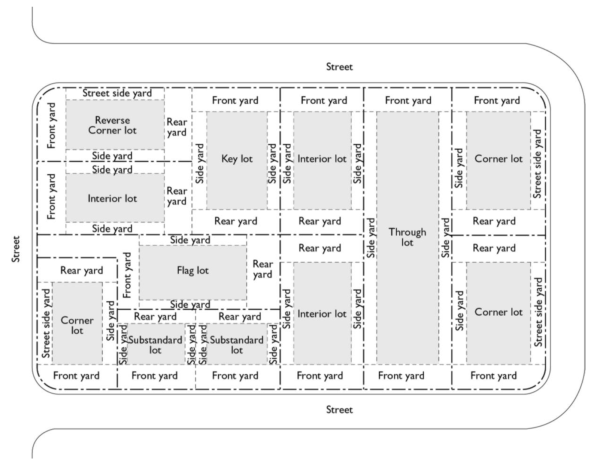 "Lot area" - means the total area, on a horizontal plane, within the lot lines of a lot.
"Lot coverage" - means a percentage figure of intensity of land use that represents the portion of a site that is impervious (i.e. does not absorb water). This portion includes, but is not limited to, all areas covered by buildings, parked structures, driveways, roads, sidewalks, and any area of concrete asphalt or other imperious surfaces.
"Lot depth" - means the average distance from the front property line to the rear property line, measured in the general direction of the side property lines of the lot.
"Lot line" - means the property line bounding a lot.
"Front lot line" means the property line abutting a public or private street or road right-of-way upon which the permanent street address is based. In the case of a corner lot where there are two (2) lot lines abutting intersecting streets, the front lot line shall normally be the one with the shortest length.
"Side lot line" means any lot line other than a front lot line or rear lot line.
"Rear lot line" means a lot line which is opposite and most distant from the front lot line.
“Lot width" - means the horizontal distance between the side lot lines, measured at the front setback line or the front platted building line, whichever is greater.
"Main building" or "main structure" - means the primary building or structure on a lot or a building or the structure that houses a principal use.
“Major street map” - means the current official map adopted by the Governing Body pursuant to KSA 12-705c as amended by KSA 12-765.
"Manufactured home" - means a structure, transportable in one (1) or more sections, which is built on a permanent chassis and is designed for use with or without a permanent foundation when connected to the required utilities which is subject to the federal manufactured home construction and safety standards established pursuant to (US Code) 42 USC Section 5403 – Construction & Safety Standards. For floodplain management purposes the term “manufactured home” also includes park trailers, travel trailers, and other similar vehicles placed on a site for greater than one hundred eighty (180) days. For insurance purposes the term “manufactured home” does not include park trailers, travel trailers, or other similar vehicles.
"Manufactured home park" - means a tract of land meeting the requirements of this ordinance containing suitable drives, utilities and other supporting elements, and devoted to the sole purpose of accommodating mobile homes or manufactured homes on a permanent or a semi-permanent basis.
"Manufactured home space" - means that area of land within a manufactured home park set aside for use as a site for one (1) manufactured home, including the open spaces around said home.
“Mixed use” - means a tract of land, building or structure developed for two (2) or more different uses including but not limited to, residential, office, manufacturing, retail, or public.
"Motor home" - means a vehicle used, or so constructed as to permit being used, as a conveyance upon the public streets and highways and constructed in such a manner as will permit occupancy thereof for human habitation, dwelling or sleeping places for one or more persons, provided further that this definition shall refer to and include all portable contrivances used or intended to be used generally for living and sleeping quarters and which is capable of being moved by its own power, towed or transported by another vehicle.
"Motel or motor hotel" - means a building or group of buildings containing one (1) undivided tract or parcel of land with a group of individual private units, each provided with separate sleeping room or rooms, having bath, lavatory and toilet facilities, designed and to be used primarily for transient guests traveling by a motor vehicle.
"Motor vehicle" - means a self-powered motorized vehicle for use on streets or highways, including customary passenger vehicles, recreational vehicles and trucks. Does not include trailers.
“Motor vehicle, dismantled” - shall mean that a number of useful parts, including but not limited to tires, batteries, doors, hoods, or windows have been stripped from the motor vehicle as to render the motor vehicle unsafe to operate.
“Motor vehicle, inoperable” - shall mean a motor vehicle which cannot be driven away in a safe or legal condition (including vehicles that are not legally tagged with the State of Kansas), and shall not include wrecked, scrapped, ruined or dismantled vehicles.
“Motor vehicle, ruined” - shall mean a motor vehicle which is substantially damaged to the extent that it is valueless or useless as an operable motor vehicle.
“Motor vehicle, scrapped” - shall mean that it has no value as an operable motor vehicle or parts thereof and most of the motor vehicle and parts thereof to be useful only as materials for reprocessing, re-melting, remanufacturing, or disposal for salvage or scrap material.
“Motor vehicle, wrecked” - shall mean those motor vehicles which have more than twenty-five (25) percent of the vehicle in damaged condition externally as to render it unsafe to operate.
“Natural features” - means the physical characteristics of properties that are not man-made (e.g. soil types, geology, slopes, vegetation, surface water, drainage patterns, aquifers, recharge areas, climate, floodplains, aquatic life, and wildlife).
“Neighborhood” - means a sub-area of the City in which the residents share a common identity focused around public facilities and social institutions or other common features, and generally within walking distance of their homes.
“Net acre” - means an acre within the perimeter of a development tract after excluding all dedicated arterial street rights-of-way.
"Net site area" - means the land area of a lot, tract or property, excluding all areas dedicated to the city, such as open space, park and greenways, and public street and alley rights-of-way, as are required by this ordinance. Easements which remain under private wnership are calculated as part of the net site area.
"Nonconforming use" - means a nonconforming situation that occurs when property is used for a purpose or in any manner made unlawful by the use regulations or development and performance standards applicable to the zoning district in which the property is located. The term also refers to the activity that constitutes the use made of the property.
"Nursing facility" - means a building, or a group of buildings, licensed by the State, where for compensation pursuant to the previous arrangement, care is offered or provided for three (3) or more persons suffering from illness, other than a contagious disease, or sociopath or psychopathic behavior, which is not of sufficient severity to require hospital attention, or for three (3) or more persons requiring further institutional care after being discharged from a hospital, clinic or similar institutions.
"Official Street Map" - means the current official map adopted by the governing body pursuant to KSA 12-705c as amended by KSA 12-765.
"Official Zoning Map" - means the zoning map adopted by the city pursuant to KSA 12-753.
"Open space" - means any parcel or area of land or water set aside, dedicated, designated or reserved for public or private use or enjoyment, or for the use and enjoyment of owners and occupants of land adjoining or neighboring such open space. Open space may include common, active and landscaped areas, as well as, areas of natural preservation.
“Open space, active” - means that part of the net site area of a development that may be improved or set aside, dedicated, designated or reserved for recreational use such as swimming pools, play equipment for children, ball fields, picnic tables, sports courts, etc.
“Open space, common” - means that part of the net site area of a development, not individually owned or dedicated for public use, that is designed and intended for the common use or enjoyment of the residents of a development.
“Open space, landscaped” - means that part of the net site area which is free of streets, structures, or parking areas and provided to improve the drainage, microclimate and aesthetics of the site. Such areas are usually landscaped and appropriately located to achieve maximum effect and appeal. Typically, such space includes lawn areas, shrubs and trees, walkways, paved terraces, sitting areas and outdoor recreational areas. Unpaved land areas within private or public street rights-of-way are not counted as landscaped open space unless they are in excess of minimum right-of-way standards.
"Ordinance" - means the City of Cheney, Kansas Zoning Code.
"Other motorized machinery and equipment" - means a vehicle or equipment not generally used on streets or highways and designed for use during construction, landscaping, farming and similar activities. Examples include tractors, combines, backhoes, graders, cranes, etc.
"Overlay district" - means a district which acts in conjunction with the underlying zoning district or districts.
"Parking area or lot" - means any portion of a parcel of land used for parking or storage of operable motor vehicles on a temporary (less than twenty-four [24] hour) basis which is connected with a street or alley by a paved driveway which affords ingress and egress for motor vehicles.
"Parking space" - means an enclosed or unenclosed paved area permanently reserved for the temporary (less than twenty-four [24] hour) storage of motor vehicles and connected with a street or alley by a paved driveway which affords ingress and egress for motor vehicles.
“Permit, building” - means a permit issued by the building official which authorizes the construction, reconstruction, alteration, enlargement, conversion, remodeling, rehabilitation, erection, demolition, moving or repair of a building or structure.
“Permit, special use” - means a specific approval for a use that has been determined to be more intense or to have a potentially greater impact than a permitted or conditional use within the same zoning district.
"Planned zoning district" - means the zoning of a lot or tract to permit that development as specifically depicted on plans approved in the process of zoning that lot or tract.
"Plat" - means a map depicting the division or subdivision of land into lots, blocks, parcels, tracts or other portions thereof.
"Plat, Final" means a drawing of a permanent nature showing the precise location and dimension of such features as streets, lots, easements and other elements pertinent to transfer of ownership and prepared for permanent record.
"Plat, Preliminary" means a drawing showing the proposed general patterns of streets, lots and land uses within a tract to be subdivided.
“Plat, One-Step” means the combination of a Plat, Final and Plat, Preliminary into a single Final Plat for submission to, review and approval by the City in accordance with the provisions of this Code and relevant state statutes.
"Recreational vehicle" - means a vehicular-type unit primarily designed as temporary living quarters for recreational, camping, or travel use, which either has its own motive power or is mounted on or drawn by another vehicle. The entities are: camping trailer, fifth-wheel trailer, motor home, travel trailer, and truck camper. It does not include pickup hoods, shells or canopies designed, created or modified for occupational usage.
"Camping trailer" means a vehicular portable unit mounted on wheels and constructed with collapsible partial side walls which fold for towing by another vehicle and unfold at the campsite to provide temporary living quarters for recreational, camping or travel use.
"Fifth - wheel trailer" means a vehicular unit, mounted on wheels, designed to provide temporary living quarters for recreational, camping or travel use, of such size or weight as not to require special highway movement permit(s), of gross trailer area not to exceed four hundred (400) square feet in the set up setup mode, and designed to be towed by a motorized vehicle that contains a towing mechanism that is mounted above or forward of the tow vehicle's rear axle.
"Motor home" means a vehicular unit designed to provide temporary living quarters for recreational, camping or travel use built on or permanently attached to a self-propelled motor vehicle chassis or on a chassis cab or van which is an integral part of the completed vehicle.
"Travel trailer" means a vehicular unit, mounted on wheels, designed to provide temporary living quarters for recreational, camping or travel use, of such size or weight as not to require special highway movement permits when towed by a motorized vehicle, and of gross trailer area less than three hundred twenty (320) square feet.
"Truck camper" means a portable unit constructed to provide temporary living quarters for recreational, camping or travel use, consisting of a roof, floor and sides, designed with a minimum extension of thirty-six (36) inches extending over the cab of a pickup truck, and designed to be loaded onto and unloaded from the bed of a pickup truck.
"Recycling collection point" - means an accessory use or structure that serves as a drop-off point for recyclable materials. The temporary storage of such items would be permitted, but no processing would be allowed.
“Redevelopment” - means the redesign or rehabilitation of existing properties.
"Regulatory flood elevation" - means elevation indicated in the Flood Insurance Study as the elevation of the one hundred (100) year flood.
"Residential districts" - refers to zoning districts RR, R-1, R-2, R-3, R-4.
"Restaurant" - means a building wherein food is prepared and served in ready-to-eat form to the public for human consumption. "Restaurant" includes cafe, cafeteria, grill, pizza parlor, diner, snack shop, hamburger shop, steak house, etc.
"Re-subdivision" - means a change in a map of an approved or recorded subdivision plat, if such change affects any street layout on such map or area reserved for public use, or any lot line; or if it affects any map or plan legally recorded prior to the adoption date of this ordinance. “Retention basin” - means a reservoir designed to retain storm water runoff on a relatively permanent basis with the primary release of water being through evaporation, infiltration into the ground or controlled overflow.
"Rezoning" - means an application for amendment of the zoning district classification applicable to one (1) or more specific lots or tracts.
“Right-of-way” or “rights-of-way” - means the total width of any land reserved or dedicated as a street, alley, sidewalk, or for other public or private use.
"Rule exception" - means the allowing of a subdivision to deviate from one (1) or more specific standards and requirements of these rules and regulations.
“Runoff” - means the surface water discharge and rate of discharge of a given watershed after a full rain or snow that does not enter the soil but runs off the surface of the land.
“Salvage yard” - means any establishment or part thereof, which is maintained, used or operated for storing, keeping, buying, repairing, or selling any wrecked, scrapped, ruined, and/or dismantled motor vehicles or parts thereof.
“Screening” - means a method of visually shielding or obscuring one abutting or nearby structure or use from another by the use of berms, densely planted vegetation, fencing, or walls.
“Sedimentation” - means the process by which soil or other surface material is accumulated or deposited by wind, water, or gravity.
"Setback line" - means a line, parallel to the respective lot line and internal to the lot, which defines the required building setback as specified in the district regulations.
"Front setback line" shall be parallel to the front lot line and shall extend from side lot line to side lot line.
"Rear setback line" shall be parallel to all rear lot lines and shall extend from side lot line to side lot line.
"Side setback lines" are parallel to any side lot line and extend from the front setback line to the rear setback line.
"Setback" or "building setback" or "yard setback" - means that area between a lot line and the respective setback line which shall remain unobstructed by buildings or structures from the ground to the sky, except as may be specifically permitted by other provisions of the Zoning Ordinance.
"Shopping center" - means a group of commercial establishments planned, developed, owned or managed as a unit, related in size (gross floor area) and type of shops to the trade area that the unit serves, and with off-street parking provided on the property.
"Sight Distance" - means a triangular shaped portion of land established at street intersections in which nothing is erected, placed, planted or allowed to grow in such a manner as to limit or obstruct the sight distance of motorists entering or leaving an intersection.
"Sign" - means any framed, bracketed, free-formed, or engraved surface which is fabricated to create words, numerals, figures, devices, designs, trademarks or logos, which is mounted on or affixed to a building or the ground, and which is sufficiently visible to persons not located on the lot where such device is located to attract the attention of such persons or to communicate information to them. "Sign" includes sign supports.
“Site” - means the existing lot of record proposed for land development, including subdivision.
"Site development plan" - means a detailed drawing (to scale) showing the proposed development of a specified parcel of land, including the location and design of buildings, easements, utility layouts, parking arrangements, public access, street patterns, drainage controls, existing vegetation and natural features, landscaping, lighting and other similar features.
"Stable" - means a structure or premises for the keeping of horses, ponies, donkeys or mules.
"Storage" or "stored" - shall mean the keeping of items, equipment, vehicles, trailers or materials for a period of time longer than would be involved in the normal day-to-day use or consumption of the same.
“Storage area or lot” - means any off-street area designated and used for the placement, keeping, holding and storage of inoperable vehicles, vehicles awaiting repair, and parts thereof; building materials, supplies and equipment; trailers; heavy construction equipment and other motorized vehicles and equipment, but not for junkyard or salvage yard purposes.
"Story" - means that part of a building included between the surface of one (1) floor and the surface of the floor above or, if there is no floor above, that part of the building which is between the surface of the floor and the ceiling next above. A top story attic is a half-story when the main line of the eaves is not above the middle of the interior height of such story. The first story is a half-story when between fifty (50) and seventy-five (75) percent of the area of its exterior walls are exposed to outside light and air entirely above grade in which exterior walls contain windows or doors permitting the entrance of daylight and outside air. When less than fifty (50) percent of the area of the walls of the first story is exposed to outside light and air entirely above grade, that story shall be classed as a basement and in the case of multifamily dwellings may not be occupied as a residence by other than a caretaker or manager.
"Street" - means a right-of-way or easement affording vehicular access to abutting properties designated as a street, avenue, highway, road, boulevard, lane or throughway. The following are street types:
"Collector Street" means a street which provides traffic circulation within residential areas. Land access is a secondary function of the collector. The collector distributes trips from the arterials to the local street network.
"Local Street" means a street which provides direct traffic access to abutting land in residential areas.
"Major Arterial" means a street or highway that provides for rapid and efficient movement of large volumes of through traffic between sections of the city and across the urbanized area. It is not primarily intended to provide land access service.
"Minor Arterial" means a street which provides for the through traffic movement between areas and across the city. A minor arterial accommodates trips of moderate length at a somewhat lower level of service and lower operating speeds than the major arterial.
"Private street" means an easement which affords principal access to property abutting thereon, which easement is owned, controlled and maintained by persons other than the public.
"Public street" means a right-of-way which affords the principal means of vehicular access to property abutting thereon which right-of-way has been dedicated to the public for such use.
"Service Street" means a street which provides traffic circulation within commercial and industrial developments and complexes from the arterial street system.
"Street line" - means the dividing line between the street right-of-way and the abutting property commonly known as the property line.
"Structural alteration" - means any change in the supporting members of a building, such as bearing walls, columns, beams or girders.
"Structure" - means anything constructed or erected, which requires location on the ground, or attached to something having a location on the ground.
"Subdivider" - means a person, firm or corporation undertaking the subdividing of land.
"Subdivision" - except for "lot-split" as defined below, means the division of a lot, tract or parcel of land into two (2) or more lots, plots, sites or other division of less than five (5) acres, including a re-subdivision of land and vacation of streets, lots or alleys. The creation of a street, alley or other public way by dedication shall be deemed a subdivision. "Lot-split" means the division of a platted lot into two (2) or more lots or portions thereof.
"Temporary structure" - means a structure that is to be removed within a designated time period, activity, or use for which the temporary structure was erected has ended.
"Tract" - means a single unit of real property under one (1) ownership, which may be platted or unplatted.
"Trailer" - means a vehicle equipped with wheels and normally towed over the road behind a motor vehicle.
"Advertising trailer" means a trailer carrying, or having attached thereto a sign, billboard or other media for advertising purposes, such advertising being the prime purpose and use of the trailer.
"Use" - means the purpose or activity for which the land, or building thereon, is designed, arranged or intended, or for which it is occupied or maintained.
“Use, permitted” - means a use permitted by right without the need for special administrative review and approval.
"Use, principal" - means the main use of land or buildings as distinguished from a subordinate or accessory use. The principal use may be either a permitted or a special use.
"Use, special" - means a use either public or private, which, because of its characteristics, cannot be classified as a permitted use in a particular district or districts without prior review and recommendation by the Planning Commission and approval by the Governing Body. Special uses may be conditionally approved.
"Use, temporary" - means any use designed, built, erected or occupied for short and/or intermittent periods of time and shall include tents, lunch wagons, dining cars, trailers and other roofed structures on wheels or other supports used for business, storage, industrial, institutional, assembly, educational or recreational purposes. Such temporary use requires a permit from the City.
"Variance" - means a variation from a specific requirement in this ordinance applicable to a specific piece of property as provided in Section 5.33 – Chapter 5 Applications and Procedures hereto.
“Waiver” - means a process for alleviating a specific requirement in this ordinance.
“Watercourse” - means a channel in which a flow of water occurs, either continuously or intermittently, and in the latter, with some degree of regularity. Such flow must be in a definite direction and cover a prescribed area. Watercourses may be either natural or artificial, and both may occur either on the surface or underground.
“Watershed” - means a land area, also known as a drainage area, which collects precipitation and contributes runoff to a receiving body of water or point along a watercourse.
"Yard" - means any open space on the same lot or parcel with a building or group of buildings, which open space is unoccupied and unobstructed from the ground upward to the sky, except for building projections or for accessory buildings or structures permitted by these regulations.
''Front yard'' means a yard across the full width of the lot extending from the front line of the main building to the front lot line, adjacent to a street.
''Rear yard'' means the area between the rear property line and the rear yard setback line, which extends the full width of the lot or parcel.
''Side yard'' means the area from the front yard or from the front lot or parcel line where no front yard is required by these regulations, to the rear yard, or rear lot or parcel line, between a side lot or parcel line and the side yard setback line. See diagram below.
"Lot area" - means the total area, on a horizontal plane, within the lot lines of a lot.
"Lot coverage" - means a percentage figure of intensity of land use that represents the portion of a site that is impervious (i.e. does not absorb water). This portion includes, but is not limited to, all areas covered by buildings, parked structures, driveways, roads, sidewalks, and any area of concrete asphalt or other imperious surfaces.
"Lot depth" - means the average distance from the front property line to the rear property line, measured in the general direction of the side property lines of the lot.
"Lot line" - means the property line bounding a lot.
"Front lot line" means the property line abutting a public or private street or road right-of-way upon which the permanent street address is based. In the case of a corner lot where there are two (2) lot lines abutting intersecting streets, the front lot line shall normally be the one with the shortest length.
"Side lot line" means any lot line other than a front lot line or rear lot line.
"Rear lot line" means a lot line which is opposite and most distant from the front lot line.
“Lot width" - means the horizontal distance between the side lot lines, measured at the front setback line or the front platted building line, whichever is greater.
"Main building" or "main structure" - means the primary building or structure on a lot or a building or the structure that houses a principal use.
“Major street map” - means the current official map adopted by the Governing Body pursuant to KSA 12-705c as amended by KSA 12-765.
"Manufactured home" - means a structure, transportable in one (1) or more sections, which is built on a permanent chassis and is designed for use with or without a permanent foundation when connected to the required utilities which is subject to the federal manufactured home construction and safety standards established pursuant to (US Code) 42 USC Section 5403 – Construction & Safety Standards. For floodplain management purposes the term “manufactured home” also includes park trailers, travel trailers, and other similar vehicles placed on a site for greater than one hundred eighty (180) days. For insurance purposes the term “manufactured home” does not include park trailers, travel trailers, or other similar vehicles.
"Manufactured home park" - means a tract of land meeting the requirements of this ordinance containing suitable drives, utilities and other supporting elements, and devoted to the sole purpose of accommodating mobile homes or manufactured homes on a permanent or a semi-permanent basis.
"Manufactured home space" - means that area of land within a manufactured home park set aside for use as a site for one (1) manufactured home, including the open spaces around said home.
“Mixed use” - means a tract of land, building or structure developed for two (2) or more different uses including but not limited to, residential, office, manufacturing, retail, or public.
"Motor home" - means a vehicle used, or so constructed as to permit being used, as a conveyance upon the public streets and highways and constructed in such a manner as will permit occupancy thereof for human habitation, dwelling or sleeping places for one or more persons, provided further that this definition shall refer to and include all portable contrivances used or intended to be used generally for living and sleeping quarters and which is capable of being moved by its own power, towed or transported by another vehicle.
"Motel or motor hotel" - means a building or group of buildings containing one (1) undivided tract or parcel of land with a group of individual private units, each provided with separate sleeping room or rooms, having bath, lavatory and toilet facilities, designed and to be used primarily for transient guests traveling by a motor vehicle.
"Motor vehicle" - means a self-powered motorized vehicle for use on streets or highways, including customary passenger vehicles, recreational vehicles and trucks. Does not include trailers.
“Motor vehicle, dismantled” - shall mean that a number of useful parts, including but not limited to tires, batteries, doors, hoods, or windows have been stripped from the motor vehicle as to render the motor vehicle unsafe to operate.
“Motor vehicle, inoperable” - shall mean a motor vehicle which cannot be driven away in a safe or legal condition (including vehicles that are not legally tagged with the State of Kansas), and shall not include wrecked, scrapped, ruined or dismantled vehicles.
“Motor vehicle, ruined” - shall mean a motor vehicle which is substantially damaged to the extent that it is valueless or useless as an operable motor vehicle.
“Motor vehicle, scrapped” - shall mean that it has no value as an operable motor vehicle or parts thereof and most of the motor vehicle and parts thereof to be useful only as materials for reprocessing, re-melting, remanufacturing, or disposal for salvage or scrap material.
“Motor vehicle, wrecked” - shall mean those motor vehicles which have more than twenty-five (25) percent of the vehicle in damaged condition externally as to render it unsafe to operate.
“Natural features” - means the physical characteristics of properties that are not man-made (e.g. soil types, geology, slopes, vegetation, surface water, drainage patterns, aquifers, recharge areas, climate, floodplains, aquatic life, and wildlife).
“Neighborhood” - means a sub-area of the City in which the residents share a common identity focused around public facilities and social institutions or other common features, and generally within walking distance of their homes.
“Net acre” - means an acre within the perimeter of a development tract after excluding all dedicated arterial street rights-of-way.
"Net site area" - means the land area of a lot, tract or property, excluding all areas dedicated to the city, such as open space, park and greenways, and public street and alley rights-of-way, as are required by this ordinance. Easements which remain under private wnership are calculated as part of the net site area.
"Nonconforming use" - means a nonconforming situation that occurs when property is used for a purpose or in any manner made unlawful by the use regulations or development and performance standards applicable to the zoning district in which the property is located. The term also refers to the activity that constitutes the use made of the property.
"Nursing facility" - means a building, or a group of buildings, licensed by the State, where for compensation pursuant to the previous arrangement, care is offered or provided for three (3) or more persons suffering from illness, other than a contagious disease, or sociopath or psychopathic behavior, which is not of sufficient severity to require hospital attention, or for three (3) or more persons requiring further institutional care after being discharged from a hospital, clinic or similar institutions.
"Official Street Map" - means the current official map adopted by the governing body pursuant to KSA 12-705c as amended by KSA 12-765.
"Official Zoning Map" - means the zoning map adopted by the city pursuant to KSA 12-753.
"Open space" - means any parcel or area of land or water set aside, dedicated, designated or reserved for public or private use or enjoyment, or for the use and enjoyment of owners and occupants of land adjoining or neighboring such open space. Open space may include common, active and landscaped areas, as well as, areas of natural preservation.
“Open space, active” - means that part of the net site area of a development that may be improved or set aside, dedicated, designated or reserved for recreational use such as swimming pools, play equipment for children, ball fields, picnic tables, sports courts, etc.
“Open space, common” - means that part of the net site area of a development, not individually owned or dedicated for public use, that is designed and intended for the common use or enjoyment of the residents of a development.
“Open space, landscaped” - means that part of the net site area which is free of streets, structures, or parking areas and provided to improve the drainage, microclimate and aesthetics of the site. Such areas are usually landscaped and appropriately located to achieve maximum effect and appeal. Typically, such space includes lawn areas, shrubs and trees, walkways, paved terraces, sitting areas and outdoor recreational areas. Unpaved land areas within private or public street rights-of-way are not counted as landscaped open space unless they are in excess of minimum right-of-way standards.
"Ordinance" - means the City of Cheney, Kansas Zoning Code.
"Other motorized machinery and equipment" - means a vehicle or equipment not generally used on streets or highways and designed for use during construction, landscaping, farming and similar activities. Examples include tractors, combines, backhoes, graders, cranes, etc.
"Overlay district" - means a district which acts in conjunction with the underlying zoning district or districts.
"Parking area or lot" - means any portion of a parcel of land used for parking or storage of operable motor vehicles on a temporary (less than twenty-four [24] hour) basis which is connected with a street or alley by a paved driveway which affords ingress and egress for motor vehicles.
"Parking space" - means an enclosed or unenclosed paved area permanently reserved for the temporary (less than twenty-four [24] hour) storage of motor vehicles and connected with a street or alley by a paved driveway which affords ingress and egress for motor vehicles.
“Permit, building” - means a permit issued by the building official which authorizes the construction, reconstruction, alteration, enlargement, conversion, remodeling, rehabilitation, erection, demolition, moving or repair of a building or structure.
“Permit, special use” - means a specific approval for a use that has been determined to be more intense or to have a potentially greater impact than a permitted or conditional use within the same zoning district.
"Planned zoning district" - means the zoning of a lot or tract to permit that development as specifically depicted on plans approved in the process of zoning that lot or tract.
"Plat" - means a map depicting the division or subdivision of land into lots, blocks, parcels, tracts or other portions thereof.
"Plat, Final" means a drawing of a permanent nature showing the precise location and dimension of such features as streets, lots, easements and other elements pertinent to transfer of ownership and prepared for permanent record.
"Plat, Preliminary" means a drawing showing the proposed general patterns of streets, lots and land uses within a tract to be subdivided.
“Plat, One-Step” means the combination of a Plat, Final and Plat, Preliminary into a single Final Plat for submission to, review and approval by the City in accordance with the provisions of this Code and relevant state statutes.
"Recreational vehicle" - means a vehicular-type unit primarily designed as temporary living quarters for recreational, camping, or travel use, which either has its own motive power or is mounted on or drawn by another vehicle. The entities are: camping trailer, fifth-wheel trailer, motor home, travel trailer, and truck camper. It does not include pickup hoods, shells or canopies designed, created or modified for occupational usage.
"Camping trailer" means a vehicular portable unit mounted on wheels and constructed with collapsible partial side walls which fold for towing by another vehicle and unfold at the campsite to provide temporary living quarters for recreational, camping or travel use.
"Fifth - wheel trailer" means a vehicular unit, mounted on wheels, designed to provide temporary living quarters for recreational, camping or travel use, of such size or weight as not to require special highway movement permit(s), of gross trailer area not to exceed four hundred (400) square feet in the set up setup mode, and designed to be towed by a motorized vehicle that contains a towing mechanism that is mounted above or forward of the tow vehicle's rear axle.
"Motor home" means a vehicular unit designed to provide temporary living quarters for recreational, camping or travel use built on or permanently attached to a self-propelled motor vehicle chassis or on a chassis cab or van which is an integral part of the completed vehicle.
"Travel trailer" means a vehicular unit, mounted on wheels, designed to provide temporary living quarters for recreational, camping or travel use, of such size or weight as not to require special highway movement permits when towed by a motorized vehicle, and of gross trailer area less than three hundred twenty (320) square feet.
"Truck camper" means a portable unit constructed to provide temporary living quarters for recreational, camping or travel use, consisting of a roof, floor and sides, designed with a minimum extension of thirty-six (36) inches extending over the cab of a pickup truck, and designed to be loaded onto and unloaded from the bed of a pickup truck.
"Recycling collection point" - means an accessory use or structure that serves as a drop-off point for recyclable materials. The temporary storage of such items would be permitted, but no processing would be allowed.
“Redevelopment” - means the redesign or rehabilitation of existing properties.
"Regulatory flood elevation" - means elevation indicated in the Flood Insurance Study as the elevation of the one hundred (100) year flood.
"Residential districts" - refers to zoning districts RR, R-1, R-2, R-3, R-4.
"Restaurant" - means a building wherein food is prepared and served in ready-to-eat form to the public for human consumption. "Restaurant" includes cafe, cafeteria, grill, pizza parlor, diner, snack shop, hamburger shop, steak house, etc.
"Re-subdivision" - means a change in a map of an approved or recorded subdivision plat, if such change affects any street layout on such map or area reserved for public use, or any lot line; or if it affects any map or plan legally recorded prior to the adoption date of this ordinance. “Retention basin” - means a reservoir designed to retain storm water runoff on a relatively permanent basis with the primary release of water being through evaporation, infiltration into the ground or controlled overflow.
"Rezoning" - means an application for amendment of the zoning district classification applicable to one (1) or more specific lots or tracts.
“Right-of-way” or “rights-of-way” - means the total width of any land reserved or dedicated as a street, alley, sidewalk, or for other public or private use.
"Rule exception" - means the allowing of a subdivision to deviate from one (1) or more specific standards and requirements of these rules and regulations.
“Runoff” - means the surface water discharge and rate of discharge of a given watershed after a full rain or snow that does not enter the soil but runs off the surface of the land.
“Salvage yard” - means any establishment or part thereof, which is maintained, used or operated for storing, keeping, buying, repairing, or selling any wrecked, scrapped, ruined, and/or dismantled motor vehicles or parts thereof.
“Screening” - means a method of visually shielding or obscuring one abutting or nearby structure or use from another by the use of berms, densely planted vegetation, fencing, or walls.
“Sedimentation” - means the process by which soil or other surface material is accumulated or deposited by wind, water, or gravity.
"Setback line" - means a line, parallel to the respective lot line and internal to the lot, which defines the required building setback as specified in the district regulations.
"Front setback line" shall be parallel to the front lot line and shall extend from side lot line to side lot line.
"Rear setback line" shall be parallel to all rear lot lines and shall extend from side lot line to side lot line.
"Side setback lines" are parallel to any side lot line and extend from the front setback line to the rear setback line.
"Setback" or "building setback" or "yard setback" - means that area between a lot line and the respective setback line which shall remain unobstructed by buildings or structures from the ground to the sky, except as may be specifically permitted by other provisions of the Zoning Ordinance.
"Shopping center" - means a group of commercial establishments planned, developed, owned or managed as a unit, related in size (gross floor area) and type of shops to the trade area that the unit serves, and with off-street parking provided on the property.
"Sight Distance" - means a triangular shaped portion of land established at street intersections in which nothing is erected, placed, planted or allowed to grow in such a manner as to limit or obstruct the sight distance of motorists entering or leaving an intersection.
"Sign" - means any framed, bracketed, free-formed, or engraved surface which is fabricated to create words, numerals, figures, devices, designs, trademarks or logos, which is mounted on or affixed to a building or the ground, and which is sufficiently visible to persons not located on the lot where such device is located to attract the attention of such persons or to communicate information to them. "Sign" includes sign supports.
“Site” - means the existing lot of record proposed for land development, including subdivision.
"Site development plan" - means a detailed drawing (to scale) showing the proposed development of a specified parcel of land, including the location and design of buildings, easements, utility layouts, parking arrangements, public access, street patterns, drainage controls, existing vegetation and natural features, landscaping, lighting and other similar features.
"Stable" - means a structure or premises for the keeping of horses, ponies, donkeys or mules.
"Storage" or "stored" - shall mean the keeping of items, equipment, vehicles, trailers or materials for a period of time longer than would be involved in the normal day-to-day use or consumption of the same.
“Storage area or lot” - means any off-street area designated and used for the placement, keeping, holding and storage of inoperable vehicles, vehicles awaiting repair, and parts thereof; building materials, supplies and equipment; trailers; heavy construction equipment and other motorized vehicles and equipment, but not for junkyard or salvage yard purposes.
"Story" - means that part of a building included between the surface of one (1) floor and the surface of the floor above or, if there is no floor above, that part of the building which is between the surface of the floor and the ceiling next above. A top story attic is a half-story when the main line of the eaves is not above the middle of the interior height of such story. The first story is a half-story when between fifty (50) and seventy-five (75) percent of the area of its exterior walls are exposed to outside light and air entirely above grade in which exterior walls contain windows or doors permitting the entrance of daylight and outside air. When less than fifty (50) percent of the area of the walls of the first story is exposed to outside light and air entirely above grade, that story shall be classed as a basement and in the case of multifamily dwellings may not be occupied as a residence by other than a caretaker or manager.
"Street" - means a right-of-way or easement affording vehicular access to abutting properties designated as a street, avenue, highway, road, boulevard, lane or throughway. The following are street types:
"Collector Street" means a street which provides traffic circulation within residential areas. Land access is a secondary function of the collector. The collector distributes trips from the arterials to the local street network.
"Local Street" means a street which provides direct traffic access to abutting land in residential areas.
"Major Arterial" means a street or highway that provides for rapid and efficient movement of large volumes of through traffic between sections of the city and across the urbanized area. It is not primarily intended to provide land access service.
"Minor Arterial" means a street which provides for the through traffic movement between areas and across the city. A minor arterial accommodates trips of moderate length at a somewhat lower level of service and lower operating speeds than the major arterial.
"Private street" means an easement which affords principal access to property abutting thereon, which easement is owned, controlled and maintained by persons other than the public.
"Public street" means a right-of-way which affords the principal means of vehicular access to property abutting thereon which right-of-way has been dedicated to the public for such use.
"Service Street" means a street which provides traffic circulation within commercial and industrial developments and complexes from the arterial street system.
"Street line" - means the dividing line between the street right-of-way and the abutting property commonly known as the property line.
"Structural alteration" - means any change in the supporting members of a building, such as bearing walls, columns, beams or girders.
"Structure" - means anything constructed or erected, which requires location on the ground, or attached to something having a location on the ground.
"Subdivider" - means a person, firm or corporation undertaking the subdividing of land.
"Subdivision" - except for "lot-split" as defined below, means the division of a lot, tract or parcel of land into two (2) or more lots, plots, sites or other division of less than five (5) acres, including a re-subdivision of land and vacation of streets, lots or alleys. The creation of a street, alley or other public way by dedication shall be deemed a subdivision. "Lot-split" means the division of a platted lot into two (2) or more lots or portions thereof.
"Temporary structure" - means a structure that is to be removed within a designated time period, activity, or use for which the temporary structure was erected has ended.
"Tract" - means a single unit of real property under one (1) ownership, which may be platted or unplatted.
"Trailer" - means a vehicle equipped with wheels and normally towed over the road behind a motor vehicle.
"Advertising trailer" means a trailer carrying, or having attached thereto a sign, billboard or other media for advertising purposes, such advertising being the prime purpose and use of the trailer.
"Use" - means the purpose or activity for which the land, or building thereon, is designed, arranged or intended, or for which it is occupied or maintained.
“Use, permitted” - means a use permitted by right without the need for special administrative review and approval.
"Use, principal" - means the main use of land or buildings as distinguished from a subordinate or accessory use. The principal use may be either a permitted or a special use.
"Use, special" - means a use either public or private, which, because of its characteristics, cannot be classified as a permitted use in a particular district or districts without prior review and recommendation by the Planning Commission and approval by the Governing Body. Special uses may be conditionally approved.
"Use, temporary" - means any use designed, built, erected or occupied for short and/or intermittent periods of time and shall include tents, lunch wagons, dining cars, trailers and other roofed structures on wheels or other supports used for business, storage, industrial, institutional, assembly, educational or recreational purposes. Such temporary use requires a permit from the City.
"Variance" - means a variation from a specific requirement in this ordinance applicable to a specific piece of property as provided in Section 5.33 – Chapter 5 Applications and Procedures hereto.
“Waiver” - means a process for alleviating a specific requirement in this ordinance.
“Watercourse” - means a channel in which a flow of water occurs, either continuously or intermittently, and in the latter, with some degree of regularity. Such flow must be in a definite direction and cover a prescribed area. Watercourses may be either natural or artificial, and both may occur either on the surface or underground.
“Watershed” - means a land area, also known as a drainage area, which collects precipitation and contributes runoff to a receiving body of water or point along a watercourse.
"Yard" - means any open space on the same lot or parcel with a building or group of buildings, which open space is unoccupied and unobstructed from the ground upward to the sky, except for building projections or for accessory buildings or structures permitted by these regulations.
''Front yard'' means a yard across the full width of the lot extending from the front line of the main building to the front lot line, adjacent to a street.
''Rear yard'' means the area between the rear property line and the rear yard setback line, which extends the full width of the lot or parcel.
''Side yard'' means the area from the front yard or from the front lot or parcel line where no front yard is required by these regulations, to the rear yard, or rear lot or parcel line, between a side lot or parcel line and the side yard setback line. See diagram below.
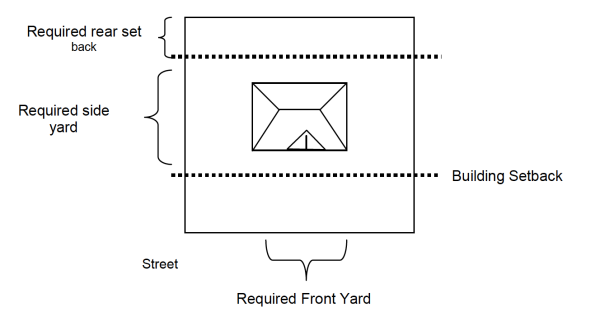 ''Required yard'' means that portion of any yard constituting the minimum area required in any zoning district, but excluding that portion of the yard in excess of the minimum required area.
“Side Street Front Yard” means a yard that occurs on a corner lot along the length of the lot. The side street front yard is adjacent to the side street public right-of-way and is generally perpendicular to the established front yard. Special setback requirements apply for side street front yards, see Figure A1 and A2.
Figure A1:
''Required yard'' means that portion of any yard constituting the minimum area required in any zoning district, but excluding that portion of the yard in excess of the minimum required area.
“Side Street Front Yard” means a yard that occurs on a corner lot along the length of the lot. The side street front yard is adjacent to the side street public right-of-way and is generally perpendicular to the established front yard. Special setback requirements apply for side street front yards, see Figure A1 and A2.
Figure A1: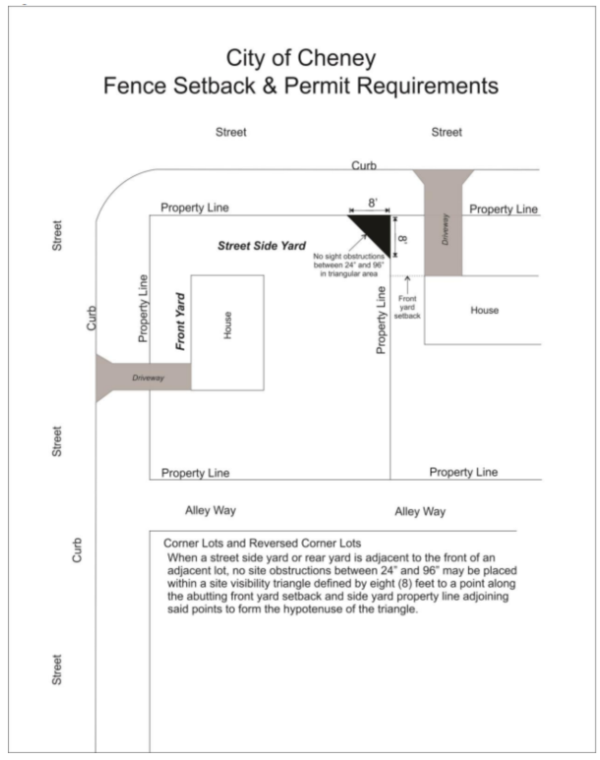 Figure A2:
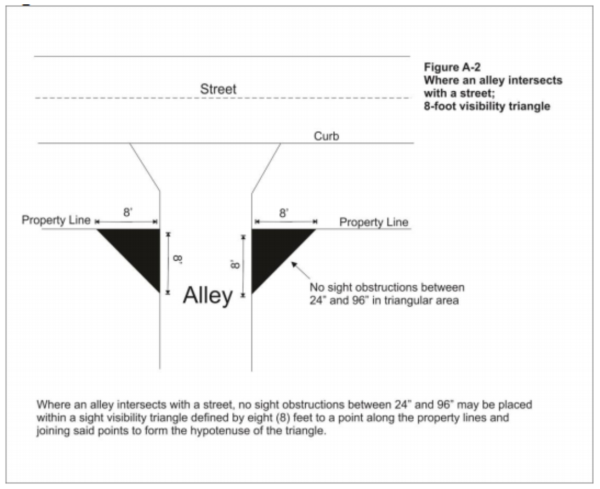 “Zoning” - means the division of the City by legislative regulations into areas, or zones, which specify allowable uses for real property and size and density restrictions for buildings within these areas.
“Zoning Certificate” - means a certificate issued by the City, certifying that any proposed use, building, or structure to be located on a lot is in accordance with all of the regulations of this ordinance.
“Zoning district” - means a section or sections of the City for which the regulations governing the use of buildings and lands are uniform for each class or use permitted therein.”
“Zoning” - means the division of the City by legislative regulations into areas, or zones, which specify allowable uses for real property and size and density restrictions for buildings within these areas.
“Zoning Certificate” - means a certificate issued by the City, certifying that any proposed use, building, or structure to be located on a lot is in accordance with all of the regulations of this ordinance.
“Zoning district” - means a section or sections of the City for which the regulations governing the use of buildings and lands are uniform for each class or use permitted therein.”
Amended by Ord. 968 - Zoning Changes on 4/17/2025

