
Chewelah City Zoning Code
CHAPTER 18
12 - SUPPLEMENTARY STANDARDS
18.12.010 Purpose
Provisions of this chapter are of general application to several zones unless otherwise noted. It is the intent of this title to provide standards sufficient to afford continuing protection to property and yet be adaptable enough to avoid unnecessary hardship or interference with growth and natural change.
(Ord. No. 900, § 7, 8-3-2016)
18.12.020 Parking And Loading Standards
- Parking Spaces Required.
- The number of required off-street parking spaces shall be as follows.
Land Use Parking Spaces Required Single-Family Residence (including Townhouses) one covered space Accessory Dwelling Units one space per unit Co-Living Housing 0.25 spaces per sleeping unit Duplex one covered space per unit Multi-Family Residency one space per unit Cottage Developments one space per unit Manufactured Home Parks one space per unit Hotels, Motels, Tourist Courts, Boarding House, and other establishments providing rooms or suites for overnight stay one space for each unit/room Retails Uses one space for each 500 gross square feet of building area Places of Assembly one space per six fixed seats or one space per 100 square feet of assembly area Professional and General Offices one space for each 500 gross square feet of building area Industrial Uses one space for each 500 gross square feet of building area Schools one space for each 1000 gross square feet of building area Assisted Living Facilities, Retirement Homes, Nursing Homes, or other similar facilities one space per two living units - For nonresidential uses, a maximum of thirty percent of the required spaces may be compact in size.
- Number and size of handicapped parking spaces shall be as per state requirements.
- Retail, professional, and general office uses within the central business district overlay zone shall provide parking spaces at one-half the requirements of this chapter. The requirements of this chapter may be waived by the current administrative designee provided a sum, identified per fee resolution, is deposited into a trust account to be used by the city to provide parking spaces within or near the downtown business district overlay zone.
- The number of required off-street parking spaces shall be as follows.
(Ord. No. 900, § 7, 8-3-2016)
Amended by Ord. 958 on 6/2/2021
Repealed & Replaced by Ord. 1010 on 6/30/2025
18.12.030 Landscaping, Screening And Maintenance
- Purpose and Intent. The purpose of this section is to establish landscaping and property maintenance standards to enhance the aesthetic appearance of property throughout Chewelah. In addition, the standards are established to protect the health and safety of the residents and users of the properties.
- Landscape Screening.
- Screening shall provide a filtered view minimizing the blocking of the view to the extent possible and may be provided by existing vegetation, landscaped areas, including the use of hedges, berms, fencing or a combination thereof. The use of vegetation (trees and columnar shrubs) is encouraged.
- Perimeter screening shall be provided as follows:
- At the sides and rear of all commercial and industrial sites to provide an all season visual separation and a wind break between adjacent land uses. Perimeter landscaping shall shield the views of industrial and commercial land uses, including outdoor storage, service, and loading areas, from roads and adjacent uses. If, however, the rear of the site is adjacent to an agricultural use, no rear yard perimeter screening is required.
- Perimeter landscaping shall be required to screen loading areas, waste disposal areas, and outdoor storage areas.
- A minimum five-foot-wide perimeter screening shall be provided adjacent to roads.
- Trees and columnar shrubs shall be a minimum of four feet in height at the time of planting and shall grow to a minimum of eight feet within five years.
- Avoid obstructing views of crosswalks, intersections and street lights.
- Additional screening may be required between dissimilar land uses, at the discretion of the city planner.
- Screening requirements may be relaxed if warranted by the use of clustering or shared access, at the discretion of the city planner.
- Interior screening shall be required for parking areas according to the following minimum requirements:
- Landscaping shall be provided at a minimum of ten percent of the parking area.
- One tree for every ten single row parking spaces or twenty spaces if parking is in double rows shall be provided, for summer shade.
- Minimum tree size at planting shall be two-inch caliper.
- Trees shall be planted a minimum of three feet from curbs and sidewalks.
- Screening may include shrubs suitable to be maintained at a height of three feet.
- Avoid obstructing views of crosswalks, intersections, and streetlights.
- The city planner may require perimeter and/or interior landscaping or perimeter fences in accordance with CMC 18.12.060 in mobile home parks.
- Landscape Materials and Design Requirements.
- The use of plant materials to achieve a variety of heights, shapes and/or textures upon maturity is encouraged.
- A combination of evergreen and deciduous trees, shrubs and groundcover may be used.
- The use of drought-tolerant plant materials is encouraged.
- The retention of existing trees is encouraged.
- Fencing materials shall be attractive and durable.
- Maintenance.
- Provisions shall be made for the on-going maintenance, including irrigation as necessary, of required landscape areas.
- Trees and shrubs which die within twelve months of planting shall be replaced by the property owner.
- All yards and buildings shall be maintained in a neat, tidy manner, including trimming and upkeep of all landscaped areas, and the removal of debris and unsightly objects.
- All yards shall be maintained free of noxious weeds consistent with the regulations of the Stevens County weed board.
(Ord. No. 900, § 7, 8-3-2016)
Amended by Ord. 941 on 2/5/2020
18.12.040 Storage
- During building construction, temporary storage of materials used in the construction shall be permitted on the property for the period of construction, not to exceed the time limit of the building permit.
- Camping trailers, camping vehicles, or boats shall not be stored in the required front yard of any lot used for residential purposes other than on established driveways, but may be stored at the rear or side of such residential lot.
- In all residential development, a minimum of forty square feet of enclosed space shall be designated as storage for each dwelling on a site. In single-family residences, mobile, designated and manufactured homes, the storage space can be located in a garage or attached to a carport. The storage can be located in a separate building or on a patio. Any structure containing storage space shall comply with all required development standards.
- All commercial storage, including storage of waste material, shall be screened from view from the surrounding property with the exception of traditional items such as automobiles, boats, house trailers, machinery, and items associated with farm supply stores, which may be publicly displayed on the grounds of the establishment selling the items. No displayed items shall in any way obstruct any street, sidewalk, alley, or public parking area, or access thereto.
(Ord. No. 900, § 7, 8-3-2016)
18.12.050 Projections And Canopies
- Eaves, cornices, awnings and permitted signs may project not more than two feet into a required yard.
- Steps, terraces, platforms and porches having no roof coverings, provided that they do not exceed forty-two inches in height above the finished grade, may occupy the front or side yard.
- Any service station canopy may extend into the front or flanking street yard areas provided that the support columns are located in the pump islands and further, provided that no canopy shall extend closer than five feet to any property line.
- Canopies for uses other than service stations may be approved by the city planner, and subject to restrictions.
(Ord. No. 900, § 7, 8-3-2016)
Amended by Ord. 941 on 2/5/2020
18.12.060 Residential Fences, Walls, And Hedges
- Applicability. The standards of this section apply to all residentially zoned parcels within the City of Chewelah.
- Height Limits.
- Within a required front yard setback, fences and walls shall not exceed four (4) feet in height.
- Within side and rear yards, fences and walls located behind the front yard setback shall not exceed six (6) feet in height. There is no such height limit for hedges.
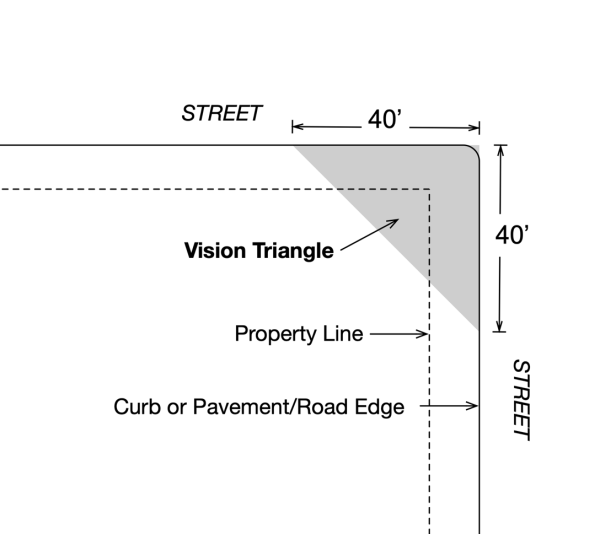
- Clear View Triangle. No site obstructions that constitute a hazard to the traveling public shall be allowed on corner lots. The clear view triangle shall be determined by measuring forty (40) feet from the intersection of the curb line or pavement or road edge along each of two intersecting streets, then connecting the two points with a straight line forming the hypotenuse (see Figure 2 in Appendix A). Branches on trees within any such triangle shall be removed at the trunk up to a minimum level of six (6) feet above finished ground level. Shrubs and hedges shall be maintained no higher than three (3) feet above finished ground level within any such triangle.
- Prohibited Materials. The following materials are prohibited in construction of fences and walls:
- Electric fencing;
- Barbed wire;
- Plywood or oriented strand board (OSB); and
- Snow fencing or plastic mesh fencing.
- Location Standards.
- After the effective date of this section, new fences and walls must be located at least one (1) foot from any adjacent sidewalks.
- Where no sidewalk exists, fences, walls, and hedges shall be set back a minimum of eight (8) feet from the edge of pavement or curb, if present. Along dirt or gravel roads, the setback requirement shall be determined by the Building Official.
- Fence placement shall not be allowed to cause damage to or hinder the maintenance of utilities.
- Fences, walls, and hedges located within the public right-of-way shall require an Encroachment Agreement approved by the Building Official and recorded with the Stevens County Auditor’s Office.
- The Building Official may require a boundary survey prepared by a land surveyor licensed in the State of Washington when necessary to determine property lines or right-of-way boundaries.
- Decisions made by staff on the provisions of the Encroachment Agreement are appealable to the city council.
- Exceptions. The Building Official may approve exceptions to the standards of this section for:
- Public facilities, public services, and utility facilities; and
- Sites with significant grade changes where a uniform or generally linear height is desired.
Figure 2, Appendix A:
(Ord. No. 900, § 7, 8-3-2016)
Editor's note— Ord. No. 875, § 2, adopted Nov. 5, 2014, changed the title of § 18.12.060 from "Fences" to read as set out herein.
Repealed & Replaced by Ord. 1023 on 8/17/2026
18.12.065 Commercial Fences
- No fence shall exceed a height of six feet in the front, side or rear yards in retail business or commercial industrial areas.
- No electrical wire fences are permitted. Barbed wire may be used for security purposes in retail business and commercial industrial zones in the absence of a residential component. Barbed wire may only be utilized on the upper one-quarter of the fence and shall be installed vertically or projecting into the property.
- Fences shall be allowed in the city right-of-way in retail business and commercial industrial zones only if the following conditions are met:
- The applicant must pay the appropriate fee and obtain from the building official an encroachment agreement. Said agreement shall be recorded with the Stevens County auditor.
- The proposed fence shall be no higher than six feet above finished grade.
- The fence may be no closer than twelve feet from the edge of the road surface if there is no curb provided along the pavement edge.
- The fence may be no closer than eight feet from the edge of the street side of the curb where curbs exist and there is no sidewalk.
- Where there is a sidewalk provided, the fence may be constructed adjacent to the sidewalk.
- Fence placement shall not be allowed to cause damage to or hinder the maintenance of utilities.
- Decisions made by staff on the provisions of the encroachment agreement are appealable to city council.
(Ord. No. 900, § 7, 8-3-2016)
18.12.070 Outdoor And Temporary Signs
- Purpose and Intent. The erection and maintenance of outdoor advertising signs shall be controlled in order to promote the public safety and the scenic value of public travel, and to preserve the natural character of the city.
- Standards.
- All signs shall be in compliance with the Uniform Sign Code.
- Outdoor signs shall not exceed the area prescribed for each zone as follows:
- Residential: Signs prohibited, except as allowed in this section;
- Retail Business: sixty square feet per sign;
- Commercial/Industrial: sixty square feet per sign.
- Signs in the commercial/industrial and retail business zones may be up to one hundred twenty square feet per sign with review and approval of a variance from the city planner.
- Nonresidential uses in the residential zones may display:
- One sign not more than fifteen square feet in area nor projecting more than twenty feet above the average elevation of the finished grade along the front of the building.
- Churches, schools, and similar uses may in addition, have one freestanding identification sign or bulletin board, not exceeding twenty-five square feet in area.
- A home occupation may have one nonluminous sign not more than two square feet in area. The sign shall be placed against the building and may be externally lighted. The sign may bear the business person's name and occupation.
- In the residential zones, for the rental or sale of property, one temporary, nonilluminated sign not exceeding eight square feet in area shall be allowed on the subject property.
- The following signage shall be allowed for mobile/manufactured home parks:
- One sign along each major approach to the mobile home park, not to exceed a total of thirty-six square feet in area for all signs.
- No sign shall project more than two feet into any required yard.
- Signs may be illuminated provided that they shall not be flashing or animated and shall be of low intensity not exceeding the equivalent of four hundred twenty-five milliamperes fluorescent tubing behind plexiglass or other plastic face spaced on seven-inch or more centers, or of exposed neon not exceeding thirty milliamperes.
- Each mobile home space shall be numbered with a sign or other method which will facilitate responses by emergency vehicles.
- Signs commonly known as billboards shall be prohibited.
- Temporary Signs.
- One temporary sign per business or event is allowed on an improved sidewalk or, in the absence of an improved sidewalk, in the public right-of-way. Businesses having more than one street frontage may be allowed one sign on each street frontage. The sign shall be placed in front of and on the same side of the street as the business establishment or event that it advertises. Exceptions: Community service organizations, nonprofit, church and school events will be allowed no more than two off-premise signs in compliance with the ordinance codified in this chapter.
- Buildings or multiple buildings with multiple tenants who have access from a common entrance, including buildings with interior or exterior courtyards, are permitted one sign per building for the use of the residents.
- No sign shall be placed in such a way as to reduce the continuous, unobstructed width of a sidewalk or walkway to less than five feet.
- Signs must be at least five feet from the building face.
- Signs may not obstruct an entrance to a building, or any steps.
- No sign may be placed within a crosswalk.
- Signs must be placed at least twelve inches from a tree grate or planting.
- Signs must be at least fifteen feet distant from another sidewalk or temporary sign.
- Temporary signs may be displayed from six a.m. to eight p.m. each day but shall be removed at eight p.m.
- Size.
- Maximum size of a temporary sign shall be eight square feet per sign face, with a maximum sign width of thirty inches, a maximum sign height of forty-eight inches, and a minimum sign height of thirty inches.
- No materials shall be added to the sign to increase its height.
- Materials. Signs shall be constructed of weather-resistant materials, such as wood, plastic, metal or durable fabric.
- Permit. No outdoor or temporary sign shall be installed or sited without first obtaining a sign permit from the city. The city may issue an annual permit for temporary signs located on a sidewalk.
- Existing Signs. All temporary signs currently situated within the city shall be subject to the ordinance codified in this chapter. The administrator shall notify owners of nonconforming signs of such status by personal service or by regular mail. Nonconforming signs shall be removed within five days of service or mailing date of the notice.
- Enforcement/Violations. Any sign not properly removed or relocated after notice from the city is declared a nuisance as defined at CMC 8.08.020, or as hereafter amended. The nonconforming sign shall be subject to the summary abatement provisions of CMC 8.08.100, or as amended, and subject to the penalties set out at CMC 8.08.110, or as amended, in addition to the penalties for violation set forth in this title.
(Ord. No. 900, § 7, 8-3-2016)
Amended by Ord. 941 on 2/5/2020
18.12.080 Home Occupation
- Purpose and Intent. Home occupations are businesses conducted in a residence or accessory structure, where the occupation is secondary to the use of the dwelling for living purposes and the residential character of the property is maintained. The provision for home occupations allows for the gainful employment at home so long as the enterprise does not disrupt or reduce the surrounding residents' enjoyment of their neighborhood.
- Standards.
- Home occupations may be conducted in any zone provided that the home occupation complies with the following standards:
- The home occupation shall be conducted entirely within the residence or an accessory structure;
- No more than five hundred square feet within a dwelling or accessory structure shall be devoted to the business;
- No structural alteration or construction to accommodate the home occupation which would, upon the vacation of the home occupation, be of a character indicating a nonresidential use or which would not lend itself to the ordinary residential occupancy of this space formerly devoted to the home occupation will be allowed;
- The home occupation shall employ a maximum of two persons, provided the persons permanently reside in the dwelling;
- The home occupation shall not generate vehicular traffic which will interfere with residential traffic circulation or have more vehicles parked than there are parking spaces;
- Appointments shall be scheduled so that no more than two customers are at the residence at any given time;
- No retail sales, directly to the public, are permitted from any residence;
- The home occupation shall not create or cause hazards or nuisances due to noise, dust, vibration, odors, smoke, glare, electrical interference, or other adverse impacts; and
- The home occupation shall not involve the use or storage of explosive, toxic, combustible or flammable materials in a quantity that exceeds the amounts incidental to normal residential use.
- The number of home occupations at any one address is limited to one.
- Home occupations may be conducted in any zone provided that the home occupation complies with the following standards:
(Ord. No. 900, § 7, 8-3-2016)
Amended by Ord. 957 on 6/2/2021
18.12.090 Mobile/Manufactured Home Park
- Purpose. This section governs the placement of dwelling units in manufactured home parks not yet in existence at the time of passage of this ordinance.
- Dwelling Units allowed.
- Manufactured Homes
- Designated Manufactured Homes
- Park Models
- Recreational Vehicles
- Tiny Houses with Wheels
- All dwelling units placed within a manufactured home park must be thermally equivalent to the state energy code. All dwelling units placed within a manufactured home park must contain at least one internal toilet and at least one internal shower unless the manufactured home park provides toilets and showers.
- All manufactured homes placed within a manufactured home park shall be.
- “New” as defined in RCW 35.63.161(2).
- Set upon a permanent foundation, with the space from the bottom of the home to the ground enclosed by concrete or an approved concrete product, which can be either load-bearing or decorative.
- Design Standards.
- The minimum area of a manufactured home park shall be one acre.
- All manufactured home parks shall provide at least one point of ingress/egress from the park to a dedicated public street. Additional access points may be required. The developer shall be responsible to pave dedicated streets inside the park and to pave the frontage streets (lot line to lot line) that adjoin the property to the center of the dedicated right-of-way.
- All utilities, including electrical distribution, cable television, and telephone service systems, shall be installed underground except for access terminals.
- Spaces within a manufactured home park shall contain a minimum of three thousand five hundred square feet in the R-3 and R-B zone and five thousand four hundred square feet in the L-R zone. The maximum building coverage including the manufactured home is fifty percent of the space.
- A minimum of eight percent of the total gross area of the park shall be designated and maintained as a recreational area for occupants of the park.
- Setbacks in a manufactured home park shall be as follows:
- Fifteen feet between dwelling units;
- Twenty feet from the front property boundary line and fifteen feet from flanking streets;
- All mobile homes shall be located at least twenty feet from the perimeter of the park.
- Fifteen feet between dwelling units;
- All vehicular ways shall meet or exceed the standards set by the street department supervisor for public streets.
- Support systems and stabilizing devices for any manufactured-designated/manufactured home shall be designed and installed in accordance with the specifications set forth by the manufacturer or the adopted standards of a federal or state regulatory agency, whichever is more stringent.
- Accessory structures installed in a manufactured home park shall conform to the requirements of the Uniform Building Code and other applicable laws. Accessory structures shall be no closer than five feet to a property line.
- Off-street covered parking space(s) shall be provided in accordance with CMC 18.12.020.
- Each manufactured home space shall be numbered with a sign or other method that will facilitate responses by emergency vehicles.
- Application Requirements.
- Preapplication Conference.
- Before any proposal for a manufactured home park is presented to the city, the city shall schedule a meeting with staff and the applicant.
- The applicant shall have prepared for the meeting the general outlines of the proposal, evidenced schematically by sketch plans drawn to scale containing in an approximate manner the following information:
- Legal description of the proposal;
- Boundaries and dimensions of the proposal including the number of acres involved;
- Location and dimensions of each space;
- Location and width of streets and pedestrian ways;
- Locations of recreational and other common areas;
- Location of landscaping, fences, walls, and other screening structures;
- Locations, arrangement, and design of all parking facilities.
- Identification of topographical hazards, environmentally sensitive areas, floodplains.
- Legal description of the proposal;
- The building official shall furnish the applicant with a written review of the conference regarding the relation of the mobile home park to general development objectives and applicable city ordinances and policies.
- Application for development permit shall include the following:
- All applications for approval of a manufactured home park development shall be accompanied by a fee as established by resolution by the city council, which shall be used to cover the costs of advertising, reviewing, and publishing incidental to the request.
- All applications submitted for approval of a manufactured home park shall a site plan drawn at a scale of one inch equals one hundred feet or larger and be either printable or to on sheets of paper eighteen inches by twenty-four inches minimum. The plan shall contain at a minimum the following information in addition to the information required in Part D,1 of this section:
- Name of person who prepared the plan;
- Name of persons owning and managing the land proposed for the park development;
- Name and address of the proposed mobile home park;
- Scale and north point on the plan;
- Vicinity map showing relationship of the development to adjacent properties;
- Location and dimensions of each space, with spaces designated by number or other designation;
- Location of each lighting fixture for exterior lighting;
- Location and dimensions of proposed building(s) other than mobile homes;
- Location of fire hydrants;
- Enlarged plot plan of a typical space, showing location of foundation base, storage space, parking, utility connections and other improvements;
- A survey plat of the property showing:
- Structures to be constructed,
- Public water system and sewer and garbage disposal plan approved by the appropriate officials.
- Name of person who prepared the plan;
- An environmental checklist, as applicable and fee for review must be submitted with the application.
- The application will be submitted in accordance with the provisions of CMC 18.20 for a Type II review.
- Preapplication Conference.
- Park Administration.
- It is the responsibility of the park owner and manager to ensure that the provisions of this title are observed and maintained within the mobile home park. Violations of this title shall subject both the owner and the manager to the penalties provided for in CMC 18.20.070 for such violation. The owner or designated agent shall be available and responsible for the direct management of the manufactured home park.
- The manufactured home park shall be maintained free of any flammable materials in amounts which might communicate fires between homes and other improvements.
- Refuse shall be collected and disposed of on a regular and sanitary basis.
- Any dumpsters or centralized collection areas containing three or more receptacles will be screened from view as per CMC 18.12.030.
- It is the responsibility of the park owner and manager to ensure that the provisions of this title are observed and maintained within the mobile home park. Violations of this title shall subject both the owner and the manager to the penalties provided for in CMC 18.20.070 for such violation. The owner or designated agent shall be available and responsible for the direct management of the manufactured home park.
(Ord. No. 900, § 7, 8-3-2016)
Amended by Ord. 941 on 2/5/2020
Repealed & Replaced by Ord. 1010 on 6/30/2025
18.12.100 Confinement Facilities
No confinement facilities, other than a holding facility, shall be located within the boundaries of the city.
(Ord. No. 900, § 7, 8-3-2016)
18.12.110 Nonconforming Uses And Structures
- Purpose and Intent. The purpose of this section is to define the conditions under which the lawful use of any building or lot existing at the time of passage of the ordinance codified in this title may be continued, although such use does not conform to the provisions of this title.
- Nonconforming Uses.
- If a nonconforming use is discontinued for a period of six months or more, use of the lands or buildings thereafter shall be in conformity with the uses permitted in the zone in which the property is located.
- Where a nonconforming use occupies a conforming building no repair or alteration shall be permitted which causes the building to become nonconforming in structure or appearance.
- A nonconforming use conducted upon open land or within a conforming building shall not be changed to any other use which does not conform to the regulations of the zone wherein such land or building is located.
- A nonconforming use if changed to a conforming use may not thereafter be changed back to a nonconforming use.
- Nonconforming Lots of Record. Any lot of any size can be used for a building site, subject to the regulations governing the zone in which it is located, if it was legally created and officially recorded in the city or county offices as a separately-owned single lot prior to the adoption of the ordinance codified in this title.
- Expansion of Nonconforming Uses of Land. Nonconforming uses of land shall not be enlarged or increased, nor extended to occupy a greater area of land than was occupied at the adoption of said ordinance, unless a conditional use permit has been issued authorizing such use.
- Nonconforming Structures.
- Nonconforming buildings and structures shall not be enlarged or altered in a way which increases the nonconformity without the issuance of a variance in accordance with CMC 18.16.030.
- In the event that a nonconforming structure is destroyed by any means other than by fire, flood, or act of nature, to an extent of more than fifty percent of its actual value based on the assessed valuation at the time of its destruction, the structure, the use, and the lot upon which it is located shall thereafter conform to all requirements of the zone within which it is located, unless the structure is designated as an historic structure in which case the structure can be rebuilt.
In the event that a nonconforming structure is destroyed by fire, flood, or act of nature restoration of that structure may be allowed provided such restoration shall be initiated, as evidenced by the issuance of a valid building permit, within twelve months of such damage occurring.
(Ord. No. 900, § 7, 8-3-2016)
18.12.120 Special Standards For The Keeping Of Livestock
- Purpose and Intent. The purpose of this section is to define the conditions under which the keeping of livestock shall be permitted within the city. The intent is to ensure that negative impacts, including but not limited to, noise, odor, destruction of property, unsightliness or damage to natural resources, are minimized while still permitting Chewelah residents to keep, raise or breed a modest number of livestock on appropriately sized and located parcels of land.
- Computation of Animal Units. An animal unit is equivalent to any one of the following: steer, cow, milk cow, horse, mule/donkey, llama, ox, exotic animal, primate, three goats, three sheep, three pigs, twenty chickens, twenty fowls or twenty rabbits. For the purpose of this definition, any newborn animal above shall be excluded until such time as it is weaned. In the case of a particular species of livestock not mentioned above, the city building official shall determine its value in terms of animal units based on the animal's nature or size. Up to ten chickens, fowls or rabbits may be kept without regard to the provisions of this section.
- Standards for the Keeping of Livestock. Livestock may be kept on residential parcels of land providing the following standards are met:
- Lots with an area of between one-half acre and one acre may keep from zero to one animal unit. Any lot of one-half acre or less may not keep an animal unit or fraction thereof.
- Lots of one acre or more in size may increase the number of animal units at the rate of one additional animal unit per half-acre in excess of one acre.* Note: Permitted animal units increase at the rate of one per each one-half acre increase in lot size.
Lot Size Number of Permitted Animal Units 0—21,779 square feet 0 21,780—43,560 square feet (1 acre) 1 43,561—65,340 square feet (1.5 acres) 2 65,340—87,120 square feet (2 acres) 3 87,121—108,900 square feet (2.5 acres) 4 108,901—130,680 square feet (3 acres)* 5 - The keeping of bulls and stallions over six months of age, the keeping of mink, foxes, or other non-domestic fur-bearing animals, and the keeping of inherently dangerous animals shall be prohibited.
- The keeping of endangered or threatened species, as defined by the Department of Fish and Wildlife, shall be prohibited.
- All livestock shall be kept on private property.
- No shelter, barn or other structure associated with the keeping of livestock shall be located within any required front, side or rear building setback.
- Any enclosure for the livestock shall be surrounded by an adequate and sufficient containment system to confine the animals therein and to prevent the animals from encroaching upon any required front, side or rear building setback.
- All stables and other animal-related buildings and enclosures upon property where livestock is kept shall be maintained in a clean, healthful and sanitary condition.
- Livestock shall be kept no closer than twenty-five feet to adjacent critical resource areas to minimize negative impacts to those areas. Where steep slopes or soils conditions warrant, the city administrator or designee may increase the size of the required buffer to adequately protect adjacent critical resource areas against negative impacts due to surface water runoff. The city administrator or designee may decrease the size of the buffer if the applicant submits a mitigation plan, prepared by a qualified professional, which demonstrates the adjacent critical resource area is protected against negative impacts. In no case shall the buffer be reduced to less than ten feet. Negative impacts include, but are not limited to, destruction of native vegetation, destruction of natural wetland or riparian habitat, erosion of stream banks, decrease in stream water quality and increase in stream water temperature.
- General Provisions.
- No pigs, hogs, domestic fowl, rabbits, horses, cattle or other livestock shall be permitted to run at large within the city limits. No domestic animals shall be driven through or on any of the public streets of the city unless the domestic animals are kept together in some manner so that the owner or driver has complete control over such animals and the animals will not be permitted to trespass on private property or travel on any public sidewalks, parking strips, or curbing. Such action shall be considered a nuisance.
- If said animal(s) cause(s) damage, the owner may be held liable as provided in RCW 16.60. If the damage was caused by an animal running at large, the owner of such damaged property may retain and keep custody of said animal(s) until the owner of the animals pays for damages.
- Any impounded animal shall be held by the police department and shall be held for no less than three days during which time the owner may claim the animal. An owner reclaiming an impounded animal shall pay an impoundment fee for each offense, plus the actual cost to the city for the care and keeping of the animal. After three days, city may elect to dispose of the animal in an appropriate method.
- It shall be unlawful for any person within the city having possession or control of any dead livestock or pet, which was not slaughtered for human consumption, to fail, refuse or neglect within forty-eight hours of death to appropriately dispose of the carcass.
- Administrative Review.
- Residents wishing to keep livestock shall request, in writing, city approval of the proposed activity. The request shall include a letter describing the livestock being kept, the purpose for which they are being kept, the anticipated duration of the keeping and any specific measures being taken to meet the requirements of this section. A site plan, showing property lines, existing structures, any adjacent critical resource areas and the location of livestock keeping areas, shall accompany the written request.
- The city administrator or designee shall review the application for conformance to the provisions of this section and if the request is consistent with the provisions of this section, shall issue an approval within five days of the request's submittal.
- The city's approval may include mitigation measures in addition to those proposed by the applicant to ensure that critical resource areas are adequately protected from damage caused by livestock.
- The administrative decision may be appealed to the hearing examiner for his/her review and determination as a non-hearing item.
- The hearing examiner's determination may be appealed to the Superior Court of the State of Washington for Stevens County.
- Compliance with New Regulations. Any keeping of livestock established prior to the effective date of this section shall be considered legal nonconforming and any such keeping of livestock that does not comply with the standards contained in CMC 18.12.120 Part C must be so modified to be in compliance within two years of the effective date of this section.
(Ord. No. 900, § 7, 8-3-2016)
Amended by Ord. 985 on 10/18/2023
18.12.121 Beekeeping
- Definitions. The terms “apiarist”, “bees”, “colony”, and “hive” as used in this section shall have the meanings set forth in RCW 15.60.005.
- Registration. All colonies shall be registered with the director of the Washington State Department of Agriculture pursuant to RCW 15.60.021 no later than April 1st of each year and comply with all rules set forth in RCW 15.60.
- Where Permitted. Beekeeping is allowed as an accessory use on any lot within the single-family residence or community facility zones, subject to the requirements of parts D.1 through D.4 below.
- Standards Applicable to Beekeeping. Beekeeping is subject to the following standards:
- Location, Density and Maintenance of Colonies.
- The number of colonies is limited to one colony per four thousand three hundred fifty-six (4,356) square feet (0.10 acre) of lot area, up to a maximum of eight colonies per lot; and
- Colonies shall be setback a minimum of twenty-five feet of any property line, except that a colony may be situated within ten feet of a side lot line or rear lot line provided the following provisions are met:
- The apiarist must establish and maintain a flyway barrier at least six feet in height consisting of a solid wall, solid fencing material, dense vegetation, or combination thereof that is parallel to the property line and extends ten feet beyond the colony in each direction so that all bees are forced to fly at an elevation of at least six feet above ground level over the property lines in the vicinity of the colony; or
- The colony is situated ten feet or more above the grade of the nearest adjoining property line.
- Colonies shall be maintained in movable-frame hives with adequate space and management techniques to prevent overcrowding and swarming.
- Hives shall be maintained to avoid overpopulation and minimize aggressive or swarming behavior, for example by requeening regularly, so as not to become a nuisance. Aggressive behavior is hereby defined as any instance in which unusual aggressive characteristics such as stinging or attacking without provocation occurs.
- Every apiarist shall maintain an adequate supply of water for bees located close to each colony.
- Location, Density and Maintenance of Colonies.
- Nuisances. Abandoned colonies, diseased bees, or bees living in trees, buildings, or any other space except in movable-frame hives shall constitute a public nuisance and shall be abated as set forth in CMC 8.08, Nuisances.
- Penalties. In addition to any other enforcement action which the city may take, violation of subsections C through E of this section above shall be a civil violation and a fine not exceeding one-hundred ($100) may be imposed. Each day the violation continues will be treated as a separate offense.
Adopted by Ord. 985 on 10/18/2023
18.12.130 Recreational Vehicles On Personal Property
Only one recreational vehicle will be permitted on a single tax parcel. Recreational vehicles may be used as a primary residence for up to 6 months when occupied in conjunction with a building permit for new building construction of a primary residence on the same property. The building official may extend the 6-month time period for up to 1 year so long as the building permit remains in good standing. Length of stay for occupied recreational vehicles on personal property shall otherwise be limited to no more than 7 consecutive days per calendar year.
(Ord. No. 900, § 7, 8-3-2016)
Repealed & Replaced by Ord. 1010 on 6/30/2025
18.12.140 Mini Storage Standards
- Purpose and Intent. Mini storage (Self-Storage Warehouse or Self-Service Storage) uses have some characteristics in common with both commercial uses and industrial uses. This section provides standards for mini storage uses and development standards to appropriately site this use in permitted zoning districts, while maintaining the desired character and function of the specific zones. In general, mini storage uses are similar to other commercial uses in that they provide a service to residential and business uses. The character of their development is often similar to industrial buildings. The use standards and design standards ensure that development of mini storage facilities is compatible with surrounding zones and uses.
- Use Standards. Other uses on the site such as office space or residential must meet the use and development standards of the base zone, overlay zone, or plan district. The following use standards apply to mini storage facilities conditionally approved in the R-B zone.
- Mini storage facility cannot occupy more than 25 percent of street frontage. Storefront or other allowed uses by right are permitted to occupy the entire street frontage or a combination to allow for 25 percent of mini storage frontage. Such commercial frontage shall be contextual in design and architecturally compatible with other adjacent and nearby first-story commercial uses. Development of retail business is subject to CMC 18.08.120.
- All storage shall be wholly within a building or shall be screened from view from the surrounding properties. There shall be no storage in any required front yard or flanking street yard.
- In R-B zone, outdoor storage shall be screened by a sight-obscuring fence pursuant to Part D,3,a of this section and/or landscaping pursuant to CMC 18.12.030.
- The following uses are prohibited:
- The storage of flammable liquids, flammable or highly combustible, radioactive or explosive materials or hazardous chemicals or toxic substances or any supplies that, whether singly or combined, may produce such explosive, flammable, toxic materials, chemicals, substances or any hazardous condition.
- Pets or animals.
- Shipping containers as accessory building(s), storage building(s), or living unit(s).
- The use of the self-storage facilities portion of the property for uses other than storage.
- The storage of junk, inoperable vehicles, scrap materials or the like is not considered outdoor storage by this zoning code.
- Development Standards. Mini storage facilities conditionally permitted in the R-B zone are subject to the following conditions:
- Minimum lot size of five acres.
- Setback Requirements:
- Minimum setbacks for retail and commercial uses shall be pursuant to setback requirements for nonresidential uses as established in CMC 18.08.120.
- Minimum setback requirements for mini storage facilities shall be:
- Front Yard: ten feet.
- Rear Yard: ten feet, except fifteen feet required on lots adjoining an R zone without an intervening alley.
- Side Yard: five feet, except ten feet required on corner lots and those adjoining an R zone.
- Maximum building height three stories, not to exceed forty-five feet.
- Maximum lot coverage eighty percent. If separate off-street parking is provided lot coverage may be one hundred percent with review and approval of a variance application.
- Maximum floor area ratio (FAR):
- Nonresidential
- Downtown: 2.0
- Other areas: 1.0
- Nonresidential
- Other Standards. Normal downtime display of salable items may be placed in a neat and orderly manner on the sidewalk adjacent to the merchant's business. The display shall not materially affect sidewalk traffic and shall be removed from the sidewalk at the end of each day.
- Other Applicable Regulations. In addition to the requirements contained in this section, all other applicable regulations in CMC Chapter 18.12 shall also apply to development in the retail business zone.
- Design Considerations. The following exterior design requirements apply to a mini storage facility when located adjacent to or across a right-of-way from a residentially zoned or developed property.
- Architectural Features. Architectural features are to be consistent with the character of the surrounding neighborhood. The following are minimum standards:
- Colors are to be muted earth tones including but not limited to gray, off-white and beige.
- Fencing is required to be low-maintenance material and articulation at intervals no greater than twenty feet.
- All outdoor lighting shall be shielded, reflected, shaded and focused away from adjoining properties.
- There must be at least twelve feet of separation between buildings and accessibility for emergency vehicles.
- Signs. Signs are subject to CMC 18.12.070.
- Landscaping and Screening. Landscaping and screening are subject to CMC 18.12.030. The following landscaping and screening requirements apply to all mini storage facilities:
- A solid wall, a screening fence or a combination of both achieving a perimeter screening to a minimum of six feet in height is required and shall be located so that a minimum of seventy-five percent of the landscaping area is outside the fence.
- Internal circulation. The internal circulation between buildings must be wide enough so that there is a twelve-foot wide travel lane for emergency vehicles to pass while tenants' vehicles are parked at their storage areas. Accesses are required to be gated and monitored.
- Parking. Parking and internal drives are prohibited in setback areas and shall be consistent with parking requirements in CMC 18.12.020.
.
- Architectural Features. Architectural features are to be consistent with the character of the surrounding neighborhood. The following are minimum standards:
Adopted by Ord. 951 on 1/20/2021
18.12.150 Electric Vehicle Charging Stations
- Purpose. The purpose of this section is to ensure the effective installation of electric vehicle charging stations.
- Designation of electric vehicle charging stations. An electric vehicle charging station is a public or private parking space that is served by battery charging equipment with the purpose of transferring electric energy to a battery or other energy storage device in an electric vehicle and is classified based on the following levels:
- Level 1 is considered slow charging.
- Level 2 is considered medium charging.
- Level 3 is considered fast charging. Level 3 stations can also be referred to as rapid charging stations that are typically characterized by industrial grade electrical outlets that allow for faster recharging of electric vehicles.
- Battery Exchange Station is considered a fully automated facility that will enable an electric vehicle with a swappable battery to enter a drive lane and exchange the depleted battery with a fully charged battery through a fully automated process.
- Where permitted.
- Level 1 and Level 2 electric vehicle charging stations are permitted uses in all zoning districts.
- Level 3 electric vehicle charging stations are a permitted use in R-B, C-I and C-F zoning districts but require a conditional use permit in an APGC zone.
- Battery exchange stations are a permitted use in R-B and C-I zoning districts but require a conditional use permit in APGC and C-F zones.
- Standards for electric vehicle charging stations. Electric vehicle charging stations utilizing parking stalls located in a parking lot or parking garage or in on-street parking spaces shall comply with the following standards.Due to the fact the technology associated with electric vehicles, batteries and electric vehicle charging stations is relatively new and is anticipated to change, and that there is a lack of municipal experience on consumer and community preferences and attitudes with regard to electric vehicles, the Administrator or designee may authorize variations from these standards, so long as the intent and goal of the standards and this section are addressed.
- Except when located in conjunction with single-family residences, electric vehicle charging stations shall be reserved for parking and charging of electric vehicles only.
- Signage. Each electric vehicle charging station shall be posted with signage indicating the space is only for electric vehicle charging purposes.
- Accessibility. The design and location of the electric vehicle charging stations shall comply with the following barrier-free accessibility requirements:
- Accessible charging stations shall be located in proximity to the buildings or facility entrances and shall be connected to a barrier-free accessible route of travel.
- Accessible charging stations shall comply with the requirements of WAC 51-50-005.
- Minimum parking requirements. Electric vehicle charging stations located within parking lots of garages may be included in the calculation of the minimum required parking spaces required pursuant to Section 18.12.020.
Adopted by Ord. 958 on 6/2/2021
18.12.160 Community-Based Behavioral Health Facilities
- Purpose And Intent. These regulations are intended to protect public health and safety by requiring safe operations of Behavioral Health Facilities for both the residents and the broader community. Violations of these regulations are subject to §1.24.010 of Chewelah Municipal Code. The purpose of this section is to allow and establish a review process for the location, siting, and operation of community-based behavioral health facilities that:
- Increase access to behavioral health services and community amenities for individuals living with behavioral health conditions or disabilities.
- Allow such facilities to be sited in areas with appropriate conditions for the services being provided.
- Apply regulatory land use frameworks in the same manner for such facilities as for other facilities with similar scale and land use impacts.
- Apply permitting and entitlement processes appropriate to the scale of the facility and location that is efficient, predictable, and informed.
- Ensure that the health and safety of both residents and the broader community is maintained during facility operations.
- Facility Types and Definitions.
“Community-based Behavioral Health Facility” means a residential facility licensed and regulated by the State of Washington, staffed to provide on-site care and that is not a hospital or a group home (adult family home). For the purposes of this title, the following facilities shall be considered a Community-based Behavioral Health Facilities:- Crisis Stabilization Facilities
- Dementia Care Facilities
- Enhanced Services Facilities
- Evaluation and Treatment Facilities
- Intensive Behavioral Health Treatment Facilities
- Residential Care Facilities
- Secure Withdrawal Management and Stabilization Facilities
“Dementia Care Facility” means a facility that provides specialized long-term care services for persons with dementia. All facilities have delayed egress, an indoor wander path, and a safe, enclosed outdoor area that can be accessed independently. Stays are generally long-term, with residents aging in place and only moving if their care needs can no longer be safely met. (WAC 388-110-220 (2) (3))
“Enhanced Services Facility” means a facility that provides support and services to persons for whom acute inpatient treatment is not medically necessary. (RCW 70.97.010(5))
“Evaluation and Treatment Facility” means a short-term court-ordered treatment provided in a residential facility (can also be provided in a hospital setting). Includes 24-hour on-site care for the evaluation, stabilization, and/or treatment of residents for substance use, mental health, or co-occurring disorders. These facilities serve individuals for 5 or 14 day (short-term) and/or 90- and 180-day (long-term) civil commitments. They may also provide services to voluntary individuals. (WAC 246-341-1134)
“Intensive Behavioral Health Treatment Facility” means a community-based specialized residential treatment facility for individuals with behavioral health conditions, including individuals discharging from or being diverted from state and local hospitals, whose impairment or behaviors do not meet, or no longer meet, criteria for involuntary inpatient commitment under chapter 71.05 RCW, but whose care needs cannot be met in other community-based placement settings. (RCW 71.24.025 (33))
“Outpatient Treatment” means behavioral health services provided through outpatient treatment. These agencies are sometimes licensed as a Behavioral Health Agency. (WAC 246-341)
“Residential Care Facility” means an establishment operated with twenty-four (24) hour supervision for the purpose of serving persons of any age under the jurisdiction of the criminal justice system or nine (9) or more persons of any age who, by reason of their circumstances or conditions, require a transitional nonmedical treatment program for rehabilitation and social readjustment; for example, work release programs, alcoholic treatment programs, drug rehabilitation centers, mental health programs, etc. This definition does not include prisons or conventional correctional institutions involving twenty-four (24) hour locked incarceration with little or no freedom of movement.
“Secure Withdrawal Management and Stabilization facility” means a facility operated by either a public or private agency or by the program of an agency which provides care to voluntary individuals and individuals involuntarily detained and committed under this chapter for whom there is a likelihood of serious harm or who are gravely disabled due to the presence of a substance use disorder. (RCW 71.05.020 (52)) - Licensing Requirements.
- All Community-based Behavioral Health Facilities are required to demonstrate compliance with all licensing requirements pursuant to Chapter 70.97 RCW, or as amended by the State Legislature.
- A written management plan shall be provided by all Crisis Stabilization Facilities, Enhanced Services Facilities, Evaluation and Treatment Facilities, Intensive Behavioral Health Facilities, Residential Care Facilities, and Secure Withdrawal Management and Stabilization facilities for the City Administrator’s (or their designee’s) review and approval. At a minimum, a management plan shall address the following components:
- Identify potential impact(s) on nearby residential uses and proposed methods to mitigate those impacts;
- Identify the project management or agency responsible for the support staff and who will be available to resolve concerns pertaining to the facility. The plan shall specify procedures for updating any changes in contact information;
- Identify staffing, supervision, and security arrangements appropriate to the facility. A 24-hour on-site supervisor is required.
- Identify a communications plan in the event that information to the surrounding neighborhood would be needed throughout the time the facility is in operation.
- Conditional Use Permit Requirements.
- New or expanded Community-based Behavioral Health Facilities shall require a Type II Conditional Use Permit.
- In addition to the requirements for a complete application specified within CMC 18.20.030, Development Review Procedure, proposed Community-based Behavioral Health Facilities must provide a written Operations Plan that shall contain the following minimum components:
- Facility point of contact (a facility email and 24-hour phone line)
- Process for communicating with neighboring residents and businesses
- Policies and procedures to address neighborhood concerns
- Numbers of residents and expected length of stay
- Facility rules and regulations
- Staffing plans (number and shifts)
- Onsite parking plan and anticipated response calls
- Safety and discharge plan which shall include relocation and notification procedures to emergency services in the event a resident voluntarily discharges against medical advice.
- Approval Criteria. In addition to all other standards required by this title and findings specified within CMC 18.16.020 (C)(2) for the approval of Type II Conditional Use Permits, the following additional criteria shall apply for Community-based Behavioral Health Facilities:
- 24-hour on-site supervisor shall be required.
- The proposed location is or will be sufficiently served by public services which may be necessary for the support and operation of the facility. These may include, but shall not be limited to, the availability of utilities, access, transportation systems, education, police and fire facilities, and social and health services.
- The proposed facility shall not be located within eight hundred and eighty feet (880 ft) of any pre-existing Community-based Behavioral Health Facility, public park, playground, recreation/community center, library, childcare center (including all types of child daycares), school, miniature golf, ice/skate rink, bowling alley, movie theater, or game arcade. The method of measurement shall be from the closest property line to the closest property line.
- The proposed facility and improvements shall be compatible with surrounding properties, including the size, height, location, setback, and arrangements of all proposed buildings, and signage.
- All required local, state, and federal licensing requirements applicable to the proposed facility shall be required prior to issuance of a certificate of occupancy.
Adopted by Ord. 991 on 4/3/2024
18.12.170 Accessory Dwelling Units (ADUs)
- Purpose and Intent.
- To provide the opportunity for accessory dwelling units within or alongside single-family homes while maintaining the character of single-family neighborhoods.
- To increase the supply of housing within the City of Chewelah.
- To offer affordable housing alternatives.
- To enable adult children to care for and support parents or other relatives in need.
- To allow homeowners the opportunity to secure additional income to cope with increasing homeownership costs.
- To promote infill housing opportunities, efficient land use, and to minimize the costs of maintaining additional public infrastructure.
- To provide the opportunity for accessory dwelling units within or alongside single-family homes while maintaining the character of single-family neighborhoods.
- Use Standards.
- Up to two ADUs, attached or detached, may be permitted per lot where the lot meets the minimum lot size standard in the underlying zoning district.
- Two attached ADUs, such as units in a basement, attic, or garage.
- One attached ADU and one detached ADU.
- Two detached ADUs may be comprised of either one or two detached structures.
- Two attached ADUs, such as units in a basement, attic, or garage.
- Municipal water and wastewater systems must serve ADUs. Septic systems and/or wells may not be used for serving ADUs.
- Modular Homes and Manufactured Homes may be utilized as ADUs so long as they are set on a permanent foundation. Mobile homes shall not be allowed as ADUs.
- Conversion of existing structures to an ADU:
- Accessory dwelling units can be converted from existing structures, including but not limited to detached garages.
- ADUs can be converted from legally non-conforming structures with respect to setbacks, lot coverage, or height, so long as any dimensional non-conformity is not increased.
- ADUs are subject to all other provisions of the Chewelah Municipal Code, including, but not limited to, maximum lot coverage standards of the underlying zoning district, off-street parking requirements, supplementary zoning standards, building and fire code requirements, city health and safety codes, critical areas, the shoreline management program, and all zoning overlay districts, including the Airport Overlay (AO) Zone.
- Up to two ADUs, attached or detached, may be permitted per lot where the lot meets the minimum lot size standard in the underlying zoning district.
- Dimensional Standards.
- Detached ADUs shall not be located any closer to a front lot line than the principal unit.
- The gross floor area of an ADU must not exceed 1,000 square feet.
- Setbacks:
- Front Yard: twenty feet.
- Rear Yard: ten feet.
- Side Yard: five feet, except 10 feet on a side yard adjacent to a street.
- Upper story decks shall maintain a minimum 10-foot side yard setback.
- Alley Setback: zero feet, so long as adequate ingress and egress are provided and in accordance with the AASHTO turning template for a pickup truck design vehicle, and a 10-foot setback is maintained for any adjacent street.
- Maximum Height: Twenty-six (26) feet.
Adopted by Ord. 1010 on 6/30/2025
18.12.180 Cottage Housing
- A. Purpose and Intent.
- To provide the opportunity for small, detached units on a single parcel while maintaining the character of single-family neighborhoods.
- To increase the supply of housing within the City of Chewelah.
- To offer a more obtainable housing alternative for a variety of households in the city.
- To promote infill housing opportunities, efficient land use, and to minimize the costs of maintaining additional public infrastructure.
- To provide centrally located and functional common open space where neighbors may interact and to ensure natural surveillance of common areas is provided.
- Density, Dimensional, and Spacing Standards
- Cottages shall each have no more than 1,400 square feet of net floor area, excluding attached garages and unenclosed front porches.
- Setbacks of the underlying zoning district shall apply.
- The maximum permitted density for cottage housing is 1 unit per 3,000 square feet.
- The minimum lot area for cottage housing shall be 20,000 square feet.
- The maximum number of cottages allowed within a single cottage development shall be 12 units.
- Cottage development property boundaries must be spaced a minimum of 500 feet from other cottage development properties within Single-family zoning districts.
- Parking areas shall be screened from adjacent lots with landscaping and either a site-obscuring wooden fence or masonry block wall to prohibit light trespass and minimize vehicle engine noise.
- Open Space
- Open space shall be provided equal to a minimum of 20 percent of the lot size. This may include common open space, private open space, setbacks, critical areas, and other open spaces.
- Common open space.
- At least one outdoor common open space is required.
- Common open space shall be provided equal to a minimum of 300 square feet per cottage. Each common open space shall have a minimum dimension of 15 feet on any side.
- Orientation. Common open space shall be bordered by cottages on at least two sides. At least half of the cottage units in the development shall abut a common open space and have the primary entrance facing the common open space.
- Parking areas and vehicular areas shall not qualify as common open space.
- Critical areas shall not qualify as common open space.
- Entries. All cottages shall feature a roofed porch at least 60 square feet in size with a minimum dimension of five feet on any side facing the street and/or common open space.
- Community Building
- A cottage housing development shall contain no more than one community building.
- Any community building proposed shall have no more than 2,400 square feet of net floor area, excluding attached garages.
Adopted by Ord. 1010 on 6/30/2025
18.12.190 Townhouse Standards
- Townhouse Lot Standards:
- Minimum street frontage width: 20 feet.
- Minimum lot size: 1,600 square feet.
- Building Design Standards:
- There shall be no more than six (6) townhouse units in any contiguous group.
- External setbacks of contiguous townhouses within the same project shall be governed by the underlying zoning district.
- Vehicular access and parking must be from an alley if one is available while maintaining acceptable turn radiuses for vehicle ingress and egress.
- Fire escapes and exterior stairs providing access to an upper floor are not allowed on any facade that faces a street.
- Shared driveways for not more than two townhouses is allowed.
- Architectural detail on street-facing façade shall be incorporated to delineate floors.
- No more than two contiguous townhouses may have identical facades within the same project. The facades of townhouses, when more than two are contiguous, units must be distinct from other townhouses but shall also maintain unifying compositional elements such as a common window header or sill line and/or aligned vertical centerlines of windows and doors between upper and lower floors. Setback variation of townhouse units is encouraged.
- At least fifteen percent of the area of each street-facing facade must be windows or main entrance doors. Windows used to meet this standard must allow views from the building to the street. Glass block does not meet this standard, and windows in garage doors do not count toward meeting this standard.
- Open space:
- A minimum of 250 square feet of open space per unit shall be provided. The open space may be common or private. Front porches may count towards meeting this standard.

