
Clarkston City Zoning Code
ARTICLE VI
PARKING AND LOADING REQUIREMENTS
Sec. 601. - Off-street parking and loading spaces required.
(a)
It is the intent of this zoning ordinance that all buildings, structures, and uses of land shall provide off-street parking and loading space in an amount sufficient to meet the needs caused by the building or use of land and that such parking and loading spaces are so oriented that they are readily useable for such purposes.
(b)
Each use of land and each building or structure hereafter constructed or established shall provide off-street parking and loading according to the standards set forth herein. When an addition is proposed to a building that is nonconforming as to parking or loading requirements, a conforming amount of parking or loading shall be supplied based upon the size of the addition.
(c)
No addition to an existing building shall be constructed which reduces the number of spaces, area, or usability of existing parking or loading space unless such building and its addition conform with the regulations for parking and loading contained herein, except when the reduced number of parking spaces still meets the requirements of this article.
(d)
Off-street parking shall incorporate handicapped spaces into the design of parking facilities.
(Ord. No. 480, § 1, 6-6-23)
Sec. 602. - General standards.
The following design requirements shall apply to all off-street parking spaces, driveways, and loading spaces.
(a)
Parking spaces.
(1)
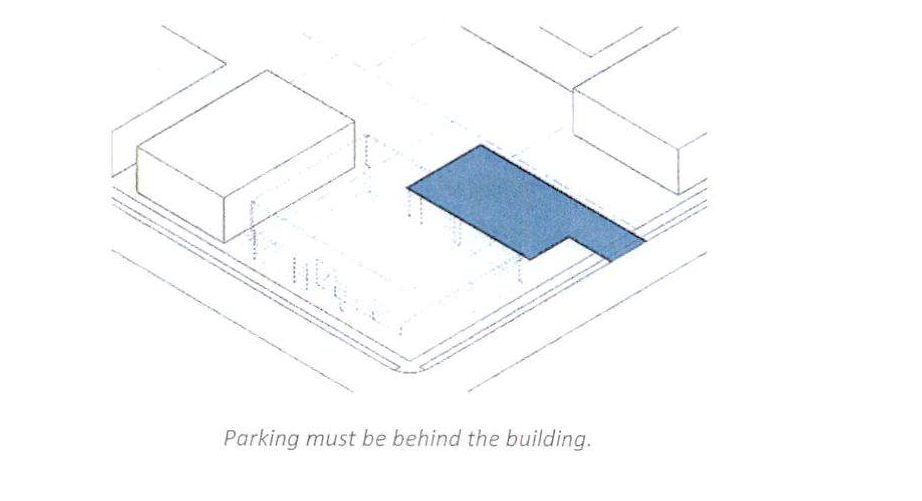
Off-street surface parking shall not be located between a building and the street without an intervening building, except where otherwise permitted in this zoning ordinance.
(2)
Required dimensions for each parking space. Each automobile parking space shall be not less than nine (9) feet wide and twenty (20) feet deep.
(3)
Surfacing, drainage and lighting. All off-street parking spaces, access and interior driveways shall be provided with a paved, dust free surface. If the off-street parking facilities are used at night, they shall be properly illuminated for the safety of pedestrians, vehicles and for security. The lighting shall be designed so as not to reflect onto or cause glare in any adjacent residential district.
(4)
Adequate interior driveways shall connect each parking space with a public right-of-way.
(5)
Striping and marking.
(i)
All pavement markings intended to delineate off-street parking spaces shall be striped with durable reflective striping designed for that purpose.
(iii)
All handicapped spaces shall be striped and marked in accordance with applicable federal and state standards.
(b)
Compact parking spaces.
(1)
No more than 20% of the required parking spaces for industrial, commercial, institutional, or multi-family uses can be designated for compact cars.
(2)
Compact parking spaces shall be identified by pavement markings and/or by appropriate signage.
(3)
Parking spaces for compact cars shall not be less than eight (8) feet wide and fifteen (15) feet deep.
(c)
Bicycle parking.
(1)
Developments in all NR-CD, RC, TC, NC-1, and NC-2 districts shall provide bicycle parking racks at a ratio of at least one (1) bicycle parking space for every twenty (20) automobile parking spaces.
(2)
No development shall have fewer than three (3) bicycle parking spaces nor be required to exceed a maximum of thirty (30) spaces.
(3)
Bicycle parking spaces shall be located within the landscape zone a maximum distance of one hundred (100) feet from the building entrance, or shall be located at least as close as the closest automobile space and shall provide a concrete pad upon which the bicycle parking space shall be firmly rooted.
(d)
Additional requirements for non single-family districts. All required off-street parking facilities (other than those for single-family dwellings), including entrances, exits, and maneuvering areas, shall comply with the following provisions. Each parking facility:
(1)
Shall have access to a public street;
(2)
Shall be graded and paved, including access drive(s), and be curbed when needed for effective drainage control;
(3)
Shall have all spaces marked with paint lines, curb stones or other similar devices;
(4)
Shall be drained so as to prevent damage to abutting properties or public streets and where possible shall be drained towards infiltration swales located in the five (5) foot head-to-head landscape strips required between vehicles in Section 535(f).
(5)
To the extent practicable, adjacent parking lots serving nonresidential or mixed-use buildings shall be interconnected and shall provide for future interconnectivity.
(6)
Shall have adequate lighting if the facilities are to be used at night, provided such lighting shall be arranged and installed so as not to reflect or cause glare on abutting properties;
(7)
Shall be designed to conform to the geometric design standards of the institute of traffic engineers;
(8)
Wheel bumpers shall be placed at the head of all parking spaces that abut a landscape strip or sidewalk. When wheel bumpers are adjacent to a sidewalk, a two (2) foot extension of the sidewalk shall be permitted to be substituted in the place of the required wheel bumpers.
(9)
No parking area may be used for the sale, repair, dismantling, servicing or long term storage of any vehicles or equipment unless such use is permitted within the district in which the parking area is located.
(10)
Location on other property. If the required automobile parking spaces cannot be reasonably provided on the same lot on which the primary use is conducted, such spaces may be provided on adjacent or nearby property within the same zoning district, provided a major portion lies within one thousand (1,000) feet of the main entrance to the primary use for which such parking is provided. A written agreement among all owners of record shall be provided and held on file with the Planning and Economic Development Manager or Director. All renewed or terminated leases shall be filed with the Planning and Economic Development Manager or Director.
(Ord. No. 480, § 1, 6-6-23)
Sec. 603. - Driveways and curb cuts.
Driveways and curb cuts shall meet the following criteria:
(a)
Interior driveway. Where ninety (90) degree parking is utilized, all interior driveways shall be a minimum of twenty two (22) feet in width. If forty five (45) or sixty (60) degree angle parking is used, then interior driveways shall be at least twelve (12) feet in width for one-way traffic and twenty two (22) feet in width for two-way traffic. Where parallel parking is utilized or there is no parking, interior driveways shall be a minimum of ten (10) feet in width for one-way traffic and twenty (20) feet in width for two-way traffic.
(b)
All sidewalk paving materials shall be continued across any intervening driveway at the same prevailing grade and cross slope as on the adjacent sidewalk clear zone. A corresponding interior sign or painted bar on the driveway shall be provided adjacent to the sidewalk paving as it intersects the driveway which shall communicate that vehicles must stop or yield for the intervening sidewalk.
(c)
Driveway curb cut widths shall be a maximum of twenty-four (24) feet for two-way entrances and twelve (12) feet for one-way entrances, unless otherwise permitted by the Georgia Department of Transportation. For the purposes of this section, two (2) curb cuts serving two one-way driveways shall only be counted as one (1) curb cut provided that each curb cut does not exceed one (1) lane in width.
(d)
Driveway curb cuts on any street that functions as an arterial street or collector street are permitted only when access cannot be provided from a side or rear street located immediately adjacent to a contiguous property, with the exception of hotel patron drop-off drives.
(e)
Driveways, except for a driveway to reach the side yard or rear yard or an on-site parking facility, are not permitted between the sidewalk and a building, and shall be perpendicular to any adjacent street.
(f)
No more than one (1) curb cut shall be permitted for each development, provided that properties with more than one (1) street frontage may have one (1) curb cut located on each street frontage. However, developments on properties with a single street frontage greater than four hundred (400) feet shall be permitted two (2) curb cuts along one street frontage provided that each curb is at least 300 feet apart.
(g)
A common or joint driveway may be authorized by the City manager pursuant to Sec. 216 of this zoning ordinance.
(h)
All developments shall have pedestrian walkways a minimum width of five (5) feet connecting ground level parking to the public sidewalks and to all building entrances.
(Ord. No. 480, § 1, 6-6-23)
Sec. 604. - Parking decks and parking structures.
The following regulations shall apply to parking decks and parking structures:
(a)
Parking deck facades shall conceal automobiles from visibility from any public right-of-way or private drive or street that are open to the general public and shall have the appearance of a horizontal storied building.
(b)
All parking decks and parking structures shall have pedestrian walkways a minimum width of five (5) feet connecting ground level parking to the public sidewalks and to all building entrances.
(c)
All parking decks and parking structures shall have a landscape strip immediately contiguous to the parking facility for the whole of the exterior perimeter of the parking facility that meets the following standards:
(1)
Contains at least one (1) understory or overstory tree and ten (10) shrubs per fifty (50) linear feet, and a minimum of ninety (90) percent living groundcover, sod, and/or annual or perennial color in the landscape strip surface area.
(2)
Is a minimum area of 250 square feet per tree.
(d)
Parking structures directly adjacent to a minor arterial or collector street shall have a use on the first floor that meets the requirements in Sec. 519.
(Ord. No. 480, § 1, 6-6-23)
Sec. 605. - Parking in residential districts.
Parking any automobile, motorcycle, motor vehicle or trailer shall not be allowed in the front yard, side yard or rear yard of a residence unless said automobile, motorcycle, motor vehicle or trailer is parked on a concrete, asphalt or gravel driveway or parking area. It shall be unlawful to park any automobile, motorcycle, motor vehicle or trailer on the grass, lawn or dirt areas in the yard of any residence located within the corporate boundaries of the City of Clarkston.
(Ord. No. 480, § 1, 6-6-23)
Sec. 606. - Parking area landscaping requirements.
Interior landscaping for parking areas shall be required for all parking lots designed for according to the requirements of Sec. 535.
(Ord. No. 480, § 1, 6-6-23)
Sec. 607. - Off-street parking requirements.
The following are the minimum number of off-street parking spaces required by type of permitted use. The square footage is the gross square footage unless otherwise indicated.
(a)
The total number of permitted parking spaces shall not exceed one hundred (100) percent of the minimum number of off-street parking spaces required by type of permitted use.
(b)
The number of off-street parking spaces required by use are as follows:
(Ord. No. 480, § 1, 6-6-23)
Sec. 608. - Shared parking standards.
Reduced parking for NR-1, NR-2, and NR-3 districts shall be prohibited. For all other districts, the applicant may request a reduction to parking standards based on the following criteria:
(a)
Reduction of parking requirements through a shared parking arrangement may be permissible only through the permission of the mayor and city council provided the arrangement shall avoid conflicting parking demands and provide for safe pedestrian circulation and access.
(b)
A to-scale map indicating location of proposed parking spaces shall be provided.
(c)
A shared parking calculation projection shall be provided that demonstrates that each use will have adequate parking provisions at all times. The process for determining the minimum parking requirements for a mixed-use development or for contiguous properties containing multiple uses is:
(1)
Determine the minimum number of parking spaces required for each use category from Sec. 607 of this article.
(2)
Multiply each parking requirement by the corresponding percentage for each of the time periods shown on the table below.
(3)
Total the number of parking spaces for each of the time periods.
(4)
The largest column total is the minimum shared parking requirement for the development or collectively for the contiguous properties.
(d)
For contiguous properties sharing parking spaces under this provision, cross-easements shall be filed establishing access to the parking spaces in perpetuity.
(e)
A reduction in the number of parking spaces that would otherwise be required for each of the various uses on a mixed-use development must be clearly shown on the development plan. If shared parking is proposed for a combination of contiguous properties, a plan must be submitted covering all of the properties that will be sharing the parking spaces.
(f)
A written agreement among all owners of record shall be provided and held on file with the Planning and Economic Development Manager or Director. All renewed or terminated leases shall be filed with the Planning and Economic Development Manager or Director.
(g)
One-half (½) of the off-street parking spaces required by a use whose peak attendance will be at night or on Sundays may be shared with a use that will be closed at night or on Sundays.
(Ord. No. 480, § 1, 6-6-23)
Sec. 609. - Pervious parking bonus.
In the TC, NC-1, and NC-2 district, for every full size parking space required by Section 607 of this article that is paved with pervious paving as defined in Article IV, an additional fifty (50) square feet of floor area shall be permitted.
(Ord. No. 480, § 1, 6-6-23)
Sec. 610. - Minimum off-street loading requirements.
When required, one (1) or more off-street loading stalls shall be provided on the same or adjoining premises with the facility it serves, either inside or outside a building or structure. A loading berth shall have minimum dimensions of twelve (12) feet wide and thirty five (35) feet deep with an overhead clearance of fourteen (14) feet. A loading space need not be a full berth but shall be sufficient to allow normal loading of a magnitude appropriate to the use served. However, in no case shall such space or its use hinder or obstruct the free movement of vehicles, and pedestrians over a street, sidewalk or alley.
(a)
The following design requirements shall apply to all off-street loading stalls.
(1)
Access. All off-street loading stalls shall have access from an alley, or if there is no alley, from a public street.
(2)
Surfacing, drainage and lighting. All off-street loading stalls and access shall be provided with a paved, dust free surface. Loading stalls shall be properly illuminated for the safety of pedestrians, vehicles and for security. Lighting shall be designed to preclude light spill onto adjacent properties.
(3)
Location. The off-street loading and unloading stalls shall be located to cause a minimum of interference with the free movement of vehicles and pedestrians over a street, sidewalk or alley.
(b)
The following are the minimum number of off-street loading stalls required by type of permitted use. Square footage is the gross amount unless otherwise indicated.
(1)
Retail operations, and all first floor nonresidential uses, with a gross floor area of less than 20,000 square feet, and all wholesale and light industrial operations with a gross floor area of less than ten thousand (10,000) square feet: One (1) loading space.
(2)
Retail operations, including restaurant and dining facilities within hotels and office buildings, with a total usable floor area of twenty thousand (20,000) square feet or more devoted to such purposes: One (1) loading space for every twenty thousand (20,000) square feet of floor area or fraction thereof and one (1) loading berth for every forty thousand (40,000) square feet of floor area or fraction thereof.
(3)
Office buildings and hotels with total usable floor area of one hundred thousand (100,000) square feet or more devoted to such purposes: One (1) loading berth for every one hundred thousand (100,000) square feet of floor area or fraction thereof.
(4)
Industrial and wholesale operations with a gross floor area often thousand (10,000) square feet or over shall conform to the following schedule:
(c)
This space may be shared by up to four (4) adjacent users by contractual arrangement specifying details of the sharing. A written agreement among all owners of record shall be provided and held on file with the city clerk. All renewed or terminated leases shall be filed with the Planning and Economic Development Manager or Director.
(d)
Applicants may request a reduction to or exemption from loading requirements. The reduction of loading requirements may be permissible through the permission of the City manager pursuant to Sec. 216 of this zoning ordinance provided the arrangement shall avoid conflicting parking demands and provide for safe pedestrian circulation and access. When loading berths are shared by numerous users a written agreement among all owners of record shall be provided and held on file with the city clerk. All renewed or terminated leases shall be filed with the Planning and Economic Development Manager or Director.
(Ord. No. 480, § 1, 6-6-23)
Sec. 611. - Parking and storage of certain vehicles.
In all residential zoning districts the parking or storage of any commercial truck or vehicle in excess of eight (8) tons (other than recreational vehicles) is prohibited except when the following provisions apply:
(a)
Such vehicle may park within a fully enclosed structure that meets all other criteria of the zoning district.
(b)
Such vehicle may park on the side or to the rear of the primary residential structure on the lot, but in no case may be closer than one hundred (100) feet from any property line.
(c)
This section shall not apply to vehicles that park or stand in residential zoning districts for less than eight (8) hours engaged in the loading or unloading of the vehicle.
(Ord. No. 480, § 1, 6-6-23)
Sec. 612. - Multi-wheeled vehicle and bus parking.
Automotive vehicles having more than four (4) wheels, major recreational equipment, school, and other buses are prohibited from parking on residential streets or within public rights-of-way. This section shall not apply to vehicles that park or stand in residential districts for less than eight (8) hours engaged in the loading or unloading of the vehicle nor shall it apply to franchised or regulated utility vehicles. See also Ch. 18, Traffic of this Code.
(Ord. No. 480, § 1, 6-6-23)
Sec. 613. - Parking, storage, or use of major recreational equipment.
Major recreational equipment may be parked or stored in side or rear yards or in a carport or enclosed buildings, provided:
(a)
The equipment may be parked anywhere on residential premises for a period of not more than twenty four (24) hours during loading or unloading.
(b)
In the case of a corner lot, no such equipment may be parked or stored in the side yard on the street side of the lot.
(c)
No such equipment shall be used for living, sleeping, or housekeeping purposes when parked of stored on a residential lot or in any location not approved for such use.
(Ord. No. 480, § 1, 6-6-23)
Sec. 614. - Handicapped parking requirements.
The minimum number of and dimensions for handicapped parking spaces shall comply with the requirements of the Americans with Disabilities Act (ADA) (Public Law 101-136), the state building code, and the American National Standards Institute, and any other applicable state or federal law.
(Ord. No. 480, § 1, 6-6-23)
Sec. 615. - Interpretations.
(a)
Where a fractional space results during the calculation of required parking, the required number of parking spaces shall be construed to be the next highest whole number.
(b)
Where the parking requirement for a particular use is not described in this article, and where no similar use is listed, the City manager or his/her designee shall determine the number of spaces to be provided based on requirements for similar uses, location of the proposed use, the number of employees on the largest shift, total square footage, potential customer use, and other expected demand and traffic generated by the proposed use. In making any such determination, the City manager or his/her designee shall follow the principles set forth in the statement of purpose at the beginning of this article.
(Ord. No. 480, § 1, 6-6-23)

