
Cleveland City Zoning Code
ARTICLE 11
- HISTORIC PRESERVATION DESIGN REVIEW GUIDELINES
The City of Cleveland has two historic districts, one nationally recognized and one nationally and locally recognized. The nationally (only) recognized district is the Founders Historic District, a residential area just west of downtown. Property owners are able to apply for tax credits based on their location in this district, but they are not regulated as a part of this Article for design review regarding construction and rehabilitation of historic structures. However, property owners in the Founders District shall comply with all other Articles of this Ordinance. The Crosstie Historic District is a nationally and locally recognized Historic District, meaning that the City has recognized the need for extra review and control to preserve this area as a historic preservation district. All property owners within the local Crosstie Historic District shall comply with all regulations as described within this Article in addition to any other applicable City standards and requirements. The Crosstie Historic District, any other previously designated local historic districts, landmarks, or historic sites in the City of Cleveland, Mississippi are hereby re-designated and re-confirmed. These designations shall continue with their previously identified boundaries.
The Crosstie Historic District is significant because it exemplifies Cleveland's early pattern of development, beginning with the first establishment of commercial and industrial enterprises and the construction of its civic and institutional buildings. The district's period of significance covers approximately sixty years, 1886—1948. The district encompasses an ample collection of historic architecture, particularly commercial types and styles, and retains its architectural integrity. The significance of the bayou and railroad corridor as an origin point, as an influence, and as a stimulant to downtown's development cannot be over emphasized. Overall, the district is significant for more than its development pattern, its developmental period, or its architecture; the district is valuable as both a determinant factor in and as a reflection of the development of the city and the surrounding region.
The Crosstie Historic District has a unique and distinctive appearance because of the manner in which it developed and because of the pattern formed by its construction or visual character. Visual character refers to the general appearance of an area created by its architecture, open spaces, streetscape features, landscaping, etc. As the commercial core of the city, Downtown Cleveland features a loose grid street pattern arranged around its early transportation corridor. In general, most buildings are turn-of-the-century, one-story, attached in a row, and line the sidewalk. Brick construction, awnings, and signs are characteristic of this commercial area. The early transportation corridor, running through the center of the district, forms a unique and historic open space. Parking rows and lots line the railroad and sidewalks, and there are a few empty properties. Streetscape features connecting the buildings and spaces include raised sidewalks, streetlights, and some planters.
Crosstie Historic District Boundaries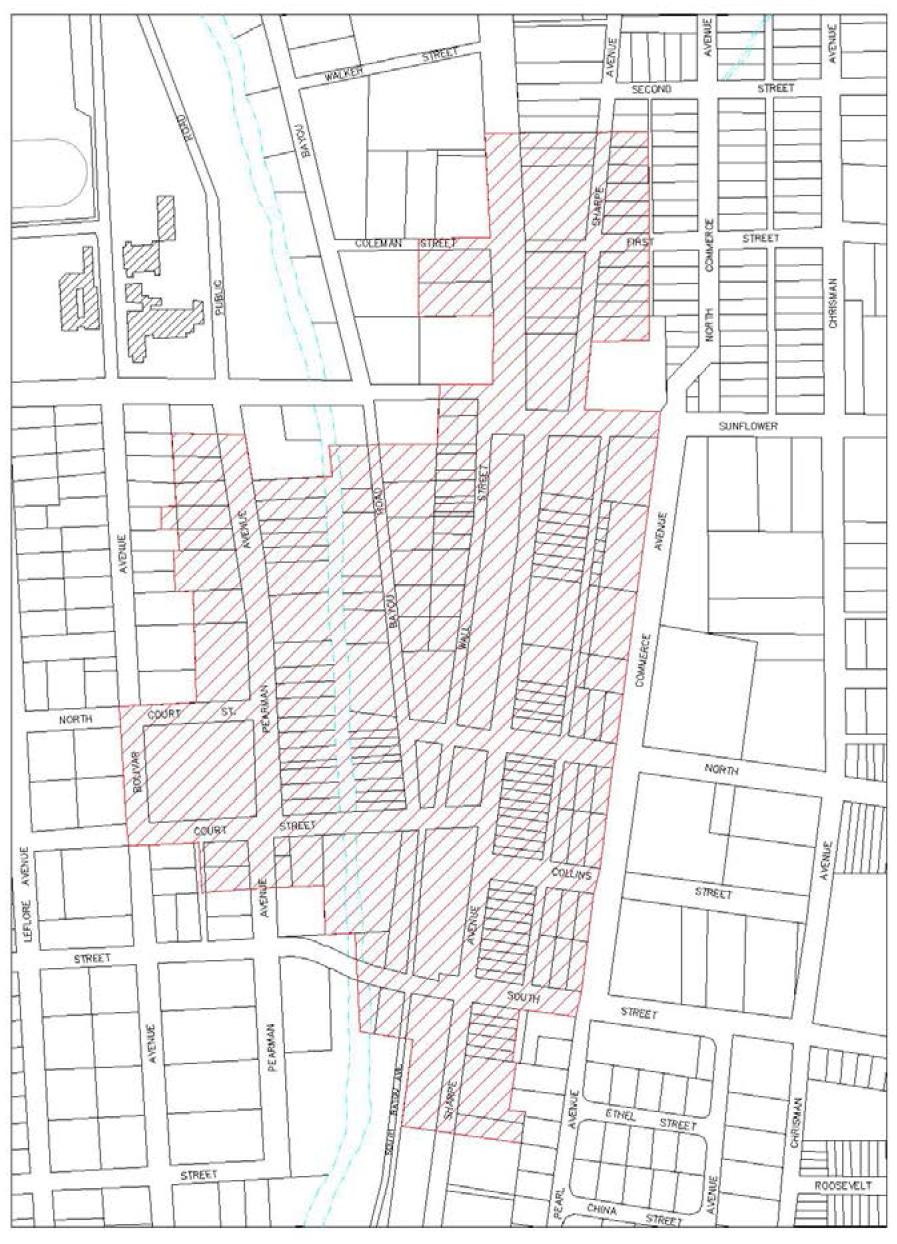
1101.1. - Architecture.
Buildings are commonly identified and categorized by: age, use or function, building type, architectural style, method of construction, etc. Characteristics may be unique to a specific building or may be shared by a variety of buildings.
Common Elements of a Downtown Building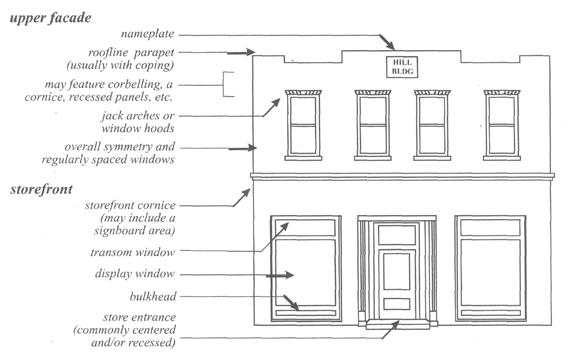
•
Within the historic district, buildings range in age reflecting the period of significance. Most buildings are late nineteenth and early twentieth century. Modern infill construction is easily distinguished because of the failure to use compatible openings, materials, and ornamentation.
•
In terms of use, buildings are constructed to shelter a variety of functions. The three most common uses found in the downtown area are: 1) commercial or retail establishments, 2) industrial or warehouse enterprises, and 3) public or civic institutions. The majority of buildings are commercial in character.
As buildings are reused, new uses which may or may not be the same as the original use are often introduced into an existing building. For example, professional offices occupy renovated interiors of residential buildings and old warehouses may be modified to house apartments. Preservationists refer to this "recycling" of buildings as adaptive reuse. Changes in use do not have to impair the historic character of a building.
•
In general, type refers to a set of buildings which share distinctive architectural characteristics. A building type can indicate whether a building is rare or common in an area and in some cases, identify the historical period in which the structure was most likely built. The three most common commercial building types in the historic district are: the store-front, the double-front, and the business block.
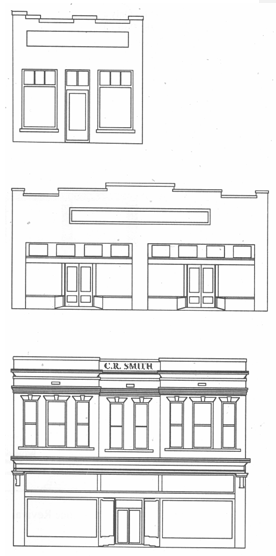
Common Commercial Building Types
Store front The simplest type of commercial building is the store-front, names for the traditional use of its first floor. On buildings more than one story high, the upper level often serves a different use and features the elements common for upper facades. One-story storefronts are common in the historic district and often appear in twos and threes.
Double-front The double-front was built for two enterprises. Buildings may be one or two stories high. The double-front differs from the business block, which may also have two storefronts, in that it does not have an emphasized central entrance or a high degree of ornamentation. One-story, double-front commercial buildings are common in the historic district.
Business Block The business block refers to a commercial building which usually covers a large or entire city lot. The building ranges from two to four stories high and has a high degree of architectural detailing. A prominent central entrance may be emphasized further by a roof pediment. If the ground level is divided in to a series of storefronts, such buildings may be referred to as continuous business blocks. Secondary entrances to upper levels are common. The historic district contains a few prominent business blocks.
•
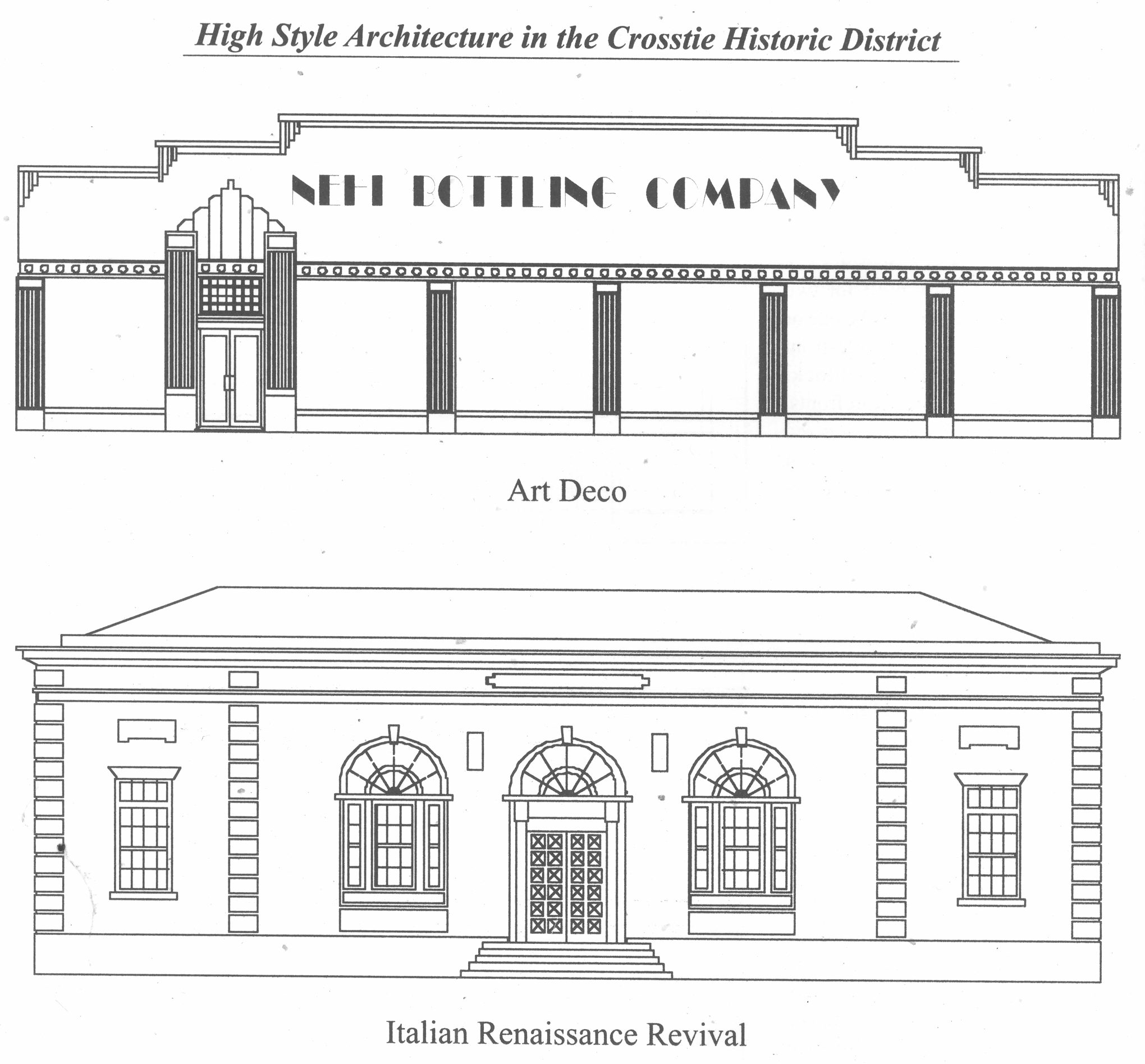
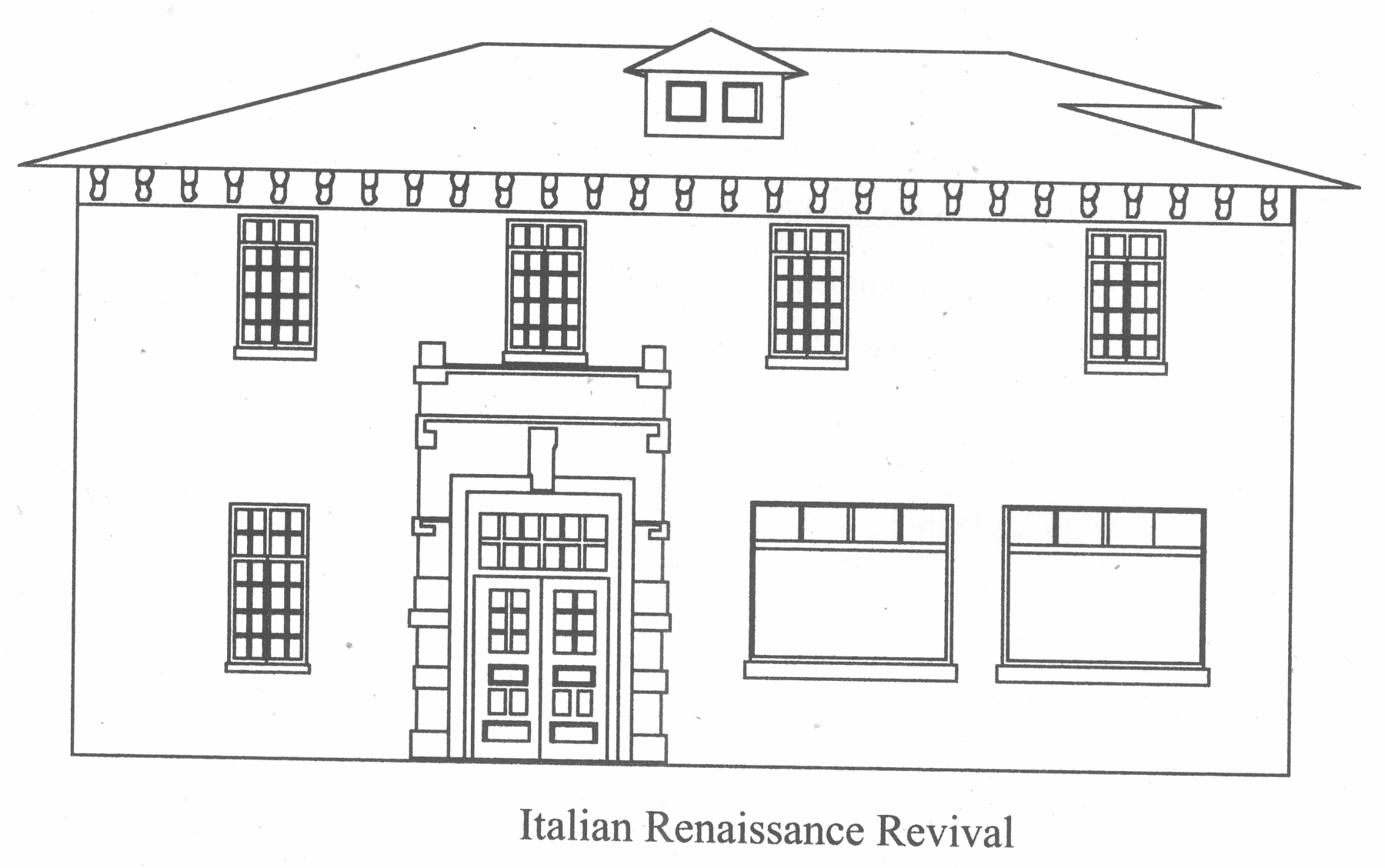
Style is one of the most basic methods of classification. Essentially style refers to the external ornamentation or decoration of a building. When all the defining aspects of a particular style are present, a building may be labeled as a high style example. If only a few stylistic details are present, the building is referred to as having elements of a style or as influenced by a style. High style buildings are few in number and are often designed by an architect; whereas, buildings with elements of a style are quite common as local interpretations of an architectural style. Buildings with no stylistic details are termed vernacular and usually referred to by type.
The majority of buildings in the Crosstie Historic District are vernacular or have elements of an architectural style. Only a few structures exhibit clear high style construction. High style examples include the Post Office (now the Police Station), the Coca Cola building, the Nehi building, and the Regent and Ellis theaters.
Other Aspects of Visual Character—An area's character is also defined by features other than buildings, such as open space (or lack thereof), site features, streetscape features, landscaping, parking, etc.
The bayou and railroad corridor through the center of the district is an important open space. Inappropriate modern plantings and excessive parking would diminish the integrity of this significant resource and of the district as a whole. The line-of-sight, such as the visibility of Sharpe Avenue from one end to the other, is also an important visual characteristic of the district which should be valued and preserved. Site features, such as fences, walls, satellite dishes, mechanical systems, etc. are generally utilitarian in character and unobtrusive in placement. Modern streetscape features, such as street lights, planters, and banners, provide additional recognition and cohesion for downtown enterprises. Parking should remain on-street, and no buildings or open space should be lost to additional parking areas.
Sec. 1102. - Five main concepts for buildings within the historical districts.
The following principles and guidelines are established in order to ensure any new development of buildings or any alteration to existing buildings within the Historic Preservation Districts is conducted in a respectable manner that accentuates and takes advantage of the historical character of Cleveland.
Based on the construction of historic downtowns, there are five main concepts that should guide the new construction of buildings to complement the existing historical character. The building a) placement and orientation, b) form and scale, c) skin, d) openings, and e) attachments all work together to create the downtown atmosphere that the City of Cleveland is preserving through the creation of historic preservation districts and architectural design guidelines.
1102.1. - Building Placement and Orientation.
Building placement is an important characteristic of site planning. Placement refers to where the building will be situated upon the lot. Building placement responds to elements such as setback and spacing. The building setback is how far the building is placed from the front, side, or rear property lines. The building spacing refers to the distance between buildings on adjoining lots. In the historic district, buildings share a similar setback and spacing. Most buildings in the historic district have a zero setback (located on the property line) and are attached (sharing side walls with flanking buildings.)
Principle 1:New buildings should follow the traditional placement pattern. Most buildings in the historic district have a zero setback (located on the property line) and are attached (sharing side walls with flanking buildings). A new building should not be placed forward or behind the established setback or façade line, which is the visual line created by the repetition of similar setbacks by historic buildings. New buildings should also be attached, having a zero setback, rather than freestanding. Institutional and civic buildings are exceptions to the rule; these buildings are generally freestanding and located centrally upon the property. Industrial architecture follows both patterns. When evaluating new construction, reference nearby buildings and the appropriate type of building (i.e. commercial, civic, industrial, etc.

Inappropriate placement and orientation detracts from the visual character of the historic district.
Principle 2:New additions should be placed to the rear of existing buildings. Additions can have a tremendous negative impact upon building placement if added to the front of a building. The façade line would be disturbed. The most appropriate place for a new addition is on the rear of the existing structure.
Principle 3:New construction should maintain the setback established by neighboring historic buildings.
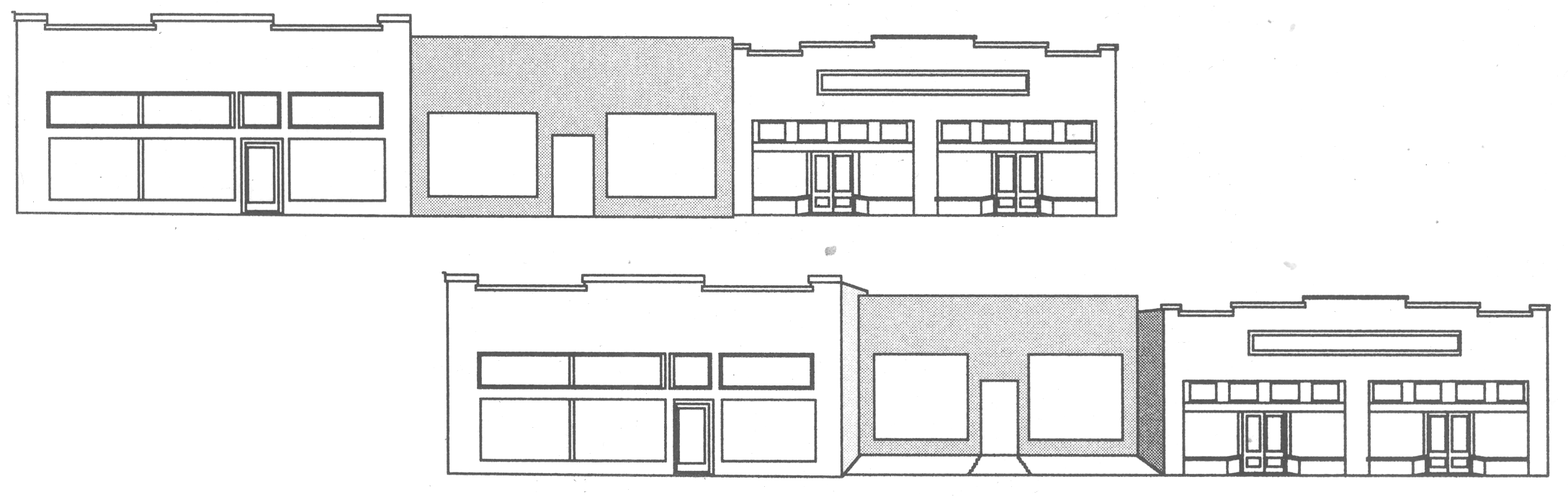
The new building (top row) follows the traditional setback of its historic neighbors while the new building (bottom row) disrupts the pattern by recessing its façade wall from the sidewalk line.
Principle 4:New construction should be placed so that the side spacing approximates that of historic buildings on the same block.
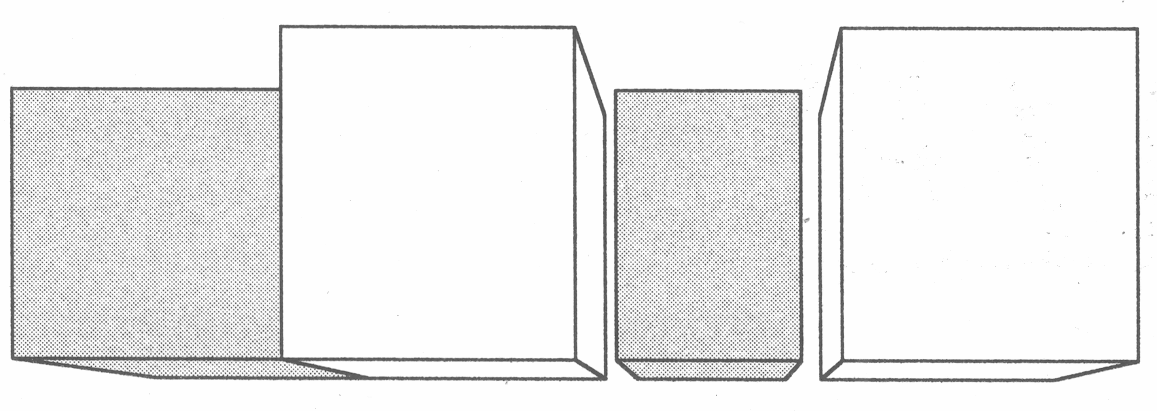
The new building (far left) shares its sidewall with the neighboring building unlike the new building (center), which disrupts this pattern by setting itself apart from the neighboring buildings.
Orientation is another significant site characteristic that simply refers to the direction that the primary entrance of a building "faces". In the historic district, the railroad had a tremendous influence on orientation where most buildings in the downtown area follow a clear pattern of being oriented towards the railroad.
Principle 5:New buildings should follow the traditional orientation pattern. Historically dependent on the railroad, most of the buildings in the downtown developed along the railroad corridor. Commercial establishments presented their "faces" to pedestrians in order to attract customers. Therefore, all buildings along a block tend to share a similar orientation toward the street. Corner buildings usually face the more important of the two streets. Civic buildings may have multiple facades; thus, these structures may face more than one street. New buildings should repeat the orientation of the historic buildings on the same block. When evaluating new construction, reference the location, nearby historic structures, and the specific type of building (i.e. commercial, civic, industrial, etc.).

The new building (center) disrupts the traditional orientation pattern by not facing its primary entrance to the street.
Principle 6:New additions should not alter the orientation of historic buildings. New additions can alter the orientation of a historic building by shifting the primary entrance or creating a new primary entrance. New entrances should be carefully evaluated to determine their impact upon orientation.
1102.2. - Building Form and Scale.
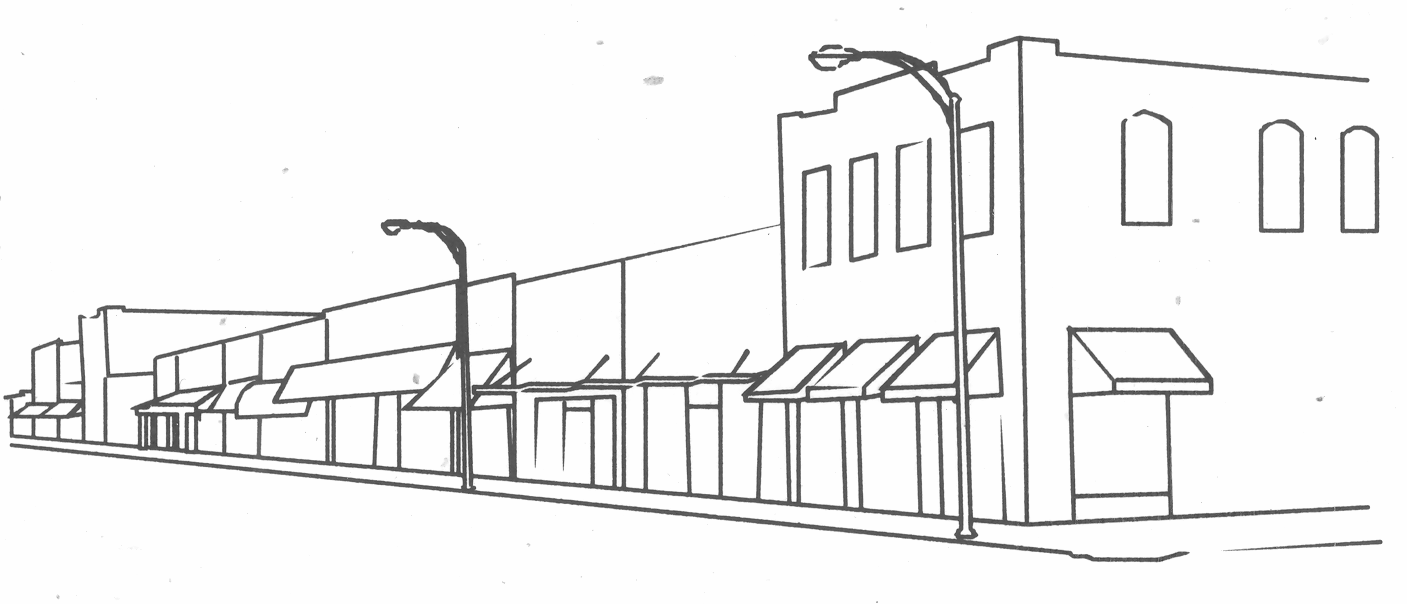
The repetition of similar form and scale creates unity in the historic district and distinguishes the area from other parts of the city.
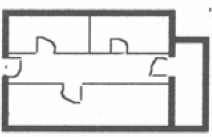
Building form is the combination of the "silhouette" and the "footprint". It refers to the shape and appearance of a building. The "silhouette" of a building is defined by the outside lines of the building. Each building has four silhouettes or sides. On blueprints, each side is known as an "elevation." The front elevation is also known as the "façade." The shape, pitch, and complexity of the roof, also known as the parapet, influence the building form or the "silhouette".
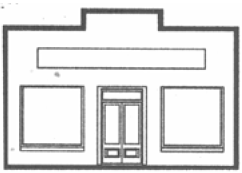
The "footprint" of a building is formed by the lines of the exterior walls of the building on the ground. On blueprints, this is known as the "plan" or "floor plan." Buildings in downtown Cleveland are primarily one single block with rectangular silhouettes and footprints. Parapets provide the only relief, or change in shape, to this geometric pattern.
Principle 1:New construction should incorporate building forms that reflect the established form of the historic district. A dominant component of form is the roof and its shape, pitch, and complexity. Other ingredients are the height of the foundation, story heights, and whether a building is composed of a single block or several small blocks. Downtown buildings are primarily one single block with rectangular silhouettes and footprints. Parapets provide the only relief, or change in shape, to this geometric pattern. New buildings should feature parapets.
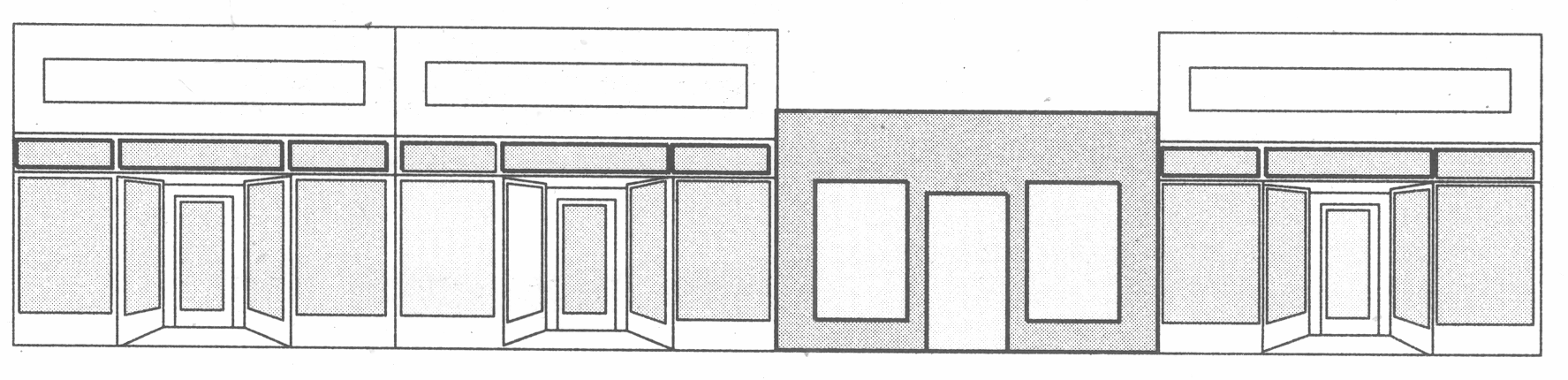
Though this new building has the same rectilinear form and number of stories as its historic neighbors, it fails to match their height due to a lower roofline and the lack of a parapet.
Principle 2:New addition forms should repeat the proportions of existing forms and should not destroy or obscure the form of the existing buildings. The roof form and foundation height of an addition should closely match the original proportion of the building. Additions, which are secondary and discernible, should not alter the footprint of a building so drastically as to completely obscure the original form.
a.
Building Form: Roofline
Roofs are an important character and form defining feature. In the historic district, rooflines of commercial and warehouse buildings are distinguished primarily by the use of parapets, false walls which create a distinctive roofline and hide the low-pitched roof behind the parapet. A few examples, usually institutional or civic buildings, do not follow this general rule.
Principle a1:Roof design should be maintained and preserved. Important aspects of roof design include its pitch, shape, symmetry, and complexity. As most roofs in the historic district are simple parapet forms, changes which alter, cover, or detract from the parapet roofline are not appropriate. These rooflines are also important for their simplicity and should not be embellished.

Parapets are a distinguishing feature of rooflines in the downtown area. Most are very geometric; however, a few possess curvilinear shapes.
Principle a2:During roof repair and replacement, new materials should match original materials. Architecturally distinctive roofing material should be carefully handled during repairs and reused when possible. As parapets are designed to hide a low-pitched roof plane, the actual roofing material is less significant for such buildings. Roof pitch and materials may be altered for improved drainage may be altered for improved drainage provided that the new roof does not rise above the parapet or lap over onto building elevations.
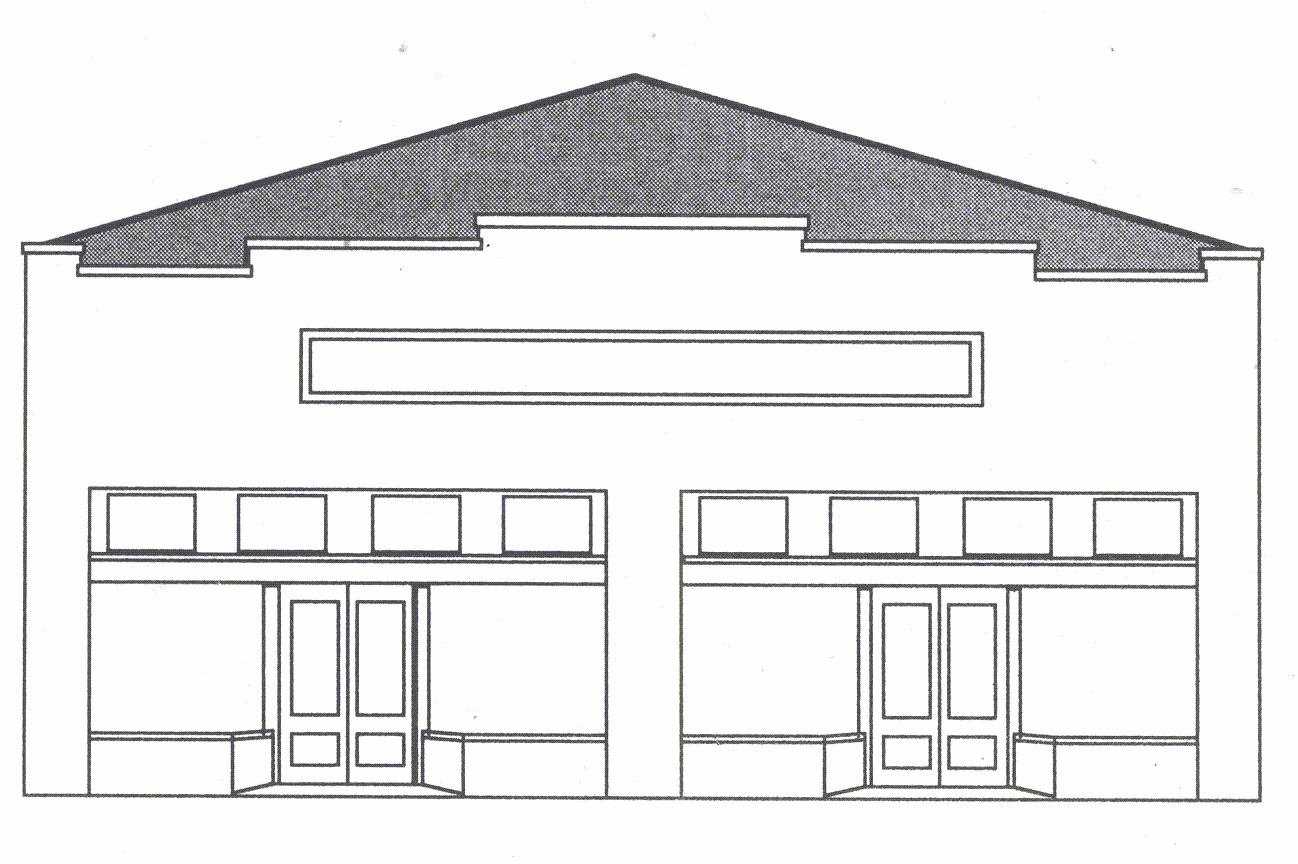
The addition of a new gable roof form is not consistent with the traditional use of parapets and disrupts the distinctive roofline created by a row of historic commercial buildings.
Principle 3:Secondary features and distinctive materials which contribute to design should be retained. Chimneys, often used for both decorative and utilitarian purposes, should be kept in good repair and not removed even when no longer in use. Skylights should be maintained whenever possible. Flashing, gutters, and downspouts should be examined and repaired during roof improvements; whereas, defunct roof pipes and vents may be removed.
Scale is the combination of mass and volume of a structure; it refers to the height, width, and depth. The majority of buildings in the downtown area are one-story with the exception of a few two-story buildings and a historic multi-story hotel. Most buildings are also no more than three or four bays wide meaning one building may have three or four different façade details or storefronts. The uniform scale of historic buildings and new construction is essential to the visual character of the historic district.
Principle 4:New buildings should follow the established scale of the historic district. The majority of buildings in the downtown area are one-story with the exception of a few two-story buildings and a historic multi-story hotel. Most buildings are no more than three or four bays wide. New buildings should approximate the height, width of adjacent and nearby historic buildings. Building depth should be evaluated if lot coverage becomes an issue. If a building is to occupy several empty lots, it is essential that the façade be segmented with horizontal divisions to approximate the widths found upon historic examples.
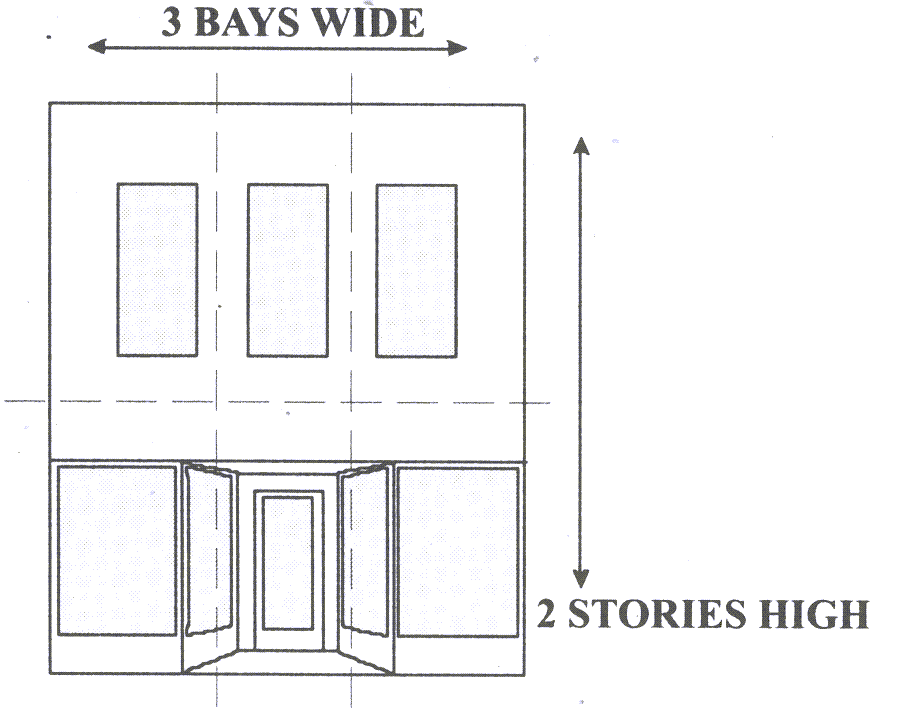
Width is a combination of actual linear footage as well as the number of vertical bays (horizontal divisions).
Height is both the number of stories as well as the height of the building above grade.
Principle 5:New additions should be proportional to and discernable from the existing historic structure. New additions should not overwhelm the original structure. Additions should not alter nor obscure the original scale of historic buildings; additions should remain secondary to the principal building. An addition should also have a perceivable juncture where it adjoins the original building. This can be achieved by using a slightly lower roofline, recessing the wall back from (rather than flush with) the original wall, or the use of a separating element.
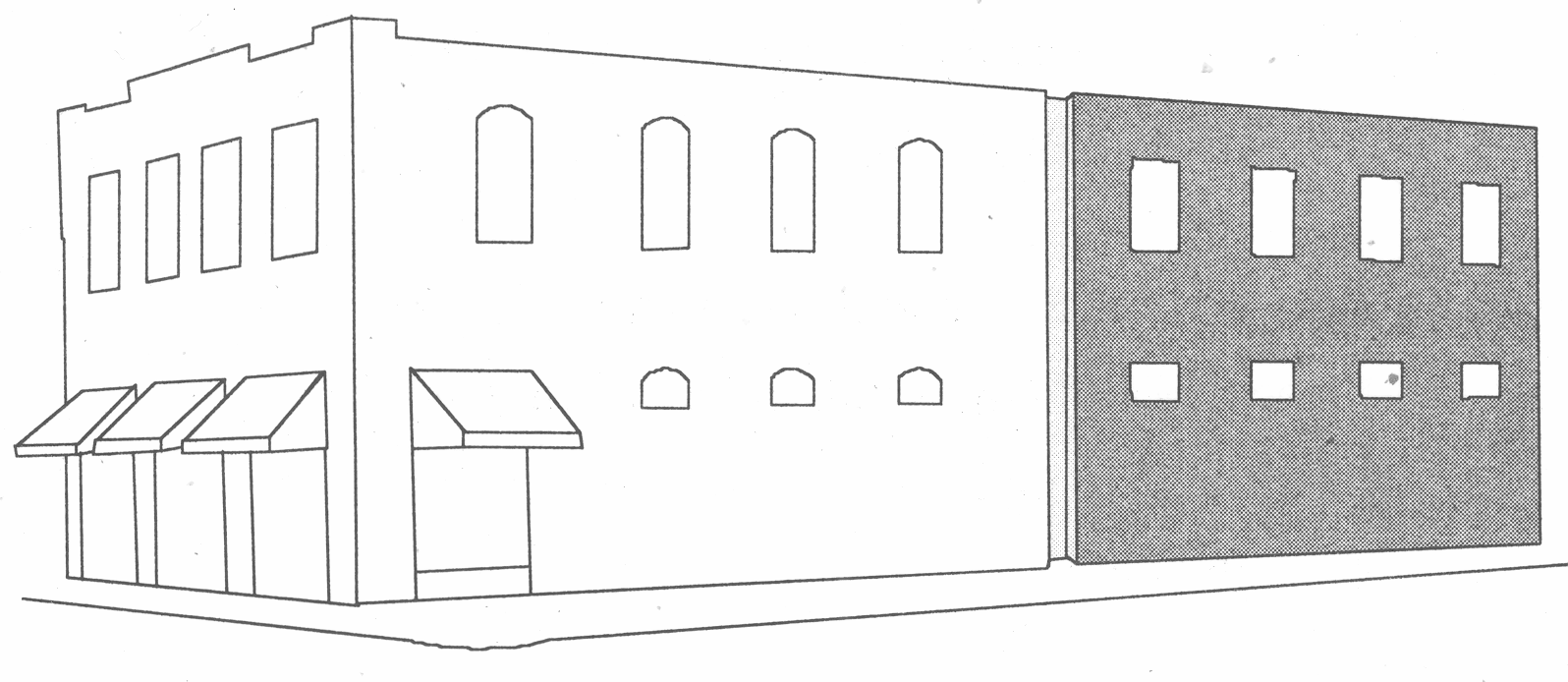
Additions are easily discernable through a small recessed "juncture" and the use of openings which differ in shape while respecting placement and size.
1102.3. - Building skin: Materials and ornamentation.
Materials and ornament have a significant impact upon visual character. Materials form the surface or walls of the building. The type of materials used defines a building in terms of both texture and color. In addition, ornamentation accentuates different portions of the building. The proper use of materials and ornamentation can allow a new building to become a contributing member of the historic district while introducing its own identity.
Principle 1:Exterior materials should be preserved and maintained. As the most common exterior material, brick is tremendously significant to the character of the historic district. Existing exteriors should not be covered by a modern replacement, including but not limited to: vinyl or aluminum siding, stucco or synthetic stucco (E.I.F.S.), western-motif plank siding, etc. Such materials rob a building of any historic integrity and its ability to contribute to the historic district.
Principle 2:New buildings should utilize traditional building materials. New buildings constructed with materials inconsistent with the district negatively impact the historic character of the area. Brick is the most common exterior material. Traditional materials uncommon to the area should not be used. Because of the permanence of masonry materials, the color of masonry materials for new construction should relate to existing historic buildings in the district to avoid inappropriate and uncharacteristic colors. Use of a primary color of brick for the façade and a secondary color for detail work will be considered; however, variegated brick is inappropriate.
Principle 3: New additions should utilize materials closely matching the original material of the building. Exterior materials for additions should relate in size, shape, and color to those of the original structure.
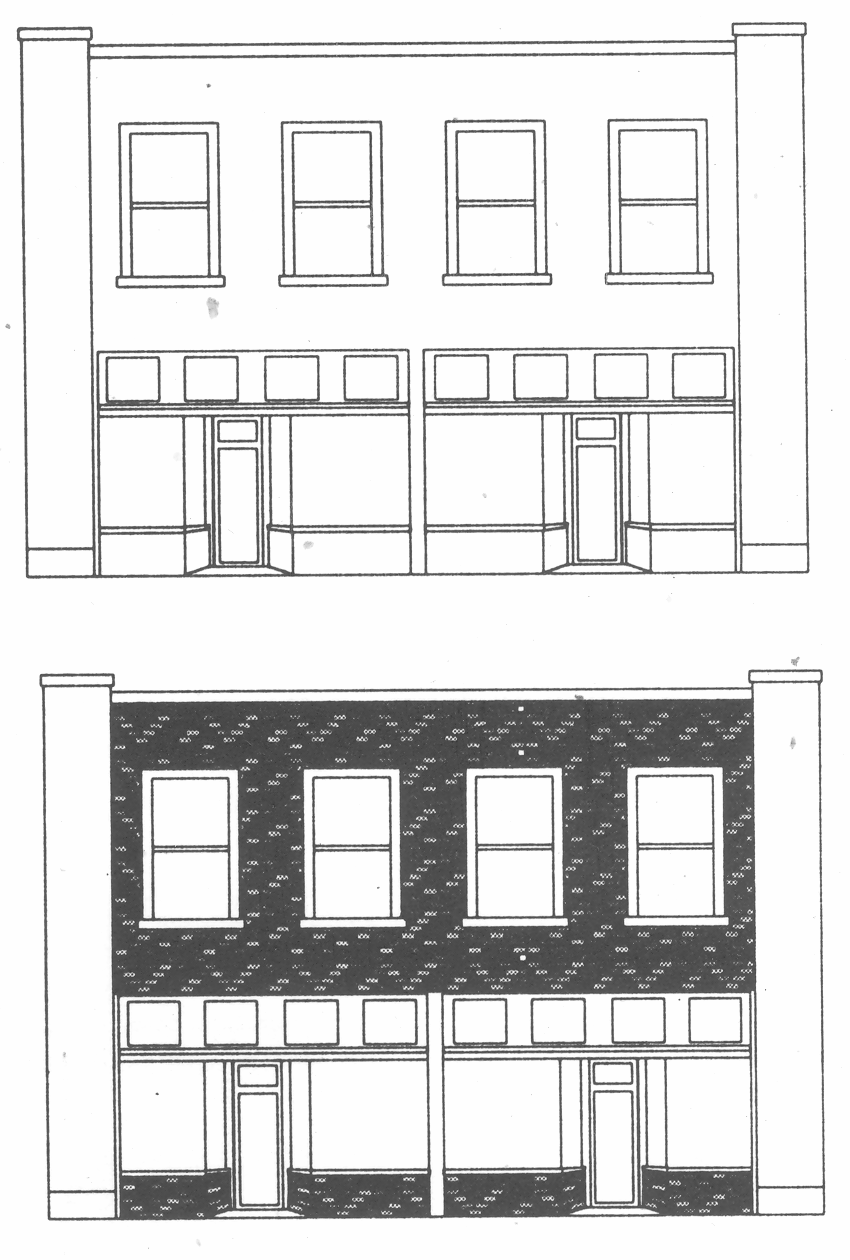
The use of variegated brick or synthetic materials for pilasters is inappropriate in the historic district.
Principle 4:Repairs should be limited to affected areas, be sensitive to historic materials, and utilize matching materials. Repair of exterior materials should remove only the damaged material and replace it in kind. Mortar for reporting should be carefully selected because modern cement is rigid and will damage historic bricks which expand and contract. The gentlest means possible should be used for cleaning building exteriors. Never sandblast to clean or remove paint from buildings. Unpainted buildings should not be painted unless previous repair or damage has caused significant contrasts in the brick and mortar; however, painting non-historic buildings can camouflage over-sized or variegated brick and increase compatibility. Iridescent and florescent paint colors are inappropriate; neutral colors are preferred. Historic paint palettes are available at most paint suppliers.
Principle 5:Architectural elements should be retained, never covered or removed. A distinguishing feature of commercial buildings in the historic district is the alignment of decorative features along a block of buildings. Decorative elements along the roofline visually connect the buildings. Decorative brickwork and brick corbelling is often common at the roofline, along the cornice, and on the parapet wall. Industrial buildings are usually devoid of ornament; however, the two soda bottling plants have a high degree of ornamentation. Institutional and civic buildings frequently use classical ornamentation, such as pediments, columns, entablatures, and quoins.
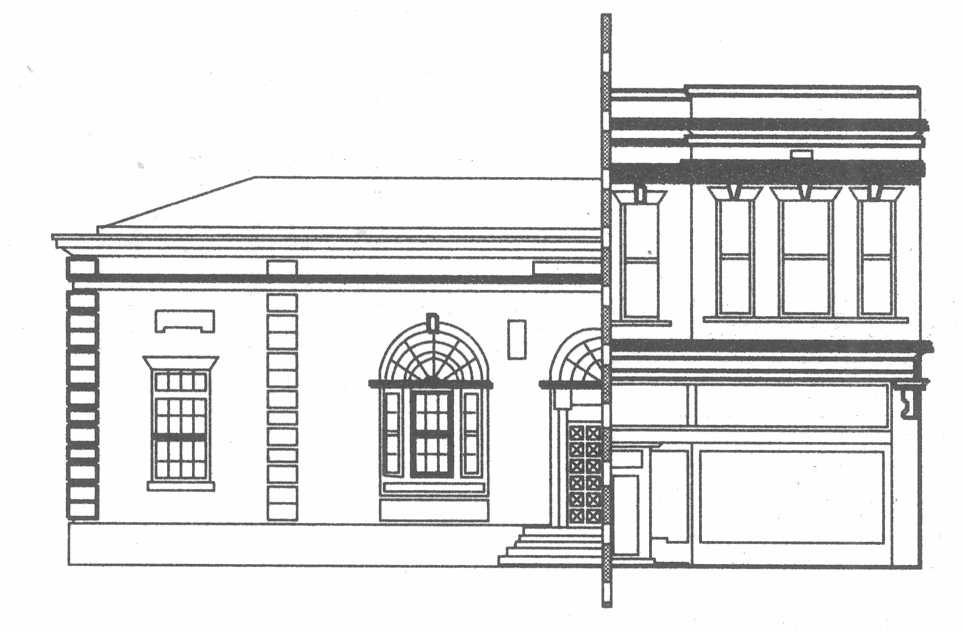
High style architectural elements are more common on institutional or civic buildings such as the old Post Office; however, some commercial facades are highly articulated like the Smith Block.
Principle 6:New buildings should use ornamentation reflecting the pattern established by existing construction. Ornamentation for new buildings should not exceed the degree of ornamentation found on existing buildings. Classical detailing should be reserved for banks and civic buildings; however, these details should be drawn from a period of development comparable to the district's architecture. Trim, brackets, braces, moldings, shingles and other such decorative features contribute ornamentation to buildings.
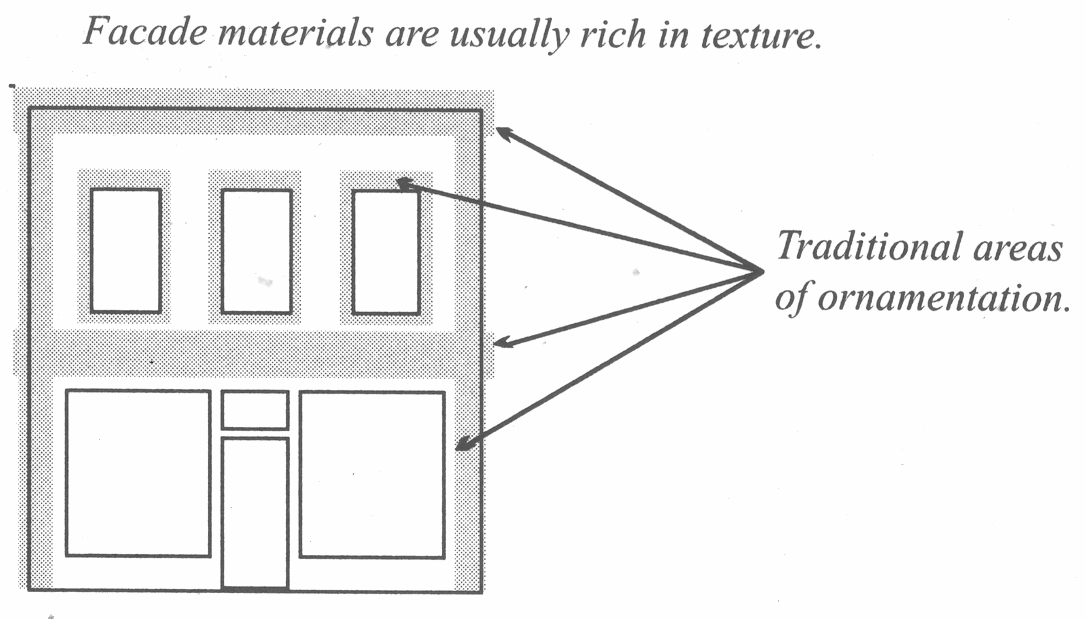
Principle 7:New additions should use the same or less ornamentation as found on the original structure. Less ornamentation for additions is encouraged. For additions to high style buildings, ornamentation which references the original structure's detailing may be considered; abstracted details are preferred. This change in ornamentation clearly denotes the addition as later construction.
1102.4. - Building openings: Storefronts, entrances, and windows.
Entrances and display windows combine to form a street level storefront for commercial enterprises. Storefronts are a distinctive feature of the historic district. Historic storefront design includes the primary entrance, large display windows, panels known as bulkheads beneath the windows, a transom row above the windows, and ornamentation such as cast iron columns, a decorative cornice line, and other details. This arrangement of features provides an ideal opportunity to display goods for public viewing. Recessed entrances, tiled entryways, and double doors also contribute to storefront design. Additionally, secondary entrances to upper floors or for service purposes are also common.
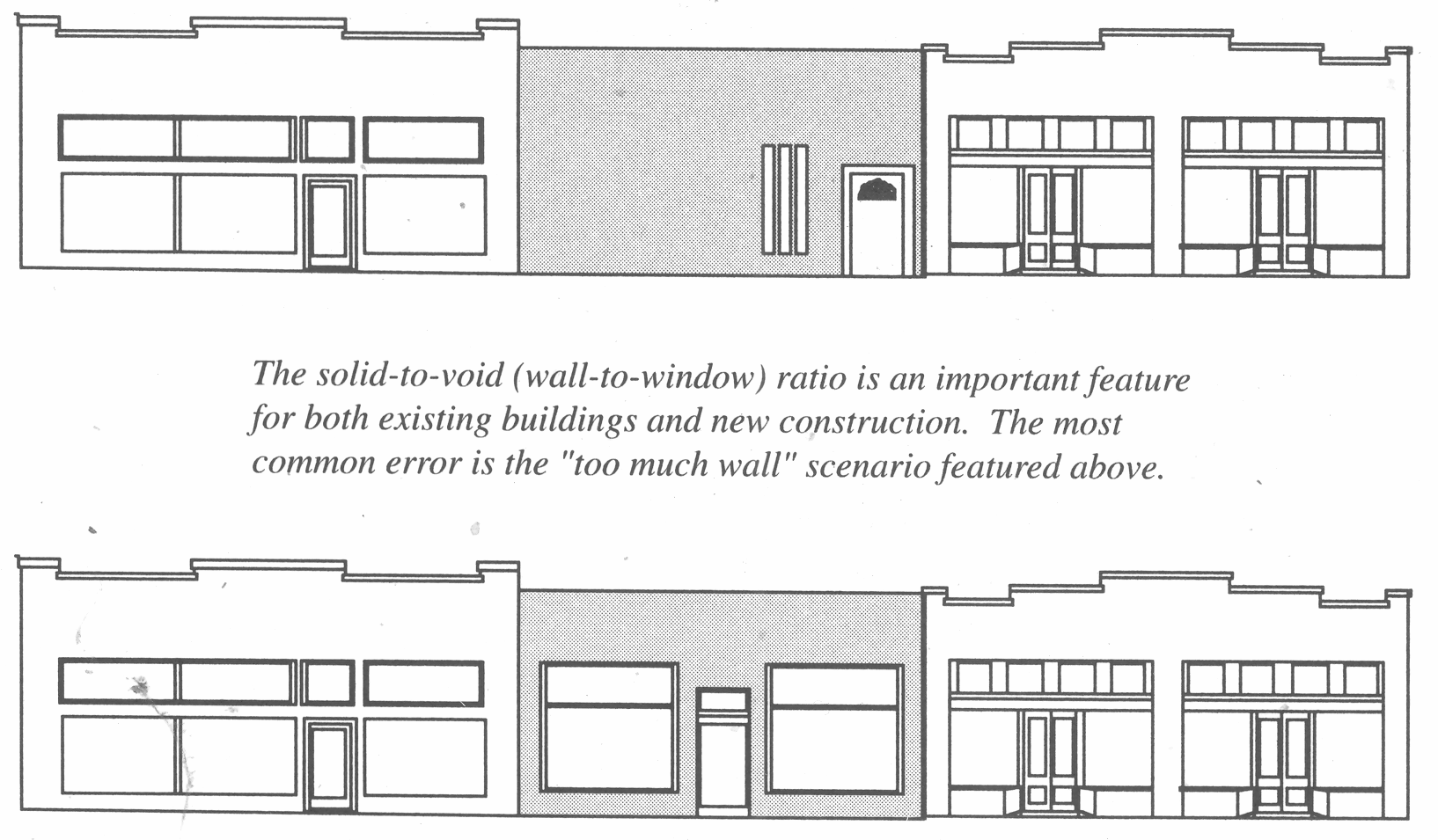
Principle 1:New buildings should carefully reference the historic use of façade elements. Storefronts, entrances, and window openings pierce the walls and create voids upon a building's façade that creates a rhythm along the streetscape. These façade elements, with a few minor variances, generally align along a block. Most buildings also emphasize façade symmetry. Openings on the façade of new buildings should follow the example established by surrounding historic buildings. Quantity and placement of openings in new buildings is extremely important. New buildings should carefully balance solid and void.
Principle 2:New additions should follow the established pattern of elements found on the original building. As additions should be located on the rear of existing buildings, only corner properties will have exposed side elevations. For such properties, it is important to respect the pattern established by similar corner properties.
Principle 3:Original storefront configuration and materials should be preserved and maintained. Storefronts should not be covered or enclosed. Entrances should not be relocated or infilled. Display windows and transoms should not be enclosed, replaced with a different window type, or covered with a false front.
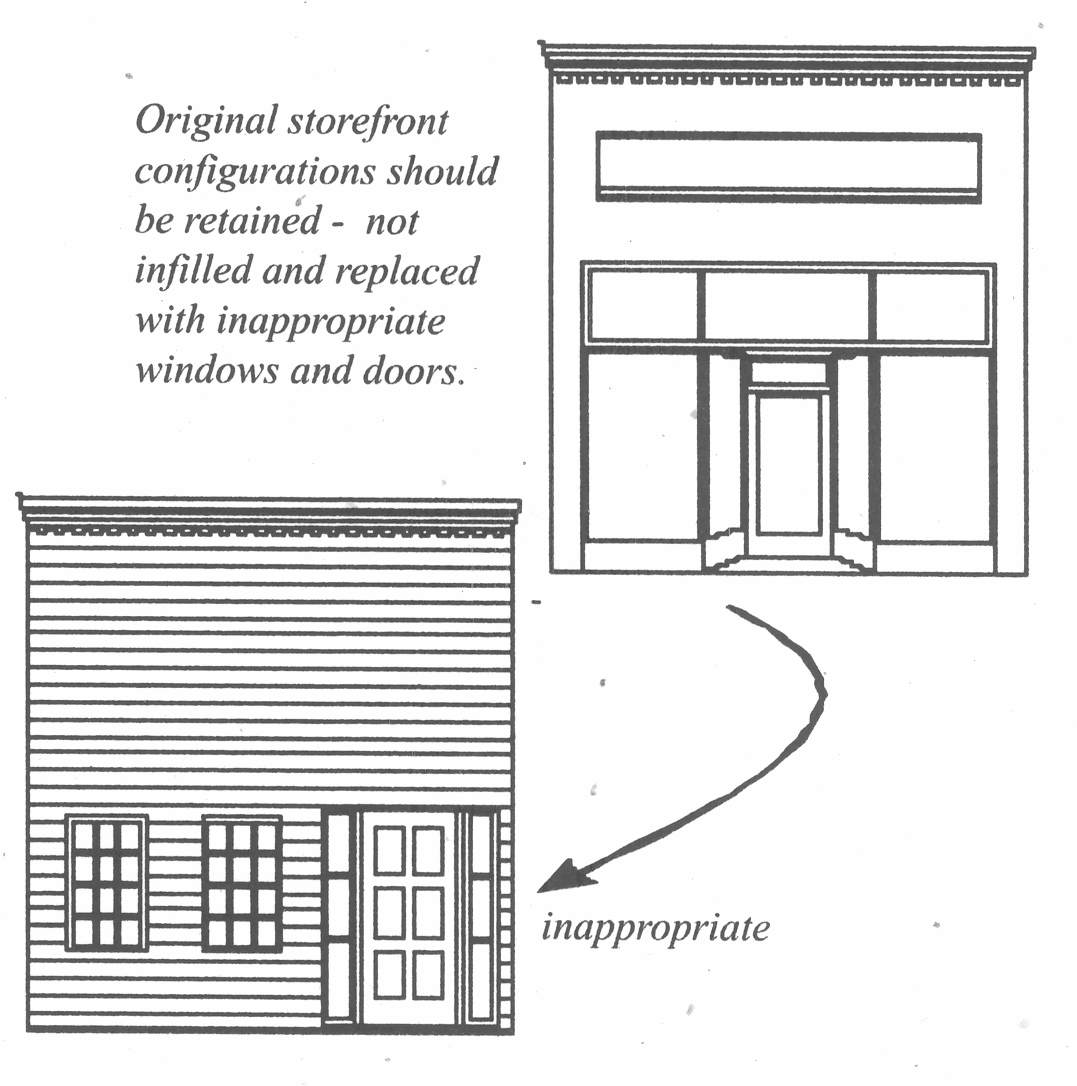
Principle 4:Replacement storefronts should follow the established traditional pattern. If the original storefront is too deteriorated to save, the replacement should accurately replicate the original. Where the original storefront no longer exists, the replacement should be based on historical research and physical evidence. Where no documentation exists, a new storefront should be designed which is compatible with original storefronts of adjacent and nearby historic buildings.
Principle 5:Existing entrances should be maintained and preserved. Entrances and their doors are evidence of the original use and design of a building. Original doors, their surrounds, and hardware should be retained. Entrance elements the location, the configuration (recessed or canted), the number and type of doors, and, tiled entryway floors should not be altered. Primary entrances should never be enclosed. Secondary entrances for upper floor access and service/delivery should be preserved even when no longer in use.
Principle 6:During repair and replacement of doors, care should be taken to match original materials and design. Deteriorated sections should be replaced rather than an entire door. If replacement of a door becomes necessary, the replacement should match the historic door in size, shape, materials, and panel patterns. Unfinished aluminum doors and residential type doors should not be installed. Adding decorative doors or surrounds to simple front entrances or utilitarian entrances diminishes the historic integrity of a building. Warehouse entrances are particularly simple and should not be embellished to create more formal entrances, such as those more characteristic of institutional and civic buildings or residential architecture.
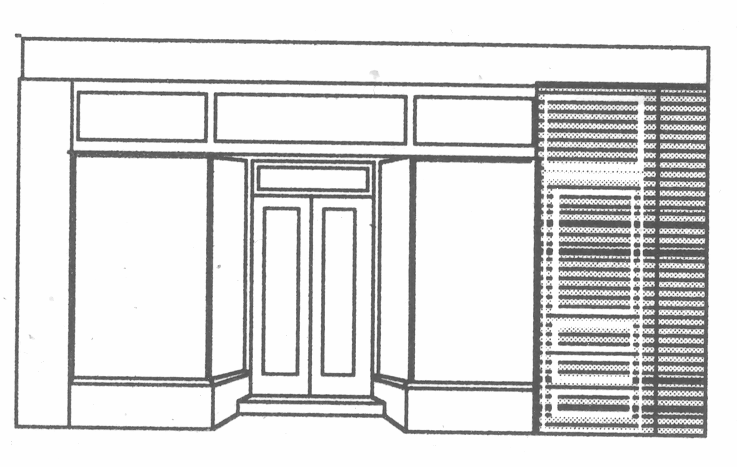
Original entrances should not be blocked-in, even if no longer in use.
Window and window features define the character of a building as well. Storefront windows of commercial buildings are used to create large expanses of glass and thus display space; however, on the upper facades and on institutional and civic buildings, the ratio of solid-to-void (wall to window) is very different. Typically, windows are regularly spaced with an emphasis on building symmetry. Upper windows are also trimmed with architectural detailing and window accessories, such as shutters, storm windows, and screens.
Principle 7:Historic windows should be preserved and maintained. Display windows and the transom row are essential to commercial storefront character. Smaller, sash windows and early metal frame windows are characteristic of industrial properties; these types of windows should remain simple and utilitarian. In contrast, institutional and civic buildings have prominent and regularly-spaced windows.
Principle 8:During repairs and renovation efforts, window configuration should be maintained. Display window and transoms should not be removed or covered. Damaged windows should be repaired by replacing affected sections with the same material and dimensions as the original. Replacement glass should be clear, not tinted. Additional or unfinished aluminum windows should not be installed. Installation of multi-divided pane windows is inappropriate and creates a false historic appearance.
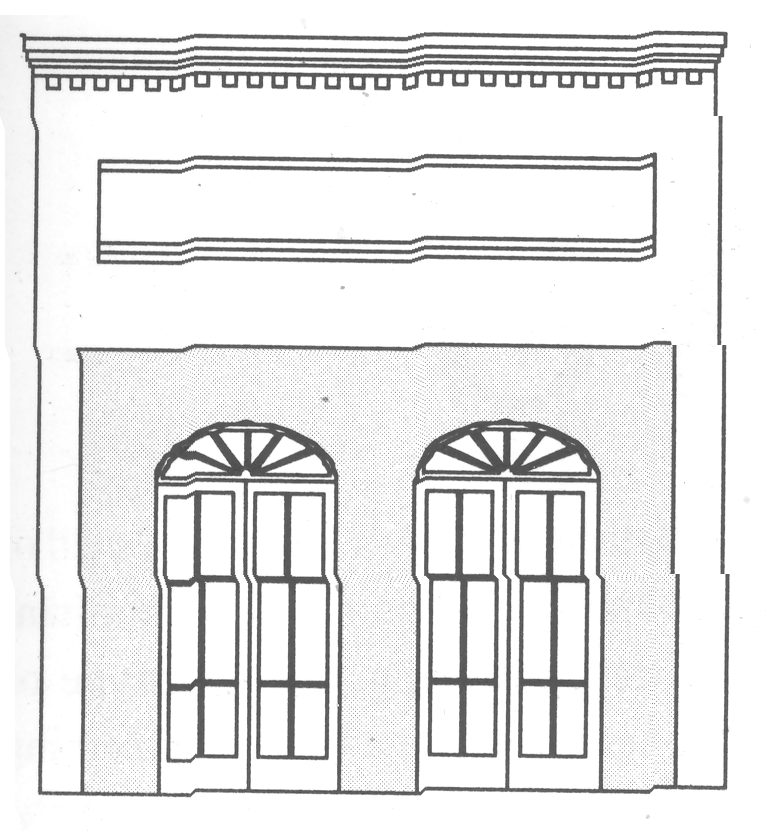
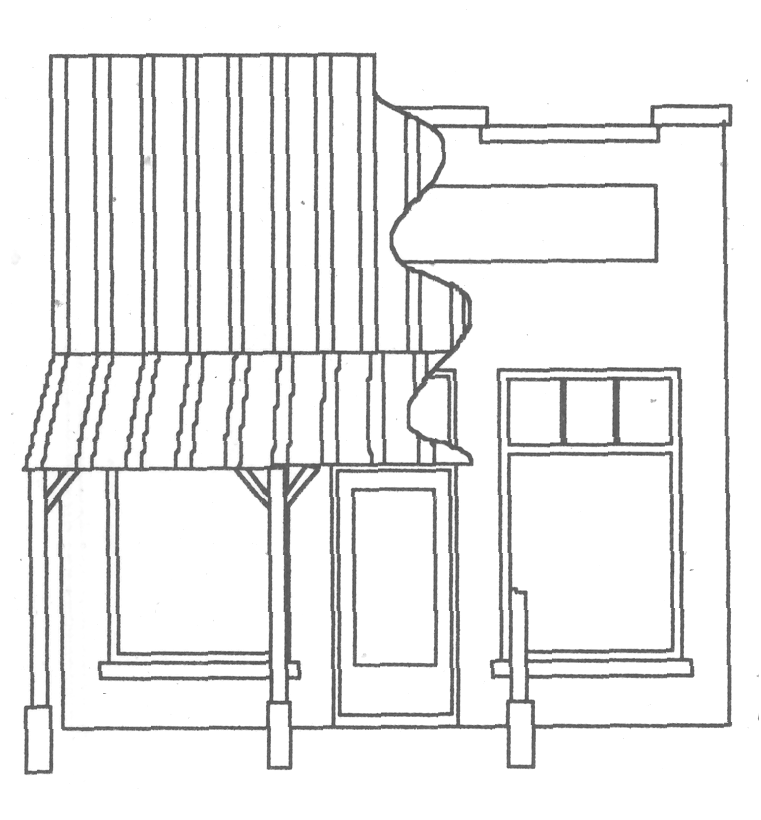
Non-historic decorative entrys and windows, referencing the Old West, Colonial New England, or New Orleans (depicted here) should not be added to falsify the storefront.
Principle 9:Storefront trim should be maintained and preserved. Bulkheads are the panels located beneath the display windows. Important bulkhead design elements include but are not limited to recessed panels, masonry ledges, and decorative trim. During repairs, it is important to replicate historic bulkheads. Wooden bulkheads should never be replaced with brick. Cast-iron columns and cornices should not be removed. Where the original ornamentation no longer exists, the replacement should be based on historical research and physical evidence.
During rehabilitation, careful removal of non-historic material may reveal physical evidence of the original façade.
 |
Original roofline with coping and stepped parapet
Traditional signboard area Obscured transom windows Important bulkhead |
Principle 10:Windows should be maintained and preserved. Historic windows are constructed of several components, such as rails, stiles, muntins, panes, sashes, and sills. Important aspects of window design include shape, dimension, grouping, spacing, type or operational category, pane arrangement, material, and ornamentation. Maintaining both window components and window arrangement is essential to building integrity.
Principle 11During rehabilitation and renovation, the original window materials and design should be retained. Though in their original state historic windows do not equal today's standards of energy efficiency, they should not be replaced. Efforts to increase energy efficiency and the operation of windows should keep the historic components intact. Window openings should not be enclosed, covered, or partially infilled for the installation of different shape or size windows. Additional window openings should never be added to the front of a building. During renovation efforts, enclosed and covered window opening should be reversed and inappropriate replacement windows removed.
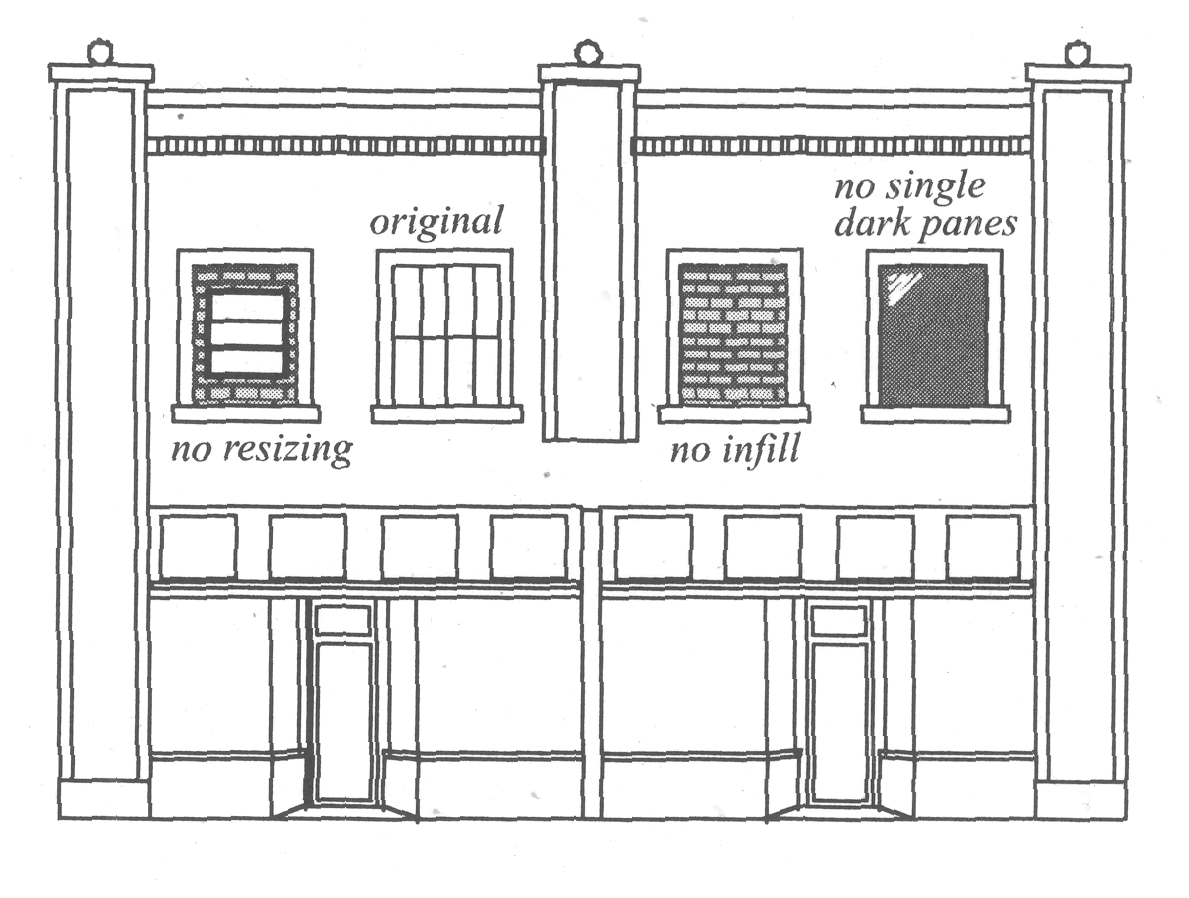
Principle 12:Windows should be repaired, rather than replaced. Damaged windows should be repaired by replacing the affected components and restoring the functional elements. Original window openings should be utilized if replacement is required by the severity of deterioration. Replacement windows should closely match the original window design. Fixed windows and simulated divided light windows ("snap-in" muntins) are inappropriate. Traditional framing materials such as wood are preferred for replacement windows; whereas, unfinished aluminum windows are inappropriate. New glazing should not be tinted or coated with a reflective material.
Principle 13:Visual impact of window accessories should be kept to a minimum. Storm windows and screens should not obscure the window's pane arrangement. Such features should be of wood or aluminum painted to match the original window frame, and the glazing should be clear. The use of interior storm windows rather than exterior storm windows is encouraged. Security grills with extensive metalwork should be avoided and are best installed on the interior of the building.
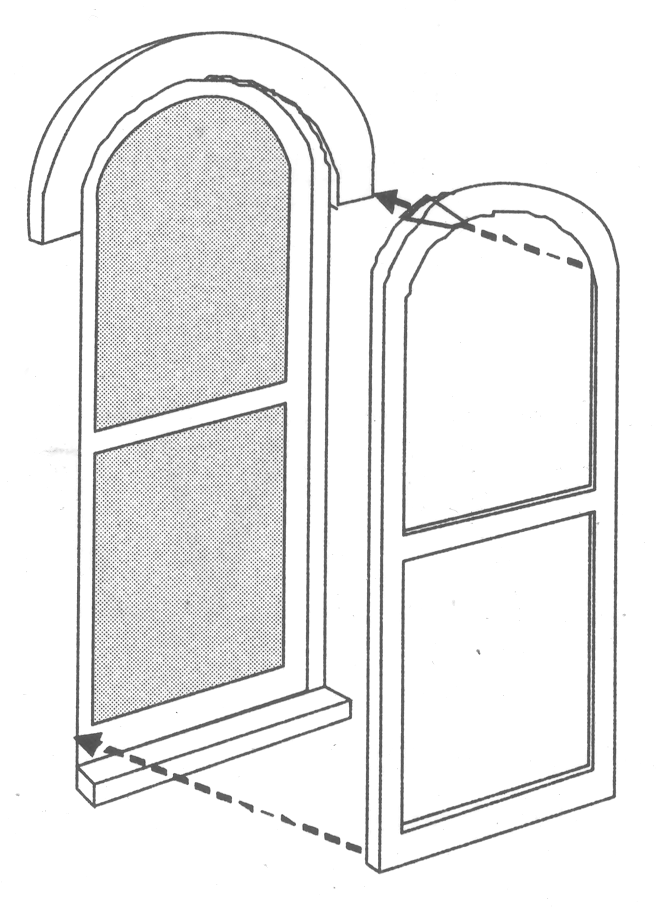
Storm windows and screens should match the shape and design of the window. Interior storm windows are a better solution.
1102.5. - Building attachments: Shutters, awnings, porches, and signs.
Principle 1:Historic shutters should be maintained. Shutters were used to provide shade, privacy, security, and decoration for buildings. Replacement shutters should be of the same material and design as the original. Where shutters have been lost or removed, historic photographs and hardware remnants may provide physical documentation of the original design. Windows which never had shutters should be left in this condition. Decorative shutters permanently affixed to the wall of a building are not considered appropriate replacements. Utilitarian type shutters on secondary elevations and on warehouse properties should not be replaced with decorative shutters.
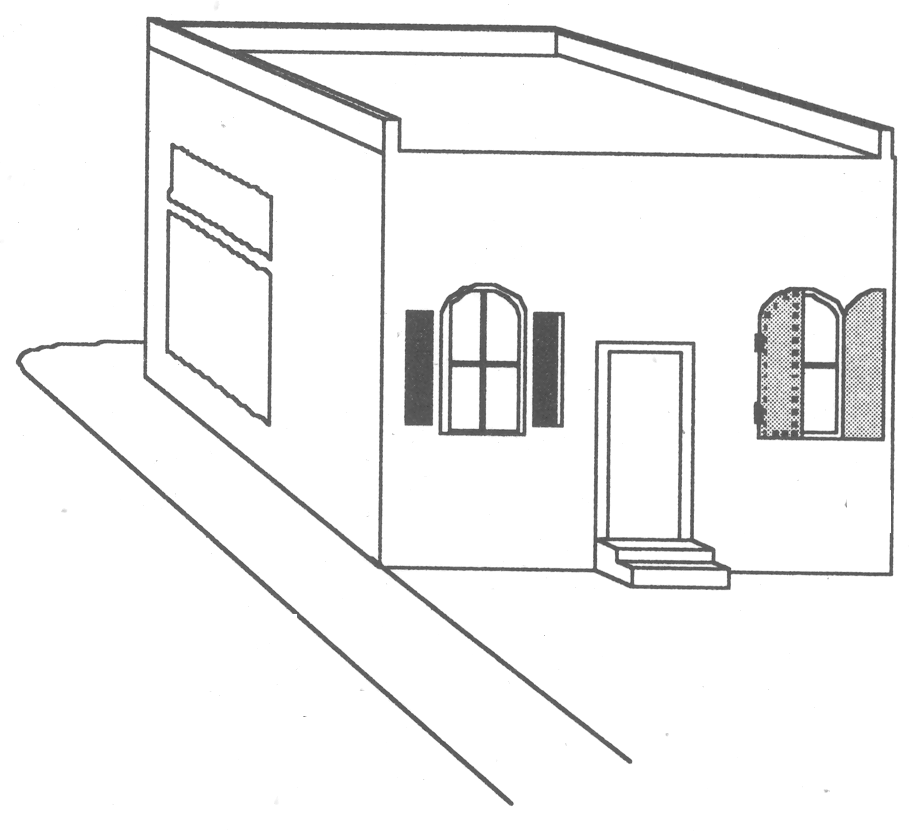
Shutter design should reflect the original use of the building and should fit the window opening.
Awnings, canopies, and porches frequently provide shade for building interiors, shelter for walkways, and ornament for exteriors. Awnings are common in this historic district. Canopies and porches are limited in number and are appropriate for only a few types of buildings.
Principle 2:Historic awnings, canopies, and porches should be preserved. Historic examples should be repaired using durable materials similar to the original.
Principle 3:The design of new awnings, canopies, and porches should be appropriate to the architectural character and historic documentation of the building and district. Inappropriate "theme" examples added during recent years are best removed or incorporated into a more appropriate design. Simple shed porches with wood posts reflect the earliest porches. For most buildings, awnings are the appropriate design; however, awnings would not be compatible for some early twentieth century buildings, which utilized flat, suspended metal canopies to reinforce their horizontal lines.
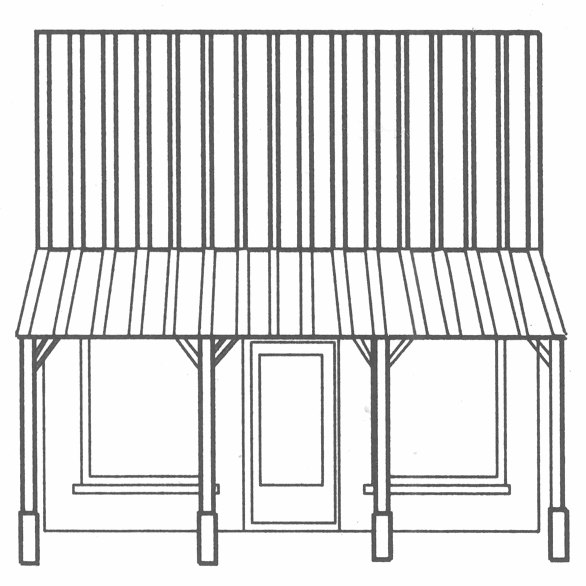
False thematic attachments, such as porches for an "Old West" look or balconies for a "French Quarter" appearance are inappropriate. Documented attachments may be restored.
Principle 4:Attachments should reinforce the scale and design of the host building. The design of new attachments should be evaluated in terms of placement, shape, size, and material. Awnings, canopies, and porches should be located to complement the building without obscuring storefront details and exterior ornament. Attachments should reflect the shape of and fit neatly within the frame of existing openings. Convex and concave awnings are generally inappropriate. Awnings and canopies should not span several buildings. Historic porches, especially those located on primary elevations, should not be enclosed.
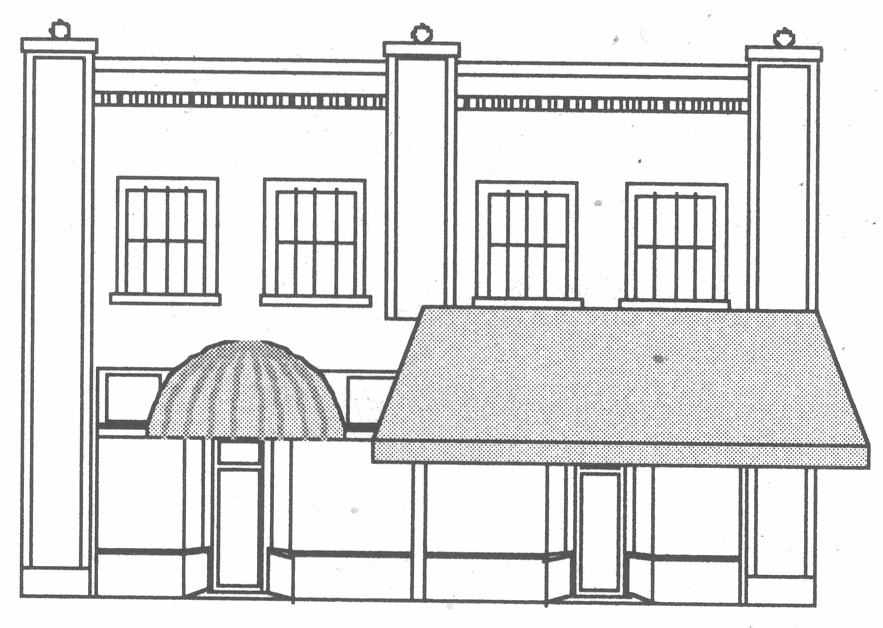
Awnings should be in scale and proportion to the building and should not cover stylistic details.
Awnings should not be shaped differently than the window or doorway. For example, rounded or "bubble" awnings are not appropriate attachments for squared entrances.
Principle 5:Materials and illumination for attachments should respect the historic character of the district. Fabric and metal are the most appropriate choices for awnings, and metal canopies may be considered. Internally lit awnings are not appropriate in the historic district.
Signs are the most common and most frequently altered features in the downtown area. Signs identify business establishments, building names, products sold, and services provided. Signs contribute significantly to the visual character of the area, and inappropriate and competitive signage can have a tremendous negative impact.
Principle 6:Historic signs should be preserved and maintained. Cornerstone inscriptions, inscribed surface lettering, "ghost" advertisements, and mosaic tile lettering on entrance flooring are common historic signs.
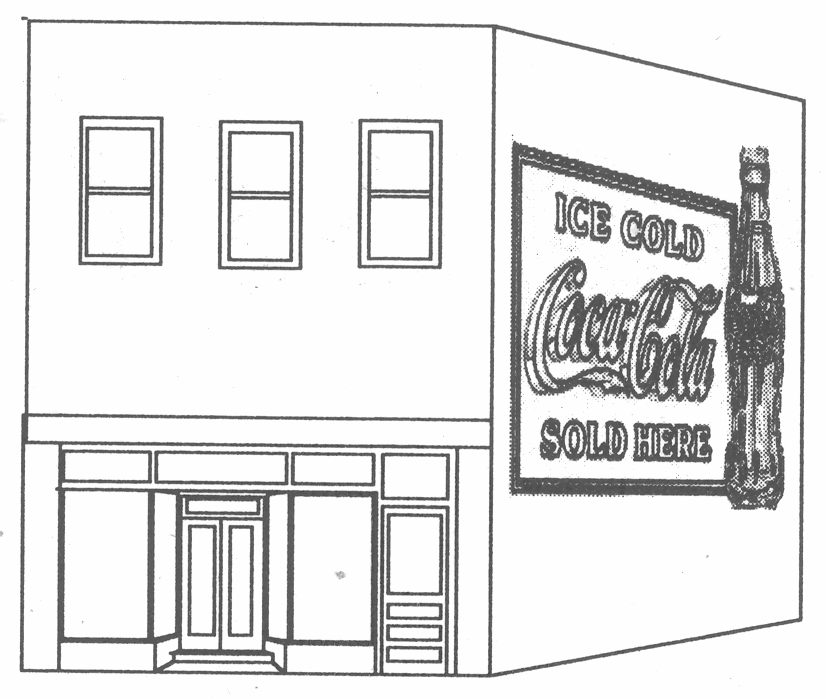
"Ghost" signs, fading painted signs, contain historic business names and product logos and should be retained. Murals are inappropriate and painted signs should be limited to historic precedents, such as the use of business names, product logos, and product advertisements.
Principle 7:Contemporary signs should be placed in traditional sign locations. Traditional sign placement includes: located within the defined area above the storefront, hanging perpendicular to the façade, painted display windows, and stitched or painted upon awnings. Signs should not cover storefront details and exterior ornament. Where possible, signs should be aligned with conforming signs on adjacent buildings.
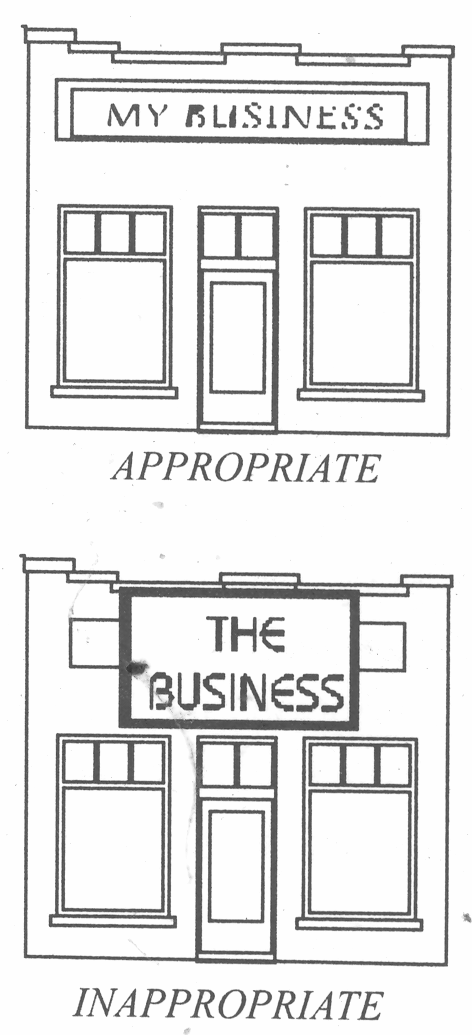
New signs should respect the proportions and design of the host building. Do not cover architectural features of the building with signs.
Principle 8: The installation of new signs should not alter or destroy historic materials or ornamentation. Signs should be mounted in such a manner to minimize the impact upon the building's exterior.
Principle 9:Contemporary signs should be of compatible design. Contemporary signs should be evaluated in terms of placement size, material, shape and lighting. Size and lighting should be limited to that which is necessary for identification purposes. Painted wood or metal signs are most appropriate; whereas, vinyl sign cabinets are not permitted. New signs should be simple or modern in design and avoid a false historic appearance. Illumination should be external and lighting fixtures should be unobtrusive.
Sec. 1103. - Maintenance requirements.
In order to insure the protective maintenance of historic resources, the exterior features of such properties shall be maintained to meet the requirements of the City's minimum housing code and building code.
Sec. 1104. - Demolition by neglect.
Any resource which is a landmark and all other resources within a preservation district shall be preserved by the owner or other persons having legal custody or control against decay and deterioration and shall be free from unreasonable structural defects. The owner or other persons having legal custody and control shall make such repairs if the resource is found to have one of the defects as discussed below. Repairs shall be made where deterioration to the extent that it creates or permits a hazardous or unsafe condition as determined by the Department of Community Development. Deterioration may be characterized by the following:
1.
Those buildings which have parts attached that may fall and injure persons or other property.
2.
Deteriorated or inadequate foundations
3.
Defective or deteriorated floor supports or floor supports insufficient to carry imposed loads with safety.
4.
Members of walls or other vertical supports that split, lean, list, or buckle due to defective material, workmanship, or deterioration.
5.
Members of walls or other vertical supports that are insufficient to carry imposed loads with safety.
6.
Member of ceilings, roofs, ceiling and roof supports, or other horizontal members which sag, split, or buckle due to defective material, workmanship or deterioration.
7.
Member of ceilings, roofs, ceiling and roof supports, or other horizontal members which are insufficient to carry imposed loads with safety.
8.
Fireplaces or chimneys which list, bulge, or settle due to defective material, workmanship or deterioration.
9.
Any fault, defect, or condition in the building which renders the same structurally unsafe or not properly watertight.
If the Heritage Commission makes a preliminary determination that a resource is being demolished by neglect, it shall direct the Department of Community Development to officially notify the owner stating the reasons for this preliminary determination and shall give the owner thirty (30) days to commence work to correct the specific defects as determined by the Heritage Commission.
This notice to the property owner shall be certified by mail, restricted delivery, and mailed to the last known address of the record owner as listed on the tax roll. If this mailing procedure is not successful, notice shall be posted in a conspicuous, protected place on the resource in question.
If the owners fail to commence work within the time allotted as specified by the building permit, the Heritage Commission shall notify the owners in the same manner as mentioned above. This notification shall also require the owners to appear at a public hearing before the Heritage Commission and shall state the date, time, and location and be mailed at least thirty (30) days before the hearing. For the purpose of insuring a lawful notice, a hearing may be continued to a new date and time. The Heritage Commission shall receive evidence on the issue of whether the subject resource should be repaired and the owners may present evidence in rebuttal. If after such hearing, the Heritage Commission shall determine that the resource is being demolished by neglect, it may direct the Department of Community Development to bring misdemeanor charges against the owners if the necessary repairs are not completed within ninety (90) days of the determination of neglect.
Sec. 1105. - Public safety.
None of the provisions of this Article shall be construed to prevent any action of construction, alteration, or demolition necessary to correct abate the unsafe or dangerous condition of any resource, or part thereof, where such condition has been declared unsafe or dangerous by the Department of Community Development or the Fire Department and where the proposed actions have been declared necessary by such authorities to correct the said condition; provided, however, that only such work as is necessary to correct the unsafe or dangerous condition may be performed pursuant to this section. In the event any resource designated as a landmark or located within a preservation district, shall be damaged by fire or other calamity to such an extent that it cannot be repaired and restored, it may be removed in conformity with normal permit procedures and applicable laws, provided that:
1.
The Department of Community Development concurs with the property owner that the resource cannot be repaired and restored and so notifies the Heritage Commission in writing.
2.
The Heritage Commission, if in doubt after receiving such notification from the Department of Community Development, shall be allowed time to seek outside professional expertise from the State Historic Preservation Office and/or an independent structural engineer before issuing a certificate of appropriateness for demolition. The Heritage Commission may indicate in writing by letter to the Department of Community Development that it will expire a time period of up to thirty (30) days for this purpose, and upon such notification, this section shall be suspended until the expiration of such a delay period.

