
Cleveland City Zoning Code
ARTICLE 4
- WORD USAGE AND DEFINITIONS
For the purpose of this Ordinance, certain words and phrases are defined. Words and phrases defined shall be given the defined meaning. Words or phrases not defined shall be given their usual meaning, except where the context clearly indicates a different or specified meaning.
Words used in the present tense include the future tense and the singular includes the plural.
The term "shall" and "must" are always mandatory and not discretionary; the words "may" or "should" are permissive.
The term "person" or "applicant" or "developer" includes a firm, organization, association, partnership, trust, company, limited liability company, limited partnership, or corporation, as well as an individual.
The terms "use" or "occupy" shall include the concept of intended, designed, or arranged to be used or occupied.
The term "building" includes the term "structure" or "any portion of a building or structure".
Whenever any reference is made in this Ordinance to any other section or provision of this or any other ordinance, such reference shall be deemed to include the provisions or regulation to which the reference is made.
Definitions are provided in alphabetical order:
ABATE/ABATEMENT: Action to terminate, stop, cease, repair, rehabilitate, replace, demolish, correct or otherwise remedy nuisance activity, condition, premises or conduct by such means and in such manner as to bring the activity, condition, premises or conduct into compliance with the laws or regulations of the City of Cleveland and/or the State of Mississippi or in such manner as is necessary to promote the health, safety or general welfare of the public.
ACCESSORY BUILDING or STRUCTURE: Any detached minor building in the rear or side of the main building consisting of masonry, frame walls, or poles without walls, and a roof, one (1) or two (2) stories in height, that is subordinate or incidental to the principal or main structure or use and located on the same lot. Any and all accessory buildings will be located behind the front building line of the main structure in the rear or side yards. Further, the accessory building or structure will not be located less than five (5) feet from the side or rear property lines, or ten (10) feet from a side street property line for corner lots, or eight (8) feet from another structure in any residential zone or twenty (20) feet from another structure in any commercial or industrial zone. It is the intent of this ordinance that there shall be but one (1) main structure plus any permitted accessory structures on any lot used for residential purposes; also, that accessory structures, including storage buildings, shall not include living quarters.
ACCESSORY USE: A subordinate use that is incidental to and customary in connection with the principal building or use and located on the same lot.
ADDITION: An extension, expansion, enlargement or increase in the area or height of a building or structure or the number of dwelling units within the building or structure. Generally, any new construction added to an existing building or structure.
ADDITIONAL INSPECTION: All inspections after the second inspection during the process of obtaining a certificate of occupancy.
ADMINISTRATIVE OFFICIAL: The official or officials designated by the governing body of the City of Cleveland to administer this Land Development Ordinance, primarily the Director of Community Development or Building Official.
ADULT ARCADE: An adult entertainment establishment where, for any form of consideration, one or more motion picture projectors, slide projectors, VCRs, or similar machines for viewing by five or fewer persons each, are used to show films, motion pictures, video tapes, slides, or other photographic reproductions which are characterized by emphasis upon the depiction or description of "specified sexual activities" or "specified anatomical areas".
ADULT BOOKSTORE: An adult entertainment establishment which has as a substantial portion of its stock-in-trade and offers for sale, for any form of consideration, any one or more of the following:
(a)
Books, magazines, periodicals, or other printed matter, or photographs, films, motion pictures, video cassettes, slides, or other visual representations which are characterized by an emphasis upon the depiction or description of "specified sexual activities" or "specified anatomical areas", or
(b)
Instruments, devices, or paraphernalia which are designed for use in connection with "specified sexual activities".
ADULT CABARET: A nightclub, bar, restaurant, theater, or similar adult entertainment establishment which regularly features live performances which are characterized by the exposure of "specified anatomical areas" or by "specified sexual activities" or films, motion pictures, video tapes, slides, or other photographic reproductions which are characterized by an emphasis upon the depiction or description of "specified sexual activities" or "specified anatomical areas".
ADULT ENTERTAINMENT ESTABLISHMENT: An adult arcade, adult bookstore, adult cabaret, adult motel, adult motion picture theater, massage parlor, or similar establishment which regularly features or depicts behavior which is characterized by the exposure of "specified anatomical areas" or by "specified sexual activities", or where any employee, operates, or owner exposes his/her "specified anatomical area" for viewing by patrons.
ADULT MOTEL: A motel or similar adult entertainment establishment which includes the word "adult" in any name it uses or otherwise advertises the presentation of adult material, offering public accommodations for any form of consideration which provides patrons with closed-circuit television transmission, films, motion pictures, video tapes, slides, or other photographic reproductions which are characterized by an emphasis upon the depiction or description of "specified sexual activities" or "specified anatomical areas".
ADULT MOTION PICTURE THEATER: An adult entertainment establishment where, for any form of consideration, films, motion pictures, video tapes, slides, or similar photographic reproductions are shown, and in which a substantial portion of the total presentation time is devoted to the showing of material which is characterized by an emphasis upon the depiction or description of "specified sexual activities" or "specified anatomical areas".
AGENT: A person, agent, manager, or other individual or entity representing the owner of a property, and who may serve as a point of contact on inspections under this ordinance.
ALTERATION: Work which impacts any exterior architectural feature including construction, reconstruction, or removal of any building or building element.
APARTMENT HOUSE: See DWELLING, MULTIPLE.
APPEARANCE: The outward aspect visible to the public.
APPURTENANCE: The visible, functional objects accessory to and part of buildings.
ARCH: A curved construction which spans an opening and supports the weight above.
ARCHITECTURAL CHARACTER: The composite or aggregate of the characteristics of structure, form, materials, and function of a building, group of buildings, or other architectural composition.
ARCHITECTURAL FEATURE: A prominent or significant part or element of a building, structure, or site.
ARCHITECTURAL STYLE: The characteristic form and detail of a building, structure, or site, as of buildings of a particular historic period.
AWNING: A sloped projection supported by a frame attached to the building façade.
BASEMENT: A story having part but no more than one-half its height below average grade of the adjoining ground. A basement is counted as a story for the purpose of height regulations, if subdivided and used for business or dwelling purposes by other than a janitor employed on the premises.
BAY: The horizontal divisions of a building, defined by windows, columns, pilasters, etc.
BED AND BREAKFAST: A building or portion thereof, formerly a single-family dwelling unit, where an owner-operator is paid for lodging in a limited number of guest bedrooms, for specific time periods, with meals provided only to registered guests. This definition does not include hotels, restaurants, cafes, or any other activities that involve sales or services to non-registered guests.
BERM: An earthen mound designed to provide visual interest, screen undesirable elements of a project from public view, and/or decrease noise.
BOARD OF APPEALS: The Cleveland Planning Commission.
BOARDING HOUSE: A building other than a hotel, where for compensation and by prearrangement for definite periods, meals, or lodging and meals, are provided.
BODY PIERCING: that activity as defined in Mississippi Code Annotated Section 73-61-3 said statutory definition being hereby adopted by reference.
BOND (two definitions in context): A monetary guarantee, which secures installation of improvements in the event a developer defaults on required subdivision improvements. An acceptable bond shall include a surety bond from a company licensed to do business in the State of Mississippi; cashier's check, assignment of certificates of deposit, or irrevocable letters of credit from banks located in the State of Mississippi on all Cleveland banks. Also, a term used to describe the various patterns in which brick is laid.
BRACKET: A decorative support feature located under eaves or overhangs.
BROKEN INSPECTION APPOINTMENT: Failure of the owner or agent to notify the City of Cleveland Code Compliance Department at least one (1) hour in advance that the owner or agent will be unable to keep a scheduled inspection appointment.
BUFFER AREA: An area set aside to remain vacant or to be planted and landscaped to reduce the blighting effect of commercial or industrial uses of adjacent residential property.
BUILDABLE WIDTH: Width of the building site left after the required yards have been provided.
BUILDING: Any structure having a roof supported by columns or walls built for the support, shelter, or enclosure of persons, animals, or property of any kind, but not including any vehicle, trailer (with or without wheels), nor any movable device. When divided by walls without openings each portion of such structure shall be deemed a separate building. It is the intent of this ordinance that there shall be but one (1) main structure plus any permitted accessory structures on any lot used for residential purposes; also, that accessory structures, including storage buildings, shall not include living quarters.
BUILDING, ALTERATION OF: Any change or rearrangement in the supporting members including bearing walls, beams, columns, or girders of a building, any addition of a structure or movement of a building from one location to another.
BUILDING, HEIGHT OF: The vertical distance measured from the average elevation of finished grade along the front of the building to the highest point of the coping of a flat roof, to the deck line of a mansard roof, or the average height between eaves and ridges for a gable, hip or gambrel roof. Exception to Height Limits: The height limitations shall not apply to church spires, belfries, cupolas and domes not intended for human occupancy, nor shall they apply to monuments, smoke stacks, conveyors, flag poles, masts, stand-pipes, parapet walls, outdoor theater screens, amateur radio antenna structures, and other similar structures and appurtenances, provided their construction conforms with existing or hereafter adopted Ordinances of the City.
BUILDING PERMIT: A permit issued by the Department of Community Development authorizing the construction, renovation, addition or alteration of a specific building on a specific lot.
BULKHEAD: The panel between framing members and beneath the display windows in a storefront; also known as a kickpanel or kickplate.
CALIPER: The average diameter of a tree measured thirty-six (36) inches above the ground.
CANOPY: A shaped or curved projection from the building façade or attached to the building façade to shelter the storefront and pedestrian traffic.
CAPITAL: Topmost member of a column or pilaster.
CARPORT: See GARAGE, PRIVATE.
CAST-IRON FRONT: A storefront made of glass and pieces of utilitarian and decorative iron case in easily assembled parts.
CELLAR: A story having more than one-half of the height below grade. A cellar is not included in computing the number of stories for height unless it is designed and used for dwelling purposes.
CERTIFICATE: A certificate of occupancy.
CERTIFICATE OF APPROPRIATENESS: A document evidencing the approval of the Heritage Commission for work proposed by an applicant within a historic district.
CERTIFICATED LOCAL GOVERNMENT: A federal program authorized by the National Historic Preservation Act 16 U.S.C. 470 et seq., which provides for the participation of local governments in a federal/state/local government preservation partnership. The federal law directs the state historic preservation officer and the secretary of the interior to certify local governments to participate in this partnership. Specific state requirements for the program are published in the State of Mississippi Guidelines and Regulations for the Certified Local Government Program.
CHECK-CASHING BUSINESS: Any individual, partnership, association, joint stock association, trust or corporation, excluding the U.S. Government and the government of Mississippi, who exchanges cash or other value for any check, draft, money order, personal money order, or other instrument for the transmission or payment of money, except travelers checks and foreign drawn payment instruments, and who charges a fee therefore, and who may defer deposit of a personal check cashed for a customer. This definition does not include any federally or state chartered bank, savings institution or credit union.
CHROMA COLORS: Any of various brilliant pigments containing chromium compounds, such as chromium green or chromium yellow. Generally, any metallic color.
CHURCH: A building used principally for religious worship, but the word church shall not include or mean a funeral chapel or building, religious educational institution or parochial school, day care center, or any type of religious owned or sponsored residential facilities.
CITY: The City of Cleveland, Mississippi, or its representative.
CITY PLANNING COMMISSION: The City of Cleveland Planning Commission or Cleveland Board of Appeals.
CLUSTER DEVELOPMENT: A development pattern for residential subdivisions that permits a reduction in lot area and bulk requirements, provided there is no increase in the number of lots permitted under a conventional subdivision and the resultant land area is devoted to open space.
COHESIVENESS: The unity of composition between design elements of a building, structure, and site.
COLUMN: A vertical, cylindrical or square supporting member, usually with a classical capital.
COMMON AREA: An open space area within or related to a site designated as a development and designed and intended for the shared use or enjoyment of residents and owners of the development. Common open space may contain such complementary structures and improvements as are necessary and appropriate for the shared use or enjoyment of residents and owners of the development.
COMPATIBILITY: The harmony in appearance of two or more buildings, structures, and landscaping elements in the same vicinity.
COMPREHENSIVE PLAN: A statement of public policy for the physical development of the entire municipality or county adopted by resolution of the governing body. As used in this Ordinance, the term refers to the most recently adopted Comprehensive Plan of the City of Cleveland, as amended and supplemented from time to time by ordinance of the Mayor and Board of Aldermen.
CONDOMINIUM: The ownership of single units in a multi-unit structure with common areas and facilities. Also, a building or group of buildings, where units are owned individually, and where the structure, common areas and facilities are owned by all the owners on a proportional, undivided basis.
CONFORMING USE: Any lawful use of a building or lot which complies with the provisions of this Ordinance.
CONSTRUCTION: The addition or placement of any improvement to a resource.
CONVENIENCE STORE: Any retail establishment offering for sale a limited line of groceries and household items generally necessary for everyday living, and intended for the convenience of the neighborhood.
COPING: The capping member of a wall or parapet.
CORBELING: A series of stepped or overlapped pieces of brick or stone forming a projection from the wall surface.
CORNICE: The uppermost, projecting part of an entablature, or feature resembling it.
COURSE: A horizontal layer or row of stones or bricks in a wall.
COURT or COURTYARD: An open unobstructed space on the same lot as the building.
CURB CUT: Any interruption or break in the line of a street curb in order to connect a driveway to a street, or otherwise provide vehicular access to abutting property.
CURB LEVEL: The level of the established curb in front of the building measured at the center of such front. Where no curb has been established, the City Engineer shall authorize and approve the establishment of such curb or its equivalent for the purpose of this Ordinance.
DAY CARE CENTER: A place that provides shelter and personal care for five or more persons, regardless of age, for any part of a 24-hour day, whether such place be organized or operated for profit or not. Care of a person shall not exceed twelve and one half (12½) hours for any part of the 24-hour day. The term day care center includes day care babysitting service, child or adult care centers and any other facility that is within the scope of this definition, regardless of auspices. Excluded from this definition is any facility operating a kindergarten, nursery school or Head Start Program in conjunction with an elementary school and/or secondary school system, whether it be public, private or parochial, whose primary purpose is a structured school readiness program. Also excluded is any medical care facility, such as a nursing home or rehabilitation center. Space requirements shall comply with Mississippi State Board of Health and the International Building Code, or other appropriate state or federal agency provisions.
DEMOLITION: The complete or partial removal of a building, structure, object, or site, including landscape features.
DEMOLITION BY NEGLECT: Improper maintenance or lack of maintenance of any resource which results in substantial deterioration of the resource and threatens its continued preservation.
DENTIL: One of a series of small, square, tooth or block-like projections forming a molding.
DENSITY: The number of families, individuals, dwelling units, households or housing structures per acre of gross land area.
DEVELOPER: Any person or other legal entity engaged in the development or redevelopment of land, buildings or structures; also any person other legal entity dividing or proposing to divide land so as to constitute a subdivision.
DIRECTOR: The Director of Community Development / Building Official of the City of Cleveland or his duly authorized representative.
DISPLAY PUBLICLY: Placing, posting, exhibiting, or in any way displaying in any location, whether public or private, an item in such a manner that it may be readily visible from a street, public space, or another property.
DOUBLE-HUNG WINDOW: A window having two sashes, one sliding vertically over the other.
DWELLING: Any building, or portion thereof, which is designed and used for residential purposes. It shall not include boarding or rooming houses, tents, hotels, recreational vehicles, mobile home or RV parks, or other structures designed or used primarily for transient residents.
DWELLING, ONE-FAMILY or SINGLE-FAMILY: A detached building, designed, arranged, and occupied exclusively by one family.
DWELLING, TOWNHOUSE: A single-family dwelling forming a group or series of three or more attached single-family dwellings separated from one another by party walls without doors, windows, or other provisions for human passage or visibility through such walls from basement or cellar to roof and having roofs which may extend from one of the dwelling units to another.
DWELLING, MULTIPLE: Any building or portion thereof which is designed, built, rented, leased or hired out to be occupied or which is occupied as a home or residence of two or more families living independently of each other. The term "multiple dwelling" shall be understood to include apartment houses, bungalow courts, duplexes, tri-plexes, and all other dwellings of similar character.
EARTHTONE COLORS: Colors considered to be various shades of reddish-brown, brown, tan, ochre, umber, flat gold, sand, and flat greens. The following are not ordinarily considered earthtone colors: bright primary colors, blue, canary yellow, red, orange, violet, magenta, bright green, silver, gray, or metallic finishes.
EASEMENT: A right distinct from ownership giving authorization by a property owner for the use by another of any designated part of his property for a specified purpose. For example:
a.
Utility: An easement reserving space for utilities.
b.
Access: An easement allowing a private path which is permanently reserved for vehicle or pedestrian access to abutting property. The terms of use which are public record.
c.
Drainage: An easement reserving space for conveyance of water.
ELEVATION: Any of the external faces of a building.
ENTABULATURE: The horizontal group of members supported by the columns, divided into three major parts, and consisting of architrave, frieze, and cornice.
ENFORCEMENT OFFICER: The Code Enforcement Officer, Housing Inspector, Building Inspector, Building Official, Director of Community Development, any sworn Police Officer of the City of Cleveland, Mississippi, or any other City official named by the Mayor and Board of Aldermen to enforce the provisions of this Ordinance.
EXTERIOR BUILDING COMPONENT: An essential and visible part of the exterior of a building.
EXTERIOR DESIGN FEATURE: The architectural style and general arrangement of such portion of a building or structure as is to be open to view from a public street, place, or way, including the kind, color, and texture of the building material of such portion, and the type of windows, doors, and lights, or ground signs and other fixtures appurtenant to the building.
FAÇADE: The front elevation or "face" of a building.
FAMILY: Any number of individuals related by blood, marriage, or other legal arrangement or a group of unrelated individuals not to exceed six unrelated persons living together as a single housekeeping unit and in which food preparation is conducted on the premises.
FANLIGHT: A semicircular or semi-elliptical window with radiating muntins suggesting a fan.
FASCIA: A projecting flat horizontal member or molding forming the trim of a flat roof or a pitched roof; also part of a classical entablature.
FENCE: A barrier intended to mark a boundary, screen a view or prevent intrusion. All fences shall be able to withstand normal wear, function as a barrier and keep an attractive appearance, and shall be built in a sound workmanlike manner, with adequate footings.
FENESTRATION: The arrangement of window openings in a building. Generally, any exterior window or door.
FINIAL: A projecting decorative element at the top of a roof turret or gable.
FLASHING: Thin metal sheets used to make the intersections of roof planes and roof/wall junctures watertight.
FLOODPLAIN: Any land area susceptible to being inundated by flood waters from any source. The 100-year Floodplain is the area of the floodplain that has a one percent chance of being inundated in any given year.
FLOODWAY: The channel of a watercourse and portions of the floodplain adjoining the channel, which are reasonably required to carry and discharge the floodwater of any natural stream or river. No building, other obstructions, or construction may [be] undertaken within the Floodway.
FLOOR AREA: The square feet of floor space within the outside line of walls and including the total of all space on all floors of a building but not including porches, garages, or space in a basement or cellar not used for dwelling purposes.
FOLLOW-UP INSPECTION: The second inspection of a building or structure during the process of obtaining a certificate of occupancy.
FOOTPRINT: The outline of a building's floor area from a top or plan view.
FOUNDATION: The lowest exposed portion of the building wall, which supports the structure above.
FRAME CONSTRUCTION: A method of construction in which the major parts consist of wood.
FRENCH DOOR: A door made of many glass panes, usually used in pairs and attached by hinges to the sides of the opening in which it stands.
FRIEZE: The middle horizontal member of a classical entablature, above the architrave and below the cornice.
FRONTAGE: The total linear distance of a property measured along the side of the street or street rights-of-way which the property touches.
FUTURE LAND USE PLAN and MAP: The part of the Comprehensive Plan for Cleveland now and hereafter adopted which includes the adopted Future Land Use Plan and Map and which sets forth identification, location, area and classifications of proposed future land uses.
GABLE ROOF: A pitched roof with one downward slope on either side of a central, horizontal ridge.
GARAGE, PRIVATE: An accessory building or portion of a main building used for vehicular storage. The term includes carport.
GARAGE, PUBLIC: A building, or portion thereof, other than a private or storage garage, designed or used for servicing, repairing, equipping, hiring, selling or storing motor-driven vehicles.
GARAGE, STORAGE: A building or portion thereof designed or used exclusively for housing four or more motor-driven vehicles.
GOVERNING BODY: The Mayor and Board of Aldermen of Cleveland, Mississippi.
GRADE: The elevation at which a building, sign, or other structure meets the ground. Generally, the average elevation of the land around the building or site.
GRAPHIC ELEMENT: A letter, illustration, symbol, figure, insignia, or other device employed to express and illustrate a message or part thereof.
GREEN BELT: A strip or tract of publicly owned land dedicated for public use only to divide certain use zones to maintain a permanent separation between the various uses.
GROUND COVER: Sod or other low growing plants installed in such a manner so as to form a continuous cover over the ground surface.
HARMONY: A quality which produces an aesthetically pleasing whole in the arrangement of varied architectural and landscape elements.
HOME OCCUPATION: An occupation conducted in a dwelling unit, provided that no person other than members of the family residing on the premises shall be engaged in such occupation. The use of the dwelling unit for the home occupation shall be clearly incidental and subordinate to its use for residential purposes by its occupants, and there shall be no change in the outside appearance of the building or premises or other visible evidence of the conduct of such home occupation. No home occupation shall be conducted in any accessory building; no traffic shall be generated by such home occupation in volumes greater than would normally be expected in a residential neighborhood; and any need for parking generated by the conduct of such home occupation shall be met off the street and other than in a required front yard. No equipment shall be used other than is normally used for domestic or household purposes. The dwelling floor plan shall remain unaltered from that appropriate with a household. No uses resembling a commercial establishment shall be conducted on the premises.
HOME OWNERS ASSOCIATION (HOA), or PROPERTY OWNERS ASSOCIATION (POA): A community association which is organized in a development in which individual owners share common interests in common property such as open space, private drives, or facilities. The HOA/POA manages and maintains the common property and enforces certain covenants and restrictions. To assure that common property is maintained, any development that proposes to have private amenities and/or common properties, those that are not being dedicated to and accepted by the City of Cleveland, shall have a HOA/POA that is established with the first phase of the development. The HOA/POA shall be mandatory in membership and dues and shall apply to the entire development. All lots within the subdivision should be included in one HOA /POA for the development.
HOOD MOLDING: A projecting molding above an arch, doorway, or window originally designed to direct water away from the opening; also called a drip mold.
HOTEL: A building used as the abiding place of not less than six transient persons who are lodged for compensation with or without meals.
IMMEDIATE FAMILY: Spouses, children, stepchildren, brothers and sisters, half-brothers and half-sisters, parents and stepparents, grandparents, and grandchildren.
IMPROVEMENTS (two definitions by context): Street pavement or resurfacing, curbs, gutters, sidewalks, water lines, sewer lines, gas lines, street lights, flood control and drainage facilities, utility lines, landscaping, dirt work, and other related matters normally associated with the development of undeveloped land into building sites. Also, additions to or new construction on landmarks or landmark sites including, but not limited to, buildings, structures, objects, landscape features, manufactured units like mobile homes, carports, and storage buildings.
INFILL: New construction where there had been vacant land or an opening before. This applies to a new structure such as a new building between two older structures or new material such as block infill in an original window opening.
INITIAL INSPECTION: The first inspection during the process of obtaining a certificate of occupancy.
INSTITUTION: A building occupied by a nonprofit corporation or nonprofit establishment for public use.
JACK ARCH: An arch with wedge shaped stones or bricks set in a straight line; also known as a flat arch.
JAMB: The vertical side of a doorway or window.
JUNKYARD: A place where waste, discarded, or salvaged materials are bought, sold, exchanged, baled, packed, disassembled, or handled including auto-wrecking yards, house-wrecking yards, used-lumber yards, and places or yards for storage or salvaged house-wrecking and structural steel materials and equipment but not including such places where such uses are conducted entirely within a completely enclosed building, and not including pawn shops and establishments for the sale, purchase, or storage of used furniture and household equipment, used cars in operable condition, or salvaged materials incidental to manufacturing operations.
KENNEL: The keeping of six or more domestic animals for monetary gain, whether for boarding, breeding or sale.
KEYSTONE: The top or center member of an arch.
LANDMARK: A building, structure, or object and its historically associated land or other appropriate setting designated by the Heritage Commission and approved by the City through an ordinance, which possesses particular architectural, cultural, or historic significance by meeting at least one of the following criteria source:
a.
Exemplifies or reflects the broad cultural, political, economic, or social history of the nation, region, state, county, or city;
b.
Is identified with historic personages or with important events in national, state, or local history;
c.
Embodies distinguishing characteristics of a landscape type or is a specimen inherently valuable for the study of a period, style of a period, style, method of construction, or use of indigenous materials or craftsmanship; or
d.
Is representative of the notable work of a master builder, designer, or architect whose individual ability has been recognized or who influenced his age.
LANDMARK SITE: An unimproved or improved parcel of ground designated by the Heritage Commission and approved by the City through an ordinance, which possesses particular archaeological, architectural, geological, or historic significance. A landmark site differs from a landmark in that the physical location, not the building, structure, or objects, possesses primary significance. For the purposes of this Ordinance, a landmark site encompasses prehistoric or historic sites on unimproved or improved land. Landmark sites meet at least one of the following criteria:
a.
Exemplifies or reflects the broad cultural, political, economic, or social history of the nation, region, state, county, or city;
b.
Is identified with historic personages or with important events in national, state, or local history;
c.
Embodies distinguishing characteristics of an architectural type or is a specimen inherently valuable for the study of a period, style, method of construction, or use of indigenous materials or craftsmanship; or
d.
Has yielded, or may be likely to yield, information important in prehistory or history. A landmark site may be a culturally significant natural feature other than landscape.
LANDSCAPE: Any improvement or vegetation including, but not limited to: shrubbery, trees, plantings, outbuildings, walls, courtyards, fences, swimming pools, planters, gates, street furniture, exterior lighting, and site improvements, including but not limited to, subsurface alterations, site regrading, fill deposition, and paving.
LIGHT: A single pane of glass.
LINTEL: A horizontal beam over a door or window which carries the weight of the wall above which is usually made of stone or wood.
LODGING HOUSE: A building where lodging only is provided for compensation to three or more, but not exceeding 20 persons, in contradistinction to hotels open to six or more transients.
LOT: A parcel of land occupied or intended for occupancy by one main building together with its accessory buildings and uses customarily incidental to it, including the open spaces required by this Ordinance, and having its principal frontage upon a street or upon a place that has been officially approved.
Examples of types of lots are shown below:
Lot, Corner: A lot that fronts on two or more streets at the junction of these streets.
Lot, Double Frontage: A lot that fronts on two or more non-intersecting streets.
Lot, Flag: A lot where the only frontage on a public street is a narrow strip of land which is generally wide enough to accommodate a driveway but is too narrow to accommodate any structures.
LOT TYPES:
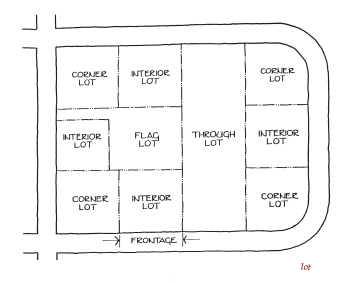
Source:A Planners Dictionary,PAS report 521/522 (2004)
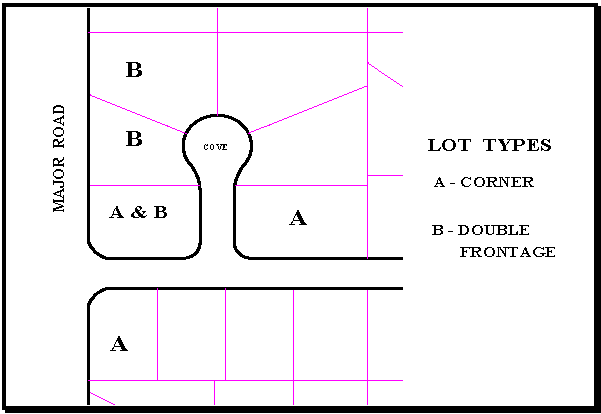
Lot, Interior: A lot with only one frontage on a public or private street.
Lot Area: The total ground area included within lot lines.
Lot Coverage: The lot area covered by all buildings located thereon, expressed as a percentage of the total lot area.
Lot Frontage: The dimension of a lot or portion of a lot abutting on a public or private street.
Lot Lines: The lines bounding a lot as defined herein.
Lot Number: The number assigned to a lot on a subdivision plat for identification purposes.
Lot of Record: A numbered or lettered tract of land in a subdivision recorded in the Plat Records of the County, or a parcel described by metes and bounds in the Deed Records of the County.
Lot Width: The width of a lot measured at the building line.
MANUFACTURED HOME: A factory manufactured movable home as provided in Section 75-49-3, Mississippi Code of 1972, Annotated. Any structure, transportable in one or more sections, which is built on a permanent chassis and designed to be used with or without a permanent foundation when connected to the required utilities. Manufactured homes are defined by and shall be constructed in accordance with the National Manufactured Housing Construction and Safety Standards Act of 1974, as amended, and shall be manufactured after June 14, 1976.
MASONRY: Brick, block, or stone which is secured with mortar.
MASSAGE PARLOR: An adult entertainment establishment where, for any form of consideration, massage, alcohol rub fomentation, electric or magnetic treatment, or similar treatment or manipulation of the human body is administered as the primary service unless such treatment or manipulation is administered by a licensed professional including but not limited to a medical practitioner, chiropractor, or physical therapist, each as defined and regulated by the laws of the State of Mississippi, including but not limited to Sections 73-6-1 et seq and the "Mississippi Physical Therapist Practice Law" of the Mississippi Code of 1972, as amended.
MASSING: A term used to define the overall volume of a building.
MECHANICAL EQUIPMENT: Devices and accessories, the use of which relates to water supply, electrical supply, drainage, heating, ventilation, air conditioning, and similar purposes.
MINOR: Any person under the age of eighteen (18) years and who is not emancipated.
MOBILE HOME: As defined within Section 75-49-3 of the Mississippi Code of 1972, Annotated, a factory built movable home manufactured before June 15, 1976 that is not constructed in accordance with the National Manufactured Housing Construction and Safety Standards Act of 1974, as amended. A single-family residence, not including camp or travel trailers, designed for transportation after fabrication on streets, highways, land, air, or water, and arriving at the site where it is to be occupied as a dwelling unit complete and ready for occupancy after location on the site, whether the location be by wheels, jacks, or permanent foundations, and connected to utilities.
MODILLION: A horizontal bracket, often in the form of a plain block, ornamenting, or sometimes supporting, the underside of a cornice.
MODULAR HOMES: A residential dwelling unit assembled on-site in accordance with the municipal building code and composed of components substantially constructed in a manufacturing plant and transported to the building site for final, permanent assembly on a permanent foundation.
MORTAR: A mixture of sand, lime, cement, and water and used as a binding agent in masonry construction.
MULLION: A heavy vertical divider between windows or doors.
MUNICIPAL COURT: The Municipal Court of the City of Cleveland, Mississippi.
MUNTIN: A secondary framing member to divide and hold the panes of glass in a window.
NATIONAL HISTORIC LANDMARK: Any district, site, building, structure, and/or object that has been formally designated as a national historic landmark by the secretary of the interior and possesses exceptional value or quality in illustrating or interpreting the heritage of the United States in history, architecture, archaeology, engineering, and culture and that possesses a high degree of integrity of location, design, setting, materials, workmanship, feeling, and association. National Historic Landmarks are automatically listed in the National Register.
NATIONAL REGISTER OF HISTORIC PLACES: The nation's official list of buildings, sites, and districts which are important in our history or culture. Created by Congress in 1966 and administered by the states.
NON-CONFORMING BUILDING: A structure or building where the size, dimensions or location of which was lawful prior to the adoption, revision or amendment to this ordinance, but which fails by reason of such adoption, revision or amendment, to conform to the present requirements of the zoning district.
NON-CONFORMING LOT: A lot where the area, dimensions, and/or location, was originally lawful and conformed to the zoning article, but no longer conforms to this Ordinance or any subsequent amendments of the zoning district where it is located.
NON-CONFORMING USE: A use of any structure or land that though originally lawful, no longer conforms with the provisions of this ordinance or any subsequent amendments thereto for the district in which it is located. Uses established after the passage of this ordinance that are in violation of this ordinance are illegal uses and shall not be given the status of nonconforming uses.
NURSING HOME: A home for the aged or infirmed, in which three or more persons not of the immediate family are received, kept, housed overnight, or provided with food and shelter or care, for compensation, but not including hospitals, clinics, or similar institutions.
OBJECT: A material thing of functional, cultural, historical, or scientific value that may be, by nature or design, movable, yet related to a specific setting or environment.
OFFICE: Space or rooms, clinics, suites, or buildings used for conduct of a business such administrative, clerical, professional, and similar uses. These offices shall include, but shall not necessarily be limited to, professional offices, medical (doctors and dentists), attorneys, accountants, real estate brokers, insurance agents, architects or engineers, but shall in no way be construed as permitting undertaking establishments, funeral homes, massage parlors, body piercing or tattoo locations, or living quarters.
OPEN STORAGE: A depository or place for storing goods related to the establishment on the same premises and not located within a building.
ORDINARY REPAIR AND MAINTENANCE: Any work done to prevent deterioration of a resource or any part thereof by returning the resource as nearly as practical to its condition prior to such deterioration, decay, or damage.
OWNER: Any person or other entity who/which owns the premises, real property, or physical premises.
OWNER OF RECORD: The owner of a parcel of land, improved or unimproved, reflected on the city tax roll and in county deed records.
PARAPET: A low protective wall located at the edge of a roof.
PARKING AREA: An open, unoccupied space used or set aside to be used for the parking of automobiles, in which no other business is conducted, and such parking area is connected to the street or alley by a driveway permitting ingress and egress. This definition does not include grassy or other non-hard surface areas of lots. It is the intention of this Ordinance that each lot should be designed to accommodate the parking requirements of the normal occupants of the lot/building/house in a hard surface area, driveway or garage without parking in the street. Coves should be left clear of parked vehicles to allow access and turning of emergency vehicles and school buses.
PARKING ROW: Spaces for the parking of vehicles. Further defined as:
a.
Single Loaded Parking Row—A single row of spaces for the parking of vehicles.
b.
Double Loaded Parking Row—Two parallel rows of spaces for the parking of vehicles arranged so that, when parked, the front end of each vehicle faces the front end of another vehicle.
PARKING SPACE: An area that is a minimum of 10′ by 20′ of hard surfaced space that is designed for and dedicated to the parking of motorized vehicles.
PAWN SHOP: Any business that loans money on deposit of personal property or deals in the purchase or possession of personal property on condition of selling the same back again to the pledgor or depositor, or loans or advances money on personal property by taking chattel mortgage security thereon, and takes or receives such personal property.
PEDIMENT: A triangular crowning element forming the gable of a roof; any similar triangular element used over windows, doors, etc.
PIER: A vertical structural element, square or rectangular in cross section.
PILASTER: A pier attached to a wall, often with capital and base.
PITCH: A term which refers to the steepness of roof slope.
PLACE: An open unoccupied space other than a street or alley permanently reserved as the principal means of access to abutting property.
PLAN REVIEW COMMITTEE: The administrative review group consisting of the Director of Community Development/Building Official, City Engineer, and Fire Inspector of the City of Cleveland.
PLANNING COMMISSION: The City of Cleveland Planning Commission or Board of Appeals.
PLAT: A map or drawing showing the lot and street arrangement or other features or details of the area being subdivided and is further defined as follows:
a.
Preliminary Plat: A plat conforming to the requirements of Article 5 and 7 hereof for preliminary approval.
b.
Final Plat: A plat conforming to the requirements of Article 5 and 7 for final approval and recording in the Office of the Chancery Clerk.
PORTALS AND CANOPIES: Any structure attached to, or part of, a building at the inner end, or also a freestanding structure, having supporting posts or columns, meant to provide shelter from the weather.
PORTICO: A roofed space, open or partly enclosed, forming the entrance and centerpiece of the façade of a building, often with columns and pediment.
PORTLAND CEMENT: A strong, inflexible (too much so for historic buildings) hydraulic cement used to bind mortar.
PREDOMINATE: Having the most publicly visible surface area.
PREMISES or REAL PROPERTY: Any location, building, structure, residence, garage, room, shed, shop, store, dwelling, lot, parcel, land or portion thereof, whether improved or unimproved.
PRESERVATION DISTRICT: A district designated by the Cleveland Heritage Commission and approved by the City through an ordinance, which contains a geographically definable area, urban or rural, possessing a significant concentration of sites, buildings, structures, or objects associated by past events or by plan or physical development, and which meets at least one of the following criteria:
a.
Exemplifies or reflects the broad cultural, political, economic, or social history of the nation, state, county, or city;
b.
Is identified with historic personages or with important events in national, state, or local history;
c.
Embodies distinguishing characteristics of architectural types or contains examples inherently valuable for the study of periods, styles, methods of construction, or uses of indigenous materials or craftsmanship; or
d.
Is representative of the notable work of master builders, designers, or architects whose individual abilities have been recognized or who influenced their eras.
PROPERTY: Any real property within the City including an improved street or highway.
PROPERTY MAINTENANCE CODE: The International Property Maintenance Code, as adopted by the Mayor and Board of Aldermen of the City of Cleveland and enforced by the City of Cleveland pursuant to local Ordinances. All definitions contained in the Property Maintenance Code shall be applicable to this Ordinance.
PROPORTION: The relationship between parts of a building, landscape, or structures to each other and to the whole.
PUBLIC BUILDING: A building owned or used exclusively by the City, County, State, or Federal governments.
QUOINS: Decorative blocks of stone or wood used on the corners of buildings.
RECESSED PANEL: A decorative element that often functions as an area for signage.
RECREATIONAL VEHICLE: A vehicular type portable structure without permanent foundation, which can be towed, hauled or driven and primarily designed as temporary living accommodation for recreational, camping and travel use and including but not limited to travel trailers, truck campers, camping trailers, and self-propelled motor homes.
RELOCATION: Any changes in the location of a building, object, or structure in its present setting or to another setting.
RESOURCE: Parcels located within preservation districts, individual landmarks, and landmark sites, regardless of whether such sites are presently improved or unimproved. Resources can be separate buildings, districts, structures, sites, and objects, and related groups thereof.
RESPONSIBLE PARTY or PERSON: Any individual, business or entity responsible for creating, causing, maintaining or permitting the nuisance activity, premises, condition or conduct; and includes, but is not limited to, the property owner, tenant, lessee, possessor, or occupant of real property, the president or other officer of the corporation, a business owner or manager of a business.
RIGHT-OF-WAY (ROW): A strip of land acquired by reservation, dedication, forced dedication, prescription or condemnation and intended to be occupied by a road, communication, crosswalk, electric transmission lines, oil of gas pipeline, water line, sanitary storm sewer and similar uses (see drawing below).
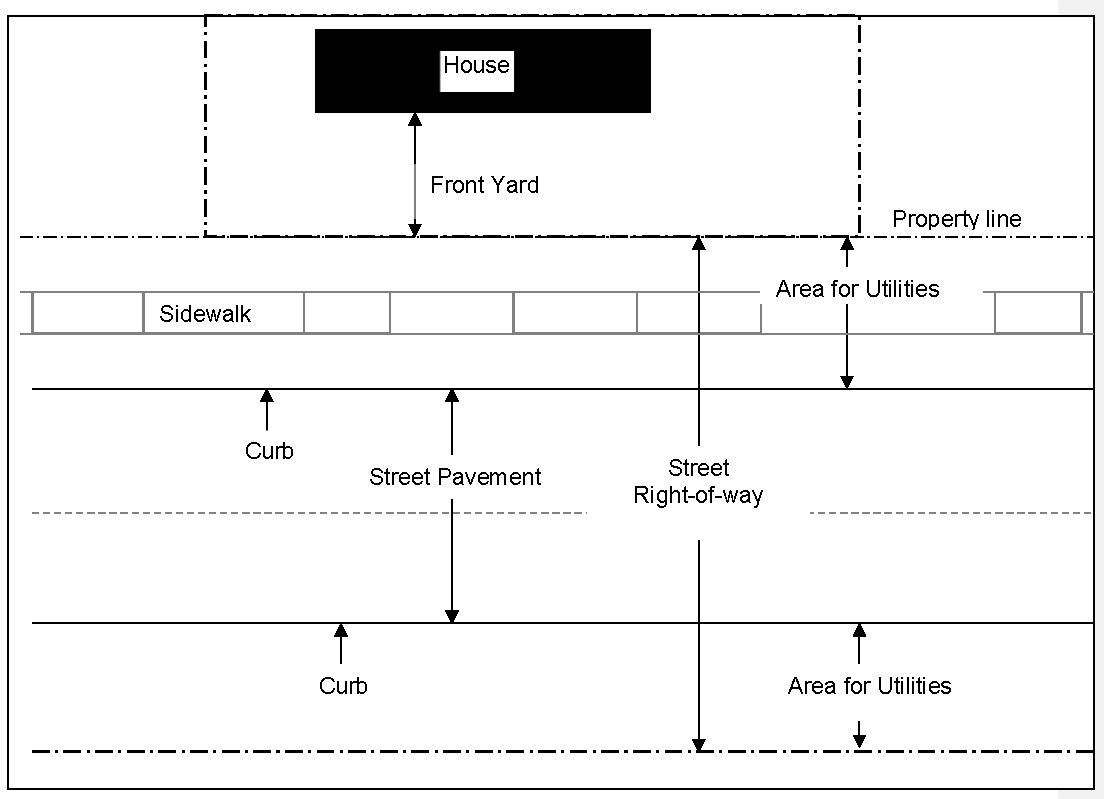
RIGHT-OF-WAY (ROW) LINE: The line delimiting the Public/Private boundary of the street and being identical with the property line of persons owning property fronting upon the streets.
ROOF: Any surface covering a building area or space that is horizontal and is intended to protect the structure from precipitation. The term "roof" also includes the overhangs of porches, porticos, and covered walks.
ROOF LINE: The highest point of the coping on a flat roof, false mansard, or parapet wall; the ridge line between the upper and lower slopes of a gambrel roof; or the mean height level between the eaves and ridge of a gable or hip roof.
ROOMING HOUSE: Any dwelling, or part of any dwelling containing one or more rooming units, in which space is let by the owner or operator to three or more persons who are not husband or wife, son or daughter, mother or father, or sister or brother of the owner or operator, and where the occupants share common bathroom, cooking and eating facilities.
ROOMING UNIT: Any room used or intended to be used for sleeping purposes.
SASH: The portion of a window that holds the glass and which moves.
SATELLITE DISK or DISH: Any disc-shaped or mast mounted equipment designed to transmit or receive electronic audio-visual or telemetric signals.
SCALE: A term used to define the proportions of a building in relation to its surroundings. The harmonious relationship of the size of a building or parts of a building to one another and to the human figure.
SEMI-PUBLIC: A use of land and/or premises by a private organization or agency to meet a basic public need such as: churches, privately endowed hospitals, cemeteries, fraternal groups, parochial schools and other similar activities.
SETBACK: A term used to define the minimum distance a building can be located from a lot line or street right-of-way.
SETBACK LINE: The minimum distance required to be maintained between a given lot line and the nearest outside wall or foundation of the building front, rear, or side (also see YARDS).
SHRUB: A woody plant, smaller than a tree, consisting of several small stems from the ground or branches near the ground.
SIDELIGHT: A glass window pane located at the side of a main entrance way.
SIDING: The exterior wall covering or sheathing of a structure.
SIGN: Any single structure, display, device, balloon or graphic on or attached to any land, building or structure, which is used to communicate any message, or which advertises or promotes any business, product, activity, service, person or interest. Signs include, but are not limited to, letters, numbers, words, illustrations, decorations, decals, emblems, trademarks, logos and lights. For the purpose of determining the number of signs, the name of the business is considered one sign, any advertised product sold by that business is considered a separate sign, and any advertised service offered by that business is considered a separate sign unless created on one rectangular sign blank and meeting the square footage requirements for that particular zoning district. Services or products which are displayed as a phrase, where the words are connected by an "&" or other means shall be considered one single separate sign as long as they are arranged on one sign blank (see Example 3 below). Below are some examples of how to determine the number of signs:

Example 1
This example is considered one sign because it is either painted or installed on one sign blank advertising a business name, a product, and a service for that business.
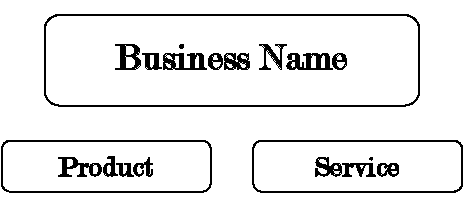
Example 2
This example is considered three signs because it is either painted or installed on three sign blanks advertising a business name, a product, and a service for that business.

Example 3
This example is considered two signs because it is cutout letters installed on a building advertising the name of the business and a phrase of products or services for that business.
Types of Signs:
1.
Banner Sign - Any sign intended to be hung either with or without frames possessing characters, letters, illustrations or ornamentations applied to paper, plastic, or fabric of any kind. National flags, flags of political subdivisions, and symbolic flags of any institution or business shall not be considered banner signs.
2.
Bench Sign - A sign located on any part of the surface of a bench or seat placed adjacent to a public right-of-way.
3.
Billboard Sign - A freestanding sign structure which advertises activities that do not take place on the site.
4.
Blade Sign - A small sign which is suspended from an overhang, canopy, marquee, or awning or is suspended from a mounting attached directly to the building wall and hangs perpendicular to the building wall. An 8-foot clearance is required between a blade sign and the finished grade. Blade signs are typically seen in downtown areas and historic districts.
5.
Directory Sign - Any sign on which the names and indications of occupants or the use of the building or shopping center is given. This shall include office buildings and church directories.
6.
Freestanding Sign Structure - Any permanent or temporary sign structure not securely attached to the outside wall, roof, or window of any building. Also known as a ground or post sign.
7.
Illuminated Sign - Any sign illuminated in any manner by an artificial light source.
8.
Nonconforming Sign - Any sign which does not conform to the regulations of this Ordinance.
9.
Projecting Sign - Any sign other than a wall sign affixed to any building or wall whose leading edge extends beyond such building or wall. A projecting sign may extend not more than six (6) feet outward from the wall at a height not less than twelve (12) feet from ground level.
10.
Roof Sign - Any signs erected or constructed wholly upon and over the roof of any building and supported solely on the roof structure. This type of sign is prohibited in Cleveland.
11.
Subdivision Entrance Sign - A permanent ground mounted sign that identifies the subdivision.
12.
Temporary Sign - Any sign that is not permanently attached to the ground, a building, or another structure by direct attachment to a rigid wall, frame, or structure. Window signs can be a type of temporary signage.
13.
Wall Sign - Any sign painted on or attached to and erected parallel to the face of the outside wall of any building which displays only one advertising surface.
14.
Window Sign - Any graphic element painted upon or in any manner affixed to a window facing the outside and which is intended to be seen from the exterior. Window signs must be located and attached on the inside of the window. Any temporary signs hanging from the interior of the business and visible from the public right-of-way are also considered to be window signs and shall be calculated as part of the allowable window signage area.
SIGN AREA (CALCULATION): The sign area is that area enclosed by one continuous line, connecting the extreme points or edges of a sign. The area shall be determined using the largest sign area visible at any one time from any one point. This area does not include the main supporting sign structures. On a two-sided sign, only one face is counted in computing the sign area.
SILL: The horizontal member located at the top of a foundation supporting the structure above; also the horizontal member at the bottom of a window or door.
SITE: The location of a significant event, a prehistoric or historic occupation or activity, or a building or structure, whether standing, ruined, or vanished, where the location itself maintains historical or archaeological value regardless of the value of any existing buildings, or objects.
SOD: A layer of earth containing grass plants and their matted roots. Also known as turf.
SPECIAL EXCEPTION: A use so specifically designed in this Ordinance, that would not be appropriate for location generally or without restriction throughout a given zoning district, but which, if controlled as to number, area, location, or relation to the neighborhood, would in the opinion of the Board of Zoning Appeals, or Mayor and Board of Aldermen, as the case may be, promote the public health, welfare, morals, order, comfort, convenience, appearance, prosperity, or general welfare.
SPECIFIED ANATOMICAL AREAS: Less than completely and opaquely covered human genitals and pubic region, cleavage of the human buttocks, or less than 50 percent of the human female breast below a point immediately above the top of the areolae; or human male genitals in a discernibly turgid state even if completely and opaquely covered.
SPECIFIED SEXUAL ACTIVITIES: Human genitals in a state of sexual stimulation or arousal; acts of human masturbation, sexual intercourse, or sodomy; fondling or other erotic touching of human genitals, pubic regions, buttocks, or chests; flagellation or torture in the context of a sexual relationship; masochism, erotic, or sexually oriented torture, beating, or the infliction of physical pain; erotic touching, fondling, or other such contact with an animal by a human; or human excretion, urination, menstruation, vaginal, or anal irrigation as part of or in connection with any of the activities set forth in this section.
STAGE SET FAÇADE: A structure in which the primary elevation of the building presents a distinct and separate design from the remainder of the building. A structure where the continuity of design does not continue beyond the primary elevation to the sides and rear of the building. This may also include separate materials and colors from the remainder of the building. An example of a stage set facade would be a brick facade reflecting a parapet on a pre-engineered steel or wood frame building with a pitched roof.
STATE HISTORIC PRESERVATION OFFICE: The historic preservation division of the state department of archives and history (SHPO).
STATE HISTORIC PRESERVATION OFFICER: The director of the state department of archives and history.
STOREFRONT: The street-level façade of a commercial building, usually having display windows.
STORY: That portion of a building included between the upper surface of any floor and the surface of the floor next above it or if there be no floor above it, then the space between the floor and the ceiling next above it.
STREET: A public right-of-way which affords primary means of access to abutting property and including all property dedicated or intended for public or private street purposes or subject to public easements therefore.
The term street means a way for vehicular traffic, whether designated as a street, highway, thoroughfare, parkway, throughway, road, avenue, boulevard, lane, place, or however otherwise designated.
a.
Arterial streets and highways are those which are used primarily for fast or heavy traffic and which provide a means to either bypass the City or be routed expeditiously through the City.
b.
Major streets are those streets which provide easy access to the various traffic generators within the City and to the arterial highway system.
c.
Collector streets are those which carry traffic from minor streets to the major streets in residential and business areas and include the principal entrance streets of a residential development and streets for circulation within such a development.
d.
Local or Minor streets are those which are used primarily for access to the abutting properties.
e.
Alleys are public or private right-of-ways which are used for vehicular access to the back or the side of properties and not the primary means of access to a street.
f.
Culs-de-sac are dead-end streets with turn-arounds and permanently closed to through traffic and used primarily for access to the abutting properties.
STREETSCAPE (2 definitions): The combination of building facades, sidewalks, street furniture, etc. that define the street. Also refers to the strip of land designed for street tree planting or landscaping along the right-of-way frontage of property.
STREET LINE: A dividing line between a lot, tract, or parcel of land and a contiguous street.
STRUCTURE: Anything constructed or erected, the use of which requires permanent location on the ground or attachment to something having a permanent location on the ground, including advertising signs, billboards, and poster panels. This definition does not include telephone poles and overhead wires.
STUCCO: Any kind of plasterwork but usually an outside covering of Portland cement, lime, and sand mixture with water.
SUBDIVISION: The division of a parcel of land into two or more lots or parcels for the purpose of transfer of ownership or building development or if a new street is involved, any division of a parcel of land. A division of land for agricultural purposes not involving a new street and not involving the construction of any dwelling shall not be deemed a subdivision. The term includes re-subdivision and when appropriate to the context, shall relate to the process of subdividing or to the land subdivided.
SUBSTANTIAL FOOD ITEM: Means food items prepared or cooked on the licensed premises and that are typically served as a main course or entrée. Some examples of a substantial food item are: fish; steak; chicken; pasta; pizza; sandwiches; and dinner salads. Side dishes, appetizer items, dessert items, and snack items such as popcorn, peanuts, chips, and crackers do not qualify as substantial food items.
SURROUND: An encircling border or decorative frame, usually around a window or door.
TATTOO PARLOR: Those activities as defined in Mississippi Code Annotated Section 73-61-1, said statutory definitions being hereby adopted by reference.
TEMPORARY USE: A use established for a temporary period of time with the intent to discontinue such use upon the expiration of the time period not intended to exceed 30 days.
TENANT: Any person, other than a legal or equitable titleholder or immediate family member, occupying or possessing a dwelling or part thereof.
TITLE-LOAN BUSINESS: Any business that regularly makes either loans to individuals secured by the title to a vehicle or title pledge agreements with pledgors, unless the business or individual is exempt from the definition of "title pledge lender" under Mississippi Code Annotated Section 75-67-403 (1972), or unless more than ninety percent (90%) of the loans that the business makes which are secured by vehicle titles are made in the context of the purchase of the vehicle.
TOURIST or TRAILER COURT: An area containing one or more structures designed or intended to be used as temporary living facilities for one or more families and intended primarily for automobile transients or providing proper space and facilities for two or more auto trailers of mobile dwelling unit character.
TRANSOM: A small operable or fixed window located above a window or door.
TREE: A large woody plant having one or several self-supporting stems or trunks and numerous branches.
UNOBSTRUCTED OPEN SPACE: An area of land required to be maintained as specified herein, upon which no structure may be erected.
UNREASONABLE ECONOMIC HARDSHIP: The inability of an owner to obtain a reasonable return or a reasonable beneficial use from a resource as required by the United States Supreme Court in Penn Central Transportation Company v. New York City, 438 U.S. 104 (1978), and subsequent decisions.
UTILITY SUBSTATION: A facility containing high voltage electrical equipment, transformers or specialized transmission facilities for gas, water, sewer, telephone or other public utilities enclosed in a single area and connected to a transmission network but not requiring office space or other space with regular attendants.
VARIANCE: A modification from the literal provisions of this Ordinance by the Board of Appeals in cases where a literal enforcement of its provisions would result in unnecessary hardship due to circumstances unique to the individual property or use for which the variance is granted.
VEHICLE: Any machine propelled by power other than human power designed to travel along the ground by use of wheels, treads, runners, or slides and transport persons or property or pull machinery and shall include, without limitation, automobiles, trucks, trailers, motorcycles, tractors, buggies and wagons.
WALL: Any exterior surface on a building or structure that is vertical and is intended to support or capable of supporting a roof structure.
WIRELESS COMMUNICATION FACILITIES: Any unstaffed facility for the transmission and/or reception of wireless telecommunication services, usually consisting of a tower or monopole tower with antenna arrays, cabling and associated ground equipment and a support structure.
Stealth Design: Any communications tower or Wireless Communications Facility (WCF) which is designed to enhance compatibility with adjacent land uses, including, but not limited to, architecturally screened roof-mounted antennas, antennas integrated into architectural elements, and tower structures designed to look other than like a WCF and with a visual appearance whereby the structure suggests a purpose other than a WCF. This includes steeples, flagpoles and trees. Towers and other WCF utilizing Stealth Design may be approved by the Planning Commission and does require approval as a Special Exception under this Ordinance.
WROUGHT IRON: Decorative iron that is hammered or forged into shape by hand, as opposed to cast iron which is formed in a mold.
YARD: An open space at grade between a building and the adjoining lot lines, unoccupied and unobstructed by a portion of the structure from the ground upward, except as otherwise may be provided. In the measuring of a yard for the purpose of determining width of a side yard, the least horizontal distance between the lot line and main building shall be used.
YARDS FIGURE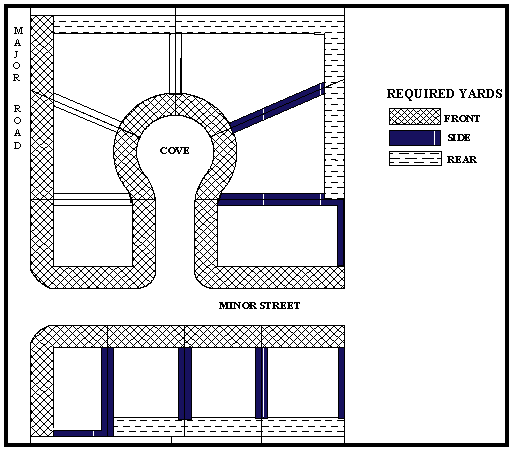
Yard, Front: The unoccupied space on the same lot with a building and situated between the street line and the front line of the building projected to the sideline of the lot.
Yard, Side: Yard between the main building and the sideline of the lot, and extending from the front yard line to the rear yard line on a corner or interior lot, or from one front yard line to the other front yard line on a double frontage lot.
Yard, Rear: A yard extending the full width of the lot between a main building and the rear lot line.
ZERO-LOT LINE DEVELOPMENT: A development approach in which a building is located on a lot in such a manner that one or more of the building's sides rest directly on a lot line.
ZONE: An established area or district within the City in which provisions of this Ordinance are applicable.

