
Cleveland City Zoning Code
ARTICLE 6
- ZONING
Sec. 601.- Zoning districts.
In order to classify, regulate and restrict the location of commerce, industry, residences and buildings designed for specific uses, to regulate the height and bulk of buildings erected or altered, and to regulate the intensity of uses on lots, the land inside the City of Cleveland, Mississippi is hereby divided into 15 "Zoning Districts". The said districts shall be known as follows:
•
A-1 Agricultural District.
•
R-1 Residence 1 District.
•
R-2 Residence 2 District.
•
R-3 Residence 3 District.
•
R-4 Residence 4 District.
•
R-5 Multifamily Residence District.
•
R-6 Manufactured Housing District.
•
B-1 Business 1 Neighborhood Commercial District.
•
B-2 Business 2 Central Business District.
•
B-2H Business 2 Historic Crosstie Central Business District.
•
B-3 Business 3 District: Highway Commercial.
•
X-1 Government District.
•
M-1 Light Industrial District.
•
M-2 Heavy Industrial District.
•
PUD Planned Unit Development.
Sec. 602. - Official zoning map.
The zoning districts described within this Article are identified and delineated on a map entitled "Official Zoning Map of the City of Cleveland, Mississippi". The map is attached to and made a part of this Ordinance. The Official Zoning Map shall be identified by the signature of the Mayor, attested by the City Clerk, and bear the seal of the City under the following words: "This is to certify that this is the Official Zoning Map referred to in Article 6 of the Combined Land Development Ordinance of the City of Cleveland, Mississippi, as adopted by the Mayor and Board of Aldermen."
If, in accordance with the provisions of this Ordinance and Statutes of the State of Mississippi, changes are made in zoning district boundaries or other matters portrayed on the Official Zoning Map, such changes shall be made on the Official Zoning Map promptly after the amendment has been approved by the Mayor and Board of Aldermen together with an entry on the Official Zoning Map as follows: "On Date , by official action of the Mayor and Board of Aldermen of the City of Cleveland, the following change(s) was/were made in the Official Zoning Map: (brief description and nature of change and reference to where the amending ordinance is recorded). No amendment to this Ordinance which involved matters portrayed on the Official Zoning Map shall become effective until after such change and entry has been made on said map.
No change of any nature shall be made on the Official Zoning Map or matter shown thereon except in conformity with the procedures set forth in this Ordinance. Any unauthorized change of whatever nature by any person or persons shall be considered a violation of this Ordinance and punishable as provided under Article 3 of this Ordinance.
Regardless of the existence of purported copies of the Official Zoning Map, which may from time to time be made or published, the Official Zoning Map, located in the office of the City Clerk, shall be the final authority as to the current zoning status of the land, buildings, and other structures in the City of Cleveland.
Interpretation of Boundaries—Where boundaries of zoning districts are uncertain as shown on the Official Zoning Map, the following rules shall apply:
•
The center lines of streets, railroad rights of way, highways, or alleys shall be indicated as boundaries between districts when any uncertainty exists as to the accurate boundary of these districts.
•
Approximate boundaries following platted lot lines or city limits shall be construed as following these lot lines or city limit line.
•
Boundaries indicated as approximately following the center lines of streams, rivers, ditches, gullies, or other bodies of water shall be construed to follow such center lines.
•
Boundaries indicated as parallel to or extensions of features described above shall be so construed. Distances not specifically indicated on the Official Zoning Map shall be determined by scale of the Map.
•
Whenever any street or alley is vacated, the particular district applying to property fronting on any such street or alley shall automatically permit use to the center line of any such street or alley.
Any discrepancy noted of a district boundary line not covered shall be interpreted by the Building Official, with appeals of that decision heard by the Board of Appeals.
Sec. 603. - Zoning map or text amendments.
From time to time and as needed or requested, the Mayor and Board of Aldermen may amend the zoning text or map. The procedures are described in Article 5.
Sec. 604. - Zoning text general.
The following regulations established by this Ordinance within each zoning district shall be minimum regulations and shall apply uniformly throughout the district, except as hereinafter provided.
No building shall be erected, converted, enlarged, reconstructed or structurally altered, nor shall any building or land be used which does not comply with all district regulations established by this Ordinance for the district in which the building or land is located.
No part of a yard or other open space or off-street parking or loading space required for the purposes of compliance with this Ordinance shall be included as part of a yard or open space or off-street parking or loading space similarly required for any other building.
No yard or lot existing at the time of passage of this Ordinance shall be reduced in dimension or area below the minimum requirements set forth herein. Yards or lots created after the effective date of this Ordinance shall meet at least the minimum requirements established by this Article.
No structure shall be constructed on any lot which does not conform to the provisions of Article 7 regulating subdivisions, unless such lot was so platted.
No land shall be used or occupied and no structure shall be designed, erected, altered, used or occupied except for the following primary permitted uses for each of the following zoning districts, together with lawfully permitted home occupations, special exceptions, temporary uses, and permitted accessory uses.
As previously stated, building permits are required for any land, building, or structure that is erected, converted, enlarged, demolished, reconstructed or structurally altered in any manner.
No uses permitted in any zoning district shall be detrimental, offensive, or dangerous to the present or intended character of the zoning district or neighboring areas and vicinity by reason of the emission of dust, gas, smoke, noise, fumes, glare, odor, vibration, or fire or other hazard.
No structure shall be designed, erected, or altered except in accordance with the following regulations:
1.
Reduction in Lot Area. No lot may be reduced in area below the minimum lot area as specified herein for the zoning district within which said lot is located.
2.
Interference with Traffic Signals. In any zoning district no outdoor advertising sign, structure, tree or conflicting illuminate shall protrude so as to create confusion around, or otherwise interfere with traffic signals.
3.
Corner Lot. On a corner lot, nothing shall be constructed, erected, placed, planted or allowed to grow in such a manner as materially to impede vision between a height of two and one-half (2.5) feet and ten (10) feet above the centerline grades of the intersecting streets in an area bounded by the street right-of-way lines of such corner lot and a straight line joining points along said street right-of-way lines twenty-five (25) feet from the nearest point of intersection. The same sight line limitations shall apply on any lot within ten (10) feet from the intersection of a street property line with the edge of a driveway pavement or alley boundary.
Sec. 605. - Exceptions.
Exception to Height Limits. The height limitations of this Ordinance shall not apply to church spires, belfries, cupolas and domes not intended for human occupancy, nor shall they apply to monuments, smoke stacks, conveyors, flag poles, masts, aerial, stand pipes, lofts, parapet walls, outdoor theater screens, amateur radio antenna structures, and other similar structures and appurtenances, provided their construction conforms with existing or hereafter adopted Ordinances of the City.
Exception to Lot Size (Lot of Record). Except as herein provided, in any residential District where the owner of the lot at the time of the adoption of this Ordinance, or the successor in title thereto, does not own sufficient land to enable them to conform to the minimum lot area and/or frontage requirements of this Ordinance, such lot may be used as a building site for a single-family residence, provided that minimum yard setback requirements for the district in which said lot is located are maintained.
Sec. 606. - Nonconforming uses and structures.
While non-conforming uses, structures, buildings, signs, etc., will be allowed to continue under certain circumstances, it is the policy of the City of Cleveland to bring these nonconformities into compliance with the city Ordinances and Codes as is reasonably practical. Continuance of legal nonconformities will be tolerated but not encouraged.
The burden of establishing that any nonconformity is a legal nonconformity shall be upon the owner of such nonconformity and not upon the City or any other person.
606.1. - Nonconforming uses.
Use Continuance: Except as herein specified, the lawful use of any public or private building, structure, sign, fence or land existing at the time of the adoption of this Ordinance may be continued although such use does not conform to the provisions of this Ordinance. No increase in the land area or the floor area in a structure or structures occupied by any nonconforming use shall be permitted except to provide more off-street parking or loading space.
Use Termination: Any one of the following acts or conditions shall result in the immediate termination of a nonconforming use:
1.
Change to a conforming use.
2.
Abandonment by owner.
3.
Non-operation or non-use for a period of twelve (12) or more consecutive calendar months.
4.
Damage or destruction of the structure in which the use is operated by any cause when the cost of repairing such damage or destruction exceeds fifty (50) percent of the replacement costs of such structure in which the use is operated as of the date of such damage or destruction.
5.
Obsolescence of the building or structure in which the uses operated when the cost of replacing such building in lawful compliance with this Ordinance shall exceed fifty (50) percent of the replacement cost of such building or structure.
Use Zoning District Change: The foregoing provisions shall apply to the nonconforming uses in zoning districts hereafter changed.
606.2. - Nonconforming structures.
Structure Continuance: Except as herein specified, any public or private nonconforming structure or building may be occupied, operated, and maintained in a state of good repair. No nonconforming structure or building shall be enlarged or extended unless the enlargement or extension is made in compliance with all of the provisions established for structures or buildings in the zoning district in which the nonconforming building or structure is located.
Structure Termination: The right to operate and maintain any nonconforming building or structure shall terminate whenever the nonconforming structure is damaged in any manner and the cost of repair of such damage exceeds fifty (50) percent of the replacement cost of such structure as of the date of such damage. The right to operate and maintain any nonconforming building shall terminate whenever the nonconforming structure shall become obsolete or substandard under any applicable Ordinance of the City and the cost of placing such structure in lawful compliance with the applicable Ordinance exceeds fifty (50) percent of the replacement cost of such building as of the date of the official order under the applicable Ordinance.
Structure Zoning District Change: The foregoing provisions shall apply to nonconforming structures in zoning districts hereafter changed.
Sec. 607. - A-1 Agricultural District.
The City of Cleveland understands that large areas around the fringe of the City may be used for agricultural purposes for many years. Further, the taxes that a property owner pays are based on the use of the land and not the zoning of the land. So the City may influence the development of the agricultural fringe, most of the lands inside the City shall be designated as a zone other than agricultural. The land that is to be zoned agricultural is zoned in this manner to minimize its development because of the need to protect it from dense development. The primary reason for this designation would be because it is located in the floodplain as designated on the FIRM maps, but there could be other reasons for it to remain minimally developed.
Permitted Uses: The following uses are identified as permitted uses in the A-1 zone.
1.
Agricultural and accessory uses provided, however, that no permits shall be required with reference to land used for the growing of the usual farm products or raw materials such as cotton, vegetables, fruit, trees and grain.
2.
Gardens.
3.
Single-family detached homes on at least two (2) acres.
Special Exceptions: All non-residential proposals shall provide information as required for Plan Review Committee review and approval. The following uses are allowed in the A-1 zone by special exception only:
1.
Churches and institutions of an educational, religious, charitable, or philanthropic nature, provided, however, that such buildings shall not be located upon sites containing an area of less than two (2) acres, shall not occupy over thirty (30) percent of the total area of the lot; that the buildings shall be set back from all lot lines a distance of not less than two (2) feet for each foot of building height.
2.
Public riding stables on at least five (5) acres.
3.
Radio and television studios or transmitting stations.
4.
Wireless telecommunications towers not to exceed three hundred (300) feet in height.
Dimensional Standards:
*The setback line for a side yard abutting a side street shall be the same as the front setback.
Accessory structures shall be setback at least five (5) feet from any property line or eight (8) feet of another structure, and shall not be located on any type of easement. When an accessory structure is to be located in the rear yard of a corner lot, the accessory structure shall be setback at least ten (10) feet from the side street property line.
Fences may be located on the side or rear property lines unless an easement exists, in which case they shall not be located on any easement area without special approval from the Building Official. Front and side fences shall be no closer than ten (10) feet from any street right-of-way line and shall not be located within any sight distance area.
Provisions for Off-street parking and loading are required and defined in Article 8.
Provisions for signage are defined in Article 9.
Non-single-family residential developments located within this zone shall have a twenty-five (25) foot wide buffer area along the side and rear property lines. Additional details and provisions for buffering and landscaping are defined in Article 10, Section 1005.
Sec. 608. - R-1 Residential District.
This zoning district is designed specifically for very low density single-family residential use on large lots. All care should be taken to preserve the intent and character of this district.
Permitted Uses: The following uses are identified as permitted uses in the R-1 zone
1.
Agricultural and accessory uses on at least five (5) acres provided, however, that no permits shall be required with reference to land used for the growing of the usual farm products or raw materials such as cotton, vegetables, fruit, trees and grain. In the event of complaints from neighboring residential property owners, attempts shall be made to minimize or eliminate the impacts upon neighboring residential property.
2.
Gardens.
3.
Home occupations.
4.
Single family detached dwellings and accessory structures.
Special Exceptions: All non-residential proposals shall provide information as required for Plan Review Committee review and approval. The following uses are allowed in the R-1 zone by special exception only.
1.
Churches and other religious institutions.
2.
Educational uses.
Dimensional Standards:
*The setback line for a side yard abutting a side street shall be the same as the front setback.
All public and semi-public buildings shall have a minimum side yard and rear yard setback of thirty (30) feet from any lot line.
Accessory structures shall be setback at least five (5) feet from any property line or eight (8) feet of another structure, and shall not be located on any type of easement. When an accessory structure is to be located in the rear yard of a corner lot, the accessory structure shall be setback at least ten (10) feet from the side street property line.
Fences may be located on the side or rear property lines unless an easement exists, in which case they shall not be located on any easement area. Front and side fences shall be no closer than ten (10) feet from any street right-of-way line and shall not be located within any sight distance area.
Provisions for Off-street parking and loading are required and defined in Article 8.
Provisions for signage are defined in Article 9.
Non-single-family residential developments located within this zone shall have a twenty-five (25) foot wide buffer area along the side and rear property lines. Additional details and provisions for buffering and landscaping are defined in Article 10, Section 1005.
Sec. 609. - R-2: Residential District.
This zoning district is designed and intended as a residential area with single-family detached homes and smaller lots than the R-1, but still with a low density or suburban level of development. This zoning district is the most common residential district in Cleveland.
Permitted Uses: The following uses are identified as permitted uses in the R-2 zone:
1.
Agricultural and accessory uses on at least five (5) acres provided, however, that no permits shall be required with reference to land used for the growing of the usual farm products or raw materials such as cotton, vegetables, fruit, trees and grain. In the event of complaints from neighboring residential property owners, attempts shall be made to minimize or eliminate the impacts upon neighboring residential property.
2.
Gardens.
3.
Home occupations.
4.
Single family detached dwellings and accessory structures.
Special Exceptions: All non-residential proposals shall provide information as required for Plan Review Committee review and approval. The following uses are allowed in the R-2 zone by Special Exception only:
1.
Bed and Breakfasts.
2.
Churches and other religious institutions.
3.
Educational institutions.
4.
Wireless telecommunications towers using "stealth design" as an accessory use on a property and not exceeding the maximum height for this zoning district.
Dimensional Standards:
*The setback lines for side yards abutting a side street shall be the same as the front setback.
All public and semi-public buildings shall have a minimum side yard and rear yard setback of thirty (30) feet from any lot line.
Accessory structures shall setback be at least five (5) feet from any property line or eight (8) feet of another structure, and shall not be located on any type of easement. When an accessory structure is to be located in the rear yard of a corner lot, the accessory structure shall be setback at least ten (10) feet from the side street property line.
Fences may be located on the side or rear property lines unless an easement exists, in which case they shall not be located on any easement area. Front and side fences shall be no closer than ten (10) feet from any street right-of-way line and shall not be located within any sight distance area.
Provisions for Off-street parking and loading are required and defined in Article 8.
Provisions for signage are defined in Article 9.
Non-single-family residential developments located within this zone shall have a twenty-five (25) foot wide buffer area along the side and rear property lines. Additional details and provisions for buffering and landscaping are defined in Article 10, Section 1005.
Sec. 610. - R-3: Residential District.
This zoning district is designed and intended as a single-family residential area with smaller lots than the R-2 with low to medium density.
Permitted Uses: The following uses are identified as permitted uses in the R-3 zone.
1.
Agricultural and accessory uses on at least five (5) acres provided, however, that no permits shall be required with reference to land used for the growing of the usual farm products or raw materials such as cotton, vegetables, fruit, trees, and grain. In the event of complaints from neighboring residential property owners, attempts shall be made to minimize or eliminate the impacts upon neighboring residential property.
2.
Gardens.
3.
Home occupations.
4.
Single family detached dwellings and accessory structures.
Special Exceptions: All non-residential proposals shall provide information as required for Plan Review Committee review and approval. The following uses are allowed in the R-3 zone as special exceptions only:
1.
Bed and Breakfasts.
2.
Churches and other religious institutions.
3.
Educational institutions.
4.
Wireless telecommunications towers using "stealth design" as an accessory use on a property and not exceeding the maximum height of this zoning district.
Dimensional Standards:
*The setback line for a side yard abutting a side street shall be the same as the front setback.
All public and semi-public buildings shall have a minimum side yard and rear yard setback of thirty (30) feet.
Accessory structures shall be setback at least five (5) feet from any property line or eight (8) feet of another structure, and shall not be located on any type of easement. When an accessory structure is to be located in the rear yard of a corner lot, the accessory structure shall be setback at least ten (10) feet from the side street property line.
Fences may be located on the side or rear property lines unless an easement exists, in which case they shall not be located on any easement area. Front and side fences shall be no closer than ten (10) feet from any street right-of-way line and shall not be located within any sight distance area.
Provisions for Off-street parking and loading are required and defined in Article 8.
Provisions for signage are defined in Article 9.
Non-single-family residential developments located within this zone shall have a twenty-five (25) foot wide buffer area along the side and rear property lines. Additional details and provisions for buffering and landscaping are defined in Article 10, Section 1005.
Sec. 611. - R-4: Residential District.
This zoning district is designed and intended as a single-family residential area with smaller lots than the R-3 with medium density.
Permitted Uses: The following uses are identified as permitted uses in the R-4 zone:
1.
Agricultural and accessory uses on at least five (5) acres provided, however, that no permits shall be required with reference to land used for the growing of the usual farm products or raw materials such as cotton, vegetables, fruit, trees, and grain. In the event of complaints from neighboring residential property owners, attempts shall be made to minimize or eliminate the impacts upon neighboring residential property.
2.
Gardens.
3.
Home occupations.
4.
Single family detached dwellings and accessory structures.
Special Exceptions: All non-residential proposals shall provide information as required for Plan Review Committee review and approval. The following uses are allowed in the R-4 zone as special exceptions only:
1.
Bed and Breakfasts.
2.
Churches and other religious institutions.
3.
Educational institutions.
4.
Wireless telecommunications towers using "stealth design" as an accessory use on a property and not exceeding the maximum height of this zoning district.
Dimensional Standards:
*The setback line for a side yard abutting a side street shall be the same as the front setback.
All public and semi-public buildings shall have a minimum side yard and rear yard setback of thirty (30) feet.
Accessory structures shall be setback at least five (5) feet from any property line or eight (8) feet of another structure, and shall not be located on any type of easement. When an accessory structure is to be located in the rear yard of a corner lot, the accessory structure shall be setback at least ten (10) feet from the side street property line.
Fences may be located on the side or rear property lines unless an easement exists, in which case they shall not be located on any easement area. Front and side fences shall be no closer than ten (10) feet from any street right-of-way line and shall not be located within any sight distance area.
Provisions for Off-street parking and loading are required and defined in Article 8.
Provisions for signage are defined in article 9.
Non-single-family residential developments located within this zone shall have a twenty-five (25) foot wide buffer area along the side and rear property lines. additional details and provisions for buffering and landscaping are defined in article 10, section 1005.
Sec. 612. - R-5: Multifamily Residential District.
This zoning district is designed and intended as a multi-family residential area with medium to high density typically seven (7) to twelve (12) units per acre. Care shall be taken to protect other residential zoning districts abutting the multi-family zone especially through the use of buffer areas. Adequate open space, yards, and buffers shall be designed into all multi-family projects for the benefit of future residents.
Permitted Uses: Multi-family residential proposals shall provide information as required for Plan Review Committee review and approval. The following are identified as permitted uses in the R-5 zone:
1.
Community houses, lodges, fraternities, and sororities.
2.
Condominium or townhouse residential dwellings.
3.
Multi-family attached residential dwellings such as two-family, tri-plex, quad-plex and apartments.
4.
Rooming or boarding house.
5.
Single-family attached or detached residential dwelling.
Special Exceptions: All non-residential proposals shall provide information as required for Plan Review Committee review and approval. The following are allowed in the R-5 zone as special exceptions only:
1.
Bed and Breakfasts.
2.
Churches and other religious institutions.
3.
Educational institutions.
4.
Wireless telecommunications towers using "stealth design" as an accessory use on a property and not exceeding thirty (30) feet in height.
Dimensional Standards:
*The setback line for a side yard abutting a side street shall be the same as the front setback.
All public and semi-public buildings shall have a minimum side yard and rear yard setback of thirty (30) feet.
Accessory structures shall be setback at least five (5) feet from any property line or eight (8) feet of another structure, and shall not be located on any type of easement. When an accessory structure is to be located in the rear yard of a corner lot, the accessory structure shall be setback at least twenty-five (25) feet from the side street property line.
Fences may be located on the side or rear property lines unless an easement exists, in which case they shall not be located on any easement area. Front and side fences shall be no closer than ten (10) feet from any street right-of-way line and shall not be located within any sight distance area.
Provisions for Off-street parking and loading are required and defined in Article 8.
Provisions for signage are defined in Article 9.
Non-single-family residential developments located within this zone shall have a twenty-five (25) foot wide buffer area along the side and rear property lines. Additional details and provisions for buffering and landscaping are defined in Article 10, Section 1005.
Sec. 613. - R-6: Manufactured Housing Residential District.
The Manufactured Housing District is intended to provide areas of planned and improved tracts suitable for the location of manufactured homes for non-transient use. A manufactured home as distinguished from a trailer for transient use shall be construed to refer to the length of time remaining in one location. Transient trailers usually remain thirty (30) days or less and manufactured homes occupants remain for at least one (1) year or more.
Permitted Uses: Proposals shall provide information as required for Plan Review Committee review and approval. The following uses are identified as permitted uses in the R-6 zone:
1.
Single family manufactured home dwellings and accessory structures.
Special Exceptions:
1.
Wireless telecommunications towers using "stealth design" as an accessory use on a property and not exceeding the maximum height of this zoning district.
Dimensional Standards:
*The setback line for a side yard abutting a side street shall be the same as the front setback.
Accessory structures shall be setback at least five (5) feet from any property line or eight (8) feet of another structure, and shall not be located on any type of easement. When an accessory structure is to be located in the rear yard of a corner lot, the accessory structure shall be setback at least twenty-five (25) feet from the side street property line.
Fences may be located on the side or rear property lines unless an easement exists, in which case they shall not be located on any easement area. Front and side fences shall be no closer than ten (10) feet from any street right-of-way line and shall not be located within any sight distance area.
Provisions for Off-street parking and loading are required and defined in Article 8.
Provisions for signage are defined in Article 9.
Developments located within this zone shall have a twenty-five (25) foot wide buffer area along the side and rear property lines. Additional details and provisions for buffering and landscaping are defined in Article 10, Section 1005.
Sec. 614. - B-1: Neighborhood Commercial District.
The Neighborhood Commercial District (B-1) shall consist of small-scale commercial business establishments offering products for sale at retail and principally supplying everyday household needs. These operations shall blend with the neighborhood and be an integral part of the neighborhoods that they serve. Businesses shall be limited in size in this zone to not more than 10,000 square feet per business, store, or building. No residential uses are allowed in the B-1 zone, but because residential uses may be permitted in areas immediately adjoining B-1, great care should be taken that only the least obnoxious commercial uses shall be permitted. Accessory buildings and uses may be allowed, but there shall be no outside storage. No residential uses are allowed in this zoning district.
All proposals shall provide information as required for Plan Review Committee review and approval.
Permitted Uses: The following uses are identified as permitted uses in the B-1 zone provided their total building area is less than 10,000 square feet:
1.
Apparel shops or clothing stores.
2.
Appliance, radio, television, telephone, etc. sales, service, or repair but not including vehicles or heavy equipment.
3.
Banks or credit unions, without drive through services.
4.
Barber and beauty shops.
5.
Convenience stores, without fuel pumps.
6.
Drug stores, without drive through services.
7.
Flower, jewelry, art, antique and gift shops.
8.
Hardware stores.
9.
Ice cream parlor, coffee shop, candy store, or bakery.
10.
Laundromats washeterias, and dry cleaner drop-off stores.
11.
Medical or dental clinic, laboratory, or offices.
12.
Professional Offices and office buildings.
13.
Studios or instruction facilities for music, art, photography, dance, or indoor physical activity.
14.
Other similar uses.
Special Exceptions: Special Exceptions must be reviewed by the Board of Appeals for approval. The following are allowed in the B-1 zone as special exceptions only:
1.
Banks or credit unions with drive through services.
2.
Churches and other religious institutions.
3.
Daycare, child or adult.
4.
Educational institutions.
5.
Funeral home or mortuary.
6.
Grocery stores without fuel pumps.
7.
Restaurants and eating establishments without drive through services.
8.
Utility substations.
9.
Wireless telecommunications towers using "stealth design" as an accessory use on a property and not exceeding thirty-five (35) feet in height.
Dimensional Standards:
* The minimum lot area shall include that area sufficient to meet requirements for the building or buildings for all primary and accessory uses, all parking and loading requirements, buffering, yards, setbacks, and open space requirements on the site.
** Front Setbacks shall conform to the standards of the adjacent properties to "blend" in with the neighborhood and may require streetscapes.
*** The setback line for side yards abutting a side street shall be the same as the front setback.
Accessory structures shall be setback at least five (5) feet from any property line or twenty (20) feet from another structure, and shall not be located on any type of easement. When an accessory structure is to be located in the rear yard of a corner lot, the accessory structure shall be setback at least twenty-five (25) feet from the side street property line.
Fences may be located on the side or rear property lines unless an easement exists, in which case they shall not be located on any easement area. Front and side fences shall be no closer than ten (10) feet from any street right-of-way line and shall not be located within any sight distance area.
Provisions for Off-street parking and loading are required and defined in Article 8.
Provisions for signage are defined in Article 9.
Developments located within this zone shall have a fifteen (15) foot wide buffer area along the side and rear property lines when adjacent to other commercial, government, or industrial zones. Developments located within this zone shall have a twenty-five (25) foot wide buffer area along the side and rear property lines when adjacent to residential zones. Additional details and provisions for buffering and landscaping are defined in Article 10, Section 1005.
Sec. 615. - B-2: Central Business District (CBD).
The Central Business District (CBD) encompasses a geographic area that represents the earliest developed portions of the City of Cleveland. The Central Business District serves as a major commercial center for the City of Cleveland. Such areas developed at a time preceding the modern day zoning ordinance and have an established character different from other areas of the City. The CBD has developed over time with smaller yard setbacks, smaller lot area, greater lot coverage and floor area ratios, parking on the streets, and other dimensional and physical characteristics, which cause uniqueness within this district. No residential uses are allowed in this zoning district.
The B-2 District is established to provide space for commercial activities of the City and to:
1.
Protect present business and commercial uses from the blighting effects of incompatible land uses, and vacant or abandoned properties.
2.
Encourage the development of the downtown area as the shopping, commercial, entertainment, and cultural core of the City and surrounding region.
3.
Encourage the eventual elimination of uses detrimental or inappropriate to proper functioning of such a district.
All proposals shall provide information as required for Plan Review Committee review and approval.
Permitted Uses: The following uses are identified as permitted uses in the B-2 zone provided their total building area is less than 10,000 square feet:
1.
Animal clinic, hospital, boarding facility, or kennel.
2.
Apparel shops or clothing stores.
3.
Appliance, radio, television, telephone, etc. sales, service or repair but not including vehicles or heavy equipment.
4.
Automobile or other vehicle repair without fuel pumps.
5.
Banks or credit unions without drive through services.
6.
Barber and beauty shops.
7.
Convenience stores with or without fuel pumps.
8.
Daycare, child or adult.
9.
Department stores.
10.
Drug stores, without drive through services.
11.
Flower, jewelry, art, antique, book and gift shop.
12.
Hardware stores.
13.
Hotels, motels, and other commercial lodging.
14.
Ice cream parlor, coffee shop, candy store, or bakery.
15.
Laundromats, washeterias, and dry-cleaning drop-off establishments.
16.
Medical or dental clinic, laboratory, or offices.
17.
Places of amusement such as drive-through theaters, indoor theaters, movie theaters, video arcades, etc.
18.
Printing, copying, or publishing establishments.
19.
Professional offices and office buildings.
20.
Restaurant and eating establishments without drive through services.
21.
Studios or instruction facilities for music, art, photography, dance, or indoor physical activity such as karate, yoga, aerobics, etc.
22.
Other similar uses
Special Approval by Board of Aldermen: All such businesses that propose to sell beer, wine, or alcoholic beverages to be consumed on the premises shall be given specific special approval by the Board of Aldermen. Any business proposing such sales must first be zoned properly as B-2 and must operate as a restaurant offering substantial food items for its patrons. Also, any business proposing such sales must have a food preparation area and equipment on the premises adequate to meet the food service requirements.
Special Exceptions: Special Exceptions must be reviewed by the Board of Appeals for approval. The following uses are allowed in the B-2 zone as Special Exceptions only:
1.
Automobile or other vehicle repair, with fuel pumps.
2.
Banks or credit unions with drive through services.
3.
Churches and other religious institutions.
4.
Commercial uses where the total building area is more than ten thousand (10,000) square feet.
5.
Drug stores with drive through services.
6.
Educational institutions.
7.
Funeral home or mortuary.
8.
Grocery stores without fuel pumps.
9.
Lumber yards or storage.
10.
Places of recreation such as bowling alleys, miniature golf, etc.
11.
Radio and television studios or transmitting stations.
12.
Restaurant or eating establishment with drive through services.
13.
Service uses such as parcel delivery, plumbing, electrical, other utilities, carpet cleaning, etc.
14.
Storage of building materials such as lumber, pipe, brick, concrete block, coal, sand, gravel, etc.
15.
Utility substation.
16.
Wireless telecommunication towers using "stealth design" as an accessory use on a property and not exceeding the maximum height of this zoning district.
Dimensional Standards:
* The minimum lot area shall include that area sufficient to meet requirements for the building or buildings for all primary and accessory uses, parking and loading, buffer, yard, setback, and open space requirements on the site or as otherwise exempted.
** Existing buildings in the B-2 zone that do not meet the front, side, or rear setbacks are non-conforming structures and may be rehabilitated using the existing building footprint or setbacks to maintain the continuity of the neighborhood. New development on vacant parcels must adhere to setbacks listed above.
*** The setback line for a side yard abutting a side street shall be the same as the front setback.
Accessory structures shall be setback at least five (5) feet from any property line or twenty (20) feet from another structure, and shall not be located on any type of easement. When an accessory structure is to be located in the rear yard of a corner lot, the accessory structure shall be setback at least twenty-five (25) feet from the side street property line.
Fences may be located on the side or rear property lines unless an easement exists, in which case they shall not be located on any easement area. Front and side fences shall be no closer than ten (10) feet from any street right-of-way line and shall not be located within any sight distance area.
Provisions for Off-street parking and loading are required and defined in Article 8.
Provisions for signage are defined in Article 9.
Developments located within this zone may not be required to maintain a landscaped buffer adjacent to commercial, government, and industrial zones due the desired character and nature of the downtown area. However, developments located within this zone shall have a twenty-five (25) foot wide buffer area along the side and rear property lines when adjacent to residential zones. Additional details and provisions for buffering and landscaping are defined in Article 10, Section 1005.
Sec. 616. - B-2H: Central Business Historic Crosstie District.
The Historic Crosstie District represents the original settlement of Cleveland and covers the traditional downtown area. This historic preservation area has been identified for special standards of design and review. Because of the character of the buildings and street parking for the downtown strip along the old railroad line this area has setbacks that are different from the rest of the Central Business District.
The Crosstie Historic District represents the core of Cleveland and the natural location of establishments engaged in retail, entertainment, financial, professional and related services. The particular nature of their businesses can be aided by the centralized location and concentration provided in this environment. Cleveland needs an active downtown to best serve the City's citizens and the regional community.
Emphasis is placed on more intimate, pedestrian-scale development rather than development oriented singly for the automobile. Pedestrian-scale developments typically pay more attention to architectural details, bring buildings closer to the street, have on-street parking, provide for wider sidewalks between parking and storefronts, incorporate elements and amenities within the sidewalk zone, etc. All of these characteristics provide a safe and interesting environment that invites pedestrians to walk within the downtown. It is the intent of this zoning district to preserve the character of this geographic area, especially the original downtown, and to support the reliance on pedestrians and nearby residents utilizing establishments within this district. Cleveland has been fortunate to be able to develop the former railroad tracks as a pedestrian oriented park through the middle of downtown.
Scale of businesses is important when encouraging pedestrian circulation, so no single business, store or building shall be in excess of ten thousand (10,000) square feet or six thousand (6,000) square feet per floor of a multi-story building.
Development within this zoning district must also conform to the requirements of the Historic Preservation Ordinance, Historic Preservation Manual, and Cleveland Heritage Commission.
Permitted Uses: The following uses are identified as permitted uses in the B-2H zone provided their total building area is less than ten thousand (10,000) square feet:
1.
Apparel shops or clothing stores.
2.
Appliance, radio, television, telephone, etc. sales, service or repair but not vehicles or heavy equipment.
3.
Banks or credit unions without drive through services.
4.
Barber and beauty shops.
5.
Department stores.
6.
Drug stores, without drive through services.
7.
Flower, jewelry, art, antique, book and gift shops.
8.
Ice cream parlor, coffee shop, candy store, or bakery.
9.
Printing, copying, and publishing establishments.
10.
Professional offices and office buildings.
11.
Restaurant and eating establishments without drive through services.
12.
Studios or instruction facilities for music, art, photography, dance, or indoor physical activity such as karate, yoga, aerobics, etc.
13.
Other similar uses.
Special Approval by Board of Aldermen: All such businesses that propose to sell beer, wine, or alcoholic beverages to be consumed on the premises shall be given specific special approval by the Board of Aldermen. Any business proposing such sales must first be zoned properly as B-2H and must operate as a restaurant offering substantial food items for its patrons. Also, any business proposing such sales must have a food preparation area and equipment on the premises adequate to meet the food service requirements.
Special Exceptions: Special Exceptions must be reviewed by the Board of Appeals for approval. The following uses are allowed in the B-2H zone as Special Exceptions only:
1.
Churches and other religious institutions.
2.
Hardware stores.
3.
Hotels, motels and other commercial lodging.
4.
Places of amusement such as drive-through theaters, indoor theaters, movie theaters, video arcades, etc.
5.
Residential dwellings in the form of single-family, multi-family, or condominium style units, may be recommended by the Planning Commission and approved by the Board of Aldermen with the following requirements and any additional requirements seen as necessary. The residential unit or units shall:
a.
Occupy the second or upper floor of an existing retail or commercial type structure which has no front or side yard setback; or,
b.
Occupy an existing warehouse or industrial type structure and convert it to residential uses; or,
c.
Incorporate the existing building or façade into the new design plan; or,
d.
Replace a "non-contributing" non-historic building with one designed in the style of the contributing historic buildings; or
e.
If new construction is proposed, it shall take place on a vacant parcel and blend with the neighboring buildings; AND,
f.
Achieve one or more of the following criteria:
1.
Will put to use an existing structure or property that otherwise may fall into a state of dilapidation or otherwise become or remain vacant;
2.
Will transform an existing structure from a state of dilapidation into a viable and economical use of the property; or,
3.
Be constructed as an integral part of the site of another use permitted within the B-2H district.
Dimensional Standards:
* The minimum lot area shall include that area sufficient to meet requirements for the building or buildings for all primary and accessory uses, parking and loading, buffer, yard, setback, and open space requirements on the site or as otherwise exempted.
** Crosstie Historic District shall have a zero (0) foot required front or side, twenty (20) foot rear setbacks and may cover one hundred (100) percent of the lot with a building. Further existing buildings in the B-2H zone that do not meet the front, side, or rear setbacks are non-conforming structures and may be rehabilitated using the existing building footprint or setbacks to maintain the continuity of the neighborhood. New development on vacant parcels must adhere to setbacks listed above.
Accessory buildings and fences are not allowed in this zoning district unless specifically approved by the Cleveland Heritage Commission.
All proposals shall provide information as required for Plan Review Committee review and approval. Additional design approval is required for development in the Crosstie Historic District from the Cleveland Heritage Commission.
Developments located within this zone shall not be required to maintain a landscaped buffer adjacent to commercial, government, and industrial zones due the desired character and nature of the downtown. However, developments located within this zone shall have a twenty-five (25) foot wide buffer area along the side and rear property lines when adjacent to residential zones. Additional details and provisions for buffering and landscaping are defined in Article 10, Section 1005.
Sec. 617. - B-3: Highway Commercial District.
This district is intended for a broad definition of commercial activities. The commercial uses in this district are oriented toward high volume automobile traffic. They are located on, and should be limited to, major highways like US 61 and MS 8. Buffering for adjacent commercial and non-commercial uses is important. Careful landscaping and proper signage is critical to creation of a positive commercial area. No residential uses are allowed in this district.
All commercial proposals shall provide information as required for Plan Review Committee review and approval.
Permitted Uses: The following are identified as permitted uses in the B-3 zone:
1.
Agricultural equipment, machinery sales and service.
2.
Animal clinic, hospital, boarding facility, or kennel.
3.
Apparel shops or clothing stores.
4.
Appliance, radio, television, telephone, etc. sales, service or repair but not vehicle or heavy equipment.
5.
Automobile (new and used), RV, and truck sales and service.
6.
Automobile or other vehicle repair with or without fuel pumps.
7.
Banks or credit unions with or without drive through services.
8.
Barber and beauty shops.
9.
Boat and trailer sales and service.
10.
Convenience stores with or without fuel pumps.
11.
Daycare, child or adult.
12.
Department stores.
13.
Drug stores with or without drive through services.
14.
Flower, jewelry, art, antique, book, and gift shops.
15.
Fresh vegetable sales stand.
16.
Funeral home or mortuary.
17.
Grocery stores with or without fuel pumps.
18.
Gun shop, sales, service, or repair.
19.
Hardware stores.
20.
Hotels, motels, other commercial lodging.
21.
Ice cream parlor, coffee shop, candy store, or bakery.
22.
Laundromats, washeterias, and dry cleaning drop-off establishments.
23.
Lumber yard and storage.
24.
Medical or dental clinic, laboratory, or offices.
25.
Mobile home and house trailer sales and service.
26.
Pawn shops, check cashing, title loan, or similar institutions but not including banks or credit unions.
27.
Printing, copying, or publishing establishments.
28.
Places of amusement such as drive-through theaters, indoor theaters, movie theaters, video arcades, etc.
29.
Places of recreation such as bowling alleys, miniature golf, etc.
30.
Printing, copying and publishing establishments.
31.
Professional offices and office buildings.
32.
Radio and television studios and transmitting stations.
33.
Restaurants and eating establishments with or without drive through services.
34.
Service uses such as parcel delivery, plumbing, electrical, other utilities, carpet cleaning, etc.
35.
Storage of building materials such as lumber, pipe, brick, concrete block, coal, sand, gravel, etc.
36.
Studios or instruction facilities for music, art, photography, dance, or indoor physical activity such as karate, yoga, aerobics, etc.
37.
Tobacco or vapor stores.
38.
Wireless telecommunications towers using "stealth design" as an accessory use on a property and not exceeding the maximum height of this zoning district.
39.
Other similar uses.
Special Approval by Board of Aldermen: All such businesses that propose to sell beer, wine, or alcoholic beverages to be consumed on the premises shall be given specific special approval by the Board of Aldermen. Any business proposing such sales must first be zoned properly as B-3 and must operate as a restaurant offering substantial food items for its patrons. Also, any business proposing such sales must have a food preparation area and equipment on the premises adequate to meet the food service requirements.
Special Exceptions: Special Exceptions must be reviewed by the Board of Appeals for approval. The following are allowed in the B-3 zone as Special Exceptions only:
1.
Automobile painting shops.
2.
Churches and other religious institutions.
3.
Educational institutions.
4.
Storage or mini-storage facilities.
Dimensional Standards:
* The minimum lot area shall include that area sufficient to meet requirements for the building or buildings for all primary and accessory uses, all parking and loading requirements, buffering, yards, setbacks, and open space requirements on the site.
** The setback line for side yards abutting a side street shall be the same as the front setback.
In the case of service stations, all gas pumps, gas pump islands, grease pits, or racks and other similar facilities shall be located no closer than 30 feet from a street or highway right-of-way line and shall not be located within a buffer strip.
Accessory structures shall be setback at least five (5) feet from any property line or twenty (20) feet from another structure, and shall not be located on any type of easement. When an accessory structure is to be located in the rear yard of a corner lot, the accessory structure shall be setback at least twenty-five (25) feet from the side street property line.
Fences may be located on the side or rear property lines unless an easement exists, in which case they shall not be located on any easement area. Front and side fences shall be no closer than ten (10) feet from any street right-of-way line and shall not be located within any sight distance area.
Provisions for Off-street parking and loading are required and defined in Article 8.
Provisions for signage are defined in Article 9.
Developments located within this zone shall have a fifteen (15) foot wide buffer area along the side and rear property lines when adjacent to other commercial, government, or industrial zones. Developments located within this zone shall have a twenty-five (25) foot wide buffer area along the side and rear property lines when adjacent to residential zones. Additional details and provisions for buffering and landscaping are defined in Article 10, Section 1005.
Sec. 618. - X-1: Government District.
This zoning designation is intended to more accurately portray the use of the land and availability of zoning categories for analysis. This designation is restricted to lands owned by government at the local, state, or federal level. It allows for the use and development by the government entity without as many potential points of conflict with the local zoning restrictions. The design of the site shall be done in a professional manner and shall seek to blend with the surrounding area. It can be located anywhere, should enhance the community, and should minimize any potential negative impacts from the new or enhanced existing development. No residential uses are allowed in this zoning district.
No uses permitted in this zoning district shall be detrimental, offensive, or dangerous to the present or intended character of this vicinity by reason of the emission of dust, gas, smoke, noise, glare, fumes, odor, vibration, or fire or other hazard.
Permitted Uses: Any that are specific to the governmental purpose and subject to the use limitations described above.
Special Exceptions:
1.
Wireless telecommunications towers as an accessory use on a property and not exceeding one hundred fifty (150) feet in height.
Dimensional Standards:
* The setback line for a side yard abutting a side street shall be the same as the front setback.
The minimum lot area shall include that area sufficient to meet requirements for the building or buildings for all primary and accessory uses, all parking and loading requirements, buffering, yards, setbacks, and open space requirements on the site.
Accessory structures shall be setback at least five (5) feet from any property line or twenty (20) feet from another structure, and shall not be located on any type of easement. When an accessory structure is to be located in the rear yard of a corner lot, the accessory structure shall be setback at least twenty-five (25) feet from the side street property line.
Fences may be located on the side or rear property lines unless an easement exists, in which case they shall not be located on any easement area. Front and side fences shall be no closer than ten (10) feet from any street right-of-way line and shall not be located within any sight distance area.
Provisions for Off-street parking and loading are required and defined in Article 8.
Provisions for signage are defined in Article 9.
Developments located within this zone shall have a fifteen (15) foot wide buffer area along the side and rear property lines when adjacent to commercial, government, or industrial zones. Developments located within this zone shall have a twenty-five (25) foot wide buffer area along the side and rear property lines when adjacent to residential zones. Additional details and provisions for buffering and landscaping are defined in Article 10, Section 1005.
Sec. 619. - M-1: Light Industrial District.
The light industrial district is created for use in those areas of the community where it is deemed desirable to locate industry which has minimum noxious effects on the surrounding area. It is designed for business operations that assemble, improve, treat, compound, or package goods or materials in such a manner so as to control the external effects of the manufacturing process. Typically, the activities are conducted wholly within an enclosed building. Industrial locations in general need to be close to major highways with relatively unobstructed pathways to the highway. No residential uses are allowed in this zoning district.
The following types of industries shall generally be included in M-1 district: Assembly plants; tools and light machinery manufacturing; cosmetic or pharmaceutical manufacturing; food, dairy, confectionery, and bakery products manufacturing and processing; furniture, upholstery, textile, fiber, leather, millwork products manufacturing; printing and engraving plants; laundry and dry cleaning plants; research laboratories; electrical parts, components, devices, and appliances assembly and manufacturing; ceramic, glass, or plastic products manufacturing; and refrigeration plants, etc.
All commercial or industrial proposals shall provide information as required for Plan Review Committee review and approval.
Permitted Uses: The following uses are identified as permitted uses in the M-1 zone:
1.
Accessory use of repair, rental and servicing of any commodity, the manufacture, fabrication, processing, warehousing, or sale of which s.
2.
Accessory use of a retail sales area of any commodity manufactured, processed, fabricated or warehoused only on the premises and equipment, supplies, and materials designed especially for uses in agriculture, mining, transportation, building and other construction.
3.
Agricultural equipment, machinery sales and service.
4.
Animal clinic, hospital, boarding facility, or kennel.
5.
Apparel shops or clothing stores.
6.
Appliance, radio, television, telephone, etc. sales, service or repair.
7.
Automobile (new and used), RV, and truck sales and service.
8.
Automobile or other vehicle repair, with or without fuel pumps.
9.
Automobile painting shops.
10.
Banks or credit unions with or without drive through services.
11.
Barber and beauty shops.
12.
Boat and trailer sales and service.
13.
Convenience stores with or without fuel pumps.
14.
Daycares, child or adult.
15.
Department stores.
16.
Drug store with or without drive through services.
17.
Flower, jewelry, art, antique, book and gift shops.
18.
Fresh vegetable sales stand.
19.
Funeral home or mortuary.
20.
Grocery stores with or without fuel pumps.
21.
Gun sales, repair or service shops.
22.
Hardware stores.
23.
Hotel, motels, and other commercial lodging.
24.
Ice cream parlor, coffee shop, candy store, or bakery.
25.
Industrial uses, similar in nature to those described at the beginning of Section 619, that does not produce noticeable or detrimental emissions of dust, gas, smoke, noise, fumes, glare, odor, vibration, effluent, fire hazard, other hazard, or other negative impact on the area, except as listed below in the Special Exceptions to M-1 zoning or as listing in M-2 zoning district.
26.
Laundromats, washeterias and drop-off dry cleaner.
27.
Lumber yards/storage.
28.
Medical or dental clinic, laboratory, or offices.
29.
Mobile home and house trailer sales and service.
30.
Pawn shops, check cashing, and title loan businesses.
31.
Places of amusement such as drive-through theaters, indoor theaters, movie theaters, video arcades, etc.
32.
Recreational of recreation such as bowling alleys, miniature golf, etc.
33.
Printing, copying, or publishing businesses.
34.
Professional offices and office buildings.
35.
Radio and television studios or transmitting stations.
36.
Restaurants and eating establishments with or without drive-through services.
37.
Service businesses such as parcel delivery, plumbing, electrical, other utilities, carpet cleaning, etc.
38.
Storage of open building materials such as lumber, pipe, brick, concrete blocks, coal, sand, gravel, etc..
39.
Storage or mini-storage facilities.
40.
Storage, warehouses.
41.
Studios or instruction facilities for music, art, photography, dance, or indoor physical activity such as karate, yoga, aerobics, etc.
42.
Tire recapping and rebuilding.
43.
Tobacco and vapor stores.
44.
Truck terminals, truck and trailer service.
45.
Utility substation.
46.
Well drilling services.
47.
Wholesale operations.
48.
Wireless telecommunications towers of less than three hundred (300) feet in height.
49.
Other similar uses.
Special Approval by Board of Aldermen: All such businesses that propose to sell beer, wine, or alcoholic beverages to be consumed on the premises shall be given specific special approval by the Board of Aldermen.
Special Exceptions: Special Exceptions must be reviewed by the Board of Appeals for approval. The following uses are allowed in the M-1 zone as Special Exceptions only:
1.
Adult Entertainment Establishments, as defined within this ordinance, shall observe the following locational requirements: That no adult entertainment establishment shall have it's property lines within one thousand (1,000) feet of any residential zoning district (R-1, R-2, R-3, R-4, or R-5), manufactured housing residential zoning district (R-6), governmental zoning district (X-1) such as a public school, park or playground, or the property lines of a church, a private school, or any historical district or site as provided by ordinances of this City or by any State or national designation; or be located within five hundred (500) feet of any commercial zoning district (B-1, B-2, B-2H, or B-3).
2.
Electroplating plants.
3.
Feed processing plants.
4.
Foundry casting light-weight nonferrous metal.
5.
Garbage disposal, storage or reclamation.
6.
Grain elevators and agricultural commodity storage.
7.
Iron works, light and wrought.
8.
Junk car or vehicle storage or reclamation yards.
9.
Paint mixing and treatment.
10.
Sheet metal products (light) manufacturing.
11.
Sign painting and manufacturing.
12.
Tattoo parlors and body piercing establishments.
13.
Taverns, clubs, and bars.
14.
Wood products manufacturing.
Dimensional Standards:
* The setback line for a side yard abutting a side street shall be the same as the front setback.
The minimum lot area shall include that area sufficient to meet requirements for the building or buildings for all primary and accessory uses, all parking and loading requirements, buffering, yards, setbacks, and open space requirements on the site.
Accessory structures shall be setback at least five (5) feet from any property line or twenty (20) feet from another structure, and shall not be located on any type of easement. When an accessory structure is to be located in the rear yard of a corner lot, the accessory structure shall be setback at least twenty-five (25) feet from the side street property line.
Fences may be located on the side or rear property lines unless an easement exists, in which case they shall not be located on any easement area. Front and side fences shall be no closer than ten (10) feet from any street right-of-way line and shall not be located within any sight distance area.
Provisions for Off-street parking and loading are required and defined in Article 8.
Provisions for signage are defined in Article 9.
Developments located within this zone shall have a twenty-five (25) foot wide buffer area along the side and rear property lines when adjacent to other commercial, government, or industrial zones. Developments located within this zone shall have a fifty (50) foot wide buffer area along the side and rear property lines when adjacent to residential zones. Additional details and provisions for buffering and landscaping are defined in Article 10, Section 1005.
Sec. 620. - M-2: Heavy Industrial District.
The heavy industrial district is created for use by those industries which normally require larger land areas, generate greater traffic volumes of heavy trucks, and create other conditions which are incompatible with other types of land uses. Industries that locate in the heavy industrial district typically create noticeable amounts external noise, odor, vibration, dust, smoke, effluents, or other objectionable conditions that must be buffered from adjacent land uses. No residential uses are allowed in this zoning district.
All proposals shall provide information as required for Plan Review Committee review and approval.
Permitted Uses: The following are identified as uses that require the M-2 zoning designation:
1.
Any industrial uses determined to potentially produce noticeable or detrimental emissions of dust, gas, smoke, noise, fumes, glare, odor, vibration, effluent, fire hazard, other hazard, or other negative impact on the area.
2.
Lumber yards and storage.
3.
Tire recapping and rebuilding.
4.
Truck terminals, truck and trailer service.
5.
Utility substation.
6.
Well drilling services.
7.
Wireless telecommunications towers not exceeding three hundred (300) feet in height.
8.
Other similar uses.
Special Exceptions: The following are allowed in the M-2 zone as Special Exceptions only:
1.
Distillation of bones, fat rendering, or offal and dead animal dumping or reduction.
2.
Electroplating plants.
3.
Explosives manufacturing or storage.
4.
Feed processing plants.
5.
Fertilizer manufacture or storage.
6.
Garbage disposal, storage or reclamation.
7.
Grain elevators and agricultural commodity storage.
8.
Iron works, light and wrought.
9.
Junk car or vehicle storage or reclamation yards.
10.
Manufacturing of acids such as hydrochloric, nitric, and sulfuric acids.
11.
Manufacturing of cement, asphalt, lime, gypsum, or plaster of paris.
12.
Paint mixing and treatment.
Dimensional Standards:
* The setback line for a side yard abutting a side street shall be the same as the front setback.
The minimum lot area shall include that area sufficient to meet requirements for the building or buildings for all primary and accessory uses, all parking and loading requirements, buffering, yards, setbacks, and open space requirements on the site.
Accessory structures shall be setback at least five (5) feet from any property line or twenty (20) feet from another structure, and shall not be located on any type of easement. When an accessory structure is to be located in the rear yard of a corner lot, the accessory structure shall be setback at least twenty-five (25) feet from the side street property line.
Fences may be located on the side or rear property lines unless an easement exists, in which case they shall not be located on any easement area. Front and side fences shall be no closer than ten (10) feet from any street right-of-way line and shall not be located within any sight distance area.
Provisions for Off-street parking and loading are required and defined in Article 8.
Provisions for signage are defined in Article 9.
Developments located within this zone shall have a twenty-five (25) foot wide buffer area along the side and rear property lines when adjacent to other commercial, government, or industrial zones. Developments located within this zone shall have a fifty (50) foot wide buffer area along the side and rear property lines when adjacent to residential zones. Additional details and provisions for buffering and landscaping are defined in Article 10, Section 1005.
Sec. 621. - PUD: Planned Unit Development.
In order to provide for flexibility of design for mixed types of uses and for mixed sizes of residential lots in one unified project, the Planned Unit Development (PUD) zoning designation has been established. The PUD allows for a large or small tract to be designed as one unit for development, subject to overall density and use restrictions that are approved as a part of the proposal. A proposal for rezoning to PUD may be located anywhere and may include a mix of residential lot sizes and types, and/or commercial lots, and/or government or public and semi-public uses. Whether it is appropriate for the area is left to the Planning Commission and Board of Aldermen and depends on the specifics of the PUD proposed outline plan. The proposal should generally conform to the Future Land Use Plan Map of the Cleveland Comprehensive Plan. If the proposal does not conform to the Future Land Use Plan Map evaluation should be conducted to see if the Future Land Use Plan Map should be amended. Any PUD proposed outline plan is subject to revision of the Planning Commission and/or Mayor and Board.
Site Plan Required: A detailed site plan of the proposed Planned Unit Development shall be submitted to the Plan Review Committee for study and approval; which shall be considered as a recommendation to the Planning Commission and then to the Board of Aldermen for final approval.
Building permits for improvement of such property shall be issued only when in conformance with the binding elements of the PUD outline development plan as approved by the Planning Commission and Mayor and Board of Aldermen for the property in question. Such plan shall be strictly complied with and be enforceable in the same manner as the zoning district regulations.
Permitted Uses: A detailed list of possible/proposed uses is required for the PUD document that may propose any uses not otherwise prohibited in the zoning districts. The list is subject to review and approval by the Planning Commission and Board of Aldermen. Uses permitted in the Planned Unit Development are expected to be those normally necessary to make up a total neighborhood community, specifically including the following:
1.
Residential Uses: Single-family detached, attached, or multi-family units in all forms.
2.
Commercial Uses—Permitted commercial uses shall be those of retail type and personal service type commercial associated with community shopping centers and high quality office park type development.
3.
Public and Semi-Public Facilities—Community centers, schools, parks and other recreational facilities, churches, clubs, public utilities, libraries and other public buildings and structures required to provide essential public services, including, but not limited to, fire stations and any other use which primarily serves the residents of such a development.
Residential Lot Size: No minimum lot sizes are established per se, so that housing can be clustered or otherwise concentrated or arranged in planned locations on the site to take advantage of its natural features. This will allow clustering of dwellings to provide maximum open space. Zero-lot line developments are an acceptable specialized type of residential PUD. The overall gross density for residential development shall be as follows:
•
Detached or attached single-family residential development shall not exceed eight (8) dwelling units per acre.
•
Multi-family residential development shall not exceed fifteen (15) dwelling units per acre.
Development Density: Commercial uses in any Planned Unit Development District shall not constitute over twenty-five (25) percent of the land area of such development and land area occupied by residential, public and other buildings and accessory structures shall not exceed forty-five (45) percent of the total land area of such development.
Parking areas for commercial facilities are considered a commercial use of land. Commercial development may not start construction until the residential development is at least one-fourth (¼) complete.
Open Space Reservation: In any Planned Unit Development the amount of land not used by residential buildings, accessory structures, and yards but required by the residential zoning of the site, shall be reserved collectively in contiguous units accessible to all the building sites in the development as maintained open space for the purpose of providing parks, recreational facilities, ways for pedestrian movement and circulation, and conserving visually pleasing elements of the environment. Prior to the sale of any lot, site, home or other structure, a bond of sufficient surety shall be posted with the Mayor and Board of Aldermen for completion of said open space improvements prior to such sale. The open space developed will constitute no less than an equivalent proportional amount to the area being developed in the case of partial development.
Responsibility for Open Space: Nothing in this section of the Ordinance shall be construed as a responsibility of the City of Cleveland, either for maintenance or liability of the following, which shall include but not be limited to: any private open areas, parks, recreational facilities, and a hold-harmless clause shall be incorporated in the covenants running with the land to this effect. It shall be provided further, however, that when an owner of a Planned Unit Development desires to dedicate certain land areas to the City for public parks and recreational facilities and the City approves the nature and location of such lands and accepts the dedicated areas, the City shall be responsible for the operation and maintenance of these lands and properties.
Homes Association: As part of the plan proposed for any Planned Unit Development, the developer shall submit a set of covenants running with the land providing for an automatic membership Homes Association, to be an incorporated non-profit organization, operating under recorded land agreements, through which each property owner in the Planned Unit Development is automatically subject to a charge for an appropriate proportionate share of the expenses for maintaining the common property, open space, and/or other activities of the Association. Once established the covenants shall continue and remain in force during the entire existence of the Planned Unit Development.
Appearance of Public Utility Facilities: Public utility facilities and structures shall be architecturally compatible or shall be properly screened and landscaped in keeping with the character and appearance of the neighborhood, all as approved by the City Planning Commission.
Approval by Board of Aldermen: Planned Unit Developments and establishment of zoning therefore must be approved by the Planning Commission and the Board of Aldermen. However, development shall be in accordance with the approved site plan. Any contemplated deviation from the approved plan shall be reviewed by the Plan Review Committee and recommendations submitted successively to the Planning Commission and the Board of Aldermen for approval. The City Planning Commission has the authority to require reasonable plan changes for the Planned Unit Development as a prerequisite to approval.
Accessory structures shall be setback at least five (5) feet from any property line or eight (8) feet from another structure in any residential development or twenty (20) feet from another structure in any commercial or industrial development, and shall not be located on any type of easement or buffer area. When an accessory structure is to be located in the rear yard of a corner lot, the accessory structure shall be setback at least ten (10) feet in any residential development or twenty-five (25) feet in any commercial or industrial development from the side street property line.
Fences may be located on the side or rear property lines unless an easement exists, in which case they shall not be located on any easement area. Front and side fences shall be no closer than ten (10) feet from any street right-of-way line and shall not be located within any sight distance area.
Provisions for Off-street parking and loading are required and defined in Article 8.
Provisions for signage are defined in Article 9.
Planned Unit Developments shall have a fifteen (15) foot wide buffer area along the side and rear property lines. Additional details and provisions for buffering and landscaping are defined in Article 10, Section 1005.
Sec. 622. - Zero lot line developments (A specialized kind of PUD).
The principal purposes of the Zero Lot line concept are: (1) the more efficient use of land, as compared with the typical single-family development, making available needed housing at a more affordable cost; (2) the design of dwellings that integrate and relate internal-external living areas resulting in more pleasant and enjoyable living facilities; (3) by placing the dwelling against one of the property lines, permitting the outdoor space to be grouped and utilized to its maximum benefit.
Site Plan Required: A detailed site plan of the proposed Zero Lot line (PUD) shall be submitted to the Plan Review Committee for study and approval. The application shall next be considered by the Planning Commission and then by the Board of Aldermen for final approval.
Development Parameters: All applications for a Zero Lot Line Development shall comply with the following applicable development parameters.
Permitted Uses:
1.
Lot-Line Houses—Detached single-family dwellings on individually platted lots. Instead of being centered on the lots, they are placed against one of the side lot lines. Customary accessory uses not inconsistent with residential lots shall be permitted. See Illustration below.
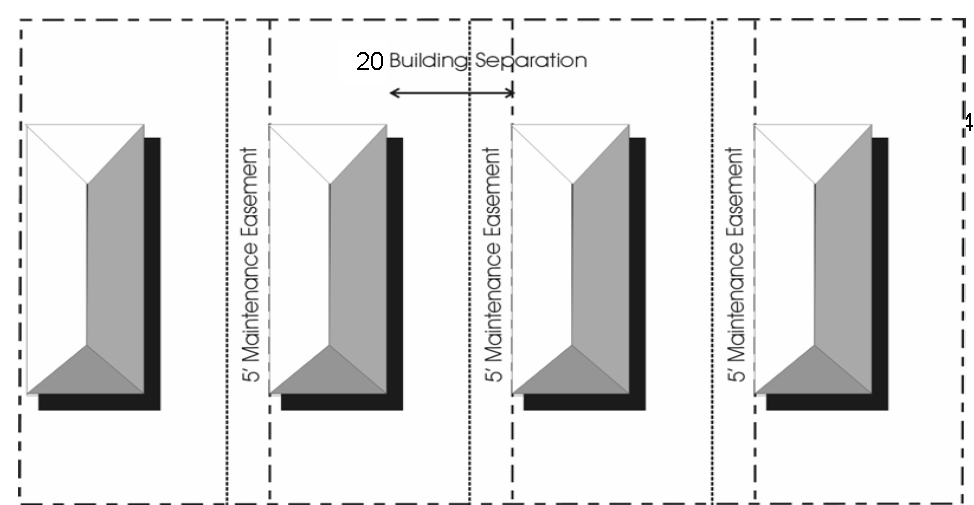
2.
Fencing, walls, trellises, and other similar uses can be used as connecting elements between one-family dwellings on adjacent lots, subject to site plan review by the Planning Commission.
3.
Twin Houses—Semi-detached, single-family dwellings which are connected along a common party wall (a code-approved firewall) to a similar unit. Each structure has only two dwellings. For a Twin House, the structure shall be set back a minimum of ten (10) feet from the side yard opposite of the common party wall. See Illustration below.
4.
Garages, carports, utility storage structures shall be permitted accessory uses and may be either attached as part of the main building or detached; however, said structures shall not be used as connecting elements and shall meet the setback requirements for accessory structures if detached or for primary structure if attached.
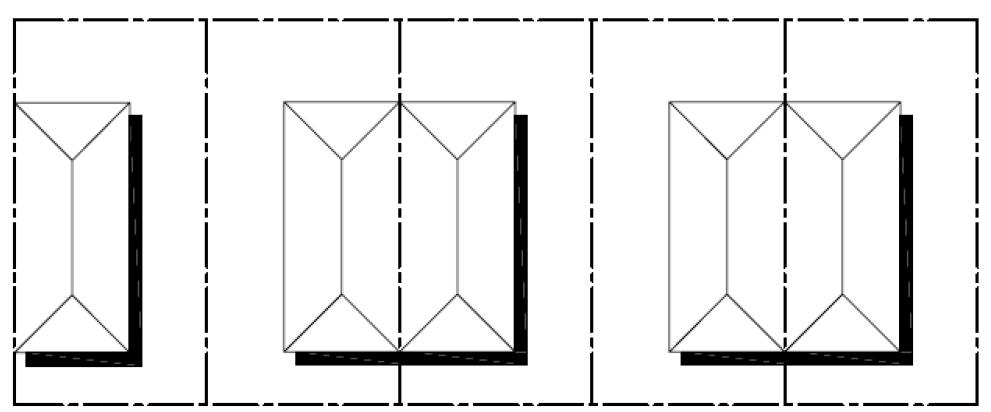
Dimensional Standards:
* This shall not include any credit for streets, recreation areas, common open space or water bodies. Private roads shall not be used in calculating the net lot area.
** Where there is not maintained common open space, a zero lot line dwelling including accessory structures shall not occupy more than fifty (50) percent of the lot area, sixty (60) percent coverage is allowed if there is maintained common open space.
*** The connecting elements such as fences, walls, trellises, patios, garden features, and other similar elements shall be permitted within the ten (10) foot setback area provided, however, no structure, with the exception of fences or walls, shall be placed within the required five (5) foot utility, wall maintenance, drainage, or other easements, or in an buffer area. And, in no case shall a zero lot line dwelling be built closer than fifteen (15) feet to the property line of a lot which is zoned as R-1 or R-2 Residential.
Accessory structures shall be setback at least five (5) feet from any property line or eight (8) feet from another structure in any residential development or twenty (20) feet in any commercial or industrial development, and shall not be located on any type of easement or buffer area. When an accessory structure is to be located in the rear yard of a corner lot, the accessory structure shall be setback at least ten (10) feet in any residential development or twenty-five (25) feet in any commercial or industrial development from the side street property line.
Fences may be located on the side or rear property lines unless an easement exists, in which case they shall not be located on any easement area. Front and side fences shall be no closer than ten (10) feet from any street right-of-way line and shall not be located within any sight distance area.
Street Frontage: Each lot shall have a clear, direct frontage on public streets or to accessways complying with private street requirements.
Platting Requirements: Each dwelling shall be located on its own individual platted lot. If areas for common use by occupants of the development are shown on the plat, satisfactory arrangements shall be made for the maintenance of the common open space and facilities as provided herein. The plat shall indicate the zero lot lines and all related easements.
Openings Prohibited on the Zero Lot Line Side: The wall of the dwelling located on the lot line shall have no windows, doors, air conditioning units, or any other type of openings, provided, however, that atriums or courts shall be permitted on the zero lot line side when the court or atrium is enclosed by three (3) walls of the dwelling unit and a solid wall of at least eight (8) feet in height is provided on the zero lot line. Said wall shall be constructed of the same material as exterior walls of the dwelling unit. Where adjacent zero lot line dwellings are not constructed against a common lot line, the builder or developer must provide for a perpetual wall-maintenance easement of five (5) feet in width along the adjacent lot and parallel with such wall.
Maintenance and Drainage Easements: A perpetual five (5) feet wide wall-maintenance easement shall be provided on the lot adjacent to the zero lot line property line which, with the exception of walls and/or fences, shall be kept clear of structures. This easement shall be shown on the plat and incorporated into each deed transferring title of the property. The wall shall be maintained in its original color and treatment unless otherwise agreed to in writing by the two affected lot owners. Roof overhangs may penetrate the easement on the adjacent lot a maximum of twenty-four (24) inches, but the roof shall be so designed that water runoff from the dwelling placed on the lot line is limited to the easement area.
Off-street Parking: A minimum of two (2) off-street parking spaces shall be provided on each platted lot. Except for parallel parking on public roads, tandem parking is permitted only on individual lots and in the driveways connecting such lots with the adjacent roads, provided said driveways are for the exclusive use of each individual lot. However, tandem parking shall be limited to no more than one (1) such tandem parking space for each individual lot. Parking shall be prohibited on sidewalks or in the front yard area directly in front of the home. Additional provisions for Off-street parking and loading are required and defined in Article 8.
Trees and Landscaping: Every development is unique and planting of trees and landscaping is required for all developments. A landscaping plan shall be submitted for approval by the Plan Review Committee.
Common Open Space and Maintenance of Facilities: Common open space is not required but may be permitted. If common open space is provided, satisfactory provisions shall be made to assure that nonpublic areas and facilities for the common use of occupants of Zero Lot Line development shall be maintained in a professional manner without expense to the general taxpayer of the City of Cleveland. Such may be provided by the incorporation of an automatic-membership home association for the purpose of continually holding title to such nonpublic areas and facilities and levying assessments against each lot, whether improved or not, for the purpose of paying the taxes and maintaining such common open space. Such assessments shall be a lien superior to all other liens save and except tax liens and first mortgage liens, which are amortized in monthly or quarter - annual payments over a period of not less than ten (10) years. Other methods may be acceptable if the same positively provide for the proper and continuous payment of taxes and maintenance without expense to the general taxpayers. The instrument incorporating such provisions shall be approved by the City Attorney, as to form legal sufficiency, before submission to the Board of Alderman and shall be recorded in the public records of Bolivar County, if satisfactory to the Board of Aldermen.
Commencement of Development: If development is not commenced within twelve (12) months from the date of approval of a site development plan, the approval hereof shall become null and void and the same may not be developed in accordance with said plan; provided, if development is permitted in stages, subsequent stages may be commenced within eighteen (18) months after the completion of the previous stage; otherwise, such subsequent stage may not be developed in accordance with the previously approved plan and such approval shall be null and void. Commencement of construction shall include, where necessary, substantial site improvement, which shall include but not be limited to active and continuous road improvement, excavation, grading and leveling, installation of utilities, and the like.
Provisions for signage are defined in Article 9.
Planned Unit Developments and Zero Lot line developments shall have a fifteen (15) foot wide buffer area along the side and rear property lines of the overall property. Additional details and provisions for buffering and landscaping are defined in Article 10, Section 1005.
Zoning Table
(a)
It is the intent of this Ordinance that the minimum lot area shall include that area sufficient to meet requirements for the building or buildings for all primary and accessory uses, all parking and loading requirements, buffering, yards, setbacks, and open space requirements on the site. Further, the new construction on the site shall be compatible with and "blend" with the existing character of the neighborhood.
(b)
The setback line for a side yard abutting a side street shall be the same as the front setback.
(c)
Existing buildings in the B-2 and B-2H zoning districts that do not meet the front, side, or rear setbacks are non-conforming structures and may be rehabilitated using the existing building footprint or setbacks to maintain the continuity of the neighborhood.
(d)
For each additional family add 2,000 square feet.
(e)
For each additional family add 5 feet.
623.1. - Creation of Leisure and Recreation District.
Under the authority granted by Miss. Code Ann. § 67-1-101, there is hereby established a Leisure and Recreation District in the downtown historic area of the City within the geographic area and with such boundaries as set forth and as represented on the map attached hereto as Exhibit A and incorporated herein by reference.
( Ord. of 01-19-2021(1) , § 1)
Editor's note— The map referenced herein as Exhibit A is not set out but copies can be viewed at the office of the city clerk.
623.2. - Name and boundaries of district.
The Leisure and Recreation District established herein shall be known as the Downtown Cleveland Arts and Entertainment District (hereinafter "the district") and shall have the following boundaries: POINT OF BEGINNING: Beginning at the point of intersection of the south right-of-way line of First Street and the west right-of-way line of North Sharpe Avenue in the City of Cleveland, Mississippi. Thence run west along and adjacent to the south right-of-way line of First Street to the intersection of the south right-of-way line of First Street with the west right-of-way line of Cotton Row, including the public sidewalk which runs north to south along Cotton Row and continuing to the intersection of the west right-of-way of Cotton Row with the north right-of-way of Shelby Street; Thence run east along the north right-of-way of Shelby Street to the intersection of the north right-of-way of South Sharpe Avenue; Thence run north along South Sharpe Avenue, becoming North Sharpe Avenue, including the public sidewalk which runs south to north along the east side of the avenue, and continuing north crossing Mississippi Highway 8 at the designated pedestrian crossing for the intersection of North Sharpe Avenue and Mississippi Highway 8; Thence continue north to the point of beginning.
( Ord. of 01-19-2021(1) , § 2)
623.3. - Outside consumption of alcoholic beverages permitted, conditions.
(a)
Any on-premises retail alcoholic beverage permittee (hereinafter "permittee") located adjacent to the district as depicted on the above map shall comply with all laws, rules and regulations which govern its license type, except that a patron, guest or member of that licensee may remove an open container of alcoholic beverage and/or wine from the licensed premises, and may possess and consume the alcoholic beverage and/or wine outside of the licensed premises anywhere within the boundaries of the district subject to the following regulations:
(b)
A person may not enter any permitted premises with an alcoholic beverage.
(c)
A permittee located in the district shall allow alcoholic beverages to be removed from the licensed premises only in a paper or plastic cup, that is recognizable to permittee, not larger than 16 fluid ounces in size, and no such alcoholic beverages shall be removed from the licensed premises in a can, bottle, glass container or other container, except as otherwise allowed by law.
(d)
No permittee shall allow a patron, guest or member to exit its licensed premises with more than one open container of alcoholic beverage, and it shall be unlawful for any person to exit such licensed premises with more than one such open container.
(e)
Permittees located in the district shall post, at all points of egress from the licensed premises, a map of the boundaries of the district in which it is located. The map shall be provided, either in electronic or paper form, to those permittees by the City upon request of the permittees.
(f)
Nothing in this [section] shall be construed to require a permittee located in the district to allow its patrons to remove alcoholic beverages and/or light wine or beer in open containers from the licensed premises.
(g)
Nothing in this [section] shall be construed to allow patrons, guests or members of a licensee to remove an open container of alcoholic beverage and/or light wine or beer from the boundaries of the district, and it shall be a violation of this [section] for any person to remove an open container of alcoholic beverage and/or light wine or beer from the boundaries of the district.
(h)
The purpose of this [section] being primarily to allow pedestrians to carry open containers as described in this [section] within the district, nothing in this [section] shall be construed to allow patrons, guests or members of a licensee to drive a motor vehicle or non-motor vehicle while carrying an open container of alcoholic beverage and/or light wine or beer onto or into a motor vehicle or pedestrian-driven vehicle,
(i)
It shall be a violation of this [section] for any person to drive a motor vehicle or non-motor vehicle while carrying an open container as described in this [section] containing alcoholic beverage and/or light wine or beer within the district.
(j)
Nothing in this [section] shall be construed to allow patrons, guests or members of a licensee to leave the district in a motor vehicle or non-motor vehicle of any kind while carrying an open container of alcoholic beverage and/or light wine or beer, and it shall be a violation of this [section] for patrons, guests or members of a licensee to leave the district as a pedestrian or in a motor vehicle or non-motor vehicle of any kind while carrying an open container of alcoholic beverage and/or beer or light wine.
(k)
Nothing in this [section] shall be construed to allow patrons, guests, or members of a licensee to impede traffic on a public street or within private or public parking lots.
( Ord. of 01-19-2021(1) , § 1)
623.4. - Public safety measures.
Enforcement of the boundaries of the district shall be the responsibility of the police department. In addition, the police and fire departments shall provide public safety services within the district in the same manner it provides those services in the remainder of the city.
( Ord. of 01-19-2021(1) , § 1)
623.5. - Definition of "alcoholic beverage" and "light wine" and "beer."
For the purposes of this [section], the term "alcoholic beverage" shall mean any alcoholic liquid, including wines of more than five percent of alcohol by weight, capable of being consumed as a beverage by a human being, including light wine and beer. To the extent the definition of "alcoholic beverage" and "light wine" and "beer" are modified under state law, the definitions of such in state law shall control.
623.6. - Penalty.
Violation of this section shall be a misdemeanor punishable by a fine of two hundred fifty dollars ($250.00) per occurrence.
( Ord. of 01-19-2021(1) , § 1)
Editor's note— At the direction of the city, Ord. of 01-19-2021(1), has been set out herein as § 623. Also, § 7 of said ordinance states, "This Ordinance is being adopted during an ongoing emergency due to the COVID-19 pandemic. Accordingly, the good cause requirement for the ordinance to take effect immediately is hereby established. Pursuant to Miss. Code Ann. § 21-13-11 (2019), this Ordinance shall be effective from and after January 25, 2020."

