
Clinton City Zoning Code
CHAPTER 3
- GENERAL PROVISIONS
Sec. 3.1. - Applicability.
The following provisions shall apply throughout the jurisdiction of this ordinance, regardless of the underlying regulating district.
Sec. 3.2. - Compliance to ordinance for increases on improvements of existing uses.
3.2.1.
All general and district requirements shall apply to an existing conforming use increasing in parking area and/or building area by at least ten percent, especially landscaping, parking, and fence standards.
Sec. 3.3. - Fence and wall standards.
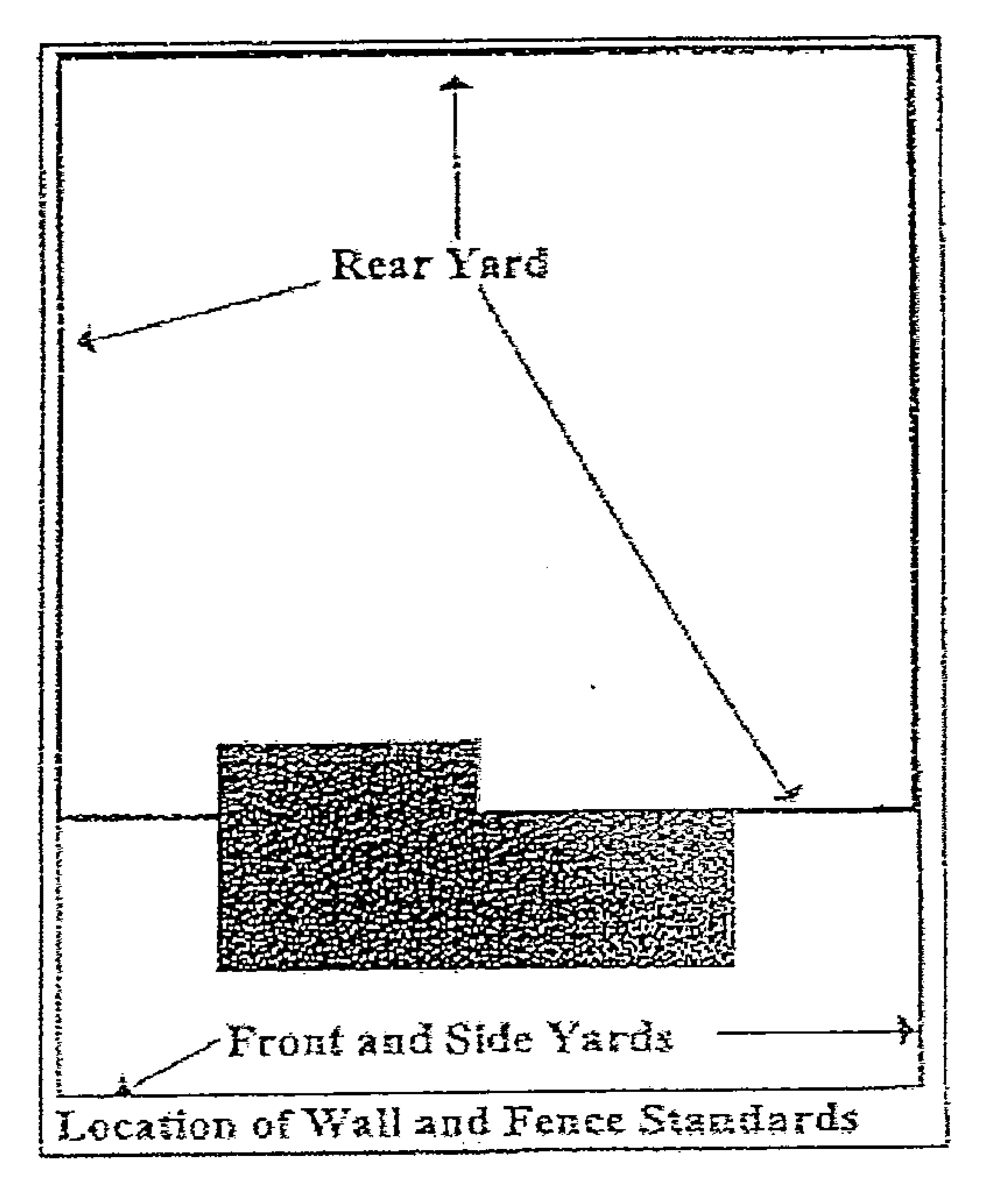
Except as otherwise noted in this ordinance, fences or walls are permitted in the various districts subject to the following regulations:
3.3.1.
Residential use.
A.
Rear yard fences and walls.
1.
Max. height: Eight feet.
B.
Side and front yard fences and walls.
1.
Max. height: Eight feet.
3.3.2.
Commercial and industrial use.
A.
Rear yard fences and walls.
1.
Max. height: Eight feet.
2.
Materials: Brick, stucco, chain link (barbed wire is permitted for rear yard fences not visible from a street), wrought iron, stone, wood, concrete, or combinations of the above. When combination of two or more materials is used, the heavier material shall be below.
B.
Side and front yard fences and walls.
1.
Max. height: Eight feet (exceptions: required screening for the affected district).
2.
Materials: Brick, stucco, chain link (barbed wire is permitted for side yard fences not visible from a street), wrought iron, stone, wood, concrete, or combinations of the above. When combination of two or more materials is used, the heavier material shall be below.
3.3.3.
Civic and institutional use.
A.
Fences and walls in all yards.
1.
Max. height: Eight feet.
2.
Materials: Brick, stucco, wrought iron, stone, wood, concrete, or combinations of the above. When combination of two or more materials is used, the heavier material shall be below.
Sec. 3.4. - Temporary structures.
3.4.1.
[Permitted.] Temporary structures and uses, when in compliance with all applicable provisions of the ordinance, and all other ordinances of the City of Clinton shall be allowed. The following temporary structures and uses shall be permitted:
3.4.2.
Construction trailers and storage trailers. Trailers used in conjunction with construction projects provided that the following conditions are met:
A.
Such construction trailers may be located at a building site where there is a valid building permit for the construction project, or, in the case of a residential subdivision, a valid building permit for at least one of the residential units being constructed.
B.
All construction trailers shall be located at least ten feet off any street right-of-way and not be placed in any required rear or side yard setbacks.
C.
All construction trailers shall be removed within one month of the completion of the project or issuance of the certificate of occupancy.
D.
All other uses of trailers, including using them as permanent on-site storage, are prohibited.
3.4.3.
Temporary sales or events.
a.
Uses requiring utilities more than 15 days in duration and/or held no more than three times per year at any particular location which would not otherwise be permitted in a particular zoning district may be issued a temporary permit as herein provided.
1.
Upon completion and submittal of an application, the zoning administrator may grant a zoning permit for the following temporary uses:
a.
Fireworks sales not to exceed 30 days;
b.
Food and beverage sales not to exceed 120 days and subject to SC DHEC review and approval;
c.
Open lot sales of Christmas trees in the C-3 and I-1 districts not to exceed 45 days;
d.
All other temporary sales not to exceed seven days and not located within the following areas:
i.
Central Commercial District (C-2);
ii.
Any residential district (R-1, R-2, R-3, and RMH);
iii.
At a major intersection within the City of Clinton.
e.
Exceptions. The following are considered as exceptions to the required permitting and time limitations:
i.
Produce vendors, provided the vendor personally grew all produce being sold.
3.4.4.
Other temporary uses. All other such temporary uses not otherwise listed may be granted a temporary zoning permit only after the zoning administrator has made the following determinations:
A.
The proposed use shall not materially endanger the public, health, welfare, and safety; and
B.
The proposed use shall not have a substantial negative effect on adjoining properties.
C.
Temporary permits shall be applied for ten days in advance of the event or function.
D.
A separate permit shall be obtained for each event.
In approving such a temporary permit, the zoning administrator may authorize conditions regarding duration of the use, hours of operation, signage, lighting, etc., and such conditions shall be made part of the permit issued. Violations of such conditions shall be considered a violation of this ordinance.
(Ord. of 2-12-2007, § 5)
Sec. 3.5. - Bed and breakfast inns.
Bed and breakfast inns may be allowed under the following conditions:
3.5.1.
Such uses are limited to ten or fewer guest rooms and guests limited to a lodging period not to exceed 29 consecutive days.
3.5.2.
Such uses shall be allowed only in older residential structures that are recognized as determined by the zoning administrator as architecturally, historically, or culturally significant and that through renovations and use as a bed and breakfast, will contribute significantly to the ambiance, character, or economic revitalization of the neighborhood.
3.5.3.
Minimal outward modifications of the structure or grounds may be made only if such changes are compatible with the character of the area or neighborhood as determined by the design review board.
3.5.4.
Meals offered to guests shall be restricted to breakfast. Afternoon social or tea service may also be served to guests if included in the room rate.
3.5.5.
The premises may not be utilized for any party, gathering, meeting, reception or other similar event for a fee unless the bed and breakfast inn is located on a site of one acre or greater.
3.5.6.
The primary purpose of the bed and breakfast inn is for use as a personal residence currently occupied by the innkeeper as his or her home.
3.5.7.
Such uses shall meet the minimum standards set forth in S.C. Code 1976, Title 45, Chapter 4 - South Carolina Bed and Breakfast Act.
3.5.8.
Parking requirements shall meet the standard of one parking space per room or suite. Any lodging must have reasonable access to public parking available or shared parking with a written agreement from an adjacent property owner.
(Ord. No. 2023-009-006, § 1(Exh. A), 9-19-2023)
Sec. 3.6. - Vibration, light, noise, and odor.
3.6.1.
Vibration. No inherent and recurring generated vibration shall be perceptible without instruments at the property line.
3.6.2.
Light. The source of exterior lighting shall not be arranged in such a manner as to be detrimental to adjacent properties or the traveling public.
3.6.3.
Noise. No persistent noise shall be detectable beyond the property line in excess of the average level of street and traffic noise generally heard at the point of observation, and no noise below such level shall be objectionable with respect to intermittence, beat, frequency, or shrillness.
3.6.4.
Odor. No objectionable odor shall be detectable beyond the property line and the emission of odors, regardless of type shall not be such as to be detrimental to the value and use of adjacent property.
Sec. 3.7. - Recycling facilities.
3.7.1.
Such facilities shall be in wholly enclosed buildings except for incidental storage, or within an area enclosed on all sides by an opaque fence or wall not less than eight feet in height and landscaped on all street frontages.
3.7.2.
All exterior storage of material shall be in sturdy containers or enclosures which are covered, secured, and maintained in good condition, or shall be baled or palletized.
3.7.3.
The site shall be maintained free of litter and any other undesirable materials, shall be cleaned of loose debris on a daily basis and shall be secured from unauthorized entry and removal of materials when attendants are not present.
3.7.4.
Space shall be provided on site for the anticipated peak load of customers to circulate, park, and deposit recyclable materials. If the facility is open to the public, space shall be provided for a minimum of ten customers or the peak load, whichever is higher, except where the zoning administrator determines that allowing overflow traffic is compatible with surrounding business and public safety.
3.7.5.
Where a facility is to be located within 500 feet of property in a residential zone, it shall not be in operation between 7:00 p.m. and 7:00 a.m.
3.7.6.
Any containers provided for afterhours donation of recyclable materials shall be at least 50 feet from any property zoned or occupied for residential use; shall be sturdy, rust resistant construction; shall have sufficient capacity to accommodate materials collected; and shall be secure from unauthorized entry or removal of materials.
3.7.7.
Donation areas shall be kept free of litter and any other undesirable material. The containers shall be clearly marked to identify the type of material that may be deposited. The facility shall display a notice stating that no material shall be left outside the recycling containers.
Sec. 3.8. - Accessory apartments.
3.8.1.
The principal structure (dwelling) must be owner-occupied.
3.8.2.
The apartment, whether attached or detached, cannot exceed 50 percent of the gross floor area of the principal dwelling, or contain more than two bedrooms.
3.8.3.
The apartment must be a complete living space, with kitchen and bathroom facilities separated from the principal unit.
3.8.4.
An accessory apartment may be accessory only to a single-unit dwelling, and not more than one apartment shall be allowed per dwelling or lot.
3.8.5.
The lot size shall be at least 50 percent greater where an accessory apartment is proposed in the R-1 district.
3.8.6.
The apartment shall meet all yard setback requirements and, where detached from the principal dwelling, shall be set back not less than ten feet from the principal dwelling.
3.8.7.
Evidence of the accessory apartment should not be apparent from the street in the R-1 district.
3.8.8.
A third off-street parking space shall be required.
Sec. 3.9. - Adult uses SIC 7299.
Owing to the potentially objectionable operational characteristics of sexually oriented or adult uses, and the deleterious effect of such uses on existing businesses and/or residential areas around them, the location of such uses shall be tempered by the supplemental siting criteria of this section.
No such use shall be located within 1,000 feet (measured in a straight line) of:
1)
A residential use;
2)
A church or religious institution;
3)
Public or private schools and educational facilities;
4)
Public parks and recreational facilities; or
5)
Any other adult or sexually oriented business.
Sec. 3.10. - Mini-warehouses SIC 4225.
Due to the need to better integrate mini-warehouses into the urban fabric of the community, the following standards shall be observed:
A.
Size. Mini-warehousing sites shall not exceed two acres.
B.
Lot cover. Lot coverage of all structures shall be limited to 50 percent of the total area.
C.
In/out. Vehicular ingress-egress shall be limited to one point for each side of property abutting any street lot line.
D.
Storage only. No business activity other than rental of storage units shall be conducted within or from the units.
Sec. 3.11. - Manufactured homes on separate lots.
The placement of manufactured homes in subdivisions, and on individual or separate lots, where permitted by this ordinance, shall comply with the following requirements:
A.
Only one manufactured home shall be located on each lot.
B.
The manufactured home and accessory uses shall conform to all applicable district requirements.
C.
The manufactured home shall be securely underpinned and anchored as required by the Standard Building Code. The securing of the unit must be inspected and approved by the zoning administrator.
D.
Each manufactured home shall have skirting constructed of bricks, concrete blocks, or other appropriate material which extends from the exterior wall to the ground. The tongue shall be removed where so designed.
E.
Recreational vehicles are never to be considered a manufactured home.
Sec. 3.12. - Manufactured home parks or courts.
Manufactured home parks or courts shall comply with the following requirements:
A.
The park shall be served by municipal water and sewer systems, a system of storm drainage, and refuse disposal facilities, not less than 40 feet from any manufactured home, plans of which shall be approved by appropriate city officials.
B.
All manufactured home spaces shall abut upon an all-weather surface driveway of not less than 22 feet in width which shall have unobstructed access to a public street.
C.
A description of the procedures of any proposed home owners association or other group maintenance agreement must be submitted to appropriate city officials.
D.
All on-site roadway intersections shall be provided with a street light, and interior lights shall be provided at not less than 400-foot intervals.
E.
Each individual manufactured home site shall be at least 25 feet from any other site and at least 25 feet from the right-of-way of any street or drive providing common circulation.
F.
Manufactured homes shall be placed on one of the following types of foundations which shall be subject to approval by the zoning administrator:
(a)
Piers under frame made of masonry construction
(b)
Curtain wall foundation of solid continuous construction around the entire perimeter of the home,
(c)
Concrete or masonry footings. Foundations shall be so constructed as to prevent settling and accumulation of water under the home. All manufactured homes placed on a concrete slab foundation or on a concrete or masonry footing foundation shall be provided with appropriate skirting of solid durable material around the entire perimeter. Each manufactured home shall be securely underpinned and anchored in accord with the Standard Building Code.
G.
Space numbers. Permanent space numbers shall be provided on each manufactured home space and shall be located so as be visible from the street or driveway. Signs identifying space locations shall be provided at each street or driveway intersection.
H.
License required; revocation. A business license shall be requisite to the opening or operation of a manufactured home park in the City of Clinton. Said license may be revoked by city council for a violation of this ordinance or other applicable ordinance and regulations governing the operations of such uses.
I.
Recreational vehicles are not to be allowed as permanent residences in a park.
Sec. 3.13. - Group-occupied dwellings.
Due to the potential lifestyle conflicts between group-occupied and single-family-occupied dwellings, the need to resolve such conflicts and provide harmonious living conditions, and meet the variant housing needs of the local population, the additional requirements of this section shall apply to the location and use of group occupied dwellings in the City of Clinton.
A.
A minimum of three off street parking spaces shall be provided, only two of which may be located in the required front or side yards in the R-2 district, plus one space for each bed (over three) in the dwelling. In all other districts, the required off street parking may be provided in all required yards, provided that in the front or side yards the parking shall meet the design standards and include a buffer around all perimeters of the parking area.
B.
No such use shall be located within 600 feet of an existing group occupied dwelling in the R-2 district, or 400 feet in all other districts (measured in a straight line).
C.
An agreement executed by the owner of the dwelling shall accompany the request for a permit:
(1)
To ensure proper maintenance of the yards and dwelling;
(2)
To ensure the control of litter and noise;
(3)
To ensure participation by the owner in the communication and enforcement process necessary to accomplish compatibility within the neighborhood; and
(4)
To ensure that only independently functioning dwelling units are rented on a single lease agreement.
D.
Compliance and permit requirements.
(1)
An occupancy permit shall be prerequisite to the use of a dwelling unit for group occupancy. Said permit shall be valid for 12 months. Thereafter group occupancy permits shall be subject to annual review by the zoning administrator to determine continuing compliance with the requirements of this section.
(2)
Where non-compliance with the provisions of this section or an on-going problem has been determined to exist, the zoning administrator shall notify the owner in writing of the nature and extent of the problem, together with instructions to correct the problem within a reasonable time frame. Failure of the owner to comply fully with an order to correct the situation shall constitute a violation of this ordinance resulting in:
(a)
Revocation of the occupancy permit; and/or
(b)
Fines and penalties as determined by the court.
(3)
An on-going problem shall be determined to exist where written documentation has been compiled over a three month period by the zoning administrator, affected neighborhood associations, or area residents. Copies of the documentation shall be filed with the city and forwarded to the property owner.
E.
Household occupancy. With the exception of a family, the number of occupants permitted to reside in a dwelling unit in a particular zoning district shall comply with the following table on the condition that for each occupant, one off-street parking space shall be provided. In any dwelling unit, only one family, as defined by this ordinance, may occupy a unit. Additionally, in a dwelling unit occupied primarily by a family, two occupants may reside within the dwelling unit. No additional occupants may be permitted on any single household residential lot which contains a separate apartment unit.
Sec. 3.14. - Yard and garage sales.
Yard, garage, tag, patio, and apartment sales are permitted without a permit and permission of the property owner or leaser of the lot, as an accessory use on any residentially or institutionally developed lot in any district. Such sale shall be limited to no more than two days per calendar month on the same lot.
Sec. 3.15. - Home occupations.
A home occupation shall be permitted in any residential district or structure provided that such occupation:
A.
Is conducted by members of the family residing in the dwelling and are permitted to be engaged in such occupation.
B.
Is conducted within the principal building;
C.
Utilizes not more than 25 percent of the total floor area of principal building;
D.
Produces no alteration or change in the character or exterior appearance of the principal building from that of a dwelling;
E.
Conducts no retail sales, other than items hand-crafted on the premises, in connection with such home occupation;
F.
No display of products shall be visible from the street;
G.
Is not visibly evident from outside the dwelling, except for the permitted sign (see section 3.9 [3.17]: signs.);
H.
Does not generate traffic in greater volumes than would normally be expected in a residential neighborhood. Any need for parking shall be met by off-street parking and other than in a required front yard.
Sec. 3.16. - Private swimming pools and tennis courts.
3.16.1.
Pools and tennis courts, including, but not limited to, aprons, walls, and equipment rooms, shall not protrude into any setbacks.
3.16.2.
This use shall be fenced or otherwise protected against intrusion.
Sec. 3.17. - Signs.
3.17.1.
Signs are considered to be structures and the regulations herein shall apply and govern in all zoning districts. No sign shall be erected or maintained unless it is in compliance with this section and the additional requirements for the specific zoning district.
3.17.2.
A permit shall be required for the erection, alteration, relocation, or reconstruction of permitted signs unless otherwise noted, and shall be issued by the zoning administrator in accordance with chapter 5 of this ordinance.
3.17.3.
Signs must be constructed of durable materials, maintained in good condition, and not permitted to become dilapidated.
3.17.4.
Non-conforming signs damaged more than 50 percent of their reasonable replacement cost shall not be repaired or replaced except in accordance with the provisions of this ordinance.
3.17.5.
Prohibited signs.
A.
Sign imitating warning signals. No sign or structure shall display flashing or intermittent lights of any type, nor shall any colored lights be utilized for sign purposes that resemble lights utilized on emergency vehicles, including police, fire, EMS, towing, and rescue vehicles; nor shall any sign use the words "Stop," "Danger," or any other that may confuse an automobile or other vehicle driver.
B.
Signs within street or highway rights-of-way. Except traffic signs and signals, information signs erected by or authorized by a governmental or other public agency, or political signs.
C.
Certain attached and painted signs. Signs painted on or attached to trees, fence posts, and telephone poles or other utility poles or signs painted on or attached to rocks or other natural features. Also, signs that have been altered from their original use, such as removing the legs from a free standing sign and placing it on a pole.
D.
Fluttering ribbons and banners. Except the flags of governments and their agencies.
3.17.6.
Signs for which a permit is not required.
A.
Traffic, directions, warning, or information signs authorized by any public agency.
B.
Official notices issued by any court, public agency, or officer.
C.
Non-illuminated "for sale," "for rent," or "for lease" signs not exceeding 12 square feet.
D.
One permitted home occupation sign, provided it is non-illuminating, no larger than one square foot, and mounted against a wall of the principal building.
E.
Non-illuminated signs not exceeding 12 square feet on work under construction, such as non-illuminated signs displaying the contractors, subcontractors, architects, engineers, owners, financial, selling, and development agencies.
F.
Political signs. These signs shall not be placed more than 45 days before an election and must be removed ten days after the election.
1.
Notice of violation. Ten days after the election, the zoning administrator shall send notice of the sign violation by registered mail, return receipt requested, to the owner of the land or which the sign is located and the violator who is responsible for the sign. Within five days of receipt or refusal of the order, the owner or violator must remove the sign.
2.
Fines. Failure to comply with the zoning administrator's order shall constitute a civil violation. Admission of liability or finding of liability shall be punishable by a fine of $100.00 for each individual charge. Each day during which the violation is found to have existed shall constitute a separate offense.
3.17.7.
Removal of signs. Whenever a sign becomes structurally unsafe or endangers the safety of a structure or premises or the public, or is erected or maintained in violation of this ordinance, the zoning administrator shall order such sign to be made safe or comply with ordinance, as the case may be, or be removed. Such order shall be sent to the owner of the land on which the sign is located by registered mail and shall be complied with within 12 days from the date of mailing or such time as the zoning administrator may deem appropriate. Failure to comply shall constitute ground for the zoning administrator to have the sign removed, and the cost thereof shall be added to any fine imposed for violation under this ordinance.
3.17.8.Outdoor
advertising/billboard signs.
A.
Definitions.
a.
Official business directional sign means a sign erected and maintained by the state or an entity authorized by the state to indicate to the traveling public the route and distance to public accommodations or commercial services for the traveling public.
b.
Off-premises sign means a business sign, which directs the attention of the public to a business, activity conducted, or product sold or offered at a location not on the same premises where such business sign is located. For purposes of this article, easements and other appurtenances shall be considered to be outside such platted parcel of land and any sign located or proposed to be located in an easement or other appurtenance shall be considered an off-premises sign.
B.
Prohibited signs.
a.
All off-premises signs are prohibited and no permit shall be granted for the construction of any off-premises signs on or after the effective date of this subsection.
C.
Repair and reconstruction of signs.
a.
Off-premises signs. Should any sign be damaged by acts of God, weather, unintentional harm or negligence or should any off-premises sign deteriorate due to failure to properly maintain said sign to the point that the cost of repair is greater than 50 percent of its current fair market value or 50 percent of current construction costs, whichever is the lesser, the city shall not grant any permits for the repair or reconstruction of the sign. This prohibition does not apply to signs damaged by vandalism or other criminal acts.
D.
Severability and conflict.
a.
Severability. This ordinance and its various parts are hereby declared to be severable. If any section, clause, provision or portion of this ordinance is declared invalid or unconstitutional by a court of competent jurisdiction, such decision shall not affect the validity of either this ordinance as a whole or any parts not declared invalid or unconstitutional.
b.
Conflict. If any part of this ordinance is found to be in conflict with any other ordinance of the City of Clinton, the most restrictive or highest standard shall prevail.
c.
Highway Advertising Control Act. Nothing herein shall be construed to in any way prohibit or relieve the city or owners of property within the corporate limits of the city from any duties, responsibilities or obligations evolved upon it or them by virtue of the terms of the Highway Advertising Control Act, as codified by S.C. Code 1976, §§ 57-25-10 through and including 57-25-220, as amended.
(Ord. of 2-12-2007)
Sec. 3.18. - Common open space.
3.18.1. Intent. Common open space is land and/or water bodies used for recreation, amenity or buffer; it shall be freely accessible to all residents of a development, where required by this ordinance. Open space shall not be occupied by buildings or structures, roads, parking, or road right-of-way; nor shall it include the yards or lots or residential dwelling units required to meet minimum lot area or parking area requirements. Common open space shall not include areas related to stormwater management through detention/retention basins.
The purpose of this section is to ensure adequate open space for high density residential development; to integrate recreation, landscaping, greenery, and/or natural areas into such projects; to promote health and safety of residents of such projects; and to compensate for the loss of open space inherent in single family residential properties.
3.18.2. Definitions.
Protected trees refers to trees that are eight inches up to 24 inches in DBH (diameter breast height).
Grand trees refers to trees that are 24 inches or greater in DBH (diameter breast height).
The following uses/projects consisting of nine or more units shall provide common open space in the amounts prescribed:
No new development, building, or structure in connection with the above shall hereafter be erected or used unless common open space is provided in accord with the provisions of this section. No existing development, building or structure in connection with the above shall be expanded or enlarged unless the minimum common open space required by the provisions of this section are provided to the extent of the alteration or expansion.
3.18.3. Common open space plan. Proposed uses/projects shall submit an open space or landscaping plan as part of the application for a building permit. The plan shall:
1)
Designate areas to be reserved as open space. The specific design of open space shall be sensitive to the physical and design characteristics of the site.
2)
Designate the type of open space which will be provided, and indicate the location of plant materials, decorative features, recreational features, etc.
3)
Specify the manner in which common open space shall be perpetuated, maintained, and administered.
3.18.4. Types of common open space and required maintenance. The types of common open space which may be provided to satisfy the requirements of this ordinance together with the maintenance required for each are as follows:
1)
Natural areas are areas of undisturbed vegetation or areas replanted with vegetation after construction. Woodlands and wetlands are specific types of natural areas. Maintenance is limited to removal of litter, dead trees, plant materials, and brush. Natural watercourses are to be maintained as free flowing and devoid of debris. Stream channels shall be maintained so as not to alter floodplain levels.
2)
Recreational areas are designed for specific active recreational uses such as playgrounds, tennis courts, swimming pools, ballfields, and similar uses. Recreational areas shall be accessible to all residents of the development. Maintenance is limited to ensuring that there exist no hazards, nuisances, or unhealthy conditions.
3)
Greenways are linear green belts linking residential areas with other open space areas. These greenways may contain bicycle paths, footpaths, and bridle paths. Connecting greenways between residences and recreational areas are encouraged. Maintenance is limited to a minimum of removal and avoidance of hazards, nuisances, or unhealthy conditions.
4)
Landscaped areas, lawns, and required buffer areas, including creative landscaped areas with gravel and tile, so long as the tile does not occupy more than two percent of the required open space. Lawns, with or without trees and shrubs, shall be watered regularly to ensure survival, and mowed regularly. Landscaped areas shall be trimmed, cleaned and weeded regularly.
3.18.5. Preservation of open space. Land designated as common open space may not be separately sold, subdivided, or developed. Open space areas shall be maintained so that their use and enjoyment as open space are not diminished or destroyed. Open space areas may be owned, preserved and maintained as required by this section by any of the following mechanisms or combinations thereof:
1)
Dedication of and acceptance by the city.
2)
Common ownership of the open space by a homeowners association which assumes full responsibility for its maintenance.
3)
Deed restricted, private ownership which shall prevent development and/or subsequent subdivision of the open space land and provide the maintenance.
In the event that any private owner of open space fails to maintain same, the city may in accordance with the open space plan and following reasonable notice, demand that deficiency of maintenance by corrected, and enter the open space to maintain same. The cost of such maintenance shall be charged to those persons having the primary responsibility for maintenance of the open space.
(Ord. No. 2023-009-003, § 1(Exh. A), 9-11-2023; Ord. of 03-03-2025(1), § 3)
Sec. 3.19. - Landscaping.
3.19.1.
Intent. These regulations are established to protect and enhance the natural landscape of Clinton and ensure the appropriate use of plant material in new construction. It is the intent of these regulations to preserve natural tree cover and establish new tree planting with development in order to:
A.
Reinforce community identity;
B.
Reduce visual blight and noise;
C.
Increase building and property values;
D.
Prevent soil erosion;
E.
Reduce storm water runoff;
F.
Create shade and reduce solar overheating.
3.19.2.
Landscaping. Landscaping is required as described in chapter 4 for the specific zoning district to provide for buffering of adjacent zones, sound and light abatement, and screening of commercial uses and parking. All required landscaping shall be installed and maintained in compliance to the following general requirements:
A.
All plant material installed shall be healthy and of the best quality.
B.
Landscaping shall be provided in accordance with these regulations whenever a building or use is changed or experiences a ten percent enlargement in floor area.
C.
Landscaping shall not conflict with the visibility at street intersections.
D.
Wheel stops shall be placed three feet from required landscaping areas.
E.
Existing vegetation may be used to satisfy portions of the landscaping requirements.
3.19.3.
Canopy trees. The following is a list intended for general reference and should not be considered all-inclusive.
3.19.4.
Understory trees. The following is a list intended for general reference and should not be considered all-inclusive.
(Ord. No. 2023-009-003, § 1(Exh. A), 9-11-2023)
Sec. 3.20. - Tree protection.
3.20.1.
Intent. These regulations are established to protect trees by regulating the cutting down, damaging, planting and replacement of trees during development in order to:
A.
Maintain the environmental and aesthetic benefits that trees provide;
B.
Improve the appearance of vehicular use areas;
C.
Protect and conserve property values within the city.
The provisions herein shall not be interpreted to prohibit or unduly inhibit development of private property.
3.20.2.
Exemptions.
A.
Residential exemption. Existing single and small multifamily residential uses are exempt from the requirements of this section unless such use is in the process of being converted into a commercial or industrial use.
3.20.3.
For parcels of land proposed for development or activity that results in the removal or injury of trees eight inches or greater in DBH (diameter at breast height) shall require replacement or mitigation and must meet a combined DBH of fifty (50) inches or greater of trees per gross acre at the time of completion of approved development For developments that are less than five (5) acres, the city forester or his/her designee may approve site/landscaping plans. For developments equal to or greater than five (5) acres, the tree commission must approve.
3.20.4.
Protection of trees. The protection of trees is required at all times if any construction or excavation of earth occurs within 24 feet from protected/grand trees. These protective measures must adhere to the following:
A.
Protective barricades required. Protective barricades shall be placed around all protected trees and grand trees located in development areas, and designated to be saved, prior to the start of development activities, and shall remain in place until development activities are complete or construction in accordance with standards set forth in this section commences. The area within the protective barricade shall remain free of all building materials, dirt or other construction debris, vehicles and development activities. Barricades shall be erected at a minimum distance of 12 feet from the base of each protected and grand tree.
B.
Construction within the protective barricade. Construction of impervious surfaces shall not be permitted within five feet of a protected tree or within 12 feet of the base of a grand tree, unless special construction methods, including but not limited to tree feeders and porous paving materials, are used and certified as acceptable by a reputable tree service or other qualified organization.
C.
Roots. All roots outside the protective barricade to be removed during development shall be severed clean and a two-inch layer of mulch shall be applied over the surface of exposed roots during development.
D.
Pruning. All pruning of protected trees and grand trees shall be done according to the National Arborists Association, Pruning Standards for Shade Trees.
3.20.5.
Standards for removal of protected or grand trees.
A.
The removal of a protected/grand tree shall be approved if the city forester or his/her designee finds that one or more of the following conditions exist. Replacement trees may or may not be required at the city forester or his/her designee's discretion.
1.
The tree is located where a proposed building or accessory structure is to be placed in accordance with other zoning standards.
2.
The tree creates unsafe vision on a public street or right-of-way.
3.
Each tree that is determined by the city forester or his/her designee affected by insects, disease or injured to the extent it is irreparably damaged shall be approved for removal.
4.
Tree is dead/dying.
5.
Tree has an uncorrectable structural defect that results in an increased risk of whole or partial tree failure.
6.
The tree is in a restricted growing space, is in conflict with the surrounding hardscape or infrastructure, and the conflict cannot be resolved.
7.
Tree is in conflict with overhead utility lines and proper pruning cannot adequately reduce the conflict without severely disfiguring the tree.
3.20.6.
Tree removal, relocation, or replacement.
A.
Relocation of protected trees. Relocation may be accomplished by relocating the tree on land under the same ownership within the city limits or to public land within city limits.
B.
Tree planting criteria. In the relocation or the replacement of a protected or grand tree, all trees used shall be vigorous, well-shaped, branched and foliated.
C.
Maintenance. The owner of the parcel shall be responsible for the maintenance of all protected, grand, relocated or replaced trees.
D.
Vacant parcels of land. On a vacant parcel of land, where a building permit or subdivision approval has not been issued, the destruction, within any five-year period, of more than 25 percent of the protected trees on any one parcel of non-exempt land shall be prohibited. The total number of protected trees existing on any one parcel shall not be reduced below a total number equal to 20 protected trees per acre.
E.
Tree bank alternative. If it has been deemed not feasible for developments that all of the required trees cannot be planted due to availability or site constraints, the remaining balance of trees may be planted on public properties. The city forester or his/her designee must make the approval of such for developments with less than five acres. For developments equal to or more than five acres, approval must be obtained from the tree commission. The diversity, amount of trees and location of replacement trees are at the discretion of city forester or tree commission. All tree bank trees are to be guaranteed for one full year after planting. Any trees that die within this time period must be replaced by the developer and/or permittee.
F.
Time limit. There will be a two-year time limit on replacing/relocating trees. If trees are not replaced/relocated in this time period, developer and/or permittee will be in violation and city forester may take steps necessary to correct the results of noncomplying work, and the reasonable costs of such steps shall be charged to the developer and/or permittee.
3.20.7.
Application for a zoning permit. Application for a permit where land development, new construction, or addition in the footprint of a structure is proposed shall require the submission of a site plan or plat which includes the following:
A.
A tree survey which locates all protected and grand trees identified by DBH (diameter at breast height) and species. Groups of trees in close proximity may be designated as a clump of trees, with the predominant species, estimated number and average diameter indicated. For developments which exceed ten acres, an aerial photograph may be substituted for a tree survey with the approval of the city forester or his/her designee in instances that they would provide the same information as the tree survey.
B.
Location of all existing and proposed structures, improvements, rights-of-way, and easements on the property and designation of all public rights-of-way and other public lands adjacent to the property.
C.
Designation of protected trees to be saved and those to be relocated or removed.
3.20.8
Variances from the requirements of this ordinance. A variance may be granted by the City of Clinton tree commission where it can be shown that there are extraordinary hardships in the way of complete compliance with this ordinance. The tree commission may grant this variance with or without conditions.
(Ord. No. 2023-009-003, § 1(Exh. A), 9-11-2023)
Sec. 3.21. - Parking.
3.21.1.
General design standards.
A.
Unless no other practicable alternative is available, any off-street parking area shall be designed so that vehicles may utilize such areas without backing onto a public street.
B.
Off-street parking areas of all developments shall be designed so that sanitation, emergency, and other public service vehicles can serve such developments.
C.
Circulation areas shall be designed so that vehicles can proceed safely without posing a danger to pedestrians and without interfering with parking areas.
D.
No off-street parking area shall be located over an active or auxiliary septic tank field.
E.
Retaining walls, screen, landscaping, and building walls shall be protected from vehicle contact.
F.
A permanent turn-around shall be required when the dead-end aisle exceeds 500 feet, measured along the centerline of the dead-end aisle, from the last aisle or public roadway.
3.21.2.
Parking space dimensions.
A.
Each parking space shall contain a rectangular area of at least 171 square feet.
B.
Parallel parking shall provide a space of 19 feet by nine feet.
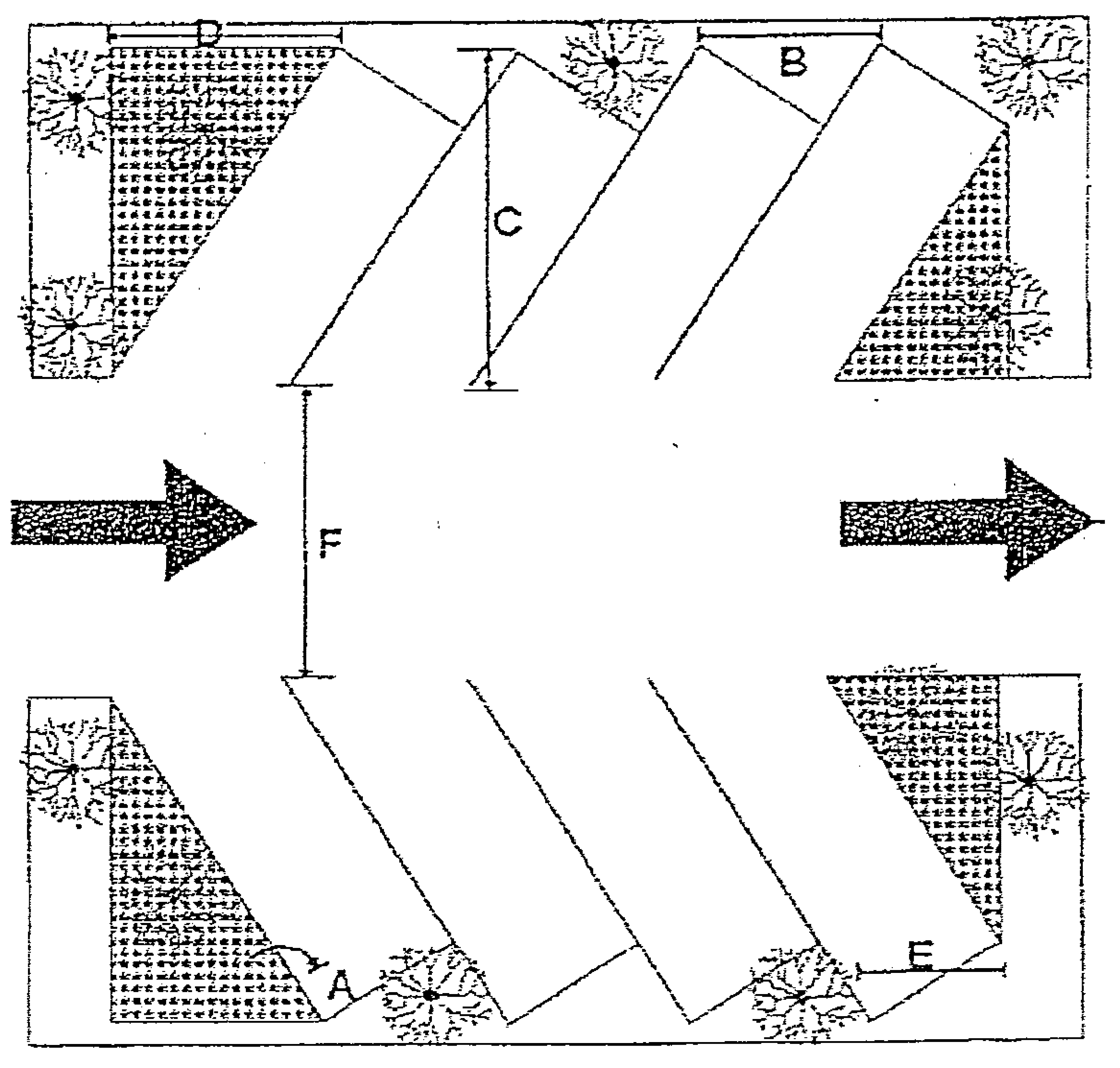
C.
Parking areas and widths shall conform to the following table:
3.21.3.
Disabled parking.
A.
Except for a lot containing a single-family or duplex dwelling, all uses shall be required to provide and designate the following number of spaces designed for disabled persons.
B.
Off-street parking spaces for the disabled shall be designed as follows:
1.
All spaces for the disabled shall have access to a curb-ramp or curb-cut when necessary to allow access to the building served, and shall be located so that users will not be compelled to wheel behind parked vehicles, and shall be located the shortest possible distance between the parking area and the entrance to the principal building it serves.
2.
Parallel parking spaces for the disabled shall be located either at the beginning or end of a block or adjacent to alley entrances. Curbs adjacent to such spaces shall be of a height which will not interfere with the opening and closing of motor vehicle doors.
3.
Each parking space for the disabled shall be paved and prominently outlined with paint and with a permanent sign bearing the internationally accepted wheelchair symbol, posted at the head of the parking space.
4.
The size of the parking space shall be per building code specifications.
3.21.4.
Cooperative parking.
A.
Refer to required parking in chapter 4 for the specific zoning district. These requirements may be met with cooperative parking.
B.
Cooperative provisions for off-street parking may be made by contract between two or more adjacent property owners. The parking area provided on any one lot may be reduced to not less than one-half the number of required parking spaces for the use occupying such lot. These lots shall be interconnected in the HC district.
3.21.5.
Application of parking requirements.
A.
Mixed uses. When more than one principal or accessory use occupy the same building or parcel; the parking spaces required shall equal the sum of the requirements of the various uses computed separately.
B.
Change in use, alteration of use, or extension of use. Off-street parking spaces shall be provided in accordance with these regulations whenever a building or use is changed, altered or enlarged by at least 50 percent in floor area, number of employees, number of dwelling units, seating capacity, or otherwise.
C.
A scale drawing or layout of all required parking areas showing the location, size, and arrangement of the individual parking spaces, loading spaces, and landscaped areas shall be submitted to the zoning administrator for approval.
3.21.6.
Lighting standards.
A.
All parking space area lighting shall be energy efficient and designed so that any glare is directed away from adjacent properties or create any hazardous traffic conditions.
B.
Lighting shall be provided to illuminate any off-street parking or loading spaces within developments providing customer service to the public after 5:00 p.m. Required lighting shall be designed at a mounting height, luminance, and spacing to provide a minimum average horizontal illumination of 0.6 foot-candles within the parking area and at primary building entrances.
Sec. 3.22. - Sight triangle.
3.22.1.
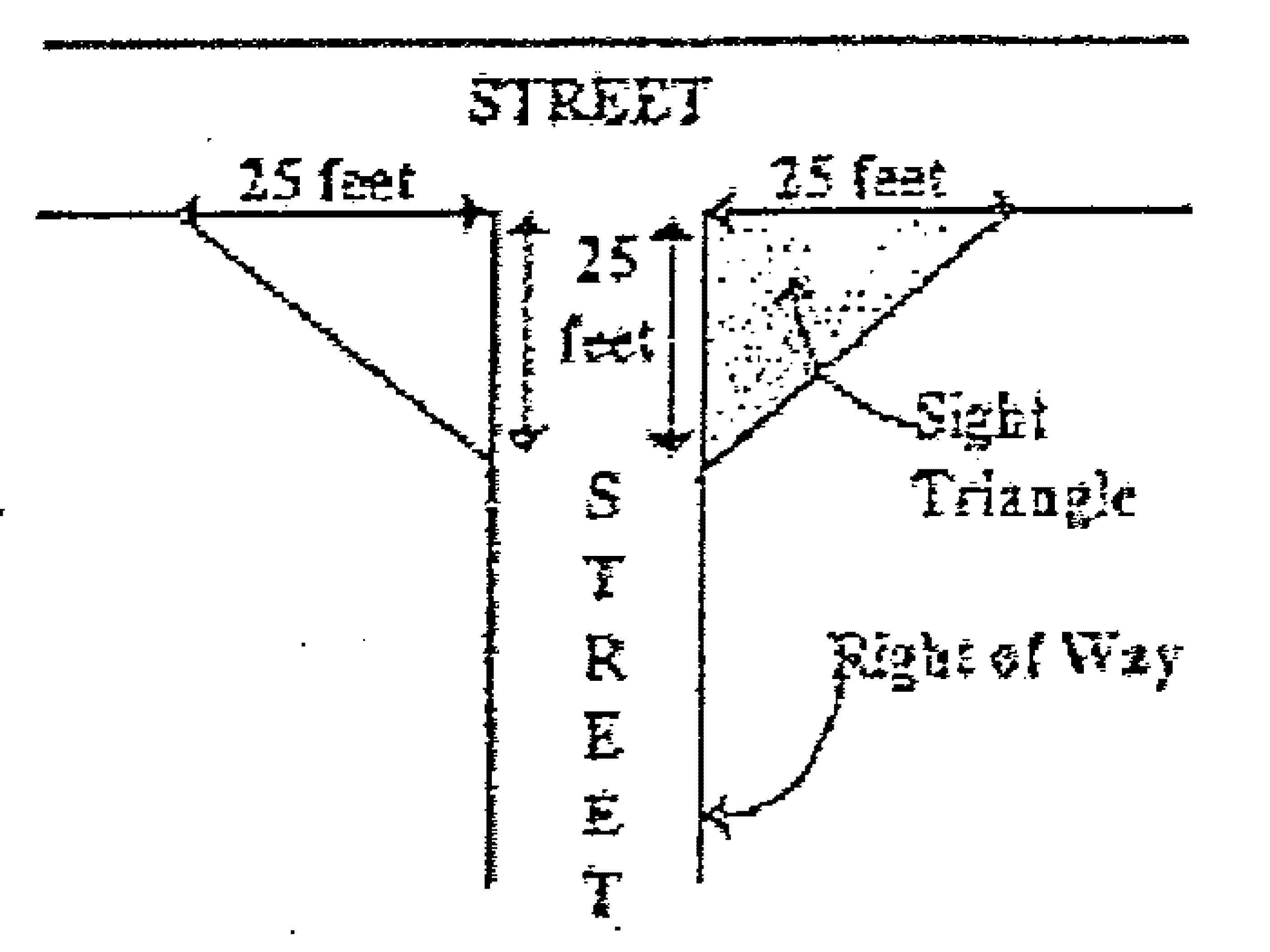
Intent. For protection against traffic hazards, no impediment to visibility shall be placed, allowed to grow, erected or maintained within visibility triangles described as follows;
3.22.2.
Size of sight triangle. A triangular-shaped portion of land 25 feet wide and 25 feet deep at the intersection.
3.22.3.
[Height.] No structure, sign, or landscaping material shall exceed 2½ feet in height within the sight triangle.
3.22.4.
[Parking.] No parking is allowed within the sight triangle.
Sec. 3.23. - Parking, storage or use of campers or recreational vehicles.
No recreational vehicle or boat in excess of 17 feet shall be parked or stored in any required front or side yard setback area in a residential district; however, such use may be parked anywhere on residential premises for a period not to exceed 24 hours during loading and unloading, and recreational vehicles may be used for temporary lodging, up to seven days.
Sec. 3.24. - Parking, storage or use of non-recreational vehicles and equipment.
1)
No automobile, truck, or trailer of any kind or type, without current license plates, shall be parked, and construction equipment shall not be stored on any lot zoned for residential use, other than in completely enclosed buildings, or screened from vision from the public street serving the property.
2)
Parking of vehicles, implements, and/or equipment used for commercial, industrial, farm or construction purposes in residential districts shall be limited to one vehicle per residence, with a capacity of no more than two tons.
3)
Vehicles with a capacity in excess of two tons and used for commercial, industrial, farm, or construction purposes are prohibited from parking in residential districts, including the street/highway right-of-way in such districts, when not actively involved in commerce.
Sec. 3.25. - Yard and setback modifications.
1)
Setbacks on corner lots. Where a side yard abuts a street, the minimum side yard requirements along the street shall be not less than the minimum front yard requirements for the same lot.
2)
Setbacks from streets. The street setback requirements shall not apply on any lot where the average setback of existing buildings located wholly or in part within 100 feet on each side of such lot within the same block and fronting on the same side of the street is less than the minimum required setback. In such cases, the setback on such lot may be less than the required setback; but not less than the average of the setbacks of the aforementioned existing buildings.
3)
Setbacks from railroads. Structures within commercial and industrial districts which are adjacent to railroads may locate closer to the railroad right-of-way than the permitted side or rear yard setbacks of the respective zoning districts. However, the location must be in accordance with applicable railroad standards and conform to all other pertinent provisions of the zoning ordinance.
Sec. 3.26. - Accessory buildings and uses.
1)
The number of accessory buildings shall not exceed two in any zoning district.
2)
Non-farm accessory buildings shall not exceed 50 percent of the gross floor area (GFA) of the principal building or use.
Accessory buildings and uses may be located anywhere within the buildable area; and may be located in required yards and setback areas under the following conditions:
1)
Accessory buildings and uses may be located in required yards and setback areas in the C-2, C-3, I-1 districts and in approved PDD's; provided such uses are located no closer than five feet to any property line, are not located in any required buffer area, and otherwise comply with the regulations for principal uses in said districts.
2)
Accessory buildings and uses in the R-1, R-2, R-3, RMH and O&P districts may be located in all required yards and setback areas; provided no such uses shall be located in any required buffer area, nor any closer than five feet to a property line, and where indicated shall meet the following conditions:
Accessory Use—off-street parking. Not more than four off-street parking spaces shall be allowed in any required front yard.
Accessory buildings, including garages, carports, domestic kennels, storage sheds, etc. May be located in required rear and side yard only.
Swimming pools, tennis courts, recreational uses, satellite dishes, ham radio ground supported TV antennas. May be located in required side or rear yard only; provided said uses shall be no closer than ten feet to the nearest residential property line, and shall have all lighting shielded or directed away from adjoining residences.
Sec. 3.27. - Nonresidential design guideline and standards.
The nonresidential design guidelines and standards as set forth in the attachment to the ordinance of February 12, 2007, as amended, are incorporated by reference.
(Ord. of 2-12-2007)
Sec. 3.28. - Minimum lot width on cul-de-sac or curved street.
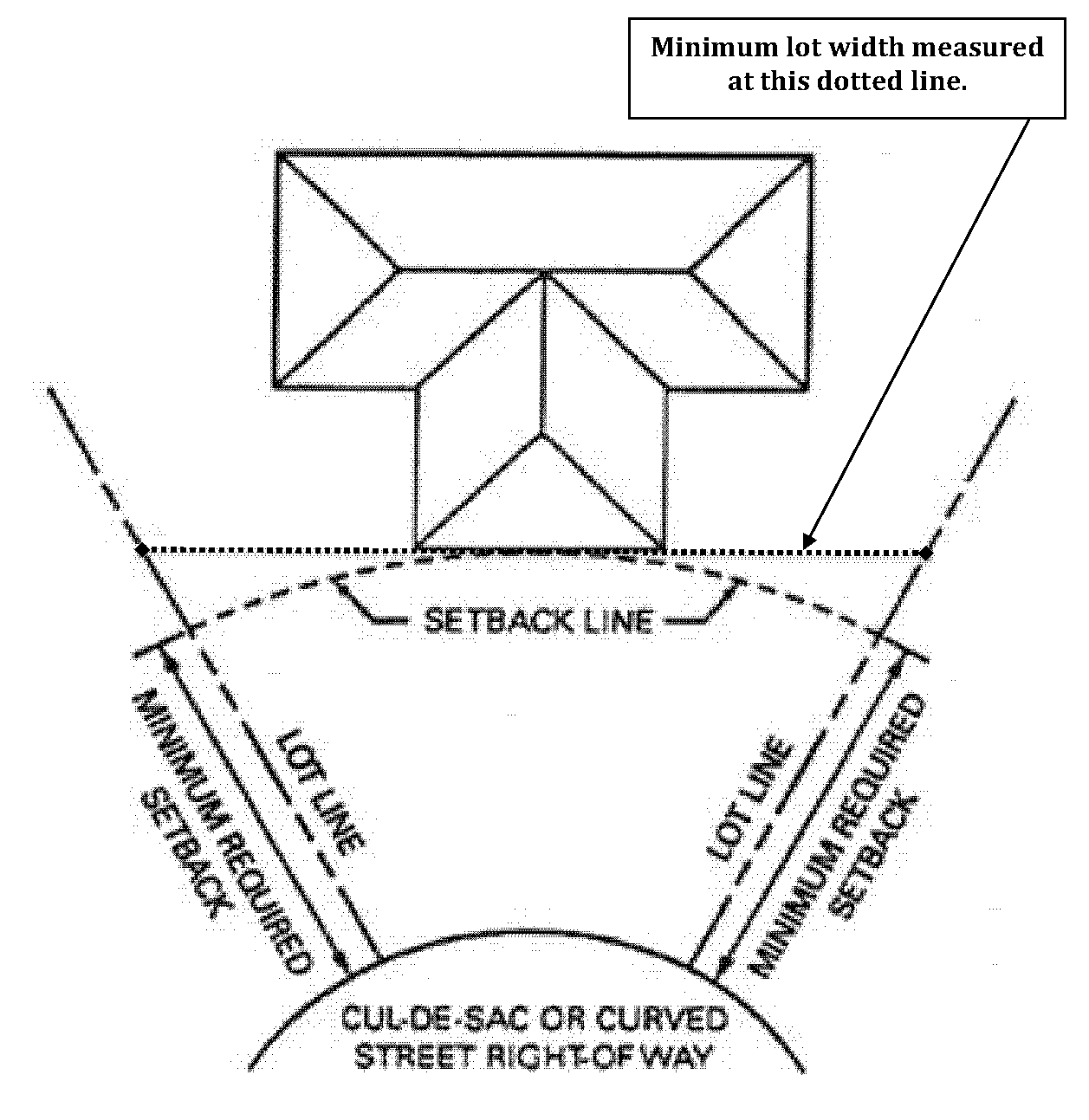
When a lot is located on a cul-de-sac or curved street where the front setback on such lots extends parallel to the arc of the street right-of-way, the "Minimum lot width", as defined and provided for lots in each residential zoning district (i.e. R-1, R-2, R-3, and R-MH) in chapter 4 of this ordinance, shall be determined by measuring the width of such lot at the furthermost point of the front setback line. The following diagram is attached hereto and made a part of this section as an example.
(Ord. of 05-19-2021(1), § 1)
Sec. 3.29. - Cluster development standards.
To encourage open space and conservation areas, cluster developments are permitted in the R-2 and R-3 zoning districts in accordance with the following zoning criteria:
1)
Residential developments are permitted to cluster lots and to reduce lot sizes in order to compensate for the minimum open space requirements established herein; however, density shall not be permitted to increase for the development site as a whole.
2)
Residential developments wishing to develop under the cluster development provision must make their intentions known at the time of preliminary approval before the planning commission on the related development site plan.
3)
The minimum lot size may be reduced to no less than 50 percent of the minimum lot size for the district in which the cluster development is located.
4)
The minimum lot width may be reduced to no less than 40 feet.
5)
The minimum interior lot setbacks may be reduced to no less than 50 percent of the minimum setbacks for the district in which the cluster development is located.
6)
For lots along the exterior boundary of a cluster development, setbacks for yards adjacent to such exterior boundaries shall not be less than two times the setbacks required for the district in which the development is proposed to be located.
7)
Permanent open space conserved as part of the cluster development shall be so arranged as to mitigate the impacts of clustering on adjoining properties and shall meet all requirements for open space as stated in section 3.18.
(Ord. of 03-03-2025(1), § 1)

