
Columbus City Zoning Code
ARTICLE V
- ADDITIONAL DISTRICT PROVISIONS
Sec. 1. - Conditions of a more restricted district.
Whenever the specific district regulations pertaining to one (1) district permit the uses of a more restrictive district, such uses shall be subject to the conditions as set forth in the regulations of the more restrictive district unless otherwise specified.
Sec. 2. - Open space.
No open space or lot area required for a building or structure shall, during its life, be occupied by or counted as open space for any other building or structure.
(1)
In any residential district, except the R-1 District, the front yard minimum setback of any lot, unoccupied as of the effective date of this ordinance, shall be equal in depth to the average depth of the front yards of the nearest adjacent occupied lots.
(2)
Fences, walls and hedges in residential districts are permitted in any required yard or along the edges of any yard, provided that no fence, wall or hedge located in the front of the front building line shall exceed forty-eight (48) inches in height within a twenty-five (25) foot setback of the front line.
(3)
Where the dedicated street right-of-way is less than fifty (50) feet, the depth of the front yard shall be measured starting at a point twenty-five (25) feet from the centerline of the street right-of-way.
(4)
No dwelling unit shall be erected on a lot which does not abut or have reasonable access to a public street.
(5)
On any corner lot on which a front and side yard is [are] required, no wall, fence, sign, structure, any plant growth or other obstruction shall obstruct sight lines at elevations over two (2) feet six (6) inches above any portion of the crown of the adjacent roadways. A sight triangle shall be formed by measuring back twenty-five (25) feet on the right-of-way line from the point of intersection of the right-of-way lines and connecting the points so as to establish a sight triangle on the area of the lot adjacent to the street intersection. [See the illustration following this article.]
(6)
An attached or detached private garage or carport which faces on a street shall not be located closer than twenty-five (25) feet to the street right-of-way line.
(7)
Side yard and rear yard: There are no side yard or rear yard setback requirements in A-1 General Agricultural Districts for either main or accessory buildings, except that two (2) or more residential dwelling units on one (1) parcel of land under one (1) ownership shall be located on the parcel in such a manner that will comply with the minimum side yard and rear yard requirements of the R-1 Single-Family Dwelling District in the event that one (1) or more of the home sites is conveyed to a second party.
Sec. 3. - Height.
The regulations herein set forth qualify or otherwise supplement, as the case may be, the specific district regulations appearing in Article IV.
(1)
Chimneys, elevators, poles, spires, tanks, towers and other projections not used for human occupancy may extend above the height limit.
(2)
Churches, schools, hospitals, sanitariums and other public and semipublic buildings may exceed the height limitation of the district, if the minimum depth of rear yards and the minimum width of the side yards required in the district are increased one (1) foot for each two (2) feet by which the height of such public or semipublic structure exceeds the prescribed height limit.
Sec. 4. - Planned Unit Development.
4.1. Purpose of provisions.
For the purpose of allowing and encouraging greater variety of design and flexibility in development, the requirements of this ordinance may be modified, provided that gross population and building density of any area proposed under the planned unit approach complies [comply] with the population and building density set forth for the zoning district in which the development shall be located.
4.2. Uses permitted.
Uses permitted after planning commission review and recommendation and approval by the city council.
4.3. Area and setback regulations.
Lot dimensions, building setbacks and area requirements may be modified, provided that a more functional and desirable use of property is attained.
(1)
Peripheral boundary setback requirements: Where the peripheral boundary of a Planned Unit Development abuts a street or road right-of-way, the building setback shall be the front yard requirement of the district. Where the peripheral boundary of a Planned Unit Development abuts the property line of adjoining holdings, the building setback shall be the rear yard requirement of the district in which the development is located.
(2)
Height regulations: Building height shall be that established for the district in which the development is located; however, height regulations may be modified following review of development plans.
4.4. Plan review and approval required.
A detailed plan of any proposed Planned Unit Development shall be submitted to the planning commission for review. Within forty-five (45) days of the receipt of plans, the planning commission shall transmit the plans, together with its report, to the mayor and city council. Said council shall review the plans and the recommendations of the planning commission and shall either approve or disapprove the proposed development plan within forty-five (45) days from receipt of the planning commission report. The planning commission shall recommend and the city council may impose conditions regarding layout, circulation and performance of the proposed Planned Unit Development and may require that appropriate deed restrictions be filed.
A plat of the approved development shall be recorded and shall show all applicable features as required by the ordinance regulating the subdivision of land.
Sec. 5. - Storm drainage plan.
5.1. Purpose of storm drainage plan.
A storm drainage plan shall be required, as stated by the provisions of this ordinance, to ensure the development of adequate storm drainage facilities.
5.2. [Required.]
A storm drainage plan shall be required for the following:
(1)
Any residential development of ten (10) or more dwelling units, except single-family lots which have already been approved by the planning commission;
(2)
Any residential, commercial or industrial development having structures in excess of three (3) stories;
(3)
Any commercial or industrial development adjacent to property zoned R-1, R-2, R-3 or R-4;
(4)
Any residential, commercial or industrial development encompassing three (3) acres or more, except single-family lots which have already been approved by the planning commission;
(5)
Any hazardous development and/or use within the I-3 Heavy Industrial District;
(6)
Planned Unit Development District;
(7)
Any residential, commercial or industrial development located within the F-1 Floodplain District;
(8)
Other special cases and projects that may be brought to the city engineer's attention by the city council, the director of planning and community development, the building permit department or the zoning administrator. Particularly, special cases in the C-1 Commercial District which are in close proximity to low density residential shall be reviewed.
5.3. Contents.
(1)
Drainage calculations analyzing runoff before and after development and for the design of on-site drainage improvements must accompany maps showing location of project, including such natural features as streams, lakes, existing drainage ditches and other topographical features. Drainage calculations must be prepared by a registered professional engineer. Calculations must be based on a storm event having a ten-year frequency.
(2)
A brief analysis of problems posed by increased storm water runoff on downstream properties must be submitted. If off-site drainage facilities downstream of the development are not adequate to accommodate post-development runoff, retention or detention facilities must be considered.
5.4. Conditions and general considerations on issuance of storm drainage plan approval.
The storm drainage plan shall be approved only after a consideration of the manner of drainage on the property, with particular reference to the effect of provisions for drainage on adjacent properties and the consequence of such drainage on overall city capacities.
5.5. Procedure.
A storm drainage plan, as provided in sections 5.3 and 5.4 above, shall be filed with the building official, whose duty it will be to submit the plan to the city engineer. If rezoning, in whole or in part, is required, the city engineer shall review the storm drainage plan prior to further processing the application. Applicant shall have the right to appear before the city engineer for the review of the plan.
(1)
Compliance: The city engineer shall certify to the building official that said plan does or does not comply with this section. If the plan does comply, the building official shall complete processing of the permit application. If the plan does not comply, the city engineer shall so specify in what respects it does not comply, in writing to the applicant and to the building official, who shall then require correction and compliance before further processing. The applicant will be required to submit an engineer's certification that the work was completed according to the storm drainage plan before receiving a certificate of occupancy for the project.
(2)
Time period for review: In all cases, the city engineer shall have up to or a maximum of thirty (30) days from the date of filing to review and recommend either approval or disapproval of any plan.
(3)
Should the storm drainage plan be approved, this approval shall be valid for three (3) years from the time of approval, providing there have been no changes in the city's requirements during that three (3) years. If changes have been made to the city's requirements during the three (3) year period, then a new application shall be necessary. And if a zoning change was required, zoning shall be advertised for public hearing for consideration by the planning commission to be changed to its former zoning classification.
Sec. 6. - Home occupation.
6.1. Regulations.
(1)
Home occupations shall not be carried out in more than twenty (20) per cent of the total dwelling building area.
(2)
There shall be no external evidence of the use, except for the allowance of one (1) unanimated, nonilluminated sign not to exceed one (1) square foot in area, mounted flush against the main building.
(3)
No goods or merchandise shall be sold or offered for sale on the premises.
(4)
An application shall be made and approved before a home occupation can be placed in any residence.
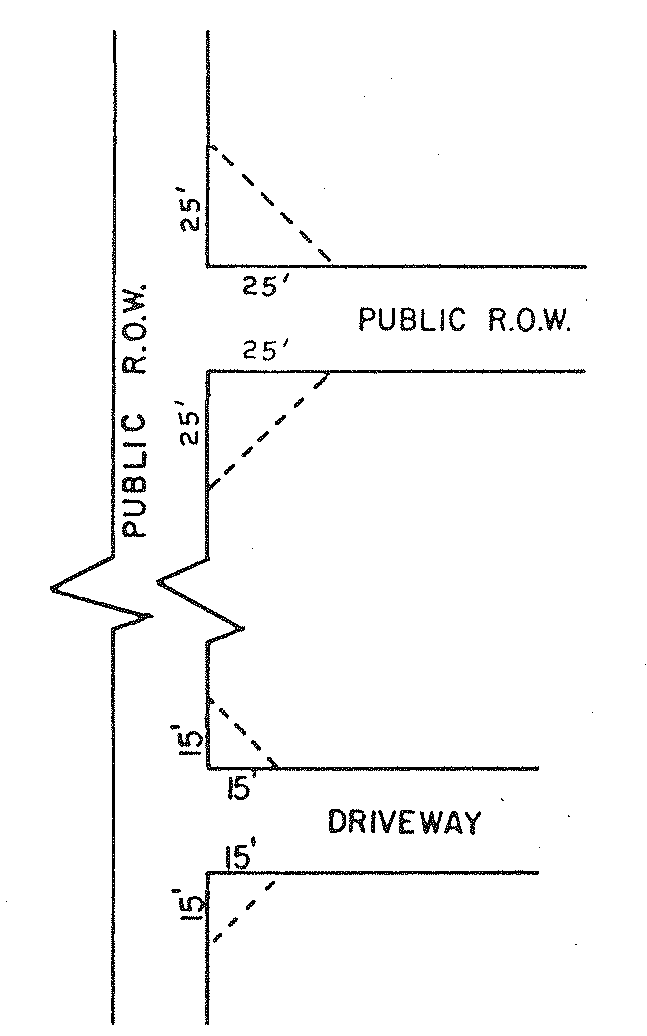
Graphic Explanation of Required Visibility Triangle at Intersection
Intersection of Private Drive and Public Right-of-Way
When an accessway intersects a public right-of-way, or when the subject property abuts the intersection of two (2) or more public rights-of-way, all landscaping within the triangular areas graphically described above shall provide unobstructed cross visibility at all levels, except that ground cover will be permitted.

