
Conover City Zoning Code
ARTICLE II
GENERAL REGULATIONS
DIVISION 5. - SIGNS[2]
Editor's note— Ord. No. 17-06, § 1, adopted July 10, 2006, amended Div. 5 in its entirety to read as herein set out. Former Div. 5, §§ 25.1—25.8, pertained to similar subject matter, and derived from the original zoning codification; an ordinance adopted June 14, 1976; Ord. No. 40-89, § 1, adopted Dec. 4, 1989; Ord. No. 6-95, adopted May 1, 1995; Ord. No. 21-95, adopted Dec. 4, 1995; Ord. No. 16-99, §§ 2—4, adopted May 3, 1999; and Ord. No. 5-01, § 1, adopted Mar. 5, 2001.
Section 21.1. - Definitions of certain terms and words.
For the purpose of this ordinance, the following words and terms shall have the meaning indicated herein:
Interpretation of commonly used terms and words:
Words used in the present tense include the future tense.
Words used in the singular number include the plural, and words used in the plural number include the singular, unless the natural construction of the wording indicates otherwise.
The word "person" includes a firm, association, corporation, trust, and company, as well as an individual.
The words "used for" shall include the meaning "designed for."
The word "lot" shall include the words "plot," "parcel," or "tract."
The word "shall" is always mandatory and not merely directory.
Wherever it appears in this Code of Ordinances, the term "mobile home" shall be replaced with the term "manufactured home" and the term "mobile home park" shall be replaced with the term "manufactured home park."
(Ord. No. 2-90, § 1, 1-8-90)
Section 21.2. - Definitions of specific terms and words.
Administrative decision. Decision made in the implementation, administration, or enforcement of development regulations that involves the determination of facts and the application of objective standards set forth in this chapter or local government development regulations. These are sometimes referred to as ministerial decisions or administrative determinations.
Administrative hearing. A proceeding to gather facts needed to make an administrative decision.
Alley. A public thoroughfare which affords only a secondary means of access to abutting property.
Assisted living residence. Any group housing and services program for two (2) or more unrelated adults, by whatever name it is called, that makes available, at a minimum, one (1) meal a day and housekeeping services and provides personal care services directly or through a formal written agreement with one (1) or more licensed home care or hospice agencies. The department may allow nursing service exceptions on a case-by-case basis. Settings in which services are delivered may include self-contained apartment units or single or shared room units with private or area baths. (G.S. 131D-2.1(5). Also includes Multiunit assisted housing with services (G.S. 131d-2.1(10).
Auditorium. A room, hall, or building, that is a part of a church, school, recreation building, or other building assigned to the gathering of people as an audience to attend lectures, theatrical, musical or other presentations.
Auto graveyard: A place of business which is operated for storing, keeping, buying or selling wrecked, scrapped, or dismantled motor vehicles or motor vehicle parts. Any establishment or place of business upon which six or more unlicensed, used motor vehicles which cannot be operated under their own power are kept or stored for a period of fifteen (15) days or more shall be deemed to be an "automobile graveyard" (NCGS 136-143(1)).
Auto repair/service station. A business whose purpose is the repair and maintenance of automobiles and similar vehicles, including but not limited to motorcycles, recreational vehicles, all terrain vehicles, golf carts, etc.
Basement. A story partly underground but having at least one-half (½) of its height above the average level of the adjoining ground.
Bed & Breakfast. A home used for lodging, with two (2) to four (4) rooms available for overnight accommodation, with the service of a morning meal, available to guests only.
Brewery/winery. Establishments open to the public where beer or other malt beverage is brewed, or where wine is fermented, and is available for sale and consumption on the premises (microbrewery, brewpub).
Buffer. An area designated for landscape planting, the purpose of which is to minimize visual impacts, noise, air pollution and glare and improve the compatibility between two (2) different zones.
Building. Any structure having a roof supported by columns or walls and intended for the shelter, housing, or enclosure of persons, animals or chattel. "Structure" shall include any building.
Building, accessory. A subordinate building, the use of which is incidental to that of a principal building on the same lot.
Building, height. The vertical distance from the mean elevation of the finished grade along the front of the building to the highest point of a flat roof, or to the deck line of a mansard roof, or to the mean height level between eaves and ridge for gable, hip or gambrel roofs.
Building, principal. A building in which is conducted the principal use of the lot on which it is located. In any residential district any structure containing a dwelling unit shall be deemed to be a principal building on the lot on which it is located.
Build-to-line. The line establishing the maximum allowable depth where the front facade of a building must begin.
Car wash. A facility for the washing of motor vehicles. May also be an accessory to auto sales, auto repair shop or convenience store.
Child care center. An arrangement where, at any one (1) time, there are three (3) or more preschool-age children or nine (9) or more school-age children receiving child care (NCGS 110-86(3)).
Child care, family. A child care arrangement located in a residence where, at any one (1) time, more than two (2) children, but fewer than nine (9) children, receive child care. Such uses shall be permitted as a home occupation (Article II, Div. 7. Home Occupations; NCGS 110-86(3)).
Comprehensive plan. The comprehensive plan, land-use plan, small area plans, neighborhood plans, transportation plan, capital improvement plan, and any other plans regarding land use and development that have been officially adopted by the City Council.
Conditional zoning. A legislative zoning map amendment with site-specific plans and conditions incorporated into the zoning map amendment.
Conference facilities. Facility designed for short term rental or occupancy by a group or groups of people to promote and share common interests (also, convention center, exhibition hall). May be accessory to a hotel, church or college.
Convenience store. A business whose purpose is to serve the traveling public, providing fuel or electric vehicle charging, and sundries.
Customary home occupations. A home based business conducted entirely within a dwelling and carried on by the occupants thereof, which use is clearly incidental and secondary to the use of the dwelling for dwelling purposes and does not change the character thereof. Refer to Section 27.
Determination. A written, final, and binding order, requirement, or determination regarding an administrative decision.
Developer. A person, including a governmental agency or redevelopment authority, who undertakes any development and who is the landowner of the property to be developed or who has been authorized by the landowner to undertake development on that property.
Development. Unless the context clearly indicates otherwise, the term means any of the following:
a.
The construction, erection, alteration, enlargement, renovation, substantial repair, movement to another site, or demolition of any structure.
b.
The excavation, grading, filling, clearing, or alteration of land.
c.
The subdivision of land as defined in N.C.G.S. 160D-802.
d.
The initiation or substantial change in the use of land or the intensity of use of land.
This definition does not alter the scope of regulatory authority granted by this chapter.
Development approval. An administrative, legislative or quasi-judicial approval made pursuant to this chapter that is written and that is required prior to commencing development or undertaking a specific activity, project, or development proposal. Development approvals include, but are not limited to, zoning permits, site plan approvals, special use permits, variances, and certificates of appropriateness. The term also includes all other regulatory approvals required by regulations adopted pursuant to this chapter, including plat approvals, permits issued, development agreements entered into, and building permits issued.
Development regulation. A unified development ordinance, zoning regulation, subdivision regulation, erosion and sedimentation control regulation, floodplain or flood damage prevention regulation, stormwater control regulation, wireless telecommunication facility regulation, historic preservation or landmark regulation, housing code, State Building Code enforcement, or any other regulation that regulates land use or development.
Double frontage lot. A continuous (through) lot which is accessible from both streets upon which it fronts.
Dwelling. Any building, structure, manufactured home, or mobile home, or part thereof, used and occupied for human habitation or intended to be so used, and includes any utility buildings and appurtenances belonging thereto or usually enjoyed therewith. The term does not include any manufactured home, mobile home, or recreational vehicle, if used solely for a seasonal vacation purpose as applied in N.C.G.S. 160D Article 12: Minimum Housing Codes.
Dwelling unit. A house or other structure or a portion of any building or structure designed, arranged or used for living quarters for one (1) or more persons living as a single housekeeping unit with cooking facilities, but not including units in hotels, other structures designed for transient residence, or mobile homes.
Dwelling, accessory. A structure designed to be used as a dwelling, which is an accessory to the primary use of a single-family dwelling.
Dwelling, single-family. A residential building, other than a mobile home, designed as a single dwelling unit.
Dwelling, two-family, "duplex". A residential building arranged or designed to two (2) dwelling units.
Dwelling, multifamily. A building or portion thereof used or designed as three (3) or more dwelling units, including apartments, condominiums and attached townhomes.
Easement. A grant by the property owner of an area of land for a specified purpose and use by the public, a corporation or persons.
Elderly housing. A multifamily residential development or facility specifically designed for older persons and their families. The occupancy of units within a development shall comprise of persons aged fifty-five (55) or older or handicapped, their spouses and/or surviving spouses, and resident staff personnel, as cited in but not limited to the Federal Fair Housing Law concerning elderly housing. If the structure in accordance with this section ceases to be used exclusively for elderly housing, the full zoning ordinance requirements for the new use must be met.
Entertainment, indoor. A business whose purpose is entertainment, e.g., movie theatres game arcades (not including "adult gaming establishments"), laser tag or paintball, pool room, rock climbing, batting cages, etc., whose business is conducted entirely indoors. Does not include gun ranges, bars or nightclubs.
Entertainment, outdoor. A business whose purpose is entertainment, e.g., mini golf, go carts, paint ball, gem mining, water parks, etc., whose business is conducted primarily outdoors. Does not include gun ranges.
Evidentiary hearing. A hearing to gather competent, material, and substantial evidence in order to make findings for a quasi-judicial decision required by a development regulation adopted under this Chapter.
Family. Any number of related persons living together as a single housekeeping unit.
Family care home. A care home having two (2) to six (6) adult residents in which the housing management provides twenty-four (24) hour scheduled and unscheduled personal care services, either directly or for scheduled needs, through formal written agreement with licensed home care or hospice agencies. Some licensed adult care homes provide supervision to persons with cognitive impairments whose decisions, if made independently, may jeopardize the safety or well-being of themselves or others and therefore require supervision. (see G.S. 131D-2.1(3), 131D-2.1(9).
Fence. A barrier intended to prevent escape or intrusion or to provide screening.
Funeral home. An establishment engaged in undertaking services, such as preparing the human dead for burial and in arranging and managing funerals, including crematories and mortuaries.
Gallery. A location used for the display of paintings, sculptures, and other works of art.
General repair. A business whose purpose is to provide repair service for any number of products, e.g., computers, electronics, appliances, shoes, etc., not to include automobiles or other vehicles.
Golf course. An area designed for golf, including a Par 3 golf course, having at least nine (9) holes, each with a tee, fairway, and a green. A clubhouse, restaurant, tennis court or other similar ancillary uses associated with the golf course shall be considered part of the golf course.
Government. Facilities operated by the executive, legislative, judicial, administrative and regulatory branches of federal, state and local governments.
Gross floor area. The total floor area of a building including basements, mezzanines and upper floors, exclusive of stairways and elevator shafts, and excluding separate service facilities outside the main building such as boiler rooms, and maintenance shops.
Kennel. A business whose function is to breed, board and/or train dogs.
Legislative decision. The adoption, amendment, or repeal of a regulation under this Chapter, an amendment to the official zoning map, or an applicable local act by the City Council. The term also includes the decision to approve, amend, or rescind a development agreement consistent with the provisions of this chapter.
Legislative hearing. A hearing to solicit public comment on a proposed legislative decision.
Lot. A parcel of land in single ownership occupied or intended to be occupied by a building together with its accessory buildings and open spaces.
Lot, corner. A lot fronting on two (2) or more streets at their intersection.
Lot, depth. The mean horizontal distance between front and rear lot lines.
Lot, interior. A lot other than a corner lot.
Lot, width. The horizontal distance between the side lot lines at the front setback line measured parallel with the front lot line, or in the case of a lot fronting on a curved street, the straight line distance between the side lot lines measured from the setback line.
Lot of record. A lot which is part of a subdivision, a plat of which has been recorded in the office of the Register of Deeds of Catawba County, or a lot described by metes and bounds, the description of which has been so recorded on or before the effective date of this ordinance.
Manufactured home. A structure, transportable in one (1) or more sections, which in the traveling mode is eight (8) body feet or more in width, or forty (40) body feet or more in length, or, when erected on site, is three hundred twenty (320) or more square feet; and which is built on a permanent chassis and designed to be used as a dwelling, with or without permanent foundation when connected to the required utilities, including the plumbing, heating, air conditioning and electrical systems contained therein. "Manufactured home" includes any structure that meets all of the requirements of this subsection except the size requirements and with respect to which the manufacturer voluntarily files a certification required by the Secretary of HUD and complies with the standards established under the Act.
For manufactured homes built before June 15, 1976, "manufactured home" means a portable manufactured housing unit designed for transportation on its own chassis and placement on a temporary or semipermanent foundation having a measurement of over thirty-two (32) feet in length and over eight (8) feet in width. "Manufactured home" also means a double-wide manufactured home, which is two (2) or more portable manufactured housing units designed for transportation on their own chassis that connect on site for placement on a temporary or semipermanent foundation having a measurement of over thirty-two (32) feet in length and over eight (8) feet in width.
Manufacturing, heavy. A facility designed for the manufacturing or processing of products, excluding abattoirs or slaughterhouses, tanneries or the storage or processing of raw hides, the manufacturing of rubber or paper, or processes involving the use of dangerous explosive, radioactive or toxic substances. Such facilities shall have minimal impact to urban areas because of noise, odors, smoke, light, dust, or the use of dangerous materials. Such facilities may require extensive use of outdoor storage areas for raw materials or finished goods.
Manufacturing, light. A facility that provides for the manufacturing and processing of products from an enclosed building. This activity may also have components for research and laboratory facilities, warehousing, and production and in a limited way the distribution of said products and materials. Such facilities shall not be inherently obnoxious to urban areas because of noise, odors, smoke, light, dust, or the use of dangerous materials. Such facilities shall conduct their processes indoors and does not require the outdoor storage of raw materials or finished goods. "Manufacturing, light" also excludes abattoirs or slaughterhouses, tanneries or the storage or processing of raw hides, the manufacturing of rubber or paper, or processes involving the use of dangerous explosive, radioactive or toxic substances.
Medical clinic. An outpatient facility operated for the day-to-day needs of the general public for regular medical care including services such as regular medical checkups, immunizations, diagnosis, and treatment of routine medical issues. Other medical clinics may include specialty medical services such as x-ray & imaging offices, outpatient surgery centers, optometry/ophthalmology offices, chiropractors, dental clinics, dialysis centers, urgent care facilities, physical/occupational rehabilitation therapy offices, etc. Facilities related primarily to the treatment of alcohol and substance abuse patients shall not be considered medical clinics.
Mobile home park. Any lot, tract, or parcel of land used, maintained or intended to be used, leased or rented for occupancy of mobile homes, consisting of not less than two (2) acres in area, excluding street rights-of-way, but including seven (7) mobile home spaces completed at first occupancy. This definition shall not include trailer sales lots on which unoccupied mobile homes are parked for the purpose of inspection and sale.
Modular home. A dwelling unit constructed in accordance with the standards set forth in the North Carolina State Building Code and composed of components substantially assembled in a manufacturing plant and transported to the building site for final assembly on a permanent foundation. Among other possibilities, a modular home may consist of two (2) or more sections transported to the site in a manner similar to a manufactured home (except that the modular home meets the North Carolina State Building Code), or a series of panels or room sections transported on a truck and erected or joined together on the site.
Motel/hotel. A building containing more than four (4) individual rooms for the purpose of providing overnight lodging facilities to the general public for compensation, with or without meals, and which has common facilities for reservations and cleaning services, combined utilities, and on-site management and reception services.
Museum. A location used for the display and preservation of paintings, sculpture, and other constructed or natural objects illustrating human or natural history.
Nonconforming structure. A structure lawfully constructed prior to the effective date of this ordinance, which does not conform to the height, bulk, yard or lot size requirements, and other requirements except use, for the district in which it is located.
Nonconforming use. A lawful use of land, building or structure existing on the effective date of this ordinance, which does not conform to the use regulations for the district in which it is located.
Nursing home. A facility which provides care for three (3) or more unrelated persons who have remedial ailments or other ailments, for which medical and nursing care are indicated; who, however, are not sick enough to require general hospital care. Nursing care is their primary need, but they will require continuing medical supervision (See G.S. 131E-101(6).
Office. A use or structure in which business or professional services are conducted or rendered.
Official maps or plans. Any maps or plans officially adopted by the city council as a guide to the development of the City of Conover, e.g., Land Development Plan, Bike & Pedestrian Plan, etc.
Outdoor advertising industry; outdoor advertising business. Provision of outdoor displays or display space on a lease or rental basis only.
Outdoor sales. A business that offers, as a principal or accessory use, products for retail sale that are displayed on the property outside of a building, not to include wholesaling or storage of products.
Outdoor storage. The keeping or housing of any construction or industrial products, components, materials, or equipment outside.
Parks, playground, recreation facility. A public or private facility designed for recreation with a significant "natural" component, including but not limited to passive parks, dog parks, golf, tennis or swimming clubs, disc golf, bike or running trails, sports clubs or facilities, etc., but not to include hunting clubs.
Parking lot/deck. A principal or accessory use of an individual lot with or without a parking structure providing a place for the temporary short-term parking of motor vehicles.
Parking space. The standing storage space for one automobile plus the necessary driveway access space.
Plat. A map or plan of a parcel of land which is to be or has been subdivided, and may include details such as rights-of-way, easements, building setbacks or footprints, and other development features.
Private driveway. A roadway serving two (2) or fewer lots, building sites or other divisions of land and not intended to be public ingress or egress.
Quasi-judicial decision. A decision involving the finding of facts regarding a specific application of a development regulation and that requires the exercise of discretion when applying the standards of the regulation. The term includes, but is not limited to, decisions involving variances, special use permits, certificates of appropriateness, and appeals of administrative determinations. Decisions on the approval of subdivision plats and site plans are quasi-judicial in nature if the regulation authorizes a decision-making board to approve or deny the application based not only upon whether the application complies with the specific requirements set forth in the regulation, but also on whether the application complies with one or more generally stated standards requiring a discretionary decision on the findings to be made by the decision-making board.
School. A facility, public or private, operated for the general education of children for two or more grade levels between Kindergarten and Grade 12.
Setback. The minimum distance between a lot line and a structure. Different types of structures may have different setbacks.
Sexually oriented business. As defined in Chapter 18.5 of the Conover Code of Ordinances.
Shooting range. An indoor facility designed for the shooting of firearms for entertainment or training.
Sign. Any form of publicity, visible from off the premises where the sign is located, directing attention to an individual activity, business, service, commodity, or product and conveyed by means of words, figures, numerals, lettering, emblems, devices, designs, trade marks or trade names or other pictorial matter designed to convey such information and displayed by means of bills, panels, posters, paints, or other devices erected on an open framework or attached or otherwise applied to posts, stakes, poles, trees, buildings or other structures or supports, provided, however, that the following shall not be included in the application of the regulations herein:
1.
Signs not exceeding one square foot in area and bearing only property numbers, post box numbers, or names of occupants of premises.
2.
Flags and insignia of any government except when displayed in connection with commercial promotion.
3.
Legal notice, identification information, or directional signs erected by governmental bodies.
4.
Integral decorative or architectural features of buildings, except letters, trademarks, moving parts or moving lights.
5.
Signs directing and guiding traffic and parking on private property but bearing no advertising matter.
6.
Signs and displays located on or within windows of a building or structure.
Signs, number and surface area. For the purpose of determining "number" of signs, a sign shall be considered to be a single display surface or display device containing elements organized, related and composed to form a unit. Where matter is displayed in a random manner without organized relationship of elements, or where there is a reasonable doubt about the relationship of elements, each element shall be considered to be a single sign.
The "surface" area of a sign shall be computed as including the entire area within a parallelogram, triangle, circle, or semicircle comprising all of the displayed sign, but not forming part of the display itself, or frames surrounding display areas.
Sign, on-site. A sign relating in its subject matter to the premises on which it is located, or to products, accommodations, services, or activities, on the premises. On-site signs do not include signs erected by the outdoor advertising industry in the conduct of the outdoor advertising business.
Sign, off-site. A sign other than an on-site sign, e.g. billboards.
Site plan. A scaled drawing and supporting text showing the relationship between lot lines and the existing or proposed uses, buildings, or structures on the lot. The site plan may include site-specific details such as building areas, building height and floor area, setbacks from lot lines and street rights-of-way, intensities, densities, utility lines and locations, parking, access points, roads, and stormwater control facilities that are depicted to show compliance with all legally required development regulations that are applicable to the project and the site plan review. A site plan approval based solely upon application of objective standards is an administrative decision and a site plan approval based in whole or in part upon the application of standards involving judgment and discretion is a quasi-judicial decision. A site plan may also be approved as part of a conditional zoning application as a legislative decision.
Special use permit. A permit issued to authorize development or land uses in a particular zoning district upon presentation of competent, material, and substantial evidence establishing compliance with one (1) or more general standards requiring that judgment and discretion be exercised as well as compliance with specific standards. The term includes permits previously referred to as conditional use permits or special exceptions.
Subdivision, minor. A subdivision qualifying for expedited review as described in Appendix B—Subdivision, article V. section 50.2.
Story. That portion of a building included between the surface of any floor and the surface of the floor next above it; or if there is no floor above it, then the space between such floor and the ceiling next above it.
Story, half. A story under a gable, hip or gambrel roof, the wall plates of which on at least two (2) opposite exterior walls are not more than two (2) feet above the floor of such story.
Street. A public or private thoroughfare within a dedicated easement or right-of-way which affords the principal means of access to abutting property.
Structure. Anything constructed or erected, the use of which requires more or less permanent location on the ground, or which is attached to something have more or less permanent location on the ground.
Studio. Location in which artists or craftsmen create objects, one at a time, by hand. Such creations include, but are not limited to, woodworking, jewelry-making, pottery throwing, painting, weaving, caning, and sculpting.
Subdivider. Any person, firm, or corporation who subdivides or develops any land deemed to be a subdivision as herein defined.
Subdivision. The division of land for the purpose of sale or development as specified in G.S. 160D-802.
Subdivision, minor. A subdivision qualifying for expedited review as described in Appendix B—Subdivision, Article V. Section 50.2.
University, college, adult training center. A use, whether private or public, providing academic education beyond the high school level.
Urgent care. A facility operated for the diagnosis and treatment of out-patients in an emergency or unanticipated medical situation requiring immediate care. See Medical clinic.
Utilities/services. Facilities used in the supply, transmission, treatment, etc., of basic services such as water, wastewater, electricity, gas, and communications, not including any offices related to the business management of such services.
Vested right. The right to undertake and complete the development and use of property under the terms and conditions of an approval secured as specified in Section 60.2. Zoning permit and vested rights.
Warehouse. A facility whose primary use is the bulk storage of manufactured goods and materials as part of a supply chain or distribution system.
Wireless telecommunication facilities. As defined in Appendix A: Division 2, Section 22.17.
Yard. A space on the same lot with a principal building, open, unoccupied and unobstructed by structures from the ground to the sky, except for encroachment and accessory buildings expressly permitted by this ordinance.
Yard, front. A yard extending across the full width of a lot and adjoining the street or major street line upon which the lot fronts.
Yard, rear. A yard extending across the full width of a lot and adjoining the rear lot line.
Yard, side. A yard adjacent to a side lot line extending from the front yard to the rear yard.
Zoning map amendment or rezoning. An amendment to a zoning regulation for the purpose of changing the zoning district that is applied to a specified property or properties. The term also includes (i) the initial application of zoning when land is added to the territorial jurisdiction of a local government that has previously adopted zoning regulations and (ii) the application of an overlay zoning district or a conditional zoning district. The term does not include (i) the initial adoption of a zoning map by a local government, (ii) the repeal of a zoning map and readoption of a new zoning map for the entire planning and development regulation jurisdiction, or (iii) updating the zoning map to incorporate amendments to the names of zoning districts made by zoning text amendments where there are no changes in the boundaries of the zoning district or land uses permitted in the district.
Zoning regulation. A regulation made in accordance with a comprehensive plan and designed to promote the public health, safety, and general welfare. To that end, the regulations may address, among other things, the following public purposes: to provide adequate light and air; to prevent the overcrowding of land; to avoid undue concentration of population; to lessen congestion in the streets; to secure safety from fire, panic, and dangers; to facilitate the efficient and adequate provision of transportation, water, sewerage, schools, parks, and other public requirements; and to promote the health, safety, morals, or general welfare of the community. The regulations shall be made with reasonable consideration, among other things, as to the character of the district and its peculiar suitability for particular uses and with a view to conserving the value of buildings and encouraging the most appropriate use of land throughout the local government's planning and development regulation jurisdiction. The regulations may not include, as a basis for denying a zoning or rezoning request from a school, the level of service of a road facility or facilities abutting the school or proximately located to the school.
(Ord. No. 9-87, §§ 1, 2, 3-9-87; Ord. No. 2-90, § 2, 1-8-90; Ord. No. 21-95, 12-4-95; Ord. No. 31-01, § 3, 8-6-01; Ord. No. 16-04, § 1, 5-3-04; Ord. No. 58-20, § 1, 12-7-20; Ord. No. 27-21, § 1, 5-3-21; Ord. No. 29-22, § 1, 6-6-22; Ord. No. 15-24, § 1, 6-3-24; Ord. No. 29-24, § 1, 9-3-24)
Section 22.0. - Moratoria.
A.
Authority. The City of Conover may adopt temporary moratoria on any development approval required by this chapter. The duration of any moratorium shall be reasonable in light of the specific conditions that warrant imposition of the moratorium and may not exceed the period of time necessary to correct, modify, or resolve such conditions.
B.
Hearing. Except in cases of imminent and substantial threat to public health or safety, before adopting an ordinance imposing a development moratorium with a duration of sixty (60) days or any shorter period, the governing board shall hold a public hearing and shall publish a notice of the hearing in a newspaper having general circulation in the area not less than seven (7) days before the date set for the hearing. A development moratorium with a duration of sixty-one (61) days or longer, and any extension of a moratorium so that the total duration is sixty-one (61) days or longer, is subject to the notice and hearing requirements of G.S. 160D-601.
C.
Exempt projects. Absent an imminent threat to public health or safety, a development moratorium adopted pursuant to this section shall not apply to any project for which a valid building permit issued pursuant to G.S. 160D-1108 is outstanding, to any project for which a conditional zoning permit application has been accepted, to development set forth in a site-specific or phased development plan approved pursuant to G.S. 160D-108, to development for which substantial expenditures have already been made in good faith reliance on a prior valid administrative or quasi-judicial permit or approval, or to preliminary or final subdivision plats that have been accepted for review by the city prior to the call for public hearing to adopt the moratorium. Any preliminary subdivision plat accepted for review by the city prior to the call for public hearing, if subsequently approved, shall be allowed to proceed to final plat approval without being subject to the moratorium. Notwithstanding the foregoing, if a complete application for a development approval has been submitted prior to the effective date of a moratorium, G.S. 160D-108(b) shall be applicable when permit processing resumes.
D.
Required statements. Any development regulation establishing a development moratorium must include at the time of adoption each of the following:
(1)
A statement of the problems or conditions necessitating the moratorium and what courses of action, alternative to a moratorium, were considered by the city and why those alternative courses of action were not deemed adequate.
(2)
A statement of the development approvals subject to the moratorium and how a moratorium on those approvals will address the problems or conditions leading to imposition of the moratorium.
(3)
An date for termination of the moratorium and a statement setting forth why that duration is reasonably necessary to address the problems or conditions leading to imposition of the moratorium.
(4)
A statement of the actions, and the schedule for those actions, proposed to be taken by the city during the duration of the moratorium to address the problems or conditions leading to imposition of the moratorium.
E.
Limit on renewal or extension. No moratorium may be subsequently renewed or extended for any additional period unless the city shall have taken all reasonable and feasible steps proposed to be taken by the city in its ordinance establishing the moratorium to address the problems or conditions leading to imposition of the moratorium and unless new facts and conditions warrant an extension. Any ordinance renewing or extended a development moratorium must expressly include, at the time of adoption, the findings set forth in subdivisions (1) through (4) of this subsection, including what new facts or conditions warrant the extension.
F.
Expedited judicial review. Any person aggrieved by the imposition of a moratorium on development approvals required by law may apply to the appropriate division of the General Court of Justice for an order enjoining the enforcement of the moratorium, and the court shall have jurisdiction to issue that order. Actions brought pursuant to this section shall be scheduled for expedited hearing, and subsequent proceedings in those actions shall be accorded priority by the trial and appellate courts. In any such action, the city shall have the burden of showing compliance with the procedural requirements of this subsection.
(Ord. No. 21-07, § 1, 6-4-07; Ord. No. 22-21, § 1, 4-5-21)
Section 22.1. - Zoning to apply to every building and use.
Except as hereinafter provided:
22.1.1 No building or land shall be used or occupied and no building or part thereof shall be erected, moved or altered except in conformity with the regulations herein for the district in which it is located.
22.1.2 No building shall be erected or altered so as to exceed the height limit, to accommodate or house a greater number of families, to occupy a greater percentage of the lot area or to have narrower or smaller rear yards, front yards or side yards than are required or specified in the regulations herein for the district in which it is located.
22.1.3 No part of a yard or other open space required about any building for the purpose of complying with the provisions of this ordinance shall be included as a part of a yard or other open space similarly required for another building.
Section 22.2. - Nonconforming uses and buildings.
22.2.1 Nonconforming uses. Nonconforming uses may be continued subject to the following provisions:
(a)
A nonconforming use of any building or land shall not be enlarged or extended; provided, that a nonconforming use of any building may be extended to any portion of such building which was, at the time such use became nonconforming, manifestly arranged or designed for such use.
(b)
A nonconforming use shall not be changed to any but a conforming use. When a nonconforming use has been changed to a conforming use, the premises shall not thereafter be used for any nonconforming use.
(c)
No structural alterations shall be made in a building housing a nonconforming use, except those required by law or ordinance or ordered by an authorized officer to secure the safety of the building.
(d)
A nonconforming use of any building or structure which is damaged to an extent exceeding fifty (50) percent of its then reproduction value, exclusive of foundations, by fire, flood, explosion, earthquake, war, riot, or act of God, shall be discontinued, and such buildings or structure shall thereafter be used only in conformance with the provisions of the district in which it is located.
(e)
If a nonconforming use is discontinued for a continuous period of more than two hundred seventy-five (275) days, any future use of the land or building shall be in conformity with the provisions of this ordinance.
22.2.2 Nonconforming buildings and structures. Nonconforming buildings and structures shall be allowed to remain subject to the following provisions:
(a)
A nonconforming building or structure shall not be enlarged or extended unless such extension shall comply with all the requirements of this ordinance for the district in which it is located.
(b)
A nonconforming building or structure which is damaged to an extent exceeding seventy-five (75) percent of its then reproduction value, exclusive of foundations, by fire, flood, explosion, earthquake, war, riot, or act of God, shall not be reconstructed except in conformity with the provisions of this ordinance.
Section 22.3. - Only one principal building used as a single family or duplex unit to be on any lot; lot must abut on street.
22.3.1 Every building hereafter erected or structurally altered shall be subject to provisions of this ordinance. Single family and duplex units shall only be located on an individual lot along with customary accessory buildings. Other commercial, mixed-use, multifamily and industrial development is subject to provisions for Level I and Level II development requirements.
22.3.2 Every lot shall abut upon a public street or way. No dwelling shall be erected on a lot which does not abut on at least one public street for a distance of at least thirty-seven and one-half (37½) feet.
(Ord. No. 39-19, § 1, 8-5-19)
Section 22.4. - Reduction of lot prohibited.
No lot shall be reduced in size so that lot width, yard requirements, lot area per dwelling unit or other requirements of this ordinance are not maintained.
Section 22.5. - Obstruction to vision.
There shall be no obstruction to vision by structures, signs, fences, walls, parking of automobiles or vegetation over three (3) feet and under ten (10) feet in height within the area from the street pavement edge to a line set back fifteen (15) feet and parallel with the street right-of-way line. This section does not apply to utility poles, mail boxes, vehicle parking facilities authorized by the City Code of Ordinances and essential highway oriented signs installed by the City of Conover and the North Carolina Department of Transportation.
Section 22.6. - Location of accessory buildings on residential lots.
22.6.1 On any residential lot, accessory buildings shall not be located in any front or required side yard, shall not cover more than thirty (30) percent of any required rear yard and shall be at least five (5) feet from any other building on the same lot and at least twenty (20) feet from any buildings used for human habitation on adjoining lots. Any part of the building, including the footings and roof overhang shall be a minimum of five (5) feet from any lot line.
22.6.2 A single accessory dwelling shall be permitted as an accessory to an existing single-family home in those districts where single-family housing is allowed and shall meet the following requirements:
a.
The total square footage of accessory dwelling shall not be greater than the heated square footage (HSF) of the ground floor of the primary structure and no more than six hundred (600) square feet.
b.
Accessory dwellings shall have adequate off-street parking.
c.
Accessory dwellings shall not be granted separate driveway access.
d.
Accessory dwellings shall be connected to the same water service as the dwelling.
e.
Accessory dwellings shall comply with North Carolina State Building Code.
f.
Accessory dwellings shall meet the side setbacks for the property's zoning district. The rear setback shall be ½ (one-half) of the rear setback for the district. Accessory structures shall be located at least ten (10) feet from the primary dwelling. Detached accessory dwellings shall not be located closer to the fronting street than the primary structure.
g.
Accessory dwellings shall always be considered secondary to a primary dwelling and shall not be subdivided from the primary parcel.
h.
Accessory dwellings may be placed on the second floor of a garage as long as all the other criteria in subsection (b) through (g), above, are met.
i.
An accessory dwelling may be attached to the existing dwelling, shall have a separate access, with no interior access to the primary dwelling, shall comply with the dimensions in section a), above, and meet all the setback requirements for the zoning district.
22.6.3 A double garage, one-half (½) of which would be located on each side of two (2) lots, shall be permitted in any residence district; provided, that a written request signed by both parties is submitted with the zoning permit application and that the requirements of this section shall be met.
22.6.4 Residential accessory structures shall have a pitched roof as to maintain design consistency with the primary residential structure.
22.6.5 Above ground and in-ground pools. Swimming pools with a depth of thirty (30) inches or more require a zoning permit. Pools shall be setback at least six (6) feet from any building, and ten (10) feet from side and rear property lines. Swimming pools are not permitted in the front yard.
22.6.6 Temporary health care structures. A temporary health care structure is a specific type of accessory dwelling and shall be permitted as a temporary use on any lot with a primary single-family dwelling which does not already have an accessory dwelling. Only one (1) such structure shall be permitted per lot, shall meet the setbacks provided in Section 22.6.2(f), above, and meet all other criteria described in NCGS 160D-915.
(Ord. No. 2-05, § 1, 4-4-05; Ord. No. 28-17, § 1, 5-1-17; Ord. No. 58-20, § 1, 12-7-20; Ord. No. 29-22, § 1, 6-6-22; Ord. No. 14-23, § 1, 6-5-23)
Cross reference— Exceptions to height limits, § 22.12.
Section 22.7. - Lot of record—Date and permitted use.
22.7.1 In any district in which residences are permitted, where a lot has an area or width of less than the required area or width and was a lot of record on or before the effective date of this ordinance, such lot may be occupied by a single-family dwelling; provided, that the minimum front, rear and side yard requirements for the district in which it is located are met. This provision shall not apply to any lot to which the provisions of section 22.8 apply.
22.7.2 In the professional district, where a lot has an area or width of less than the required area or width and was a lot of record on or before the effective date of this ordinance, such lot may be occupied by a permitted use; provided, that all other requirements of the district are met. This provision shall not apply to any lot to which the provisions of section 22.8 apply.
Section 22.8. - Same—Adjoining and vacant lots.
If two (2) or more adjoining and vacant lots of record are in a single ownership at any time after the effective date of this ordinance, and such lots individually have less area or width than the minimum requirements of the district in which such lots are located, such lots shall be considered as a single lot which meets the minimum requirements of this ordinance for the district in which such lots are located.
Section 22.9. - Side yards on corner lots.
In residential districts, the minimum width of the side yard along an intersection of streets shall be equal to one-half (½) the front yard requirement of the district in which the lot is located. Accessory buildings in the rear yard shall also comply with the side yard requirement.
Section 22.10. - Front yard setbacks.
The front yard requirements of this chapter shall not apply to any lot where the front yard coverage on developed lots, located wholly or in part within one hundred (100) feet on each side of such lot and within the same block and zoning district and fronting on the same street as such lot, is less than the minimum required front yard. In such cases, the front yard on such lot may be less than the required front yard but not less than the average of the existing front yards on the developed lots; provided, that the front yard on such lot shall not be less than one-half (½) of the required front yard.
Section 22.11. - Conditions for modification of required yards.
Requirements for front, rear and side yards may be modified under the following conditions:
22.11.1 Cornices, eaves, steps, gutters, bay windows less than ten (10) feet wide, fire escapes, fire balconies, fire towers and similar features may project not more than two and one-half (2½) feet into any required yard.
22.11.2 Necessary retaining walls and fences less than six (6) feet high when located in the rear yard, shall be exempt from the yard requirements of this ordinance; except that on a corner lot no fence more than three (3) feet in height shall be located within any yard or building setback required along the side street line by any other provision of this ordinance. The height of any fence located within a yard abutting on a street line shall be measured from the sidewalk; and if there is no sidewalk, from the top of the curb; and if there is no sidewalk or curb, from the center line of the street. All other fence heights shall be measured from natural grade. Terraces, steps and uncovered porches which are not in any part more than four (4) feet above the ground floor level and not within two and one-half (2½) feet of any party lot line shall be exempt from the yard requirements of this ordinance.
Section 22.12. - Exceptions to height limits.
Penthouses or roof structures for the housing of elevators, stairways, tanks, ventilating fans or similar equipment required to operate and maintain the building, skylights, steeples, chimneys, water tanks, silos, dust collection systems in the M-1 district, and EM-1 district or similar structures may be erected above the height limits herein specified, but no penthouse or roof structure or any space above the height limit shall be allowed for the purpose of providing additional floor space for residential use. Telecommunication towers and antennas may exceed height limits as provided for in section 22.17.
(Ord. No. 4-82, 5-3-82; Ord. No. 38-97, § 1, 10-6-97; Ord. No. 24-98, §§ 1—3, 7-7-98; Ord. No. 3-12, § 1, 2-6-12; Ord. No. 22-18, § 1, 5-29-18)
Cross reference— Location of accessory buildings on residential lots, § 22.6.
Section 22.13. - Fences.
Fences and walls are permitted as an accessory use in all zoning districts, provided that:
(a)
Fencing in residentially zoned areas shall not be permitted between the front street right-of-way line and the front building line of the principal building.
(b)
Fencing shall be limited to eight (8) feet in height within a side or rear yard.
(c)
The owner of the property on which the fence or wall is located is required to maintain the fence or wall in safe and attractive condition and plumb (vertical) to the ground. Failure to properly maintain such fencing shall constitute a public nuisance.
(d)
Retaining walls over five (5) feet in height shall be designed and constructed under the responsible charge of a NC registered professional engineer.
(e)
Height limitations do not apply to fences or walls built in conjunction with electric or gas substations; water or wastewater treatment plants; industrial security fencing; or outdoor recreation uses. Such fences or walls shall not exceed ten feet in height without specific approval of the board of adjustment.
(f)
No fence shall be constructed within or upon any street right-of-way. In addition, no fence or wall shall be constructed within six (6) feet of any street pavement.
(g)
No fence or wall shall alter or impede the natural flow of water in any stream, creek, drainage swale, or ditch.
(h)
No wall or solid fence higher than forty-two (42) inches above grade shall be placed within the sight visibility triangle of any public street, private street, or driveway.
(i)
Fences or walls shall be constructed of finished wood vertical planks, wood picket, or split-rail wood fencing, brick, ornamental iron or metal railing, chain link, wire, stone, vinyl, or other masonry not including unfinished concrete block. Fences shall be muted, earthtone in color, other than vinyl fences or wood picket which may be white in color.
(j)
Nothing in this section shall preclude the installation of temporary fences related to construction sites or sediment and erosion control.
(k)
A zoning permit is required for the installation of any fence.
(l)
Below are examples of approved fencing:
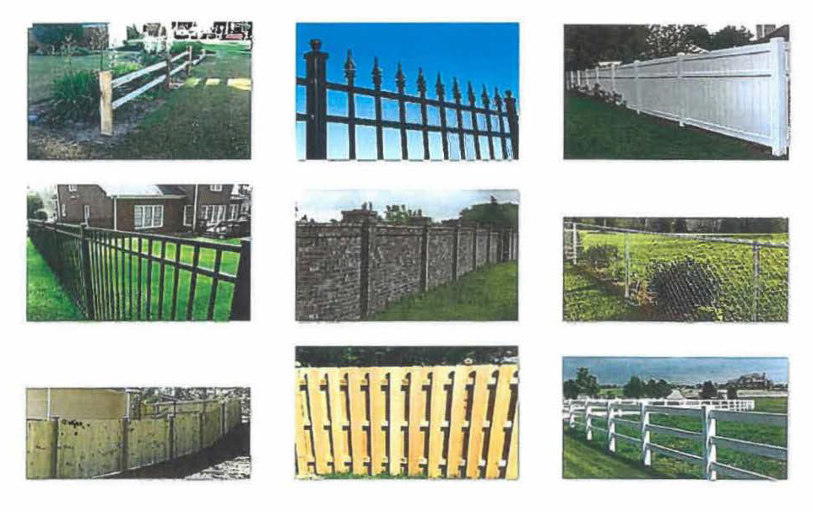
(Ord. No. 28-17, § 1, 5-1-17; Ord. No. 16-21, § 1, 3-10-21)
_____
Section 22.14. - Lighting.
This ordinance shall apply to all lights that illuminate any commercial, industrial, or recreational facility (and any associated parking facilities) and/or separate parking facilities not associated with any commercial, industrial or recreational facility. A light plan shall be shown on the site plan and approved by the planning department. A plan shall consist of location and details for style features.
(1)
All new lighting installed shall be full cutoff or fully shielded light fixtures. Full cutoff is defined as a fixture that does not emit light ninety (90) degrees above the horizontal plane. Illumination of signs shall be in full compliance with the Conover Zoning Ordinance Division 5. Signs.
(2)
Lighting fixtures mounted at ground level must be aimed and shielded so as not to trespass on the neighboring property or rights-of-way. Light emitted from these fixtures may not project above the lowest roofline. Pedestrian lighting fixtures shall be of types that utilize translucent glass or other material.
(3)
Floodlights, spotlights or any other similar lighting pointed upward shall not be used to illuminate buildings or other sight features unless approved as an integral architectural element on the development plan. On-site lighting may be used to accent architectural elements and not be used to illuminate entire portions of building(s).
(4)
Lighting that is used to illuminate outdoor areas of assembly and/or sporting facilities are permitted so long as the lights are arranged as to direct the light away from adjacent residential properties and streets. These fixtures shall only be illuminated when the subject facility is in active use.
(5)
Seasonal display of bare lights is permitted on a temporary basis.
(Ord. No. 9-87, § 3, 3-9-87; Ord. No. 35-07, § 1, 11-5-07)
Section 22.15. - Appearance criteria for manufactured homes located on individual lots.
The zoning enforcement officer shall use the following criteria in determining the classification of manufactured homes:
(1)
Class A, Manufactured Home.
a.
All homes must measure at least nine hundred sixty (960) square feet of enclosed and heated living area.
b.
Only multi-section units are permitted and all homes must measure at least nine hundred sixty (960) square feet of enclosed and heated living area.
c.
The pitch of the roof of the dwelling has a minimum vertical rise of at least four (4) feet for each twelve (12) feet of horizontal run and the roof is finished with a type of shingle that is commonly used in standard residential construction.
d.
All roof structures shall provide an eave projection of no less than six (6) inches, which may include a gutter.
e.
A continuous masonry foundation enclosure, unpierced except for required ventilation and access shall be installed in accordance with requirements of Chapter 5, Article II, Section 5-25 of the Conover City Code. The ground surface below the foundation shall be protected with a polyvapor barrier. Installation shall include a positive water drainage away from the home.
f.
The exterior siding consists predominantly of vinyl or aluminum horizontal lap siding (whose reflectivity does not exceed that of gloss with paint), wood, or hardboard, comparable in composition, appearance and durability to the exterior siding commonly used in standard residential construction.
g.
The moving hitch, wheels and axles, and transporting lights shall be removed.
h.
Stairs, porches, entrance platforms, ramps and other means of entrance and exit to and from the home shall measure at least fifteen (15) square feet and be installed or constructed at each entrance of the home in accordance with the standards set by the North Carolina Department of Insurance, attached firmly to the primary structure and anchored securely to the ground.
i.
The manufactured home must be in full compliance with Chapter 5, Article II of the Code of the City of Conover, North Carolina (minimum housing standards). Proper anchoring shall be in compliance with North Carolina State Building Codes as adopted by reference or amended by the building code from time to time.
j.
The manufactured home shall measure at least five hundred sixty (560) square feet of enclosed and heated living area.
(2)
Class B, Manufactured Home. The Class B Manufactured Home shall meet or exceed criteria b. through j. of manufactured home appearance criteria listed above.
(3)
Class C, Manufactured Home. The Class C Manufactured Home shall meet or exceed criteria e. through j. of manufactured home appearance criteria listed above.
(Ord. No. 2-90, § 3, 1-8-90)
Section 22.16. - Building design standards for industrial and manufacturing uses.
A)
For industrial and manufacturing uses, if metal or unfinished concrete block are used on the lower half of any façade facing a public street, landscape screening must be installed according to this section.
B)
Landscape screening required by this ordinance shall:
1)
Be shown in detail on the site plan and approved by the Conover Planning Department,
2)
Be installed at a rate of one (1) plant per ten (10) feet of wall and no further than ten (10) feet from the building wall. Buildings designed to have loading areas on the street facing side of the building may move required landscaping to the outer edge of paved lots. Required screening may be incorporated with required property buffer and/or street yard plantings as applicable,
3)
Be a minimum of three (3) feet tall when planted,
4)
Be of a species that forms a continuous year-round opaque screen within three (3) years after planting (i.e.—Evergreens such as American, Nellie Stevens, or Fosters Hollies or similar native species),
5)
Reach a height of at least fifty (50) percent of the height of the wall at full maturity,
6)
Be installed in addition to any required screening, buffering or landscaping required in Section 26.2 (Planting Specifications) and Section 23.5 (Landscaping of Parking Areas),
7)
Be installed and approved before a Certificate of Occupancy will be granted, except when seasonal weather conditions are not conducive, then a temporary Certificate of Occupancy may be issued for up to sixty (60) days upon receipt of a bond, letter of credit, or check in the amount of the required screening,
8)
Be perpetually maintained, and dead and diseased plants replaced by the owner or occupant of the property.
C)
If two (2) wall materials are combined horizontally on one (1) façade, the "heavier" material shall be below.
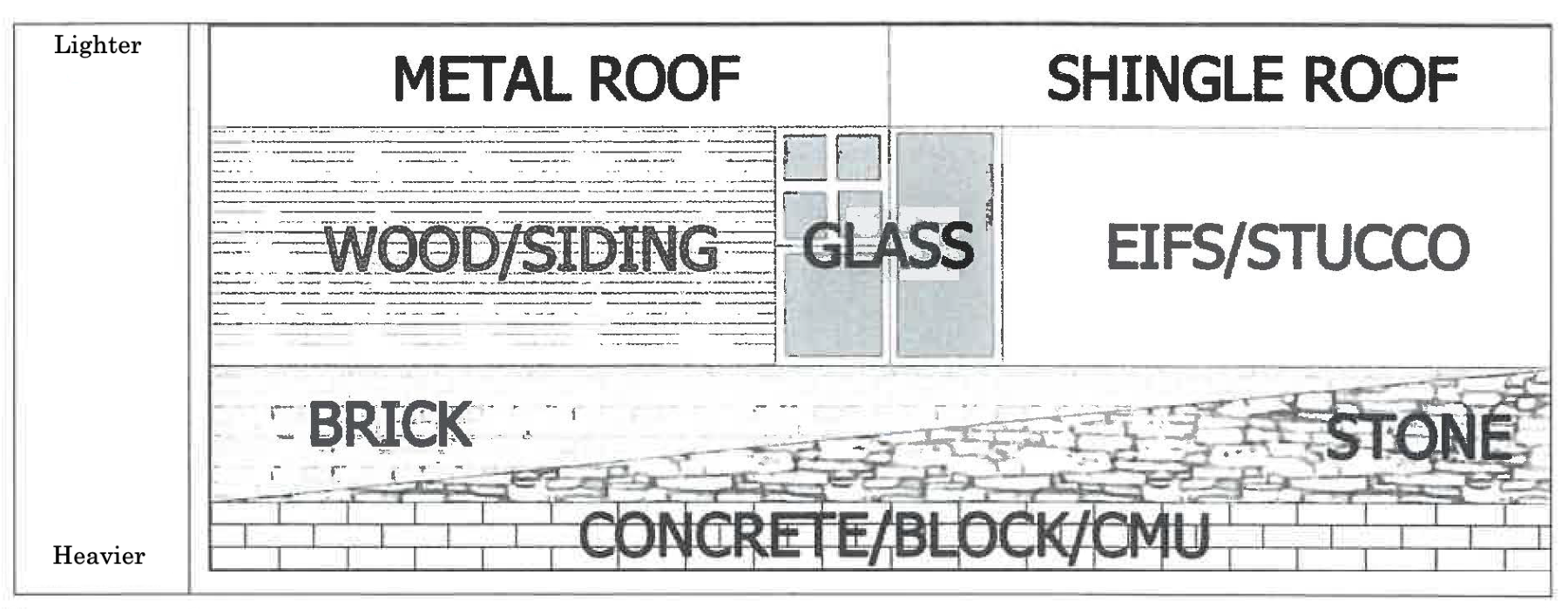
Figure 22.16(c).1
D)
Façade and roof colors shall be of low reflectance earth tone, muted, subtle, or neutral colors. Neon, or similar gas tubing, is not allowed as an accent material. Colors including, but not limited to fluorescent, day glow, or neon shall be prohibited as a primary wall or roof color. Flat roofs may be reflective for energy conservation purposes.
E)
Projecting elements placed on rooftops shall be screened to have a minimal visual impact as viewed from the public street (except for alleys or service areas) through the use of setbacks, parapet walls, screens, painting of such features, or similar treatments.
F)
All accessory buildings shall be clad in materials similar in appearance to the principal structure or meet the screening requirements of subsection B), above.
G)
Expansions to existing structures must meet the requirements of this ordinance.
H)
Manufactured and mobile units (trailers) shall be prohibited, except for temporary use during construction or for storage of materials during construction, with an approved Zoning Permit.
(Ord. No. 25-06, § 1, 11-6-06; Ord. No. 24-12, § 1, 9-4-12; Ord. No. 12-19, § 1, 3-4-19)
Editor's note— Ord. No. 24-12, § 1, adopted Sept. 4, 2012, amended the title of § 22-16 to read as herein set out. Formerly said section was entitled "Appearance criteria for new or expansions to commercial, office, industrial and institutional buildings on individual lots or as a part of any Planned Unit Development—Business (PUD-B) including all municipal, county, state and federal buildings and excluding the B-3 and the Traditional Neighborhood Design (TND) Zoning Districts."
Section 22.16.2. - Building design standards for commercial, office, institutional and multi-family uses.
A)
Design standard purpose and applicability. Building design standards establish a minimum acceptable level of appearance for structures excluding industrial and manufacturing uses which are addressed in Section 22.16. These regulations are intended to encourage new construction to respect the character of Conover and avoid obtrusive, inharmonious design practices. The city has determined that it is in the best interest of the community for new construction to build upon and promote the existing character of the city. The city supports the view that inspiring, well-maintained, and harmonious development is an excellent and lasting form of economic development that can benefit residents and businesses. These standards seek to ensure that proposed development is compatible when considered within the context of the surrounding area. These design standards shall apply to new construction and expansions or façade renovations of existing development.
B)
Building design. Building design features, such as but not limited to walls, windows, shutters, vents, doors, entrances, awning, canopies, roof pitch/design, eaves, and parapets shall meet the following criteria:
1)
General compatibility requirement. All development subject to this article shall be compatible with the established architectural character of the city by using a design that is complementary to the predominant architectural styles, designs, and forms in the area. Compatibility shall be achieved through techniques such as the repetition of roof lines, the use of similar proportions in building mass and outdoor spaces, similar relationships to the street, similar window and door patterns, and the use of building materials that have color, shades, and textures similar to those existing in the neighborhood of the proposed development.
2)
Building materials: Building materials shall either be similar to the materials already being used in the neighborhood, or if dissimilar materials are proposed, other characteristics such as; scale, proportions, form, architectural detailing, color, and texture, shall be utilized to ensure that similarity exists for the building to be compatible, despite the differences in materials. Predominant exterior building materials shall be high quality materials, including, but not limited to brick, wood, stone, and glass. Textured concrete masonry units (CMU), metal and Exterior Insulation Finishing System (EIFS) shall not constitute more than twenty (20) percent of any exterior wall. EIFS shall not be used on the first floor of any building. All exterior walls visible from a parking lot or public right-of-way shall be clad with the same material required for the front of the building. All accessory buildings shall be clad in materials similar in appearance to the principal structure. Accent lighting, such as neon, LED or the like, are not allowed on walls or roofs.
3)
Colors: Façade and visible roof colors shall be of low reflectance earth tone, muted, subtle, or neutral colors. Colors including, but not limited to black (wall only), fluorescent, day glow neon or other extremely vibrant colors shall be prohibited as a primary wall or roof color. The colors of any B-3 (Central Business District) building or structure, are further restricted and shall conform to the adopted color palette set forth for the "Conover Downtown Color Palette Design Guidelines" and are incorporated by reference.
4)
Massing: Where large structures or expanses of blank wall are proposed, building mass shall be broken up through the use of setbacks, projecting and/or recessed elements, columns, pilasters, porticos and similar design techniques. Such features shall be offset at least eight (8) inches. Roofline offsets shall be provided to lend architectural interest and variety to the massing of a building and to relieve the effect of a single long roofline. Such roof offsets shall be at least fifteen (15) percent of the wall height.
5)
Emphasize human scale features: Human scale is considered to be building characteristics that are comparable to the size and mass of human body. Building design shall emphasize human-scale architectural features at ground level, entryways and along street frontages. This can be achieved through the creative use of windows, doors, columns, canopies, lighting and awnings.
6)
Additions and renovations: Building additions and façade renovations should be designed to reflect existing buildings in scale, materials, window treatment, and color. A change in scale may require a transitional design element between the new development and existing buildings. Expansions to existing structures must meet the requirements of this ordinance.
7)
Complementary development: In developments with multiple structures, buildings shall be compatible by such means as a pattern of architectural features, similar massing, materials and proportions, and consistent location of signage.
8)
Entryways: Each principal building on a site shall have a clearly defined, highly visible primary entrance and feature at least one (1) of the following: porches, canopies or porticos, arcades, arches, wing walls, planters, and recesses or projections. Multi-tenant buildings, or buildings with more than one (1) entrance, should also provide such features for each additional entrance.
9)
Windows, doors or other openings shall make up at least twenty-five (25) percent of the street facing wall(s) of the first floor, and twenty (20) percent of street facing wall(s) on upper floors of non-residential buildings. The following standards also apply:
A.
Windows complying with the requirement noted above, shall not be tinted to block more than fifty (50) percent of visible light.
B.
Fake or applied windows, spandrel panels or other similar features shall not be suitable to meet this standard for windows, doors and other openings.
C.
First floor windows or any glass panels, spandrels or other similar features on the street facing wall(s) shall not be mirrored.
10)
Screening of mechanical equipment and trash containers.
A.
Projecting elements and mechanical equipment on the structure or the ground, such as utility meters, transformers, generators, gas or other storage tanks, air handling units and other utility hardware shall be integrated into the design of the structure and screened from public street view (except for alleys or service areas) with materials or colors similar to those on the structure.
B.
Projecting elements placed on rooftops shall be screened to have a minimal visual impact as viewed from the public street (except for alleys or service areas) through the use of setbacks, parapet walls, screens, painting of such features, or similar treatments.
C.
All waste and recycling equipment and containers shall be screened with materials similar to the primary structure.
D.
Abandoned mechanical equipment is prohibited and shall be removed.
11)
[Manufactured and mobile units (trailers):] Manufactured and mobile units (trailers) shall be prohibited, except for temporary use during construction or for storage of materials during construction, with an approved zoning permit.
(Ord. No. 24-12, § 1, 9-4-12; Ord. No. 28-17, § 1, 5-1-17; Ord. No. 12-19, § 1, 3-4-19)
Section 22.17. - Wireless telecommunication facilities.
22.17.1 Wireless support structures require a zoning permit and must meet the following regulations:
22.17.2 Definitions. As used in this section, the following terms shall have the meanings indicated:
Accessory equipment means any equipment installed and owned by a third party used to deliver a service (other than a communications service) to a telecommunications facility, such as an electric meter.
Antenna has the same meaning as the term "antenna" defined in (NCGS 160D-931(1). Applicable codes have the same meaning as the term "applicable codes" defined in (NCGS 160D-931(2).
Base station means a station at a specific site authorized to communicate with mobile stations, generally consisting of radio receivers, antennas, coaxial cables, power supplies, and other associated electronics.
City utility pole has the same meaning as the term "city utility pole" as defined in (NCGS 160D-931(7).
Collocation has the same meaning as the term "collocation" as defined in (NCGS 160D-931(8).
Concealed wireless facility, concealed wireless support structure, or concealed antenna means a stealth wireless facility, stealth wireless support structure, or stealth antenna.
Concealment element means any design feature, including but not limited to painting, shielding requirements, shrouds, and restrictions on location or height in relation to the surrounding area that are intended to make a telecommunications facility less visible to the casual observer. The design elements of a concealed (stealth) telecommunications facility are concealment elements.
Eligible facilities request means any request for modification of an existing wireless support structure or base station that does not substantially change the physical dimensions of such telecommunications tower or base station, as defined in either 47 C.F.R. 1.40001(b) or (NCGS 160D-931(12).
Monopole means a single, self-supporting, freestanding pole-type structure built for the sole purpose of supporting one (1) or more antennae. For the purposes of this section 22.18, a utility pole is not a monopole.
Qualifying city utility pole means a modified or replacement city utility pole that does not exceed fifty (50) feet above ground level and that is associated with a new small wireless facility that does not extend more than ten (10) feet above such city utility pole.
Qualifying small wireless facility means a new small wireless facility that does not extend more than ten (10) feet above the utility pole, city utility pole, or wireless support structure on which it is collocated and is located either (i) in the city right-of-way or (ii) outside of city right-of-way on property other than single family residential property.
Qualifying utility pole means a new utility pole or a modified or replacement utility pole that does not exceed fifty (50) feet above ground level and that is associated with a new small wireless facility that does not extend more than ten (10) feet above such utility pole.
Shroud means a box or other container that contains and is designed to camouflage or conceal the presence of, a telecommunications facility, antenna, or accessory equipment.
Small wireless facility has the same meaning as the term "small wireless facility" as defined in (NCGS 160D-931(2).
Stealth wireless facility, stealth wireless support structure, or stealth antenna means any telecommunications facility, wireless support structure, or antenna that is integrated as an architectural feature of a structure or that is designed to camouflage or conceal the presence of the telecommunications facility, wireless support structure, or antenna so that the purpose of the telecommunications facility, wireless support structure, or antenna is not readily apparent to a casual observer.
Substantial change has the same meaning as the term "substantial change" as defined by Federal Communications Commission regulations, 47 CFR 1.40001(b)(7).
Substantial modification has the same meaning as the term "substantial modification" as defined in (NCGS 160D-931(19).
Telecommunications facility means a facility consisting of a base station and accessory equipment, and the utility pole, city utility pole, or wireless support structure, if any, associated with the facility.
Utility pole has the same meaning as the term "utility pole" as defined in (NCGS 160D-931(20).
Wireless facility has the same meaning as the term "wireless facility" as defined in (NCGS 160D-931(22). The term includes small wireless facilities.
Wireless support structure has the same meaning as the term "wireless support structure" as defined in (NCGS 160D-931(27). A utility pole or city utility pole is not a wireless support structure.
22.17.3 General guidelines and requirements.
a.
Purpose; goals. The purpose of this ordinance is to establish general guidelines for the siting of wireless support structures and antennas. The goals of this ordinance are to
(i)
Encourage the location of towers in nonresidential/non-historical areas and minimize the total number of towers throughout the community,
(ii)
Enhance the ability of the providers of telecommunications services to provide such services to the community quickly, effectively and efficiently;
(iii)
Encourage strongly the joint use of new and existing tower sites,
(iv)
Encourage users of towers and antennas to locate them, to the extent possible, in areas where the adverse impact on the community is minimal.
b.
Principal or accessory use. Antennas and towers may be considered either principal or accessory uses on an industrial or commercial zoned lot. A different existing use or an existing structure on the same lot shall not preclude the installation of an antenna or tower on such lot. For purposes of determining whether the installation of a tower or antenna complies with district development regulations, including, but not limited to, setback requirements, lot size and coverage requirements, and other such requirements, the dimensions of the entire lot shall control, even though the antennas or towers may be located on leased parcels within such lots.
Wireless support structures that are constructed, and antennas that are installed, in accordance with the provisions of this ordinance shall not be deemed to constitute the expansion of a nonconforming use or structure.
c.
Reserved.
d.
Location. Wireless support structures shall be permitted in the B-4 (General Business), M-1 (General Manufacturing), and EM-1 (Exclusive Manufacturing) zoning districts only.
e.
Fees: Applications for new wireless support structures, expansion or alteration, and collocation on existing structures shall be subject to an application fee as set in the City of Conover's fee schedule. The city may choose to waive fees for structures that are or will be located on city-owned property.
f.
Permit required. All new wireless support structures, collocations and substantial modifications of existing structures require the issuance of a permit. Applications shall include:
a)
A completed zoning permit application.
b)
A scaled site plan showing all the details relevant to the application; property lines, setbacks, buildings, fences, plantings, etc.
c)
Elevation plans and proposed color palette for wireless support structures and appurtenant buildings.
d)
An engineer's sealed plans for the wireless support structure(s).
Collocations on previously permitted wireless support structures which do not constitute a substantial modification shall only require a completed zoning permit application (a), above.
22.17.4 Administrative approvals.
a.
Administratively approved uses. The following applications for wireless support structures and substantial modifications shall be reviewed by the planning director.
(1)
Collocating an antenna on an existing structure other than a wireless support structure (such as a building, sign, light pole, water tower, or other freestanding, nonresidential structure) that is more than fifty (50) feet in height, so long as such addition does not add more than twenty (20) feet to the height of the existing structure and does not exceed the maximum tower height limit (Sec. 22.17.5)(n))
(2)
Collocating an antenna on an existing wireless support structure of any height, including a preexisting tower, or any other substantial modification as defined in Section 22.17.2, above.
(3)
The placement of any new wireless support structure.
(4)
Replacing an existing tower which adds no more than twenty (20) feet to the overall height of the existing structure and does not exceed the maximum tower height limit (Sec. 22.17.5)(n)). The standards of section 22.17.5 shall be used for approval of replacement towers.
(5)
The planning director shall notify an applicant, in writing, of an incomplete application within forty-five (45) days of the submittal (NCGS 160D-934(b)). A written decision from the planning director regarding complete applications for collocation on an existing wireless support structure or previously approved structure (i.e., a structure already in use as a wireless facility, such as a water tower) shall be issued no more than forty-five (45) days from the date of application. (NCGS 160D-934(c))
b.
[Reserved.]
22.17.5 Wireless support structures criteria. Communication companies are encouraged to locate telecommunication antennae on or in structures other than a tower. Such structures may include church steeples, transmission line towers, utility/light poles, water towers, etc. Where such facilities are not available, co-location of facilities is encouraged.
The following standards shall be used in the approval of the siting of new towers:
a.
An applicant shall provide a summary explanation of why the proposed facility cannot be located on an existing wireless support structure.
b.
An applicant may apply for and receive an approval for a new wireless facility without the commitment of a service provider for the facility. A building permit for construction shall not be issued until the applicant has such commitment. The approval shall expire after twenty-four (24) months if no service provider is found. (NCGS 160D-933(e))
c.
Reserved
d.
Buffering of the site shall be installed in accordance with section 26.2 of the City of Conover Zoning Ordinance. Required buffers will be installed along the lot lines of the property on which the facility is located.
e.
The base of the wireless support structure, along with any appurtenant facilities, buildings or equipment, shall be surrounded by a security fence or wall at least eight (8) feet in height unless the support structure is collocated entirely on a building over twelve (12) feet in height.
f.
No outside storage shall be allowed on any telecommunication facility site.
g.
Monopole construction for all new telecommunication wireless support structures shall be required. "Stealth" technology and application is encouraged and shall be used to be consistent with surrounding area and structures .
h.
The applicant or owner shall maintain onsite at the facility contact information for all parties responsible for maintenance of the facility.
i.
Reserved.
j.
The color of the wireless support structure and any other equipment mounted on it shall be neutral, except to the extent required by federal law, so as to minimize its visual impact,
k.
Reserved.
l.
No commercial advertising shall be allowed on the facility's site.
m.
The setback of the base of the wireless support structure from all adjacent property lines shall be one (1) foot for each foot in height of the support structure. When the site property abuts a residential district, the setback from that district shall be one (1) foot for each foot in height plus twenty (20) feet.
n.
A wireless support structure shall not exceed the maximum height of one hundred twenty (120) feet above pre-construction ground level.
o.
Any wireless support structure that is taken out of service or abandoned shall be removed by the service provider within one-hundred and eighty (180) days, unless the provider supplies reasonable evidence that the provider is diligently working to place the facility back into service. Should the service provider fail to remove an abandoned facility in a timely manner, the city may cause abandoned facilities to be removed and recover the costs for removal, including any legal fees. (NCGS 160D-935(g))
(Ord. No. 3-12, § 1, 2-6-12; Ord. No. 20-17, § 1, 3-6-17; Ord. No. 51-21, § 1, 9-13-21)
Section 22.18. - Regulation of small wireless facilities.
22.18.1
Purpose:
(a)
Minimize the impacts of small wireless facilities on surrounding areas by establishing standards for location, structural integrity and compatibility;
(b)
Encourage the location and collocation of small wireless facilities equipment on existing structures thereby minimizing new visual, aesthetic, and public safety impacts, and to reduce the need for additional antenna-supporting structures;
(c)
Encourage coordination between suppliers of small wireless facilities in the City of Conover and its planning jurisdiction;
(d)
Accommodate the growing demand for wireless services and the resulting need for small wireless facilities;
(e)
Regulate in accordance with all applicable federal and state laws;
(f)
Establish review procedures to ensure that applications for small wireless facilities are reviewed and acted upon within a reasonable period of time or any specific period of time required by law;
(g)
Protect the unique aesthetics of the city while meeting the needs of its citizens and businesses to enjoy the benefits of wireless communications services.
22.18.2
Definitions: See section 22.17.2.
22.18.3
Reserved.
22.18.4
Applicability; Compliance with Law; Exemptions.
(a)
The standards established herein shall apply only to qualifying small wireless facilities, qualifying utility poles, and qualifying city utility poles, as defined herein. Nothing in this ordinance shall be interpreted to excuse compliance with, or to be in lieu of, any other requirement of state or local law, except as specifically provided herein.
(b)
Unless expressly set forth herein, the following categories of small wireless facilities are exempt from the requirements in section 22.18, provided they meet the location and design requirements set forth below:
1.
Any telecommunications facility below sixty-five (65) feet when measured from ground level which is owned and operated by an amateur radio operator licensed by the Federal Communications Commission and used exclusively for amateur radio operations.
2.
Over the air reception devices covered under 47 C.F.R. § 1.4000, that is a small satellite dish antenna, one (1) meter in diameter or less not located within the public right-of-way.
3.
Collocation and eligible facilities requests, as defined in (NCGS 160D-934(a)) or 47 U.S.C.1455, shall be processed in accordance with (NCGS 160D-934(b, c)), and/or federal laws and regulations as appropriate. In approving any eligible facilities request, the city solely intends to comply with a requirement of federal law or state law and not to grant any property rights or interests except as compelled by federal or state law. Without limitation, approval does not exempt applicant from, or prevent city from, opposing a proposed modification that is subject to complaint under the National Historic Preservation Act or the National Environmental Policy Act. Collocations are only permitted as provided in section 22.18.6 or section 22.18.7.
4.
Routine maintenance of small wireless facilities; the replacement of small wireless facilities with small wireless facilities that are the same size or smaller; or installation, placement, maintenance, or replacement of micro wireless facilities (as defined in G.S. Article 19, Part 3E) that are suspended on cables strung between existing utility poles or city utility poles in compliance with all applicable laws or regulations by or for a communications service provider authorized to occupy the city rights-of- way and who is remitting taxes under G.S. § 105-164.4(a)(4c) or (a)(6).
5.
A temporary small wireless facility, upon the declaration of a state of emergency by federal, state, or local government, and a written determination of public necessity by the City of Conover; except that such facility must comply with all federal and state requirements and must be removed at the conclusion of the emergency.
6.
Public safety facilities or installations required for public safety on public or private property, including transmitters, repeaters, and remote cameras so long as the facilities are designed to match the supporting structure.
7.
A small wireless facility located in an interior structure or upon the site of any stadium or athletic facility, provided that the small wireless facility complies with applicable codes.
22.18.5
Collocation of small wireless facilities. Collocation of small wireless facilities on land used as single-family residential property or vacant land that is zoned for single-family development, and any small wireless facility that extends more than ten (10) feet above the utility pole, city utility pole, or wireless support structure on which it is collocated, are subject to section 22.17. Notwithstanding the foregoing, replacement of an existing streetlight for which the city is financially responsible with a streetlight capable of including a collocated, concealed small wireless facility is permitted on land used as single-family residential property or vacant land that is zoned for single-family development, pursuant to the requirements of section 22.18.6.
Collocations of qualifying small wireless facilities in city right-of-way or outside of city right-of-way on land that is in a non-residential zoning district or land that is used for non-single-family residential property, are subject to the following requirements:
(a)
Application. Applicants must complete an application as specified in form and content by the city. The application shall include the requirement of a map for the purposes of determining the new small wireless facility is located in city right-of-way or on private property.
(b)
Height. Each new small wireless facility shall not extend more than ten (10) feet above the utility pole, city utility pole, or wireless support structure on which it is collocated.
(c)
Public safety. In order to protect public safety:
(1)
Small wireless facilities shall cause no signal or frequency interference with public safety facilities or traffic control devices and shall not physically interfere with other attachments that may be located on the existing pole or structure.
(2)
A structural engineering report prepared by an engineer licensed by the State of North Carolina shall be submitted by the applicant, certifying that the host structure is structurally and mechanically capable of supporting the proposed additional antenna or configuration of antennae and other equipment, extensions, and appurtenances associated with the installation.
(3)
A traffic and pedestrian management plan must be submitted for any installation that requires work in the public right-of-way.
(4)
No portion of a small wireless facility may be placed in the public right-of-way in a manner that:
i.
Obstructs pedestrians or vehicular or bicycle access, obstructs sight lines or visibility for traffic, traffic signage, or signals; or interferes with access by persons with disabilities. An applicant may be required to place equipment in vaults to avoid obstructions or interference; or
ii.
Involves placement of pole-mounted equipment (other than cabling) whose lowest point is lower than eight (8) feet above ground level.
(5)
An abandoned small wireless facility shall be removed within one hundred eighty (180) days of abandonment.
(d)
Objective design standards.
(1)
No signs are permitted on small wireless facilities except for official or public notice or warning signs required by a valid and applicable federal, state, or local law, regulation or chapter; by a public utility company; or by order of a court of competent jurisdiction.
(2)
Small wireless facilities shall be located, designed, and/or screened to blend in with the existing natural or built surroundings to reduce the visual impacts as much as possible, and to be compatible with neighboring land uses and the character of the community. New and/or replacement utility poles and facilities equipment shall be placed as close to lot corners as possible.
22.18.6
Utility poles and city utility poles associated with small wireless facilities. The modification, operation, or replacement of qualifying utility poles and qualifying city utility poles associated with small wireless facilities are subject to the following requirements:
(a)
Application. Applicants must complete an application as specified in form and content by the city. The application shall include the requirement of a map for the purposes of determining the new small wireless facility is located in city right-of-way or on private property.
(b)
Height. Each modified or replacement utility pole or city utility pole shall not exceed (i) forty (40) feet above ground level on property zoned for or used as single- family residential property, or in the right-of-way adjacent to such property, where existing utilities are installed underground, or (ii) fifty (50) feet above ground level on all other property. Each new small wireless facility shall not extend more than ten (10) feet above the associated utility pole, city utility pole, or wireless support structure on which it is collocated.
(c)
Small wireless facilities. All requirements of section 22.18.5 apply to small wireless facilities located on a utility pole, city utility pole, or wireless support structure.
(d)
Public safety. In order to protect public safety:
(1)
No replacement utility poles or city utility poles associated with a small wireless facility are permitted in the clear zone as defined in the City of Conover Standard Specifications and Details Manual or if none such similar clear zone defined by North Carolina Department of Transportation regulations unless such replacement pole is breakaway rated.
(2)
No portion of a utility pole or city utility pole associated with a small wireless facility may be placed in the public right-of-way in a manner that:
i.
Obstructs pedestrians or vehicular or bicycle access, obstructs sight lines or visibility for traffic, traffic signage, or signals; or interferes with access by persons with disabilities. An applicant may be required to place equipment in vaults to avoid obstructions or interference; or
ii.
Involves placement of pole-mounted equipment (other than cabling) whose lowest point is lower than eight (8) feet above ground level.
(e)
Objective design standards.Utility poles or city utility poles associated with a small wireless facility shall be located, designed, and/or screened to blend in with the existing natural or built surroundings to reduce the visual impacts as much as possible, and to be compatible with neighboring land uses and the character of the community. New and/or replacement utility poles and facilities equipment shall be placed as close to lot corners as possible.
22.18.7
Standard conditions.
(a)
Applicant must obtain all other required permits, authorizations, approvals, agreements, and declarations that may be required for installation, modification, and/or operation of the proposed facility under federal, state, or local law, rules, or regulations, including but not limited to encroachment agreements and FCC approvals. An approval issued under this section 22.18 is not in lieu of any other permit required under the zoning ordinance or City Code, nor is it a franchise, license, or other authorization to occupy the public right-of-way, or a license, lease, or agreement authorizing occupancy of any other public or private property. It does not create a vested right in occupying any particular location, and an applicant may be required to move and remove facilities at its expense consistent with other provisions of applicable law. An approval issued in error, based on incomplete or false information submitted by an applicant or that conflicts with the provisions of the zoning ordinance, is not valid. No person may maintain a small wireless facility in place unless required state or federal authorization remain in force.
(b)
All small wireless facilities and related equipment, including but not limited to fences, cabinets, poles, and landscaping, shall be maintained in good working condition over the life of the use. This shall include keeping the structures maintained to the visual standards established at the time of approval. The small wireless facility shall remain free from trash, debris, litter, graffiti, and other forms of vandalism. Any damage shall be repaired as soon as practicable, and in no instance more than thirty (30) calendar days from the date of notification by the city. In public rights-of-way, damaged or deteriorated components must be corrected within five (5) business days of notification.
(c)
Reserved.
(d)
Small wireless facilities and equipment shall be identified with contact information for the responsible parties.
(e)
Reserved.
(f)
After written notice to the applicant and/or owner, the city may require the relocation, at the applicant/owner's expense, of any small wireless facility, and the associated utility pole, city utility pole, or wireless support structure on which it is collocated, located in the public right-of-way, as necessary for maintenance or reconfiguration of the right-of-way or for other public projects.
(g)
Collocation or modification of small wireless facilities on an existing non-conforming wireless support structure or base station shall not be construed as an expansion, enlargement, or increase in intensity of a non-conforming structure and/or use, provided that the collocation or modification constitute an eligible facilities request.
(Ord. No. 22-19, § 1, 5-6-19; Ord. No. 51-21, § 1, 9-13-21)
Section 23.1. - Parking space to be required and permanent.
23.1.1 Off-street parking spaces shall be provided in accordance with this division in all districts.
23.1.2 The off-street parking space required by this division shall be permanent space and shall not be used for any other purpose.
23.1.3 Each parking space shall not be less than nine (9) feet by eighteen (18) feet, the same comprising of one hundred sixty-two (162) square feet of parking space per automobile (except for parallel spaces as shown in table in Section 23.1.7) and marked accordingly, exclusive of adequate egress and ingress drives, landscaping, and maneuvering space.
24.1.4 Off-street parking spaces shall not be located in such a manner that parked cars will extend or have direct ingress and egress onto a public street or sidewalk.
23.1.5 Off-street parking areas, loading, egress and ingress, and maneuvering space shall be paved. Any parking area not paved at the time of adoption of this ordinance shall be allowed to continue as such until an expansion of the building or parking area occurs. At such time, the parking area must be paved. Parking areas in the B-2, B-4, CC, M-1, EM-1 zones serving as overflow parking or areas set aside for outdoor storage or distribution and logistics may use gravel as an alternative to paving. Gravel areas are to be constructed using the standard detail for gravel lots in the standards and specifications manual.
23.1.6 Adequate lighting shall be provided if the facilities are to be used at night. Such lighting shall be arranged and installed so as not to reflect or cause glare to abutting properties or streets.
23.1.7 Dimensional standards for ingress/egress and maneuvering are to be shown on the following diagram:
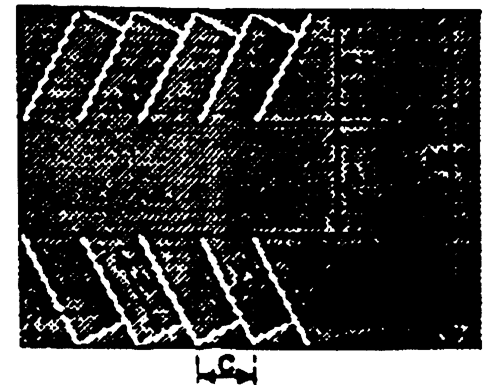
All dimensions are considered minimum values.
23.1.8 Parking on unpaved surfaces prohibited. No person shall keep, store or park any motor vehicle, trailer or similar, whether operable or inoperable, on any portion of a front yard or any side corner yard facing a street on any residentially zoned or used property except an area that is used as a driveway to the property. A drive shall be considered any portion of the lot affording access to the street, paved, concrete, or gravel and not exceeding thirty (30) percent of the front or side corner yard. An unpaved surface is considered any surface other than a drive, such as, but not limited to grass or dirt.
23.1.9 Waiver. A waiver of parking requirements may be issued due to special circumstances, upon request by the developer. The planning director shall have the power to approve a site plan showing less paved parking area than is required by this section; provided, however, that a landscaped area of sufficient size to meet the deficiency shall be set aside and reserved for the purpose of meeting future off-street parking requirements when it becomes necessary. Completion of the required parking must be completed within ninety (90) days of notification from the city. Such waivers may be approved if no more than twenty (20) percent of the required parking.
(Ord. No. 17-88, § 1, 5-22-88; Ord. No. 3-93, § 1, 4-5-93; Ord. No. 22-95, § 1, 12-4-95; Ord. No. 16-04, § 1, 5-3-04; Ord. No. 22-18, § 1, 5-29-18; Ord. No. 16-21, § 1, 3-10-21; Ord. No. 29-24, § 1, 9-3-24)
Section 23.2. - Use of parking lots permitted; street parking.
23.2.1 The required parking space for any number of separate uses may be combined in one (1) lot but the required space assigned to one use may not be assigned to another use during the same hours of operation.
23.2.2 Exceptions to parking requirements.
A.
Along streets with designated on-street parking, such parking may be considered as fulfilling on-site parking requirements of adjacent parcels.
B.
On-street parking installed on public streets will be available to the public and will not be reserved for any individual business, property owner or tenant. Newly installed public parking on public streets may require the developer to provide additional right-of-way to accommodate parking.
C.
In the B-3 (Central Business) district, on-site parking shall be one (1) space for every thousand square feet (or part) of gross floor area and one (1) space for each dwelling unit.
23.2.3 No parking area may be used for the sale, repair, dismantling, servicing or long term storage of any vehicle or equipment unless permitted by the district and is the principal use where located.
23.2.4 Reserved.
(Ord. No. 22-95, § 1, 12-4-95; Ord. No. 5-98, § 9, 2-2-98; Ord. No. 27-11, § 1, 12-5-11; Ord. No. 3-12, § 1, 2-6-12; Ord. No. 1-14, § 1, 1-6-14; Ord. No. 12-19, § 1, 3-4-19; Ord. No. 58-20, § 1, 12-7-20; Ord. No. 58-20, § 1, 12-7-20; Ord. No. 29-24, § 1, 9-3-24)
Section 23.3. - Reserved.
Editor's note— Ord. No. 22-21, § 1, adopted April 5, 2021, repealed § 23.3, which pertained to enforcement and derived from Ord. No. 22-95, § 1, December 4, 1995.
Section 23.4. - Schedule of parking spaces.
Off-street parking spaces shall be provided and permanently maintained by the owners and occupants of the following types of property uses on the basis indicated:
23.4.1 Residence and apartments, mobile homes and mobile home parks: Two (2) spaces for each dwelling unit. Elderly housing parking requirements shall be one (1) per unit.
23.4.2 Reserved.
23.4.3 Motels, hotels, and bed & breakfast: One (1) space for each room or unit to be rented, plus one (1) space for each two (2) employees on the work shift of largest employment (hotel/motel) or one (1) space for owner of a bed & breakfast.
23.4.4 Hospitals and nursing homes: One space for each two (2) beds intended for patient use, exclusive of bassinets, plus one space for each staff or visiting doctor and one space for each two (2) employees on the largest work shift.
23.4.5 Elementary schools and junior high schools, both public and private: One space for each employee.
23.4.6 Senior high schools, colleges, trade schools and technical institutes: One space for each five (5) students for whom the school was designed, plus one space for each employee.
23.4.7 Restaurants: One (1) space for each four (4) seating accommodations, plus one (1) space for each two (2) employees on the shift of largest employment.
23.4.8 Restaurants, drive-in, or similar uses designed for curb-type service and fast food type service: One (1) space for each four (4) seating accommodation, but no fewer than ten (10) spaces. Parking shall be arranged such that at least thirty (30) percent of required spaces are adjacent to the building, not bisected by a drive aisle.
23.4.9 Medical and dental clinics and offices: Three (3) spaces for each primary patient care provider practicing at the clinic, plus one (1) space for each employee.
23.4.10 Auditoriums, theaters, stadiums, conference facilities, places of worship and similar uses involving the assembling of persons: One (1) space for each four (4) seats in such place of assembly, plus one (1) space for each one hundred (100) square feet of floor or ground area used for amusement or assembly, but not containing fixed seats, plus one (1) spaces per three (3) employees at maximum employment.
23.4.11 Bus terminals: One space for each employee and one space for each bus loading ramp and track.
23.4.12 Other office, business and commercial uses: A minimum of two (2) spaces for each one thousand (1,000) square feet of gross floor area and a maximum of four (4) spaces for each one thousand (1,000) square feet of gross floor area.
23.4.13 Industrial, warehousing, wholesaling uses, and data centers: One space for each vehicle used directly in the conduct of such use, and, in addition, one space for each two (2) employees of the establishment at maximum employment on a single shift.
23.4.14 Outdoor sales: At least two (2) but no more than four (4) spaces for every one thousand (1,000) square feet of area dedicated to outdoor sales. Designated parking spaces may not be used for outdoor sales if the use of those spaces would not allow the site to meet the minimum parking requirements or create an unsafe environment for pedestrians or drivers.
23.4.15 Assisted living facilities and nursing homes: One (1) space for every two (2) beds plus one (1) space for every two (2) employees at maximum employment.
23.4.16 Recreational gymnasiums, yoga, exercise or fitness centers: One (1) space for each five hundred (500) square feet of gross floor area.
(Ord. No. 30-88, § 1, 8-1-88; Ord. No. 22-95, § 1, 12-4-95; Ord. No. 16-04, § 1, 5-3-04; Ord. No. 1-14, § 1, 1-6-14; Ord. No. 12-19, § 1, 3-4-19; Ord. No. 58-20, § 1, 12-7-20; Ord. No. 29-24, § 1, 9-3-24)
Section 23.5. - Landscaping of parking areas.
23.5.1 The landscaping requirements of this section shall apply to land, public and private, designated as multi-family, recreational, institutional and commercial land uses which are required to have twenty (20) or more parking spaces. All industrial land uses and those multi-family, recreational, institutional and commercial land uses which are required to have ten (10) to nineteen (19) spaces must comply with the street yard requirements only.
23.5.2 Parking area landscaping requirements of this section are as follows:
a.
Credit for using existing trees on site greater than or equal to those required standards (see section 23.5.3 and 23.5.4) shall be two (2) trees for every one tree retained.
b.
When using existing tree, the area under the dripline (maximum extension of branches) of the tree must remain undisturbed. This includes grading, fill, paving, etc.
c.
If an existing tree dies, it must be replaced with two (2) trees during the next planting season.
d.
If any vegetation dies, replacement is required within the next planting season.
e.
Landscaping shall be placed in a manner which meets the intent of this ordinance, and shall be maintained.
f.
Any fraction of requirements shall be rounded up to the next whole number.
g.
Landscaping shall not obstruct the view of motorists using any street, private driveway, parking aisles or the approach to any street intersection so as to constitute a traffic hazard.
23.5.3 Landscaping requirements for interior areas of parking area. Interior areas are defined as the area within the property used for vehicular storage, parking and movement. Landscaping requirements for interior areas are as follows:
a.
Planting areas shall be no less than one hundred sixty-two (162) square feet, with a minimum width of six (6) feet.
b.
One (1) tree shall be required for every twenty (20) parking spaces and one (1) shrub shall be required for every ten (10) parking spaces required.
c.
No vehicular parking space shall be farther than fifty (50) feet from a tree within an interior planting area.
23.5.4 Landscaping requirements for street yards of parking areas. Street yards are defined as the area between the public right-of-way and interior area. Landscaping requirements for street yards are as follows:
a.
Street yards required to be minimum of ten (10) feet in width.
b.
One (1) tree is required every one hundred (100) feet along the street frontage.
c.
Shrub beds (fifty (50) square feet minimum and a minimum of ten (10) shrubs per shrub bed) are required every forty (40) feet along the street frontage. Berms may be used instead of shrubs with the following stipulations: 1) berms must be the required height of shrubs with no more than a 3:1 slope; 2) shorter shrubs may be used in combination with berms as long as the required total height is met; 3) berms must be capped or topped with groundcover vegetation; 4) berms shall or [be] grassed; 5) berms must occupy sixty (60) percent of the frontage area; 6) fences may be used in combination with berms as long as the fence is compatible in materials and color to building and is not more than forty (40) percent of the required height.
23.5.5 Tree and shrub specifications. "Tree" as used herein means any tree, evergreen or deciduous, whose mature height of its species can be expected to exceed fifteen (15) feet, however seventy-five (75) percent of required trees must be expected to exceed thirty-five (35) feet (except in cases where this would require the planting of incompatible species with the surrounding environment, such as overhead utility lines, than acceptable species may be used). The tree, existing or planted, shall be at least eight (8) feet in height and six and one-quarter (6¼) inches in circumference (two (2) inches in diameter) measured at one-half (½) foot above grade for newly planted trees and measured at four (4) feet above grade for existing trees.
"Shrub" shall attain a minimum size of thirty (30) inches in height with three (3) years of planting. All shrubs shall be a minimum of eighteen (18) inches tall when planted. All shrubs planted on berms may have lesser height provided the combined height of the berm and plantings after three (3) years is at least thirty (30) inches in height.
(Ord. No. 22-95, § 1, 12-4-95; Ord. No. 8-15, § 1, 5-4-15)
Section 24.1. - Required.
At the time of the erection or expansion of any main building or part thereof which is used or is to be used for any use required by this division to provide off-street loading space, such space shall be provided as set forth herein.
Off-street loading and unloading spaces shall be designed and constructed so that all maneuvering to park vehicles for loading and unloading can take place entirely within the premises. These spaces shall be provided so as not to interfere with the free, normal movement of vehicles and pedestrian[s] on the public right-of-way. No loading or unloading space shall have direct ingress and egress from the public right-of-way, street or sidewalk.
(Ord. No. 22-95, § 2, 12-4-95)
Section 24.2. - Schedule of loading spaces.
24.2.1 Retail operations and all first-floor nonresidential uses with a gross floor area of less than five thousand (5,000) square feet and all wholesale and light industrial operations with a gross floor area of less than ten thousand (10,000) square feet: A loading space determined by the building inspector to be sufficient to allow normal loading and unloading operations of a kind and magnitude appropriate to the use.
24.2.2 Retail operations, including restaurants and dining facilities within hotels and office buildings, with a gross floor area of twenty-thousand (20,000) square feet or more: One loading berth with minimum dimensions of twelve (12) feet by twenty-five (25) feet and fourteen (14) feet overhead clearance for every twenty thousand (20,000) square feet of floor area and any fraction thereof in excess of ten thousand (10,000) square feet.
24.2.3 Planned unit developments, business: One loading berth with minimum dimensions of twelve (12) feet by fifty-five (55) feet and fourteen (14) feet overhead clearance for every twenty thousand (20,000) square feet of floor area and any fraction thereof in excess of ten thousand (10,000) square feet.
24.2.4 Office buildings and hotels with a gross floor area of fifty thousand (50,000) square feet or more: One loading berth with minimum dimensions of twelve (12) feet by twenty-five (25) feet and fourteen (14) feet overhead clearance for every fifty thousand (50,000) square feet of floor area and any fraction thereof in excess of twenty-five thousand (25,000) square feet.
24.2.5 Industrial and wholesale operations with a gross floor area of ten thousand (10,000) square feet or over shall provide berths no less than twelve (12) feet by fifty-five (55) feet and fourteen (14) feet overhead clearance in quantities determined by the building inspector to be sufficient to allow normal loading and unloading operations of magnitude appropriate to the use.
Section 24.3. - Reserved.
Editor's note— Ord. No. 22-21, § 1, adopted April 5, 2021, repealed § 24.3, which pertained to enforcement and derived from Ord. No. 22-95, § 2, December 4, 1995.
Section 25.1. - General.
All signs shall be erected or altered in accordance with the following requirements [set out in this division].
(Ord. No. 17-06, § 1, 7-10-06)
Section 25.2. - Purpose.
The purpose of this section is:
1)
To enhance and protect the physical appearance of the city while promoting the economic well being of the community by creating a favorable physical image.
2)
To promote public safety and traffic safety by ensuring that signs are properly designed, constructed, installed, and maintained.
3)
To minimize distractions and/or obstruction of view that contribute to traffic hazards and endanger public safety.
4)
To promote high standards of quality development by encouraging appropriately designed, placed, and sized signage.
5)
To provide an effective guide for communicating identification through signage while preventing signs from dominating the visual appearance of the areas in which they are located.
6)
To afford businesses, individuals and institutions an equal and fair way to use signs as an effective form of communication or promotion of products and services.
7)
To prohibit signs of a commercial nature from districts in which commercial activities are barred.
(Ord. No. 17-06, § 1, 7-10-06)
Section 25.3. - Administration.
25.3.1
The building inspector or zoning enforcement officer shall order the immediate removal of any signs that are not constructed or maintained in accordance with the provisions of this section or in accordance with applicable provisions of the North Carolina State Building Code. All advertising structures, together with any supports, braces, guys and anchors, shall be kept in good repair or ordered removed by the building inspector and/or zoning enforcement officer.
25.3.2
In the event that special site conditions exist, such as topography, the planning director shall have the authority to grant approval for signage so long as the subject signage meets the intent of the ordinance.
(Ord. No. 17-06, § 1, 7-10-06)
State Law reference— Unlawful posting of advertisements, G.S. § 14-45; authority to remove unauthorized signs from highway right-of-way, G.S. § 105-86(d).
Section 25.4. - Location.
No sign or structure shall be erected or constructed as to interfere with vision clearance as defined in Section 22.5 along any street or at any intersection or junction of two (2) or more traffic arteries.
(Ord. No. 17-06, § 1, 7-10-06)
Section 25.5. - Illumination.
No flashing, scrolling or intermittent illumination shall be used on any advertising sign or structure. Any illuminated signs allowed by this ordinance shall be downcast and placed so as to prevent the undiffused light rays from being cast upon adjacent properties, upon the public right-of-way, or the night sky. Any digital, LED (light emitting diode), or similar signs are permitted, provided that the screen or type shall change no more than one (1) time in a five (5) minute period; this does not include time or temperature units.
Signs located in the P-1 or B-3 district shall be limited to those lighted from behind to silhouette letters and figures, and internally illuminated signs.
Changeable copy, or LED signs shall meet the following standards: Maximum brightness shall be five thousand (5,000) nits (candelas per square meter) during daylight hours (dawn to dusk) and one hundred fifty (150) nits during nighttime hours. The applicant or sign manufacturer must provide either written certification from the manufacturer that the light intensity has been factory-programmed not to exceed above listed light levels or provide an isolux lighting plan certified by an electrical engineer.
(Ord. No. 17-06, § 1, 7-10-06; Ord. No. 8-15, § 1, 5-4-15)
Section 25.6. - Nonconforming signs.
Nonconforming signs will be allowed to remain, in good repair. A nonconforming sign is considered a nonconforming structure. If a nonconforming sign is altered, refaced, removed, moved, or changed in any way the sign shall be brought into complete compliance with the regulations of this ordinance. Nonconforming on-site signs shall be completely removed within thirty (30) days of the discontinuance of a business use. Property owners shall be responsible for removal of nonconforming signs.
(Ord. No. 17-06, § 1, 7-10-06; Ord. No. 47-08, 11-3-08; Ord. No. 20-17, § 1, 3-6-17)
Section 25.7. - Sign types.
25.7.1
Wall Mounted Signs
(a)
The total area of an individual wall sign shall be limited to one square foot in area for each linear foot of the building wall on which the sign is located.
(b)
One or a combination of the permitted wall sign types may be used on a building wall, as long as the total area of the signs does not exceed the maximum permitted.
(c)
No building facade area shall contain more than two separate wall signs, except as provided for multiple-occupancy buildings.
(d)
On multiple-occupancy buildings, each occupant with a separate individual outside entrance serving the general public may have a separate wall sign subject to the conditions stated in subsection (a) above.
(e)
In addition to other permitted signs, but subject to the total sign area limits applicable to all wall signs, a theater may install one or more back-lighted or internally illuminated "poster boxes", provided that:
(1)
Such boxes shall not exceed 36 by 54 inches each in area;
(2)
The top of such boxes shall not be more than ten (10) feet above ground; and
(3)
Such boxes shall be permanently mounted to a wall.
25.7.1.1
Flush Wall Mounted Signs
Definition—A flush wall mounted sign is attached or painted directly on the building wall, generally on the facade, with the exposed display surface of the sign in a plane parallel to the plane of the wall. A flush wall sign may project no more than eighteen (18) inches from the building wall.
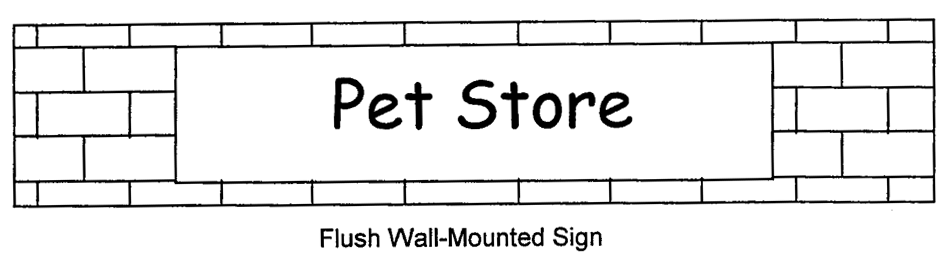
Figure 1. Flush Wall-Mounted Sign
25.7.1.2
Projecting Signs
Definition—A hanging sign, blade sign or any sign that is mounted to and projects out from a building wall.
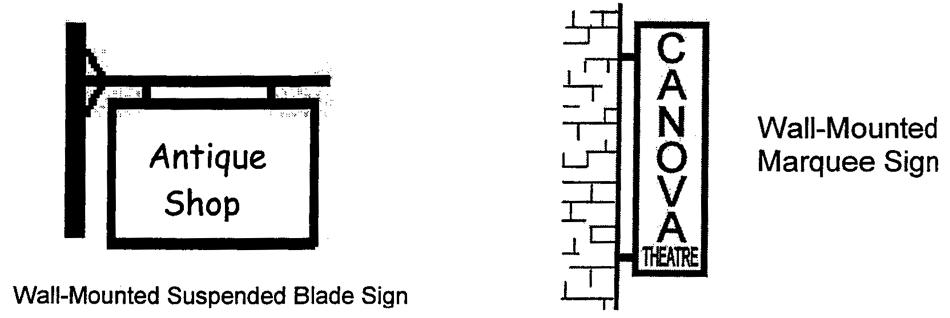
Figure 2. Various Wall-Mounted Signs
(a)
Any projecting or hanging sign must have seven (7) or more feet of vertical clearance from the ground or sidewalk level.
(b)
A hanging/blade sign may project no more than three (3) feet from the building wall and shall be no more than eight (8) square feet in area per display surface.
(c)
A marquee sign shall be allowed at theaters only, must be in compliance with the maximum percentage of facade coverage limitations for wall signs and may project no more than six (6) feet from the building wall.
25.7.1.3
Canopy/Awning Sign
Definition—A canopy or awning sign is a wall sign in which the lettering is applied directly onto a canopy or awning. The lettering on a canopy/awning shall be counted as sign face area.
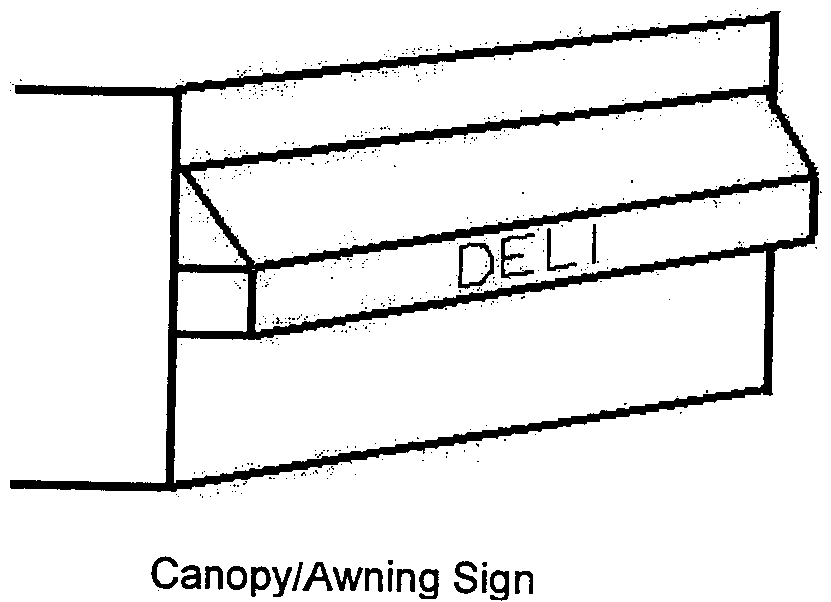
Figure 3. Canopy/Awning Sign
(a)
The total area of a canopy/awning sign shall be one square foot in area for each horizontal linear foot of the canopy/awning.
(b)
Reserved.
(c)
No neon is allowed on awnings.
(d)
On single-occupant property, one awning sign may be allowed only in lieu of all other signage otherwise permitted on the wall to which the awning is attached.
(e)
On multi-occupant property, one awning sign may be allowed over each occupant entrance only in lieu of other wall signage.
(f)
No metal bar or framing or other solid shall be less than eight (8) feet above the ground or sidewalk and that a flexible cloth, canvas or similar skirt may hang twelve (12) inches below the horizontal frame supporting the awning, but in no case shall the skirt be less than seven (7) feet above the ground or sidewalk at the lowest point.
25.7.2
Freestanding Signs
(a)
Only one (1) freestanding sign may be erected per building, regardless of the number of tenants.
(b)
Outparcels for shopping centers shall not be allowed principal ground signs.
(c)
The leading edge of all freestanding signs shall be a minimum of five (5) feet behind the existing and/or future public right-of-way and shall not be located as to obstruct any sight triangle at a street or driveway.
(d)
PUD-R, subdivision, and manufactured home parks shall be allowed only one (1) monument style freestanding or arm sign on one side, or in the median, of each principle entrance.
(e)
PUD-B greater than five (5) acres shall be allowed to have one freestanding sign at the principal entrance and a second freestanding sign at the secondary entrance, provided that the secondary entrance does not share frontage with the principle entrance and that the secondary sign is no larger than eight (8) feet in height and forty (40) square feet in display area.
(f)
Freestanding monument style signs are the only freestanding signs permitted in the B-3 district.
(g)
Freestanding signs shall not be permitted for zero setback buildings.
(h)
Freestanding monument style signs are the only freestanding signs permitted in the commercial corridor district (CC).
(i)
PUD-B greater than ten (10) acres abutting I-40 shall be allowed to have one freestanding sign at a principal entrance or along I-40 frontage as permitted in table (j) and a second monument style freestanding sign at an entrance no larger than twenty (20) feet in height and one hundred (100) square feet.
_____
(j)
All on-site freestanding signs shall meet the following requirements:
25.7.2.1
Monument Signs
Definition —A monument sign is mounted generally flush with the ground plane and may not be mounted on a pole, pylon, raised on a man made berm, wall, or similar structure.
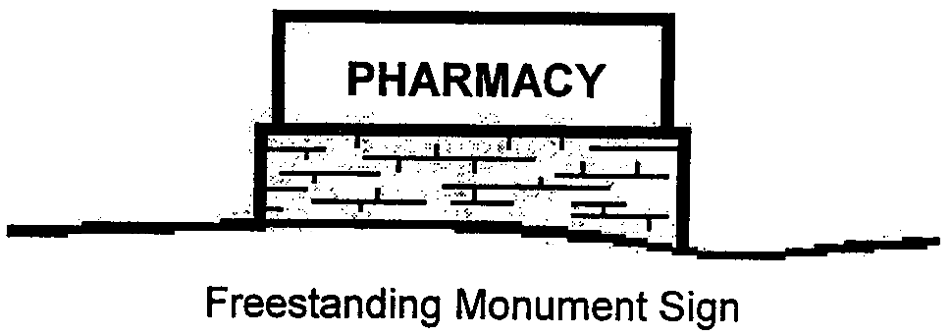
Figure 4. Freestanding Monument Sign
(a)
The supporting structure (base) shall be included in the measurement of a sign height, but not included in the calculation of sign area. The supporting structure (base) material shall be constructed with materials architecturally consistent with the principal structure.
25.7.2.2
Elevated Signs
Definition - An elevated freestanding sign hung from a pole and beam frame or placed within a frame mounted on up to two supporting poles.
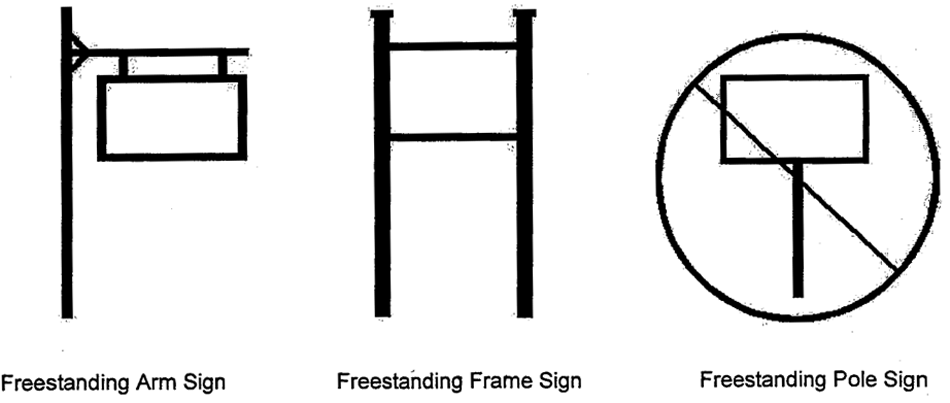
Figure 5. Various Freestanding Signs
(a)
Single pole signs are not permitted, except as provided for in Section 25.7.3.
_____
25.7.3
Off-Premises Billboard Signs
Off-premises billboard signs or other large off-premises outdoor advertising structures shall only be allowed in the interstate Highway I-40 corridor in the highway business (B-2), general business (B-4), general manufacturing (M-1), and the exclusive manufacturing districts (EM-1), and shall be subject to the following regulations:
(a)
The maximum permitted area shall be 380 square feet.
(b)
The maximum height shall be fifty (50) feet above normal elevation of the ground at base of the sign.
(c)
Signs shall be separated from other structures by a minimum of twenty (20) feet.
(d)
The leading edge of the sign must be setback not less than one (1) foot from the right-of-way and not more than two hundred fifty (250) feet.
The sign must be placed a minimum of four hundred (400) feet from any residential district, or park, school, hospital, rest home, or nursing home.
(e)
Roof mounted signs are prohibited.
(f)
Sign support structures shall be limited to one per lot. Back-to-back or V-shaped signs shall be permitted, provided the interior angle between signs does not exceed fifteen (15) degrees.
(g)
The distance between off-premises signs shall be one thousand (1000) feet between signs on the same side of the right-of-way and five hundred (500) feet for signs on opposite sides of the right-of-way. The off-premises sign shall be a minimum of five hundred (500) feet from the use, product or service to which it refers. All distances shall be measured along the center line of the street adjacent to the sign.
(h)
On corner lots, no part of any advertising structure shall be located closer than fifty (50) feet to the point of intersections of the rights-of-way of the two (2) streets forming the corner.
(i)
All sign structures must be designed and certified by a licensed engineer and constructed to withstand thirty (30) pounds per square foot wind load.
(j)
Any off-premises sign made nonconforming by this ordinance, abutting I-40 and possessing a valid permit from NCDOT shall be permitted to remain in place, However, if such signs are structurally altered, removed, moved, or changed in any way such signs shall comply with all regulations of this ordinance.
(k)
The above standards A through K shall apply to the erection and maintenance of all off-site, outdoor advertising structures in Conover, North Carolina and its extraterritorial planning area, along the I-40 corridor. Whenever a sign is subject to requirements of the North Carolina Department of Transportation, the more stringent rules shall apply.
25.7.4
Signs Exempt From Regulation
The following signs are exempt from permit requirements under this Division provided such signs comply with the provisions stated below and that neon tube and other illumination shall be prohibited.
(a)
Sandwich boards and sidewalk signs are allowed in the B-3 and MX zoning districts provided that:
(1)
Any such sign shall not be illuminated or have moving parts.
(2)
Any such sign shall be no larger than eight (8) square feet, shall not be more than two (2) feet wide nor more than four (4) feet tall.
(3)
The sign shall be constructed of materials that present a finished appearance, e.g. rough cut plywood is not acceptable.
(4)
One (1) sign allowed per building and shall be permitted in addition to any other allowable signage.
(5)
The sign shall be displayed during business hours only.
(6)
Any such sign shall be located directly in front of the building.
(7)
The sign shall provide five (5) feet of clearance for the passage of pedestrians between the sign and other obstacles such as signs, poles, fire hydrants, street furniture, landscaping, etc. and ten (10) feet of clearance between any intersection or driveway.
(8)
No sign shall block visibility-vehicular or pedestrian at any time.
(9)
Any person erecting a sandwich board or sidewalk sign shall indemnify and hold harmless the City and it's officers, agents and employees from any claim arising out of the presence of the sign on City Property or any right-of-way.
(b)
Construction site identification signs are allowed on an active construction site and must not exceed four (4) square feet in area per display surface and three (3) feet in height for single family or duplex construction; and thirty-two (32) square feet and eight (8) feet in height for multi-family or non-residential construction. Such signs must be removed within seven (7) days of the completion of the project, and must not interfere with pedestrian or vehicular circulation or sightlines.
(c)
One real estate sign per street frontage is permitted on the property for sale and shall be a maximum of four (4) square feet in size in residential zoning districts and thirty-two (32) square feet in commercial/industrial zoning districts.
(d)
Signs advertising multi-family residential (PUD-R) and multi-tenant commercial (PUD-B) property for lease or sale shall be limited to four (4) square feet in size, constructed of materials that present a finished appearance consistent with and affixed to the existing approved permanent signage.
(e)
Building directory signs, identifying occupants of a building, must be wall-mounted, must be located next to the entrance, must be a maximum of four (4) square feet, and must not project more than six (6) inches from the wall.
(f)
Service entrance signs or signs directing traffic shall bear no logos or other advertising matter.
(g)
Parking directional signs may be either wall-mounted or freestanding, are limited to two (2) square feet in area and three (3) feet in height and shall bear no advertising matter. If freestanding, the leading edge of the signs must be located a minimum of one (1) foot from the right-of-way.
(h)
Political signs are permitted within the street rights-of-way in accordance with the following provisions:
(1)
Signs shall not be erected more than thirty (30) days prior to the beginning of "one stop voting". Signs must be removed no later than seven (7) days after the election or campaign to which they pertain.
(2)
No sign shall be permitted in a fully controlled access highway.
(3)
No sign shall be closer than three (3) feet from the edge of pavement.
(4)
No sign shall obscure motorist visibility at an intersection.
(5)
No sign shall be higher than forty-two (42) inches above the edge of the pavement of the road.
(6)
No sign shall be larger than six (6) square feet.
(7)
No sign shall obscure or replace another sign.
(8)
Any sign that is placed within the right-of-way that does not comply with these standards may be removed.
State Law reference— (G.S. 136-32).
(i)
Window signs shall be allowed provided that they cover no more than twenty-five (25) percent of the gross glass area.
(j)
Temporary signs or banners shall be allowed with an approved permit for a maximum duration of forty (40) days, annually. Temporary signs or banners shall be removed no more than two (2) days after the event. Such signs shall be a minimum of five (5) feet from the street right-of-way.
(k)
Service stations pumps may have one or two signs attached to the top of the pumps and are limited to four (4) square feet per display area. Additional pump top signs may be permitted by transferring wall signage display area for each such additional sign.
(l)
Service station canopy signs may be painted or affixed to the pump canopy, but may not be located on top or bottom of the canopy. Such signage shall not exceed fifteen (15) square feet on each side of the canopy, up to a maximum of three (3) sides. The message of the canopy sign shall be limited to the name and registered trademark of the establishment or one gas price display.
25.7.5
Prohibited Signs
(a)
Signs located in or extending into the public right-of-way, other than approved signs installed by the City of Conover for City maintained streets and the North Carolina Department of Transportation (NCDOT) for State maintained streets.
(b)
Signs that are dilapidated or in disrepair.
(c)
Signs on roofs, chimneys, or balconies.
(d)
Flashing or blinking signs, signs with flashing or reflective disks or signs with flashing lights or lights of changing degree of intensity or color.
(e)
Animated, rotating or other moving or apparently moving signs.
(f)
Portable signs, except those specifically permitted in Section 25.7.4.
(g)
Signs that are similar in color, design or appearance to traffic control signage.
(h)
Windblown or inflatable devices, including balloons, streamers, giant animals or any other forms or shapes.
(i)
Posters, streamers or similar devices used to attract attention.
(j)
Off-site signs, except for those specifically permitted in Section 25.7.3.
(k)
Vehicular Signs. Vehicles containing business names or logos, including delivery trucks, may not be stored or parked between the public right-of-way and the normal building line for the principle structure.
(l)
Pole Signs.
(m)
Any sign associated with a home occupation.
(n)
All other signs not expressly permitted in this ordinance.
(Ord. No. 17-06, § 1, 7-10-06; Ord. No. 47-08, 11-3-08; Ord. No. 1-14, § 1, 1-6-14; Ord. No. 8-15, § 1, 5-4-15; Ord. No. 20-17, § 1, 3-6-17; Ord. No. 58-20, § 1, 12-7-20)
Section 25.8. - Unlawful cutting of trees or shrubs.
No person shall destroy, trim, or remove any trees, shrubs or other vegetation for the purpose of increasing or enhancing the visibility of any sign if the subject vegetation is located:
(a)
Within the public right-of-way, unless the work is done by an agency having jurisdiction over the streets.
(b)
On property that is not under the ownership or control of the person responsible for such work, unless authorization is provided by the property owner where the subject vegetation is located.
(c)
Any trees or shrubs that are required landscaping under the Conover Zoning Ordinance.
(Ord. No. 17-06, § 1, 7-10-06)
Section 25.9 - Murals.
Mural definition: For purposes of this ordinance, a mural is a picture or design painted on or attached to an exterior surface of a structure. For illustrative purposes, this definition additionally includes painted panel(s), frescoes, mosaics, and the like that are directly affixed to or attached to an exterior surface of a structure. Murals serve as a visual landmark and should be distinctive through use of design, color, etc.
25.9.1 General.
All murals within the City of Conover's planning jurisdiction must be permitted by the administrator after first receiving a recommendation from the ad hoc mural review committee (MRC). Maintenance of murals in accordance with the provisions herein is the responsibility of the property owner. A mural that is permitted to deteriorate into a condition of disrepair shall constitute a public nuisance and may be subject to enforcement actions under applicable local ordinances. All references to administrator in this section 25.9 shall refer to the city's planning director.
25.9.2 Purpose.
It is the purpose of this section to:
(a)
Encourage artistic expression.
(b)
Foster community pride.
(c)
Preserve existing murals that are a valued part of the history of the city.
(d)
Promote the cultural heritage of the city.
(e)
Build collaboration opportunities with the arts and cultural community.
(f)
Join history, character identity, and sense of place with tourism and economic development.
25.9.3 Objectives.
The mural regulations also promote public safety and welfare by regulating such displays in keeping with the following objectives:
(a)
The design, construction, installation, repair, and maintenance of murals will not interfere with traffic safety or otherwise endanger public safety.
(b)
The MRC will consider reasonable protection to the visual environment by controlling the spacing, scale, chromatic intensity and location of such displays.
(c)
The public will enjoy the aesthetic benefits of being able to view such displays in numbers and sizes that are reasonably and appropriately regulated without having to endure visual blight and public safety impacts.
25.9.4 Mural Requirements.
Application and review.
(a)
A completed application shall be submitted to the administrator for a completeness review for each new mural. Applications shall include the following:
1.
Written permission of the building owner.
2.
Confirmation on building/mural placement location preparation, including indication on whether surface material contains chemical treatments to remove chipping paint, mold, and dirt.
3.
Confirmation of mural size and location compliance.
4.
Confirmation of materials to be used, including proof that materials are to last for a period of at least five (5) years in an exterior environment.
5.
Area calculations, including a high-resolution rendering or colored sketch of the mural and building on which it is to be located with all dimensions shown to scale.
6.
Any other information deemed necessary by the administrator to thoroughly review the application.
(b)
Upon the submission of a complete application, the administrator shall notify the city council. The city council shall appoint an ad-hoc mural review committee (MRC) within sixty (60) days of the administrator's notification. The MRC shall review and approve or deny the mural application based on the criteria established in this section. The MRC shall be comprised of:
1.
One (1) member of the planning board, recommended by the planning board.
2.
Two (2) members recommended by the Arts Culture Catawba f/k/a United Arts Council of Catawba County, at least one (1) of whom should be an artist.
3.
One (1) Conover business owner or business representative.
4.
One (1) to three (3) additional citizens of Conover at large.
No member of the ad-hoc MRC shall be an abutting or adjoining property owner of the property upon which the application has been made nor shall any member have a direct financial interest in the result of the application.
(c)
The administrator or designee shall facilitate and coordinate MRC meetings and maintain records for such meetings in accordance with the Public Records Act and any duly-authorized records retention policy. The MRC shall render its decision within one hundred eighty (180) days of the completed application submission date.
(d)
The MRC will be considered dissolved once approval or denial of the mural has been issued.
(e)
The mural applicant will be required to notify the administrator following completion of the mural so a final compliance inspection may take place.
(f)
The MRC shall serve in an advisory capacity to the city council, the city manager, and the administrator on technical matters under this section pertaining to the installation and maintenance of murals.
(g)
The MRC shall not premise its recommendation on the content of the mural except as lawfully contemplated under section 25.9.7 of this section.
(h)
Regardless, the administrator shall not premise the decision to issue a permit, or not to, under this section based on the content of the mural except as lawfully contemplated under section 25.9.7 of this section.
(i)
Any decision of the administrator may be appealed to the city manager within thirty (30) days of the administrator's written decision. Such appeal shall be in writing, directed to the city manager and the administrator via U.S. Mail or by such electronic means as the city manager may provide, and shall clearly and succinctly state the bases for said appeal. Upon receipt of an appeal, the administrator shall convey all file materials pertaining to the application to the city manager who shall consider the application in accordance with this section. The city manager's decision shall constitute an administrative decision and further appeal thereafter shall be governed by Chapter 160D of the General Statutes.
(j)
Any mural approved under this section must be installed within two (2) years of the administrator's approval, or the permit shall expire. However, the administrator may grant a written extension of up to an additional two (2) years if deemed appropriate under the circumstances.
25.9.5 Size and Measurement.
(a)
Murals shall not be permitted on the primary street facing side of any building and may not extend over windows, doors, or architectural features.
(b)
The total size of a mural is determined by calculating a bounding box around all features which make up the mural. If a mural spans more than one wall or surface, the total mural area must be a part of the calculation.
(c)
If the mural is to contain an artist signature or brand, it must be approved during approval of mural and make up no more than five (5) percent of the total mural area.
25.9.6 Recordkeeping.
The city shall maintain a record of all completed mural projects, including a high-resolution photograph of the final product at the site provided by the mural applicant, along with the artist's name, contact information, and the date of completion.
Accordingly, following the installation of the mural, the artist and/or mural applicant must submit a high-resolution photo of the completed mural, which includes measurement confirmations that will be kept on file with the city in the event of alterations or maintenance concerns.
25.9.7 Consistency in Ordinance and Statute Application.
(a)
The city wishes to encourage the installation of murals and, at the same time, maintain its ability to enforce its sign ordinance. Therefore, a picture or design painted on or attached to an exterior surface of a structure that is clearly related by language, logo, or pictorial depiction to the advertisement of any product or service or the identification of any business shall be excluded from the definition of "mural" and is instead regulated under article II, division 5 of the zoning ordinance.
(b)
No mural shall contain obscene material as defined by N.C.G.S. § 14-190.1 or by the prevailing U.S. Supreme Court standards for obscenity.
25.9.8 Alterations to Permitted Murals Restricted.
(a)
Alterations include any change to a permitted mural, including, but not limited to, any change to the image(s), materials, colors or size of the permitted mural. Any such alterations require the submittal of a new application.
(b)
Alterations do not include naturally occurring changes to the mural caused by exposure to the elements or the passage of time.
(c)
Alterations are only allowed in the following circumstances:
1.
Minor changes to the original approved design may be made during installation due to unforeseen issues that arise such as existing equipment or equipment access needs, ventilation systems, required safety equipment or notification, etc.
2.
Minor changes to the permitted mural that result from the maintenance or repair of the mural shall not constitute an alteration, provided the work is consistent with the standards for maintenance of the approved mural.
3.
Other maintenance activities permitted by section 25.9.9 maintenance.
25.9.9 Maintenance.
(a)
The mural owner is responsible for general maintenance of the mural as to not create public safety threat or blight.
(b)
Minor changes resulting from maintenance or repair may include slight and unintended deviations from the originally approved image, colors or materials, when necessary to address deterioration over time or as a result of damage caused by vandalism.
25.9.10 Removal.
A mural shall be removed if the structure or property is substantially remodeled or altered in a way that precludes continuance of the mural.
25.9.11 Nonconforming murals.
Any mural installed prior to the effective date of this section shall have legal nonconforming status and, notwithstanding any provision of this ordinance, will not require registration. Such murals must comply with the maintenance standards provided herein for new murals.
25.9.12 Historical Properties and Buildings.
Murals shall not be permitted on properties designated historic under state law, unless a certificate of appropriateness is obtained in accordance with N.C.G.S. 160D-947.
(Ord. No. 24-25, § 1, 9-15-25)
Section 26.1. - Intent.
The purpose of this section is to preserve and protect the health, safety and general welfare of the residents of Conover by promoting the environmental and public benefits of buffers. It is intended to improve compatibility and provide transition between different zones and preserve the character and aesthetics of an area.
(Ord. No. 8-87, § 1, 3-3-87)
Section 26.2. - Planting specifications.
26.2.1 Industrial/manufacturing zones that abut residential zones. A planted buffer shall reach a height of twenty (20) feet. Plants used in a buffer shall be a species that forms a continuous year-round screen within three (3) years after planting. The planted buffer shall be composed of two (2) rows of plants planted in a bed with a width of thirty (30) feet along the length of the border that requires the buffer. Plant material will be spaced according to the table provided. When necessary, utilities and sightlines for drivers shall be accommodated in the design of the buffer in section 26.2.4.
26.2.2 Commercial/business zones that abut residential zones, nonresidential uses and level II multi-family developments in residential zones. A planted buffer shall reach a height of fifteen (15) feet. Plants used in a buffer shall be of a species that forms a continuous year-round screen within three (3) years after planting. The planted buffer shall be composed of one (1) row of plants planted in a bed with a width of fifteen (15) feet along the length of the border that requires the buffer. Plant material will be spaced according to the table provided. Existing mature foliage may be considered to act as the required buffer provided that such foliage is deemed sufficient to meet the intent of this article. When necessary, utilities and sightlines for drivers shall be accommodated in the design of the buffer in section 26.2.4.
26.2.3 Required buffer heights and topographic considerations. The required height of the planted buffer shall be measured in relation to the elevation of the edge of the adjacent area to be screened. In such cases as the ground elevation of the location at which the screen is to be planted is less than the elevation of the proposed building site, the required height of the screen shall be increased in an amount equal to said difference in elevation.
26.2.4 Plant types and spacings. Below are listed the types of plants that shall be used in landscape buffers and the maximum spacing each plant type shall be planted apart. Substitution for another plant type is subject to verification that the proposed plant will thrive for the intended purpose, is not an exotic invasive species in our area, and will provide adequate screening. No more than fifty (50) percent of the total plantings in a buffer shall be deciduous plants.
26.2.5 Preservation of existing buffer areas are encouraged. When areas of existing trees are located where a buffer is required; the existing trees will be counted provided that adequate screening will remain in place to meet the requirements of the ordinance and where gaps may be present, additional plant material added according to the planting table above.
26.2.6 Prohibited plant material. The following list plants shall not be used in or counted towards landscaping required by this ordinance.
Prohibited plants
Leyland cypress
Bradford pear (Pyrus calleryana)
Tree of Heaven (Ailanthus altissima)
Princess Tree (Paulownia tomentosa)
Privet hedge, Ligustrum species
Norway maple (Acer plantanoides)
(Ord. No. 8-87, § 1, 3-3-87; Ord. No. 22-18, § 1, 5-29-18; Ord. No. 16-21, § 3-10-21; Ord. No. 14-23, § 1, 6-5-23)
Section 26.3. - Standards.
26.3.1 The specifications for planted buffers in section 26.2 shall be required in all industrial and commercial zones when these areas abut residential zones and for all nonresidential uses in residential zones.
26.3.2 All plant types required in this ordinance shall consist of plants at least five (5) feet in height when planted.
26.3.3 When two (2) rows of plantings are required, plants shall be staggered in a triangular pattern so that there is a plant spaced the required distance apart as specified in section 26.2.4.
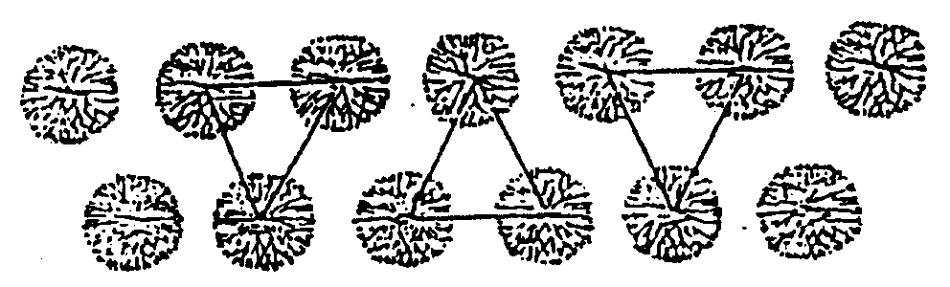
26.3.4 Reserved.
26.3.5 When industrial and commercial property is developed adjacent to vacant property zoned residential, a buffer shall be required.
26.3.6 The buffer shall be shown in detail on the site plan and approved by the Conover Planning Department.
26.3.7 The buffer shall be installed and approved before a certificate of occupancy will be granted except when seasonal weather conditions are not conducive, then a temporary certificate of occupancy may be issued for up to sixty (60) days.
26.3.8 The buffer shall be maintained, and dead and diseased plants replaced by the owner or the occupant of the premises. The outside storage of materials shall be prohibited in the area between the planted buffer and the residential district. This area shall be properly maintained by the owner or occupant of the premises.
26.3.9 If a fence is erected on the residential district side of the planted buffer by the party establishing the buffer, the fence shall follow the requirements of section 22.13. Fences.
(Ord. No. 8-87, § 1, 3-3-87; Ord. No. 16-21, § 3-10-21)
Section 27. - Home occupations.
27.1 Home Occupation: An occupation conducted as an accessory use of a dwelling unit, provided that:
(a)
Only members of the immediate family permanently residing on the premises may be employed or engaged in the customary home occupation;
(b)
The use of the dwelling unit or accessory buildings for the home occupation shall be clearly incidental and subordinate to the use of the property for residential purposes, and not more than thirty-five (35) percent nor more than seven hundred fifty (750) square feet of the floor area of the dwelling unit and any accessory buildings combined shall be used in the conduct of the home occupations; provided, that the floor area defined as used in the home occupation is the area dedicated to or primarily used for the home occupation, and does not include areas incidentally used for the home occupation;
(c)
No external evidence of the conduct of the home occupation, including commercial signs, shall be visible;
(d)
No customary home occupation shall cause an increase in the use of any public utilities or services (water, sewer, garbage collection, etc.) so that the combined total use for dwelling unit and customary home occupation purposes exceeds the average for residences in the neighborhood.
(e)
Traffic and parking regulations;
(1)
The home occupation shall not generate traffic volumes or parking area needs greater than would normally be expected in the residential neighborhood.
(2)
In addition, normally there shall be no more than three (3) vehicles parked at any time on-or off-street for non-residential purposes including but not limited to parking by non-resident employees, customers, delivery services, etc.; but excluding drop-offs and pick-ups. Home occupations for arts education or similar educational purposes are exempt from any parking restrictions.
(3)
There shall be no regular pick-up and delivery by vehicles other than those of a size normally used for household deliveries.
(f)
No equipment or process shall be employed that will cause noise, vibration, odor, glare, or electrical or communication interference detectable to the normal senses off the lot in the case of detached dwelling units, or outside the dwelling unit in the case of attached dwelling units;
(g)
The on-premises sale and delivery of goods which are not the products of the home occupation are prohibited, except that the sale of goods which are incidental to a service of the home occupation is permitted;
(h)
In no case shall a home occupation be open to the public at times earlier than 8:00 a.m. nor later than 9:00 p.m.
(i)
A zoning compliance permit is issued for the home occupation(s). The permit shall describe the nature of the business and include the applicant's certification that the home occupation will be conducted in accord with the Ordinance and other applicable laws and ordinances. The city zoning official may revoke a zoning compliance permit for a home occupation if he/she determines the conditions were being violated. Once a home occupation permit has been granted, it shall remain in effect until: (1) it is revoked by the city; (2) the home occupation is terminated by the resident or residents for one hundred eighty (180) or more days; or (3) the holder of the permit moves from the residence.
(Ord. No. 21-95, 12-4-95; Ord. No. 10-98, § 1, 3-2-98; Ord. No. 47-08, 11-3-08; Ord. No. 28-17, § 1, 5-1-17)

