
Cortland City Zoning Code
CHAPTER 3
MISCELLANEOUS ZONING REGULATIONS
9-3-1.- Establishment of districts.
In order to implement the regulatory scheme of this title so as to achieve objectives enumerated in section 9-1-1 of this title, this entire municipality is hereby divided into the following zoning districts:
(Ord. 1980-3, 8-11-1980, eff. 9-5-1980; amd. Ord. 1984-1, 11-12-1984; Ord. 1987-4, 9-28-1987; Ord. 1991-2, 9-9-1991; Ord. 1995-13, 11-13-1995, eff. 12-2-1995)
9-3-2. - Map of zoning district boundaries.[5]
The boundaries of the listed zoning districts are hereby established as shown on the Official Zoning Map of this municipality. The Official Map, including all notations and other information thereon, is hereby made a part of this title by reference. The Official Zoning Maps shall be kept on file in the administrator's office. (Ord. 1980-3, 8-11-1980, eff. 9-5-1980)
See also section 9-1-7 of this title.
9-3-3. - District boundaries.[6]
In determining with precision what territory is actually included within any zoning district, the administrator shall apply the following rules:
A.
Streets And Alleys: The district boundaries are either streets or alleys unless otherwise shown; and where the designation on the Zoning Maps indicates that the various districts are approximately bounded by the center line of a street or alley, such street or alley center line shall be construed to be the district boundary line.
B.
Lot Lines: Where the district boundaries are not otherwise indicated and where the property has been or may hereafter be divided into blocks and lots, the district boundaries shall be construed to be lot lines; and where the designations on the Zoning Maps are approximately bounded by lot lines, said lot lines shall be construed to be the boundary of the district.
C.
Unsubdivided Property: In unsubdivided property, the district boundary lines shown on the Zoning Maps shall be determined by use of the scale shown on such maps. (Ord. 1980-3, 8-11-1980, eff. 9-5-1980)
See also section 9-1-9 of this title.
9-3-4. - Annexed territory.[7]
Any land which may be annexed to this municipality in the future shall be placed in the zoning district designated in the pre- annexation or annexation agreement, if such zoning district is consistent with the comprehensive plan, or in the R-1 single-family residence district if there is no preannexation or annexation agreement. Such zoning designation shall remain until changed in accordance with the provisions of this title. Every annexation proposal shall also be filed with the soil and water conservation district as required by 70 Illinois Compiled Statutes 405/22.02a. (Ord. 1995-13, 11-13-1995, eff. 12-2-1995)
See also section 9-1-8 of this title.
9-3-5. - Intent of districts.
A.
AG agricultural: This district provides for protection and preservation of agricultural lands for the performance of agricultural functions.
B.
R-1 single-family residence: This district provides for single-family residences on larger lots with lower densities and more open space.
C.
R-2 high density single-family residence: This district provides for single-family residences on small lots and was designated to reduce some of the development costs associated with subdivisions.
D.
R-3 two-family residence: This district provides for the mix of one- and two-family residences on larger lots.
E.
R-4 multiple-family residence: This district provides for the location of apartment dwellings at locations adjacent to adequate utilities and transportation services. (Ord. 1980-3, 8-11-1980, eff. 9-5-1980)
F.
C-1 limited retail business: This district provides for attractive and convenient (including both vehicular and pedestrian accessibility) neighborhood shopping areas to provide a full range of retail goods and services and business and professional office operations and related uses.
G.
C-2 general commercial: This district is designed to accommodate those commercial retail, wholesale and rental activities which may be incompatible with the predominantly retail uses permitted in other business districts; and whose service area may generate high traffic and is not confined to any one (1) neighborhood or community.
H.
I-1 light industrial: This district is to provide space for modern landscaped industrial and commercial establishments which create limited or no hazards, noise, vibration, smoke, dust, odors, heat, glare or other objectionable influences which would be offensive beyond the boundaries of the industrially zoned lot.
I.
I-2 heavy industrial: This district is to provide a location for industrial uses which generate truck traffic and uses which may create odors, gases, dust, noise, smoke, etc. Uses which have a potential for nuisances are required to obtain a special use permit.
J.
P-1 recreation and open space: This district is to maintain areas that are subject to flooding or having significant flora or fauna by remaining open space or for recreational uses. (Ord. 1980-3, 8-11-1980, eff. 9-5-1980; amd. Ord. 1984-1, 11-12-1984; Ord. 1987-4, 9-28-1987; Ord. 1991-2, 9-9-1991; Ord. 1995-13, 11-13-1995, eff. 12-2-1995)
K.
Aspen Drive overlay district: This district is established to provide regulations for accessory structures unique to lots within the district suffering from excessively large drainage easements. The map symbol and short name for this district shall be AO district. (Ord. 2011-03, 1-24-2011)
9-3-6. - District area; bulk regulations.
It shall be unlawful to erect or alter any building within this municipality unless the following minimum lot areas and bulk regulations are complied with: (Ord. 1980-3, 8-11-1980, eff. 9-5-1980)
A.
Lot Requirements By District:
Notes:
1 In the R-1, R-4 and I-1 districts, the required minimum lot width at the front building setback line is seventy-five (75) feet; the minimum allowable width of the lot at the front and rear lot lines is fifty (50) feet. In the R-2 and I-1 districts, the minimum lot width is required at the front building setback line and the front and rear lot lines. On curvilinear lot lines, the chord shall be used for all measurements.
2 Building height is the maximum and cannot be exceeded.
3 In the R-4 district the minimum lot area is nine thousand (9,000) square feet or two thousand two hundred fifty (2,250) square feet per dwelling unit, whichever is greater.
4 Applies only to attached single-family dwellings sharing only a common wall.
5 Applies only to attached single-family dwellings sharing a common wall and a common side lot line.
6 Subject to the requirements of section 9-4-31 of this title.
7 One 0 side yard permitted for a common wall.
(Ord. 1994-1, 1-24-1994, eff. retroactive to 11-28-1993; amd. Ord. 1995-13, 11-13-1995, eff. 12-2-1995; Ord. 1996-4, 5-13-1996, eff. 6-1-1996; Ord. 2004-23, 6-28-2004; Ord. 2010-02, 2-22-2010)
B.
Dwelling Standards:
1.
AG Districts: AG districts shall include dwellings as quarters for employees solely engaged in agricultural permitted uses.
2.
R-1 And R-2 Districts: R-1 and R-2 zoning districts shall have a minimum floor area of six hundred (600) square feet. The dwelling may be occupied by one family or an individual plus no more than two (2) lodgers, boarders or guests.
3.
R-3 Districts: R-3 zoning districts shall not have less than six hundred (600) square feet of floor space in each dwelling unit. Each dwelling may be occupied by one family or an individual plus no more than two (2) lodgers, boarders or guests.
4.
R-4 Districts: R-4 zoning districts shall have not less than the following minimum floor area for each living unit:
5.
Occupancy: Each dwelling unit may be occupied by one family or an individual plus no more than two (2) lodgers, boarders or guests. (Ord. 1983-7, 9-26-1983; amd. Ord. 1995-13, 11-13-1995, eff. 12-2-1995)
C.
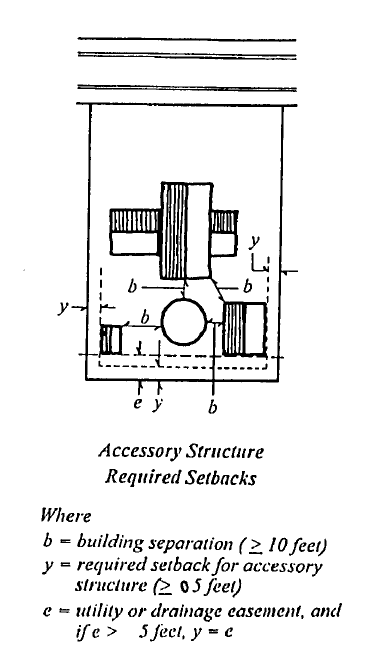
Aspen Drive Overlay District Standards: The zoning administrator may relax setback requirements for accessory structures and uses in the side and rear yard of lots within the overlay district in order to accommodate the smallest practical accessory structure. The zoning administrator is not obligated to relax or reduce the required setbacks for accessory structures and shall take into consideration the location of fences, windows, utility meters, the proximity of principal buildings, and other site features or attributes as deemed necessary in order to determine whether and how much a setback may be reduced. The zoning administrator shall not reduce the minimum building separation for an accessory structure without the consent and approval of the building code official. Nothing herein gives the zoning administrator the authority to permit any accessory structure to be located on a public utility and/or drainage easement. (Ord. 2011-03, 1-24-2011)
9-3-7. - Permitted uses by district.
The use of a building, structure or land shall be allowed only in the zoning districts indicated and for the purposes specified in the following table of permitted uses. Each use is mutually exclusive and does not encompass other uses listed in the table. A principal use, and any accessory use(s) incidental thereto and on the same zoning lot, listed in the table in any district denoted by the letter "P" is permitted by right provided all other requirements of state law, this section, and all other applicable ordinances and regulations of the town have been satisfied. A principal use, and any accessory use(s) incidental thereto and located on the same zoning lot, listed in the table in any district denoted by the letter "S" is a special use and permitted only subject to the provisions of subsection 9-9-2A of this title. A principal use, and any accessory use(s) incidental thereto and located on the same zoning lot, listed in the table in any district denoted by the letter "T" is a temporary use and permitted only subject to the provisions of this title. A use of a building, structure or land not denoted by either "P" or "S" or "T" is not permitted in that district.
A.
Agriculture Uses:
B.
Construction Uses:
C.
Finance, Insurance, Real Estate Uses:
D.
Food Service Uses:
E.
Manufacturing And Processing Uses:
F.
Motor Vehicle Uses:
Notes To Subsection F Only:
1 Subject to the requirements of section 9-4-25 of this title.
2 Subject to the requirements of section 9-4-26 of this title.
3 Subject to the requirements of section 9-4-15 of this title.
4 Subject to the requirements of section 9-4-18 of this title.
G.
Other Uses:
Notes To Subsection G Only:
1 Subject to the requirements of title 5, chapter 4 of this Code.
2 Subject to the requirements of section 9-4-23 of this title.
3 Subject to the requirements of section 9-4-22 of this title.
4 Subject to the requirements of section 9-4-17 of this title.
5 Subject to the requirements of section 9-4-10 of this title.
6 Subject to the requirements of section 9-4-31 of this title.
7 Subject to the requirements of section 9-4-32 of this title.
(Ord. 1987-4, 9-28-1987; amd. Ord. 1988-5, 10-10-1988; Ord. 1991-1, 3-27-1991; Ord. 1991-2, 9-9-1991; Ord. 1995-13, 11-13-1995, eff. 12-2-1995; Ord. 1996-4, 5-13-1996, eff. 6-1-1996; Ord. 1997-13, 9-22-1997; Ord. 1998-18, 11-23-1998; Ord. 2000-20, 12-18-2000; Ord. 2002-25, 9-23-2002, eff. 9-23-2002; Ord. 2006-24, 3-27-2006; Ord. 2006-44, 6-26-2006; Ord. 2007-13, 3-26-2007; Ord. 2008-10, 3-24-2008; Ord. 2008-17, 7-28-2008; Ord. 2008-23, 8-25-2008; Ord. 2010-02, 2-22-2010; Ord. 2011-01, 1-24-2011; Ord. 2019-06, 4-22-2019, eff. 5-2-2019; Ord. 2020-13, 6-22-2020, eff. 7-2-2020)
9-3-8. - General prohibition.
No structure or part thereof shall be erected, used, occupied, enlarged, altered, relocated or reconstructed except in conformity with the provisions of this title. Similarly, no lot or part thereof shall be used, occupied or developed except in conformity with the provisions of this title. (Ord. 1980-3, 8-11-1980, eff. 9-5-1980)
9-3-9. - Unlisted uses prohibited.
Whenever any use is not specifically listed as permitted or special within a particular zoning district, such use shall be deemed prohibited in that district. However, if the town board of trustees, following consultation with the zoning administrator and the planning commission, finds that the unlisted use is similar to and compatible with the listed uses, it may allow such use by amending this title in accordance with subsection 9-9-2B of this title. The town board's decision shall become a permanent public record, and any unlisted use that it approves shall thereafter have the same status as listed uses. (Ord. 1980-3, 8-11-1980, eff. 9-5-1980)
9-3-10. - Lot requirements.
A.
Minimum Requirements: Except as specifically provided otherwise elsewhere in this title, every lot must meet the minimum area, minimum dimensions and minimum setback requirements of the district in which it is located independently; that is, without counting any portion of an abutting lot.
B.
Access Required: No building shall be erected on any lot unless such lot abuts, or has permanent easement or access to, a public street or a private street that conforms to the standards set forth in the land subdivision control ordinance of this municipality.
C.
Front Setbacks, Corner/Through Lots: Every lot with multiple frontages (such as corner or through lots) shall meet the front setback requirements of the district in which it is located on every side having frontage.
D.
Front Setbacks In Certain Built Up Areas: Except as specifically provided otherwise, in all residential zoning districts and in the C commercial districts, where lots having fifty percent (50%) or more of the frontage on one side of a street between intersections (that is, in 1 block) are developed with buildings, and the front setbacks of those lots do not differ by more than ten feet (10'), the minimum required front setbacks on that block shall be the average of the existing front setbacks; provided however, that in any built up area, no front setback less than fifteen feet (15') shall be permitted, nor shall any front setback greater than fifty feet (50') be required. (Ord. 1980-3, 8-11-1980, eff. 9-5-1980)
9-3-11. - Reserved.
(Ord. 1999-05, 3-22-1999)
9-3-12. - Reserved.
(Ord. 1999-05, 3-22-1999)
9-3-13. - Accessory structures and uses.
No "accessory structure or use", as defined herein shall hereafter be built, moved or remodeled, established, altered or enlarged unless such accessory structure or use is permitted by this section. Accessory uses are permitted in any zoning district in connection with any principal use that is permitted within such district.
A.
Accessory Structures or Use Limitations and Conditions: Each accessory structure and use shall comply with the applicable use limitations in the zoning district in which it is located and, in addition:
1.
No accessory structure or use shall be constructed, occupied or established on any lot prior to the completion of the principal structure to which it is accessory.
2.
No accessory structure or use shall be permitted in any yard unless it is a permitted yard obstruction as provided in subsection B.2 of this section.
3.
Outdoor storage, where permitted, shall be maintained in such a manner so as to prevent the overgrowth of weeds, grasses and other obnoxious plant material, and the harboring of rodents and other animal and insect pests.
4.
Buildings and structures essential, incidental or customary to the pursuit of agriculture in an agricultural district are exempt from the requirements of this section.
5.
No accessory building shall be used for dwelling purposes.
6.
No accessory structure or use except fences shall be constructed, occupied or established on any public utility, drainage, or pipeline easement, except with the written permission of all the utility companies and the town having rights to use the easement.
7.
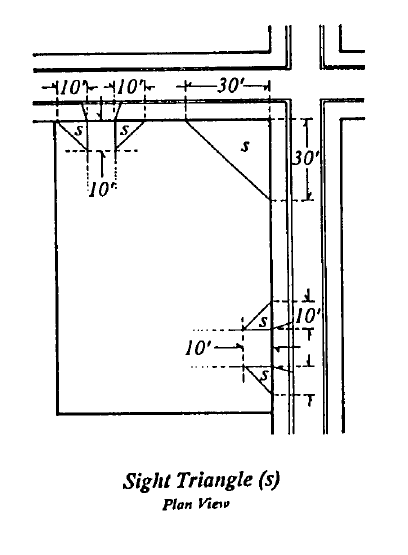
No accessory structure or use shall become a visual obstruction within the sight triangle, the sides of which are formed by the right of way of two (2) intersecting streets, or a street with a driveway, or a street with an alley. The length of the sides of said triangle shall be thirty feet (30') along the street rights of way that intersect, and ten feet (10') along the street right of way and driveway when a street and driveway intersect, or along the street right of way and alley when a street and alley intersect. The area in the sight triangle between two and one-half feet (2.5') and eight feet (8') above grade is to be free and clear of obstructions.
B.
Permitted Yard Obstructions:
1.
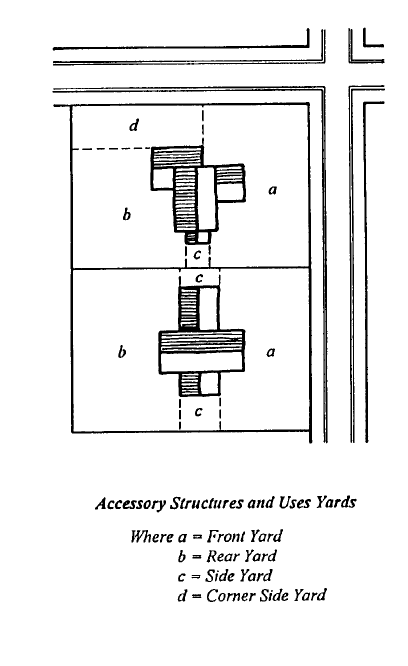
Exceptions: No accessory structures and uses, except those which are permitted as obstructions in yards as indicated in subsection B.2, "Table Of Permitted Yard Obstructions", of this section shall be established, constructed or altered in, or moved to any yard. For the purpose of this subsection B:
a.
Front yard shall refer to the open space on a lot between the front lot line and all of the vertical planes forming the front elevation of the principal structure;
b.
Rear yard shall refer to the open space on a lot between the rear lot line and all of the vertical planes forming the rear elevation of the principal structure, but excluding any corner side yard;
c.
Side yard shall refer to the open space on a lot between the side lot line and the vertical plane(s) forming the side elevation of the principal structure closest to the side lot line, but excluding any rear or front yards; and
d.
Corner side yard shall refer to the open space on a lot between the corner side lot line and the vertical plane forming the side wall(s) of the principal structure closest to the corner side lot line, but excluding any rear or front yards.
2.
Table of Permitted Yard Obstructions:
a.
Where "P" indicates an accessory structure or use is a permitted yard obstruction in the indicated yard.
b.
Accessory structures and uses not listed in this table or exceeding the maximum dimensions herein shall be considered prohibited yard obstructions.
c.
Accessory structures and uses listed in this table shall comply with the lot requirements for the district in which they are located and the regulations in this section unless otherwise specified in this table.
TABLE OF PERMITTED YARD OBSTRUCTIONS
C.
Standards for Accessory Structures or Uses:
1.
Height: No accessory structure or use shall be higher than:
a.
Twenty two feet (22') in any residential district; or
b.
Twenty five feet (25') for nonagricultural uses in any other zoning district.
2.
Maximum Building Coverage: Forty percent (40%) of the lot area.
3.
Location: No accessory structure shall be located closer than ten feet (10') to any principal structure and no closer than five feet (5') from a lot line.
4.
Attached Accessory Structures: Accessory structures, except architectural ornamentation, fire escapes, porches, decks and balconies, attached to the principal structure shall be considered part of the principal building and shall comply with the required setbacks for the principal structure.
D.
Solar Skyspace Easements: The adoption of solar energy systems as permitted yard obstructions in subsection B2 of this section does not constitute a granting of a solar skyspace easement by the town. A solar skyspace easement is not a prerequisite for obtaining a zoning or building certificate from the town but the owner/operator shall assume all responsibility for obtaining covenants, easements, or similar documentation to assure sufficient sunlight to operate the solar energy system unless adequate access to sunlight is provided by the site and assumes all risks associated with operating the solar energy system without a solar skyspace easement. (Ord. 1999-05, 3-22-1999; amd. Ord. 2009-04, 6-22-2009; Ord. 2020-13, 6-22-2020, eff. 7-2-2020)
(Ord. No. 2021-05, § 2, 5-24-2021)
9-3-14. - Required conditions.
A.
Habitable Room and Space: No habitable room shall be permitted in a cellar except when part of a single-family dwelling. Portions of rooming houses and other dwellings below grade used for habitable space shall be permitted only if there are two (2) means of egress. In addition, habitable and occupiable rooms and spaces defined in the building code shall be permitted only if they comply with all building, housing, fire and other applicable codes, ordinances or regulations. (Ord. 1983-7, 9-26-1983)
B.
Requirements:
1.
Required conditions, limited retail business district:
a.
All business, service, repair or processing, storage or merchandise display shall be conducted wholly within an enclosed building, except for off street automobile parking and off street loading.
b.
Processes and equipment employed and goods processed or sold shall be limited to those which are not objectionable by reason of odor, dust, smoke, cinders, gas, noise, vibration, refuse, matter or water carried waste.
2.
Required conditions, general commercial district: any repair or display of materials, goods or products shall be carried on in such a manner as not to be injurious or offensive to the occupants of adjacent premises by reason of emission or creation of noise, vibration, smoke, dust or other particulate matter, toxic or noxious materials, odors, fire, glare or dust. (Ord. 1983-7, 9-26-1983; amd. Ord. 1984-1, 11-12-1984)
3.
Required conditions, industrial district:
a.
Any production, processing, repair or storage of materials, goods or products shall be carried on in such a manner as not to be injurious or offensive to the occupants of adjacent premises by reason of emission or creation of noise, vibration, smoke, dust or other particulate matter, toxic or noxious materials, odors, fire or glare or heat. (Ord. 1983-7, 9-26-1983)
b.
All activities involving the storage or manufacture, assembly or processing of materials or products, except the parking of vehicles in operable condition, shall be within completely enclosed buildings unless if located out of doors: 1) it is concealed by a solid wall or uniformly painted solid fence, not less than eight feet (8') in height, 2) no manufacturing, assembling or processing activities occur between the hours of 10:00 p.m. and 7:00 a.m., 3) any outdoor illumination used on the premises is directed downward, does not exceed one foot-candle or lumen at the property line, and 4) complies with the standards for noise, dust, vibration in this code. (Ord. 2011-20, 6-27-2011)
c.
No activities involving the storage, utilization or manufacture of materials or products which decompose by detonation shall be permitted such as are specifically licensed by proper authority. Such materials shall include, but not be confined to, all primary explosives such as lead azide and lead stylphate, fulminate of mercury; all high explosives and boosters, such as TNT, RDX, tetryl and ammonium nitrate; propellants and components thereof, such as nitrocellulose, black powder, ammonium perchlorate and nitroguandine; blasting explosives such as dynamite, and nitroglycerine; pyrotechnics and fireworks materials such as powdered magnesium, potassium chlorate, potassium permanganate, and potassium nitrate; rocket fuels such as hydrazine nitrate; and nuclear fuels, fissionable materials and products, and reactor elements such as uranium 235 and plutonium 239. (Ord. 1983-7, 9-26-1983)

