
Cortland City Zoning Code
CHAPTER 6
SIGNS
9-6-1.- Purpose.
The regulation of signs by this chapter is intended to promote and protect the public health, safety and welfare by:
A.
Reducing the depreciation of property values caused by signs that are incompatible with surrounding land uses;
B.
Creating a viable economic and business climate within the commercial and industrial areas of the town;
C.
Enhancing and protecting the physical appearance of all areas of the town; and
D.
Reducing the distraction, obstructions and hazards to pedestrians and vehicular traffic caused by the indiscriminate placement and use of signs. (Ord. 2004-10, 3-22-2004, eff. 3-22-2004)
9-6-2. - Scope.
The regulations of this chapter shall govern and control the erection, enlargement, expansion, alteration, operation, maintenance, relocation and removal of all signs within the town and any sign not expressly permitted by these regulations shall be prohibited.
The regulations of this chapter related to the location of signs, by function and type, within zoning districts and shall be in addition to provisions of the Cortland building code.
For the purposes of this chapter, a "sign" shall mean any object, device, display, or structure or part thereof situated outdoors or, when situated indoors, intended to be seen from the out of doors which is used to advertise, identify, display, direct or attract attention to an object, person, institution, organization, business, product, service, event or location by any means including words, figures, designs, symbols, fixtures, colors, motion, illumination, or projected images. (Ord. 2004-10, 3-22-2004, eff. 3-22-2004)
9-6-3. - Prohibited signs.
The following signs shall not be permitted in any zoning district:
A.
Flashing signs, except electronic message boards which show temperature, time, business or public service messages for not less than two (2) second intervals.
B.
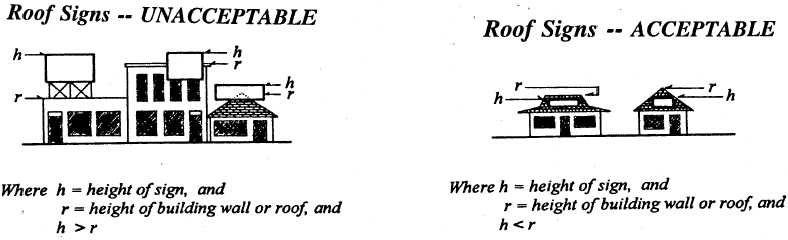
Signs which are wholly dependent upon a building for support or mounted on the roof, which project more than six inches (6") above the highest point of a building or roof to which they are attached, unless permitted otherwise, herein.
C.
Signs which constitute a hazard to public health or safety.
D.
Signs displaying obscene, indecent or immoral matter.
E.
Signs mounted on trailers or motor vehicles, provided that signs containing the name, address or business identification of the owner or user and displayed on a motor vehicle in use and portable signs defined herein are exempt from this section.
F.
Attention getting devices including, but not limited to, inflatable, moving, rotating or undulating signs, or light beams except as otherwise permitted with a special events permit only once annually per establishment.
G.
Signs which, by reason of size, location, content, color, or manner of illumination, obstruct the vision of motorists or interfere with the visibility or effectiveness of any traffic sign or control device on public streets.
H.
Signs which make use of words such as "stop", "look", "one-way", "danger", "yield", or any similar word, phrase, symbol or light so as to interfere with or confuse pedestrian or vehicular traffic.
I.
Signs displayed within or extended over public right of way, except those erected or authorized by a government authority.
J.
Signs which obstruct ingress or egress from any fire escape, door, window, or other exit or entrance.
K.
Advertising, business, or identification signs on light poles of establishments.
L.
Signs painted directly on trees, rocks and fences and other structures or objects, except walls.
M.
Festoon lighting. (Ord. 2004-10, 3-22-2004, eff. 3-22-2004)
9-6-4. - General provisions.
A.
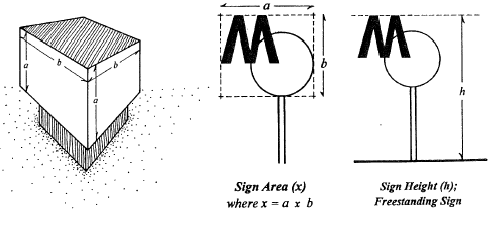
Sign Area: The area of a sign shall be the smallest rectangle which encloses the entire perimeter of a sign, but excluding the supporting structure which does not form part of the sign proper or of the display. Where a sign is designed with more than one surface, the area computed shall include only the largest single display surface which is visible from any one side or position. For the purpose of determining number of signs, a sign shall be considered to be a single display surface or display containing elements organized, related, and composed to form a unit. Where matter is displayed in a random manner without organized relationship to elements, or where there is reasonable doubt as to the relationship of elements, each element shall be considered to be a single sign.
B.
Sign Height: The height of sign shall be the distance measured between the top of the nearest public street curb and the highest point of the sign for freestanding signs. For other signs, the distance measured between finished grade adjoining the wall on which wall a, projecting, awning, window sign is attached and the highest point of said sign.
C.
Illumination: An illuminated sign is any sign from which artificial light emanates either by means of exposed lighting on the surface of the sign or through transparent or translucent material from a source within the sign, or a sign which reflects artificial light from a source intentionally directed upon it.
1.
Illuminated signs permitted in residential districts or within one hundred feet (100') of a residential district shall not be illuminated between the hours of 11:00 p.m. and 7:00 a.m., unless the use to which the sign pertains is open.
2.
No illuminated sign shall be positioned or maintained so as to permit the beams and illumination therefrom to be directed or beamed upon any adjacent property nor to cause glare or reflection that may constitute a nuisance or traffic hazard.
D.
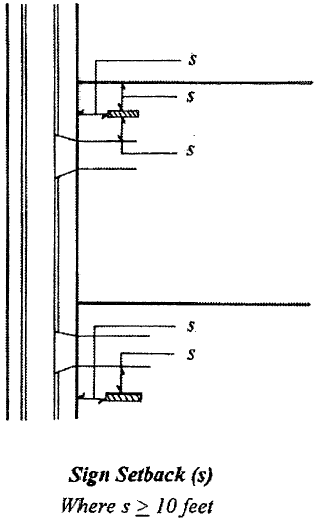
Yards: Except as otherwise provided herein, freestanding signs shall be located at least ten feet (10') from any driveway and lot line.
E.
Sign Maintenance: The owner of a sign or the premises on which such sign is located shall be liable for maintenance of such sign, including its source(s) of illumination, in neat and orderly condition and in good working order at all times, and for preventing deterioration of the physical appearance or safety of such sign. Message board signs must be designed in such a manner that the message area is resistant to damage by wind and vandalism.
F.
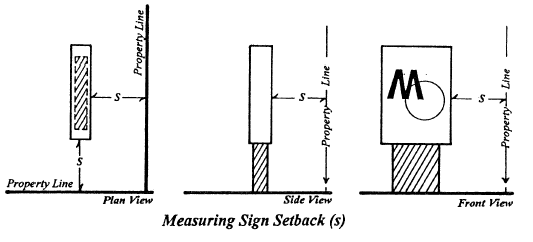
Distance Measurement: The location of a sign shall be measured as the distance between the point of reference specified and the closest point on the sign.
G.
Electrical Elements: All wiring, fittings, and materials used in the construction, connection and operation of electrically illuminated signs shall be in accordance with the provisions of the Cortland building code and shall be contained in rigid conduit or enclosed in poles or raceways. No wiring may be exposed on the surface of any element of the sign.
H.
Structural Elements: The construction and structural components of all signs shall be in accordance with the standards and regulations of the Cortland building code.
I.
Sight Triangle: Signs, and any concealed support elements supporting a sign, shall not be located within any "sight triangle" as defined herein.
J.
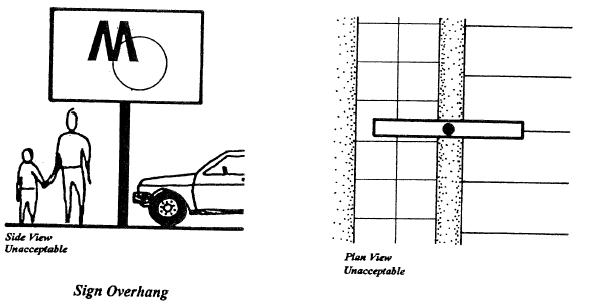
Overhang: Except awning, canopy and projecting signs, no sign may overhang any part of a structure, sidewalk, parking or loading space, driveway or maneuvering aisle.
(Ord. 2004-10, 3-22-2004, eff. 3-22-2004)
9-6-5. - Signs exempted from this chapter.
Nothing in this section shall be construed as exempting the following signs from the provisions of sections 9-6-3 and 9-6-4 of this chapter or from any provisions of the building code or those portions of this code applicable to signs. The following signs are otherwise exempt from regulations of this chapter:
A.
Flags, symbols or crests of nations, states, cities or political, fraternal, religious or civic organizations, provided the number of such flags does not exceed four (4). One flag displaying the name or logo of a company or business shall be allowed provided that it is flown along with the American flag and shall not be larger than said flag. These flags shall be flown in accordance with protocol established by the congress of the United States for the Stars And Stripes.
B.
Decorations customarily and commonly associated with a national, local or religious holiday, or recognized local special event, provided that such decorations shall not be displayed for more than sixty (60) days.
C.
Signs which direct or regulate the movement of pedestrians or vehicles into or within a site, provided that:
1.
No more than one such sign is displayed per driveway;
2.
The sign does not exceed six (6) square feet in area or three feet (3') in height from finished grade for freestanding signs or eight feet (8') in height from finished grade for wall signs; and
3.
No more than ten percent (10%) of the area of the sign is used to advertise any business, product or service provided on the lot.
D.
Signs which identify only the names and locations of occupants or uses within a building(s) on a lot provided that such signs shall not exceed twenty (20) square feet in area or eight feet (8') in height from finished grade, and shall not be located closer than fifty feet (50') to any property line.
E.
Signs not exceeding two (2) square feet in area bearing only the name or logo of the occupant, or address of the lot, or indicating building entrances or exits. Such signs may be illuminated.
F.
Legal notices, identification, informational, directional, traffic or other sign erected or required by governmental authority under the law, statute or ordinance. (Ord. 2004-10, 3-22-2004, eff. 3-22-2004)
G.
Signs no greater than sixteen (16) square feet in area announcing candidates for political office or political issues. (Ord. 2010-11, 8-23-2010)
H.
Memorial signs or tablets containing the names of a building and the date of construction, when cut into any masonry surface so as to be part of the building or when constructed of bronze or some other noncombustible material and permanently attached to a building.
I.
Nonilluminated signs displayed on windows provided the area of all window signs occupies no more than forty percent (40%) of the window surface area.
J.
Real estate signs not more than six (6) square feet in area, provided that no more than one such sign shall be permitted in each yard abutting a street. Real estate signs may be freestanding signs and shall be set back not less than ten feet (10') from any lot line and shall not exceed six feet (6') in height and shall not be illuminated. Real estate signs must be removed within two (2) days of closing or lease transaction.
K.
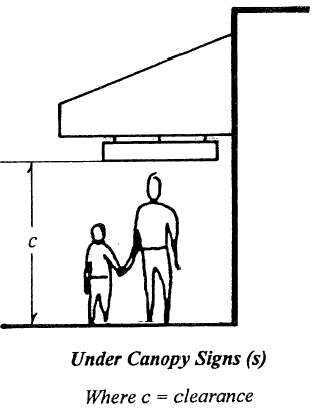
Signs attached to the underside of a canopy provided such signs do not exceed six (6) square feet in area and are mounted at right angles to the building facade and provided a minimum clearance of seven feet (7') above the sidewalk is maintained and that no portion of such sign is within one foot (1') of the edge of the canopy.
L.
Public telephone, gasoline pump and vending machine graphics, logos and instructions.
M.
Signs not exceeding three (3) square feet in area, not closer to any property line than ten feet (10'), and legible to a person of average eyesight standing on the nearest property line.
N.
One (1) sign not exceeding thirty-two (32) square feet in area, and eight feet (8') in height erected on a lot on which construction is taking place, indicating the name of the architects, engineers, landscape architects, contractors, and similar artisans, and the owners, financial supporters, sponsors and similar persons or firms having a role or interest with respect to the structure or project. Said sign shall be erected only so long as construction is occurring on the lot. Said sign shall be a wall or freestanding sign.
O.
Works of art that do not include a commercial message, graphic or logo.
P.
One menu board sign for a drive-in window operation provided such sign does not exceed thirty-two (32) square feet in area or eight feet (8') in height.
Q.
Signs no greater than two (2) square feet in area giving warning, e.g., beware of dog, no trespassing, no dumping, etc., and not to exceed four (4) per lot, except that the zoning administrator may permit additional such signs under proven special circumstances.
R.
Religious symbols, identification emblems of religious orders, or commemorative plaques or recognized historical agencies, no greater than thirty two (32) square feet in area.
S.
When located on agricultural property used for agricultural purposes, signs no greater than two (2) square feet in area pertaining to seed, fertilizer or hybrid products used, produced or cultivated on the property, and signs no greater than thirty-two (32) square feet in area pertaining to the sale in season of agricultural products grown or produced on the property.
T.
Signs no greater than four (4) square feet in area which provide the hours of operation or business or indicate whether the premises is open for business or inspection.
U.
Portable signs no larger than ten (10) square feet in area when displayed on a sidewalk along the facade of a tenant space or a building occupied by a commercial use, provided such sign is displayed only during the hours of operation of the commercial use, and the sign does not interfere with pedestrian movement. Such signs are intended to benefit and to attract the attention of pedestrians.
V.
Identification and warning signs as required by section 9-4-34B.3. (Ord. 2004-10, 3-22-2004, eff. 3-22-2004; amd. Ord. 2020-13, 6-22-2020, eff. 7-2- 2020)
9-6-6. - Classifications and definitions of signs.
For purposes of this chapter, signs shall be classified according to their functional and structural types, defined as follows:
A.
Functional Types:
ADVERTISING SIGN: A sign, commonly known as a billboard, which directs attention to a business, commodity, service or entertainment conducted, sold, or offered at a location other than the lot on which the sign is located; or, a sign which directs attention to a business that is no longer conducted or to a product that is no longer sold on the lot on which the sign is located. An advertising sign shall be a freestanding sign.
BUSINESS SIGN: A sign which directs attention to a business or profession conducted, or to a commodity or service sold, offered or manufactured, or to an entertainment offered on the premises where the sign is located or to which it is affixed. A business sign shall be an awning, canopy, roof, wall or window sign.
DEVELOPMENT SIGN: A sign designating the name and/or address of the development. A "development" for the purpose of this chapter shall mean a building or buildings located on a lot not less than one hundred feet (100') in width at the front property line and under unified ownership or control. A development sign may be used for the identification of residential or nonresidential subdivisions. A development sign shall be a freestanding sign and may or may not include the following:
1.
Tenant Identification Sign: A sign giving the name of a tenant on a lot on which two (2) or more tenants or businesses are located. Said sign shall only indicate the name of the tenant or business establishment or a logo or symbolic representation of the type of business. Tenant identification signs shall be uniform in size and shape and be designed for maximum legibility; and/or
2.
Message Board Sign: A sign designed so that characters, letters, or illustrations can be changed or rearranged electronically, electrically, or manually without altering the face or surface of the sign.
GRAND OPENING SIGN: Any sign used for the purpose of advertising a grand opening or grand reopening of a new business. A grand opening sign may be displayed only within one year of issuance of an occupancy certificate. A grand opening sign may be an awning, canopy, freestanding, portable, roof, temporary, wall or window sign. Grand opening signs shall not be used for promotions, special sales, seasonal sales, or going out of business sales.
IDENTIFICATION SIGN: A sign giving the name and address of a residential building, business, development, industry, or other building or establishment. Such signs may be wholly or partly devoted to a readily recognized symbol. An identification sign shall be an awning, canopy, freestanding, projecting, roof, wall, or window sign.
REAL ESTATE SIGN: A sign indicating the sale, rental, lease, or development of a building or lot, or a portion thereof, on which the sign is located. A real estate sign shall be a freestanding, wall or window sign.
B.
Structural Types:
AWNING SIGN: A sign that is mounted on or attached to an awning that is otherwise permitted by this chapter. An awning may be fixed or retractable and shall be securely attached to and supported by the building. No posts or columns shall be permitted to support the awning. Awnings shall be designed to provide unobstructed flow of pedestrian traffic along any sidewalk. The construction materials and the manner of construction of all awnings shall be in accordance with the Cortland building code.
CANOPY SIGN: A sign that is mounted on or attached to a canopy that is otherwise permitted by this chapter. A canopy shall not encroach upon the required building line on a lot. The construction materials and the manner of construction of all canopies shall be in accordance with the Cortland building code.
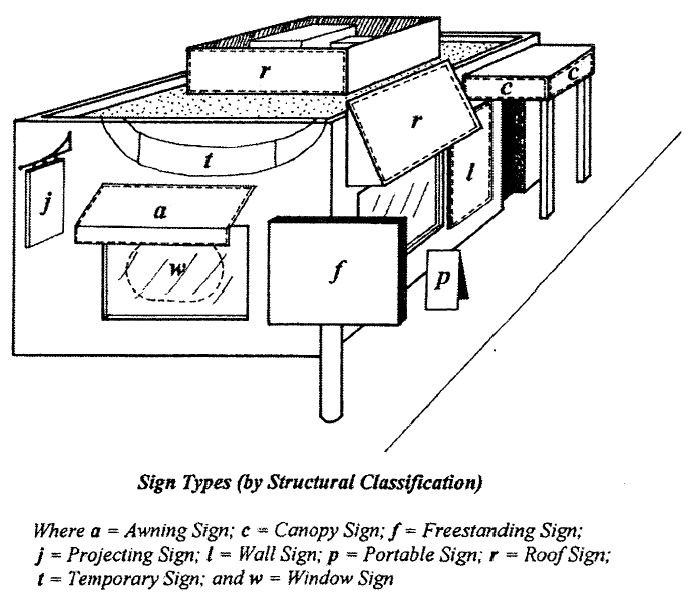
FREESTANDING SIGN: A sign supported independently of any structure. Such sign may be referred to as a ground or pole sign.
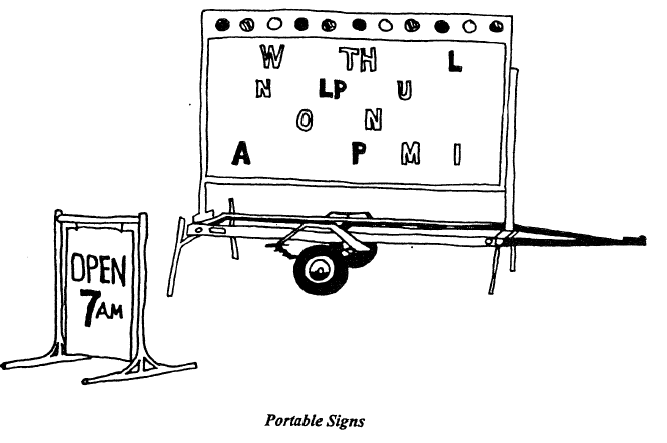
PORTABLE SIGN: A freestanding sign, no face of which shall exceed fifty (50) square feet, attached to or mounted upon a frame intended to be moved from place to place. Such sign may be used as a grand opening sign and may or may not include movable lettering and/or electrical equipment for use as illuminated signs. All illuminated portable signs shall be wired with a UL approved ground fault interrupter, and all service connections shall be approved by a Cortland electrical inspector. No flashing lights or other moving displays shall be permitted on such sign, and all illumination shall be of an indirect or diffused nature.
PROJECTING SIGN: A sign attached perpendicular to a wall of a building, supported solely by the building, and having not more than two (2) faces which may be no more than twelve inches (12") apart.
TEMPORARY SIGN: Any sign, banner, pennant, streamer, or advertising display constructed of cloth, canvas, light fabric, cardboard, wallboard, or other light weight material without a frame. A temporary sign shall be a wall, window, awning or canopy sign.
WALL SIGN: A sign painted on or fastened to the wall of a building or structure in such a manner that the wall becomes the supporting structure for, or forms the background surface of, the sign and which does not project more than twelve inches (12") from such building or structure. No sign shall extend beyond the width of the facade of the building to which it is attached.
WINDOW SIGN: A sign which is painted, applied, or attached to, or located within three feet (3') of the interior of a window, which sign may be seen through the window from the exterior of the structure.
C.
Sign Classification Table: For purposes of convenience, the following table is provided to clarify which sign structural types may be used for particular types of sign functions. An "X" shall indicate the only permitted use of various sign structural types for various types of sign functions.
(Ord. 2004-10, 3-22-2004, eff. 3-22-2004)
9-6-7. - Permitted signs.
The following signs shall be permitted in the town as accessory structures, subject to all applicable standards:
A.
Awning Signs: Where permitted in section 9-6-8, "Table Of Sign Requirements", of this chapter, business and identification awning signs shall be permitted subject to the following:
1.
Number: Not more than one awning sign shall be permitted on each awning.
2.
Location: Individual letters, words or symbols may be affixed or applied to any awning surface facing a public street or mounted over a public entrance to an establishment.
3.
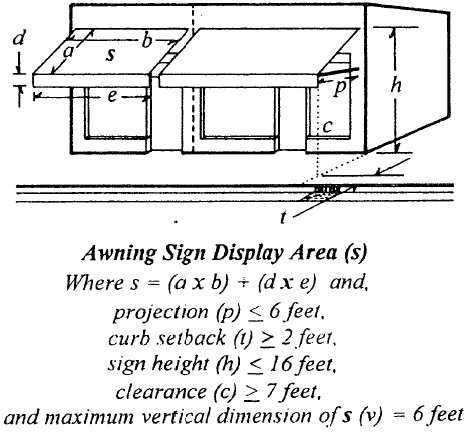
Height: The maximum height of an awning sign shall be the highest point of the awning to which the sign is attached or sixteen feet (16'), whichever is less.
4.
Sign Display Area: Each awning sign shall be located within a selected sign display area. The awning sign display area shall be the exterior area of the permitted awning. The awning sign display area may be computed using a combination of two (2) adjoining geometric shapes (circles, squares, rectangles, triangles only). The vertical dimensions of the awning sign display area shall not exceed six feet (6').
5.
Sign Display Area Limits: The awning sign display area shall not extend beyond the awning surface on which the sign is located, nor beyond the premises of a particular establishment.
6.
Sign Area: The area of an awning sign shall not exceed the maximum percentage of sign display area as stated in this subsection A and as specified in section 9-6-8, "Table Of Sign Requirements", of this chapter.
7.
Illumination: Awning signs may be illuminated subject to the standards in section 9-6-4 of this chapter.
8.
Clearance: A minimum clearance of seven feet (7') shall be provided between finished grade and the lowest point of an awning sign, but in no instance shall an awning sign extend below the lowest point of the awning to which the sign is attached.
9.
Projection: No awning sign and the awning to which it is affixed shall project more than eight feet (8') from the building wall, but shall not project into or over the roadway of any street or driveway.
10.
Setback From Curb: No awning sign and the awning to which it is affixed shall project within two feet (2') of the curb of a street or driveway.
B.
Canopy Signs: Where permitted in section 9-6-8, "Table Of Sign Requirements", of this chapter, business and identification canopy signs shall be permitted subject to the following:
1.
Number: Not more than one canopy sign shall be permitted per street frontage per building or tenant space having an exterior public entrance.
2.
Location: Canopy signs shall be mounted on the face of a canopy provided no wall or roof signs are directed to the same street frontage.
3.
Height: The maximum height of a canopy sign shall be the highest point of the canopy to which said sign is attached or sixteen feet (16'), whichever is less.
4.
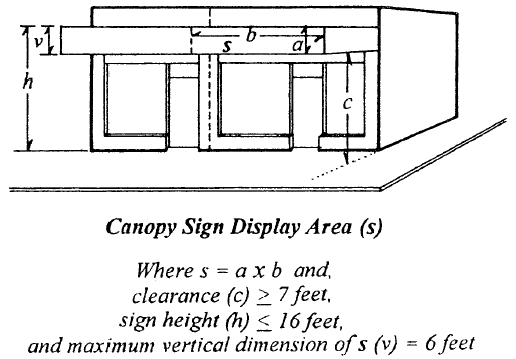
Sign Display Area: Each canopy sign shall be located within a selected sign display area. The canopy sign display area shall be the area of the permitted canopy. The canopy sign display area may be computed using a combination of two (2) adjoining geometric shapes (circles, squares, rectangles, triangles only). The vertical dimensions of the canopy sign display area shall not exceed six feet (6'), except that the zoning administrator may authorize additional vertical dimensions if the area of the canopy sign is less than fifteen percent (15%) of the total area of the canopy and is located more than three hundred feet (300') from a public right of way.
5.
Sign Display Area Limits: The canopy sign display area shall not extend beyond the canopy face on which the sign is located, nor beyond the premises of a particular establishment.
6.
Sign Area: The area of a canopy sign shall not exceed the maximum percentage of sign display area as stated in this subsection B and as specified in section 9-6-8, "Table Of Sign Requirements", of this chapter.
7.
Illumination: Canopy signs may be illuminated subject to the standards in section 9-6-4 of this chapter.
8.
Clearance: A minimum clearance of seven feet (7') shall be provided between finished grade to the lowest point of a canopy sign, but in no instance shall a canopy sign extend below the lowest point of the canopy on which the sign is attached.
9.
Projection: No canopy sign shall project more than twelve inches (12") from the canopy to which it is attached.
10.
Time and Temperature Displays: Time and temperature displays may be incorporated into a canopy sign provided location, area and other technical requirements herein are satisfied.
11.
Message Board Sign: Message board signs shall be permitted when incorporated into a permitted canopy sign subject to all applicable standards, and the following conditions:
a.
No more than fifty percent (50%) of the canopy sign area shall be used as a message board sign.
b.
Lettering used on manual changeable copy signs directed to local or collector streets shall be at least three inches (3") in height.
c.
Lettering used on manual changeable copy signs directed to secondary or major arterial streets shall be at least six inches (6") in height.
d.
Lettering used on manual changeable copy signs directed to pedestrians shall be at least one inch (1") in height.
C.
Freestanding Signs: Where permitted in the table of sign requirements, freestanding development and identification signs shall be permitted subject to the following:
1.
Number: No more than one freestanding sign per street frontage per lot shall be permitted on a lot.
2.
Location: No freestanding signs shall be located closer than ten feet (10') to a front property line, and shall be located as far as possible from any transition side property line:
3.
Height: No freestanding sign shall exceed fifteen feet (15') in height.
4.
Sign Area: No freestanding sign shall exceed the maximum area as specified in section 9-6-8, "Table Of Sign Requirements", of this chapter.
5.
Illumination: Freestanding signs may be illuminated subject to the standards in section 9-6-4 of this chapter.
6.
Time and Temperature Displays: Time and temperature displays may be incorporated into a freestanding sign provided location, area and other technical requirements herein are satisfied.
7.
Message Board Sign: Message board signs shall be permitted when incorporated into a freestanding sign subject to all applicable standards herein, and the following conditions:
a.
No more than fifty percent (50%) of the freestanding sign area provided shall be used as a message board sign.
b.
Lettering used on manual changeable copy signs directed to local or collector streets shall be at least three inches (3") in height.
c.
Lettering used on manual changeable copy signs directed to secondary or major arterial streets shall be at least six inches (6") in height.
d.
Lettering used on manual changeable copy signs directed to pedestrians shall be at least one inch (1") in height.
8.
Distance From Building: No freestanding sign shall be located closer than ten feet (10') to a building, provided that a freestanding sign four feet (4') in height or less may be located as close as three feet (3') from a building.
9.
Decorative Sign Base: All freestanding signs shall be designed and constructed with an integral decorative base constructed of wood, metal, masonry, or stone to conceal the sign's support structure(s) and to visually complement the building materials used on the principal building on the lot. The decorative base shall be equal to at least seventy-five percent (75%) of the width of the sign face. The area of the decorative sign base shall not be computed as part of the sign area. The height of the decorative sign base shall be computed in determining the sign height.
10.
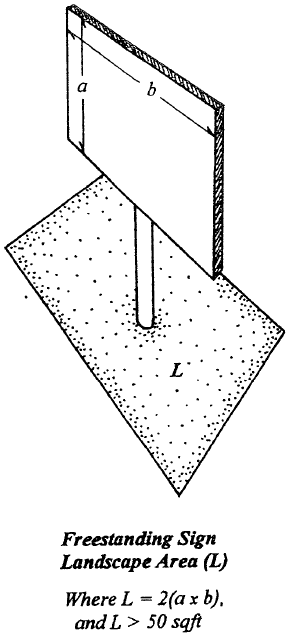
Sign Landscaping: All freestanding signs shall be located in a landscaped area separated and protected from vehicular circulation and parking areas. A minimum of two (2) square feet of landscaping area shall be required for every one square foot of sign face provided, but no freestanding sign landscape area shall be less than fifty (50) square feet in area. Said landscape area shall be landscaped appropriately.
D.
Portable Signs: Where permitted in section 9-6-8, "Table Of Sign Requirements", of this chapter, portable signs shall be permitted subject to the following:
1.
Number: No more than one portable sign shall be permitted on a lot at any one time.
2.
Location: Portable signs shall comply with all location requirements for freestanding signs, with the exception that portable signs may be located closer than one hundred feet (100') from a freestanding sign.
3.
Sign Area: The area of a portable sign shall not exceed fifty (50) square feet.
4.
Duration of Display:
a.
No portable sign shall be displayed for more than thirty (30) consecutive days within one year of occupancy of a building or tenant space.
b.
Portable signs may be displayed only for grand (re)opening sales or celebrations.
E.
Projecting Signs: Where permitted in section 9-6-8, "Table Of Sign Requirements", of this chapter, projecting identification signs shall be permitted subject to the following:
1.
Number: Not more than one projecting sign per establishment shall be permitted on a building wall facing a public street and/or having a public entrance, provided no canopy or roof sign for the establishment is located on the same building wall.
2.
Location: Projecting signs shall be affixed to the wall having the establishment's public entrance and shall not be located beyond the premises of a particular establishment.
3.
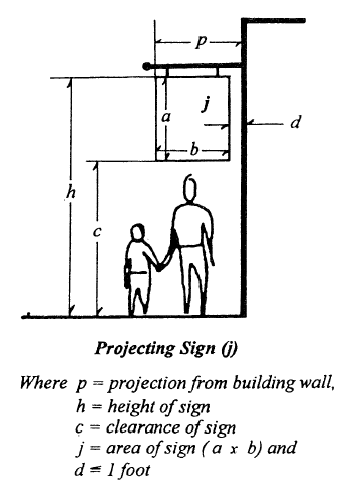
Height: No projecting sign shall extend above the roofline or the highest point of the wall of the building on which it is located or fourteen feet (14') from finished grade, whichever is less.
4.
Sign Area: The area of a projecting sign shall not exceed sixteen (16) square feet.
5.
Illumination: Projecting signs may be illuminated subject to the standards in section 9-6-4 of this chapter.
6.
Clearance: Projecting signs shall provide a minimum clearance of seven feet (7') between the finished grade below the sign to the lowest edge of the sign.
7.
Projection: No projecting sign shall project from the building wall more than six feet (6'). The innermost edge of the projecting sign shall be no more than one foot (1') from the wall of the building to which it is attached. Projecting signs may swing, but all projecting signs shall be permanently attached to the building.
8.
Setback from Curb: No projecting sign shall project within two feet (2') of the curb of a street or driveway.
F.
Roof Signs: Where permitted in section 9-6-8, "Table Of Sign Requirements", of this chapter, business and identification roof signs shall be permitted subject to the following:
1.
Number: Not more than one business and identification roof sign per street frontage per establishment shall be permitted, provided no wall or canopy sign for the same establishment is directed to the same street frontage, except that:
a.
No roof sign shall face a residential lot and shall be at least fifty feet (50') from a public street.
b.
No roof sign shall be allowed for individual tenants in a multi-tenant building or a multi-story building.
2.
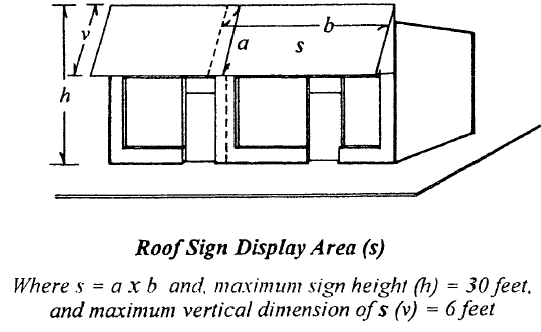
Location: A roof sign shall be located on a decorative mansard, penthouse or other architectural element of a building which extends vertically beyond the roofline, and shall be single faced and be mounted directly vertical as a wall sign, with no visible angle iron, guywires, braces or secondary supports and all hardware concealed. A roof sign shall be displayed parallel to the eave line of the roof to which it is attached, or parallel to the penthouse or architectural element above the roofline to which it is attached, and shall face a public street.
3.
Height: The maximum height of a roof sign shall be thirty feet (30') from finished grade or two (2) stories, whichever is less.
4.
Sign Display Area: Each roof sign shall be located within a selected sign display area. The roof sign display area shall be the area of the permitted roof, mansard, penthouse or other architectural element of a building that extends vertically above the roofline. The roof sign display area may be computed using a combination of two (2) adjoining geometric shapes (circles, squares, rectangles, triangles only). The vertical dimensions of the roof sign display area shall not exceed six feet (6'), except that the zoning administrator may authorize additional vertical dimensions if the area of the roof sign is less than fifteen percent (15%) of the total area of the roof and is located more than three hundred feet (300') from a public right of way.
5.
Sign Display Area Limits: The roof sign display area shall not extend beyond the dimensions of the mansard, penthouse or architectural element on which the sign is located, or beyond the premises of a particular establishment.
6.
Sign Area: The area of a roof sign shall not exceed the maximum percentage of sign display area as stated in this subsection F and as specified in section 9-6-8, "Table Of Sign Requirements", of this chapter.
7.
Illumination: Projecting signs may be illuminated subject to the standards in section 9-6-4 of this chapter.
G.
Temporary Signs: Where permitted in section 9-6-8, "Table Of Sign Requirements", of this chapter, awning, canopy, roof and wall temporary signs shall be permitted subject to the following:
1.
Number: Except for grand openings provided in subsection 9-6-9.C of this chapter, not more than one temporary sign shall be permitted per street frontage.
2.
Location: Temporary signs shall comply with all location requirements for awning, canopy, roof and wall signs.
3.
Height: Temporary signs shall comply with the height requirements for awning, canopy, roof and wall signs.
4.
Sign Area: No freestanding temporary sign shall exceed thirty-two (32) square feet in area and eight feet (8') in height. No temporary sign attached to an awning, canopy, roof or wall shall exceed sixty (60) square feet in area.
5.
Illumination: Temporary signs shall not be illuminated.
6.
Duration of Display:
a.
Except for grand openings provided in subsection 9-6-9.C of this chapter, temporary signs shall be permitted for no more than fourteen (14) consecutive days, provided that temporary signs displayed in connection with a grand opening may be displayed for no more than thirty (30) consecutive days.
b.
Temporary signs shall not be displayed more than four (4) times in any one calendar year by an establishment on a lot.
H.
Wall Signs: Where permitted in section 9-6-8, "Table Of Sign Requirements", of this chapter, business and identification wall signs shall be permitted subject to the following:
1.
Number: Not more than one business and identification wall sign per street frontage or per building wall having a public entrance per establishment shall be permitted, provided no canopy or roof sign for the same establishment is directed to the same street frontage, except that:
a.
Not more than one business or identification wall sign may be permitted on walls not facing a street or having a public entrance, provided the wall does not face a residential lot and is at least fifty feet (50') from the nearest property line or another building on the lot.
b.
No wall signs shall be allowed for individual tenants in a multi-story or a multi-tenant building having no exterior building entrance for each tenant.
2.
Location: Wall signs shall be affixed only to a wall having the establishment's public entrance or a wall facing a public street.
3.
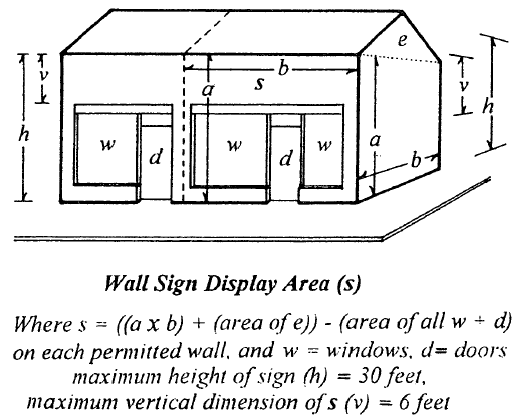
Height: The maximum height of a wall sign shall be thirty feet (30') from finished grade or two (2) stories, whichever is less.
4.
Sign Display Area: Each wall sign shall be located within a selected sign display area. The sign display area shall be the area of the permitted wall or walls less the area of said wall occupied by windows, doors, canopies, awnings and roofs. The wall sign display area may be computed using a combination of two (2) adjoining geometric shapes (circles, squares, rectangles, triangles only). The vertical dimensions of the wall sign display area shall not exceed six feet (6') except that the zoning administrator may authorize additional vertical dimensions if the area of the wall sign is less than fifteen percent (15%) of the total area of the wall and is located more than three hundred feet (300') from a public right-of-way.
5.
Sign Display Area Limits: The wall sign display area shall not extend above the roofline or the wall of a building or beyond the premises of a particular establishment in the building.
6.
Sign Area: The total area of all wall signs per wall shall not exceed the maximum percentage of sign display area as stated in this subsection H and as specified in section 9-6-8, "Table Of Sign Requirements", of this chapter. The sign area is in addition to any other sign types on the premises.
7.
Illumination: Wall signs may be illuminated subject to the standards in section 9-6-4 of this chapter.
8.
Time and Temperature Displays: Time and temperature displays may be incorporated into a wall sign if location, area and other technical requirements herein are satisfied.
9.
Message Board Sign: Message board signs may be displayed when incorporated into a wall sign subject to all applicable standards herein, and the following conditions:
a.
No more than fifty percent (50%) of the area of the wall sign displayed shall be used as a message board sign.
b.
Lettering used on manual changeable copy signs directed to local or collector streets shall be at least three inches (3") in height.
c.
Lettering used on manual changeable copy signs directed to secondary or major arterial streets shall be at least six inches (6") in height.
d.
Lettering used on manual changeable copy signs directed to pedestrians shall be at least one inch (1") in height.
I.
Window Signs: Where permitted in section 9-6-8, "Table Of Sign Requirements", of this chapter, business and identification signs may be painted, affixed or applied to the interior of window glass, shall be subject to the following:
1.
Location: Window signs may be displayed only in windows facing a public street, or in windows in a wall having a public entrance.
2.
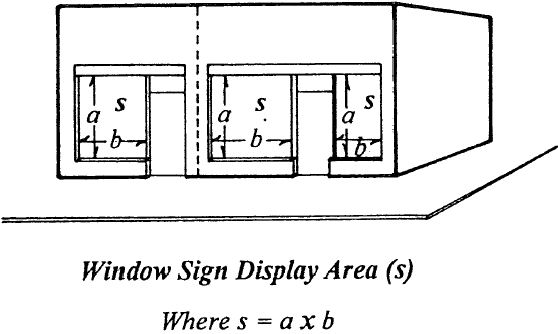
Sign Display Area: Each window sign shall be located within a selected sign display area. The window sign display area shall be the exterior glass surface area of all permitted windows, but excluding doors and superficial borders or trim.
3.
Sign Display Area Limits: The sign display area for window signs shall not extend beyond the window surface on which the sign is located, nor beyond the premises of a particular establishment.
4.
Sign Area: The area of an window sign shall not exceed the maximum percentage of sign display area as specified in section 9-6-8, "Table Of Sign Requirements", of this chapter.
5.
Illumination: Window signs may be illuminated subject to the standards in section 9-6-4 of this chapter. (Ord. 2004-10, 3-22-2004, eff. 3-22-2004)
9-6-8. - Table of sign requirements.
A.
All signs permitted in the town shall be erected in accordance with the specifications set forth in the following table by street classification:
Table 1. Sign Requirements By Street Classification
Where, P = Permitted. Consult regulations for temporary signs for specific maximum area requirements.
(Ord. 2004-10, 3-22-2004, eff. 3-22-2004)
9-6-9. - Special signs.
In addition to the foregoing, the following signs shall be permitted subject to the following:
A.
Gasoline Stations, Service Stations and Minimarts: Each gasoline station, service station or minimart shall be allowed:
1.
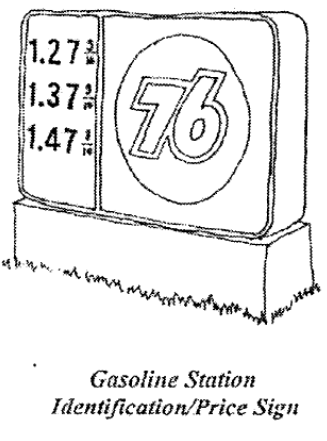
One freestanding sign per street frontage. Gasoline price signs shall be integrated into the freestanding sign.
2.
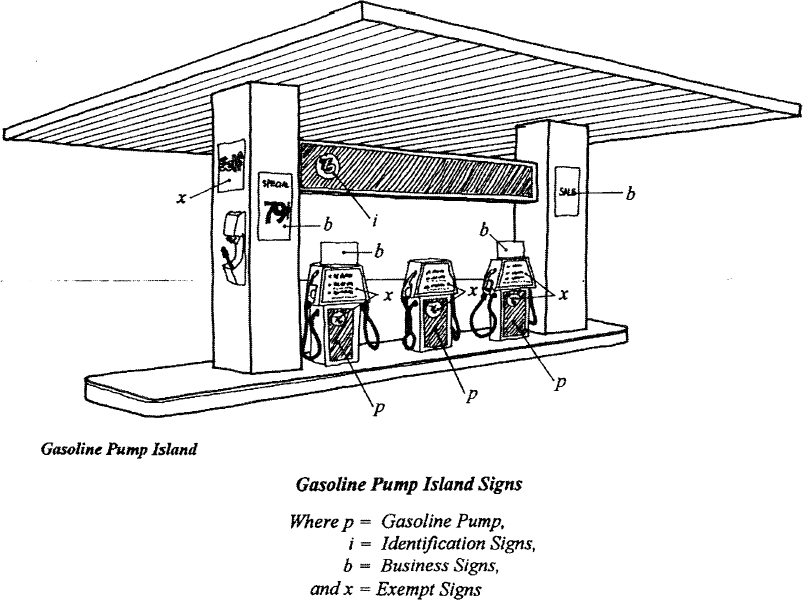
Business signs at each pump island, the total area of which at each pump island shall not exceed four (4) square feet per gasoline pump. No such sign may be located more than eight feet (8') abovegrade and each such sign shall not exceed three (3) square feet in area. For the purposes of this section, a pump is the aboveground equipment used to dispense and measure multiple grades of gasoline for full service or self-service use of the customer and may have one or more pump nozzles attached thereto for dispensing fuel to up to two (2) cars at one time.
3.
Identification signs at each pump island, the total area of which shall not exceed six feet (6') square feet per gasoline pump at said pump island, and no such sign shall exceed fourteen (14) square feet.
4.
Business and identification signs located at the pump island shall not be illuminated.
5.
For the purpose of this section, a "pump island" shall mean one or more pumps arranged in a row. More than one pump island may be located under a protective canopy or other roof like structure.
B.
Motor Vehicle and Recreational Vehicle Dealership:
1.
Each such dealership shall be allowed a second freestanding development sign only if the lot is used for both new and preowned vehicles, or if two (2) or more makes or product lines are offered for sale on the same lot. No more than two (2) such signs shall be allowed: one identifying the new vehicle product line, and one identifying preowned vehicles or the sale of a second vehicle product line. Each sign shall otherwise conform to the height, area and location requirements, herein.
2.
Notwithstanding the provisions of subsection 9-6-3B of this chapter, each such dealership may display pennants or streamers on the lot provided same are kept in good appearance.
C.
Grand Opening Signs: Portable and temporary signs shall be permitted for grand opening promotions and business anniversaries, subject to the following:
1.
Portable Signs:
a.
Number: No more than one portable sign shall be permitted on a lot at any one time.
b.
Location: Portable signs shall comply with all location requirements for freestanding signs, with the exception that portable signs may be located closer than one hundred feet (100') from a freestanding sign.
c.
Sign Area: The area of a portable sign shall not exceed fifty (50) square feet.
d.
Illumination: Portable signs may be illuminated subject to the standards in section 9-6-4 of this chapter.
2.
Temporary Signs:
a.
Number: Except flags, pennants and streamers, the maximum number of temporary signs shall not exceed the number of awning, canopy, freestanding, roof, and wall signs displayed on the premises.
b.
Sign Area: No temporary sign attached to a freestanding sign shall exceed thirty-two (32) square feet in area and eight feet (8') in height. No temporary sign attached to a wall, canopy, or awning shall exceed sixty (60) square feet in area and shall conform to the sign display area limits for such awning, canopy and/or wall signs.
c.
Location: Temporary signs shall comply with all location requirements for awning, canopy, freestanding, roof, and wall signs.
d.
Illumination: Temporary signs may not be illuminated.
3.
Duration of Display:
a.
No portable and/or temporary sign(s) used for advertising a grand opening of a new business shall be displayed for more than one period of time not exceeding thirty (30) consecutive days within a calendar year and shall be displayed only within one year of new occupancy of a building or tenant space.
b.
All portable and temporary signs used for advertising a grand (re)opening of a new business or a business anniversary shall be displayed simultaneously.
c.
Portable signs may be displayed only for grand (re)opening promotions or business anniversaries.
4.
Searchlights: Searchlights may be used in connection with a grand opening display provided the light beacons are directed more than forty-five degrees (45°) skyward and are not operated between the hours of 11:00 p.m. and 7:00 a.m.
D.
Advertising Signs:
1.
Number: Not more than one advertising sign per street frontage per lot shall be permitted.
2.
Area and Height: The area and height of advertising signs shall not exceed the maximum specified for undeveloped land in section 9-6-8, "Table Of Sign Requirements", of this chapter.
3.
Distance to Residential Lots: No advertising sign shall be located closer than one hundred (100) yards to a residential zoning lot.
4.
Distance Between Signs: No advertising sign shall be located closer than one hundred feet (100') to another freestanding sign on the same lot.
5.
Setback: No advertising signs shall be located closer than ten feet (10') to any right of way line or closer than seventy five feet (75') to any side lot line.
6.
Unimproved Property: Advertising signs shall be permitted only on unimproved property.
7.
Property is Improved: Advertising signs shall be removed at such time the lot on which they are located is improved.
8.
Illumination: Advertising signs shall not be illuminated.
E.
Marquee Signs:
1.
Marquees shall be designed and specified by a registered structural engineer or registered architect and shall be subject to approval by the Cortland building official.
2.
Marquees shall be supported solely by the building to which they are attached; no columns or posts shall be permitted as supports. Marquees shall be designed to provide unobstructed flow of pedestrian traffic along any sidewalk.
3.
No marquee shall project within two feet (2') of the curb of any street, alley or driveway. (Ord. 2004-10, 3-22-2004, eff. 3-22-2004)
F.
Public Buildings:
1.
Number: One freestanding sign per street frontage where the public building has frontage on more than one public street, or no more than two (2) freestanding signs may be erected on only one street frontage.
2.
Location: No freestanding signs shall be located closer than ten feet (10') to a front property line, and shall be located as far as possible from any transition side property line.
3.
Height: No freestanding sign shall exceed fifteen feet (15') in height.
4.
Sign Area: No freestanding sign shall exceed the maximum area as specified in section 9-6-8 of this chapter, the table of sign requirements.
5.
Illumination: Freestanding signs may be illuminated subject to the standards in section 9-6-4 of this chapter.
6.
Time and Temperature Displays: Time and temperature displays may be incorporated into a freestanding sign provided location, area and other technical requirements herein are satisfied.
7.
Message Board Sign: Message board signs shall be permitted when incorporated into a freestanding sign subject to all applicable standards of this chapter and the following conditions:
a.
No more than one message board shall be permitted on a lot, regardless of the number of street frontages or freestanding signs permitted.
b.
No more than seventy-five percent (75%) of the freestanding sign area provided shall be used as a message board sign.
c.
Lettering used on manual changeable copy signs directed to local or collector streets shall be at least three inches (3") in height.
d.
Lettering used on manual changeable copy signs directed to secondary or major arterial streets shall be at least six inches (6") in height.
e.
Lettering used on manual changeable copy signs directed to pedestrians shall be at least one inch (1") in height.
8.
Distance from Building: No freestanding sign shall be located closer than ten feet (10') to a building, provided that a freestanding sign four feet (4') in height or less may be located as close as three feet (3') from a building.
9.
Decorative Sign Base: All freestanding signs shall be designed and constructed with an integral decorative base constructed of wood, metal, masonry, or stone to conceal the sign's support structure(s) and to visually complement the building materials used on the principal building on the lot. The decorative base shall be equal to at least seventy-five percent (75%) of the width of the sign face. The area of the decorative sign base shall not be computed as part of the sign area. The height of the decorative sign base shall be computed in determining the sign height.
10.
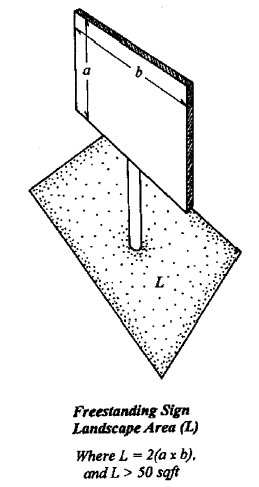
Sign Landscaping: All freestanding signs shall be located in a landscaped area separated and protected from vehicular circulation and parking areas. A minimum of two (2) square feet of landscaping area shall be required for every one square foot of sign space provided, but no freestanding sign landscape area shall be less than fifty (50) square feet in area. Said landscape area shall be landscaped appropriately.
(Ord. 2007-40, 11-26-2007)
9-6-10. - Nonconforming signs.
A.
Authority to Continue: Subject to the elimination and termination provisions hereinafter set forth, any sign lawfully existing on March 1, 2004, may be continued so long as it complies with the applicable provisions of this code.
B.
Repairs, Alteration, Expansion, Moving: The owner or beneficial user of any nonconforming sign shall maintain such sign in good condition and repair provided that such sign shall not be changed or altered in any manner which would increase the degree of its nonconformity; shall not be changed to another nonconforming sign; shall not be expanded; shall not be structurally altered to prolong its useful life; or shall not be moved in whole or part in any other location where it would remain nonconforming.
C.
Exception for Repairs Pursuant to Public Order: Nothing in this section shall be deemed to prevent the strengthening or complying with a reasonable order of a public official who is charged with protecting the public safety and who declares such a sign to be unsafe and orders its restoration to a safe condition, provided such restoration is not otherwise in violation of the various provisions of this section prohibiting the repair or restoration of partially damaged of destroyed structures.
D.
Termination of Nonconforming Signs:
1.
Immediate Termination: Any sign or sign feature prohibited by section 9-6-3 of this chapter shall be terminated within thirty (30) days after the effective date of this chapter by removal of the sign or by alteration of the sign to eliminate the specified nonconforming feature.
2.
Termination by Abandonment: Any nonconforming sign, the use of which is discontinued for a period of sixty (60) days, shall be presumed abandoned and shall not thereafter be reestablished. Any period of such discontinuance caused by government actions, strikes, material shortages or acts of God, and without any contributing fault by the nonconforming user shall not be considered in calculating the length of discontinuance for purpose of this section.
3.
Termination by Change of Business: Any nonconforming sign advertising or relating to a business on the premises on which it is located shall be terminated upon any change in the nature, ownership or control of the business; provided, however, such termination shall be required if there is no change in the name or manner in which the business is conducted and such change, ownership control does not require the modification or alteration of any existing sign.
4.
Termination by Damage or Destruction: Any nonconforming sign damaged or destroyed, by any means, to the extent of thirty-five percent (35%) of its replacement cost new shall not be restored but shall be terminated. (Ord. 2004-10, 3-22-2004, eff. 3-22-2004)
9-6-11. - Zoning certificate requirements.
A.
Certificate Required: Except for those signs enumerated in section 9-6-5 of this chapter, no sign shall be erected, enlarged, expanded, altered or relocated unless a zoning certificate evidencing the compliance of such sign with the provisions of this chapter and other applicable provisions of this title shall have been first issued in accordance with the provisions of subsection B of this section.
Routine sign maintenance, changing of parts designed for change or changing the content of a sign in any manner which does not change the functional classification of the sign shall not, standing alone, be considered an alteration of the sign requiring issuance of a zoning certificate, unless such change of parts or content relates to or is occasioned by a change in the ownership or nature of the activity to which the sign relates or to the nature of the activity which is conducted on the premises on which the sign is located.
B.
Zoning Certificate Application Requirements: Application for a zoning certificate for a sign shall be filed with the zoning administrator upon forms provided by the town. Every application for zoning certificate for a sign shall be accompanied by the following, as needed:
1.
A copy of plans and specifications showing the method of construction, illumination, if any, and support of such sign. Calculations showing the sign is designed for dead load and wind pressure in any direction in the amount required by other applicable laws and ordinances of the town may be required.
2.
An accurate plan showing the location of the sign(s) on the lot and a drawing indicating the location of the sign(s) on any building or structure on the lot.
3.
A sketch, drawn to scale, showing sign faces, exposed surface areas and the proposed message and design, accurately represented as to size, area, proportion and color.
4.
The written consent of the owner(s) or agent of the building, structure, or land on which the sign is erected.
5.
An insurance policy or bond as required by subsection C of this section. (Ord. 2004-10, 3-22-2004, eff. 3-22-2004)
C.
Bond Requirements: Every applicant for a sign permit shall, before the permit is granted, file with the zoning administrator a continuing bond in the penal sum of ten thousand dollars ($10,000.00), executed by the applicant and a surety company to be approved by the town president/mayor and conditioned for the faithful observance of the provisions of this chapter, and all amendments thereto, and all laws and ordinances relating to signs and which shall indemnify and save harmless the town of Cortland from any and all damages, judgments, costs or expenses which said town may incur or suffer by reason of the granting of the said permit. A liability insurance policy, in an amount not less than one million dollars ($1,000,000.00) issued by an insurance company authorized to do business in the state of Illinois, conforming to this section may be permitted in lieu of a bond. The requirements of this subsection shall not apply to temporary signs. (Ord. 2004-10, 3-22-2004, eff. 3-22-2004; amd. Ord. 2014-05, 7-28-2014)
D.
Permit Fees: The fee to be charged for permits for the construction or erection of any sign, except those enumerated in section 9-6-5 of this chapter shall be as determined by the town board and amended from time to time. (Ord. 2004-10, 3-22-2004, eff. 3-22-2004)
E.
Revocation of Permit: All rights and privileges acquired under the provisions of this chapter, or any amendments thereto, are mere licenses revocable at any time by the majority of the town president/mayor and town board, and all such permits shall contain this provision. (Ord. 2004-10, 3-22-2004, eff. 3-22-2004; amd. Ord. 2014-05, 7-28-2014)

