
Crockett City Zoning Code
ARTICLE 1
- TITLE, PURPOSE, APPLICATION AND DEFINITIONS
Section 101. - Title.
This ordinance, in accordance with the authority granted in the legislature of the State of Texas in the V.T.C.A. Local Government Code, Ch. 211, shall be known and may be cited as the Crockett zoning ordinance.
(Ord. No. O-02-26, § I, 2-2-26)
Section 102. - Purpose.
Zoning and district regulations and related standards are herein established in accordance with the City's comprehensive plan adopted by the city council in accordance with V.T.C.A. Local Government Code, Ch. 213, for the purpose of promoting the sound long-range development of the city and promoting public health, safety, and welfare. In addition, the regulations and standards contained herein are designed to encourage the most appropriate uses of land and capital improvements; to maintain and stabilize the value of property; to reduce fire hazards, to provide adequate light and air; to decrease traffic congestion and its accompanying hazards; to prevent the overcrowding of land to avoid undue concentration of population; to effectively and fairly regulate land use activities which are not in conformance with this ordinance; and to facilitate the adequate provision of water supply, sewers, energy use and distribution, transportation, schools, parks, public utilities, and other public requirements.
(Ord. No. O-02-26, § I, 2-2-26)
Section 103. - Application of the zoning ordinance.
This ordinance classifies and regulates the use of land and structures within the city limits of Crockett, as hereinafter set forth. Except as hereinafter provided, no land may be used and no structure may be erected, constructed, moved, altered, enlarged, or rebuilt unless it will be used and maintained in accordance with the requirements established for the district in which the structure is to be located, and in accordance with the provisions of the articles within this ordinance as they pertain to districts.
The city recognizes that new types of land and structure use will develop, and it is not possible for the city to anticipate every conceivable use. Zoning text amendments to add a new use to a zoning district classification may be requested and considered in accordance with the process established in section 605 of this ordinance.
(Ord. No. O-02-26, § I, 2-2-26)
Section 104. - Definitions.
A.
For the purpose of these regulations, words used in the present tense include the future tense; words used in the singular number include the plural; and words in the plural include the singular, except where the natural and obvious construction of the writing indicates otherwise; the words "building" and "structure" are synonymous; the words "primary" and "principal" are synonymous; and the words "lot", "plot" and "tract" are synonymous. The word "may" is not discretionary unless the context in which it is used indicates otherwise. The words "must" and "shall" are mandatory in every instance.
B.
Undefined terms. Terms not defined in this section have the meanings assigned to them in the city building codes. Terms not defined in this section or in the building codes have the customary meaning assigned to them with Webster's Dictionary (latest edition) to be used as a resource for determining the meaning.
C.
For purposes of this ordinance, certain terms and words are to be used and interpreted as defined hereinafter. Should any definition established by ordinance be later found to conflict with the definition of the same term made by applicable Texas law, the Texas statutory definition will supersede the definitions herein.
Accessory building: (See definition for "Building, accessory.")
Accessory dwelling unit: (See section 312.)
Accessory use: A use that is customarily incidental, appropriate and subordinate to the main or principal use of land or buildings located upon the same premises.
Agricultural activity: The use of land for producing crops or other activities normally associated with the production of commercial crops. (See "Animal business" definition for commercial livestock operations.)
•
Crop: Includes a shrub, vine, tree, seedling, shoot, slip, or other plant capable of producing food, fiber, medicine, nursery stock, floral products, or aesthetic beauty (V.T.C.A. Agriculture Code, § 252.001).
Alley: A public passage or way affording a secondary means of vehicular access to abutting property and not intended for general traffic circulation.
Amusement arcade (also video arcade): Any building, room, place or establishment of any nature or kind, and by whatever name called, where any percentage of the public floor area is devoted to six (6) or more amusement devices that are operated for a profit, whether the same is operated in conjunction with any other business or not, including, but not limited to, such amusement devices as coin-operated pinball machines, video games, electronic games, shuffle boards, or other similar amusement devices. However, the term "amusement device", as used herein, shall not include amusement redemption machines, musical devices, billiard tables which are not coin-operated, machines that are designed exclusively for small children, devices designed to train people in athletic skills or golf, tennis, baseball, archery or other similar sports. Does not include an amusement redemption machine establishment (see "Amusement redemption machine establishment" definition) or pool hall (see "Pool hall" definition).
Amusement, commercial - indoor: An amusement enterprise that is wholly enclosed within a building which is treated acoustically so that noise generated by the enterprise is not perceptible at the bounding property line, and that provides activities, services and/or instruction for the entertainment of customers or members, but not including amusement arcades, amusement redemption machine establishments, live entertainment venues, or pool halls. Uses may include, but are not limited to, the following: bowling alley, skating rink, martial arts club, racquetball/handball club, indoor tennis courts/club, indoor swimming pool or scuba diving facility, museums, and other similar types of uses.
Amusement, commercial - outdoor: An amusement enterprise offering entertainment and/or games of skill to the general public for a fee wherein any portion of the activity takes place outdoors. Includes, but is not limited to, an archery range, batting cages, go-cart tracks, golf course, golf driving range, miniature golf course, amusement parks, petting zoo/animal exhibition, and other similar types of uses. Does not include live entertainment venues or theaters. Specific regulations for outdoor commercial amusement use in the agriculture-residential district are set forth in section 201.1.
•
Archery range: A recreational facility designed and constructed for the practice and teaching of archery, and operated by a public agency, quasi-public or private organization. No discharge of firearms permitted.
Amusement redemption machine and amusement redemption machine establishment: See article XIII, chapter 13, of the Crockett Code.
Animal business: A business involving the breeding, care, treatment, or sale of animals or animal products, including a veterinary practice, if the person operating that business holds a license for the business that is issued by the federal government or state; does not include pet shop (V.T.C.A. Local Government Code, § 229.901). [Source for required licenses: Current Texas Business Licenses and Permits Guide published by the Business Permit Office within the Texas Economic Development and Tourism Office in the Office of the Governor.]
Antiques shop: A retail establishment engaged in the selling of works of art, furniture and/or other artifacts from an earlier period with all sales and storage occurring inside a building.
Apartment building: (See "Dwelling, multi-family" definition.)
Appliance sales/servicing shop: A commercial establishment providing retail sales and repairs of household and home equipment designed to perform a specific household task, such as dishwashers, clothes washers and dryers, ovens, refrigerators and similar items.
Art studio: An artist's workroom for the purpose of painting, pottery, sculpture, woodworking, scrapbooking, photography, graphic design, filmmaking, animation, industrial design, and other arts and for the purpose of displaying such works for retail sales and for the retail sale of related supplies as an incidental use.
Assembly/manufacturing/production establishment: Establishments engaged in the assembly, manufacturing, production or transformation of materials into new products. These establishments are usually described as plants and factories and characteristically use power-driven machines and materials handling equipment. Assembly/manufacturing production is usually executed for the wholesale market, rather than for direct sales to the domestic consumer.
•
Light assembly/manufacturing/production establishment: An assembly/manufacturing/production practice that does not use capital-intensive machinery or production equipment and typically produces goods targeted at the end consumers such as clothes, shoes, electronics, toys, jewelry, leather goods, metal/paper/plastics/wood products, food products, solar panels, or other fast-moving consumer goods. May include a factory outlet retail or wholesale store for the sales and servicing of goods or materials on the same premises as the assembly/manufacturing company to which they are related, including sales and service, in a separate building or buildings.
•
Heavy assembly/manufacturing/production establishment: An assembly/manufacturing/production practice that uses capital and energy-intensive machinery to typically produce large and complex products and/or goods that are used by other businesses in producing other products, such as raw materials, machinery, and equipment. Examples include, but are not limited to, cement, concrete, lime and gypsum manufacturing, chemical manufacturing, leather tanning and refinement facilities, wood products, and paper manufacturing plants.
Auction sales: A business enterprise primarily engaged in the sale of new or used goods sold to the highest bidder where the operations are wholly enclosed within a building. The definition does not include the sale or trade of animals or other livestock (see "Animal businesses").
Auto parts and accessory sales store: The use of any building or other premises for the primarily indoor display and sale of new or used parts for automobiles, panel trucks or vans, trailers, or recreation vehicles.
Automobile: A self-propelled mechanical vehicle designed for use on streets and highways for the conveyance of goods and people including, but not limited to, the following: passenger cars, light duty trucks, sport utility vehicles, vans and mini-vans, motor scooters, and motorcycles.
Automobile laundry: See "Car wash" definition.
Automobile rentals: Indoor/outdoor storage and leasing/renting of automobiles, motorcycles, and light load trucks.
Automobile repair:
•
Major: General repair or reconditioning of engines, air conditioning systems and transmissions for motor vehicles; wrecker service; collision repair services including body, frame or fender straightening or repair; customizing; painting; vehicle steam cleaning; undercoating and rustproofing; the uses listed under "automobile repair, minor," and other similar uses.
•
Minor: Minor repair or replacement of parts, tires, tubes, and batteries; diagnostic services; minor motor services such as grease, oil, spark plug, and filter changing; tune-ups; emergency road service; replacement of starters, alternators, hoses, and brake parts; automobile washing and polishing; performing state inspections and making minor repairs necessary to pass said inspection; normal servicing of air conditioning systems, and other similar minor services for light road vehicles, but not including any operation named under the definition of "automobile repair-major" or any other similar use. Includes quick oil change facilities and quick tune-up facilities.
Automobile sales:
•
New: Retail sales of new automobiles or light-load vehicles, including, as a minor part of the business, the sales of used automobiles or light-load vehicles and the service of new or used vehicles.
•
Used: Retail sales, or offering for sale, of used automobiles or light load vehicles.
Automobile salvage or wrecking yard: An outdoor place where a person stores three (3) or more vehicles for the purpose of dismantling or wrecking the vehicles to remove parts for sale or for use in automotive repair or rebuilding (V.T.C.A. Transportation Code, Ch. 396).
Automobile service station: Any building, land area, or other premises, or portion thereof, used, or intended to be used, for the retail dispensing, sale or offering for sale of any automobile fuels, oils or accessories including lubrication of automobiles and minor automobile repairs.
Bail bond business: The solicitation, negotiation, or execution of a bail bond by a bail bond surety as defined under V.T.C.A. Occupations Code Ch. 1704, as amended.
Bakery shop (retail): A retail location where more than fifty (50) percent of sales made are sales of bakery items sold from a display case or counter and consumed off the premises. Bakery items include bread, rolls, buns, biscuits, bagels, croissants, pastries, doughnuts, Danish pastries, cakes, tortes, pies, tarts, muffins, bars, cookies, tortillas, and/or similar items. The term does not include candy, snack items, sandwiches, tacos, or pizzas. (Tex. Admin. Code, Title 34, Part 1, Ch. 3, Subchapter O, Rule 3.293.)
Bank/financial institution: An establishment for the custody, loan, exchange or issue of money, the extension of credit, and/or facilitating the transmission of funds.
Barber shop/beauty shop: A personal services shop where the practice of barbering or cosmetology as described in the V.T.C.A. Occupations Code Ch. 1603, Regulation of Barbering and Cosmetology, is performed or offered to be performed for compensation, except when such place is duly licensed as a barber or cosmetology school or college.
Barndominium: See section 313.
Bed and breakfast: See section 307.
Bicycle shop: A retail establishment that specializes in selling bicycles, bicycle parts, and accessories including, but not limited to, tools, helmets, clothing, and shoes. Facilities may also be used to offer basic repair services for bicycles, bicycle parts and equipment.
Block: A piece or parcel of land entirely surrounded by public highways, streets, streams, railway rights-of-way, parks, etc., or a combination thereof. The planning and zoning commission is the city's authority as to a determination of questions regarding the limits or extent of a block.
Board of adjustment: The officially designated municipal body appointed by the city council and authorized by the V.T.C.A. Local Government Code, § 211.008, with the composition, powers and duties set forth in article 7 of this zoning ordinance.
Body art studio (also known as a tattoo studio or body piercing studio): An establishment whose principal business activity, either in terms of operation or as held out to the public, is the practice of one (1) or more of the following: placing of designs, letters, figures, symbols, or other marks upon or under the skin of any person, using ink or other substances that result in the permanent coloration of the skin by means of the use of needles or other instruments designed to contact or puncture the skin; or the creation of an opening in the body of a person for the purpose of inserting jewelry or other decoration. The establishment must have a current license issued by the Texas Department of State Health Services to operate the studio, with the license prominently displayed in the studio. This definition does not include ear piercing.
Bottling plant: A commercial specialized facility fitted with bottling machinery that provides the service of filling empty containers with the desired product and performing other needed services to prepare that product to be shipped to customers.
Brewery: A place where beer is produced.
Building: Any structure intended for shelter, housing or enclosure of persons, animals or property. When separated by dividing walls without openings, each portion of the separated structure is considered to be a separate building.
•
Building, accessory - business or industry: On non-residential property, a detached, subordinate building to the main building that is used for purposes accessory and incidental to the main use (see "Accessory use").
•
Building, accessory - residential: On residential property, a subordinate building that is detached and is used for a purpose that is customarily incidental to the primary dwelling structure and is not an accessory dwelling unit. Examples may include, but are not limited to, the following: a private garage for automobile indoor storage, tool shed, greenhouse as a hobby, home workshop, children's playhouse, indoor storage building, garden shelter, boathouse, etc.
•
Building, main or primary: A building in which the principal use of the lot on which it is situated is conducted. On residential property, the permitted dwelling other than an accessory dwelling unit will be a main or primary building.
Building area: That portion of a lot upon which buildings may be placed, excluding required yards and limited by the maximum building coverage as specified for each zoning district.
Building coverage: The percentage of the lot area covered by the building, excluding all overhanging roofs.
Building height: The vertical distance from the average line of the highest and lowest points of that portion of the lot covered by the building to the highest point of the coping of a flat roof, or the deck line of a mansard roof, or to the average height of the highest gable of a pitch or hip roof.
Building lines: The lines established on a lot, behind which a building can be constructed and in front of which are the unoccupied front, side, and rear yards.
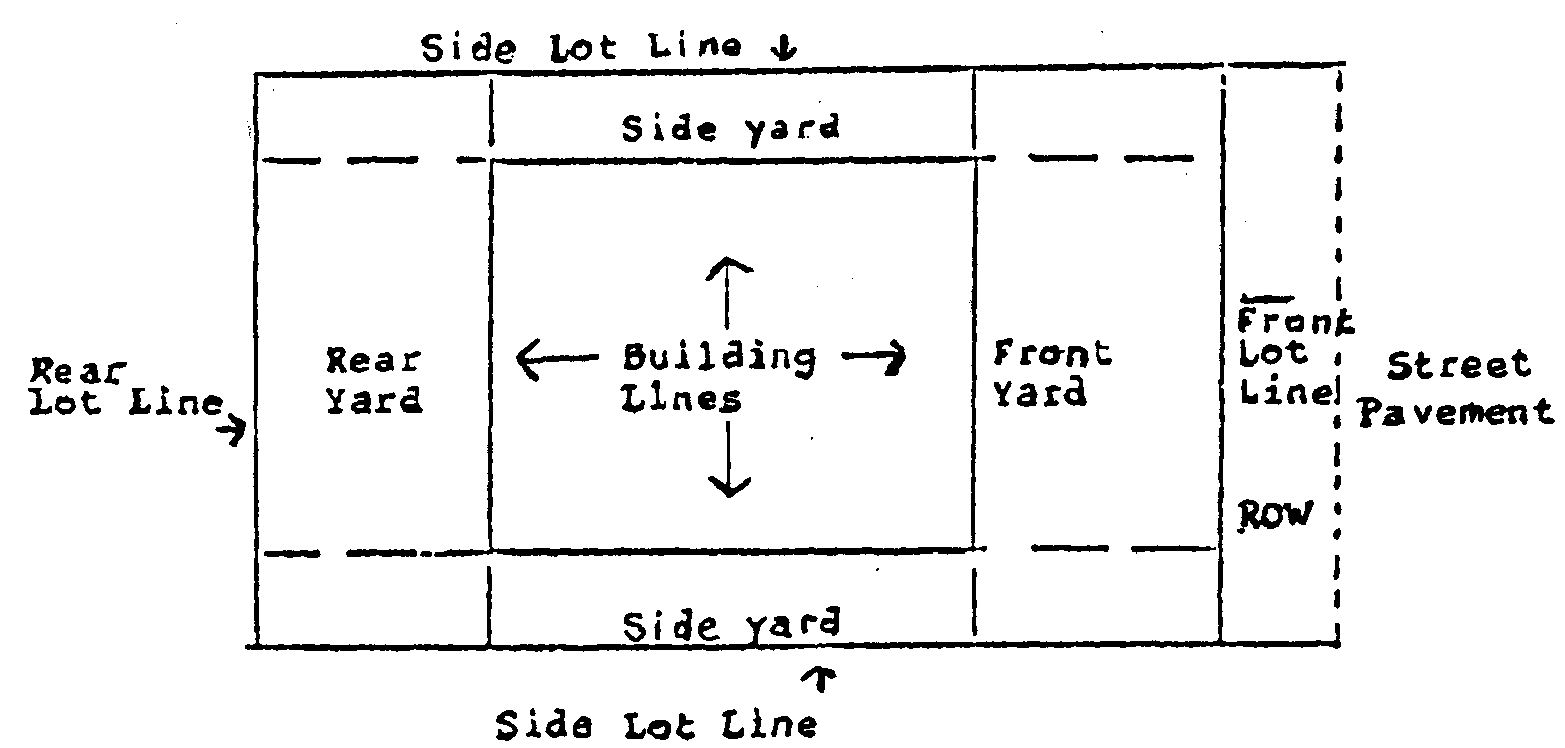
Example 1—Building Lines and Setbacks for Front, Side and Rear Yards
Building material and home supply store: A commercial establishment offering lumber, building supplies, tools, home improvement materials and related items for retail and wholesale sales (e.g., to building contractors). May be indoor storage only or include outdoor storage behind a solid screening wall or include a lumber yard for the outdoor storage and sale of cut lumber and associated building materials.
Building site: A single parcel of land occupied or intended to be occupied by a building or structure.
Bus passenger station: Any premises for the transient housing or parking of motor-driven buses and the loading and unloading of passengers.
Business office: See "Offices, professional and general business."
Campground: A recreational area or tract of land that retains an open-air or natural character and on which accommodations for temporary overnight occupancy are located or may be placed along with related accessory buildings (e.g., office building), private facilities (e.g., laundry facilities, showers and restrooms), and recreational facilities/equipment for client use only. The overnight accommodations may include cabins, recreational vehicles, tents, or yurts or similar accommodations. The campground area may rise to or include a glamping area, which is a blend of "glamorous" and "camping" and describes a style of camping with amenities not usually associated with "traditional" camping, such as wi-fi and public utilities. A glamping area may have a variety of permanent structures for overnight accommodation such as cabins and yurts or other accommodations and facilities and accessory buildings more luxurious than those associated with traditional camping. The area is used for temporary leisure, recreational or study purposes and provides opportunities for the enjoyment or appreciation of the natural environment. A campground may be operated as a commercial enterprise.
Capital improvement: The addition of a permanent structural change or the restoration of some aspect of a property, which will either enhance the property's overall value, prolong its useful life, or adapt it to new uses.
Car wash:
•
Attended: The owner of the vehicle does not actually wash the vehicle. Instead, he either leaves the vehicle and comes back to retrieve it later, or he waits in a designated area while employees of the car wash facility vacuum, wash, dry, wax and/or detail the vehicle for a fee.
•
Unattended: The owner of the vehicle causes the vehicle to become washed. One (1) type of unattended car wash facility utilizes automated self-service (drive-through/rollover) wash bays and apparatus in which the vehicle owner inserts money or tokens into a machine, drives the vehicle into the wash bay, and waits in the vehicle while it is being washed. The other type of unattended facility is comprised of wand-type self-service (open) wash bays in which the vehicle owner drives the vehicle into the wash bay, gets out of the vehicle, and hand washes the vehicle with a wand-type apparatus by depositing coins or tokens into a machine.
Carport: A permanent roofed structure open on at least two (2) sides, designed for the parking and shelter of private passenger vehicles, not to exceed thirty-six (36) feet on its longest dimension.
Catering services establishment: A commercial establishment that provides the preparation, delivery and service of food consumed off-premises at another location.
Cemetery: A place that is used or intended to be used for interment, and includes a graveyard, burial park, mausoleum, or any other area containing one (1) or more graves (V.T.C.A. Health and Safety Code, § 711.001).
Child care/day care facility: An establishment subject to regulation by the Texas Health and Human Services Commission that provides assessment, care, training, education, custody, treatment, or supervision of three (3) or more children under the age of sixteen (16) years who are not related by blood, marriage, or adoption to the owner or operator of the facility, for all or part of the twenty-four-hour day, whether or not the establishment operates for profit or charges for its services. This term does not include child-placing agencies and listed family homes as defined by 26 TAC Section 745.21. This definition does not extend to churches or other religious or public institutional buildings in which children are cared for while their parents or legal guardians are attending services, meetings, or classes, or are engaged in church activities.
Church or other religious establishment (temple, synagogue, mosque): A building or structure with a primary use as a place of public assembly for worship and religious training as customarily occurs in churches, synagogues, mosques, and temples. Accessory buildings include rectories and centers for recreational and social activities sponsored by the religious establishment.
City council: The governing body of the City of Crockett, Texas.
Clinic, health care: A facility or group of offices for one (1) or more health care providers for the examination and treatment of ill and afflicted human outpatients; provided, however, that patients are not kept overnight except under emergency conditions. Includes, but is not limited to, chiropractic, dental, and physician offices.
Coffee shop: A business establishment with a primary focus on the sale and serving of various types of coffee, espresso, lattes, and cappuccinos.
Commercial property: Any property having a primary use for a public purpose, business activities, economic gain or other similar activity. Includes, but is not limited to, shopping centers, office spaces, hospitals, schools, churches or other religious establishments, warehouses, or any other location for a business or social enterprise. A mixed-use property remains a commercial property.
Communication tower: A structure designed to support antennas for telecommunications and broadcasting and may include television, cellular phone, or wireless internet or radio signals.
Community garden, private: An area limited to five (5) acres of privately owned land which is used for the growing of usual farm products, vegetables, fruits, and trees and is gardened collectively by a group of people. For a community garden owned by the city or other government agency, refer to the definition for public parks and public facilities.
Convalescent, rest, nursing or other extended care facility: A place of residence or care for persons suffering from infirmities of age, illness, or other debilitating conditions where care is provided on a prolonged or permanent basis for compensation.
Convenience store: An establishment engaged in the retail sale of food, beer, wine, household products and may include the retail sale of self-service gasoline.
Counseling and rehabilitation home/facility: A nonmedical facility providing living facilities (either with or without board), recreational, counseling and other rehabilitative service to noninstitutionalized individuals of either sex, who require specialized attention and care in order to achieve personal independence. Includes, but is not limited to, an emergency shelter for victims of crime, abuse, or neglect, a halfway house, a rehabilitation care facility/institution, or a residential treatment center. The facility must be approved by an appropriate local and/or state agency.
Country club: An area of twenty (20) acres or more containing a golf course and a club house and available only to private specific membership. Such a club may contain adjunct facilities such as a private club, dining room, swimming pool, tennis courts and similar recreational or service facilities.
Coverage: See "Building coverage" definition.
Crop: See "Agricultural activities" definition.
Dance or gymnastics studio: A building or portion of a building used as a place of work for a dancer or gymnast or for instructional classes in dance or gymnastics.
Day care facility: See "Child-care facility" definition.
Density: The average number of housing units per unit of land expressed as square feet of land area per housing unit or dwelling units per acre.
Density transfer of dwelling unit clustering: Within a planned unit development, this term refers to the substitution of common open space for private open space relinquished by waiver of minimum yard requirements for individual buildings. The average density in dwelling units per acre for the total planned unit development remains the same as permitted in the appropriate zoning district before the planned unit development designation is given. (See example 2.)
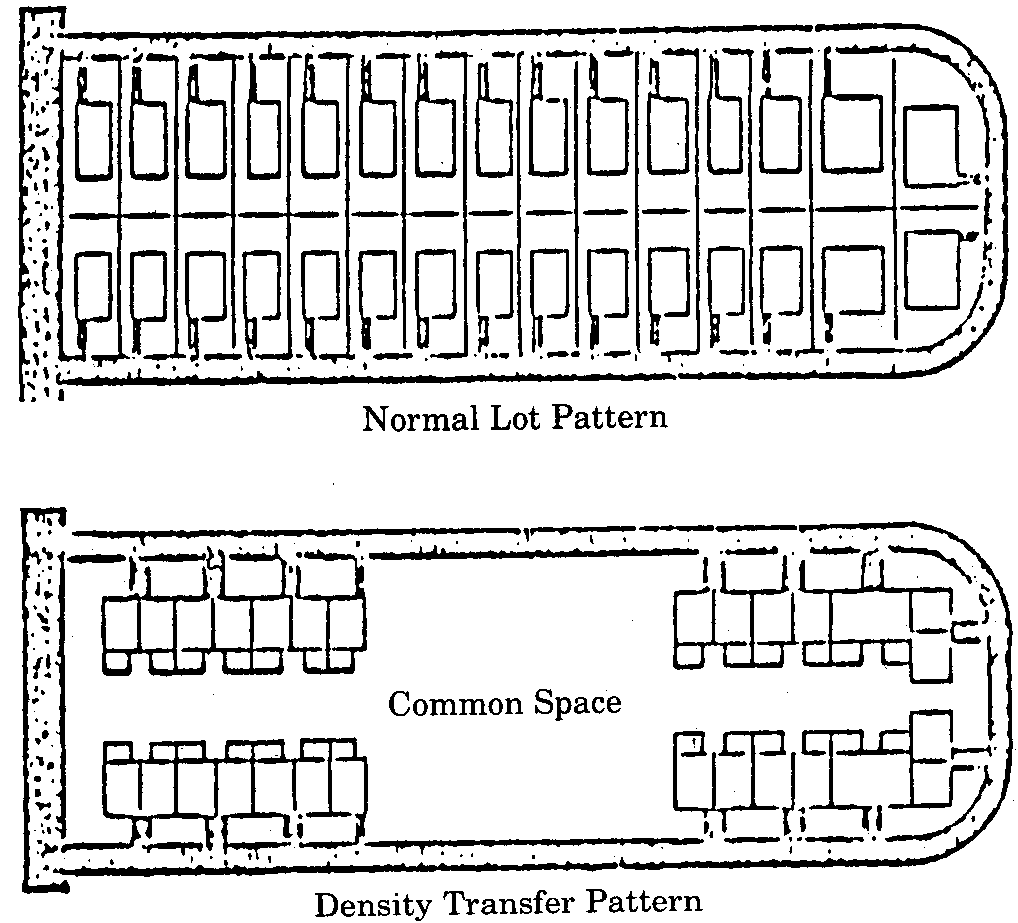
Example 2—Density Transfer of Dwelling Unit Clustering
Dental clinic/office: See "Clinic" definition.
District zoning: Any section or sections of the City of Crockett for which regulations governing the use of buildings and/or premises are described in article 2 of this ordinance and as shown on the official zoning map of Crockett.
Donut shop: See "Bakery shop (retail)" definition.
Drive-in restaurant: Any establishment where food and/or beverage is sold to the consumer, motor vehicle parking space is provided and where patrons are served in their respective vehicles.
Drive-in theater: See "Theater, drive-in (outdoor)" definition.
Dry cleaning or laundry establishment: Any attended or unattended place, building or portion thereof, available to the general public for the purpose of washing, drying, extracting moisture from, or dry-cleaning wearing apparel, cloth, fabrics, and textiles of any kind by means of a mechanical appliance(s). Includes a washateria.
Dry cleaning plant: An industrial facility where fabrics are cleaned with substantially nonaqueous organic solvents, on a commercial or wholesale basis.
Duplex: See "Dwelling, two-family" definition.
Dwelling: Any building or portion thereof, which is designed to be used as living quarters for one (1) or more families, but not including:
(A)
Recreational vehicles, travel trailers or motor homes (see definition);
(B)
Industrialized buildings (see definition);
(C)
Relocatable educational facilities (see definition); or
(D)
Accessory buildings (see definition for "Building, accessory").
Dwelling, attached: A dwelling having any portion of each of one (1) or more walls in common with adjoining dwellings.
Dwelling, detached: A dwelling having open space outside all exterior walls.
Dwelling, multiple-family: Three (3) or more attached dwelling units on a single lot designed to be occupied by three (3) or more families living independently of one another, exclusive of hotels, motels, resort facilities, recreational vehicle (RV) camping areas, manufactured home parks and RV parks. Includes three-family units (triplex), four-family units (fourplex), as well as traditional apartment buildings and condominiums.
Dwelling, single-family attached: A dwelling unit which is joined to another dwelling unit at one (1) or more sides by a party (i.e., shared) wall, which is designed for occupancy by one (1) family, and which is located on a separate lot delineated by front, side and rear lot lines. Example: Townhome.
Dwelling, single-family detached: A dwelling designed and constructed as a freestanding structure for occupancy by one (1) family and located on a lot or separate building tract having no physical connection to a building located on any other lot or tract.
Dwelling, townhouse or rowhouse: Three (3) or more attached single-family dwelling units attached at the side or sides and forming a continuous group, each unit of which has a separate outdoor entrance and is designed to be occupied and may be owned by one (1) family. The owner owns the interior and exterior of the home as well as the property it sits on.
Dwelling, twin home: An attached single-family dwelling consisting of a single building sharing a center wall, but unlike a duplex, it consists of two (2) properties on two (2) lots that can be owned by two (2) different property owners. The lot line runs down the middle of the house.
Dwelling, two-family (duplex): Two (2) dwellings sharing a common wall in one (1) stand-alone structure on one (1) lot owned by one (1) owner, designed to be occupied by two (2) families living independently of each other. Does not include a twin home.
Dwelling unit: Complete and independent living facilities for a single family with permanent provisions for living, sleeping, cooking and sanitation on a long-term basis of more than thirty (30) consecutive days with one (1) or more bedrooms. The kitchen must, at a minimum, contain cabinets, a countertop, a sink with running water, and a stove or stove hookup. The term does not include a residential unit in a hotel, motel, or other establishment that exists for the purpose of use on a transient basis or any structure that does not meet the definition of a dwelling. An attached mixed-use dwelling unit may be joined at one (1) or more sides by a wall shared with a commercial business.
Earthmoving equipment, heavy: See "Heavy earth-moving equipment rentals, sales, and storage" definition.
Easement: A right given by the owner of a parcel of land to another person, public agency or private corporation for a specific and limited use of that parcel.
Entertainment venue, live: An indoor venue that is wholly enclosed within a building which is treated acoustically so that noise generated by the enterprise is not perceptible at the bounding property line and for which the primary purpose is the display, presentation, or performance of live concerts, musicals, or other live stage entertainment.
Event: An activity that is planned for a special purpose and usually involves a lot of people (example: trade show, conference, party). The event might be a one-day event or might be a recurring event that happens on a repeat schedule (e.g., every Saturday). Does not include the routine operation of a for-profit or non-profit business.
Event venue: A building used for the hosting of weddings, conferences, galas, and other similar events. Such uses may include an area for catering preparation and storage or a commercial kitchen to be used only for special events held at the event venue.
Extended educational/training institutions/schools: Includes a business or professional school, a college/university or a vocational technical or trade school.
•
Business or professional school: A school, commercial or non-profit, organized to offer instruction and training in a service or art, such as office administration school, barber college, beauty school, or commercial art school.
•
College/university: An institution established for educational purposes offering courses of study beyond the secondary education level.
•
Vocational technical or trade school: A commercial school involved in training students in vocational-technical skills (e.g., auto mechanics, barbering, food service, electrical, plumbing, welding, etc.) and other trade studies, including instruction in the use of a variety of machines and equipment (e.g., lathes, drill presses, electronics, etc.).
Family: One (1) or more persons related by blood or marriage including adopted children or a group of not to exceed five (5) persons not related by blood or marriage occupying premises and living as a single nonprofit housekeeping unit, as distinguished from a group occupying a hotel, club, short-term rental, or similar dwelling for group use.
Family care facility for children: See "Foster family home" definition.
Farm machinery, implements, and supply sales: A commercial facility and open area utilized for the display, sales, rental and storage of machinery, equipment, or implements or attachments to the machinery, equipment, or implements, all in operable condition, used for, or in connection with, planting, cultivating, irrigating, harvesting, and producing agricultural or forestry products.
Farmer's market: Means a designated location used for a recurring event at which a majority of the vendors are farmers or other food producers who sell food directly to consumers. Must include at least two (2) vendors who meet the definition of "farmer." May include vendors who are not "farmers" or "food producers," provided that "farmers" and "food producers" constitute the majority of vendors who participate in the market throughout the year. Does not include the farmers market located in the city park across the street from City Hall, which is a public facility.
•
Farmer: A person or entity that produces agricultural products including, but not limited to, fruits, vegetables, fungi, grains, fiber, honey, dairy products, meat, poultry, or eggs, by practice of the agricultural arts upon land that the person or entity owns, rents, leases, or to which the person or entity otherwise has access.
•
Food producer: A person who grew, raised, processed, prepared, manufactured, or otherwise added
value to the food product the person is selling. The term does not include a person
who only packaged or repackaged a food product.
(
Title 25 Tex. Admin. Code, Part 1, Chapter 229, Subchapter FF, Rule § 229.702.)
Feed and grain store: An establishment for the retail and/or wholesale selling of corn, grain and other food stuffs for animals and livestock, and implements and goods related to agricultural processes; does not include the sale of farm machinery.
Feedlot: See "Animal business" definition.
Flea market: An outdoor or partially indoor premises, where the main use is the sale of new and used household goods, personal effects, tools, artwork, small household appliances and similar merchandise, objects or equipment, in small quantities, in broken stalls, lots or parcels, not in bulk, for the use or consumption by the immediate purchaser in a building, open air or partly enclosed booths or stalls not within a wholly enclosed building. This term does not include wholesale sales establishments or rental services establishments or for the routine operation of for profit or non-profit businesses but may include food vending vehicles or concession stands operating for the benefit of flea market customers. This definition does not pertain to arts and craft shows, auction sales, garage sales, retail sidewalk sales, or sales held by nonprofit organizations.
Floor area:
•
Gross: The sum of the gross horizontal areas of all floors of a building measured from the exterior faces of exterior walls or from the centerline of the walls separating two (2) buildings, and including, but not limited to, basements; elevator shafts and stairwells at each floor; attic space providing headroom of seven (7) feet or more; and accessory uses in enclosed space but excluding space used for off-street parking.
•
Net: The total floor area within a building devoted or intended to be devoted to a particular use, with structural headroom of seven (7) feet or more, whether above or below the finished lot grade.
Floor area ratio: A mathematical expression determined by dividing the gross floor area of a building by the area of the lot on which it is located.
Florist shop: A retail store devoted to the display and sale of cut flowers, potted plants, blooming plants, inside foliage plants, bedding plants, corsage flowers, cut foliage, floral decorations, live decorative materials, accessories, and arrangements thereof.
Food truck park: An area designed to accommodate three (3) or more food vending vehicles as the primary use of the property while possibly accommodating areas on the property for entertainment or recreational opportunities. The sale of merchandise other than food and beverages shall not be permitted. Note: A food truck park on city-owned property is considered a public facility. See article III, chapter 9, Crockett Code, for related regulations.
Food vending vehicle: Any vehicle that operates as a food service establishment and is designed to be readily movable. (V.T.C.A. Health and Safety Code, § 437B.001, as added by HB 2844, 89 th Legislature.)
Foster family home: A home under the regulation of a child-placing agency that is the primary residence of the foster parents and provides care for six (6) or fewer children or young adults for twenty-four (24) hours a day. A foster family home may temporarily increase the capacity to seven (7) or eight (8) children under certain circumstances. [Source: Tx Health and Human Services Child Care Regulation Handbook, Revision 24-1, effective Feb. 20, 2024.]
Foster group home: An operation under the regulation of a child-placing agency that provides care for seven (7) to twelve (12) children or young adults for twenty-four (24) hours a day. Must be the primary residence of the foster parents. [Source: Tx Health and Human Services Child Care Regulation Handbook, Revision 24-1, effective Feb. 20, 2024.]
Fraternal lodge or service organization clubhouse: An enclosed space, room or structure used by an organized group having a restricted membership and specific purpose related to the welfare of the members, for the purpose of holding organization-related meetings, gatherings or social functions.
Funeral/interment service establishment: A place of business used in the care and preparation for interment or transportation of human remains, or any place where one (1) or more persons, either as sole owner, in co-partnership, or through corporate status, are engaged or represent themselves to be engaged in the business of embalming or funeral directing (V.T.C.A. Health and Safety Code, § 711.001). May include a crematory.
Furniture restoration shop: An establishment that reupholsters, refinishes, repairs and/or restores household-type (i.e., living room, kitchen and bedroom) furniture and institutional (i.e., public building, such as schools, theaters, civic buildings, churches or other religious establishments, etc.) furniture for individuals on a small-scale retail basis. This activity does not include the term "furniture manufacture" or wholesale sales of any type of furniture or commodities.
Garage:
•
Private: An accessory building enclosed on at least three (3) sides or a part of a main building used for storage of automobiles and used solely by the occupants and their guests. Such term is also referred to as "enclosed parking space."
•
Parking: See "Parking garage."
Garage apartment: A dwelling unit for one (1) family erected in or above a private garage. (See section 301, for performance standards relating to garage apartments.)
Glamping area: See "Campground" definition.
Group care facility for children: See definition for "Foster group home."
Gymnastic studio: See "Dance or gymnastic studio" definition.
Health care clinic: See "Clinic" definition.
Health/reducing/fitness club/studio: Includes, but is not limited to, an establishment which provides facilities and equipment (e.g., gymnasiums, weight rooms, swimming pools/spas, exercise apparatus, instruction/classes, etc.) which are intended to promote health, fitness, weight reduction and/or similar health-related activities. Such facilities may include such accessory uses as food service, sales of sundries and apparel, and childcare services, provided that such accessory uses are clearly incidental to the primary use and are for the use of studio patrons only (i.e., not the general public). No outside signage may be used to advertise accessory uses.
Heavy earthmoving equipment rentals, sales, and storage: A commercial facility and open area utilized for the display, sales, rental and indoor/outdoor storage of heavy-duty vehicles in operable condition built for use on earthmoving works-related construction projects such as digging of foundations, rock removal, digging of trenches, soil grading, demolition of structures, and other similar projects. Examples of such equipment include excavators, scrapers, bulldozers, wheel loaders, and trenching machines.
Heavy truck sales and rentals: A commercial facility and open area used for the display, sale, rental and indoor/outdoor storage of new or used heavy load vehicles in operable condition.
Height: See "Building height" definition.
Home-based business: See section 308.
Homeowner's association: A formal nonprofit organization operating under recorded land agreements through which: (a) each lot and/or homeowner in a planned unit development or other described land area is automatically a member; and (b) each lot may be subject to a charge for a proportionate share of the expenses for the organization's activities, such as maintenance of common property; and (c) if unpaid, the charge may become a lien against the nonpaying homeowner's property.
Hospital: An institution providing health services primarily for human inpatient, medical or surgical care for the sick or injured and including related facilities such as laboratories, outpatient departments, training facilities, central service facilities, and staff offices which are an integral part of the facilities.
Hotel or motel: A building or group of buildings under one (1) ownership containing six (6) or more sleeping rooms occupied, intended or designed to be occupied, as the temporary abiding place for persons who are lodged with or without meals for compensation, but not including a hospital or recreational vehicle camping area.
Ice cream/frozen yogurt shop: A small-scale retail establishment for producing, mixing, compounding, serving ice cream or frozen yogurt or similar confection primarily for on-premises consumption with extremely limited wholesale distribution as an accessory use only.
Incidental use: Any use which is different from the main or principal use but which compliments and/or supplements the main or principal use.
Industrialized building: A commercial structure that is constructed in one (1) or more modules or constructed using one (1) or more modular components built at a location other than the commercial site and designed to be used as a commercial building when the module or the modular component is transported to the commercial site and erected or installed. An industrialized building includes the structure's plumbing, heating, air conditioning, and electrical systems. An industrialized building includes a permanent commercial structure and a commercial structure designed to be transported from one (1) commercial site to another commercial site but does not include a commercial building or structure that is installed in a manner other than on a permanent foundation and either: (a) not open to the public; or (b) less than one thousand five hundred (1,500) square feet in total area and used other than as a school or a place of religious worship (V.T.C.A. Occupations Code, § 1202.003).
Industrialized housing: A residential structure that is designed for the occupancy of one (1) or more families, constructed in one (1) or more modules or constructed using one (1) or more modular components built at a location other than the permanent site, and designed to be used as a permanent residential structure when the module or the modular component is transported to the permanent site and erected or installed on a permanent foundation. Industrialized housing includes the structure's plumbing, heating, air conditioning, and electrical systems. Industrialized housing does not include: (1) housing constructed of a section or panelized system that does not use a modular component; or (2) a ready-built home constructed in a manner in which the entire living area is contained in a single unit or section at a temporary location for the purpose of selling and moving the home to another location. A modular home will have a decal issued by the Texas Department of Licensing and Regulation signifying that the home has been built to comply with the International Residential Code (V.T.C.A. Occupations Code, § 1202.002).
Iron works/machine shop: A facility performing cutting, grinding, turning, honing, milling, deburring, lapping, electrochemical machining, etching, or other similar metal fabrication operations.
Junkyard: A place where a business that owns junk and is operated to store, buy, or sell junk keeps all or part of the junk outdoors until the business disposes of the junk.
•
Junk: Means copper, brass, iron, steel, rope, rags, batteries, tires, or other material that has been discarded or sold at a nominal price by the previous owner of the material. The term does not include a wrecked vehicle (V.T.C.A. Transportation Code, Ch. 396).
Laboratory, medical: An indoor establishment that includes laboratories and/or experimental equipment for medical, dental, or optical research, testing, and analytical work having a direct relationship to the provision of health services, prototype design and development, or product testing.
Laboratory, scientific and/or industrial research: An establishment that engages in research, testing or evaluation of materials or products that may include experimental equipment and operations involving compounding of materials. Does not include a medical laboratory. (See "Laboratory, medical.")
Laundromat: See "dry cleaning or laundry establishment" definition.
Livestock and livestock market: See "Animal business" definition.
Living space: The interior space within a building that: (1) is designed and intended for human habitation; (2) is heated by a conventional heating system; (3) has a finished interior, including walls, floors, and ceilings; (4) is directly accessible from other living areas, typically through a door, heated hallway, or stairway; and (5) is capable of being used year-round for living, sleeping, eating, or cooking. The term does not include unfinished basements, attics or other unfinished areas, garages, screened or open patios, porches, or accessory structures.
Loading space: Space logically and conveniently located for bulk pickups and deliveries, scaled to delivery vehicles expected to be used, and accessible to such vehicles when required off-street parking spaces are filled. The minimum dimensions of the loading space must be scaled to accommodate the largest vehicle used for such pickups and deliveries, including vertical clearance. Required off-street loading space cannot be included as off-street parking space as required in the computation of such space for certain zoning districts.
Lot, corner: A lot on which at least two (2) adjacent sides abut for their full lengths on a street.
•
Lot depth: The mean horizontal distance between the front and rear lot lines.
•
Lot width: The mean horizontal distance between the side lot lines.
Manufactured home or "manufactured housing" means a HUD-code manufactured home or a mobile home.
•
HUD-code manufactured home: Has the meaning assigned by 42 U.S.C. Section 5402(6), which states that the term means a structure, transportable in one (1) or more sections, which, in the traveling mode, is eight (8) body feet or more in width or forty (40) body feet or more in length, or, when erected on-site, is three hundred twenty (320) or more square feet, and which is built on a permanent chassis and designed to be used as a dwelling with or without a permanent foundation when connected to the required utilities, and includes the plumbing, heating, air-conditioning, and electrical systems contained therein; except that such term shall include any structure which meets all the requirements of this paragraph except the size requirements and with respect to which the manufacturer voluntarily files a certification required by the Secretary (Secretary of Housing and Urban Development) and complies with the standards established under this chapter (Chapter 70, Title 42 U.S. Code); and except that such term shall not include any self-propelled recreational vehicle. The term does not include a recreational vehicle as defined by 24 C.F.R. Section 3282.15(b).
Note: A HUD-code manufactured home displays a red certification label on the exterior of each section per 24 C.F.R. § 3280.11. This label serves as the manufacturer's certification that the section is built in accordance with federal HUD standards.
•
Mobile home: (A) means a structure: (i) constructed before June 15, 1976; (ii) built on a permanent chasses; (iii) designed for use as a dwelling with or without a permanent foundation when the structure is connected to the required utilities; (iv) transportable in one (1) or more sections; and (v) in the traveling mode, at least eight (8) body feet in width or at least forty (40) body feet in length or, when erected on-site, at least three hundred twenty (320) square feet; and (B) includes the plumbing, heating, air conditioning, and electrical systems of the home.
•
Attached: In reference to a manufactured home means that the home has been: (A) installed in compliance with the rules of the Texas Department of Housing and Community Affairs operating through its manufactured housing division; (B) connected to a utility, including a utility providing water, electric, natural gas, propane or butane gas, or wastewater service.
•
Installation: Means the temporary or permanent construction of the foundation system and the placement of a manufactured home or manufactured home component on the foundation. The term includes supporting, blocking, leveling, securing, anchoring, and property connecting multiple or expandable sections or components and making minor adjustments.
•
New manufactured home: Means a manufactured home that is not a used manufactured home, regardless of its age.
•
Used manufactured home: Means a manufactured home which has been occupied for any use or for which a statement of ownership has been issued. The term does not include: (A) a manufactured home that was used as a sales model at a licensed retail location; or (B) a manufactured home that: (i) was sold as a new manufactured home and installed but never occupied; (ii) had a statement of ownership; and (iii) was taken back from the consumer or transferee because of a first payment default or agreement to rescind or unwind the transaction.
[State law reference—V.T.C.A. Occupations Code, Ch. 1201, Manufactured Housing, V.T.C.A. Occupations Code, § 1201.003, Definitions, amended by SB 1341, 89th Tex. Legislature, and V.T.C.A. Occupations Code, § 1201.004, Definitions Binding.]
Note: See section 314 for specific requirements relating to manufactured homes outside of a manufactured home subdivision or manufactured home park.
Manufactured home park (also known as mobile home park or trailer park or manufactured home community): See section 201.4c for definition and section 314 for specific requirements.
Manufactured homes sales: A commercial establishment and open area used for the display, sale, and outdoor storage of manufactured homes.
Manufactured home subdivision (also known as mobile home subdivision): See section 201.4b for definition.
Manufactured/mobile home pad area: An area designed for the exclusive use of an individual manufactured/mobile home.
Massage establishment: Any place of business in which massage therapy is practiced by a massage therapist as defined and licensed by the V.T.C.A. Occupations Code, Ch. 455.
Metal dealer, crafted precious: A place of business in which a person registered with the Finance Commission of Texas, as required by V.T.C.A. Occupations Code, Ch. 1956, subch. B, engages in the business of purchasing and selling crafted precious metal, including purchases or sales made through the mail,.
•
Crafted precious metal: Means jewelry, silverware, and art object or another object, made wholly or partly from precious metal and used primarily for personal, family, or household purchases. The term does not include a coin or other excluded items listed in the definition in the V.T.C.A. Occupations Code, Ch. 1956, subch. B.
Metal dealer, scrap (or secondhand): A place of business in which a person purchases, gathers, collects, solicits, or procures scrap metal or where scrap metal is gathered or kept for shipment, sale, or transfer, under terms and conditions found in Vernon's Ann. Civ. St., art. 9009. (Also see Junk or salvage yard.)
Mini warehouse (or self-storage warehouse): Small individual storage units for rent or lease, restricted solely to the inside storage of items. The conduct of sales, business or any other activity other than storage within the individual storage units is prohibited, other than a sale conducted by the owner or representative in an effort to sell a unit's contents after a renter/lessee has defaulted on payment.
Mixed-use: See definition in section 315.
Mobile home: See "Manufactured home" definition.
Mobile home park: See "Manufactured home park" definition.
Mobile home subdivision: See "Manufactured home subdivision" definition.
Modular component: A structural part of housing or a building constructed at a location other than the building site in a manner that prevents the construction from being adequately inspected for code compliance at the building site without damage or removal and reconstruction of a part of the housing or building (V.T.C.A. Occupations Code, § 1202.001).
Modular home: See definition for "Industrialized housing." Note: A modular home is a type of industrialized housing.
Motor truck: Any truck with a manufacturer's rated carrying capacity in excess of two thousand (2,000) pounds and which is used or maintained primarily for the transportation of property. "Light" trucks, pickup trucks, panel delivery trucks, and carryall trucks are not "motor trucks" under this definition.
Motorcycle: A usually two-wheeled, self-propelled vehicle having one (1) or two (2) saddles or seats, and which may have a sidecar attached. For the purposes of this definition, motorbikes, all-terrain vehicles (ATVs), motor scooters, mopeds and similar vehicles are classified as motorcycles.
Motorcycle sales and repair: A commercial establishment used for the display, sale and/or servicing, including repair work, of motorcycles in operable condition; may include an open area and indoor/outdoor storage as permitted by the zoning district.
Multiple-family dwelling: See "Dwelling, multiple-family" definition.
Music studio (also known as recording studio): A specialized facility for recording and mixing instrumental or vocal musical performances, spoken words, and other sounds.
Neighborhood business: An independently owned and operated small-scale personal services shop or professional and general business office (see definitions) that: (1) is located in or surrounded by a residential district; (2) is secondary to the principal use of the building as a dwelling or which is the primary use of the building; (3) must not create any noise, odor, or electrical disturbance beyond the confines of the lot on which the activity is conducted; and (4) must by nature be low-intensity with a limited number of clients/customers at any specific time so as to not act as a traffic generator to the detriment of the neighborhood. In connection with a neighborhood business, there shall be no display of more than two (2) square feet in area attached to the main or accessory building and no outside storage. Does not include any retail shops. A specific use permit for a neighborhood business transfers to a new property owner unless the condition of the permit is that it only applies to the owner of the property at the time the permit was approved. However, the specific nature of the neighborhood business may not change from what the business was at the time the specific use permit was issued (e.g., a beauty shop must remain a beauty or barber shop, a law office must remain a law office or an office for a similar professional), unless the current property owner obtains a new specific use permit for a business of a different nature.
Nonconformance: A lawful condition of a structure or land which does not conform to the regulations of the zoning district in which it is situated. This may include, but is not limited to, failure to conform to use, height, area coverage or off-street parking requirements.
Nonconforming use: A structure or land lawfully occupied by a land use activity that does not conform to the regulations of the zoning district in which it is situated and which has been identified as a nonconforming use by the Crockett zoning board of adjustment.
Offices, professional and general business: A room or group of rooms used as executive, management, and/or administrative offices for private, governmental or non-profit organizations or that provide business or information technology services benefiting the public. Typical uses include but are not limited to business offices for accounting, advertising, computer programming and software services, insurance, investment, legal, property management, real estate, travel, and other professions or offices providing computer, facsimile, photocopying and minor printshop or telephone answering services. Excludes health care provider offices.
Oil and gas drilling/extraction: A process whereby a hole is bored using a drill bit to create a well for oil and natural gas production.
Oil field equipment rentals, sales, and storage facility: A commercial facility and open area utilized for the display, sales, rental and indoor/outdoor storage of large equipment in operable condition associated with the oil and natural gas exploration and production process.
Open/outdoor storage: The permanent and/or continuous keeping, displaying or storage of any equipment, goods, machinery, building or other materials, or commodities, including raw, semifinished, finished materials, or other products outside a building during hours of business and extending into the hours during which a business is closed and which is visible from any public street or adjacent property owned by a different property owner when viewed from ground level. Permitted industrial open storage may include any products on pallets, in shipping containers or in crates. Vehicular parking, storage that is accessory to residential use, and outside commercial displays as specifically permitted by this ordinance are not open/outdoor storage.
Optical sales/service shop: A facility housing the workplace of an optician engaged in the fitting and sale of glasses, contact lenses and related optical apparatus for correcting vision.
Outside commercial display: See section 201.6, paragraph H.
Park: An area of land, usually in a largely natural state, for the enjoyment of individuals and having facilities for rest, recreation, and social opportunities for the surrounding community (e.g., ballfield, botanical garden, picnic area, playground, pocket park).
•
Pocket park: A mini park designed to provide recreational and social opportunities for the surrounding community, typically located on vacant or under-utilized lots, offering a green oasis in a developed area. May be publicly or privately owned.
•
Public: Owned and operated by a public agency such as the City of Crockett, Houston County, or the Crockett ISD.
•
Private: Not owned by a public agency but owned, developed and sponsored by a quasi-public group, private agency, or private residents for the exclusive use of residents or neighborhood groups and their guests or for specific groups or social opportunities, such as "little league" baseball.
Parking garage, public: A building or portion of a building, other than a private garage, which is used by the general public for the temporary parking of motor vehicles, usually for a fee.
Parking space: A permanently surfaced area, enclosed or unenclosed, sufficient in size to store one (1) automobile together with a surfaced driveway connecting the parking space with a street or alley and permitting ingress or egress of an automobile. For purposes of this ordinance, the size of a parking space for one (1) vehicle consists of a rectangular area having dimensions of not less than eight (8) feet by eighteen (18) feet plus adequate area for ingress and egress.
Pawn shop: A location at which or premises in which a pawnbroker regularly conducts business consisting of: (a) lending money on the security of pledged goods; or (b) purchasing goods on condition that the goods may be redeemed or repurchased by the seller for a fixed price within a fixed period. Unclaimed property may be sold at the shop. The pawnbroker must display the pawnshop license issued by the office of consumer credit commissioner for the place of business, and it must identify the name of the pawn broker and the address at which the business is to be conducted. A separate pawnshop license is required for each place of business (V.T.C.A. Finance Code, Ch. 371, and V.T.C.A. Local Government Code, § 211.0035).
Permanent foundation: A slab, footing (perimeter foundation), or a pier and beam foundation. In the case of footings or a pier and beam foundation, skirting must be installed along the bottom of the structure so that no space under the structure may be seen and to prevent creating a habitat for animals. See "Skirting" definition.
Personal services shop: A commercial establishment primarily engaged in providing personal services related to the care and appearance of the body or the repair of personal effects. Includes but is not limited to barbershops, beauty salons, shoe repair shops, and tailoring/seamstress/alteration shops.
Pet shop: A commercial establishment specializing in the display and retail sale of small live animals generally kept as household pets, such as dogs, cats, birds, or fish and associated goods for the maintenance of such animals. (See "Animal business" for state law reference.)
Petroleum bulk stations: A facility, including pipeline terminals, refinery terminals, rail and barge terminals,
and associated underground and above ground storage tanks, connected or separate,
from which petroleum products are withdrawn from bulk and delivered into a cargo tank
or barge used to transport those products.
[30 TAC, Part 1, Chap. 334, Subchapter F, Rule 334.122.]
Petroleum refining and storage facility: An industrial facility utilized for the bulk storage and refining of crude petroleum and for production of refined petroleum products.
Planned unit development (PUD): An area with a specified minimum contiguous acreage to be developed as a single entity according to a unified site design plan, containing one (1) or more residential uses.
Planning and zoning commission: The Planning and Zoning Commission of Crockett, Texas.
Plant nursery, wholesale: A wholesale establishment, often including artificially heated and/or cooled buildings (greenhouse) or open spaces where plants, shrubs, and trees are raised and/or sold on a wholesale basis; may include related indoor/outdoor storage of equipment for landscape contracting. May not include retail sales, such as a retail garden center.
Plant nursery and garden supply sales: A retail establishment, including a building, part of a building, a greenhouse, or open space for the growth, display and/or sale of plants, shrubs, trees, horticultural supplies and similar items used in indoor or outdoor planting. All such displays shall be located behind the front yard line established in the district in which the establishment is located.
Plumbing/electrical/air conditioning/heating equipment sales/services: A commercial establishment providing supplies, repairs, installation and sales of plumbing, electrical, air conditioning, heating, and related equipment.
Pool hall: See article IV, chapter 13, city Code.
Portable building sales: A commercial establishment and open area used for the display, sale, and outdoor storage of structures capable of being carried and transported to another location, but not including manufactured homes, tiny homes or any other portable temporary or permanent dwelling unit.
Premises: Structures and land that make up a parcel of property.
Primary building: See "Building, main/primary" definition.
Print shop: A commercial establishment that produces or reproduces in print form individual orders from a business, profession, service, industry, or government organization or from other customers. Services may range from simple duplicating services to using a variety of printing processes and may include placement of orders for printing conducted off-premises.
•
Print shop, minor: An establishment which primarily reproduces, in printed form, individual orders from a business, profession, service, industry or government organization. Offset, letterpress, and duplicating equipment are used, but no rotary presses or linotype equipment are used. Related services might include faxing, digitizing, graphic reproducing, and report assembling.
•
Print shop, major: An establishment used for bulk printing, binding, cutting or copying of materials including books, magazines, newspapers, posters, photos, signs or drawings by means of a printing press, lithography, offset printed, blue printing, photographic reproduction techniques, or other similar methods, for either distribution or sale.
Private airport or landing field: A privately or publicly owned location that maintains an airfield, air strip, or runway for private use by its owner(s) or employees or by invitation and is not open for use by the general public. May be equipped with hangars, facilities for refueling and repair, and various accommodations for passengers.
Private club: A building or portion of a building in which liquor-by-the-drink is served by permission of the Texas Alcoholic Beverage Commission to people having membership in said club.
Private school: A school that offers a course of instruction for students in one (1) or more grades from prekindergarten through grade 12 and is not operated by a governmental entity (V.T.C.A. Education Code, § 5.001).
Professional office: See "Offices, professional and general business."
Public agency: A recognized public agency, unit of government, or public utility.
Public facilities and offices: Any property, building or structure which is owned, leased, primarily used and/or primarily occupied by the state, the United States or the city, any of their subdivisions or agencies, or any public or quasi-public utility.
Public parking garage: See "Parking garage, public" definition.
Public school: A school that is supported with public funds and is authorized by action of and operated under the oversight of a publicly constituted local or state educational agency; provides educational services to all students who are enrolled.
Radio or television stations: A public or commercial facility for broadcasting live or pre-recorded programs by radio or television, or recording of such programs, records, tapes, compact discs, video tapes or other recorded media. Such a facility may house activities and equipment necessary for recording and programming, broadcasting and receiving, radio and television signals. Includes transmission lines.
Recording studio: See "Music studio" definition.
Recreational vehicle: A mobile unit built on a chassis and intended to be used generally for temporary living and sleeping quarters for travel, recreation and vacation purposes. The term includes travel trailers designed to be towed, motor homes designed as temporary dwellings equipped to travel under their own power, tiny homes on wheels, and any other portable contrivance intended to be used as temporary living and sleeping quarters which may be moved under its own power, towed or transported by another vehicle. A recreational vehicle may also be utilized as a long-term place of residence for more than thirty (30) consecutive days within a permitted recreational vehicle park or camping area or a manufactured home park within established limits. This definition does not include manufactured homes, tents, or yurts or similar structures.
Recreational vehicle/camper sales and leasing: An establishment that sells, leases and/or rents new and/or used recreational vehicles, travel trailers, campers, and boats/watercraft, including repair work of recreational vehicles and boats as an accessory use.
Recreational vehicle park: Any development, site, parcel or tract of land designed, maintained or intended to be used for the purpose of providing short-term occupancy of less than thirty (30) consecutive days or long-term occupancy of recreational vehicles in an atmosphere similar to a manufactured home park but limited to recreational vehicles. The use of tents or yurts or similar structures allowed within a campground are not allowed as dwellings within a recreational vehicle park.
Recycling plant: A facility in which recoverable resources such as paper, newspapers, magazines, books, glass, metal cans and other products are recycled, reprocessed and treated to return such products to a condition in which they may again be used for production. Definition does not include a junkyard or automotive salvage yard.
Relocatable educational facility: A portable, modular building capable of being relocated, regardless of whether the facility is built at the installation site, that has been used or is designed to be used primarily as an educational facility for teaching the curriculum required under V.T.C.A., Education Code, § 28.002 (V.T.C.A. Occupations Code, § 1202.004).
Residential density: The number of lots, dwelling units, or persons located or residing within a residential density.
•
Gross density: The number of lots, dwelling units, or persons located within the total acreage of a residential area.
•
Net density: The number of lots, dwelling units, or persons located within the total acreage of a residential area, exclusive of street rights-of-way, easements, nonresidential land use sites, and acreage unsuitable for development.
Restaurant: An establishment with a principal business of the sale of foods and beverages to the general public in a ready-to-consume state with designated dining areas.
Retail sales in general: Retail stores or shops which sell, lease or rent new or used products to the general public that are not intended for resale and not primarily intended for commercial/industrial use. Typical stores and shops include, but are not limited to, arts and craft stores, auto parts and accessory sales, bicycle shops, bookstores, clothing stores, convenience stores with or without self-service gasoline, department stores, delicatessens, florist shops, furniture and home décor stores, general stores, gift shops, grocery markets/stores, hardware stores, pharmacies, shoe stores, specialty boutiques or shops, and thrift/second-hand shops. May also include servicing or repair of the items sold as incidental use. Any retail shop that is listed as a separate use in the land use charts in section 201.10 is not included in this definition.
•
Delicatessen: A commercial establishment primarily engaged in the retail sale of cold cuts, cheeses, and a variety of salads, as well as a selection of unusual or foreign prepared food for home consumption.
Sand, gravel or stone extraction and/or storage: The process of extracting and/or indoor/outdoor storage of sand, gravel, stone, topsoil, compost or other products from the earth.
Setback: The required minimum distance that a structure must be "set back" from a property line to ensure there is adequate space for fire safety, access to utilities, light, air, and for maintaining neighborhood aesthetics, and within which no structure may be built but which may include driveway areas or other similar surface improvements.
Sexually oriented business: See chapter 15.5 of the Crockett Code.
Note: No other land use may include a sexually oriented business.
Shopping center: A group of primarily retail and service commercial establishments planned, constructed and managed as a total entity with customer and employee parking provided on-site, provision for goods delivery separated from customer access, provision of aesthetically appropriate design and protection from the elements.
Short-term rental: See section 310.
Single-family dwelling: See "Dwelling, single-family" definition.
Skirting: A type of exterior trim that is installed around the foundation of a structure so that no space under the structure may be seen and to prevent creating a habitat for animals.
Specific use: A land use activity that may be appropriate within a designated zoning district but which must be reviewed by the planning and zoning commission and approved by the city council. The criteria for determining the appropriateness of a land use activity requiring a specific use permit is found in section 303 of this ordinance.
Stable:
•
Private stable: A stable for private use with a capacity of not more than two (2) horses or mules.
•
Public/commercial stable: A stable, other than a private stable, with a capacity for boarding more than two (2) horses or mules for a fee. A public/commercial stable that also rents horses to the general public for recreational riding must comply with regulations for outdoor commercial amusements in the AR district.
Note: Private and public/commercial stables must comply with section 4-6, article I, chapter 4 of city Code.
Stadium: An indoor or outdoor sports arena with tiers of seats for spectators. May also be used for special events.
Story:
•
Full story: That portion of a building, other than a basement, that is included between the surface of any floor and the surface of the floor next above it, or if there is no floor above it, then the space between the floor and ceiling next above it.
•
Half story: A space under a sloping roof which has the line of intersections of roof decking and wall face not more than three (3) feet above the top floor level, and in which space not more than two-thirds of the floor area is finished off for use. A half story containing independent apartments or living quarters will be counted as a full story.
Street: Any public thoroughfare which affords the principal means of access between various land use activities.
Structural alteration: Any change in the supporting members of a building, such as bearing wall of partitions, column, beams, or girders, or any substantial change in the roof or in the exterior walls.
Structure: Anything constructed or erected, the use of which requires a location on the ground or an attachment to something located on the ground (also see definition of "Building").
Tailoring/alteration/seamstress shop: A personal services shop which houses the workplace of a tailor or seamstress engaged in fabrication, alteration, repair, of men's and women's clothing and apparel. Not a clothing factory.
Tanning salon: An indoor commercial facility where individuals may receive a tan by means of artificial light.
Tattoo studio: See "Body art studio" definition.
Theater, drive-in: An open lot with its appurtenant facilities devoted primarily to the showing of motion pictures or theatrical productions on a paid admission basis to patrons seated in automobiles.
Theater, movie (indoor): A building or part of a building devoted to the showing of motion pictures. May include arcade games and concessions as incidental uses.
Theater, outdoor: An open-air cinema or open-air theater where the screen or stage and the spectator seats are located outdoors with or without a canopy or other covering. May be a temporary seasonal or permanent setting.
Theater, playhouse (indoor): See "Entertainment venue, live" definition.
Tiny home: See section 316.
Tiny home development: See section 316.
Tiny home on wheels: A manufactured or prefabricated nonmotorized but movable house on wheels that typically has a living space of four hundred (400) square feet or less and that is considered the same as a recreational vehicle for the purpose of this zoning ordinance. Also known as a THOW.
Tiny homes sales: A commercial establishment and open area used for the display, sale and outdoor storage of tiny homes and tiny homes on wheels.
Townhouse or rowhouse: See "Dwelling, townhouse or rowhouse" definition.
Trailer, camping, recreational or travel trailer: See recreational vehicle.
Trailer, hauling: A mobile unit to be pulled behind an automobile or truck which is designed for hauling animals, produce, goods or commodities, including boats.
Truck sales and rentals, heavy trucks: See "Heavy truck sales and rentals" definition.
Truck stop: A facility for parking, refueling and/or minor repair of heavy load tractor-trailer trucks. These facilities may also include retail sales of food and/or other items, restaurant(s), restroom/showers facilities, and/or temporary sleeping quarters.
Truck terminal: An area and building where cargo is stored and where trucks, including tractor and trailer units, load and unload cargo on a regular basis. May include facilities for the temporary indoor/outdoor storage of loads prior to shipment. Also known as a motor freight terminal.
Twin home: See "Dwelling, twin home" definition.
Two-family dwelling: See "Dwelling, two-family" definition.
Use permitted by right: A land use activity that does not require the review and approval of the planning and zoning commission or the city council unless otherwise specified.
Variance: A site-specific approval granted by the board of adjustments for a particular property to vary from the terms of the city's zoning ordinance; the approval must be based on a finding of hardship and must not be contrary to the public interest.
Vineyard, private: A private enterprise establishment used for the growing of grapevines, typically producing grapes used in winemaking, which may provide for on-site sales and wholesale sales and distribution of such produce and products.
Warehouse, mini: See "Mini warehouse" definition.
Warehouse, commercial storage: A commercial facility designed and used for the inside storage of manufactured products, supplies, and equipment, but excluding bulk storage of materials that are inflammable or explosive, or that create hazardous or commonly recognized offensive conditions.
Warehouse, office/showroom: An establishment with a minimum of seventy-five (75) percent of its total floor area devoted to indoor storage and warehousing, but not accessible to the general public. The remaining area may include retail and wholesale sales areas, sales offices and display areas for products sold and distributed from the storage and warehousing areas.
Washateria: See "Dry cleaning or laundry establishment" definition.
Wholesale distribution center: Building or facility used for the indoor storage and distribution of wholesale items/products.
Wholesale sales establishments: The selling and/or distribution of merchandise or commodities to retailers, or to industrial, commercial, institutional or professional business users, or to other wholesalers. This activity also includes acting as an agent or broker that buys merchandise for, or sells merchandise to, such individuals or companies. This activity does not typically involve retail (i.e., walk-up or drive-up) sales to individuals who are the end-users of the merchandise.
Winery: A wine-making establishment.
Yard: An open space on a lot between the lot line and the building line which is unoccupied by any building or part of a building including any parking structures (e.g., garage, carport) except for roof overhangs.
•
Front yard: The minimum depth of the front yard is the distance between the nearest point of the street-side wall of building; and the front line of the lot, or that line produced, measured at right angles of the front line of the lot.
•
Rear yard: The unoccupied space between the rear lot line and the building line, as specified for each zoning district, which is parallel to the front lot line.
•
Side yard: The unoccupied space between the side lot line and the building line, as specified in each zoning district, extending from the front yard to the rear yard.
Yurt: A portable, circular dwelling made of a lattice of flexible poles and covered in felt or other fabric; a study, reliable type of tent that functions like a real home, protecting inhabitants from the elements while still simple enough in construction to suit camping or glamping purposes.
Zoning or code enforcement officer: The municipal employee who has been officially designated as the individual responsible for determining compliance with the regulations and policies found in this ordinance.
(Ord. No. O-5B-86, § 1, 5-19-86; Ord. No. 0-4-99, § 1, 4-5-99; Ord. No. O-01B-21, § I, II, 1-25-21; Ord. No. O-02-26, § I, 2-2-26)

