
Crockett City Zoning Code
ARTICLE 2
- ESTABLISHMENT OF DISTRICTS, REGULATIONS, AND ZONING MAP
Section 201. - Establishment of zoning districts and regulations.
A.
The City of Crockett, Texas, is hereby divided into zoning districts as listed in this section.
B.
The city's zoning districts are as follows:
1.
AR Agricultural-residential district.
2.
R-1 Single-family residential district.
3.
R-2 Two-family residential district.
4.
R-3 Multiple-family residential district.
5.
MH-1 Manufactured home subdivision district.
6.
MH-2 Manufactured home park and RV park/campground district.
7.
C-1 Neighborhood commercial district.
8.
C-2 General commercial district.
9.
C-3 City center shopping district.
10.
M Manufacturing/industrial district - light.
11.
I Manufacturing/industrial district - heavy.
C.
The regulations for each of the above-named zoning districts are established on the following pages.
(Ord. No. O-02-26, § II, 2-2-26)
Section 201.1. - AR Agricultural-residential district.
A.
Description. The AR Agricultural-residential district is intended to provide a location for agricultural and residential land use activities in areas situated on the fringes of Crockett's present boundaries and which may become an urban area in the future. Therefore, the agricultural and residential activities permitted within the district should not be detrimental to urban land uses and are intended to encourage and protect appropriate agricultural uses until urbanization is warranted and the appropriate change in zoning district classification is made.
B.
Uses permitted by right. Refer to section 201.10 Land use chart - residential for land uses permitted by right.
C.
Specific uses. Refer to section 201.10 Land use chart — residential for land uses requiring a specific use permit.
D.
Area, coverage, and height regulations. All buildings in the AR district must conform to the requirements listed in the land use district standards chart in section 201.10.
E.
Regulations to protect the natural state of the AR district. Event venues, commercial/public stables, and outdoor commercial amusements must meet the following requirements:
1.
Minimum area shall be three (3) acres.
2.
At least fifty (50) percent of the total site shall be left in its natural state or be landscaped. The remaining fifty (50) percent of land is eligible for development.
3.
Where needed to enhance aesthetics or to ensure public safety, a fence, wall, landscape screen, earth mound, or other screening approved by the building official shall enclose the portion of land developed for specific use. The planning and zoning commission shall determine the necessity of such screening.
4.
Utility conduits shall be installed underground in conformance with the applicable state and local regulations.
G.
Mandatory project plan requirements. Individuals requesting a specific use permit must comply with the project plan requirements as prescribed in section 303 of this ordinance.
(Ord. No. O-5B-86, § 1, 5-19-86; Ord. No. 0-4-99, § 2, 4-5-99; Ord. No. O-04-09, § 1, 4-20-09; Ord. No. O-01-16, § I, 1-11-16; Ord. No. O-02-26, § II, 2-2-26)
Section 201.2. - R-1 Single-family residential district.
A.
Description. This is the most restrictive residential zoning district. The primary use of land is for detached single-family dwellings and related religious, educational, and recreational facilities normally required to provide the basic elements of a balanced and attractive neighborhood. These areas are intended to be separated and protected from the encroachment of land use activities that do not perform a function necessary to sustain the residential environment. Internal stability, attractiveness, order, efficiency, and security are encouraged by the provision for adequate light, air and open space for dwellings and related facilities and through consideration of the proper functional relationship of these various elements. Densities in this district may not exceed seven (7) dwelling units per gross acre.
B.
Uses permitted by right. Refer to section 201.10 Land use chart - residential for land uses permitted by right.
C.
Specific uses. Refer to section 201.10 Land use chart - residential for land uses requiring a specific use permit.
D.
Area, coverage, and height regulations. All buildings in the R-1 district must conform to the requirements as listed in the land use district standards chart in section 201.10.
E.
Mandatory project plan requirements. Individuals requesting a specific use permit or a zoning amendment to achieve R-1 status must comply with the project plan requirements as prescribed in section 303 of this ordinance.
(Ord. No. 0-4-99, § 3, 4-5-99; Ord. No. O-04-09, § 2, 4-20-09; Ord. No. O-02-26, § II, 2-2-26)
Section 201.3. - R-2 Two-family residential district.
A.
Description. The R-2 district is intended to serve as a residential zone that provides a slightly higher population density but with basic restrictions similar to the R-1 district. The principal use for land in the R-2 district is for detached single-family and two-family (duplex) dwellings along with related religious, educational and recreational facilities normally required for the provision of a balanced and attractive neighborhood. These areas are intended to be separated and protected from the encroachment of land use activities that are incompatible with residential development. Internal stability, attractiveness, order and efficiency are encouraged by providing adequate light, air and open space for dwellings and related facilities and through the consideration for the proper functional relationship and arrangement of each element. Densities in this district may not exceed seven (7) single-family dwelling units or eleven (11) two-family dwelling units per gross acre.
B.
Uses permitted by right. Refer to section 201.10 Land use chart - residential for land uses permitted by right.
C.
Specific uses. Refer to section 201.10 Land use chart - residential for land uses requiring a specific use permit.
D.
Area, coverage and height regulations. All buildings in the R-2 district must conform to the requirements as listed in the land use district standards chart in section 201.10.
E.
Mandatory project plan requirements. Individuals requesting a specific use permit or an amendment to the zoning map to achieve R-2 status must comply with the project plan review as prescribed in section 303 of this ordinance.
(Ord. No. O-5B-86, § 1, 5-19-86; Ord. No. O-4A-88, § 1, 4-18-88; Ord. No. 0-4-99, § 4, 4-5-99; Ord. No. O-04-09, § 3, 4-20-09; Ord. No. O-02-26, § II, 2-2-26)
Section 201.4a. - R-3 Multiple-family residential district.
A.
Description. This is a residential district to provide for medium density development of up to fifteen (15) dwelling units per acre. The principal use of land is for attached single-family dwellings such as townhomes, detached single-family dwellings, two-family dwellings (duplexes), and multiple-family dwellings consisting of apartment complexes, condominiums, triplexes, fourplexes, garden apartments, and similar dwellings. Recreational, religious and educational land use activities normally appropriate to service such residential neighborhoods are also permitted to provide the basic elements of a convenient, balanced and attractive living area. Densities in this district may not exceed seven (7) single-family dwelling units, eleven (11) two-family dwelling units, or fifteen (15) multiple-family dwelling units per gross acre.
B.
Uses permitted by right. Refer to section 201.10 Land use chart - residential for land uses permitted by right.
C.
Specific uses. Refer to section 201.10 Land use chart - residential for land uses requiring a specific use permit.
D.
Area, coverage and height regulations. All buildings in the R-3 district must conform to the requirements as listed in the land use district standards chart in section 201.10.
E.
Mandatory project plan requirements. Individuals requesting a specific use permit or a zoning amendment to achieve R-3 status must comply with the project plan requirements as prescribed in section 303 of this ordinance.
F.
Screening requirement. A screening fence is required between any apartment use and a developed single-family residential use in accordance with section 305 of this ordinance.
(Ord. No. O-5B-86, § 1, 5-19-86; Ord. No. 0-4-99, § 5, 4-5-99; Ord. No. O-04-09, § 4, 4-20-09; Ord. No. O-02-26, § II, 2-2-26)
Editor's note— Section II of Ord. No. O-02-26 renumbered § 201.4 as § 201.4a, to read as herein set out.
Section 201.4b. - MH-1 Manufactured home subdivision district.
A.
Definition and description. A manufactured home subdivision is defined as a parcel of land which is designed, platted, improved and intended for the long-term placement of individually owned HUD-Code manufactured homes on platted lots which can be purchased outright by the owners of the homes. Facilities may include a residence for the owner/manager of the premises, utility hook-ups, accessory structures, playgrounds and open space areas, fenced yard areas for pets, and other similar amenities.
The MH-1 district is intended to provide for quality manufactured home subdivision developments containing many of the characteristics and the atmosphere of a standard single-family subdivision but where manufactured homes are permitted by right. Density in this district shall not exceed seven (7) single-family dwelling units per gross acre.
B.
Uses permitted by right. Manufactured homes are permitted by right when: (i) an existing manufactured home is being replaced in accordance with section 314.04; or (ii) a manufactured home is being newly installed and the manufactured date is not more than five (5) years prior to the date of the installation. Although permitted by right, a building permit must be obtained from the city's building official before installing a replacement or a newly placed manufactured home.
Refer to section 201.10 Land use chart - residential for additional land uses permitted by right.
C.
Specific uses. Refer to section 201.10 Land use chart - residential for land uses requiring a specific use permit.
D.
Area, coverage and height regulations. All buildings in the MH-1 district must conform to the requirements listed in the land use district standards chart in section 201.10.
E.
Mandatory project plan requirements. Individuals requesting a specific use permit or a zoning amendment to achieve MH-1 status must comply with the project plan requirements as prescribed in section 303 of this ordinance.
F.
Pad areas.
1.
Manufactured home subdivisions must have a pad area for each manufactured home to be placed in the subdivision.
2.
Access. Each lot and manufactured home pad area must have access to an all-weather surfaced interior roadway that conforms to the specifications provided by the Crockett Platting Ordinance.
3.
Length, width and square footage of pad area. Each manufactured home pad area must have a minimum length of not less than eighty (80) feet and a minimum width of not less than forty (40) feet. The minimum square footage required for a pad area is three thousand two hundred (3,200) square feet.
G.
Subdivision design and construction standards applicable. All manufactured home subdivisions must comply with the design and construction standards as specified in the Crockett Subdivision Regulations.
H.
Additional regulations. In addition to the manufactured home subdivision regulations set forth in this section, manufactured homes must comply with the single lot standards, structural safety and skirting requirements established in section 314.
(Ord. No. O-02-26, § III, 2-2-26)
Section 201.4c. - MH-2 Manufactured home park and RV park/campground district.
A.
Definitions and description.
1.
A manufactured home park or community is defined as a development site, parcel or tract of land under single ownership designed, maintained or intended to be used for the purpose of providing long-term occupancy of more than thirty (30) consecutive days for the placement of four (4) or more manufactured/mobile homes including all buildings used or maintained for the use of the residents of the development. This term is not to be used in conjunction with any manufactured homes, RV, or trailer sales lots which contain unoccupied units that are intended for purposes of inspection and sale (V.T.C.A. Property Code, § 94.001(4)).
2.
The MH-2 district is intended to provide for quality development and maintenance of manufactured home parks and recreational vehicle parks and campgrounds. In addition to the manufactured home park requirements set forth in this section, manufactured homes must comply with the structural safety and skirting requirements in section 314.
B.
Uses permitted by right.
1.
Manufactured homes are permitted by right when: (i) an existing manufactured home is being replaced in accordance with section 314.04; or (ii) a manufactured home is being newly installed and the manufactured date is not more than five (5) years prior to the date of the installation. Although permitted by right, a building permit must be obtained from the city's building official before installing a replacement or a newly placed manufactured home.
2.
Recreational vehicles (which include a manufactured tiny home on wheels) used as a primary dwelling are permitted by right for up to twenty (20) percent of the pad areas within a manufactured home park in the MH-2 district. All requirements for a manufactured home within the manufactured home park, including size of the pad and setbacks, will be applicable to the recreational vehicle.
3.
Refer to section 201.10 Land use chart - residential for additional land uses permitted by right.
C.
Specific uses.
1.
Boat and recreational vehicle and travel trailer storage yard.
2.
Recreational vehicle park.
3.
Campground.
Refer to section 201.10 Land use chart - residential for additional land uses requiring a specific use permit.
D.
Area, coverage and height regulations. All buildings in the MH-2 district must conform to the requirements listed in the land use district standards chart in section 201.10.
E.
Mandatory project plan requirements. Individuals requesting a specific use permit or a zoning amendment to achieve MH-2 status must comply with the project plan requirements as prescribed in section 303 of this ordinance.
F.
Manufactured home parks pad areas.
1.
Pad area requirement. Manufactured home parks must have a pad area for each manufactured home to be placed in the park.
2.
Access. Each manufactured home pad area must have access to an all-weather surfaced interior roadway that conforms to the specifications provided by the Crockett platting ordinance.
3.
Length, width and square footage of pad area. Each manufactured home pad area must have a minimum length of not less than eighty (80) feet and a minimum width of not less than forty (40) feet. The minimum square footage of area required for a pad area is three thousand two hundred (3,200) square feet.
4.
Clearance. Each manufactured home must be located so that at least fifteen (15) feet of clearance is maintained between it and other manufactured homes or structures located within a manufactured home park except that manufactured homes placed end-to-end may have a clearance of ten (10) feet where opposing rear walls are staggered.
G.
Manufactured home park site standards. All manufactured home parks must comply with the following standards:
1.
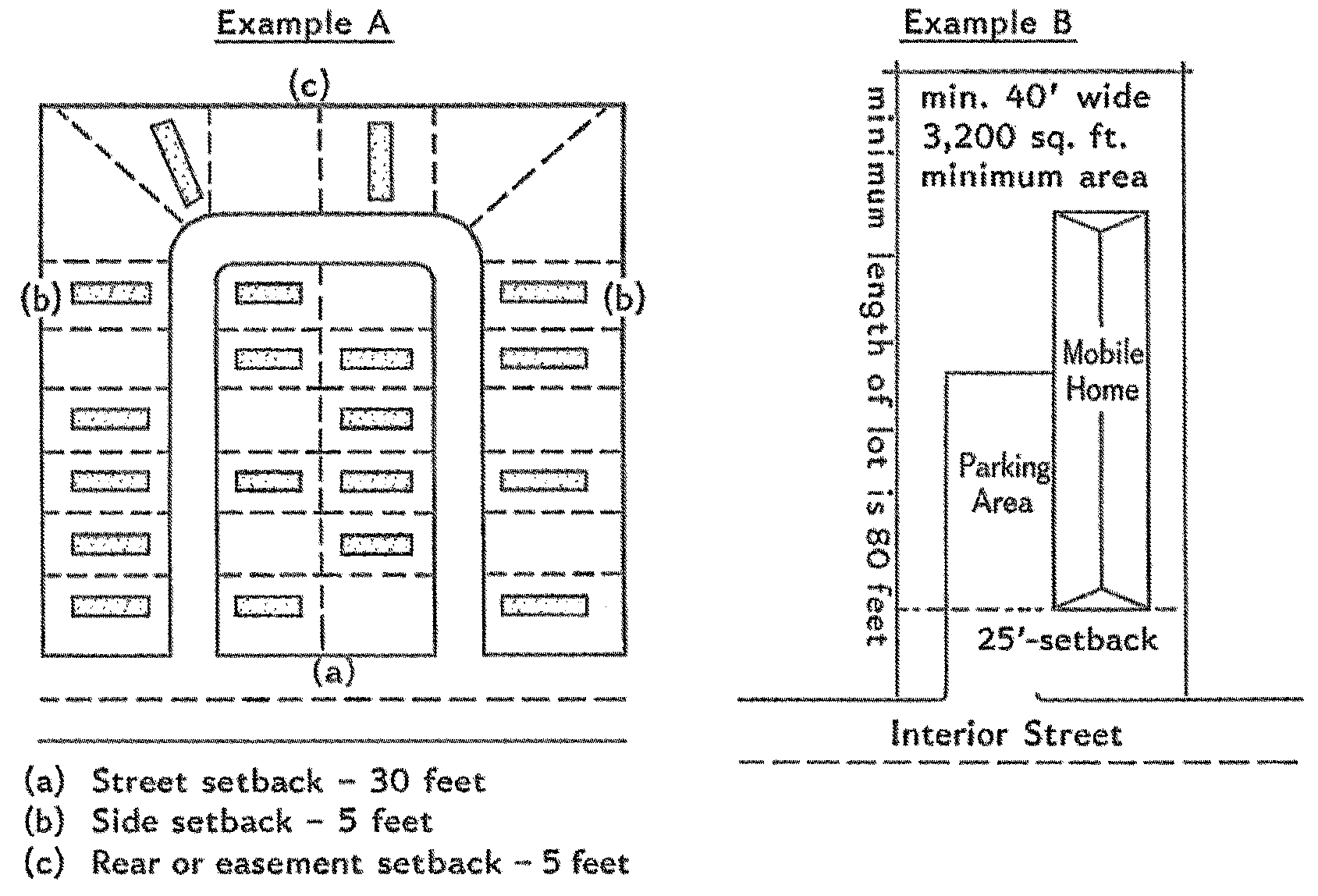
Setbacks. All manufactured homes and structures must be set back from exterior street right-of-way lines to comply with the following standards:
a.
The minimum depth of a yard abutting an exterior street must be thirty (30) feet. When a site has double frontage, this provision must be met on both yards.
b.
All manufactured homes and structures must be set back at least five (5) feet from any easement or property line.
c.
All manufactured homes and structures must be set back at least five (5) feet from all side lot lines.
See examples A and B below for illustration.
2.
Coverage. Primary and accessory buildings cannot cover more than forty (40) percent of the lot or site area on interior lots and sites, and fifty (50) percent of the lot or site area on corner lots or sites. Accessory buildings cannot cover more than twenty (20) percent of a rear yard.
3.
Subdivision design and construction standards applicable. All manufactured home parks must comply with the design and construction standards as specified in the Crockett Subdivision Regulations.
H.
Required recreational areas in manufactured home parks. In all parks accommodating or designed to accommodate twenty-five (25) or more manufactured homes there shall be one (1) or more recreation areas which shall be easily accessible to all park residents. The size of such recreation areas shall be based upon a minimum of one hundred (100) square feet for each lot.
I.
Maintenance of register. To help ensure that replacement manufactured homes comply with section 314.04, the park management shall maintain a register containing the make, model, year of each manufactured/mobile home and provide a copy of the register to the city code enforcement officer on an annual basis.
J.
Recreational vehicle parks requirements. The standards relating to setbacks, coverage, design and construction, and recreation areas for manufactured home parks apply to recreational vehicle parks. Skirting and security to pad requirements do not apply.
K.
Campground requirements. Each individual site shall be no less than one thousand (1,000) square feet and there shall be no more than nine (9) sites per developable acre. Group camp sites shall be designed to accommodate no more than twenty-five (25) people per acre.
L.
Screening requirement. A screening fence is required between the side and rear property lines of any manufactured home park, recreational vehicle park, or campground and adjacent property in accordance with section 305 of this ordinance.
(Ord. No. O-02-26, § III, 2-2-26)
Section 201.5. - C-1 Neighborhood commercial district.
A.
Description. The C-1 Neighborhood commercial district is primarily designed to accommodate neighborhood businesses designed to provide a compatible relationship with adjacent residential areas. Requirements for sunlight, natural air circulation, open space, on- and off-street parking are more restrictive in the C-1 district because the neighborhood businesses located within it are intended to become an integral part of the surrounding neighborhood and must operate in harmony with residential, educational, religious and recreational land use activities.
B.
Uses permitted by right. Refer to section 201.10 Land use chart - non-residential for land uses permitted by right.
C.
Specific uses. Refer to section 201.10 Land use chart - non-residential for land uses requiring a specific use permit.
D.
Area, coverage and height regulations. All buildings in the C-1 district must conform to the requirements as listed in the land use district standards.
E.
Mandatory project plan requirements. Individuals requesting a specific use permit or a zoning amendment to achieve C-1 status must comply with the project plan review as prescribed in section 303 of this ordinance.
F.
Access to C-1 sites. Not more than two (2) entrance/exit points of access to a C-1 site will be permitted except as allowed on state highways in the access design standards of the state highway department.
G.
Screening requirement. A screening fence is required between any commercial, manufacturing or industrial use and a developed residential use in accordance with section 305 of this ordinance.
(Ord. No. O-5B-86, § 1, 5-19-86; Ord. No. O-04-09, § 5, 4-20-09; Ord. No. O-08C-10, § 1, 8-16-10; Ord. No. O-02-26, § IV, 2-2-26)
Section 201.6. - C-2 General commercial district.
A.
Description. The C-2 district is primarily intended to provide for the location and development of larger retail shops and stores that provide goods and services for the residents of the city and the surrounding region and that may require outdoor display and storage of merchandise.
B.
Uses permitted by right. Refer to section 201.10 Land use chart - non-residential for land uses permitted by right, which includes all uses permitted by right and specific use in the C-1 Neighborhood commercial district except for mixed-use.
C.
Specific uses. Refer to section 201.10 Land use chart - non-residential for land uses requiring a specific use permit.
D.
Area, coverage and height regulations. All buildings in the C-2 district must conform to the requirements as listed in the land use district standards.
E.
Mandatory project plan requirements. Individuals requesting a specific use permit or a zoning amendment to achieve C-2 status must comply with the project plan requirements as prescribed in section 303 of this ordinance.
F.
Access to C-2 sites. Not more than two (2) entrance/exit points of access to a C-2 site will be permitted, except as allowed on state highways in the access design standards of the state highway department.
G.
Screening requirement. A screening fence is required between any commercial, manufacturing or industrial use and a developed residential use in accordance with section 305 of this ordinance.
H.
Outside commercial displays. Commercial and mixed-use properties may have neat and orderly outside displays of decor (e.g., planters, etc.), including seasonal decor celebrating a current holiday, special event, or a seasonal change, an outside seating area with seating made of non-porous material, and outside displays of merchandise that may be purchased by the general public.
Outside commercial displays must be an accessory use and comply with the following provisions:
1.
Items must be placed/located on the same lot as the primary use and may not extend onto adjacent property.
2.
Items must not occupy any required parking spaces or loading areas and must not extend into public street right-of-way.
3.
Public sidewalks in front of commercial properties must maintain a minimum clear width for an accessible route and entryway in compliance with the ADA.
4.
The placement of items must not pose a safety or visibility hazard, nor impede public vehicular or pedestrian circulation, either on-site or off-site, in any way.
5.
Except for the merchandise of businesses that have their primary inventory routinely displayed outside based on the nature of the business or which are permitted by definition to have outside displays and storage, all merchandise for sale must be removed from outside display when the business is closed to the general public.
6.
All items must be displayed in a neat, orderly manner within a clean, litter-free area that is maintained so that excessive dust, fumes or odors will not be produced by the continued display of items.
(Ord. No. O-5B-86, § 1, 5-19-86; Ord. No. O-9-95, § 3, 7-25-95; Ord. No. O-04-09, § 6, 4-20-09; Ord. No. O-08C-10, § 1, 8-16-10; Ord. No. O-02-26, § IV, 2-2-26)
Section 201.7. - C-3 City center shopping district.
A.
Description. The C-3 district is intended to encourage and facilitate the maintenance and redevelopment of Crockett's city shopping district with a mixture of retail, office and residential uses while preserving the historic identity of downtown. Most types of office and retail-commercial businesses with indoor display or sales are permitted within the C-3 district. The district's area regulations are the most liberal in this section because it is recognized that the full lot coverage pattern which characterizes the district's development would create many difficulties if altered.
B.
Uses permitted by right. Refer to section 201.10 Land use chart - non-residential for land uses permitted by right, which includes all uses permitted by right in the "C-1" neighborhood commercial district.
C.
Specific uses. Refer to section 201.10 Land use chart - non-residential for land uses requiring a specific use permit.
D.
Area, coverage, and height regulations. All buildings in the C-3 district must conform to the requirements as listed in the land use district standards.
E.
Screening requirement. Screening is not required for any uses permitted by right in the C-3 district. Screening may be required for uses permitted by specific use if required by the city council.
F.
Off-street parking is not required with uses allowed by right in the C-3 district. Additional parking may be required for uses allowed by specific use if required by the city council. Such parking shall be provided at the rate identified in section 401. City-owned parking lots located in the C-3 district provide for employee and/or customer parking for the C-3 district.
G.
Outdoor commercial displays, storage, repair or assembly of goods.
1.
Except when a display of merchandise is during a special public event that includes the display of items on closed off streets and parking spaces (e.g., Christmas in Crockett sponsored by the Crockett Area Chamber of Commerce), no outside display of merchandise that may be purchased by the general public or is an example of the type of merchandise sold at the location and no outdoor storage, repair or assembly of goods is permitted in the C-3 district including by businesses that would be permitted to have outdoor storage in another district.
2.
This restriction does not prohibit commercial and mixed-use properties from having neat and orderly outside displays of decor (e.g., planters) that is not similar to the merchandise the property user is selling, including seasonal decor celebrating a current holiday, special event, or a seasonal change, or an outside seating area with seating made of non-porous material.
(Ord. No. O-5-86, § 1, 5-5-86; Ord. No. O-8-90, § 1, 8-6-90; Ord. No. O-04-09, § 7, 4-20-09; Ord. No. O-08C-10, § 1, 8-16-10; Ord. No. O-04-22, § I, 4-18-22; Ord. No. O-02-26, § IV, 2-2-26)
Section 201.8. - M Manufacturing/industrial district - light.
A.
Description. The M district is primarily intended to provide for the location and development of non-nuisance types or light manufacturing, fabrication, assembling, warehousing and wholesaling businesses. The district may serve as a buffer between heavy industrial zones and other inharmonious land use activities.
B.
Uses permitted by right. Refer to section 201.10 Land use chart - non-residential for land uses permitted by right, which includes all uses permitted by right in the C-2 General commercial district, except churches or other religious establishments.
C.
Specific uses. Refer to section 201.10 Land use chart - non-residential for land uses requiring a specific use permit.
D.
Area, coverage and height regulations. All buildings in the M district must conform to the requirements as listed in the land use district standards.
E.
Mandatory project plan requirements. Individuals requesting a specific use permit or amendment to the zoning ordinance to achieve M status must comply with the project plan review as prescribed in section 303 of this ordinance.
F.
Access to M district sites. Not more than two (2) entrance/exit points of access to an M district site will be permitted.
G.
Screening requirement. A screening fence is required between any commercial, manufacturing or industrial use and a developed residential use in accordance with section 305 of this ordinance.
H.
Major automobile repair restrictions. Major automobile repair activities are permitted by right when the premises of such activities are conducted wholly enclosed within a building or behind a wooden or brick screening fence. The material and maintenance requirements of such a screening fence are found in section 305 of this ordinance.
(Ord. No. O-5B-86, 5-19-86; Ord. No. O-3-87, § 1, 3-2-87; Ord. No. O-9-95, § 3, 7-25-95; Ord. No. O-04-09, § 8, 4-20-09; Ord. No. O-08C-10, § 1, 8-16-10; Ord. No. O-02-26, § IV, 2-2-26)
Editor's note— Ord. No. O-02-26 amended the title of § 201.8 to read as herein set out. The former § 201.8 was entitled "M manufacturing, warehousing and wholesaling district."
Section 201.9. - I Manufacturing/industrial district - heavy.
A.
Description. The I district is primarily intended to provide for location and development of medium and heavy impact industries, which may generate noise, odor, smoke, dust or intense light, and any supporting commercial and public uses, while still allowing light manufacturing, fabrication, assembling businesses along with warehousing and wholesaling businesses allowed by right in the M district. The industrial and manufacturing uses restricted to the I district must provide access to rail or street transportation routes, and provision may also be made for outdoor operations and outdoor storage. Due to the character and intensity of land use activities that are restricted to the I district, such uses are not permitted to directly abut a residential district without a specific use permit for which the approval process includes consideration of an assessment by the city's fire chief or designee as to whether the proximity of the use to the abutting residential district would create a much higher than average risk to public health and safety.
B.
Uses permitted by right. Refer to section 201.10 Land use chart - non-residential for land uses permitted by right, which includes all uses permitted by right in an M district except those commercial uses permitted by right in the C-2 General commercial district.
C.
Reserved.
D.
Specific uses. Refer to section 201.10 Land use chart - non-residential for land uses permitted by right or requiring specific use permit.
E.
Area, coverage and height regulations. All buildings in the I district must conform to the requirements as listed in the land use district standards.
F.
Mandatory project plan review requirements. Individuals requesting a specific use permit or amendment to the zoning ordinance to achieve I status must comply with the project plan review requirements as prescribed in section 303 of this ordinance.
G.
Access to I district site. Not more than two (2) entrance/exit points of access to an I district site will be permitted except as allowed on state highways in the access design standards of the state highway department.
H.
Screening requirement. A screening fence is required between any commercial, manufacturing or industrial use and a developed residential use in accordance with section 305 of this ordinance.
I.
Junk/salvage yard and automobile salvage/wrecking yard restriction. Junk/salvage yards and automobile salvage/wrecking yards are permitted by right when the premises on which such activities are conducted are surrounded by a wooden or brick fence which is at least six (6) feet in height and forms a solid and continuous screen. Such a screen shall be maintained in good condition.
(Ord. No. O-5B-86, 5-19-86; Ord. No. O-3-87, § 1, 3-2-87; Ord. No. O-04-09, § 9, 4-20-09; Ord. No. O-08C-10, § 1, 8-16-10; Ord. No. O-02-26, § IV, 2-2-26)
Editor's note— Ord. No. O-02-26 amended the title of § 201.9 to read as herein set out. The former § 201.9 was entitled "I general industrial district."
Section 201.10. - Land use charts.
All numbers in feet unless otherwise indicated. NA = Not applicable.
Square feet to acres: 2,400 sf = 0.0551 acre; 3,500 sf = 0.0803 acre; 6,000 sf = 0.138 acre; 7,500 sf = 0.172 acre; 10,000 sf = 0.23 acre; 32,670 sf = 0.75 acre.
Any tract of land platted before October 10, 1984, for residential use shall have a minimum of 5,000 sq. ft. The principal structure on these lots shall not cover more than 50% of said lots.
* See Article 3, Sec. 301, for supplemental land use district standards relating to lot size, open space, front yard determinations, and height restrictions.
P—Land Use Permitted by Right.
S—Specific Use Permit Required.
Blank—Land Use Not Permitted and Expressly Prohibited.
Note: All uses permitted by right or by specific use permit are subject to compliance with the applicable provisions of City Code.
P - Land Use Permitted by Right.
S - Specific Use Permit Required.
P/S * - Applies to uses permitted only in the I district that requires an SUP with assessment by Fire Chief if location of use abuts a residential district.
Blank Box - Land Use Not Permitted and Expressly Prohibited.
Note: All uses permitted by right or by specific use permit are subject to compliance with applicable provisions of City Code.
(Ord. No. O-02-26, § V, 2-2-26)
Editor's note— (Ord. No. O-02-26, § V, adopted Feb. 2, 2026, deleted the prior "Land Use District Standards Table" and "Land Use Matrix Tables" and replaced with new provisions designated as § 201.10 as herein set out. Former provisions derived from: Ord. No. O-5B-86, § 1, adopted May 19, 1986; Ord. No. 0-4-99, § 6, adopted April 5, 1999; Ord. No. O-04-09, § 10, adopted April 20, 2009; and Ord. No. O-04-22, § II, adopted April 18, 2022.
Section 202. - Establishment of official zoning map.
A.
There is hereby created an official zoning map for the City of Crockett. This map, which will be permanently filed with the city secretary, will have in association with it copies of each amendment to the map which have taken place since the map was last submitted.
B.
An updated version of the zoning map will be submitted once each year to the city secretary who will certify that it is correct as of the date of its submission.
C.
Only one (1) official zoning map will be filed with the city secretary. Other copies of the map which may be used by other city offices must be dated and bear the following statement:
"Notice: This map is not official and interested parties are directed to the official zoning map on file with the Crockett City Secretary."

