
Cutler Bay City Zoning Code
ARTICLE IX
TRANSPORTATION REQUIREMENTS
Sec. 3-130.- Purpose.
This article encourages the development of a network of interconnecting streets that work to disperse traffic while connecting and integrating neighborhoods with the existing urban fabric of the town. Equally important, the article encourages the development of a network of sidewalks and bicycle lanes that provide an attractive and safe mode of travel for cyclists and pedestrians. Interconnecting street networks encourage alternate modes of transportation to the automobile, enhance transit service opportunities, improve traffic safety through promoting slower speeds, and potentially reduce vehicle miles traveled within the street network.
(Ord. No. 12-03, § 2(3-130), 6-20-2012)
Sec. 3-131. - Spatial relationship.
As the most prevalent and visual public spaces in the town, streets should be spatially defined by buildings. Proper alignment and delineation of the public street space occurs when the facades of adjacent buildings are aligned much like the walls forming a room. Buildings that make up the street edges are aligned in a disciplined manner. The defined space observes a certain ratio of height to width. Building articulation must take place primarily in the vertical plane of the facade.
(Ord. No. 12-03, § 2(3-131), 6-20-2012)
Sec. 3-132. - General principles.
The town views streets as the most important public spaces and therefore has developed the following set of principles which permit this space to be used by both vehicles and people:
(1)
Streets are designed to be only as wide as necessary to accommodate the vehicular mix serving adjacent land uses, while providing adequate access.
(2)
Whenever an irreconcilable conflict exists among vehicular and pedestrian usage, the conflict should be resolved in favor of the pedestrian, unless in the best interest of public safety.
(3)
The uses of traffic calming devices are strongly preferred as alternatives to conventional traffic control measures. The public works director may permit minor variations and exceptions to street engineering and design specified, such as, but not limited to, variations to the pavement width, tree planting areas, street grade, sight distances, and centerline radii in accordance with principles above. Right-of-way widths should be preserved for continuity.
(4)
Closed or gated streets are discouraged.
(5)
Private streets may be allowed within developments that will remain under common ownership, provided they are designed, constructed and maintained pursuant to best management practices approved by the town public works director.
(6)
Streets in proposed subdivisions shall be connected to rights-of-way in adjacent areas to allow proper inter-neighborhood traffic flow by means of a collector street. If adjacent lands are unplatted, stub-outs in the new development shall be provided for future connection to the adjacent unplatted land.
(7)
The developer shall deposit with the town sufficient funds to provide all necessary roadway related infrastructure signs as may be required by town, county or state standards.
(8)
At least two street name signs shall be placed at each four-way street intersection, and one at each T intersection. Signs shall be installed near light standards and free of visual obstructions. The design of street name signs shall be consistent, in a style appropriate to the community, and of uniform size and color.
(Ord. No. 12-03, § 2(3-132), 6-20-2012)
Sec. 3-133. - Design specifications.
Streets shall be designed to permit comfortable use by motorists, pedestrians, and bicyclists. Street widths, design speeds, and the number of motor travel lanes shall be minimized to enhance safety for motorists and non-motorists alike. The specific design of any given street must consider the building types which have frontage and the relationship of the street to the overall town street network. New development with frontage on existing publicly maintained streets shall be required to build to the standards of this article.
(1)
Transportation system. All required elements of the transportation system shall be provided in compliance with the engineering design and construction standards contained in the public works manual and related standards of the county, latest issue.
(2)
Right-of-way requirements. Right-of-way locations for collector and arterial roads are identified in the transportation element of the town growth management plan, on file in the community development department. Where roadway construction, improvement, or reconstruction is not required to serve the needs of the proposed development project, future rights-of-way shall nevertheless be reserved for future use.
(3)
Traffic control plans. Traffic control plans showing signage and pavement markings shall be prepared in accordance with the guidance of the manual on uniform traffic control devices and shall be prepared by the public works department.
(4)
Design speed. Design speeds should not exceed 35 miles per hour on any street serving residential uses. Only streets serving predominately commercial and nonresidential land uses may exceed this design speed.
(5)
Connectivity. All or most proposed streets within the network shall form an interconnected pattern and shall connect with the adjacent street pattern. Connectivity shall be assessed by the ability to provide multiple routes, diffuse traffic, and shorten pedestrian walking distances. A properly designed street network, unless prohibited by the existing street layout, should provide a minimum of two routes of access for a given location. This affords a high level of accessibility for emergency vehicles and appropriate service routing for school buses and transit.
(6)
Intersections. All streets shall intersect as nearly as possible at right angles (90 degrees) and no street shall intersect at less than 75 degrees. Where a centerline offset occurs at an intersection a traffic circle is strongly preferred. Otherwise, the distance between centerlines of the intersecting streets shall not be less than 150 feet. No two streets may intersect with any other street on the same side at a distance of less than 300 feet measured from centerline to centerline of the intersecting street. When the intersected street is an arterial, the distance between intersecting streets shall be no less than 500 feet.
(7)
Block lengths. Streets shall have block lengths between 200 and 500 feet. Exceptions are permitted, however, due to topography, environmental protection, protection of existing buildings, and similar conditions.
(8)
Curb radii. Curb radii shall be designed to reduce pedestrian crossing distances along all streets requiring sidewalks. In general, curb radii should not exceed 20 feet. At an angle of intersection of less than 90 degrees, a greater radius may be required.
(9)
Cul-de-sacs. Cul-de-sacs, if permitted, shall not exceed 300 feet in length from the intersection with a street that is not another cul-de-sac and that provides through access. Cul-de-sac bulb radii shall be a minimum of 50 feet.
(10)
Shoulders. Shoulders, where required, shall measure at least five feet in width and shall be required on each side of street and located within the right-of-way. Shoulders shall consist of stabilized turf or other material permitted by the public works director and be maintained by the adjacent property owner. Center areas of cul-de-sac bulbs shall be curbed and landscaped.
(11)
On-street parking. On-street parking is recommended where building type and use will generate regular parking use. For streets which serve commercial and mixed use buildings, and where possible, on-street parking is required and should be marked as such. Where possible, on-street parking on at least one side of the street is recommended on streets serving single-family, two-family, townhouse, and multifamily structures with lots 60 feet or less in width. Where possible, on-street parking must also be provided on one side of any street adjacent to a square, park or other open space.
(12)
Street materials. Street materials shall conform to the provisions of the county public works manual. Exceptions may be made for pedestrian crosswalks. Sidewalk material may vary according to the overall design and character of the development as approved by the public works director.
(13)
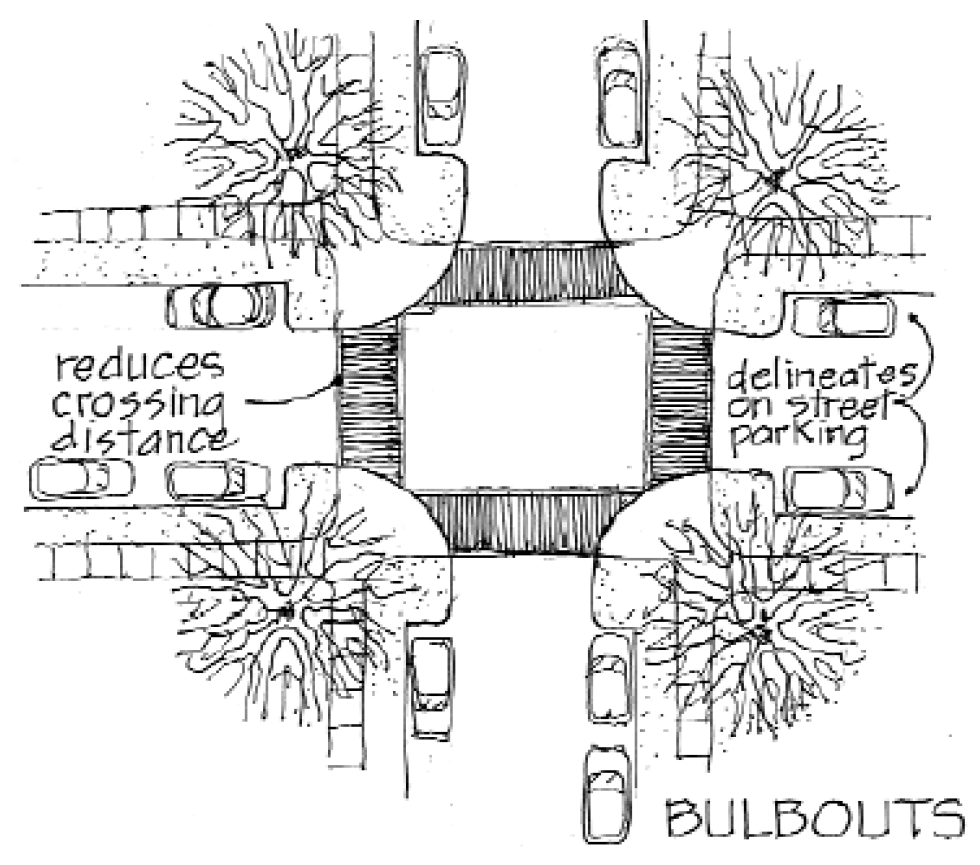
Pedestrian street crossings. Mid-block crossings, bulb outs, raised crosswalks and similar techniques may be used to accommodate pedestrians when traffic and site conditions exist to provide circulation or access to schools, playgrounds, parks, shopping centers, transportation and other facilities.
(14)
Bike lanes. Designated bike lanes a minimum of five feet in width shall be installed by all development with frontage along arterial and collector roadways; four feet along residential streets.
(15)
Trees and sidewalks. Pursuant to the town's adopted street tree master plan, street trees and sidewalks are required on both sides of public streets except lanes, alleys, and the undeveloped edge of neighborhood parkways. Planting area for street trees should be a minimum of five feet in width and sidewalks shall at a minimum be five feet in width. Along streets serving commercial uses, sidewalks should be a minimum of seven feet in width. A ten-foot minimum width sidewalk with tree grates or cut-outs is required along town center commercial streets. Generally, canopy trees shall be planted at a spacing not to exceed 40 feet on center. Where overhead utility lines preclude the use of canopy trees, small maturing trees may be substituted, planted 30 feet on center. Commercial streets shall have trees which compliment the face of the buildings and which shade the sidewalk. Residential streets shall provide for an appropriate canopy, which shades both the street and sidewalk, and serves as a visual buffer between the street and the home. All sidewalks shall be paved in brick pavers, concrete, pervious concrete or a similar material, as approved by the public works director.
(16)
Planting strips. Planting strips should be located between the edge of pavement/curb and sidewalk and parallel to the street. Within commercial areas and other sidewalks with high pedestrian volumes, grated tree wells may be used in lieu of planting strips. The minimum width of all planting strips shall be five feet.
(17)
Shared use paths. A path that is jointly used for both bicycles and pedestrians shall be eight feet in width. Wherever they are present they should be easily accessible and where possible should be on both sides of the street and meet all ADA requirements.
(Ord. No. 12-03, § 2(3-133), 6-20-2012)
Sec. 3-134. - Street cross sections.
The following street cross sections are typical examples of ways in which a street can be assembled within the town. These specifications may be varied only in accordance with the design principles detailed above and as enumerated in the town growth management plan transportation element.
(1)
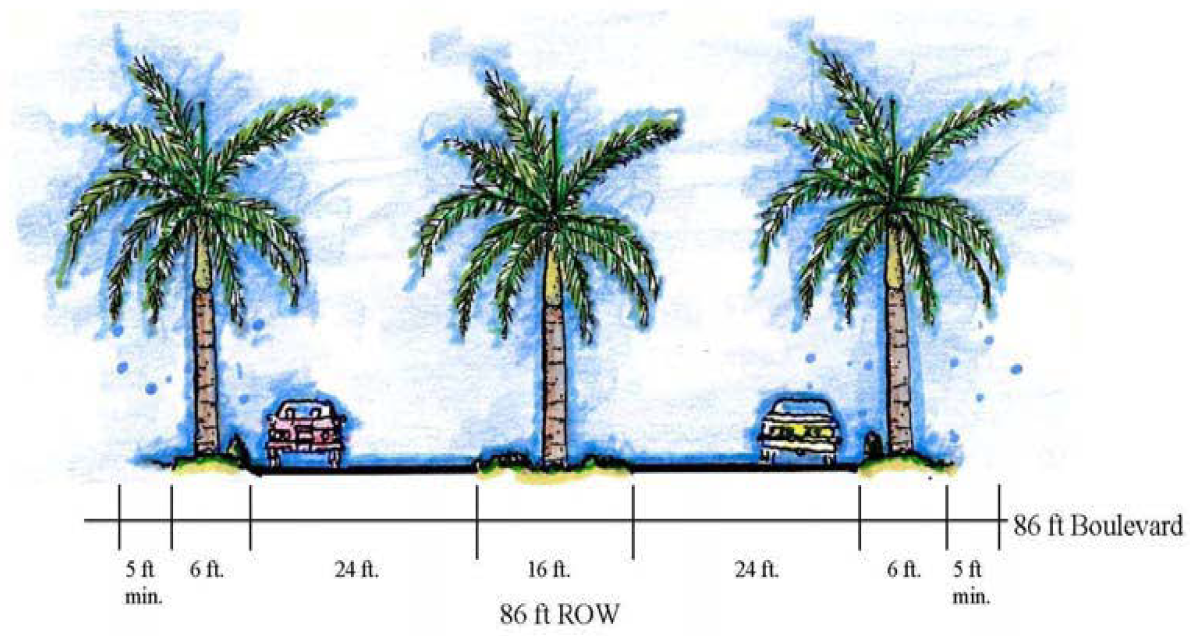
Boulevard. Boulevards are urban in character and provide multi-lane access to commercial and mixed-use buildings, generally support all transportation modes (automobile, commercial vehicles, emergency vehicles, and transit) with high levels of efficiency, and carry regional traffic. Speeds (30—35 mph) and traffic volumes on these streets are higher. Widened perimeter travel lanes and sidewalks support pedestrians and bicyclists.
a.
Design speed: 30—35 mph.
b.
Pavement width: 24-16-24 feet.
c.
Right-of-way width: 86 feet.
d.
Curb radius: 15 feet.
e.
Drainage: Curb and gutter.
f.
On street parking: No.
g.
Landscaped median; 16-foot width.
(2)
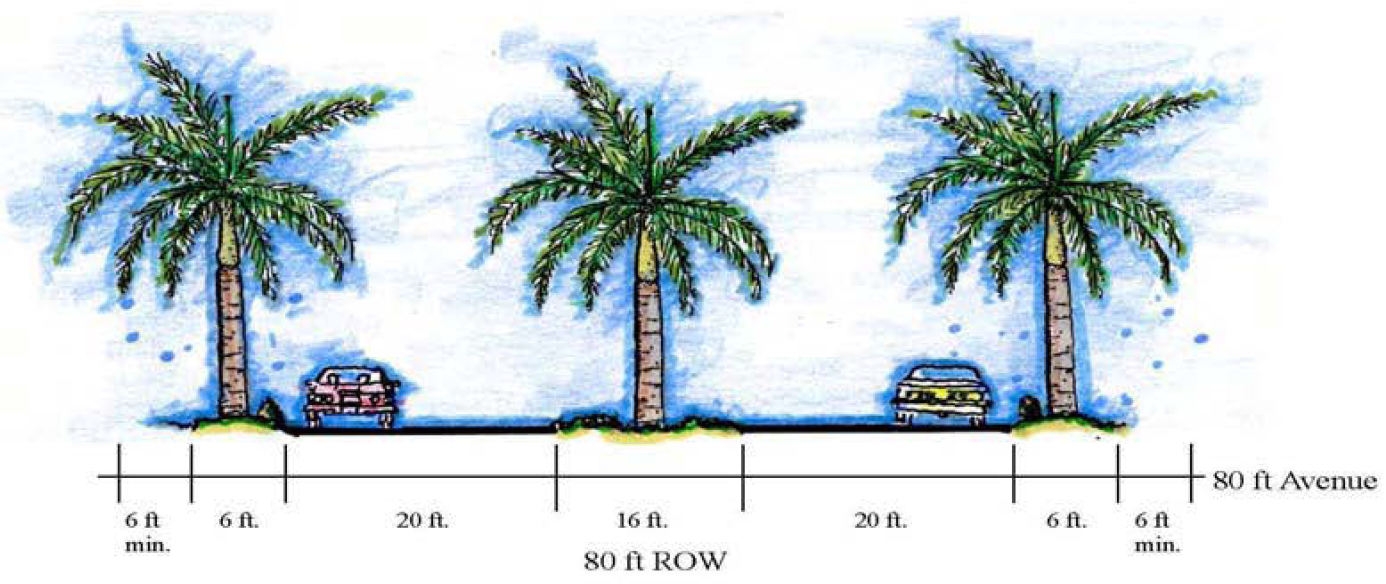
Avenue. Avenues connect neighborhoods to town centers and usually extend over a mile in length. On-street parking is generally permitted. Travel lanes are physically separated by a raised, landscaped median.
a.
Design speed: 20—30 mph.
b.
Pavement width: 20-14-20 feet.
c.
Right-of-way width: 80 feet.
d.
Curb radius: 15 feet.
e.
Drainage: Curb and gutter.
f.
On street parking: Yes.
g.
Landscaped median: 14 feet.
(3)
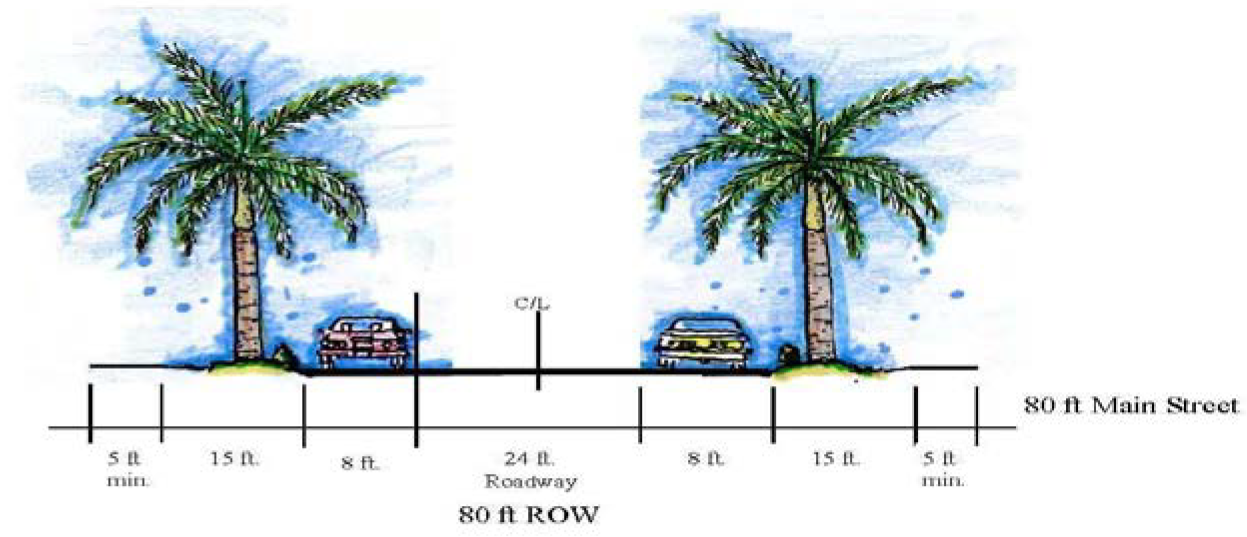
Main street. Main streets are urban in character and provide low speed, pedestrian friendly access to neighborhoods as well as neighborhood commercial and mixed-use buildings. On-street parking along with widened travel lanes to accommodate bicycle lanes is preferred.
a.
Design speed: 25—30 mph.
b.
Pavement width: 24 feet.
c.
Right-of-way width: 80 feet.
d.
Curb radius: 15 feet.
e.
Drainage: Curb and gutter.
f.
On street parking: Yes.
(4)
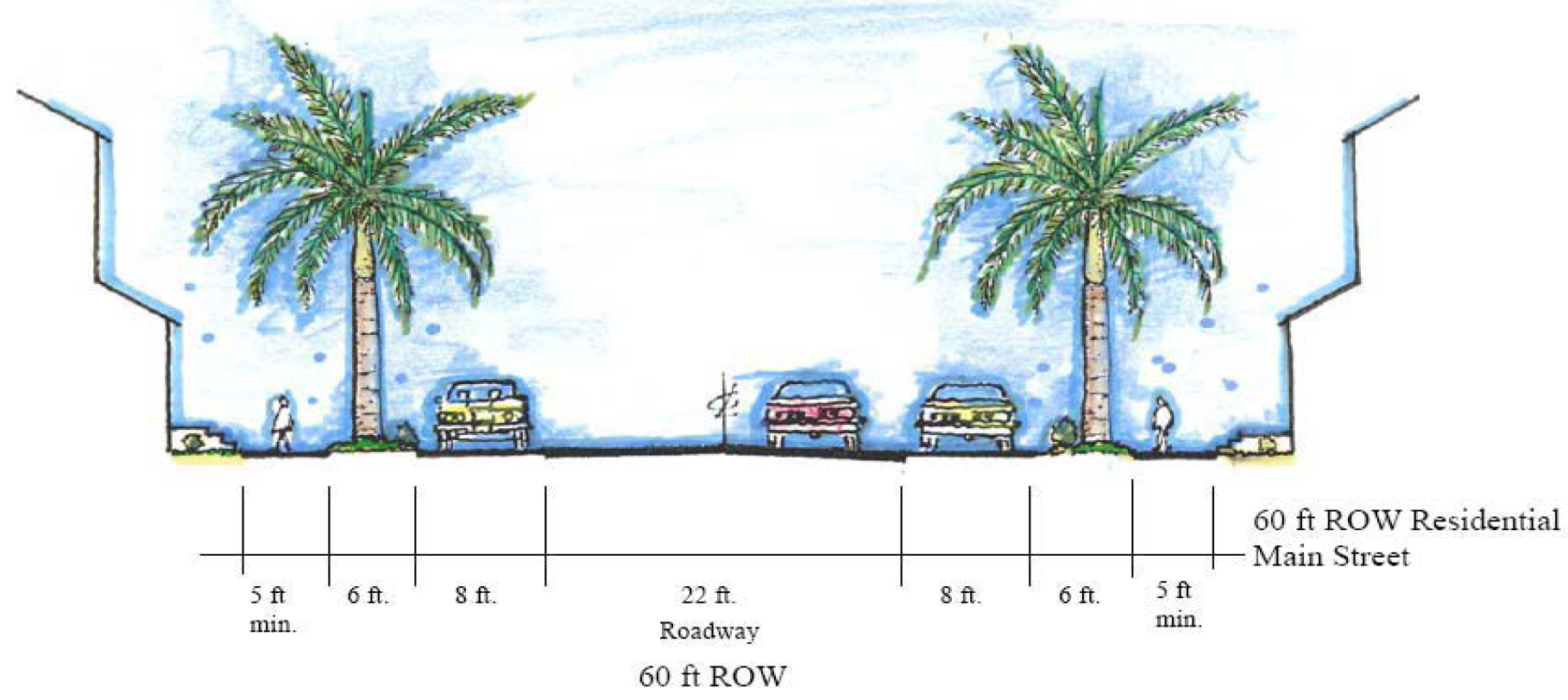
Residential main street. Residential main streets provide low-speed, pedestrian friendly access to higher density attached residential neighborhoods such as apartments and townhouses. Residential main streets are the most urban in character of the residential street classifications.
a.
Design speed: 20—25 mph.
b.
Pavement width: 38 feet.
c.
Right-of-way width: 60 feet.
d.
Curb radius: 15 feet.
e.
Drainage: Curb and gutter.
f.
On street parking: Yes.
g.
Planting strip: Six feet.
(5)
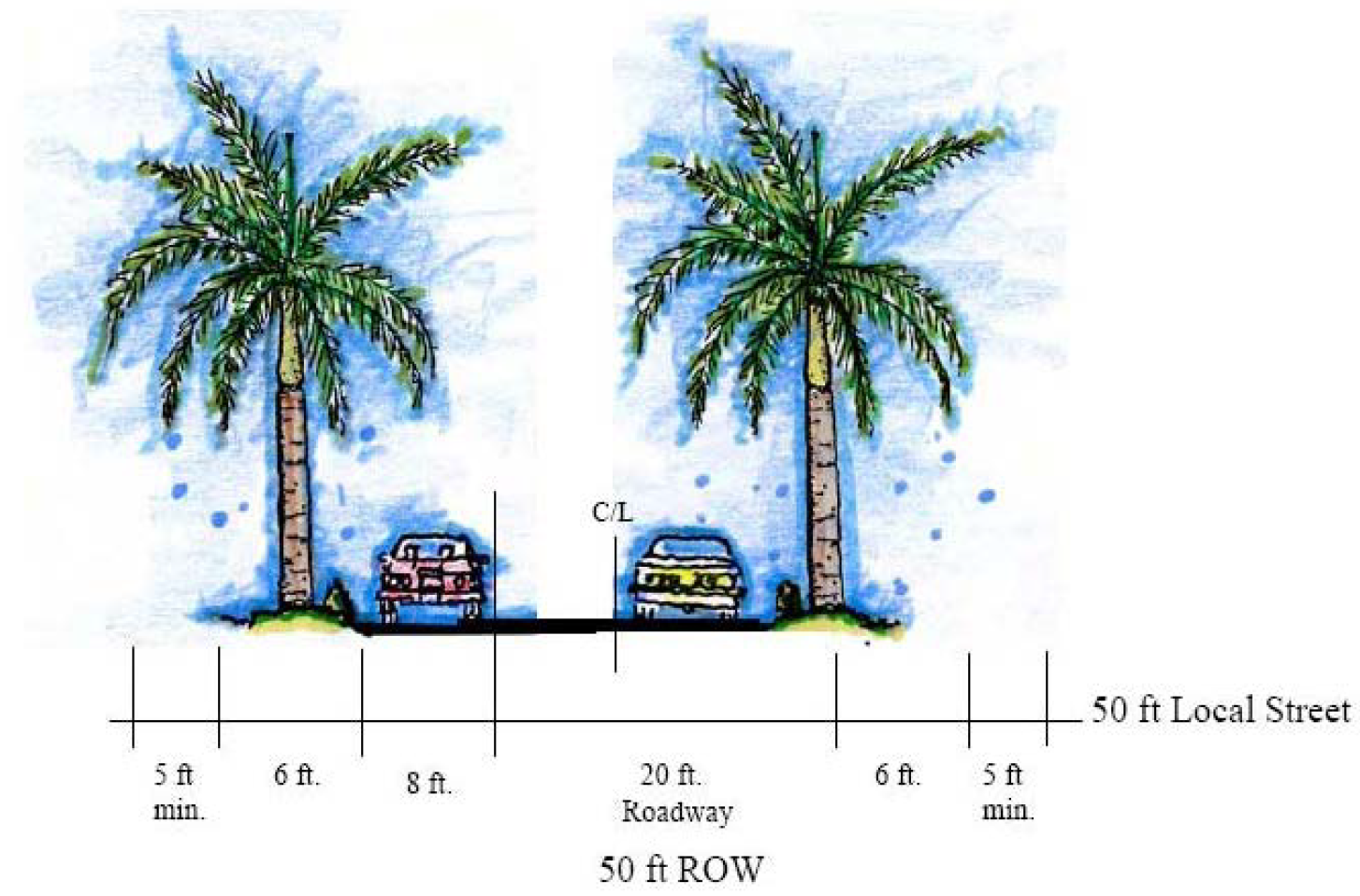
Local street. Local streets are pedestrian-oriented and residential in character, functioning primarily to provide access to neighborhood destinations and to provide connections within neighborhoods. Traffic speeds of 15 to 20 mph are appropriate since these streets should not move significant traffic volumes. On-street parking is generally permitted on one side of the street.
a.
Design speed: 20—25 mph.
b.
Pavement width: 28 feet.
c.
Right-of-way width: 50 feet.
d.
Curb radius: 15 feet.
e.
Drainage: valley curb.
f.
On street parking: Yes.
g.
Planting strip: Six feet.
(6)
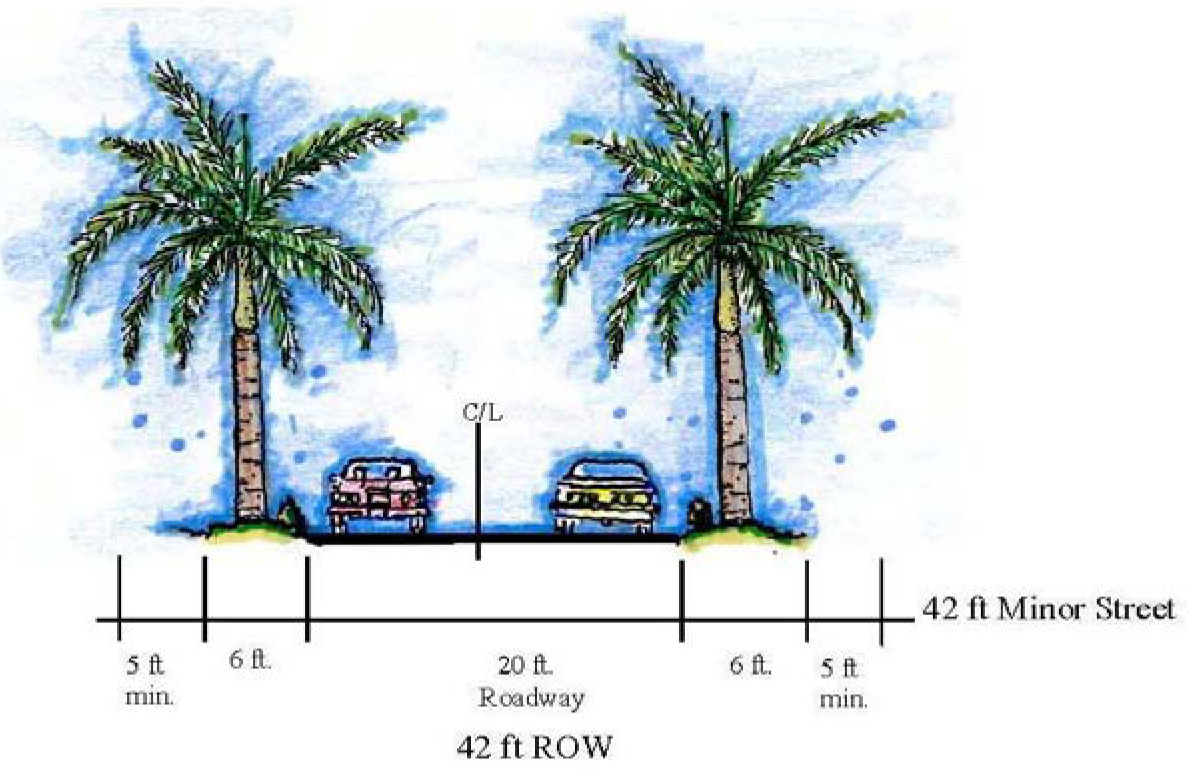
Minor street (this street type shall be private only). Minor streets are pedestrian-oriented and residential in character, functioning primarily to provide access within neighborhoods. A traffic speed of 15 mph is appropriate since these streets are designed to accommodate low traffic volumes.
a.
Design speed: 15 mph.
b.
Right-of-way width: 42 feet.
c.
Curb radius: 15 feet.
d.
Drainage: Valley curb/open.
e.
On street parking: No.
(7)
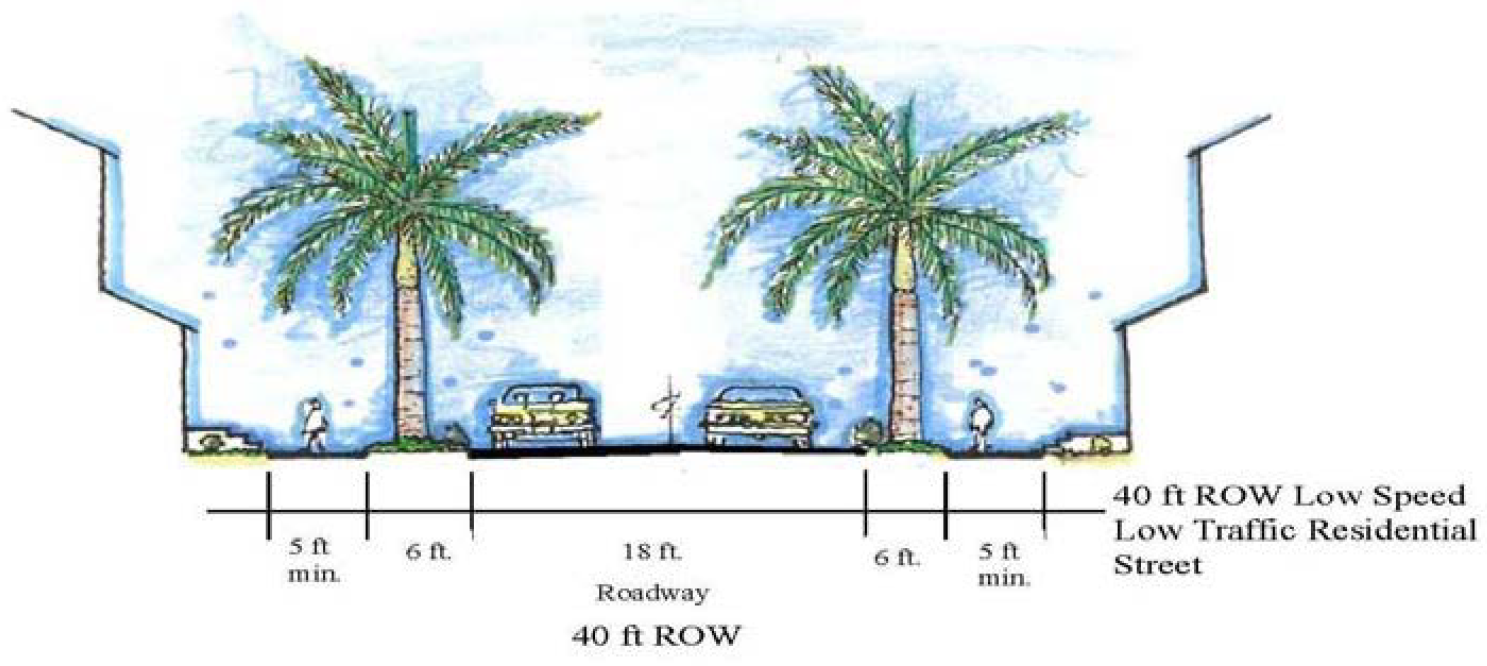
Lane (this street type shall be private only). Lanes are narrow, short, low speed, low traffic, privately maintained roads typically 16 to 18 feet wide and accessing single-family residences.
a.
Design speed: 10—15 mph.
b.
Right-of-way width: 40 feet.
c.
Curb radius: Ten feet.
d.
Drainage: Open section.
e.
On street parking: No.
f.
Street trees: No.
g.
Sidewalks: No.
(8)
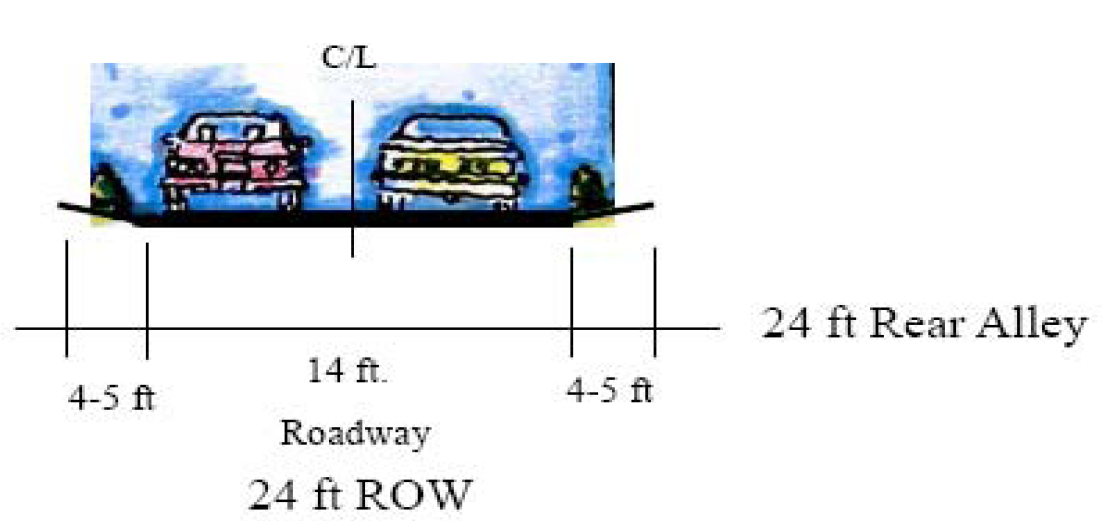
Rear alley (this street type shall be private only). Alleys are privately maintained, low-speed service easements providing rear access for service, delivery, emergency access, utilities, and commercial uses.
a.
Design speed: Ten mph.
b.
Right-of-way width: 24 feet.
c.
Curb radius: Five feet.
d.
Drainage: Curb and gutter.
e.
On street parking: No.
f.
Street trees: No.
g.
Sidewalks: No.
(9)
Bulbouts. The following is an illustration of bulbouts:
(10)
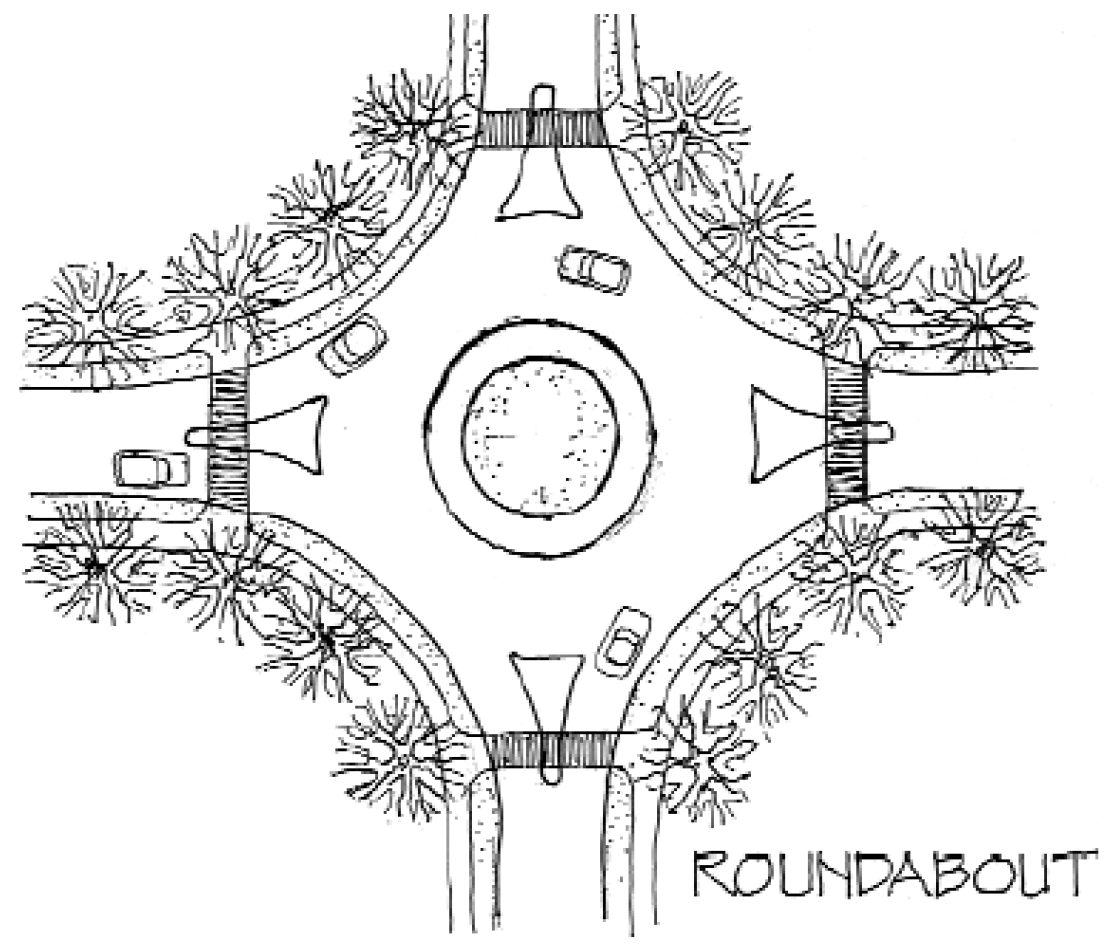
Roundabouts. The following is an illustration of a roundabout:
(Ord. No. 12-03, § 2(3-134), 6-20-2012)

