
Dacono City Zoning Code
ARTICLE 11
Off-Street Parking and Loading
Sec. 16-280.- Required parking.
(a)
Parking for residential land uses shall be required as follows:
Table 1:
Residential Off-Street Parking Standards
* Note: If the number of parking spaces required results in a fractional space, any fraction shall be counted as one (1) additional parking space.
(b)
Parking for nonresidential land uses includes parking for employees, unless employee parking requirements are specifically listed in Table 2, as follows:
Table 2:
Nonresidential Off-Street Parking Standards
* Note: Square footage is based upon gross floor area (GFA) of the related building or land use.
** Note: If the number of parking spaces required results in a fractional space, any fraction shall be counted as one (1) additional parking space.
(c)
Parking for the disabled shall be provided as required by the Americans with Disabilities Act (ADA) and shall be identified by an upright sign at least four and one-half (4½) feet in height.
(d)
All areas designed or required for parking or loading shall be approved by the City. Any area designed or required for parking or loading shall be properly graded for drainage and, except as provided in Subsection (f), shall be an improved surface comprised of asphalt, concrete, brick, cement pavers, or similar materials installed and maintained according to industry standards. The term improved surface does not include compacted/crushed stone, compacted gravel, landscape mulch or similar material, or recycled asphalt. Parking on lawns, whether public or private, is expressly prohibited within the City. Parking and loading areas shall be maintained in good condition and free from debris, vegetation or any other objects that would interfere with the ability to use the area for parking.
(e)
At the time of the erection of a new structure or at the time of enlargement or change in use of an existing structure within any zone district in the City, off-street parking and loading shall be provided as required in this Article. If off-street parking or loading, or both, have been provided in conjunction with an existing use or are added to an existing use, such parking and loading shall not be eliminated or reduced if the elimination or reduction would result in less parking or loading being provided than is required by this Article.
(f)
An area designed or required for parking or loading within a property zoned Agricultural (A), shall not be required to be an improved surface, as that term is defined in Subsection (d); except that, a driveway running across a property zoned Agricultural (A) that is used to access a road, street, or highway shall be an improved surface for the first one hundred (100) feet extending from the road, street, or highway.
(Prior code 17.32.010; Ord. 556 §1, 2000; Ord. 689 §1, 2007; Ord. 871 §§2, 3, 2019)
Sec. 16-281. - Uses not specified.
For uses not specifically identified in Table 1 or 2 of Section 16-280 above, the off-street parking requirement for the land use shall be determined by the City based on similar land uses.
(Prior code 17.32.020; Ord. 556 §1, 2000; Ord. 689 §2, 2007)
Sec. 16-282. - Mixed uses.
In the case of mixed land uses, the total parking requirement shall be the sum of the requirements of all of the land uses. Where the applicant can demonstrate that the land uses of a mixed use development or building have different hours or days of operation and would allow for the potential use of "shared" parking, a maximum reduction of twenty percent (20%) of the total required parking for all of the land uses combined may be proposed, subject to City approval.
(Prior code 17.32.030; Ord. 556 §1, 2000)
Sec. 16-283. - Location of parking lots.
Off-street parking lots shall be provided on the same property as the principal building or use, except that in commercial and industrial districts the required parking may be within four hundred (400) feet of the property, subject to City approval. Such off-site parking lots shall be maintained as long as the principal building or use is maintained and an agreement to ensure continued access and use of off-site parking lots shall be required by the City.
(Prior code 17.32.040; Ord. 556 §1, 2000)
_____
Sec. 16-284. - Size of parking spaces - standard and compact spaces.
(a)
Standard parking spaces shall conform with the dimensions shown in Table 3, as follows:
Table 3:
Parking Space Design Standards - Standard Spaces
* Note: When an overhang is used to reduce parking space depth, aisle width must be increased to twenty-two (22) feet.
(b)
Compact parking spaces shall conform with the dimensions shown in Table 4, as follows:
Table 4:
Parking Space Design Standards - Compact Spaces
* Note: When an overhang is used to reduce parking space depth, aisle width must be increased to twenty-two (22) feet.
_____
(c)
The use of compact parking spaces shall be for long-term use, such as for employees and shall be subject to City approval. Compact parking spaces shall not exceed a maximum of twenty-five percent (25%) of the total amount of required parking spaces and shall be identified by an upright sign at least four and one-half (4½) feet in height, posted at the beginning and end of each grouping of compact parking spaces.
(d)
Parking spaces designed at a ninety-degree angle may be reduced in length as provided for in Tables 3 and 4 if there is a landscaped area or sidewalk at least six (6) feet in width to provide a two-foot overhang and the overhang does not negatively affect the adjacent landscaping or sidewalk.
(Ord. 556 §1, 2000)
Sec. 16-285. - Design of parking lots.
(a)
Except in residential zone districts for residential uses, parking shall have the same setbacks as principal buildings, provided that no parking shall be closer than three (3) feet to any side or rear yard.
(b)
The following design standards shall apply to all off-street parking lots containing ten (10) or more parking spaces:
(1)
Parking lots visible from the public right-of-way or adjacent to residential uses shall be screened through the use of dense shrubbery, low walls, berms or a combination of these methods a minimum of three (3) feet in height. At least seventy-five percent (75%) of the length of the frontage of the parking lot shall be screened.
(2)
Parking lots shall be designed to include landscaped islands to help define and channel traffic throughout the parking lot and provide shade within the parking lot. A minimum of ten percent (10%) of the interior of the parking lot shall be in landscaped islands. Islands shall be a minimum width of eight (8) feet and a minimum of one hundred twenty-eight (128) square feet in area. Islands shall include a minimum of one (1) deciduous shade tree and shrubbery no higher than two (2) feet. At least seventy-five percent (75%) of the landscape island shall be in living plant material.
(3)
No more than fifteen (15) parking spaces shall be in a continuous row without landscape islands.
(4)
Parking aisle widths shall be in conformance with the widths specified in Table 3 or 4, unless otherwise required by the Fire District for emergency access purposes.
(5)
Lighting used to illuminate parking lots shall be arranged to contain all light on the site so that lighting does not impact adjoining residential areas and public streets or rights-of-way.
(6)
The location and number of parking lot driveways and entrances shall be arranged to reduce or minimize the potential of traffic hazards and congestion on public streets or rights-of-way.
(7)
Parking lot design shall comply with all applicable Uniform Baseline Design Standards.
(Ord. 556 §1, 2000; Ord. 689 §3, 2007)
Sec. 16-286. - Parking lot review.
Plans shall be submitted to the Planning Commission for review and approval of any parking lot designed for one hundred (100) or more cars. Parking lots that are part of a submittal for site plan, subdivision or Planned Unit Developments (PUD) shall be reviewed as part of the submittal and shall not require a subsequent review by the Planning Commission.
(Prior code 17.32.080; Ord. 556 §1, 2000)
Sec. 16-287. - Loading.
(a)
All commercial, industrial and institutional buildings and uses shall maintain adequate facilities off-street for loading and unloading, as follows:
Table 5:
Off-Street Loading Spaces
* Note: Square footage is based upon gross floor area (GFA).
(b)
Each off-street loading space shall be a minimum of ten (10) feet in width and thirty-five (35) feet in length and shall be designated for loading purposes.
(c)
Off-street loading, service and storage areas shall be screened from view from the public right-of-way or from adjacent properties by an opaque screen that is designed as part of the building architecture or the landscape design. Chain link fencing with slats, tires, used building materials or other materials not typically used for fencing or for enclosure purposes shall not be considered acceptable screening materials.
(Prior code 17.32.090; Prior code 17.32.100; Ord. 556 §1, 2000)
Sec. 16-288. - Sight distance.
(a)
For safety and visibility purposes, a sight distance triangle shall be created and maintained in which there shall be no landscape materials or berms or other visual obstructions between a height of two and one-half (2½) feet and ten (10) feet above the adjacent street level.
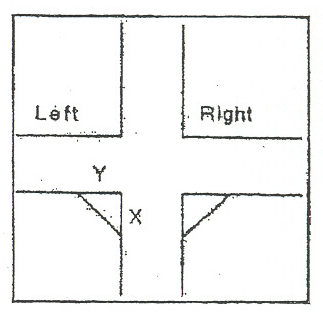
Sight Distance Triangle
(b)
The following chart shall be used to determine the sight distance triangle:
Table 6:
Sign Distance Table
* Note: "X" distances shall be measured perpendicular from the projected flow line of the intersecting street. For calculation purposes, the most restrictive street at an intersection shall be used.
(Ord. 556 §1, 2000)

