
Davis Junction City Zoning Code
ARTICLE VIII
DISTRICT REGULATIONS OF GENERAL APPLICABILITY
8-101 - ACCESSORY STRUCTURES AND USES
A.
Authorization. Subject to the limitations of this Section 8-101, accessory structures and uses are permitted in any zoning district in connection with any principal use lawfully existing within such district.
B.
Definition. An accessory structure or use is a structure or use that:
1.
Is subordinate in area, extent, and purpose to, and serves, a principal structure or use;
2.
Is customarily found as an incident to such principal structure or use;
3.
Contributes to the comfort, convenience, or necessity of those occupying, working at, or being served by such principal structure or use;
4.
Is, except as otherwise expressly authorized by the provision of this Zoning Ordinance, located on the same zoning lot as such principal structure or use; and
5.
Is under the same ownership and control as the principal structure or use.
C.
Certificate of Zoning Compliance Required. When required by Subsection 11-401 C of this Zoning Ordinance, a Certificate of Zoning Compliance evidencing the compliance of the accessory use or structure with the provisions of this Zoning Ordinance shall be obtained before any such accessory use or structure is established or constructed.
D.
Special Regulations Applicable to Particular Accessory Structures and Uses.
1.
Storage. Except as otherwise expressly permitted by this Zoning Ordinance, outdoor storage will not be allowed as an accessory use; where so permitted, such storage will be screened as required by Subsection 8-107 of this Article.
Accessory storage structures, other than garages, shall not exceed 200 square feet in gross floor area if accessory to a residential use or 10% of either the floor area or the volume of the principal structure if accessory to any other type of principal structure.
2.
Residential Recreational Facilities.
a)
Use. Residential recreational facilities will be limited to use by the occupants of the principal residential use and their guests.
b)
Landscaping and Screening. See Subsection 8-107 of this Article for landscaping and screening requirements applicable to such facilities.
c)
Pools. No pool, or any equipment appurtenant thereto, will be located:
(1)
In any required front yard;
(2)
In any required corner side yard;
(3)
In any distance from the property line deemed appropriate by the Zoning Administrator, if located in any required rear yard or required interior side yard; or
(4)
Contrary to the pool fence requirements of the Davis Junction Building Code, as amended (Code § 8-22 (7), or the Davis Junction Residential Code, as amended (Code § 8-28 (5 to 9)).
3.
Accessory Parking Lots in Single Family Residential District. Except when approved as part of a special use permit, parking lots will not be permitted as an accessory use in any single family residential district.
4.
Off-Street Storage of Vehicles. The provisions of Subparagraphs (a) through (d) of this Paragraph will govern the off-street storage of all vehicles in all residential districts and the provisions of Subparagraph (e) of this Paragraph will govern the off street storage of all vehicles in all districts:
a)
Storage Defined. For purposes of this Paragraph, the term storage will mean the parking of a vehicle for a continuous period of longer than 12 hours.
b)
Storage of Vehicles in Garages. Any vehicle may be stored in a garage in a residential district provided the garage complies with all applicable provisions of this Zoning Ordinance.
c)
Storage of Vehicles in Parking Areas. Any vehicle, except a commercial vehicle, may be stored in a parking area provided that such storage is in compliance with the provisions of Subparagraph 8-101D.4(e) below.
d)
Parking and Storage of Commercial Vehicles in Residential Districts. The parking and storage of commercial vehicles in residential districts will comply with the following restrictions:
(1)
Class I Commercial Vehicles. No Class I commercial vehicle will be parked or stored in any unenclosed parking lot or parking area on any lot, except for the period necessary for the reasonable expeditious loading or unloading of such vehicle or in conjunction with the performance of a service or delivery for the benefit of the lot or its owners or occupants.
(2)
Class II Commercial Vehicles.
(i)
Number. Not more than one Class II commercial vehicle may be stored in any unenclosed parking lot or parking area on any lot. Any other Class II commercial vehicle parked or stored on such lot will be located on such lot only for the period necessary for the reasonable expeditious loading or unloading of such vehicle or in conjunction with the performance of a service or delivery for the benefit of the lot or its owners or occupants.
(ii)
Signs. Any Class II commercial vehicle with a sign area in excess of six square feet on any one side of such vehicle must be stored in an enclosed garage.
The Corporate Authorities may, upon written request, for good cause shown and following notice pursuant to Subparagraph 11-303 B3(a) of this Zoning Ordinance, waive the application of any of the restrictions in this Subparagraph (d).
e)
General Regulations and Standards. The following standards and regulations will apply to the storage of vehicles in parking lots and parking areas in all districts:
(1)
Location on Lot. Parking lots and parking areas will comply with yard requirements applicable in the district in which they are located, except that parking areas in the R-1 and R-2 districts may be located in any required front yard.
(2)
Surface. No vehicle will be stored except on any all weather asphalt or concrete pavement surface.
(3)
Permanent Location Prohibited. No vehicle will have its wheels removed or be affixed to the ground so as to prevent its ready removal.
(4)
Residential Use Prohibited. No vehicle will be used for living, sleeping or housekeeping purposes while parked or stored in the Village.
(5)
Utility Hookups. No vehicle will be connected to any public utility except for required servicing.
(6)
Unsafe Conditions. No vehicle will be parked or stored so as to create a dangerous or unsafe condition. The ground under or surrounding the location wherein a vehicle is stored must be free of noxious weeds, debris, and combustible material.
5.
Storage of Inoperable or Unlicensed Vehicles. No vehicle, other than a vehicle awaiting timely repair at an automotive repair shop, gasoline station, or new or used car dealer, incapable of being driven or used for the purpose or use for which it was designed, or without all required licenses, may be stored in any parking lot or parking area in the Village. The lack of a current state vehicle registration or a current state emissions test sticker will create a rebuttable presumption that the vehicle is unlicensed.
6.
Stables. Private stables will not be allowed as an accessory use except in the AG District and in compliance with the following restrictions:
a)
Lot Area. A minimum lot area of five acres must be provided.
b)
Fenced Pasture Area. A minimum fenced pasture area of one acre must be provided. The fence must be sufficient to contain the pastured livestock.
c)
Location. The stable will not be located within 50 feet of any residence on the zoning lot, nor within 100 feet of any residence on any other zoning lot.
d)
Sanitation. All feed must be stored in rodent-proof containers. Manure in excess of 10 cubic yards must be removed and properly disposed of. No manure will be stored within 50 feet of any residence on the zoning lot, nor within 100 feet of any residence on any other zoning lot. All nuisance-causing conditions will be immediately abated.
7.
Antenna With Surface Areas of 10 Square Feet or Less. Antenna and antenna support structures having a combined surface area not greater then 10 square feet, and no single dimension exceeding 12 feet, will be permitted as an accessory use.
8.
Antenna, other than Amateur Radio Facilities, With Surface Areas Exceeding 10 Square Feet. Except for amateur radio facilities permitted pursuant to Section 8-101D.8 of this Section, antenna and antenna support structures having a combined surface area greater than 10 square feet, or having any single dimension exceeding 12 feet, will be permitted as an accessory use only in compliance with the following regulations:
a)
Number Limited in Residential Districts. No more than one such antenna and antenna support structure may be located on any zoning lot in any residential district.
b)
Height Limited. Unless attached to a building pursuant to Subparagraph (c) below, no such antenna or antenna support structure will exceed 65 feet in height in the Industrial Districts or 12 feet in heights in any other district; provided, however, that such antenna or antenna support structure may alone or in combination exceed these height limits only if so authorized by special permit where such a special permit is allowed by applicable zoning district regulations.
c)
Attachment to Buildings Limited. No such antenna or antenna support structure will be attached to a principal or accessory structure unless all of the following conditions are satisfied:
(1)
Size. The antenna and antenna support structure will not exceed 15 square feet in area or 12 feet in any dimension.
(2)
Height. The antenna and antenna support structure will not extend more than three feet above the highest point of the building on which it is mounted or the maximum permissible building height, whichever is less.
(3)
Mounting. The antenna and antenna support structure will not be attached or mounted upon any building appurtenance, such as a chimney. The antenna and antenna support structure will not be mounted or attached to the front of any principal building or to the side of any building facing a street, including any portion of the building roof facing any street. The antenna and antenna support structure will be designed to withstand a wind force of 80 miles per hour without the use of supporting guy wires.
(4)
Color. The antenna and antenna support structure will be of a color that blends with the roof or building side on which it is mounted.
(5)
Grounding. The antenna and antenna support structure will be bonded to a grounding rod.
(6)
Other Standards. The antenna and antenna support structure must satisfy such other design and contraction standards as the Corporate Authorities reasonably determine are necessary to ensure safe construction and maintenance of the antenna and antenna support structure.
d)
Setback from Street. No such antenna or its support structure will be erected or maintained closer to any street than the wall of the principal building to which it is accessory that is nearest to such street.
e)
Guy Wires Restricted. No guy or other support wires will be used in connection with such antenna or support structure except when used to anchor the antenna or support structure to an existing building to which such antenna or support structure is attached.
9.
Amateur Radio Facilities with Surface Area Exceeding 10 Square Feet. Any antenna and antenna support structure having a combined surface area greater than 10 square feet or having any single dimension exceeding 12 feet that is capable of transmitting as well as receiving signals and is licensed by the Federal Communications Commission as an amateur radio facility must satisfy each of the following conditions, which reasonably and clearly define aesthetic, public health, and safety objectives and represent minimum practical regulations necessary to accomplish these objectives:
a)
Number Limited. No more than one such antenna support structure with a surface area greater than 10 square feet or any single dimension exceeding 12 feet may be located on any zoning lot.
b)
Height Limited. No such antenna or antenna support structure will, if ground-mounted, exceed 70 feet in height, or if attached to a building pursuant to Subparagraphs (c) below, the height therein specified.
c)
Attachment to Buildings Limited. No such antenna or antenna support structure will be attached to a principal or accessory structure unless all of the following conditions are satisfied:
(1)
Height. The antenna and antenna support structure will not extend more than 25 feet above the highest point of the building on which it is mounted.
(2)
Mounting. The antenna and antenna support structure will not be attached to or mounted upon any building appurtenance, such as a chimney. The antenna and antenna support structure will not be mounted or attached to the front of any principal building or to the side of any building facing a street, including any portion of the building roof facing any street. The antenna and antenna support structure will be designed to withstand a wind force of 80 miles per hour without the use of supporting guy wires.
(3)
Grounding. The antenna and antenna support structure must be bonded to a grounding rod.
(4)
Other Standards. The antenna support structure must satisfy such other design and construction standards as the Corporate Authorities reasonably impose.
d)
Setback from Street. No such antenna or its support structure will be erected or maintained closer to any street than the wall of the principal building to which it is accessory that is nearest to such street.
e)
Setbacks from Adjacent Buildings. No such antenna or its support structure will be located in any required side yard or nearer than one-half the height of the antenna and support structure to any habitable building on any adjacent property.
10.
Small Wireless Facilities.
a)
Districts. Small wireless facilities are allowed as permitted or special uses in the following districts:
P = Permitted Use, S = Special Use
b)
Special Use. Small wireless facilities allowed as a special use must be:
i.
Designed so as to completely conceal all components of the small wireless facility within a new or existing structure that is architecturally compatible with its surroundings; including, but not limited to, an antenna behind louvers, or in a false roof on a building, or inside a steeple, clock tower, flagpole (with a maximum diameter of 15 inches), campanile or bell tower; or
ii
Camouflaged so as to blend into its surroundings to such an extent that it is no more obtrusive to the casual observer than the structure on which it is
a)
Placed, such as a rooftop, lighting standard or existing tower; or
b)
Replacing, such as a school athletic field light standard, or other similar structure.
11.
Uses Accessory to Hotels. Notwithstanding anything in this Zoning Ordinance to the contrary, the following uses will be deemed to be accessory to hotels; provided that such uses are located entirely within the hotel building and with no principal exterior access:
a)
Gift shops;
b)
Barber shops; or
c)
Beauty shops.
12.
Uses Accessory to Open Space Uses. Notwithstanding anything in this Zoning Ordinance to the contrary, the following use will be deemed to be accessory to uses in the Open Space uses:
a)
That are permitted uses in that district; or
b)
For which a special permit has been lawfully issued and is in full force and effect; provided that such uses shall be located entirely within the open space and with no principal exterior access:
(1)
Eating places;
(2)
Outdoor seating accessory to permitted eating places;
(3)
Carryout eating places; or
(4)
Drinking places accessory to permitted eating place.
13.
Accessory Day Care Centers in the Commercial and Industrial Zoning Districts. Notwithstanding anything in this Zoning Ordinance to the contrary, day care centers will be considered permitted accessory uses in all Commercial and Industrial Districts subject to the following limitations:
a)
The accessory day care center will be for the exclusive use of employees of the principal use. Day care operations serving those not employed on the premises will be deemed a separate principal use, and so regulated in accordance with this Zoning Ordinance.
b)
All requisite state and local licenses and permits regarding day care facilities will be required for such operations.
c)
All regular day care activities, including any outdoor play areas, will be located within the building setbacks for the district in which the principal use is located.
d)
The persons or organization operating the accessory day care center need not be employed by the owners or operators of the principal use.
e)
All accessory day care centers must comply with all other requirements in the Zoning Ordinance.
14.
Exterior Lighting. Any permitted accessory lighting fixtures must be so designed, arranged, and operated as to prevent direct rays of light from being cast onto any adjacent property or street and so as not to produce sky-reflected glare. Except for street lights, no exterior light in or adjacent to any residential district will be so designed, arranged or operated to produce an intensity of light exceeding one-half foot candle at any residential lot line.
15.
Uses Subject to Special Restrictions. Where the district regulations of this Zoning Ordinance require compliance with any procedures or standards with respect to a specific use, such use shall not be established as an accessory use except in compliance with those procedures and standards.
8-101E - Special Accessory Structure and Use Regulations for AG District.
1.
Permissible Accessory Uses. Except for small wireless facilities, only those uses customarily accessory to the pursuit of agriculture will be permitted in the AG District.
2.
Roadside Produce Stands. Roadside stands for the sale of produce grown or produced on or in the immediate area of the premises will be allowed in the AG District, but not including live animals. Such stands will be subject to the following:
a)
Will not contain more than 600 square feet of gross floor area.
b)
Must be set back not less than 75 feet from any adjoining public right-of-way.
c)
Must provide parking for at least five cars for each 50 square feet of structure.
d)
Sales will be permitted from March 15 through November 15.
e)
Owner and operator of a roadside produce stand will be required to obtain a temporary use permit pursuant to 8-103 for the operation of the stand on an annual basis.
3.
Permitted Accessory Structure. Accessory buildings or uses incidental to the principal uses allowed in the AG district (Appendix A), including private garages, are permitted.
4.
Private Wind Energy Conversion Systems (WECS). WECS accessory to an established agricultural or residential use will be permitted provided that any private WECS tower must be setback not less than 1.1 times the tower height from any public road right-of-way line, overhead utility transmission lines, communication towers, and adjacent property lines. However, in no instance will any part of a WECS, including guy wires, be located within five feet of any public road right-of-way line, overhead utility transmission lines, communication towers, and adjacent property lines.
5.
Guest Houses. Guest house for non-paying guests incidental to the principal uses allowed in the AG district (Appendix A), subject to the following:
a)
The guest house shall be used for the occasional housing of guests of the occupants of the principal building to which the guest house is accessory, and not for permanent occupancy by others as housekeeping units;
b)
The guest house shall be designed, constructed, and maintained as one dwelling unit;
c)
The guest house may not be separated from the zoning lot on which it is constructed unless all resulting lots/parcels are zoning lots meeting the minimum lot size/width required for the zoning district;
d)
Not more than one guest house shall be allowed per principal dwelling to which it is incidental and accessory; and
e)
A guest house may not exceed 800 square feet of total living area.
8-101F - Special Bulk, Yard, and Space Regulations.
1.
General Rule. Except as otherwise provided in this Subsection F, all accessory structures and uses must comply with, and be included in calculating compliance with, all bulk, yard, and space requirements applicable in the district in which they are located.
2.
Distance from Principal Structures. No detached accessory structure, except an air conditioning unit, antenna, antenna support structure, or small wireless facility, will be located within 10 feet of any principal structure unless such accessory structure is protected by a fire separation wall in compliance with the Building Code.
3.
Special Height Limitation.
a)
General. No accessory structure will exceed 15 feet in height measured from grade when located in any yard or setback required for any principal structure.
b)
Flagpoles. Notwithstanding the otherwise applicable height limitations in the district, flagpoles may extend to a height of 10 feet above the highest point of the roof of the principal structure.
c)
Antennas. Notwithstanding the otherwise applicable height limitations in the district, the height of any antenna with a surface area in excess of 10 square feet will be governed by Paragraph 8-101D of this Section.
d)
Small Wireless Facilities.
i)
The maximum height of a small wireless facility collocated on an existing structure shall be limited to 10 feet above the structure on which the small wireless facility is collocated.
ii)
The maximum height of a new small wireless facility which is not collocated on an existing structure may not exceed: (i) 10 feet in height above the tallest existing utility pole that is in place on the date the application is submitted, that is located within 300 feet of the small wireless facility and that is in the same right-of-way within the Village; or (ii) 45 feet above ground level.
4.
Special Floor Area Ratio Exception. A small wireless facility collocated on an existing structure shall not count toward any required floor area ratio.
5.
Special Side and Rear Yard Regulations for Residential Recreational Facilities. Notwithstanding the otherwise applicable side and rear yard regulations established for principal structures and uses by the district regulations of this Zoning Ordinance, residential recreational facilities will be governed by the special landscaping and screening requirements of Subsection 8-107 of this Article.
8-101G - Use Limitations.
1.
Every accessory structure or use must comply with the use limitations applicable in the zoning district in which it is located.
2.
No accessory structure or use will be constructed, established, or maintained on any lot prior to the substantial completion of construction of the principal structure to which it is accessory.
8-102A. - Authorization.
Subject to the limitations of this Section 8-102, any home occupation that is customarily incidental to the principal use of a building as a dwelling will be permitted in any dwelling unit.
8-102B. - Definition.
A home occupation is a business, profession, occupation or trade that:
1.
Is conducted for gain or support by a full-time occupant of a dwelling unit;
2.
Is incidental and secondary to the use of such dwelling unit for dwelling purposes; and
3.
Does not change the residential character of such dwelling unit.
8-102C - Use Limitations.
1.
Employee Limitations.
a)
The entrepreneur of every home occupation must be domiciled in the dwelling unit where such occupation is conducted. In addition, where a day care nursery is operated as a home occupation, the principal provider of day care must be domiciled in the dwelling where such day care nursery is operated.
b)
No more than one full time or part time employee of the entrepreneur of a home occupation may work at the dwelling unit where such occupation is conducted at any one time, provided that one off street parking space is made available for that employee.
2.
Structural Limitations.
a)
No alteration of any kind will be made to the dwelling unit where a home occupation is conducted that would change its residential character as a dwelling unit, including the enlargement of public utility services beyond that customarily required for residential use.
3.
Occupational Limitations.
a)
No activity will be conducted on a residential lot unless it is conducted wholly within a principal dwelling unit or permitted accessory structure.
b)
No more than a total of 25 percent of the floor area (exclusive of garage floor area devoted to permissible parking of a vehicle used in connection with the home occupation) of any dwelling unit or any permitted accessory structure will be devoted to the conduct of a home occupation and all such occupations must take place on one floor of the dwelling.
c)
No stock in trade will be displayed or sold on the premises of any home occupation except
i.
In-home sales of merchandise through direct selling; or
ii.
As part of a garage sale, and subject to the garage sale regulations in Paragraph 8-103D1 of this Code.
d)
Routine attendance of patients, clients, subcontractors, or employees, other than those authorized to work full- or part-time as provided in Paragraph 8-102C.1 of this Code, associated with a non-day care home occupation will be allowed at the premises of the home occupation, provided no more than five vehicle trips by such patients, clients, subcontractors, or employees are made to the dwelling unit per day, and provided further that no deliveries are made to the dwelling unit at any time by commercial vehicles with a gross empty weight of 10-tons. "Routine attendance" means that the conduct of the home occupation requires non-domiciled persons to visit the premises of the home occupation as part of the regular conduct of the occupation, without regard to the number, frequency, or duration of such visits.
e)
Notwithstanding anything to contrary in this Paragraph 8-102C3:
i.
For home day care businesses, attendance of up to six children, including family members, at any one time may be allowed, and
ii.
For home tutoring and other educational skills instruction businesses, attendance of up to two persons at any one time may be allowed for the purpose of receiving private instruction in any subject or skill.
f)
No mechanical, electrical, or other equipment that produces noise, electrical or magnetic interference, vibration, heat, glare, emissions, odor, or radiation outside the dwelling unit or any permitted accessory structure that is greater or more frequent than that typical of equipment used in connection with residential occupancy shall be used in connection with any home occupation.
g)
No outdoor storage shall be allowed in connection with any home occupation.
h)
No refuse in excess of the amount allowable for regular residential pick-up shall be generated by any home occupation.
i)
Except as otherwise provided in this Subsection 8-102C, vehicles used in connection with any home occupation shall be subject to the requirements of Paragraph 8-101D.4 of this Article.
4.
Signage and Visibility.
a)
No sign other than as permitted pursuant to Paragraph 8-106 F3 shall advertise the presence or conduct of the home occupation.
b)
Except for the identification sign permitted in Subparagraph 8-102C.4(a) above, no home occupation shall be in any manner visible or apparent from any public or private street.
5.
Traffic Limitations. Except as otherwise provided in this Section 8-102, no home occupation shall generate more traffic than is typical of residences in the area.
6.
Nuisance-causing Activities. In addition to the foregoing specific limitations, no home occupation shall cause any nuisance or be noxious, offensive, or hazardous.
7.
Licensing Requirements. Every home occupation shall be subject to applicable business licensing and inspection requirements.
8-103A - Authorization.
Subject to the limitations of this Section 8-103, temporary uses as hereinafter specified are permitted in the zoning districts hereinafter specified.
8-103B - Definition.
A temporary use is a use that:
1.
Is established for a fixed period of time with the intent to discontinue such use upon the expiration of such time; and
2.
Does not involve the construction or alteration of any permanent structure.
8-103C - Certificate of Zoning Compliance Required; Special Standards for Issuance and Revocation.
1.
Certificate Required. Except as provided in Paragraphs D1 and D13 below, no temporary use will be established or maintained unless a Certificate of Zoning Compliance evidencing the compliance of such use with the provisions of this Code will have first been issued in accordance with Section 11-401 of this Code; provided, however, that permitted temporary uses of publicly owned or leased buildings and property, other than those included in Paragraph D13 below, will be exempt from this requirement.
2.
Bases for Certificate Denial. Such a Certificate may be denied if the Board of Trustees determines that the applicant has failed to comply with the standards, conditions, or terms of any previously issued zoning certificate for a temporary use or that the permanent use of the subject property fails to comply in all respects with the provisions of all applicable Ordinances regulating the development, use, and maintenance of the property. Such a certificate will be denied if the Board of Trustees determines that the public health, safety, or welfare would be, or may reasonably be expected to be, impaired by the issuance thereof.
3.
Conditions on Certificate. Such a Certificate may be conditioned upon such special requirements as the Board of Trustees may determine are necessary to achieve the purposes of this Code and to protect the public health, safety, and welfare. Following reasonable notice and an opportunity for a hearing before the Planning and Zoning Commission.
4.
Revocation of Certificate. Such a Certificate will be revoked if any of the standards and conditions imposed pursuant to this Section 8-103, or such certificate, are violated.
8-103D - Permitted Temporary Uses.
Subject to the specific regulations and time limits that follow, and to the other applicable regulations of the district in which the use is permitted, the following temporary uses, and no others, are permitted in the zoning districts herein specified:
1.
Garage Sales. In any residential district, but only in compliance with the following terms and conditions:
a)
Garage Sale Defined. The term "garage sale" includes all general sales of goods open to the public, conducted from a residential premises including, but not limited to, all sales entitled "garage," "lawn," "yard," "attic," "porch," "room," "backyard," "patio," "flea market," "rummage," "estate," or "moving" sale.
b)
Certificate of Zoning Compliance. No Certificate of Zoning Compliance will be required for garage sales authorized pursuant to this Paragraph 1.
c)
Frequency. Garage sales will be limited to a period not to exceed three consecutive days. No more than four garage sales will be conducted from the same dwelling unit in any calendar year, and no more than one such sale will be allowed to occur in any 30-day period at the same dwelling unit.
d)
Hours of Operation. No garage sales shall operate between the hours of ten o'clock (10:00) p.m. and seven o'clock (7:00) a.m.
e)
Location of Sale. No portion of any garage sale will take place on any public or private landscaped area, on any public sidewalk, or on any public right-of-way.
f)
Garage sales are exempt from the certification requirements in Section 8-103F.3 of this Code.
2.
Indoor and Outdoor Art, Craft, and Plant Shows. In any Original Town District, neighborhood commercial district, corridor commercial district, corridor service district, AG, or EPOS district; provided, however, that any such use will require the specific prior approval of the Board of Trustees on the basis of the adequacy of the parcel size, parking provisions, traffic access and the absence of undue adverse impact on other properties. Any such sale shall be limited to a period not to exceed three consecutive days. In addition to the foregoing indoor and outdoor art, craft, and plant shows shall be permitted in a residential district as part of a garage sale and subject to the garage sale regulations in Paragraph 8-103D.1 of this Code.
3.
Christmas Tree Sales. In any commercial or manufacturing district and, when conducted by a not-for-profit religious, philanthropic, or civic group or organization, on property owned or leased by such group or organization, in any EPOS, or AG district; provided:
a)
That any such use in any Original Town District, neighborhood commercial district, corridor commercial district, corridor service district, AG, or EPOS district must be conducted solely by the officers, directors, members, and employees of any such group or organization, and any proceeds of such Christmas Tree sales must accrue solely to such group or organization;
b)
That any such use will require the specific prior approval of the Board of Trustees on the basis of the adequacy of the parcel size, parking provisions, traffic access, and the absence of undue adverse impact on other properties;
c)
Such use will be limited to a period not to exceed 45 days; and
d)
Display of Christmas trees need not comply with the yard requirements of this Code, except that no tree will be displayed within the sight triangle defined in Subsection 12-206 S of this Code.
Sales under this subsection are exempt from the certification requirements in Section 8-103F.3 of this Code.
4.
Contractors' Office and Equipment Sheds. In any district when accessory to a construction project. No such use will contain any sleeping or cooking accommodations. Such use will be limited to a period not to exceed the duration of the active construction phase of such project.
5.
Real Estate Offices, Including Model Units. In any district when such use is accessory to a new development. No such use will contain any sleeping or cooking accommodations unless located in a model dwelling unit. Such use will be limited to the period of the active selling or leasing of units or space in such development and to activities related to the development in which such office is located. No such office will be used as the general office or headquarters of any firm.
6.
Carnivals and Circuses. In any non-residential district; provided, however, that any such use shall require the specific prior approval of the Board of Trustees on the basis of the adequacy of the parcel size, parking provisions, traffic access, and the absence of undue adverse impact on other properties. Such use will be limited to a period not to exceed ten (10) days. Such use need not comply with the yard requirements of this Code except that structures or equipment that might block the view of operators of motor vehicles on any public or private street must not be located within the sight triangle defined in Subsection 12-206 S of this Code. Such use need not comply with the maximum height requirements of this Code. The concessionaire responsible for the operation of any such carnival or circus must:
a)
Submit in advance of the event date a site layout displaying adequate ingress and egress routes for emergency vehicles and no dead-end aisles; and
b)
Provide for a thorough clean-up of the site upon termination of the event, including restoring area to same or better condition as it was found.
7.
Sales of Overstock, Seconds, and Similar Goods in Districts Where Not a Permitted Use. In restricted industrial districts or light industrial districts when accessory to any use permitted or specially permitted in such district; but only in compliance with the following conditions:
a)
Existing Inventory Only. No products will be sold except such products as are manufactured, warehoused, or distributed in the normal course of business of the principal use operated on the zoning lot in question. No products will be brought in from other sources for purposes of temporary sale.
b)
No Outdoor Sales. Any area in which such a temporary retail use takes place, including the sale and display of products, must be fully enclosed.
c)
Number and Duration of Sales Limited. Not more than four (4) such temporary uses may be conducted on the same premises in any calendar year, or more than one (1) such sale in any calendar quarter. In each calendar quarter, one (1) such sale may be for a period of not more than three (3) successive days.
8.
CommercialTents. In any district, in connection with any permitted, accessory, temporary, or special permit use. No commercial tent will be allowed to remain for a period of more than four (4) days longer than the period during which the use with which it is associated is allowed to remain or, in the absence of any such period, ten (10) days. Unless waived in writing by the Board of Trustees, every tent must comply with bulk, yard, and space requirements applicable to accessory uses pursuant to Subsection 8-101F of the Article.
9.
Civic Uses of Public Property. Any civic use of any public building or property when authorized by the governmental agency owning or controlling such property; provided that no such use will impose an undue adverse effect on neighboring streets or property.
10.
Unique Events. In any district for a period not to exceed seven (7) consecutive days; subject to such conditions and security requirements as the Board of Trustees determines are necessary.
11.
Temporary Electrical Substations. In any district; provided, however, that any such use will require the specific prior approval of the Board of Trustees on the basis of need and impact on surrounding properties.
12.
Temporary Location of Local Government Uses. The activities of units of local government may be temporarily located in any non-residential district, but only during periods of structural alteration, renovation, or expansion of existing facilities for those activities at another location. No such temporary relocation will be allowed without the prior approval by the corporate authorities by resolution duly adopted. The corporate authorities may, but will not be required to, hold a public hearing prior to adoption of such approval resolution. Such approval by the corporate authorities will be in lieu of any Certificate of Zoning Compliance and will be subject to the use limitations contained in Section 8-103F of this Code, all as determined and imposed by the corporate authorities, in their sole and absolute discretion.
8-103E - Bulk, Yard, and Space Regulations.
Except as expressly provided otherwise in Subsection 8-103D of this Code, every temporary use must comply with the bulk, yard, and space regulations applicable in the district in which such temporary use is located.
8-103F - Use Limitations.
1.
General Limitations. Every temporary use shall comply with the use limitations applicable in the district in which it is located as well as with the limitations made applicable to specified temporary use by Subsection 8-103D of this Code. No temporary use will be permitted in any district if it would have a significant negative impact, including aesthetic impact, on any adjacent property or on the area as a whole.
2.
Hours and Days of Operation. No temporary use will be operated during any hours or on any days of the week except such as are designated by the Board of Trustees in the certificate required by Subsection 8-103C of this Code, on the basis of the nature of the temporary use and the character of the surrounding area.
3.
Public Safety. Except for garage sales under Section 8-103D.1 and sales under 8-103D.3, no temporary use will be permitted unless the Lynn Scott Rock Fire Protection District and the Ogle County Sheriff's Office have first certified that such use will result in no additional, undue on-site or off-site threat to public safety. No temporary use will be operated except in accordance with such restrictions and conditions as the Fire Protection District and Sheriff's Office may require in connection with such certification. If required by the Board of Trustees operator of the temporary use must employ a fire watch team and appropriate security personnel.
4.
Traffic. No temporary use will be permitted if additional vehicular traffic reasonably expected to be generated by such temporary use would have undue detrimental effects on surrounding streets and uses.
5.
Conflicts With Other Temporary Uses. No temporary use will be permitted if such use would conflict with another previously authorized temporary use.
6.
Parking. Before approving any temporary use, the Board of Trustees will make an assessment of the total number of off-street parking spaces that will be reasonably required in connection with the proposed temporary use, on the basis of the particular use, its intensity, and the availability of other parking facilities in the area, and will approve such temporary use only if such off-street parking is provided. No temporary use will be authorized that would, in the opinion of the Board of Trustees, unreasonably reduce the amount of off-street parking spaces available for use in connection with permanent uses located on the zoning lot in questions.
7.
Compliance with Laws. Temporary uses must comply with all federal, state, and local laws, including the sign regulations in Section 8-106 of this Code, and the noise regulations in Section 26-151 of the Village Code.
8-103G - Additional Conditions.
Every temporary use will, in addition, comply with, and the Board of Trustees may impose, such other conditions as may reasonably be necessary to achieve the purposes of this Code or to protect the public health, safety, and welfare.
8-104A - Authorization.
Subject to the limitations of this Section 8-104 and Paragraphs 8-101D3 and 8-101D4, off-street parking is permitted as an accessory use in all districts. Off-street parking as a principal use is permitted only when expressly authorized by the regulations applicable to the district in question. Nothing herein shall be construed to limit the right of any person to provide off-street parking in excess of the requirements herein established but all such parking shall comply with the standards of this Section.
8-104B - General Requirements.
1.
Applicability to Existing, New, and Expanded Uses.
a)
General Applicability. Except as provided otherwise in this Paragraph B1, the provisions of this Section shall apply to, and off-street parking spaces sufficient to satisfy the requirements of this Section shall be provided for, all existing and new uses, in accordance with the provisions of Articles IX and XII of this Code.
b)
Change in Existing Use. Whenever a use existing on the effective date of this Code is changed thereafter to a new use, parking facilities shall be provided as required herein for such new use; provided, however, that when any such new use is required to have no more than the same number of parking spaces required of such existing use, then such new use may be established with a deficiency in required parking spaces equal in number to not more than the number of spaces such existing use was deficient on the effective date of this Code.
c)
Increase in Use Intensity. Whenever the intensity of use of any structure or use is increased through the addition of dwelling units, floor area, seating capacity or other units of measurement specified herein for required parking spaces, parking spaces as required herein shall be provided for such increase in intensity of use.
d)
Exception for Nonconforming Locations and Design. Nothing in this Paragraph B1 shall be construed to prohibit the continued utilization of any parking space as an accessory use to any structure or use for parking of a vehicle that may lawfully be parked in such space solely because such space does not satisfy the locational or design requirements of this Code, or any amendment to it, if such space was legally in use as an accessory use to such structure or use on the effective date of this Code or such amendment.
2.
Location of Required Parking Spaces.
a)
General Rule. Except as provided in Subparagraphs 2(b) through 2(d) below, parking spaces required by this Section shall be located on the same zoning lot as the use to which they are accessory.
b)
Parking for Townhouse, Two Family, and Multiple Family Dwellings. Not more than four parking spaces located in a garage, driveway, or other area reserved for exclusive use of the residents of an individual dwelling unit shall be counted toward the 4.5 spaces required pursuant to Subparagraph 8-104F.1(a)(4) below. At least one-half (1/2) space required for each dwelling unit shall be located in an area or areas available for use in common by at least three such individual units. Such areas may include parking spaces located in parking areas or lots within the development in which such units are located, whether located on or off the lot on which such units are located; provided, however, that no such required space shall be located farther than 300 feet, measured along a paved established pedestrian circulation route, from the unit it is required to serve.
c)
Parking for Multiple Family Dwellings in the Multiple Family Residential and Commercial District. Not more than two parking spaces located in a garage, driveway or other are reserved for exclusive use of the residents of an individual dwelling unit shall be counted toward the 2.5 spaces required pursuant to Subparagraph 8-104F1(a)(3) below. At least one-half (½) space required for each dwelling unit shall be located in an area or areas available for use in common by at least three such individual units. Such areas may include parking spaces located in parking areas or lots within the development in which such units are located, whether located on or off the lot on which such units are located; provided, however, that no such required space shall be located father than 300 feet, measured along a paved established pedestrian circulation route, from the unit it is required to serve.
d)
Deficiency Spaces. When proposed to provide spaces to eliminate a parking deficiency existing on the effective date of this Code, parking spaces required by this Section may be located at any location within an adjacent district in which the principal use in question is a permitted use or within the same zoning district as, and within 300 feet of, the zoning lot on which the use to be served is located, but only when such remote site is covenanted to remain so for so long as said parking spaces are required to meet the standards of this Code.
8-104C - Design and Maintenance.
Every parking lot and garage shall be designed, constructed, and maintained in accordance with the standards and requirements herein set forth:
1.
Location on Lot. Except as provided in the applicable district regulations of this Code, off-street parking spaces may be provided on surface lots, underground, under building, in single level parking garages, or in multiple level parking garages. Except as provided in Paragraph 8-104E.2 parking garages shall comply with the yard requirements applicable in the district in which they are located. Parking lots and areas shall comply with the yard requirements applicable in the district in which they are located except that parking areas in Single Family Residential Districts may be located in any required front yard. See also Paragraph 8-101D4 for additional regulations concerning the storage of vehicles in residential districts.
2.
Screening and Landscaping. All parking lots and garages shall comply with the screening and landscaping requirements set forth in Section 8-107 of this Article.
3.
Design.
a)
Access to Street. All parking lots, areas, and garages shall be so located and designed as to provide access to adjacent streets with the least interference with through traffic movements. Notwithstanding any other provision of this Code, driveways serving single family dwellings and driveways providing direct access from a parking lot to a street, may traverse any required yard; provided, however, that the surface area of any such driveway giving access from a parking lot or area through any such yard shall not exceed thirty percent of the area of such yard. No curb cut across public property shall exceed forty feet in width without the written approval of the Board of Trustees. No such access shall be provided through a zoning district other than the district in which the parking lot is located. No such access shall be provided through a zoning lot other than the zoning lot on which the parking is located except across a permanent, recorded access easement in form and substance satisfactory to the Board of Trustees.
b)
Turnaround Area. Every parking lot or garage, other than a parking lot or garage accessory to a single family dwelling, shall be provided with a turnaround area or other means to permit cars to exit the parking lot or garage without backing onto any street or sidewalk.
c)
Slope. No area of any parking lot or garage excluding access ramps, shall have a slope in excess of five percent. No ramp shall have a slope in excess of eight percent.
d)
Lighting. Fixed lighting shall be provided for all parking lots and garages accommodating more than ten vehicles. Such lighting shall be so arranged as to prevent direct glare of beams onto any public or private property or streets. All lighting shall be reduced to security levels at all times of non-use.
e)
Tree Planting Areas; Landscaped Islands. Trees located within planting islands in paved areas shall have a minimum landscaped area of 35 square feet of surface area and a depth sufficient to allow the bottom of the tree ball to be planted with a washed gravel layer at the bottom of the tree planting area to allow proper watering and drainage. If the soil is impervious, then a drainage pipe shall connect the tree planting area to a drainage structure. All islands shall be bordered by a six inch high concrete barrier curb and shall be located and constructed in accordance with accepted engineering standards.
f)
Car Stops. Every parking lot and garage, except parking lots and garages accessory to a single family dwelling, shall be bordered by a six inch high concrete curb and shall be provided with curbs, car wheel stops, guard rails, barrier fences or other suitable devices designed and located to protect required screening devices, landscaping, structures and other vehicles from damage by vehicles using such lot or garage. This provision shall not be construed to require car wheel stops for every parking space, but only in those cases where the Board of Trustees determines that such stops are necessary or desirable to achieve the purposes of this Subparagraph.
g)
Circulation Aisles. Each parking space shall be accessed by a circulation aisle of a width, in feet, as specified below:
h)
Back-up Area. Each parking space, except spaces accessory to a single family dwelling, shall be provided with a sufficient back-up area to permit egress in one maneuver, consisting of one backward and one forward movement.
i)
Space Dimensions. Each off-street parking space, excluding its associated circulation aisle, shall have the following minimum dimensions, in feet:
I-1 and I-2 Zoning Districts: Parking Dimensions (in feet)
All Zoning Districts except I-1 and I-2:
Parking Dimensions (in feet) Parking Stall
In all zoning districts, except I-1 and I-2, the above-stated stall length dimensions for non-parallel stalls on the perimeter of a parking lot may be reduced to include only eighteen and one-half feet of parking surface plus one and one-half feet of overhang into abutting landscaped areas; provided that such reduction does not reduce the size of any required yard below the requirements in the applicable district.
In all zoning districts, the above-stated stall width dimensions shall be increased to twelve feet or to the width required by state law, whichever is greater, for required handicapped parking spaces.
j)
Landbanking To Reduce Long-Term Parking Space Dimensions. Except for parallel parking spaces, the above-stated stall dimensions may be reduced, in order to increase the amount of landscaped open space, to 18.5 feet in length and 8.5 feet in width in parking lots and structures accessory to institutional, office and manufacturing uses pursuant to a special permit granted in accordance with the procedures of Subsection E below, and where the Board of Trustees finds that the typical parking space in such lot or structure will be occupied by no more than one (1) or two (2) different vehicles during the course of the business day.
k)
Maintenance. All tree planting areas, landscaped islands, parking lots, garages and areas shall be properly maintained at all times so as to be free of weeds, pot holes, broken curbs, and other damaged or neglected features.
8-104D - Use; Other Temporary Storage.
1.
General. No off-street parking lot or area shall be used for any purpose other than the temporary storage of motor vehicles related to the premises, except that merchandise, equipment, or materials related to the use being made on the premises may be stored for a period of time not exceeding three days in any seven day period.
8-104E - Landbanking of Required Parking.
1.
Landbanking Authorized. Notwithstanding any other provision of this Section, the Board of Trustees may, by special permit granted pursuant to Section 11-602 of this Code, reduce the total number of off-street parking spaces required to be paved pursuant to Subsection F of this Section or the stall length and width dimension required pursuant to Subparagraph 8-104C3(i) above, subject to acceptance by the property owner of the conditions set forth in Paragraphs E2 through E4 below.
2.
Termination of Landbanking. The Board of Trustees shall have the right, in its sole and absolute discretion, to require the property owner or his or her successor, at any time, to increase the stall length and width to the dimension required by Subparagraph 8-104C3(i) above or to increase the number of parking spaces provided to serve said development up to the maximum required by Subsection F of this Section for the property in question as if no special permit for landbanking had been granted.
3.
Alternate Plans Required. Every application for a special use permit to allow landbanking of required parking spaces shall be accompanied by alternate detailed parking plans. One plan shall show the full stall length and width required by Subparagraph 8-104C3(i) above and the full number of parking spaces required pursuant to Subsection F of this Section; the other plan shall show the reduced stall length and width or the reduce number of parking spaces, or both, as the case may be, proposed to be provided pursuant to the special permit being sought and shall also show the landscaping treatment of areas proposed to be reserved for future parking requirements. Both such plans shall show the location on the site of all parking areas, the exact number of parking spaces to be provided, and complete details for:
a)
Wheel stops;
b)
Markings;
c)
Curbing;
d)
Surfacing;
e)
Screening and landscaping;
f)
Lighting;
g)
Signing; and
h)
Access.
The design plans for such parking areas shall be subject to the approval of the Board of Trustees.
4.
Open Space Covenant. As a condition of granting such special permit, the applicant must file with the Board of Trustees his unconditional agreement and covenant in form and substance satisfactory to the Village Attorney that areas reserved for future parking will be maintained as landscaped open space until and unless required to be used for off-street parking pursuant to such special permit. The Ordinance granting such permit, together with such agreement and covenant, shall be recorded with the Recorder of Deeds of Ogle County, Illinois, at the expense of the applicant.
8-104F - Required Spaces.
1.
Specified Uses. For the following uses, the following minimum number of off-street parking spaces shall be provided:
OFF-STREET PARKING REQUIREMENTS BY LAND USE
2.
Unspecified Uses. When the ultimate use of a structure is not known, the maximum number of spaces that might be required for any use to which the structure might reasonably be devoted will be provided.
3.
Computation of Required Spaces,
a)
Fractional Spaces. When determination of the number of required parking spaces results in the requirement of a fractional space, any fraction will equal one additional parking space.
b)
Capacity Calculations. When parking spaces are required on the basis of capacity, capacity shall be determined based on the occupancy standards established by the Building Code.
c)
Bench Seating. In stadiums, auditoriums, houses of worship, and other places of assembly in which patrons or spectators occupy benches, pews, or other similar seating facilities, each 24 inches of such seating facility will be counted as one seat for the purpose of determining the requirement for off-street parking facilities under this Code.
d)
Population Calculations. When parking spaces are required on the basis of the number of employees, customers, students, or similar measure, the maximum number for which the structure is designed shall govern except that when the structure has no design capacity, the maximum number present at any one time shall govern. Increases or decreases in the number of employees, customers, students, or similar measure, will result in increases or decreases in required parking spaces based on that measure.
8-104G - Reduction of Required Number of Parking Spaces for Warehouses and Automated Warehouses.
1.
Reduction Authorized. Notwithstanding any other provision of this Section, the Board of Trustees may, by special permit granted pursuant to Section 11-602 of this Code, reduce the total number of off-street parking spaces required pursuant to Subsection F of this Section for Warehouse or Automated Warehouse to one parking space for each 2,500 square feet of gross floor area subject to acceptance by the property owner of the conditions set forth in Paragraphs G2 and G3 below.
2.
Alternate Plans Required. Every application for a special use permit to allow reduction of required parking spaces for Warehouses will be accompanied by alternate detailed parking plans. One plan shall show the number of parking spaces required pursuant to Subsection F of this Section; the other plan shall show the reduced number of parking spaces proposed to be provided pursuant to the special permit being sought and shall also show the landscaping treatment of areas proposed to be reserved for future parking requirements. Both plans shall show the location on the site of all parking areas, the exact number of parking spaces to be provided, and complete details for:
a)
Wheel stops;
b)
Markings;
c)
Curbing;
d)
Surfacing;
e)
Screening and landscaping;
f)
Lighting;
g)
Signing; and
h)
Access.
The design plans for such parking areas shall be subject to the approval of the Board of Trustees.
3.
Covenant. As a condition of granting such special permit, the applicant shall file with the Board of Trustees his unconditional agreement and covenant in form and substance satisfactory to the Village Attorney that should the property ever cease to be used as an Warehouse or Automated Warehouse, additional off-street parking spaces will be provided in accordance with the then applicable off-street parking requirements for such use to which the property is converted. The Ordinance granting such permit, together with such agreement and covenant, shall be recorded with the Recorder of Deeds of Ogle County, Illinois at the expense of the Applicant.
8-105A - Authorization.
Subject to the limitations of this Section 8-105, off-street loading is permitted as an accessory use in all districts other than single family residential districts. Nothing herein shall be construed to limit the right of any person to provide off-street loading in excess of the requirements herein established, but all such loading shall comply with the minimum standards of this Section.
8-105B - General Requirements.
1.
Applicability to Existing, New, and Expanded Uses.
a)
General Applicability. Except as provided otherwise in this Paragraph B1, the provisions of this Section shall apply and off-street loading spaces sufficient to satisfy the requirements of this Section shall be provided for all existing and new uses in accordance with the provisions of Articles IX and XII of this Code.
b)
Change in Existing Use. Whenever a use existing on the effective date of this Code is changed thereafter to a new use, loading facilities shall be provided as required herein for such new use.
c)
Increase in Use Intensity. Whenever the intensity of use of any structure or use is increased through the addition of dwelling units, floor area, seating capacity, or other units of measurement specified herein for required loading spaces, loading spaces as required herein shall be provided for such increase in intensity of use.
d)
Exception. Notwithstanding the foregoing provisions of this Paragraph B1, no building or use lawfully existing on the effective date of this Code, or any amendment of it establishing loading requirements with respect to such structure or use, shall be required to provide any additional loading spaces pursuant to this Paragraph B1 unless and until the aggregate increase in units of measurement shall equal the full number of units for which one additional loading space would be required pursuant to Subsection 8-105D of this Section, in which event loading spaces as required herein shall be provided for the total aggregate increase.
2.
Location of Required Loading Spaces. Loading spaces shall be located on the same zoning lot as the use they serve.
8-105C - Design and Maintenance.
Every loading space shall be designed, constructed, and maintained in accordance with the standards and requirements herein set forth:
1.
Location on Lot. All loading spaces shall comply with the yard requirements applicable to principal uses in the district which they are located except that open loading spaces may be located in a required rear yard. No loading space shall be located within 50 feet of the nearest point of intersection of any two public or private streets or alleys. No loading space shall be located closer to any public right-of-way than the façade of the building facing such right-of-way. No loading space shall open onto any building façade facing a public right-of-way. All loading spaces shall be located and arranged to provide logical and convenient access thereto from the use they serve.
2.
Screening. All loading spaces shall comply with the screening requirements set forth in Section 8-107 of this Article.
3.
Design.
a)
Access of Street. Loading spaces shall be designed and arranged to provide access to a street or alley in a manner that will create the least possible interference with through traffic movements. No curb cut across public property shall exceed 40 feet in width without the written approval of the Board of Trustees.
b)
Maneuvering Space. Every loading space shall be provided with sufficient maneuvering space on the zoning lot where it is located to allow vehicles to access and exit the space without having to make any backing movement on or into any public or private street.
c)
Surface, Drainage, and Markings. Every loading space shall be faced with an asphalt or Portland cement binder pavement providing in all-weather, durable and dustless surface, and all such construction shall meet the minimum standards for structural materials established by the Village.
d)
Lighting. Fixed lighting shall be so arranged as to prevent direct glare of beams onto any public or private property or streets. All lighting must be lit during night hours, but shall be reduced to security levels at all times of non-use.
e)
Space Dimensions. Each loading space, excluding required maneuvering areas, shall have the following minimum dimensions, in feet:
Standard 10W × 25L × 14H
Tractor-trailer 12W × 70L × 15H
8-105D - Required Spaces.
1.
General Requirement. Loading spaces or receiving areas shall be provided in sufficient number, of sufficient size, and so located that no loading and unloading operations infringe upon any street or sidewalk.
2.
Minimum Requirements. For the following uses, the following minimum number of loading spaces shall be provided:
The first space required for any building having in excess of 10,000 square feet shall be sized to accommodate a tractor-trailer and, unless otherwise required by the Board of Trustees, all other spaces may be standard size.
8-106A - Purpose.
The purpose of Part I-C is to set out regulations for the erection and maintenance of signs while preserving the right of free speech and expression.
8-106B - Scope.
The regulations of Part I-C shall provide a balanced and fair legal framework for design, construction, and placement of signs that:
1.
Promotes the safety of persons and property by ensuring that signs do not create a hazard by:
a.
Collapsing, catching fire, or otherwise decaying;
b.
Confusing or distracting motorists; or
c.
Impairing drivers' ability to see pedestrians, obstacles or other vehicles, or to read traffic signs; and
2.
Promotes the efficient communication of messages, and ensures that persons exposed to signs:
a.
Are not overwhelmed by the number of messages presented; and
b.
Are able to exercise freedom of choice to observe or ignore said messages according to the observer's purpose; and
3.
Protects the public welfare and enhances the appearance and economic value of the landscape by protecting scenic views and avoiding sign clutter that can compromise the character, quality, and viability of commercial corridors;
4.
Ensures that signs are compatible with their surroundings, and prevents the construction of signs that are a nuisance to occupants of adjacent and contiguous property due to brightness, reflectivity, bulk, or height;
5.
Promotes the use of signs that are aesthetically pleasing, of appropriate scale, and integrated with the built environment, in order to meet the objectives related to the quality and character of development set forth in the Davis Junction's Comprehensive Plan;
6.
Enhances property values and business opportunities;
7.
Assists in wayfinding; and
8.
Provides fair and consistent permitting and enforcement.
8-106C - Authority.
The Board of Trustees finds that:
1.
The Village has the authority to regulate signs under the United States Constitution, the Constitution of the State of Illinois, and the Zoning Division of the Illinois Municipal Code;
2.
Part I-C advances important and substantial governmental interests;
3.
The regulations set out in Part I-C are unrelated to the suppression of constitutionally-protected free expression and do not involve the content of protected messages which may be displayed on signs, nor do they involve the viewpoint of individual speakers;
4.
The incidental restriction on the freedom of speech is no greater than is essential to the furtherance of the interests protected by Part I-C; and
5.
Certain types of speech are not protected by the First Amendment due to the harm that they cause to individuals or the community, and speech that is harmful to minors may be prohibited in places that are accessible to minors.
8-106D - General Findings of Fact.
The Board of Trustees finds that:
1.
The ability to display signs of reasonable size and dimensions is vital to the health and sustainability of many businesses, and the display of signs with noncommercial messages is a traditional component of the freedom of speech, but the constitutional guarantee of free speech may be limited by appropriate and constrained regulation that is unrelated to the expression itself;
2.
The Village has an important and substantial interest in preventing sign clutter (which is the proliferation of signs of increasing size and dimensions as a result of competition among property owners for the attention of passing motorists), because sign clutter degrades the character of the community, makes the community a less attractive place for commerce and private investment, and dilutes or obscures messages displayed along the Village's streets by creating visual confusion and aesthetic blight;
3.
Sign clutter can be prevented by regulations that balance the legitimate needs of individual property owners to convey their commercial and noncommercial messages against the comparable needs of adjacent and nearby property owners and the interest of the community as a whole in providing for a high quality community character;
4.
Temporary signs that are not constructed of weather-resistant materials are often damaged or destroyed by wind, rain, and sun, and after such damage or destruction, degrade the aesthetics of the Village's streets if they are not removed;
5.
The Village has an important and substantial interest in keeping its rights-of-way clear of obstructions and litter;
6.
The Village has an important and substantial interest in protecting the health of its tree canopy, which contributes to the character and value of the community; and
7.
The uncontrolled use of off-premises outdoor advertising signs and their location, density, size, shape, motion, illumination and demand for attention can be injurious to the purposes of Part I-C, and destructive to community character and property values, and that, as such, restrictions on the display of off-premises commercial messages are necessary and desirable.
8-106E - Application of Part I-C.
1.
Generally. Hereinafter, all construction, relocation, enlargement, alteration, and modification of signs within the Village shall conform to the requirements of Part I-C, all State and Federal regulations concerning signs and advertising, and applicable building codes. Generally, signs are approved by issuance of a sign permit. However, there are some signs that do not require a permit. These signs are listed in subsection 3, below.
2.
Signs Requiring a Permit. A sign permit shall be required for all permitted signs exceeding six square feet in area, unless otherwise exempted by subsection 3, below. In addition, a sign permit shall be required at any time the sign area is increased, if the increase is allowable within the zone district in which the sign is located. This subsection shall not be interpreted so as to grant permission for prohibited signs with sign areas less than six square feet.
3.
Signs that Do Not Require a Sign Permit. The following signs do not require a sign permit, but may require a building permit or other related permit (if subject to building or electrical codes). Temporary signs that do not require permits shall still comply with the standards of Part I-C.5, Temporary Signs, and Part I-C.3, GeneralDesign and Maintenance Standards, or the applicable standards of this subsection.
a.
Official and Legal Notice. Official and legal notice signs that are issued by any court, public body, person, or officer in performance of a public duty, or in giving any legal notice;
b.
Signs with De Minimus Area. Signs that are affixed to a building or structure (even if wall signs are not permitted in the district or for the use), which do not exceed one square foot in sign area, provided that only one such sign is present on each elevation that is visible from public rights-of-way or neighboring property; and signs that are less than three-fourths of a square foot in area that are affixed to machines, equipment, fences, gates, walls, gasoline pumps, public telephones, or utility cabinets;
c.
Flags. Flags that are not larger than 30 square feet in area that are affixed to permanent flagpoles or flagpoles that are mounted to buildings (either temporary or permanent);
d.
Decorative Signs. Clearly incidental, customary, and commonly associated with a holiday, provided that such signs shall be displayed for a period of not more than 60 consecutive days nor more than 60 total days in any one year;
e.
Carried Signs. Signs that are being carried by people (however, such signs are not exempt if they are set down or propped on objects);
f.
Bumper Stickers. Bumper stickers on vehicles;
g.
Interior Signs. Signs that are not visible from residential lots, abutting property or public rights-of-way;
h.
Traffic Control Signs. Traffic control signs and other signs related to public safety that the Village or another jurisdiction installs or requires a developer to install;
i.
Holiday Decorations. Holiday decorations that are displayed for not more than two months per year.
8-106F - Exemption for Addressing.
The Board of Trustees finds that the posting of the addresses of buildings in locations that are visible from the street is necessary for the effective delivery of public safety services. The efficient and timely delivery of emergency services is a compelling governmental interest. Accordingly, the Village requires that street addresses shall be posted as follows:
1.
Nonresidential and Mixed-Use Districts. In nonresidential districts, street addresses shall be posted at:
a.
All primary building entrances; and
b.
On detached signage if the address on the building is not visible from the street.
2.
Residential Districts. In residential districts, street addresses shall be posted:
a.
On the facade of the building that faces the street from which the address is taken; and
b.
On the mailbox or mailbox support, if the mailbox is detached from the building.
3.
Exclusion from Sign Area Calculation. Because address signs are required, numbers and letters used for addressing are not included in the calculation of sign area if they are not more than 14 inches in height.
8-106G - Signs Permitted Before Effective Date.
If a permit for a sign has been issued in accordance with all Village ordinances in effect prior to the effective date of Part I-C, and provided that construction is begun within six months of the effective date of Part I-C and diligently pursued to completion, said sign may be completed in accordance with the approved plans on the basis of which the permit has been issued, subject thereafter, if applicable, to the provisions of this Zoning Ordinance regarding nonconforming signs.
8-106H - Relationship to Other Regulations.
These regulations recognize other regulations pertaining to signage. Where any provision of Part I-C cover the same subject matter as other regulations, the more restrictive regulation shall apply.
8-106I - Measurements.
1.
Generally. The regulations of Part I-C shall be applied using the measurements set out in this Section.
2.
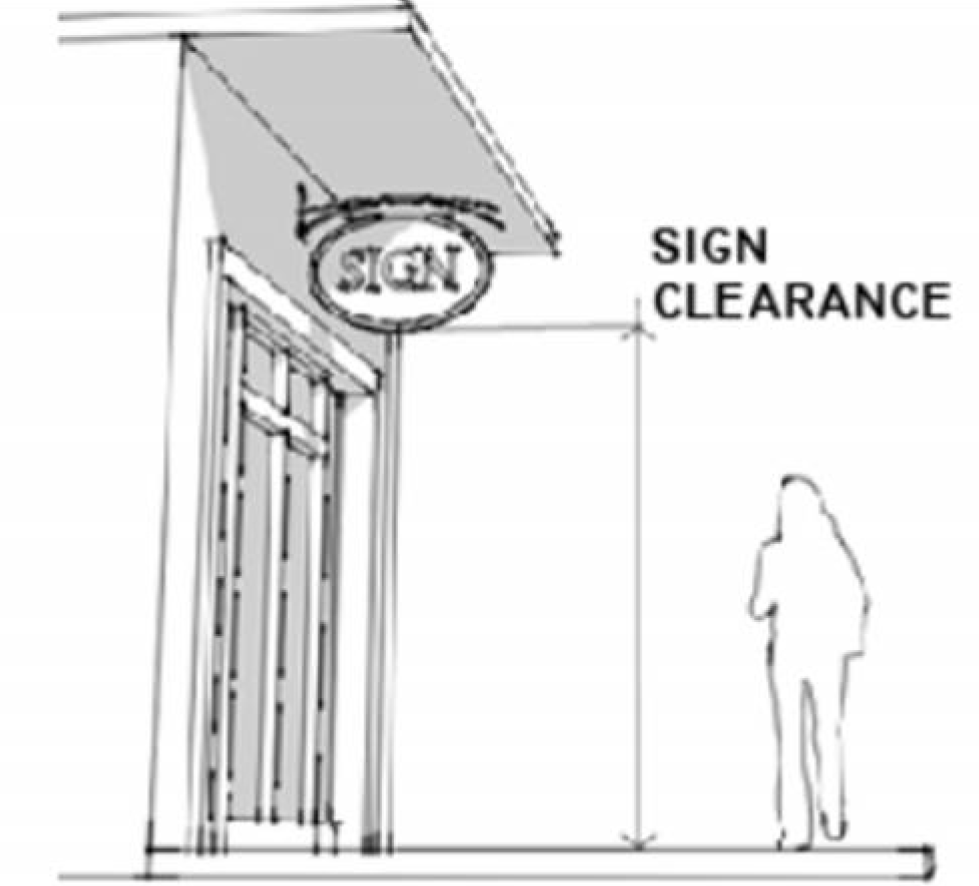
Sign Clearance. Sign clearance is the distance between the bottom of a sign face or structural element that is not affixed to the ground and the nearest point on the surface under it. See Figure 8-106 I.2.a, Measurement of Sign Clearance.
Figure 8-106 I.2.a
Measurement of a Sign Clearance
3.
Sign Height. For detached signs (temporary and permanent), sign height is:
a.
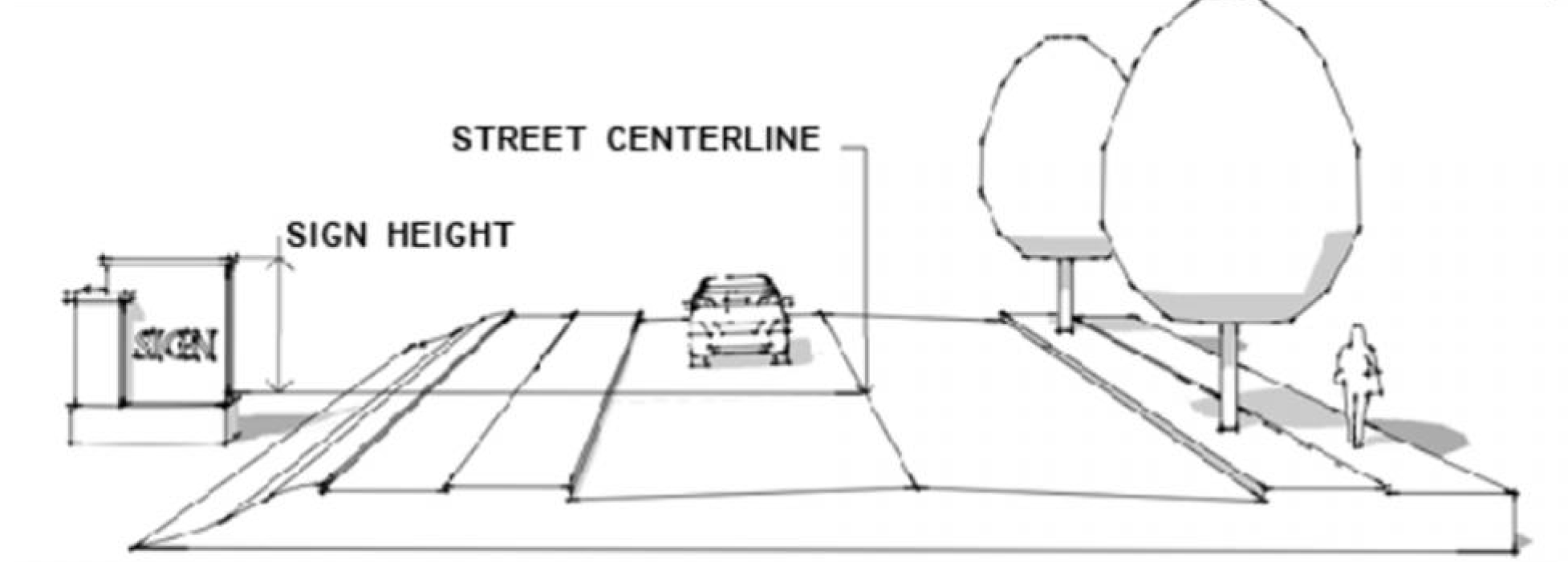
Where the natural grade of the ground where the sign is to be located is lower than the street centerline, the vertical distance to the top of the sign face or sign structure, whichever is higher, measured from the elevation of the centerline of the adjacent street. See Figure 8-106 I.3.a, Measurement of Sign Height, Sign Base Lower than Street Centerline.
Figure 8-106 I.3.a
Measurement of Sign Height, Sign Base Lower than Street Centerline
b.
Where the natural grade of the ground where the sign is to be located is higher than the street centerline, the vertical distance to the top of the sign face or sign structure, whichever is higher, measured from the elevation of the average grade around the base of the sign.
4.
Items of Information. An item of information is a word, logo, abbreviation, symbol, geometric shape, image, or number with 10 or fewer digits (punctuation of numbers does not increase the number of items of information). See Figure 8-106 I.4.a, Items of Information.
Figure 8-106 I.4.a
Items of Information
The sign below has 7 items of information: 4 words + one 10-digit number (with punctuation)
+ 2 symbols

8-106J - Calculations.
1.
Generally. The calculations required by the regulations of Part I-C shall be according to the methodologies of this Section.
2.
Sign Area.
a.
Generally. Sign area is calculated as the area within a continuous perimeter with up to eight straight sides that encloses the limits of text and graphics of a sign, together with any frame or other material or color forming an integral part of the display or used to differentiate the sign's message from the background against which it is placed. The area excludes the structure upon which the sign is placed (unless the structure is an integral part of the display or used to differentiate it), but includes any open space contained within the outer limits of the display face of a sign, or between any component, panel, strip, or figure of any kind composing the display face, whether this open space is enclosed by a frame or border or not. See Figure 8-106 J.2.a, Sign Area, Generally.
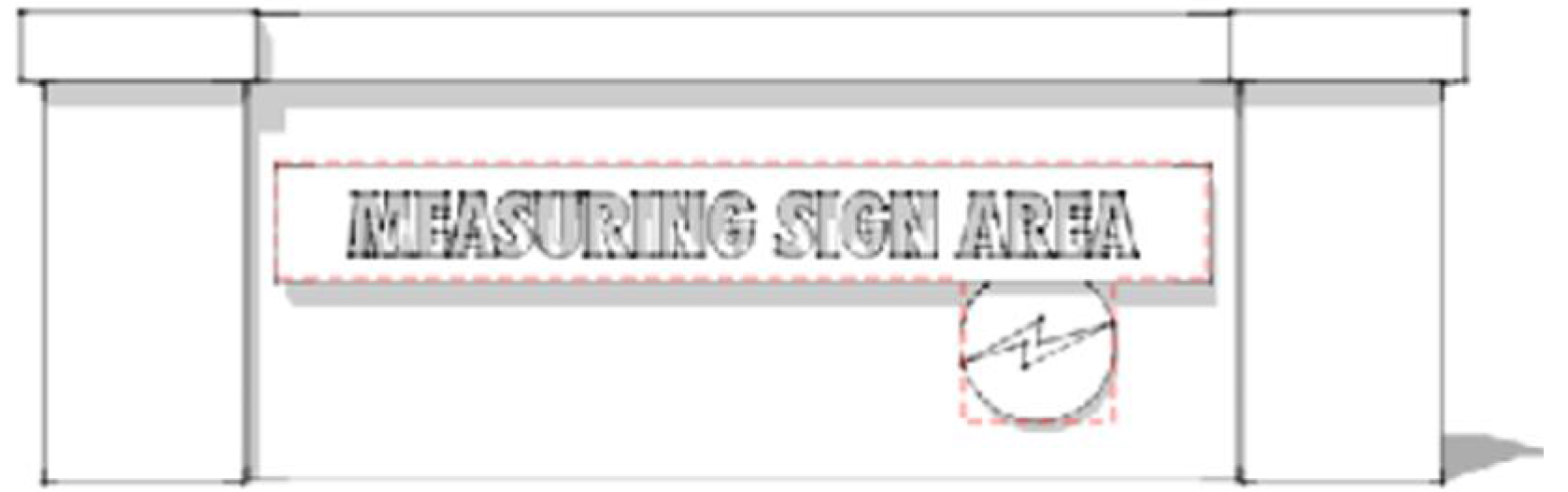
Figure 8-106 J.2.a
Sign Area, Generally
The sign area of the illustrative monument sign below is calculated as the area within
the smallest eight-sided polygon that encloses all of the text and graphics and framing
of the message and graphics of the sign.
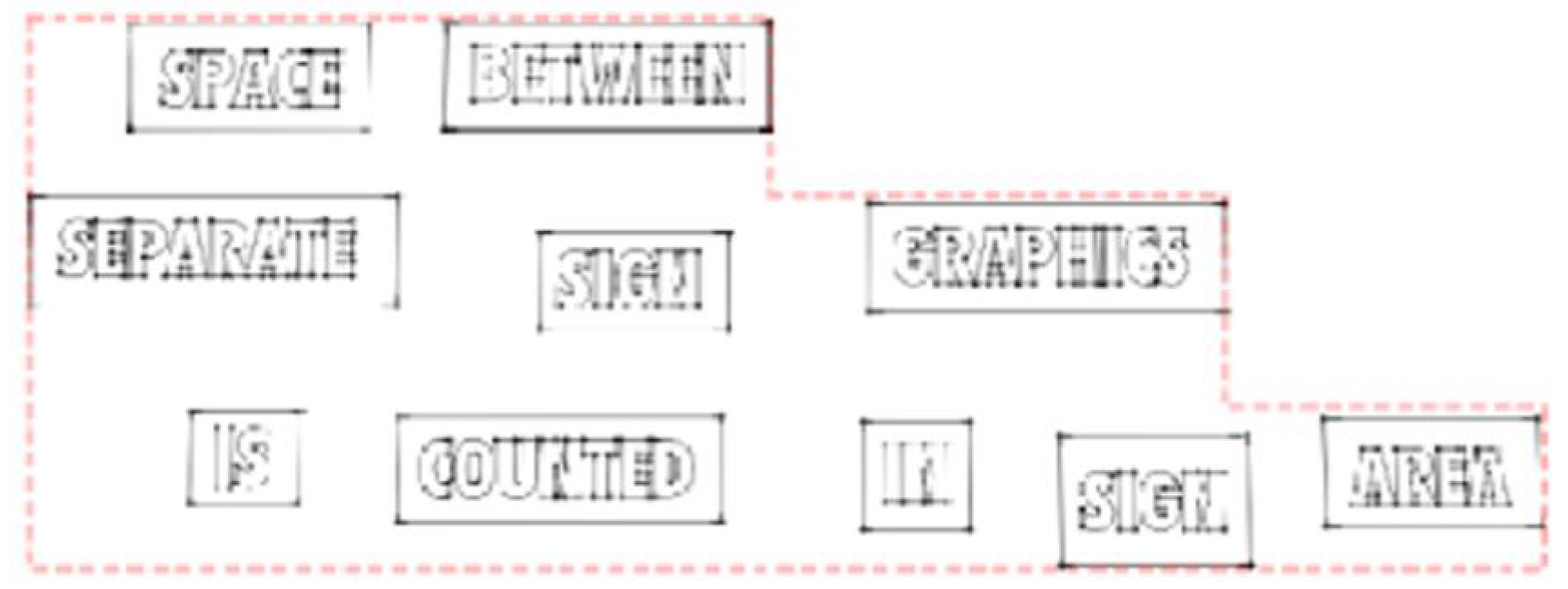
The sign area of the illustrative collection of wall signs below is measured as the
area within the smallest eight-sided polygon that encloses all of the text and graphics
and framing that differentiates them from the wall.
b.
Double-Faced Signs. For projecting, suspended, or other double-faced signs:
i.
Only one display face is measured if the sign faces are parallel or form an interior angle of less than 45 degrees, provided that the signs are mounted on the same structure. If the faces are of unequal area, then sign area is equal to the area of the larger face.
ii.
Both display faces are measured if:
1.
the interior angle is greater than 45 degrees; or
2.
the sign faces are mounted on different structures.
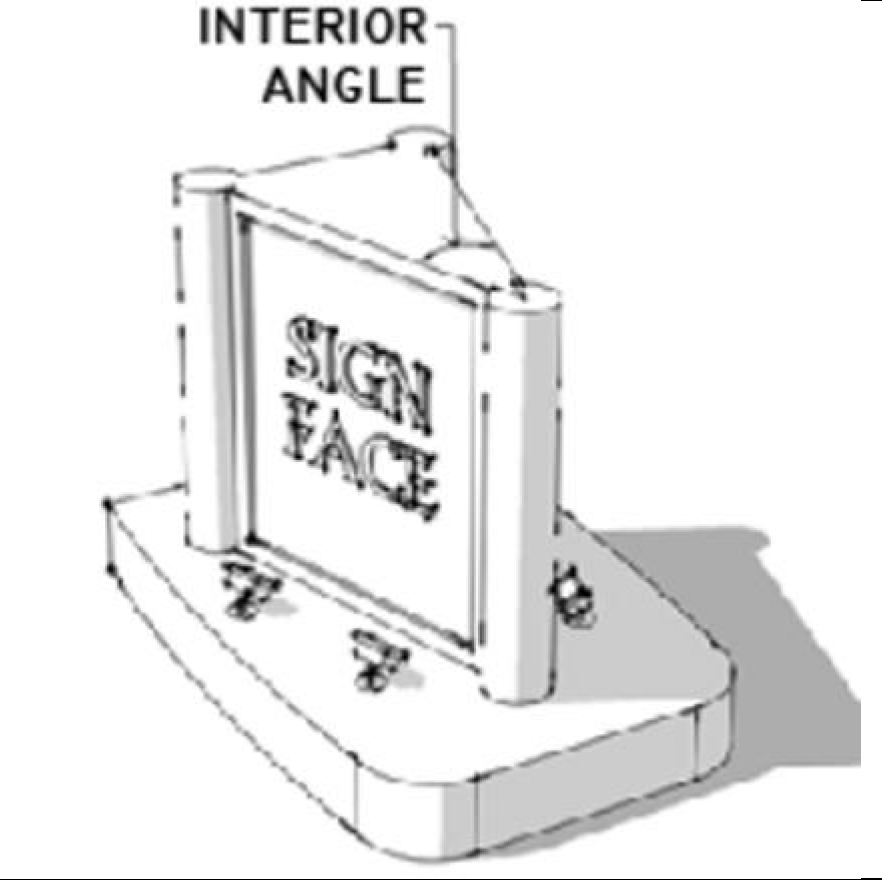
Figure 8-106 J.2.b
Double-Faced Signs
3.
Signable Area. Signable area is calculated as follows:
a.
Wall Signs. A two-dimensional area on the facade of a building that describes the largest square, rectangle, or parallelogram which is free of architectural details.
b.
Window Signs. The area of glass within a window frame.
c.
Other Signs. The area of the face of the sign which is designed to be used for text and graphics (the signable area does not include the sign's supporting frame or structure, if any, provided that such frame or structure is not designed to display text or graphics).
4.
Signable Area Ratio. Signable area ratio is the sign area divided by the signable area. It is expressed as a percentage.
5.
Relationship Between Maximum Sign Area and Maximum Signable Area Ratio. Where both a maximum sign area and a maximum signable area ratio are set out, the standard that results in polygram that encloses all of the text and graphics and framing that differentiates them from the wall.
8-106 K - Prohibited Signs and Design Elements.
1.
Generally. This Section identifies signs and sign elements that are not allowed anywhere in the Village.
2.
Prohibited Signs.
a.
The following signs are prohibited in all areas of the Village:
i.
Signs with more than two sign faces;
ii.
Signs that are a traffic hazard because they simulate or imitate (in size, color, lettering, or design) any traffic sign or signal;
iii.
Animated or moving signs that are visible from public rights-of-way, including any moving, swinging, rotating, flashing, blinking, scintillating, fluctuating, or otherwise animated light (except as allowed in Section 8-106 O, Message Centers);
iv.
Vehicle signs;
v.
Portable Signs, except as specifically permitted in Part I-C.5, Temporary Signs; and
vi.
Billboards.
b.
Other signs may be prohibited in certain districts. See Part I-C.4, Permanent Signs, and Part I-C.5, Temporary Signs, for requirements.
3.
Prohibited Design Elements.
a.
The following elements shall not be used as an element of signs or sign structures, whether temporary or permanent:
i.
Sound, smoke, or odor emitters;
ii.
Awnings that are back lit and/or made of plastic;
iii.
Stacked products (e.g., tires, soft drink cases, bagged soil or mulch); and
iv.
Unfinished wood support structures, except that stake signs may use unfinished stakes.
b.
The following elements shall not be used as an element of signs or sign structures, whether temporary or permanent, which are visible from public rights-of-way:
i.
Flags, banners, or comparable elements that are designed to move in the wind that are not affixed to permanent flagpoles or flagpoles that are mounted to buildings;
ii.
Spinning or moving parts;
iii.
Bare light bulbs, except on holiday displays which are exempted from regulation by Section 8-106 E, Application of Part I-C;
iv.
Flashing lights, except on holiday displays which are exempted from regulation by Section 8-106 E, Application of Part I-C;
v.
Motor vehicles, unless:
1.
The vehicles are functional, used as motor vehicles, and have current registration and tags;
2.
The display of signage is incidental to the motor vehicle use; and
3.
The motor vehicle is properly parked in a marked parking space or is parked behind the principal building.
vi.
Semi-trailers, shipping containers, or portable storage units, unless:
1.
The trailers, containers, or portable storage units are functional, used for their primary storage purpose, and, if subject to registration, have current registration and tags;
2.
The display of signage is incidental to the use for temporary storage, pick-up, or delivery; and
3.
The semi-trailer is parked in a designated loading area or on a construction site at which it is being used for deliveries or storage.
4.
Prohibited Content.
a.
The following content is prohibited without reference to the viewpoint of the individual speaker:
i.
Text or graphics of an indecent or immoral nature and harmful to minors;
ii.
Text or graphics that advertise unlawful activity;
iii.
Text or graphics that are obscene, fighting words, defamation, incitement to imminent lawless action, or true threats; or
iv.
Text or graphics that present a clear and present danger due to their potential confusion with traffic control signs or signs that provide public safety information (for example, signs that use the words "Stop," "Yield," "Caution," or "Danger," or comparable words, phrases, symbols, or characters in such a manner as to imply a safety hazard that does not exist).
b.
The narrow classifications of content that are prohibited by this subsection are either not protected by the United States or Illinois Constitutions, or are offered limited protection that is outweighed by the substantial governmental interests in protecting the public safety and welfare. It is the intent of the Board of Trustees that each paragraph of this subsection (e.g., subsection 8-106 K.5.a.i, K.5.a.ii, K.5.a.iii, or K.5.a.iv) be individually severable in the event that a court of competent jurisdiction were to hold one or more of them to be inconsistent with the United States or Illinois Constitutions.
8-106 L - Prohibited Sign Locations.
1.
Generally. Attached signs shall be installed on signable areas of buildings, as defined by Section 8-106 I, Measurements. Detached signs shall be set back as required by Section 8-106 R, Detached Signs. Signs that are in violation of this Section are subject to immediate removal.
2.
Prohibited Obstructions. In no event shall a sign, whether temporary or permanent, obstruct:
a.
Building ingress or egress, including doors, egress windows, and fire escapes;
b.
Features of the building or site that are necessary for public safety, including standpipes and fire hydrants;
c.
Within any sight triangle, as defined by Section 12-206 S, Sight Triangle; or
d.
Sight distances that are required by the Davis Junction Subdivision and Development Ordinance.
3.
Prohibited Mounts. No sign, whether temporary or permanent, shall be posted, installed, or mounted on any of the following locations:
a.
On trees; or
b.
On utility poles, light poles, or on utility cabinets, except signs posted by the Village or the utility that are necessary for public safety or identification of the facility by the utility provider.
4.
Prohibited Locations. In addition to the setback requirements of Part I-C, and the other restrictions of this Section, no sign shall be located in any of the following locations:
a.
In or over public rights-of-way (which, in addition to streets, may include other elements, such as sidewalks, parkways, retaining walls, utility poles, traffic control devices, medians, and center islands that are within the public right-of-way), except:
i.
Traffic control signs installed by a governmental entity or which are required to be installed by a governmental entity (e.g., permanent traffic control devices such as stop, yield, and speed limit signs, as well as temporary signs related to street construction or repair);
ii.
Signs posted by governmental entities that support emergency management, such as wayfinding to disaster relief locations;
iii.
Banners posted by the Village on utility or light poles according to the standards of subsection 8-106 L.3 above;
iv.
Signs constructed by the Village or another governmental or quasi-governmental entity pursuant to terms and conditions set forth in an approved intergovernmental agreement with the Village; and
v.
Signs specifically identified in a sign design program approved pursuant to Part I-C.3, General Design and Maintenance Standards.
b.
In locations that have less horizontal or vertical clearance from authorized communication or energized electrical power lines than that prescribed by the laws of the State of Illinois and the regulations duly promulgated by agencies thereof.
c.
Within easements for overhead utilities (placement in other utility easement areas is allowed only if approved by the utility service provider and if the other applicable requirements of this Zoning Ordinance are met).
8-106 M - Items of Information.
No sign face shall contain more than 20 items of information. Items of information are measured as provided in Section 8-106 I, Measurements.
8-106 N - Illumination of Signs.
1.
Generally. Signs shall be internally illuminated or, if external illumination is used, the source of illumination shall be shielded.
2.
Hours of Illumination. Signs shall be turned off each day by the later of 10:00 PM or upon closing of the associated land use (signs may be turned back on at 5:00 AM).
3.
Sign Illumination. Signs shall not exceed the following illumination levels:
Table 8-106 N.3.a
Maximum Sign Illumination Standards
8-106 O - Message Centers.
1.
Generally. Manual and electronic message centers may be used in detached signs and marquee signs to a limited degree, pursuant to the applicable standards of this Section.
2.
Electronic Message Centers. Electronic message centers may be incorporated into signage as follows:
a.
Design Requirements.
i.
Electronic message centers are only permitted on monument signs or marquee signs which enclose the electronic message center component on all sides with a finish of brick, stone, stucco, powder coated (or comparably finished) metal, or the surface of the sign face. The enclosure shall extend not less than six (6) inches from the electronic message center in all directions.
ii.
Electronic message centers shall make up not more than fifty (50%) percent of the sign area of a monument sign or seventy five (75%) percent of the sign area of a marquee sign. The balance of the sign area shall utilize permanent, dimensional letters or symbols.
iii.
No sign structure that includes a cabinet, box, or manual changeable copy sign may also include an electronic message center. See Figure 8-106 O.2.a, Electronic Message Center Design Requirements.
iv.
All electronic message center display components shall be full color with a minimum pitch resolution of 16 mm spacing or better (i.e. 10 mm, 12 mm, etc.)
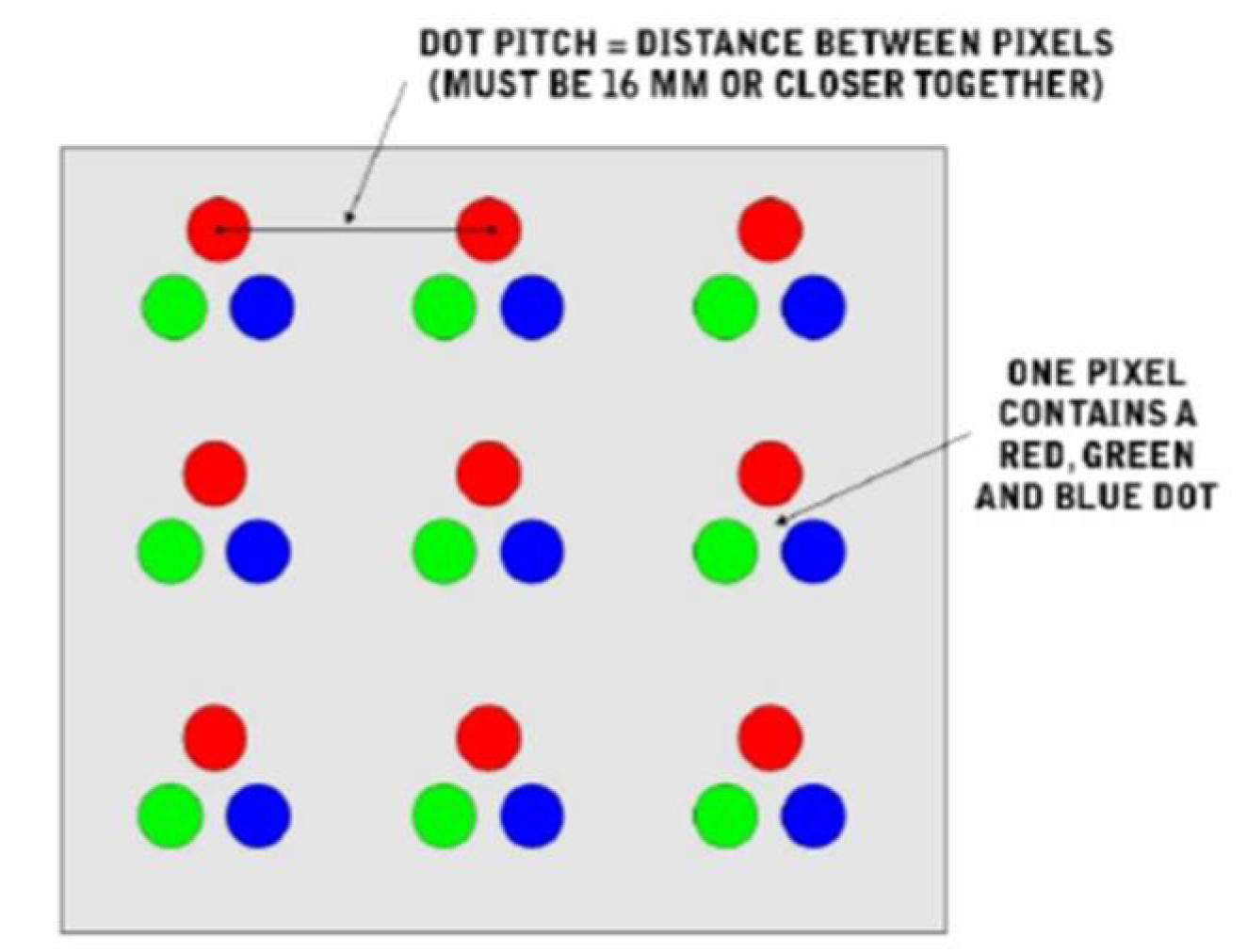
Figure 8-106 O.2.a
Electronic Message Center Resolution Requirements
b.
Operational Requirements. Electronic message centers:
i.
Shall contain static messages only;
ii.
Shall display messages for a period of not less than eight (8) seconds (multiple electronic message centers, if used on the same sign, shall be synchronized to change messages at the same time);
iii.
Shall not use transitions or frame effects between messages; and
iv.
Shall conform to the Illumination Standards as set forth in Subsection 8-106 O.3 below.
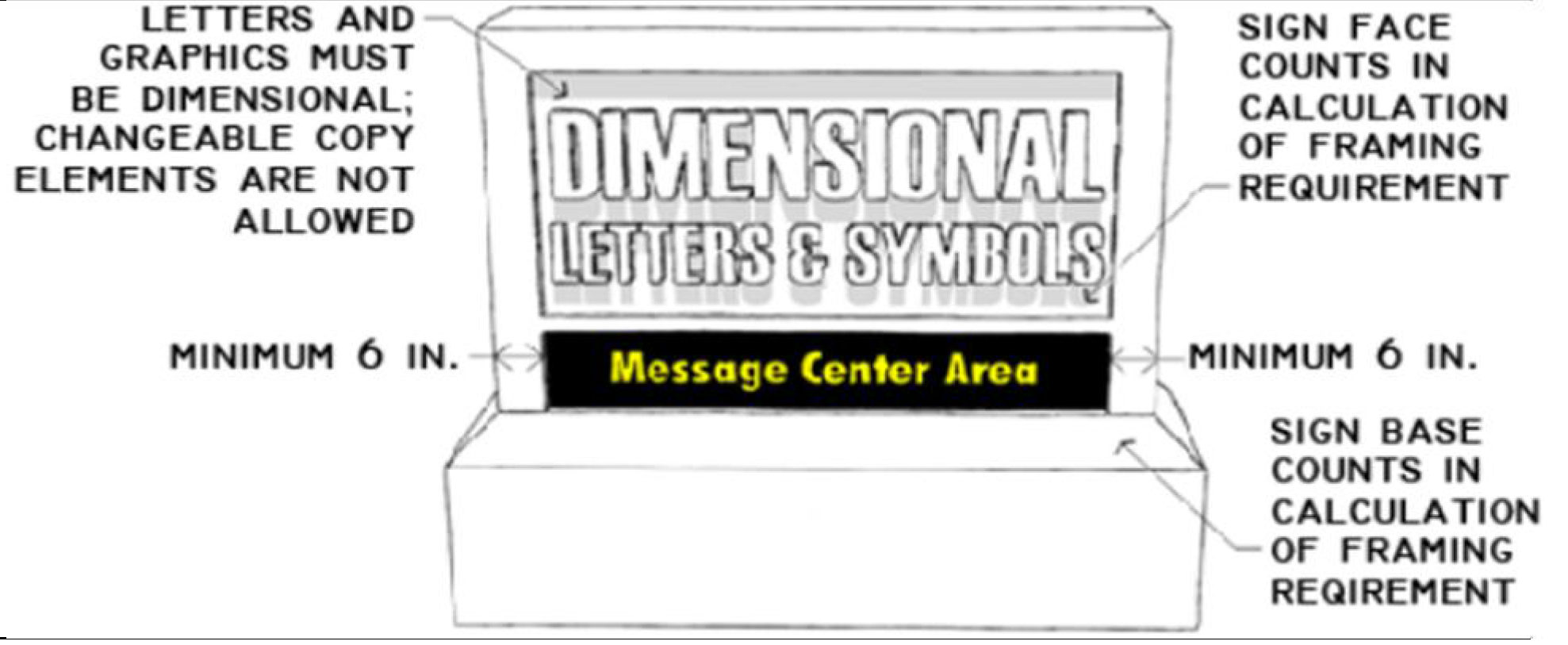
Figure 8-106 O.2.b
Electronic Message Center Design Requirements
c.
Illumination Standards. The illumination standards set forth in this Subsection 8-106 O.3 shall apply to all electronic message center signs, including multi-tenant electronic message centers.
i.
Measurement Criteria. The illuminance of an electronic message center shall be measured with an illuminance meter set to measure foot-candles accurate to at least two (2) decimals. Illuminance shall be measured with the electronic message center off, and again with the electronic message center displaying a white image for a full color-capable electronic message center, or a solid message for a single-color electronic message center. Measurements shall be taken after sunset with the site fully illuminated by installed site lighting. All measurements shall be taken perpendicular to the face of the electronic message center at the distance determined by the total square footage of the electronic message center as set forth below:
Large Sign: 98 feet
Medium Sign: 73 feet for Symmetrical and Asymmetrical sign types; 84 feet for horizontal sign type
Small Sign: 49 feet for Symmetrical and Asymmetrical sign type; 57 feet for horizontal sign type
Other Sign Sizes: Measurement Distance = √ (Area of Sign (in sq. ft.) × 100)
ii.
Electronic Message Center Illumination Limits. The difference between the off and solid-message measurements using the EMC Measurement Criteria shall not exceed 0.3 foot-candles on either side of the sign. If there is a difference in measurement of illumination levels on either side of the sign, the side of the sign facing residentially zoned properties shall take precedent.
iii.
Dimming Capabilities. All electronic message centers shall be equipped with a sensor or other device that automatically determines the ambient illumination and programmed to automatically dim according to ambient light conditions, or that can be adjusted to comply with the 0.3 foot-candle measurements.
3.
Multi-Tenant Electronic Message Centers. Multi-tenant electronic message centers are intended to provide an opportunity for unified, multi-tenant developments to advertise on-site businesses through uniform sign designs subject to the requirements set forth in this subsection 3. Developments that do not meet the criteria set forth in this subsection 3 are permitted to display electronic message center signs in accordance with subsection 2.
a.
Development Eligibility Requirements. Multi-tenant electronic message centers are permitted in mixed use or non-residential developments that meet all of the following criteria:
i.
Unified mixed use or non-residential development that meets the minimum floor area requirements as specified in Table 8-106 O.3, whether existing or proposed through an approved site plan, and contains at least ten (10) existing or proposed tenants, storefronts, or businesses.
ii.
The development must be located in the C-1, C-2, C-3, and C-4 zone districts.
iii.
Through the sign permit application, the development must identify tenants, storefronts, and businesses eligible for signage on the multi-tenant electronic message center sign.
b.
Sign Design, Location, and Requirements. A mixed use or non-residential development that meets all of the criteria of subsection 3.a, above, may display multi-tenant electronic message centers on signs that meet all of the following criteria:
i.
The sign shall conform to the sign prototypes and criteria set forth in Table 8-106 O.3.
ii.
A maximum of one (1) large sized multi-tenant electronic message center sign may be displayed per eligible development meeting the criteria in subsection 3.a, except that a maximum of two (2) large sized multi-tenant electronic message center signs may be displayed if the total square footage of existing floor area for the development exceeds 400,000 square feet and is adjacent to IL-72 or IL-251.
iii.
A maximum of one (1) medium sized multi-tenant electronic message center sign may be displayed per eligible development meeting the criteria in subsection 3.a.
iv.
All electronic message center display components shall be full color with a pitch resolution of no greater than 16 mm spacing (e.g. 12 mm, 10 mm are acceptable).
v.
The sign must meet the minimum setback requirements set forth in Table 8-106 O.3.
vi.
The sign must be located adjacent to the rights-of-way specified in Table 8-106 O.3 under "Eligible ROW Frontage."
c.
Operational Requirements. Multi-tenant electronic message centers:
i.
Shall contain static messages only;
ii.
Shall display messages for a period of not less than eight (8) seconds;
iii.
Shall not use transitions or frame effects between messages;
iv.
Shall meet the illumination standards set forth in subsection O.3.; and
v.
No more than four (4) separate images on the electronic message center display shall be displayed at any given time.
Table 8-106 O.3
Multi-tenant EMC Requirements
| Sign Prototype | Symmetrical | Asymmetrical | Horizontal | |||||
|---|---|---|---|---|---|---|---|---|
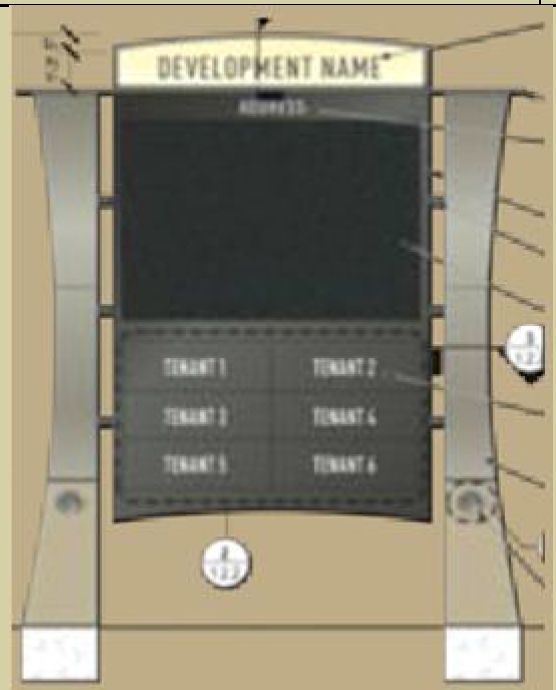 | 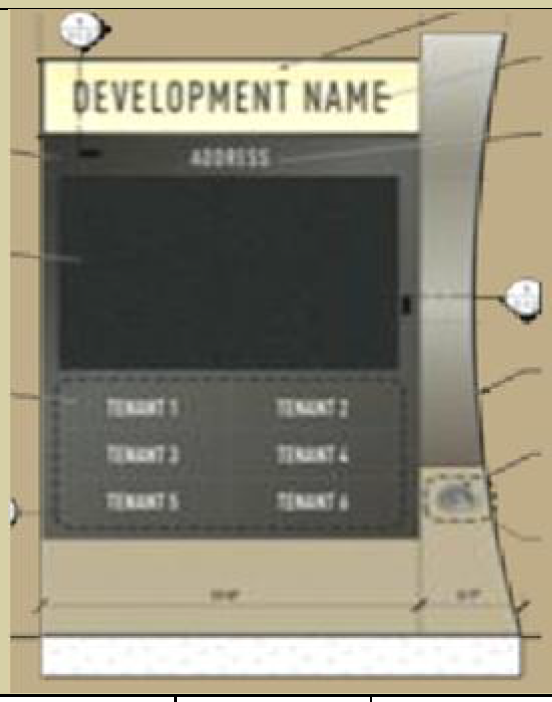 | 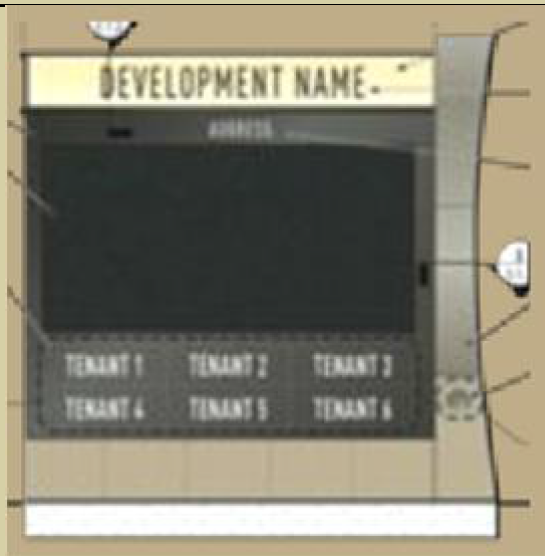 | ||||||
| Sign Size | Large | Medium | Small | Large | Medium | Small | Medium | Small |
| Maximum Sign Height | 25 ft. | 18 ft. | 12 ft. | 25 ft. | 18 ft. | 12 ft. | 14 ft. | 10 ft. |
| Maximum EMC Component Size | 8'×12" | 6'×9" | 4'×6" | 8'×12" | 6'×9" | 4'×6" | 6'×12" | 4'×8" |
| Minimum Total Floor Area | 200,000 sf. | 75,000 sf. | 15,000 sf. | 200,000 sf. | 75,000 sf. | 15,000 sf. | 75,000 sf. | 15,000 sf. |
| Eligible ROW Frontage | IL-72 or IL-251 | IL-72 or IL-251 | IL-72 or IL-251 | |||||
| Required Setback from Residentially Zoned Properties | 500 ft. | 250 ft. | 100 ft. | 500 ft. | 250 ft. | 100 ft. | 250 ft. | 100 ft. |
| Required Setback from Other Property Lines | 10 ft. | 10 ft. | 10 ft. | 10 ft. | 10 ft. | 10 ft. | 10 ft. | 10 ft. |
4.
Manual Changeable Copy Message Centers. Manual changeable copy signs may be incorporated into signage as follows:
a.
Manual changeable copy message centers are only permitted on monument signs or marquee signs which enclose the message center component on all sides with a finish of brick, stone, stucco, powder coated or comparably finished metal, or sign face that extends not less than six inches from the message center in all directions. Gaps between the message center and the finish are permitted to accommodate locks and hinges for a cover for the changeable copy area, but only to the extent necessary for such locks and hinges to operate.
b.
Manual changeable copy message centers, including their frames, shall make up not more than 50 percent of the sign area. The balance of the sign area shall utilize permanently affixed letters or symbols. See Figure 8-106 O.4.a, Manual Changeable Copy Centers.
c.
Manual changeable copy message centers shall not be internally lit unless:
i.
They use opaque inserts with translucent letters, numbers, or symbols (see Figure 8-106 O.4.b, Changeable Copy Inserts);
ii.
Blank opaque inserts that are the same color as the opaque portions of the letters, numbers, and symbols are used over all areas of the sign where copy is not present; and
iii.
The opaque portion of the letters, numbers, and symbols is the same color.
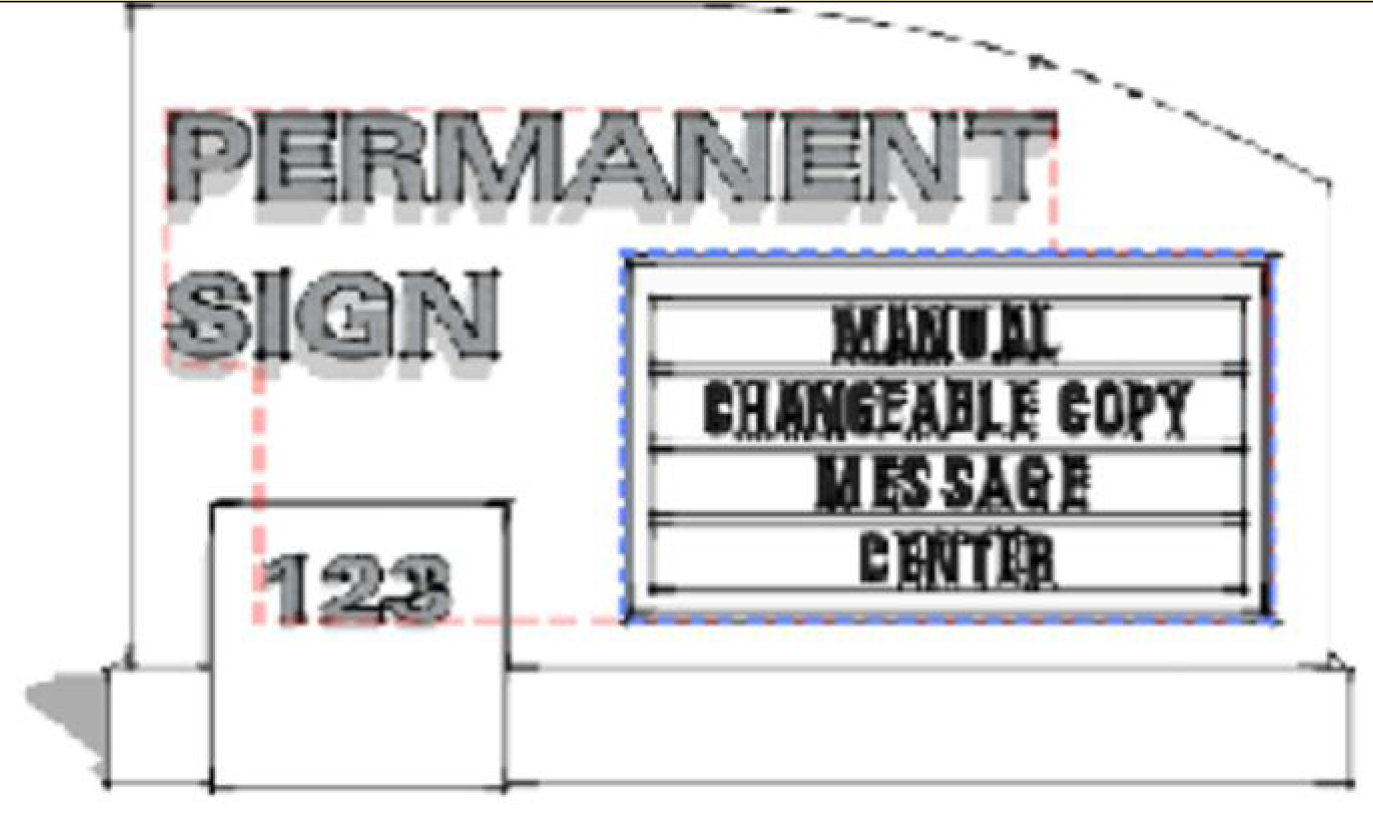
Figure 8-106 O.4.a
Manual Changeable Copy Centers
The manual changeable copy message center (outlined in dashed blue line) may occupy
not more than 50 percent of the sign area (outlined in dashed red line)

Figure 8-106 O.4.b
Changeable Copy Inserts
Changeable copy message centers may be internally lit if they use opaque inserts with
translucent letters, numbers, or symbols (See A below), but shall not be internally
lit if they use clear or translucent inserts with opaque or translucent letters, numbers,
or symbols (see B below).
8-106 P - Sign Maintenance.
1.
Generally. Signs and sign structures of all types (attached, detached, and temporary) shall be maintained as provided in this Section.
2.
Message. Signs shall display messages. Signs that do not display a message for a period of more than 30 days are abandoned. See Section 9-106, Nonconforming Signs.
3.
Paint and Finishes. Paint and other finishes shall be maintained in good condition. Peeling finishes shall be repaired. Signs with running colors shall be repainted, repaired, or removed if the running colors were not a part of the original design.
4.
Mineral Deposits and Stains. Mineral deposits and stains shall be promptly removed.
5.
Corrosion and Rust. Permanent signs and sign structures shall be finished and maintained to prevent corrosion and rust. A patina on copper elements is not considered rust.
6.
Level Position. Signs that are designed to be level, whether temporary or permanent, shall be installed and maintained in a level position. See Figure 8-106 P.6, Level Position.
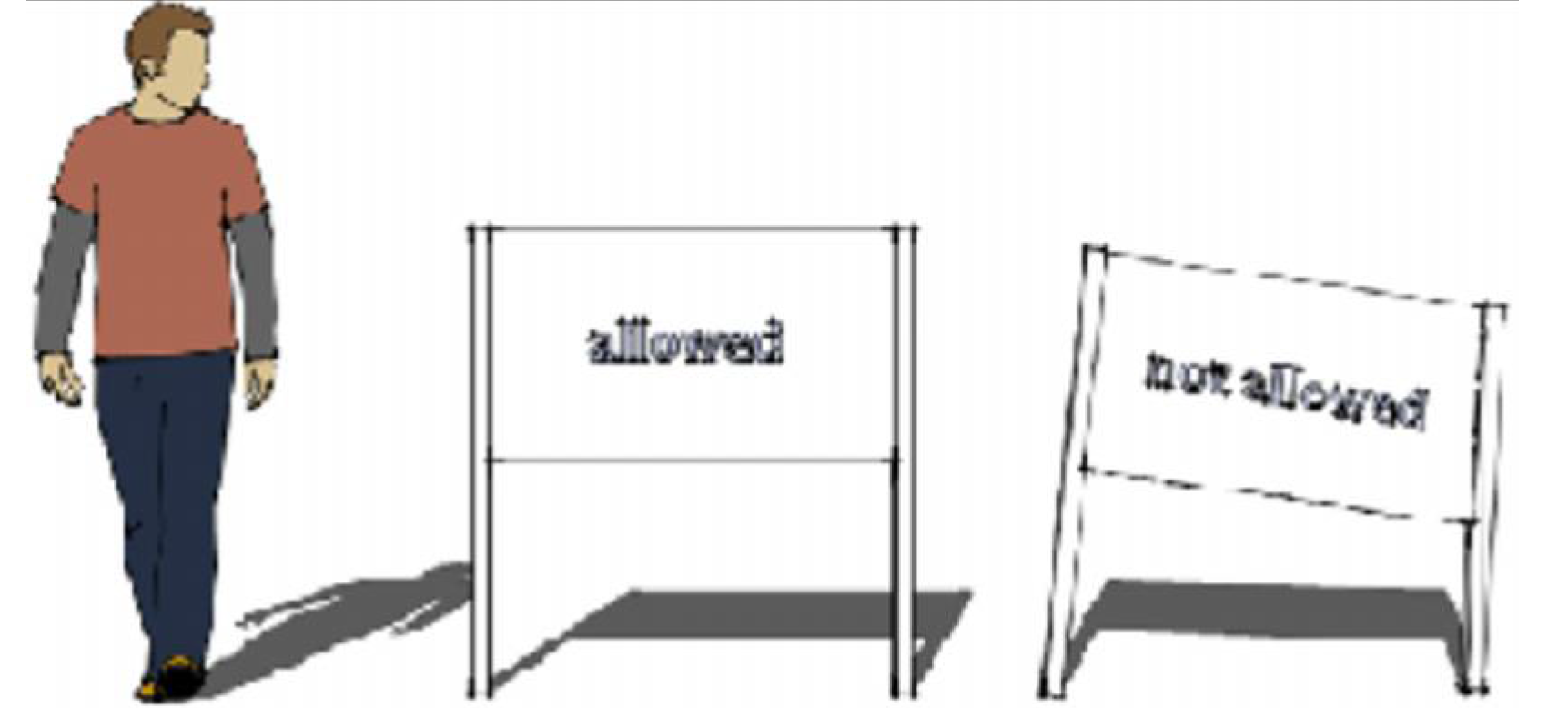
Figure 8-106 P.6
Level Position
8-106 Q - Attached Signs.
1.
Generally. There are many forms of attached signs. This section sets out which forms of attached signs are allowed in each zoning district and the standards that apply to them. Attached signs that are not listed in a table are not allowed as-of-right in any of the districts set out in the Table.
2.
Residential and Agriculture Districts.
a.
The standards of Table 8-106 Q.2, Permissible Attached Sign Types in Residential and Agriculture Districts, apply to multifamily and nonresidential uses in the districts that are set out in the table.
b.
Attached signs are not allowed for home occupations, except for required address signs
Table 8-106 Q.2
Permissible Attached Sign Types in Residential and Agriculture Districts
3.
Nonresidential Districts. The standards of Table 8-106 Q.3, Permissible Attached Sign Types in Nonresidential/Mixed-Use Districts, apply in the districts that are set out in the table.
Table 8-106 Q.3
Permissible Attached Sign Types in Nonresidential/Mixed-Use Districts
8-106 R - Detached Signs.
1.
Generally. There are many forms of detached signs. This section sets out which forms of detached signs are allowed in each zoning district, and the size and height standards that apply to them.
2.
Required Setbacks. All detached signs shall be set back at least 10 feet from all property lines. This standard may be waived if:
a.
The waiver would lower the elevation of the base of the sign by more than three feet and:
i.
The sign will be set back at least one foot from any sidewalk;
ii.
The sign will not encroach on any utility easement;
iii.
The sign will not obstruct a required sight distance (see Davis Junction Subdivision and Development Ordinance); and
iv.
There is at least five feet of landscaped parkway between the edge of pavement and the property line; or
b.
The sign is a wayfinding sign used to identify a residential subdivision or development and:
i.
The sign will be set back at least one foot from any sidewalk;
ii.
The sign will not encroach on any utility easement;
iii.
The sign will not obstruct a required sight distance (see Davis Junction Subdivision and Development Ordinance); and
iv.
The sign will not be located within the sight triangle (see Section 12-206 S, Sight Triangle).
Table 8-106 R.2.a
Permissible Detached Sign Types in Residential and Agricultural Districts
Table 8-106 R.2.b
Permissible Detached Sign Types in Nonresidential/Mixed-Use Districts
8-106 S - General Standards for Freestanding Temporary Signs.
1.
Generally. There are many forms of temporary signs. This section sets out which forms of temporary signs are allowed in each zoning district, and the size and height standards that apply to them. Sign types that are not listed in Table 8-106 S.2.a, Permissible Freestanding Temporary Sign Types, Agricultural and Residential Zoning Districts, or Table 8-106 S.2.b, Permissible Freestanding Temporary Sign Types, Nonresidential and Mixed-Use Zoning Districts, are not permitted as freestanding signs.
2.
Setbacks. All temporary signs shall be set back at least five feet from all property lines, except as provided in Section 8-106 T, Prevention of Visual Clutter in Principal Corridors. Temporary signs that are not visible from public rights-of-way or abutting property are not restricted by this Section.
Table 8-106 S.2.a
Permissible Freestanding Temporary Sign Types in Residential and Agricultural Districts
Table 8-106 S.2.b
Permissible Freestanding Temporary Sign Types in Nonresidential/Mixed-Use Districts
8-106 T - Prevention of Visual Clutter in Principal Corridors.
1.
Generally. The Board of Trustees finds that the proliferation of temporary signage along the principal corridors of the Village causes visual clutter that is detrimental to the character of the community, and tends to be distracting to motorists. The Board of Trustees also finds that the application of this Section does not restrict the ample alternative ways that residents and business owners may communicate their messages.
2.
Corridor Setback Requirement.
a.
No temporary sign shall be placed within the right-of-way (as provided in Section 8-106 L, Prohibited Sign Locations), or within 30 feet of the edge of pavement (whichever creates a greater setback from the edge of pavement), along the following street corridors: IL Route 72 and IL Route 251.
b.
The setback requirement of this Section shall not apply in the following circumstances:
i.
Where the front yard of any lot that is used or zoned for single-family residential purposes abuts any right-of-way identified in subsection 2.a above; or
ii.
Where an intervening private fence, wall, or other structure clearly delineates the boundary of private property outside of the prescribed public right-of-way, in which case the required setback shall include only the area up to and including the outside surface of such private fence, wall, or other structure.
8-106 U - Standards for Attached Temporary Signs.
1.
Generally. Attached temporary signs are permitted subject to the standards of this Section, for a duration as set out in Section 8-106 V, Duration of Temporary Signs.
2.
Banners. Banners are permitted in the C-1, C-2, C-3, and C-4 districts, provided that:
a.
There is only one banner per tenant per principal building;
b.
The banner is attached to the principal building, and complies with the standards of Section 8-106 L, Prohibited Sign Locations.
c.
The sign area on the banner is not larger than the sign area allowed for a wall sign on the building upon which the banner is attached.
3.
Sock Signs and Temporary Wall Signs. Sock signs and temporary wall signs are permitted in C-1, C-2, C-3, C-4, I-1, and I-2 districts, and may be installed upon issuance of a building permit for a permanent sign, and may remain in place for not more than 30 days. Such signs shall have a sign area that is not more than 15 percent larger than that which is permitted for the permanent sign for which the permit application was filed.
4.
Window Signs. Temporary window signs are allowed in all locations where permanent window signs are allowed, provided that the transparency standards of Section 8-106 Q, Attached Signs, are met.
8-106 V - Duration of Temporary Signs.
1.
Generally. The purpose of temporary signs is to display messages for a temporary duration. Temporary signs shall not be used as a subterfuge to circumvent the regulations that apply to permanent signs or to add permanent signage to a parcel proposed for development in addition to that which is permitted for permanent signs by Section 8-106 Q, Attached Signs and Section 8-106 R, Detached Signs.
2.
Duration of Display.
a.
In general, temporary signs shall be removed as of the earlier of the date that:
i.
A commercial message is obsolete and has become misleading or off-premises (e.g., a "for lease" or "for sale" sign in front of a building that is fully occupied);
ii.
The sign falls into disrepair (see Section 8-106 P, Sign Maintenance); or
iii.
The number of days set out in Table 8-106 V.2.a, Duration of Detached Temporary Signs, or Table 8-106 V.2.b, Duration of Attached Temporary Signs, expires.
Table 8-106 V.2.a
Duration of Detached Temporary Signs
Table 8-106 V.2.b
Duration of Attached Temporary Signs
3.
Administrative Interpretations. The Board of Trustees finds that materials technology is a rapidly evolving field of study, and that materials for signage that are not listed in Table 8-106 V.2.a Duration of Detached Temporary Signs or Table 8-106 V.2.b Duration of Attached Temporary Signs, may be introduced into the market. When an unlisted material is proposed, the Zoning Administrator shall determine to which class of materials the new material is comparable, based on the new material's appearance, durability, and colorfastness. No sign displays shall be longer in duration than the longest permitted display in Table 8-106 V.2.a Duration of Detached Temporary Signs or Table 8-106 V.2.b Duration of Attached Temporary Signs regardless of the material.
8-107 A - General Landscaping and Maintenance Requirements.
Except for accessory uses expressly permitted to be located in required yards, all yards and open space between and about structures and off-street parking and loading areas and lots shall be landscaped and kept free of accumulations of garbage, trash, refuse, debris, and other unsightly or nuisance-creating materials. All landscaping shall be continually maintained by the owner or other person responsible for maintenance of the premises, and all planting areas shall be kept free of weeds. Undeveloped areas shall be mowed and kept free of accumulations of garbage, trash, refuse, debris, and other unsightly or nuisance-creating materials until developed. Developed areas shall be maintained in compliance with all site plans and landscaping plans approved pursuant to the Code, and all buffers and landscaping shall be maintained and replaced in accordance with such plans.
8-107 B - Foundation Landscaping
1.
Scope.
a)
General. The requirements of this Subsection B shall apply in all districts other than (i) single-family residential districts, (ii) multiple family residential districts where only single family detached dwellings are developed, (iii) the I-1 and the I-2 Districts, and (iv) the C-1 District. The provisions of this Subsection B shall not apply to buildings developed prior to the date of adoption of this ordinance.
b)
Exception for Inadequate Growing Conditions. If the Board of Trustees determines that a building has no areas with adequate growing conditions to support a healthy foundation landscaped area, such building shall be exempt from the requirements of this Subsection B.
2.
Area Required.
a)
Width. Each principal and accessory building shall have a landscaped area located along the foundation of each building with a minimum width of ten feet when the building height is more than the lesser of three stories or 35 feet, and a minimum width of five feet when the building height is less than the lesser of three stories or 35 feet. All such minimum widths shall be measured from the edge of the building.
b)
Distance. The landscaped area shall be provided abutting each building and any attached structures, including decks and terraces, for a combined distance of not less than fifty percent of the exterior perimeter of each such building and any attached structures, including decks and terraces.
3.
Plant Materials Required. All such landscaped areas shall contain any combination of shade trees, ornamental trees, evergreen trees, shrubs, flowering plants, ground cover plants, and other native or ornamental grasses and plants. All areas adjacent to a building or structure that are not paved and not otherwise landscaped as required by this Subsection shall be sodded and maintained with a grass cover or other plant material. Nuisance greenery, as defined by Section 26-1 of the Village Code, is prohibited.
4.
Design. All such landscaped areas shall be designed to meet the following standards, as applicable to the lot:
a)
Screening from view any mechanical equipment, air conditioning units, and other equipment not located within the building, service areas, and loading docks;
b)
Provide visual relief along large expanses of building walls, and accent building entrances and architectural features; and
c)
Enhance walkways, entrances, outdoor seating areas, and other pedestrian areas.
8-107 C - Parking Lots and Garages.
1.
Parking Lot Screening.
a)
Every parking lot visible from a right-of-way or any public or private street adjoining any lot located in any residential district or adjacent to any land zoned in the Environmental Preservation and Open Space Overlay District shall be screened from view from such residential lot for a height of not less than six feet above grade.
b)
Every parking lot visible from a right-of-way or any public or private street located in any office, commercial, or industrial district that adjoins any zoning lot or lot of record located in any office, commercial or industrial district shall be screened from view from such adjacent lot for a height of not less than four feet above grade; provided, however, that no such screening shall be required between two lots located in the commercial or industrial districts.
c)
Location and Materials. All parking lot screening required by this Section shall be located between the edges of the parking lot and the property line nearest to each combination of decorative walls, fences (but not including chain link fences), berms or landscaping.
2.
Parking Lot Interior Landscaping.
a)
Trees. In addition to the requirements set forth in Paragraph A1 above, every parking lot containing 10 or more parking spaces shall contain at least one tree, of three inches or greater in diameter, for each eight parking spaces provided, however, that every parking lot in the industrial districts, and the C-3 and C-4 Districts containing 10 or more parking spaces shall contain at least one tree, of three inches or greater in diameter, for each 20 parking spaces. Such trees may be provided by the preservation of existing trees or the planting of new trees and shall be planted at a sufficient distance from each other for healthy growth based on current standards generally observed by professionals in the arboriculture, forestry, landscaping, and landscape architecture professions. No existing or new tree located more than five feet outside the perimeter of the paved parking area shall be counted in meeting the requirements of this Paragraph. More than fifty (50%) percent of the trees required by this Paragraph shall be located in landscaped islands within the interior of the paved parking lot.
b)
Other Requirements. All islands shall be generally dispersed throughout the interior of the parking lot and shall be not less than 100 square feet in area and shall be of such dimensions that shall support the healthy growth of trees and other landscaping therein, based on current standards generally observed by professionals in the arboriculture, forestry, landscaping, and landscape architecture professions. All such islands, created curbs, or other traffic flow regulators shall be landscaped with shrubs, flowering plants, ground cover plants, sodded lawn, or mulch. No material in islands interior to parking lots other than trees shall be more than 30 inches in height above adjacent pavement.
3.
Parking Garage Design. Every parking garage, other than garages accessory to single family dwellings, constructed after the effective date of this Code shall comply with the following design standards:
a)
The exterior walls of the garage shall be a minimum of five feet in height.
b)
The exterior surface of the garage shall be constructed of the same materials as, or materials architecturally and aesthetically compatible with, the principal building to which it is accessory.
c)
The foundation landscaping requirements of this Section 8-107.
4.
Exception. The provisions of this Subsection C shall not apply to parking lots and garages developed prior to the date of adoption of this ordinance unless repair has been made to more than fifty percent of the structure.
8-107 D - Loading Spaces.
Every loading space visible from any lot zoned for residential use or any land zoned in the Environmental Preservation and Open Space Overlay District, and whether or not such residential use is within the Village, shall, except as necessary for access, be screened on all sides visible from any such lot by an opaque fence (but not including chain link fences), wall or densely planted evergreen hedge of not less than six to eight feet in height.
8-107 E - Perimeter Landscaped Open Space.
Except as expressly provided otherwise in the district regulations, when perimeter landscaped open space is required is required, it shall extend along the entire length of the lot line in question and shall have a width equal to fifteen feet or the depth of the yard required along the lot line in question, whichever is greater. Such space shall be broken only by required access drives. Such space shall be suitably surfaced with grass, groundcover, or decorative paving material, or a combination thereof; shall contain landscaping such as ornamental trees and shrubs or appropriate screening devices such as decorative walls, fences (but not including chain link fences), berms, or a combination thereof. The landscaping and screening treatment of such space shall be so designed and maintained as to preserve unobstructed vision of the street and sidewalk at points of access and as not to interfere with, or be damaged by, work within any public or utility easement, unless the Board of Trustees shall determine that no other location is reasonably feasible.
8-107 F - Special Protective Requirements for Non-Dwelling Uses Abutting Residential Use and Environmental Preservation and Open Space Overlay District.
Notwithstanding any other provision of this Section 8-107, in any case where a lot to be devoted to any use other than a dwelling abuts or is across a right-of-way from any lot zoned for residential use or land zoned in the Environmental Preservation and Open Space Overlay District, whether or not such lot is within the Village, the use and development of the lot to be devoted to the non-dwelling use shall be subject to the following requirements:
1.
Special Building Setback for Buildings Over Fourteen Feet in Height. All buildings over fourteen feet in height shall be set back from any front or corner side yard line facing a residential district a distance equal to the setback normally required or to the front yard required in the adjacent residential district, whichever is greater, and from any other yard line a distance equal to the yard normally required or twenty-five feet, whichever is greater.
2.
Special Landscaping and Screening of Special Front and Corner Side Setbacks. Any front or corner side yard setback required pursuant to Paragraph 1 above shall be treated as a perimeter landscaped open space.
3.
Special Landscaping and Screening from Residential Uses and Districts. Any side or rear lot line, and all lot lines of any industrial use, abutting a dwelling use or a residential district shall be buffered by a perimeter landscaped open space of at least five feet in width along such lot line, which shall be sufficient to provide a total visual screen at least six feet in height along the entire length of such line. Industrial uses abutting or across a right-of-way from any lot zoned for residential use shall, in addition to the other requirements provided in this Paragraph, be screened by an eight foot fence (but not including chain link fences) located within the perimeter landscaped open space.
4.
Additional Perimeter Open Space for Outdoor Activity Areas. Any area of permitted outdoor activity likely to produce visual or auditory disturbance or annoyance on any abutting residential lot whether or not located within the Village shall be separated from said lot by a perimeter landscaped open space at least 20 feet wide or by a buffer found by the Board of Trustees to be reasonably sufficient to create a visual barrier, to absorb and diffuse noise, and to ensure the private enjoyment of said lot.
5.
The provisions of this Subsection 8-107 F shall not apply to any use established prior to the effective date of this Code.
8-107 G - Enclosure of Uses Required.
Except where otherwise expressly authorized by this Code, all permitted uses shall be conducted within a completely enclosed structure.
8-107 H - Roof Top Mechanical Equipment.
Except for antennae mounted on roofs pursuant to the provisions of this Code, all mechanical equipment located on the roof of any building constructed after the effective date of this Code shall be fully screened by a parapet wall or other screening structure constructed of materials compatible with the principal building façade to the height of such equipment.
8-107 I - Residential Recreational Facilities.
Outdoor residential recreational facilities accessory to any dwelling located in any single family residential district, other than swimming pools, shall be buffered and screened by a perimeter landscaped open space equal in width to the applicable required yard or 10 feet, whichever is less, and consisting of an opaque fence, wall or densely planted evergreen hedge of not less than six feet in height in combination with other landscaping materials. Such screening shall be provided on all sides of such facility visible from any adjoining property or any public or private street. See also Section 8-101D2 of this Article for additional requirements applicable to such facilities.
8-107 J - Refuse Containers; Outdoor Storage.
1.
Screening. All refuse containers and all areas permitted outdoor storage shall be enclosed by a screening fence (but not including chain link fences), wall or densely planted evergreen hedge of a height sufficient to screen such containers or storage areas from view from adjoining properties and public or private streets.
2.
Location. No refuse containers or storage areas shall be located between any principal structure and either its front or corner side lot line.
3.
Exemptions. The requirements of Paragraph 1 hereof shall not apply to standard receptacles permitted for use by single family dwellings. None of the requirements of this Subsection shall apply to receptacles placed and maintained for use by the general public to avoid littering or to receptacles temporarily placed on construction sites for the purpose of collecting construction debris.
8-107 K - Screening and Landscaping Within Sight Triangles.
Notwithstanding any other provision of this Section, no landscaping, fencing or other screening shall be erected or maintained at a height in excess of two and one-half (2 ½) feet within the area of any sight triangle as defined in Subsection 12-206 of this Code.
8-107 L - Fences and Walls.
When located in a required yard, fences shall be installed with the finished side facing the neighboring property. Except where a greater height is expressly authorized for screening purposes pursuant to this Section, all fences and walls erected as a permitted obstruction in any required yard shall be subject to the following height limitations:
8-201 A - Authorization.
Subject to the limitations of this Section 8-201, all uses and structures that are classified in the North American Industry Classification System No. 517312 shall be subject to the following standards, regulations, and requirements at all times in those zoning districts in which they are permitted or special permit uses.
8-201 B - Location.
Personal wireless services antennas shall be located on lawfully pre-existing antenna support structures or other lawfully pre-existing buildings or structures wherever possible. No special use permits authorizing construction of a new antenna support structure or addition to or expansion of an existing antenna support structure or existing building or structure shall be authorized unless the applicant is able to demonstrate that no lawfully pre-existing antenna support structure or lawfully pre-existing building or structure is available, on commercially reasonable terms, and sufficient for the location of an antenna necessary for the provision of personal wireless services.
8-201 C - Design of New Antenna Support Structures for Co-Location.
Unless otherwise authorized by the Board of Trustees for good cause shown, every new personal wireless services antenna support structure of a tower design shall be designed, constructed, and installed to be of a sufficient size and capacity to allow the location of additional personal wireless services antennas to accommodate at least one additional personal wireless service provider on such structure in the future. Any special permit for such a support structure may be conditioned upon the agreement of the applicant to allow co-location of other personal wireless service providers on commercially reasonable terms specified in such special permit.
8-201 D - Tower Design.
Every new personal wireless services antenna support structure that is of a tower design shall:
1.
Be a monopole, rather than latticework, unless otherwise authorized by the Board of Trustees for good cause shown;
2.
Not be illuminated or have any signs installed thereon unless otherwise required by federal law or regulations; and
3.
Be separated from any principal building by a distance that is not less than 110 percent of the height of the tower. For the purposes of this requirement, this distance shall be measured horizontally from the center of the base of the supporting structure of the tower to the point where the ground meets a vertical wall of such principal building.
Any deck on such a tower shall be centered on the tower and the radius from the center of the tower to the outside of the deck shall not exceed six feet. Each side of the deck shall not exceed six feet vertically.
8-201 E - Antennas on Buildings.
Antennas that are installed pursuant to the National American Industry Classification System No. 517312 must conform with one of the following:
1.
Such antennas shall be located only on a lawfully pre-existing building and shall not exceed the following dimensions:
a)
Omnidirectional or whip antennas shall not exceed six inches in diameter and 12 feet vertically; and
b)
Directional or panel antennas shall not exceed three feet horizontally and six feet vertically.
2.
Such antennas and any necessary antenna support structure are fully enclosed or shielded from view from any point located off the zoning lot on which they are located by a structure otherwise permitted on the zoning lot and all electronic equipment is fully enclosed in a structure otherwise permitted on the zoning lot.
All such antennas shall not exceed the maximum height authorized by applicable zoning district regulations, and shall not extend above the highest point of the building or structure to which they are attached or more than two feet from the exterior of any wall or roof of the building to which they are attached. In no event shall a total or more than six antennas of the types and sizes described in Paragraph 1 of this Subsection be located on any building in the C-3 or C-4 District.
8-201 F - Color.
Every personal wireless services antenna and antenna support structure shall be neutral colors that are harmonious with, and that blend with, the natural features, buildings, and structures surrounding such antenna and antenna support structures; provided, however, that directional or panel antennas and omnidirectional or whip antennas located on the exterior of a building that will also serve as an antenna support structure shall be of colors that match, and cause the antenna to blend with, the exterior of the building.
8-201 G - Landscaping and Fencing.
In addition to any other applicable requirements of Section 8-107 of this Code, all ground-mounted antennas, antenna support structures, related electronic equipment, and equipment enclosures shall be subject to the following:
1.
In order to minimize the visibility of such facilities, a natural screen or fence shall be erected if not already provided, so as to provide the maximum reasonable achievable screening as determined by the Board of Trustees.
2.
Any natural screen shall be a minimum of six feet in height when planted, with dense plantings spaced no more than two feet apart.
3.
Any fence shall be a minimum of eight feet in height, except where fence height is otherwise limited by Section 8-107 of this Code, and shall be of a style of construction that provides a visual shield of the facilities.
8-201 H - Protection Against Climbing.
Every personal wireless services antenna and antenna support structure shall be protected against unauthorized climbing or other access by the public.
8-201 I - Equipment Enclosures.
All electronic and other related equipment and appurtenances necessary for the operation of any personal wireless services antenna shall, whenever possible, be located within a lawfully pre-existing structure or completely below grade. When a new structure is required to house such equipment, such structure shall be harmonious with, and blend with, the natural features, buildings, and structures surrounding such structure. Any freestanding structure that is not attached to or within an existing building or located completely below grade shall not exceed a maximum heights of fifteen feet.
8-201 J - Licenses and Permits.
The operator of every personal wireless services antenna shall maintain all licenses and permits required by other agencies and governments with jurisdiction over the design, construction, location and operation of such antenna. In addition, any such operator shall annually provide copies of such licenses and permits, and provide evidence of renewal or extension thereof, to the Village Clerk.
8-201 K - Compliance with Plans.
Every personal wireless services antenna and antenna support structure shall comply with all plans approved by the Village.
8-201 L - Limited to Applicant.
Every ordinance granting approval of a special permit for a personal wireless services antenna or antenna support structure shall state that any assignment or transfer of the special permit or any of the rights thereunder may be made only with the approval of the Board of Trustees.
8-201 M - Term Limitation.
Unless otherwise provided by ordinance, every special permit for a personal wireless services antenna or antenna support structure is subject to the following conditions:
1.
Where the provider of personal wireless services is not the owner of the land on which such antenna or structure is located, the term of the special permit is limited to the term of the lease or other agreement granting rights to use the land; and
2.
The special permit shall be subject to review by the Board of Trustees, at ten year intervals, to determine whether the technology in the provision of personal wireless services has changed such that the necessity for the special permit at the time of its approval has been eliminated or modified, and whether the special permit should be modified or terminated as a result of any such change.
8-201 N - Abandonment and Removal.
When one or more antennas, an antenna support structure, or related equipment are not operated for the provision of personal wireless services for a continuous period of twelve months or more, such antenna, antenna support structure, or related equipment may be deemed to be abandoned and must be removed. The Village will be entitled to remove such an antenna, antenna support structure, or related equipment if the owner does not remove such items within ninety (90) days following the mailing of written notice that removal is required. Such notice shall be sent by certified or registered mail, return receipt required, by the Village to such owner at the last known address of such owner. If two or more providers of personal wireless services use the antenna support structure or related equipment to provide personal wireless services, then the period of non-use under this provision shall be measured from the cessation of operation at the location of such antenna support structure or related equipment by all such providers.
8-201 O - Security Fund.
The owner of every personal wireless services antenna shall establish a security fund in a form and in an amount as set forth in this Subsection. The security fund shall serve as security for the removal of the antenna. The security fund shall be continuously maintained in accordance with this Subsection at the owner's sole cost and expense until the antenna is removed.
1.
Form. The owner shall provide the security fund to the Village in the form of cash, unconditional letter of credit, or surety bond, in a form acceptable to the Village.
2.
Amount. The dollar amount of the security fund shall be equal to the Village Engineer's reasonable estimated removal cost for the antenna.
3.
Withdrawals. Following a removal notice provided under Subsection 8-201 N, the Village may withdraw an amount from the security fund, provided that the owner or operator has not removed the antenna within the 90-day notice period.
4.
Return. Upon removal of the antenna, the Village will return the security fund, or such portion remaining on deposit, to the owner within a reasonable time after account is taken for all offsets necessary to compensate the Village for the owner's failure to remove the antenna upon notice provided by Subsection 8-201 N.
5.
Rights not limited. The rights reserved to the Village with respect to the security fund are in addition to all other rights of the Village, whether reserved by this Subsection or otherwise authorized by law, and no action, proceeding or exercise of right with respect to said security fund shall affect any other right the Village may have.
8-201 P - Insurance.
The operator of every personal wireless services antenna must tender to the Village Clerk, on an annual basis, proof of public liability insurance covering the facility in an amount not less than One Million Dollars ($1,000,000.00).

