
Deer Park City Zoning Code
ARTICLE 13
- PERFORMANCE STANDARDS
13.01. - Landscape Requirements.
13.01.1.
Purpose. This concerns providing landscape space, trees, vegetation and other materials for the purposes of the following:
1.
Site Design. Complementing the design and location of buildings, streets, and circulation systems and integrating and enhancing the overall site design.
2.
Buffering. Minimizing the impacts of light, noise, movement or activities from adjacent properties.
3.
Conservation. Protecting and conserving water resources and assisting in the management of stormwater.
4.
Environmental. Improving air quality, moderating ambient temperatures and lowering energy consumption.
5.
Soil Protection. Protecting and conserving soils from erosion by wind or water or from excavation or grading and the promotion of healthy soil biology.
13.01.2.
Scope.
1.
Applicability. Section 13.01 Landscape Requirements shall apply to the following:
a.
All new developments and all existing developments that are expanding or redeveloping 30 percent or more land area or building area.
b.
New Single-Family (SF), Two-Family (2F) and Townhome (TH) lots shall comply with [this Section] 13.01 Landscaping Requirements for Single-Family, Two-Family, and Townhome Lots.
c.
HOAs and Covenants, Codes and Restrictions (CCRs) for residential developments shall not overrule the requirements of this Section 13.01 by penalizing or restricting water conserving landscapes, or requiring landscape materials that do not comply with this Section 13.01.
d.
All open space and landscape areas required by other regulations in the Zoning Ordinance and the Subdivision Ordinance shall comply with the standards of this Section 13.01.
2.
General Standards. The preparation of the Landscape and Irrigation plans shall be in accordance with the following standards:
a.
Best management practices for tree pruning, ANSI A300, shall apply to this Section 13.01.
b.
Nursery standards shall be the American Standard for Nursery Stock, ANSI Z60.1-2004.
c.
Best management practices for stormwater management as approved by the Director of Engineering Services.
3.
Landscape Plan.
a.
A Landscape Plan is required for all applicable developments, as described above.
b.
The Building Official shall establish and maintain a list of the required documents and elements for a Landscape Plan.
c.
A Landscape Plan shall be prepared by a Landscape Architect and submitted for review.
d.
Irrigation drawings shall be prepared by a licensed Irrigator.
4.
Equivalent or Superior Landscape Requirements.
a.
The Planning and Zoning Commission may approve modified landscape requirements that are equivalent to, or exceed, the requirements set forth in within this section in conjunction with the submittal Site Plan only if the following is met:
i.
The following standards are met:
1)
The proposed landscape requirements represent a superior result than that which could be achieved by strictly following the requirements of this section; and
2)
The proposed landscape design complies with the stated purpose of this section; and
3)
Landscape elements and yard area requirements are provided elsewhere on the site.
ii.
The proposed landscape design either:
1)
Incorporates the retention of significant trees and naturally occurring undergrowth; or
2)
Better accommodates or improves the existing physical conditions of the subject property.
5.
Landscape Inspections.
a.
The approved landscape design shall be inspected and approved by the City before a Certificate of Occupancy can be issued.
b.
The landscape construction may be delayed up to six months under special circumstances when the amount of the landscape improvement costs is escrowed with the City or a performance bond is initiated between the City and the property owner.
6.
Maintenance and Enforcement.
a.
The owner of the property shall maintain the landscape pursuant to the design intent and best management practices for landscape.
b.
The owner of a property that does not comply with these requirements shall be notified and given 30 calendar days to comply.
c.
If, after 30 calendar days, the landscape still does not comply with the approved Landscape Plan, the City may issue citations for the violation pursuant to code enforcement provisions.
13.01.3.
Examples of Appropriate Landscaping.
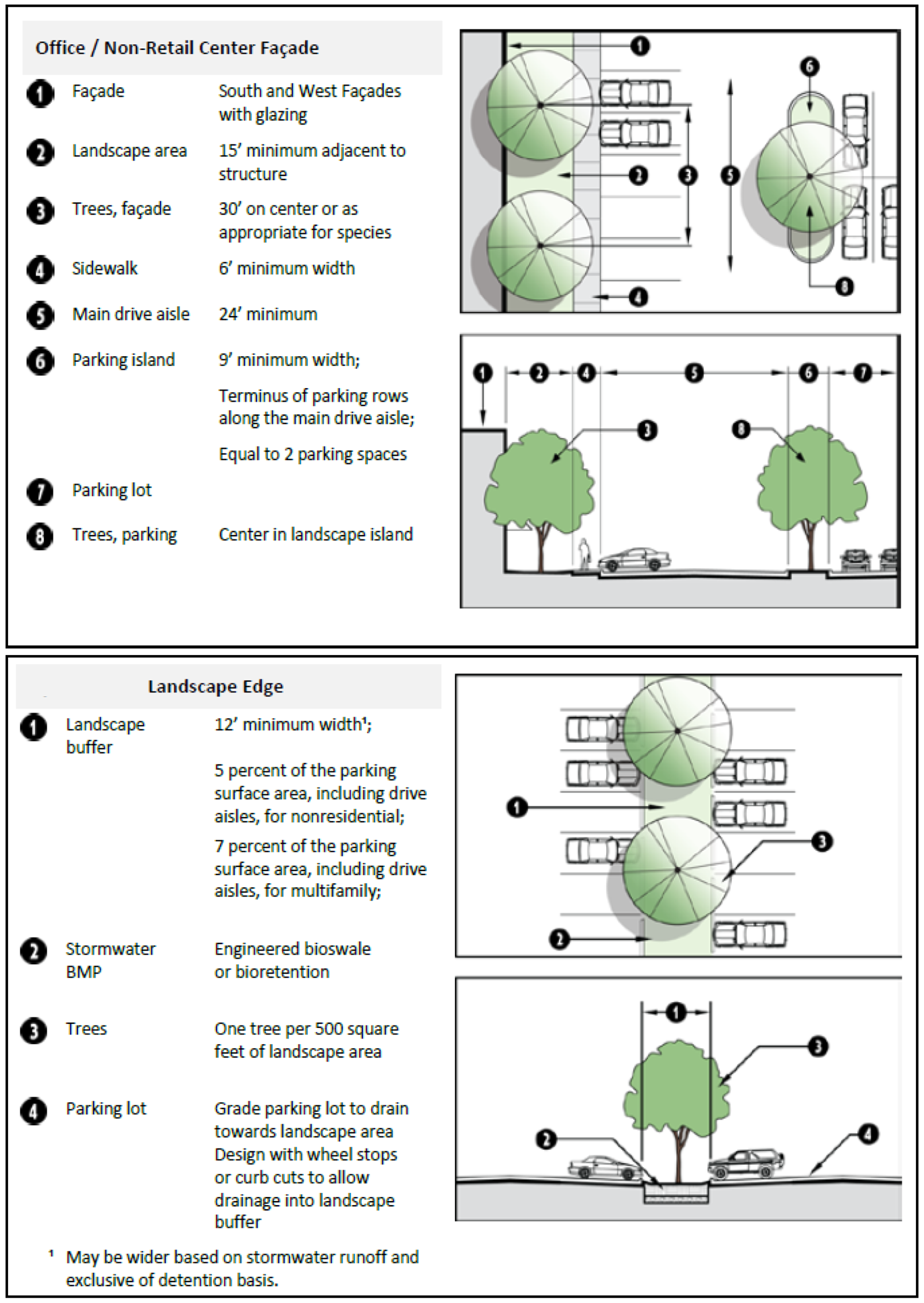
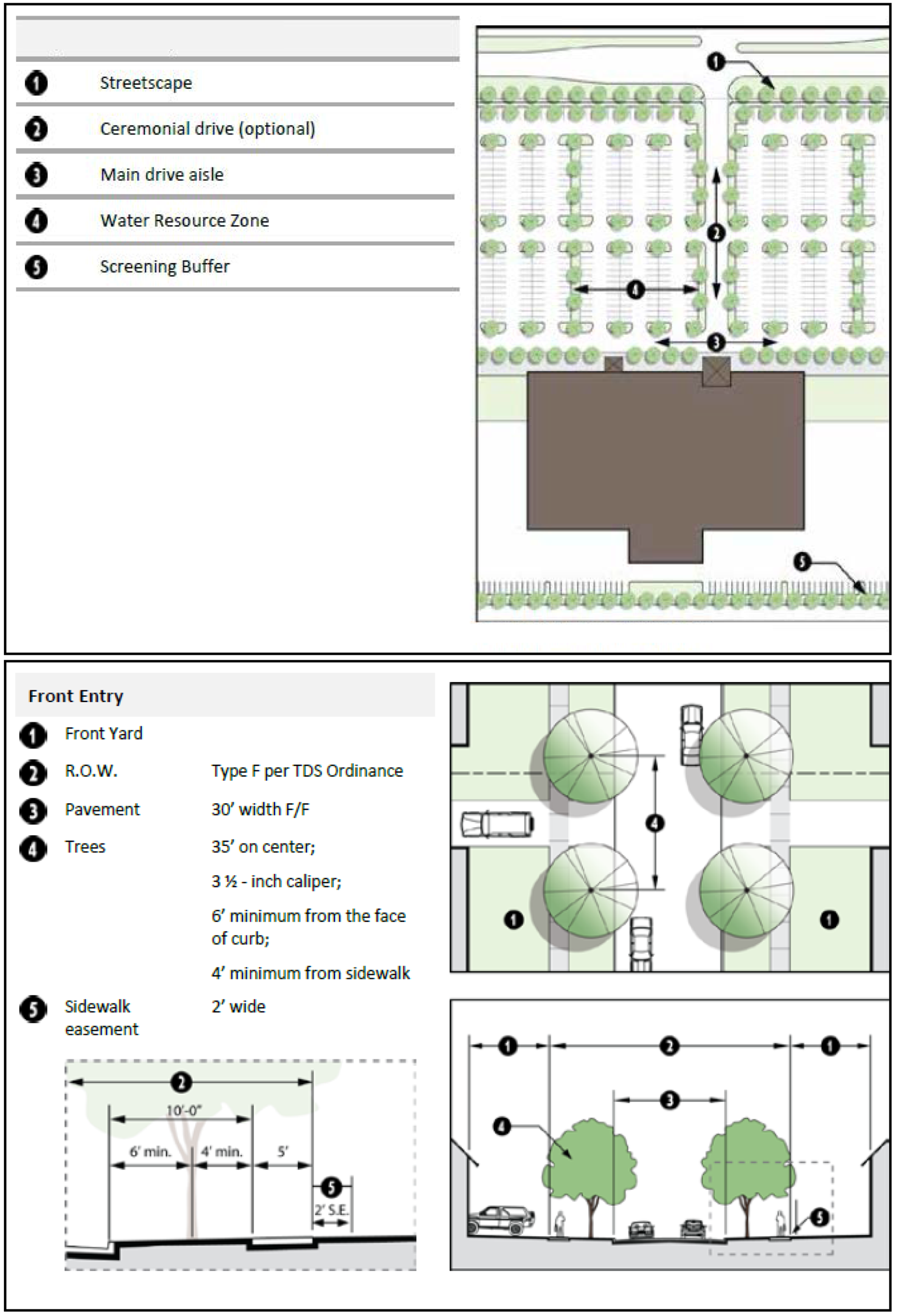
13.02. - Screening Standards.
13.02.1.
Purpose. Standards set forth in this section establish the screening options required for the various land uses and zoning districts.
13.02.2.
Standards.
1.
Applicability. Regulations are prescribed for the location and type of various screening devices to be used when required in the various zoning districts or in this section in accordance with the following standards:
a.
The property owner of a tract of land in a nonresidential zoning district shall be the responsible party for:
i.
The wall or fence construction on the property line where a tract is adjacent to a district or use required to be screened; and
ii.
Paving the area between the wall and/or fence and the alley according to Engineering Services' standards.
b.
The property owner of a tract of land within a multifamily zoning district shall be the responsible party for when adjacent to a single-family zoning district.
c.
Screened from View and Screening Elements. All areas covered by this section shall be screened from all streets and adjacent property lines of residentially zoned parcels, or areas shown as single-family or multifamily residential uses on the Future Land Use Map.
2.
Screening Wall Materials. A screening wall or fence required under the provisions of this section, under a SUP, a PUD, or other requirement shall be constructed of clay-fired brick or stone masonry units.
a.
All wall or fence openings within a required screening element shall be equipped with gates equal in height and screening characteristics to the wall or fence.
b.
Split-face concrete masonry units, or pre-cast panels used in lieu of walls constructed of clay fired brick or stone materials shall be constructed only with approval by the Director.
3.
Screening Wall Finishing on Both Sides.
a.
All required masonry screening walls shall be equally finished on both sides of the wall.
b.
The style, color, and material of the wall must be consistent within the development.
4.
Screening Installation and Maintenance.
a.
All required walls, fencing, and other screening materials must be installed and completed prior to final acceptance of the project.
b.
The property owner shall maintain all screening fences, walls, and landscaping.
c.
Set in place wall panel construction methods are prohibited in conjunction with multifamily developments proposed after April 5, 2011.
d.
Repairs to existing walls will be permitted with the addition of galvanized metal supports being added to the area being repaired.
e.
Thin walls are permitted in conjunction with multifamily development, and shall be constructed over a concrete footing (grade beam) or a galvanized steel angle iron with four-inch by 12-inch concrete mow strip beneath.
5.
Landscape Screening and Sight Visibility Triangle. Refer to the Thoroughfare Design Standards Ordinance for restrictions and limitations of improvements and landscaping in visibility easements.
6.
Screening Standards. In any residential district, or along the common boundary between any residential and nonresidential district where a wall, fence, or screening separation is erected, the following standards for height, location, and design shall be observed.
a.
Any fence or wall located to the rear of the minimum required front yard line shall not exceed eight feet in height above the grade of the adjacent property.
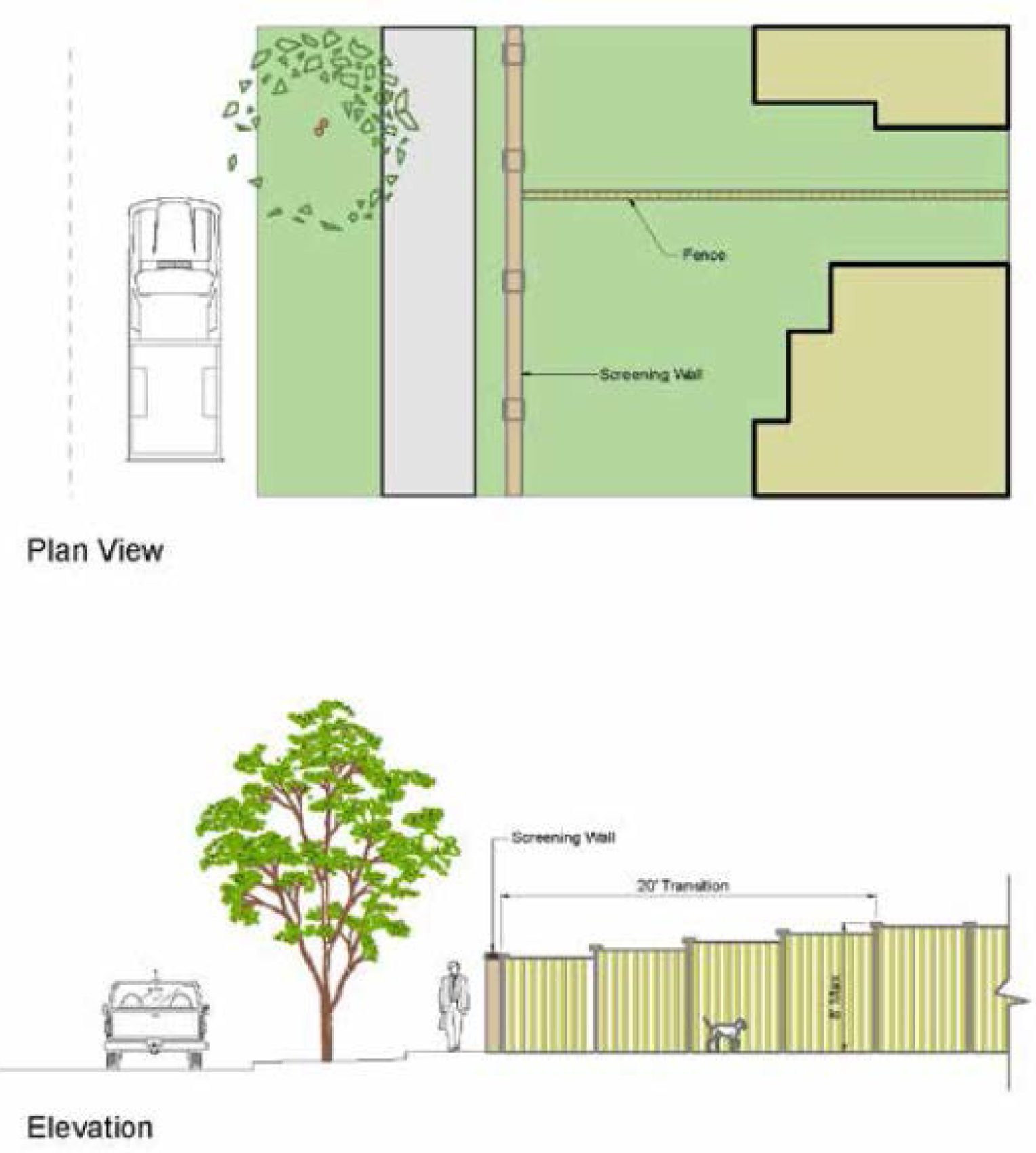
i.
As shown below where a fence intersects a screening wall and the height of the fence exceeds the height of the screening wall, the height of the fence shall transition to the height of the screening wall over a distance of 20 feet.
13.02.3.
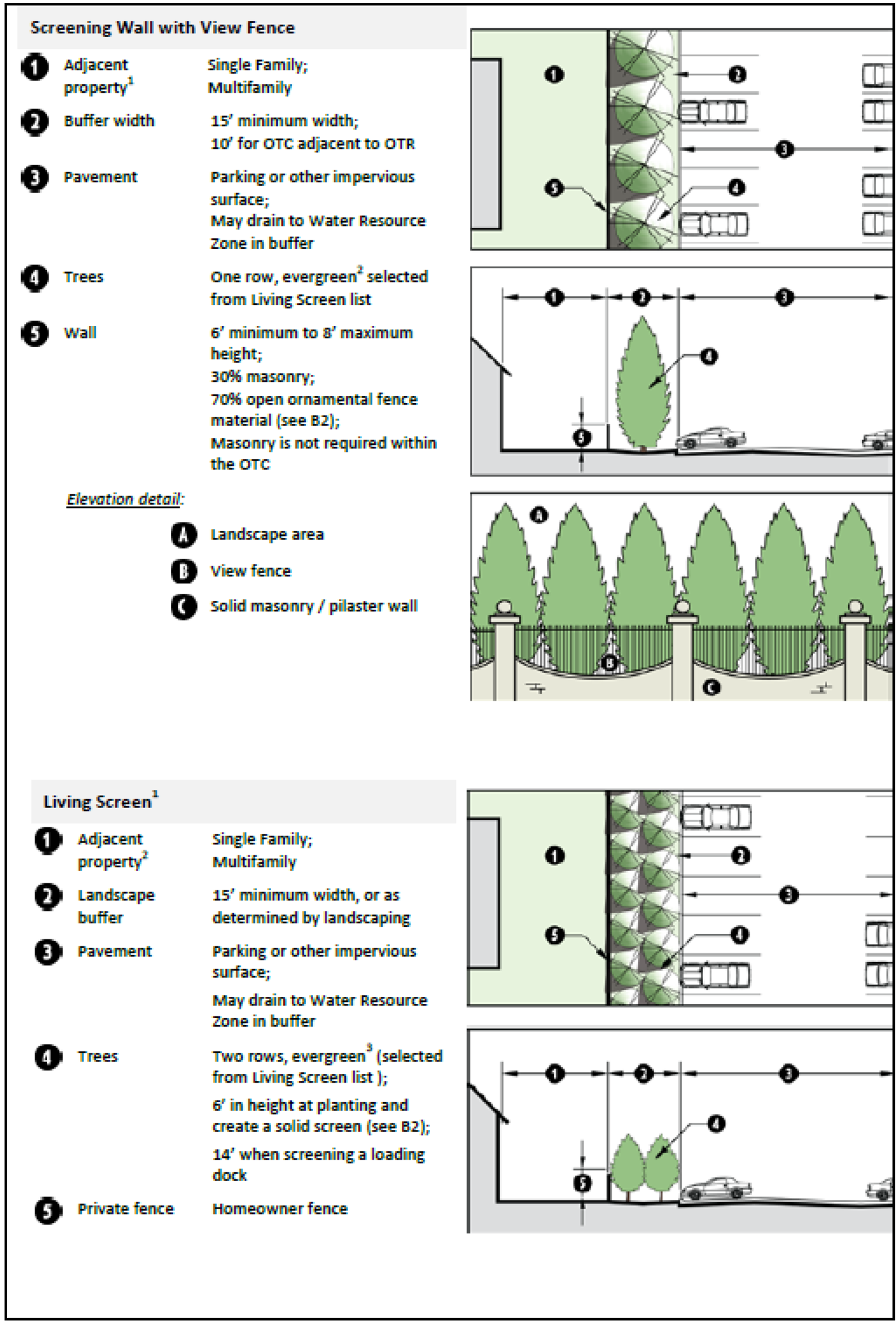
Additional Examples of Screening/Buffer Areas.
13.03. - Screening for Outside Storage.
13.03.1.
Outside Storage and Display Requirements.
1.
Elements within Outside Storage and Display Areas.
a.
Outside storage and display areas shall only contain equipment, vehicles, commodities, materials, goods, or merchandise that is sold, rented, or distributed within the inside of a building of a primary use, unless it is demonstrated to the Director that such products or materials could not be located indoors.
b.
Outside Storage and Display, Sales, or Operations.
i.
No outside storage and display, sales, or operations shall be permitted unless such activity is visually screened from all streets and adjacent property lines of residentially zoned parcels or areas shown as single-family residential or multifamily use on the Future Land Use Map.
ii.
These regulations do not apply to temporary outside merchandise display, such as a sidewalk sale, where an outside area is used for merchandise display for less than 90 calendar days in one calendar year. If an area is used for more than 90 calendar days in one calendar year, then it shall comply with this section.
2.
Prohibited Areas.
a.
Outside storage and display areas shall not be located within any required front/side yards.
b.
Outside storage and display areas shall not be located within any drainage or other type of easement.
c.
Outside storage and display areas shall not be located within any required parking area, parking spaces, loading areas, fire lanes, vehicular moving aisles or customer pick up lanes.
3.
Visual Obstruction and Interference. Outside storage and display areas shall not obstruct visibility or interfere with pedestrian or vehicular circulation and shall be subject to the following requirements:
a.
A minimum six-foot-wide pedestrian path shall be maintained between outside storage and display areas and vehicular maneuvering aisles; and
b.
A minimum six-foot-wide pedestrian path shall be maintained between any entry or exit doors from the primary use building to the vehicular maneuvering aisles or parking areas.
4.
Size Limitation.
a.
Outside storage and display areas shall not occupy an area exceeding 25 percent of the gross floor area of the primary use building, or ten percent of the lot area, whichever is most restrictive.
b.
Exception to the Size Limitation of Outside Storage and Display Areas. If the outside storage and display area exceeds these requirements, it must be presented on the Site Plan and requires Planning and Zoning Commission approval.
5.
Exemptions. Outside storage and display areas shall not apply to new and used sales or lease of automobile, motorcycle, recreational vehicles, or watercraft and similar facilities requiring outside display.
6.
Temporary Uses. Seasonal and temporary storage areas shall provide for electrical plug-ins if storage containers require electrical service.
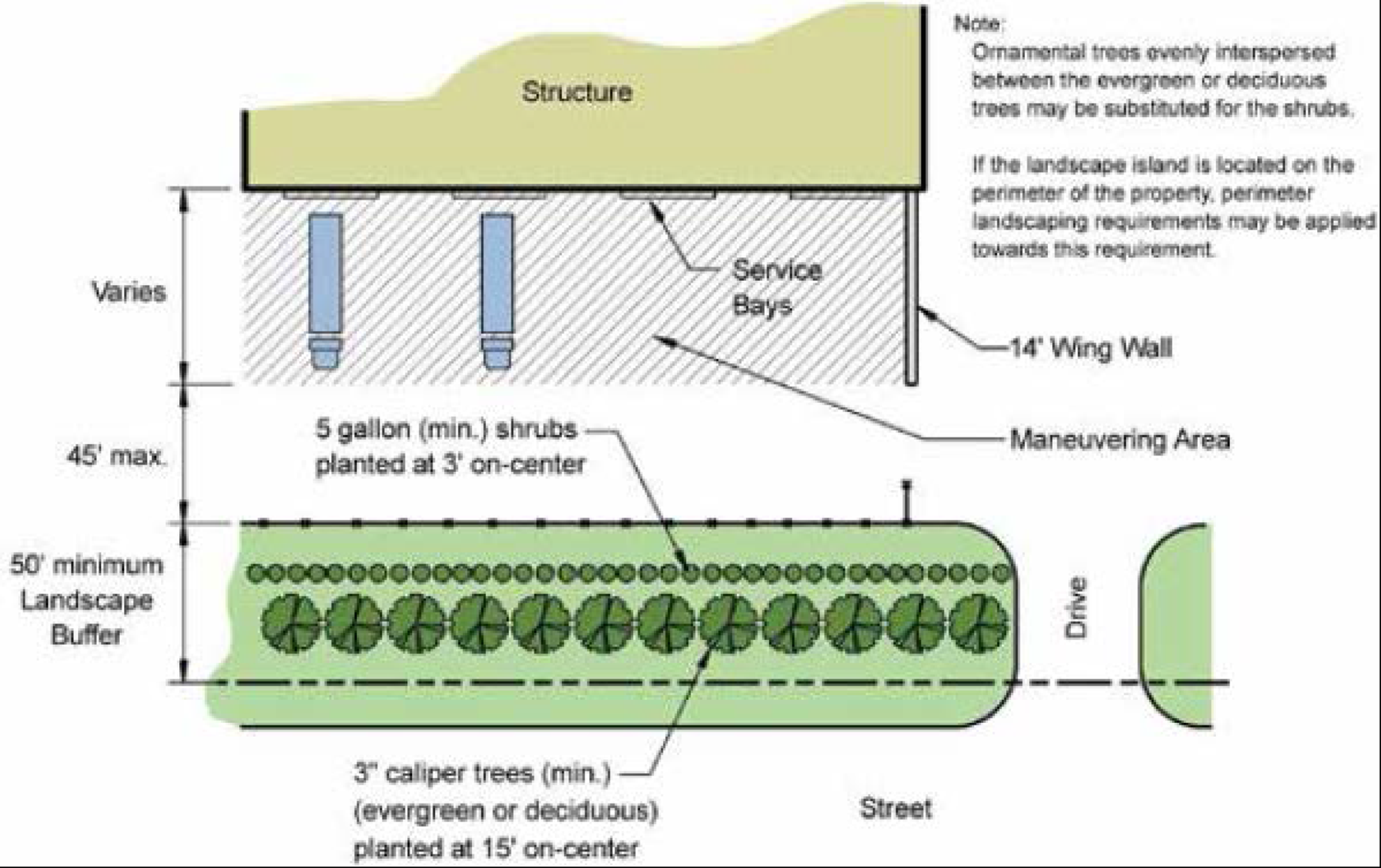
13.04. - Screening Requirements for Residential and Nonresidential Properties.
13.04.1.
Screening Required Between Nonresidential and Residential.
1.
A solid screening wall separating a nonresidential zoning district from a residential zoning district shall be up to required pursuant to this section, except when deemed physically impractical by the Director of Public Works or other designee.
2.
A required screening wall shall be at least six feet six inches in height, unless specifically permitted or required by this section or unless approved by a PUD or SUP.
13.04.2.
When the Nonresidential Use is Responsible for Constructing the Screening Wall.
1.
When nonresidential construction abuts the boundary of any property in a residential zoning classification, the Developer of the nonresidential use shall erect the screening wall along the common property line.
2.
The design and construction material of the screening wall shall be as specified in this section.
13.04.3.
When a Residential Use is Responsible for Constructing the Screening Wall.
1.
When residential construction abuts the boundary of any property in a nonresidential zoning classification, the Developer of the residential use shall erect the screening wall along the common boundary before the issuance of a Certificate of Occupancy and Compliance.
2.
The design and construction material of the screening wall shall be as specified in this section.
13.04.4.
Screening Walls for Loading Docks.
1.
Nonresidential uses with loading docks or delivery entrances that front a Collector Street or Arterial Street shall be screened by a minimum ten-foot-tall masonry screening wall to obscure views of loading docks and loading spaces.
2.
Loading docks and delivery entrances within the Light Industrial (LI) District and Heavy Industrial (HI) District are exempt.
3.
The following standards apply if service or loading dock areas are adjacent to residential uses:
a.
Service/loading areas shall be screened from view at a height of ten feet at the residential property line.
b.
This ten-foot wall must screen the entire loading dock or space.
c.
Screening materials shall utilize similar masonry materials to the building's façades.
d.
Service/loading areas shall be located at the side or rear of buildings.
13.04.5.
Screening Wall Materials.
1.
Any screening wall required by this section shall be constructed of the following materials:
a.
Brick, stone, or split-face concrete masonry unit; or
b.
Pre-cast concrete wall or poured-in-place concrete wall with a similar wall with a similar appearance as brick, stone or split-face concrete masonry unit.
2.
All construction materials shall be earth-tone or traditional masonry colors including white.
a.
Where a masonry screening wall is constructed of split-face concrete masonry units or pre-cast concrete or poured-in-place concrete with a similar appearance as brick, the decorative or split-face side of the wall shall face the adjacent residential properties or street.
b.
An unfinished Haydite block wall or a wall with non-traditional masonry colors shall be prohibited.
c.
Smooth-faced concrete masonry units shall not be permitted as a construction material for a screening fence.
13.04.6.
Screening Wall Design.
1.
All masonry walls shall be constructed with the same masonry materials as the main building.
2.
The screening wall shall be designed and constructed to prevent any drainage or erosion problems.
3.
A minimum five-foot-wide screening fence maintenance easement shall be provided on all lots abutting the required screening along the full length of the required screening fence, unless separated by an alley. If platting, such easement shall be shown on the Preliminary Plat and Final Plat.
13.04.7.
Mechanical Equipment Screening Requirements for Nonresidential Properties.
13.04.7.1.
Generally.
a.
In all nonresidential development, all mechanical equipment, whether ground-mounted, roof-mounted or otherwise attached to the building, shall be screened from view.
b.
Mechanical equipment areas shall be constructed, located, and screened to prevent interference with the peace, comfort, and repose of the occupants of any adjoining building or residence.
c.
The location, construction, and screening of all mechanical equipment shall be shown on the site plan or design drawings.
13.04.7.2.
Ground-Mounted Mechanical Equipment.
a.
Ground-mounted mechanical equipment, with the exception of an electricity delivery provider's distribution equipment, shall be placed behind a screening wall or living screen equal or greater than one foot above the height of the unit.
b.
The screening wall shall be constructed of masonry materials.
13.04.7.3.
Roof-Mounted Mechanical Equipment.
a.
Roof-mounted mechanical equipment shall be screened from view with a parapet wall, mansard roof or alternative architectural element.
b.
The height of the screening element shall be equal to or greater than the height of the mechanical unit(s), provided that the element shall not extend more than six feet above the roof.
c.
When the height of a mechanical unit exceeds the maximum permitted height of the screening feature, an additional roof setback for the unit shall be required at a ratio of two horizontal feet for each additional one foot of vertical height above the maximum six feet.
d.
Screening for mechanical equipment shall apply to new building construction only.
13.04.8.
Screening of Outdoor Waste Storage for Nonresidential, Single-Family Attached, and Multiple-Family Residential Properties.
13.04.8.1.
Generally.
a.
Waste storage areas housing (refuse containers, dumpsters, or similar facilities) shall be constructed, located, and screened to prevent interference with the peace, comfort, and repose of the occupants of any associated or neighboring building or residence.
b.
The location, construction, and screening of all waste storage areas shall be shown on the site plan or design drawings.
13.04.8.2.
Screening Required. Refuse containers, trash dumpsters/containers, trash compactors, box compactors, and other similar containers shall be screened on three sides with a masonry screening wall that shall be constructed to a minimum height of one foot above the container height, but shall not exceed eight feet in height.
a.
The container shall be screened by the masonry wall capable of screening the area.
b.
The screening wall shall be similar to or extensions of the development's architectural design.
13.04.8.3.
Incidental Use Requirement and Location Standards. Refuse containers, trash dumpsters/containers, trash compactors, box compactors, and other similar containers that are used for waste disposal purposes shall:
a.
Only be allowed as an incidental use; and
b.
Only be allowed when located behind the building line established by the structure and not within any required landscaped area.
13.05. - Off-Street Parking and Loading Requirements.
13.05.1.
Applicability.
1.
No building or structure or part thereof shall be erected, altered, or converted for any permitted use unless vehicle parking is provided according to the following standards, unless subject to an exception.
2.
Vehicle parking shall be provided on the lot or tract, on an immediately contiguous lot or tract, or within 300 feet of such building or structure.
3.
An established use lawfully existing at the effective date of this Zoning Ordinance need not provide vehicle parking that meets this Ordinance. No existing vehicle parking in connection with a legal use, at the effective date of this Zoning Ordinance, may be reduced below the minimum number of spaces as hereinafter required.
13.05.2.
General Requirements.
1.
Parking Areas and Driveways. Unless otherwise noted, parking areas and driveways shall be curbed, pared with cement concrete and maintained to City specifications.
2.
Parking Space Dimension (Standard). In all zoning districts, all parking spaces shall not be less than nine feet by 20 feet.
13.05.3.
Parking Space Schedule, Single-Family and Duplex Uses.
1.
The minimum off street parking spaces for single-family and duplex uses shall be two spaces for each dwelling unit, in addition to any garage parking spaces.
2.
No off-street parking shall be allowed in any front yard area, except on a paved driveway.
3.
No parking area or vehicle storage space shall be used for the storage or parking of any vehicle with more than two axles.
4.
No inoperable vehicle may be parked on the street or driveway.
13.05.4.
Parking Space Schedule, Multi-Family Uses.
1.
Off-street parking shall be provided behind the front building line in the side or rear yard of the lot or tract of land upon which a multi-family building is constructed.
2.
Off-street parking shall be provided to meet the requirements of the residents and their guests in each multi-family project according to the following standards:
■
Two spaces for each studio unit;
■
Two spaces for each one-bedroom unit;
■
2 ½ spaces for each unit with two bedrooms;
■
2 ½ spaces for each unit with three or more bedrooms, plus one additional space for each four units in development.
3.
No parking area or vehicle storage shall be used for the storage or parking of any vehicle with more than two axles.
4.
No inoperable vehicle may be parked on the street or driveways.
13.05.5.
Parking Space Schedule. Nonresidential uses [are] applicable to all districts.
13.05.6.
Off-Street Parking and Regulations.
1.
In computing the parking requirements for any building or development, the total parking requirements shall be the sum of the specific parking space requirements for each class of use included in the building or development.
2.
Floor Area of a structure devoted to off-street parking of vehicles shall be excluded in computing the off-street parking requirements of any use.
13.05.7.
Parking Requirements for New or Unlisted Use. Where questions arise concerning the minimum off-street parking requirements for any use not specifically listed, the requirements may be determined by the Director of Public Works or other designee as those of a similar use.
13.05.8.
Circulation and Parking Requirements for all Nonresidential Developments.
1.
Applicability. The regulations provided in this section shall apply to all nonresidential development.
2.
Parking Aisles. Parking aisles shall generally be designed perpendicular to the front of the primary building in the development.
3.
Wheel Stops and/or Bollards. If curbs are not provided, then parking spaces that face and are adjacent to a building or required landscaped area shall utilize wheel stops and/or bollards within 12 inches from the end of the space.
13.05.9.
Handicap [Disabled] Parking Spaces. Handicap [Disabled] parking spaces shall be provided according [to the] Americans Disability Act (ADA) Standards for Accessible Design, as may be amended. Current requirements are as follows.
13.05.10.
Parking Space Design Details. Each standard off-street surface parking space size shall be in accordance with the design standards as shown on the following illustrations for space size and design.
13.05.11.
Off-Street Loading Space, All Districts. All nonresidential uses having 50,000 SF or more of gross floor area shall provide adequate off-street facilities for loading and unloading of merchandise and goods within or adjacent to the building, in such a manner as not to obstruct freedom of traffic movement of the public streets, alleys, or sidewalks.
1.
All drives and approaches shall provide adequate space and clearances to allow for the maneuvering of trucks off-street.
2.
Each site shall provide a designated maneuvering area for trucks.
3.
No maneuvering shall take place in the ROW, all maneuvering shall be on-site.
13.05.12.
Vehicle Stacking Requirements.
1.
Double Stacking Space Required after the Final Window, Food Pick-Up Window, or Stopping Point.
a.
A double stacking space shall be provided after the final window, order board, or stopping point to allow vehicles to pull clear of the transaction area prior to entering an intersecting on-site driveway or maneuvering aisle.
2.
Visibility Triangle Requirement for Drive-Through Lanes.
3.
Buildings and other structures shall have a ten-foot visibility triangle at the end point of drive-through lane to provide adequate visibility to allow vehicles to safely exit the drive-through lane prior to merging into intersecting driveways or maneuvering aisles.

