
Deer Park City Zoning Code
ARTICLE 4
- RESIDENTIAL DISTRICTS2
Editor's note— For purposes of organizational clarity, at the editor's discretion § 4.1 has been codified as part of a newly created Div. 1, Generally, § 4.01, with former § 4.2 redesignated as Div. 2, District Descriptions, comprised of §§ 4.03—4.10, with the following §§ 4.11—4.13 designated as Div. 3, Other Development Provisions.
DIVISION 2. - DISTRICT DESCRIPTIONS[3]
Editor's note— Formerly § 4.2. See editor's note to art. 4.
4.01. - Purpose.
The regulations for residential districts are designed to:
■
Protect the residential character of areas so designated by excluding therefrom principal commercial and industrial activities;
■
Encourage a suitable environment for family life by permitting appropriate neighborhood facilities such as churches, schools, and playgrounds;
■
Permit certain institutions and utility facilities considered necessary in or compatible with residential neighborhoods;
■
Preserve openness of the living areas and to avoid overcrowding by requiring certain minimum yards, open spaces, and site areas, and maximum bulk of structures;
■
Provide for access of light and air to windows and for privacy, as far as possible, by controls over the spacing and height of buildings and other structures;
■
Make available areas suitable for a variety of dwelling types and densities to permit a wide range of individual choice;
■
Ensure the provision of adequate off-street parking space to provide for the parking needs of the permitted uses;
■
Protect residential areas against hazardous, offensive or objectionable influences;
■
Protect residential areas against heavy traffic and against through traffic of all kinds.
4.02. - Reserved.
Note— See editor's note to art. 4.
4.03. - Single-Family (SF) District.
4.03.1.
Permitted Uses.
4.03.1.1.
Principal Uses. Principal uses permitted in an SF district are limited to those included in the use groups set forth below, subject to the indicated district regulations. Detailed lists of permitted uses in the use groups are set forth in Article 14.
4.03.1.2.
Accessory Uses. Accessory uses to any of the above principal uses.
4.03.[1.]2.[5.]
Bulk and Area Regulations.
4.03.1.3.
Off-street Parking and Loading Requirements. The number of off-street parking spaces required shall be as set forth in Article 12, and developed as provided by Section 16.09.
4.03.1.4.
Living Area. The minimum living area of a single-family dwelling when constructed in any SF single-family district shall be 1,000 SF.
4.03.1.5.
Area Regulations. Property and buildings shall conform to the related standards listed within 9.4 Residential Districts Development Standards and the following regulations. If there is a conflict between 9.4 and the following regulations, the following regulations shall control.
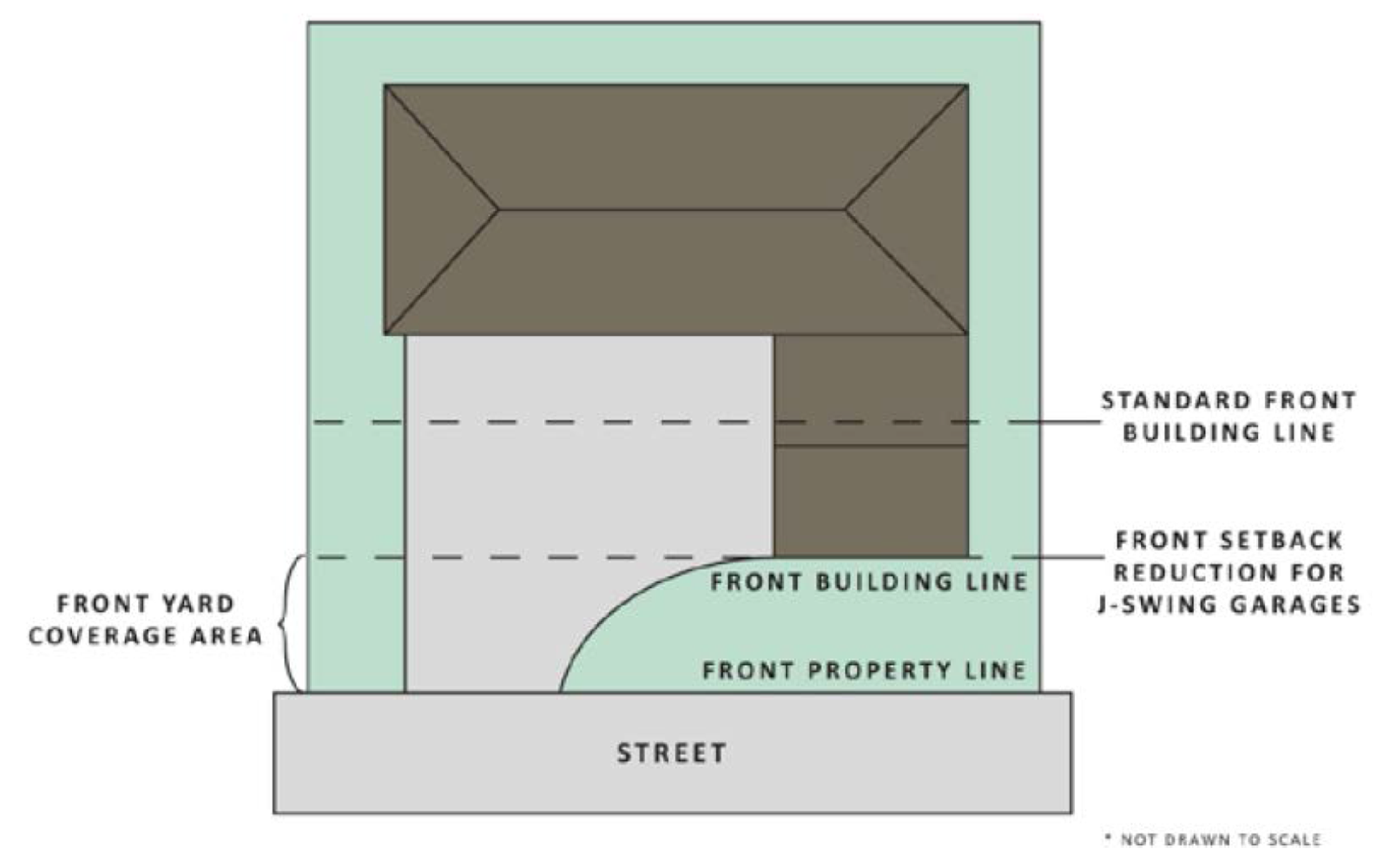
■ Front Yard Coverage. The cumulative area of any driveway plus any impermeable surface area located between the front property line and any front building wall shall not exceed 50 percent of the area between the front property line and any front building wall, as shown in the figure below.
4.03.1.6.
Covered Parking in SF3. In addition to the requirements of Section 4.03.1.3, there shall be required two (2) covered and enclosed parking spaces in SF3 districts.
4.04. - Two-Family (TF) District.
4.04.1.
General Purpose and Description. The TF—Two-Family Residential (Duplex) District is intended to promote quality duplex residential development. Individual ownership of the two-family or duplex unit is encouraged.
This District may include neighborhoods consisting entirely of duplexes, or, when in accordance with the intent of the Comprehensive Plan, may provide a transition district between lower density residential areas and more intense residential, nonresidential areas, or Major Thoroughfares.
4.04.1.1.
Permitted Uses.
4.04.1.1.1.
Principal Uses. Principal uses permitted in a TF district are limited to those included in the use group set forth below, subject to the included district regulations. Uses permitted in the TF District is outlined in Section 10.04 Detailed lists of permitted uses in the use groups are set forth in Article 12.
4.04.1.1.2.
Accessory Uses. Accessory uses to any of the above principal uses.
4.04.1.2.
Bulk and Area Regulations. In a TF district, any use of land and any structure shall be subject to the following bulk and area regulations:
4.04.1.3.
Off-street Parking and Loading Requirements. The number of off-street parking spaces required shall be as set forth in Article 14, and developed as provided by Section 16.09. Off-street loading requirements are set forth in Section 16.09.
4.04.1.4.
Living Area. The minimum living area of a single-family dwelling and for each unit in a two-family dwelling when constructed in any TF two-family district shall be 1,000 SF.
4.05. - Patio Home (PH) District.
4.05.1.
General Purpose and Descriptions. The PH District is provided to allow for development of "zero-lot line" homes in a modified residential district, which encourages greater use of the side yard areas. Clustered lot patterns with a common usable open space system can be incorporated as an integral part of the development.
4.05.1.1.
Permitted Uses. Uses permitted in the PH District is outlined in Section 10.04.
1.
Zero-lot line, or patio home, residential detached dwellings in a platted subdivision.
2.
Community Owned or Multiple Ownership Areas.
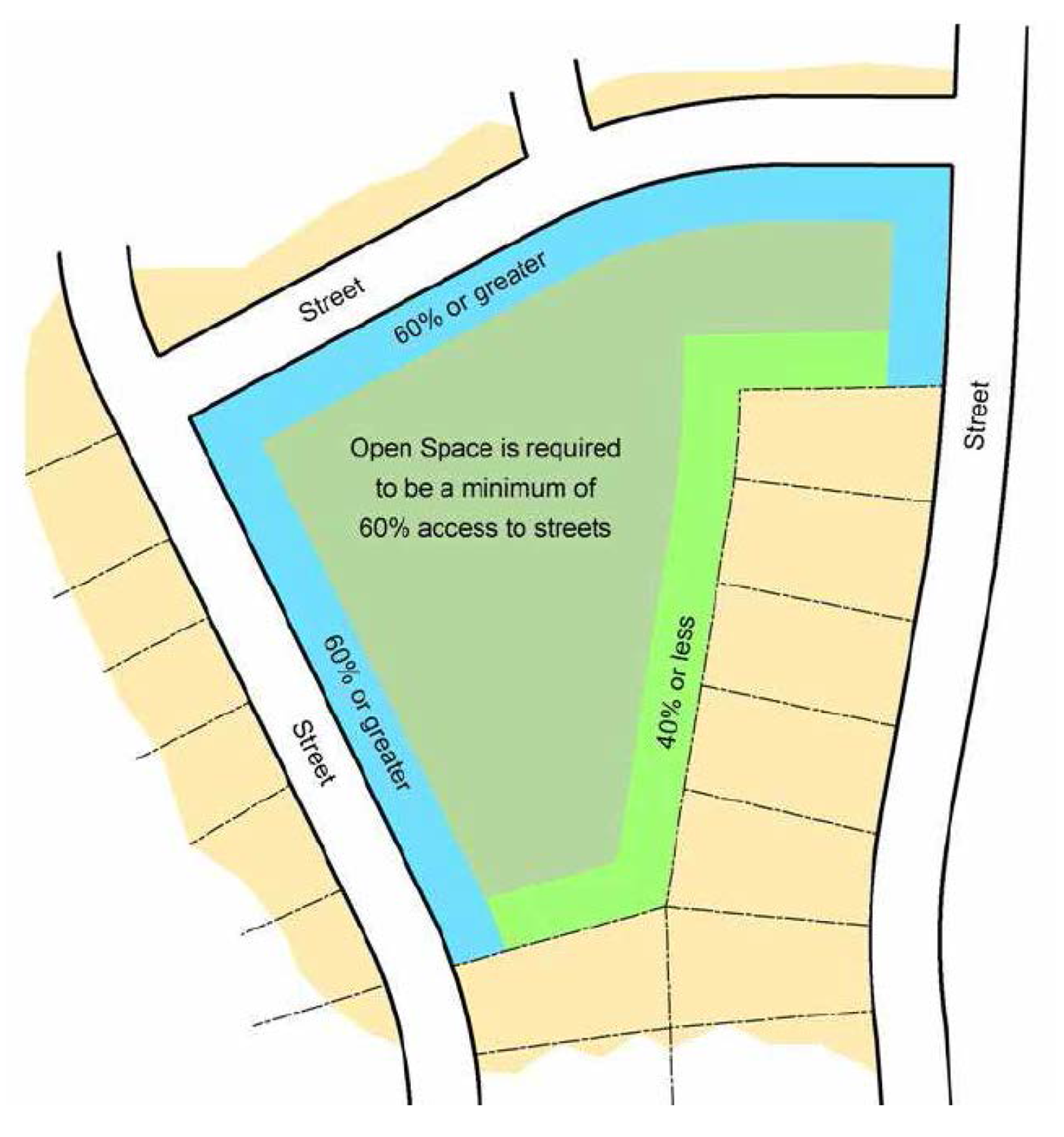
Open space, community center, an access gate, an entrance guard facility, recreational building and facilities are permitted uses provided they are incidental to the above-described residential uses, are approved on a Final Plat, and meet the following conditions:
a.
In accordance with the Subdivision Ordinance, an HOA shall be established to maintain open space, recreational areas, and other commonly owned facilities.
■
The developer is responsible for drafting the HOA documents pertaining to the HOA's responsibilities to maintain these areas.
■
Major creek areas delineated as the City's linear park system shown on either the City's Parks Master Plan or City's Hike & Bike Trail Master Plan shall not count towards the required open space. The Major Creeks areas not shown as part of either plan may count toward the required open space where lots do not back to the open space.
b.
Prior to approval of a Final Plat, a document establishing the HOA shall be submitted to the City for review and approved by the City Attorney for conformance with all requirements and other applicable ordinances.
■
The City Attorney shall review and approve the HOA documents pertaining to maintenance of the HOA areas prior to their recording at the County.
■
The developer is responsible for reimbursement of the City Attorney's fees for reviewing these documents.
4.05.1.2.
Area Regulations. Property and buildings shall conform to the related standards.
1.
For lots with a zero side yard setback.
a.
A roof overhang equipped with a gutter may extend a maximum of eight inches into a neighboring property. No other roof overhangs or extensions from a wall may extend into a neighboring lot.
b.
The closest exterior roofline to an adjacent property shall be storm guttered if the general slope of the roof falls toward the neighboring property. Gutters shall include returns to direct the water to the lot of origin.
c.
The "zero" side shall be designated on the Final Plat. All access, maintenance, and use easements shall be provided on preliminary and Final Plats.
d.
A five-foot-wide access, maintenance, and use easement shall be dedicated on the Final Plat for all lots adjacent to lots with a "zero" side. The purpose of this easement is to give the adjoining owner access for maintenance of his/her dwelling.
e.
The majority of one side of the structure shall be located within three feet of one side lot line. Building walls which are located adjacent to the "zero" side of the lot shall not have any doors, windows, ducts, grills, vents, or other openings. This requirement precludes exterior walls forming enclosures for courts, patios, or similar indentations to the "zero" wall.
2.
Center Option Lots.
a.
Lots not using a zero side yard setback shall be considered center option lots.
b.
Center option lots shall conform to the related standards.
3.
Minimum Rear Yard.
a.
12 feet.
b.
20 feet for structures accommodating required off-street parking if provided from a dedicated street or private alley.
4.06. - Townhome (TH) District.
4.06.1.
General Purpose and Descriptions. The TH District provides for the development of attached residential dwelling units in structures built to accommodate three to eight units per structure. In those districts where townhouses are a permitted use, the Building Official may issue a building permit for the erection of townhouses, provided that the development conforms to the following minimum conditions and requirements.
4.06.2.
Minimum Site. The minimum gross site area for a townhouse development shall be 15,000 SF. In determining compliance with this provision, no part of a lot shall be counted unless it is of such size, shape, topography, and location as to make it usable for individual townhouse lots, common parking or recreation areas, or necessary pedestrian ways.
4.06.3.
Off-street Parking Areas. If the required off-street parking facilities are not provided on the individual townhouse lots, they shall be provided on common areas, located within 200 feet of each lot so served, measured along a route of pedestrian access.
4.06.4.
Usable Open Space. There shall be at least 900 SF of common recreation area per townhouse lot; the minimum area of any common recreation area shall be 6,000 SF, and the minimum width of any such area shall be 60 feet. Each required common recreation area shall be within 300 feet of all the townhouse lots it is intended to serve, measured along a route of pedestrian access. Each required common recreation area shall be appropriately graded, turfed, surfaced, or otherwise landscaped and provided with suitable drainage facilities.
Pedestrian ways and swimming pools may be included as part of the required usable open space having the required minimum width, but off-street parking areas and service drives may not be included in such areas.
4.06.5.
Common Areas—Ownership and Maintenance. For any land or facilities to be used in common by residents of the development, there shall be provisions made for the establishment of a property owner's association to own, manage and maintain such common facilities.
4.06.6.
Public Access. Each individual townhouse lot shall abut on a public street.
4.06.7.
Area Regulations.
1.
Minimum Front Yard: 25 feet.
2.
Minimum Side Yard.
■
Five feet from a side property line when adjacent to open space lots or amenity center lots.
■
15 feet from a side property line when adjacent to detached residential dwelling units.
■
20 feet from a side property line when adjacent to a dedicated street.
3.
Minimum Rear Yard. 20 feet, 60 feet when the building is in excess of one story and adjacent to a Single-Family Zoning District.
4.
Structure Separation. Structures on the same parcel shall have the following setbacks and/or minimum distance between structures.
■
Minimum Front Yard: 25 feet.
■
Minimum Side Yard: ten feet between buildings without openings (windows); 15 feet between buildings with openings and when adjacent to side street; 60 feet when building is in excess of one story in height and adjacent to Single-Family Zoning District.
■
Minimum Rear Yard: 20 feet; 60 feet when the building is in excess of one story and adjacent to a Single-Family Zoning District.
4.06.8.
Permitted Uses. Uses permitted in the TH District is outlined in Section 10.04.
1.
Community Owned or Multiple Ownership Areas. Common open space, community centers, an access gates, an entrance guard facilities, recreational buildings and facilities are permitted uses provided they are incidental to the above-described residential uses, are approved on a Final Plat, and meet the following conditions.
[2.]1.
In accordance with the Subdivision Ordinance, a homeowners association (HOA) shall be established to maintain open space, recreational areas, and other commonly owned facilities.
i.
The developer is responsible for drafting the HOA documents pertaining to the HOA's responsibilities to maintain these areas.
[3.]2.
Prior to approval of a Final Plat, a document establishing the HOA shall be submitted to the City for review and approved by the City Attorney for conformance with all requirements and other applicable ordinances.
i.
The City Attorney shall review and approve the HOA documents pertaining to maintenance of the HOA areas prior to their recording at the County.
ii.
The developer is responsible for reimbursement of the City Attorney's fees for reviewing these documents.
4.08. - Multifamily (MF) District—MF1 District.
4.08.1.
Permitted Uses. Principal uses permitted in an MF1 district are limited to those included in the use groups set forth below, subject to the indicated district regulations. Detailed lists of permitted uses in the use groups are set forth in Article 12.
4.08.1.1.
Accessory Uses. Accessory uses to any of the above principal uses.
4.08.2.
Bulk and Area Regulations. In an MF1 district, any use of land or any structure shall be subject to the following bulk and area regulations.
4.08.3.
General Regulations.
4.08.4.
Off-street Parking and Loading Requirements. The number of off-street parking spaces required shall be as set forth in Article 12, and developed as provided by Section 16.09. Off-street loading requirements are set forth in Section 16.09.
4.08.5.
Living Area. The minimum living area of each dwelling unit constructed in the MF1 district shall be:
i.
1,000 SF for a single-family dwelling and for each unit in a two-family dwelling.
ii.
650 SF for each unit of a townhouse or unit in a multiple dwelling.
Editor's note— Inasmuch as former § 4.7, Multifamily (MF) District, existed only as an organizational head for §§ 4.8 and 4.9, said section 4.7 has been removed and its catchline incorporated into §§ 4.8 and 4.9.
4.09. - Multifamily (MF) District—MF2 District.
4.09.1.
Permitted Uses.
4.09.1.1.
Principal Uses. Principal uses permitted in an MF2 district are limited to those included in the use groups set forth below, subject to the included district regulations. Detailed lists of permitted uses in the various use groups are set forth in Article 12.
4.09.1.1.1.
Accessory Uses. Accessory uses to any of the above principal uses.
4.09.2.
Bulk and Area Regulations. In an MF2 district, any use of land or any structure shall be subject to the following bulk area regulations.
4.09.3.
Transitional Regulations. The bulk and area regulations for that portion of a zoned lot in the MF2 district which is contiguous with or across the street from a PD, predevelopment or SF, single-family district shall be the same as the general regulations set forth in paragraph B, except that within a 300-foot transitional zone, the minimum lot area per dwelling unit shall be 4,000 SF and the maximum height of the principal building and accessory structure shall be one story.
4.09.4.
General Regulations.
4.09.5.
Off-street Parking and Loading Requirements. The number of off-street parking spaces required shall be as set forth in Article 12, and developed as provided by Section 16.09. Off-street loading requirements are set forth in Section 16.09.
4.09.6.
Living Area. The minimum living area of each dwelling unit constructed in the MF2 district shall be:
i.
1,000 SF for a single-family dwelling and for each unit in a two-family dwelling.
ii.
650 SF for each unit of a townhouse or unit in a multiple dwelling.
Editor's note— Inasmuch as former § 4.7, Multifamily (MF) District, existed only as an organizational head for §§ 4.8 and 4.9, said section 4.7 has been removed and its catchline incorporated into §§ 4.8 and 4.9.
4.10. - Manufactured Homes Parks (MP) District.
4.10.1.
Permitted uses.
4.10.1.1.
Principal Uses. Principal uses permitted in an MP district are limited to those included in the use groups set forth below, subject to the included district regulations. Detailed lists of permitted uses in the various use groups are set forth in Article 12.
4.10.1.1.1.
Accessory Uses. Accessory uses to any of the above principal uses.
4.10.2.
Bulk and Area Regulations. In an MP district, any use of land or any structure shall be subject to the following bulk and area regulations:
4.10.3.
Off-street Parking and Loading Requirements. The number of off-street parking spaces required shall be as set forth in Article 12, and developed as provided by Section 16.09. Off-street loading requirements are set forth in Section 16.09.
4.11. - Special Types of Residential Development.
Provisions regulating special types of residential development are set forth in Section 4.12. These special types of development include building groups, townhouses and manufactured home parks.
4.12. - Building Groups.
In those districts where dwelling groups and apartment house groups are permitted uses, the Building Official may issue a building permit for the erection of such a building group, provided that the development conforms to the following minimum conditions and requirements:
4.12.1.
Minimum Lot Area. The area of the lot on which the building group is to be erected shall be at least equal to the aggregate of the minimum lot areas otherwise required for the individual buildings in the group.
1.
Fronting Separations. Each residential building in the group shall front either on a street or other permanent public open space at least 30 feet wide or on a common yard or outer court. The least width of such yard, if flanked by buildings on one side only, shall be:
2.
Separation Other Than Fronting. In each case, the distance between principal buildings, other than the distances specified immediately above, shall not be less than the sum of the least widths of the affected yards required in the district in which the building group is to be located.
3.
Separation From Lot Lines. The distance between principal buildings and the nearest zoning lot lines, other than a front lot line, shall be not less than 20 feet.
4.12.2.
Access To a Public Street. Every residential structure in the building group shall be within 60 feet of a public street or of a private access roadway or drive, having a minimum paved with [width] of 20 feet, provided the length of such private access road be a maximum of 500 feet measured from the street to the end of a turnaround. Pavement design including turnaround shall comply with the improvement standards of the City's subdivision regulations.
4.12.3.
Compliance With Other Ordinance Requirements. Except as modified in this subparagraph 4.12, such building group shall conform to all the requirements of this ordinance for the district in which it is to be located.
4.13. - Manufactured Home Parks.
Manufactured home parks may be established provided the development conforms to the following minimum conditions and requirements:
4.13.1.
Minimum Site. The minimum gross area for a manufactured home parks development shall be 40,000 SF. In determining compliance with this provision, no part of a lot shall be counted unless it is of such size, shape, topography and location as to make it usable for individual manufactured home lots, common recreation areas or necessary vehicular or pedestrian ways.
4.13.2.
Usable Open Space. There shall be at least 600 square feet of usable open space per individual manufactured home; the minimum width of any such open space shall be 80 feet. Each required common area shall be within 300 feet of all the manufactured homes it is intended to serve, measured along a route of pedestrian access. Each required common area shall be appropriately graded, turfed, or otherwise landscaped, and provided with suitable drainage facilities.
4.13.3.
Accessory Commercial Use. In a manufactured home park containing at least 100 dwelling units, there may be provided for the convenience of the residents of the development an accessory commercial area, provided the commercial area meets the following conditions:
1.
The gross floor area devoted to commercial purposes shall not exceed two SF for each manufactured home site in the manufactured home park development.
2.
No commercial parcel shall be closer than 300 feet to any property in an SF, TF or MF district outside the development.
3.
Any commercial parcel shall be governed by the requirements of the Neighborhood Shopping (NS) district. No illuminated signs shall be visible outside the premises.
4.13.4.
Other Regulations. The development shall conform with the Mobile Home, chapter 58 of Code the of the City of Deer Park, and all other applicable city and state regulations.

