
Deerfield Beach City Zoning Code
ARTICLE III
ZONING DISTRICT REGULATIONS
Sec. 98-41.- Establishment of districts.
For the purposes of protecting, promoting, and improving the public health, safety, comfort, order, appearance, convenience, morals, and general welfare of the community, the incorporated area of the City of Deerfield Beach is hereby divided into the following zoning districts in the manner shown on the official zoning map:
(Ord. No. 2017/011, § 2, 6-19-17)
Sec. 98-42. - Official map.
The official zoning map shall be entrusted to the custody of the city clerk and shall be located in city hall. It shall be identified by the signature of the mayor, attested by the city clerk, and shall bear the city seal under the following words: "This is to certify that this is the Official Zoning Map of the City of Deerfield Beach as referenced in Article III under Ordinance No. 1994/002 adopted on January 25, 1994." It shall be considered a part of this Code.
(1)
Amendments. Approved amendments to the official zoning map shall be promptly noted on a true copy of the official zoning map by inserting the case number and date of approval on or near the affected parcel.
(2)
Retention of earlier zoning maps. All zoning maps and regulations or remaining portions thereof which have had official force and effect in the City prior to the effective date of these zoning regulations shall be retained as public records.
(3)
Replacement of official zoning map. If the official zoning map is damaged, destroyed, lost or difficult to interpret because of the nature or number of changes and additions, the city commission may adopt, after due public notice, an updated official zoning map which will supersede the prior official zoning map. The updated official zoning map may correct drafting or other errors or omissions in the prior official zoning map, but no such corrections shall have the effect of amending the original official zoning map or any subsequent amendment thereof. The updated official zoning map shall be identified in the same manner as the original official zoning map, except that the certificate shall state: "This is to certify that this official zoning map supersedes and replaces the official zoning map adopted on November 20, 1990, as part of Ordinance No. 1990/82 of the City of Deerfield Beach." Unless the prior official zoning map has been lost or has been totally destroyed, the prior map or any significant parts thereof remaining shall be preserved, together with all available records pertaining to its adoption or amendment.
Sec. 98-43. - Interpretation of district boundaries.
The following rules of interpretation shall be used to locate the district boundaries shown on the Official Zoning Map.
(1)
Boundaries following streets. Boundaries following, or approximately following, the centerlines of streets shall be construed to follow those centerlines. If a street is vacated, the district boundary shall be construed to remain in its location, except when ownership of the vacated street is divided other than at the center; in which case, the boundary shall be construed to move with the ownership.
(2)
Boundaries following lot lines. Boundaries following, or approximately following, lot lines shall be construed to follow those lot lines.
(3)
Boundaries following county and city limits. Boundaries following, or approximately following, city limits shall be construed to follow those county and city limits.
(4)
Boundaries following railroad lines. Those boundaries following, or approximately following, railroad lines shall be construed to follow the centerline of the railroad right-of-way. If a railroad right-of-way is vacated, the district boundary shall be construed to remain in its location, except when ownership of the vacated railroad right-of-way is divided other than at the center; in which case, the boundary shall be construed to move with the ownership.
(5)
Boundaries following water bodies. Those boundaries following, or approximately following, the shorelines of water bodies shall be construed to follow and move with those shorelines. Boundaries following, or approximately following, the centerlines of streams, rivers, canals, lakes, or other bodies of water, shall be construed to follow and move with those centerlines.
(6)
Boundaries entering any body of water. Those boundaries entering any body of water, but not continuing to intersect with other zoning boundaries, shall be construed to extend in the same direction in which they entered the body of water, until they intersect with other zoning boundaries.
(7)
Boundaries which are parallel to or extensions of above features. Boundaries parallel to, or extensions of the features indicated herein, shall be construed to be parallel to, or extensions of, those features as the case may be.
(8)
Other cases. Boundaries splitting existing lots in subdivisions and any other boundaries not determined by the above rules, shall be determined by reference to the expressed distances on, or the scale of, the Official Zoning Map. If the existing lot will not accommodate any of the uses permitted in the multiple districts indicated thereon, a rezoning to an appropriate district shall be required.
(9)
Determination of boundaries. In cases where the rules set forth in this article cannot with certainty determine the true location of a district boundary, the director shall request the planning and zoning board to render a determination. No boundary shall be changed except by the amendment process set forth in Article VIII.
Sec. 98-44. - Scope and application.
In interpreting and applying the provisions of this Code, they shall be held to be the minimum requirements for achieving the purposes of the Code. It is not intended that this Code interfere with, abrogate, or annul any easements, covenants, or other agreements between parties; however, where this Code imposes a greater restriction, the provisions of this Code shall control.
(1)
Zoning affects all premises. Except as provided for herein, no premises shall hereafter be used or occupied, and no building or structure shall hereafter be erected, constructed, moved, or altered except in conformity with these regulations. If, because of an error or omission on the official zoning map, any property within the city is not shown as being included within a zoning district, the classification of such property shall be in conformance with the Broward County Land Use Plan, unless properly changed by an amendment to this article and the city's adopted comprehensive plan.
(2)
Interpretation of Broward County flexibility zones. Development densities may be constrained as a result of the application of flexibility zones mandated by the Broward County Comprehensive Plan. These flexibility zones specify the numbers of dwelling units which can be built within a specific geographic area. The city will maintain a listing of available units for each flexibility zone, and conformance with the flexibility zone provisions will be a part of the development plan review.
(3)
Application of commercial flexibility.
a.
The city may permit up to five percent of the area designated for residential use on the Broward County Land Use Plan within a flexibility zone to be used for neighborhood office and/or retail sales of merchandise or services, subject to compliance with Policy 13.01.10 of the Broward County Land Use Plan. No such contiguous area may exceed ten acres in size. For the purpose of this provision, contiguous is defined as: attached; located within 500 feet; or separated only by streets and highways, canals and rivers, or easements.
b.
This five percent residential-to-commercial flexibility rule may be applied by the city through (re)zoning, subject to compliance with Policy 13.01.10 of the Broward County Land Use Plan.
(4)
Maximum allowed density.
a.
Density refers to the gross area (lot area includes to the center line of a street) available to be developed. It is used to determine the maximum number of units allowed on a site based upon the maximum allowed density as set forth in the zoning district and as determined below.
b.
The area associated with bodies of water, excluding drainage canals, the Intracoastal Waterway and North and South Lakes, shall not be used in the calculation of the maximum allowed density on a site. Easement area located within the site are calculated in the area used for determining density.
c.
The maximum allowed density on a site shall only be increased through the application of Reserve Units or Flexibility Units.
(5)
Interpretation of uses and structures permitted; prohibited uses.
a.
If a zoning category specifically outlines "permitted uses" then any other use not specifically permitted within such categories or permitted as an accessory use or conditional use shall be specifically prohibited.
b.
In accordance with F.S. § 381.986, it is hereby expressly provided that medical marijuana dispensaries are prohibited within the city in each and every zoning district.
(6)
Yard, lot coverage, floor area, and building height requirements. Every building or accessory structure to be erected upon a lot shall meet all yard, lot coverage, floor area, and building height requirements of its district unless specifically exempted elsewhere in this Code.
(7)
Multiple use of required space prohibited. No part of a required yard, or other required open space, or of the off-street parking or loading spaces for one structure, shall be included as part of the yard, open space, off-street parking or loading space requirements for any other structure.
(8)
Reduction of lot area prohibited. Except for any approved planned residential or planned industrial developments, no yard or lot existing at the time of passage of this Code, shall be reduced in dimension or area below the minimum requirements of its district. With the same exception, yards or lots designed after the effective date of this Code shall meet the requirements established by this Code.
(Ord. No. 2000/001, § 11, 4-5-00; Ord. No. 2019/014, § 2, 5-21-19)
Sec. 98-45. - RS-5 residence, single-family.
(a)
Purpose and intent. The purpose of this district is to delineate those areas defined by the land use element of the city's comprehensive plan as suitable for single-family detached homes and related uses up to a maximum density of five dwelling units per acre.
(b)
Permitted uses. The following uses shall be permitted principal uses in the RS-5 district:
(1)
Dwelling, single-family detached;
(2)
Public park;
(3)
Essential services;
(4)
Home occupations in single-family dwellings subject to the provisions of this Code;
(5)
Family foster home;
(6)
Community residential home I to the extent provided for and subject to the restrictions set forth in F.S. § 419.001, as amended.
(c)
Conditional uses. Upon application and after a favorable determination by the board of adjustment or the city commission (where the conditional use is part of the site plan application) that all conditions and provisions of a conditional use have been met, the uses listed below may be permitted as conditional uses in this district. In addition to any provisions listed herein, all proposed conditional uses shall comply with the requirements of this Code, be heard and decided by the board of adjustment (or the city commission where applicable) as set forth herein, and be consistent with the goals, objectives and policies of the city's comprehensive plan.
(1)
Churches, other houses of worship and church or parochial schools incidental to churches provided:
a.
The city commission finds the proposed use and development plan to be consistent with the comprehensive plan and the proper development of the surrounding area.
b.
The site shall be at least 20,000 square feet in area and shall have at least 200 feet of street frontage.
c.
The site shall be located on a street of sufficient width and of such alignment and connection with other streets as to be capable of handling the traffic generated by such use without undue congestion or other hazards.
d.
The coverage of all roofed structures shall not exceed 25 percent of the plot area.
e.
The development plan shall provide adequate screening and separation from adjacent residential properties.
(2)
Golf course and country club facilities, not including miniature golf courses or practice driving tees as principal use providing:
a.
The site shall be at least 30 acres in area;
b.
Any buildings, structures or parking area shall be located at least 100 feet from any property line.
(3)
Libraries;
(4)
Museums;
(5)
Fire stations;
(6)
School;
(7)
Energy recovery structures.
(d)
Accessory uses. The following uses shall be permitted accessory uses in the RS-5 district:
(1)
Swimming pools and spas in accordance with the provisions of sections 98-74 and 98-73(2) of this Code;
(2)
Docks in accordance with the provisions of sections 98-87 and 98-73(3) of this Code;
(3)
Other accessory uses customarily incidental to a principal permitted or approved conditional use. No commercial use may be considered accessory to a residential use.
(4)
Playground equipment for use by children, provided said equipment does not occupy an area of more than 150 square feet and is located at least five feet from any property line. Additionally, a structure capable of being occupied on a temporary basis may be permitted in the rear yard, provided that the structure is designed for the recreational use of children and is no larger than 10 feet in height and 25 square feet in floor area and is located at least ten feet from any property line.
(e)
Property development requirements. Property development regulations addressing minimum lot requirements, minimum floor area, required yards, maximum lot coverage, floor area ratio, and height are presented in tabular form contained herein.
(f)
Other development requirements. All other applicable lot and use regulations as set forth in this Code shall be met.
(g)
No sign shall be constructed or erected which exceeds the height of the tallest building on the lot upon which the sign is to be erected, or the maximum height as permitted in section 98-101 of the Land Development Code, whichever is less.
(Ord. No. 2000/001, § 12, 4-5-00; Ord. No. 2005/027, § 2, 9-6-05; Ord. No. 2008/013, § 2, 5-20-08; Ord. No. 2012/029, § 4, 7-10-12;Ord. No. 2017/013, § 3, 6-19-17)
Sec. 98-46. - RS-7 residence, single-family.
(a)
Purpose and intent. The purpose of this district is to delineate those areas defined by the land use element of the city's comprehensive plan as suitable for moderate density development including single-family units up to a maximum density of seven dwelling units per acre. This district is intended to be limited in application to those areas of the city where existing platting patterns have resulted in predominant lot size below those established for the RS-5 and RM-10 districts.
(b)
[Permitted principal uses.] The following uses shall be permitted principal uses in the RS-7 district:
(1)
Dwelling, single-family detached;
(2)
Public park;
(3)
Essential services;
(4)
Home occupations in single-family dwellings subject to the provisions of this Code;
(5)
Family foster home;
(6)
Community residential home I, as defined by and to the extent provided for and subject to the restrictions set forth in F.S. § 419.001, as amended.
(c)
Conditional uses. Upon application and after a favorable determination by the board of adjustment or the city commission (where the conditional use is part of the site plan application) that all conditions and provisions of a conditional use have been met, the uses listed below may be permitted as conditional uses in this district. In addition to any provisions listed herein, all proposed conditional uses shall comply with the requirements of this Code, be heard and decided by the board of adjustment (or the city commission where applicable) as set forth herein, and be consistent with the goals, objectives and policies of the city's comprehensive plan.
(1)
Churches, other houses of worship and church or parochial schools customarily incidental to churches provided:
a.
The city commission finds the proposed use and development plan to be consistent with the comprehensive plan and does not impose a negative traffic impact upon neighboring residences.
b.
The site shall be at least 20,000 square feet in area and shall have at least 200 feet of street frontage.
c.
The site shall be located on a street of sufficient width and of such alignment and connection with other streets as to be capable of handling the traffic generated by such use without undue congestion or other hazards.
d.
The coverage of all roofed structures shall not exceed 25 percent of the plot area.
e.
The development plan shall provide adequate screening and separation from adjacent residential properties.
(2)
Libraries;
(3)
Museums;
(4)
Fire stations;
(5)
School;
(6)
Child day care center, provided that such center is located at least 1,000 feet from any other child day care center located in the RS-7 district. The distance requirement shall be measured and computed by following a straight line from the nearest property line of the proposed center to the nearest property line of an existing center.
(d)
Accessory uses. The following uses shall be permitted accessory uses in the RS-7 district:
(1)
Swimming pools and spas in accordance with the provisions of sections 98-74 and 98-73(2) of this Code;
(2)
Docks in accordance with the provisions of sections 98-87 and 98-73(3) of this Code;
(3)
Other accessory uses customarily incidental to a principal permitted or approved conditional use. No commercial use may be considered accessory to a residential use.
(4)
Playground equipment for use by children, provided said equipment does not occupy an area of more than 150 square feet and is located at least five feet from any property line. Additionally, a structure capable of being occupied on a temporary basis may be permitted in the rear yard, provided that the structure is designed for the recreational use of children and is no larger than 10 feet in height and 25 square feet in floor area and is located at least ten feet from any property line.
(e)
Property development requirements. The property development regulations addressing minimum lot requirements, minimum floor area, required yards, maximum lot coverage, floor area ratio and height are presented in tabular form contained herein.
(f)
Other development requirements. All other applicable lot and use regulations as set forth in this Code shall be met.
(g)
No sign shall be constructed or erected which exceeds the height of the tallest building on the lot upon which the sign is to be erected, or the maximum height as permitted in section 98-101 of the Land Development Code, whichever is less.
(Ord. No. 1997/006, § 1, 4-1-97; Ord. No. 2000/001, § 13, 4-5-00; Ord. No. 2005/027, § 3, 9-6-05; Ord. No. 2008/013, § 3, 5-20-08; Ord. No. 2012/029, § 5, 7-10-12; Ord. No. 2017/013, § 4, 6-19-17)
Sec. 98-47. - RM-10 residence, multifamily.
(a)
Purpose and intent. The purpose of this district is to delineate those areas defined by the land use element of the city's comprehensive plan as suitable for moderate density residential development including single-family units, two-family units, and moderate density multiple-family dwellings up to a maximum density of ten dwelling units per acre.
(b)
Permitted uses. The following uses shall be permitted principal uses in the RM-10 district:
(1)
Dwelling, single-family;
(2)
Townhouses;
(3)
Dwelling, two-family;
(4)
Dwelling, multifamily;
(5)
Public park;
(6)
Essential services;
(7)
Home occupations subject to the provisions of this Code;
(8)
Family foster home;
(9)
Community residential home I, to the extent provided for and subject to the restrictions set forth in F.S. § 419.001, as amended.
(10)
Community residential home II, to the extent provided for and subject to the restrictions set forth in F.S. § 419.001, as amended, and subject to the provisions of section 98-93 of this Code.
(11)
ALF subject to the provisions of section 98-93 of this Code, provided that no ALF shall be located within a radius of 1,200 feet of another ALF;
(c)
Conditional uses. Upon application and after a favorable determination by the board of adjustment or the city commission (where the conditional use is part of the site plan application) that all conditions and provisions of a conditional use have been met, the uses listed below may be permitted as conditional uses in this district. In addition to any provisions listed herein, all proposed conditional uses shall comply with the requirements of this Code, be heard and decided by the board of adjustment (or city commission where applicable) as set forth herein, and be consistent with the goals, objectives and policies of the city's comprehensive plan.
(1)
Churches, other houses of worship, and church or parochial schools incidental to churches provided:
a.
The city commission finds the proposed use and development plan to be consistent with the comprehensive plan and does not impose a negative traffic impact upon neighboring residences.
b.
The site shall be at least 20,000 square feet in area and shall have at least 200 feet of street frontage.
c.
The site shall be located on a street of sufficient width and of such alignment and connection with other streets as to be capable of handling the traffic generated by such use without undue congestion or other hazards.
d.
The coverage of roofed structures shall not exceed 25 percent of the plot area.
e.
The development plan shall provide adequate screening and separation from adjacent residential properties.
(2)
School;
(3)
Museums;
(4)
Libraries;
(5)
Fire stations;
(6)
Child and adult day-care centers.
(d)
Accessory uses. The following uses shall be permitted accessory uses in the RM-10 district:
(1)
Private swimming pool;
(2)
Private dock;
(3)
Other accessory uses customarily incidental to a principal permitted or approved conditional use. No commercial use may be considered accessory to a residential use.
(e)
Property development requirements. The property development regulations addressing minimum lot requirements, minimum floor area, required yards, maximum lot coverage, floor area ratio, height, and minimum landscape area are presented in tabular form herein.
(f)
Building groups and spacing. The maximum length of any group of attached structures shall not exceed 250 feet. The minimum distance between building groups shall be as follows:
(1)
One- and two-story building—25 feet;
(2)
Three or more stories-One-half the height of the taller adjacent building or 25 feet, whichever is greater.
(g)
Other development requirements. All other applicable lot and use regulations as set forth in this Code shall be met.
(h)
No sign shall be constructed or erected which exceeds the height of the tallest building on the lot upon which the sign is to be erected, or the maximum height as permitted in section 98-101 of the Land Development Code, whichever is less.
(Ord. No. 2000/001, § 14, 4-5-00; Ord. No. 2005/027, § 4, 9-6-05; Ord. No. 2008/013, § 4, 5-20-08; Ord. No. 2012/029, § 6, 7-10-12)
Sec. 98-48. - RM-15 residence, multifamily.
(a)
Purpose and intent. The purpose of this district is to delineate those areas defined by the land use element of the city's comprehensive plan as suitable for medium density residential development up to a maximum density of 15 dwelling units per acre.
(b)
Permitted uses. The following uses shall be permitted principal uses in the RM-15 district:
(1)
Dwelling, single-family;
(2)
Dwelling, two-family;
(3)
Dwelling, multiple-family;
(4)
Townhouses;
(5)
Public parks;
(6)
Essential services;
(7)
Home occupations subject to the provisions of this Code;
(8)
Family foster home;
(9)
Community residential home I to the extent provided for and subject to the restrictions set forth in F.S. § 419.001, as amended.
(10)
Community residential home II to the extent provided for and subject to the restrictions set forth in F.S. § 419.001, as amended, and subject to the provisions of section 98-93 of this Code.
(11)
ALF, subject to the provisions of section 98-93 of this Code, provided that no ALF shall be located within a radius of 1,200 feet of another ALF.
(c)
Conditional uses. Upon application and after a favorable determination by the board of adjustment or the city commission (where the conditional use is part of the site plan application) that all conditions and provisions of a conditional use have been met, the uses listed below may be permitted as conditional uses in this district. In addition to any provisions listed herein, all proposed conditional uses shall comply with the requirements of this Code, be heard and decided by the board of adjustment (or city commission where applicable) as set forth herein and be consistent with the goals, objectives and policies of the city's comprehensive plan.
(1)
Churches, other houses of worship and church or parochial schools incidental to churches provided:
a.
The city commission finds the development plan to be consistent with the comprehensive plan and does not impose a negative traffic impact upon the surrounding area.
b.
The site shall be at least 20,000 square feet in area and shall have at least 200 feet of street frontage.
c.
The site shall be located on a street of sufficient width and of such alignment and connection with other streets as to be capable of handling the traffic generated by such use without undue congestion or other hazards.
d.
The coverage of all roofed structures shall not exceed 25 percent of the plot area.
e.
The development plan shall provide adequate screening and separation from adjacent residential properties.
(2)
Golf course and country club facilities, not including miniature golf courses or practice driving tees as principal use providing:
a.
The site shall be at least 60 acres in area.
b.
Any buildings, structures or parking area shall be located at least 100 feet from any residentially zoned property.
(3)
School;
(4)
Libraries;
(5)
Museums;
(6)
Fire stations;
(7)
Child and adult day-care centers.
(d)
Accessory uses. The following uses shall be permitted as accessory uses in the RM-15 district.
(1)
Private swimming pool;
(2)
Private dock;
(3)
Other accessory uses customarily incidental to a principal permitted or approved conditional use.
(e)
Property development requirements. The property development regulations addressing minimum lot requirements, minimum floor area, required yards, maximum lot coverage, floor area ratio, height, and minimum landscape area are presented in tabular form contained herein.
(f)
Building groups and spacing. The maximum length of any group of attached structures should not exceed 250 feet. The minimum distance between building groups shall be as follows:
(1)
One- and two-story buildings—25 feet.
(2)
Three or more stories—One-half the height of the taller adjacent building or 25 feet, whichever is greater.
(g)
Other development requirements. Other applicable lot and use regulations are set forth in this Code.
(h)
No sign shall be constructed or erected which exceeds the height of the tallest building on the lot upon which the sign is to be erected, or the maximum height as permitted in section 98-101 of the Land Development Code, whichever is less.
(Ord. No. 2000/001, § 15, 4-5-00; Ord. No. 2005/027, § 5, 9-6-05; Ord. No. 2008/013, § 5, 5-20-08; Ord. No. 2012/029, § 7, 7-10-12; Ord. No. 2014/031, § 7, 10-7-14)
Sec. 98-49. - RM-25 residence, multifamily.
(a)
Purpose and intent. The purpose of this district is to delineate those areas defined by the land use element of the city's comprehensive plan as suitable for tourist accommodations development and high-density residential development up to a maximum of 25 dwelling units per acre.
(b)
Permitted uses. The following uses shall be permitted principal uses in the RM-25 district:
(1)
Dwelling, single-family;
(2)
Dwelling, two-family;
(3)
Dwelling, multiple-family;
(4)
Townhouses;
(5)
Public parks;
(6)
Essential services;
(7)
Home occupations subject to the provisions of this Code;
(8)
Family foster home;
(9)
Community residential home I to the extent provided for and subject to the restrictions set forth in F.S. § 419.001, as amended;
(10)
Community residential home II; subject to the provisions of section 98-93 of this Code and to the extent provided for and subject to the restrictions set forth in F.S. § 419.001, as amended;
(11)
ALF, subject to the provisions of section 98-93 of this Code, provided that no ALF shall be located within a radius of 1,200 feet of another ALF.
(c)
Conditional uses. Upon application and after a favorable determination by the board of adjustment or the city commission (where the conditional use is part of the site plan application) that all conditions and provisions of conditional uses have been met, the uses listed below may be permitted as conditional uses in this district. In addition to any provisions listed herein, all proposed conditional uses shall comply with the requirements contained herein and shall be heard and decided by the zoning appeals special master (or city commission where applicable) as set forth herein and be consistent with the goals, objectives and policies of the city's comprehensive plan.
(1)
Tourist accommodations including hotels and motels provided:
a.
The maximum density shall not exceed 38 dwelling units per gross acre;
b.
Accessory uses including restaurants, retail and personal service uses shall not exceed ten percent of the gross floor area of the hotel or motel;
c.
Outside dining areas associated with a hotel restaurant shall not exceed 48 patrons and shall not be included in the ten percent floor area restriction. Note that section 98-79 provides for additional outdoor seating regulations east of the Intracoastal Waterway.
(2)
School;
(3)
Libraries;
(4)
Museums;
(5)
Fire stations;
(6)
Child and adult day-care centers;
(7)
Interval ownership/time sharing units. Density shall be limited to 38 dwelling units per gross acre.
(d)
Accessory uses. The following uses shall be permitted accessory uses in the RM-25 district.
(1)
Cabana club;
(2)
Private swimming pool;
(3)
Private dock;
(4)
Other accessory uses customarily incidental to a principal permitted or approved conditional use.
(e)
Property development requirements. The property development regulations addressing minimum lot requirements, minimum floor area, required yards, maximum lot coverage, floor area ratio, height, and minimum landscape area are presented in tabular form herein.
(f)
Building groups and spacing. The maximum length of any group of attached structures should not exceed 250 feet. The minimum distance between building groups shall be as follows:
(1)
One- and two-story buildings—25 feet.
2.
Three or more stories—One-half the height of the taller adjacent building or 25 feet, whichever is greater.
(g)
No sign shall be constructed or erected which exceeds the height of the tallest building on the lot upon which the sign is to be erected, or the maximum height as permitted in section 98-101 of the Land Development Code, whichever is less.
(Ord. No. 2000/001, § 16, 4-5-00; Ord. No. 2005/027, § 6, 9-6-05; Ord. No. 2008/013, § 6, 5-20-08; Ord. No. 2012/029, § 8, 7-10-12; Ord. No. 2014/033, § 9, 12-2-14)
Sec. 98-50. - RP-10 residence, mobile home park.
(a)
Purpose and intent. The purpose of this district is to provide for those areas defined by the land use element of the city's comprehensive plan as suitable for moderate density residential development in the form of mobile home parks up to a maximum density of ten dwelling units per acre.
(b)
Permitted uses. The following uses shall be permitted principal uses in the RP-10 district.
(1)
Mobile home park;
(2)
Essential services;
(3)
Home occupations subject to the provisions of this code.
(c)
Conditional uses. Upon application and after a favorable determination by the board of adjustment or the city commission (where the conditional use is part of the site plan application) that all conditions and provisions of conditional use have been met and that the proposed use is consistent with sound zoning practice, the following uses may be permitted in the RP-10 district.
(1)
Mobile home sales provided:
a.
Mobile home units for sale within the park or for use as display models shall be placed on individual mobile home spaces and shall meet the separation requirements for all mobile home units as established in this district.
b.
The mobile home sales area is limited to sales within the park and is screened from any adjacent residential areas as required by section 98-93.
(d)
Accessory uses. The following uses shall be permitted accessory uses in the RP-10 district.
(1)
Swimming pool intended for the use of mobile home park tenants;
(2)
Management, rental or sales office is limited to the operation of the park to which it is accessory;
(3)
Maintenance facilities for the park.
(e)
Minimum lot area. The minimum lot area for the development of a mobile home park shall be two acres with a minimum street frontage of 200 feet. The minimum lot area for a mobile home space, within a mobile home park shall be 3,200 square feet with a minimum street frontage of 40 feet.
(f)
Property development requirements. The property development regulations for mobile home parks and mobile home spaces, are as follows:
(1)
A mobile home park perimeter setbacks shall be as follows:
a.
Front yard. 25 feet.
b.
Side yard. 10 feet.
c.
Rear yard. 15 feet.
d.
Waterfront yard. 30 feet.
(2)
Setbacks and separation requirements for mobile homes and structures in a mobile home park shall be as follows:
a.
Front setback. No part of any mobile home, addition or appurtenance shall be placed closer than 12 feet from the street pavement.
b.
Corner (street side) setback. No part of any mobile home, addition or appurtenance shall be placed closer than ten feet from the street pavement.
c.
Interior side separation. No part of any mobile home, addition, or appurtenance shall be placed closer than ten feet side to side.
d.
Rear separation. No part of any mobile home, including carports, porches and additions shall be placed closer than 20 feet rear to rear, or rear to side. Detached accessory structures, such as sheds and utility buildings may be located in the rear separation area, but not less then ten feet from another accessory structure.
(3)
No part of any mobile home, including all accessory structures shall be erected or altered to a building height exceeding 20 feet.
(4)
The minimum floor area of a mobile home located in a mobile home park shall be 720 square feet.
(g)
Access to mobile home sites. All mobile home sites shall abut upon a drive or street with a minimum 30 feet right-of-way. This drive or street shall be paved to a minimum of 20 feet and conform to city's subdivision ordinance standards with respect to all other design criteria.
(h)
Porches and additions.
(1)
Structures of a permanent nature, such as enclosed porches, screen enclosures and other additions to mobile homes shall conform to all applicable provisions of the building code.
(2)
All canvas, portable or demountable roofs, porches or appurtenances shall be dismantled and stored either within the mobile home or in some permanent building within one hour after all hurricane alerts by the U.S. Weather Bureau and/or if the mobile home is not to be occupied for a period of 30 days or more.
(3)
Additions described in subparagraphs (1) and (2) above shall be regarded as minor amendments to the approved mobile home park site plan and shall require review and approval by the director to ascertain that all applicable requirements are met.
(i)
Other development requirements. All other applicable lot and use regulations are set forth in this Code.
(Ord. No. 2005/027, § 7, 9-6-05; Ord. No. 2010/007, § 1, 3-23-10; Ord. No. 2014/031, § 8, 10-7-14; Ord. No. 2024/009, § 3, 6-4-24)
Sec. 98-51. - PUD, planned unit development.
(a)
Purpose and intent. The purpose of this district is to provide for innovations in residential development to better meet contemporary housing demands, to stimulate variety in the type, design and arrangements of housing units, to permit economies in providing public services and to reflect changes in the technology of land development and relate the development of land to the specific site and to conserve natural amenities. This innovation is to be encouraged through the substitution of design and performance criteria for the normally rigid development parameters of other residential districts. This district is intended to be applied in those areas of the city identified in the land use element of the comprehensive plan as suitable for residential use.
(b)
Permitted uses. The following uses shall be permitted principal uses in the PUD district:
(1)
Dwelling, one-family;
(2)
Dwelling, two-family;
(3)
Dwelling, multifamily;
(4)
Townhouses;
(5)
Public and private recreation facilities;
(6)
Churches and other houses of worship;
(7)
Child and adult day care centers;
(8)
Convenience, goods, retail and personal service stores primarily intended and designed to service the residents of the PUD;
(9)
Essential services;
(10)
Foster home;
(11)
ALF, subject to the provisions of section 98-93 of this Code, provided that no ALF shall be located within a radius of 1,200 feet of another ALF;
(12)
Home occupations subject to the provisions contained herein.
(c)
Conditional uses. None.
(d)
Accessory uses. Permitted accessory uses in the PUD district shall include those uses customarily incidental to the permitted principal uses.
(e)
Minimum site requirements. The minimum land area for a PUD shall be 40 contiguous acres. All land to be included within the PUD shall be owned by the applicant.
(f)
Density and design standards. The following standards shall be applied in evaluating PUD development proposals:
(1)
Area limitations.
a.
A maximum of five percent for accessory retail, dining and service facilities and parking associated with these uses, provided any one particular site does not exceed ten contiguous acres.
b.
A minimum of 20 percent of (of the net acreage) open space shall be provided.
(2)
Residential density. The residential density for a PUD shall not exceed the density allowed in the comprehensive plan.
(3)
Limitations on businesses. No business shall be permitted until certificates of occupancy have been issued for at least 25 percent of the total planned residential floor area or 100 residential dwelling units, whichever is less.
(4)
Property development requirements. There shall be no minimum lot size, setbacks, percentage of lot coverage or lot width. However, every single-family dwelling shall have access to a public street, court, pedestrian or other area dedicated to public use. Single-family detached, duplex, townhouses and multifamily structures shall be placed in such a manner as to provide privacy, light and air.
It is the intent of this section to provide a means of allowing substantial variances from normal district requirements for a planned unit development in regard to setbacks providing the following criteria are maintained.
a.
Deviations in setbacks shall be consistent with the general intent and purpose of planned unit development.
b.
Deviations would produce an urban environment of equal or superior quality to that which would result from strict adherence to the provisions and requirements of the previous zoning.
c.
Deviations will not constitute a threat to the property values, safety, health or general welfare of the owners or occupants of the adjacent or nearby land, nor be detrimental to the health, safety, or general welfare of the people within the planned unit development.
d.
It shall be determined that the deviations are necessary for reasonable and practical physical development according to a plan and are not required solely on the basis of financial consideration.
e.
The peripheral setback requirements from boundary lines of the planned unit development or major street right-of-way lines for all buildings shall be 25 feet, plus one foot for each two feet by which the height of a peripheral building exceeds 20 feet.
f.
The height of buildings anticipated in a particular planned unit development shall not exceed 75 feet. The maximum length of any building shall not exceed 250 feet.
g.
Minimum floor area requirements shall conform to RS-7 requirements for single-family dwellings, RM-10 for two-family dwellings, and Schedule A for all other units.
(g)
Administrative procedures. A PUD shall be adopted in the same manner as a rezoning ordinance, except that it shall contain a conceptual site plan demonstrating or requiring compliance with conditions set forth herein and generally depicting the nature, intensity and location of various uses, which has been reviewed by the DRC in the same manner as any application requiring major development review. The PUD ordinance may provide that minor modifications to the conceptual site plan shall be permitted upon approval by the director of planning and zoning after review by the DRC.
(Ord. No. 2005/027, § 8, 9-6-05; Ord. No. 2012/029, § 9, 7-10-12; Ord. No. 2024/009, § 3, 6-4-24)
Sec. 98-52. - RSO, residential/office.
(a)
Purpose. To provide for a zoning district of sufficient aesthetic quality and limited level of intensity, including consideration of noise and traffic generation, to serve as a buffer between a major thoroughfare and single-family zoning district which would allow reasonable use of the property without detrimental or adverse effects to abutting properties and which, by virtue of controlled design and maintenance, will add to the aesthetic development of a central boulevard. This district is intended to be limited in application to those areas of the city where residential property abuts a major thoroughfare and property sizes have been substantially reduced by right-of-way improvements. These considerations shall be applied by city staff, the planning and zoning board and the city commission in reviewing the site plan required under this section.
(b)
Uses permitted.
(1)
Professional offices wherein specialized professional services such as the offices of doctor, dentist, chiropractor, osteopath, (excluding group counseling and pain clinics) lawyer, engineer, architect, insurance agent or real estate broker are provided.
(2)
Residential dwelling(s). Density may not exceed five units per acre provided such units can be permitted under the City of Deerfield Beach Land Use Plan. Efficiencies or transient lodging shall not be permitted.
(3)
A combination of the above-referenced uses.
(c)
Design and signage. Office building design shall be by an architect registered under the laws of Florida and be such that the building substantially resembles a residence in the opinion of the city commission. All colors utilized for structures, walls and signs shall be of a pastel, neutral nature with each site coordinated to present a unified project.
A five-foot high stucco masonry wall or the equivalent landscape buffer shall be provided on the rear of all lots. The finish on the wall shall have equal treatment on both sides. The city commission shall make a determination as to whether a masonry wall or landscape buffer shall be required. The nature of the landscape buffer shall meet the requirements set forth by the city commission and shall serve to buffer the residential property to the same extent as a masonry wall. Corner lots shall have a five-foot setback on the side street frontage for walls.
Signs for offices shall be limited to a name plate, designating the name of the office, attached to the side of the building having street frontage on the major thoroughfare. One sign per business shall be allowed and the area of each sign shall not be more than nine square feet. Such signs shall not be illuminated or lighted. No other signage shall be permitted.
Solid waste facilities shall be screened from public view by a stucco masonry enclosure attached to the main building. Larger developments may be required to provide dumpster enclosures in accordance with engineering drawings 19.01 and 19.02 as determined by the sanitation superintendent.
(d)
Building height and size.
(1)
The maximum building height shall be two stories and shall not exceed 25 feet.
(2)
The minimum building site size shall be 6,000 square feet.
(3)
The maximum floor area shall not exceed 2,500 square feet for a one story building or 3,000 square feet for a two story building.
(4)
The minimum square footage required for development is as follows where the building is solidly devoted to one of the following uses:
5.
A residential use permitted by subsection b.3. shall be subject to the following minimum requirements:
(e)
Existing buildings. No building or structure or part thereof, shall be converted to another permitted use within this zoning district if the site is unable to comply with the parking requirements of this section. Conversions of existing buildings are subject to site plan review. A conversion shall be considered as any change in use.
(f)
Yards. For the purpose of this district, the front yard shall be defined as that portion of the lot abutting the major thoroughfare. The rear yard shall be opposite the front yard as described herein.
(1)
Front yard. 15 percent of the lot depth where lot depth is 100 feet or more and ten feet for lot depth less than 100 feet.
(2)
Corner side yard—25 feet.
(3)
Interior side yard—10 feet.
(4)
Rear yard—15 feet.
(g)
Lot coverage and open space.
(1)
The maximum lot coverage of the building and all accessory structures shall not exceed thirty-five percent of the lot.
(2)
At least 25 percent of the lot shall be reserved for landscaping and lawn areas.
(h)
[Interior lots.] Property owners shall not cause interior lots to be rendered without access by selling off property or by attempting to develop interior lots first without a common drive system. Location and design of this system shall be the subject of development plan review. Individual corner lots shall derive access from the side street.
(i)
Parking requirements and design. The design and configuration of the parking area shall be in accordance with the off-street parking section with the following exceptions. Garages, carports and associated driveways may count toward meeting the parking requirement. No individual lot or combination of lots may be used solely for parking.
(1)
Office use—One space for every 300 square feet of gross floor area exclusive of medical or dental offices. The general provisions of the off-street parking section shall apply to medical and dental offices.
(2)
Residential use located in same building with office use:
a.
One bedroom—One space per unit.
b.
Two bedroom—Two spaces per unit.
c.
Three bedroom—Two spaces per unit.
(3)
When the building is proposed to be used for residential purposes only, the general provisions of the off-street parking section shall apply.
(4)
Except where necessary for the provision of temporary services, and for emergency purposes, no commercial vehicles or vehicles in excess of one ton rated capacity may be parked within the zoning district.
(5)
Artificial lighting used to illuminate the parking area shall be cutoff luminaire design directed away from adjacent properties with a pole height not exceeding 12 feet.
(j)
Applicable codes and special criteria. Development under this classification shall adhere to all other existing criteria of this Code. Where any provisions of this zoning district conflict with other city codes and ordinances, this section shall govern.
Prior to construction, or conversion, any structure erected in the RSO zoning district shall be the subject of development review through submission of a development plan as required in this Code. In approving such development plan, the community appearance board, city planning and zoning board, and city commission shall consider the location, size, height, spacing, appearance, character and utilization of any building, structure or use and their appurtenances, access and circulation for vehicles and pedestrians, streets, parking areas, yards and open spaces and relationship to adjacent property to ensure that such proposal provides for the safety and convenience of the public, and that adequate protection and separation are provided for contiguous and nearby residential property.
The city commission may attach to its approval of a development plan any reasonable conditions, limitations or requirements which are found necessary in its judgment to effectuate the purposes of this section and carry out the spirit and purpose of the zoning ordinance.
(Ord. No. 2005/027, § 9, 9-6-05; Ord. No. 2013/034, § 2, 12-3-13; Ord. No. 2024/009, § 3, 6-4-24)
Sec. 98-52A. - DBR, Dixie Business/Residential District.
(a)
Purpose and intent. The purpose of this specialized zoning district is to encourage and provide enhanced property development within the Dixie Highway commercial corridor. Objectives of the district include: protecting adjacent residential land uses; providing for the development of new housing types; maintaining heights and densities at appropriate levels; enhancing the commercial status of the corridor with neighborhood serving non-residential uses; and providing architectural design guidelines to achieve a compatible and aesthetic environment.
(b)
Definitions. These definitions are set forth as separate and supplemental from those definitions contained in section 98-3, as they are specific to the DBR district. To the extent there is a conflict between these definitions and those of section 98-3, the meaning given herein shall control.
Antiques means an object having special value because of its age (typically at least 50 years old) especially a household item, clothing, piece of furniture, toys or handicraft representing a period of origin. Antiques do not include firearms, cars, watercraft or other motorized vehicles.
Architectural style means a system or style of a building or structure, having certain qualities of structure, decoration, rhythm, articulation, pattern, texture, and materials all of which contribute to or establish a building character.
(1)
Old Florida coastal vernacular style. An architectural style characterized by agrarian wood features, metal roofing, wood or stucco exterior, broad overhangs, recessed sash windows, shutters, awnings, porches and colonnades.
(2)
Mediterranean style. An architectural style characterized by stucco walls, barrel roof tiles, arches, corbeled brackets, a predominately-hipped roof, parapet walls and a distinguishable entrance.
(3)
Bermuda/Island style. An architectural style characterized by white tile roofs with stucco façades and quoins used as typical details.
Dual frontage means property with at least two public street frontages, on either its front, rear or side property lines.
Fast food restaurants means any restaurant in which the usual and customary operations includes all of the following characteristics:
(1)
There is no table service. Patrons must order and pickup their food from a counter.
(2)
The patron has the option to eat the food on the premises or take the food elsewhere for consumption.
(3)
All eating utensils are disposable.
(4)
Drive-through or walk-up window service.
Financial services means an applicable licensed establishment or place of business providing financial services. Financial service uses are limited to banks, trust companies, savings and loans, credit unions, investment companies, security exchange and real estate brokers.
Front property line means the property line that abuts the street of highest intensity, as defined by the street hierarchy system. The address street shall determine the front property line for dual frontage property with the same street intensity.
Limited business service means an establishment or place of business primarily engaged in rendering services to other businesses on a fee or contractual basis. Business service uses are limited to advertising and mailing, travel, building maintenance, management consulting, security, commercial research, development and testing, photo finishing, duplicating and secretarial services.
Limited personal service means an establishment or place of business primarily engaged in the sale of services of a personal nature. Personal service uses are limited to hair, nails, facials, shoe repair, tailor and alteration, pet grooming and dry cleaning shops.
Limited retail sales means the retail sales of new and consignment antiques, baked goods, bicycles, beer and wine, books and magazines, cards, confectioneries, cosmetics, crafts, electronics, eyewear, fabrics and linens, fish, food, fruits and vegetables, garden supplies and plants, gifts, glassware, hardware, paints, housewares, ice cream, jewelry, lighting, meats, medicines and prescriptions, music CD/tapes, musical instruments, nautical supplies, office equipment and supplies, paper and art supplies, pets and pet supplies, photographic equipment and supplies, pool supplies, sewing supplies, sporting goods (excluding firearms), toys, video sales and rentals, wearing apparel and accessories.
Mixed-use development means permitted residential and nonresidential uses (either outright or conditionally) in the same structure or separate structures on the same lot and meeting the standards specified in the DBR district.
Nonresidential development means permitted nonresidential uses (either outright or conditionally) exclusively in the same structure or separate structures on the same lot without any residential uses and meeting the standards specified in the DBR district.
Professional office use means specialized, State of Florida licensed services, such as the offices of a doctor, dentist, lawyer, engineer architect, chiropractor, massage therapist, osteopath, insurance agent or real estate broker.
Prohibited use means that the use is not allowed in the DBR district.
Rear property line means the property line that defines the rear of the lot, opposite of the front property line.
Residential development means permitted residential uses (either outright or conditionally) exclusively in the same structure or separate structures on the same lot without any nonresidential uses and meeting the standards specified in the DBR district. Residential development includes single-family, townhouses, duplex, and multifamily dwellings.
Street front façade means the side of a building that faces the front property line not including alleyways when viewed in elevation from the centerline of the public street on which it fronts.
Street hierarchy system means a classification of public thoroughfares for the movement of pedestrians and or vehicles based on the highest intensity sequence of city main streets (highest), neighborhood main streets, and local streets (lowest), and further defined as:
(1)
City main streets include Dixie Highway, and Southwest 10th Street.
(2)
Neighborhood Main Streets include Southwest 15th Street, Southwest 14th Place, Southwest 14th Street, Southwest 13th Place, Southwest 2nd Avenue, Martin Luther King Avenue, Southwest 2nd Terrace, Southwest 5th Court, Southwest 5th Street, Southwest 4th Street, Southwest 2nd Court, Southwest 2nd Street, Southwest 1st Terrace, Southwest 1st Court, and Southwest 1st Avenue.
(3)
Local streets include all other streets.
(c)
Applicability. All new construction or site improvements or alteration, expansion, renovation and similar improvements to existing structures permitted on or after (date of ordinance) shall conform to the requirements of this division. No part of any existing structures shall be converted to another permitted use within the DBR zoning district if the site is unable to comply with the requirements of this section. Conversions of existing buildings are subject to development review. A conversion shall be considered as any change in use.
(d)
Use regulations. The uses that are permitted by right or by condition in the Dixie Business/Residential district shall be indicated in Table A. The letter "P" in the status column means "permitted by right," and the letter "C" means permitted as a conditional use. Any use not listed in Table A as permitted, or conditionally permitted is prohibited.
(1)
Allowable permitted and conditional uses are further restricted by the property's street frontage designation and its front property line as determined by the street hierarchy system. As an example, health and fitness club uses are permitted on lots abutting streets with city main street designations but are not permitted on lots with neighborhood main or local street designations.
(2)
For property or development plans with dual frontage, the street with the highest street designation determines allowable uses.
(3)
All activities in the DBR district, including any sale, display, preparation and storage shall be conducted entirely within a fully-enclosed building, with the exception of restaurants which may be allowed to have outdoor seating for up to 48 as a permitted use and in excess of 48 as a conditional use.
(e)
Accessory uses. Uses customarily incidental to the principal permitted or approved conditional use shall be permitted accessory uses in the DBR district.
DIXIE BUSINESS/RESIDENTIAL DISTRICT - ALLOWABLE USES
TABLE A
(f)
Dispersal limitation. No fast food restaurant shall be located within 2,500 feet of any other fast food restaurant within the district. No convenience store shall be located within 2,500 feet of any other convenience store within the district.
(1)
The distance requirement shall be measured and computed by following a straight line from the nearest property line of the proposed facility to the nearest property line of an existing facility, along the city main street right-of-way line.
(2)
Fast food restaurants and convenience stores, which are in existence on the effective date of this district, shall not be used in the 2,500-foot computation for future facility proposals.
(g)
Building design standards. It is the intent of the DBR specialized zoning district to ensure that the development of the Dixie corridor is carried out in accordance with a harmonious architectural style. Buildings shall have architectural features and patterns that provide visual interest, reduce massing aesthetic and respond to the site. Façades shall be designed to reduce the mass/scale and uniform monolithic appearance of large unadorned walls, while providing visual interest that is consistent with the community's identity. Articulation is accomplished by varying the building mass in height and width so that it appears to be divided into distinct massing elements (see Illustration 1 below).
Corner lots at an intersection of city or neighborhood main streets shall also be
designed to emphasize their location. Buildings and structures shall be designed with
additional architectural embellishments, such as corner towers or other such features
to emphasize their location as gateways and transition points within the community.
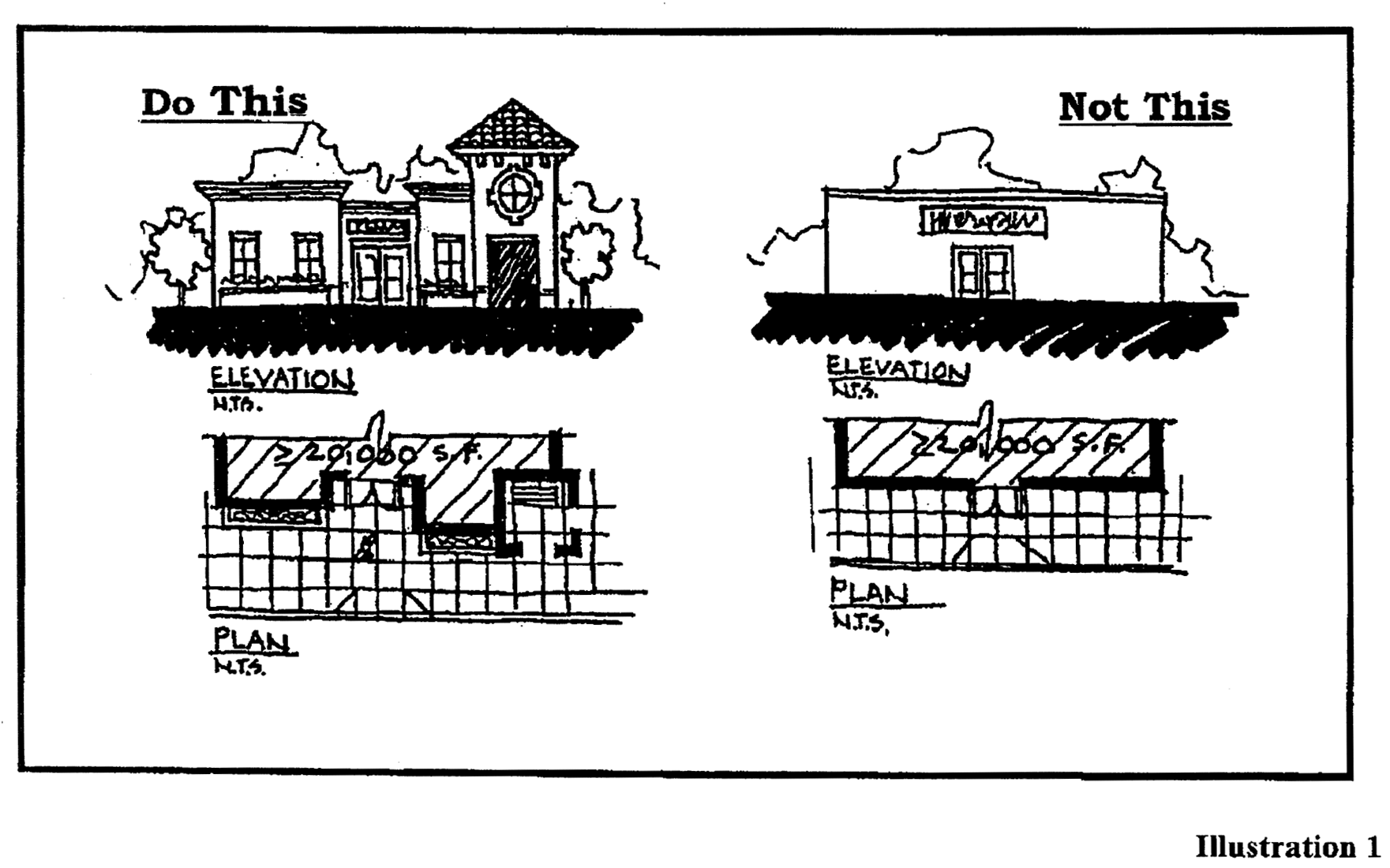
Articulation
The principals and guidelines set out below are not intended to limit quality architecture but to establish a meaningful guide for quality development and redevelopment. In order to achieve this intent, all development shall be designed by a registered Florida architect and comply with the following:
(1)
All façades that front public rights-of-way shall be designed to be consistent with either the fundamental design concepts of the Old Florida Coastal Vernacular, Mediterranean or Bermuda/Island style and include detail and trim features that represent these architectural styles.
(2)
The ground floor of façades that face a city or neighborhood main street shall have no horizontal length or uninterrupted curve of a building façade exceeding 100 linear feet. Projections and recesses shall have a minimum depth of three feet with varied lengths (see Illustration 2 below).
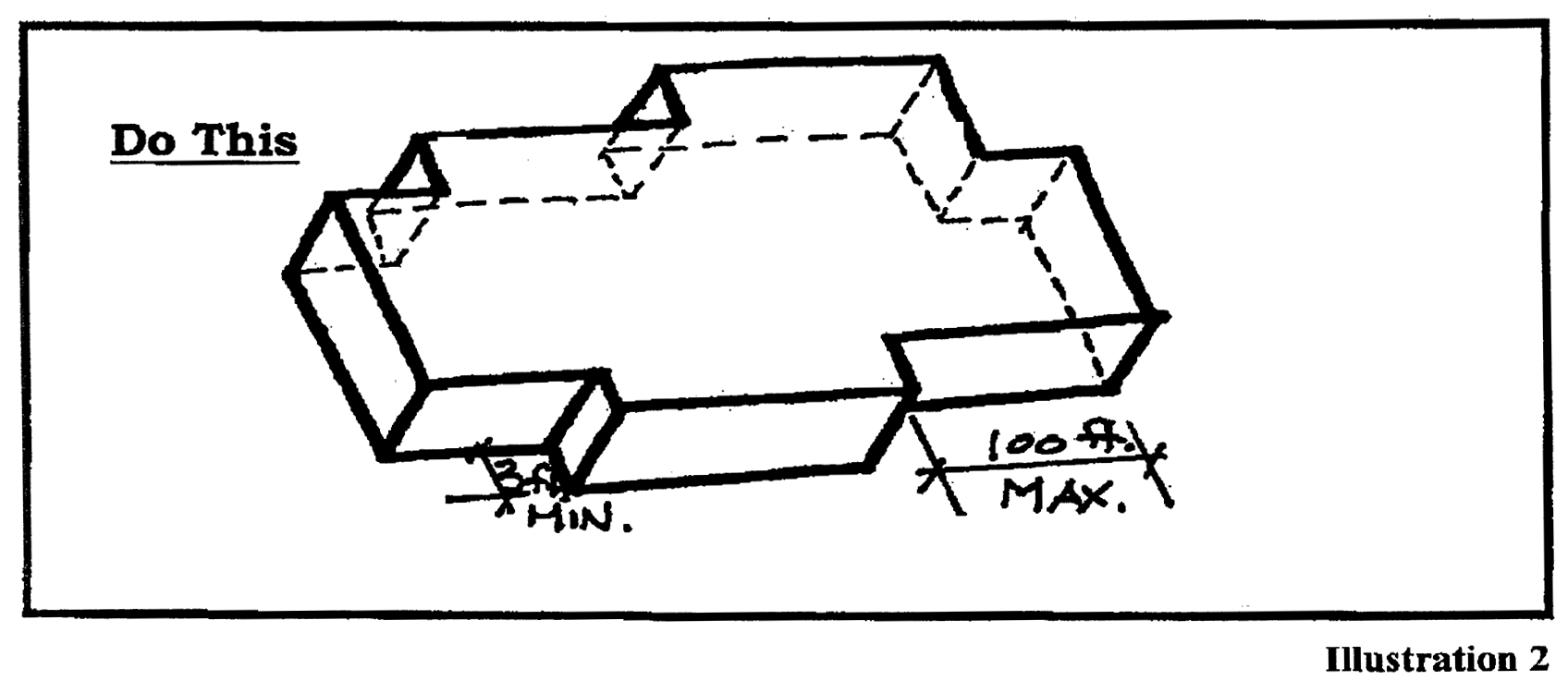
Projections and Recesses
(3)
All nonresidential and mixed-use buildings and projects shall be required to provide a minimum of three building design treatments as listed below; (see Illustration 3 below).
a.
Canopies or porticos, integrated with the building's massing and style;
b.
Overhangs, minimum of three feet;
c.
Arcades, minimum of eight feet clear in width;
d.
Raised cornice parapets over doors;
e.
Peaked roof forms;
f.
Arches;
g.
Display windows;
h.
Ornamental and structural architectural details, other than cornices, which are integrated into the building structure and overall design;
i.
Clock or bell towers;
j.
Sculptured artwork;
k.
Any other treatment, which in the opinion of the director of planning and growth management meets the intent of this section:
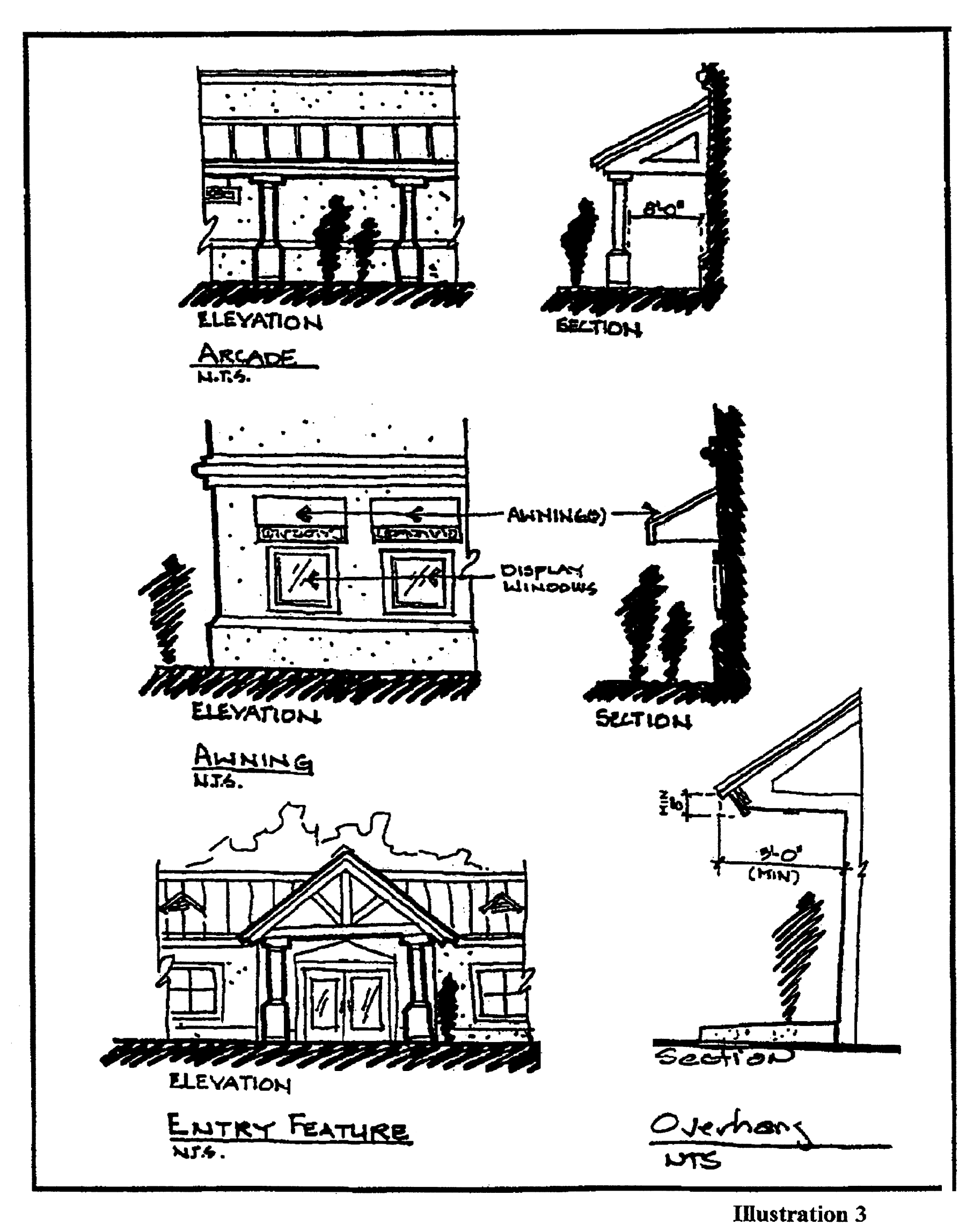
Design Treatments
(4)
A nonresidential or mixed use building façade that faces a city or neighborhood main street shall have either windows along no less than 50 percent of their horizontal length or a primary customer entrance along said façade.
(5)
All nonresidential façades of outparcel structures shall be considered street facing façades and shall have the architectural, site and landscaping design elements which are integrated with and common to those used on the primary structure. These common design elements shall also include colors and materials associated with the main structure.
(6)
Roof edges and parapet treatments of city and neighborhood main street fronting buildings shall have at a minimum of one roof edge and/or parapet with a vertical change from the dominant roof condition a minimum of three feet; (see Illustration 4).
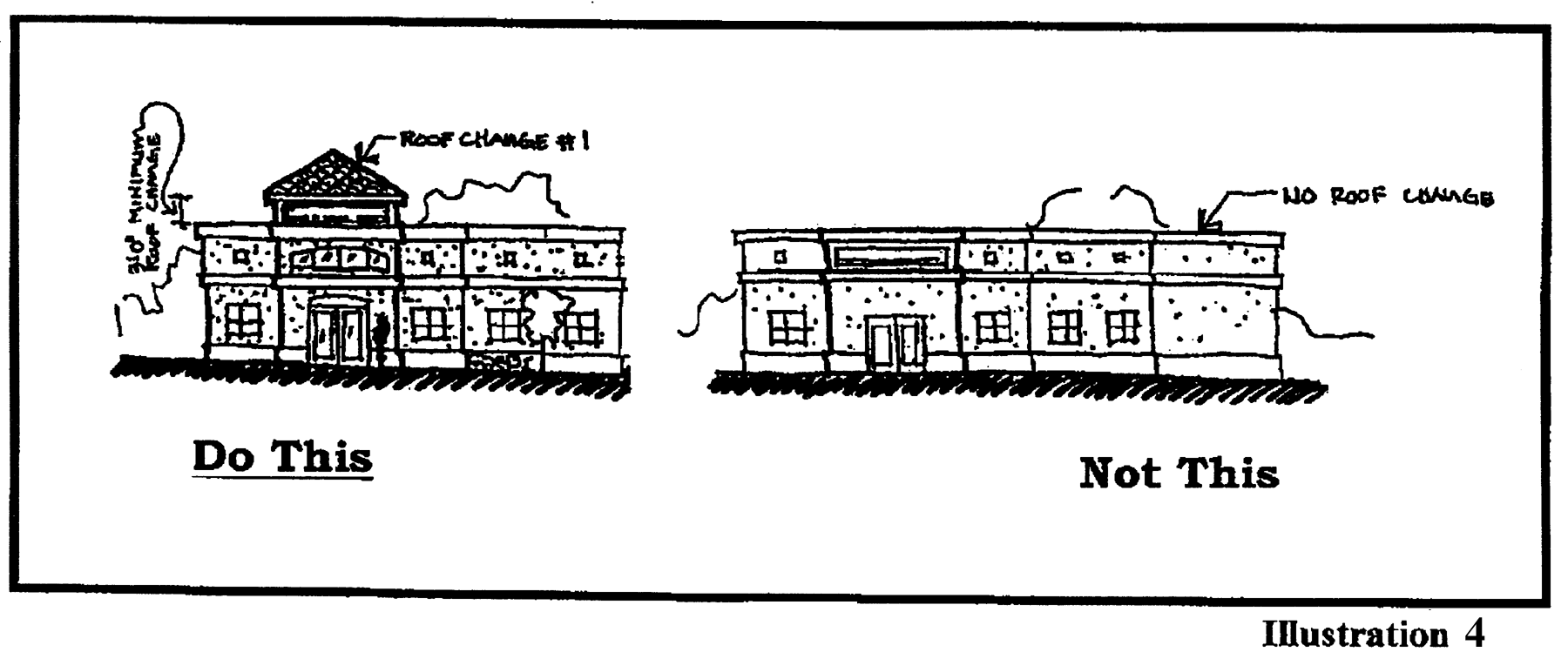
Roof Edges and Parapet Treatments
(7)
Prohibited roof types and materials for nonresidential or mixed-use buildings shall include the following:
a.
Asphalt shingles, except laminated, 320-pound, 30-year architectural grade asphalt shingles or better;
b.
Roofs utilizing less than or equal to a two to 12 pitch unless utilizing full parapet coverage;
c.
Back-lit awnings used as a mansard or canopy roof;
(8)
Blank wall areas shall not exceed ten feet in the vertical direction nor 20 feet in the horizontal direction of all street or corner street front building façades. Control and expansion joints within this area shall constitute a blank wall area unless used as a decorative pattern and spaced at intervals of six feet or less. Relief and reveal work depth must be a minimum of one-half-inch, (see Illustration 5)
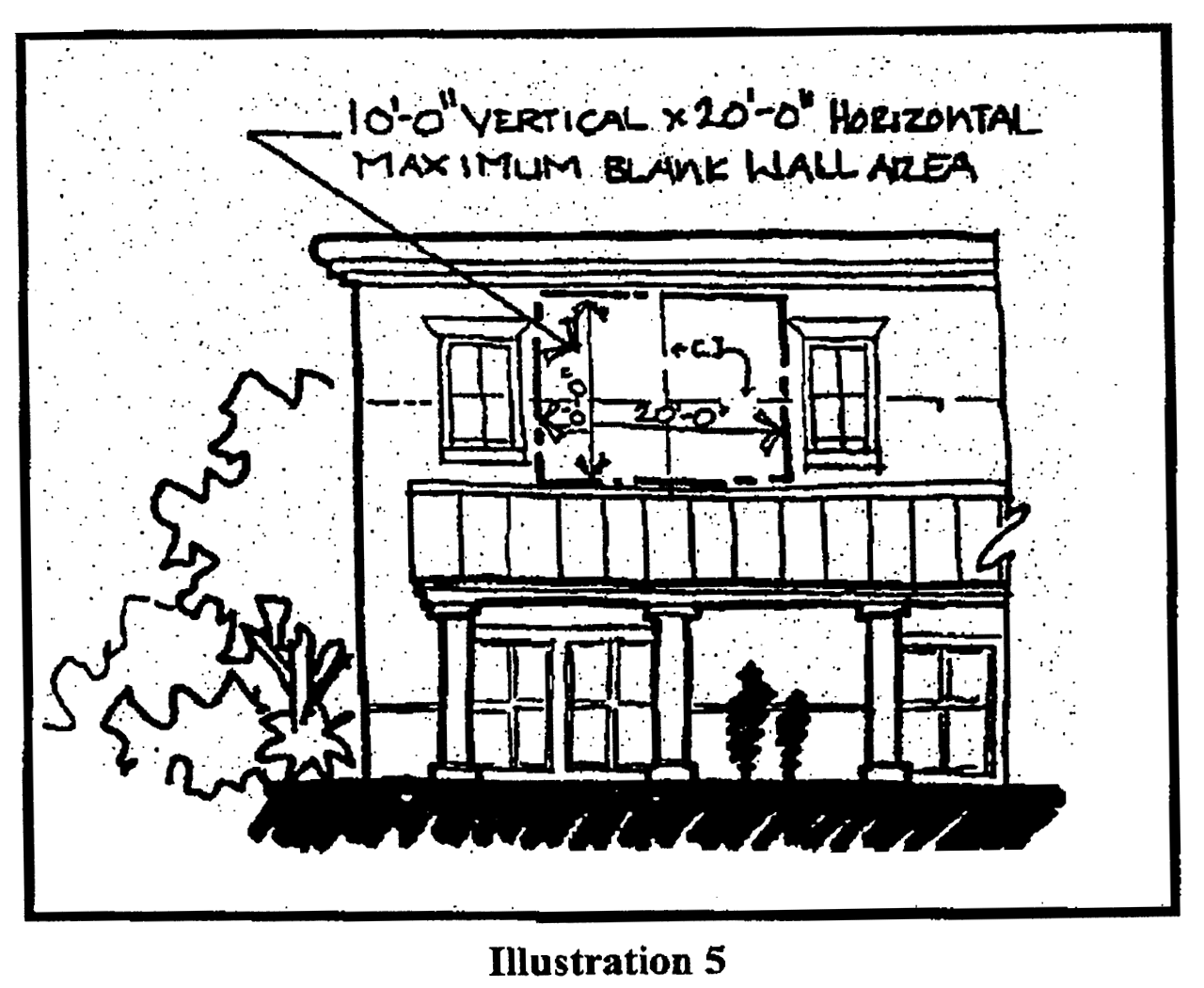
Blank Wall Areas
(h)
Building placement priority. All nonresidential and mixed-use buildings with nonresidential uses shall give priority to the street of greatest intensity by placing the building's front façade, adjacent to the front property line. The building(s) street front façade shall have a minimum length, equal to 80 percent of the front property line's lot dimension as described below.
(1)
For purposes of calculating the 80 percent minimum building length requirement for street front façades, driveways and required landscape buffer widths that comprise the front lot line dimension, may be subtracted from the total length of the front property line before calculating the 80 percent requirement; (see Illustration 6).
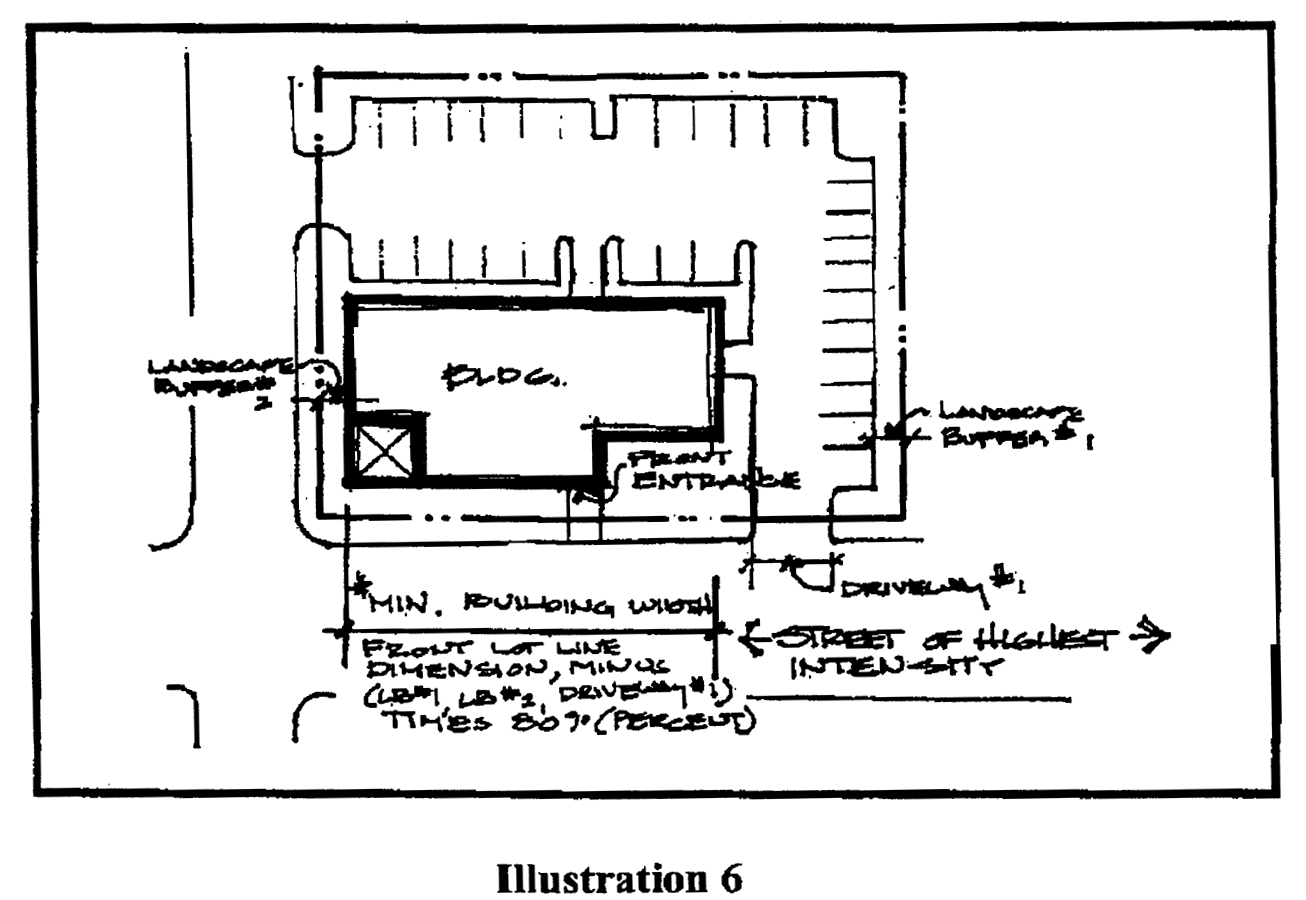
Front Line Dimension
(i)
Landscaping. Any site plan, which includes improvements along a city main street, shall provide an irrigation system rendering 100 percent coverage to the property and adjacent swale areas of the city main rights-of-way. St. Augustine sod shall be planted within the swales. In addition to the required landscaping per Code, all swale areas are to have three and one-half-inch minimum caliper Mahogany trees, planted 30 feet on center; provided that swales under power lines shall have three and one-half-inch minimum caliper, yellow Tabebuias, planted 30 feet on center.
(j)
Property development requirements. The development regulations for property in the Dixie Business/Residential district shall be as indicated in Table B.
TABLE B
(k)
Bicycle parking facilities. All buildings with uses listed in Table C shall provide on the same lot, bicycle-parking facilities as required. Each required bicycle facility shall include stationary bike racks, typically a vertical hoop or bar and shall be designed to accommodate the required number of bicycles.
TABLE C
(l)
Off-street parking, driveways and loading requirements. Except as otherwise provided in this section, the design, configuration and requirements of all parking and loading areas shall be in accordance with section 98-88.
(1)
Development plans with a front property line on a city main street and a rear property line on a neighborhood main street shall not have access from the neighborhood main street. No curb cuts or driveways shall be allowed to cross the rear property line.
(2)
Garages, carports and associated driveways may count toward meeting the parking requirements for residential uses and residential uses only in a mixed-use development.
(3)
Residential uses located in the same building with nonresidential uses shall have a parking requirement of one and one-half spaces per dwelling unit.
(4)
Office use shall have a parking requirement of one space for every 300 square feet of gross floor area, exclusive of medical or dental offices. The general provisions of off-street parking section shall apply to medical and dental offices.
(5)
Limited retail sales uses shall have a parking requirement of one space for every 350 square feet of nonstorage floor area.
(m)
Walls, fences and hedges. A minimum six-foot high stucco masonry wall shall be constructed where any nonresidential use, or mixed-use development, directly abuts a residential zone or residentially developed site. The wall shall have equal finished treatment on both sides. Corner lots shall have a five-foot setback on the corner street frontage for walls.
(1)
Front, rear and street side (corner) yards. Garden walls, fences or hedges may be located within the required front, rear and corner yards. They must be set back five feet from the property line for the purpose of landscape beautification and may not exceed eight feet in height.
(2)
Interior side yards. Walls, fences or hedges may be located in the required interior side yard and may not exceed eight feet in height.
(3)
Walls or landscape buffers abutting residential-zoned property which are required to be constructed by this section, shall be erected either before or concurrent with the construction of the exterior walls of the first building.
(n)
Solid waste facilities. Solid waste facilities shall be screened from public view by a stucco masonry enclosure attached to the main building. Larger developments may be required to provide dumpster enclosures in accordance with engineering drawings 19.01 and 19.02 as determined by the sanitation department.
(1)
Solid waste facilities may not be located in the front or corner side yards.
(o)
Signs. Except as otherwise provided in this section, all permitted signs in the DBR district shall be in accordance with Chapter 102 of the Deerfield Beach Land Development Code.
(1)
Signs permitted and regulated on all one- and two-family residential developments shall be as allowed in section 102-8(a) for one- and two-family dwelling districts.
(2)
Signs permitted and regulated on all multi-family residential developments shall be as allowed in section 102-8(b) for multi-family residential districts.
(3)
Signs permitted and regulated on all nonresidential and mixed-use developments shall be as allowed in section 102-8(c) for business, commercial and industrial districts.
(4)
Signs permitted and regulated on community facility developments shall be as allowed in section 102-8(d) the community facility district.
(p)
Applicable codes and special criteria. Development under the Dixie Business/Residential District shall adhere to all other existing criteria of the Deerfield Beach Land Development Code. Where any provision of this zoning district conflicts with other city codes and ordinances, this section shall govern.
Prior to construction, or conversion, of any structure in the DBR zoning district, the proposal shall be the subject of development review through the submission of a development plan as required in the Code. In approving such development plan, the community appearance board, planning and zoning board and city commission shall consider the location, size, height, spacing, appearance, character and utilization of any building, structure or use and their appurtenances, access and circulation for vehicles and pedestrians, streets, parking areas, yards, and open spaces and their relationship to adjacent property to ensure that such proposal provides for the safety and convenience of the public, and that adequate protection and separation are provided for contiguous and nearby residential property.
The city commission may attach to its approval of a development plan any reasonable conditions, limitations or requirements that are found necessary in its judgment to effectuate the purpose of this section and carry out the spirit and objectives of the zoning ordinance.
(Ord. No. 2003-007, § 1, 2-2-03; Ord. No. 2005/027, § 10, 9-6-05; Ord. No. 2012/029, § 10, 7-10-12; Ord. No. 2013/034, § 3, 12-3-13; Ord. No. 2014/033, § 2, 12-2-14; Ord. No. 2024/009, § 3, 6-4-24)
Sec. 98-53. - B-1 business, community.
(a)
Purpose and intent. The purpose of this district is to identify within the area defined by the land use element of the comprehensive plan for commercial development, areas where selected commercial activities can be established in a manner consistent with any surrounding uses and districts. With the exception of restaurants and brewpubs which may be allowed to have outdoor seating, all activities including any sale, display, preparation and storage, shall be conducted entirely within a fully-enclosed building. Note that section 98-79 provides for additional outdoor seating regulations east of the Intracoastal Waterway.
(b)
Permitted uses. The following uses shall be permitted principal uses in the B-1 district.
(1)
Package store, in accordance with Section 98-104 of the Land Development Code.
(2)
Brewpub provided:
a.
Revenue from food sales shall constitute more than 50 percent of the total gross sales;
b.
Live music or entertainment shall only be allowed as an accessory use. All noise generated by live music or entertainment activities shall be fully contained within the indoor space occupied by the brewpub.
c.
No more than 50 percent of the total gross floor area of the establishment shall be used for the brewery function including, but not limited to, the brew house, boiling and water treatment areas, bottling and kegging lines, malt milling and storage, fermentation tanks, conditioning tanks and serving tanks;
d.
Outdoor seating for not in excess of 48 patrons is permitted;
(3)
Clinic, medical;
(4)
Financial institution;
(5)
Office, business, government and professional;
(6)
Public park and recreation area;
(7)
Restaurant (including outdoor seating for not in excess of 48 patrons);
(8)
Store, convenience goods;
(9)
Store, retail (excluding stores which sell firearms or ammunition for firearms);
(10)
Store, personal service;
(11)
Store, business service;
(12)
Shopping center (consisting of permitted or approved conditional uses as contained herein);
(13)
Theatre;
(14)
Health and fitness club;
(15)
Funeral home;
(16)
Animal hospital;
(17)
Amusement establishment/game center (subject to the restrictions contained within Code section 18-143);
(18)
Laundromat, provided that such facility is located at least 1,000 feet from any other laundromat facility. The distance requirements shall be measured and computed by following a straight line from the nearest point of the existing building or structure, or part thereof, in which a laundromat facility is located to the nearest point of the building or structure in which a laundromat facility is proposed to be located;
(19)
Marina;
(20)
Laboratory, medical/dental;
(21)
Parking facility, commercial;
(22)
Parking facility, public;
(23)
Church or other house of worship;
(24)
Tutoring center;
(25)
Dry cleaning establishment;
(26)
Dry cleaning plant provided that such facility is located at least 1,000 feet from any other dry cleaning plant. The distance requirements shall be measured and computed by following a straight line from the nearest point of the existing building or structure or part thereof, in which a dry cleaning plant is located to the nearest point of the building or structure in which a dry cleaning plant is proposed to be located;
(27)
Thrift shop;
(28)
Fire and police stations.
(29)
Pharmacy, provided that such facility is located at least 250 feet from any other pharmacy. The distance requirements shall be measured and computed by following a straight line from the nearest point of the existing building or structure, or part thereof, in which a pharmacy is located to the nearest point of the building or structure in which a pharmacy is proposed to be located;
(c)
Conditional uses. Upon application and after a favorable determination by the zoning appeals special master or the city commission (where the conditional use is part of the site plan application) that all conditions and provisions of a conditional use have been met, the uses listed below may be permitted as conditional uses in this district. In addition to any provisions listed herein, all proposed conditional uses shall comply with the requirements of this code, be heard and decided by the zoning appeals special master (or city commission where applicable as part of a site plan) as set forth herein and be consistent with the goals, objectives and policies of the city's comprehensive plan.
(1)
Dwellings, multiple-family provided that:
a.
Less than 50 percent of the building is utilized for residential purposes;
b.
Dwelling units conform to the requirements of the RM-15 districts;
c.
Dwellings are not on ground floor.
(2)
Hotels and motels. Density is limited to 38 dwelling units per gross acre;
(3)
Child and adult day-care centers;
(4)
School;
(5)
School, arts;
(6)
School, vocational;
(7)
Assisted living facilities, subject to the provision of section 98-93 of this Code. Building height shall not exceed 45 feet. All other dimensional requirements are the same as RM-15 zoning district. Density requirements are the same as RM-15 zoning district;
(8)
Automobile dealership providing new car sales, provided that:
a.
All motor vehicles must be located within a completely enclosed building.
b.
There shall be no outside storage, no outside display nor outside parking of any vehicles which are offered for sale.
c.
There shall be no vehicle repair work, no vehicle service, no vehicle painting and no vehicle detailing or other vehicle work of any kind or nature, permitted on the premises either inside or outside the building.
(9)
Nightclub in accordance with section 98-104 of the Land Development Code.
(10)
Bar, lounge or saloon in accordance with section 98-104 of the Land Development Code.
(11)
Indoor recreational facilities (excluding pool halls) located within a shopping center of at least ten acres in gross land area, or a freestanding building with at least three acres gross area; provided that only one such facility shall be permitted in any shopping center;
(12)
Club, private/public;
(13)
Outdoor seating in excess of 48 seats for a restaurant or brewpub.
(d)
Accessory uses. The following uses shall be permitted accessory uses in the B-1 district.
(1)
Accessory uses customarily incidental to a principal permitted or approved conditional use.
(e)
Property development requirements. The property development regulations addressing minimum lot requirements, minimum floor area, required yards, maximum lot coverage, floor area ratio, height and minimum landscape area are presented in tabular form contained herein.
(f)
Other development regulations. All other applicable lot and use regulations are set forth in this Code.
(Ord. No. 1998/037, § 1, 12-15-98; Ord. No. 2000/001, § 17, 4-5-00; Ord. No. 2002/023, § 1, 7-31-02; Ord. No. 2004/028, § 1, 9-7-04; Ord. No. 2005/027, § 11, 9-6-05; Ord. No. 2008/013, § 7, 5-20-08; Ord. No. 2012/029, § 11, 7-10-12; Ord. No. 2013/034, § 4, 12-3-13; Ord. No. 2014/017, § 2, 6-17-14; Ord. No. 2014/033, § 3, 12-2-14; Ord. No. 2015/029, § 2, 10-6-15; Ord. No. 2016/024, § 3, 12-6-16; Ord. No. 2018/005, § 3, 1-16-18; Ord. No. 2019/011, § 2, 4-16-19; Ord. No. 2019/014, § 3, 5-21-19; Ord. No. 2024/009, § 3, 6-4-24)
Sec. 98-53A. - B-1A business-flex district.
(a)
Purpose and intent. The purpose and intent of this district is to provide for commercial uses which are consistent with the commercial flexibility provisions of the Broward County Land Use Plan. Pursuant to Section 2.5(A)(2) of the Administrative Rules Document of the Broward County Planning Council, application of the five percent commercial flexibility rule is limited to "neighborhood office and/or retail sales of merchandise or services." In order to avail itself of the five percent commercial flexibility provision, the City of Deerfield Beach has provided this B-1A district. This district is meant to be consistent with the limited commercial provisions of the five percent commercial flexibility rule as set forth in the Administrative Rules Document of the Broward County Planning Council.
(b)
Permitted uses. The following uses shall be permitted principal uses in the B-1A district:
(1)
Neighborhood office;
(2)
Neighborhood retail sales of merchandise or services.
(c)
Accessory uses. The following uses shall be permitted accessory uses in the B-1A district:
(1)
Accessory uses customarily incidental to principal permitted or approved conditional uses and consistent with the limitations set forth in Broward County Planning Council Administrative Rules Document Section 2.5(A)(2).
(d)
Property development requirements. The property development regulations addressing minimum lot requirements, minimum floor area, required yards, maximum lot coverage, floor area ratio, height, and minimum landscape area are presented in tabular form contained herein.
(e)
Outside storage and exterior display. No outside storage of materials or sales goods is permitted.
(f)
Other development regulations. All other applicable development regulations are set forth in this Code.
(Ord. No. 2000/001, § 18, 4-5-00; Ord. No. 2005/027, § 12, 9-6-05; Ord. No. 2024/009, § 3, 6-4-24)
Sec. 98-53B. - COD, Cove Overlay District.
(a)
Purpose and intent. The purpose of the Cove Overlay District (COD) is to encourage property development within the area commonly known as the Cove Shopping Center which supports and implements the objectives of the Cove Master Plan. These objectives include: the establishment of the district; enhancing the commercial compatibility with adjacent residential land uses; improving the commercial viability of the district; and providing architectural design guidelines to achieve a compatible and aesthetic environment. Phase I of the Cove Charrette Master Plan is hereby adopted by reference and shall be utilized as an overall statement of intent to guide the architectural design and redevelopment of the Cove Overlay District. The regulations contained herein shall be in addition to any regulations set forth in the City Code and the Land Development regulations. Where there is a conflict in said regulations, the regulations contained herein shall prevail.
(b)
Applicability. Within the Cove Overlay District, as shown on the Official Zoning Map as COD, all new construction, site improvements or alteration, expansion, renovation and similar improvements to existing structures shall conform to the requirements of this section.
(c)
Permitted uses. The following uses shall be principal uses in the COD district:
(1)
Brewpub provided:
a.
Revenue from food sales shall constitute more than 50 percent of the total gross sales;
b.
Live music or entertainment shall only be allowed as an accessory use. All noise generated by live music or entertainment activities shall be fully contained within the indoor space occupied by the brewpub;
c.
No more than 50 percent of the total gross floor area of the establishment shall be used for the brewery function including, but not limited to, the brewhouse, boiling and water treatment areas, bottling and kegging lines, malt milling and storage, fermentation tanks, conditioning tanks and serving tanks;
d.
Outdoor seating for not in excess of 48 patrons.
(2)
Church or other house of worship;
(3)
Dwellings, multiple-family provided that:
a.
Subject to the Broward County Rules of Flexibility. Density conforms to the requirements of the RM-15 district;
b.
Retail or restaurant uses are on the ground floor with residences on the second floor or above.
(4)
Financial institution;
(5)
Health and fitness club;
(6)
Marina;
(7)
Office, business, government and professional;
(8)
Parking facility, commercial;
(9)
Parking facility, public;
(10)
Public park and recreation area;
(11)
Restaurant, including outdoor seating for not in excess of 48 patrons;
(12)
School, arts;
(13)
Store, convenience goods;
(14)
Store, retail (excluding stores which sell firearms or ammunition for firearms);
(15)
Store, personal service;
(16)
Theatre;
(17)
Craft artisan production;
(18)
Executive office suites;
(19)
Live/Work unit, provided that the live unit is not on the first floor.
(d)
Conditional uses. Upon application and after a favorable determination by the special master or the city commission (where the conditional use is part of the site plan application) that all conditions and provisions of a conditional use have been met, the uses listed below may be permitted as conditional uses in this district. In addition to any provisions listed herein, all proposed conditional uses shall comply with the requirements of this Code, be heard and decided by the zoning appeals special master (or city commission where applicable as part of a site plan) as set forth herein and be consistent with the goals, objectives and policies of the city's comprehensive plan.
(1)
Bar, lounge or saloon; such uses to be specifically exempted from compliance with section 98-104 of the Land Development Code;
(2)
Child day care center;
(3)
Hotels, motels and similar tourist accommodations, subject to the dimensional requirements of the RM-25 zoning district;
(4)
Indoor recreational facility (excluding pool halls);
(5)
Outdoor seating in excess of 48 seats for a restaurant or brewpub.
For conditional uses, the following additional condition shall be required to be satisfied:
(i)
The property line of the lot or parcel on which any building devoted to the use is located shall be at least 100 feet from a residentially zoned property.
(e)
Accessory uses: The following uses shall be permitted accessory uses in the COD district.
(1)
Accessory uses customarily incidental to a principal permitted or approved conditional use.
(f)
Property development requirements. The property development regulations addressing minimum lot requirements, minimum floor area, required yards, maximum lot coverage, maximum floor area ratio, minimum landscaping and maximum height shall be the same as those listed for the B-1 zoning district.
(g)
Other development regulations.
(1)
Architectural design guidelines. Architectural design guidelines for the Cove Overlay District are established as follows:
a.
Buildings or structures constructed within the COD shall conform to the "Key West" architectural style as set forth in the Cove Charrette Master Plan (Phase I), "Architecture" section. Alterations, additions and similar improvements to existing structures within the district shall conform with these design guidelines to the extent possible. Said guidelines are incorporated herein by reference.
b.
New structures shall relate harmoniously to the form and scale of architecture in the vicinity.
c.
Exterior building materials and architectural elements considered compatible in the COD shall include:
1.
Weathered, lightly stained/painted or natural wood;
2.
Metal/batten standing seam roof, exposed rafter tails;
3.
Wood trim around doors and windows painted a contrasting color;
4.
Lattice work, decorative moldings;
5.
Horizontal siding;
6.
Wood-clad walls, aluminum siding (that resembles painted wood cladding);
7.
Canopies, awnings, roof overhangs;
8.
Covered porches slightly above grade with columns and railings;
9.
Pitched roofs (especially gable or hip roof end facing the street), mansard roofs should wrap around the entire building perimeter, rooflines should not run in a continuous place for more than 100 feet without offsetting or jogging the roof plane;
10.
Predominately vertical, rectangular sash windows;
11.
Clear glass windows (88 percent light transmission or more);
12.
Light building colors such as pale yellow, white, eggshell, beige, coral, mint/pale greens, pale pink, pale blues; and
13.
Arbors, trellises, gazebos, picket fences.
d.
Exterior building materials and architectural elements considered incompatible in the COD shall include:
1.
Blue or red barrel tile or metal roofing;
2.
Unarticulated facades and blank walls;
3.
Overly-articulated facades. Mediterranean stucco detailing, ornate "New Orleans" style metal grill work;
4.
Tile, stainless steel (and other glare producing materials used in large areas), exposed split faced concrete block walls;
5.
Flat, blank facades with no relief;
6.
Gambrel roof, flat roof without pediment, vertical and partial mansard roof (mansard roofs shall wrap around the entire building perimeter);
7.
Square or horizontal band windows;
8.
Minor glass with less than 88 percent light transmission;
9.
Window air conditioning units;
10.
Indoor/outdoor carpeting;
11.
Chain-link fences;
12.
Residential-looking doors on commercial buildings;
13.
Log cabin "look."
(h)
Signage. The following requirements regarding signage in the COD shall apply, in addition to the requirements of Chapter 102 and section 98-53(g).
(1)
A single freestanding sign shall be permitted for the shopping center. This sign shall be designed as a solid, landmark architectural feature utilizing the design, colors and materials of the district and may be in excess of ten feet in height.
(2)
Freestanding signs for individual properties and/or buildings within the district shall be prohibited.
(3)
All building signs located within the COD shall be of a consistent design and color scheme, compatible with the established Key West, architectural design as set forth in the "Cove Overlay District Architectural Design Guidelines" section of this code, and be either;
a.
Individual cut-out letters; including aluminum plate, formed plastic, reverse channel and channel letters;
b.
Cut-out corporate logos; and/or
c.
Sand blasted plaques.
(4)
Legal building signs existing on the effective date of the ordinance from which this section is adopted are considered "grandfathered" until January 1, 2014. As of January 1, 2014, all signs shall comply with the requirements of this section.
(5)
In the event that damage to an existing legal sign that does not comply with the provisions of this section exceeds 50 percent of the value of the sign, such sign shall be rebuilt to comply with the provisions of this section.
(i)
Separation requirements for alcoholic beverage establishments. The distance separation requirements for alcoholic beverage establishments between other alcoholic beverage establishments set forth within section 98-104 of this Code shall not apply within the Cove Overlay District (COD).
(j)
Public street furniture for restaurants. The city may grant a revocable license, in a form approved by the city attorney, for the placement of street furniture and related support structures adjacent to operating restaurants in areas of the Cove Shopping Center where there is parallel parking subject to the following conditions:
(1)
The street furniture may include tables, chairs, hardscape decorations, and waste receptacles of a design and location approved by the city commission; and
(2)
Upon request of the city, the applicant shall commit an equivalent number of parking spaces to the spaces that become unavailable or obstructed, for public parking somewhere adjacent to the building occupied by the party wishing to place the street furniture; and
(3)
The street furniture is located directly adjacent to a full-service restaurant; and
(4)
The public at large is permitted to use all exterior tables and seats, irrespective of whether they are patronizing the restaurant that has provided the street furniture and on the same basis as patrons of the restaurant; and
(5)
The applicant signs a maintenance and hold harmless agreement, in a form acceptable to the city attorney, providing for regular maintenance of the street furniture and the regular cleaning of the area where the street furniture is located and the applicant posts a $5,000.00 bond with the city, in a form acceptable to the city attorney, to secure this obligation; and
(6)
The fire department determines that the proposed street furniture lay out does not pose a fire hazard or endanger the public in case of a fire; and
(7)
There is a demonstration to the city commission that the placement of the street furniture will not impact the flow of traffic; and
(8)
Such other conditions as deemed necessary by the city commission to address public safety and achieve the intent of this section.
(Ord. No. 2009/004, § 1, 2-3-09; Ord. No. 2015/024, § 2(Exh. A), 9-9-15; Ord. No. 2016/024, § 4, 12-6-16; Ord. No. 2018/016, § 2, 6-5-18)
Sec. 98-54. - B-2 highway business.
(a)
Purpose and intent. The purpose of this district is to identify, within the area defined by the land use element of the comprehensive plan for commercial development. This district will normally be applied along principal arterial streets. With the exception of dispensing fuel in gas stations, outdoor seating for restaurants, craft/artisan production, brewpubs and automobile dealership display, all business shall be conducted within a fully enclosed building.
(b)
Permitted uses. The following uses shall be permitted principal uses in the B-2 district:
(1)
Package store, in accordance with section 98-104 of the Land Development Code;
(2)
Church or other house of worship (not located in a shopping center);
(3)
Clinic, medical;
(4)
Financial institution;
(5)
Fire and police stations;
(6)
Gas stations;
(7)
Hotel and motel, density is limited to 38 dwelling units per gross acre;
(8)
Office, business and professional;
(9)
Public park and recreation area;
(10)
Restaurant (including outdoor seating for not in excess of 48 patrons);
(11)
Store, convenience;
(12)
Store, retail (excluding stores which sell firearms or ammunition for firearms);
(13)
Store, personal service;
(14)
Store, business service;
(15)
Shopping center consisting of permitted or approved conditional uses as contained herein;
(16)
Essential services;
(17)
Theatre;
(18)
Health and fitness club;
(19)
Animal hospital;
(20)
Funeral home;
(21)
Boat sales;
(22)
Marina;
(23)
Amusement establishment/game center (subject to the restrictions contained within Code section 18-143);
(24)
Laundromat, provided that such facility is located at least 1,000 feet from any other laundromat facility. The distance requirements shall be measured and computed by following a straight line from the nearest point of the existing building or structure, or part thereof, in which a laundromat facility is located to the nearest point of the building or structure in which a laundromat facility is proposed to be located;
(25)
Laboratory, medical/dental;
(26)
Parking facility, commercial;
(27)
Parking facility, public;
(28)
Brewpub provided:
a.
Revenue from food sales shall constitute more than 50 percent of the total gross sales;
b.
Live music or entertainment shall only be allowed as an accessory use. All noise generated by live music or entertainment activities shall be fully contained within the indoor space occupied by the brewpub;
c.
No more than 50 percent of the total gross floor area of the establishment shall be used for the brewery function including, but not limited to, the brewhouse, boiling and water treatment areas, bottling and kegging lines, malt milling and storage, fermentation tanks, conditioning tanks and serving tanks;
d.
Outdoor seating for not in excess of 48 patrons is permitted;
(29)
Craft/artisan production, provided:
a.
The maximum gross floor area is 10,000 square feet;
b.
Must include a non-production area such as retail, eating, drinking or tasting that is at least ten percent, but no more than 30 percent of the total floor area;
c.
The facility must front a street or have a well-marked and visible entrance;
d.
All production, processing and distribution activities are to be conducted within a fully enclosed building;
e.
Access and loading bays shall not face any street, excluding alleys;
f.
Silos are permitted as accessory structures and must obtain site plan approval; the maximum height shall be as allowed in the dimensional requirements of the zoning district;
g.
Live music or entertainment shall only be allowed as an accessory use. All noise generated by live music or entertainment activities shall be fully contained within the building;
h.
Outdoor seating for not in excess of 48 patrons is permitted.
(30)
Sports performance training facility;
(31)
Tutoring center;
(32)
Dry cleaning establishment;
(33)
Dry cleaning plant provided that such facility is located at least 1,000 feet from any other dry cleaning plant. The distance requirements shall be measured and computed by following a straight line from the nearest point of the existing building or structure, or part thereof, in which a dry cleaning plant is located to the nearest point of the building or structure in which a dry cleaning plant is proposed to be located;
(34)
Tattoo/body piercing studio, provided that such facility is located at least 1,000 feet from any other tattoo/body piercing facility. The distance requirements shall be measured and computed by following a straight line from the nearest point of the existing building or structure, or part thereof, in which a tattoo/body piercing studio is located to the nearest point of the building or structure in which a tattoo/body piercing studio is proposed to be located;
(35)
Automobile accessories retail store, provided that such facility is located at least 1,000 feet from any other automobile accessories retail store. The distance requirements shall be measured and computed by following a straight line from the nearest point of the existing building or structure, or part thereof, in which an automobile accessories retail store is located to the nearest point of the building or structure in which automobile accessories retail store is proposed to be located;
(36)
Thrift shop;
(37)
Pharmacy, provided that the such facility is located at least 250 feet from any other pharmacy. The distance requirements shall be measured and computed by following a straight line from the nearest point of the existing building or structure, or part thereof, in which a pharmacy is located to the nearest point of the building or structure in which a pharmacy is proposed to be located;
(c)
Conditional uses. Upon application and after a favorable determination by the special master or the city commission (where the conditional use is part of the site plan application) that all conditions and provisions of a conditional use have been met, the uses listed below may be permitted as conditional uses in this district. In addition to any provisions listed herein, all proposed conditional uses shall comply with the requirements of this Code, be heard and decided by the zoning appeals special master (or city commission where applicable) as set forth herein and be consistent with the goals, objectives and policies of the city's comprehensive plan.
(1)
Dwellings, multiple-family provided:
a.
Less than 50 percent of the building is utilized for residential purposes;
b.
Dwelling units conform to the requirements of the RM-15 districts;
c.
Dwellings are not on ground floor.
(2)
Automobile dealership providing new car sales provided that:
a.
The facility has a lot area of at least 20,000 square feet;
b.
All automobile service is performed in a completely enclosed building;
c.
Parking and display areas shall be set back a minimum of 25 feet from the front and corner property lines and 20 feet from the interior side property line. No display tactics other than the storage of vehicles in permitted areas will be allowed. Examples of unacceptable display are elevated vehicles, open hoods or decorations such as balloons, festoons, flags or graphics.
(3)
Child and adult day care centers;
(4)
Schools;
(5)
School, arts;
(6)
School, vocational;
(7)
Nightclub in accordance with section 98-104 of the Land Development Code;
(8)
Bar, lounge or saloon in accordance with section 98-104 of the Land Development Code;
(9)
Indoor recreational facility (including pool halls);
(10)
Club, private/public;
(11)
Outdoor seating in excess of 48 seats for a restaurant, brewpub or a craft/artisan production facility;
(12)
Assisted living facility, subject to the provisions of section 98-83 of this Code. Further, building height shall not exceed 45 feet. All other dimensional requirements are the same as RM-15 zoning districts. Density requirements are the same as RM-15 zoning district;
(13)
Store, retail, which retail store sells firearms;
(14)
Auto rental agency;
(15)
Halfway house; provided the parcel upon which it is located is at least 1,000 feet from the nearest RS-5, RS-7, RM-10 or RM-15 zoning district and no halfway house is located within a radius of 1,000 feet of an existing halfway house.
(16)
Pawnshop in accordance with section 98-99 of the Land Development Code;
(17)
Secondhand store in accordance with section 98-99 of the Land Development Code.
a.
Building height, as defined in this Code, shall not exceed 35 feet. All other dimensional requirements shall be those of the B-2 zoning district with the exception that the maximum FAR shall be .80 and the maximum lot coverage shall be 65 percent.
b.
Storage of hazardous materials such as toxic or explosive substances shall be prohibited.
c.
Storage bay doors on any perimeter buildings shall not face any abutting property located in a residentially zoned district, nor shall they be visible from any public road.
d.
Site arrangement, landscaping, signage, building size and architectural design elements such as roof pitch, material, colors, elevation details (doors, windows, trim) shall be designed so as to ensure that the property does not appear as an industrial warehouse development or facility.
(d)
Accessory uses. The following uses shall be permitted accessory uses in the B-2 district.
(1)
Accessory uses customarily incidental to a principal permitted or approved conditional use.
(2)
Used car sales shall only be allowed as an accessory use to new car sales.
(e)
Property development requirements. The property development regulations addressing minimum lot requirements, minimum floor area, required yards, maximum lot coverage, floor area ratio, height and minimum landscape area are presented in tabular form contained herein.
(f)
Outside storage and exterior display. No outside storage of materials or sales goods is permitted except for motor vehicles at automobile sales lots.
(g)
Other development regulations. All other applicable development regulations are set forth in this Code.
(Ord. No. 1997/016, § 2, 6-17-97; Ord. No. 1998/037, §§ 2, 3, 12-15-98; Ord. No. 2000/001, § 19, 4-5-00; Ord. No. 2002/023, § 2, 7-31-02; Ord. No. 2005/027, § 13, 9-6-05; Ord. No. 2008/013, § 8, 5-20-08; Ord. No. 2012/029, § 12, 7-10-12; Ord. No. 2013/034, § 5, 12-3-13; Ord. No. 2014/017, § 3, 6-17-14; Ord. No. 2014/033, § 4, 12-2-14; Ord. No. 2015/029, § 3, 10-6-15; Ord. No. 2016/024, § 4, 12-6-16; Ord. No. 2018/005, § 4, 1-16-18; Ord. No. 2018/008, § 2, 2-6-18; Ord. No. 2019/014, § 4, 5-21-19; Ord. No. 2024/009, § 3, 6-4-24)
Sec. 98-55. - B-3 general business.
(a)
Purpose and intent. The purpose of this district is to provide for heavy commercial activities which can serve as a transition between commercial and industrial areas and, with proper buffering, be compatible with residential development. This district is intended to be applied to those areas identified by the land use element of the comprehensive plan as C-2 land use where the existing lot pattern or development pattern makes an industrial district inappropriate. With the exception of outdoor seating for craft/artisan production facilities and outdoor storage as provided herein, all business must be conducted within a fully enclosed building.
(b)
Permitted uses. The following uses shall be permitted principal uses in the B-3 district:
(1)
Building materials supply/distribution to the trade - (includes, but not limited to, hardware, lumber, millwork, plumbing);
(2)
Printing;
(3)
Trade shops: metal work, woodworking, plumbing, roofing, electrical and associated building trades;
(4)
Store, retail (in accordance with land use plan limitations);
(5)
Essential services;
(6)
Lawn service;
(7)
Commercial bakery;
(8)
Exterminator;
(9)
Medical or dental lab;
(10)
Offices, business and professional;
(11)
Warehouses;
(12)
Wholesale trade;
(13)
Boat repair;
(14)
Plant nursery;
(15)
Automotive services;
(16)
Marina;
(17)
Commercial kitchen;
(18)
School, vocational;
(19)
Building cleaning and maintenance services;
(20)
Sports performance training facility;
(21)
Indoor recreation, provided:
a.
The location, design and operation of an indoor recreation shall not adversely affect the continued use, enjoyment and development of adjacent properties. In considering this requirement, particular attention shall be focused on noise, pollution and traffic;
b.
The use is in accordance with the land use plan limitations;
c.
Alcoholic beverage sales may not be permitted as an accessory use.
(22)
Craft/artisan production (in accordance with land use plan limitations) provided:
a.
There is a non-production area dedicated for uses such as retail, eating, drinking or tasting that is at least ten percent, but no more than 30 percent of the total floor area;
b.
The facility must front a street or have a well-marked and visible entrance;
c.
All production, processing and distribution activities are to be conducted within an enclosed building;
d.
Access and loading bays shall not face any street, excluding alleys;
e.
Silos are permitted as accessory structures and must obtain site plan approval; the maximum height shall be as allowed in the dimensional requirements of the zoning district;
f.
Live music or entertainment shall only be allowed as an accessory use. All noise generated by live music or entertainment activities shall be fully contained within the building;
g.
Outdoor seating shall be permitted as an accessory use and limited in size to 20 percent of the gross floor area of the tenancy space.
(23)
Dry cleaning establishment;
(24)
Dry cleaning plant;
(25)
Automobile accessories retail establishment provided that such facility is located at least 1,000 feet from any other automobile accessories retail store. The distance requirements shall be measured and computed by following a straight line from the nearest point of the existing building or structure, or part thereof, in which an automobile accessories retail store is located to the nearest point of the building or structure in which automobile accessories retail store is proposed to be located;
(26)
Thrift shop.
(27)
Pharmacy, provided that such facility is located at least 250 feet from any other pharmacy. The distance requirements shall be measured and computed by following a straight line from the nearest point of the existing building or structure, or part thereof, in which a pharmacy is located to the nearest point of the building or structure in which a pharmacy is proposed to be located;
(c)
Conditional uses. Upon application and after a favorable determination by the zoning appeals special master or the city commission (where the conditional use is part of the site plan application) that all conditions and provisions of a conditional use have been met, the uses listed below may be permitted as conditional uses in this district, provided that the property listed below may be permitted as conditional uses in this district. In addition to any provisions listed herein, all proposed conditional uses shall comply with the requirements of this Code, be heard and decided by the zoning appeals special master (or the city commission where applicable) as set forth herein, and be consistent with the goals, objectives and policies of the city's comprehensive plan.
(1)
Automobile repair garage provided the requirements of this Code are complied with. No vehicle may be stored in the public right-of-way while such vehicle is in the custody of the automobile repair garage. No vehicle may be stored in the required parking spaces for the business except temporarily while a customer is picking up or dropping off the vehicle. No vehicle may be stored in any required landscaped area. For the purpose of this section, the term "vehicle" shall mean any vehicle regardless of type, including, but not limited to cars, trucks, motorcycles, scooters, boats, trailers, all-terrain and recreational vehicles. An automotive body shop shall contain within said shop, a spray paint booth constructed in compliance with the National Fire Code;
(2)
Fabricating, assembly and processing operations which produce no noise, smoke or other pollutants noticeable at the property line of the subject site;
(3)
Outside storage provided:
a.
The outside storage is subordinate to the principal use located on the same property; and
b.
The outside storage area does not abut a residential district; and
c.
The storage area is in a rear or side yard and screened according to the requirements of this Code; and
d.
The height of the material stored does not exceed the height of the screening.
(4)
Boat yard/boat basis;
(5)
Auto rental agency;
(6)
Check cashing store; and
(7)
Astrologist, palmist, psychic, and related services;
(8)
Halfway house; provided the parcel upon which it is located is at least 1,000 feet from the nearest RS-5, RS-7, RM-10 or RM-15 zoning district and no halfway house is located within a radius of 1,000 feet of an existing halfway house;
(9)
Pain management clinics, subject to the requirements set forth in section 98-65 of this Land Development Code.;
(10)
Smoke shop provided:
a.
No smoke shop shall be located within 1,000 feet of any other smoke shop or within 1,000 feet of any school (public or private as defined in Sections 1002.01 or 1003.01 Florida Statutes), house of worship, licensed day care center, medical clinic or specialty hospital treating persons for substance abuse; or located 100 feet from any residentially zoned property, alcoholic beverage establishment, nightclub or private club; and
b.
The distance requirements shall be measured and computed by following a straight line from the nearest point of the existing building or structure, or part thereof, in which an existing smoke shop, public or private school, house of worship, licensed day care center, medical clinic or specialty hospital treating persons for substance abuse is located to the nearest point of the building or structure in which a smoke shop is proposed to be located;
(11)
Pawn shop in accordance with section 98-99 of the Land Development Code;
(12)
Secondhand store in accordance with section 98-99 of the Land Development Code.
(d)
Accessory uses. The following use shall be permitted accessory use in the B-3 district:
(1)
Accessory uses customarily incidental to a principal, permitted or approved conditional use.
(e)
Property development requirements. Property development regulations addressing minimum lot requirements, minimum floor area, required yards, maximum lot coverage, floor area ratio, minimum landscape area and height are presented in tabular form contained herein.
(Ord. No. 2000/001, § 20, 4-5-00; Ord. No. 2002/026, § 1, 8-20-02; Ord. No. 2005/027, § 14, 9-6-05; Ord. No. 2008/013, § 9, 5-20-08; Ord. No. 2008/019, § 1, 8-19-08; Ord. No. 2011/036, § 3, 8-1-11; Ord. No. 2012/017, § 1, 5-15-12; Ord. No. 2012/018, § 1, 5-15-12; Ord. No. 2013/034, § 6, 12-3-13; Ord. No. 2014/017, § 4, 6-17-14; Ord. No. 2014/033, § 5, 12-2-14; Ord. No. 2016/003, § 2, 2-2-16; Ord. No. 2016/024, § 6, 12-6-16; Ord. No. 2018/005, § 5, 1-16-18; Ord. No. 2018/008, § 3, 2-6-18; Ord. No. 2019/014, § 5, 5-21-19; Ord. No. 2024/009, § 3, 6-4-24)
Sec. 98-55A. - OP, office park.
(a)
Purpose and intent. The purpose of this district is to encourage and provide for the location of planned office complexes and corporate headquarters in a campus-like atmosphere with substantial buildings and ample open space. Limited services for employees such as personal services, shopping and food as specifically listed herein are permitted, and are limited to areas within buildings primarily devoted to office use. Except for employee break areas as designated on an approved site plan, all business activity must be conducted within a fully-enclosed building.
(b)
Permitted uses. The following uses shall be permitted principal uses in the OP district:
(1)
Banking and financial institutions;
(2)
Business, professional, administrative offices;
(3)
Commercial schools (art, music, theatrical, business and technical);
(4)
Educational, scientific, and industrial research facilities;
(5)
Essential services;
(6)
Fire stations;
(7)
Government offices;
(8)
Hospitals;
(9)
Hotels and motels;
(10)
Medical and dental laboratories;
(11)
Recording or broadcasting studio (music, radio, television, film);
(12)
Research laboratories;
(13)
Specialty hospitals'
(14)
Tutoring center.
(c)
Conditional uses. None.
(d)
Accessory uses. The following uses shall be permitted accessory uses in the OP district:
(1)
Barber shop;
(2)
Beauty salon;
(3)
Bookstore, newsstand;
(4)
Business services;
(5)
Childcare center, pre-school or adult day-care;
(6)
Courier service;
(7)
Delicatessen;
(8)
Dry cleaning or laundry drop-off and pick-up;
(9)
Florist;
(10)
Health and fitness club;
(11)
Nail salon;
(12)
Retail bakery;
(13)
Restaurant (eat-in or take-out);
(14)
Other uses customarily incidental to a principal permitted use.
(e)
Property development requirements.
(1)
The minimum site size for an OP zoned property shall be five acres.
(2)
If the property is to be subdivided, the minimum individual lot size shall be 15,000 square feet and the minimum lot width shall be 100 feet.
(3)
The project area shall have a minimum 25-foot landscape buffer around the perimeter except where the project area abuts residentially zoned property, in which case the minimum landscape buffer shall be 50 feet.
(4)
The minimum distance between buildings shall be 25 feet.
(5)
The building setback from a street shall be 25 feet.
(6)
The building setback from an interior project perimeter property line shall be 25 feet, except where the property lines abuts residentially zoned property, in which case the setback shall be 50 feet.
(7)
In cases where the project property is subdivided, the building setbacks from the individual lot lines shall be:
Side and rear (project interior)—15 feet.
Side and rear (project perimeter)—25 feet, 50 feet abutting residential.
(8)
Building height shall be limited to six stories or 75 feet, whichever is less.
(9)
Maximum lot coverage for buildings shall be 35 percent.
(10)
Maximum floor area ratio (FAR) shall be 1.5.
(11)
Minimum landscaped area shall be 30 percent.
(12)
Minimum floor area shall be 3,000 square feet.
(Ord. No. 2011/030, § 1, 6-21-11; Ord. No. 2012/029, § 13, 7-10-12; Ord. No. 2013/034, § 7, 12-3-13; Ord No. 2015/029, § 4, 10-6-15; Ord. No. 2024/009, § 3, 6-4-24)
Sec. 98-56. - I industrial.
(a)
Purpose and intent. The purpose of this district is to identify, within the area defined by the land use element of the comprehensive plan for industrial development, areas where general industrial uses may be established. With the exception of outdoor seating for craft/artisan production facilities and outdoor storage as provided herein, all activities, including all principle, conditional and accessory uses shall be performed in a completely enclosed building except as herein exempted.
(b)
Permitted uses. The following uses shall be permitted principal uses in the I district:
(1)
Commercial bakeries;
(2)
Commercial kitchen;
(3)
Building supply;
(4)
Dry cleaning and laundries, commercial;
(5)
Manufacturing, and/or assembly;
(6)
Medical or dental lab;
(7)
Office, business and professional;
(8)
Printing;
(9)
Wholesale packaging, supply and distribution, (this category includes facilities devoted to the building trades);
(10)
Essential services;
(11)
Warehouses;
(12)
Recycling operation (not involving hazardous waste materials);
(13)
Trade shops: metal work, woodworking, plumbing, roofing, electrical, and associated building trades;
(14)
Sports performance training facility;
(15)
Indoor recreation, provided:
a.
The location, design, and operation of an indoor recreation shall not adversely affect the continued use, enjoyment, and development of adjacent properties. In considering this requirement, particular attention shall be focused on noise, pollution, and traffic;
b.
The use is in accordance with the land use plan limitations;
c.
Alcoholic beverage sales may not be permitted as an accessory use;
(16)
Craft/artisan production (in accordance with land use plan limitations) provided:
a.
There is a non production area dedicated for uses such as retail, eating, drinking, tasting that is at least ten percent, but no more than 30 percent of the total floor area;
b.
The facility must front a street or have a well-marked and visible entrance;
c.
All production, processing and distribution activities are to be conducted within a fully enclosed building;
d.
Access and loading bays shall not face any street, excluding alleys;
e.
Silos are permitted as accessory structures and must obtain site plan approval; the maximum height shall be as allowed in the dimensional requirements of the zoning district;
f.
Live music or entertainment shall only be allowed as an accessory use. All noise generated by live music or entertainment activities shall be fully contained within the building;
g.
Outdoor seating shall be permitted as an accessory use and limited in size to 20 percent of the gross floor area of the tenancy space.
(17)
Self-service storage facility, provided that:
a.
Such facility is located at least 2,500 feet from any other self-service storage facility. The distance requirements shall be measured and computed by following a straight line from the nearest property line of the proposed self- service storage facility to the nearest property line of an existing self-service storage facility.
b.
The facility used for self-storage may be used only for passive self-service storage. No businesses shall be permitted to operate from, or be licensed at, the facility. No personal activities, such as but not limited to, hobbies, arts and crafts, woodworking, repair, restoration, or maintenance of vehicles, machinery or equipment, etc. shall be permitted.
c.
Outside storage of any kind, including boats and vehicles, shall not be allowed.
d.
Storage of hazardous materials such as toxic or explosive substances shall be prohibited.
e.
Storage bay doors on any perimeter buildings shall not face any abutting property located in a residentially zoned district, nor shall they be visible from any public road.
f.
Site arrangement, landscaping, signage, building size and architectural design elements such as roof pitch, material, colors, elevation details (doors, windows, trim) shall be designed so as to ensure that the property does not appear as an industrial warehouse development or facility.
(c)
Conditional uses. Upon application and after a favorable determination by the board of adjustment or the city commission (where the conditional use is part of the site plan application) that all conditions and provisions of a conditional use have been met, the uses listed below may be permitted as conditional uses in this district. In addition to any provisions listed herein, all proposed conditional uses shall comply with the requirements of this Code, be heard and decided by the board of adjustment (or city commission where applicable) as set forth herein, and be consistent with the objectives and recommendations of the city's comprehensive plan.
(1)
Truck and transportation terminals.
(d)
Accessory uses. The following uses shall be permitted accessory uses in the I district:
(1)
Wholesale sales associated with and incidental to the principal use.
(2)
Warehouses associated with and incidental to the principal use.
(3)
Showrooms associated with and incidental to the principal use.
(4)
Outside storage provided:
a.
The outside storage is subordinate to the principal use located on the same property; and
b.
The outside storage area does not abut a residential district; and
c.
The storage area is in a rear or side yard and screened according to the requirements of this Code.
(5)
Other uses customarily incidental to a principal or conditional use.
(e)
Limitations. No bulk storage of flammable materials and no storage of explosives is permitted.
(f)
Property development requirements. The property development regulations addressing minimum lot requirements, minimum floor area, required yards maximum lot coverage, floor area ratio, height, and minimum landscape area are presented in tabular form contained herein.
(g)
Other development requirements. Other applicable lot and use regulations are set forth in this Code.
(Ord. No. 2005/027, § 15, 9-6-05; Ord. No. 2005/042, § 1B, 12-13-05; Ord. No. 2012/017, § 2, 5-15-12; Ord. No. 2014/033, § 6, 12-2-14; Ord. No. 2016/003, 2-2-16; Ord. No. 2024/009, § 3, 6-4-24)
Sec. 98-56B. - I-2 limited heavy industrial.
(a)
Purpose and intent. The purpose of this district is to identify, with the area defined by the land use element of the comprehensive plan for industrial development, and which was subject to the stipulations of Chapter 90-486, Laws of Florida, areas where limited heavy industrial uses may be established. These limited heavy industrial uses shall be screened and buffered from abutting roadways and waterways and residential land uses, to prevent noise, glare fumes and vibrations. All activities, including all principle and accessory uses shall be performed in a completely enclosed building or structure except as herein specifically permitted. No use which is not listed as permitted use, or approved accessory use shall be permitted in the district. Metal shredding is a prohibited use. The uses prohibited in section 2(d) and 2(e) of Chapter 90-486, Laws of Florida shall continue to be prohibited in the district.
(b)
Permitted uses. The following uses shall be permitted principal uses in the I-2 district.
(1)
Asphalt plant (with outdoor operations) provided:
a.
Any building or structure (except fences or perimeter walls) or the storage of any product, material or equipment on a lot which is contiguous to a residentially zoned lot shall be set back a minimum of 300 feet, except if the residentially zoned lot is owned by the property owner of the contiguous industrially zoned property;
(2)
Auto repair, provided:
a.
Any building or structure (except fences or perimeter walls) or the storage of any product material or equipment on a lot which is contiguous to a residentially zoned lot shall be set back a minimum of 50 feet, except if the residentially zoned lot is owned by the property owner of the contiguous industrially zoned property;
(3)
Automobile auctions, provided:
a.
There is a building on the lot which shall be a minimum of 150 square feet in area and which shall contain permanent sanitary facilities;
(4)
Automobile storage for new and used vehicles in conjunction with a car dealership (which may be at an off-site location), provided:
a.
There is a building on the lot which shall be a minimum of 150 square feet in area and which shall contain permanent sanitary facilities;
(5)
Boarding kennel provided:
a.
Boarding kennels shall not be permitted on any plot which is contiguous to any residentially-zoned lot, except if the residentially zoned lot is owned by the property owner of the contiguous industrially zoned property;
(6)
Brewery, winery, distillation of liquors;
(7)
Building supply and lumber yards with outdoor storage, provided:
a.
All building activities including sawing, cutting and other similar and usual building activities are performed within a fully enclosed building;
(8)
Commercial bakeries and kitchens;
(9)
Concrete batching and/or mixing (with outdoor operations) provided:
a.
Any building or structure (except fences or perimeter walls) or the storage of any product material or equipment on a lot which is contiguous to a residentially zoned lot shall be set back a minimum of 100 feet, except if the residentially zoned lot is owned by the property owner of the contiguous industrially zoned property;
(10)
Dry cleaning and laundries, commercial;
(11)
Educational facilities for industrial trades;
(12)
Essential services;
(13)
General commercial and retail (in accordance with the uses set forth in 98-56B(k) and the land use plan limitations);
(14)
Heavy commercial uses including new and used automobile, truck, motorcycle, boat and trailer display, sales, and service provided:
a.
All repair activities must be performed within a fully enclosed building, except that large vehicles and equipment may be repaired outdoors. Display and inventory may be stored outside;
(15)
Indoor commercial recreation provided:
a.
The location of the use does not preclude or adversely affect the future use of surrounding areas for industry;
(16)
Industrial sales;
(17)
Laboratories (research, testing, medical or dental);
(18)
Liquefied petroleum gas storage, fill and distribution, provided:
a.
Bulk storage of liquefied petroleum gas is not permitted; and
b.
Any building or structure (except fences or perimeter walls) or the storage of any product material or equipment on a lot which is contiguous to a residentially zoned lot shall be set back a minimum of 100 feet except if the residentially zoned lot is owned by the property owner of the contiguous industrially zoned property;
(19)
Manufacturing and/or assembly (excluding tank farms, butane or propane manufacturing) providing that:
a.
All materials stored, handled or repackaged on the premises shall be within a building structure fully enclosed except if the stored materials are too long or too large to fit within a fully enclosed building or structure, then the building or structure shall be partially enclosed with a minimum of a roof and at least two walls;
(20)
Motion picture/ broadcasting studios;
(21)
Metalwork, woodworking, plumbing, roofing, electrical and associated building trades;
(22)
Motorfreight terminal;
(23)
Moving company;
(24)
Office uses (in accordance with the land use plan limitations);
(25)
Pest control services;
(26)
Processing, packaging, and/or distribution (including food products);
(27)
Printing;
(28)
Recycling provided:
a.
All materials stored, handled or repackaged on the premises shall be within a building or structure fully enclosed or partially enclosed with a minimum of a roof and at least three walls facing in any direction where there is residentially zoned property within 1,200 feet (if additional walls are needed for this purpose based upon the shape of the building they shall be required). Recycled materials are permitted to be stored outside in containers; and
b.
Any building or structure, (except fences or perimeter walls) or the storage of any product material or equipment on a lot which is contiguous to a residentially zoned lot shall be set back a minimum of 500 feet, except if the residentially zoned lot is owned by the property owner of the contiguous industrially zoned property; and
c.
Operations shall conform to Chapter 27, section 27-216 (as amended from time to time) of the Broward County Code for solid waste management license requirements and standards; and
d.
Operations do not involve prohibited materials such as oil, hazardous or untreated biomedical waste. Prohibited materials as defined in Chapter 27 of the Broward County Code of Ordinances shall be handled in accordance with the regulations set forth within Chapter 27 and the permit issued by Broward County. In accordance with the provisions of Chapter 27, such prohibited materials can only be stored for 48 hours from receipt of material and disposal of such materials must be at a facility licensed for disposal of such materials;
(29)
Repair shop;
(30)
Research facilities, (educational, scientific or industrial);
(31)
Salvage yard, provided:
a.
All processes, and/or operations related to vehicle recycling, scraping of metal from vehicles, vehicle dismantling and crushing, and fluid recycling and reclamation shall be occur within in a fully enclosed building that complies with this section; and
b.
Outside storage shall be limited to non-stacked, non-totaled vehicles, unless an additional ten-foot-wide landscape buffer interior to the perimeter wall with 14-foot—16-foot high canopy trees planted for each 40 linear feet of property line is provided in addition to all other landscape requirements. Canopy trees shall be staggered from other required perimeter trees. No dismantling of cars through the use of machinery other than hand dismantling shall occur in outside storage. Outside storage of vehicles shall be designed in an organized manner, with the cars aligned in rows; and
c.
Salvage yards shall be completely enclosed by a solid, continuous ten-foot high solid concrete, pre-cast or masonry wall:
1.
The wall shall be of similar composition, construction and color throughout, and shall be constructed of new materials without openings except for necessary entrances and exits. The wall shall be finished on both sides.
2.
The wall shall be setback at least ten feet from all interior property lines.
3.
Entrances and exits shall be equipped with solid eight-foot high gates which shall be closed at all times except when in use.
4.
The outside salvage area shall be screened in accordance with section 98-56B(e) if applicable and no vehicles or parts shall be visible above said screening from the neighboring residentially zoned lots.
d.
Site environmental monitoring: The site must be provided with environmental monitoring facilities as required by Broward County, the Florida Department of Environmental Protection, and the U.S. EPA; and
e.
All toxic chemicals, automobile fluids and petroleum waste must be safely contained and properly disposed; and
f.
No noisy processing of vehicles or other noisy activity (such as sawing, crushing and compacting) shall be carried on in connection with the business on Sunday, Christmas, Thanksgiving, or any other time between the hours of 6:00 p.m. and 7:30 a.m.; and
g.
Any building or structure, (except fences or perimeter walls) or the storage of any product material or equipment on a lot which is contiguous to a residentially zoned lot shall be set back a minimum of 300 feet, except if the residentially zoned lot is owned by the property owner of the contiguous industrially zoned property;
(32)
Storage yard for operable vehicles, useable equipment, useable construction materials or other useable materials, provided:
a.
The storage area shall be screened in accordance with section 98-56B(e), if applicable, and stored operable vehicles, useable equipment, useable construction materials or other useable materials shall be set back a minimum of 100 feet from a residentially zoned lot, except if the residentially zoned lot is owned by the property owner of the contiguous industrially zoned property; and
b.
There shall be no storage of construction debris, inoperable vehicles or salvage materials; and
c.
There shall be a building on the lot which shall be a minimum of 150 square feet in area and which shall contain permanent sanitary facilities;
(33)
Telecommunications towers (subject to section 98-98);
(34)
Transfer station provided:
a.
Operations do not involve prohibited materials such as oil, hazardous or untreated biomedical waste. Prohibited materials as defined in Chapter 27 of the Broward County Code of Ordinances shall be handled in accordance with the regulations set forth within Chapter 27 and the permit issued by Broward County. In accordance with the provisions of Chapter 27, such prohibited materials can only be stored for 48 hours from receipt of material and disposal of such materials must be at a facility licensed for disposal of such materials;
b.
All materials, except yard waste, clean concrete and wood, transferred, processed or stored is within a building structure fully enclosed or partially enclosed with a minimum of a roof and at least three walls facing in any direction where there is residentially zoned property within 1,200 feet (if additional walls are needed for this purpose based upon the shape of the building they shall be required; and
c.
Any building or structure (except fences or perimeter walls) or the storage of any product material or equipment on a lot which is contiguous to a residentially zoned lot shall be set back a minimum of 100 feet, except if the residentially zoned lot is owned by the property owner of the contiguous industrially zoned property;
(35)
Truck and heavy equipment rental, sales and repair provided:
a.
All repair work shall be within a totally and permanently enclosed building, except that large trucks or equipment may be repaired outdoors. Equipment inventory may be stored outside;
(36)
Wholesale packaging, supply and distribution;
(37)
Warehouses, and self-storage facilities.
(c)
Accessory uses.
(1)
Customary accessory uses incidental to a permitted use;
(2)
Wholesale showrooms and/or retail showrooms or sales ancillary to the permitted use and occupying less than 20 percent of the gross floor area occupied by the principal use;
(3)
Service and repair of equipment sold, leased, used or stored on the property as a permitted use;
(4)
Day care center;
(5)
Outside storage for recycling (see section 98-56B(b)(28);
(6)
Outside storage (except recycling) provided:
a.
The outside storage is subordinate to the principal use located on the property; and
b.
The outside storage area does not abut a residential zoned district; and
c.
The storage area is in the rear or side yard and is screened with either a fence or shrubs sufficient to adequately screen the storage area and in accordance with the landscape code; and
(7)
Storage of petroleum products and liquefied petroleum gas if solely for the use of the permitted use.
(d)
Property development requirements. The property development regulations addressing minimum lot requirements, minimum floor area, required yards maximum lot coverage, floor area ratio, height, and minimum landscape area are presented in tabular form contained herein and shall be the same as the I industrial district.
(e)
Additional screening requirements. The landscape requirements of section 98-80 shall apply to the I-2 zoning district, however in accordance with Chapter 90-486, Laws of Florida, additional screening is required where any site plan or property directly abuts a residential use, or is located adjacent to the lake. In this situation the required landscaped buffer along the lake or residential property line, shall either be a 50-foot-wide natural earthen landscape buffer, or a 30-foot-wide earthen wall and landscape buffer as required below.
(1)
A 50-foot-wide, earthen berm and landscape buffer: Beginning at the edge of water or property line, a 12-foot-high by 50-foot-wide, natural soil berm with landscaping and irrigation shall be constructed. Along the highest elevation of the berm, large trees (those, which upon maturity shall reach a minimum of 30 feet in height) shall be planted at a minimum of 30 feet on center. The minimum height of these trees shall be 12 feet with a minimum crown spread of five feet when planted. In addition to the large trees, smaller trees (those, which upon maturity shall reach a minimum height of 12 feet in height and are considered spreading trees) shall be planted at a minimum of 30 feet on-center along the edge of water or property line. These smaller trees shall be a minimum of six feet high at the time of planting. The large and small trees shall be planted in the triangular method and irrigated. Sod shall be required on all permeable areas not covered with shrubs and ground material. All buffer areas shall be fully irrigated per Code requirements.
(2)
A 30-foot-wide, combined earthen berm/fence and landscape buffer: Beginning at the edge of water or property line, a 30-foot-wide natural soil berm and stucco or pre-cast concrete wall minimum eight feet to a maximum of ten feet shall be constructed, so that the total height of the berm and wall is a minimum of 12 feet. The wall must be located at the highest elevation of the earthen berm to achieve the required 12-foot height. Along the water side of the wall or residential use, landscaping with irrigation shall be installed as required for the 50-foot berm above. Sod shall be required on all permeable areas not covered with shrubs and ground cover. All buffer areas shall be fully irrigated per Code requirements.
(3)
Existing buffers, constructed in accordance with Chapter 90-486, Laws of Florida shall be considered to be conforming.
(f)
Other development requirements. Other applicable lot and use regulations as set forth in Article IV, Supplementary Regulations.
(g)
Reserved.
(h)
Any recycling facilities licensed and operating on the date of adoption of this Section shall be considered a lawfully conforming recycling facility and shall be permitted to recycle any of the materials permitted by its existing license provided such recycling is in accordance with county, state and federal rules and regulations and is within a building structure provided any expansion will comply with the provisions of this section. Expansion shall be limited to the enlargement of the square footage of the existing recycling facility structure only and such limitation on expansion shall not include the enlargement or modification of any ancillary structures or the modification of materials allowed to be recycled pursuant to an amendment to the recycling license.
(i)
Except as otherwise set forth in this article, all uses legally operating at as of the date any property becomes zoned I-2 shall be considered legally conforming uses to the extent of the existing operations. There shall be no loss of status if the use is discontinued for not more than 360 days.
(j)
Any property which has an approved and valid site plan as of the date of the adoption of this article shall be considered to be a legally conforming use and said site plan may be revised provided that the revised site plan meets the applicable property development and screening requirements set forth above.
(k)
The following B-1, B-2, B-3 and C-1 uses allowed by the 1990 Broward County Zoning Code shall be considered to be permitted uses in the I-2 zoning category:
NEIGHBORHOOD BUSINESS B-1 DISTRICT:
(1)
Uses permitted.
a.
The following kinds of retail stores: Confectionary, dairy products, dressed poultry, drug, florist, fruit and vegetable, garden supply, gift, grocery, hardware, hobby supply, ice cream, jewelry, meat market, music, notions, pet supply, seafood, souvenir, sundry, supermarket, tobacco, toy variety, wearing apparel.
b.
Bakery or delicatessen, provided all preparation of food is for retail sale on the premises and the services of not more than six persons are utilized in any such establishment.
c.
The following personal services: Barber, beauty parlor, hat cleaning and blocking, pressing and mending, shoe repair, shoeshine.
d.
The following miscellaneous uses: Day nursery, dressmaking, laundry and dry cleaning pickup station, medical and dental offices, nonalcoholic beverage bar, nursery school, restaurant, self-service ice stations, tailor, watch and jewelry repair, self-service laundry, business and professional offices.
e.
Self-service coin-operated dry cleaning establishments, subject to the following limitations and requirements:
1.
Service shall be rendered directly to customers who shall bring in and take away the articles to be cleaned.
2.
The establishment shall not provide pickup or delivery service.
3.
The customers shall operate the machines provided to do their own dry cleaning.
4.
The services of not more than three persons shall be utilized in the operation of the establishment.
5.
Not more than ten individual cleaning units shall be used in any establishment, and the total combined rated capacity shall not exceed 80 pounds.
6.
The entire cleaning and drying process shall be carried on within completely enclosed solvent reclaiming units.
7.
All solvents used in the cleaning process and the vapors therefrom shall be nonexplosive and nonflammable.
f.
Automobile parking lot and parking garage.
g.
Church, private or parochial school, nursery school or child care center, nonprofit private club.
h.
A residential use accessory to a permitted use.
i.
Accessory uses and structures.
j.
One-family dwelling on plots the use of which is restricted by valid restrictive covenants of record to such residential use.
k.
Sewage or water treatment, pumping and storage plants to serve the surrounding residential area. Such plants shall conform to the following requirements:
1.
The plot shall not be less than 100 feet in width and 10,000 square feet in area, and shall be as large as necessary to provide required setback areas.
2.
No building or structure shall be located nearer to any residentially zoned property or to any street line than a distance equal to the height of such building or structure.
3.
No unenclosed sewage treatment facility shall be located nearer to any residentially zoned property than 175 feet.
4.
No enclosed sewage treatment facility or water pumping or treatment facility shall be located nearer than 50 feet to any residentially zoned property.
5.
All plots shall have a landscaped setback area at least 20 feet in width or depth adjacent to all street lines and adjacent to all plot lines separating the subject property from residentially zoned property. The aforesaid landscaped setback area shall not be used for any building, structure, fences, wall, parking or storage. The landscaped setback area shall be planted with grass, shrubbery and trees; and no part shall be paved or surfaced except for minimum driveways and walkways for access. All landscaping shall be maintained in a healthy, growing condition, properly trimmed, watered and cleaned.
6.
All machinery, equipment and mechanical or electrical apparatus shall be so designed installed and operated as to minimize noise effects upon surrounding property.
7.
Plots shall not be used for storage of machinery or equipment or for service facilities for a franchised area.
l.
Sewage lift or pumping stations, containing no treatment facilities, subject to all requirements of section 39-578(10).
m.
Residence on floating homes and vessels.
(2)
Limitations on uses.
a.
Except for automobile parking lots, all activities of permitted uses, including sale, display, preparation and storage, shall be conducted entirely within a completely enclosed building.
b.
No secondhand or used merchandise shall be offered for sale, displayed or stored,
c.
All products produced shall be sold at retail in connection with a permitted use.
d.
No retail store shall have a floor area open to the public, including display, service and sales, greater than 5,000 feet.
COMMUNITY BUSINESS B-2 DISTRICT:
(1)
Uses permitted. No building or structure, or part thereof, shall be erected, altered or used, or land and water used, in whole or in part, for other than one or more of the following specified uses:
a.
Any use permitted in a B-1 district.
b.
Hotel, motel, rooming or boarding house, and multiple dwellings, provided they conform to Article IX, section 39-162 of this article.
c.
The following kinds of retail stores, and others similar thereto: Antiques, art supply, automobile accessory, automobile new parts, bait and tackle, boat and marine motors in buildings, business machines, camera and photographic supply, corsetiere, department, dry goods, furniture, furrier, greeting cards, home appliances, household furnishings, leather goods and luggage, linens, fabrics and draperies, millinery and modiste, musical instruments, newsstand, office furniture and equipment, optical goods, package liquor, paint, pets, sporting goods, stationery and books, television, radio and phonograph, wallpaper, swimming pool supplies and equipment, dairy supplies and equipment not including feed or fertilizer, takeout service stores including home delivery.
d.
The following services: Commercial gymnasiums, service stations, fur storage, health institutions, home appliances repair, job printing, radio, television and phonograph repair, reducing studio, coin laundry, automobile air conditioning installation and repair occupying not more than 4,000 square feet of floor space.
e.
Dry cleaning establishment for direct service to customers, subject to the following limitations and requirements:
1.
Service shall be rendered directly to customers who bring in and pick up the articles to be dry cleaned.
2.
The establishment shall not provide pickup or delivery service.
3.
The services of not more than five persons shall be utilized in the operation of the establishment.
4.
Not more than two cleaning units shall be used in any establishment, neither of which shall have a rated capacity in excess of 40 pounds.
5.
The entire cleaning and drying process shall be carried on within completely enclosed solvent-reclaiming unites.
6.
All solvents used in the cleaning process and the vapors therefrom shall be nonexplosive and nonflammable.
f.
The following amusement and recreation uses: Aquarium, assembly hall, nightclub, music hall, bar, tavern, pool or billiard room, theater, museum, exhibits, amusement devices such as penny arcades, shooting galleries, games of skill and science, astrologists, fortune-telling, palmistry, phrenology.
g.
The following office types of uses: Banks and financial institutions, business and professional offices, customs brokers and manufactures' agency, employment office, governmental offices, messenger office, post office, public utility offices, stockbroker, stock exchange, telegraph office, ticket officer, travel agency, newspaper office.
h.
The following water-related uses: Boat and marine motor service and repair while boat are in water, boat rental, livery and hire, charter boats, group fishing boats, commercial wharves, piers, slips and anchorages, sightseeing and excursion boats.
i.
The following miscellaneous uses: Art, charm, dancing, dramatic or music schools, business or commercial school, artist, studio, auction of art goods, jewelry, rugs and the like, costumer, dental laboratory, interior decorator, motor bus terminal, lawn furniture sale, photographic studio, radio and television studios, day nursery or nursery school, mortuary or funeral home, not including ambulance service, except for transportation of human remains, crematory for human remains as an accessory use within the same building that houses a funeral home or mortuary, and furniture upholstery shop, the floor space of which shall not exceed 4,000 square feet.
j.
The following noncommercial types of uses: Church, church school and uses accessory thereto; library, museum and similar institutions of a nonprofit character; publicly owned or operated buildings or uses, including community buildings or uses, including community buildings, parks, playgrounds, but not including dump, sanitary fill or incinerators; private club, lodge, fraternity and similar uses not operated for profit.
k.
Accessory uses and structures, including an automatic car wash rack as an accessory use to a service station when the plot occupied by the service station and accessory uses has not less than 135 feet of street frontage and 27,500 square feet of area.
l.
Self-service coin-operated auto wash, wherein the customer performs all services in washing, cleaning, and drying. There shall be a continuous unpierced masonry wall five feet in height on all plot lines except street plot lines.
m.
Pest control agencies that do not store fumigant gases.
n.
Mobile collection centers, pursuant to the provisions set out in section 39-262.
(2)
Limitations of uses. Except for automobile parking lots, drive-in banks, mobile collection centers, and gasoline sales and day care centers, all activities of permitted uses, including sale, display, preparation and storage, shall be conducted entirely within a completely enclosed building; provided that drive-in type retail stores may conduct sales through open doors or windows.
GENERAL BUSINESS B-3 DISTRICT:
(1)
Uses permitted. No building or structure, or part thereof, shall be erected, altered or used, or land or water used, in whole or in part, for other than one or more of the following specified uses:
a.
Any use permitted in B-1 or B-2 district, provided that residential uses shall conform to the Broward County Land Use Plan.
b.
New or used automobile, truck, and trailer display, sales and repair,. Repair and service garage, not including bumping and painting. Auto laundry. Display and storage of not more than ten utility trailers for sale or rental purposes.
c.
Boat sales.
d.
Home appliance repair, hand laundry, job printing shop, locksmith, sharpening and grinding, radio, television and phonograph repair, newspaper printing plant.
e.
Archery range, barbecue stand, boxing or sports arena, drive-in restaurant or refreshment stand, golf driving range, miniature golf course, bowling alley, pony ride and pony riding, skating rink, swimming pool, drive-in theater.
f.
Armory, lodge hall, pawnshop, telephone exchange, taxidermist, veterinary, research and testing laboratory, pest control agency, plant nursery or landscaper.
g.
Tire and battery store, retail plumbing and electrical fixtures, lawn mower rental, sales and service, ship chandlery, upholstering shop utilizing the services of not more than four persons on the premises and occupying not more than 4,000 square feet of floor space, offices of electrical and plumbing contractors including not over 4,000 square feet of enclosed storage and shop space, with no outside or open air storage of supplies or materials, used furniture and household appliances entirely within a fully enclosed building.
h.
Accessory uses and structures.
i.
Milk distributing stations, on a site not less than two acres in area, 200 feet in depth and 200 feet in width.
j.
Sales of used auto parts, new and used motorcycles, sign painting, glass and mirror shop, awning and canvas shop, furniture repair shop, all inside a fully enclosed building and occupying not more than 4,000 square feet of floor space.
k.
Ceramic stores and/or schools having not more than a total of 25 cubic feet of electric or gas ceramic kiln capacity.
l.
Mobile collection centers, pursuant to the provisions set out in section 39-175.
m.
Food catering.
n.
Designated uses as listed in section 39-134, and subject to distance limitations specified in section 39-133 of this code.
(2)
Limitations on uses. All products produced incidental to a permitted use other than food catering shall be sold at retail on the premises.
COMMERCIAL C-1 DISTRICT:
(1)
Uses permitted. No building or structure, or part thereof, shall be erected, altered or used, or land or water used, in whole or in part, for other than one or more of the following specified uses:
a.
Any use permitted in B-3 districts, except as specified in section 39-1012.
b.
Sales and display of the following:
Agricultural implements.
Automobile secondhand parts (no wrecking).
Building supplies in a building.
Construction equipment.
Dairy supplies.
Feed.
Fertilizer.
Fuel.
Machinery.
Monuments.
Motorcycles.
Pumps.
Produce.
Restaurant and hotel supplies and equipment.
Secondhand merchandise.
Ship chandlery.
Swimming pool supplies.
Tractors.
Welding equipment and supplies.
c.
The following service establishments:
Ambulance service.
Animal hospital.
Boarding kennel.
Bookbinding.
Carpet and rug cleaning.
Cleaning and dyeing establishment.
Crating, packing and shipping service.
Diaper service.
Distribution service and package.
Food catering.
Fruit packing and shipping.
Glass and mirror shop.
Laundry.
Linen supply.
Magazine wholesale agency.
Milk distribution stations.
Mirror silvering.
Printing, lithography and engraving.
Soft drink bottling.
d.
The following repair and shop uses:
Automobile paint shop.
Awning and canvas.
Battery repair and rebuilding.
Electrical contractor shop.
Electrical repair shop.
Furniture repair shop.
Household repair shop.
Plumbing shop.
Restaurant and store fixture shop.
Roofing contractor shop.
Sign painting shop.
Tire recapping and vulcanizing.
Upholstery shop.
e.
The following wholesale, warehouse and storage uses:
Cold storage plant.
Fish house.
Frozen food lockers.
Ice storage house.
Storage warehouse.
Wholesale establishment.
Wholesale seafoods.
f.
The following miscellaneous uses:
Bottled gas storage, filling and distribution.
Creamery.
Electric utility yard.
Express office.
Gas regulator station.
Lumberyard.
Nonaccessory parking or open-air storage of commercial vehicles.
Railroad freight or passenger station.
Railroad transfer, storage and team tracks.
Theatrical studio.
Trade and vocational school.
Transformer and electrical switching station.
Seaplane base.
Utility trailer display and storage.
g.
The following uses, when so located that no land allocated to such use or building occupied by such use lies within 100 feet of any residentially zoned property; provided that this separation requirement shall apply only to principal uses and not to accessory uses which are not included in the list of uses which follows:
Automobile body shop.
Boat building and repair, up to 45-foot length.
Cabinet and carpenter shop.
Heating contractor shop.
Sheet metal shop.
Sign shop.
Tinsmith shop.
h.
Accessory uses and structures.
i.
Building, service and repair of pleasure boats not over 100 feet waterline length, provided such use is located at least 300 feet from any residentially zoned property except where such property is zoned A-1 or A-2.
j.
Storage of pleasure boats not over 100 feet waterline length, provided such storage is located at least 100 feet from any residentially zoned property except where such property is zoned A-1 or A-2.
k.
Bath and massage parlors.
(Ord. No. 2012/009, § 2, 2-7-12; Ord. No. 2024/009, § 3, 6-4-24)
Sec. 98-57. - PID, planned industrial district.
(a)
Purpose and intent. The purpose of this district is to provide for innovations in industrial or office development by encouraging projects reflective of changes in the technology of land development and the relationship to the specific site and its natural amenities. This innovation is to be encouraged through the substitution of design and performance criteria for the normally rigid development parameters of other industrial districts. This district is intended to be applied in those areas of the city identified in the land use element of the comprehensive plan as suitable for industrial use. With the exception of outdoor seating for restaurants, craft/artisan production, and brewpubs, all business shall be conducted within a fully enclosed building.
(b)
Permitted uses. The following uses shall be permitted principal uses in the PID district:
(1)
Manufacturing;
(2)
Office, business and professional;
(3)
Warehouses associated with manufacturing, assembly and distribution;
(4)
Wholesale packaging, supply and distribution (this category includes facilities devoted to the building trades);
(5)
Essential services;
(6)
Educational, industrial, medical, scientific research and development, laboratory;
(7)
Printing;
(8)
Building cleaning and maintenance services;
(9)
Construction/trade contractors;
(10)
Commercial kitchens;
(11)
Sports performance training facility;
(12)
Craft/artisan production (in accordance with land use plan limitations) provided:
a.
There is a non-production area dedicated for uses such as retail, eating, drinking or tasting that is at least ten percent, but no more than 30 percent of the total floor area;
b.
The facility must front a street or have a well-marked and visible entrance;
c.
All production, processing and distribution activities are to be conducted within an enclosed building;
d.
Access and loading bays shall not face any street, excluding alleys;
e.
Silos are permitted as accessory structures and must obtain site plan approval; the maximum height shall be as allowed in the dimensional requirements of the zoning district;
f.
Live music or entertainment shall only be allowed as an accessory use. All noise generated by live music or entertainment activities shall be fully contained within the building.
g.
Outdoor seating shall be permitted as an accessory use and limited in size to 20 percent of the gross floor area of the tenancy space.
(13)
Brewpub (in accordance with land use plan limitations) provided:
a.
Revenue from food sales shall constitute more than 50 percent of the total gross sales;
b.
Live music or entertainment shall only be allowed as an accessory use. All noise generated by live music or entertainment activities shall be fully contained within the indoor space occupied by the brewpub;
c.
No more than 50 percent of the total gross floor area of the establishment shall be used for the brewery function including, but not limited to, the brewhouse, boiling and water treatment areas, bottling and kegging lines, malt milling and storage, fermentation tanks, conditioning tanks and serving tanks;
d.
Outdoor seating shall be permitted as an accessory use and limited in size to 20 percent of the gross floor area of the tenancy space.
(c)
Conditional uses. The following shall be conditional uses for a PID of 50 acres or more:
(1)
Child day care centers. One only per PID will be permitted.
(2)
Hotels. One only per PID will be permitted. Hotels and motels are subject to dimensional requirements of the RM-25 zoning district. Density is limited to 38 dwelling units per gross acre.
(3)
Stand-AloneRestaurant. One only per PID will be permitted. The stand-alone restaurant shall be of a minimum of 5,000 square feet in structure with no drive-throughs allowed. Outdoor seating shall be limited in size to 20 percent of the gross floor area of the tenancy space.
(d)
Accessory uses. Permitted accessory uses in the PID district shall include those uses customarily incidental to a principal permitted or approved conditional use. Permitted accessory uses shall include (i) any use either stand alone or part of a permitted use that is primarily intended to serve the employees of the PID district, or (ii) any use within a Hotel structure that is primarily intended to serve patrons or employees of the Hotel. Examples include sandwich shops, restaurants, personal services, credit unions, cafeterias, assembly spaces or other similar uses as deemed appropriate by the Director of Planning and Development Services Department.
(e)
Minimum site requirements. The minimum land area for a PID shall be 25 contiguous acres. All land to be included within the PID shall be owned by the applicant.
(f)
Design standards. The following standards shall be applied in reviewing PID development proposals:
(1)
Area limitations:
a.
The project area shall be enclosed on all sides with the exception of accessways by a landscaped green belt area with a minimum width of 25 feet. It shall be the responsibility of the owner or developer to carry out this requirement, and to provide such maintenance or guarantee of maintenance, subject to planning and zoning board approval.
b.
In no instance shall off-street loading facilities front on a public right-of- way and in no event shall these facilities be located within 100 feet of a residential district.
c.
All storage shall be within a fully enclosed building.
(g)
Administrative procedures. A PID shall be processed and adopted in the same manner as a PUD and may be varied in the same manner as provided for therein.
(Ord. No. 2000/001, § 21, 4-5-00; Ord. No. 2005/027, § 16, 9-6-05; Ord. No. 2014/033, § 7, 12-2-14; Ord. No. 2016/015, § 1, 9-6-16; Ord. No. 2018/014, § 2, 5-1-18; Ord. No. 2024/009, § 3, 6-4-24)
Sec. 98-58. - A, agriculture, limited.
(a)
Purpose and intent. This district is intended to be applied to those areas containing an on-going agricultural use or where the future proper development is uncertain, such as recently annexed property. This district is intended to serve as an interim district until such time as these properties are ready to be developed in accordance with the land use element of the comprehensive plan.
(b)
Permitted uses. The following uses shall be permitted principal uses in the A district:
(1)
Dwelling, one-family, provided the prevailing land use designation allows said use;
(2)
Crop raising, including field and orchard crops;
(3)
Plant nurseries;
(4)
Public parks and playgrounds;
(5)
Essential services.
(c)
Conditional uses. None.
(d)
Accessory uses. Permitted accessory uses in the A district shall include those uses customarily incidental to the permitted principal uses.
(e)
Property development requirements. Property development regulations addressing minimum lot requirements, minimum floor area, required yards, maximum lot coverage, floor area ratio, height, and minimum landscape area are presented in tabular form contained herein.
(f)
Other development requirements. All other development requirements are set forth in this Code.
(Ord. No. 2005/027, § 17, 9-6-05; Ord. No. 2024/009, § 3, 6-4-24)
Sec. 98-59. - S, open space.
(a)
Purpose and intent. The purpose of this district is to delineate those areas identified in the land use element of the comprehensive plan for open space, parks and recreation, or conservation needs. All uses must be consistent with the recreational use of open space and for uses accessory and subordinate to such use.
(b)
Permitted uses. The following uses shall be permitted principal uses in the S district:
(1)
Athletic playing fields;
(2)
Beaches;
(3)
Civic and cultural centers;
(4)
Country clubs;
(5)
Essential services;
(6)
Golf courses;
(7)
Municipal fishing piers;
(8)
Park, active;
(9)
Parks, passive;
(10)
Playgrounds;
(11)
Picnic grounds;
(12)
Swimming pools.
(c)
Conditional uses. None.
(d)
Accessory uses. The following uses shall be permitted accessory uses in the S district subject to the restrictions set forth in chapter 50 of the Code of Ordinances:
(1)
Boat launching facilities accessory to parks;
(2)
Cabana clubs exclusively serving a condominium or hotel located within 500 feet of the condominium or hotel and owned, operated and maintained by the same association or entity; or hotel and owned, operated and maintained by the same association or entity;
(3)
Beach chair and beach umbrella amenity setups ("equipment") accessory to a beach principal use and exclusively serving a condominium or hotel located within 100 feet of the parcel where the equipment is located, provided that parcel where the equipment is located is operated, maintained, and owned or controlled by the same condominium association or hotel, including affiliated entities, ("owner"). Such accessory use shall be subject to the following conditions:
a.
Owner's submission of a permit application, subject to city approval, that includes a site plan and operational plan describing the number and types of equipment/setups, proposed placement of the equipment, and overnight storage of the equipment in a manner that is consistent with the conditions set forth herein;
b.
The equipment shall be owned or leased by the owner that is located within 100 feet of the parcel where the equipment is located;
c.
No structures (as defined by the Florida Building Code) shall be permitted;
d.
The equipment shall not: (i) unduly impede governmental business, (ii) imperil public safety, (iii) materially interfere with public access to or use of the public beach, or (iv) violate any public policy or local, state or federal law or emergency order;
e.
Owner's compliance with all applicable laws and regulations, including any administrative regulations approved by the city manager to achieve compliance with the conditions herein, and acknowledgement of the public's customary use and agreement not to materially interfere with such customary use;
f.
The owner shall agree to indemnify, defend, and hold harmless the city, its officers and employees from any and all claims, liability, lawsuits, damages and causes of action by parties other than the city (and its employees) that may arise out of the permit or the equipment located on the subject beach parcel, and
g.
The owner shall agree to provide for the entire permit period, at its own expense, commercial general liability insurance in the minimum amount of $1,000,000.00 per occurrence for bodily injury and property damage and naming the city as an additional insured on the policy.
(4)
Golf driving ranges accessory to golf courses;
(5)
Meeting rooms for members accessory to country clubs;
(6)
Restaurants (fast food and full-service) accessory to country clubs, golf courses, municipal fishing piers, and public parks;
(7)
Retail stores for the sale of equipment and clothing accessory to golf courses and sports courts;
(8)
Retail sales and rental of fishing gear and related items accessory to municipal fishing piers provided said activity is limited to the fishing pier structure or related structures adjoining the pier;
(9)
Provision of foods, services and goods in public parks for the benefit of the public by any regularly licensed concessionaire acting by and under the authority and regulation of the parks and recreation department in accordance with the provisions of chapter 50 of the Code of Ordinances;
(10)
Sports courts as accessory to a park or country club;
(11)
Other uses customarily incidental to the principal use.
(e)
Property development requirements.
(1)
Lot coverage. Except for municipal fishing piers, the maximum lot coverage by buildings or other roofed structures shall be ten percent. For municipal fishing piers, there shall be no maximum lot coverage limitation.
(2)
Height.
a.
Except as set forth below, no building or other structure, including a net along the perimeter of a golf driving range, shall be erected to a height exceeding 50 feet.
b.
No building or other structure that is within 25 feet of a residentially zoned district shall be erected to a height exceeding 35 feet.
(3)
Yards and setbacks.
a.
No structures (roofed or un-roofed), except for permitted fences and walls, shall be located within 50 feet of any residentially zoned district, or within 25 feet of any property line abutting a street.
b.
No off-street parking lot or facility shall be located within 25 feet of any contiguous residentially zoned lot in separate ownership.
c.
Country clubs. Country club facilities may include restaurants, lounges and meeting rooms for the use of members. Country clubs associated with golf courses may also include retail stores for the sale of golf equipment and locker rooms. The aggregate floor area of all such accessory uses shall not exceed 25 percent of the gross area of the building.
d.
Golf driving ranges. Golf driving ranges shall be a minimum of 200 feet from any residentially-zoned lot.
(4)
Lighting—sports courts, athletic fields and parks.
a.
Lighting shall be designed and installed so as to prevent glare or excessive light on adjacent residentially-zoned property through appropriate shielding. No lighting source shall cause more than 1.0 footcandle of illumination to fall on adjoining residential single-family or multi-family zoned property.
b.
Uplighting is prohibited.
c.
Lighting fixtures shall be a maximum of 35 feet in height.
d.
Lighting fixtures installed at a sports facility which is located adjacent to residential areas, shall be operated only when such facilities are in use and a period of one-half hour before such use and one-half hour after such use.
e.
Exceptions. Public facilities including but not limited to parks; lighted recreation and athletic areas, courts and fields shall be exempted from these standards.
(5)
Golf courses and golf driving ranges shall not be lit for night play and any lighting for said purpose is prohibited.
(6)
Operating hours of golf course driving ranges shall be limited to 7:00 a.m. to 9:00 p.m.
(7)
No loudspeakers or other sound amplifying devices shall be permitted at golf driving ranges.
(8)
Golf courses and golf driving ranges accessory to the golf courses shall undergo major development review.
(f)
Other development requirements. Other applicable lot and use regulations are set forth in Article IV, Supplementary Regulations.
(g)
Signs.
(1)
Signs allowed in the S district shall meet the requirements and provisions of section 102-8(d) of this code.
(Ord. No. 2000/001, § 22, 4-5-00; Ord. No. 2005/027, § 18, 9-6-05; Ord. No. 2014/031, § 2, 10-7-14; Ord. No. 2022/001, § 2, 1-4-22; Ord. No. 2024/009, § 3, 6-4-24)
Sec. 98-59A. - SPOD, Sullivan Park Overlay District.
(a)
Purpose and intent. The purpose of the Sullivan Park Overlay District (SPOD) is to encourage property development within the area commonly known as the Sullivan Park which supports and implements the objectives of the Cove Master Plan, dated January 2008 and the Urban Land Institute Technical Advisory Board Panel Report, dated July 2011. These objectives include: providing pedestrian access to the Cove Shopping Center; creating a recreation-based activity center; historic and environmental interpretation and providing public access to the Intracoastal Waterway. The Urban Land Institute Technical Advisory Panel Report is hereby adopted by reference and shall be utilized as an overall statement of redevelopment goals and objectives within the Sullivan Park Overlay District. The regulations contained herein shall be in addition to any regulations set forth in the City Code and the Land Development regulations. Where there is a conflict in said regulations, the regulations contained herein shall prevail.
(b)
Applicability. Within the Sullivan Park Overlay District, as shown on the Official Zoning Map as SPOD, all new construction, site improvements or alteration, expansion, renovation and similar improvements to existing structures shall conform to the requirements of this section.
(c)
Permitted uses.
(1)
Civic and cultural centers;
(2)
Marina facilities;
(3)
Parks, active;
(4)
Parks, passive;
(5)
Playgrounds;
(6)
Picnic grounds.
(d)
Accessory uses: The following uses shall be permitted accessory uses in the Sullivan Park Overlay District:
(1)
Provision of foods, services and park related goods for the benefit of the public by any regularly licensed concessionaire acting by and under the authority and regulation of the parks and recreation department in accordance with the provisions of Chapter 50 of the Code Ordinances.
(2)
Private concessions on property directly adjacent to a city park which concession provides goods and services, as specifically approved by the city commission, related to and supporting the activities common to the city park.
(e)
Property development requirements. The property development regulations for the Sullivan Park Overlay District shall be as follows:
(1)
The maximum height of any structure shall be 35 feet, except for any accessory stair tower which may be 40 feet in height.
(2)
The maximum lot coverage shall be 15 percent.
(3)
All structures excluding fences and walls shall be setback 25 feet from the front, side and rear yards. Structures may extend into the waterfront yard.
(4)
The minimum landscape area shall be 40 percent.
(f)
Other development regulations.
(1)
Docks. The following requirements regarding docks in the Sullivan Park Overlay District Shall apply, in addition to the requirements of section 98-87(d):
a.
Docks and piers may extend into Intracoastal Waterway or Hillsboro Canal a maximum of 35 feet from the seawall. In no case shall a dock, pier or piling be constructed or installed in such a manner that it would impede navigation of the waterway.
b.
Docks and piers shall not extend closer than ten feet to the property line of any residentially zoned adjacent property. Abutting any other zoning district, docks and piers may extend to the property line.
c.
All docks, piers, pilings, dolphins and safety ladders shall be maintained in a safe condition.
d.
No pier or dock shall be constructed to a height greater than the height of the seawall.
e.
All construction shall take into consideration any registered historic property or facility.
(2)
Parking. Parking requirements shall be those applicable in Schedule B.
(3)
Signage. The following requirements regarding signage in the SPOD shall apply, in addition to the requirements of Chapter 102:
a.
Two freestanding internally lit monument signs shall be permitted within the zoning district and shall meet the following requirements:
1.
The signs shall be setback five feet from any property line.
2.
Maximum height not to exceed eight feet measured from the crown of the highest adjacent right-of-way.
3.
The area of each sign face shall not exceed 24 square feet and a maximum of two sign faces are permitted per sign.
4.
The maximum area of the sign structure shall be 48 square feet.
b.
Two freestanding internally lit information kiosks shall be permitted within the zoning district with the following requirements:
1.
The maximum height shall be ten feet.
2.
The kiosks shall be setback eight feet from all property lines.
(Ord. No. 2014/022, § 1, 9-3-14)
Sec. 98-60. - CF community facilities.
(a)
Purpose and intent. The purpose of this district is to provide for those areas identified in the land use element of the comprehensive plan as suitable for use by community facilities. It is intended that this district be applied to major community facilities and that some community facilities of a less intensive nature be permitted in other districts.
(b)
Permitted uses. The following uses shall be permitted principal uses in the CF district:
(1)
Auditoriums;
(2)
Cemeteries;
(3)
Church, or other house of worship;
(4)
Fire stations;
(5)
Government offices;
(6)
Hospitals;
(7)
Libraries;
(8)
Museums, art galleries (which do not regularly sell art work which is displayed);
(9)
Public parks and recreation areas;
(10)
Schools;
(11)
College or university research and development parks operated in accordance with Chapter 159, Part V, Florida Statutes;
(12)
Transportation terminals;
(13)
Waste and water treatment facilities;
(14)
Essential services;
(15)
Cultural and/or civic centers;
(16)
Gymnasium;
(17)
Amphitheaters;
(18)
ALF, subject to the provisions of section 98-93 of this Code;
(19)
Specialty hospitals.
(c)
Conditional uses. Upon application and after a favorable determination by the board of adjustment or the city commission (where the conditional use is a part of the site plan application) that all conditions and provisions of a conditional use have been met, the uses listed below may be permitted as conditional uses in this district. In addition to any provisions listed herein, all proposed conditional uses shall comply with the requirements of this Code, be heard and decided by the board of adjustment (or city commission where applicable) as set forth herein, and be consistent with the objectives and recommendations of the city's comprehensive plan.
(1)
Special residential facility, adult congregate living facility (ACLF) subject to the provisions of section 98-93 of this Code. Further, the building height shall not exceed 45 feet. The number of permitted dwelling units per acre (DU/AC) shall be limited to the allocation of "reserve" or "flexibility" units as prescribed in the City of Deerfield Beach Land Use Plan.
(2)
Adult day care and child care centers, subject to compliance with the requirements set forth in section 98-85 "conditional use" of this Code.
(d)
Accessory uses. Permitted accessory uses in the CF district shall include those uses customarily incidental to the permitted principal and approved conditional uses.
(e)
Property development requirements. The property development requirements shall be established by the city commission on a case-by-case basis through the established development plan review process.
(f)
Other development requirements. Other applicable lot and use regulations are set forth in Article IV, Supplementary Regulations.
(Ord. No. 2002/021, § 1, 6-4-02; Ord. No. 2005/027, § 19, 9-6-05; Ord. No. 2012/029, § 14, 7-10-12; Ord. No. 2013/034, § 8, 12-3-13; Ord. No. 2024/009, § 3, 6-4-24; Ord. No. 2024/011, § 2, 6-18-24)
Sec. 98-61. - Schedule of dimensional regulations.
(Ord. No. 2012/009, § 3(Exh. A), 2-7-12; Ord. No. 2012/021, § 1, 5-15-12; Ord. No. 2017/013, § 2, 6-19-17; Ord. No. 2018/014, § 2, 5-1-18)
Sec. 98-62. - GF government facilities.
(a)
Purpose and intent. The purpose of this district is to provide for those areas identified in the land use element of the comprehensive plan as suitable for use by community facilities and which may accommodate certain government facilities and activities.
(b)
Permitted uses. The following uses shall be permitted principal uses in the GF district:
(1)
Courthouse;
(2)
Correctional and/or detention facilities;
(3)
Governmental offices;
(c)
Conditional uses. None
(d)
Accessory uses. Permitted accessory uses in the GF district shall include those uses customarily incidental to the permitted principal use.
(e)
Property development requirements. Except as set forth herein, the property development requirements for minimum lot size, minimum floor area, required yards, maximum lot coverage, floor area ratio, height, and minimum landscape area shall be established on a case-by-case basis by the city commission through the established development plan review process.
(1)
Front yard—25 feet.
(2)
Interior side yard—10 feet.
(3)
Corner side - yard—10 feet.
(4)
Rear yard—15 feet.
(5)
Minimum landscaped area—15 percent.
(f)
Walls and fences. All walls and fences in the GF district shall comply with the requirements of section 98-77, Commercial and industrial walls and fences.
(g)
Signs. Signs permitted on all GF government developments shall be in accordance with Chapter 102 of the Deerfield Beach Land Development Code as regulated for business, commercial and industrial districts.
(h)
Other development requirements. All other development requirements and regulations as set forth in this Code, in addition to the following:
(1)
The property on which it is located must have been annexed into the City of Deerfield Beach from Broward County after August 1, 1999.
(2)
Property must be located adjacent to an arterial roadway with an ultimate right-of-way width of 144 feet per the Broward County Trafficways plan.
(3)
The total square footage of any detention or correctional facility within the GF district shall not exceed 95,000 square feet of building area and ten acres of land area.
(4)
No detention or correctional facility shall be located within 1,000 feet of another detention or correctional facility. This distance shall be determined by straight line measurement from nearest property line to nearest property line.
(5)
All other development requirements and regulations as set forth in this Code.
(Ord. No. 2003/054, § 1, 11-18-03; Ord. No. 2005/027, § 20, 9-6-05; Ord. No. 2024/009, § 3, 6-4-24)
Editor's note— Ord. No. 2003/054, § 1, adopted Nov. 18, 2003, amended the Code by adding provisions designated as a new § 98-61. Inasmuch as the schedule of dimensional regulations is considered to be § 98-61, the provisions of Ord. No. 2003/054 have been included herein as § 98-62 at the discretion of the editor. See also the Table of Amendments.
Sec. 98-63. - TOD, transit oriented development.
(a)
Purpose and intent. The purpose of this district is to provide for innovations in mixed use development which is transit supportive. This district is appropriate in areas served by regional transit stations, such as Tri-Rail stations, major transit hubs, and neighborhood and regional transit centers. Residential use and at least two non-residential uses are required for each TOD. With the exception of outdoor seating for restaurants, craft/artisan production, brewpubs, and outdoor uses specified below, all business activities including any sale, display, preparation and storage, must be conducted within a fully-enclosed building. A TOD shall only be permitted on a parcel with a TOD land use designation on the City Future Land use Plan.
(b)
Permitted uses. General categories of permitted uses for each TOD must be specified in the permitted uses section of the Future Land Use Element of the Comprehensive Plan. The following uses shall be permitted principal uses in the TOD district:
(1)
Brewpub provided:
a.
Revenue from food sales shall constitute more than 50 percent of the total gross sales;
b.
Live music or entertainment shall only be allowed as an accessory use. All noise generated by live music or entertainment activities shall be fully contained within the indoor space occupied by the brewpub;
c.
No more than 50 percent of the total gross floor area of the establishment shall be used for the brewery function including, but not limited to, the brewhouse, boiling and water treatment areas, bottling and kegging lines, malt milling and storage, fermentation tanks, conditioning tanks and serving tanks;
d.
Outdoor seating for not in excess of 48 patrons is permitted.
(2)
Child and adult day-care centers;
(3)
Clinic, medical;
(4)
Craft/artisan production, provided:
a.
The maximum floor area is 10,000 square feet;
b.
There is a non production area dedicated to uses such as retail, eating, drinking or tasting that is at least ten percent, but no more than 30 percent of the total floor area;
c.
The facility must front a street or have a well-marked and visible entrance;
d.
All production, processing and distribution activities are to be conducted within an enclosed building;
e.
Access and loading bays shall not face any street, excluding alleys;
f.
Live music or entertainment shall only be allowed as an accessory use. All noise generated by live music or entertainment activities shall be fully contained within the building;
g.
Outdoor seating for not in excess of 48 patrons is permitted.
(5)
Dwelling, multiple-family;
(6)
Essential services;
(7)
Financial institution;
(8)
Health and fitness club;
(9)
Home occupation subject to the provisions of this Code;
(10)
Hotels and motels;
(11)
Office, business, government, and professional;
(12)
Outdoor kiosks for the following: retail sales, food, refreshments, and information;
(13)
Public/private park and/or recreation area;
(14)
Restaurant (including outdoor seating for not in excess of 48 patrons);
(15)
School;
(16)
School, arts;
(17)
Store, business service;
(18)
Store, personal service;
(19)
Store, retail (excluding stores which sell firearms and "Big box," i.e. stand-alone stores with 30,000 square feet or more);
(20)
Townhouses;
(21)
Transit station.
(c)
Conditional uses. Upon application and after a favorable determination by the board of adjustment or the city commission (where the conditional use is part of the site plan application) that all conditions and provisions of a conditional use have been met, the uses listed below by be permitted as conditional uses in this district. In addition to any provisions listed herein, all proposed conditional uses shall comply with the requirements of this Code, be heard and decided by the board of adjustment (or city commission where applicable) as set forth herein and be consistent with the goals, objectives and policies of the city's comprehensive plan.
(1)
Alcoholic beverage establishment—On- or off-premises consumption;
(2)
School, vocational (excluding auto-related trades);
(3)
Store, convenience goods;
(4)
Outdoor seating in excess of 48 seats for a restaurant, brewpub or a craft/artisan production facility.
(d)
Accessory uses. Permitted accessory uses in the TOD district shall include the following:
(1)
Other uses customarily incidental to a principal permitted use (excluding drive-through facilities).
(e)
Density and design standards. The following standards shall be applied in evaluating TOD development proposals:
(1)
Residential density. The residential density shall be stipulated for each TOD in the Permitted Uses section of the Future Land Use Element of the Comprehensive Plan, in accordance with the Comprehensive Plan policies relating to TODs.
(2)
Limitation on businesses. The intensity of non-residential development shall be stipulated for each TOD in the Permitted Uses section of the Future Land Use Element of the Comprehensive Plan, in accordance with the Comprehensive Plan policies relating to TODs and shall be specified in the ordinance rezoning the property to the TOD category. The TOD Master Plan shall include a phasing plan, if applicable. The first phase shall include residential use and at least one other approved use.
(3)
Public-accessible open space. Plazas, urban open space, green space, or pocket park uses that are accessible to the public must be provided as an integrated component of the TOD.
(4)
Design guidelines. The design features shall promote and enhance pedestrian mobility, including connectivity to transit, based on characteristics such as:
a.
Integrated transit stop with shelter or station;
b.
Wide (five feet minimum) pedestrian and bicycle paths that minimize conflict with motorized traffic and are adequately landscaped, shaded and provide opportunities for shelter from the elements;
c.
Buildings which front the street with minimal setbacks provided compatibility with surrounding properties is maintained.
d.
Parking which does not front a public street. At least 75 percent of the parking spaces must be in structured garages.
e.
Streets (internal and adjacent to the TOD) which are designed to discourage isolation and provide connectivity (such as streets in the grid pattern);
f.
Internal pedestrian and transit amenities shall be provided, such as:
1.
Seating on benches, planter ledges, or at tables;
2.
Shade from trees, awnings, or umbrellas;
3.
Light fixtures;
4.
Trash receptacles;
5.
Information kiosks;
6.
Clocks;
7.
Fountains;
8.
Sculptures or other artwork;
9.
Drinking fountains;
10.
Banners;
11.
Flags;
12.
Food and refreshment vendor areas.
(5)
Property development requirements. The minimum contiguous land area for a TOD shall be two gross acres. The minimum landscape area shall be 15 percent. Height, setbacks, percentage of lot coverage, non-residential floor area ratio, and residential density shall be established by the master plan ordinance which is adopted as set forth in subsection (f) below.
a.
Minimum floor area requirements shall conform to Schedule A for all dwelling units.
b.
Parking shall be required at a rate of 15 percent less than required by Schedule B. Off-Street Parking Requirements. Shared parking shall be accepted for uses exhibiting non-conflicting peak hours of operation based upon Table 1. For shared parking, the greatest parking requirement resulting from a specified time period shall be applied. The 15 percent rate reduction cannot be combined with the shared parking reduction for the same uses.
c.
Bicycle parking shall be provided as set forth in Table 2. All bicycle parking facilities are to be highly visible to intended users. The bicycle parking facilities shall not encroach on any area in the pubic right-of-way intended for use by pedestrians, nor shall they encroach on any required fire egress.
Table 1: Shared Use Parking Requirement Multiplier:
This table can reduce the parking requirement if a development maintains a mix of uses within the project.
Shared Parking Example
(Combined uses would require 39 less spaces; 225 verses 186):
Table 2: Bicycle Parking Requirements.
(f)
Administrative procedures. A TOD shall be adopted in the same manner as a rezoning ordinance, except that it shall contain a Master Plan demonstrating or requiring compliance with conditions set forth herein and generally depicting the nature, intensity and location of various uses, dimensional and other development requirements, which has been reviewed by the DRC in the same manner as any application requiring major development review. The TOD ordinance may provide that minor modifications to this Master Plan shall be permitted pursuant to section 98-12 of the Land Development Code regarding development plans.
(g)
A master signage plan approved in accordance with section 102-6 of this Code shall be established for each TOD.
(Ord. No. 2006/016, § 1, 6-20-06; Ord. No. 2012/029, § 15, 7-10-12; Ord. No. 2013/034, § 9, 12-3-13; Ord. No. 2014/033, § 8, 12-2-14; Ord. No. 2024/009, § 3, 6-4-24)
Sec. 98-64. - Halfway houses.
A halfway house shall be permitted to be located only in such zoning districts as specifically permitted. A halfway house shall not house more than two persons per sleeping room; the minimum size of each sleeping room shall be:
(1)
One resident—150 square feet;
(2)
Two residents—300 square feet.
The off-street parking requirement shall be one and one-half parking spaces for each sleeping room plus one space for each staff member. Density/intensity shall be limited to one sleeping room per 1,740 square feet of lot area.
(Ord. No. 2008/013, § 10, 5-20-08)
Sec. 98-65. - Pain management clinics.
(a)
Pain management clinics, as described in the criteria above, are prohibited from on-site dispensing of controlled substances that are identified in Schedules II, III, or IV in F.S. §§ 893.03, 893.035, or 893.0356, unless otherwise expressly permitted by law. The following are exempt from this prohibition:
(1)
A health care practitioner when administering a controlled substance directly to a patient if the amount of the controlled substance is adequate to treat the patient during that particular treatment session.
(2)
A health care practitioner when dispensing a one-time, 72-hour emergency resupply of a controlled substance to a patient.
(b)
Pain management clinics shall be a conditional use in the B-3 zoning district and shall be considered a prohibited use in every other zoning district.
(c)
No pain management clinic shall be permitted to be located within 1,000 feet of another pain management clinic. For purposes of establishing the distance between pain management clinics an applicant shall provide a certified survey from a registered surveyor demonstrating the distance between the proposed pain management clinic and another other pain management clinic in the city.
(d)
Any pain management clinic legally in existence prior to the effective date of this article, but now in violation of its provisions, shall be considered a legal nonconforming use for a period of two years from the effective date of this article. After the two-year period of time, such use shall be discontinued; provided that all presently operating clinics shall comply with subsections (f), (g) and (i) prior to July 30, 2011.
(e)
Any request for reasonable accommodations to this section shall be governed by and processed pursuant to section 98-103, Code of Ordinances.
(f)
Prior to conducting any business, a pain management clinic shall file with the department of planning and growth management the following:
(1)
A notarized certificate setting forth the names and addresses of all owners and managers or operators of the facility; such a certification shall be filed annually thereafter.; and
(2)
An affidavit by the owner or physician of record pursuant to F.S. § 458.3265 or 459/0137, as amended, attesting to the fact that no employee of the business, nor any independent contractor or volunteer having regular contact with customers of the business, has been convicted of a drug-related felony within the five-year period prior to the date of the application and that the business shall not employ or allow any such convicted employee, independent contractor, or volunteer on the premises thereafter.
(g)
A pain management clinic shall be limited to the hours of operation between 7:00 a.m. and 9:00 p.m. Monday through Saturday.
(h)
A pain management clinic shall provide a minimum of one parking space per ten gross square feet of customer waiting area, including lobby and seating area. In addition the clinic shall provide a minimum of one parking space per 200 gross square feet of the remainder of the facility.
(i)
No pain management clinic shall provide outdoor seating areas, queues, or customer waiting areas. All activities shall be conducted within the building.
(Ord. No. 2010/009, § 2, 4-20-10; Ord. No. 2011/036, § 2, 8-1-11)
Sec. 98-66. - Local activity centers (LAC).
(1)
The following standards, regulations and requirements apply to areas to be rezoned as the local activity center (LAC) to be known as Pioneer Grove. The LAC district regulations are created to ensure development within a local activity center future land use category is consistent with the LAC land use designation. The LAC is intended to encourage and promote development that facilitates a coordinated and balanced mix of land uses, including residential, retail, office and certain types of commercial, governmental and recreation uses. The mix of land uses associated with the LAC district shall also provide recreation, entertainment and associated employment opportunities while reflecting design principles of an urban center integrating the city's local history and landscape ecology with high quality architecture in design of buildings, green infrastructure, pedestrian-friendly streets with a variety of services and amenities within a five-minute walk (i.e. quarter mile).
(2)
LACs shall be designed to encourage compact development reflecting characteristics which include a mixture of community-serving uses such as commercial, office, employment, civic and institutional, recreation and open space and residential, characterized by an efficient infrastructure, close-knit neighborhoods and sense of community, preservation of natural systems, promotion of pedestrian circulation and convenient access to transit facilities within a LAC land use category.
(3)
A LAC will support the location of uses and internal circulation such that pedestrian safety and mobility is prioritized. All land uses in a LAC shall be directly accessed via pedestrian pathways, and accessible to existing or future alternate public transportation modes, including bicycle and transit.
(4)
LACs shall include:
(a)
Park land and/or open space that is accessible to the public as a functional component with a proposed LAC; and
(b)
Housing opportunities as a functional component within a proposed LAC; and
(c)
Affordable housing opportunities favoring urban development patterns characterized by reduced lot sizes and vertical integration of residential units with nonresidential uses; and
(d)
The rehabilitation and use of historic buildings; and
(e)
Design standards that incorporate pedestrian and bicycle paths and greenways to accomplish fully-connected routes to all destinations within the LAC. The paths should be spatially defined by buildings, trees and lighting, and should incorporate design which discourages high speed traffic; and
(f)
Convenient access to mass transit or multi-modal facilities; and
(g)
A uniform streetscape program shall be implemented with pedestrian amenities, public plaza areas, bicycle facilities, street trees and transit-related amenities.
(Ord. No. 2017/011, § 3, 6-19-2017)
Sec. 98-67. - Local activity center (LAC)—Regulations.
(1)
Purpose and intent. The purpose of the LAC known as Pioneer Grove is to re-establish the historic center as the main hub of Deerfield Beach while ensuring a sustainable and progressive community vision of "everybody's neighborhood."
(2)
General development standards. The general development standards are the dimensional requirements that apply to the entire LAC and include requirements for use, height, setbacks, landscape, definitions, minimum site requirements, signage, parking and loading, and streetscape, among others.
(a)
All proposed developments within the boundaries of the district shall comply with the requirements of this section and the adopted design standards for the district.
(b)
Any items not mentioned in the following standards for the LAC shall comply with other provisions within the Land Development Regulations.
(3)
LAC zoning designation. Properties located within the boundaries of the LAC shall comply with the development and use requirements provided herein and in accordance with the City of Deerfield Beach Land Development Code.
(4)
Boundaries of the local activity center (Pioneer Grove) zoning district. The boundaries of the LAC zoning district are generally located north of Southeast 7th Street, south of the Hillsboro Canal, east of Dixie Highway and west of Northeast and Southeast 6th Avenue, as depicted on the City of Deerfield Beach Official Zoning Map.
(5)
Design requirements.
(a)
All design and architectural features of development for construction and reconstruction projects shall meet the Design Standards of Pioneer Grove adopted by resolution by the city commission.
(b)
Design standards may be amended from time to time by city staff for the purposes of grammar organization or changes to the photographs. Any change which reduces regulations or increases regulations shall require approval from the city commission.
(6)
District standards.
(a)
The Pioneer Grove District shall be characterized by a unique streetscape that is to draw upon the historic character of Deerfield Beach and is inclusive of automobiles, pedestrians and cyclists, providing an efficient, safe and engaging sidewalk and roadway network.
(b)
Sustainable landscaping methods and tree canopy is encouraged to enhance the district's green infrastructure and ecological systems.
(c)
Ground floor residential and commercial mixed use is encouraged to promote pedestrian activity and walkability.
(d)
Active uses are encouraged for all building frontages to ensure a vibrant mix of uses throughout the built environment and sense of place.
(e)
Development that is inclusive of both a diverse mix of housing type and affordability is promoted with incorporation of two-story ground floor residential walk-up units, loft units with double height spaces, live/work units or traditional flats with oversized, inset balconies or outdoor areas to enhance the garden character of the district.
(f)
Residential and commercial use of rooftops are encouraged to promote sustainability and resiliency.
(7)
Nonconforming uses. Existing uses in the LAC as of the date of adoption of the land use plan amendment may continue as uses and may expand, to the extent permitted by the zoning regulations in place at the time of the adoption of this amendment, within the parcel or parcels upon which the existing development is located.
(8)
Development regulations.
(a)
Density and intensity. Density within the LAC is subject to the number of units as provided in the adopted comprehensive plan.
1.
The permitted density of the district is subject to the following:
a.
2,150 multi-family dwelling units (equates to an overall density of 18 dwelling units per acre);
b.
215,000 square feet of commercial use;
c.
169,000 square feet of community facility use;
d.
14.5 acres of recreation and open spaces uses (minimum, including Pioneer Park).
2.
Dwelling units are allocated at the time of development plan approval. Upon expiration of a development plan the allocation of dwelling units shall terminate and such units shall be made available for future development.
3.
The allocation of dwelling units shall be subject to all provisions of the Land Development Regulations applicable at the time of development permit approval when the dwelling units are allocated on a first come, first serve basis.
(b)
Building orientation. Regardless of the location of building entrances, for the purposes of this section, no rear facing features may be located along Hillsboro Boulevard, 2nd Avenue or 4th Avenue.
(c)
Dimensional requirements.
1.
Setback encroachments.
a.
Architectural building façade features (i.e., awnings, canopies, entrance features, etc.) shall be permitted to encroach no more than three feet into a required sidewalk.
b.
Awning framing shall align with storefronts and other architectural features along commercial areas oriented towards pedestrian pathways and activity.
2.
Minimum unit size for dwelling units. Total square feet for dwelling units shall meet Schedule A of the Land Development Regulations.
(d)
Side and rear setbacks. Properties may directly abut or connect to an adjacent property at the side and rear setbacks and are not required to have a minimum setback. Side and rear yards which are not adjacent or abutting either a street right-of-way or the south or east LAC boundary line must have a minimum five-foot landscape strip and five-foot sidewalk. Side and rear yards which are adjacent and abutting to the south or east LAC boundary line must have a minimum fifteen-foot building setback.
(e)
Front yard setbacks and street hierarchy, Types I—III. All streets within Pioneer Grove are classified into three types. These classifications are made pursuant to various functional characteristics of the street such as width, traffic volume, suitability for human-scale and pedestrian friendly street life. The form of development that occurs on any given street is in part determined by the street classification, and in part, on where it is located in the district. Setbacks include room for public and private improvements to create the unique character of each street by type. The provided requirements for each street type are the minimum necessary to ensure the character, infrastructure needs and design components are fulfilled for Pioneer Grove.
1.
Type I street: Hillsboro Boulevard is a Type I street, carrying the most traffic and serving as a regional arterial to the Pioneer Grove District, as well as other areas of Deerfield Beach, interstate highways and the entire region. The Type I street has the widest right-of-way to carry a higher volume of cars throughout the region. Hillsboro Boulevard is under the auspices of the Florida Department of Transportation (FDOT) and is subject to the Broward County Traffic ways Plan, which requires a right-of-way width of one hundred twenty feet. The city is currently working with FDOT to develop bike lanes and sidewalks throughout the city and to continue to link Hillsboro Boulevard as a main access point to Pioneer Grove. The intersection of Hillsboro Boulevard and NE/SE 2nd Avenue will be the main entrance to the Pioneer Grove District and the public infrastructure and streetscape shall reflect the significance of this intersection through specialized pavement markings and various gateway features.
a.
Consistent sidewalk widths and streetscape shall be maintained to assure public realm continuity and a sense of place.
b.
Sidewalks shall be a minimum ten feet in width.
c.
Landscaping shall meet the requirements of section 98-80(f).
d.
Any utility structures proposed along the front of the property shall be located within the area allocated to street amenities and shall not encroach into or interfere with any of the requirements herein.
2.
Type II street: The Type II street is the next lower level of traffic volume and is the main arterial that will service the Pioneer Grove District area. NE Eller Street, NE/SE 2nd Avenue and NE/SE 4th Street are Type II streets and the main link of the Pioneer Grove District to both the neighborhood streets and neighborhood and regional arterials. The streetscape shall be inclusive of wide sidewalks, parallel parking, and various street amenities with development of mixed use commercial and residential structures that create a vibrant pedestrian-friendly area.
a.
Consistent sidewalk widths and streetscape shall be maintained to assure public realm continuity and a sense of place.
b.
Landscape buffer strip shall be a minimum of seven feet in width.
c.
Sidewalk width shall be a minimum of eight feet in width.
d.
Street amenities shall be provided at a total of five feet in area, exclusive of the sidewalk width. Street amenities such as benches, outdoor seating, trash receptacles, bicycle parking and sharing station, interactive water features, green infrastructure, historic elements and other types of street furniture shall comply with requirements set forth in the Pioneer Grove District Design Standards.
e.
Benches shall be provided at a minimum of 300-foot intervals.
f.
Bicycle racks shall be provided at a minimum of 600-foot intervals.
g.
Trash and recyclable waste receptacles shall be provided on the corner of every intersection.
h.
Any utility structures proposed along the front of the property shall be located within the area allocated to street amenities and shall not encroach into or interfere with any of the requirements herein.
i.
On-street parking is encouraged for properties in which on-street parking currently exists and may be eligible for participation in the Pioneer Grove Enhancement Program provided in this section and further detailed in the Design Standards.
3.
Type III street: Type III streets are the remaining streets that make up the Pioneer Grove District. These streets will be primarily multi-family residential development that will assist in supporting the commercial uses along 2nd Avenue but also may contain mixed use structures that support neighborhood commercial uses. Some of these units may include live/work units and loft/studio-type units. The area north of Hillsboro Boulevard can support higher densities and height due to the proximity to the large preserved open space of Pioneer Park, as can the areas near the railroad tracks and the west side of SE 2nd Avenue.
a.
Landscape buffer strip shall be a minimum of five feet in width.
b.
Sidewalk width shall be a minimum of five feet in width.
c.
Street amenities shall be provided at a total of three feet in area, exclusive of the sidewalk width. Street amenities such as benches, outdoor seating, trash receptacles, bike racks, interactive water features, historic elements and other types of street furniture shall comply with requirements set forth in the Pioneer Grove District Design Standards.
d.
Benches shall be provided at a minimum of 300-foot intervals.
e.
Bicycle racks shall be provided at a minimum of 600-foot intervals.
f.
Trash and recyclable waste receptacles shall be provided at every intersection.
g.
Any proposed utility structures proposed along the front of the property shall be located within the area allocated to street amenities and shall not encroach into or interfere with any of the requirements herein.
h.
On-street parking is encouraged and requirements may be eligible for participation in the Pioneer Grove Enhancement Program provided in this section and further detailed in the Design Standards.
(f)
Maximum height of building by area.
1.
The maximum building height for all buildings that are not adjacent to and abutting a southern or eastern LAC boundary is 45 feet. Maximum heights may be increased through acceptable participation in the incentive program.
2.
The maximum building height for all properties that are adjacent to and abutting a southern or eastern LAC boundary line is 35 feet. In the case where a right-of-way separates a property from an existing residential property, the maximum building height is 45 feet.
3.
Maximum building height shall be measured from the grade of the adjacent street to the highest point of roof slab. Allowable projections above roof slabs for inactive rooftops that do not support human activity include, but not limited to, mechanical rooms; elevator overrun and equipment room; access stairs; parapets; cantilevers, projections, corner tower features and decorative elements and shall not exceed fifteen feet above the roof slab.
4.
All rooftop mechanical equipment, stair and elevator towers shall be designed as an integral part of the building volume and/or adequately screened and location shown at time of site plan submittal.
5.
Where possible, rooftops should be designed to accommodate various forms of human activity such as sun decks, pools, outdoor cafes, etc. Roof surfaces not allocated to human activity should be finished with a surface material that does not affect the quality of views from surrounding buildings.
(g)
Accessory structures.
1.
Outdoor storage. Outdoor storage shall not be permitted unless within a fully enclosed structure meeting the architectural design standards set forth for Pioneer Grove District. Onsite storage shall be associated with the primary or accessory use of the property.
2.
Outdoor seating. Outdoor seating shall be permitted subject to section 98-105 of this Code. Outdoor seating area may expand to outdoor adjacent tenant space provided there is permission from the property owner and adjacent tenants. Use of outdoor seating within adjacent tenant space shall not conflict with hours of operation of affected tenants and all fire and life safety access for ingress and egress of patrons and pedestrians shall be provided.
3.
Car shelters/porte-cocheres. Car shelters, porte-cocheres and similar structures, where attached to the main building, may have eaves extending to within two feet of the side and rear property lines; provided, that such structures are open on three sides and supported by posts spaced not closer than four feet apart. No such structure shall be closed in, enclosed or otherwise altered to provide a habitable area.
(9)
Off-street and on-street parking and loading.
(a)
Permitted parking types.
1.
Surface parking: All off-street parking shall meet the requirements of section 98-88 of this Code unless it is in conjunction with a multi-level structured parking or an approved parking an;ol2;alysis.
2.
Multi-level structured parking (excluding mechanical traverse robotic parking):
a.
All required parking spaces in multi-level parking structures shall be permitted to be nine feet in width and eighteen feet in length.
b.
Wheel stops or curbs are not required when two parking spaces are contiguous at the width ("head to head"), provided that the length of the parking space is extended to 20 feet.
3.
Tandem parking spaces:
a.
Tandem parking shall be permitted in conjunction with a parking analysis submitted by the property owner and approved by the City of Deerfield Beach Planning and Development Services Department within multi-level structured parking for residential or valet uses only.
b.
Tandem parking shall not block any emergency service areas, access aisles, accessible spaces, walkways or residential visitor parking.
c.
Tandem parking spaces utilized by a valet parking service shall be identified on a valet parking plan to be submitted by the property owner or applicant in accordance with Article VI of Chapter 18 of the Code.
4.
Parallel parking spaces.
a.
Parallel parking spaces shall be permitted to be nine feet in width and 22 feet in length.
b.
Within parallel parking groups, a minimum of one landscaping island per five parking spaces shall be provided per landscape requirements set forth in this Code.
c.
Parallel parking spaces must be striped so that the driver can indicate the location of the front wheel to the front of the parking space.
5.
Low-emission and compact car parking spaces.
a.
Low-emission and compact car parking spaces shall be permitted to be eight feet six inches in width and 16 feet in length.
b.
Electric vehicle charging spaces may be permitted at nine feet in width and 18 feet in length. Charging stations may be centrally located and/or within required landscape buffers between wheel stops so that vehicles not directly adjacent to the charging station may utilize the service.
c.
If providing for low emission or compact spaces, signage shall be placed indicating dedication of the space.
6.
Visitor parking spaces. Visitor parking spaces shall be a minimum of nine feet in width and 18 feet in length.
(b)
Parking standards.
1.
No commercial vehicles shall be permitted to be stowed within forty feet of any street right- of-way at any time unless completely screened from public view.
2.
Pedestrian circulation, linkages and walkways shall be provided from all parking lots and multi-level parking structures to the public right-of-way and any principal or accessory building it serves. If the parking area serves multiple buildings on separate properties, a pedestrian circulation plan shall be provided by the applicant and clearly marked on the site plan.
3.
Technical deviations as provided in section 98-88(q) of the Land Development Code shall not be considered within the LAC.
(c)
Parking ratios.
1.
The amount of off-street parking spaces for single use projects shall be as required in Schedule B Off-Street Parking Requirements in the Land Development Regulations, unless a parking analysis is submitted by a licensed engineer in compliance with the standards provided herein.
2.
Parallel and compact parking spaces shall be permitted to count towards the minimum number of parking spaces required.
(d)
Shared parking.
1.
Shared parking may be utilized provided that adequate analysis and justification, together with a shared parking agreement are submitted within the Parking Analysis at time of development.
2.
Shared parking shall meet the requirements of the Pioneer Grove Enhancement Program set forth below in section 98-67(17).
(e)
Loading zones.
1.
Properties shall employ a variety of loading/service areas throughout the site, including loading bays, on street loading zones and shared trash/compactor bays.
2.
Loading zones and trash bays may be shared between uses provided that all entities involved provide an executed agreement allowing such use and that such agreement is approved by the city environmental services department and the city attorney.
3.
On-street loading zones. On street loading zones shall be permitted in designated loading zones.
a.
Designated on-street loading zones shall have a minimum width of nine feet and a minimum length of 40 feet.
b.
On-street loading zones shall be clearly marked with striping, paving patterns, bollards, signage or other forms of markings as provided in the Code.
c.
On-street loading may be used for and count towards general parking requirements provided that hours for loading are clearly marked and provided as part of the site plan submittal.
4.
Off-street loading areas. Off-street loading zones shall be clearly marked with striping, paving patterns, bollards, signage or other forms of markings.
(f)
Service doors. Service doors, garage doors, delivery doors or similar shall, where possible, be located so as not to be prominently visible from the public right-of-way. In locations adjacent to a public right-of-way, such doors shall blend into the overall building façade or be adequately screened by a decorative feature or fence.
(10)
Dumpsters and trash receptacles.
(a)
All dumpsters shall be located within or fully enclosed by three walls by the principle structure as part of the rear façade of the building where dumpsters are to be rolled out at time of waste pickup. In cases where a dumpster cannot be located within the principle structure, the option to include a dumpster which meets the Pioneer Grove architectural design standards in an accessory parking structure or in an accessory structure may be considered.
(b)
Shared use of dumpsters among abutting properties may be permitted with approval of the city environmental services department and the submission of a shared dumpster plan and a shared agreement between the owners as detailed in the off-street parking requirements.
(11)
Parking analysis. Properties within the Pioneer Grove District may submit for a reduction in required parking by meeting the following requirements:
(a)
The application is part of a mixed-use site plan application.
(b)
The application is part of a multi-level structured parking.
(c)
The application has executed agreements, acceptable to the city attorney, with adjacent properties to utilize existing off-street parking.
(d)
The application has provided lands for a public transit shelter.
(e)
Properties wishing to submit for a parking analysis must first provide a methodology letter to be reviewed by the city planning and development services department prior to the submittal of a parking analysis. The methodology letter shall include the following:
1.
The parking analysis shall be conducted by a professional engineer who is trained in traffic related matters and is qualified to sign and seal the parking analysis.
2.
The analysis shall use terminology consistent with the ITE land uses and internal capture matrix provided within Pioneer Grove. This information is available in the city planning and development services department.
3.
That the analysis shall clearly indicate all roadways within the scope as well as Peak AM/PM total trips for all proposed uses.
4.
That the analysis shall show consistency with other properties developed to the Pioneer Grove Design Standards.
(12)
Required landscaping. Required landscaping shall be provided in accordance with the following
(a)
Landscape strips.
1.
Landscape strips, unless at the end of a property, can be no less than ten feet in length and the width established by the road matrix. End landscape strips can be no less than five feet in length.
2.
Vegetation shall completely fill all areas of a landscape strip. A minimum of 25 percent of this vegetation shall be wildflowers and a minimum 25 percent shall be perennials.
3.
Landscape strips adjacent to a right-of-way shall be constructed in such a way as to allow for storm water runoff to enter onto the landscaped area. Parallel parking landscape islands shall be provided to allow for on street storm water to enter onto the landscape strip.
4.
Large rocks or boulders may be used within landscape strips as landscape material.
5.
When a landscape strip is adjacent to a parallel parking landscape island, the entire area shall act as the landscape strip with no physical separation of the two.
(b)
Surface parking lots.
1.
Surface parking lots, not associated with a structured parking shall meet the minimum standards set forth in 98-88(f).
2.
Linear parking islands shall be provided instead of finger islands to increase opportunities for storm water management and tree canopy.
(c)
Street trees.
1.
A street tree shall be planted every twenty-five feet on center and must be within a landscape strip.
2.
Trees adjacent to a right-of-way and/or sidewalk shall be planted using structural soils or materials such as modular building blocks to ensure that the root systems of the tree do not impact the adjacent sidewalks or rights-of-way.
3.
A minimum of one street tree shall be planted in each parallel parking landscape island.
(d)
Property buffers.
1.
A small tree shall be planted every 20 feet on center and must be within a landscape strip.
2.
Vegetation shall completely fill all areas of a landscape strip. A minimum of 25 percent of this vegetation shall be wildflowers and a minimum 25 percednt shall be perennials.
3.
Large rocks or boulders may be used within landscape strips as landscape material.
4.
All properties shall have a minimum 15% pervious area.
5.
Properties that incorporate pervious landscape areas that do not match the locations identified above shall be required to have a minimum of one tree for every three hundred sq. ft. of pervious landscaped area.
(e)
Green infrastructure: Green infrastructure is the practice of using a variety of engineered techniques which are designed to temporarily delay and even possibly reduce the volume of storm water entering a local sewer system. Additionally, Green infrastructure can act as a first treatment opportunity for contaminants that could otherwise potentially pollute city water ways. Pioneer Grove will incorporate Green infrastructure where practicable to offset a dense urban design with the wet weather impacts of South Florida. All projects within Pioneer Grove are required to design drainage plans for storm water runoff to lead, at a minimum, the first one inch of storm water run-off on property to landscaped areas which utilize a green infrastructure technique. The following are a list of acceptable Green Infrastructure techniques. More information about the design of these techniques can be found in the Design Standards.
1.
Landscape strip filtration and drainage.
2.
Downspout disconnection to landscape strips.
3.
Pocket wetlands.
4.
Permeable pavement.
5.
Rainwater harvesting.
6.
Bio swales (not associated with landscape strips).
7.
Green roofs.
8.
Green walls.
Plant List for Pioneer Grove—Rain Garden
* = Native Species
(13)
Lighting.
(a)
All off street parking facilities shall be illuminated pursuant to the standards contained herein. Open parking facilities, which include on-street and off-street surface parking, and enclosed off street parking structures, which include multi-level parking structures and covered grade?level parking facilities, shall have different lighting standards.
(b)
Design requirements.
1.
Sides of properties not adjacent to a street and not directly abutting an adjacent property must provide a minimum six-tenths foot candle.
2.
Open parking lots and the principal walkways providing access thereto shall be provided to meet the minimum standards of section 98-88.
3.
Multi-level structured parking shall be provided with a minimum maintained average of four foot candles of light measured at floor level.
4.
Overspill of lighting onto adjacent properties not within the Pioneer Grove District shall not exceed six-tenths horizontal and vertical foot candles at the site boundary and no greater than one hundredth horizontal foot candles twenty-five feet beyond the site, except for right-of-way and locations adjacent to the FEC railway. Luminaires shall be full?cutoff and/or shielded such that no light shall overspill into residential units.
5.
The maximum height of an outdoor light fixture along Type I street hierarchy, including the luminaire, shall not exceed 30 feet above grade.
6.
The maximum height of any pedestrian pathway outdoor light fixture along any street, including the luminaire, shall not exceed twelve feet above grade.
7.
Each site plan submission shall demonstrate compliance with the lighting requirements described within this section and incorporate the surrounding existing lighting so that the true illumination value is provided.
(c)
Operational requirements.
1.
Office buildings and retail centers shall operate lighting in open parking areas from dusk to dawn. One-half light levels are permitted during hours in which all surrounding businesses are closed.
2.
Parking structures shall operate lighting 24 hours a day or dusk to dawn to maintain the lighting level.
(14)
Hardscape, streetscape and pedestrian crossings.
(a)
Hardscape variations.
1.
Each development project shall include benches, parklets and other seating areas along sidewalks and pedestrian circulation routes which shall be provided and maintained by the property owner or project engineer.
2.
Seating and other street amenities shall comply with the Design Standards for Pioneer Grove referenced herein.
(b)
Street width. The minimum width of paved roadways shall be 15 feet for one-way streets and 24 feet for two-way streets.
(c)
Pedestrian crosswalks. All crosswalks within Pioneer Grove shall be marked with a distinguished pavement pattern that meets the Design Standards of Pioneer Grove.
(15)
Signage. Signage shall comply with the Design Standards for Pioneer Grove referenced herein. Pioneer Grove will provide a consistent design theme for signage related to entrances into and wayfinding throughout the district. Signage may change based on project type and location. All tenant signage shall meet the dimensional criteria provided elsewhere in this Code.
(a)
Master sign plan required.
1.
All signage locations shall be reviewed and approved at the time of development review of the site plan. Development projects are encouraged to submit sign plans that are at a pedestrian scale and consistent with the architectural design themes of Pioneer Grove. Development projects may be required to provide easement locations for Pioneer Grove identification signage.
2.
The number of signs and design shall be approved at time of site plan. Minimum signage may be increased through the Pioneer Grove Enhancement Program.
3.
Changes to the location of signs may require a minor revision. New types of signs not previously approved may require a major revision.
(16)
Separation requirements for alcoholic beverage establishments. The distance separation requirements for alcoholic beverage establishments set forth within section 98-104 of this Code shall not apply within the LAC.
(17)
Pioneer Grove Enhancement Program.
(a)
Provision for incentives to general provisions. Incentive regulations provide additional development capacity for certain areas promoting a variety of public benefits such as historic preservation, creation of urban open space, office uses and affordable housing. Projects participating in the program shall comply with all the requirements of the LAC, unless specifically stated otherwise by the program. Allocation of the incentives commensurate on the value and priority of improvements proposed, as well as the extent to which the intent of the Code and Pioneer Grove Design Standards are met. The Pioneer Grove Enhancement Program is further detailed in the Design Standards, including but not limited to list and description of incentives and the Pioneer Grove priority projects eligible for incentives.
(b)
Priority Pioneer Grove enhancement projects. The city has a prioritized list of enhancement programs for Pioneer Grove, which are considered valuable to the success of the district and are vital connections to the desired vision, human connections and character of the district with the residents and business owners located in and around Pioneer Grove. The Pioneer Grove Design Standards includes detailed descriptions of enhancement items based on level of priority with highest priority project first. The incentives provided by the city to projects that meet the criteria are based on the matrix to the extent the project meets or exceeds the intent of the requirements of the district.
(c)
Pioneer grove enhancement program participation process.
1.
Incentive requests shall be submitted at time of development review of site plan or site plan amendment.
2.
Approval by city commission. An applicant may petition the city commission for incentives based on the requirements provided within the Pioneer Grove Enhancement Program.
(d)
Mandatory participation. For all new development, the following uses are required to participate in the Pioneer Grove Enhancement Program.
1.
Fee-simple townhomes.
2.
Stand-alone single use, single story commercial uses.
3.
Stand-alone multi-tenant, single story commercial uses.
(18)
Permitted and conditional tenant uses, mixed-use. The following may be permitted for mixed use developments provided that the city commission deems the uses to be compatible and representative of a mixed use structure as described herein.
Preferred Uses - P = Permitted C = Conditional Use
(Ord. No. 2017/011, § 4, 6-19-17)
Sec. 98-68. - PDD, planned development district.
(a)
Purpose and intent. The purpose of the planned development district ("PDD") is to enable quality development for properties that due to the size or characteristics of the property, other implements of zoning regulation provided in the Land Development Code would result in under-utilized or under-developed property. The sites must demonstrate that they have unique property considerations, and that rezoning of property to the PDD district would provide a public benefit that would not otherwise be permitted if all regulations governing the land use and development of the site had to be met. The PDD district is intended to provide the flexibility to enable innovative design, while requiring a design that ensures that the development is compatible with surrounding existing development and public infrastructure.
(b)
Rezoning qualifications. Applicants for rezoning to the PDD district must demonstrate the following through a statement of need:
(1)
The development and redevelopment of properties is apparent;
(2)
The development and redevelopment of properties shall enhance the economic development strategies of the City of Deerfield Beach; and
(3)
The development of properties with unique property characteristics, natural or man-made, that impede the development of these properties under the strict application of the regulations of the Land Development Code.
(c)
Development agreement required. Applicants for rezoning to the PDD district must submit a development agreement, including a statement of need, to be considered by the city commission in conjunction with the rezoning application demonstrating that the applicant has provided for or complied with the following:
(1)
A higher level of connectivity via vehicular, pedestrian, and bicycle access to surrounding land uses, areas of public activity, mass transit, and the city as a whole.
(2)
Opportunities either regionally or on-site to provide for affordable or senior designated housing.
(3)
Energy efficient and green building design including, but not limited to, use of reclaimed water, solar energy systems, use of green roofs and green walls, and other measures that will relieve pressure on public and private utility systems, and reduce pollution and urban heat islands.
(4)
A high quality of design and materials that is integrated throughout the site and will be complimentary to and enhance the surrounding neighborhood and the city as a whole.
(5)
The preservation and enhancement of desirable site characteristics, natural or manmade, including, but not limited to, vegetation, geological features, and historical features.
(6)
More useable and suitably located public open space and amenities.
(d)
Minimum site requirements. All land to be included within the PDD shall be contiguous (including rights-of-way) and owned either solely by the applicant or by multiple owners who agree to be represented by the applicant. If multiple property owners are part of a proposed PDD property, applicants must provide documentation, in a form that may be recorded in the public records and is acceptable to the city, that all such property owners agree to be jointly regulated and bound by the PDD regulations and required development agreement.
(e)
Property development requirements. There shall be no set dimensional regulations such as minimum lot size, height, setbacks, percentage of lot coverage, floor area ratio or lot width. The application shall provide all relevant site data tabulations and justification for all proposed relevant site data tabulations as part of the development agreement.
(1)
Residential density. The residential density for a PDD shall not exceed the density allowed in the underlying land use.
(2)
Limitations on business or industrial uses. All proposed uses must be listed in the development agreement. All uses must conform to the City's Comprehensive Plan and land use map designations.
(3)
Parking requirements. Deviations from parking requirements in section 98-88 of the Land Development Code shall be considered, provided a study is provided by a qualified traffic engineer or certified planner (AICP) indicating that, for the development, there are unique characteristics of the area, or other specific elements unique to the development, strict application of the off-street parking requirements will make it inequitable to the applicant or unnecessary to protect the public interest to apply the specific requirements of the off-street parking ordinance and that sufficient parking exists to serve the proposed development.
(4)
Landscape requirements. Deviations in landscape requirements in section 98-80 shall be considered, provided that a higher quality of materials are proposed, on-site specimen trees are preserved, or innovative features such as green infrastructure, which may include green walls or roofs, are included in the proposed development.
(f)
Conceptual master plan. In addition to the rezoning application, statement of need and development agreement, the applicant shall provide a Conceptual Master Plan ("CMP"). The CMP shall depict the general location of proposed and/or existing major roadways through or abutting the property and any existing water bodies. The CMP shall also include the following information:
(1)
Identify maximum development density and/or intensity for the property expressed in appropriate units of measurement (e.g., dwelling units for residential uses, square footage for commercial and office uses, etc.), and shall show the general location of all areas proposed to be developed for residential and nonresidential uses; and
(2)
The general size, configuration, and location of each development phase, unless the development is to be constructed in a single phase; and
(3)
The location of each residential unit and all non-residential buildings; and
(4)
The minimum width and composition of any proposed buffers and/or setbacks along the perimeter of the subject property; and
(5)
An overall circulation plan that shows: (i) right-of-way widths for collector and arterial streets which serve more than one land use module either directly or indirectly, (ii) right-of-way widths for all streets which connect directly with streets outside of the PUD, and (iii) right-of-way widths for major pedestrian, bicycle and other nonmotor vehicle circulation ways which serve more than one land use module, and (iv) whether the roads that serve the lots will be publicly or privately maintained.
(6)
The general location of area set aside for open space and recreational features; and
(7)
The location of all points of vehicular ingress and egress from existing easements or rights-of-way into the development; and
(8)
Access and facilities for public transit, where applicable;
(g)
Evaluation criteria. The city commission shall consider at a minimum, the following criteria when evaluating the proposed PDD district. The proposed PDD shall:
(1)
Conform to the City's Comprehensive Plan policies and land use map designations.
(2)
Conform to the purpose and intent of the PDD district as set forth in subsection (a) above and the criteria set forth in subsections (b)—(e) above.
(3)
Provide a land use or combination of land uses that are arranged and designed in such a manner as to be well integrated with other land uses, the immediate surrounding area, the planned thoroughfare system, and other public facilities such as water and sewer systems, parks, schools, transit routes and utilities.
(4)
Adequately, reasonably and conveniently integrate into existing and planned streets, transit systems, public services, utilities and public facilities.
(5)
Promote development that is appropriate to and well integrated with its environmental setting and surrounding neighborhood, including existing vegetation, soils, geology, topography and drainage patterns.
(6)
Adequately justify any deviations from standard development requirements based upon the overall quality of the plan provided, the need to address specific concerns outlined in the statement of need, and the need to address other conditions that may affect the viability of reasonably developing the property in a manner consistent with stated objectives of the City's Comprehensive Plan.
(7)
Provide innovative design in comparison with development reviewed under other base zoning district regulations and demonstrate how the objectives of the proposed PDD could not have been achieved by any other zoning category.
(8)
For developments containing residential units, the PDD must provide for on-site open space and recreational amenities appropriate to the future residents and, to the extent practicable, provide for a variety of dwelling units and building types.
(9)
For non-residential developments, the PDD shall provide for inviting, pedestrian-oriented public spaces.
(h)
Administrative procedures. A PDD shall be adopted in the same manner as a rezoning ordinance and shall be accompanied by a development agreement that shall provide for the conditions set forth in this section and shall generally depict the nature, intensity and location of various uses, which has been reviewed by the DRC in the same manner as any application requiring major development review. The development agreement may also include phasing requirements. Depending on the extent of the proposed development, the proposed development may require additional approvals by the city commission, including but not limited to a master plan, site plan, phasing plan and off-site improvements. The PDD development agreement may provide that minor modifications to the conceptual master plan shall be permitted upon approval by the director of planning and development services after review by the DRC.
(i)
Exclusions.
(1)
Properties in the following zoning districts are excluded from consideration for rezoning to a PDD:
(a)
Planned Industrial District;
(b)
Local Activity Center;
(c)
Dixie Business Residential;
(d)
Cove Overlay District;
(e)
Sullivan Park Cove Overlay District;
(f)
Community Facility;
(g)
Planned Unit District;
(h)
Open Space;
(i)
Transit Oriented Development.
(2)
Properties in the following geographic areas are excluded from consideration for rezoning to a PDD:
(a)
All land east of the Intracoastal waterway.
(b)
Any property previously rezoned from a zoning district set forth in (i)(1) above.
(Ord. No. 2018/030, § 2, 10-16-18)

