
Deerfield Beach City Zoning Code
ARTICLE IV
SUPPLEMENTARY REGULATIONS
Sec. 98-71.- Lot regulations.
(a)
Lots of record not meeting minimum lot dimensions. Any lot or parcel of record which qualifies as a lot of record as set forth in a recorded plat, but does not comply in all respects with the minimum lot area and lot dimensions specified for the zoning district in which it is located, may nevertheless be used as long as it complies with all other requirements for that zoning district.
(b)
Intersection visibility. At all street intersections, no obstruction to vision (other than an existing building, post, column, or tree) exceeding 30 inches in height above the established grade of the street at the property line shall be erected or maintained on any lot within the triangle formed by the street lot lines of such lot and a line drawn between the points along such street lot lines 30 feet distant from their point of intersection.
(c)
Yard encroachments. Every part of every required yard shall be open and unobstructed from the ground to the sky except as hereinafter provided or as otherwise permitted below:
(1)
Sills or belt courses may project not over 12 inches into a required yard.
(2)
Roof overhangs, cornices, or eaves may project not over one-third of the required yard provided such structure does not exceed five feet; further provided that where the yard is less than five feet in width such projections shall not exceed one-half the width of the yard.
(3)
Chimneys, fireplaces or pilasters may project not over two feet into a required yard.
(4)
Awnings may be placed over doors or windows in any required yard, but such awnings shall not project closer than one foot to any lot line.
(5)
Fire escapes, stairways and balconies which are unroofed and unenclosed may project not over five feet into a required rear yard, or not over three feet into a required side yard.
(6)
Retaining walls, and steps are permitted in waterfront yards provided that said structures may not extend in height above the finish grade elevation of the principal building lot, and adhere to the standards set forth in Land Development Code section 98-87.
(7)
Excessive use of lighting shall be considered a yard encroachment. Exteriors may be used to illuminate property for safety purposes and for temporary holiday events but may not be used to advertise, draw considerable attention to or cause adjacent properties to be unable to utilize said property in a manner that is consistent with the neighborhood.
(d)
Temporary buildings. Temporary buildings used in conjunction with a specific project development, including those employed for models, sales, and construction work may be allowed in any zoning district, when approved by the building official in conjunction with an active building permit for which the temporary building is needed and being used. Such buildings shall be removed at the time of project completion. No other such temporary buildings may be considered. Temporary buildings may not be located in a required setback.
(e)
Use of premises without buildings. No lot or parcel may be occupied for a permitted use without a principle structure and attendant improvements first being constructed. For the purpose of erosion and upland control, tidal flood barriers are exempt from this requirement.
(f)
Mechanical equipment. All mechanical equipment shall be screened in a manner approved by the development review committee and the community appearance board.
(g)
City uses. The provisions of this article are not intended, and shall not be construed, to preclude the use of any property by the City of Deerfield Beach in any city government capacity, function or purpose.
(h)
Parking facilities within structures in a CRA. Within a designated Community Redevelopment Area (CRA), parking facilities, either as a principal or an accessory use, within a structure shall not be included for purposes of calculating gross floor area, floor area ratio, or lot coverage.
(Ord. No. 2000/001, § 23, 4-5-00; Ord. No. 2002/023, § 3, 7-31-02; Ord. No. 2017/013, § 5, 6-19-17; Ord. No. 2022/014, § 2, 8-16-22)
Sec. 98-72. - "Boarded-up" structures.
(a)
Definition. "Boarded-up" means the covering of any one or more doors, windows or other openings into a structure by any type of material, regardless of the reason for such "boarding up." Excluded from this definition of "boarded up" are:
(1)
The typical hurricane or storm shutters custom manufactured and permanently installed on residences on a year round basis and then closed during the owner's temporary absence.
(2)
The temporary (four-to-five day) boarding up normally done in preparation for a severe storm such as a hurricane.
(b)
"Boarded up" material. Any person who "boards up" or causes to be "boarded up" any structure, and any owner who permits a structure to be "boarded up" shall paint, or cause to be painted, the material used to "board up" the structure the same color as the building.
(c)
Maintenance of "boarded up" premises. Any person who "boards up" or causes to be "boarded up" any structure, and any owner who permits a structure to be boarded up shall maintain, or cause to be maintained, the exterior of the structure and the premises on which the structure is erected as required by the Deerfield Beach City Code.
Sec. 98-73. - Minimum yard regulations for accessory structures.
No accessory structure, pool, deck, driveway or other paved surface shall reduce the minimum landscaped area requirement pursuant to Section 98-61 for properties in all zoning districts.
(1)
Accessory structures in R-districts.
a.
Accessory structures may be located within a required rear yard provided, however, no accessory structure may be erected or located:
1.
Within a public utility easement, unless approved by the public utility and the City of Deerfield Beach;
2.
In a required front yard;
3.
In excess of 15 feet in height.;
4.
Within five feet of any side or rear lot line and within 15 feet of the street side (corner) lot line, and waterfront lot line.
b.
Yard encroachments such as, air conditioning units, pool circulation pumps and similar mechanical equipment may be located within a required rear, side or waterfront yard, provided there are no encroachments closer than three feet from the adjacent lot line and are screened from public view.
(2)
Above ground swimming pools. Swimming pools shall be considered as an accessory structure and shall have the same setback and requirements.
(3)
Decking, patios and terraces. In RS-5, RM-7, RM-10 and RSO zoning districts, decking, including but not limited to poured concrete, pavers or wooden decking at or below grade shall extend no closer than two feet from the side or rear property line and five feet from the street side (corner) property line. In no case shall a deck be allowed in the front setback. Decking may extend to a waterfront property line. In all other zoning districts, decking at or below grade shall extend no closer than ten feet from the front and street side (corner) property lines and five feet from the side and rear property lines. Decking may extend to a waterfront property line.
(4)
Accessory structures in other than R-districts. Except as set forth below, accessory structures shall comply with front yard and waterfront yard requirements for the principal structure to which they are accessory and shall not be closer to any side or rear property line than ten feet.
Flagpoles are considered as accessory structures to a principal building and shall be limited to 20 feet in height. If the principal building exceeds 20 feet, the pole height may be increased but may not exceed the height of the principal building. Flagpoles are permitted in all zoning districts. Setback requirements shall be equal to 60 percent of the principal building setback requirements of the respective zoning district.
(5)
Accessory structures in S districts. Accessory structures in S districts, where the property is owned by a governmental agency and used for recreational purposes, may be permitted by the city commission upon a finding that the structure and use are consistent with the recreational nature of the property. There shall be no required setback, floor area or other dimensional criteria for such uses or parking requirements; provided the city commission finds the following:
a.
The use will facilitate the public's enjoyment of the recreational facility or property; and
b.
The structure is integrated harmoniously with the recreational facility or property and does not unduly interfere with the recreational use of the facility or property; and
c.
The structure is located within 1,200 feet of a public parking lot or facility.
(Ord. No. 2000/001, § 24, 4-5-00; Ord. No. 2017/013, § 6, 6-19-17)
Sec. 98-74. - Swimming pools and spas.
(a)
This section shall only refer to inground pools. This shall include swimming pools, jacuzzis, hot tubs, spas or other whirlpool type devices so constructed that they may not be readily dissembled for storage and reassembled to the original integrity. These restrictions shall apply to swimming pools located in all zoning districts.
(b)
All swimming pools, jacuzzis, hot tubs and spas as described above shall be protected by a screened enclosure or fence, not less than four feet, which shall secure the area in which the pool is located from access except through the principal dwelling structure located on the property, a screen door or a fence gate. All screening or fencing shall be constructed in a manner consistent with this Code.
(c)
In-ground pools shall comply with the following requirements (measurements for determining setbacks are taken from the water's edge of the pool).
(1)
Front yard setbacks shall be the same as for the principal building.
(2)
Street side (corner) setbacks shall be 15 feet from the property line.
(3)
Side, rear and waterfront setbacks shall be seven and one-half feet from the property line(s).
(d)
Screen enclosures over pools shall be considered accessory structures and shall be five feet back from the side and rear property lines and not allowed in the front or street side (corner) setbacks.
(e)
The provisions of this section shall be binding upon those swimming pools constructed subsequent to August 5, 1986. Swimming pools constructed before August 6, 1986 are exempt unless such swimming pools are subsequently brought into compliance with the terms of this section. Once a swimming pool is brought into compliance with this section, the exemption shall no longer apply to that swimming pool.
(f)
Notwithstanding the provisions of subsection (d) above, all swimming pools in the City of Deerfield Beach shall be brought into compliance with the provisions of this section prior to January 1, 2012.
(Ord. No. 2006/031, §§ 1, 2, 9-19-06;Ord. No. 2017/013, § 7, 6-19-17)
Sec. 98-75. - Residential walls, fences and hedges.
All walls, fences or hedges may be located within the required yard areas for residential uses but shall conform to the regulations set forth below. No fences, walls or hedges may be located within the intersection sight triangle as set forth in section 98-71 of this Code.
(1)
Single- and two-family dwelling units in RS-5, RS-7 and RM-10 zoning districts.
a.
Front yards. No wall or fence shall be located within the required front yard. Hedges are permitted provided they do not exceed four feet in height.
b.
Street side (corner) yards. Walls, or fences may be located in the corner yard. They must be set back ten feet from the property line and may not exceed six feet in height. Hedges are permitted to be eight feet in height.
c.
Side and rear yards. Walls, or fences may be located on the required side or rear lot line. They may not exceed six feet in height. Hedges are permitted to be eight feet in height.
(2)
All residential multifamily dwelling units in RM-10, RM-15, RM-25 zoning districts. Garden walls, fences or hedges shall be the subject of development plan review and are permitted as follows:
a.
Front and street side (corner) yards. Garden walls, fences or hedges may be located in the front and corner yards. They must be set back five feet from the property line for the purpose of landscape beautification and may not exceed six feet in height.
b.
Side or rear yards. Garden walls, fences, or hedges may be located in the required side or rear yards and may not exceed six feet in height.
(3)
Other conditions.
a.
Waterfront yard. "Open" fences may be permitted to a maximum height of six feet. Hedges may be allowed provided they do not exceed four feet in height. Open fences shall be deemed to be those fences which allow for one to view objects on the other side of the fence with a viewing obstruction of less than 75 percent.
b.
Through lots. On through lots, garden walls, fences or hedges shall comply with the requirements of a front yard for the district in which it is located; provided that garden walls, fences, or hedges may be erected to a height of eight feet on rear side of the property abutting a right-of-way. The rear side of a through lot shall be determined by the Director.
c.
Residential abutting other residential. Where a single or two-family lot abuts a multifamily lot, hedges in the side or rear yard may be allowed to a height of eight feet.
d.
Residential abutting other uses. Where a residential lot abuts a lot being used for business or industrial purposes, a fence, wall or hedge may be erected in the side or rear yard to a height of eight feet.
(4)
Materials and construction. All exterior faces of block walls shall be finished and of professional quality such as stucco, prefinished block, stacked block with struck joints, shadow blocks, painted or similar, installed in a workmanlike manner. Fences of wood, PVC, chain-link or metal pickets shall be constructed with the finished side toward the outside of the property. No wire of less than 12-gauge shall be permitted. Other materials shall not be allowed. All fences and walls must be of durable material and design, installed straight and plumb, and constructed in accordance with prevailing professional standards.
(5)
Location and height measurement. All fences and walls must be located so that all portions of the structure above or below grade are inside the property line. Height is to be measured in the following manner: the vertical distance from the average of the natural contours of the adjoining and subject lot to the highest point of the fence line. In the case of a masonry wall, measurement is to include the column and cap.
(Ord. No. 2017/013, § 8, 6-19-17)
Sec. 98-76. - Planters.
Planters shall be permitted in all residential districts, provided that they are located within five feet of the principal structure and do not protrude beyond the side building line of the dwelling unit and are not in excess of 24 inches high.
Sec. 98-77. - Non-residential walls and fences.
All walls and fences located within the required yard areas for non-residential users shall conform to the following regulations, except where special requirements are set forth. Except for municipally owned parks and facilities, all such structures must be placed on a parcel of land on which there is an existing principal building. No fences, walls or hedges may be located within the intersection sight-triangle as set forth in this code intersection visibility. These structures shall be the subject of development plan review.
(1)
Height.
a.
Front and street side (corner) yards. Garden walls, fences or hedges may be located in the front and corner yards. They must be set back five feet from the property line for the purpose of landscape beautification and may not exceed eight feet in height.
b.
Side or rear yards. Maximum of eight feet in height located in the required yard.
(2)
Materials and construction. The construction of walls and fences may be of several types as follows:
a.
All fences or walls to be installed straight and plumb.
b.
Concrete block walls, PVC, chain link, and metal picket fences constructed in accordance with this Code.
c.
Precast concrete walls designed to simulate wood, of a quality acceptable to the building official and director.
d.
Substantial wood fences of approved, durable species, incorporating architectural design features to enhance appearance and of a quality and design acceptable to the building official and director.
e.
Two feet of barbed wire material may be placed on a fence at least six feet in height only under the following conditions:
1.
On a construction site where there is an active building permit;
2.
On utility sites;
3.
On the location of any essential public service as determined by the city manager.
4.
In B-3 (general business), I (industrial) and PID (Planned Industrial Development) where application has been made to the city manager, providing documentation that the risk to persons and property is substantially greater without the barbed wire than with it.
Installation of barbed wire shall be evidence that the property owner has expressly assumed all risks associated with the material.
(3)
Required screening. Where any non-residential use directly abuts a residential zone or residentially-developed site or where said nonresidential use is within 25 feet of a residential zone or residentially-developed site, or where a nonresidential use within a multifamily residential zone abuts a residential use in the same or a different residential zone, it shall be screened from the adjoining residential zone or use by a solid, concrete block wall at least six feet but not more than eight feet in height. Said wall shall be located completely within the limits of the nonresidential lot and shall have equal architectural treatment on both sides with the final product to be painted stucco and finished the same as the principal building on the site. In the case where an alley separates the properties, location of said wall shall be determined by the city commission.
Walls abutting residentially-zoned property which are required to be constructed by this section, shall be erected either before or concurrent with the construction of the exterior walls of the first building, or when deemed necessary by the director of planning to provide protection to adjoining properties from dirt, dust, debris, noise or deleterious effects.
(4)
Location and height measurement. Same as section 98-75(5) above.
(5)
Commercial or industrial storage. Any outside storage permitted in accordance with the requirements of the ordinance shall be screened from the public right-of-way and any abutting properties. Said screening shall be the subject of development plan review.
(6)
Maintenance. Any fences or walls installed in accordance with this section shall be maintained in good order to achieve the objectives of this section. Failure to maintain fencing or walls provided in accordance with this section shall be considered a violation of this Code.
(Ord. No. 2014/031, § 3, 10-7-14)
Sec. 98-78. - Satellite dishes.
Satellite dish and tower structures associated with multifamily, commercial and industrial users shall be subject to approval by the community appearance board.
(1)
[Generally.] A satellite dish antenna is permitted in any zoning district provided:
a.
The maximum diameter does not exceed 12 feet;
b.
The entire satellite dish antenna and structure is located in accordance with the requirements of a Type 2 accessory structure (as provided herein).
c.
A ground mounted dish may not exceed 15 feet in height. A pole mounted dish may not exceed a height above the roof of the principal building on the premises, or a height technically necessary to receive signals;
d.
No antenna shall be placed upon the roof of any residential structure in RS-5, RS-7, and RM-10 zoning districts.
e.
The satellite dish must be separated from any adjacent residentially zoned or developed property by an opaque fence or mature hedge or landscaping at least five feet in height. Satellite dish antennas shall be screened from any public or private street by the principal building;
f.
Materials and colors that blend with the surroundings must be employed to the maximum extent possible;
(2)
Quantity. One satellite dish shall be permitted per residential lot and not more than three satellite dishes shall be permitted on a nonresidential parcel. On nonresidential parcels, satellite dishes in excess of the three permitted herein shall be considered a conditional use.
(3)
Radio, television, citizen band or other electronic communication tower antennas. A radio, television or other type communication tower is permitted in all zoning districts as a secondary use provided:
a.
The entire tower structure and antenna is located within the required principal building setbacks of the applicable district;
b.
No part of the antenna or structure may exceed 50 feet or the height of the zoning district in which it is located, whichever is greater;
c.
No antenna may be placed on the roof of any structure.
d.
Materials and colors that blend with the surroundings must be employed to the maximum extent possible;
e.
Only one communication tower shall be permitted per user.
Sec. 98-79. - Outdoor seating/beach area.
East of the Intracoastal Waterway, outdoor seating areas permitted for restaurants, and brewpubs shall be granted a 50 percent outdoor customer service area (CSA) credit for the purpose of calculating parking requirements.
(Ord. No. 2014/033, § 10, 12-2-14)
Sec. 98-80. - Landscape requirements.
(a)
Objective and purpose. The objective of this section is to provide regulations and establish standards for the installation and maintenance of Florida-friendly landscaping. This section is intended to (i) promote functional and sustainable landscape as an effective means of conserving energy, (ii) maintain and improve the aesthetic quality of the City, and (iii) promote the health and general welfare of the citizens and residents of Deerfield Beach. Every effort shall be made to preserve and maintain natural plant communities within the city, as identified in the city's comprehensive plan, including but not limited to:
(1)
The creation of a Florida-friendly landscaping program by utilizing the following nine principles to design quality landscapes that conserve water, protect the environment, are appropriate for local conditions and are drought, wind and salt tolerant:
a.
Right plant, right place;
b.
Water efficiently;
c.
Mulch;
d.
Recycle;
e.
Fertilize appropriately;
f.
Manage yard pests;
g.
Reduce stormwater runoff;
h.
Attract wildlife; and
i.
Protect the water front.
(2)
Compliance with applicable National Pollutant Discharge Elimination System (NPDES) stormwater and surface water requirements.
(3)
Prevent the destruction of the city's tree canopy and promoting the expansion of a healthy, sustainable urban forest as set forth in the comprehensive plan.
(4)
Promote the use of drought-tolerant trees and shrubs for energy conservation by encouraging cooling through the provision of shade and the channeling of breezes to help offset local heat island effects.
(5)
Contribute to the processes of air movement, air purification, oxygen regeneration, ground water recharge and storm water retention, while aiding in the abatement of noise, glare, heat, air pollution and dust generated by major roadways and intense use areas.
(6)
Preserve and improve the aesthetic appearance, character and value of commercial, industrial and residential development through the use of attractive, drought-tolerant plant material in an effort to protect and increase property values within the city while also conserving South Florida's freshwater resources.
(7)
Reduce the negative impacts of invasive plant species that invade native plant communities by removing the existing invasive plant species as well as prohibiting their use and encouraging their replacement with the use of native plants.
(8)
Utilizing landscape material to visually define the hierarchy of roadways and to provide shade and a visual edge along the roadways.
(9)
Promoting the use of more wind tolerant trees and proper horticultural planting methods in order to maintain a more sustainable landscape.
(10)
Promoting the use of low-maintenance plants that are able to tolerate short periods without rainfall and that are relatively free from pests and diseases.
(11)
Promoting replacing high-maintenance and/or problem-prone plants with low-maintenance plant species that have low water and fertilizer requirements and few pest and disease problems.
(12)
Promoting specific management guidelines to minimize negative secondary and cumulative environmental effects associated with the misuse of fertilizers.
(13)
Design of landscape that will enhance architectural features, relate structure design to the site, visually screen sites and unsightly views, reduce noise impacts from major roadways and incompatible uses, strengthen important vistas and reinforce neighborhood site design.
(b)
Definitions. For the purpose of enforcing and administering this section, the following words shall have the definition and meanings (and regulations related thereto) as herein set forth:
Berm: A linear earthen mound measured from the crown of the road or abutting finish floor elevation and has a maximum slope of three to one. The berm shall consist of clean fill composed of planting soil.
Clear trunk: The distance between the top of the root ball along the vertical trunk or trunks of a tree to the point at which lateral branching or fronds begin.
Diameter breast height or DBH: The diameter of the tree trunk(s) measured at four and one-half feet above grade.
Disturbed land/ground: Any land where the original natural vegetation has been removed, displaced, overtaken or raked.
Florida-friendly landscape: Landscape that adheres to the principles of Florida-friendly landscaping, include planting the right plant in the right place, efficient watering, appropriate fertilization, mulching, attraction of wildlife, responsible management of yard pests, recycling yard waste, reduction of stormwater runoff, and waterfront protections. Additional components of Florida-friendly landscape include planning and design, soil analysis, the uses of solid waste compost, practical use of sod, and proper maintenance.
Flowering tree: A single or multi-trunked dicot tree that by virtue of its natural cycle produces visible flowers or bulbs. Flowering trees at the time of installation shall have a minimum caliper of two and one-half inches, a minimum height of ten feet; and a minimum crown spread of five feet.
Functional landscape: The combination of living and nonliving materials that, when installed or planted, creates an ongoing system providing aesthetic and environmental enhancement to a particular site and surrounding area.
Gray wood ("clear wood"): The portion of the palm trunk which is mature hardwood measured from the top of the root ball to the base of green terminal growth or fronds.
Groundcover: A dense, low-growing plant, other than sod, that by the nature of its growth characteristics completely covers the ground and does not usually exceed two feet in height.
Hedge: A continuous planting of shrubs which forms a compact, dense, visually opaque, living barrier at time of planting.
Invasive exotic: A species or an individual of a species that is foreign to an environment and that, when introduced to that environment, outcompetes the native species.
Irrigation: To supply with water by a mechanical sprinkler system.
Landscape/landscaping: When used as a noun, this term shall mean living plant materials such as grasses, groundcover, shrubs, vines, trees or palms and nonliving durable materials commonly used in environmental design such as, but not limited to, walls or fences, aesthetic grading or mounding, but excluding pavers, paving, artificial turf, turf block, rocks and structures. When used as a verb, this term shall mean the process of installing or planting materials commonly used in landscaping or environmental design.
Lawn/turf/sod: Upper layer of soil bound by grassy plant roots.
Mulch: Organic, arsenic free, material such as wood chips, pine straw or bark placed on the soil to reduce evaporation, prevent soil erosion, control weeds and enrich the soil. Cypress mulch is not permitted.
Multi-trunk trees: A tree that has a minimum of three trunks with no more than five trunks of equal diameters originating from the ground, no crossing branches and with angles no greater than 45 degrees.
Native habitat: An area enhanced or landscaped with an appropriate mix of native tree, shrub and groundcover species that resembles a native plant community in structure and composition or is naturally occurring.
Native plant community: A natural association of plants dominated by one or more prominent native plant species, or a characteristic physical attribute as indicated by the City of Deerfield Beach.
Native plant species: Native plant species shall be those plant species indigenous to the ecological communities of south Florida, as indicated on lists provided by the City of Deerfield Beach or that can be scientifically documented to be native to south Florida.
Open space: All pervious landscape planting areas of the site.
Overall height: The height measured from the ground to the bend of the top most branch of the tree. Overall height on palms: the measurement from the ground to the bend of the topmost frond. All measurements shall be from the top of the root ball.
Palm tree: Any family of mostly tropical or sub-tropical monocotyledonous tree with a simple stem and a terminal crown of large pinnate or fan-shaped leaves. Palm trees shall have a minimum gray wood measurement of six feet (except for Sabal Palms which shall have eight feet) and should be clustered in groups of unequal numbers and varying sizes for most effective treatment. Each palm shall count as one tree, with three clustered palms counting as one shade tree.
Perimeter buffer: An area of flat a grade or bermed land that is set aside along the perimeters of a parcel of land in which landscape is required to provide an aesthetic transition between adjacent plots to eliminate or reduce the adverse environmental impact, and incompatible land use impacts.
Shade/canopy tree: A single or multi-trunked dicot or conifer tree that by virtue of its natural shape provides at maturity a minimum shade canopy of 30 feet in diameter. Shade trees at the time of installation shall have a minimum caliper diameter of three inches; a minimum height of 12 feet; and a minimum crown spread of six feet.
Shrub: A self-supporting, woody plant full to the ground with three or more branches produced from the ground which could be maintained in a healthy state to the height indicated on the landscape plans.
Site-specific plant materials: The use of plant species selected to minimize supplemental irrigation, fertilization and pest control.
Soil/topsoil: A medium composed of at least a minimum of 50 percent sand and maximum of 50 percent muck. Palm planting soils shall compose of no more than 80 percent sand and remainder soil consisting of muck. It must be clear and free of construction debris, weeds and rocks, with a pH between six and one-half, and seven.
Standard: A woody perennial plant with a number of stout stems, all but one of which have been removed. The remaining stem then has been trained into an upright, small, tree-like form having a rounded crown usually supported by a stake.
Tree, Dicotyledonous (Dicot): A tree having a woody stem and branches and leaves with net venation and having a separate, distinct outer bark which can be peeled from the tree.
Tree, Monocotyledonous (Monocot): A palm or a tree having fronds with parallel venation and no true woody bark with a minimum overall natural height of ten feet at maturity.
Tree: A self-supporting, woody perennial plant, usually with one vertical stem or main trunk, which naturally develops a distinct, elevated crown and provides, at maturity, natural characteristics of the species.
Vine: Any plant with a long, slender stem that trails or creeps on the ground or climbs by winding itself on a support. A vine at time of installation must have a minimum of three runners, no less two feet in length and shall clearly show an attachment to the structure.
(c)
Minimum requirements for RS-5 (Residence Single Family), RS-7 (Residence Single Family). A landscape plan is not required for any single-family home or duplex unless it is part of a development project. The following are the minimum requirements applicable to all property within the RS-5 (Residence Single Family) and RS-7 (Residence Single Family) districts.
(1)
Each lot or parcel with less than 100 feet of linear frontage shall contain, in the required yard areas, a minimum of three trees, of which two of these trees must be in the front yard, one of which must be a shade tree and one that must be a flowering tree. The third may be a small tree. For corner lots, an additional tree is required.
(2)
Each lot or parcel with more than 100 feet in linear frontage shall contain, in the required yard areas, a minimum of four trees, of which three of these trees must be in the front yard, two of which must be a shade tree and one which must be a flowering tree. The fourth can be a small tree. For corner lots, an additional tree is required.
(3)
Each lot or parcel, regardless of the linear frontage length, must screen the bottom portion of the building/foundation and/or any mechanical equipment with shrubs for any portion of the building/foundation or mechanical equipment which is visible from a roadway.
(4)
For corner lots, the front street requirement shall include the front and corner side lot.
(5)
For mitigation purposes and in order to fulfill this standard, all existing trees on the property must be healthy, vigorous and meet the minimum tree size requirement as approved by the urban forester.
(6)
Trees used for mitigation to meet the minimum requirement standards shall not be removed unless the tree(s) are in poor health or it is determined the tree(s) are creating an unsafe situation. Mitigated tree(s) that are removed for such reasons must be replaced as required in section 98-81.
(d)
Minimum requirements for RM-10 (Residence, Multi-Family), RM-15 (Residence, Multi-Family) and RP-10 (Residence, Mobile Home Park).
(1)
Property zoned RM-10, RM-15 or RP-10 that is less than 10,000 square feet in size shall comply with the requirements for RS-5 and RS-7 above.
(2)
Property zoned RM-10, RM-15 or RP-10 that is 10,000 square feet or greater in size shall be required to have one tree and ten shrubs for every 3,000 square feet (or fraction thereof) of parcel space. For the required trees, no less than 30 percent shall be shade trees and no less than 30 percent shall be flowering trees.
(e)
Minimum requirements for RM-25 (Residence, Multi-Family), PUD (Planned Unit Development), RSO (Residential/Office), B-1 (Business, Community), B-1A (Business-Flex District), COD (Cove Overlay District), B-2 (Highway Business), B-3 (General Business), OP (Office Park), I (Industrial), I-2 (Limited Heavy) and PID (Planned Industrial District).
(1)
Landscape areas/pervious areas. One tree and ten shrubs and ten ground covers per 1,500 square feet or fraction thereof of pervious area shall be required in addition to the requirements below.
(2)
Perimeter buffers. All development projects shall have a landscape buffer adjacent to rights-of-way and abutting properties. Such minimum requirements may not be counted toward interior landscape requirements.
a.
The portion of all developments abutting rights-of-way shall have a ten-foot minimum perimeter buffer width.
b.
The portion of all developments abutting an adjacent property that is not residentially zoned shall have a five-foot minimum perimeter buffer width.
c.
Perimeter buffers for all rights-of-way buffers. One 14 to 16-foot-tall tree for each 40 linear feet of street frontage or fraction thereof. One eight to ten-foot small tree per 100 linear feet or portion thereof and a 24-inch-tall continuous hedge. Vehicle overhang from Type "D" curbing does not count towards the buffer width. However, it can count towards the pervious area.
d.
Perimeter buffers for all nonresidential properties adjacent to or abutting residential zoned properties. One 14 to 16-foot-tall tree for each 20 linear feet of property line or fraction thereof. A six-foot-tall wall shall be installed at the inside edge of the property. A continuous 24-inch-tall hedge on the residential side of the wall. Vehicle overhang from Type "D" curbing does not count towards the buffer width. However, it can count for towards pervious area.
e.
Perimeter buffers for all adjacent properties not residentially zoned One 14 to 16-foot-tall tree for each 40 linear feet of property line or fraction thereof along with a 24-inch-tall continuous hedge. Vehicle overhang from Type "D" curbing does not count towards the buffer width. However, it can count for towards pervious area.
(3)
Arbor streets.
a.
The following are the streets designated by the City as an "Arbor Street": Hillsboro Boulevard, NE 2nd Avenue, Eller Drive, NE 4th Street, SE 4th Street, Dixie Highway, SW 10th Street, SW 15th Street, SW 14th Place, SW 14th Street, SW 13th Place, SW 2nd Avenue, Martin Luther King Avenue, SW 2nd Terrace, SW 5th Court, SW 5th Street, SW 4th Street, SW 2nd Court, SW 2nd Street, SW 1st Terrace, SW 1st Court and SW 1st Avenue.
b.
The portion of all developments abutting an arbor street or a residentially zoned property shall have a perimeter buffer with a 15-foot width and shade trees or specimen palms over and above the minimum requirements shall be required to provide for such perimeter buffer. Additional materials shall meet at least the minimum required code specifications.
(4)
Accessways. Perimeter buffers may be traversed by necessary accessways if approved in writing by the city.
(5)
Berms. If berms are being provided, all berms shall have not less than a three to one slope (if going into dry or wet retention area it must have a four to one slope) measured from the crown of the roadway or abutting residential pad finish floor elevation (FFE), whichever is higher; be fully sodded and irrigated. All contour lines with heights shall be depicted on all planting plans. Berms shall consist of a minimum of 50 percent sand and a maximum of 50 percent muck, with a pH between six and one-half, and seven, and free of construction debris, weeds, and rocks.
(6)
Plant materials. The remainder of the perimeter buffer shall be covered with sod, ground cover, or other landscape treatment. In cases where nonresidential property abuts residential property, the city can require such additional landscape as is necessary to protect the aesthetics and minimize the impact on the abutting residential area.
(7)
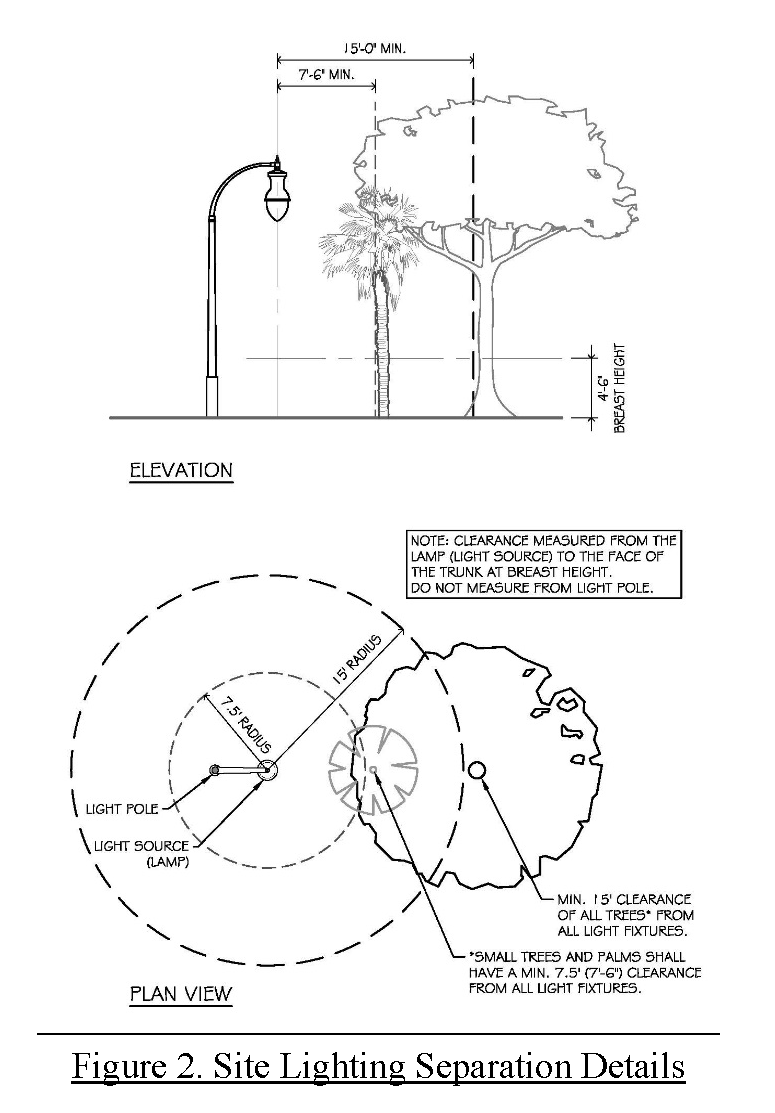
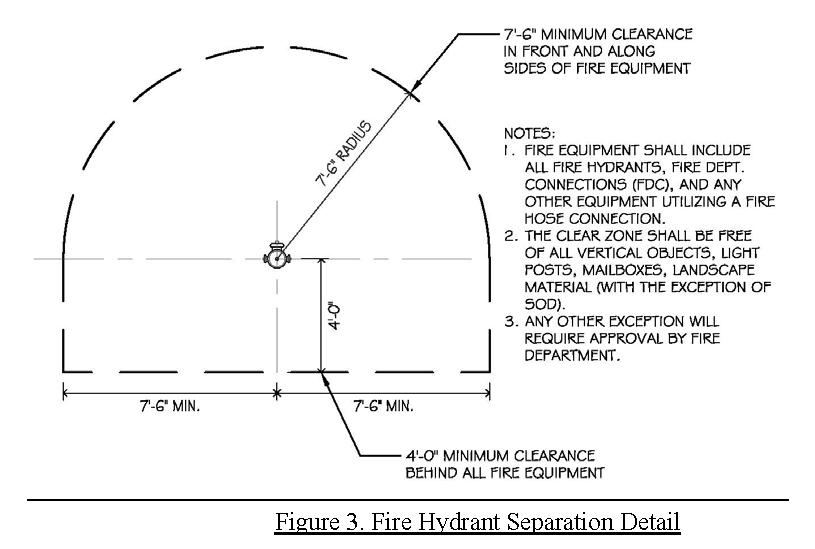
Parking islands. The following landscape requirements shall apply to the interior of parking areas containing one or more spaces. Landscape islands are for landscaping and are not to be utilized as utility or light pole islands unless the minimum distance as shown in Figure 2, Site Lighting Separation Detail, and Figure 3, Fire Hydrant Separation detail are met. As such, landscaping, trees, shrubs, ground cover and sod are required.
(8)
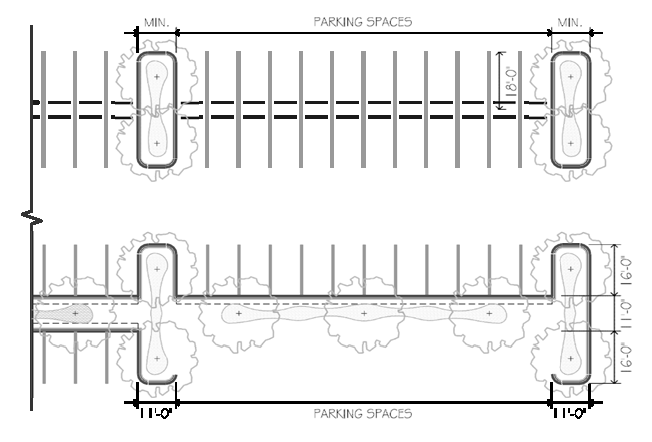
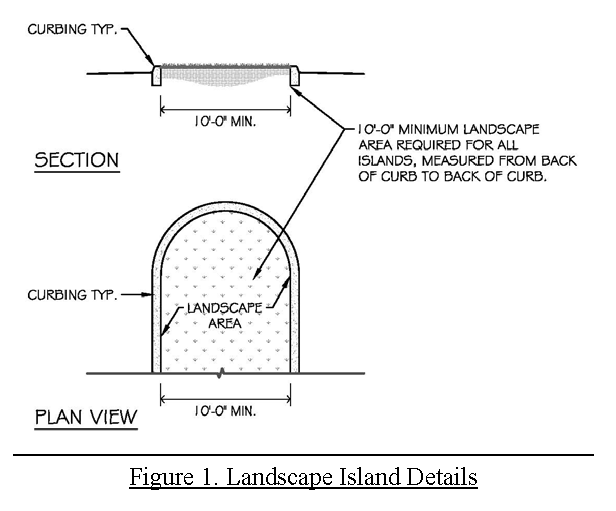
Terminal islands. Landscaped terminal islands of at least 11 feet in width (ten-foot-wide landscape and Type "D" curbing around it) and to the length of the adjacent parking stall shall be provided at the end of each parking row. All limerock and other incompatible materials shall be excavated from islands to a depth of two and one-half feet and backfilled with the specified planting mix.
(9)
Interior islands. At least one landscaped interior island shall be provided for every ten parking spaces. Interior islands shall measure at least 11 feet in width (ten-foot landscape wide area and Type "D" curbing) and to the length of the adjacent parking stall All limerock and other incompatible materials shall be excavated from islands to a depth of two and one-half feet and backfilled with the specified planting mix. As an alternative design, islands maybe consolidated to group trees if the design provides a greater degree of sustainable shade as determined by the urban forester.
(10)
Optional divider medians. When provided, divider medians shall be a minimum of 11 feet in width, including Type "D" ten inside curbs. Pedestrian crossings where required are permitted by the approval of the planning and development services director. Trees and shrubs are to be utilized where practical.
(11)
Landscape treatment. All interior planting areas not dedicated to trees, shrubs, or existing vegetation shall be landscaped with sod, ground cover, or other appropriate landscape treatment (no sand, rock, gravel, pavement, or bare soil). In no instance shall there be less than one shade tree and 20 shrubs for each landscaped island; this in additional to other landscape requirements.
(12)
Site lighting and trees. No light poles shall be located within 15 feet of a canopy tree or within seven and one-half feet of a palm species or small tree. All final light pole locations shall be illustrated on the planting plans with required separation and must concur with the photometric plans. Trees are required in landscape islands.
(13)
Fire hydrant/fire valves and trees. All trees and palms shall be installed seven and one-half feet from the front and sides of fire hydrants and four feet from the rear. All final locations shall be illustrated on the planting plans with the required separation and must concur with the site plans. Trees and shrubs are required in landscape islands.
(14)
Foundation planting along building facades.
a.
Buildings shall contain a foundation planting strip along the full length of each facade that fronts parking or other vehicular use areas (truck courts not included) to help soften and scale the buildings. The width of the zone and degree to which it is landscaped shall be determined by the building heights. No point in the foundation planting may be less than five feet in width for required landscape and this area shall be clear of any roof overhang.
b.
Height for this purpose shall be measured to the top of a parapet wall. Sides of industrial structures not oriented to residential or public view may be exempt from the above standards.
c.
Foundation plantings in areas shall include low, mid and upper level landscape.
d.
A group of three palms, or one palm tree that qualifies as a shade tree is required for every 40 linear feet of the foundation planting along the frontage and sides that fronts public parking, these trees can be grouped where appropriate. A minimum of ten shrubs and 30 ground cover plants shall also be planted for every 40 feet of facade length.
e.
Required trees or palms at the time of planting shall relate to the building height. Height of palms refers to graywood.
In situations where trees or palms cannot be planted, green walls can be used provided that the total section of green wall is a minimum of 25 percent of each facade in which the green wall is proposed.
(15)
Parking structure/multi-level garages. All parking structures require a minimum 50 percent screening. Such screening can be made of green walls or other decorative features to soften and buffer the parking structures on all visible sides.
(f)
Special district provisions and all other zoning districts not specifically mentioned.
(1)
Pioneer Grove District—LAC. Additional landscape requirements can be found in the Pioneer Grove Design Standards Booklet and section 98-67 of the Land Development Code.
(2)
Coastal Community Architectural District properties may increase their maximum palm tree percentage to 40 percent of overall required trees. In addition, the use of plant materials known to be tolerant to wind and salt spray is encouraged.
(3)
Unincorporated County Districts (all areas and/or parcels which still have a Broward County zoning designation). Proposed landscape shall utilize the landscape code requirements of the City of Deerfield Beach.
(4)
Minimum landscape requirements for all zoning districts not specifically mentioned. Unless specifically approved by the city commission through a development agreement or similar means, all zoning districts shall follow the guidelines of section 98-80(d).
(5)
Commercial uses within residentially zoned districts. Any commercial property located within a residentially zoned district shall follow the provisions of section 98-80(e).
(g)
Swales. When necessary, applicants for a development permit shall provide for swale trees adjacent to their property.
(1)
Urban swale tree location and purpose. Swale trees shall be required along existing, proposed and improved rights-of-way to provide shade for pedestrians and create an aesthetically pleasing design edge along the roadway to visually define the hierarchy of roadways. The species and location of swale trees shall not conflict with existing or proposed improvements and utilities. Consideration shall be given to the selection of the trees to avoid serious problems such as future road widening, broken pipes, clogged sewers, cracked sidewalks and power interruptions. As such, swale trees will require prior approval from the department of environmental services.
(2)
Size, spacing and planting width. Required swale trees at the time of planting, shall have a clear trunk of at least four and one-half feet, a height of at least 14—16 feet, and a DBH of three inches. Exception to this standard is allowed under overhead lines where the "Right Tree in Right Place" shall be utilized and adjustments in the sizes will be determined by the urban forester. Swale trees shall be spaced at average intervals of 30 feet. Roads and center medians fronting single-family residences shall comply with these provisions. Where possible, all trees with expected trunk diameters of four inches or greater must be located outside of the roadway clear zone as established by applicable roadway safety criteria. Average spacing requirements for single family homes on cul-de-sacs, homes which are zero-lot line and townhouses shall be based on the total frontage of the adjacent street and not on the individual lot widths. Required swale trees shall be installed prior to the final building inspection.
(h)
Green infrastructure practices. All new development shall where possible apply green infrastructure practices such as those provided below:
(1)
Bio swales/rain gardens are encouraged as landscape elements to concentrate or remove debris and pollution out of the surface runoff. It consists of swaled drainage course with maintainable slopes sides filled with compatible landscape. These areas should not be sodded.
(2)
Green, living, vertical walls or green facades are encouraged to partially or completely cover blank walls with greenery that includes a growing medium, such as soil or a substrate, irrigation system, attachment and drainage. Living material that is less than 75 percent of the total area within one year shall be measured as failing.
(3)
Green roofs or rooftop gardens are encouraged to help soften the views to the roof as an architectural element, absorb rain water, create a wild life habitat, lower the heat island effect by partially or completely covering it with landscape, growing medium, waterproofing, irrigation and drainage.
(4)
Permeable pavement. A traditionally impervious surface area, designed to allow for water to pass through and percolate through the material into the substrate in order to reduce storm water runoff.
(5)
Root barriers. Root barriers are required where swale trees are planted within five feet of a sidewalk or roadway. A minimum eighteen-inch-deep root barrier shall be installed per manufactures specifications against the edge of the sidewalk and the edge of the pavement and shall extend five feet in both directions parallel to the sidewalk and roadway.
(6)
Structural soils. Are encouraged as a medium that can be compacted to pavement design and installation requirements while permitting root growth. It is a mixture of gap-graded gravels (mostly of crushed stone) and soil (mineral contact organic matter) that provides an integrated, root penetrable, high strength bio area underneath the pavement system.
(7)
Soil (silva) cells. The soil cell is a modular, underground bioretention system that utilizes the proven capacity of soils for stormwater management and healthy tree growth to bring green infrastructure to the built environment. As such, this method may be utilized as an alternative for urban planting of trees or palms.
(8)
Tree well/tree pit. A below ground or at grade modified planting area designed to receive and treat storm water runoff.
(i)
Right-of-ways and access intersections.
(1)
Sight triangles. Sight triangles are required to be shown on all planting plans for all intersections, and pedestrian crosswalks. The sight triangle shall include the area on each right-of-way or accessway corner that is bounded by the line that connects the sight or "connecting" points located on each of the right-of-way locations or property lines of intersecting rights-of-way or accessways.
(2)
Sight triangle dimensions.
(3)
Sight triangle requirements for the intersections of all rights-of-way and accessways shall conform, when necessary with the criteria outlined in the following standards:
a.
AASHTO's A Policy on Geometric Design of Highways and Streets.
b.
FDOT Roadway and Traffic Design Standards, Index Nos. 545, 546, and 700.
c.
FDOT Manual of Uniform Minimum Standards for Design, Construction, and Maintenance for Streets and Highways.
(4)
If a private driveway intersects with any public rights-of-way, no sight distance obstruction will be permitted within the ten-foot by 50-foot triangular area formed by the intersection of each side of the driveway and the ultimate rights-of-way or property lines with the driveway side of the triangle being ten feet in length, the public rights-of-way side of the triangle being 50 feet in length, and the third side of the triangle being the line connecting the ends of the two other sides.
(5)
Subject to city approval, if the public rights-of-way is a local street with a posted speed limit of 25 miles per hour or less, these requirements may be reduced to ten feet by 35 feet.
(6)
For all on-site intersections of private internal accessways, driveways, and/or private drive aisles, a minimum ten feet by 25-foot sight triangle must be maintained from the intersecting edges of the travel way, with the ten-foot side of the triangle being along the minor drive aisle and the 25-foot side of the triangle being along the major drive aisle.
(7)
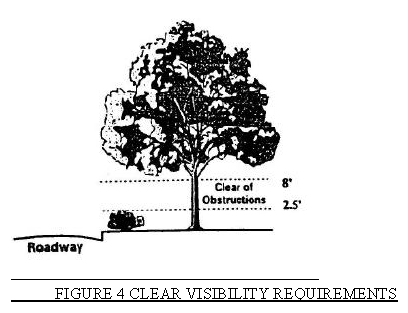
Clear visibility requirements. No structure or planting (at mature growth) that exceeds two and one-half feet in height above the street grade shall be permitted within the required sight triangles. Exceptions are permitted if the lower canopies of trees allow a clear line of sight between two and one-half feet and eight feet above the adjacent street grade and the trunks of such trees are sufficiently spaced or located so as to be unlikely to interrupt the line of sight.
(j)
Screening, softening and scaling requirements.
(1)
Above-ground elements. Dumpsters, sewer lift stations, transformers, switchboxes, air conditioning units, mechanical equipment, cabinets, pedestals and all other above ground freestanding utility equipment or enclosure elements shall be fully screened on all non-accessible portions with a 36-inches-tall, continuous hedge at time of planting.
(2)
Generators.
a.
New development. Generators and above ground gas tanks shall be fully screened on all visible non-accessible portions with hedge material equal to the height of the generator and the gas tanks.
b.
Existing development. Except when determined by the urban forester that screening is impracticable, generators and above ground gas tanks installed on existing developed properties shall be fully screened on all visible non-accessible portions with hedge material equal to the height of the generator and the gas tanks.
c.
In cases where nonresidential property abuts residential property, the city can require such additional landscape as is necessary to protect the aesthetics and minimize the impact on the abutting residential area.
(k)
Plant standards. The following specifications and percentages are utilized to establish diversity in height, offer color, provide shade, create understory and layering and palms and brand a sustainable and distinctive landscape design for the city. All landscaping required by this article shall comply with the following:
(1)
Plant sizes. Minimum size of required trees and shrubs (at the time of planting) shall be:
(2)
Trees and palms.
a.
All proposed trees and palms shall not be planted under roofs, overhangs or balconies.
b.
All proposed trees and palms within or overhanging a pedestrian area shall have a clear trunk high enough to allow unobstructed pedestrian movement under or around.
c.
All proposed trees and palms must be planted so not to touch the building at time of planting or in the near future.
d.
All trees and palms shall be a minimum of four feet from any utility or hardscape. All trees and palms shall have a root barrier if they are less than six feet from a utility or hardscape.
(3)
Shrubs.
a.
Shrubs shall be planted in a manner that prevents branches from touching the buildings walls or walkways at the time of planting.
b.
Planting shrubs around trees shall be done in a manner that prevents trunk damage.
c.
Shrubs shall be planted in layers which will promote plant species diversity and enhance the city's aesthetics. This shall be done through positioning taller shrubs in the back and shorter shrubs in the front.
d.
Shrubs must be planted as to not create a sight visibility hazard.
(4)
New ficus species shall not be planted within ten feet of any structure, utility or street.
(5)
The use of plant material that can be hazardous to persons, pets or property shall be reviewed on a case-by-case basis.
(6)
Vines. At the time of planting, vines shall be 60 inches in supported height. The method of attachment and irrigation shall be indicated in the landscape plans.
(7)
Cycads and palms used as hedges. Species such as Coontie and Cardboard Plants as well as Saw Palmettos may not be mechanically cut or trimmed. They are discouraged from being placed in sight triangles or in other locations where they might be subject to improper trimming.
(8)
The landscape architect shall make every effort to group plant material by watering requirements.
(9)
A minimum of 50 percent of all tree, palm and plant species shall be a native species.
a.
Tree species diversity. The tree species diversity with no more than 30 percent of one species shall be as follows:
b.
Ground cover species diversity.
(10)
Plant quality. Plant materials used in accordance with this code shall conform to the standards for Florida Grade No. 1 or Florida Fancy as provided for in the most recent edition of the Florida Grades and Standards for Nursery Plants, State of Florida Department of Agricultural and Consumer Services. For standards not addressed in the Florida Grades and Standards for Nursery Plants, plant materials shall conform to the American National Standards Institute ANSI Standards Z60.1.
(11)
Existing landscape material. At the discretion of the urban forester, vegetation and plant material that exists on a site prior to its development may be used to satisfy the minimum landscape requirements of this section, provided that such vegetation meets the landscape standards in this section. However, no credit shall be permitted for:
a.
Vegetation not properly protected from damage during construction.
b.
Plant species classified as "prohibited", invasive exotic or "controlled."
c.
Vegetation that is dead, dying, diseased, or infested with insects.
d.
Existing plant material noted as prohibited, which is to be removed from the site.
(12)
Relocation of landscape material. Where it is not feasible to retain existing healthy tree(s), those trees shall be relocated elsewhere on the property. If this is not possible, then the tree(s) may be relocated to another property deemed appropriate by the urban forester. All relocated tree(s) shall be guaranteed for one year. For any tree(s) which cannot be relocated, or which dies within one year of relocation, the applicant or property owner shall replace the tree(s) according to the standards established in this chapter. No existing tree(s) on-site may be removed or transplanted without receipt of a permit from the city.
(13)
Replacement of landscape material. All landscape, including credited landscape per an approved plan, that subsequently dies, shall be replaced according to the standards established in this chapter.
(14)
Ground treatment. Pervious areas within required planting areas not dedicated to trees, shrubs or other vegetation shall receive appropriate landscape treatment and present a finished appearance and complete coverage upon planting. No sand, gravel, pavement or base soil shall be permitted. The following standards shall apply:
a.
Ground cover. Ground cover may be planted in lieu of sod. Ground cover shall provide not less than 75 percent coverage upon planting and 100 percent coverage within three months after planting. All ground cover shall be planted so as to not touch the buildings walls or walkways at the time of planting. Planting ground cover around trees shall be done in a manner that prevents trunk damage. Ground cover must have a clear, discernable border so that it does not spread.
(b)
Sod. Sod shall not be treated as fill in material, but rather as a major planned element of the landscape, be consolidated and limited to those areas on the site that require pedestrian traffic, provide recreation use, soil erosion control for slopes/swales and shall be placed so that it can be irrigated separately from planting beds. All sod areas, including but not limited to, swales, lake maintenance easements and retention areas shall be sodded to the waterline. All sod shall be a solid Florida-friendly types (Zone Ten) laid on a smooth planting base with tight joints, no overlaps at 100 percent coverage at the time of planting and cut to fit all landscape planters and curbed areas. Sod shall be green, adequate soil backing, healthy, clean and visibly free of weeds, pests and diseases. Sod areas shall be identified and labeled on the landscape plans. Seeding and plugs are prohibited on developable land. However, seeding can be approved per the discretion of the urban forester on vacant lots. Additionally, artificial turf is not permitted in the front yard or street front yard of a residential or commercial property.
(l)
Installation standards. All landscape in all districts shall be installed according to sound nursery practices in a manner designed to encourage vigorous growth. All required landscape material shall be healthy and in place prior to and at the time of issuance of the final certificate of occupancy.
(1)
All trees, palms, shrubs and ground cover shall require the planting of soil around the rootball (not underneath) at a minimum of two times the size of the rootball. Also, the plant material is encouraged (when possible) to be planted at a point higher than the crown of the road for natural drainage when possible.
(2)
Mulch. Three inches of shredded, organic, arsenic free mulch shall be installed around each tree planting for a minimum of 18 inches beyond its trunk in all directions, including palms, and throughout all hedge, shrub and ground cover planting; mulch shall be pulled a minimum of six inches away from trees and palms. Mulch cannot be "volcanoed" around trees. NOTE: Cypress much is prohibited to help reduce the destruction of the native Cypress trees for mulch. Mulch may not be placed in locations where it can be washed away to a local catch basin or drain.
(3)
All trees/palms shall be properly guyed and staked at the time of planting, including restaking in the event of blow overs or other failures of the staking and guying for one year from landscape final approval or establishment. All guying and staking shall be removed within one year of approval or establishment and if the tree cannot stand on its own, it shall be replaced. The use of nails, wire, rope, or any other method which damages the trees or palms is prohibited. The use of plastic or non-biodegradable staking material is prohibited except in certain site conditions.
(4)
All plants shall be installed so the top of the rootball is ten percent above the surrounding soil grade. All synthetic string, synthetic burlap, cords or wire baskets shall be removed prior to planting.
(5)
All parking islands, medians and other landscape areas shall be installed with continuous Type "D" curbing to prevent damage to the planting material and the displacement of soil and mulch. Also, all landscape islands, divider medians and planters shall be excavated of lime rock and/or compacted soil to a depth of 30 inches and backfilled with specified planting mix to the top of the curb. Additionally, all areas along buildings shall be excavated to a depth of 12 inches and backfilled with specified planting mix.
(6)
A root barrier system, structural soil or silva cells shall be installed in situations where a tree or palm is planted within five feet of a hard scape surface such as roadways and sidewalks.
(7)
Fertilizer applications.
a.
Any person who commercially applies fertilizer or exterior pest controls to any property within the City of Deerfield Beach must be certified to do so by the Florida Department of Agriculture and Consumer Services FDACS.
b.
All plantings shall be fertilized at the time of installation with an appropriate fertilizer consistent with site conditions or at such higher standard as may be determined by the urban forester.
c.
Fertilizer shall not be applied within two and one-half feet of any impervious area such as roadways and sidewalks.
d.
Fertilizer shall not be applied with ten feet of any sea wall, pond, stream, watercourse, lake, canal, storm drain or wetland.
e.
All properties are discouraged from using any fertilizer from the months of May to September of any year. All properties are discouraged from using any fertilizer at any time in which the soil is saturated.
(8)
All plant rootball sizes shall conform or exceed the minimum standards in the current edition of Florida Grades and Standards.
(9)
All landscape, including trees, palms, shrubs, vines and ground covers shall be guaranteed for one year after final landscape approval. A written warranty shall be submitted to the city prior to final landscape approval.
(10)
All invasive and exotic pest plants shall be removed prior to final inspection.
(11)
All landscape substitutions shall require urban forester approval prior to installation.
(12)
Landscape inspections:
a.
A pre-inspection of the site with the landscape contractor and urban forester shall be required to discuss all the city's requirements for plant installation, answer any questions, determine site conditions for appropriate use and selection of landscape material prior to installation.
b.
A final landscape inspection shall be required upon completion prior to a certificate of occupancy or completion.
c.
All trees planted shall be free of ant mounds at time of inspection.
(m)
Irrigation standards.
(1)
All properties except single family homes shall be irrigated to maintain required plant materials. Irrigation systems shall be installed underground and comply with the following: Wherever practical, high water and low water use areas shall be circuited as noted below.
(2)
All required planting areas shall be served by a permanent irrigation system maintained in good working order and designed to minimize water on impervious areas. Drip irrigation systems, where practical, shall be encouraged.
(3)
Irrigation systems shall be designed to apply water onto shrub and tree areas less frequently than those onto sodded areas. Irrigation systems shall be designed to have 100 percent coverage with 50 percent overlap.
(4)
Rain sensors shall be installed on systems with automatic controllers.
(5)
All irrigation systems utilizing non-potable water shall be from a rust-free water source.
(6)
Irrigation controllers shall be switched to manual operation during periods of increased rainfall unless rain sensors are incorporated into the system.
(7)
The following standards shall be considered the minimum requirements for landscape irrigation design within the jurisdiction of the South Florida Water Management District:
a.
Sprinkler zoning. Sprinkler heads irrigating sodded or other high-water demand landscape areas shall be circuited so that they are on a separate zone or zones from those irrigating trees, shrubbery or other reduced water requirement areas.
b.
Control systems. Automatically controlled irrigation systems shall be operated by an irrigation controller that is capable of watering high water requirement areas on a different schedule from low water requirement areas.
(8)
Use of non-potable water for use in the irrigation of sod and plant material is required when determined to be available.
(9)
Detailed irrigation plans must be submitted to the planning and development services department for review and approval prior to application to the building department for permitting. In addition to all other necessary inspections, the urban forester shall test the final system to assure that it satisfies the intent of this section.
(10)
"As built" drawings, showing water source, manifold, pipe size, number, make, pattern of heads to be used and gallons per zone, must be submitted to the planning and development services department prior to a certificate of occupancy or completion.
(n)
Maintenance.
(1)
Responsibility. The owner, tenant, and their agent, if any, shall be jointly and severally responsible for the maintenance of all landscape which shall be maintained in good condition so as to present a healthy, neat and orderly appearance and shall be kept free from refuse and debris.
(2)
Median and swale agreements. Parties subject to maintenance agreements with the city relative to medians and swales within the public rights-of-way shall be subject to the above requirements plus any other provisions of the agreement.
(o)
Plant list. The approved plant list and invasive-exotic species list may be found in the City of Deerfield Beach Landscape Manual. Any tree or shrub not specifically listed will be reviewed and evaluated by the city forester.
(Ord. No. 2000/001, § 25, 4-5-00; Ord. No. 2009/007, § 1, 3-17-09; Ord. No. 2012/031, § 3, 9-4-12; Ord. No. 2017/013, § 9, 6-19-17; Ord. No. 2019/013, § 2, 5-7-19)
Sec. 98-81. - Tree preservation.
(a)
Purposes. The purposes of this section are to establish rules and regulations governing the protection of trees and vegetative cover within the limits of the City of Deerfield Beach, to encourage the proliferation of trees and vegetation within the city as well as their replacement, and to preserve the tree canopy of the City of Deerfield Beach by regulating the cutting, trimming and pruning of its trees in recognition of their importance and their meaningful contribution to a healthy, beautiful and safer community attributable to their carbon dioxide absorption, oxygen production, dust filtration, wind and noise reduction, soil erosion prevention, beach erosion protection, surface drainage improvement, beautification and aesthetic enhancement of improved and vacant lands, and the general promotion of the health, safety, welfare and well being of the city.
(b)
Definitions. In interpreting the provisions of this section, if no definition is provided herein and the context permits, the latest editions of the following publications recognized as authoritative in the scientific field shall apply:
"Tree Protection Manual for Builders and Developers" by the Florida Department of Agriculture Division of Forestry; and
"Standards for Pruning Shade Trees" by the National Arborist Association.
As used in this section, the following words and terms shall be defined as set forth herein:
Buildable area means the portion of a site within the required yard areas which are proposed to be covered by structures or improvements.
Caliper means diameter at breast height (DBH) of a dicot or conifer tree trunk as measured four and one-half feet above the ground. Caliper of a monocot is the diameter of the tree trunk measured one foot above the ground.
Canopy means area occupied by aboveground, green-growing parts of a tree or palm.
City landscape architect shall be the person designated by the city manager to administer this section.
Developed property means property containing a structure which has a valid certificate of occupancy.
Dripline means the natural outside end of the branches of a tree or shrub projected vertically to the ground.
Equivalent value means an amount of money which reflects the cost of replacing a dicot or conifer tree. This amount shall be determined based on the market value of an equivalent replacement plus installation.
Hatracking means to flat-cut the top of a tree, severing the leader or leaders, or pruning a tree by stubbing off mature wood, or reducing the total circumference or canopy spread not in conformance with National Arborists Association standards, or any trimming which alters the natural characteristics of the species.
Overlift means the removal of the majority of the inner lateral branches and foliage thereby displacing weight and mass to the ends of the branches. The alteration of the tree's live crown ratio may be considered as evidence of overlifting.
Pruning means the removal of plant parts, dead or alive, in a careful and systematic manner so as to not damage other parts of the plant.
Shape means the regular and frequent shearing of outer tree branches, making pruning cuts of one inch in diameter or less, for the purpose of controlling the size and shape of the tree canopy.
Topiary means the practice of pruning a tree into an ornamental shape by pruning branches one inch in diameter or less.
Tree.*
(1)
Dicot. Any self-supporting woody perennial plant which has a trunk diameter of three inches measured four and one-half feet above grade, and has a minimum overall height of ten feet.
(2)
Monocot. A tree having fronds with parallel venation and an indistinct, tightly held trunk surface, e.g. palm.
*Unmaintained plants/hedges, clumping and clustering palms and bamboo which have grown excessively tall are not considered trees for the purpose of permitting.
Tree abuse means any action or inaction which causes the decline or death of a tree. "Tree abuse" includes, but is not limited to, improper cutting and trimming, damage inflicted upon the tree by machinery or equipment, or prolonged or incorrect staking, changing the natural grade within the drip line, destruction of the natural landscape function of the tree, or death.
Tree removal means to change the location of a tree, or to cause damage to or destruction of a tree or root system so as to cause a tree to die.
Tree service/arborist means any licensed person, company, corporation, or entity or service which does regularly, for a compensation or fee, transplant, remove, prune, trim, repair, inject, or perform surgery upon a tree.
Violator means a person who removes or abuses a tree or otherwise violates this section. The owner of the property upon which the tree is located shall also be deemed a violator if the abuse or removal is undertaken by the owner's employee, agent or person under the owner's control.
(c)
Applicability. The terms and provisions of this chapter shall apply to real property except as follows:
(1)
Removal of tree species occurring in regulated waters as defined by the Broward County Tree Preservation and Abuse Ordinance (The Broward Ordinance) when the mitigation required by that license for the removal of the trees is equal to or greater than the replacement requirements of this section.
(2)
Removal of any tree that is diseased, injured or in danger of falling, to the extent that its continued existence threatens the health or safety of contiguous persons or property, provided that the owner of the property can document (photographs, etc.) that such condition(s) existed prior to the removal of the tree; in the case of natural forest communities, specimen trees or historic tree, documentation of the condition must be presented to the city landscaper within 48 hours after removal.
(3)
Removal of any tree on owner-occupied residential properties of one acre or less developed or detached single-family and duplex usage, except the following:
a.
Previously preserved, relocated or replaced trees that were preserved, relocated or replaced as a condition of granting a tree removal license; or
b.
Historical or special status category trees.
(4)
Under emergency conditions such as hurricanes, war, or any natural disasters of similar scope, county utilities, water management districts, improvements districts, county airports, Florida Department of Transportation, municipal utilities and franchised utilities, except as provided below, may remove a tree in order to prevent imminent interruption of service or to restore interrupted service.
(5)
During emergency conditions caused by a hurricane or other disaster, the provisions of this section may be suspended by direction of the city manager.
(6)
Removal or relocation of planted landscape trees prior to the issuance of a certificate of occupancy (subject to the requirements of 98-80 (m)).
(7)
Removal of tree species occurring in regulated waters as exempted by The Broward Ordinance.
(8)
Removal of any tree that is hazardous to the extent that its continued existence creates an imminent threat to public safety or property. In order to claim this exemption, the owner of the property may document by photographs or other evidence that such condition(s) existed prior to the removal of the tree. In the case of Natural Forest Communities, specimen trees or historic trees, documentation of the condition must be presented to the city landscaper within 48 hours of removal.
(9)
Previously preserved, relocated or placed trees that were preserved, relocated or placed pursuant to a tree removal license.
(10)
Removal of trees by all county-licensed nurseries, botanical gardens and commercial grove operations, but only in relation to those trees which are planted and grown for the sale or intended sale to the general public in the ordinary course of the licensed business.
(11)
Removal of trees by all governmental and private nurseries with respect to trees which have been planted and grown for future relocation.
(12)
Removal of trees, except historical or specimen trees, by franchised utility companies provided that:
a.
The utility company provides written notice to the city and the record owner of the property on which the trees proposed to be removed are located of the intent to remove trees; the written notices shall be delivered, at minimum, 15 days prior to the intended tree removal; and
b.
The utility company can demonstrate to the city prior to tree removal that:
1.
The tree will cause a continual disruption of service. A specimen palm tree may be removed under this exemption;
2.
The easement or property was in actual use conveying utilities prior to the effective date of this article; and
3.
The threat of service interruption cannot be remedied by tree pruning in accordance with standards as set by the American National Standards Institute, as amended.
(13)
Removal of nuisance trees.
(14)
Removal of nuisance trees as permitted by The Broward Ordinance.
(15)
Removal of root systems which show evidence of destroying public or private property. The removal of the root systems or necessary root pruning must be done so as to not irreparably damage the tree or create a safety hazard.
(d)
Prohibitions:
(1)
General: A person shall not cause, suffer, permit or allow the removal of any tree without first obtaining a license from the city as herein provided. The property owner, holder of an easement and/or person removing a tree without a license shall be responsible for the violation. The removal of trees in violation of this section is a public nuisance.
(2)
Historical trees: A person shall not cause, suffer, permit or allow the removal of any historical tree without first obtaining a variance from the board to conduct the removal.
(3)
Land clearing: Land clearing and site development where such activities may result in the removal of trees shall not occur unit a tree removal permit has been obtained.
(4)
The storage or use of materials or equipment within the drip line of any tree or attachments, other than those of a protective and nondamaging nature, to any tree.
(e)
License application: An owner of his agent of fee simple title may apply for a tree removal permit. After submitting certified approval of the fee simple owner, the agent of the owner, the lessee of the property, optionee, contract purchaser, or holder of an easement may apply for a tree removal permit. A holder of an easement may obtain a permit only when the proposed tree removal is consistent with the use granted by the easement. The city shall require that any tree surveys or site plans be prepared by any person qualified to do so under the Laws of Florida.
(1)
Application for permit: Application for tree removal permits shall be made on forms approved by the city manager or his designee.
(2)
Application filing fee:
a.
Before any application for a permit required under this section is accepted for review, a permit application filing fee shall be tendered. The amount of the fee shall be as established by resolution of the city commission.
b.
For any substantial deviation from the original application there shall be an additional fee. The amount of the fee shall be established by resolution by the commission.
(3)
Application for a tree removal permit constitutes consent by the property owner and/or applicant for the city to conduct site inspections in furtherance of this section on the subject property.
(4)
A survey or detailed sketch of the property showing the approximate location of the tree(s) to be removed.
(5)
Common name of each tree to be removed.
(6)
The diameter measurement of the tree(s) to be removed measured four and one-half feet above the ground.
(7)
Location, quantity, common name and size of the replacement tree(s).
(8)
A description for the reason for removal. Accepted reasons may include:
a.
The tree is a nuisance tree as defined in this section;
b.
The tree is diseased, injured or destructively damaged;
c.
The tree is in danger of materially impairing the structural integrity of existing or proposed structures, interferes with utility service or adversely affects sight distance triangles and any other remedies (i.e., root pruning, pruning, relocation, etc.) will result in irreparable damage to the tree;
d.
The tree is required to be cut down, destroyed, removed or relocated by county, state or federal law, or by rules promulgated by a county, state or federal agency.
(f)
Tree removal permit:
(1)
As a condition precedent of any land clearing and/or site development where any tree removal or relocation is to be conducted, except as otherwise exempted under this section, a person shall be required to obtain a tree removal permit. The city commission or city manager shall approve a schedule of permit fees. Any person may submit a sworn affidavit to the city stating that the property the person wishes to develop does not contain trees that are protected under this section.
(2)
A tree may be removed only when an applicant has demonstrated to the city that the proposed development cannot be located on the site without the removal of the tree, and that there is no practical way to avoid tree removal. In determining if the applicant may remove trees pursuant to a tree removal permit, the city shall consider at minimum the following:
a.
The applicant has made every reasonable effort to incorporate existing trees and to minimize the number of trees removed; or,
b.
The trees proposed to be removed are the minimum number necessary; or,
c.
The trees proposed to be removed are of poor quality and appearance; or,
d.
The trees proposed to be removed are obstructing safe vehicular cross visibility; or,
e.
The trees proposed to be removed are damaging existing improvements; or,
f.
The trees proposed to be removed are creating ongoing safety problems for existing development; or,
g.
The trees proposed to be removed are growing in too close proximity to other trees to permit normal growth and development of affected trees consistent with good forestry practices.
The applicant must relocate the trees to be removed. If relocation is not a viable solution, an applicant shall replace removed trees. If it is determined that an applicant cannot relocate nor replace removed trees, the applicant shall pay the appropriate feet into the tree preservation trust fund.
(3)
A determination of the extent of environmental impact by the project development as covered by the scope of this section shall be performed by the city. This determination shall be based upon drawings or site plan and a completed tree removal permit application form submitted to the city by the applicant. The city staff shall have the right to conduct field inspections.
(4)
The applicant shall be responsible for the relocation or the replacement of trees removed for utilities, roads, drainage, and other services constructed to benefit the property for which the application was filed.
(5)
Other trees: The permittee shall only remove those trees so specified in the permit. Any damage to any other tree on the site shall constitute a violation of this section.
(6)
Duration: A permit shall be valid for development for not more than two years for the date of issuance. A one-time extension of up to two years may be issued provided there is no substantial deviation from the original application and the permit extension complies with al standards in effect at the time of the permit extension. Additional conditions may be imposed in the permit extension when there is a change in site conditions that may affect trees. A violation of the permit may be prosecuted at any time. Where any activity regulated by the tree removal permit has occurred, the permittee must comply with all conditions of the permit even though the permit may have expired.
(g)
Tree relocation:
(1)
Before the city issues a tree removal permit that allows the replacement of any tree, the applicant must demonstrate the relocation is not a viable alternative. Relocation shall occur either within the site with the concurrence of the city, where the site is public property, or with the concurrence of the property owner, where the site is private property. The site shall be in reasonable proximity to the original site and have physiographic conditions similar to the original site. If any tree is to be located either on-site or off-site, a relocation plan shall be submitted. Relocation plans, as required by this section, must first be reviewed and approved prior to granting any tree removal permit. Before a permit is issued for tree relocation, performance bonds may be required to be posted.
(2)
Methods for relocation: The following guidelines shall be utilized to ensure successful transplanting of trees designated for transplanting:
a.
Any tree being relocated shall not be unnecessarily damaged during removal, transport or replanting of that tree.
b.
If the trees have a dormant period, they should be transplanted during that time. Trees should not be transplanted during periods of strong, dry winter winds or during droughts.
c.
Adequate space for root and crown development shall be provided.
d.
Trees shall be root and canopy pruned according to sound arboricultural standards prior to transplanting, as stated in ANSI 300 Standards published by department of Agriculture by National Arborist Association.
e.
During and following transplanting, the root ball and truck shall be protected. The root ball must be kept moist at all times.
f.
Transplanted trees shall be braced for at least one year.
g.
Transplanted trees shall not be fertilized at planting time, but shall be watered sufficiently until the tree growth is reestablished. Transplanted trees must have two bubblers located at base of tree to assure proper irrigation during establishment period.
h.
All crown pruning shall be done in accordance with National Arborist Association standards or palm pruning in accordance with the standards listed in ANSI 300 Standards published by Department of Agriculture by National Arborist Association, a copy of which is on file in the City Building Department.
(h)
Tree replacement:
(1)
Replacement criteria. Trees that are removed and not relocated shall be replaced so that there is, at a minimum, no loss of tree canopy coverage upon maturity of the replacement trees. Performance bonds may be required to be posted. The following procedures shall be used to determine the tree placement requirements:
a.
Tree canopy coverage on-site shall first be determined using one or any combination of the following methods: review of aerial photography, or on-site inspection of a tree survey. The city shall required the applicant to submit a tree survey in order to make this determination, unless the applicant can demonstrate that it is clearly unnecessary.
b.
Relocation of trees on-site will be counted towards equivocal replacement canopy. Relocation of trees off-site shall be counted as half credit towards equivalent replacement. Guidelines in this section shall be followed for any trees to be relocated.
c.
Native trees shall be required to replace native tree canopy coverage removed.
d.
A determination of the number of trees to be replaced shall be performed. This determination shall be based upon the area of impact and the category of replacement trees selected by the applicant. The canopy replacement at tree maturity shall at least equal the canopy removed.
e.
A minimum of three palm trees shall be required to replace one canopy tree (where palm trees are permitted as a replacement tree); provided that at least one-half of the replacement requirements are met with the installation of canopy trees.
(2)
Minimum standards for tree replacement:
a.
All trees to be used as replacement trees shall be a minimum quality of Florida No. 1 grade or better (Florida Department of Agriculture Grades and Standards Reference Guide).
b.
The Tree Replacement Standards set forth in The Broward Ordinance shall constitute the minimum criteria for replacement of trees.
c.
Should it be demonstrated to the city that the minimum tree size is unavailable, smaller trees may be substituted. If the site cannot hold trees of the necessary caliper, then a replacement fee of $200.00 per three inches of caliper shall be paid.
d.
For tree replacement requirements of one to five trees, a minimum of one species shall be utilized as a replacement tree. For six to ten replacement trees required, a minimum of two species shall be utilized. For 11 to 20 replacement trees required, a minimum of three species shall be utilized. For 21 to 50 replacement trees required, a minimum of four species shall be utilized. For 51 or more replacement trees required, a minimum of five species shall be utilized.
e.
For trees removed pursuant to section 98-81 (i)(2)a., b., c., an additional 50 percent tree replacement shall be required.
(3)
Replacement trees shall not be removed or effectively destroyed unless approval has been granted by a valid tree removal permit. The original permittee and owner of any property on which trees have been replaced or relocated shall place of record a notice that shall inform subsequent purchasers, assigns and occupants of the replacement site that trees on the replacement side may not be removed without a valid tree removal permit.
(i)
General relocation/replacement conditions:
(1)
Any tree remaining on-site shall not be unnecessarily damaged while relocating trees or planting or preparing the site for any replacement trees.
(2)
Replacement or relocated trees shall not be placed where they will interfere with existing or proposed utilities, either above or below ground.
(3)
Where practicable, replacement tree species, installation methods and maintenance methods shall follow Florida-Friendly principles.
(4)
The permittee shall replace each tree specified in the permit within a time period of up to six months with the city approval. A time extension may be granted if future construction will endanger the replacement trees. However, where an extension for planting has been granted, each tree specified in the permit must be replaced prior the approval of a certificate of occupancy.
(5)
All relocated or replacement trees shall be located where they will have adequate space for root and canopy development, except where small trees planted in close proximity to one another are to be later relocated to other areas of the site.
(6)
Where practicable, trees shall be relocated or replaced within the municipality from which the origin trees were removed.
(7)
Relocated or replacement trees or palms must comply [with] Florida Power & Light Guidelines.
(j)
Maintenance/monitoring requirements:
(1)
Responsibility: The permittee shall be responsible for maintaining the health of any replacement or relocated tree for one year from planting.
(2)
Replace within 60 days any replaced tree that dies or is determined to be effectively destroyed within one year of being planted, as determined by the city. The one year maintenance period shall begin whenever a tree is replaced. For projects that include the planting of 100 or more replacement trees, a ten percent mortality allowance will apply. If 90 percent or more of the replacement trees are determined to be viable after a period of one year, the project shall be considered successful and replacement trees will not be required for the remaining ten percent of the trees that dies or in a state of decline.
(k)
Standards. All work to be performed in accordance with the specifications set forth in the American National Standards Institute A-300, Tree, Shrub and Other Woody Plant Maintenance-Standard Practices, and Z-133.1, Pruning, Repairing, Maintaining, and Removing Trees, and Cutting Brush-Safety Requirements; Florida Department of Agriculture Division of Plant Industry, Grades and Standards for Nursery Plants; Jim Clark and Nelda Matheny, Trees and Development, Council of Tree and Landscape Appraisers, Guide for Plant Appraisal, Ninth Edition, 2000; Richard Harris, Arboriculture Integrated Management of Landscape Trees, Shrubs and Vines, Second Edition; Gary W. Watson and E.B. Himelick, Principles and Practices of Planting Trees and Shrubs; Florida Urban Forestry Council, Selecting and Planting Trees for the South Florida Urban Forest; and Florida Power and Light's Plant The Right Tree In the Right Place brochure.
(l)
Tree abuse.
(1)
Tree abuse is prohibited. Abused trees shall not be counted toward fulfilling landscape requirements and will be required to be replaced. Tree abuse shall include:
a.
Hatracking a tree; or
b.
Destroying the natural habit of tree growth; or
c.
Pruning which leaves stubs or results in a flush cut; or splitting of limb ends; or
d.
Removing tree bark to the extent that if a line is drawn at any height around the circumference of the tree, over one-third of the length of the line falls on portions of the tree where bard no longer remains; or
e.
Using climbing spikes, nails or hooks, except for purposes of total tree removal or as specifically permitted by standards set by the American National Standards Institute, as amended; or
f.
Pruning that does not conform to standards set by the American National Standards Institute, as amended; or
g.
Pruning of live palm fronds which initiate above the horizontal plane as defined by the American National Standards Institute (ANSI A-300).
(2)
Remedial actions required for tree abuse.
a.
In the event a person abuses a tree in violation of this section, the violator shall be responsible to undertake pruning and other remedial actions that the enforcement agency determines are reasonably necessary to protect public safety and property, and to help the tree survive the tree abuse damage if the tree is not a nuisance species.
b.
If the natural habit of growth of the tree is destroyed, the violator shall install a replacement tree. Such abused tree shall be removed if it threatens public safety or property.
c.
Replacement trees must comply with the Grades and Standards Florida No. 1 stock as determined by the Department of Agriculture Grades and Standards Reference Guide. All species listed on the Florida Exotic Pest Plant Council's List are considered unacceptable replacement material, and prohibited to plant. The diameter of the replacement tree shall be equal to or greater than the diameter of the abused tree (DBH). More than one tree may be utilized for replacement if the aggregate sum of the diameters of the replacement trees is equal to or greater than the diameter of the abused tree. Each replacement tree shall have the largest diameter commercially available in Dade. Broward and Palm Beach counties for the tree species selected, provided that no replacement tree shall have a diameter of less that three inches. Diameter measurements shall be made at four and one-half feet above the ground (DBH).
d.
Replacement trees shall be installed on-site. In the event the site cannot accommodate all required replacement trees, the remaining replacement trees shall be installed on public lands or an equivalent replacement fee for equal caliper inches shall be paid into the Deerfield Beach Beautification Trust Fund.
e.
The owner of an abused tree can provide the urban forester, with written documentation from an arborist certified by the International Society of Arboriculture or other qualifying organization stating that the degree of abuse is not sufficient to warrant the removal of the abused tree. The arborist's opinion must include a description of the proposed remedial pruning and a timeline for the proposed pruning. After reviewing the arborist's opinion, the city manager or designee, can agree to allow the tree to remain. If the abused tree is allowed to remain on the property, it is the property owner's responsibility to follow through with any necessary corrective pruning or maintenance in a timely manner so as not to allow the tree to develop into a hazardous tree.
(m)
Tree protection; construction/clearing.
(1)
During the land clearing and construction stage of development, the developer shall clearly mark all trees to be maintained and shall erect and maintain protective barriers in accordance with specifications set forth by the Broward County Department of Planning and Environmental Protection, a copy of which is maintained in the office of the city landscape architect, around all such trees or groups of trees prior to commencement of construction activity. The developer shall not allow the movement of equipment or the storage or placement of equipment, materials, debris, or fill within the protection barrier.
(2)
During the construction stage of development, the developer shall not allow the cleaning of equipment or material within the drip line of any tree or group of trees which are to be maintained. Neither shall the developer allow the disposal of waste material such as paint, oil, solvents, asphalt, concrete, mortar, etc. within the drip line of any tree or group of trees.
(3)
During the land clearing and construction stage of development, the city landscaper or his assigned officer shall periodically inspect the site to ensure compliance with the provisions of this section.
(n)
Exceptions.
(1)
In the event that any tree shall be determined to be in a hazardous or dangerous condition so as to endanger the public health, welfare or safety, and requires immediate removal without delay, verbal authorization by phone may be given by the city landscaper and the tree removed without obtaining a written permit as herein required.
(2)
During the period of an emergency such as a hurricane, tropical storm, flood or any other act of God, the requirements of this section may be waived as necessary by the city landscaper.
(3)
Public utilities may prune a tree in a manner that may be classified as tree abuse if said pruning is necessary to prevent service interruptions or to prevent interference with the operation of water control structures. However, public utilities shall be required to notify the city landscaper within 24 hours of any such trimming or pruning. It shall be required to provide the location at which the trimming or pruning occurred and the reason for the excessive trimming or pruning.
(4)
Exempted tree species. The following trees are exempt from the regulations contained herein:
Acacia auriculiformis (Earleaf acacia)
Araucaria heterophylla (Norfolk Island Pine)
Bischofia javanica (Bischofia, Bishopwood)
Brasaia actinophylla (Schefflera)
Casuarina spp. (Australian pine, all species)
Cupaniopsis anacardiopsis (Carrotwood)
Dalbergia sissoo (Indian rosewood)
Leucaena leucocephala (Lead tree)
Melaleuca quinquenervia (Cajeput tree/Melaleuca)
Metopium toxiferum (Poison wood)
Schinus terebinthifolius (Brazilian Peppertree)
If species listed above is part of the approved site plan, then the trees must be replaced in caliper inches on-site regardless of their nuisance character.
(5)
No person shall be required to obtain a tree removal permit or replace a tree where a tree is removed because it poses an imminent threat or danger to the functioning of any utility of a dwelling unit, or otherwise poses a threat to persons or public safety or, in the case of utilities, will cause a continual disruption of service in its vicinity, provided that the following conditions are met:
a.
The city landscaper is provided three business days notice, on a form provided by the city of the intent of the individual to remove the tree and confirms, in writing, that the conditions specified above exist (if the landscaper determines that the above conditions do not exist, he shall state his reasons in writing); and
b.
The removal of the tree will not cause the property upon which the tree is located to fall blow any tree or landscaping requirements which were in force at the time the property was given approval for development.
(o)
Specimen trees: Projects containing specimen tree(s) (as defined in The Broward Ordinance) are subject to the following additional criteria:
(1)
Specimen trees are subject to the preservation and relocation criteria of this section. If it is determined by the city that tree location is not feasible, then payment shall be made into the tree preservation trust fund. Payment shall be based on the value of the tree(s), determined by "The Valuation of Landscape Trees, Specimen Shrubs, and Other Plants," published by the International Society of Arboriculture.
(2)
The licensee may substitute for this payment the planting of the equivalent value of replacement trees which shall be done in compliance with subsections (k), (l) and (m). This option may be exercised at the city's discretion.
(p)
Tree trimming and cutting: Except for work performed by an owner or occupant on his residential property, no party other than a firm licensed in tree trimming and pruning may perform such work on any tree.
(1)
Trees shall be trimmed only in the following manner:
a.
All cuts shall be clean, flush with the branch collar and executed at junctions, laterals or crotches. Drop crotch trimming for overhead utility lines shall be followed.
b.
Removal of dead wood, crossing branches, weak or insignificant branches, and suckers shall be accomplished simultaneously with any reduction in crown.
c.
Topiary pruning shall only be allowed for trees located on owner occupied property developed for detached single-family or duplex usage, or for those trees that were not installed to meet minimum landscaping requirements and are identified on an approved landscape plan as appropriate for topiary pruning, and are located outside the rights-of-way or road easements.
(2)
Vehicles used by tree services/arborists operating within the City of Deerfield Beach shall be clearly marked with the name of the tree service/arborist. This identification shall include company logos, if any, address, phone number and the number of its license.
(3)
All trimmed branches or fronds are to be removed from the property and properly disposed of by the tree service.
(q)
Public lands. No tree, plant stock or sod shall be removed or pruned on any public lands, parks or public rights-of-way except in accordance with the provisions of this section.
(r)
Appeals. Due to the nature of this tree preservation and protection section, if a situation of hardship arises whereby the strict application of the section cannot be met due to extenuating circumstances, the environmental control committee, composed of the director of public works, the building official and the director of planning, is authorized to grant a special exception to the strict application of the section, provided that:
(1)
The application is made before any actions for which a variance is sought have been undertaken; and
(2)
Any alleged hardship is not created by any person having any interest in the property. A hardship shall not be considered self-created if the subject tree was installed prior to the effective date of this section; and
(3)
There are unique and special circumstances or conditions applying to the subject tree or the property upon which it is located, that do not apply generally to other trees or properties; and
(4)
The variance proposed is the minimum variance necessary to alleviate the hardship; and
(5)
That the granting of the variance will be in harmony with the general intent and purposes of this section, and will not create a dangerous condition that threatens the public or property.
(s)
Penalty.
(1)
Any person, firm, partnership, corporation, association or other organization, or any combination thereof, who shall violate or fail to comply with any of the provisions of this section, shall, upon conviction by the code enforcement board be fined in an amount not to exceed $500.00. The removal or abuse of each tree shall constitute a separate offense under this section.
(2)
Any person who violates the provisions of this section shall be deemed guilty of any offense and the conviction thereof shall be grounds for the revocation or suspension of any permit granted for the construction or remodeling of any building or structure on the site so involved.
(3)
Fees and penalties including monies received for settlement of court cases, which are received by the City of Deerfield Beach pursuant to this section, shall be placed in the tree preservation trust fund.
(t)
Tree preservation trust fund. Additional revenue received by the city from costs associated with tree mitigation, residential tree permits, and donations or grants may be deposited into the tree preservation trust fund. The tree preservation trust fund shall be used for the following expenditures:
(1)
City-wide beautification programs and projects, and tree installation programs created and managed by the city, including but not limited to the arbor day tree giveaway and the shady tree program;
(2)
Highway and street beautification landscape projects, tree inventory projects, and as a matching source for grant funds; or
(3)
Any additional programs or projects approved by a resolution of the city commission to be funded with funds from the tree preservation trust fund.
The city manager shall administer the expenditure of such funds.
(u)
Stop work orders. Whenever any work is being done by a person not in compliance with this article, the city landscaper, or a code enforcement officer may order that work be stopped and such persons performing such work shall immediately cease such work. The work may not resume until such time as the person is in compliance with this article.
(Ord. No. 1998/006, § 1, 4-7-98; Ord. No. 2000/001, § 26, 4-5-00; Ord. No. 2000/041, §§ 1—3, 11-21-00; Ord. No. 2000/045, § 1, 1-23-01; Ord. No. 2001/023, § 1, 9-19-01; Ord. No. 2005/024, § 1, 9-6-05; Ord. No. 2011/021, § 4, 6-7-11; Ord. No. 2012/031, § 4, 9-4-12; Ord. No. 2017/013, § 10, 6-19-17; Ord. No. 2021/008, § 2, 6-1-21)
Sec. 98-82. - Environmentally sensitive lands.
For any lands designated as a natural resource area by Broward County it shall be required that the impact of a proposed development on the property so designated be minimized. The area so designated shall be protected in any site plan or building permit application from any disturbance which would cause the natural vegetation to suffer significant reduction. The application shall contain an assessment of the impact of the proposed development on the natural resource area and the measures undertaken to protect those areas.
For properties designated as local areas of particular concern by Broward County, no development shall occur prior to the conduct of an environmental impact study. The study shall set forth conditions to assure that the native vegetations or any wetlands are protected from the impact of development.
Sec. 98-83. - Grades and elevations.
Building grades. All buildings shall be constructed according to grades established by the city's engineering department. Grades shall be established sufficient to provide proper drainage and shall be consistent with future road development plans. For residential developments, the building first floor elevation shall be set a minimum of 18 inches and maximum of 24 inches above the centerline elevation of the adjacent roadway. For commercial or industrial developments, the minimum shall be six inches and the maximum 12 inches. In cases where a development abuts two or more roadways, the centerline along the street address roadway shall govern.
When construction permits are required through the South Florida Water Management District and Broward County Environmental Quality Control Board's Surface Water Management Division, the first floor elevation shall be set using their requirements.
In no cases shall the first floor elevation be set below the elevation established by the Federal Emergency Management Agency Flood Insurance Rate Map. Site grades shall be set to provide proper drainage, be consistent with future development plans and not cause flooding on adjacent properties.
Sec. 98-84. - Permitted exceptions to height regulations.
No exceptions to the height regulations shall be permitted except as specifically provided for below:
(1)
One or more mechanical equipment rooms, not exceeding ten percent of the roof area, may exceed the height regulations of the district within which it is located, however such mechanical equipment rooms, their location and visibility from adjoining streets or properties should be the subject of site plan review considerations.
(2)
A church spire or church tower may exceed the height regulations of the district within which it is located.
(3)
No sign, nameplate, display, or advertising device of any kind whatsoever shall be inscribed upon or attached to any antenna, tower, or other structure which extends above the roof of the principal structure or height regulations.
(4)
Antennas and satellite dishes as provided for herein.
Sec. 98-85. - Conditional use.
Conditional uses, as enumerated in article III hereof, shall be permitted only upon authorization by the zoning appeals special master or the city commission where the request for a conditional use is part of a site plan application or change of use application provided that such uses comply with the following requirements and other applicable requirements as set forth in this article. The burden of proving that the use does so comply shall be on the applicant who shall be required to affirmatively demonstrate that said use complies with each and every condition set forth herein. The following requirements must be met to secure approval of the conditional use:
(1)
That the use is a permitted conditional use as set forth in article III hereof.
(2)
That the use complies with all specific development requirements as set forth for that use in the district in which it is located.
(3)
That the use is so designed, located and proposed to be operated that the public health, safety, welfare and convenience will be protected as far as tangible effect, including but not limited to, noise, air pollution, traffic problems, or overcrowding.
(4)
That the use will not cause injury to the value of other property in the neighborhood where it is to be located here such injury results from the noise, traffic, or other tangible effects which will occur as a result of the intended use.
(5)
That the use will be compatible with adjoining development and the proposed character of the district where it is to be located.
(6)
That the use will have a density and intensity of development as compatible with the neighborhood in which it is located.
(7)
That adequate landscaping and screening is provided to screen the development or use from neighboring residential areas to provide an opaque buffer for said residential areas. The applicant may be required to take additional measures for landscaping or screening purposes which measures are in excess of the requirements for a permitted use.
(8)
That the use will not increase traffic on an adjoining street so as to lower its level of service below the adopted level of service or create a traffic nuisance to adjoining properties utilizing the same streets.
(9)
That adequate off-street parking, stacking and loading is provided, that ingress and egress are so designed as to cause minimum interference with traffic on abutting streets and that the use has adequate frontage on a public or approved private street.
(10)
That the use conforms with all applicable regulations governing the district where it is located.
(Ord. No. 2000/001, § 27, 4-5-00; Ord. No. 2018/036, § 4, 11-13-18)
Sec. 98-86. - Accessory uses.
(a)
General. Accessory uses shall be customarily incidental to the principal use of the lot and shall be located on the same lot or on property under the same common ownership as the principal use to which it is subordinate or abutting the principal use. Whether a use is accessory shall be the decision of the director. This decision is appealable to the special master within 15 days of its issuance.
The following additional regulations shall apply to the accessory uses so specified below:
(1)
No detached garage or other buildings shall be constructed, placed, erected or built before the construction of the main building when the main building is the principle use.
(2)
No business or professional service of any kind shall be conducted in an accessory building in any single-family residence district.
(3)
In districts zoned for residential use, where an accessory building is used for garage purposes, it shall be used solely by the occupants of the premises, and shall not be used for more than one commercial vehicle, up to one ton maximum capacity.
(b)
Private recreational facilities. In all zones except S, Open Space, tennis courts, shuffleboard courts and similar uses of a recreational nature not to be covered by a structure, may be constructed within yard areas except the required front yard, required street rear yard, and waterfront yard. However, any walls or fences constructed as a part thereof shall conform with section 98-75 of this Code. In determining the percentage of coverage of a lot by buildings, tennis courts, shuffleboard courts and similar uses, shall not be counted in such computation. Private recreational facilities within a structure shall conform with all pertinent accessory structure requirements of this Code.
(Ord. No. 2014/017, § 5, 6-17-14; Ord. No. 2014/031, § 4, 10-7-14)
Sec. 98-87. - Docking and mooring facilities.
(a)
Purpose and intent. It is the intent and purpose of this section to:
(1)
Provide for the adequate securing of moored vessels and to provide safe access by users for routine maintenance and use while minimizing the impact on the navigability of waterways, native marine habitat, and the use and view of the waterway by surrounding property owners;
(2)
Provide reasonable access for vessels, seawalls, and dock maintenance;
(3)
Provide clarification on the permissible configuration of water-dependent structures based on the classification of waterfrontage;
(4)
Provide distinction between tidally influenced areas and other water bodies within the city;
(5)
Permit the construction of docks, dolphins, boat lifts, and shoreline infrastructure in and upon certain waterways, but not to prohibit the innovative design of such facilities, provided that the construction of any such facility does not cause a hazardous interference with navigation, inhibit riparian rights, endanger life or property, or deny the public reasonable visual access to public waterways; and
(6)
Establish a consistent minimum elevation for tidal flood barriers that will:
a.
Provide a standard for flood mitigation infrastructure that serves as a barrier to tidal flooding, not seepage, by accounting for water levels predicted under combined conditions of sea level rise, high tides, and high frequency storm surge through the year 2070; and
b.
Ensure new shoreline structures and major shoreline improvements are designed for use as tidal flood barriers through application of consistent standards that account for future predicted tidal flood conditions and coastal water levels associated with sea level rise in accordance with current regional sea level rise projections, as updated and adopted by the Broward County Board of County Commissioners.
(b)
Applicability. This section 98-87 applies to the following:
(1)
All new tidal flood barriers, substantial repair or substantial rehabilitation to shorelines and shoreline structures, and the installation of any fixed infrastructure attached to tidal flood barriers (such as mooring structures). This section is not applicable to oceanfront beaches or shorelines seaward of the coastal construction control line;
(2)
Real property within the City of Deerfield Beach containing, adjacent to, or abutting shorelines; and
(3)
Real property within the City of Deerfield Beach containing or abutting waters where there is no tidal influence or navigable connection to tidally-influenced waterbodies. This shall include, but is not limited to, nontidal waterbodies such as artificially constructed lakes, ponds, or other features constructed to maintain stormwater and surface water-runoff, and similar feature designs.
(c)
Definitions. For purposes of this section 98-87, the following terms shall have the definition and meanings as set forth in this subsection.
Access walkway means the portion of a dock structure (typically intersecting the waterfront lot line) that connects to a terminal platform.
Bisecting line means an extension of a property line into a waterbody drawn at a 90-degree angle from a point where the property line intersects with the bulkhead. Should a property line intersect the bulkhead at a corner, this property line shall be extended along its axis to intersect the bisecting line. Other generally accepted methods, taking into consideration the configuration of the shoreline, and allowing for the equitable apportionment of riparian rights, include, but are not limited to, lines drawn perpendicular to the shoreline for regular (linear) shorelines, or lines drawn perpendicular to the centerline (thread) of the waterway, or perpendicular to the line of deep water (line of navigability or edge of navigable channel) as appropriate for irregular shorelines.
Boat lift/davit means a manual, electronic, or fuel operated device, fixed to the ground, a seawall, finger pier, or dock, designed to lift watercraft clear of the water.
Canal dead end shall mean the terminus of a waterway.
Dock, "T" or "L" means a dock with an access walkway that runs perpendicular to the shoreline and which the dock is parallel to the seawall or shoreline.
Finger pier means a dock that is not parallel to the seawall, bulkhead line or property line and that extends into or above any body of water more than eight feet from the wet face of a seawall, mean high water line, ordinary high water line (for nontidal bodies), bulkhead, or property line.
Mean high water means the average height of the high tides over a 19-year period. For shorter periods of observation, "mean high water" means the average height of the high waters after corrections are applied to eliminate known variations and to reduce the result to the equivalent of a mean 19-year value.
Mean high water line means the intersection of the tidal plane of mean high water with the shore.
Mean low water means the average height of the low waters over a 19-year period. For shorter periods of observation, "mean low water" means the average height of low waters after corrections are applied to eliminate known variations and to reduce the result to the equivalent of mean 19-year value.
Mean low water line means the intersection of the tidal plane of mean low water with the shore.
Mean sea level means the mean sea level measurement as established by North American Vertical Datum of 1988 (NAVD88).
Mooring structure means a boat dock, slip, davit, hoist, lift, floating vessel platform, mooring pile, or similar structure attached to land or to a seawall, to which a vessel can be moored.
Ordinary high-water line or ordinary high-water mark means the intersection of the nontidal plane of ordinary high water with the bank or shoreline.
Personal watercraft means a vessel less than 16 feet in length that uses an inboard motor powering a water jet pump as its primary source of power, and that is designed to be operated by a person sitting, standing or kneeling on, rather than the conventional manner of sitting or standing inside the vessel.
Rafting shall mean a first vessel being docked or moored at a seawall of a dock and a second vessel being docked at the same seawall but distant from the seawall so that the first vessel is in between the second vessel and the seawall.
Rip-rap means a foundation of unconsolidated boulders, stone, rubble, concrete without protruding rebar, or similar materials placed on or near a shoreline to mitigate wave impacts and prevent erosion.
Seawall cap means a concrete box structure (usually reinforced) that connects seawall panels, piles, and anchoring system (if present) together at the top.
Substantial repair or substantial rehabilitation means:
(1)
Any modification to the shoreline or a shoreline structure along more than 50 percent of the length of the property's shoreline; or
(2)
Any modification, alteration, or installation of an appurtenant structure (such as a mooring structure) that exceeds 50 percent of the cost of a tidal flood barrier along the property's shoreline.
Terminal platform means that part of a dock, including finger piers, that is connected to the access walkway, is located at the terminus of the facility, and is designed to secure and load or unload a vessel or conduct other water-dependent activities.
Tidal flood barrier means any structure or shoreline feature including, but not limited to, banks, berms, green-grey infrastructure, seawalls, seawall caps, upland stem walls, or other infrastructure that impedes tidal waters from flowing onto adjacent property or public right-of-way, and located within or along a tidally influenced area. This definition is not meant to include rip-rap, derelict erosion control structures, or permeable earthen mounds that do not provide an impermeable water barrier to tidal flooding.
Tidally influenced area means the real property adjacent to, or affected by, a waterway with water level changes in response to the daily tide.
Upland stem wall. (See "retaining wall")
Water body and surface water mean a natural or artificial watercourse, pond, bay, and coastal waters extending to a landward limit.
(d)
Standards and design criteria for docks, mooring facilities, and other water-dependent structures.
(1)
Docking facility general standards.
a.
All boat docking facilities and shoreline infrastructures (including but not limited to docks, seawalls, and bulkheads) are subject to, and shall comply with, all applicable city, county, state, district, and regulatory agencies laws, codes and standards. No construction of such facilities and structures shall occur within the limits of the city, unless plans and specifications have been submitted to and have obtained the required approvals from such agencies with applicable jurisdiction. Property owners shall obtain all necessary permits and approvals from other agencies that may have regulatory authority, and the property owner shall be responsible for obtaining all such necessary permits or approvals.
b.
Before a permit is issued to any person to construct such structure, the person shall certify that they either own the land abutting the water upon which the mooring structure will be constructed or produce written consent of the owner, whether a private person or a governmental agency, to construct such structure in the particular waterway.
c.
No dock, mooring structure, or water-dependent accessory structure shall be permitted on a property that does not have a principal structure with a certificate of occupancy.
d.
All docking facilities must meet at least one of the following conditions:
1.
There shall be at least four feet water depth at mean low water at the terminal end of the docking facility; or
2.
A docking facility that extends across a full allowable percentage of the width of any body of water may terminate in water less than four feet deep at mean low water if this water depth occurs within five horizontal feet of the terminal end of the docking facility such that the centerline of an average vessel will rest in water of adequate depth of four feet at mean low water, and continuous access to open water is available.
e.
When no seawall exists, the dock shall have a minimum height of four feet as measured from the mean low water line to the top of the dock. When a seawall exists, the minimum elevation of any dock constructed prior to 2035 shall be four feet NAVD88 provided they are designed and constructed to accommodate a minimum elevation of five feet NAVD88 by January 1, 2050. Notwithstanding the foregoing, docks may include appurtenances at elevations less than four feet NAVD88, such as lower levels containing steps or ramps, provided the majority of the dock affixed to the land at which it belongs adheres to the minimum elevation as required by this provision.
f.
When no seawall exists, the maximum height of any dock shall be five feet above mean high water. When a seawall exists, the dock shall not exceed the height of the seawall, unless the construction of the dock adheres to subsection 98-87(d)(1)g.
g.
All docks shall be constructed separate and independent from all seawalls, except that dock decking may be attached to the top of the seawall cap where it is certified by sealed engineering documents that the structure and construction is sufficient to accommodate the additional loads of the proposed dock. In the event evidence is provided that dock decking may be constructed on top of the seawall, the dock shall not exceed six inches above the seawall cap.
h.
A maximum of one dock shall be permitted per single-family and two-family dwelling use. The dock itself does not need to be continuous and may have breaks or access points.
i.
Structures serving commercial uses, public uses, or more than three dwelling units may establish the minimum number of additional docking facilities to accommodate to the needs of the property's use, provided that the proposed structures comply with all applicable provisions of the city's land development regulations and other applicable law.
j.
Canal or water body width with respect to any structure to which the measurement applies shall be measured laterally across the water body from the proposed point of said structure placement to the opposing point, and shall be measured as follows:
1.
A canal or water body bounded on one side by a seawall and on one side by an unaltered shoreline shall be measured from the seawall to the property line of the unaltered shoreline or to the mean low water line, whichever is closer to the navigable channel; and,
2.
A canal or water body bounded by two unaltered shorelines or banks shall be measured from the property lines of the unaltered shoreline or to the mean low water line, whichever is closer to the navigable channel; and,
3.
A canal or water body bounded by two seawalls shall be measured from seawall to seawall.
k.
All docks shall be installed with a safety ladder that is installed from the dock surface to two feet below mean low water. For docks in excess of 50 feet in length, two ladders meeting the aforementioned specifications shall be provided.
l.
All docks, pilings and safety ladders shall be maintained in a safe condition.
m.
All docks with boat lifts, davits or similar lifting mechanisms shall provide cleats, rings, or similar features that can be used to tie down the vessel when it is out of the water in order to stabilize the vessel during high wind.
n.
The commercial use of docks in residentially zoned districts within the city is prohibited. This includes, but shall not be limited to, the prohibition of boarding cruise parties or charter parties at a dock located at a residentially zoned property within the city.
o.
Other than at a duly licensed marina, no individual may live on a boat moored or anchored within the city.
p.
Repair or restoration of boats is permitted only at duly licensed facilities located in the B-3 and I-2 zoning districts, or where such facilities exist that are legally nonconforming. In the event minor emergency repairs are required, such repairs may be performed as necessary for the shortest period of time necessary to complete the minor emergency repairs.
(2)
Docking and mooring standards.
a.
Other than at a duly licensed yacht club, marina, city park, or legally nonconforming docking facility, no vessel shall be anchored or moored in any manner other than parallel to the land or seawall at which the vessel is being docked or moored. There shall be no rafting of boats so that only one boat may be docked or moored at any given space at a lot or seawall. It is not intended that this subsection prohibit vessels from docking one behind or in front of the other, each adjacent to and parallel to the seawall. This subsection is intended to prohibit two or more boats from being rafted. Notwithstanding the provisions of this section, personal watercrafts may be docked perpendicular to a seawall, not to exceed 16 feet in length from the seawall or more than 25 percent of the width of the canal or water body, whichever is more restrictive.
b.
In no circumstance shall the total projection of a dock, mooring structure, and vessel exceed 25 percent of the width of the water body.
c.
Watercrafts and vessels shall be docked or anchored where the furthest projection of the watercraft or vessel is a minimum of five feet from each bisecting line.
d.
Watercrafts and vessels shall be anchored or moored in such a manner that navigation of the waterway is not impeded for any other watercraft or vessel, regardless of the allowable setbacks provided in this section.
e.
No watercrafts or vessels shall dock at, moor to, or tie up to shoreline vegetation, including but not limited to mangroves.
(3)
Docking and mooring facility design criteria and dimensional regulations. The tables and exhibits in this section illustrate the regulations as provided within this section. All new and substantially improved mooring structures shall adhere to all of the dimensional criteria established herein. In no circumstance shall a structure be constructed that does not comply with all of the requirements of this section. If a conflict between the prescribed text, tables, and exhibits exists, the more restrictive regulations shall govern.
a.
Standards applicable to docking facilities in tidally influenced areas where seawalls exist. When a property is either located between two properties with existing bulkheads or seawalls, or is located on a waterway exhibiting greater than 75 percent lots with seawalls, and the lot is less than 150 feet from existing riprap, bulkhead, or seawall lots on either side of the adjoining shoreline, the property shall adhere to the criteria established in Table A.
b.
Standards applicable todocking facilities on properties either located on a canal dead-end, exhibiting irregular shorelines, or containing unique bisecting lines. Properties located along tidal water bodies that meet any of the following conditions shall follow the dimensional regulations established in Table A:
1.
Properties containing waterfront lot lines located at canal dead-ends;
2.
Properties containing waterfront lot lines or abutting shorelines non-parallel to the centerline of the subject water body; or
3.
Properties containing waterfront lot lines or shorelines where bisecting lines may intersect with one another.
c.
Standards applicable to docking and mooring facilities for properties within a tidally influenced area with no existing seawall and contains a mangrove fringe. Where a property does not contain, and is adjacent to a property that does not contain, an existing seawall and a mangrove fringe exists on the property, then a dock with a walkway perpendicular to the shoreline, such as a finger pier, "T," or "L" dock, shall be the recommended configuration and shall be designed in accordance with Table A of this section and adhere to the following:
1.
The dock and walkway shall be located so as to avoid or minimize impacts to the mangroves and native vegetation;
2.
The walkway connecting the dock to the shoreline shall not exceed five feet in width. One such walkway shall be allowed for every 100 feet of shoreline or waterfront length or fraction thereof (for example, 75 feet of shoreline may have one walkway and 101 feet of shoreline may have two).
3.
The terminal end of the dock shall not extend into the water body more than 20 percent of the width of the waterway, as measured from the mean high water line or landward toe of the mangrove fringe.
4.
Reflective navigation indicators shall be located every 50 feet and on both sides of the terminal platform.
5.
The terminal platform shall be no wider than eight feet in one dimension and shall be setback a minimum of five feet from the bisecting lines. As established by this section, properties zoned S, open space shall be exempt from this requirement.
d.
Standards applicable to docking and mooring facilities on nontidal water bodies or along waterfronts with no navigable connection or access to tidally influenced waterways. In addition to the provisions established in this section and Table A herein, the following conditions shall apply:
1.
No dock, observation deck, or similar structure shall be constructed on a waterbody considered to be stormwater treatment or retention area, unless otherwise approved by the city and all applicable county, state, district, and regulatory agencies.
2.
Docks and other water-dependent structures shall be measured from the mean high-water line, safe upland line, edge of water, ordinary high water line, or waterfront property line, whichever is more waterward.
3.
Properties located on such water bodies demonstrating a minimum width of 200 feet may install a dock adhering to the provisions of subsection 98-87(3)(c), provided all other applicable requirements set forth in this section are met.
4.
Landscaping shall be installed within the littoral zone in a plan approved by the city landscape architect and director of the planning and development services department.
e.
Boat lift criteria. A boat lifting device may be permitted subject to the following conditions:
1.
When the lot frontage along a body of water is less than 100 feet, only one boat lift is permitted and shall be setback a minimum of ten feet from the bisecting lines.
2.
When the lot frontage along a body of water is 100 feet in length or greater, a maximum of two boat lifts shall be permitted and shall be setback a minimum of 25 feet from the bisecting lines.
3.
Personal watercraft elevators and platforms with the capability of securing a maximum of three personal watercrafts shall be calculated as one boat lift and conform to this section.
Table A: Dock and Boat Lift Setbacks
Maximum Dock Height: No greater than seawall - No greater than 5 feet above mean high
water line when no seawall exists.
Minimum Dock Height: No less than 4 feet (NAVD88) w/seawall - No less than 4 feet
above mean low water when no seawall exists.
All side setbacks measured from bisecting lines.
f.
Dolphins. Dolphins may be installed in conjunction with docking and mooring facilities provided they comply with the standards established in Table B of this section and adhere to the following conditions:
1.
No dolphin shall be permitted when the waterway is less than 80 feet in width.
2.
For waterways 80 feet to 100 feet in width, a minimum clear width of 50 feet of the waterway channel shall be maintained, and dolphins shall be erected a maximum of 25 feet or 25 percent into the waterway, whichever is more restrictive, and as measured from the property line, wet face of the seawall, or bulkhead, whichever is nearer to the waterway.
3.
For waterways greater than 100 feet in width, the maximum distance a dolphin may be installed shall be 30 feet or 25 percent from the property line, whichever is more restrictive, and as measured from the property line, wet face of the seawall, or bulkhead, whichever is nearer to the waterway.
4.
Dolphins shall be set back a minimum of ten feet from the bisecting lines, regardless of length of water frontage.
5.
Dolphins shall be constructed of preservative-treated piling with a minimum butt dimension or diameter of ten inches.
6.
All dolphins shall have a reflector band approximately six inches wide installed approximately two feet below the top of the piling.
Table B: Dolphins
(4)
Additional criteria; miscellaneous standards.
a.
Dock lighting. Any light installed on or below a water structure shall not produce glare, shall not cause illumination in excess of 1.0 footcandles on any abutting residential property, and shall adhere to the outdoor lighting restrictions established in section 34-60 and the following design criteria:
1.
Light fixtures shall include recessed light sources or shields;
2.
Light source shall consist of yellow bug type bulbs not exceeding 25 watts (incandescent) or four watts (LED) or low-pressure sodium vapor lamps;
3.
Dock lighting shall consist of low-profile, low-level luminaries no higher than 48 inches off the decking such as low-mounted wall fixtures, low bollards, and dock-level fixtures, so that the light source or any reflective surface of the light fixture is not visible from the water; and
4.
The use of red or green lights, or lights that emit red or green light due to a lens or other method, is prohibited.
b.
Tidal flood barriers and minimum elevations for coastal infrastructure within tidally influenced areas.
1.
All new or substantially repaired or substantially rehabilitated banks, berms, green-grey infrastructure, seawalls, seawall caps, upland stem walls, or other similar infrastructure shall be designed and constructed to perform as tidal flood barriers. Tidal flood barriers shall have a minimum elevation of five feet NAVD88. Applications for new or substantially repaired or substantially rehabilitated tidal flood barriers submitted prior to January 1, 2035, may be permitted a minimum elevation of four feet NAVD88, if the barriers are designed and constructed to accommodate a minimum elevation of five feet NAVD88 by January 1, 2050.
2.
All property owners must maintain a tidal flood barrier in good repair. A tidal flood barrier is presumed to be in disrepair if it allows tidal waters to flow unimpeded through or over the barrier and onto adjacent property or public right-of-way. Failure to maintain a tidal flood barrier in good repair shall be an offense subject to code enforcement action and other legally available remedies. The owner of the tidal flood barrier shall demonstrate progress towards repairing a deficiency within 60 days after receiving a notice of the deficiency or code violation and shall complete repairs within 365 days after receipt of the notice. If the required repair or rehabilitation meets the substantial repair or substantial rehabilitation threshold, no later than 365 days after receipt of the notice, the property owner shall design, obtain permits, cause to be constructed, and obtain final inspection approval of seawall improvements that meet the minimum elevation and design requirements.
3.
Tidal flood barriers below a minimum five feet NAVD88 elevation shall be improved, designed, and constructed so as to prevent tidal waters from impacting adjacent property or public right-of-way. Causing, suffering, or allowing the trespass of tidal waters onto adjacent property or public right-of-way is hereby declared a public nuisance and a citable offense requiring abatement. The owner shall demonstrate progress toward addressing the deficiency within 60 days after receipt of the notice from the city and complete the construction of an approved remedy no later than 365 days after receipt of the notice from the city.
4.
Tidal flood barriers shall be designed and constructed to prevent tidal waters from flowing through the barrier, while still allowing for the release of upland hydrostatic pressure.
5.
To the extent practicable, tidal flood barriers shall be designed and constructed to adjoin immediately proximate tidal flood barriers to close gaps and prevent trespass of tidal water.
6.
All tidal flood barriers undergoing substantial repair or substantial rehabilitation shall be constructed along the property's entire shoreline.
7.
All tidal flood barriers shall be constructed with natural limerock rip-rap, or other approved habitat enhancement, at the waterward face of the structure.
8.
Property owners are encouraged to consider approaches and materials that enhance the biological value of traditional (flat surface) seawalls and flood barriers with the incorporation of living shoreline features, use of hybrid green-grey materials, and the use of biological forms, where practicable.
9.
This section shall not be construed to require the installation of a seawall where other flood protection measures serve as an equally effective tidal flood barrier.
10.
Tidal flood barriers capable of automatically being elevated in advance of high tides to prevent tidal flooding are permissible, provided that the automation does not require daily human intervention.
11.
Seawalls and other vertical tidal flood barriers shall not exceed seven feet NAVD88, or the required finished grade elevation, whichever is higher.
12.
The construction or affixing of retaining walls on top of or over seawall caps is prohibited.
13.
The width of any seawall cap shall be no less than 18 inches and no greater than 42 inches.
c.
Rip-rap design criteria. Where practical, rip-rap shall be placed at the base and waterward of solid seawalls and bulkheads, starting at one foot above mean high water and shall meet the following design criteria:
1.
Rip-rap shall be constructed with a slope no steeper than 2 (horizontal): 1 (vertical).
2.
There shall be no reinforcing rods or other similar protrusions in concrete rubble.
3.
All rubble or boulders are free of attached sediments such as concrete, except as may be necessary at the points of contact to secure the boulders. The filling of gaps and crevices with concrete is not permitted.
d.
When no mangrove fringe exists, terminal platforms of any dock shall be no wider than eight feet in one dimension and not exceed a total of 160 square feet in area.
(5)
Required disclosure in contracts for sale of real estate. In accordance with Broward County Ordinance No. 2020-11, in any contract for the sale of real estate located in tidally influenced areas of Broward County that is executed after December 31, 2020, the seller shall include in the contract or a rider to the contract the following disclosure in not less than fourteen-point, capitalized, bold-faced type:
THIS REAL ESTATE IS LOCATED IN A TIDALLY INFLUENCED AREA. THE OWNER MAY BE REQUIRED BY COUNTY OR MUNICIPAL ORDINANCE TO MEET MINIMUM TIDAL FLOOD BARRIER ELEVATION STANDARDS DURING CONSTRUCTION OR SUBSTANTIAL REPAIR OR SUBSTANTIAL REHABILITATION OF SEAWALLS, BANKS, BERMS, AND SIMILAR INFRASTRUCTURE OR WHEN REQUIRED TO ABATE NUISANCE FLOODING.
Exhibit A: Docking Design Criteria on Water Bodies With Seawalls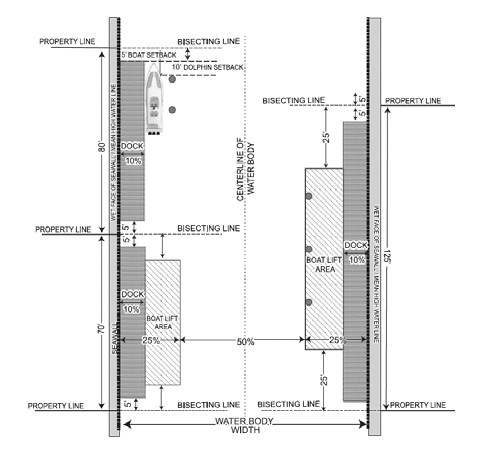
Exhibit B: Docking Design Criteria on Canal Dead Ends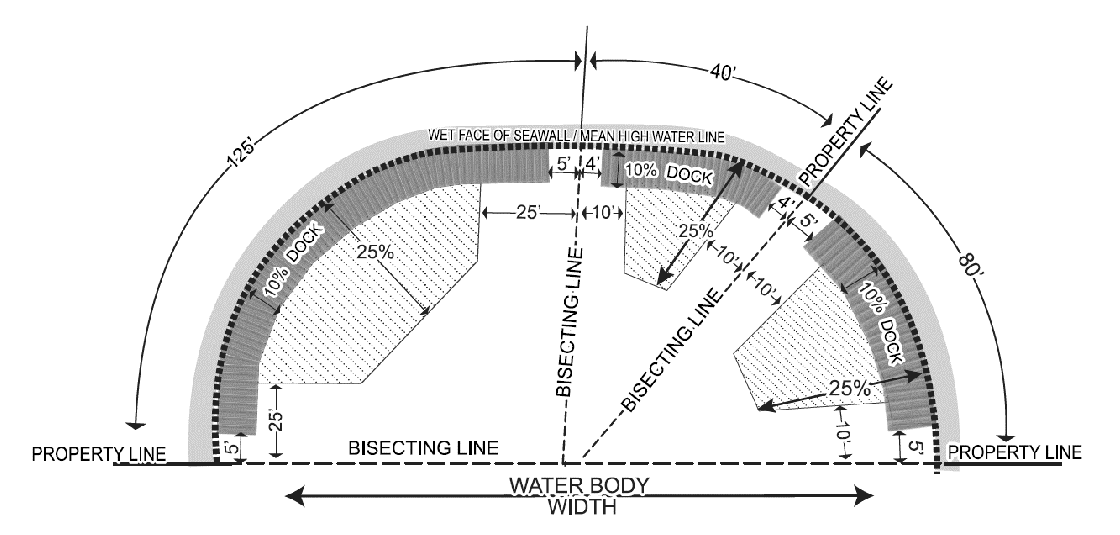
Exhibit C: Dock Design Criteria on Vegetated Unaltered Shorelines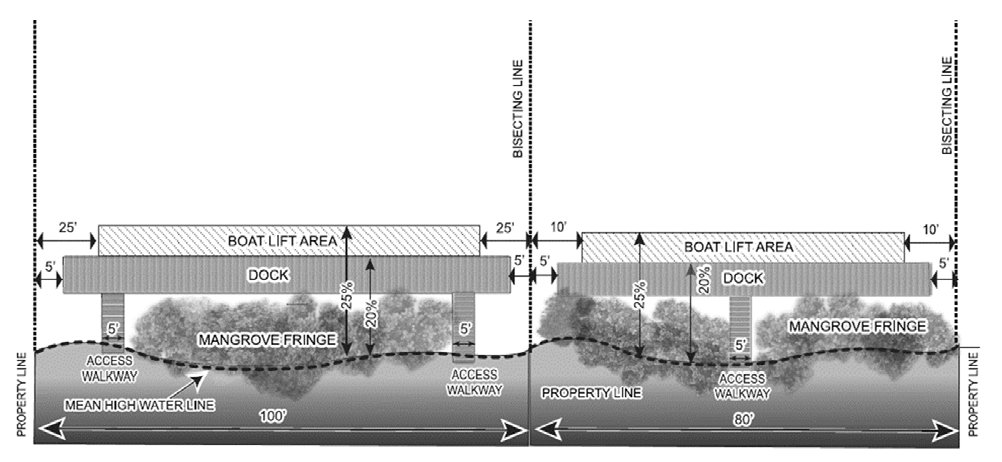
Exhibit D: Dock Design Criteria on Nontidal Water Bodies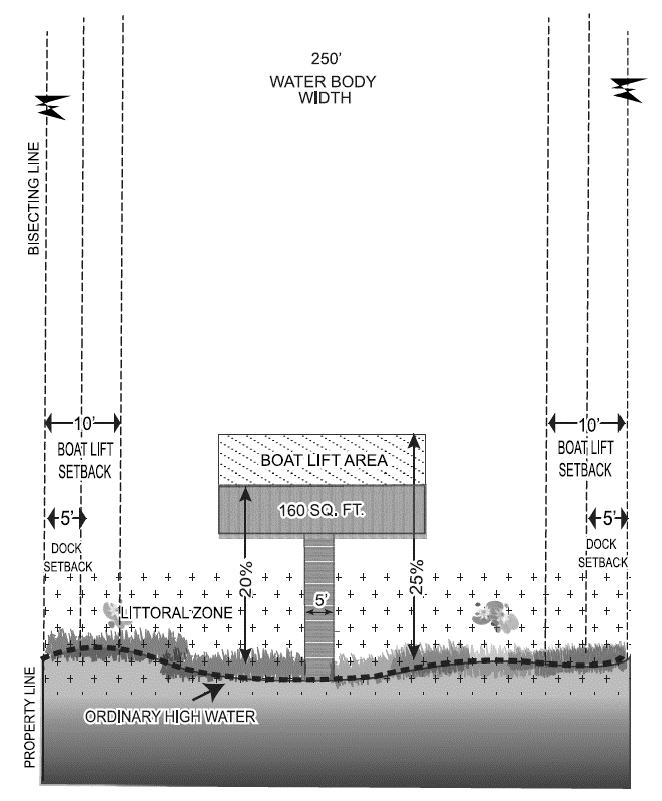
(Ord. No. 2000/033, § 1, 1-23-01; Ord. No. 2004/037, § 1, 12-7-04; Ord. No. 2006/037, § 1, 9-19-06; Ord. No. 2013/033, § 1, 11-5-13; Ord. No. 2014/008, § 1, 3-4-14; Ord. No. 2022/003, § 3, 1-4-22; Ord. No. 2022/014, § 2, 8-16-22)
Sec. 98-88. - Off-street parking and loading.
(a)
Location, general. Off-street parking facilities required by this article shall be located upon the same lot or parcel of land such facilities are intended to serve, or upon a lot or parcel of land, the nearest property line of which is located within 600 feet airline measurement, of the nearest property line it is intended to serve; provided that the city commission may, upon application, permit off-street parking up to a distance of 750 feet from the nearest property line it is intended to serve if it finds that the location and size of the off-street parking facility is such that patrons walking from the parking facility to the use will not unreasonably disturb traffic patterns or neighboring property owners. In instances of off-street parking facilities not contiguous to the parcel of land such facilities are intended to serve, a unity of title or similar legal agreement, which may include but not be limited to a lease agreement or easement deed acceptable to the city attorney, shall be required to ensure the continuity of such parking facilities. All off-street parking facilities required under this article shall be located on property whereon such off-street parking use is a permissible use and shall be designed, developed and maintained in accordance with all applicable provisions of this article.
(b)
For all permitted uses. Parking shall be allowed only on paved surfaces as required in section 98-95(b), Permissible paving. Parking is permitted in any setback areas or yards, except a required waterfront yard, in the RS-5, RS-7 and RM-10 district for single family and two-family dwellings only.
(1)
Required parking spaces for single-family and two-family dwellings:
(i)
All parking shall be located in a carport, garage or driveway.
(ii)
Driveway parking shall be counted as meeting off-street parking requirements.
(iii)
The minimum driveway width shall be 12 feet for straight driveways and ten feet for circular driveways.
(iv)
Driveways shall be no more than 24 feet in width.
(v)
Driveways require a minimum side setback of five feet, as measured along the property line, however they may encroach up to two feet from the side property line once within the property boundaries. On corner lots, the edge of each driveway must be a minimum of 25 feet from the intersection of the extended property lines.
(vi)
No more than one driveway and one circular driveway are permitted. However, in the case of residential properties with two or more street frontages, a maximum of three driveways are permitted. Driveways shall be separated by a minimum of 20 feet at the property line.
(vii)
No more than two driveway curb cuts are permitted per street frontage (three for residential properties with two or more street frontages).
(viii)
A maximum of 75 percent of a required front yard may be used for off-street parking and other paved surfaces.
(ix)
Parking of Commercial vehicles shall comply with section 66-59 of the Code of Ordinances of The City of Deerfield Beach and Parking of Boats and Recreational Vehicles shall comply with Section 66-116 of the Code of Ordinances of The City of Deerfield Beach.
(2)
For all other permitted uses, approved permitted uses with site plan review or approved conditional uses, required front, street side or rear yards may be used for off-street parking, except as limited herein. No parking, required or otherwise, shall be permitted within the swale area of an abutting street or alley. A maximum of 80 percent of a required front yard may be used for off-street parking. No more than two driveways per street frontage shall be permitted for non-residential properties and the two driveways shall be separated by a minimum of 20 feet at the property line.
(c)
Size. Each parking space required and provided pursuant to the provisions of this article shall correspond to parking and drive dimensions provided for herein.
(d)
Handicapped parking. Every parking area designed to serve a use available for the public shall provide parking for the handicapped persons in accordance with State of Florida and Building Code Requirements. This shall include all multifamily developments.
(e)
Access. The plan for ingress and egress to and from the off-street parking area and landscaping shall be subject to the approval of the city. No curbs or sidewalks may be cut or altered in any manner without a permit from the city and all other applicable county or state agencies. Minimum width of an aisle designed and intended for maneuvering of an automobile into a parking space, shall be in conformance with Schedule C. The parking plan must be so arranged that each automobile may be placed and removed from the parking space assigned thereto and taken to and from the property without the necessity of moving any other automobile to complete the maneuver or backing into a right-of-way to complete the maneuver.
(f)
Identification. Each parking space required and provided pursuant to the provisions of this article shall be distinguished and separated from adjoining parking spaces by means of three-inch painted stripes. It shall be the responsibility and obligation of the owner or operator of any building, structure or use affected by this article to maintain such identification markings so that parking spaces at all times are distinguishable from one another.
(g)
Number of parking spaces required. There shall be provided, at the time of the construction of any principal building or structure or at the time any principal building or structure is enlarged or increased in capacity, or at the time any use or occupancy of an existing building is changed to a use or occupancy which increases the requirements for off-street parking, minimum off-street parking facilities with adequate provisions for ingress and egress, in accordance with the requirements of this section and the schedule of off-street parking requirements, as prescribed in this Code. (See Schedule B)
When units or measurements determining number of required off-street parking spaces result in requirement of a fractional space, any such fraction equal to or greater than one-half shall require a full off-street parking space.
(h)
Combined off-street parking. Nothing in this Article shall be construed to prevent collective provision for, or joint use of, off-street parking facilities for two or more buildings or uses by two or more operators, provided that the total of parking spaces when combined or used together shall not be less than the sum of the requirements of the several individual uses computed separately in accordance with this article.
No owner, operator or lessee may designate, stripe, sign or in any other manner, take action to restrict the use of any parking area from the mutual use of other owners, operators, or lessees in a combined off-street parking area.
(i)
Parking of commercial vehicles. Off-street parking facilities supplied by the owner or operator to meet the requirements of this article shall not be used by commercial vehicles owned, operated or used in the business of such owner during regular hours.
(j)
Parking lot design criteria. All surface parking areas shall meet the following criteria:
(1)
Materials. Off-street parking facilities including access aisles, vehicular storage area, and driveways shall be surfaced with a hard, dustless material, and perpetually maintained in a smooth, well-graded condition. Impediments to traffic flow such as speed bumps may not be constructed after March 17, 1992; provided that, where speed bumps exist prior to that date, they shall be deemed to be legal; further provided that, speed bumps may be permitted thereafter only upon application to the city specifying the exact location of the speed bump, height and width of the speed bump, and the length of the speed bump, and the need for the speed bump and after a permit is granted by the city manager or his designee. The permit may only be granted after a finding by the fire chief that a) there is sufficient need for the speed bump, b) that the existence of such a speed bump will not cause a hazard to emergency vehicles which must traverse the area, and c) that the existence of the bump would not unduly burden the ability of emergency vehicles to gain access to the property in question and property in the surrounding areas; as a further precondition to the permit the City shall require submission of two sets of plans by a licensed contractor which plans must be approved by the development review committee prior to issuance of the permit. Driveways, access aisles and parking spaces for churches or public and private schools offering academic courses may be surfaced with grass or lawn. In all instances, either wheel stops or extruded curbing shall be required. In the event extruded curbing is utilized, the landscaped area shall be increased in width by 30 inches (60 inches for head to head spaces).
(2)
Drainage. All off-street parking facilities for the use of the public required by this article shall be drained so as not to cause any nuisance on adjacent or public property.
(3)
Landscaping. As required by this Code.
(4)
Size and configuration. Dimensions for various types of parking spaces and the approved configurations for these spaces are illustrated on the Schedule C.
(5)
Lighting standards. All parking facilities to be developed in multifamily, commercial, and industrial developments shall be illuminated according to the standards contained herein.
(1)
For the purposes of this section, exterior parking facilities shall include the parking surface of open parking lots and access thereto, and parking areas and other non-enclosed areas at grade level for which the parking facilities are a requirement. Garage parking facilities shall include underground, multilevel parking garages, and enclosed grade level parking facilities.
(2)
Illumination.
a.
For exterior or parking facilities, the intensity of illumination shall provide an average of one footcandle equal to one lumen per square foot, and shall be well distributed on the pavement areas; however, at no point shall illumination be less than one-fourth footcandle.
b.
Garage parking facilities shall provide an average intensity of illumination of 50 footcandles at the entrance, ten footcandles in traffic lanes and five footcandles in storage areas.
c.
The current edition of the "IES" Lighting handbook", published by the Illuminating Engineers Society, 345 East 47 Street, New York, N.Y. 10017, is the standard to be used by the architect or engineer as a guide for the design and testing of parking facility lighting. The standards contained therein shall apply unless standards developed and adopted by this section or subsequent amendments are more severe, in which case the more restrictive standards shall apply.
(3)
All site plans for buildings subject to this section must be accompanied by a parking facility lighting plan submitted by a registered architect or a registered engineer. The lighting plan shall be certified by the registered architect or registered engineer as providing illumination in accordance with the applicable minimum standards set forth in paragraph (2) above. Subsequent construction must comply with said lighting plan. If there exists a question concerning whether the work was done in accordance with specifications, the building official may require as a prerequisite to the issuance of a certificate of occupancy that the architect or engineer who prepared the plans certify that all work was done in accordance with specifications.
(4)
All required illumination shall be controlled by automatic devices.
a.
For business uses with exterior or garage parking facilities, the required illumination shall be provided until at least 30 minutes after the closing time of any establishment served by the parking facility.
b.
Any parking facility that serves a residential use must maintain the minimum levels of illumination established by this section through the use of natural or artificial light 24 hours per day.
(5)
In order to minimize offensiveness to persons or neighboring property and to eliminate distractions to and temporary blinding of drivers of vehicles passing illuminated property, in addition to the lighting standard established herein, all artificial parking lot lighting shall either be shaded or screened in a manner that will limit spillover of lighting onto adjacent property and rights-of-way. Spillover shall not exceed three footcandles vertical and shall not exceed one footcandle horizontal illumination on adjacent properties or structures measured at grade. An outdoor lighting installation shall not be placed in permanent use until a letter of compliance signed and sealed by a registered engineer or architect is provided to the city stating that the lights have been field tested and meet the standards set forth above.
(k)
Utilization of parking structures. When off-street parking facilities are located within a separate parking structure the following conditions and restrictions shall apply:
(1)
The structure shall conform to all lot, yard and bulk requirements of the district in which it is located.
(2)
The parking facilities shall be designed so as to conform to all other provisions of this article and all other ordinances of the city.
(3)
All non-structural portions of the exterior elevations, except for vehicular ingress and egress areas, shall, in addition to any required safety provisions, be screened by a sight block of at least 50 percent solidity for the total areas between deck levels, such sight blockage to be determined by elevation. A solid wall for 50 percent of the distance between deck levels will not be acceptable.
(4)
When parking facilities are located on the roof of a structure, a four-foot sight block shall be provided in accordance with subsection (3) above. The definition for height of a building shall be applied in respect to feet and be measured to the top of the sight block as set forth above.
(l)
Bicycle parking. It shall be a requirement that both private and public recreational areas (parks, golf courses, tennis courts, etc.) provide bicycle racks as part of the total off-street parking facilities.
(m)
Off-street loading. In any district, in connection with every building or building group or part thereof, thereafter erected and having a gross floor area of 10,000 square feet or more, which is to be occupied by commercial or industrial uses or other uses similarly requiring the receipt or distribution by vehicles of material or merchandise, there shall be provided and maintained on the same lot with such building, off-street loading berths or unloading berths as follows:
10,000—25,000 square feet—1 berth
25,000—40,000 square feet—2 berths
40,000—60,000 square feet—3 berths
For each additional 50,000 square feet—1 berth
A loading berth shall have a minimum size of 12 feet in width, 30 feet in length and 14 feet in height.
For curb cut and swale information, see section 98-94.
(n)
Compact parking. Compact parking spaces shall meet the requirements of Schedule C for size and configuration and may be used as follows:
(1)
For residential uses and churches and other houses of worship in any zoning district allowing such uses, residential compact spaces may be provided in an amount not to exceed 75 percent of the total parking spaces provided on the site.
(2)
For commercial uses in any zoning district allowing such uses, commercial compact spaces may be provided in an amount not to exceed 50 percent of the total parking spaces provided on the site; except within a designated Community Redevelopment Area, commercial compact spaces may not exceed 75 percent of the total parking spaces provided on the site.
(3)
All commercial and/or residential compact spaces shall be situated in parking lots such that they are in groups or clusters and not intermingled with standard spaces. Specific signage designating commercial and/or residential compact spaces is not required.
(4)
For industrial uses in industrial zoning districts, industrial compact spaces may be provided in an amount not to exceed 25 percent of the total parking provided on the site. Industrial compact spaces shall be signed to designate them as compact spaces.
(5)
For all uses allowed in industrial zoning districts, commercial compact spaces may be provided in an amount not to exceed 50 percent of the total parking provided on the site. In such cases, use of commercial compact spaces are also subject to (3) above.
(o)
[Valet parking.] Valet parking is hereby permitted as a means to satisfy the off-street parking requirements contained in this Code, under the following circumstances:
(1)
The owner of the property must submit a written affidavit to the City of Deerfield Beach stating that it will provide for valet parking during all operating hours and specifying the minimum amount of personnel who will be providing said valet service and detailing the arrangements which have been made to provide for spaces for said valet operation. City property or public right-of-way may not be used for such spaces unless the property to be served is owned by the city.
(2)
Valet spaces which are to be credited against city off-street parking requirements are not greater than 1,250 feet from the property line of the facility to be served.
(3)
The valet parking plan set forth in such affidavit must be found acceptable by the director of planning. Provisions for nonconcurrent use of spaces may be made. Should any changes be made in the valet plan, a revised affidavit acceptable to the director of planning shall be submitted. Failure to provide valet service in conformity with the affidavit shall be a violation of this Code.
(4)
Valet parking may not satisfy more than 50 percent of the parking requirements contained in Deerfield Beach Land Development Code. If the spaces in question are part of the required parking for the property in question, the permission must indicate that the principal use located on the property will not be in operation for the hours during which valet parking will be permitted.
No valet parking operation conducted within the city may charge a fee for parking vehicles where said vehicles are parked on city right-of-way or property. This prohibition shall not apply to city operated valet operations, or valet operations which serve facilities located on city property.
(p)
Any handicapped seating area in a facility subject to F.S. § 553.503, shall not be considered a customer service area or floor area for the purposes of parking requirements.
(q)
The city commission may authorize a technical deviation from the parking requirements provided in section 98-88 of the City Land Development Code under the conditions set forth below. A technical deviation is a reduction in the required amount of parking spaces required by the city. No one shall have a right to a technical deviation and the granting of a technical deviation shall be within the sole discretion of the city commission. It shall be the burden of the applicant to affirmatively demonstrate on the record, by the greater weight of the evidence that satisfaction of the necessary requirements set forth below. One of the following requirements must be met in order to receive a technical deviation:
(i)
The applicant affirmatively demonstrates that the application for off-street parking requirements places restrictions upon the use of the proposed development which make the off-street parking requirements excessive in view of the use limitations being voluntarily placed upon the proposed use (provided said use restrictions are included in an enforceable development agreement). It shall be the burden of the applicant to propose, with its application, the voluntary restriction; or
(ii)
It is found that the arrangement of uses in close proximity to the proposed use is such that, when combined with available mass transit or other uses which are likely to provide parking for patrons of the proposed use without the necessity of seeking a different parking space, is such that the strict application of the off-street parking ordinance requirements would be inequitable to the applicant, or unnecessary to protect the public interest, or would be in excess of that needed to provide sufficient parking for the proposed use; or
(iii)
A study is provided by a qualified traffic engineer or (AICP) certified planner indicating that, for the specific use, considering any use restrictions, other unique characteristics of the area, or other specific elements unique to the development, strict application of the off-street parking requirements will make it inequitable to the applicant or unnecessary to protect the public interest to apply the specific requirements of the off-street parking ordinance and that sufficient parking to serve the proposed development exists with the granting of the technical deviation; or
(iv)
(a)
All parking deviations east of S.E. 15 Avenue are hereby determined to have an effect upon the City of Deerfield Beach and the parking in the beach area. Therefore, all parking deviations as granted herein shall be subject to the requirements set forth in this subsection (iv) except for development on city owned property. The area east of S.E. 15 Avenue within the City of Deerfield Beach shall be known, for the purposes of this subsection, as the "Beach Area."
(b)
The City Commission of the City of Deerfield Beach has determined that, while parking deviations may be determined to be merited in the Beach Area, there is also a need for additional parking or improvements to the parking system. Therefore, the impact of any parking deviation granted will have a negative impact upon the proper provision of parking spaces in the Beach Area. To remedy this effect, while still providing a means of obtaining parking deviations in the Beach Area and thus encourage economic revitalization, the City Commission of the City of Deerfield Beach has determined that a fee related to the number of parking spaces involved in any parking deviation shall be imposed. The fee shall support improvements to the public parking system in the Beach Area which obtain technical deviations. The provisions of this subsection are therefore adopted by the City Commission of the City of Deerfield Beach and are imposed upon persons or entities obtaining parking deviations in the Beach Area in order to offset technical deviations granted in the Beach Area and to provide a benefit to the parties obtaining technical deviations commensurate with their impact.
(c)
As a condition to the receipt of any technical deviation in the Beach Area, the applicant shall be required to pay into a city fund, established expressly for the purposes as set forth herein, the sum of $6,000.00 for each parking space reduction received as part of a technical deviation approval. The funds received pursuant to this requirement shall be used for the following purposes in the Beach Area only:
(i)
Constructing parking facilities except as prohibited by the City Charter; or
(ii)
Operating shuttle systems to parking facilities; or
(iii)
Improving pedestrian and bicycle paths, facilities and safety; or
(iv)
Long term (in excess of 25 years) leasing private spaces for public use; or
(v)
Improving existing parking facilities (except as prohibited by the City Charter); or
(vi)
Other programs to improve the off-street parking system; or
(vii)
Any project which has the effect of reducing the demand on existing public parking spaces in the Beach Area as determined by the city commission.
The city commission may grant such technical deviation from the requirements of the off-street parking requirements as it deems justified based upon the criteria described above in subsections (q)(i) or (ii) or (iii) with any conditions it deems necessary to assure that the reasonable parking needs of the use are provided for. No application which does not contain a specific statement in response to either subsection (q)(i) or (ii) or (iii) shall be accepted for processing.
(Ord. No. 1996/017, § 1, 5-21-96; Ord. No. 1997/009, § 1, 4-1-97; Ord. No. 1997/039, § 1, 11-18-97; Ord. No. 2000/001, § 28, 4-5-00; Ord. No. 2002/023, § 5, 7-31-02; Ord. No. 2003/002, § 1, 1-7-03; Ord. No. 2003/047, § 1, 11-4-03; Ord. No. 2011/002, § 1, 1-11-11; Ord. No. 2017/013, § 11, 6-19-17)
Sec. 98-89. - Reserved.
Editor's note— Ord. No. 2014/017, § 6, adopted June 17, 2014, repealed § 98-89, which pertained to service stations. See also the Table of Amendments.
Sec. 98-90. - Drive-in facilities.
Drive-in facilities may be permitted only as an accessory use and only when the following provisions are met and approved by the city.
(1)
Location and arrangement of exits and entrances. No drive-in accessory use shall have an entrance or exit for vehicles which is located closer than 30 feet to any intersection of public streets. Individual ingress and egress drives extending across public sidewalks and curbs shall be subject to the same standards and approvals as those for off-street parking access.
(2)
Size and arrangement. No drive-in accessory use shall project into any front yard or, if applicable, street side yard further than the principal building. A maximum of six drive-in stalls is permitted and they shall be located so as to not restrict pedestrian access to any public entrance of the principal building, be it further provided that any portion of the drive-in facilities, including access drives, which are located between the principal building that required off-street parking shall have adequate pedestrian safeguards. There shall be a minimum stacking area which shall be no less than 80 feet.
Sec. 98-91. - Miscellaneous uses.
(a)
Home occupations.
(1)
A home occupation is a business, profession, occupation or trade that is conducted within a residential dwelling unit for the economic gain or support of a resident of the dwelling, is incidental and secondary to the residential use of the lot and does not adversely and/or perceptively affect the character of the lot or surrounding area. Examples of home based businesses include, but are not limited to, the following: offices of lawyers, architects, engineers, contractors, consultants, stock brokers, marketers, bookkeepers, real estate brokers and insurance agents; electronic and offsite retail; studios of artists, and musicians; sewing, millinery and dressmaking services. Home occupations do not include such businesses as: family child care homes and large family child care homes (which are separate accessory uses of homes), automotive repair and the like; any licensed or unlicensed practitioner who performs invasive procedures (acupuncture, tattooing, body piercing and the like); restaurants, bars, social clubs and the like; animal kennels or hospitals and the like; motor vehicle sales including internet-based motor vehicle sales; or any other business that is clearly inappropriate or out of character for a residential area such that its location constitutes an adverse impact on neighboring residential properties.
(2)
Standards. Home occupations are allowed as an accessory use to any principal dwelling unit, subject to the following standards:
a.
Parking of commercial vehicles in accordance with section 66-59.
b.
The operator of the home occupation shall be a full-time resident of the principal dwelling.
c.
No person other than full-time residents of the principal dwelling may be employed in connection with the home occupation.
d.
The home occupation shall cause no change in the external appearance of the existing dwelling and structures on the property.
e.
There shall be no outdoor display or storage of goods, equipment or services associated with the home occupation.
f.
There shall be no other exterior evidence to indicate that the premises are being used for any purpose other than for a dwelling use.
g.
There shall be no direct, on-premise retail sales to customers.
h.
There shall be sufficient off-street parking for patrons of the occupation, with the number of off-street parking spaces required for the home occupation provided and maintained in addition to the space or spaces required for the dwelling itself.
i.
The home occupation shall not involve significantly greater volumes or frequencies of deliveries or shipments, vehicular traffic or pedestrian traffic than normally expected in a residential area.
j.
The home occupation shall not generate noise, vibration, odor, glare, fumes or electrical or communications interference (including visual or audible interference with radio or television reception) that can be detected by the normal senses off the premises.
(b)
[Reserved. ]
(c)
Alcoholic beverage establishments. Applications for alcoholic beverage establishments where consumption takes place on the premises shall demonstrate conformance with the following requirements to merit approval for operation within the City of Deerfield Beach:
(1)
Distance from church or school. No establishment for the sale of any alcoholic beverage for consumption on the premises or bottle club shall be located within 500 feet of any established church or school located within or without the corporate limits of the City of Deerfield Beach, measured from the main normal public entrance of the alcoholic beverage establishment to the main entrance of the church or to the point of school property measured along public thoroughfares by the shortest route of ordinary pedestrian traffic, or within 500 feet airline measurement.
(2)
Application to new churches or schools. Where an alcoholic beverage establishment is located in conformity with the provisions of this section, the subsequent location of a church or school in the proximity of such existing establishment shall not be construed to cause such establishment to be in violation of this section nor to cause such establishment to be deemed a nonconforming use.
(d)
[Garage sales.] Garage sale shall be permitted in residentially zoned areas and shall be regulated as follows:
(1)
Garage sales. A garage sale shall be construed to mean any sale or transfer for consideration of goods, items or articles of any kind conducted on residentially zoned property in the City of Deerfield Beach where evidence of sale activity is observable from other residences or the public right-of-way.
(2)
Garage sales on a residentially zoned property shall be allowed but are hereby limited to three per residence per calendar year. Garage sales concurrently held by adjoining residences shall be considered separate garage sales. No other garage sales shall be allowed under any circumstances. No garage sale shall be allowed on vacant lots.
(3)
A single garage sale may continue for two consecutive days but shall only be conducted between the hours of 8:00 a.m. and 6:00 p.m. Garage sale signs are temporary signs and are regulated pursuant to chapter 102 of the City of Deerfield Beach Land Development Code.
(4)
All merchandise shall be placed only on the driveway of the residence or the front or side lawn. The merchandise shall be at least five feet from any paved street. Merchandise for sale shall be placed out in an orderly fashion.
(5)
It shall be a violation of this section for a person holding a garage sale to sell merchandise which was acquired or consigned for the purpose of resale.
(6)
At the conclusion of such garage sales, all unsold articles and items shall be removed or packed in such a manner so as not to be visible from any public streets or abutting property.
(7)
The owner or tenant of the property on which the sale is conducted shall be responsible for the maintenance of good order and decorum. There shall be no loud or boisterous conduct on the premises.
(8)
Any person may report a garage sale by sending or providing to the City's Code Compliance Department any combination of date-stamped photographs depicting the garage sale and the address where it occurred. It shall be the responsibility of the Code Compliance Department to keep and maintain a log, which shall be available for public inspection upon reasonable notice, of all garage sales reported to it under this section.
(e)
Temporary use of off-street parking facilities as commercial parking lots. Subject to the conditions set forth herein, off-street parking facilities associated with permitted uses may be used for purposes other than parking at the use for which the parking facilities were approved, and a fee charged for such parking in said spaces, provided the following conditions have been met and a license granted:
(1)
The property in question is in a commercially zoned district;
(2)
The property is located west of A1A if it is north of N.E. 2nd Street and west of 21st Avenue if it is south of N.E. 2nd Street;
(3)
The facility presently has adequate off-street parking per the City Code; and
(4)
The parking lot was constructed pursuant to an approved site plan by the City Commission of the City of Deerfield Beach; and
(5)
An application is filed on a form prescribed by the director of planning which depicts the parking lot in question, the spaces which are going to be used per this section, and providing such other information as is deemed necessary and appropriate by the director of planning; and
(6)
The city commission approves the application. The city commission may approve an application with conditions to mitigate any impacts upon the beach community.
(Ord. No. 1998/023, § 1, 6-30-98; Ord. No. 2000/001, § 30, 4-5-00; Ord. No. 2003/043, § 1, 10-21-03; Ord. No. 2017/013, § 12, 6-19-17; Ord. No. 20147/016, § 1, 8-15-17; Ord. No. 2024/009, § 3, 6-4-24)
Sec. 98-92. - Nonconforming building, structures or land and uses.
(a)
Continuation of use. A use, parcel of land, building or structure, lawfully in existence at the effective date of this Code which shall be made nonconforming at the passage of this Code or any applicable amendment thereto, may be continued, except as otherwise provided in this article.
A use is nonconforming if it fails to comply with all the requirements of the zoning district in which it is located or any land development regulation or is located in a nonconforming building. A parcel of land, a building or a structure is nonconforming if it fails to comply with the requirements of the zoning district in which it is located or the land development regulations or it houses, or is the site of a nonconforming use.
(b)
Regulation of nonconforming buildings, structures or lands. No existing building, structure or lands devoted to a nonconforming use shall be enlarged, extended, reconstructed, substituted or structurally altered, except when changed to a conforming use or when required to do so by law.
(1)
Restoration. Any nonconforming structure which has less than 50 percent of its previous existing floor area made unsafe or unusable, may be restored or reconstructed for its intended use, provided that the floor area of such use, building or structure shall not exceed the floor area which existed prior to such damage. All repairs shall be completed within one year after damages occur or such use shall not be rebuilt except as a conforming use.
(2)
Structures qualifying for reconstruction/restoration. Where the building or structure is located east of the Intercoastal waterway and more than 50 percent of the previous existing floor area is rendered unsafe or unusable due to an event outside of the control of the property owner (a "qualifying structure"), the qualifying structure may be restored or reconstructed for its intended use, provided that (i) the floor area of the restored or reconstructed qualifying structure shall not exceed the floor area, setbacks and height that existed prior to such event, (ii) the restoration or reconstruction shall be substantially completed within two years after the event causing the qualifying structure or such later time as approved by the city in writing, and (iii) the following conditions are satisfied as determined by the zoning appeals special master after a public hearing to be requested by the property owner:
a.
At the time the damage occurred, there is no record that the qualifying structure had any outstanding or unresolved code violation orders; and
b.
The property owner provides an affidavit executed and prepared by a professional engineer or architect, registered in the State of Florida, certifying that the qualifying structure is structurally and electrically safe for the specified use for continued occupancy in conformity with the minimum inspection and procedural guidelines as issued by the board of rules and appeals. The affidavit shall be executed and dated within the three-year period immediately prior to the damage causing the qualifying structure; and
c.
Any non-conformities that existed immediately prior to the event causing the qualifying structure to not pose a threat to the peaceful enjoyment by abutting property owners of their property; and
d.
In the case of commercial/hotel buildings, that the restoration or reconstruction of the qualifying structure would not negatively impact the economic vitality of the area in which it is located; and
e.
No additional dwelling units shall be constructed and the nonconformities that existed prior to the damage are not expanded; and
f.
There is no change of use in the qualifying structure.
Notwithstanding anything set forth above to the contrary, reconstructed structures or buildings shall comply with all building and fire codes applicable at the time of reconstruction.
(3)
Repair. Normal maintenance repair and incidental alteration of a structure containing a nonconforming use is permitted, provided it does not extend the area or volume of space occupied by the nonconforming use or increase the noise level, amount of odors or emissions emanating from the nonconforming use. A building or other structure containing residential nonconforming uses may be altered in any way to improve interior livability, provided however, that no structural alterations shall be made which would increase the number of dwelling units or the square footage or height of any building.
(4)
Site or building alterations. Site or building alterations to nonconforming lands, buildings or structures are not permitted unless the City Commission finds that:
a.
The land, building or structure is nonconforming because one or more physical characteristics, not including use, of the development are nonconforming; and
b.
The proposed alterations do not increase the size of the building or structure; and
c.
Proposed alterations do not permit a nonconforming use to be expanded. No nonconforming use shall be enlarged or increased, nor extended to occupy a greater area of land, building or structure than was occupied on the date the use became nonconforming;
(c)
Regulation of nonconforming uses.
(1)
Nonconforming uses of land, buildings or structures. No nonconforming use shall be enlarged or increased, nor extended to occupy a greater area of land, building or structure than was occupied at the effective date of adoption or amendment of this section.
(2)
No such nonconforming use shall be moved in whole or in part to any portion of the lot or parcel other than that occupied by such use at the effective date of adoption or amendment of this section.
(3)
No existing land, building or structure devoted to a nonconforming use shall be enlarged, extended, constructed, reconstructed, moved or structurally altered, except in changing the use of the structure to a use permitted in its zoning district.
(d)
Regulation of nonconforming structures or sites. The following provisions of this article are intended to apply to any primary or accessory building or structure, including trash enclosures and their lots, existing at the effective date of this chapter that do not meet the regulations of this chapter for height, yards, lot area, lot width, lot coverage, floor area, floor area ratio, separation, design, parking, traffic circulation, drive lanes, access points, landscaping, lighting or any other similar dimensional requirements or limitations.
(1)
A nonconforming property owner seeking to amend any or all portions of their development plan may do so in conformance with LDC section 98-16, provided that any amendment is to the most reasonable extent to meet all provisions of the Land Development Code as determined by the director of planning and development services. In reviewing development application submittals, the planning and development services director shall consider the following to determine compliance with nonconformance to the Land Development Code:
a.
The size and configuration of the site.
b.
The extent that the proposed alteration will improve the character or quality of the site.
c.
The extent to which parking areas, site lighting and traffic situations are improved for the site.
d.
The extent to which safe pedestrian access and movement is enhanced for the site.
e.
The extent to which landscaping is increased or improved for the site. Mitigation for missing landscaping already approved shall not be counted as increases or improvements.
(2)
Amendments to any site or development plan where the only proposed change is for the purpose of complying with the Americans with Disabilities Act is exempt from this section.
(e)
Termination of nonconforming uses and structures.
(1)
Abandonment. A nonconforming use discontinued or not used for a period of more than 120 consecutive days (not including closure for renovations or repairs) or the change of use to a conforming use for any period of time, shall be considered an abandonment thereof, and such nonconforming use shall not thereafter be revived. When a nonconforming parcel of land, building or structure is not used for a period of 120 consecutive days (except when governmental action impedes access to the premises), the land, building or structure shall not thereafter be used except in conformity with the regulations of the zoning district in which it is located. If a nonconforming use is discontinued or abandoned on a portion of the land or structure for 120 consecutive days, that portion of the land or structure shall not thereafter be used except in conformity with the regulations of the zoning district in which it is located.
(2)
Land or structures shall not be deemed to be active and in continued nonconforming usage solely from the existence of a state license or local business tax receipt permitting such a use or business, but such use or business must be actively undertaken, staffed and in operation, unless other facts show legally sufficient activity, for such use or business to be deemed in active continued nonconforming usage.
(3)
It shall constitute a rebuttable presumption that the use has been abandoned if a land, building or structure is noted by city code inspectors or police officers to be vacant and/or unoccupied during the 120-day period. Unoccupied means any land, building or structure which is not being used by persons authorized by the owner of the property on which such building or structure is located. Vacant and/or unoccupied also means where utility services have been terminated.
(4)
Partial destruction. When 50 percent or more of the existing floor area of a nonconforming structure is destroyed by fire or other casualty or act of God and as a result becomes unsafe or unusable, the use of such structure as a nonconforming use shall thereafter be terminated. Provided that, where a nonconforming use is a residence located in a residential zoning district, it may be reconstructed to its prior condition, even if more than 50 percent of the floor area is destroyed.
(f)
Early termination of nonconforming use or structure where nuisance is created.
(1)
Where the nonconforming aspect of a nonconforming use or the nonconforming elements of a nonconforming structure create a nuisance then, in that event, the city shall have the right to require that the use be made conforming or that the nuisance be permanently abated. For the purposes of this section, a nuisance shall be deemed to be any activity, conduct or circumstance which emanates from the nonconforming use, land, building or structure that is injurious to the health of those residing in neighboring residences or using neighboring businesses or is unreasonably offensive to the senses of those occupying neighboring businesses or residences which creates conditions which interfere with the use or enjoyment of neighboring property, property or residences. For illustrative purposes only, a nuisance may result from offensive smells, loud and frequent noises, air pollution, unsightly conditions, damage to the environment or any condition that will have a material and adverse impact on the quality of life of those using neighboring businesses or residing in neighboring residence.
(2)
The creation or existence of a nuisance as set forth within Chapter 34, Article III of the Code shall be deemed a violation of this section and shall be subject to fines as set forth in section 2-361 of the City Code and shall constitute grounds for termination of the legal nonconforming status of the use or structure.
(3)
Where the city claims that a nuisance exists it shall provide written notice, by certified mail or hand delivery, to the business or enterprise creating the nuisance. If certified mail is not claimed within three business days of its availability, the City may provide notice by regular mail to the location. Mail and delivery shall be to the location listed on the business tax receipt application. The notice shall state the nature of the nuisance and the intent of the City to revoke the nonconforming status of the business or enterprise. The notice shall state a date, time and place at which a hearing of the City's intent to revoke the nonconforming status and notify the recipient that it shall have the opportunity to respond to the charges of nuisance at said hearing by introducing witnesses and evidence and making such legal and factual arguments as are based in law and fact. The hearing shall be held before the code enforcement special master. Should the code enforcement special master find the existence of a nuisance then, in that event, the nonconforming status of the land, building or structure shall be deemed to be terminated. Continuation of the nonconforming use, or use of the nonconforming land, building or structure except in compliance with the current City Code and land development and use regulations, shall be a violation of the City Code subject to prosecution before the code enforcement special master or in county court, through a notice to appear, or through an action for injunction in circuit court, at the city's option.
(Ord. No. 2011/051, § 1, 11-1-11; Ord. No. 2016/024, § 7, 12-6-16; Ord. No. 2019/012, § 2, 5-21-19)
Sec. 98-93. - Development standards for assisted living facilities and community residential homes.
(a)
Design standards. Residential facilities including assisted living facilities and community residential homes shall be governed by section 98-61, schedule of dimensional regulations, for the zoning district within which the property is located.
(b)
Dispersal. Facilities governed by F.S. § 419.001, as amended, shall be subject to the separation requirements set forth therein.
(c)
Density computation. The density and development restrictions for the zoning district in which the assisted living facility or community residential home is located shall apply to the same extent they do to all other development in the applicable zoning district and as set forth in the Broward County Land Use Plan.
(d)
Number of persons per sleeping room. The number of persons per sleeping room shall not exceed two.
(e)
Parking requirements. Parking requirements shall be provided as follows:
(f)
Procedure. All applicants desiring to establish a community residential home II or assisted living facility within the City of Deerfield Beach shall be required to provide information to the city as follows:
(1)
Name and address of applicant;
(2)
Name and address of facility operator/manager;
(3)
State of Florida licensing office if applicable;
(4)
Nature of services to be provided on-site;
(5)
Number of proposed units/beds/assigned residents;
(6)
Number of staff;
(7)
If the application is for an assisted living facility, a copy of the applicable license from the agency for health care administration.
(Ord. No. 2001/014, §§ 1, 2, 6-14-01; Ord. No. 2008/013, § 11, 5-20-08; Ord. No. 2011/043, § 1, 9-20-11; Ord. No. 2012/029, § 3, 7-10-12)
ADDITIONAL REFERENCES
Sec. 98-94. - Growth of plants and placement of objects in the right-of-way.
This section shall regulate the placement of objects in the swales, medians, and rights-of-way and shall also regulate the growth of any trees, bushes, shrubs or other plants which are planted on, or encroach upon, the City of Deerfield Beach right-of-way in any manner, whether such objects or plants be on public right-of-way or on abutting private property except as expressly permitted herein.
(1)
Definitions:
Median: That area between opposing travel lanes of a vehicular thoroughfare.
Swale: The unpaved, permeable area between the edge of a paved roadway or street and the right-of-way line.
Right-of-way: The entire width of the dedicated public way, used or to be used for a street, alley or walkway including the swale area, any paved sidewalk area, all median areas and the paved area for vehicular traffic.
All other words shall carry their common meaning as stated in the edition of Webster's New Collegiate Dictionary which is most current at the time of final passage of this Code.
(2)
No abutting property owner may install or permit to remain in the public right-of-way including the swale abutting such owner's property any landscaping or nonliving objects which protrude above the existing grade except real estate temporary "open house" direction signs as defined in section 98-97, signs advertising the conduct of a garage sale as permitted in section 98-91(d) of the Land Development Code, mail boxes installed on nonhazardous supports, as provided for in the American Association of State Highway and Transportation Officials publication "A Guide for erecting mailboxes on Highways," as such may be amended from time to time, franchised public utilities, structures of governmental agencies, round white concrete buttons ten to 14 inches in diameter and four inches in height with no exposed edges, and privately installed landscaping or nonliving objects or structures as provided for and permitted in section 98-95 of this Code.
(3)
No property owner may install or permit to remain, on such owner's property, any landscaping or nonliving object which is in violation of either section 46-13 of the City Code or section 98-71(b) of this Code or which while planted or installed in the abutting property owner's private property extends into or protrudes out over or overhangs the public right-of-way in such a fashion as to impede or restrict travel on such public right-of-way including pedestrian traffic on sidewalks or impede or restrict complete visibility of any part of the public right-of-way or traffic-control signs thereon by persons who are traveling on or who are upon the public right-of-way.
(4)
The city may trim or remove any landscaping planted or installed by any private property owner when such landscaping grows to an extent that it violates either section 46-13 of this Code or section 98-71(b) or grows to such an extent that it violates subsections (b) or (c) or does not comply with section 98-95. The city may remove any non-living objects which exist on or extend into the right-of-way which do not comply with this Code. Such removal or trimming shall only take place after the abutting property owner is provided 14 days notice of the requirement for such and no corrective action is taken by such property owner within that period of time.
Provided however, the city may trim such growths or objects upon 24-hour notice or even without notice when, in the opinion of the city, such present an acute or immediate threat to the health, safety and welfare of the citizens.
(Ord. No. 2014/011, § 2, 4-1-14; Ord. No. 2017/013, § 13, 6-19-17)
Sec. 98-95. - Landscaping and paving.
(a)
Permissible landscaping. Live landscaping may be permitted on swale areas and median areas of public right-of-way not used for vehicle or pedestrian traffic, provided such landscaping meet the following conditions:
(1)
Ground cover shall be permitted provided that it shall not be allowed to grow to a height higher than 24 inches above the existing grade;
(2)
Trees must be high enough so as to provide a nine-foot clearance between the lowest hanging branch or leaf and the existing grade;
(3)
Sod may be placed in the public swale provided said sod or grass is not permitted to grow to a height in excess of six inches;
(4)
The abutting property owner, or the City of Deerfield Beach, or other governmental agency, are the only parties who may place such landscaping in the public swale or median. Where live landscaping is placed in the swale or median by a private property owner, the owner of that property shall be responsible for maintaining said landscaping. If such landscaping is not maintained in living condition by a private party responsible for doing so, the city may remove said landscaping from public right-of-way;
(5)
Planters may be erected around permitted trees (as set forth in (2) above), provided the planters are no higher than 12 inches and do not encroach on any paved portion of the right-of-way.
(6)
The permission granted herein may be revoked by the city at any time.
(b)
Permissible paving. Pavement which has been constructed under a legal construction permit within the right-of-way prior to the effective date of this section shall be permitted to remain in place or to be replaced with matching construction by the owner or by any contractor, including the city, who shall have caused such paving to be destroyed. Driveways in the right-of-way constructed or replaced after effective date of this section may be paved with limerock base and asphalt in accord with city engineering standards or may be paved with any other material which has a paved wearing surface equal to, or better than, the standard city driveway design, as approved by the building official of the city. However, should any other than a city standard driveway be destroyed as a result of city work in the right-of-way, the city shall not be liable for any driveway restoration, other than reconstruction of the driveway with limerock base and asphalt in accord with city engineering standards. However, at his own option the abutting property owner may elect to have constructed, or at his own expense and under his own private contract, a driveway as approved by the building official, other than the standard city limerock-asphalt driveway. In this case said owner waives all rights to any compensation from the city for driveway replacement.
Driveways, or the paving of median strips, shall require written approval of the plans by the environmental services department and, if in state right-of-way, a permit from the State Department of Transportation.
Sidewalks shall be installed in accordance with the provisions of this Code. All other paving within the right-of-way is prohibited.
(Ord. No. 2009/002, § 2, 1-13-09; Ord. No. 2017/013, § 14, 6-19-17)
Sec. 98-96. - Enforcement.
(a)
The city may enforce the provisions of this chapter through the code enforcement process set forth within chapter 2, article VI of the City Code. Any violation of the provisions of this chapter may also be enforced pursuant to section 1-15 of the City Code.
(b)
In instances where the objects in the public right-of-way or swale present an acute and immediate threat to the health, safety and welfare of the citizens, the city manager or his designee may remove such objects immediately or may give the abutting property owner a period of time not to exceed 24 hours to remove the object(s).
(Ord. No. 2017/018, § 10, 8-15-17)
Sec. 98-97. - Signs.
The provisions of Chapter 102 of this Code (Ordinance 2002/040) as it may be amended from time to time, relating to signs is incorporated into this Land Development Code.
(Ord. No. 2002/040, § 2, 11-19-02)
Sec. 98-98. - Communication towers and antennas.
(a)
Legislative intent. The regulations and requirements of this division establish general guidelines for the siting of wireless communications towers and antennas and are intended to accomplish the following purposes:
(1)
Promote the health, safety and general welfare of the public by regulating the siting of wireless communication facilities, including satellite earth stations;
(2)
Minimize the impacts of wireless communication facilities on surrounding areas by establishing standards for location, structural integrity and compatibility;
(3)
Encourage the location and co-location of wireless communication equipment on existing structures thereby minimizing new visual, aesthetic and public safety impacts, effects upon the natural environment and wildlife, and to reduce the need for additional antenna-supporting structures;
(4)
Accommodate the growing need and demand for wireless communication services;
(5)
Encourage coordination between suppliers of wireless communication services in the City of Deerfield Beach;
(6)
Respond to the policies embodied in the Telecommunications Act of 1996 in such a manner as not to unreasonably discriminate between providers of functionally equivalent personal wireless service or to prohibit or have the effect of prohibiting personal wireless service in the city;
(7)
Establish predictable and balanced codes governing the construction and location of wireless communications facilities, within the confines of permissible local code;
(8)
Establish review procedures to ensure that applications for wireless communications facilities are reviewed and acted upon within a reasonable period of time and in compliance with all applicable federal and state laws;
(9)
Protection of the unique natural beauty and rural character of the town while meeting the needs of its citizens to enjoy the benefits of wireless communications services.
(10)
Enhance the ability of the providers of wireless communications services to provide to the community reliable wireless communications services based on best practices through an efficient and timely application process;
(11)
To comply with the requirements of Section 6409 of the Middle Class Tax Relief and Job Creation Act of 2012, the Telecommunications Act of 1996 and F.S. § 365.172.
(b)
Definitions. As used in this division, the following words, terms and phrases when used in this division shall have the meanings set forth below, and for the purpose of this division shall control over any other definitions contained in the City's Code of Ordinances. Words not defined shall be given their common and ordinary meaning.
"Accessory use" means a secondary use including a use that is related to, incidental to, subordinate to and subservient to the main use of the property on which an antenna and/or telecommunications tower is sited.
"Amateur radio antenna" means an antenna used to engage in amateur radio communications as licensed by the FCC and in accordance with federal law.
"Antenna" means a transmitting and/or receiving device mounted on a telecommunications tower, building or structure and used in wireless communications services that radiates or captures electromagnetic waves, digital signals, analog signals, radio frequencies, wireless communications signals and other communications signals, including directional antennas such as panel and microwave dish antennas, and omni-directional antennas such as whips, but excluding radar antennas, amateur radio antennas and satellite earth stations.
"Applicant" means any party submitting an application within the meaning of this division.
"Application" means any proposal, submission or request to construct, operate, or maintain a telecommunications tower, equipment facility, wireless communications facility, or antenna within the city or to seek any other relief from the city pursuant to this division.
"Array" means a group of antennas that are either (i) mounted or side mounted on the rooftop of a building or rooftop structure(s); or (ii) directly or indirectly mounted on a telecommunications tower.
"Attached wireless communication facility" means an antenna or antenna array that is attached to an existing building or other non-tower structure, with any accompanying mounting structure or device which attaches it to the building, non-tower structure, transmission cables, and an equipment enclosure, which may be located either inside or outside of the existing building or non-tower structure. An attached wireless communications facility is considered to be an accessory use to the existing principal use on a site.
"Broadcasting facility" means any telecommunications tower or antenna built primarily for the purpose of broadcasting AM, FM or television signals.
"Building Code" means the Florida Building Code, as amended, the National Electrical Code, as amended, the National Electrical Safety Code, as amended, FCC regulations, as amended, and any other applicable federal, state, and local building codes.
"Building-permit review" means a review for compliance with building and related construction standards adopted by the city and does not include a review for compliance with land development regulations.
"Carrier" means a company licensed by the Federal Communications Council (FCC) that provides wireless services. A tower builder or owner is not a carrier unless licensed to provide personal wireless services.
"City" means the City of Deerfield Beach, Florida.
"Collocation" means the situation when a second or subsequent wireless provider uses an existing structure to locate a second or subsequent antenna. The term includes the ground, platform, or roof installation of equipment enclosures, cabinets, or buildings, and cables, brackets, and other equipment associated with the location and operation of the antennas.
"Commercial mobile radio services" means, per Section 704 of the Telecommunications Act of 1996, any of several technologies using radio signals at various frequencies to send and receive voice, data and video.
"Eligible facilities" means any request for modification of an existing wireless tower or base station that involves:
• Collocation of new transmission equipment; or
• Removal of transmission equipment; or
• Replacement of transmission equipment.
"Eligible facilities request" means a request or application for an eligible facilities.
"Equipment facility" means a room, cabinet, shelter, pedestal, build-out of an existing structure, building, or similar structure used to house ancillary equipment for a telecommunications tower or antenna. Each such cabinet, shelter, or building shall be considered a separate equipment facility.
"Essential services" means those services provided by the city and other governmental entities that directly relate to the health and safety of its residents, including fire, police and rescue.
"Existing structure" means a structure that exists or a structure for which a building permit has been issued and is in effect at the time an application for permission to place an antenna on a structure is filed with the city. The term includes any structure that can structurally support the attachment of an antenna in compliance with applicable codes, excluding poles.
"Extraordinary conditions" are those that occur subsequent to a hurricane, flood, or other natural hazard or subsequent to a defective finding on a previous inspection.
"FAA" means the Federal Aviation Administration.
"FCC" means the Federal Communications Commission.
"Guyed tower" means a telecommunications tower that is supported, in whole or in part, by guy wires and ground anchors.
"Height" means the distance measured from the ground level to the highest point of a telecommunications tower or other structure. For the purposes of measuring height, the base pad and all antennas or other attachments mounted on a structure shall be included in the measurements to determine overall height. Lightning arrestors, also known as lightning rods, shall not be included in the calculation of height.
"Historic building, structure, site, object, or district" means any building, structure, site, object, or district that has been officially designated as a historic building, historic structure, historic site, historic object, or historic district through a federal, state or local designation program.
"Interference" means the impairment of transmission or reception of any public safety communications, licensed frequencies or licensed radio frequencies within the city. This term embraces electrical interference in all of its forms, including, without limitation, co-channel interference, interference from inter-modulation products, and blanketing inference.
"Land development regulations" means any ordinance enacted by the city for the regulation of any aspect of development, including ordinances governing zoning, subdivisions, landscaping, tree protection, or signs, the city's comprehensive plan, or any other ordinance concerning any aspect of the development of land.
"Microwave dish antenna" means a dish-like antenna used to link telecommunications sites together by wireless transmission and/or receipt of voice or data.
"Monopole tower" means a telecommunications tower consisting of a single pole or spire self-supported on a permanent foundation, constructed without guy wires, ground anchors, or other supports.
"Person" means any natural person, firm, partnership, association, corporation, company, or other legal entity, private or public, whether for profit or not for profit.
"Personal wireless services" means commercial mobile radio services, unlicensed wireless services, and common carrier wireless exchange access services, as defined under federal law, 47 U.S.C. § 332(c)(7)(C), or as this definition may be amended from time to time, and includes but is not limited to, cellular, personal communication services, specialized mobile radio, enhanced specialized mobile radio, and paging service. Personal wireless services shall not be considered as essential services, public safety telecommunications, public utilities or private utilities.
"Pole" means any utility, electricity, telephone, power or light pole, erected for the purpose of and providing such services, other than any such pole owned by the city.
"Pre-existing tower" means a telecommunications tower for which a building permit has been properly issued prior to the effective date of this division, including permitted telecommunications towers that have not yet been constructed so long as such approval is current and not expired.
"Preferred zoning districts" means the zoning districts within this division in which the city provides a preference for the installation of wireless communications facilities.
"Public rights-of-way" or "ROW" means a public right-of-way, public utility easement, highway, street, bridge, tunnel, pier, waterway, dock, wharf, court, lane, path, or alley or any other property for which the city is the authority that has jurisdiction and control and may lawfully grant access to such property pursuant to applicable law, and includes the surface, the air space over the surface and the area below the surface to the extent the city holds a property interest therein. "Public rights-of-way" shall not include private property. "Public rights-of-way" shall not include any real or personal property except as described above and shall not include city buildings, fixtures, poles, conduits, facilities or other structures or improvements, regardless of whether they are situated in the public rights-of-way.
"Public safety communications" means any and all non-public wireless communications systems providing services exclusively to and from police, fire, and other emergency services operating within the city.
"Roofline." The overall ridge line of the structure which does not include cupolas, elevator towers, clock towers or other features that are permitted to exceed the maximum height of the buildings
"Rooftop" means the exterior surface on the top of a building or structure.
"Search area" means the geographic area in which a wireless communications facility must be located in order to provide, at a minimum, designed service coverage, as certified through an affidavit by a radio frequency engineer or other such appropriate technical expert. The search area includes that initial circular area which has a diameter of no less than one mile designated by a wireless provider or operator for a new tower. The search area shall be determined based upon engineering considerations including grids, frequency coordination and levels of service consistent with good engineering practices.
"Self-support tower" means a tapered structure broad at the base and narrower at the top consisting of cross-members and diagonal bracing and without guyed support (also known as lattice towers).
"Service provider" means any person or business entity that has located or is wishing to locate a telecommunications tower or antenna within the city limits to support or to provide personal wireless services.
"Setbacks" means the required distance from the telecommunications tower or equipment facility to the property line of the parcel on which the wireless communications facility is located.
"Stealth facility or tower" or "stealth" means any wireless communications facility or tower or antenna that is disguised, hidden, part of proposed or existing structure, or placed within a proposed or existing structure in a manner that makes it not readily identifiable as a wireless communications facility or designed to blend into the surrounding environment. Examples of such facilities would include, but are not limited to, architecturally screened roof mounted antenna, building-mounted antenna painted to match the existing structure, antenna integrated into architectural elements, a bell tower, spire, flag pole, etc, or other similar structures.
"Substantial change" means:
• The mounting of a proposed antenna on the tower that would increase the existing height of the tower by more than ten percent or by the height of one additional antenna array with separation from the nearest existing antenna not to exceed 20 feet, whichever is greater, except that the mounting of the proposed antenna may exceed the size limits set forth in this definition if necessary to avoid interference with existing antennas; or
• The mounting of a proposed antenna that would involve adding an appurtenance to the body of the tower that would protrude from the edge of the tower more than the width of the tower structure at the level of the appurtenance, whichever is greater, except that the mounting of the proposed antenna may exceed the size limits set forth in this paragraph if necessary to shelter the antenna from inclement weather or to connect the antenna to the tower via cable.
• Notwithstanding the above, any change to a stealth antenna or stealth tower which would no longer cause the antenna or tower to be a stealth antenna or tower would be considered a substantial change.
"Telecommunications Act" means the Telecommunications Act of 1996, Pub. L No. 104-104, codified at 47 U.S.C., and as may be amended from time to time.
"Telecommunications tower" or "tower" means any structure, and support thereto, designed and constructed primarily for the purpose of supporting one or more antennas intended for transmitting or receiving personal wireless services, telephone, radio and similar communication purposes, including stealth, monopole, and guyed towers. The term includes radio and television transmission telecommunications towers, microwave telecommunications towers, common-carrier telecommunications towers, and cellular telephone telecommunications towers, among others. Poles are only a support structure and are not a telecommunications tower.
"Whip antenna" means a cylindrical antenna that transmits signals in 360 degrees.
"Wireless communications facility" means any equipment or facility used to provide personal wireless service and may include, but is not limited to, antennas, towers, equipment facility, cabling, antenna brackets, and other such equipment. Placing a wireless communications facility on an existing structure does not cause the existing services facilities, as defined under federal law, 47 U.S.C. § 332(c)(7)(C), as this definition may be amended from time to time, and includes, but is not limited to, antennas and radio-transmitting telecommunications towers, and associated facilities used to transmit telecommunications signals. Poles are only a support structure and are not a wireless communications facility. An open video system is not a wireless communications facility to the extent that it provides video services; a cable or video system is not a wireless communications facility to the extent that it provides cable or video services.
(c)
Applicability.
(1)
To the extent permitted by applicable federal and state law, all new and existing wireless communications facilities shall comply with these regulations. These regulations shall apply to all construction, reconstruction or modifications of such facilities.
(2)
Pre-existing telecommunications towers or antennas shall not be required to meet the requirements of this chapter, other than the specific requirements set forth herein for such facilities; further certain eligible facilities shall be subject to special treatment as set forth in section (m) below.
(3)
Broadcasting facilities/amateur radio station operators/receive only antennas. This chapter shall not govern any broadcasting facility or a wireless communications facility owned and operated by a federally-licensed amateur radio station operator or which is used exclusively for receive only antennas; however, requests for placement of an amateur radio antenna in the city shall be processed in accordance with applicable law.
(4)
Pending applications. This chapter shall apply to pending applications for wireless communications facilities, as defined herein unless prohibited by applicable law.
(5)
Not essential services. The providing of personal wireless services and the siting and construction of wireless communications facilities shall be permitted pursuant to this chapter and shall not be permitted as essential services or public safety telecommunications as defined herein.
(6)
Except for matters herein specifically reserved to the city commission, the city manager shall be the principal city official responsible for the administration of this chapter. The city manager may delegate any or all of the duties hereunder unless prohibited by applicable law.
(7)
AM array. For purposes of implementing this chapter, an AM array, consisting of one or more tower units and supporting ground system which functions as one AM broadcasting antenna shall be considered one tower. Measurements for setbacks and separation distances shall be measured from the outer perimeter of the towers included in the AM array. Additional tower units may be added within the perimeter of the AM array by right.
(8)
An applicant must submit an application and pay the applicable fees as set forth herein or as may be modified by the city commission by resolution or ordinance.
(9)
Exemptions:
a.
Emergency wireless telecommunication owned by the city, or other public agency and used wholly or in part for the public safety or emergency communication purposes;
b.
Antennas used solely for broadcast radio or television reception as an accessory use to a home or business.
c.
Antennas legally operated by FCC-licensed amateur radio operators as an accessory use to a home or business.
(d)
Application requirements (for towers and tower modifications). Nothing contained herein shall be construed to require information on or an evaluation of a wireless provider's business decisions about its service, customer demand for its service, or quality of its service to or from a particular area or site, unless the wireless provider voluntarily offers this information to the city. These regulations shall not be construed to require information on or evaluation the wireless provider's designed service unless the information or materials are directly related to an identified land development or zoning issue or unless the wireless provider voluntarily offers the information. The city's review shall however provide for a full review of all appropriate land development and zoning regulations applicable to the proposed facility. For said purpose the following application requirements shall be applicable and shall be required for the city development review. Eligible facilities requests shall be processed as set forth in section (m) below.
(1)
Unless exempted from these requirements, or specifically provided otherwise herein, as set forth below, or as otherwise required by state or federal law, permits shall be required for the installation of wireless communications facilities, including telecommunications towers and modifications thereto.
(2)
In addition to the submission requirements for an application for site plan approval and major development review provided by any other provision of the Land Development Code, the following information must be included in all applications, including applications for installations of telecommunications towers or modifications thereto:
a.
A current boundary survey of the property upon which the facility is to be located.
b.
Description of the personal wireless services currently provided and/or to be provided by the applicant over the proposed wireless communications facilities in the city.
c.
Location of the proposed facilities and a remedial action plan for the facilities that includes procedures to be undertaken to rectify structural deficiencies, safety hazards, or any interference with or obstruction to public safety communications, plans to make necessary repairs and/or accommodations to alleviate any such structural deficiencies, hazards, interference, or obstruction, and a minimum period within which the repairs and/or accommodations will be made. The remedial action plan shall include names and addresses of contact information for owner personnel responsible for the wireless communications facility. Any change in the contact information that occurs when the wireless communication facility is approved and operating shall be reported immediately to the city manager or designee in writing. The city manager or designee is authorized to waive the requirement for the remedial action plan in those cases where he or she determines that it is not required.
d.
Identification of the trees, structures, improvements, facilities and obstructions, if any, that applicant proposes to temporarily or permanently remove or relocate.
e.
Identification of all applicable FCC licenses and approvals if applicable.
f.
Certification by the applicant that the telecommunication tower or wireless communications facility conforms to all required federal standards for safety and conforms to industry construction and safety standards.
g.
Lot size. For purposes of determining whether the installation of a telecommunications tower or antenna complies with the zoning and land development provisions relating to buildings, including, but not limited to, setback requirements, lot coverage requirements, and other such requirements, the dimensions of the entire lot shall control, even though the antenna or telecommunications tower may be located on leased parcels within such lot. Additional zoning and development provisions are set forth in this article and shall supersede any land development regulations where more restrictive.
h.
An inventory of existing sites. Each applicant shall provide the city with an inventory of its pre-existing telecommunications towers and antennas, and the preexisting sites of any other telecommunications towers, antennas and wireless communications facilities within a one mile radius of the site within city limits and one mile of the potential site of the proposed wireless communications facility outside city limits.
i.
For applications for new telecommunications towers, the applicant must provide information to demonstrate, pursuant to the procedures listed within this section, that no pre-existing tower or existing structure, can be used or modified so as not to require the use of new telecommunications towers or new structures to accommodate the applicant's proposed wireless communications facility. Evidence submitted to demonstrate that no pre-existing tower is suitable may consist of an affidavit from an engineer licensed to practice in the State of Florida or by an engineer exempt from such requirement under state law, and with experience with radio frequency and wireless communications facilities, determining or demonstrating the following:
1.
That pre-existing towers or existing structures located within the search area do not have the structural capacity to provide reasonable technical service consistent with the applicant's technical system, including but not limited to, applicable FCC requirements.
2.
That pre-existing towers or existing structures are not of sufficient height to meet, at a minimum, applicable FCC requirements, or engineering requirements of the applicant.
3.
That pre-existing towers or existing structures do not have sufficient structural strength or capacity to support applicant's proposed antenna and related equipment, or a replacement tower is not economically feasible.
4.
That the applicant's proposed antenna would cause electromagnetic/radio frequency interference with antennas on pre-existing towers, antennas or existing structures, or the antenna on the pre-existing towers or structures would cause interference with the applicant's proposed antenna.
5.
That the applicant's proposed antenna on a pre-existing tower or existing structure would cause interference with public safety telecommunications.
6.
That the applicant made diligent efforts but was unable to identify a feasible location or to obtain permission to install or collocate the applicant's wireless communications facilities on pre-existing towers or usable antenna support located within a one-mile radius from the proposed site.
7.
That there are other limiting factors that render pre-existing towers and existing structures unsuitable.
j.
The site planning and engineering report, as defined below.
k.
If applicable, an executed memorandum of lease or a signed affidavit from the landowner that an executed lease agreement with a service provider for placement of the wireless communications facility and/or tower exists or will be executed upon approval of the application, and where it will be located.
l.
Additional information that the city may request consistent with this chapter and applicable law to process the application. In the event the city requests any additional information, the time in which an application is processed shall be tolled pending receipt and further evaluation.
m.
Consultant fee. The city shall have the right to retain independent technical consultants and experts that it deems necessary to properly evaluate applications based upon the standards set forth herein in accordance with applicable law and required to supplement the review of city staff in its review of the criteria set forth herein. The consultant fee shall be based upon the hourly rate of the independent technical consultant or expert the city deems necessary properly to evaluate applications provided said fee is reasonable in light of fees charged by other consultants in the field. The consultant fee shall be applied to those applications requiring special review or evaluation. The applicant shall reimburse the consultant fees to the city prior to issuance of any permits. The consultant fee shall be supported by an invoice detailed enough to permit review by the applicant to assure itself that the services and billings are reasonable and related to the application review.
n.
To the extent not prohibited by applicable law, any application for a wireless communications facility shall also include a certification from an engineer licensed to practice in the state or by an engineer exempt from such requirement under state law, and with experience with radio frequency and wireless communications facilities, that the proposed facility, including reception and transmission functions, is not expected to interfere with or obstruct transmission to and from existing public safety communications facilities.
(3)
Site planning and engineering report. The site planning and engineering report shall be prepared in accordance with this section. The required engineering analyses shall be prepared by an engineer licensed to practice in the state or by an engineer exempt from such requirement under state law, and with experience with radio frequency and wireless communications facilities. The site planning and engineering report shall include:
a.
A site development plan of the entire subject property drawn to scale, including, without limitation:
1.
A tax parcel number, legal description of the parent tract and leased parcel, total acres, and section/township/range of the subject property;
2.
The lease parcel fully dimensioned, including property lines, setbacks, roads on or adjacent to the subject property, easements, rights-of-way, and/or other encumbrances;
3.
Outline of all existing buildings, including purpose (i.e. residential buildings, garages, accessory structures, etc.) on subject property;
4.
Where applicable, all existing vegetation, by mass or individually by diameter, measured four feet from the ground of each stand-alone tree on the subject property;
5.
Proposed/existing security barrier, indicating type and extent as well as point of controlled entry to the facility;
6.
Proposed/existing access easements, utility easements, and parking for the telecommunications tower;
7.
All proposed changes to the subject property, including grading, vegetation removal, temporary or permanent roads and driveways, stormwater management facilities and any other construction or development attendant to the telecommunications tower;
8.
Scaled elevation drawing of proposed telecommunications tower, including location of all mounts, antennas, equipment facilities, fencing and landscaping;
9.
If applicable, on-site and adjacent land uses.
b.
If applicable, a narrative of why the proposed telecommunications tower cannot comply with applicable requirements, including engineering analyses as applicable.
c.
The type of telecommunications tower or modifications thereto and specifics of design including, if appropriate, the following:
1.
Equipment brochures for the proposed tower such as manufacturer's specifications or trade journal reprints. These shall be provided for the antennas, mounts, equipment facilities, security barriers and any other equipment necessary to construct the tower, if any;
2.
Materials of the proposed tower specified by generic type and specific treatment (i.e., anodized aluminum, stained wood, painted fiberglass, etc.). These shall be provided for the antennas, mounts, equipment facilities, cables as well as cable runs, and security barrier, if any;
3.
Colors of the proposed tower represented by a color board showing actual colors proposed. Colors shall be provided for the antennas, mounts, equipment facilities, cables as well as cable runs, and security barrier, if any;
4.
Dimensions of the tower specified for all three directions: height, width and breadth. These shall be provided for the antennas, mounts, equipment facilities and security barrier, if any; and
5.
A visual impact analysis and photo digitalization and landscaping embellishment and/or methods used for concealment or camouflage of the proposed telecommunications facilities viewed from the property line, as well as at a distance of 250 feet and 500 feet from all properties within that range, or at other points agreed upon by city staff.
d.
Current wind-loading capacity and a projection of wind-loading capacity using different types of antennas as contemplated by the applicant. No telecommunications tower shall be permitted to have its wind loading capacity lower than as provided for by the Florida Building Code.
e.
An affidavit from a Florida registered professional engineer or by an engineer exempt from such requirement under state law, and with experience with radio frequency and wireless communications facilities stating that the proposed wireless communications facility, including reception and transmission functions, will not cause interference.
f.
An affidavit from an engineer licensed to practice in the state or by an engineer exempted from such requirement under state law stating confirming compliance with all applicable building codes, associated regulations and safety standards. For all wireless communications facilities attached to existing structures, the statement shall include certification that the structure can support the load superimposed from the wireless communications facility.
(e)
Attached wireless communications facilities.
(1)
Application and approval criteria for attached wireless communications facilities: An attached wireless communications facilities shall undergo minor development review and shall also include community appearance review; provided that the requirements contained herein, shall be supplemental to any such review requirements and the application shall demonstrate compliance with each and every requirement set forth in this subsection and in section (l) with respect to the antennas to be employed; therefore, in addition to the minor development review requirements set forth in the Land Development Code, the application shall address each and every requirement listed in this subsection and in section (l). Collocations meeting the requirements set forth in section 98-98(f)(3) shall be governed by the requirements provided for therein. Placing an antenna on a structure which already contains an antenna in compliance with section shall be deemed a collocation provided it meets the design and placement requirements set forth in this section and all other requirements of section (f) below.
a.
For a proposed attached wireless communications facility to be approved, it shall meet the approval criteria, set forth below.
1.
Height.
a)
For buildings or non tower structures in excess of 60 feet in height, the antenna, antenna array, attachment device, equipment enclosure and/or any ancillary equipment located on the rooftop of the building shall not extend above the highest point of the building by more than 20 feet if a stealth antenna and ten feet a non-stealth antenna; for buildings more than 50 feet in height but less than 60 feet in height they may not extend above the highest point of the building by more than ten feet if a stealth antenna and eight feet if a non-stealth antenna.
b)
For buildings or non-tower structures less than 50 but more than 35 feet in height the antenna, antenna array, attachment device, equipment enclosure and/or any ancillary equipment shall be stealth and shall not exceed the height of the structure by more than six feet. No antennas shall be permitted on buildings or non- tower structures less than 35 feet in height.
c)
For attached wireless communication facilities, which are attached to a building and not located on the rooftop of the building, the antenna shall be a stealth antenna and shall be located at least 40 feet above the ground.
2.
Construction. Attached facilities may have a monopole type construction only.
3.
Color. No attached antenna or antenna arrays, equipment enclosures and ancillary equipment shall be visible from outside the building where they are located unless the applicant demonstrates that a different location is required to provide the designed level of service. The antenna and support structure shall be painted so as to blend in with the building or structure where they are placed.
b.
Screening and placement.
1.
Attached wireless communications facilities on a building rooftop shall, to the extent physically feasible, be screened by a parapet or other device so as to minimize its visual impact as measured from the boundary line of the subject property. Attached facilities shall be placed in the center of the building where reasonably possible so as to further minimize visual impact and may not occupy more than 25 percent of the roof top; and
2.
An attached wireless communications facility shall only be permitted in non-residential zoning districts; attached wireless communications facilities are prohibited in residential zoning districts with the limited exception of buildings in residential zoning districts with a permitted height of at least 50 feet and only where the antenna is located on the roof of the building and shall either be a stealth antenna or screened from view from the ground and, in any case, may not exceed the height of the building by more than ten feet.
3.
Where the attached wireless communications facility is not located on a building, it shall be a stealth antenna and shall not exceed the structure upon which it is located by more than ten percent of the height of the structure.
c.
The only signage that is permitted upon an antenna-supporting structure, equipment enclosures, or fence (if applicable) shall be informational, and for the purpose of identifying the antenna-supporting structure, (such as ASR registration number) as well as the party responsible for the operation and maintenance of the facility, its current address and telephone number, security or safety signs, and property manager signs (if applicable). If more than 220 voltage is necessary for the operation of the facility and is present in a ground grid or in the tower, signs located every 20 feet and attached to the fence or wall shall display in large, bold, high contrast letters (minimum height of each letter: four inches) the following: "HIGH VOLTAGE—DANGER."
d.
The antenna-supporting structures shall have a monopole type construction only, and shall not be guyed or have a lattice type construction.
e.
The entire antenna-supporting structure and all appurtenances shall be designed pursuant to the wind speed design requirements of ASCE 7-95, including any subsequent modification to those specifications. And the attachment shall similarly withstand such wind speed design requirements. A certification by a professional engineer to this facts shall be provided by the applicant.
f.
The antenna-supporting structures shall be illuminated in accordance with FAA requirements to provide aircraft obstruction lighting, where required. Any lighting required by the FAA must be of the minimum intensity and number of flashes per minute (i.e. the longest duration between flashes) allowable by the FAA. No other structure lighting shall be permitted except that required by the FAA.
(2)
Submittal requirements for attached wireless communications facility applications:
a.
For a proposed attached wireless communication facility application to be considered complete, in addition to the requirements for minor development review, it shall contain the following:
1.
Dimensions of the proposed antenna specified for all three directions: height, width and breadth. These shall be provided for the antennas, mounts, equipment facilities and security barrier, if any.
2.
A description of the height of the building or non-tower structure, the dimensions of the surface of the antenna mounting area, the size of the antenna, a description of the mounting and support structures.
3.
A visual impact analysis, with a minimum of two photo digitalization or photographic superimpositions of the pre-existing tower and proposed antenna within the subject property. The photo digitalization or photographic superimpositions shall be provided for all attachments, including: the antennas, mounts, equipment facilities, any other equipment necessary to install and operate the antenna and security barrier, if any, for the total height, width and breadth, at a distance of 250 feet and 500 feet from a property within that range, as required for community appearance board review, or at other points agreed upon in a pre-application conference.
4.
Prior to issuance of a building permit, a statement by a professional engineer licensed by the State of Florida specifying the design structural failure modes of the proposed facility.
5.
Other information necessary to demonstrate compliance with the criteria set forth herein.
b.
Certification from a professional engineer licensed by the State of Florida and the applicant that the structure or rooftop to which the facility will be attached has the structural capability to accommodate such attachment, in accordance with the provisions of the current Florida Building Code and that the facility shall not cause interference with any City of Deerfield Beach public safety transmissions.
c.
Attached wireless communications facility applications shall undergo minor development review only.
(f)
Collocations.
(1)
No collocation shall be permitted except after review and approval by the city as set forth herein. The following information must be included in collocation applications (except for eligible facilities) which do not meet the criteria set forth in subsections (2) and (3) below:
a.
An engineering report, from an engineer licensed to practice in the state or by an engineer exempt from such requirement under state law, and with experience with radio frequency and wireless communications facilities that shall include:
1.
A statement of compliance with this chapter and all applicable building codes, associated regulations and safety standards as provided herein. The statement shall include certification that the existing structure can support the load superimposed from the antenna(s).
2.
The type of antenna and specifics of design including, if appropriate, the following:
a)
Equipment brochures for the proposed antenna such as manufacturer's specifications or trade journal reprints. These shall be provided for the antennas, mounts, equipment facilities, cables as well as cable runs, and security barrier, if any;
b)
Materials of the proposed antenna specified by generic type and specific treatment (i.e., anodized aluminum, stained wood, painted fiberglass, etc.). These shall be provided for the antennas, mounts, equipment facilities, cables as well as cable runs, and security barrier, if any;
c)
Colors of the proposed antenna represented by a color board showing actual colors proposed. Colors shall be provided for the antennas, mounts, equipment facilities, cables as well as cable runs, and security barrier, if any;
d)
Dimensions of the proposed antenna specified for all three directions: height, width and breadth. These shall be provided for the antennas, mounts, equipment facilities and security barrier, if any; and
e)
A visual impact analysis, with a minimum of two photo digitalization or photographic superimpositions of the pre-existing tower and proposed antenna within the subject property. The photo digitalization or photographic superimpositions shall be provided for all attachments, including: the antennas, mounts, equipment facilities, any other equipment necessary to install and operate the antenna and security barrier, if any, for the total height, width and breadth, at a distance of 250 feet and 500 feet from a property within that range, as required for community appearance board review, or at other points agreed upon in a pre-application conference.
3.
Current wind-loading capacity and a projection of wind-loading capacity using different types of antennas as contemplated by the applicant. No tower shall be permitted to have its wind loading capacity lower than as provided for by the Florida Building Code.
b.
If applicable, a signed affidavit from the landowner or tower owner that an executed lease agreement with a service provider for placement of the wireless communications facility collocation exists or will be executed upon approval of the application, and where the wireless communications facility will be collocated; and
c.
Additional information that the city may request consistent with this chapter and applicable law to process the application. In the event the city requests any additional information, the time in which an application is processed shall be tolled pending receipt and further evaluation.
(2)
Collocations on towers, including nonconforming towers are subject only to building-permit review, which may include a review for compliance with this section, if they meet the following requirements:
a.
The collocation does not increase the height; and
b.
The collocation does not increase the ground space area, commonly known as the compound, approved in the site plan for equipment facilities and ancillary facilities, except as allowed under this chapter; and
c.
The collocation consists of antennas, equipment facilities, and ancillary facilities that are of a design and configuration consistent with all applicable regulations, restrictions, or conditions, if any, applied to the initial antennas placed on the tower and to its accompanying equipment facilities and ancillary facilities and, if applicable, applied to the tower supporting the antennas. Such regulations may include the design and aesthetic requirements, but not procedural requirements, other than those authorized by this section, of the applicable land development regulations in effect at the time the initial antennas placement was approved.
Such collocations shall not be subject to any design or placement requirements of land development regulations in effect at the time of the collocation that are more restrictive than those in effect at the time of the initial antennas placement approval, to any other portion of the land development regulations, or to public hearing review. Such collocation applications are not subject to the city commission's approval and shall be decided by the city manager or designee.
(3)
Applications for collocation (other than on towers).
(a)
Except for a historic building, structure, site, object, or district, the following collocation applications on all other existing structures shall be subject to no more than administrative review for compliance with this section and building permit standards if they meet the following requirements:
1.
The collocation does not increase the height; and
2.
The collocation does not increase the existing ground space area by more than 25 percent, otherwise known as the compound, if any, approved in the site plan for the equipment facility and ancillary facilities. The city manager shall require a new landscape plan for the expanded ground space area indicating, at a minimum, compliance with the previous conditions of approval or buffer requirements at the time the previous landscape plan or buffer was approved.
3.
The collocation consists of antennas, the equipment facility and ancillary facilities that are of a design and configuration consistent with any applicable structural or aesthetic design requirements and any requirements for location on the structure in effect at the time of approval of the structure, but not prohibitions or restrictions on the placement of additional collocations on the existing structure or procedural requirements, other than those authorized by this section of the chapter at the time of the collocation application; and
4.
The collocation consists of antennas, the equipment facility and ancillary facilities that are of a design and configuration consistent with all applicable restrictions or conditions, if any, that do not conflict with subsection (c) and were applied to the initial antennas placed on the structure and to its accompanying the equipment facility and ancillary facilities and, if applicable, applied to the structure supporting the antennas.
(4)
If only a portion of the collocation does not meet the requirements of any of the above subsections, such as an increase in the height or a proposal to expand the ground space approved in the site plan for the equipment facility by more than 400 square feet or 50 percent where all other portions of the collocation meet the requirements of this subsection, that portion of the collocation only, may be reviewed as set forth below in subsection (7). A collocation proposal under this subsection that increases the ground space area, otherwise known as the compound, approved in the original site plan for equipment facilities and ancillary facilities by no more than a cumulative amount of 400 square feet or 50 percent of the original compound size, whichever is greater, shall require no more than administrative minor development review for compliance with the city's regulations, including but not limited to land development regulations review, and building permit review; provided, however, that any collocation proposal that increases the original compound size more than such greater cumulative amount shall be reviewed as if it were a new wireless communications facility.
(5)
The replacement of or modification to a wireless communications facility, except a tower, that results in a wireless communications facility not readily discernibly different in size, type, and appearance when viewed from ground level from surrounding properties, and the replacement or modification of equipment that is not visible from surrounding properties, all as reasonably determined by the city manager or his designee, shall require submittal of a building permit for approval by the city. This requirement shall not supersede any lease agreement between a service provider and landowner, including the city.
(6)
The owner of the pre-existing tower on which the proposed antennas are to be collocated shall remain responsible for compliance with any applicable condition or requirement of a permit or agreement, or any applicable condition or requirement of the land development regulations to which the pre-existing tower must comply, including any aesthetic requirements, provided the condition or requirement is not inconsistent with this section.
(7)
Collocations, or portions thereof, not meeting the requirements set forth in subsections (2) and (3) above shall undergo minor development review and community appearance review and shall meet the standards and additional requirements of section (l) below.
(g)
Application fees, application, review process.
(1)
Filing fee. All applications shall be accompanied by the applicable nonrefundable filing fee as follows:
a.
Filing fee.
1.
An application shall be accompanied by a non-refundable filing fee in the following amount:
a)
New telecommunications tower or equipment facility .....$1,500.00
b)
Application for attached wireless facility .....1,000.00
c)
Antenna array for co-location (other than those satisfying the criteria set forth in subsection F-2 or which are eligible facilities) .....750.00
2.
The application fees are in addition to any other fees imposed by the city's Code. The city commission may amend the amount of the filing fees from time to time by resolution.
3.
Cost recovery. The purpose of the filing fee is to defray the city's costs in processing the application. All reasonable expenses incurred by the city in considering and processing the application, including, but not limited to, consulting and legal costs, shall be off-set from the filing fee. If, however, the expenses exceed the amount of the filing fee, to the extent not prohibited by applicable law, the applicant shall pay the difference within 30 days of the date it receives notice of such additional expenses. If the additional fees are not received by the city within 30 days of the date of notice, the city shall notify such applicant and the applicant shall pay an additional late fee at the rate of 18 percent per annum of the amount unpaid or underpaid, provided, however, that such rate does not exceed the maximum amount allowed under the applicable law. In such case, the rate will be the maximum allowed by law. If the city does not receive said fee in total within 60 days of the date of notice, the city shall notify the applicant in writing and may revoke any approval.
(2)
Unless otherwise authorized by state or federal law, no person shall construct, install or maintain a wireless communications facility within the city without the city's approval pursuant to this chapter.
(3)
The following procedures apply to construction of a new tower or modification thereto:
a.
The city manager or designee shall review the application for consistency with the city's comprehensive plan, land development regulations including this chapter, and compatibility of the proposed wireless communications facility with the surrounding neighborhood. All requirements set forth in section (d) above shall be applicable. For applications that are not subject to the city commission's approval pursuant to this chapter, the city manager or designee shall issue a written decision either granting or denying an application. The city manager or designee shall not grant an application for a proposed wireless communications facility that will interfere with any public safety communications, or is otherwise not in compliance with this chapter. In the event the city manager or designee denies an application, the city manager or designee shall set forth the reasons for denial in writing.
b.
Notification of completeness. The city manager or designee shall notify the applicant within 20 business days after the date the application is submitted as to whether the application is, for administrative purposes only, properly completed and has been properly submitted in accordance with the requirements set forth above. However, such determination shall not be deemed as an approval of the application. Such notification shall indicate with specificity any deficiencies which, if cured, could make the application properly completed.
c.
In the event that the city manager or designee determines that a proposed wireless communications facility subject to the city commission's approval is not in compliance with this chapter, the city manager or designee may recommend that the city commission deny the application and shall set forth the reasons for denial in writing, in accordance with applicable law. Provided, however, that in the event a proposed wireless communications facility is not in compliance with one or more requirements of this division, the city manager may recommend approval of the application if the city manager determines that the requested modification to the development standards of this division will not be detrimental to the city.
d.
After the city manager or designee has determined that the application is ready to be processed, the application shall be forwarded, as applicable, depending on the type of application, to the appropriate staff, the community appearance board, the planning and zoning board, and the city commission pursuant to the requirements of this division, in accordance with applicable law. The city commission shall consider the application, the recommendation of the community appearance board and planning and zoning board, where applicable, the city manager or designee's recommendation, and any additional evidence presented by the applicant, city staff and the public.
e.
Any decision of the city commission to deny an application shall authorize the city manager or designee to set forth in writing the city commission's reasons for the denial. It is the intent of this section to establish a procedure for compliance with the "written decision" and "substantial evidence" requirements of the Telecommunications Act, 47 U.S.C. § 332(c)(7)(B)(iii).
(4)
The city shall grant or deny each properly completed application for a collocation based on the application's compliance with this chapter, applicable provisions of the City Code and any other applicable regulations, and within the normal timeframe for a similar building permit review but in no case later than 45 business days after the date the application is determined to be properly completed. This timeframe shall not apply to lease negotiations for collocation on city-owned property. Eligible facilities shall be subject to the requirements set forth in section (n).
(5)
The city shall grant or deny each properly completed application for any other wireless communications facility based on the application's compliance with this chapter and any other applicable law, including but not limited to the City Code and within the normal timeframe for a similar type of review, but in no case later than 90 business days after the date the application is determined to be properly completed. This timeframe shall not apply to lease negotiations for wireless communications facilities on city-owned property.
(6)
An application is deemed submitted or resubmitted on the date the application is received by the city. If the city does not notify the applicant in writing that the application is not completed in compliance with the city's regulations within 20 business days after the date the application is initially submitted or additional information resubmitted, the application is deemed, for administrative purposes only, to be properly completed and properly submitted. However, the determination shall not be deemed as an approval of the application. If the application is not completed in compliance with the city's regulations, the city shall so notify the applicant in writing indicating with specificity any deficiencies in the required documents or deficiencies in the content of the required documents which, if cured, would make the application properly completed. Upon resubmission of information to cure the stated deficiencies, the city shall notify the applicant, in writing, within the normal timeframes of review, but in no case longer than 20 business days after the additional information is submitted, of any remaining deficiencies that must be cured. However, if applicant does not cure the application deficiencies within 20 business days after receiving the notice of deficiencies, the application shall be considered withdrawn or closed unless an extension due to reasonable circumstances of the time to cure is requested by the applicant prior to the expiration of the 20-day period and such extension is granted by the city manager.
(7)
The timeframes specified above may be extended, only to the extent that the application has not been granted or denied, because the city's procedures generally applicable to all other similar types of applications require action by the city commission and/or planning and zoning board and/or community appearance board, and such action has not taken place within the specified timeframes. Under such circumstances, the city commission, planning and zoning board, or community appearance board, as applicable, shall either grant or deny the application at its next regularly scheduled meeting, or, otherwise, the application shall be deemed automatically to be approved; accordingly, the city manager or designee may by letter to the applicant extend the timeframe for a decision until the next available scheduled meeting date of the city commission and/or planning and zoning board and/or community appearance board as to whether to grant or deny an application for a permit taken pursuant to this division.
(8)
The city may request, but not require, a waiver of the timeframes by the applicant, except that, with respect to a specific application, the city may require a one-time waiver in the case of a declared local, state, or federal emergency that directly affects the administration of all permitting activities of the city.
(9)
The city may enter into an entry and testing agreement with the wireless communications facility owner, applicant and/or operator, in a form approved by the city attorney, without approval of the city commission.
(10)
Notwithstanding the foregoing, the city and an applicant may voluntarily agree to waive the timeframes set forth above.
(11)
Appeal. If an application is denied by the city manager or designee for noncompliance with the requirements of this chapter then the applicant may appeal this decision to the city commission within ten business days of the decision to be appealed. The appeal shall set forth the grounds for the appeal in writing. The city commission shall hear the appeal within 15 business days of its filing and rule on the appeal within three days of the hearing on the appeal.
(12)
Modification of development standards. If an applicant seeks a modification to the wireless communications facility development standards for an antenna, antenna array, attachment device, equipment enclosure and/or any ancillary equipment provided in this division, the applicant shall provide the nature of the specific relief sought and the legal or engineering justification to demonstrate that, without such relief, applicability of the regulations would have the effect of prohibiting the provision of reliable and feasible personal wireless services. There shall be no fee charged for seeking this relief except for payment of any expert the city is required to retain to review the request.
(h)
Installations on municipal property. Applications for a new telecommunications tower on property owned, leased or otherwise controlled by the city, except for public rights-of way, shall require a license agreement approved by the city commission and executed by the city and the owner of the proposed wireless communications facility. The approval must be by ordinance. For the second reading on the ordinance, in addition to all other advertising requirements imposed by law, the city shall provide at least seven days mailed notice to all persons on the tax roll living within 500 feet of the municipal facility which will house the wireless communications facility. This requirement shall not apply to collocations or ground space licenses where the ground space is less than 400 square feet. A license agreement for a new tower on municipal property shall only be effective if approved by a four fifths vote of the city commission.
(i)
Interference with public safety communications.
(1)
To the extent not inconsistent with applicable federal law, all providers of personal wireless services and all owners and/or operators of wireless communications facilities, shall not cause interference with the operations of public safety communications services. Should any such interference occur, it shall be the responsibility of the owner of the wireless communications facility to rectify the interference immediately.
(2)
To the extent not inconsistent with applicable law, if a provider of personal wireless services or the owner or operator of a wireless communications facility, refuses to stop the interference or to cease transmitting signals as required herein, the city may file a complaint with the FCC for resolution and/or seek an injunction against it pursuant to F.S. § 843.025, that makes it unlawful for any person to deprive a law enforcement officer of his or her radio or to otherwise deprive the officer of the means to summon assistance, or pursue any other remedy authorized by applicable law. Any person who is found to have violated this section shall be punished as provided by applicable law.
(j)
Development, zoning, building, and inspection standards and requirements for wireless communications facilities.
(1)
General regulations. The standards listed in this section apply specifically to all antennas, towers and wireless communications facilities, except those owned by the city, located on property owned, leased, or otherwise controlled and approved by the city or as otherwise specified herein. The city reserves the right to modify or waive the requirements for use on public property. The city shall not be required to provide access to city property. Additional standards are set forth in subsection L below and elsewhere in this section.
(2)
The development, construction, maintenance and repair of wireless communications facilities are subject to the regulatory supervision of the city to the full extent permitted by applicable law and shall be performed in compliance with all laws, ordinances and practices affecting such facility including, but not limited to, zoning codes, building codes, and safety codes, and as provided in this chapter. Unless excepted herein or by applicable state or federal law, no application for development or construction of a wireless communications facility shall be approved by the city unless and until, pursuant to F.S. § 365.172(12)(b)(1), all applicable requirements relating to aesthetics, landscaping, land use based location priorities, structural design, setbacks, and all other applicable regulations have been addressed by the applicant and reviewed and approved by the city.
(3)
All proposed telecommunications towers and antennas must meet or exceed current standards and regulations of the FAA, the FCC, including emissions standards, and any other agency of the local, state or federal government with the authority to regulate towers and antennas prior to issuance of a building permit by the city. If such applicable standards and regulations are revised and require that existing facilities adhere to such revised standards, then the owners of telecommunications towers and antennas governed by this chapter shall bring such towers and antennas into compliance with such revised standards and regulations within 90 calendar days of the effective date of such standards and regulations, unless a different compliance schedule is established by the controlling agency or other applicable law. Failure to bring into compliance with such revised standards and regulations shall constitute grounds for the removal of the telecommunications tower, antenna or wireless communications facility at the owner's expense.
(4)
To ensure the structural integrity of telecommunications towers installed, the owner shall construct and maintain telecommunications tower in compliance with the applicable building code, and all other applicable codes and standards. A statement shall be submitted to the city by a Florida-registered professional engineer certifying compliance with this section upon completion of construction and/or subsequent modification. Where an existing structure or pole is requested as a stealth facility, the stealth facility, and all modifications thereof, shall comply with all requirements as provided in this chapter and all other applicable standards as may be amended from time to time.
(5)
Inspections.
a.
The city reserves the right to conduct annual inspection of wireless communications facilities at the owner's expense, to ensure compliance with this chapter and other applicable codes and regulations. The city may conduct more frequent inspections of wireless communications facilities, should there be an emergency or extraordinary conditions.
b.
If, upon inspection, the city concludes that a wireless communications facility fails to comply with such codes and standards and constitutes a danger to persons or property, then upon notice being provided to the owner, the owner shall commence work within 30 calendar days to bring such wireless communications facility into compliance with such standards. Failure to bring such wireless communications facility into compliance within 60 calendar days of notice, which may be extended up to 90 days by the city manager if the owner is working in good faith to cure, shall constitute grounds for requiring the removal of the facility at the owner's expense.
c.
The city reserves the right to require additional inspections if there is evidence that a tower or a wireless communications facility has a safety problem or is exposed to extraordinary conditions.
(6)
Wireless communications facilities in residential zoning districts. The city prohibits the placement of a wireless communications facility in a residential zoning district unless the applicant demonstrates to the satisfaction of the city that it cannot reasonably provide its personal wireless service to the residential area or zone from outside the residential area or zone. In such a case, the city and the applicant shall cooperate to determine an appropriate location for a wireless communication facility of an appropriate design within the residential area or zone. The applicant shall reimburse any and all reasonable costs and expenses incurred by the city for this cooperative determination, including attorney's fees. Such application for cooperation shall be accompanied by an application fee in the same amount as for a new tower. The cooperation application shall not be subject to the timeframes contained in this chapter for granting and denying applications, but the city and the applicant shall cooperate to complete the review within a reasonable amount of time. In any case, even if required to be permitted, the tower shall be a stealth tower. This section does not prohibit attached wireless communication facilities on multifamily residential buildings to the extent permitted in Section (e).
(7)
Hierarchy of zoning districts and siting alternatives. Development of a wireless communications facility shall be permitted in the following preferred zoning districts and in accordance with the following siting alternatives hierarchies:
a.
For towers, the preferred zoning districts order of ranking, including public rights-of-way in any such zoning district, is from highest 1. to 5. Where a lower ranked alternative is proposed, the applicant must demonstrate in its application that higher ranked options are not available. The availability of a less expensive lease on a lower ranked site is not sufficient in and of itself to justify using the lower ranked alternative where a higher ranked alterative is otherwise available.
1.
Industrial (I and I-2); and B-3 zoning district.
2.
Commercial Recreation District.
3.
CF, Community Facilities District.
4.
Office Park.
5.
All other districts are least favored.
*Towers are prohibited in all residential districts except as provided in subsection (j)(6). Only stealth towers shall be permitted in districts in this category.
b.
The order of ranking for siting alternatives is from highest 1. to lowest 5. Where a lower ranked alternative is proposed, the applicant must demonstrate in its application that higher ranked options are not available. The availability of a less expensive lease on a lower ranked site is not sufficient in and of itself to justify using the lower ranked alternative where a higher ranked alterative is otherwise available.
1.
Co-location on existing telecommunications towers or existing structures in a permitted zoning district.
2.
Placement of an antenna on an existing structure (or other collocation) in a permitted zoning district.
3.
New stealth tower.
4.
New telecommunications tower in a permitted zoning district.
5.
Another installation in any other permitted zoning district.
(8)
Unstaffed communication buildings and structures.
a.
Minimum setbacks. Unmanned communication buildings shall comply with the setback requirements applicable to buildings in the zoning district where such buildings are to be situated.
b.
Size limitations. Any unstaffed communication building shall be a permanent structure not to exceed 300 square feet in floor area, but may be up to 400 square feet in floor area if the city approves placement of a generator within such building.
c.
More than one unstaffed communication building may be permitted on a site; provided, however, that the total square footage of such buildings, added together, does not exceed:
1.
1,200 square feet if the wireless communications facility installation has the capacity to accommodate three different users and provisions are made for a generator for each user on the site.
2.
1,600 square feet if the wireless communications facility installation has the capacity to accommodate four different users and provisions are made for a generator for each user on the site.
3.
2,000 square feet if the wireless communications facility installation has the capacity to accommodate five different users and provisions are made for a generator for each user on the site.
If the site contains more than one building, any required distance separation between the buildings may be waived by the city manager or designee, except as may be prohibited by applicable life safety codes.
(k)
Standards for telecommunications towers.
(1)
Minimum standards. Except where a modification to the wireless communications facilities development standards of this section is granted by the city commission as permitted herein, every telecommunications tower must meet the following minimum standards:
a.
All telecommunications towers 80 feet or greater in height shall be designed and constructed with the capability of accommodating at a minimum two different service providers.
b.
Should a telecommunications tower be permitted to be located in a residential district as a result of the process referred to in subsection (j)(6) the height of said tower located shall not exceed 100 feet and only stealth towers shall be permitted. Any telecommunications tower constructed in a residential area or residential zoning district shall be a stealth tower and shall be located no closer than 300 percent of the height of the telecommunications tower to any residential structure that exists or for which a building permit has been issued and is in effect at the time of construction of the telecommunications tower and shall be further limited as set forth in subsection (j)(6) above.
c.
The height of a telecommunications tower in nonresidential zoning districts shall not exceed:
1.
100 feet with the capacity of accommodating three different service providers.
2.
120 feet with the capacity of accommodating four different service providers.
3.
140 feet with the capacity of accommodating five different service providers.
d.
Telecommunications towers or antennas shall be consistent with Federal Aviation Administration (FAA) standards and requirements. Prior to the issuance of a building permit(s) by the city, the applicant shall provide evidence that any telecommunications towers or antennas are in compliance with FAA regulations. Where an antenna will not exceed the highest point of the existing structure upon which it is to be mounted, such evidence shall not be required.
e.
All proposed wireless communications facilities shall comply with current radio frequency emissions standards of the FCC.
f.
All telecommunications tower sites must comply with the landscaping requirements as set forth herein. A wall six feet in height constructed in accordance with the City Code, and as measured from the finished grade of the site, shall be required around the base of any tower and may be required around any accessory building or structures.
g.
The minimum required landscape buffering widths shall be consistent with the requirements set forth herein shall be installed around the entire outside perimeter of the concrete wall and/or buildings, encircling the leased premises on which said telecommunications tower shall be placed. Additional landscape buffer widths may be required by the community appearance board around the outside perimeter of the wall and around any or all anchors or supports if deemed necessary to buffer adjacent properties. The city commission, upon site plan review, may require additional landscape buffer widths in excess of the above requirements as is deemed reasonably necessary in order to enhance compatibility with adjacent residential and nonresidential land uses. Landscaping shall be installed on the outside of the perimeter wall.
h.
The following landscaping, shall be provided:
1.
A minimum row of large trees or large palms at least 16 feet in height, or one-half the height taller than the wall, whichever is larger, at a maximum distance of 12 to 15 feet apart, with ten- to—foot tall smaller trees in-between them shall be planted around the perimeter of the wall.
2.
A continuous branch-touching-branch hedge (full to the ground) shall fully screen all non-accessible portions of the wall to the height of the wall or tallest element (not tower) at installation. All gates must be opaque, color and type to be approved by staff.
3.
All landscaping shall be properly installed and maintained in accordance to the approved site plan and city code requirements to insure good health and viability. All missing, dead, damaged or diseased landscaping shall be replaced with like kind per approved plans or at the established grown heights of the existing landscaping (whichever is larger) within 30 calendar days of notice.
4.
In locations where the impact of the wireless communications facility abuts residential properties the city commission, after review by the community appearance board, may require such additional landscaping as necessary to protect the aesthetics and minimize the impact of the surrounding area.
5.
The city commission, upon site plan review, may require additional landscaping in excess of the above requirements as deemed reasonably necessary in order to enhance compatibility with the adjacent residential and nonresidential land uses.
i.
Telecommunications towers shall only be located on parcels larger than 2,500 square feet.
j.
Warning signs for high voltage and trespassing.
1.
No signs, including commercial advertising, logo, political signs, flyers, flags, or banners, but excluding warning signs, shall be allowed on any part of an antenna or tower. Any signs placed in violation of this section shall be removed immediately at the facility owner's expense.
2.
If high voltage is necessary for the operation of the telecommunications tower, associated equipment, or any accessory structures, "HIGH VOLTAGE—DANGER" warning signs shall be permanently attached to the fence or wall and spaced no more than 40 feet apart.
3.
"NO TRESPASSING" warning signs shall be permanently attached to the fence or wall and spaced no more than 40 feet apart.
4.
The height of the lettering of the warning signs shall be at least 12 inches in height. The warning signs shall be installed at least five feet above the finished grade.
5.
The warning signs may be attached to freestanding poles if the content of the sign may be obstructed by landscaping.
k.
Mobile or immobile equipment not used in direct support of a tower facility shall not be stored or parked on the site of the telecommunications tower, unless repairs to the tower are being made.
l.
The minimum setbacks shall conform to the setbacks for buildings as set forth for zoning districts where the towers are situated. Additional requirements are set forth in this article relating to setbacks and the more restrictive requirement shall apply where there is a difference between the zoning code and this article.
m.
All telecommunication towers in nonresidential zoning districts shall be located no closer than 300 percent of the height of the tower from the closest residential zoning district, as measured on a straight line from the two closest points between the nearest residential zoning district line and the nearest point of the proposed tower structure. Where the tower is in a residentially zoned district or within 500 feet of a residentially zoned district it shall be a stealth tower only; where the tower is more than 500 feet of but within 1,000 feet of a residentially zoned district it shall be either a monopole or stealth tower. Other than as provided for in subsection K-6 above, towers are prohibited in residentially zoned districts.
n.
The minimum distance separation between an existing tower and a proposed tower shall be no less than 2,500 feet as measured by a straight line between the bases of the towers. When a stealth facility or tower is proposed to be used by the applicant, or an existing tower or structure that serves another purpose, or a pole, then, in that event, the city manager or designee, may recommend a reduction in the minimum separation as set forth above up to 50 percent of said minimum separation, provided that the proper landscaping and/or buffering is put in place at the direction of the city manager or designee after approval and/or recommendation by the community appearance board, the planning and zoning board, and the city commission, as applicable. The minimum separation between a telecommunications tower over 30 feet in height from paved public rights-of-way shall be 100 percent of the tower's height.
o.
All buildings and other structures to be located on the same property as a telecommunications tower shall conform to the setbacks established for the underlying zoning district.
p.
Each application for a wireless communications facility may be required to include written approval or a statement of no objection from other state agencies that may regulate wireless communications facility siting, design, and construction.
q.
Removal of abandoned or unused facilities. A provider who has determined to discontinue its operations or part of its operations in the city must either:
1.
Remove its own facilities;
2.
Provide information satisfactory to the city manager or designee that the provider's obligations for its equipment in the public right-of-way or public easement or private property under this division have been lawfully assumed by another provider; or
3.
Submit to the city manager or designee a proposal and instruments for transferring ownership of its equipment to the city for facilities located on city right-of-way or city property. If a provider proceeds under this clause, the city may, at its option:
(a)
Assume ownership of the equipment with a $10.00 nominal consideration, or
(b)
Require the provider, at its own expense, to remove the equipment, or
(c)
Require the provider to post a bond in an amount sufficient to reimburse the city for reasonably anticipated costs to be incurred in removing the equipment. Equipment of a provider who fails to comply with the preceding paragraph and which, for 12 months, remains unused shall be deemed to be abandoned. Abandoned equipment is deemed to be a nuisance. The city may exercise any remedies or rights it has at law or in equity, including, but not limited to (i) abating the nuisance, (ii) taking possession of the equipment and restoring it to a useable condition, or (iii) requiring removal of the equipment by the provider or by the provider's surety under the bond required herein. Telecommunications towers being utilized for other purposes, including but not limited to light standards and power poles, may be exempted from this provision.
r.
Accessory buildings or structures. All accessory buildings or structures shall meet all building design standards as listed in this Code, and in accordance with the provisions of the Florida Building Code. All accessory buildings or structures shall require a building permit issued by the building division and/or city manager or designee.
s.
Colors. Except where superseded by the requirements of other county, state, or federal regulatory agencies possessing jurisdiction over telecommunications towers, telecommunications towers shall be painted or constructed in neutral colors, designed to blend into the surrounding environment such as non-contrasting gray, earth tones of appropriate shades of green, or such other colors as determined by the community appearance board.
t.
In the event a hurricane or any other weather warning is issued by the National Weather Service that may impact wireless communications facilities in the city, the city manager or designee may order a service provider to temporarily lower or secure, as applicable and feasible, any temporary, portable, or partially constructed wireless communications facilities until such time as the warning is canceled.
(l)
Standards for antennas. The standards set forth herein apply to all antennas unless specifically exempted herein or exempted pursuant to state or federal law.
(1)
Antenna types. To minimize adverse visual impacts, stealth antenna types shall be preferred. If a non-stealth antenna is proposed, the application shall be required to demonstrate, in a technical manner acceptable to the city, why the stealth antenna (i.e. an antenna incorporated into the architecture of the building or tower or fully screened from view from sites proximate to the antenna) cannot be used for the particular application. This does not preclude a combination of the various types of antenna.
(2)
Antenna dimensions. A statement shall be submitted, prepared by a registered professional engineer licensed to practice in the state, and competent to evaluate antenna choices, to certify the need for the required dimensions.
a.
Whip (omni-directional) antennas and their supports must not exceed 15 feet in height and three inches in diameter and must be constructed of a material or color which matches the exterior of the building or structure to which it is attached.
b.
Microwave dish antennas located below 65 feet above the ground may not exceed six feet in diameter. Microwave dish antennas located 65 feet and higher above the ground may not exceed eight feet in diameter. Ground-mounted dish antennas must be located or screened so as not to be visible from abutting public streets or adjacent properties. Microwave antennas on roof tops shall be screened from view.
c.
No more than five dish antennas shall be installed on a monopole tower on only one dish antenna shall be permitted below 65 feet unless the applicant can demonstrate that more are necessary at that level in order to meet designed service requirements.
(3)
Any related unstaffed equipment building shall not contain more than 300 square feet of gross floor area but may be up to 400 square feet in gross floor area if the city approves placement of a generator within such equipment facility, but should not be more than ten feet in height;
(4)
Aircraft hazard. Prior to the issuance of a permit by the city, the application shall provide evidence that the telecommunications tower or antenna is in compliance with FAA regulations. Where an antenna will not exceed the highest point of the existing structure upon which it is to be mounted, such evidence shall not be required.
(m)
Special provisions for certain eligible facilities' modifications.
(1)
Notwithstanding any other provisions of this section, the city shall not deny any eligible facilities' request for a modification to an existing wireless tower or base station which does not substantially change the physical dimensions of such tower or base station provided the procedure and requirements set forth in (2) below are satisfied;
(2)
In order to obtain approval under this subsection the applicant shall file an application on a form provided by the city and shall be obligated to demonstrate conclusively that the proposed modification satisfies the standards set forth above and that the modification shall meet all applicable building codes. The application shall provide an accurate visual representation of the effect of the proposed modification to the tower or the base station.
(3)
The city shall act on any such request within 45 days of receipt of a completed application which satisfies the requirements set forth above.
(n)
Use of public rights-of-way or city owned property.
(1)
No telecommunications towers or equipment facilities may be installed or placed in the ROW, with the exception that a stealth antenna may be placed on any pole that has already been installed or placed in the ROW, with the consent of the pole owner, subject to the standards in this section. No telecommunications towers or equipment facilities shall be permitted on city owned property with the exception of a stealth antenna on a pole permitted by the city in a license agreement approved at a public hearing noticed as provided herein. The city shall have no obligation to enter into a license agreement. The standards below for stealth antennas in the ROW shall apply to any license together with any additional conditions imposed by the city in the license agreement. An application meeting the requirements of a collocation as described in section (f)(2) shall be subject to review as set forth therein.
(2)
Development standards.
a.
Any stealth antenna to be installed in the ROW, including any accompanying equipment facilities, shall be subject to all requirements of this division and all site plan review and permitting requirements of the city and shall undergo minor development and community appearance board review.
b.
When installing a stealth antenna on a pole, any and all associated equipment facilities shall be placed in any of the following areas:
1.
Underground in the ROW; or
2.
On an adjacent property, with the consent of the property owner provided that all the wiring is underground and all setback requirements are met.
3.
Above ground flush-mounted on the pole, provided the equipment facilities do not exceed the diameter or width of the pole at point of mounting, subject to review and approval by the community appearance board.
c.
Before installing any stealth antenna on any pole already installed in the ROW, an applicant must complete the antenna application pursuant to this chapter and must also comply with the other applicable sections of this chapter. An application pursuant to this section shall not be deemed a collocation application.
d.
No antenna may be installed under this section until the applicant fully complies with all the indemnification and insurance requirements of this chapter.
e.
A stealth antenna may be mounted on an existing pole in the ROW with the consent of the pole owner, provided the height of the stealth antenna does not extend more than 12 feet above the top of such pole. An existing pole may be modified, replaced or rebuilt as a monopole to accommodate a stealth antenna so long as the height of such pole is not increased by more than 20 feet from its existing height.
(o)
Replacement or modification of a wireless communications facility.
(1)
A telecommunications tower that is modified or reconstructed to accommodate the collocation of an additional antenna shall be of the same telecommunications tower type as the existing telecommunications tower, unless the city allows reconstruction as a monopole pursuant to this section.
(2)
An existing telecommunications tower may be modified or rebuilt to a taller height to accommodate an additional antenna. Such modification or rebuild of the telecommunications tower shall require the approval of the city commission. The new height shall comply with the requirements of this chapter.
(3)
A telecommunications tower that is being rebuilt to accommodate an additional antenna and which requires movement onsite from its existing location shall require an application for a new tower. After the telecommunications tower is rebuilt to accommodate collocation, only one telecommunications tower may remain on the site. A relocated onsite telecommunications tower shall continue to be measured from the original telecommunications tower location for purposes of calculating separation distances between towers pursuant to this section. The relocation of a telecommunications tower pursuant to this section shall not be deemed to cause a violation of the separation requirements contained herein.
(4)
Modification of existing wireless communications facility. Minor modification of a wireless communications facility shall not require an additional approval so long as the modification does not change the height of the telecommunications tower, enlarge the antenna array, enlarge the equipment facility and does not involve any collocation. All other modifications shall require approval pursuant to the requirements of this division.
(5)
Any pre-existing tower, including a nonconforming tower, may be structurally modified to permit collocation or may be replaced through no more than administrative review and building permit review, and is not subject to public hearing review, if the overall height of the tower is not increased and, if the replacement tower is a monopole tower or, if the pre-existing tower is a stealth tower, the replacement tower is a similar stealth tower.
(6)
Rebuilding damaged or destroyed nonconforming towers or antennas. Legal nonconforming telecommunications towers or antennas that are damaged or destroyed may be rebuilt subject to the provisions of this division. Building permits to rebuild the facility shall comply with the then applicable building codes and shall be obtained within 180 calendar days from the date the facility is damaged or destroyed. If no permit is obtained or if the permit expires, the telecommunications tower or antenna shall be deemed abandoned as specified herein.
(p)
Indemnification, insurance, security funds, and violations.
(1)
Indemnification. The city shall not enter into any lease agreement with any provider for the use of city owned property for installation of wireless communications facilities until and unless the city obtains an adequate indemnity from such provider. The indemnity must at least:
a.
Release the city from and against any and all liability and responsibility in or arising out of the construction, operation or repair of the wireless communications facility.
b.
Indemnify and hold harmless the city, its trustees, elected and appointed officers, agents, servants and employees, from and against any and all claims, demands, or causes of action of whatsoever kind or nature, and the resulting losses, costs, expenses, reasonable attorneys' fees, liabilities, damages, orders, judgments, or decrees, sustained by the city or any third party arising out of, or by reason of, or resulting from or of each wireless communications facility operator, or its agents, employees, or servants negligent acts, errors, or omissions.
c.
Provide that the covenants and representations relating to the indemnification provision shall survive following the term of any agreement and continue in full force and effect for at least one year following the termination of the party's agreement as to the party's responsibility to indemnify.
d.
In no event shall the city indemnify a service provider and/or the owner or operator of a wireless communications facility.
(2)
Insurance. The city shall not grant or approve an application for the installation of a tower, antenna and/or wireless communications facility on city-owned property and shall not enter into any lease agreement for city owned property until and unless the city obtains assurance that such applicant or lessee (and those acting on its behalf) has adequate insurance. The insurance requirements of this section may be satisfied by evidence of self-insurance acceptable to the city. At a minimum, the following requirements must be satisfied:
a.
A wireless communications facility owner shall not commence construction or operation of the facility without obtaining all insurance required under this section and approval of such insurance by the city manager, nor shall a wireless communications facility operator allow any contractor or subcontractor to commence work on its contract or sub-contract until all similar such insurance required of the same has been obtained and approved. The required insurance must be obtained and maintained for the entire period the wireless communications facility is in existence. If the operator, its contractors or subcontractors do not have the required insurance, the city may order such entities to stop operations until the insurance is obtained and approved.
b.
Certificates of insurance, reflecting evidence of the required insurance, shall be filed with the city. For entities that are entering the market, the certificates shall be filed prior to the commencement of construction and once a year thereafter, and as provided below in the event of a lapse in coverage.
c.
These certificates shall contain a provision that coverage afforded under these policies will not be canceled until at least 30 days prior written notice has been given to the city. Policies shall be issued by companies authorized to do business under the laws of the state. The city may amend its requirements pertaining to insurance from time to time and may require additional provisions pertaining to such insurance in a lease.
d.
In the event that the insurance certificate provided indicates that the insurance shall terminate or lapse during the period of the lease agreement with the city, then in that event, the wireless communications facility operator shall furnish, at least 30 days prior to the expiration of the date of such insurance, a renewed certificate of insurance as proof that equal and like coverage for the balance of the period.
(3)
Comprehensive general liability. A wireless communications facility operator and its contractors or subcontractors engaged in work on the operator's behalf, shall maintain adequate insurance to cover liability, bodily injury and property damage in the minimum amount of $1,000,000.00 or in such greater amount as reasonably determined by the city at the time of application. Exposures to be covered include premises, operations, and those certain contracts relating to the construction, installation or maintenance of the wireless communications facility. Coverage shall be written on an occurrence basis. Certificates of insurance reflecting evidence of the required insurance shall be filed with the city.
(4)
Prior to any construction on city-owned property, every service provider, shall establish a cash security fund, or provide the city with an irrevocable letter of credit subject to the city attorney's approval, in the amount specified in an agreement, permit, or other authorization as necessary to ensure the provider's faithful performance of construction and compliance with this division. The minimum amount of the security fund for each telecommunications tower shall be $25,000.00 and the minimum amount for each antenna shall be $5,000.00.
(5)
In the alternative, at the city's discretion, a service provider may, in lieu of a cash security fund or letter of credit, file and maintain with the city a bond in the same amounts as required in subsection (1) above. The provider and the surety shall be jointly and severally liable under the terms of the bond. The bond shall be issued by a surety having a minimum rating of A-1 in Best's Key Rating Guide, Property/Casualty Edition; shall be subject to the approval of the city attorney; and shall provide that: "This bond may not be canceled, or allowed to lapse, until 60 days after receipt by the city, by certified mail, return receipt requested, of a written notice from the issuer of the bond of intent to cancel or not to renew."
(6)
The rights reserved by the city with respect to any security fund or bond established pursuant to this section are in addition to all other rights and remedies the city may have under this division, a lease, or at law or equity.
(7)
Any person, firm or corporation who knowingly breaches any provision of this division shall upon receipt of written notice from the city be given a time schedule to cure the violation. Failure to commence to cure the violation within 30 days and to complete cure, to the city's satisfaction, within 60 days, or such longer time as the city may specify, shall result in revocation of any permit or license and the city shall seek any remedy or damages to the full extent of the law. This shall not preclude other penalties allowed by law.
(8)
Violations.
a.
In addition to revoking any permit for placement of a wireless communications facilities in the city for violation of this chapter and any other remedies available at law including, but not limited to F.S. § 166.0415 and F.S. Ch. 162, or at equity or as provided in this chapter, the city may apply any one or combination of the following remedies in the event an applicant or service provider violates this chapter, or applicable local law or order related to placement of such facilities in the city:
1.
Failure to comply with the provisions of this chapter or other applicable law may result in imposition of penalties to be paid by the applicant or service provider to the city as provided in F.S. Ch. 162, and the City Code, as they may be amended.
2.
In addition to or instead of any other remedy, the city may seek legal or equitable relief from any court of competent jurisdiction.
b.
No waiver. Failure of the city to enforce any requirements of this chapter shall not constitute a waiver of the city's right to enforce that violation or subsequent violations of the same type or to seek appropriate enforcement remedies.
(Ord. No. 1996/019, § 1, 6-18-96; Ord. No. 1996/042, § 1, 12-17-96; Ord. No. 2005/009, § 1, 3-15-05; Ord. No. 2009/003, §§ 2—6, 2-3-09; Ord. No. 2013/001, § 1, 2-12-13)
Sec. 98-99. - Separation requirements for pawnshops and secondhand stores.
Notwithstanding anything contained in the Land Development Code or the Code of the City of Deerfield Beach to the contrary, the following zoning regulations shall apply to pawnshops and secondhand stores:
(1)
Pawnshops and secondhand stores shall not be permitted uses in any B-1 zoning district in the City of Deerfield Beach.
(2)
A pawnshop and a secondhand store may be permitted as a conditional use in the B-2 and B-3 zoning districts of the City of Deerfield Beach subject to the provisions relating to conditional uses as set forth in section 98-85 of the Land Development Code of the City and provided that there is not another pawnshop or secondhand store located within 1,500 feet (airline measurement from structure to structure) of the proposed pawnshop or secondhand store.
(3)
Pawnshops and secondhand stores shall not be permitted within 1,500 from any other pawnshop or secondhand store. The distance requirements shall be measured and computed by following a straight line from the nearest point of the existing building or structure, or part thereof, in which a pawnshop is located to the nearest point of the building or structure in which a pawn shop is proposed to be located;
(4)
The distance requirements described above shall not cause pawnshops or secondhand stores presently existing to be illegal and such pawnshops and secondhand stores may continue to operate provided their use is not discontinued for in excess of 90 days; further, the subsequent location of a school, house of worship or child care facility within 1,500 feet of a pawnshop or secondhand store shall not cause a pre-existing pawnshop or secondhand store to violate the terms of this section.
(5)
No building, location or structure used for the purpose of exercising the privilege of doing business as a pawnshop within the City limits shall be used or occupied without first obtaining a certificate of use pursuant to section 98-61 of this Code. Before a certificate of use may be issued, the applicant must submit evidence of a state license (Section 539.001, F.S.) and a city business tax receipt.
(6)
No building, location or structure used for the purpose of exercising the privilege of doing business as a secondhand store within the city limits shall be used or occupied without first obtaining a certificate of use pursuant to section 98-61 of this Code. Before a certificate of use may be issued, the applicant must submit evidence of a state registration (Section 538.09, F.S.) and a city business tax receipt.
(Ord. No. 1998/001, § 1, 2-17-98; Ord. No. 2016/024, § 8, 12-6-16)
Sec. 98-100. - Temporary use of off-street parking facilities as commercial parking lots.
(a)
Subject to the conditions set forth herein, off-street parking facilities associated with permitted uses may be used for purposes other than parking at the use for which the parking facilities were approved, and a fee charged for such parking in said spaces, provided the following conditions have been met and a license granted:
(1)
The property in question is in a commercially zoned district; and
(2)
The property is located west of A1A if it is north of N.E. 2nd Street and west of 21st Avenue if it is south of N.E. 2nd Street; and
(3)
The facility presently has adequate off-street parking per the City Code; and
(4)
The parking lot was constructed pursuant to an approved site plan by the City Commission of the City of Deerfield Beach; and
(5)
An application is filed on a form prescribed by the director of planning which depicts the parking lot in question, the spaces which are going to be used per this section, and providing such other information as is deemed necessary and appropriate by the director of planning; and
(6)
The city commission approves the application. The city commission may approve an application with conditions to mitigate any impacts upon the beach community.
(b)
A fee of $10.00 per parking space to be used for these purposes shall be charged to any person receiving permission pursuant to the city commission under the provisions contained herein. Approval by the city commission shall also entitle the applicant to a license indicating his/her right to avail itself of the provisions provided for herein. Such license shall be for a term of up to three years, after which time a new application must be submitted and the procedures and fees set forth herein must be satisfied.
(c)
The city commission may place further limits on the length of time for which an applicant may use its parking facilities pursuant to the license. If such time is limited to a period of less than one year then the fee shall be reduced to $5.00 per parking space.
(Ord. No. 1998/023, §§ 1—3, 6-30-98)
Editor's note— Ord. No. 1998/023, §§ 1—3, adopted June 30, 1998, did not specifically amend the Code; hence, inclusion herein as § 98-100, was at the discretion of the editor.
Sec. 98-101. - Reserved.
Editor's note— Ord. No. 2024/009, § 3, adopted June 4, 2024, repealed § 98-101, which pertained to sign size limitations and derived from Ord. No. 2003/006, § 1, adopted January 7, 2003; Ord. No. 2005/027, § 1, adopted September 6, 2005.
Sec. 98-102. - Adult entertainment establishments.
(a) Definitions. For the purposes of this article, the following definitions shall apply:
Adult book store/adult novelty store/adult video store: An establishment having adult material as a substantial or significant portion of its stock in trade, or an establishment with a segment or section devoted to the sale or display of such material. Twenty percent of the gross floor area of the establishment devoted to adult material shall be presumed to be a substantial or significant portion of the stock in trade (to calculate this percentage, isles in front of stock shall be included as being used for the regulated purpose).
Adult dancing establishment: An establishment where employees display or expose specified anatomical areas to others, regardless of whether the employees actually engage in dancing.
Adult domination/submission parlor: An adult establishment specializing in bondage, sadomasochism, humiliating activities or other similar activities which depicts, describes or relates to the "specified sexual activities" or "specified anatomical areas," as defined below.
Adult material: One or more of the following, regardless of whether it is new or used:
(1)
Books, magazines, periodicals, or other printed matter, photographs, films, motion pictures, video cassettes, slides or other visual representations; recordings or other audio materials; and novelties or devices that have, as their primary or dominant theme, subject matter depicting, exhibiting, illustrating, describing, or relating to specified sexual activities or specified anatomical areas as defined below; or
(2)
Instruments, novelties, devices, or paraphernalia which are designed for use in connection with specified sexual activities.
Adult mini motion picture theater: An enclosed building (with theater style seating or viewing booths) with a capacity of less than 50 persons regularly used for presenting adult material, for observation by patrons therein, which activity requires the exclusion of minors under F.S. Ch. 847. The viewing or adult "booth" referenced in this definition is defined as a small enclosed or partitioned area inside the theater designed or used for the viewing of adult material by one or more persons, which are accessible to all persons, regardless of whether a fee is charged for access. A "booth" shall not include a foyer through which a person can enter or exit the establishment, or a rest room.
Adult motel: A hotel, motel, boarding house or rooming house or other place of temporary lodging presenting adult material by means of closed circuit television, for observation by patrons therein.
Adult motion picture theater: An enclosed building with a capacity of 50 or more persons regularly used for presenting adult material for observation by patrons therein, which activity requires the exclusion of minors under F.S. Ch. 847.
Encounter studio/modeling studio: An establishment offering nude or semi-nude encounter/modeling sessions, sessions between opposite or same sex adult individuals, nude dance/photo sessions, or sexual consultations, which have their dominant or primary theme matters depicting, describing or relating to "specified sexual activities" or "specified anatomical areas," as defined below.
Massage establishment: Any place of business or establishment wherein all or any one or more of the following names, subjects and methods of treatment are administered or practiced: Body massage either by hand or by any mechanical or electrical apparatus or device (excluding fever therapy), applying such movements as stroking, friction, rolling, vibration, kneading, cupping, petrissage, rubbing, effleurage, or tapotement. However, nothing in this article shall be construed as applying to State of Florida licensed massage therapists, barbers, cosmetologists, manicurists, pedicurists, occupational therapists, physical therapists, midwives, practical nurses, agents, servants or employees in licensed hospitals, nursing homes or other licensed medical institutions, physicians, osteopaths, chiropractors, podiatrists, naturopathic physicians or other licensed medical practitioners, or their agents, servants or employees acting in the course of such agency, service or employment under the supervision of the licensee. Also, the term "massage establishment" shall not apply to any massage establishment wherein at least 50 percent of the employees on duty full time during the hours that the establishment is open for business are State of Florida licensed massage therapists or other licensed professionals listed in the preceding sentence.
Nude entertainment establishment: Any establishment which does or does not offer alcoholic beverages for sale or consumption but does feature male or female entertainers, performing partially clothed or completely nude, displayed in a setting, section, stage or cubicle within a business, which has as its principal or incidental purpose the offering for viewing to adults of performances which have as their dominant or primary theme matters depicting, describing or relating to "specified sexual activities" or "specified anatomical areas," as defined below.
Regulated use includes, but is not limited to the following:
(1)
Adult bookstore/adult novelty store/adult video store;
(2)
Adult dancing establishment;
(3)
Adult domination/submission parlor;
(4)
Adult mini motion picture theater;
(5)
Adult motel;
(6)
Adult motion picture theater;
(7)
Encounter/studio/modeling studio;
(8)
Massage establishment;
(9)
Nude entertainment establishment; and
(10)
Any bookstore, video store, motion picture theater, motel/hotel, dancing establishment, massage establishment, or photo or modeling studio (a) that includes the word "adult" in its name; or (b) where an employee, operator, or owner exposes his or her specified anatomical area for viewing by patrons; or (c) that requires the exclusion of minors under F.S. Ch. 847, shall be considered a regulated use.
Residence: For purposes of applying this spacing requirement, the term "residence" shall include any dwelling as defined by the City's Code, and shall also include a mobile home in a mobile home park. It shall not include a recreational vehicle or a boat, wherever located.
Specified anatomical areas is defined as:
(1)
Less than completely and opaquely covered:
a.
Human genitals and pubic region; or
b.
Cleavage of the human buttocks; or
c.
That portion of the human female breast encompassed within an area falling below the horizontal line one would have to draw to intersect a point immediately above the top of the areola, including the areola; this definition shall include the entire lower portion of the human female breast, but shall not include a portion of the cleavage of the human female breast exhibited by a dress, blouse, shirt, leotard, bathing suit or other wearing apparel, provided the areola is not so exposed; and
(2)
Human male genitals in a discernibly turgid state, even if completely and opaquely covered.
Specified sexual activities is defined as:
(1)
Human genitals in a state of sexual stimulation, arousal, or tumescence; or
(2)
Acts of human anilingus, bestiality, buggery, cunnilingus, coprophagy, coprophilia, fellatio, flagellation, masochism, masturbation, necrophilia, pederasty, pedophilia, sadism, sadomasochism, sexual intercourse or sodomy; or
(3)
Fondling or other erotic touching of human genitals, pubic region, buttock, anus, or female breast; or
(4)
Excretory functions as part of or in connection with the activities set forth in subsections (1) through (3).
(b)
Intent and purpose; regulated uses. It is the intent and purpose of this article to regulate the location and separation of adult entertainment uses, referred to herein as "regulated uses," which, because of their very nature, are recognized as having serious objectionable operational characteristics, particularly when they are located near properties zoned, planned or developed with incompatible uses, thereby having a deleterious effect upon the adjacent areas. Further, it is recognized that the location of even one regulated use near an incompatible use causes such deleterious effects on that area. Special regulation of these uses is necessary to ensure that these adverse effects will not contribute to the blighting or downgrading of the surrounding area. The regulations seek to prevent a concentration of regulated uses in any one area (i.e., not more than one such use within 1,000 feet of each other which would create such adverse effects) and prevent their location within 500 feet of incompatible uses. This article has neither the purpose nor the effect of limiting or restricting access by adults to sexually oriented, nonobscene materials protected by the First Amendment, or denying access by the distributors and exhibitors of sexually oriented entertainment to their intended market.
(c)
Exemptions. This article shall not apply to accredited universities, colleges or other educational institutions; libraries, art galleries, museums, art exhibits and galleries open to the public; arts and cultural performance theaters and playhouses; or commercial professional photography and portrait studios which may use nude subjects for their photographs or portraits. Such uses shall not be considered regulated uses.
(d)
Limitations. Regulated uses shall be permitted only within those lands within the City of Deerfield Beach with a zoning designation of Broward County M-1 or M-3, subject to the following restrictions:
(1)
No regulated use shall be allowed within 1,000 feet of the property line of another existing regulated use.
(2)
No regulated use shall be allowed within 500 feet of the property line of any existing residentially zoned or planned property, an existing residence, an existing church or other place of worship, an existing school, an existing public library, an existing day care center or nursery for children, an existing community college or an existing public park (referred to collectively herein as "incompatible uses").
(3)
The distance provided for in this section shall be calculated by airline measurement from property line to property line, using the closest property lines of the parcels of land involved. Where the distance is measured to a roadway, it shall be calculated from the property line of the regulated use to the edge of the right-of-way for the roadway. For purposes of this subsection, the term "parcel of land" means any quantity of land capable of being described with such definiteness that its location and boundaries may be established, which is designated by its owner or developer as land to be used or developed as a unit or which has been used or developed as a unit.
(4)
A regulated use, complying with each and every requirement set forth above and as otherwise set forth in subsection (f) below, shall be deemed a permitted use in the Broward County M-1 and M-3 zoned districts in the City of Deerfield Beach.
(e)
Certified survey. For purposes of establishing the distance between regulated uses, other regulated uses and incompatible uses, as set forth above, the applicant for any regulated use shall furnish a certified survey from a registered surveyor. Such survey shall indicate the distance from the regulated use, any other regulated use and any incompatible use as set forth above. In case of any dispute, the measurement scaled by the planning and growth management director shall govern.
(f)
Parking standards. Adult mini motion picture theaters, adult domination/submission parlors, massage establishments, and adult motion picture theaters shall provide one parking space per booth plus one parking space for each four fixed seats in the main auditorium. Adult dancing establishments and nude entertainment establishments shall provide one parking space for each 40 square feet of customer service area, including waiting area, in conformance with the city's schedule of off-street parking requirements for nightclubs. Encounter studio/modeling studios, and any other regulated use not covered by the city's parking code, shall provide one parking space for each 200 square feet of gross floor area.
(g)
Amortization.
(1)
Any regulated use, lawfully operating on the adoption date of this section, that is in violation of this section shall be deemed a nonconforming use. The nonconforming use shall be permitted to continue for a period not to exceed five years, unless terminated earlier for any reason or discontinued for a period of 90 days or more.
(2)
Such nonconforming uses shall not be increased, enlarged, or extended. Buildings or premises devoted to nonconforming uses shall not be increased, enlarged, or extended. Buildings or premises devoted to a nonconforming use shall not be altered in any way except to be changed to a conforming use. Alteration shall mean any change, addition, or modification in construction or occupancy. Normal maintenance and repair shall be permitted.
(3)
If two or more existing regulated uses are within 1,000 feet of one another but are otherwise in a permissible location, the regulated use which was first established and continually operating at a particular location is the conforming use and the later-established business(es) is (are) nonconforming. However, an existing regulated use that is not located in a permissible location (and will therefore be amortized out after five years) shall not be used to prevent the location of a regulated use in a permissible location that is within 1,000 feet of the amortized use's property line.
(4)
A regulated use lawfully operating as a conforming use is not rendered a nonconforming use by the subsequent location of an incompatible use as set forth above within 500 feet of the regulated use. This provision applies only to an ongoing regulated use, not to a regulated use that has been terminated for any reason or discontinued for a period of 90 days or more subsequent to the location of the incompatible use.
(Ord. No. 2003/043, § 1(1)—(7), 10-21-03)
Editor's note— Ord. No. 2003-/043, § 1, adopted Oct. 21, 2003, did not specifically amend the Code, hence, inclusion herein as § 98-102 was at the discretion of the editor. See also the Code Comparative Table.
Sec. 98-103. - Reasonable accommodation procedures.
(a)
Policy implementation. This section implements the policy of the City of Deerfield Beach for processing of requests for reasonable accommodation to its ordinances, rules, policies and procedures for persons with disabilities as provided by the Federal Fair Housing Amendments Act (42 U.S.C. 3601 et seq.) ("FHA") and Title II of the Americans with Disabilities Act (42 U.S.C. Section 12131 et seq.) ("ADA") or other applicable federal law. For purposes of this section, a "disabled" individual or person is an individual that qualifies as disabled and/or handicapped under the FHA and/or ADA or other applicable federal law. Any person who is disabled (or qualifying entities) may request a reasonable accommodation with respect to the city's land use or zoning laws, rules, policies, practices and/or procedures as provided by the FHA and the ADA or other applicable federal law pursuant to the procedures set out in this section.
(b)
Request for reasonable accommodation. A request by an applicant for reasonable accommodation under this section shall be made in writing by completion of a reasonable accommodation request form, which form is maintained by (and shall be submitted to) the director of planning and development services (the "director"). The reasonable accommodation form shall contain such questions and requests for information as are necessary for processing the reasonable accommodation request. For a reasonable accommodation request involving housing or zoning, the application, shall, at a minimum, require the following information:
(1)
Name and contact information for applicant and, as applicable, applicant's authorized representative; and
(2)
Letter of authorization from owner/applicant granting an agent authorization to represent the applicant, if applicable; and
(3)
Disclosure of ownership interests in property and consent of all property owners; and
(4)
Address of housing or other location at which accommodation is requested, and description of the existing use of the property; and
(5)
A description of:
a.
The qualifying disabilities;
b.
The accommodation requested; and
c.
The specific regulation(s) and/or procedure(s) from which accommodation is sought; and
(6)
Reason(s) the reasonable accommodation may be necessary for the individual with disabilities to use and enjoy the housing or other service; and
(7)
Other relevant information reasonably requested by the director, pertaining to the disability or property that may be needed by the city in order for the city to evaluate the request for reasonable accommodation; and
(8)
If the reasonable accommodation is regarding a request for a community residence or other type of group housing, the applicant shall provide the following additional information:
a.
A statement as to whether the applicant is requesting the accommodation in order to house more than three unrelated people in a single-family dwelling;
b.
The number of persons in one dwelling necessary to be financially viable;
c.
The number of persons in one dwelling necessary to be therapeutically beneficial;
d.
The name, phone, and email of the on-site supervisor or manager if one is to reside on the premises for any period of time; and
e.
All certified recovery residences must provide proof of satisfactory, fire, safety and health inspections as required by Section 397.487, F.S., as amended from time to time.
(c)
Medical information. If the information provided by the disabled individual to the city includes medical information or records, including records indicating the medical condition, diagnosis or medical history of the disabled individual, such individual may, at the time of submitting such medical information, request that the city, to the extent allowed by law, treat such medical information as confidential information of the disabled individual. The city shall thereafter endeavor to provide written notice to the disabled individual, and/or their representative, or any request received by the city for disclosure of the medical information or documentation which the disabled individual has previously requested be treated as confidential by the city. The city will cooperate with the disabled individual, to the extent allowed by law, in actions initiated by such individual to oppose the disclosure of such medical information or documentation, but the city shall have no obligation to initiate, prosecute or pursue any such action, or to incur any legal or other expenses (whether by retention of outside counsel or allocation of internal resources) in connection therewith, and may comply with any judicial order without prior notice to the disabled individual.
(d)
Hearing officer. The hearing officer with authority to review vested rights applications under section 98-33 of the land development code is empowered to and shall have the authority to consider and act on requests for reasonable accommodation, after notice and public hearing to receive comments, input and information from the public (provided, however, the hearing officer, or designee, shall not be required to render their decision at said public hearing). When a reasonable accommodation request form has been completed and submitted to the director of planning and development services, it will be referred to the hearing officer, for a hearing, review and consideration.
(1)
The hearing officer shall issue a written determination within 45 days of the date of receipt of a completed application, except as provided in paragraph (3) below, and may, in accordance with federal law:
a.
Grant the accommodation request;
b.
Grant a portion of the request and deny a portion of the request, and/or impose conditions upon the grant of the request as he/she deems necessary and appropriate to mitigate any public safety concerns which pose a significant risk to children under age 18 or neighboring residential communities or the residential character of those communities; or
c.
Deny the request, in accordance with federal law.
The hearing officer shall issue a written order on the request which either approves the request, denies the request or approves the request with conditions and/or modifications. If the request is denied, the order shall state the grounds therefore. All written determinations shall give notice of the right to appeal.
(2)
If reasonably necessary to reach a determination on the request for reasonable accommodation, the hearing officer may, prior to the end of said 45-day period, request additional information from the requesting party, specifying insufficient detail what information is required. The requesting party shall have 15 days after the date of the request for additional information to provide the requested information. In the event a request for additional information is made, the 45-day period to issue a written determination shall no longer be applicable, and the hearing officer, or designee, shall issue a written determination within 45 days after receipt of the additional information. If the requesting party fails to provide the requested additional information within said 15-day period, the hearing officer shall issue a written notice advising that the requesting party had failed to timely submit the additional information and therefore the request for reasonable accommodation shall be deemed abandoned and/or withdrawn and no further action by the city with regard to said reasonable accommodation request shall be required. The time periods set forth herein may be extended by agreement of the applicant and the city, with the approval of the hearing officer.
(e)
Disability. In determining whether the reasonable accommodation request shall be granted or denied, the requesting party shall be required to establish that they are protected under the FHA and/or ADA by demonstrating that they are handicapped or disabled, as defined in the FHA and/or ADA, and that the specific accommodation request constitutes the minimum necessary to address the reasonable accommodation requested. Although the definition of disability is subject to judicial interpretation, for purposes of this section the disabled individual must show: (i) a physical or mental impairment which substantially limits one or more major life activities; (ii) a record of having such impairment; or (iii) that they are regarded as having such impairment.
For requests related to housing, next the hearing officer must make a finding that:
(1)
The accommodation request will provide direct or meaningful therapeutic amelioration of the effects of the particular disability or handicap, and is necessary to afford handicapped or disabled persons equal opportunity to enjoy and use housing in residential districts in the city;
(2)
That the requested accommodation would not impose an undue financial or administrative burden on the city;
(3)
That the reasonable accommodation is based on a site-specific assessment with regard to the particular property for which the accommodation is requested; and
(4)
That the requested accommodation would not fundamentally alter the city's zoning scheme.
The foregoing (as interpreted by the courts) shall be the basis for a decision upon a reasonable accommodation request made by the hearing officer. The hearing officer shall issue a written order on the request which approves the request, denies the request or approves the request with conditions and/or modifications as are deemed necessary and lawful. If located in a residential area, the hearing officer may impose conditions or modifications if he/she finds that such conditions or modifications are necessary to mitigate any factors which would fundamentally alter the residential character of the neighborhood, to protect the public health and safety or are reasonably necessary to assure compliance with his/her order.
(f)
Reasonable accommodation determination. In the event a reasonable accommodation is granted, it shall specifically apply only to the applicant. In the event the applicant is no longer living, or if applicable, operating at the subject location, the reasonable accommodation shall cease. The notice of determination shall be sent to the requesting party (i.e. the disabled individual(s) or representative) by certified mail, return receipt requested. The City of Deerfield Beach or the applicant may appeal a decision of the hearing officer to the Circuit Court in and for Broward County, Florida, in accordance with the Florida Rules of Appellate Procedure.
(g)
No fee for reasonable accommodation. There shall be no fee imposed by the city in connection with a request for reasonable accommodation under this section or an appeal of a determination on such request to the city commission, and the city shall have no obligation to pay a requesting party's or an appealing party's (as applicable) attorney's fees or costs in connection with the request, or an appeal.
(h)
Pending application. While an application for reasonable accommodation, or appeal or a determination of same, is pending before the city, the city will not enforce the subject zoning ordinance, rules, policies and procedures against the applicant.
(i)
General provisions. The following general provisions shall be applicable:
(1)
The city shall display a notice in the city's public notice bulletin board (and shall maintain copies available for review in the planning and development services department, and the city clerk's office), advising the public disabled individuals (and qualifying entities) may request reasonable accommodation as provided herein.
(2)
A disabled individual may apply for a reasonable accommodation on his/her own behalf or may be represented at all stages of the reasonable accommodation process by a person designated by the disabled individual.
(3)
The city shall provide such assistance and accommodation as is required pursuant to FHA and ADA in connection with a disabled person's request for reasonable accommodation, including, without limitation, assistance with reading application questions, responding to questions, completing the form, filing an appeal, and appearing at a hearing, etc. to ensure the process is accessible.
(j)
Revocation of reasonable accommodation. Any reasonable accommodation received shall be subject to revocation or modification if the holder of the reasonable accommodation or the property upon which the accommodation is granted is found in violation of any provision of the order granting the reasonable accommodation by a court of law or by the special master hearing code enforcement cases, and the holder of the reasonable accommodation has failed to correct such violation. The city shall send the notice of a hearing on a proposed revocation or modification of a reasonable accommodation by certified mail, return receipt requested, to the holder of the reasonable accommodation at least 30 days prior to the date of the hearing. The reasonable accommodation administrator shall have the authority to consider and act on a revocation or modification of a reasonable accommodation, after notice and hearing during which the reasonable accommodation holder shall have the opportunity to present evidence and be heard.
(k)
Recertification. On an annual basis, the applicant shall submit a recertification affidavit to the city certifying that there are no material changes to the underlying facts and circumstances that served as the basis for the reasonable accommodation order. The recertification affidavit must be filed at least 30 days before the conclusion of the end of the one year period of effectiveness of the reasonable accommodation order. The failure of the applicant to timely submit the annual recertification affidavit, or a material change to the underlying facts and circumstances that served as the basis for the reasonable accommodation order, shall result in the revocation of the approved reasonable accommodation.
(l)
Severability. If any part, section, subsection, paragraph, subparagraph, sentence, phrase, clause, term or word of section relating to reasonable accommodations, is declared unconstitutional by the final and valid judgment or decree of any court of competent jurisdiction, this declaration of unconstitutionality or invalidity shall not affect any other part, section, subsection, paragraph, subparagraph, sentence, phrase, clause, term or word.
(Ord. No. 2008/013, § 12, 5-20-08; Ord. No. 2014/013, § 1, 5-6-14; Ord. No. 2017/007, § 1, 5-16-17; Ord. No. 2021/013, § 2, 6-15-21)
Sec. 98-104. - Separation requirements for alcoholic beverage establishments.
(1)
No alcoholic beverage establishments shall be located within 1,000 feet from any other alcoholic beverage establishment.
(a)
The distance between alcoholic beverage establishments shall be measured and computed by following a straight line from the nearest point of the existing building or structure, or part thereof, in which an alcoholic beverage establishment is located to the nearest point of the building or structure in which an alcoholic beverage establishment is proposed to be located.
(b)
Distance separation requirements shall not apply if one (a) or both of the two (b) establishments is:
1.
An alcoholic beverage establishment within a hotel, motel, resort or convention center; or
2.
An alcoholic beverage establishment operated as part of a permitted outdoor event.
(2)
No alcoholic beverage establishment shall be located within 1,000 feet from any school, house of worship or child care center.
(a)
For the purpose of determining the distance between alcoholic beverage establishments and houses of worship, schools, child care centers and other alcoholic beverage establishments, the applicant for such use shall furnish a certified survey from a land surveyor registered in the State of Florida, indicating the distance between the proposed establishment and any house of worship, school, child care center and any existing alcoholic beverage establishment.
(b)
The survey shall indicate the shortest distance as measured and computed in the manner set forth herein.
(c)
In case there are no houses of worship, schools, child care centers or existing alcoholic beverage establishments within the distances set forth herein, the survey shall so certify.
(3)
If the proposed establishment is to be located within a single building or structure containing multiple tenants, which includes an existing alcoholic beverage establishment, school, house of worship or child care center, the required distances shall be measured and computed by utilizing the main entrances of the proposed establishment and the existing alcoholic beverage establishment, school, house of worship or child care center therein.
(4)
Where an alcoholic beverage establishment is located in conformity with the provisions of this section, the subsequent locating of a house of worship, school or child care center within one 1,000 feet of the existing alcoholic beverage establishment shall not be construed to cause such establishment to be in violation of this article or to be considered a non-conforming use.
(5)
A package store may apply for a variance to the distance requirements of this section to the special master in accordance with section 98-116, provided that the following conditions are met:
(a)
The package store is solely owned and operated by a retail or grocery store that shares a common wall with the alcoholic beverage establishment, and the retail or grocery store has a floor plan that is greater than 5,000 square feet; and
(b)
The package store has a floor plan greater than 3,000 square feet and does not permit the sale of alcohol for consumption on site.
(6)
A business that has received a certificate of occupancy for a use that would not be considered an alcoholic beverage establishment that desires to sell alcohol on site as part of its business plan, may apply for a variance to the distance requirements of this section to the special master in accordance with section 98-116, provided that the following conditions are met:
(a)
The sale of alcohol is for on-site consumption only and accessory to the primary use of the business; and
(b)
The sale of alcohol will not occur outside of the hours of operation for the primary use of the business; and
(c)
The business does not permit customers to bring their own alcohol for consumption on the premises (ex. a bottle club).
(Ord. No. 2016/024, § 9, 12-6-16; Ord. No. 2022/016, § 2, 8-16-22)
Sec. 98-105. - Outdoor seating.
Outdoor seating shall be permitted for commercially zoned multi-tenant properties. Outdoor seating space shall have a minimum setback of two feet from the linear property line of the adjacent tenant space and a minimum access clearance of three feet to the entrance/exit and the public right-of- way or sidewalk space.
(Ord. No. 2017/011, § 5, 6-19-17)
Sec. 98-106. - Vacation rentals.
(a)
Authority, Scope and Purpose.
(1)
This section is enacted under the home rule power of the City of Deerfield Beach in the interest of the health, peace, safety and general welfare.
(2)
Section 509.013, Florida Statutes, provides a distinction between "transient public lodging establishments," which are rented, or advertised or held out for rental to guests more than three times in a calendar year for periods of less than 30 days or one calendar month, whichever is less; and "non-transient public lodging establishments," which are rented, or advertised or held out for rental to guests for periods of at least 30 days or one calendar month, whichever is less.
(3)
Section 509.242(1)(c), Florida Statutes, further provides for a subset of transient public lodging establishments, called "vacation rental," which is any unit or group of units in a condominium or cooperative or any individually or collectively owned single-family, two-family, three-family or four-family house or dwelling unit that is also a transient public lodging establishment, but that is not a timeshare project.
(4)
It is the intent of this section to regulate life safety requirements for vacation rentals, as defined by Florida Statutes, which are located in residential dwelling zoning districts of the City of Deerfield Beach.
(5)
In 2011, the Florida Legislature passed House Bill 883, (Chapter 2011-119, Laws of Florida), amending Florida Statutes, Section 509.032(b) to provide that "[a] local law, ordinance or regulation may not restrict the use of vacation rentals, prohibit vacation rentals or regulate vacation rentals based solely on their classification, use or occupancy. This paragraph does not apply to any local law, ordinance or regulation adopted on or before June 1, 2011."
(6)
In 2014, the Florida Legislature passed Senate Bill 356 (Chapter 2014-71, Laws of Florida), amending that same statute to read "[a] local law, ordinance or regulation may not prohibit vacation rentals, or regulate the duration or frequency of rental of vacation rentals. This paragraph does not apply to any local law, ordinance or regulation adopted on or before June 1, 2011.
(7)
This section does not prohibit vacation rentals, or regulate the duration or frequency of vacation rentals, nor is it the intention of the City of Deerfield Beach to do so, but rather this section is intended to address life safety and compatibility concerns and the secondary effects of vacation rentals in residential neighborhoods in the interests of health, peace, safety and general welfare.
(b)
Findings of fact.
(1)
Residents residing within their residential dwellings are inherently familiar with the local surroundings, local weather disturbances, local hurricane evacuation plans, and means of egress from their residential dwellings, thereby minimizing potential risks to themselves and their families.
(2)
In contrast, transient occupants of vacation rentals, due to their transient nature, are typically not familiar with local surroundings, local weather disturbances, local hurricane evacuation plans, and means of egress from the vacation rentals in which they are staying, thereby increasing potential risks to themselves and their families, and putting an additional burden on, and potentially putting at risk, emergency personnel in the event of an emergency situation.
(3)
Certain vacation rentals are presently located within the city's residential dwelling zoning districts.
(4)
Vacation rentals, left unregulated, can create negative impacts within residential neighborhoods due to excessive noise, parking and traffic problems, excessive use and impact on public services and public works, extreme size and/or greater occupancy.
(5)
Vacation rentals situated within residential neighborhoods can disturb the quiet nature and atmosphere of such neighborhoods, and the quiet enjoyment of its residents.
(6)
Vacation rentals located within established residential neighborhoods can create negative compatibility impacts relating to extreme noise levels, late night activities, on-street parking issues and traffic congestion.
(7)
A residential dwelling is typically the single largest investment a family will make, with the residents of the residential dwelling desiring the tranquility and peaceful enjoyment of their neighborhood without excessive noise and increased parking issues and traffic congestion caused by transient occupants of vacation rentals.
(c)
Vacation rental standards. Vacation rentals shall be permitted in all residential dwellings provided they are in compliance with this section and the applicable zoning district regulations. No person shall rent or lease all or any portion of a "dwelling unit" as a "vacation rental," as those terms are defined in section 98-3, without complying with the following standards governing the use of any vacation rental as a permitted use:
(1)
Minimum life/safety requirements:
a.
Swimming pool, spa and hot tub safety. A swimming pool, spa or hot tub shall comply with the current standards of the Residential Swimming Pool Safety Act, Chapter 515, Florida Statutes.
b.
Smoke and carbon monoxide (CO) detection and notification system. If an interconnected and hard-wired smoke and carbon monoxide (CO) detection and notification system is not in place within the vacation rental, then one such system shall be required to be installed and maintained on a continuing basis consistent with the requirements of Section R314, Smoke Alarms, and Section R315, Carbon Monoxide Alarms, of the Florida Building Code-Residential.
c.
Fire extinguisher. A portable, multi-purpose dry chemical 2A:10B:C fire extinguisher shall be installed, inspected and maintained in accordance with NFPA 10 on each floor/level of the dwelling unit. The extinguisher(s) shall be installed on the wall in an open common area or in an enclosed space with appropriate markings visibly showing the location.
d.
Battery powered emergency lighting of primary exit. Battery powered emergency lighting which provides illumination automatically in the event of any interruption of normal lighting shall be provided for a period of not less than one hour to illuminate the primary exit.
e.
Emergency egress and maintenance. Halls, entrances and stairways within a vacation rental shall be clean and ventilated. Hall and stair runners shall be kept in good condition. Rails shall be installed on all stairways and around all porches and steps.
(2)
Maximum occupancy. Each vacation rental dwelling unit shall be occupied by no more than one "family", as defined in section 98-3 of this Code, and in no event shall maximum occupancy of such dwelling unit exceed two persons per bedroom plus two additional persons.
(3)
Minimum vacation rental lease wording. The vacation rental lease agreement shall contain the minimum information as provided for in subsection 98-106(f).
(4)
Minimum vacation rental information required postings. The vacation rental shall be provided with posted material as prescribed in subsection 98-106(g).
(5)
Responsible party. Designation of a vacation rental responsible party capable of meeting the duties provided in subsection 98-106(e).
(6)
Other standards. Any other applicable standards contained within the City of Deerfield Beach Land Development Code and the City of Deerfield Beach Code of Ordinances including but not limited to, section 14-105 (Exterior building and structure standards), section 14-106 (Minimum standards for yard and landscape areas), section 58-69 (Preparation and storage of residential refuse), section 66-58 (Parking prohibitions on certain streets) and section 98-74 (Swimming pool enclosure requirements).
(d)
Registration required. It shall be unlawful for any person to operate a vacation rental within the corporate limits of the city without first registering the vacation rental with the planning and development services department in accordance with the requirements in this subsection. All vacation rentals shall be registered no later than October 1, 2018, or a date up to 90 days later if such later date is approved by resolution of the city commission.
(1)
Initial registration. Every vacation rental owner, either personally or through an authorized agent, shall first register with the city by submitting to the planning and development services department a properly completed registration form, utilizing a form approved by the city, together with a registration fee in an amount established by resolution of the city commission. A separate registration form shall be required for each vacation rental. The registration form shall include the following submittals:
a.
A copy of the business tax receipt from the City of Deerfield Beach pursuant to Chapter 38, Article VII, Division 5 of the Code of Ordinances.
b.
A copy of the vacation rental's current registration with the Broward County Tourist Development Tax Section for purposes of collecting and remitting tourist development taxes.
c.
A copy of the Florida Department of Business and Professional Regulation license as a transient public lodging establishment/vacation rental.
d.
A copy of the vacation rental's current and active certificate of registration with the Florida Department of Revenue for the purposes of collecting and remitting sales surtaxes, transient rental taxes and any other taxes required by law to be remitted to the Florida Department of Revenue, if the registrant has such certificate of registration.
e.
Copies of the postings required by subsection 98-106(g) shall be provided.
f.
A completed vacation rental responsible party application, in a form approved by the city, which includes the name, address and 24-hour telephone number(s) of the vacation rental responsible party who satisfies the requirements in subsection 98-106(e)(2) and (3).
g.
A properly executed and notarized affidavit, in a form approved by the city, acknowledging and agreeing to compliance with all of the vacation rental requirements set forth in this section.
(2)
Registration renewal. After a vacation rental is initially registered, the registration shall be renewed by October 1 of each year in the following manner:
a.
Renewal affidavit. The registrant shall submit to the city a properly executed and notarized affidavit, in a form approved by the city, attesting that there have been no changes to the information in the initial registration form and accompanying documents, including all updates pursuant to subsection 98-106(3) or, alternatively, identifying and attesting to specific changes to the registration information with any applicable supporting documents to be submitted to the city.
b.
Renewal fee. The registrant shall pay a renewal fee in an amount established by resolution of the city commission.
(3)
Registration updates. Any change(s) to the information or submittals included with the initial or renewal registration must be reported to the city within 30 days of the occurrence of such change(s) via a form approved by the city. The registrant shall sign the form and attest to the truth and accuracy of the changes.
(4)
Incomplete registration/renewal affidavit. If a registration form or renewal affidavit submitted pursuant to this subsection is incomplete, the registrant shall be notified of the deficiency and shall have ten days from notification to correct the deficiency.
(5)
Evidence of vacation rental operation. Advertising, listing or posting a property on the internet, in a newspaper advertisement or other similar publication as being available for use as a vacation rental creates a rebuttable presumption that the property owner is operating it as a vacation rental. Nothing in this paragraph precludes the city from presenting other forms of evidence.
(6)
False information. It shall be unlawful for any person to give any false or misleading information in connection with the vacation rental obligations under this section.
(e)
Vacation rental responsible party.
(1)
The purpose of the responsible party is to respond to routine inspections as well as non-routine complaints and other more immediate problems related to a vacation rental.
(2)
The property owner may serve in this capacity or shall otherwise designate a vacation rental responsible party to act on their behalf. Any person 18 years of age or older may be designated by the owner provided they can perform the duties listed in subsection 98-106(e)(3) below.
(3)
The duties of the vacation rental responsible party whether the property owner or an agent are to:
a.
Be available by mobile telephone at the listed phone number 24 hours a day, seven days a week and capable of handling any issues arising from the vacation rental use; and
b.
If necessary, be willing and able to come to the vacation rental dwelling unit within two hours following notification from an occupant, the owner, or the city to address issues related to the vacation rental; and
c.
Authorized to receive service of any legal notice on behalf of the owner for violations of this section; and
d.
Otherwise monitor the vacation rental dwelling unit at least once weekly to assure continued compliance with the requirements of this section.
(4)
A property owner may change his or her designation of a vacation rental responsible party temporarily or permanently; however, there shall only be one vacation rental agent for each vacation rental at any given time. To change the designated agent, the property owner shall notify the city pursuant to subsection 98-106(d)(3).
(f)
Vacation rental/lease agreements minimum provisions. The rental agreement must contain the following information at a minimum:
(1)
A copy of the language in subsection 98-106(c)(2) regarding maximum occupancy.
(2)
A statement regarding the total number of parking spaces allowed for the vacation rental dwelling unit; and
(3)
A statement that all transient occupants must evacuate from the vacation rental following any evacuation order issued by local, state or federal authorities.
(g)
Required posting of the following vacation rental information.
(1)
On the back of or next to the main entrance door or on the refrigerator there shall be provided as a single page the following information:
a.
The name, address and mobile telephone number of the vacation rental responsible party;
b.
Notice that quiet hours are to be observed between 9:00 p.m. and 7:00 a.m. daily or as superseded by any subsequent city noise regulation—Chapter 34, Article II, Noise Control;
c.
The maximum number of vehicles that can be parked at the vacation rental dwelling unit, along with a sketch of the location of the off-street parking spaces;
d.
The days of trash pickup and recycling pickup;
e.
If the vacation rental is located on the barrier island, notice of sea turtle nesting season restrictions and sea turtle lighting usage; and
f.
The location of the nearest hospital.
(2)
If the vacation rental includes three or more occupied floors, on the third floor above ground level and higher floors there shall be posted, next to the interior door of each bedroom a legible copy of the building evacuation map—Minimum 8 1/2" by 11" in size.
(h)
Offenses/violations.
(1)
Non-compliance with any provisions of this section shall constitute a violation of this section.
(2)
Separate violations. Each day a violation exists shall constitute a separate and distinct violation.
(i)
Remedies/enforcement. Any violation of the provisions of this section may be enforced either pursuant to section 1-15 of the City of Deerfield Beach Code of Ordinances or through the code enforcement process set forth within Chapter 2, Article VI of the City of Deerfield Beach Code of Ordinances, or in any other manner authorized by applicable law. Nothing contained herein shall prevent the city from seeking all other available remedies which may include, but not be limited to, injunctive relief, liens and other civil and criminal penalties as provided by law, as well as referral to other enforcing agencies.
(j)
Additional time to comply with minimum life safety standards. Some existing vacation rentals may not meet the minimum life safety standards required in this section. Correcting these measures may take some time to secure a licensed contractor, obtain the necessary permits and complete the work. A vacation rental in operation on or before February 20, 2018 shall have until October 1, 2018 to come into compliance with the minimum life safety standards, provided that the vacation rental is in compliance with all other requirements contained in this section.
(k)
No waiver. An effective vacation rental registration shall not be construed as a waiver of any requirements contained within the City of Deerfield Beach Code of Ordinances or Comprehensive Plan. The effective registration of a vacation rental shall not be construed as an approval of a use or activity that would otherwise be illegal under Florida law, the Florida Building Code, the Florida Fire Code or Life Safety Code.
(Ord. No. 2017/014, § 2, 6-19-17; Ord. No. 2018/011, § 2, 2-20-18)
Sec. 98-107. - Mobile food dispensing vehicles.
(a)
Purpose and intent. The purpose and intent of this section is to establish land use and zoning regulations for real property where a mobile food dispensing vehicle is authorized to operate within the jurisdictional limits of the city. Except for mobile food dispensing vehicles operating on such real property as authorized in this section, mobile food dispensing vehicles are prohibited from operating within the city. This section is neither intended to prohibit mobile food dispensing vehicles from operating within the entirety of the city nor regulate the licensing, registration, permitting and fees of mobile food dispensing vehicles preempted by the state under F.S. § 509.102.
(b)
Definitions. As used in this section, the following words and phrases shall have the following meanings, unless the context clearly indicates that a different meaning is intended:
City manager shall mean the city manager or designee.
Developed site shall mean real property upon which a building or other permanent improvements have been legally constructed and that is currently in compliance with the City Code and all applicable land development regulations.
Food shall mean all substances commonly used for human consumption as food, beverage, confectionery, or condiments, whether simple, mixed, or compound, and all substances or ingredients used in preparation thereof.
Mobile food dispensing vehicle shall mean any vehicle that is a public food service establishment and that is self-propelled or otherwise moveable from place to place and includes self-contained utilities, including, but not limited to, gas, water, electricity, or liquid waste disposal.
Special event shall mean any organized, temporary public or private celebration or gathering of people, which requires a city special event permit, including by way of example events relating to athletic contests, carnivals, fairs, cook-offs, entertainment, dancing, music concert, dramatic productions, art exhibitions, parades, fundraisers (such as religious, charitable, patriotic or philanthropic events), or the sale of merchandise, food or alcohol, or any combination of the foregoing.
(c)
Authorized locations. Subject to compliance with the regulations set forth in subsection (d), mobile food dispensing vehicles shall be allowed to operate within the jurisdictional limits of the city as a temporary accessory use on property that is designated B-1, B-2, B-3, I, I-2 or PID on the city's official zoning map.
(d)
Regulations. The following regulations shall apply to all mobile food dispensing vehicles operating within the city:
(1)
Mobile food dispensing vehicles shall not operate in any of the rights-of-way within the city, unless they are operating in a right-of-way with express written permission of the city during an authorized special event.
(2)
When the mobile food dispensing vehicle will be operating on private property, a notarized affidavit signed by the property owner indicating that the mobile food dispensing vehicle has permission to operate and vend on the property is required to be maintained on the vehicle and available for inspection at all times while operating within the city. The affidavit must also indicate that the property owner acknowledges and agrees to comply with the following requirements:
a.
The property owner shall comply with all ordinances regarding solid waste disposal and must provide the mobile food dispensing vehicle access to solid waste collection on the subject property;
b.
The property owner shall require that the mobile food dispensing vehicle meet all applicable federal, state and local statutes, regulations, laws, ordinances, rules and codes including, but not limited to, applicable land use and zoning requirements regarding the subject property including site plan requirements;
c.
The property owner shall acknowledge that the property owner understands the regulations governing mobile food dispensing vehicles and will be held responsible, along with the mobile food dispensing vehicle owner/operator, for any code violations; and
d.
The property owner shall ensure that the property will be continuously maintained in a neat, clean, and orderly manner, and that the mobile food dispensing vehicle shall be limited to operating as a temporary accessory use on the subject property.
(3)
The subject property must be a developed site. The subject property shall not be vacant or unimproved.
(4)
No more than one mobile food dispensing vehicle shall be parked or in operation on a single property at any given time, except multiple mobile food dispensing vehicles may be allowed with express written permission of the city during an authorized special event.
(5)
A mobile food dispensing vehicle may operate at a single location up to a maximum of four days per week but no more than three consecutive days. Notwithstanding the foregoing, if operation is allowed as part of a special event permit, mobile food dispensing vehicles may operate in accordance with the duration of the special event permit.
(6)
Except with the express written permission of the city during an authorized special event, hours of operation shall be limited to between 7:00 a.m. and 10:00 p.m. The person in charge of the mobile food dispensing vehicle when in operation on the developed site must be present at all times during hours of operation.
(7)
When the mobile food dispensing vehicle will be operating on private property, the mobile food dispensing vehicle must be parked on a paved surface and the sales and service area (including the vehicle) shall not exceed an area of 600 square feet. The area must not adversely affect existing uses on the subject property or the flow of pedestrian and vehicular traffic on the developed site. There must be an adequate number of parking spaces available for the general public visiting the developed site.
(8)
Outdoor dining areas shall not extend out more than 30 feet from the mobile food dispensing vehicle.
(9)
Mobile food dispensing vehicles selling or dispensing of food to customers in a moving vehicle or otherwise engaging in drive-up sales is prohibited.
(e)
Operational standards.
(1)
A mobile food dispensing vehicle shall have an operational plan that includes the days and times of operation, locations of operation, and whether the mobile food dispensing vehicle will have an outdoor dining area. The operational plan shall be available for review by the city upon request.
(2)
Parking of mobile food dispensing vehicles is prohibited when such vehicles are not in operation, unless such vehicles are located within an enclosed garage.
(3)
The operation of a mobile food dispensing vehicle must not obstruct or interfere with the visibility triangle, vehicular or pedestrian traffic, building access, fire lanes, crosswalks, driveways, fire hydrants, loading areas, stormwater drainage systems, or landscape buffers associated with the principal use, or block required minimum parking spaces of the property.
(4)
Mobile food dispensing vehicles must not enter or park upon playgrounds, playing fields and courts, sidewalks, footpaths, or bicycle paths.
(5)
Mobile food dispensing vehicles must not enter or park upon any "no parking" area, loading zone, driveway, handicapped parking space, designated public safety lane (e.g., fire lanes), within 20 feet of a crosswalk, or within 15 feet of a fire hydrant or storm drainage structure.
(6)
Amplified music or other sounds from any mobile food dispensing vehicle or from audio equipment installed on the developed site for purposes of vending, attracting, or encouraging the congregation of customers is strictly prohibited.
(7)
Mobile food dispensing vehicles shall maintain an appropriate number and size of operable fire extinguishers in accordance with applicable law.
(8)
The operation of a mobile food dispensing vehicles shall not create or cause nuisance conditions including, but not be limited to, unauthorized signage, loud noises, visual glare, flashing or animated lights, shouting, amplified music or sound, excessive fumes or smoke, environmental hazards, and any vehicular or pedestrian hazard.
(9)
The grounds around the mobile food dispensing vehicle and within the vending space shall be kept free of litter, trash, paper and waste at all times. Waste containers shall be provided and all trash and waste containers shall be taken with the vehicle when the vendor leaves, or, with the permission of the property owner, placed inside a commercial dumpster in use and located on the developed site.
(10)
Mobile food dispensing vehicles shall not discharge waste, fat, oil, grease, or such other similar substances from the mobile food dispensing vehicle. All such substances related to or generated from the mobile food dispensing vehicle shall be taken with the mobile food dispensing vehicle when it leaves the subject property.
(11)
Mobile food dispensing vehicles must comply, as applicable, with the standards specified by Chapter 5K-4.002, Florida Administrative Code, and the U.S. Food and Drug Administrative 2017 Food Code, as such codes may be amended from time to time. It is also prohibited and unlawful for a mobile food dispensing vehicle to fail to comply with all applicable state and city traffic, parking, and stopping and standing laws, codes, ordinances, rules and regulations, including but not limited to applicable building code and fire code regulations.
(12)
A copy of the appropriate license(s) issued from the Florida Department of Business and Professional Regulation (division of hotels and restaurants) shall be maintained on the mobile food dispensing vehicle at all times when the mobile food dispensing vehicle is in operation on real property located within the city, and shall be made available for inspection upon request by the city's law enforcement or code enforcement officers.
(13)
Mobile food dispensing vehicles and all materials associated with such vehicles must physically be moved at least daily and cannot remain on the subject property outside of the approved hours of operation, unless otherwise allowed by the city for special events.
(14)
No additional signage shall be permitted on the developed site related to the mobile food dispensing vehicle except as to signage permanently affixed and displayed on the vehicle, unless specifically approved as part of a special event.
(15)
Mobile food dispensing vehicles shall not sell alcohol unless specifically approved as part of a special event. The alcohol-related restrictions of chapter 6 of the City Code are applicable unless otherwise authorized by the City Code, or, expressly waived by the city.
(f)
Special events.
(1)
Mobile food dispensing vehicles shall be allowed to operate within the jurisdictional limits of the city, pursuant to a valid special event permit, in the following authorized areas during an authorized special event:
a.
Within a clearly delineated area on city property or a public road that has been specifically and temporarily set aside for a mobile food dispensing vehicle to operate during a special event that is open to the general public, provided that the mobile food dispensing vehicle has been contractually arranged by the special event organizer to be part of the special event.
b.
Within a clearly delineated area on public or private school property that has been specifically and temporarily set aside for a mobile food dispensing vehicle to operate during a school sponsored event held entirely on school property, which is open to the faculty and student body, provided the mobile food dispensing vehicle has been contractually arranged by the school to be part of the event.
c.
Within a clearly delineated area on private property that has been specifically and temporarily set aside for a mobile food dispensing vehicle to operate during a special event held entirely on private property, which is private or open to the general public, provided the mobile food dispensing vehicle has been contractually arranged by the special event organizer to be part of the special event.
(2)
The number and frequency of special events are limited as set forth in section 2-548 of the City Code.
(g)
Penalties.
(1)
Owners and operators of mobile food dispensing vehicles and property owners on which such mobile food dispensing vehicles operate, shall be jointly and severally liable for any violations of this section. The penalty provisions set forth in section 1-15 of the City Code shall apply to violations of this section.
(2)
In addition to the penalties authorized by subsection (1), the city manager may also suspend or revoke the special event permit as provided in section 2-541 of the City Code.
(Ord. No. 2021/016, § 2, 8-3-21)

