
Delhi Charter Township
City Zoning Code
City Zoning Code
ARTICLE V
- DISTRICT REGULATIONS
Section 5.1 - General provisions.
5.1.1 Establishment of districts. For the purpose of promoting the public health, safety, morals, convenience and general welfare, the area within Delhi Charter Township is hereby divided into the following districts:
5.1.2 Zoning district map. The boundaries of these districts are hereby defined and established as shown on a map entitled, "Zoning District Map of Delhi Charter Township, Ingham County, Michigan", which accompanies this Ordinance and which map, with all explanatory matter thereon, is hereby made a part of this Ordinance.
The official zoning map shall be identified by the signature of the township supervisor, attested by the township clerk and bearing the following words:
"This is to certify that this is the official zoning map referred to in article V, section 5.1.2 of the Delhi Charter Township Zoning Ordinance adopted on October 28, 1968".
If, in accordance with the provisions of this Ordinance, changes are made in district boundaries or other matter portrayed on the official zoning map, such changes shall not be considered final and building permits shall not be issued until changes have been made on the official zoning map. Such map changes shall be made within three (3) normal working days after the effective date of the ordinance amendment. Each map change shall be accompanied by a reference number on the map which shall refer to the official action of the township board. Two (2) copies of the official zoning map are to be maintained and kept up-to-date, one (1) in the township clerk's office and one (1) in the building inspector's office.
5.1.3 Interpretation of district boundaries. Where uncertainty exists with respect to the boundaries of any of the districts indicated on the zoning map, the following rules shall apply:
1)
Boundaries indicated as approximately following the streets or highways, the centerlines of said streets or highways shall be construed to be such boundaries.
2)
Boundaries indicated as approximately following lot lines shall be construed as following such lot lines.
3)
Boundaries indicated as approximately following township boundary lines shall be construed as following such township boundaries.
4)
Boundaries indicated as approximately following railroad lines shall be construed to be midway between the main tracks.
5)
Boundaries indicated as approximately parallel to the centerlines of streets or highways shall be construed as being parallel thereto and at such distance therefrom as indicated on the official zoning map. If no distance is given, such dimension shall be determined by the use of the scale shown on the official zoning map.
6)
Boundaries following the shoreline of a stream, lake, or other body of water shall be construed to follow such shorelines, and in the event of change in the shoreline shall be construed as moving with the actual shoreline; boundaries indicated as approximately following the centerline of streams, rivers, canals, or other bodies of water shall be construed to follow such centerlines.
7)
Where the application of the aforesaid rules leaves a reasonable doubt as to the boundaries between two (2) districts, the regulations of the more restrictive district shall govern the entire parcel in question, unless otherwise determined by the township board of appeals after recommendation from the township planning commission.
5.1.4 Scope of regulations. No building or structure or part thereof shall hereafter be erected, moved, construed, or altered, and no new use or change in use shall be made unless in conformity with the provisions of this Ordinance and with the regulations specified for the district in which it is located.
1)
The regulations applying to each district include specific limitations on the use of land and structures, height and bulk of structures, density of population, lot area, yard dimensions, and area of lot that can be covered by each structure.
2)
The township board of appeals shall have the power to classify a use which is not specifically mentioned for the purpose of clarifying the use regulations in any district.
3)
All dwellings hereafter erected, other than mobile homes in designated mobile home parks, shall be no less in length along any continuous side measured horizontal along the base of the main floor than the average length along said side of all houses within one (1) mile within the same zoning district wherein it is proposed to be constructed.
4)
All dwellings hereafter constructed shall be provided with a storage area equal to ten (10) percent of the total floor area of the dwelling. Such storage area may be in the form of basement, crawlspace, garage or storage building.
5.1.5 Uses not permitted in any district. The following uses are not allowed in any district, subject to the conditions imposed herein:
1)
The wrecking, storage or dismantling of automobiles, or the maintenance and/or operation of junk cars is prohibited, except as provided for in section 5.15.4.
2)
The keeping of cattle, hogs, sheep, goats, horses, or other animals shall be prohibited, except in A-1, Agricultural and R-1A, Residential Districts as provided for; provided, however, cats, dogs, or other household pets may be kept as personal pets only.
3)
No conditions shall be allowed to exist which will constitute a hazard to health, welfare or safety, are unsightly, or in any way create a nuisance or damage adjoining property.
4)
Commercial marihuana and/or commercial medical marihuana grower(s), processor(s), provisioning center(s), secure transporter(s), safety compliance facility(ies), dispensaries, compassion clubs, or medical marihuana compassion clubs are not permitted as a land use in any zoning district within Delhi Charter Township.
5)
A commercial marihuana facility, or commercial activities associated with the growing, processing, sales, transporting or testing of marihuana, are not be permitted as a business, home business, activity, or accessory use, nor may such activities include accessory uses in any zoning district within Delhi Charter Township.
5.1.6 Road frontage required. Unless otherwise provided for within this ordinance, all lots or metes and bounds descriptions shall front on public roads or approved private streets.
5.1.7 Design standards for one-family dwelling units.
1)
Every one-family dwelling unit hereafter erected with the exception of manufactured homes within manufactured housing parks shall have a minimum square footage of floor space as required in the schedule of regulations for the zoning district in which the dwelling is located. For the purpose of this Ordinance, a basement or cellar shall not count as a story and a breezeway or garage shall not be included in the computation of ground floor area.
2)
One-family dwelling units shall have a minimum width across the front elevation of twenty-four (24) feet and minimum dimensions along any side or rear elevation of no less than sixteen (16) feet and comply in all respects with the currently adopted township building codes. If there are any extensions or additions to the front of the dwelling, the minimum width of any such secondary front elevation shall be twelve (12) feet and shall also comply in all respects with the township building codes.
3)
One-family dwellings shall be firmly attached to a permanent foundation constructed on the site in accordance with the township building codes and coextensive with the perimeter of the building. The attachment shall meet all applicable building codes and other state and federal regulations.
4)
One-family dwellings shall be connected to potable water and sanitary sewage facilities approved by the health agency having jurisdiction. If public water and sanitary sewage disposal facilities is/are available to said premises, said dwelling shall be connected thereto.
5)
One-family dwellings shall be aesthetically compatible in design and appearance with other residences in the vicinity.
a)
Dwellings shall have either:
- Except for gable roofs, a roof overhang of not less than six (6) inches, nor more than three (3) feet on all sides, or
- Roof drainage systems concentrating roof drainage along the sides of the dwelling.
b)
Evaluation of the appearance of a project shall be based on the overall quality of its design and relationship to its surroundings.
c)
All one-family dwelling units shall have a good scale and be in harmonious conformance with permanent neighboring development.
d)
Materials.
(1)
Materials shall have good architectural character and shall be selected for harmony of the building with neighboring structures and buildings.
(2)
Materials shall be selected for suitability to the type of buildings and the design in which they are used. Walls shall be architecturally harmonious with other exterior components of the building that are visible from any road.
(3)
Materials shall be of durable quality.
(4)
In any design in which any part of the structural frame is exposed to view, the structural materials shall be compatible within themselves and harmonious with their surroundings.
e)
Building components, such as windows, doors, eaves, and parapets, shall have workman-like proportions and relationships to one another.
f)
Mechanical equipment or other utility hardware on roof, ground, or buildings shall be screened from public view with materials harmonious with the building, or they shall be so located as not to be visible from any road.
g)
Any determination of incompatibility shall be based upon the standards set forth in this section, as compared with the character, design, and appearance residential dwellings within one thousand (1,000) feet of the subject dwelling. The foregoing shall not be construed to prohibit innovative design concepts involving such matters as solar energy, view, unique land contour, or relief from the standard designed home.
6)
There shall be not less than one (1) exterior door in the front of the dwelling with permanently attached steps connected to this exterior door area where a difference in elevation requires the same.
7)
The dwelling complies with all pertinent building and fire codes. In the case of mobile/manufactured homes, the standards for manufactured housing construction as contained in United States Department of Housing and Urban Development (HUD) regulations shall apply. Additionally, all dwellings shall meet or exceed all applicable roof snow load and strength requirements for Delhi Charter Township.
8)
The foregoing standards shall not apply to any manufactured home located in a licensed manufactured home park except to the extent required by state or federal law or otherwise specifically required in the ordinance of the township pertaining to such parks.
9)
All construction required should be commenced only after a building permit has been obtained in accordance with the applicable township requirements.
10)
If placed within a floodplain, a one-family dwelling unit shall meet all requirements for construction of dwellings within said floodplain.
5.1.8, 5.1.9 Reserved.
Editor's note— Ord. No. 39.104, adopted Jan. 20, 2004, deleted and eliminated in their entirety §§ 5.1.8 and 5.1.9, which pertained to the compatibility of mobile homes and mobile home defined.
5.1.10 [Certificate of occupancy required.]. No person shall occupy any mobile home as a dwelling within the township until a certificate of occupancy shall be issued by the township building inspector or zoning administrator, which permit shall indicate satisfactory compliance with all requirements of the Delhi Charter Township Zoning Ordinance and Building Code.
5.1.11 Home occupations: Except as provided in section 5.1.11.4 relating to medical marihuana, home occupations shall be permitted within any residential, town center or agricultural zoning district, provided that the specific occupation is not in conflict with this or any other ordinance, statute or regulation.
1)
Intent. Home occupations are intended to provide and allow some auxiliary commercial use while at the same time protecting and maintaining the residential character of the neighborhood.
2)
General restrictions. To achieve this objective, the residential districts can allow compatible residential and auxiliary commercial use. All uses within this district must be conducted entirely within an enclosed building. No outdoor displays are permitted. Except as provided in section 5.1.11.4 relating to medical marihuana, signage shall be permitted as provided in subsection 6.9.9(B) for wall Signs (Home Occupations) only.
3)
Uses in different districts. It is possible for a particular use to be allowed in one residential district and not be allowed in another.
5.1.11.1 Definition. Except as provided in section 5.1.11.4 relating to medical marihuana, "home occupations" shall be defined as businesses operated continuously from an area which is zoned residential, town center, or agricultural, wherein the owner and all employees and workers of the home business are members of the immediate family which resides within the residence and which definition shall include, among other things, the giving of instruction in a craft or fine art within the residence, subject to regulations relating to noise, traffic, advertising, hours of operation, and other conditions that may relate to the use of the residence. For purposes of this definition, "immediate family" shall include father, mother, sister, brother, son, daughter, sister-in-law, brother-in-law, father-in-law or mother-in-law. In addition, no more than one (1) nonfamily nonresident worker may be involved in the home occupation.
5.1.11.2 Permitted uses. Except as provided in section 5.1.11.4 relating to medical marihuana, all uses shall be permitted pursuant to this section, except the following uses:
1)
Any occupation requiring a special use permit in any commercial or industrial zone or any occupation listed under special conditions in any commercial or industrial zone except that of hair shops and beauty shops with only one (1) hairdresser or barber and one (1) chair may be a permitted home occupation.
2)
Any occupation requiring the use of hazardous materials as defined by the Michigan Department of Natural Resources, the Michigan Department of Health or the Ingham County Health Department if that identified material is used or stored in a quantity that exceeds that of a normal residence.
3)
Any occupation which involves the use of mechanical, electrical, or similar machinery or equipment other than that used for normal domestic or hobby purposes.
4)
Any occupation which involves outdoor storage or display of products or equipment.
5)
Retail sale of goods from stock to the general public. This subsection shall not prohibit sale of goods which are specifically ordered by customers.
5.1.11.3 Space restrictions. No more than twenty-five (25) percent of the building area shall be devoted to home occupation use(s). The term "building area" is defined in section 10.2. This section shall not apply to day care or foster care uses which involve children and/or adults.
5.1.11.4 Medical marihuana activities.
1)
Medical marihuana primary caregiver. Commercial marihuana and commercial medical marihuana activities shall not be permitted as a home occupation or business. A primary caregiver, subject to the restrictions set forth in the definitions to this ordinance and requirements of the Michigan Medical Marihuana Act and the general rules of the Michigan Department of Public Health and this Ordinance, may furnish and provide the services of a registered primary caregiver in a residence subject to the following restrictions:
(a)
The provisions and restrictions set forth in section 5.1.11.3 shall be applicable to this use.
(b)
The growing of medical marihuana by a primary caregiver shall be limited to the A-1, TC, R1-A, R1-B, R1-C, R1-D and R1-E zoning districts only.
(c)
No signs or advertisements of any kind shall be permitted or visible on or from the exterior of the property or structure involved in primary caregiver activities relating to the medical marihuana activities.
(d)
A registered primary caregiver's medical marihuana growing activities shall be limited to the number of plants allowed by law, subject to application for and issuance of a medical marihuana location permit for such growing operation issued by the township.
(e)
A registered primary caregiver, excluding the primary caregiver as a registered patient, shall not in providing services to other registered patients, grow, possess, furnish, transfer, or allow to be used, medical marihuana for other registered patients within any non-owner occupied dwelling wherever situated in the Delhi Charter Township, or any structure or dwelling within one thousand (1,000) feet from the property line of any real property upon which any school, child care facility, preschool, or church is situated. Any person who violates this section shall be guilty of a misdemeanor and shall be punished by a fine of not more than five hundred dollars ($500.00), or by imprisonment for not more than ninety (90) days, or by both such fine and imprisonment. Each act of violation and every day upon which any such violation shall occur shall constitute a separate offense.
(f)
The use of a dwelling under this section shall be limited to two (2) primary caregivers residing within said facility and providing usable medical marihuana to not more than five (5) qualifying patients registered to each such caregiver.
(g)
Transfers of medical marihuana from the registered primary caregiver to his or her qualifying patients shall be accomplished only by the delivery of medical marihuana by the primary caregiver at the home of the qualifying patient.
(h)
Lighting for medical marihuana growing operations shall not be visible from the building exterior.
(i)
All medical marihuana, whether in plant form, "usable marihuana," or "edibles" shall be contained within the dwelling within a secure, enclosed, locked facility, accessible only by the registered primary caregiver or registered qualifying patient. The storage facility and marihuana may be subject to inspections from time to time by authorized township personnel.
(j)
Medical marihuana growing facilities shall be subject to electrical, mechanical, plumbing and fire department inspections, and issuance of a permit as required by the applicable building and construction codes.
2)
Confidentiality. Application for permits submitted by a registered caregiver, including information regarding the patient's primary caregiver, is confidential, to the extent provided by applicable law.
5.1.12 Walkways. Sidewalks shall be provided where required by township ordinance and by the planning commission to achieve convenient pedestrian movement about and among properties. In general, sidewalks shall be located within the street rights-of-way, one (1) foot from and parallel to the future right-of-way line. Exceptions will be made to accommodate existing conditions such as trees, utility poles and appurtenances, and distance to curbs.
5.1.13 Walkway construction. Sidewalks located within street rights-of-way shall be poured-in-place Portland cement concrete or premanufactured concrete unit pavers placed on prepared aggregate base and subject to approval of Delhi Charter Township. Sidewalks and/or pedestrian paths located outside street rights-of-way may be constructed of materials other than Portland cement concrete and are subject to approval of Delhi Charter Township. Materials other than poured-in-place Portland cement concrete shall be clearly shown on the site plan documents and may be modified or denied by Delhi Charter Township. Walkways shall have a minimum clear width of five (5) feet, except when a walk abuts parking, the minimum width of the walk shall be six (6) feet. Poured-in-place concrete sidewalks shall be at least four (4) inches thick, except at driveway crossings where the minimum thickness shall be at least six (6) inches thick. Concrete shall be laid on a four-inch-thick sand base.
5.1.14 Drainage. No downspout or sump pump discharge drainage shall be designed or constructed in such a manner as to permit such drainage to flow directly and immediately over any sidewalk.
5.1.15 Barrier-free access. In accordance with federal, state, and local requirements, all sidewalks shall be designed and constructed to be barrier-free. The maximum slope shall not exceed five (5) percent (one (1) foot of vertical change in twenty (20) lineal feet). The ramp shall have at least the same width as its sidewalk approach. The upper and lower ends of the ramp shall have the same elevation as the adjacent sidewalk and pavement surfaces. Access shall conform to the current barrier-free design rules of the State of Michigan Bureau of Construction Codes and the ADA (Americans with Disabilities Act) Access Guidelines for Buildings and Facilities.
5.1.16 Site lighting requirements: Exterior site lighting shall be permitted in any zoning district subject to the restrictions provided in this section.
5.1.16.1 Purpose and intent. The purpose of this section is to regulate the placement, orientation, distribution patterns, and fixture types of outdoor lighting. The intent of this section is to encourage lighting that provides safety and security; also to prevent glare on public roadways, protect the privacy of residents; and reduce atmospheric light pollution and light trespassing.
5.1.16.2 Definitions:
1)
Fully shielded fixture. An outdoor lighting fixture that is shielded or constructed so that all light emitted is projected below a horizontal plane running through the lowest part of the fixture.
2)
Glare. Light that causes annoyance, discomfort, or loss in visual performance and ability because the luminance is sufficiently greater than the luminance to which the human eyes are adapted.
3)
Outdoor lighting fixture. An electrically powered illuminating device or other outdoor lighting fixture including all parts used to distribute the light and/or protect the lamp, permanently installed or portable, used for illumination. Such devices shall include, but are not limited to, search, spot, flood, and area lighting.
4)
Recessed canopy fixture. An outdoor lighting fixture recessed into a canopy ceiling so that the bottom of the fixture is flush with the ceiling.
5.1.16.3 Outdoor lighting compliance statement. The applicant for any permit work involving outdoor lighting fixtures governed by this section shall submit, as a part of the site plan, evidence that the proposed work will comply with this section. This information shall contain but not be limited to the following:
1)
The location, height, make, model, lamp type, intensity, direction, and wattage of each outdoor lighting fixture;
2)
A lighting diagram indicating the outermost limits of exterior illumination provided by all exterior lighting sources on a site; and
3)
Additional information the zoning administrator may determine necessary, including but not limited to illuminance level profiles.
5.1.16.4 Approved materials and methods of construction. The provisions of this section are not intended to prevent the use of any design, material, or method of installation or operation not specifically prescribed by this section, provided any such alternate has been approved. The zoning administrator may approve any such proposed alternative provided it:
1)
Provides at least approximate equivalent to the applicable specific requirement of this section; and
2)
Is otherwise satisfactory and complies with the purpose and intent of this section.
5.1.16.5 General requirements.
1)
All outdoor lighting fixtures, including display lighting, shall be turned off after close-of-business, unless needed for safety or security, in which case the lighting shall be reduced to the minimum level necessary. Residential districts shall be exempt from the provisions of this subsection, provided that any on-site lighting does not project onto adjacent properties or create glare on an adjacent roadway.
2)
Auto/truck filling stations. Island canopy ceiling fixtures shall be recessed.
3)
All light fixtures that are required to be fully shielded shall be installed and maintained so that the shielding is effective as described in the definition section of this Ordinance.
5.1.16.6 Table of shielding requirements.
5.1.16.7 Exemptions. The following uses shall be exempt from the provisions of this Ordinance:
1)
Roadway and airport lighting;
2)
Temporary circus, fair, carnival, or civic uses;
3)
Construction or emergency lighting, provided such lighting is temporary and is discontinued immediately upon completion of the construction work or abatement of the emergency necessitating said lighting;
4)
Temporary lighting; and
5)
Lighting associated with agricultural pursuits.
(Ord. No. 39.51, 11-16-93; Ord. No. 39.54, 6-7-94; Ord. No. 39.63, 1-2-96; Ord. No. 39.88, § 3, 1-18-00; Ord. No. 39.92, § 2, 2-1-00; Ord. No. 39.95, § 1, 7-18-00; Ord. No. 39.102, 4-20-04; Ord. No. 39.104, 1-20-04; Ord. No. 39.120, 2-22-06; Ord. No. 39.121, 2-22-06; Ord. No. 39.130, 6-5-07; Ord. No. 39.157, §§ I, I, IV, 2-15-11; Ord. No. 39.162, § I, 5-6-14; Ord. No. 39.165, §§ I, II, 5-16-17; Ord. No. 39.167, § 1(Att. A), 1-20-26)
Section 5.2 - R-1A District: One-family rural residential.
5.2.1 Intent and purpose. This section establishes the R-1A One-Family Rural Residential District to encourage the development of residential properties of a semirural character within areas of the township presently without public water and sewerage services and likely to remain without such services for an indefinite period. This district includes existing low-density one-family properties as well as areas within which such development appears both likely and desirable.
In order to avoid intrusion of undesirable uses and to foster all possible benefits for a continued high quality residential environment, all nonresidential land and structur[al] uses in this district, as well as other residential districts in this Ordinance, have been classified into three (3) categories:
1)
Those uses permitted by "right";
2)
Those uses permitted under "special conditions"; and
3)
Those uses permitted by "special permit."
The latter classification has been established to facilitate the inclusion within the district of certain nonresidential uses that have been generally accepted as reasonably compatible with one-family neighborhoods, but that present potential injurious effects upon residential and other property, unless authorized under specific and controlled conditions.
5.2.2 Uses permitted by right:
1)
One-family dwelling.
2)
Customary accessory uses and buildings, provided such uses and buildings are incidental to the principal use and do not include any activity conducted as a business. Any accessory building or use shall be located on the same lot with the principal building. Accessory uses shall include the following:
a)
Living quarters as part of an accessory garage for domestic employees of the resident of the principal building.
b)
The leasing of rooms by a resident family to nontransient roomers when the total number of roomers does not exceed two (2) in any one (1) dwelling and provided that no sign is displayed.
c)
Additional supplementary uses, including accessory buildings as stipulated in article VI, section 6.2.
3)
Public recreation.
4)
Name plates and signs—Signs may be permitted as provided in article VI, section 6.9.
5)
Automobile parking—Off-street spaces shall be provided as specified in article VI, section 7.1.
6)
Cemeteries which lawfully occupied land at the time of the adoption of this Ordinance.
7)
Private swimming pools; provided, that whenever an unenclosed swimming pool is constructed, said pool shall be provided with a protective fence four (4) feet in height and entry shall be provided by means of a controllable gate. This restriction shall not be construed to require fences around private temporary swimming pools erected entirely above grade.
5.2.3 Uses permitted under special conditions. The following uses of land and structures shall be permitted, subject to the conditions hereinafter imposed for each use:
1)
Railroad right-of-way: Including all necessary trackage, switches and operating devices, but excluding storage, marshalling yards, freight yards or sidings.
2)
Golf courses and country clubs: Other than golf driving ranges and miniature golf courses, subject to the following conditions:
a)
The site area shall be fifty (50) acres or more and shall be so designed as to provide all ingress and egress directly onto or from a major arterial.
b)
A site plan of the proposed development shall be reviewed and approved by the township planning commission. Such site plan shall indicate the location of service roads, entrances, driveways and parking areas and shall be so designed in relationship to the major arterial that pedestrian and vehicular traffic safety is encouraged.
c)
Development features shall be shown on said site plans, including the principal and accessory buildings, structures and parking areas, and shall be so located as to minimize any possible adverse effects upon adjacent property; all principal or accessory buildings and parking areas shall be not less than two hundred (200) feet from any property line of abutting residentially zoned lands.
d)
The minimum number of off-street parking spaces shall be provided as required in article VII, section 7.1, including additional spaces which may be required for each accessory use, such as a restaurant or bar.
e)
Whenever a swimming pool is to be provided, said pool shall be located at least one hundred (100) feet from abutting residentially zoned property lines and shall be provided with a protective fence four (4) feet in height and entry shall be by means of a controlled gate.
f)
All lighting shall be shielded to reduce glare and shall be so arranged and maintained as to direct the light away from all residential lands which adjoin the site.
3)
Cemeteries: Public or private, subject to the following conditions:
a)
The site shall be so designed as to provide all ingress and egress directly onto or from a major arterial.
b)
The location of proposed service roads, entrances and driveways shall be so designed in relationship to the major arterial that pedestrian and vehicular traffic safety is encouraged.
c)
No principal or accessory building shall be closer than fifty (50) feet from any butting residentially zoned property line.
4)
Customary agricultural operations: Including general farming, truck farming, fruit orchards, nursery, greenhouses and usual farm buildings, but subject to the following restrictions:
a)
No storage of manure or odor or dust-producing materials or use shall be permitted within one hundred (100) feet of any adjoining lot line.
b)
A minimum of one (1) acre shall be provided for one (1) horse or pony kept within a private stable and one (1) additional horse or pony may be kept for each twenty thousand (20,000) square feet by which the lot exceeds one (1) acre. Private stables and buildings housing other farm animals shall not be closer to any adjoining lot line than one hundred (100) feet.
c)
All farm buildings shall be located no closer than fifty (50) feet to any lot line.
d)
Customary farm animals may be kept on a noncommercial basis when adequately housed and fenced on a parcel of land not less than forty thousand (40,000) square feet in area.
e)
No products shall be publicly displayed or offered for sale from the roadside.
5)
Funeral homes: Subject to section 8.2.4 site development requirements for institutions.
6)
One (1) on-site use wind energy systems and/or anemometer tower: Subject to the requirements of section 6.2.2.1.
5.2.4 Uses permitted by special use permit. The following uses of land and structures may be permitted by the application for and the issuance of a special use permit when specified procedures and requirements, as outlined in the article and sections cited, are complied with:
1)
Religious institutions: Churches, convents, parsonages and other housing for religious personnel: Refer to article VIII, section 8.2.
2)
Educational and social institutions: Public or private elementary and secondary schools, institutions for higher education, auditoriums and other places for assembly and centers for social activities: Refer to article VIII, section 8.12.
3)
Public buildings and public service installations: Publicly-owned and operated buildings, including libraries, public utility buildings and structures, telephone exchange buildings, transformer stations and substations: Refer to article VIII, section 8.2.
4)
Institutions for adult care and living: Public or private nursing or convalescent homes, homes for the aged, adult interim care facilities and adult foster care facilities.
5)
Anemometer tower over twenty (20) meters high, utility grid wind energy system, and/or on-site use wind energy system over twenty (20) meters high, and/or more than one (1) on-site use wind energy systems and/or anemometer tower.
5.2.5 Dimensional requirements. The following minimum dimensions for lot area, and width, front, side and rear yard, together with maximum dimensions for lot coverage and building heights, shall be required for every structure and land use in the district, except noted:
1)
Minimum lot area: Forty thousand (40,000) square feet. There shall not be more than one (1) dwelling upon each lot.
Refer to supplementary area regulations, article VI, section 6.3, for permitted exceptions to lot area.
2)
Minimum lot width: One hundred fifty (150) feet along the street upon which the lot principally fronts.
In the case where a curvilinear street pattern produces irregularly shaped lots with nonparallel side lot lines, a lesser frontage width at the street line may be permitted; provided, that the lot width at the building line is no less than one hundred fifty (150) feet: Refer to supplementary area regulations, article VI, section 6.3, for permitted exceptions to lot widths.
3)
Maximum lot coverage: All buildings, including accessory buildings, shall not cover more than twenty (20) percent of the lot area.
4)
Minimum yard dimensions:
a)
Front yard: Thirty-five (35) feet.
b)
Side yard: Fifteen (15) feet, except in the case of a corner lot where the side yard on the street side shall be not less than thirty-five (35) feet.
c)
Rear yard: Thirty-five (35) feet.
For permitted reductions in yard dimensions, for permitted yard encroachments and for placement of accessory buildings in yard area: Refer to supplementary yard regulations, article VI, section 6.4.
5)
Maximum building heights: For residential structures, two and one-half (2½) stories, but not exceeding thirty-five (35) feet.
For permitted exceptions to residential building heights: Refer to supplementary heights regulations, article VI, section 6.5.
For building height limitations for nonresidential structures in residential districts: Refer to article VIII, section 8.2.4.
6)
Minimum dwelling floor area:
a)
One thousand ninety-two (1,092) square feet for single-story residences.
b)
One thousand five hundred forty-eight (1,548) square feet for two-story residences.
c)
One thousand three hundred forty (1,340) square feet for multistory residences.
All of the above exclusive of any attached porch or breezeway.
d)
In the event there is an attached garage, the minimum requirement in subsections b) and c) above, may be reduced as follows:
(1)
Not less than one thousand two hundred forty-eight (1,248) square feet for two-story residences.
(2)
Not less than one thousand forty (1,040) square feet for multistory residences.
(Ord. No. 39.59, 6-6-95; Ord. No. 39.69, 11-18-97; Ord. No. 39.111, 5-4-05, eff. 5-15-05; Ord. No. 39.155, § II, 2-16-10)
Section 5.3 - R-1B District: One-family low-density residential.
5.3.1 Intent and purpose. The only essential difference between R-1A and R-1B Districts is that a higher density of population will be permitted by allowing one-family dwelling unit construction on smaller lot areas. The district also includes areas within the township which presently have, or will have within a reasonable future period, public water and sewer facilities.
5.3.2 Uses permitted by right. All uses permitted, except agricultural, in the R-1A District, subject to all restrictions specified therefor.
5.3.2.1 Uses permitted under special conditions. All uses permitted under special conditions, except agricultural, in the R-1A District, subject to all restrictions specified therefor.
5.3.3 Uses permitted by special use permit. The following uses of land and structures may be permitted by the application for and the issuance of a special use permit when specified procedures and requirements, as outlined in the article and sections cited, are complied with:
1)
All uses permitted the R-1A District except agricultural, child care centers and adult foster care centers, anemometer tower over twenty (20) meters high, utility grid wind energy system, on-site use wind energy system over twenty (20) meters high, more than one (1) on-site use wind energy system and/or anemometer tower, subject to all the restrictions specified therefore.
2)
Private, noncommercial recreation areas: Private, nonprofit swimming pool clubs, community recreation centers or other noncommercial recreation activities.
5.3.4 Dimensional requirements. The following minimum and maximum dimensions for lot coverage and building heights shall be required for every structure and land use in this district, except as noted:
1)
Minimum lot area. Fifteen thousand (15,000) square feet. There shall not be more than one (1) dwelling upon each lot. For permitted exceptions to lot area, refer to article VI, section 6.3.
2)
Minimum lot width. One hundred (100) feet along the street upon which the lot principally fronts, except as follows:
a)
In the case where a curvilinear street pattern produces irregularly shaped lots with nonparallel side lot lines, a lesser frontage width at the street line may be permitted, provided that the lot width at the building line is no less than one hundred (100) feet: Refer to article VI, section 6.3 for permitted exceptions to lot widths.
b)
A single-family dwelling may be constructed on a lot of record as of October 28, 1968, which is of smaller dimensions and of less gross area than the minimum specified, provided that any lot so excepted shall be no less than fifty (50) feet wide at the street line and that no lot shall be so reduced in area that required open spaces will be smaller than those established as a minimum for the district in which the lot is located.
3)
Maximum lot coverage. All buildings, including accessory buildings, shall not cover more than twenty (20) percent of the total lot area: Refer to article VI, section 6.3.
4)
Minimum front yard. Thirty (30) feet, except in the case where forty (40) percent or more of lots are occupied with residential structures in any block, no building hereafter erected or structurally altered shall project beyond the average front yard line so established, provided this regulation shall not require a front yard of more than fifty (50) feet or allow a front yard of less than twenty-five (25) feet.
5)
Minimum side yard. No building shall be closer than ten (10) feet from any side lot line except in the case of a corner lot where the side yard on the street side shall be not less than thirty (30) feet.
6)
Minimum rear yard. For lots up to one hundred fifty (150) feet in depth, the rear yard shall not be less than thirty (30) feet in depth. For lots over one hundred fifty (150) feet in depth, the rear yard shall not be less than forty (40) feet in depth.
7)
Maximum building height. For residential structures: Two and one-half (2½) stories, but not exceeding thirty-five (35) feet. Accessory buildings shall not exceed a height of fifteen (15) feet.
Refer to article VI, section 6.5, for building height limitations for nonresidential structures in residential districts.
8)
Minimum dwelling floor area:
a)
One thousand ninety-two (1,092) square feet for single-story residences.
b)
One thousand five hundred forty-eight (1,548) square feet for two-story residences.
c)
One thousand three hundred forty (1,340) square feet for multistory residences.
All of the above exclusive of any attached porch or breezeway.
d)
In the event there is an attached garage, the minimum requirements in subsections b) and c) above, may be reduced as follows:
(1)
Not less than one thousand two hundred forty-eight (1,248) square feet for two-story residences.
(2)
Not less than one thousand forty (1,040) square feet for multistory residences.
(Ord. No. 39.52, 12-7-93; Ord. No. 39.77, 10-6-98; Ord. No. 39.119, 2-7-06; Ord. No. 39.155, § III, 2-16-10)
Section 5.4 - R-1C District: One-family medium-density residential.
5.4.1 Intent and purpose. The only essential difference between the R-1C and the R-1A Districts or the R-1B District is that a higher density of population will be permitted through one-family dwelling unit construction on smaller lot areas. This district has been designed to include existing one-family developments within the township which have a similar lot area and character, as well as areas within which such development appears likely and desirable.
5.4.2 Uses permitted by right. All uses permitted by "right" in the R-1A District or the R-1B District, subject to all restrictions specified therefor.
5.4.2.1 Uses permitted under specified conditions. All uses permitted under "special conditions", except agricultural, in the R-1A District or the R-1B District, subject to all restrictions specified therefor.
5.4.2.2 Uses permitted by special use permit. All uses permitted under "special use permit" in the R-1A District and the R-1B District, subject to all restrictions specified therefore.
5.4.3 Dimensional requirements. The following minimum and maximum dimensions for lot coverage and building heights shall be required for every structure and land use in this district, except as noted:
1)
Minimum lot area. Ten thousand (10,000) square feet. There shall be no more than one (1) dwelling upon each lot. For permitted exceptions to lot area: Refer to article VI, section 6.3.
2)
Minimum lot width. Eighty (80) feet along street lot principally fronts upon, except as follows:
a)
In the case where a curvilinear street pattern produces irregularly shaped lots with nonparallel side lot lines, a lesser frontage width at the street line may be permitted, provided that the lot width at the building line is no less than eighty (80) feet.
b)
Any residential lot created and recorded prior to the effective date of this Ordinance may be used for any permitted use even though the lot area and/or dimensions are less than those required for the district in which the lot is located as provided in article VI, section 6.3, for permitted exceptions to lot widths.
c)
In any area not required to be serviced by a public sewer, the minimum width of any lot or building site shall be one hundred (100) feet, said minimum width to be determined at the front building line.
3)
Maximum lot coverage. All buildings, including accessory buildings, shall not cover more than thirty (30) percent of the total lot area: Refer to article VI, section 6.3.
4)
Minimum front yard. Twenty-five (25) feet, except in the case where forty (40) percent or more of lots within a block are occupied with residential structures, no building hereafter erected or structurally altered shall project beyond the average front yard so established, provided this regulation shall not require a front yard of more than fifty (50) feet or allow a front yard of less than twenty (20) feet.
5)
Minimum side yard. No building shall be closer than eight (8) feet from any side lot line, except in the case of a corner lot where the side yard on the street side shall not be less than twenty-five (25) feet.
6)
Minimum rear yard. For lots up to one hundred fifty (150) feet in depth, the rear yard shall not be less than thirty (30) feet in depth. For lots over one hundred fifty (150) feet in depth, the rear yard shall not be less than forty (40) feet in depth.
Refer to article VI, section 6.4, for permitted reductions in yard dimensions, permitted yard encroachments and placement of accessory buildings in yard area.
7)
Maximum building height. For residential structures, two and one-half (2½) stories, but not exceeding thirty-five (35) feet: Refer to article VI, section 6.5, for permitted exceptions to residential building heights.
Refer to article VI, section 6.5, for building height limitations for nonresidential structures in residential districts.
8)
Minimum dwelling floor area:
a)
One thousand (1,000) square feet for single-story residences.
b)
One thousand four hundred fifty-two (1,452) square feet for two-story residences.
c)
One thousand two hundred sixty (1,260) square feet for multistory residences.
All of the above exclusive of any attached porch or breezeway.
d)
In the event there is an attached garage, the minimum requirements in subsections b) and c) above, may be reduced as follows:
(1)
Not less than one thousand one hundred fifty-two (1,152) square feet for two-story residences.
(2)
Not less than nine hundred sixty (960) square feet for multistory residences.
(Ord. No. 39.52, 12-7-93; Ord. No. 39.119, 2-7-06; Ord. No. 39.155, § IV, 2-16-10)
Section 5.5 - R-1D District: One- and two-family high-density residential.
5.5.1 Intent and purpose. This district provides for a diverse residential environment whereby both single-family and two-family dwellings can be accommodated side by side. It provides for a mixture of these two (2) housing types and thereby offers a greater choice in living environments for township residents.
5.5.2 Uses permitted by right. All uses permitted by "right" in the R-1B District, subject to all restrictions specified therefor.
5.5.2.1 Uses permitted under specified conditions. All uses permitted under "special conditions", in the R-1B District, subject to all restrictions specified therefor.
5.5.2.2 Uses permitted by special use permit. All uses permitted under "special use permit", in the R-1B District, subject to all restrictions specified thereof.
5.5.3 Dimensional requirements. The following minimum dimensions for lot and area width: Front, side and rear yards, together with maximum dimensions for lot coverage and building heights, shall be required for every structure and land use in this district, except as noted:
1)
Minimum lot area. Six thousand six hundred (6,600) square feet for single-family dwelling and ten thousand (10,000) square feet for a two-family dwelling. For permitted exceptions to lot area, refer to article VI, section 6.3.
2)
Minimum interior lot width. Sixty-six (66) feet for single-family and eighty (80) feet for two-family units along the street upon which the lot principally fronts, except as follows:
a)
In the case where a curvilinear street pattern produces irregularly shaped lots with nonparallel side lot lines, a lesser frontage width at the street line may be permitted, provided that a lot width at the building line is no less than the above dimensions.
b)
Any residential lot created and recorded prior to the effective date of this Ordinance may be used for any permitted use even though the lot area and/or dimensions are less than those required for the district in which the lot is located as provided in article VI, section 6.3, for permitted exceptions to lot widths.
c)
In any area not required to be serviced by a public sewer, the minimum width of any lot or building site shall be one hundred (100) feet, said minimum width to be determined at the front building line.
3)
Minimum corner lot width. Eighty (80) feet for single-family and ninety (90) feet for two-family residences with exception to be allowed for lots or curvilinear streets producing nonparallel side lot lines, except that any minimum lot width shall be ten (10) feet more for corner lots.
4)
Maximum lot coverage. All buildings, including accessory buildings, shall not cover more than thirty (30) percent of the total lot area for single-family units, not more than forty (40) percent of the total lot area for two-family units. Refer to article VI, section 6.3.
5)
Minimum front yard. Twenty-five (25) feet, except in the case where forty (40) percent or more of lots within a block are occupied with residential structures, no building hereafter erected or structurally altered shall project beyond the average front yard so established, provided this regulation shall not require a front yard of more than fifty (50) feet or allow a front yard of less than twenty (20) feet.
6)
Minimum side yards. No building shall be closer than six (6) feet on properties used for single-family residential purposes and eight (8) feet on properties used for multiple-family residential purposes, except in the case of a corner lot where the side yard on the street side shall not be less than twenty-five (25) feet.
7)
Minimum rear yard. For lots up to one hundred fifty (150) feet in depth, the rear yard shall not be less than thirty (30) feet in depth for single-family units and forty (40) feet in depth for two-family units. For lots over one hundred fifty (150) feet in depth, the rear yard shall increase by one (1) foot for each ten (10) feet in excess of one hundred fifty (150) feet. Such rear yards shall not be required to exceed forty (40) feet for single-family and fifty (50) feet for two-family dwellings in any case.
Refer to article VI, section 6.4 for permitted reductions in yard dimensions, permitted yard encroachments and placement of accessory buildings in yard area.
8)
Maximum building height. For residential structures, two and one-half (2½) stories, but not exceeding thirty-five (35) feet. Refer to article VI, section 6.5 for permitted exceptions to residential building heights.
Refer to article VI, section 6.5 for building height limitations for nonresidential structures in residential districts.
9)
Minimum dwelling floor area:
a)
Single-family:
1)
Seven hundred eighty-six (786) square feet for single-story residences.
2)
One thousand four hundred fifty-two (1,452) square feet for two-story residences.
3)
One thousand one hundred sixteen (1,116) square feet for multistory residences.
All of the above exclusive of any attached porch or breezeway.
b)
In the event there is an attached garage, the minimum requirements in subsections 2) and 3) above, may be reduced as follows:
1)
Not less than one thousand one hundred forty-two (1,142) square feet for two-story residences.
2)
Not less than eight hundred sixteen (816) square feet for multistory residences.
c)
Two-family residences: Seven hundred (700) square feet per dwelling unit, exclusive of any attached porch, garage or breezeway.
(Ord. No. 39.52, 12-7-93; Ord. No. 39.119, 2-7-06; Ord. No. 39.155, § V, 2-16-10)
Section 5.6 - R-1E District: One-family high-density residential.
5.6.1 Intent and purpose. This district provides for one-family residential development with the requirements and purposes of R-1D, but excluding two-family dwellings. This provides for development where more density and small lots may be desirable, but whereby two-family dwellings would not be in character with surrounding areas or may not be desirable.
5.6.2 Uses permitted by right. All uses permitted by "right" in the R-1D District, except two-family dwellings, subject to all restrictions specified therefor.
5.6.2.1 Uses permitted under specified conditions. All uses permitted under "special conditions" in the R-1D District, subject to all restrictions specified therefor.
5.6.2.2 Uses permitted by special use permit. All uses permitted under "special use permit" in the R-1B District, subject to all restrictions specified therefor.
5.6.3 Dimensional requirements. All dimensional requirements of section 5.5.3 (R-1D) apply excepting those which apply to the two-family dwellings described in the section 5.5.3.
(Ord. No. 39.52, 12-7-93)
Section 5.7 - RM District: Multifamily residential.
5.7.1 Intent and purpose: This district is designed to accommodate multiple-family residential land uses at a higher density than any single-family district, but provide comparable standards of quality. Specifically, this district is provided to accommodate a mixture of housing types, to permit boarding and lodging homes under specified maximum capacities, and to serve the limited needs for garden apartments, townhouses, row houses or other group housing facilities similar in character and density.
The primary purposes of this district are:
1)
To provide for multiple-family developments that will be harmonious with adjacent properties;
2)
To maintain the overall intensity of land use, population density and required open space specified in this section and in the comprehensive development plan; and
3)
To encourage a range of housing types and innovative designs while protecting the interests of residents and the overall attractiveness of the township.
5.7.2 Uses permitted by right:
1)
Multiple-family dwellings: Subject to the requirements of section 3.3 relating to site plan submission and review and section 5.7.6. a minimum of seven thousand two hundred sixty (7,260) square feet of land for each dwelling unit must be provided.
2)
Signs may be permitted as provided in article VI, section 6.9.
5.7.3 Uses permitted under special conditions: The following uses of land and structures shall be permitted, subject to the conditions hereinafter imposed for each use:
1)
Group housing developments: Including those types of residential housing customarily known as garden apartments, terrace apartments, townhouses, row housing units, and other housing structures of similar character, subject to all the restrictions set forth in this section.
2)
Golf courses and country clubs, in accordance with article V, section 5.2.3; however, golf courses constructed in conjunction with a multiple family housing project shall be owned and operated by the owners of said multiple housing project. Land devoted exclusively to golf course play shall not be counted for purposes of maximum dwelling unit density, although courses' swimming pools or community houses shall be counted as part of any required recreational area.
5.7.4 Uses permitted by special use permit: The following uses of land and structures may be permitted by special use permit, in accordance with section 8.1.3, upon the approval of the planning commission, PROVIDED all of the provisions of this Ordinance are met:
1)
Multifamily dwellings in excess of six (6) units per acre. PROVIDED, however, that any applicant for a special use permit hereunder is advised that Delhi Charter Township Planning Commission and Township Board shall have the right to grant a density of less than that requested by the applicant if such lower density is deemed to be more consistent with the intent and purpose of this section. Public hearing notices shall specifically state that: "The Planning Commission or Township Board is considering an application to permit a maximum of ____ units per acre to be constructed" where the number of proposed units is greater than six (6). Criteria used to determine final density will be based in part on the requirements of section 8.1.3 as well as the following considerations:
a)
Preservation of existing natural assets, such as stands of trees, flood plains, and open spaces.
b)
Utilization of open space and the development of recreational facilities, in excess of the requirements of this section.
c)
Adjacent land use and zoning.
d)
Topography of proposed development site.
2)
Incorporated retirement centers, of six (6) or more units, including facilities for care and treatment of the convalescent and aged, PROVIDED such facilities are owned by the corporation and that such care is limited to members of the corporation.
a)
"Retirement centers" shall be construed to mean an incorporated development whose primary purpose is to provide living facilities for retired persons who are members of the corporation.
b)
"Retirement centers" shall not be operated on parcels of land of less than ten (10) acres in size.
c)
A special use permit is not required for state-licensed adult foster care facilities providing services for six (6) or fewer residents pursuant to MCL 125.3206(a) and MCL 125.3102(t).
3)
Commercial services, in conjunction with a multiple housing project, provided that:
a)
Commercial services shall be for the principal use of the residents.
b)
There shall be no direct access to the commercial service from any exterior (off-side) road.
c)
The commercial service shall not be located on the absolute periphery of the multiple housing project.
d)
There can be no external advertising displays or signs.
e)
If the commercial service is contained in a separate structure, the agriculture shall be harmonious with the multiple-family structures. Harmonious shall be considered at a minimum to include the following: similar building materials, styles, height, setback and roof pitch.
4)
Lodging homes, provided that not more than four (4) non-transient roomers are accommodated in one (1) dwelling and that said dwelling is occupied by a resident family.
5)
Boarding homes, provided that not more than four (4) non-transient persons are accommodated for the serving of meals.
6)
Mobile home park developments, in accordance with article VIII, section 8.4.
7)
Educational, social, and religious institutions: Private elementary and secondary schools, public or private institutions for higher education, auditoriums and other places for assembly and centers for social activities, and religious institutions provided that:
a)
Institutional uses may be permitted in existing multiple tenant buildings if all parking requirements for the site, including the institutional use, are provided as established in section 7.1, and the site and structure meet zoning requirements of the district or is a legal nonconformity.
b)
Institutional uses on single occupant parcels and in single occupant buildings must meet the conditions for the use as stated in section 8.2.4.
8)
Anemometer tower over twenty (20) meters high, and/or on-site use wind energy system over twenty (20) meters high.
9)
One (1) or more on-site use wind energy systems and/or anemometer tower: Subject to the requirements of section 6.2.2.1.
5.7.5 Site plan review procedure: All multiple-family developments are subject to site plan review as specified in section 3.3 of this Ordinance. In addition, architectural sketches or renderings of the proposed buildings shall be provided with any special use permit application. Likewise, applicants are encouraged to submit a conceptual development site plan for review by community development staff and the Delhi Charter Township Planning Commission as outlined in section 3.3.4 of this Ordinance.
5.7.6 Traffic impact study: A traffic impact study prepared by qualified personnel may be required to be submitted to the community development department along with any request for a special use permit for any multiple-family dwelling projects (not including lodging houses and boarding house). Said traffic study will be required if any of the following circumstances exist:
1)
Traffic issues related to flow and volume have been identified in the area at a previous date by the Ingham County Road Department, City of Lansing and/or the Michigan Department of Transportation.
2)
If the proposed development is not located on a primary road as defined by the Ingham County Road Department.
3)
If the project shall serve forty (40) or more units.
4)
Said traffic study shall, as to all roadways abutting said development, set forth:
a)
Existing daily and peak flow traffic over a period of not less than two (2) weeks.
b)
Anticipated contribution to daily and peak flow traffic for each use proposed within the development.
c)
A description of all roadway improvements which the applicant intends to make, if any, including but not limited to, additional turn and deceleration lanes, signals and signage.
d)
A description of any enhancements to existing intersections, signage, and traffic signals in the area, which may be necessary as a result of the proposed use.
e)
All traffic studies shall be reviewed by the township consulting engineer and approved, modified if needed, and adopted by the Delhi Charter Township Planning Commission as part of final site plan approval.
5.7.7 Dimensional requirements: The following minimum and maximum dimensions for lot coverage and building heights shall be required for every structure and land use in this district:
1)
Minimum lot area:
a)
For all multiple-family dwellings: A site of not less than one (1) acre.
b)
For lodging and boarding houses: Six thousand six hundred (6,600) square feet for each dwelling unit, plus five hundred (500) square feet for each non-transient person accommodated.
2)
Building location:
a)
For multiple-family dwellings: For buildings up to thirty-five (35) feet in height, no building shall be closer than thirty-five (35) feet to any street right-of-way; thirty-five (35) feet to any rear property line; twenty (20) feet to an interior side property line.
For each one (1) foot of building height above thirty-five (35) feet, one (1) foot shall be added to the required front, side and rear yards.
b)
No building in a multiple housing development may be located closer than one hundred (100) feet to the center of the road right-of-way of county primary road as designated in the current Delhi Charter Township Master Plan, the Ingham County Road Department, or by the Delhi Township Planning Commission.
c)
The minimum distance between buildings shall be twenty-five (25) feet for buildings of one (1) story in height. This distance shall be increased by not less than five (5) feet for each story added.
d)
No building shall be located closer to any interior drive located within the boundaries of the multi-family development than ten (10) feet.
e)
No building hereafter erected or structurally altered shall project beyond the average front yard so established, provided this regulation shall not require a front yard of more than fifty (50) feet or allow a front yard of less than twenty (20) feet.
f)
No accessory building shall be located between the building line and the street. Any accessory building on the premises shall be at least five (5) feet from the rear property line, not less than three (3) feet from the side yard line, and no closer than ten (10) feet to any existing structure.
3)
Maximum building height:
a)
For multiple-family dwellings: Three (3) stories, but not exceeding thirty-five (35) feet. Accessory buildings shall not exceed a height of fifteen (15) feet. No space below grade level shall be used for dwelling purposes except as follows:
(1)
The finished floor grade of the space below grade level shall be no more than four (4) feet below the finished outside ground level at any point on the periphery of that part of the structure enclosing the below grade dwelling space.
(2)
On sloping sites, the finished grade of the dwelling space shall be above the finished outside ground level for at least the length of one (1) wall. All such dwelling spaces shall have either adequate through or cross-ventilation.
b)
For lodging or boarding houses: Two and one-half (2½) stories, but not exceeding thirty-five (35) feet. Accessory building shall not exceed a height of fifteen (15) feet.
4)
Minimum dwelling floor area:
a)
A minimum dwelling unit floor area does not include common hallways, common storage areas and service areas.
b)
Efficiency unit: Shall have a minimum of four hundred (400) square feet of floor area. No more than ten (10) percent of the total number of completed units may be efficiency units. Efficiency units may be in one (1) building or distributed uniformly throughout the various buildings in the development.
c)
One-bedroom unit: Shall have a minimum of five hundred (500) square feet of floor area. Each one-bedroom unit shall consist of a minimum of a living room, kitchen, or a combined living room, kitchenette and bedroom.
d)
First additional room: The dwelling unit shall be increased by not less than one hundred fifty (150) square feet for the first additional room.
e)
For each additional room thereafter, the dwelling unit shall be increased by two hundred (200) square feet.
5)
Minimum lot width:
a)
Minimum lot width: One hundred thirty-two (132) feet along the street on which the lot principally fronts, except where a curvilinear street pattern produces irregularly shaped lots with nonparallel side lot lines, a lesser frontage width at the street line may be permitted, PROVIDED that the lot width at the building line is no less than one hundred thirty-two (132) feet. Provided that the depth to width ration shall not be greater than 3:1.
b)
Minimum lot width for private drive: Sixty-six (66) feet along the street into which the private drive will exit, PROVIDED that no building construction may take place within such sixty-six (66) foot width.
5.7.8 General standards:
1)
Roadway location: In order to facilitate orderly growth and prevent overburdening of public highways, all roadways which provide direct traffic egress to multiple-family developments must be approved in advance by the Ingham County Road Commission.
2)
Automobile parking:
a)
Developments of twelve (12) units or less, two and one-half (2½) parking spaces shall be required for each unit.
b)
Parking areas on sites of five (5) acres or less shall be behind the front building line.
c)
Parking areas shall not be closer than twenty (20) feet from an adjacent residential zone with a density of less than six (6) units per acre.
d)
In developments of thirteen (13) units or more, off-street parking spaces shall be provided as specified in article VII, section 7.1.
e)
All parking spaces shall be a minimum of one hundred sixty-two (162) square feet in area measuring at least nine (9) by eighteen (18) feet.
3)
Curb and gutters: Must be provided for all drives and at the perimeter of all parking area.
4)
Sidewalks: Shall be required to provide smooth on-site movement of pedestrians throughout the development. Location of said sidewalks shall be determined through the site plan review process. All sidewalks shall be a minimum width of five (5) feet.
5)
Fencing: Within the multiple-family residential zoning district fencing shall be regulated as follows:
1.
During site plan review:
a.
Fencing may be required along the entire length of a property line whenever a multiple-family development abuts property that is zoned other than RM, RM-1 or RM-2. This determination shall be based on the potential as recommended by the director of community development and finally approved by the planning commission for land use conflicts, incompatible uses currently or in the future, traffic volumes, existence of an attractive nuisance, or other factor that is relevant to the use of the subject property or the adjacent property.
2.
Fencing may be constructed on an existing RM site without site plan review provided that it meets the requirements of subsection 5.7.8 5)3.b., below.
3.
Fencing within the RM District shall conform to the following requirements:
a.
Fencing that is installed as a requirement of site plan review shall comply with the following requirements:
(1)
Fencing shall not exceed ten (10) feet in height but shall be at least six (6) feet in height and shall be constructed of an opaque material to provide screening and visual separation between properties.
(2)
All provisions of subsections 6.2.4(2)(d) through 6.2.4(6) shall also apply.
b.
Fencing that is installed as an elective property improvement shall conform to the following general requirements:
(1)
Fencing shall not exceed six (6) feet in height.
(2)
All provisions of subections 6.2.4(2)(d) through 6.2.4(6) shall also apply.
6)
Private streets: Private streets and access drives may be permitted within group housing developments. The following minimum requirements shall be met:
a)
No dead-end street or roadway shall serve more than one hundred (100) dwelling units as a means of vehicular access.
b)
Suitable turning facilities shall be provided for vehicles at the terminus of all dead-end streets or roadways. A minimum radius of fifty (50) feet shall be required for all turnarounds; an additional width may be required by the township planning commission after consideration of the vehicular needs of a particular multiple housing development proposal and the requirements of emergency services providers.
c)
The maintenance and repair of streets, roadways or access drives is the sole responsibility of the property owner(s).
7)
Open space: A minimum open space consisting of not less than thirty-five (35) percent of the total land area, exclusive of parking area and drives, shall be maintained properly and cared for as open space.
8)
Recreation and community area: One hundred (100) square feet pre bedroom but no less in area than twelve hundred (1,200) square feet shall be developed and maintained for recreational use. The following shall be included in the calculation of recreation and community area:
a)
Play courts, such as sandplay, playground equipment suitable for swinging, climbing, sliding and jumping.
b)
Community recreational facilities, such as field games (softball, etc.), court games (basketball, tennis, etc.), and swimming pool.
c)
Picnic areas including picnic tables, grills, etc.
d)
Area of clubhouse or central meeting structure (or appropriate area for said purpose within an existing multiple dwelling structure).
e)
Other open space areas that can be used for active recreation to be approved by the director of community development or his/her designee.
9)
Landscaping: Acceptable landscaping as defined in section 6.10 and depicted on the site plan shall be provided in open spaces, around buildings, and within parking areas. No occupancy permit may be issued until landscaping has been inspected and approved or a performance bond equal to the estimated cost has been posted with the township. Said performance bond shall be forfeited if landscaping has not been completed one (1) year after an occupancy permit has been issued for said building.
a)
In addition to any landscaping required in any particular district, all parking areas of twenty-five (25) or more vehicles shall be landscaped. Such landscaping shall be accomplished throughout the parking areas on the basis of two hundred (200) square feet of landscape area for each twenty-five (25) parking spaces. All parking area landscaping shall be adequately maintained in a healthy condition and conform to the material, curbing, and planting requirements established in section 6.10.1.7.
b)
When deemed necessary by the planning commission, in order to protect surrounding properties, appropriate screening with plant materials, wood or brick, approved by the planning commission, may be required.
c)
A landscape buffer, twenty (20) feet in width, shall be required for all RM developments along all side and rear property lines that is adjacent to any residentially zoned property.
10)
Utility service: All utility lines shall be underground. Any utility installations remaining above ground shall be located so as to have a harmonious relationship to neighboring properties and the site.
11)
Solid waste disposal: A satisfactory solid waste disposal system shall be designed in accordance with the following article VI, section 6.1.6, and approved with the site plan.
a)
Solid waste dumpsters: Trash dumpsters shall be located throughout the development to facilitate the temporary collection of trash. All dumpsters shall be easily accessible to the dwelling units served. Dumpsters shall be covered and screened from public view with a solid screen constructed on four (4) sides.
b)
Solid waste compactors: Trash compactors, if used, shall be placed in easily accessible locations in the development.
c)
Individual solid waste containers are prohibited. However, for attached or detached cluster housing in condominium developments, individual solid waste containers shall be permitted for waste removal pickup, provided that such pickup is on the same day for the entire development. While use of a single refuse company is preferred, this section shall not be construed to prohibit utilization of more than one (1) company, provided that waste pickup is limited to a single day each week for the entire development.
d)
Litter: Litter shall be collected regularly and the grounds shall be kept neat and orderly in appearance.
12)
Security: In developments where more than one (1) unit enters through a single exterior door into a central corridor, security locks with an intercom device shall be provided.
13)
Required amenities: An exterior deck, patio, porch or balcony of not less than twenty-four (24) square feet shall be provided for, and with direct access to, each dwelling unit in all multiple-family developments.
(Ord. No. 39.92, § 3, 2-1-00; Ord. No. 39.155, § VI, 2-16-10; Ord. No. 39.160, § I, 12-3-13; Ord. No. 39.167, § 1(Att. A), 1-20-26)
Section 5.8 - Reserved.
Editor's note— Ord. No. 39.160, § II, adopted Dec. 3, 2013, repealed § 5.8, entitled "R-M2 District: Multiple-family residential", which derived from Ord. No. 39.55, adopted Apr. 5, 1994; and Ord. No. 39.80, § 1, adopted Feb. 2, 1999.
Section 5.9 - C-1 District: Low-impact commercial.
5.9.1 Intent and purpose. The C-1 District is designed to provide office and service facilities to the community with a minimum of impact upon surrounding residential properties and to provide opportunity for transitional land use between residential neighborhoods and commercial, warehousing or industrial areas.
5.9.2 Uses permitted by right. The following uses are permitted by right within the C-1, Commercial District:
1)
Professional offices as follows:
a)
Offices of various professional medical persons concerned with improving personal and community health.
b)
Offices of architects, engineers, urban planners and artists and others employed in the graphic arts.
c)
Offices in which personnel will be employed for work in one (1) of the following fields: Executive, administrative, legal, writing, clerical, stenographic, accounting, insurance, real estate and other similar enterprises.
2)
Photography studios.
5.9.3 Uses permitted under special conditions.
1)
Educational, social and religious institutions: Public or private elementary and secondary schools, institutions for higher education, auditoriums and other places for assembly and centers of social activities, and religious institutions; provided that:
a)
Institutional uses may be permitted in existing multiple tenant buildings if all parking requirements for the site, including the institutional use, are provided as established in section 7.1, and the site and structure meet zoning requirements of the district or is a legal nonconformity.
b)
Institutional uses on single occupant parcels and in single occupant buildings must meet the conditions for the use as stated in section 8.2.4.
2)
Funeral homes: Subject to section 8.2.4, site development requirement for institutions.
3)
Veterinary clinics: Provided that the following conditions are complied with:
a)
That there is no outdoor area for housing or keeping animals.
b)
That any outdoor area used to walk animals, or for another similar activity, is kept free from animal waste.
c)
All animals outside of the facility must be leashed or otherwise restrained.
4)
One (1) or more on-site use wind energy systems and/or anemometer tower: Subject to the requirements of section 6.2.2.1.
5.9.4 Uses authorized by special use permit. The following uses may be permitted after issuance of a special use permit as provided in article VIII:
1)
Barber and beauty shops.
2)
Banks and financial institutions.
3)
Research laboratories.
4)
Veterinary clinics that have outdoor areas for housing or keeping animals, animal day care and other pet related businesses. Minimum criteria for special use permit approval:
a)
The service is limited to domestic animals with written approval by veterinarian providing regular care and/or treatment.
b)
Provide a plan of operation that provides for animal safety and the control of odor, noise, dust, waste management, drainage, security and demonstrate the facility will not constitute a nuisance, hazard or health problem to adjoining property or uses. The director of community development must approve all aspects of the plan.
c)
The building has masonry construction or other soundproofing.
d)
Windows remain closed.
e)
The building is set back a minimum of fifty (50) feet from residentially zoned property.
f)
All outdoor areas used to house or keep animals shall be enclosed with a solid fence six (6) feet high.
g)
No more than one (1) dog for every sixty (60) square feet of interior common play space and one (1) dog for every one hundred fifty (150) square feet in exterior common play area.
h)
For animal day cares, attendants shall accompany dogs at all times and shall not exceed a ratio of fifteen (15) dogs or portion per one (1) attendant.
i)
For animal day cares, the hours for dropping off and picking up animals shall begin no earlier than 6:00 a.m. and no later than 8:00 p.m.
j)
All animals shall be current with all normal immunizations and licensing.
k)
No overnight boarding without approval in a SUP and staff present at all times.
l)
No more than twenty (20) dogs are permitted.
m)
Any other conditions deemed necessary by the township to protect the health, safety and welfare of the animals, adjacent property owners or others.
5)
Small retail shops such as gift shops, floral shops, and arts and crafts shops, provided such shop is less than four thousand (4,000) square feet of retail display area.
6)
Nondrive-thru restaurants with indoor seating.
7)
Anemometer tower over twenty (20) meters high, utility grid wind energy system, and/or on-site use wind energy system over twenty (20) meters high.
5.9.5 Site development requirements:
1)
Minimum lot area: Five thousand (5,000) square feet.
2)
Minimum lot width: Fifty (50) feet.
3)
Yards:
a)
Front yard: Twenty-five (25) feet minimum. No parking, loading, or accessory structures shall be permitted in the front yard.
b)
Side yard: When abutting residentially zoned properties, a side yard of at least ten (10) feet must be provided. On a corner lot, a side yard of twenty-five (25) feet must be provided on the street side.
c)
Rear yard: Forty (40) feet minimum.
4)
Maximum building height: Two (2) stories or twenty-eight (28) feet minimum.
5)
Off-street parking/loading requirements: Off-street parking and loading/unloading spaces shall be provided in accordance with the requirements specified in article VII, section 7.1. All parking and loading requirements shall be satisfied within the rear or side yard areas. Whenever a side or rear yard is used for parking and abuts a residential district, a solid fence at least four (4) feet high shall be placed along all such boundary lines.
6)
Signs may be permitted as provided in article VI, section 6.9.
7)
Lighting: No lighting shall have a source of illumination visible outside the property lines of the parcel or lot and shall in no way impair safe movement of traffic on any street or highway. All lighting shall be directed away from adjoining properties.
5.9.6 Fencing. Within the C-1 Commercial Zoning District shall be regulated as follows:
1.
During site plan review:
a.
Fencing may be required along the entire length of a property line whenever a commercial development abuts property that is zoned R-1A, R-1B, R-1C, R-1D, R-1E, TC, RM, RM-1 or RM-2.
2.
Fencing may be constructed on an existing C-1 commercial site without site plan review provided that it meets the requirements of subsection 5.9.6(3)(b) below.
3.
Fencing within the C-1 District shall conform to the following general requirements:
a.
Fencing that is installed as a requirement of site plan review shall comply with the following requirements:
(1)
Fencing shall not exceed ten (10) feet in height and shall be constructed of an opaque material to provide screening and visual separation between properties.
(2)
All provisions of subsections 6.2.4(2)(d) through 6.2.4(6) shall also apply.
b.
Fencing that is installed as an elective property improvement shall conform to the following general requirements:
(1)
Fencing shall not exceed six (6) feet in height.
(2)
All provisions of subsections 6.2.4(2)(d) through 6.2.4(6) shall also apply.
(Ord. No. 39.76, 9-1-98; Ord. No. 39.77, 10-6-98; Ord. No. 39.83, 4-6-99; Ord. No. 39.101, § 1, 11-4-03; Ord. No. 39.106, 1-18-05; Ord. No. 39.111, 5-4-05; Ord. No. 39.124, 3-7-06; Ord. No. 39.145, 11-20-07; Ord. No. 39.155, § VII, 2-16-10)
Section 5.10 - C-2 District: General business.
5.10.1 Intent and purpose. This district is intended to cater to the entire community by accommodating those retail, business, and institutional activities used by the general consumer population.
5.10.2 Uses permitted by right. Unless otherwise specified, all of the following uses within this district must be conducted wholly within a permanent, fully-enclosed building.
1)
All uses permitted by "right", "under special conditions", or "special use permit" within the C-1 Low Impact Commercial District, except veterinary clinics, child care centers, and adult foster care centers, and educational, social and religious institutions.
2)
Retail establishments selling principally new merchandise.
3)
Offices.
4)
Banks and financial institutions.
5)
Personal and business services.
6)
Commercial schools, including, but not limited to, art schools, modeling schools, and decorating schools. This does not, however, include truck driving and industrial trade schools.
7)
Public buildings.
8)
Hospitals, medical clinics and convalescent homes.
9)
Funeral homes.
10)
Printing, publishing, photographic reproduction, blueprinting and related trades and arts.
11)
Building supply and equipment stores.
12)
Automobile showrooms for display of autos indoors.
5.10.3 Uses permitted under special conditions. The following uses of land and structures shall be permitted, subject to the conditions stated:
1)
Veterinary clinics: Provided that the following conditions are complied with:
a)
That there is no outdoor area for housing or keeping animals.
b)
That any outdoor area used to walk animals, or for another similar activity, is kept free from animal waste.
c)
All animals outside of the facility must be leashed or otherwise restrained.
2)
Restaurants without drive-through: Provided that the site has direct access to primary road.
3)
Temporary outdoor uses such as Christmas tree sales, tent sales, amusements, provided:
a)
Such use shall be limited to thirty (30) days in any calendar year per parcel of land.
b)
Such use or sales area shall not be located within any required yard or setback area.
c)
Adequate hard surface, off-street parking shall be maintained at all times.
d)
Such use shall be approved only when it can be adequately shown not to be injurious or detrimental to properties in the immediate vicinity.
e)
Extension beyond the thirty-day limit may be granted by the planning commission after a public hearing and a finding that a practical difficulty will be created if the thirty-day limit were to be imposed.
4)
Commercial recreation facilities: Such a bowling alley, billiard hall, indoor archery range, indoor skating rink or other similar uses, provided that all uses will be conducted wholly within a completely enclosed building and that such building is located at least one hundred (100) feet from any front, side or rear yard of any lot within an adjacent residential district.
5)
Outdoor patio dining and drinking establishments may be permitted in conjunction with a properly zoned and approved dining and/or drinking establishment after a proper site plan has been submitted and approved by the appropriate agencies in the approval process as outlined in section 3.3 of this Ordinance.
6)
Outdoor retail displays as an accessory use for retail establishments, provided:
a)
Only new merchandise is on display such as flowers craft goods, food and books.
b)
Display area limited to front yard setback area.
c)
Clear sidewalk access shall not be completely obstructed.
d)
Such use shall be approved only when it can be adequately shown not to be injurious or detrimental to properties in the immediate vicinity.
e)
Approval for such display shall be granted by the zoning administrator or his or her designee. Additional approval is required from the director of the downtown development authority if parcel is located within the downtown development authority district.
7)
Educational, social and religious institutions: Public or private elementary and secondary schools, institutions for higher education, auditoriums and other places for assembly and centers for social activities, and religious institutions; provided that:
a)
Institutional uses may be permitted in existing multiple tenant buildings if all parking requirements for the site, including the institutional use, are provided as established in section 7.1, and the site and structure meet all other requirements of the district or is a legal nonconformity.
b)
Institutional uses on single occupant parcels and in single occupant buildings must meet the conditions for the use as stated in section 8.2.4.
8)
One (1) or more on-site use wind energy systems and/or anemometer tower: Subject to the requirements of section 6.2.2.1.
9)
Drive-through window service for a bank or pharmacy, provided the following conditions are met:
a)
All motor vehicle parking and standing areas shall be provided and improved in accordance with the requirements stated in article VII, section 7.1.
b)
The site has direct access to a major or minor arterial from at least one (1) property line.
c)
No more than two (2) driveway approaches shall be permitted directly from any major or minor arterial.
d)
A solid fence or wall six (6) feet in height shall be erected along all property lines abutting any lot within a residential district.
e)
Exterior lighting shall be arranged so that it is deflected and directed away from adjacent properties.
5.10.4 Uses authorized by special use permit. The following uses may be authorized under the provisions of article VIII of this Ordinance:
1)
Servicing and repair of motor vehicles, trailers, boats and other fuel powered equipment including lawn and garden equipment.
2)
Manufacturing and processing establishments selling their entire output at retail on the premises.
3)
Secondhand stores.
4)
Automobile and other outdoor vehicle display lots.
5)
Child care centers and adult foster care centers in accordance with section 8.6.3(10).
6)
All buildings that are fifty thousand (50,000) square feet in area or greater.
7)
Animal day care (even when it is a service offered by another pet related business) and veterinary clinics with outdoor areas for housing or keeping animals approval conditions in section 5.9.4.
a)
No more than thirty (30) dogs are permitted.
8)
Fueling stations and the sale of motor vehicle fuels provided that the following conditions are met:
a)
Any sales shall be in a wholly enclosed building and no outdoor sales or displays are permitted, except for fuel sales.
b)
Minimum site size shall be fifteen thousand (15,000) square feet with a minimum width of one hundred fifty (150) feet.
c)
The site shall have at least one (1) property line abutting a primary roadway as designated by the Ingham County Road Department.
d)
The minimum building setback, including any canopy or similar structure, from any road right-of-way shall be at least forty (40) feet.
e)
A buffer zone that minimally conforms to the "type C buffer zone" requirements of section 6.10.1.5, shall be required along all property lines that do not abut a public street. However, if the provisions of section 6.10.1.5 would normally require a larger buffer zone than what is required by this section, the provisions of section 6.10.1.5 will prevail.
9)
Anemometer tower over twenty (20) meters high, utility grid wind energy system and/or on-site use wind energy system over twenty (20) meters high.
5.10.5 Site development requirements.
1)
Minimum lot area. Ten thousand (10,000) square feet.
2)
Minimum lot width. Eighty (80) feet.
3)
Yards:
a)
Front yard. Forty (40) feet minimum if parking is provided in the front yard. The front yard may be reduced to twenty (20) feet, however no parking may be allowed within the front yard area.
b)
Side yard. When a lot within the C-2 District abuts upon a residential, town center or C-1 District, a minimum twenty-five-foot setback shall be provided from the common lot line. A forty-foot-setback shall be provided from the street side on a corner lot.
c)
Rear yard. Twenty-five (25) feet minimum.
4)
Maximum building height. Two and one-half (2½) stories or thirty-five (35) feet.
5)
General use requirements. No use in this district shall produce any noise, objectionable odor, smoke, fumes, heat, glare or vibration humanly perceptible beyond its lot lines.
6)
Signs may be permitted as provided in article VI, section 6.9.
7)
Off-street parking and loading requirements. Shall be provided as specified in article VII, sections 7.1 and 7.2.
8)
Lighting. No lighting shall have a source of illumination visible outside the property lines of the parcel or lot and shall in no way impair safe movement of traffic on any street or highway. All lighting shall be directed away from adjoining properties.
9)
Fencing. Within the C-2 Commercial Zoning District shall be regulated as follows:
1.
During site plan review:
a.
Fencing may be required along the entire length of a property line whenever a commercial development abuts property that is zoned R-1A, R-1B, R-1C, R-1D, R-1E, RM, RM-1, RM-2, TC or C-1.
2.
Fencing may be constructed on an existing C-2 Commercial site without site plan review provided that it meets the requirements of subsection 5.10.5(3)(b) below.
3.
Fencing within the C-2 district shall conform to the following general requirements:
a.
Fencing that is installed as a requirement of site plan review shall comply with the following requirements:
(1)
Fencing shall not exceed ten (10) feet in height and shall be constructed of an opaque material to provide screening and visual separation between properties.
(2)
All provisions of subsections 6.2.4(2)(d) through 6.2.4(6) shall also apply.
b.
Fencing that is installed as an elective property improvement shall conform to the following general requirements:
(1)
Fencing shall not exceed six (6) feet in height.
(2)
All provisions of subsections 6.2.4(2)(d) through 6.2.4(6) shall also apply.
(Ord. No. 39.67, 6-3-97; Ord. No. 39.69, 11-18-97; Ord. No. 39.74, 8-18-98; Ord. No. 39.76, 9-1-98; Ord. No. 39.77, 10-6-98; Ord. No. 39.85, 8-3-99; Ord. No. 93.87, §§ 1, 2, 12-21-99; Ord. No. 39.101, § 2, 11-4-03; Ord. No. 39.106, 1-18-05; Ord. No. 39.124, 3-7-06; Ord. No. 39-142, 6-19-07; Ord. No. 39.145, 11-20-07; Ord. No. 39.146, 2-5-08; Ord. No. 39.155, § VII, 2-16-10; Ord. No. 39.164, § II, 2-21-17; Ord. No. 39.167, § 1(Att. A), 1-20-26)
Section 5.11 - C-3 District: Highway service.
5.11.1 Intent and purpose. This district is designed to accommodate retail business and service activities which serve the particular needs of the highway traveler. The protective standards for site development contained in this section are intended to promote efficient and safe traffic access to this district and to minimize any adverse effect of such district upon adjoining land uses of a different type.
5.11.2 Review procedure. Review and approval by the township building inspector is required before a building permit may be issued within any Highway Service District. The owner or lessee proposing development within this district shall submit a site plan of suitable scale indicating all above surface improvements to be made. Such site plan shall include the location of all buildings, driveways, parking areas, acceleration or details of the proposed development which may be required by the township building inspector. To assure maximum traffic safety and to assure maximum protection to abutting properties, the building inspector may include, as part of his written approval, the carrying out of certain development requirements by the owner or lessee that modify or are in addition to the standards set forth in this section.
5.11.3 Uses permitted. All of the following uses permitted must be conducted wholly in a permanent, fully-enclosed building except as otherwise stated herein and except utility structures not usually so enclosed:
1)
Retail establishments: Selling principally (ninety (90) percent of total sales measured by dollar volume) new merchandise, including, but not limited to such uses as gift, curio, novelty and outdoor sports supply shops.
2)
Personal and business services, excluding processing of physical materials.
3)
Passenger terminals.
4)
Offices, banks and public buildings.
5)
Restaurants and drive-thru businesses: (excluding drive-in theaters) including cafes, tea rooms and other drive-thru businesses, provided that for drive-thru restaurants and businesses the following conditions are met:
a)
All motor vehicle parking and standing areas shall be provided and improved in accordance with the requirements stated in article VII, section 7.1.
b)
The site has direct access to a major or minor arterial from at least one (1) property line.
c)
No more than two (2) driveway approaches shall be permitted directly from any major or minor arterial.
d)
A solid fence or wall six (6) feet in height shall be erected along all property lines abutting any lot within a residential district.
e)
Exterior lighting shall be arranged so that it is deflected and directed away from adjacent properties.
6)
Motel, motor hotel, hotel and transient lodging facilities (but not including trailer camps or tent sites) under the following conditions:
a)
Minimum floor area: Each guest unit shall contain not less than two hundred fifty (250) square feet of floor area.
b)
Minimum lot area: One (1) acre lot with a minimum width of one hundred fifty (150) feet, provided that there shall be no less than eight hundred (800) square feet of lot for each guest unit.
c)
Maximum lot coverage: All buildings, including accessory buildings, shall not occupy more than twenty-five (25) percent of the net area within property lines of land developed at any one (1) time.
d)
Minimum yard dimensions: All buildings shall be set back no less than seventy-five (75) feet from any street line and no less than forty (40) feet from any side or rear property line.
e)
Maximum building height: Two (2) stories, but not to exceed twenty-five (25) feet, except as stated in section 6.5.3.
f)
Site screening: The site may be enclosed by open structure wood or wire fences along any yard line, but shall not exceed six (6) feet in height. Shrubs and/or trees may be used to screen alone or in combination with structural screens. No screening shall in any way impair safe vertical or horizontal sight distance for any moving vehicle. Screening at least four (4) feet high shall be erected to prevent headlight glare from shining on adjacent residential or agricultural property. No screening shall be closer than seventy-five (75) feet to any street line, except for headlight screening which shall not be closer than thirty (30) feet.
g)
Lighting: No lighting shall have a source of illumination visible outside the property lines of the parcel or lot and shall in no way impair safe movement of traffic on any street or highway.
h)
Swimming pools and other outdoor recreational uses: Provided that such facilities are an accessory use to a permitted use within this district and are located on the same site as the principal use to which they are accessory.
i)
Accessory uses, such as meeting rooms, tavern, bar or similar uses: Provided such accessory use shall be carried on within the same building as the principal use. A caretaker's or proprietor's residence shall be permitted as an accessory use only when the principal use is a motel, motor hotel, hotel or other transient tourist facility.
7)
Miniature golf, trampoline or similar public amusement.
8)
Drive-in theaters, temporary and transient amusement enterprises and golf driving ranges and race tracks: Provided that the additional site development requirements of article VIII, section 8.6 are met.
9)
One (1) or more on-site use wind energy systems and/or anemometer tower: Subject to the requirements of section 6.2.2.1.
5.11.4 Site development requirements:
1)
Minimum lot area. Ten thousand (10,000) square feet, unless a greater area is required herein.
2)
Minimum lot width. One hundred (100) feet, unless a greater width is required herein.
3)
Yards:
a)
Front yards: Fifty (50) feet.
b)
Side yards: Twenty (20) feet each side.
c)
Rear yards: Thirty (30) feet.
4)
Exceptions to required lot area, width and yards. In cases where one (1) owner or lessee proposes an integrated site development of a unified group of buildings, the Delhi Charter Township Planning Commission may waive or modify the lot area, lot width and yard requirements (except front yard requirements) stated herein, if, in its judgment, the proposed development conforms to the basic intent of the Highway Service District and will meet the parking, vehicular safety and protective standards stated within this section.
5)
Motor vehicle access. All site plan proposals submitted under the requirements of the Highway Service District shall provide for the proper handling of traffic on the highway, frontage road or street giving access to the district. No access by motor vehicles, other than stated herein, shall be permitted to a minor or residential street. All points of entrance or exit for motor vehicles shall be no closer than fifty (50) feet from the intersection of the right-of-way lines of two (2) streets.
6)
Maximum building height. Buildings shall not exceed two (2) stories in height or twenty-five (25) feet, provided that any building within sixty-five (65) feet of a residential district shall not exceed fifteen (15) feet in height, except as provided in section 6.5.3.
7)
General use requirements. Noise emanating from a use in this district shall not exceed the level of ordinary conversation (sixty-five (65) decibels) at the boundaries of the lot. Short intermittent noise peaks may be expected if they do not exceed normal traffic noise peaks at any point on the lot boundaries. No odors shall be humanly perceptible at or beyond the lot boundaries at a height of less than twenty-five (25) feet. No physical vibrations humanly perceptible at or beyond the lot boundaries shall be allowed.
8)
[Signs.] Signs may be permitted as provided in article VI, section 6.9.
9)
Off-street parking and loading requirements. Off-street parking and loading areas shall be provided and maintained in accordance with the requirements of article VII, sections 7.1 and 7.2 and in addition, shall conform to the following locational criteria:
a)
Motels, motor hotels, hotels and other transient residential uses. Parking shall be furnished on the immediate premises of the developed site.
b)
Restaurants and drive-in business. Parking shall be provided on the premises or in the district within five hundred (500) feet of the building, as measured from the nearest point of the parking area to the nearest point of the building.
10)
Temporary outdoor uses. No merchandise shall be displayed outside any building without a special use permit, as provided in article VIII, and issued only upon approval of the Delhi Charter Township Board, provided that such permit shall not be issued for more than one (1) year.
11)
Fencing. Within the C-3 Commercial Zoning District shall be regulated as follows:
1.
During site plan review:
a.
Fencing may be required along the entire length of a property line whenever a commercial development abuts property that is zoned R-1A, R-1B, R-1C, R-1D, R-1E, RM-1, or RM-2, TC, C-1 and C-2.
2.
Fencing may be constructed on an existing C-3 Commercial site without site plan review provided that it meets the requirements of subsection 5.9.6(3)(b) below.
3.
Fencing within the C-3 District shall conform to the following general requirements:
a.
Fencing that is installed as a requirement of site plan review shall comply with the following requirements:
(1)
Fencing shall not exceed ten (10) feet in height and shall be constructed of an opaque material to provide screening and visual separation between properties.
(2)
All provisions of subsections 6.2.4(2)(d) through 6.2.4(6) shall also apply.
b.
Fencing that is installed as an elective property improvement shall conform to the following general requirements:
(1)
Fencing shall not exceed six (6) feet in height.
(2)
All provisions of subsections 6.2.7(2)(d) through 6.2.4(6) shall also apply.
5.11.5 Uses authorized by special permit. The following uses may be authorized under the provision of article VIII of this Ordinance:
1)
Truck terminal.
2)
Car washes and auto laundries, including the self-service type.
3)
Automobile and other outdoor vehicle display lots.
4)
Service and repair of motor vehicles, trailers, boats, and other fuel-powered equipment.
5)
Warehousing, including mini-storage facilities.
6)
Adult motion picture theaters, bookstores, massage parlors, under provision of subsection 8.6.3(9) of this Ordinance.
7)
Animal day care (even when it is a service offered by another pet related business) and veterinary clinics with or without outdoor areas for housing or keeping animals approval conditions in section 5.9.4.
a)
No more than thirty (30) dogs are permitted.
8)
Outdoor storage of materials, equipment, machinery and other similar uses.
9)
Fueling stations and the sale of motor vehicle fuels under the following conditions:
a)
Any sales shall be in a wholly enclosed building and no outdoor sales or displays are permitted, except for fuel sales.
b)
Minimum site size shall be fifteen thousand (15,000) square feet with a minimum width of one hundred fifty (150) feet.
c)
The site shall have at least one (1) property line abutting a primary roadway as designated by the Ingham County Road Department.
d)
The minimum building setback, including any canopy or similar structure, from any road right-of-way shall be at least fifty (50) feet.
e)
A buffer zone that minimally conforms to the "type C buffer zone" requirements of section 6.10.1.5, shall be required along all property lines that do not abut a public street. However, if the provisions of section 6.10.1.5 would normally require a larger buffer zone than what is required by this section, the provisions of section 6.10.1.5 will prevail.
10)
Anemometer tower over twenty (20) meters high, utility grid wind energy system and/or on-site use wind energy system over twenty (20) meters high.
11)
Recreational camps/campgrounds. Refer to article VII, section 8.6.2(5), miscellaneous special uses, for specific requirements.
(Ord. No. 39.74, 8-18-98; Ord. No. 39.85, 8-3-99; Ord. No. 93.87, § 3, 12-21-99; Ord. No. 39.93, § 2, 3-7-00; Ord. No. 39.94, 6-20-00; Ord. No. 39.106, 1-18-05; Ord. No. 39.116, 2-7-06; Ord. No. 39.124, 3-7-06; Ord. No. 39.138, 6-5-07; Ord. No. 39.145, 11-20-07; Ord. No. 39.147, 2-5-08; Ord. No. 39.155, § VII, 2-16-10; Ord. No. 39.164, § I, 2-21-17; Ord. No. 39.167, § 1(Att. A), 1-20-26)
Section 5.12 - Reserved.
Editor's note— Ord. No. 39.83, adopted April 6, 1999, deleted provisions formerly set out herein as § 5.12, which pertained to the C-4 Planned Shopping Center District and derived from Ord. No. 39, adopted Oct. 28, 1968.
Section 5.13 - Town Center District (TC).
5.13.1 Intent and purpose. The Town Center District is intended to provide and promote attractive development while at the same time protecting and maintaining existing mature and/or historic areas of the community.
To achieve this objective, the Town Center District allows a blend of compatible residential and commercial uses. Residential and commercial uses may be concurrent within the same building.
5.13.2 Exclusive zoning district. Town Center zoning classifications shall be restricted to the following areas:
1)
Cedar Street - Both sides from Holt Road north to Aurelius Road.
2)
Holt Road - North side from Aurelius Road to Thorburn Street; south side from Aurelius Road to Michael Street.
3)
Aurelius Road - Both sides from Holt Road to Cedar Street.
4)
DeCamp Street - Both sides between Aurelius Road and Cedar Street.
5)
North Street - Both sides between Aurelius Road and Cedar Street.
6)
Center Street - Both sides between DeCamp Street and North Street.
7)
Any property shown as "Community Activity Center" on the Future Land Use Map within the current Delhi Township Master Plan.
5.13.3 Uses permitted by right. The following uses are permitted by right within the Town Center District:
1)
One- and two-family dwellings.
2)
Professional offices.
3)
Retail establishments and personal services.
4)
Specialty grocery, food or beverage shop.
5)
Full-service and quick-service restaurant, coffee shop, pastry shop, bakery, or delicatessen.
6)
Pharmacy or drugstore.
7)
Art gallery, shops and studios.
8)
Beauty salon, day spa, hair salon or similar.
9)
Pet grooming, pet stores and similar.
10)
Dance studio, martial arts studio or similar.
5.13.4 Uses permitted under special conditions. The following uses of land and/or structures may be permitted, subject to the conditions listed:
1)
Antique stores: All displays and sales must be conducted within a fully enclosed building. No chemical stripping or refinishing of antiques and/or furniture shall be permitted on the premises.
2)
Funeral homes: Subject to section 8.2.4 Site development requirements for institution.
3)
Loft style dwelling units may be permitted on a second or higher story within commercial/office buildings, provided that, each unit contains a minimum living area, as follows:
a.
Efficiency units shall contain a minimum of four hundred (400) square feet of living area;
b.
One-bedroom units shall contain a minimum of five hundred (500) square feet of living area;
c.
Two-bedroom units shall contain a minimum of six hundred fifty (650) square feet of living area, and that for each additional room thereafter an additional two hundred (200) square feet of living area shall be required.
4)
One (1) on-site use wind energy systems and anemometer tower: Subject to the requirements of section 6.2.2.1.
5)
Outdoor patio or sidewalk dining and/or drinking establishments in conjunction with a properly zoned and approved use within the Town Center District. The following conditions will apply:
a.
If the activity is to occur within the road right-of-way a permit or license from the Ingham County Road Department may be required by that office.
b.
The serving of alcoholic beverages outdoors is regulated by the State of Michigan Liquor Control Commission. Evidence of the MLCC's approval, as appropriate, shall be provided to the director of community development.
c.
A site plan shall be submitted and approved pursuant to section 3.3 of this Ordinance for the patio or sidewalk dining and/or drinking establishment.
5.13.5 Uses authorized by special use permit.
1)
Multiple-family dwellings: Multiple-family dwellings may be allowed within the Town Center District following issuance of a special use permit as regulated in article VIII. Such multiple dwellings must be unusual and/or different concept from the common multiple dwelling plan and project such as, but not limited to, senior citizens housing, medically assisted living and service club developments.
2)
Animal day care (even when it is a service offered by another pet related business) and veterinary clinics with or without outdoor areas for housing or keeping animals approval conditions in section 5.9.4.
a.
No more than twenty (20) dogs are permitted.
3)
Boarding houses, boutique hotels and bed and breakfast facilities.
4)
Buildings exceeding thirty-five (35) feet in height
5)
Commercial buildings exceeding fifteen thousand (15,000) square feet in size.
6)
Multi-level or raised parking areas, ramps or lots; a parking area that is not a typical surface lot.
7)
Theaters for performing arts, movies or similar.
8)
Alcohol drinking establishments, bars, nightclubs and similar.
5.13.5.1 Uses not permitted in the TC Zoning District.
1)
Secondhand and pawn stores are not permitted within the TC District, except those stores that sell antiques pursuant to subsection 5.13.4 1) above. This provision is not intended to prohibit stores that sell merchandise on consignment.
2)
Dollar stores, payday advance, rent-to-own furniture stores, smoke/vape shops or similar operations.
3)
Adult motion picture theaters, adult bookstores or massage parlors as identified by subsection 8.6.3(8).
4)
Mobile home parks.
5.13.6 Site development requirements.
1)
Minimum lot area - Five thousand (5,000) square feet.
2)
Minimum lot width - Fifty (50) feet along the road on which the property fronts.
3)
Yards:
Front yard: No minimum dimensions.
Side yard: Five (5) feet minimum, unless adjacent property is also zoned Town Center in which case no side yard setback shall be required.
Rear yard: Twenty-five (25) feet when abutting a property that is zoned R1-A, R1-B, R1-C or R1-D. If subject site abuts a property that is zoned RM, RM-1, RM-2, TC, C-1, C-2, C-3, A-1, IW, IR, IA, IM, IP or PP, the rear yard setback may be reduced to ten (10) feet.
4)
Maximum building height without a special use permit pursuant to subsection 5.13.5 4) above: Thirty-five (35) feet.
5)
Signs may be permitted as provided in article VI, section 6.9.
6)
Off-street parking: Off-street parking shall be provided as is required in section 7.1.8. All parking must be hard surface and located behind the front building line.
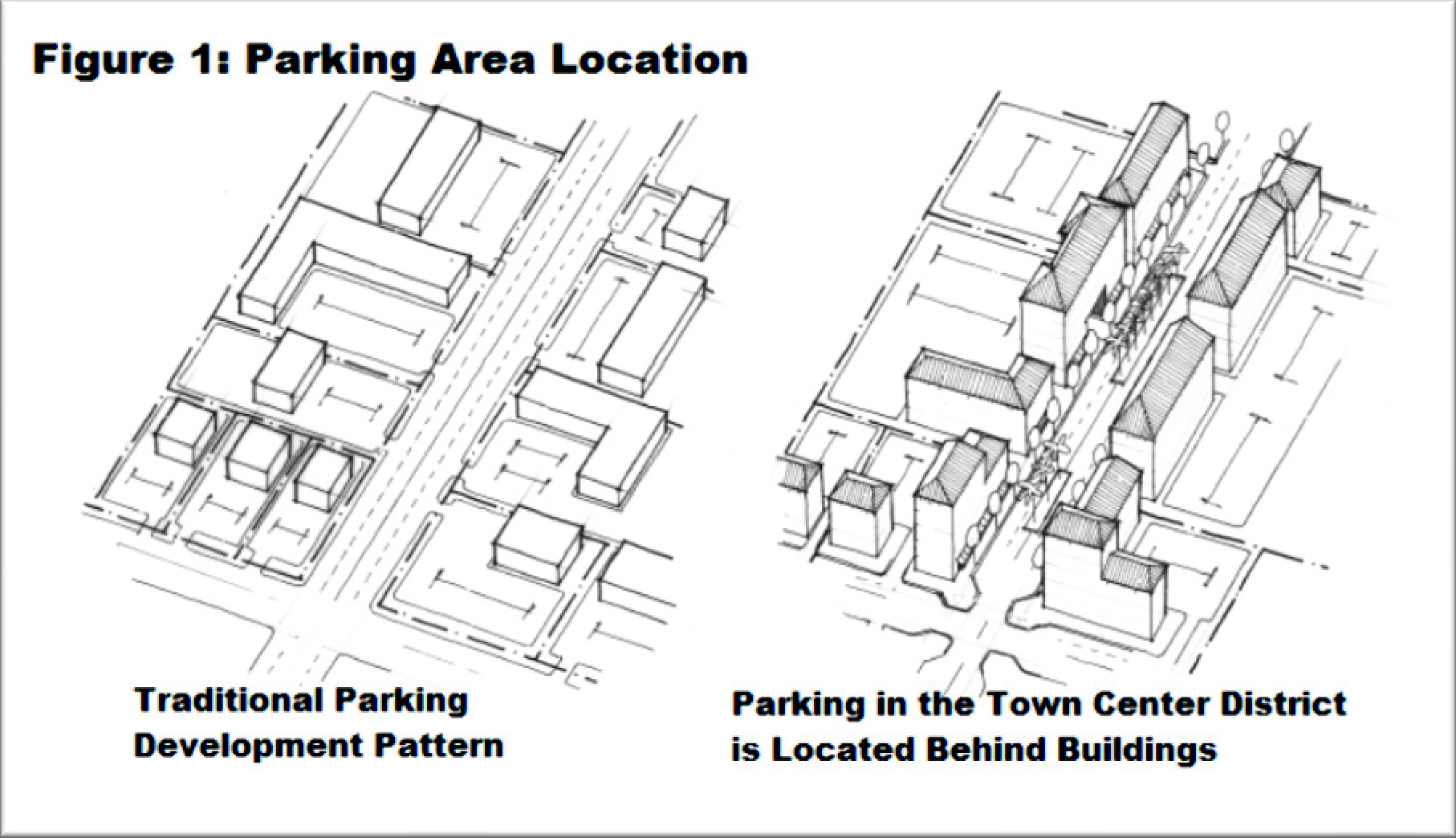
7)
Buildings shall be sited such that they front on the roadway, with parking and service areas located in the rear. The development objective is that each building will contribute to an attractive streetscape that is a part of a recognizable "downtown" area and be of a scale and type that is typically associated with same.
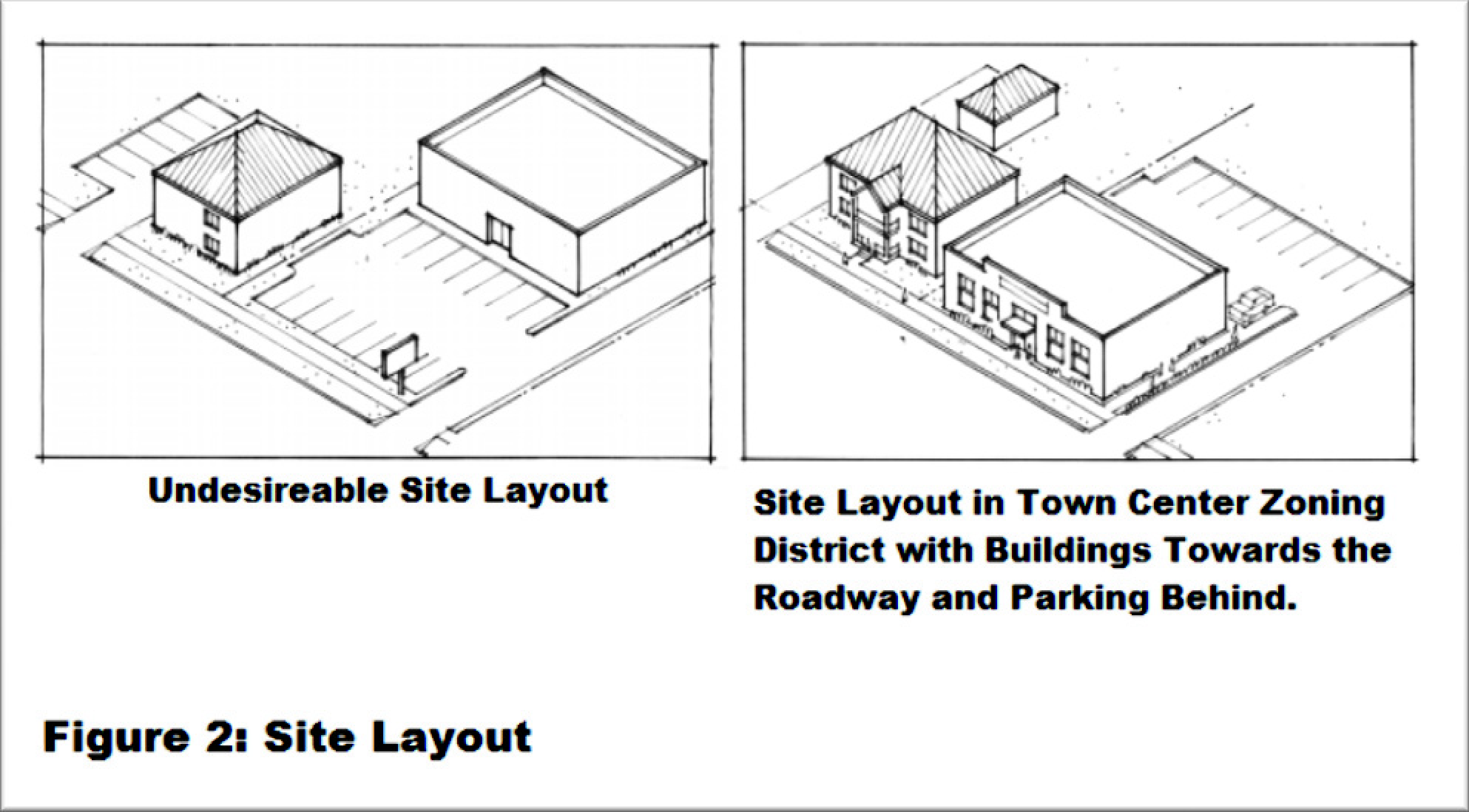
8)
Buildings shall be constructed of high-quality materials such as brick, stone, masonry or other quality siding and roofing materials. The use of false fronts, non-durable surfaces, or other "quick fix" type treatments will not be permitted.
9)
Whenever feasible, shared driveways shall be used to provide access to multiple properties.
10)
Fencing: Within the Town Center (TC) zoning district shall be regulated as follows:
1.
During site plan review:
a.
Fencing may be required along the entire length of a property line whenever a commercial development abuts property that is zoned R-1A, R-1B, R-1C, R-1D, R-1E, RM, RM-1 or RM-2.
2.
Fencing installed at the option of the property owner may be constructed on a Town Center site, provided that it meets the following requirements:
a.
Fencing shall not exceed six (6) feet in height.
b.
All provisions of subsections 6.2.4(2)(d) through 6.2.4(6) shall also apply.
11)
Human scale: All development and redevelopment of buildings and sites shall be constructed in a manner that creates and preserves human scale development. Human scale is defined as the proportional relationship of the physical environment (buildings, trees, parking lots, streets, etc.) to human dimensions. When components in the built environment are ordered in such a way that people feel comfortable, then human scale has most likely been achieved. By contrast, a place that is out of human scale, either too small or too large, will tend to make people feel uncomfortable. The reaction is to avoid such a place or to move through it quickly. Significant buildings and sites use monumental scale to create a sense of importance. In these cases, the human scale elements are often incorporated into the project as well. Human scale can be further reinforced by the choice of materials, textures, patterns, colors and details.
1.
Characteristics of human scale development are as follows:
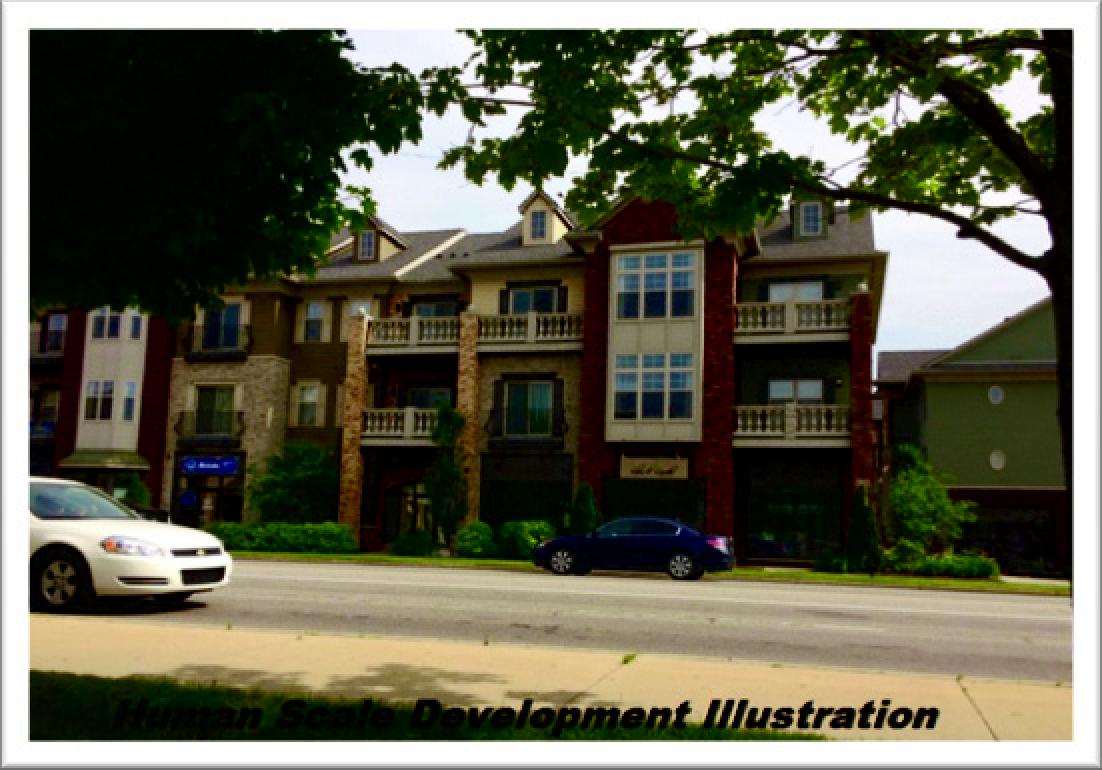
a.
The dimensions of building height and width, street width, streetscape elements, building setback, and other elements are combined so that they establish a comfortable realm for people to move around in and interact in. The dimensions of human interaction govern the design rather than the dimensions of vehicular circulation and convenience.
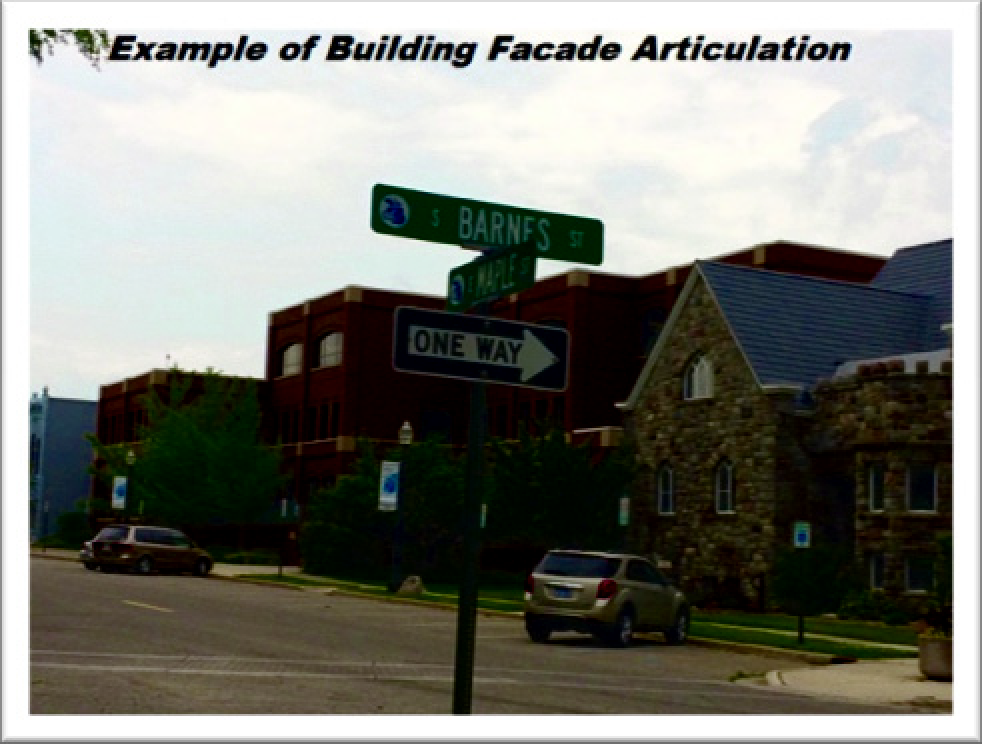
b.
Buildings are arranged to enclose and define space. This may include locating buildings close to a sidewalk, creating spatial definition.
c.
Buildings have limited height at pedestrian paths and sidewalks. Taller buildings have upper stories that are setback.
d.
Building articulation and design details reduce the perceived mass of large buildings. Elements such as openings at street level, decorative elements that mark floor heights such as cornices, porches and awnings are used to break the building down to human dimensions.
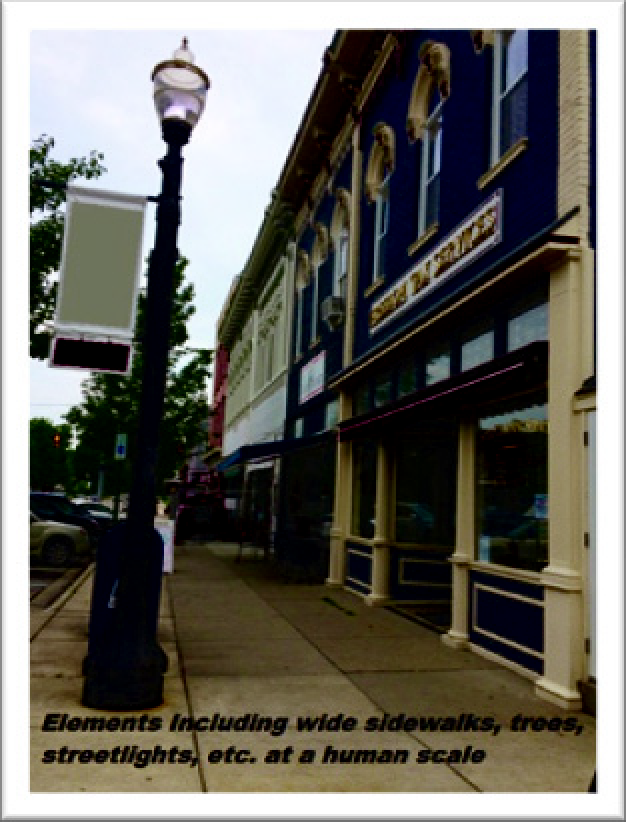
e.
Residential forms and proportions are used on commercial and office buildings next to residential areas.
f.
Street trees with protective canopies enclose and define the streetscape.
g.
Complete streets infrastructure is installed when appropriate.
h.
Streetscape elements such as sidewalks wide enough for comfortable pedestrian movement, distinctive sidewalk paving, pedestrian-scale streetlights and other fixtures are used to relate to the human dimension.
(Ord. No. 39.53, 12-21-93; Ord. No. 39.73, 7-7-98; Ord. No. 39.106, 1-18-05; Ord. No. 39.111, 5-4-05, eff. 5-15-05; Ord. No. 39.124, 3-7-06; Ord. No. 39.136, 6-5-07; Ord. No. 39.145, 11-20-07; Ord. No. 39.155, § VIII, 2-16-10; Ord. No. 39.161, § I, 8-6-14; Ord. No. 39.167, § 1(Att. A), 1-20-26)
Section 5.14 - Condominium regulations.
5.14.1 Intent and scope of regulations. The purpose of this section is to regulate projects that divide real property under a contractual arrangement known as a condominium. New and conversion condominium projects shall conform to the requirements of this Ordinance, all other applicable township regulations, and the Condominium Act (P.A. 59 of 1978, MCL 559.101 et seq. as amended). Each condominium project shall be reviewed in a manner consistent with equivalent projects within the applicable zoning district. A site condominium project shall be considered equivalent to a platted subdivision for the purposes of enforcing all site standards of the township. It is the intent to regulate site condominium projects in a manner consistent with a traditional subdivision plat, following the requirements of this section, this Ordinance, and the Subdivision Control Ordinance No. 88, as amended, and other township ordinances and policies except that the review procedures of this section shall apply.
5.14.2 General requirements.
The following regulations shall apply to all condominium projects:
1)
Condominium unit or site condominium lot. For all purposes of this Ordinance, each detached condominium unit or site condominium lot shall be considered the equivalent of a platted lot of record as defined in the Delhi Charter Township Subdivision Control Ordinance No. 88, as amended, and shall comply with applicable regulations for the zoning district. The relocation of boundaries or any other change in the dimensions of a condominium unit or site condominium lot shall be considered an amendment to the condominium documents and condominium site plan.
2)
Area computation. Any area within a public or private street right-of-way, or any equivalent easement or dedication, shall not be included in the computation of the minimum area of a condominium lot, nor considered in determining the dwelling density for a site.
3)
Condominium units.
a)
Single-family detached units: In the case of a condominium project in which the condominium units are intended for detached single-family residential purposes (site condominium), not more than one (1) single-family dwelling unit and permitted accessory structure shall be proposed or constructed on a condominium lot. No dwelling unit may be located on a condominium lot with any other approved principal use. The condominium unit shall be considered a lot under this Ordinance.
b)
Attached or multiple residential units: All condominium buildings and units created by the construction of multiple or attached residential units containing individually owned condominium units, or by conversion of existing multiple-family or attached units into individual condominium units, shall conform with all requirements of this Ordinance and the applicable zoning district.
c)
Nonresidential condominium units: A nonresidential condominium project consisting of either new building construction or the conversion of existing building(s) into individual condominium units, shall conform with all requirements of this Ordinance and the applicable zoning district.
4)
Setbacks. Yard setback requirements for a structure on a condominium lot shall be as specified in the Setback Matrix, Appendix A of this Ordinance and shall be measured from the perimeter of the condominium lot to the nearest part of a structure.
5)
Utility connections. Each site condominium unit shall be separately connected to available public water supply and sanitary sewer system unless the project is the conversion of an existing multifamily complex.
6)
Relocation of lot boundaries. Relocation of condominium lot boundaries, if allowed in the condominium documents, as permitted in Section 48 of the Condominium Act (P.A. 59 of 1978, as amended), shall comply with the requirements of the Setback Matrix, Appendix A of this Ordinance, and shall be subject to the review procedures specified in section 3.3 (Site Plan Review).
7)
Resulting lots. Any property remaining after the formation of a new unit lot by the relocation of an existing condominium lot boundary, as permitted by Section 49 of the Condominium Act (P.A. 59 of 1978, as amended), shall comply with the minimum requirements of the Setback Matrix of this Ordinance, or shall be placed into common areas within the project.
8)
Roads in condominium projects. All condominium projects shall require direct access and direct connection to a public road from the project site. All roads within a condominium project shall be located within an approved and dedicated right-of-way of sufficient width and design to accommodate street pavement, sidewalks or paved pedestrian paths, and all necessary utilities and public services.
Private roads shall accommodate all emergency and service vehicles and shall be of sufficient width to permit two-way traffic and, if desired, on street parking. The condominium documents shall require and recognize that the private roads are not the responsibility of Delhi Charter Township or the Ingham County Road Department and that all maintenance, snow removal, construction, repair and replacement is the sole responsibility of the condominium association. Funding, paying for and facilitating said activities shall be the sole responsibility of the condominium association. All enforcement activities, including but not limited to parking control, truck use and speed enforcement, shall also be the sole responsibility of the condominium association. The condominium association shall, likewise, be solely responsible to ensure and maintain full access for emergency vehicles and services via the private roads.
Note— It should be noted that the Setback Matrix, Appendix A of Ord. No. 39.105, adopted May 4, 2004, is not set out herein. It is on file and available for inspection in the township clerk's office.
5.14.3 Review requirements.
The following process and review procedures shall apply for all condominium projects:
1)
Pre-application condominium review (concept review)—Optional. A developer of a condominium project may submit a conceptual condominium site plan for review by the director of community development, who may informally review the plan for general compliance with township requirements. Such review is intended to allow the developer to receive direction and recommendations from the township staff regarding unit or lot sizes, orientation, street layout, and other conceptual plan issues and to provide information to the developer regarding zoning ordinance requirements and township development policies and practices.
2)
Tentative preliminary condominium approval. Each condominium project shall be subject to review and approval of a tentative preliminary condominium plan by the planning commission and the township board.
a)
Planning commission and township board review: Based upon the design standards and requirements set forth in this Ordinance and other applicable township regulations, the planning commission and township board shall review and take action regarding a tentative preliminary condominium approval.
b)
Recommendation and action: The planning commission shall recommend approval, approval with conditions or denial of the tentative preliminary condominium to the township board. The board shall approve, approve with conditions or deny the tentative preliminary condominium plan, the effect of which shall be as follows:
(1)
Approval: The effect of an approval of the tentative preliminary condominium shall be that the lot sizes, orientation, street layout and other general requirements pertaining to the overall design of the development as proposed, generally comply with the requirements of this Ordinance and the Delhi Charter Township Subdivision Control Ordinance, No. 88.
(2)
Approval with conditions: The effect of an approval of the tentative preliminary condominium plan with conditions shall be that the lot sizes, orientation, street layout and other general requirements pertaining to the overall design of the development as proposed, comply with the requirements of this Ordinance and the Delhi Charter Township Subdivision Control Ordinance, No. 88, provided that the conditions placed on the approval are fully met.
(3)
Denial: The effect of denial of the tentative preliminary condominium plan is that the plan does not meet the requirements of this Ordinance and/or the Delhi Charter Township Subdivision Control Ordinance.
3)
Preliminary condominium approval. The purpose of the preliminary condominium approval is to provide for the detailed review and approval of specific design elements of the proposed condominium project. This step includes the site plan review process as outlined in section 3.3.5 of this Ordinance.
a)
A preliminary condominium application shall be reviewed and acted upon in accordance with the review procedures and standards specified in section 3.3 (Site Plan Review Procedure).
b)
Outside agency permits or approval: The applicant shall be responsible for obtaining all necessary permits or approvals from applicable outside agencies, and providing proof of said approvals to the director of community development, prior to receiving preliminary condominium approval.
c)
Where the director of community development determines that the site design or proposed improvements shown on the preliminary condominium plans have been materially altered from that which was approved by the planning commission and township board as the tentative preliminary condominium, the changes may be considered a major revision and subject to a new review by the planning commission and the township board.
d)
Planning commission review: Based upon the requirements of this Ordinance, the Delhi Charter Township Subdivision Control Ordinance and any other applicable regulations and/or Ordinances, the planning commission shall approve, approve with conditions or deny the preliminary condominium plan, the effect of which shall be as follows:
(1)
Approval or approval subject to conditions: Approval of the preliminary condominium plan shall mean that the plan meets the requirements of this Ordinance and other applicable township regulations, subject to any conditions imposed by the planning commission as part of its motion of approval.
(2)
Denial: A denial shall mean that the preliminary condominium plan does not meet the requirements of this Ordinance and/or other applicable township regulations. Any motion of denial shall specify the reasons for the denial and those requirements that are not met.
(3)
Expiration of approval: A preliminary condominium approval shall be valid for a period of twenty-four (24) consecutive months from the date of planning commission approval. Upon written request from the applicant, one (1) extension of up to three hundred sixty-five (365) days may be granted if the approved preliminary condominium site plan adequately represents current conditions on and surrounding the site.
4)
Final preliminary condominium. Prior to commencing construction of any improvements to the land, final preliminary condominium site plans shall be sent to the director of community development for administrative review and approval. Where the director of community development determines that the site design or proposed improvements shown on the final plans have been materially altered from that which was approved by the planning commission and township board as the preliminary condominium, the changes may be considered a major revision and subject to a new review by the planning commission and township board.
5)
Final condominium approval. For condominium developments, final condominium approval shall be considered the equivalent of a final plat review, as specified in the Delhi Charter Township Subdivision Control Ordinance No. 88, as amended. Final condominium applications shall be prepared and submitted to the director of community development. The township board shall take action to approve, approve with conditions or deny the final condominium.
a)
Master deed recorded: The master deed must be recorded at the Ingham County Register of Deeds and a copy provided to the director of community development.
b)
Effects of approval: Building permits for individual condominium units may be issued by the building official.
c)
Expiration of approval: A final condominium approval shall be valid for a period of twenty-four (24) consecutive months from the date of approval. Upon written request from the applicant, the planning commission may grant one (1) extension of up to three hundred sixty-five (365) days on a plan, if the approved final condominium site plan adequately represents current conditions on and surrounding the site.
5.14.4 Required plan information.
1)
Requirements for optional pre-application review. If an optional information preliminary review is desired, the following pre-application information should be submitted to the director of community development.
a)
Proposed use(s). The proposed use(s) of the condominium project (for example: Residential, commercial, industrial).
b)
Density. The total acreage of the condominium site, acreage set aside for roads and parking areas, number of condominium units to be developed by type on the subject parcel and a residential density computation on a unit per acre basis.
c)
Circulation. The vehicular and pedestrian circulation system planned for the proposed development, including the designation of any street(s) for private ownership or dedication to the public.
d)
Road layout. The location of all existing roads adjacent to the development with details on the connection of the project circulation system to the public system.
e)
Unit lot orientation. The proposed layout of structures, unit lots, parking areas, open space and recreation/park areas.
f)
Natural features. Specific locations and dimensions of wetland areas, wetland buffers, floodplain, and other significant natural features such as tree stands, unusual slopes, streams and water drainage areas. Include the total acreage of all wetland areas and open space.
2)
Tentative preliminary condominium approval requirements. A tentative preliminary condominium site plan shall be provided to the director of community development in advance of a planning commission meeting for which a review is scheduled. The following information shall be included with a tentative preliminary condominium site plan:
a)
Condominium site plan information: All information required for a conceptual condominium site plan, as specified in subections 5.14.5(1)(a—f) above. A minimum of one (1) printed eleven (11) inch × seventeen (17) inch copy of the tentative preliminary condominium site plan shall be submitted. Additionally, one (1) digital copy of the tentative preliminary condominium site plan shall be submitted in a file type specified by the director of community development.
b)
Common areas defined: Limited common elements, common elements, unit lots, preservation areas, convertible areas and any other designated ownership areas must be clearly delineated on the site plan.
c)
Condominium restrictions: All deed restrictions or other regulations.
d)
Landscaping plan: Proposed landscape screening, including greenbelt, berms, and screening walls, and a maintenance plan that is in compliance with this Ordinance.
3)
Preliminary condominium approval requirements. Following approval of the tentative preliminary condominium by the planning commission and the township board, the preliminary condominium site plan may be submitted following the requirements outlined in section 3.3.5. Ten (10) full-size copies of the site plan shall be submitted, and five (5) additional courtesy copies are requested. One (1) digital copy of the tentative preliminary condominium site plan shall be submitted in a file type specified by the director of community development. Additionally, the following information shall be submitted:
a)
Ownership interest: Declaration of all persons with an ownership interest in the land on which the condominium project will be located, including a description of the nature of each entity's interest (for example, fee owner, option holder, lessee, or land contract vendee).
b)
Condominium site plan information: All required information by section 3.3.5.
c)
Condominium documents: Drafts of all condominium documents as defined in this Ordinance, including the master deed and association bylaws. The township attorney shall review all condominium documents.
d)
Condominium restrictions: All deed restrictions or other regulations proposed to be included in the condominium documents in the nature of restrictive covenants that regulate the layout, use and maintenance of public or common areas, accessory structures, payment of assessments, and enforcement of condominium regulations. All items shall be physically incorporated as part of the site plan through detail sheets and notes attached to the final plan.
e)
Common areas defined: Limited common elements, common elements, unit lots, preservation areas, convertible areas and any other designated ownership areas must be clearly delineated on the site plan.
f)
Landscaping plan: Proposed landscape screening, including greenbelt, berms, and screening walls, and a maintenance plan that is in compliance with this Ordinance.
g)
Additional information: The following additional information shall be submitted for township review:
(1)
Cross-sections of roads, drive aisles and paved area;
(2)
All recorded easements for the use of land areas for the purpose of constructing, operating, inspecting, maintaining, repairing, altering, replacing, and/or removing pipelines, mains, conduits and other installations of a similar character for the provision of public utilities, including sewage, water and storm water run-off and which require the restoration and rehabilitation of the easement area after utility construction is completed.
h)
Outside agency approvals: Written verification of all applicable state, county and other agency approvals or comments.
i)
Section 71 comments: Presentation of any comments received as a result of the notice required pursuant to Section 71 of the Condominium Act (P.A. 59 of 1978, as amended, MCL 559.171).
j)
Revised site plan: A revised, dated, and sealed final preliminary condominium site plan shall be submitted incorporating all changes, if any, required by the preliminary condominium approval.
4)
Final condominium approval requirements. Following planning commission approval of the preliminary condominium plan, the developer shall submit the following items to the director of community development to be forwarded to the township board for final approval. The following items must be completed:
a)
Provide a copy of the recorded master deed to community development department.
b)
Written approval and action, if applicable, from all applicable departments, as identified by the director of community development, and agencies as specified in the Subdivision Control Ordinance No. 88 (Final Plat Requirements).
(1)
Although it is preferred that public improvements (as listed in section 5.4 of Ord. No. 88) be installed and approved prior to the issuance of any building permits, the township board may, at its sole discretion, allow the developer to provide a financial guarantee for the completion of said improvements. If the township board approves the request by the Developer to accept a financial guarantee in lieu of the actual installation of public improvements, the developer shall provide an irrevocable letter of credit (IRLC). The IRLC shall be to the benefit of the township, in an amount specified by the township, for the purpose of guaranteeing performance of the township requirements and enabling the township to access the funds if necessary to complete the required improvements. The township can not require that other public agencies with approval authority to do the same.
(2)
In the event that the township permits the use of the IRLC in lieu of the completion of required public improvements, final condominium approval may be granted by the township board.
(3)
Once the township board has approved the final condominium, the community development department may issue building permits, subject to the following conditions:
(a)
In the case of site condominiums no more than four (4) building permits will be issued. In the case of attached condominium units, no more than thirty-two (32) building permits encompassing no more than a total of four (4) buildings will be issued. This provision allows either four (4) detached units or four (4) buildings with up eight (8) units per building to be constructed.
(b)
Certificates of occupancy for these units will not be granted until such time as all required public improvement is completed and approved by the appropriate entity.
c)
One (1) full-size set of the final condominium drawings.
d)
One (1), eleven (11) inch × seventeen (17) inch set of final condominium drawings.
e)
One (1) digital copy of the project site plan clearly showing unit lot lines and other area divisions, in a format that is acceptable to the township. The digital copy shall be as a file type specified by the director of community development.
f)
One (1) digital copy of the project sewer plan, in a format that is acceptable to the township. The digital copy shall be as a file type specified by the director of community development.
5.14.5 Project standards.
The following standards are applicable to condominiums:
1)
Underlying zoning requirements. Condominium units shall be subject to all dimensional and area requirements and other design standards for the zoning district in which they are located, as specified in the Setback Matrix, Appendix A of this Ordinance. All dimensions and required information shall be clearly shown on the site plan so that the planning commission can determine that all applicable minimum requirements are met.
2)
Dimensions and setbacks. The regulations shall be applied by requiring that the minimum area of the site condominium unit and the surrounding limited common element be, at least equal to the minimum lot area and lot width requirements as stated in the Setback Matrix, Appendix A of this Ordinance for the appropriate zoning district in which the project is located.
3)
Land division/subdivision requirements. The substantive requirements for streets, sidewalks, utilities, storm drainage and subdivision lot layout and design as set forth in the Land Division Act (P.A. 288 of 1967, as amended, MCL 560.101 et seq.) and the Delhi Charter Township Subdivision Control Ordinance No. 88, as amended, apply to all site condominium projects.
4)
Conversion condominiums. The conversion of an existing residential or non-residential development to condominium ownership shall be permitted and approved by the director of community development provided that there is no change proposed to the site as a result of the conversion that would require site plan review per section 3.3 of this Ordinance. If the conversion will create changes to the site that would require site plan review, then the provisions of section 3.3 must be satisfied prior to the conversion occurring.
Note— It should be noted that the Setback Matrix, Appendix A, as referenced above, is not set out herein, but is on file and available for inspection in the township clerk's office.
5.14.6 Monuments.
All site condominium projects shall be clearly marked with monuments as follows:
1)
Required. Monuments shall be placed in the ground according to the following requirements, but it is not intended or required that monuments be placed within the traveled portion of a street to mark angles in the boundary of the condominium project if the angle points can be readily reestablished by reference to monuments along the sidelines of the streets.
2)
Construction. All monuments used shall be made of solid iron or steel bars at least one-half (½) inch in diameter and thirty-six (36) inches long and completely encased in concrete at least four (4) inches in diameter.
3)
Location. Monuments shall be located in the ground at all angles in the boundaries of the condominium project; at the intersection lines of streets and at the intersection of the lines of streets with the boundaries of the condominium project; at all points of curvature, points of tangency, points of compound curvature, points of reverse curvature and angle points in the side lines of streets and alleys; at all angles of an intermediate traverse line and at the intersection of all limited common elements and all common elements.
a.
Reference: If the required location of a monument is inaccessible, or if the locating of a monument would be clearly impracticable, it is sufficient to place a reference monument nearby and the precise location thereof be clearly indicated on the plans and referenced to the true point.
b.
Steel roads: If a monument point is required to be on a bedrock outcropping, a steel rod, at least one-half (½) inch in diameter shall be drilled and grouted into solid rock to a depth of at least eight (8) inches.
c.
Set at grade: All required monuments should be placed flush with the surrounding grade where practicable.
4)
Condominium unit corners. Each site condominium unit corner shall be monumented in the field by iron or steel bars or iron pipes at least eighteen (18) inches long and one-half (½) inch in diameter, or other markers approved by the township engineer. Each condominium lot must be able to be defined by reference to appropriate condominium unit monuments.
5)
Timing. The director of community development, upon recommendation of the township engineer, may waive the placing of any required monuments and markers for a reasonable time period on the condition that the proprietor deposits with the township clerk cash or a certified check, or an irrevocable bank letter of credit in an amount recommended by the township engineer.
The period shall not exceed three hundred sixty-five (365) days after the date of condominium final site plan approval. Outstanding cash, certified check or irrevocable bank letter of credit shall be returned to the proprietor upon receipt of a certificate by a licensed surveyor that the monuments and markers have been placed as required within the time specified. Failure to complete within the time period will lead to a forfeiture of the cash or a certified check, or an irrevocable bank letter of credit and the completion of the placement under the direction of the director of community development.
5.14.7 Post construction requirements.
1)
Document submittals.
a)
It shall be the responsibility of a developer or proprietor of a condominium project to furnish the following items to the community development department:
(1)
Two (2) copies of an "as built survey" sealed by a licensed design professional;
(2)
One (1) copy of the final site plan sealed by a licensed design professional on a mylar sheet in a manner and format that is acceptable to the township.
b)
The building official may withhold the issuing of any certificate of occupancy for any structure within the condominium project, if such documents have not been submitted within ten (10) days after written request from the building official to do so.
c)
The developer shall also file, with the Ingham County Register of Deeds, all documents in a manner and format acceptable to the county for the recording of the plan and documents. Notification of page and liber shall be provided to the township.
2)
Plan revisions. If the condominium construction plan [Exhibit B, as required by the Condominium Act (P.A. 59 of 1978, as amended, MCL 559.166)] is revised, the revised plan shall be submitted to the township for review and approval in accordance with the procedure specified in section 3.3 (Revisions to Approved Site Plans).
3)
Amended documents. An amendment to any condominium document that significantly impacts the approved site plan, or any conditions of the condominium site plan approval, shall be forwarded by the director of community development for additional approval by the planning commission and/or the township board prior to the issuance of a building permit.
5.14.8 Monuments required—All condominium projects. All condominium projects shall be marked at their boundaries with monuments meeting the requirements of section 5.15.7(B) above.
5.14.9 Compliance with federal, state and local law. All condominium projects shall comply with federal and state statutes and local ordinances.
5.14.10 State and county approval. The developer or proprietor of the condominium project shall establish that appropriate state and county approvals have been received with regard to the freshwater system for the proposed project and with regard to the wastewater disposal system for the proposed project.
5.14.11 Temporary occupancy. The zoning administrator may allow occupancy of the condominium project before all improvements required by this Ordinance are installed, provided that a bond is submitted sufficient in amount and type to provide for the installation of improvements before the expiration of the temporary occupancy permit without expense to the township.
5.14.12 Single-family detached condominiums. Single-family detached condominiums shall be subject to all requirements and standards of the applicable zoning district in which the development occurs, including minimum floor area requirements, except minimum lot size. For the purpose of computing density, the number of units per gross acre shall not exceed 2.9 units per acre in developments without community water and sanitary sewer systems or 3.8 units per acre in developments with community water and sanitary sewer systems, except in the case of those developments within the R-1A zone districts where the maximum density shall not exceed 1.75 units per gross acre.
There shall be maintained a minimum distance of seventy (70) feet from the center of one (1) residential dwelling unit to the center of another residential dwelling unit. This seventy-foot requirement shall be computed along the front building line. In addition, building envelopes shall be depicted on the site plan to assure that the minimum twenty-five-foot front yard, thirty-five-foot rear yard, four-foot side yard (least side), and total of two (2) side yards of fourteen (14) feet can be met.
5.14.13 Setbacks. Single family cluster housing condominiums shall be permitted upon issuance of a special use permit per article VIII, and subject to all requirements and standards of the applicable R-1B and R-1C Districts, including minimum floor area requirements. Minimum lot sizes shall not apply. Setbacks are as follows:
1)
No cluster building in a condominium development may be located closer than one hundred (100) feet to the center of public road right-of-way of a primary road as designated by the Ingham County Road Commission.
2)
A minimum of thirty-five (35) feet setback shall be established between any cluster building in a condominium development and public road right-of-way of secondary roads or streets.
3)
No cluster dwelling unit shall be located closer than ten (10) feet to any private street or access drive.
4)
The minimum distance between buildings within a cluster condominium development shall be twenty-five (25) feet.
5)
No building in a cluster condominium development shall be closer than twenty-five (25) feet to any adjacent interior side or rear property line.
5.14.14 [Streets and roads.] All streets and roads in a single-family detached condominium project shall, at a minimum, conform to the standards and specifications promulgated by the Ingham County Road Commission for roads within single-family residential subdivisions.
5.14.15 [Site plan required.] After submittal of the condominium plan and by-laws as part of the master deed, the proprietor shall furnish to the township a copy of the site plan on a photographic hard copy, laminated photostatic copy or mylar sheet of at least thirteen (13) by sixteen (16) inches with an image not to exceed ten and one-half (10½) by fourteen (14) inches.
5.14.16 Sidewalks in condominium developments. Sidewalks shall be required along all public and private streets and roadways. Said sidewalks shall be constructed to Ingham County Road Commission standards and shall be no less than five (5) feet in width.
(Ord. No. 39.55, 4-5-94; Ord. No. 39.63, 1-2-96; Ord. No. 39.81, §§ 2, 3, 2-2-99; Ord. No. 39.93, § 3, 3-7-00; Ord. No. 39.105, 5-4-04; Ord. No. 39.122, 3-7-06; Ord. No. 39.139, 6-5-07; Ord. No. 39.167, § 1(Att. A), 1-20-26)
Section 5.15 - Industrial Warehouse District.
5.15.1 Intent and purpose. The warehouse district is designed to facilitate the development of warehouse, storage and office-related activities in a manner that enhances and is compatible with surrounding districts. This district severely limits and restricts industrial activities to a very general level of development that has minimal impact on bordering districts.
5.15.2 Uses permitted. The following are the principal uses permitted by right:
1)
The warehouse and storage of general materials such as, but not limited to, building materials, contractors equipment, clothing, cotton, dry goods, feed, food, furniture, hardware, pipe, rubble, electrical, shop supplies, wood or similar product. All storage must be housed inside the building structure.
2)
The following shall be the allowable accessory uses in this district:
a)
Cafeterias, lunchrooms, meeting rooms, training facilities, day care facilities, recreation facilities and similar uses provided for the benefit of employees;
b)
Accessory structures for the storage of motor vehicles, equipment, products or materials;
c)
Accessory structures for the collection and temporary storage of waste materials;
d)
Accessory structures for security personnel.
e)
Office use which is incidental to any permitted use on that site.
f)
One (1) or more on-site use wind energy systems and/or anemometer tower: Subject to the requirements of section 6.2.2.1.
5.15.3 Uses authorized by special use permit. The following uses may be permitted under special conditions and subject to special restrictions:
1)
Above ground bulk storage of flammable liquids, liquid petroleum, gases and explosives and corrosives.
2)
Storage of chemicals, insecticides, solvents and other related products.
3)
Warehouse or storage of materials and equipment that are maintained outside of an enclosed structure.
4)
Contractors' storage yard or open storage of junk.
5)
Coal or building materials storage yard.
6)
Radio and television towers.
7)
Truck terminal facilities.
8)
Animal day care (even when it is a service offered by another pet related business) and veterinary clinics with or without outdoor areas for housing or keeping animals approval conditions in section 5.9.4.
a)
No more than sixty (60) dogs are permitted.
9)
Anemometer tower over twenty (20) meters high, utility grid wind energy system and/or on-site use wind energy system over twenty (20) meters high.
5.15.4 Reserved.
5.15.5 Groundwater protection. Any request for industrial rezoning is subject to the site plan review process and groundwater protection sections as provided in section 3.3.
5.15.6 Use requirements.
1)
Activities in this district shall be carried on in completely enclosed buildings, except the loading and unloading of products from vehicles. Storage of materials, supplies or equipment may be permitted out-of-doors after issuance of a special use permit according to section VIII of this Ordinance. All outdoor storage shall be screened from public view by a solid wall or fence. This section shall not require the complete screening of vehicles, trailers or equipment which are currently licensed for over-the-road use.
2)
Noise emanating from a use in this district shall not exceed the level of ordinary conversation at the boundaries of the lot. Short intermittent noise peaks may be expected if they do not exceed normal traffic noise peaks at any point on the lot boundaries.
3)
Uses in this district shall be such that they:
a)
Emit no noxious, toxic or corrosive fumes or gases, except for those produced by internal combustion engines under design operating conditions or except as permitted by an approved Michigan Department of Natural Resources Air Quality Permit.
b)
Emit no odorous gases or other odorous matter in such quantities as to be humanly perceptible at or beyond any point on the boundary of the use parcel, provided that any process which may involve the creation or emission of any odors shall be provided with a secondary safeguard system so that control will be maintained if the primary safeguard system should fail.
c)
Emit no smoke, other than that produced by normally operating heating equipment.
d)
Discharge into the air no dust or other particulate matter created by any industrial operation or emanating from any products stored prior to or subsequent to processing.
e)
Produce no heat humanly perceptible at or beyond the lot boundaries.
f)
Utilize all lighting in a manner which produces no glare on public streets or on any other parcel.
g)
Produce no physical vibrations humanly perceptible at or beyond the lot boundaries.
h)
Produce no electromagnetic radiation or radioactive emission injurious to human beings, animals or vegetation, or of any intensity that interferes with the lawful use of any other property.
i)
Do not engage in the production or storage of any material designed for use as an explosive, nor in the use of such materials in production.
5.15.7 Site development requirements.
1)
Minimum lot area. Must be two (2) acres unless said lot abuts an existing industrial zone.
2)
Minimum lot width. Must be two hundred (200) feet.
3)
Maximum lot coverage. Cannot exceed fifty (50) percent (including accessory buildings) of the lot size.
4)
Front yard setbacks. Fifty-foot minimum. There shall be an additional foot of setback for every foot the building itself exceeds forty (40) feet in height.
5)
Side and rear yard:
a)
When side and rear yards abut residential or agricultural districts, no building shall be closer than fifty (50) feet. There shall be an additional foot of setback for every foot said building shall exceed forty (40) feet in height.
b)
When side and rear yards abut commercial no building shall be closer than fifty (50) feet.
c)
When side and rear yards abut other industrial districts they shall be no closer than twenty (20) feet.
6)
Front, side and year yard restrictions. When a property line abuts a roadway, a building setback of no less than fifty (50) feet is required for the side of the property. Furthermore, a buffer strip not less than fifty (50) feet wide shall be developed along all property lines which face, abut or are adjacent to a residential district. This buffer strip shall be planted with trees and shrubs in accordance with the approved site plan for the lot. The buffer strip shall be graded with a berm at least five (5) feet above the highest ground elevation within twenty-five (25) feet of the buffer strip. The berm shall be continuous except for necessary access drives.
7)
Off-street parking. Spaces shall be provided in accordance with the requirements specified in article VII, section 7.1. In addition to these requirements, sufficient parking space shall be provided to park all vehicles owned or leased by the occupant, including, but not limited to, passenger cars, trucks, tractors, trailers and similar vehicles.
8)
For all buildings constructed in this district which are not intended for a specific operation or use. There shall be provided a number of off-street parking spaces adequate for the anticipated total number of employees at any one (1) time. A building permit may be issued only if an adequate number of off-street parking spaces will be provided on the lot in accordance with the requirements as specified in article VII, section 7.1, Off-Street Parking Requirements.
9)
Off-street loading/unloading. Each use in this district shall provide off-street loading spaces as provided in section 7.2 of this Ordinance.
10)
Signs. All signs shall conform to the requirements as provided in section 6.9 of this Ordinance.
11)
Fencing. When a lot in an industrial district abuts a lot in a residential or commercial district, a solid fence no less than six (6) feet and no more than ten (10) feet in height shall be erected along all property lines which abut these residential or commercial areas.
1.
In addition, fencing within the IW District shall conform to the following general requirements:
a.
Fencing that is intended to provide security to a portion of the site, for example around a protected parking area or sensitive heating/cooling mechanical equipment outside the building, shall not exceed fourteen (14) feet in height. Security fencing within the Industrial Warehouse District may be topped with barbed wire or similar material in order to provide additional security.
b.
All provisions of subsection 6.2.4(2)(d) shall also apply.
c.
All provisions of subsection 6.2.4(3) shall also apply.
d.
All provisions of subsection 6.2.4(4) shall also apply.
e.
All provisions of subsection 6.2.4(6) shall also apply.
12)
Public utilities. Public utilities must be available. Utilities include sanitary sewers, water supply and fire hydrants, storm drains and, if necessary, retention and disposal of solid refuse waste. All industrial sites must be served by public water and sanitary sewer.
13)
All season roads: The requirements of section 6.1.8 must also be met.
5.15.8 Voiding of permit. Any building permit granted under this section shall become null and void unless the development proposed shall have passed its first building inspection within one (1) year from the date of the granting of the permit. Before voidance is actually declared, the building inspector shall notify the applicant of such voiding action by sending a notice to the applicant at the address indicated on the permit application at least ten (10) days before such voidance is effective.
5.15.9 Supporting evidence required. The purpose of this district is to allow land uses such as scientific and applied research facilities in areas that are wholly compatible with adjacent residential and commercial area. Uses in this district should be dedicated to the development and application of innovative technology and production techniques.
It is the further intent of this district to only allow uses that are compatible with and not potentially injurious to those areas of the township that are groundwater recharge areas.
(Ord. No. 39.55, 4-5-94; Ord. No. 39.63, 1-2-96; Ord. No. 39.106, 1-18-05; Ord. No. 39.124, 3-7-06; Ord. No. 39.141, 6-19-07; Ord. No. 39.145, 11-20-07; Ord. No. 39.153, § I, 7-5-09; Ord. No. 39.155, § IX, 2-16-10)
Section 5.16 - Industrial Research District.
5.16.1 Intent and purpose. The purpose of this district is to allow land uses such as scientific and applied research facilities in areas that are wholly compatible with adjacent residential and commercial area. Uses in this district should be dedicated to the development and application of innovative technology and production techniques.
It is the further intent of this district to only allow uses that are compatible with and not potentially injurious to those areas of the township that are groundwater recharge areas.
5.16.2 Uses permitted. The following are the principal uses permitted by right:
1)
Scientific and medical laboratories.
2)
Engineering, testing or design facilities.
3)
Other applied research facilities.
4)
The following shall be the allowable accessory uses in this district:
a)
Cafeterias, lunch rooms, meeting rooms, training facilities, day care facilities, recreation facilities and similar uses provided for the benefit of employees.
b)
Accessory structures for the storage of motor vehicles, equipment, products or materials.
c)
Accessory structures for the collection and temporary storage of waste materials.
d)
Accessory structures for personnel.
e)
Office use which is incidental to any permitted use on that site.
f)
One (1) or more on-site use wind energy systems and/or anemometer tower: Subject to the requirements of section 6.2.2.1.
5.16.3 Uses authorized by special use permit. The following uses may be permitted under special conditions and may be subject to special restrictions:
1)
Animal day care (even when it is a service offered by another pet related business) and veterinary clinics with or without outdoor areas for housing or keeping animals approval conditions in section 5.9.4.
a)
No more than sixty (60) dogs are permitted.
2)
The manufacture or production of prototypical products as may be minimally necessary for research and development purposes, provided such use occupies no more than twenty-five (25) percent of the total floor area of all principal buildings on the lot.
3)
Anemometer tower over twenty (20) meters high, utility grid wind energy system and/or on-site use wind energy system over twenty (20) meters high.
5.16.4 Reserved.
5.16.5 Groundwater protection. Any request for industrial rezoning is subject to the site plan review process as provided in section 3.3 of this Ordinance.
5.16.6 Use requirements. All activities within the Industrial Research District must meet use requirements as provided in section 5.15.6.
5.16.7 Site development requirements. Site development must meet requirements as provided in section 5.15.7.
5.16.8 Voiding of permit. Any building permit granted under this section shall become null and void unless the development proposed shall have passed its first building inspection within one (1) year from the date of the granting of the permit. Before voidance is actually declared, the building inspector shall notify the applicant of such voiding action by sending a notice to the applicant at the address indicated on the permit application at least ten (10) days before such voidance is effective.
5.16.9 Supporting evidence required. In all instances in which the building inspector and/or the building board of appeals considers the ability of a proposed use to meet all the requirements of this section to be reasonably doubtful, it will be incumbent upon the proponent to furnish adequate evidence in support of his application. If such evidence is not presented, the building permit shall not be issued.
(Ord. No. 39.55, 4-5-94; Ord. No. 39.106, 1-18-05; Ord. No. 39.141, 6-19-07; Ord. No. 39.145, 11-20-07; Ord. No. 39.155, § IX, 2-16-10)
Section 5.17 - Industrial Assembling District.
5.17.1 Intent and purpose. The Industrial Assembling District is designed to permit industrial establishments that engage in processing, assembling and packaging as primary activities. This district permits activities allowed in both the Warehouse and Industrial/Research Districts but prohibits intensive industrial uses that are commonly found in a heavy industrial district. Heavy industrial manufacturing is generally defined as large scale operations that use basic raw materials to produce a finished product.
5.17.2 Uses permitted. The following are the principal uses permitted by right:
1)
The light manufacturing of small products, assembling, packaging or treatment of such products as:
a)
Baked goods, candy and food products.
b)
Bottling products.
c)
Hardware and cutlery.
d)
Electrical and electronic machinery, components and supplies, radios, phonographs and television sets, electrical appliances, office computing and accounting machines.
e)
Professional and scientific instruments, photographic and optical goods.
f)
Musical instruments, toys, novelties, sporting and athletic goods, metal or rubber stamps, or other molded rubber products.
g)
Manufacture and repair of electric or neon signs, light sheet metal products, including heating and ventilating equipment, cornices, eaves and the like.
h)
Manufacturing of pottery and ceramics.
2)
The following shall be the allowable accessory uses in this district:
a)
Cafeterias, lunch rooms, meeting rooms, training facilities, day care facilities, recreation facilities and similar uses provided for the benefit of employees.
b)
Accessory structures for the storage of motor vehicles, equipment, products or materials.
c)
Accessory structures for the collection and temporary storage of waste materials.
d)
Accessory structures for security personnel.
e)
Office use which is incidental to any permitted use on that site.
f)
One (1) or more on-site use wind energy systems and/or anemometer tower: Subject to the requirements of section 6.2.2.1.
5.17.3 Uses authorized by special use permit. The following uses may be permitted under special conditions and may be subject to special restrictions:
1)
Vehicle body repair shops.
2)
Laboratories involving experimental film testing.
3)
Public utility installations and buildings, including power fuel, communications and water treatment.
4)
Facilities that use daily large quantities of hazardous materials. The following list of industries generally may store or generate large quantities of hazardous substances (this list is not all inclusive):
Users of pesticides;
Pesticide application services;
Chemical, paint and plastics manufacturing;
Commercial laundries and dry cleaner plants;
Furniture manufacturing and refinishing;
Printing;
Analytical and clinical laboratories;
Vehicle maintenance operations, including: Transportation/trucking, contractors/construction, automotive dealers, car rental, service stations/automotive repair;
Photographic development;
Equipment repair;
Junk yards;
Pulp and paper industry;
Wood preserving and treatment;
Metal manufacturing (including metal plating);
Other manufacturing (textiles, rubber, glass, etc.);
Commercial establishments with fleets of trucks and cars;
Government agencies with fleets of trucks and cars.
5)
Animal day care (even when it is service offered by another pet related business) and veterinary clinics with or without outdoor areas for housing or keeping animals approval conditions in section 5.9.4.
a)
No more than sixty (60) dogs are permitted.
6)
Anemometer tower over twenty (20) meters high, utility grid wind energy system and/or on-site use wind energy system over twenty (20) meters high.
The determination of whether an industry in this district requires regulation due to the use of hazardous substances and, therefore, requires a special use permit is the authority of the Delhi Planning Commission.
5.17.4 Reserved.
5.17.5 Groundwater protection. Any request for industrial rezoning is subject to the site plan review process as provided in sections as provided in section 3.3 of this Ordinance.
5.17.6 Use requirements. All activities within the Industrial Assembling District must meet use requirements as provided in section 5.15.6.
5.17.7 Site development requirements. Site development must meet the requirements specified in section 5.15.7.
5.17.8 Voiding of permit. Any building permit granted under this section shall become null and void unless the development proposed shall have passed its first building inspection within one (1) year from the date of the granting of the permit. Before voidance is actually declared, the building inspector shall notify the applicant of such voiding action by sending a notice to the applicant at the address indicated on the permit application at least ten (10) days before such voidance is effective.
5.17.9 Supporting evidence required. In all instances in which the building inspector and/or the building board of appeals considers the ability of a proposed use to meet all the requirements of this section to be reasonably doubtful, it will be incumbent upon the proponent to furnish adequate evidence in support of their application. If such evidence is not presented, the building permit shall not be issued.
(Ord. No. 39.55, 4-5-94; Ord. No. 39.106, 1-18-05; Ord. No. 39.141, 6-19-07; Ord. No. 39.145, 11-20-07; Ord. No. 39.155, § IX, 2-16-10)
Section 5.18 - Industrial Manufacturing District.
5.18.1 Intent and purpose. This district is intended for intensive industrial uses but also permits assembly, warehouse and research activities, including service establishments which are not of a type generally requiring the customer to call at the place of business. The manufacturing district is designed to permit the manufacturing, processing or assembly of semi-finished and finished products from raw material as well as previously prepared material. It is also intended to prohibit residential uses and intensive retail enterprise as being incompatible with the primary industrial and related uses permitted. It is the purpose of these regulations to promote sound industrial areas within the community which are also protected from incompatible uses.
It is the further intent of this district to only allow uses that are compatible with and not potentially injurious to those areas of the township that are groundwater recharge areas.
5.18.2 Uses permitted:
1)
Any manufacturing or other industrial-type activity or related use, including alteration, cleaning, fabrication, finishing, machining, processing production, repair, servicing, testing, or treating of materials, goods or products.
2)
All public utilities, including buildings, necessary structures, storage yards and other related uses.
3)
Water supply and sewage disposal plants, water and gas tank holders and railroad transfer and storage tracks when accessory to a permitted use.
4)
Vehicle body repair shops.
5)
The following shall be the allowable accessory uses in this district:
a)
Cafeterias, lunch rooms, meeting rooms, training facilities, day care facilities, recreation facilities and similar uses provided for the benefit of employees;
b)
Accessory structures for the storage of motor vehicles, equipment, products or materials;
c)
Accessory structures for the collection and temporary storage of waste materials;
d)
Accessory structures for security personnel;
e)
Office use which is incidental to any permitted use on that site;
f)
One (1) or more on-site use wind energy systems and/or anemometer tower: Subject to the requirements of section 6.2.2.1.
5.18.3 Uses authorized by special use permit:
1)
Salvage yards, provided the requirements as specified in subsection 8.6.3(2) of this Ordinance are met.
2)
Animal day care (even when it is a service offered by another pet related business) and veterinary clinics with or without outdoor areas for housing or keeping animals approval conditions in section 5.9.4.
a)
No more than sixty (60) dogs are permitted.
3)
Anemometer tower over twenty (20) meters high, utility grid wind energy system and/or on-site use wind energy system over twenty (20) meters high.
5.18.4 Reserved.
5.18.5 Groundwater protection. Any request for industrial rezoning is subject to the site plan review process as provided in section 3.3 of this Ordinance.
5.18.6 Use requirements. All activities within the Industrial Manufacturing District must meet use requirements as provided in section 5.15.6.
5.18.7 Site development requirements. Site development must meet requirements as provided in section 5.15.7.
5.18.8 Voiding of permit. Any building permit granted under this section shall become null and void unless the development proposed shall have passed its first building inspection within one (1) year from the date of the granting of the permit. Before voidance is actually declared, the building inspector shall notify the applicant of such voiding action by sending a notice to the applicant at the address indicated on the permit application at least ten (10) days before such voidance is effective.
5.18.9 Supporting evidence required. In all instances in which the building inspector and/or the building board of appeals considers the ability of a proposed use to meet all the requirements of this section to be reasonably doubtful, it will be incumbent upon the proponent to furnish adequate evidence in support of their application. If such evidence is not presented, the building permit shall not be issued.
(Ord. No. 39.55, 4-5-94; Ord. No. 39.106, 1-18-05; Ord. No. 39.141, 6-19-07; Ord. No. 39.145, 11-20-07; Ord. No. 39.155, § IX, 2-16-10)
Section 5.19 - Industrial Park District.
5.19.1 Intent and purpose. The Industrial Park District is designed to accommodate a variety of industrial uses such as warehousing, assembling, heavy industrial, larger offices, scientific and applied research facilities, and uses dedicated to the development and application of innovative technology and production techniques. The nature, scale and function of such uses will be limited and regulated to ensure that they pose no significant or unusual risk to the public health, safety and welfare; generate a minimum of noise, heat, glare, odor, dust, vibration or other nuisances; emit no harmful radiation pollution of the air, water or the ground; and pose a minimum of traffic, fire or other safety hazards. The location of such uses will be limited to areas which are highly visible and accessible from major transportation facilities. The design and development of land and facilities in this district will be regulated to create a low-density, well-planned, park-like environment with architecturally attractive buildings and structures, large, well-landscaped yard areas and vistas, and screened parking, access and storage facilities. To achieve these objectives, the district requires the integrated planning of large tracts of land while permitting phased development to minimize disruptions and instability for existing residents.
5.19.2 Uses permitted. The following are the uses permitted by right:
1)
Corporate headquarters, administrative offices or business or professional offices.
2)
Warehouses and storage of general materials as described in section 5.15.
3)
Scientific or medical laboratories, engineering, testing or design facilities, or other theoretical or applied research facilities described in section 5.16.
4)
Assembling operations as described in section 5.17.
5)
The following shall be the allowable accessory uses in this district:
a)
Cafeterias, lunch rooms, meeting rooms, training facilities, day care facilities, recreation;
b)
Accessory structures for the storage of motor vehicles, equipment, products or materials;
c)
Accessory structures for the collection and temporary storage of waste materials;
d)
Accessory structures for security personnel;
e)
Office use which is incidental to any permitted use on that site.
6)
One (1) or more on-site use wind energy systems and/or anemometer tower: Subject to the requirements of section 6.2.2.1.
5.19.3 Uses authorized by special use permit. The following uses may be permitted under special conditions and may be subject to special restrictions:
1)
Warehouse and storage facilities described in section 5.15.3.
2)
The manufacture or production of prototypical products as may be minimally necessary for research and development purposes, provided such use occupies no more than twenty-five (25) percent of the total floor area of all principal buildings on the lot as described in section 5.16.
3)
Facilities for the assembly, treatment or packaging of finished or semi-finished parts or components from prefabricated parts or previously prepared materials as described in section 5.17.
4)
Any manufacturing or other industrial type activity or related use, including alteration, cleaning, fabrication, finishing, machining, processing, production, repair, servicing, testing, or treating of materials, goods or products.
5)
The retail sale of products or services produced or assembled on the property, together with related accessories or similar supporting goods or services, provided such use occupies no more than ten (10) percent of the total floor area of all principal buildings on the lot.
6)
Animal day care (even when it is a service offered by another pet related business) and veterinary clinics with or without outdoor areas for housing or keeping animals approval conditions in section 5.9.4.
a)
No more than sixty (60) dogs are permitted.
7)
Anemometer tower over twenty (20) meters high, utility grid wind energy system, and/or on-site use wind energy system over twenty (20) meters high.
5.19.4 Reserved.
5.19.5 Groundwater protection. Any request for industrial rezoning is subject to the site plan review process as provided in section 3.3 of this Ordinance.
5.19.6 Use requirements:
1)
Activities in this district shall be carried on in completely enclosed buildings. Storage may be permitted out-of-doors with a special use permit, but shall be effectively screened by a solid, uniformly finished wall or fence with solid entrance and exit gates, which wall or fence shall in no case be lower than the enclosed storage. Such storage shall include the parking of licensed motor vehicles over one and one-half (1½) ton rated capacity.
2)
Noise emanating from a use in this district shall not exceed the level of ordinary conversation at the boundaries of the lot. Short intermittent noise peaks may be expected if they do not exceed normal traffic noise peaks at any point on the lot boundaries.
3)
Uses in this district shall be such that they:
a)
Emit no noxious, toxic or corrosive fumes or gases except for those produced by internal combustion engines under design operating conditions or except as permitted by an approval Michigan Department of Natural Resources Air Quality Permit.
b)
Emit no odorous gases or other odorous matter in such quantities as to be humanly perceptible at or beyond any point on the boundary of the use parcel, provided that any process which may involve the creation or emission of any odors shall be provided with a secondary safeguard system so that control will be maintained if the primary safeguard system should fail.
c)
Emit no smoke, other than that produced by normally operating heating equipment.
d)
Discharge into the air no dust or other particulate matter created by an industrial operation or emanating from any products stored prior to or subsequent to processing.
e)
Produce no heat humanly perceptible at or beyond the lot boundaries.
f)
Utilize all lighting in a manner which produces no glare on public streets or on any other parcel.
g)
Produce no physical vibrations humanly perceptible at or beyond the lot boundaries.
h)
Produce no electromagnetic radiation or radioactive emission injurious to human beings, animals, or vegetation or of any intensity that interferes with the lawful use of any other property.
i)
Produce or store no explosives or explosive material.
5.19.7 Site development requirements.
1)
Minimum lot area:
a)
The industrial park in this district shall be at least thirty (30) contiguous acres in size. The park may consist of one (1) or more parcels under single ownership or owned separately but developed jointly according to a common park development plan or subdivision plan.
b)
The industrial park may be divided into individual development sites which are at least ten (10) acres in size with at least three hundred (300) feet of frontage on a public street. Each industrial development site may be developed as a separate phase of the park but in accordance with the overall park development plan or subdivision plan. One (1) or more principal buildings may be placed on a development site.
c)
The industrial park may also be further subdivided into individual building lots which are at least one (1) acre in size with at least one hundred (100) feet of frontage on a public street or private roadway.
2)
Minimum setbacks. Must be fifty (50) feet from right-of-way or middle-of-road.
3)
Maximum lot coverage. Cannot exceed fifty (50) percent (including accessory buildings) of the lot size.
4)
Front yard setbacks. Fifty-foot minimum. There shall be an additional foot of setback for every foot the building itself exceeds forty (40) feet in height.
5)
Side and rear yard:
a)
When side and rear yards abut residential districts no building shall be closer than fifty (50) feet. There shall be an additional foot of setback for every foot said building shall exceed forty (40) feet in height.
b)
When site and rear yards abut commercial no building shall be closer than fifty (50) feet.
c)
When side and rear yards abut other industrial districts, they shall be no closer than twenty (20) feet.
6)
Front, side and rear yard restrictions:
a)
When property lines about a roadway, a building setback of no less than fifty (50) feet is required for that side of the property.
b)
Furthermore, a buffer strip not less than fifty (50) feet wide shall be developed along all property lines which face, abut or are adjacent to a residential district. This buffer strip shall be planted with trees and shrubs in accordance with the approved site plan for the lot. The buffer strip shall be graded with a berm at least five (5) feet above the highest ground elevation within twenty-five (25) feet of the buffer strip. The berm shall be continuous except for necessary access drives.
7)
Off-street parking. Spaces shall be provided in accordance with the requirements as provided in section 7.1 of this Ordinance. In addition to these requirements, sufficient parking space shall be provided to park all vehicles owned or leased by the occupant, including, but not limited to, passenger cars, trucks, tractors, trailers and similar vehicles. For all buildings constructed in this district which are not intended for a specific operation or use, there shall be provided a number of off-street parking spaces adequate for the anticipated total number of employees at any one (1) time. A building permit may be issued only if an adequate number of off-street parking spaces will be provided on the lot in accordance with the requirements as specified in section 7.1 of this Ordinance.
8)
Off-street loading/unloading. Each use in this district shall provide off-street loading spaces as provided in section 7.2 of this Ordinance.
9)
Signs. All signs shall conform to the requirements as provided in section 6.9 of this Ordinance.
10)
Fencing. When a lot in an industrial district abuts a lot in a residential or commercial district, a solid fence no less than six (6) feet and no more than ten (10) feet in height shall be erected along all property lines which abut these residential or commercial areas.
a)
In addition, fencing within the IP District shall conform to the following general requirements:
(1)
Fencing that is intended to provide security to a portion of the site, for example, around a protected parking area or sensitive heating/cooling mechanical equipment outside the building, but not including fencing required by subsection 5.19.6(1), shall not exceed fourteen (14) feet in height. Security fencing within the Industrial Park District may be topped with barbed wire or similar material in order to provide additional security.
(2)
All provisions of subsection 6.2.4(2)(d) shall also apply.
(3)
All provisions of subsection 6.2.4(3) shall also apply.
(4)
All provisions of subsection 6.2.4(4) shall also apply.
(5)
All provisions of subsection 6.2.4(6) shall also apply.
11)
Public utilities. Public utilities must be available. Utilities include sanitary sewers, water supply and fire hydrants, storm drains and, if necessary, retention and disposal of solid refuse waste. All industrial sites must be served by public water and sanitary sewer.
12)
All season roads: The requirements of section 6.1.8 must also be met.
5.19.8 Voiding of permit. Any building permit granted under this section shall become null and void unless the development proposed shall have passed its first building inspection within one (1) year from the date of the granting of the permit. Before voidance is actually declared, the building inspector shall notify the applicant of such voiding action by sending a notice to the applicant at the address indicated on the permit application at least ten (10) days before such voidance is effective.
5.19.9 Supporting evidence required. In all instances in which the building inspector and/or the building board of appeals considers the ability of a proposed use to meet all the requirements of this section to be reasonably doubtful, it will be incumbent upon the proponent to furnish adequate evidence in support of their application. If such evidence is not presented, the building permit shall not be issued.
(Ord. No. 39.53, 12-21-93; Ord. No. 39.55, 4-5-94; Ord. No. 39.106, 1-18-05; Ord. No. 39.124, 3-7-06; Ord. No. 39.141, 6-19-07; Ord. No. 39.145, 11-20-07; Ord. No. 39.153, § II, 7-5-09; Ord. No. 39.155, § IX, 2-16-10)
Section 5.20. - RM-1 District: Multiple-family residential.
5.20.1 Intent and purpose. This district is provided to accommodate a mixture of housing types, to permit boarding and lodging homes under specified maximum capacities, and to serve the limited needs for garden apartments, townhouses, row houses or other group housing facilities similar in character and density.
5.20.2 Uses permitted by right:
1)
Multiple-family dwellings.
2)
Signs may be permitted as provided in article VI, section 6.9.
5.20.3 Uses permitted under special conditions. The following uses of land and structures shall be permitted, subject to conditions hereinafter imposed for each use:
1)
Group housing developments, including those types of residential housing customarily known as garden apartments, terrace apartments, townhouses, row housing units, and other housing structures of similar character, subject to all the restrictions [set forth in this section].
2)
Temporary buildings, in accordance with article V, section 5.2.3 and further, shall be removed before the issuance of any occupancy permit.
3)
Railroad right-of-way, in accordance with article V, section 5.2.3.
4)
Golf courses and country clubs, in accordance with article V, section 5.2.3; however, when built in conjunction with a multiple housing project, they shall be owned and operated by the owners of said multiple housing project of which they are a part. Swimming pools or community houses are counted as part of the required recreational area.
5)
Cemeteries, in accordance with article V, section 5.2.3.
5.20.4 Uses permitted by special use permit: The following uses of land and structures may be permitted by special use permit upon the approval of the planning commission, provided all of the provisions of this Ordinance are met:
1)
Incorporated retirement centers, including facilities for care and treatment of the convalescent and aged, provided such facilities are owned by the corporation and that such care is limited to members of the corporation.
a)
Retirement centers shall be construed to mean an incorporated development whose primary purpose is to provide living facilities for retired persons who are members of the corporation.
b)
Retirement centers shall not be operated on parcels of land of less than ten (10) acres in size.
2)
Commercial services, in conjunction with a multiple housing project, provided that:
a)
Commercial services shall be for the principal use of the tenants.
b)
There shall be no direct access to the commercial service from any exterior (off-site) road.
c)
The commercial service shall not be located on the absolute periphery of the multiple housing project.
d)
There can be no external advertising displays or signs.
e)
If the commercial service is contained in a separate structure the architecture shall be harmonious with the multiple-family structures.
3)
Lodging houses, provided that not more than four (4) nontransient roomers are accommodated in one (1) dwelling and that said dwelling is occupied by a resident family.
4)
Boardinghouses, provided that not more than four (4) nontransient persons are accommodated for the serving of meals.
5)
Mobile home park developments, in accordance with article VIII, section 8.4.
6)
Anemometer tower over twenty (20) meters high, and/or on-site use wind energy system over twenty (20) meters high.
7)
One (1) or more on-site use wind energy systems and/or anemometer tower: Subject to the requirements of section 6.2.2.1.
5.20.5 Site plan review procedure: All multiple-family developments are subject to site plan review as specified in section 3.3 of this Ordinance.
5.20.6 Dimensional requirements: The following minimum and maximum dimensions for lot coverage and building heights shall be required for every structure and land use in this district:
1)
Minimum lot area:
a)
For multiple-family dwellings: Site of one (1) acre or less, a maximum density of five thousand (5,000) square feet of land for each dwelling unit. Sites having over one (1) acre of land, a maximum density of three thousand six hundred (3,600) square feet of land for each dwelling unit.
b)
For lodging or boardinghouses: Six thousand six hundred (6,600) square feet for each dwelling unit, plus five hundred (500) square feet for each nontransient person accommodated.
2)
Building location:
a)
For multiple-family dwellings: For buildings up to thirty-five (35) feet in height, no building shall be closer than thirty-five (35) feet to any street right-of-way; thirty-five (35) feet to any rear property line; twenty (20) feet to an interior side property line. For each one (1) foot of building height above thirty-five (35) feet, one (1) foot shall be added to the required front, side and rear yards.
b)
No building in a multiple housing development may be located closer than one hundred (100) feet to the center of the road right-of-way of an arterial street (primary road) as designed in the Comprehensive Development Plan of Delhi Charter Township, or by the Delhi Township Planning Commission.
c)
The minimum distance between buildings shall be twenty-five (25) feet for buildings of one (1) story in height. This distance shall be increased by not less than five (5) feet for each story added.
d)
No building shall be located closer to any private street or access drive than ten (10) feet.
e)
No building hereafter erected or structurally altered shall project beyond the average front yard so established, provided this regulation shall not require a front yard of more than fifty (50) feet or allow a front yard of less than twenty (20) feet.
3)
Maximum building height:
a)
For multiple-family dwellings: Three (3) stories, but not exceeding forty (40) feet. Accessory buildings shall not exceed a height of fifteen (15) feet. No space below grade level shall be used for dwelling purposes except as follows:
(1)
When the finished floor grade of the space below grade level is no more than four (4) feet below the finished outside ground level at any point on the periphery of that part of the structure enclosing the below grade dwelling space.
(2)
On sloping sites, the finished grade of the space below grade level is above finished outside ground level for at least the length of one (1) wall. In the same instance, such dwelling spaces shall have either adequate through or cross ventilation.
b)
For lodging or boardinghouses: Two and one-half (2½) stories, but not exceeding thirty-five (35) feet. Accessory building shall not exceed a height of fifteen (15) feet.
4)
Minimum dwelling floor area:
a)
A minimum dwelling unit floor area does not include common hallways, common storage areas and service areas.
b)
Efficiency unit: Shall have a minimum of five hundred fifty (550) square feet of floor area, but only ten (10) percent of the total number of completed units may be efficiency units. These units may be in one (1) building or distributed uniformly throughout the various buildings in the development.
c)
One-bedroom unit: Shall have a minimum of seven hundred (700) square feet of floor area. Each one-bedroom unit shall consist of a minimum of a living room, kitchen, or a combined living room, kitchenette and bedroom.
d)
First additional room: The dwelling unit shall be increased by one hundred twenty (120) square feet.
e)
For each additional room thereafter, the dwelling unit shall be increased by two hundred (200) square feet.
5)
Minimum lot width:
a)
Minimum lot width for buildings: One hundred thirty-two (132) feet along the street on which the lot principally fronts, except that in the case where a curvilinear street pattern produces irregularly shaped lots with nonparallel side lot lines, a lesser frontage width at the street line may be permitted; provided, that the lot width at the building line is no less than one hundred thirty-two (132) feet.
5.20.7 General standards.
1)
Location: In order to facilitate orderly growth and prevent overburdening of public highways, all roadways which provide direct traffic egress to multiple-family developments must be approved in advance by the Ingham County Road Department.
2)
Automobile parking:
a)
Developments of twelve (12) units or less, two and one-half (2½) parking spaces shall be required for each unit.
b)
Parking areas on-sites of five (5) acres or less shall be behind the front building line.
c)
Parking areas shall not be closer than ten (10) feet from an adjacent residential zone.
d)
Carports: Parking for multiple-family developments may be contained within carports.
e)
In developments of thirteen (13) units or more, off-street parking spaces shall be provided as specified in article VII, section 7.1.
f)
All parking spaces shall be a minimum of two hundred (200) square feet in area or ten (10) by twenty (20) feet.
3)
Curb and gutters: Must be provided for all drives and at the perimeter of all parking areas.
4)
Sidewalks: Shall be required on all public and private streets at a minimum of four (4) feet wide. If the curb is being used for a sidewalk, the width must be increased to five (5) feet in width.
5)
Fencing: Multiple develop sites must be fenced on all property lines not fronting on a street by a fence with a minimum height of four (4) feet, except the first twenty (20) feet abutting a road right-of-way shall be three (3) feet in height. The type of fencing shall be approved by the township. The type, material and location must be designated on the site plan.
6)
Private streets: Private streets or private access drives may be permitted within group housing developments; provided, that the following minimum requirements are met:
a)
All streets, roadways, or private access drives will be paved to a minimum width of twenty (20) feet when parking is prohibited. Additional widths for streets may be required by the township planning commission based upon the particular density and building relationship proposals of the proposed multiple development.
b)
No dead-end street or roadway shall serve more than one hundred (100) dwelling units as a means of vehicular access.
c)
Suitable turning facilities shall be provided for vehicles a the terminus of all dead-end streets or roadways. A minimum radius of fifty (50) feet shall be required for all turn-arounds; an additional width may be required by the township planning commission after consideration of the vehicular needs of a particular multiple housing development proposal.
d)
Satisfactory arrangements have been made with the township planning commission regarding the maintenance and repair of streets roadways or access drives.
7)
Open space: A minimum open space area, exclusive of parking areas and drives, equivalent to the total area of dwelling units, shall be maintained properly and cared for.
8)
Recreation area: One hundred (100) square feet per bedroom but no less in area than one thousand two hundred (1,200) square feet shall be developed and maintained for recreational use. Where applicable the following shall be included:
a)
Play courts, such as sandplay, swinging, climbing, sliding and jumping.
b)
Community recreational facilities, such as field games (softball, etc.) court games (basketball, tennis, etc.) and swimming pool.
c)
Picnic areas including picnic tables, grills, etc.
9)
Landscaping: Acceptable landscaping shall be provided in open spaces, around buildings and within parking areas. No occupancy permit may be issued until landscaping has been inspected and approved or a performance bond equal to the estimated cost has been posted with the township. Said performance bond shall be forfeited if landscaping has not been completed one (1) year after an occupancy permit has been issued for said building.
a)
In addition to any landscaping required in any particular district, all parking areas of twenty-five (25) or more vehicles shall be landscaped. Such landscaping shall be accomplished throughout the parking areas on the basis of two hundred (200) square feet of grass and planted area (including trees) for each twenty-five (25) parking spaces. All landscaping shall be adequately maintained in a healthy condition.
b)
When deemed necessary by the planning commission, in order to protect surrounding properties, appropriate screening of plant materials, wood or brick, approved by the planning commission, may be required.
10)
Utility service: Electric and telephone distribution lines shall be underground. Any utility installations remaining above ground shall be located so as to have a harmonious relation to neighboring properties and the site.
11)
Solid waste disposal: A satisfactory solid waste disposal system shall be designed in accordance with the following, article VI, section 6.1.6, and approved with the site plan.
a)
Solid waste dumpsters: Trash dumpsters shall be located throughout the development to facilitate the temporary collection of trash. All dumpsters shall be easily accessible to the dwelling units served. Dumpsters shall be covered and screened from public view with a solid screen constructed on four (4) sides.
b)
Solid waste compactors: Trash compactors, if used, shall be placed in easily accessible locations in the development.
c)
Individual solid waste containers are prohibited.
d)
Litter: Litter shall be collected regularly and the grounds shall be kept neat and orderly in appearance.
(Ord. No. 39.55, 4-5-94; Ord. No. 39.56, 8-9-94; Ord. No. 39.80, §§ 1, 2, 2-2-99; Ord. No. 39.92, § 3, 2-1-00; Ord. No. 39.101, § 3, 11-4-03; Ord. No. 39.107, 1-18-05; Ord. No. 39.124, 3-7-06; Ord. No. 39.143, 11-20-07; Ord. No. 39.155, § X, 2-16-10; Ord. No. 39.167, § 1(Att. A), 1-20-26)
Section 5.21 - A-1 District: Agricultural.
5.21.1 Intent and purpose. This district is intended to preserve, enhance and stabilize existing areas within the township which are presently used predominately for general farming and areas which, because of their soil characteristics and natural flora, should be conserved for agricultural use. In addition, premature urban development within rural areas can result in increased public costs because of the necessity of serving scattered urban developments with water, sewer, schools, roadways and other public services. It is, therefore, the purpose of this district to promote the orderly and harmonious development of the township by preserving predominately rural lands from premature urban development and to preserve the essential characteristics and economic value of this district as agricultural lands.
To achieve these objectives, permitted uses within this district are limited to agricultural and low-density rural residential use, together with such limited community facilities as schools, churches and public open spaces.
5.21.2 Uses permitted by right:
1)
Single-family dwelling.
2)
Field crop and fruit farming, truck gardening, horticulture, aviaries, hatcheries, apiaries, greenhouses, tree nurseries and similar agricultural enterprises, along with accessory uses incidental to the above.
3)
Raising and keeping of small animals, such as poultry, rabbits and goats.
4)
Raising and keeping of livestock such as cattle, hogs, horses and ponies may be conducted on parcels of less than ten (10) acres; provided, however, that such parcel contains at least one hundred sixty (160) feet of width at its narrowest point and is a minimum of two hundred fifty (250) feet in depth, and provided also that all such keeping and raising shall be for the use and consumption by the occupants of the premises.
5)
General and specialized farms including the raising and keeping for profit of cattle, hogs, horses, ponies, sheep and similar livestock upon a parcel having an area of not less than ten (10) acres.
6)
Public and private conservation areas and structures for the conservation of water, soil, open space, forest and wildlife resources.
7)
Public areas, such as forest preserves, game refuges, forest type recreation parks and similar public uses of low-intensity character.
5.21.3 Uses permitted under special conditions. The following uses of land and structures shall be permitted, subject to the conditions hereinafter imposed for each use:
1)
Cemeteries, public or private, subject to the conditions specified for R-1A Districts, One-family rural residential, article V, section 5.2.3.
2)
Roadside stands selling products grown on the premises upon which the stand is located, provided that contiguous space for the parking of customer's vehicles is furnished off the public right-of-way or street at the rate of one (1) parking space for each fifteen (15) square feet of roadside stand floor area and provided further that all of the requirements for accessory buildings contained in article VI, section 6.2 shall be met.
3)
Railroad right-of-way, as specified for R-1A Districts, One-family rural residential, article V, section 5.2.3.
4)
Supplementary uses: Customary accessory uses and buildings incidental to the permitted principal use of a premises. The following accessory uses may be permitted under the conditions stipulated:
a)
The killing and dressing of poultry and animals produced upon the premises.
b)
All signs shall conform to the requirements of article VI, section 6.2.3, "Supplementary Use Regulations".
c)
One (1) or more on-site use wind energy systems and/or anemometer tower: Subject to the requirements of section 6.2.2.1.
5)
Duplexes, subject to the following conditions, which conditions shall be in addition to those contained in section 5.21.5 and controlling if in conflict with those contained in section 5.21.5:
a)
Minimum dwelling floor area at first or main floor level: One thousand seven hundred (1,700) square feet for single-story duplexes and eight hundred eighty-four (884) square feet for all duplexes above one (1) story, exclusive of any garage, porch or breezeway.
b)
Minimum living space per duplex unit: Each living unit in a duplex shall have a minimum living space of seven hundred (700) square feet.
c)
Parking spaces: Each unit shall be provided with a minimum of two (2) parking spaces. Such spaces may be in a garage with access provided by a hard-surface drive or on a hard-surface parking area located behind the front building line, such area being reached by a hard-surface drive.
6)
Funeral homes: Subject to section 8.2.4 site development requirements for institutions.
5.21.4 Uses authorized by special use permit. The following uses of land and structures may be permitted in any agricultural district by the application for and the issuance of a special use permit when all the procedural requirements specified in article VIII, section 8.1, "Uses Authorized by Special Use Permit: General Standards and Requirements", are satisfied, together with any applicable requirements as outlined in the particular article and sections cited:
1)
Public recreation and playgrounds.
2)
Greenhouses and nurseries selling at retail on the premises.
3)
Riding stables and livestock auction yards.
4)
Raising of fur-bearing animals for profit.
5)
Game or hunting preserves operated for profit.
6)
Veterinary hospitals and clinics with or without outdoor areas for housing or keeping animals, kennels and animal day care, approval conditions in section 5.9.4.
a)
No more than sixty (60) dogs are permitted.
7)
Seasonal labor housing complexes associated with agricultural enterprises.
8)
Sawmills.
9)
Sod farms.
10)
Grain and seed elevators and sales, cold storage for cooperative and/or wholesale agricultural products.
11)
Private noncommercial recreation areas: Private, nonprofit swimming pool clubs, community recreation centers or other noncommercial recreation activities.
12)
Golf courses and country clubs: Other than golf driving ranges and miniature golf courses, subject to the conditions specified in article V, subsection 5.2.3 (3).
13)
Institutions for human care: Religious institutions; educational and social institutions; refer to article VIII, section 8.2.
14)
Public buildings and public service installations: Refer to article VIII, section 8.2.
15)
Sand or gravel pits, quarries, incinerators, sanitary fills, salvage yards, public or semi-private sewage treatment and disposal installations: Refer to article VIII, section 8.6, "Miscellaneous Special Uses".
16)
Special open space uses: Public beaches, bath houses, private resorts, recreational camps and other open space uses operated for profit: Refer to article VIII, section 8.6, "Miscellaneous Special Uses".
17)
Underground housing:
a)
Definition: "Underground housing" shall be defined as a building specifically designed as a permanent dwelling or dwellings with the principal portion thereof located below ground and with the roof covered by a minimum of two (2) feet of earth.
b)
Site development requirements: A special use permit may be issued for the erection of a structure if there has been compliance with the following site development requirements:
(1)
All plans presented are signed and sealed by a registered professional engineer or architect.
(2)
Adequate storm drainage is provided and approved by the Ingham County Drain Commission.
18)
Auction barns.
19)
Contractor's offices: Provided there is no retail business on the site and equipment is kept within a building.
20)
Anemometer tower over twenty (20) meters high, utility grid wind energy system and/or on-site use wind energy system over twenty (20) meters high.
5.21.5 Dimensional requirements. The following minimum dimensions shall be required for every structure and land use in this district:
1)
Minimum lot area. Each dwelling shall be located upon a lot having an area of not less than forty thousand (40,000) square feet. An agricultural operation which includes the raising and keeping of livestock for profit shall be located upon a lot having an area of not less than ten (10) acres.
2)
Minimum lot width: One hundred sixty (160) feet along the street upon which the lot principally fronts, except as follows:
a)
In the case where a curvilinear street pattern produces irregularly shaped lots with nonparallel side lot lines, a lesser frontage width at the street line may be permitted, provided that the lot width at the building line is no less than one hundred sixty (160) feet. Refer to article VI, section 6.3 for permitted exceptions to lot widths.
3)
Minimum yard requirements:
a)
Front: Thirty-five (35) feet.
b)
Side yards: Sixteen (16) feet, except in the case of a corner lot where the side yard on the street side shall not be less than thirty-five (35) feet.
c)
Rear yard: Thirty-five (35) feet.
d)
Minimum setbacks for accessory buildings: All accessory buildings shall meet the requirements of section 6.4.4.
4)
Maximum building height: Two and one-half (2½) stories or thirty-five (35) feet for residential structures.
5)
Minimum dwelling floor area:
a)
One thousand ninety-two (1,092) square feet for single-story residences.
b)
One thousand five hundred forty-eight (1,548) square feet for two-story residences.
c)
One thousand three hundred forty (1,340) square feet for multi-story residences.
All of the above exclusive of any attached porch or breezeway.
d)
In the event there is an attached garage, the minimum requirement in b) and c) above may be reduced as follows:
(1)
Not less than one thousand two hundred forty-eight (1,248) square feet for two-story residences.
(2)
Not less than one thousand forty (1,040) square feet for multi-story residences.
5.21.6 Driveway standards for A-1 District. The following minimum standards shall be required for every driveway that provides access to a structure within this district. The term "driveway", as used in this section, shall mean that portion of the property utilized to provide a means of ingress and egress to a lot or parcel within the township to and from a roadway for use by motor vehicles. "Driveway" shall not include a private road as defined by this Ordinance.
1.
Permits for construction of driveway: All persons constructing or contracting for the construction of a driveway within Delhi Charter Township shall obtain a driveway permit from the Ingham County Road Department, as required, prior to commencement of construction.
2.
Plans submitted pursuant to subsection 3.1.2(2) of this Ordinance shall be reviewed by the Delhi Charter Township Fire Chief, or his/her designee, prior to issuance of a building permit. The purpose of this review shall be to provide an opportunity for the fire chief to review the proposed site layout and provide information to the property owner regarding the fire department's ability to provide emergency services to the structure(s) based on the site design proposed. Additionally, the fire chief may make recommendations regarding the site development that will permit access or improve access to the site in the event of an emergency. Recommendations will be made in writing to the owner prior to the issuance of a building permit. Any changes to the site design will require that a revised plot plan or drawing be submitted to the director of community development prior to approval of the building permit. Fire chief recommendations that are not complied with by the property owner shall be documented in writing by the fire chief and attached as a permanent part of any future certificate of occupancy that may be issued for the structure(s). If the property owner opts not to comply with the recommendations made as a result of this review the fire department and other emergency service providers may not be able to provide emergency services to the property.
3.
Refer to section 6.1.2.1, which also applies.
(Ord. No. 39.63, 1-2-96; Ord. No. 39.106, 1-18-05; Ord. No. 39.111, 5-4-05; Ord. No. 39.119, 2-7-06; Ord. No. 39.123, 3-7-06; Ord. No. 39.144, 11-20-07; Ord. No. 39.145, 11-20-07; Ord. No. 39.155, § XI, 2-16-10; Ord. No. 39.163, § I, 5-6-14; Ord. No. 39.167, § 1(Att. A), 1-20-26)
Section 5.22. - PP District: Public Property.
5.22.1. Intent and purpose: The intent of the PP Public Property District is to provide a district wherein community services and facilities may be optimally located with respect to providing public service within the township.
5.22.2. Uses permitted by right: The following are permitted principal uses in the PP District:
1)
Buildings housing governmental functions of the township, county or state.
2)
Schools owned and operated by Michigan Public School Districts or public universities, municipal buildings, libraries, fire stations, police stations, department of public works buildings and storage yards, wells, cemeteries, off-street parking facilities, water towers, auditoriums and essential services.
3)
Parks, playgrounds, play fields, indoor and outdoor stadiums and theaters, floodplains, lakes and rivers.
4)
Public swimming pool or swimming beach/area.
5)
Publicly owned or operated off-street parking in connection with the uses permitted herein.
6)
Municipal golf courses.
7)
Any use of a building or land similar in character to those specified above.
8)
Uses, buildings and structures customarily incidental to the above permitted uses.
5.22.2.1 Uses permitted under special conditions. The following uses of land and structures shall be permitted, subject to the conditions stated:
1)
One (1) on-site use wind energy systems and/or anemometer tower: Subject to the requirements of section 6.2.2.1.
5.22.3. Uses authorized by special use permit.
1)
Ancillary commercial facilities on public property, such as snack bars, pro shops, and carnival attractions. Such uses shall be subject to lease conditions arranged by the township.
2)
Anemometer tower over twenty (20) meters high, utility grid wind energy system and/or on-site use wind energy system over twenty (20) meters high and/or more than one (1) on-site use wind energy system and/or anemometer tower.
5.22.4. Site development requirements.
1)
Minimum lot area: Ten thousand (10,000) square feet.
2)
Minimum lot width: Eighty (80) feet.
3)
Yards:
a)
Yard requirements for buildings and structures within this district shall be compatible with abutting land uses. The intent is for public facilities and uses as described in this section to develop harmoniously within the existing pattern of development in the immediate area. The following minimums shall apply, but additional setback may be required if it is deemed necessary by the director of community development or planning commission during site plan review pursuant to section 3.3.3 to achieve the intent stated above:
i)
Front yard: Ten (10) feet minimum.
ii)
Side yard: Ten (10) feet minimum.
iii)
Rear yard: Twenty (20) feet minimum.
4)
Maximum building height: Two and one-half (2½) stories or thirty-five (35) feet.
5)
No use in this district shall produce any unreasonable noise that is not incidental to and reasonably expected to be associated with the permitted use. No use in this district shall produce any objectionable odor, smoke, fumes, heat, glare or vibration that is reasonably perceptible beyond its lot lines, except for public facilities that function for the treatment of sewage, water or other public waste, or the generation of electrical power with a wind energy system or the collection of materials for recycling. This section shall not be construed to prohibit activities and noise associated with sporting, concerts, moving pictures or ceremonial events.
6)
Signs may be permitted as provided in article VI, section 6.9.
7)
Off-street parking and loading requirements shall be as specified in article VII, sections 7.1 and 7.2.
8)
Landscaping, screening and buffering shall be as specified in article VI, section 6.10. The planning commission, at its discretion, may waive all or a portion of the buffering requirements based upon the relative difference in the zoning and use of property adjacent to the public property district.
9)
No lighting shall have a source of illumination visible outside the property lines of the parcel or lot and shall in no way impair safe movement of traffic on any street or highway. All lighting shall be directed away from adjoining properties. Lighting shall comply with section 5.1.16.
10)
Fencing: Fencing may be installed on public property without limitation as to placement, height or construction material provided that it is intended to provide security for public property or provide necessary screening or separation of uses that are permitted within the PP District from adjacent uses.
(Ord. No. 39.95, § 2, 7-18-00; Ord. No. 39.100, § 1, 8-8-02; Ord. No. 39.124, 3-7-06; Ord. No. 39.128, 6-5-07; Ord. No. 39.150, 10-7-08; Ord. No. 39.155, § XII, 2-16-10)
Section 5.23. - PD District: Planned development.
5.23.1 Intent and statement of purpose. It is the intent of this section to permit planned development for the purposes of:
- Achieving a higher quality of development than would otherwise be achieved without the modifications allowed by this section.
- Allowing for innovation in land use planning and development.
- Ensuring compatibility of design and function between neighboring properties.
- Encouraging development that is consistent with the goals stated within the township's comprehensive development plan or other adopted plans.
- Protecting and preserving natural resources, natural features, open space, and/or historical or significant architectural features.
- Eliminating or reducing the degree of existing nonconforming uses or structures.
The planned development process shall not be used for circumventing the more specific standards in the Zoning Ordinance, or the planning upon which the standards are based. Rather, these provisions are intended to result in a development that is substantially consistent with the zoning standards as generally applied to the proposed uses, but allowing specific modifications to the zoning standards that, in the sole judgment of the township, assure a superior quality of development. If this improved quality is not clearly apparent upon township review, a site shall not qualify for the modifications allowable under this section.
5.23.2 Planning commission finding required. In order to qualify for any modifications to the zoning standards as allowed by this section, a proposed planned development shall be subject to a finding by the planning commission that the proposed development results in a recognizable and substantial benefit both to the community and to the ultimate users of the site.
No consideration in the approval process shall be given to economic factors. Economic factors shall not justify the granting of a modification that would otherwise meet all Zoning Ordinance standards. The recognizable benefits must relate to increased quality of a development and quality of life in the township.
A recognizable and substantial benefit is defined as follows: A clear benefit, both to the ultimate users of the property in question and to the community, that would reasonably be expected to accrue, taking into consideration the foreseeable detriments of the proposed development and uses. Such benefit must include one (1) or more of the following:
- Long-term protection or preservation of natural resources and natural features;
- Creation of a significant amount of contiguous permanent open space;
- An elimination or significant reduction in the degree of nonconformity to the Zoning Ordinance of existing use(s) or structure(s).
- Implementation of the township comprehensive development plan or other formally adopted plan(s).
5.23.3 Eligibility criteria. To be eligible for planned development approval, the applicant must demonstrate that each of the following criteria will be met:
1)
Minimum frontage. The planned development shall have minimum frontage of two hundred (200) feet along a public street.
2)
Availability and capacity of public services. The proposed type and density of use shall not result in an unreasonable increase in the use of public services, public facilities, and utility capacities.
3)
Compatibility with the comprehensive development plan. The proposed development shall not have an adverse impact on future development with the township as proposed in the comprehensive development plan of the township or any other adopted plan(s) of the township.
4)
Compatibility with the planned development intent. The proposed development shall be consistent with the intent and spirit of all township regulations.
5)
Development impact. The proposed development shall not impede the continued use or development of surrounding properties for uses that are permitted in the Zoning Ordinance.
6)
Unified control of property. The proposed development shall be under single ownership or control such that there is a single entity having responsibility for completing the entire project in conformity with the approved site plan. This provision shall not prohibit a transfer of the unified ownership or control, provided that notice of such transfer is provided to the township clerk.
5.23.4 Planned development design standards. Proposed planned developments shall comply with each of the following site design standards:
1)
Location. A planned development may be approved in any zoning district in the township, subject to the restrictions stated in section 5.23.3 and required findings, review and approval.
2)
Permitted uses. Any land use authorized in this Ordinance may be included in a planned development as a principal or accessory use, provided that public health, safety, and welfare are not impaired.
3)
Applicable base regulations. Unless specifically waived or modified (in accordance with section 5.23.4 below), the yard, bulk, dimensional, parking, loading, landscaping, lighting, and other standards for the districts listed below shall apply for uses proposed as a part of a planned development:
a)
All single family residential uses shall comply with the regulations applicable in the R-1A, One-Family Rural Residential District.
b)
Multiple family residential uses shall comply with the regulations applicable in the RM, Multiple Family District with a residential density not exceeding six (6) dwelling units per acre.
c)
All retail commercial uses shall comply with the regulations applicable in the C-2, General Business District.
d)
All office uses shall comply with the regulations applicable in the C-1, Low Impact Commercial District.
e)
Industrial uses shall comply with the regulations in the IR, Industrial Research District.
f)
Mixed uses shall comply with the regulations applicable for each individual use, as outlined above. If regulations are inconsistent, the regulations applicable to the most dominant use shall apply.
4)
Regulatory flexibility. To encourage flexibility and creativity consistent with the planned development concept, departures from the regulations of the township Zoning Ordinance, may be permitted, by specific action of the township board following a recommendation of the planning commission after public hearing. The modified requirements become the development standards for the specific proposed planned development site and establish the site as a unique zoning district. For example, such departures may include modifications to:
- Lot dimensional and area standards;
- Floor area standards;
- Setback requirements;
- Height, parking, loading, and landscaping requirements; and
- Similar bulk and dimensional requirements.
Such departures may be permitted only if they will result in a higher quality of development than would be possible without the modifications and shall be clearly stated in all plans and documents as a condition of the final township approval.
5)
Parallel plan. The applicant shall prepare, and present to the planning commission for review, a detailed parallel design plan for the site. A parallel plan shall represent an approvable design incorporating all of the township's adopted development standards. This plan shall include all information as required by the procedures stated in section 3.3.
a)
Single family district parallel plan. The number of dwelling units allowable within a planned development site that encompasses any land area previously zoned for residential purpose shall be determined in the following manner:
For single family residential zoning districts the parallel plan shall comply with state and township requirements and design criteria for a tentative preliminary subdivision plat, fully consistent with Public Act 288 of 1967 (Land Division Act), as amended, and the township subdivision control regulations. Nonresidential projects will comply with normal site plan submittals. The planning commission shall review the design and, based upon typical review criteria, determine the maximum number of dwelling units that could be feasibly constructed following the parallel design. This number, as approved by the planning commission, shall become the maximum number of dwelling units allowable within the planned development site. The applicant may then submit a site plan seeking modifications consistent with the intent of section 5.23.1.
For multi-family residential zoning district, a parallel plan shall be submitted that complies with standards for the RM district based upon a density of six (6) units per acre. If the applicant requests more than six (6) units per acre, a second plan may be presented for an increased density. The planning commission shall review the design of all plans submitted and, based upon typical review criteria, determine the maximum number of dwelling units that could be feasibly constructed on the site. A total number of units, as approved by the planning commission, shall become the maximum number of dwelling units allowable within the planned development site.
b)
Nonresidential planned developments shall submit plans that comply with normal site design standards. The planning commission shall determine the appropriate intensity of development for the site. The planned development shall not exceed the intensity of the parallel plan.
c)
For mixed use planned developments, a parallel plan shall be submitted for each existing zoning district encompassing the site. The allowable number of dwelling units and the overall intensity of development for the planned development shall be determined by the planning commission using sub-sections a) and b) immediately above.
6)
Permitted mix of uses. Where the previously existing zoning district is residential, nonresidential uses, may be permitted in a planned development, provided that the applicant demonstrates that the residential uses will be the predominant use. The planning commission shall determine predominance of use after taking into account the following criteria as they apply to each of the proposed uses:
- Amount of traffic generated;
- Hours of operation or use;
- Noise, odors, and overall impact on adjoining uses;
- Land area allocated to each use; and,
- Building area allocated to each use.
7)
Residential open space requirements.
a)
Twenty-five (25) percent of the gross area of the site as dedicated open space held in common or public ownership as required in section 5.23.4.7.f. Except as noted in section 5.23.4.7.e. any undeveloped land area within the boundaries of the site may be included as required open space.
b)
Within a planned development that includes any residential land use, any and all land area that is not devoted to one of the following:
- A residential platted lot,
- A condominium unit
- A building envelope,
- An accessory use,
- A vehicle accessway, vehicle parking, a roadway, or
- A land improvement specifically approved by the planning commission on a site plan, shall be set aside as common land for recreation, conservation, agricultural uses, or designated to be preserved in an undeveloped state.
c)
The land area of dedicated common open space in a planned development that includes any residential land use shall equal or exceed the aggregate land area by which any and all individual dwelling unit lots are reduced below the required minimum zoning lot area as required for the previously existing zoning district as stated in the setback matrix.
d)
Planned developments containing a residential component shall provide and maintain a minimum amount of dedicated common open space at the ratio of twelve hundred (1200) square feet of common open space per dwelling unit, provided that each development shall contain at least one (1) acre of contiguous common open space.
e)
Any pervious land area within the boundaries of the site may be included as required common open space, except for land area that is:
- Contained in public street rights-of-way or private road easements;
- Designated as an accessway;
- Submerged land areas created by a water body (wetland areas as defined by township regulations may be included as open space, subject to design restrictions of the parallel plan); or,
- Used as part of common parking areas.
f)
The required open space shall be set aside by the developer through an irrevocable conveyance, such as a deed restriction, conservation easement, or covenant that runs with the land, assuring that the common open space will be developed according to the site plan and never changed to another use. Such conveyance shall provide for all of the following:
- The privately owned common open space shall be maintained by private property owners with a property interest in the open space;
- Maintenance standards and maintenance schedule to be followed;
- Ability of the assessment of the private property owners by the Charter Township of Delhi for the cost of maintenance of the open space in the event that it is inadequately maintained and becomes a public nuisance.
g)
The following active uses may occur when permitted by the township within designated open space areas:
- Noncommercial recreation;
- Parks (public or private);
- Farming uses;
- Golf courses;
- For recreation, conservation, or agricultural uses; or,
- Preserved in an undeveloped state.
h)
In order to encourage the use of a residential planned development and to preserve the maximum amount of open space for a project, the total number of allowable dwelling units as determined in the parallel plan (section 5.23.4.5) will be increased according to all of the following criteria:
- PD developments providing more than twenty-five (25) percent but less than thirty (30) percent of open space shall be entitled to an additional five (5) percent of the number of dwelling units otherwise permitted under these regulations.
- PD developments providing more than thirty (30) percent but less than forty (40) percent of open space shall be entitled to an additional ten (10) percent of the number of dwelling units otherwise permitted under these regulations.
- PD developments providing more than forty (40) percent of open space but less than forty-five (45) percent shall be entitled to an additional fifteen (15) percent of the number of dwelling units otherwise permitted under these regulations.
- PD developments providing more than forty-five (45) percent of open space shall be entitled to an additional twenty (20) percent of the number of dwelling units otherwise permitted under these regulations.
i)
In no case shall the density of dwelling units within a PD site, including any bonus dwelling units granted in excess of the parallel plan, exceed the maximum density as follows:
All computations shall be stated to the nearest square foot and must be stated in detail on the site plan. In no case shall the maximum gross area of any development exceed 12.00 units per acre.
j)
All open space that is provided under these regulations must meet the following criteria:
- The open space shall not be part of any building site or condominium unit lot included in the development.
- The open space shall generally be in contiguous areas and shall not be of an unusual shape, configuration, or other conditions that would make the open space largely unusable.
8)
Frontage and access.
a)
Planned Developments shall provide direct access from the site onto at least one (1) primary road as designated in the current Delhi Township Master Plan, by the Ingham County Road Department or by the Delhi Township Planning Commission.
Planned developments may be approved with other access if the site involves the reuse or redevelopment of an existing nonconforming structure or nonconforming use.
b)
The nearest edge of any entrance or exit drive shall meet Ingham County Road Commission requirements for sight distance and separation.
c)
Planned developments located on the following roads may count as double the percentage of contiguous open space along the road right-of-way:
- Waverly Road from M-99 south to township boundary;
- College Road from Sandhill Road south to Howell Road;
- Holt Road from Eifert Road west to Waverly Road.
9)
Reserved.
10)
Emergency access. The configuration of buildings, driveways, and other improvements shall permit convenient and direct emergency vehicle access.
11)
Pedestrian and vehicular circulation. A pedestrian circulation system that is insulated from the vehicular circulation system shall be provided by the developer. The layout of vehicular and pedestrian circulation routes shall respect the pattern of existing or planned streets, sidewalks, and bicycle pathways in the vicinity of the site.
12)
Utilities. All utilities within the planned development site, including electric, telephone, and cable television lines, shall be placed underground.
13)
Privacy for dwelling units. The design of a planned development shall provide visual and sound privacy for all proposed dwelling units within and adjacent to the development. Fences, walls, and landscaping shall be used in the site design to protect the privacy of dwelling units.
5.23.5 Zoning amendment. The approval of a planned development proposal shall constitute an amendment to the Zoning Ordinance and revision of the township official zoning map creating a new zoning district and designating the subject site as 'Planned Development #___'. Approval of a planned development application, developer proposal, and all aspects of the final site plan and all conditions imposed upon it and modifications granted by the township, shall constitute a permanent and inseparable part of the zoning amendment, zoning map, and related land use approval. A complete file that includes the final site plan shall be kept in the township clerk's office.
5.23.6 Application requirements. In considering any application for approval of a planned development proposal, the planning commission and township board shall make their determinations on the basis of standards set forth for site plan review in section 3.3, as well as the following standards and requirements:
1)
Conformance with the planned development concept. The site plan and all uses proposed in connection with a planned development shall be consistent with and promote the intent of the planned development concept, as well as with the planned development design standards as stated in section 5.23.4.
2)
Compatibility with adjacent uses. The proposed planned development shall set forth specifications with respect to height, setbacks, density, parking, circulation, landscaping, views, and other design and layout features that exhibit due regard for the physical relationship of the development to surrounding properties and the uses thereon. In determining whether this requirement has been met, consideration shall be given to all of the following:
- The bulk, placement, and materials of construction of proposed structures;
- The location and screening of vehicular circulation and parking areas in relation to surrounding development;
- The location and screening of outdoor storage, outdoor activity or work areas, and mechanical equipment in relation to surrounding development;
- The hours of operation of the proposed nonresidential uses;
- The provision of landscaping;
- Other site amenities;
- The proposed signage;
- All site lighting.
3)
Public services. Any proposed planned development shall not exceed the capacity of available public services, including but not necessarily limited to water supply, public roads, and fire protection services, and educational services, unless the project proposal contains an acceptable plan for providing necessary services or evidence that such services will be available by the time the planned development is completed.
4)
Impact of traffic. The planned development application shall describe the impact that the development of the site will have on surrounding sites and the township as a whole and propose mitigation measures for negative impacts.
5)
Accommodations for pedestrian traffic. The planned development shall be designed with a sidewalk or trail network to accommodate safe pedestrian circulation throughout and along the perimeter of the site, minimizing interference from vehicular traffic.
6)
Compatibility with the township planning. The proposed planned development shall be consistent with the general principles and objectives of the adopted comprehensive development plan of the township and other adopted township plan(s).
7)
Compliance with applicable regulations. The proposed planned development shall be in compliance with all applicable federal, state, county and township regulations.
5.23.7 Planned development processing.
1)
Intent. The procedures and standards in this section are intended to provide a consistent and uniform method for review of planned development proposals. It is the intent of these provisions to encourage cooperation and consultation between the township and the applicant so as to facilitate development in accordance with the township's land use objectives.
2)
Procedures.
a)
The approval of a planned development application shall require an amendment to the Zoning Ordinance to revise the zoning map and designate the subject property as 'Planned Development #___' Approval granted under this section, including all aspects of the final plan and conditions imposed on it, shall constitute an inseparable part of the zoning amendment.
b)
Pre-application conference. Prior to submission of an application for a planned development zoning district, the applicant shall meet with the director of community development and appropriate staff to outline the fundamental elements of the proposed development (location, acreage, residential density, nonresidential density, building types, specific uses, open space and natural features and proposed circulation). The applicant shall receive at the pre-application conference an explanation of ordinance requirements, procedures, and estimated time lines.
c)
Preliminary development concept. Prior to setting a public hearing on the proposed Zoning Ordinance amendment, the planning commission shall review and comment on the preliminary development concept for the proposed planned development. The intent of the planning commission review is to provide as much feedback as possible to the applicant prior to the official public hearing as required under section 5.23.7.5.c).
Prior to the planning commission's review of a preliminary development concept, the following information shall be submitted regarding the concept plan:
1)
Evidence of ownership or equitable interest in the proposed site of the planned development.
2)
Legal description and generalized location.
3)
Written detailed description of the proposed uses.
4)
Fifteen (15) copies of the parallel plan required in section 5.23.4.5 and of a conceptual site plan for the proposed development that contains the following information:
- Readable scale;
- Existing zoning of the site and adjacent properties;
- Existing land use of the site and adjacent properties;
- Location of proposed structures, parking areas, and open space;
- Development summary data (acres, units, parking spaces, gross/net density, gross building square footage);
- General descriptions of water, sanitary and storm drainage systems including storage basins;
- Identification of existing natural features of the site and location of specific wetland area;
- Description of proposed landscape features, buffers, and pedestrian circulation system;
- Identification of existing and proposed easements;
- Identification of existing and proposed public and private rights-of-way and adjacent curb cuts;
- Identification of any proposed nonresidential land use;
- Other information as may be required by director of community development or the planning commission.
5)
Description of development ownership, proposed ownership form for residential and nonresidential components, and proposed maintenance concept.
d)
Complete planned development applications shall be submitted in accordance with the following procedures and requirements, which provide for detailed review of planned development proposals by the planning commission, including a public hearing, followed by consideration of the township board:
1)
The applicant or a designated representative shall be present at all scheduled review meetings or consideration of the proposal may be tabled or denied.
2)
The application for planned development shall be made on the forms and according to the guidelines specified by the director of community development.
3)
Applications for planned development approval shall include all applicable data required for site plan review as specified by the director of community development. In addition, the application shall include the following:
(a)
An overall plan for the planned development. The overall plan shall graphically represent the development concept using maps and illustrations to indicate each type of use, square footage or acreage allocated to each use, approximate locations of each principal structure and use in the development, setbacks, and typical layouts and building elevations for each type of land use.
(b)
A map and written explanation of the relationship of the proposed planned development to the township's comprehensive development plan.
(c)
Information concerning traffic generated by the proposed planned development. Sufficient information shall be provided by the applicant to the director of community development to allow for an evaluation of the impact of the proposed development on adjoining roads. The following traffic-related information shall be provided:
- Estimates of the volume of traffic generated by each use;
- The peak hour volume of traffic expected to be generated by the proposed development;
- A schematic drawing indicating vehicular movement through the site including anticipated turning movements; and,
- Measures being proposed to alleviate the impact of the development on the overall township circulation system.
(d)
Analysis of the fiscal impact of the proposed planned development on the operations of the township and the appropriate school district.
(e)
Evidence of market need for the proposed use(s) and the financial feasibility of completing the project in its entirety.
(f)
Legal documentation of single ownership or unified control. The documentation shall be in the form of agreements, contracts, covenants, and deed restrictions that indicate that the development can be completed as shown on the plans.
(g)
A schedule of the intended development and construction details, including the phasing or timing of all proposed improvements.
(h)
A draft of ownership and governance documents. These documents shall include all of the following:
- Deeds of ownership;
- Warranties guaranteeing ownership conveyed and described in the deeds;
- A list of covenants, conditions, and restrictions that are conditions of ownership upon the purchasers and owners in the planned development;
- If applicable, association bylaws (for example, condominium association bylaws) which describe how the association is organized; the duties of the association to operate, manage, and maintain common elements of the planned development; and, the duties of individual shareholders to manage and maintain their own units.
(i)
A written narrative detailing the applicant's perception of the recognizable and substantial benefit per section 5.23.2 that would accrue as part of the planned development.
3)
Site plan requirements. The site plan shall be prepared in the manner specified in this section and on the planned development application form. A site plan that does not meet the stipulated requirements shall be considered incomplete and shall therefore not be subject to formal review. In addition to meeting site plan requirements of this ordinance, the plans submitted shall include the following:
a)
A general location map showing the existing zoning designations for the subject property and all land within one-half (½) mile.
b)
The pedestrian and vehicular circulation system proposed within the site, including a designation of private or public streets.
c)
The location of existing streets adjacent to the proposed development with an indication of how they will connect with the proposed circulation system for the new development.
d)
The proposed building envelopes, orientation of units, open space and recreational, park, and/or open space areas.
e)
Topographical drawing showing existing and proposed contours including proposed landscaping, greenbelts, berms, and/or screening walls.
f)
Proposed sewage treatment method and water supply systems.
g)
Proposed storm water retention and/or drainage system.
h)
A clear delineation of stages or phases of construction.
i)
A colored rendering showing the major components of the site plan for presentation purposes.
j)
The parallel plan as required for residential uses as defined in section 5.23.4.5.
4)
Applicable reviews. The planned development application materials, fees, and sufficient copies of the completed site plan shall be submitted to the director of community development for review. The director of community development shall forward the materials to the appropriate township departments for their review and comments
5)
Initial planning commission review. After all application materials have been received by the township, review fees paid by the applicant, and the reviews completed by the township engineer and township planner, the application and site plan shall be reviewed by the planning commission in accordance with following procedures:
a)
Acceptance for processing. The application shall be placed on the agenda of a planning commission meeting at which time the plan shall be reviewed and a public hearing may be scheduled.
b)
Changes to previously existing zoning. Nothing shall prohibit the concurrent processing of a request by the applicant for a change in the previously existing zoning classifications to accommodate the planned development plan. However, the processing of a request shall be subject to separate review with separate, fees, reviews and consideration. A planned development approval may not precede a change in the previously existing zoning for the site.
c)
Public hearing. The public hearing shall be scheduled in the same manner as required for planned unit development in Section 16c(5) of Michigan Public Act 184 of 1943, as amended. As stated therein, the public hearing and notice required shall fulfill the public hearing and notice requirements for an amendment to the Zoning Ordinance and zoning map.
d)
Planning commission review. Following the public hearing, the planned development proposal and site plan shall be considered by the planning commission in relation to any public comments, the standards of the Zoning Ordinance and consistency with the intent and spirit of the planned development concept.
e)
Application and/or plan revision. If the planning commission determines that revisions to the submitted application and/or site plan are necessary, the applicant shall be given up to ninety (90) days to submit a revised plan. Plan revisions shall be accompanied by all required fees. Following submission of a revised plan, the planned development proposal shall be placed on the agenda of a meeting of the planning commission for further review and possible action.
6)
Planning commission determination. The planning commission shall review the application for planned development, together with the public hearing findings and reports and recommendations from the director of community development, township attorney, township planner, township engineer, public safety officials, and other applicable reviewing agencies. The planning commission, through staff, shall prepare and transmit a report to the township board stating its conclusions and recommendations regarding an affirmative decision and any specific conditions of approval.
The planning commission may recommend to the township board approval or approval with conditions, or the planning commission may deny an application, as follows:
a)
Approval. The planning commission will recommend approval to the township board, only if the planning commission makes a favorable finding for each one of the following:
- That the proposed planned development will provide a recognizable and substantial benefit to the community per section 5.23.2;
- That the requested modifications to the zoning standards stated in the Ordinance result in a higher quality of development than otherwise permitted; and,
- That the final site plan, except for approved modifications proposed for the planned development is in compliance with the township Zoning Ordinance, including modifications allowed by this section.
b)
Approval with conditions. The planning commission may recommend that the township board impose reasonable conditions with the approval of a planned development proposal, to the extent authorized by law, for the following purposes:
- To assure that public services and facilities affected by the proposed development will be capable of accommodating increased public service loads caused by the development;
- To protect the natural environment and conserve natural resources and energy;
- To assure compatibility with adjacent uses of land;
- To assure compliance with the township comprehensive plan or other adopted plans;
- To promote the use of land in a socially and economically desirable manner;
- To protect the public health, safety, and welfare of the individuals in the development and those immediately adjacent, and the community as a whole;
- To achieve the intent and purpose of this Ordinance.
If the planning commission, subject to conditions recommends the planned development approval, such conditions shall become an integral part of the record of approval, and shall be modified only through further action as provided in this section.
c)
Denial. The planning commission shall deny that application if any one of the following occurs:
- Submittals do not justify that the commission finds that a clearly recognizable and substantial benefit, as defined in section 5.23.2, to the community exists;
- The proposed development does not further the goals of the township comprehensive development plan or other adopted plans;
- The proposed site plan does not comply with the standards and regulations set forth in this Ordinance or modified pursuant to this section; or,
- The development would otherwise be injurious to the public health, safety, welfare, and orderly development of the township.
Township board action is not required following the denial of an application. Any applicant denied by the planning commission may appeal the decision to the township board. The township board may review the denial and forward their recommendations back to the planning commission for reconsideration.
7)
Submission of plans for county review. Following either a) approval or b) approval with conditions by the planning commission, the complete application will forwarded to the tri-county planning commission for their review according to Section 10 of PA 184 of 1943, as amended.
8)
Submission of plans to township board. After the planning commission makes a recommendation for approval or for approval with conditions, the applicant shall make any required revisions to the documents and submit sufficient copies of the revised site plan and supporting materials to the director of community development for review and forwarding to the township board.
9)
Ordinance processing. Upon receipt of the planning commission recommendation and the county recommendation regarding a planned development plan and application, the township clerk shall forward the communications to the township board to initiate proceeding for adoption of an amendatory Zoning Ordinance.
10)
Township board determination. The township board shall make a determination based upon review of the final plan pursuant to the standards and requirements set forth in section 5.23.2 and section 5.23.3. They shall consider the findings and recommendations of the planning commission, the reports and recommendation from the director of community development, other township officials, and other applicable reviewing agencies. Following completion of its review, the township board shall approve, approve with conditions, or deny a planned development proposal.
11)
Recording of planning commission and township board action. Each action taken with respect to a planned development shall be duly recorded in the minutes of the planning commission or township board, as appropriate.
5.23.8 Post approval requirements.
1)
Effect of approval. Approval of a planned development proposal shall constitute an amendment to the Zoning Ordinance and official zoning map. All improvements and land use(s) of the site shall be in conformity with the planned development amendment as shown on the approved site plan and with all conditions imposed. Notice of the adoption of the amendment shall be published in a paper of general circulation of the township within fifteen (15) days after adoption. The applicant shall record an affidavit with the register of deeds containing the legal description of the entire project, specifying the date of approval, and declaring that all future improvements will be carried out in accordance with the approved planned development site plan unless an amendment is adopted in the future by township board.
2)
Board of appeals authority. The board of appeals shall not have the authority to consider an appeal of any decision or any condition imposed by township board or planning commission concerning a planned development proposal.
3)
Application for a building permit. Prior to any building permit or other construction permit being issued, the applicant shall submit proof of the following:
a)
Final approval of the site plan and planned development application, including a revised plan that contains all requirements and conditions of final approval.
b)
Final approval of the engineering and construction plans.
c)
Acquisition of all other applicable township, county, or state permits.
4)
Performance guarantee. The director of community development may require that a performance guarantee be deposited with the township consistent with section 8.7.4(15) to ensure faithful completion of the improvements. Improvements that shall be covered by the performance guarantee include, but are not necessarily limited to landscaping, open space improvements, amenities, streets, lighting, and sidewalks, paving of parking lots and aisles.
5)
Expiration of planned development approval. If construction has not commenced within eighteen (18) months of the date of final approval, all approvals granted by the township become null and void and a new application for planned development shall be required. However, the township board may grant a twelve (12) month extension of an approval, upon written request from the applicant, if it finds that the approved site plan adequately represents current conditions on and surrounding the site. The written request for extension must be received prior to the approved site plan expiration date. In the event that an approved planned development plan becomes null and void, the planning commission shall initiate proceedings to amend the zoning classification of the site to return it to the previous zoning district classification.
6)
Planned development agreement. If the township board approves the planned development proposal, the township and applicant shall execute a planned development agreement, which shall be recorded in the office of the Ingham County Register of Deeds. Said agreement shall include a site plan as required by this article. Final approval of the planned development plan shall become effective upon recording of the Agreement. The planned development agreement shall set forth the terms and conditions agreed upon by the applicant and the township, and upon which approval of the planned development project is based. The planned development agreement shall, at minimum, include the following:
a)
Legal description of the land that is subject to the agreement.
b)
A description of all permitted uses of the property, the density or intensity of use, and the maximum height.
c)
History of the review procedures and action taken by the planning commission and township board.
d)
List of all plans, documents, and other materials submitted by the applicant, including the approved site plan.
e)
Review and explanation of any special provisions agreed to by the applicant and township during the course of review of the planned development proposal.
f)
An explanation of all public improvements to be undertaken by the applicant or the township in conjunction with the proposed planned development project.
g)
Description of any required easements or public or private dedications of rights-of-way.
h)
Description of all modifications to township ordinance standards for the existing zoning district.
i)
Duration of any applicable conditions agreed upon in the planned development agreement, along with terms under which a termination date may be extended by mutual agreement.
j)
Applicability of future amendments to the general zoning regulations to land that is subject to the proposed planned development agreement.
k)
Extent to which the planned development plan may be modified subject to administrative approval, planning commission approval, or township board approval.
5.23.9 Site plan revisions.
1)
General revisions. An approved planned development proposal and plan may also be revised in accordance with the procedures set forth for approval of a new proposal or according to section 5.23.9.2, minor changes, below.
2)
Minor changes. Notwithstanding section 5.23.9.1, above, minor changes may be approved by the director of community development upon request of the owner subject to a written finding that the minor modification complies with all of the following:
a)
The proposed changes will not affect the basis on which an approval was granted nor be inconsistent with any conditions attached to the approval.
b)
The proposed minor changes will not adversely affect the overall planned development in light of the intent and purposes of such development.
c)
The proposed changes will not affect the character or intensity of use, the general configuration of the buildings and uses on the site, vehicular or pedestrian circulation, drainage patterns, or the demand for public services.
d)
The proposed changes are consistent with the goals of the township comprehensive development plan or other adopted plans.
Examples of minor changes include, but are not limited to:
- Additions or alteration to the landscape plan or landscape materials.
- Alterations to the internal parking layout of an off-street parking area, if the total number of spaces provided does not change.
- Relocation of a trash receptacle.
- An increase in floor area of less than twenty (20) percent of the initial total floor area up to five thousand (5,000) square feet maximum.
- Replacement of a non-residential use with a similar use allowed in the previously existing zoning district.
(Ord. No. 39.103, 4-20-04; Ord. No. 39.167, § 1(Att. A), 1-20-26)

