
Delhi Charter Township
City Zoning Code
City Zoning Code
ARTICLE VII
- OFF-STREET PARKING AND LOADING REGULATIONS
Section 7.1 - Off-street parking requirements.
7.1.1 Purpose and intent. It is the intent of this Ordinance to provide for adequate vehicular and bicycle storage space for the myriad of land uses within Delhi Charter Township. Sufficient parking spaces and access will protect the health, safety, and welfare of the general public by promoting safe and efficient storage of motor vehicles to avoid unnecessary interference with the public use of streets and to help relieve traffic congestion.
7.1.2 Extent of control:
a)
All buildings and structures erected or altered and all land uses initiated after the effective date of this Ordinance shall provide off-street parking and/or loading facilities as required herein. When a building or structure undergoes any increases in the number of dwelling units, gross floor area, usable floor area, maximum capacity, or other unit of measurement specified for off-street parking, parking requirements shall be determined for the entire building or structure as modified.
b)
No parking or loading area or space which exists at the time of the adoption of this Ordinance shall thereafter be relinquished or reduced in any manner below the requirements established by this Ordinance.
7.1.3 Ownership. All off-street parking and loading areas shall be under the direct control, either by ownership or lease, and adequately maintained by each property owner in every zoning district for the off-street storage of motor vehicles for the use of occupants, employees, and patrons.
7.1.4 Location of parking areas. Off-street parking areas required by this chapter shall be located in relation to the use they are intended to serve. All parking areas shall be on the same property as the principal building in all zoning districts. All parking areas are preferred to be located on the premises behind the principal building away from any adjacent thoroughfare. However, the following uses may have parking located off the premises within five hundred (500) feet walking distance, measured from the nearest corner of the parking area to the nearest entrance point into the principal building:
a)
Public and quasi-public buildings, assembly halls, private clubs, associations and institutions.
b)
Uses in industrial warehouse, research, assembling, and manufacturing districts.
c)
Commercial and office uses, except hotels, motels, and commercial lodging, where parking must be on the premises.
7.1.5 Definitions:
a)
Floor area, usable floor area, and leasable floor areas: Gross floor area used or intended to be used for services to customers, patrons, clients, patients, or tenants, including areas occupied for fixtures and equipment used for display or sale of merchandise, but excluding floor areas which are used exclusively for storage, for housing mechanical equipment integral with the building for maintenance facilities, or for those areas so restricted that customers, patients, clients, and the general public are denied access. For buildings where use areas are not defined, the gross floor area may be reduced by fifteen (15) percent to determine usable floor area.
b)
Fractional spaces: A calculation of the number of parking spaces needed resulting in a fraction of a space shall be corrected by deleting any space less than one-half (½) of a full space or by adding one (1) space for any fraction value over one-half (½) of a full space.
c)
Maximum capacity: Legal maximum occupancy as determined by the building code. Maximum number of persons permitted to occupy an establishment based on its title.
d)
Employees: For parking requirements stated in terms of employees, the calculation shall be based upon the maximum number of employees likely to be on the premises during the largest working shift.
e)
Seating allocation: In a stadium, sports arena, church, or other place of assembly in which customers or spectators occupy a bench, pew, or similar type of seating, each eighteen (18) inches of available seating shall be counted as one (1) seat for the purpose of determining off-street parking requirements.
7.1.6 Use of parking areas: Absolutely no commercial repair work or servicing of any kind shall be conducted on any parking area. Selling may be permitted as regulated in section 5.10.3, Temporary Outdoor Uses. Only those traffic directional signs necessary for the proper functioning of the parking area may be permitted.
7.1.7 Mixed/joint use of parking areas: The joint use of parking facilities by two (2) or more uses is recommended whenever such use is practical and satisfactory to each of the uses intended to be served, and when all requirements for location, design, construction, and landscaping can be satisfied.
In computing capacities of any joint use, the total space requirement is the sum of the individual requirements that will occur at the same time. If peak space requirements for individual uses occur at distinctly different times, the maximum capacity required for the joint parking area will be less than the sum of the total space requirements.
A copy of an agreement between the joint users shall be filed with the application for a building permit and recorded with the Register of Deeds of Ingham County. The agreement shall include a guarantee for continued use of the parking facility for each party to the joint use.
7.1.8 Parking for handicapped persons. The number of parking spaces reserved for physically handicapped or challenged persons shall be identified by signs and shall be available in a number that is required by all applicable state and federal laws.
7.1.9 Required parking space ratios. Parking space requirements for motor vehicles in all land use districts shall be provided in accordance with the following minimum standards:
7.1.10 Required storage spaces. In addition to the off-street parking space requirements listed in section 7.1.9, land uses with drive-in services shall also provide storage spaces for customers in vehicles waiting to be served. Such spaces shall be of the same size and construction as parking spaces and shall be arranged so that they do not obstruct traffic movements through the property nor extend into any right-of-way. Storage spaces are typically arranged in a linear fashion. The minimum number of storage spaces required for a use shall be determined according to the ratios listed below:
7.1.11 Requirements for a use not mentioned. To determine the requirements for an off-street parking facility for a land use not specifically mentioned, those requirements for a use which is mentioned and which is most similar to the use not mentioned shall apply.
7.1.12 Other restrictions:
a)
Parking in yards. No mobile homes, tent and travel trailers, motor homes, boats, snowmobiles, trailers, and the like shall be parked or stored within the primary front yard setback area or in an exposed side yard of a corner lot of a residential district in excess of forty-eight (48) hours in a seven-day consecutive period. An exception to this requirement may be granted to properties that do no have an open area in excess of eight (8) feet in any dimension between the side property line and the principal structure on the property. In these cases, all recreation vehicles may be parked ahead of the front building lines. Furthermore, no parking space may extend into a public right-of-way. These provisions are designed to ensure emergency vehicles access to structures and to maintain the character of existing neighborhoods.
b)
Maximum use restriction. If fewer spaces are available than the minimum requirement for the use stipulates, the extent and occupancy of the use shall be restricted proportionately to the number of parking space available.
c)
Changes in use. Any change in the use or occupancy of a property that would result in a higher parking space requirement than that stipulated in section 7.1.9 shall be considered an expansion of the use and shall be subject to review. For any expansion of a use, all existing and proposed parking access facilities shall be improved and maintained in accordance with the standards in this chapter.
d)
Semi-truck trailer storage. The parking of semi-truck trailers for more than a 48-hour period in any off-street parking area in the Town Center, Low Impact Commercial, General Business, Highway Service, and Planned Shopping Center Districts is prohibited.
e)
Single- and two-family and Town Center District parking requirements. For the purposes of this section, parking areas shall be defined as areas specifically intended for the placement of vehicles when not in use. Vehicles shall include, but not be limited to, cars, trucks, pickups and vans. Unless otherwise specified, single- and two-family and Town Center districts shall provide for off-street parking as follows:
1)
Every dwelling unit must be provided with a designated parking area containing a minimum of two hundred (200) square feet located behind the front of the building line. Required parking may be in a garage, carport, or other structure, or may be out-of-doors.
2)
Parking of commercial vehicles in excess fifteen thousand (15,000) pounds of gross vehicle weight shall not be permitted in any single- or two-family residential district.
3)
The open storage or parking of commercial vehicles greater than fifteen thousand (15,000) pounds of gross vehicle weight, semi-trucks and trailers, tractors, bulldozers, earth carriers, cranes or other such equipment, unless in use during construction work, is prohibited in any residential district in Delhi Charter Township.
4)
Any designated front yard parking area shall not exceed fifty (50) percent of the total front yard area or one thousand (1,000) square feet, whichever is less.
5)
Nothing in this section shall prohibit the parking of vehicles for a period of eight (8) hours or less on lawns or grassy areas for purposes of delivery, pickup, or service to a dwelling.
f)
Uses requiring a special use permit. For those land uses which require a special use permit and are not specifically addressed in section 7.1.9, the parking space requirements will be determined through the site plan review process.
7.1.13 Surfacing materials:
a)
Off-street parking areas with a capacity of four (4) or more vehicles and loading areas, excluding access drives, shall be hard-surfaced with either asphalt, concrete, limestone, gravel or similar surface.
b)
No parking shall be permitted on lawns or grassy areas, with the exception of section 7.1.12 e)5.
c)
Designated parking areas with a capacity of four (4) or more vehicles shall consist of a level, durable, well-drained, dust-free, smooth surface.
7.1.14 Parking design and access standards: In addition to the general design requirements specified in other portions of this chapter and in section 6.10.1.7, the following design and construction requirements shall be satisfied in all off-street parking areas with the exception noted below:
a)
Minimum residential parking space size. A minimum of one hundred sixty-two (162) square feet shall be provided for each vehicle parking space.
1)
Parking spaces shall be at least nine feet by eighteen feet (9′ × 18′), except where the zoning ordinance permits smaller spaces, and except for barrier-free spaces, which shall be provided in accordance with the barrier-free design rules of the State of Michigan Bureau of Construction Codes. Parking spaces which abut sidewalks or landscaped areas may be produced to not less than sixteen (16) feet in length, to allow for vehicle overhang, if the adjacent sidewalk has a minimum width of seven (7) feet.
2)
Driveways between parking bays intended for two-way flow shall have a minimum width of twenty-four (24) feet.
3)
See Table 1 and Figure 1 for more details on parking space size requirements.
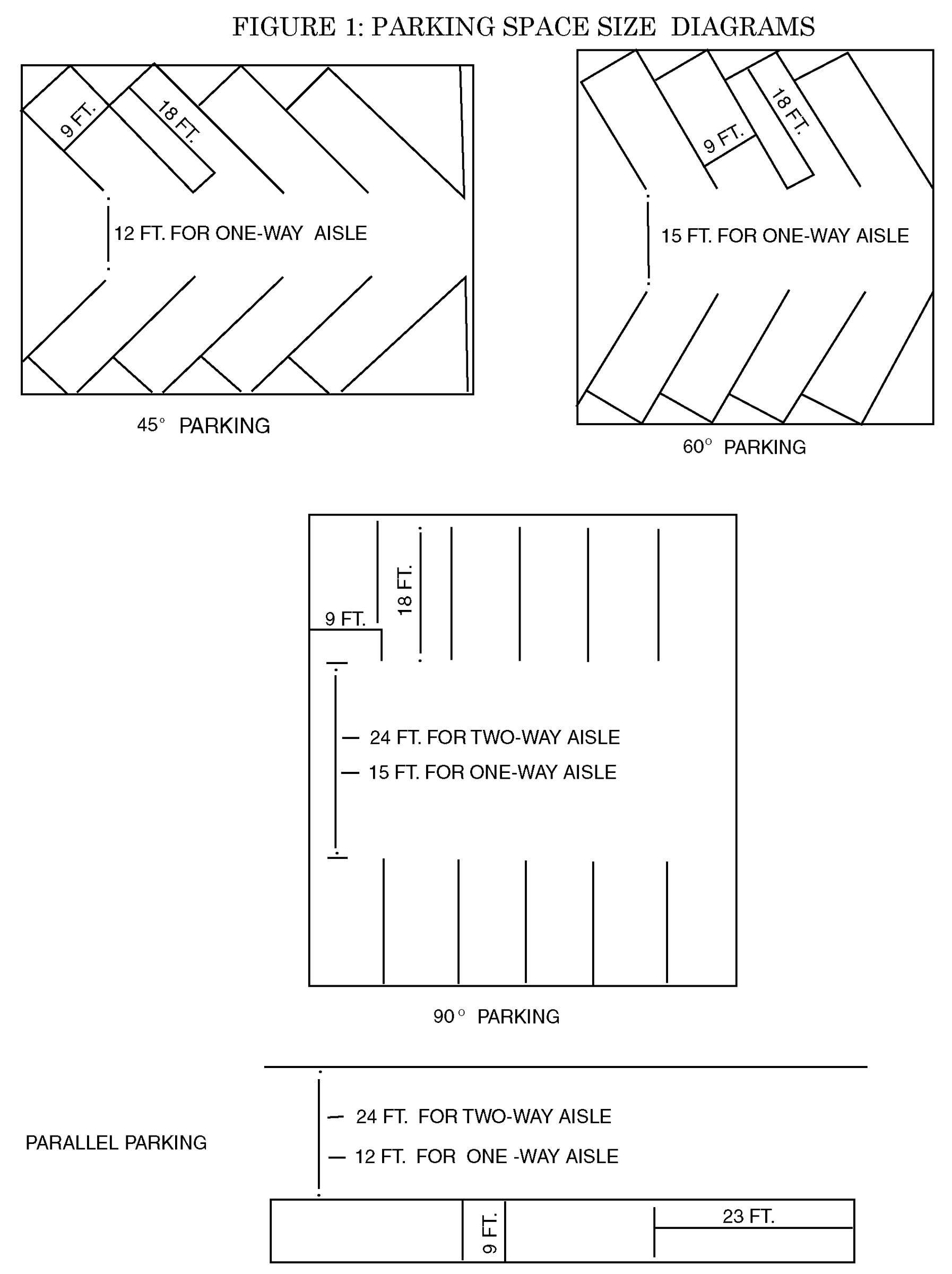
Parking Space Size Requirements
b)
Marking or designation. Parking areas shall be designated and marked as to provide for orderly and safe movement and storage of vehicles.
c)
Access drives. Except for parking spaces provided on residential lots, access drives shall be provided not less than twenty (20) feet wide and so located as to secure the most appropriate development of the individual property.
d)
Employee long-term off-street parking. In an employee long-term off-street parking facility, the minimum dimensions of the parking lot shall be described in Tables 2, 3, 4, or 5. "Employee long-term off-street parking facility" means an off-street parking facility for employees of the owners or beneficial users of the facility, where the average period of times that vehicles are parked in the facility is four (4) hours or more.
TABLE 2: MINIMUM DIMENSIONS FOR LAYOUT OF OFF-STREET PARKING SPACES IN GENERAL SERVICE
FACILITIES
(8.5-Ft. Parking Space Width)
*Measured perpendicular to length.
TABLE 3: GENERAL SERVICE FACILITIES
(8.5-Ft. Parking Space Width)
*NOTE: The "parking space depth to wall" and the "parking space depth interlock" are determined by rotating a 6 × 18.5 foot rectangle to the appropriate angle.
TABLE 4: MINIMUM DIMENSIONS FOR LAYOUT OF PARKING SPACES IN AN EMPLOYEE LONG-TERM
OFF-STREET PARKING FACILITY
(8-Ft. Parking Space Width)
*Measured perpendicular to length.
TABLE 5: EMPLOYEE LONG-TERM FACILITIES
(8.5 Ft. Parking Space Width)
*NOTE: The "parking space depth to wall" and the "parking space depth interlock" are determined by rotating a 6 × 18.5 foot rectangle to the appropriate angle.
e)
Drainage. Parking areas with a capacity of four (4) or more vehicles shall be surfaced with a material that will provide a durable, smooth and dustless surface and must be graded and provided with adequate drainage facilities to dispose of all collected surface water. All such parking areas shall be adequately maintained as to provide a durable, smooth, dustless surface.
f)
Curb and gutter. Except for single-family and two-family residential lots, concrete curbs and gutters shall be required to control storm water flow from the parking areas and to protect all landscaped areas such as landscape islands. Exceptions to this requirement may be granted by the zoning administrator or his/her designee, provided that the applicant can show that drainage will not run off onto adjacent parcels or otherwise negatively impact neighboring parcels.
g)
Backing onto street. All off-street parking and loading areas that require vehicles to back directly into a public road are prohibited.
h)
Lighting. Except for single-family and two-family residential lots, adequate lighting shall be provided for use when a parking area is in operation. All lighting shall be arranged so that no source of light shall be visible beyond the parcel or lot upon which the parking area is located.
On-site lighting shall be directed away from residential properties and public or private streets. Light poles or other supports, fixtures, and the quality of light emitted in residential developments shall be compatible with the surrounding residential character. Lighting emitted in nonresidential developments, which are adjacent to residential developments shall be compatible with the character of the adjacent residential areas.
Light poles shall be located not less than five (5) feet from the edge of a drive or parking space. Light poles located along streets shall be in accordance with the Ingham County Road Department and/or the Michigan Department of Transportation requirements, as applicable. Wiring for outside lighting shall be underground. Light poles or other supports shall be located so as not to interfere with traffic flow and access to fire hydrants or other utilities. Information shall be supplied on the height, direction, location, and intensity of outside lighting.
i)
Buffer zones. When a parking area is adjacent to a property of a different zone, a landscape buffer in accordance with section 6.10.1.5 shall be required.
j)
Greenbelts. When a parking area is adjacent to a public thoroughfare, a landscape greenbelt in accordance with section 6.10.1.6 shall required.
k)
Landscaping. Off-street parking area landscaping shall be in accordance with section 6.10.1.7 of this Ordinance.
7.1.15 Plot plan review: Plans and specifications for the construction or alteration of an off-street parking area shall be subject to site plan review per section 3.3 of this zoning ordinance.
7.1.16 Bicycle parking:
a)
It shall be the responsibility of both the owner and the occupant of any new multiple family housing, restaurant service, commercial recreation, retail shopping, and institutional developments to provide parking for bicycle users in accordance with the following provisions:
1)
Multiple-family development. One (1) bicycle parking space shall be provided on the premises for each dwelling unit.
2)
Nonresidential. At least four (4) bicycle storage spaces shall be provided on the premises and be accessible to visitors, employees, and/or customers.
b)
Such facilities shall be located in a convenient and accessible place which does not interfere with pedestrian or vehicular circulation.
1)
Storage space size requirements. Bicycle storage racks or other outdoor locking devices must be at least two (2) feet wide. Storage space within a building must be at least ten (10) square feet and must be exclusive of habitable rooms, kitchens, dining rooms, bathrooms, hallways, balconies, or patios which are accessible to occupants and employees of the premises.
2)
Exemptions. Nonresidential uses or developments with two (2) or less dwelling units located in the Town Center District (TC) shall be exempt from the requirements of this section.
(Ord. No. 39.51, 11-16-93; Ord. No. 39.55, 4-5-94; Ord. No. 39.68, 8-19-97; Ord. No. 39.76, 9-1-98; Ord. No. 39.77, 10-6-98; Ord. No. 39.90, § 1, 1-18-00; Ord. No. 39.101, § 4, 11-4-03; Ord. No. 39.109, 1-18-05; Ord. No. 39.167, § 1(Att. A), 1-20-26)
Section 7.2 - Loading and unloading space requirements.
7.2.1 Intent and purpose. In order to prevent undue interference with public use of streets and alleys, every manufacturing, storage, warehouse, department store, wholesale store, retail store, hotel, hospital, laundry, dairy, mortuary and other similar uses customarily receiving or distributing goods by motor vehicles shall provide space on the premises for that number of vehicles that will be at the premises at the same time on an average day of full use.
7.2.2 Additional parking space. Loading space required under this section shall be provided as area additional to off-street parking space as required under section 7.1 and shall not be considered as supplying off-street parking space.
7.2.3 Space requirements. There shall be provided adequate space for standing, loading and unloading services not less than twelve (12) feet in width, twenty-five (25) feet in length and fourteen (14) feet in height, open or enclosed, for all uses listed in the following table or for similar uses similarly involving the receipt or distribution by vehicles of materials or merchandise.
TABLE 6: LOADING AND UNLOADING SPACE REQUIREMENTS
7.2.4 Access. Access to a truck standing, loading and unloading space shall be provided directly from a public street or alley and such space shall be so arranged to provide sufficient off-street maneuvering space as well as adequate ingress and egress to and from a street or alley.
7.2.5 Site requirements. Off-street loading spaces and access drives shall be paved, drained, lighted and shall have appropriate bumper or wheel guards where needed. Any light used for illumination shall be so arranged as to reflect the light away from adjoining premises and streets. Where any off-street loading space adjoins or abuts a lot or premises used for residential, educational, recreational or religious purposes or abuts a residential district, there shall be provided a masonry wall not less than four (4) feet in height between the off-street loading space and said residential, educational, recreational or religious premises or residential zone.
(Ord. No. 39.68, 8-19-97)

