
Denison City Zoning Code
ARTICLE V
- DEVELOPMENT STANDARDS
Sec. 28.50. - Off-street parking and loading requirements.
28.50.1. Purpose:
To secure safety from fire, panic, and other dangers; to lessen congestion on public streets; to facilitate the adequate provision of transportation; to conserve the value of buildings; and to encourage the most appropriate use of land. Minimum off-street parking and loading shall be provided as set forth in the following schedules and provisions.
28.50.2. Residential districts—Special off-street parking provisions:
A.
Required off-street parking shall be provided on the same site as the use it is to serve.
B.
All vehicle parking shall be on a paved parking surface. For single-family houses, duplexes, patio homes and townhouses, concrete, asphalt, turf pavers or brick pavers are approved paving materials. If all parking is located to the rear of the main structure, a ribbon driveway meeting the requirements of section 28.54.7 may be utilized to access the paved parking spaces. All driveways and approaches to parking spaces, garages and carports shall be continuous and shall be similarly paved in accordance with the Public Works Standard Details, except in the A and RD districts.
C.
No required parking space, garage, carport, or other automobile storage space shall be used for the storage of any heavy load vehicle (see definitions for heavy load vehicle).
D.
Carports shall not be constructed of canvas, fabric or similar materials. Support poles shall not be PVC, plastic or similar material.
E.
1.
;hg;Any owner of a recreational vehicle may park one (1) such vehicle in the rear yard only of a lot in a residentially zoned district so long as the owner is the owner or occupant of such lot. Where there is no reasonable access to the rear yard, the recreational vehicle may be parked in the side yard, subject to the limitations provided by this section; and where there is not reasonable access to or insufficient space in the side yard, the recreational vehicle may be parked in the front yard of the lot, subject to the limitation provided by this section.
2.
Where side yard parking is permitted pursuant to the preceding paragraph, no person shall park a recreational vehicle so as to encroach upon the area of the side yard setback requirement of the lot. No person shall park a recreational vehicle in the side yard except upon an asphaltic or concrete pad which shall not encroach upon the area of the side yard setback requirement.
3.
Where front yard parking is permitted pursuant to E.1. above, the owner shall park the recreational vehicle as follows:
a.
In the driveway of the residence or upon an asphaltic or concrete pad adjacent to the driveway;
b.
At an angle perpendicular to the street upon which the residence faces; and
c.
In a manner in which the area of the publicly-owned parkway is maintained without encroachment.
4.
The following requirements are applicable to all parking of recreational vehicles in residentially zoned areas:
a.
A vehicle in excess of forty (40) feet in length shall not be parked in a residentially zoned district.
b.
Stock and utility trailers may be parked only within the rear yard area of a lot within a residentially zoned area.
c.
A corner lot shall be deemed to have reasonable access to the rear yard.
d.
When no permanent improvements exist on a lot, in addition to all other requirements provided in this article, the recreational vehicle shall be parked within the area defined by the applicable building lines of the lot.
e.
At no time shall such parked recreational vehicle be occupied or used for living, sleeping or housekeeping purposes, except as hereinafter permitted for visiting, nonpaying guests of the owner.
f.
A person shall not park a recreational vehicle within a public street except for the purpose of loading or unloading of the recreational vehicle, and then not for a period beyond forty-eight (48) hours.
g.
A person shall not connect the recreational vehicle to any utilities, except for a temporary connection to electricity for the purpose of charging batteries.
h.
No person shall operate an auxiliary power unit or generator while the recreational vehicle is parked within a residentially zoned district.
i.
No person may store any accessory or paraphernalia of the recreational vehicle outside the recreational vehicle in the immediate area of a parked recreational vehicle.
5.
The owner's recreational vehicle or the recreational vehicle of a nonpaying, visiting guest of the owner when parked in conformity with this article may be used for sleeping purposes only by the visiting guests for a maximum of fourteen (14) days in any calendar year. The recreational vehicle shall not be connected to any utility, other than temporary electrical hookups.
F.
Certain residential off-street parking regulations.
1.
Definitions. As used in this chapter, the following definitions apply unless otherwise stated:
Additional residential parking space shall mean an area not to exceed one hundred sixty-two (162) square feet that is situated between residence's existing driveway and the nearest side lot line.
Circular driveway shall mean a driveway serving a residential lot that enters and exits the residential lot from separate driveway approaches situated on the residential lot.
Double driveway shall mean a driveway of sufficient width to accommodate two (2) vehicles parked side by side.
Driveway shall mean a path giving access from a public right-of-way to a building on the abutting private property that is situated perpendicular to the public right-of-way.
Vehicle shall mean automobile, truck, motorcycle, recreational vehicle, boat, motor home, truck camper, travel trailer, tent trailer, camping trailer, motorized dwelling, fifth wheel, mobile home, house trailer, trailer, semi-trailer, horse trailer, airplane glider, off-highway motor vehicle, snowmobile, sand buggy, dune buggy, all-terrain vehicle, tractor, implement of husbandry, special mobile equipment, or any other major recreational equipment or motorized equipment.
2.
Prohibition. No person shall park or allow any parking of a vehicle on any part of a front or side residential yard other than on a paved or other hard-surfaced, impervious area driveway, ribbon driveway, double driveway, circular driveway or additional residential parking space, provided that the driveway or parking space meets the requirements of this chapter and all other applicable law.
3.
Exception. This section shall not apply to driveway, double driveway, circular driveway or additional residential parking area existing on the residential property on the effective date of this section, but this section shall be effective against all other pre-existing driveways or parking areas on a residential lot.
4.
Medical hardship exception. In the event that the foregoing parking restrictions create a hardship upon a permanent, full-time resident and such hardship is created by the medical incapacity of such resident, the city manager may grant a specific exception to this section. Such request shall be made in writing and shall include such medical documentation as is necessary, in the judgment of the city manager, for the making of an informed decision. The city manager's decision shall be made in writing, addressed to the applicant, shall specify the condition under which the exception is granted and shall return all medical documentation submitted to the applicant.
28.50.3. Nonresidential and MF Districts—Special off-street parking provisions:
A.
To prevent nuisance situations, all parking area lighting shall be designed and operated so as not to reflect or shine on adjacent properties and in accordance with the standards established in section 28.57.
B.
For safety and firefighting purposes, free access through to adjacent nonresidential parking areas shall be provided in accordance with subsection 28.50.10, Fire Lanes.
C.
All off-street parking, maneuvering, loading and storage areas shall be paved in accordance
with the parking lot paving requirements in the city's Code of Ordinances (i.e., no
parking shall be permitted on grass, within landscaped areas, or on other unimproved
surfaces).
Parking spaces shall be permanently and clearly identified by stripes, buttons, tiles,
curbs, barriers, or other approved methods. Nonpermanent-type marking, such as paint,
shall be regularly maintained to ensure continuous clear identification of the space.
D.
Each standard off-street surface parking space size shall be in accordance with the design standards as shown on Illustration 2 for space size and design. Specific parking space sizes, exclusive of aisles, driveways and maneuvering areas shall be in accordance with the following minimum sizes:
1.
Standard: Nine (9) feet by eighteen (18) feet.
2.
Compact: Nine (9) feet by sixteen (16) feet; limited to a maximum of ten (10) percent of the required number of parking spaces; must be clearly designated with appropriate signage (see subsection 28.50.7.H.).
3.
Parallel: Eight (8) feet by twenty-two (22) feet.
E.
All parking and loading spaces, and vehicle sales areas on private property shall have a vehicle stopping device (e.g., curb, wheel stop, etc.) installed so as to prevent parking of motor vehicles in any required landscaped areas, to prevent vehicles from hitting buildings, to protect public and/or private utility structures/facilities, and to prevent parked vehicles from overhanging a public right-of-way line, public sidewalk, or adjacent private property (see Illustration 3). An extra-wide walkway on private property may be permitted so as to allow encroachment of vehicle overhang while maintaining an unobstructed four-foot minimum walkway width. The requirement shall apply only where spaces are adjacent to the walks, right-of-way, and required landscaping. Parking shall not be permitted to encroach upon the public right-of-way in any case. For new construction only, all vehicle maneuvering shall take place on-site. No public right-of-way shall be used for backing or maneuvering into or from a parking space, or for circulation within the parking lot.
F.
In all nonresidential and multi-family zoning districts, the perimeter of all parking lots and driveways shall be provided with concrete curbs or other means to control traffic.
G.
Refuse storage facilities placed in a parking lot shall not be located in a designated parking or loading space. Each refuse facility shall be located so as to facilitate pickup by refuse collection agencies.
H.
Handicap parking space(s) and other associated provisions (e.g., clear and unobstructed pathways into building, crosswalks across parking lots, etc.) shall be provided according to building codes, State laws, and requirements of the Americans with Disabilities Act (ADA).
I.
In all nonresidential and multi-family zoning categories, designated parking and loading areas shall not be used for the repair, storage, dismantling or servicing (except for normal maintenance of a private vehicle) of vehicles or equipment, or for the storage of materials or supplies, or for any other use in conflict with the designated parking and loading areas (i.e., advertising or open storage of raw materials).
J.
To ensure that all requirements set forth in this section are carried forward, it will be the responsibility of the owner of the parking area to adequately maintain the facility. All off-street parking areas shall be kept free of trash, debris, vehicle repair operation or display and advertising uses. At no time after initial approval of the parking area layout can changes be made in the location and number of provided spaces without approval of the planning director, or his/her designee.
K.
Requirements for drive-through facilities:
1.
A stacking space shall be an area on a site measuring ten (10) feet by twenty (20) feet with direct forward access to a service window or station of a drive-through facility which does not constitute space for any other circulation driveway, parking space, or maneuvering area. An escape lane, of at least fourteen (14) feet in width and with negotiable geometric design, must be provided to allow vehicles to get out of stacking lane in the event of a stalled vehicle, emergency, accidental entry, etc. (see Illustration 7).
2.
For financial institutions with drive-through facilities, each teller window or station, human or mechanical, shall be provided with a minimum of five (5) stacking spaces. One (1) escape lane shall be provided.
3.
For each service window of a drive-through restaurant, a minimum of six (6) spaces shall be provided for the first vehicle stop (usually the menu/order board), and two (2) spaces shall be provided for each additional vehicle stop (order/pickup windows, etc.). One (1) escape lane shall be provided from the beginning of the stacking lane to the first stop (e.g., menu/order board).
4.
For retail operations (other than restaurants, banks, etc.) and kiosks that provide drive-up service (e.g., pharmacy, dry cleaners, etc.), a minimum of three (3) stacking spaces for each service window shall be provided.
5.
For a full-service car wash, each vacuum or gas pump lane shall be provided with a minimum of four (4) stacking spaces. For the finish/drying area, adequate vehicle stacking and storage space must be provided to keep finished vehicles out of circulation aisles, access easements, fire lanes, streets, etc.
6.
For each automated self-service (drive-through/rollover) car wash bay, a minimum of three (3) stacking spaces, in addition to the wash bay itself shall be provided. One (1) stacking space shall be provided at the exit end of each wash bay for window-drying and other detailing.
7.
For each wand-type self-service (open) car wash bay, a minimum of two (2) stacking spaces, in addition to the wash bay itself shall be provided. One (1) stacking space shall be provided at the exit end of each wash bay for window drying and other detailing, unless a separate area/shade structure is provided (outside of circulation aisles) for these activities.
8.
For automobile quick-lube type facilities, a minimum of three (3) stacking spaces shall be provided for each service bay in addition to the service bay(s) itself.
9.
For any restaurant that provides double drive-through lanes the inside lane closest to the building shall be an area measuring ten (10) feet by twenty (20) feet. The outside lane shall be an area measuring fourteen (14) feet in width and with negotiable geometric design.
28.50.4. Off-Street loading space—All districts:
A.
All retail and similar nonresidential structures shall provide and maintain off-street facilities for receiving and loading merchandise, supplies and materials within a building or on the lot or tract. All drives and approaches shall provide adequate space and clearances to allow for the maneuvering of trucks off-street. Each site shall provide a designated on-site maneuvering area for trucks (see Illustration 3). Such off-street loading space may be adjacent to (but not any portion of) a public alley or private service drive, or it may consist of a truck berth within the structure. Such off-street loading space or truck berth shall consist of a minimum area of ten (10) feet by forty-five (45) feet, and such spaces or berths shall be provided in accordance with the following schedule:
B.
In all nonresidential zoning districts, loading docks or service/delivery entrances shall be screened or not be constructed facing any public street, and shall not be visible from any public street.
C.
Loading docks for any establishment which customarily receives goods between the hours of 9:00 p.m. and 8:00 a.m. and is adjacent to a residential use or district shall be designed and constructed so as to enclose the loading operation on three (3) sides, in order to reduce the effects of the noise of the operation on adjacent residences.
D.
Kindergartens, elementary schools, day schools, and similar child training and care establishments shall provide one (1) paved off-street pedestrian loading and unloading space for an automobile on a through, "circular" drive for each ten (10) students cared for (excluding child care in a residence). An additional lane shall also be required to allow pass by or through traffic to move while automobiles waiting or parked to pick up children occupy loading/unloading areas.
28.50.5. Parking access from a public street—All districts:
A.
In the approval of a site plan, design consideration shall be given to providing entrance/exit drives that extend into the site to provide adequate queuing of vehicles on the site.
B.
In all districts (except single-family and duplex zoning districts) building plans shall provide for entrance/exit drive(s) appropriately designed and located to minimize traffic congestion or conflict within the site and with adjoining public streets as approved by the planning director, or his/her designee.
1.
Based upon analysis by the city, if projected volumes of traffic entering or leaving a development are likely to interfere with the projected peak traffic flow volumes on adjoining streets, additional right-of-way and paving in the form of a deceleration lane or turn lane may be required of a developer in order to reduce such interference.
2.
The determination of additional right-of-way or paving requirements shall be made at the time the final site plan is submitted for approval.
C.
Vehicular access to nonresidential uses shall not be permitted from alleys serving residential areas, and shall not be configured as "head-in" parking spaces that are accessed directly from the street.
D.
Parking space configuration, location, arrangement, size and circulation in all districts shall be constructed according to Illustration 2.
28.50.6. Parking requirements based upon use:
A.
In all districts except the Central Business District (CBD), there shall be provided at the time any building or structure is erected or structurally altered, or change of use, off-street parking spaces in accordance with the following requirements:
1.
Assisted living: One (1) space per six (6) beds; plus one (1) parking space for each three hundred (300) square feet of floor area devoted to offices, dining rooms, exercise/therapy rooms and other similar ancillary uses, plus one (1) space for every (2) employees at full occupancy.
2.
Automobile parts sales (indoors): One (1) space per five hundred (500) square feet of indoor floor area, plus one (1) space for each two thousand (2,000) square feet of outside sales area.
3.
Automobile sales or service: See Motor Vehicle Sales.
4.
Bank, savings and loan, or similar institution: One (1) space per two hundred and fifty (250) square feet of gross floor area in addition to required stacking spaces (see subsection 28.50.3.K.).
5.
Bed and breakfast facility: One (1) space per guest room in addition to the requirements for a normal residential use.
6.
Bowling alley or center: Four (4) parking spaces for each alley or lane.
7.
Business or professional office (general): One (1) space per three hundred (300) square feet of gross floor area, except as otherwise specified herein.
8.
Car wash (self-serve): One (1) space per washing bay or stall in addition to the washing areas/stalls themselves and required stacking spaces; Car wash (full service): One (1) space per one hundred fifty (150) square feet of floor area in addition to the required stacking spaces (also see subsection 28.50.3.K.).
9.
Church, rectory, or other place of worship: One (1) parking space for each three (3) seats in the main auditorium/sanctuary (see subsection 28.50.7.B.).
10.
Commercial amusement (indoor): One (1) space per one hundred (100) square feet of gross floor area, or as follows:
a.
Racquetball or handball courts—Three (3) spaces for each court.
b.
Indoor tennis courts—Six (6) spaces for each court.
c.
Gymnasium, skating rinks, and martial arts schools—One (1) space for each three (3) seats at a maximum seating capacity (based upon maximum occupancy), plus one (1) space for each two hundred (200) square feet.
d.
Swimming pool—One (1) space for each one hundred (100) square feet of gross water surface and deck area.
e.
Weight lifting or exercise areas—One (1) space for each one hundred (100) square feet.
f.
Indoor jogging or running tracks—One (1) space for each one hundred (100) linear feet.
g.
Motion picture theaters (which do not include live performances): a) one (1) space per three and one-half (3½) seats for single-screen theaters; b) one (1) space per five (5) seats for motion picture theaters with two (2) or more screens (see subsection 28.50.7.B.).
h.
Amusement center—One (1) space for each game table and one (1) space for each amusement device.
i.
[All other areas.]—All areas for subsidiary uses not listed above or in other parts of this section (such as restaurants, office, etc.) shall be calculated in with the minimum specified for those individual uses.
11.
Commercial amusement (outdoor): Ten (10) spaces plus one (1) space for each five hundred (500) square feet over five thousand (5,000) square feet of building and recreational area.
12.
Commercial use: One (1) space per two hundred fifty (250) square feet of floor area.
13.
Community center, library, museum or art gallery: Ten (10) parking spaces plus one (1) additional space for each three hundred (300) square feet of floor area in excess of two thousand (2,000) square feet. If an auditorium is included as a part of the building, its floor area shall be deducted from the total and additional parking provided on the basis of one (1) space for each four (4) seats that it contains (see subsection 28.50.7.B.).
14.
Convenience store (with gasoline pumps): One (1) space per two hundred (200) square feet of floor area, plus one (1) space for each gasoline pump unit (a unit may have up to six (6) nozzles for gasoline disbursement). Spaces within pump areas qualify as spaces for the parking requirement. If no gasoline sales are provided, then the parking requirements shall be the same as for a retail store. Adequate space shall be provided for waiting, stacking, and maneuvering automobiles for refueling. (See also subsection 28.50.3.K.).
15.
Dance/aerobics studio, or assembly/exhibition hall without fixed seats: One (1) parking space for each one hundred (100) square feet of floor area thereof.
16.
Day nursery, day care center: One (1) space per ten (10) pupils (based upon maximum occupancy and/or licensing capacity), plus one (1) space per teacher, plus one (1) space for each bus or van stored on the property (and sized to accommodate the vehicle).
17.
Defensive driving school/class: One (1) space for each classroom seat (see subsection 28.50.7.B.).
18.
Event venue/meeting hall: One (1) space for each three (3) seats.
19.
Fast-food or drive-in restaurant: One (1) parking space per one hundred (100) square feet of gross floor area (including indoor/outdoor play areas and patio dining areas), or one (1) space for every three (3) seats under maximum seating arrangement (i.e., occupancy), whichever is greater; required parking spaces are in addition to any stacking spaces that may be needed/provided for drive-through or drive-in facilities (see subsection 28.50.3.K.).
20.
Food truck park: one (1) space outside of public rights-of-way for each one hundred (100) square feet of patron seating area. Food truck parks located in the CA District are exempt from this requirement.
21.
Furniture or appliance store, hardware store, wholesale establishments, clothing or shoe repair or service: Two (2) parking spaces plus one (1) additional parking space for each three hundred (300) square feet of floor area over one thousand (1,000) square feet.
22.
Gasoline station: One (1) space per two hundred (200) square feet of floor area, plus one (1) space for each gasoline pump unit (a unit may have up to six (6) nozzles for gasoline disbursement). Spaces within pump areas qualify as spaces for the parking requirement. Adequate space shall be provided for waiting, stacking, and maneuvering automobiles for refueling. (See also subsection 28.50.3.K.).
23.
Golf course: Four (4) parking spaces per hole or green plus requirements for retail, office, and club house areas and one (1) space per each two (2) employees.
24.
Golf driving range: One and one-half (12) spaces for each driving tee.
25.
Health club, health spa or exercise club: One (1) space per one hundred fifty (150) square feet of floor area.
26.
Hospital: One (1) space for each two (2) beds or examination room, whichever is applicable; plus one (1) space for every two (2) employees during periods of full occupancy.
27.
Hotel or motel: One (1) space per room for the first two hundred fifty (250) rooms and .75 space per room for each room over two hundred fifty (250), plus one (1) space per five (5) restaurant/lounge area seats (based upon maximum occupancy), plus one (1) space per one hundred twenty-five (125) square feet of meeting/conference areas.
a.
One and one-tenth (1.1) spaces per room which contains kitchenette facilities, plus parking for restaurant and meeting areas per ratio stated in this paragraph.
b.
Two (2) spaces per guest room provided with full kitchen facilities plus parking for restaurant and meeting areas per the ratio stated in this paragraph.
c.
One (1) space for every two (2) employees during peak (i.e., busiest) time periods when the hotel/motel is fully occupied.
28.
Independent living facility: One and one-half (1.5) spaces for each dwelling unit, plus any additional spaces for accessory retail, office, service or recreational uses.
29.
Institutions of a philanthropic nature: Ten (10) spaces plus one (1) space for each employee.
30.
Library or museum: Ten (10) spaces plus one (1) space for every three hundred (300) square feet.
31.
Lodge or fraternal organization: One (1) space per two hundred (200) square feet.
32.
Lumber yard/home improvement center: One (1) space per four hundred (400) square feet display area, plus one (1) space per one thousand (1,000) square feet of warehouse.
33.
Manufactured/mobile home or manufactured/mobile home park: Two (2) spaces for each manufactured/mobile home unit, plus visitor/supplemental parking in accordance with subsection 28.23.4.B. plus additional spaces as required herein for accessory uses.
34.
Medical or dental office: One (1) space per two hundred (200) square feet of floor area. Facilities over twenty thousand (20,000) square feet shall use the parking standards set forth for hospitals.
35.
Mini-warehouse or self-storage facility: Four (4) spaces per establishment plus (1) one additional space per ten thousand (10,000) square feet of storage area.
36.
Mortuary or funeral home: One (1) parking space for each two hundred (200) square feet of floor space in slumber rooms, parlors or individual funeral service rooms, or one (1) space for each three (3) seats in the auditorium/sanctuary (see subsection 28.50.7.B.), whichever is greater. Adequate on-site stacking spaces shall also be provided for the organization and forming of processions such that these activities do not cause excessive or extended traffic congestion/delays on a public roadway.
37.
Motor-vehicle sales and new or used car lots: One (1) parking space for each five hundred (500) square feet of sales floor/office and other indoor uses, plus one (1) parking space for each one thousand (1,000) square feet of exterior lot area used for storage, sales and parking areas, plus one (1) parking space per repair bay in service areas (indoors or outdoors), plus one (1) parking space per service/towing vehicle to be stored on-site (required parking spaces are in addition to those to be used for the storage/display of vehicles for sale/lease).
38.
Multi-family dwelling:
a.
One (1) space for each studio/efficiency unit.
b.
One and one-half (1.5) spaces for each one-bedroom unit.
c.
Two (2) spaces for each two-bedroom unit.
d.
Two and one-half (2.5) spaces for each three-bedroom unit.
e.
Three (3) spaces for each four- or more-bedroom unit.
39.
Office (administrative or professional): One (1) space for each three hundred (300) square feet of floor area.
40.
Outdoor display: One (1) space for each six hundred (600) square feet of open sales/display area.
41.
Pawn shop: One (1) space for each two hundred (200) square feet of floor area.
42.
Places of public assembly not listed: One (1) space for each three (3) seats provided (see subsection 28.50.7.B.).
43.
Real estate office: One (1) space for each two hundred (200) square feet.
44.
Restaurant, private club, night club, cafe or similar recreation or amusement establishment: One (1) parking space for each one hundred (100) square feet of gross floor area (including indoor/outdoor play areas and patio dining areas), or one (1) space for every three (3) seats under maximum seating arrangement (i.e., occupancy), whichever is greater; required parking spaces are in addition to any stacking spaces that may be needed/provided for drive-through or drive-in facilities (see Subsection 28.50.3.K.).
45.
Retail or personal service establishment, except as otherwise specified herein: One (1) space per two hundred (200) square feet of gross floor area in addition to any required stacking spaces for drive-through facilities (see subsection 28.50.3.K.).
46.
Rooming or boarding house: One (1) parking space for each sleeping room, plus one (1) parking space for each host resident or employee during maximum (i.e., peak) shift.
47.
School, elementary (grades K-6): One (1) parking space for each fifteen (15) students (design capacity).
48.
School, secondary or middle (grades 7-8): One (1) parking space for each twelve (12) students (design capacity).
49.
School, high school (grades 9-12): One (1) space for each three (3) students, faculty and staff (design capacity).
50.
Skilled nursing facility: One (1) space per six (6) beds; plus one (1) parking space for each three hundred (300) square feet of floor area devoted to offices, cafeterias, exercise/therapeutic rooms, and other similar ancillary uses; plus one (1) space for every two (2) employees at full occupancy.
51.
Storage or warehousing: One (1) space for each two (2) employees or one (1) space for each one thousand (1,000) square feet of total floor area, whichever is greater.
52.
Telemarketing: One (1) space for each two hundred fifty (250) square feet of floor space.
53.
Theater, indoor or outdoor (live performances), sports arena, stadium, gymnasium or auditorium (except school auditorium): One (1) parking space for each three (3) seats or bench seating spaces (see subsection 28.50.7.B.).
54.
Travel center: One (1) space per two hundred (200) square feet of floor area, plus one (1) space for each gasoline pump unit (a unit may have up to six (6) nozzles for gasoline disbursement). Spaces within pump areas qualify as spaces for the parking requirement. If no gasoline sales are provided, then the parking requirements shall be the same as for a retail store. Adequate space shall be provided for waiting, stacking, and maneuvering automobiles for refueling. On-site parking area dedicated to automobiles shall exceed truck parking by a ratio of 2:1.
55.
Veterinarian clinic: One (1) space per three hundred (300) square feet of gross floor space.
56.
Warehouse or wholesale type uses: One (1) space for five thousand (5,000) square feet of gross floor area.
28.50.7. Rules for computing number of parking spaces:
In computing the number of parking spaces required for each of the above uses, the following rules shall govern:
A.
"Floor area" shall mean the gross floor area of the specific use.
B.
"Seat" shall be interpreted as follows:
1.
For fixed (e.g., church pews, grandstands, benches, etc.) seating, one (1) seat equals one point seventy-five (1.75) feet of length; and
2.
For flexible (e.g., folding chairs, etc.) seating areas, one (1) seat equals eight (8) square feet of floor area occupied by such seating area (includes aisles).
C.
Where fractional spaces result, the parking spaces required shall be construed to be the next higher whole number.
D.
The parking space requirements for a new or unlisted use not specifically mentioned herein shall be the same as required for a use of similar nature. If the proposed use is not similar to any of the uses listed herein, a determination shall be made by the planning director or his/her designee, in accordance with the requirements for the most closely related use specified in this section. In the event the applicant disagrees with this determination, then he/she may submit a request for determination by the city using the same process as provided in subsection 28.49.1.D. for classifying new and unlisted uses.
E.
Whenever a building or use is changed or enlarged in floor area, number of employees, number of dwelling units, seating capacity or otherwise, to create a need for an increase of ten (10) percent or more in the number of existing parking spaces, such spaces shall be provided on the basis of the enlargement or change.
F.
For buildings that have mixed uses within the same structure (such as retail and office), the parking requirement shall be calculated for the most intensive use. In cases where the design of the interior of the structure is not practical for alteration, the parking requirement may be calculated for each use within a structure for buildings over twenty thousand (20,000) square
G.
Shared parking may be allowed in the case of mixed uses (different buildings) feet under the following conditions. Up to fifty (50) percent of the parking spaces required for a theater or other place of evening entertainment (after 6:00 p.m.), or for a church, may be provided and used jointly by banks, offices, and similar uses not normally open, used, or operated during evening hours. Shared parking must be on the same parking lot. Reduction due to shared parking shall be determined by the city planning director, or his/her designee. To assure retention of the shared parking spaces, each property owner shall properly draw and execute a document expressing the same and shall file this agreement with the City of Denison.
H.
Compact car spaces: In the NS, GR, C and CBD Districts only, compact car parking spaces may be permitted when approved as part of a detailed site plan by the planning and zoning commission and the city council, providing one (1) of the following conditions apply:
1.
Where it is necessary to preserve the natural landscape and native trees, a maximum of twenty (20) percent of required parking may be designated for compact cars.
2.
On parking lots larger than fifty (50) spaces involving large industrial buildings or large offices and where there is only one (1) tenant, a maximum of twenty (20) percent of the required parking may be for compact cars.
3.
On parking lots larger than fifty (50) spaces involving a shopping center, a maximum of twenty (20) percent of the required parking may be for compact cars.
28.50.8. Location of parking spaces:
All parking spaces required herein shall be located on the same lot (and within one hundred fifty (150) feet, in the case of nonresidential buildings/uses) of the building or use served, except as follows:
A.
Where an increase in the number of spaces is required by a change or enlargement of an existing use, or where such spaces are provided collectively or used jointly by two (2) or more buildings or establishments, the required additional spaces may be located not to exceed three hundred (300) feet from any nonresidential building served.
B.
In any case where the required parking spaces are not located on the same lot with the building or use served, or where such spaces are collectively or jointly provided and used, approval by the planning and zoning commission and the city council is required according to the following criteria:
Off-site parking may be permitted on an immediately contiguous lot or tract or on a lot or tract within one hundred fifty (150) feet of such building or structure providing:
1.
That a permanent, irrevocable easement of the parking facilities in favor of the premises to be benefited shall be dedicated and recorded as a condition of such use; or
2.
That a long-term remote parking lease agreement be provided upon approval by the city as a condition of such use.
28.50.9. Use of required parking spaces, nonresidential districts:
Required off-street parking and loading spaces shall be used only for these respective purposes and shall not be used for refuse containers, cart corrals, recycling kiosks, signs or sign support structures, telecommunications towers or support structures, storage or permanent display of boats, trailers, campers, motor vehicles or other goods, materials, or products for sale/lease/rent.
28.50.10. Fire lanes:
A.
Fire lanes shall be provided in all multi-family (and in some single-family attached), manufactured home, and nonresidential developments, as required by the adopted fire code of the city (also see the subdivision ordinance for certain fire lane regulations). Fire lanes shall be a minimum width of twenty-four (24) feet of paving, and shall have a minimum inside turning radius at curves of twenty (20) feet, or as required by the fire code and/or the fire chief of the City of Denison. The minimum overhead vertical clearance over fire lanes shall be fourteen (14) feet for a linear distance of fifty (50) feet on each side (i.e., in front of and behind, as a fire apparatus would traverse underneath) of any overhead structure (e.g., canopy, roof overhang, vertical height control device, etc.).
B.
Any such fire lane easement shall either connect both ends to a dedicated street or be provided with a turnaround having a minimum outer radius of fifty (50) feet. If two (2) or more interconnecting lanes are provided, interior radius for that connection shall be required in accordance with the following:
For ninety (90) degree or greater turns only.
Twenty-four-foot fire lane—minimum radius twenty (20) feet.
Thirty-foot fire lane—minimum radius ten (10) feet.
28.50.11. Construction requirements for parking areas:
All weather surface. All weather surface shall mean either:
A.
Five (5) inches of compacted base material with two (2) inches of asphaltic concrete cover; or
B.
Four (4) inches of concrete on a prepared sub-grade.
28.50.12. Certain residential off-street parking prohibited:
A.
Definitions: As used in this chapter, the following definitions apply unless otherwise stated:
1.
Additional residential parking space shall mean an area not to exceed one hundred sixty-two (162) square feet that is situated between residences existing driveway and the nearest lot line.
2.
Circular driveway shall mean a driveway serving a residential lot that enters and exits the residential lot from separate driveway approaches situated on the residential lot.
3.
Double driveway shall mean a driveway of sufficient width to accommodate two (2) vehicles parked side by side.
4.
Driveway shall mean a path giving access from a public right-of-way to a building abutting private property that is situated perpendicular to the public right-of-way.
5.
Vehicle shall mean automobile, truck, motorcycle, recreational vehicle, motor home, truck camper, travel trailer, tent trailer, camping trailer, motorized dwelling, fifth wheel, mobile home, house trailer, trailer, semi-trailer, horse trailer, airplane glider, off-highway motor vehicle, snowmobile, sand buggy, dune buggy, all-terrain vehicle, tractor, implement of husbandry, special mobile equipment, or any other major recreational equipment or motorized equipment.
B.
Prohibition: No person shall park or allow any parking of a vehicle on any part of a front or side residential yard other than on a paved or other hard-surfaced, impervious area driveway, double driveway, circular driveway or additional residential parking space, provided that the driveway or parking space meets the requirements of this chapter and all other applicable law.
C.
Exception: This section shall not apply to a driveway, double driveway; circular driveway or additional residential parking area existing on the residential property on the effective date of this section, but this section shall be effective against all other pre-existing driveways or parking areas on a residential lot.
D.
Medical hardship exemption: In the event that the foregoing parking restrictions create a hardship upon a permanent, full-time resident and such hardship is created by the medical incapacity of such resident, the city manager may grant a specific exemption to this section. Such request shall be made in writing and shall include such medical documentation as is necessary in the judgment of the city manager, for the making of an informed decision. The city manager's decision shall be made in writing, addressed to the applicant, shall specify the condition under which the exception is granted and shall return all medical documentation to the applicant.
(Ord. No. 4866, § 3, 5-1-17; Ord. No. 4892, § 3(3.01), 8-7-17; Ord. No. 4893, § 3(3.02), 8-7-17; Ord. No. 4901, § 3(3.03), 9-5-17; Ord. No. 5023, § 3B, 9-16-19; Ord. No. 5134, § 5, 5-3-21; Ord. No. 5237, § 3, 10-3-22; Ord. No. 5432, § 3, 1-20-26)
Sec. 28.51. - Landscape requirements.
28.51.1. Purpose:
The purpose of this section is to improve the appearance of vehicular use areas and property abutting public rights-of-way, require the installation and maintenance of trees, shrubs and other plant material to improve the aesthetics and natural environment of the city, reduce the amount of impervious surface area, stormwater runoff, and consequent pollution in local waterways, and promote the public health and safety through the reduction of air pollution, visual pollution, and glare. These standards recognize the value and necessity of air purification, water conservation and the use of drought-tolerant plants and trees that are native or adapted to the region's climate, soils and environment.
28.51.2. Applicability:
A.
The standards and criteria contained within this section are deemed to be minimum standards and shall apply as stated.
1.
To all new residential and nonresidential development (including uses such as schools, government buildings and churches within a residential zoning district)
2.
To any redevelopment that:
a.
Increases the existing square footage of a structure(s) by more than thirty (30) percent; and/or
b.
Increases the use of the site by more than thirty (30) percent.
c.
Adds twenty (20) or more parking spaces to an existing parking lot.
3.
To any nonresidential or multi-family use requiring a conditional use permit (CUP) or a planned development (PD) zoning designation, unless special landscaping standards are otherwise provided for in the ordinance establishing the CUP or PD District.
B.
If at any time after the issuance of a certificate of occupancy, landscaping as required and approved according to this section is found to be not in conformance with the following standards and criteria
1.
The director of development services (or his/her designee) shall issue notice to the owner, citing the violation and describing what action is required to comply with this section.
2.
The owner, tenant or agent shall have thirty (30) days from the date of said notice to establish/restore the landscaping, as required.
3.
If the landscaping is not established/restored within the allotted time, then such person shall be in violation of this chapter and subject to the enforcement provisions of article VII of this chapter.
C.
Except for the provisions in section 28.51.6.A.7, this section 28.51 does not apply to lots in the CA—Central Area district.
28.51.3. Permits:
A.
Landscaping for standard development/redevelopment: With the exception of single-family detached and duplex lots, no permits shall be issued for building, paving, grading or construction until a landscape plan is submitted and approved by the director of development services (or his/her designee) along with the applicable required plan, as specified in section 28.13 of this chapter. The landscape plan may be shown on the required site plan (provided the plan remains clear and legible) or may be drawn on a separate sheet. For projects requiring a landscape plan, prior to the issuance of a certificate of occupancy for any building or structure, all landscaping shall be installed in accordance with the plan. For single-family detached and duplex lots, landscaping must be installed prior to the final inspection and in accordance with section 28.51.7.
B.
Landscaping for phased development: If development of a site is being accomplished in two (2) or more phases, landscaping may be established in phases. Phased landscaping shall only be permitted in conjunction with a required site plan, as specified in section 28.13 that is submitted and approved in phases as well. In all cases, a landscaping plan shall be submitted along with a required site plan.
C.
Seasonal deferment for landscaping installation: In any case in which a certificate of occupancy is sought at a season of the year in which the director of development services (or his/her designee) determines that it would be impractical to plant trees, shrubs or groundcover, or to successfully establish turf areas, the applicant may request a temporary deferral of installation.
1.
The applicant shall submit a letter requesting temporary deferral which also states when the installation shall occur.
2.
All landscaping required in accordance with this section shall be installed within six (6) months of the date of the approval of the temporary deferral.
3.
Following the installation of the required landscaping and city approval of the same, the city shall issue a letter of compliance.
4.
Failure to install the landscaping within the temporary deferral period shall be an offense.
28.51.4. Landscape plan:
Prior to the issuance of a building, paving, grading or construction permit for any use other than single-family detached or duplex dwellings, a landscape plan shall be submitted to the director of development services, or his/her designee. In accordance with section 28.13 of this chapter the director (or his/her designee) shall review such plans and shall approve same if the plans are in accordance with the criteria of this chapter. If the plans are not in conformance, they shall be disapproved and shall be accompanied by a written statement setting forth the changes necessary for compliance.
The director of development services may establish procedures and forms for landscape plans for clarity and consistency of operations. The procedures and forms shall have the force of ordinance as if fully incorporated herein. Landscaping plans shall be prepared by a person knowledgeable in plant material usage and landscape design (e.g. landscape architect, landscape contractor, landscape designer, etc.) and drawn to a scale of not smaller than one (1) inch equals twenty (20) feet or such scale approved by the director of development services. Landscape plans shall contain the following minimum information:
A.
Existing property boundary lines, easements, buildings, parking lots, roads, and other improvements.
B.
Location of all trees to be preserved (do not use "tree stamps"), including approximate size and common name.
C.
Location of all new plant and landscaping material to be installed, including plants, mulch, gravel and rocks, paving, benches, living screens, fountains, statues, earthen berms, ponds (to include depth of water), topography of site, or other landscape features and materials.
D.
Planting schedule including species and common names of all plant materials, installation size, quantities (container size, planted height, etc.), and special planting instructions.
E.
Details of restoration of disturbed areas, including areas to be sodded or seeded, and identify ground cover.
F.
Location and details of irrigation, sprinkler, or water systems including location of water sources.
G.
Description of maintenance provisions.
H.
Name and address of the person(s) responsible for the preparation of the landscape plan, prepared date, and north arrow/symbol, and map insert depicting location of property.
I.
Such other information as may be required by the city to determine compliance with this section.
28.51.5. General standards:
The following criteria and standards shall apply to landscape materials and installation:
A.
An automatic irrigation system is required for all landscaping, except in areas designated as natural areas to be preserved on the landscape plan and for individual single-family detached and single-family attached dwellings and duplexes.
B.
Except as allowed by section 21.2 of this Code, no plant materials or irrigation systems shall be installed in public rights-of-way or on other public property without an encroachment agreement approved by the city.
C.
To insure drought-tolerance, all plant materials shall be native or adapted to the North Texas climate. Trees and shrubs shall be chosen from the approved plant materials list in appendix C of this chapter. No invasive species shall be used.
D.
No more than thirty (30) percent of required trees shall be the same species.
E.
Where a parking lot or access aisle is adjacent to any landscaping, including the permeable areas and drip lines around trees and planting beds, such landscaping shall be protected with continuous curbs, curbs with openings, wheel stops or similar solid or semi-permeable barriers.
F.
Landscaping materials such as mulch and gravel may be used under trees, shrubs and other plants, but shall not comprise a significant portion of the total landscaped area.
G.
Tree caliper measurements of new required trees shall be the caliper of the tree measured at twelve (12) inches above the soil. Shade trees shall be a minimum caliper of three (3) inches. Ornamental trees shall be a minimum caliper of two (2) inches.
H.
All new trees shall be surrounded by a permeable surface or be located within a tree grate that is a minimum of five (5) feet by five (5) feet in size.
I.
Shrubs required pursuant to this section shall meet the following minimum criteria:
1.
For non-residential and multi-family uses, shrubs shall be a minimum size of five (5) gallons at time of planting. To comply with the shrub requirement for single-family and duplex uses, shrubs shall be a minimum size of three (3) gallons at the time of planting.
2.
Hedges, where installed for screening/buffering purposes, shall be planted and maintained so as to form a continuous, unbroken, solid visual screen which should be at least six (6) feet in height within three (3) years after planting. The exception to this shall be hedges that are installed as screening for parking lot/headlights. Such hedges shall form a continuous, solid visual screen which should be at least three (3) feet in height within two (2) years after planting.
J.
Grass areas that are installed for the purposes of meeting the landscaping requirements of this section shall be sodded, plugged, sprigged, hydro-mulched (between the dates of April 16 and August 15) and/or seeded, except that solid sod shall be used in swales, earthen berms or other areas subject to erosion. Grass sod shall be clean and free of weeds and noxious pests or diseases. Grass areas that exist at the time of development or redevelopment and that are located in a designated natural area on the approved landscape plan are exempt from this requirement.
K.
Ground covers that are installed for the purpose of meeting the landscaping requirements of this section shall be planted in such a manner as to present a finished appearance and reasonably complete coverage within one (1) year of planting. Ground covers that are existing at the time of development/redevelopment and that are located in a designated natural area on the approved landscape plan are exempt from this requirement.
L.
Earthen berms shall have side slopes not to exceed 33.3 percent (three (3) feet of horizontal distance for each one (1) foot of vertical height). All berms shall provide necessary drainage provisions as may be required by the city's engineer.
M.
Property owners shall insure that all landscaping, including trees and shrubs planted on a lot within the city, complies with the visibility standards contained in the Public Works Design Manual. Landscaping shall be pruned to not obstruct traffic signs and signals, visibility at intersections or impede the passage of pedestrians on sidewalks.
28.51.6. Minimum landscaping requirements for nonresidential and multi-family developments:
A.
Landscaping along rights-of-way: Except as provided below and as specified within the overlay districts and planned development zoning districts, a minimum ten-foot wide landscape strip shall be provided adjacent to all public and private streets outside of the right-of-way (see figure A).
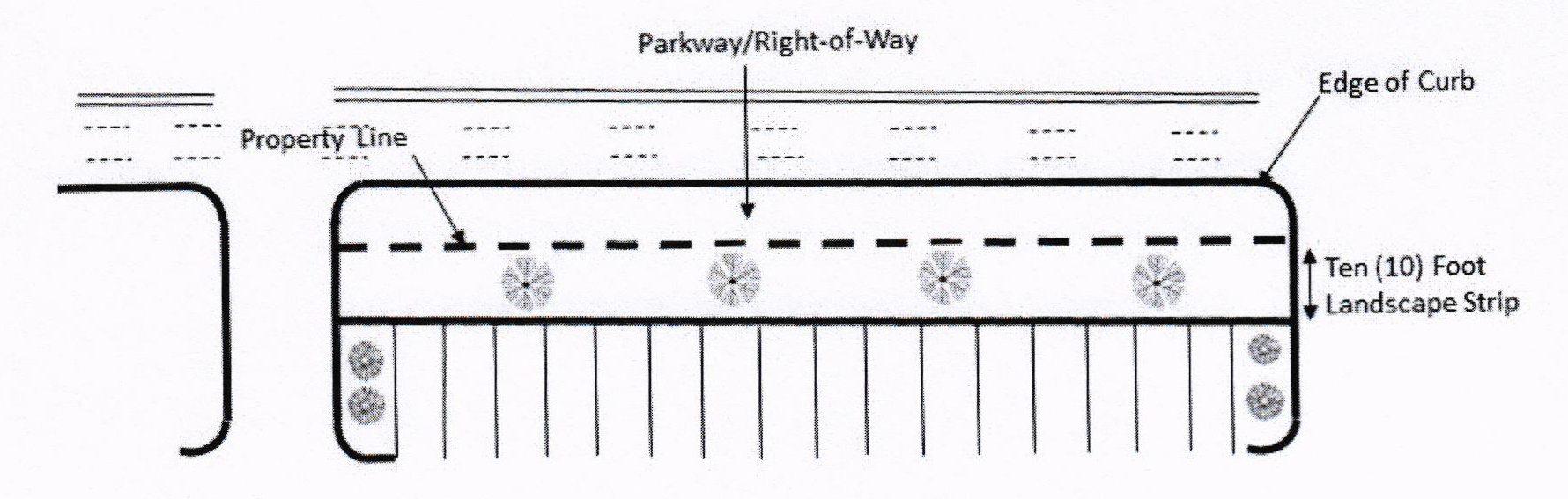
Figure A
1.
Within the landscape strip shade trees a minimum caliper of three (3) inches shall be planted at thirty (30) feet on-center. Trees may be planted in clusters not to exceed eighty (80) feet between clusters. Ornamental trees may be substituted at a ratio of two to one (2:1).
2.
Where parking spaces are located adjacent to the landscape strip, evergreen shrubs, a minimum size of five (5) gallons and chosen from the list of approved shrub materials in appendix C must be planted to provide a solid three-foot tall opaque screen after two (2) years.
3.
Where the landscaped strip abuts a parking lot or drive aisle, continuous or intermittent curbs, wheel stops or similar solid or semi-permeable barriers shall be installed.
4.
Permeable surfaces within the landscape strip shall be comprised of grass, groundcover, planting beds, or mulched areas. Gravel, rock, bark mulch or other similar materials may only be used underneath the tree canopy and shrubs in a required landscaped strip. Where bark mulch is used as groundcover, it shall be contained with edging material and shall be maintained at a constant depth of four (4) inches.
5.
Where the location of existing overhead utility lines conflict with the tree planting requirements within the landscape strip, the developer may choose from two options:
a.
Installation of ornamental trees instead of shade trees, at a rate of three (3) trees per five hundred (500) square feet of landscape strip; or
b.
Planting the required shade trees in tree islands located within the first tier of parking spaces.
6.
Where easements containing underground utilities conflict with tree planting requirements within the required landscape strip, the trees shall be planted outside the utility easement on the property owner's side and adjacent to the required landscape strip (see figure B).
7.
On lots in the CA—Central Area district, a five-foot wide landscape strip is required adjacent to public and private streets that border a surface parking lot containing twenty (20) or more parking spaces. Shrubs shall be installed within the landscape strip in accordance with subsection 2 above.
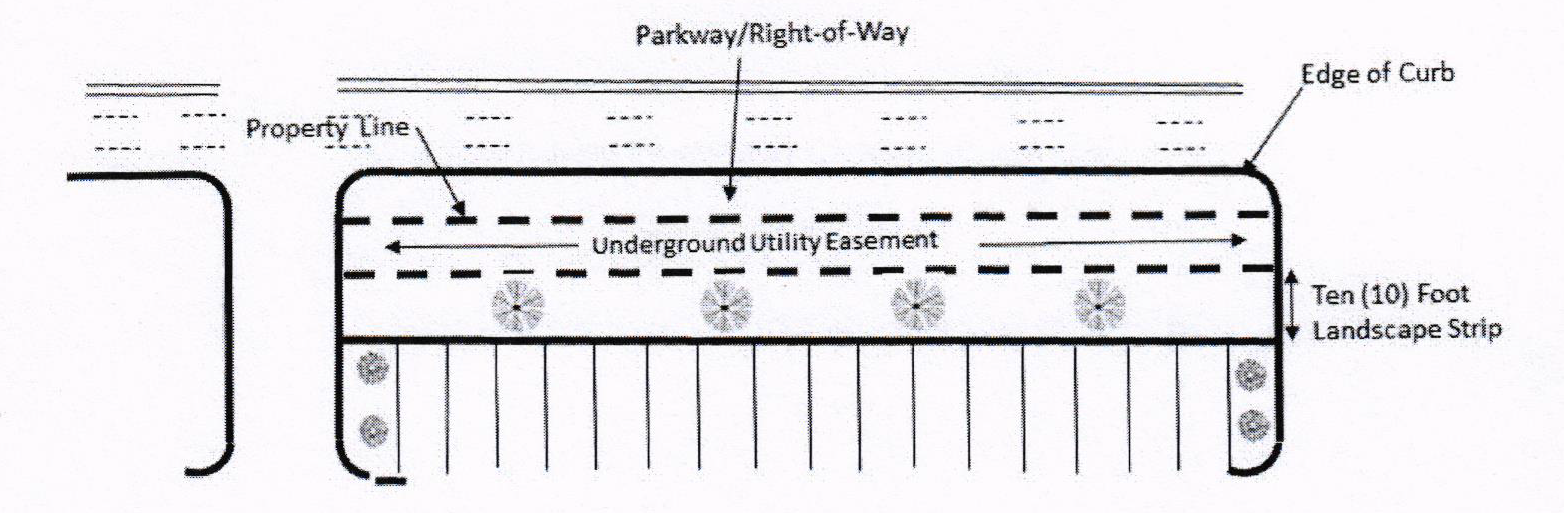
Figure B
B.
Requirements for landscaping in and around parking lots: Parking lots, including those within the CA—Central Area district containing twenty (20) spaces or more, shall be landscaped in accordance with this section in addition to the required landscape strip as described in section 28.51.6 above.
1.
There shall be eight (8) square feet of permeable interior landscaping for each parking space or fraction thereof. The permeable space shall be grass, shrubs, groundcover, trees or a combination of these materials. Gravel, bark mulch, decomposed granite or other similar materials shall only be used under tree canopy and shrubs. Trees are required as described in subsections 28.51.6.B.2 and B.3 below.
2.
There shall be a minimum of one (1) shade tree that is a minimum caliper of three (3) inches planted in the parking area for every fifteen (15) parking spaces. Ornamental trees may be substituted at a ratio of two to one (2:1), for no more than fifty (50) percent of required shade trees (see figure C).
3.
A landscape island is required at the end of all rows of parking and at a ratio of one (1) landscape island for every fifteen (15) parking spaces or fraction thereof. Landscape islands must be spaced at no more than fifteen (15) parking spaces apart and must be a minimum of ten (10) feet by eighteen (18) feet in size. Each landscape island must contain one (1) shade tree three (3) inches in caliper or two (2) ornamental trees if approved by the director of development services in accordance with subsection 28.51.6.B.2 above.
4.
A minimum ten (10) foot wide landscaped area is required to separate parking areas that have one hundred (100) or more parking spaces.
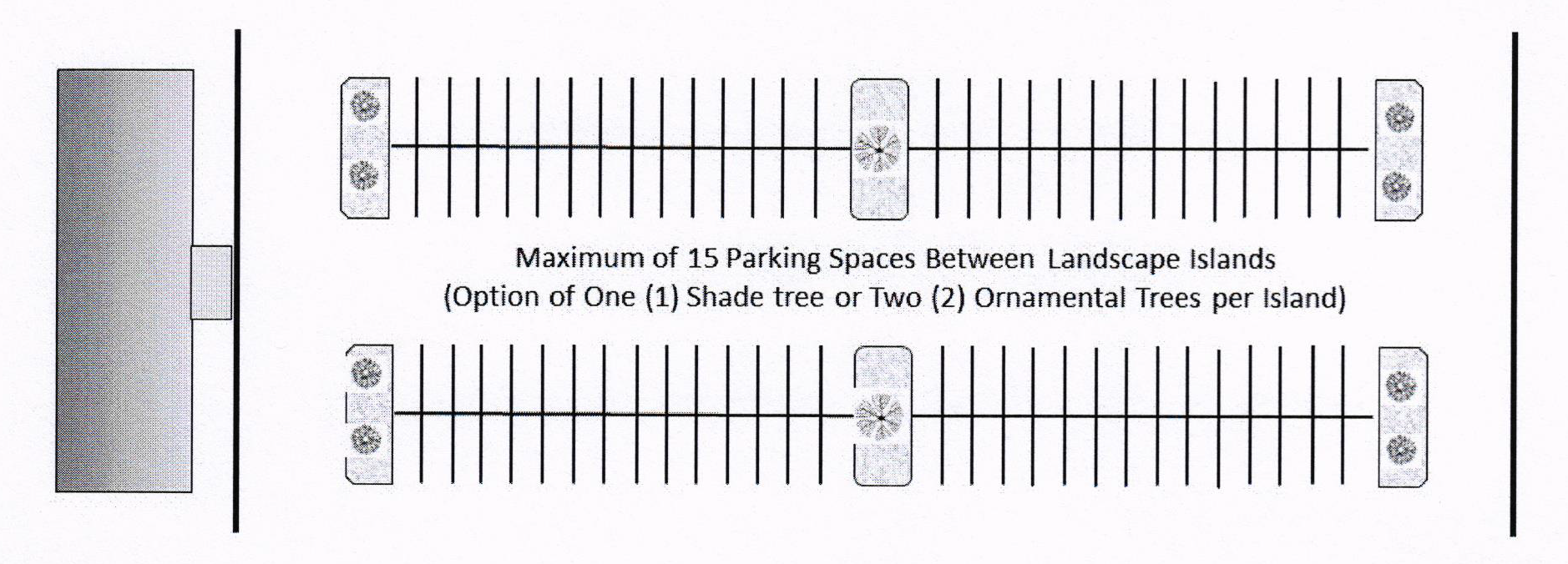
Figure C
28.51.7. Minimum landscaping requirements for single-family residential or duplex lots:
A.
These standards shall apply to all single-family dwelling lots two (2) years after the date that plat was approved or the date the city accepted the public improvements, in accordance with V.T.C.A., Local Government Code § 211.016 of the:
1.
Trees shall be provided for each lot as follows:
a.
For lots one hundred (100) feet or less in width:
(1)
Required front yards twenty (20) feet or more in depth—a minimum of one (1) shade tree with a minimum caliper of three (3) inches or two (2) ornamental trees a minimum of two (2) inches in caliper.
(2)
Where the required front yard is less than twenty (20) feet, ornamental trees may be planted in lieu of shade trees.
(3)
Where the required front yard is five (5) feet or less in depth, shrubs may be planted in lieu of shade trees or ornamental trees.
b.
For lots wider than one hundred (100) feet as measured at the front yard setback, a minimum of two (2) shade trees with a minimum caliper of three (3) inches shall be planted in the front yard.
c.
Existing trees located within the front yard that meet the minimum size requirements above that are to be preserved may be counted to meet the requirements in subsection 28.51.7.A.1 above.
2.
Shrubs, a minimum of three (3) gallons in size, shall be provided for each lot as follows and shall be planted in the front yard:
a.
Lots less than seven thousand (7,000) square feet—twelve (12) shrubs.
b.
Lots size seven thousand (7,000) square feet to ten thousand (10,000) square feet—fifteen (15) shrubs.
c.
Lots greater than ten thousand (10,000) square feet—twenty (20) shrubs.
B.
As an erosion control measure, front, side and rear yards of new single-family, single-family attached and duplex dwelling units shall be sodded prior to the final inspection. These areas may also include mulched planter beds with shrubs and hardscape such as patios, driveways and sidewalks.
28.51.8. Maintenance:
Required landscaping must be maintained in a healthy, growing condition at all times and free from refuse and debris. The property owner is responsible for regular weeding, mowing of grass, irrigating, fertilizing, pruning and other maintenance needs. Plantings and ground cover required by an approved landscape plan that have died shall be replaced within three (3) months of notification by the city. However, the time for compliance may be extended by up to six (6) months by the director of development services in order to allow for seasonable or weather conditions.
28.51.9. Tree preservation and incentives for preservation of natural areas and trees:
A.
Tree preservation requirements.
1.
Purpose. The purpose of this section is to establish regulations to prohibit the unapproved removal, transplanting and clear cutting of trees, preserve and replace existing protected trees within the city and to provide protection of trees during construction, development, or redevelopment of a site. In addition, this section shall further the following public purposes:
a.
Encourage the preservation and protection of existing protected trees and protected tree stands and groves, and which include the preservation of open spaces in the design of undeveloped residential and non-residential developments;
b.
Reward site design that preserves existing protected trees and associated habitat by offering preservation credits to off-set required replacement rates for protected trees that are necessarily removed during construction, development, and redevelopment;
c.
Preserve trees that further the ecological, environmental, and aesthetic qualities that contribute to the unique, natural beauty of Denison;
d.
Preserve and provide for trees that offer shade and windbreaks; reduce the erosive effects of rainfall, protect water resources, mitigate ambient air temperatures and improve air quality;
e.
Prevent the untimely and indiscriminate removal or destruction and clear-cutting of trees; and
f.
Preserve heritage trees (greater than forty (40) caliper inches (CI)) to the greatest extent possible.
2.
Definitions.
Buildable area. The portion of a lot exclusive of required yard areas on which a structure or building improvements may be erected.
Building pad. The actual foundation area of a building and a ten-foot clear area around the foundation necessary for construction and grade transitions. This also includes the term "building footprint."
Caliper inch (CI). Method of measuring the trunk diameter of a nursery grown tree. The point of measurement is approximately six (6) inches above the top of the root ball.
Clear-cutting. The indiscriminate cutting, plowing, or grubbing of trees without regard to type or size for the purpose of clearing the land.
Critical root zone. The area of undisturbed natural soil around a tree defined by a concentric circle with a radius equal to the distance from the trunk to the outermost portion of the drip line.
Critically alter. The uprooting, removing the canopy or severing the main trunk of a tree, or any act which causes or may reasonably be expected to cause a tree to die. This includes, but is not limited to the removal of a tree from a property, damage inflicted upon the root system of a tree by machinery, storage of materials, or the compaction of soil above the root system of a tree, a change in the natural grade above the root system of a tree, an application of herbicidal chemical or the misapplication of beneficial chemicals, excessive pruning, placement of nonpermeable pavement over the root system of the tree, or trenching within the primary root zone. Additionally, a tree may be considered critically altered if more than twenty-five (25) percent of the primary root zone is altered or disturbed at natural grade, or more than twenty-five (25) percent of the canopy is removed.
Development. Any manmade change to improved or unimproved real estate including, but not limited to, buildings and other structures, paving, drainage, or utilities, and agricultural activities.
Diameter at breast height (DBH). The diameter of the tree trunk diameter measured in inches at a height of four (4) feet above the natural grade. For multiple-trunk trees, DBH shall be the sum of the diameter of the individual trunks.
Drip line. A vertical line run through the outermost portion of the crown of a tree and extending to the ground. This may also be referred to as the root protection zone.
Floodplain. The area designated as being within the one-hundred-year floodplain on the Federal Emergency Management Agency flood insurance map (FIRM).
Grove. A group of twelve (12) or more protected trees with no undergrowth. The grove of protected trees can be a single cluster or in a linear row.
Grubbing. Excavating or removing a significant part of the root system.
Mitigation. The method by which trees are replaced whether through replanting on the subject property, transplanting to another location or same property, or through payment of fee-in-lieu-of replanting approved by the city.
Mitigation plan. The city approved plan of mitigation for a property (also referred to as tree protection/mitigation plan).
Protective fencing. Chain link, orange vinyl construction fence or other fencing at least four (4) feet in height.
Replacement trees. Trees planted to mitigate the loss of protected trees during development.
Tree. Any self-supporting woody plant which will attain a trunk caliper of three (3) inches or more DBH and which normally attains a height of at least fifteen (15) feet at maturity, with one (1) or more main stems or trunks and many branches. This does not include trees commonly known as ornamental trees.
Tree, dead (or declining). A tree that is dead or in severe decline with substantial structural defects, no remedial options available, and no chance of recovery as determined and documented by a certified arborist or registered landscape architect.
Tree fund. A city administered fund established for collection of fee-in-lieu-of replacement trees paid as mitigation and may include other contributions made in support tree preservation efforts.
Tree, heritage. Any protected tree species with 40 CI or greater as measured at DBH.
Tree preservation plan. A plan or drawing to scale that illustrates which trees are to be preserved, which trees are to be removed, and the manner in which trees will be protected during the construction process.
Tree, protected. Any tree species other than those specifically identified herein as an "unprotected tree" and having a trunk caliper of seven (7) inches or more, measured four (4) feet above natural grade level (also referred to as measured at DBH).
Tree, replacement. Large trees (canopy and shade trees) as outlined in appendix C, Required Plant Lists, of this chapter. This shall also include shade trees listed in the Texas SmartScape Database for North Central Texas.
Tree survey. A plan or drawing to scale that identifies the size, location and species of trees seven (7) inches or more DBH on a property.
Tree, unprotected (exempt from section 28.51.8). The trees which are specifically exempt from the mitigation provisions of section 28.51.8 regardless of caliper inches at DBH based on species type. The scientific and common names of these trees are identified in section 28.51.8.4.j.
3.
Applicability. The provisions of this section apply to:
a.
All vacant and undeveloped property; and
b.
All property to be redeveloped, including additions and/or alterations.
c.
All developed property for which a tree protection/mitigation plan, landscape plan or planned development overlay district has been approved by the city and identifies trees required to be planted or preserved in accordance with this section.
4.
Exemptions.
a.
This section does not apply to individual single-family, duplex, and townhouse lots after initial development and final inspection of the dwelling units by the building inspections department. Individual single-family and duplex lots five (5) acres or less in size created through a minor plat in accordance with the subdivision ordinance are also exempt. However, if a tree proposed for removal was required by the landscape regulations of chapter 28 at the time of permitting and/or as required by the provisions of an approved planned development overlay district ordinance for the property, the owner shall replace the tree with a minimum three (3) caliper inch large tree of the species outlined in appendix C. Clear-cutting is prohibited on all individual single-family, duplex and townhouse lots five (5) acres or larger in size.
b.
For all new single-family developments, the buildable area, as defined above, plus the area needed to establish proper drainage, detention and retention areas, sidewalks, septic systems and lateral lines, fences, screening walls, swimming pools and decking, driveways, public street rights-of-way, private street lots and utility easements are exempt. Sufficient area to allow the normal operation of construction equipment for these improvements is also exempt.
c.
For all nonresidential and multifamily developments, the building pads, proposed public street rights-of-way, utility easements, areas needed to establish property drainage, detention and retention areas, drive aisles, sidewalks and fire lanes are exempt. Sufficient area to allow the normal operation of construction equipment for these improvements is also exempt.
d.
During the period of an emergency such as a tornado, severe thunderstorm, ice storm, flood, or other natural disaster, the requirements of this ordinance may be waived as deemed necessary by the emergency management coordinator or other designee of the city manager.
e.
In addition to rights granted by easement, utility companies franchised by the city may remove trees during the period of an emergency that are determined by the company to be a danger to public safety and welfare by interfering with utility service.
f.
Any plant nursery (growing for commercial sales) shall be exempt from the terms and provisions of this section only in relation to those trees planted and growing on the premises for the sale or intended sale to the public.
g.
Utility and drainage easements required by the city and utility companies to install and maintain infrastructure.
h.
Trees that are diseased or dead, unless the tree was required to be planted as part of an approved landscape plan or tree mitigation plan.
i.
The city may approve selective thinning of protected trees, upon the recommendation of a certified arborist engaged by the developer, which will enhance the likelihood of survival of a larger tree or trees.
j.
Unprotected (exempt) tree species—the following tree species are exempt from the provisions of this section unless located in a floodplain:
5.
Tree preservation requirements. A violation of subparagraphs a., c. or d. below shall be an offense. The following requirements must be met:
a.
In all zoning districts, no clear-cutting of land is allowed without a permit. An approved tree preservation plan or approved site plan is the permit that allows the removal of trees subject to this ordinance.
b.
Removal and clearing of underbrush (but not grubbing) is allowed and does not require a permit.
c.
No tree, seven (7) inches DBH or greater, may be cut to remove the canopy, removed, transplanted or critically altered unless located in areas specifically exempted by this section, the city has approved removal based on the tree's health and condition, or the city has approved removal after assessment of a mitigation fee.
d.
Regardless of the exemptions identified in subsections 28.51.8.4.b and 28.51.8.4.c, where a development project is proposed for twenty-five (25) or more acres, a minimum of fifteen (15) percent of the total caliper inches of protected trees shall be preserved, excluding any protected trees in a floodway.
6.
Tree survey and preservation plan requirements. Failure to comply with this paragraph 6 shall be an offense.
a.
Tree survey. A tree survey must be submitted with all site plan and preliminary plat applications. A tree preservation plan, if applicable, shall be submitted with all final plat applications. The planning department is authorized to maintain a list of required information for tree surveys and tree preservation plans. The tree survey shall include the exact location, size, condition if damaged or diseased, and common name of each protected (non-exempt) tree seven (7) inches DBH or larger, including those located in the one-hundred-year floodplain. The tree survey for properties with ten (10) or fewer protected trees may be shown on the site plan or preliminary plat instead of a separate plan.
(1)
For property containing large heavily wooded areas, the city may, in lieu of a tree survey, authorize the submittal of an aerial photograph indicating all areas of tree cover that will not be disturbed or critically altered, provided that a tree survey and tree preservation plan of all other areas is submitted prior to any grading or construction. Trees within the non-disturbance area do not need to be individually identified unless they will be used for tree preservation incentives.
(2)
In lieu of a tree survey, the applicant may submit a statement from a certified arborist or registered landscape architect certifying that there are no protected trees on a property.
b.
Tree preservation plan. The tree preservation plan shall indicate which trees are to be preserved, which are to be removed and the manner in which they will be protected during the construction period. A tree mitigation plan, if required, must be included as part of the tree preservation plan.
7.
Requirements for tree preservation. Developers shall adhere to the following tree protection measures on all construction sites and as depicted in figure D. Failure to comply with this paragraph 7 shall be an offense.
a.
Prior to grading, brush removal, or construction, the developer shall clearly tag or mark all trees to be preserved.
b.
The developer shall erect protective fencing around each tree or group of trees to prevent the placement of debris or fill within the root protection zone. The fence shall be installed prior to the release of any permit. If the protection fence is found removed, down, or altered at any time during construction prior to final inspection or landscape installation, a stop work order may be issued.
c.
During the construction phase of development, the developer shall establish a construction entrance that avoids protected trees and prohibit cleaning, parking, or storage of equipment or materials under the canopy of any tree or group of trees being preserved. The developer shall not allow the disposal of any waste material such as, but not limited to, paint, oil solvents, asphalt, concrete, mortar, etc. in the canopy area.
d.
No attachments or wires of any kind, other than those of a protective nature shall be attached to any tree.
e.
No fill or excavation may occur within the drip line of a tree to be preserved unless there is a specific approved plan for use of tree wells or retaining walls. Major changes of grade, six (6) inches or greater, will require additional measures to maintain proper oxygen and water exchange with the roots.
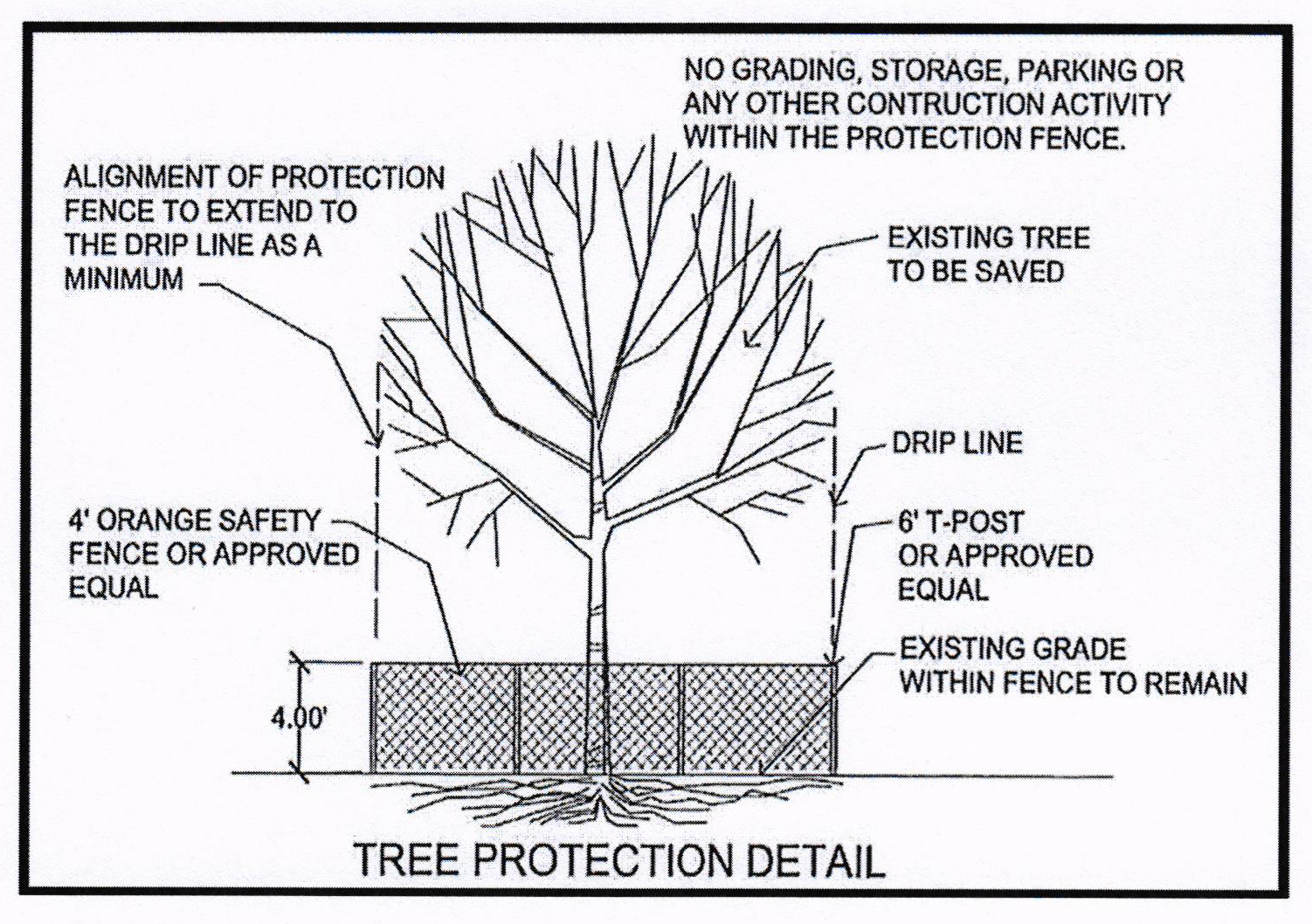
Figure D
8.
Tree replacement and mitigation. Failure to comply with this paragraph 8 shall be an offense.
a.
If protected (non-exempt) trees seven (7) inches and larger DBH are removed from a property, replacement trees, a minimum of three (3) inches in caliper, must be planted to equal the diameter of the tree(s) removed. Replacement trees are a credit toward the trees removed from the property and shall be in addition to trees required by other landscape requirements of the zoning ordinance.
b.
Replacement trees planted to mitigate tree removal may be located on the property being developed or in a location mutually agreed upon by the city and developer.
c.
If all replacement trees cannot be properly located, the developer may pay a mitigation fee in the amount established in the comprehensive fee schedule to the city in lieu of tree replacement. All fees shall be paid prior to removal of a protected tree.
B.
Incentives for preservation of protected trees and groves of protected trees. These incentives are designed to encourage the preservation of existing, protected trees and existing groves of protected trees. These incentives shall not be used to reduce the required amount of landscaping required by the zoning ordinance, overlay districts or the requirements of a specific planned development overlay district.
1.
Tree preservation. The following incentives are applicable for existing protected trees that are preserved:
a.
Tree credits. Credit toward the total number of protected trees required as outlined in the following:
b.
Preservation of groves of protected trees. All mitigation requirements of this section may be met by submitting a tree preservation plan depicting a minimum of fifteen (15) percent of the caliper inches of protected trees be preserved in one (1) or more groves.
C.
Appeals and alternative compliance. When the literal enforcement of the provisions of this section creates an undue hardship due to the number and size of protected trees and in consideration of the topography of the subject property, an applicant may submit an appeal to the city council consisting of an alternative compliance plan. The alternative compliance plan shall clearly delineate any proposed reductions to the standards and depict alternative standards.
D.
Penalty; enforcement.
1.
It shall be an offense for any person(s) or entity to cause the transplanting of a protected tree, removal of a protected tree, cutting a protected tree to remove the canopy and/or clear cutting without first obtaining an approved permit or m violation of a permit required by this section.
2.
Each protected tree removed, cut to remove the canopy, transplanted, or clear-cut without a permit or in violation of a permit shall constitute a separate offence. Violation of this section shall not constitute an exemption to the replacement and mitigation requirements contained herein.
3.
A person commits an offense if the person critically alters a protected tree not meeting an exception listed in this section without first obtaining a permit or in violation of a permit from the city.
4.
Any person who violates or causes the violation of this section by the:
a.
Transplanting of a protected tree, removal of a protected tree, cutting a protected tree to remove the canopy and/or clear-cutting without first obtaining an approved permit or in violation of a permit;
b.
Critically altering a protected tree without first obtaining a permit from the city, or by critically altering a tree in violation of the permit; or
c.
By failing to follow the tree replacement procedures, shall be guilty of a misdemeanor and upon conviction shall be fined one hundred fifty dollars ($150.00) per caliper inch of the tree, not to exceed five hundred dollars ($500.00) per tree.
The unlawful transplanting of a protected tree, removal of a protected tree, cutting a protected tree to remove the canopy, clear-cutting, or critical alteration of each protected tree shall be considered a separate incident and each incident shall subject the violator to the maximum penalty set forth herein for each tree.
5.
Any person, firm, corporation, agent or employee thereof who violates any provisions of this section other than those listed above, shall be guilty of a misdemeanor and upon conviction hereof shall be fined not to exceed five hundred dollars ($500.00) for each incident. The unlawful critical alteration of each protected tree shall be considered a separate incident and each incident subjects the violator to the maximum penalty set forth herein for each tree.
6.
Allegation and evidence of a culpable mental state is not required for the proof of an offense defined by this section.
7.
Acceptance of improvements. The city may refuse to accept any public improvements until the person pays all penalties for violations of this section; provided, however, that acceptance of public improvements shall be authorized before all trees shall be replaced if, with the director of development services' approval, the person furnishes the city with a cash deposit or surety bond in the approximate amount of the cost to replace the tree(s).
8.
Certificate of occupancy. No certificate of occupancy (CO) shall be issued until any and all penalties for violations of this section have been paid to the city. No CO shall be issued until all required replacement trees have been planted or appropriate payments have been made to the reforestation fund; provided, however, that a CO may be granted before all trees have been replaced if, with the director of development services' approval, the person furnishes the city with a cash deposit or surety bond in the approximate amount of the cost to replace the tree(s).
(Ord. No. 4958, § 3(3.1), (3.2), 8-6-18; Ord. No. 5298, § 3, 6-20-23; Ord. No. 5314, § 3, 9-18-23)
Sec. 28.52. - Accessory building and use regulations.
28.52.1 In a single-family or multi-family district, an accessory building is a subordinate or incidental building, attached to or detached from the main building, not used for commercial purposes and not rented. Accessory buildings shall be located toward the rear portion of the property. Accessory buildings shall not be permitted without a main building or primary use being in existence.
28.52.2 In nonresidential districts, an accessory building is a subordinate building, the use of which is secondary to and supportive of the main building. Accessory buildings shall not be permitted without a main building or primary use being in existence or in the case of a vacant lot, a building permit for the primary structure has been issued. Accessory buildings should, wherever possible, be located toward the rear portion of the property.
28.52.3 Accessory dwellings (including garage and detached units) may be permitted in residential zoning districts (see regulations for the specific district, and the use charts, section 28.49), and shall conform to the height limitations of the main structure. No such accessory dwelling or quarters shall be used or occupied as a place of abode or residence.
28.52.4. Area regulations for accessory buildings in residential and multi-family districts:
A.
Size of yards:
1.
Front yard: Detached accessory buildings shall be prohibited in front of the main building. Garages and carports are permitted if attached to the main or primary structure and maintain the same setbacks as for the primary or main structure.
2.
Side yard: There shall be a side yard not less than three (3) feet from any side lot line, or alley line for any accessory building provided that such building is separated from the main building by a minimum distance of ten (10) feet. Accessory buildings adjacent to a side street shall have a side yard not less than fifteen (15) feet. Garages or carports located and arranged so as to be entered from the side yard shall have a minimum distance of twenty-five (25) feet from the side lot line, alley line, alley easement line or street. Carports or garages arranged to be entered from the side yard, facing a public street, shall have a minimum distance equal to the required yard for the main building or twenty-five (25) feet, whichever is greater.
3.
Rear yard: There shall be a rear yard not less than three (3) feet from any lot line or alley line, or easement line, except that:
a)
Where apartments are permitted, the main building and all accessory buildings shall not cover more than sixty (60) percent of that portion of the lot lying to the rear of a line erected joining the midpoint of one (1) side lot line with the midpoint of the opposite side lot line;
b)
Carports, garages, or other accessory buildings, located within the rear portion of a lot as heretofore described, constructed closer than ten (10) feet to the rear property line; or
c)
Accessory buildings constructed ten (10) feet or more from the main building shall have a rear yard of three (3) feet. If an alley exists, accessory buildings may be located within three (3) feet of a rear lot line.
4.
Carports shall be measured from the posts supporting the roof nearest to the street, alley or property line (see Illustration 6). Carports are prohibited in the front yard.
5.
Accessory buildings are not permitted without a main structure.
6.
Accessory buildings shall not exceed twenty-six (26) feet in height, unless otherwise allowed in the specific zoning district.
7.
Metal accessory buildings less than two hundred forty (240) square feet are permitted but shall not be used as an enclosed parking area or garage or carport.
8.
Steel storage containers designed to be transported to a residential lot on a temporary basis shall only be permitted in the rear yard for a maximum of ninety (90) days once per year and shall only be allowed on a paved surface. All temporary steel storage containers require permits.
9.
In all districts except those specifically excepted herein, in order for a structure to qualify as an accessory building, the structure shall be one originally designed and constructed for use with a primary structure, compatible with the primary use and surrounding structures, and shall have a roof pitch ratio of at least 6:1. Specifically, prohibited from use as an accessory building are trailers, with or without wheels attached, buses, cargo containers and all other equipment and apparatuses whose original design is for the transport of goods, materials or humans.
In the commercial, light industrial and heavy industrial zoning districts a cargo container without wheels or axles may be placed behind the primary structure and used as an accessory building under the following conditions:
1.
Adequate ventilation to accommodate the safe storage of the contents of the container provided;
2.
Prior to locating the container on the property, the container is painted the primary color of the property's main structure; and
3.
Screening on three (3) sides of the container is provided in a manner that complies with the screening criteria provided by this chapter.
No utilities other than electricity may be provided to such containers, and then only with the prior approval of a wiring and installation application for permit submitted to the chief building official.
Sec. 28.53. - Fence, screening and wall regulations.
28.53.1. Purpose:
To encourage the most appropriate use of land; conserve and protect the privacy and value of adjacent permitted uses and promote good urban design in the public realm. Regulations are prescribed for the location and type of various screening devices to be used when required in the various zoning districts or in this section in accordance with the following standards.
28.53.2. General fence and screening requirements for AH Districts:
A.
A permit from the Office of the Chief Building Official shall be required for the construction, repair, or replacement of all fences and screening walls, except for replacement or repair of an existing segment of fence in conformance with this Chapter for which a permit was previously issued that is not more than 20 feet in length.
B.
Fences around swimming pools shall comply with the City of Denison's Code of Ordinances and Texas Health and Safety Code Chapter 757.
C.
Fencing for a tennis court is allowed in all zoning districts and shall be a maximum twelve (12) feet in height, except within a yard that abuts a street and is in the public view.
D.
All fences shall comply with the sight visibility requirements for landscaping set forth in Section 28.51.7 and as shown in Appendix "A" Illustration 5 and as set forth in Section 28.55.8.
E.
The following materials are prohibited for use as fences:
1.
Metal panels or corrugated sheet metal panels except as allowed in subsection 28.53.5.1.E below.
2.
Plywood and/or loading pallets.
3.
Any welded wire fabric unless specifically allowed by this section.
4.
Barbed or barbless agricultural wire, such as hog wire, poultry wire, cattle panels, or electrical fencing unless used to enclose pastures, cropland or agricultural activities or approved in conformance with subsection 28.53.5.E.
5.
Pipe and cable fencing unless specifically allowed by this section.
F.
When chain link fencing is used, it shall include metal posts, post caps and metal top rails. When a chain link fence is in the public view, it shall be coated, such as with vinyl or similar. Chain link fencing is prohibited in any front yard.
G.
In the H (Historic Overlay District), a Certificate of Appropriateness must be approved before a permit can be issued for construction.
H.
Fences within the public view when the property abuts a master thoroughfare plan roadway, as designated in the City's Comprehensive Plan, which is incorporated by reference pursuant to Section 17-26, shall be designed to fully screen structural elements of the fence that are not equally visible on both sides of the fence such that the finished side of the fence faces outward toward the street and public view. Such fences shall not exceed eight (8) feet in height, except for residential land uses, when within the required yard area, Section 28.53.4 B. applies.
I.
Fences shall be maintained in good condition to include but not limited to structural integrity, consistent materials and consistent color.
J.
Fences required to be at least fifty (50) percent open by this Chapter shall not have vertical pickets or similar solid features in between structural posts that exceed three (3) inches in width.
K.
Exceptions to this Section 28.53 may be authorized by the Office of the Chief Building Official when a conflict exists with an expressed safety-related requirement of the Denison Code of Ordinances.
L.
All fence materials shall be durably painted or stained, except integrally colored masonry fences.
28.53.3. Screening required between non-residential and residential uses:
A.
In the event that the property line of a multi-family use, nonresidential use, or manufactured/mobile home park is adjacent to the property line of a single-family, two-family or residential PD district, or in the event that the property line of any nonresidential district is adjacent to a multiple-family district, a screening wall or fence of not less than six (6) feet, nor more than eight (8) feet in height shall be erected on the property line separating these properties. The purpose of the screening wall or fence is to provide a visual and protective barrier between the properties. The construction material for such screening fences may be wood stockade with metal poles, masonry, brick, stone or another approved material.
1.
The owner of the multi-family property shall be responsible for and shall build and maintain the required screening wall or fence on the property line dividing the property from the single-family or duplex residential district. This construction requirement applies only when multi-family is adjacent to residential uses.
2.
When screening is required between nonresidential and residential uses, it shall be the responsibility of the owner of the property with the nonresidential use to construct and maintain the screening wall or fence.
3.
Any screening wall or fence required under the provisions of this section or under a conditional use permit, planned development district, or other requirement shall be constructed of masonry, reinforced concrete, wood or other similar suitable permanent materials that do not contain openings except gates. Gates shall be equal in height and screening characteristics to the wall or fence.
4.
The Planning and Zoning Commission may approve alternative equivalent screening through the site plan approval process in Section 28.13. A solid living screen consisting of landscaping that will achieve a minimum height of six (6) to eight (8) feet within two (2) years may be considered by the Commission as an alternative screening equivalent. The living screen must be irrigated by an automatic irrigation system which shall be constructed and maintained by the property owner requesting the approval of the alternative screening.
5.
The screening wall and fence may extend into the front yard setback of the non-residential, multi-family or mobile home district at the minimum height unless restricted by the sight visibility easements in subsection 28.51.7.
6.
The screening fence/wall shall be finished on both sides in a manner/color that is compatible to the exterior finish materials used on the nonresidential or multi-family buildings.
28.53.4. Residential fences and walls:
A.
Any fence or wall within a rear or side yard setback that is also not within the front or street side yard setback shall not exceed a total of eight (8) feet in height measured from grade and including the height of a functional retaining wall.
B.
No fence or wall shall be permitted between the street and the front yard setback of any single-family or duplex residential structure unless it does not exceed four (4) feet in height and has openings of not less than fifty (50) percent of the fence area.
C.
For a corner lot, any fence or wall located between the street and a single-family or duplex residential structure shall not exceed eight (8) feet in height measured from grade and including the height of a retaining wall. The fence or wall shall be located a minimum of four (4) feet from the edge of a sidewalk or property line, whichever is greater. The fence or wall shall not extend beyond the front of the single-family or duplex structure.
D.
For a corner lot with a single-family residential or duplex building where one yard has been designated as a side yard but adjoins a front yard on an adjacent lot, a fence may be erected to enclose the side yard but must be set back a minimum of fifteen (15) feet from the edge of pavement or back of curb, whichever exists and wholly located on private property, unless in the Infill Overlay Zoning District, a reduction may be granted by the Chief Building Official to the minimum necessary to mitigate space constraints, provided a landscape buffer is placed between the fence and the property line.
E.
Gates designed for vehicular access shall be set back from the property line a minimum of twenty-five (25) feet.
F.
For properties used as multi-family, assisted living facility, and nursing/convalescent or skilled home, an ornamental metal fence a maximum of six (6) feet in height and fifty (50) percent open in construction may be erected within the front yard setback and within the side yard setback of corner lots that abut a street.
28.53.5. Non-residential fences and walls:
A.
Fences located within the front yard setback in the O, NS, LR, RR, CR, C and BP zoning districts, unless addressed below in subsections D. and E., shall be a maximum of forty-eight (48) inches in height and constructed of wrought iron or tubular steel, and shall be no less than fifty (50) percent open. The fence must be set back a minimum of ten (10) feet from the property line or behind any required landscaped edge.
B.
Fences erected within the side yard setback of corner lots that abut a street shall comply with the standards in subsection A above.
C.
Fences and walls located within the side or rear yards of non-corner lots may be erected on the property line, shall be a maximum of eight (8) feet in height, and may be constructed of black or green vinyl coated chain link with matching top rails and caps, galvanized/zinc coated chain link, wrought iron or tubular steel or masonry, brick or stone screening walls. Solid metal panels are allowed only in the LI and HI districts, and must be of materials and design specifically manufactured or fabricated for use as screening or fencing.
D.
For uses categorized as "Transportation and Auto Services" in Section 28.49, except for impound lots and wrecking yards, pipe rail fencing with a maximum height of twenty-four (24) inches may be erected on the property line. Pipe rail fencing shall have a painted or powder coated finish in a color complimentary with the surrounding development. Automobile storage areas on impound lots and wrecking yards must be screened in accordance with subsection 28.53.6.A below.
E.
In the LI and HI districts, fences located within the front yard setback shall be a maximum of eight (8) feet in height and shall be no less than fifty (50) percent open. Green or black coated vinyl chain link or galvanized/zinc coated chain link fencing may be used. Fences shall be set back a minimum of ten (10) feet from the front property line, but may be erected on the side and rear yard property lines. Solid metal panels are allowed only in the side and rear yards of non-corner lots, and must be of materials and design specifically manufactured or fabricated for use as screening or fencing. Barbed wire, electric wire or razor wire is allowed only if approved by the Planning and Zoning Commission as part of the site plan review process.
28.53.6. Screening for open storage, refuse containers and ground-mounted equipment:
A.
In districts permitting open storage, screening shall be required only for those areas used for open storage. A screening fence or wall which is a minimum of six (6) feet but does not exceed a maximum of eight (8) feet in height shall be provided and maintained at the property line adjacent to the area to be screened by one (1) or a combination of the following methods:
1.
Solid masonry (brick, concrete block or concrete panels).
2.
Wrought iron with solid landscape screening.
3.
Alternate equivalent screening may be approved through the site plan approval process under Section 28.13.
No outside storage may exceed the height of the screening fence or wall. Outside storage exceeding eight (8) feet shall require a conditional use permit.
B.
Refuse and recycling storage areas which are not within a screened rear service area and which are in the public view in the HO, AO, MO, PD, BP, MF-1, MF-2, MHP districts shall be visually screened by a minimum six-foot solid masonry wall on at least three (3) sides (see Illustration 1 for refuse container enclosure diagrams). The fourth side, which is to be used for garbage pickup service, shall be gated to secure the refuse storage area. Alternate equivalent screening methods may be approved through the site plan approval process in Section 28.13. Each refuse facility shall be located so as to facilitate pickup by refuse collection agencies. Adequate reinforced paved areas shall be provided for refuse facilities and their approaches for loading and unloading, as per Appendix "A" Illustration #1.
C.
Plans and specifications for screening and/or fencing around ground mounted utility structures (e.g. transformers, natural gas regulating stations, etc.) shall be submitted for review by the affected utility company prior to construction of said screening/fencing.
D.
Regardless of the zoning district or land use, any refuse and recycling storage area within the public view that is not temporary shall be screened in compliance with the aforementioned design requirements in Subsection A or alternate equivalent screening method as approved by the City Planning Director or through the site plan approval process in Section 28.13, when required.
E.
Plans and specifications for screening and/or fencing around ground mounted utility structures (e.g. transformers, natural gas regulating stations, etc.) shall be submitted for review by the affected utility company prior to construction of said screening/fencing.
F.
Trash and recycling storage areas shall be accessible to accommodate front or side loading waste collection vehicles.
(Ord. No. 4872, § 3, 5-1-17; Ord. No. 5062, §§ 2, 3, 5-4-20; Ord. No. 5065, § 2, 6-15-20; Ord. No. 5205, § 4, 4-18-22)
Editor's note— Ord. No. 4872, § 3, adopted May 1, 2017, changed the title of § 28.53 from "Fencing, walls and screening requirements" to read as herein set out.
Sec. 28.54. - Exterior construction and design requirements.[2]
28.54.1. Purpose.
This section establishes minimum standards for the design and appearance of residential development and for the provision of amenities for multi-family development, and are intended to encourage a variety of housing types and styles, to improve the streetscape and to promote high quality and durable construction.
28.54.2. Definitions.
The following definitions apply to the regulations contained within this section, and illustrated in section 28.54.7:
1.
Arch—A curved construction of wedge-shaped stones or brick which spans an opening.
2.
Base course—A horizontal decorative band of brick or stone installed along the foundation of a building or used to delineate the stories.
3.
Bay window—A projecting window that forms an extension of the floor space of a building.
4.
Box window—A projecting window with a flat front and flat sides that does not extend the floor space of a building.
5.
Bracket—A decorative projecting element located under the eaves of a building.
6.
Decorative brick pattern—Variations from the standard horizontal stretcher brick laying pattern that are used to highlight facade features.
7.
Dormer—A window that projects from a roof.
8.
Eaves—The edge of a roof that projects beyond the face of a wall.
9.
Elevation—Any of the external faces of a building.
10.
Front facade—The exterior wall of building which faces the public street and which contains the main entry doorway.
11.
Extended porch—A covered shelter with a separate roof projecting over the entrance to a building and open on a minimum of two (2) sides.
12.
Recessed entry—A shelter over the entrance to a building covered by the primary roof and enclosed by walls on both sides.
13.
Quoin—The use of brick or stone to accentuate the corners of a building.
14.
Roof extension awning—A roof over a window, supported by brackets and located lower than the primary roof.
15.
Shutters—Wooden or metal covers fitted on the outside of a window and which may be functional or decorative.
28.54.3. Application requirements.
The director of development services or designee is authorized to establish, maintain and publish requirements for information and details to be shown on elevation plans to ensure compliance with this section.
28.54.4. Single-family detached, duplex, tri-plex and quadraplex residential standards.
A.
Applicability—These regulations are applicable to all new single-family detached, two-family (duplex), three-family (triplex) and four-family (quadraplex) construction.
B.
Building articulation—Builders must use three (3) of the following architectural features for the front facade:
1.
Dormers (with windows).
2.
Arches (windows or doors).
3.
Secondary gables with a minimum 6/12 roof pitch.
4.
Bay or box windows.
5.
Brackets.
6.
Base course.
7.
Quoins.
8.
Decorative brick patterns.
9.
Extended front porch of at least fifty (50) square feet.
10.
Recessed porch a minimum of tweny-four (24) inches wider than the front door.
11.
Shutters.
12.
Roof extension awning.
13.
Facade articulation with a minimum offset of three (3) feet.
C.
Minimum front yard: For front entry garages, the minimum setback for the face of the garage door is twenty-five (25) feet. The face of the garage door may extend a maximum of three (3) feet beyond the front facade.
D.
Driveways and parking construction:
1.
Single-family lots—All driveways and parking spaces shall be constructed completely of concrete or similar solid paved surface such as turf pavers, brick pavers, or asphalt. If parking spaces are located to the rear of the main building, a ribbon driveway of continuous concrete strips or pavers may be utilized along the side yard to access the parking spaces. The concrete or paver ribbons must be a minimum of two (2) feet in width, separated by a grass strip a minimum of three (3) feet in width. All portions of the driveway within the public right-of-way must be concrete and paved in accordance with the Public Works Standard Details.
2.
Duplexes—A grass strip a minimum of three (3) feet in width must separate driveways and off-street parking located within the front yard, unless shared singlewidth driveway provides access to parking spaces for both units.
3.
Triplexes and quadraplexes—All parking spaces for triplexes and quadraplexes must be located to the rear of the main building and accessed by a driveway located along one (1) side yard of the property or accessed from the alley.
E.
Roof treatment—Except for porch roofs, pitched roofs shall have a minimum slope of 4" x 12" (four (4) inches vertical rise for every twelve (12) inches horizontal run) and shall have an overhang at least one (1) foot beyond the building wall. For roofs with a pitch of 8/12 or greater, the minimum overhang shall be six (6) inches.
F.
Elevation repetition—Within single-family and two-family residential subdivisions with more than two (2) lots, the use of substantially identical exterior elevations is prohibited on lots directly across the street or within two (2) lots in either direction. For corner lots, the same exterior elevation shall not be used diagonally across the intersection. Exterior elevations are considered to not be substantially identical if three (3) of the following are changed:
1.
The number of stories.
2.
The garage location/orientation.
3.
The roof type.
4.
The articulation of the front facade.
5.
The configuration of the porch width, type and roof coverage.
6.
Facade building materials.
G.
Accessory dwelling unit standards—Accessory dwelling units must utilize one (1) of the facade materials of the main dwelling unit.
28.54.5. Townhouse residential standards.
A.
Applicability—These standards are applicable to all new townhouse construction.
B.
Architectural features—Builders must use two (2) of the following architectural features for the front facade of each unit:
1.
Dormers (with windows).
2.
Arches (windows or doors).
3.
Gables.
4.
Bay or box windows.
5.
Brackets.
6.
Base course.
7.
Quoins.
8.
Decorative brick patterns.
9.
Extended front porch of at least fifty (50) square feet.
10.
Recessed porch a minimum of twenty-four (24) inches wider than the front door.
11.
Shutters.
12.
Roof extension awning.
13.
Facade articulation with a minimum offset of two (2) feet.
C.
Roof treatment—Except for porch roofs and shed roofs, pitched roofs shall have a minimum slope of 4" x 12" (four (4) inches vertical rise for every twelve (12) inches horizontal run) and shall have an overhang at least one (1) foot beyond the building wall. Roofs must utilize dormers, gables or a change in the roof height or form for each unit.
D.
Mechanical unit screening—Roof-mounted mechanical units shall be screened from view from the property line with a parapet wall, screening device or alternative architectural element. The height of the screening element shall be equal to or greater than the height of the mechanical unit provided that the element shall not extend more than five (5) feet above the roof.
E.
Elevation repetition—The use of substantially identical exterior elevations is prohibited more than once within any four (4) townhouse units. For corner lots, the same exterior elevation shall not be used diagonally across the intersection. Exterior elevations are considered to not be substantially identical if two (2) of the following are changed:
1.
The number of stories.
2.
The garage location/orientation.
3.
The roof type.
4.
The articulation of the front facade.
5.
The configuration of the porch width, type and roof coverage.
6.
Facade building materials.
28.54.6. Multi-family residential standards.
A.
Applicability—This section applies to anv multi-family development with two (2) or more buildings.
B
Building articulation—Horizontal wall planes longer than forty (40) feet in length must be segmented into smaller sections by a structural facade offset (recess or projection) of a minimum three (3) feet deep and eight (8) feet wide. The facade offset must apply to a minimum of one-half of the height of the wall.
C.
Roof treatment—Roofs must be constructed with dormers, gables, or a change in the roof height or form of a minimum of three (3) feet in height. Flat roofs are permitted if a parapet wall is also used as a screen.
D.
Architectural features—In addition to the change in building articulation and roof treatments required above, each multi-family building must incorporate two (2) of the following architectural features:
1.
Balconies/patios for one-half of the units.
2.
A minimum of two (2) different facade materials.
3.
Roof extension awnings.
4.
Shutters for one-half of the windows.
5.
Canopies or awnings.
E.
Exterior stairways—Stairways directly accessing the exterior shall be fully or partially enclosed.
F.
Mechanical unit screening.
1.
Roof-mounted—Roof mounted mechanical units shall be screened from view from the property line with a parapet wall, screening device or alternative architectural element. The height of the screening element shall be equal to or greater than the height of the mechanical unit provided that the element shall not extend more than five (5) feet above the roof.
2.
Ground mounted—Ground mounted mechanical units shall be screened by a wooden fence a maximum of four (4) feet in height or by shrubs that will achieve a height of four (4) feet within two (2) years of installation.
G.
Amenities.
1.
Amenities for multi-family development shall be required as follows:
a.
One (1) swimming pool for developments with fifty (50) or more units.
b.
One (1) playground area containing at least five (5) pieces of play equipment for every one hundred (100) dwelling units, or fraction thereof.
2.
In addition to the above requirements, each multi-family development with one hundred (100) or more dwelling units shall provide one (1) of the following:
a.
Dog park with a minimum of two thousand five hundred (2,500) square feet of space enclosed by a fence and providing at least one (1) dog waste station with bag dispenser and waste receptacle.
b.
Ramadas, arbors or trellises covering at least one thousand (1,000) square feet.
c.
One (1) outdoor barbecue grill for each one hundred (100) units.
d.
A splash pad a minimum of one thousand (1,000) square feet in size.
e.
Regulation-size volleyball, basketball, tennis, pickleball or other sport court.
f.
Fitness center a minimum of five hundred (500) square feet in size.
g.
Business center a minimum of five hundred (500) square feet in size.
h.
Media room a minimum of five hundred (500) square feet in size.
28.54.7. Illustrations.
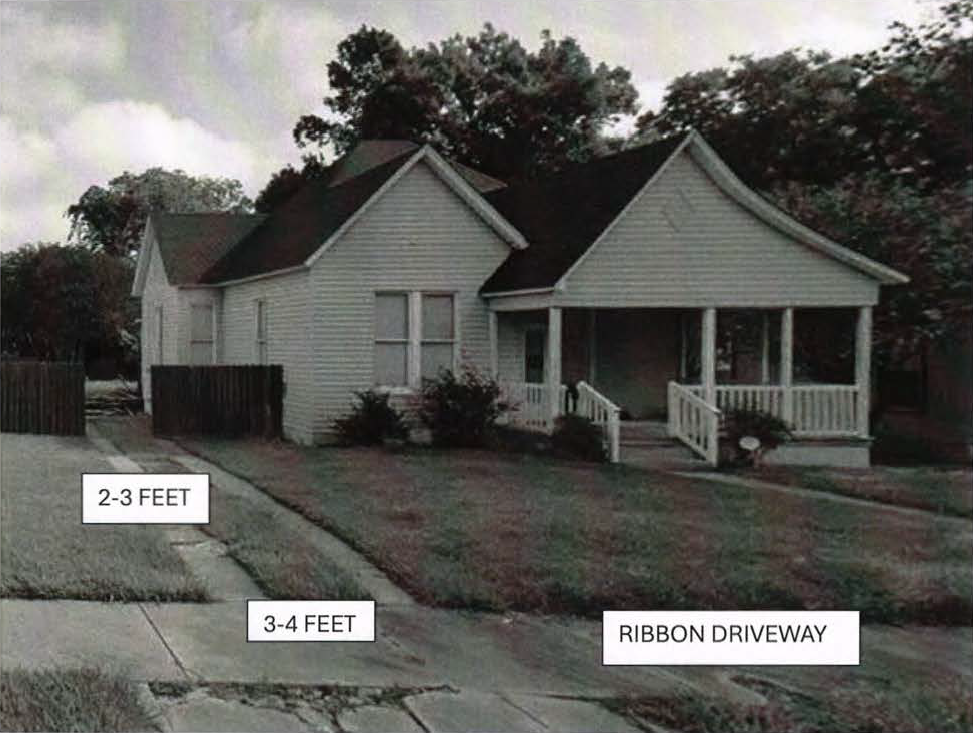
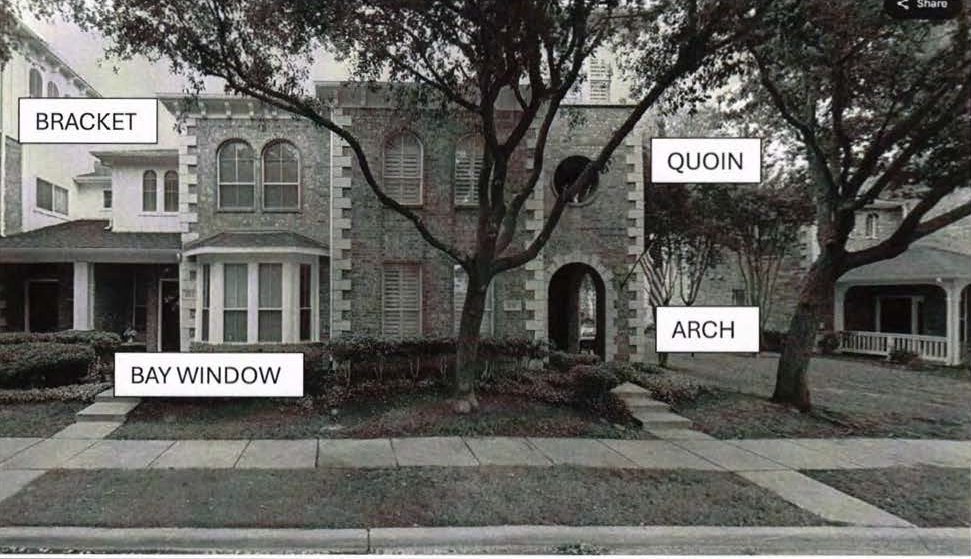
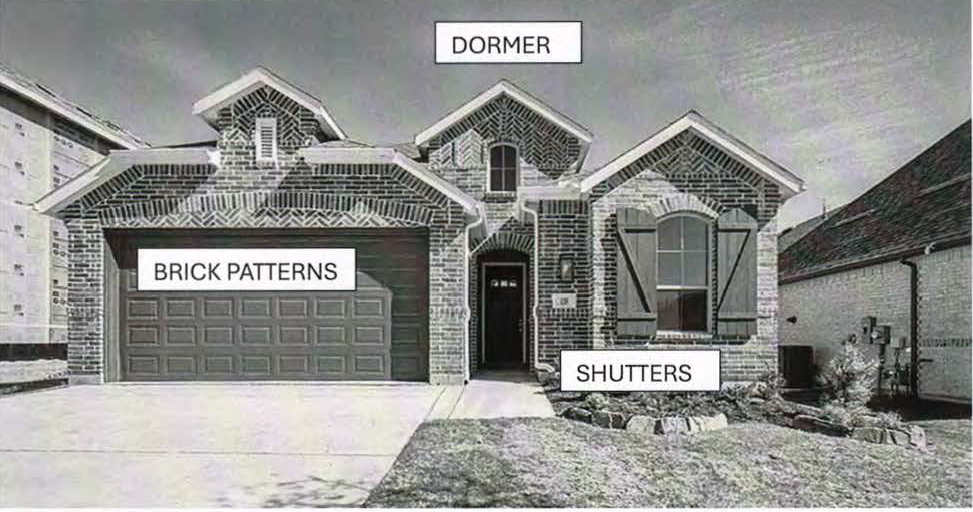
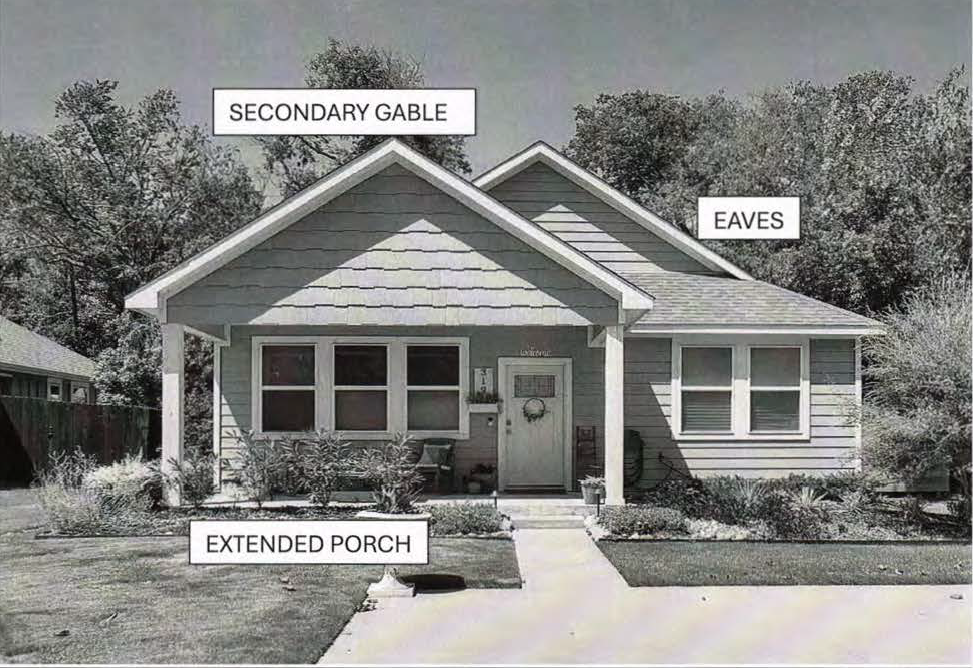
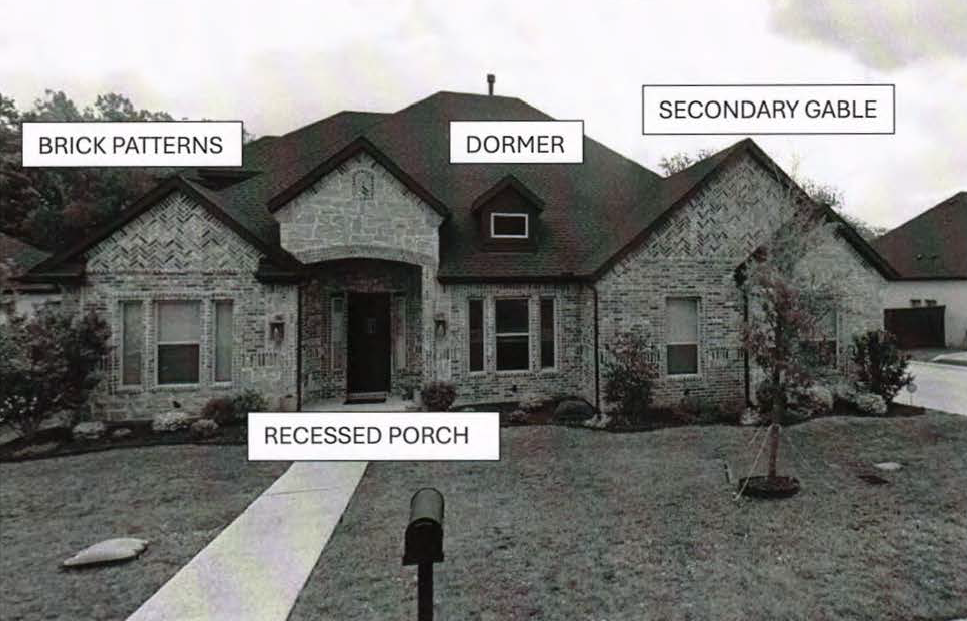
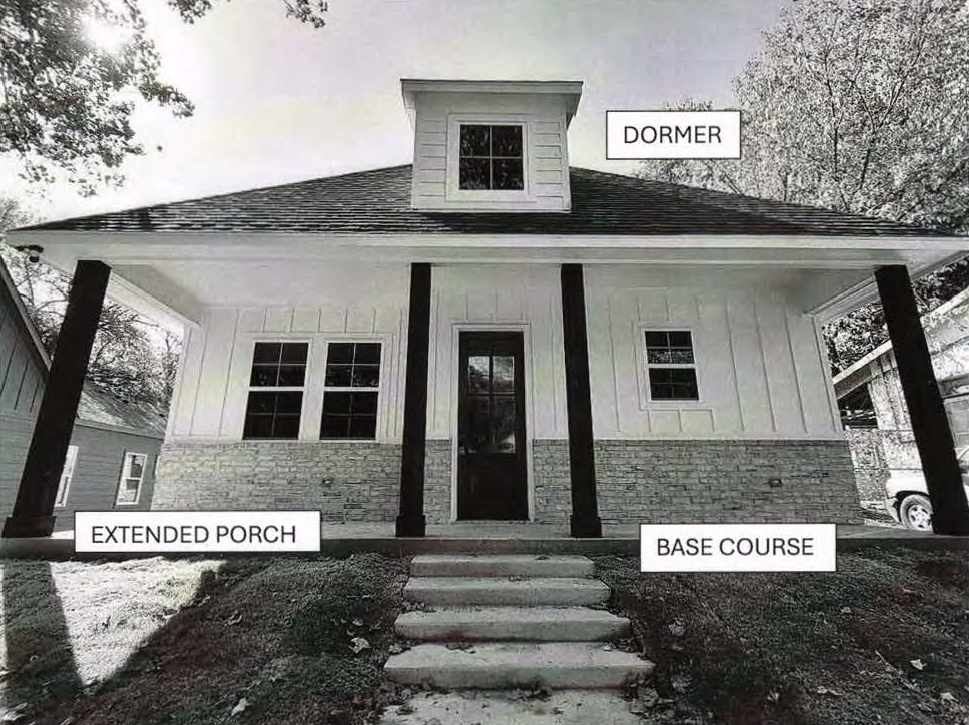
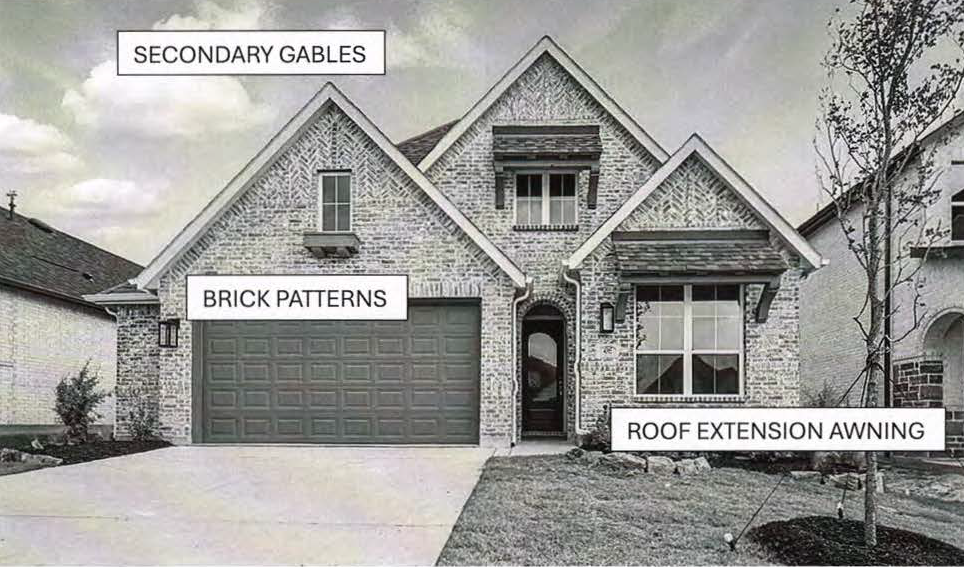
(Ord. No. 5432, § 3, 1-20-26)
Editor's note— Ord. No. 5432, § 3, adopted Jan. 20, 2026, repealed the former Sec. 28.54, and enacted a new Sec. 28.54 as set out herein. The former Sec. 28.54 pertained to similar subject matter and derived from Ord. No. 4733, § 2, adopted Feb. 17, 2014; Ord. No. 4820, § 2(2.12—2.14), adopted July 18, 2016; Ord. No. 4841, § 2(2.03, 2.04), adopted Oct. 3, 2016.
Sec. 28.55. - Supplemental regulations.
28.55.1.
A.
Measuring setbacks: All setback measurements shall be made in accordance with Illustration 8.
B.
Configuration of lots: Wherever possible, flag lots (i.e., lots with minimal, or panhandle type, frontage) shall be avoided. Similarly, through (i.e., double frontage) lots (particularly within residential zoning districts) shall also be avoided wherever possible. (Also see subdivision ordinance for regulations pertaining to the configuration of lots.)
28.55.2. Front yard:
A.
On all corner lots, the front yard setback shall be observed along the frontage of both intersecting streets, unless approved specifically otherwise on a final plat. Where single-family and duplex lots have double frontage, extending from one street to another, or are on a corner, a required front yard shall be provided on both streets unless a side or rear yard building line has been established along one (1) frontage on the plat, in which event only one (1) required front yard need be observed. The side and/or rear yards in the case of single-family and duplex uses shall be identified and the front of the structure shall not face the side or rear yard (see Illustration 9).
B.
Where the frontage on one (1) side of a street between two (2) intersecting streets is divided by two (2) or more zoning districts, the front yard shall comply with the requirements of the most restrictive district for the entire frontage (see Illustration 10).
C.
The front yard shall be measured from the property line to the front face of the building, to the nearest supporting member of a covered porch or terrace, or to any attached accessory building. Eaves and roof extensions or a porch without posts or columns may project into the required front yard for a distance not to exceed four (4) feet, and subsurface structures, platforms or slabs may not project into the front yard to a height greater than thirty (30) inches above the average grade of the yard (see Illustration 11).
D.
Minimum lot widths for lots with predominate frontage on the curved radius of a street (e.g., cul-de-sac or "eyebrow" portion of a street) shall be measured as the linear distance of the curved front building line, and shall be shown on the subdivision plat. Lot widths for all lots shall be as set forth in the respective zoning district for each lot.
E.
Gasoline service station pump islands that parallel a public street may be located a minimum of eighteen (18) feet to the property line adjacent to a public street. For pump islands that are perpendicular or diagonal to a public street, the setback shall be thirty (30) feet in order to prevent vehicles stacking out into the street while waiting for a pump position. Pump islands may extend beyond the front building line as described above (provided that all other requirements of this chapter are met), but shall not be closer than fifteen (15) feet to any property line that is not adjacent to a public street.
F.
Where a future right-of-way line has been established for future widening or opening of a street or thoroughfare, upon which a lot abuts, then the front, side, or rear yard shall be measured from the future right-of-way line.
28.55.3. Side yards:
A.
On a corner lot used for one- or two-family dwellings, both street exposures shall be treated as front yards on all lots platted after the effective date of this chapter, except that where one street exposure is designated as a side yard for both adjacent lots or where the two (2) lots are separated by an alley, street right-of-way, creek/floodplain area, or other similar phenomenon. In such case, a building line may be designated by the planning director (or his/her designee) with a minimum side yard of twenty (20) feet or more (as determined by the applicable zoning district standards). On lots that were official lots of record prior to the effective date of this chapter, the minimum side yard adjacent to a side street shall comply with the minimum required side yard for the respective district.
B.
Every part of a required side yard shall be open and unobstructed except for the ordinary projections of windowsills, belt courses, cornices, and other architectural features not to exceed twelve (12) inches into the required side yard, and roof eaves projecting not to exceed thirty-six (36) inches into the required side yard. Air conditioning compressors and similar equipment are permitted in the side yard.
C.
Where a future right-of-way line has been established for future widening or opening of a street or thoroughfare, upon which a lot abuts, then the front, side, or rear yard shall be measured from the future right-of-way line.
28.55.4. Special height regulations:
In the districts where the height of buildings is restricted to two (2) to three (3) stories, cooling towers may extend for an additional height not to exceed fifty (50) feet above the average grade line of the building. Water stand pipes and tanks, church steeples, domes and spires, school buildings, and institutional buildings may be erected to exceed the height limit, as specified in the particular zoning district, provided that one (1) additional foot shall be added to the width and depth of front, side, and rear yards for each foot that such structures exceed the district height limit.
28.55.5. Wireless telecommunications:
Notwithstanding any other provision of this Code, telecommunication antennas, when such are permitted by federal law and the laws of the State of Texas, shall be regulated and governed by this article.
A.
Definitions: For the purposes of this article the following words and phrases shall have the meanings ascribed to them as follows:
1.
Telecommunications tower means a structure more than ten (10) feet tall, built primarily to support one (1) or more telecommunications antennas.
2.
Telecommunications means the transmission, between or among points specified by the user, of information of the user's choosing, without change in the form or content of the information as sent and received.
3.
Telecommunications service means the offering of telecommunications for a fee directly to the public, or to such classes of users as to be effectively available directly to the public, regardless of the facilities used.
4.
Antenna means any structure or device used to collect or radiate electromagnetic waves, including both directional antennas, such as panels, and dishes, and omni-directional antennas, such as whips, but not including satellite earth stations.
5.
Telecommunications antenna means an antenna used to provide a telecommunications service.
6.
Antenna array means a structure attached to a telecommunications tower that supports a telecommunications antenna.
7.
Whip antenna means an omni-directional dipole antenna of cylindrical shape which is no more than six (6) inches in diameter.
8.
Non-whip antenna means an antenna which is not a whip antenna such as dish antennas, panel antennas, etc.
9.
EIA-222 means Electronics Industries Association Standard 222, "Structural Standards for Steel Antenna Towers and Antenna Support Structures."
B.
Telecommunications towers.
1.
Telecommunications towers shall be permitted and located only in accordance with section 28.49 of this chapter after the applicant has complied with the requirements of this article.
2.
A site plan shall be submitted by the applicant to the planning and zoning Administrator which shall satisfy all of the following requirements:
a.
Tower height, including antenna array, may not exceed one hundred twenty (120) feet.
b.
Telecommunications towers must be a minimum of one hundred twenty (120) feet from residential structures.
c.
Telecommunications towers shall be separated from other towers regulated by this section a minimum distance as set out in the table below.
Required Tower Separation
d.
All guys and guy anchors are located within the buildable area of the lot and not within the front, rear, or side yard setbacks and no closer than five (5) to any property line.
e.
The base of the tower is enclosed by security fencing. Security fence shall consist of a minimum of six-foot-chain link fence with at least two (2) strands of barbed wire above the chain link fence.
f.
Equipment buildings must be similar in color and character to the main or adjoining building or structure or blend with the landscaping and other surroundings immediately adjacent to it and be screened by a chain link or wrought iron fence with evergreen hedge, a blind fence, or a masonry wall.
g.
The tower is erected and operated in compliance with current Federal Communications Commission and Federal Aviation Administration rules and regulations and other applicable federal and state standards.
h.
A telecommunications tower must be:
1.
Used by two (2) or more wireless communications providers; or
2.
Designed and built so as to be capable of use by two (2) or more wireless communications providers including providers such as cellular or PCS providers using antenna arrays of nine (9) to twelve (12) antennas each within fifteen (15) vertical feet of each other with no more than three (3) degrees of twist and sway at the top elevation and the owner of the tower on which it is located must certify to the city that the antenna is available for use by another wireless telecommunications provider on a reasonable and nondiscriminatory basis and at a cost not exceeding the market value for the use of the facilities provided space is available at the time of the request. If the property on which the tower is proposed to be located is to be leased, the portions of the actual or proposed lease that demonstrate compliance with the requirements of this paragraph shall be submitted with the site plan and zoning application, if applicable.
i.
No lettering, symbols, images, or trademarks large enough to be eligible to occupants of vehicular traffic on any adjacent roadway shall be placed on or affixed to any part of a telecommunications tower, antenna array or antenna, other than as required by FCC regulations regarding tower registration or other applicable law.
j.
The need for the requested site and the nature of any existing sites shall be documented and the manner in which the rezoning and/or location of the tower will promote the City of Denison's telecommunications policies shall be demonstrated.
k.
Telecommunications towers should be constructed to minimize potential safety hazards. Telecommunications towers shall be constructed so as to meet or exceed the most recent EIA-222 standards and prior to issuance of a building permit the building official shall be provided with an engineer's certification that the tower's design meets or exceeds those standards. All towers shall be located in such a manner that if the structure should fall along its longest dimension, it will remain within property boundaries and avoid residential structures, public streets, utility lines and other telecommunications towers.
l.
Telecommunications towers and equipment buildings shall be located to minimize their number, height and obtrusiveness to minimize visual impacts on the surrounding area and in accordance with the following policies:
i.
Ensure that the height of towers and monopoles has the least visual impact and is no greater than required to achieve service area requirements and potential collocation, when visually appropriate.
ii.
Demonstrate that the selected site for a new monopole and tower provides the least visual impact on residential areas and the public rights-of-way. Analyze the potential impacts from other vantage points in the area to illustrate that the selected site provides the best opportunity to minimize the visual impact of the proposed facility.
iii.
Site telecommunication facilities to minimize being visually solitary or prominent when viewed from residential areas and the public rights-of-way. The facility should be obscured by vegetation, tree cover, topographic features, and buildings or other structures to the maximum extent feasible.
iv.
Place telecommunication facilities to ensure that historically significant landscapes are protected. The views of and vistas from architecturally and/or historically significant structures should not be impaired or diminished by the placement of telecommunication facilities.
v.
The commission may recommend a variance and the council may grant a variance to a requirement for telecommunications towers when it is determined that such a variance better accomplishes the policies set out in this subsection than would a strict application of the requirement. Such variance shall be no greater than necessary to accomplish those policies.
m.
No signals or lights or illumination shall be permitted on a tower unless required by the Federal Communications Commission, the Federal Aviation Administration, or the city.
n.
If any additions, changes, or modifications are to be made to the tower, the chief building official shall have the authority to require proof, through the submission of engineering and structural data, that the addition, change, or modification conforms to structural wind load and all other requirements of the current building code adopted by the city.
o.
The applicant shall fully and accurately complete a questionnaire supplied them by the planning and zoning administrator designed to gather information to assist in making a decision regarding any rezoning application. In order to assist the staff and the council in evaluating visual impact, the applicant shall submit color photo simulations showing the proposed site of the tower with a photo-realistic representation of the proposed tower as it would appear viewed from the closest residential property or from one-quarter (¼) mile, whichever distance is less.
p.
The tower complies with all ordinances of the city not in conflict with this section.
1.
Any telecommunications tower in place at the time of adoption of these standards which can be extended upward to accommodate additional antennae may be so extended without fully complying with the siting requirements of this section so long as the total height limitation of this article is not exceeded and by complying with permitting requirements of this article.
2.
In addition to the usual application fee for a request for a change in zoning, if applicable, under of this chapter, the applicant shall reimburse the city for the reasonable, actual cost to the city for the services of an engineer should one be required to review the application and provide engineering expertise.
C.
Antennas mounted on existing structures.
1.
Antennas mounted on buildings.
a.
Roof-mounted telecommunications antennas are allowed on nonresidential buildings and structures pursuant to the provisions of this chapter, provided a non-whip antenna does not exceed the height of the building by more than ten (10) feet and is screened from view from any adjacent public roadway and provided a whip antenna does not exceed the height of the building by more than fifteen (15) feet and is located no closer than fifteen (15) feet to the perimeter of the building. Prior to installation of a roof-mounted antenna, the department of building inspections shall be provided with an engineer's certification that the roof will support the proposed antenna and associated roof-mounted equipment. Roof-mounted antennas and associated equipment may be screened with enclosures or facades having an appearance that blends with the building on which they are located or by locating them so that they are not visible from an adjacent public roadway.
b.
Building-mounted telecommunications antennas of the non-whip type are allowed on nonresidential buildings and structures pursuant to the provisions of this chapter, provided the antenna is mounted flush with the exterior of the building so that it projects no more than thirty (30) inches from the surface of the building to which it is attached; and the antenna's appearance is such as to blend with the surrounding surface of the building.
c.
Associated equipment shall be placed either within the same building or in a separate building which matches the existing building in character and building materials or blends with the landscaping and other surroundings immediately adjacent to the separate building housing the equipment. Associated equipment for roof-mounted antennas may be located on the roof of the building if it is screened from view from any adjacent public roadway.
2.
Telecommunications antennas are allowed without further zoning or existing utility, lighting, telecommunications towers and sign structures, provided that the antenna does not exceed the height of the structure by more than ten (10) feet if a non-whip type or fifteen (15) feet if whip type. Existing structures may be rebuilt if necessary to support the load of the new antenna without further zoning if the rebuilt structure is substantially similar in appearance to the existing structure it replaces. The owner of the structure may be permitted to rebuild the structure at a height greater than the original structure by demonstrating to the city's satisfaction that the additional height accommodates and promotes the purposes and objectives of this article.
3.
Telecommunications antennas located on existing structures in excess of eighty (80) feet in height are not subject to the five-thousand-foot separation requirement.
4.
When an application for a building permit to locate a telecommunications antenna on an existing building or other structure is made, the chief building official shall be provided with color photo simulations showing the site of the existing structure with a photorealistic representation of the proposed antenna and the existing structure or any proposed reconstruction of the structure as it would appear viewed from the closest residential property or from one-quarter (¼) mile, whichever distance is less. The applicant shall also submit photographs of the same views showing the current appearance of the site without the proposed antenna.
5.
Telecommunications antennas shall not be constructed or used within the city without all approvals and permits first having been secured. The chief building official shall approve or reject the site plan within thirty (30) days of the zoning application being approved by the city council, if applicable, or of the date of submittal of the site plan by applicant, whichever last occurs. In the event the site plan as originally submitted is incomplete, the thirty-day review period does not commence until the chief building official determines the site plan, as amended, to be administratively complete.
6.
Within thirty (30) days of the enactment of this article and during each January thereafter, providers of personal wireless services, as that term is defined by federal law, operating in the city shall provide the city with their respective master antenna plan, including detailed maps, showing the precise locations and characteristics of all telecommunications antennas and towers serving any portion of the city and indicating coverage areas for current and future telecommunications antennas and towers and shall provide the city with any updates to the above documents. Updating documents shall be provided to the city within three (3) months of their creation.
7.
It shall be an affirmative defense to prosecution for violation of a provision of this section that compliance with the provision would prohibit or have the effect of prohibiting the provision of personal wireless services as defined by federal law. In addition, any entity that desires to erect or utilize telecommunications facilities that would be prohibited by the ordinances or regulations of the city dealing with zoning and land use may apply for such use under this chapter and the council shall, upon a showing that strict application of the regulation would prohibit or have the effect of prohibiting personal wireless service as defined by federal law, vary the subject regulation, consistent with the spirit and intent of this section, to the extent necessary to prevent the prohibition.
28.55.6. Minimum dwelling unit area:
Minimum dwelling unit areas specified in this chapter shall be computed exclusive of breezeways, garages, open porches, carports and accessory buildings.
28.55.7. Open storage areas:
Open storage of materials, commodities or equipment (where allowed in the specific zoning district) shall be located behind the front building line and observe all setback requirements for the main structure or building. This standard does not apply to outside display (see definition of outside display).
28.55.8. Sight visibility:
Visual clearance shall be provided in all zoning districts so that no fence, wall, architectural screen, earth mounding or landscaping thirty (30) inches or higher above the street center line obstructs the vision of a motor vehicle driver approaching any street, alley, or driveway intersection as follows:
A.
At a street intersection, clear vision must be maintained for a minimum of twenty-five (25) feet across any lot measured from the corner of the property line in both directions (see Illustration 5).
B.
At an intersection with an alley, this clearance must be maintained for ten (10) feet (see Illustration 5).
C.
Shrubs and hedges that are typically less than thirty (30) inches in height at maturity, as measured from the centerline of the street, may be located in the visual clearance areas of all districts.
D.
A limited number of single-trunk trees having a clear trunk (i.e., branching) height of at least eight (8) feet may be located within sight visibility areas provided that they are spaced and positioned such that they will not produce a visibility inhibiting, "picket-fence" effect when they attain mature size.
28.55.9. Requirements for recycling facilities:
A recycling operation for the collection, processing, and transfer of recyclable materials is a permitted use in the LI District with a conditional use permit if the use satisfies the following conditions:
A.
The collection, processing, and transfer of recyclables is fully contained within a building.
B.
The site has no less than one hundred fifty (150) feet of frontage on a public street.
C.
The unloading area for recyclable materials is not less than fifty (50) feet from any adjoining property located in a more restrictive zoning district, however, this provision shall not apply where the adjoining property is railroad track right-of-way.
D.
That portion of the site used for truck maneuvering and the receiving and loading of recyclable material is enclosed by a solid fence or wall not less than six (6) feet in height except for any part of the site contiguous to a railroad. The fence or wall shall have a nonglare finish.
E.
The recyclable materials unloading areas, including maneuvering areas for trucks, are all-weather surfaced.
F.
The site shall be kept free of uncontrolled litter, scrap, paper or other refuse.
28.55.10. Requirements for e-cigarette, cigarette, cigar and/or tobacco retail shop and tobacco bar:
An e-cigarette, cigarette, cigar and/or tobacco retail shop or a tobacco bar may be a permitted use in the commercial and light industrial districts with a conditional use permit ("CUP") if the use satisfies the following conditions:
A.
It shall be unlawful for any person to operate an e-cigarette, cigarette, cigar and/or tobacco shop or to operate a tobacco bar within the city, or engage in any other activity for which the State of Texas (the "State") requires an e-cigarette retailer permit or a cigarette, cigar and/or tobacco retailer permit be obtained from the Texas comptroller, without first obtaining a CUP for the location from the city.
B.
No applicant shall be granted a CUP for the location under this section who has not first been issued an e-cigarette retailer permit or a cigarette, cigar and/or tobacco retailer permit from the Texas comptroller and who fails to present satisfactory evidence of the same.
C.
It shall be unlawful for any applicant issued an e-cigarette retailer permit or a cigarette, cigar and/or tobacco retailer permit from the Texas Comptroller to use or display a permit or to exercise any privilege granted by a permit except at the place, address, premises and location for which the permit and the CUP is granted.
D.
Any CUP granted shall expire on the last day of May of each even-numbered year unless the e-cigarette, cigarette, cigar and/or tobacco retailer provides satisfactory evidence of an approved renewal submission from the Texas comptroller. If an existing CUP expires without satisfactory evidence of an approved renewal, the CUP shall be declared null and void and of no force and effect and the e-cigarette, cigarette, cigar and/or tobacco retailer shall immediately cease operations. The applicant may reapply for a CUP but may not continue operations without a new CUP being granted.
E.
The establishment for an e-cigarette, cigarette, cigar and/or tobacco retailer is prohibited within one thousand (1,000) feet of any church, school, daycare, or hospital. This section shall not apply where the church, school or hospital is built within one thousand (1,000) feet of where an e-cigarette, cigarette, cigar and/or tobacco retailer holds a valid certificate of occupancy prior the church, school, daycare, or hospital being built.
F.
The measurement of the distance between an e-cigarette, cigarette, cigar and/or tobacco retailer and the church, school or public hospital shall be from the nearest property line of the church, school, daycare, or hospital to the nearest doorway by which the public may enter the e-cigarette, cigarette, cigar and/or tobacco retailer, along street lines and in direct line across intersections.
G.
All conditions in this section, or as otherwise applicable, shall be complied with prior to the granting of a CUP or the issuance of a certificate of occupancy. This CUP shall be declared null and void and of no force and effect and shall discontinue if or for any one (1) or more of the following:
1.
Any failure to comply with any term or condition of this section or all applicable regulations, as they exist or may be amended; or
2.
A certificate of occupancy for which a use authorized by this section is not applied for and issued within one hundred and eighty (180) days from the effective date of a CUP being granted; or
3.
The use for which the CUP is granted ceases to operate for a continuous period of one hundred eighty (180) calendar days; or
4.
A structure for which the CUP is granted remains vacant for a continuous period of one hundred eighty (180) calendar days; or
5.
The CUP was obtained by fraud or deception; or
6.
Failure to comply with any and all applicable local, state or federal laws or regulations, as they exist or may be amended.
(Ord. No. 5369, § 9, 10-21-24)
Sec. 28.56. - Wind energy conversion systems (WECS).
28.56.1 Wind energy conversion systems shall require a conditional use permit (CUP) in all zoning districts and floodplain areas. Large wind energy systems shall be located on a lot having a minimum lot size of five (5) acres. All wind energy systems shall be subject to the following additional requirements (unless one or more of the following requirements are specifically waived or modified in the CUP ordinance):
A.
An accurately drawn-to-scale survey/site plan is required with the CUP application and shall include the following:
1.
Property lines and physical dimensions of the property;
2.
Location, dimensions, setbacks and types of existing major structures on the property;
3.
Location of the proposed wind system tower, and setbacks/dimensions from all existing structures on-site, from all property lines, and from structures on adjacent properties;
4.
Locations and dimensions/setbacks from all public rights-of-way that are contiguous with the property;
5.
Overhead utility lines, and approximate locations/canopy coverage of large existing trees on the property;
6.
Wind system specifications, including manufacturer and model, rotor diameter, tower height, tower type and rated kW output;
7.
Tower foundation blueprints or drawings;
8.
Tower blueprint or drawing;
9.
Elevation drawings showing the design and height of the proposed energy system, and any screening that will be provided to screen the system/tower from public view.
B.
Wind towers and generators proposed to be installed within the 100-year floodplain shall also have approval of the city's engineer and, where applicable, the U.S. Army Corps of Engineers. Such tower sites shall take such measures, as required by the city's engineer, to protect the sites from damage from potential flooding. The city's engineer shall require a floodplain permit and a licensed engineer's certification that the tower/generator will not pose a threat or safety hazard due to flood conditions.
C.
No portion of the tower structure of a wind energy system shall be located within any required front, side or rear yard, and the tower and all of its appurtenances shall be located behind (i.e., not in front of) the main building unless otherwise authorized (i.e., varied) in the SUP ordinance. No portion of a system may protrude over a property line without acquisition of an easement for the encroachment from the adjacent property owner(s), nor over an easement without proper written release from the utility provider or entity who owns or controls such easement.
D.
A wind energy system may exist only as an accessory use, and it may not be constructed/installed until a primary structure exists on the property. A wind energy system may only supply power to structures on the lot/parcel where the system is located (i.e., not to an off-site structure).
E.
For property sizes less than or equal to five (5) acres in area, the tower height shall be a maximum of sixty-five (65) feet. For property sizes greater than five (5) acres in area, the tower height shall not exceed one hundred (100) feet unless otherwise approved in the SUP ordinance. Blade clearance shall be a minimum of twenty (20) feet above the ground.
F.
Wind energy conversion systems must comply with applicable Federal Aviation Administration (FAA) regulations, including any necessary approvals for installations close to airports, and must also comply with applicable ASHTO engineering standards.
G.
The tower for a wind energy system shall be set back a minimum distance of two (2) times the tower's height from all property lines, public rights-of-way and occupied buildings, and shall be set back a minimum distance of one and one-half (1.5) times the tower's height from the applicant's own building(s) on the property unless constructing the WEC according to subsection P. below.
H.
The tower for a wind energy system shall be set back a minimum distance of one and one-half (1.5) times the tower's height from any overhead utility lines, unless written permission is granted otherwise by the affected utility.
I.
No tower shall be erected closer than two hundred (200) feet or a distance of five (5) times the diameter of the larger rotor, whichever is the greater distance, to another wind energy tower.
J.
All wind energy systems shall be equipped with a redundant braking system. This includes both aerodynamic over speed controls (including variable pitch, tip and other similar systems) and mechanical brakes. Mechanical brakes shall be operated in a fail-safe mode. Stall regulation shall not be considered a sufficient braking system for over speed protection.
K.
Safety and security measures:
1.
A clearly visible warning sign that states "Caution, High Voltage" must be placed at the base of all pad-mounted transformers and substations.
2.
All ground-mounted electrical and control equipment shall be labeled and secured to prevent unauthorized access.
3.
The tower shall be designed and installed so as to not provide step bolts or a ladder readily accessible to the public for a minimum height of twelve (12) feet from the ground.
4.
All access doors to wind energy systems and their appurtenances (e.g., cabinets, junction boxes, etc.) shall be locked or fenced, as appropriate, to prevent entry by nonauthorized persons.
L.
All electrical wires associated with a wind energy system, other than wires necessary to connect the wind generator to the tower wiring, the tower wiring to the disconnect junction box, and the grounding wires shall be located underground.
M.
Wind energy systems shall be required to comply with any noise standards and requirements contained in any of the applicable ordinances.
N.
Visual appearance.
1.
A wind tower and generator shall not be artificially lighted unless such lighting is required by the Federal Aviation Administration.
2.
The wind tower and generator shall remain painted or finished the neutral white, light grey or silver color or finish that was originally applied by the manufacturer.
3.
All signs, other than the manufacturer's or installer's identification, appropriate warning signs, or owner identification on a wind generator, tower, building, or other structure associated with a wind energy system, shall be prohibited. Such signs as described above shall be no larger than four (4) square feet in size, and shall be located near the base of the tower.
4.
No flags, pennants, banners or similar materials may be displayed on or attached to any portion of a wind energy system, including its tower, unless a proper permit is obtained from the city for a temporary sign/display, in accordance with the city's sign ordinance.
O.
Nuisance prevention.
1.
Wind energy systems shall be sited, to the greatest extent practical, to minimize the impact of shadow flicker or blade glint upon any inhabited structures (except for the owner's) or public roadways. Systems found to be a nuisance or a traffic hazard shall be shut down until the flicker or glint problem is remedied.
2.
Wind energy systems shall comply with all applicable Federal Communications Commission (FCC) rules, and shall not cause static noise interference with other individuals' television reception or with private or public telecommunications (e.g., public safety communications, 911 dispatch, etc.).
P.
No wind energy system shall be placed or constructed on the roof of any existing structure unless such structure is/was designed and constructed to structurally accommodate and support a roof-mounted wind energy system. Certification by a structural engineer shall be required for any roof-mounted system. No roof-mounted WEC shall exceed a maximum height of sixty-five (65) feet, as measured from the lowest ground level elevation point of the structure to which it is mounted, to the top of the tower (i.e., at the center of the hub).
Q.
A building permit shall be required for the installation of a wind energy system:
1.
The owner shall submit an application to the building official. The application shall be accompanied by standard drawings of the wind turbine structure, a line drawing of the electrical components, and two (2) copies of the site plan for the wind energy system, and any fee the city requires for an accessory use or building.
2.
No permit for a wind energy system shall be issued until evidence of written approval has been given to the city that the utility company has been informed of the customer's intent to install an interconnected customer-owned generator, and the utility company has expressed written approval for the system. Off-grid systems shall be exempt from this requirement.
3.
Building permit applications for wind energy systems shall be accompanied by standard drawings of the wind turbine structure, including the tower, base and footings. An engineering analysis of the tower showing compliance with the city's building code, and certified by a licensed professional engineer, shall also be submitted. This analysis is frequently supplied by the manufacturer.
4.
Building permit applications for wind energy systems shall be accompanied by a line drawing of the electrical components in sufficient detail to allow for a determination that the manner of installation conforms to the city's electrical code. This information is frequently supplied by the manufacturer.
5.
A building permit issued for a wind energy system shall expire if the system is not installed, functioning and passed city inspection within six (6) months (i.e., one hundred eighty (180) calendar days) following the date the permit is issued.
R.
Abandonment.
1.
A wind energy system that is out-of-service for a continuous twelve-month period (i.e., three hundred sixty-five (365) calendar days) will be deemed to be abandoned. The building official (or designee) may issue a notice of abandonment to the owner of a wind energy system that is deemed to have been abandoned. The owner shall have the right to respond to the notice of abandonment within thirty (30) calendar days from the date that the notice was mailed to the owner. The building official (or designee) shall withdraw the notice of abandonment and notify the owner that the notice has been withdrawn if the owner provides sufficient information that demonstrates the wind energy system has not been abandoned, and that it is in compliance and operational in accordance with the city's regulations for WECs.
2.
If the wind energy system is determined to be abandoned, the owner of the wind energy system shall remove the wind generator and tower structure (including all its appurtenances) from the property at the owner's sole expense within three (3) months (i.e., ninety (90) calendar days) after the notice of abandonment has been sent to the owner. If the owner fails to completely remove the wind generator, tower and any associated appurtenances, the building official (or designee) may pursue a legal action to have the wind generator and tower structure removed at the owner's expense.
S.
Future subdivision of any property upon which a wind energy system is located shall only be allowed if the WEC is a legally conforming use/structure, and if all setback, height and other requirements for WECs (as such exist at the time of such future subdivision) remain in compliance.
Sec. 28.57. - Lighting and glare standards.
28.57.1. Purpose:
Standards for controlling lighting and glare are set forth to reduce the annoyance and inconvenience to property owners and traffic hazards to motorists. These standards are intended to allow reasonable enjoyment of adjacent and nearby property by their owners and occupants while requiring adequate levels of lighting of parking areas.
28.57.2. Nonresidential site lighting and glare standards:
A.
Any use shall be operated so as not to produce obnoxious and intense glare or direct illumination across the bounding property line from a visible source of illumination of such intensity as to create a nuisance or detract from the use or enjoyment of adjacent property. All outside lights shall be made up of a light source and reflector so selected that acting together, the light beam is controlled and not directed across any bounding property line above a height of three (3) feet. The allowable maximum intensity measured at the property line of a residential use in a residential district shall be 0.25 footcandles. Light poles shall be placed on the site a setback equal to its height from all adjacent residential property.
B.
All off-street parking areas for nonresidential uses in nonresidential districts that are used after dark shall be illuminated beginning one-half (½) hour after sunset and continuing throughout the hours of business operation. If only a portion of a parking area is offered for use after dark, only that part is required to be illuminated in accordance with these standards.
However, the portion offered for use shall be clearly designated. Lighting within the parking areas shall meet the following minimum requirements:
1.
Intensity:
a.
Minimum at any point on the parking area surface to be at least 0.6 footcandles initial, and at least 0.3 footcandles maintained or one-third (⅓) of the average, whichever is greater.
b.
Illumination shall not exceed an average of one (1) footcandle at ground level and shall distribute not more than 0.25 footcandles of light upon any adjacent residentially zoned area.
2.
Height:
a.
On tracts or lots over three (3) acres in size, the maximum height for poles with lights is thirty-five (35) feet.
b.
On tracts or lots less than three (3) acres, the maximum height of poles with lights is thirty-five (35) feet.
c.
Special lighting or lighting higher than thirty-five (35) feet may be approved as specifically noted on a site plan.
28.57.3. Residential lighting and glare standards:
Residential lighting for security and night recreation use is permitted in all residential districts provided the following requirements are met:
A.
Direct lighting over ten (10) feet in height is shielded from adjacent property.
B.
No light source shall exceed twenty-five (25) feet in height. Street lights and other traffic safety lighting are exempt from this standard.
C.
Lighting shall not directly shine on adjacent dwellings.
28.57.4. Luminaires:
Light sources shall be of a down-light type, indirect, diffused, or shielded type luminaries installed and maintained so as to reduce glare effect and consequent interference with use of adjacent properties and boundary streets. Bare bulbs above seventy-five (75) watts and strings of lamps are prohibited, except for temporary lighting.
Sec. 28.58. - Home occupation regulations.
28.58.1. Purpose:
Standards for controlling home occupations are set forth to minimize annoyance and inconvenience to neighboring property owners within residential areas. These standards are intended to allow reasonable and comfortable enjoyment of adjacent and nearby property by their owners and by occupants of neighboring residential dwellings, while providing opportunities for the pursuit of home-based businesses.
28.58.2. Special provisions for home occupations:
A.
Home occupations shall be permitted as accessory use in single-family residential zoning districts provided that they comply with all restrictions herein;
B.
The occupation shall produce no alteration or change in the character or exterior appearance of the principal building from that of a residential dwelling, and performance of the occupation activity shall not be visible from the street;
C.
Such use shall be incidental and secondary to the use of the premises for residential purposes, and shall not utilize floor area exceeding twenty (20) percent of the combined gross floor area of dwelling unit and any accessory building(s) that are used for the home occupation (in no case shall the combined floor area utilized for a home occupation exceed one thousand (1,000) square feet);
D.
Not more than two (2) patron or business-related vehicles shall be present at one time, and the proprietor shall provide adequate off-street parking on the property where the use is located;
E.
The operation of such an occupation shall be between the hours of 7:00 a.m. and 6:00 p.m. for outdoor activities, and between 6:00 a.m. and 10:00 p.m. for indoor activities;
F.
One (1) commercial vehicle, GVW of one (1) ton or less (according to the manufacturer's classification), may be used or parked on the property in connection with the home occupation;
G.
The occupation activity shall not increase vehicular traffic flow beyond what normally occurs within a residential district, and shall not require regular and frequent deliveries by large delivery trucks or vehicles with a rated capacity in excess of one and one-half (1.5) tons, according to the manufacturer's classification;
H.
There shall be no outside storage, including trailers, or outside display related to the home occupation use;
I.
No mechanical or electrical equipment shall be employed on the premises other than that which is customarily found in a home environment, and that which is customarily associated with a hobby or avocation which is conducted solely for pleasure and not for profit or financial gain;
J.
The home occupation shall not generate noise, vibration, glare, fumes/odors, heat or electrical interference beyond what normally occurs within a residential district;
K.
The occupation shall not require the use of chemicals on the property that are obnoxious or hazardous to the welfare of the neighborhood;
L.
The home occupation shall not involve the use of advertising signs or window displays, or any other device that calls attention to the business use of the premises through audio and/or visual means;
M.
The occupation shall not offer a ready inventory of any commodity for sale on the premises unless the commodity is made/assembled on-site (e.g., arts and crafts items, handmade clothing, etc.); and
N.
The occupation shall not be harmful or detrimental to the health, welfare and safety of the neighborhood, nor shall it interfere with the comfortable enjoyment of life, property and recreation by residents of the area.
28.58.3. Applicability of other regulations:
Home occupations shall also be subject to any and all other provisions of local, state and/or federal regulations and laws that govern such uses.
28.58.4. Uses allowed as home occupations:
Subject to the provisions of subsection 28.58.2 above, home occupations may include the following uses:
A.
Secondary office of an accountant, architect, landscape architect, attorney, engineer, consultant, insurance agent, realtor, or similar profession must have primary office in appropriate zone;
B.
Author, artist or sculptor;
C.
Dressmaker, seamstress or tailor;
D.
Music/dance teacher, or similar types of instruction, provided that instruction shall be limited to no more than one (1) pupil at a time;
E.
Individual tutoring and home schooling;
F.
Millinery;
G.
Office facility of a minister, rabbi, priest or other clergyman;
H.
Home crafts, such as rug weaving, model making, etc.;
I.
Office facility of a salesman, sales or manufacturer's representative, etc., provided that no retail or wholesale transactions or provision of services are personally and physically made on the premises;
J.
Food preparation establishments such as cake making/decorating or catering, provided that there is no on-premises consumption by customers, and provided that all aspects of the business comply with all State and local health regulations;
K.
Swimming lessons and water safety instruction, provided that such instruction involves no more than six (6) pupils at any one time.
28.58.5. Uses prohibited as home occupations:
Home occupations shall not, in any event, be deemed to include the following uses:
A.
Animal hospitals or clinics, commercial stables, or kennels;
B.
Schooling or instruction, except swimming/water safety classes and home schooling, with more than one (1) pupil at a time;
C.
Restaurants or on-premises food or beverage (including private clubs) consumption of any kind, except for limited food/meal consumption associated with the operation of a licensed registered family home or a bed and breakfast facility;
D.
Automobile, boat or trailer paint or repair shop; small engine or motorcycle repair shop; welding shop; large household appliance repair shop; or other similar type of business;
E.
Office facility for a doctor, dentist, veterinarian or other medical-related profession;
F.
On-premises retail or wholesale sales of any kind, except for items that are produced entirely on the premises in conformance with this chapter, and except for occasional garage sales;
G.
Commercial clothing laundering or cleaning;
H.
Mortuaries or funeral homes;
I.
Trailer, vehicle, tool or equipment rentals;
J.
Repair shops or services, except as specifically provided in subsection 28.58.4 above;
K.
Furniture upholstery shops;
L.
Antique, gift or specialty shops;
M.
Repair shops for any items having internal combustion engines;
N.
Any use that would be defined by the building code as an assembly, factory/industrial, hazardous, institutional or mercantile occupancy; and
O.
Personal services such as nails, massage, beauty shop or barber shops.
28.58.6. Home occupation uses not classified:
Any use that is not either expressly allowed nor expressly prohibited by subsections 28.58.4 and 28.58.5, respectively, is considered prohibited, unless and until such use is classified by amendment to this chapter by the Denison City Council, subsequent to an affirmative recommendation by the planning and zoning commission.
28.58.7. Effect of section 28.58 upon existing home occupations:
A.
Any home occupation that was legally in existence as of the effective date of this chapter and that is not in full conformity with the provisions herein shall be deemed a legal nonconforming use, and is subject to the provisions of section 28.9 provided that the owner/proprietor of such home occupation register his/her business with the city within ninety (90) days of the effective date of this chapter.
B.
Any home occupation that was legally in existence as of the effective date of this chapter and that conforms with (i.e., is not in violation of) the provisions herein shall be hereby authorized to continue.
Sec. 28.59. - Grading regulations.
28.59.1. Purpose and need:
A.
Soil erosion and sediment deposition onto lands and into waters occurs as a result of land clearing, excavation, filling, grading and construction activities. Such erosion and sediment deposition results in pollution of waters and damage to domestic, agricultural, recreational and other resource uses.
B.
During the construction process, soil is highly vulnerable to erosion by wind and water. Eroded soil endangers water resources by reducing water quality and causing the siltation of aquatic habitat for fish and other desirable species. Eroded soil also necessitates repair of sewers and ditches and the dredging of lakes. In addition, clearing and grading during construction cause the loss of native vegetation necessary for terrestrial and aquatic habitat.
C.
The purpose of this ordinance is to safeguard persons, protect property, and prevent damage to the environment. This ordinance also promotes the public welfare by guiding, regulating, and controlling the design, construction, use, and maintenance of any development or other activity that disturbs or breaks the topsoil or results in the movement of earth on land.
D.
This ordinance provides for rules and regulations for excavation, filling and grading activities within Denison, Texas and provides for administration and enforcement of said rules and regulations.
28.59.2 Grading permit:
A.
A permit is required when:
1.
A project is required to have a grading plan under stormwater regulations, that will be sufficient to fulfill the requirements of this section.
2.
A project is not required under stormwater regulations, this section must be followed for grading permit requirements.
3.
Any project involving excavation or fill, unless underneath the footprint of an existing structure or building, or in the Fairview Cemetery.
4.
The project involves any amount of land area that includes or potentially includes sensitive habitat or natural features regulated by the State of Texas or a federal agency.
5.
The project involves any amount of land that contains or may contain sensitive cultural or archeological resources regulated by the State of Texas or a federal agency.
6.
The project involves land subject to the floodplain requirements set forth in Chapter 8.
7.
The project involves excavation, cuts or fill in public right of way set forth in Chapter 21.
8.
Required by the Denison Code of Ordinances.
B.
A permit is not required when the project is associated with agricultural purposes.
C.
The City Manager or designee shall prepare application materials.
D.
Residential properties under 1 acre will be required to have a grading permit with a grading plan prepared by the applicant, engineer or a landscape architect.
E.
Residential properties between 1 acre and 5 acres may be required to have a grading permit with a grading plan, as determined by the City Manager or designee. Factors to be considered include but are not limited to existing drainage conditions, potential hazards and availability of infrastructure.
F.
Residential properties over 5 acres will fall under the stormwater permit for grading purposes.
(Ord. No. 5066, § 2, 6-15-20)
Editor's note—
Ord. No. 4678, § 1, adopted Feb. 18, 2013, repealed § 28.59, which pertained to sign
regulations and derived from Ord. No. 4720, adopted July 29, 2009. The user's attention
is directed to § 19-1 et seq.
Subsequently, Ord. No. 5066, § 2, adopted June 15, 2020, enacted new provisions to
read as herein set out.
Sec. 28.60. - Alcoholic beverages.
28.60.1. Prohibitions:
The following prohibitions shall be applicable to premises whereon alcoholic beverages are sold or consumed:
A.
The sale of alcoholic beverages is prohibited on the premises of a business that is located within: three hundred (300) feet of a church, public or private school, or public hospital;
B.
The measurement of the distance between the place of business where alcoholic beverages are sold and the church or public hospital shall be along the property lines of the street fronts and from front door to front door, and in a direct line across intersections.
28.60.2. Regulations:
The following regulations shall apply to premises upon which the sale or consumption of alcoholic beverages is permitted herein:
A.
Before the city shall sign any certificate for an application for a permit or license under the state liquor control act, such certificate shall be submitted to the planning department to ensure that the application complies with all provisions of this and all applicable ordinances.
B.
All applicable standards and requirements of this chapter shall apply. Said standards shall include, but not be limited to off-street parking and loading, landscaping, fencing, sign, height, area, design, special conditions, and supplementary standards for the zoning district in which the premises is located.
C.
Any premises permitted in accordance with this section shall conform to all city regulations and ordinances relating to fire codes, health permits, and building codes.
D.
It is the intent of this chapter to regulate establishments selling (retail) or serving alcoholic beverages the same as establishments of the same type that do not sell (retail) or serve alcoholic beverages. If, however, a particular use in the use chart in section 28.49 expressly identifies that use as selling (retail) or serving alcoholic beverages, or the definition of a particular use in section 28.63 includes reference to the sale (retail) or serving of alcoholic beverages, then such uses are subject to the regulations applicable within those districts in which the use is permitted outright or conditionally. Similar establishments that do not sell (retail) or serve alcoholic beverages may not be allowed in the same zoning districts, or may be subject to different regulations.
Sec. 28.61. - Development standards for cluster development plans.
28.61.1. Calculation of maximum number of dwelling units:
A.
For development subject to a cluster development plan, the maximum number of dwelling units permitted on a site shall be based on net buildable acreage (NBA), using the following method, substantiated by sufficient plans and data to verify the calculations:
1.
The NBA shall be determined by subtracting the following from the gross acreage of the site:
a.
All lands located within existing street rights-of-way;
b.
All lands located within existing utility and railway rights-of-way;
c.
All lands located within a floodplain;
d.
All lands located within a wetland;
e.
All of the area located within a pond or lake;
f.
All of the land area having a slope of twelve (12) percent or greater; and
g.
Twenty-five (25) percent of the area located within a woodland area to be preserved.
2.
In the calculation in subsection 1. above, the following shall apply:
a.
The elevation of the 100-year recurrence interval floodplain determined through floodplain studies shall be used where available. Where such flood stage data are not available, the regulatory flood elevation shall be determined by a registered professional engineer and the sealed report of the engineer setting forth the regulatory flood stage and the method of its determination shall be approved by the city's engineer.
b.
Where two (2) or more categories overlap, the overlapping acreage shall be counted only once, using the most restrictive classification.
B.
To determine the maximum number of units permitted on a given site, the number of net buildable acres shall be multiplied by the maximum residential density allowed in the RD or UD District, as applicable.
28.61.2. Design standards for cluster areas:
A.
All dwelling units subject to a cluster development plan shall be grouped into cluster areas, each of which shall be surrounded by or have access to common open space.
B.
A cluster development plan may contain one (1) or more cluster areas.
C.
No cluster area shall contain more than one hundred (100) dwelling units. The maximum number of lots in a cluster area may be increased, however, and cluster areas may be assembled into larger groupings, with the approval of the planning and zoning commission and provided that the applicant can demonstrate that such an alternative plan is more appropriate for the development parcel and will meet both the general intent and design standards of this chapter.
D.
Cluster areas shall be defined by the outer perimeter of contiguous lotted areas or abutting streets, and may contain lots, streets, and cluster area open space. When the development does not include individual lots, as in a condominium, the outer perimeter shall be defined as an area encompassed by a line drawn around the units, no point of which is less than one hundred (100) feet from any unit.
E.
The outer boundaries of each cluster area shall meet the separation distance requirements specified in subsection A.
F.
Cluster areas shall be defined and separated by common open space in order to provide direct access to common open space and privacy to individual lot or yard areas. Cluster areas may be separated by streets if the street right-of-way is designed as a boulevard.
G.
Cluster areas containing twenty-five (25) or more dwelling units must provide internal open space at a minimum rate of two thousand (2,000) square feet per dwelling unit, and shall meet the following standards:
1.
Common open space located within cluster areas shall be counted toward meeting the overall open space requirement specified for the base zoning RD or UD District, as applicable.
2.
The open space shall have a minimum street frontage of one hundred twenty-five (125) feet.
3.
Internal open space may contain parking areas, but parking areas shall not be included in the required two thousand (2,000) square feet of internal open space per dwelling unit.
H.
All lots in a cluster area shall have access from interior streets.
I.
All lots in a cluster area shall abut or have access to common open space to the front or rear. Common open space across a street shall qualify for this requirement.
J.
In locating cluster areas, disturbance to existing woodlands, hedgerows, and individual mature trees shall be minimized.
28.61.3. Design standards for common open space:
On all parcels developed under cluster development plan, a minimum of twenty-five (25) percent of the gross land area shall be set aside as protected common open space. This open space shall meet the following standards:
A.
For the purposes of this subsection, gross land area includes all lands within parcel, except existing street, railway, and utility rights-of-way.
B.
Common open space shall comply with the following design standards:
1.
The location of common open space shall be consistent with the objectives of the city comprehensive plan.
2.
All open space areas shall be part of a larger continuous and integrated open space system within the parcel being developed. At least seventy-five (75) percent of the common open space areas shall be contiguous to another common open space area. For the purposes of this subsection, areas shall be considered contiguous if they are within one hundred (100) feet of each other and there are no impediments to access between the areas.
3.
Common open space shall, to the greatest extent possible, protect site features identified in the site inventory and analysis as having particular value in the context of preserving rural character, in compliance with the intent of this chapter.
4.
Natural features shall generally be maintained in their natural condition, but may be modified to improve their appearance, or restore their overall condition and natural processes. Permitted modifications may include woodland management, woodland reforestation, meadow management, and wetland management, when recommended by qualified professionals, or buffer area landscaping.
5.
All wetlands, floodplains, wildlife habitat areas, and areas having slopes over twelve (12) percent, shall be contained in common open space.
6.
The common open space shall maximize common boundaries with existing or future open space on adjacent lands, as shown in the comprehensive plan.
7.
To preserve scenic views, ridge tops and hilltops should be contained within common open space wherever possible.
8.
A minimum of eighty (80) percent of the area of existing woodlands shall be contained within common open space. Up to twenty (20) percent of the area of existing woodlands may be located within lots or used for residential development. This limitation may be exceeded under the following conditions:
a.
The site is primarily wooded and development at the permitted density would not be possible without encroaching further into the woodlands.
b.
Any encroachment on woodlands beyond twenty (20) percent shall be the minimum needed to achieve the maximum permitted density, as determined by the planning and zoning commission.
9.
No area of common open space shall be less than twenty-five (25) feet in its smallest dimension or less than ten thousand (10,000) square feet in area.
10.
The boundaries of common open space shall be marked by natural features wherever possible, such as hedgerows, edges of woodlands, streams, or individual large trees. Where no such natural demarcations exist, additional plantings, fences, or other landscape features should be added to enable residents or the public, if applicable, to distinguish where common open space ends and private lot areas begin. Where structural demarcations, such as fences, are used, they shall be the minimum needed to accomplish this objective.
11.
Trails in common open space that are located within one hundred (100) feet of homes in cluster areas shall be identified.
12.
Under no circumstances shall all common open space be isolated in one area of the development. Common open space shall be distributed appropriately throughout the development to properly serve and enhance all dwelling units, cluster areas, and other common facilities.
13.
Common open space shall include lands located along existing public streets in order to preserve existing rural landscape character as seen from these streets, and shall, in no case, contain less than the required buffer, setback area, or separation distance.
14.
Safe and convenient pedestrian access and access for maintenance purposes shall be provided to common open space areas that are not used for agricultural purposes, in accordance with the following:
a.
At least one (1) access point per cluster area shall be provided, having a width equal to or greater than the minimum width of a lot within the cluster area. This width may be reduced to no less than fifty (50) feet if the applicant can demonstrate that, due to natural site constraints, meeting the lot width requirement would run counter to the objectives of this section.
b.
Access to common open space used for agriculture may be restricted for public safety and to prevent interference with agricultural operations.
C.
The following areas shall not be included in the calculation of common open space areas:
1.
Private lot areas.
2.
Street and highway rights-of-way, public or private.
3.
Railway and utility rights-of-way.
4.
Parking areas.
5.
Areas not meeting the requirements of subsection 28.61.3.B. above.
D.
Preservation of existing natural landscape.
1.
For the purpose of conserving the natural landscape and in recognition of the time value of existing vegetation, the preservation of existing vegetation shall always be preferred to the installation of new plant material.
2.
Existing woodlands and hedgerows shall be retained to the maximum extent possible. Where possible, existing woodlands and hedgerows shall be incorporated into the required separation areas between cluster areas and external streets and site boundaries.
3.
Suitable existing vegetation shall be credited toward the landscaping requirements of this section, when, in the opinion of the planning and zoning commission, it would equal or exceed the visual impact of the new required plant material after two (2) years of growth.
4.
All new landscaping to be installed and existing vegetation to be preserved shall be protected in accordance with accepted landscape methods.
E.
Street trees.
1.
Street trees shall be planted along internal streets within cluster areas.
2.
Street trees may be planted, but are not required, along internal streets passing through common open space.
3.
Informal arrangements are encouraged for street trees, to avoid the urban appearance that regular spacing may invoke.
4.
Street trees shall be located so as not to interfere with the installation and maintenance of utilities and paths, trails, or sidewalks that may parallel the street.
5.
The species of street trees shall be selected from the "List of Recommended Species for Landscaping" adopted by the city.
6.
Street tree plantings shall comply with all applicable regulations in the city.
F.
Buffers.
1.
A planted buffer area at least twenty-five (25) feet in width shall be established within all required separation areas between external streets and cluster areas.
2.
Planted buffers within separation areas between cluster areas are encouraged to enhance privacy and a rural appearance between lots.
3.
Buffers consisting of an informal arrangement of native plant species combined with infrequent mowing are strongly encouraged, to create a low-maintenance, natural landscape.
28.61.4. Ownership and maintenance of common facilities and open space:
A.
Ownership: To ensure adequate operation and maintenance of common open space, recreation facilities, stormwater management facilities, common parking areas and driveways, private streets, and other common or community facilities (hereinafter referred to as common facilities) for land subject to a cluster development plan, one of the following ownership options shall be provided for:
1.
Homeowner's association. Common facilities may be held in common ownership as undivided proportionate interests by the members of a homeowner's association, subject to following requirements:
a.
The applicant shall provide to the city a description of the association, including its bylaws, and all documents governing maintenance requirements and use restrictions for common facilities. Such documents shall be approved as to form by the city attorney.
b.
The association shall be established by the owner or applicant and shall be operating, with financial subsidy by the applicant, if necessary, prior to the sale of any dwelling units in the development.
c.
Membership in the association shall be mandatory for all purchasers of dwelling units therein and their successors and assigns.
d.
The association shall be responsible for maintenance and insurance of common facilities.
e.
The members of association shall share equitably the costs of maintaining, insuring, and operating common facilities.
f.
The association shall have or hire adequate staff to administer, maintain, and operate common facilities.
g.
Written notice of any proposed transfer of common facilities by the homeowners association or the assumption of maintenance of common facilities must be given to all members of the association and to the city at least thirty (30) days prior to such event.
h.
Each lot shall be automatically subject to a charge for a proportionate share of the expenses for the homeowner's association's maintenance of common open spaces or the provision and upkeep of common facilities.
i.
The city shall have the right of immediate access to the common elements at all times if necessary for the preservation of public health, safety and welfare. Should homeowners association fail to maintain the common elements to city specifications for ninety (90) days after written request to do so, then the city shall have the same right, power and authority to enforce the association's rules and to levy assessments necessary to maintain the common areas.
j.
The association may not be dissolved, nor may the provisions of the association documents pertaining to the maintenance of common areas and facilities and assessments be amended, without the prior written consent of the city council.
2.
Fee simple dedication to the city. The city or other public agency acceptable to the city may, but shall not be required to, accept any portion of the common facilities, provided that:
a.
There shall be no cost of acquisition, other than costs incidental to the transfer of ownership, such as title insurance.
b.
Any facilities so dedicated shall be accessible to the residents of the city, if the city so chooses.
c.
The city or other public agency shall maintain such facilities.
d.
The residents of the development shall hold a conservation easement on the land and facilities so dedicated, protecting the common open space from development in perpetuity.
3.
Dedication of conservation easements to a public agency. The city or other public agency acceptable to the city may, but shall not be required to, accept easements for public use of any portion of the common facilities, title of which is to remain in private ownership, provided that:
a.
There is no cost of easement acquisition, other than costs incidental to the transfer of ownership, such as title insurance.
b.
A satisfactory maintenance agreement shall be reached between the owner and the city.
c.
Lands under a city easement may or may not be accessible to residents of the city.
4.
Dedication to a nonprofit conservation organization. With the approval of the city council, an owner may dedicate any portion of the common facilities to a nonprofit conservation organization in fee simple or as a conservation easement, provided that:
a.
The organization is acceptable to the city.
b.
The conveyance contains appropriate provisions for proper reverter or retransfer in the event that the organization becomes unwilling or unable to continue carrying out its responsibilities.
c.
A maintenance agreement acceptable to the city is established between the owner and the organization.
5.
Ownership retained by the original landowner. Ownership of common open space and facilities may be retained by the original landowner provided that:
a.
The city and residents of the development shall hold conservation easements on the land protecting it from any further development.
b.
Resident access to the land is limited only by agreement of the residents of the development, as indicated by documents signed at the time of purchase of individual dwelling units.
B.
Maintenance and operation of common facilities. A plan and narrative for the use, maintenance, and insurance of all common facilities, including provisions for funding, shall be provided to and approved by the planning and zoning commission prior to approval of the cluster development plan. The maintenance plan shall:
1.
Define ownership.
2.
Establish necessary regular and periodic operation and maintenance responsibilities.
3.
Estimate staffing needs, insurance requirements, and other associated costs and define the means for funding the same on an ongoing basis.
4.
Include a description specifically focusing on the long-term management of open space lands.
5.
At the discretion of the planning and zoning commission, the applicant may be required to escrow sufficient funds for the maintenance and operation costs of common facilities for up to one (1) year.
C.
Leasing of common open space lands. Common open space lands may be leased to another person or other entity for use, operation, and maintenance, provided that:
1.
The residents of the development shall at all times have access to such leased lands, except in the case of lease for agricultural purposes, in which case the residents, with their agreement, may be restricted from accessing the lands.
2.
The common open space lands to be leased shall be maintained for the purposes set forth in this section.
3.
The operation of such leased open space lands may be for the benefit of the residents of the development only, or may be open to the public, if so determined by the residents.
4.
The lease, and any transfer or assignment thereof, shall be subject to the approval of the city council.
5.
Lease agreements shall be recorded in the office of the County Clerk of Grayson County within thirty (30) days of their execution, and a copy of the recorded lease shall be filed with the city.
D.
Conservation. Common open space shall be restricted in perpetuity from further subdivision and/or land development by deed restriction, conservation easement, or other agreement in a form acceptable to the planning and zoning commission upon recommendation of the city attorney and duly recorded in the office of the County Clerk of Grayson County.
Sec. 28.62. - Sexually oriented businesses.
28.62.1. Applicability:
A.
Notwithstanding any other provision of the zoning ordinance to the contrary, the procedures and standards contained in this section shall apply to regulation of sexually oriented businesses and those businesses selling or renting sexually oriented media or merchandise, or providing sexually oriented entertainment, and in the event of a conflict the provisions of this section shall prevail.
B.
This section shall be construed together with the provisions of Chapter 29 of the City Code of Ordinances regarding the licensing of sexually oriented businesses.
28.62.2. Findings:
The facts and other matters set forth in the "Whereas" clauses that form the preamble to this section [Ordinance No. 4563] are hereby adopted as findings of fact in support of this amendment to the zoning ordinance. Upon adoption of this section, the recitals contained in the whereas clauses shall be incorporated into the zoning ordinance by reference as if fully set forth herein.
28.62.3. Definitions:
For the purposes of this section the following words and phrases shall have the meanings ascribed to them as follows:
1.
Applicant: Any person, including any spouse of an individual owner, or any other entity required to submit any documentation and/or receive any approvals for operating sexually oriented business or working within a sexually oriented business within the City of Denison.
2.
Bath house, sexually oriented: An enterprise where a portion of its business is offering baths and/or showers with other persons present who are nude or displaying specified anatomical areas.
3.
Body painting studio, sexually oriented: An establishment where a portion of its business is the application of paint or other substance to or on the human body by any means of application, technique or process when the subject's body displays for the patron's view specified anatomical areas.
4.
Business, sexually oriented: Any of the following businesses: sexually oriented cabaret or nightclub; sexually oriented entertainment; sexually oriented motion picture theater; sexually oriented video viewing arcade; sexually oriented encounter center; sexually oriented media store; sexually oriented bathhouse; sexually oriented massage business; sexually oriented retail establishment; sexually oriented body painting studio; sexually oriented lingerie or swimwear modeling studio; sexually oriented modeling/photography studio; sexually oriented escort business; or any other such business establishment whose purpose is offering sexually oriented entertainment, media or merchandise. Each such business is considered a separate land use for purposes of these regulations.
5.
Business license, sexually oriented: Any license applied for under the sexually oriented business licensing ordinance establishing licensing requirements for sexually oriented businesses.
6.
Cabaret or nightclub, sexually oriented: A building or portion of a building which provides or allows the provision of live sexually oriented entertainment to its customers or which holds itself out to the public as an establishment where sexually oriented entertainment is available, but such definition shall not include any sexually oriented use prohibited by this section. Signs, advertisements or an establishment name including verbal or pictorial allusions to sexual stimulation or gratification or by references to "adult entertainment," "strippers," "showgirls," "exotic dancers," "gentleman's club," "XXX" or similar terms, shall be considered evidence that the establishment holds itself out to the public as a sexually oriented cabaret or nightclub.
7.
Child care facility: A facility licensed by the Texas Department of Family and Protective Services providing supervision for children thirteen (13) years of age or younger or for any individual who is deemed mentally challenged.
8.
Customer: A person who:
a.
Enters a business in return for the payment of an admission fee or any other form of consideration or gratuity; or
b.
Enters a business and purchases, rents, or otherwise partakes of any material, merchandise, goods, entertainment, or other services offered therein; or
c.
Enters a business other than as an employee, vendor, service person, or delivery person.
9.
Director of planning: This is the Planning and Zoning Director of the City of Denison, Texas, or a designated agent.
10.
Display publicly: The act of exposing, placing, posting, exhibiting, or in any fashion displaying in any location, whether public or private, an item or activity in such a manner that it may be readily seen and its content or character distinguished by normal unaided vision from a street, highway, or public sidewalk, or from the property of others or from any portion of the premises where items and materials other than sexually oriented media or merchandise are offered for sale or rent to the public.
11.
Educational facility: A public or private kindergarten, primary, secondary and postsecondary educational facilities offering instruction in the branches of learning and study required to be taught by the Texas Education Agency; and such federally-funded educational programs for preschool children as the Head Start Program.
12.
Encounter center, sexually oriented: A business or enterprise that offers physical contact between two (2) or more persons when one or more of the persons is in a state of nudity or semi-nudity, for the purpose of engaging in specified sexually activity or touching specified anatomical areas, but not including a sexually oriented cabaret or nightclub.
13.
Entertainer, sexually oriented: Any person paid by some form of remuneration to provide entertainment to customers at a sexually oriented business; entertainment may consist of dancing, singing, modeling, acting, other forms of performing, or individual conversations with customers whereby the entertainer is paid any form of remuneration directly or indirectly for such conversations.
14.
Entertainment, sexually oriented: Any of the following activities, when performed by a sexually oriented entertainer at a sexually oriented business: dancing, singing, talking, touching, modeling (including lingerie or photographic), gymnastics, acting, other forms of performing, or individual conversations with customers.
15.
Escort, sexually oriented: A person who offers to provide, for some form of remuneration, acts of sexually oriented entertainment, companionship or conduct to a client.
16.
Escort business, sexually oriented: A business or person that advertises or solicits in any way to prospective clients for the provision of sexually oriented escorts that will provide sexually oriented entertainment, companionship or conduct or employs or contracts with a sexually oriented escort, or refers or provides to a client a sexually oriented escort.
17.
Floor area, gross: The total area of the building accessible or visible to a person, including showrooms, theaters including stage area, service areas (but not including restrooms), behind-counter areas, areas used for storage of sexually oriented media or merchandise, and aisles, hallways, and entryways serving such areas.
18.
Frequently: Two (2) or more times per month.
19.
Library, public: A publicly-owned facility in which literary and artistic materials, such as books, periodicals, newspapers, pamphlets, prints, records, and tapes, are kept for reading, reference, or lending.
20.
Lingerie or swimwear modeling studio, sexually oriented: An establishment or business that provides the services of live models modeling lingerie, bathing suits, or similar wear to individuals, couples, or small groups in a space smaller than one thousand (1,000) square feet.
21.
Massage: The act of touching, stroking, kneading, stretching, friction, percussion, and vibration, and includes holding, positioning, causing movement of the soft tissues and applying manual touch and pressure to the body.
22.
Massage business, sexually oriented: Any business in which massages are offered as one of the business's services by a person who is not licensed as a massage therapist under the Texas State Statutes, Title 3, Chapter 455: Massage Therapy.
23.
Massage therapist: A person licensed as a massage therapist in accordance with the provisions of the Texas Department of State Health Services in accordance with the Texas State Statutes, Title 3, Chapter 455: Massage Therapy.
24.
Media: Anything printed or written, or any picture, drawing, photograph, motion picture, film, videotape or videotape production, or pictorial representation, or any electrical or electronic reproduction of anything that is or may be used as a means of communication. Media includes but shall not necessarily be limited to books, newspapers, magazines, movies, videos, sound recordings, CD-ROMS, DVDs, other magnetic media, and undeveloped pictures.
25.
Media, sexually oriented: Media which are distinguished or characterized by their emphasis on matter depicting, describing, or relating to "specified sexual activities" or "specified anatomical areas."
26.
Media store, other (some sexually oriented media): A store with sexually oriented media for sale or rent with no on-premises viewing of or listening to sexually oriented media; which does not advertise or hold itself out in any forum as a "XXX," "adult" or "sexually oriented" media business; and to which any of the following applies:
a.
Sexually oriented media constitutes more than ten (10) percent but less than forty (40) percent of the stock in trade; or
b.
Sexually oriented media constitutes more than ten (10) percent but less than forty (40) percent of the gross floor area (display, storage and aisles); or
c.
Sexually oriented media constitutes more than ten (10) percent but less than forty (40) percent of the value of media in inventory, disregarding for this purpose any high-value media that by type of product, character or price are inconsistent with the general media offered by the store.
27.
Media store, sexually oriented: A store with sexually oriented media for sale or rent with no on-premises viewing of or listening to sexually oriented media, and to which any of the following applies:
a.
Sexually oriented media constitutes forty (40) percent or more of the stock in trade; or
b.
Sexually oriented media constitutes forty (40) percent or more of the gross floor area (display, storage and aisles); or
c.
Sexually oriented media constitutes forty (40) percent or more of the value of media in inventory, disregarding for this purpose any high-value media that by type of product, character or price are inconsistent with the general media offered by the store; or
d.
It advertises or holds itself out in any forum as a "XXX," "adult" or "sexually oriented" media business.
28.
Merchandise, sexually oriented: This term includes any of the following categories of merchandise: lingerie presented in combination with other merchandise contained within this definition; leather goods marketed or presented in a context to suggest their use for sadomasochistic practices; and sexually oriented novelties. Sexually oriented media is merchandise that is separately defined for the purpose of this section.
29.
Modeling/photography studio, sexually oriented: Any place where a person who appears nude or semi-nude or in a state of nudity or semi-nudity and is to be observed, sketched, drawn, painted, sculptured, photographed, or similarly depicted by other persons. Such studio shall not include one with a college, junior college, or university supported entirely or in part by public taxation; a private college or university that offers educational programs in which credits are transferable to a college, junior college, or university supported entirely or partly by taxation.
30.
Motel, sexually oriented: A hotel, motel, or similar commercial lodging establishment that:
a.
Provides as its business accommodations to the public for any form of consideration for the purpose of viewing sexually oriented media or sexually oriented entertainment. This definition does not include lodging facilities that offer sexually oriented media via cable or satellite services on room televisions as ancillary television programming; or
b.
Is marketed as or offered as "adult," "XXX," "couples," or "sexually oriented" lodging facility; or
c.
Offers a sleeping room for a period of less than ten (10) hours or allows a tenant or occupant to rent the room for a period of time of less than ten (10) hours.
31.
Motion picture theater, sexually oriented: An establishment where, for any form of consideration, sexually oriented media are frequently shown that are characterized by the depiction or description of "specified sexual activities" or "specified anatomical areas" or that is marketed as or offered as "adult," "XXX," or sexually oriented. Frequently shown media as characterized herein do not include sexually oriented speech and expressions that take place inside the context of some larger form of expression. This definition does not include any type of facility that would meet the definition of a sexually oriented video viewing arcade or booth.
32.
Novelties, sexually oriented: Instruments, devices, toys, or paraphernalia either designed as representations of human genital organs or female breasts or designed or marketed primarily for use in sexually oriented stimulation of specified anatomical areas.
33.
Nudity or state of nudity: The showing of the human male or female genitals, pubic area, vulva, anus, anal cleft or cleavage with less than a fully opaque covering, or the showing of the covered male genitals in a discernibly turgid state. See, also, Semi-nude.
34.
Owner: The individual owner of an establishment, or if the legal owner is a corporation, partnership, or limited liability company, the term shall include all general partners, any limited partner with a financial interest of ten (10) percent or more, all corporate officers and directors, and any shareholder or member with a financial interest of ten (10) percent or more. "Owner" includes the spouse(s) of any of the above persons.
35.
Premises: The physical location at which a business is located; as used in this section, the term shall include all parts of that physical location, both interior and exterior, which are under the control of the subject business, through ownership, lease or other arrangement.
36.
Protected land use: A child care facility, educational facility, public library, public recreational facility, or religious facility.
37.
Protected zoning district: Any of the following zoning districts established under this zoning ordinance: "urban development district;" "one-family, two-family, or multiple-family residential district;" "manufactured home district;" "lakeside development district;" "planned development overlay district" within the area designated as residential on the approved concept plan; and "historic overlay district."
38.
Public area: A portion of a sexually oriented business that is accessible to the customer, excluding restrooms, while the business is open for business.
39.
Recreational facility, public: A permanent facility devoted to public recreational purposes such as parks, play fields, or community recreation buildings.
40.
Religious facility: A permanent facility exclusively used on a regular basis for religious assembly such as customarily occurs in a synagogue, temple, mosque, or church or convent or monastery.
41.
Retail store, other (some sexually oriented merchandise): A store selling or renting one or more categories of sexually oriented merchandise, or a combination of sexually oriented merchandise or sexually oriented media, with no on premises viewing of or listening to sexually oriented media; which does not advertise or hold itself out in any forum as a "XXX," "adult" or "sexually oriented" merchandise business; and to which any of the following applies:
a.
Any combination of two (2) or more of the following categories of merchandise: lingerie; leather goods marketed or presented in a context to suggest their use for sadomasochistic practices; sexually oriented novelties; or sexually oriented media; where such combination constitutes more than ten (10) percent but less than forty (40) of the stock in trade, gross floor area (display, storage and aisles), or the value of the inventory; or
b.
Sexually oriented merchandise constitutes more than ten (10) percent but less than forty (40) percent of the stock in trade; or
c.
Sexually oriented merchandise constitutes more than ten (10) percent but less than forty (40) percent of the gross floor area (display, storage and aisles); or
d.
Sexually oriented merchandise constitutes more than ten (10) percent but less than forty (40) percent of the value of merchandise in inventory, disregarding for this purpose any high-value items that by type of product, character or price are inconsistent with the general merchandise offered by the establishment; or
e.
The combination of sexually oriented merchandise or sexually oriented media sold or rented on the premises meets the criteria in subsections b, c or d.
42.
Retail store, sexually oriented: A store with sexually oriented media and merchandise for sale or rent with no on premises viewing of or listening to sexually oriented video in which:
a.
Any combination of two or more of the following categories of merchandise: lingerie; leather goods marketed or presented in a context to suggest their use for sadomasochistic practices; sexually oriented novelties; or sexually oriented media; where such combination constitutes forty (40) percent or more of the stock in trade, gross floor area (display, storage and aisles), or the value of the inventory; or
b.
Sexually oriented media and merchandise constitutes forty (40) percent or more of the stock in trade; or
c.
Sexually oriented media and merchandise constitutes forty (40) percent or more of the gross floor area (display, storage and aisles); or
d.
Sexually oriented media and merchandise constitutes forty (40) percent or more of the value of the inventory, disregarding for this purpose any high-value inventory item that by type of product, character or price are inconsistent with the general type offered by the store; or
e.
It advertises or holds itself out in any forum as a "XXX," "adult" or "sexually oriented" merchandise business.
43.
Sadomasochistic practices: Flagellation or torture by or upon a person clothed or naked, or the condition of being fettered, bound, or otherwise physically restrained on the part of one so clothed or naked.
44.
Semi-nude or in a state of semi-nudity: The showing of the female areola or nipple with less than fully opaque covering. Showing of any other part of the anatomy defined under nude or state of nudity shall constitute being nude or in a state of nudity.
45.
Specified anatomical areas: Areas that include:
a.
Less than completely and opaquely covered human male or female genitals, pubic area, vulva, anus, or anal cleft or the human female areola or nipple; or
b.
Human male genitals in a discernibly turgid state, even if completely and opaquely covered.
46.
Specified criminal act: Any offense as defined in Chapter 43 of the Texas Penal Code; or any sexual offense, rape, statutory rape or other sexually related offense as defined by criminal statutes in Texas or any other state or by federal laws addressing similar or related offenses; or any offense involving controlled substances, or illegal drugs or narcotics as defined in federal or state laws in Texas or any other state.
47.
Specified sexual activities: Acts of human masturbation, sexual intercourse, or sodomy. These activities include, but are not limited to the following: bestiality, erotic or sexual stimulation with objects or mechanical devices, acts of human analingus, cunnilingus, fellatio, flagellation, masturbation, sadism, sadomasochism, sexual intercourse, sodomy, or any excretory functions as part of or in connection with any of the activities set forth above with any person on the premises. This definition shall include apparent sexual stimulation of another person's genitals whether clothed or unclothed.
48.
Video, sexually oriented: This definition is used to refer to any motion pictures, movies, films, videotapes, CD-ROMS, DVDs, computer images, slides, sound recordings, other magnetic media or electrical or electronic reproductions of anything that is or may be used as a means of communication that is distinguished or characterized by it emphasis on matters depicting, describing, or relating to "specified sexual activities" or "specified anatomical areas."
49.
Video viewing arcade, sexually oriented: A building or any portion of a building wherein coin-operated, slug-operated, or for any other form of consideration, electronically, electrically, or mechanically controlled still or motion picture machines, projectors, video or laser disc players, or other image-producing devices are maintained to show images of "specified sexual activities" or "specified anatomical areas."
50.
Video viewing arcade booth, sexually oriented: Any booth, cubicle, stall, or compartment that is designed, constructed, or used to hold or seat customers and is used for presenting videos or viewing publications by any photographic, electronic, magnetic, digital, or other means or medium (including, but not limited to, film, video or magnetic tape, laser disc, CD-ROMs, books, DVDs, magazines or periodicals) to show images of "specified sexual activities" or "specified anatomical areas" for observation by customers therein. The term "booth," "arcade booth," "preview booth," and "video arcade booth" shall be synonymous with the term "motion picture arcade booth."
28.62.4. Use regulations:
A.
Permitted uses. The following uses are permitted uses within the designated zoning districts and shall be incorporated in the use charts in section 28.49:
1.
Media store, other (some sexually oriented media). Permitted in Commercial and Light Industrial Districts only;
2.
Retail store, other (some sexually oriented merchandise). Permitted in Commercial and Light Industrial Districts only;
3.
Sexually oriented media store. Permitted in Light Industrial District only;
4.
Sexually oriented retail store. Permitted in Light Industrial District only;
5.
Sexually oriented motion picture theatre. Permitted in Light Industrial District only; and
6.
Sexually oriented cabaret or nightclub. Permitted in Light Industrial District only.
B.
Prohibited uses. The following are sexually oriented business uses that are prohibited uses within any zoning district due to the experiences in other communities that demonstrate these uses create the opportunity for high-risk sexual activity, prostitution, drug use, and other criminal behavior while posing logistical difficulties and physical endangerment risks for code enforcement and police officers in policing these businesses, and uses involving sexually oriented media viewing booths or arcades are associated with deleterious effects and access to such media is available in other venues which are less harmful to the health, safety and welfare of the community:
1.
Sexually oriented bath house;
2.
Sexually oriented body painting studio;
3.
Sexually oriented encounter center;
4.
Sexually oriented escort business;
5.
Sexually oriented lingerie or swimwear modeling studio;
6.
Sexually oriented massage business;
7.
Sexually oriented modeling/photography studio;
8.
Sexually oriented motel;
9.
Sexually oriented video viewing arcade or booth;
10.
Any permitted sexually oriented business that includes as part of its business any business designated in subsections 1. through 9.; and
11.
More than one use permitted under subsection A. on any lot, parcel or tract.
C.
Nonconforming uses. Uses that are lawfully operating on the effective date of this section but do not conform to the use and separation provisions of this section, shall be deemed nonconforming uses, subject to the provisions of section 28.9, nonconforming uses and structures. A lawfully existing sexually oriented business shall comply with the provisions of section 28.62.6 of the zoning ordinance. A lawfully existing media store, other and retail store, other shall register with the planning director as a nonconforming use not later than one hundred eighty (180) days after the effective date of this section 28.62. If such business does not register by such date, nonconforming status shall be lost and section 28.62 shall be strictly enforced.
28.62.5. Location requirements and measurement of distances:
A.
Separation standards. The following spatial requirements shall apply to the location of permitted sexually oriented business:
1.
A "sexually oriented media store" shall be separated a distance of one thousand (1,000) feet from any protected land use or protected zoning district;
2.
A "sexually oriented retail store" shall be separated a distance of one thousand (1,000) feet from any protected land use or protected zoning district;
3.
A "sexually oriented motion picture theatre" shall be separated a distance of one thousand five hundred (1,500) feet from any protected land use or protected zoning district;
4.
A "sexually oriented cabaret or nightclub" shall be separated a distance of one thousand five hundred (1,500) feet from any protected land use or protected zoning district; and
5.
No sexually oriented business shall be located within one thousand five hundred (1,500) feet of any other sexually oriented business.
B.
Measurement. Where one use is required to be separated from another use, measurements shall be made in accordance with the following:
1.
The required separation distance shall be measured in a straight line from the nearest point of the structure containing the sexually oriented business to the nearest property line of the protected land use, protected zoning district or other sexually oriented business;
2.
If the sexually oriented business is located in a multi-tenant building, then the distance shall be measured in a straight line from the nearest point of the portion of the building occupied by the sexually oriented business to the nearest property line occupied by the protected land use, protected zoning district or other sexually oriented business.
3.
The required distance separation from a protected land use, protected zoning district or other sexually oriented business shall apply regardless of whether such protected land use or zoning district is located inside or outside the City of Denison.
4.
The separation measurements shall be provided by a licensed professional surveyor hired by the sexually oriented business.
C.
Nonconformity. No legally permitted sexually oriented business shall become nonconforming through subsequent establishment of a protected land use or protected zoning district located in closer proximity to the permitted sexually oriented business than what is required by the separation standards in this section.
28.62.6. Specific requirements for particular uses:
A.
Media store, other (some sexually oriented media) and retail store, other (some sexually oriented merchandise). In addition to all other provisions of this zoning ordinance, media store, other and retail store, other must comply with the following standards:
1.
Separate room. Sexually oriented media and/or sexually oriented merchandise shall be kept in a separate room physically and visually separate from the remainder of the store by an opaque wall reaching at least eight (8) feet high or to the ceiling, whichever is less;
2.
Access. Access to the room containing sexually oriented media and/or sexually oriented merchandise shall be through a solid door, accessed by an electronic control device controlled and monitored by a clerk through direct visual control;
3.
Location. The room entrance to the sexually oriented media and/or sexually oriented merchandise shall be located so that it is as far as reasonably practicable from media and/or merchandise likely to be of interest to children;
4.
Monitoring. Activities in the room having sexually oriented media and/or sexually oriented merchandise shall be monitored at all times by a store clerk through a video system located at the clerk's counter;
5.
Age limit. No person under the age of eighteen (18) shall be permitted within the room containing sexually oriented media and/or sexually oriented merchandise;
6.
Lighting. The room having sexually oriented media and/or sexually oriented merchandise shall be well lit at a lighting level of at least thirty (30) foot candles measured three (3) feet from the floor; and
7.
Display publically not permitted. No sexually oriented media and/or sexually oriented merchandise shall be publicly displayed outside the room designated for such media and/or merchandise.
8.
Conversion to sexually oriented business. If a media store, other or retail store, other does not comply with the criteria defining such use, or otherwise converts to a sexually oriented business, the city may initiate revocation or other enforcement proceedings authorized under this zoning ordinance to remedy the conversion to a sexually oriented business.
B.
Sexually oriented businesses. In addition to all other provisions of this zoning ordinance, sexually oriented businesses permitted under section 28.62.4.A. must comply with the following standards:
1.
Exterior lighting. The exterior property of a sexually oriented business shall be lighted in accordance with the following standards:
a.
Exterior lighting of the entries and parking areas shall be a minimum of fifteen (15) foot-candles as measured three (3) feet from the ground or paving;
b.
For a business on a single lot or parcel, no lighting shall illuminate any property not in control of the business by more than five (5) foot-candles as measured at the nearest adjacent property;
c.
Light sources shall be oriented toward the center of the site or shielded so as to not be visible from the property line; this applies to refractory lenses which extend beyond the lighting fixture and are designed to redirect the lighting source horizontally; and
d.
All proposed exterior lighting shall be submitted with the application for site plan approval.
2.
Exterior signage. All proposed signage for a sexually oriented business shall be in accordance with the following standards:
a.
All proposed exterior signage shall be submitted with the application for site plan approval; and
b.
Notwithstanding any provision of the zoning ordinance to the contrary which is more restrictive, signage permitted for sexually oriented businesses must:
(1)
Not contain any flashing lights;
(2)
Be a flat plane, rectangular in shape;
(3)
Not exceed seventy-five (75) square feet in area; and
(4)
Not exceed ten (10) feet in height or ten (10) feet in length.
3.
Display publically not permitted. No sexually oriented media, merchandise or activity shall be publicly displayed by a sexually oriented business.
4.
Age limit. No person under the age of eighteen (18) shall be permitted within the sexually oriented business; and
5.
Business license. All sexually oriented businesses shall be in compliance with Chapter 29 of the City Code of Ordinances, Sexually Oriented Business Licensing.
28.62.7. Pre-submission application:
A.
[Pre-submission application.] No application for site plan approval, a building permit or certificate of occupancy for a sexually oriented business, or "media stores, other" or "retail stores, other" shall be accepted by the city until the owner submits a complete "pre-submission application" to the director of planning containing the following information:
1.
A legal description or tax parcel for the proposed use;
2.
Confirmation of the applicant's ownership or controlling interest in the property;
3.
Detailed description and type of proposed sexually oriented business or other business having sexually oriented media and/or merchandise ("media stores, other" and "retail stores, other");
4.
A professional land surveyor's delineation of the proposed building and the location of its primary entrance and confirming via specific measurements that the proposed sexually oriented business meets the separation distances required from protected land uses and zoning districts or any other sexually oriented business (not required for "media stores, other" and "retail stores, other"); and
5.
Payment of an application fee of two hundred dollars ($200.00).
B.
Action on pre-submission application. Within five (5) business days of receipt of a complete pre-submission application, the director of planning shall:
1.
Determine whether the proposed use is a permitted use in the zoning district in which it is to be located;
2.
Determine whether the proposed use meets the required separation distances; and
3.
If the above criteria are satisfied, approve the pre-submission application and authorize the applicant to submit an application for site plan approval pursuant to section 28.13 of the zoning ordinance.
C.
Deadline for site plan approval. Notwithstanding any provision to the contrary in section 28.13, within thirty (30) calendar days from the date an application for site plan approval has been received and deemed complete, the director of planning shall approve, approve with conditions, or disapprove the site plan. If the permit is denied, the denial shall be made in writing, and shall specify the reasons why the site plan was denied, citing specific section provisions other provisions of the other ordinances that provide the basis for such denial. In all other respects, the procedures for site plans contained in section 28.13 shall apply.
D.
Waiver of rights. The applicant may, at its option, pursue other or additional administrative remedies available under the zoning ordinance; by doing so, the applicant shall be deemed to have waived any right to a decision within a particular time period and shall be subject to all of the terms, conditions and timelines applicable to such administrative remedies under the zoning ordinance.
28.62.8. Exemptions to separation restrictions:
A.
Process. If the director of planning denies the pre-submission application due to the separation restrictions of section 28.62.5A., then the applicant may apply for an exemption from the separation restrictions by filing a written petition with the city clerk requesting a hearing within ten (10) calendar days of the date the applicant receives notification of the director of planning's decision. The city council shall serve as the appeals board. The appeal shall be scheduled within twenty (20) calendar days of the date the petition is received in the office of the city clerk. The city clerk shall give written notice to the applicant of the time and place for the hearing on the applicant's appeal at least ten (10) calendar days prior to the scheduled date of hearing.
B.
Hearing. The city council shall hear and consider evidence offered by any interested person. The formal rules of evidence do not apply. The burden of proof shall be upon the applicant to demonstrate that the requested exemption to the separation restrictions meets the criteria for granting of such exemption.
C.
Criteria for exemptions. The city council may grant an exemption from the separation restrictions of section 28.62.5A. if the city council makes the following findings:
1.
That the location of the proposed sexually oriented business will not have a detrimental effect on nearby properties or be contrary to the public safety or welfare;
2.
That the granting of the exemption will not violate the spirit and intent of the zoning ordinance;
3.
That the location of the proposed sexually oriented business will not downgrade the property values or quality of life in the adjacent areas or encourage the development of urban blight;
4.
That the location of a sexually oriented business in the area will not be contrary to any program of neighborhood conservation nor will it interfere with any efforts of urban renewal or restoration; and
5.
That all other applicable provisions of the zoning ordinance shall be observed.
D.
Decision. The city council shall issue a decision with findings within ten (10) calendar days. If the separation exemption is granted, the city council shall direct the director of planning to approve the pre-submission application. If the separation exemption is denied, the applicant shall be immediately notified by registered or certified mail to the address provided on the application, and the letter of notification shall state the basis for such denial. The applicant may not reapply for an exemption until at least twelve (12) months have elapsed since the date of the city council's action. Any applicant aggrieved by the denial of an exemption may seek judicial review in the appropriate court.
E.
Time period. If the city council grants the separation exemption, the exemption is valid for one (1) year from the date of the city council's action. If a certificate of occupancy has not been issued within one (1) year from the date of the city council action granting the separation exemption, the exemption shall expire.
(Ord. No. 4563, § 2, 6-7-10)

