
Diamondhead City Zoning Code
ARTICLE 12
- ARCHITECTURAL STANDARDS
12.1.- SCOPE.
This Article is intended to set architectural guidelines defining the character and general composition of buildings for the construction of new buildings within the City of Diamondhead.
12.2. - PURPOSE.
12.2.1
The purpose of architectural standards is to make certain the exterior of all new construction and building additions are high quality, long-lasting, and sustainable within the City of Diamondhead and consistent with the architectural theme and character of existing neighborhoods. Further, these standards are intended to ensure architectural appropriateness for buildings in newly developing areas. Architectural design and use of materials for the construction of any building shall be subject to the approval of the Development Review Committee (DRC), and reviewable by the Planning Commission.
12.2.2
These standards are intended to enhance the visual aspect and livability of the entire city. These standards will foster architectural diversity and interest, yet achieve and maintain a consistent, durable and pleasing aesthetic/visual quality.
12.3. - APPLICATION FOR APPROVAL.
A.
All applications shall conform to the requirements of Section 2.2 Permits and Certificates.
B.
Projects submitted to the City of Diamondhead for approval shall include all necessary preliminary construction documents, plans, and drawings necessary to fully illustrate the design and appearance of proposed buildings, including, but not limited to, exterior finish materials and textures, colors, roof lines and materials, building arrangement, building elevation of each building side, accent features (cornices, window treatments, dormers, signage, etc.). Artist renderings of proposed buildings and material samples may be helpful in the City's review.
12.3.1
Multiple Buildings.
Groups of buildings on the same parcel of land may be reviewed and permitted as a single project rather than individual buildings. Grouping of similar buildings is encouraged to minimize the number of reviews required and to allow for originality and design flexibility.
12.4. - GENERAL REQUIREMENTS.
12.4.1
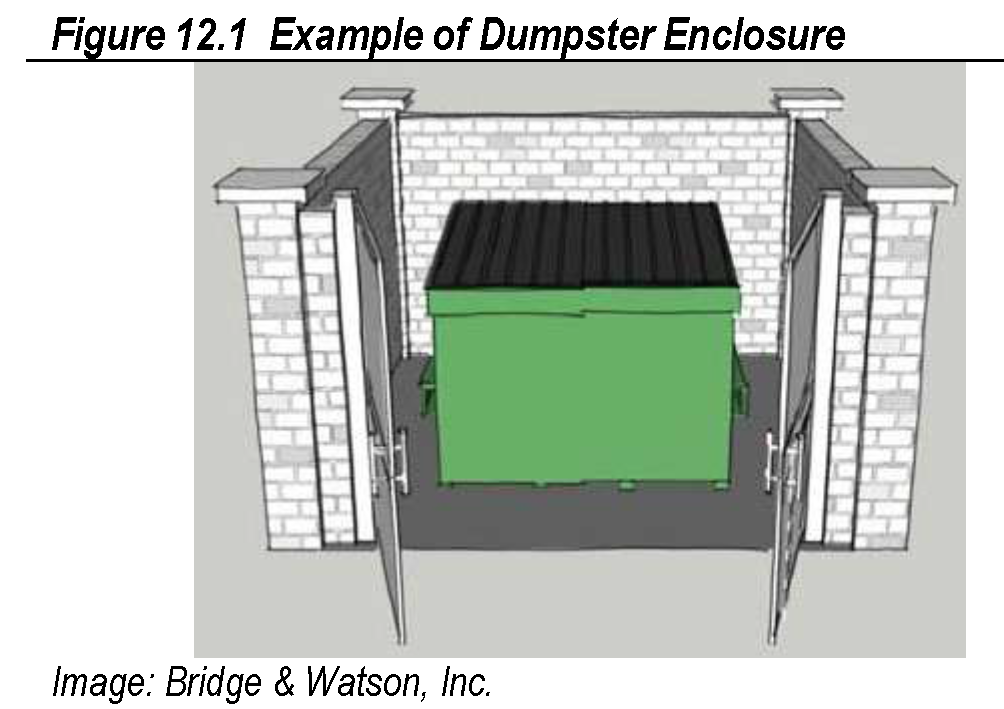
Dumpsters.
A.
All dumpsters shall be screened from sight by a fence or wall at least six inches taller than the tallest point on the dumpster. In no case shall said wall or fence exceed eight feet in height.
B.
The fence shall be constructed of an opaque material made of brick, stucco, split face block, wood, vinyl, or similar material to that of the principal building.
C.
Fences constructed of chain-link or chain-link with vinyl slats shall not be allowed.
D.
Dumpsters shall be located in the rear yard behind the building they serve, or otherwise in an inconspicuous location.
E.
Any business or entity utilizing a dumpster, which said dumpster is not enclosed or otherwise screened upon the adoption of this ordinance, shall be screened in accordance with these provisions within five (5) years from the adoption hereof.
12.4.2
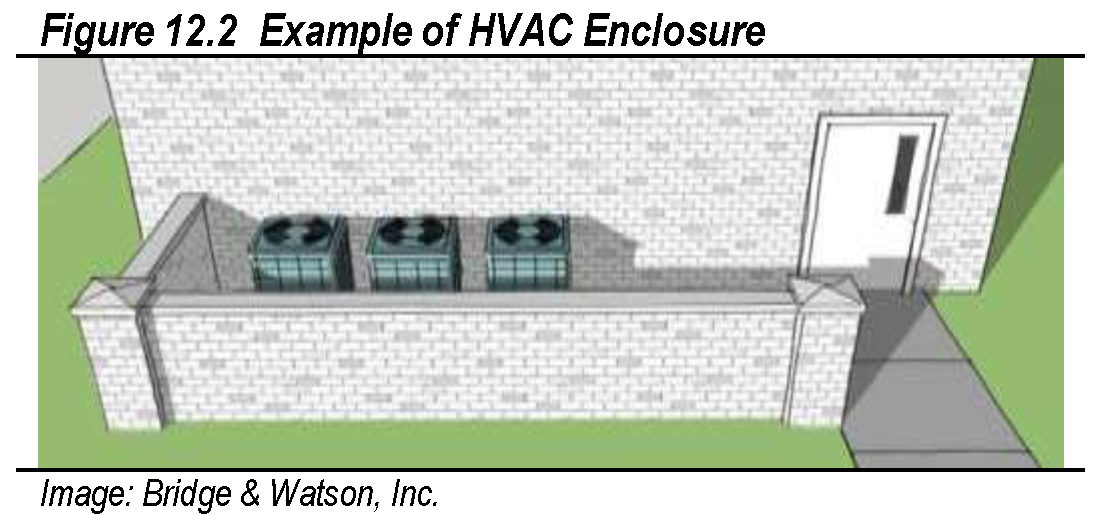
Mechanical systems (HVAC).
A.
All commercial and retail building ground mounted mechanical, HVAC, and like systems shall be screened from public street view (within 300 feet) by an opaque wall or fence of similar material to that of the principal building or landscaping.
B.
All commercial and retail building roof-mounted mechanical, HVAC, and like systems shall be screened from public street view (within 300 feet) on all sides.
12.4.3
Roof Requirements.
A.
Pitched Roofs.
i.
All one-story buildings less than ten-thousand (10,000) gross square feet must have a pitched roof (between 3:12 and 12:12) as much as possible.
ii.
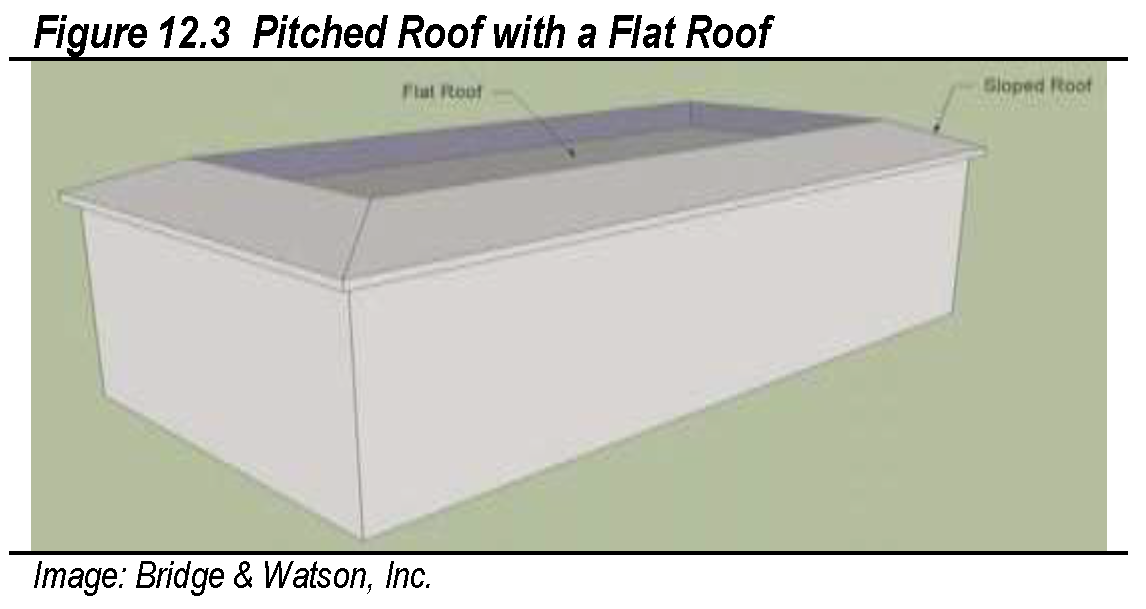
If a pitched roof is not possible, a combination of flat roof and pitched roof is required.
a.
Provide a pitched roof on front and side of the building to screen view of any flat roof.
iii.
Arcades, drive-under canopies, porches, and other features shall be created with a pitched roof.
iv.
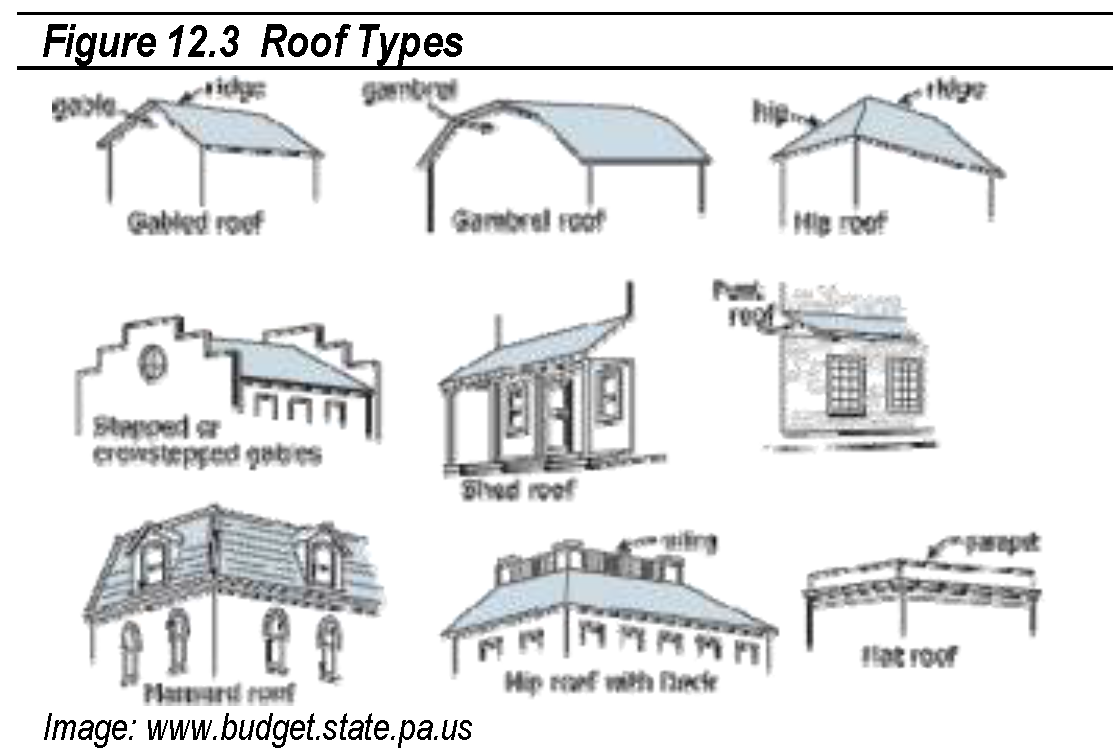
Materials for pitched roofs shall be limited to architectural dimensional grade asphalt shingles, natural slate, natural terra cotta, natural wood shake, copper or factory-finished sheet metal.
B.
Mansard Roofs.
Mansard roofs shall have a maximum pitch of 12:12 with a minimum twelve-foot (12') vertical surface length.
C.
Flat Roofs.
i.
Flat roofs may be of any material that meets building codes.
ii.
Exposed metal flashing shall be copper or factory-finished sheet metal.
iii.
If factory-finished metal flashing is used, such as standing seam, the color must be subdued to blend with other materials or of a color to simulate weathered copper or bronze.
iv.
All buildings with flat roofs should include parapet articulation on the front façade(s) of such building. The parapet articulation should coincide with any roof articulation may be a part of the roof design.
D.
Other.
Drive-under canopies for gasoline pumps may have flat roofs with vertical or factory formed facing of finished sheet metal.
12.4.4
Accessory Buildings.
All accessory buildings shall be constructed of the same material and be similarly designed as the principal building.
12.5. - COMMERCIAL, TECHNOLOGY, AND PFR ZONING DISTRICTS AND PUBLIC FACILITIES.
12.5.1
Building Design.
Building design shall exhibit architectural control which seeks to be creative and which best utilizes building lines, shapes, and angles to maximize architectural integrity.
A.
Unadorned pre-stressed upright concrete panels, unfinished concrete block, metal siding (such as galvanized or unfinished steel, galvalume, or unfinished aluminum), and pole-type building materials are not permitted as primary exterior building materials. Vinyl siding and aluminum siding shall also be excluded.
B.
Any new building shall be constructed so that all exterior sides shall be surfaced equivalent to the front of the building. The rear elevation of a building shall be exempt from this requirement provided the rear of the building is not visible from public view.
12.6. - INDUSTRIAL ZONING DISTRICTS.
12.6.1
Building Design.
Building design shall exhibit architectural control which seeks to be creative and utilize building lines, shapes, and angles to maximize architectural integrity.
A.
Unadorned pre-stressed upright concrete panels, unfinished concrete block, metal siding (such as galvanized or unfinished steel, galvalume, or unfinished aluminum), and pole-type building materials are not permitted as primary exterior building materials. Vinyl siding and aluminum siding shall also be excluded.
B.
Any new building shall be constructed so that all exterior sides shall be surfaced equivalent to the front of the building. The rear elevation of a building shall be exempt from this requirement provided the rear of the building is not visible from public view.
12.7. - HIGH DENSITY RESIDENTIAL ZONING DISTRICTS.
The exterior building finish of two-family and multi-family dwelling units shall include a variation in building materials which are to be distributed throughout the building façades and coordinated into the architectural design of the structure to create an architecturally balanced appearance. Two-family, townhome, condominiums, and multi-family dwelling structures shall comply with the following requirements:
12.7.1
Finish Material Composition.
The exterior building finish materials shall not include unadorned pre-stressed upright concrete panels, unfinished concrete block, metal siding (such as galvanized or unfinished steel, galvalume, or unfinished aluminum), pole-type building materials or vinyl and aluminum siding.
12.8. - SINGLE-FAMILY RESIDENTIAL DISTRICTS.
12.8.1
Architectural Compatibility.
To ensure architectural compatibility with homes in the immediate vicinity of the building site, building design shall be in keeping with the design patterns and architectural features that exist in the immediate vicinity.
A.
The immediate vicinity shall include an area within the same zoning district and a 500' radius of the building site.
B.
If no buildings exist within the immediate vicinity, then 10 homes within the same zoning district and similarly situated as the proposed building site shall be selected from within the City of Diamondhead. Similarly situated shall mean houses which have a similar location and characteristics as that which is proposed. Examples of similar location and characteristics include ,but are not limited to, golf course orientation, water frontage, airport access, attached vs. detached units, square footage, etc. The 10 homes shall be utilized as a compatibility guide to determine compliance with Section 12.8.1(C).
C.
Building design shall conform to the prevailing pattern and materials within the immediate vicinity. The following items shall be used to determine compatibility:
i.
Roof pitch.
ii.
Roofing materials.
iii.
Exterior finishes and materials.
iv.
Garage orientation.
v.
Landscaping.
vi.
Color scheme.
vii.
Mailbox design and construction.
viii.
Driveway and walkway materials.
ix.
Porches, dormers, or other features.
x.
Building orientation.
D.
No front facades (elevations) of any developer, builder and/or person who develops and plats subdivisions or those other individuals building homes within each subdivision, will be approved without sufficient deviation in design item(s) listed in 12.8.1.C to maintain architectural compatibility with the surrounding neighborhood. No like front facades (elevations) will be approved within two (2) platted lots adjacent to, or one (1) platted lot across from or diagonal to a like façade. Alternating like facades in a manner that is contrary to the intent of this section will be grounds for denial of such plans.
12.8.2.
General Design Characteristics.
A.
Parking on site should be visually subordinate to the residential character of the street.
B.
Garages, carports, outbuildings, etc., should not be "street forward" and of materials and styles that blend with the existing structures and neighborhood.
C.
Maintain the average scale of one- and two-story buildings along the street.
D.
Maintain the similarity of building heights. The apparent height of the primary façade should not exceed two stories.
E.
Use roof forms that are similar in scale and character to the neighborhood and to those used historically.
12.8.3
Additions to Existing Structures.
A.
Residential additions shall be compatible and in context with the same general scale, proportion, massing, and detailing as the original structure and should not be a stark contrast.
B.
The design of a new addition shall incorporate the main characteristics of the existing structure. This may include:
i.
The extension of architectural lines from the existing structure to the addition;
ii.
Repetition of bays, windows, and entrance spacing;
iii.
Use of harmonizing colors and materials; and
iv.
The inclusion of similar architectural details (e.g., window/door trim, lighting fixtures, and stone/brick decoration).
C.
A new addition that creates an appearance inconsistent with the character of the existing building is inappropriate.
( Res. No. 2022-064 , 9-20-2022)
12.9. - EXCEPTIONS.
The DRC may approve materials and designs that differ from those required within this ordinance, provided the following criteria are achieved:
A.
The proposed building maintains the quality and value intended by this Section.
B.
The proposed building is compatible and in harmony with other structures designed by standards in this Section within the district.
C.
The design exceeds the intent of the ordinance.
12.10. - PRELIMINARY CONSTRUCTION DOCUMENT REVIEW.
12.10.1
Review Procedure.
A.
Plans for new construction, additions, and changes to existing buildings that involve 50% or more of the floor area or 50% or more of the value of the property shall be submitted to the Zoning Administrator for approval.
B.
Each building design will be reviewed for at least the following considerations:
i.
Appropriate location of structures on the site with relationship to other amenities, restrictions, adjacent land usage, etc.
ii.
General massing, roof treatments, proportions and quantity of exterior openings.
iii.
Use of exterior materials as they relate to adjacent structures, and their impact on the quality and character of the immediate area.
iv.
Screening of mechanical equipment, tanks, loading decks, refuse handling, ancillary equipment, etc., whether on the roof or on the site.
12.10.2.
Variance.
Any request for a variance in the requirements of this Article shall be submitted in accordance with Section 2.6 Variance Procedure.

