
Diamondhead City Zoning Code
ARTICLE 5
- GENERAL REGULATIONS
5.1.- LIMIT OF ONE PRINCIPAL USE.
No more than one (1) principal use shall be permitted on a lot, unless specifically permitted by this Ordinance.
5.2. - PRINCIPAL BUILDINGS.
5.2.1
Street Frontage Required.
Every principal building shall be built upon a lot with frontage upon a public or private street improved to meet minimum standards set forth in the subdivision regulations for the City of Diamondhead.
5.2.2
Two or More on a Lot.
Where two (2) or more principal buildings are on a lot, the same shall conform to the following:
A.
The requirement of this Ordinance which would apply to each building if each were on a separate lot; and
B.
The standards and improvements required for land development by the Subdivision regulations.
5.3. - MAXIMUM HEIGHT OF BUILDINGS.
5.3.1
In General.
The regulations herein set forth qualify or supplement, as the case may be, the specific district regulations appearing in Article 4.
A.
Chimneys, elevators, poles, spires, tanks, towers, and other projections not used for human occupancy may extend above the district limitations for height. However, should the height be in excess of fifty (50) percent of the specific district limitations, a conditional use shall be required. See also the provisions of Article 13, Telecommunication Facilities.
B.
Churches, schools, hospitals, sanatoriums, and other public and semi-public buildings may exceed the height limitation of the district if the minimum depth of rear yards and the minimum width of the side yards required in the district are increased one (1) foot for each two (2) feet by which the height of such public or semi-public structure exceeds the prescribed limit.
C.
To maintain neighborhood continuity, the building height of new residential construction may exceed 35 feet when the existing primary buildings of the adjoining properties exceed 35 feet. In no case shall this provision allow a new residential building to exceed the height of a residential structure on adjoining property.
5.3.2
Airport Height Restrictions.
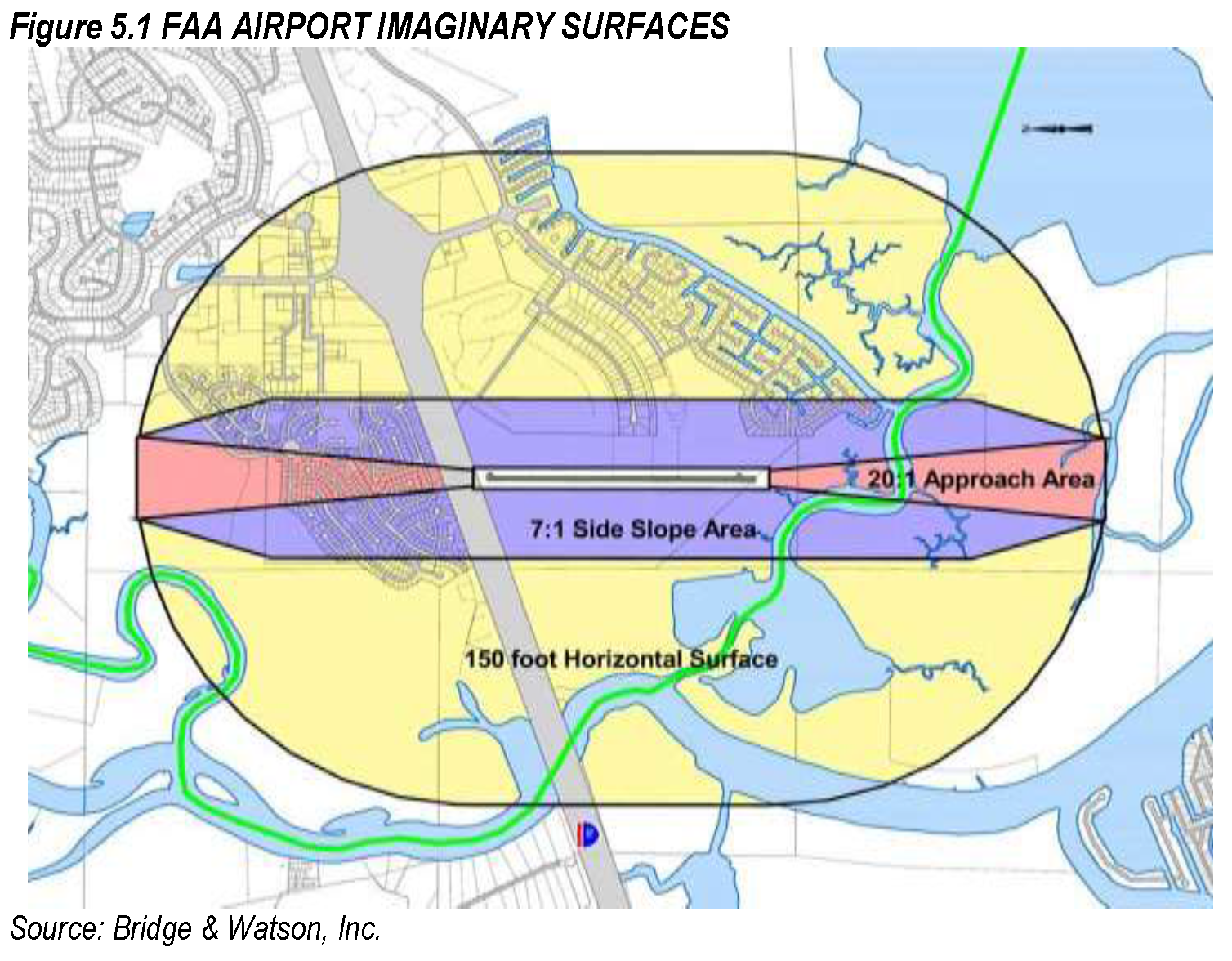
Airport height restrictions exist to protect the approach zones and clear areas around the Diamondhead airport and the methodology for such height restrictions are promulgated by the Federal Aviation Administration (FAA). In no case shall the Airport Height Restrictions allow a building or structure which exceeds the height limits imposed within each zoning classification of this Ordinance.
Buildings or other structures located within the FAA Imaginary Surfaces of the airport as shown in Figure 5.1 shall not exceed the elevation limits as set forth by the FAA in 14 CFR Part 77 Surfaces. The elevation limits in these areas shall be calculated as outlined in items A through C or as otherwise required by the FAA. The distances and calculations shall be confirmed by the Zoning Administrator prior to issuing a building permit.
A.
Lots located in the 20:1 runway approach:
((D - 200)/20) + E R = E MAX
D = Distance from end of runway to building location
E R = Elevation of runway
E MAX = Maximum structure elevation
B.
Lots located within the 7:1 side slope area:
((D - 125)/7) + E R = E MAX
D = Distance from end or edge of runway to building location
E R = Elevation of runway
E MAX = Maximum structure elevation
C.
Lots located within the 150 feet Horizontal Surface:
No structure shall exceed a maximum elevation of 150 feet above the elevation of the airport runway.
5.4. - SPECIAL LOT AND YARD REQUIREMENTS.
5.4.1
In General.
A.
The lot or yard requirements for any new building or use shall not include any part of a lot that is required by any other building or use to comply with the requirements of this Ordinance.
B.
No required lot area or yard shall include any property (the ownership of which has been transferred subsequent to the effective date of this Ordinance), if such property was part of the area required for compliance with the dimensional requirements applicable to the lot from which such transfer was made.
5.4.2
Exceptions to Minimum Lot Areas, Lot Widths and Yards.
A.
Nonconforming Lots.
See Section 5.6.
B.
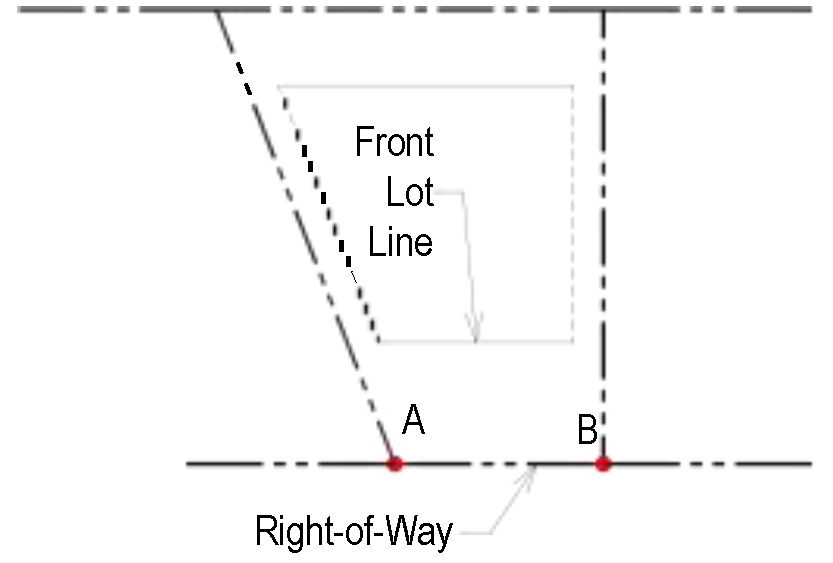
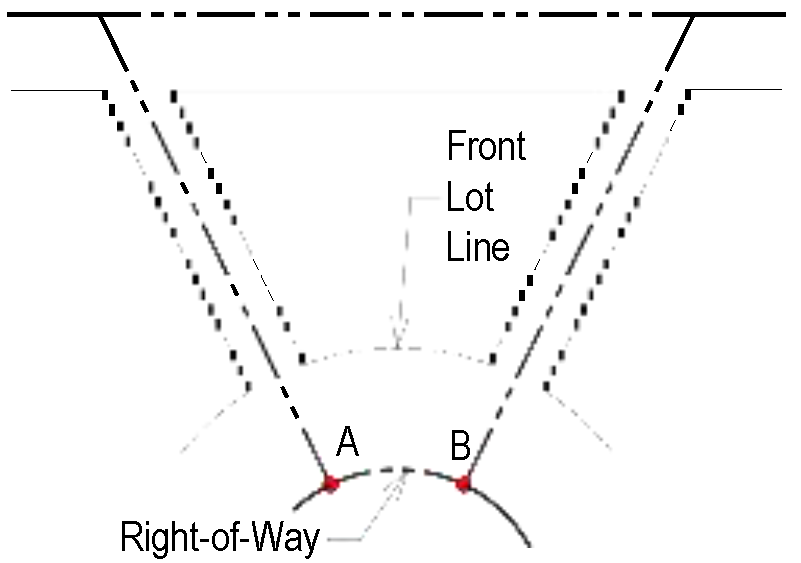
Irregularly Shaped Lots.
In the case of irregularly shaped lots, the minimum lot width specified in the district shall be measured at the front lot line of the minimum required front yard, provided that in no case shall the lot frontage measured at the street right-of-way line be less than seventy (70%) percent of the required minimum lot width except in the following situations: on cul-de-sacs or courts or street centerline curves of less than three hundred (300') feet radius where the lot frontage measured at the street right-of-way line shall not be less than forty (40%) of the minimum lot width.
C.
Through Lots.
Front yards shall be provided along all portions of a through lot abutting any street, except where a provision of a different yard will comply with the prevailing front yard pattern on adjoining lots. The presence of an alley shall not constitute a through lot.
D.
Corner Lots.
Front yards shall be provided along all portions of a corner lot abutting any street, except where the provision of a different yard will comply with the prevailing yard pattern on adjoining lots (but shall not be less than ten (10') feet).
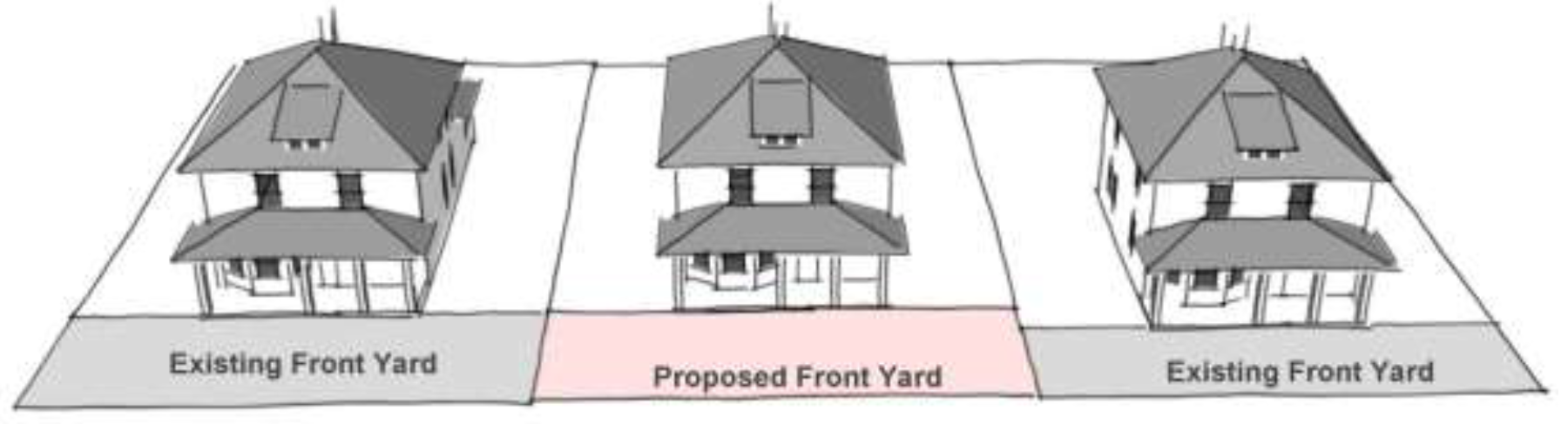
E.
[Front yard depth.] The front yard of a lot between two lots (each having a principal building within twenty (20') of the lot) may be reduced to a depth equal to that of the greater of the two adjoining lots, except that the front yard shall not be less than ten (10') feet.
F.
Projections into Yards.
i.
No projection into required yard areas permitted in Sections 5.4.2F.ii. and iii. (except for patios) in a Low Density Residential District or Medium Density Residential District shall be less than ten (10') feet from any side or rear lot line or fifteen (15') feet from any front lot line.
ii.
Bay windows, fireplaces, fire escapes, chimneys, uncovered stairs and landings, and balconies and cornices, canopies, marquees, eaves or other architectural features not required for structural support may project into the required side, front or rear yard not more than two (2') feet.
iii.
Patios may be located in the required side and rear yards not closer than three (3') feet to any adjacent property line.
G.
Side Yard Variation under Diamondhead Property Owners Association Approval.
Although the provisions of this ordinance are specific as they relate to side yard setbacks, the City of Diamondhead recognizes that certain side yard variations were allowed and granted by the Diamondhead Property Owners' Association over the course of time preceding the adoption of this ordinance. Therefore, any residential lot having been previously platted, approved or developed with a side yard setback less than that required by this ordinance shall hereafter develop in conformance with those side yard setbacks as heretofore approved. In no case, however, shall a side yard be less than 5 feet unless otherwise specifically allowed by this ordinance.
5.4.3
Traffic Visibility across Corners.
A.
Sightlines at Intersections of Streets.
i.
A triangular area as defined in Section 5.4.3.A.iii. shall be graded and shall be free of sight obstructions so that vision between a height from two to ten (2' to 10') feet above the centerline grades of the intersecting streets is not obscured.
ii.
By means of deed restriction, lease restriction, or plan amendment (whichever method is applicable), vegetation shall not be planted or allowed to grow in such a manner as to obscure vision between a height of from two to ten (2' to 10') feet above the centerline grades of the intersecting streets within the triangular area defined in Section 5.4.3.A.iii.
iii.
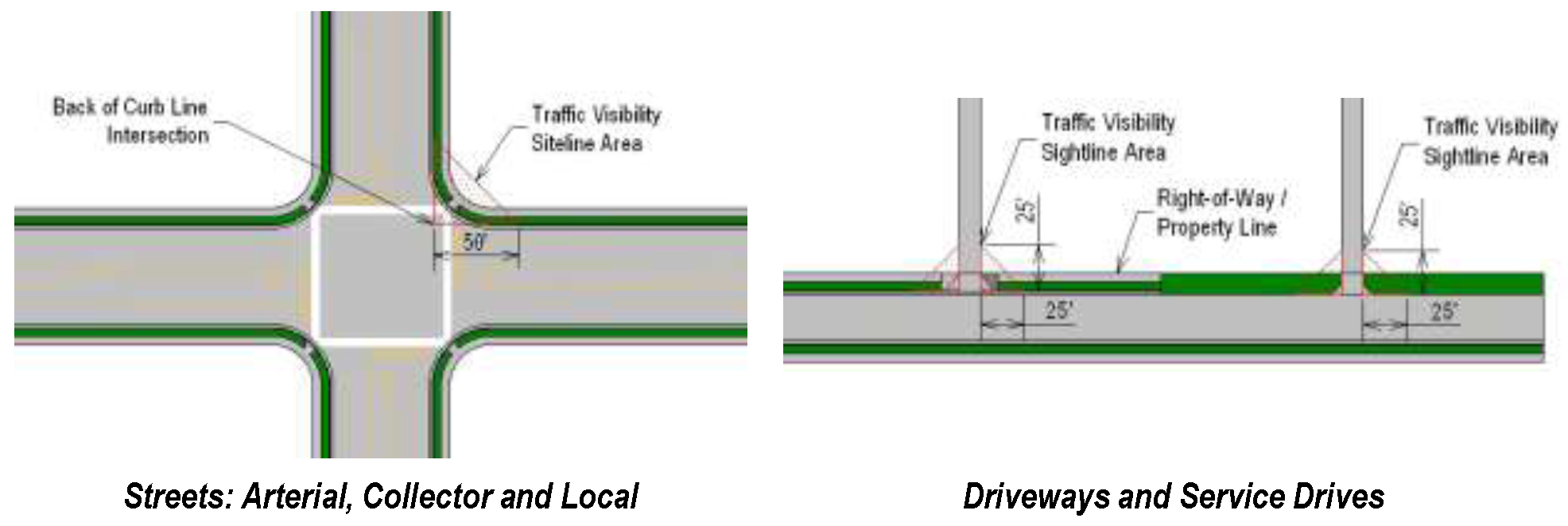
Such triangular area shall be bound at street intersections (corner lots) as measured along the back of curb on both streets for a distance of fifty (50) feet from the point of intersection of the curb line. In the absence of curb, the triangular area shall be measured fifty (50) feet from intersection of the projection line of the edge of pavement.
B.
Sightlines at Intersections of Driveways or Access ways with Streets.
i.
A triangular area as defined in Section 5.4.3.B.iii. shall be graded and shall be free of sight obstructions so that vision between a height of from two to ten (2' to 10') feet above the centerline grades of the intersecting driveway, access way, or streets is not obscured.
ii.
By means of deed restriction, lease restriction, or plan amendment (whichever method is applicable), vegetation shall not be planted or allowed to grow in such a manner so as to obscure vision between a height of from two to ten (2' to 10') feet above the centerline grades of the intersecting driveway, access way, or streets within the triangular area defined in Section 5.4.3.B.iii.
iii.
Such triangular area shall be bound by the intersecting driveway, access way, or street centerlines and a diagonal connecting two points as measured along the back of curb on both streets and driveways for a distance of twenty-five (25) feet from the point of intersection of the curb lines. In the absence of curb, the triangular area shall be measured twenty-five (25) feet from intersection of the projection line of the edge of pavement.
| Table 5.1 - Sightlines at Various Types of Intersections | |
 |
5.4.4
Buffer Yards.
A.
Scope.
Any non-residential use which borders any property zoned or used for residential purposes shall provide buffer yards which comply with the standards of Section 5.4.4.
B.
Size, Location.
i.
A fifteen (15') foot buffer yard shall be required, unless otherwise indicated in this Ordinance. A twenty five [foot] (25') buffer yard shall be required when any non-residential use borders any property zoned as R-1 or R-2. Additionally, the Planning Commission may require additional buffer area upon the determination that the proposed non-residential use will generate noise, light, glare, dust, odor, appearance, or other noxious characteristics which warrant additional separation or screening techniques.
ii.
The buffer yard shall be measured from the property line or from the street right-of-way line (where a street serves as the district boundary line). Buffer yards shall not be within an existing or future street right-of-way and shall be in addition to that right-of-way.
iii.
The buffer yard may be coterminous with a required front, side, or rear yard, provided the larger yard requirements shall apply in case of conflict.
C.
Characteristics.
i.
The buffer yard shall be a landscaped area free of structures, manufacturing or processing activity, materials, or vehicular parking. No driveways or streets shall be permitted in the buffer yards except at points of ingress or egress.
ii.
In all buffer yards, all areas not within the planting screen shall be planted with grass seed, sod or ground cover, and shall be maintained and kept clean of all debris, rubbish, grass more than twelve (12") inches in height, or weeds.
D.
Planting Screen.
i.
Each buffer yard shall include a planting screen of trees, shrubs, and/or other plant materials extending the full length of the lot line to serve as a barrier to visibility, airborne particles, glare and noise.
ii.
Each Planting Screen shall be in accordance with the following requirements:
a.
Plant materials used in the Planting Screen shall be of such species and size as will produce, within two (2) years, a complete year-round visual screen of at least eight (8') feet in height.
b.
The Planting Screen shall be permanently maintained by the landowner and any plant material which does not live shall be replaced within one (1) year.
c.
The Planting Screen shall be so placed that at maturity it will be at least three (3') feet from any street or property line.
d.
The Planting Screen shall be broken only at points of vehicular or pedestrian access and shall comply with Section 5.4.3.
iii.
In circumstances where it is impractical for a Planting Screen to meet all the requirement of this Section or would create an undue hardship, the Planning Commission may modify the requirements or approve acceptable alternatives which shall satisfy the spirit, objectives and intent of the screen requirements. Planning Commission review shall be in accordance with Section 2.4 of this Ordinance.
E.
Plans.
i.
Prior to the issuance of any Zoning approval, the applicant shall submit plans which graphically indicate, in both drawing and text where appropriate, the following:
a.
The location and arrangement of each buffer yard.
b.
The placement, species, and size of all plant materials; and
c.
The placement, size, materials and type of all fences to be placed in such buffer yard.
ii.
Such plans shall be reviewed by the Zoning Administrator to ascertain that the plans are in conformance with the terms of this Ordinance.
5.5. - ESTABLISHMENT OF FUTURE RIGHT-OF-WAY WIDTHS FOR ROADS.
5.5.1
Purpose and Establishment.
All front yards and other appropriate yards shall be measured from the relevant minimum future right-of-way line indicated in Section 5.5.2 where the existing right-of-way is less than that indicated in Section 5.5.2 for the particular class of road on which a property abuts.
5.5.2
Measurement.
A.
The future right-of-way shall be measured from the centerline of the existing road.
B.
The specific classification of each road is shown on the Street Classification Map set forth in the Comprehensive Plan for the City of Diamondhead.
5.6. - NONCONFORMING BUILDINGS, STRUCTURES, LOTS, AND USES OF LAND.
5.6.1
Nonconforming Buildings and Structures.
A nonconforming building or structure and/or land use existing at the time of adoption of these regulations may be continued and maintained except as otherwise provided in this Section.
A.
Alteration or Enlargement and Repair of Buildings and Structures.
i.
A nonconforming building or structure shall not be added to or enlarged in any manner unless said building or structure, including additions or enlargements and use is made to conform to all of the regulations of the district in which it is located and no additional structures not conforming to the requirements of this ordinance shall be erected in connection with such nonconforming uses of land.
ii.
Should a nonconforming structure be moved for any reason, for any distance whatever, it shall thereafter conform to these regulations for the district in which it is located after it is moved.
iii.
Any repairs of damage or destruction sustained by a nonconforming use shall return the structure to no less than the true value as determined by the Hancock County Tax Assessor which existed prior to the damage or destruction.
B.
Building or Land Vacancy.
i.
Nonconforming building, structure, dwelling, or land use, or portion thereof, existing at the time of adoption of these regulations which is or hereafter becomes vacant for any reason, for a period in excess of six (6) months shall not thereafter be occupied except by a use which conforms to the use regulations of the district in which it is located.
C.
Change In Use.
i.
A nonconforming use of a conforming building or structure (i.e., commercial use in a dwelling, etc.) shall not be expanded or extended into any other portion of such conforming building or structure nor changed except to a conforming use.
ii.
Once changed to a conforming use, no structure or land shall be permitted to revert to a nonconforming use.
iii.
Nonconforming use may be changed to another nonconforming use only if permitted as a Conditional Use by the Planning Commission after the applicant has shown that the proposed change will be less objectionable in external effects than the existing nonconforming use with regard to:
a.
Traffic generation and congestion (including truck, passenger car, bicycle, and pedestrian traffic);
b.
Noise, smoke, dust, fumes, vapors, gases, heat, odor, glare, or vibration;
c.
Storage and waste disposal; and
d.
Appearance.
5.6.2
Nonconforming Lots of Record.
A.
A building may be constructed on a nonconforming lot, provided the yard requirements of this Ordinance are observed.
B.
Contiguous nonconforming lots under common ownership shall be considered one lot.
5.6.3
Restoration.
Should a nonconforming structure be destroyed or damaged by any means to an extent that would be in excess of fifty (50) percent of the true value as determined by the Hancock County Tax Assessor it shall not be reconstructed or use made of except in conformity with the provisions of these ordinances.
5.6.4
Ownership.
Whenever a nonconforming structure or lot is sold to a new owner, such sale shall have no effect on the nonconforming status of the structure or lot. A nonconforming use of land or structure shall not lose its nonconforming status upon the sale to a new owner.
5.6.5
District Changes.
Whenever the boundaries of a district are changed so as to transfer an area from one district to another district, the foregoing provisions shall also apply to any nonconforming uses or structure existing in the district to which the area was transferred.
5.6.6
Repairs and Maintenance.
Ordinary repairs and replacement of nonbearing walls, fixtures, wiring, or plumbing may be performed, provided that the nonconforming structure shall not be increased in size.
5.6.7
Uses Requiring Planning Commission Review and Conditional Use Procedures.
Any lawful use existing on the effective date of this ordinance or amendment thereto, and which would be required to have Planning Commission review pursuant to Section 2.4 of this ordinance or would be a conditional use under the terms of this ordinance or amendment thereto, is, without further action, conforming under these provisions. However, any alteration to the site, building, nature of the operations, or any other aspect of the use shall require a Planning Commission Review or conditional use, whichever the case may be.
( Res. No. 2022-031 , 4-5-2022)
5.7. - TEMPORARY STRUCTURE OR USE.
5.7.1
A temporary permit may be issued by the Zoning Administrator for structures or uses necessary during construction or other seasonal or special circumstances of a nonrecurring nature subject to the following additional provisions:
A.
The life of such permit shall not exceed one (1) year and may be renewed for an aggregate period of not more than two (2) years.
B.
Such structure or use shall be removed completely upon expiration of the permit.
C.
The Zoning Administrator shall not issue a temporary permit for any use or activity which is otherwise prohibited within the City.
5.7.2
Temporary permits may be issued for outdoor sale of goods not associated with farm produce, firewood, or seafood only after review and approval by the Planning Commission provided:
A.
Written concurrence from the property owner(s) is obtained.
B.
Sale periods are limited to conditions established by the Planning Commission.
C.
Suitable safety precautions are taken in accordance with conditions approved by the Zoning Administrator to insure that human health and welfare are not jeopardized.
5.7.3
The Zoning Administrator may at his discretion elect to take any request for temporary permits before the Planning Commission for review and action.

