
Diamondhead City Zoning Code
ARTICLE 8
- OFF-STREET PARKING AND LOADING
8.1.- GENERAL PROVISIONS.
The off-street parking and loading requirements hereinafter set forth in this Article supplement the district regulations for each of the districts, pursuant to this Ordinance. In no case is parking authorized on any private or public areas not specifically designed or designated for parking. This includes residential yards, median areas, and roadways.
8.1.1
Procedure.
An application for a building permit for a new or enlarged building, structure or use shall include therewith a plot plan, drawn to scale, and fully dimensioned showing any off-street parking or loading facilities to be provided in compliance with the requirements of this Ordinance.
8.1.2
Extent of Control.
All buildings and structures erected and all land uses initiated after the effective date of this Ordinance shall comply with the off-street parking and loading requirements of this Ordinance and shall provide accessory off-street parking or loading facilities as required herein for the use thereof.
8.1.3
Parking and Storage of Certain Vehicles or Equipment.
Within the various residential zoning districts for the City of Diamondhead, the following restrictions and limitations concerning the parking of recreational vehicles, trailers, equipment and the like shall apply.
A.
The following vehicles are prohibited from being parked in a residential zoning district for more than a 12-hour period:
i.
All vehicles that have a dump-type bed.
ii.
All motorized construction equipment.
iii.
All vehicles that exceed ten (10) feet in height above the grade.
B.
The following vehicles shall be parked behind the front line of the existing house and screened from view from the street and adjacent property, including golf course areas:
i.
Vehicles that exceed seven (7) feet six (6) inches in height above grade.
ii.
Lawn maintenance equipment.
iii.
All trailers used to transport equipment or construction vehicle parked for more than 24 hours.
iv.
Individual recreational vehicles such as boats, jet skis, all-terrain vehicles (ATV), or similar vehicles.
C.
The screening utilized to comply with Section 8.1.3B shall require a permit issued by the Zoning Administrator and shall conform to the following:
i.
When possible, materials utilized for the screen shall be similar to the exterior materials of the primary structure or fence, if a fence exists.
ii.
In no case shall the following materials be utilized to constitute the required screen: tarpaulin, bed linens or similar, tin or sheet metal, vinyl slatted chain-link or wire mesh, wood sheeting, plastic or vinyl sheeting, or other materials which would detract from the neighborhood.
iii.
Landscape plantings may be utilized to accomplish the necessary screening.
D.
Major recreational equipment, including, but not limited to, travel trailers, campers or camper trucks, coaches, motorized dwellings, or similar equipment, shall not be parked or stored in a driveway or parking area, except for a reasonable amount of time as may be required to load or unload personal property at a residence prior to or after use for which such recreational equipment is designed. Out of town guests of a property owner may be permitted to park major recreational equipment on premises driveway only for a period not exceeding seven (7) days, provided no portion of the equipment extends into the road right-of-way or, where provided, sidewalks.
8.1.4
Location of Parking Areas.
A.
Off-street parking facilities shall be provided on the same lot or parcel of land as the main building being served, or on a separate lot or parcel of land not over five hundred (500) feet from any entrance of the main building measured from the nearest point of the parking area, provided the separate lot or parcel of land intended for the parking facilities is located in the same district as the principal permitted use or in a less restricted district.
B.
Over flow parking for residential uses shall be located between the garage the nearest side lot line, but in no case shall the overflow be located in front of the house unless located on a circular drive.
8.2. - REQUIRED NUMBER OF OFF-STREET PARKING SPACES.
8.2.1.
Requirement.
A.
Each use established, enlarged, or altered in any district shall provide and satisfactorily maintain off-street parking spaces in accordance with Table 8.1 and the regulations of this Article.
B.
Uses not specifically listed in Table 8.1 shall comply with the requirements for the most similar uses listed in Table 8.1.
C.
Where a proposed use contains or includes more than one type of use (regardless of whether each use is listed in Table 8.1 or is an unlisted use), the number of parking spaces required shall be the sum of the parking requirements for each separate use.
D.
Where the computation of required parking spaces results in a fractional number, the fraction of one-quarter (¼, 0.25) or more shall be counted as one (1).
8.2.2
Schedule of Off Street Parking Spaces Required.
At least the following amounts of off-street parking spaces shall be provided. The classification of use shall be deemed to include and apply to all uses, and if the classification of any use for the purpose of determining the number of parking spaces to be provided is not readily determinable hereunder the classification of the use shall be fixed by the Zoning Administrator.
Casino patron parking shall be designed to accommodate peak user demand based upon eighty (80) percent of casino capacity. Such parking shall reflect a mixture of bus and automobile parking such that bus spaces accommodate twenty (20) to thirty (30) percent of casino capacity. The exact percentage of estimated bus traffic shall be determined by the Diamondhead Planning Commission based upon marketing information provided by the casino developer, and bus parking shall be based upon eighty-five (85) percent capacity of the bus. The following calculations shall be used.
8.2.3
Handicapped Parking Spaces Required.
In each parking lot a portion of the total parking spaces shall be specifically designed, located, and reserved for vehicles licensed by the State for use by the handicapped. The required number of spaces is found in Table 8.3.
A.
Accessible parking spaces shall be designated as reserved by a sign showing the symbol of accessibility. Van accessible spaces shall be marked with an additional sign.
B.
Parking spaces designated for persons with disabilities shall be located on the shortest possible circulation route to an accessible entrance to the building. In separate parking structures or lots which do not serve a particular building, parking spaces for disabled persons shall be located on the shortest possible pedestrian route to an accessible pedestrian entrance of the parking facility.
C.
Accessible parking spaces shall be included as parking spaces satisfying the requirements for off-street parking.
D.
One space in every eight spaces shall be van accessible, but not less than one.
E.
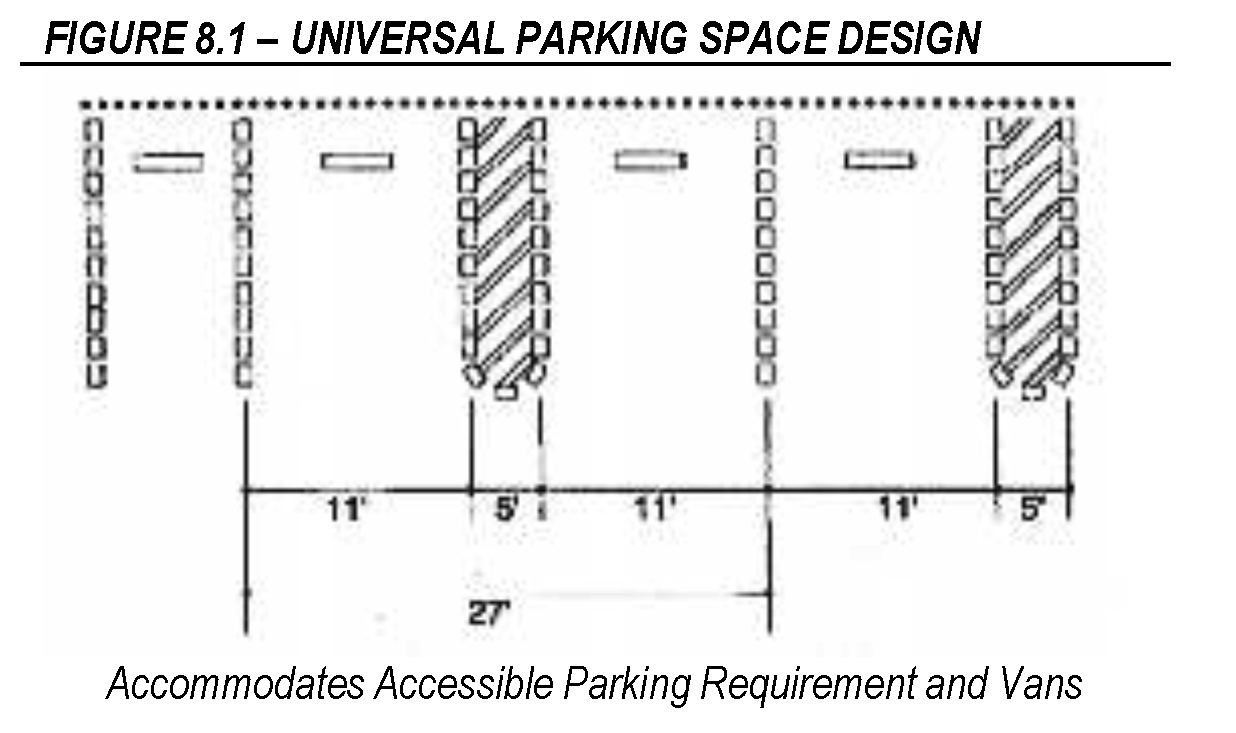
Accessible parking spaces shall be not less than 9 feet wide by 19 feet long with a minimum 5-foot-wide access aisle. Universal parking spaces 11 feet wide with an adjacent 5-foot access aisle may be used to satisfy the requirement for accessible parking including van accessible parking spaces. See Figure 8.1.
(Res. No. 2020-012 , 3-3-2020)
8.3. - GENERAL REGULATIONS APPLYING TO OFF-STREET PARKING FACILITIES.
8.3.1
Existing Parking.
Structures and uses in existence at the effective date of this Ordinance shall not be subject to the requirements of this Article, provided that the kind or extent of use is not changed and that any parking facility now serving such structures or uses shall not in the future be reduced to an amount less than that required by this Ordinance.
8.3.2
Change in Use.
A.
When a building or structure erected or enlarged shall undergo a decrease in number of dwelling units, gross floor area, seating capacity, number of employees, or other unit of measurement specified for required off-street parking or loading facilities, and, further, when said decrease would result in a requirement for fewer total off-street parking or loading spaces through application of the provisions of this Ordinance thereto, off-street parking and loading facilities may be reduced accordingly, provided that existing off-street parking or loading facilities shall be so decreased only when the facilities remaining would at least equal or exceed the off-street parking or loading requirements resulting from application of the provisions of this Ordinance to the entire building or structure as modified.
B.
When a building or structure shall undergo any increase in number of dwelling units, gross floor area, seating capacity, or other unit measurement specified herein for required off-street parking or loading facilities, and, further, when said increase would result in a requirement for additional total off-street parking or loading spaces through application of the provisions of this ordinance thereto, parking and loading facilities shall be increased accordingly.
8.3.3
Conflict with Other Uses.
No parking area shall be used for any other use that interferes with its availability for the parking need it is required to serve.
8.3.4
Joint Use.
Off-street parking facilities for different buildings, structures or uses, or for mixed uses, may be provided collectively in any zoning district in which separate off-street parking facilities for each constituent use would be permitted, provided that the total number of spaces so located together shall not be less than the sum of the separate requirements for each use and not more than 300 feet from the lot on which the main building is located.
8.4. - DESIGN STANDARDS FOR OFF-STREET PARKING FACILITIES.
8.4.1
General Requirements.
A.
Every parking facility shall be designed so that it does not constitute a nuisance, hazard, or unreasonable impediment to traffic.
B.
Every parking area shall be arranged for orderly, safe movement.
C.
Every parking area shall be designed so that each motor vehicle may proceed to and from the parking space provided for it without requiring the moving of any other motor vehicle, except those of a single-family or two-family dwelling, a valet parking lot not open for public parking, or attendant directed parking.
D.
Surfacing of all parking facilities shall be concrete, asphaltic concrete, or asphalt and all parking facilities shall be properly graded for drainage and maintained in a good condition, free of weeds, dust, trash and debris, potholes or other surface failures. Pervious pavement or pervious pavements systems are allowed subject to the provisions of Article 8.4.1.I.
E.
Wheel guards may be provided and so located that no part of a parked vehicle will extend beyond the parking facility.
F.
Parking spaces shall not be used for the sale, repair, dismantling, or storage of any vehicles, equipment, materials, or supplies.
G.
Parking facilities on more than one level (multiple-level) shall be designed in accord with those standards set out herein for grade-level parking facilities insofar as they are reasonably applicable. The design of such a multiple-level facility shall be subject to approval of the Planning Commission with respect to layout, circulation, accommodations for pedestrians' ingress and egress, and other characteristics affecting safety and convenience.
H.
All parking spaces shall be properly marked by durable paint in stripes a minimum of four (4) inches wide and extending the length of the parking space.
I.
Pervious pavement or pervious pavement systems. Pervious pavement or pervious pavement systems, capable of carrying a wheel load of four thousand (4,000) pounds, including pervious asphalt, pervious concrete, modular pavers designed to funnel water between blocks, lattice or honeycomb shaped concrete grids with turf grass or gravel filled voids to funnel water, plastic geocells with turf grass or gravel, reinforced turf grass or gravel with overlaid or embedded meshes, or similar structured and durable systems are permitted. Gravel, turf, or other materials that are not part of a structured system designed to manage stormwater shall not be considered pervious pavement or a pervious pavement system. Pervious pavement and pervious pavement systems shall meet the following conditions:
1.
All materials shall be installed per industry standards. Appropriate soils and site conditions shall exist for the pervious pavement or pervious pavement system to function. Documentation that verifies appropriate soils and site conditions shall be provided. For further guidance and technical assistance, please refer to the following source: Georgia Stormwater Management Manual: Volume 2 Technical Handbook.
2.
All materials shall be maintained per industry and city standards. Damaged areas shall be promptly repaired. Gravel that has migrated from the pervious pavement systems onto adjacent areas shall be swept and removed regularly.
3.
Pervious pavement or pervious pavement systems, except for pervious asphalt or pervious concrete, shall not be used for accessible parking spaces or the accessible route from the accessible space to the principal structure or use served.
4.
Pervious pavement or pervious pavement systems shall be prohibited in areas used for the dispensing of gasoline or other engine fuels or where hazardous liquids could be absorbed into the soil through the pervious pavement or pervious pavement system.
5.
Pervious pavement or pervious pavement systems that utilize turf grass shall be limited to overflow parking spaces that are not utilized for required parking and that are not occupied on a daily or regular basis.
6.
Pervious pavement or pervious pavement systems used for parking or associated drive aisles or driveways shall count as impervious surface for the purposes of impervious surface coverage in any zoning district that has a maximum impervious surface limit or percentage, except where a pervious pavement system utilizing turf grass is provided for a fire access lane that is independent of a parking lot.
7.
Pervious pavement or pervious pavement systems shall not allow parking spaces, drives aisles, or driveways to be located anywhere not otherwise permitted by the regulations of this zoning ordinance and the district in which it is located.
8.
Parking areas shall have the parking spaces marked as required by this article except that pervious pavement systems that utilize gravel or turf may use alternative marking to indicate the location of the parking space, including, but not limited to, markings at the end of spaces on the drive aisle or curbing, wheel stops, or concrete or paver strips in lieu of painted lines.
8.4.2
Parking Space Geometry.
A.
Parking spaces shall have a minimum area of 171 square feet with a width of nine (9) feet and a length of nineteen (19) feet. Parking lots shall be laid out and constructed in accordance with the following specifications as set forth in Table 8.4.
| Table 8.4 - Parking Space Geometry | |||
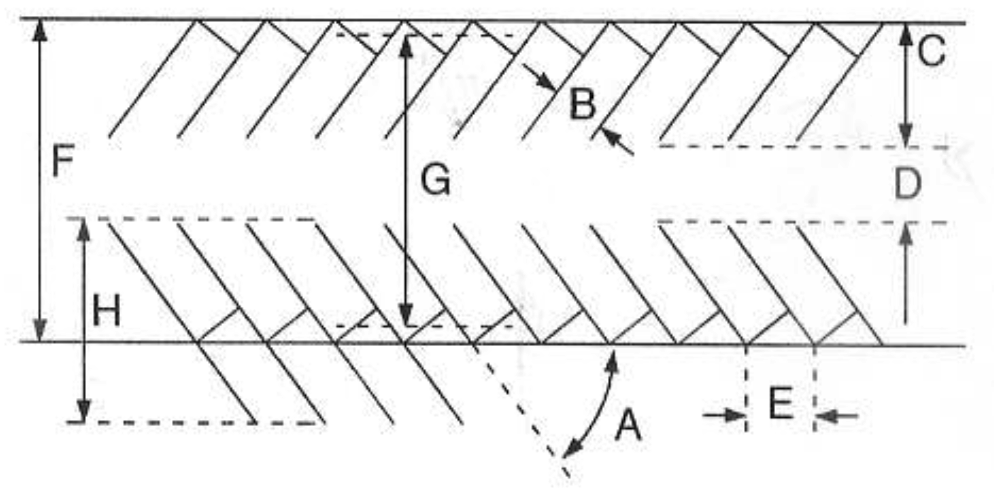 | |||
| A = Angle of Parking | |||
| 45° | 60° | 90° | |
| B = Stall Width | 9.0' | 9.0' | 9.0' |
| C = Vehicle Projection | 19.7' | 21.0' | 19.0' |
| D = Aisle Width | 12.5' | 17.5' | 22.0' |
| E = Curb Length per Stall | 12.7' | 10.5' | 9.0' |
| F = Width of Bay | 51.9' | 59.5' | 60.0' |
| G = Width of Bay, double | 45.6' | 55.0' | 60.0' |
| H = Width of double stalls | 33.1' | 37.5' | 38.0' |
B.
Parallel parking spaces shall have a minimum width of 9 feet and a minimum length of 24 feet adjacent to a minimum 12-foot wide aisle.
C.
Aisles or lanes designated by the Fire Department shall be a minimum of 18 feet wide.
D.
Additional aisle width and turning radii may be required to accommodate emergency vehicles, large vehicles, equipment, vehicles with trailers, or when the aisle serves as a principle means of access and/or circulation within the site including access to loading spaces, drive-through facilities, or trash storage facilities.
E.
Pedestrian walks shall be located between every other (alternating) parking bay, a parking bay being the vehicular access aisle and parking spaces on one or both sides served by it. If parking bays exceed three hundred (300) feet in length without vehicular access to adjacent bays or to another drive or street, a pedestrian walk shall be provided between each parking bay. Required pedestrian walks shall have a four-foot (4') clear width and such width shall be protected and maintained by curbs or wheel guards. All pedestrian walks shall be paved and maintained free of standing water. Pervious asphalt or pervious concrete may be used as an alternative to concrete, asphaltic concrete, or asphalt subject to the provisions of Article 8.4.1.J.
F.
Blocks of parking bays containing more than two hundred (200) parking spaces shall be established if the total number of parking spaces to be provided exceeds two hundred (200). Such blocks shall be defined by landscaped strips having at least a fifteen (15) foot clear width and such width shall be protected by curbs or wheel guards. Each such landscape strip shall be raised and protected by curbs and shall contain a four (4) foot wide pedestrian walk extending the full length of the strip. Vehicular access aisles within the block shall be connected to one or more roadway at least twenty-four (24) feet wide or such greater width as may be required to accommodate the volume of traffic anticipated and along which no parking spaces shall be provided or allowed.
8.4.3
Access Drives and Driveways.
A.
Parking facilities shall be designed with appropriate means of vehicular access to a street or alley in such manner as will least interfere with the movement of traffic, and so as to provide adequate maneuvering area for the vehicle to turn around where only one entry or exit is provided in order that no backing of vehicles into the street or alley is required. No driveway or curb cut in any district shall exceed forty feet in width and the location of such driveway or curb cut shall be subject to the approval of the Zoning Administrator on the basis of providing the minimum traffic interference.
B.
Parking lot access drives may be designed for either one-way or two-way traffic and in either case shall be appropriately marked. In the case of one-way traffic, a parking lot access drive shall not be less than twelve (12) feet in width. In the case of two-way traffic, a parking lot access drive shall not be less than twenty-four (24) feet in width.
C.
Adequate provisions shall be made to maintain uninterrupted parallel drainage along a public street at the point of driveway or access drive entry.
D.
At least fifty (50') feet shall be provided between any two (2) access drives along one (1) street for one (1) lot.
E.
No access drive or driveway shall be less than thirty (30') feet from any street intersection.
F.
The use of shared access drives shall be encouraged in order to reduce the number of curb cuts and improve the appearance of street corridors in the city.
8.4.4
Grading, Surface Drainage.
Adequate stormwater drainage facilities shall be installed in order to ensure that stormwater will not collect upon the parking areas and remain there and to ensure that stormwater will not flow onto abutting property or abutting sidewalks.
8.4.5
Nighttime Illumination.
A.
Any parking area designed for use by ten (10) or more cars after dusk shall be adequately illuminated.
B.
Illumination shall be provided in compliance with Article 18.
8.4.6
Landscaping.
A.
All parking spaces and access drives shall be at least five (5') feet from any side or rear lot lines.
B.
All areas not serving as parking spaces, aisles, access drives or pedestrian walkways shall be permanently landscaped and maintained.
C.
Except where entrance and exit drives cross street lines, all parking areas for any purpose other than single-family residences shall be physically separated from any public street by a concrete curb and by a planting strip which shall not be less than ten (10') feet in depth (measured from the right-of-way line).
D.
Planted areas shall be planted and maintained with live landscape material, such as trees, plants, or shrubbery. In the event any location is subject to more than one provision with respect to planting areas, the more restrictive provision shall apply.
E.
The maximum number of uninterrupted parking spaces shall be 25. Planted islands (shade trees) shall be used as a means to divide the groups of parking spaces from each other.
F.
All parking rows must be anchored on either end with a curbed planted island/projection. Each island/projection must have one (1) indigenous shade tree for single parking rows, and two (2) for double parking rows at a minimum two-and-one-half (2½) inch caliper.
8.4.7
Screening.
A.
Any area of six (6) or more spaces which is not within a building and abuts or is across a street from any lot in a residential zoning district, shall be provided with a suitable fence, wall, berm, or evergreen planting, or a combination thereof, at least four (4') feet in height, designed to screen visibility and headlight glare from such residential lot.
B.
The perimeter of all parking areas within the C-1, C-2, I, and T zoning districts must have an unbroken hedge consisting of either indigenous evergreen shrubs or indigenous densely planted deciduous shrubs, to be a minimum height of twenty-four (24) inches at the time of planting. The perimeter screening must also include indigenous shade trees planted a minimum of thirty-five (35) feet on center, measured at two-and-one-half (2½) inch caliper thickness, at a height of five (5) feet at the time of planting. (This provision ensures that the negative visual impacts of parking are minimized, as viewed from within the parking lot and from the neighboring properties and the heavy interstate traffic flow.)
8.4.8
Shared Parking Facilities.
Under the foregoing provisions of this ordinance, off-street parking spaces are required to be provided individually for each use or structure. Pursuant to the procedure hereinafter set forth and subject to certain limitations, two (2) or more uses may share off-street parking facilities, with each of such uses being considered to have provided the parking spaces individually.
A.
No use shall be considered as individually having provided off-street parking facilities which are shared with one or more other uses unless the schedules of operation of all such uses are such that none of the uses sharing the facilities require the off-street parking facilities at the same time as the other sharing them.
B.
An application for Conditional Use shall be filed with the Zoning Administrator by the owner or owners of all land and structures for which shared off-street parking spaces are to be provided. The applications shall contain such information as is required by this ordinance or reasonably deemed necessary by the Zoning Administrator and shall include plans showing the proposed shared facilities in relation to the uses for which they are to be provided.
C.
In consideration of an application for Conditional Use for shared parking, the Planning Commission shall take into account and hear evidence concerning the nature and hours of operation of each respective use proposing to share parking. Further, the Planning Commission shall receive necessary and enforceable commitments, or otherwise impose appropriate conditions, to ensure that the nature and characteristics of each use proposing to share parking are such that adequate parking will be available for each use.
(Ord. No. 2012-019.3, 1-15-2019)
8.5. - OFF-STREET LOADING FACILITIES.
The regulations herein shall govern the design of and the requirements for off-street loading and unloading space in all districts.
8.5.1
Required Number of Spaces and Location.
A.
Every building or structure used for business, trade or industry shall provide space for the loading and unloading of vehicles off the street or public alley. Such space shall have access to a public alley or street. Off-street loading and unloading space shall be designed not to obstruct or interfere with the use of any street, alley, or adjoining property. Off-street loading and unloading spaces may not be located on public right-of-way nor within a front yard. The minimum size and number of off-street loading and unloading spaces shall depend upon the size of the building to which they are appurtenant, as found in Table 8.5.
B.
When determination of the number of required off-street loading berths results in a requirement of a fractional space, any fraction up to and including one-half shall be disregarded, and fractions over one-half shall be interpreted as one loading space.
C.
No loading space shall be closer than fifty (50) feet to any property in a residential district unless completely enclosed by building walls, or a uniformly painted solid noncombustible fence or wall, or any combination thereof not less than six (6) feet in height. No permitted or required loading space shall be located within fifty (50) feet of the nearest point of intersection of any two streets.
8.5.2
Construction and Maintenance.
Off-street loading facilities shall be constricted, maintained, and operated in accordance with the following specifications:
A.
An off-street loading space shall be a hard-surfaced area of land, open or enclosed, other than a street or public way, used principally for the standing, loading, or unloading of motor trucks, tractors and trailers so as to avoid undue interference with the public use of streets and alleys. Loading spaces may overlap or conflict with required parking spaces when, in the opinion of the Zoning Administrator, the required loading space would not normally be used at the same time as the parking.
B.
They shall be graded for drainage, surfaced with concrete, asphaltic concrete, or asphalt and maintained in good condition free of weeds, dust, trash and debris and be free from potholes or other signs of surface failure.
C.
Lighting shall be arranged so that the source of light does not shine directly into adjacent residential properties or into traffic.
D.
Entrances and exits shall be provided and located as to minimize traffic congestion.
E.
Where access and drives to off-street loading facilities occur in conjunction with off-street parking facilities that provide parking at street level for more than three hundred (300) vehicles, provision shall be made to maintain separate circulation routes within such facilities.
8.5.3
Cooperative Establishment and Use.
Requirements for the provision of off-street truck-loading facilities with respect to two (2) or more structures may be satisfied by the permanent allocation for the requisite number of spaces for each use in a common truck-loading facility, cooperatively established and operated; provided, however, that the total number of spaces designated is not less than the sum of the individual requirements unless, in the opinion of the Zoning Administrator, a lesser number of spaces will be adequate, taking into account the respective time of usage of the truck-loading facility by the individual uses, the character of the merchandise, and related factors. In order to eliminate the multiplicity of individual facilities, to conserve space where space is at a premium and to promote orderly development generally, the Zoning Administrator is hereby authorized to plan and group off-street truck-loading facilities cooperatively for a number of truck-loading generators within close proximity to one another in a given area in such manner as to obtain a maximum of efficiency and capacity, provided consent thereto is obtained from the participants in the cooperative plan.
8.6. - SPECIAL PROVISIONS FOR DELIVERY OR OTHER BUSINESS VEHICLES.
Vehicles utilized in the normal operation of a business shall be parked behind or beside the principle building or parked in the most inconspicuous location available relative to its visibility from a public street or right-of-way (if parked at the business location) when said vehicle is not in use. The term "use" shall not include advertising purposes.
8.7. - MAINTENANCE REQUIREMENTS FOR PRIVATE STREETS AND DRIVES.
Any privately-owned street or drive which is open and available for public use and public access, and is reasonably expected to be utilized by the motoring public, shall be maintained in a condition free of weeds, dust, dirt, standing water, trash and debris and be free from potholes or other signs of surface failure. Additionally, such privately owned streets or drives shall be suitably marked and striped in conformance with the Manual on Uniform Traffic Control Devices.

