
Dothan City Zoning Code
ARTICLE X
- SPECIAL DISTRICTS
Sec. 114-155. - Purpose.
Special districts are created and shall be known as a planned unit development (PUD) district, the U.S. Highway 84 east overlay district and manufactured home community (MHC) district. Division 2 contains the regulations for establishing a planned unit development (PUD). A PUD may be established in any district provided the use(s) intended to be established are permitted in the underlying district; depending on location, rezoning may be required. Division 3 contains regulations that apply in a fixed geographic area to be known as the U.S. Highway 84 east overlay district. Uses in the U.S. Highway 84 east overlay district are specifically defined as either permitted or special exceptions uses. Division 4 contains regulations that apply to the establishment of a manufactured home community (MHC) and to individual manufactured homes parked on private lots. An MHC may be established only in an MH-1 district.
(Ord. No. 2015-336, § 1, 12-1-15; Ord. No. 2022-248, § 1, 8-16-22)
Sec. 114-156. - Planned unit developments (PUD).
(a)
Intent. The intent of this section is to provide flexibility to a unified development proposal which provides a public benefit by encouraging the best use of land resources, protecting valuable natural features, providing more open space, promoting economical public services, providing a mix of housing types and land uses and mobility options within a development that conventional zoning would not otherwise allow. This section is further intended to increase the desirability and convenience to the residents or occupants of the PUD without causing adverse effects on adjoining properties.
The purpose of a PUD is to encourage the unified development of tracts of land. This is achieved by permitting, within the confines of an overall density limitation, much more creative and flexible concepts in site planning than would otherwise be possible through the strict application of minimum and maximum requirements of zoning districts established in this chapter. For example, a development zoned PUD could, by design, decrease the minimum setbacks and lot area while providing a larger, more desirable area for open space. Where such flexibility is permitted as established in this chapter and the City of Dothan Code of Ordinances, chapter 90, subdivision regulations, PUD project design and construction shall follow a carefully devised plan of development which shall be prepared in accordance with the development procedures and approvals prescribed in this chapter. Where PUDs are permitted, regulations adapted to the unified development are intended to accomplish the purposes of zoning and subdivision regulations and other applicable regulations to the same degree as in cases in which those regulations are intended to control development on a lot-by-lot rather than unified basis. A PUD shall be treated as an overlay district, which, unless otherwise amended through the rezoning process, shall be subject to the minimum requirements of the base zoning district.
(b)
Definitions. Refer to article II of this chapter for definitions.
(c)
General requirements. The general requirements in this section shall apply to all PUDs.
(1)
A homeowners association shall be created and incorporated for the purpose of providing for the maintenance of any common elements identified on the approved plan of the development. Covenants shall be created and recorded establishing the conditions and responsibilities of all parties.
(2)
The planned unit development shall be in conformity with the long range development plan or portion thereof as may apply.
(3)
The PUD shall be consistent in all respects with the purposes and intent of this chapter.
(4)
Three acres in area in single ownership, with adequate frontage serving as the principal means of access to the property, shall be the minimum for development.
(5)
The planned unit development will provide, through desirable arrangement and design, benefits which justify the deviations from subdivision development standards which would otherwise apply.
(6)
All land proposed in the project for residential use, including outdoor use of space, off-street parking, interior drives and other circulation ways, community facilities such as schools, recreation centers, libraries, shopping, and public safety facilities, may be counted in computing the density requirements.
(7)
All open space not assigned to public use or to private occupancy as set forth in this section shall be assigned to the common use of all residents of the development with such use ensured in perpetuity. Assignment and development of such open spaces shall provide for the common enjoyment of all residents.
(8)
Minimum open space shall be ten percent of the development with permanent useable open space determined by the nature of the development and of the site.
(9)
The open space between buildings shall be so designed as to provide adequate privacy, safety and aesthetic value.
(10)
Every dwelling or ground floor dwelling unit shall be accessible to service and emergency vehicles.
(11)
Private and public streets shall comply with the intent of the PUD and as approved by the planning commission.
(12)
On-street parking shall be permitted only along easements or streets adequate in size internal to the project, and not along a peripheral street or major thoroughfare serving other uses.
(13)
The outside perimeter building line setback is recommended to be 40 feet.
(14)
The planning commission may modify these requirements for cause.
(d)
Uses permitted.
(1)
Principal uses. Permitted principal uses in a PUD include the following:
a.
Dwelling units of a permanent nature for ownership or rental.
b.
Public parks and specialized recreation centers (maybe counted toward the useable open space requirement).
c.
Commercial, office, institutional, industrial.
(2)
Accessory uses. Accessory uses permitted in a PUD include the following:
a.
Home occupations.
b.
Facilities for the use of residents of the development for recreation, children's nursery, kindergarten, laundry or similar services, or any similar facility.
c.
Off-street parking or garages.
d.
Commercial, office, industrial or other uses dependent on design and service area.
(e)
PUD approval process.
(1)
Generally. The developer of a PUD shall schedule an initial planning meeting with the planning staff to discuss the scope and intent of the concept.
(2)
Fees required. Fees shall be as required for each individual application type (rezoning, preliminary plat, final plat, etc.)
(3)
Rezoning. For properties not zoned with the PUD overlay or which require rezoning to implement the PUD plan, rezoning shall be required and shall follow the rezoning process as described in article IV of this chapter. Application procedures and public notice shall be given according to article IV of this chapter. Rezoning public hearings shall be held subsequent to final PUD plan public hearing and approval.
(4)
Sketch plan. A sketch plan of the proposed project shall be submitted to the planning commission by the developer, showing existing conditions within the site and its vicinity and the proposed layout and development of the PUD.
(5)
Preliminary plan. After receiving general approval of the planned unit development sketch plan and the review and recommendations from the administrative staff, the developer shall prepare and submit a preliminary plan for review, before submission of the final plan.
a.
The plan shall be accompanied by a written statement attesting the following:
1.
The proposed development, as shown on the plans and as set forth in the specifications, will be completed in substantial detail within such time period as may be agreed upon by the planning commission.
2.
Provision shall be made for maintenance of common areas.
3.
Public easements, rights-of-way and publicly dedicated land, as indicated in the final plan, may be accepted in concept by the planning commission, but final approval of the concept does not constitute acceptance by the board of commissioners of the dedication.
4.
An explanation of why the project would be more beneficial as proposed than under by-right zoning standards.
5.
A list of modifications required to implement the proposed project shall be provided including, but not limited to, setbacks, lot area, percentage of building coverage, parking regulations, buffer requirements, etc.
b.
Maps and a written statement setting forth the conditions of the proposed development shall be included in the preliminary plan. The maps must show enough of the area surrounding the proposed development to demonstrate the relationship to the adjoining uses, both existing and those proposed by the developer. The maps shall be in a general schematic form and shall contain the following information, based on the scope, intent, size, and location of the proposed PUD. Maps are to include the following information:
1.
Proof of ownership.
2.
Boundary lines of the property, including dimensions.
3.
Location and names of all public streets adjoining or traversing the site.
4.
Name of the project.
5.
Vicinity map showing the relationship to the surrounding area.
6.
Topography at a minimum of five-foot intervals at an appropriate scale.
7.
Principal physical characteristics such as streams, floodplains, wetlands, wooded areas, rock outcroppings.
8.
Total acreage.
9.
Overall gross density.
10.
General location, approximate acreage and density/intensity of each use area, including single-family, multi-family, recreation, open space, educational, commercial and any other.
11.
Proposed connection to existing water, drainage and sewer facilities.
12.
Development staging (proposed).
13.
Circulation plan (proposed).
14.
Buffers and landscaping (proposed).
15.
Easements, rights-of-way and land intended to be publicly dedicated.
16.
Location of streets.
17.
Names of all streets and alleys.
18.
Ratio of off-street parking for each land use area as required.
19.
The number of each lot as determined by the public works director.
20.
Conceptual drainage, water, sewerage, street plans and specifications of proposed improvements prepared in sufficient detail to prove that the final plan will be in substantial compliance with the preliminary plan. Subdivision construction regulations do not necessarily apply. Design criteria shall be determined by necessity but in any event shall be approved by the public works director. Construction plans and specifications of proposed improvements not conforming to subdivision design standards or as otherwise approved by the public works director, shall not be accepted by the city for maintenance.
c.
A public hearing before the planning commission shall be held for preliminary plans.
d.
Eight copies of the required preliminary plan, accompanied by an application signed by the developer or their authorized representative, shall be submitted to the planning commission secretary not less than 21 calendar days prior to the public hearing date at which the applicant wishes to present the plan.
e.
When a PUD includes the subdivision of land, a preliminary plat shall be required and shall be submitted in accordance with the City of Dothan Code of Ordinances, chapter 90, subdivision regulations.
f.
When possible, required preliminary plan public hearings will be held concurrently with preliminary plat public hearings. Application procedures and public notice shall be given as for preliminary plat.
(6)
Final plan. After receiving general approval of the preliminary plan and the review and recommendations of the administrative official and planning commission, the developer may prepare and submit a final plan for review. Such submittal shall consist of a complete set of construction plans for review and approval by the public works director.
a.
A public hearing before the planning commission may be required.
b.
If approval is required by the planning commission, eight copies of the required final plan shall be accompanied by an application signed by the developer or their authorized representative and submitted to the planning commission secretary on or before the first business day of the month preceding the public hearing date at which the applicant wishes to present the plan.
c.
Provided the final plan is substantially in compliance with the preliminary plan and construction plans have been approved, the administrative official may waive the public hearing. If required, application procedures and public notice shall be given as for final plat.
d.
If the developer wishes to develop the planned development project in stages, the final plan submitted for review and approval may cover only the first stage to be developed. Subsequent stages will be submitted in the same manner.
e.
The final plan is the permanent public record of the planned unit development and will be the manner in which the development is constructed as provided in this article.
f.
If a final plan covering at least a portion of the area in the preliminary plan has not been filed within one year, the approval shall expire. The approval may be extended for additional periods not in excess of six months each when, for good cause, such extension is necessary.
g.
The final plan provides a specific and particular plan by which development and construction will take place.
h.
When a PUD includes the subdivision of land, a final plat shall be required and shall be submitted in accordance with the City of Dothan Code of Ordinances, chapter 90, subdivision regulations.
(7)
Modifications to approved PUD.
a.
Minor. Minor modifications of the approved plan during construction may be permitted upon consultation with the administrative official who, in turn shall consult with other city departments as appropriate. Minor modifications shall not include the following: the removal of primary roads, reduction of open space, alteration of pedestrian facilities, or the reallocation of land uses.
b.
Major. If a substantial amendment to the preliminary or final plan is submitted after approval of the preliminary plan or final plan, the requirements will be the same as if submitting the entire PUD for approval and shall comply with the City of Dothan Code of Ordinances,
(Ord. No. 2015-336, § 1, 12-1-15)
Sec. 114-157. - Reserved.
Editor's note— Ord. No. 2022-248, § 2, adopted Aug. 16, 2022, repealed § 114-157, which pertained to the downtown overlay district (DOD), and derived from Ord. No. 2015-336, § 1, adopted Dec. 1, 2015; Ord. No. 2017-348, § 1, adopted Nov. 7, 2017; Ord. No. 2018-235, §§ 1, 2, adopted Sept. 4, 2018; Ord. No. 2019-17, § 1, adopted Feb. 5, 2019; and Ord. No. 2021-96, § 1, adopted May 4, 2021.
Secs. 114-158, 114-159. - Reserved.
Editor's note— Ord. No. 2022-248, § 1, adopted Aug. 16, 2022, designated a new div. 4, manufactured home communities. At the editor's discretion, and for purposes of maintaining Code format, §§ 114-158, manufactured home communities, and 114-159, individual manufactured homes parked on a private lot, have been redesignated as §§ 114-167 and 114-168. The historical notes of said sections have been preserved for reference purposes.
Sec. 114-161. - Generally.
(a)
Purpose. The purpose of this section is to implement the vision of the Highway 84 east vision plan by establishing clear development and use standards consistent with the plan in an overlay district focused on design quality, flexibility of implementation and incentives. The Highway 84 east vision promotes incremental transformation of the area from automobile-oriented development patterns to pedestrian-oriented development patterns. The Highway 84 east vision also promotes greater diversity of land uses and building typologies resulting in districts containing daily needs near each other including places to live, to work, to recreate, to eat, to shop and to socialize. This overlay shall result in development that is more coordinated, despite fragmented ownership and multiple builders, and to achieve public benefits as specified in the Highway 84 east vision, including:
(1)
Corridor development resulting in high quality streetscapes, new buildings and adaptive reuse of historic structures displaying heightened architectural integrity.
(2)
Establish higher density, mixed-use downtown districts that smoothly transition to lower density districts.
(3)
Development of new streets and new blocks to accommodate mixed-use development and alternative vehicular routes to Highway 84. New streets will include sidewalks and streetscapes to promote walking and biking, and a high-quality sense of place.
(4)
Prioritize how new buildings interface with sidewalks, streets, and other buildings to create desirable spaces. Specifically focus on the fronts of the buildings and how buildings address the sidewalk and shape the public spaces.
(5)
Prioritize the design and form of buildings and de-emphasize the specific use of the buildings to support market adaptation.
(6)
Prioritize building massing and materials and de-emphasize specific architectural style.
(7)
Promote design improvements without slowing economic development, especially for small, difficult to redevelop parcels fronting on Highway 84.
(8)
Streamline approvals for projects that comply with the development standards and intent of the Highway 84 east vision plan.
(b)
Applicability.
(1)
Applicability of zoning overlay. The Highway 84 east overlay district is established to serve as an overlay to the existing base zone districts. Base zone districts within the overlay include AC, B-1, B-2, B-3, H-I, L-I, O-I, R-1, R-2, R-3, R-4, and R-A. To the extent that anything in this chapter conflicts with a base zone district, this chapter shall prevail.
(2)
Applicability of historic district design guidelines. Commercial and residential design guidelines adopted by the historic preservation commission and apply within the downtown historic district and NBCAR historic district.
(3)
Overlay boundaries.
a.
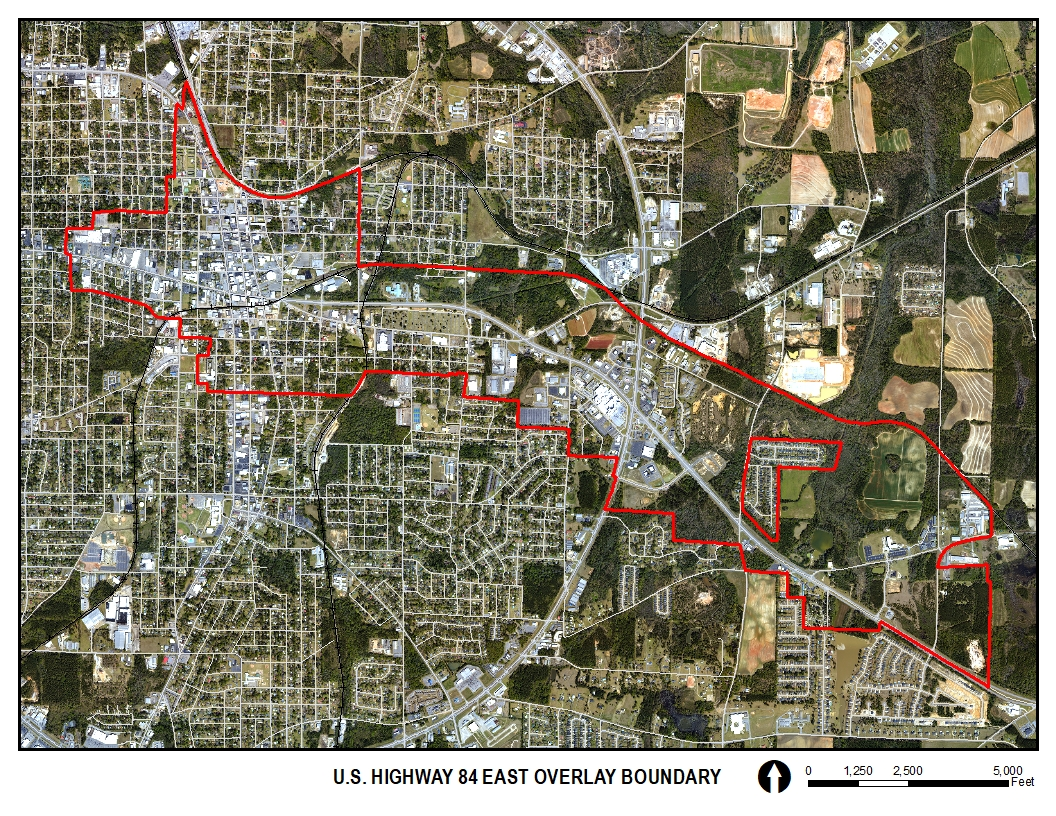
The overlay district is hereby established in accordance with map 1.
Map 1—Overlay Boundary
(4)
Applicability for development. The overlay shall apply to all development within its boundaries. When demolition of a building or structure is triggered, all new or replacement development shall comply with the requirements of the overlay. When an addition is proposed, the addition shall comply with the overlay. When a remodel is proposed, it shall comply with the overlay to the greatest extent possible.
(5)
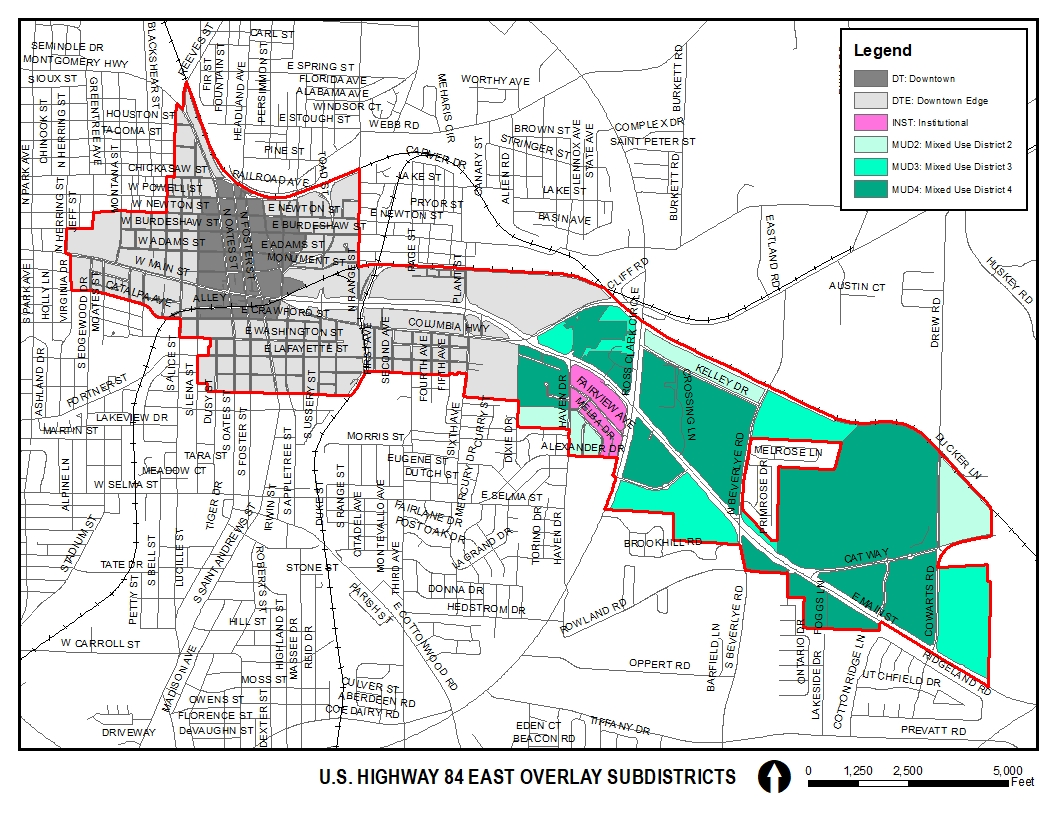
Subdistrict boundaries. Within the Highway 84 east overlay district, six subdistricts are established to provide clear transitions throughout the corridor and to ensure appropriate land use transitions and that development standards are appropriate for their context. The subdistricts are illustrated in map 2 and include the following:
a.
Downtown core.
b.
Downtown edge.
c.
Mixed-use 4.
d.
Mixed-use 3.
e.
Mixed-use 2.
f.
Institutional.
(6)
Alternative building placement standards. The Highway 84 east overlay district provides alternatives in the placement of buildings for the mixed-use 4, mixed-use 3, mixed-use 2, and institutional subdistricts. The preferred alternative promotes building placement towards the front of the property and parking placed behind the building. This is consistent with the Highway 84 east vision plan by emphasizing buildings and their architecture rather than parking lots. However, for development plans that elect to place parking toward the front of the building, specific requirements are defined for the design of front parking lots that improve aesthetics, promote green stormwater infrastructure, and provide abundant landscaping. Optional building placement standards are not allowed within the downtown core and downtown edge subdistricts.
The two building placement alternatives are defined as the "preferred" alternative and the "optional" alternative. These alternatives apply only to four subdistricts: mixed-use 4, mixed-use 3, mixed-use 2, and institutional. Specific development standards, dimensional standards and parking standards for each alternative are detailed in section 114-162.
Map 2—Subdistricts
(c)
General requirements.
(1)
Text controls.
a.
In the event of a conflict or inconsistency between the text of this chapter and any illustration, figure, table, heading, caption, or map, the text shall control.
b.
Unless otherwise specifically indicated, lists or items or examples that use terms such as "for example," "including," and "such as," or similar language are indented to provide examples and are not an exhaustive list of all possibilities.
(2)
All development applications requiring a building permit shall be in conformance with this chapter.
(3)
All land area within a project site, including outdoor use of space, off-street parking, interior drives and other circulation ways, community facilities such as schools, recreation centers, libraries, shopping, and public safety facilities, may be counted in computing lot area.
(4)
Any deviations from the overlay district requirements will require the approval of the city planning commission.
(Ord. No. 2022-248, § 2, 8-16-22; Ord. No. 2023-401, § 1, 11-21-23; Ord. No. 2025-300, § 5, 12-2-25)
Sec. 114-162. - Subdistrict development standards.
(a)
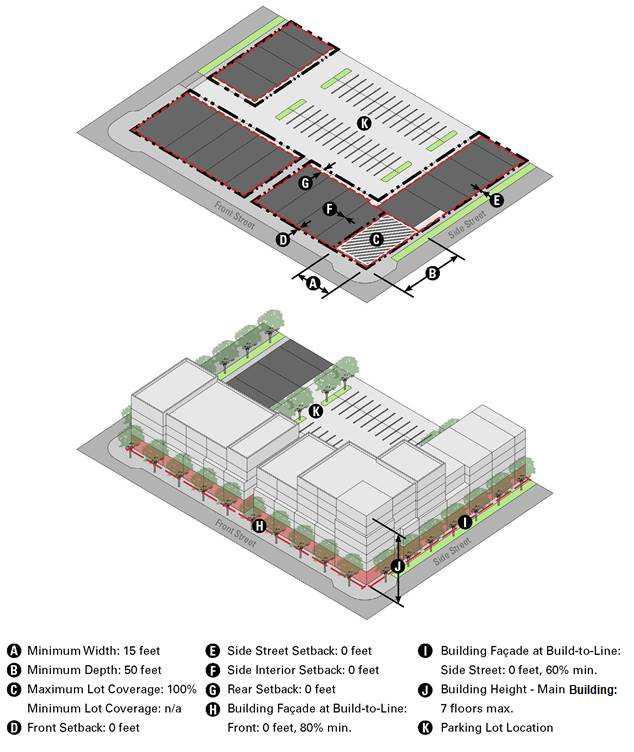
Downtown core subdistrict. The purpose of the downtown core subdistrict is to provide a high-density, vibrant, urban downtown that provides locally- and regionally-serving commercial, entertainment, and civic and public uses, as well as a variety of urban housing choices in main street mixed-use, mid-rise, and high-rise building types. The standards allow for redevelopment that is consistent with the historic urban design pattern of downtown. The following dimensional tables (tables 1-1, 1-2, and 1-3) apply to the downtown core subdistrict. Graphics highlighting the dimensions follow in figure 1.
* Lot coverage includes both buildings and hardscape areas including parking lots, walkways, sidewalks, patios, etc.
NOTE: The administrative official may modify building placement standards based on available right-of-way widths, utility conflicts, or other development constraints identified in the field.
Figure 1: Downtown Core Parking Requirements Illustrations
STANDARD PARKING REDUCTIONS
N/A
(b)
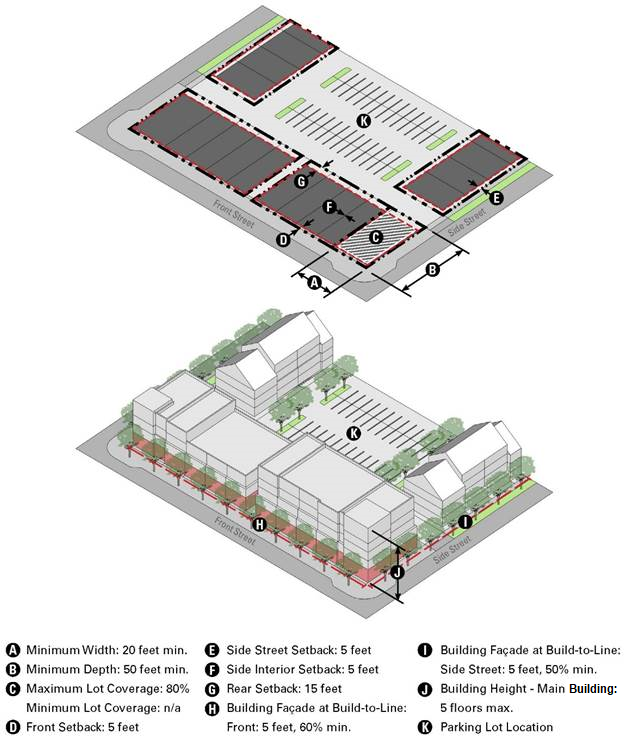
Downtown edge subdistrict. The purpose of the downtown edge subdistrict is to provide a high density, vibrant, urban development that is supportive of the downtown core. The downtown edge subdistrict serves commercial, entertainment, civic and public uses. This district also serves a variety of urban housing choices in main street mixed-use, and mid-rise types. The downtown edge is located adjacent to the downtown core and is a transition area to surrounding, lower density areas. The following dimensional tables (tables 2-1, 2-2, and 2-3) apply to the downtown edge subdistrict. Graphics highlighting the dimensions follow in figure 2.
NOTE: The administrative official may modify building placement standards based on available right-of-way widths, utility conflicts, or other development constraints identified in the field.
Figure 2: Downtown Edge Development Standards Illustrations
* On-street and off-site parking may be allowed to count towards requirement at the discretion of the director of planning and development.
** At least four queuing spaces are required for drive-throughs.
STANDARD PARKING REDUCTIONS
Standard reductions are available for developments that provide certain amenities or that implement certain strategies that provide alternatives to single-occupancy vehicles. Standard reductions can be granted administratively and deducted automatically from the applicable minimum parking requirement if the stated criteria are met, as determined by the director of planning and development. These amenities and strategies are identified in table 2-3 below.
(c)
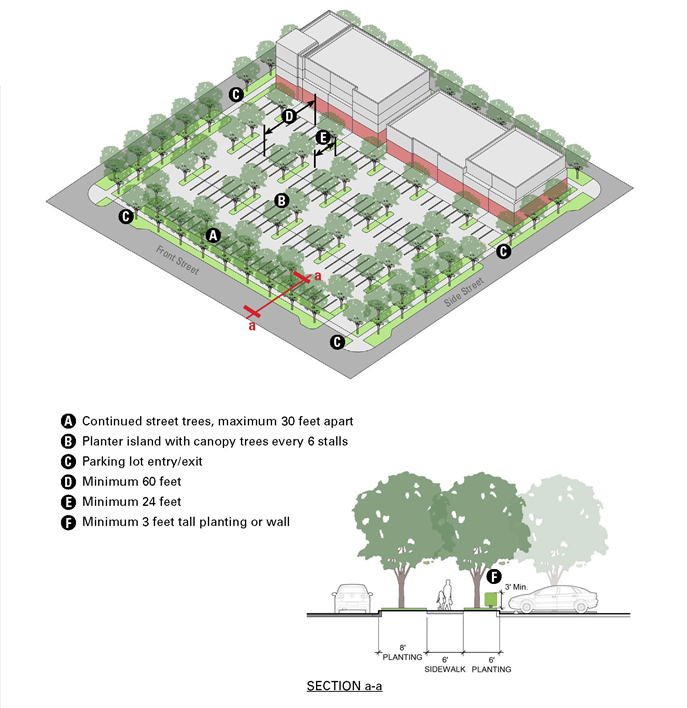
Mixed-use 4 subdistrict. The purpose of the mixed-use 4 subdistrict is to provide a vibrant, walkable mixed-use area that provides commercial, retail, entertainment, and civic and public uses. This district also serves a variety of housing choices. While less dense than the downtown subdistricts, these areas encourage the same mixture of uses found in the core and edge. The following dimensional tables (tables 3-1, 3-2, and 3-3) apply to the mixed-use 4 subdistrict. Graphics highlighting the dimensions follow in figures 3A and 3B.
Figure 3A: Mixed-Use "Preferred" Development Standards Illustrations
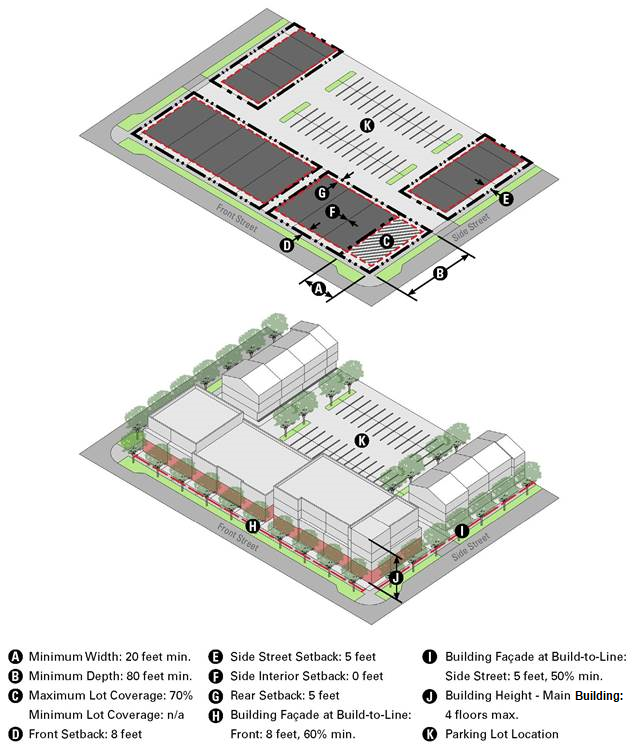
Figure 3B: Mixed-Use 4 "Optional" Development Standards Illustrations
* On-street parking may be allowed to count towards requirement at the discretion of the director of planning and development.
** At least two queuing spaces are also required for drive-throughs.
Nonconforming properties. If a property is nonconforming as to off-street parking requirements, only additions to the nonconforming structure shall be required to comply with off-street parking requirements. Existing legally established nonconformities related to off-street parking may continue in accordance with sections 114-171 through 114-173.
ALTERNATIVE MINIMUM PARKING REQUIREMENTS
STANDARD PARKING REDUCTIONS
Standard reductions are available for developments that provide certain amenities or that implement certain strategies that provide alternatives to single-occupancy vehicles. Standard reductions can be granted administratively and deducted automatically from the applicable minimum parking requirement if the stated criteria are met, as determined by the director of planning and development. These amenities and strategies are identified in table 3-3 below.
(d)
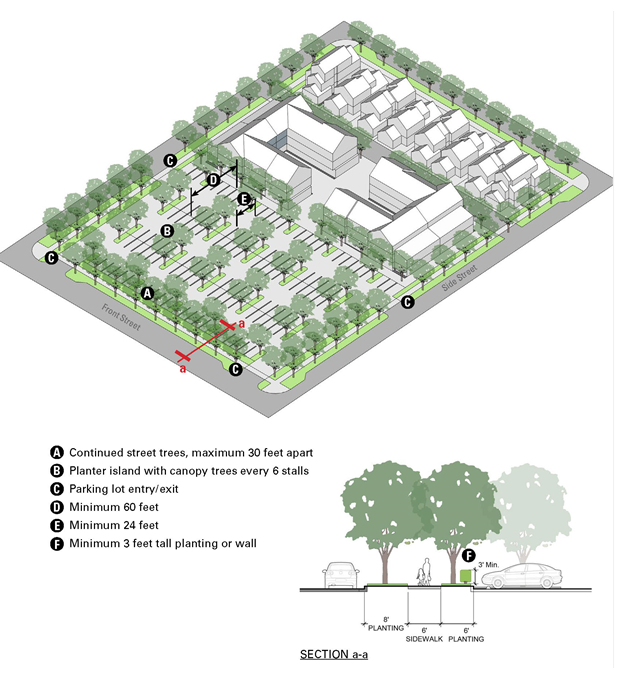
Mixed-use 3 subdistrict. The purpose of the mixed-use 3 subdistrict is to provide medium- to high-density housing in building types such as apartment houses, courtyard apartments, and low-rise buildings that transition from the surrounding lower-density neighborhoods to the higher-density mixed-use neighborhoods. Commercial uses to support mixed-use development are also allowed. The following dimensional tables (tables 4-1, 4-2, and 4-3) apply to the mixed-use 3 subdistrict. Graphics highlighting the dimensions follow in figures 4A and 4B.
Figure 4A: Mixed-Use 3 "Preferred" Development Standards Illustrations
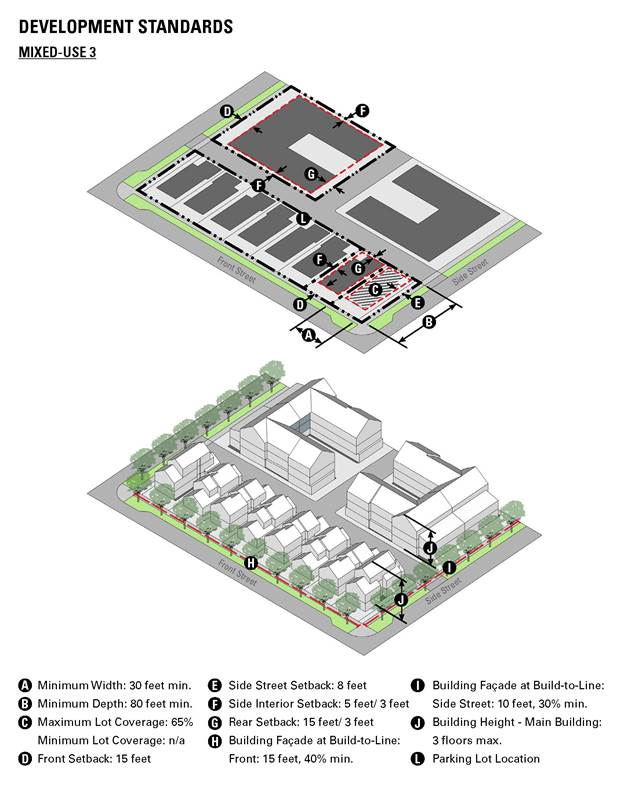
Figure 4B: Mixed-Use 3 "Optional" Development Standards Illustrations
* On-street parking may be allowed to count towards requirement at the discretion of the director of planning and development.
** At least two queuing spaces are also required.
*** Parking minimums may include electric vehicle parking.
Nonconforming properties. If a property is nonconforming as to off-street parking requirements, only additions to the nonconforming structure shall be required to comply with off-street parking requirements. Existing legally established nonconformities related to off-street parking may continue in accordance with sections 114-171 through 114-173.
ALTERNATIVE MINIMUM PARKING REQUIREMENTS
STANDARD PARKING REDUCTIONS
Standard reductions are available for developments that provide certain amenities or that implement certain strategies that provide alternatives to single-occupancy vehicles. Standard reductions can be granted administratively and deducted automatically from the applicable minimum parking requirement if the stated criteria are met, as determined by the director of planning and development. These amenities and strategies are identified in table 4-3 below.
(e)
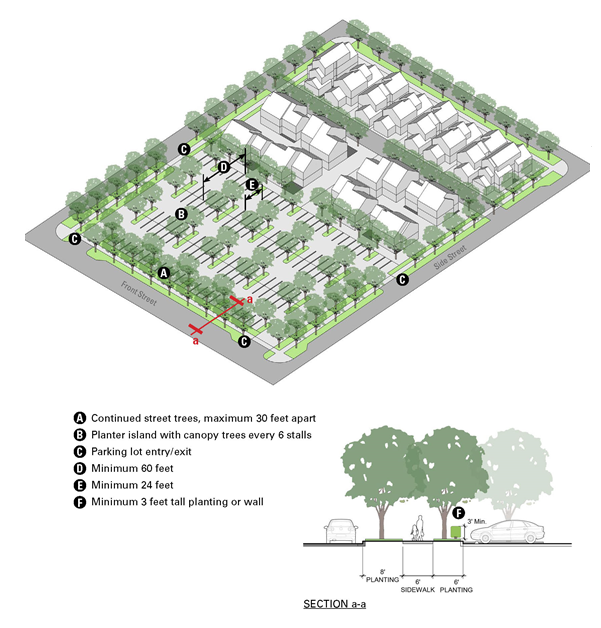
Mixed-use 2 subdistrict. The purpose of the mixed-use 2 subdistrict is to provide a walkable, predominantly residential neighborhood that includes single-family and medium density building types within walking distance to transit and commercial areas. Commercial and mixed-use development are also permitted in this subdistrict. The following dimensional tables (tables 5-1, 5-2, and 5-3) apply to the mixed-use 2 subdistrict. Graphics highlighting the dimensions follow in figures 5A and 5B.
Figure 5A: Mixed-Use 2 "Preferred" Development Standards Illustrations
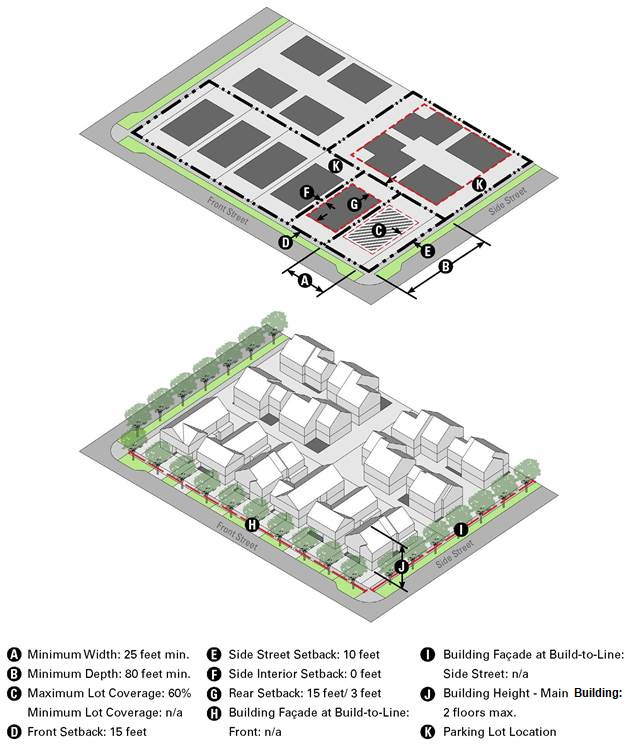
Figure 5B: Mixed-Use 2 "Optional" Development Standards Illustrations
* On-street parking may be allowed to count towards requirement at the discretion of the director of planning and development.
** Parking minimums may include electric vehicle parking.
Nonconforming properties. If a property is nonconforming as to off-street parking requirements, only additions to the nonconforming structure shall be required to comply with off-street parking requirements. Existing legally established nonconformities related to off-street parking may continue in accordance with sections 114-171 through 114-173.
ALTERNATIVE MINIMUM PARKING REQUIREMENTS
STANDARD PARKING REDUCTIONS
Standard reductions are available for developments that provide certain amenities or that implement certain strategies that provide alternatives to single-occupancy vehicles. Standard reductions can be granted administratively and deducted automatically from the applicable minimum parking requirement if the stated criteria are met, as determined by the director of planning and development. These amenities and strategies are identified in table 5-3 below.
(f)
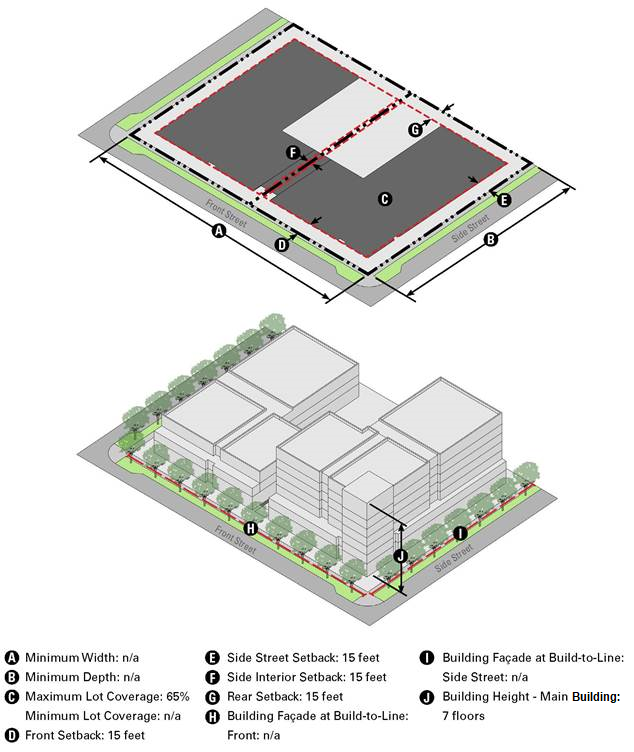
Institutional. The purpose of the institutional subdistrict is to provide appropriately scaled development that contributes to a pedestrian-oriented built environment while also meeting the needs of the community these districts serve. This subdistrict recognizes the inherent challenges that large institutions and special use districts face in adhering to the development standards of the other subdistricts. Therefore, a separate subdistrict is identified to establish standards specific to these types of uses. The following dimensional tables (tables 6-1, 6-2, and 6-3) apply to the institutional subdistrict.
Figure 6: Institutional Development Standards Illustrations
* On-street parking may be allowed to count towards requirement at the discretion of director of planning and development.
** Parking minimums may include electric vehicle parking.
Nonconforming properties. If a property is nonconforming as to off-street parking requirements, only additions to the nonconforming structure shall be required to comply with off-street parking requirements. Existing legally established nonconformities related to off-street parking may continue in accordance with sections 114-171 through 114-173.
ALTERNATIVE MINIMUM PARKING REQUIREMENTS
STANDARD PARKING REDUCTIONS
Standard reductions are available for developments that provide certain amenities or that implement certain strategies that provide alternatives to single-occupancy vehicles. Standard reductions can be granted administratively and deducted automatically from the applicable minimum parking requirement if the stated criteria are met, as determined by the director of planning and development. These amenities and strategies are identified in Table 6-3 below.
(Ord. No. 2022-248, § 2, 8-16-22; Ord. No. 2023-401, § 1, 11-21-23)
Sec. 114-163. - Uses permitted.
(a)
Land use tables. Permitted uses, special exception uses, and not permitted uses are outlined in the following tables.
(1)
Accessory uses and structures.
(2)
Agricultural uses.
(3)
Commercial uses.
(4)
Industrial uses.
(5)
Institutional Uses.
(6)
Medical and residential uses.
(1) Existing digital and static billboards are permitted uses. No new billboards are permitted in the downtown core and downtown edge subdistricts. New static display billboards permitted in the MU-3 and MU-4 subdistricts per provisions in section 114-215.
(2) Not to exceed 50,000 square feet.
(3) Special Exception is required if non-medical boarding is included.
(Ord. No. 2022-248, § 2, 8-16-22; Ord. No. 2023-401, § 1, 11-21-23)
Sec. 114-164. - General standards.
These are standards/requirements pertain to all development in the overlay unless specific subdistricts are identified within. To implement the Highway 84 east vision, the following development standards apply to all development in the overlay unless specific subdistricts are identified within.
(a)
Architectural standards.
(1)
Massing.
a.
In the downtown core and downtown edge, buildings shall maintain a consistent street wall along all their street frontages. Variety in massing may occur through step-backs on upper floors.
b.
In the mixed-use 4 and mixed-use 3, buildings shall maintain a consistent street wall along all streets except for Highway 84. Variety in massing may occur through step-backs on upper floors.
c.
Breaks in the street wall shall be limited to those necessary to accommodate pedestrian pass-throughs, public plazas, entry forecourts, permitted vehicular access driveways, and hotel drop-offs.
d.
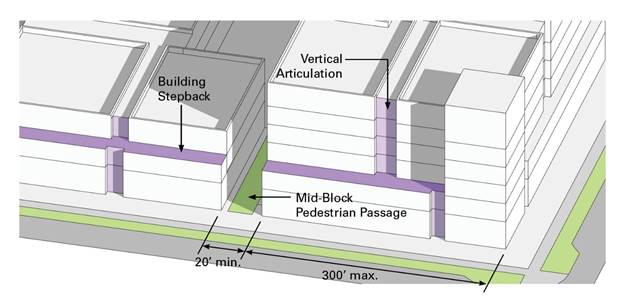
Large projects should be broken into a series of appropriately scaled buildings for pedestrian scale and walkability. A passageway of at least 20 feet wide shall be located between buildings so that no building is more than 300 feet in length. The passageway shall be clearly visible from the street, provide a clear connection to adjacent common areas, provide enhanced landscaping, materials, and lighting to create a pleasant pedestrian experience. Monolithic slab-like structures that wall off views and overshadow the surrounding neighborhood are prohibited. See figure 7.
Figure 7: Massing, Step Back and Passageway
(2)
Architectural detail.
a.
Buildings shall be well-detailed with long-lived materials that can be appreciated when viewed by the pedestrian.
b.
Architectural features shall be layered to emphasize certain features of the building such as entries, corners, common open spaces, public amenity spaces, and organization of units.
c.
Building entries shall be designed as the focal point of the building facade. Accentuate main building entries by creating a vertical break in the building wall.
d.
Windows and doors shall be used as character-defining features to reflect an architectural style or theme consistent with other facade elements. Windows shall project or be inset from the exterior building wall and incorporated into well-designed trims and details. Use balconies, fenestration, or other elements to create an interesting pattern of projections and recesses.
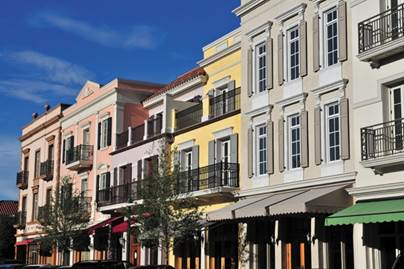
The variety of windows and balconies create visual interest
e.
The plane of a building shall be varied to provide visual interest and contribute to the quality and definition of the street wall. Horizontal architectural variations shall be used to break down the scale and massing of longer facades.
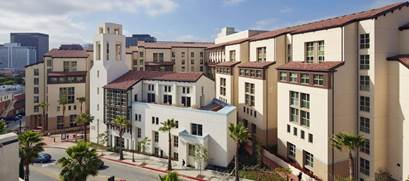
Variety of building massing helps to break down the scale of the buildings
f.
Different architectural treatments shall be employed on the ground floor facade than on the upper floors. Provide an identifiable break between the building's base and mid-section with a change in material, change in fenestration pattern, or similar means.
g.
The cornice or roof line of historic structures shall be reflected with a demarcation on new adjacent structures. Similarly, the fenestration and pattern of historic buildings shall be reflected on new adjacent structures.
h.
Where appropriate, employ shade and shadow created by reveals, surface changes, overhangs, and sunshades to provide visual interest on facades exposed to the sun and refuge for pedestrians.
(b)
Materials.
(1)
The interplay of materials, windows and other elements shall support the larger design objectives as articulated by the architect.
(2)
Buildings shall aim for a "timeless design" and employ high-quality, durable materials and careful detailing that have proven longevity.
a.
Feature long-lived and sustainable materials. The material palette should provide variety, reinforce massing and changes in the horizontal or vertical plane.
b.
Use durable materials on ground floor facades. Low-quality materials such as stucco, plaster, and exterior insulation finishing system (EIFS) are prohibited at the ground-floor along any streets, alleys, or public amenity spaces.
c.
Use especially high-quality durable materials on upper floor facades. Low-quality materials such as stucco, plaster, and EIFS are not permitted on exterior building facade facing streets, alleys, or public amenity spaces, except as minor detail components amounting to no more than ten percent of any elevations above the ground floor.
d.
To provide visual variety and depth, layer the building materials to provide a variety of textures that bear a direct relationship to the building's massing and structural elements. The materials should reinforce the integrity of the design concept and the building's structural elements, and not appear as an imitation of a material or style.
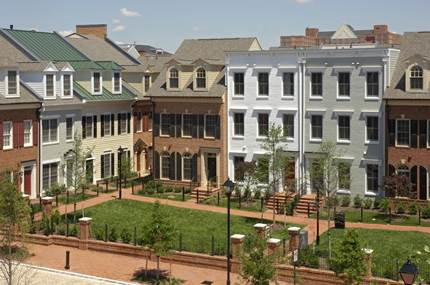
High quality building materials and simple architectural design
(c)
Windows and doors.
(1)
Provide high-performance, well-detailed windows and doors that add to the depth and scale of the building's facade.
(2)
Window placement, size, material, and style shall be used to help define a building's architectural style and integrity.
(3)
In buildings other than curtain wall buildings, windows shall be recessed from the exterior building wall, except where inappropriate to the building's architectural style. The required recess may not be accomplished using plants around the window.
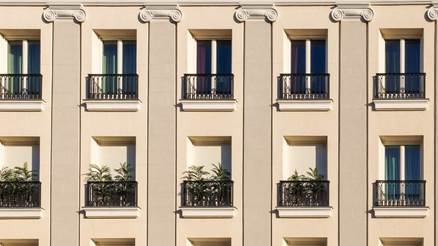
Windows recessed from front building elevation to create visual interest
(4)
Windows and doors shall be well-detailed where they meet the exterior wall to provide adequate weather protection and to create a shadow line.
(5)
There is no maximum limit on how much glazing may be provided, however, glazing shall meet the requirements outlined in the below table:
a.
First floor, nonresidential: The area of glass between three feet and eight feet above finished floor, divided by the area of the building façade also between three feet and eight feet above finished floor.
b.
Above first floor, nonresidential: The combined area of glass on all floors above the first divided by the total area of the building façade for those floors.
c.
Multi-family: The area of glass divided by the area of the façade.
d.
Glazing requirements for religious institutions, schools, or medical uses may be reduced by the administrative official as appropriate to the context.
(d)
Maximum block size.
(1)
Maximum perimeter length: 2,200 feet, unless constrained by location conditions. Information about the specific constraint must be included with the development application and the review will be completed by the development review committee (DRC).
(2)
Maximum block length: 700 feet.
(3)
Maximum block area: four acres.
(e)
Building orientation.
(1)
Buildings shall be oriented toward streets with parking located away from primary streets. In the mixed-use 4, 3, 2, and institutional subdistricts a parking lot can front Highway 84 and Ross Clark Circle under the "optional" alternative for building placement provided landscape materials are increased by 20 percent, ten percent if a berm is installed to shield the parking lot from public view.
(2)
The principal entrances for buildings shall be oriented toward primary streets.
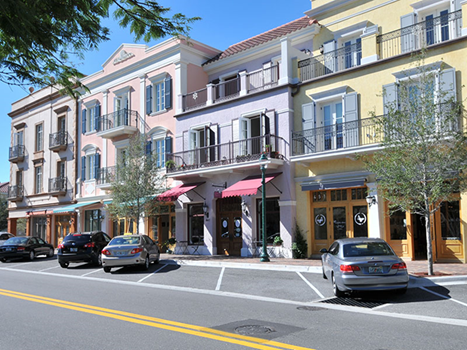
Building entrances fronting on streets
(f)
Public realm and open area standards.
(1)
Design flexible outdoor public spaces that can support a range of uses as public gathering places including seating, conversing, window-shopping, and dining, playing, or special events programming such as farmers markets, art exhibits or street festivals.
(2)
Where blocks are longer than 300 feet, one mid-block pedestrian pathway, a minimum of 20 feet in width, which is open to the public, shall be provided to enhance walkability of streets and neighborhoods (see figure 7).
(3)
All outdoor public spaces shall provide ADA-compliant walkways to ensure ease of access for all users.
(4)
Open-air outdoor spaces shall be landscaped to provide shade, aesthetics, and comfort for users. Planters, planter boxes and similar planting containers may count toward this requirement.
(5)
Non-movable or fixed seating should be placed with consideration to noontime sun and shade; deciduous trees should be planted as the most effective means of providing comfortable access to sun and shade.
(6)
Above-grade outdoor spaces including roof or podium terraces, building cut-outs, or residential courtyards, shall incorporate trees and other plantings in permanent or temporary planters that will shade, reduce reflective glare, and add interest to the space.
(7)
Landscape elements shall establish scale and reinforce continuity between indoor and outdoor space. Canopy trees shall be provided within open spaces, especially along streets and required setbacks. Tree species selected should provide a minimum of 35 percent tree canopy coverage for the landscaped areas within the site. The site landscape plan shall annotate the tree species, placement on site, and canopy dimensions. Mature canopy dimensions to be shown graphically on the site landscape plan.
a.
Landscape elements shall provide scale, texture, and color. A rich, coordinated palette of landscape elements that enhances the site's identity is encouraged.
(g)
Stormwater plan.
(1)
Stormwater shall be detained and retained in a way that will support overall drainage and will not shift impacts into the public right-of-way or onto adjacent property.
(2)
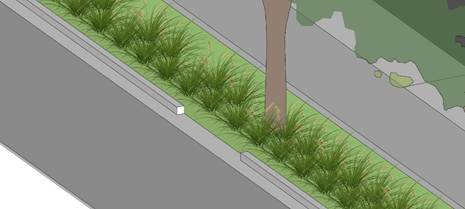
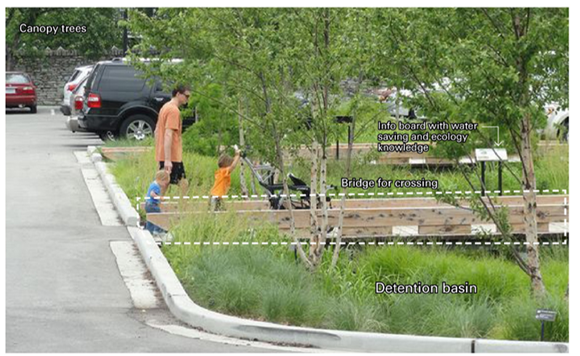
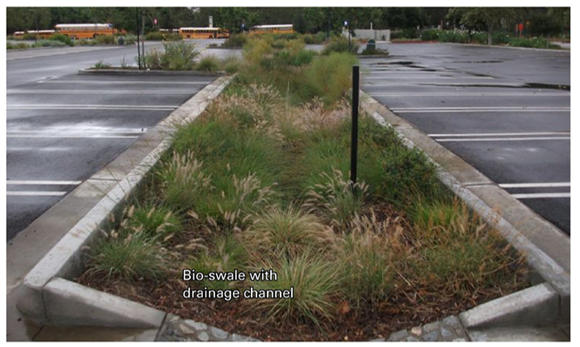
All new development shall utilize bioswales, as opposed to traditional detention and retention ponds, to the extent practical. Bioswales are required, to the extent practical, on new streets and in parking lots. Bioswales are engineered elements in the hardscape that divert stormwater from parking lots and streets into vegetated landscaped elements such as parking islands, buffered areas, and median swales. See figure 8.
Figure 8: Bioswale Adjacent to Street
(3)
When a detention pond is used and is visible from a public right-of-way, it must be designed to serve as a naturalized landscape features and include a landscape planting plan.
(4)
A coordinated stormwater plan between adjacent property owners is encouraged so the location of retention/detention facilities is efficient and in the most appropriate location.
(h)
Signage standards.
(1)
General requirements.
a.
All signs erected in the overlay shall comply with the requirements in article XII, signs and billboards, in addition to the requirements outlined herein.
b.
To the extent that anything in this chapter conflicts with article XII, this chapter shall prevail.
c.
The following sign standards in this chapter apply to the overlay subdistricts:
1.
Section 114-217 (sign standards in residential districts) applies in the mixed-use 4, 3 and 2 subdistricts where residential uses are dominant;
2.
Section 114-219 (sign standards for commercial or industrial districts) applies for wall signage in the downtown core, downtown edge, mixed-use 4 and institutional subdistricts.
a.
Building sign area shall be calculated based on the area of the façade facing the public right-of-way but may be distributed to other building faces. Sign area shall not exceed the standards in section 114-219, table 4.
b.
Ground-mounted freestanding signs shall adhere to the sign standards in section 114-218 (sign standards for office and institutional districts).
(2)
Prohibited signs.
a.
In addition to the sign types prohibited in article XII, the following sign types are prohibited in the overlay.
b.
Portable signs and inflatable devices, which includes devices consisting of flexible material that is shaped by air or other gas, whether stationary or featuring movement.
c.
Vehicle signs. Signs placed on or affixed to vehicles and/or trailers, including bicycles, which are parked on a public right-of-way, public property, or private property to be visible from a public right-of-way, unless such vehicle is used in the normal day-to-day operations of the business.
d.
Temporary banners.
1.
Pole signs.
(3)
Mounting and placement.
a.
Signs shall be mounted in such a manner as to not obscure architectural features and openings of a building.
b.
Signs shall not be placed higher than the cornice line.
c.
Basement and ground floor businesses are limited to placing signs on the ground floor and shall be no higher than 15 feet above grade.
(4)
Materials.
a.
Signs shall be constructed of sturdy materials and generally match the character of the building.
b.
Plastic, vinyl, and similar materials are prohibited.
(5)
Signage lighting.
a.
Signage illumination is to aid in navigation while also keeping a focus on public safety and promoting the aesthetic and visual character of the community.
b.
Illumination of signs for nonresidential uses in residential areas requires special exception approval.
(6)
Billboards.
a.
West of the Columbia Highway/Highway 84 intersection to Park Avenue.
1.
All existing billboards permitted by right. No new static billboards shall be permitted.
2.
With the exception of the Plant Street/Highway 84 intersection, one additional digital billboard may be permitted between the AL 52 (Columbia Highway)/U.S. 84 intersection and the Park Avenue/U.S. 84 intersection.
3.
In exchange for the installation of an additional digital billboard, three static billboards located between Columbia Highway and Park Avenue shall be removed.
(i)
Drive-through design standards.
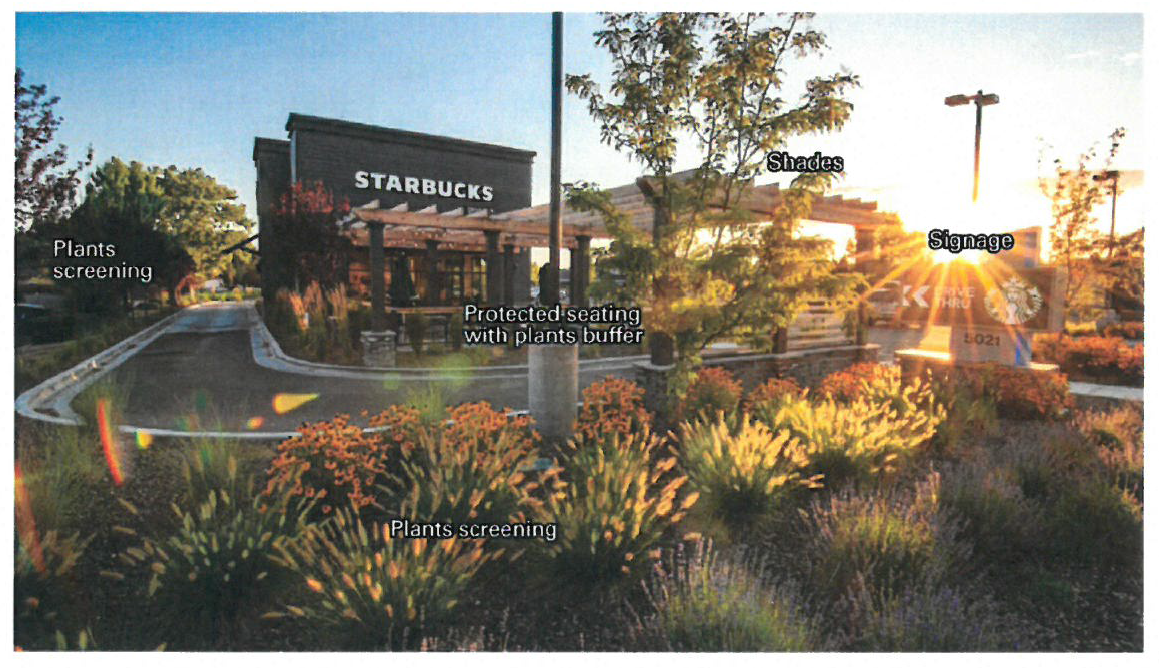
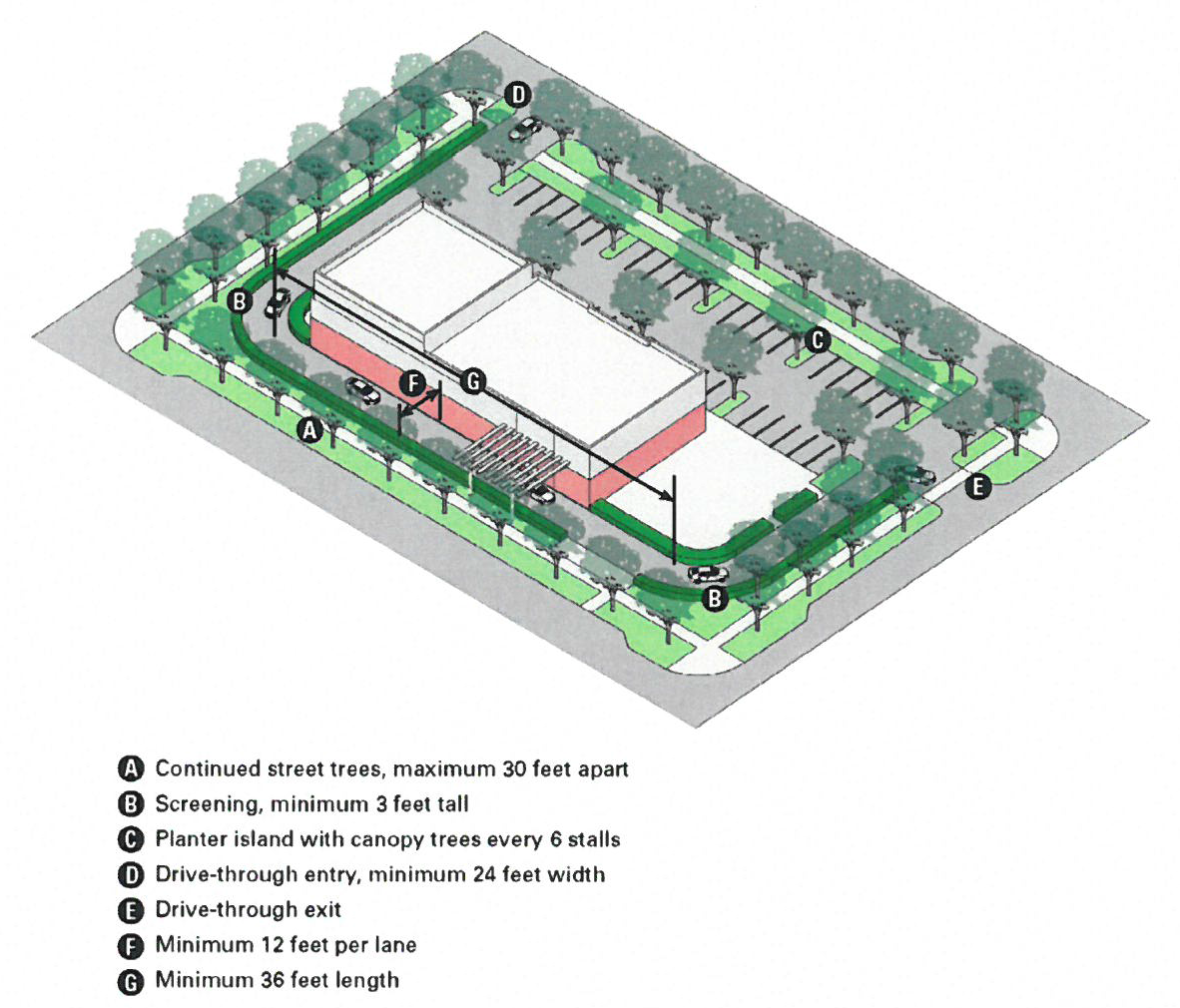
(j)
Parking lot/structure design.
(1)
Parking lots shall be designed to have an abundance of landscaping, including shade trees, stormwater swales, and screening from adjacent streets and sidewalks.
(2)
Parking lot dimension shall be consistent with the City of Dothan requirements.
(3)
The number of vehicular access points from streets shall be kept to a minimum to reduce the need for excessive curb-cuts.
(4)
When a parking lot is not located behind a building a screen hedge, or a low landscape wall shall be required to screen the parking lot from public rights-of-way.
(5)
When a parking garage is proposed, it must be appropriately designed to fit into the overall context. This shall include:
a.
Parking garages accessed from a street shall be screened using landscaping, architectural detailing, or both.
b.
No parking garage shall exceed seven stories in the downtown core, downtown edge, or mixed-use 4 subdistricts.
c.
Parking garages, other than individual garages associated with single-family, duplex, town home development, are not permitted in the mixed-use 3 or mixed-use 2 subdistricts.
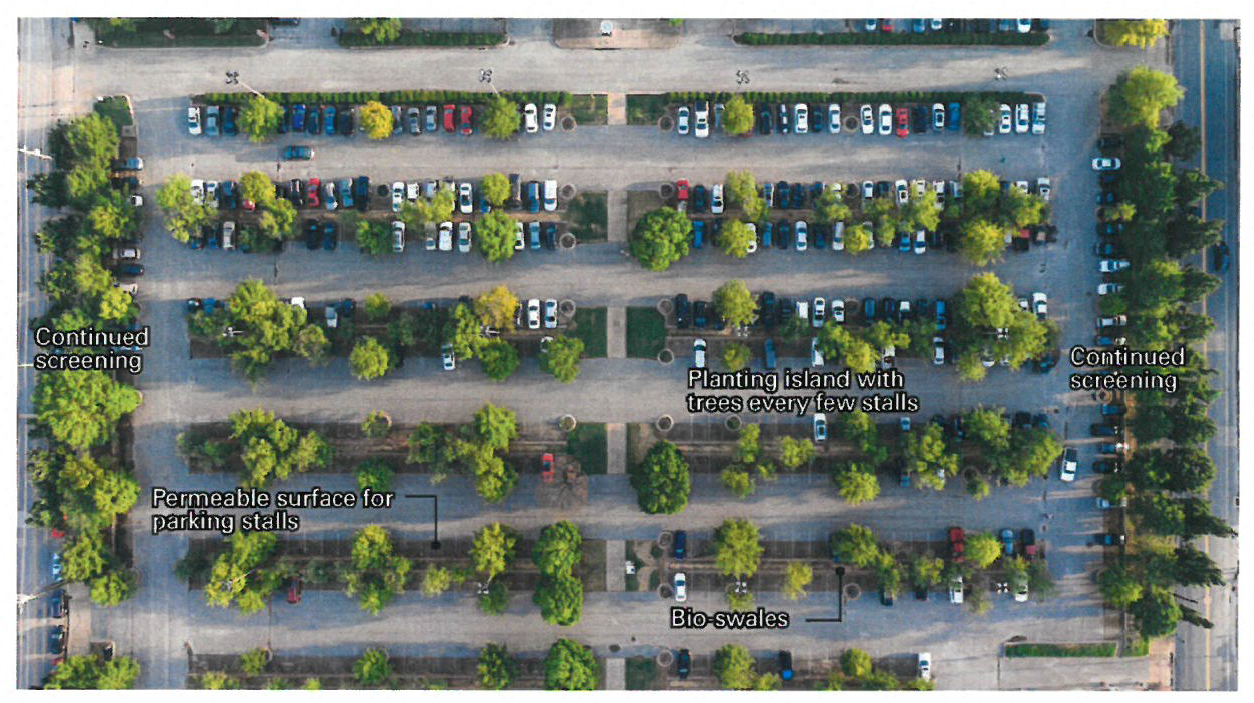
Illustration of elements that meet parking lot standards
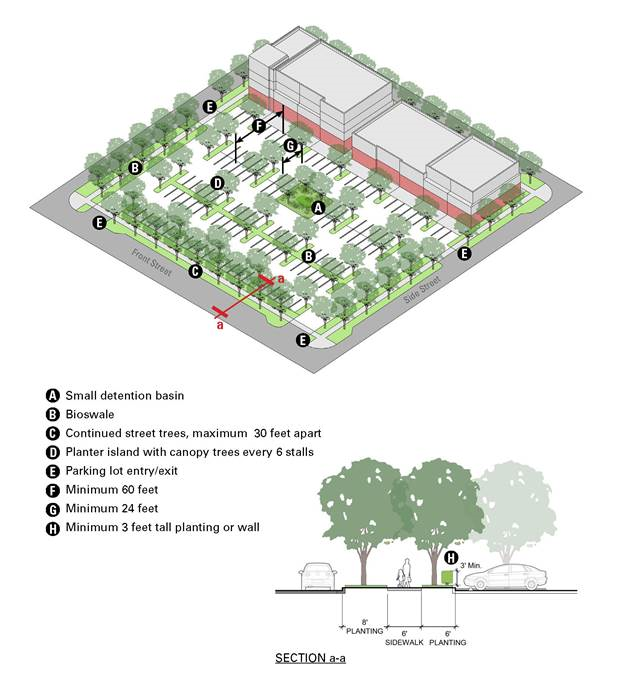
(k)
Parking lot island and roadway shade trees standards. Landscape areas shall be provided in the interior parking area to provide shade, break the expanse of pavement, provide visual relief, and minimize temperature elevation from the expanse of asphalt.
(1)
Landscape areas shall consist of planter islands, planter strips, or peninsula types. To count toward the off-street parking landscape requirements, a planter island, planter strip, or peninsula shall have a minimum area of 126 square feet with a minimum width of seven feet (hereafter referred to as contributing landscape areas).
(2)
Peninsulas may be designed within or adjacent to the interior parking area. The square footage of each planter island, planter strip or peninsula within the parking lot must be shown; all contributing landscape areas should be designated on the landscape plan by shading or otherwise differentiated from any non-contributing landscape area.
(3)
Foundation landscaping (landscaping immediately adjacent to building) shall not be considered interior parking area landscaping.
(4)
Crape Myrtle species and any other understory tree species will not be accepted toward fulfilling canopy shade requirements in parking lots and along roadways.
(5)
At intersections, tree species can change to break up the visual landscape character.
(6)
The proposed landscape plan must show how a minimum of 40 percent of the parking lot will be covered with tree canopy within ten years. The site landscape plan shall annotate the tree species, placement on site, and canopy dimensions. Mature canopy dimensions to be shown graphically on the site landscape plan.
(7)
Parking lot island and roadway recommended shade tree list. The following trees are recommended based upon documented tree characteristics including tolerance to heat and drought conditions, tree canopy for shade, lack of fruit production, seasonal color, and typical longevity. Other species may be considered at the recommendation of a licensed landscaped professional authorizing the landscape plan.
a.
Tupelo.
b.
Chinese Elm.
c.
Chinese Pistache.
d.
Willow Oak.
e.
Purple Ash Tree.
f.
Bald Cypress.
g.
Regal Prince Oak.
h.
Green Vase Zelkova.
(l)
Landscape standards.
(1)
[Landscape plan.] Landscape plans shall be designed by a registered landscape architect or landscape designer registered in the State of Alabama. A landscape architect licensed by the State of Alabama, or a landscape designer licensed by the State of Alabama may recommend other species for consideration to the city that are suited to the soils and climate. All plant material shall be kept free of weeds, refuse and debris.
(2)
DELETED.
(3)
General landscape requirements (private or public property).
a.
DELETED.
b.
A minimum of three inches of organic mulch shall be provided to landscape areas to limit weed growth and to enrich the soil.
c.
Shrub and ground cover spacing shall be a maximum of three feet on center or the maximum diameter of the species at three-quarter maturity, whichever is less.
d.
Tree spacing along streets should follow a consistent pattern with an emphasis on providing consistent shade.
e.
In general, the landscaped area shall encompass large shade trees over small ornamental trees.
f.
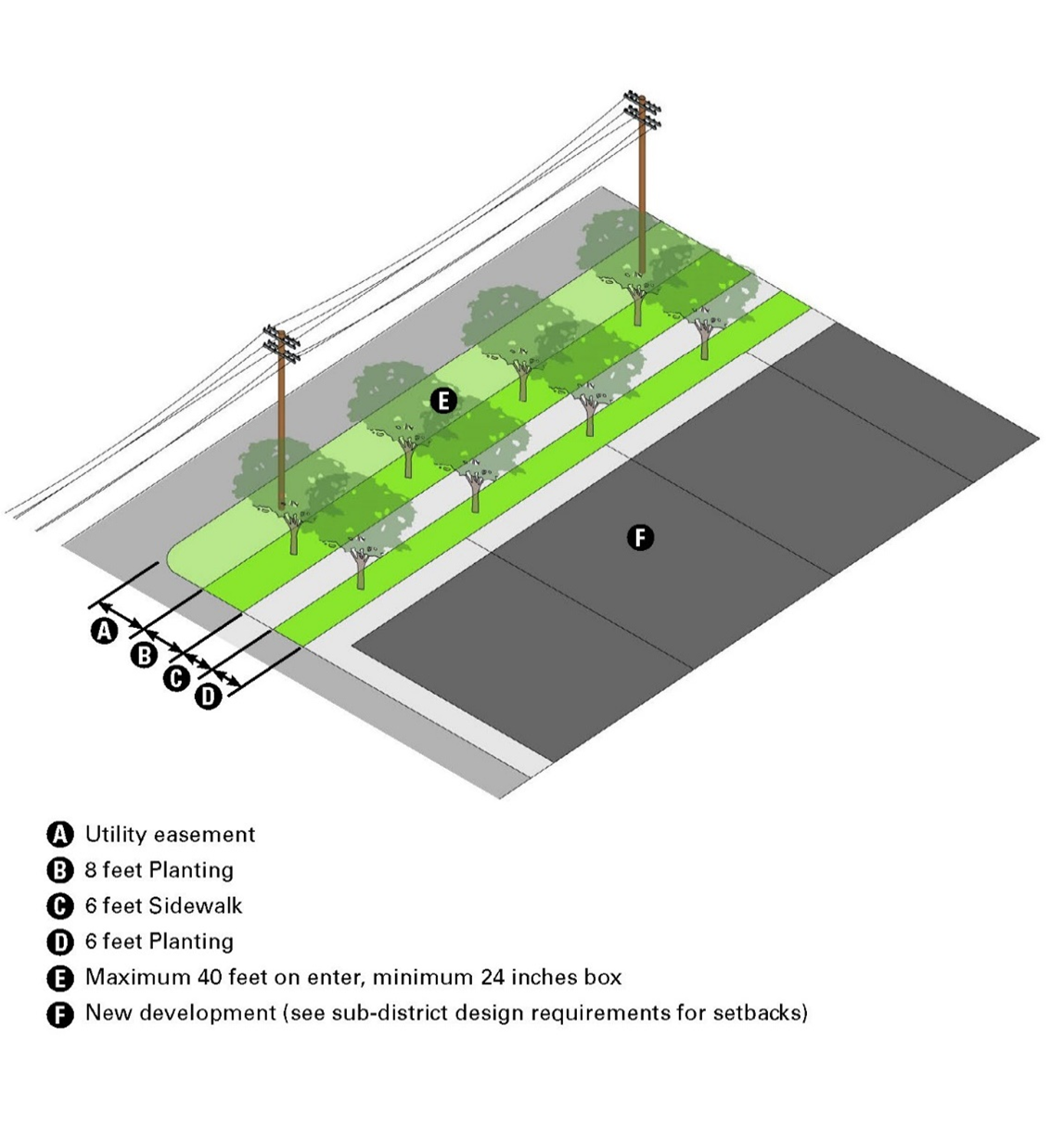
Tree spacing shall allow the tree to mature without major pruning. Tree pruning shall be prohibited except for unsafe branches and to keep trees from impacting utility lines or touching buildings. Trees should be allowed to reach full height and canopy size. Continuous street trees are still required adjacent to the utility lines while also respecting setbacks as defined by the utility company.
g.
DELETED.
h.
Space trees equal to their tree canopy width at three-quarter maturity minimum and a maximum tree spacing of 40 feet on center.
i.
Plant minimum 24-inch box trees within parkways or tree wells.
j.
Proposed plans for street trees and parking lot trees shall be accompanied by plan notations indicating specific controls to be applied for the emergence of surface roots and irrigation. Engineered tree cell products are highly encouraged. Tree cells prevent surface roots and eliminate the need for tree irrigation systems.
k.
Soil volume shall be a minimum of 500 cubic feet of soil per tree. Soil volume, tree pit dimensions and tree spacings are notably significant in the maintenance, health, and longevity of trees. It is important to allow plenty of space for trees to grow deeper. Wide spreading root systems are less likely to topple and break.
l.
DELETED.
m.
Tree gates may be used in the downtown core subdistrict and downtown edge subdistrict.
n.
DELETED.
o.
Understory planting shall be hardy, native or climate adaptive and non-invasive plants.
p.
Rain gardens or bioswales shall be made up of water tolerant grasses and wildflowers.
q.
DELETED.
r.
All required plant material shall be maintained in good condition. Landscaping materials, including preserved trees that die or become diseased or damaged shall be replaced. The replacement plants shall have size equal to or greater than those originally planted. Replacement plants shall also be the same type as those being replaced unless it can be shown that one or more alternate species would be more likely to thrive, in which case one of the alternate species may be used.
s.
Planting standards. Standards for transplanting should be in keeping with those established in the International Society of Arboriculture publication Tree and Shrub Planting Manual or similar publication. For plant material quality specifications, reference the American Association of Nurserymen publication American Standard for Nursery Stock (ANSI Z60, 1973). For information on tree species, reference the American Standard for Nursery Stock (ANSI Z60, 1973). For information on tree species site requirements, reference the Manual of Woody Landscape Plants (Michael Dirr, Stipes Publishing).
1.
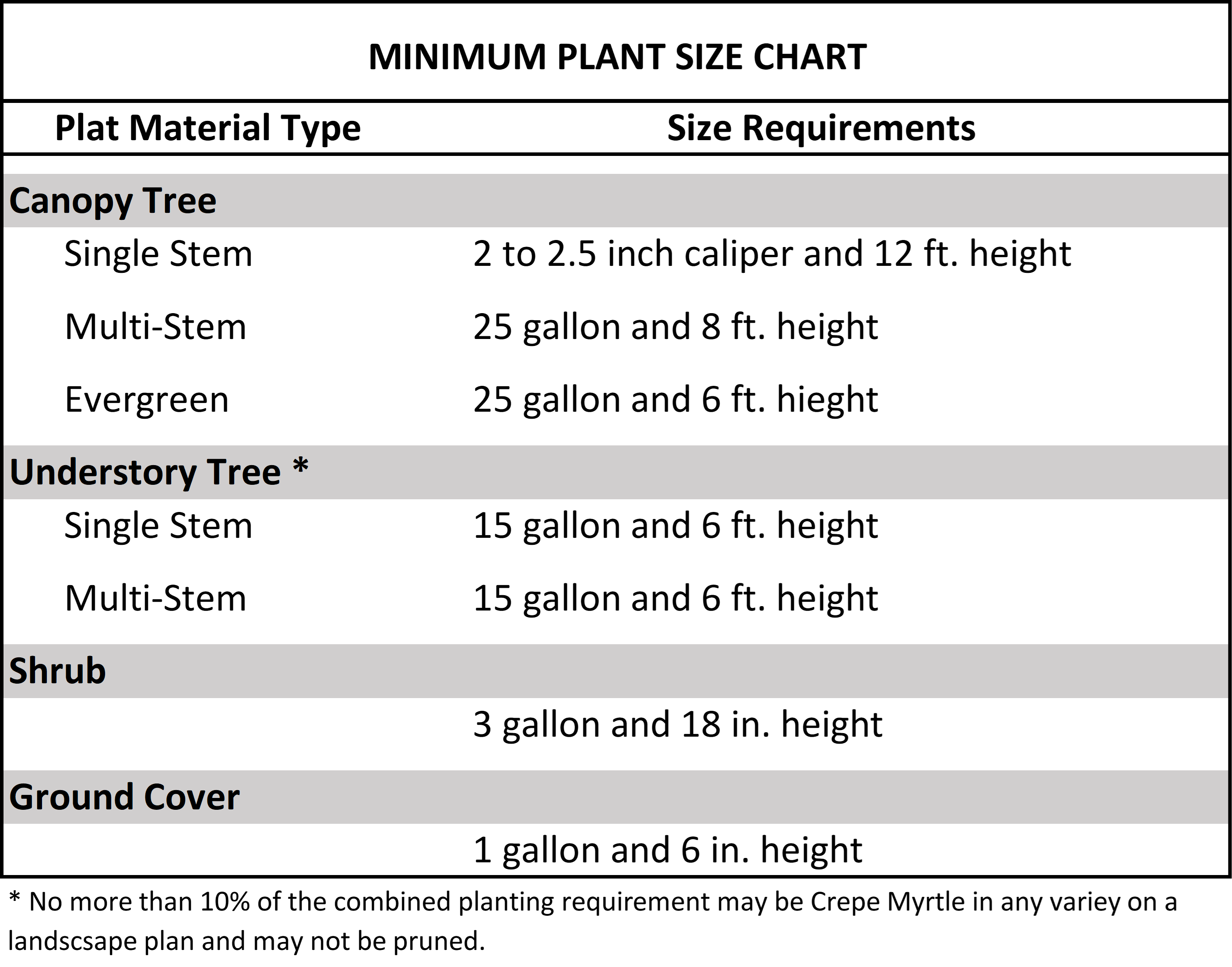
Notes: Unless otherwise specifically indicated elsewhere in this article, all plant materials shall meet the following minimum size standards: All plants should meet American Standards for Nursery Stock (ANSI Z60.1-1996). All minimum height requirements listed shall be planted height. Balled and burlap or field grown materials that meet caliper and height requirements and ANSI standards are acceptable.
2.
Plant materials shall meet the minimum size standards as shown in the preceding chart.
3.
All site areas that are not designed for buildings and hardscape shall be planted so that when mature 90 percent of the planter area is covered with plant material.
4.
Hardscape areas shall provide shade incorporate canopy trees so that when the trees are mature, 50 percent of the hardscape areas (excluding buildings) are covered with tree canopy.
5.
All landscape areas shall be covered with at least three inches of mulch at installation and new mulch shall be replaced so that soil is protected.
6.
Plant materials shall be appropriate for the climate.
7.
Tree selection shall emphasize large canopy trees rather than small ornamental trees. Small ornamental trees can be used as accents but not as the primary tree for shading.
(m)
Lighting standards.
(1)
Appropriate lighting is important and can serve to:
a.
Enhance visual clarity for drivers, bicyclists, and pedestrians.
b.
Aid in a pedestrian orientation when well-lit areas provide directionality.
c.
Highlight the identity of a neighborhood or community.
d.
Enable areas in the public realm (plazas, parks to be more conducive to pedestrian/merchant activities).
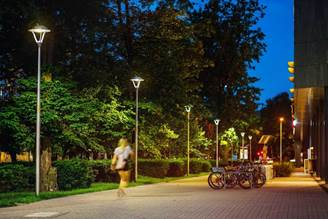
Pedestrian scaled lighting
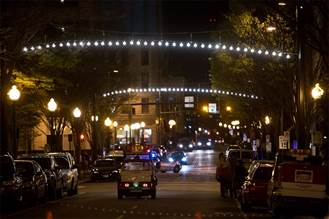
Accent lighting over festival street
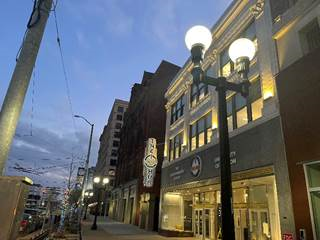
Lighting fixture to complement historic district
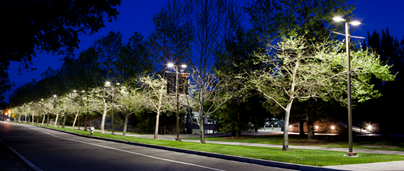
Lighting fixtures to service both pedestrians and vehicles
(2)
A hierarchy of lighting types is encouraged to assist drivers, bicyclists, and pedestrians.
(3)
Lighting shall be scaled to the context of the area.
(4)
Reduce glare by utilizing appropriate shielding.
(5)
Light temperature shall be warm (in yellow tones) rather than bright whites.
(6)
Lighting that blinks or oscillates is prohibited.
(n)
Paving standards.
(1)
Paving consistency is a priority to enhance the design continuity of individual developments.
a.
Paving shall be neutral colors (earth tones or grays).
(2)
Simple, well installed concrete sidewalks is preferred over poorly installed enhanced pavement.
(3)
Stamped concrete is discouraged.
(4)
Concrete shall have equally spaced expansion joints to reduce cracking and to prolong maintenance.
(5)
The use of permeable paving in select areas is encouraged to slow stormwater runoff and to provide accents.
a.
Permeable pavers shall be neutral colors (earth tones or grays).
(o)
Circulation plan.
(1)
The general location of major roadways within the overlay district shall ensure that adjacent developments maintain a minimum acceptable level of connectivity.
(2)
DELETED.
Map 3—Circulation
DELETED
(3)
The overall street network shall be consistent with the intent of the circulation plan to maintain connectivity.
(4)
Adjustments to the circulation plan may be required due to existing constraints. However, the applicant must show how modifications to the circulation plan will result in maintaining the connectivity of the existing circulation plan or enhance it.
(5)
Circulation between adjacent properties shall be created to the greatest extent possible. This may require coordination between property owners to determine the final location of street or pathway connections.
(6)
All property boundaries must be addressed as part of overall connectivity.
(7)
DELETED.
(p)
Requirements for major projects. Any project that is equal to or greater than four acres in size (as a single parcel, or as a compilation of multiple parcels) is considered a major project within the overlay area. In addition to the general requirements that apply to all properties in the overlay, the following additional requirements shall apply.
(1)
Coordination between adjacent properties. Major projects are required to provide a coordinated, interconnected street network, providing connections for both pedestrians and vehicles.
a.
The applicant must show how the street network will connect with adjoining properties. Streets should be designed and built so future connection can occur when development on the adjoining parcels occur.
b.
When considering connections, all property boundaries shall be considered and addressed.
c.
Private and public streets shall comply with the intent of the streets section in this chapter.
d.
Every building shall be accessible to service and emergency vehicles.
(2)
DELETED.
(3)
Open space plan.
a.
All open space not assigned to public use or to private occupancy shall be assigned to the common use with such use ensured in perpetuity. Assignment and development of such open spaces shall provide for the common enjoyment of all.
(4)
Open space requirements.
a.
Major projects shall devote a minimum acreage of ten percent of the total development area for open space.
b.
The character of open space may be formal or informal. The minimum width for formal space shall be 60 feet.
c.
Open space must be accessible from a public right-of-way and may be dedicated to the public subject to city approval.
(q)
Street standards.
(1)
General requirements. Great streets are more than a place for automobiles. Great cities have streets that function as the primary public realm for people to gather, to walk, to bike, to eat a meal, to be outside, as well as a place to drive. Within the overlay district, existing streets shall be modified, block by block, with a combination of public and private investment.
a.
DELETED.
b.
The circulation plan provides conceptual guidance for the new street network to be designed and built with new development.
c.
New street networks shall be a connected grid with no dead ends or cul-de-sac.
d.
New street networks shall function as multi-modal corridors with complete street elements.
e.
All public and private streets design and construction shall comply with the requirements of the subdivision regulations.
(2)
Open and continuous.
a.
Streets shall be always open to the public. Gating of streets and alleys is not permitted.
(3)
Service areas.
a.
Areas for service, deliveries, trash pick-up, and the like, should be located along rear or side of buildings and parking lots and not in the front of buildings.
(4)
Collector streets.
a.
New collector streets shall be built consistent with the Highway 84 east vision and with the circulation plan in this chapter.
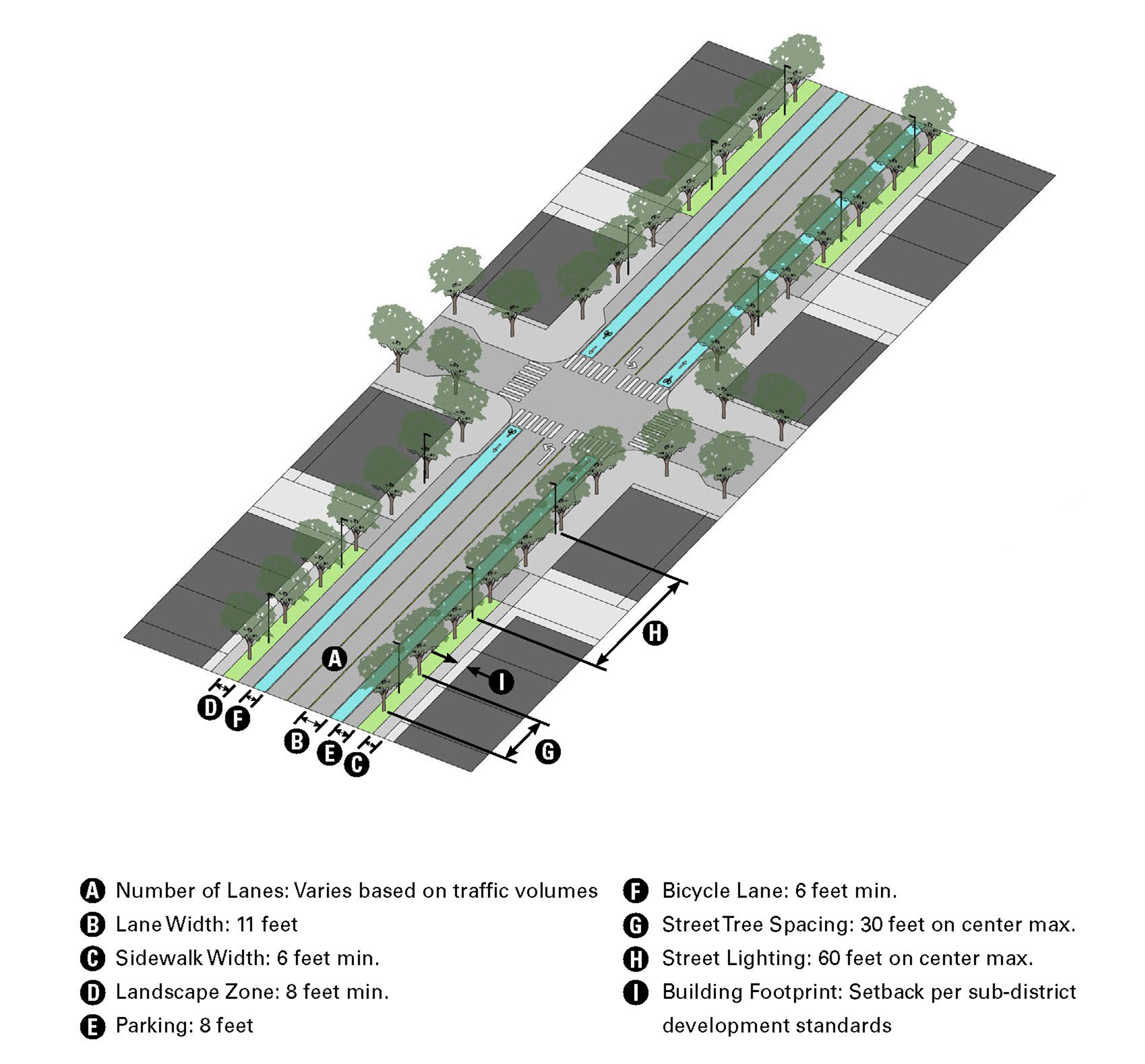
b.
Street design standards are outlined in table 7 and in figure 9.
Figure 9: Collector Street Landscape and Street Standards
(5)
Neighborhood streets with street parking.
a.
Provide on-street parallel parking to reduce parking lot sizes and parking ratios for new development.
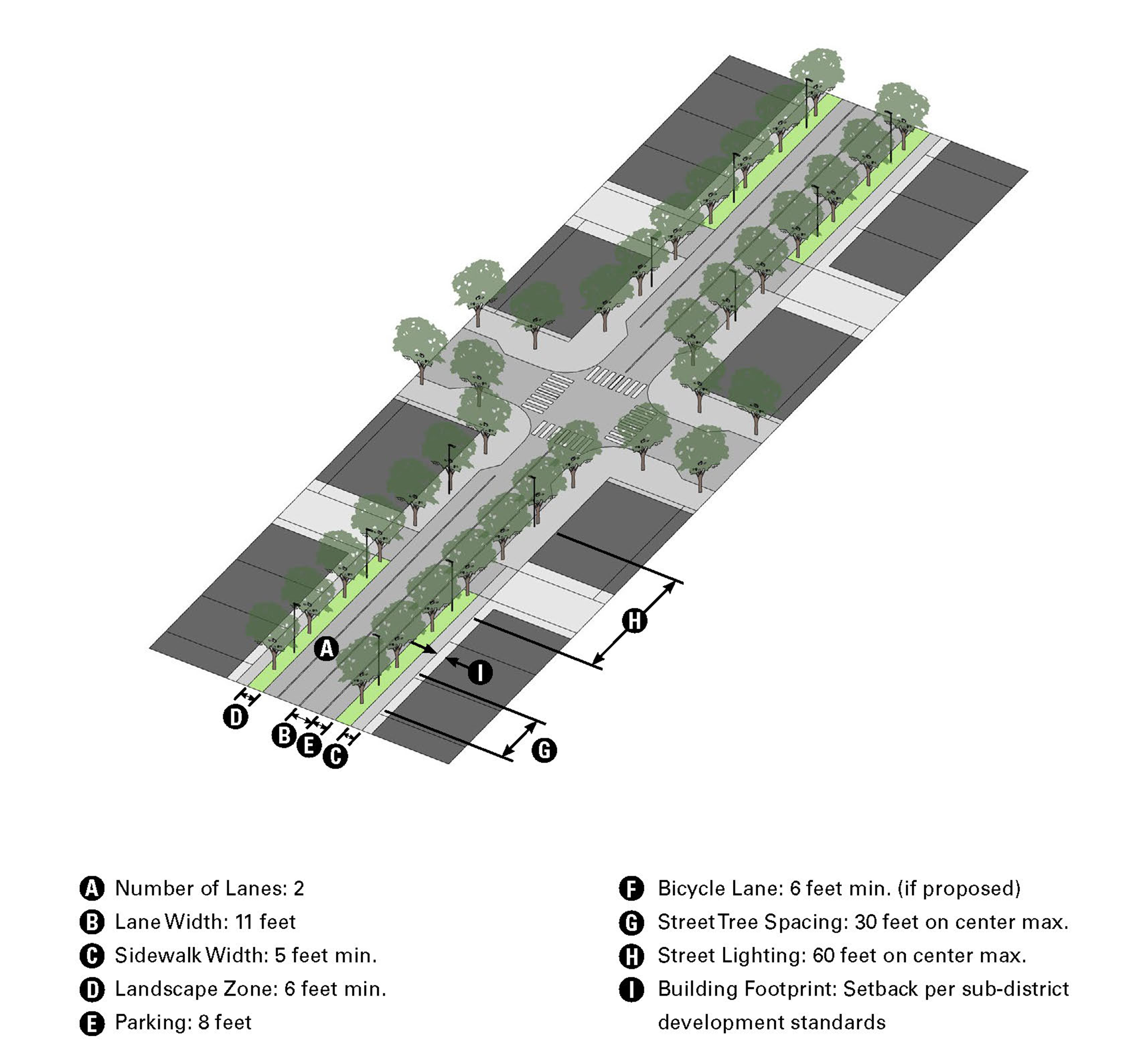
b.
Recommended street design standards are outlined in table 8 and in figure 10.
Figure 10: Neighborhood Street with Street Parking Landscape and Street Standard
(6)
Neighborhood streets without street parking.
a.
Neighborhood streets without on-street parking may be necessary in specific conditions to reduce the right-of-way width, or when street parking is not necessary because there is sufficient parking in lots within a walkable distance to destinations. This determination shall be made by staff.
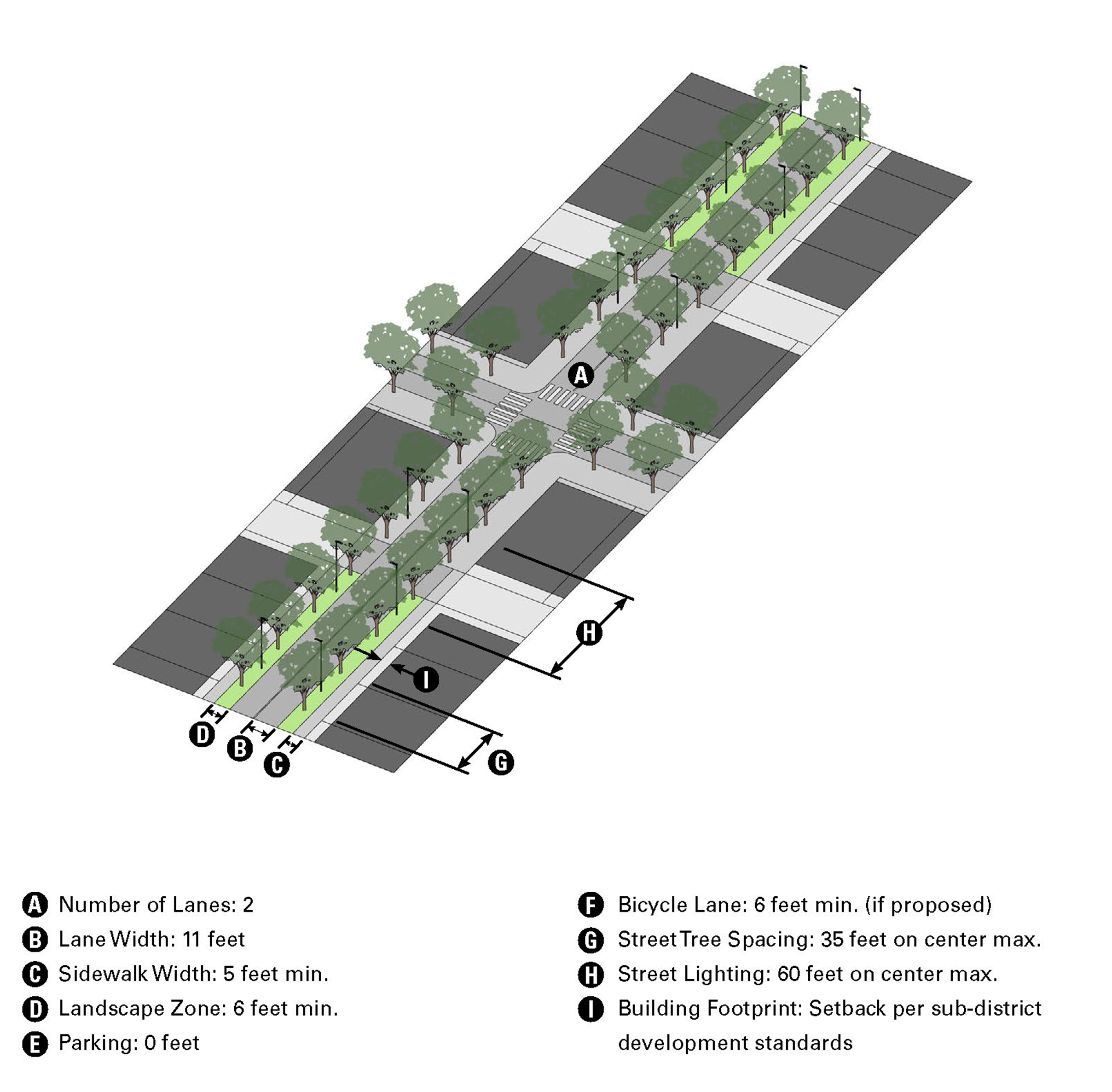
b.
Recommended street design standards are outlined in table 9 and in figure 11.
Figure 11: Neighborhood Street without Street Parking Landscape and Street Standard
(7)
Intersection design. Should include roundabouts where appropriate.
a.
Corner radius: Twenty-foot maximum radius to promote slower traffic turning movements resulting in a safer pedestrian environment.
b.
Bulb outs: Where feasible curb extensions should be built, extensions should be a minimum of six feet.
c.
Crosswalks: High visibility crosswalks at all intersections are required. Crosswalks should be a minimum of ten feet in width.
(r)
Approval process.
(1)
Pre-application meeting. Applicants are encouraged, but not required, to schedule an initial planning meeting with the planning staff to discuss the scope and intent of the project and to ensure understanding of the overlay requirements and applicability.
(2)
Development plan approval. An approval, pursuant to article V of the Dothan Zoning Code is required for all development in the Highway 84 East overlay. An application shall follow the steps and requirements outlined in article V, except that the following additional requirements shall apply.
a.
A written description of the proposal, including how the proposal meets the requirements of Highway 84 east overlay and the Highway 84 east vision plan. This description must address:
1.
Circulation for pedestrians, bicycles, and automobiles;
2.
Open space and parks;
3.
Street design; and
4.
Land use.
b.
A landscape plan, prepared by a registered landscape architect or landscape designer registered in the State of Alabama, shall be included as part of the application. It shall identify all the proposed plant material, location, and grading proposed. The plan must include required notations regarding tree and plant species, tree canopy size at maturity, tree root controls, irrigation plan, and long-term maintenance plan.
c.
Mapping, renderings, or other visuals that clearly illustrate how the proposal complies with this chapter related to parking, streets, circulation, landscaping, and signage.
d.
All applications shall include a written and graphic description of how existing and proposed streets, sidewalks, and bike lanes, comply with the overlay's circulation plan and will result in a coordinated, interconnected street network with coordinated blocks among different parcels with different owners.
e.
Architectural plans, designed by a registered designer, shall be included. At a minimum, building elevations showing the following must be included:
1.
Materials palette keyed to elevation;
2.
Color palette keyed to elevation; and
3.
Written description of how the architecture fits with the project context and the overlay's design requirements.
f.
Conceptual drainage, water, sewerage, street plans and specifications of proposed improvements prepared in sufficient detail to indicate the proposal will meet City of Dothan requirements.
(3)
Deviations from the development standards within this overlay will require the approval of the planning commission.
(4)
Modifications to an approved project within the overlay district.
a.
Minor. Minor modifications of the approved plan during construction may be permitted upon consultation with the administrative official who, in turn shall consult with the development review committee (DRC) as appropriate. Minor modifications shall not include the following: the removal of primary roads, reduction of open space, alteration of pedestrian facilities, or the reallocation of land uses.
b.
Major. If a substantial amendment to an approved plan is submitted, the requirements will be the same as if submitting the entire project for approval and shall comply with the City of Dothan Code of Ordinances in place at the time of the amended application.
(Ord. No. 2022-248, § 2, 8-16-22; Ord. No. 2023-401, § 1, 11-21-23)
Sec. 114-167. - Manufactured home communities.
(a)
Community plan.
(1)
Development plan approval required (refer to article V for requirements). In addition to the requirements in article V, the following information shall be included on the plan.
a.
The site plan of the community showing streets, street widths, corner radii, driveways, open areas, parking spaces, service buildings, location of water courses, flood hazard areas, easements, the number, location and size of all mobile home lots.
b.
The location of service buildings and other improvements constructed or to be constructed within the mobile home park.
c.
The location of recreational vehicles and other transient spaces to provide for temporary travel trailers, RV's etc.
d.
Any engineering design information including topographic survey as required by engineering services staff necessary to review the construction plans. Construction plans shall be certified by a professional engineer.
e.
Recreation areas shall be provided in all parks designed to accommodate at least 40 units and be located as to allow ease of access to all park residents. Recreation areas may be incorporated into unit sites or established as a separate space.
f.
Sidewalks shall be provided in accordance with section 90-141 in the City of Dothan Subdivision Regulations.
(2)
Before construction permits are issued for the proposed improvements, the community plan shall be reviewed by the planning commission.
(b)
Setbacks, lot area and auxiliary buildings.
(1)
Total minimum area shall be three acres (see table 114-132).
(2)
Perimeter setbacks shall be 50 feet (see table 114-132).
(3)
Along community streets, there shall be a minimum distance of 15 feet between the manufactured home and any abutting community street.
(4)
Minimum lot/site size. Manufactured home lots/sites shall have a minimum lot width of 50 feet and containing at least 5,000 square feet minimum area.
(5)
Units shall be separated from each other and from other buildings or structures by at least 20 feet. Small on-site storage buildings are permitted within ten feet.
(c)
Permits, application and plans; manufactured home community construction.
(1)
It shall be unlawful for any person to construct, maintain or operate any manufactured home community within the city unless he holds a valid business license issued by the city. All units shall display the state issued tax sticker. All required permits shall be acquired from the building permits office prior to installing any manufactured home. Manufactured home communities are permitted only in zones or districts as provided in sections 114-131.1 through 114-131.6.
(2)
No person shall construct or alter a manufactured home community in the city unless the plans and specifications for such park have been submitted and approved by the planning commission in accordance with article V of this chapter.
(d)
Environmental, open space and access requirements.
(1)
Site location. The location of manufactured home community shall comply with chapter 42, floods and chapter 83, stormwater.
(2)
Site drainage requirements. Stormwater runoff shall not be shed onto any adjacent land, either as surface runoff or via an outfall structure, unless contained in an existing drainage easement, ditch, structure or right-of-way or as otherwise approved by the public works director.
(3)
Soil and ground cover requirements. Park grounds except paved areas shall be maintained with vegetation or other natural cover that is capable of preventing soil erosion and the emanation of dust during dry weather.
(4)
Manufactured home stands, skirting and tie downs.
a.
Each mobile home shall be placed on a foundation, except transient homes. The foundation may consist of piers at least eight inches thick and spaced no more than 120 inches on center under framework. The piers may be of concrete or concrete block, as provided by the manufacturer or installation standards of the Alabama Manufactured Housing Commission.
b.
All manufactured homes shall be required to install skirting in accordance with the manufacturers installation instructions. Acceptable materials may include masonry, metal, vinyl or other materials manufactured for that purpose.
c.
All manufactured homes shall be required to install tie-downs or other devices acceptable to the building official to secure the manufactured home to the ground. Installation shall be in accordance with the manufacturer's instructions or installation standards of the Alabama Manufactured Housing Commission.
(5)
Driveway construction and design standards. Street construction and design standards for mobile home parks are as follows:
a.
All parks shall provide safe, continuous and convenient vehicular access from abutting public streets or roads to each mobile home space.
b.
All driveways shall be paved with plant mixed asphalt or similar materials. Driveways shall be maintained free of holes and other hazards by the owner.
c.
Grades of all driveways shall be sufficient to ensure adequate surface drainage.
d.
All manufactured home spaces shall abut an interior driveway. All interior driveways shall be no less than 22 feet in width. Community driveways shall have unobstructed access to a public street or highway and be adequately maintained by the owner of the manufactured home community.
e.
In manufactured home communities where parking is permitted on interior drives, the width of such drives shall be sufficient to allow for parking cars.
f.
Minimum pavement radius in a cul-de-sac shall be 40 feet, unless otherwise required by the fire marshal. "T" or "L" type turnarounds may be permitted.
g.
Streets shall be designed with a horizontal and vertical alignment which meets a 20 mph design speed.
h.
Streets shall have traffic control and street name signs as approved by the public works department and E911.
(6)
Required parking. Parking shall be provided in all communities for the use of park occupants and guests. Parking bays shall contain a minimum of 400 square feet and be located as to provide direct access to the manufactured home space. No direct driveway access shall be permitted to any exterior public street.
(7)
Pedestrian access. All communities shall provide safe, convenient, all-season pedestrian access between individual mobile homes and community facilities provided for park residents.
(8)
Required illumination of park street systems. All communities shall be furnished with electrical systems and lighting units so spaced and equipped as to provide for the safe movement of pedestrians and vehicles at night.
(9)
Existing parks. Licensed communities with spaces in existence on the effective date of the ordinance from which this chapter is derived may not be expanded or renovated unless such expansion or renovation meets the standards imposed by this chapter. Waiver of these provisions may be granted by the planning commission based on demonstrated need.
(e)
Service buildings and other community service facilities.
(1)
The space separation requirements of this article shall apply to accessory structures and community service facilities which are required for management and servicing for community residents. Such accessory structures may include, but are not limited to, service buildings or other community structures containing one or more of the following uses:
a.
Park management offices, repair shops and storage.
b.
Community sanitary facilities.
c.
Community laundry facilities.
d.
Indoor community recreation areas.
e.
Commercial uses supplying essential goods or services primarily for the use of park residents.
(2)
All mobile structures used as accessory service or community facilities must meet the standards set by this Code.
(f)
Water supply requirements. Every community shall be connected to a municipal water supply and provide the infrastructure necessary to maintain a sufficient supply of potable water, under adequate pressure, to required fire hydrants, individual manufactured homes, service buildings and other accessory community facilities. The water system shall be maintained by the community owner.
(g)
Sewage disposal requirements. Every park shall have a sewer disposal system adequate for conveying and disposing of sewage from mobile homes, service buildings and other accessory facilities. Such system shall be designed, constructed and maintained in accordance with state and local laws and shall conform to the regulations of the health authorities having jurisdiction. If available, the system will be connected to the city sewer system. Provisions shall be made for sealing the sewage connection inlet when a mobile home does not occupy the lot.
(h)
Garbage, trash and refuse disposal.
(1)
All garbage, trash and refuse shall be collected by a public or private operator and disposed of in an approved landfill.
(2)
The storage, collection and disposal of refuse shall be provided and managed to prevent health hazards, rodent harborage, insect breeding areas, accidents, fire hazards or air pollution.
(3)
All refuse shall be stored in fly-tight, watertight, rodent-proof containers at designated locations for each manufactured home space. Containers shall be provided by mobile home owners in sufficient number and capacity to properly store all refuse.
(4)
Grounds, buildings and structures shall be maintained free of debris that would create habitat for vermin such as insects and rodents. The growth of brush, weeds and grass shall be controlled to prevent noxious weeds or heavy undergrowth not otherwise part of a buffer.
(i)
Electrical and fuel gas distribution system requirements. Lots and sites in communities shall have all electrical, natural and liquefied petroleum gas or fuel oil supply appurtenances designed, constructed and maintained in compliance with the City of Dothan Building Codes.
(j)
Building, plumbing and electrical alterations and additions. All building, plumbing and electrical alterations, repairs or additions shall require a permit and be made in accordance with applicable local regulations.
(k)
Registration of occupants. Every mobile home park owner or operator shall maintain a register containing a record of all mobile homes and occupants using the mobile home park as provided by state law.
(l)
Compliance with regulations; supervision of park. The person to whom a permit for a mobile home park is issued shall at all times operate the park in compliance with this article and shall provide adequate supervision to maintain the park, its facilities and equipment in good repair and in a clean and sanitary condition at all times.
(m)
Inspection. The health officer and/or building official are hereby authorized and directed to make inspections to determine the condition of any unit or structure located within the community in order that the health and safety of occupants and of the general public may be safeguarded.
(Ord. No. 2015-336, § 1, 12-1-15; Ord. No. 2022-248, § 1, 8-16-22)
Editor's note— Ord. No. 2022-248, § 1, adopted Aug. 16, 2022, designated a new div. 4, manufactured home communities, and redesignated §§ 114-158 and 114-159 as §§ 114-167 and 114-168. The historical notes of said sections have been preserved for reference purposes.
Sec. 114-168. - Individual manufactured homes parked on a private lot.
(a)
It shall be unlawful for any manufactured home to be parked in any residential zone other than a mobile home park complying with the provisions of this section without a special exception granted by the board of zoning adjustment.
(b)
The temporary parking of mobile homes may be allowed by the building official for office use in any district during the period of construction activity.
(c)
After a special exception has been granted by the board of zoning adjustment, the building official will issue a permit in accordance with the special exception.
(d)
Any mobile home parked for any purpose on a single lot prior to the effective date of the ordinance from which this chapter is derived shall be legally nonconforming until such time as the mobile home is moved. Thereafter, it must be in compliance with this chapter.
(e)
The undercarriage of any unit parked outside a manufactured home community or subdivision, other than mobile homes parked for display on a mobile home sales lot, shall be screened with a material manufactured for that purpose, unless the mobile home has been placed on a permanent foundation which conceals the undercarriage.
(f)
In a manufactured home sales lot, temporary screening shall be provided for the undercarriage of any mobile home parked for display along any public right-of-way.
(Ord. No. 2015-336, § 1, 12-1-15; Ord. No. 2022-248, § 1, 8-16-22)
Note— See editor's note at § 114-167.

