
Dothan City Zoning Code
ARTICLE II
DEFINITIONS
Sec. 114-25.- Purpose.
The purpose of this article is to define words, terms and phrases used in this chapter. Words, terms and phrases not defined in this article shall be construed according to the common and approved usage of the language, but technical words and phrases and such others that have acquired a peculiar and appropriate meaning in law, shall be construed and understood according to such meaning except where the context clearly indicates a different meaning.
(Ord. No. 2015-336, § 1, 12-1-15)
Sec. 114-26. - Definitions.
The following words, terms and phrases, when used in this section, shall have the meanings ascribed to them in this section, except where the context clearly indicates a different meaning. If a word, term or phrase is not listed or not defined elsewhere in this section, the conventional meaning of the word, term or phrase shall apply. The administrative official is authorized to make a final determination of the meaning of any word, term or phrase used in this section, and in case of any dispute, an appeal of the administrative official's determination may be filed with the planning commission.
Abandoned sign. Any sign or sign structure that no longer identifies a current business, product, service, use or activity being conducted on the premises on which the sign is located or that has not occupied the site for a period longer than 60 days and which does not maintain a current business license.
Accessory building. Any detached minor building in the area of the main building consisting of masonry or frame walls and roof, one or two stories in height, necessary as an adjunct to the use or occupancy of a principal or main building and/or structure, except open buildings and/or structures such as pergolas, arbors, and other garden houses of similar character. An accessory building is one which:
(1)
Is not used as a residential dwelling,
(2)
Is subordinate to and serves the principal building and/or principal use,
(3)
Is subordinate in area, extent or purpose to the principal building and/or principal use served,
(4)
Contributes to the comfort, convenience or necessity of occupants of the principal building and/or principal use served, and
(5)
Is located on the same zoning lot as the principal building and/or principal use served, with the single exception of such accessory off-street parking facilities as are permitted to be located elsewhere than on the same zoning lot with the building and/or use served.
Accessory dwelling unit (ADU). A secondary residential dwelling that is intended to be used in conjunction with single-family dwellings and/or uses.
Accessory dwelling unit for owner/operator. A residential dwelling that is intended to be used in conjunction with another use, other than single-family residential uses.
Accessory use. A use customarily incidental and subordinate to the principal use and located on the same lot with such principal use.
Administrative official. The Director of the City of Dothan Planning and Development Department or his/her designee. The administrative official may appoint a representative as appropriate.
Adult bookstore. An establishment having a majority of its stock in trade books, magazines, or other periodicals, or other goods or items which are distinguished or characterized by their emphasis on matter depicting, describing or relating to "specified sexual activities" or "specified anatomical areas," as defined below for observation by patrons therein.
Adult day care. The provision of care for adult persons, who are not related to the primary caregiver, for less than 24 hours per day.
Adult entertainment. Any "adult bookstore," "adult video store," "adult theater," "adult nightclub," or any commercial establishment which for a fee is charged for presentation of material or exhibitions distinguished or characterized by an emphasis on matter depicting, describing or relating to "specified sexual activities" or "specified anatomical areas," as defined below for observation by patrons therein.
Adult nightclub. A theater, concert hall, auditorium, nightclub, bar, restaurant or similar commercial establishment which regularly features live performances that are characterized by the exposure of "specified sexual activities" or by "specified anatomical areas," as defined below.
Adult video. A video, CD, laser disk, or similar medium with a cover available that depicts "specified sexual activities" or "specified anatomical areas."
Adult video store. A commercial establishment having a majority of its stock or a majority of its floor space dedicated to "adult videos," as defined herein, which are rented or sold or presented for a fee or incidentally to another service which are distinguished or characterized by an emphasis on matter depicting, describing, or relating to "specified sexual activities" or "specified anatomical areas" as defined below for observation by patrons therein.
(1)
Specified anatomical areas:
a.
Less than completely and opaquely covered:
1.
Human genitals; pubic region,
2.
Buttock, and
3.
Female breast below a point immediately above the top of the areola;
b.
Human male genitals in a discernibly turgid state, even if completely and opaquely covered.
(2)
Specified sexual activities:
a.
Human genitals in a state of sexual stimulation or arousal;
b.
Acts of human masturbation, sexual intercourse or sodomy;
c.
Fondling or other erotic touching of human genitals, pubic region, buttock or female breast.
Agricultural activity. The raising of animal, fowl, fish and agricultural or horticultural crops, including but not limited to soybeans, tobacco, timber, orchard fruits, vegetables, flowers and/or ornamental plants for commercial purposes.
Aircraft landing field. A private loading and unloading facility for aircraft and helicopters. Included are runways, hangers, refueling and repair facilities, parking and all other facilities needed to operate aircraft. This use is not intended to be open to the public.
Airport/heliport. A passenger and freight loading and unloading facility for aircraft and helicopters. Included are runways, hangers, refueling and repair facilities, parking and all other facilities needed to operate aircraft. Ticket purchasing, restaurants and retail stores are permitted as accessory uses.
Alcoholic beverage establishment. A commercial establishment located in the city which allows for the sale of alcoholic beverages (liquor, beer or wine) to be consumed by patrons on the premises until the legally required closing time as prescribed by law and entrance is age restricted. Food service may be provided but is incidental to the consumption of alcoholic beverages. This term includes, but is not limited to lounges, bars, taverns, pubs, bottle clubs, etc.
Alley. A narrow public or private way less in size than a street, designed for the special accommodation of the property it reaches, and not intended for general travel.
Alteration; altered. The term "alteration" includes any of the following:
(1)
Any addition to the height or depth of a building and/or structure.
(2)
Any change in the location of any exterior walls of a building and/or structure.
(3)
Any increases in the interior accommodations of a building and/or structure.
In addition to such, a building and/or structure shall be classified as "altered" when it is repaired, renovated, remodeled or rebuilt at a cost in excess of 50 percent of its tax value prior to the commencement of such repairs, renovation, remodeling or rebuilding.
Animal. Refer to the City of Dothan Code of Ordinances, chapter 10, animals.
Animal hospital. An enterprise for the care and treatment of the diseases and injuries of animals, and where animals may be boarded during their treatment and convalescence. (Also see definition of veterinarian.)
Animated sign. A sign employing actual motion, the illusion of motion, or light and/or color changes achieved through mechanical, electrical or electronic means. Animated signs, which are differentiated from changeable signs as defined and regulated by this Code, include the following types:
(1)
Mechanically activated: Animated signs characterized by repetitive motion and/or rotation activated by a mechanical system powered by electric motors or other mechanically induced means.
(2)
Electrically activated: Animated signs producing the illusion of movement by means of electronic, electrical, or electromechanical input and/or illumination capable of simulating movement through employment of the characteristics of one or both of the classifications noted below:
a.
Flashing: Animated signs or animated portions of signs whose illumination is characterized by a repetitive cycle in which the period of illumination is either the same as or less than the period of non-illumination. For the purposes of this chapter, flashing will not be defined as occurring if the cyclical period between on-off phases of illumination exceeds four seconds.
b.
Patterned illusionary movement: Animated signs or animated portions of signs whose illumination is characterized by simulated movement through alternate or sequential activation of various illuminated elements for the purpose of producing repetitive light patterns designed to appear in some form of constant motion.
Antenna support structure. Any building or other structure other than a tower which complies with the maximum height allowed in the district in which it is located and which can be used for location of telecommunications facilities.
Applicant. Any person who applies for development permit, rezoning request, variance request, special exception, etc.
Application. The process by which an owner submits a request to develop, construct, build, modify or erect a tower. Application includes all written documentation, verbal statements and representations, in whatever form or forum, made by the applicant to the city concerning such a request.
Architectural projection. Any projection from a building that is decorative and/or functional and not intended for occupancy, and that extends beyond the face of an exterior wall of a building but that does not include signs as defined herein. See also: Awning, back-lit awning and canopy, attached and freestanding.
Assisted living facility. A licensed "assisted-care living facility" that provides domiciliary care, room, board and nonmedical living assistance service to primarily aged, ambulatory persons who live in a rooming unit. Where there is a common kitchen and communal area for all residents within the facility, three rooming units in the facility shall be counted as one dwelling unit for determining the facility's density.
Auction. The sale of items to the highest bidder.
Audio/video tape transfer. The production of multiple copies of audio or visual tapes from master copies.
Automated teller machine (ATM). A facility to provide banking and other electronic services that are operated by the customer.
Automobile parking. The use of property for the commercial parking or storage of operable automobiles on a temporary basis. Such parking shall be for the use of licensed vehicles only and is not intended to include merchandise or vehicles for sale.
Automobile repair. Any building and/or structure, improvements, or land used for the general repair, adjusting, overhauling, removing, replacing, rebuilding, or reconditioning of automobiles and engines, including but not limited to body, frame or fender straightening or repair, welding, painting, or upholstery work, collision repair, vehicle steam cleaning, but excluding the assembly, disassembly, dismantling or salvage of automobiles, in whole or in part. Abandoned vehicles shall not be stored on the premises and must be removed in accordance with City Code of Ordinances, section 98-161.
Automobile sales, new. A franchised retail automobile dealership that is primarily housed in a building and/or structure and characterized by a mixture of secondary supporting uses; however, the principal use of the site shall be the marketing and display of new automobiles, whether by sale, rental, lease or other commercial or financial means. Secondary supporting uses may include an inventory of vehicles for sale or lease either on-site or at a nearby location of new or used automobiles in operating condition, and on-site facilities for the repair and service of automobiles previously sold, rented, or leased by the dealership as defined under "automobile repair" and "automobile service." No abandoned vehicles shall be stored on the premises.
Automobile sales, used. A retail business which sells operable, used automobiles that pass state vehicle inspection requirements upon display in the open for sale or trade. Secondary supporting uses may include the service of automobiles previously sold or traded as defined under "automobile service." No "automobile repair" or "scrap operation" activities may occur on-site and no abandoned vehicles shall be stored on the premises.
Automobile service. Any building and/or structure, improvements, or land used for the replacement of any part, or repair of any part, to an automobile that does not require removal of the engine head or pan, engine transmission or differential, including, but not limited to oil change and lubrication, cooling, electrical, fuel and exhaust systems, wheel alignment and balancing, brake adjustment, relining and repairs, mufflers, batteries, new tire services and sales, shock absorbers, installation of stereo equipment, car alarms or cellular phones, but excludes dismantling, rebuilding, reconditioning, or salvage of automobiles, in whole or in part. No abandoned vehicles shall be stored on the premises. No vehicle to be serviced shall remain on the premises more than 45 days.
Automobile wash. A building or portion thereof containing facilities for washing more than two automobiles, using production-line methods with a chain conveyor, blower, steam cleaning device or other mechanical devices within an enclosed building and/or structure or a self-service facility with one or more wash bay(s) that is free or coin-operated. Car wash also includes operations that are done by hand such as auto detailing.
Automotive rental/leasing. The rental or leasing of automobiles, motorcycles, recreational vehicles, boats, recreational equipment, and light trucks and vans, including incidental parking and servicing of vehicles for rent or lease (e.g. rental car agencies and taxi-cab dispatch areas). No "automobile repair" or "scrap operation" activities may occur on-site and no abandoned vehicles shall be stored on the premises.
Awning. An architectural projection that provides weather protection, identity or decoration and is wholly supported by the building to which it is attached. An awning is comprised of a lightweight, rigid skeleton building and/or structure over which a covering is attached.
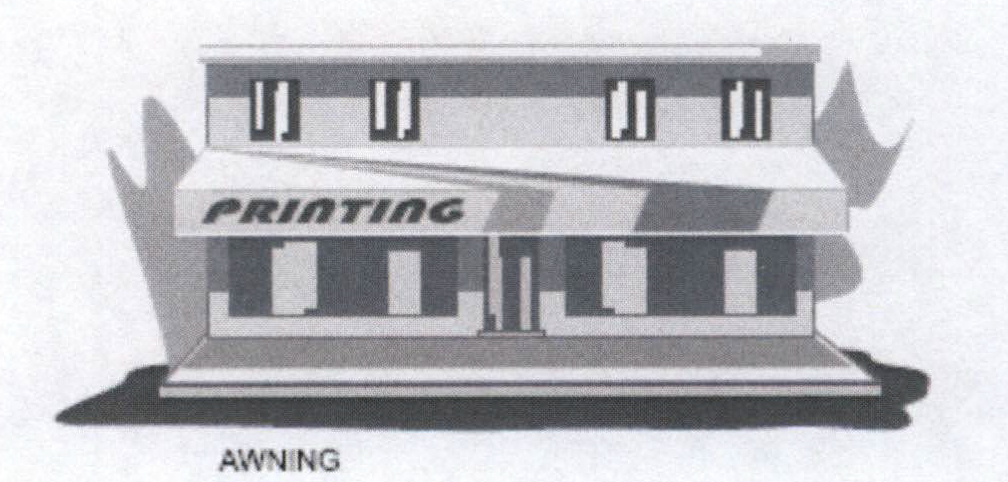
Awning sign. A sign displayed on or attached flat against the surface or surfaces of an awning. See also: Wall Sign. Signs on awnings shall be included in the applicable sign area requirements for wall signs [see section 114-219(c), table 4]. Only the sign area displayed on an awning shall be used to determine the permitted sign area the entire awning shall not be included in a sign area calculation.
Balcony. A platform enclosed by a railing or parapet projecting from the wall of a building for the private use of tenants or for exterior access to the above-grade living units. When a balcony is roofed and enclosed, it is considered part of the room it serves.
Bank or financial institution. Any building, room, space or portion thereof where an establishment provides a variety of financial services, including generally, banks, credit unions, and mortgage companies.
Banner. Any sign made of cloth, canvas, plastic, sheeting or any other flexible material, which is not rigidly and permanently attached to a building or the ground by a permanent support structure.
Bar (tavern or lounge). A commercial enterprise whose primary activity is the sale of alcoholic beverages to be consumed on the premises. Bars include taverns, night clubs, private clubs, bottle (BYOB) clubs, and similar facilities serving alcoholic beverages.
Beacon. Any light with one or more beams directed into the atmosphere or directed at one or more points not on the same lot or parcel as the light source.
Bed and breakfast (B&B). A transient lodging establishment either converted from a single-family dwelling or specifically constructed for the purpose of providing overnight or otherwise temporary lodging for the general public and may provide meals for compensation.
Berm. A manmade raised bank of earth, a minimum of four feet above grade, used to provide privacy, separation of uses, and/or barriers to visual pollution.
Billboard. For the purposes of this chapter, a billboard shall be defined as any sign, structure or device which advertises or contains information unrelated to a business, profession, or activity conducted, or to a commodity or service sold or offered upon the premises where the sign is located (see off-premise sign).
Block. A unit of land bounded by streets or by a combination of streets and public land, railroad rights-of-way, waterways, or any other barrier to the continuity of development.
Boardinghouse. A building other than a hotel, cafe or restaurant where, for compensation, meals are provided for three or more persons.
Buffers. The use of landscaping, retained native vegetation or landscaping along with berms, walls or decorative fences that has 80 percent opacity within five years so as to partially or completely screen from the street or an abutting property vehicular use areas, parking lots, parked cars, detention ponds and conflicting activity areas another in order to mitigate the impacts of noise, light, or other nuisance.
Building. A building and/or structure attached or placed on the ground, enclosed by exterior walls, built, erected and framed of a combination of materials, having a roof for the shelter of persons, animals, or property.
Building area. Includes, but is not limited to, a portion of the lot occupied by the main building, including porches, carports, accessory buildings and other roofed buildings and/or structures.
Building contractors supply. The construction and incidental storage activities performed by construction contractors on zoned lots other than construction sites, as well as the retail or wholesale sale of materials used by the construction trades.
Building envelope. The area formed by the front, side, and rear building setback lines of a lot within which the principal buildings must be located.
Building height. See definition of height of building and/or structure.
Building line. A line showing the nearest distance to the property line where it is permissible to build or place a dwelling or building.
Build-to line. An alignment establishing a certain distance from the property line to a line along which the building shall be built. Front porches and handicap ramps shall be exempt from build-to line requirements but must occur behind the property line.
Business school. An enterprise offering instruction and training, including four-year degrees and/or postgraduate degrees, in a service or the arts such as secretarial, cosmetology, commercial artist, computer software, legal, and similar training, provided that such enterprise does not offer student housing or athletic facilities at the site.
Butcher. A retail store supplying meat and poultry products where meat processing is limited to making cuts of meat from preprocessed carcasses.
Caliper. Diameter of tree trunk measured at six inches above grade.
Camouflaged tower. means a self-supporting communications tower concealed to resemble an object that blends with its surroundings, such as a communications tower concealed to resemble a tree within a wooded setting, a street lamp, a lookout tower, a clock tower or a light post on an athletic field.
Camp. A place where children, youth and/or adults gather together for spiritual, recreational, or educational purposes in an organized and supervised manner, and where overnight lodging (e.g. tents, cabins), food, counseling, religious, and outdoor recreational activities may be provided.
Candela. The basic unit of measurement of light in SI (metric) units.
Candela per square meter (cd/m2). The SI (metric) unit used to describe the luminance of a light source or of an illuminated surface that reflects light. Also referred to as Nits.
Candle or candlepower. Synonymous with Candela, but in English, not SI (metric), terms.
Canopy. An attached or unattached multi-sided overhead structure or architectural projection supported by attachment to a building on one or more sides and either cantilevered from the building or supported by columns but not enclosed by walls. The surface and/or soffit may be illuminated by either an external or internal light source.
Canopy (shade) tree. Any tree that is normally more than 40 feet in height at maturity that provides shade from its foliage mass; also individual or tree groups forming an overhead cover. Examples of recommended canopy (shade) trees are included in section 114-239(a) of article XIII. Canopy (shade) trees should be located so as to minimize potential interference with utilities and avoid sight and height obstructions.
Cash advance. Any building, room, space or portion thereof where unsecured, short-term cash advances are provided, including those made against future pay checks.
Cemetery/mausoleum. Land used or dedicated to the burial of the dead, including crematoriums, mausoleums, necessary sales, and maintenance facilities. Mortuaries shall be included when operated within the boundary of such cemetery.
Check cashing. Any building, room, space or portion thereof where checks are cashed in exchange for a fee.
Church. A building wherein persons regularly assemble at a specific time for religious worship following a recognized creed and which is maintained and controlled by a religious body organized and recognized by the IRS as a tax exempt religious institution together with all accessory buildings and uses customarily associated with such primary purpose. The definition includes synagogue, temple, mosque, or other such place for worship and religious activities.
City horticulturist. A city employee who is an expert in the science of cultivating plants and is in charge of all plantings within the city limits. If the position of horticulturist is vacant, the city manager may appoint an acting horticulturist.
City services. Services to the public at large, including emergency services, fire prevention and protection, law enforcement, traffic control, water, sewer, electricity and other services provided by the city in the city.
Civic building. Any building and/or structure designed and constructed for community use or benefit by governmental, cultural, educational, public welfare, religious or transportation organizations.
Clear cutting. The removal of all vegetation upon a tract of land at one time.
Clinic, outpatient. See definition of outpatient clinic.
Club (fraternal). A facility which offers social, educational, cultural or other similar activities that are only available to members and their guests.
Collection center. A facility which is staffed and fenced that has waste receptacles on site that are open to the public, when an attendant is present, to receive household waste, municipal solid waste and recyclable material.
College or university. An institution of higher education offering undergraduate or graduate degrees.
Commercial amusement, inside. The provision of entertainment or games of skill to the general public for a fee and that is wholly enclosed in a building, including but not limited to a bowling alley or billiard parlor. This use does not include an arena.
Commercial amusement, outside. The provision of entertainment or games of skill to the general public for a fee where any portion of the activity takes place outside of a building, including but not limited to a golf driving range, archery range or miniature golf course. This use does not include a stadium.
Commercial message. Any sign wording, logo, or other representation that, directly or indirectly, names, advertises, or calls attention to a business, product, service, or other commercial activity.
Community education (K-12). Public or private instruction on an elementary, middle and high school level, approved under the regulations of the State of Alabama.
Condominium. A form of property ownership in which each owner holds title to his/her individual unit, plus a fractional interest in the common areas of the multi-unit project. Each owner pays taxes on his/her property, and is free to sell or lease it.
Conservation easement. A nonpossessory interest in real property imposing limitations or affirmative obligations, the purposes of which include retaining or protecting natural, scenic, or open space values of real property; assuring its availability for agricultural, forest, recreational, or open space use; protecting natural resources; or maintaining air or water quality.
Consignment sale. A sale of personal property by someone who is acting as an agent of another.
Construction/demolition landfill. See definition of landfill, construction/demolition.
Convenience store. A facility where flammable and combustible liquids, such as gasoline and other motor fuels, are stored and subsequently dispensed, by use of fixed approved dispensing equipment by customers of the facility on a self-service basis and/or by employees on a full-service basis and which may include an automatic car wash for washing one automobile at a time, within an enclosed building; in addition, a facility which also provides sandwiches, snacks, staple groceries and other similar retail products or services, which are not recognized or defined by the zoning code as separate uses or as necessary components of separate uses, for sale on premises for consumption off premises by the customer.
Core area. The portion of a lot or parcel of property that is not located within the tree protection area or the residential buffer.
Corner lot. See definition of lot, corner.
Correctional facility. A facility for the housing and care of persons legally confined for violations of law.
Crematory. A facility which reduces the deceased to ashes by burning.
Cultural center. Services to the public, such as, but not limited to museums, art galleries and libraries by a public or private, non-profit facility.
Curb market. A business dealing in buying or selling fruit, produce or any grocery item, whether permanent or temporary, seasonal or year-round, of which the building must be permanent and comply with the building code (e.g. a store selling food).
Custom assembly. The on-site production of goods by hand manufacturing that generally involves only the use of hand tools. Incidental direct sale to consumers of the goods produced on-site is permitted.
Daycare. The provision of care for persons (preschool age, disabled or the elderly), who are not related to the primary caregiver, for less than 24 hours per day including:
(1)
Daycare center: A facility that provides daycare for more than six (6) persons;
(2)
Daycare home: Accessory to a single-family dwelling for up to six (6) persons;
(3)
School daycare: Daycare centers of unlimited size for before, during and after school programs.
Detention area. A pond, pool or basin used for the temporary storage of stormwater runoff.
Development plan. A dimensional presentation of a proposed development of a specified parcel (or parcels) of land that illustrates the location of buildings, easements, parking arrangements, public access, street pattern, and other similar features.
Development review committee (DRC). A committee consisting of the administrative official, public works director or their designee, building official, fire marshal, utilities director or their designees and traffic engineer or their designee having the responsibility and authority to review and approve certain development plans as provided for in article V of this chapter.
Developments, major. Non-residential development containing more than 15,000 square feet of gross floor area and/or has a common boundary with a residentially zoned and/or used parcel.
Developments, minor. Non-residential development containing less than 15,000 square feet of gross floor area and that does not have a common boundary with a residentially zoned and/or used parcel. Common boundary shall include roadways not considered to be a major thoroughfare (see definition).
Diameter at breast height (DBH). Diameter of a tree measured at four and one-half feet (54 inches) above the ground.
Directional sign. Signs that are designed and erected solely for the purpose of traffic or pedestrian direction and placed on the property which the public is directed.
Directory sign. Signs that are designed and erected to direct traffic or pedestrian direction and placed on the property which the public is directed. These signs generally provide a map of the entire complex to which the sign relates.
Display area. The area of a sign or advertising device that can be enclosed or measured by the smallest square, circle, rectangle, triangle, or geometric figure that will encompass the extreme limits of the writing, representation, emblem, or other display, together with any material or color forming an integral part of the background of the display, or used to differentiate the sign from the backdrop or structure against which it is placed, also including any supporting framework, bracing, or decorative fence or wall.
Distribution center (UPS, FedEx, newspaper, etc.). A use where goods are received and/or stored for delivery to the ultimate customer at remote locations. The sale or distribution of goods from the premises may consist of the flexible use of the floor area for warehouse, assembly, showroom and office space within tenant areas, with the showroom and office.
Donation center, drop-off. Any lot, building and/or structure or premises used solely for the collection of clothing, furniture, housewares, small electrical appliances, household textiles, toys, and other small household items. The center shall not pay for materials collected or sell any collected materials on the premises. Collected materials shall be stored in an enclosed location on-site until picked up and taken to a central sorting and distribution center. Types of drop-off donation centers range from storefront centers, which may include a drive-thru facility, to other enclosed facilities.
Dripline. A collective name for all vertical lines from the earth to the outermost tips of the crown of a tree. These lines will completely encircle the tree and thereby define its outermost reaches.
Dripline area. The total area underneath a tree that would encompass all driplines.
Drive-in restaurant. A restaurant or public eating business so conducted that food, meals or refreshments are brought to the motor vehicles for consumption by the consumer or patron. Seating may be provided.
Drive-in theater. A theater so arranged and conducted that the customer or patron may view the performance while being seated in a motor vehicle.
Driving range. An establishment containing an area equipped with distance markers, clubs, balls, and tees for practicing golf drives and putting, and which may include a snack-bar and pro-shop, but excludes miniature golf courses or "putt-putt" courses.
Dry cleaning and laundry establishment. An establishment containing no more than 3,000 square feet, for the mechanical cleaning of garments, articles or goods of fabric for retail customers, using non-flammable liquids with no odor, fumes, or steam detectable to normal senses from off the premises. A dry cleaning and laundry establishment does not include a laundry or laundromat which provides self-service type washing and drying for use of retail customers.
Dry cleaning and laundry pick-up station. An establishment where customers drop-off and pick-up garments or articles that are sent to another location for cleaning or laundering. A dry cleaning and laundry pick-up station does not include on-site dry cleaning or laundry facilities.
Dry cleaning and laundry plant. An establishment for the mechanical cleaning of garments, articles or goods of fabric, including a linen, diaper, or uniform laundering service, containing more than 3,000 square feet of gross floor area. A dry cleaning and laundering plant may perform work on the premises for other dry cleaning and laundry services and serve retail customers.
Dwelling unit. A building providing complete, independent living facilities for one or more persons including permanent provisions for living, sleeping, eating, cooking and sanitation to include:
(1)
One-family (single-family): A building containing one detached dwelling unit.
(2)
Two-family (duplex): A building containing two attached dwelling units.
(3)
Multi-family: A building containing at least three attached dwelling units.
Election sign (political sign). A sign erected for the purpose of expressing support for or opposition to a candidate or stating a position regarding an issue to be decided by vote (refer to section 114-211 for applicable standards).
Electronic message center sign (EMC). An electrically activated changeable sign whose variable message and/or graphic display capability can be electronically programmed by computer from a remote location. EMCs typically use light emitting diodes (LED) as a lighting source.
Emergency situation. A sudden unexpected occurrence, either the result of human or natural forces, necessitating immediate action to prevent or mitigate significant loss or damage to life, health, property, essential public services, or the environment.
Engineer. Any professional engineer licensed by the state.
Extended hours. Hours of operation (of a business) that are extended beyond 10:00 p.m. Monday through Thursday and 12:00 a.m. midnight for the purpose of selling alcoholic beverages.
FAA. The Federal Aviation Administration.
Façade. The entire area of a building facing or side extending from the roof or parapet to the ground and from one corner of the building to another but does not include any structural or nonstructural elements which extend beyond the roof of a building.
Family. A single person, or a group of two or more persons related by blood, marriage or adoption, which may be together with no more than three additional persons not related by blood, marriage or adoption; or any number of persons not related by blood, marriage or adoption, living together as a single household. However, the number of unrelated persons shall not exceed the number of bedrooms in the dwelling.
FCC. The Federal Communications Commission.
Financial institution or bank. Any building, room, space or portion thereof where an establishment provides a variety of financial services, including generally, banks, credit unions, and mortgage companies.
Flashing sign. Signs whose illumination is characterized by a repetitive cycle in which the period of illumination is either the same as or less than the period of non-illumination. For the purposes of the ordinance, flashing will not be defined as occurring if the cyclical period between on-off phases of illumination exceeds eight seconds.
Flood. A temporary rise in the level of rivers, streams, lakes and drainageways which results in inundation of areas not ordinarily covered by water.
Flood hazard area. Any area shown on the flood insurance rate maps as being located within the boundaries of flooding under regulatory flood conditions (100-year frequency flood).
Flood insurance rate maps. The officially adopted city maps designating the elevation and boundaries of flooding under regulatory flood conditions. Such maps to be maintained by the public works director and based on information prepared by the U.S. Army Corps of Engineers, the Federal Insurance Administration or other reputable reports accepted by the public works director based on competent engineering studies prepared by a professional engineer currently registered in the State of Alabama.
Footcandle. An English unit of measurement of the amount of light falling upon a surface (illuminance). One footcandle is equal to one lumen per square foot and is measured with an illuminance meter.
Fraternity/sorority house. A facility which serves as living quarters for private social organizations, serving students of colleges or universities.
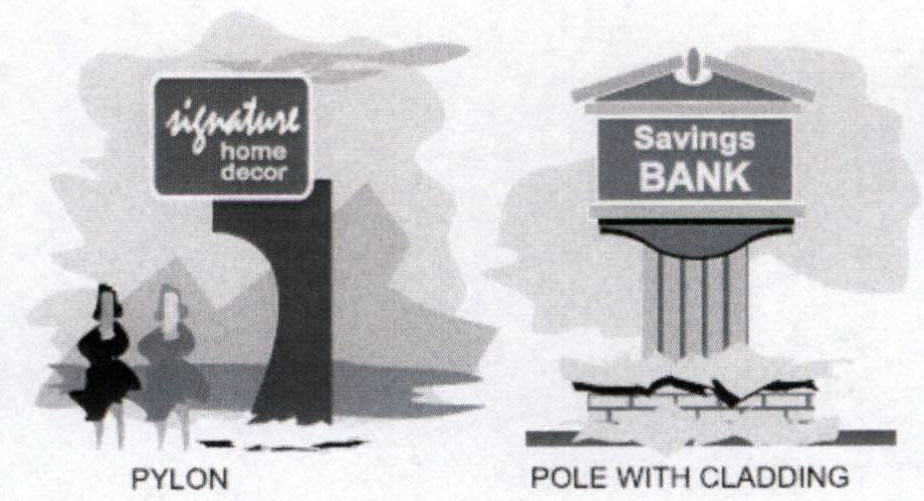
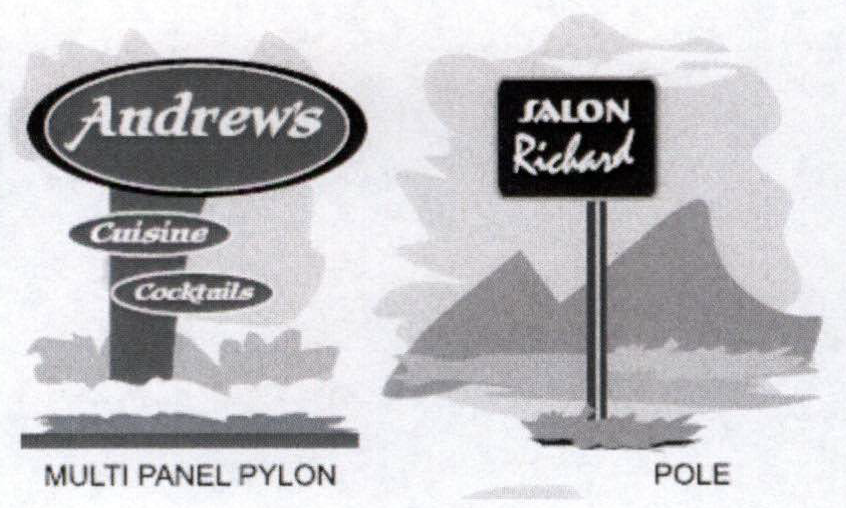
Freestanding sign. Any sign supported by structures or supports that are placed on or anchored in the ground and that are independent from any building or other structure. The posts or other supporting structures shall be considered part of the sign, except that they shall not be included in computing the sign display area. Illustrations of typical freestanding signs follow.
Fruit stand. See definition of produce and fruit stand.
Funeral home. An establishment with facilities for the preparation of the dead for burial or cremation, for the viewing of the body, and for funerals.
Garage (yard) sale sign. A temporary sign pertaining to the sale of personal property at or upon any residentially zoned lot or parcel.
Governmental/public use. A building or structure owned, operated, and/or occupied by governmental agency for the purpose of providing a governmental service to the public.
Grand opening sign. A temporary on-premise sign announcing the opening of a new business.
Greenway. A linear park, alternative transportation route, or open space conservation area that provides passive recreational opportunities, pedestrian and/or bicycle paths, and/or the conservation of open spaces or natural areas.
Gross vehicle mass (GVM). The accepted safe, maximum allowable total mass of a fully loaded motor vehicle. It consists of the tare mass (mass of the vehicle itself with all operating fluids) plus the payload.
Ground cover. Natural plant material such as vines, shrubs, or grasses that would not normally attain a height of more than two feet.
Group home. A facility which serves as a home for persons with disabilities as defined by the Fair Housing Act of 1988 and may include up to two additional persons acting as house-parents or guardians who need not be related to each other or to any of the persons residing in the home.
Halfway house. A facility, which is licensed by the State of Alabama, for housing persons on release from more restrictive custodial confinement or initially placed in lieu of such more restrictive custodial confinement, wherein supervision, rehabilitation, and counseling are provided to mainstream residents back into society, enabling them to live independently.
Hazardous operation. A use that may present serious hazards to human life and health such as, but not limited to arsenals, atomic reactors, explosives and fireworks manufacture.
Heavy equipment sales and service. The retail or wholesale sale or rental of heavy motorized vehicles or equipment, along with incidental service or maintenance such as, but not limited to construction equipment rental yards, tractor-trailers, semi-trailers, boats, buses, recreational vehicles, farm equipment and moving trailer rental. (See "automobile sales, new," "automobile sales, used.")
Heavy manufacturing. See definition of manufacturing, heavy.
Height of building and/or structure. The vertical distance from the average level of the highest and lowest point of that portion of a lot covered by the building to the top-most point of the roof.
Heliport. See definition of airport/heliport.
High bulk retail. A business use where the display of merchandise requires large areas such as furniture.
Home improvement sales. A facility for the retail sale of a diverse range of hardware and related materials generally used in the maintenance, repair or construction of buildings and/or structures, including lawn and garden supplies.
Home occupation, non-qualifying. A business use of residential property that is clearly secondary, and incidental and includes characteristics that might, in the opinion of the administrative official, generate or involve external impacts including storage of equipment, trailers or vehicles used in the business. (e.g. lawn care business with a home office but with outside equipment storage).
Home occupation, qualifying. A business use of residential property that is clearly secondary, and incidental and does not include characteristics that might, in the opinion of the administrative official, affect the residential character of the neighborhood (e.g. home office for work conducted at other locations).
Homeless shelter. A facility providing temporary housing to indigent, needy, homeless, or transient persons and which may also provide ancillary services such as counseling, vocational training, etc.
Homeowners association. An incorporated, nonprofit organization operating under recorded land agreements through which:
(1)
Each lot owner and homeowner in a planned or other described land area is automatically a member;
(2)
Each lot is automatically subject to a charge for a proportionate share of the expenses for the organization's activities, such as maintaining a common property.
Hospital. A public or private institution where medical or surgical care is provided for the sick or injured on an out-patient or long-term basis.
Hotel. A building or portion thereof which contains at least ten guestrooms intended for occupancy by persons for compensation, whether paid directly or indirectly.
Household. A family living together in a single dwelling unit with common access to, and common use of, all living and eating areas and all areas and facilities for the preparation and storage of food within the dwelling unit. (Refer to definition of "family.")
Illegal nonconforming building and/or structure. A building and/or structure which was erected or altered outside the provisions of a prior zoning ordinance.
Illegal nonconforming use. Any use which, on the effective date of the ordinance from which this chapter is derived, was operating outside the provisions of a prior zoning ordinance, such as a dine and dance establishment operating in a residential zone in defiance of zoning restrictions.
Illuminance. The amount of light falling upon a real or imaginary surface, commonly called "light level" or "illumination." Measured in footcandles (lumens/square foot) in the English system and lux (lumens/square meter) in the SI (metric) system.
Indoor assembly. A place where people gather for a specific purpose for a designated period of time.
Interior landscape island. An island in the parking area with 150 square feet of minimum area containing a minimum of one tree eight feet in height with a one and one-quarter-inch caliper measured at six inches above grade after planting, four shrubs and ground cover or other approved material not to exceed three feet in height.
International Code Council (ICC). A membership driven association that develops building codes and standards used to construct residential and commercial buildings and provides minimum safeguards for people at home, at school and in the workplace. The I-Codes are a complete set of comprehensive, coordinated building, life safety and fire prevention codes.
Junkyard or salvage yard. A lot or parcel of land on which is kept, stored, bought or sold articles commonly known as junk, including scrap paper, scrap metal and used automobile bodies and parts, appliances, etc.
Kennel or stable. Any lot, building and/or structure or premises used for the boarding, breeding, training, and/or raising of domestic animal/wildlife (excluding livestock), whether by owners of such animals or by persons providing facilities and care, whether or not for compensation, but shall not apply to the keeping of animals in a municipal animal pound, pet store, a bona fide laboratory for scientific or experimental purposes (e.g. dental, veterinary, pharmaceutical or biological) or in a veterinary establishment for the purpose of observation and/or recovery necessary to veterinary treatment.
Kitchen facilities. A portion of a building used for the preparation of meals, and for the purpose of this chapter shall include a sink or similar fixture for washing dishes.
Landfill, construction/demolition. A facility for the disposal of non-biodegradable waste, resulting from road building, construction, remodeling, repair or demolition of buildings and/or structures.
Landfill, sanitary. A facility for the burial of nonhazardous and non-medical farm, residential, institutional, commercial or industrial waste according to the provisions of subtitle "D" of the Resource Recovery and Conservation Act.
Landscaping. Any additions to the natural features of a plot of ground to restore construction disturbance and to make it more attractive, as by adding lawns, trees, and shrubs to the natural environment.
Landscaping plan. A plan containing the information required in section 114-238(b) of this chapter.
Legal nonconforming building and/or structure (grandfathered building and/or structure). A building and/or structure which was lawfully erected or altered in conformity with all applicable municipal ordinances or through variances granted by the board of zoning adjustment, but which the building and/or structure does not comply with all the provisions this chapter establishes for buildings and/or structures in the district in which the buildings and/or structure is located.
Legal nonconforming use (grandfathered use). A land use which, on the effective date of the ordinance from which this chapter is derived, was lawfully operated in accordance with the provisions of any prior zoning ordinance or through a variance granted by the board of zoning adjustment, but which use is not a permitted use as established by this chapter in the district in which the use is located.
Light manufacturing. See definition of manufacturing, light.
Line of site. A visual path emanating from an average eye level adjudged to be three and one-half feet above ground level.
Liquor sales. The retail sale of alcoholic spirituous beverages to patrons or customers, in sealed packages, and not for consumption on the premises.
Listed sign. A sign manufactured and labels in accordance with specifications promulgated by a recognized testing laboratory designed to assure compliance with American National Standards (ANSI) and/or the National Electric Code (NEC).
Live work. A building or space within a building that is used jointly for commercial and residential purposes where the residential use of the space is secondary or accessory to the primary use as a place of work.
Livestock. Refer to the City Code of Ordinances, chapter 10 animals.
Living quarters. Housing providing facilities for sleeping and bathing.
Living space. The floor space in a dwelling to be calculated on the basis of total habitable room area.
Lounge. See definition of bar, tavern or lounge.
Lot. A piece, parcel or plot of land occupied or intended to be occupied by one main building, accessory building, uses customarily incidental to such main buildings and such open spaces as are provided in this chapter or as intended to be used with such piece, parcel or plot of land. Two or more lots of record may be combined to create one zone lot provided a "unity of title declaration" is submitted and recorded (see section 114-187).
Lot, corner. A lot situated at the intersection of two or more streets. On corner lots, the narrower side shall be considered the front, regardless of the location of the main entrance of the dwelling. Where both frontages of the lot are equal, the front yard shall be considered the side on which the majority of the lots front the block.
Lot, double-frontage. A lot having frontage on two nonintersecting streets, as distinguished from a corner lot.
Lot of record. A lot which is part of a subdivision, the plat of which has been recorded in the office of the Judge of Probate of Houston, Dale or Henry Counties, or any parcel of land, whether or not part of a subdivision, that has been officially recorded by a deed in the office of the judge of probate, provided such lot was of a size which met the minimum dimensions for lots in the district in which it was located at the time of recording or was recorded prior to the effective date of zoning in the area where the lot is located and met the requirements of the subdivision regulations in effect at the time of the recording.
Lot width. The horizontal distance between side lot lines measured along a line that is parallel to the front lot line.
Lot, zone. Two or more lots of record combined into one unified building site. Such land area may be designated as a zone lot only by the owner or owners thereof through the filing of a unity of title declaration (see section 114-187).
Luminance. The light that is emitted by or reflected from a surface. Measured in units of luminous intensity (candelas) per unit area (square meters in SI measurement units or square feet in English measurement units.) Expressed in SI units as cd/m 2 , and in English units as foot lamberts. Sometimes also expressed as "nits," a colloquial reference to SI units and measured with a luminance meter.
Lux. The SI (metric) unit for illuminance. One lux equals 0.093 footcandles.
Maintenance. The act of replacing, repairing, or repainting a portion of a structure.
Major thoroughfares (arterials). Major thoroughfares/arterials shall include the following: Ross Clark Circle, U.S. Highway 231, U.S. Highway 431, U.S. Highway 84, Westgate Parkway, Honeysuckle Road between U.S. Highway 84 and Alabama Highway 52, Park Avenue, Denton Road north of U.S. Highway 231, Alabama Highway 52, Alabama Highway 53, Fortner Street east of Honeysuckle Road, Alabama Highway 605, Headland Avenue from Reeves Street northward to the city limits, Hodgesville Road from U.S. 231 to Saunders Road, Saunders Road between Hodgesville Road and U.S. Highway 231, Napier Field Road, Flynn Road, Flowers Chapel Road, Murphy Mill Road between U.S. 231 and John D. Odom Road or as hereafter designated by the board of commissioners.
Manufactured (mobile) home. A structure designed in one or more sections on a permanent chassis without independent motive power to be used as a dwelling with or without a permanent foundation, connected to public utilities incorporating plumbing, heating and air-conditioning and electrical systems and displaying a current HUD certification sticker.
Manufactured home lot/site. A parcel of land designed for the exclusive use of the occupants of a single manufactured home.
Manufactured home park/community. Any site, lot, field or tract of land privately or publicly owned or operated upon which two or more manufactured homes used for living quarters.
Manufactured home park/community street. A hard surfaced street which affords principal access to manufactured home lots/sites or auxiliary buildings from any adjacent public street.
Manufactured home skirting. A durable material designed and installed to enclose the space from the bottom of the manufactured home to the surface of the manufactured home stand.
Manufactured home stand. That part of an individual lot/site which has been reserved or designed specifically for the placement and support of one manufactured home unit.
Manufacturing, heavy. The manufacture or compounding process of raw materials. These activities or processes would necessitate the storage of large volumes of potentially flammable, toxic or explosive materials needed for the manufacturing process. These activities may involve outdoor operations as part of their manufacturing process. Typical heavy manufacturing uses include but are not limited to: concrete batch plants; concrete, tile, or brick manufacturing; automobile, truck, and tire assembly; ammonia or chlorine manufacturing; metal casting or foundries; gas manufacturing; grain milling or processing; metal or metal ore production, refining, smelting, or alloying; petroleum or petroleum product refining; boat, pool and spa manufacturing; slaughtering of animals; glass manufacturing; paper manufacturing; and wood or lumber processing.
Manufacturing, light. The manufacture, predominately from previously prepared materials, of finished products or parts, including processing, fabrication, assembly, treatment and packaging of such products, and incidental storage, sales and distribution of such products, but excluding basic industrial processing and custom manufacturing. Typical light manufacturing uses include but are not limited to: electronic goods, food and bakery products, non-alcoholic beverages, paper imprinting, household appliances, leather products, jewelry, food and bakery products, and clothing apparel.
Mausoleum. See definition of cemetery/mausoleum/crematory.
Medical or scientific lab. A facility for research, testing or investigation of a medical or scientific nature, but not for the production of a product.
Microbrewery. The production of beer, regardless of the percentage of alcohol by volume (ABV), in quantities not to exceed 5,000 barrels per month, with a barrel containing 31 U.S. liquid gallons.
Mineral extraction. The extraction of metallic and nonmetallic minerals or materials, including rock crushing, screening and the accessory storage of explosives.
Minor modification (PUDs only). Any change which does not alter the scope or intent of the PUD or adversely affect adjacent areas or increase financial or maintenance responsibility to the city.
Minor plan amendment. Alterations to existing developments which do not increase either the building area or the square footage of existing building(s) by more than 50 percent and which, in the judgment of the administrative official, will not significantly affect neighboring property or public services and facilities, including but not limited to water, sanitary sewer, transportation and storm drainage systems.
Mobile storage unit. The purchase, lease, or rental of any storage unit or container that is either set on the ground or on wheels, and which is typically used for, but is not limited to the storage of equipment, excess inventory, layaway items, back-to-school merchandise, seasonal merchandise, records or clearance sale items. A mobile storage unit excludes semi-trailers, and/or containers belonging to a railroad or barge operation located in a railroad yard, on a railroad track, and on or near a navigable river.
Mobile vending. Any equipment, apparatus, trailer, vehicle, cart, or other conveyance, other than a vending machine, located outdoors, from which a vendor displays, sells, offers for sale, gives away, or offers to give away anything of value including any food, beverage, goods, wares, merchandise, or services.
Mobile vendor. A person who peddles, vends, sells, displays, or offers for sale goods, wares or merchandise at a temporary location and/or on a temporary or occasional basis. Notwithstanding the foregoing, vendors selling only food and/or beverages, vendors selling living plants and agricultural products, and street vendors shall not be considered "mobile vendors."
Modular home. A dwelling unit constructed or assembled on-site in accordance with the applicable building code and composed of components substantially assembled in a manufacturing plant and transported to the building site for final assembly on a permanent foundation.
Monument sign. A freestanding sign that is detached from a building and having a support structure that is a solid-appearing base constructed of a permanent material, such as concrete block or brick.
Motel. A building or group of buildings containing one or more guestrooms having separated outside entrances for each such room or suite of rooms and for each of which rooms or suite of room's an automobile parking space is provided.
Motor freight. Facilities engaged in the shipment of goods from shippers to receivers for a charge including the services of other transportation establishments to effectuate delivery.
Multi-copy. Services for instant reproduction of documents by the photocopy process for individual patrons.
Multi-faced signs. Any sign that uses more than one side to relay a message, statement, or expression.
Multi-family. Three or more dwelling units within a single building.
Multimedia productions. A facility for the staging and recording of video or audio productions such as, but not limited to music commercials, programs and motion pictures.
Natural vegetation. A generally undisturbed, maintenance-free, self-perpetuating stand of vegetation comprised of indigenous shrubs, flowers, wild grasses, and trees.
Net residential acreage. Land used or proposed to be used for the placement of dwelling units and their accessory uses, private open spaces, parking areas, etc. This does not include streets or public recreation or open spaces.
Nits. The unit of measurement for luminance which is the total amount of light emitted from a sign divided by the surface are of the sign (candelas per square meter cd/m 2 ).
Non-commercial message. A message that carries no statement or expression related to the commercial interests of the sign owner, lessee, author or other persons responsible for the sign message.
Nonconforming sign. Any sign that is allowed by this chapter yet does not conform to the requirements of the ordinance.
Nonconforming use. A land use of any building and/or structure and/or land which, though originally lawful, does not conform to this chapter or any subsequent amendments thereto for the district in which it is located.
Nonconformity. A condition that occurs when, on the effective date of adoption of this code or a previous ordinance or on the effective date of an ordinance text amendment or rezoning, an existing lot, building and/or structure, sign, development, or use of an existing lot or building and/or structure does not conform to one or more of the regulations currently applicable to the district in which the lot, building and/or structure, sign, development, or use is located.
Non-protected trees. Any pine tree less than 18 inches DBH and any non-pine species less than 12 inches DBH, plus any other species of trees that the city horticulturist may certify to the planning commission in writing as not being suitable for preservation. A list of such non-protected species shall be maintained by the planning and development department.
Nonresidential drug treatment facility. A facility characterized by the dispensing of substitute narcotics for the treatment of drug addictions with little or no professional counseling on an outpatient basis.
Nursing home. A State of Alabama licensed facility providing full-time convalescent or chronic care to persons who, by reason of advanced age, chronic illness or infirmity are unable to care for themselves and require skilled nursing and related medical services.
Off-premise sign (off-site sign). Any sign containing a message unrelated to a business, profession, or activity conducted, or to a commodity or service sold or offered, upon the premises where the sign is located.
Office, general. A building providing space for executive, management, administrative or professional services, but not involving medical services.
On-premise sign. Any sign containing a message related to a business, profession, or activity conducted, or to a commodity or service sold or offered, upon the premises where the sign is located.
Open space. An area open to the sky which may be on the same lot with a building. The area may include, along with natural environmental features, swimming pools, tennis courts or any other recreational facilities. Streets, buildings and/or structures for habitation and the like shall not be included.
Open space, permanent, useable. These terms are meant to include public open spaces, not occupied by buildings, and may consist of pedestrian walkways, play areas, landscaped areas, sports areas, ponds and any other areas suitable for the common enjoyment of the residents of the project. Privately owned lots or privately occupied space shall not be considered as permanent useable open space.
Outpatient clinic. A facility for examining and treating patients with medical problems on an outpatient basis, including ambulatory care or similar medical services that generally require a stay of less than 24 hours.
Owner. Any person with fee title or with written permission from a person with fee title, to any plot of land within the city who desires to develop, construct, build, operate, modify or erect a structure upon such land.
Ownership. This term is meant to include the following:
(1)
A person, partnership or corporation.
(2)
An association of property owners legally bound to one another.
(3)
The homeowners association of a condominium project, established under laws of the State of Alabama.
Park. Any facility that is open to the public for recreational uses, including, but not limited to, hiking, swimming, boating, camping; predominately kept in a natural state; or the property of the local, state or federal government, or any department or agency thereof, specifically designated as a park, natural area or recreation area.
Parking space. The space necessary to park an automobile. Not less than an area nine feet wide and 18 feet long shall be provided for each parking space, and all parking spaces required shall be provided with necessary lanes and maneuvering areas. Handicapped parking spaces shall have dimensions in accordance with the Americans with Disabilities Act requirements and/or the International Building Code as adopted.
Pawnshop. Any building, room, space or portion thereof where a pawnbroker regularly conducts business.
Perimeter landscaping. The use of landscaping along the outer limits of the development area excluding access points.
Person. Any individual, including any trustee, receiver, assignee, or personal representative thereof.
Personal care services. Services such as fitness centers, spas, tanning salons, nail salons, beauty and barber care, and dry cleaning and laundry services not to include a laundry plant.
Personal instruction. Services for training individuals or groups in the arts, personal defense, crafts or other subjects of a similar nature.
Photometric plan. Illustration depicting the anticipated light levels generated by all exterior lights across the site and 50 feet beyond the property lines.
Planned unit development (PUD). A development that:
(1)
Is land under unified control, planned and developed as a whole in a single development operation or approved programmed series of development operations for dwelling units and related uses and facilities;
(2)
Includes principal and accessory uses and buildings substantially related to the character of the development itself and the surrounding area of which it is a part; and
(3)
Is developed according to comprehensive and detailed plans which include streets, utilities, building sites and the like.
Pool house. An exterior building designed and used as an accessory to an outdoor swimming pool and not for human habitation.
Portable sign. Any sign not permanently attached to the ground or other permanent structure, or a sign designed to be transported, including, but not limited to, signs designed to be transported by means of wheels; signs converted to A-frames or T-frames; menu or sandwich board signs; balloons or other inflatable devices used as signs; umbrellas used for advertising; and signs attached to or painted on vehicles parked and visible from public right-of-way, unless such vehicle is used in the normal day-to-day operations of the business.
Portable storage building. A building and/or structure that is designed to be transported from place-to-place solely for the purpose of storing inanimate objects, does not have a door or other entranceway into a dwelling unit and that does not have water fixtures within its confines, the use of which is limited solely to storage of objects.
Power/gas substation. A facility that regulates electric current or natural gas pressure for distribution to individual neighborhoods.
Printing and publishing. The production and distribution of books, magazines, newspapers and other printed matter, including retail photocopying and blueprinting services, as well as record pressing and publishing, engraving and photoengraving.
Produce and fruit stand. A building and/or structure constructed for the display and sale of fresh produce only. It is not intended to be a market where unpackaged, prepackaged or home-prepared foods are offered for sale, or where foods which require refrigeration for health safety are offered for sale.
Prohibited sign. Any sign that is not allowed as of the effective date of this chapter.
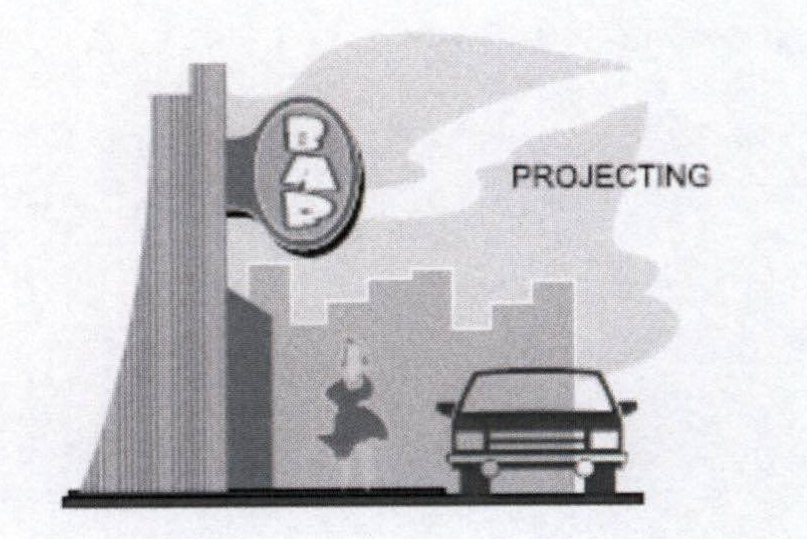
Projecting sign. A sign other than a wall sign that is attached to or projects more than 18 inches from a building face or wall of a structure whose primary purpose is other than the support of a sign.
Protected tree. Any pine tree 18 inches or greater DBH and any non-pine species 12 inches or greater DBH except for those classes or species of trees included in the list of non-protected trees.
Public land use. Any land use operated by or through a unit or level of government, either through lease or ownership, such as municipal administration and operation, county buildings and activities, state highway offices and similar land uses, and federal uses such as post offices, bureau of public roads and internal revenue offices, military installations, etc.
Public utilities. Any essential services to the public at large, including water, sewer, telephone (except wireless), electricity, natural gas and other services regulated by the Alabama Public Service Commission as a public utility, but excluding cable TV, radio, television and any public utility operation of a wireless communications facility for a profit.
Putrescible waste. Material which is capable of undergoing the process of decomposition resulting in the formation of malodorous byproducts.
Radio/television/satellite tower. A building and/or structure for transmitting and receiving radio, television, satellite and other broadcast signals, including radar surveillance and including accessory buildings.
Reader board. Permanent sign containing messages in the form of removable letters or changeable copy. A reader board may be a wall sign or part of a freestanding sign.
Real estate sign. An on-premise sign that is used to identify property for sale (refer to section 114-211 for applicable standards).
Recommended tree. Any tree listed in section 114-239(a) of this chapter or any tree determined by the city horticulturist. A landscape architect licensed by the State of Alabama or a landscape designer licensed by the State of Alabama may recommend other trees for consideration to the city horticulturist that are suited to the soils and climate of Dothan, Alabama.
Recreation facility (indoor). A commercial or public recreational land use conducted entirely within a building, including but not limited to arcade, arena, athletic and health clubs, auditorium, bowling alley, community center, conference center, exhibit hall, gymnasium, library, movie theater, museum, performance theater, pool or billiard hall, skating rink, swimming pool, tennis court, etc.
Recreation (public). Publicly owned or operated recreation facilities.
Recreational vehicle (RV), camping-type. A vehicular portable building designed as a temporary dwelling unit for travel, recreation and vacation uses, which is identified on the unit by the manufacturer as a "camper," "travel trailer," or "motor home," is not more than eight feet in body width and does not exceed 40 feet in length.
Recycling collection center. A drop-off facility for the temporary assemblage of small recyclable consumer items such as food and beverage containers, fabrics and paper.
Recycling facility. A facility, other than a facility open to the public, to receive household waste and recyclable material, where any method, technique, or process is utilized to separate, process, modify, convert, treat or otherwise prepare non-putrescible waste so that component materials or substances may be used or reused or sold to third parties for such purposes. The use or reuse of solid waste may not be used in a manner that would constitute solid waste disposal.
Regulatory flood. A 100-year frequency flood as delineated on the flood hazard maps which has a probability of occurring once every 100 years or having a one percent chance of occurring each year.
Rehabilitation facility. A facility offering treatment for addictive, mental or physical disabilities on either a 24-hour a day or outpatient basis.
Religious institution. Any building and/or structure or site used primarily for religious practices.
Research service. A facility offering basic or applied research, or experimental study, testing or analysis in the natural sciences, including any educational uses associated with and accessory to such research.
Residential. Any land area used and/or zoned for housing activities with personal use or enjoyment without the intent of realizing a profit or recovering costs through the sale of goods or services.
Restaurant, carry-out/take-out/delivery. Establishments where food is ordered by telephone and prepared on the premises for pick-up by the customer. There is limited or no seating provided on the premises. There is no on-site drive-through menu order station although orders may be placed at a pick-up window. The establishment may deliver food to the customer.
Restaurant, fast-food. Any building, room, space, or portion thereof where food is sold for consumption on-site or off-site within a short period of time, orders are made at either a drive-through or walk-up window or counter, payment for food is made prior to consumption, and the packaging of food is done in disposable containers.
Restaurant, full-service. Any building, room, space or portion thereof where food is sold for consumption on-site, customers are provided an individual menu, a restaurant employee serves the customers at the same table or counter at which items are consumed, where seating turns over at a rate of 30 minutes or more and whose gross sales of food constitute the principal activity of the business. Alcoholic beverages may or may not be offered for sale to accompany the meal.
Retail. The sale of goods and/or services at retail. For purposes of calculating required parking, retail includes "retail, general" and "retail, convenience" and "retail, shopping center."
Retail, general. An establishment providing general retail sales, services or rental from the premises, of goods and/or services not specifically classified in another commercial activity type. Exterior displays and sales are allowed.
Retail, indoor sales only. An establishment providing general retail sales, services or rental from the premises, of goods and/or services not specifically classified in another commercial activity type. No exterior displays and/or sales shall be permitted.
Retail, shopping center. A single building containing two or more different individual stores engaged in general retail sales.
Retention area. A pond, pool or basin used for the permanent storage of stormwater runoff.
Roadside stand. A building and/or structure for display and sale of farm products raised on the premises with no space for customers within the building and/or structure itself.
Roof line. The fascia, soffits, bargeboards and cladding that forms the frontage immediately below the roof and the eaves of most homes. These are traditionally made from wood, but can also be made of plastics, such as polyvinyl chloride.
Roof peak. The highest point of a roof. _____
Roof sign. A sign mounted on the main roof of a building or on the uppermost edge of a parapet wall of a building and which is wholly or partially supported by such building. Signs mounted on mansard facades, pent eaves and architectural projections such as canopies or marquees shall not be considered a roof sign.
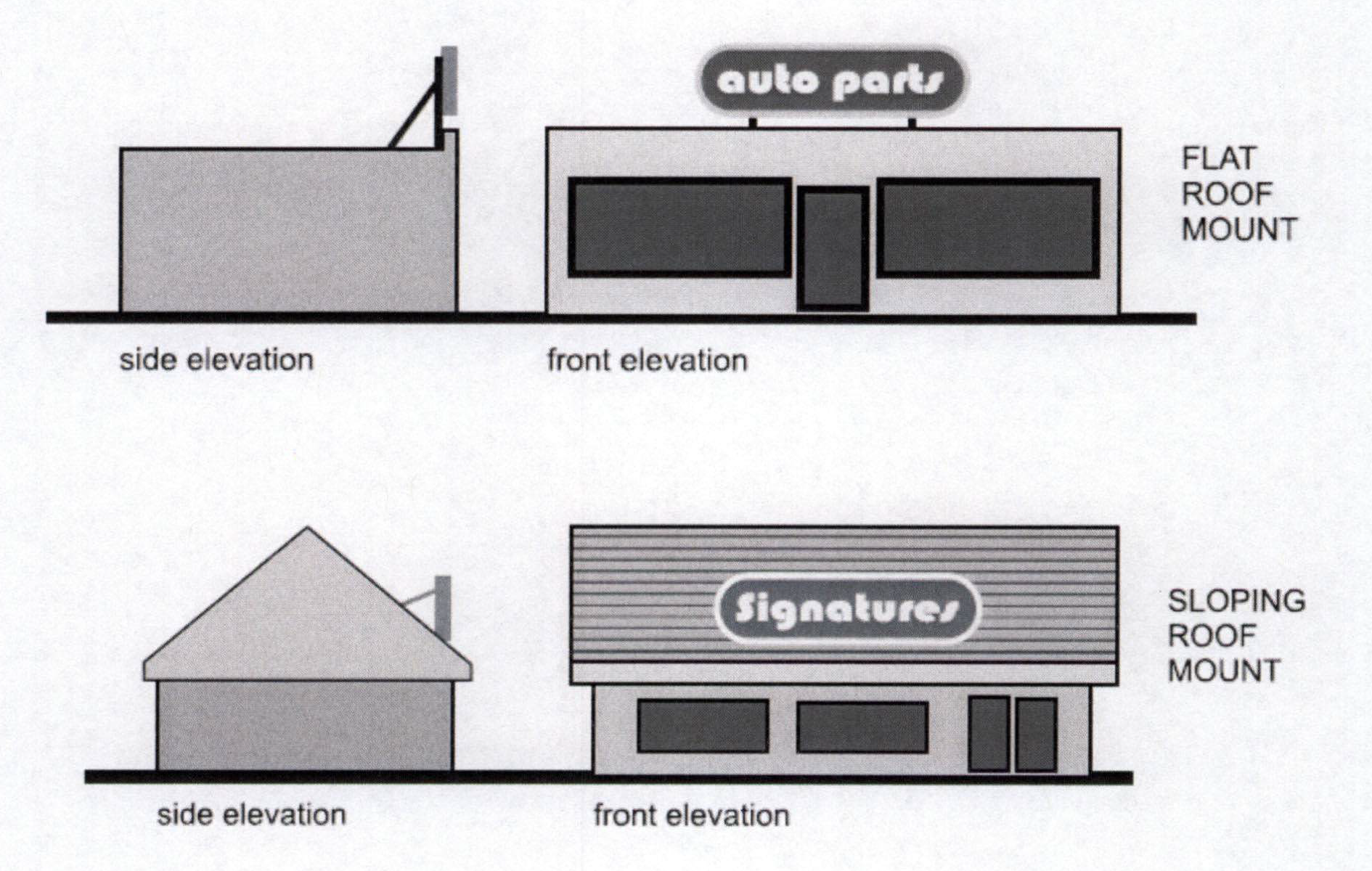
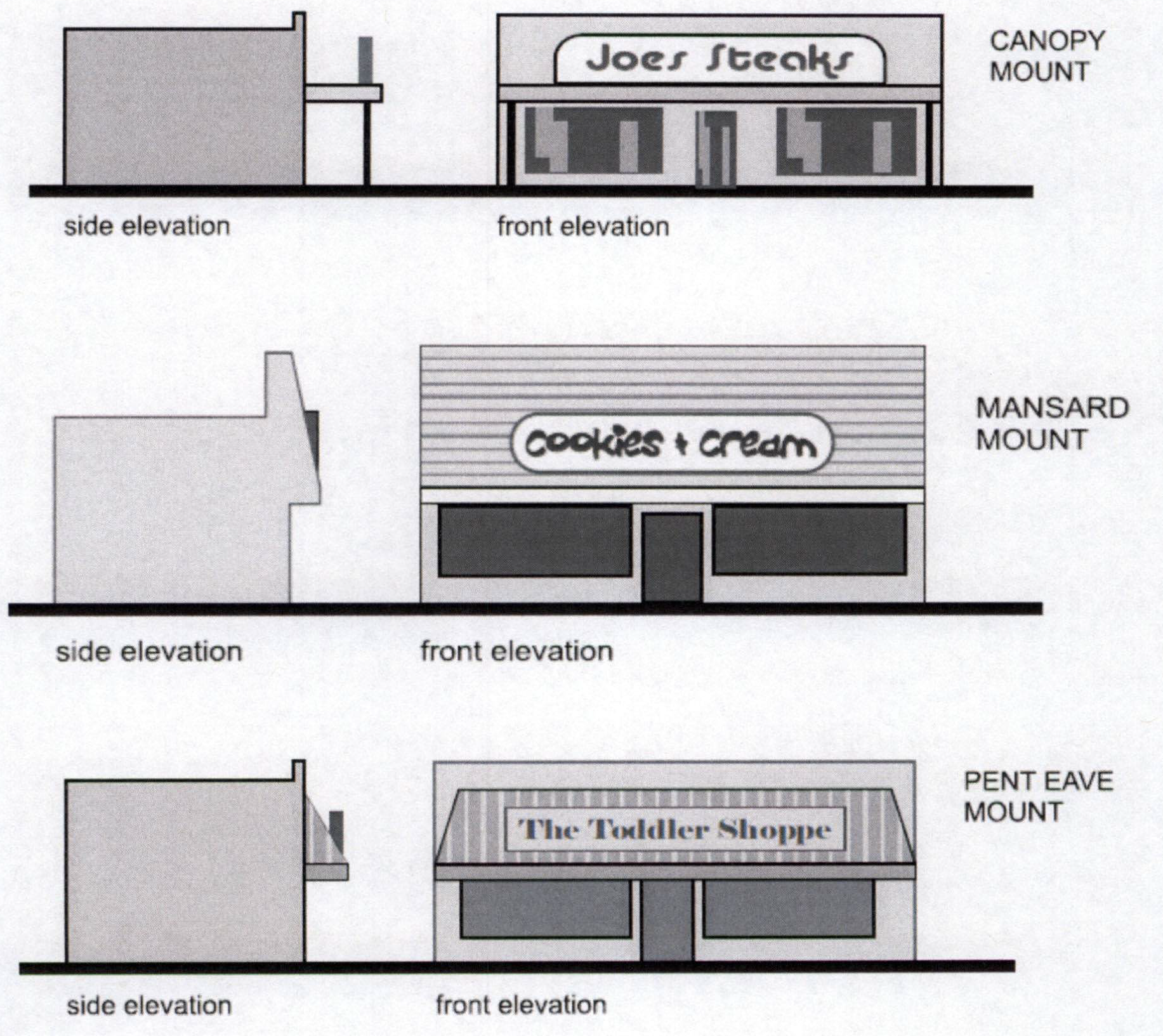
_____
Rooming house. Any building or portion thereof which contains not less than three or more than nine guestrooms which are designed or intended to be used, let or hired out for occupancy by persons for compensation, whether paid directly or indirectly.
School. Refer to the following definitions in this article:
(1)
Business school,
(2)
Daycare,
(3)
Community education (grades K-12),
(4)
College or university, and
(5)
Vocational school.
Scrap operation. The storage, processing and/or sale from the premises of used or waste material, including automotive dismantlers and recyclers, where a person, firm, association, corporation, or trust resident or nonresident, is engaged in the business and/or providing facilities for the purpose of recovering parts from automobiles and trucks, which have been wrecked or otherwise rendered inoperable as transportation vehicles with the parts recovered being for resale and further reduces used automobiles and trucks to a condition capable of salvage for their metal scrap content by scrap processors.
Searchlights. Any light with one or more beams directed into the atmosphere or directed at one or more points not on the same lot or parcel as the light source.
Seasonal use. See definition of temporary/seasonal use.
Self-service laundry. A building and/or structure containing washing machines and usually drying machines, which are coin-operated by the customer. It may or may not have an attendant.
Self-service storage. An establishment that leases or rents storage units for the purpose of storing personal property.
Semipublic land uses. A philanthropic and charitable land use including YMCAs, YWCAs, Salvation Army, orphanages, private welfare organizations, Red Cross, and other general charitable institutions.
Shelter, storm. A building and/or structure intended to provide protection to human life during periods of danger from nuclear fallout, air raids, storms or other emergencies.
Short-term commercial rental (STCR). A non-owner-occupied, residential rental where one room or the entire dwelling is rented for no more than 30 consecutive days for visitors.
Short-term residential rental (STRR). An owner-occupied, residential rental where one or more rooms of a single-family home, the main use of which is residential living, is rented for no more than 30 consecutive days for visitors.
Shrub. A woody plant or bush of relatively low height two to six feet distinguished from a tree by having several stems rather than a single trunk.
Sight triangle. A triangular shaped portion of land established at street/drive aisle intersections in which nothing is erected, placed, planted or allowed to grow in such a manner as to limit or obstruct the sight distance of motorists entering or leaving the intersection. Standards for sight triangles can be found in section 98-10 of the City of Dothan Code of Ordinances.
Sign. Any writing, pictorial representation, number, illustration, or other device which is supported by or contained within a structure specifically designed to announce direct attention to, identify, advertise or otherwise make anything known. Excluded are governmental signs erected for public safety; signs located completely within an enclosed building; and flag emblems or insignia of a nation, political unit, school or religious group. The term sign shall not be deemed to include incidental architectural embellishments.
Sign area. The area of a sign or advertising device that can be enclosed or measured by the smallest square, circle, rectangle, triangle, or geometric figure that will encompass the extreme limits of the writing, representation, emblem, or other display, together with any material or color forming an integral part of the background of the display, or used to differentiate the sign from the backdrop or structure against which it is placed, also including any supporting framework, bracing, or decorative fence or wall. The entire face of a projecting or detached sign, excluding those posts, uprights, braces or other structural members that support it, containing no message(s) and having a horizontal dimension of less than 24 inches.
Slaughterhouse. A place where animals are slaughtered and prepared for distribution to butcher shops or retail sales establishments such as grocery stores. A slaughterhouse is designed to accommodate the confinement and slaughtering of live animals and may include packing, treating, storage, or sale of the product on the premises.
Sorority house. See definition of fraternity/sorority house.
Special exception. A special exception is a land use that would generally not be considered as an appropriate land use in a particular zoning district as a use permitted by-right, but could be considered appropriate with certain controls and/or restrictions which promote the public health, safety, welfare, order, comfort, convenience, appearance, prosperity, or general welfare. Special exceptions require approval by the board of zoning adjustment as outlined in this chapter in article VI, board of zoning adjustment. Uses that qualify for special exception consideration are outlined in the table of permitted uses in article VIII, district regulations.
Stable. See definition of kennel or stable.
Story. That portion of a building included between the surface of any floor and the surface of the floor next above it or, if there is no floor above it, the space between such floor and the ceiling next above it.
Street. Any public or private way set aside for common travel. Refer to the City of Dothan Code of Ordinances, chapter 90, subdivision regulations for street classifications, definitions and requirements.
Street frontage. The length of the property line of the lot, lots, parcel or tract of land abutting a public street, road or highway.
Structure. Anything constructed or erected which requires location on the ground or attached to something having a location on the ground, including among other things signs, billboards, fences and walls, but not including telephone poles, overhead wires, wire fences and other fences less than three feet high, retaining walls or terraces (see definition of "building").
Street vendor. Any person engaging temporarily in the retail sale of goods, wares, or merchandise within the city, including any person who for the purpose of conducting such business from a cart or motor vehicle of any kind.
Tank farm. An open air facility containing aboveground large containers for the bulk storage of material in liquid, powder or pellet form.
Tavern. See definition of bar (tavern or lounge).
Taxidermy. The art of preparing, stuffing, and mounting the skins of animals.
Telecommunications facilities. Any cables, wires, lines, wave guides, antennas and any other equipment or facilities associated with the transmission or reception of communication which a person seeks to locate or has installed upon or near a tower or antenna support structure. The term "telecommunications facilities" shall not include:
(1)
Any satellite earth station antennas two meters or less in diameter and located in any area zoned to generally permit commercial or industrial uses.
(2)
Amateur radio service antennas (HAMS).
(3)
Direct broadcast satellite (DBS) antennas one meter or less in diameter.
(4)
Antennas which are one meter or less in diameter designed to receive video programming services via multichannel, multipoint distribution (wireless cable) providers (MMDS).
(5)
Antennas which receive signals from television broadcast stations (TVBS) provided such antennas do not exceed 25 feet above the established height of the zoning district.
(6)
Accessory facilities used exclusively for dispatch communications by public emergency agencies or government agencies.
(7)
Accessory facilities used exclusively for dispatch communication by government agencies.
(8)
Facilities, such as supervisory control and data acquisition (SCADA) or distribution automation (DA) facilities, exclusively used by public utilities and by the city for monitoring and controlling the operation of public utility systems and city services, where accessory to a permitted public utility installation or a permitted city installation, provided such facilities do not exceed 20 feet in height above a structure or building when mounted thereto or 100 feet in height when ground-mounted.
Temporary festival. The provision of rides, games, food, amusements, and/or activities, open to the public. The use shall have duration of no more than 14 days in one month.
Temporary/seasonal use. A use established for a fixed period of time, with the intent to discontinue such use upon the expiration of such time that does not involve the construction or alteration of any permanent building and/or structure.
Temporary sign. A sign displaying information for a use or event for a limited period of time.
Time and/or temperature sign. Any sign that displays current time and/or temperature for the location in which the sign is placed.
Tower. A self-supporting lattice, guyed or monopole structure constructed from grade which supports telecommunications facilities.
(1)
Guyed tower means a communications tower anchored with guy wires.
(2)
Lattice tower means a self-supporting communications tower with three or more sides of open-framed supports.
(3)
Monopole tower means a cylindrical self-supporting communications tower constructed as a single spire.
Townhouse. An attached dwelling unit having a separate ground floor entrance and separate private yard space, with common sidewalls on one or both sides of the dwelling unit.
Townhouse building. A single building within a townhouse complex containing as many as seven individual residential units sharing at least one common wall as regulated by article IX, townhouse regulations.
Townhouse complex. A group of townhouse buildings each containing not less than two or more than seven attached townhouse units as regulated by article IX, townhouse regulations.
Townhouse unit. A single living space located within a townhouse building sharing at least one common wall as regulated by article IX, townhouse regulations.
Tree. A woody plant with one main, erect trunk with a diameter of at least three inches at breast height at maturity with a distinct and elevated crown.
Tree protection area. The portion of a lot or parcel located in a required setback or yard.
Tree removal. The removal of a tree by any act that causes it to die including, cutting, pruning, root damage or other damage resulting from construction, grading, paving, or other activities.
Tree removal plan. A plan conforming to section 114-237(c) of this article.
Under canopy/awning sign. A sign attached to the underside of a canopy or awning.
Understory tree. Any tree that is normally less than 25 feet in height at maturity, but that still provides shade and a degree of protection to the earth and vegetation beneath it. Examples of recommended understory trees are included in section 114-239(a) of this article. Understory trees shall not be pruned or trimmed to restrict their growth unless such pruning or trimming is necessary to prevent interference with utilities or sight obstructions.
University. See definition of "college or university."
Use. The purpose for which land or a building and/or structure is designed, arranged or intended or for which it is or may be occupied or maintained.
Utility companies. Any person, governmental body, organization, or entity of any type, and their agents, representatives, and employees, supplying electricity, natural gas, water, communications, or similar or associated services.
Utility equipment. Poles, towers, supports, wires, conductors, conduits, guys, stubs, cross arms, braces, transformers, insulators, cut-outs, switches, communication circuits, used or useful in supplying electricity, natural gas, water, communication or similar or associated services.
Variance. A relaxation of the terms of this chapter where such variance will not be contrary to the public interest and where such variance is due to conditions peculiar to the property and not the result of the actions of the applicant.
Vehicular rental/leasing. An establishment that offers the rental or leasing of automobiles, motorcycles, recreational vehicles, boats, recreational equipment, and light trucks and vans, including incidental parking and servicing of vehicles for rent or lease (e.g. rental car agencies and taxi-cab dispatch areas). No "automobile repair" or "scrap operation" activities may occur on-site and no abandoned vehicles shall be stored on the premises.
Vehicular sales and service, limited or limited vehicular sales and service. An establishment that offers the retail or wholesale sale of motorcycles, trucks and vans, recreational vehicles, boats, or similar motorized recreational equipment, along with incidental service or maintenance such as, but not limited to boat dealers, motorcycle dealers, and recreational vehicle dealers. No "automobile repair" or "scrap operation" activities may occur on-site and no abandoned vehicles shall be stored on the premises.
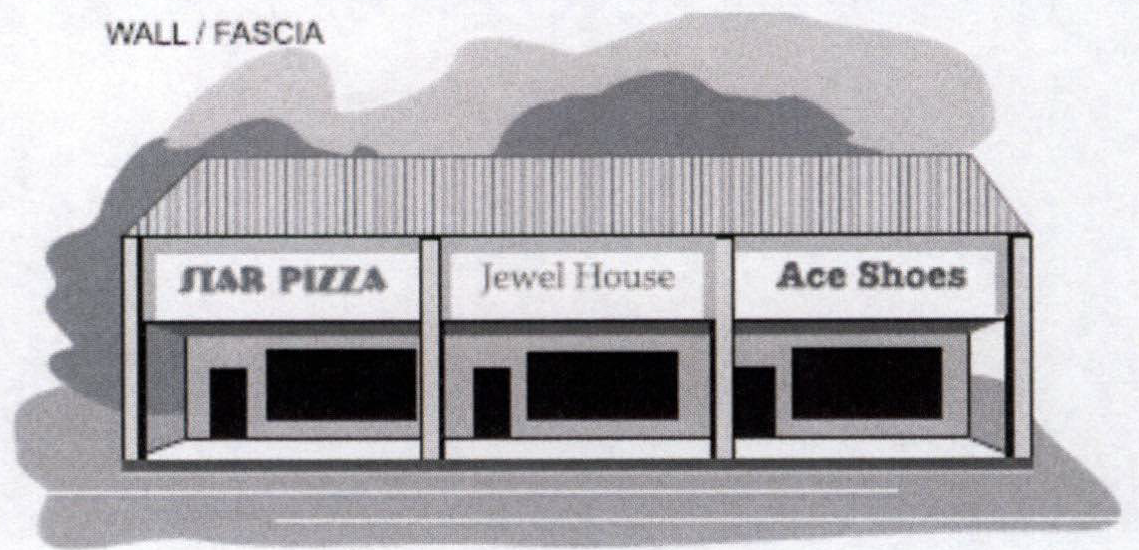
Veterinarian. An enterprise for the outpatient care and treatment of the diseases and injuries of animals. Boarding of animals is not permitted at a veterinarian. (Also see definition of "animal hospital.")
Vocational school. A facility offering regularly scheduled instruction in technical, commercial or trade skills.
Wall or fascia sign. A sign that is affixed in any manner to an exterior wall of a building or structure and that projects no further than 18 inches from the surface of the building or structure wall. Also includes signs painted on the wall or affixed to architectural projection that extends from a building provided the copy area of such signs remain parallel to the face of the building façade or to the face of the architectural projection to which it is affixed.
Warehouse. A facility used primarily for the bulk storage of goods and materials either for a private entity or the general public.
Wholesale. See definition for distributive business/wholesale.
Wind sign. Any sign, pennant, ribbon, spinner, streamer, flag, feather, captive balloon, or other objects or materials fastened in such a manner as to move upon being subjected to pressure by wind and/or acting to draw attention to a business, product, service or activity whether it contains a message or not.
Window. Any single window pane, or a series of adjacent window panes separated by a mullion(s) of 12 inches or less. Adjacent window panes set at different angles shall constitute separate windows regardless of the width of their mullion separation.
Window sign. A picture, symbol, or combination thereof designed to communicate information about a business, commodity, event, sale, or service that is placed inside or upon a window and is visible from the exterior of the window. Sunscreen applications to windows are not signs provided opacity is less than 50 percent.
Wrecker service. An establishment for the removal of a motor vehicle by towing, carrying, hauling or pushing from public or private property when such vehicle is inoperable or has been ordered to be impounded to a public or private impound lot. This shall not include an "automobile service" use that has a tow truck and service vehicles on-site.
Yard. The open space on the lot between the lot lines or street right-of-way and the building envelope for the main building, left open, unoccupied and unobstructed by buildings and/or structures from the ground to the sky, except as otherwise provided in this chapter. Yards shall be measured from the wall of the building and/or structure to the property line. The maximum allowable roof overhang within the yard setbacks shall be 30 inches. If a roof overhang exceeds 30 inches, the appropriate yard setback shall be measured from the property line to the facing of the overhang less the allowed 30 inches of overhang. See figures below for illustrations of one house with a 30-inch overhang and another house with a greater than 30-inch overhang.
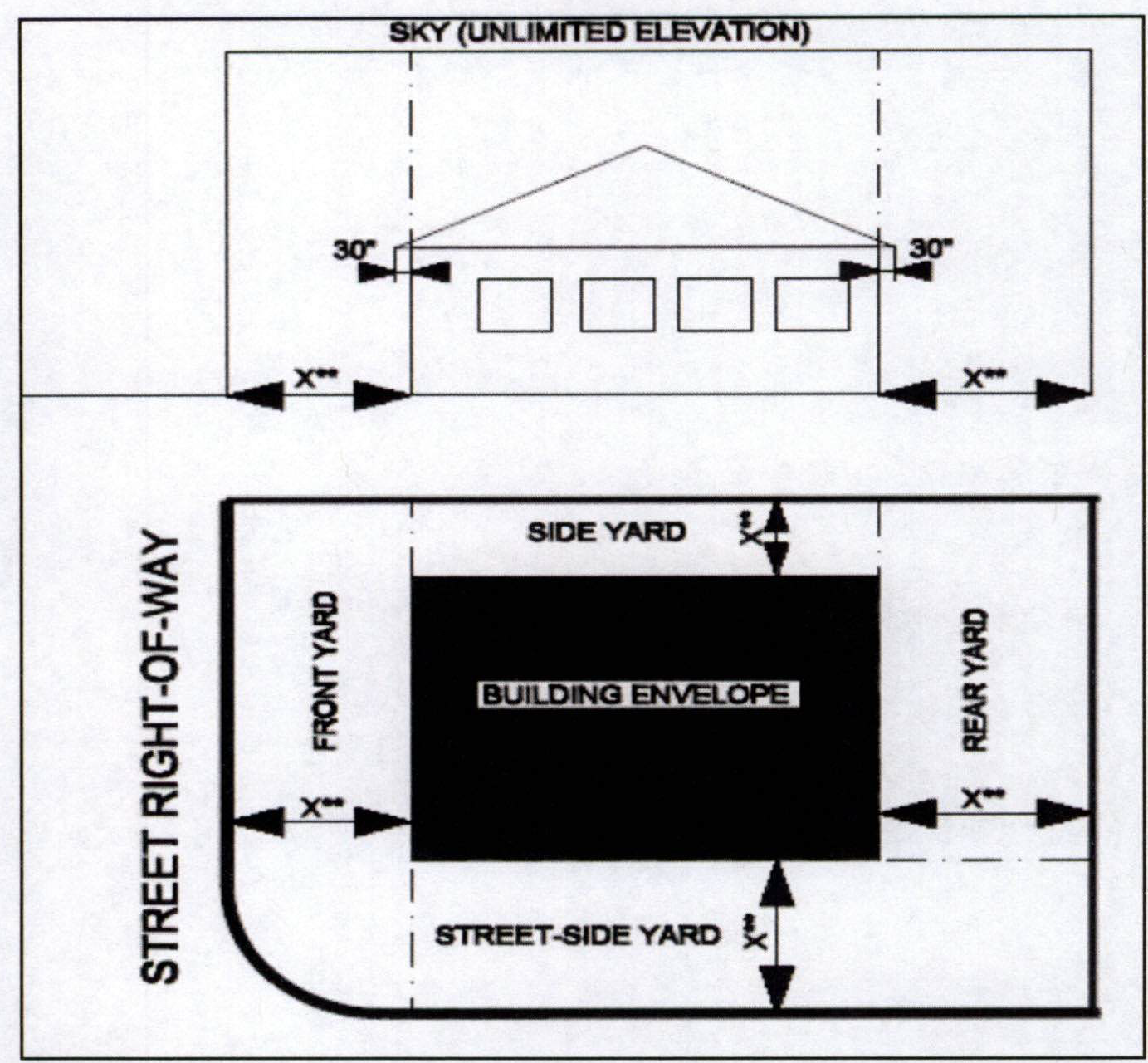
Yard, front. An open space extending across the entire width of the lot between the main buildings, including covered porches, and the front lot line, or if an official future street right-of-way line has been established, between the main building including covered porches and the right-of-way line. On corner lots, the narrower side shall be considered the regardless of the location of the main entrance of the dwelling. Where both frontages of the lot are equal, the front yard shall be considered the side on which the majority of the lots front the block. No storm shelter, even though it does not exceed 30 inches in height, shall be permitted in any front yard.
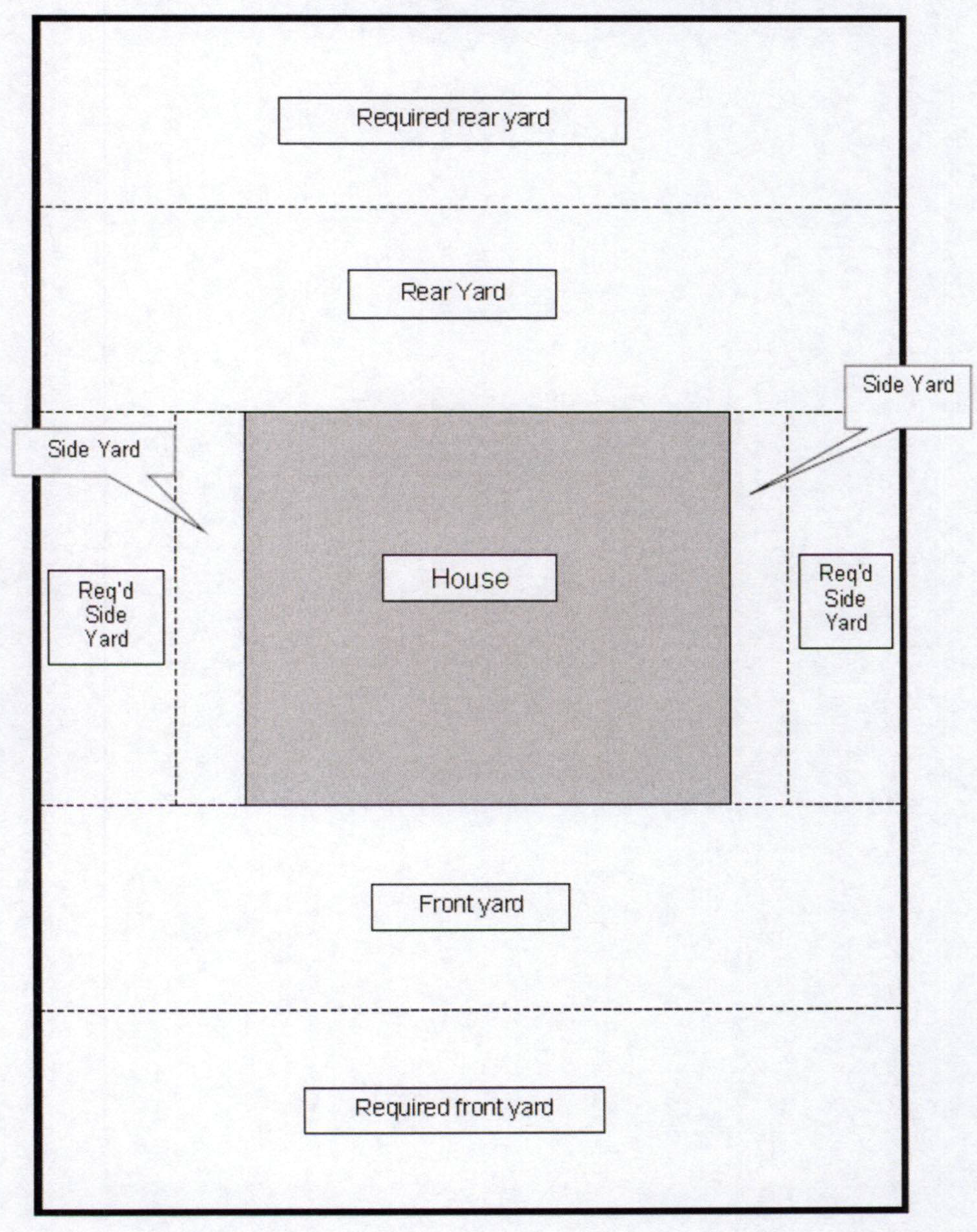
Yard, rear. An open space extending across the width of the lot behind the main building to the property line, excluding accessory buildings and/or structures.
Yard, side. An open space extending along the side lot line, front yard to the rear yard, between the main building, excluding accessory buildings and/or structures and such lot line.
Yard, street-side. A street side yard is an open space extending along the side lot line, front yard to the rear yard, between the main building and the street. This definition only applies to corner lots.
Yard, required. A yard is an open space, the depth of which is specified in the "district dimensional regulations" pertaining to the district in which such yard is required to be provided (See article VIII, section 114-132). The actual front, rear or side yard may exceed the required yard but may not be less than the required yard unless a variance is approved by the board of zoning adjustment.
(Ord. No. 2015-336, § 1, 12-1-15; Ord. No. 2018-115, § 1, 5-15-18; Ord. No. 2018-212, § 1, 8-21-18; Ord. No. 2021-18, § 1, 2-2-21; Ord. No. 2022-267, § 1, 10-4-22; 2024-111, § 1, 5-7-24)

