
Douglas City Zoning Code
ARTICLE 18
- LANDSCAPING, WALLS, SCREENING AND BUFFERING
Sec. 1801.- Purpose.
This article provides standards for landscaping, walls, screening devices and lighting so as to promote the general welfare of the community. This is accomplished by encouraging the creation of an attractive appearance as well as screening from view any and all uses which may be unattractive to public view. Landscaping materials, including ground covers, shrubs and trees not only improve appearance, but also facilitate control of erosion, reduction of dust and glare, and visually soften building masses. Additionally, walls and screening devices allow for separation and aid in buffering incompatible, unsuitable, and/or unharmonious activities. Used together, landscaping, walls, screening devices and lighting help insure privacy, aid in promoting logical land development and enhance property values. For purposes of this article, landscaping means the combination of elements such as trees, shrubs, ground covers, vines, and other organic and inorganic material for the express purpose of creating an attractive and pleasing environment. Water features, plazas, patios, decorative courtyards and lighting may also be considered landscape elements. Other paved surfaces are not included in the minimum requirements.
The City encourages the use of low water plant material in such a way that a lush appearance is presented. Plant material that is high in pollen production is discouraged. Plants should be placed in such a way as to maximize survivability (i.e., low water-use plants should not be placed in drainage ways, and the use of frost-tender plants should be limited to accent locations, not primary focal points). See Section 1806 for recommended plant list.
1801.1
General Regulations. All new buildings, all new uses of land, and additions of more than twenty- five (25) percent to existing buildings and uses in all districts shall comply with this article.
A.
Any proposed building or use shall be shown on the site plan indicating the location of existing and proposed buildings, parking areas, street improvements, locations and types of landscaped areas, walls and screening devices.
B.
Occupancy permits may be issued prior to the complete installation of all required landscaping if security equal to one hundred ten (110) percent of the cost of plant materials and labor, as verified by the Director of Public Works, is filed with the City assuring such installation within six (6) months after occupancy.
C.
Security may consist of one (1) of the following:
(1)
Posting of a performance bond by a qualified surety;
(2)
Establishing a cash trust, said fund to be deposited with the City to the credit of the property owner;
(3)
Depositing with the City a certificate of deposit issued by a banking institution authorized to issue same; or
(4)
Filing with the City an executed contract of guarantee between the City and a trust company, banking institution, or other financial institution authorized to enter into such contracts.
D.
If the installation of landscaping is not completed within six (6) months, the security may be used by the City to complete the installation. Upon completion of the installation, any portion of the remaining security deposited with the City shall be returned.
E.
The final landscape inspection shall be made prior to any security being returned. Any portions of the landscaping not installed, improperly installed, or not maintained shall cause the inspection to be postponed until the project is completed or cause the security to be used by the City.
1801.2
Landscaping Design. All portions of a development site not utilized for building development, service areas, paved or improved storage areas, parking driveways, etc., shall be landscaped. Minimum areas of landscaping are as follows.
1.
Lot Landscaping. Any part of the total lot area which faces a roadway that is not required for buildings, structure, loading and vehicular access ways, streets, parking and utility areas, pedestrian walks and hard surfaced activity areas shall be landscaped with grass, trees, shrubs and/or may include other inorganic materials such as aggregate. All landscape areas and material shall be maintained in a healthy, neat, clean, weed-free condition.
2.
Right-of-Way Landscaping. Landscaping shall be established along the street frontages in the area lying between the back of existing or future street curbs and property line.
3.
Tree Planting Standards. Trees shall be required along all collector streets in accordance with the following standards:
a.
Minimum Size. Street trees shall be a minimum of five-gallon size.
b.
Planting Detail. All street trees shall be planted and staked in accordance with the provisions of Figure 1 of this section, or as otherwise approved by the City.
c.
Required Plant Lists. Street trees to be planted may be chosen from the required list of trees in Section 1806. Approval for the planting of alternate species may be given by the City.
d.
Trees planted closer than thirty-three (33) feet from the curb line of any intersection of streets or alleys shall comply with Section 1802, Traffic Sight Line Requirements.
e.
No tree shall be planted closer than five (5) feet from any fire hydrant or utility pole.
f.
Trees shall not be planted closer than twenty (20) feet from any light standards.
g.
Where there are overhead power lines, tree species are to be chosen that will not interfere with those lines.
h.
Tree planting requirements shall also apply to private streets.
4.
Spacing. All street frontage tree spacing shall be made subject to the provisions of this section, and the limitations imposed by Section 1802, Traffic Sight Line Requirements.
a.
Small or narrow stature trees (under twenty-five (25) feet in height, less than sixteen (16) feet wide at maturity) shall be spaced at an interval of approximately twenty (20) feet to thirty-five (35) feet apart.
b.
Medium sized trees (twenty-five (25) to forty (40) feet tall, sixteen (16) to thirty-five (35) feet wide at maturity) may be spaced at an interval of approximately thirty (30) feet to forty-five (45) feet apart.
c.
Large trees (over forty (40) feet in height and more than thirty-five (35) feet wide at maturity) may be spaced at an interval of approximately forty (40) feet or greater.
5.
Maintenance Standards. Trees, as they mature, shall be gradually pruned to provide at least seven (7) feet of clearance above sidewalks and twelve (12) feet above street roadway surfaces, and follow Section 1804, Maintenance Standards.
6.
Shrubs. All shrubs shall be a minimum of one (1) gallon size.
7.
Common area. All common area landscaping and amenities shall be installed prior to issuance of any occupancy permits in all zoning districts.
8.
Irrigation. Provision shall be made for metered water service to all landscaped areas requiring water. Drip, or other low water use irrigation systems, shall be utilized. Any person installing an irrigation system within the right-of-way shall be responsible for the water and maintenance of the system.
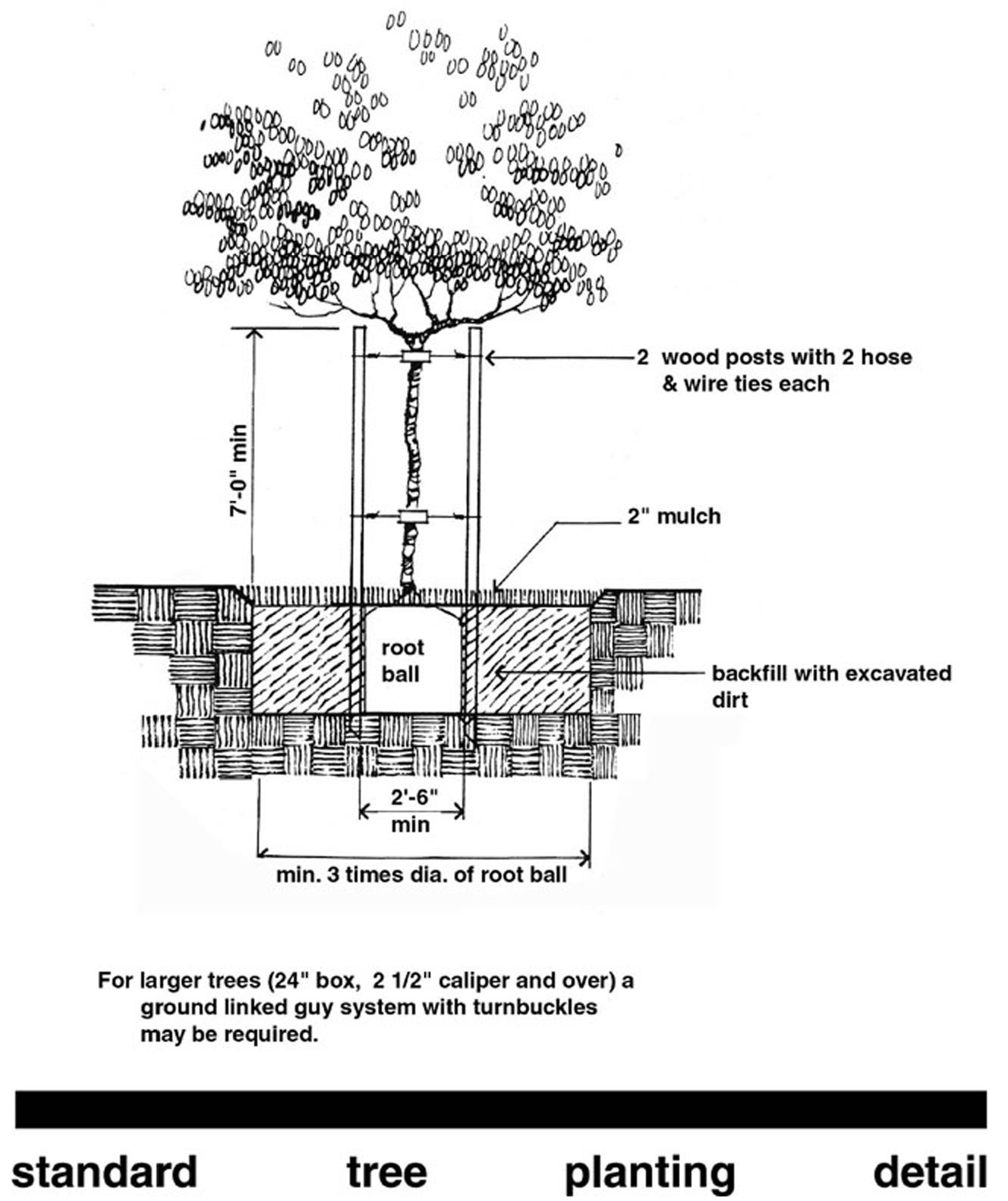
Figure 1: Standard Tree Planting Detail
1801.3
Landscaping Design: Single-Family Residential Building Site. All new single-family residential dwellings shall have landscaping in the front yard completed before a certificate of occupancy is issued. All single-family residential building sites shall have at a minimum one (1) tree and four (4) shrubs for every building site.
1801.4
Landscaping Design: Multi-Family, Commercial, Office, and Industrial Areas. In addition to Section 1801.2, the following additional items shall be required for multifamily, office professional, commercial and industrial areas. Each site to be developed shall be required to provide landscape areas equal to or exceeding the following minimum amounts:
1.
There shall be a required minimum fifteen (15) percent of the lot area to be landscaped with a variety of plant types and sizes and other features.
2.
Required street trees, landscaping and curbed planters in parking lot interiors can be counted as part of the fifteen (15) percent landscaped area.
3.
All landscaping shall consist of low water use, drought tolerant plants. Plants shall be chosen from the list in Section 1806 that will satisfy the drought tolerant requirement. Alternative plant species will be considered during the site plan review process and may be utilized if approved by the City.
4.
Landscaping requirements pursuant to Section 1803, Streetscape, Walls, Screening and Buffering shall be followed.
In lieu of these standards, and at his option, the property owner may prepare a detailed plan and specifications for landscaping and other features. Such plan and specifications shall be submitted to the City for review and approval.
1801.5
Water Retention Areas. All on-site water retention areas, other than paved surfaces, shall be entirely landscaped and shall maintain slopes no steeper than 4:1.
Sec. 1802. - Traffic sight line requirements.
1802.1
General Provisions. The intent of this section is to provide a clear view of operators of vehicles on the streets of pedestrians and vehicles on the adjacent sidewalk or street or roadway right-of-way or traffic proceeding on the crossing street or streets.
The sight triangle area is the triangular area formed by the face of curb lines and a line connecting them at points thirty-three (33) feet from the intersection of lines, extended from the curb or edge of pavement. See Figure 2.
1802.2
Fences, Walls and Buildings.
1.
No fence, walls, buildings or other obstruction shall be built, repaired, remodeled or replaced to a height of more than thirty-six (36) inches height (measured from top of existing or future street curb) shall be placed within the sight triangle area. See Figures 2 and 3.
2.
No fence shall be built, repaired, remodeled or replaced to a height of more than thirty-six (36) inches (measured from top of existing or future sidewalk) within ten (10) feet of either side of any driveway.
1802.3
Height of Hedges, Shrubs, and Other Plants. All hedges, shrubs or other plants, except trees, shall be cut and trimmed to no more than thirty-six (36) inches in height (measured from top of existing or future street curb) within the sight triangle area. See Figures 2 and 3.
1802.4
Trees at Intersections. All trees shall be trimmed and kept trimmed so that there shall be no limbs, leaves, needles or other foliage above thirty-six (36) inches or below eighty-four (84) inches (measured from top of existing or future street curb) within the sight triangle area. See Figure 2 and 3.
1802.5
Removal of Violations.
1.
If the City discovers any violation of Section 1802, the City may:
a.
Notify the owner of the property, by certified mail, that he/she has seven (7) days from receipt of said notice to remove the violation or take reasonable action to bring the violation into full compliance; or
b.
Notify the property owner, by posting such notice on the front door of the residence or by personal delivery to the owner, that he/she has twenty-four (24) hours to remove or remedy such violation; or
c.
Immediately remove such interference or encroachment, if the violation is an imminent safety hazard.
2.
In the event a property owner fails to remove or remedy a violation of this article within the time provided in the notice to the property owner, the City is authorized to take any action necessary, including entering the property, to effect full compliance with the provisions of the article. The property owner shall be liable to the City for the actual cost, plus overhead, to remove or abate a violation of this article. If the amount is not paid within thirty (30) days from the date of billing, the amount may become a lien against the property.
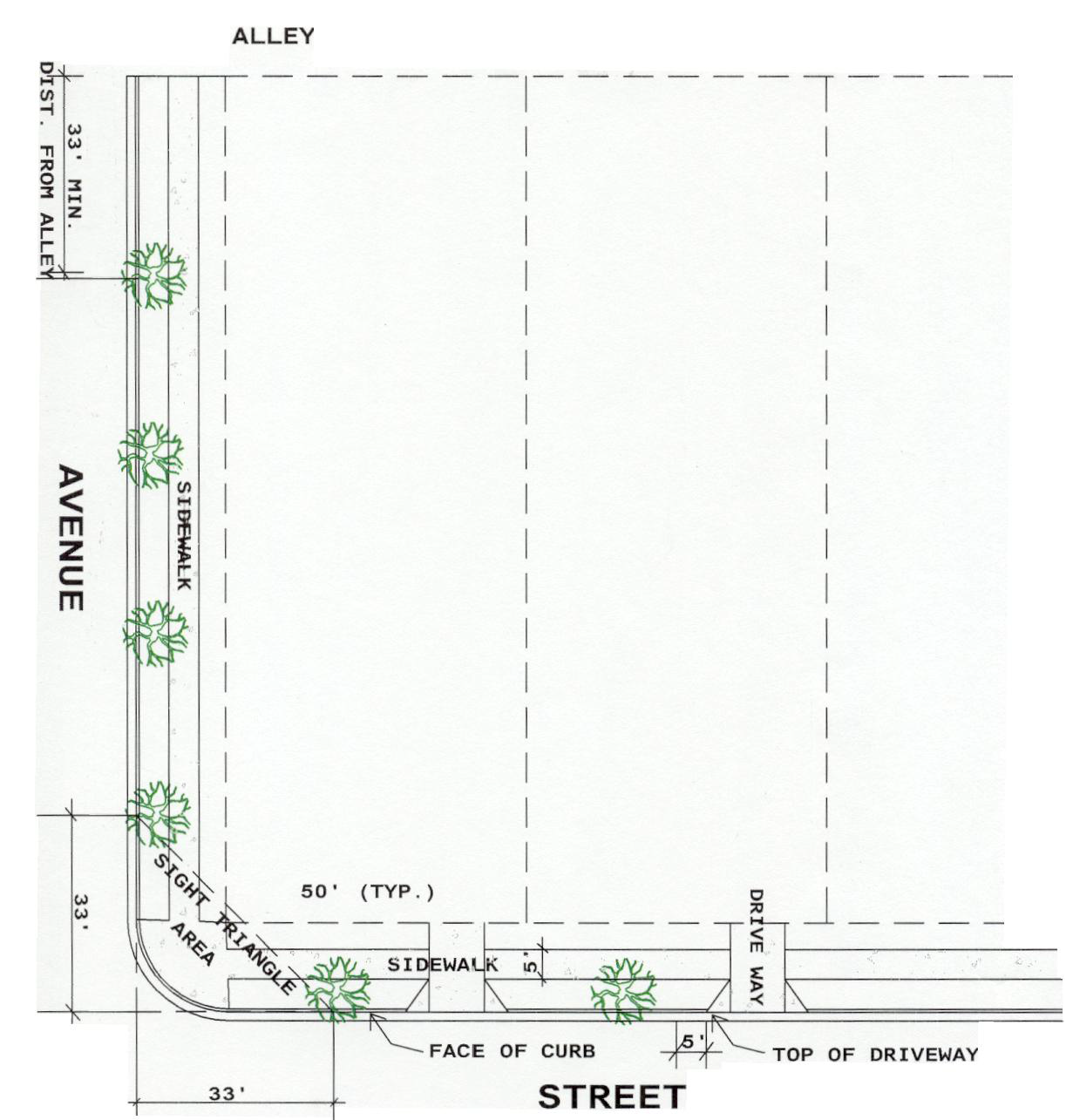
Figure 2: Sight Triangle Area
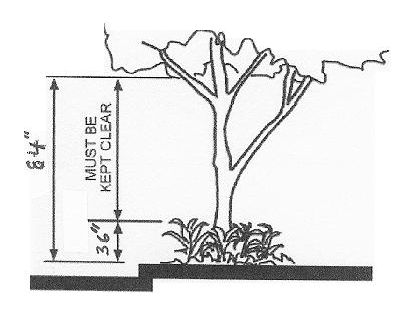
Figure 3: Vision Obstructions at Intersection
Sec. 1803. - Streetscape, walls, screening and buffering.
1803.1
General Provisions. To reduce the impacts on adjacent uses a streetscape buffer consisting of landscape planting, walls, and/or berm screening shall be provided. The property owner is responsible for the establishment and maintenance of screening in accordance with the requirements of this section unless the abutting use has already provided said buffering in compliance with the standards of this Section.
1803.2
Approval Prior to Installation. Prior to installation of any fences, walls, or any other screening or buffering, written approval is required by the City.
1803.3
Development Standards for Multifamily, Commercial, Office, or Industrial Uses. The following are screening and buffering requirements that shall be followed:
1.
Tree requirements.
A.
A minimum size of five-gallon trees spaced as described in Section 1801.2 shall be planted along any property line of parcels developed for multifamily, commercial, office, or industrial uses which are adjacent to a single family residential or multifamily residential development. Minimum width of landscape buffer shall be six (6) feet. See Figure 4.
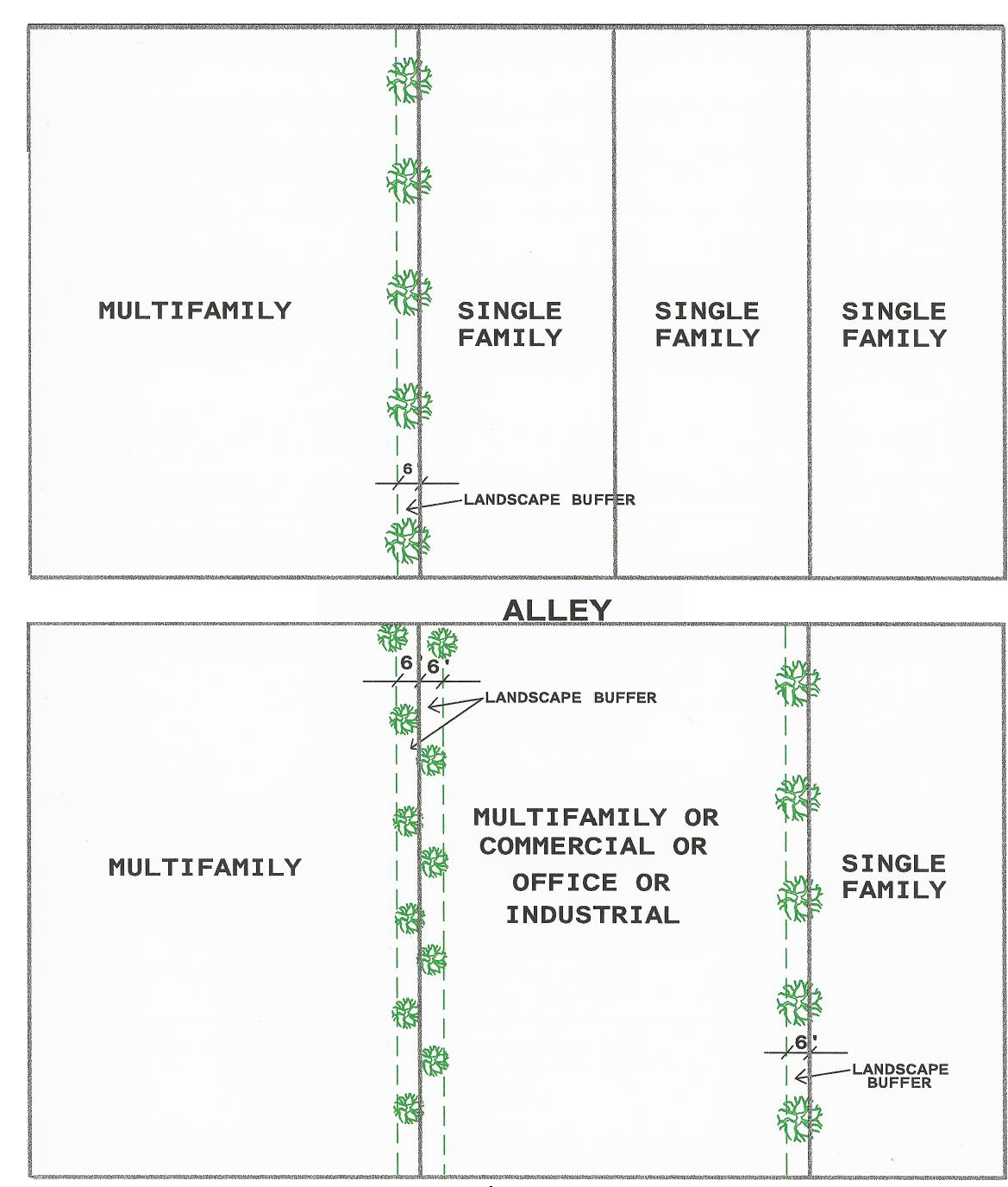
Figure 4: Buffering Between Mixed Uses
B.
Where a commercial, office or industrial user of over fifty thousand (50,000) square feet building area is located adjacent to a single-family residence, multifamily residential development, the landscape buffer described in subsection (A) above shall include two (2) rows of trees. Fifty (50) percent of the trees shall be fifteen (15) gallon minimum trees and all the trees shall be staggered for maximum effect in buffering the different uses. Minimum width of landscape buffer shall be twelve (12) feet. See Figure 5.
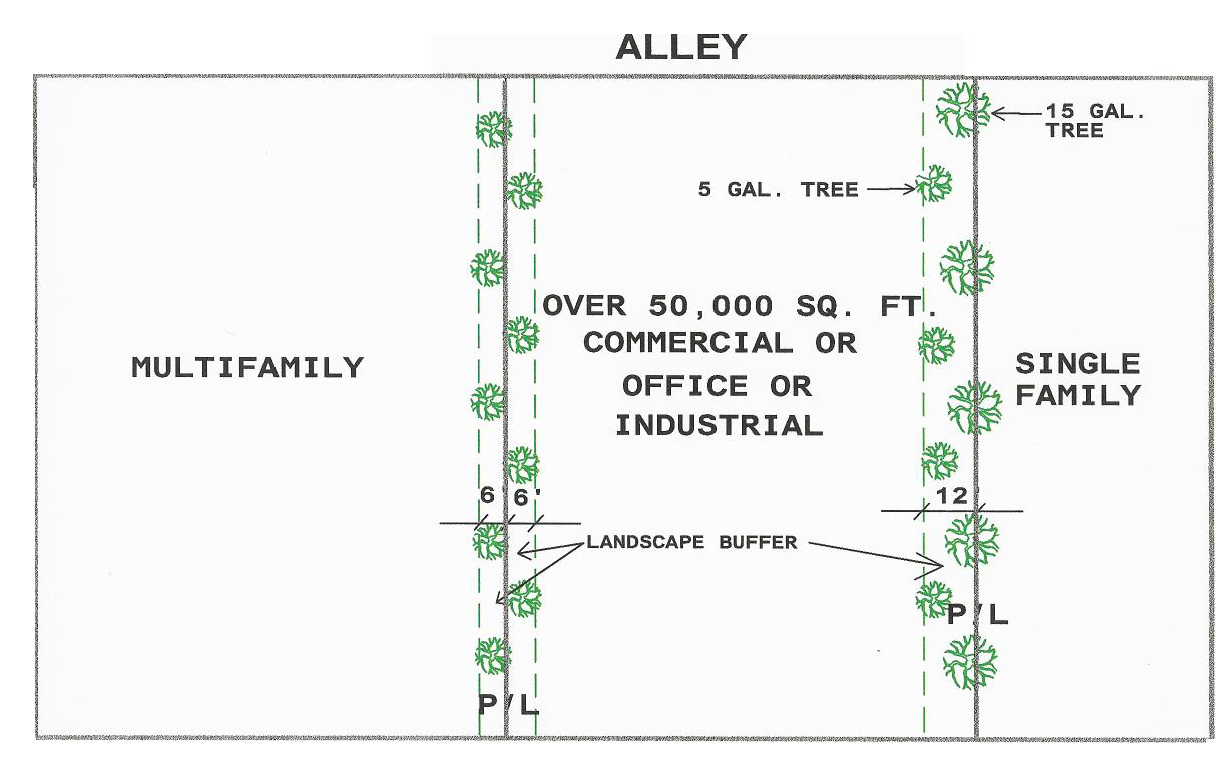
Figure 5: Landscaping Between Mixed Uses
C.
Brick, slump block, masonry wall requirements. Brick, slump block, masonry wall, or other compatible alternatives approved by the City shall be constructed along any property line of parcels developed for multifamily, commercial, office, or industrial uses which is adjacent to a single family residential or multifamily residential development.
D.
Outdoor Storage Areas. All outdoor storage areas properly zoned for bulk storage of materials, surplus, salvage, boats, recreational vehicles, vehicles, semi-trailers, buses, bulk storage of raw materials, equipment, trash or other similar items shall be one hundred percent (100%) screened from view by a masonry or concrete wall, or other materials which totally screen from view, and which meet the approval of the City. The wall shall be a minimum of six (6) feet in height but not to exceed ten (10) feet in height, measured from the highest adjacent grade within twenty (20) feet or street curb, whichever is higher. Storage areas abutting public thoroughfares, city parks, and schools shall provide additional screening if storage items exceed ten (10) feet in height in order to totally screen from view.
Decorative screening, approved by the City, shall be used at locations abutting public thoroughfares, city parks, and schools.
All refuse areas shall be screened from view by a minimum of a six-foot high masonry wall.
1803.4
Mobile Homes.
A.
There shall be a fifteen-foot streetscape buffer consisting of landscape planting, and/or berm screening provided along the perimeter boundaries of all mobile home subdivisions and mobile home/trailer parks; and
B.
There shall be a wall with a minimum height of six (6) feet, measured from the highest adjacent grade within twenty (20) feet. The wall shall be of masonry or concrete construction and color to be compatible with other buildings in the vicinity. The area between the wall and the public street shall be landscaped including trees. The landscaping shall be maintained by the mobile home or trailer park owner.
1803.5
Utility Boxes and Installations.
A.
Along streets that border residential subdivisions, all utility boxes and above-ground utility installations, other than utility poles, that are in excess of twenty-seven (27) cubic feet in size and that are to be placed back of sidewalk shall be installed with landscaping on three (3) sides. The landscaping at maturity shall provide adequate screening of the utility structures.
B.
Along streets that border nonresidential development, all utility boxes and above-ground utility installations, other than utility poles, that are in excess of twenty-seven (27) cubic feet in size shall be set back a sufficient distance so that a minimum of three (3) feet of landscaping separates the utility structure from the public street right-of-way or sidewalk, whichever is nearer the structures. The landscaping at maturity shall provide adequate screening of the utility structures. In addition, all utility boxes shall be placed so that the access doors open parallel to the street corridor and are accessible without the need to cut down or reduce the effectiveness of the landscaped screening.
Sec. 1804. - Maintenance standards.
1804.1
General Requirements. The landscape areas, irrigation systems, walls, screening devices, curbing, lighting and other equipment required in the zoning regulations on-site as well as in the right-of-way shall be maintained by the owner, owner's association, or the lessee of the site in accordance with the approved site or landscape plan.
1804.2
Minor Modifications. Minor modifications of the landscaping occurring as a result of routine maintenance, necessary replacement of elements because of damage or disease, or other causes are not subject to review by the City as long as the intent of the approved site or landscaping plan is met.
1804.3
Substantial Modifications. Any substantial alteration or deterioration of those areas shall be considered a violation of this and any applicable ordinances. Substantial modifications, as determined by the City, and/or removal of existing landscaping, lighting, walls, screening devices or other equipment required in this section shall require review and prior approval of a revised landscape plan by the City.
1804.4
Landscaping Appearance. Landscaped areas shall be reasonably maintained by the owner and/or the lessee of the property as to pruning, trimming, watering, mulching, weeding, litter removal, aerating, dethatching turf areas, and/or other requirements to create an attractive and safe appearance for the development. Clipping and pruning of the plant material are required to prevent obstructive overhang into walks, curb areas, drives, and line of sight triangles. Also, any areas designated and intended for the purposes of on-site water retention shall be maintained and reserved for that specific purpose.
1804.5
Landscape Interference. It is unlawful for any owner or occupier of property to permit any tree, shrub, hedge or other plant located on the property, or installed on the property, to interfere with the function of any traffic sign, signal or lighting, or the flow of drainage water on any street, roadway, easement or other public right-of-way, or the passage of traffic, pedestrian or vehicular, on any street, sidewalk, roadway or other public right-of-way.
1804.6
Irrigation Systems. Regular landscape maintenance should ensure water efficiency. Irrigation systems will be maintained and replaced as necessary to continue to conserve water. Detection and repair of leaky or broken pipes, valves, and fittings and malfunctioning and/or misaligned heads, emitters, and bubblers will be part of a regular maintenance program for the site. Automatic Irrigation Controllers are recommended to be reset a minimum of four (4) times a year (spring, summer, fall, and winter) to adjust for plant water requirements which vary according to the season.
1804.7
Replacement of Materials. The removal or destruction of landscape material, lighting or other material or equipment required in this section previously approved by the City, as part of the lighting plan, landscape plan, shall constitute a violation of the zoning regulations. Dead vegetation shall be promptly replaced, based on standard seasonal planting practices with healthy, living plants in all required landscaping areas. Replacement of landscape material shall be of like size as that which was removed or destroyed. Bare soil is not permitted.
1804.8
Violation Notification. When notified of a violation the owner, owner's association, or the lessee of the site shall bring into compliance within thirty (30) days said violation in accordance with the approved site or landscape plan. This will include any landscape areas, irrigation systems, walls, screening devices, curbing, lighting, material, and other equipment required in the zoning regulations that does not survive, function properly or is in need of repair.
Sec. 1805. - Native plant salvage.
1805.1
General requirements. The Arizona Native Plant Law, A.R.S. 3-901 et seq., states that the developer or contractor shall not deface, injure or destroy certain trees, shrubs or cacti. The developer or contractor must give the Arizona Department of Agriculture notice prior of any clearing or grading operations of any residential subdivision, multi-family residential, commercial or industrial development one (1) acre or larger in size. The developer or contractor must provide a copy of the notice submitted to the State in compliance with the Arizona Native Plant Law to the Public Works Director. Arizona native protected plants, as defined by the statutes, shall not be disturbed without notifying the Arizona Department of Agriculture pursuant to state law requirements.
Sec. 1806. - Low water use and drought tolerant plant list.
1806.1
Drought Tolerant Plant List. These are some of the native and adapted plants which do well at the elevations in Cochise County (three thousand five hundred (3,500) to four thousand five hundred (4,500) feet) and are hardy to at least 15°F. Remember that these plants need regular irrigation while they are being established. After establishment they can be grown with moderate to no supplemental irrigation. Ask about a plant's mature size and characteristics to better plan for its location and spacing relative to buildings, power lines and other plants. In general, native species adapt better to our desert environment, provide valuable wildlife habitat, and are less susceptible to diseases than non-native species. Members of the cacti family are not mentioned as they are well known low water plants, and fire resistant.
Sec. 1807. - Definitions.
For the purpose of this article:
1.
Conceptual landscape plan means the same as a landscape plan as defined herein except that shrubs, ground cover and vines may be indicated by size, quantity, name and general locations on the site.
2.
Collector street means a street designed to carry moderate to large volumes of traffic (generally a minimum ADT of 5,000 vehicles), primarily from local streets to arterials. Collectors may provide some direct access to individual properties, usually large residential developments and mid-size commercial/industrial/office developments. The length of a major collection seldom exceeds one (1) mile.
3.
Irrigation plan means a plan drawn on twenty-four (24) inch by thirty-six (36) inch format, prepared to scale, showing the layout and details of an irrigation system, including the type and location of all materials used.
4.
Irrigation system means the combination of elements such as automatic controllers, meters, pressure vacuum breakers, pipes, valves, emitters, bubblers, spray heads, tubing and other materials designed for the purpose of transporting water to landscaping.
5.
Landscaping means the combination of elements such as trees, shrubs, ground covers, vines, and other organic and inorganic material for the express purpose of creating an attractive and pleasing environment. Water features, plazas, patios, decorative courtyards and lighting may also be considered landscape elements. Other paved surfaces are not included in the minimum requirements.
6.
Landscape plan means a plan drawn on twenty-four (24) inch by thirty-six (36) inch format, prepared to scale, showing elements such as trees, shrubs, ground covers, vines, sculpture, walls, lighting, water features, walkways and other organic and inorganic materials. The plan shall include a plant list, indicating the size, quantity location and name, both botanical and common, of all plant material to be used.
7.
Lighting plan means a plan drawn on twenty-four (24) inch by thirty-six (36) inch format, prepared to scale, showing the layout and details of lighting and photometrics, including the type and location of all materials used.
8.
Maintenance means the repair, painting, trimming, pruning, watering and other on-going activities that are associated with providing an attractive site appearance.
9.
Model homes means single-family residential homes built and used by developers for the purpose of initially showing to prospective buyers of the same or similar type homes for sale not used for residential purposes.
10.
On-site lighting means any illumination source or illumination device, except lighting used for signs, that is located on a lot and is visible from outside the building(s) on the lot.
11.
Screening device means any structure intended to fully conceal an activity or mechanical element from view, adjacent uses, properties or streets.
12.
Site plan means a plan drawn on twenty-four (24) inch by thirty-six (36) inch format, prepared to scale, showing all the uses proposed for a specific property. The plan shall show all dimensions, buildings, structures, sign locations, off-street parking, loading spaces, points of ingress and egress, all walls, refuse containers, walkways, all ultimate rights-of-way (measured to the center lines of streets, and alleys), a location map, complete site data and any additional information which may be necessary to clearly define the intended use and property lines.

