
Douglas City Zoning Code
ARTICLE 5
- SCHEDULE OF DISTRICT REGULATIONS ADOPTED
Sec. 501.- SFR - Single-Family Residence.
This zoning district is comprised of single-family residential areas and certain areas where such development is desirable. Regulations are designated to stabilize and protect the single-family character of the district, to promote and encourage creation of a desirable environment for family life, and to prohibit all incompatible activities. Principal uses are single-family dwellings on individual lots.
501.1
Approvals required. No structure or building shall be built or remodeled upon land in a Single-Family Residence (SFR) district until all required subdivision or site plan approvals have been obtained.
501.2
Location. The following criteria shall be considered in establishing and maintaining a SFR district:
(a)
Conforms to appropriate designation in the General Plan.
(b)
Corresponds to an existing district or development in an area annexed into the City.
501.3
Divisions of SFR district. The SFR district shall be further divided into the following density districts, as hereinafter described and regulated and to be so designated on the Official Zoning Districts Map: SFR32; SFR16; SFR12; SFR8; SFR6.
501.4
Permitted principal uses. One (1) single-family residence per lot as defined in subsection 501.8.
501.5
Permitted conditional uses. See Section 310. Permitted: Subsections 310(C)(4), (5), (6), (7), (8), (9), (10), (14), and Subsections of 310(D).
501.6
Permitted accessory uses.
A.
Any use customarily incidental to a permitted principal use, such as:
1.
Private or carport for storage of vehicle;
2.
Garden house, toolhouse, ramada, swimming pool.
B.
Permitting the placement of carports open on at least two sides to encroach fully into any side yard, as long as sight triangle is maintained.
C.
Accessory dwelling units: See Section 310.
D.
Home occupations: See Section 324.
E.
Where the keeping of horses and other livestock is lawful, structures customarily accessory to such use.
F.
Recreational vehicles may be parked and/or stored in all residential zones provided that RV does not extend into the public right-of-way, does not create a sight distance problem at corner lots, and is not used as residence.
501.7
Property development standards.
*Except nonresidential uses, see 501.9 below.
The following provisions shall be added to the SFR6 and SFR8 portions of subsection 501.7 and other applicable sections of the City of Douglas Zoning Regulations:
A.
Permitting the placement of open front porches to encroach six (6) feet into any required front yard, and carport extension (lawfully erected within a side yard) to encroach six (6) feet into any required front yard, subject to the following conditions:
1.
The porch or carport extension may never be enclosed by the owner of the property or by subsequent owners.
2.
The porch or carport extension may never be utilized as balconies or for the creation of a two-story addition.
3.
The porch or carport extension must be aesthetically designed to match the architecture of the principal structure (i.e. peaked roof on a house with a peaked roof, flat with flat) and materials used in the principal structure (or other methods and materials as approved by the Public Works Director, Building Inspector or Planner. Appeals to the decision may be made to the Design Review Board). When possible, fascias should connect and blend as close as possible with the fascia of the principal structure.
4.
The porch or carport extension support columns or posts must also be aesthetically designed to match the architecture and materials of the principal structure or match existing columns or posts.
5.
The porch or carport extension may not exceed an average of nine (9) feet in height if the roof structure has a pitch of two (2) inches in twelve (12) inches or less, or exceed an average of thirteen (13) feet in height when the roof structure has a roof pitch greater than two (2) inches in twelve (12) inches.
6.
Any future exterior remodeling of the principal structure must include plans for the carport or porch in order to maintain aesthetic continuity between the two structures.
7.
The permit applicant must submit a notarized statement (provided by the City of Douglas) listing the conditions stated above; acknowledging that the owner understands that the carport or porch is subject to these conditions. Prior to permit issuance, this statement must be recorded in perpetuity on the deed of the property at the Cochise County Recorder's Office in Bisbee, Arizona. This is done in order to ensure that potential buyers or subsequent owners are informed of the limitations upon the structure. The recorded document must be maintained in the property file at the Planning and Zoning Office for the City of Douglas.
8.
Permitting the placement of carports open on at least two sides to encroach fully into any side yard, as long as sight triangle is maintained.
501.8
Corner lot, corner lot abutting key lot. On any corner lot that abuts a key lot or is separated there from by an alley, any structures exceeding three (3) feet in height shall be set back from the side lot line not less than the minimum front setback required for the key lot, except for carports open on at least two sides. Normal side setbacks apply.
501.9
Nonresidential accessory buildings. A nonresidential structure, not including a detached garage, which is necessary to a dwelling may be erected on a parcel if it meets the following requirements:
A.
Maximum height. Fifteen (15) feet above grade.
B.
Location restrictions. No accessory building shall be erected in any minimum required front or side yard, except as otherwise provided in this code.
C.
Setback requirements. Accessory buildings shall be setback from the side and the rear lot line a distance not less than three (3) feet, except:
1.
For a lot having its rear lot line contiguous with an alley line, no rear setback shall be required for the accessory building(s).
2.
For a corner lot abutting a key lot and not separate therefrom by an alley, any accessory building shall be set back from the width of the least required side yard applicable to the main building.
3.
For a corner lot, the street side setback shall be the same as for the main buildings.
4.
No stable, corral, barn, animal shed or shelter shall be erected or maintained closer than seventy-five (75) feet to any property line.
501.10
Off-street parking and loading. In accordance with the provisions of Article 6.
501.11
Sign regulations. In accordance with the provisions of Article 7.
501.12
Landscaping screening and buffering. Landscaping, screening, and buffering shall be provided as deemed adequate by the Planning and Zoning Commission, or the Board of Adjustment, and the Building Inspector. All landscaping shall meet the specifications set forth in any subsequent ordinance specifically addressing the issue of landscaping.
(Ord. 14-1033, § 2, 2014; Ord. 20-1120, §, 10-14-2020; Ord. No. 23-1166, § 2, 7-12-2023; Ord. No. 24-1196, § 1(Exh. A), 9-11-2024)
Sec. 502. - MFR - Multifamily residence.
502.1
Purpose. This district is comprised of medium-density residential areas representing a compatible mixture of single-family, two-family, multifamily, and attached single-family own house dwelling units. Regulations are designed to stabilize and protect the character of the district, to promote and encourage creation of a favorable environment for family-life, and to prohibit all incompatible activities. Principal uses are limited to single-family and two-family dwellings, apartments, and townhomes, which conform to the residential character of the district.
502.2
Approvals required. No structure or building shall be built or remodeled upon land in MFR district until all necessary site plan and/or subdivision plat approvals have been obtained.
502.3
Location. The following criteria shall be considered in establishing and maintaining a MFR district:
A.
Conforms to appropriate designation in the general plan.
B.
Corresponds to an existing district or development in an area annexed into the City.
502.4
Permitted principal uses.
A.
One (1) single-family residence per lot.
B.
Two-family dwellings or two (2) attached single-family dwellings on a single lot.
C.
Dwellings for three (3) or more families in one (1) building or in a group of buildings, including apartments, row house and town houses.
502.5
Permitted conditional uses. See Section 310, items 310(C)(4), (5), (6), (7), (8), (9), (10), (14) and Subsections of 310(D).
502.6
Permitted accessory uses.
A.
Any use customarily incidental to a permitted principal use, such as:
1.
Private garage or carport for storage of vehicles;
2.
Garden house, tool house, ramada, swimming pool.
B.
Accessory dwelling units, see Section 310.
C.
Home occupations per Section 324.
D
Recreation and health facilities which are designed and clearly intended for the use of the residents of the project.
E.
Recreational vehicles may be parked and/or stored in all residential zones provided the vehicles are not situated in required yard setbacks and are fully screened from adjoining lots and streets.
502.7
Property development standards. Special Requirements: Any multiple family project which exceeds twenty-five (25) dwelling units per acre may be processed as a planned area development under the provisions of Article 9.
A.
Area and yards.
1.
Single-family house. This dwelling type consists of a single-family residence located on a privately-owned lot, which has private yards on all four (4) sides of the house. The following table specifies the minimum standards for single-family homes:
2.
Lot-line house. This dwelling type consists of a single-family, fully detached residence located on an individual lot which is set on the lot line. Doors or windows are prohibited in that wall of the house on the lot line. Either five-foot maintenance easement shall be provided for the neighboring property, or the lot line house may be set back five (5) feet from the line and recreation, planting, and use easement may be granted to the adjacent lot owner if the adjacent house is located on the lot line. In addition, the following table specifies the minimum standards for a lot line house.
* This standard applies when units are located on the lot line.
**This standard applies when units are set back from the lot line and the easement described above is provided.
3.
Duplex. This dwelling type consists of a semi-detached dwelling for a single-family. It has only one (1) dwelling unit from ground to roof and only one (1) wall in common with another dwelling unit. The following table specifies the minimum standards for a duplex:
4.
Multiplex. This dwelling type may be either a single-family attached dwelling or a multiple-family unit. Each unit may take direct access point, or units may share yards and access. The units may be arranged in a variety of configurations, including back-to-back, side to side, or vertically; however, not more than six (6) units shall be attached in any single building.
5.
Apartment building. Apartment buildings are buildings comprising multiple dwellings units, which share common access to individual units and yards. The yard required shall be the sum of the areas required for each unit within the structure. Apartment shall contain three (3) or more units in a single structure. The following table specifies the minimum for apartment buildings:
(6)
Attached single-family townhouse. This dwelling type consists of an attached single-family townhouse unit for a single family. It has only one (1) dwelling unit from ground to roof with individual outside access. Each dwelling unit is separated from each abutting dwelling unit by a party or lot line wall. The following table specifies the minimum standards for a townhouse.
* 8-foot setback may not impede the sight distance triangle for the adjacent intersection.
Additional placement regulations for attached single-family townhouse dwelling units:
(a)
Outside balconies on second floor. Minimum required yards and minimum required distances between buildings on the same lot shall be measured to the exterior line of all outside balconies on second floor.
(b)
All townhouse dwelling units will provide screening of an unpierced masonry wall not less or more than six (6) feet in height in each rear yard.
(c)
Approved front yard landscape will be required for each townhouse dwelling unit consisting of at least one (1) tree and two (2) shrubs and proper ground coverage over a minimum of 30% of the area within the front yard setback.
(d)
If an enclosed garage or carport is used to meet the off-street parking requirement, the enclosed garage or carport cannot be converted into living space.
B.
Minimum distance between buildings on the same lot. The minimum distance between the opposing exterior walls of detached buildings or part of attached or semi-detached buildings, on the same lot, shall be:
1.
If both walls are front walls or contain doors or living room windows: Forty (40) feet.
2.
If one wall is a front wall, or contains doors or living room windows and one wall is a side or rear wall containing no doors or windows: Twenty-four (24) feet.
3.
If either wall is a side or rear wall containing windows or doors: Twenty-four (24) feet.
4.
In one wall is a side or rear wall containing windows or doors and one wall contains no windows or doors: Eighteen (18) feet.
5.
If neither wall contains windows or doors: Ten (10) feet.
C.
Additional placement regulations for multifamily dwellings.
1.
Two or more story buildings shall be set back not less than forty (40) feet from the boundary line of any adjoining single-family residential district.
2.
If the front of a building, or part thereof, faces on an interior side or rear lot line, the building, or that part thereof, shall be set back from such lot line not less than twenty (20) feet.
3.
Separation of semi-detached dwellings or rowhouses. When, for purposes of sale or separate ownership, a two-family or multifamily residence and the land in and upon which such dwellings are situated, is to be subdivided into separate lots having one dwelling unit per lot, such lots shall be exempt for all interior side yard requirements; provided, however, that such dwelling unit shall be separated from each abutting dwelling unit by a party or lot line wall extending the full height of the buildings through opening.
4.
Irregularly shaped lots. On irregularly shaped lots, the building setback from all lot lines shall comply at every point with the minimum yard requirement, whichever is applicable.
5.
Outside halls or balconies on second and third floors. Minimum required yards and minimum required distances between buildings on the same lot shall be measured to the exterior line of all outside hall or balconies on second or higher floors of buildings.
D.
Buildings—Courts.
1.
The depth of a court formed by walls on three (3) sides shall not exceed one and one-half (1½) times the width.
2.
When a court is partially enclosed by projections, the sum of the projections shall not exceed twenty-five (25) percent of the greatest required distance between buildings as set forth in Section 502.7.A.6.
502.8
Nonresidential accessory buildings. A nonresidential structure, not including a detached garage, which is necessary to a dwelling, may be erected on a parcel if it meets the following requirements:
A.
Maximum height. Fifteen (15) feet above grade.
B.
Maximum yard coverage. Thirty-five (35) percent of the required rear and side yards.
C.
Location restrictions. No accessory buildings shall be set back from the side and the rear lot lines a distance no less than three (3) feet, except:
1.
For a lot having its rear lot line contiguous with an alley line, no rear setback shall be required for the accessory building(s).
2.
For a corner lot abutting a key lot and not separated therefrom by an alley, any accessory building shall be setback form the rear lot line a distance not less than the width of the least required side yard applicable to the main building.
3.
For a corner lot, the street side setback shall be the same as for the main building.
4.
No stable, barn, corral, animal shed or shelter shall be erected or maintained closer than seventy-five (75) feet to any property line, where permitted.
502.9
Off-street parking and loading. In accordance with the provisions in Article 6.
502.10
Sign regulations. In accordance with the provision of Article 7.
502.11
Landscaping, screening and buffering. Landscaping, screening, and buffering shall be provided as deemed adequate by the Planning and Zoning Commission or the Board of Adjustment and the Building Inspector. All landscaping shall meet the specifications set forth in any subsequent ordinance on landscaping.
(Ord. 817, § 1, 2002; Ord. 817, § 1, 2002; Ord. No. 23-1166, § 2, 7-12-2023)
Sec. 503. - MHR - Mobile Home Residence.
503.1
Purpose. The district is comprised of areas developed or to be developed for mobile homes for residential purpose on individually owned lots or leased lot. Regulations are designed to stabilize and protect the residential character of the district to promote and encourage a suitable environment for families and to prohibit all incompatible activities.
503.2
Approvals required. No structure or use shall be built or remodeled in a MHR district until all necessary site plan and/or subdivision plat approvals have been obtained. Only mobile homes manufactured after June 15, 1976, will be approved. Pre-1976 mobile homes in place on or before November 27, 2005, will be allowed to remain as long as they meet Federal guidelines relating to safety.
503.3
Location. The following criteria shall be considered in establishing and maintaining a Mobile Home Residence zoning district:
1.
Conforms to appropriate designation in the General Plan, or
2.
Corresponds to an existing district or development in an area annexed into the City.
503.4
Permitted principal uses.
A.
Mobile home subdivision with one (1) single-family residence per lot.
1.
Permitted conditional uses. See Section 310, items 310(C)(4),(5),(6),(7),(8),(9),(10),(14),(15) and Subsections of 310(D).
2.
Permitted accessory uses.
(a)
Any use customarily incidental to a permitted principal use, such as:
(1)
Private garage or carport for storage of vehicles;
(2)
Garden house, toolhouse, ramada, swimming pool.
(b)
Accessory dwelling units: See Section 310.
(c)
Where the keeping of horses and other livestock is lawful, structures customarily accessory to such use.
(d)
Home occupations per Section 324.
3.
Property development standards.
(a)
Maximum density: One (1) dwelling unit per lot.
(b)
Minimum lot width: Fifty (50) feet.
(c)
Required yards:
(1)
Minimum front yard: Twenty-five (25) feet.
(2)
Minimum rear yard: Twenty-five (25) feet.
(3)
Minimum side yard: Ten (10) feet.
(4)
Minimum side street yard: Fifteen (15) feet.
(d)
Minimum distance between principal buildings: Twenty (20) feet.
(e)
Maximum building height: Twenty-five (25) feet.
4.
Nonresidential accessory building.
(a)
Maximum height: Fifteen (15) feet above grade.
(b)
Maximum yard coverage: Thirty-five (35) percent of rear yard.
(c)
Location restrictions: No accessory building shall be erected in any minimum required front or side yard.
(d)
Setback requirements: Accessory buildings shall be setback form the side lot line and the rear lot line a distance not less than three (3) feet, except:
(1)
For a lot having its rear lot line contiguous with an alley line, no rear setback shall be required for the accessory building(s).
(2)
For a corner lot abutting a key lot and not separated therefrom by an alley, any accessory building shall be setback from the rear lot line a distance not less than the width of the least required side yard applicable to the main building.
(3)
For a corner lot, the street side setback shall be the same as the main building.
B.
Mobile home park.
1.
Permitted conditional uses. See section 310, items 310.2.D, E, F, G, H, I, J, N, O, P.
2.
Permitted accessory uses. The following accessory uses which are incidental and subordinate to a mobile home park are permitted in conjunction with the park:
(a)
Single-family residence. One (1) single-family residence for the owner or manager of the mobile home park. The yard requirements for this residence in the park shall be the same as provided in use in subsection 503.4.A.3, above. The residence may include office space for use in connection with the park operation.
(b)
Social and recreational center with competent uses. Component uses will be permitted in a recreation or social center building provided:
(1)
That there will be no wholesale activity;
(2)
That no merchandise or supplies shall be stored or displayed outside the completely enclosed building;
(3)
That there shall be no exterior advertising or sign except as permitted for accessory used only;
(4)
That the mobile home park is large enough to accommodate at least twenty-five (25) mobile homes;
(5)
That component uses shall not be in a building which is less than fifty (50) feet from any property line of the mobile home park or one hundred (100) feet from any public right-of-way bounding the park site;
(6)
That the component uses shall not occupy more than twenty-five (25) percent of the floor area in the social and recreation center building.
The component uses permitted are:
Tobacco store and news stand.
Delicatessen, snack bar and food store.
Day nurseries and child care.
(c)
Private recreation uses. For the use of the occupants of the mobile home park and their guests, such as swimming pool, golf course, putting greens and shuffleboard courts.
(d)
Model mobile home sales. Mobile home models for sale, provided they do not occupy more than five (5) percent of the total spaces in the mobile home park. Each mobile home shall be the same setback and spacing required for other mobile homes. They shall have the same setback and spacing required for other mobile home. There shall be no exterior displays or advertising other than one (1) non-illuminated sign, not to exceed six (6) square feet for each model and not over six (6) feet in height.
(e)
Laundry. Coin-operated laundry and dry cleaning pickup, provided there shall be no dry cleaning pickup, provided there shall be no dry cleaning equipment.
3.
Property development standards:
(a)
Minimum area: Two (2) acres.
(b)
Maximum density: Ten (10) mobile homes per acre.
(c)
Maximum building height: Twenty-five (25) feet.
(d)
Required yards:
(1)
Minimum, front yard: Twenty-five (25) feet from public right-of-way or none from private roads.
(2)
Minimum rear yard: Ten (10) feet from space line or twenty-five (25) feet from the exterior boundary of the park.
(3)
Minimum side yard: Ten (10) feet from space line or twenty-five (25) feet from the exterior boundary of the park.
(e)
Minimum space size: Each mobile home space shall have a minimum width of fifty (50) feet and a minimum depth of eighty (80) feet.
(f)
Minimum distance between mobile homes: Twenty (20) feet, side to side, provided that any mobile home accessory structure, porch, patio cover, awning, carport or similar structure, open on at least two (2) sides, may project into the required area.
4.
Nonresidential accessory buildings. A nonresidential structure, but not including a detached garage, which is necessary to a dwelling, may be erected on a parcel if it meets the following requirements:
(a)
Maximum height: Fifteen (15) feet above grade.
(b)
Maximum yard coverage: Thirty-five (35) percent of required rear yard.
(c)
Location restriction: No accessory building shall be erected in any minimum required front or side yard, except as otherwise provided in this Code.
(d)
Setback requirements: Accessory buildings shall be setback form the side or the rear lot line a distance not less than three (3) feet, except:
(1)
For a lot having its rear lot line contiguous with an alley line, no rear setback shall be required for the accessory building(s).
(2)
For a corner lot abutting a key lot and not separated therefrom by an alley, any accessory building shall be setback from the rear lot line a distance not less than the width of the least required side yard applicable to the main building.
(3)
For a corner lot, the street side setback shall be the same as from the main building. In no case shall the distance between such structures and a different mobile home, or between such structure belonging to different mobile homes be less than eight (8) feet. Any storage cabinet less than sixty (60) square feet, attached or detached, may be constructed in the required separation area. Any permanent enclosed addition to the living area of mobile home in excess of sixty (60) square feet shall be considered an extension of the mobile home for separation purposes.
(e)
Minimum private street standards: See Article 6.
503.5
Off-street parking and loading. In accordance with the provisions of Article 6.
503.6
Sign regulations.
503.7
Landscaping, screening and buffering. Landscaping, screening, and buffering shall be provided as deemed adequate by the Planning and Zoning Commission or Board of Adjustment, and the Building Inspector. All landscaping shall meet the specifications set forth in any subsequent ordinance specifically addressing the issue of landscaping.
(Ord. 05-881, § 4, 2005; Ord. No. 23-1166, § 2, 7-12-2023)
Sec. 504. - NC - Neighborhood Convenience.
504.1
Purpose. The purpose of the NC district is to provide locations for commercial uses within close proximity to residential area. It is to provide for opportunities to serve the needs of residents for convenience shopping and services. Such uses will be limited to professional offices, services, and retail trade that are oriented to the day-to-day commercial needs of the residential neighborhood. Neighborhood commercial uses are intended to be pedestrian oriented. The purpose is also to assure that such development is of a scale and design that is compatible with the residential environment and is an enhancement to neighborhood area.
504.2
Approval required. No structure or building shall be built or remodeled upon land in the NC District until all required site plan approvals have been obtained.
504.3
Location. The following criteria shall be considered in establishing and maintaining a NC district:
A.
Conforms to appropriate designation in the General Plan.
B.
Corresponds to an existing district or development in an area annexed into the City.
C.
Shall be located at the intersection of two (2) collector streets or an arterial and collector street.
D.
Availability of pedestrian access from surrounding neighborhoods.
E.
Lack of LC or NC zoning district or use within one-fourth (¼) mile.
504.4
Permitted principal uses. Building, structures, or premises shall be used and buildings and structures shall hereafter be erected, altered or enlarged for the following uses:
A.
Retail sales (limited to 3,000 square feet of gross floor area).
1.
General merchandise or variety store.
2.
Food and beverage store; no drive-through window allowed if business sells alcoholic beverages.
3.
Drugs and pharmacy.
B.
Services(limited to 1,000 square feet of gross floor area per use and may be increased to 3,000 square feet if, Retail Sales floor area is reduced on a square foot basis.
1.
Professional, administrative, clerical or sales service.
2.
Day care centers.
(a)
The proposed facility shall comply with all requirements of the county and state health departments and other applicable regulations.
(b)
A solid wall or fence, a minimum of six (6) feet high and a landscape buffer shall be provided around play areas abutting any residential zone.
(c)
Parking shall be provided at a rate of one (1) parking space for each two hundred (200) square feet of net floor area. A maximum of one-half of the area for required parking may be used as a portion of the outdoor play area. If the building changes uses, all required parking areas shall be utilized as parking.
(d)
Provision for child drop-off with pedestrian access to the building entrance shall be incorporated into the plan.
C.
Other neighborhood commercial uses of similar character, found by the Community Development Director to meet the purpose of the district.
504.5
Permitted conditional uses. See Section 310, Permitted: Subsections 310(C)(4),(5),(6),(7),(8),(9),(10),(12),(13),(14) and Subsections of 310(D).
504.6
Permitted accessory uses.
A.
Any use customarily incidental to a permitted principal use, such as:
1.
Private garage or carport for storage of vehicles;
2.
Garden house, toolhouse, ramada, swimming pool.
B.
Accessory dwelling unit, See Section 310.
C.
Where the keeping of horses and other livestock is lawful, structures customarily accessory to such use.
D.
Home occupations, See Section 324.
504.7
Property development standards.
A.
Required area: Less than one (1) acre.
B.
Building height: No building shall exceed twenty-five (25) feet in height.
C.
Minimum distance between main buildings: As prescribed by the Uniform Building Code.
D.
Required yards:
1.
Front yard.
(a)
There shall be a front yard having a depth of not less than thirty (30) feet.
(b)
Where a site is located at the intersection of two (2) or more streets, the required front yard of not less than thirty (30) feet shall be provided on one street and a yard having a depth of not less than twenty (20) feet shall be on the intersecting street.
2.
Side and rear yard. Ten (10) feet.
E.
Operations and storage: All operations and storage shall be conducted within a completely enclosed building or within an area contained by a wall or fence.
504.8
Nonresidential accessory building.
A.
Maximum height: Fifteen (15) feet above grade.
B.
Maximum yard coverage: Thirty (30) percent of rear yard.
C.
Location restrictions: No accessory building shall be erected in any minimum required front or side yard.
D.
Setback requirements: Accessory buildings shall be setback form the side lot line and the rear lot line a distance not less than three (3) feet, except:
1.
For a lot having its real lot line contiguous with an alley line, no rear setback shall be required for the accessory building(s).
2.
For a corner lot abutting a key lot and not separated therefrom by an alley, any accessory building shall be setback form the rear lot line a distance not less than the width of the least required side yard applicable to the main building.
3.
For a corner lot, the street side setback shall be the same as for the main building.
504.9
Off-street parking and loading. In accordance with the provisions of Article 6.
504.10
Sign regulations. In accordance with the provisions of Article 7.
504.11
Landscaping, screening, and buffering. Landscaping, screening, and buffering shall be provided as deemed adequate by the Planning and Zoning Commission or Board of Adjustment, and Building Inspector. All landscaping shall meet the specifications set forth in any subsequent ordinance specifically addressing the issue of landscaping.
(Ord. 05-887, § 1, 2006; Ord. No. 23-1166, § 2, 7-12-2023)
Sec. 505. - LC - Limited Commercial.
505.1
Purpose. The district comprises area developed for establishments selling retail goods and providing personal services for residents of the immediate neighborhood. Buildings shall be grouped together in compact arrangements providing maximum shopping convenience and multiple use of off-street parking and minimal periphery conflicts with abutting residential properties. Development shall preserve the essential neighborhood character of the district, prevent encroachment by more intensive commercial uses, protect abutting residential properties and avoid any undue concentration of vehicular traffic on local streets.
505.2
Approval required. No structure or building shall be built or remodeled upon land in the LC District until site plan approval has been obtained.
505.3
Location. The following criteria shall be considered in establishing and maintaining a LC District:
A.
Conforms to appropriate designation in the General Plan.
B.
Corresponds to an existing district or development in an area annexed into the City.
C.
Shall be at intersection of two (2) collector streets or an arterial and collector street.
D.
Availability of pedestrian access form surrounding neighborhoods.
E.
Lack of LC district within one mile.
505.4
Permitted principal uses.
A.
Enclosed retail sales of apparel and accessories; dry goods; foods; drugs; flowers; garden supplies; hardware; gifts and novelties; pet, but not livestock; hobby supplies; jewelry; liquor, by package only and no drive-through window allowed; music and records; household supplies; newspapers; magazines and books; paint, wallpaper and glass; shoes; sporting goods; stationary; tobacco; toys; variety store goods; and similar convenience goods;
B.
Personal appearance service establishments; collection and distributions of laundry and dry cleaning; self-service laundry and dry cleaning establishments; shoe repair; and similar personal service establishments;
C.
Medical and dental offices and clinics, including veterinary clinics limited to small animal services;
D.
Bank, lending agency, postal station;
E.
Service stations, in accordance with the following regulations:
1.
Repair of motor vehicles shall not include painting, upholstering, body and fender work, dismantling and over-hauling.
2.
Accessory buildings are prohibited.
3.
The service station site shall comply with the following:
(a)
The site shall have a minimum width and a minimum length of one hundred fifty (150) feet measured from the street property line.
(b)
Pump islands shall be located at least thirty (30) feet from the street property line.
(c)
Outside display, either permanent, or temporary, of tires, oil, and other auxiliary items for sale shall be permitted only if located on the pump islands or at least forty (40) feet from the street property line. No more than one (1) display rack for each type of item is permitted.
(d)
All street perimeters of the site except for areas occupied by buildings and points of Ingress and egress shall be planted with a ten-foot minimum width of landscaping materials on site; interior perimeters shall be planted with six-foot minimum width of landscaping materials.
4.
Design of the station building and site shall be compatible with the type of development in or anticipated in the nearby areas. Refer to the Landscaping, Walls, and Screening Articles for compliance with additional regulations.
5.
Overhead bay doors shall not front on or be visible from any public street.
6.
Vehicles and other obstructions may not be parked on any corner lot within the triangular area formed by the curb lines and a line connecting them at points thirty-three (33) feet from the intersection of the street lines.
7.
Service station structures that cease to be used for that purpose for at least one (1) year, shall be considered abandoned. Such abandoned buildings shall be removed and the underground fuel tanks shall be removed or filled with inert material. See subsection 404.2.
505.5
Permitted conditional uses. See Section 310(C) and (D).
505.6
Permitted accessory uses.
A.
Any use customarily incidental to a permitted principal use, such as:
1.
Private garage or carport for storage of vehicles;
2.
Garden house, toolhouse, ramada, swimming pool.
B.
Accessory dwelling units, see Section 310.
C.
Where the keeping or horses and other livestock is lawful, structures customarily accessory to such use.
505.7
Property development standards.
A.
Required area. No minimum area requirement, but any development over three (3) contiguous acres in gross area shall be processed as a planned area development under the provisions of Article 9.
B.
Minimum distance between main buildings. As prescribed by the Uniform Building Code as adopted by the City.
C.
Building height. No building shall exceed twenty-five (25) feet in height.
D.
Required yards.
1.
Front yard.
(a)
There shall be a front yard having a depth of not less than forty (40) feet.
(b)
Where a lot has double frontage on two (2) streets, the required front yard of not less than forty (40) feet shall be provided on both streets.
(c)
Where a lot is located at the intersection of two (2) or more streets, the required front yards of not less than forty (40) feet shall be provided on one (1) street and a yard having a depth of not less than twenty (20) feet shall be provided on the intersecting street.
2.
Side and rear yard. Ten (10) feet.
E.
[Location.] All operations shall be conducted within completely enclosed building.
505.8
Nonresidential accessory building.
A.
Maximum height: Fifteen (15) feet above grade.
B.
Maximum yard coverage: Thirty-five (35) percent of rear yard.
C.
Location restrictions: No accessory building shall be erected in any minimum required front or side yard.
D.
Setback requirements: Accessory building shall be setback from the side lot line and the rear lot line a distance not less than three (3) feet, except:
(1)
For a lot having its real lot line contiguous with an alley line, no rear setback shall be required for the accessory building(s);
(2)
For a corner lot abutting a key lot and not separated therefrom by an alley, any accessory building shall be setback form the rear lot line a distance not less than the width of the least required side yard applicable to the main building;
(3)
For a corner lot, the streets side setback shall be the same as for the main building.
505.9
Off-street parking and loading. In accordance with the provisions of Article 6.
505.10
Sign regulations. In accordance with the provisions of Article 7.
505.11
Landscaping, screening, and buffering. Landscaping, screening, and buffering shall be provided as deemed adequate by the Planning and Zoning Commission or Board of Adjustment, and Building Inspector. All landscaping shall meet the specifications set forth in any subsequent ordinance specifically addressing the issue of landscaping.
(Ord. 05-887, § 2, 2006; Ord. No. 23-1166, § 2, 7-12-2023)
Sec. 506. - OP - Office Professional.
506.1
Purpose. The district is for the development of office and related uses adjacent to commercial uses. Certain other uses are permitted under conditions and standards which assure their compatibility with a general concentration of office use and/or medium- and high-density residential districts. This district will generally serve as a transition from commercial uses to residential districts.
506.2
Approval required. No structure or building shall be built or remodeled upon land in the OP District until subdivision plat and/or site plan approvals as been obtained.
506.3
Location. The following criteria shall be considered in establishing and maintaining an OP District:
A.
Conforms to appropriate designation in the General Plan.
B.
Corresponds to an existing district or development in an area annexed into the City.
506.4
Permitted principal uses. Buildings, structures, or premises shall be used and shall hereafter be erected, altered or enlarged only for the following uses:
A.
Business and professional.
1.
Business college, limited to the teaching of office and business practices and skills.
2.
Office business: Any office in which chattels or goods, wares or merchandise are not commercially created, displayed, sold, exchanged, excepted commercial uses appurtenant thereto, such as a gift shop, news stand, smoke shop, barber shop, beauty parlor, and small retail, provided the entrance of such accessory uses shall be from the interior of the building, lobby or arcade, and there shall be no exterior advertising.
3.
Office professional for: accountant, architect, chiropodist, chiropractor, dentist, engineer, lawyer, minister, naturopath, osteopath, physician, planner, surgeon, surveyor, optometrist, small animal veterinarian.
4.
Office semi-professional for: Insurance broker, public stenographer, real estate broker, stock broker, and other persons who operate or conduct offices which do not require the stocking of goods for wholesale or retail, but shall no include barber, beauty operator, cosmetologist, embalmer, or mortician except as provided in sub-paragraph (b) hereof.
5.
Optician (limited to prescription work only).
6.
Laboratories: Medical, dental, blood bank.
7.
Physiotherapist.
8.
Studio: For professional work, or teaching of any form of commercial or fine arts, photography music, drama, dance, but not including sending or receiving tower.
9.
Broadcasting station and studio, radio or television, but not including sending or receiving tower.
10.
Nursing homes, retirement, or convalescent homes.
B.
Retail.
1.
Art gallery.
2.
Establishments primarily supplemental in character to other permitted principal uses, such as: pharmacy, apothecary shop, sale of correction garments, prosthetic devices, and optical goods.
3.
Blueprint, print, lithographs, or photostatic copies not produced on the premises.
C.
Service.
1.
Banks, finance offices, lending institutions, stock brokerage firms, saving and loan associations and credit unions (including drive-thru).
2.
Telephone answering service.
3.
Temporary buildings for uses incidental to construction work, which buildings shall be removed upon completion or abandonment of the construction work.
506.5
Permitted conditional uses. See Section 310(C) and (D).
506.6
Permitted accessory uses.
A.
Any uses customarily incidental to a permitted principal use, such as:
1.
Private garage or carport for storage of vehicles;
2.
Garden house, toolhouse, ramada, swimming pool.
B.
Accessory dwelling units, see Section 310.
C.
Where the keeping of horses and other livestock is lawful, structures customarily accessory to such use.
506.7
Property development standard.
A.
Required area: No minimum area requirement, but any development over three (3) acres in gross area shall be processed as a planned area development under the provisions of Article 9.
B.
Maximum building height: No building shall exceed thirty-five (35) feet in height except that within one hundred (100) feet of any UR, SFR, MFR, MHR, or RV district, no building shall exceed twenty-five (25) feet in height.
C.
Required yards:
1.
Front yards: Forty (40) feet.
2.
Where a lot has doubled frontage on two (2) streets, the required front yard shall be provided on both streets.
3.
Where a lot is located at the intersection of two (2) or more streets, the required front yard shall be provided on one (1) street and a yard having a depth of not less than twenty (20) feet shall be provided on the intersecting street.
4.
Side and rear yard. Ten (10) feet.
D.
Operations and storage. All operations and storage shall be conducted within a completely enclosed building.
506.8
Nonresidential accessory buildings.
A.
Maximum height: Fifteen (15) feet above grade.
B.
Maximum yard coverage: Thirty-five (35) percent of the required side and rear yards.
C.
Location restrictions: No accessory building shall be erected in any minimum required front yard, except as otherwise provided in this code.
D.
Setback requirements: Accessory buildings shall be setback from the side lot line and the rear lot line a distance not less than three (3) feet, except:
1.
For a lot having its rear lot line contiguous with an alley line, no rear setback shall be required for the accessory building(s).
2.
For a corner lot abutting a key lot and not separated therefrom by an alley, any accessory building shall be setback form the rear lot line a distance not less than the width of the least required side yard applicable to the main building.
3.
For a corner lot, the street side setback shall be the same as for the main building.
506.9
Off-street parking and loading. In accordance with the provisions of Article 6.
506.10
Sign regulations. In accordance with the provisions of Article 7.
506.11
Landscaping, screening, and buffering. Landscaping, screening, and buffering shall be provided as deemed adequate by the Planning and Zoning Commission or Board of Adjustments, and Building Inspector. All landscaping shall meet the requirements set forth in any subsequent ordinance specifically addressing the issue of landscaping.
(Ord. No. 23-1166, § 2, 7-12-2023)
Sec. 507. - GC - General Commercial.
507.1
Purpose.
A.
This district is designed for the central retail marketing function of the Douglas trade area. Office building activities, personal and business services, and minor repair services are compatible with the primary purpose of the district. Regulations are designed to encourage a concentrated development limited by standards to prevent traffic congestion and to protect the district form incompatible uses.
B.
Definitions. The following Medical Marijuana definitions of land use groups shall have the following meaning where applicable in Sections 507, 508, 509, and 510 of these zoning regulations and business license code.
1.
Medical marijuana designated caregiver cultivation location. A Medical Marijuana Designated Caregiver Cultivation Location or Cultivation by a Designated Caregiver refers to cultivation of Medical Marijuana by a Designated Caregiver and Cardholder whose registration card indicates that the cardholder has been authorized to cultivate marijuana plants for a qualifying patient(s)' medical use pursuant to the Arizona Medical Marijuana Act A.R.S. § 36-2804.A.7.
2.
Medical marijuana dispensary. A Medical Marijuana Dispensary shall have meaning as "Nonprofit Medical Marijuana Dispensary" set forth in the Arizona Medical Marijuana Act A.R.S. § 36-2801.11.
3.
Medical marijuana dispensary off-site cultivation location. A Medical Marijuana Dispensary Off-Site Cultivation Location means the additional location, if any, where marijuana may be cultivated for the use of a Medical Marijuana Dispensary as disclosed pursuant to the Arizona Medical Marijuana Act A.R.S. § 36-2804. B.1.b.ii.
4.
Medical marijuana qualifying patient cultivation location. A Medical Marijuana Qualifying Patient Cultivation Location shall mean cultivation of medical marijuana by a qualifying patient pursuant to the Arizona Medical Marijuana Act A.R.S. § 36-2801.1.a.ii, but shall only include a Qualifying Patient who is also a Cardholder, authorized to cultivate marijuana plants pursuant to the provisions of A.R.S. § 36-2804.02A.3.f.
507.2
Approval required. No structure or building shall be built or remodeled upon land in the General Commercial district until all required subdivision plat and/or site plan approvals have been obtained.
507.3
Location. The following criteria shall be considered in establishing and maintaining a GC district:
A.
Conforms to appropriate designation in the General Plan.
B.
Corresponds to an existing district or development in an area annexed into the City.
507.4
Permitted principal uses. Buildings, structure, or premises shall be used and buildings and structures shall hereafter be erected, altered or enlarged only for the following uses including:
A.
Building and professional services.
1.
Business and professional offices including any permitted in Neighborhood Commercial, Limited Commercial or Office Professional.
2.
Business schools.
3.
Medical or dental offices including laboratory.
4.
Museum.
5.
Optician.
6.
School, private, operated as a commercial enterprise.
7.
Studio for professional work or teaching of any form of commercial or fine arts.
8.
Small animal veterinary hospital.
B.
Retail sales.
1.
Antique store.
2.
Appliance store.
3.
Art gallery.
4.
Automobile parts store.
5.
Bakery.
6.
Bars and cocktail lounges.
7.
Bicycle store.
8.
Bookstore.
9.
Camera store.
10.
Candy store.
11.
Carpet and floor covering store.
12.
Clothing store.
13.
Craft shop conducted in conjunction with retail business which may include ceramics, mosaics, fabrics, jewelry, leather goods, silk screening, dress designing, sculpturing and wood carving.
14.
Department store.
15.
Drug store.
16.
Electronic equipment store.
17.
Fabric store.
18.
Florist.
19.
Furniture store.
20.
Gift shop.
21.
Grocery store or supermarket.
22.
Gun shop.
23.
Hardware store.
24.
Hobby or toy store.
25.
Home improvement store.
26.
Ice cream store.
27.
Import store.
28.
Liquor store, no drive-through window allowed.
29.
Music store.
30.
Pawn shop.
31.
Pet shop.
32.
Restaurants, including drive-in or drive through types.
33.
Sporting goods store.
34.
Stationary store.
35.
Swimming pool supply store.
36.
Variety store.
37.
Second-hand stores as long as all items are contained within the building.
38.
Medical marijuana designated caregiver cultivation location, subject to subsection 507.7.E.
39.
Medical marijuana dispensary, subject to subsection 507.7.E.
40.
Medical marijuana dispensary off-site cultivation location, subject to subsection 507.7.E.
41.
Medical marijuana qualifying patient cultivation location, subject to subsection 507.7.E.
C.
Services.
1.
Appliance repair.
2.
Bank (including drive-thru).
3.
Barber or beauty shop.
4.
Bowling alley.
5.
Broadcasting station and studio, radio or television, but not including transmitting or receiving towers.
6.
Clothes cleaning agencies and Laundromats excluding industrial cleaning and dying plants.
7.
Hotel or motel.
8.
Movie theater.
9.
Pool hall.
10.
Printing, lithography, publishing or photostating establishment.
11.
Shoe repair.
12.
Taxidermist.
13.
Telephone answering service.
14.
Theater for the performing arts.
15.
Amusement park.
16.
Automated car wash.
17.
Automobile rental or leasing.
18.
Automobile sales, new.
19.
Automobile sales, used.
20.
Automotive repair, body and paint shops.
21.
Bars and cocktail lounges.
22.
Boat sales.
23.
Bus station, excluding overnight parking and storage of buses.
24.
Commercial parking lot.
25.
Day nursery or pre-school.
26.
Equipment sales rental and storage yard.
27.
Funeral home and chapel.
28.
Gasoline service station.
29.
Health studio.
30.
Miniature golf course.
31.
Motorcycle sales.
32.
Recreational vehicle and camper sales and or repair.
33.
Residential health care facility.
34.
Sports arena.
35.
Tire store excluding retreading.
36.
Multi-unit storage facilities.
507.5
Permitted conditional uses. See Section 310(C) and (D).
507.6
Permitted accessory uses.
A.
Any use customarily incidental to a permitted principal use, such as:
1.
Private garage or carport for storage of vehicles;
2.
Garden house, toolhouse, ramada, swimming pool.
B.
Accessory dwelling units, See Section 310.
C.
Where the keeping of horses and other livestock is lawful, structures customarily accessory to such use.
D.
Home occupations, see Section 324.
507.7
Property development standards.
A.
Required area. No minimum area requirement, but any development over three (3) contiguous acres in gross area shall be processed as a planned area development under the provisions of Article 9.
B.
Maximum building height. No building shall exceed thirty-five (35) feet in height, except that within one hundred (100) feet of any SFR, MFR, or MHR district, no building shall exceed twenty-five (25) feet in height.
C.
Minimum distance between main buildings. As prescribed by the Uniform Building Code.
D.
Required yards:
1.
Front yard:
(a)
There shall be a front yard having a depth of not less than forty (40) feet.
(b)
Where a lot has double frontage on two (2) streets, the required front yard of not less than forty (40) feet shall be provided on both streets.
(c)
Where a lot is located at the intersection of two (2) or more streets, the required front yard of not less than forty (40) feet shall be provided on one (1) street and a yard having a depth of not less than twenty (20) feet shall be provided on the intersecting street.
2.
Side and rear yard. Ten (10) feet.
E.
[Specifications.] The following property development standards shall have the following specifications where applicable in Article 5 of these zoning regulations, and shall apply across the board as to all districts (GC, IP, LI and HI), as listed in the zoning regulations.
1.
Medical marijuana dispensary.
(a)
The total maximum floor area of a medical marijuana dispensary shall not exceed two thousand five hundred (2,500) square feet.
(b)
The secure storage area for the medical marijuana stored at the medical marijuana dispensary shall not exceed five hundred (500) square feet of the total two thousand five hundred (2,500) square foot maximum floor area of a medical marijuana dispensary.
(c)
A medical marijuana dispensary shall be located in a permanent building and shall not be located in a trailer, cargo container, mobile or modular unit, mobile home, recreational vehicle or other motor vehicle.
(d)
The permitted hours of operation of a medical marijuana dispensary shall be from 9:00 am to 5:00 pm.
(e)
A medical marijuana dispensary shall have an interior customer waiting area equal to a minimum of twenty-five (25) percent of the gross floor area.
(f)
A medical marijuana dispensary shall not have a drive-through service.
(g)
A medical marijuana dispensary shall not have outdoor seating areas.
(h)
A medical marijuana dispensary shall not offer a service that provides off-site delivery of the medical marijuana.
(i)
A medical marijuana dispensary shall be setback a minimum of two thousand (2,000) feet from any other medical marijuana dispensaries measured in a straight and direct horizontal line between the two (2) closest exterior walls of the medical marijuana dispensaries.
(j)
A medical marijuana dispensary shall be setback a minimum of one thousand (1,000) feet from a public, private or charter school or a licensed childcare center, measured in a straight and direct horizontal line from the closest exterior wall of the medical marijuana dispensary to the closest property line of a school or childcare center.
(k)
A medical marijuana dispensary shall be setback a minimum of one thousand (1,000) feet from a church, library or public park and a minimum of two thousand (2,000) feet from a licensed residential substance abuse diagnostic and treatment facility or other licensed drug or alcohol rehabilitation facility, measured in a straight and direct horizontal line from the closest wall of a medical marijuana dispensary to the closest property line of a church, library, public park, licensed residential substance abuse diagnostic and treatment facility or other licensed drug or alcohol rehabilitation facility.
A "church" means a building which is erected or converted for use as a church, where services are regularly convened which is used primarily for religious worship and schooling and which a reasonable person would conclude is a church by reason of design, signs or other architectural features.
(l)
A medical marijuana dispensary shall comply with lawful, applicable health regulations, including those promulgated by the Arizona Department of Health Services and any other authorized regulatory agency.
2.
Medical marijuana dispensary off-site cultivation location.
(a)
The total maximum floor area of a medical marijuana dispensary off-site cultivation location shall not exceed three thousand (3,000) square feet.
(b)
The secure storage area for the medical marijuana stored at the medical marijuana dispensary off-site cultivation location shall not exceed one thousand (1,000) square feet total maximum floor area of a medical marijuana dispensary off-site cultivation location.
(c)
A medical marijuana dispensary off-site cultivation location must be located in a permanent building and shall not be located in a trailer, cargo container mobile or modular unit, mobile home, recreational vehicle or other motor vehicle.
(d)
A medical marijuana dispensary off-site cultivation location shall be setback a minimum of two thousand (2,000) feet from any other medical marijuana dispensaries or medical marijuana dispensary off-site cultivation locations measured in a straight and direct horizontal line between the two closest exterior walls of the medical marijuana dispensaries' cultivation location.
(e)
A medical marijuana dispensary off-site cultivation location shall be setback a minimum of one thousand (1,000) feet from a public, private or charter school or a licensed childcare center measured in a straight and direct horizontal line from the closest exterior wall of the medical marijuana off-site cultivation location to the nearest property line of a school or childcare center.
(f)
A medical marijuana dispensary off-site cultivation location shall be setback a minimum of one thousand (1,000) feet from a church, library or public park and a minimum of two thousand (2,000) feet from a licensed residential substances abuse diagnostic and treatment facility or other licensed drug or alcohol rehabilitation facility measured in a straight and direct horizontal line from the closest wall of the medical marijuana dispensary off-site cultivation location to the closest property line of a church, library, public park, licensed residential substance abuse diagnostic and treatment facility or other licensed drug or alcohol rehabilitation facility.
A "church" means a building which is erected or converted for use as a church, where services are regularly convened which is used primarily for religious worship and schooling and which a reasonable person would conclude is a church by reason of design, signs or other architectural features.
(g)
Medical marijuana off-site cultivation location shall comply with all lawful, applicable health regulations, including those promulgated by the Arizona Department of Health Services and any other authorized regulatory agency.
3.
Medical marijuana designated caregiver cultivation location.
(a)
All conditions and restrictions for a medical marijuana dispensary off-site cultivation locations apply except that the designated caregiver cultivation location cultivation area is limited to a total two hundred fifty (250) square feet maximum, including any storage areas.
(b)
A designated caregiver may cultivate at their residence for a single qualifying patient subject to compliance with § A.R.S. 36-2806.01.
(c)
More than one (1) designated caregiver may co-locate cultivation locations as long as the total cultivation area does not exceed two hundred fifty (250) square feet maximum, including storage areas.
(d)
A designated caregiver shall comply with all lawful, applicable health regulations, including those promulgated by the Arizona Department of Health Services and any other authorized regulatory agency.
4.
Medical marijuana qualifying patient cultivation location.
(a)
A qualifying patient may cultivate at their place of residence subject to compliance with A.R.S. § 36-2806.01.
(b)
A qualifying patient, cultivating marijuana, shall comply with all lawful, applicable health regulations, including those promulgated by the Arizona Department of Health Services and any other authorized regulatory agency.
507.8
Nonresidential accessory buildings.
A.
Maximum height: Fifteen (15) feet above grade.
B.
Maximum yard coverage: Thirty-five (35) percent of rear yard.
C.
Location restrictions: No accessory building shall be erected in any minimum required front or side yard, except as otherwise provided in this code.
D.
Setback requirements: Accessory buildings shall be setback front eh side lot line and the rear lot line a distance no less than three (3) feet, except:
1.
For a lot having its rear lot line contiguous with an alley line, no rear setback shall be required for the accessory building(s).
2.
For a corner lot abutting a key lot and not separated there form an alley, any accessory building shall be setback form the rear lot line a distance not less than the width of the least required side yard applicable to the main building.
507.8
Off-street parking and loading. In accordance with the provisions of Article 6.
507.9
Sign regulations. In accordance with the provisions of Article 7.
507.11
Landscaping, screening, and buffering. Landscaping, screening, and buffering shall be provided as deemed adequate by the Planning and Zoning Commission or Board of Adjustment, and Building Inspector. All landscaping shall meet the specifications set forth in any subsequent ordinance specifically addressing the issue of landscaping.
507.12
Marijuana testing facility permitted.
A.
It shall be unlawful for a person to operate a marijuana establishment at any location within the City of Douglas without obtaining a business license from the City of Douglas pursuant to the Douglas Municipal Code, Section 5.02.040.A.8, and also meet City Zoning Code regulations, including any application and review procedures.
B.
A Marijuana testing facility is permitted in the City of Douglas subject to the following conditions:
1.
To the extent permitted by applicable law, the development standards shall follow those outlined in subsection numbered 507.7.E. Maximum square footage may be expanded subject to Conditional Use Permit application and hearing procedures set forth under the City.
2.
There are no more than one marijuana testing facilities operating in the City of Douglas.
3.
Shall ensure that access to the area of the facility where marijuana or marijuana products are being tested or stored for testing is limited to a facility's owners, authorized personnel or agents.
4.
Shall ensure that transportation of marijuana or marijuana products are following applicable law.
5.
Shall comply with all testing processes, protocols, standards, and criteria adopted by the Department for testing marijuana and marijuana products.
6.
Shall maintain records, equipment and instrumentation as required by the Department.
7.
Shall submit a written security plan to the City of Douglas that specifies the measures that will be taken to deter and prevent unauthorized entrance into limited access areas including the use of security equipment to detect unauthorized intrusion, exterior lighting to facilitate surveillance, and electronic monitoring such as video cameras that provide coverage of all entrances to and exits from limited access areas and all entrances to and exits from the building and has sufficient recording resolution.
8.
Shall comply with all security protocols required by the Department.
9.
Shall only be authorized in GC, IP, LI, HI zoning districts by Conditional Use Permit.
507.13
Marijuana establishments permitted.
A.
It shall be unlawful for a person to operate a marijuana establishment at any location within the City of Douglas without obtaining a business license from the City of Douglas pursuant to the Douglas Municipal Code, Section 5.02.040.A.8, and also meet City Zoning Code regulations, including any application and review procedures.
B.
If authorized by state law and a valid permit has been obtained from the City of Douglas, a marijuana establishment is permitted in City of Douglas subject to the following conditions and limitations:
1.
To the fullest extent allowable by law, shall be authorized in the City of Douglas for:
a.
A dual licensee who operates both a nonprofit medical marijuana dispensary and marijuana establishment.
b.
Any other entity licensed by the Department to provide marijuana or marijuana products to consumers.
2.
Shall only be authorized in GC, IP, LI, HI zoning districts by Conditional Use Permit.
3.
Shall not be located within two thousand (2,000) feet of the same type of use or a nonprofit medical marijuana dispensary. This distance shall be measured from the lot line of the property in which the businesses are conducted or proposed to be conducted.
4.
Shall not be located within two thousand (2,000) feet of a substance abuse testing, treatment, or rehabilitation center. This distance shall be measured from the lot line of the property in which the business is conducted or proposed to be conducted to the property boundary line of the protected use.
5.
Shall not be located within one thousand (1,000) feet of a residence, preschool, kindergarten, elementary, secondary or high school, place of worship, public park, or licensed childcare facility. This distance shall be measured from the lot line of the property in which the business is conducted or proposed to be conducted to the property line of the protected use.
6.
Shall be located in a permanent building on an established foundation adhering to the City building codes and shall not include any temporary, portable or self-powered mobile facilities, or trailer, cargo container or motor vehicle.
7.
To the extent permitted by applicable law, the development standards shall follow those outlined in subsection numbered 507.E. Maximum square footage may be expanded subject to Conditional Use Permit application and hearing procedures set forth under the City.
8.
Maximum square footage may be expanded subject to Conditional Use Permit application and hearing procedures set forth under the City of Douglas Planning and Zoning Code and:
a.
Shall have operating hours not earlier than 9:00 a.m. and not later than 10:00 p.m.
b.
Shall not provide drive-thru services or offsite deliveries of marijuana or marijuana products.
c.
Shall not allow a person to consume marijuana or marijuana products on the premises or provide outdoor seating areas.
d.
Shall provide for proper disposal of marijuana remnants or by- products. The remnants or by-products shall not to be placed within the facility's exterior refuse containers, City trash can, bin or another City facility, or in any park refuse container unless authorized by the City.
e.
Shall not emit dust, fumes, vapors or odors into the environment from the facility and shall ensure that ventilation, air filtration, building and design standards are compatible with adjacent uses and the requirements of adopted building codes of City.
f.
Shall not sell marijuana or marijuana products, except as permitted by state law to consumers.
g.
Shall not display or keep marijuana or marijuana products that are visible from outside the premises.
h.
Shall comply with applicable county health regulations for food preparation and handling.
i.
Shall comply with applicable laws to safely and securely engage in extraction processes.
j.
Shall submit a written security plan to the City that describes the actions taken to deter and prevent unauthorized entrance into limited access areas including use of security equipment, exterior lighting to facilitate surveillance, and electronic monitoring such as video cameras.
k.
For a marijuana establishment that engages in cultivation or manufacturing, shall submit a written operations plan to the City that describes the following:
i.
Procedures showing that the marijuana cultivation will be conducted in accordance with state and local laws and regulations regarding use and disposal of pesticides and fertilizers.
ii.
The legal water source, irrigation plan, wastewater systems to be used, and projected water use.
iii.
The plan for addressing odor and other public nuisances that may derive from the establishment.
507.14
Individual's primary residence for personal use of marijuana.
A.
To the fullest extent allowable by law, marijuana possession, consumption, processing, manufacturing, transportation, and cultivation is permitted in a residential zoning district in the City of Douglas and is subject to the following conditions and limitation:
1.
It shall be unlawful for any individual who is at least twenty-one (21) years of age to possess, transport, cultivate or process more than six (6) marijuana plants.
2.
It shall be unlawful for two or more individuals who are at least twenty-one (21) years of age to possess, transport, cultivate or process more than twelve (12) marijuana plants at the individuals' primary residence.
3.
Except as provided by A.R.S. § 36-2801 et al. and this Section, it shall be unlawful for an individual to otherwise cultivate marijuana in a residential zoning district within the City limits.
4.
Individuals shall not process or manufacture marijuana by means of any liquid or gas other than alcohol, that has a flashpoint below one hundred (100) degrees Fahrenheit.
5.
Kitchen, bathrooms, and primary bedroom(s) shall be used for their intended use and shall not be used primarily for residential marijuana processing, manufacturing, or cultivation.
6.
A residence shall not emit dust, fumes, vapors, or odors from cultivation, processing, or manufacturing into the environment and individuals shall ensure that ventilation, air filtration, building and design standards are compatible with adjacent uses and the requirements of adopted building codes of [City/Town].
7.
Cultivation shall be limited to a closet, room, greenhouse, or other enclosed area on the grounds of the residence equipped with a lock or other security device that prevents access by minors.
8.
Cultivation shall take place in an area where the marijuana plants are not visible from public view without using binoculars, aircraft, or other optical aids.
507.15
Fees and retail sales from marijuana and marijuana products. Douglas Municipal Code, Section 5.02.040.A.8, shall be amended to provide for a one thousand dollar ($1,000.00) a year business license fee applicable to a Marijuana Testing Facility and to conduct retail sales of Marijuana and Marijuana products by Marijuana Establishments. These facilities shall also be subject to local sales tax assessments. To the fullest extent allowable by law, the sale of marijuana and marijuana products is authorized within the Douglas City Code from a marijuana establishment and is tangible personal property as defined in A.R.S. § 42-5001 and subject to the transaction privilege tax in the retail classification and use tax.
507.16
Violations and enforcement penalties.
A.
It is unlawful and a violation of this article for a person to sell, cultivate, process, manufacture or transport marijuana or marijuana products if the person fails to meet all the requirements in this article or state law, including the Department's rules.
B.
It is a violation of this article for any person to provide false information on any permit application.
C.
Each day any violation of any provision of this article shall continue shall constitute a separate offense.
D.
The business license may be revoked by the City for violation of any provision of this article, for any violation of the requirements of the permit, or if the Department revokes the license for a marijuana establishment or marijuana testing facility. If a license is revoked, the permittee shall have the right to appeal the decision of the City as outlined in the Douglas Municipal Code.
E.
Violations of this article are in addition to any other violation enumerated within the Douglas Municipal Code and in no way limits the penalties, actions or abatement procedures which may be taken by the City for any violation of this article, which is also a violation of any other Code provision of the City or federal or state law. Conviction and punishment of judgment and civil sanction against any person under this article shall not relieve such person from the responsibility of correcting prohibited conditions, or removing prohibited structures or improvements, and shall not prevent the enforced correction or removal thereof.
F.
Violations of this article are in addition to any other violation enumerated within the Douglas Municipal Code and in no way limits the penalties, actions or abatement procedures which may be taken by the City for any violation of this article, which is also a violation of any other Code provision of the City or federal or state law. Conviction and punishment of judgment and civil sanction against any person under this article shall not relieve such person from the responsibility of correcting prohibited conditions, or removing prohibited structures or improvements, and shall not prevent the enforced correction or removal thereof.
G.
Civil penalty: Violations of any provision of this article shall be civil code offenses which may be adjudicated and enforced in the local justice Court.
(Ord. No. 05-887, § 3, 2006; Ord. 11-997, §§ 2, 3, 7, 3-9-11; Ord. 21-1128 §§ 1—5, 2021; Ord. No. 23-1166, § 2, 7-12-2023)
Sec. 508. - IP - Industrial Park.
Purpose. This district is intended to provide for administrative, professional, research and specialized manufacturing activities at a low intensity. All uses shall be of non-nuisance type and residential scale having low silhouette, a variety of separate building masses and landscaped areas. This district is to provide employment near residential areas and the development standards are intended to be compatible with adjacent residential and commercial uses and provide a park-like setting for employment.
508.1
Approvals required. No structure or building shall be built or remodeled upon land in the IP district until all required subdivision plat and/or site plan approvals have been obtained.
508.2
Location. The following criteria shall be considered in establishing and maintaining an IP district:
A.
Conforms to appropriate designation in the General Plan.
B.
Corresponds to an existing district or development in an area annexed into the City.
508.3
Permitted principal uses.
A.
Industrial, scientific, or business research, development testing laboratories and offices.
B.
Electronic instruments and devices, assembling and manufacturing.
C.
Computer center.
D.
Motion picture studios.
E.
General office buildings.
F.
Medical and dental office building and clinics.
G.
Temporary construction offices and sheds, appurtenant signs and storage incidental to a construction project only for the duration of such project, not to exceed eighteen (18) months.
H.
Medical Marijuana Designated Caregiver Cultivation Location, subject to subsection 507.7.E.
I.
Medical Marijuana Dispensary Off-site Cultivation Location, subject to subsection 507.7.E.
J.
Medical Marijuana Qualifying Patient Cultivation Location subject to subsection 507.7.E.
508.4
Permitted conditional uses. See Section 310(C) and (D).
508.5
Permitted accessory uses.
A.
Any use customarily incidental to a permitted principal use, such as:
1.
Private garage or carport for storage of vehicles;
2.
Garden house, toolhouse, ramada, swimming pool.
B.
Accessory dwelling units, See Section 310.
C.
Where the keeping of horses and other livestock is lawful, structures customarily accessory to such use.
508.6
Property development standards.
A.
Minimum area: No minimum area requirement, but any development over ten (10) acres in gross area shall be processed as a planned area development under the provisions of Article 9.
B.
Building height: No building shall exceed twenty-five (25) feet in height.
C.
Required yards.
1.
Side and rear yard. Twenty five (25) feet.
2.
Front Yard. There shall be a front yard having a depth of not less than forty (40) feet.
D.
Minimum distance between main buildings: As prescribed by the Uniform Building Code.
508.7
Nonresidential accessory buildings.
A.
Maximum height. Fifteen (15) feet above grade.
B.
Maximum yard coverage. Thirty-five (35) percent of the required side and rear yards.
C.
Location restrictions. No accessory building shall be erected in any minimum required front yard, except as otherwise provided in this code.
D.
Setback requirements. Accessory building shall be set back from the side lot line and the rear lot line a distance not less than three (3) feet, except:
1.
For a lot having its rear lot line contiguous with an alley line, no rear setback shall be required for the accessory building(s).
2.
For a corner lot abutting a key lot and not separated therefrom by an alley, any accessory building shall be setback form the rear lot line a distance not less than the width of the least required side yard applicable to the main building.
3.
For a corner lot, the street side setback shall be the same as for the main building.
508.8
Off-street parking and loading. In accordance with the provisions of Article 6.
508.9
Sign regulations. In accordance with the provisions of Article 7.
508.10
Landscaping, screening, and buffering. See subsection 507.11.
(Ord. 11-997, § 4, 3-9-11; Ord. No. 23-1166, § 2, 7-12-2023)
Sec. 509. - LI - Light Industry.
509.1
Purpose. This district if for industrial development, but not located where development and operational characteristics of the industries will negatively effect nearby residential or commercial uses. Regulations are intended to encourage development of such manufacturing, fabricating, processing, packaging and other industries as can be operated in a relatively clean, quiet and safe manner.
509.2
Approvals required. No structure or building shall be built or remodeled upon land in the Light Industrial district until all required subdivision plat and/or site plan approvals have been obtained.
509.3
Location.> The following criteria shall be considered in establishing and maintaining a LI district:
A.
Conform to appropriate designation in the General Plan for industrial land use.
B.
Corresponds to an existing district or development in an area annexed into the City.
509.4
Permitted principal uses.
A.
Manufacture, compounding, processing, packaging, bottling, or treatment of such products as bakery goods, candy, cosmetic, dairy products, drugs, perfumes, pharmaceutical, soap, toiletries, beverage, and food products, and other personal articles and household goods.
B.
Manufacture, compounding, assembling or treatment of articles of merchandise from the following previously prepared materials: bone, cellophane, canvas, cloth, cork, feathers, felt, fiber, fur, glass, hair, horn, rubber, leather, paper, plastics, precious or semiprecious metals or stones, shell, straw, textiles, tobacco, wood, wool, yard; except as hereinafter specified.
C.
Manufacture of instruments, toys, novelties, rubber and metal stamps, cameras, photographic equipment, business and household machines and appliances.
D.
Farming, landscaping and agricultural supplies and equipment, wholesaling and storage.
E.
Manufacturing, processing and assembly of malleable metals, signs, monuments, industrial machinery and carbonic ice.
F.
Public utility plants and storage.
G.
Spraying supplies and equipment, wholesaling and storage.
H.
Towed or motor vehicle assembling, repairing including body and fender shops.
I.
Truck, bus, and heavy equipment garages, dispatching and weighing stations.
[J.
Reserved.]
K.
Mini-warehouses, for storage purpose only. No retailing is permitted form these facilities.
L.
Retail commercial operations directly related to the primary industrial use, may be permitted, provided they do not exceed fifteen (15) percent of the gross floor area in the LI district.
M.
Blacksmith or welding shop.
N.
Contractors storage yard.
O.
Kennels.
P.
Veterinary hospital.
Q.
Medical marijuana designated caregiver cultivation location, subject to subsection 507.7.E.
R.
Medical marijuana dispensary off-site cultivation location, subject to subsection 507.7.E.
S.
Medical marijuana qualifying patient cultivation location, subject to subsection 507.7.E.
509.5
Permitted conditional uses. See Section 310(C) and (D).
509.6
Permitted accessory uses.
A.
Any use customarily incidental to a permitted principal use, such as:
1.
Private garage or carport for storage of vehicles;
2.
Garden house, toolhouse, ramada, swimming pool.
B.
Accessory dwelling unit. See Section 310.
C.
Where the keeping of horses and other livestock is lawful, structures customarily accessory to such use.
509.7
Property development standards.
A.
Minimum area: No minimum size required for industrial use.
B.
Building height: No building shall, exceed thirty-five (35) feet in height.
C.
Required yards:
1.
Front yard setback: 40 feet.
2.
Side yard setback: Minimum of twenty-five (25) feet.
3.
Rear yard setback: Same as side yard setback.
D.
Minimum distance between main buildings. As prescribed by the Uniform Building Code.
509.8
Nonresidential accessory buildings:
A.
Maximum height: Fifteen (15) feet above grade.
B.
Maximum yard coverage: Thirty-five (35) percent of the required side and rear yard.
C.
Location Restrictions: No accessory building shall be erected in any minimum required front yard, except as otherwise provided in this code.
D.
Setback requirements: Accessory buildings shall be setback form the side lot line and rear lot line a distance not less than three (3), feet except:
1.
For a lot having its rear lot line contiguous with any alley line, not rear setback shall be required for the accessory building(s).
2.
For a corner lot abutting a key lot and not separated therefrom by an alley, any accessory building shall be set back from the rear lot line a distance not less than the width of the least required side yard applicable to the main building.
3.
For a corner lot, the side street setback shall be the same as for the main building.
509.9
Off-street parking and loading. In accordance with the provisions of Article 6.
509.10
Sign regulations. In accordance with the provisions of Article 7.
509.11
Landscaping, screening, and buffering. See subsection 507.11.
(Ord. 11-997, § 5, 3-9-2011; Ord. No. 23-1166, § 2, 7-12-2023)
Sec. 510. - HI - Heavy Industry.
510.1
Purpose. This district is comprised of certain industrial lands, structures and uses having physical and operational characteristics which are offensive or hazardous at historically high-intensities of use or which would otherwise adversely affect the economic welfare of nearby residential and commercial uses with high-intensity, large-scale industrial use. When scaled smaller, and impacts are managed, certain heavy industry uses may be compatible with other less Intensive uses.
510.2
Approvals required. No structure or building shall be built or remodeled upon land in the Heavy Industry district until all required subdivision plat and/or site plan approvals have been obtained. The Arizona Department of Environmental Quality (ADEQ) shall be consulted for review of potential environmental impacts as part of the documented City of Douglas development review and approval process.
A.
Substandard Lot Sizes. For Heavy Industry (HI)-zoned properties with less land area than the minimum lot size established in Section 510.7, Property Development Standards, there may be two (2) pathways to permitting a proposed use or development in the HI Zoning District:
1)
If the proposed use would be normally be principally-permitted per Section 510.4, a conditional use permit would be required, per Section 310;
2)
If the proposed use would normally be conditionally-permitted per Section 510.5, a complete planned development application must be filed per the requirements of Article 9, Planned Development Regulations.
510.3
Location. The following criteria shall be considered in establishing and maintaining a HI zoning district:
A.
Conforms to appropriate designation in the general plan.
B.
Corresponds to an existing district or development in an area annexed into the City.
510.4
Permitted principal uses.
A.
School or studio for professional work or teaching of any form of commercial or fine arts;
B.
Small and large animal veterinary hospital;
C.
Retail sales;
D.
Broadcasting station and studio;
E.
Clothes cleaning establishment;
F.
Industrial cleaning and dying plants;
G.
Publishing;
H.
Shoe repair;
I.
Taxidermist;
J.
Automated carwash;
K.
Automobile rental;
L.
Automobile sales;
M.
Automotive repair;
N.
Body and paint shops;
O.
Boat sales;
P.
Commercial parking lot;
Q.
Equipment sales or rental and storage;
R.
Gasoline service station;
S.
Motorcycle sales;
T.
Recreational vehicle and camper sales and repair;
U.
Tire store;
V.
Retreading;
W.
Multi-unit storage facilities;
X.
Cold storage;
Y.
Wholesale establishments;
Z.
Manufacture, compounding, processing, packaging, bottling of, or treatment of such products as bakery goods, candy, cosmetic, dairy products, drugs, perfume, pharmaceutical, soap, toiletries, beverage, and food products, and other personal articles and household goods;
AA.
Manufacture, compounding, assembling or treatment of articles of merchandise from the following previously prepared materials: bone, cellophane, canvas, cloth, cork, feathers, felt, fiber, fur, glass, hair, horn, rubber, leather, paper, plastics, precious or semi-precious metals or stones, shell, straw, textiles, tobacco, wood, wool, yarn, except as hereafter specified;
AB.
Manufacture of instruments, toys, novelties, rubber and metal stamps, cameras, photographic equipment, business and household machines and appliances;
AC.
Farming, landscaping and agricultural supplies and equipment, wholesaling and storage;
AD.
Manufacturing, processing and assembly of malleable metals, signs, monuments, industrial machinery, and carbonic ice;
AE.
Spraying supplies and equipment, wholesaling and storage;
AF.
Towed or motor vehicle assembling;
AG.
Truck, bus and heavy equipment garages, dispatching and weighing stations;
AH.
Mini-warehouses, for storage purposes only (no retailing is permitted from these facilities;
AI.
Retail commercial operations directly related to the primary industrial use, may be permitted, provided they do not exceed twenty (20) percent of the gross floor area;
AJ.
Blacksmith or welding shop;
AK.
Kennels;
AL.
Medical marijuana designated caregiver cultivation location, subject to subsection 507.7.E;
AM.
Medical marijuana dispensary off-site cultivation location, subject to subsection 507.7.E;
AN.
Medical marijuana qualifying off-site cultivation location "35", subject to subsection 507.7.E.
510.5
Permitted conditional uses. In accordance with Section 310, the following uses may be approved:
A.
Ball bearing manufacturing;
B.
Boxes or cabinets, manufacturing;
C.
Chocolate and cocoa products manufacturing;
D.
Feed (grains) manufacturing and processing;
E.
Flour and grain mills, storage and elevators;
F.
Fuel distributing station, gasoline (bulk plant);
G.
Ice manufacturing and storage;
H.
Paint and varnish manufacturing;
I.
Septic tank, cesspool servicing and cleaning-equipment yard;
J.
Wood products, manufacturing, bulk;
K.
Meat packing and smoking; slaughtering prohibited;
L.
Petroleum products, packaging and storage, including butane distributors, subject to the provisions of the Uniform Fire Code;
M.
Automobile parts, supplies, salvage, or wrecking;
N.
Cement and paving material mixing plant;
O.
Manufacture, fabrication, or assembly, including contractors facilities, of building materials and construction equipment: acoustical materials, air conditioners, heating and ventilating equipment, bolts, cement and concrete products, ceramics, decorative metals and wrought iron, doors drills, fences, fire escapes, hardware and machine and road building equipment, plaster, plastics, plumbing supplies and sewer pipes, pumps, scaffolds, screens, screws, tile, welding equipment, windows; or other similar items;
P.
Exterminator and insect poison, manufacturing;
Q.
Foundry for casting lightweight, nonferrous metal, not causing noxious odors or fumes;
R.
Gasoline and petroleum bulk storage tanks;
S.
House movers, equipment, storage or wrecking yards;
T.
Junk yards;
U.
Metals crushing for salvage;
V.
Millwork (woodworking, manufacturing);
W.
Planing mills;
X.
Plating works, bulk (galvanizing);
Y.
Manufacture of brick and all clay, cinder, concrete, synthetic, cast stone, plastic and pumice stone products;
Z.
Rock crushing;
AA.
Sand blasting yard;
AB.
Seed treatment, processing, extraction of oil;
AC.
Steel fabrication (plate, structural, misc. iron, reinforcing);
AD.
Storage yards bulk material;
AE.
Tanks, fabrication;
AF.
Retail commercial operations directly related to the primary industrial conditional use maybe permitted, provided they do not exceed twenty (20) percent of the gross floor area;
AG.
Extraction of sand, gravel, and other natural resources;
AH.
Wastewater treatment plants and sewage facilities;
AI.
Utility structures;
AJ.
Correctional facilities;
AK.
Public solid waste landfill or transfer station;
AL.
Emergency service facilities or other public service facilities needing locations in the area to permit effective service within the area;
AM.
Private clubs, lodges;
AN.
Recycling centers;
AO.
Medical offices when developed in conjunction with a planned hospital development.
510.6
Permitted accessory uses.
A.
Any use customarily incidental to a permitted principal use, such as:
1.
Private garage or carport for storage of vehicles;
2.
Garden house, toolhouse, ramada, swimming pool.
B.
Accessory dwelling units, see Section 310.
C.
Where the keeping of horses and other livestock is lawful, structures customarily accessory to such use.
510.7
Property development standards.
A.
Minimum area: Five (5) acres, with conditional use permitting or planned development application processes required for existing Heavy Industry (HI)-zoned properties with substandard land area, per Section 510.2(A).
B.
Building height: No newly-constructed building featuring permitted Heavy Industry (HI) uses shall exceed thirty-five (35) feet In height.
C.
Required yards:
1.
Front yard setback: 40 feet.
2.
Side yard setback: 30 feet.
3.
Rear yard setback: 30 feet.
D.
Minimum distance between main buildings: As prescribed by the Uniform Building Code.
E.
Required yards, applicability to substandard parcels: Notwithstanding the above Subsections of Section 510.7 above, required yards may be established for a non-conforming Heavy Industry (HI)-zoned properties through a conditional use permit or planned development application process, per Section 510.2(A).
510.8
Nonresidential accessory buildings.
A.
Maximum height: Fifteen (15) feet above grade.
B.
Maximum yard coverage: Thirty-five (35) percent of the required side or rear yard.
C.
Location restrictions: No accessory building shall be erected in any minimum required front yard, except as otherwise provided in this code.
D.
Setback requirements: Accessory buildings shall be setback form the side lot line and the rear lot line a distance not less than three (3) feet, except:
1.
For a lot having its rear lot line contiguous with an alley line, no rear setback shall be required for the accessory building(s).
2.
For a corner lot abutting a key lot and not separated therefrom by an alley, any accessory building shall be setback form the rear lot line a distance not less than the width of the least required side yard applicable to the main building.
3.
For a corner lot, the street side setback shall be the same as for the main building.
E.
Nonresidential accessory buildings, applicability to substandard parcels: Notwithstanding the above Subsections of Section 510.8 above, nonresidential accessory building locations may be established for a non-conforming Heavy Industry (HI)-zoned properties through a conditional use permit or planned development application process, per Section 510.2(A)).
510.9
Off-street parking and loading. In accordance with the provisions of Article 6.
510.10
Sign regulations. In accordance with the provisions of Article 7.
510.11
Landscaping, screening, and buffering. See subsection 507.11.
(Ord. 10-986, § 2, 6-9-10; Ord. 11-997, § 6, 3-9-11; Ord. No. 22-1143, § 2(Exh. A), 4-13-2022)
Sec. 511. - OS - Open Space Zone.
511.1
Purpose. This district in intended to provide for land uses in areas which have been set aside to serve recreational functions or to provide open space areas.
511.2
Approvals required. No structure or building shall be build or remodeled upon land in the Open Space district until all required subdivision plat and/or site plan approvals have been obtained.
511.3
Location. The following criteria shall be considered in establishing and maintaining an OS zoning district:
A.
Conforms to appropriate designation in the General Plan.
B.
Corresponds to location of existing park or open space use.
C.
Corresponds to an existing district or development in an area annexed into the City.
511.4
Permitted principal uses.
A.
Parks, parkways, cemeteries, and related facilities.
B.
Golf course, playground, playfield and related facilities.
C.
Airports.
D.
Open space areas.
511.5
Permitted conditional uses.
A.
Amusement parks.
B.
Public zoo.
C.
Racetracks and raceways.
D.
Fairgrounds.
511.6
Permitted accessory uses.
A.
Any use customarily incidental to a permitted principal use, such as:
1.
Private garage or carport for storage for vehicles.
2.
Garden house, toolhouse, ramada, swimming pool.
3.
Accessory dwelling units, see Section 310.
4.
Where the keeping of horses and other livestock is lawful, structures customarily accessory to such use.
511.7
Property development standard.
A.
Minimum area: One (1) acre.
B.
Building height: No building height shall exceed twenty-five (25) feet in height.
C.
Required setbacks:
1.
A landscape buffer of not less than thirty (30) feet shall be maintained between all building sand all adjacent residential districts.
2.
All buildings shall maintain a setback of not less than twenty-five (25) feet from all streets.
511.8
Nonresidential accessory buildings.
A.
Maximum height: Fifteen (15) feet above grade.
B.
Maximum yard coverage: Thirty-five (35) percent of the required side and rear yards.
C.
Location restrictions: No accessory building shall be erected in any minimum required front yard, except as otherwise provided in this code.
D.
Setback requirements: Accessory buildings shall be setback form the side lot line and the rear lot line a distance not less than three (3) feet, except:
1.
For a lot having its rear lot line contiguous with alley line, no rear setback shall be required for the accessory building(s).
2.
For a corner lot abutting a key lot and not separated therefrom by an alley, any accessory building shall be setback form the rear lot line a distance not less than the width of the least required side yard applicable to the main building.
3.
For any accessory building used for sleeping or living purposes, the setback from the interior side lot lines and the rear lot line shall be a distance not less than the width of the least required side yard applicable to the main building.
4.
For a corner lot, the street side setback shall be the same as for the main building.
511.9
Off-street parking and loading. In accordance with the provisions of Article 6.
511.10
Sign regulations. In accordance with the provisions of Article 7.
511.11
Landscaping, screening and buffering. By definition, open space shall have natural landscaping or will have large areas of vegetation that require maintenance. Wherever possible, open spaces shall be devoted to the promotion of the natural environment of our area.
Sec. 512. - AA - Airport Airspace Overlay District.
512.1
Purpose. An Airport Airspace (AA) area, to be superimposed over existing zoning districts. It is established for the purposes of regulating and restricting the height of structures and objects of natural growth, and otherwise regulating the use of property in the vicinity of public airports and heliports designated on the Official Zoning Map by creating airport approach, transitional, horizontal and conical zones, and establishing the boundaries thereof.
512.2
Establishment of zones and height limitations.
A.
Airport Zones. In order to carry out the provisions of this article, there are hereby established certain zones which include all of the area under the approach transitional, horizontal, and conical surfaces defined thereinafter and shown on the Official Zoning Map. An area located in more than one (1) of the following zones with the more restrictive height limitation. The various zones are defined as follows:
1.
Utility Runway Visual Approach Zone. The inner edge of this approach zone coincides with the width of the primary surface and is two hundred fifty (250) feet wide. The approach zone expands outward uniformly to a width of one thousand two hundred fifty (1,250) feet to a horizontal distance of five thousand (5,000) feet from the primary surface. Its centerline of the runway.
2.
Utility Runway Non-Precision Instrument Approach Zone. The inner edge of this approach zone coincides with the width of the primary surface and is five hundred (500) feet wide. The approach zone expands outward uniformly to width of two thousand (2,000) feet at a horizontal distance five thousand (5,000) feet from the primary surface. Its centerline is the continuation of the runway.
3.
Runway other than Utility Visual Approach Zone. The inner edge of this approach zone coincides with the width of the primary surface and is five hundred (500) feet wide. The approach zone expands outward uniformly to a width of one thousand-five hundred (1,500) feet at a horizontal distance of five thousand (5,000) feet from the primary surface. Its centerline is the continuation of the centerline of the runway.
4.
Runway other than Utility with a Visibility Minimum Greater than Three-Fourths Mile Non-Precision Instrument Approach Zone. The inner edge of this approach zone coincides with the width of the primary surface and is five hundred (500) feet wide. The approach zone expands outward uniformly to a width of three thousand-five hundred (3,500) feet at a horizontal distance of ten thousand (10,000) feet from the primary surface. Its centerline is the continuation of the centerline of the runway.
5.
Runway other than Utility with a Visibility Minimum as Low as Three-Fourths Mile Non-Precision Instrument Approach Zone. The inner edge of this approach zone coincides with the width for the primary surface and is one thousand (1,000) feet wide. The approach zone expands outward uniformly to a width of four thousand (4,000) feet at a horizontal distance of ten thousand (10,000) feet from the primary surface. Its centerline is the continuation of the centerline of the runway.
6.
Precision Instruments Runway Approach Zone and Military Runway Approach Zone. The inner edge of this approach zone coincides with the width of the primary surface and is one thousand (1,000) feet wide. The approach zone expands outward uniformly to a width of sixteen thousand (16,000) feet at a horizontal distance of fifty thousand (50,000) feet from the primary surface. Its centerline is the continuation of the centerline of the runway.
7.
Heliport Approach Zone. The inner edge of this approach zone coincides with the width of the primary surface. The approach zone expands outward uniformly to a width of five hundred (500) feet at a horizontal distance of four thousand (4,000) feet from the primary surface.
8.
Transitional Zones. The transitional zones are the area beneath the transitional surface.
9.
Heliport Transitional Zones. These zones extend outward form the sides of the primary surface and the heliport approach zones a horizontal distance of two hundred fifty (250) feet from the primary surface centerline and the heliport approach zone centerline.
10.
Horizontal Zone. The horizontal zone is established by swinging arcs of five thousand (5,000) feet radii for all runways designated utility or visual, or arcs of ten thousand (10,000) feet radii for all other runways form the center of each end of the runway and shall be the longest determined for either end. The horizontal zone does not include the approach and transitional zones.
11.
Conical Zone. The conical zone is established as the area that commences at the periphery of the horizontal zone and extends outward a horizontal distance of four thousand (4,000) feet.
512.3
Height limitations. Except as otherwise provided in this article, no structure shall be erected, altered, or maintained, and no tree shall be allowed to grow in any zone created by this article to a height in excess of the applicable height limit herein established for such zone. The height limitations for each zone are as follows:
1.
Utility Runway Visual Approach Zone. Slopes twenty (20) feet outward for each foot upward beginning at the end of and at the same elevation as the primary surface and extending to a horizontal distance of five (5,000) feet along the extended runway centerline.
2.
Utility Runway Non-Precision Instrument Approach Zone. Slopes twenty (20) feet outward for each foot upward beginning at the end of and at the same elevation as the primary surface and extending to a horizontal distance of five thousand (5,000) feet along the extended runway centerline.
3.
Runway other than Utility Visual Approach Zone. Slopes twenty (20) feet outward for each foot upward beginning at the end of and at the same elevation as the primary surface and extending to be a horizontal distance of five thousand (5,000) feet along the extended runway centerline.
4.
Runway other than Utility with a Visibility Minimum Greater than Three-Fourths Mile Non-Precision Instrument Approach Zone. Slopes thirty-four (34) feet outward for each foot upward beginning at the end of and at the same elevation as the primary surface and extending to a horizontal distance of ten thousand (10,000) feet along the extended runway centerline.
5.
Precision Instrument Runway Approach Zone and Military Runway Approach Zone. Slopes fifty (50) feet outward for each foot upward beginning at the end of and at the same elevation as the primary surface and extending to a horizontal distance of ten thousand (10,000) feet along the extended runway centerline; then slopes upward forty (40) feet horizontally for each foot vertically to an additional horizontal distance of forty thousand (40,000) feet along the extended runway centerline.
6.
Heliport Approach Zone. Slopes eight (8) feet outward for each foot upward beginning at the end of and at the same elevation as the primary surface and extending to a distance of four thousand (4,000) feet along the heliport approach zone centerline.
7.
Transitional Zones. Slopes seven (7) feet outward for each foot upward beginning at the sides of and at the same elevation as the primary surface and the approach surface, and extending to a height of one hundred fifty (150) feet above the airport elevation. In addition to the foregoing, there are established height limits sloping seven (7) feet outward for each foot upward beginning at the sides of and at the same elevation as the approach surface, and extending to where they intersect the conical surface. Where the precision instrument runway approach zone projects beyond the conical zone, there are established height limits sloping seven (7) feet outward for each foot upward beginning at the sides of and at the same elevations the approach surface, and extending a horizontal distance of five thousand (5,000) feet measured at ninety (90) degree angles to the extended runway centerline.
8.
Heliport Transitional Zones. Slope two (2) feet outward for each foot upward beginning at the sides of and at the same elevation as the primary surface and the heliport approach zones and extending a distance of two hundred fifty (250) feet measured horizontally form and at ninety (90) degree angles to the primary surface centerline and heliport approach zones centerline.
9.
Horizontal Zone. Established at one hundred fifty (150) feet above the airport elevation.
10.
Conical Zone. Slopes twenty (20) feet outward for each foot upward beginning at the periphery of the horizontal zone and at one hundred fifty (150) feet above the airport elevation and extending to a height of three hundred fifty (350) feet above the airport elevation.
512.4
Use regulations. The provisions and regulations of the zoning district over which Airport Airspace (AA) Districts are superimposed, if more restrictive, shall prevail. No use shall be made of land underlying the surface boundaries of any zone created by this article in such a manner as to create electrical interference with radio communications of the airport or aircraft; make it difficult for flyers to distinguish between airport lights and others; result in glare in the eyes of the flyers using the airport, impair visibility in the vicinity of the airport or otherwise endanger the landing, taking off, or maneuvering of aircraft.
512.5
Hazard marking. Any use permit that is granted for property underlying the surface boundaries of any zone created by this article, may be so conditioned as to require the owner of the property for which said permit is desired, at the owner's expense, to install, operate, and maintain such marking sand lights as may be necessary to indicate to flyers the presence of an airport hazard in order to effectuate the intent of this article.
Sec. 513. - H-P - Historic Preservation Overlay Zoning District.
513.1
Purpose. The Historical Preservation (H-P) Overlay Zoning District is intended to protect and enhance the distinctive character and historical significance of various sections of the City, to protect and preserve buildings of unique, characteristic architecture and to protect and preserve groups of buildings and street facades of historical significance or unique architectural character. Preservation of historical areas and buildings will be a significant factor contributing to the social and economic welfare of inhabitants. The regulations contained herein encourage adaptive reuse of existing buildings and neighborhood context sensitive new construction rather than contemporary conventional structures more suited to rural or suburban contexts. The creation of this district is therefore considered to be in furtherance of the health, safety and general welfare of the City.
The Historic Preservations (H-P) Overlay Zoning District is a supplemental special district which, when superimposed over another zoning district, requires that the proposed uses and development plans for all sites, buildings, structures, facades, or appurtenances thereto, to be erected, constructed, converted, established, altered or enlarged within the district to be reviewed and approved by the City Planner and Building Inspector prior to any construction, removal or site work. Where the work to be done is patently in keeping with the intent and purpose of the historical preservation district no further review or approval other than that of the City Planner and Building Inspector is required. If the City Planner or Building Inspector disapproves of said plans, then the applicant may appeal the decision to the Design Review Board.
In instances involving major reconstruction or major additions, as defined per Article 10, to buildings or other structures within the historical preservation district which will affect the character of the structure or building and its neighboring buildings or when new construction is involved, the City Planner or designee shall call meeting of the Design Review Board for the purpose of reviewing and approving such plans. The City Planner shall also call a meeting of the siding review board or Design Review Board whenever there is reasonable expectation that the proposed work anticipated will be controversial in nature.
The Historic Preservation (H-P) Overlay Zoning District also provides authority to the Design Review Board to override parts of this ordinance when it would be impossible to maintain the historic qualities of the H-P Overlay Zoning District by enforcing all use and development standards supplemental to the district's primary underlying zoning district. This is particularly the case in the downtown district where yard and building setbacks, and off- street parking requirements cannot be met and keep the historic and unique character of the district.
513.2
Permitted Uses.
A.
Permitted principal uses.
A mix of more socially and economically activating commercial and employment land uses located within existing buildings having transparent storefronts are favored within the Historic Preservation (HP) Overlay Zoning District; therefore, the uses principally permitted are broader in range than other zoning districts, per:
1.
Underlying Zoning. All uses allowed by the underlying zoning district are allowed within the Historic Preservation (H-P) Overlay Zoning District, with development standards of the H-P Overlay Zoning District applied rather than those associated with the underlying zoning district;
2.
Compatibility with Less intense Zoning Districts Than Underlying Zoning. To promote mixed use and adaptive reuse of existing structures, except where an underlying zoning district is single-family residential or mobile home residential, uses permitted within all intensities of commercial and office zoning districts shall also be permitted within the H-P Overlay Zoning District, with development standards of the H-P Overlay Zoning District applied rather than those associated with any of the zoning districts typically hosting such uses.
B.
Permitted conditional uses. More socially and economically activating crafting land uses located within existing buildings having transparent storefronts are also favored within the Historic Preservation (H-P) Overlay Zoning District; therefore, the uses conditionally permitted in addition to those listed in Section 310 include smaller-scaled forms of industrial uses and innovative agriculture not encouraged elsewhere in the City:
1.
Craft and artisanal manufacturing and production uses typically associated with Light Industry or Heavy Industry zoning districts may be permitted conditionally within the H-P Overlay Zoning District, provided there is a safe, but visible connection between production, enterprise and customers, visitors, and passersby.
a.
Craft brewing. Micro scale, nano-scale, or pico-scale production of beers, ales, meads and associated products for commercial consumption, whether combined with on-site packaged beverage sales, merchandise sales, or restaurant uses per A.R.S. 4-205.08, 4-206.01, 4-243.02(A), et al.
i.
Separation distance requirements. Per A.R.S. § 4-207, alcohol manufacturing, sales, and service establishments must be 300 feet from schools and places of worship, and the separation distance must be applied during site selection for a proposed brewing use unless an exemption per the City's adopted entertainment district resolution, consistent with Arizona Revised Statute requirements.
b.
Craft distilling. Micro-scale, nano-scale, and pico-scale production of distilled spirits and associated products for commercial consumption, whether combined with on-site packaged beverage sales, merchandise sales, or restaurant uses per A.R.S. 4-205.10, 4-206.01, 4-243.02(B), et al.
i.
Separation distance requirements. Per A.R.S. § 4-207, alcohol manufacturing, sales, and service establishments must be 300 feet from schools and places of worship, and the separation distance must be applied during site selection for a proposed unless an exemption per the City's adopted entertainment district resolution, consistent with Arizona Revised Statute requirements.
c.
Craft winery. Micro-scale, nano-scale, and pico-scale production of wines and associated products for commercial consumption, whether combined with on-site packaged beverage sales; merchandise sales, or restaurant uses per A.R.S. 4-205.04, 4-206.01, 4-243.02(B).
i.
Separation distance requirements. Per A.R.S. § 4-207, alcohol manufacturing, sales, and service establishments must be 300 feet from schools and places of worship, and the separation distance must be applied during site selection for a proposed unless an exemption per the City's adopted entertainment district resolution, consistent with Arizona Revised Statute requirements.
d.
Custom and craft furniture making.
e.
Custom jewelry-making.
f.
Textiles crafting.
g.
Artisanal bakery.
h.
Craft coffee-roaster.
i.
Craft blacksmith, craft metal-working shop, including welding.
j.
Custom automobile and motorcycle crafting shop.
k.
Custom bicycle crafting shop.
l.
Custom and craft toy-making shop.
m.
Other undefined crafting uses of similar intensity may be administratively deemed appropriate within the H-P Overlay Zoning District by the City Planner, consistent with the process described in Section 302 of these regulations.
2.
Vertical agriculture. Where possible, allow for adaptive reuse of vacant buildings and spaces within the H-P Overlay Zoning District to include vertical agricultural use, including hydroponic, aquaponic, and other forms of urban agriculture. These uses can support food security and local food and beverage production objectives.
C.
Permitted accessory uses.
1.
Any use customarily incidental to a permitted principal use, meeting the development standards requirements of Section 513.3 and the submittal review requirements and procedure of Section 513.4.
2.
Rooftop gardens. Protecting roofs by absorbing water in planters, raised planting beds, green roof containers or similar vessels supports an approach to resilience and food security with limited resources.
513.3
Property development standards.
A.
Required area. No minimum area requirement. A ten thousand (10,000) square foot maximum area requirement applies for permitted conditional uses.
B.
Maximum building height. No new building in the H-P Overlay Zoning District shall exceed forty-five (45) feet in height, nor four (4) stories in levels, measured above ground.
C.
Minimum distance between main buildings. As prescribed by the Uniform Building Code, applicable to historic buildings.
D.
Required yards:
1.
Front yard:
a.
Zero (0) feet. Regardless of double frontage on two (2) streets.
2.
Side yard:
a.
Zero (0) feet.
3.
Rear yard:
a.
Zero (0) feet.
E.
Departures. Though flexibility exists more so in the H-P Overlay Zoning District than in other zoning districts, departures from the property development standards may be applicable through a conditional use permit process.
513.4
Design Review Requirements and Procedure.
A.
Prior to the preparation of final architectural or engineering drawings for any building within the Historic Preservation (H-P) Overlay Zoning District, the property owner or his representative shall submit the following consideration:
1.
Rendered elevations of the front, sides and rear of the building, to scale, adequately illustrating the building's character and treatment.
2.
A list of exterior materials, colors, and their application.
B.
Exempt activities and improvements, notification and guidance. The following are allowed without design review, with notification by building owner, occupant, or agent, and with guidance available and encouraged from the City with regards to historic preservation techniques, as appropriate:
1.
No permits are required for the following maintenance, repairs or replacement:
a.
Cleaning;
b.
Re-painting;
c.
Repointing or replacing brick and other masonry in-kind;
d.
Repair of building facade elements without removal;
e.
Replacement of building facade elements with like-materials, or like-appearance materials after consultation with City Planner or designee thereof; and
2.
Permits are required for re-roofing, but may be acquired retroactively for emergency repair or replacement.
3.
Re-roofing with like-materials, or like-appearance as with a repair or replacement, may be conducted without design review.
C.
Minor improvements and construction, requiring administrative design review for approval.
1.
Any non-cabinet signs permanent or temporary, any architectural fencing, and any addition less than twenty percent (20%) of the total existing building area, or exterior remodeling less than sixty percent (60%) of the facade(s) that is consistent with the architectural design and material consistency of the primary structure qualifies as a minor improvement and will go through administrative design review, with application and fees.
2.
Administrative design review approval for a minor improvement is required prior to review and approval of a building permit.
3.
Any proposed demolition, partial or whole of a structure, may not be considered a minor improvement and must be reviewed by the Design Review Board in a public hearing, per 17.05.513.4(D).
D.
Major improvements and construction. Any proposed repairs or improvements that do not qualify per Subsection 513.4(B) or (C) above as exempt or minor must be scheduled to appear before the Design Review Board for approval of plans, and the following additional information shall be submitted:
1.
An application for Design Review approval. Said application to be furnished by the Development Services Department and to include applicant's name, mailing address, location of property, property owner name and mailing address, property owner authorization, legal description and such other information as deemed necessary by the Design Review Board.
2.
A site plan, to scale, showing area covered by building, parking areas and landscaping treatment. The site plan submittal package shall also include space occupancy amounts for land uses permitted within Section 513.2 and conform to the development standards of Section 513.3.
E.
Prior to the issuance of a building permit within the H-P Overlay Zoning District, the City Planner or designee thereof shall confirm whether the Design Review Board was required to, and in fact had approved plans through design review which are in substantial conformance to those presented with the building permit application and that the time limitations imposed by this ordinance or the Design Review Board have not elapsed. If the City Planner or designee have any questions as to whether the plans are in substantial conformance with the plans approved by the Design Review Board, the plans shall be referred to the Design Review Board for their consideration.
F.
Prior to the change of any building's exterior character, by remodeling or alteration, the property owner or his designated agent shall secure that approval of the City Planner or designee thereof, or the Design Review Board, as the circumstances require.
G.
The City Planner and Design Review Board shall impose such conditions as they may deem necessary in order to carry out fully the provisions and intent of this Ordinance. A notation of the City Planner or Design Review Board's action shall be indelibly imprinted on each sheet of two sets of plans. One set shall be retained by Development Services and one set shall be returned to the owner or his representative.
H.
The City Planner or designee thereof shall ensure that all matters approved are undertaken and completed according to the details of the recorded approval and are hereby authorized and required to cause the stoppage of any work attempted to be done without or contrary to the recorded approval and shall cause any violator to be prosecuted.
I.
Any citizen of the City of Douglas shall also have the right, within thirty (30) days, to appeal an administrative design review decision of the City Planner or designee thereof to the Design Review Board.
J.
The decisions made by the City Planner or designee thereof under Subsection 513.4 shall be published as a legal notice in a newspaper of record within thirty (30) days after said decision.
513.5
Criteria. In considering any application for Design Review approval, the City Planner or designee thereof and the Design Review Board shall be guided by the following criteria:
A.
The architectural character of the proposed structure shall be in harmony with and compatible to those structures in the Historical Preservation Overlay Zone.
B.
The architectural character of the proposed structure shall be in harmony with and compatible to the architectural character hereinafter adopted for any given area.
C.
The specific provisions of The City of Douglas, Arizona Historic Preservation Overlay Design Guidelines.
513.6
Demolition of Historic Buildings. No permit shall be issued by Development Services for demolition of all or any significant part of any residential, commercial or industrial building, which is in the designated historic district before approval by the Design Review board.
In making the decision, the Design Review Board shall determine if the applicant has shown that the preservation of the building is physically and/or economically infeasible.
A.
If preservation is found to be both physically and economically infeasible, they shall notify the City Planner or designee thereof that the issuance of the demolition permit is approved by the Design Review Board.
B.
If the preservation of the building is found by consideration of testimony and evidence to be feasible, the Design Review Board shall notify persons or groups interested in historic preservation who may either attempt to convince the owner to preserve the building for at least five (5) years in accordance with the provisions of this article, or if the owner does not so agree, to attempt to have the property purchased by someone who will agree to preserve the building for five (5) years' in accordance with the provisions of this article.
C.
If the owner is not convinced to retain the building and does not make an agreement to that effect and no one else has agreed to purchase the property within ninety (90) days after public notification of the application for demolition permit, the Design Review Board shall notify the City Planner or designee thereof that the issuance of a permit to demolish the building is approved.
D.
Approval by the Design Review Board of the issuance of a permit does not mandate the granting of the permit by the City Planner or designee thereof if substantial reasons exist to deny it under other provisions of the Douglas Municipal Code.
(Ord. No. 22-1143, § 2(Exh. A), 4-13-2022; Ord. No. 23-1166, § 2, 7-12-2023)
Sec. 514. - (DR) - Design Review Overlay Zone.
514.1
Purpose. The Design Review District is intended to protect and enhance the distinctive character and natural attractiveness of the City of Douglas in areas that may not otherwise be deemed to be historic.
It is also the intent of this district to enhance the aesthetic and visual environment, to assurance appropriate architectural design and to protect the unique architecture and items of historical significance from the effects of inharmonious, bizarre, and out-of-scale development. Enrichment of civic beauty is also a significant factor contribution to the social welfare of its inhabitants, and the creation of this district is therefore considered to be in furtherance of health, safety, and general welfare.
The (DR) Design Review Overlay Zone is a supplemental special district which, when superimposed over any other zoning district, requires the review of the exterior design and site plans for all buildings, structures, or appurtenances thereto, to be erected, constructed, converted, established, altered or enlarged within the district.
514.2
Review Requirements and Procedure.
A.
Prior to the preparation of final architectural or engineering drawings for any buildings within and area containing the supplemental (DR) Design Review Zoning, the property owner or his representative shall submit the following for the Design Review Board consideration:
1.
An application for Design Review approval. Said application to be furnished by the City Development Services Office and to include applicant's name, mailing address, location of property, legal description of property and such other information as deemed necessary by the Building Inspector and the Design Review Board.
2.
Rendered evaluations of the front, sides, and rear of the building, to scale, adequately illustrating the building's character and treatment.
3.
A site plan, to scale, showing area covered by building, parking areas and landscaping treatment.
4.
A list of exterior materials, colors and their application.
B.
Prior to the issuance of a building permit within any area containing the supplemental (DR) zoning, the City Planner or designee thereof shall ascertain that the Design Review Board has approved plans which are in substantial conformance to those presented with the Building Permit application and that the time limitations imposed by this ordinance or the Design Review Board have not elapsed. If the Inspector of Building has any questions as to whether the plans are in substantial conformance with the plans approved by the Design Review Board for the consideration.
C.
Prior to the change of any building's exterior character, by remodeling or alteration, the property owner, or his designated agent, shall secure the approval of the Design Review Board.
D.
The Design Review Board shall impose such conditions as it may deem necessary in order to fully carry out the provisions and intent of this ordinance. A notation of the Design Review Board's action shall be indelibly imprinted on each sheet of two set plans. One set shall be retained in the Building Inspection file and one set shall be returned to the owner or his representative.
E.
The City Planner or designee thereof ensure that all matters approved by the Design Review Board are undertaken and completed according to the approval of the Design Review Board and shall cause any violator to be prosecuted.
514.3
Criteria. See subsection 513.5.
(Ord. No. 22-1143, § 2(Exh. A), 4-13-2022; Ord. No. 23-1166, § 2, 7-12-2023)
Sec. 515. - Mixed Use/Infill Development Overlay Zone (MUI).
515.1
Purpose and Intent. The Mixed Use/Infill Development Overlay Zone (MUI) is intended to protect and enhance the distinctive character of the original townsite and other early established areas by encouraging mixed use and infill development or redevelopment in those areas. The primary purpose of the MUI Overlay Zone is to encourage redevelopment of nonconforming residential and commercial structures, lots, and uses that were in place prior to the adoption of the City's Zoning Regulations in 1966. Regulations are designed to stabilize the character of the original townsite while promoting and encouraging mixed use and infill development.
The City of Douglas recognizes that there are considerable financial and design challenges inherent to developing successful infill projects in many of the City's older neighborhoods. This is due to infrastructure costs, irregular lot sizes, inability to benefit from economies of scale, and lower sales and rental prices than some newer areas of the City. The provisions of this Ordinance [section] thus facilitate the development of vacant and underutilized parcels located in the mature portions of Douglas and those parcels ready for redevelopment within the original townsite area. The provisions also ensure that new infill development is consistent in character and scale with established neighborhoods and business districts.
The specific objectives of this section are to:
(a)
Allow flexibility to facilitate mixed use and infill development.
(b)
Provide development standards and flexibility that can achieve high quality design, promote compatibility between new and existing development and enhance the overall look of the neighborhood.
(c)
Revitalize blighted, distressed and underutilized areas through redevelopment.
(d)
Encourage redevelopment of nonconforming properties.
(e)
Allow for development of mixed-use buildings with neighborhood-oriented commercial services and other uses.
515.2
Establishment of the Mixed Use/Infill Development Overlay Zone. The area and boundaries of the MUI Overlay Zone are hereby established as shown on the official MUI Overlay Zone Map, which together with explanatory matter thereon, is hereby adopted by reference and declared to be a part of this Ordinance [section]. Changes to the boundaries of the MUI Overlay Zone Map shall be made by Amendment to this Ordinance [section] adopted by the Mayor and Council.
515.3
Definitions.
Abutting property. Any property that touches or joins at the edge or border of a parcel or lot subject to this chapter.
Infill parcel. Any nonconforming vacant or underutilized lot where infrastructure is already present.
Mixed use. Any combination of commercial and non-commercial uses mixed horizontally (i.e. a combination of uses arranged side by side) or vertically (i.e. a combination of uses within a multi-story building).
515.4
Eligibility for Infill Development.
(a)
To qualify for infill development:
(1)
Parcel must be located in the Mixed Use/Infill Development Overlay Zone (MUI);
(2)
Parcel must be zoned for residential use;
(3)
Parcel must be vacant or underutilized; and
(4)
Parcel does not meet the underlying zoning requirement for minimum lot size.
(b)
Modification of development requirements are limited to building setbacks, driveways, parking, buffers, trees and landscaping, lighting, signs, and other site development provisions.
515.5
Infill Development Incentive. In the event impact fees on new development are adopted by the City, infill development in the MUI Overlay Zone shall be exempt from assessment of impact fees.
515.6
Eligibility for Mixed Use Development.
(a)
To qualify for mixed use development:
(1)
Parcel must be located in the Mixed Use/Infill Development Overlay Zone (MUI);
(2)
Parcel must have a commercial zoning designation; and
(3)
Mixed use building with residential units planned for the second story, or in the rear of the building, shall have retail, commercial, or office uses on the ground floor, with all street frontages being predominately retail, commercial or office.
515.7
Limitations.
(a)
A mixed use/infill development designation cannot modify items related to requirements of the Uniform Building Codes, Uniform Fire Codes, Engineering Standards and State Health Laws.
(b)
Parcels that meet minimum lot size requirements for their underlying zoning classification established in the Zoning Regulations do not qualify for designation as an infill parcel.
515.8
Permitted Uses.
(a)
Residential Zones. All residential zones within the MUI shall have the following uses to allow greater flexibility of development, subject to conformity with Section 515.8, Mixed Use/Infill Development Design Standards:
(1)
All the land uses permitted by the underlying zoning.
(2)
Duplexes and attached houses on comer lots.
(3)
Zero-lot line housing.
(4)
Attached single-family (townhouse) units that are similar to duplexes or triplexes in size and character.
(b)
Nonresidential Zones. The following uses are allowed in the nonresidential zones:
(1)
All of the land uses permitted by the underlying zoning.
(2)
Residential uses, on the second story, or in the rear of building, as long as retail, commercial, or office uses are on the ground floor and all street frontages are predominately retail, commercial or office.
(3)
Limited and general commercial uses.
(4)
Office professional uses.
(5)
Neighborhood convenience uses.
515.9
Mixed Use/Infill Development Design Standards. All building plans submitted for review and approval pursuant to this chapter must address all of the following design standards that apply to the permitted use:
(a)
Setback.
(1)
The minimum required front yard setback is zero (0) feet from the right-of-way. New single-family dwellings may be erected as close to a front property line as the average distance established by the existing dwellings, provided that no more than two (2) adjacent units shall have the same front yard setback. The minimum difference of staggered setbacks shall be four (4) feet, as depicted in the diagram below.
For residential uses, the front porch area shall be included when calculating front yard setbacks.
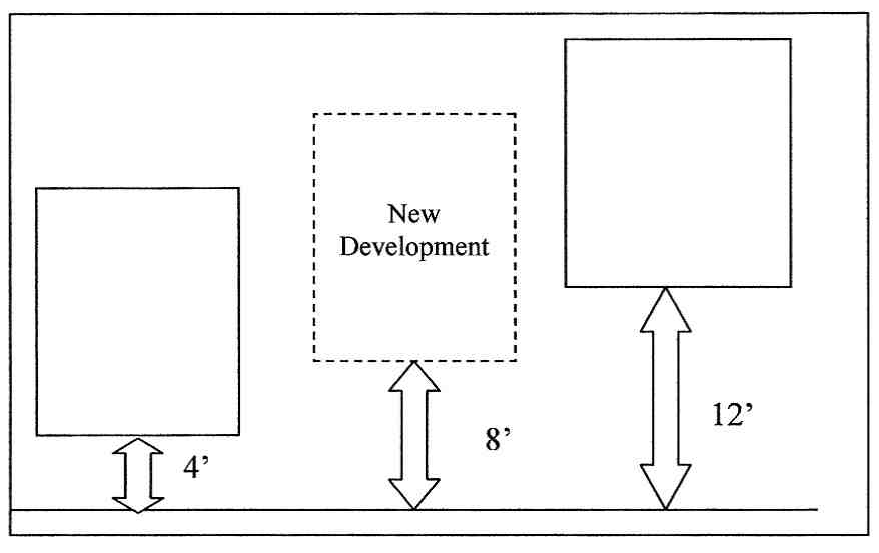
(2)
For nonresidential uses, the minimum required side yard setback is zero (0) feet on both sides. For single-family dwellings, the minimum required side yard setback is zero (0) feet on one side and five (5) feet on the other side. For zero lot lines, the following criteria shall be met:
(i)
When the structure shares a side property line with a non-zero lot line development, the structure shall be set back from the common property line by a minimum of five (5) feet.
(ii)
Prior to building permit approval, the applicant shall submit a copy of a recorded easement for every zero lot line that guarantees access not less than five (5) feet in width running the entire length of the side wall for construction and maintenance for purposes of structures and yards. The easement shall stipulate that no fence or other obstruction shall be placed in a manner that would prevent maintenance of structures on the subject lot.
(iii)
The placement and/or design of windows on the ground floor of the zero lot line buildings shall address issues of privacy for the occupants of the abutting lot. For example, the privacy standard may be met by using clerestory windows along zero lot property lines.
(b)
Design Elements. See the City of Douglas MUI Overlay Zone Design Guidelines.
(c)
Building Orientation. All buildings shall be oriented to a public street, except when buildings cannot be oriented to the street due to inadequate street frontage. In this case, buildings may be oriented to a private street or lane, which shall be developed in conformance with city standards for pedestrian and vehicular circulation.
Duplexes and attached houses on comer lots shall be designed so each unit is oriented towards a different street, which gives the structure the overall appearance of a house when viewed from either street in accordance with the following:
(i)
Qualifying situations: New development on comer lots in the residential zones. Conversion of existing housing is not allowed.
(ii)
Each unit of the duplex or attached house must have its address, front door, driveway, and parking area or garage oriented to a separate street frontage.
(d)
Off-street parking. It is understood that many locations in the MUI Overlay Zone do not meet the specifications set in Article 6 regarding requirements to provide off-street parking. Strict enforcement of the provisions in Article 6 could jeopardize the intent and purpose of the MUI Overlay Zone. Therefore, off-street parking will not be required where physical constraints make adherence to the requirement not feasible. However, should an area be available for off-street parking, applicant will be required to provide off-street parking to the extent it is possible to do so.
515.10
Notice to Abutting Property Owners. The Community Development Department shall give written notice of any infill development under consideration to abutting property owners. The City shall make every effort to address the concerns of abutting property owners during the plan review process.
515.11
Appeals. Appeals to the City Manager, or his designee, concerning interpretation or administration of the Mixed Use/Infill Development Overlay Zone (MUI) may be taken by any person aggrieved by any decision of the Community Development Director. Such appeals shall be filed within thirty (30) days of the decision of the Community Development Director, including all papers constituting the record upon which the action appealed is taken. Upon good cause shown, the City Manager, or his designee, may reverse, affirm, or modify the decision of the Community Development Director. The decision of the City Manager is final.
(Ord. No. 08-919, § 1(Exh. A), 2-13-2008)
Sec. 516. - Innovative Community Overlay Zones (IC).
A.
Purpose and Intent. The Innovative Community (IC) Overlay Zones, including Innovative Community-Residential (IC-R), Innovative Community-Commercial (IC-C), and Innovative Community-Mixed Use (IC-MU) are intended to protect smaller properties in zoning districts that require larger redevelopment for off-street parking and landscaping than are feasible, while encouraging adaptive reuse of existing buildings where underlying zoning district regulations prohibit this. Similar to the Mixed-Use/Infill Development (MUI) Overlay Zoning District, the primary purpose of the IC Overlay Zones is to encourage reinvestment, redevelopment and infill development of nonconforming residential and commercial structures, lots, and uses that were in place prior to the adoption of the City's Zoning Regulations in 1966. But secondarily, recognizing that the overlays concentrate opportunities for a variety of residential and commercial uses is both desirable and consistent with the General Plan, increased flexibility is suitable for other parcels within the Overlay Districts. Regulations are designed to stabilize the character of the existing development while promoting and encouraging infill development.
The City of Douglas recognizes that there are considerable financial and design challenges inherent to developing successful infill projects in many of the City's older neighborhoods. These provisions thus facilitate the development of vacant and underutilized parcels located in the mature portions of Douglas and those parcels ready for redevelopment. The provisions also ensure that new infill development is consistent in character and scale with established neighborhoods and business districts.
B.
Objective. The specific objectives of this section are to:
1.
Facilitate innovative residential, commercial, and mixed-use infill development.
2.
Provide development standards and flexibility that can achieve high quality design and innovation, promote resiliency, and compatibility between new and existing development and enhance the appeal of Douglas neighborhoods.
3.
Revitalize blighted, distressed and underutilized areas through relaxed regulations toward improving existing non-conforming uses as a first step.
4.
Encourage redevelopment of non-conforming properties where market demand exists, and create opportunities for increased development.
5.
Allow for innovative design and development of single-family and multifamily dwellings, mixed-use buildings with neighborhood-oriented retail, restaurant, and commercial services and other uses that are suited to the character of neighborhoods in which they are situated.
C.
Establishment of the Innovative Community Overlay Zones. The areas and boundaries of the Innovative Community-Residential (IC-R), Innovative Community-Commercial (IC-C), and Innovative Community-Mixed-Use (IC-MU) Overlay Zones are hereby established as shown on the official City Zoning Districts Map, which together with explanatory matter thereon, is hereby adopted by reference and declared to be a part of this Ordinance.
D.
Definitions.
1.
Abutting property. Any property that touches or joins at the edge or border of a parcel or lot subject to this chapter.
2.
Infill parcel. Any vacant or underutilized lot where infrastructure is already present.
3.
Innovative. Different, improving, demonstrating new possibilities with regards to housing and commercial types, building materials, and arrangements where conventional suburban regulations have been stifling.
4.
Mixed use. Any combination of commercial or non-commercial uses mixed horizontally (i.e., a combination of uses arranged side-by-side) or vertically (i.e., a combination of uses within a multi-story building).
5.
Overlay District. A designated area wherein existing, underlying zoning district regulations may be chosen, but other regulations that offer greater flexibility may be chosen instead.
E.
IC-R - Innovative Community-Residential Overlay Zoning District regulations.
1.
Purpose and Intent. The Innovative Community-Residential (IC-R) Overlay Zoning District recognizes that existing regulations of underlying zoning districts are too challenging and restrictive for providing housing placement or construction in contemporary market conditions. The IC-R intends to allow for affordable housing types through flexibility of property development standards, and for placement and construction of contemporary innovations in housing types rather than requiring only one type of housing.
2.
Qualifications.
a.
Parcel must be located in the Innovative Community-Residential (IC-R) Overlay Zoning District; and
b.
Parcel must have an underlying residential zoning district designated.
3.
Limitations.
a.
An Innovative Community-Residential (IC-R) Overlay Zoning District cannot modify requirements of the International Building Codes, International Fire Codes, Engineering Standards, Federal Emergency Management Agency (FEMA) regulations, and State Health Laws.
4.
Permitted Uses.
a.
All the land uses permitted by the underlying zoning, that can meet the property development standards of Section 17.05.516(E)(5);
b.
Single-family detached housing types, that can meet the property development standards of Section 17.05.516(E)(5), including but not limited to:
i.
Conventional suburban house;
ii.
Tiny/cottage house;
iii.
Shipping container house.
c.
Multi-family housing, including, but not limited to, duplexes, triplexes, and attached houses that can meet the property development standards of Section 17.05.516(E)(5).
5.
Property Development Standards. All site plans and building specification plans submitted for review and approval pursuant to this section must address all of the following property development and design standards that apply to the proposed use:
a.
Required minimum lot size: 3,000 square feet for both single-family detached or multifamily;
b.
Maximum unit density: One (1) dwelling per 1,500 square feet;
c.
Minimum lot width (for single-family detached): Twenty-five (25) feet;
d.
Minimum yard requirements for residential uses.
i.
Front (street frontage) yard: Four (4) feet, including from the edge of any porch footing;
ii.
Side yard: Four (4) feet, with a minimum of five (5) feet from any other structures, residential or accessory use, on-property or off-property; and
iii.
Rear yard: Zero (0) feet when located along an alley, five (5) feet without an alley.
6.
Permitted accessory uses and structures.
a.
Private garage or carport;
b.
Garden shed, tool shed, ramada, swimming pool; and
c.
Home occupation, per Section 17.03.324.
7.
Off-street parking. It is understood that many locations in the Innovative Community-Residential (IC-R) Overlay Zoning District do not meet the specifications set in Article 17.06 regarding requirements to provide off-street parking. Strict enforcement of the provisions of Article 17.06 could jeopardize the intent and purpose of the IC-R Overlay Zoning District. Therefore, off-street parking will not be required where physical constraints make adherence to the requirement infeasible. However, should an area be available for off-street parking, applicant with be required to provide off-street parking to the extent it is possible to do so, in compliance with Article 17.06.
F.
IC-C - Innovative Community-Commercial Overlay Zoning District regulations.
1.
Purpose and Intent. The Innovative Community-Commercial (IC-C) Overlay Zoning District recognizes that existing regulations of underlying zoning districts are too challenging and restrictive for allowing rehabilitation of existing commercial buildings, or reconstruction and new construction in contemporary market conditions for smaller parcels. The IC-C Overlay Zoning District intends to allow for adaptive commercial re-use, reconstruction, redevelopment and new construction through flexibility of property development standards. These regulations should allow the placement and construction of contemporary innovations in commercial building types rather than requiring only suburban-style off-street parking-intensive strip mall development.
2.
Qualifications.
a.
Parcel must be located in the Innovative Community-Commercial (IC-C) Overlay Zoning District; and
b.
Parcel must have an underlying commercial zoning district designation.
3.
Limitations.
a.
An Innovative Community-Commercial (IC-C) Overlay Zoning District cannot modify requirements of the International Building Codes, International Fire Codes, Engineering Standards, Federal Emergency Management Agency (FEMA) regulations, and State Health Laws.
4.
Permitted Uses.
a.
All permitted uses listed in the commercial zoning districts of DMC 17.05.504, 17.05.505, 17.05.506, and 17.05.507, that can meet the property development standards of Section 17.05.516(F)(5).
5.
Property Development Standards. All site plans and building specification plans submitted for review and approval pursuant to this section must address all of the following property development and design standards that apply to the proposed use:
a.
Required minimum lot size: 3,000 square feet;
b.
Maximum unit density: None;
c.
Minimum lot width: Twenty-five (25) feet;
d.
Minimum yard requirements for commercial uses:
i.
Front (street frontage) yard: Zero (0) feet;
ii.
Side yard: Zero (0) feet, with a minimum of five (5) feet from any other structures, commercial or accessory use, on-property or off-property; and
iii.
Read yard: Zero (0) feet when located along an alley, five (5) feet without an alley.
6.
Off-street parking. It is understood that many locations in the Innovative Community-Commercial (IC-C) Overlay Zoning District do not meet the specifications set in Article 17.06 regarding requirements to provide off-street parking. Strict enforcement of the provisions of Article 17.06 could jeopardize the intent and purpose of the IC-C Overlay Zoning District. Therefore, off-street parking will not be required where physical constraints make adherence to the requirements infeasible. However, should an area be available for off-street parking, applicant will be required to provide off-street parking to the extent it is possible to do so in compliance with Article 17.06.
G.
IC-MU - Innovative Community-Mixed-Use Overlay Zoning District regulations.
1.
Permitted Uses.
a.
All permitted uses listed in the commercial zoning districts of DMC 17.05.504, -.505, -.506, and -.507, that can meet the property development standards of Section 17.05.516(G)(5);
b.
Existing residential units, whether single-family detached or multi-family, and including accessory dwelling units;
c.
Proposed mixed use with commercial uses below residential use;
d.
Proposed mixed use with commercial uses in front of residential use;
e.
Proposed multi-family attached limited per Section 17.05.516(G)(5)(b).
2.
Qualifications.
a.
Parcel must be located in the Innovative Community-Mixed-Use (IC-MU) Overlay Zoning District; and
b.
Parcel may have an underlying residential zoning district designation, with an existing commercial purpose building; or
c.
Parcel may have an underlying commercial zoning district designation, with an existing residential purpose building; or
d.
Parcel is undeveloped, adjacent to existing commercial uses and carries either a commercial zoning district or residential zoning district designation.
3.
Limitations.
a.
An Innovative Community-Mixed-Use (IC-MU) Overlay Zoning District cannot modify requirements of the International Building Codes, International Fire Codes, Engineering Standards, Federal Emergency Management Agency (FEMA) regulations, and State Health Laws.
4.
Permitted Uses.
a.
All permitted uses listed in the commercial zoning districts of DMC 17.05.504, 17.05.505, 17.05.506, and 17.05.507, that can meet the property development standards of Section 17.05.516(G)(5).
b.
Existing residential units, whether single-family detached or multifamily, and including accessory dwelling units;
c.
Proposed mixed-use with commercial uses below residential use;
d.
Proposed mixed-use with commercial uses in front of residential use;
e.
Proposed multifamily attached or detached tiny/cottage housing limited per Section 17.05.516(G)(5)(b).
5.
Property Development Standards. All site plans and building specification plans submitted for review and approval pursuant to this section must address all of the following property development and design standards that apply to the proposed use:
a.
Required minimum lot size: 3,000 square feet;
b.
Maximum dwelling unit density: One (1) unit per 1,000 square feet of parcel area, after subtracting commercial use area if mixed-use;
c.
Minimum lot width: Twenty-five (25) feet for single use, fifty (50) feet for mixed-use;
d.
Minimum yard requirements:
i.
Front (street frontage) yard: Zero (0) feet;
ii.
Side yards: Zero (0) feet, with a minimum of five (5) feet from any other structures, commercial or accessory use, on-property or off-property; and
iii.
Rear yard: Zero (0) feet when located along an alley, five (5) feet without an alley.
6.
Off-street parking. It is understood that many locations in the Innovative Community-Mixed-Use (IC-MU) Overlay Zoning District do not meet the specifications set in Article 17.06 regarding requirements to provide off-street parking. Strict enforcement of the provisions in Article 17.06 could jeopardize the intent and purpose of the IC-C Overlay Zoning District. Therefore, off-street parking will not be required where physical constraints make adherence to the requirement infeasible. However, should an area be available for off-street parking, applicant will be required to provide off-street parking to the extent it is possible to do so in compliance with Article 17.06.
H.
Application Process.
1.
Notification of intent to neighbors required. The Applicant shall provide written notice of their permitting intentions; and must:
a.
Acquire petition signatures of approval or certified mail receipts from their abutting property owners prior to or concurrent with filing a building permit application with the City.
2.
Conceptual Plan Pre-Application Review Meeting required with Development Services, to consider the following provided by the applicant:
a.
Conceptual site plan, indicating locations of any proposed structures, off-street parking, landscaping; and
b.
Proposed project scope, including amounts of use in square feet, number of spaces, dwelling units as appropriate.
3.
Application Submittal Requirements. All of the following must be provided:
a.
Application Form completed;
b.
Site Plan. Showing property lines with dimensions, existing and proposed structures with dimensions, adjacent rights-of-way named, and setback distances among structures and property lines shown;
c.
Building specification plans for every proposed structure;
d.
Proof of notification of abutting property owners, whether petition of proposal approval or certified mail receipts, per Section 17.05.516(H)(1)(a) above; and
e.
Receipt of fee payment.
I.
Appeals. Appeals to the City Manager, or the designee, concerning interpretation or administration of the Innovative Community-Commercial (IC-C), and Innovative Community-Mixed-Use (IC-MU) Overlay Zoning Districts may be taken by any person aggrieved by any decision of the City Planner or designee thereof. Such appeals shall be filed within thirty (30) days of the decision of the City Planner, including all papers constituting the record upon which the action appealed is taken. Upon good cause shown, the City Manager, or the designee, may reverse, affirm, or modify the decision of the City Planner in writing. The written decision of the City Manager is final and shall be filed with any associated permitting documents.
(Ord. No. 23-1166, (Exh. A), 7-12-2023; Ord. No. 24-1196, § 1(Exh. A), 9-11-2024)

