
Douglas City Zoning Code
CHAPTER 6
USE-SPECIFIC DEVELOPMENT STANDARDS
6.1 - General
The following provisions are intended to provide development standards for specific uses in addition to the general development standards in Chapter 5 of this Code. The uses identified in this chapter commonly cause or result in unique adverse impacts to adjacent properties, public facilities and infrastructure, and the environment that may require additional mitigation measures. No use identified within this chapter shall be initiated, installed, or put into operation unless a determination of full compliance with the following requirements and all other applicable requirements of this Code has been made by the City.
(Ord. No. 967, § 42, 8-10-2015)
6.2 - Accessory Agricultural Structures and Uses
6.2.1
Allowed Uses and Structures
Agricultural accessory uses shall meet the general accessory structure and use standards, any applicable specific accessory use standards, and the general development standards in Chapter 5 of this Code. The following structures and uses are considered accessory to any agricultural use defined as agricultural by this Code:
• Operation and use of agricultural, farming, ranching, and dairy vehicles, equipment, materials, barns, sheds, etc.;
• Keeping of domestic livestock and pets, subject to any specific use and dimensional standards;
• Any accessory residential structure or use;
• Outside storage incidental to and necessary for agricultural uses (not including wrecking or salvage yards or junk storage);
• Fuel storage for farming, ranching, or dairy vehicles, subject to any local or State Fire Marshal requirements;
• Fences, walls, and hedges;
• Antennas, radio facilities, and satellite dishes, pursuant to the provisions of this Code; and
• Personal solar and wind energy generators.
6.2.2
Additional Requirements
Accessory agricultural uses and structures shall meet the general accessory use and dimensional standards in Chapter 4 and the general development standards in Chapter 5 of this Code. Construction of an accessory agricultural structure may require prior approval of a Site Plan Application and issuance of a Zoning Certificate pursuant to the provisions of Chapter 3 of this Code.
(Ord. No. 967, § 42, 8-10-2015)
6.3 - Accessory Commercial Structures and Uses
6.3.1
Allowed Uses and Structures
The following uses and structures are considered accessory to a principal commercial use:
• On-site parking lots or garages providing parking for a commercial structure;
• On-premise signs;
• Carports or other motor vehicle or commercial vehicle covered parking areas (hereinafter "covered parking areas") shall comply with the following:
• Definition: Covered parking areas shall be defined as a structure built attached or detached from the primary structure that is open on at least three (3) sides and where vision through the three (3) open sides is not impeded. This definition does not include garages.
• Location: Covered parking areas are limited to the side and rear of the property.
• Exception: Covered parking areas may project from the front of the primary structure when designed to favorably add to the architecture of the primary structure at the discretion of the Community Development Director.
• Setbacks: Covered parking areas smaller than two hundred (200) square feet may project into a required setback not to exceed one-third (⅓) the distance of the required setback. Covered parking areas larger than two hundred (200) square feet shall comply with the principal structure setbacks for the applicable zoning district. Covered parking areas in the side yard shall not be less than twenty (20) feet from the front lot line.
• Size: When allowed in the front, covered parking areas affixed to the front of the primary structure are limited to a maximum of five hundred (500) square feet of coverage area. Detached covered parking areas or covered parking areas affixed to the side or rear of the primary structure are limited to a maximum of five hundred (500) square feet of coverage area or twenty (20) percent of the primary structure, whichever is larger.
• Height: Covered parking areas may not exceed the maximum height for an accessory structure in each zone district.
• Architectural Design: The design of the covered parking areas shall be in character with, and constructed of, the same quality permanent materials as the principal building, or adopted design standards. No metal buildings or structures shall be allowed for covered parking areas over two hundred (200) square feet unless concealed with materials in character with the principal building.
• Building Permit Required: Covered parking areas shall require a building permit.
• Construction: All covered parking areas two hundred (200) square feet or less shall meet all applicable building codes, including wind and snow loads. All covered parking areas exceeding two hundred (200) square feet shall be constructed using permanent concrete footers, metal framing or wood beams, and metal or wood rafters, and shall meet all applicable building codes, including wind and snow loads.
• Maintenance: Covered parking areas shall be maintained in good condition at all times.
• Fully enclosed accessory structures used for storing merchandise or materials needed for operation of the principal commercial use. Merchandise storage within the CB-1 (Downtown Business) zoning district shall be limited to areas within the principal structure and shall not be allowed within an accessory structure;
• Shipping containers in commercial zones (excluding the Industrial Zone) shall comply with the following:
• Definition: "Shipping container" shall mean a unit originally used or designed to store goods or other merchandise during shipping or hauling by a vehicle, including, but not limited to, rail cars of any kind, truck trailers, or multi-modal shipping containers or similar structures such as look-alike shipping container buildings or metal buildings marketed as "containers," "portable storage units," or "conex."
• Occupation: Shipping containers shall not be used as dwellings, sleeping quarters or for occupancy for any period of time.
• Limited: Unless the commercial lot is being used as a mini-warehouse or commercial self-storage facility, only one (1) shipping container shall allowed per commercial lot.
• Building Permit Required: Shipping containers shall require a building permit be issued prior to installation.
• Location: Shipping containers are limited to the rear of the property.
• Setback: Shipping containers shall comply with the setbacks for the applicable zoning district.
• Size and Height: The maximum size allowed for a shipping container shall be eight (8) feet wide by twenty (20) feet long by eight and one-half (8.5) feet tall.
• Architectural Design: Shipping containers shall be concealed on all sides and top with materials that are in character with, and constructed of, the same quality permanent materials as the principal building, or adopted design standards. No corrugated or ribbed metal shall be allowed unless the principal building is sided with the same material.
• Exception: Shipping containers used as mini-warehouse (commercial self-storage facility) (see Section 16.6.26).
• Maintenance: Shipping containers shall be maintained in good condition at all times.
• Exception: Temporary portable moving containers/moving pods placed on private property for the purpose of moving household goods. Shipping containers shall be permitted on construction sites provided there is an active building permit and placement is ancillary to a project on site. Such shipping containers shall be removed within thirty (30) days of completion of work associated with the building permit.
• Outside storage, which shall be fully screened pursuant to the requirements of this chapter and Chapter 5 of this Code. Under no circumstances shall outside storage be allowed in the CB-1 (Downtown Business) zoning district;
• Fences, walls, and hedges;
• Outdoor retail displays, which shall be limited to a maximum display area of five (5) percent of the total area of the lot or parcel upon which the commercial use operates or one thousand (1,000) square feet, whichever is less;
• Antennas, radio facilities, and satellite dishes, subject to the requirements of this Code; and
• Any accessory structure or related use expressly designated as accessory in a commercial zoning district under this Code, or otherwise established as an accessory use through an interpretation of the Community Development Department Director.
6.3.2
Additional Requirements
Accessory commercial uses and structures shall comply with the general accessory use and dimensional standards in Chapter 4 and the general development standards in Chapter 5 of this Code. Construction of an accessory structure may require prior approval of a Development Plan and issuance of a Zoning Certificate pursuant to the provisions of Chapter 3 of this Code.
(Ord. No. 967, § 42, 8-10-2015; Ord. No. 1011, § 30, 12-13-2021; Ord. No. 1054, § 4, 5-27-2025)
6.4 - Accessory Dwelling Units
6.4.1
General
Accessory dwelling units shall be limited to accommodations for extended family members of the owners of the principal residential structure or as rental units.
6.4.2
Number of Accessory Dwelling Units
One accessory dwelling unit is allowed per lot, parcel, or tract in designated zoning districts as identified in Chapter 4 of this Code.
6.4.3
Type of Structure
Accessory dwelling units may be allowed internal to the principal residential structure or may be allowed as an accessory residential structure.
6.4.4
Kitchens Allowed
Accessory dwelling units that are constructed as an accessory residential structure may include either a kitchen or wet bar that is separate and in addition to the kitchen in the principal residential structure. Accessory dwelling units that are internal to the principal residential structure shall not include a separate kitchen or wet bar.
6.4.5
Size Limitation
Accessory dwelling units shall be limited to a maximum of 800 square feet in total floor area.
6.4.6
No Separate Utility Meters
All electric, gas, sewer, and water services to an accessory dwelling unit shall be interconnected to and indistinguishable from that of the principal residential dwelling and shall not have separate meters, service lines, or billing unless otherwise required in writing by the respective utility provider.
6.4.7
Parking
The owner of any residential lot seeking approval of an accessory dwelling unit shall provide one off-street parking space for use by the occupant(s) of the accessory dwelling unit. The location of the parking space shall be depicted on the associated residential site plan.
6.4.8
Other Applicable Standards
All accessory dwelling units constructed as an accessory residential structure shall meet the dimensional standards in Chapter 4 for an accessory structure in the respective zoning district.
(Ord. No. 967, § 42, 8-10-2015)
6.5 - Accessory Industrial Structures and Uses
6.5.1
Allowed Uses and Structures
The following uses and structures are considered accessory to a principal industrial use:
• On-site parking lots or garages providing parking for an industrial use, building, or structure;
• Carports or other motor vehicle or construction equipment covered parking areas limited to a maximum of 1,000 square feet of coverage area. All covered parking areas shall be constructed using permanent concrete footers, metal framing or wood beams, and metal or wood rafters. Any covered parking structure that is affixed to a principal structure shall comply with the principal structure setbacks for the applicable zoning district. Any covered parking structure that is not attached to a principal structure shall comply with the accessory structure setbacks for the applicable zoning district;
• On-premise signs;
• Fully enclosed accessory structures used for storing merchandise or materials needed for operation of the principal industrial use;
• Outside storage, which shall be fully screened pursuant to the requirements of this Chapter and Chapter 5 of this Code;
• Fences, walls, and hedges;
• Antennas, radio facilities, and satellite dishes, subject to the requirements of this Code; and
• Any accessory structure or related use expressly designated as accessory in an industrial zoning district under this Code, or as otherwise established as an accessory use through an interpretation of the Community Development Department Director.
6.5.2
Additional Requirements
Accessory industrial uses and structures shall comply with the general accessory use and dimensional standards in Chapter 4 and the general development standards in Chapter 5 of this Code. Construction of an accessory structure may require prior approval of a Development Plan and issuance of a Zoning Certificate pursuant to the provisions of Chapter 3 of this Code.
(Ord. No. 967, § 42, 8-10-2015)
6.6 - Accessory Light Manufacturing and Industrial
Light manufacturing and industrial uses may be conducted as an accessory use to a principal commercial use pursuant to the use allowances in Chapter 4 of this Code. Accessory light manufacturing and industrial uses shall be operated in conjunction with the principal commercial use on the same lot or parcel and shall not exceed five hundred (500) square feet in total floor area.
(Ord. No. 967, § 42, 8-10-2015)
6.7 - Accessory Residential Structures and Uses
6.7.1
Allowed Uses and Structures
The following uses and structures are considered accessory to a principal residential use:
a. Detached private parking garages;
b. Carports or other motor vehicle covered parking areas (hereinafter "covered parking areas") shall comply with the following:
i. Definition: Covered parking areas shall be defined as a structure built attached or detached from the main structure that is open on at least three (3) sides and where vision through the three (3) open sides is not impeded. This definition does not include garages.
ii. Location: Covered parking areas are limited to side and rear yards.
Exception: The Community Development Director may approve a covered parking area to be placed in the front yard if the structure is two hundred (200) square feet or less, if the structure is attached to the primary structure, and if the structure is designed to favorably add to the architecture of the primary structure.
iii. Setbacks: Covered parking areas smaller than two hundred (200) square feet may project into a required setback not to exceed one-third (⅓) the distance of the required setback. Covered parking areas larger than two hundred (200) square feet shall comply with the principal structure setbacks for the applicable zoning district. Covered parking areas in the side yard shall not be less than twenty (20) feet from the front lot line.
Exception: The Community Development Director may approve a covered parking area to be placed no closer than five (5) feet off the front lot line if the structure is two hundred (200) square feet or less, if the structure is attached to the primary structure, and if the structure is designed to favorably add to the architecture of the primary structure.
iv. Size: Covered parking areas are limited to a maximum of two hundred (200) square feet or forty (40) percent of the primary structure, whichever is larger.
v. Height: Covered parking areas may not exceed the maximum height for an accessory structure in each zone district.
vi. Architectural Design: The design of the covered parking areas shall be in character with, and constructed of, the same quality permanent materials as the principal building, or adopted design standards. No metal buildings or structures shall be allowed for covered parking areas over two hundred (200) square feet unless concealed with materials in character with the principal building.
vii. Building Permit Required: Covered parking areas shall require a building permit.
viii. Construction: All covered parking areas two hundred (200) square feet or less shall meet all applicable building codes, including wind and snow loads. All covered parking areas exceeding two hundred (200) square feet shall be constructed using permanent concrete footers, metal framing or wood beams, and metal or wood rafters, and shall meet all applicable building codes, including wind and snow loads.
ix. Maintenance: Covered parking areas shall be maintained in good condition at all times.
c. Storage sheds;
d. Shipping containers in residential zones shall comply with the following:
i. Definition: "Shipping container" shall mean a unit originally used or designed to store goods or other merchandise during shipping or hauling by a vehicle, including, but not limited to, rail cars of any kind, truck trailers, or multi-modal shipping containers or similar structures such as look-alike shipping container buildings or metal buildings marketed as "containers," "portable storage units," or "conex."
ii. Occupation: Shipping containers shall not be used as dwellings, sleeping quarters or for occupancy for any period of time.
iii. Limited: Only one (1) shipping container allowed per residential lot.
iv. Building Permit Required: Shipping containers shall require a building permit.
v. Location: Shipping containers are limited to rear yards.
vi. Setback: Shipping containers shall comply with the setbacks for the applicable zoning district.
vii. Size and Height: The maximum size allowed for a shipping container shall be eight (8) feet wide by twenty (20) feet long by eight and one-half (8.5) feet tall.
viii. Architectural Design: Shipping containers shall be concealed on all sides and top with materials that are in character with, and constructed of, the same quality permanent materials as the principal building, or adopted design standards. No corrugated or ribbed metal shall be allowed unless the principal building is sided with the same material.
ix. Maintenance: Shipping containers shall be maintained in good condition at all times.
Exception: Temporary portable moving containers/moving pods placed on private property for the purpose of moving household goods. Shipping containers shall be permitted on construction sites provided there is an active building permit and placement is ancillary to a project on site. Such shipping containers shall be removed within thirty (30) days of completion of work associated with the building permit.
e. Gazebos;
f. Domestic pets;
g. Personal, private-use greenhouses;
h. Fences, walls, and hedges;
i. Antennas, radio facilities, and satellite dishes, pursuant to the requirements of this Code;
j. Personal solar and wind energy generators;
k. Swimming pools, hot tubs, tennis courts or other similar private recreational facilities;
l. Recreational vehicles (RVs) or travel trailers:
i. Recreational vehicles (RVs) or travel trailers may be allowed for short-term stays intended for property owner(s)/family/friends not to exceed fourteen (14) days in any thirty-day period.
ii. Recreational vehicles (RVs) or travel trailers shall not be rented out under any circumstances and shall not be used as or considered short-term rentals or accessory dwelling units.
iii. Recreational vehicles (RVs) or travel trailers shall be limited to one (1) per lot unless otherwise approved by Conditional Use Permit.
iv. Recreational vehicles (RVs) or travel trailers shall not be connected to water and sewer when not in use.
v. Recreational vehicle (RV) or travel trailer sewage shall be disposed of in an appropriate manner at all times.
vi. Recreational vehicles (RVs) or travel trailers may be stored on parking areas surfaced with an all-season material such as concrete, brick, asphalt, gravel or other similar material in side yards in any zone.
m. Any accessory structure or related use expressly designated as accessory in a residential zoning district under this Code, or as otherwise established as an accessory use through an interpretation of the Community Development Department Director.
6.7.2
Additional Requirements
Accessory residential uses and structures shall comply with the general accessory use and dimensional standards in Chapter 4 and the general development standards in Chapter 5 of this Code. Construction of an accessory structure may require prior approval of a Site Plan and issuance of a Zoning Certificate pursuant to the provisions of Chapter 3 of this Code.
(Ord. No. 967, § 42, 8-10-2015; Ord. No. 1011, § 31, 12-13-2021; Ord. No. 1062, § 3, 10-13-2025)
6.8 - Agricultural Stands
Agricultural stands shall be limited to the sale of products raised, grown, or made within the same ownership whereupon the stand and sales are to be located and conducted. All agricultural stands shall comply with the minimum setbacks in the respective zoning district and may be required to provide a new access onto a public road. The requirement for providing a new access shall be at the discretion of the City Engineer following review of the proposed use and location.
(Ord. No. 967, § 42, 8-10-2015)
6.9 - Animals
6.9.2
Animal Keeping
A.
Prohibited Species
Poisonous or venomous biting or injecting species of amphibian or reptile, including
snakes, shall not be brought into, kept, maintained, offered for sale or barter, or
released within the City. This restriction does not prohibit any circus or other entertainment
organization, or educational or research facility, from keeping such an animal where
the animal is securely and humanely confined.
B.
Exceptions
The requirements of this section shall not apply to the private keeping of aquarium-based
animals, such as fish, turtles, frogs, non-poisonous and non-venomous biting and injecting
species of amphibians, insects, or reptiles (including snakes), or any other similar
animal. This section shall also not apply to the private keeping of small domestic
animals, such as guinea pigs, hamsters, ferrets, commonly recognized household pet
birds, and household pet rabbits that are not raised for sale or slaughter. All such
animals shall be kept within the confines of the principal structure on the subject
property.
C.
Animal Keeping By Conditional Use Permit
The keeping, stabling, and corralling of any of the following animals within the City
limits shall be prohibited and shall be considered a nuisance in any zoning district:
• Big game animals, exotic species, fur bearing animals, game birds, predatory animals, protected animals, small game animals, trophy game animals, or wildlife as defined in W.S. 23-1-101 unless otherwise permitted.
The keeping, stabling, and corralling of any of the following animals within the City limits shall be prohibited and shall be considered a nuisance in any zoning district except in the A (Agriculture) or zoning districts unless the same have been approved as a conditional use permit in any other zoning district:
• Horses, hogs, sheep, llamas, cows, goats, ponies, mules, and donkeys, other similar barnyard animals, and falcons.
All conditional use permit applications for the keeping of any of the above listed animals shall be subject to the following:
i.
Conditional Use Permit
Any persons wishing to keep animals listed above in this Section 6.9.2.C on any property that is not zoned A (Agriculture) or RR (Rural Residential) must apply for a conditional use permit pursuant to the application, review, and approval procedures and requirements of Section 3.15 of this Code.
ii.
Conditions and Restrictions of Conditional Use Permit
Upon the issuance of a conditional use permit for the keeping of animals, the City Council may place such conditions and restrictions upon the permit as it deems reasonable and necessary, including, but not limited to, the following:
a.
The number and types of animals;
b.
Required barriers and facility structural specifications;
c.
Setbacks;
d.
Lot size, with a requirement of a minimum lot size of twenty thousand (20,000) square feet for keeping of large animals such as horses or cows for extended periods of time;
e.
Animal health certificate by licensed veterinarian;
f.
Provisions for the removal of excrement from the property on a regular basis; and
g.
Any other matter which the City Council deems reasonably pertinent or relevant to the issuance of the permit.
iii.
Compliance with State and Federal Requirements
The requirement to obtain a conditional use permit for animal keeping shall be in addition to the requirement to comply with all other state and federal permits, statutes and regulations regarding the care and keeping of such animals for which a permit is sought.
iv.
Exceptions
a.
Commercial Operations
Commercial animal use operations (including, but not limited to, sale barns, veterinary hospitals, animal grooming facilities, and pet stores) shall not be required to obtain a permit under this section, provided such operations are located in zoning districts wherein such use is an allowed use as identified in Table 4-4 in Chapter 4 of this Code.
b.
Service Animals
The requirements of this Section 6.9.1 shall not apply to service animals. Service animals may or may not be registered as a service animal.
v.
Additional Considerations
In zoning districts wherein commercial animal use operations are allowed as permitted conditional uses, owners or operators shall first obtain a conditional use permit from the City according to the requirements contained in this section. The granting of such a permit shall be at the discretion of the City Council, who shall take into consideration the type of construction to be employed as it relates to sanitation and the manner in which animals or livestock are to be housed, as well as such zoning regulations or regulations concerning animal use operations as may be adopted by the governing body from time to time.
vi.
Conditional Use Permit Approval
a.
The City Council may make the granting of a conditional use permit subject to reasonable limitations or conditions as it may deem necessary to enhance the appearance of the property, to reduce the adverse effects on nearby property, to preserve the character of the area, or to make the conditional use more acceptable in other ways.
b.
The conditional use permit shall be issued and signed by the Community Development Director and attested by the City Clerk.
c.
Upon the performance of the conditions set forth in the conditional use permit and the continued performance, if the conditions are of a continuing nature, the use shall be considered to be a permitted use. No conditional use may be modified, structurally enlarged, or expanded in ground area, unless such is allowed by the terms of the permit until and unless the conditional use permit is amended and approved in accordance with the ordinance codified in this chapter.
vii.
Permit Revocation
a.
Upon the recommendation of staff, and notification of specific deficiencies, the Planning and Zoning Commission shall review, during a public meeting, any conditional use permit which appears to be in violation of the conditions set forth in accordance with the proper issuance of the permit.
b.
If the Commission finds that the permittee is not acting in compliance with the conditional use permit, it shall recommend to the City Council that said permit be revoked.
c.
Within thirty (30) days, the City Council shall review the commission's finding and shall make a ruling on the permit.
d.
There shall be no right of appeal from a decision of the governing body revoking a conditional use permit. The decision of the governing body shall be final and exclusively within the province of the governing body.
e.
The City may resort to any other remedy allowed by law for violations of the ordinance codified in this chapter.
viii.
Review/Amendments to Permit
a.
Community Development Department staff shall conduct an annual review of all conditional use permits and shall make adequate inquiries to ensure that the conditions of the permit are in force.
b.
Where deficiencies are apparent in compliance with a conditional use permit, Community Development Department staff shall notify the permit holder of the nature of any violations and said permit holder shall have no more than thirty (30) days in which to correct any deficiencies.
c.
In the case where conditional use permit holders will not or do not comply with staff's required corrections, staff shall notify the Planning and Zoning Commission at its next public meeting of any deficiencies in a conditional use permit, and of attempts made to resolve the problem. The permit holder shall be allowed to speak in defense of any actions or inactions. The Planning and Zoning Commission shall then, on the basis of evidence presented, make a recommendation to the City Council on the continuance of the permit.
d.
In cases where the permit holder desires modification to a permit, either to alleviate a prior condition to use, or to allow for expansion or change in operations, the permit holder shall submit, in writing, a request for such amendment, and shall pay a seventy-five dollar ($75.00) filing fee paid to the Finance Department. Public hearings and approval procedures shall be as provided for new conditional use permits as specified in Section 18.72.010 of this chapter.
e.
In any case in which the Community Development Department staff believe a change in the reasonable limitations or conditions of an existing conditional use permit needs to be made to reduce the adverse effects on nearby property, to preserve the character of the area, or to make the conditional use acceptable in other ways, staff may make such recommendation to the Planning and Zoning Commission for review during a public meeting. Public hearings and approval procedures for the recommended changes shall be as provided for new conditional use permits as specified in Section 18.72.015(D) through (G).
D.
Fowl Specific Requirements
The keeping of fowl in the City limits may be allowed with the following restrictions:
a.
No parcel of land or lot shall have more than four (4) fowl unless that parcel of land is larger than ten thousand (10,000) square feet. Then one (1) fowl per one thousand (1,000) square feet will be permitted.
b.
Male fowl are prohibited.
c.
Fowl must be kept in a coop in a rear yard and must remain in the coop or an adjoining fenced enclosure at all times.
d.
Enclosures, which are subject to zoning standards for fence height and accessory buildings, must be at least seven and one-half (7.5) feet from any property line and forty (40) feet from any neighboring houses or as far from neighboring houses as possible.
e.
The maximum size of a coop or enclosure may not exceed ten (10) square feet per chicken and both together may not exceed fifteen (15) square feet per chicken.
f.
Fencing, landscape buffering or screening of a minimum of six (6) feet in height and enclosing the entire perimeter of the coop and chicken exercise area (yard) must be installed and maintained at all times.
g.
There shall be no slaughtering of fowl on the premises. Harvesting of the chicken for meat or any purpose other than eggs shall be conducted at a USDA-approved facility.
h.
Provisions for the removal of excrement from the property on a regular basis.
(Ord. No. 967, § 42, 8-10-2015; Ord. No. 990, § 39, 5-22-2017; Ord. No. 1000, § 20, 6-10-2019; Ord. No. 1049, § 1, 3-10-2025)
6.10 - Auto Wrecking and Salvage Yards
The purpose of this Section is to ensure that adequate mitigation measures are provided by auto wrecking and salvage yards to protect adjacent public roads and land uses from the potential harmful and adverse effects of automobile recycling centers, scrap and waste recycling facilities, junk yards, or other similarly classified uses. These regulations are also designed to help facilitate compliance with all federal, state, and local environmental regulations governing the use, storage, generation, and disposal of hazardous substances and hazardous wastes within the salvage industry; and to prevent the release of such substances and wastes into the environment resulting from leaks, fugitive air emissions, accidents, or improper disposal.
6.10.1
Conditional Use Permit Required
Approval of a conditional use permit, pursuant to the provisions in Chapter 3 of this Code, shall be required prior to initiating, constructing, operating, or expanding an auto wrecking and salvage yard.
6.10.2
Compliance with State and Federal Regulations
Auto wrecking and salvage yards shall comply with all federal, state and local environmental compliance standards. All applicable licenses and permits from federal, state, or local regulating agencies shall be secured and maintained for the life of a wrecking and salvage yard
6.10.3
Zoning Certificate Required
Prior to issuance of a Zoning Certificate by the Community Development Department Director for a new auto wrecking and salvage yard, an approved application for vehicle storage and disposal facility license from the Wyoming Department of Transportation (WDOT) and documentation that the requirements of the Wyoming Department of Environmental Quality (DEQ) have been met shall be provided to the Community Development Department Director as documentation of compliance with the applicable state regulations. Prior to the issuance of a Zoning Certificate by the Community Development Department Director to authorize the expansion of an existing auto wrecking and salvage yard an approved Storage & Disposal Facility Compliance Review Form by WDOT and documentation that the requirements of the Wyoming Department of Environmental Quality (DEQ) have been met shall be provided to the Community Development Department Director as documentation of compliance with applicable state regulations.
6.10.4
Operational Standards for All Facilities
A.
Fire Control Plan
A Type A, B, or B-LSR Development Plan proposing to establish or expand a salvage
yard, automobile recycling center, scrap and waste recycling facility, junk yard or
other similarly classified use shall be accompanied by a fire control plan, which
shall be reviewed and approved by the State Fire Marshal prior to City approval of
the Development Plan.
B.
Landscaping and Screening
All outdoor storage areas, processing areas, and parts removal areas shall be screened
from public roads and adjacent residential uses with a six-foot one hundred (100)
percent opaque fence or decorative screening wall. All six-foot decorative screening
walls shall be designed and certified by a licensed engineer in the State of Wyoming.
All facilities shall be landscaped in conformance with the requirements of Chapter 5 of this Code, except that landscaping may be concentrated along adjacent road frontages
and around parking areas. The use of berms is allowed in conjunction with the opaque
fence or decorative screening wall and landscaping pursuant to the provisions in Chapter 5 of this Code.
C.
Maintain Records of Hazardous Substances
The owner of a facility shall be responsible for identifying all hazardous substances
used, processed, stored, or handled at the facility and for maintaining updated qualitative
and quantitative records of such materials at the facility. An up-to-date inventory
list of hazardous substances and hazardous wastes generated, used, stored, handled,
processed, or disposed of shall be maintained on site in accordance with federal,
state, and local regulations including hazardous waste manifests, bills of lading,
or other equivalent manifesting for hazardous substance disposal.
D.
Storage within Fence
All materials, automobiles, and parts shall be located inside a fenced or screened
area.
E.
Storage within Easements
Storage of automobiles, parts, or materials shall not occur within an easement without
prior written approval of the beneficiary of the easement.
F.
Storage within Drainage Areas
Storage of automobiles, parts, or materials shall not occur in drainage facilities
or within a 100-year floodplain.
G.
Stacking of Vehicles
Vehicles designated for parts removal and vehicles waiting to be crushed shall not
be stacked more than two (2) vehicles high.
H.
Removal and Storage of Parts
i.
Location of Dismantling
All dismantling of automobiles or other vehicles shall be conducted within an entirely enclosed structure and on an impervious surface, except where the parts are to be removed by a customer.
ii.
Storage of Parts Inside or in Parts Racks
All parts shall either be stored within a fully enclosed building or shall be stored outdoors in parts racks. Parts racks shall not exceed eight (8) feet in height.
iii.
Condition of Parts in Outdoor Storage
Outside storage of disassembled parts is prohibited unless empty and stored with the fluid cavities open for inspection and in a manner which prevents direct contact with rain or surface drainage.
6.10.5
Environmental Controls
A.
Automotive Waste Controlled
All automotive waste generated during the recycling processes shall be removed, collected,
stored, transported, and recycled in accordance with all federal, state and local
regulations.
B.
Seeps or Leaks of Automotive Waste
Automotive waste shall not be allowed to seep or leak onto soil.
C.
Hazardous Substance Containers Product Tight and Labeled
All primary containment and individual storage containers of hazardous substance or
hazardous wastes shall be product tight, maintained, and labeled in compliance with
federal, state and local regulations
D.
Hazardous Substance Areas Secure
Any area where hazardous substances are stored shall be fenced and security measures
shall be taken to prevent anyone other than facility personnel or other authorized
persons from entering.
E.
Floor Drains Not Connected to Wastewater Treatment Facilities
Floor drains located within a parts removal area or in a hazardous substances handling,
usage or storage area shall not be connected to a drainfield, septic tank, or stormwater
collection system.
F.
Hazardous Substances and Secondary Containment
Drums containing hazardous substances and hazardous wastes shall only be stored within
a secondary containment area or in a structure or other secure area that complies
with the requirements for secondary containment. All secondary containment areas shall
be protected from weather and shall be maintained in accordance with all applicable
fire codes.
G.
Flammable Liquids
Flammable liquids shall be stored in accordance with the Douglas Fire Department and
State Fire Marshal regulations.
H.
Hazardous Substance Disposal
Any disposal of hazardous substances shall be in accordance with all applicable fire
codes.
6.10.6
Stormwater Management and Permitting
All facilities are subject to stormwater quality and erosion control permits of the City of Douglas and the State of Wyoming. A Type B or B-LSR Development Plan shall be required to establish or expand an existing auto wrecking and salvage yard facility and such Plan shall be accompanied by a drainage report pursuant to the requirements of Chapter 5 of this Code.
6.10.7
Inspections
All facilities governed by this Section shall be open to inspection by City personnel. Annual inspection programs may be implemented to ensure compliance with the requirements of this Section.
6.10.8
Closure of Auto Wrecking and Salvage Yard Facilities
A.
Notification of Closure
The owner of any facility governed by this Section shall provide notice to the Community
Development Department Director if operations cease for more than 60 days.
B.
Operation Nonconforming Operations
Any facility that operates as a nonconforming use and ceases to operate for a period
of one (1) year or more shall lose status as a nonconforming use.
C.
Evaluation of Vacated or Closed Areas
The owner of any operational area that is vacated shall provide an evaluation of potential
environmental impacts for the vacated or closed area. Environmental mitigation may
be required by state and/or federal regulation.
(Ord. No. 967, § 42, 8-10-2015)
6.11 - Bed and Breakfast Homes
6.11.1
Residential Site Plan
A residential site plan is required prior to the operation of a bed and breakfast home that demonstrates compliance of the proposed use with the requirements of this section and with the general development standards of Chapter 6 of this Code. All bed and breakfast homes shall comply with the following:
i.
A maximum of two (2) guest rooms may be rented on a nightly basis.
ii.
The owner of the bed and breakfast home shall reside on the subject property.
iii.
Meals shall be served to overnight guests of the bed and breakfast home only.
iv.
The bed and breakfast home shall obtain all required licenses and pay applicable sales tax.
(Ord. No. 967, § 42, 8-10-2015)
6.12 - Bed and Breakfast Inn
6.12.1
Conditional Use Permit Required
A conditional use permit is required to establish or expand an existing bed and breakfast inn. A Type B or Type B-LSR Development Plan shall be submitted concurrently with the conditional use permit for review and approval by the City Council to demonstrate compliance with the requirements of this section and with the general development standards of Chapter 6 of this Code.
6.12.2
Group Events
Group events, including, but not limited to, weddings, retreats, conferences, etc…, may be permitted under the terms of the conditional use permit. Occupancy limits, date and time restrictions, and other limitations on outdoor uses or activities may be imposed by the City Council in the conditional use approval.
6.12.3
Resident Innkeeper Reside on Subject Property
A resident innkeeper shall reside on the subject property.
6.12.4
Meals Served to Guests Only
Meals shall be served to overnight guests of the bed and breakfast inn only.
6.12.5
Maximum Length of Stay
The maximum length of stay for overnight guests is limited to 30 days.
6.12.6
Character of Inn
The character and exterior appearance of the bed and breakfast inn shall be residential in nature and consistent with the surrounding area.
6.12.7
Signage
Signage shall meet the requirements of this Code except as otherwise modified or limited by this section. One sign is allowed. The sign area shall not exceed 8 square feet. A freestanding sign shall not exceed 4 feet in height. The sign shall be located at least 5 feet from all lot, parcel or tract lines. The sign may be indirectly illuminated. If the sign is attached to the bed and breakfast inn, no part of the sign may extend above the wall of the bed and breakfast inn.
6.12.8
Parking
Parking shall meet the parking requirements of Chapter 5 of this Code.
6.12.9
Required Licenses and Sales Tax Collected
The bed and breakfast inn shall obtain and maintain all required licenses and pay applicable sales tax.
(Ord. No. 967, § 42, 8-10-2015)
6.13 - Boarding and Rooming
6.13.1
General
Boarding and rooming may be utilized for short or long-term occupation as for-rent accommodations.
6.13.2
Number of Rooms or Guest Houses
No more than one bedroom within a principal residential structure may be used for boarding or rooming. Any request for approval for more than one bedroom for boarding or rooming shall be regulated as a bed and breakfast pursuant to this Chapter and shall comply with the use standards in Chapter 4.
6.13.3
Kitchens Prohibited
Boarding and rooming accommodations shall not include a kitchen or wet bar.
6.13.4
Size Limitation
Boarding and rooming accommodations shall be limited to one bedroom and associated bathroom facilities.
6.13.5
No Separate Utility Meters
All electric, gas, sewer, and water services to boarding and rooming accommodations shall be interconnected to and indistinguishable from that of the principal residential structure and shall not have separate meters, service lines, or billing.
(Ord. No. 967, § 42, 8-10-2015)
6.14 - Commercial Kennels
6.14.1
Required License
The operator of a commercial kennel shall obtain a kennel license prior to initiating operation of the kennel.
6.14.2
Allowed Locations
Commercial kennels shall only be permitted as an allowed use or by approval of a conditional use permit as designated for specific zoning districts in Chapter 4 of this Code.
6.14.3
Security Enclosure
A security enclosure(s) shall be provided to support a commercial kennel to ensure adequate protection of the kenneled animals against the effects of weather. All kennel enclosures and buildings shall be adequately heated and ventilated and shall require building permit approval. All animal quarters and runs shall be maintained in a clean, dry, and sanitary condition.
6.14.4
Food and Water
Food and water shall be free from contamination, wholesome, palatable and of sufficient quantity and nutritive value to meet the normal daily requirements of the conditions and size of the animal. All animals shall have access to fresh water at all time.
6.14.5
Adequate Enclosure Size
All enclosures and runs shall have sufficient space to allow animals to stand up, lie down, and turn around without touching the sides or tops of the enclosure or run. Runs shall provide an adequate exercise area and protection from the harmful effects of weather.
6.14.6
Waste Management Plan
A waste management plan shall be required for all commercial kennels, which shall detail the frequency and methods of disposing of all animal waste.
6.14.7
Location of Outdoor Enclosures and Runs
No outdoor enclosures or runs shall be located within 20 feet of any property adjacent to a residential use. Additional setback requirements may be imposed by the City Council in approving a conditional use permit for a commercial kennel where a conditional use permit is required pursuant to the use standards in Chapter 4 of this Code.
(Ord. No. 967, § 42, 8-10-2015)
6.15 - Commercial Telecommunications Facilities (CTF)
6.15.1
Applicability
The provisions of this Section shall apply to the construction of new or the alteration, expansion, modification, or relocation of existing commercial telecommunications facilities.
6.15.2
Exemptions/Exceptions
Communication towers proposed for essential public services, public safety, and for communication purposes of public or private utilities shall only be subject to the General provisions of this Section.
6.15.3
Permits Required
A.
Building Permit Required
A building permit is required prior to any construction, alteration, expansion, modification,
or relocation of any new or existing commercial telecommunications facility, unless
otherwise restricted by City Council approval.
B.
Compliance with Concourse County Airport Approach Zones
No commercial telecommunications facility shall protrude into the minimum requirements
for the Converse County Airport approach zones. Such minimum requirements shall be
delineated by the adopted Converse County Airport Obstruction and Approach Zone Map.
C.
Maintenance
Commercial telecommunication facilities shall be maintained in good condition at all
times.
D.
Rehabilitation/Redevelopment
A renewal plan shall be provided as part of the building permit application for the
rehabilitation or redevelopment of the property and/or structure in the event of closure
of the commercial telecommunication facility. Such plan shall:
• Afford maximum opportunity for rehabilitation or redevelopment of the property and/or structure(s) by both private enterprise and the City of Douglas; and
• Provide for the removal or reuse of the facility or facilities within twelve (12) months of closure.
E.
Enforcement
Any violation of this Section shall be subject to the enforcement provisions of Chapter 9 of this Code.
6.15.4
Located on Public Property or within Public Rights-of-Way
On public rights-of-way within the City, the City shall authorize the application and use of such rights-of-way after the applicant executes a lease agreement acceptable to the City. The applicant shall demonstrate that the location of the telecommunications facility on public property is essential to the health, safety, and welfare of the community and residents of the City of Douglas. The City shall have no obligation whatsoever to execute such agreement.
6.15.5
Compliance with State and Federal Requirements Including FAA and FCC Regulations
All telecommunications towers and facilities must meet or exceed the standards and regulations of the Federal Aviation Administration, the Federal Communications Commission, and any other agency of the state or federal government with the authority to regulate telecommunications towers and facilities, including but not limited to electro-magnetic frequency (EMF) emissions. If such standards and regulations change, then the owners of the telecommunications towers and facilities must bring such towers and facilities into compliance with such revised standards and regulations within six (6) months of the effective date of such standards and regulations, unless a different compliance schedule is mandated by the controlling state or federal agency. Failure to bring telecommunications towers and facilities into compliance with such revised standards and regulations shall constitute grounds for removal of the tower or telecommunications facility at the owner's expense.
6.15.6
Enforcement and Revocation
A material breach of any terms and conditions of a permit issued for a tower or antenna under this section, or other material violations of this section, may result in the revocation by the City of the right to operate, utilize or maintain the particular tower or antenna within the City following written notification of the violation to the owner or operator, and after failure to cure or otherwise correct such violation within the specified allotted time period.
6.15.7
Abandonment or Expiration
In the event the use of a telecommunications tower or telecommunications facility is discontinued by the owner/operator, the owner and/or operator shall provide written notice to the City of his or her intent to discontinue use and the date when the use shall be discontinued. In the absence of such notice a telecommunications tower or telecommunications facility shall be considered abandoned if use for signal sending/receiving has discontinued for one hundred twenty (120) consecutive days. The City may require removal of any abandoned or unused telecommunications tower or telecommunications facility by the tower owner/operator within thirty (30) days after notice from the City.
6.15.8
Removal or Repair
The owner of the facility shall be required to financially cover removal or repair of the facility if abandoned or determined to be unsafe.
In the event that the necessary repairs or removal are not being accomplished expeditiously in accordance with the time period set forth, or if the work on a removal or repair has ceased or is abandoned without due cause, the city may, after ten (10) working days from the date of issuing a certified letter to the owner so notifying, correct the work as required by this code. The city may employ private contractors to assist in the repair of the public improvement. All costs and fees for the repairs performed will be borne by the owner.
Editor's note— Ord. No. 1000, § 18, adopted June 10, 2019, amended § 6.15.8 in its entirety to read as herein set out. Former § 6.15.8 pertained to financial assurance.
6.15.9
Lighting
No signals, lights or illumination shall be permitted on a commercial telecommunications facility, unless required by the Federal Aviation Administration or other applicable authority. If lighting is required, the lighting alternatives and design chosen must be the least obtrusive to the surrounding community.
6.15.10
Facility Inventory
Any proposed commercial telecommunications facility by a provider shall include a detailed inventory of all the provider's existing and approved facilities in the City, including those facilities which will connect into the proposed commercial telecommunications facility.
6.15.11
Stealth Design
All commercial telecommunications facilities shall incorporate a stealth design to be designed to camouflage or conceal the presence of associated tower structures, antennae, and equipment with a stealth design that is consistent with surrounding architecture and design consistent with structures compatible with those that would be present on the existing and adjacent parcel, zone district, and land uses.
6.15.12
Landscaping and Screening
All structures, accessory equipment, equipment cabinets and shelters and mechanical facilities associated with any commercial telecommunications facility shall be screened in accordance with the landscaping requirements of Chapter 5 of this Code. Where such parcel is located along an "entryway" to the city as defined in the community corridor element of the City of Douglas Community Development Plan, landscaping shall be consistent with the guidelines provided therein.
6.15.13
Freestanding Telecommunications Facilities
A.
Setbacks
Commercial telecommunications facilities shall be setback a minimum ratio of one and
one-half horizontal foot for every vertical foot of tower or antenna height, for protection
from free fall or ice fall. The setback may be modified if the applicant provides
a certified engineer's or qualified expert's report substantiating that any free fall
of the tower or ice fall from the private tower can be contained totally upon the
applicant's lot or parcel and the modified location is certified by the applicant's
engineer or expert as safe. Subsequent subdivision of lands upon which a generator
has been constructed shall be designed to maintain the required setback.
B.
Height
The City Council, in approving a conditional use for a commercial telecommunications
facility, may approve a facility with a proposed tower height in excess of the maximum
allowed structural height of the zone district if it is demonstrated that the proposed
height is necessary for the provision of the telecommunications service and that the
height will comply with the conditional use criteria, and not create a detrimental
aesthetic or visual impact on the community.
C.
Colocation
All new commercial telecommunications facilities shall provide additional capacity
suitable for installation or colocation of telecommunications facilities and shall
permit additional telecommunications providers to install or co-locate such facilities
on such towers; such colocation shall, however, be subject to mutually agreeable terms
and conditions negotiated between the parties.
6.15.14
Roof or Building Mounted Telecommunications Facilities
A.
Height
Roof or building mounted telecommunications facilities shall not exceed more than
fifteen (15) feet above the highest point of the roof, including associated equipment
cabinets and structures.
B.
Screening of Associated Equipment Cabinets and Shelters
Roof or building mounted commercial telecommunications facilities shall provide screening
of associated antennae and accessory equipment, and mechanical facilities in the form
of roof mounted stealth design or placement, or with a decorative wall and in accordance
with the landscape provisions of Chapter 5 of this Code.
C.
Abandonment
In the event the use of a telecommunications tower or telecommunications facility
is discontinued for signal sending/receiving, the owner and/or operator shall provide
written notice to the City of his or her intent to discontinue use and the date when
the use shall be discontinued. In the absence of such notice a telecommunications
tower or telecommunications facility shall be considered abandoned if use for signal
sending/receiving has discontinued for one hundred twenty (120) consecutive days.
The City may require removal of any abandoned or unused telecommunications tower or
telecommunications facility by the tower owner/operator within thirty (30) days after
notice from the Community Development Department Director or City Council.
D.
Maintenance
All telecommunications towers, facilities, antenna support structures, and accessory
equipment areas shall be kept and maintained in good condition, order and repair,
and maintained in stealth condition if originally required, at all times so that the
same shall not menace or endanger the life or property of any person, and retains
its original characteristics.
(Ord. No. 967, § 42, 8-10-2015; Ord. No. 1000, §§ 17, 18, 6-10-2019; Ord. No. 1011, § 32, 12-13-2021)
6.16 - Construction Equipment Storage
The storage of vehicles, materials, equipment, and field offices associated with a federal, state, or local public improvement project, public or special district utility project, or private development-related construction project, occurring on the same lot, parcel or tract as the project, is allowed as an accessory use, provided construction equipment storage shall cease and the subject property shall be restored within thirty (30) days after the project is completed. The same lot, parcel, or tract shall include all lots, parcels, and tracts within a subdivision when the project is for the purposes of construction of the subdivision.
6.16.1
Construction Equipment Storage in Residential Zone Districts
No commercial or industrial-type equipment, including tractors, backhoes, bulldozers, trenchers, cranes, or other similar equipment, may be stored in any residential areas except when a residential building is being constructed for which the equipment is being used in the performance of this construction.
6.16.2
Off-Site Construction Equipment Storage
Construction equipment storage may occur adjacent to or in immediate proximity to the project or location where the construction activities are occurring as a temporary use provided construction equipment storage shall cease and the subject property shall be restored within thirty (30) days after the project is completed.
A.
Temporary Use Permit Required
Prior to the storage of any construction equipment, field offices, or storage units
a temporary use permit shall be issued by the Community Development Department Director
pursuant to the temporary use provisions of this Section.
B.
Development Plan Required
A Type A Development Plan shall be submitted to the Community Development Department
Director for review and approval prior to the initiation of any off-site construction
equipment storage and prior to issuance of a zoning certificate.
C.
Site Restoration
Sites used for off-site construction equipment storage shall be restored to their
original state within thirty (30) days of completion of the associated project.
6.16.3
Construction Trailers and Field Offices
Construction trailers and field offices shall comply with required zoning setbacks and dimensional standards, and all other applicable requirements of this Code.
6.16.4
Storage within Right-of-Way
Construction equipment storage within the right-of-way is not regulated or authorized by this Section. Storage of construction equipment within the right-of-way shall require a separate license agreement between the contractor and the City prior to initiating such storage.
(Ord. No. 967, § 42, 8-10-2015)
6.17 - Day Care Centers, Assisted Living Facilities, Group Homes, and Nursing Homes
6.17.1
Not Applicable
This section shall not apply to preschools or home day cares. Home day cares shall comply with the home occupation provisions of this Code.
6.17.2
Permit Required
Approval of a permit for a group home, assisted living facility, nursing home, or day care facility by the Community Development Department Director or City Council shall be subject to the provisions of this Section and the provisions and limitations of the County and State Department of Health and Department of Family Services.
6.17.3
Development Plan Approval Required
A residential site plan shall be submitted to the Community Development Department Director for review and approval to verify compliance with the requirements of this Section and with the general development standards of Chapter 5 of this Code. The site plan shall identify any planned outdoor uses associated with day care centers, assisted living facilities, and group homes conducted in residential structures. A Type A, Type B, or Type B-LSR Development Plan shall be submitted for review and approval for any group home, nursing home, assisted living facility, nursing home, or day care facility conducted in a non-residential or commercial facility.
6.17.4
Enrollment and Residency Restrictions
The Community Development Department Director, in approving a Residential Site Plan or Type A Development Plan, or the City Council, in approving a conditional use permit, may require a lower enrollment for day care centers or a lower number of residents in an assisted living facility, group home, or nursing home than allowed by any County or State issued permit. A family group home facility in a single-family residential structure shall not exceed twenty (20) adult or child residents.
6.17.5
Subject to Occupancy Requirements
Enrollment in day care centers, assisted living facilities, and group homes in residential structures shall not exceed the occupancy allowances for such structures.
6.17.6
Compatible with Adjacent Uses
A family care home, child care center, adult care home, or group home requiring a conditional use permit may not result in an over intensive use of land in relation to surrounding residential uses. All commercial components, such as parking lots and playgrounds, shall be screened and buffered from neighboring residences and uses.
6.17.7
Not Considered a Secondary Use
Where a family care home, child care center, adult care home, or group home is an allowed use or permitted conditional use, it shall not be considered a second principal use when operated in conjunction with the continued use of a single-family residential structure by the operator as his/her primary place of residence.
6.17.8
Day Care Center Compliance with the International Mechanical Code
Day care centers using residential stove tops shall comply with the requirements of Section 15.12.170—Amendments to Section 507.2.3.1, Day Care Facilities, of Chapter 15.12, International Mechanical Code, of Title 15, Buildings and Construction, of the Douglas Municipal Code.
(Ord. No. 967, § 42, 8-10-2015; Ord. No. 990, § 5, 5-22-2017)
6.18 - Barbecue Pits, Portable Outdoor Fireplaces, and Wood-Burning Stoves
A.
Definition
A portable, outdoor, solid-fuel-burning fireplace that may be constructed of heavy gauge steel, concrete, masonry, clay or other noncombustible material. A portable outdoor fireplace may be open in design, or may be equipped with a small hearth opening and a short chimney or chimney opening in the top.
B.
Location
Barbecue pits, portable outdoor fireplaces, and wood-burning stoves shall be so located, constructed, maintained and used as to minimize fire hazard and smoke nuisance both on the property on which used and on neighboring property.
Portable outdoor fireplaces shall be used in accordance with the manufacturer's instructions and shall not be operated within fifteen (15) feet of a structure or combustible material, including overhead structures or vegetation.
Exceptions:
•
Portable outdoor fireplaces used at one- and two-family dwellings may be operated within five (5) feet of a structure.
•
Manufactured barbecue pits, portable outdoor fireplaces, and wood-burning stoves approved via retailers.
C.
Spark Arrestors and Lids
Spark arrestors and lids shall be installed on all barbecue pits, portable outdoor fireplaces, and wood-burning stoves.
D.
Attendance
Use of barbecue pits, portable outdoor fireplaces, and wood-burning stoves shall be constantly attended until the fire is extinguished. A minimum of one (1) portable fire extinguisher with a minimum 4-A rating or other approved on-site fire-extinguishing equipment, such as dirt, sand, water barrel, garden hose or water truck, shall be available for immediate utilization.
E.
Fire Chief Approval Required
Approval from the Douglas Fire Chief shall be required prior to installation of any barbecue pit, portable outdoor fireplace, and/or wood-burning stove.
(Ord. No. 1000, § 1, 6-10-2019)
6.19 - Flammable and/or Hazardous Substance Storage Facility
Flammable and/or hazardous substance storage, as defined in Chapter 2 of this Code, may be conducted as a principal use or as an accessory use to a principal industrial use pursuant to the use allowances in Chapter 4 of this Code. The siting and operation of all flammable and/or hazardous substance storage facilities shall be pursuant to the requirements of the Fire Marshal and shall comply with all applicable state and federal regulations. Under no circumstances shall a flammable and/or hazardous substance storage facility be approved or constructed in a manner that would result in a violation of the use and dimensional standards of this Code.
(Ord. No. 967, § 42, 8-10-2015; Ord. No. 1000, § 1, 6-10-2019)
Editor's note— Ord. No. 1000, § 1, adopted June 10, 2019, added a new § 6.18 and renumbered former §§ 6.18—6.38 as §§ 6.19—6.39.
6.20 - Home Occupations
6.20.1
Intent
It is the intent of this Section to provide clear standards for home occupations in zones that allow residential use which will ensure compatibility with the residential purposes of those zones and that there are no adverse effects on the residential character of those zones, and which will not allow in residential zones those uses allowed in commercial and industrial zones except as specifically authorized by this Section. This Section is not meant to regulate a small home lawn mowing service, lemonade stand, magazine sales, cookie sales, or other traditional small-scale businesses or business-like activities operated by a child residing in the dwelling, which are considered exempt from the provisions of this Code.
6.20.2
Home Occupation Permit Required
A home occupation permit, zoning certificate, and accompanying residential site plan shall be submitted for the Community Development Department Director's review and approval to verify compliance with the home occupation standards. The site plan shall indicate the area proposed for the home occupation within the residence or accessory structure and shall demonstrate compliance with the requirements of this section and with the general development standards of Chapter 6 of this Code.
6.20.3
Accessory in Character
The residential home occupation shall be clearly subordinate to the use of the lot as a residence. The use of the dwelling or detached accessory structure for the home occupation shall not result in any visual or other essential change in the residential character of the property. The home occupation shall be contained entirely within the dwelling or a detached accessory structure.
6.20.4
No Visual Impacts
No activity associated with a home occupation shall be allowed which results in detrimental visual impacts to the surrounding neighborhood.
6.20.5
Person Conducting Occupation Resides on Lot
The home occupation shall be conducted only by a person or persons residing on the lot or parcel.
6.20.6
Number of Employees
Residential home occupations shall be limited to one (1) employee who is not a resident at the premises on which the home occupation is conducted.
6.20.7
Hours of Operation
All activities associated with a home occupation shall be limited to the hours of 8:00 a.m. through 6:00 p.m.
6.20.8
Applicable Business Licenses Required
The home occupation's operator shall be required to obtain and maintain all applicable licenses for the home occupation conducted on the property.
6.20.9
Sales Tax
The home occupation's operator shall be required to pay applicable sales tax on all products or services sold as a home occupation.
6.20.10
Signage and Advertising
There shall be no advertising of the home occupation visible outside the dwelling except in accordance with the signage provisions in Chapter 5. Except by customary exterior residential lighting, no sign illumination is allowed.
6.20.11
Sales Limited
No sale of goods, supplies, or other inventory shall be allowed unless the sales are clearly incidental and related to providing a service (e.g., sale of hair care products at a beauty shop; occasional sale of a firearm by a gunsmith; incidental retail sales where the home occupation is a mail order, internet, or delivery business, brokers of firearms where inventory is not maintained on site except for specific transactions) or unless the items are produced, constructed or assembled on the premises or are clearly incidental and related to the sale of the homemade items. Nothing in this Section shall limit the ability of the home occupation to sell products mail order via the internet or by telephone.
6.20.12
Nuisances and Hazards Avoided
Any mechanical, electrical or electronic equipment or machinery used in the home occupation shall be operated in a fashion so that no noise, vibration, glare, fumes, odors, heat, or electrical interference are detectable to the normal senses beyond the boundary line of the lot or parcel. In no case shall any equipment be allowed which involves the use of hazardous, explosive or highly flammable (other than fuel needed to power the equipment) substances or which produces hazardous, explosive or highly flammable wastes or products.
6.20.13
Conducted in Accordance with Laws
The occupation shall be conducted in compliance with all applicable building, fire, health, and environmental laws, codes, and regulations.
6.20.14
More than One Home Occupation Allowed
More than one (1) home occupation may be conducted on any property provided that aggregate impacts are limited to those allowed by this Code.
6.20.15
Deliveries Limited
Deliveries other than standard parcel services are prohibited when associated with a home occupation. No commercial tractor-trailer semi-truck deliveries shall be permitted.
6.20.16
Environmental Impacts
The rural home occupation shall not result in any generation of solid waste or hazardous substances or petroleum or excessive noise, vibration, dust, glare, drainage, erosion or other environmental impacts to surrounding lot or parcel owners.
6.20.17
Allowed Residential Home Occupations
The following home occupations shall be allowed in residential zone districts subject to the standards and requirements of this Section:
• Any principal or sideline occupation or trade or any hobby which results in the sale or trade of any products manufactured by the resident on the premises or the preparation or provision of any service by the resident on the premises;
• Any professional or business office, whether the resident's principal or occasional work place;
• Any educational or training service requiring pupils, students or trainees to come to the premises for instruction by resident (e.g., music or art studios);
• Home day cares;
• Any non-profit, civic, or religious organization or association for which the resident is employed, works, serves, or represents, whether or not the resident is remunerated for the services; and
• Any bed and breakfast home, which operates in conformance with specific-use and all other applicable development standards of this Code.
6.20.18
Excluded Uses
A residential home occupation shall not include the following uses:
• Auto repair garages, auto re-conditioning (detailing), or auto body/ paint shops;
• Any form of food service (restaurants, catering, etc.);
• Any form of vehicle/trailer sales or rental storage;
• Contractor's equipment yard or equipment rental or sales;
• Funeral parlor;
• Any form of hospital (other than doctor's office);
• Any form of pet boarding or veterinary hospital;
• Any form of rental warehousing;
• Commercial stables;
• Any trucking, hauling, bussing, taxi, or limousine dispatch service which would require the parking of vehicles on site between jobs or service calls; or
• Any industrial or heavy commercial use.
6.20.19
Limit on Area within a Dwelling and Accessory Structure
The total area used for the home occupation shall not occupy more than thirty (30) percent or two hundred fifty (250) square feet of the existing dwelling, whichever is larger. The home occupation shall not exceed more than three hundred (300) square feet of any accessory structure. The operation of a home occupation shall not result in the elimination of the dwelling's kitchen or all of its bedrooms.
6.20.20
Outside Storage Prohibited
There shall be no outside storage or display on the premises of material, tools or equipment used as part of the home occupation or any products manufactured as part of the home occupation.
6.20.21
Limit on Visitation by Clients
The occupation will ordinarily not bring more than three (3) clients or customers to the lot or parcel at any one time.
6.20.22
Parking Spaces Required
If the home occupation will result in any clients or customers coming to the property, no less than two (2) parking spaces shall be available.
(Ord. No. 967, § 42, 8-10-2015; Ord. No. 1000, § 1, 6-10-2019)
Note— See editor's note at § 6.19.
6.21 - Home Occupations, Agricultural
An agricultural home occupation is an accessory use of property, a dwelling, or a detached accessory structure which otherwise meets the requirements of a residential home occupation except as specifically modified and expanded by this Section.
6.21.1
Intent
The intent of the more broadly defined agricultural home occupation is to recognize the unique land use characteristics in low-density agriculturally zoned areas and to reasonably accommodate the home-based businesses that traditionally occur in these areas.
6.21.2
Agricultural Home Occupation Permit Required
An agricultural home occupation permit, zoning certificate, and accompanying residential site plan shall be submitted for the Community Development Department Director's review and approval to verify compliance with the home occupation standards. The site plan shall indicate the area proposed for the home occupation within the residence or accessory structure and shall demonstrate compliance with the requirements of this section and with the general development standards of Chapter 6 of this Code.
6.21.3
Accessory in Character
The agricultural home occupation shall be clearly subordinate to the use of the lot as a residence. The use of the dwelling or detached accessory structure for the home occupation shall not result in any visual or other essential change in the residential character of the property.
6.21.4
No Visual Impacts
No activity associated with agricultural home occupation shall be allowed which results in detrimental visual impacts to the surrounding neighborhood.
6.21.5
Residency Requirement
The agricultural home occupation shall be conducted only by a person or persons residing on the lot or parcel.
6.21.6
Employees
Agricultural home occupations shall be limited to two (2) employees who are not residents at the premises on which the home occupation is conducted.
6.21.7
Hours of Operation
All activities associated with an agricultural home occupation shall be limited to the hours of 8:00 a.m. through 6:00 p.m.
6.21.8
Applicable Business Licenses Required
The agricultural home occupation's operator shall be required to obtain and maintain all applicable licenses for the home occupation conducted on the property.
6.21.9
Sales Tax
The home occupation's operator shall be required to pay applicable sales tax on all products or services sold as a home occupation.
6.21.10
Signage and Advertising
There shall be no advertising of the home occupation visible outside the dwelling except in accordance with the signage provisions in Chapter 5. Except by customary exterior residential lighting, no sign illumination is allowed.
6.21.11
Sales Limited
No sale of goods, supplies, or other inventory shall be allowed unless the sales are clearly incidental and related to providing a service (e.g., sale of hair care products at a beauty shop; occasional sale of a firearm by a gunsmith; incidental retail sales where the home occupation is a mail order, internet, or delivery business, brokers of firearms where inventory is not maintained on site except for specific transactions) or unless the items are produced, constructed or assembled on the premises or are clearly incidental and related to the sale of the homemade items. Nothing in this Section shall limit the ability of the agricultural home occupation to sell products mail order via the internet or by telephone.
6.21.12
Nuisances and Hazards Avoided
Any mechanical, electrical or electronic equipment or machinery used in the rural home occupation shall be operated in a fashion so that no noise, vibration, glare, fumes, odors, heat, or electrical interference are detectable to the normal senses beyond the boundary line of the lot or parcel. In no case shall any equipment be allowed which involves the use of hazardous, explosive or highly flammable (other than fuel needed to power the equipment) substances or which produces hazardous, explosive or highly flammable wastes or products.
6.21.13
Conducted in Accordance with Laws
The occupation shall be conducted in compliance with all applicable building, fire, health, and environmental laws, codes, and regulations.
6.21.14
More than One Home Occupation Allowed
More than one (1) agricultural home occupation may be conducted on any property provided that aggregate impacts are limited to those allowed by this Code.
6.21.15
Deliveries Limited
Deliveries other than standard parcel services are prohibited when associated with an agricultural home occupation. No commercial tractor-trailer semi-truck deliveries shall be permitted.
6.21.16
Environmental Impacts
The agricultural home occupation shall not result in any generation of solid waste or hazardous substances or petroleum or excessive noise, vibration, dust, glare, drainage, erosion or other environmental impacts to surrounding lot or parcel owners.
6.21.17
Allowed Agricultural Home Occupations
The following agricultural home occupations shall be allowed in the A (Agricultural) zoning districts subject to the standards and requirements of this Section:
• Any principal or sideline occupation or trade or any hobby which results in the sale or trade of any products manufactured by the resident on the premises or the preparation or provision of any service by the resident on the premises;
• Any professional or business office, whether the resident's principal or occasional work place;
• Any educational or training service requiring pupils, students or trainees to come to the premises for instruction by resident (e.g., music or art studios);
• Any non-profit, civic, or religious organization or association for which the resident is employed, works, serves, or represents, whether or not the resident is remunerated for the services; and
• Any bed and breakfast home, which operates in conformance with specific-use and all other applicable development standards of this Code.
• Contractor's equipment yards, construction businesses, welding shops;
• Trucking and hauling businesses;
• Automobile repair businesses; and
• Other small businesses which primarily serve a rural agricultural or ranching clientele.
6.21.18
Excluded Uses
The following types of businesses, among others, do not qualify as a rural home occupation:
• Any form of food service (restaurants, catering, etc.);
• Any form of vehicle/trailer sales or rental storage;
• Funeral parlor;
• Any form of hospital (other than doctor's office);
• Any form of pet boarding or veterinary hospital;
• Any form of rental warehousing;
• Any form of outdoor storage other than accessory storage associated with the rural home occupation;
• Commercial stables;
• Any industrial or heavy commercial use.
• Any heavy industrial, solid waste disposal, solid waste transfer, scrap tire recycling or mineral extraction use;
• Commercial uses or businesses which do not primarily serve a rural agricultural or ranching clientele.
• Any use involving significant public occupancy or overnight accommodations other than those uses specifically allowed in the zoning district;
• Any commercial tower or utility use, not otherwise allowed or permitted; and
• Any outdoor concert, shooting range, race track or comparable use.
6.21.19
Outside Storage and Work Areas Allowed
Outside storage, parking and work areas are allowed provided these are set back a minimum of fifty (50) feet from all property lines and are limited in combination to one (1) acre or five (5) percent of the total lot or parcel area, whichever is less. The screening standards of Chapter 5 of this Code shall apply to outside storage areas.
6.21.20
Trips Generated by Home Occupation Limited
The total number of one-way vehicle trips generated by the rural home occupation shall not exceed an average of twenty (20) per day.
(Ord. No. 967, § 42, 8-10-2015; Ord. No. 1000, § 1, 6-10-2019)
Note— See editor's note at § 6.19.
6.22 - Home Occupation, Agricultural Expansion as a Conditional Use
6.22.1
Conditional Use Approval Required
A conditional use permit is required to establish or expand an agricultural home occupation on a large residential or agricultural property in a manner that protects neighboring properties from extreme or unreasonable impacts. A Type B development plan shall be submitted concurrently with the conditional use permit for review and approval by the City Council to demonstrate compliance with the requirements of this section and with the general development standards of Chapter 6 of this Code. The development plan shall indicate the area proposed for the agricultural home occupation within the residence or accessory structure, required parking, and any areas of proposed outdoor storage.
6.22.2
Location
An agricultural home occupation is allowed as a conditional use on any parcel or lot that is two (2) acres or more in area and is located in the A (Agricultural) zoning district.
6.22.3
General Requirements
An agricultural home occupation by conditional use shall conform to all standards for locating and operating an agricultural home occupation except as otherwise modified by these standards and the conditional use approval. The number of allowed employees and traffic shall be established by the provisions of this Section and shall not be modified by the Conditional Use Permit.
6.22.4
Employees and Traffic
An agricultural home occupation approved by conditional use may be approved to employ a maximum of ten (10) employees and generate a maximum of fifty (50) daily trips.
(Ord. No. 967, § 42, 8-10-2015; Ord. No. 1000, § 1, 6-10-2019)
Note— See editor's note at § 6.19.
6.23 - Large-Scale Retail Development (Type B-LSR Development Plans)
6.23.1
Intent
The intent of this section is to establish development standards for large-scale retail developments. The requirements of this Section shall be in addition to the requirements of Chapters 3 and 5 of this Code. These standards are intended and designed to accomplish the following:
• Protect the character of new and existing neighborhoods from intrusive large-scale retail development;
• To ensure compatibility of adjacent land uses;
• To minimize degradation of the environment;
• To ensure that the costs of mitigating the impacts of large-scale development are incurred by the applicant proposing the development rather than the residents of the City;
• To prevent urban blight, deterioration and decay; and
• To enhance the health, safety and general welfare of the community.
These standards are also intended to function as criteria for evaluating, assessing, and approving the quality and design of large-scale retail developments.
6.23.2
Applicability
These regulations shall apply to any large-scale retail development proposed via a Type B-LSR Development Plan. The application review and approval procedures for a Type B-LSR Development Plan application shall be pursuant to Chapter 3 of this Code.
6.23.3
Siting and Design Requirements
In addition to all other applicable review procedures and design criteria, all development governed by this chapter shall meet additional design criteria and development standards for a Type B-LSR Development Plan contained in Chapter 3 of this Code regardless of location or zoning district. Design criteria shall include, but are not limited to, the following:
A.
Architectural Features
Architectural features shall serve the purpose of softening the impact of the development
on surrounding neighborhoods, allowing the building(s) to fit the character of the
surrounding development and the community. All large-scale retail development shall
be subject to the following architectural design standards:
i.
Façades and Exterior Building Surfaces
Building façades shall be articulated to reduce the massive scale and uniform, impersonal, and monolithic appearances associated with large buildings and shall be constructed so as to provide visual interest consistent with the character and scale of the community.
ii.
Projections and Recesses
The horizontal wall plane of all exterior building façades shall incorporate wall plane projections, recesses, or a combination of the two, having a depth of at least three (3) percent of the length of the façade and extending at least twenty (20) percent of the length of the façade. No uninterrupted length of any façade shall exceed fifty (50) horizontal feet.
iii.
Street-Facing Façades
The exterior wall plan facing public streets shall be interrupted by any combination of display windows, entry areas, awnings or other architectural features along a minimum of sixty (60) percent of its horizontal length.
iv.
Change in Architectural Detail and Finishes
All structures shall be designed to incorporate alternate or repeating changes in any combination of color, façade texture, or construction materials.
v.
Materials
Predominant exterior building materials shall be high-quality materials, including, but not limited to, brick, stucco, wood, aggregate, glass, sandstone, native stone, manufactured stone and tinted/textured concrete masonry units, or other material approved by the city. Exterior building materials shall not include smooth-faced concrete block or any other material not otherwise approved by the City. Concrete panels or prefabricated metal panels visible on building façades must be textured or colored or otherwise incorporated in a manner consistent with the intent of this section. Metal panels may be used on roofs, awnings or similar features when incorporated into an architectural design in a manner consistent with the intent of this section. The use of visible corrugated or ribbed profile metal siding shall be prohibited on any building façade visible from an adjacent residential property or public street or right-of-way.
vi.
Colors
Façade colors shall be low reflectance, subtle, neutral or earth tone colors. The use of high-intensity colors, metallic colors, black or fluorescent colors shall be prohibited. Building trim and accent areas may feature brighter colors, including primary colors, and metallic accents. The use of florescent or neon tubing shall be prohibited.
vii.
Roofs
Roofs along any primary façade shall provide breaks in the roof line by adding parapets, mansard roofs, gable roofs, hip roofs, dormers, or other architectural features as approved by the City. Roof line breaks should be located in consideration of the potential for future adaptive reuse of the subject building.
viii.
Building Entrances
Buildings shall have clearly defined, highly visible entrances and shall be designed to incorporate a minimum of two (2) of the following architectural features:
• Canopies or porticos;
• Overhangs;
• Recesses/projections;
• Arcades;
• Raised corniced parapets over the door;
• Arches;
• Outdoor patios;
• Display windows;
• Architectural details such as tile work and moldings which are integrated into the building structure and design; and
• Outdoor planters or wing walls that incorporate landscaped areas and/or places for sitting.
B.
Screening and Landscape Standards
All Type B-LSR Development Plans for large-scale retail developments shall be subject
to the landscaping, buffering, and screening requirements in Chapter 5 of this Code and the following:
i.
An irrigation and maintenance plan shall be required. The plan shall address water conservation and shall provide specific areas and systems for utilization of rainwater, snowmelt, and/or recycled water. The plan shall also include a schedule for routine maintenance of all landscaped areas, including seasonal preparation and irrigation system repair protocol;
ii.
A minimum thirty (30) foot wide landscape buffer area shall be provided around the perimeter of the overall development except to allow for locations necessary for ingress and egress. Plantings and surface treatments within the landscape buffer area(s) shall comply with the requirements of Chapter 5 of this Code;
iii.
Internal landscaping requirements for a large-scale development shall be as outlined in Chapter 5 of this Code;
iv.
Landscaping plans for large-scale retail development shall be prepared by a professional landscape architect licensed in the State of Wyoming;
v.
All service and loading areas shall be screened from view pursuant to the requirements of Chapter 5 of this Code;
vi.
Xeriscaping shall be the recommended landscaping method to encourage conservation of municipal water supplies. Any proposal to incorporate or exclusively utilize xeriscaping in a large-scale retail development shall be presented as an alternate landscaping plan. Captured and filtered run-off water reuse for landscaping ("rain gardens") is encouraged. The city will allow for a twenty-five (25) percent reduction in building permit fees as an incentive for practicing water conservation, utilization of accepted xeriscaping methods and/or captured run-off water reuse.
C.
Sidewalks
Sidewalks are required on all public streets abutting a large-scale retail development.
Sidewalks shall be detached from streets by a landscaped area of no less than eight
(8) feet in width. All roadway landscaped areas shall require the same number and
shall be limited to the same species as outlined in Commercial Buffering and Screening
Requirements and Table 5.2-2 in the Landscaping requirements of Chapter 5, respectively. Reasonable pedestrian access within the development shall be provided,
including easily identifiable walkways adjacent to the building front. Pedestrian
walkways shall utilize different material than the surrounding pavement, such as colored
or stamped concrete, paving stone, or other approved alternatives.
D.
Lighting
Applications for approval of a large-scale retail development shall include a master
lighting plan. The master lighting plan shall comply with the requirements of Chapter 5 of this Code and shall include the following:
i.
The provision of lighting at appropriate locations in order to adequately illuminate parking and loading areas and vehicular and pedestrian circulation routes;
ii.
Plans for minimizing light pollution, including prohibiting upward lighting and requiring concealed or shielded lighting fixtures to ensure that no direct light or reflection creates a nuisance or hazard to any adjacent ownership or right-of-way; and
iii.
A photometric plan for the entire development area, including the intensity measurement of all development lighting, to ensure appropriate lighting levels throughout the site and at all property lines.
E.
Transportation Impact Study
Applications for approval of a large-scale retail development shall include a transportation
impact study prepared and certified by a licensed professional engineer in the State
of Wyoming with experience in traffic engineering and transportation planning. The
goal of the study is to identify the traffic-related issues that result from the development
and to determine the mitigation techniques required to maintain acceptable levels
of service, meet long-term transportation planning goals, and implement the City of
Douglas Master Plan. A number of parameters shall be evaluated based on the level
of complexity of the development and location within the transportation network. The
design engineer shall consult with the City Engineer prior to establishing the parameters
of the study.
F.
Off-Street Parking
Off-street parking shall be subject to the requirements of Chapter 5 of this code. No more than one hundred twenty-five (125) percent of the required
off-street parking shall be permitted as a part of the development plan. Screening
and buffering of off-street parking shall be subject to the landscaping requirements
of this section and Chapters 3 and 5 of this Code.
G.
Signage.
In addition to the sign regulations in Chapter 5 of this Code, all applications for approval of a large-scale retail development under
a Type B-LSR Development Plan shall include a master sign program, which shall address
signage for the entire Development Plan area. All master sign programs shall, at a
minimum, comply with the following specific standards for all large-scale retail developments:
i.
The sign area for any sign affixed to a building shall not exceed ten (10) percent of the building façade upon which such sign is located;
ii.
Any sign located beneath a canopy, arcade, marquee, or other similar building projection shall not contain more than three (3) square feet in sign area and shall be located on a building frontage proximate to an entrance to the building in regular use by the general public.
iii.
Pole and ground signs for developments visible from the Interstate 25 corridor shall not exceed the height necessary for the sign to be legible for traveling motorists on Interstate 25. If highway infrastructure does not provide a visual impediment, then pole and ground signs shall meet the height standards for the applicable zoning district. All pole and ground signs shall:
a.
Be located on the same private property as the subject development;
b.
Be incorporated into the landscape design, and constructed of the same or similar materials or colors of the associated buildings;
c.
Not interfere with vehicular and pedestrian safety.
iv.
Monument signs shall be constructed using aesthetically-enhancing materials, such as brick, stucco, stone, or any other material approved by the City Council.
6.23.4
Adaptive Reuse
A.
Building Design
The site plan and building design shall include specific elements for multi-tenant
adaptive reuse. The building design shall allow for:
i.
The interior subdivision of the structure into separate tenancies;
ii.
Façades can be readily adapted to accommodate multiple entrances;
iii.
Multiple loading and storage areas and the potential for constructing additional external service entrances.
B.
Site Layout
The layout of the site plan shall allow for:
i.
Parking lot schemes that could be shared by multiple establishments;
ii.
Siting of and access to multiple refuse container storage areas;
iii.
A master sign program and constructed signage that can be readily changed to accommodate appropriately scaled signage for multiple tenants;
iv.
Landscaping schemes that complement a multiple entrance design and can be enhanced to ensure adequate screening of re-distributed parking arrangements, multiple loading areas, and multiple refuse container storage areas.
C.
Evaluation of Adaptive Reuse Alternatives Required
The applicant shall also provide an adaptive reuse study in support of the Type B-LSR
Development Plan application. The study shall focus on the form, location, accessibility,
and applicable zoning district use standards of the proposed development site in determining
the adaptive reuse marketability of the structures of the proposed development. The
study shall identify a minimum of two (2) reuse alternatives and shall depict each
alternative on a conceptual re-development plan for the entire development plan area.
(Ord. No. 967, § 42, 8-10-2015; Ord. No. 1000, § 1, 6-10-2019)
Note— See editor's note at § 6.19.
6.24 - Manufactured and Mobile Home Parks
6.24.1
General
In addition to the requirements of this section, all manufactured and mobile home parks shall be subject to the requirements of Chapters 3 and 5 of this Code.
6.24.2
Compliance with Type B Development Plan Procedures
An application for approval of a mobile home park shall be submitted, reviewed, and approved pursuant to the requirements for a Type B Development Plan application under Section 3.13 of the this Code.
6.24.3
Additional Mobile Home Requirements
i.
Mobile homes older than 1976 shall not be installed within the City limits.
ii.
Mobile homes may be subject to additional inspections prior to installation at the Building Official's discretion with concurrence by the Community Development Director, and shall comply with all applicable health and safety requirements.
iii.
Each mobile home shall have an individual water meter.
iv.
A mobile home shall be a single wide or larger.
v.
A mobile home shall be constructed in accordance with the Manufactured Home Construction and Safety Standards as promulgated by the United States Department of Housing and Urban Development; or constructed in compliance with the construction codes adopted by City of Douglas; and
vi.
A mobile home in a MH-1 zone shall be supported by and anchored to a permanent foundation:
a.
As defined by the United Stated Department of Housing and Urban Development Foundation Handbook; or
b.
Constructed in accordance with the construction codes adopted by the City of Douglas, or
c.
As designed by a structural engineer licensed to practice in the state of Wyoming;
d.
Having exterior foundation walls, either structural bearing or non-bearing walls, constructed of concrete or mortared masonry; or concrete or cement based skirting product specifically designed for lower perimeter enclosures; or a lower perimeter enclosure assembly as approved by the City consisting of framing, sheathing, vapor barrier, and siding, with a minimum six (6) inch separation from grade provided by cement masonry units.
6.24.4
Additional Mobile Home Park Requirements
All mobile home park applications shall also comply with the following:
A.
Streets and Access
All mobile home park streets shall be paved and provide safe and convenient vehicular
access from abutting public streets and throughout the mobile home park. Street widths
shall be adequate to accommodate any contemplated and expected traffic loads and shall
meet the street design and construction requirement in Chapters 5 and 8 of this Code. In addition, the following requirements shall apply:
• Two (2) way streets within on-street parking shall be a minimum of forty (40) feet wide from the back of curb to the back of curb;
• One (1) way streets with on-street parking shall be a minimum of thirty (30) feet wide from the back of curb to the back of curb;
• All dead-end streets shall be limited to a maximum length of three hundred (300) feet and shall be provided with a cul-de-sac having at least a seventy-five (75) foot radius;
• Accesses to each mobile home pad stand shall be a minimum of sixteen (16) feet wide.
B.
Parking
All mobile home park spaces shall have a minimum of two (2) off-street parking spaces
no smaller than ten (10) feet by twenty (20) feet.
C.
Recreation Area
A minimum of ten (10) percent of the gross site area of a mobile home park shall be
reserved for a park and recreational area. The park and recreational area shall be
concentrated in approved locations and shall be designed with trees, grass, benches,
and recreational facilities and equipment. The location shall be designated in the
mobile home park development plan and shall be depicted with landscaping and recreational
improvements on the required landscaping plan, which shall be submitted concurrent
with and in support of the mobile home park development plan.
D.
Sidewalks
All mobile home park development plans shall designate internal sidewalks. In addition,
a four (4) foot concrete walkway from sidewalks to each mobile home stand shall be
depicted on the development plan.
E.
Landscaping
All mobile home park development plans shall include a landscaping plan for the entire
plan area. The landscaping plan shall, at a minimum, comply with the landscaping requirements
for a Mobile Home Park in Chapter 5 of this Code.
F.
Utilities
Utilities serving a mobile home park shall comply with the requirements of Chapter 5 of this Code. Each lot within a mobile home park shall be equipped with a separate
water shutoff.
6.24.5
Additional Regulations
All manufactured or mobile home parks and all improvements required therein are subject to all City codes and regulations, state regulations, and the applicable provisions of the International Building Code and the National Electric Code.
6.24.6
Mobile Home Occupancy Permit Required
All manufactured and mobile homes moved onto a manufactured or mobile home lot shall require a mobile home occupancy permit. The City Building Inspector or his authorized representative shall be responsible for inspection of all incoming mobile homes. Upon completion of an inspection of a mobile home, the Building Inspector shall grant an occupancy permit if all of the City's requirements have been met. There shall be no charge for the first inspection. If violations are found on the first inspection and a return inspection is needed, a twenty-five dollar ($25.00) fee shall be charged for the issuance of an occupancy permit.
6.24.7
Inspections
The City Building Inspector or his authorized representative shall be responsible for inspection of all incoming mobile homes.
(Ord. No. 967, § 42, 8-10-2015; Ord. No. 990, § 40, 5-22-2017; Ord. No. 1000, §§ 1, 19, 6-10-2019)
Note— See editor's note at § 6.19.
6.25 - Membrane Structures
Membrane structures, as defined in Chapter 2 of this Code, that exceed one hundred twenty (120) square feet are only allowed in the A (Agricultural), I (Industrial), and PLI (Planned Light Industrial) zoning districts. One (1) story, detached membrane structures not exceeding one hundred twenty (120) square feet that are used as storage sheds, playhouses, and other similar accessory residential uses, excluding greenhouses, are allowed in all agricultural, industrial, and residential zoning districts and in the MH-1 (Manufactured Home) zoning district.
(Ord. No. 967, § 42, 8-10-2015; Ord. No. 1000, § 1, 6-10-2019)
Note— See editor's note at § 6.19.
6.26 - Outdoor Storage
Outside storage may include vehicles, raw materials, supplies, finished or semi-finished products or equipment used in conjunction with, and specifically accessory to, an allowed principal use conducted on the premises unless otherwise allowed as a principal use. Outside storage of inoperable vehicles or equipment in a location other than the salvage yard is only permitted to the extent allowed in this Section. Employee or customer parking or merchandise display areas shall not be considered outside storage. All areas of proposed outdoor storage shall be identified on the associated Type A, Type B, or Type B-LSR Development Plan.
6.26.1
Screening of Outdoor Storage
Outside storage shall be enclosed and concealed pursuant to the provisions of Chapter 5. Decorative screening walls in excess of six (6) feet in height shall comply with the principal structure setback requirements of the applicable zoning district.
6.26.2
Screening Fence Waived Between Adjacent Storage Areas
When outside storage areas are adjacent to each other and are not visible from public areas, the outdoor storage screening requirements may be waived by the Community Development Department Director, in approving a Type A Development Plan, or by the City Council, in approving a Type B or Type B-LSR Development Plan.
6.26.3
Outside Storage Not to Exceed Height of Screening
Outside storage or stacked materials shall not exceed the height of the screening fence or wall except for operable vehicles, trailers, or other equipment designed to be towed or lifted as a single component. All equipment and vehicles exceeding the height of the fence shall be stored on the rear one-half (½) of the property except when adjacent to a residential zoning district, in which case the equipment or vehicles shall be a minimum fifty (50) feet from the residential zoning district boundary.
6.26.4
Storage Adjacent to Road
Outside storage is allowed within the required building setback area from a road provided that the storage area does not occupy more than fifty (50) percent of the lineal frontage at the right-of-way. Outside storage shall not be allowed within any required landscape setback, screening or buffering area.
6.26.5
No Storage in Required Landscape Area
Outside storage shall not be allowed within any required landscape setback, screening or buffering area.
6.26.6
No Commercial or Industrial Storage in Residential Zone Districts
No commercial or industrial type equipment, to include tractors, backhoes, bulldozers, trenchers, cranes, or other similar equipment, may be stored in any residential areas except when a residential building is being constructed for which the equipment is being used in the performance of this construction.
(Ord. No. 967, § 42, 8-10-2015; Ord. No. 1000, § 1, 6-10-2019)
Note— See editor's note at § 6.19.
6.27 - Personal Solar Energy Generators
6.27.1
Minimum Lot Size
There shall be no minimum lot size for installation of a personal solar energy generator.
6.27.2
Maximum Height
Solar panels attached to a roof shall not exceed the maximum height allowed in the zoning district for the structure type (principal or accessory) by more than five (5) feet. The maximum height of a detached solar panel shall be fifteen (15) feet.
6.27.3
Number of Generators Allowed
A maximum of one (1) personal solar energy generation array is allowed per lot.
6.27.4
Setbacks and Location
Detached solar panels shall not be located within any principal or accessory structure setback area. Detached solar panels shall not be located within the side yard adjacent to a street (e.g., corner lot).
(Ord. No. 967, § 42, 8-10-2015; Ord. No. 1000, § 1, 6-10-2019)
Note— See editor's note at § 6.19.
6.28 - Personal Wind Energy Generators
6.28.1
Minimum Lot Size
A.
Freestanding Generators
One personal wind energy generator is allowed as an accessory use on any lot or parcel
comprised of two (2) acres or more.
B.
Roof-Mounted or Attached Generators
One roof-mounted or attached personal wind energy generator is allowed per lot or
parcel as an accessory use provided that such generator does not exceed the maximum
height allowance within the respective zoning district.
6.28.2
Maximum Height
The height of a freestanding generator to the top of the blades in the vertical position shall not exceed seventy-five (75) percent of the distance from the base of the generator to any property line or overhead electrical line, not including the service line for the subject generator, or eighty (80) feet, whichever is less. The maximum height of a generator may be further restricted if the generator is proposed to be located within the Converse County Airport approach zones.
6.28.3
Minimum Height of Blades Above Ground
The minimum height of the bottom of the generator blades in the vertical position from finished grade shall be twenty (20) feet.
6.28.4
Number and Type of Generators Allowed
A maximum of one (1) generator per five (5) acres is allowed on any lot or parcel. All generators (turbines) shall be constructed utilizing bird-friendly technology. Evidence of bird-friendly generator design shall be submitted to the Community Development Department prior to approval of the subject personal wind energy generator.
6.28.5
Location
The generator serving a structure shall be located on the same lot or parcel as the structure it is serving. Excess energy generated by personal wind energy generators may be sold as allowed under state and federal law.
6.28.6
Setback from Property Lines
Any freestanding generator shall be set back from all property lines at a ratio of one and one-half (1½) horizontal feet from the property lines for every one (1) vertical foot of generator height measured to the top of the blades in the vertical position. Subsequent subdivision of lands upon which a generator has been constructed shall be designed to maintain the required setback.
6.28.7
High Wind Mitigation
All applications for building permits to construct a personal wind energy generator shall include documentation from the manufacturer of the generator that identifies that the subject generator includes safety features to mitigate the effects of high wind conditions.
6.28.8
Electromagnetic and Electrical Interference
No equipment associated with a generator shall adversely affect the operation of any off-premises electrical, radio, or television equipment, including electrical interference with navigational signals for radio communications between an aviation facility and aircraft.
6.28.9
Manual Shut-Off Required
All personal wind energy generators shall be equipped with a manual shut-off, which may be utilized by utility company personnel.
(Ord. No. 967, § 42, 8-10-2015; Ord. No. 1000, § 1, 6-10-2019)
Note— See editor's note at § 6.19.
6.29 - Public and Private Utilities
6.29.1
Intent
This section is intended to provide regulations for the installation of public or private utilities. Nothing in this section shall be interpreted so as to prevent the location, erection, or construction of facilities necessary to distribute public utilities.
6.29.2
Type B Development Plan and Zoning Certificate
Construction of a utility facility shall require prior approval of a Type B Development Plan unless the public utility facility has been approved in association with a final plat. The Community Development Department Director shall have the authority to determine the appropriate submittal requirements based upon the type of facility being proposed and the scope and nature of the project. A zoning certificate shall be required for all public utility facilities. Zoning certificates for a public utility facility must be reviewed and approved by the City Council concurrent with the required Type B Development Plan applications. The governing body may make the approval of the Type B Development Plan and the granting of a zoning certificate subject to reasonable limitations or conditions as it may deem necessary to:
• Enhance the appearance of the property;
• Reduce adverse effects on nearby property; and
• Preserve the character of the area.
6.29.3
Storage Yards and/or Warehousing
Storage yards and/or warehousing shall not be allowed as accessory uses to a utility unless expressly allowed by the zone or district in which the facility is located as outlined in Chapter 4 of this Code.
6.29.4
Setbacks
A facility is subject to the minimum setback requirements of the zone in which it is located. Any fencing shall be governed by the requirements or regulations concerning fencing in that zone.
6.29.5
Construction of Utilities
Utilities shall be constructed pursuant to the requirements of Chapter 8 of this Code.
6.29.6
Surface Rehabilitation
All surfaces disturbed or damaged by the installation of utilities shall be re-graded, re-vegetated, and mulched to prevent soil erosion and return the site to a natural grade state. All hard-surfaced areas shall be restored to an equal or better condition than before construction.
6.29.7
As-Built Construction Drawings
As a condition for releasing financial assurance for construction of utilities, the developer shall submit to the City as-built drawings of all main, primary, secondary, and service utilities installed as part of the project. Monumentation must be verified by the City Engineer as a condition for releasing financial assurance.
6.29.8
Undergrounding and Rehabilitation of Disturbed Surfaces
All utilities shall be placed underground in residential and commercial zoning districts and as part of any approved Type-B LSR Development Plan. All surface disruptions caused during the undergrounding of utilities shall be rehabilitated, including reconstruction of hard surfaces and re-vegetation and mulching of natural surfaces, to the original or to an improved condition. All surface disruptions shall be returned to the previously existing grade and shall be properly treated for the surface discharge of water.
(Ord. No. 967, § 42, 8-10-2015; Ord. No. 1000, § 1, 6-10-2019)
Note— See editor's note at § 6.19.
6.30 - Travel Trailer and Recreational Vehicle (RV) Parks
6.30.1
Development Plan Required
A Type A or Type B Development Plan shall be submitted to the Community Development Department Director or City Council for review prior to the development or expansion of any travel trailer and RV park. The Director shall coordinate the review process for all proposed travel trailer and RV parks.
6.30.2
Subject to City Codes and State Regulations
All travel trailer and RV parks and all improvements required therein are subject to all City codes and regulations, State regulations, and the applicable provisions of the International Building Code, and the National Electric Code.
6.30.3
Location
Travel trailer and RV parks shall only be located within the MH-2 (Mobile Home Park) zone.
6.30.4
Minimum Park Area
A travel trailer and RV park shall be a minimum one-half (½) acre.
6.30.5
Density
The maximum density of a travel trailer and RV park shall be sixteen (16) travel trailer or RV units per acre.
6.30.6
Minimum Parking Space Size
A travel trailer and RV park shall provide a minimum parking space of five hundred (500) square feet per unit.
6.30.7
Landscaping
Travel trailer and RV parks shall comply with the landscaping requirements of Chapter 5 of this Code. All required landscaping shall be completed before any park space is rented.
6.30.8
Parking
Travel trailer and RV parks shall comply with the parking requirements of Chapter 5 of this Code.
6.30.9
Public Access
All travel trailer and RV parks shall have access to a public road with a minimum collector level status.
6.30.10
Internal Access
All travel trailer and RV parks streets shall be paved and provide safe and convenient vehicular access from abutting public streets and throughout the travel trailer and RV park. Street widths shall be of adequate widths to accommodate any contemplated and expected traffic load, but, in all cases, shall meet the following minimum requirements:
i.
Two (2) way streets with on-street parking shall be a minimum of forty (40) feet wide back of curb to back of curb.
ii.
One (1) way streets with on-street parking shall be a minimum of thirty (30) feet wide back of curb to back of curb.
iii.
All dead-end streets shall be limited to a maximum length of three hundred (300) feet and shall be provided with a cul-de-sac of at least seventy-five-foot radius.
iv.
Minimum access widths to each travel trailer pad site shall be sixteen (16) feet.
6.30.11
Recreation Area
A minimum of ten (10) percent of the gross site area shall be reserved for park and recreational development. The areas shall be concentrated into approved locations and shall be designed with trees, grass, benches and recreational equipment. The recreational area shall be designated in the travel trailer and RV parks development plan.
6.30.12
Sidewalks
Sidewalks shall be designated in the travel trailer and RV park development plan. There shall be a four (4) foot concrete walkway from all sidewalks to each travel trailer or RV space.
6.30.13
Utilities
All utilities shall be provided in accordance with this Code and the Municipal Code.
6.30.14
Hazardous Weather Shelter
All new or expanded travel trailer and RV parks shall be located within one-quarter (¼) mile of a hazardous weather shelter. If a proposed park is not located within one-quarter (¼) mile of an existing shelter, then the applicant shall be required to construct a shelter on the same property as the proposed park. The shelter shall be depicted on the development plan and shall require a building permit and zoning certificate prior to construction.
(Ord. No. 967, § 42, 8-10-2015; Ord. No. 1000, § 1, 6-10-2019)
Note— See editor's note at § 6.19.
6.31 - Short-Term Rentals
6.31.1
Intent
This section is intended to provide regulations for short-term rentals in a manner that protects both the quality and the safety of the community, maintains local housing stock, and benefits the local and tourism economy.
6.31.2
Definitions
"Short-Term Rental" means a furnished residential home unit or residential accessory building that is suitable or intended for occupancy for dwelling, sleeping, or lodging purposes, for a period of fewer than thirty (30) consecutive days, in exchange for a charge for the occupancy.
6.31.3
Prohibitions
a.
No short-term rental shall be permitted within one thousand (1,000) feet, including public right-of-way, of a school building in which children attend classes, measured from the center point of each school building (Douglas Primary School, Douglas Intermediate School, Douglas Upper Elementary School, Douglas Middle School, Douglas High School, and the Douglas Administration Building) per Maps 6.31-1 unless authorized by city council who may place additional conditions on the conditional use permit for the purposes of ensuring health and safety. The city council may adopt proposed additional conditions for these short-term rentals via resolution.
b.
No more than two (2) short-term rentals shall be permitted within one (1) block on the same street in any residential zone.
c.
No short-term rental shall be permitted in a multi-family dwelling with more than four (4) units.
d.
No person shall sublet a short-term rental unit.
e.
Short-term rental permits are nontransferable.
Maps 6.31-1 Short-Term Rental Prohibited Zones
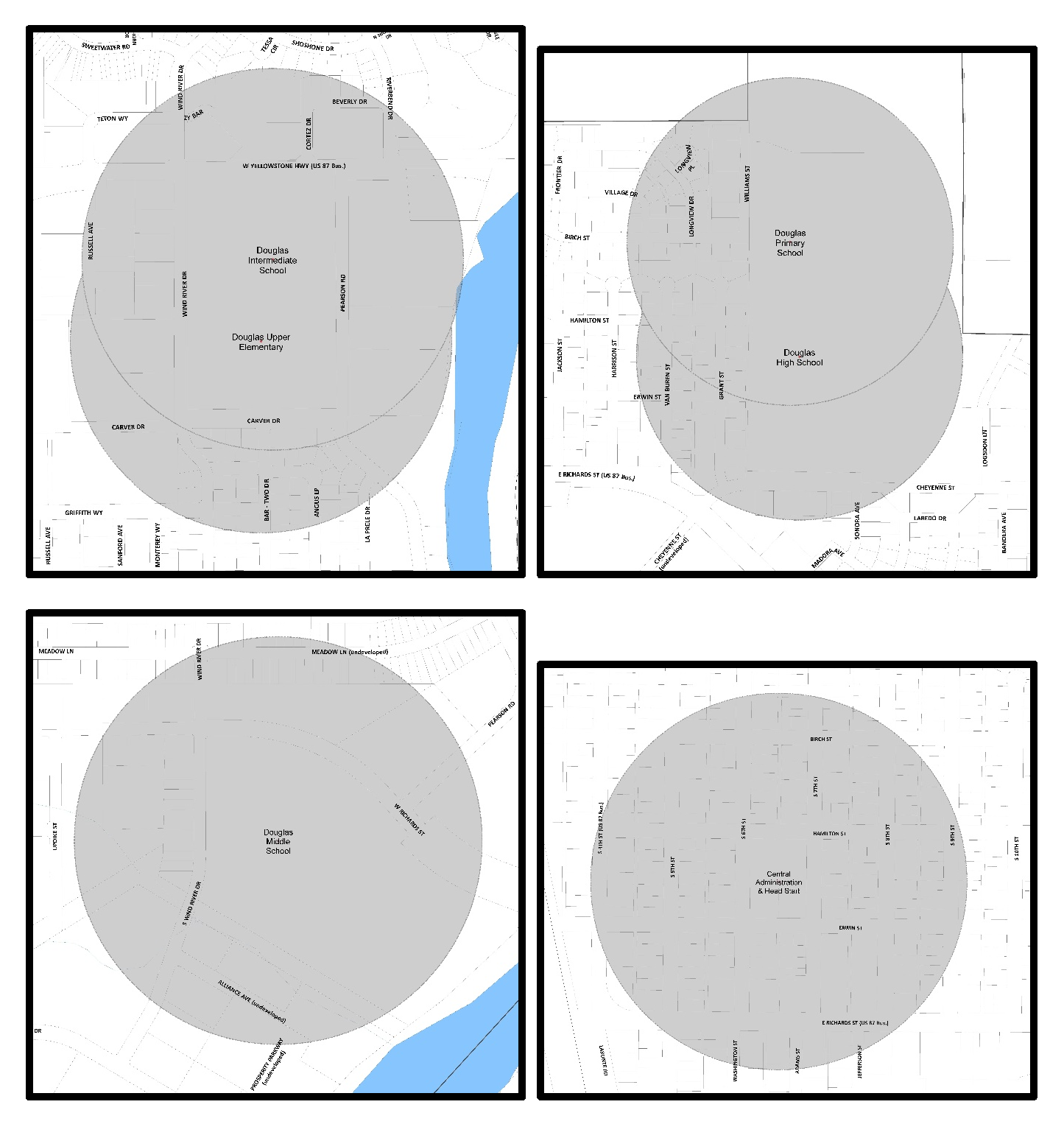
6.31.4
Occupancy and Parking
a.
Occupancy is limited to three (3) persons per sleeping-room listed for rent.
b.
One (1) off-street parking space shall be provided for short-term rentals in residential zones.
6.31.5
Permit Required
Approval of a conditional use permit, pursuant to the requirements in Chapter 3 of this Code, shall be required to for the operation of a short-term rental.
6.31.6
Lodging and Sales Tax
Short-term rental unit owners are subject to, and responsible for, collecting and remitting all applicable taxes, specifically including the sales and lodging tax.
6.31.7
Compliance with Building and Fire Codes
All short-term rental units are subject to the applicable building and fire codes. Properties being renovated to accommodate short-term rentals shall apply for a building permit and are subject to all applicable building and fire codes.
6.31.8
Safety Inspections
All short-term rentals are subject to safety inspections as deemed reasonably necessary by the Community Development Department.
6.31.9
No Separate Utility Meters
All electric, gas, sewer, and water services to boarding and rooming accommodations shall be interconnected to and indistinguishable from that of the principal residential structure and shall not have separate meters, service lines, or billing.
6.31.10
Violation; Advertising
Advertising of a short-term rental without the appropriate city permit shall be considered a violation and shall be subject to the enforcement provisions of Chapter 9 of this Code.
(Ord. No. 1011, § 1, 12-13-2021; Ord. No. 1013, § 3, 8-22-2022; Ord. No. 1015, § 1, 11-14-2022; Ord. No. 1045, §§ 2—4, 9-9-2024)
6.32 - Sidewalk Displays
A.
Sidewalk Displays Allowed Placement
Merchandise mobile displays may be placed directly adjacent to the storefront owning said merchandise. A five-foot clear walking space shall be provided at all times (see figure 6.6-1).
Exception: If a sidewalk width is no wider than five (5) feet, the Community Development Director may make a determination on the display area so long as reasonable space is provided for pedestrian traffic, ADA access, and safety.
Figure 6.6-1
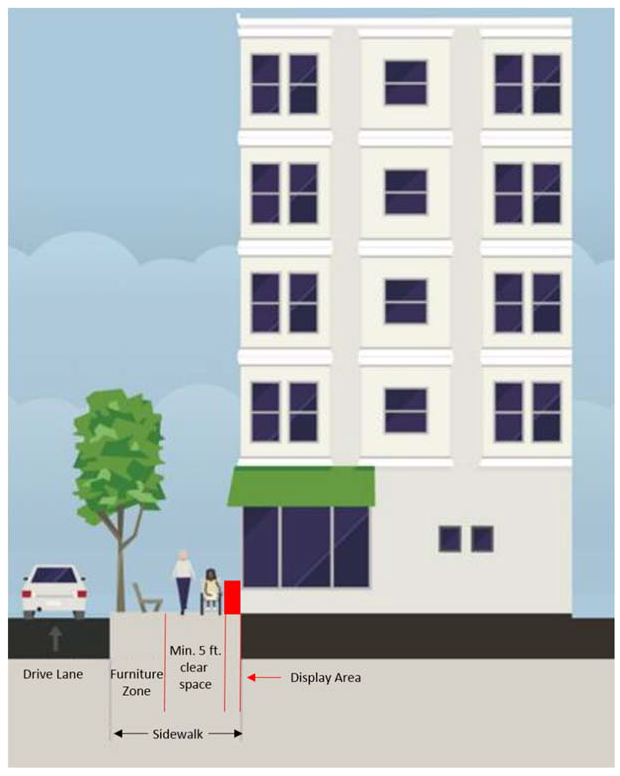
B.
Timing
Merchandise mobile displays shall only be allowed during the time the business owning the merchandise is open. All merchandise mobile displays shall be completely removed from the sidewalk at the close of business. Merchandise shall be stored within the structure owning the merchandise.
C.
Pertaining
This code shall not pertain to public art, mobile temporary signs (e.g. sandwich boards, real-estate signs, etc.), or safety measures (e.g. orange cones, construction buffers, etc.).
(Ord. No. 1000, § 2, 6-10-2019; Ord. No. 1011, § 1, 12-13-2021)
Editor's note— Ord. No 1011, § 1, adopted Dec. 13, 2021, enacted a new § 6.31, and renumbered the former §§ 6.31—6.40 as §§ 6.32—6.41 as set out herein. The historical notations have been retained with the amended provisions for reference purposes.
6.33 - Refuse Storage Containers (Dumpsters)
In addition to compliance with the landscape and screening requirements of Chapter 5 of this Code, refuse storage containers (dumpsters) shall be sited to allow left-side trash removal access by the Public Works Department. No Type A, Type B, or Type B-LSR Development Plan shall be approved without written approval by the Public Works Department that the locations of all refuse storage containers (dumpsters) are acceptable and that adequate access and space for maneuvering has been provided.
(Ord. No. 967, § 42, 8-10-2015; Ord. No. 1000, § 2, 2019; Ord. No. 1011, § 1, 12-13-2021)
Note— See editor's note at § 6.32.
6.34 - Sexually Oriented Businesses
6.34.1
Intent and Authority
A.
Intent
The purpose of this chapter in regulating sexually oriented businesses is to promote
the health, safety, morals and general welfare of the citizens of the City, and to
establish reasonable and uniform regulations to prevent the concentration of sexually
oriented businesses within the City.
B.
Authority
The provisions of this chapter are pursuant to authority granted to cities under the
Wyoming Constitution and Wyoming Statutes Section 15-1-101.
6.34.2
Zoning and Location Restrictions
A.
Zoning
Sexually oriented businesses are prohibited in all zoning districts, except in the
I (Industrial) zoning district. Approval of a conditional use permit, pursuant to
the requirements in Chapter 3 of this Code, shall be required to initiate, construct, or operate a sexually oriented
business in the I (Industrial) zoning district.
B.
Location Restrictions
No conditional use permit application to operate a sexually oriented business shall
be approved unless the applicant can prove compliance with each of the following:
i.
No sexually oriented business shall be located within one thousand (1,000) feet of any property:
a.
Upon which residential uses are identified as a principal allowed use;
b.
A public or private K through twelve (12) school;
c.
A public park; or
d.
A religious institution.
ii.
No sexually oriented business shall be located within one thousand (1,000) feet of another sexually oriented business.
iii.
Not more than one (1) sexually oriented business shall be permitted in the same building, structure, or portion thereof.
Measurement of the required separation distances shall be a straight linear measurement from the nearest wall of the structure proposed for the sexually oriented business to the nearest wall of the structure used for any existing sexually oriented business without regard to intervening structures, topography, streets, jurisdictional boundaries, or any other obstruction.
(Ord. No. 967, § 42, 8-10-2015; Ord. No. 1000, §§ 1, 2, 6-10-2019; Ord. No. 1011, § 1, 12-13-2021)
Note— See editor's note at § 6.32.
6.35 - Temporary Housing
6.35.1
Prohibited
Temporary housing shall be prohibited within the City of Douglas for any purpose and within any structure, building, container, enclosure, or any temporary facility.
(Ord. No. 967, § 42, 8-10-2015; Ord. No. 1000, §§ 1, 2, 6-10-2019; Ord. No. 1011, § 1, 12-13-2021)
Note— See editor's note at § 6.32.
6.36 - Temporary Uses
6.36.1
Zoning District Standards
All temporary uses shall comply with the use and dimensional standards for the respective zoning district, which are included in Chapter 4 of this Code.
6.36.2
Duration of Temporary Use
Temporary uses shall be limited to the specific dates/time period identified on the temporary use permit. No temporary use shall be allowed to operate for a period exceeding one (1) year, unless otherwise noted on the permit. Renewal of a temporary use permit may be granted in one-year increments, following the same application, review, and approval procedures as the original temporary use permit. Any renewal or reapplication shall be considered a new temporary use permit application.
6.36.3
Compliance with Building and Health and Safety Ordinances
All temporary uses shall comply with the building and health and safety ordinances of the City of Douglas Municipal Code.
6.36.4
Parking and Driveway
Safe access and adequate parking shall be provided for all temporary uses. Any use that requires a building permit, lasts more than thirty-one (31) days, or results in a new driveway intersection onto a City road shall be required to secure the appropriate access and right-of-way permitting.
6.36.5
Suspension/Revocation
If, upon review due to a complaint about the operation of the temporary use or upon a request for renewal of the temporary use, the Community Development Department Director determines that the use is not in compliance with the conditions or restrictions imposed by this Code or by the temporary use permit, the Director may take any action deemed necessary to remedy the noncompliance, including, but not limited to, revocation of the permit or pursuing the noncompliance as a zoning violation.
6.36.6
Transferability
Temporary use permits are valid for only the lot or parcel identified in the temporary use permit and may not be transferred to another property by the recipient of the permit.
6.36.7
Compliance with Other Regulations
All temporary use permits shall comply with the requirements of this Code, including, but not limited to, Chapter 4, Zoning, and Chapter 5, General Development Standards.
(Ord. No. 967, § 42, 8-10-2015; Ord. No. 1000, §§ 1, 2, 6-10-2019; Ord. No. 1011, § 1, 12-13-2021)
Note— See editor's note at § 6.32.
6.37 - Towers, Commercial and Private (Non-Commercial Telecommunications Facilities)
Commercial and private towers not considered commercial telecommunications facilities (CTF), including amateur (HAM) operated radio towers and antennae are permitted as accessory uses in all zone districts.
6.37.1
Location on Property
The tower shall be located on the property to contain on site all ice-fall or debris from tower failure.
6.37.2
Number of Towers Restricted in Residential Districts
Private towers shall be limited to one (1) per site. Additional commercial towers located in non-residential districts may be authorized with approval of a conditional use permit application.
6.37.3
Setback from Property Lines
The private tower shall maintain a setback from all property lines based upon a ratio of one and one-half (1½) horizontal foot for every vertical foot of tower or antenna height, for protection from free fall or ice fall. The setback may be modified if the applicant provides a certified engineer's or qualified expert's report substantiating that any free fall of the tower or ice fall from the private tower can be contained totally upon the applicant's lot or parcel and the modified location is certified by the applicant's engineer or expert as safe. Subsequent subdivision of lands upon which a generator has been constructed shall be designed to maintain the required setback.
6.37.4
Setback from Electrical Transmission Lines
A private tower shall not be located closer than a distance of one and one-half (1½) horizontal foot for every vertical foot of tower and antenna height, plus ten (10) feet, from any electrical transmission line. This does not include the service line for the lot or parcel where the private tower is to be located.
6.37.5
Location of Supporting Devices
Supporting devices such as guy wires and support poles shall be located on the same lot or parcel as the tower and may not be located in the front setback area. A zero foot setback for guy wires from the side and rear property lines is permissible. In no event, however, may the supporting devices be located within any utility or drainage easement.
6.37.6
Lighting Prohibited
No signals, lights or illumination shall be permitted on a private or commercial tower, unless required by the Federal Aviation Administration (FAA) or other applicable authority. If lighting is required, the lighting alternatives and design chosen must be the least obtrusive to the surrounding community.
6.37.7
Landscaping and Screening
With the exception of the tower, all structures associated with the private or commercial tower shall be screened from view from adjacent properties and rights-of-way pursuant to the landscape provisions of Chapter 5 of this Code. The Community Development Department Director, in reviewing a residential site plan or Type A Development Plan, or the City Council in reviewing a Type B or Type B-LSR Development Plan, for a private or commercial tower shall not grant approval if the associated structures are not adequately screened and may include a requirement to paint the tower a color which makes the tower more compatible with the surrounding environment.
6.37.8
Unauthorized Climbing
Adequate measures, such as anti-climb apparatus or removal of climbing ladder, are required in order to discourage unauthorized climbing. Security fencing and other design methods may be incorporated to discourage and/or prevent unauthorized access to and climbing of the tower. The use of chain link fencing may only be used for security purposes and shall not be counted toward any screening requirements of this Code.
6.37.9
Height Limitations
A.
Compliance with Concourse County Airport Approach Zones
No private or commercial tower shall protrude into the minimum requirements for the
Converse County Airport approach zones. Such minimum requirements shall be delineated
by the adopted Converse County Airport obstruction and approach zone map.
B.
Maximum Height
Private and commercial freestanding or attached towers in any zone district shall
not exceed one and one-half (1½) the maximum structural height allowed in the zone
district in which it is located. A commercial tower exceeding one and one-half (1½)
the maximum structural height allowed in the zone district shall require approval
of a conditional use permit and Type B or B-LSR Development Plan by the City Council
pursuant to the provisions of Chapter 3 of this Code.
(Ord. No. 967, § 42, 8-10-2015; Ord. No. 1000, §§ 1, 2, 6-10-2019; Ord. No. 1011, § 1, 12-13-2021)
Note— See editor's note at § 6.32.
6.38 - Vehicle, Boat, and Recreational Vehicle Storage
(Ord. No. 967, § 42, 8-10-2015; Ord. No. 1000, §§ 1, 2, 6-10-2019; Ord. No. 1011, § 1, 12-13-2021)
Note— See editor's note at § 6.32.
6.39 - Vehicles, Inoperable and Unlicensed
For use in refurbishing and restoring vehicles as a hobby, a property owner may keep on his/her property no more than two (2) unlicensed or inoperative vehicles and materials involved with the repair and restoration of those vehicles, provided the vehicles and materials are enclosed in a building or screened from view from the public right-of-way and adjacent properties at all times. This section does not apply to:
• Vehicle storage incident to an automobile sales, towing, storage, or repair business operated in compliance with all applicable law;
• The storage of wrecked, junked or inoperative vehicles by a lawful salvage business operating in compliance with all applicable law.
(Ord. No. 967, § 42, 8-10-2015; Ord. No. 1000, §§ 1, 2, 6-10-2019; Ord. No. 1011, § 1, 12-13-2021)
Note— See editor's note at § 6.32.
6.40 - Vehicle Repair Garage
The repair or dismantling of vehicles and storing of parts and accessories shall be conducted within an entirely enclosed structure. Any vehicles awaiting repair stored outside shall be stored in accordance with the outdoor storage standards in this Chapter. Outdoor storage of vehicles awaiting repair shall be prohibited in the CB-1 (Central Business) Zone District.
(Ord. No. 967, § 42, 8-10-2015; Ord. No. 1000, §§ 1, 2, 6-10-2019; Ord. No. 1011, § 1, 12-13-2021)
Note— See editor's note at § 6.32.
6.41 - Oil and Gas Operations
6.41.1
Intent
These regulations are intended to ensure the safety, preserve the health, promote the prosperity and improve the morals, order, comfort and convenience of the present and future residents of the City. These regulations are also intended to facilitate the development of oil and gas resources within the City, while mitigating potential land use conflicts between such development and existing, as well as planned, land uses. Owners of subsurface mineral interests have certain legal rights and privileges, including the right to use that part of the surface estate reasonably required to extract and develop their subsurface mineral interests, subject to compliance with the provisions of these regulations and any applicable statutory and regulatory requirements. The State has a recognized interest in fostering the efficient development, production, and utilization of oil and gas resources, and in the prevention of waste and protection of the correlative rights of common source owners and producers to a fair and equitable share of production profits. Similarly, owners of the surface estate have certain legal rights and privileges, including the right to have the mineral estate developed in a reasonable manner.
6.41.2
General Provisions
A.
New and Re-Drilled Wells
i.
It shall be unlawful for any person to drill a well that has not been previously permitted under this section, reactivate a plugged or abandoned well or perform initial installation of accessory equipment or pumping systems (in cases where a well is not being drilled) unless a conditional use permit has first been granted by the City Council in accordance with the requirements of this section.
ii.
The granting of such conditional use permit shall not relieve the operator from otherwise complying with all applicable regulatory requirements of the City, State, and the federal government.
iii.
When a conditional use permit has been granted for a well, reentry of such well for purposes of sidetracking, twinning, deepening, recompleting or reworking shall not require a separate conditional use permit.
iv.
The conditional use permit is limited to the current proposed facilities as shown in the approved plan. To the extent the applicant desires, after initial completion of a well, to place additional equipment on a tank battery or wellhead location which was not shown in the approved plan, the applicant must, except in a situation where additional equipment is necessary for a period of fourteen (14) days or less, notify the City of installation of such additional equipment.
v.
Within thirty (30) days after completion of operations, the applicant shall provide to the City "as-built" drawings showing all facilities, pipelines, flow lines and gathering lines which the applicant has placed on the land subject to this permit.
vi.
Nothing in this section shall be construed to allow oil and/or gas processing or refining facilities within the incorporated boundaries of the City of Douglas. This restriction shall not apply to small-scale processing at the respective well head designed to separate liquids and gases in order to effectively store and transfer resources off site.
B.
Right of Entry
For the purpose of implementing and enforcing this section, duly authorized City personnel
or contractors may enter onto a property subject to a conditional use permit upon
notification of the operator, permittee, lessee or other party holding a legal interest
in the property. If entry is denied, the City shall have the authority to discontinue
processing the conditional use permit application, or any associated permit applications,
revoke approved permits and applications, or obtain an order from a court to obtain
entry.
C.
Inspection
The operator or applicant shall provide the telephone number of a contact person who
may be reached twenty-four (24) hours a day, seven (7) days a week, for purposes of
being notified of any proposed City inspection under this Section or in case of emergency.
Any permitted oil and gas operations and facilities may be inspected by the City at
any time, to ensure compliance with the requirements of the approved permit, provided
that at least one (1) hour's prior notice is given to the contact person at the telephone
number supplied by the operator or applicant. Calling the number (or leaving a message
on an available answering machine or voice mail service at the number) at least one
(1) hour in advance of the proposed inspection shall constitute sufficient prior notice
if the contact person does not answer. By accepting the City's approved conditional
use permit, the operator or applicant consents to such inspections. The cost of any
City inspection deemed reasonable and necessary to implement or enforce this section
shall be borne by the operator or applicant.
D.
Use Tax
All operators must conform to applicable provisions of this Code and the Municipal
Code relating to taxation.
6.41.3
Conditional Use Application Requirements
An application for a conditional use permit shall include the following information:
A.
Site Plan Requirements
The site plans for a well site submitted with an application for a use by conditional
review shall be submitted on one (1) or more plats or maps, at a scale not less than
one (1) inch to fifty (50) feet, showing the following information:
i.
The proposed location of production site facilities or well site facilities associated with the well in the event production is established, if applicable. Future development of the resource shall be considered in the location of the tank battery. Existing tank batteries and transmission and gathering lines within one thousand (1,000) feet of the well site shall be shown.
ii.
The location of layout, including, without limitation, the position of the drilling equipment and related facilities and structures, if applicable.
iii.
True north arrow.
iv.
Existing improvements, if any, within a radius of one thousand (1,000) feet of the proposed well.
v.
Existing utility easements and other rights-of-way of record, if any, within a radius of one thousand (1,000) feet of the proposed well.
vi.
The applicant's drainage and erosion control plans for the well site or production site and the area immediately adjacent to such site, if applicable, as well as a financial assurance estimate and financial assurances sufficient to ensure installation of grading and erosion control measures associated with on-site access roads.
vii.
Location of access roads.
viii.
Well site or production site and existing lease boundaries.
ix.
The names of abutting subdivisions or the names of owners of abutting, un-platted property within one thousand (1,000) feet of the well site or production site.
x.
The name and address of the operator and the name of the person preparing the site plan or map.
B.
Vicinity Map Requirements
A vicinity map shall be required as part of a conditional use permit application for
approval of a well site or production site and shall include the following information:
i.
Location of all existing water bodies and watercourses, including direction of water flow. This information shall be submitted on USGS 7.5 minute series or assessor base maps which indicate topographic detail and show all existing water bodies and watercourses with a physically defined channel within a four-hundred-foot radius of the proposed well;
ii.
Location of existing oil and gas wells as reflected in the records of the State of Wyoming. This information shall be submitted on a map and shall include any and all wells within a one-thousand-foot radius of the proposed location for the well;
iii.
Location of all bodies of water, including, but not limited to, rivers, lakes, irrigation ditches, and ponds within a one-thousand-foot radius of the proposed location of the well; and
iv.
Location of proposed drill or re-drill site.
C.
Additional Requirements
In addition to a site plan and vicinity map, an application for approval of a conditional
use permit shall include the following information:
i.
The operator's and surface owner's names and addresses, copies of any required State of Wyoming Oil and Gas Conservation Commission forms and designation of agent, if applicable;
ii.
An operating plan;
iii.
A list of all permits or approvals obtained or yet to be obtained from local, state or federal agencies other than the Wyoming Oil and Gas Conservation Commission;
iv.
An emergency response plan that is acceptable to emergency services providers that includes a list of local telephone numbers of public and private entities and individuals to be notified in the event of an emergency, the location of the well and provisions for access by emergency response entities;
v.
A plan for weed control at the well site;
vi.
A transportation impact study identifying the traffic impacts and required mitigation measures for ensuring that the development of the well site will not create an unsafe condition on City streets;
vii.
A detailed evaluation of the geological conditions and technical limitations of the well drilling process that indicates that drilling operations into the targeted formation are unable to be performed using directional drilling techniques from a well site located outside the incorporated boundaries of the City of Douglas;
viii.
A fire protection plan that is mutually acceptable to the operator and the appropriate fire district that includes planned actions for possible emergency events and any other pertinent information. Prior to application to the City, a proposed fire protection plan and emergency response plan shall be submitted to and reviewed by the fire district; and
ix.
Method of providing sanitary facilities.
6.41.4
Development Standards
A.
Building Permit Required
Building permits must be obtained for all above-ground structures to which the International
Building Code applies.
B.
Setback Requirements
Under no circumstances shall a conditional use permit for drilling at a well site
be approved if the proposed location of the well head would be located within one
thousand (1,000) feet of any of the following:
• A lot or parcel used for residential purposes;
• A lot or parcel used for a public or private school;
• A lot or parcel used for public building, street, park, open space, or having an established public gathering area; or
• A municipal groundwater well head or surface water intake site.
C.
Compliance with State and Federal Environmental Regulations
The approval of an oil and gas conditional use permit shall not relieve the operators
from complying with all current applicable state and federal regulations and standards
concerning air quality, water quality and waste disposal.
D.
Geologic Hazards, Floodplains, and Floodway Restrictions
All equipment at well sites and production sites in geological hazard and floodplain
areas shall be anchored to the extent necessary to resist flotation, collapse, lateral
movement or subsidence and to the extent necessary to comply with the Federal Emergency
Management Act.
E.
Access
All private roads used to maintain access to the tank batteries or the well site shall
be improved and maintained according to the following standards:
i.
Tank Battery Access Roads
Access roads to tank batteries shall be subject to review by the City Engineer in accordance with the following minimum standards:
a.
Shall be graded gravel roadway having a prepared subgrade and an aggregate base course surface a minimum of six (6) inches thick compacted to a minimum density of ninety-five (95) percent of the maximum density determined in accordance with generally accepted engineering sampling and testing procedures.
b.
Shall be graded so as to provide drainage from the roadway surface and constructed to allow for cross-drainage of waterways (such as roadside swales, gulches, rivers, creeks and the like) by means of an adequate culvert pipe. Adequacy of the pipe is subject to approval of the City Engineer.
c.
Shall be maintained so as to provide a passable roadway free of ruts at all times.
ii.
Wellhead Access Roads
Access roads to wellheads shall be subject to review by the City Engineer in accordance with the following minimum standards:
a.
Shall be a graded, dirt roadway compacted to a minimum density of ninety-five (95) percent of the maximum density determined in accordance with generally accepted engineering sampling and testing procedures and approved by the City Engineer.
b.
Shall be graded so as to provide drainage from the roadway surface and constructed to allow for cross-drainage of waterways by means of an adequate culvert pipe. Adequacy of the pipe shall be subject to approval by the City Engineer.
c.
Shall be maintained so as to provide a passable roadway generally free of ruts.
iii.
Public Access Roads
An extra-legal vehicle or load permit shall be required for all extra-legal vehicles or loads which use City streets. Such permit, if required, shall be obtained from the City Engineer prior to hauling. The applicant shall comply with all City and state regulations regarding weight limitations on streets within the City, and the applicant shall minimize extra-legal truck traffic on streets within the City.
F.
Impacts to Public Roads
i.
Every permit issued by the City shall require the applicant or operator to pay a fee that is sufficient to pay the estimated cost for all impacts which the proposed operation may cause to facilities owned or operated by the City or used by the general public, including, but not limited to:
a.
Repair and maintenance of roads;
b.
Bridges and other transportation infrastructure;
c.
Improvements made or to be made by the City to accommodate the operations and to protect public health, safety and welfare; and
d.
Costs incurred to process and analyze the application, including the reasonable expenses paid to independent experts or consultants.
ii.
The City shall establish a mechanism to assess and obtain payment of such fees, subject to the right of the City to request additional funds if the fees prove to be insufficient, or to refund surplus funds to the operator if the fees paid exceed the actual cost of the impacts.
iii.
The City may further require that the applicant or operator, or both, post a bond in an amount to be set during the site plan phase, as security in the event additional damages occur to facilities owned or operated by the City or used by the general public.
iv.
As a condition of issuance of the permit and on an as-needed basis, the City may require additional site-specific measures be undertaken by the applicant or operator in order to protect and preserve facilities owned or operated by the City or used by the general public.
G.
Emergency Response Cost Reimbursement Required
The well site operator shall reimburse the City or the responsible emergency response
provider for any emergency response costs incurred by the City or the provider in
connection with activity at the well site or production site, except that the operator
shall not be required to provide reimbursement for emergency response costs where
the emergency response was precipitated by a mistake of the City.
6.41.5
Process and Review Criteria
All conditional use permit applications for approval of a drilling or re-drilling site shall follow the application and review procedures required for a conditional use permit as required in Chapter 3 of this Code. In addition to the standard review criteria for a conditional use permit as outlined in Chapter 3 of this Code, a conditional use permit for approval to drill or re-drill an oil and/or gas well shall also comply with each of the following criteria:
i.
The site plan for the well site application complies with the requirements of this Section;
ii.
The vicinity map for a well site application complies with the requirements of this section;
iii.
The well site application complies with the requirements of this Section for additional information;
iv.
The well site application complies with the provisions of this Section for geologic hazards, floodplains, or floodways;
v.
The well site application complies with the provisions of this Section for wildlife mitigation procedures;
vi.
Development of the well site will not result in adverse environmental impacts; and
vii.
Any adverse impacts to City streets resulting from the development of the well site can and will be mitigated by the applicant.
(Ord. No. 967, § 42, 8-10-2015; Ord. No. 1000, §§ 1, 2, 6-10-2019; Ord. No. 1011, § 1, 12-13-2021)
Note— See editor's note at § 6.32.
6.42 - Shipping Containers as Mini-Warehouse (Commercial Self-Storage Facility).
6.42.1
Purpose
The purpose of this section is to regulate the use of shipping containers in mini-warehouse (commercial self-storage facility) developments to protect the public health, safety, and welfare, and safeguard property values while promoting positive aesthetics in the City.
6.42.2
Definitions
"Mini-Warehouse (Commercial Self-Storage Facility)." Buildings designed primarily for the storage of household items and inventory of small commercial businesses where storage units are individually leased or rented, where access to storage units is infrequent, and where no utilities are provided except for services provided to a manager's apartment, office, and for the lighting and climate control of individual storage units. May also include shipping containers in commercial and industrial zones.
"Shipping Container" shall mean a unit originally used or designed to store goods or other merchandise during shipping or hauling by a vehicle, including, but not limited to, rail cars of any kind, truck trailers, or multi-modal shipping containers or similar structures such as look-alike shipping container buildings or metal buildings marketed as "containers," "portable storage units," or "conex."
6.42.3
Approvals
A.
Adjacent to Residential Zone - Approved as a Type B Development: Shipping containers used as a mini-warehouse (commercial self-storage facility) adjacent to any residential zone shall be approved as a Type B Development.
B.
Not Adjacent to Residential Zone - Approved as a Type B Development: Shipping containers used as a mini-warehouse (commercial self-storage facility) not adjacent to any residential zone shall be approved as a Type A Development.
C.
Building Permit Required: Shipping containers shall require a building permit and shall comply with adopted and applicable International Building Codes.
6.42.4
Occupation
Shipping containers shall not be used as dwellings, sleeping quarters or for occupancy for any period of time.
6.42.5
Site and Circulation
A.
Limited: Only one (1) shipping container is allowed per commercial lot unless the commercial lot is being used as a mini-warehouse (commercial self-storage facility).
B.
Lot Coverage: Shipping containers shall be in an approved designated area per the Development Plan or Building Permit application and be included in the calculation of overall lot coverage.
C.
Site Circulation: A site circulation plan shall be provided as part of the Development Plan or Building Permit application.
6.42.6
Screening, Markings, Advertising
A.
Screening: Shipping containers shall be screened from the view of the public and adjacent properties with a combination of plantings, xeriscaping materials, landscaped berms, and one hundred (100) percent solid opaque fence or decorative wall. Fences and decorative walls used to screen shipping containers shall be a minimum of six (6) feet in height. Any request to construct a decorative screening wall to screen shipping containers in excess of six (6) feet shall be designed and certified by a registered engineer in the State of Wyoming. The height of an opaque fence or decorative screening wall may be reduced by one (1) foot for every one (1) foot of earthen berm constructed immediately below the fence or wall up to a maximum reduction of the fence or wall height resulting in a three-foot fence or decorative screening wall on top of a three-foot earthen berm.
B.
Markings: Shipping containers shall retain their original data plate (CSC safety approval placard) affixed. Shipping containers shall be painted on all visible sides and top with solid natural earth toned colors that blend and/or enhance the natural scenic aesthetic of the neighborhood.
C.
Advertising: Shipping containers shall not be used for any advertising purpose and shall be kept clean of all alpha-numeric signage and writing with the exception of their original data plate (CSC safety approval placard).
6.42.7
Placement
A.
Arrangement: Shipping containers shall be placed in a tidy straight line with no space between each container.
B.
Drainage: Shipping containers shall be placed so surface drainage runs away from the containers to a designated drainage and does not pool around the containers.
C.
Fastened: Rows of containers shall be fastened together.
D.
Positioning: Shipping containers shall not occupy required off-street parking, loading or landscaping areas.
E.
Setbacks: Shipping containers shall comply with the setbacks for the applicable zoning district.
F.
Size and Height: The maximum size allowed for a shipping container shall be eight (8) feet wide by twenty (20) feet long by eight and one-half (8.5) feet tall.
Exception: Shipping containers used for mini-warehouse (commercial self-storage facility) may not exceed eight (8) feet wide by forty (40) feet long by nine and one-half (9.5) feet tall.
G.
Stacking: Shipping containers shall not be stacked.
H.
Surface: Containers shall be safe, structurally sound, in good repair, and placed on a stable compacted or solid surface to ensure containers do not shift, sink, tilt, or fall out of line with the adjacent containers.
I.
Trailer Detachment: Shipping containers must be detached from the transportation trailer and placed on the ground. All running gear shall be removed prior to placement.
6.42.8
Utilities
No shipping container shall be connected to any utilities other than electrical.
6.42.9
Maintenance
Shipping containers shall be maintained in good condition at all times. Any container appearing to be in disrepair or shifting shall be removed and corrected immediately. Any container that becomes unsound, unstable or otherwise dangerous, as determined by the City, shall be immediately repaired or removed by the property owner and at the expense of the property owner.
(Ord. No. 1054, § 1, 5-27-2025)

