
Duncanville City Zoning Code
ARTICLE III
- LAND USES
Sec. 3.01. - Uses permitted by district.
A.
Land and buildings in each of the zoning districts may be used for any of the specified uses in Section 3.03. Permitted Use Chart.
B.
See Section 7.02. Land Use Terms, for definitions of land use classifications.
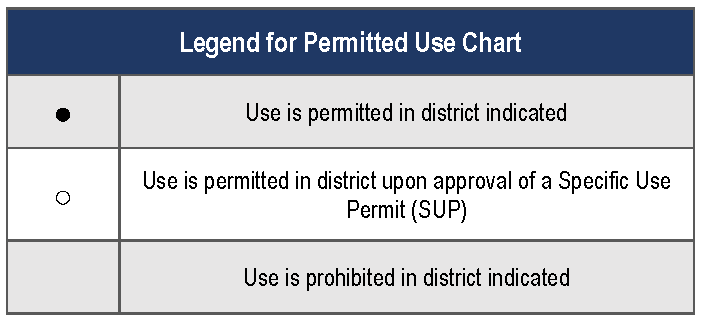
(Ord. No. 2395, § 1, 3-2-21)
Sec. 3.02. - Classification of new and unlisted uses.
It is recognized that new types of land use will develop, and forms of land use not anticipated may seek to locate in the city. In order to provide for such changes and contingencies, a determination as to the appropriate classification of any new or unlisted use shall be made as follows:
A.
City planner classification as a similar use. The new or unlisted use will be referred to the city planner to determine whether the new or unlisted use should be classified as a similar existing use.
B.
Zoning text amendment for new or unlisted use. If the city planner is unable to classify the new or unlisted use as similar to an existing use, the use shall be processed as a zoning text amendment, which requires a recommendation from the planning and zoning commission and approval from the city council to amend the permitted use chart.
C.
Factors for consideration. The determination shall be based on findings in relation to the nature of the use and whether it involves dwelling activity, sales, processing, type of product, storage and amount and nature thereof, enclosed or open storage, anticipated employment, transportation requirements, amount of noise, odor, fumes, light, dust, toxic material, and vibration likely to be generated and the general requirements for public utilities.
(Ord. No. 2395, § 1, 3-2-21)
Sec. 3.03. - Permitted use chart.
(Ord. No. 2395, § 1, 3-2-21; Ord. No. 2478, § 1, 5-2-23; Ord. No. 2487, § 1, 8-1-23)
Sec. 3.04. - Additional use regulations.
The following requirements correspond to each use as designated within the "Additional Regulations" column of Section 3.03. Permitted Use Chart.
A.
Residential uses.
1.
Boarding house standards.
a.
Application information. Specific use permit applications shall include, but not limited to, the following information:
(1)
Number of permanent occupants;
(2)
Maximum number of temporary occupants;
(3)
Total square feet of dwelling unit;
(4)
Number of bedrooms;
(5)
Total square feet of sleeping rooms;
(6)
Number of restrooms;
(7)
Total square feet of kitchen;
(8)
Total square feet of living and/or dining areas;
(9)
Maximum number of vehicles; and
(10)
On-site responsible party and contact information.
b.
Living area.
(1)
Each bedroom in a dwelling unit occupied by one person shall contain 70 square feet of floor area, and that each bedroom occupied by more than one person shall contain at least 60 square feet of floor area for each occupant thereof.
(2)
Bedrooms shall be proportional to bathrooms and living areas in single family residential structures such that for every two rooms used in the structure as a bedroom there shall be at least: (A) one full bathroom (containing a commode, a sink and a shower or bathtub); and (B) one living area. As used in this section, the term "living area" means a room of at least 120 square feet in size, other than:
(a)
An unfinished garage or basement; or,
(b)
A room used as bedroom, bathroom or kitchen.
c.
Spacing. No boarding house shall locate within 1,600 feet of another boarding house. The measurement is taken in a straight, direct line from one property to another.
d.
Parking. The amount of on-site parking shall not exceed the parking required by Section 3.03. Permitted Use Chart by more than three spaces.
e.
Inspections. All boarding houses shall require an interior and exterior inspection of the property prior to the issuance of a certificate of occupancy and annually thereafter by the building official, building inspector, and code enforcement officials.
2.
Community home for persons with disabilities standards.
a.
Application information. Applications for a community home for persons with disabilities shall include, but not limited to, the following information:
(1)
Current state license information, and
(2)
On-site responsible party and contact information.
b.
Spacing. In accordance with Section 123.008 of the Human Resources Code, no community home for persons with disabilities shall locate within one-half mile of another community home for persons with disabilities.
c.
Parking. The amount of on-site parking shall not exceed the parking required by Section 3.03. Permitted Use Chart by more than three spaces.
d.
Inspections. All community homes shall require an interior and exterior inspection of the property prior to the issuance of a certificate of occupancy and annually thereafter by the building official, building inspector, and code enforcement officials.
3.
Industrialized home standards.
a.
The industrialized home meets or exceeds all building code requirements that apply to other dwelling units concerning on-site construction.
b.
The industrialized home conforms to all applicable zoning standards for the respective zoning district.
c.
The industrialized home has a value equal to or greater than the median taxable value for each single-family dwelling located within 500 feet of the lot on which the industrialized housing is proposed to be located, as determined by the most recent county certified tax appraisal roll;
d.
The industrialized home has exterior siding, roofing, roofing pitch, foundation fascia, and fenestration compatible with the single-family dwellings located within 500 feet of the lot on which the industrialized housing is proposed to be located;
e.
The industrialized home complies with municipal aesthetic standards, building setbacks, side and rear yard offsets, subdivision control, architectural landscaping, square footage, and other site requirements applicable to single-family dwellings; and
f.
The industrialized home is securely fixed to a permanent foundation.
4.
Mixed-use development standards.
a.
Build-to zone.
(1)
At least 75 percent of the front façade shall be located within five feet from the required front yard setback.
(2)
For corner lots, at least 75 percent of the exterior side façade shall be located within five feet from the required side yard setback.
b.
Building articulation. See requirements in Section 4.03. Design Standards.
c.
Required fenestration.
(1)
Ground floor shall be 50 percent to 75 percent doors and/or windows.
(2)
Upper floors shall be 25 percent to 50 percent doors and/or windows (measured between three feet to nine feet above each finished floor.
d.
Building entrance.
(1)
The primary entrance shall front a public street with a walkway connecting to a front sidewalk.
(2)
Architectural elements shall indicate a clear entry point.
e.
Parking.
(1)
Off-street parking shall be calculated based on the uses within the development. Shared parking provisions may be utilized to reduce the number of required spaces.
(2)
No off-street parking shall be located in front of the building façade.
f.
Uses.
(1)
At least 75 percent of the first story of the structure shall be used for nonresidential use(s). The remaining portion of the structure above the first story may be used for either residential or nonresidential uses, or a combination of both.
(a)
If a one-story structure exists on the property, 100 percent of the structure shall be occupied for nonresidential use(s) only.
(2)
Drive-through features for the transaction of business are prohibited.
5.
Multiple-family dwelling standards.
a.
Building articulation. See requirements in Section 4.03. Design Standards.
b.
Recreation space.
(1)
All multiple-family developments with 20 dwelling units or more shall devote not less than eight percent of the gross development area to recreational facilities, generally in a central location. In large developments (two acres or larger), these may be decentralized.
(2)
Recreation areas include space for community buildings and community uses, such as adult recreation, child play areas, dog parks, picnic areas, and swimming pools, but do not include vehicle parking, commercial, maintenance, and utilities areas.
6.
Patio home/zero lot line home, townhome, and two-family dwelling standards. See Section 4.02. Modified Dimensional Standards for exceptions to the dimensional standards.
B.
Accessory and incidental uses.
1.
Accessory dwelling unit standards.
a.
No more than one Accessory Dwelling Unit for the purpose of a living quarters shall be permitted on a lot.
b.
No more than one household family unit shall occupy an accessory dwelling unit at a time.
c.
The homeowner must live on the property.
2.
Drive-thru standards.
a.
A drive-thru window is not automatically included with any use. A drive-thru must be allowed as an accessory use to utilize a drive-thru window.
b.
See Section 4.04.F. Off-Street Stacking Requirements for applicable stacking and queuing requirements.
3.
Fuel pumps standards. See Section 4.04.F. Off-Street Stacking Requirements for applicable stacking and queuing requirements.
4.
Home occupation standards.
a.
There shall be no change in the outside appearance of the building or premises, or other visible evidence of the conduct of such home occupation. No sign, advertisement or display may be used to indicate the presence of a home occupation in the structure.
b.
The home occupation shall be clearly incidental and subordinate to the home's use for residential purposes. Not more than 500 square feet or ten percent of the square footage of the dwelling area, whichever is greater, shall be used in the conduct of the home occupation.
c.
The address of the dwelling may not appear in any advertisement.
d.
Any persons employed must be a member of the occupant's immediate family and reside on the premises where the home occupation takes place.
e.
No home occupation may utilize equipment other than that designed for residential use or which would be detrimental to or distract from the use of the premises as a residence.
f.
The home occupation will not cause an increase in traffic volume in the neighborhood. No more than five patrons may be on the premises at one time.
g.
No equipment shall be used that creates offensive noises, vibration, sound, smoke, dust, odors, heat, glare, x-rays, or electrical disturbances to radio or television instruments.
h.
Delivery of materials to and from the premises shall not involve the use of vehicles over two ton capacity, except parcel post, United Parcel Service or similar delivery trucks.
i.
No traffic shall be generated by a home occupation in greater volume than normally expected in a residential neighborhood, and any need for parking must be accommodated within the required off-street parking for the residence or along the street frontage for the lot.
j.
No outside storage shall be permitted in conjunction with a home occupation.
5.
Outdoor display, permanent standards.
a.
Outdoor display, permanent areas shall not be located more than 30 feet from the main building and shall not exceed 50 percent of the linear frontage of the building.
b.
Outdoor display, permanent areas shall not pose a safety or visibility hazard, nor impede public vehicular or pedestrian circulation, either on-site or off-site, in any way.
c.
Outdoor display, permanent areas must be contained within the property and shall not extend into the right-of-way.
d.
Outdoor display, permanent items shall be displayed in a neat, orderly manner, and the display area shall be maintained in a clean, litter-free manner.
e.
Outdoor display, permanent is permitted only as an accessory use and is not a permitted principal use.
6.
Outdoor display, temporary standards.
a.
Outdoor display, temporary areas shall not be located more than 30 feet from the main building and shall not exceed 50 percent of the linear frontage of the building.
b.
Outdoor display, temporary shall not occupy any of the parking spaces that are required by this zoning ordinance for the primary use(s) of the property, except on a temporary basis only, which is a maximum of 45 days per display and a maximum of two displays per calendar year.
c.
Outdoor display, temporary areas shall not pose a safety or visibility hazard, nor impede public vehicular or pedestrian circulation, either on-site or off-site, in any way.
d.
Outdoor display, temporary must be contained within the property. Outdoor display, temporary areas shall not extend into the right-of-way without written permission from the city.
e.
Outdoor display, temporary items shall be displayed in a neat, orderly manner, and the display area shall be maintained in a clean, litter-free manner.
f.
Outdoor display, temporary is permitted only as an accessory use and is not a permitted principal use.
7.
Outside storage standards.
a.
Outside storage shall not be located in the front yard.
b.
See Section 4.07.C.6 Outside Storage Screening for screening requirements.
8.
Short-term rental standards.
a.
The applicant must obtain a short-term rental permit from the city and provide proof of ownership of the residence.
b.
The applicant must demonstrate to the satisfaction of the city planner that the unit and property do not have any outstanding issues related to taxes or building, electrical, plumbing, fire, health, housing, police, planning, noise, or code enforcement provisions.
c.
The applicant must submit a report to the city planner each January that indicates the following:
(1)
The number of nights the unit was rented as a short-term rental in the previous year;
(2)
Proof of payment of hotel occupancy tax is submitted to the city in accordance with Chapter 18 Article II of the City's Code of Ordinances; and
(3)
Proof of current property insurance.
(4)
If the applicant has failed to meet one of these requirements, the city shall provide ten calendar days of notice to comply.
d.
The city retains the right to suspend or remove a property from the registry. Once a property has been removed from the registry, the property shall not be added to the registry for at least one year.
e.
Suspension or removal shall be at the discretion of the city planner for reasons including, but not limited to, the following:
(1)
The applicant has given false or misleading information during the application process;
(2)
There has been a violation of any of the terms, conditions, or restrictions of this subsection;
(3)
The applicant has failed to pay the hotel occupancy tax in the timely manner; or
(4)
The location has received three complaints from the neighboring property owners for excessive noise or traffic within a 24 month period.
f.
Continued operation of a short-term rental following suspension or removal from the registry shall be considered a violation of this zoning ordinance.
9.
Wind energy turbine standards.
a.
General standards.
(1)
Wind energy turbines are permitted only in the rear yard.
(2)
The minimum distance between the ground and any part of a rotor blade must be at least 20 feet.
(3)
Wind energy turbines shall not be illuminated, nor may they bear any signs or advertising.
(4)
Wind energy turbines must have automatic braking, governing, or feathering system to prevent uncontrolled rotation, over-speeding, and excessive pressure on the support structure, rotor blades, and turbine components.
(5)
All wiring serving wind energy turbines must be underground.
(6)
Noise produced by wind energy turbines may not exceed 55 dBA measured at the property line.
(7)
Wind energy turbines must not cause any interference with normal radio and television reception in the surrounding area, with any public safety agency or organization (including but not limited to police, fire, and ambulance) radio transmissions, or with any microwave communications link. The owner shall bear the cost to conduct a study to determine interference, and of immediately eliminating any such interference should any occur, or must immediately shut down the system or parts of the system causing the interference.
(8)
A finish (paint/surface) must be provided for the wind energy turbine that reduces the visibility of the facility, including the rotors. In most circumstances this condition may be satisfied by painting the support structure and rotors with flat light haze gray paint. If the support structure is unpainted it must be of a single color throughout its height. The owner must maintain the finish, painted or unpainted, so that no discoloration is allowed to occur.
(9)
The diameter of the area swept by the rotors may not exceed 12 feet.
b.
Freestanding systems—Additional standards.
(1)
Wind energy turbines may be mounted on a tower detached from other structures on the lot.
(2)
The minimum setback from any property line, overhead utility line, or public right-of-way shall be a distance equal to the vertical distance from the ground to the tip of a wind generator blade when the tip is at its highest point unless the affected utility, property owner, or governmental entity grants written permission for a lesser setback. In addition to the system's structures, guy wires associated with towers shall meet applicable setbacks for the zoning district.
(3)
Freestanding systems measured from the top blade may not exceed 45 feet in height.
(4)
Support structures for freestanding systems must be unclimbable from the ground to a height of at least 15 feet.
(5)
A maximum of one freestanding wind energy turbine shall be allowed per lot.
c.
Roof-mounted systems—Additional standards.
(1)
Wind energy turbines may be mounted on the roof of a structure as an appurtenance.
(2)
Roof-mounted systems measured from the top blade may not be more than five feet over the maximum allowed height for the structure.
(3)
A maximum of one roof-mounted wind energy turbine shall be allowed per lot.
(4)
Before any roof-mounted system is mounted, the property owner must submit a report prepared by a licensed professional engineer attesting to the fact that the structure to which the system will be mounted is or will be sufficiently strong to support the system and to withstand the wind, vibratory, and other loads to which it would be subjected as a result of mounting the system on it. This report is subject to approval by the city engineer prior to the mounting of the system.
C.
Educational, institutional, public, and special uses.
1.
Child care facility, daycare standards. See Section 4.04.F. Off-Street Stacking Requirements for applicable stacking and queuing requirements.
2.
School, Primary or Secondary (Private) or School, Primary or Secondary (Public) Standards. See Section 4.04.F. Off-Street Stacking Requirements for applicable stacking and queuing requirements.
3.
Wireless communication tower standards. See Section 4.12. Wireless Telecommunication Regulations.
D.
Recreational and entertainment uses. None.
E.
Retail and service uses.
1.
Adult-oriented uses standards. Adult-oriented uses must maintain a minimum separation distance of 1,000 feet from any residential district, any structure used as a residence, any place of worship, school, hospital, park or playground, or any other adult-oriented uses.
2.
Bar (≥75% Alcohol Sales) and Uses with ≥75% Alcohol Sales Standards
a.
No establishment that derives 75 percent or more of its revenue from the sale of alcohol for on-premise consumption shall be located is within 300 feet of a place of worship, school, or hospital except as provided by the Texas Alcoholic Beverage Code. The city planner shall use subdivision plats to verify the distance requirements have been met. If a dispute exists, it shall be the applicant's responsibility to engage the services of a Professional Surveyor to determine the separation distance.
b.
Standards included in Article XX. Sale of Alcoholic Beverages of the city's Code of Ordinances shall apply.
3.
Food truck park standards.
a.
All mobile vendors must have valid required health inspection permits from the city.
b.
Applications for a food truck park shall include the following:
(1)
A detailed site plan showing the location and dimensions of the park area, locations of all proposed mobile vendors, landscaping, building setbacks, vehicle parking, areas for sitting and/or dining, barriers, utility connection locations, and restroom locations;
(2)
Written permission from the land owner to use the site (unless the applicant is the land owner);
(3)
A copy of all required health inspection permits;
(4)
Proposed hours of operation;
(5)
Shared use agreement for restroom facilities (if applicable), as noted by d below.
c.
Food truck park sites are considered a parking lot; therefore, all surfaces must be paved and include the required landscaping outlined in Section 4.08 Landscape Requirements.
d.
Adequate restroom facilities shall be provided either on-site or through a shared use agreement with a neighboring business. Portable toilets, if used, must be screened from view of the public.
e.
Electrical, water, and wastewater connections shall be provided.
f.
Above ground utility connections shall not interfere with pedestrian or vehicular safety and shall not be located in customer service areas or customer parking lots.
g.
Food truck park sites shall be defined by curbs (i.e., continuous curb cuts are prohibited) to confine ingress and egress to defined access points to ensure the safety of pedestrians within the park.
h.
A barrier shall be located between any vehicular areas and the customer service areas. The barrier may be implied or physical and constructed with landscaping elements; gated fencing; changes in ground surface texture, material or color; or similar treatments.
i.
Drive-thrus are not permitted in conjunction with a food truck park.
j.
Signage is allowed on the mobile vendor vehicle itself but no detached signage is allowed.
k.
A waste receptacle is required for every mobile vendor and waste shall be removed daily.
4.
Hookah lounge standards. Hookah lounges are prohibited in accordance with Chapter 16B Smoking of the City's Code of Ordinances.
5.
Retail, sundry standards.
a.
A retail, sundry store shall not be located within 5,000 feet of another retail, sundry store, measured by the nearest property lines.
b.
A minimum of ten percent of the floor area of the retail, sundry store must be dedicated to fresh produce, meat and dairy products and designated as such within an SUP.
6.
Tobacco, CBD, or vape shop standards. Tobacco, CBD, or Vape shops must maintain a minimum separation distance of 500 feet from any residential district, any structure used as a residence, any place of worship, school, hospital, park, or playground.
F.
Commercial and industrial uses. None.
G.
Automobile and transportation uses.
1.
Auto repair and services, Major standards.
a.
Luminaries shall be mounted at a height not to exceed 30 feet as measured vertically from the horizontal surface of the nearest parking pavement.
b.
No exterior auditory devices shall be permitted.
c.
See Section 4.04.F. Off-Street Stacking Requirements for applicable stacking and queuing requirements.
2.
Car Wash standards.
a.
The use, where adjacent to property zoned as single-family residential uses shall maintain a minimum setback of at least 125 feet.
b.
The hours of operation may be limited when located adjacent to property zoned for single-family residential uses.
c.
No outside/outdoor vending machines, such as soda, video rental, or newspaper vending machines, are permitted.
d.
See Section 4.04.F. Off-Street Stacking Requirements for applicable stacking and queuing requirements.
3.
Fuel station, standalone standards.
a.
The use, where adjacent to property zoned as single-family residential uses shall maintain a minimum setback of at least 125 feet.
b.
The hours of operation may be limited when located adjacent to property zoned for single-family residential uses.
c.
No outside/outdoor vending machines, such as soda, video rental, or newspaper vending machines, are permitted.
d.
No part of the use shall be located nearer than 18 feet to the front property line.
e.
See Section 4.04.F. Off-Street Stacking Requirements for applicable stacking and queuing requirements.
(Ord. No. 2395, § 1, 3-2-21)

