
Duncanville City Zoning Code
ARTICLE IV
- DEVELOPMENT STANDARDS
Sec. 4.01. - Additional regulations in the code of ordinances.
Note that additional development regulations exist in the city's Code of Ordinances outside of this zoning ordinance, including but not limited to:
A.
Chapter 12. Article X. Fence Regulations;
B.
Chapter 12. Article XVII. Tree Preservation;
C.
Chapter 16A. Sign Guidelines;
D.
Chapter 16B. Smoking;
E.
Chapter 17. Streets and Sidewalks;
F. Appendix
B. Subdivision Regulations;
Visit Municode.com to view the entire Code of Ordinances.
(Ord. No. 2395, § 1, 3-2-21)
Sec. 4.02. - Modified dimensional standards.
A.
Dimensional standards in the opportunity areas. The dimensional standards required by Article 2. Zoning Districts are modified to encourage redevelopment within the opportunity areas identified within the comprehensive plan. Dimensional standards within the opportunity areas (with the exception DD, Downtown Duncanville District) are modified as follows:
1.
Twenty percent reduction in front, rear, and side setback; and
2.
Twenty percentage point increase in building coverage.
Example: A 30 foot setback and 50 percent maximum lot coverage would become a 24 foot setback and 70 percent maximum lot coverage,
B.
Interior side yard setback adjustment for zero lot lines.
1.
Patio homes.
a.
The interior side yard setback regulations in Article 2. Zoning Districts shall not apply to the zero lot line side of patio home/zero lot line home. The exemption applies only to one side yard setback.
b.
A patio Home/zero lot line home may only be built along the property line if another offset patio home is located adjacent to that side (i.e., the zero lot line side of a patio home/zero lot line home shall not be located next to a traditional Single family detached home).
c.
Separation between buildings shall be no less than ten feet.
d.
The wall of the dwelling located on the zero lot line side shall have no windows, doors, air conditioning units or any other type of opening.
2.
Townhomes on separate lots.
a.
This section addresses townhomes where multiple units are adjoined across property lines. This section does not apply to townhomes located on a single lot.
b.
The interior side yard setback regulations in Article 2. Zoning Districts shall not apply to the interior sides of Townhomes on separate lots. The exemption does not apply to the end units.
c.
Minimum lot frontage shall be 25 feet.
d.
Minimum lot size shall be 3,000 square feet.
3.
Two-family dwellings on separate lots.
a.
This section addresses two-family dwellings that are adjoined across a property line. This section does not apply to two-family dwellings located on a single lot.
b.
The interior side yard setback regulations in Article 2. Zoning Districts shall not apply to the interior lot line of two-family dwellings on separate lots (i.e., the exemption allows the housing structure to be split across two lots so each unit is located on its own lot).
c.
Two-family dwellings located on separate lots must each be at least half the area of the minimum lot size required for that zoning district (i.e., the minimum lot size would be met if the lots were combined).
C.
Special exception for dimensional standards for redevelopments. For redevelopments, the zoning board of adjustment may allow a special exception in accordance with Section 6.10. Special Exceptions for deviation from the dimensional standards provided in Article 2. Zoning Districts for the proposed standards to use the most intense existing dimensions on the block within the same zoning district for any allowed use for the following:
1.
Building height,
2.
Front, rear, and side setback; and/or
3.
Building coverage.
(Ord. No. 2395, § 1, 3-2-21)
Sec. 4.03. - Design standards.
A.
Applicability. The requirements of this section shall apply to all nonresidential, multiple-family, and mixed-use developments in the following circumstances:
1.
New construction. When a new main building is constructed.
2.
Building expansion. When the floor area of a main building is increased by more than 50 percent; only the expansion shall be required to comply.
B.
Building articulation.
1.
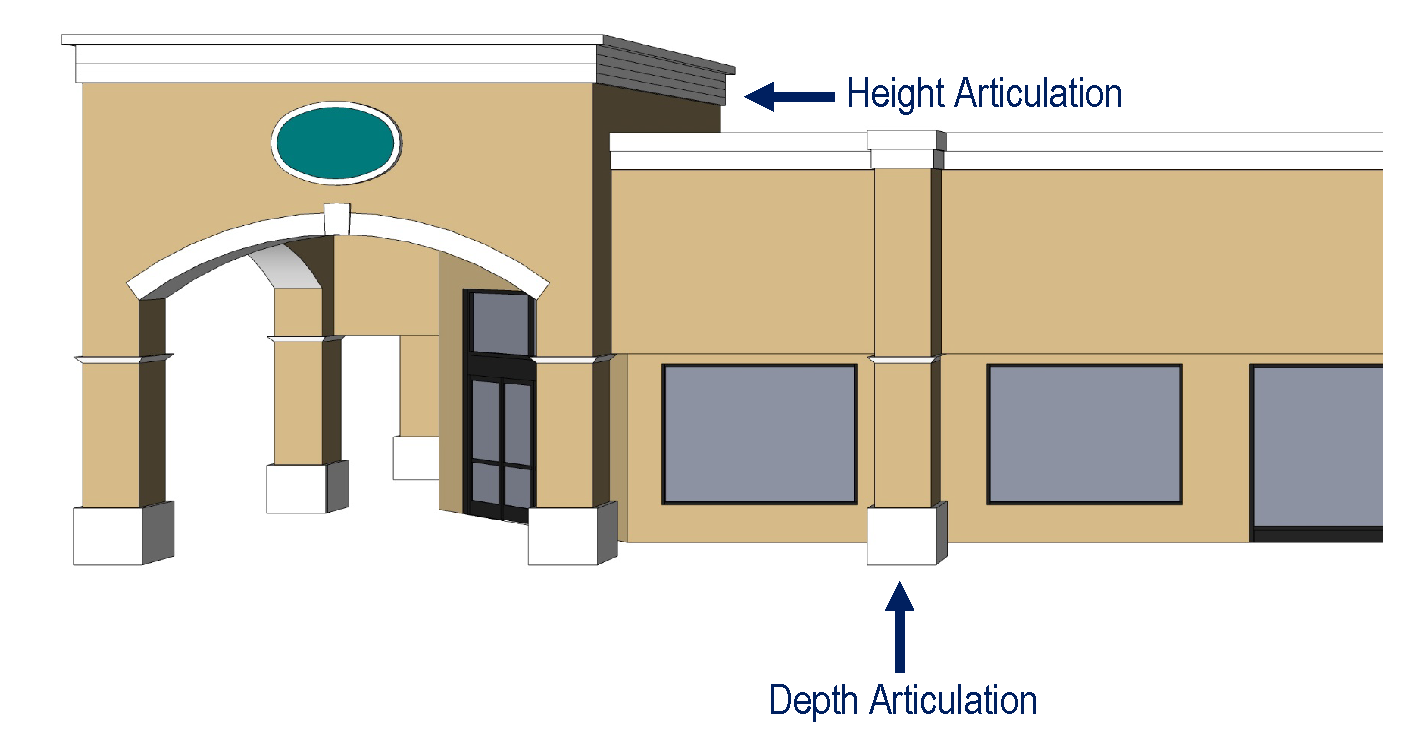
Height and depth articulation shall be provided as follows:
a.
Height articulation for flat roofs of at least five feet shall be required for every 50 feet of building façade length. Pitched roofs do not require height articulation.
b.
Depth articulation of at least three feet shall be required for every 30 feet of building façade length. Depth articulation applies only below the roofline.
2.
The rear façade is exempt from the articulation requirements unless it is visible from a public right-of-way or residential property.
Figure 4.03.1. Examples of Height and Depth Articulation
(Ord. No. 2395, § 1, 3-2-21)
Sec. 4.04. - Off-street parking and loading requirements.
A.
Applicability. The requirements of this section shall apply in the following circumstances:
1.
New construction. When a new main building is constructed.
2.
Use change. When a change in use requires 20 percent or more additional parking beyond the previous use.
3.
Building expansion. When the floor area of a main building is increased by more than 20 percent.
B.
Off-street parking requirements.
1.
Number of spaces. The number of off-street parking spaces shall be provided for the corresponding use as indicated in Section 3.03. Permitted Use Chart.
2.
Number of spaces in the opportunity areas. The parking requirements established by Section 3.03. Permitted Use Chart are modified to encourage redevelopment within the opportunity areas identified within the comprehensive plan. Parking requirements within the opportunity areas (with the exception DD, Downtown Duncanville District) are modified as follows:
a.
Reduction in the number of required parking spaces by 25 percent.
3.
Single-family and townhome parking accommodations. All single-family homes and townhomes shall provide, at a minimum, the following parking accommodations:
a.
Two unenclosed, paved parking spaces, plus
b.
A one- or two-car garage or porte cochere.
(1)
Exception: A carport may be provided in lieu of a garage or Porte Cochere upon approval of a specific use permit.
4.
Duplex parking accommodations. All duplexes shall provide, at a minimum, the following parking accommodations:
a.
Two unenclosed, paved parking spaces.
5.
Residential front-entry garages.
a.
Single-family and duplex garages. Single-family and duplex garages shall be set back a minimum of five feet from the front building face. The front building face is considered the forwardmost portion of the structure, excluding a front porch.
(1)
Exception: The garage setback requirement may be reduced or waived upon recommendation by the planning and zoning commission and approval by the city council.
b.
Townhome garages. Townhome garages may be flush with the building face, but in no case shall the garage project beyond the front building face.
6.
Multiple uses. In computing the parking requirements for any building or development, the total parking requirements shall be the sum of the specific parking space requirements for each class of use included in the building for development.
7.
No storage permitted. In the residential zoning districts, no parking space, garage, carport, or other automobile storage space or structure shall be used for the parking or storage of any truck, truck-trailer, or van except panel and pickup trucks not exceeding one ton capacity.
8.
Parking requirements for new or unlisted use. Where questions arise concerning the minimum off-street parking requirements for any use not specifically listed, the requirements may be determined by the city planner as those of a similar use.
9.
Use of permeable surfaces.
a.
Permeable surfaces are prohibited for required parking spaces and fire lanes. Permeable surfaces may be used for other parking or driving surfaces, subject to approval by the city engineer.
b.
The applicant shall provide a written statement that the property owner shall be responsible for maintaining the surface in a fully operational condition.
c.
If, at any time after the issuance of a certificate of occupancy, the approved permeable surface is found to be unmaintained or not fully operational, the building official shall issue notice concurrently to the owner, tenant, and/or agent, citing the violation and describing what action is required. The owner, tenant, and/or agent shall have 30 days from date of said notice to restore the permeable surface as required. If the permeable surface is not restored within the allotted time, the owner, tenant, and/or agent shall be in violation of this chapter.
10.
Curbs and Drainages. See Section 4.08.D.6. Concrete Curb below for requirements regarding curbs and drainage.
11.
On-site parking required.
a.
All required off-street parking must be provided on the lot occupied by the main use, except as provided in 15. Shared Parking.
b.
All required ADA-accessible spaces shall be provided in the on-site parking area.
12.
Parking lot perimeter.
a.
In all nonresidential, mixed use, and multi-family developments with more than four units, the perimeter of all parking lots and driveways shall be provided with concrete curbs, medians, or other means to control traffic.
b.
Curb cuts shall be provided in accordance with Section 4.08.D.6. Concrete Curb below to drain stormwater runoff into landscaped areas.
13.
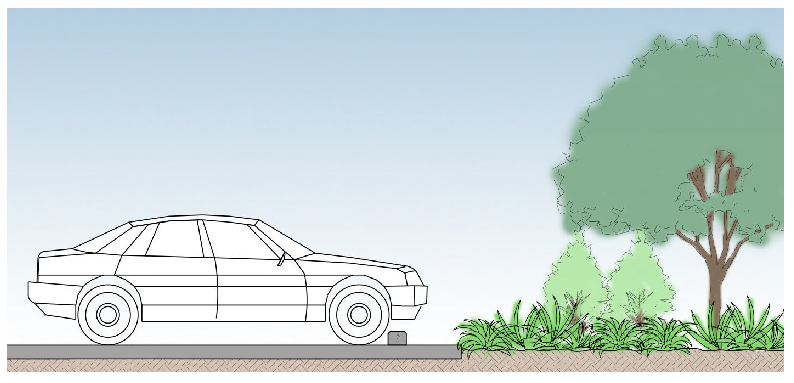
Vehicle stopping device. No parking space shall allow a vehicle to overhang a required landscape area, open space area, sidewalk, street right-of-way or adjacent property (see Figure 4.04.1).
Figure 4.04.1. Wheel Stop Required to Prevent Vehicle Overhang
14.
Access and availability of parking spaces and fire lanes. Unless specifically stated otherwise within this zoning ordinance, all required parking spaces shall be accessible at all time. No outside storage, vehicle storage, or queuing may take place within required parking or fire lanes. See exception for outdoor display, temporary in Section 3.04.B.6.b.
15.
Shared parking.
a.
The purpose of shared parking is to allow two or more adjacent land uses that have different peak use periods to share a parking area and reduce the number of required spaces.
b.
A shared parking agreement shall be recorded prior to issuance of a building permit or a certificate of occupancy. If such agreement is revoked by any entity, then the required off-street parking spaces shall be provided according to the standard parking requirements.
c.
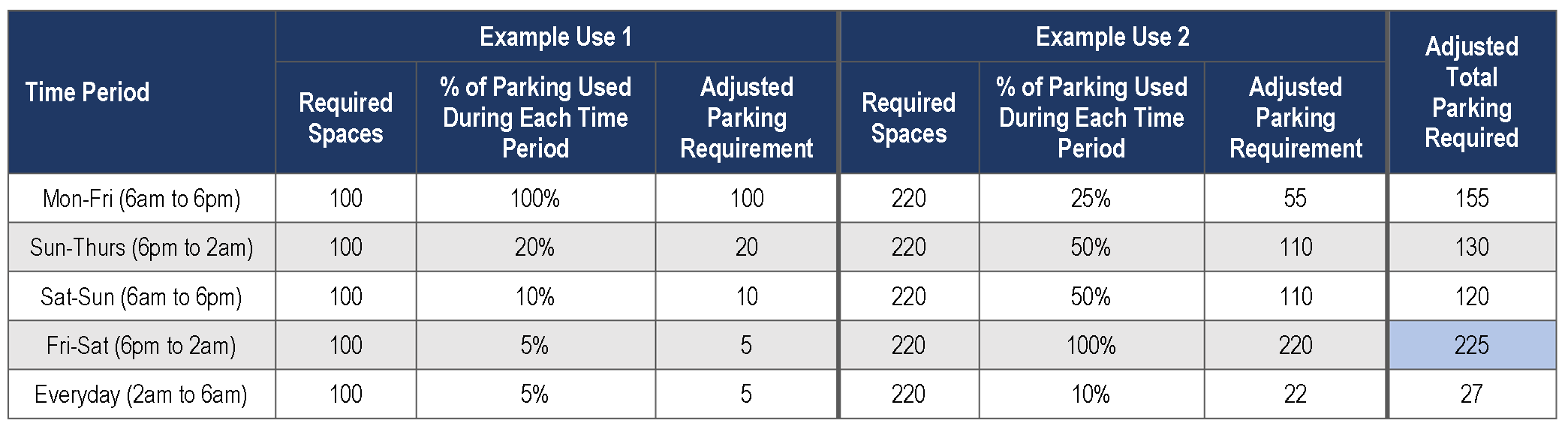
A shared parking calculation, using the format provided in Table 4.04.1, shall be required to determine the minimum number of spaces.
d.
The minimum parking required shall be the highest adjusted total parking for any time period.
e.
The percentage of parking used during each time period shall be provided by the applicant and subject to approval by the city planner.
f.
All shared parking spaces must be located within 500 feet of all shared uses, measured by the shortest legal walking route.
g.
Handicapped spaces required by ADA shall be calculated by individual use and not be shared.
h.
Table 4.04.1 provides an example of shared parking calculations. This example includes shared parking for two uses—Example Use 1 with a minimum parking requirement of 100 spaces, and Example Use 2 with a minimum parking requirement of 220 spaces. In this example, the minimum parking requirement would be 225 spaces.
Table 4.04.1. Shared Parking Examples
C.
Off-street loading.
1.
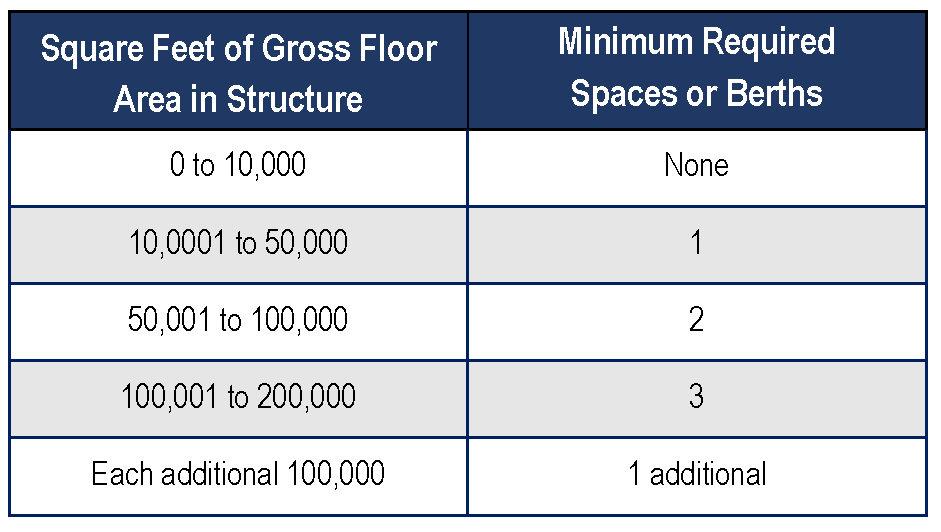
The number of loading spaces required by this section shall be the minimum, and the owner/applicant shall evaluate the users' needs to determine if additional loading space is needed.
2.
Such off-street loading space shall consist of a minimum area of ten feet by 75 feet.
3.
Loading areas shall be located at the side or rear of buildings.
4.
Loading areas shall not encroach upon required off-street parking areas or into the right-of-way.
5.
Unenclosed off-street loading areas shall be paved with hard surface pavement.
6.
The city planner may reduce the loading space requirements if the city planner determines requirements are excessive.
Table 4.04.2. Minimum Loading Standards for Nonresidential Uses
D.
Parking design requirements.
1.
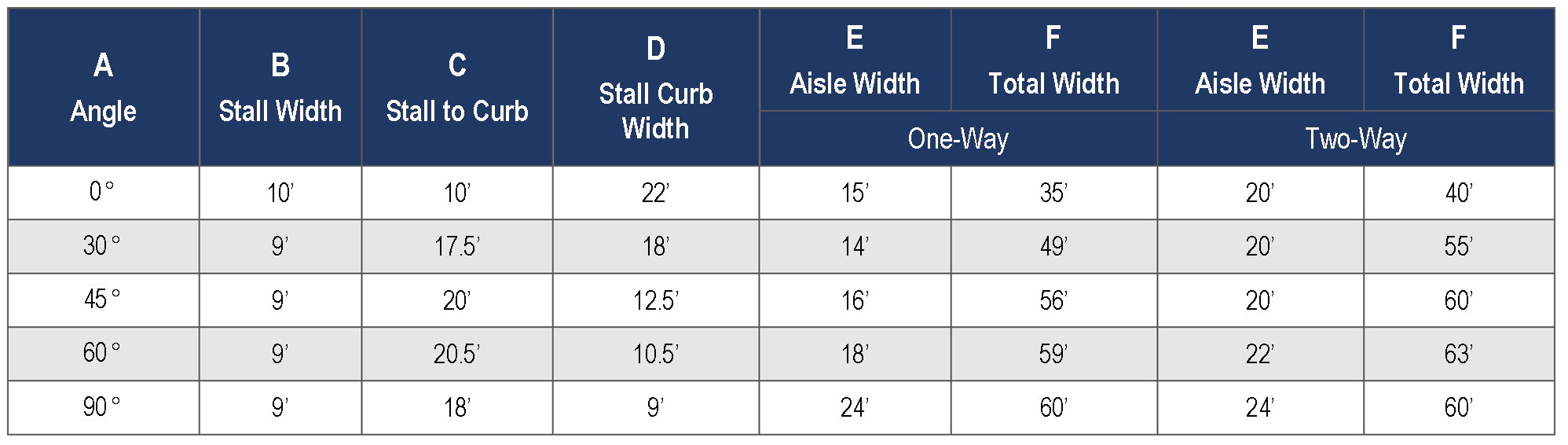
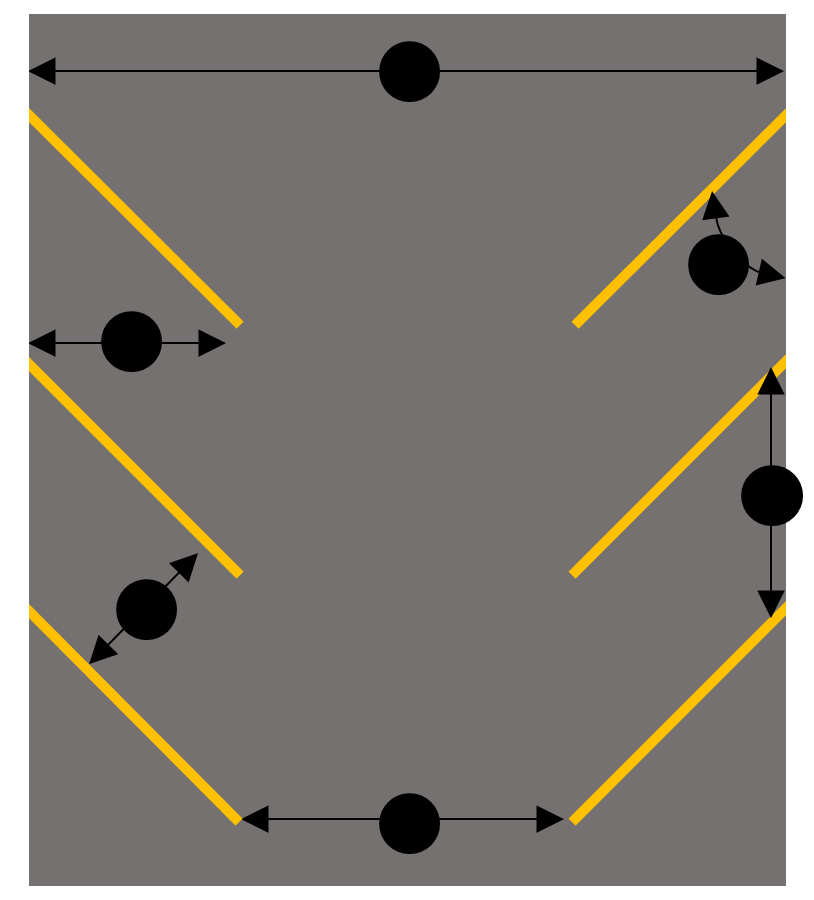
Configuration. Aisles, parking spaces, and circulation shall be provided in accordance with Figure 4.04.2 and Table 4.04.3.
2.
Striping. All off-street parking spaces and means of ingress and egress shall be laid out on the parking surface with paint or plastic striping that provides a permanent delineation between spaces and aisles.
a.
No striping shall be required for residential uses, except for multi-family developments.
3.
Parking lot materials.
a.
Parking lots for new developments and redevelopments shall be constructed with reinforced concrete according to city specifications prior to receiving a certificate of occupancy.
b.
Existing parking lots constructed with asphalt may be repaired with asphalt and may be expanded up to ten percent of its area with asphalt as it existed on January 1, 2020.
c.
If a parking lot is deteriorated 50 percent or more (in the building official's determination), the entire lot must either:
(1)
Be completely redone in concrete; or
(2)
Be completely resurfaced (mill and overlay) in asphalt with required aesthetic improvements, like adding diamond-shaped landscape islands.
Table 4.04.2. Parking Dimensions
E.
Parking lot maintenance.
1.
All persons owning, occupying or having supervision of real property not used for residential purposes (single-family and duplex) in the city shall keep and maintain in good condition and repair any lot or area situated on said property designated or used for the parking or storage of motor vehicles or for the access thereto.
2.
The surface of all such parking lots or areas, including the approaches, driveways, drive aisles to such parking, lots or areas, shall be kept and maintained free of grass, weeds and vegetation and free of cracks, holes, or pits which may allow the seepage or accumulation of water.
Figure 4.04.2. Parking Dimensions
F.
Off-street stacking requirements.
1.
The purpose of stacking spaces is to provide the ability for vehicles to queue on-site prior to receiving a service.
2.
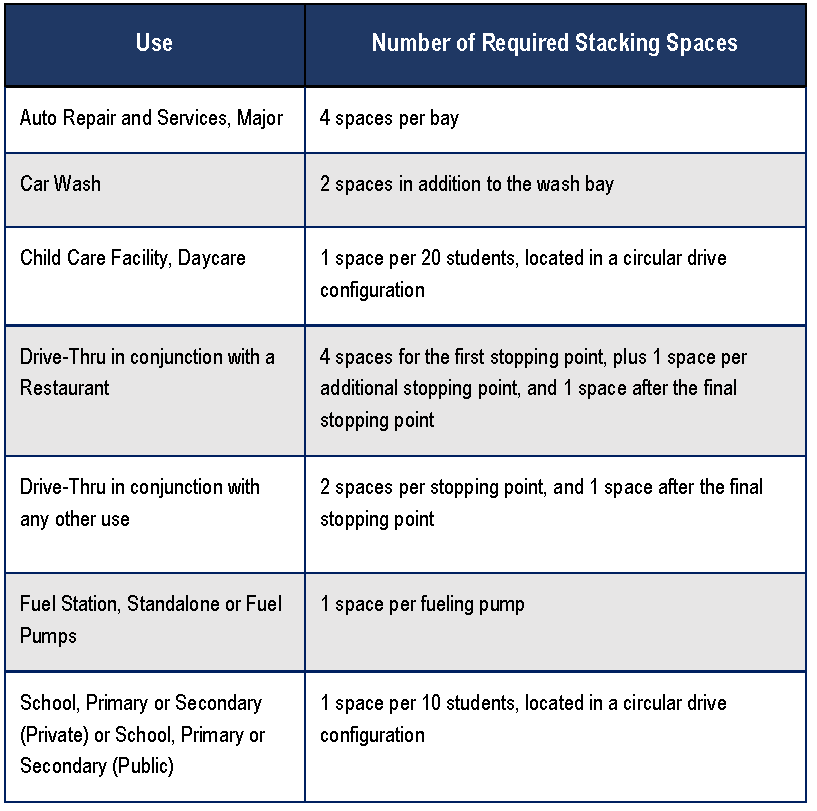
Stacking spaces are required in all districts any time a use is constructed or expanded in accordance with Table 4.04.4.
3.
The number of spaces refers to the queuing line and does not include the space at a stopping point (e.g., drive-up window, inside a car wash or repair bay, or similar location).
G.
Driveway materials.
1.
Nonresidential driveways shall be constructed with reinforced concrete according to city specifications.
2.
Residential driveways on improved streets (curb and gutter) shall be constructed with reinforced concrete, permeable pavers, or porous concrete according to city specifications.
3.
Residential driveways on unimproved streets (no curb and gutter) may be surfaced with reinforced concrete, asphalt, permeable pavers, or porous concrete according to city specifications.
H.
Special exceptions for off-street parking requirements. For redevelopments, the zoning board of adjustment may allow a special exception to reduce minimum parking requirements in accordance with Section 6.10. Special Exceptions by up to 50 percent if the size and shape of the lot to be redeveloped on is such that off-street parking provisions could not be complied with, and the proposed redevelopment will not create undue traffic congestion in the adjacent streets.
Table 4.04.4. Number of Required Stacking Spaces
(Ord. No. 2395, § 1, 3-2-21)
Sec. 4.05. - Lighting requirements.
A.
Applicability.
1.
The following requirements shall apply to all new development, redevelopment, or expansions.
2.
A change in use or occupancy with no structural modifications shall not trigger compliance.
B.
Regulations for all developments.
1.
Light sources shall be of a down-light, indirect, diffused, or shield type or so installed and maintained as to reduce glare effect and consequent interference with the use of adjacent properties and boundary streets.
2.
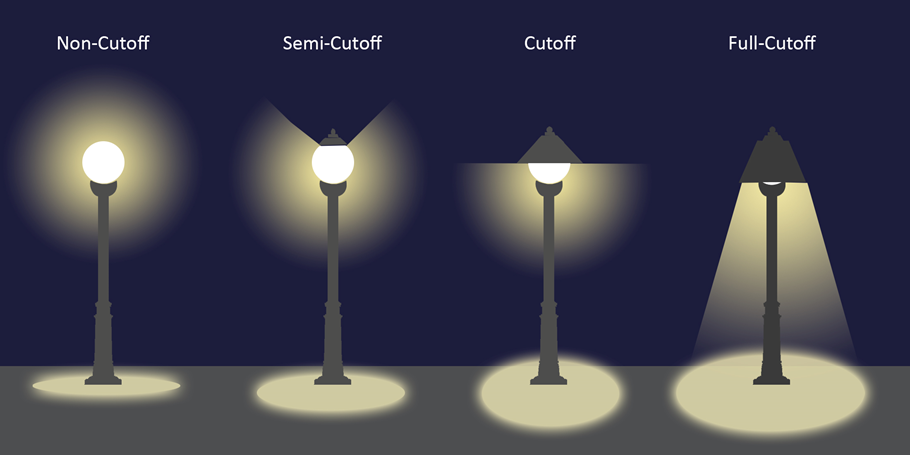
All lighting fixtures shall be restricted to full cutoff types (see Figure 4.05.1) so that no light is emitted above the lowest light emitting part of the fixture.
3.
No exterior illumination (either direct or indirect) shall cross a residential property line nor be a nuisance to traffic.
4.
No intermittent or flashing lights shall be permitted.
5.
All lighting shall comply with the city's current Electrical Code and Building Code, which can be located on the city's website.
Figure 4.05.1. Examples of Lighting Fixtures
C.
Regulations for nonresidential, multi-family, and mixed-use developments.
1.
Site, parking, and loading lighting.
a.
Sufficient lighting of parking areas.
(1)
Illumination of parking areas shall be sufficient to ensure the visibility of pedestrians and the safe movement of traffic within the site.
(2)
All city building parking lots shall be luminated from dusk to dawn.
b.
High intensity lighting.
(1)
The allowable maximum intensity measured at the property line of a retail, office, commercial, or multi-family developments use shall be 3.0 foot-candles and 5.0 foot-candles for an industrial use.
(2)
When located adjacent to single-family residential development, the intensity shall be no greater than 1.0 foot-candles when measured at the nearest adjacent residential district.
(3)
Any external lighting shall be mounted and maintained to avoid illumination of any adjacent residential property.
c.
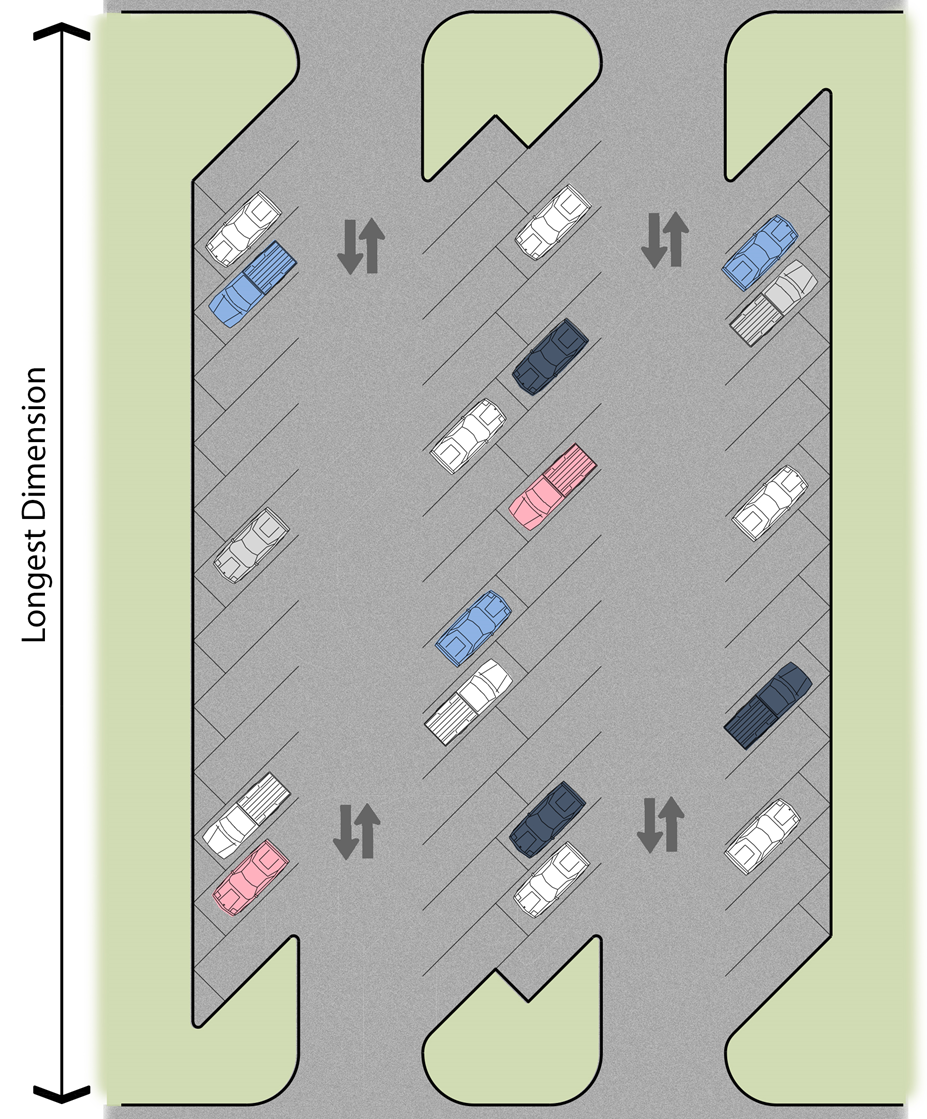
Mounting height within parking areas. The mounting height of lighting fixtures shall not exceed the heights specified in Table 4.05.1.
Table 4.05.1. Mounting Heights for Lights in Parking Areas
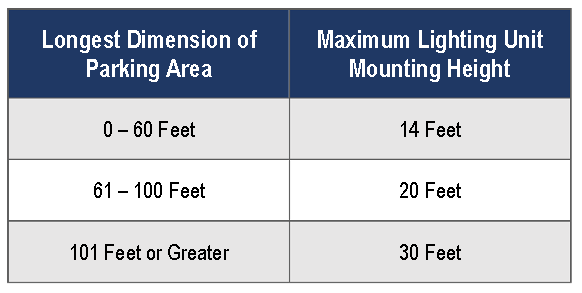
Figure 4.05.2. Longest Dimension of Parking Area
d.
Accent lighting.
(1)
Accent lighting shall not exceed 1.0 foot-candles at the property line.
(2)
Lighting shall be shielded to prevent light pollution or glare beyond the element intended for accent illumination.
2.
Lighting plan required.
a.
All nonresidential, multi-family, and mixed-use developments shall submit a lighting plan with a site plan. The lighting plan shall show how the proposed development will comply with the regulations within this section.
b.
Lighting plan shall include, at a minimum, the following information:
(1)
The type of illuminating devices, fixtures, lamps, supports, reflectors, and other devices, and their respective location on the site;
(2)
A description of the illuminating devices, fixtures, lamps, supports, reflectors, and other devices (such as catalog cuts by manufactures and drawings); and
(3)
Photometric data, such as furnished by manufactures, or similar data showing the angle of cut off or light emissions.
3.
Maintenance.
a.
Piers for light poles taller than eight feet shall be designed by a professional engineer competent in structural engineering. Soil condition and wind loading shall be accounted for in the pier design.
b.
All fixtures and supports shall be painted or otherwise treated to resist rust and corrosion and shall be maintained in an attractive condition and in a manner consistent with the surrounding architecture.
c.
All fixtures and lamps shall be maintained in a working, serviceable condition at all times.
4.
Safety and security lighting. Lighting shall illuminate pedestrian areas with at least 0.5 foot-candles.
D.
Crime prevention through environmental design (CPTED). The City of Duncanville has a goal of promoting public safety through implementation of principles of crime prevention through environmental design. Every application for a site plan or plot plan for projects in all districts and shall be reviewed by the city development team and may include one law enforcement officer prior to approval. The applicant must respond to all suggestions and concerns noted by the development team prior to consideration and approval and only the planning and zoning commission may grant waivers to the recommendations of the team.
The applicant is encouraged to consider the following principles and guidelines in the design of his/her project to assist in the creation and maintenance of developments that decrease the opportunity for crime and increases the perception of safety. The CPTED review shall encompass, but not be limited to the following principles:
1.
Provision of natural surveillance.
a.
The placement and design of physical features to maximize visibility. This will include building orientation, windows, entrances and exits, parking lots, walkways, guard gates, landscape trees and shrubs, fences and walls, signage and any other physical obstructions.
b.
The placement of persons and/or activities to maximize surveillance possibilities.
c.
Lighting that provides for nighttime illumination of parking lots, walkways, entrances and exits.
2.
Provision of natural access control.
a.
The use of sidewalks, pavement, lighting and landscaping to clearly guide the public to and from entrances and exits.
b.
The use of fences, walls or landscaping to prevent and/or discourage public access to or from dark and/or unmonitored areas.
3.
Provision of territorial enforcement. The use of pavement treatments, landscaping, art, signage, screening and fences to define and outline ownership of property.
4.
Maintenance. The use of low-maintenance landscaping and lighting treatments to facilitate CPTED principles of natural surveillance, natural access control and territorial reinforcement. All exterior lighting fixtures shall be maintained in an operative state and landscaping shall be maintained to present a healthy and orderly appearance and shall be kept free from refuse and debris.
(Ord. No. 2395, § 1, 3-2-21)
Sec. 4.06. - Accessory building requirements.
A.
General provisions.
1.
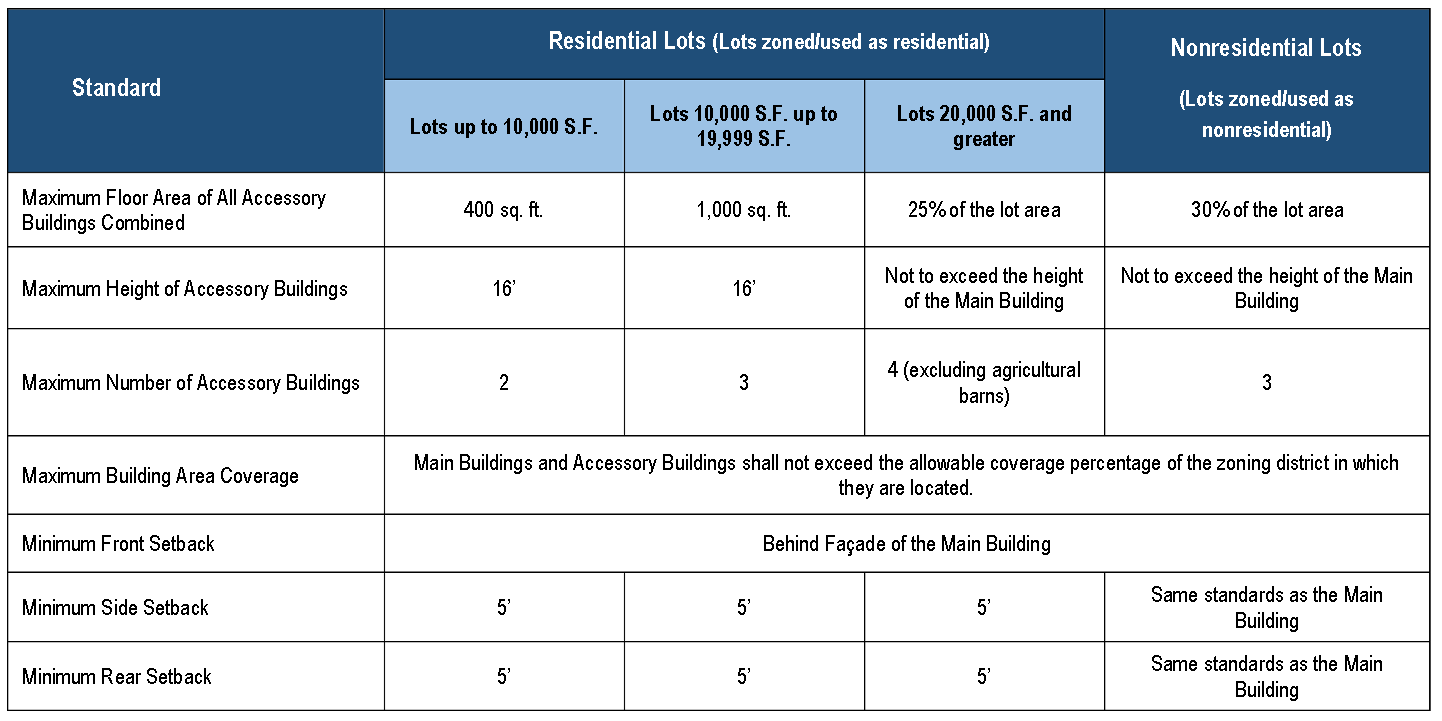
The dimensional regulations in Table 4.06.1 shall apply to all accessory buildings.
a.
Exception: The dimensional regulations in Table 4.06.1 shall not apply to accessory buildings associated with agricultural purposes on residential lots.
2.
Accessory buildings are prohibited within easements.
3.
No permit is required for accessory buildings less than 120 square feet in floor area and less than 13 feet in height.
Table 4.06.1. Accessory Building Requirements
B.
Requirements for residential accessory buildings.
1.
Accessory buildings may only be used as an accessory dwelling unit as permitted by Section 3.03. Permitted Use Chart.
2.
Accessory buildings containing livestock (i.e., chickens, hogs, horses, etc.) shall be located at least 15 feet from any existing dwelling on a neighboring property.
C.
Special exceptions for accessory building requirements. The zoning board of adjustment may allow a special exception from the requirements of this section in accordance with Section 6.10. Special Exceptions, based on findings that the placement and size of the proposed accessory building is compatible with the surrounding neighborhood and would not be detrimental to the general health, safety, and welfare of the neighborhood.
(Ord. No. 2395, § 1, 3-2-21)
Sec. 4.07. - Screening and buffering requirements.
A.
Applicability.
1.
The following requirements shall apply to all new development.
a.
Exception: Modifications or expansions of existing structures by less than ten percent of the floor area shall be exempt from this section.
2.
A change in occupancy shall not trigger compliance; however, a change to a more intensive use as determined by the city planner shall require compliance.
B.
Maintenance required. If at any time after the issuance of a certificate of occupancy, the approved screening and/or buffering is found to be in nonconformance to the standards and criteria of this section, the building official shall issue notice concurrently to the owner, tenant, and/or agent citing the violation and describing what action is required to comply with this section. The owner, tenant, and/or agent shall have 30 days from date of said notice to restore the screening and/or buffering as required. If the screening and/or buffering is not restored within the allotted time, the owner, tenant, and/or agent shall be in violation of this chapter.
C.
Screening.
1.
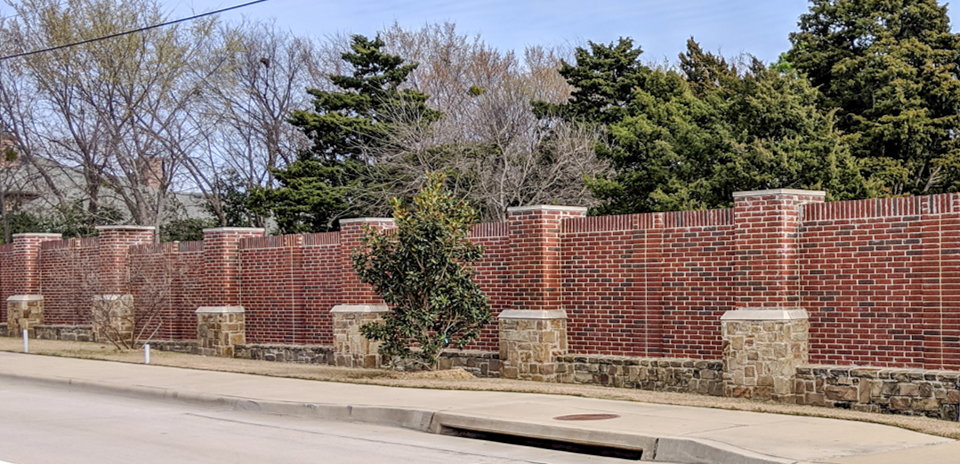
Subdivisions backing to major roadways. A solid masonry screening wall minimum of six feet and maximum of eight feet in height is required when a residential subdivision backs to a street with a Right-of-Way of 60 feet or greater.
Figure 4.07.1. Example of Solid Masonry Wall
2.
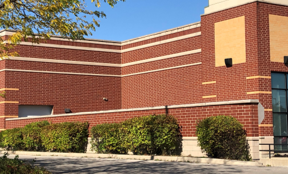
Loading and service areas.
a.
Loading and service areas shall be located at the side or rear of buildings.
b.
Where visible from other properties or the right-of-way, a solid screening wall at least ten feet in height shall be required to screen views of loading docks and loading spaces used for tractor/semi-trailer delivery. This wall must screen the entire loading dock or space from view of other properties and right-of-way.
Figure 4.07.2. Example of Screened Loading Area
3.
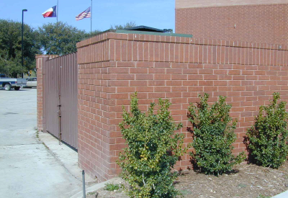
Waste container areas.
a.
Garbage, recycling, and other waste containers shall be located as near to the rear or side property line as practicable as determined by the city planner.
b.
Waste containers shall be screened from view by a solid masonry screening wall on three sides, and fourth side consisting of a metal or wood gate to allow access to the container(s).
c.
Screening walls shall be a minimum of six feet and maximum of eight feet, unless additional height is needed to shield the container(s) from view as determined by the city planner.
d.
Screening shall be maintained in a good condition.
Figure 4.07.3. Example of Refuse Area Screening
4.
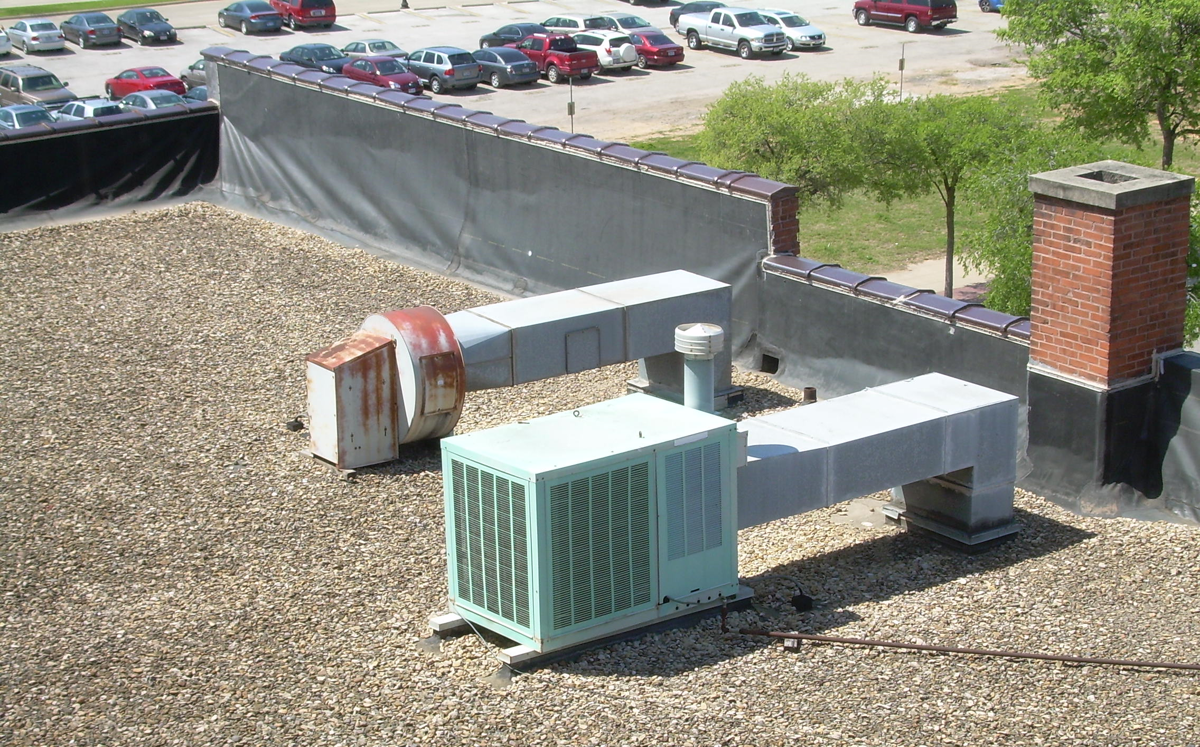
Rooftop equipment.
a.
Any rooftop mechanical or utility equipment shall be screened from view by the public or within any right-of-way by a parapet wall.
b.
Such screening must be present on all façades, excluding the rear.
c.
Parapet walls shall be constructed of the same building material as the façades and shall be undistinguishable from the remainder of the façade.
Figure 4.07.4. Example of Unscreened Rooftop
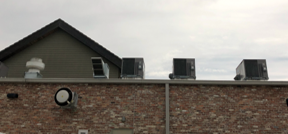
Figure 4.07.5. Example of Screened Rooftop Equipment
5.
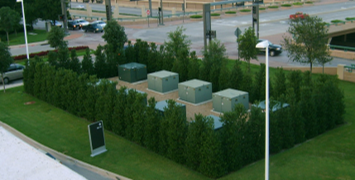
Ground-mounted equipment.
a.
Mechanical or utility equipment shall be located out of public view to the extent practicable as determined by the city planner.
b.
Any equipment visible to the public or from any right-of-way shall be screened by either a vegetative screening or a solid screening wall that is tall enough to screen the equipment from view.
Figure 4.07.6. Example of Screened Ground-Mounted Utility Equipment
6.
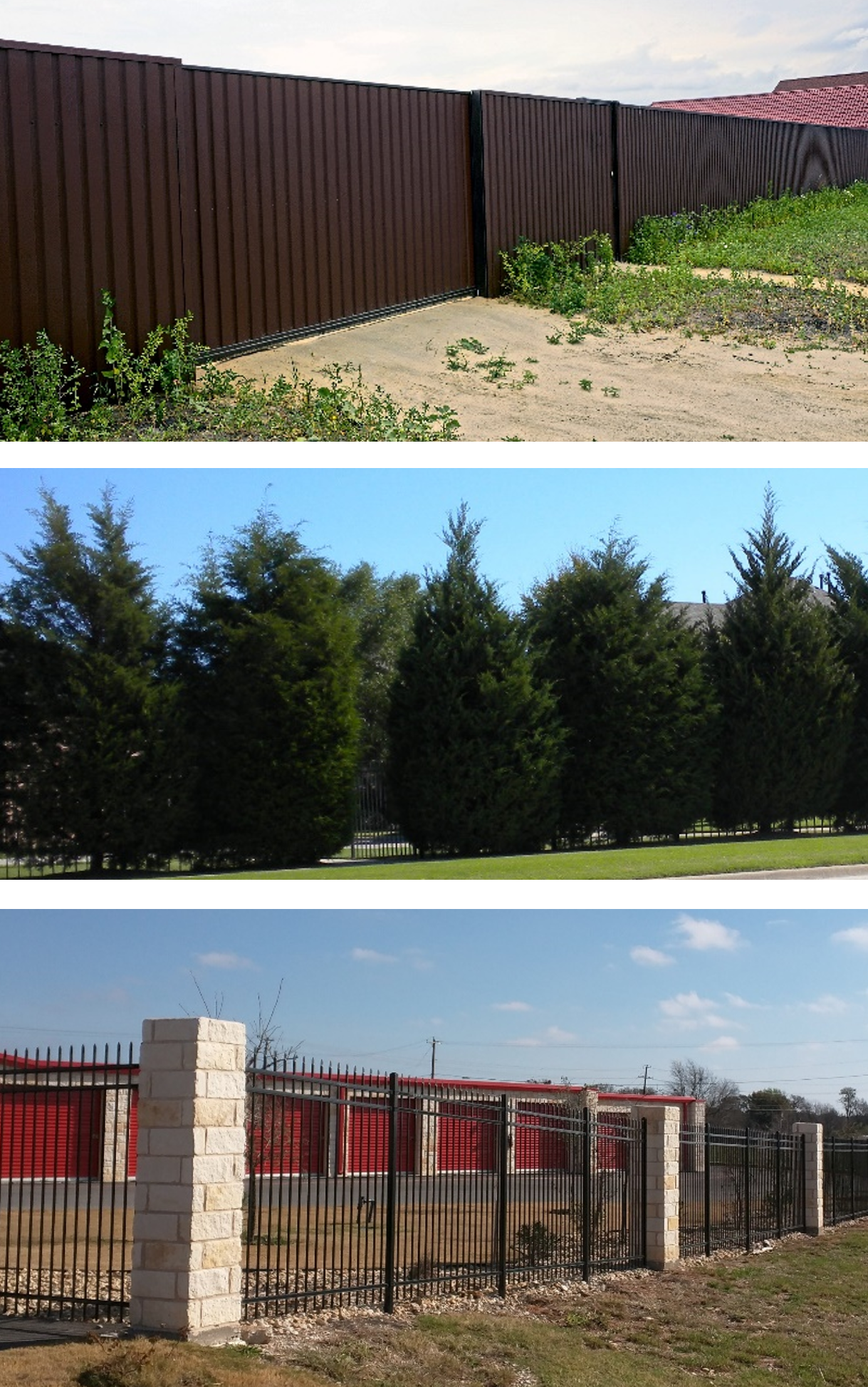
Outside storage screening.
a.
Outside storage shall be screened with a minimum six foot screening fence or wall, and shall not be visible from the right-of-way or adjacent property.
(1)
Exception: Outside storage in the I Industrial District be screened with a minimum six foot screening fence or wall; however, the fence or wall may be of an open or transparent design allowing visibility from the right-of-way or adjacent property.
b.
Screening may be masonry, metal, vegetative, vinyl, or a combination thereof; however, chain-link fences are prohibited for required screening.
(1)
The city planner shall be authorized to allow alternative materials that provide an attractive appearance with a long life span.
c.
If outside storage is located entirely behind the building and is not visible from the right-of-way or adjacent property, then no screening is required.
Figure 4.07.7. Examples of Outside Storage Screening
D.
Buffering.
1.
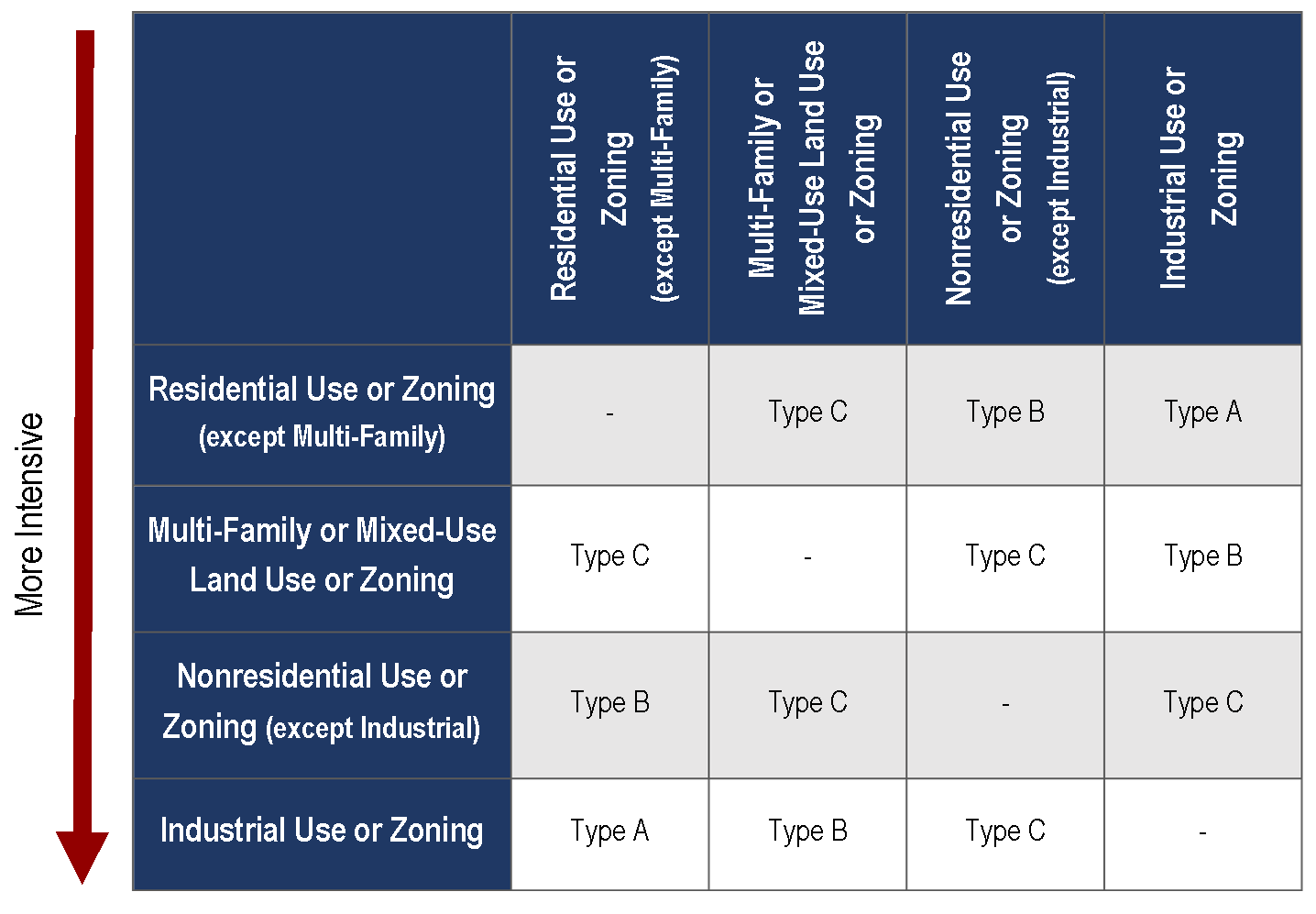
A buffer shall be located along the shared lot line and located on the property of the more intensive use (according to Table 4.07.1). The more intensive use shall be responsible for installing and maintaining the buffer.
2.
The required landscaping shall be provided within the buffer area adjacent to the more intensive use. Buffer area landscaping is in addition to landscaping requirements established in Section 4.08.
3.
These regulations shall not apply to any adjacent properties separated by a roadway.
4.
Buffer types. The following requirements correspond to the designations in Table 4.07.1.
a.
Buffer Type A.
(1)
Buffer depth: 25 foot abutting the shared lot line.
(2)
Screening wall within buffer: Minimum six feet solid masonry wall.
(3)
Required landscaping with buffer:
(a)
Continuous groundcover.
(b)
One shade tree for every 35 feet of shared lot line.
(c)
Three shrubs per 25 feet of shared lot line.
b.
Buffer Type B.
(1)
Buffer depth: 15 feet abutting the shared lot line.
(2)
Screening wall within buffer: Minimum six feet solid masonry wall or solid vegetative screen.
(3)
Required landscaping:
(a)
Continuous groundcover.
(b)
One shade tree for every 50 feet of shared lot line, unless a vegetative screen is used.
(c)
Three shrubs per 40 feet of shared lot line, unless a vegetative screen is used.
c.
Buffer Type C.
(1)
Buffer depth: Ten feet abutting the shared lot line.
(2)
Screening wall within buffer: Minimum six feet solid masonry wall or solid vegetative screen.
(3)
Required landscaping within buffer:
(a)
Continuous groundcover.
(b)
One shade tree for every 60 feet of shared lot line.
(c)
One shrub per 50 feet of shared lot line.
5.
Alternative compliance. A request for alternative compliance may be submitted and acted upon in accordance with Section 6.07. Alternative Compliance. Approval may be granted for alternative material for fencing, screening, and buffering, based upon a finding that the proposed alternative is, at a minimum, equivalent to and meets the spirit and intent of this section.
Table 4.07.1. Required Buffer Type by Adjoining Use or Zoning
(Ord. No. 2395, § 1, 3-2-21)
Sec. 4.08. - Landscape requirements.
A.
Applicability.
1.
The following requirements shall apply to all new development or expansions of existing structure by less than ten percent of the floor area.
2.
A change in use or occupancy with no structural modifications shall not trigger compliance.
B.
Maintenance required. If at any time after the issuance of a certificate of occupancy, the approved landscaping is found to be in nonconformance to the standards and criteria of this section, the building official shall issue notice concurrently to the owner, tenant, and/or agent citing the violation and describing what action is required to comply with this section. The owner, tenant or agent shall have 30 days from date of said notice to restore the landscaping as required. If the landscaping is not restored within the allotted time, the owner, tenant, and/or agent shall be in violation of this chapter.
C.
Requirements for single-family, duplex, and townhome development. At least two shade trees or three ornamental trees shall be provided in front of the front building line of each lot.
D.
Requirements for all other development. The following requirements shall apply to all developments except single-family, duplex, and townhome development.
1.
Landscape plan.
a.
A landscape plan is required for all developments except single-family, duplex, and townhome development.
b.
The city planner shall establish and maintain a list of the required documents and elements for a landscape plan.
c.
A landscape plan shall be prepared by a landscape architect and submitted for review.
d.
Irrigation drawings shall be prepared by a licensed Irrigator.
e.
The landscape plan shall include a description of the maintenance provisions for the landscaping (e.g., "the owner shall be responsible for the maintenance, establishment, and performance of plant materials, etc.").
f.
The landscape plan shall include the following statement:
This irrigation system has been installed in accordance with all applicable state and local laws, ordinances, rules, regulations or orders. I have tested the system and determined that it has been installed according to the irrigation plan and is properly adjusted for the most efficient application of water at this time.
2.
Required landscaped areas on a lot.
a.
A minimum of 20 percent of the lot area shall be landscaped.
b.
Any area of a lot not used for buildings or site improvements shall be landscaped.
c.
One shade tree or two ornamental trees shall be provided per 400 square feet of required landscaped area.
d.
One shrub shall be provided per 25 square feet of required landscaped area.
3.
Required landscaped areas within parking lots.
a.
Landscaped areas within parking lots shall be provided in addition to the requirements in 2. Required Landscaped Areas on a lot above.
b.
Landscaped areas within parking lots shall be at least nine feet wide and 150 square feet in area.
c.
At least 25 square feet of landscaped area shall be provided per parking space.
d.
There shall be a minimum of one shade tree or two ornamental trees planted in the parking area for every 15 parking spaces.
e.
There shall be a landscaped area with at least one shade tree or two ornamental trees within 60 feet of every parking space.
f.
A landscape island shall be located at the terminus of all parking rows, and shall contain at least one ornamental tree.
4.
Required landscape buffer.
a.
A minimum 15-foot landscape buffer adjacent to the right-of-way of any existing or proposed major thoroughfare street is required.
(1)
Corner lots fronting two major thoroughfares shall be required to observe the 15-foot buffer on both street frontages.
b.
All other street frontages shall observe a minimum 10-foot landscape buffer.
c.
One shade tree per 40 linear feet or portion thereof of street frontage shall be required.
d.
In areas where overhead utilities are present, substitute trees (a minimum one inch) in caliper and a minimum five feet tall shall be planted per the approved plant list.
5.
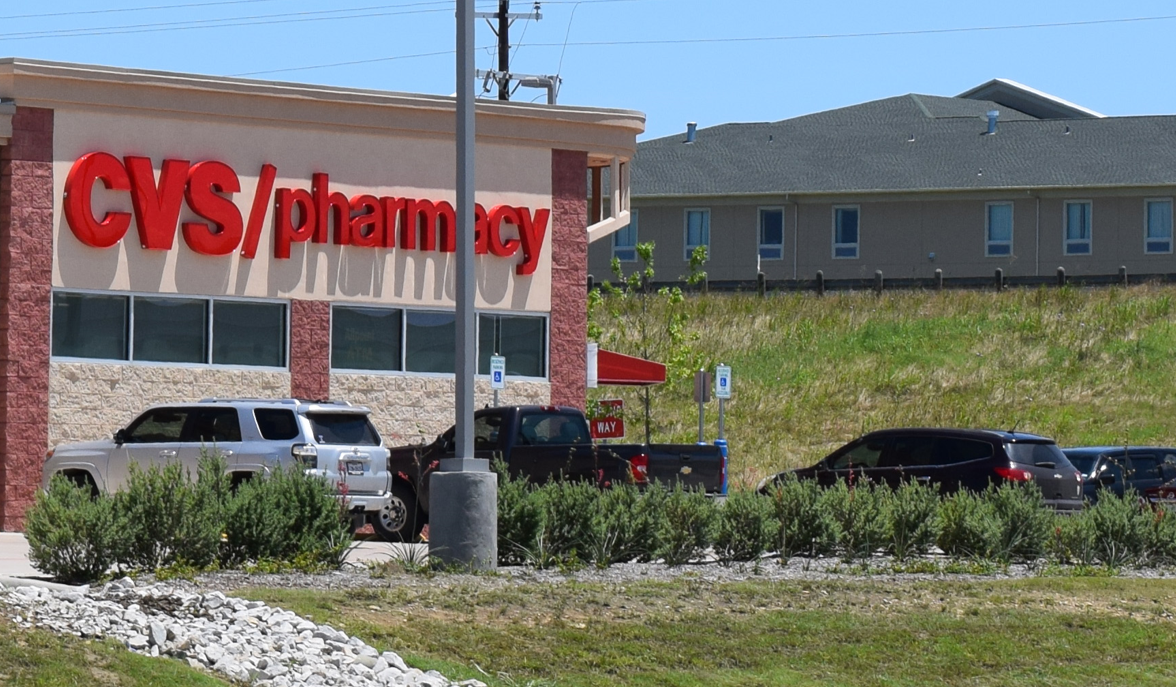
Continuous shrub buffer. When parking lots abut any public right-of-way, a continuous shrub buffer shall be provided.
Figure 4.08.1. Continuous Shrub Buffer
6.
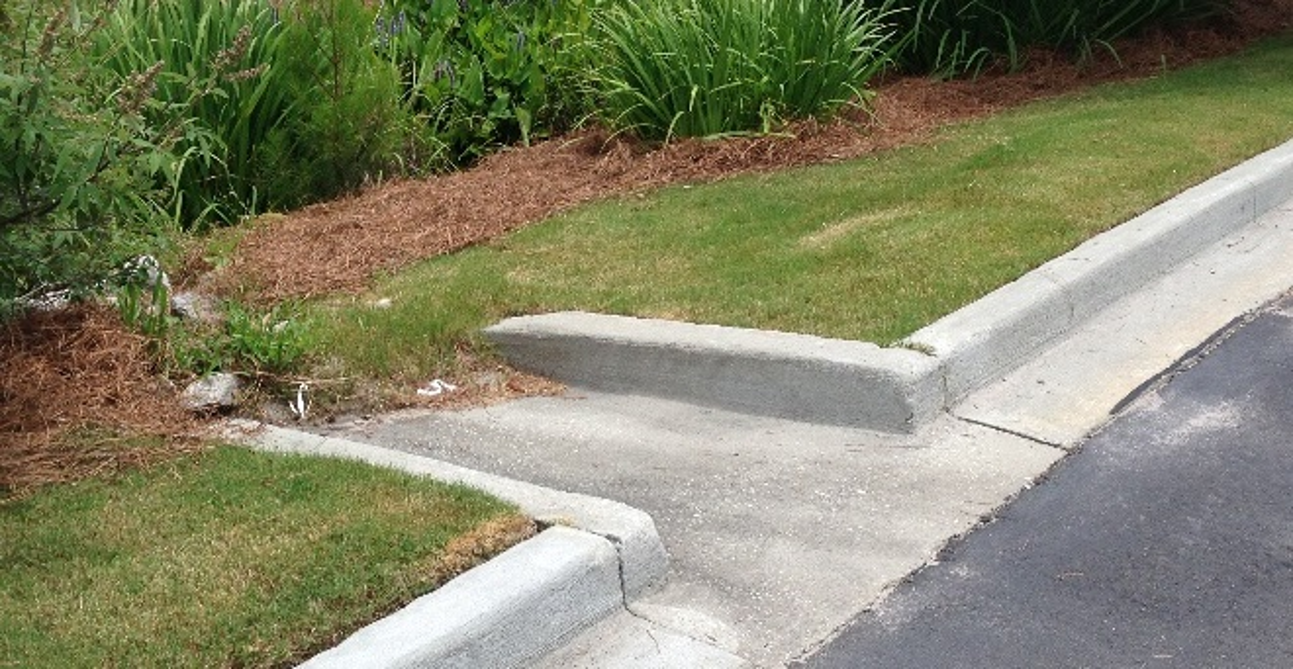
Concrete curb. All landscaped areas shall be protected by a raised six inch concrete curb with openings to allow for the drainage of stormwater into the landscaped areas (see Figure 4.08.2).
Figure 4.08.2. Concrete Curb with Drainage Opening
7.
Irrigation requirements.
a.
All required landscaped open space shall be provided with adequate and inconspicuous irrigation systems. Areas totaling less than ten square feet may be irrigated by other methods.
b.
Freeze cut-off monitors shall be provided.
8.
Planting requirements.
a.
See Chapter 12 of the City's Code of Ordinances, Article XVII Tree Preservation for information on credit for existing landscaping and required tree removal permits.
b.
All required plantings shall be selected from the city's approved plant list. Native and drought tolerant species are preferred.
c.
Complete coverage of required landscaped areas shall be provided with shrubs, groundcover, and/or ornamental grass with a rock landscape base or a mulch base.
9.
Alternative compliance for landscaping. A request for the following may be submitted and acted upon in accordance with Section 6.07. Alternative Compliance. Approval may be granted for modified landscape requirements if the following is met.
a.
The following standards are met:
(1)
The proposed landscape requirements represent a superior result than that which could be achieved by strictly following the requirements of this section;
(2)
The proposed landscape design complies with the stated purpose of this section; and
(3)
Landscape elements and yard area requirements are provided elsewhere on the site.
b.
The proposed landscape design:
(1)
Incorporates the retention of significant trees and naturally occurring undergrowth; or
(2)
Incorporates more native plantings and/or a more sustainable design; or
(3)
Better accommodates or improves the existing physical conditions of the subject property.
(Ord. No. 2395, § 1, 3-2-21)
Sec. 4.09. - Residential proximity slope.
A.
Purpose. The residential proximity slope defines the required separation distance between a property that is zoned as residential from adjacent nonresidential property/structures.
B.
Applicability. This section shall apply to all new development or building enlargements in the following zoning districts:
1.
C Commercial District; and
2.
I Industrial District.
C.
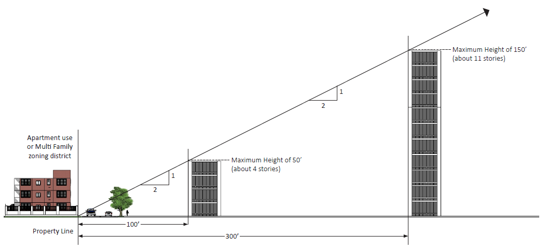
General provisions. The residential proximity slope is a plane projected upward and outward from every site of origination as shown Figure 4.09.1 and Figure 4.09.2. When referring to residential proximity envelopes, all slopes in this section are stated as vertical rise to horizontal run. Specifically, the envelope is projected from the point formed by the intersection of:
1.
The vertical plane extending through the boundary line (common property line) or right-of-say line of the site of origination; and
2.
The finished floor elevation at grade level of the restricted building or structure, or
3.
From natural grade of the restricted building or structure prior to fill, in situations where property is filled.
D.
Angle and extent of projection. The angle of projection of the residential proximity slope depends on the zoning category of the site of origination as specified in Table 4.09.1.
E.
Calculation of height restrictions. The horizontal distances used to calculate the height restrictions imposed by the residential proximity slope may be determined by using the lot, block, and right-of-way dimensions as shown on the official plat or zoning maps of the city, or by scale measurement of the distances on such official maps. All dimensions and methodology used in determining the distance measurement are subject to the approval of the director of public works.
F.
Residential adjacency.
1.
Residential adjacency exists if a building site is adjacent to a residential zoning districts or residential use or is directly across a street or alley from one or more of these uses or districts.
2.
Height requirements shall apply to all structures, excluding wireless telecommunication towers and antennas, or amateur communication towers/antennas which are addressed in Section 4.12. Wireless Telecommunication Regulations, or to parking lot lighting.
G.
Maximum building height.
1.
Special height provisions.
a.
Height is measured as the maximum vertical distance from the finished floor elevation at final grade at the lowest point of the structure to the top of the structure;
b.
Structures shall be erected to any height in compliance with the Federal Aviation Administration air space limitations, airport flight overlay district regulations, residential proximity slope height restrictions, and the building code.
(1)
Exceptions: Local utility transmission and distribution lines and supporting structures are exempt from residential proximity slope height restrictions.
c.
The following structures may project a maximum of 12 feet above the maximum structure height specified in the district regulations where residential proximity slopes are required:
(1)
Elevator penthouse or bulkhead;
(2)
Mechanical equipment room;
(3)
Cooling tower;
(4)
Tank designed to hold liquids;
(5)
Ornamental cupola or dome;
(6)
Skylights;
(7)
Clerestory;
(8)
Visual screens which surround roof mounted mechanical equipment;
(9)
Chimney and vent stacks;
(10)
Parapet wall, limited to a height of four feet;
d.
Church steeples are exempt from the maximum height provisions.
Table 4.09.1. Angle and Extent of Projection
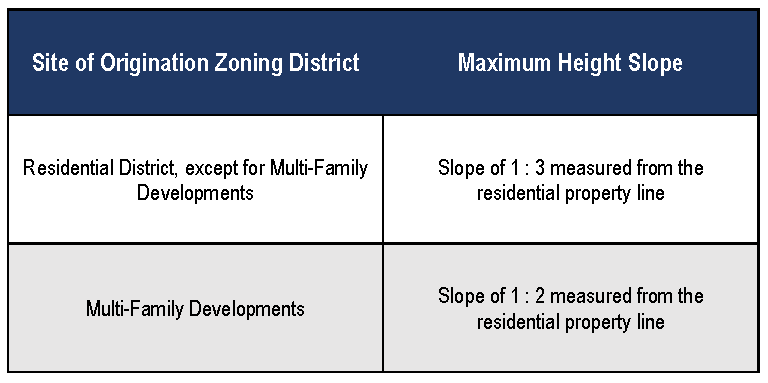
Figure 4.09.1. Single Family/Duplex as Site of Origination
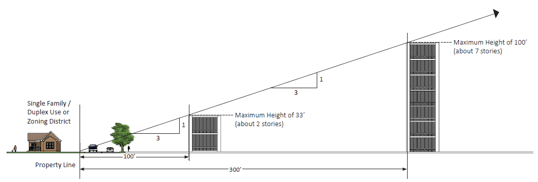
Figure 4.09.2. Multi-Family Development as Site of Origination
(Ord. No. 2395, § 1, 3-2-21)
Sec. 4.10. - Intersection visibility triangle.
A.
Applicability. The following requirements shall apply to all new development or proposed expansions into the Intersection Visibility Triangle.
B.
Prohibited obstructions. Obstructions are prohibited at elevations between two and one-half (2½) feet and nine feet above the average street grade within the intersection visibility triangle. Prohibited obstructions include any fence, wall, screen, billboard, sign, structure, foliage, or any other object.
C.
Intersection visibility triangle requirements.
1.
Curbed major thoroughfares intersecting at right angles. At intersections where major thoroughfares intersect at or near right angles, the intersection visibility triangle shall be the area formed by extending the two curb lines from their point of intersection 45 feet along the curb and connecting these points with an imaginary line, thereby making a triangle.
2.
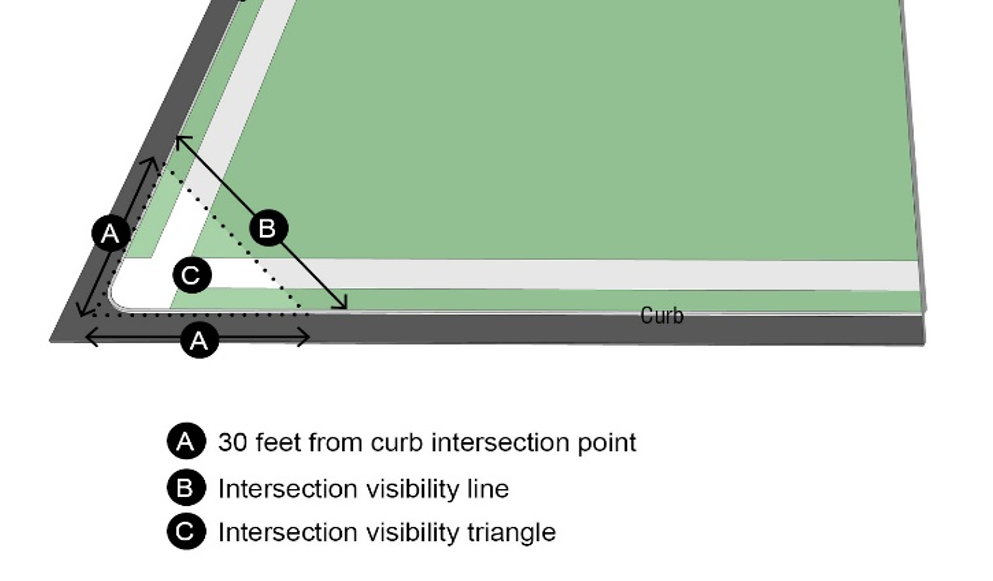
Other curbed streets intersecting at right angles. At all intersections where other streets intersect at or near right angles, the intersection visibility triangle shall be the area formed by extending the two curb lines from their point of intersection 30 feet along the curb and connecting these points with an imaginary line, thereby making a triangle.
Figure 4.10.1. 45 feet from Curb Intersection Point
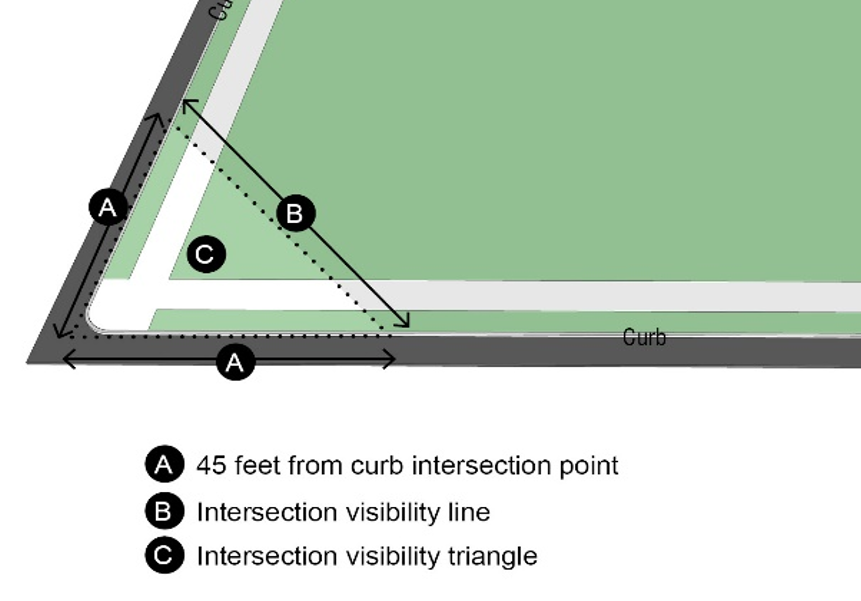
Figure 4.10.2. 30 feet from Curb Intersection Point
3.
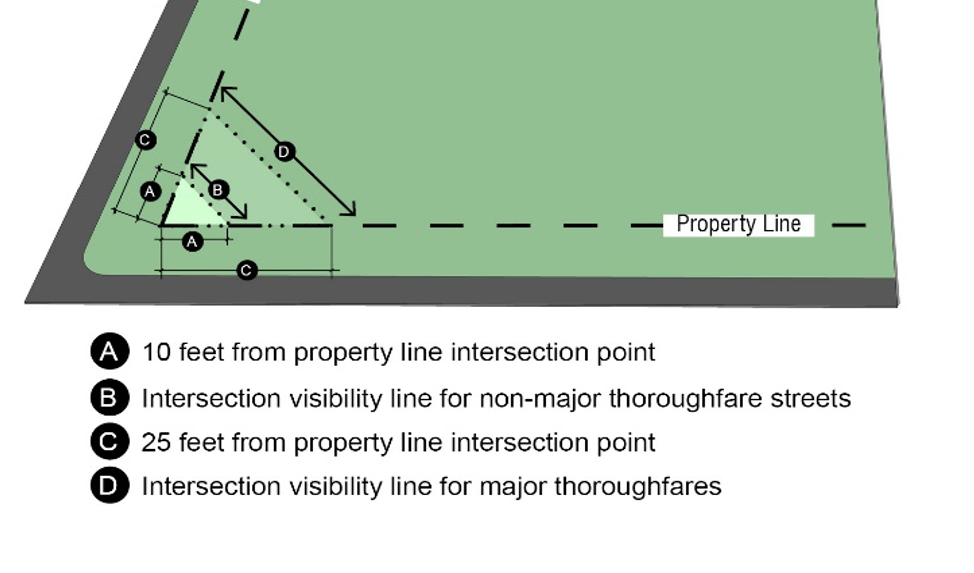
Uncurbed streets intersecting at right angles. If there are no curbs existing, the triangular area shall be formed by extending the property lines from their point of intersection 25 feet on major thoroughfares and ten feet on other streets or thoroughfares, and connecting these points with an imaginary line, thereby making a triangle.
4.
Streets that do not intersect at right angles. At intersections where streets do not intersect at or near right angles, the director of public works shall have the authority to increase the minimum sight distances required above as he/she deems necessary to provide safety for both vehicular and pedestrian traffic.
5.
Abatements.
a.
The director of public works shall have the authority to determine whether any such fence, wall, screen, hedge, tree, bush, shrub, billboard, sign or structure, as erected, planted, placed or maintained, constitutes a public hazard or public nuisance in violation of the provisions of this section.
b.
Upon determination, the director of public works shall cause to be issued written notice to the owner or lessee of the property demanding that said owner or lessee abate said hazard or nuisance within ten business days of the date said notice is mailed. If said hazard or nuisance is not abated within ten days of the date said notice is mailed, the city may abate the hazard or nuisance, and charge the owner or lessee of the property reasonable charges for labor.
c.
The city may abate the hazard or nuisance upon the written request of the owner or lessee of the property and upon payment of reasonable charges for labor.
6.
Exceptions. The provisions of this section shall not apply to, or otherwise interfere with the following:
a.
Placement and maintenance of traffic-control devices under governmental authority and control and public utilities.
b.
Existing and future screening requirements imposed by the city council.
c.
Existing and future city, state and federal regulations.
Figure 4.10.3. 10 feet/25 feet from Property Line Intersection
(Ord. No. 2395, § 1, 3-2-21)
Sec. 4.11. - DD, Downtown Duncanville district requirements.
A.
Downtown Duncanville master plan. The Downtown Duncanville master plan establishes the community vision for the redevelopment of city's downtown into a vibrant center of community life. The master plan builds on "Our Visions", Main Street Duncanville established 2003. The master plan is illustrative but provides guidance for the character and standards for the redevelopment of the Downtown Duncanville District.
B.
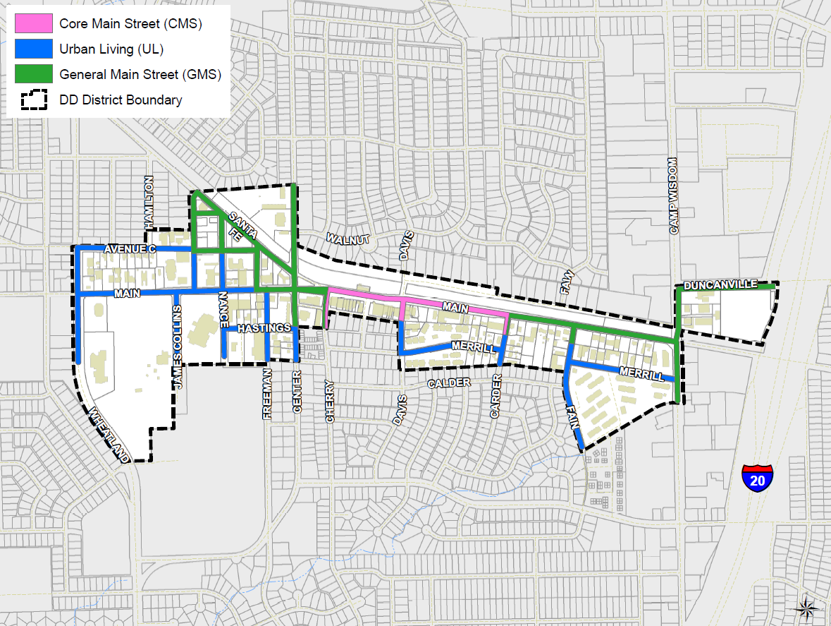
Applicability and location. The DD, Downtown Duncanville District shall be mandatory for all properties along with frontage along Main Street from I-20 frontage road to Wheatland Road and other properties as depicted in the regulating plan as outlined in Figure 4.11.1.
C.
DD District major elements. The DD, Downtown Duncanville District is composed of following major elements:
1.
Regulating plan. The regulating plan (Figure 4.11.1) identifies the frontage types and associated standards for all lots within the district.
2.
Frontage types. The frontage type establishes the building standards including height, bulk, building and parking location, and functional design for all lots within the DD, Downtown Duncanville District. All lots within the Downtown Duncanville master plan area are classified into one of the following frontage types:
a.
Core Main Street (CMS).
b.
Urban Living (UL).
c.
General Main Street (GMS).
3.
Building height. The building height requirements establish the vertical form of all buildings within the DD, Downtown Duncanville District, including the following elements:
a.
Height of principal buildings;
b.
Height of any structured parking;
c.
Height of a principal building's ground floor from the sidewalk; and
d.
Height of buildings adjacent to single-family neighborhoods.
4.
Site design. The site design requirements establish the layout of all sites within the DD, Downtown Duncanville District, including the following elements:
a.
Build-to zone to define the location of the front façade;
b.
Maximum lot coverage;
c.
Required side and rear setbacks; and
d.
Amount and placement of parking.
5.
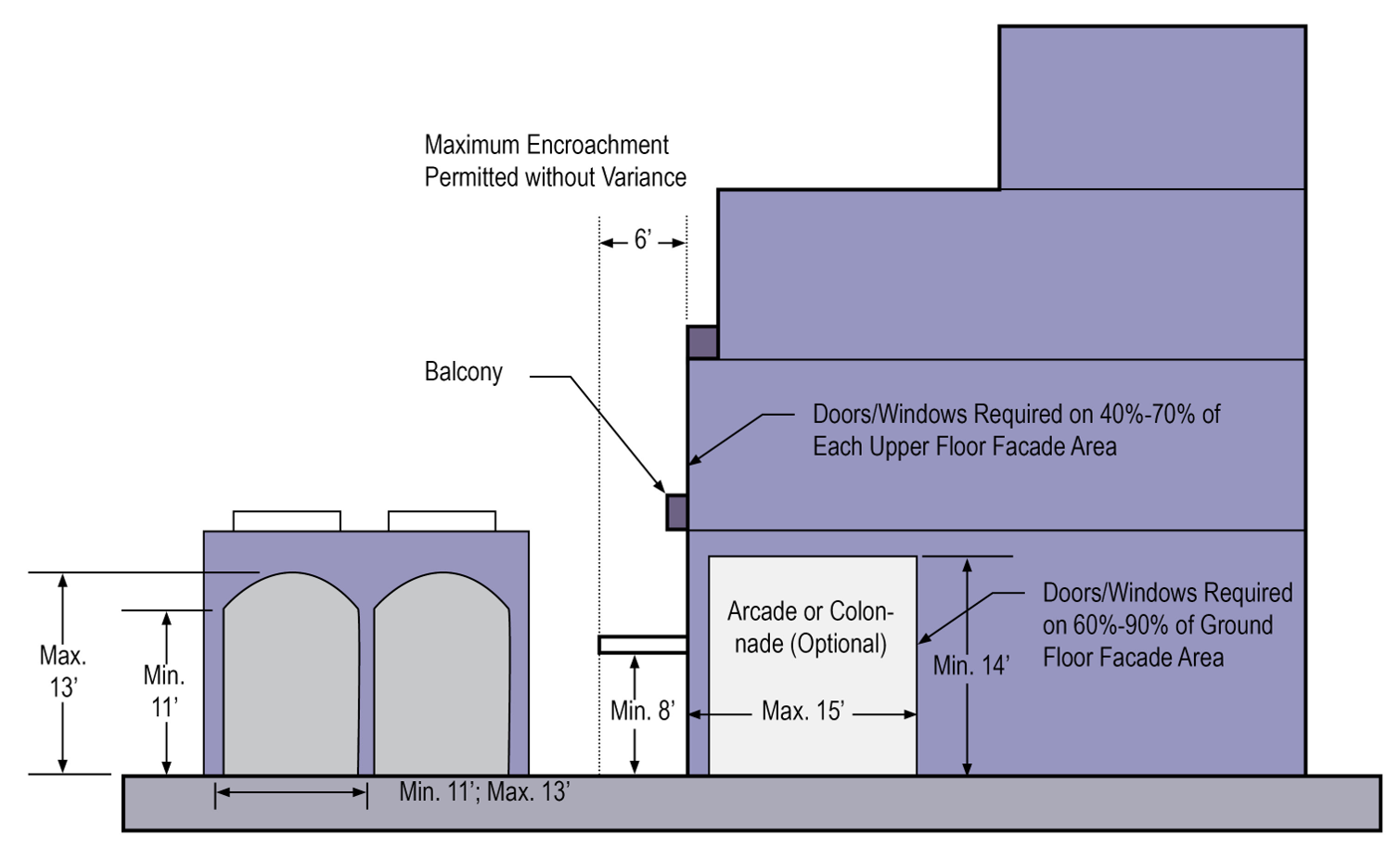
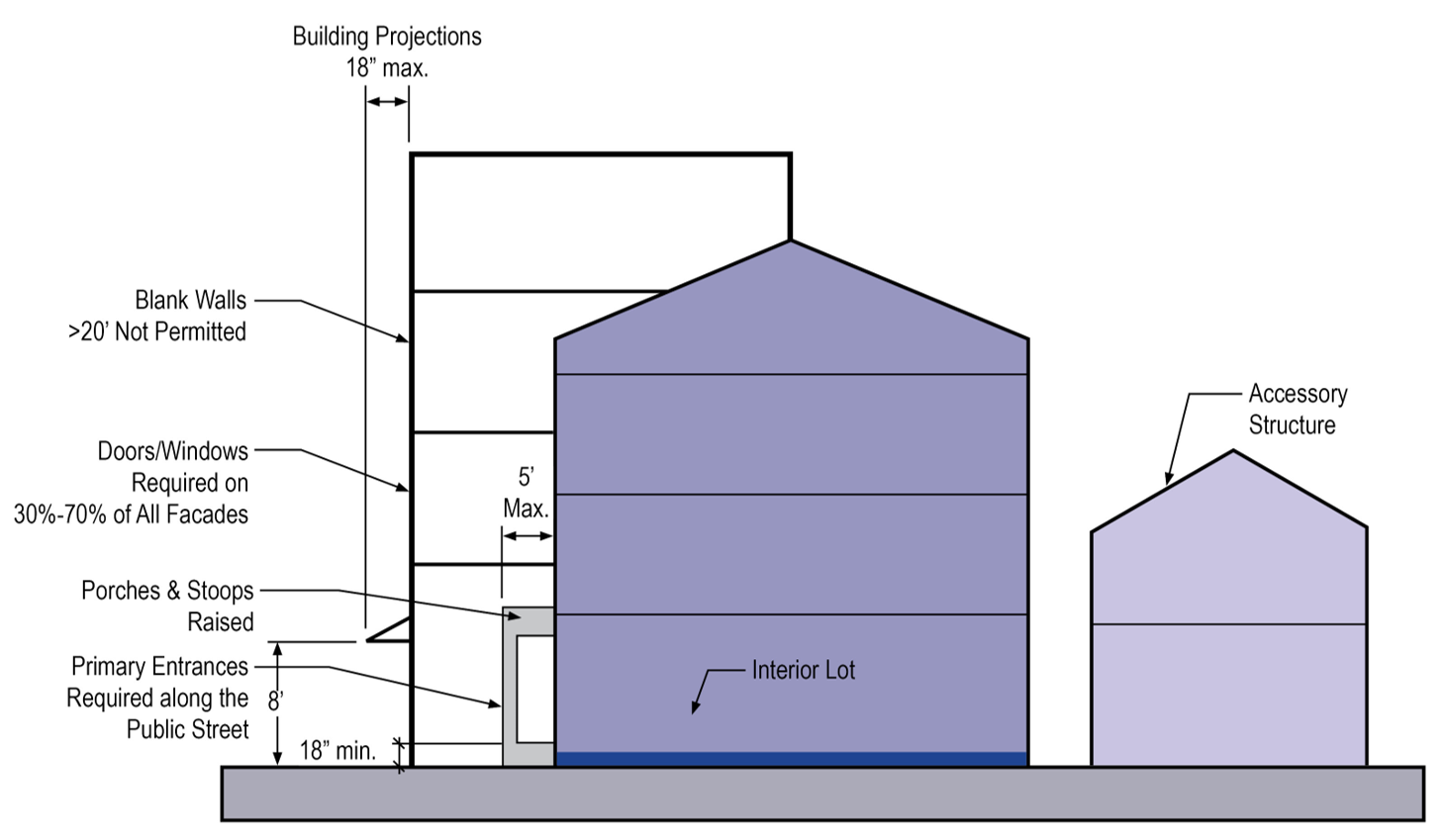
Building design. The building design requirements establish the architectural design of all buildings within the DD, Downtown Duncanville District, including the following elements:
a.
Placement of doors and windows;
b.
Building projections;
c.
Arcade and colonnades located in the build-to zone, and
d.
Height and projections of stoops and porches.
D.
Architectural standards. See K. Architectural Standards for standards for commercial, mixed use, live/work, and residential buildings.
E.
Development standards. Development standards not addressed this Section 4.11 shall be governed by Article 4. Development Standards to the extent they are not in conflict with the intent of the DD, Downtown Duncanville District.
F.
Land uses. See Section 3.03. Permitted Use Chart for permitted land uses by frontage type.
Figure 4.11.1. DD District Regulation Plan
G.
Standards by street frontage type.
1.
Core Main Street (CMS).
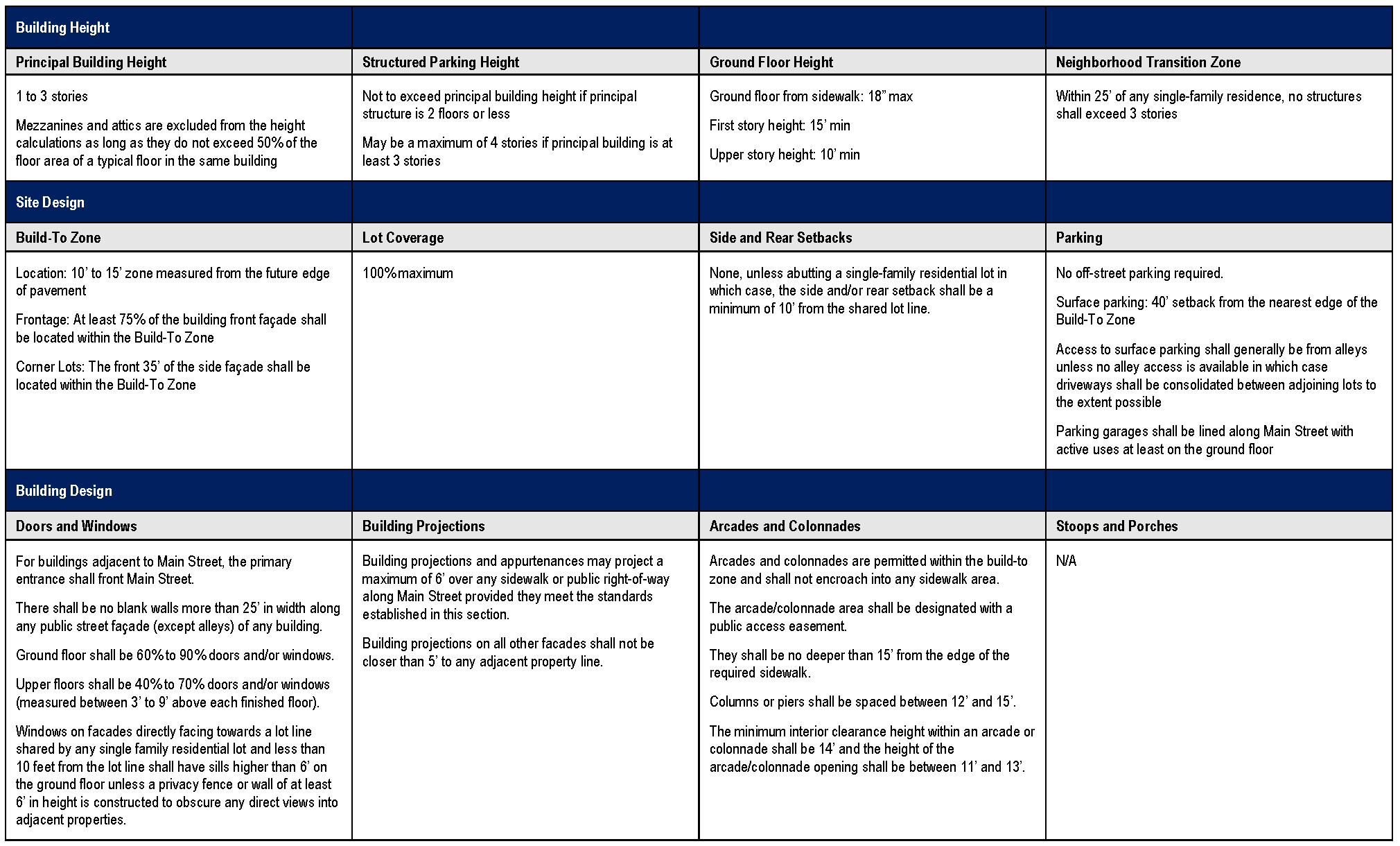
Figure 4.11.2. CMS Height Standards
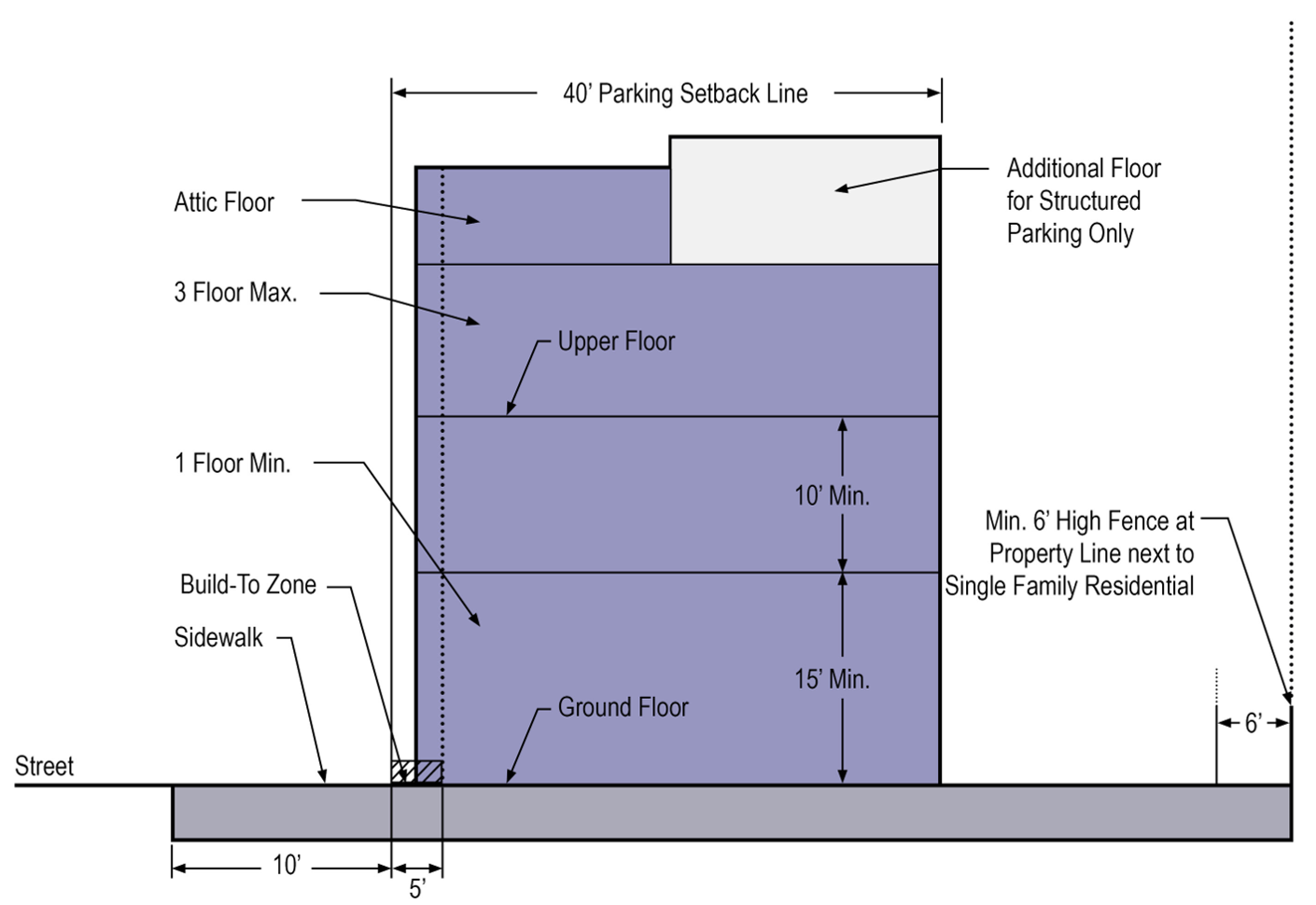
Figure 4.11.3. CMS Building Disposition
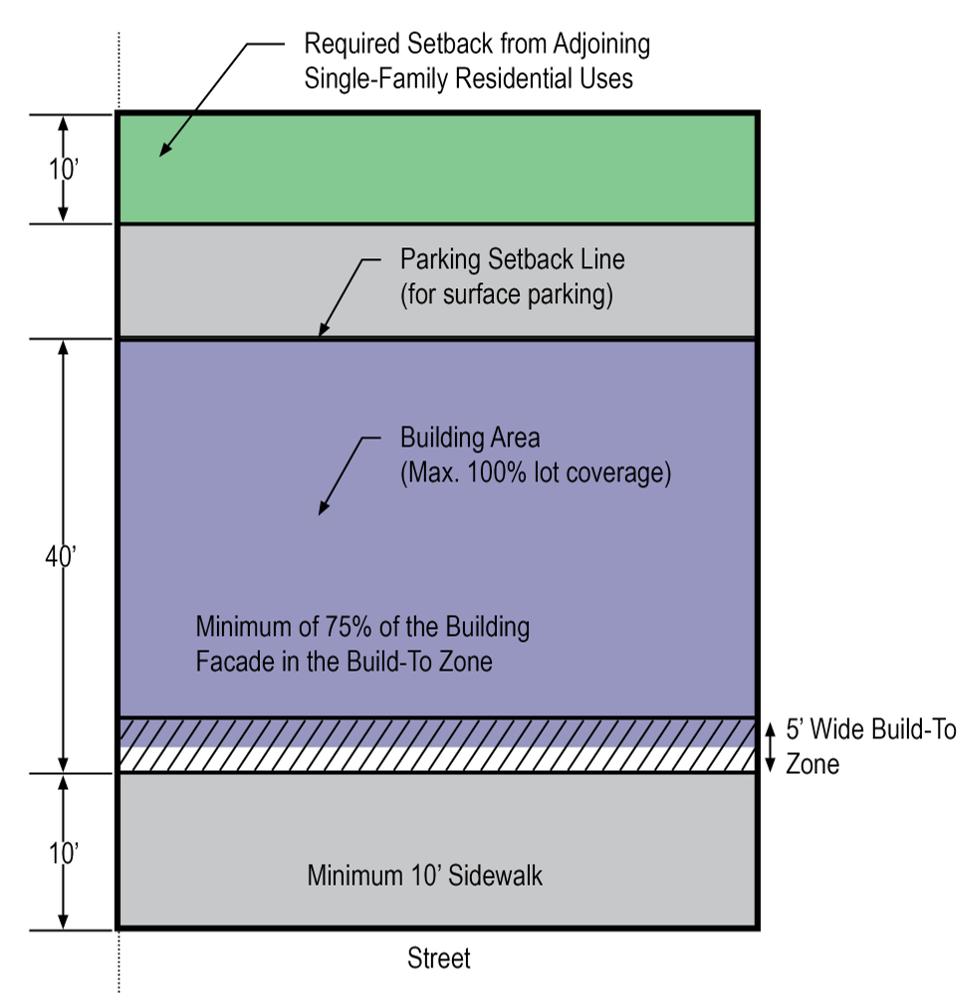
Figure 4.11.4. CMS Façade Elements
2.
Urban Living (UL).
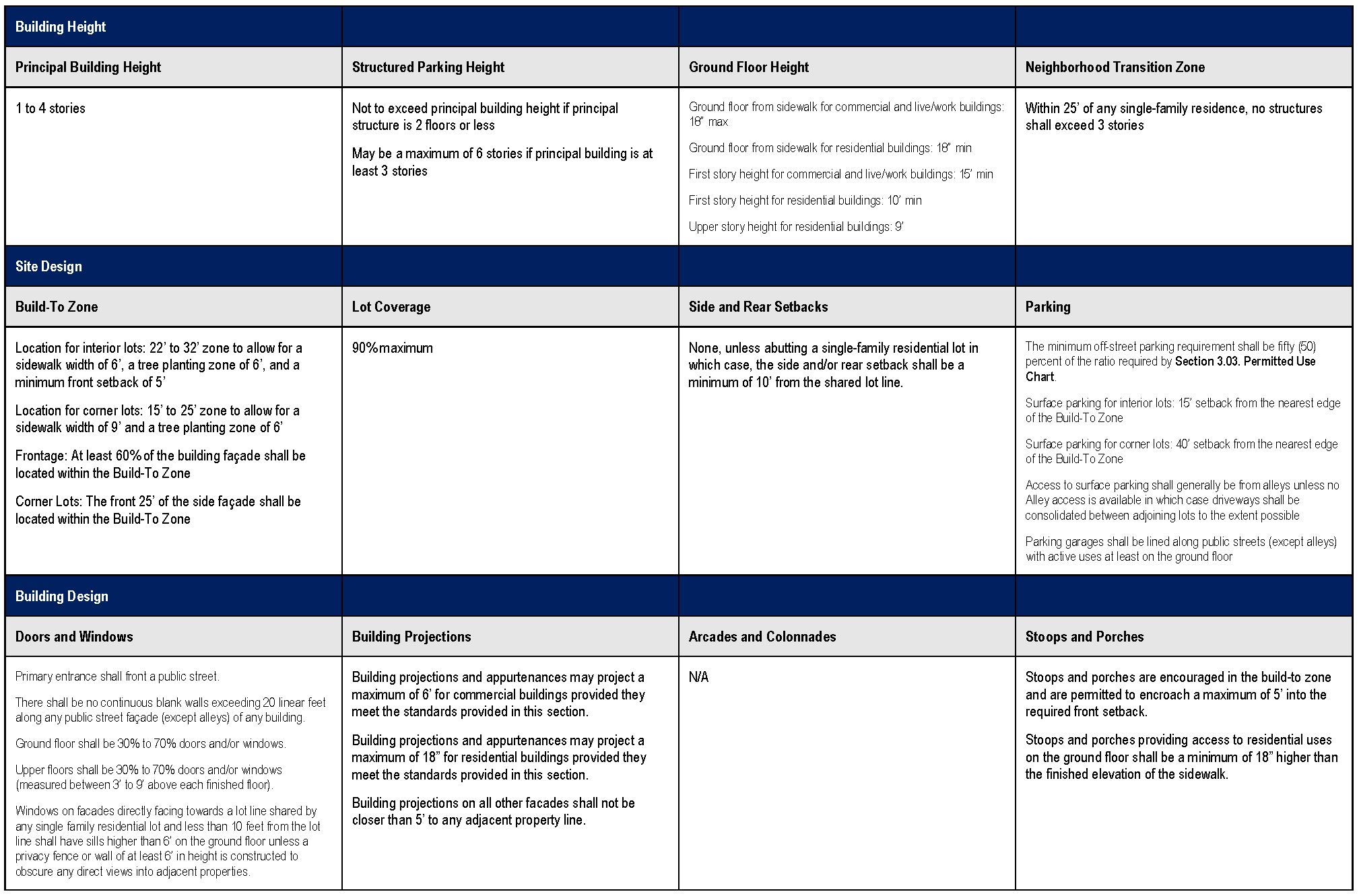
Figure 4.11.5. UL Height Standards
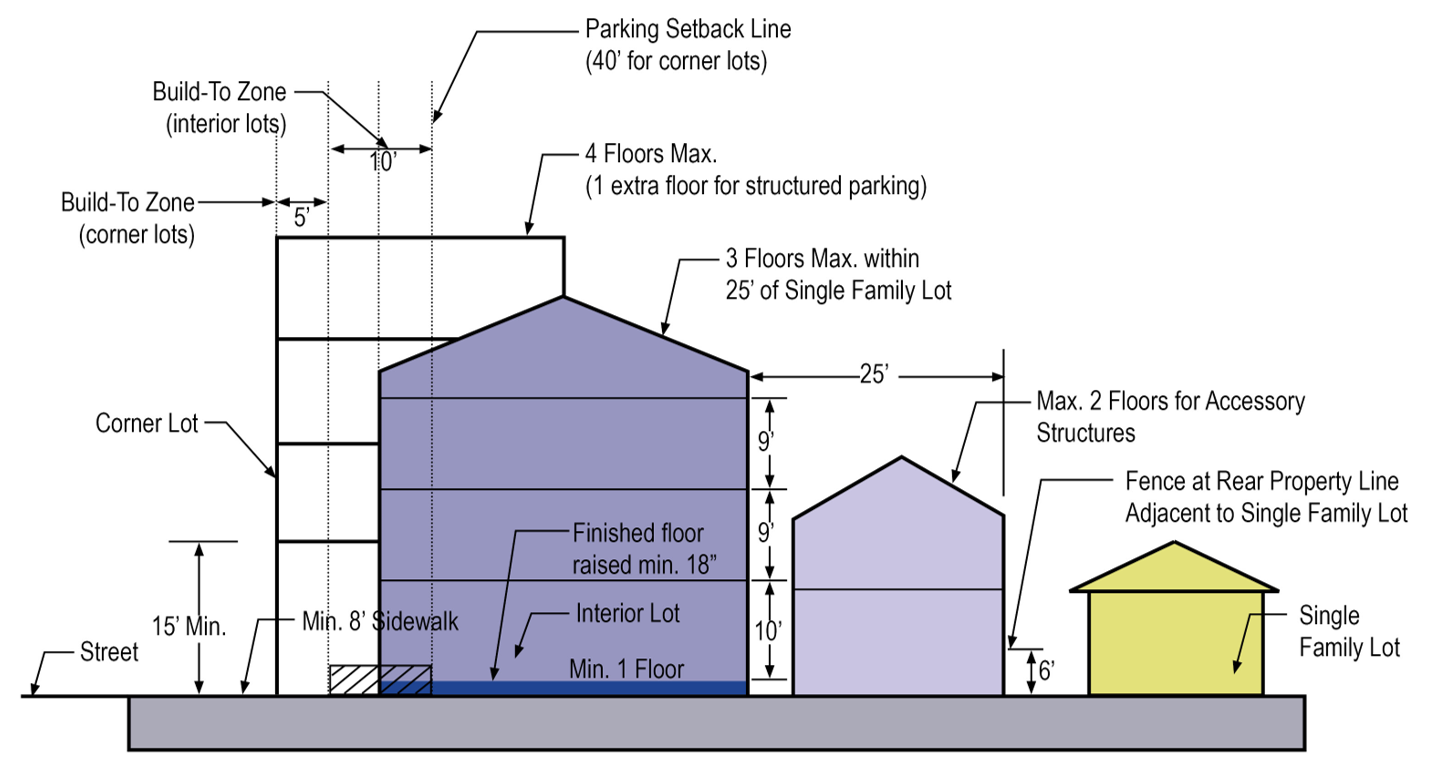
Figure 4.11.6. UL Building Disposition
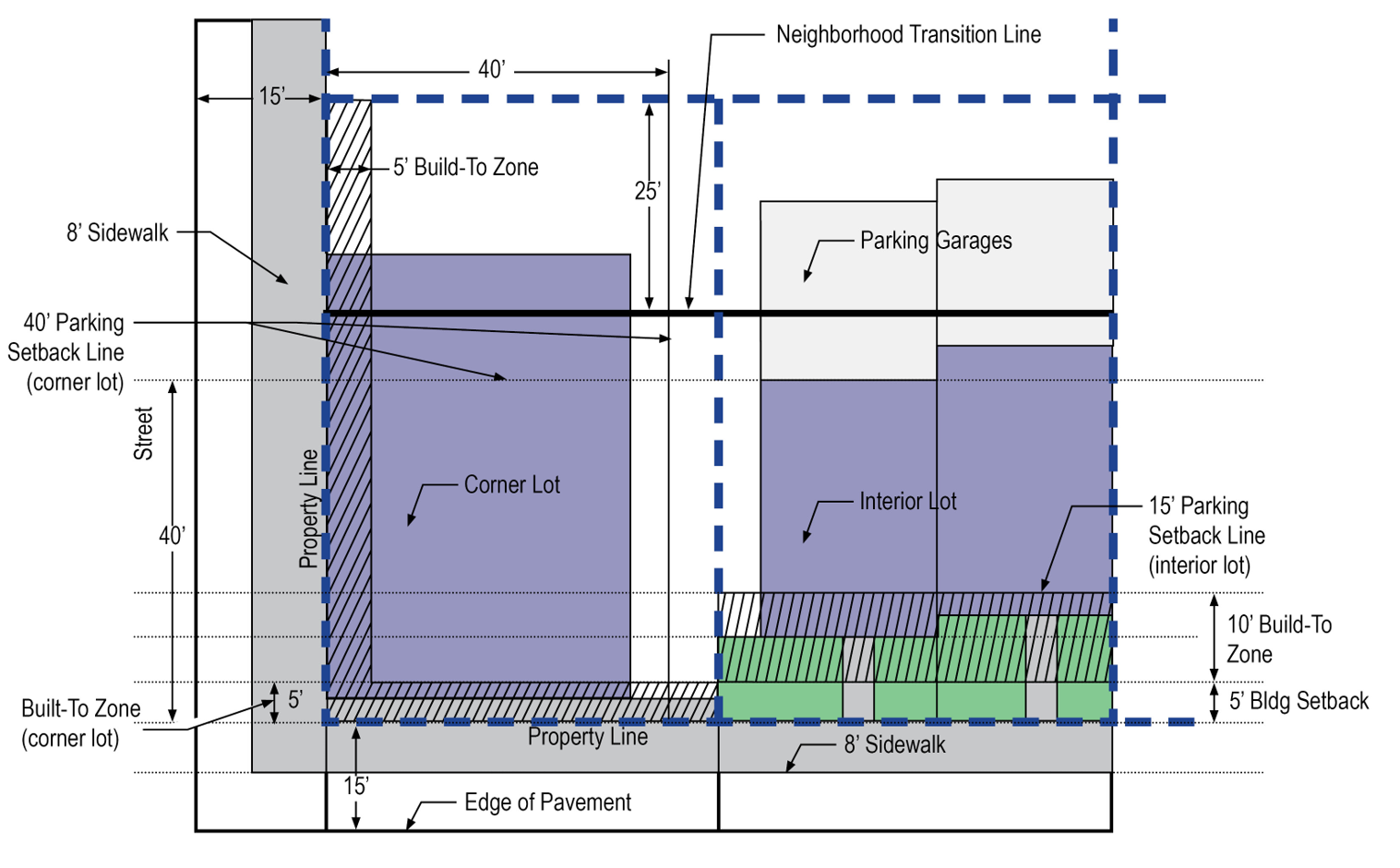
Figure 4.11.7. UL Façade Elements
3.
General Main Street (GMS)
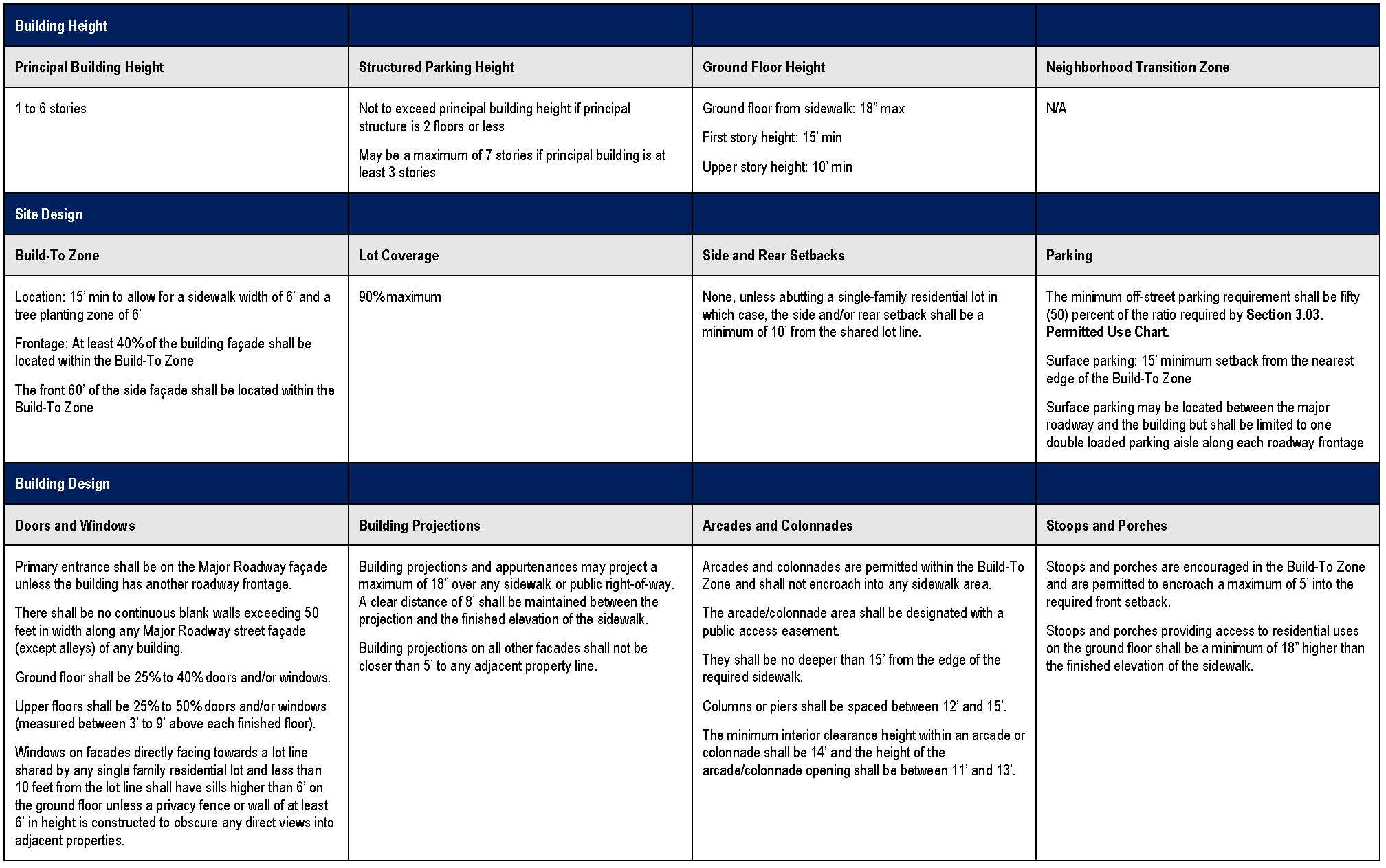
Figure 4.11.8. GMS Height Standards
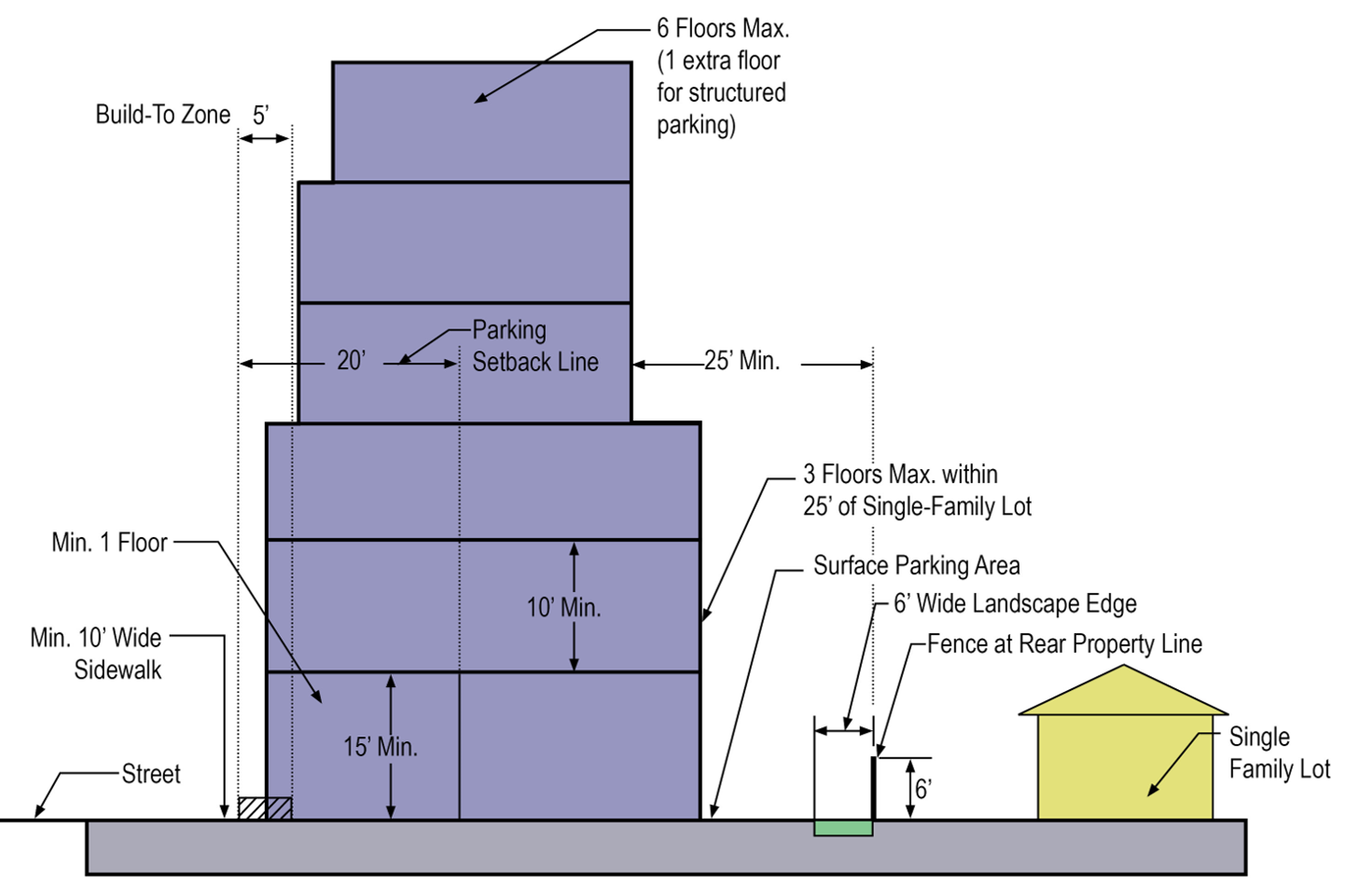
Figure 4.11.9. GMS Building Disposition
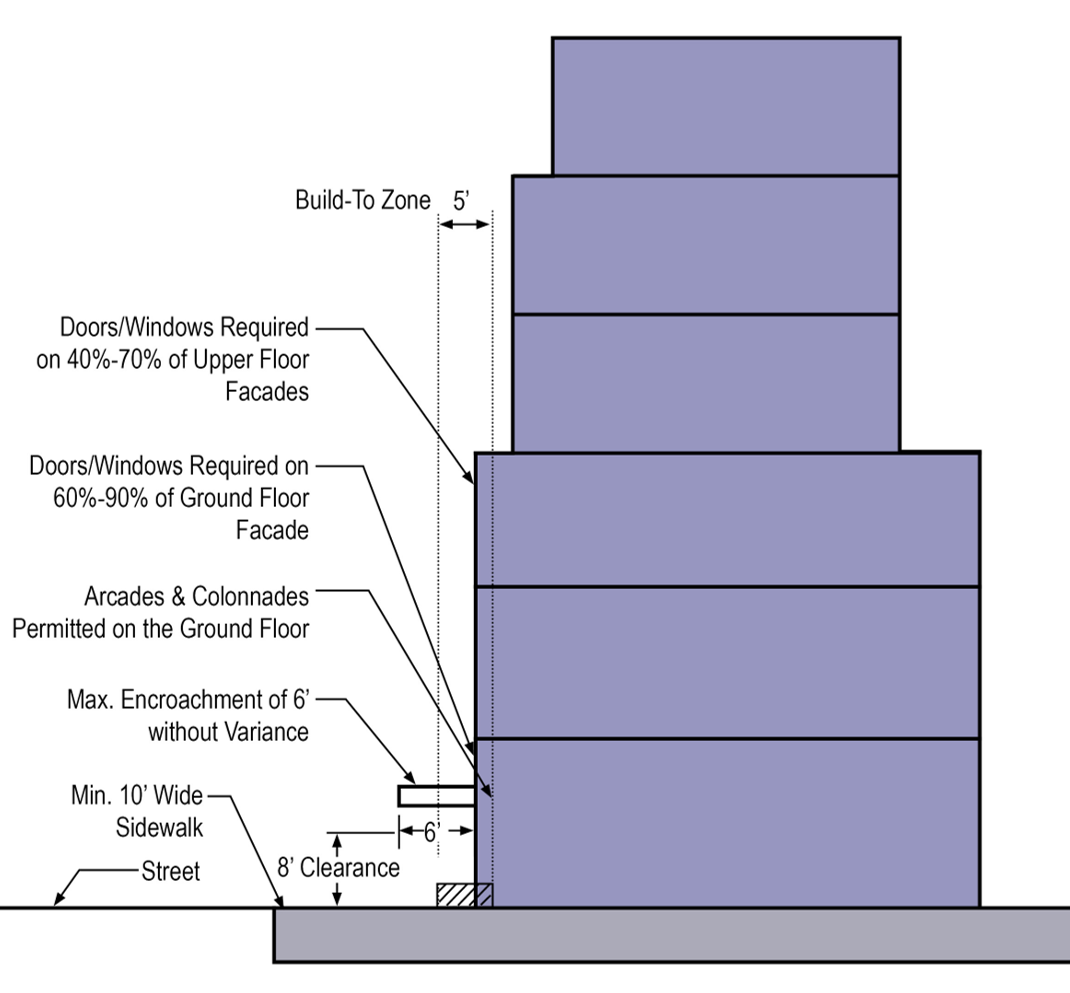
Figure 4.11.10. GMS Façade Elements
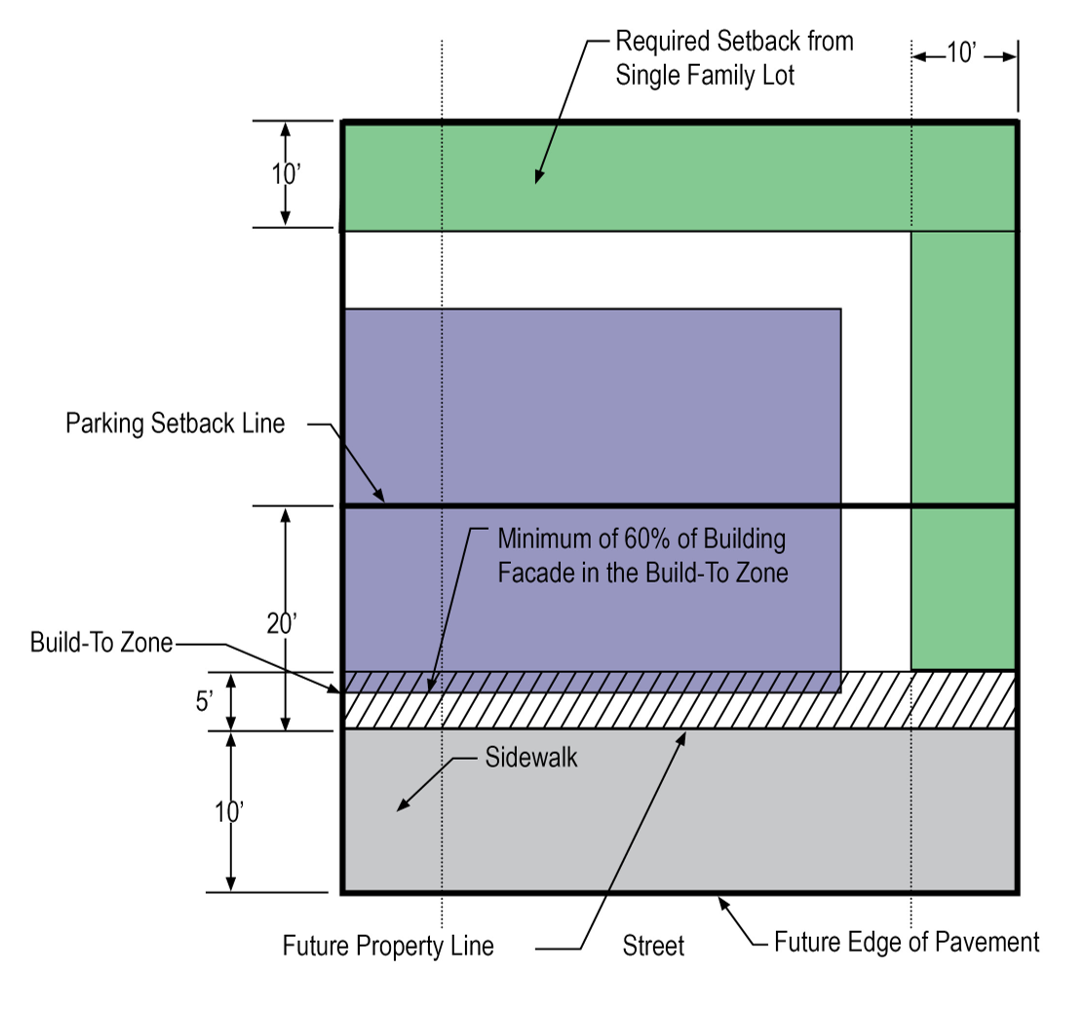
H.
Boundary determination. Due to the public improvements planned for Main Street including the realignment of travel lanes, addition of the slip-street and on-street parking, the future right-of-way lines and corresponding property lines are subject to change based on the approved streetscape plan. The future edge of pavement as shown the adopted Downtown master plan shall be the basis for establishing the build-to zones, lines and parking setback lines along Main Street and any other street in the DD, Downtown Duncanville District that requires public street improvements. If the existing street does not require any public improvements, the build-to zone, line and parking setback lines shall all be measured from the property/right-of-way line along that street frontage. The city manager may revise the build-to zones and parking setbacks to accommodate required streetscape improvements based upon a city council approved streetscape plan and survey.
I.
Pedestrian orientation. In order to facilitate walkability and livability, Main Street and intersecting streets within the DD, Downtown Duncanville District shall provide accessible sidewalks with street trees. Cross-sections as delineated on the Main Street Regulating Plan, incorporated herein by reference, are established to facilitate guidance for an integrated set of transportation choices—driving, walking and cycling, as well as to form public places bounded by building façades creating a sense of "outdoor rooms" or enclosure along the street or within building courtyards opening to the street.
J.
Public improvements. Public improvements within the right-of-way necessary to facilitate walkability, as delineated on the Downtown Duncanville master plan and regulating plan, shall be designed and constructed by the city or other public entities when funding becomes available; accordingly, new design and construction of private buildings and improvements within the district shall conform to and be complementary with those public improvements.
K.
Architectural standards.
1.
Commercial and mixed-use buildings.
a.
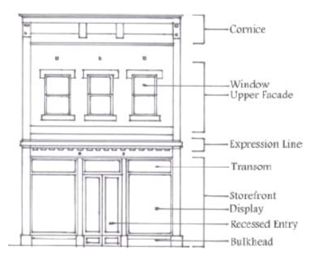
An expression line shall delineate divisions between floors of all buildings, and a cornice shall delineate the tops of façades that do not utilize a pitched roof. For retail storefronts, a transom, display window area and bulkhead at the base shall be utilized.
b.
The visual and acoustic impacts of all mechanical, electrical, and communications equipment (ground and roof-mounted) shall not be visible from adjacent properties and public streets, and screening materials and landscape screens shall be architecturally compatible with and similar in design and color to the building materials of the principal structures on the lot.
c.
Mansard roofs are prohibited. Flat roofs without parapets on all sides are prohibited.
d.
Roofs shall be constructed of a process and of materials that shall have a minimum installation and manufacturer's warranty of at least 20 years.
e.
Ground floor retail building plate heights shall be at least 15 feet in height.
f.
Windows shall be oriented vertically.
g.
Columns and piers shall be spaced no farther apart than the height of the column or pier.
h.
Transparency. Each floor of any building façade facing a park, plaza or street shall contain transparent windows. The specific standards for transparency are established under the frontage standards for all sites within the DD, Downtown Duncanville District.
i.
Permitted finishes for commercial or mixed-use buildings. At least 80 percent of the exterior façades of all new buildings (excluding area included in doors and windows) fronting on any public street (with the exception of alleys) and 50 percent of all non-public street fronting (including alleys) façades shall be finished in one or more of the following materials:
(1)
Brick, stone, cast stone, rock, marble, granite, non-synthetic stucco applied using a three-step process, glass block and/or tile.
(2)
Fiber cement siding with at least a 30 year warranty.
(3)
Split face concrete block, poured-in-place concrete, and tilt-wall concrete. Any use of concrete products shall have an integrated color and be textured or patterned. Tilt-wall concrete structures shall include reveals, punch-outs, or other similar surface characteristics to enhance the façade on at least 25 percent of each façade.
(4)
Fascia and soffit shall be constructed with a fiber cement material with a 30 year warranty. Hardboard and pressboard shall not be permitted.
j.
EIFS (Exterior Insulating Finishing System) or synthetic stucco shall only be permitted as an accent material and shall be less than 20 percent of any given façade and shall be permitted only on the portions of the building façades higher than eight feet from the finished ground level.
k.
The exterior walls of buildings may be lit with wall washer type lights, natural gas lamps, or low wattage decorative electric lamps.
l.
Building encroachments:
Table 4.11.1 shall establish the standards for encroachments into the public right-of-way.
Table 4.11.1. Building Encroachment Standards
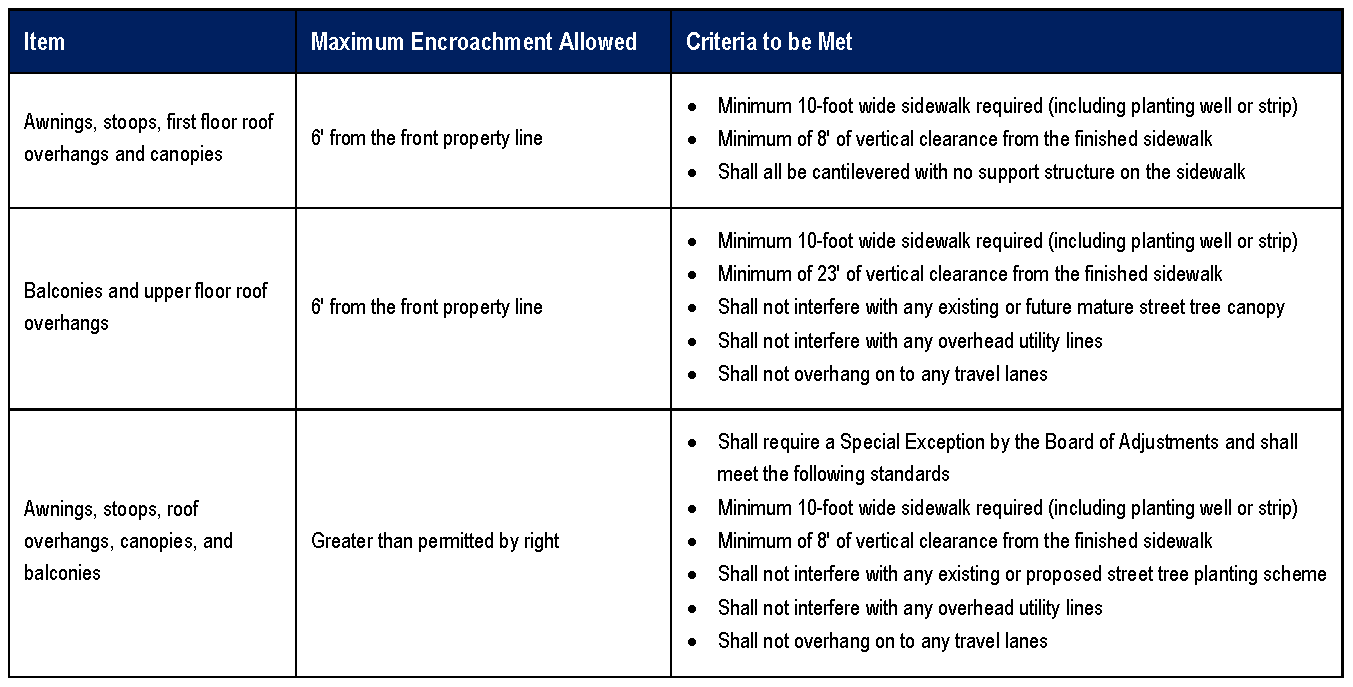
Figure 4.11.11. Architectural Elements
2.
Live/work and residential buildings.
a.
Windows on live/work and townhouse residential buildings shall also utilize significant surrounds or shutters, as well as mullions between grouped windows.
b.
The following permitted finishes for residential buildings and live/work units shall be allowed: Fiber cement siding (not sheets) with at least a 30-year warranty; brick; stone; man-made stone and non-synthetic stucco utilizing a three-step process. The following shall be allowed up to 20 percent as an accent material: Exterior insulating finishing system (EIFS) (abuse resistant EIFS above eight feet above grade) or similar material over a cementitious base, rock, glass block and tile.
c.
Side façades, rear façades, accessory structures, and garages shall be of finished quality and of the same color and materials that blend with the front of the building. Rear façades may be painted tilt-wall or painted block matching the same color of the rest of the building if the rear façade faces an alley or is not viewable from a public street or right-of-way.
d.
On townhouses, at least one of the following shall be utilized: porches, stoops, bay windows, balconies, masonry clad chimneys, attached pergolas or colonnades. These architectural elements may encroach into the build-to-line.
e.
Plate heights for townhouse residential units shall be no less than ten feet for the first floor and nine feet for the second or higher floors.
f.
Unless served by a parking structure or shared parking, all residential buildings shall utilize rear-loaded or "pull-through" garages/carports. Carports shall be constructed and finished of the same material and style as the primary building.
L.
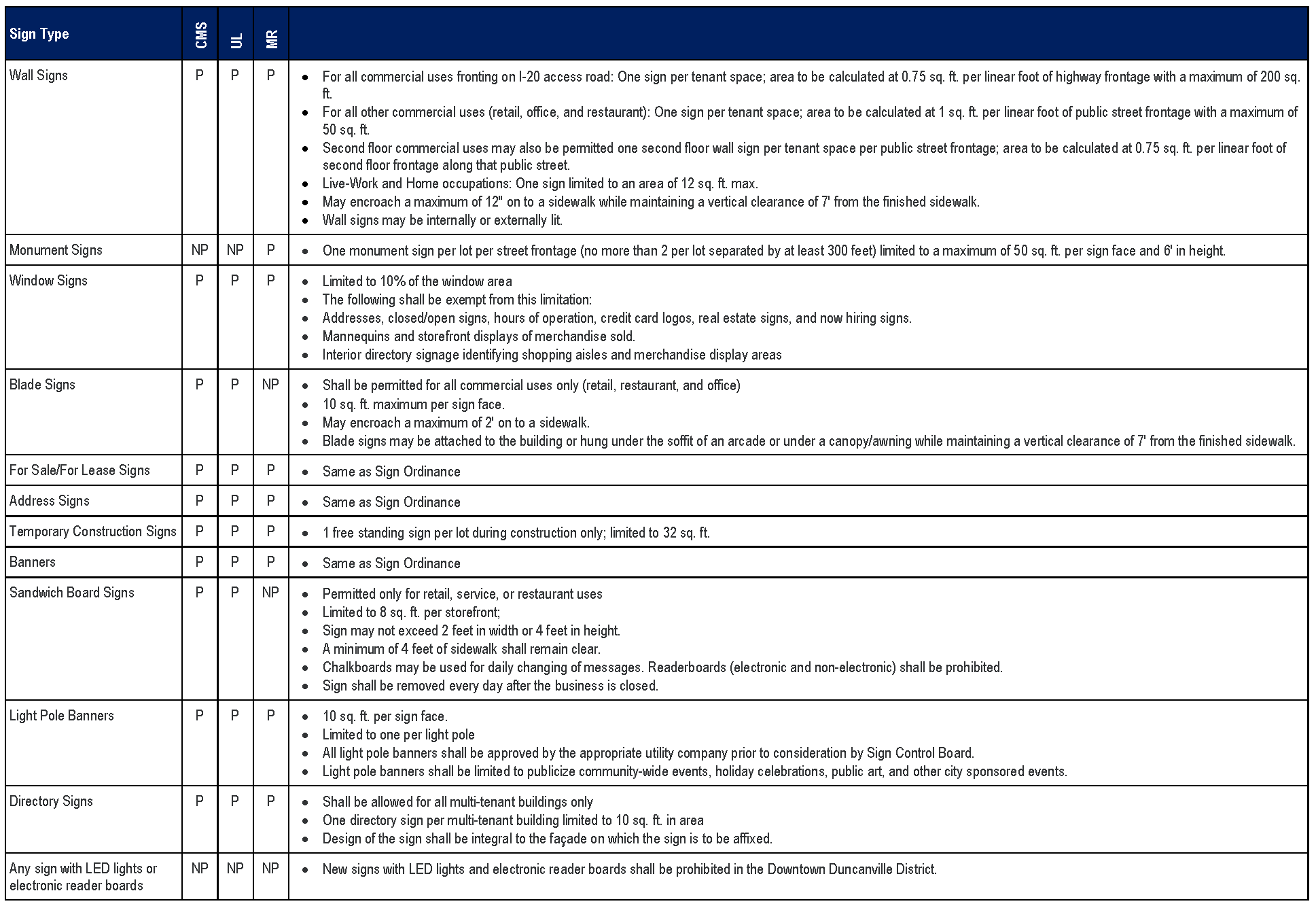
Signage. Except as specifically listed Table 4.11.2, all other signage and sign standards must comply with Chapter 16A, Sign Guidelines of the City of Duncanville Code of Ordinances, as amended.
1.
For conforming uses and new signs for non-conforming uses, the standards in Table 4.11.2 shall apply and sign permits may be approved administratively unless specifically noted in this section. An applicant has the option to establish unique sign standards including size, color, type, design, and location based upon specific performance criteria. Such sign standards shall be reviewed by staff and is subject to approval of the sign control board.
Table 4.11.2. Permitted Sign Types
M.
Application and review requirements.
1.
The development review committee shall be responsible for the following:
a.
Reviewing applications for concept plans, site plans, and any other development related applications within the DD, Downtown Duncanville District.
b.
Make determinations on the applications and interpretations of guidelines, standards, and requirements of this chapter.
c.
Approval of site plans within the DD, Downtown Duncanville District that comply with all applicable city ordinances.
2.
Site plan. All nonresidential, mixed-use, multi-family, and townhome development within the DD, Downtown Duncanville District shall comply with the requirements under Section 6.04. Site Plans.
3.
Special uses, special events, and specific use permits special uses, special events, and specific use permits in the DD, Downtown Duncanville District shall meet the requirements under Article 6. Zoning Procedures.
N.
Alternative compliance for DD, Downtown Duncanville District. Alternative compliance is a method for planning and zoning commission to approve alternative methods of compliance for nonconforming structures in the DD, Downtown Duncanville District based on predetermined standards that may be suitable for this district in select scenarios of land development, reconstruction or modifications. The purpose of alternative compliance is to provide a method to allow for nonconforming structures to remain nonconforming after reconstruction or substantial modification if it is in agreement with the Downtown Duncanville District Main Street Master Plan, the Main Street Vision, this district and other policies/regulations that may be adopted by the city council.
1.
Applicability. Requests for alternative compliance for DD, Downtown Duncanville District are only suitable for nonconforming buildings (not nonconforming uses) zoned DD, Downtown Duncanville District and the applicant seeks approval for reconstruction or substantial modifications to the building exterior or building façade of a nonconforming building where the collective reconstructions or modifications within any five year period are valued at more than either $50,000 or a total of 50 percent of the assessed value of the structure in the most recently certified tax rolls, whichever is greater.
2.
Review and approval criteria.
a.
The alternative compliance requested shall be in agreement with and promote the concepts from the Downtown Duncanville District Main Street master plan.
b.
The alternative compliance requested shall promote the concepts of the form-based zoning within the DD, Downtown Duncanville District.
c.
The alternative compliance requested shall be in agreement with and promote the concept of orienting buildings in a manner that enhances the pedestrian environment.
d.
Consideration shall be given to the impact of the alternative compliance requested on parking areas, vehicle circulation, building layout, connectivity to surrounding streets and sidewalks.
e.
Consideration shall be given to whether the alternative compliance requested adversely affects or potentially adversely affects nearby property.
f.
The applicant shall demonstrate the structural and engineering obstacles and difficulties with making the building conforming.
3.
Approval process.
a.
Applications for approval of alternative compliance shall be submitted to the city and shall specify in detail:
(1)
The alternative compliance sought from the requirements that would otherwise make the building conforming.
(2)
Describe in detail the structural and engineering obstacles and difficulties with making the building conforming.
(3)
All other information determined by staff to be needed to properly consider the request.
b.
Alternative compliance applications shall be considered by the planning and zoning commission after review by the development review committee. To hear and take action on an application for alternative compliance the planning and zoning commission shall hold a public hearing at least ten days after publishing notice one time in the official publication of the city, stating the time and place of such hearing, and after providing written notice at least ten days before the hearing date to each owner, as indicated on the most recently approved municipal tax roll, of real property within 200 feet of the property on which the alternative compliance is requested to be considered.
4.
Appeal process. The applicant may appeal a decision of the planning and zoning commission denying the application to the city council by submitting written notice of appeal through the director of public works as follows:
a.
The applicant must submit said written notice of appeal no later than 20 calendar days from the date of such decision by the planning and zoning commission.
b.
Following receipt of a proper written notice of appeal from the applicant, the city council shall consider the appeal at one of its next two regular meetings for which there is time to post an agenda and publish notice. To hear and take action on a notice of appeal the city council shall hold a public hearing at least 15 days after publishing notice one time in the official publication of the city, stating the time and place of such hearing, and after providing written notice at least 15 days before the hearing date to each owner, as indicated on the most recently approved municipal tax roll, of real property within 200 feet of the property on which the alternative compliance is requested to be considered.
c.
The city council may affirm, modify or reverse the decision of the planning and zoning commission. If the city council upholds the decision of the planning and zoning commission, the applicant may not apply for alternative compliance for the same building for 12 months from the date of the city council's decision.
(Ord. No. 2395, § 1, 3-2-21)
Sec. 4.12. - Wireless telecommunication regulations.
A.
Purpose.
1.
Protect residentially zoned areas and land uses from potential adverse impacts of towers and antennas;
2.
Encourage the location of towers in nonresidential areas, and on city facilities where feasible;
3.
Minimize the total number of towers and antennas throughout the community;
4.
Strongly encourage the joint use of new and existing tower and antenna sites as a primary option rather than the construction of additional single-use facilities;
5.
Encourage owners/providers of towers and antennas to locate them, to the maximum extent possible, in areas where the adverse impact on the community is minimal;
6.
Encourage owners/providers of towers and antennas to configure them in a way that minimizes the adverse visual impact of the towers and antennas through careful design, siting, landscape screening, and innovative camouflaging techniques;
7.
Encourage owners/providers of emerging new technologies to evaluate utilization of these technologies in lieu of a proliferation of towers/antennas across the community;
8.
Enhance the ability of the providers of wireless telecommunications services to provide such services to the community quickly, effectively, and efficiently; and
9.
Consider the effect on public safety by communication towers and antennas; and
10.
Avoid potential damage to adjacent properties from tower failure through engineering and careful siting of tower and antenna structures. In furtherance of these goals, the city shall give due consideration to existing land uses, and environmentally sensitive areas in approving sites for the location of towers and antennas.
B.
Applicability.
1.
New towers and antennas. All new towers or antennas in the city shall be subject to these regulations, except as provided in 2. and 3. below.
2.
Amateur radio station operators/receive only antennas. This section shall not govern any tower, or the installation of any antenna, that is under 70 feet in height and is owned and operated by a federally-licensed amateur radio station operator or is used exclusively for receive-only antenna.
3.
AM array. For purposes of implementing this section, an AM array, consisting of one or more tower units and supporting ground system which functions as one AM broadcasting antenna, shall be considered one tower. Measurements for setbacks and separation distances shall be measured from the outer perimeter of the towers included in the AM array. Additional tower units may be added within the perimeter of the AM array by right.
C.
General requirements.
1.
Application. When making an application for a permit, the owners/providers shall complete a "telecommunication tower/antenna siting application", in its entirety and provide same to the city for review and evaluation by the director of public works.
2.
Principal or accessory use. Antennas and towers may be considered either principal or accessory uses. A different existing use of an existing structure on the same lot shall not preclude the installation of an antenna or tower on such lot.
3.
Lot size. For purposes of determining whether the installation of a tower or antenna complies with district development regulations, including, but not limited to, setback requirements, lot coverage requirements, and other such requirements, the dimensions of the entire lot shall control, even though the antenna or tower may be located on leased parcels within such lot.
4.
Inventory of existing sites. When making an application for a permit, the applicant for an antenna and/or tower shall provide to the city an inventory of its existing towers, antennas, or sites approved for towers or antennas, that are either within the jurisdiction of the city or within one mile of the border thereof, including specific information about the location, height, and design of each tower. The city may share such information with other applicants who apply for administrative approvals or specific use permits under this chapter or other organizations seeking to locate antennas within the jurisdiction of the city, provided however, that the city is not, by sharing such information, in any way representing or warranting that such sites are available or suitable.
5.
Aesthetics. Towers and antennas shall meet the following requirements:
a.
Towers shall maintain a galvanized steel finish or, subject to any applicable standards of the FAA, be painted a neutral color so as to reduce visual obtrusiveness;
b.
At a tower site, the design of the buildings and related structures shall, to the greatest extent possible, use materials, colors, textures, screening, and landscaping that will blend them into the natural setting and surrounding buildings, as approved by the director of public works; and,
c.
If an antenna is installed on a structure other than a tower, the antenna and supporting electrical and mechanical equipment shall be of a neutral color that is identical to, or closely compatible with, the color of the supporting structure so as to make the antenna and related equipment as visually unobtrusive as possible, as approved by the director of public works.
6.
Performance bond/insurance/letter of credit.
a.
For towers located on city-owned property, any required performance bonds, insurance and/or indemnification shall conform with the city lease agreement; and,
b.
For towers located on private property, the owners/provider shall provide and maintain in effect at all times a performance bond for each tower valued at one-third of the cost of the tower construction (labor and material) to be determined at the time of permit application. The purpose of the performance bond is to insure maintenance/removal of the towers/buildings/fences, etc., to return the site to its original condition in the event of tower failure, or damage to the surrounding property. For those companies with multiple towers in the city, a single bond to cover all towers shall be acceptable. In lieu of a performance bond, a company may provide to the city either a certificate of insurance whose value equals or exceeds that required by a performance bond, with the city as an additional insured, or an irrevocable Letter of credit whose value would equal or exceed that required by a performance bond.
7.
Building and support equipment. Buildings and support equipment associated with towers or antennas shall comply with the requirements of G. Buildings or Other Equipment Storage below.
8.
Multiple tower/antenna plan. The city encourages the users of towers and antennas to submit a single application for approval of multiple towers and/or antenna sites.
9.
Measurement. For purposes of measurement, tower setbacks and separation distances shall be calculated and applied to facilities located in the city irrespective of municipal boundaries.
10.
Lighting. Towers shall not be artificially lighted unless required by the FAA or other applicable authority, including the city. A nonintrusive security light shall be provided for the base of the tower and the cabinet building, operational from dusk to dawn. A red light, of a type approved by the FAA, shall be provided on all towers for visibility of the tower from aircraft. The red light shall be placed atop the highest point of the tower.
11.
Signs. No signs shall be allowed on a telecommunication facility system except for caution/safety advisory type notices, and/or for addressing purposes. The signs shall be no larger than two square feet.
D.
Administratively approved uses—towers. The following provisions shall govern the issuance of administrative approvals for towers:
1.
The director of public works shall make every attempt to respond to each such application within 60 days after receiving it by either approving or denying the application;
2.
The director of public works, in order to encourage the use of monopoles, may administratively allow the reconstruction of an existing tower (125 feet or less) to monopole construction. The new monopole may be increased in height one time by 25 percent of the original approved height, to a maximum of 125 feet, whichever is less.
3.
Setbacks.
a.
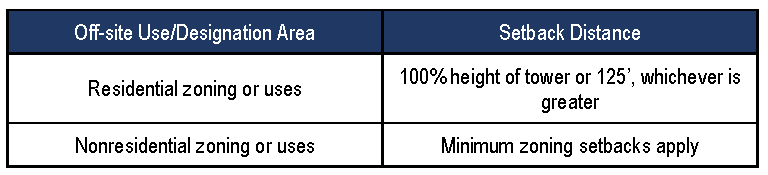
Setback requirements. The setback requirements set forth in Table 4.12.1 shall apply to all Towers, unless the city council in granting a specific use permit varies these conditions.
Table 4.12.1. Setback Requirements for Towers
b.
Additional requirements.
(1)
Guys and accessory buildings shall satisfy the minimum zoning district setback requirements.
(2)
Setbacks measured from the base of the tower to the closest building line.
(3)
A separation distance of 5,000 feet between towers shall apply to all towers, unless the city council in granting a specific use permit varies this condition. The separation distances between towers shall be applicable for and measured between the proposed tower and preexisting towers. The separation distances shall be measured by drawing or following a straight line between the base of the existing tower and the proposed base, pursuant to a site plan, of the proposed tower.
(4)
A structure which is modified or reconstructed to accommodate the collocation of an additional antenna shall be of the same type as the existing structure, unless the director of public works allows reconstruction as a monopole.
c.
Height.
(1)
The height change(s) referred to in this subsection may be increased one time by 25 percent of the original approved height, to a maximum of 125 feet, whichever is less.
(2)
The additional height referred to in this subsection shall not require an additional distance separation as set forth in E. Administratively Approved Uses—Antennas below. The tower's pre-modification height shall be used to calculate such distance separations.
d.
On-site location.
(1)
A tower which is being rebuilt to accommodate the collocation of an additional antenna may be removed on-site within 50 feet of its existing location.
(2)
After the tower is rebuilt to accommodate collocation, only one tower may remain on the site. The owner/provider shall remove the vacated tower within 60 days after the new antenna becomes operational. If the tower is not removed by the specified time, the city shall exercise the performance bond/letter of credit to remove the tower.
E.
Administratively approved uses—antennas. The following provisions shall govern the issuance of administrative approvals for antennas:
1.
The director of public works shall make every attempt to respond to each such application within 60 days after receiving it by either approving or denying the application.
2.
Locating antennas on existing nonresidential structures or towers in all zoning districts consistent with the terms of a and b below.
a.
Antennas on existing structures. Any antenna which is not attached to a tower may be approved by the director of public works as an accessory use, provided:
(1)
The antenna does not extend more than 20 feet above the highest point of the structure;
(2)
The antenna complies with all applicable FCC and FAA regulations;
(3)
The method of attachment and materials used to attach the antenna to a structure complies with all applicable building codes; and
(4)
Minimum zoning setbacks shall apply to all antenna installations.
b.
Antennas on existing towers. An antenna which is attached to an existing tower may be approved by the director of public works as an accessory use, provided:
(1)
The antenna does not extend more than 20 feet above the highest point of the structure, and not exceed an overall height of 125 feet;
(2)
The antenna complies with all applicable FCC and FAA regulations; and
(3)
The method of attachment and materials used to attach the antenna to a structure complies with all applicable building codes.
F.
Specific use permit (SUP).
1.
General. The following provisions shall govern the issuance of specific use permits for towers which do not qualify for administrative approval, or for antennas over 20 feet above a nonresidential structure or for antennas on any residential structure.
a.
Applications for specific use permits under this section shall be subject to the procedures and requirements of Section 6.05. Specific Use Permits except as modified in this section.
b.
In granting a specific use permit, the city council may impose conditions to the extent the city council concludes such conditions are necessary to minimize any adverse effect of the proposed Tower or Antenna on adjoining properties.
c.
Any information of an engineering nature that the applicant submits, whether civil, mechanical, or electrical, shall be certified by an engineer.
d.
An applicant for a specific use permit shall submit the information described in this zoning ordinance and a nonrefundable fee as established by resolution of the city council to reimburse the city for the costs of reviewing the application.
e.
Any specific use permit issued under this section shall remain in effect for a period of ten years.
2.
Towers.
a.
In addition to any information required for applications for an SUP pursuant to Section 6.05. Specific Use Permits of the zoning ordinance, applicants for a SUP for a tower shall complete the application as prescribed in C.1. Application above and shall submit the following prepared by professionals, licensed to practice their respective disciplines in the State of Texas:
(1)
A scaled site plan clearly indicating, but not limited to, the location, type and height of the proposed tower, all weather parking pad, fencing, illumination, landscaping, on-site land uses and zoning, adjacent land uses and zoning (including when adjacent to other municipalities), adjacent roadways, proposed means of access, setbacks from property lines, elevation drawings of the proposed tower and any other structures, easements, topography, parking, and other information deemed by the city to be necessary to assess compliance with the ordinance.
(2)
Legal description of the parent tract and leased parcel (if applicable).
(3)
The setback distance between the proposed Tower and the nearest residential unit and/or residentially zoned properties shall be in accordance with D.3. Setbacks above.
(4)
The separation distance from other towers described in the inventory of existing sites submitted pursuant to D.3.b Additional Requirements above shall be shown on an updated site plan or map. The applicant shall also identify the type of construction of the existing, tower(s) and the owner/operator of the existing tower(s), if known.
(5)
A landscape plan showing specific language materials, and which maximizes preservation of existing plant material in accordance with d. Landscaping below.
(6)
Method of fencing, illumination, and finish.
b.
Availability of suitable existing towers, other structures, or alternative technology. No new tower shall be permitted unless the applicant demonstrates to the reasonable satisfaction of the city council that no existing tower, structure or alternative technology that does not require the use of an additional tower or structures can accommodate the applicant's proposed system needs. An applicant shall submit information requested by the city council related to the availability of suitable existing towers, other structures or alternative technology. Evidence submitted to demonstrate that no existing tower, structure or alternative technology can accommodate the applicant's proposed system may consist of any of the following:
(1)
No existing towers or structures are located within the geographic area which meet applicant's engineering requirements.
(2)
Existing towers or structures are not of sufficient height to meet applicant's engineering requirements.
(3)
Existing towers or structures do not have sufficient structural strength to support applicant's proposed system.
(4)
The applicant's proposed system would cause electromagnetic interference with the antenna on the existing towers or structures, or the antenna on the existing towers or structures would cause interference with the applicant's proposed system.
(5)
The fees, costs, or contractual provisions required by the owner in order to share an existing tower or structure or to adapt an existing tower or structure for sharing are unreasonable.
(6)
The applicant demonstrates that there are other limiting factors that render existing towers and structures unsuitable.
(7)
The applicant demonstrates that alternative technologies are unsuitable.
c.
Security fencing. Towers shall be enclosed by security fencing not less than six feet in height.
d.
Landscaping. The following requirements shall govern the landscaping surrounding towers:
(1)
Tower facilities shall be landscaped with a buffer of plant materials that effectively screens the view of the tower compound from residential zoning, or uses. The standard buffer shall consist of a landscaped strip at least four feet wide outside the perimeter of the compound, to be approved by the director of public works.
(2)
Existing mature tree growth and natural landforms on the site shall be preserved to the maximum extent possible. In some cases, such as towers sited on large, wooded lots, natural growth around the property perimeter may be sufficient buffer, as approved by the director of public works.
(3)
If the natural growth in (2) above is removed or is damaged, the director of public works may require equivalent landscaping per (1) above.
3.
Antennas. In addition to any information required for applications for specific use permits pursuant to Section 6.05. Specific Use Permits, applicants for a specific use permit for an antenna shall complete the application as prescribed in C.1. Application above and shall submit the following prepared for professionals, licensed to practice their respective disciplines in the State of Texas:
a.
A scaled site plan clearly indicating, but not limited to, the uses and zoning, adjacent land uses and zoning (including when adjacent to other municipalities), adjacent roadways, proposed means of access, setbacks from property lines, elevation drawings of the proposed antenna and any other structures, easements, topography, parking, and other information deemed by the city to be necessary to assess compliance with the ordinance.
b.
Legal description of the parent tract and leased parcel (if applicable).
c.
The setback distance between the proposed antenna and the nearest residential unit and/or residentially zoned properties shall be in accordance with D.3. Setbacks above.
G.
Buildings or other equipment storage.
1.
Antennas located on towers. The equipment cabinet or structure in association with Antennas shall comply with all applicable building codes. Equipment storage shall be aesthetically pleasing and architecturally compatible with its surroundings.
2.
Antennas mounted on structures or rooftops. The equipment cabinet or structure used in association with antennas shall comply with all applicable building codes. Prior to any roof loading, an engineer shall certify the building is structurally adequate. Equipment storage shall be aesthetically pleasing and architecturally compatible with the building upon which it is located.
3.
Antennas mounted on public utility poles or light poles. The equipment cabinet or structure used in association with antennas shall comply with all applicable building codes. Equipment storage shall be aesthetically pleasing and architecturally compatible with its surrounding.
H.
Removal of abandoned towers and antennas. Any tower or antenna that is not operated for a continuous period of 12 months shall be considered abandoned, and the owner of such tower or antenna shall remove the same within 60 days of receipt of notice from the director of public works notifying the owner of such abandonment. Failure to remove an abandoned tower or antenna within said 60 days shall be grounds to remove the tower or antenna at the owner's expense, or by execution of the performance bond. If there are two or more users of a single tower, then this provision shall not become effective until all users cease using the tower.
(Ord. No. 2395, § 1, 3-2-21)
Sec. 4.13. - Exterior wall covering requirements.
A.
Applicability. In compliance with HB 2439 that amends Title 10 of the LGC Subtitle Z, this Section 4.13. Exterior Wall Covering Requirements shall not be applicable and enforced unless the State of Texas amends said title to enable enforcement of this section.
B.
Purpose. Exterior construction requirements are accepted as adding structural and aesthetic value to property. It ensures a longer life of a structure by minimizing maintenance and contributes greatly to overall community preservation.
This article shall apply to all zoning districts.
C.
Definitions. For the purpose of this section, the following definitions shall apply:
1.
Chimney shall mean a primary vertical structure containing one or more flues, for the purpose of carrying gaseous products of combustion and air from a fuel-burning appliance to the outside atmosphere.
2.
Masonry construction shall include all construction of stone material, brick material, concrete masonry units, or concrete panel construction, which is composed of solid, cavity, faced, or veneered-wall construction. The method of construction shall be by means of masonry units being bedded by mortar in a stacked system with the starting coarse placed on the foundation or other structural support. See Section 3 for additional regulations.
The standards for masonry construction types are listed below:
a.
Stone material: Masonry construction using stone material may consist of granite, marble, limestone, slate, river rock, and other hard and durable naturally occurring all weather stone. Cut stone, dimensioned stone, and manufactured stone products are acceptable.
b.
Brick material: Brick material used for masonry construction shall be hard fired (kiln fired) clay or slate material which meets the latest version of ASTM Standard C216, Standard Specification for Facing Brick (Solid Masonry Unit Made of Clay or Shale), and shall be severe weather (SW) grade, and Type FBA or FBS or better. Unfired or underfired clay, sand, or shale brick are not allowed.
c.
Concrete masonry units: Concrete masonry units used for masonry construction shall meet the latest version of the following applicable specifications; ASTM C90, Standard Specification for Loadbearing Concrete Masonry Units (hollow and solid); ASTM C129, Standard Specification for Nonloadbearing Units (hollow and solid). Concrete masonry units shall have an indented, hammered, split face finish or other similar architectural finish, integrally colored, subject to approval by the building official. Lightweight concrete block or cinder block construction is not acceptable as an exterior finish.
d.
Concrete panel construction: Concrete finish, pre-cast panel or tilt wall construction shall be painted, fluted, or exposed aggregate. Other architectural concrete finish is subject to approval by the building official. Smooth or untextured concrete finishes are not acceptable unless painted and maintained.
3.
Portland cement plaster (Stucco) shall consist of a scratch coat, a brown coat and a finish coat. The minimum combined thickness of the scratch coat and the brown coat shall be ¾ of an inch. The finish coat can consist of one of the following: a cement based textured and colored finish, an acrylic based textured or colored finish, or an elastomeric colored finish coat. Stucco applied over frame construction shall have metal lath and accessories installed in accordance with ASTM C-1063. Portland cement plaster shall be applied in accordance with ASTM C-926. All other ASTM Standards applicable to Portland Cement Plaster installations shall apply to this definition.
4.
Glass and metal standards are as follows:
a.
Glass walls shall include glass curtain walls or glass block construction. Glass curtain wall shall be defined as an exterior wall which carries no structural loads, and which may consist of the combination of metal, glass, or other surfacing material supported in a metal framework.
b.
Metal walls shall include profiled panels, deep ribbed panels and concealed fastener systems. Exterior finish shall be film laminated or baked-on enamel painted to the wall manufacturer's standards.
(1)
The use of corrugated metal, plastic, or fiberglass panels is prohibited.
(2)
The use of galvanized, aluminum coated, zinc-aluminum coated or unpainted exterior metal finish is prohibited.
D.
Miscellaneous standards.
1.
Manufactured stone veneer, stone products, precast stone, stone siding, stone veneer, and brick veneer with a thickness of less than two and three-fourth inches and/or designed to be installed by means of adhesives or connections to the adjacent vertical wall member shall be prohibited.
2.
Stucco, synthetic stucco, Exterior Insulation Finish System (EIFS), and cementitious fiber board materials shall not be considered for the 80 percent masonry requirement but may be utilized for part or all of the remaining 20 percent of the structure.
3.
The use of hard board or press board shall be prohibited for any feature on any structure, including Type A accessory buildings.
4.
Type B accessory buildings, including carports, 400 square feet or less shall be built with materials that are durable and resistant to deterioration. Profiled panels, deep ridge panels, and concealed fastener systems are permitted. All vertical and horizontal structural members of carports shall be of 14-gauge steel or aluminum. Vertical supporting members shall be a minimum of three inches in diameter for circular posts or three inches by three inches for tubular posts. Low or single pitch carport roofs shall be of maintenance free materials (minimum 26-gauge steel or aluminum). Exterior finish for metal materials shall be baked enamel finish or painted to the manufacturer's specifications; unpainted metal finish is prohibited. The use of corrugated metal, plastic, or fiberglass panels is prohibited.
E.
Construction standards. The standards and criteria contained within this section are deemed to be minimum standards and shall apply to all new, altered or repaired construction occurring within the city.
1.
Residential "R-1.4" Single-Family Dwelling, "R-1.8" Single-Family Dwelling, "R-2.2" Single-Family Dwelling, "D" Duplex, "D-IA" Duplex Dwelling, "D-113" Duplex Dwelling District, and any other Single-Family Dwelling or Residential Planned Development Districts with a minimum dwelling size (living area) of less than 2,600 square feet.
a.
All residential buildings and structures located in these residential zoning districts shall be of exterior construction having at least 80 percent of the total exterior walls above grade level to the top plate of the first story, excluding doors and windows, constructed of brick, stone or material of equal characteristics in accordance with the city's building code and fire prevention code. If the structure is more than one story in height, this requirement shall apply as a minimum to the first story, and may be applied to the remainder of the structure. Chimneys of fireplaces capable of burning wood shall be full masonry brick or stone from slab to cap, regardless of whether it is an interior or exterior chimney. Any other chimney not built for wood burning (i.e. gas with artificial logs) and is located on an exterior wall, shall maintain an exterior veneer consistent with the adjacent walls on either side of the chimney. Exposed metallic chimneys or factory built chimneys (non masonry) shall be prohibited. All other chimneys shall be constructed in accordance with the city's building code and fire code. Facia and soffit shall be constructed with maintenance free type materials, with hardboard and pressboard excluded.
b.
Exterior walls finished with concrete masonry units or similar products, or corrugated metal materials are not permitted on any residential structure.
c.
Additions or alterations to existing structures shall be constructed to an architectural standard consistent with the existing structure in terms of siding and roofing.
2.
Residential "R-2.6" Single-Family Dwelling, "R-3.0" Single-Family Dwelling, "R-3.0 E" Single-Family Estate Dwelling, and any other Single-Family Dwelling or Residential Planned Development Districts with a minimum dwelling size (living area) of 2,600 square feet or greater.
a.
All residential buildings and structures located in these residential zoning districts shall be of exterior construction having at least 80 percent of the total exterior walls above grade level to the top plate of the first story for a one story structure, or to the top plate of the second story for a structure greater than one story, excluding doors and windows, constructed of brick, stone or material of equal characteristics in accordance with the city's building, code and fire code. Chimneys of fireplaces capable of burning wood shall be full masonry brick or stone from slab to cap, regardless of whether it is an interior or exterior chimney. Any other chimney not built for wood burning (i.e. gas with artificial logs) and is located on an exterior wall, shall maintain an exterior veneer consistent with the adjacent walls on either side of the chimney. Exposed metallic chimneys or factory built chimneys (non-masonry) shall be prohibited. All other chimneys shall be constructed in accordance with the city's building code and fire code. Facia and soffit shall be constructed with maintenance free type materials, with hardboard and pressboard excluded.
b.
Exterior walls finished with concrete masonry units or similar products, or corrugated metal materials are not permitted on any residential structure.
c.
Additions or alterations to existing structures shall be constructed to an architectural standard consistent with the existing structure in terms of siding and roofing.
3.
"A" Apartment and "A-2" Apartment-2 Zoning Districts.
a.
All principal buildings and structures located in the "A" Apartment and "A-2" Apartment-2 Districts shall be of exterior fire resistant construction having 100 percent of the total exterior walls, excluding doors and windows constructed of brick, stone, or brick veneer. Facia and soffit shall be constructed with maintenance free type materials, with hardboard and pressboard excluded.
b.
Exterior building materials for additions or alterations to existing structures shall conform to section 4.3.A of this article.
c.
Fireplace chimneys shall be full masonry brick or stone from slab to cap, regardless of whether it is an interior or exterior chimney, and regardless of whether it is wood burning or not. Exposed metallic chimneys or factory built chimneys (non masonry) shall be prohibited.
4.
Nonresidential All Nonresidential Zoning Districts with the Exception of "C-I" Light Commercial, "C-2" Heavy Commercial, "I-1" Light Industrial, and "I-2" Heavy Industrial Districts.
a.
All nonresidential structures shall be of exterior construction having at least 80 percent of the total exterior walls above grade level, excluding doors and windows, constructed of masonry, Portland cement plaster, or glass wall construction, in accordance with the city's building code and fire prevention code. Chimneys for fireplaces capable of burning wood shall be full masonry brick or stone from slab to cap, regardless of whether it is an interior or exterior chimney. Any other chimney not built for wood burning (i.e. gas with artificial logs) and is located on an exterior wall, shall maintain an exterior veneer consistent with the adjacent walls on either side of the chimney. Exposed or metallic chimneys or factory-built chimneys (non masonry) shall be prohibited. All other chimneys shall be constructed in accordance with the city's building and fire codes. Facia and soffit shall be constructed with maintenance-free type materials, with hardboard and pressboard excluded.
b.
Exterior building materials for additions or alterations to existing structures shall conform to section 4.4.A of this article.
c.
No structure shall be erected, converted, designed, or constructed to allow for the interior passage of motor vehicles for the retail sales or delivery of foods or beverages. Canopies, awnings, and/or roof overhangs for restaurant service are permitted.
5.
Nonresidential "C-1" Light Commercial and "C-2" Heavy Commercial Districts.
a.
All nonresidential structures shall be of exterior construction having at least 80 percent of the total exterior walls above grade level, excluding doors and windows, constructed of masonry, Portland cement plaster, or glass wall construction, in accordance with the city's building code and fire prevention code. All chimneys shall be constructed in accordance with the city's building code and fire code. Facia and soffit shall be constructed with maintenance free type materials, with hardboard and pressboard excluded.
b.
Exterior building materials for additions or alterations to existing structures shall conform to section 4.5.A of this article.
c.
No structure shall be erected, converted, designed, or constructed to allow for the interior passage of motor vehicles for the retail sales or delivery of foods or beverages. Canopies, awnings, and/or roof overhangs for restaurant service are permitted.
6.
Nonresidential "I-1" Light Industrial and "I-2" Heavy Industrial Districts.
a.
All nonresidential structures shall be of exterior construction in accordance with the city's building code and fire prevention code. Building façades (front only) which face any residential zoning district, unless separated by a major thoroughfare, shall be of stone, brick, Portland cement plaster, or glass wall construction. All chimneys shall be constructed in accordance with the city's building code and fire code. Facia and soffit shall be constructed with maintenance free type materials, with hardboard and pressboard excluded.
b.
Exterior building materials for additions or alterations to existing structures shall conform to section 4.6.A of this article.
c.
No structure shall be erected, converted, designed, or constructed to allow for the interior passage of motor vehicles for the retail sales or delivery of foods or beverages. Canopies, awnings, and/or roof overhangs for restaurant service are permitted.
7.
Procedure for determining alternative exterior materials:
a.
All requests for alternative exterior building materials shall be noted and described on a site plan to be submitted to the zoning board of adjustment for review. If requested by the building official, a sample of the material shall be required to be submitted with the site plan.
b.
An alternative exterior material may be approved by the board if it is determined that the material is equivalent to or better than masonry according to the criteria listed for exceptions below as part of the approval of a site plan submitted to the zoning board of adjustment.
c.
Consideration for exceptions to the above requirements shall be based only on the following:
(1)
Architectural design and creativity;
(2)
Compatibility with surrounding developed properties; and
(3)
Architectural variances may be considered for, but not limited to, Gingerbread, Victorian, English Tudor, or Log designs.
8.
If the provisions of this chapter are more restrictive than, or in conflict with the building or fire code, this chapter shall apply.
F.
Exceptions.
1.
Vision clearance. On any comer lot on which the front and side yards are required, no wall, fence, structure, sign, tree, shrub, or hedge may be maintained as to cause danger to traffic by obstructing the view, and when topography prevents a clear view, this bank shall be moved.
G.
Front yard. The front yards heretofore required shall be adjusted in the following cases.
1.
Open and unenclosed terraces or porches and eave and roof extensions may project into the required front yard for a distance not to exceed four feet; provided, however, that no supporting structure for such extensions may be located within the required front yard. The supporting structure of an open carport or other structure for the storage of automobiles shall not be located within the required front yard. An unenclosed canopy for a gasoline filling station or similar business may extend beyond the building line but shall never be closer to the property line than 12 feet. The building line of a gasoline filling station shall mean the actual wall of the filling station and shall not be interpreted as being the curb of a walk or driveway, or as the front of a canopy of the column supporting same.
H.
Side and rear yards.
1.
Every part of the required side or rear yard shall be open and unobstructed except for accessory buildings as permitted herein and the ordinary projection of windowsills, belt courses, and other ornamental features projecting not to exceed 12 inches. Eaves and awnings on main residential structures may project to within three feet of a side or rear lot line.
2.
Accessory buildings may be built in the rear yard except that when such accessory building is located closer than 15 feet to the main building it shall observe the same side yard as required for the main building.
3.
Terraces, uncovered porches, platforms and ornamental features which do not extend more than three feet above the ground (first) floor level of the building may project into a required side yard provided such projections not be erected closer than two feet from the side lot lines.
I.
Lot area. On any lot separately owned prior to December 27, 1965, or on any lot separately owned at the time the area was annexed to the city subsequent to December 27, 1965, a single-family house may be erected even though the lot has less area than required by these regulations.
J.
Location of dwellings and buildings. Only one main building for single-family, two-family or multiple-family use with permitted accessory buildings may be located upon a lot or unplatted tract. Every dwelling shall face or front upon a street or officially approved place, other than an alley, which means an access shall have a minimum width of 30 feet. Where a lot is used for retail, commercial, industrial, or a combination of same, or for a combination of retail and dwelling purposes, more than one main building may be located upon the lot, but only when such buildings conform to all the open space, parking, and density requirements applicable to the uses and districts and when all such main buildings face upon a street or officially approved place, other than an alley. Whenever two or more main buildings or portions thereof, are placed upon a single lot or tract and such buildings will not face upon a street or officially approved place, the same may be permitted when the site plan for such development is approved by the city planning commission so as to comply with the normal requirements for platting. No parking area, storage area, or required open space for one building shall be computed as being the open space, yard or area requirements for any dwelling or other use.
K.
Erection of dwellings in business districts. No single-family, duplex or apartment dwelling may be erected, converted or constructed in any "LR-1", "LR-2", "CB", "O", "C", or "I" district, except as permitted by special use permit in an "I" Industrial District.
L.
Temporary building for construction purposes only. The building official may issue a permit for a temporary building to be used for construction purposes only, and which shall be removed upon completion or abandonment of construction work or at the end of two years. if more time is needed, the planning commission shall hold a public hearing for the purpose of considering the continuation of the temporary building for construction purposes.
M.
Temporary permit for sales office. The building official may issue a permit for a sales office in single-family and duplex district zoning for the sale of real estate and with no outside storage of material, equipment, or vehicles, which shall not be permitted for more than two years. At the end of two years if more time is needed, the planning commission shall hold a public hearing for the purpose of considering the continuation of a building to be used for a sales office.
(Ord. No. 2395, § 1, 3-2-21)

