
Duncanville City Zoning Code
ARTICLE VI
- ZONING PROCEDURES
Sec. 6.01. - Applicability, completeness, and expiration.
A.
Applicability. The following procedures shall apply to any zoning related plan or application that is required by the city and is submitted in accordance with these regulations.
B.
Determination of completeness. Every required application shall be subject to a determination of completeness by the responsible official for processing the application.
1.
Acceptance standard. The application shall only be accepted for processing when it is accompanied by all documents required by, and prepared in accordance with, the requirements of these regulations.
2.
Acceptance procedures.
a.
A determination of completeness shall be made not later than the tenth (10 th ) business day.
b.
If the submitted application is incomplete, the applicant shall be notified in writing not later than the tenth (10 th ) business days after submittal.
(1)
Such notice shall be served by depositing it in the U.S. Postal Service, or by electronic mail transmission, before the tenth (10 th ) business day following submission of the application.
(2)
The notification shall specify the documents or other information needed to complete the application, and shall state the date the application will expire (see D. Expiration of an Application Due to Incompleteness below) if the documents or other information are not provided to the city.
c.
An application shall be deemed complete on the eleventh (11 th ) business day after the application has been received if notice is not served in accordance with D. Expiration of an Application Due to Incompleteness below.
d.
If the application is determined to be complete, the application shall be processed as prescribed by these regulations.
3.
Acceptance shall not constitute compliance. A determination of completeness shall not constitute a determination of compliance with the substantive requirements of this section.
4.
Acceptance shall not guarantee approval. It is not guaranteed that an accepted, complete application will be approved, if after the application is deemed complete it is determined that the application does not comply with these regulations.
C.
Resubmittal after notification of incompleteness.
1.
If the application is resubmitted after a notification of incompleteness within the time allotted in D. Expiration of an Application Due to Incompleteness below, the application shall be processed upon receipt of the re-submittal.
2.
If the information or documents submitted are not sufficient to enable the decision-maker to apply the criteria for approval, the application may be denied on such grounds.
D.
Expiration of an application due to incompleteness. An application shall automatically expire at the close of business on the 45 th calendar day after the application's submittal, if:
1.
The applicant fails to provide documents or other information necessary to comply with the city's technical requirements relating to the form and content of the permit application; and
2.
The city provides to the applicant, not later than the tenth (10 th ) business day after the date the application is filed, written notice that specifies the necessary documents or other information, and the date the application will expire if the documents or other information is not provided; and
3.
The applicant fails to provide the specified documents or other information necessary to comply with the city's requirements relating to the application within the time provided in the notification.
E.
Denial of applications.
1.
If any city official processes an application prior to the application being determined complete, the application shall then be deemed invalid and shall be grounds for denial or revocation of such application.
2.
A typographical error shall not constitute an incomplete application.
3.
The applicant may be notified of such denial or revocation for an incomplete zoning application in writing.
F.
Submittal of a previously decided application. After the final decision on a specific application by the decision-maker, the same application shall not be submitted again until after six months from the decision-maker's action.
(Ord. No. 2395, § 1, 3-2-21)
Sec. 6.02. - Zoning map and text amendments.
A.
Two types of zoning amendments.
1.
Zoning map amendment (Rezoning). A zoning map amendment (Rezoning) is a change or modification to the boundaries of any zoning district within the zoning district map.
2.
Zoning text amendment. A zoning text amendment is the change of the text within this zoning ordinance and does not include change or modification to the boundaries of any zoning districts.
B.
Approval authority and report/hearing requirement for zoning amendments.
1.
Revision authority. The city council may, from time to time, amend, supplement or change by ordinance the boundaries of the districts (i.e., Rezoning) or the regulations herein established (i.e., Zoning Text Amendment) as provided by the Statutes of the State of Texas.
2.
Planning and zoning commission report. Per Texas Local Government Code Chapter 211.007, the planning and zoning commission shall make a preliminary report and hold a public hearing before submitting a final report to the city council. The city council shall not hold a public hearing or take action until it receives the final report of the planning and zoning commission.
C.
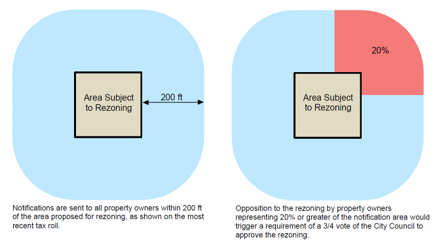
Written notice for planning and zoning commission public hearings for a rezoning. Before the tenth day before the planning and zoning commission hearing date, written notice of each public hearing before the planning and zoning commission on a proposed rezoning shall be sent to each owner, as indicated by the most recently approved municipal tax roll, of real property within 200 feet of the property on which the change in classification is proposed. The notice may be served by its deposit in the municipality, properly addressed with postage paid, in the United States mail.
D.
Newspaper notice for city council public hearings for any zoning amendment. Before the 15 th day before the date of the city council hearing, notice of the time and place of the hearing for any zoning amendment (i.e., a Rezoning or a Zoning Text Amendment) must be published in an official newspaper or a newspaper of general circulation in the municipality.
E.
City council action.
1.
Protests for rezonings.
a.
If a proposed rezoning is protested in accordance with this subsection, the proposed change must receive, in order to take effect, the affirmative vote of at least three-fourths of all members of the city council. The protest must be written and signed by the owners of at least 20 percent of either:
(1)
The area of the lots or land covered by the proposed change; or
(2)
The area of the lots or land immediately adjoining the area covered by the proposed change and extending 200 feet from that area.
b.
In computing the percentage of land area under a above, the area of streets and alleys shall be included.
2.
Overruling planning and zoning commission recommendation for denial. The affirmative vote of at least three-fourths of all members of the city council is required to overrule a recommendation of the planning and zoning commission that a proposed change to a regulation or boundary be denied.
F.
After a final decision is reached by the city council denying a request for a change in a zoning district or boundary, no further application may be considered for that property for 12 months from the date of the final decision.
Figure 6.02.1. Depiction of Notification Area and Protest Requirement
(Ord. No. 2395, § 1, 3-2-21)
Sec. 6.03. - Nonconformities.
A.
Intent of provisions.
1.
Existence of nonconformities.
a.
A nonconformity describes a use, structure, or lot that does not conform to the current standards of the zoning ordinance, but that was in conformance with the standards in place at the time of its inception, and have been rendered nonconforming due to a change in the applicable standards and regulations.
b.
Nonconformities occur in three general categories, or combinations thereof.
(1)
Nonconforming uses. A nonconforming use occurs when an existing use is no longer allowed in the zoning district in which the use is located.
(2)
Nonconforming structures. A nonconforming structure occurs when a setback, height, or other structural dimension requirement is not met.
(3)
Nonconforming lots. A nonconforming lot occurs when the lot area or other dimension requirement is not met.
c.
It is the declared intent of this section that nonconforming uses and nonconforming structures eventually be eliminated and be required to comply with the regulations of the zoning ordinance, having due regard for the property rights of the person affected, the public welfare, and the character of the surrounding area.
B.
Establishment of legal or illegal nonconformities.
1.
Legal nonconformities.
a.
Those uses, structures, or lots that do not conform to current zoning standards, but were legally established prior to the effective date of this zoning ordinance, at which time they were in conformance with applicable standards, shall be considered "legal nonconformities."
b.
Such uses, structures, or lots may be maintained or potentially altered subject to the provisions of this section.
2.
Illegal nonconformities.
a.
Those uses, structures, or lots, other than residential accessory buildings, which in whole or part are not in conformance with current zoning standards and were not in conformance with applicable standards at the time of their inception shall be considered "illegal nonconformities."
b.
Such uses, structures, or lots and shall be subject to penalties.
C.
Single-family residential uses. Previously conforming single-family residential uses on platted lots approved prior to the zoning ordinance effective date, which may now be nonconforming due to stricter standards, shall be deemed in conformance with this zoning ordinance.
D.
Existing platted lots. Any existing lot platted prior to the zoning ordinance effective date that was legally conforming shall be deemed a conforming lot.
E.
Changing uses.
1.
Nonconforming use to conforming use. Any nonconforming use may be changed to a conforming use, and once a change is made, the use shall not be changed back to a nonconforming use.
2.
Nonconforming use to another nonconforming use. A nonconforming use shall not be changed to another nonconforming use.
F.
Nonconforming use expansion in existing building. A nonconforming use may be enlarged, increased, or extended within an existing building provided:
1.
No structural alteration may be made on or in the existing building except those required by law to preserve the building in a structurally sound condition.
2.
The number of dwelling units or rooms in a nonconforming residential use shall not be increased so as to exceed the number of dwelling units or rooms existing at the time the use became a nonconforming use.
3.
A nonconforming use located within any building shall not be extended to occupy any land outside the building.
G.
Expansion of nonconforming structures with conforming uses. Buildings or structures that do not conform to the area regulations or development standards in the zoning ordinance but where the uses are deemed conforming may only increase or expand the nonconforming structure in compliance with the current zoning ordinance standards.
H.
Reuse of nonconforming structures by conforming uses. Nonconforming structures shall be allowed to be reoccupied by a conforming use.
I.
Restoration of a nonconforming structure.
1.
If a nonconforming structure is destroyed by fire, the elements, or natural catastrophic event, it may be rebuilt as a nonconforming structure to its pre-destroyed dimensions and setbacks.
2.
The construction must comply with all current building codes, and zoning regulations in effect at the time the structure received its building permit.
3.
The construction must commence within 12 months of the date of destruction.
a.
The failure of the owner to start such reconstruction within 12 months shall forfeit the owner's right to restore or reconstruct the nonconforming structure, except in conformance with the zoning ordinance.
b.
If the regulations cannot be determined or if the regulations are disputed for the time the structure received its building permit, then the zoning board of adjustment shall hold a hearing and shall take evidence, such as previously adopted ordinances, photographs, and tax records, to determine the standards that apply.
4.
Any change to an original dimension or a setback of the nonconforming structure shall be subject to approval of a special exception.
J.
Resuming a nonconforming use. A nonconforming use destroyed by fire, the elements, or natural catastrophic event may be resumed to its pre-destroyed capacity, if it begins resuming within 12 months of the date of destruction; otherwise, the nonconforming use shall be deemed to be discontinued or abandoned.
K.
Movement of nonconforming structure. A nonconforming structure may be relocated within the same platted lot, and shall comply with all setback and screening requirements.
L.
Abandonment of nonconforming uses.
1.
Once a nonconforming use has been abandoned, the nonconforming use shall not be allowed to be reintroduced. This prohibition of the reoccupation of an abandoned nonconforming use shall be enforced by the denial of building permit or certificate of occupancy applications.
2.
A nonconforming use shall be considered abandoned when evidence presented to the city planner indicates that a structure designed or arranged for a nonconforming use has ceased to be used in a bona fide manner as a nonconforming use for a period of six consecutive calendar months. For purposes of calculating the six month period, a use is abandoned upon the occurrence of the first of any of the following events:
a.
On the date when the use of land is physically vacated;
b.
On the date the use ceases to be actively involved in the sale of merchandise or the provision of services;
c.
On the date of termination of any lease or contract under which the nonconforming use has occupied the land; or
d.
On the date a final reading of water or power meters is made by the applicable utility provider(s).
3.
Abandonment of a nonconforming use requires intent, such as disconnecting utilities.
4.
Any nonconforming use that does not involve a permanent type of structure or operation and that is moved from the premises shall be considered to have been abandoned.
5.
Unless the nonconforming use status is reinstated pursuant to M. Loss of and Reinstatement of nonconforming use Status an abandoned use shall not be instituted on that parcel or other parcel in any district which does not permit the abandoned use.
M.
Loss of and reinstatement of nonconforming use status.
1.
Loss of nonconforming use status. If the city planner determines that a nonconforming use has met the definition of abandonment and has lost its nonconforming use status, the use shall not be instituted on that parcel or other parcel that does not permit the abandoned use.
2.
Application for nonconforming use status reinstatement.
a.
The owner or operator of the abandoned nonconforming use may submit a written application to the zoning board of adjustment to have the nonconforming rights reinstated.
b.
Written application for reinstatement of nonconforming rights must be made within 30 days after the denial of building permit or certificate of occupancy application for the nonconforming use.
3.
Zoning board of adjustment hearing.
a.
The zoning board of adjustment shall hold a hearing on the requested reinstatement of a nonconforming use status within 30 calendar days of the request or the next scheduled zoning board of adjustment, whichever is greater.
b.
The applicant and the city planner shall submit any evidence or findings to the zoning board of adjustment for consideration in the case.
c.
The zoning board of adjustment shall use the above abandonment criteria in deliberating the case.
4.
Board of adjustment decision. The board of adjustment may reinstate the nonconforming use status and thus allow the building permit or certificate of occupancy application to be processed only if the zoning board of adjustment finds that the use was not discontinued for six months or more. The failure of the owner or operator to remove on premise signs shall not be considered (on its own) evidence of a continuing use.
N.
Amortization of nonconforming uses.
1.
City council initiation of amortization case. Only the city council, by majority vote, may request that the zoning board of adjustment consider establishing a compliance date for a nonconforming use.
2.
Board of adjustment decision of amortization case.
a.
Per the authorization of city council as established in 1. above, the zoning board of adjustment may require the discontinuance of a nonconforming use under any plan whereby the full value of the use's structure and facilities can be amortized within a definite period of time, taking into consideration the general character of the neighborhood and the necessity for all properties to conform to the zoning regulations.
b.
All actions to discontinue a nonconforming use shall be taken with due regard for the property rights of the persons affected when considered in the light of the public welfare and the character of the area surrounding the nonconforming use and the conservation and preservation of property.
3.
Public hearing process. Upon receiving a request under 1. above from the city council, staff shall schedule the first public hearing before the zoning board of adjustment. The zoning board of adjustment may establish a compliance date only after holding two separate public hearings.
a.
First public hearing. The zoning board of adjustment shall hold a public hearing to determine whether continued operation of the nonconforming use will have a significant adverse effect on nearby properties. If, based on the evidence presented at the public hearing, the zoning board of adjustment determines that continued operation of the nonconforming use will have a significant adverse effect on nearby properties, it shall schedule a second public hearing to establish a compliance date for the nonconforming use; otherwise, it shall not. In determining whether the continued operation will have a significant adverse effect on nearby properties, the zoning board of adjustment shall consider the following factors:
(1)
The character of the surrounding neighborhood.
(2)
The degree of incompatibility of the use with the zoning district in which it is located.
(3)
The manner in which the use is being conducted.
(4)
The hours of operation of the use.
(5)
The extent to which continued operation of the use may threaten public health or safety.
(6)
The environmental impacts of the use's operation, including but not limited to the impacts of noise, glare, dust, and odor.
(7)
The extent to which public disturbances and nuisances may be created or perpetuated by continued operation of the use.
(8)
The extent to which traffic or parking problems may be created or perpetuated by continued operation of the use.
(9)
Any other factors relevant to the issue of whether continued operation of the use will adversely affect nearby properties.
(10)
To the extent the nonconforming use impacts the value and marketability of the abutting and surrounding properties or neighborhood.
b.
Second public hearing.
(1)
If the zoning board of adjustment has determined in the first public hearing that the nonconforming use has an adverse effect on nearby properties, it shall hold a second public hearing to set a date for compliance. The zoning board of adjustment shall, in accordance with the law, provide a compliance date for the nonconforming use under a plan whereby the owner's actual investment in the use before the time that the use became nonconforming can be amortized within a definite time period. The following factors must be considered by the zoning board of adjustment in determining a reasonable amortization period:
(a)
The owner's capital investment in structures, fixed equipment, and other assets (excluding inventory and other assets that may be feasibly transferred to another site) on the property before the time the use became nonconforming.
(b)
Any costs that are directly attributable to the establishment of compliance date, including demolition expenses, relocation expenses, termination of leases, and discharge of mortgages.
(c)
Any return on investment since inception of the use, including net income and depreciation.
(d)
The anticipated annual recovery of investment, including net income and depreciation.
(e)
A reasonable closeout and termination period for the nonconforming use.
(2)
If the zoning board of adjustment, at the first public hearing, requests financial documentation and/or records from the owner relating to the factors listed directly above, the owner shall provide said documents and/or records at least 30 days before the second public hearing. If the owner does not provide said documentation, the zoning board of adjustment is authorized to make its determination of a compliance date based upon any reasonably available public records as well as public testimony at the hearing. Failure by owner to provide the requested financial documents and records shall not prevent the zoning board of adjustment from setting a compliance date.
4.
Ceasing operations. If the zoning board of adjustment establishes a compliance date for a nonconforming use, the use must cease operations on that date and it may not operate thereafter unless it becomes a conforming use.
5.
Definitions. For purposes of this subsection, "owner" means the owner of the nonconforming use at the time of the zoning board of adjustment's determination of a compliance date for the nonconforming use.
6.
Finality of decisions.
a.
Decisions that cannot be immediately appealed. A decision by the zoning board of adjustment that the continued operation of a nonconforming use will have a significant adverse effect on neighboring property and the zoning board of adjustment's decision to schedule a second public hearing to establish a compliance date are not final decisions and cannot be immediately appealed.
b.
Decision to deny a request to establish a compliance date. A decision by the zoning board of adjustment to deny a request to establish a compliance date is final unless appealed to state court within ten calendar days in accordance with Chapter 211 of the Local Government Code.
c.
Decision setting a compliance date. A decision by the zoning board of adjustment setting a compliance date is final unless appealed to state court within ten calendar days in accordance with Chapter 211 of the Local Government Code.
(Ord. No. 2395, § 1, 3-2-21)
Sec. 6.04. - Site plans.
A.
Purpose. Through site plan review, zoning standards and other applicable municipal standards or ordinances that may apply to specific site development can be uniformly implemented by the city for townhome, multi-family, and nonresidential development.
B.
Two types of site plans.
1.
Type 1: Site plans related to SUP rezoning applications.
a.
Applications for approval of site plans related to SUP rezoning applications must be submitted to the city planner.
b.
The approval of site plans related to SUP rezoning applications requires the following:
(1)
Review by the city planner and building official;
(2)
A recommended action by planning and zoning commission for the city council's consideration; and
(3)
Approval by the city council.
2.
Type 2: Site plans related to building permit applications.
a.
No building permit shall be issued nor shall any on-site construction/development activity occur for developments unless a site plan is approved by the city planner and building official.
(1)
Exemption: Single-family and duplex developments shall be exempt from site plan submittal.
b.
Applications for approval of site plans related to building permit applications must be submitted to the building official.
c.
The approval of site plans related to building permit applications requires the following:
(1)
Review by the city planner and building official, and
(2)
Approval by the city planner and building official.
C.
Site plan application procedure and requirements.
1.
Site plan pre-application meeting.
a.
Before preparing a site plan, the applicant may meet with the city planner or building official to allow the applicant to learn the general procedures for approval and to review the concept of the proposed development, if desired by applicant.
b.
No application for a permit may be submitted to or accepted for filing during the meeting.
2.
Site plan application
a.
The property owner or authorized agent shall file an application for the approval of a site plan. This application shall include the information listed on the site plan application form, which shall be created and maintained by the city planner.
b.
The following plans may be required with a site plan application and approval is necessary prior to final authorization for development:
(1)
Final plat or replat;
(2)
Engineering plans or construction plans;
(3)
Traffic impact analysis, if applicable;
(4)
Façade plan, if required;
(5)
Landscape plans, if required;
(6)
Flood study, if required; and
(7)
Other approvals as required by ordinance or resolution.
3.
Site plan approval by type.
a.
Type 1: Site plans related to SUP rezoning applications. The city council shall use the review and approval process outlined in B.1.b and may approve, conditionally approve, or deny a site plan based upon the criteria listed below.
b.
Type 2: Site plans related to building permit applications. The city planner and building official shall use the review and approval process outlined in B.2.c above and shall approve, conditionally approve, or deny a site plan based upon the criteria listed below.
4.
Approval criteria.
a.
Compliance with the zoning ordinance regulations and other applicable regulations and previously approved, valid plans for the property.
b.
Compliance with the following design standards and specifications, as may be amended, is required in addition to the design standards and specification set forth in this zoning ordinance:
(1)
Subdivision regulations;
(2)
Fire Code;
(3)
Engineering standards;
(4)
Building Code; and
(5)
Any additional design standards and specifications approved by the city council.
c.
The city shall not take action on a site plan for property where city taxes are delinquent.
5.
Site plan effect.
a.
Approval of a site plan in association with a rezoning application is the city's authorization to apply for or for the issuance of building permits, depending on the specific case.
b.
During the time the site plan remains valid, the city shall not apply any additional requirements concerning building placement, streets, drives, parking, landscaping or screening.
c.
Except where authorized by ordinance, a site plan shall not be used to approve a variance or special exception to development regulations.
d.
Where an approved plan conflicts with an adopted regulation and no variance or special exception is expressly approved, the regulation shall apply.
6.
Site plan lapse.
a.
Two year effective period. The approval of a site plan shall be effective for a period of two years from the date of filing of the application.
b.
Expired site plans.
(1)
Upon expiration of a site plan, the applicant shall be required to submit a new site plan subject to the then existing regulations.
(2)
Site plan approval shall expire upon completion of the improvements shown on the plan. Permits must remain valid during the construction process.
(3)
Subsequent additional development, site modifications and redevelopment shall be considered a new project subject to the then existing ordinances, laws and regulations of the city.
D.
Revocation of site plan approval. The city council may revoke approval of a site plan if it determines that the conditions of the approval have not been met or if the plan contains, or is based upon, incorrect information or if it is determined that it was obtained using fraud or deceit.
(Ord. No. 2395, § 1, 3-2-21)
Sec. 6.05. - Specific use permits.
A.
Purpose. The uses that require a specific use permit (SUP) according to Section 3.03. Permitted Use Chart are so classified because they are more likely to have potential impacts on the area in which they are located than other uses that are permitted by-right.
B.
Application.
1.
Application and public hearing procedures for an SUP shall be completed in the same manner as Section 6.02.A.1. Zoning Map Amendment (Rezoning).
2.
A site plan shall be included with the application as outlined in Section 6.04. Site Plans.
C.
Review and approval.
1.
The planning and zoning commission shall review each case on its own merit, apply the criteria established herein, and recommend either approval or denial of the SUP to the city council.
2.
Following the planning and zoning commission's recommendation, the city council shall review each case on its own merit, apply the criteria established herein, and, if appropriate, authorize said use by granting an SUP.
D.
Considerations.
1.
In considering an application for an SUP, the planning and zoning commission and the city council shall consider the following:
a.
The proposed use is consistent and compatible with the adjacent land use and zoning.
b.
The proposed use is consistent with the architecture and characteristics of the adjacent properties.
c.
The proposed use may promote innovative use of modern development concepts, without having an adverse impact on adjacent properties.
d.
The proposed use is consistent with the goals and objectives of the city.
e.
The proposed use is an enhancement or improvement beyond the minimum standards set forth by the zoning ordinance.
f.
The proposed use will not be detrimental to the general health, safety, and welfare of the community.
g.
The proposed use would stabilize and improve property values within the city.
h.
The proposed use would protect and enhance the city's attractiveness to residents, businesses, tourists, and visitors.
i.
The proposed use would strengthen and help diversify the economy of the city.
2.
In recommending that an SUP for the premises under consideration be granted, the planning and zoning commission and the city council shall consider that such uses are harmonious and adaptable to building structures and uses of abutting property and other property in the vicinity of the premises under consideration, and shall make recommendations as to requirements for paving (material/structure) of streets, alleys and sidewalks, means of ingress and egress to public streets, provisions for drainage, adequate off-street parking, screening, landscaping and open space, heights of structures, residential proximity slopes, special setbacks, and compatibility of buildings.
E.
Conditions.
1.
In granting an SUP, the planning and zoning commission may recommend and city council may impose conditions which shall be complied with by the owner or grantee before a certificate of occupancy may be issued by the building official for use of the building on such property pursuant to such SUP and such conditions precedent to the granting of the certificate of occupancy.
2.
Said special conditions shall be set forth in the amending ordinance granting the SUP.
F.
Building permit or certificate of occupancy application.
1.
A building permit or certificate of occupancy shall be applied for and secured within six months from the time of granting the SUP.
2.
If an application for a building permit or a certificate of occupancy has not been applied for and secured after six months from the date of approval, the city council may direct the planning and zoning commission to call a public hearing to consider a change of zoning on the subject property.
G.
SUP amendment required for modifications.
1.
No building, premise, or land used under a specific use permit may be enlarged, modified, structurally altered, or otherwise significantly changed from the approved site plan unless an amended SUP is granted for such enlargement, modification, structural alteration, or change.
2.
Minor changes or alterations may be approved by the city planner.
H.
No zoning board of adjustment authority. The zoning board of adjustment shall not have jurisdiction to grant exceptions to the conditions contained in the SUP.
I.
Time period.
1.
The specific use permit may be issued for an unlimited or limited period of time. Prior to the expiration of a specific use permit with a limited time period, the owner may apply for an extension as provided below.
a.
Specific use permits shall only be issued for a limited period of time if the use is intended to be temporary and does not require substantial investment into the site.
2.
Should an applicant desire to continue a specific use after the initial time period and all available extensions expire, a new application, complete with filing fees, site plan, drawings, background data, etc., must be filed. The city council by an affirmative vote may, after public hearing and proper notice to all parties affected and after recommendations from the planning and zoning commission, grant the specific use permit.
J.
Zoning map amendment. When the city council authorizes granting a specific use permit, the zoning district map shall be amended according to its legend to indicate that the affected area has conditional and limited uses, and said amendment is to indicate the appropriate zoning district for the approved use and prefixed by an "SUP" designation.
K.
Development following SUP issuance. Following the issuance of a specific use permit, the building official shall ensure that if the development is undertaken, it is completed in compliance with said permit. If the development has not been completed in accordance with the approved site plan within 12 months after the issuance of the building permit, the city council may direct the planning and zoning commission to call a public hearing to consider a change of zoning on the subject property
L.
Status of SUPs. Once an SUP has been granted for a lot, said SUP shall not be expanded to another lot without application for a new SUP.
(Ord. No. 2395, § 1, 3-2-21)
Sec. 6.06. - Planned developments.
A.
General.
1.
In order to develop land in a PD, Planned Development District, the applicant shall follow a five-step procedure, as follows:
a.
Step 1. Pre-application conference review.
b.
Step 2. PD application for rezoning and PD development plan, which includes the:
(1)
PD development statement; and
(2)
PD development map.
c.
Step 3: Preliminary plat, if subdivision occurs and where required by the subdivision ordinance.
d.
Step 4. Final plat if subdivision occurs and where required by the subdivision ordinance.
e.
Step 5. Site plan.
2.
Each required step shall be completed and approved before the following step is reviewed.
3.
Selection of a conventional zoning district as a base district shall be required for a PD.
4.
Where appropriate, other methods authorized in the Subdivision Regulations may be substituted in Step 4. Final Plat, such as a minor plat or amending plat.
5.
The planning and zoning commission and city council may, however, review more than one step at the same public hearing.
B.
Planned development (PD) steps for creation and development.
1.
Step 1. Pre-application conference review.
a.
At least ten business days prior to submission of an application for rezoning to a PD district, the applicant shall submit to the city planner a sketch plan, drawn to approximate scale, showing streets, lots, public areas, and other significant features.
b.
The applicant should discuss with the city planner the procedure for adopting a PD district and the requirements for the general layout of streets and utilities, access to arterials, or general design and narrative, the availability of existing services, and similar matters.
c.
The intent of Step 1. Pre-application conference review is to expedite and facilitate the approval of a PD development plan.
2.
Step 2. PD Application for rezoning and PD development plan.
a.
Procedures and requirements.
(1)
The PD rezoning application shall be filed in accordance with regular procedures and on application forms of the city.
(2)
The PD development plan, which is submitted with the application for rezoning, shall consist of a PD development statement and a PD development map.
(3)
The minimum net acreage for a PD, planned development district request shall be 15 acres unless a specific finding is made by the city council that the establishment of the district is required to implement the comprehensive plan.
b.
PD design statement. The PD development statement shall be a written report containing a minimum of the following elements:
(1)
Title of PD;
(2)
List of the owners and/or developers;
(3)
Statement of the location and relationship to existing and proposed adjoining land uses;
(4)
Description of the PD concept, including an acreage or square foot breakdown of land use areas and densities proposed, a description of building use types, proposed restrictions, and typical site layouts;
(5)
Selection of one conventional zoning district as a base zoning district to regulate all uses and development regulations not identified as being modified;
(6)
A list of all applicable special development regulations or modified regulations to the base zoning district, plus a list of requested exemptions from or modifications to applicable development regulations;
(7)
A description of the proposed sequence of development; and
(8)
Other supporting maps as necessary to meet the submission requirements of this zoning ordinance.
c.
PD development map. The PD development map shall be a graphic representation of the development plan for the area of a PD district containing a minimum of the following elements:
(1)
Proposed locations, use types, and sizes of structures;
(2)
The existing zoning districts in the development area and surrounding it; and
(3)
Elevation, topography with minimum five foot contour intervals, slope analysis, soil characteristics, and tree cover.
d.
Approval of the PD development plan.
(1)
Upon final approval by the city council of the PD development plan and the appropriate ordinance of rezoning, these elements shall be considered a part of the zoning district map.
(2)
The ordinance of rezoning shall adopt the PD development plan by reference, and it shall be attached to said ordinance and become a part of the official records of the city.
e.
The city may require that an applicant prepare a traffic impact analysis to assist the city in determining whether the PD development plan will be supported with adequate levels of roadways and intersections concurrent with the demand created by the development.
f.
Expiration of a PD development plan.
(1)
A PD development plan shall expire after two years from the date of approval if no substantial development progress has been made within the PD. A new PD development plan must be submitted and approved by the city council.
(2)
The city planner may grant a two year extension of a PD development plan. At the end of the two year extension, a second extension may be given by the city planner for up to one year.
(3)
An extension shall be granted if a development application for the PD district has been submitted and is undergoing the development review process or if the city planner determines development progress is occurring.
g.
Use and development of the property.
(1)
The PD development plan shall control the use and development of the property, and all building permits and development requests shall be in accordance with the plan until it is amended by the city council.
(2)
The PD development plan and all supporting data shall be made a part of the permanent file and maintained by the city secretary.
3.
Step 3: Preliminary plat. Where a preliminary plat is required, the applicant shall prepare a preliminary plat for review and approval.
4.
Step 4. Final plat. Where a final plat is required, the applicant shall prepare a final plat for review, approval, and filing of record according to procedures established by the city council.
5.
Step 5. Site plan. A site plan shall be submitted upon the application for a building permit and reviewed in accordance with procedures established in Section 6.04. Site Plans.
C.
Minor PD amendments.
1.
The city planner may approve or defer to the city council consideration of minor PD amendments to the PD development plan if all of the following conditions are satisfied:
a.
The project boundaries are not altered.
b.
Uses other than those specifically approved in the PD development plan are not added. Uses may be deleted but not to the extent that the character of the project is substantially altered from the character described within the PD development statement.
c.
The allocation of land to particular uses or the relationship of uses within the project are not substantially altered.
d.
The density of housing is not increased more than ten percent or decreased by more than 30 percent.
e.
The land area allocated to nonresidential uses is not increased or decreased by more than ten percent.
f.
Floor area, if prescribed, is not increased or decreased by more than ten percent.
g.
Floor area ratios, if prescribed, are not increased.
h.
Open space ratios, if prescribed, are not decreased.
2.
If the city planner finds that these criteria are not satisfied, an amended PD development plan shall be submitted for full review and approval according to the procedures set forth in these regulations.
D.
Reversion at the property owner's request. If the property owner decides to abandon the PD concept and nullify the PD development plan, he/she shall make application for rezoning either to the original status or to a new classification. Said application shall be heard according to regular procedures by the planning and zoning commission and city council.
(Ord. No. 2395, § 1, 3-2-21)
Sec. 6.07. - Alternative compliance.
A.
Purpose and applicability.
1.
Purpose. The purpose of the alternative compliance process is to allow for different standards that will produce a substantially equivalent effect or enhanced level of results as intended by the original development standards.
2.
Applicability.
a.
The applicable zoning district standards for a project shall not be reduced or varied using the alternative compliance process unless such standard(s) is specifically cited as qualifying for alternative compliance consideration in its respective section of these regulations.
b.
Alternative compliance shall be granted only as indicated for each regulation.
c.
The city is not obligated to grant alternative compliance for any application.
B.
Approval process.
1.
A request for alternative compliance from certain provisions, as specifically cited within these regulations, may be submitted for review and approval along with the site plan for a project, or along with the project's initial development application (as applicable for the project).
2.
All alternative compliance requests shall be clearly delineated graphically or in narrative format, as appropriate, on the site plan (or on the project's initial development application), including a reference to the specific section within this zoning ordinance that allows consideration of such alternative standard(s).
a.
The decision-maker of the application shall be responsible for approval of alternative compliance.
b.
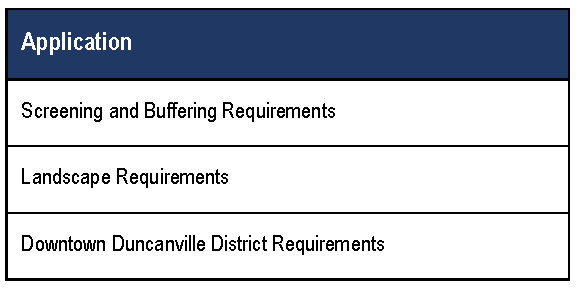
Alternative compliance may be requested only for the regulations listed in Table 6.07.1.
C.
Evaluation criteria. The proposed standard(s) shall meet all of the following criteria:
1.
Be in agreement with and promote the comprehensive plan's recommendations and policies;
2.
Does not reduce a standard unless it is, to the greatest extent practical, equally mitigated or improved by increasing standards of other requirements; and
3.
Does not modify the land uses allowed in the zoning district in which the subject property is located.
Table 6.07.1. Regulation Eligible for Alternative Compliance
(Ord. No. 2395, § 1, 3-2-21)
Sec. 6.08. - Appeal of an administrative decision.
A.
Authority. Per Texas Local Government Code Section 211.010, the zoning board of adjustment may hear and decide appeals where it is alleged there is error on any order, requirement, decision or determination made by an administrative official in the enforcement of this zoning ordinance.
B.
Filing procedure.
1.
Such appeal shall be filed within 15 days after the decision has been rendered by the administrative official, by filing with the officer from whom the appeal is taken and with the zoning board of adjustment a notice of appeal specifying the grounds thereof.
2.
The officer from whom the appeal is taken shall transmit to the zoning board of adjustment all the papers constituting the record upon which the action appealed from was taken.
C.
Stays. Per Texas Local Government Code Section 211.010, an appeal stays all proceedings in furtherance of the action that is appealed unless the official from whom the appeal is taken certifies in writing to the board facts supporting the official's opinion that a stay would cause imminent peril to life or property. In that case, the proceedings may be stayed only by a restraining order granted by the board or a court of record on application, after notice to the official, if due cause is shown
D.
Notice.
1.
The zoning board of adjustment shall fix a reasonable time for the hearing of an appeal, give the public notice thereof by posting such notice in the mail addressed to all owners of real property located within 200 feet of the property on which the appeal is made, and by publishing notice of such hearing in a newspaper of general circulation in the city.
2.
Both the posted and published notice shall be given at least ten days prior to the date set for the hearing. A party may appear at the appeal hearing in person or by agent or attorney. The zoning board of adjustment shall decide the appeal within a reasonable time.
E.
Concurring vote of 75 percent required. Per Texas Local Government Code 211.009.(c), the concurring vote of 75 percent of the members of the zoning board of adjustment is necessary to grant an appeal of an administrative decision.
(Ord. No. 2395, § 1, 3-2-21)
Sec. 6.09. - Variances.
A.
Authority. Per Texas Local Government Code Section 211.009, the zoning board of adjustment may authorize, in specific cases, a variance from the terms of this zoning ordinance if the variance is not contrary to the public interest and, due to special conditions, a literal enforcement of the ordinance would result in unnecessary hardship, and so that the spirit of the ordinance is observed and substantial justice is done.
B.
Conditions for granting a variance. In exercising its power to grant a variance, the zoning board of adjustment shall make findings and show in its minutes that:
1.
There are special circumstances existing on the property on which the application is made related to the size, shape, area, topography, surrounding conditions, and location that do not apply generally to other property in the same area and the same zoning district.
2.
A variance is necessary to permit the applicant the same rights in the use of his property that are presently enjoyed under this article by other properties in the vicinity and zone, but which rights are denied to the property on which the application is made.
3.
The granting of a variance on the specific property will not adversely affect the land use pattern as outlined in the land use plan and will not adversely affect any other feature of the comprehensive plan.
4.
The granting of the variance will not be based upon the recognition of a self-imposed hardship or only the opportunity to make the property more profitable to the applicant and/or owner.
5.
The variance, if granted, will be no material detriment to the public welfare or injury to the use, enjoyment, or value of property in the vicinity.
C.
Limitations on variance granting authority.
1.
The zoning board of adjustment shall have no power to grant a use other than those permitted in the district for which the variance is sought, except as specifically provided for in this zoning ordinance.
2.
The zoning board of adjustment shall have no power to grant or modify provisions of an SUP authorized under Section 6.05. Specific Use Permits.
D.
Precedent. The granting of a variance shall not set a precedent.
E.
Concurring vote of 75 percent required. Per Texas Local Government Code 211.009.(c), the concurring vote of 75 percent of the members of the zoning board of adjustment is necessary to grant a variance.
(Ord. No. 2395, § 1, 3-2-21)
Sec. 6.10. - Special exceptions.
A.
Authority. Per Texas Local Government Code Section 211.009, the zoning board of adjustment may hear and decide special exceptions to the terms of this zoning ordinance when the regulations require the board to do so.
B.
Special exception requirements.
1.
No hardship required. A special exception does not require a finding of an undue hardship.
2.
Specifically allowed by the zoning ordinance. Approval of a special exception by the zoning board of adjustment is specifically provided for and defined in this zoning ordinance.
C.
Conditions for granting a special exception. When in the zoning board of adjustment's judgment, the public convenience and welfare will be substantially served and the appropriate use of the neighboring property will not be substantially injured, the zoning board of adjustment may, in specific cases and subject to appropriate conditions and safeguards, authorize the following special exceptions to the regulations herein established:
1.
Section 4.02.C. Special Exception for Dimensional Standards for Redevelopments;
2.
Section 4.04.H. Special Exceptions for Off-Street Parking Requirements;
3.
Section 4.06.C. Special Exceptions for Accessory Building Requirements;
D.
Precedent. The granting of a special exception shall not set a precedent.
E.
Concurring vote of 75 percent required. Per Texas Local Government Code 211.009.(c), the concurring vote of 75 percent of the members of the zoning board of adjustment is necessary to grant a special exception.
(Ord. No. 2395, § 1, 3-2-21)

