
Eagar City Zoning Code
CHAPTER 18
68 - OFF-STREET PARKING AND LOADING
18.68.010 - Purpose.
The purpose of this chapter is to alleviate or prevent congestion of the public streets, and to promote the safety and welfare of the public by establishing minimum requirements for the off-street parking of motor vehicles in accordance with the use to which the property is put. It is the further purpose of this chapter to place upon the property owner the primary responsibility for relieving public streets of the burden of on-street parking.
(Ord. No. 2013-04, Exh. A, 5-7-2013)
18.68.020 - Plans required.
An applicant for plan review must submit plans showing the off-street parking required by this chapter. These plans must show location, arrangement and dimensions of the off-street parking, turning spaces, drives, aisles and ingress and egress and must be approved by the community development director in accordance with the provisions of the currently adopted building code. Whenever approval has been issued in compliance with the requirements of this section, subsequent use of the structure, or use of the land is conditioned upon the unqualified availability of off-street parking as shown in the approved plans.
(Ord. No. 2013-04, Exh. A, 5-7-2013)
18.68.030 - Alterations, additions and expansions of a business.
A.
A new use, addition or alteration of a building shall not be approved if it would create or increase a deficit in off-street parking.
B.
It is unlawful to reduce the amount of existing parking below the minimum required by this section without first supplying other spaces as are required.
C.
If a building or business is destroyed, and is then reconstructed to the same size which existed prior to the destruction (subject to the provisions of Section 18.76.040 of this title) it shall be required to provide only the number of parking spaces which existed prior to the destruction.
D.
If a business expands it shall be required to provide the number of additional parking spaces necessitated by the expansion.
(Ord. No. 2013-04, Exh. A, 5-7-2013)
18.68.040 - Access.
All off-street parking shall have access from a public street or alley.
(Ord. No. 2013-04, Exh. A, 5-7-2013)
18.68.050 - Obstructions to visibility prohibited.
Ingress, egress, internal traffic circulation, off-street parking and loading facilities and pedestrian ways shall be designed so as to promote safety and convenience and so that traffic visibility is not obstructed.
(Ord. No. 2013-04, Exh. A, 5-7-2013)
18.68.060 - Design and location of spaces.
A.
Single-family Residences, Manufactured Homes, Multiple-family Residences of Four or Less Dwelling Units and Agricultural Uses.
1.
Location. Required off-street parking shall be located on the same lot or parcel as the use it is intended to serve.
2.
Surfacing. Off-street parking spaces, driveways and accessways shall be properly surfaced and graded to prevent impoundment of surface water.
3.
Driveways. Driveways and accessways shall be not less than ten feet wide for one-way traffic, and not less than twenty feet wide for two-way traffic.
B.
All Uses Except as Provided in Subsection A. of This Section.
1.
Location. Required off-street parking shall be located on the same lot as the building or use it is intended to serve.
2.
Design. All off-street parking lots and spaces shall be so designed as to prevent automobiles from backing onto a public street or from projecting beyond the property lines. This shall be accomplished through the use of such devices as curbing, striping, landscaping, setbacks, driveways or any other method that will ensure compliance with this requirement.
3.
Surfacing. All off-street parking areas, accessways and driveways shall be improved and surfaced with asphalt, concrete or some other dust free material in a manner satisfactory to the town engineer. The surfacing of the parking area shall be of sufficient grade so that there will be no impoundment of surface water and all surface drainage shall be into a public street or improved drainage channel or structure.
4.
Lighting. Parking lots used during hours of darkness shall be lighted to minimum level of five foot-candles. Lighting shall be indirect, hooded and arranged so that the source of light does not create a nuisance or hazard to traffic or adjacent properties.
5.
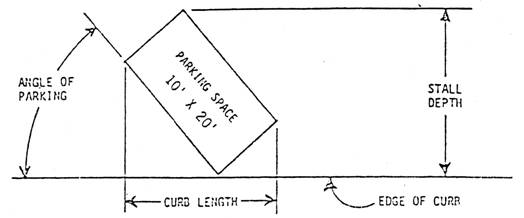
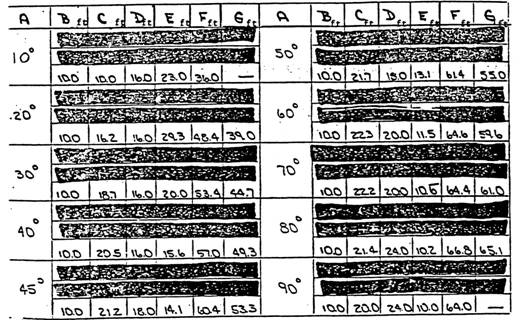
Dimensions. Arrangements of parking spaces within the parking lot and driveway widths shall conform to the following requirements:
6.
Striping. All parking spaces shall be clearly marked with stripes painted onto or otherwise permanently affixed to the paved surface of the parking lot.
(Ord. No. 2013-04, Exh. A, 5-7-2013)
18.68.070 - Size of parking spaces.
A parking space is an area of not less than two hundred square feet, with a minimum width of ten feet, and a minimum depth of twenty feet, which is specifically designated for, and used for, the parking of an automobile or light truck, exclusive of all driveways and accessways.
(Ord. No. 2013-04, Exh. A, 5-7-2013)
18.68.080 - Dimensions and marking of spaces.
Policy on parking area dimensions is as set out in this section:
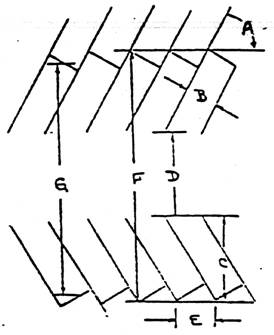
A = Parking Angle
B = Stall Width
C = Stall Depth
D = Aisle Width
E = Curb Length
F = Curb-to-curb Bay Width
G = Stall Center-to-center Width
Minimum parking stall size, two hundred square feet.
Minimum two-way traffic aisle, twenty-four feet.
Minimum one-way traffic aisle, sixteen feet.
Handicap space width, twelve feet.
(Ord. No. 2013-04, Exh. A, 5-7-2013)
18.68.090 - Schedule of required off-street spaces.
A.
Off-street parking spaces shall be provided for each specified use in accordance with the schedule set out in this section.
B.
Definitions. In calculating the total number of required parking spaces, "usable floor area," as used in this chapter means the area capable of being devoted to the specified use (does not include such spaces as kitchens, restrooms, hallways, etc.), and the term "seat" shall also include each thirty inches of bench seating when individual seats are not provided.
C.
Mixed Uses. In the event of mixed uses, the total requirement for off-street parking spaces is the sum of the requirements of the various uses computed separately.
D.
Fractional Amount. In calculating the total number of required off-street parking spaces, fractional amounts are to be disregarded.
E.
Unlisted Uses. Parking requirements for a specific use not listed in this section shall be determined by the community development director based upon the requirements for uses of similar intensity.
F.
All garage or other space allocated for the parking of vehicles within buildings, basements or on roofs of buildings shall be considered part of the off-street parking facilities and may be included as such in computing the parking area requirements.
G.
Schedule.
(Ord. No. 2013-04, Exh. A, 5-7-2013)
18.68.100 - Adjustment or reduction of requirements.
The planning and zoning commission may approve substitute parking locations and may reduce the amount of off-street parking required by conditional use permit, and provided:
A.
It can be shown that the time of use of the buildings or uses will be at different hours or days so that each use will have the amount of off-street parking available when the building or use is occupied; or
B.
Sufficient off-street parking is readily available within the vicinity; or
C.
Acquisition of land for such use is unnecessary in order to carry out the purposes of this title.
(Ord. No. 2013-04, Exh. A, 5-7-2013)
18.68.110 - Off-street loading requirements.
In all zoning districts, for every building or part thereof, erected or enlarged after the effective date of the ordinance codified in this title, which is occupied by a use receiving or distributing materials or merchandise by motor truck, there shall be provided and maintained on the same premises as the building or use, adequate off-street loading space meeting the minimum requirements hereinafter specified. Loading space shall not be considered as satisfying requirements for off-street parking space.
(Ord. No. 2013-04, Exh. A, 5-7-2013)
18.68.120 - Schedule of loading space requirements.
Loading space requirements are as set out in this section:
(Ord. No. 2013-04, Exh. A, 5-7-2013)
18.68.130 - Location of loading spaces.
Required off-street loading space shall not be permitted in any required front yard. Off-street loading space may occupy all or any part of a required rear yard, except as otherwise provided herein, and may be partially or entirely enclosed within a building.
(Ord. No. 2013-04, Exh. A, 5-7-2013)
18.68.140 - Alley use for loading and unloading.
Where a building or use in a nonresidential district abuts an alley, such alley may be used as maneuvering space for loading and unloading spaces; provided, however, that no alley abutting any residential district may be so used.
(Ord. No. 2013-04, Exh. A, 5-7-2013)
18.68.150 - Size of loading spaces.
Every required off-street loading space shall have a minimum width of twelve feet, a minimum length of forty-five feet and a minimum height of fourteen feet, exclusive of access aisles and maneuvering space.
(Ord. No. 2013-04, Exh. A, 5-7-2013)

