
Eagar City Zoning Code
CHAPTER 18
88 - DESIGN/SITE REVIEW
18.88.010 - Purpose of this section.
This section is intended to encourage, protect and enhance the appearance of the town. The town council recognizes that the creation of a desirable environment for business and industry, as well as residential areas, is a prime requisite for the preservation of property values, for the development of compatible uses and buildings, and for the preservation of public health, safety and welfare. The town of Eagar shall utilize, when considered necessary by the design review board, an architect licensed in the state of Arizona and qualified to consult the design review board and the town staff on architectural design matters as they relate to this chapter.
(Ord. No. 2013-04, Exh. A, 5-7-2013)
18.88.020 - Definitions.
For the purpose of this chapter, the following list of words shall be defined as indicated below:
A.
"Building" means any structure built for the support, shelter or enclosure of persons, animals, chattels, or property of any kind.
B.
"Landscape" means improvement of the property using native or non-native vegetation and natural or ornamental material. Includes all aspects of grading, planting and vertical construction other than buildings.
C.
"Sign" means any devise for visual communication, including any structure or natural object or part thereof, that is used for the purpose of bringing the subject thereof to the attention of the public, but not including any flag, badge or insignia of any governmental agency or any civic, charitable, religious, patriotic, fraternal or similar organization.
D.
"Structure" means that which is built or constructed, an edifice or building of any kind or any piece of work artificially built up or composed of parts combined together in some definite manner.
(Ord. No. 2013-04, Exh. A, 5-7-2013)
18.88.030 - Application of section.
A.
This chapter shall apply to all buildings structures and signs which are to be hereafter erected, constructed, converted, established, altered or enlarged which are located within the town of Eagar except those listed below.
B.
Exceptions:
1.
Single-family dwellings and accessory uses.
2.
Residential structures of four units or less in one building or group of buildings.
3.
Non-illuminated directional or informational signs not exceeding six square feet in area.
4.
Public utility electrical transmission structures.
5.
A primary residence in a commercial zone with an attached business.
(Ord. No. 2013-04, Exh. A, 5-7-2013)
18.88.040 - Procedure.
A.
Prior to the preparation of final architectural or engineering drawings for any building or structure to which this section is applicable, the property owner or his representative shall submit the following information for consideration by the design review board. When a complete design review submittal is made the design review board shall meet within seven business days for the review of the plans.
1.
Application for Design Review. Forms will be furnished by the community development department. Such application shall include the applicant and owners names, mailing addresses, location and legal description of the property and such other information as deemed necessary by the design review design review board. The town council shall establish design review fees by resolution.
2.
Site plan showing the areas devoted to buildings, structures, parking.
3.
Elevation drawings of the front, sides, and rear of the building or structure illustrating the building's appearance and treatment. Exterior materials shall be included on the drawings or a separate list.
4.
Material samples as well as other supportive information shall be required if deemed necessary by the design review board to aid in clarifying the application.
B.
Prior to issuance of a building permit for a building or structure to which this section is applicable, the community development department shall ascertain that the plans submitted for the building permit are in substantial conformance with those approved by the design review board and that the approved time has not expired. Questions regarding procedures or approval shall be referred to the design review board for consideration.
C.
The design review board may impose such conditions, as it may deem necessary to carry out fully the intent of this section. The action of the design review board shall be noted on two copies of the plans. One copy shall be retained by the community development department and one copy shall be returned to the owner or applicant.
D.
Conditions prescribed by the design review board shall be considered as an integral part of the construction plans. Non-compliance with such plans shall be grounds for stopping work on the project or for the denial of the certificate of occupancy.
E.
A building, structure or sign which has been approved, constructed and installed in accordance with the approval of the design review board may be removed but may not be further modified without additional review and approval of such design review board.
1.
Signs that are crucial for direction or assists circulation may not be removed without review and approval from the design review board.
F.
Any building, structures or signs which have been approved by the design review board and has been constructed as follows shall be maintained by the owners or the person in possession of the property upon which the building, structure or sign is located to create an attractive appearance for the development.
(Ord. No. 2013-04, Exh. A, 5-7-2013)
18.88.050 - Criteria for design approval.
In considering any application for design approval, the design review board shall be governed by the following criteria:
A.
The community development director will provide guidance for proposed development. The community development department will maintain a portfolio that reflects buildings and structures that will provide guidance for prospective developers. The town council shall review and approve the above noted portfolio and any updates thereto. Consideration should also be given to the specific aspects of the site proposed for the construction and its surroundings.
B.
Architectural materials including, but not limited to, landscaping or other opaque or semi-opaque materials may require visual separation of pedestrian or vehicular traffic.
C.
The overall design of the building, structure or sign and its site shall not adversely affect the present or potential development of the nearby properties or the traffic pattern in abutting streets by virtue of the type of building, structure or sign, it's placement on the lot and location of the parking and driving area.
D.
All screening walls shall be compatible with the building design, color and materials.
E.
Details of barriers, walls and landscaping used for the screening along street frontages shall be approved by the design review board and shall be compatible with established street frontage landscape design.
F.
Signs shall relate to the exterior architectural design of the building or structure and shall be compatible therewith.
(Ord. No. 2013-04, Exh. A, 5-7-2013)
18.88.060 - Design review board.
Creation, Appointment, Term of Office and Qualification of Members and Meeting Times.
A.
The design review board shall have no fewer than six members appointed by the town council. The design review board will have one member from the town council and one member from the planning and zoning commission. All other members will be citizens of the town of Eagar with experience in the following fields: construction, architectural design, drafting, structural engineering, landscape design, brokerage or any other discipline related to development of commercial property. The member assigned from the town council shall serve as chair of the design review board. Terms shall be a staggered three-year term. Initially two board members will serve a one-year term, two will serve a two-year term and two will serve a three-year term. Thereafter, all terms will be for three years. Meetings will be on an as-needed basis. As a minimum, three members of the design review board must be present to call a meeting to order and take action on an application.
(Ord. No. 2013-04, Exh. A, 5-7-2013)
18.88.070 - Powers and duties.
The design review board shall have the power to approve, conditionally approve or disapprove all applications for design review, basing its decisions on the criteria set forth in Section 18.88.050. It is the responsibility of the applicant to submit adequate material on which the design review board may make a determination as to the compliance of the proposed development with the terms of this section. The design review board, after hearing an application shall impose such reasonable conditions, as it may deem necessary to carry out the provisions and intent of this section. Such approval as is granted by the design review board shall become effective in ten days unless the applicant appeals the design review board's decision as set forth in Section 18.88.080. In case of such appeal, the approval shall be voided until the town council acts on the matter. Approval shall be valid for the period of one year from the date of approval by the design review board or the town council. The design review board, upon resubmittal by the applicant, may reconsider applications which have been disapproved. The design review board may provide an extension if requested thirty days prior to the expiration of the approval.
A.
Under the following circumstances, the community development director may approve a sign without going to the design review board if in the opinion of the community development director, the sign follows the criteria set forth in Section 18.88.050. The community development director shall have the same duties and powers of the design review board in regard to signs. If there are problems, which cannot be resolved between the planning staff and the applicant, the matter will be referred to the design review board.
B.
Under the following circumstances, the community development director may approve a building or structure without going to the design review board:
1.
The building or structure is either an addition or as an accessory to an existing building and the structure does not exceed five hundred square feet or a minor revision of a building or structure previously approved by the design review board.
2.
The addition or accessory does not substantially alter the appearance of the site as seen from off site.
3.
The accessory or addition is compatible with existing buildings or structures. The intent of this section is that the addition or accessory shall not have what is commonly referred to as a "tack on or sore thumb" appearance or constitute an "eye sore" to the adjacent area.
4.
That all proposed and existing buildings, structures, signs and landscaping on the site conforms to or is made to conform to the criteria set forth in Section 18.88.050.
5.
The community development director shall have the same duties and powers as the design review board in regard to these buildings or structures. If there are any problems, which cannot be resolved between the planning and zoning staff and the applicant, the matter will be referred to the design review board.
(Ord. No. 2013-04, Exh. A, 5-7-2013)
18.88.080 - Appeals.
The applicant for the design review, or the community development director, with the consent of the town manager, or any member of the town council may appeal any decision of the design review board to the town council by filing written notice of the appeal with the town clerk within ten calendar days from the date of the design review board's action. Notice of such appeal and the date for its consideration by the town council meeting at which such appeal is to be heard. The town council, on appeal, by this section, shall take legal action on such appeal within thirty days of its initial consideration.
(Ord. No. 2013-04, Exh. A, 5-7-2013)
18.88.090 - Building design guidelines.
A.
Building and Topography.
1.
Policy:
a.
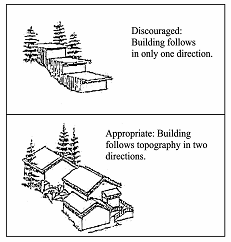
Building should respect the natural topography of the site.
2.
Guidelines and Recommendations:
a.
Step a building foundation to follow the slope (fifteen percent or greater) of the site when feasible.
i.
In general, an exposed foundation should not exceed three feet in height.
B.
Primary Building Entrance.
1.
Policy:
a.
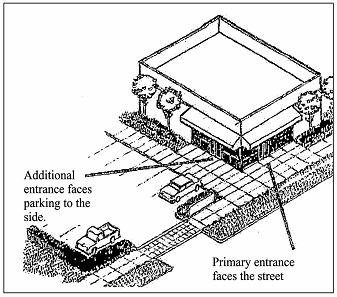
The primary entrance of a structure should orient to a street, major sidewalk, pedestrian way, plaza courtyard or other public space.
2.
Guidelines and Recommendations:
a.
Design the main entrance to be clearly identifiable.
i.
Provide a sheltering element such as a stoop, porch, awning, gable, arcade, or portico to signify the primary entrance to a building.
b.
Orient the primary entrance of a building to face a street, plaza or pedestrian way.
i.
Focusing an entrance toward a parking lot without also addressing the street is not recommended.
ii.
Consider using a "double-fronted" design where entrance to parking and to the street is encouraged. That is, provide a door to the street and another to the parking lot.
C.
Street Level Interest.
1.
Policy:
a.
When a building is located close to a street or walkway, it should be designed to provide interest to pedestrians. For example, commercial buildings with storefronts are of interest to passerby, while porches, courtyards and decorative wall surfaces add interest to multifamily housing designs. These features encourage pedestrian activity and should be used whenever feasible.
b.
The overall mass of a building should appear to be in scale with existing buildings. This will help new structures fit in with the Eagar context. At the same time, newer structures may be larger than seen before; they should simply be articulated in their form to compliment existing structures.
2.
Guidelines and Recommendations:
a.
Develop the street level of a building to provide visual interest to pedestrians.
i.
Provide visual interest with: A display window providing views to activities in the building, or a display case with exhibits, where internal functions do not permit windows, or a decorative wall surface such as a mural or sculptural feature.
ii.
A large expanse of blank wall is not recommended on a facade that faces a public way or a major pedestrian route.
iii.
Avoid large panelized products or extensive featureless surfaces.
b.
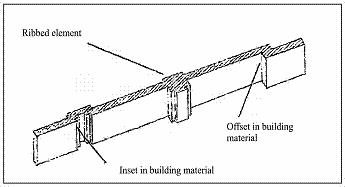
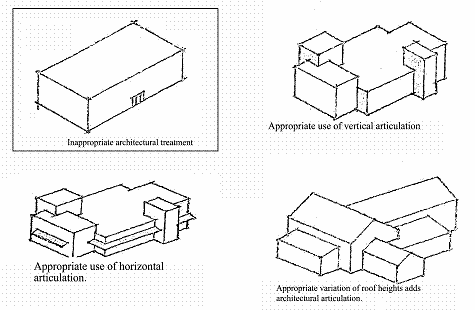
For all buildings, divide the building(s) into modules that express traditional dimensions. In general, a primary facade plane should not exceed seventy-five feet in length. If a building would exceed this dimension, provide a jog in the facade to divide it into subordinate elements that will be less than seventy-five feet in length each (the jog should be a minimum of twenty percent of the facade plane height).
c.
All buildings shall employ at least two of the following techniques:
i.
Change materials with each building module to reduce the perceived mass; or
ii.
Change the height of a wall plane or building module. The change in height shall be at least twenty percent of the vertical height; or
iii.
Change the roof form to help express the different modules of the building mass; or
iv.
Change the arrangement of windows and other facade articulation features, such as columns or strap work that divide large wall planes into smaller components.
D.
Roof Form.
1.
Policy:
a.
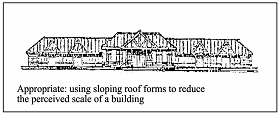
The primary roof form of a structure should help reduce the perceived scale of the building. For that reason, sloping roofs should be used in most contexts. These also will help the building fit with the mountain backdrop.
2.
Guidelines and Recommendations:
a.
Using sloping roof forms to reduce the perceived scale of a building is encouraged.
b.
Any pitched roof should have a minimum of sixteen-inch overhang eaves.
c.
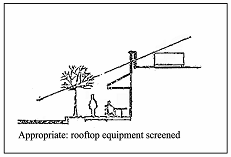
Recommended roof features:
i.
A flat roof with parapet (flat roof is not a strong recommendation);
ii.
A cornice or molding to define the top of a parapet;
iii.
Sloping roofs with a minimum pitch of 4:12;
iv.
Multiple roof planes.
E.
Building Materials.
1.
Policy:
a.
Materials that reduce the perceived mass of a building and appear to blend with the natural setting shall be used.
2.
Guidelines and Recommendations:
a.
The following are recommendations of building materials:
i.
Log or log siding, natural wood siding, painted or stained wood lap or in shingle pattern where appropriate to the building use, style and setting.
ii.
Brick, stone, rusticated block or comparable modular masonry are preferred primary building materials. Color should be integral to the material.
iii.
New materials that convey the texture, scale, matte finish and color similar to masonry will be considered where appropriate.
iv.
Stucco (and its artificial derivatives) when it is tinted earth tone colors and detailed to convey a sense of scale that is appropriate as a secondary building material, i.e., on second floors or above other primary building materials. Reveal and scoring lines should be used to create panels that establish shadow lines and visual relief.
b.
Materials that are highly reflective are inappropriate as primary materials.
i.
Mirrored glass, large expanses of metal panels, or other shiny materials are not considered primary materials.
F.
Service Canopies.
1.
Policy:
a.
A gas station service area should appear as a subordinate element in the site design.
b.
Minimize the visual impacts of a service area canopy.
i.
Use a low profile section for the canopy itself.
ii.
Screen lights under the canopy.
iii.
Break up mass of the canopy area by stepping the form of the canopy area by stepping the form of the canopy or by dividing it into a set of smaller individual canopies.
G.
Color.
1.
Policy:
a.
Building finish colors should help a structure blend with the natural setting and reduce its perceived scale.
b.
Colors with high chrome values should be kept to a minimum and used only as an accent.
2.
Guidelines and Recommendations:
a.
Use muted colors and earth tones.
i.
This applies to roof materials as well.
ii.
The predominant color of exterior walls seen from a public way should be muted and earth toned.
iii.
Where appropriate, accent colors, including high intensity and metallic colors, may be used to break up the mass.
(Ord. No. 2013-04, Exh. A, 5-7-2013)

