
Eagle Lake City Zoning Code
DIVISION II
REQUIREMENTS OF ZONING DISTRICTS
CHAPTER 1: - REGULATIONS[1]
Note— Please see division VIII, chapter 1 for definitions relating to this chapter.
CHAPTER 2: - ZONING MAP; ESTABLISHMENT OF DISTRICTS; INTERPRETATION; APPLICATION[2]
Note— Please see division VIII, chapter 1 for definitions relating to this chapter.
CHAPTER 3: - SCHEDULE OF DISTRICT REGULATIONS[3]
Note— Please see division VIII, chapter 1 for definitions relating to this chapter.
CHAPTER 4: - TABLE OF PERMITTED USES[4]
Note— Please see division VIII, chapter 1 for definitions relating to this chapter.
CHAPTER 5: - DIMENSIONAL REQUIREMENTS[5]
Note— Please see division VIII, chapter 1 for definitions relating to this chapter.
CHAPTER 6: - DEVELOPMENT STANDARDS[6]
Note— Please see division VIII, chapter 1 for definitions relating to this chapter.
ARTICLE 1: - GENERAL PROVISIONS
The table of permitted uses in division II, chapter 4, is incorporated herein by reference, the same as if it had been recited in its entirety. Likewise, the schedule of dimensional development setbacks and requirements, which is located in division II, chapter V. Regulations for the flood hazard overlay district are located in division VII, chapter 7, section 7.1.1.50. Each district is established to provide areas in the city where it is appropriate for similar uses to develop and to recite the intent of the city commission as it pertains to guidance for development decisions within each district pursuant to this article as hereinafter follows:
Sec. 2.1.1.10. - Purpose and intent.
Zoning district regulations prescribe detailed requirements that have application for every land use within the boundaries of a given zoning district. However, general or supplementary regulations are necessary to prescribe regulations that have application in more than one district or groups of districts but not necessarily throughout the city. The requirements described below apply in some cases to residential districts, some in institutional districts, some in commercial districts, and others in industrial districts.
Sec. 2.1.2.10. - Accessibility to public rights-of-way.
Every building hereafter erected or moved shall be on a lot having a minimum width of 20 feet adjacent to or abutting on a public street, or with access to a public street by means of a private street approved by the city commission, which has a minimum of 24 feet wide right-of-way or easement. All structures shall be located on lots so as to provide safe and convenient access for servicing, fire protection, related emergencies, and required off-street parking.
Sec. 2.1.2.20. - Accessory uses or structures.
1.
Parameters. All accessory uses and structures must be utilized in conjunction with the principal use or structure only. Any utilization of the accessory use or structure independent of the principal use or structure is strictly prohibited. In this regard, and by way of example, an accessory structure that has multiple uses shall be solely limited in use to that function which serves as an accessory to the principal.
2.
Residential districts. In residential districts, accessory structures and uses shall not be located in required front yards but may be located in required side or rear yards except for side street yards, but not closer than five feet to the property line; provided, that accessory structures for the housing of persons, such as guest houses and garage apartments, shall not be located in any required yard. On double frontage lots in residential districts, accessory uses and structures shall not be located in either of the required front yards, but may be located in side yards, except as provided otherwise herein. No separate accessory building shall be located within five feet of any other building.
3.
Surface constructed uses. Surface constructed uses, such as a pool deck, patio, or similar features, when not greater than 30 inches in height above the median grade covered by such proposed use shall be permitted within the required side and rear yards, but not closer than five feet to the property line.
4.
Electrical meters. Accessory structures shall not be served by an electrical meter separate from that of the principal use.
(Ord. No. O-12-01, § 1(Exh. A), 10-17-2011)
Sec. 2.1.2.21. - Clinics, medical or dental.
1.
Limitations on medical or dental clinics.
A.
Medical or dental clinics shall be subject to the following regulations: On-site dispensing of controlled substances that are identified in Schedules II, III, or IV in Sections 893.03, 893.035, or 893.0356, Florida Statutes, as may be amended from time to time, is prohibited, unless otherwise expressly permitted by statutory or general law. However, the following are exempt from this prohibition:
1.
A health care practitioner, when administering a controlled substance directly to a patient, if the amount of the controlled substance is adequate to treat the patient during that particular treatment session.
2.
A pharmacist or health care practitioner, when administering a controlled substance to a patient or resident receiving care as a patient at a hospital, nursing home, ambulatory surgical center, hospice, or intermediate care facility for the developmentally disabled which is licensed by the state.
3.
A health care practitioner, when administering a controlled substance in the emergency room of a licensed hospital.
4.
A health care practitioner, when dispensing a one-time, 72-hour emergency resupply of a controlled substance to a patient.
Additionally, the health care practitioner responsible for the operation and/or supervision of any medical or dental office shall execute an affidavit acknowledging the regulations set forth hereinabove prior to payment of the required business tax, and annually thereafter upon renewal of same prior to the issuance of a business tax receipt. Failure or refusal to execute the required affidavit shall constitute prima facie evidence that the subject medical or dental clinic is operating in violation of the code of ordinances, which may result in code enforcement action, revocation of business tax receipt, and/or any other actions permitted by law.
2.
Limitations on pain management clinics.
A.
Medical clinics that qualify as pain management clinics shall be subject to the following distance requirements.
1.
No prescription drug store shall be permitted to locate within the same shopping center or within a 1,000-foot radius of any pain management clinic.
2.
No pain management clinic shall be permitted to locate within the same shopping center or within a 1,000 foot radius of any prescription drug store.
3.
No pain management clinic shall be permitted to locate within a 1,000 foot radius of another pain management clinic.
4.
No pain management clinic shall be permitted to locate within a 1,000 foot radius of a school, church, daycare facility, or a similar use involving children.
(Ord. No. O-12-02, § 2(Exh. B), 10-17-2011)
Sec. 2.1.2.30. - Docks, piers, and boathouses.
1.
General.
A.
Docks, piers, and boathouses are permitted in all residential districts as an accessory structure incidental to a residence. Docks, piers, and boathouses are also permitted in multi-family residential districts.
B.
All such facilities are considered private and may be constructed by the owner on any lot bordering a lake, provided the owner complies with the following minimum requirements pertaining to docks, piers, and boathouses. These requirements shall not preclude the applicability of laws, regulations, standards, and criteria adopted by the State of Florida or other regulating agencies.
1.
Docks, piers, and boathouses shall only be constructed in the center one-third of the waterfront property. Bait houses, storage shelters, wet bars, living quarters, and other "non-water dependent" structures and uses are prohibited on or in connection with a dock, pier, or boathouse. No person shall occupy any watercraft as a residence.
2.
A permit issued by the city is required for the construction of all docks, piers, and boathouses in accordance with permitting procedures set forth in the Code of Ordinances of the city.
3.
A permit is required when: (1) both the lakefront property from which the structure is extended and the lake lie within the city limits; (2) when the lakefront property is in the city but the lake is outside the city limits, and (3) when the lakefront property is outside the city limits but the lake is within the city limits.
4.
It shall be the responsibility of the owner of the property from which the dock, pier, or boathouse is extended to obtain all approvals, verifications, exemptions, surveys, and permits for construction and maintenance of said structure. The contractor and/or builder shall be equally responsible, with the owner, for construction in accordance herewith and the Code of Ordinances of the city, and is therefore equally subject to any applicable fines or penalties.
2.
Applications. Each lot owner must secure a permit from the city prior to the commencement of construction of a dock, pier, or boathouse. The dock, pier, or boathouse must be constructed in accordance with the standards set forth in this ordinance and such other applicable Ordinances and regulations of the city.
3.
Watercraft storage. In the case of a dock, pier, or boathouse constructed on a single-family lot, no more than two watercraft may be moored overnight at any dock, pier, or boathouse.
4.
Limitations. For multi-family, hotel/motel, and private clubs the following limitations apply:
A.
One boat slip for each ten dwellings or hotel/motel rooms or 30 club members on lakes of 100 acres or more;
B.
One boat slip for each 20 dwelling units or hotel/motel rooms or 60 club members on lakes of less than 100 acres.
5.
Standards.
A.
Length.
1.
Docks and piers shall not extend into a lake for a distance greater than 75 feet measured from the minimum low water elevation established by the Southwest Florida Water Management District (SWFWMD).
2.
Where the depth of water at the lake-ward end of the dock or pier is less than 30 inches, a floating dock of not more than 20 feet in length may be attached to the permanent 75-foot dock or pier.
3.
Should the depth of water be less than 30 inches after a floating dock has been permitted and installed, the owner shall make application for a variance in accordance with division VI, chapter 3 of these regulations and gain specific approval for any further construction that would add length to the dock or pier. The planning commission shall have the authority to impose conditions upon any variance granted.
B.
Surface area. The surface area of a dock or pier or boathouse of combination thereof shall not exceed 1,000 square feet, which shall include all platforms, walkways, and roofed areas as measured on a horizontal plane. The terminal platform may not exceed 250 square feet in area. The total roofed area of the structure may not exceed 500 square feet including the boathouse.
C.
Railing required. The main access pier from the shore to the dock boathouse or terminal platform shall not exceed six feet in width. A handrail is required on one side of any part of a dock or pier that is less than four feet in width.
D.
Safety signalization. All docks and piers shall be equipped with a structural member or a warning device that is clearly visible at a minimum of six feet above the surface of the water. Such device may be flags, reflectors, or standard warning shapes painted international orange or some other bright color. Such devices shall be installed at the lake-ward end of the structure and shall be installed at intervals of not more than 25 feet along the structure to the shoreline.
E.
Height. The overall height of the structure shall not exceed 24 feet above the deck of the dock or pier. The vertical distance between the eaves of any roof and the deck of the dock or pier shall be at least six feet. The sides of any structure including a boathouse shall remain open. The open sides may be covered by screen material that permits visibility.
6.
Maintenance and removal.
A.
All docks, piers, and boathouses shall be maintained as safe and structurally sound facilities. Substandard structures are identified as those having deteriorated or damaged structural components and those in a depilated condition that present a hazard to pedestrians and persons in boats. Structural components include, but are not limited to: pilings, joists, beams, decking, and any component hanging loose or no longer connected to the structure.
B.
It shall be the responsibility of the owner to repair any substandard dock, pier, or boathouse in accordance with the building regulations of the city or remove it.
Sec. 2.1.2.40. - Erection of more than one principal structure on a lot.
In any zoning district, more than one structure housing a permitted or permissible principal use may be erected on a single lot; provided, that minimum yard, area, access, and other requirements of the land development regulations shall be met for each structure as though it were on an individual lot.
Sec. 2.1.2.50. - Essential services.
1.
Essential services, herewith defined as services authorized and regulated by state or national public utility commissions or services owned or franchised by the city or county, may be located within any zoning district after review and approval by the city commission. This provision includes both structures and uses and includes gas, water, electric, sewerage, and telephone facilities. However, this provision shall not be deemed to permit the location in a district of such establishments as electric or gas generating plants, sewage treatment plants, water pumping facilities, or aeration facilities, liquid petroleum gas storage facilities above or below ground from which they would be otherwise prohibited and provided, further, that this provision shall not be deemed to include the establishment of structures for commercial activities such as sales or the collection of bills in districts from which such activities would be otherwise prohibited.
2.
Under this provision, where structures are involved, such structures shall conform insofar as possible to the character of the district as to architecture and landscaping and shall meet all yard, area, and similar requirements as provided for in the district in which they are to be located.
Sec. 2.1.2.60. - Excavation, borrow pits.
1.
Excavations of any type or creation of borrow pits, may be permitted in certain zoning districts only after approval of a site plan, as required by the land development regulations, by the administrative official and city staff. Such excavations shall meet the following requirements:
A.
Excavation and borrow pit operations shall be controlled to provide reasonable and continued protection of the surrounding properties with regard to the use and cleanliness of the streets for access to the subject premises. Hours of operation may be imposed to protect the peace, well being, compatibility, and character of surrounding properties.
B.
No excavation of earth shall be within 100 feet of any road right-of-way line. No excavation of earth shall be closer than 50 feet to an adjoining lot or parcel.
C.
Sides of an excavation shall be sloped inwardly and not more than one foot vertical drop for each three feet horizontal dimension measured from the edge of the excavation to a depth of two feet below the water table or to the bottom of the excavation, whichever is greater.
D.
In no case shall the aquifer be penetrated.
E.
No excavation shall be permitted which in any way interferes with natural or planned drainage.
F.
Prior to the issuance of site plan approval, the city (consulting) engineer shall make a determination of drainage plan conformity. No site plan shall be approved which, in the opinion of the engineer or administrative official, shall be detrimental to the public health, safety, or general welfare.
G.
No excavation or borrow pit shall exceed 50,000 cubic yards or five acres per each site.
H.
As a part of the site plan review, a reclamation or restoration plan shall be required prior to approval and issuance of a development order.
2.
The following activities and conditions are exempt from the provisions in [subsection] 2.1.2.60(1) above:
A.
Excavation or grading incidental to the construction of a building on a lot or parcel for which a building permit has been issued. This authorization shall only apply to the land shown on the site plan submitted with the application for a building permit. Once a certificate of occupancy has been issued pursuant to said building permit, that authorization shall not apply to any subsequent acquisition of land.
B.
Excavation or grading performed in accordance with a site plan or subdivision plat which has been reviewed and approved by the administrative official and city staff and for which all necessary permits have been issued. Development plans qualifying for this exception shall be those under active development at the effective date of the land development regulations and those approved thereafter.
C.
The construction and maintenance of roads by or for the city, Polk County, or the State of Florida.
D.
Bona fide agricultural operations provided such operations have been permitted or exempted from permits by the Florida Department of Environmental Permitting (FDEP), the South West Florida Water Management District (SWFWMD), and/or the Florida Department of Environmental Protection.
E.
Activities incidental to the operation of public utilities.
F.
Any excavation of less than a total of 15 yards of dirt removed from a lot or parcel for any reason whatsoever.
Sec. 2.1.2.70. - Exceptions to height limitations.
The height limitations contained in each zoning district regulations shall not apply to spires, belfries, cupolas, antennas, water tanks, ventilators, chimneys, or other appurtenances usually required to be placed above the roof level and not intended for human occupancy. The heights of these structures or appurtenances thereto shall not exceed any height limitations prescribed by the Federal Aviation Agency within the flight approach zone of airports.
Sec. 2.1.2.80. - Extensions of commercial and office development to General Commercial (CG) District.
1.
Uses within transitional area. Within the transitional area, as delineated on the zoning map and adjacent to the CG district, the planning commission, may as a special exception permit the below listed uses, subject to the conditions stated herein and those regulations governing special exceptions generally, to be extended into the adjoining residential district if such extension is found to promote safety and improve traffic circulation on and adjoining uses outside the CG district can be appropriately protected from potentially adverse effects.
A.
Banks, financial establishments, offices, and similar uses.
B.
Medical and dental clinics, but not veterinary clinics.
C.
Institutional uses such as adult congregate living facilities.
D.
Professional and business offices.
E.
Dance, art, and music studios.
F.
Two-family detached or semi-detached dwellings subject to the requirements of the RG districts governing such use.
G.
Off-street parking areas for passenger vehicles, restricted as follows:
1.
When in connection with permitted commercial uses, such areas shall be open for use only during customary business hours of such uses but in no case shall hours of operation be conducted between 7:00 p.m. and 7:00 a.m. No fee shall be charged for such parking.
2.
Front and side yard requirements of the residential district shall apply.
3.
Vehicular access shall be through the commercial district, and all driveways serving such parking areas shall be subject to approval by the department of public works.
4.
Parking areas shall be properly drained, suitably surfaced, and provided with appropriate bumper guards where needed. All unpaved areas shall be suitably landscaped and properly maintained.
5.
All parking areas shall be enclosed with a solid wall not less than five feet high, provided, that visibility clearance as required in the land development regulations shall be maintained at access points.
6.
All parking areas shall be used exclusively for parking related to the use for which the area was established and none shall be used for storage or parking of materials, equipment, supplies, trucks or trailers owned or operated by or for any commercial use. No such parking area shall be used for display, sales, or service other than delivery of goods to customers' cars.
7.
No sign shall be erected in any such parking area in such a way as to be visible from within the residential district; except, that on each street side adjacent to an entrance to the area one sign may be erected within 25 feet of the commercial district boundary, not exceeding nine square feet in area, and indicating only the name of the operator and the purpose of the lot.
H.
In connection with such proposals, petitioners shall submit a site plan for consideration, indicating proposed uses and structures, driveways, and parking areas, yards, buffering, drainage and such other details as the planning commission may require by general rules or in the particular circumstances of the case, and shall indicate a schedule for initiation and completion of development. If the special exception is granted, such plan shall be binding upon the petitioner and any successors in title, and no substantial change shall be permitted without additional special exceptions proceedings.
2.
Minimum frontage. Minimum frontage of 5th Street (US 17) shall be 125 feet.
3.
Limitations on vehicular access. Except for public service vehicles, there shall be no vehicular access to the property through a residential district.
4.
Site planning, limitations on operations. Site planning, design, and location of structures and open spaces and management of operations shall be such that orientation of commercial service, offices, and related activities is toward the frontage on US 17. There shall be no sales, service, storage, or display of goods or garbage or trash storage, or collection or disposal facilities visible in any portion of the extension area from any portion of any residential district. Lighting of structures and premises in the extension area shall be so directed and shielded as to protect adjoining residential districts from the effects of nuisances.
5.
Yard requirements; buffering. Yards and structural buffering shall be provided to minimize the impact of the extension on any adjoining residential district. The following minimum requirements may be increased to achieve a state public purpose, but shall not be diminished:
A.
Yards adjacent to all streets shall be a minimum of 25 feet in depth within the extension area.
B.
Side yards adjoining lot lines with any residential use shall be a minimum of ten feet in dimension.
C.
All minimum required yards provided in the residential district in relation to the extension shall be landscaped and maintained as is appropriate to the residential surrounding. No portion of any required yard for any extension within the residential area shall be used for off-street parking.
D.
In order to protect adjacent property in residential districts from lights, noise, or undesirable views, walls a minimum of five feet in height shall be required around the extension boundaries but meeting all applicable residential minimum yard requirements.
6.
Maximum percent of lot coverage. The maximum percent of lot coverage shall be 40 percent.
7.
Action after examination of site plans. After examination of the site plan, the planning commission may require changes where necessary for stated public purposes as a condition for approval and may attach additional conditions and safeguards, including limitations on hours and manner of operation, beginning and conclusion of construction, or other matters.
Sec. 2.1.2.90. - Fences, walls, hedges, architectural features, and swimming pools.
1.
No fence or solid wall on any property shall exceed six feet in height in any zoning district. No fence or other obstruction including signs (having less than eight feet of ground clearance), walls, hedges, or other structures shall exceed four feet in height within 25 feet of a street intersection. In all zoning districts, fences, walls, or hedges shall be limited to four feet in height within required front or side street setback areas. However, on corner lots a six-foot fence, wall or hedge is permitted in said setback if (a) it runs parallel to the front street from the primary residential unit directly to the side street right of way line and thence directly to the nearest point on the rear lot line, (b) the rear lot line of the subject lot are the same as (match) the lot to its rear, and (c) the side yard facing sides of the two back to back house are the same distance from the side street right-of-way This exception does not alter the four foot height limitation within 25 feet of a street intersection, and is also subject to a determination by the building official that the fence, wall or hedge does not materially impede visibility.
2.
Architectural features, eaves, chimneys, fireplaces, balconies, and the like may project into required front, side, or rear yards not more than three feet where the required yard is eight feet or more in width. Ordinary projections of window sills, belt courses, cornices, and other ornamental features may project into these required yards to the extent of not more than seven inches.
3.
Swimming pools shall be fenced as required by law.
(Ord. No. O-14-03, § 1(Exh. A), 7-21-2014)
Sec. 2.1.2.100. - Home occupation.
1.
Requirements.
A.
No person other than members of the family residing on the premises shall be engaged in such occupation;
B.
The use of the dwelling unit for the home occupation shall be clearly incidental and subordinate to its use for residential purposes by its occupants, and shall under no circumstances change the residential character thereof;
C.
There shall be no change in the outside appearance of the building or premises or other visible evidence of the conduct of such home occupation other than one sign not exceeding one square foot in area, non-illuminated, mounted flat against the wall of the principal building at a position not more than two feet from the main entrance to the residence;
D.
No home occupation shall be conducted in any accessory building;
E.
No home occupation shall occupy more than 25 percent of the first floor area of the residence;
F.
No traffic shall be generated by such occupation in greater volumes than would normally be expected in a residential neighborhood and any need for parking generated by the conduct of such home occupation shall be met off the street and other than in the required front yard;
G.
No retail or wholesale sales may be conducted on the premises;
H.
Outdoor storage or display of materials or products shall not be permitted;
I.
No equipment, tools, or process shall be used in such home occupation which creates noise, vibration, glare, fumes, odors, or electrical interference detectable to the normal senses off the lot, if the occupation is conducted in a single-family residence, or outside the dwelling unit if conducted in other than a single-family residence. In the case of electrical interference, no equipment or process shall be used which creates visual or audible interference in any television or radio receivers off the premises or cause fluctuation in line voltage off the premises;
J.
No goods, chattels, materials, supplies, or items of any kind except normal postal and related types of materials can be delivered either to or from the premises in connection with the home occupation except in a passenger vehicle owned by the resident.
2.
Permitted home occupations. Customary home occupations may include but are not limited to the following uses, provided all requirements of the land development regulations are met:
A.
Artists, sculptors, authors, and composers.
B.
Bookkeepers and certified public accountants.
C.
Dress makers, milliners, seamstress, and tailors.
D.
Handicrafts such as ceramics, model making, quilting, rug weaving, and wood working.
E.
Photo lab.
F.
Professional office such as landscape architect, architect, engineer, physician, lawyer.
G.
Secretarial service and telephone answering service.
H.
Computer programmer and operator.
I.
The giving of individual instruction to one person at a time such as an art or piano teacher and swimming instructor.
3.
Prohibited uses as home occupations. Prohibited uses shall include but are not limited to the following uses:
A.
Beauty and barber shops.
B.
Band instruction or dance instruction.
C.
Studio for group instructions.
D.
Public dining facility or tearoom.
E.
Antique or gift shops.
F.
Photographic studio.
G.
Fortunetelling or similar activity.
H.
Outdoor repairs or food processing.
I.
Retail or wholesale sales.
J.
Child care centers or kindergartens.
K.
Group instructions of any type.
L.
Similar uses to those listed above.
4.
Occupational license. A home occupation shall be subject to all applicable city occupational license and other business taxes.
Sec. 2.1.2.110. - Houses displayed for advertising purposes, model homes.
Construction of a house(s) displayed for advertising purposes, not intended to be sold or occupied as a dwelling, whether in connection with a residential development or otherwise may be permitted in residential or certain commercial zones but shall not commence until a performance bond adequate to ensure the removal of the structure, if located other than in a residential district, has been posted with the administrative official and approved by the city attorney. Such structure, if in a commercial district, shall be removed at the end of the permit period unless the administrative official grants an extension. If the structure is in a residential district, a certificate of occupancy for residential use shall be required prior to use as a residence or any other use. No permit or extension thereof shall exceed one-year time increments.
Sec. 2.1.2.120. - Methods for measurement—Lots.
1.
Lot definition. For purposes of the land development regulations, a lot is defined as a parcel of land of at least sufficient size to meet minimum requirements for use, width, coverage, and total area, and to provide such yards and other open spaces as are required. Such lot shall have frontage on an improved public street, or on an approved private street, and may consist of:
A.
A single lot of record;
B.
A portion of a lot of record;
C.
A combination of complete lots of records, of complete lots of record and portions of lots of record, or of portions of lots of record;
D.
A parcel of land described by metes and bounds; provided, that in no case of division or combination shall any residual lot or parcel be created which does not meet the requirements of this section.
2.
Lot frontage. The front of a lot shall be defined to be that portion of the lot nearest the street established as the street address. For the purposes of determining yard requirements on corner lots and through lots, all sides of a lot adjacent to streets shall be considered frontage, and yards shall be provided as indicated in this section.
3.
Lot measurements.
A.
Lot depth. Depth of a lot shall be defined to be the distance between the midpoints of straight lines connecting the foremost points of the side lot lines in front and the rear most points of the side lot lines in the rear.
B.
Lot width. Lot width determinations as related to minimums prescribed in the land development regulations shall be measured across the rear of the required front yard; provided, that in the case of wedge shaped lots with narrow ends and cul-de-sac or other acute street curvatures, the rear line of the required front yard shall be moved sufficiently from the front line to provide at least 80 percent of the required lot width, and in the case of flag lots, the lot width shall be measured at the rear line of the required front yard as measured within the flag portion of the lot.
C.
Lot area. Lot area, for determinations relating to minimum lot size as required by the land development regulations, shall include the total area of the lot, except, that where lots are of such peculiar or irregular shape that portions have no useful functions in relation to buildable areas, such portions shall not be included in computation of total area.
4.
Lot of record. A lot which is part of a subdivision recorded in the office of the county clerk, or a lot or parcel described by metes and bounds, the description of which has been so recorded on or before the effective date of the original zoning ordinance of the city which shall be August 7, 1961, and all subsequent amendments.
5.
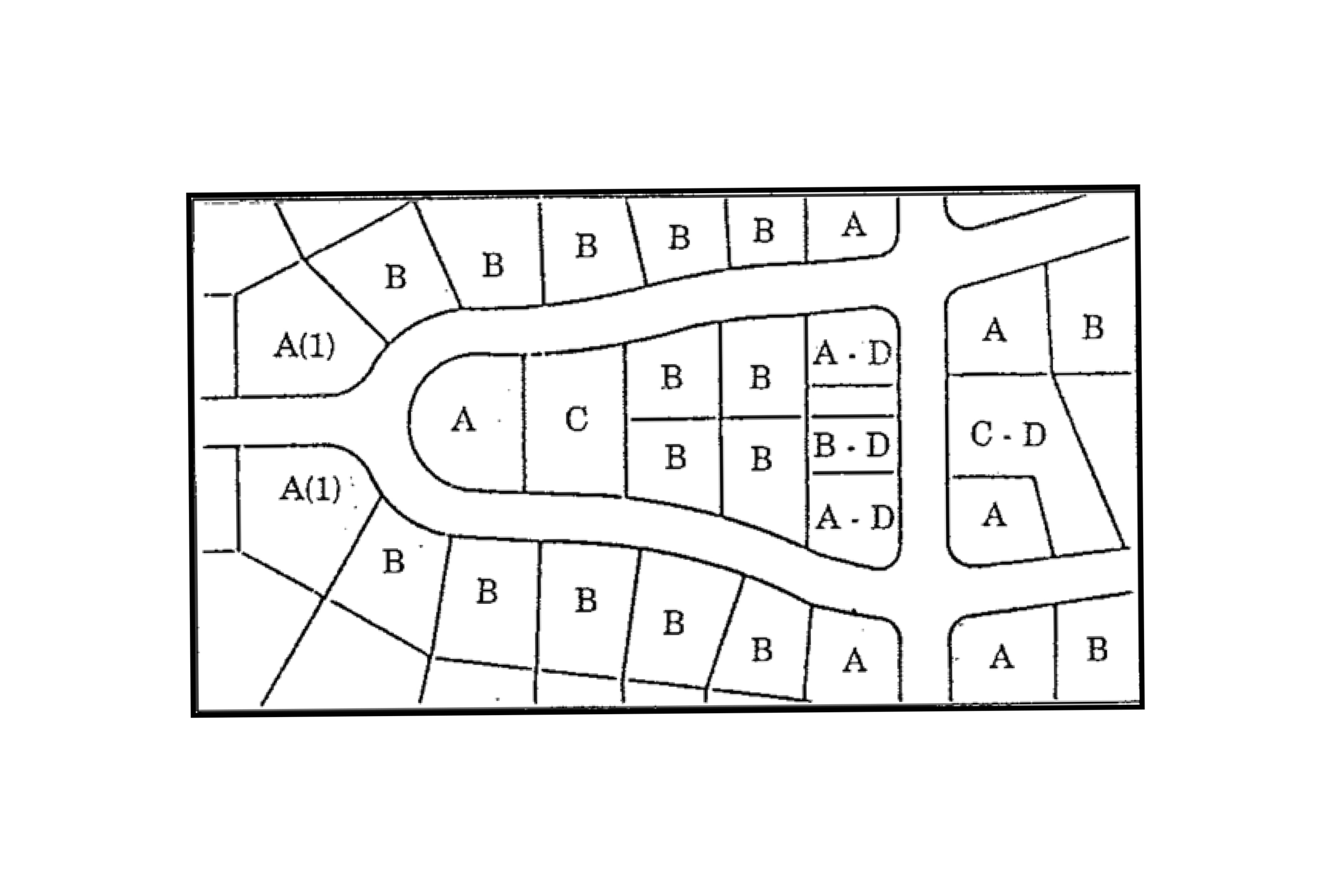
Lot types. The diagram below illustrates descriptive terminology used in the land development regulations with reference to corner lots, interior lots, through lots, and reversed frontage lots.
A.
In the diagram, "A" is a corner lot, defined as a lot located at the intersection of two or more streets. A lot abutting on a curved street or streets shall be considered a corner lot if straight lines drawn from the foremost points of the side lot lines to the foremost point of the lot meet at an interior angle of less than 135 degrees. See lots marked A(1) in the diagram.
B.
In the diagram, "B" is an interior lot, defined as a lot other than a corner lot with only one frontage on a street.
C.
In the diagram, "C" is a through lot, defined as a lot other than a corner lot with frontage on more than one street. Through lots abutting two streets may be referred to as double frontage lots.
D.
In the diagram, "D" is a reversed frontage lot, defined as a lot on which the frontage is at right angles or approximate right angles (interior angle less than 135 degrees) to the general pattern in the area. A reversed frontage lot may be a corner lot (A-D in the diagram), an interior lot (B-D), or a through lot (C-D).
6.
Lot coverage. That percentage of lot area that is or may be covered or occupied by buildings, including accessory buildings, under the terms of the land development regulations.
(Ord. No. O-20-05, 12-2-2019)
Sec. 2.1.2.130. - Methods for measurement—Yards.
1.
Yard. For purposes of the land development regulations, a yard is defined as the minimum required open space, other than a court, unoccupied and unobstructed by any structure or portion of a structure from 30 inches above the general ground level of the graded lot upward; provided, that fences, walls, poles, posts, and other customary yard accessories, such as ornaments and furniture may be permitted in any yard subject to height limitations and requirements limiting obstruction of visibility. A court is an uncovered open space enclosed on two or more sides by exterior walls of a building.
2.
Yard, front.
A.
A yard adjacent to a public or private street and extending across the entire front of the lot. Lots extending through blocks in such a way as to have frontage on two public or private streets shall provide front yards adjacent to each street.
B.
Depth of required front yards shall be measured perpendicular to a straight line joining the foremost points of the side lot lines. The foremost points of side lot lines, in the case of rounded property corners, as at street intersections, or irregular corners, shall be assumed to be the points at which lines would have met without rounding or irregularity. Front and the front of the rear yard lines shall be parallel.
C.
Minimum front yard requirements are established for each zoning district. The administrative official may permit a reduced minimum front yard equal to the average setback of existing principal structures within 200 feet of either side of the lot. In no case shall the property owner/developer be required to increase the specific zoning district minimum front yard requirement.
3.
Yard, side.
A.
A yard extending from the rear line of a required front yard to the rear or back property line, or in cases where more than one front yard is required, as on a through lot, to the rear line of the second front yard. For corner lots, those yards adjacent to streets remaining after front yards have been established shall be considered side yards, but shall be required to have the same distance as the required front yard, except in the case where a corner lot existed prior to September 3, 1991, such side yard shall be required to be only one-half the distance of the minimum required front yard.
B.
Width of a required side yard shall be measured in a manner similar to that employed in measurement of depth for required front yards, so that the yard established is a strip of the minimum width required with its inner edge parallel to the side lot line at its outer edge.
4.
Yard, rear.
A.
A yard extending between required side yards at the rear of the lot. In the case of lots having more than one front yard, remaining yards shall be considered side yards.
B.
Depth of a required rear yard shall be measured in a manner similar to that employed in measurement of depth for required front yards, so that the yard established is a strip of the minimum depth required with its inner edge parallel to the rear lot line at its outer edge.
5.
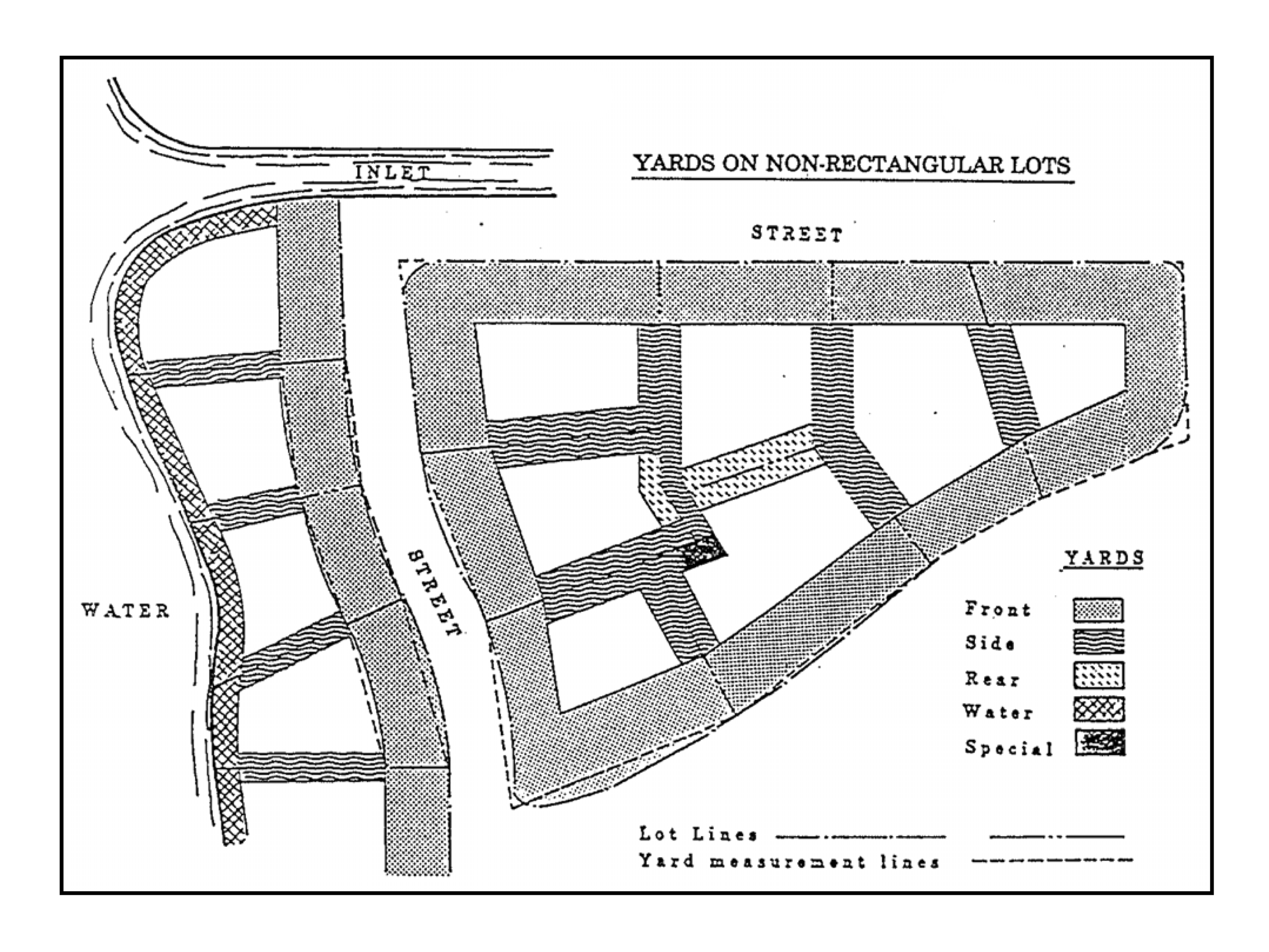
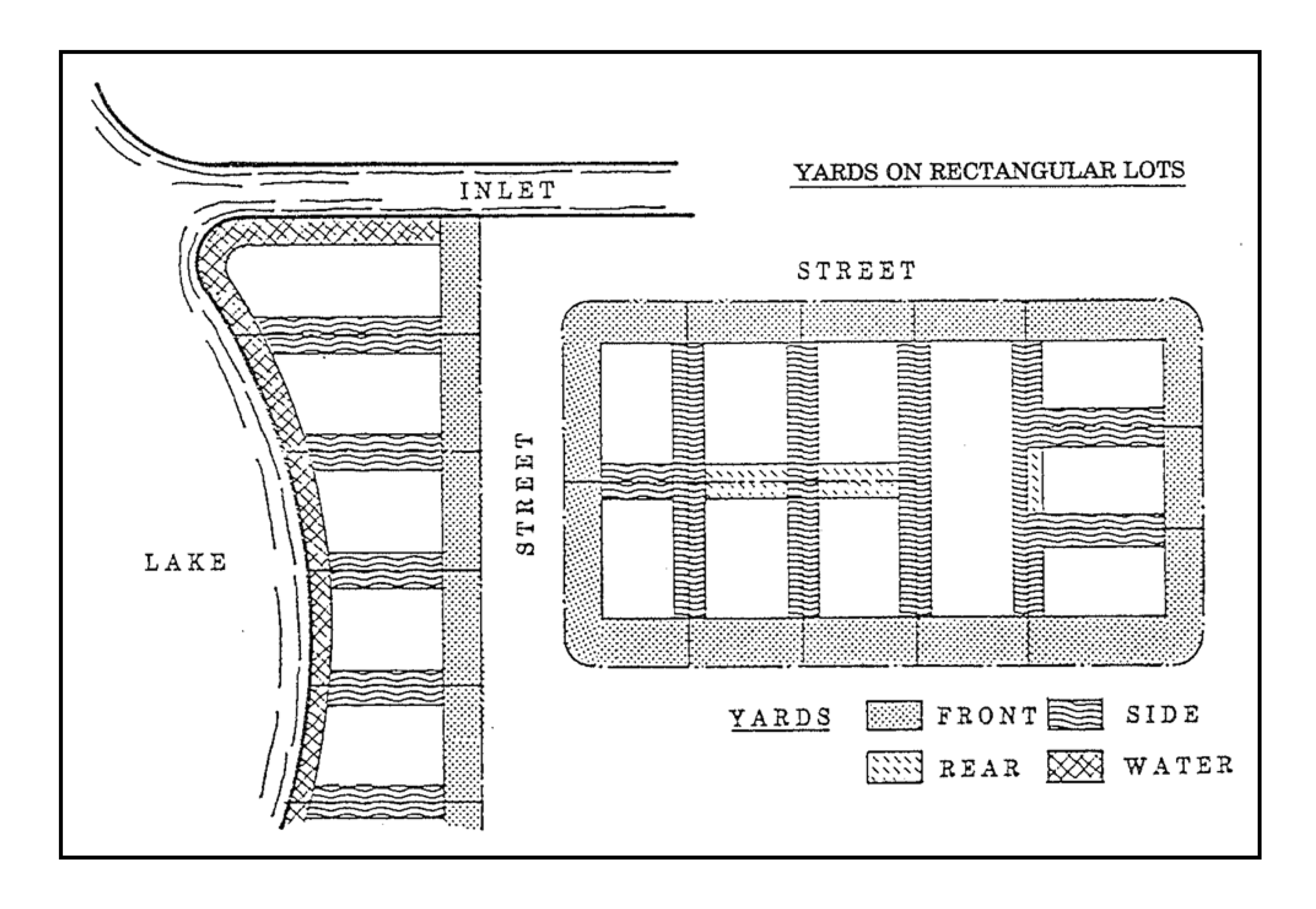
Yard, special. A yard behind any required yard adjacent to a public or private street, required to perform the same functions as a side or rear yard, but adjacent to a lot line and so placed or oriented that neither the term "side yard" nor the term "rear yard" clearly applies. In such cases the administrative official shall require a yard with minimum dimensions as generally required for a side yard or a rear yard in the zoning district, determining which shall apply by the relation of the portion of the lot on which the yard is to be located to the adjoining lot or lots, with due regard to the orientation and location of structures and buildable areas thereon.
6.
Yard, water. A yard adjacent to a public body of water or an inlet or stream with a width of ten feet or greater and extending across the entire water side of the lot.
7.
Yards on non-rectangular lots. The diagram below illustrates descriptive terminology used in the land development regulations with reference to front yards, rear yards, side yards, water yards, and special yards.
8.
Yards on rectangular lots. The diagram below illustrates descriptive terminology used in the land development regulations with reference to front yards, rear yards, side yards, water yards, and special yards.
Sec. 2.1.2.140. - Minimum floor areas.
The minimum floor area for all single-family detached dwellings shall be 950 square feet.
Sec. 2.1.2.150. - Public building location.
The planning commission may recommend the location in any zoning district of any public buildings erected by, or for the use of city, county, state, or federal government, to the city commission for their action; provided, that all yard, area, and similar requirements as provided for in the zoning district in which they are to be located are met.
Sec. 2.1.2.160. - Recording of common areas.
The following procedure shall be required after development approval by the city commission, planning commission, or administrative official as appropriate to the specific case:
1.
Any development, project, or improvement of whatever kind, approved as meeting applicable requirements of the land development regulations which contains commonly owned areas, whether in the form of easements, drainage ways, open space, recreation space, buildings, or other structures, shall not be issued building permits until all such common areas have been recorded in the office of the Polk County Clerk.
2.
All documents pertaining to common ownership, such as maintenance responsibilities, assessments, payment of taxes, homeowners association, or condominium articles, bylaws, and rules shall be included and made a part of this submission.
3.
Such common area documentation shall not be recorded until the administrative official and city attorney have reviewed and approved such documents, plans, and drawings as having met the requirements of the approved development or project.
4.
Evidence in the form of certified copies of the recorded documents shall be required for permit issue and shall be made a part of the permit file until completion thereof.
Sec. 2.1.2.170. - Site compatibility requirements for certain residential, institutional, commercial, and industrial development.
1.
Intent.
A.
In order to promote safety, improve traffic circulation on and around a site, and to prevent potential adverse effects, petitioners for all residential, institutional, commercial, and industrial development activities, except as provided otherwise within the land development regulations, shall submit a site plan meeting the requirements as stated in division IV, chapter 1.
B.
The site plan shall be submitted for review to the administrative official indicating proposed uses and structures, driveways and parking areas, minimum required yards, buffering, signs, landscaping, drainage, and such other details as are required by these sections, by general rule, or in the particular circumstances of the case, and shall indicate a schedule for initiation and completion of development.
C.
If approved, the site plan shall be binding upon the petitioners and any successors in title, and no substantial change shall be permitted without approval from the administrative official.
2.
Review criteria.
A.
Limitations on vehicular access. Except for public service vehicles, principal vehicular access to the property for nonresidential developments shall not be through an adjacent residential district.
B.
Limitations on operations. Site planning, design, and location of structures and open spaces, and management of operations shall be such that orientation of institutional, commercial, and industrial activities is toward the frontage of the street and the following conditions shall apply:
1.
There shall be no sales, service, storage, or display of goods or materials and no off-street loading operations, garbage or trash storage, or collection or disposal facilities visible in any portion of the property from any portion of any abutting residential district.
2.
Signs for nonresidential developments on the property shall be oriented away from any abutting residential zoning district. Lighting of structures and premises on the property shall be arranged and operated in such a manner as to prevent nuisance effects on any abutting residential zoning district.
C.
Yard requirements; buffering. Yards and structural buffering shall be provided to minimize the impact of nonresidential development on any abutting residential district. The following minimum requirements may be increased to achieve a stated public purpose, but shall not be diminished:
1.
Required yards of nonresidential development adjacent to public streets shall be a minimum of 25 feet in depth unless a greater depth is specified otherwise in the land development regulations.
2.
Off-street parking shall not be permitted within the required setback (not minimum required yard) area in commercial districts.
3.
Required yards for all nonresidential uses adjoining any residential district shall be a minimum of 25 feet.
4.
All required yards provided for nonresidential uses which abut any residential district shall be landscaped and maintained as required in the land development regulations and as is appropriate to the residential surroundings. No portion of any required yard abutting any residential district shall be used for off-street parking except as provided below.
5.
As an alternate to the yard and landscaping requirements in [subsections] 3 and 4 above, the property owner of nonresidential uses may elect to provide a solid decorative fence or wall, a minimum of six feet in height along all sides and rear property lines adjoining a residential district, except that such wall or fence shall not project beyond the rear line of an adjacent required front yard in the residential district.
6.
Where the nonresidential property owner elects to go to yard and landscaping provisions as provided for in [subsections] 3 and 4 above, the administrative official may also require additional appropriate fences, walls, or vegetative screening in order to protect adjacent property in residential districts from lights, noise, or undesirable views. Plant materials shall be at least Florida No. 1 materials (see chapter 581, Florida Statutes as amended) and hedge materials shall be a minimum of four to five feet in height and spaced a maximum of four feet on centers at the time of planting.
These plant materials shall be maintained in such a manner as to fulfill the screening intent of this provision. Failure to maintain in such manner shall constitute a violation of these provisions.
3.
After examination of the site plan. The administrative official may require changes where necessary for stated public purposes as a condition for approval, and may attach additional conditions and safeguards, including limitations on hours and manner of operation, beginning and conclusion of construction, and related matters. The administrative official shall not reduce the above stated conditions and safeguards, but may add other applicable conditions and safeguards in granting approval.
4.
Exclusions. The provisions of this section apply to all developments (other than individually owned single-family detached dwellings) including residential, institutional, commercial, and industrial uses except under the following conditions:
A.
Permitted residential, institutional, commercial, and industrial uses wishing to locate in existing structures and/or for premises where alterations, expansions, or enlargement of such facilities do not increase the existing floor and/or ground area, or parking requirements.
B.
Normal building modernization and improvements such as roofing, painting, false fronting with facades, walkway coverings, and related improvements shall not be required to meet these requirements unless building floor areas are in fact increased.
Sec. 2.1.2.180. - Structures near bodies of water; grade level of building sites; 100-year flood plain.
1.
No building or structure, other than a boathouse or dock, shall be erected within 50 feet of the shoreline of any lake or other body of water which has a width of ten feet or greater at its normal water level.
2.
In all zoning districts, no building for human habitation shall be erected on a site where the grade level is less than the 100-year flood level of the nearest lake. In all districts, no building for human habitation shall be erected with floors less than one foot above the 100-year flood level of the nearest lake.
3.
For purposes of the these regulations, normal water level and 100-year flood levels shall be considered to be those established on the flood insurance rate maps.
Sec. 2.1.2.190. - Temporary structures, general.
Temporary structures in connection with land development, construction projects, grand openings, or temporary shelter. These structures include, but are not limited to, tents, canopy covers, mobile offices, and so forth. Such structures may be erected or moved onto a site, for the purposes of sales, shelter, or other directly related matters. The administrative official may approve this structure by permit; such permittee shall specify location, type of construction, maintenance requirements, and a specified period of time. The permit may be renewed every 30 days for a maximum of six months. At the end of the prescribed time period, the structure must be removed from the property. Failure to obtain a permit or violations of conditions specified by that permit shall be in violation of the land development regulations. All temporary structures must meet all applicable city codes.
Sec. 2.1.2.200. - Limited agricultural uses allowed within certain residential zoning districts.
1.
Limited agricultural uses are permitted on residential lots that are five acres or greater in size. Such use is limited to agriculture involving trees, which shall include but not be limited to groves, orchards and tree farms.
2.
In addition, for lands within the city that have previously been zoned residential to accommodate the planned development of lots smaller than five acres in size, agricultural uses are allowed until such time as a plat has been approved by the city and recorded.
3.
Nothing in this section shall prohibit a landowner from raising crops on his/her property for personal (vs. commercial) consumption.
(Ord. No. O-12-07, § 1(Exh. A), 8-6-2012)
Sec. 2.1.2.201. - Medical marijuana treatment center dispensing facilities.
1.
Prohibition. Medical marijuana treatment center dispensing facilities are prohibited and shall not be located within the boundaries of the city. The city shall not accept, process or approve any request or application for a development order, building permit or other approval associated with a proposed medical marijuana treatment dispensing facility.
2.
Definition. For the purposes of this section, the term "medical marijuana treatment center dispensing facility" means any facility where medical marijuana or any product derived therefrom is dispensed at retail.
3.
Interpretation. This section and the terms used herein shall be interpreted in accordance with F.S. § 381.986 and F.A.C. ch. 64-4. The intent of this section is to ban medical marijuana treatment center dispensing facilities from being located within the boundaries of the city as authorized by F.S. § 381.986(11).
(Ord. No. O-18-04, § 2, 7-16-2018)
Sec. 2.1.3.10. - Intent.
1.
Within the districts established by the land development regulations or amendments that may later be adopted there exist: lots; structures; land and structures; and characteristics of use which were lawful prior to the effective date of the original zoning ordinance adopted on August 7, 1961, and all subsequent amendments but which would be prohibited, regulated, or restricted under the terms of the land development regulations or future amendments.
2.
It is the intent of this article to permit certain of these nonconformities to continue without increase in the degree of nonconformity but to discourage the survival of certain other nonconformities.
3.
Nonconforming uses and nonconforming characteristics of either conforming or nonconforming uses are declared by this article to be incompatible with permitted uses in the zoning district involved, to be a threat to the character and stability of the district, and to economic values generally within the district. In view of these effects, it is the intent of this article that certain nonconforming uses be discontinued and that no existing nonconforming use be extended or enlarged, except as provided herein by the addition of other uses of a nature prohibited generally in the district involved.
4.
To avoid undue hardship, nothing in this article shall be deemed to require change in plans approved by the administrative official prior to the effective date of adoption of the land development regulations or amendment thereof; construction or designated use of any building on which actual construction was lawfully begun prior to the effective date of adoption of the land development regulations or amendment thereof and upon which actual building construction has been carried on diligently. Actual construction is hereby defined to include the placing of construction materials in permanent position on the site and fastened in a permanent manner. Where excavation or demolition or removal of an existing building has been substantially begun preparatory to rebuilding, such excavation or demolition or removal shall be deemed to be actual construction, provided that work shall be carried on diligently until the completion of the new construction involved.
Sec. 2.1.3.20. - Nonconforming lot(s) of record.
1.
In any district in which single-family detached dwellings are permitted, a single-family detached dwelling and customary accessory buildings may be erected on any single lot of record existing at the effective date of adoption or subsequent amendments of the original zoning ordinance adopted August 6, 1971, notwithstanding limitations imposed by other provisions of this article. The provision shall apply even though such lot fails to meet the requirements for area or width, or both, that are generally applicable in the zoning district; provided, that yard dimensions and requirements other than those applying to area or width, or both, of the lot shall conform to the regulations for the district in which such lot is located. A variance of yard requirements shall be obtained only through action of the planning commission. No lot presently classified nonconforming under the preceding administered zoning chapter shall be declared a conforming lot under the provisions of this article unless or until such lot meets the minimum requirements set forth herein and as applied in the zoning district in which such lot is located.
2.
There shall not be any division of any parcel of land which creates a lot with a width or area below the minimum requirements stated in this chapter, except as provided below.
Sec. 2.1.3.30. - Nonconforming land or land with minor structures only.
If at time of the effective date or subsequent amendment of the land development regulations lawful use of land exists which would not be permitted by the regulations imposed, and where such use involves no individual structure with a replacement cost exceeding $2,000.00:
1.
No such nonconforming use shall be enlarged or increased, nor extended to occupy a greater area of land than was occupied at the effective date of adoption of the land development regulations or subsequent amendment of the land development regulations;
2.
No such nonconforming use shall be moved in whole or in part to any portion of the lot or parcel other than that occupied by such use on the effective date of adoption of the land development regulations of subsequent amendment of the land development regulations;
3.
If any such nonconforming use of land ceases for any reason for a period of more than six months, any subsequent use of such land shall conform to the regulations specified by the land development regulations for the zoning district in which such land is located;
4.
No additional structure not conforming to the requirements of the land development regulations shall be erected in connection with such nonconforming use of land, nor shall any structure destroyed or deteriorated to the extent of 50 percent or more of replacement value be replaced; and
5.
Such nonconforming use shall be discontinued within three years from the date it becomes nonconforming and any minor structures shall be removed unless converted to conforming use and unless the structure would be a conforming structure in the district.
Sec. 2.1.3.40. - Nonconforming structures.
Where a lawful structure exists at the effective date of adoption of the land development regulations or subsequent amendment of the land development regulations that could not be built under the terms of the land development regulations by reason of restrictions on area, lot coverage, height, yards, its location on the lot, or other requirements concerning the structure, such structure may be continued so long as it remains otherwise lawful, subject to the following provisions:
1.
No such nonconforming structure may be enlarged or altered in a way which increases its nonconformity, but any structure or portion thereof may be altered to decrease its nonconformity;
2.
Should such nonconforming structure or nonconforming portion of structure be destroyed by any means to an extent of more than 50 percent of its replacement cost at time of destruction, it shall not be reconstructed, except in conformity with the provisions of the land development regulations;
3.
Should such structure be moved for any reason for any distance whatsoever, it shall thereafter conform to the regulations for the zoning district in which it is located after it is removed.
Sec. 2.1.3.50. - Nonconforming structures or structures and premises combined.
If, except as provided in section 2.1.3.40, at the effective date of the land development regulations or subsequent amendment of the land development regulations, lawful use exists involving individual structures with a replacement cost exceeding $2,000.00, or such structures and premises in combination, and such use would not be permitted by the regulations imposed:
1.
Except as hereinafter provided, no such structure shall be enlarged, extended, constructed, reconstructed, moved, or structurally altered except in changing the use to a use permitted in the district;
2.
Any nonconforming use may be extended through parts of a building manifestly arranged or designed for such use at the effective date of the land development regulations or subsequent amendment of the land development regulations but no such use shall be extended to occupy any land outside such building;
3.
If no structural alterations are made, any nonconforming use of such structure, or structure and premises, may as a special exception be changed to another nonconforming use; provided, that the planning commission shall find that the proposed use is equally or more appropriate in the location than the existing nonconforming use. In permitting such change, the planning commission may require appropriate conditions and safeguards in accord with the provisions of the land development regulations;
4.
If a nonconforming use of such structure, or structure and premises, is superseded by a permitted use, such use shall thereafter conform to the regulations for the zoning district, and no nonconforming use shall thereafter be begun or resumed;
5.
If a nonconforming use of a structure, or structure and premises in combination, is discontinued or abandoned for six consecutive months or for 18 months during any three-year period (except when government action impedes access to the premises), the structure, or structure and premises in combination, shall not thereafter be used except in conformity with the regulations of the zoning district in which it is located;
6.
Where nonconforming use status applies to such structure and premises in combination, removal or destruction or major deterioration of the structure to the extent of more than 50 percent of replacement cost shall eliminate the nonconforming status of the land.
Sec. 2.1.3.60. - Reconstruction or alteration of some structures.
The planning commission may permit, as a special exception, reconstruction or structural alteration of individual structures with a replacement cost exceeding $2,000.00, containing nonconforming uses, upon a finding that such use is likely to continue indefinitely with or without such reconstruction or structural alteration, and that the proposed reconstruction or structural reconstruction or structural alteration will result in substantial improvement in appearance of the premises or other public benefits in keeping with the purposes of zoning. Site and building plans shall be included with applications for such special exceptions as required in the land development regulations and if approved shall be binding on the petitioner and his successors in title. Such reconstruction or alteration shall be subject to the following general requirements and limitations, in addition to conditions and safeguards which may be added to fit the particular circumstances of the case:
1.
Where a lot abuts or adjoins a lot in a residential district, a solid wall or solid structural screen shall be provided and maintained as necessary to protect adjoining residential property from lights, noise, or undesirable views, dust, fumes, or other obnoxious conditions. Such solid wall or solid structural screen shall be a minimum of six feet in height;
2.
If the use is nonresidential, off-street parking areas for short-term use by customers or other visitors to the premises shall be located and improved in such a manner as to minimize potential adverse effects from light, noise, or dust. Off-street parking space shall be provided as required for the first zoning district in which the use is permitted;
3.
If the use is nonresidential, signs shall be limited as to location and illumination as for the most restrictive commercial zoning district. Number of signs shall not exceed three, with total surface area not exceeding 30 square feet. Orientation of signs shall be toward the street, with as little exposure as practicable to adjoining residential districts;
4.
Minimum yard requirements, maximum height, percent of lot coverage, and impervious surface coverage requirements for the zoning district in which the nonconforming use is located shall apply;
5.
The floor area devoted to nonresidential nonconforming uses shall not be increased more than 20 percent in any reconstruction or alteration authorized by any such special exception. Floor area of residential nonconforming uses may be increased by as much as 40 percent under this provision. In all cases of floor area increase, the allowable percentage shall be based upon the existing floor area as of the date of adoption of the land development regulations and no further increases shall be permitted for the nonconforming use.
Sec. 2.1.3.70. - Nonconforming signs, off-street parking, and related characteristics of use.
If characteristics of use, such as signs, off-street parking, or other matters pertaining to the use of land, structures or premises, are made nonconforming by the land development regulations, no change shall be made in such characteristics of use which increases the degree of nonconformity with the regulations of the land development regulations, but changes may be made which decreases such nonconformity.
Sec. 2.1.3.80. - Ordinary repairs and maintenance.
1.
Except as provided in this article, on any nonconforming structure or portion of structure, and on any structure or portion containing a nonconforming use, work may be done on ordinary repairs or on repair or maintenance of non-bearing walls, fixtures, wiring, or plumbing; provided:
A.
That the cubic content of the nonconforming structure or portion shall not be increased; and
B.
That these provisions shall apply only where deterioration is not to an extent of 50 percent or more of replacement cost of the structure or portion thereof.
2.
Nothing contained herein shall prevent the strengthening or restoring to safe condition of a structure or portion thereof declared to be unsafe by any official charged with protecting the public safety, upon order of such official.
Sec. 2.1.3.90. - Uses permissible under special exception provisions not to be considered nonconforming uses.
Any use which is permissible as a special exception in a zoning district under the terms of the land development regulations, other than a change through planning commission action from a nonconforming use to another use not generally permitted in the district, shall not be deemed a nonconforming use in such zoning district, but shall without further action be considered a conforming use.
Sec. 2.2.1.10. - Official zoning map adopted.
1.
The city is hereby divided into zoning districts, as shown on the official zoning map which, together with all explanatory matter thereon, is hereby adopted by reference and declared to be a part of the land development regulations.
2.
The official zoning map shall be identified by the signature of the mayor, attested by the city clerk, and bearing the seal of the city under the following words: "This is to certify that this is the Official Zoning Map referred to in division II, chapter 2 of the Land Development Regulations of the City of Eagle Lake, Florida," together with the date of adoption.
3.
If changes are made in district boundaries or other matter portrayed on the official zoning map, such changes shall be entered on the official zoning map promptly after the amendment has been approved by the city commission with an entry on the official zoning map as follows: "On (date), by official action of the city commission the following (change or changes) were made on the Official Zoning Map: (brief description of nature of change or reference to amendment ordinance number)," which entry shall be signed by the mayor and attested by the city clerk. No amendment which involves matter portrayed on the official zoning map shall become effective until after such change and entry has been made on said map.
4.
No changes of any nature shall be made in the official zoning map or matter shown thereon except in conformity with the procedures set forth in the land development regulations. Any unauthorized change of whatever kind by any person shall be considered a violation of the land development regulations and punishable as provided under the provisions of the land development regulations.
5.
Regardless of the existence of purported copies of the official zoning map which may from time to time be made or published, the official zoning map which shall be located in the office of the city clerk shall be the final authority as to the current zoning status of land and water areas, buildings, and other structures in the city.
Sec. 2.2.1.20. - Replacement of official zoning map.
1.
In the event that the official zoning map becomes damaged, destroyed, lost, or difficult to interpret because of the nature or number of changes and additions, the city commission may by ordinance adopt a new official zoning map, may correct drafting or other errors or omissions in the prior official zoning map, but no such corrections shall have the effect of amending the original official zoning map or any subsequent amendment thereof. The new official zoning map shall be identified by the signature of the mayor attested by the city clerk, and bearing the seal of the city under the following words: "This is to certify that this Official Zoning Map supersedes and replaces the Official Zoning Map adopted (date of adoption of map being replaced) as part of Ordinance No. ___ of the City of Eagle Lake, Florida."
2.
Unless the prior official zoning map has been lost, or has been totally destroyed, the prior map or any significant parts thereof remaining shall be preserved, together with all available records pertaining to its adoption or amendment.
3.
Nothing in this chapter shall prevent the city clerk from maintaining an official zoning map on a floppy disc for computer use as well as a hard copy drawing of the official zoning map.
Sec. 2.2.1.30. - Rules for interpretation of district boundaries.
Where uncertainty exists as to the boundaries of districts as shown on the official zoning map, the following rules shall apply:
1.
Boundaries indicated as approximately following the center lines of highways, streets, or alleys shall be construed to follow such center lines;
2.
Boundaries indicated as approximately following the right-of-ways of highways, streets, or alleys shall be construed to follow such right-of-way lines;
3.
Boundaries indicated as approximately following platted lot lines shall be construed as following such lot lines;
4.
Boundaries indicated as approximately following city limits shall be construed as following such city limits;
5.
Boundaries indicated as following shorelines shall be construed to follow such shorelines, and in the event of change in the shoreline shall be construed as moving with the actual shoreline; except, where such moving would change the zoning status of a lot or parcel; and in such case the boundary shall be interpreted in such a manner as to avoid changing the zoning status of any lot or parcel;
6.
Boundaries indicated as approximately following the center lines of streams, canals, lakes, or other bodies of water shall be construed to follow such center line and to be at the limit of the jurisdiction of the city, unless otherwise indicated;
7.
Boundaries indicated as following railroad tracks shall be construed as being midway between the main tracks, unless specifically shown otherwise;
8.
Boundaries indicated as parallel to or extensions of features indicated in subsections 1 through 7 above shall be so construed. Distances not specifically indicated on the official zoning map shall be determined by the scale of the map;
9.
Where physical or cultural features existing on the ground are at variance with those shown on the official zoning map, or in other circumstances not covered by subsections 1 through 8 above, the planning commission shall interpret the district boundaries; and
10.
Where a district boundary line divides a lot which was in single ownership prior to the adoption date of the zoning ordinance which was in effect at the time of adoption of the land development regulations, the planning commission may permit, as a special exception, the extension of the regulations for either portion of the lot not to exceed 50 feet beyond the district line into the remaining portion of the lot.
Sec. 2.2.1.40. - Application of district regulations.
1.
The regulations set by this chapter within each zoning district shall be minimum or maximum limitations, as appropriate to the case and shall apply uniformly to each class or kind of structure or land; except as hereinafter provided:
A.
No building, structure, or land shall hereafter be used or occupied, and no building or structure or part thereof shall hereafter be erected, constructed, reconstructed, moved, or structurally altered except in conformity with all of the regulations herein specified for the zoning district in which it is located.
B.
No building or other structure shall hereafter be erected or altered:
1.
To exceed the height or bulk;
2.
To accommodate or house a greater number of families;
3.
To occupy a greater percentage of lot area;
4.
To have narrower or smaller rear yards, front yards, side yards, or other open spaces, than are herein required; or in any other manner contrary to the provisions of this chapter and the land development regulations.
C.
Except as otherwise provided herein, no part of a yard or other open space or off-street parking or loading space required in connection with any building for the purpose of complying with the land development regulations, shall be included as part of a yard, open space, or off-street parking or loading space similarly required for any other building.
D.
No yard or lot existing at the time of passage of the land development regulations shall be reduced in dimension or area below the minimum requirements set forth herein.
Sec. 2.2.1.50. - Schedule of district regulations; adopted.
District regulations for individual zoning districts, other than special districts, shall be as set forth in the schedule of district regulations, division II, chapter 3. The official schedule of district regulations shall be on file in the office of the city clerk. Authentication, effective amendments, and provisions concerning unauthorized changes and replacement shall be the same as for the official zoning map as set forth in sections 2.2.1.10 and 2.2.1.20.
Sec. 2.2.1.60. - Interpretation of provisions.
In their interpretation and application, the provisions of this chapter shall be held to be minimum requirements, adopted for promotion of the public health, safety, morals, appearance, or general welfare. Wherever the requirements of this chapter are at variance with the requirements of any other provisions of the land development regulations, the most restrictive or that imposing the higher standards shall govern.
Sec. 2.2.1.70. - Determinations concerning uses not specified.
1.
Where there is substantial doubt as to whether particular uses or classes of uses, not specifically identified in the land development regulations, are of the same general character as those listed as permitted principal or accessory uses, or uses permissible by special exception, the administrative official may request the planning commission to make a determination on the matter, giving due consideration to the intent of the land development regulations concerning the zoning district, the character of uses specifically identified, and the character of the use in question.
2.
Requests for such determinations shall be made only by the administrative official, and shall not involve cases where the administrative official has made a negative finding, in which case appeals shall be made to the planning commission on grounds of error in his determination within 30 days of determination. After determinations have been made by the planning commission, appeals from its determinations shall also be made to the city commission on grounds of error within 30 days of determination.
3.
Upon making its determinations, the planning commission shall notify the administrative official and any other officer or agency of the city likely to be affected by its findings.
4.
If the planning commission finds that the particular use or class of use in question is of such an unusual or transitory nature, or is unlikely to recur frequently, unless its determination is reversed on grounds of error by the city commission, the determination shall thereafter be binding without further action or amendment of the regulations as an administrative ruling.
5.
If the planning commission finds that the particular use or class of uses is likely to be common or recurrent, and that omission by specific reference in the land development regulations is likely to lead to public uncertainty, it shall initiate a proposed amendment rectifying the omission. Until final action on such proposed amendment, the determination of the planning commission shall be binding as an interim administrative ruling.
Sec. 2.3.1.10. - OUA - Open Use Agriculture.
1.
Statement of intent. This zoning district is intended for agricultural uses and to preserve for agricultural uses those lands with agricultural development potential. Open spaces, park lands, watersheds, and water recharge areas are also intended to be protected in these districts. The regulations discourage or prohibit nonagricultural oriented residential development and generally prohibit commercial and industrial development. Certain recreational activities not inappropriate to the district are permitted. Areas zoned OUA shall have a definite change in use trends and needs prior to any rezoning to a classification permitting more intensive uses.
2.
Permitted principal uses. See table of land uses in division II, chapter 4.
3.
Permitted accessory uses. Uses and structures which are:
A.
Customarily accessory and clearly incidental and subordinate to permitted or permissible uses and structures.
B.
Located on the same lot as the permitted principal use or structures, or on a contiguous lot in the same ownership.
4.
Prohibited uses and structures. Any use or structure not specifically or provisionally permitted herein. Listed permitted or permissible uses do not include either as a principal or an accessory use any of the following which are listed for emphasis:
A.
Manufacturing or industrial establishments.
B.
Wholesale warehouse or storage establishments.
C.
Junk yard or automobile wrecking yard.
D.
Sale of new or secondhand merchandise of whatsoever type or kind.
E.
Contractor, construction, or equipment yard.
F.
Slaughter house for livestock.
G.
Livestock auction.
H.
Keeping and raising of swine and poultry.
I.
Off site advertising signs.
J.
Mining.
K.
Sanitary landfill.
L.
Toxic waste site.
M.
Uses similar in character to any of the above uses.
5.
Special exception uses. Special exception uses are permissible by the planning commission after public hearing and are subject to appropriate conditions and safeguards. See table of land uses in division II, chapter 4.
6.
Minimum lot requirements. See table of dimensional standards in division II, chapter 5.
Sec. 2.3.1.20. - RS - Single-Family Residential.
1.
Statement of intent. These zoning districts, designated as RS-1 and RS-2, are intended to include lands vacant, partially developed, and developed for low to medium density single-family detached residences. Within areas designated RS-1 and RS-2, except for child care center locations, the nature of the use of property is the same with distinction being made as to lot area, width, and certain yards.
2.
Permitted principal uses. See table of land uses in division II, chapter 4.
3.
Permitted accessory uses.
A.
Uses and structures which are:
1.
Customarily accessory and clearly incidental and subordinate to permitted or permissible uses and structures.
2.
Do not involve the conduct of retail business on the premises (except as permitted in connection with agricultural and horticultural uses under division II, chapter 6, section 2.6.2.20).
3.
Are located on the same lot as the permitted principal use or structure or on a contiguous lot in the same ownership.
4.
Are not of a nature likely to attract visitors in larger numbers than would normally be expected in a residential neighborhood.
5.
Do not involve operations or structures not in keeping with the character of a single-family residential neighborhood.
B.
Noncommercial greenhouses, domestic employees dwelling units not for rent, private garages, tool houses and garden sheds, children's play equipment, private swimming pools, noncommercial flower and vegetable gardens, and the like are permitted as accessory to residential or other permitted principal uses in this district. Taking boarders or renting rooms is permitted as a use accessory to principal residential use, provided that not more than two boarders or roomers may be accommodated and that no separate kitchen facilities shall be provided for roomers or boarders.
C.
Dish antennas are to be considered as an accessory use and shall meet all minimum yard and setback requirements. See division II, chapter 5, dimensional requirements.
4.
Prohibited uses and structures. Any use or structure not specifically or provisionally permitted herein. Listed permitted or permissible uses do not include either as a principal or an accessory use any of the following which are listed for emphasis:
A.
Trade or service establishments or storage in connection with such establishments, storage or long-term parking of commercial or industrial vehicles, storage of building materials except in connection with or demolition of structures on the premises, storage or use of manufactured homes or trailers except as provided in division III, chapter III, outdoor advertising, and any use or structure not specifically or provisionally permitted herein.
B.
Funeral homes.
C.
Junk yards.
5.
Special exception uses. Special exception uses are permissible by the planning commission after public hearing and subject to appropriate conditions and safeguards. See table of land uses in division II, chapter 4.
6.
Minimum lot requirements. See table of dimensional standards in division II, chapter 5.
Sec. 2.3.1.30. - RG - General Residential.
1.
Statement of intent. This zoning district is intended to include lands that are vacant, partially developed, or developed for medium to high density residential uses. Special emphasis is on a compatible mixture of residential uses, where they are well served by public and commercial services and have convenient access to the main traffic arteries of the city.
2.
Permitted principal uses. See table of land uses in division II, chapter 4.
3.
Permitted accessory uses.
A.
Uses and structures which are:
1.
Customarily accessory and clearly incidental and subordinate to permitted or permissible uses and structures.
2.
Do not involve the conduct of retail business on the premises (except as permitted in connection with agricultural and horticultural uses under division II, chapter 6, section 2.6.2.20.
3.
Are located on the same lot as the permitted principal use or structure or on a contiguous lot in the same ownership.
4.
Are not of a nature likely to attract visitors in larger numbers than would normally be expected in a residential neighborhood.
5.
Accessory uses and structures shall be in keeping with medium to high density residential neighborhoods; and that garage apartments only as accessory to permitted principal uses and structures may be permitted, but shall be counted as dwelling units for purposes of lot area computations.
B.
Noncommercial greenhouses, servants quarters not for rent, private garages, tool houses and garden sheds, children's play equipment, private swimming pools, noncommercial flower and vegetable gardens, and the like are permitted as accessory to residential or other permitted principal uses in this district. Taking boarders or renting rooms is permitted as a use accessory to principal residential use, provided that not more than two boarders or roomers may be accommodated and that no separate kitchen facilities shall be provided for roomers or boarders.
C.
Dish antennas are to be considered as an accessory use and shall meet all minimum yard and setback requirements. See division II, chapter 5, dimensional requirements.
4.
Prohibited uses and structures. Any use or structure not specifically or provisionally permitted herein. Listed permitted or permissible uses do not include either as a principal or an accessory use any of the following which are listed for emphasis:
A.
Trade or service establishments or storage in connection with such establishments, storage or long-term parking of commercial or industrial vehicles, storage of building materials except in connection with or demolition of structures on the premises, storage or use of manufactured homes or trailers except as provided in division III, chapter 3, outdoor advertising, and any use or structure not specifically or provisionally permitted herein.
B.
Junk yards.
5.
Special exception uses. Special exception uses are permissible by the planning commission after public hearing and are subject to appropriate conditions and safeguards. See table of land uses in division II, chapter 4.
6.
Minimum lot requirements. See table of dimensional standards in division II, chapter 5.
Sec. 2.3.1.40. - RIO - Residential, Institutional, and Office.
1.
Statement of intent. This zoning district is intended for institutional, office, multiple-family residential, cultural, and allied uses. Erection of new one-family and two-family dwellings is not permitted, as being considered out of character with the intent of the district. The district is not to be commercial in character with those limited commercial activities permitted to be allowed only in support of office and institutional uses in the particular RIO district.
2.
Permitted principal uses. See table of land uses in division II, chapter 4.
3.
Permitted accessory uses. Uses and structures which are:
A.
Customarily accessory and clearly incidental and subordinate to permitted or permissible uses and structures.
B.
Are located on the same lot as the permitted principal use or structure or on a contiguous lot in the same ownership.
C.
Do not involve operations or structures not in keeping with the character of this district.
D.
Dwelling units, when a part of the permitted principal use, provided all minimum requirements for area, setback, height, and related requirements for the district are met, and provided further, that all such dwellings shall be confined to the rear one-half of the ground floor, or to a floor other than the ground floor of the principal permitted use. Dwelling units shall be limited to one for each permitted principal use and contain a minimum of 500 square feet of living area but in no case shall the aggregate residential floor area exceed the aggregate floor area of the principal use. One off-street parking space shall be provided for each dwelling unit in addition to the required off-street parking for the permitted principal use and shall be provided at the rear of the principal permitted use.
E.
Senior adult flats.
4.
Prohibited uses and structures. Any use or structure not specifically, provisionally, or by reasonable implication permitted herein including but not limited to the following:
A.
Abandoned signs.
B.
Off-site signs.
C.
Excavation, borrow pits.
D.
Mining.
E.
Junk yards.
5.
Special exception uses. Special exception uses are permissible by the planning commission after public hearing and are subject to appropriate conditions and safeguards. See table of land uses in division II, chapter 4.
6.
Minimum lot requirements. See table of dimensional standards in division II, chapter 5.
Sec. 2.3.1.50. - CN - Neighborhood Commercial.
1.
Statement of intent. This zoning district is intended to be located in areas where small groups of selected commercial and service establishments may be appropriately located to serve within convenient distance from one or several neighborhoods. Regulations are designed to maintain a commercial character appropriate to residential surroundings, with orientation to and compatibility with neighborhoods served of extreme importance.
2.
Permitted principal uses. See table of land uses in division II, chapter 4.
3.
Permitted accessory uses. Uses and structures which are:
A.
Customarily accessory and clearly incidental and subordinate to permitted or permissible uses and structures.
B.
Are located on the same lot as the permitted principal use or structure or on a contiguous lot in the same ownership (except in the case of off-street parking facilities).
C.
Do not involve operations or structures not in keeping with the character of this district.
D.
Dwelling units, when a part of the permitted principal use, provided all minimum requirements for area, setback, height, and related requirements for the district are met, and provided further, that all such dwellings shall be confined to the rear one-half of the ground floor, or to a floor other than the ground floor of the principal permitted use. Dwelling units shall be limited to one for each permitted principal use and contain a minimum of 500 square feet of living area but in no case shall the aggregate residential floor area exceed the aggregate floor area of the principal use. One off-street parking space shall be provided for each dwelling unit in addition to the required off-street parking for the permitted principal use and shall be provided at the rear of the principal permitted use.
E.
Dish antennas are to be considered as an accessory use and shall meet all minimum yard and setback requirements of this chapter. See division II, chapter 5, dimensional requirements.
F.
The sale of automotive fuel as an accessory use shall be permitted in connection with principal uses. See division II, chapter VI, uses permitted with conditions, for requirements.
4.
Prohibited uses and structures. Any use or structure not specifically, provisionally, or by reasonable implication permitted herein, including but not limited to the following:
A.
Single-family residences except as provided under accessory uses.
B.
Two-family and multiple-family residences.
C.
Motels and hotels.
D.
Storage or use of manufactured homes.
E.
Junk yards.
F.
Off-site signs.
G.
Warehousing and storage except as accessory to a permitted principal use.
H.
Sales, service, display, or storage of goods except in completely enclosed buildings.
5.
Special exception uses. Special exception uses are permissible by the planning commission after public hearing and are subject to appropriate conditions and safeguards. See table of land uses in division II, chapter 4.
6.
Minimum lot requirements. See table of dimensional standards in division II, chapter 5.
Sec. 2.3.1.60. - CG - General Commercial.
1.
Statement of intent. This zoning district is intended to permit and encourage general commercial activity and automotive oriented uses that require a conspicuous and accessible location convenient to streets carrying substantial volumes of traffic. Such activities generally require sizeable land areas, do not necessarily cater directly to pedestrians, though pedestrian traffic will be found in the district, and require ample off-street parking and loading space. Certain light manufacturing activities are permitted when it can be demonstrated that these uses are compatible with uses of a commercial nature and the specific requirements stated herein are met.
2.
Permitted principal uses.
A.
See table of land uses in division II, chapter 4.
B.
Extensions of commercial and office development to General Commercial (CG) District. Please see section 2.1.2.80 in division II, chapter 1 for an explanation of the allowed uses and requirements for this transitional area.
3.
Permitted accessory uses.
A.
Uses and structures which are:
1.
Customarily accessory and clearly incidental and subordinate to permitted or permissible uses and structures.
2.
Are located on the same lot as the permitted principal use or structure or on a contiguous lot in the same ownership (except in the case of off-street parking facilities).
3.
Do not involve operations or structures not in keeping with the character of this district.
4.
Dwelling units, when a part of the permitted principal use, provided all minimum requirements for area, setback, height, and related requirements for the district are met, and provided further, that all such dwellings shall be confined to the rear one-half of the ground floor, or to a floor other than the ground floor of the principal permitted use. Dwelling units shall be limited to one for each permitted principal use and contain a minimum of 500 square feet of living area but in no case shall the aggregate residential floor area exceed the aggregate floor area of the principal use. One off-street parking space shall be provided for each dwelling unit in addition to the required off-street parking for the permitted principal use and shall be provided at the rear of the principal permitted use.
B.
Dish antennas are to be considered as an accessory use and shall meet all minimum yard and setback requirements of this chapter. See division II, chapter V, dimensional requirements.
C.
The sale of automotive fuel as an accessory use shall be permitted in connection with principal uses. See division II, chapter VI, uses permitted with conditions, for requirements.
4.
Prohibited uses and structures. Any use or structure not specifically, provisionally, or by reasonable implication permitted herein including but not limited to the following:
A.
Dwelling units except as provided under table of land uses in division II, chapter 4.
B.
Manufacturing and processing except as provided under table of land uses in division II, chapter 4.
C.
Elementary, junior, or high schools, public or private.
D.
Any use which is potentially dangerous, noxious, or offensive to neighboring uses in the district or to those who pass on public ways by reason of smoke, odor, noise, glare, fumes, gas, vibration, threat of fire or explosion, emission of particulate matter, interference with radio or television reception, radiation, or likely for other reasons to be incompatible with the character of the district.
5.
Special exception uses. Special exception uses are permissible by the planning commission after public hearing and are subject to appropriate conditions and safeguards. See table of land uses in division II, chapter 4.
6.
Minimum lot requirements. See table of dimensional standards in division II, chapter 5.
Sec. 2.3.1.70. - ILW - Industrial, Light Warehousing.
1.
Statement of intent. This zoning district is intended for light manufacturing, processing, storage and warehousing, wholesaling, and distribution. Institutional and residential uses are prohibited as being not in character with the activities conducted in these districts. Service and commercial activities relating to the character of the district are permitted. Regulations are intended to prevent or reduce friction between uses in this district and to protect nearby residential districts. Performance standards are applied at lot lines unless specified otherwise.
2.
Permitted principal uses. See table of land uses in division II, chapter 4.
3.
Permitted accessory uses.
A.
Uses and structures which are customarily accessory and clearly incidental and subordinate to permitted principal uses and structures, provided however, that no residential facilities shall be permitted in the district except for watchmen or caretakers whose work requires residence on the premises or for employees who will be temporarily quartered on the premises or as permitted otherwise in this chapter.
B.
The sale of automotive fuel as an accessory use shall be permitted in connection with principal uses. See division II, chapter VI, uses permitted with conditions, for requirements.
4.
Prohibited uses and structures. Any use or structure not specifically, provisionally, or by reasonable implication permitted herein including but not limited to the following:
A.
Dwelling units (including motel and hotel), except as provided under accessory uses.
B.
Hospitals or clinics (except clinic in connection with industrial activity).
C.
Nursing home and similar uses.
D.
Private or public elementary or high schools.
E.
Churches.
F.
Yards or lots for scrap or salvage operations or for processing, storage, display, or sale of any scrap, salvage, or secondhand building materials and automotive vehicle parts.
G.
Wrecking yards (including automotive vehicle wrecking yards) and junk yards or yards used in whole or in part for scrap or salvage operations or for processing, storage, display or sales of any 5.6.6 scrap, salvage, or secondhand building materials, junk automotive vehicles, or secondhand automotive vehicle parts.
H.
Any other uses or structures not specifically, provisionally, or by reasonable implication permitted herein.
I.
Any use not conforming to performance standards in division IX, appendix D of the land development regulations.
5.
Special exception uses. Special exception uses are permissible by the planning commission after public hearing and are subject to appropriate conditions and safeguards. See table of land uses in division II, chapter 4.
6.
Minimum lot requirements. See table of dimensional standards in division II, chapter 5.
Sec. 2.3.1.80. - SE - Suburban Estates.
1.
Statement of intent. The Suburban Estates Zoning District, designated as SE-1 and SE-2, shall be applied to those properties that serve as a transitional area between established rural/agricultural uses and more intense suburban uses. As the city expands its boundaries, this category will serve as a reasonable land use alternative near the edges of its service area that are adjacent to county rural/agricultural uses. Allowances shall be made for limited agricultural/rural uses within this district such as hobby farming, animal breeding, and dog kennels. Detached single-family dwellings shall be the primary use within this district with limited agricultural/rural accessory uses permitted as well. The Suburban Estates District is also appropriate in high recharge areas for the aquifer due to its higher percentage of pervious area and open space. Requirements to connect to central water and sewer service may be waived by the city commission if said utilities are not available to the site as defined by chapter 381, Florida Statutes and Chapter 64E-6 of the Florida Administrative Code. The Suburban Estates Zoning Districts are compatible with the Suburban Estates Land Use District.
2.
Permitted principal uses. See table of land uses in division II, chapter 4.
3.
Permitted accessory uses.
A.
Guest house/cottage as an accessory to a single-family dwelling.
B.
Senior adult flat as an accessory to a single-family dwelling.
C.
Noncommercial farming/hobby farming as an accessory to a single-family dwelling.
4.
Prohibited uses and structures. See table of land uses in division II, chapter 4.
5.
Special exception uses. Special exception uses are permissible by the planning commission after public hearing and are subject to appropriate conditions and safeguards. See table of land uses in division II, chapter 4.
6.
Minimum lot requirements. See table of dimensional standards in division II, chapter 5.
Sec. 2.3.1.90. - ST - Suburban Transitional.
1.
Statement of intent. The Suburban Transitional Zoning District, designated as ST-30, ST-20, and ST-14, shall be applied to lands that act as a transition between suburban estates uses and more intense residential and nonresidential land use districts. No agricultural/rural uses shall be permitted as primary or accessory uses. This district is established to accommodate development of detached single-family homes on large lots. The suburban transitional zoning district is designed to be compatible with suburban estates, suburban transitional, and low density residential future land use categories.
2.
Permitted principal uses. See table of land uses in division II, chapter 4.
3.
Permitted accessory uses.
A.
Guest house/cottage as an accessory to a single-family dwelling.
B.
Senior adult flat as an accessory to a single-family dwelling.
4.
Prohibited uses and structures. See table of land uses in division II, chapter 4.
5.
Special exception uses. Special exception uses are permissible by the planning commission after public hearing and are subject to appropriate conditions and safeguards. See table of land uses in division II, chapter 4.
6.
Minimum lot requirements. See table of dimensional standards in division II, chapter 5.
Sec. 2.3.1.100. - PD - Planned Development.
Please see division III, chapter 1 for information pertaining to Planned Development Districts.
Sec. 2.3.1.110. - FH - Flood Hazard Overlay District.
Please see division VII, chapter 1, section 7.1.1.50, for information pertaining to the Flood Hazard Overlay District.
Sec. 2.4.1.10. - Purpose.
The table on the following page presents, in a quick-reference form, information regarding permitted, permitted with conditions, and special exception land uses. Permitted uses are designated by the letter "P." Uses permitted with conditions, designated by the letters "PC," are also permitted but have requirements that must be met prior to approval. Special exception uses, designated by the letters "SE," must receive approval from the planning commission as explained in division VI, chapter 2. Division II, chapter 6 governs the development standards for uses permitted with conditions and special exceptions. This table must be read in conjunction with the regulations for specific zoning districts in division II, chapter 3, the regulations for planned development districts in division III, chapter 1, and the regulations for flood hazard overlay district in division VII, chapter 1, sections 7.1.1.50 and 7.1.1.60.
Sec. 2.4.2.10. - Table 2.4.2.10(A).
(Ord. No. O-10-06, § 1(exh. A), 2-16-2010; Ord. No. O-10-07, § 1(exh. A), 2-16-2010; Ord. No. O-10-08, § 1(exh. A), 2-16-2010; Ord. No. O-12-02, § 3(exh. C), 10-17-2011; Ord. No. O-18-05, 7-16-2018)
Sec. 2.5.1.10. - General.
The tables on the following pages present, in a quick-reference format, information regarding the dimensional requirements for the zoning districts. These tables must be read in conjunction with the regulations for specific zoning districts in division II, chapter 3. The dimensional requirements for all planned development districts are located in division III, chapter 1. The dimensional requirements for the flood hazard overlay district are located in division VII, chapter 1, section 7.1.1.70.
TABLE 2.5.1.10(a):
SINGLE-FAMILY DETACHED DWELLING
1 Not closer than five feet to any lot line, provided that where a single-family detached dwelling is erected on a nonconforming lot of record in separate ownership, and the lot is less than 50 feet in width, side yards shall be a minimum of five feet in width unless the structure is over nine feet in height form the ground to eaves. For any building over nine feet in height form the ground to the eaves, side yards shall be increased one foot for each two feet of height above nine feet.
2 Front setback for garage/front setback for living area. Front setback assumes a local road classification for all jurisdictions.
3 [Reserved.]
4 14,000 square feet; or a lesser minimum lot area requirement may be approved by the city commission provided that the maximum allowable density is not exceeded as determined by the property's future land use designation. The city commission may impose additional development restrictions on a property including, but not limited to, increased building setbacks, landscaping and buffering, increased minimum house sizes, height restrictions, etc., to maintain compatibility with surrounding properties. Any decrease in minimum lot area may not be approved until advertised public hearings are held by the planning commission and by the city commission after due public notice. Applicants who request a minimum lot area below 14,000 square feet must submit an application to rezone along with a detailed concept plan of the proposed development showing individual lots, lot dimensions, lot area, street layout, stormwater retention/detention areas, street cross sections, access locations of the development and within 200 feet of the development, existing topography, tree cover and the zoning and future land use designations of abutting properties. The planning commission shall make a recommendation prior to the city commission taking final action on the request. A minimum lot area reduction request may be made simultaneously with the initial application to rezone to ST-14 or after the property is already designated as ST-14. Any request for a minimum lot area reduction will be processed and treated as a rezoning application for purposes of public notice and due process. Any approval of a request to reduce the minimum lot area requirement and/or conditions of approval for such reduction shall be recorded in the public records of Polk County using a development order form that is acceptable to the city. Such development order and/or conditions of approval shall run with the land and shall be binding upon any present or future land owners.
5 Where an ILW district adjoins a residential district without an intervening street or alley, the required adjoining yard shall be a minimum of 25 feet and shall not be used for parking. Solid decorative fences or walls at least six feet in height and five feet inside the ILW property line shall be erected by the ILW activity along all side and rear property lines so adjoining, except that such walls shall not project beyond the rear line of an adjacent front yard in the residential district. The five-foot area between walls or fences and the adjoining property line shall be maintained in live landscaping as required above.
TABLE 2.5.1.10(b):
SEMI-DETACHED
1 Side: 18 feet combined but not closer than seven feet to any lot line, provided that where a single-family detached dwelling is erected on a nonconforming lot of record in separate ownership, and the lot is less than 50 feet in width, side yards shall be a minimum of five feet in width, unless the structure is over nine feet in height from the ground to eaves. For any building over nine feet in height from the ground to the eaves, side yards shall be increased one foot for each two feet of height above nine feet; provided that for single-family attached, side yard requirements apply only to end units.
2 Where an ILW district adjoins a residential district without an intervening street or alley, the required adjoining yard shall be a minimum of 25 feet and shall not be used for parking. Solid decorative fences or walls at least six ft. in height and five ft. inside the ILW property line shall be erected by the ILW activity along all side and rear property lines so adjoining, except that such walls shall not project beyond the rear line of an adjacent front yard in the residential district. The five-foot area between walls or fences and the adjoining property line shall be maintained in live landscaping as required above.
TABLE 2.5.1.10(b):
ATTACHED DWELLING
1 Lot area: 4,000 square feet per dwelling unit, provided:
1. Not more than ten units may be permitted in any group of contiguous attached dwellings.
2. Individual lot area of building site may be reduced to a minimum of 2,000 square feet per dwelling unit if the difference between individual lot or building site area and the 4,000 square feet per dwelling unit minimum lot area is provided in common open space and approved by the administrative official or the planning commission as applicable, as to acceptance in form, location and assurance of permanent maintenance of such common open space.
2 Side: 18 feet combined but not closer than seven feet to any lot line, provided that where a single-family detached dwelling is erected on a nonconforming lot of record in separate ownership, and the lot is less than 50 feet in width, side yards shall be a minimum of five feet in width, unless the structure is over nine feet in height from the ground to eaves. For any building over nine feet in height from the ground to the eaves, side yards shall be increased one foot for each two feet of height above nine feet; provided that for single-family attached, side yard requirements apply only to end units.
3 Where an ILW district adjoins a residential district without an intervening street or alley, the required adjoining yard shall be a minimum of 25 feet and shall not be used for parking. Solid decorative fences or walls at least six ft. in height and five ft. inside the ILW property line shall be erected by the ILW activity along all side and rear property lines so adjoining, except that such walls shall not project beyond the rear line of an adjacent front yard in the residential district. The five-foot area between walls or fences and the adjoining property line shall be maintained in live landscaping as required above.
TABLE 2.5.1.10(c):
MULTI-FAMILY DWELLING
1 Side: 18 feet combined but not closer than seven feet to any lot line, provided that where a single-family detached dwelling is erected on a nonconforming lot of record in separate ownership, and the lot is less than 50 feet in width, side yards shall be a minimum of five feet in width, unless the structure is over nine feet in height from the ground to eaves. For any building over nine feet in height from the ground to the eaves, side yards shall be increased one foot for each two feet of height above nine feet; provided that for single-family attached, side yard requirements apply only to end units.
2 Where an ILW district adjoins a residential district without an intervening street or alley, the required adjoining yard shall be a minimum of 25 feet and shall not be used for parking. Solid decorative fences or walls at least six ft. in height and five feet inside the ILW property line shall be erected by the ILW activity along all side and rear property lines so adjoining, except that such walls shall not project beyond the rear line of an adjacent front yard in the residential district. The five-foot area between walls or fences and the adjoining property line shall be maintained in live landscaping as required above.
TABLE 2.5.1.10(d):
COMMERCIAL, SERVICE, AND OFFICE ACTIVITIES
1 Where an ILW district adjoins a residential district without an intervening street or alley, the required adjoining yard shall be a minimum of 25 feet and shall not be used for parking. Solid decorative fences or walls at least six ft. in height and five ft. inside the ILW property line shall be erected by the ILW activity along all side and rear property lines so adjoining, except that such walls shall not project beyond the rear line of an adjacent front yard in the residential district. The five-foot area between walls or fences and the adjoining property line shall be maintained in live landscaping as required above.
2 14,000 square feet; or a lesser minimum lot area requirement may be approved by the city commission provided that the maximum allowable density is not exceeded as determined by the property's future land use designation. The city commission may impose additional development restrictions on a property including, but not limited to, increased building setbacks, landscaping and buffering, increased minimum house sizes, height restrictions, etc., to maintain compatibility with surrounding properties. Any decrease in minimum lot area may not be approved until advertised public hearings are held by the planning commission and by the city commission after due public notice. Applicants who request a minimum lot area below 14,000 square feet must submit an application to rezone along with a detailed concept plan of the proposed development showing individual lots, lot dimensions, lot area, street layout, stormwater retention/detention areas, street cross sections, access locations of the development and within 200 feet of the development, existing topography, tree cover and the zoning and future land use designations of abutting properties. The planning commission shall make a recommendation prior to the city commission taking final action on the request. A minimum lot area reduction request may be made simultaneously with the initial application to rezone to ST-14 or after the property is already designated as ST-14. Any request for a minimum lot area reduction will be processed and treated as a rezoning application for purposes of public notice and due process. Any approval of a request to reduce the minimum lot area requirement and/or conditions of approval for such reduction shall be recorded in the public records of Polk County using a development order form that is acceptable to the city. Such development order and/or conditions of approval shall run with the land and shall be binding upon any present or future land owners.
TABLE 2.5.1.10(e):
OTHER PERMITTED OR PERMISSIBLE USES AND STRUCTURES
1 Side: 18 feet combined but not closer than seven feet to any lot line, provided that where a single-family detached dwelling is erected on a nonconforming lot of record in separate ownership, and the lot is less than 50 feet in width, side yards shall be a minimum of five feet in width, unless the structure is over nine feet in height from the ground to eaves. For any building over nine feet in height from the ground to the eaves, side yards shall be increased one foot for each two feet of height above nine feet; provided that for single-family attached, side yard requirements apply only to end units.
2 Where an ILW district adjoins a residential district without an intervening street or alley, the required adjoining yard shall be a minimum of 25 feet and shall not be used for parking. Solid decorative fences or walls at least six ft. in height and five ft. inside the ILW property line shall be erected by the ILW activity along all side and rear property lines so adjoining, except that such walls shall not project beyond the rear line of an adjacent front yard in the residential district. The five-foot area between walls or fences and the adjoining property line shall be maintained in live landscaping as required above.
3 A lesser minimum lot area requirement may be approved by the city commission provided that the maximum allowable density is not exceeded as determined by the property's future land use designation. The city commission may impose additional development restrictions on a property including, but not limited to, increased building setbacks, landscaping and buffering, increased minimum house sizes, height restrictions, etc., to maintain compatibility with surrounding properties. Any decrease in minimum lot area may not be approved until advertised public hearings are held by the planning commission and by the city commission after due public notice. Applicants who request a minimum lot area below 14,000 square feet must submit an application to rezone along with a detailed concept plan of the proposed development showing individual lots, lot dimensions, lot area, street layout, stormwater retention/detention areas, street cross sections, access locations of the development and within 200 feet of the development, existing topography, tree cover, and the zoning and future land use designations of abutting properties. The planning commission shall make a recommendation prior to the city commission taking final action on the request. A minimum lot area reduction request may be made simultaneously with the initial application to rezone to ST-14 or after the property is already designated as ST-14. Any request for a minimum lot area reduction will be processed and treated as a rezoning application for purposes of public notice and due process. Any approval of a request to reduce the minimum lot area requirement and/or conditions of approval for such reduction shall be recorded in the public records of Polk County using a development order form that is acceptable to the city. Such development order and/or conditions of approval shall run with the land and shall be binding upon any present or future land owners.
(Ord. No. O-20-03, 11-4-2019)
Sec. 2.6.1.10. - General provisions.
1.
The purpose of this article is to create an approval process for special exception uses, those which are permitted only through special application and public review. Its intent is to ensure that such uses, if approved, are compatible with surrounding properties, and are developed in suitable locations with those design features which are necessary to safeguard the public health, safety, and welfare.
2.
Special exceptions shall be granted in accordance with the provisions of division VI, chapter II. Special standards and requirements presented in this article are conditions for approval of the special exception and shall be binding on all development authorized under the special exception.
3.
The following standards apply to uses listed as special exceptions "SE" on the table of permitted uses in division II, chapter 4, and approved under the provisions of division VI, chapter II. Where standards provided herein exceed and/or create greater restrictions than those of the underlying zoning district, this article shall supersede any other provision of this code. Where no standard is established in this article, that of the relevant zoning district shall apply.
Sec. 2.6.1.20. - Animal hospital, veterinary clinic, animal boarding place, fur farm, dog kennels, and similar uses.
Animal hospital, veterinary clinic, animal boarding place, fur farm, dog kennels, and similar use provided, no building for the housing of animals shall be located within 125 feet of any lot line.
Sec. 2.6.1.30. - Country club, private club, or outdoor recreation club and camp.
Country club, private club, or outdoor recreation club and camp, provided all structures or parking must be at least 50 feet from any street right-of-way line and 100 feet from any property in private ownership.
Sec. 2.6.1.40. - Extension of commercial services and office uses.
Extension of commercial service and office uses, in accordance with division II, chapter 1, section 2.1.2.80.
Sec. 2.6.1.50. - Golf courses.
Golf courses, not including miniature golf courses, provided land area comprises at least 100 acres of land in one parcel and that any building, accessory parking area, or structure is located at least 50 feet from any street right-of-way line and at least 100 feet from any property in separate ownership.
Sec. 2.6.1.60. - Group housing and supervised living facilities.
1.
Group housing and supervised living facilities provided all federal, state, and city requirements are met.
2.
All lot, yard, coverage, height, and sign requirements shall be as for RG - Multiple Family.
3.
Off-street parking shall be provided with one space per staff member and one per bed. Loading areas, if provided, shall be separated from off-street parking facilities. Fences, walls, or vegetative screening (in accordance with division II, chapter 1, section 2.1.2.170) shall be required to screen commercial land uses from these subject uses.
4.
The number of rooms or sleeping accommodations shall not exceed the maximum density permitted in the RG zoning district (ten dwelling units/acre).
5.
All other provisions of the special exception requirements in this chapter shall be met.
Sec. 2.6.1.70. - Light manufacturing or processing.
1.
Is conducted in a completely enclosed building.
2.
Does not involve odor, noise, smoke, or other obnoxious effects detectable to normal senses from outside the building.
3.
Does not involve electrical interferences to television, radio, or communications systems off the premises.
4.
Does not involve storage of materials other than in the building or buildings in which the activity is located.
5.
Such light manufacturing or processing uses whether proposed to occupy a new or used structure shall comply with the performance standards of this chapter.
Sec. 2.6.1.80. - Mixed use residential/commercial.
In connection with multiple-family dwellings having a minimum of 100 dwelling units, establishments for sale of convenience goods, personal, and professional service establishments, and eating and drinking establishments, provided that all such establishments shall be designed and scaled to meet only the requirements of occupants and their guests, and that there shall be no external evidence of the existence of such establishments. Floor area devoted to such incidental and accessory uses other than parking shall not exceed 20 percent of the total residential floor area.
Sec. 2.6.1.90. - Public and private truck parking lots.
1.
Public and private truck parking lots subject to the following conditions:
A.
Lots shall contain a minimum width of 100 feet and 20,000 square feet of area.
B.
Long-term (overnight) parking of running vehicles or equipment thereon or on the trailers shall be prohibited within 50 feet of any residential district.
C.
Access shall be through the commercial district and not through a residential district.
D.
All lights shall be oriented away from residential districts.
E.
Parking lots shall be properly drained, surfaced with a weather proof surface (includes turf) and where necessary provided with appropriate bumper guards and/or wheel stops.
F.
No signs shall be erected on the lot except that on the street side adjacent to an entrance to the lot one sign not exceeding nine square feet in area may be permitted which indicates only the name of the operator, telephone number, and purpose of the lot. Such sign shall be located no closer than ten feet to the property line and shall meet all other requirements of this chapter.
G.
Front, side, and rear yards except as provided above shall be as for CG district.
H.
In connection with such proposals, petitioners shall submit a site plan for review, indicating proposed use and structures, if any, driveways and parking areas, yards, setbacks, and such other details as the planning commission may require by general rules or in the particular circumstances of the case. If the special exception is granted, such plan shall be binding upon the petitioner and any successors in title, and no substantial change shall be permitted without additional special exception proceedings.
Sec. 2.6.1.100. - Radio or TV transmission stations.
Radio or television transmitting or receiving station, line, or sight relay devices, structures, or tower over 100 feet in height above the ground and meeting all FCC and FAA requirements.
Sec. 2.6.1.110. - Self-storage (mini-warehouse) facilities.
1.
Outdoor storage is prohibited.
2.
Building facades of metal buildings that face a street shall be covered with masonry, wood, or other material that enhances the aesthetic appeal of the building.
3.
Sites and building layout shall be designed so that a series of garage doors is not visible from adjacent streets.
4.
Individual storage units shall not be utilized as a business location.
5.
Individual storage units shall not be used as a distribution center for wholesale products.
6.
Parking for office space associated with management and rental of self storage units shall be as provided for other office space in the Eagle Lake Code.
7.
Where driveways are used for access to individual storage units, the minimum width of the driveway shall be 24 feet.
8.
Parking shall not be designed or located to block access to individual storage units.
9.
Where storage units are accessed from inside an enclosed building, additional parking spaces shall be provided at the rate of one space per 10,000 square feet of storage area.
Sec. 2.6.2.10. - General provisions.
The following standards apply to uses listed as permitted with conditions (PC) on the table of land uses in division II, chapter 4. Where standards provided herein exceed and/or create greater restrictions than those of the underlying zoning district, this article shall supersede any other provision of this code. Where no standard is established in this article, that of the relevant zoning district shall apply.
Sec. 2.6.2.20. - Agricultural and horticultural uses.
1.
OUA zoning district.
A.
Agricultural and horticultural uses including keeping and raising of livestock but not to include poultry and swine.
B.
Permanent or temporary structures on the farm site for housing farm labor, with capacity of one family for each five acres of agriculture site.
C.
Roadside stands for sale of products grown on the premises and with sales limited to only such on-site grown products.
2.
RS and RG zoning districts. Plant nurseries with greenhouses and similar agricultural uses and structures, provided that only minor and incidental sales shall be permitted, and that no roadside stands or signs shall be erected.
Sec. 2.6.2.30. - Church.
1.
OUA zoning district. Church (including temporary revival establishments), provided that the minimum parcel size shall not be less than two acres.
2.
RS, RG, and RIO zoning districts. Churches, provided that the minimum parcel size shall not be less than two acres.
Sec. 2.6.2.40. - Combination retail outlets such as grocery with gas pumping facilities.
1.
No automotive service repair being permitted.
2.
Sales, display, preparation, and storage to be conducted within a completely enclosed building (not including enclosed interior malls and the like), and no more than 20 percent of floor space to be devoted to storage.
3.
Products to be sold only at retail.
4.
No sale, display, or storage of secondhand merchandise except as incidental to sale of new merchandise.
Sec. 2.6.2.50. - Dwelling units as part of the principal structure.
Dwelling units, when a part of the permitted principal use, provided requirements for area, setback, height, and related requirements shall be set, and provided further, that all such dwellings shall be confined to the rear one-half of the ground floor, or to a floor other than the ground floor of the principal permitted use. Dwelling units shall be limited to one for each permitted principal use and contain a minimum of 500 square feet of living area but in no case shall the aggregate residential floor area exceed the aggregate floor area of the permitted principal use.
Sec. 2.6.2.60. - Excavation, borrow pits.
Excavation, borrow pits not exceeding 50,000 cubic yards or five acres per site. See section 2.1.2.60 of division II, chapter 1 of the land development regulations.
Sec. 2.6.2.70. - Garden supply centers in a shopping center in PD-C.
Garden supply centers are often found in shopping centers. If such activities are proposed as a part of the PD-C they must be included in the request for amendment. If outside display of products is involved, such activity shall be well away from residential districts and properly screened.
Sec. 2.6.2.80. - Hospitals, sanitariums, rest homes, nursing homes, convalescent homes, and homes for the aged and orphans.
Provided that no such facility shall have a lot area of less than two acres, that no building in connection with such facilities shall be closer than 50 feet to the lot line of any adjoining property, and that all other state, county, and city regulations shall be met.
Sec. 2.6.2.90. - Laundry, dry-cleaning, and laundromat establishments.
No such establishment shall employ more than five persons in processing on the premises.
Sec. 2.6.2.100. - Limited commercial and service activities in support of institutional and office uses.
1.
Limited commercial and service activities in support of institutional and office uses, such as:
A.
Retail outlets for sale of books, educational, and art supplies, florist or gift shop, delicatessen, prescription drug store, prosthetic appliance establishments, and similar establishments.
B.
Service establishments such as barber or beauty shop, restaurant (but not drive-in restaurant), laundry or dry cleaning pickup station, and similar activities.
2.
The above uses are subject to the following limitations:
A.
Sale, display, preparation, and storage to be conducted within a completely enclosed building, and no more than 20 percent of floor space to be devoted to storage.
B.
Products to be sold only at retail.
C.
No sale, display, or storage of secondhand merchandise except as incidental to sale of new merchandise.
Sec. 2.6.2.110. - Manufactured housing development.
Manufactured housing development, containing RDMH and standard design manufactured homes (SDMH) shall be permitted provided however that all residential lots on the perimeter of the district shall contain only RDMH manufactured homes meeting all appearance criteria.
Sec. 2.6.2.120. - Marinas, boat launching ramps in PD-RVP.
Marinas, launching ramps, and the like may be permitted when appropriate to the character and location of the park, provided that such installation shall be located with due regard to the peace and tranquility in any adjoining residential district, and shall not provide facilities for long-term storage of boats other than those rendered in connection with the park operation, or for major repair or overhaul of boats. Requirements and restrictions applied in particular cases may include limitations on hours and manner of operation, requirements for boat trailer storage sizes and types of boats and motors, and related activities.
Sec. 2.6.2.130. - Mixed use residential/commercial.
1.
RG and RIO zoning districts. In connection with multiple-family dwellings having a minimum of 100 dwelling units, establishments for sale of convenience goods, personal and professional service establishments, and eating and drinking establishments, provided that all such establishments shall be designed and scaled to meet only the requirements of occupants and their guests, and that there shall be no external evidence of the existence of such establishments. Floor area devoted to such incidental and accessory uses other than parking shall not exceed 20 percent of the total residential floor area.
2.
PD-H zoning district. Accessory uses permitted shall include only those which are customarily accessory and incidental to residential developments. Floor area devoted to accessory uses other than parking shall not exceed ten percent of residential floor area, and provided that in planned residential developments having 100 or more dwelling units, establishments for sale of convenience goods, personal and professional service establishments, and eating and drinking establishments shall be permitted as accessory uses. Such establishment shall be designed and scaled to meet only the requirements of occupants of dwelling units in the planned development and their guests, and there shall be no external evidence of such establishments visible from outside the planned development.
Sec. 2.6.2.140. - Noncommercial beaches, docks, boat launching facilities, boathouses, and similar uses.
Noncommercial beaches, docks, boat launching facilities, boathouses, and similar uses, provided that no dock shall extend over 50 feet from the established high water mark, and that no boathouse or other enclosed structure in such district shall exceed a height above the ground or high water mark, where situated, of 12 feet, or contain an area exceeding 300 square feet.
Sec. 2.6.2.150. - Outdoor storage lots and yards.
Outdoor storage yards and lots, provided such outdoor storage yard shall not be located closer than 25 feet to any public street and that such yard shall be completely enclosed, except for necessary ingress and egress, by a solid fence or wall not less than six feet high; and provided further that this provision shall not permit wrecking yards (including automobile wrecking yard), junk yards, or yards used in whole or in part for scrap or salvage operations or for processing, storage, display, or sales of any scrap, salvage, or secondhand building materials, junk automotive vehicles, or secondhand automotive vehicle parts.
Sec. 2.6.2.160. - Private child care center.
1.
RS-2 and RG zoning districts, after review by the planning commission:
A.
Lot area shall not be less than 8,000 square feet; lot width in portion used for fenced play area shall not be less than 80 feet.
B.
Fenced play area of not less than 3,000 square feet shall be provided for the first 15 or fewer children, with 200 square feet additional for each additional child.
C.
No portion of the fenced play area shall be closer than 20 feet to any public street.
D.
A five-foot-high solid masonry wall, or solid fence which furnishes protection against noise shall be provided between fenced play areas and residential lot lines in such locations as may be directed by the planning commission.
E.
All outdoor play activities shall be conducted within the fenced play area and no outdoor play activities shall be conducted before 8:00 a.m. or after 8:00 p.m.
F.
All facilities, operation, and maintenance shall meet city, county, and state requirements for the operation of child care centers.
G.
Setbacks:
1.
RS-2 zoning district. The facility must meet the following setbacks in the RS-2 zoning district: 25 feet front; ten feet side, and 20 feet rear.
2.
RG zoning district.
a.
Front: 25 feet.
b.
Side: 18 feet combined but not closer than seven feet to any lot line, provided that where a single-family detached dwelling is erected on a nonconforming lot of record in separate ownership, and the lot is less than 50 feet in width, side yards shall be a minimum of five feet in width, unless the structure is over nine feet in height from the ground to eaves. For any building over nine feet in height from the ground to the eaves, side yards shall be increased one foot for each three feet of height above nine feet.
c.
Rear: Ten feet.
2.
RIO zoning districts, after review by the administrative official:
A.
Lot area shall not be less than 9,500 square feet; lot width in portion used for fenced play area shall not be less than 75 feet.
B.
Fenced play area of not less than 3,000 square feet shall be provided for the first 15 or fewer children, with 200 square feet additional for each additional child.
C.
No portion of the fenced play area shall be closer than 20 feet to any public street right-of-way.
D.
A five-foot-high solid wall, or solid fence shall be provided between fenced play areas and residential lot lines in such locations as may be directed by the administrative official.
E.
All outdoor play activities shall be conducted within the fenced play area and no outdoor play activities shall be conducted before 8:00 a.m. or after 8:00 p.m.
F.
All facilities, operation, and maintenance shall meet city, county, and state requirements for the operation of child care centers.
Sec. 2.6.2.170. - Private club of a fraternal or social character.
Private clubs of a fraternal or social character not operated or maintained for profit, including a dining facility incidental to the club activity and operated for the benefit of members only.
Sec. 2.6.2.180. - Railroad right-of-way.
Existing railroad right-of-way, but not to include switching, freight or storage yards, buildings, or maintenance structures.
Sec. 2.6.2.190. - Recreational vehicle park convenience establishments.
Establishments for the sale or rental of supplies or for provision of services for satisfaction of daily or frequent needs of campers within the park may be permitted. Such establishments include those providing groceries, ice, sundries, bait and fishing equipment, self-service laundry equipment and the like, but not sale of gasoline for automobiles, boats, or other vehicles. Such establishments shall be designed to serve only the needs of occupants of the park, and shall not, including their parking area, occupy more than five percent of the area of the park, and shall be so located as not to attract patronage from outside the park, nor to have adverse effects on surrounding land uses. The structures housing such facilities shall not be located closer than 100 feet to any public street or property line.
Sec. 2.6.2.195. - Repair garages, minor and major.
1.
No outside storage of any motor vehicle supplies or parts is permitted. All material must be stored inside a building each night.
2.
All large-scale repairs must be done in an enclosed building.
3.
No inoperable vehicle will be on the premises more than ten consecutive days. Time Extensions may be granted by the code enforcement officer in ten consecutive day increments up to two months from the date the vehicle arrived on the premises. An extension may be granted if the code enforcement officer concludes that the repair garage has proceeded with due diligence and in good faith in repair attempts to make the vehicle operable or to have the vehicle removed. All such requests for extensions shall be submitted in writing not less than five days before the expiration of the time period, stating the reason for the time extension request and providing proof of the need for the extension.
4.
All repair garages must meet all Environmental Protection Agency, Florida Department of Environmental Protection, and Florida Department of Transportation regulations.
(Ord. No. O-10-08, § 2(exh. A), 2-16-2010)
Sec. 2.6.2.200. - Restaurants.
1.
CN zoning district. Restaurants not including drive-in restaurants, provided that no alcoholic beverages shall be sold or served on the premises.
2.
CG zoning district. Restaurants including drive-in restaurants, provided that no alcoholic beverages shall be sold or served on the premises, except that alcoholic beer and wine may be served or consumed on the premises only when served with a meal.
3.
PD-C zoning district. Restaurants, including the fast food type, but not including drive-in restaurants, provided that no alcoholic beverages shall be sold or served on the premises.
Sec. 2.6.2.210. - Riding academy or boarding stable.
Riding academy, or boarding stable, provided no building for housing animals shall be located within 200 feet of any residentially zoned property.
Sec. 2.6.2.220. - Service and repair of household appliances.
No such establishment shall employ more than five persons in processing on the premises.
Sec. 2.6.2.230. - Service establishments.
Service establishments such as barber and beauty shops, shoe repair, laundry, and dry cleaning establishments, repair of home appliances, provided that no such establishment shall employ more than five persons in processing on the premises.
Sec. 2.6.2.240. - Service stations in a shopping center in a PD-C.
Service stations are often found in shopping centers. If such activities are proposed as a part of the PD-C they must be included in the request for amendment. If outside display of products is involved, such activity shall be well away from residential districts and properly screened. If service stations are to be permitted, their locations shall be a part of the amendment; they shall be so located that there will be no interference with pedestrian traffic. The requirements set out for service stations in section 2.6.2.240 as a minimum shall apply.
Sec. 2.6.2.250. - Service stations and/or convenience stores and automotive fuels as an accessory use: location, design, operation, including sales of all fuels.
1.
Service stations and/or convenience stores. The following regulations shall apply to the location, design, construction, operation, and maintenance of all service stations and/or convenience stores, including the sale of all fuels and systems and any other types, petroleum or otherwise, to be devised and established for similar and related activities.
A.
A service station and/or convenience store lot shall be of adequate width and depth to meet all district setback requirements, but in no case shall the width of a lot be less than 140 feet wide and contain less than a minimum area of 15,000 square feet. The planning commission shall have no power to grant variances below minimum lot requirements for such land uses.
B.
All lights and lighting on and for a service station and/or convenience store and lot shall be so designed and arranged that the light source and glare shall not be directly visible from a residential district.
C.
No service station and/or convenience store building or fuel pump or storage tank shall be located within 25 feet of any property that is zoned residential or institutional.
D.
Where a lot to be used for a service station and/or convenience store abuts on any property which is zoned residential or institutional, there shall be a solid wall designed and installed on all such property lines, other than street lines, which will prevent auto lights, smoke, fumes, dust, and other obnoxious materials (from ground level to the required fence height) from penetrating into the residential or institutional district. The solid wall shall be a minimum of six feet in height.
E.
No fuel pump or storage tank shall be located within 15 feet of any street right-of-way line. Where a street setback line has been established, no fuel pump or storage tank shall be located within 15 feet of such setback line. Where conditions of traffic safety, due to street intersections, lack of visibility at a street crown, or other peculiar circumstances prevail, additional setbacks may be required by the administrative official, but in no case shall they be required to exceed 25 feet.
F.
The number of curb breaks for a service station and/or convenience store shall not exceed two for each 100 feet of street frontage, each having a width of not more than 40 feet and located not closer than 30 feet to the right-of-way lines of any street intersection. Such curb breaks shall not be closer than 15 feet to any other private property line and there shall be a minimum distance of 15 feet between such curb breaks. Clearance for curb breaks shall be obtained from the Florida Department of Transportation for any proposed service station and/or convenience store located on a street under Polk County or Florida Department of Transportation jurisdiction.
2.
Automotive fuels as an accessory use. The following regulations shall apply to the sale of automotive fuels as an accessory use, at locations other than at service stations:
A.
The sale of automotive fuel as an accessory use shall be permitted in connection with principal uses in all commercial and industrial districts. No such sale of automotive fuel as an accessory use shall be permitted or permissible by special exception in connection with conforming or nonconforming uses in any other zoning district.
B.
Accessory sales of this nature, and services performed in connection therewith, shall be limited to sale of automotive fuel, replenishing oil, washing windshields, windows and lights, providing air for tires, providing water and additives for radiators, and other routine minor services. Activities at such establishments shall not include lubrication, changing oil, washing vehicles, tire repairs, painting, mechanical or body repairs, and the like unless permitted in the zoning district as a principal use.
C.
The number of dispensing islands shall not exceed four, with not more than four fuel pumps concentrated in one pump island or service area. No such dispensing facilities shall be located within 25 feet of any property zoned residential or institutional. No pump or other dispensing facility shall be located within 15 feet of any street right-of-way line or established setback line. Where conditions of traffic safety at intersections, impaired visibility, or other conditions make such requirements reasonable for protection of vehicles or pedestrians, additional setbacks may be established by the administrative official, but in no case shall such setbacks be required to exceed 25 feet.
D.
Parking areas and vehicular lanes shall be clearly marked and shall provide for safe and convenient parking, vehicular circulation, and pedestrian movement. Except for vehicles attended by the driver and awaiting servicing, there shall be no parking within 12 feet of any pump or other dispensing outlet. Vehicular lanes shall be at least 12 feet in width, and shall be so located and arranged that parking in relation to the principal use will not interfere with convenient movement and service at the dispensing outlet.
Sec. 2.6.2.260. - Shoe repair.
No such establishment shall employ more than five persons in processing on the premises.
Sec. 2.6.2.270. - Sidewalk sales.
Sidewalk sales not exceeding six consecutive days and not more than four times per calendar year, provided no products or displays shall be left on sidewalks between the hours of 7:00 p.m. and 7:00 a.m. A clear space of not less than three feet shall be reserved in front of displays for pedestrians and pedestrians in wheel chairs to pass safely. A permit from the city shall be required but no fee shall be charged.
Sec. 2.6.2.280. - Truck stops.
Truck stops, provided there is a minimum lot width of 200 feet and 40,000 square feet of area, and further provided that long-term parking of running vehicles or equipment thereon shall be prohibited within 50 feet of any residential zoning district.
Sec. 2.6.2.290. - Uses permitted with conditions in CG zoning district.
1.
Permitted principal uses and structures.
A.
Retail outlets such as grocery, variety, drug, sundries and notions, and similar uses.
B.
Service establishments such as barber and beauty shops, shoe repair, laundry and dry cleaning establishments, repair of home appliances, provided that no such establishment shall employ more than five persons in processing on the premises.
C.
Banks, financial establishments, offices, and similar uses.
D.
Restaurants including drive-in restaurants, provided that no alcoholic beverages shall be sold or served on the premises, except that alcoholic beer and wine may be served or consumed on the premises only when served with a meal.
E.
Motion picture theaters and other indoor commercial recreation enterprises.
F.
Combination retail outlets such as grocery with gas pumping facilities but with no automotive service repair being permitted.
G.
Existing residential uses.
H.
Retail outlets, for sales of such items as home furnishings, appliances, office equipment, new and used automobiles, motorcycles, boats, recreational vehicles, manufactured homes, automotive vehicle parts and accessories (but not junk yards or automobile wrecking yards, or concrete block or any concrete fabricating yards), feed, fertilizer, lumber and building supplies and similar uses.
I.
Service establishments such as funeral home, appliance repair shops, automobile filling stations (subject to requirements of section 2.6.2.240), auto rental agencies, drive-in restaurants, laundry and dry cleaning establishments, veterinarian or animal boarding kennels in soundproof buildings, plant nursery and landscape contractor, printing establishments, and similar uses.
J.
Public service, delivery and transportation facilities, utility offices, and operation centers.
K.
Governmental uses, including city, county, state, and federal uses.
L.
Hotels and motels.
M.
Churches.
N.
Vocational, trade, and business schools.
O.
Retail establishments manufacturing goods for sale only at retail on the premises.
P.
Truck stops, provided there is a minimum lot width of 200 feet and 40,000 square feet of area, and further provided that long-term parking of running vehicles or equipment thereon shall be prohibited within 50 feet of any residential zoning district.
Q.
Wholesaling, provided no manufacturing for distribution is permitted on the premises.
R.
Private clubs of fraternal or social character including a dining facility incidental to the club activity and operated for the benefit of members only.
S.
Sidewalk sales not exceeding six consecutive days and not more than four times per calendar year, provided no products or displays shall be left on sidewalks between the hours of 7:00 p.m. and 7:00 a.m. A permit from the city shall be required but no fee shall be charged.
T.
Except for automobile, truck, boat, manufactured home, recreational vehicles and similar vehicle sales, lumber sales and supply, building supply, plant nursery, lawn ornaments and statuaries, and similar uses, the above uses are subject to the following limitations:
1.
Sale, display, preparation and storage to be conducted within a completely enclosed building (not including enclosed interior malls and the like), and no more than 30 percent of floor space to be devoted to storage.
2.
Products to be sold only at retail.
3.
No sale, display, or storage of secondhand merchandise except as incidental to sale of new merchandise.
4.
Lumber sales and supply, building supply and similar uses shall provide fencing and buffers as required in section 2.1.2.170, regardless of the adjacent land use.

