
Eaton Rapids City Zoning Code
ARTICLE XVIII
GENERAL STANDARDS AND EXCEPTIONS
Sec. 18.00.- Application.
General requirements and standards apply to all districts except as noted herein. Where requirements of a general regulation and a district regulation differ, the more restrictive requirements shall prevail.
Sec. 18.02. - Use of Buildings and Land.
No building shall be erected, converted, enlarged, reconstructed, or structurally altered, nor shall any building or land be used, designed, or arranged, for any purpose other than is permitted in the district in which the building or land is located. No building shall be erected, converted, enlarged, reconstructed, or structurally altered except in conformity with the area regulations of the district in which the building is located.
Sec. 18.04. - Zoning Permits Issued Prior to Effective Date.
Any building or structure for which a zoning permit has been issued and the construction of the whole or a part of which has been entered into pursuant to a zoning permit issued prior to the effective date of this Ordinance may be completed and used in accordance with the plans and applications on which said zoning permit was granted.
A building which is lawfully under construction at the time of adoption of this Ordinance shall be allowed to be completed within one (1) year of the passage of this Ordinance. Adoption of this Ordinance shall not require any changes to the plans, construction or designated use of any such buildings.
Sec. 18.06. - Restoration of Unsafe Buildings.
Nothing in this Ordinance shall prevent the strengthening or restoring to a safe condition any part of a any building or structure declared unsafe by the building inspector or required compliance with his or her lawful order.
Sec. 18.08. - Moving of Buildings.
A.
Any building or structure that has been wholly or partially erected on any premises located within the city shall not be moved to and be placed upon any other premises in the city until a building permit for such removal has been secured according to the requirements of this Ordinance. Any such building or structure shall fully conform to this Ordinance in the same manner as a new building or structure.
B.
Before a permit may be issued for moving a building or structure, the building inspector shall inspect the same and determine if it is in a safe condition to be moved, whether or not it may be reconditioned to comply with the building code and other requirements for the use and occupancy for which it is to be used, and whether or not it will be of similar character with the buildings in the area where it is to be moved. In addition, clearances shall be obtained from all utility companies ensuring that utilities are discontinued and all facilities accounted for. Special inspection fees as determined by the city, may be charged to cover costs of inspecting the old site and the new site of such building or structure. If these conditions can be complied with, a building permit shall be issued for the moving of such a building or structure.
Sec. 18.10. - Exceptions to Height Limitations.
A roof structure for the housing of elevators, stairways, tanks, ventilation fans or similar equipment required to operate and maintain the building, fire or parapet walls, skylights, individual domestic radio and television aerials, telecommunication facilities, electrical transmission and communication poles and towers, theater screens, steeples, flagpoles, chimneys, smokestacks, water tanks, grain elevators, silos, gas containers, industrial installation requiring a vertical production procedure such as flour mills, steel mills, and refineries, or similar structures may be erected above the height limits herein prescribed, but no such structures shall be allowed for the purpose of providing additional floor space for residential, business, or industrial use.
No structure may be erected to more than twice the applicable height limits of the district in which it is located, unless otherwise provided for in this Ordinance. No such structure shall have a total area greater than twenty-five (25) per cent of the roof area of the building. No such structure shall be used for any residential purpose or commercial purpose, other than a use incidental to the main use of the building.
Sec. 18.12. - Exceptions to Area and Width Requirements.
A.
Recorded Lots. Lots established by a legally recorded plat or deed prior to the adoption of this Ordinance which have less than the minimum area or width requirements established by this section, may nevertheless be used for any use permitted within the district in which such lot is located. In addition, lots established by a recorded plat or deed subsequent to the adoption of this Ordinance and which met the requirements of said Ordinance, but as a result of amendments thereto, can no longer meet the minimum area or width requirements, may nevertheless be used for any use permitted within the district in which such lot is located.
B.
Lack of Public Utilities. In areas unserved by public or other approved community water and/or sewage facilities, the minimum lot areas required by this Ordinance shall be increased to include any additional area deemed necessary by the appropriate health department to insure safe water supply and/or adequate sewage disposal.
Sec. 18.13. - Land Divisions and Lot Line Adjustments.
A.
Land divisions.
1.
Upon the filing of an application, which shall include a legal description of the proposed partition or division of the newly formed parcels, and a survey prepared and certified by a registered land surveyor, and upon payment of the fee as established by resolution of the city council, the application shall be forwarded to the planning commission for review, certification, and potential approval. Platted lots, outlots, parcels of land in existing recorded plats, or land located in unplatted areas described by metes-and-bounds descriptions, may be partitioned or divided provided the land division shall, in regard to width, depth, and area, conform to the terms and provisions of the City of Eaton Rapids Zoning Ordinance, the Michigan Land Division Act, P.A. 288 of 1967, the Subdivision Control Act, P.A. 172 of 1929, the Plat Act, and other applicable ordinances.
B.
Lot line adjustments.
1.
Upon the filing of an application, which shall include a legal description of the proposed lot adjustment(s) for each affected lot, a survey prepared and certified by a registered land surveyor, and payment of the fee as established by resolution of the city council, the application shall be forwarded to the City of Eaton Rapids building and zoning official, or their designee, for review. The application may be approved if said application complies with the City of Eaton Rapids Zoning Ordinance, the Michigan Land Division Act, P.A. 288 of 167, as amended, and any other applicable law.
(Ord. No. 2002-6, 8-26-02; Ord. No. 2025-13, § 1, 9-22-25)
Sec. 18.14. - Number of Buildings on a Lot.
Every building hereinafter erected or structurally altered shall be located on a lot herein defined and there shall be not more than one (1) principle building on one (1) lot unless otherwise provided in this Ordinance. Exceptions to the aforementioned requirement include multiple-family dwellings in a Multiple-Family Residential District (MFRD) or Planned Unit Developments (PUD).
No lot may contain more than one (1) principal building, structure, or use excepting groups of multiple-family dwellings, site condominiums as approved under the provisions of this Ordinance, or retail business buildings or other groups of buildings the building inspector deems to be a principle use collectively.
Sec. 18.16. - Location of Dwellings.
In order to ensure adequate setbacks and to provide a uniform design, no residential structure shall be erected upon the rear of a lot except in the case of a waterfront lot. Structures in residential districts other than those containing waterfront lots shall be set back no further than the average front setback of the structures upon the same block, as determined by the building inspector. Appeals of such determination shall be resolved by the zoning board of appeals. No residential structure shall be erected upon a lot with another dwelling unless otherwise provided by this ordinance.
(Ord. No. 2002-8, 8-26-02)
Sec. 18.18. - Illegal Dwellings.
The use of any portion of the basement of a partially completed building, any garage, or accessory building for dwelling or sleeping purposes in any zoning district is prohibited, unless otherwise provided for in this Ordinance. No dwelling unit shall be erected in an industrial district. However, the sleeping quarters of a watchman or a caretaker may be permitted in an industrial district in conformity with the specific requirements of the particular district.
Sec. 18.20. - Accessory Buildings and Structures.
Accessory buildings and structures, except as otherwise permitted in this Ordinance, shall be subject to the following regulations:
A.
General standards.
1.
Accessory buildings, structures and uses are permitted only in connection with, incidental to and on the same lot with a principal building, structure, or use which is permitted in the particular zoning district. An accessory building, structure, or use must be in the same zoning district as the principal building, structure, or use on a lot.
2.
No accessory building, structure, or use shall be occupied or utilized unless the principal structure to which it is accessory is occupied or utilized. No accessory building, structure, or use may be placed on a lot without a principal building, structure, or use.
3.
Where the accessory building is structurally attached to a main building, it shall be subject to and must conform to all regulations of this Ordinance applicable to main or principal buildings.
4.
All accessory buildings, structures and uses combined shall cover no more than fifty (50) per cent of any rear yard, subject to setback, lot coverage, and other standards of this Ordinance. Accessory buildings shall not be erected in any required front yard. In no instance shall such a building be nearer than three (3) feet to any adjoining lot line or street right-of-way. In no instance shall an accessory building or structure, excluding garages exceed one hundred twenty (120) square feet.
5.
No detached accessory building shall be located closer that ten (10) feet to any main or principal building.
6.
In the case of double frontage lots, accessory buildings shall observe front yard requirements on both street frontages wherever there are any principal buildings fronting on such streets in the same block or adjacent blocks.
7.
In the case of an accessory building located in the rear yard on a corner lot, the side lot line of which is substantially a continuation of the required front yard setback of the lot to its rear, such accessory building shall be set back from the streets side at least as far as the required front yard setbacks of the lot at the rear of the subject corner lot.
8.
No accessory building may be closer than five (5) feet to any other accessory building.
B.
Garages.
1.
In any residential district, no garage shall be erected closer to the side lot line than the permitted distance for the dwelling, unless the garage is completely to the rear of the dwelling, in which event the garage may be erected five (5) feet from any interior side lot line. No garage or portion thereof, shall extend into the required front yard area. Attached garages of fireproof construction may be erected to extend beyond the front line of the house in those areas which are being developed according to a common plan that includes the construction of attached garages extending beyond the front line of the house, provided that such garages shall not encroach in or upon the minimum front yard required by this Ordinance, and provided further, that the cornice, eaves, or overhang shall not extend more than six (6) inches into the required front or side yard.
2.
A garage may occupy not more than fifty (50) per cent of a required rear yard, provided that in no instance shall the building exceed seven hundred sixty-eight (768) square feet, nor exceed fourteen (14) feet in height. No garage shall be constructed upon or moved to any parcel of property until the principal building thereon, or intended to be placed thereon, is at least two-thirds (⅔) completed.
3.
On a corner lot, the entrance to the garage shall not be less than eight (8) feet from the lot line adjacent to the street, except as otherwise permitted herein.
4.
In the case of double frontage lots, garages shall observe front yard requirements on both street frontages wherever there are any principal buildings fronting on such streets in the same block or adjacent blocks.
C.
Swimming pools. Swimming pools, (below ground or above ground) which contain twenty-four (24) inches or more of water depth at any point, shall be enclosed by a solid or impervious fence or enclosure approved by the building inspector surrounding the device sufficient to make such device inaccessible to small children. Such fence or enclosure, including the gates, shall not be less than four (4) feet above grade or otherwise made inaccessible to small children, from the outside.
Swimming pools, shall comply with the required side yard setbacks as specified in Article XVII. No such device shall be permitted in any required front yard.
D.
Mechanical equipment. Mechanical equipment, such as blowers, ventilating fans, and air conditioning units, shall be placed not closer than three (3) feet to any lot line in any business district, and not closer than six (6) feet in all other districts.
E.
Flagpoles. Flagpoles in nonresidential districts shall not exceed one hundred (100) feet in height and may be illuminated provided the source of illumination is designed, located, and shielded to prevent glare onto adjacent properties, and shall be arranged to prevent adverse affects on motorist visibility on adjacent rights-of-way. Flagpoles in residential districts shall adhere to the same, except that they may not exceed forty (40) feet in height.
Sec. 18.22. - Accessory Uses and Buildings in Business and Industrial Districts.
In business and industrial districts, accessory buildings and uses may occupy any of the ground area which the principal buildings are permitted to cover. Accessory buildings such as buildings for parking attendant, guard shelters, gate houses, and transformer buildings may be located in any of the yards of the industrial districts.
Sec. 18.24. - Attachments to Main Buildings.
Accessory buildings or structures, including, but not limited to, porches enclosed by walls or garages attached to a dwelling unit or other principle building in a substantial manner, such as by a wall or roof, shall be deemed a part of such principle building for the purpose of determining compliance with the provisions of this chapter concerning required yards.
Sec. 18.26. - Frontage on Streets Required.
No dwelling unit shall be built, moved, or converted upon a lot having a frontage of less than twenty (20) feet upon a public street, or upon a private street, or other permanent easement giving access to a public street. No zoning permit shall be issued for any construction located on any lot or parcel of land in the city that does not abut on a public street, a private street, or other permanent easement giving access to a public street. All access to a public street, a private street, or other permanent easement shall meet the requirements of Article XXI of this Ordinance. This Ordinance shall not be construed as the basis for preventing the issuance of a building permit for ordinary repair or maintenance of any building that is already erected on the date of adoption of this Ordinance upon a lot or parcel of land that does not abut such an access.
(Ord. No. 2002-8, 8-26-02)
Sec. 18.28. - Front Yard Requirements.
Each lot shall have a front yard with a minimum depth measured from, and parallel to, the front right-of-way line, existing or proposed, whichever is greater, as established in Article XVII. Where a front yard of greater or less depth than specified exists in front of a dwelling on one (1) side of a street in any block in a Traditional Residential District (TRD), the depth of the front yard of any building thereafter erected or placed on any lots in such block shall be not less, but need not be greater, than the average depth of the front yards of the existing dwellings.
Sec. 18.30. - Corner Lot, Side Yard Width to the Street Line.
In the case of a corner lot, the side yard width to the side street line shall be equal to at least one-half (½) of the front yard depth requirement for the district in which the lot is located. In no case shall the side yard width to the side street line be less than twenty (20) feet.
Sec. 18.32. - Yards Apply Only to One Building.
No required yard or other open space around an existing building, or which is hereafter provided around any building for the purpose of complying with the provisions of this Ordinance shall be considered as providing a yard or open space for any other building; nor shall any yard or other required open space or any lot be considered as providing a yard or open space for another lot whereon a building is to be erected.
No lot, adjacent lots in common ownership, required yard, parking area, or other required open space shall be created, divided or reduced in dimensions or area below the minimum requirements of this Ordinance. If already less than the minimum requirements of this Ordinance, a lot or adjacent lots in common ownership or a required yard, parking area or other open space shall not be divided or reduced in dimensions or area so as to increase its noncompliance with the minimum requirements of this Ordinance. Lots or yards created after the effective date of this Ordinance shall comply with the requirements of this Ordinance.
In any residential district, the front and rear yard requirements of a double frontage lot shall be the same as prescribed for any single-family lot in the zone wherein the double frontage lot is located.
Sec. 18.34. - Corner Visibility.
No structure, fence, wall, hedge, planting, tree, or other obstruction to vision in
excess of thirty (30) inches in height shall be erected or maintained on that part
of the corner residential lot that is included between the lines of intersection of
street rights-of-way and a line intersecting them at points of thirty (30) feet distance
from the intersection of the street lines.
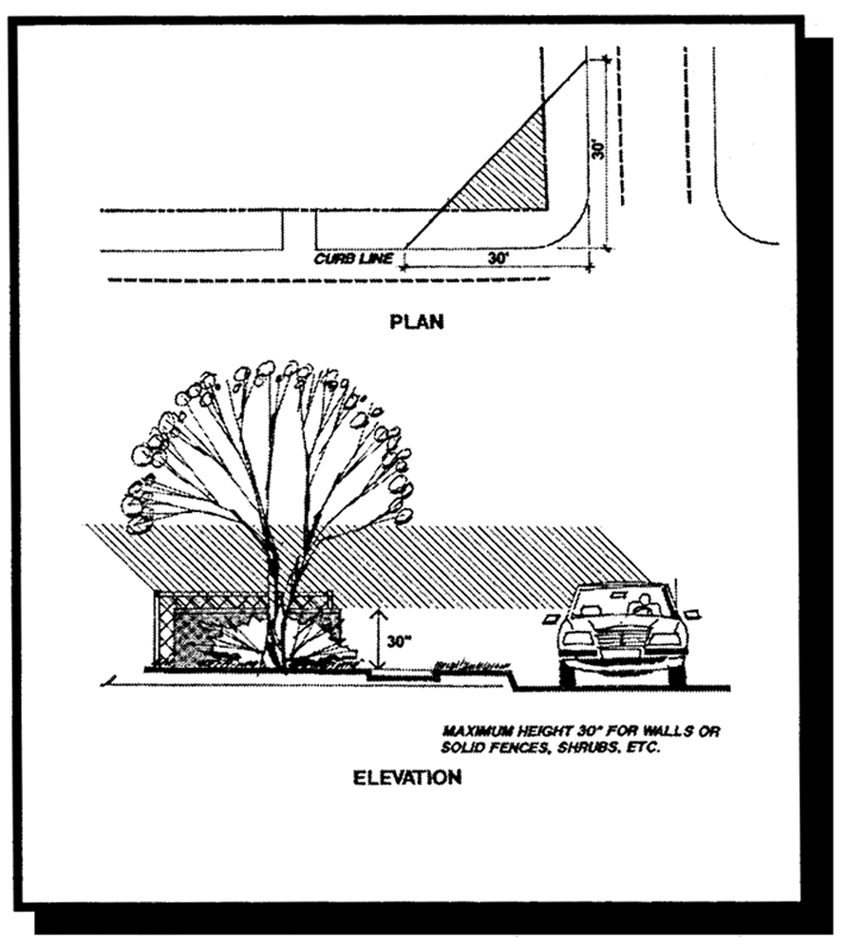
Clear Vision Area
Sec. 18.36. - Other Projections into Yards.
A.
Cornice, Sill, Chimney, or Fireplace. A cornice, eave belt course, sill, canopy, or other similar architectural feature (not including bay windows or other vertical projections which shall be a part of the main building), may extend or project into a required side yard not more than two (2) inches for each one (1) foot of width of such side yard and may extend or project into a required front or rear yard not more than thirty-six (36) inches. Chimneys or fireplaces may project into a required front, side, or rear yard not more than two (2) feet, provided the width of such side yard is not reduced to less than five (5) feet.
B.
Fire Escape. A fire escape may extend or project into any front, side, or rear yard not more than four (4) feet.
C.
Open Stairway or Balcony. An open, unenclosed stairway or balcony, not covered by a roof or canopy may extend or project into a required yard not more than six (6) feet and such balcony may extend into a required front yard not more than six (6) feet.
D.
Porch, Open. An unenclosed platform or landing which does not extend or project into any required front, side, or rear yard more than eight (8) feet is exempted from yard requirements provided that the width of a side yard is not reduced to less than five (5) feet. An overhang, canopy, or portico may be placed over the open porch, but it shall not be enclosed.
Sec. 18.38. - Access Through Yards.
Access drives may be placed in the required front or side yards so as to provide access to a rear yard. Further any walk, terrace, or other pavement serving a like function shall be permitted in any required yard.
Sec. 18.40. - Fences, Walls, or Other Specified Structures.
A.
Fences, Walls.
1.
The erection, construction or alteration of any fence, wall or other type of protective barrier shall require a building permit approved by the building inspector as to conformance to the requirements of the zoning district wherein it is required because of land use development, and to the requirements of this section.
2.
Fences or walls may be permitted in any yard, or along the edge of any yard. The height of fences, walls, and hedges shall not exceed six (6) feet in any side or rear yard. A fence in a business or industrial district may be permitted up to eight (8) feet in height along the side or front yard, providing it does not constitute an obstruction for motor vehicles. A security fence for a permitted use may include a maximum of one (1) additional foot of barbed wire in industrial and business districts only, In all other districts, no fence or wall along the side or front yard, or in front of the side building line of a corner lot shall be over three (3) feet in height.
3.
No fence shall be erected or maintained in such a way as to obstruct the vision of motorists exiting driveways. No fence or wall in a front yard on a corner lot, with a triangular section of land formed by the two (2) street right-of-way line and line connecting them at points thirty (30) feet from the intersection of such right-of-way line, shall exceed thirty (30) inches in height above the curb level.
4.
Fences may be placed up to a lot line. No parts of fences, including foundations, may extend beyond any lot line.
5.
The finish sides of fences in the rear or side yard may face towards or away from the property on which they are placed. If a fence is located in the front yard, the finished side shall face away from the property on which it is placed. If a fence exists in the rear or side yard of any adjacent lot, only one (1) other fence may be placed along the adjoining boundaries of such adjacent lot. Areas between abutting fences must be maintained in accordance with the city's Code of Ordinances.
6.
No fence, wall, or screen shall be erected within any public right-of-way, unless approved by the City Council.
7.
The use of electric current or charge of any fence or part thereof is prohibited, except those buried beneath the ground.
B.
Trees, Shrubs, Flowers, or Plants. Trees, shrubs, flowers, or plants shall be permitted in any front, side, or rear yard, provided it does not violate the corner setbacks as set forth in this section.
C.
Other Specified Structures. Walls, driveways, curbs, retaining walls, mailboxes, name plates, lamp posts, bird baths, and structures of a like nature shall be permitted in any front, side, or rear yard.
(Ord. No. 2002-16, 12-23-02; Ord. No. 2004-50, 8-23-04)
Sec. 18.42. - Rubbish and Waste Material.
It shall be unlawful throughout the city to openly store, collect, or place discarded building materials, refuse, junk, inoperable and unlicensed motor vehicles, or other similar materials, except upon land owned and operated as a state approved solid waste site, or as otherwise stated in the city ordinances.
Sec. 18.43. - Trash and Waste Containers.
Outside waste containers shall be permitted in the General Business, Local Business, Central Business and Multiple Family Residential District provided that they comply with the following requirements:
(a)
Adequate vehicular access shall be provided to such containers for truck pickup either via a public alley or vehicular access aisle which does not conflict with the use of off-street parking areas or entrances to or exits from principal buildings nearby.
(b)
Waste containers shall be screened from public view to the extent practical, taking into account any physical limitations of the site. Such screening shall utilize construction materials and techniques that are both ornamental and consistent with the surrounding area, and which are not in conflict with other sections of this appendix.
(c)
The waste containers(s), the screening wall or fence and the surrounding ground area shall be maintained in a neat and orderly appearance, free from rubbish, waste paper or other debris. This maintenance shall be the responsibility of the owner of the premises on which the containers are placed.
(d)
There shall be compliance with all city, county and state health ordinances and statutes.
(e)
No incinerator, garbage receptacle, oil or propane tank, or storage rack shall be exposed on the grounds outside any building without screening specified for waste containers and unless adequate safety and sanitary precautions are taken.
(Ord. No. 2002-9, 9-9-02)
Sec. 18.44. - Screening.
In order to provide adequate protective screening for residential areas adjacent to or near nonresidential areas, screening shall be provided in accordance with Article XX.
Sec. 18.46. - Grades.
No premises shall be filled or grades established, so as to discharge the surface runoff on abutting property in such a manner that will cause inconvenience or damage to adjacent properties.
Sec. 18.48. - Protection of Excavations.
The construction, maintenance, or existence within the city of any unprotected, unbarricaded, open, or dangerous excavations, holes, pits, wells, or of any excavations, holes, or pits which constitute or are reasonably likely to constitute a danger or menace to the public health, safety, or welfare are prohibited. This section shall not be construed so as to prevent any excavation under a permit issued pursuant to this Ordinance or other applicable ordinance or code, where such excavation is properly protected and warning signs are posted in such a manner as may be approved by the building inspector. Excavation required for swimming pools is excepted from the excavating provisions of this section provided that all necessary permits are obtained and the pool is constructed within thirty (30) days of the excavations. Excavation and site preparation for building foundations is also excepted from the excavation provisions of this section provided that such work is considered incidental to building construction and all necessary permits have been obtained.
Sec. 18.50. - Certificates Required for Excavations; Bonds.
The use of land for the excavation, removal, filling, or depositing in excess of thirty-six (36) inches, of any type of earth material, topsoil, gravel, or rock, or the excavation, removal, filling, or depositing of any garbage, rubbish, or other wastes or byproducts is not permitted in any zoning district, except under a certificate from and under the supervision of the building inspector in accordance with a topographic plan, approved by the city engineer and/or consultant, submitted by the developer or owner of the property concerned. The topographic plan shall be drawn at a scale of not less than fifty (50) feet equals one (1) inch and shall show existing and proposed grades and topographic features and such other data as may from time to time be required by the city. Such certificate may be issued in appropriate cases, upon the filing with the application of a cash bond or surety bond by a surety company authorized to do business in the state, running to the city, in an amount established by the city, which bond will be sufficient in amount to rehabilitate the property upon default of the operator or such other reasonable expenses. This regulation shall not be construed so as to apply to normal soil removal for basement or foundation work when a building permit has previously been duly issued by the building inspector.
Sec. 18.52. - Voting Places.
This Ordinance shall not be so construed as to interfere with the temporary use of any property as a voting place in connection with a municipal, state, federal, or other public election.
Sec. 18.54. - Automotive Fueling Stations, Service Stations, Repair Centers, and Public Garages.
A.
Purpose. In order to regulate and control the problems of noise, odor, light, fumes, vibration, dust, danger of fire and explosion, and traffic congestion which result from the unrestricted and unregulated construction and operation of automotive fueling stations, service stations, repair centers, and public garages, and to regulate and control the adverse effects which these and other problems incidental to automotive fueling stations, service stations, repair centers, and public garages may exercise upon adjacent and surrounding areas, the following regulations and requirements are provided for automotive fueling stations, service stations, repair center, and public garages located in any zoning district. All automotive fueling stations, service stations, repair centers, and public garages erected after the effective date of this Ordinance shall comply with this section. No automotive fueling station, service station, repair center, or public garage existing on the effective date of this Ordinance shall be structurally altered so as to provide a lesser degree of conformity with this section than existed on the effective date of this Ordinance.
B.
Minimum Area and Frontage. An automotive fueling station, service station, repair center, or public garage shall be located on a lot having a frontage along the principal street of not less than one hundred fifty (150) feet and having a minimum area of fifteen thousand (15,000) square feet.
C.
Setbacks. An automotive fueling station, service station, repair center, or public garage building housing an office and/or facilities for servicing, greasing, and/or washing motor vehicles shall be located not less than forty (40) feet from any street lot line and not less than fifteen (15) feet from any side or rear lot line directly adjoining a residential zoning district, unless required otherwise by this Ordinance. In cases where the side or rear line abuts an open public alley, the structure may be constructed on such property line.
D.
Driveway and Curbs. All driveways providing ingress to or egress from an automotive fueling station. Service station, repair center, or public garage shall comply with the requirements and standards stated in Article XXI of this Ordinance.
E.
Paved Areas. The entire lot, excluding the area occupied by a building shall be hard surfaced with concrete or a plant-mixed bituminous material, except approved landscaped areas.
F.
Equipment Location. All lubrication equipment, motor vehicle washing equipment, hydraulic hoists and pits shall be enclosed entirely within a building. All gasoline and fuel pumps shall be located not less than fifteen (15) feet from any lot line and shall be arranged so that motor vehicles shall not be supplied with gasoline or serviced while parked upon or overhanging any public sidewalk, street, or right-of-way.
G.
Number of Pumps. An automotive fueling station, service station, or repair center located on a lot having an area of fifteen thousand (15,000) square feet or less shall include not more than four (4) double gasoline and fuel pumps or eight (8) single gasoline and fuel pumps and two (2) enclosed stalls for servicing, lubricating, greasing, and/or washing motor vehicles. An additional two (2) gasoline and fuel pumps and/or one (1) enclosed stall may be included with the provision of each additional two thousand (2,000) square feet of lot area.
H.
Screening. For all automotive fueling stations, service stations, repair centers, or public garages screening shall be provided in accordance with Article XX of this Ordinance.
I.
Lighting. All exterior lighting, including illuminated signs, shall be erected and hooded or shielded so as to be deflected away from adjacent and neighboring property, and shall comply with the performance measures stated in Article XVIII of this Ordinance.
J.
Prohibited Locations. No automotive fueling station, service station, or repair center shall be located nearer than two hundred (200) feet, as measured from any point on the property line, to any school, playground, church, or hospital.
K.
Outdoor Storage and Parking. All repair work shall be conducted completely within an enclosed building. There shall be no storage of vehicle components, parts, trash, supplies, or equipment outside of a building. Outdoor storage or parking of vehicles or trailers, other than private passenger automobiles, shall be prohibited between 10:00 p.m. and 7:00 a.m. of the following day, except that equipment rental operations shall be permitted if incidental to the automotive fueling station, service station, or repair center, and if restricted to travel trailers or campers of under twenty-one (21) feet overall length, car-top carriers, and similar auto accessories. Such operations shall be within fenced enclosures observing the same setbacks required for buildings in the zoning district wherein the automotive fueling station, service station, or repair center is located, and their storage area shall not exceed twenty (20) per cent of the area of the area of the automotive fueling station, service station, or repair center site.
L.
Removal of Underground Storage Tanks and Remediation of Sites. In the event that an automotive fueling station, service station, repair center, or public garage use has been abandoned or terminated, all underground storage tanks shall be removed and any contamination present on the site shall be corrected in accordance with all applicable local, state, and federal laws.
Sec. 18.56. - Essential Public Services.
Essential public services shall be permitted in any zoning district as authorized and regulated by law and other provisions of this Ordinance and the city's Code of Ordinances, it being the intention hereof to exempt such essential services from the application of this Ordinance.
The planning commission may permit the erection and use of a building or an addition to an existing building of a public service corporation or for public utility purposes, in any permitted district to a greater height or of a larger area than the district requirements herein established and may permit the location in any use district of a public utility building, structure, or use, if the commission finds such use, height, area, building, or structure reasonably necessary for the public convenience and services, and if such building, structure, or use is designed, erected, and landscaped to conform harmoniously with the general architecture and plan of such district.
Sec. 18.58. - Drive-in and Drive-through Establishments.
A.
Screening. For all drive-in or drive-through establishments, screening shall be provided in accordance with the standards and requirements of Article XX of this Ordinance.
B.
Lighting. All exterior lighting, including illuminated signs, message boards, or ordering stations shall be erected and hooded or shielded so as to be deflected away from adjacent and neighboring property, and shall comply with all the performance measures stated in Article XVIII of this Ordinance.
C.
Setbacks. A drive-in or drive-through establishment, including any message boards or ordering stations shall be located not less than fifteen (15) feet from any side or rear lot line directly adjoining a residential zoning district.
D.
Driveways and Curbs. All driveways providing ingress to or egress from a drive-in or drive-through establishment shall comply with the standards and requirements stated in Article XXI of this Ordinance.
E.
Paved Areas. The entire lot, excluding the area occupied by a building shall be hard surfaced with concrete or a plant-mixed bituminous material, except approved landscaped areas.
Sec. 18.60. - Tourist Homes; Bed and Breakfast.
Where allowed, either as a permitted or conditional use, the planning commission shall in addition to any standards set forth elsewhere in this Ordinance also review the application and require compliance with the following standards:
A.
Application. An initial application to establish or re-establish a bed and breakfast operation shall be made to the building inspector for its review and action. The application shall, as a minimum include the following information:
1.
A floor plan of the single-family dwelling drawn to a scale of not less than one-eighth (⅛) inch equals one (1) foot and showing the layout of the building. The location of the guest room(s), bathroom(s), and such other information as required herein to facilitate proper review of the application.
2.
A site plan of the lot drawn to a scale of not less one-eighth (⅛) inch equals one (1) foot and showing the existing structure and any accessory structures on the site, the location of driveways and vehicular parking areas.
B.
Plan review. The building inspector shall review the application and the floor and site plan for compliance with all pertinent standards and conditions.
C.
Dwelling unit and operator requirements. Bed and breakfast facilities shall be confined to the single-family dwelling unit which is the principal dwelling unit on the property. The dwelling unit in which the bed and breakfast facility is to be located, shall be the principal residence of the operator, and said operator shall live within said principal residence when bed and breakfast operations are active.
D.
Total area used for bed and breakfast. Not more than fifty (50) per cent of the total existing floor area of the dwelling structure at the time of initial application, shall be devoted to bed and breakfast operations. The method of determining floor area shall be based on the definition of "usable floor area" as defined in this Ordinance.
E.
Exits. The bed and breakfast facility shall contain at least two (2) usable exits to the outdoors.
F.
Minimum guest room size. Rooms utilized for guest sleeping shall have a minimum floor area of one hundred (100) square feet for two (2) occupants, with an additional thirty (30) square feet provided for each additional occupant up to a maximum of four (4) occupants per room.
G.
Cooking facilities. No separate cooking facilities shall be provided for bed and breakfast guests, nor shall existing cooking facilities be made available for use by the bed and breakfast guests.
H.
Sanitary facilities. Adequate lavatories, water closets, and bathing facilities shall be provided to all guests in a bed and breakfast facility.
I.
Safety devices. Each sleeping room shall have a separate smoke alarm and each floor shall be equipped with at least one (1) fire extinguisher.
J.
Appearance. The structure must maintain the appearance of a single-family residence.
K.
Parking. A single off-street parking area shall be provided for the occupants and employees with at least one (1) parking space for each sleeping room provided for guests plus at least two (2) parking spaces for the owner.
L.
Signs. One (1) nonilluminated sign, not to exceed three (3) square feet in area, shall be permitted to identify by name the bed and breakfast. Such sign may be attached flat to the surface of the principal dwelling or freestanding provided that it shall not be located within the required front yard setback.
M.
Guest register. Each operator shall keep a list of the names of all persons staying at the bed and breakfast operation. Such list shall be available for inspection by city officials at any time.
N.
Length of stay. The maximum stay for any occupant of a bed and breakfast operation shall be fourteen (14) consecutive days and not more than forty-five (45) days in one (1) year.
O.
Annual inspection and renewal. All bed and breakfast operations shall be subject to annual inspection by the building inspector to ensure that the use continues to meet or exceed the standards established herein and/or otherwise by the planning commission. Failure to comply with the standards shall result in the revocation of the ability to use said property for the purpose of a bed and breakfast operation.
P.
Appeal. An applicant denied renewal of permission to use the property for a bed and breakfast operation may appeal that decision to the City of Eaton Rapids Zoning Board of Appeals for further review and consideration in accordance with the rules and procedures for hearings appeals as set forth and regulated in this Ordinance. The board may approve or deny the appeal for reissuance when, in the board's opinion, good cause is shown after investigation and after opportunity has been given to the applicant to be heard.
In its investigation, the board shall consider compliance or noncompliance with local, state, and federal standards, ordinances, or regulations in addition to the conduct of the applicant relative to the public and the guidelines set forth in this ordinance.
Sec. 18.62. - Storage and Repair of Vehicles in Residential Districts.
The carrying out of repair, restoration, and maintenance procedures on vehicles in any residential zoning district, when such work is not conducted entirely within the interior of the vehicle, shall be subject to the following limitations:
A.
Procedures exceeding forty-eight (48) hours in duration or which require the vehicle to be immobile or inoperable in excess of forty-eight (48) hours shall be carried out within an enclosed building.
B.
Inoperable vehicles, vehicle parts, equipment, tools, and supplies shall be stored within an enclosed building.
C.
Only vehicles owned or operated by a member of the immediate family residing at a given residence may be repaired, restored, maintained, or stored at that residence at any given time, whether or not such work is conducted entirely within the interior of the vehicle.
Sec. 18.64. - Storage and Parking of Commercial, Farm, and Recreational Vehicles in Residential Districts.
A.
Location and Duration. For motor homes, travel trailers, folding-type trailers, pickup campers, snowmobiles on trailers, boats and similar and related type units, and other recreational vehicles as defined by this Ordinance, or for farm implements and tractors on sites that are actively being cultivated, the regulations of outside storage on all lots zoned and/or used for residential purposes are as follows:
1.
A total of two (2) but not more than one (1) of each such unit may be stored or parked outside on a lot which is zoned and/or used for residential purposes. The ownership of such units shall be in the name of a member of the immediate family of the lot's owner, tenant, or lessee. However, farm tractors, equipment, and implements may be stored either in an enclosed building or they may be stored outdoors provided that the subject site is being actively cultivated. Further, that restored antique farm equipment is exempt from this subsection if displayed for decorative purposes.
2.
Such units, when stored outside, shall be located in a side or rear yard, except as provided in the case of vacant lots. Such units shall be placed or parked on a lot with a principal building, structure, or use unless it is a lot which is attached to an occupied lot under the same ownership. Such units shall not be closer than ten (10) feet from any structure nor five (5) feet from any lot line, unless otherwise provided by this section.
3.
The combined area covered by the dwelling, accessory buildings, other above-ground structures and swimming pools, and the area covered by the outside storage of such units, may not exceed forty (40) per cent of the total area of the lot.
4.
Recreational vehicles or recreational equipment may be stored, parked, or placed within any front yard or within a public right-of-way whereon street parking is permitted for a period not exceeding forty-eight (48) hours for loading and unloading or in the process of normal maintenance and cleaning.
5.
In the case of corner lots, as defined with two (2) front yards, the regulations of this section shall apply to both front yards. The side yard facing the street will be considered a second front yard.
6.
In the case of through lots, parking shall be permitted in the side yard or in the effective rear yard, as determined by the building inspector, provided the parked vehicle meets the front and side yard principal building setback requirements of the zoning district.
7.
In the case of through lots on a corner (i.e., lots having frontage along three (3) streets), parking shall be allowed only in the side yard. The building inspector may permit parking in the effective rear yard, as noted in subparagraph 6. above, upon determination that such parking is allowed in the adjacent lot.
8.
In the case of lots where the location of the principal structure or site topography prevents access to the side or rear yard, the building inspector may permit parking of recreational vehicles or equipment in a driveway or on a paved parking pad within a front yard for a period of not more than one hundred eighty (180) days in any one (1) calendar year.
9.
None of such units or any recreational equipment parked or stored outside shall be connected to electricity, water, gas, or sanitary facilities for living, lodging, or housekeeping purposes and none of the same shall be used for living, lodging, or housekeeping purposes, unless otherwise approved by the chief of police in cases of emergency.
10.
All recreational equipment and vehicles shall be maintained in good condition, shall be operable and shall have a current license and/or registration.
B.
Prohibited Items. The parking and/or storage of buses, converted buses, and boats in excess of thirty (30) feet in length for a period exceeding forty-eight (48) hours, is prohibited, unless a permit has been issued by the building inspector. Said permit shall be valid for a period not to exceed ten (10) consecutive days out of any ninety (90) days.
C.
Storage on Vacant Lots. Not more than one (1) recreational unit, motor home, travel trailer, pickup camper, folding-type trailer, boat, or similar and related type unit, and other recreational vehicles as defined by this Ordinance, may be parked or stored on a vacant residentially zoned lot, except as otherwise authorized by this Ordinance. When stored on a vacant lot, such unit shall be located only on the rear half of such lot.
D.
Camper Tops. Detachable camper tops shall not be stored in any residential district except in accordance with this section. Further, camper tops that are not installed on a licensed and operable vehicle must be placed on the ground and stabilized.
E.
Handicapped Vehicles/Equipment. A recreational vehicle and/or recreational equipment which is officially designated as handicapped in accordance with state law and which is used as the regular means of transportation by or for handicapped person may be parked within the required setback area.
F.
Commercial Vehicles. It shall be unlawful for the owner, tenant, or lessee of any lot in any residential zoning district to permit the open storage or outdoor parking of semi-tractor (WB-50 or larger) trucks and/or semi-trailers, bulldozers, earth carriers, cranes, or any other similar equipment or machinery, unless parked thereon while in use for approved construction on such lot.
(Ord. No. 2002-8, 8-26-02; Ord. No. 2007-9, 9-24-07)
Sec. 18.66. - Temporary Buildings, Structures, and Uses for Construction or Special Events.
Temporary principal or accessory buildings, structures, and uses may be permitted, subject to the following conditions:
A.
General.
1.
Temporary buildings and structures may only be used for the storage of construction materials, tools, supplies, and equipment for construction management and supervision offices and for temporary on-site sanitation, solid waste or fuel facilities related to construction activity on the same lot, and for seasonal or special events.
2.
No temporary building or structure shall be used as a dwelling unit.
3.
The placement of temporary buildings and structures shall be in conformance with the requirements of this Ordinance. A zoning permit for such building or structure shall be issued by the building inspector prior to installation.
4.
Temporary buildings and structures shall be removed from the lot within fifteen (15) days after an occupancy permit is issued by the building inspector for the permanent structure on such lot, when applicable, or within fifteen (15) days after the expiration of a building permit issued for construction on such lot, when applicable.
5.
Temporary uses, seasonal uses, or special events may be allowed in any district upon issuance of a permit, when meeting the standards listed below:
a.
Seasonal sales events may be allowed on any lot with a permitted principal building. Seasonal sales may also be allowed on a vacant lot when providing the minimum setback for buildings, structures, and parking required for the appropriate zoning district. In no case shall the setbacks for buildings, structures, and parking be less than ten (10) feet.
b.
If the petitioner is not the owner of the property, the petitioner shall provide written permission of the owner of the property to allow such a use or event.
c.
The use or event, in the opinion of the building inspector will not be harmful nor impair the use and enjoyment of the existing adjacent uses.
6.
A sketch plan drawn to scale shall be provided illustrating the following:
a.
Property lines.
b.
Adjacent uses and zoning districts.
c.
Existing and proposed buildings and structures.
d.
Location of any areas for storage such as inventory not being displayed.
e.
Fire hydrants.
f.
Layout of parking.
g.
Boundaries of proposed sales areas.
h.
The location and size of any proposed sign (off-premises signs shall also be identified).
B.
Review and approval procedures, permit fees, and required escrow.
1.
The building inspector shall review and approve requests for a temporary use or seasonal event. Where appropriate, the building inspector shall consult with the fire department and police department. If the request is denied, the building inspector shall state the reasons for denial in writing and provide a copy to the applicant.
2.
The applicant shall pay a nonrefundable permit fee to the city treasurer. The fee shall be established and may from time to time be modified, by the city council. The fee amount may vary depending upon the type of event.
3.
The proprietor of the temporary use or seasonal event may be required to deposit a cash bond or similar type of escrow, in an amount established by the city council, prior to the issuance of the permit. The escrow shall be used by the city to pay the cost of returning the property to its condition prior to commencement of the event or refunded to the proprietor upon compliance with the requirements of this Ordinance and any other applicable ordinances.
Sec. 18.68. - Sexually Oriented Businesses.
A.
Authorization. In the preparation, enactment, and enforcement of this section, it is recognized that there are some uses relating to sexual material which, because of their very nature have serious operational characteristics that have a deleterious effect upon residential, office, and commercial areas. Because certain forms of expression relating to sexual material have particular functional and inherent characteristics with a high potential of being injurious to surrounding properties by depreciating the quality and value of such property, it is the intent of this section to provide a framework of reasonable regulatory standards which can be used for approving or disapproving the establishment of this type of use in a viable and accessible location, where the adverse impact of their operations may be minimized.
B.
Site Location Principles. The following principles shall be utilized to evaluate the proposed location of any such use. These principles shall be applied by the planning commission as general guidelines to help assess the impact of such a use upon the district in which it is proposed:
1.
No sexually oriented business shall be located within five hundred (500) feet, measured from the outer most boundaries of the lot or parcel upon which the proposed adult use will be situated, of a: residential zoning district, church, monastery, temple, or similar place of worship, school, library, public park or playground, noncommercial assembly facility, public office building, licensed day care facility as defined in Act 116 of the Public Acts of 1973, as amended (MCLA 722.111 et seq.), or arcade.
2.
A sexually oriented business shall be located only in the Limited Industrial Zoning District or the General Industrial Zoning District.
3.
No sexually oriented business shall be permitted within a one thousand (1,000) foot radius of an existing sexually oriented business. Measurement of the one thousand (1,000) foot radius shall be made from the outer most boundaries of the lot or parcel upon which the proposed adult use will be situated.
C.
Site Development Requirements. In addition to the site development standards and requirements specified elsewhere in this Ordinance the following shall be complied with for all sexually oriented businesses:
1.
The site layout, setbacks, structures, function, and overall appearance shall be compatible with adjacent uses and structures.
2.
Windows, displays, signs, and decorative structural elements of buildings shall not include or convey examples of a sexual nature. All such displays and signs shall be in conformance with this Ordinance and shall be approved by the planning commission prior to their use.
3.
All building entries, windows, and other such openings shall be located, covered, or screened in such a manner as to prevent viewing into the interior from any public or semi-public area and wherever else it is requested by the planning commission.
4.
No loud speakers or sound equipment shall be used by an sexually oriented business that projects sound outside of the sexually oriented business so that sound can be discerned by the public from public or semi-public areas.
5.
A sexually oriented business shall clearly post at the entrance to the business, or that portion of the business utilized for adult only purposes, that minors are excluded.
D.
Use Regulations.
1.
No person shall reside in or permit a person to reside in the premises of a sexually oriented business.
2.
No person shall operate an sexually oriented business unless there is conspicuously placed in a room where such business is carried on, a notice indicating the process for all services performed therein. No person operating or working at such a place of business shall solicit or accept any fees except those indicated on any such notice.
3.
The owners, operators, or person in charge of a sexually oriented business shall not allow entrance into such building or any portion of a building used for such use, to any minors as defined by MCL 722.51 et seq., as amended.
4.
No sexually oriented business shall posses or disseminate or permit persons therein to posses or disseminate on the premises any obscene materials as defined by MCL 752.361 et seq., as amended.
5.
No person shall operate an adult personal service business without obtaining a license from the City of Eaton Rapids for the same. Such licenses shall be issued in compliance with the City of Eaton Rapids Code. Such license shall be subject to all regulations of federal, state, and local governments.
6.
No person shall be come the lessee or sublessee of any property for the purpose of using said property for an adult entertainment business without the express written permission of the owner of the property for such use.
Sec. 18.70. - Telecommunications Towers.
Alternative tower structures and antennas, telecommunication towers, alternative tower structures and antennas shall meet the following in addition to all other applicable standards and requirements provided in this Ordinance:
A.
Setbacks. All towers shall be set back from all exiting street right-of-way, adjacent property lines, and power transmission lines by a distance of no less than equal to that of the height of the tower.
B.
Security fencing. Telecommunications towers or alternative tower structures and attendant accessory structures shall be enclosed by security fencing at least six (6) feet in height and shall also be equipped with an appropriate anti-climbing device.
C.
County, state, or federal requirements. All telecommunication towers or alternative tower structures must meet or exceed current standards and regulations of the county, the FAA, the FCC, the Michigan Aeronautics Commission (MAC), and any other agency of the state or federal government with the authority to regulate telecommunication towers or alternative tower structures and antennas. The applicant shall submit written proof all applicable standards have been complied with. If such standards and regulations are changed, then the owners of the telecommunication towers or alternative tower structures and antennas governed by this Ordinance shall bring such telecommunication towers and alternative tower structures and antennas into compliance with such revised standards and regulations within six (6) months of the effective date of such standards and regulations, unless a different compliance schedule is mandated by the controlling agency. Failure to bring telecommunication towers or alternative tower structures and antennas into compliance with revised standards and regulations shall constitute grounds for the removal of the telecommunication towers or alternative tower structures or antenna at the owner's expense.
D.
Lighting. Towers shall not be artificially lighted unless required by the FAA, the MAC, or other applicable authority. If lighting is required, the lighting alternatives and design chosen must cause the least disturbance of the surrounding views. Unless required by federal or state law, all sources of lighting for parking areas or for external illumination of buildings or grounds or for the illumination of any signs, shall be directed away from and shall also be arranged as to not affect driver visibility on adjacent public roads and highways.
E.
Compliance with codes. Telecommunication towers, alternative tower structures, and antenna, shall comply with all pertinent electrical and building codes.
F.
Permitted locations. Alternative tower structures and antennas, telecommunication towers, alternative tower structures and antennas are permitted only on a priority basis only on the following sites; a) governmentally owned sites; b) religious or other institutional sites; c) public or private school sites, or d) public park or public open space areas.
Sec. 18.72. - Performance Standards.
Any use permitted by this Ordinance, including conditional uses, is subject to compliance with the performance standards set forth in this section. No use hereafter established shall exceed the limits set forth in this section, except as provided in this Ordinance.
A.
Noise. No operation or activity shall be carried out in any zoning district, which operation or activity causes or creates measurable noise levels exceeding the maximum sound pressure levels described in this section, as measured on or beyond the boundary lines of such district. Sound measurements shall be made with industry accepted equipment and methodology.
1.
The maximum permitted sound pressure levels, in decibels, are as follows:
Noise levels shall not exceed seventy-five (75) decibels measured at the property line during the hours of 7:00 a.m. through 9:00 p.m. and shall not exceed sixty-five (65) decibels during the hours of 9:00 p.m. through 7:00 a.m.
B.
Dust, soot, dirt, fly ash, and products of wind erosion. No person shall operate or cause to be operated or maintained any process for any purpose, a furnace or a combustion device for the burning of coal and/or natural or synthetic fuels without maintaining and operating while using the process, furnace, combustion device, recognized and approved equipment, means, methods, devices, or contrivances to reduce the quality of gas-borne or air-borne solids carried in fumes emitted, directly or indirectly, into the open air, to a concentration level (per cubic foot of the carrying medium at a temperature of five hundred (500} degrees Fahrenheit) not exceeding two-tenths (0.20) grains. These standards are not intended to apply to residential uses, such as chimneys for fireplaces or wood/coal burning stoves.
C.
Smoke. No person shall discharge into the atmosphere, from any single source of emission, excepting smoke from a chimney for a fireplace or wood/coal burning stove in a residential structure, any smoke of a density or equivalent capacity which exceeds for any period of time, the density designated as No. 1 on the Ringelmann Chart or twenty (20) per cent opacity, which is hereby incorporated into this Ordinance by reference, except when the emission consists only of water vapors, or the shade, or appearance of which is equal to, but not darker than No. 2 of the Ringelmann Chart, for a period, or periods aggregating four (4) minutes in any thirty (30) minutes.
D.
Vibration. Machines or operations which cause vibration shall be permitted, but no operations shall be permitted to produce ground transmitted oscillations which cause a displacement exceeding that specified in the following tables and/or as measured at the property line. These vibrations shall be measured with a seismograph or accelerometer, preferably the former.
1.
The maximum permitted steady state vibration, in inches, is as follows:
2.
The maximum permitted impact vibration, in inches, is as follows:
Between 9:00 p.m. and 7:00 a.m. of the following day, all maximum vibration levels, as measured at the boundary line of residentially used areas adjacent to non-residentially zoned districts, shall be reduced to one-half (½) the indicated permissible values by those activities causing the vibration.
E.
Odor. The emission of noxious, odorous matter in such quantities as to be readily detectable at a point along any property line, when diluted in the ratio of one (1) volume of odorous air to four (4) or more volumes of clean air, so as to produce a public nuisance or hazard beyond lot lines is prohibited.
F.
Glare, heat, and light. Any operation producing intense glare or heat (such as or similar to arc welding or acetylene torch cutting) which emits harmful rays shall be preformed within an enclosure so as to completely obscure and shield such operation from direct view from any point along the lot lines and as not to create a public nuisance or hazard along such lot lines, except during the period of construction of the facilities to be used and occupied. Bare bulbs in or near a residentially used area shall be not greater than ten (10) watts. Within five hundred (500) feet of a residentially zoned area, bare bulbs which are visible in the residential area may not exceed fifteen (15) watts. Exterior lighting shall be so installed that the surface of the source of light shall not be visible from the nearest residential district boundary, and it shall be so arranged to reflect light away from any residential use. In no case, shall more than one (1) footcandle power of light cross a lot line five (5) feet or more above the ground. In no case shall more than ten (10) footcandle power of light exist at any given point on site. Exterior spotlighting or other illumination shall be so installed as to eliminate any nuisance to adjoining business and industrial districts or the creation of a traffic hazard on public highways.
G.
Fire and safety hazards. The storage and handling of flammable liquids, liquefied petroleum gases, and explosives, ranging from free or active burning to intense burning, as determined by the fire chief, and highly toxic and highly radioactive materials shall comply with all state rules and regulations, regulations as established by the Fire Prevention Act, Act 207 of the Public Acts of 1941, as amended (MCLA 29.1 et seq.), the Flammable and Combustible Liquids Code (pursuant to Act 154 of the Public Acts of 1974, as amended, 29 CFR 1910.106, NfiPA prevention codes, and the requirements of the state fire marshal.
Further, such materials or products, if stored, utilized, or produced within completely enclosed buildings or structures, shall have incombustible exterior walls and meet the requirements of the applicable building code. All such buildings or structures shall be set back at least forty (40) feet from lot lines and all such buildings or structures.
Further, all exterior above-ground storage tanks for flammable liquid materials, liquefied petroleum gases, explosives, and highly toxic and highly radioactive materials shall be completely surrounded by earth embankments, dikes, and other types of retaining walls which will contain the total capacity of all tanks so enclosed. Below-ground bulk storage tanks of flammable liquids shall be located not closer to the property line than twice the depth to the bottom of the buried tank.
H.
Open fires. No person operating a permitted or conditional use shall cause to be burned any combustible refuse in an open outdoor fire.
I.
Sewage wastes. Sewage wastes shall comply with the City of Eaton Rapids Code regarding sewer use and the performance measures established therein.
J.
Gases. The escape or emission of any gas which is injurious, destructive, or explosive is unlawful and may be summarily caused to be abated. Sulphur dioxide gas, as measured at the property line at ground elevation, shall not exceed an average of three-tenths (0.3) ppm; hydrogen sulfide shall not exceed one (1.0) ppm; fluorine shall not exceed one-tenth (0.1) ppm; nitrous fumes shall not exceed five (5.0) ppm; and carbon monoxide shall not exceed fifteen (15.0) ppm, all measured as the average intensity during any twenty-four (24) hour sampling period.
K.
Radio transmissions, explosives, and radioactive materials. For electronic equipment required in an industrial operation, the equipment shall be shielded so that its operation will not interfere with radio, television, or other electronic equipment. All explosives and radioactive materials shall be stored and/or used in a manner which does not endanger abutting properties. Radioactive materials and wastes, and including electromagnetic radiation, such as X-ray machine operation, shall not be emitted to exceed quantities established as safe by the U.S. Bureau of Standards, when measured at the property line. All transportation, including by rail, of radioactive materials, hazardous waste, and toxic waste shall be within permissible standards set by the federal government. Applicable regulations of the Federal Communications Commission regarding electromagnetic radiation are hereby incorporated into this Ordinance by reference.
L.
Drifting and air-borne matter. The drifting or air-borne transmission beyond the lot line, of dust, particles, or debris from any open stockpile is unlawful and shall be summarily caused to be abated.
M.
Nuisances. A person or industry shall not discharge from any source whatsoever such quantities of air contaminants or other materials which cause injury, detriment, or nuisance to the public, which endanger the comfort, repose, health, or safety of the public, or which cause or have natural tendency to cause injury or damage to business or property.
N.
Stormwater. All stormwater generated by a use and/or structure shall be managed and discharged in accordance with all applicable local, state, federal, and county drain commission standards and requirements.
(Ord. No. 2024-3, § 1, 10-28-24)
Sec. 18.74. - Site Condominium Projects.
For the purposes of this Ordinance, the term "site condominium project", shall mean a plan or project consisting of not less than two (2) single-family units established in conformance with he Michigan Condominium Act, P.A. 59 of 1978, as amended.
Sec. 18.76. - Site Condominium Development Standards.
A.
Purpose and Scope.
1.
Site condominium projects are condominium developments in which each condominium unit consists of an area of vacant land and a volume of vacant air space within which a building or other improvements may be constructed by the condominium unit owner. Each site condominium unit may also have an appurtenant limited common element reserved for the exclusive use of the owner of the condominium unit. Either the condominium unit by itself, or the condominium unit taken together with any contiguous, appurtenant common element, shall be considered to constitute a building site which is the functional equivalent of a "lot" for the purpose of this Ordinance and other applicable laws, ordinances, and regulations.
Site condominium projects may also include general common elements consisting of common open space, recreational areas, streets, and other areas available for use by all owners of condominium units within the project. Subject to the district zoning provisions applicable to the project's location, any land use permitted by the City of Eaton Rapids Zoning Ordinance may be permitted in a site condominium project.
2.
The purpose of this section is to ensure that the plans for developments within the City of Eaton Rapids proposed under the provisions of the Condominium Act, Act 59 of the Public Acts of 1978, as amended shall be reviewed with the objective and intent of achieving the same characteristics as if the development and improvements therein were being proposed pursuant to the Subdivision Control Act, Act 288 of the Public Acts of 1967, as amended. It is further the intent of this Section to ensure that such development is in conformance with the requirements of this Ordinance, the City of Eaton Rapids Subdivision Regulations, Appendix B, and other applicable city ordinances and state and federal regulations.
B.
Zoning Permit Issuance. Prior to the issuance of any zoning permit for any use within a site condominium project, the planning commission shall have approved a preliminary and final development plan meeting the requirements of this Ordinance.
C.
Site Condominium Layout, Design, and Required Improvements. Site condominium subdivision plans shall conform to the design, layout, and improvement standards included in the City of Eaton Rapids Development Standards Ordinance, Appendix B, as adopted and amended, and specifically the following sections from Article IV, Appendix B, which are included herein by reference:
1.
Section 400, Streets and alleys.
2.
Section 401, Utility and other easements.
3.
Section 402, Lots.
4.
Section 403, Blocks.
5.
Section 404, Open spaces.
6.
Section 405, Sidewalks.
7.
Section 406, Use.
8.
Section 407, Commercial or industrial modification.
9.
Section 408, Utilities and improvements.
D.
Inspections and Specifications. The city council may establish inspection fees, inspection requirements, specification standards, and administrative procedures as provided by law and such shall be deemed to be requirements of this Ordinance. All plans and installation of improvements called for shall be subject to the approval of the city or its agent, or such other competent persons as designated by the city. All inspection fees shall be paid by the applicant before the final plan is signed by the city unless adequate financial guarantees are given to the city prior to final plan approval.
E.
Height, Bulk, Density, and Area. The height, bulk, density, and area by land use requirements set forth in this Ordinance shall also apply to condominium units. For purposes of this section, the minimum building site is equivalent to the minimum lot size of the respective zoning district.
F.
Setbacks and Boundaries. The setback requirements for condominium buildings shall be determined as follows:
1.
Single-family detached units.
a.
The front yard setback shall be one-half (½) the approved or recorded street right-of-way, plus the current setback for the existing zoning district.
b.
The side yard setbacks shall be twice the minimum required within the zoning district. The distance from the unit to the limit of development shall meet the minimum required side yard setback within the zoning district.
c.
The rear yard setback between the rear of two (2) units shall be twice the minimum rear yard setback of the zoning district. The distance from the rear of the unit to the limits of the development shall meet the minimum rear yard setback of the zoning district.
2.
Multiple-family units. Multiple-family units shall meet the standards of the Multiple-Family Residential District (MFRD).
3.
The relocation of boundaries as defined in Section 148 of the Michigan Condominium Act, shall conform to all setback requirements of this section, of the district in which the project is located, shall be submitted to the planning commission for review and approval, and these requirements shall be made a part of the bylaws and recorded as part of the master deed.
G.
Common Elements. After construction of a condominium unit, the undeveloped area of a unit shall become a common element.
H.
Encroachment. A condominium project shall not be constructed in a manner that intentionally creates an encroachment.
I.
Subdivision of Unit Sites. Subdivision of condominium unit sites is permitted following planning commission review and approval, contingent upon the submission of an amended master deed to determine the effect of the subdivision on the conditions of zoning or development plan approval, and shall be made as part of the bylaws and recorded as part of the master deed.
J.
Conformance with Subdivision Regulations. All condominium project plans shall conform to the plan preparation requirements, design layout, and improvements standards as established within this Ordinance or with the city's Code of Ordinances.
K.
Water and Waste Water. The condominium project shall comply with and meet all federal, state, county, and city standards for a fresh water system and waste water disposal.
L.
Expansion and Conversion. Prior to expansion or conversion of a condominium project to additional land and new phases, it must be reviewed and approved by the planning commission.
M.
Master Deed. The project developer shall furnish the city with one (1) copy of the proposed consolidated master deed, one (1) copy of the bylaws, and two (2) copies of the proposed plans. The proposed plans shall be reviewed for compliance with this Ordinance and the city's Code of Ordinances and to insure that an assessment mechanism has been included to guarantee adequate maintenance of common elements.
N.
As-Built Plans and Occupancy. Submission of an as-built plan of a condominium unit is required prior to occupancy. The building inspector may allow occupancy of the project before all improvements required are installed provided that an escrow is submitted to the city clerk, sufficient in amount and type to provide for the installation of improvements before the expiration of the temporary occupancy permit without expense to the city. The amount and form of the escrow shall be determined by the city council. Fees for these reviews may be established from time to time by the city council.
O.
Final By-Laws, Consolidated Master Deed, and Site Plan. Upon approval of the development, the applicant shall furnish the city a copy of the by-laws and consolidated master deed. The development plan shall be provided on a mylar sheet of at least twenty-four (24) inches by thirty-six (36) inches.
P.
Compliance With Other Statutes and Ordinances. All condominium projects shall comply with pertinent federal, state, and local laws, statutes, and ordinances.
Q.
Site Condominium Review and Approval Procedures (Step I Review). Application for review and approval of a site condominium subdivision shall be in accordance with the following procedures:
1.
Prior to the formal application for a site condominium development, the developer shall meet with the planning commission. The purpose of this meeting is to inform the planning commission of the applicant's intent to initiate a site condominium project. On or before this meeting, the applicant shall submit the following to the building inspector, who shall distribute is to all planning commission members, the city manager, and the city engineer or consultant.
a.
A sketch drawn to scale, indicating the general location and configuration of the property to be developed; the alignment of streets and building sites; and the relationship of the proposed project to adjacent streets and neighboring properties.
b.
A statement regarding the provision of sewer service and water supply.
2.
During the preliminary discussion meeting, the planning commission, based on the information available to it, shall inform the applicant of the following:
a.
General requirements of this section and other applicable provisions of this Ordinance and the Subdivision Regulation Ordinance.
b.
Planned or anticipated sites of parks and recreation areas and other public uses.
c.
Utility system capabilities.
d.
Planned or anticipated public improvements, including streets, utility extensions, and the like.
e.
Street plans and potential problems relative to the natural features of the area, including, but not limited to floodplains, soil conditions, topography, and groundwater tables.
f.
Additional information which will assist the applicant in proceeding in a reasonable and sound manner toward the final approval of the site condominium project.
3.
This review is intended for information purposes only and does not constitute binding commitments on the part of the city. Neither do they imply tentative approval of any proposed site condominium project. Furthermore, such discussions shall not carry the authority to proceed with construction or to sell or transfer property.
4.
Following preliminary review, the applicant shall submit the site condominium subdivision plans to the following agencies for their approval:
a.
Michigan Department of Natural Resources/Michigan Department of Environmental Quality.
b.
Other appropriate state and county review and enforcement agencies having direct approval or permitting authority over all or part of the project's construction phases.
R.
Site Condominium Review and Approval Procedures (Step II Review).
1.
An application for preliminary review of a site condominium subdivision project shall be made to the building inspector along with the appropriate fees as required by city council resolution. The application shall, at a minimum contain the following information:
a.
Application for certificate of zoning compliance, which upon issuance, shall ensure that the project as proposed is capable of being developed in conformity with the standards and regulations applicable to the zoning district in which the project is located, subject to the customary procedures applicable to city approvals of individual uses on individual building sites.
b.
A plan drawn at a scale of not more than one hundred (100) feet to the inch and shall include or be accompanied by the following information:
i.
The name of the project, the name and address of the developer, the name, address, and seal of a registered surveyor or engineer preparing the plan; and a description of the property to be subdivided.
ii.
A key map showing the location and position of the property and its relationship to surrounding streets and the surrounding area, including the existing zoning or abutting areas.
iii.
North arrow, scale, contour interval, and legend when appropriate.
iv.
Contour elevations adjusted to United States Geologic Service datum at not more than five (5) foot intervals.
v.
Where appropriate, established floodplain contours and elevations adjusted to United Stated Geologic Service datum.
vi.
The location of all existing streets, lots, plats, public utilities, drains, streams, or bodies of water on/or abutting the property.
vii.
The lot lines, intended layout, and intended use of the entire property owned or represented by the developer. The following shall be included:
1)
Street and stub street right-of-way location, width, and curve radii.
2)
Proposed street names.
3)
Building site lines, site line dimensions to the nearest foot, site and block numbers, and building site areas to the nearest ten (10) square feet.
viii.
The location and dimensions of all existing or proposed easements or open space reserves, including electrical and telephone easements.
ix.
The locations and tentative size of proposed sanitary sewers, storm sewers and catch basins, water mains, culverts, bridges, ponding areas, ponds, lagoons, slips, waterways, lakes, bays, and canals.
x.
Statements regarding:
1)
Intent to utilize private water or sewage facilities.
2)
Zoning and lot size requirements.
3)
Zoning requirements for front, side, and rear yards.
4)
Size and type of street in accord with the Eaton County Road Commission standards and/or City of Eaton Rapids Subdivision Regulations.
5)
Intent to install gas sidewalks, street lights, and shade trees.
6)
Use of waterways, rivers, streams, lakes, or ponds.
xi.
The location of all general and limited common elements.
xii.
The use and occupancy restrictions and maintenance provisions for all general and limited common elements as will be contained in the master deed.
Street and stub street right-of-way location, width and curve radii.
Proposed street names.
Building site lines, site line dimensions to the nearest foot, site and block numbers, and building site areas to the nearest ten (10) square feet.
c.
Proof that the applicant is the owner of the property or has the legal or financial interest in the property such as a purchase agreement.
d.
The name, address, and phone number of the owner(s) of record, if different from that of the applicant.
e.
The legal description, address and tax parcel number of the property.
f.
Project description, including number of structures, dwelling units, square feet of building sites, open spaces, and estimated inhabitants, phasing, etc.
g.
Gross and net size of the parcel in acres.
h.
Written comments and/or approvals from the above list of agencies resulting form their review of the site condominium subdivision plans, as applicable.
i.
A copy of the proposed deed restrictions or covenants for the site condominium subdivision.
j.
A copy of any preliminary agreements which may be required before final plan approval is granted.
k.
A copy of the proposed master deed of the project and the supportive information which is intended to be recorded with the Register of Deeds as required by state law.
2.
The applicant shall provide at least twelve (12) copies of the preliminary site condominium project plan and additional copies if deemed necessary by the Building Inspector. The plans at the time of their submittal shall contain the information required for preliminary site condominium plan as required by this Ordinance.
3.
The application and plans shall be submitted at least thirty (30) days before the next regularly scheduled meeting of the planning commission.
4.
Upon receipt of the preliminary site condominium project plans, the building inspector shall forward one copy to each member of the planning commission, and the city engineer or consultant, for consideration at the next regularly scheduled meeting of the planning commission.
5.
The building inspector shall notify by mail, all the members of the planning commission that a meeting will take place at a specified time concerning the property proposed for the site condominium project. At this or a subsequent meeting, a public hearing shall be held. Notice of said hearing shall be given at least fifteen (15) days prior to the hearing by one (1) publication in a newspaper of general circulation in the city and by notice by mail to each public utility company within the geographical sections or divisions of the city affected by the proposed development. Notices of said hearing shall also be sent, not less than fifteen (15) days prior to the date fixed therefor, by mail to the applicant and to all property owners within three hundred (300) feet of the subject property. For structures containing four (4) or more dwelling units owned or leased by different individuals, partnerships, businesses, or organizations, notice shall be given to eh manager or owner who shall be requested to post the notice at the primary entrance to the structure. The building inspector shall also give such notice of the meeting as required by the Open Meetings Act.
In reviewing the preliminary plan, the planning commission shall give particular attention to all information required to accompany the submission, in particular the deed restrictions and covenants in an effort to determine that they are adequate to ensure ultimate completion of the project in accordance to the proposed plan. If the preliminary plan meets the requirements of this Ordinance and all other applicable local, state, county, and federal regulations, the planning commission shall grant it preliminary approval. The planning commission shall forward one (1) copy of the preliminary plan along with a notation indicating preliminary approval and any recommendation to the city council for its review and approval.
If the plan does not meet the requirements of this Ordinance, the planning commission shall:
a.
Recommend denial of the preliminary plan, setting forth the reasons in writing; or
b.
Recommend granting of preliminary plan approval contingent upon completion of the revisions as noted.
The planing commission shall forward the planning commission's recommendations to the city council.
S.
City Council Step II Review and Approval of Preliminary Plan. After receipt of the preliminary plan and recommendation from the planning commission, the city council shall consider the preliminary plan at its next meeting, or within thirty (30) days from the date of receipt of the same from the planning commission.
1.
The city council shall consider the preliminary plan along with the recommendations from the planning commission. If the plan meets the preliminary plan requirements of this Ordinance, the council shall grant Step II preliminary plan approval and the applicant shall be so notified. Step II approval shall give the applicant the following rights for a two-year period from the date of approval:
a.
That the general terms and conditions under which Step II approval was granted will not be changed by the city.
b.
That the building site sizes, orientation, and street layout have been approved.
2.
If the preliminary plan substantially meets the requirements of this Ordinance, the city council may grant tentative approval of Step II. This approval shall be conditioned upon the submission of such changes, revisions or additional material as is determined to be necessary to complete Step II. Upon the submission of such changes, revisions, or additional material to the city council, the preliminary plan shall be granted unconditional Step II approval and the applicant shall be so notified.
3.
If the preliminary plan cannot meet the requirements of this Ordinance, the city council shall deny Step II approval and shall notify the applicant along with the reasons for denial.
T.
Requirement of Financial Guarantee. In lieu of completion of all public improvements prior to approval of the final plan, the city council may require the developer to provide a financial guarantee of performance in one or a combination of the following arrangements for those requirements which are over and beyond the requirements of any public agency other than the city, responsible for the administration, operation, and maintenance of the applicable public improvement. Completion of improvements shall be required prior to the issuance of occupancy permits for any dwelling or business establishment.
1.
Cash deposit, certified check, irrevocable letter of credit:
a.
A cash deposit, certified check, or irrevocable letter of credit shall accrue to the respective public agency responsible for administering the construction, operation, or maintenance of the specific public improvement. These deposits shall be made with the treasurer of the respective unit of government of which the public agency is a part, or deposited with a responsible escrow agent, or trust company subject to the approval of the respective governmental body.
b.
The dollar value of the cash deposit, certified check, or irrevocable letter of credit shall be equal to the total estimated cost of construction of the specified public improvement as determined by the city engineer.
c.
The escrow time for the cash deposit, certified check, or irrevocable letter of credit shall be for a period to be specified by the respective public agency responsible for administering the construction, operation, or maintenance of the specific public improvement.
d.
In the case of either cash deposit or certified check, an agreement between the respective public agency and the developer may provide for progressive payments out of the cash deposit or reduction of the certified check to the extent of the estimated cost of the completed portion of the public improvement as determined by the city engineer and in accordance with the public agency responsible for administering the specific public improvement.
2.
Penalty for failure to complete the construction of a public improvement. In the event the developer shall, in any case, fail to satisfactorily complete the required construction of public improvements within such period of time as required by the conditions of the guarantee for the completion of public improvements, the city council may declare the developer to be in default and require that all the improvement(s) be installed regardless of the extent of the building development at the time the developer is declared to be in default. The city council may obtain sums necessary for the cost and expense of such installation by appropriating the amounts necessary to complete the project from the cash deposit, certified check, or irrevocable letter of credit. Nothing contained herein shall prohibit the city from the pursuit of any other remedies which may be available for breach of agreement and/or for damages including requests for actual attorney fees and costs.
U.
Effect of Step II Approval. Approval of a Step II preliminary plan by the city council shall serve as conditional authorization to proceed with the project, including the sale and occupancy of individual building sites on the basis of condominium ownership and the construction of required improvements to the land in conformity with approved project plans.
Step II preliminary plan approval shall not serve as the direct authorization for construction of buildings on individual building sites within the development. Prior to building construction, individual uses shall be subject to the customary provisions of the specific zoning district that the subject property is located in, the schedule of regulations, and any general or special requirements applicable to the individual use as outlined or referenced in the general standards and exceptions portion of this Ordinance or any other applicable requirements of this Ordinance.
V.
Final Plan Approval.
1.
Within two (2) years from the date of Step II approval of the preliminary plan, the applicant shall prepare and submit the necessary copies of the final site condominium plan to the city clerk along with a completed application form and any fee established by the city council, at least two (2) weeks prior to the next regularly scheduled council meeting. The applicant shall also submit the following:
a.
Two (2) copies of as-built plans of all required public improvements which shall be reviewed by the city engineer or consultant, for compliance with applicable city ordinances.
b.
A copy of all final agreements and the master deed which is to be recorded with the Eaton County Register of Deeds.
c.
Letters of approval from all applicable agencies or utilities, stating that improvement have been properly installed and inspected, and inspection fees paid, or that performance guarantees have been submitted for uncompleted improvements.
2.
If all submissions are found acceptable, the city clerk shall submit the same to the city council at its next regular meeting for approval.
3.
The city council shall approve or reject said final plan based upon the plans and other material submitted and the recommendation of the city engineer or consultant and shall notify the applicant in writing.
4.
If the final plan is rejected, the city clerk shall notify the applicant stating the reasons for denial.
5.
All provisions of the site condominium project plans which are approved by the city council must be incorporated, as approved in the master deed for the condominium project. A copy of the master deed as field with the Eaton County Register of Deeds for recording must be provided to the city clerk within ten (10) days after such filing with the county.
Sec. 18.78. - Site Condominium Variances.
A.
Applications. Application for any variance shall be made in writing by the petitioner prior to the time when the Step II preliminary plan is filed for the consideration of the planning commission. The application shall state fully and clearly all facts relied upon by the petitioner and shall be supplemented with maps, plans, or other additional data, which may aid the planning commission or the zoning board of appeals in the analysis of the propose variance.
B.
Building Site Area, Width, and Depth Regulations. Variances with respect to individual building site width, depth, and area regulations governed by the district regulations of the zoning district in which the site condominium project is located shall be made to the zoning board of appeals, pursuant to the procedures, rules, and conditions contained in Article XXV, unless the proposal is for a planned unit development. In such instances subsection C., below shall apply.
C.
Planned Unit Developments. Variances with respect to building site dimensions and uses for planned unit developments under the site condominium form of development may be achieved under the procedures and standards set forth in Article XV, Planned Unit Developments.
D.
Required Public Improvements or utilities. The city council, with the recommendation from the planning commission, may grant a variance with respect to required public improvements if, in their best judgement, said installations shall be impractical. Provided however, that variances with respect to required public improvements shall not normally be granted unless the average width of the proposed development, as measured at the street frontage is eighty (80) feet or more, and the average building site size is at least ten thousand four hundred (10,400) square feet, or the proposed development is an extension of an existing plat or development which does not have the particular improvement.
In considering variances from the standards or requirements for public improvements and utilities, the city council shall find, based upon recommendations from the planning commission, that undue hardship or practical difficulties may result from strict compliance with the requirements or that application of the requirement or standard is impractical. The planning commission shall only recommend a variance that it deems necessary or desirable to the public interest. In making its finding, the planning commission shall take into account the nature of the proposed development, existing land use in the vicinity of the proposed development, the number of persons to reside or work in the proposed development. No such variance shall be recommended unless the planning commission finds, after public hearing, all of the following:
1.
That there are such special circumstances or conditions affecting the property that the strict application of the improvement standard would clearly be impractical or unreasonable. In such cases, the developer shall first state his/her reasons in writing as to the specific provision or requirement involved and submit them to the planning commission.
2.
That the granting of the specified variance will not be detrimental to the public welfare or injurious to other property in the area in which said property is situated.
3.
That such variance will not violate the provisions of the Condominium Act nor create a violation of the City of Eaton Rapids Zoning Ordinance.
4.
That such variance will not have the effect of nullifying the intent and purpose of these regulations and the comprehensive plan of the city.
Sec. 18.80. - Wellhead Protection.
The city has determined that the groundwater underlying the area identified in the Wellhead Protection Area, which is incorporated into this Ordinance by reference, is the sole source of the city's drinking water, that the groundwater aquifers are integrally connected with, and flow into, the surface waters, lakes, and streams, which constitute a significant public health, recreational, and economic resources of the city, and that spills and discharges of petroleum products, sewage, and other hazardous substances threaten the quality of the groundwater supplies and other water related resources, posing potential public health and safety hazards and threatening economic losses.
Therefore, the following standards and requirements are established to preserve and maintain existing and potential groundwater supplies, aquifers, and groundwater recharge areas and protect them from adverse development and land use practices, preserve and protect present and potential drinking water supply, conserve the natural resources of the city, protect the financial investment of the city in its drinking water supply system, and to meet state requirements for wellhead protection.
The following shall apply to all land uses, including private and public facilities that are located within the area identified in the Wellhead Protection Area, and that use, store, or generate hazardous substances in quantities greater than one hundred (100) kilograms per month, and which require development plan review and approval under the provisions of this Ordinance:
A.
General provisions.
1.
Groundwater protection.
a.
Stormwater management and drainage facilities shall be designed in addition to any other standards established by this Ordinance, to retain the natural retention and storage capacity of any wetland, water body, or watercourse, and shall not increase flooding, or the potential of environmental contamination, on-site or off-site, and shall not result in loss of use of property by any third party.
b.
General purpose floor drains shall be connected to a public sewer system, an on-site holding tank, or a system authorized through a state surface or groundwater discharge permit.
c.
Sites at which hazardous substances are stored, used, or generated shall be designed to prevent spills, and unpermitted discharges to the air, surface of the ground, groundwater, lakes, streams, rivers, or wetlands.
d.
State and federal agency requirements for storage, spill prevention, record keeping, emergency response, transport, and disposal of hazardous substances and polluting materials shall be met.
2.
Aboveground storage and use areas for hazardous substances and polluting materials.
a.
Primary containment of hazardous shall be "product-tight" and shall consist of a tank, pit, pipe, or vessel.
b.
Secondary containment shall be sufficient to store the substance for the maximum anticipated period of time necessary for the recovery of any released substance and shall consist of a second tank, catchment pit, pipe, or vessel.
c.
Outdoor storage of hazardous substances shall be prohibited, except in "product-tight" containers which are protected from weather, leakage, and accidental damage and vandalism.
d.
Out-buildings, storage rooms, sheds, etc., that are utilized as secondary containment, shall not have floor drains which outlet to soil, public sewer system, groundwater, or nearby drains or natural water bodies, unless a surface or groundwater discharge permit has been obtained pursuant to the applicable requirements of PA 245, as amended.
3.
Underground storage tanks.
a.
All pertinent state and federal requirements regulating the installation, inspection, maintenance, removal, and remediation of underground storage tanks shall be adhered to.
4.
Well abandonment.
a.
Out of service wells shall be sealed and abandoned in accordance with the applicable requirements of the Michigan Department of Health Well Construction Unit.
5.
Site with contaminated soils and/or groundwater.
a.
Development plans shall identify all such areas.
b.
Development on contaminated areas shall not be permitted unless information from the appropriate state and federal agencies is available indicating that an approved clean-up of the contaminated area is to occur in a timely fashion.
6.
Construction standards.
a.
Hazardous substances stored on the construction site during the construction process, shall be stored in a location and manner designed to prevent spills and unpermitted discharges to air, surface of the ground, groundwater, lakes, streams, rivers, or wetlands. Any storage container of over twenty-five (25) gallons or two hundred twenty (220) pounds, containing hazardous substances shall have secondary containment.
b.
Upon completion of construction, all hazardous substances and containment systems no longer in use, shall be removed from the construction site and disposed of in a manner consistent with applicable local, state, and federal requirements.
7.
Maintenance.
a.
In areas where hazardous substances are handled, structural integrity of the building shall be maintained to avoid inadvertent discharge of chemicals to soil and groundwater.
B.
Required information for site plan review.
[1.]
In addition to the otherwise required development plan information, the following information shall be provided, where applicable, on the development plan submitted for review and approval:
a.
The site plan shall include all required information in sufficiently complete and understandable form to provide an accurate description of the proposed use(s) and structures(s).
b.
All elements of the site design shall be harmoniously and efficiently organized in relation to topography, the size and type of lot, the character of adjoining property, and the type and size of buildings.
c.
Lighting for parking areas or outdoor activity areas shall be shielded to prevent light from spilling onto any property used or zoned for residential purposes.
d.
Access driveway shall be located no less than fifty (50) feet from the nearest part of the intersection of any street or any other driveway.
[2.]
Special land use decision guidelines: The principal question that should be asked in reviewing a special land use request: Is the proposed location an appropriate location for that use? If the facts show that it is an appropriate location (that the use is compatible), and all standards are met (both the general/discretionary and the specific/nondiscretionary standards), approval must be given.
The decision to approve, deny or approve with conditions must be incorporated in a statement listing the conclusions, the basis for the decision and any conditions. Appeal to the Zoning Board of Appeals on decisions regarding special land uses is permitted only if the Ordinance specifically provides for such an appeal.
The site shall be developed so as not to impede the normal and orderly development or improvement of surrounding property for uses permitted by the Zoning Ordinance. Redevelopment of existing sites shall be brought in conformance with all site improvement provisions of the Zoning Ordinance which are relative to and proportionate to the extent of redevelopment, as determined by the Planning Commission.
Buildings and structures will meet or exceed setback standards, height and other dimensional standards, and be placed to preserve environmentally sensitive areas. Redevelopment of existing structures shall meet or exceed all standards for which a variance has not been obtained.
The landscape shall be preserved in its natural state, insofar as practicable, by minimizing tree and soil removal, alteration to the natural drainage courses, and the amount of cutting, filling and grading. Insofar as practical, natural features and the site topography shall be incorporated into the proposed site design.
The site design shall provide reasonable visual and sound privacy for dwelling units located therein and adjacent thereto. Fences, walks, barriers, and landscaping shall be used, as appropriate, for the protection and enhancement of property and the privacy of its occupants. All buildings or groups of buildings shall be arranged so as to permit emergency vehicle access by some practicable means to all vehicles.
Every structure or dwelling unit shall be provided with adequate means of ingress and egress via public streets and walkways.
The arrangement of public or common ways for vehicular and pedestrian circulation shall respect the pattern of existing or planned streets and pedestrian or bicycle pathways in the area. The width of streets and drives shall be appropriate for the volume of traffic they will carry. The site plan shall provide pedestrian or bicycle pathways in the area. The site plan shall provide a pedestrian circulation system that is insulated as completely as is reasonably possible from the vehicular system.
The expected volume of traffic to be generated by the proposed use shall not adversely impact existing roads and the circulation thereon.
Stormwater management system and facilities shall preserve the natural drainage characteristics and enhance the aesthetics of the site to the maximum extent possible, and shall not substantially reduce or increase the natural retention or storage capacity of any wetland, water body, or water course or cause alterations which could increase flooding or water pollution on or off the site.
The proposed development shall include measures to prevent soil erosion and sedimentation.
The scale and design of the proposed development shall facilitate the adequate provision of services currently furnished by or that may be required including fire and police protection, stormwater management, water supply, sanitary sewage removal and treatment, traffic control and administrative services.
[3.]
Site plan review, decision guidelines: A site plan must be approved if it meets the standards and requirement of the Zoning Ordinance and other applicable ordinances, and the conditions placed on the approval are met.
[a.]
Once approved, a site plan is an enforceable document.
[b.]
Once approved, site plans may only be changed with the mutual agreement of the community and the applicant. Many communities process major changes by the approving body and minor changes as an administrative procedure.
[c.]
Approval of a site plan may expire if not under construction within a time period specified in the Ordinance.
(Ord. No. 2002-8, 8-26-02)
Sec. 18.82. - Garage, Yard and Estate Sales.
A home owner or resident may dispose of his or her own personal property, not previously purchased for resale, in a yard or garage sale after obtaining a permit to conduct such sale. The number of sales shall be limited to three (3) per calendar year, each of which is limited to a maximum of five (5) days in duration. Furthermore, the administrator or executor of an estate in probate court, may obtain a permit from the city clerk, at no expense, to conduct such public sale for a limited time not to exceed five (5) days, with no extension or renewal of said permit except by action of the city council.
Provided however that the foregoing shall not be deemed to apply to the activities of those charitable organizations classified as 501(c)(3) organizations for purposes of Internal Revenue Services.
(Ord. No. 2002-8, 8-26-02)

