
Eaton Rapids City Zoning Code
ARTICLE XX
LANDSCAPING STANDARDS
Sec. 20.05.- Purpose.
The purpose of this Article is to establish minimum standards for the design, installation, and maintenance of landscaping along public streets, as buffer areas between uses, on the interior of sites, within parking lots, and adjacent to buildings. Landscaping is viewed as a critical element contributing to the aesthetics, development quality, stability of property values, and the overall character in the city.
The standards of this Article are also intended to preserve quality mature trees, screen headlights to reduce glare, integrate various elements of a site, help ensure compatibility between land uses, assist in directing safe and efficient traffic flows at driveways and within parking areas, and minimize negative impacts of stormwater runoff.
The landscape standards of this Article are considered the minimum necessary to achieve the intent. In several instances, the standards are intentionally flexible to encourage creative design. Applicants are encouraged to provide additional landscaping to improve the function, appearance, and value of their property.
Sec. 20.10. - Requirements and Timing of Landscaping.
A.
Plan Required. Landscaping shall be included with all nonresidential, multiple-family developments, and manufactured housing park preliminary plan applications reviewed by the city. A separate landscaping plan shall be submitted at a minimum scale of one (1) inch equals forty (40) feet. The landscape plan shall clearly describe the location, type, size, and spacing of all plant materials. It shall also include planting details and specifications, clearly describing planting technique, material installation, planting mixtures, mulch, material depth, seed blends, and other necessary information.
B.
Installation and Inspection. Wherever this Ordinance requires landscaping or plant materials, it shall be planted within six (6) months from the date of issuance of a certificate of occupancy and shall thereafter be reasonably maintained with permanent plant materials which may be supplemented with other plantings. Except in the case of manufactured housing parks, the planning commission may require a performance guarantee in a form acceptable to the city, to cover the costs of landscaping prior to the issuance of a certificate of occupancy.
Landscaping shall be installed in a sound manner according to generally accepted planting procedures with the quality of plant materials as hereinafter described and shall be protected from vehicular encroachment and snow removal operations.
In the event a performance guarantee is being held, the building inspector will within three (3) months of receiving written notification of installation, conduct an inspection to verify said installation and authorize release of the guarantee.
C.
Plant Material Standards. It is the intent of this Article that a diverse mixture of plantings be provided. Therefore, all required landscaping shall comply with the following minimum plant material standards, unless otherwise specified within this Article. These standards may be varied by the planning commission where the established minimums, in the judgement of the commission, will not serve the purpose and intent of this Article.
1.
Plant quality. Plant materials permitted in required landscaped areas shall be hardy to the climate of Michigan, long-lived, resistant to disease and insect attack, and shall have orderly growth characteristics.
2.
Plant size specifications.
a.
Trees. Required trees shall be of the following sizes at the time of planting, unless otherwise stated in this Article:
i.
Deciduous trees. Two and one-half (2½) inch caliper minimum trunk measurement at four (4) feet off the ground, with a minimum eight (8) feet in height above grade when planted.
ii.
Evergreen trees. Eight (8) feet in height, with a minimum spread of three (3) feet and the size of the burlapped root ball shall be at least ten (10) times the caliper of the tree measured six (6) inches above the grade.
iii.
Deciduous ornamental trees. One (1) inch caliper minimum at three (3) feet off the ground, with a minimum height of six (6) feet above grade when planted.
b.
Shrubs. Minimum twenty-four (24) inches in height above planting grade.
c.
Hedges. Planted in such a manner as to form a continuous unbroken visual screen within two (2) years after planting.
d.
Vines. Minimum of thirty (30) inches in length after one (1) growing season.
e.
Ground cover. Planted in such a manner as to present a finished appearance and reasonably complete coverage after one (1) complete growing season.
f.
Grass. Planted in species normally grown as permanent lawns in the Eaton Rapids area. Grass may be plugged, sprigged, seeded, or sodded, except that rolled sod, erosion reducing net, or other suitable mulch shall be used in swales or other areas subject to erosion. Grass, sod, and seed shall be clean and free of weeds, noxious pests, and disease.
g.
Mulch material. Minimum of six (6) inches deep for planted trees, shrubs, and vines, and shall be installed in a manner as to present a finished appearance.
C.
Prohibited Plant Materials. The following plant materials shall not be used for required landscaping purposes under any circumstances, except where considered appropriate for the immediate ecosystem, such as in wetland areas, due to their susceptibility to storm damage, disease, or other undesirable characteristics:
Box Elder, Silver Maples, American Elm, Horse Chestnut, Poplar, Ailanthus, Catalpa, Osage Orange, Cottonwood, Black Walnut, and European Barberry.
Sec. 20.15. - Special Provisions for Existing Sites.
Special provision is made for applying these standards to developed sites which existed prior to the effective date of this Ordinance. Therefore, except in the case of a manufactured housing development, when an existing site is undergoing improvement, a change in use, or expansion that requires the submittal of a development plan, the objective of these standards is to gradually bring the existing site into compliance with the minimum standards of this Article in relation to the extent or change on a site.
When reviewing plans for a change in use or expansion which requires development plan review, the building inspector or body reviewing the plan shall require an upgrade in landscaping, using the following as guidelines:
A.
General requirements. Each building expansion requiring development plan review shall provide at least ten (10) per cent of the landscaping requirements for a new development for every ten (10) per cent of expansion.
B.
Street and parking lot requirements. Each building expansion requiring development plan review should provide landscaping along public streets and within parking areas, with landscaping along public streets as the priority. Where parking lot landscaping cannot be reasonably provided, additional landscaping along the street or in any required buffer areas should be considered.
Sec. 20.20. - Required Landscaping Along Public Streets.
One (1) of the following street landscaping options is required on land abutting public streets or where otherwise referenced.
A.
Greenbelt.
1.
Minimum width of ten (10 feet). The planning commission may permit the width of the greenbelt to be reduced in cases where existing conditions do not permit a ten (10) foot width and in the Central Business District (CBD), where it is desirable to maintain a shallow front setback in keeping with the character of the CBD. In such cases, the greenbelt requirement may be met through the provision of street trees or the provision of landscaping as required below.
2.
At least one (1) deciduous tree and four (4) shrubs per each forty (40) lineal feet of street frontage. Location of the trees and shrubbery is discretionary. In the CBD, additional canopy trees may be provided in lieu of the requirement for shrubs at the rate of one (1) additional canopy tree for every four (4) required shrubs.
3.
The greenbelt area shall contain grass, vegetation ground cover, mulch, or crushed stone on a weed barrier, and be curbed or edged as necessary.
4.
Where headlights from parked vehicles will shine into the roadway, the planning commission may require the use of a totally obscuring hedge with a minimum height of twenty-four (24) inches and a maximum height of thirty-six (36) inches.
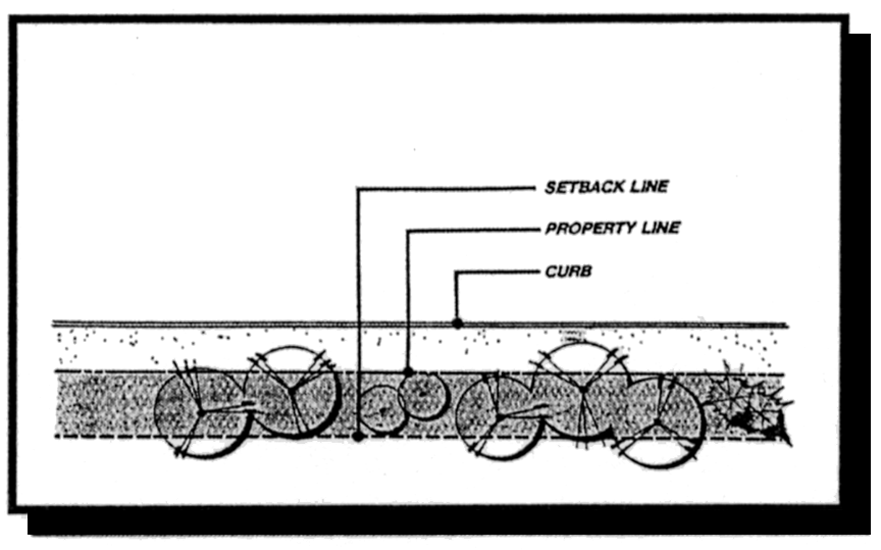
Greenbelt
B.
Berm.
1.
Minimum height of two (2) feet with a crest at least three (3) feet in width. The height of the berm may meander if the intent of this Article is met and an appropriate screen is provided.
2.
The exterior face of the berm shall be constructed as an earthen slope, with a slope not to exceed one (1) foot of vertical rise to three (3) feet of horizontal distance (1:3). The interior face of the berm may be constructed as an earthen slope or retained by means of a wall, terrace, or other means acceptable to the building inspector.
3.
At least one (1) deciduous tree shall be provided for each thirty (30) feet of lineal berm length.
4.
At least one (1) minimum shrub shall be provided for each one hundred (100) square feet of berm surface area, as calculated from a plan view.
5.
Berm slopes shall be protected from erosion by sodding or seeding. If the slopes are seeded, they shall be protected until the seed germinates and a permanent lawn is established by a straw mulch, hydro-mulching, or netting specifically designed to control erosion.
C.
Buffer strip.
1.
Minimum width of ten (10) feet.
2.
All trees shall be evergreens and shall include at least one (1) tree for each thirty (30) feet of length.
3.
The buffer planting area shall contain grass, vegetation ground cover, mulch, or crushed stone on a weed barrier, and be curbed or edged as necessary.
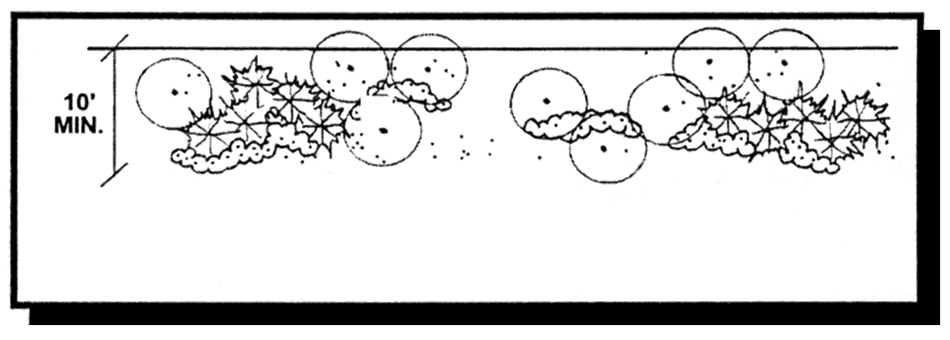
Buffer Strip
Sec. 20.25. - Parking Lot Landscaping.
Within every parking area containing ten (10) or more proposed spaces, at least one (1) deciduous tree and ornamental tree with at least one hundred (100) square feet of planting area shall be used for every ten (10) parking spaces, in addition to any other landscaping requirements. This landscaping shall meet the following standards:
A.
Landscaping shall be dispersed throughout the parking area in order to break up large expanses of pavement and help direct smooth traffic flow within the lot.
B.
Landscaping shall be planned and installed such that, when mature, it does not obscure traffic signs or lighting, obstruct access to fire hydrants, nor interfere with adequate motorist sight distance.
C.
Dimensions of separate landscaped areas within the interior of or adjacent to parking areas shall be shown on the development plan. Minimum width of such areas shall be ten (10) feet.
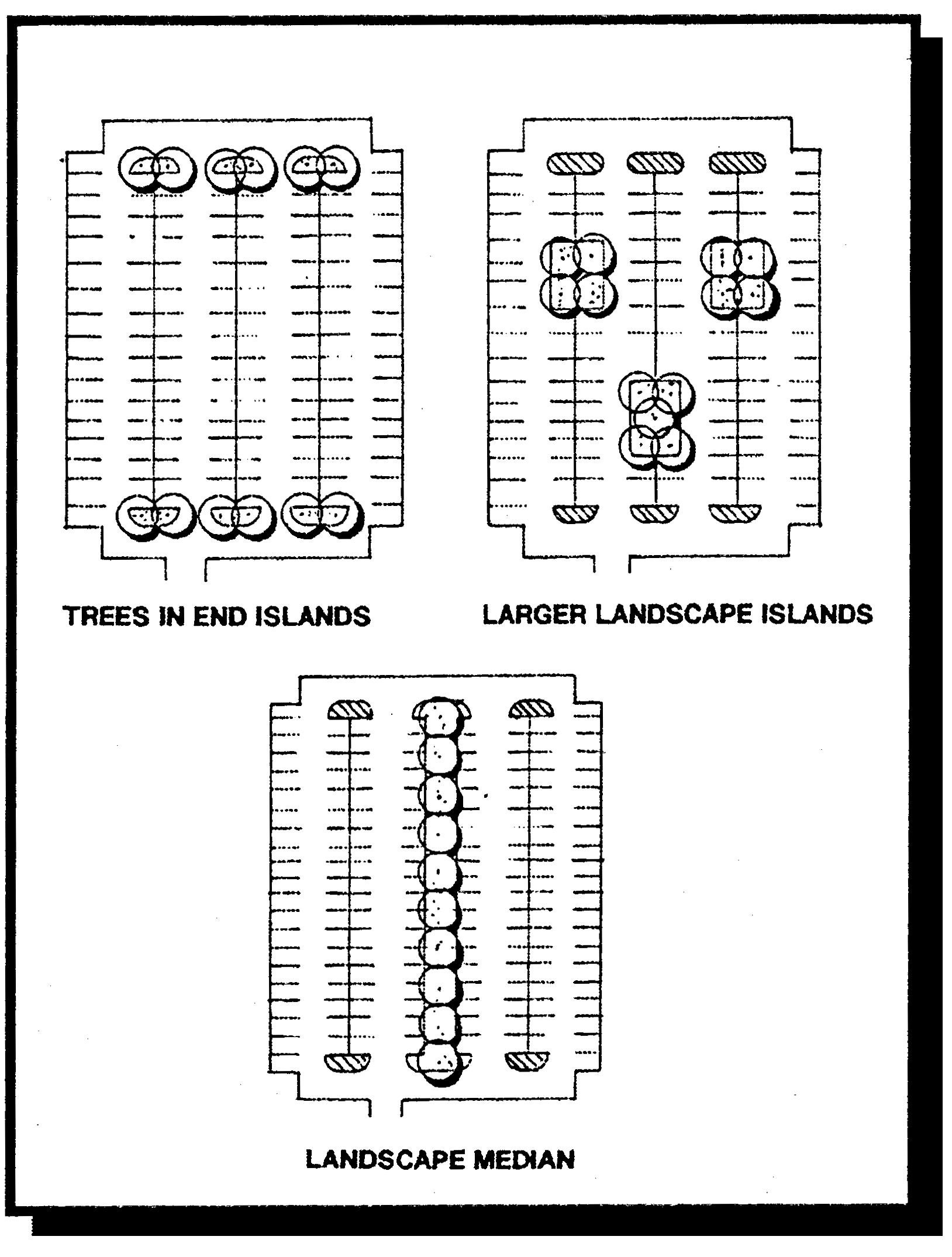
Landscape Islands Within Parking Areas
Sec. 20.30. - Waste Receptacle and Mechanical Equipment Screening.
Waste receptacles shall be located and screened in accordance with the standards of this Ordinance including those standards identified in Article XIX, Design Standards, or other city ordinances. Ground mounted mechanical equipment shall be screened with plant materials or a wall, when deemed necessary by the planning commission.
Sec. 20.35. - General Layout and Design Standards.
A.
Plant Health and Maintenance. Landscaped areas and plant materials required by this Ordinance shall be kept free from refuse and debris. Plant materials, including lawns, shall be maintained in a healthy and growing condition, neat and orderly in appearance. If any plant material required by this Ordinance dies or becomes diseased, they shall be replaced within thirty (30) days of written notice from the building inspector, or within an extended time period as specified in said notice.
B.
Removal of Support Material. Tree stakes, guy wires, and tree wrap are to be removed after one (1) year.
C.
Irrigation. All landscaped areas shall be provided with a readily available and acceptable water supply to facilitate continued maintenance.
D.
Visibility. Landscaping materials and arrangement shall ensure adequate sight visibility for motorists, adequate clearance for pedestrians and vehicles, and accessibility to fire hydrants, and shall not interfere with or obstruct the view of public viewsheds and sight lines from rights-of-way and public property to streams, lakes, and other waterways.
E.
Species Tolerance. Cul-de-sacs, site entrances, and boulevard medians shall be landscaped with species tolerant of roadside conditions common to the Eaton Rapids area.
F.
Public Safety. Plantings within fifteen (15) feet of a fire hydrant shall be no taller than six (6) inches at maturity.
Sec. 20.40. - Incentives to Preserve Existing Trees.
The City of Eaton Rapids encourages the preservation of quality and mature trees by providing credits toward the required trees for greenbelts, buffer strips, interior landscaping, and within parking lots. Trees intended to be preserved shall be indicated with a special symbol on the development plan and be protected during construction through the use of a fence around the drip line. Tree species, location, and caliper must be shown on the landscape plan. Tree protection measures must be shown and noted on the landscape plan.
To obtain credit, the preserved trees shall be of a high quality and at least two and one-half (2½) inches caliper. Trees to be preserved shall be counted for credit only if they are located on the developed portion of the site as determined by the planning commission. Any tree over twelve (12) inches in caliper to be removed shall be noted on the landscape plan.
The credit for preserved trees shall be as follows:
Note: Caliper measurements for existing trees is the diameter at a height of four and one-half (4½) feet above the natural grade. Any preserved trees receiving credit which are lost within two (2) years after construction shall be replaced by the land owner with trees otherwise required by this Ordinance.
Sec. 20.45. - Walls and Berms Between Uses.
In those instances where the following conditions occur, the need for a wall, a berm, or similar type of landscaped buffer shall be determined by the planning commission.
A.
Zoning districts and land uses. For developments within the CBD, LBD, and MXD, there shall be provided and maintained on those sides abutting or adjacent to a residential zoning district and/or a current residential use, a decorative masonry wall six (6) feet in height, (except as otherwise required).
For developments within the MFRD, GBD, LID, and GID, there shall be provided and maintained on those sides abutting or adjacent to a residential zoning district and/or current residential use, a greenbelt, a berm, or a buffer strip, (except as otherwise required, such as in the case of MHPD, which shall only apply where adjacent to current residential use).
For nonresidential land uses within residential zoning districts there shall be provided and maintained on those sides abutting or adjacent to a residential zoning district and/or a current residential use, a decorative masonry wall six (6) feet in height, a greenbelt, a berm, or a buffer strip, (except as otherwise required).
B.
Location. Required walls, greenbelts, berms, or buffer strips shall be located on or at the lot line, except where underground utilities interfere.
C.
Materials. Such walls and screening barrier shall have no openings for vehicular traffic or other purposes, except as otherwise provided for in this Ordinance and except such openings as may be approved by the building inspector. All walls herein required shall be constructed of materials approved by the building inspector to be durable, weather resistant, rustproof, and easily maintained. Materials for walls shall be compatible with surrounding building materials, including but not limited to brick or stone. Materials for the greenbelts, berms, or buffer strips shall be in accordance with the standards identified in this Article unless specified elsewhere.
D.
Alternatives. The planning commission may approve a landscaped berm as an alternative to a wall upon finding the landscaped berm will provide a similar screening effect.
Sec. 20.50. - Waiver or Modification of Standards for Special Situations.
The planning commission may determine existing landscaping or screening intended to be preserved, or a different landscape design, would provide all or part of the required landscaping and screening. In making such a determination to waive or reduce the landscape and screening requirements of this Article, the following may be considered:
A.
Extent that existing natural vegetation provides desired screening.
B.
There is a steep change in topography which would limit the benefits of required landscaping.
C.
The presence of existing wetlands.
D.
Existing and proposed building placement.
E.
The abutting or adjacent land is developed or planned by the city for a use other than residential.
F.
Building heights and views.
G.
The adjacent residential district is over two hundred (200) feet from the subject site.
H.
Similar conditions to the above exist such that no good purpose would be served by providing the landscaping or screening required.

