
Eaton Rapids City Zoning Code
ARTICLE XXI
PARKING, LOADING, AND ACCESS MANAGEMENT
Sec. 21.05.- General Regulations.
A.
Purpose. The purpose of this Article is to regulate the parking, loading, and access of automotive vehicles in all zoning districts. The number of automobiles presently in use in Eaton Rapids and the probability that over time, the number will increase, make it necessary for the safety, health, and convenience of all using the streets in Eaton Rapids, that the public streets be useable and to their maximum capacity, for the movement of vehicles, and that the parking of vehicles thereon for long periods of time subordinates the good of the public as a whole to the convenience to the few.
B.
Plan and Area Requirements. The following regulations and standards shall apply in all zoning districts:
1.
A plan of the proposed parking and loading areas shall be submitted with any development plan for all new commercial, industrial, multiple-family, and manufactured housing parks.
2.
All off-street parking areas required by this Ordinance shall be of adequate size and design to provide safe and reasonably direct ingress and egress from an alley or street. The minimum standards for parking spaces and aisle are indicated in the table in section 21.15 of this Article. The average parking area, consisting of one parking space with maneuvering aisle, shall be three hundred (300) square feet.
Sec. 21.10. - Off-Street Parking Requirement.
With the exception of areas designated by the planning commission within the central business district as being parking exempt, there shall be provided in all districts at the time of erection or enlargement of any main building or structure, automobile off-street parking space with adequate access to all spaces. The number of off-street parking spaces, in conjunction with all land or building uses shall be provided, prior to occupancy, as hereinafter prescribed.
A.
Location of spaces. Off-street parking for other than single-family or two-family residential uses shall be either on the same lot or within three hundred (300) feet of the building it is intended to serve, as measured form the nearest point of the off-street parking lot. Ownership shall be shown of all lots or parcels intended for use as parking by the applicant during development plan review.
B.
Location of spaces for residential uses. Required residential off-street parking spaces shall consist of a parking strip, parking bay, driveway, garage, or combination thereof and shall be located on the premises they are intended to serve, or if located in the central business district, within a reasonable walking distance as determined by the planning commission.
C.
Irrevocable use of spaces. All required off-street parking spaces shall be stated in an application for development plan review and shall be reserved irrevocably for such use. Minimum required off-street parking spaces shall not be displaced by any other use unless and/or until equal parking facilities are provided elsewhere, or the parking requirements of the site change.
D.
Reduction of space area. Off-street parking existing at the effective date of this Ordinance, in connection with the operation of an existing building or use shall not be reduced to an amount less than hereinafter required for a similar new building or new use.
E.
Collective use of spaces. Two (2) or more buildings or uses, may collectively provide the required off-street parking in which case the required number of parking spaces shall not be less than the sum of the requirements for the several individual uses computed separately.
F.
Variance for collective uses. In the instance of dual function of off-street parking spaces where operating hours of buildings do not overlap and there is an opportunity for a patron to visit more than one use, the planning commission may grant a reduction to the required number of spaces up to twenty (20) per cent, provided a signed agreement is provided by the property owners.
G.
Prohibited activities. The storage of merchandise, refuse storage and receptacles, or other materials, and the storage or repair of vehicles or other machinery is prohibited in areas serving as parking spaces, unless provided for otherwise in this Ordinance.
H.
Similar use. For those uses not specifically mentioned, the requirements for off-street parking facilities shall be in accord with the use which the planning commission determined is similar in type.
I.
Fractional units. When units or measurements determining the number of required parking spaces result in the requirement of a fractional space, any fraction up to and including one-half (½) shall be disregarded and fractions over one-half (½) shall require one (1) parking space.
J.
Screening. Off-street parking areas and related drives shall be effectively screened on any side which adjoins or faces any public street, residential zoning district or current residential use, by a wall, greenbelt, berm, or buffer strip, and shall be in accordance with Article XX of this Ordinance.
K.
Setbacks. No part of any off-street parking area shall be closer than ten (10) feet to any school, hospital, or other institutional use property line. All required off-street parking areas accommodating more than two (2) parking spaces shall be no closer than ten (10) feet from a public street.
L.
Loading spaces. Loading spaces shall not be construed as meeting required off-street parking spaces, unless approved otherwise by the planning commission.
M.
Seating allocation. In stadiums, sports arenas, churches, temples, or other places of assembly in which patrons or spectators occupy benches, pews, or similar seating facilities, each twenty-four (24) inches of seating shall be counted as one (1) seat for the purposes of determining requirements for off-street parking facilities under this Ordinance.
N.
Use of spaces by churches, temples, and similar places of worship. Parking spaces already provided to meet off-street parking requirements for places of public assembly, stores, offices, and industrial establishments lying within five hundred (500) feet of a church, temple, or similar place of worship, as measured along the lines of public access, which uses are not normally used between 6:00 a.m. and 6:00 p.m. on respective days of worship and are made available for other parking, may be used to meet not more than seventy-five (75) per cent of the off-street parking requirements of a church, temple, or similar place of worship. Written permission for such an arrangement shall be provided to the city.
O.
Length of time in parking areas. Except when land is used as storage space in connection with the business of an automotive service center/station or automotive repair center, the time limits for parking in off-street parking areas shall prevail as specified under this Ordinance and in any other pertinent City of Eaton Rapids Codes.
P.
Restriction of parking on private property. No person shall park any motor vehicle on any private property, or use such private property as a parking space, without the express or implied consent or authorization of the owner, holder, occupant, lessee, agent, or trustee of such property.
Q.
Exceeding number of spaces required. In order to minimize excessive areas of pavement, which depreciate aesthetic standards and contribute to high rates of stormwater runoff, exceeding the minimum parking space requirements by greater than ten (10) per cent shall not be allowed, except as approved by the planning commission.
R.
Units of measurement.
1.
Where floor area is the unit for determining the required number of off-street parking and loading spaces, such unit shall mean the gross floor area (GFA), unless otherwise noted.
2.
Where the floor area measurement is specified as gross leasable floor area (GLA), parking requirements shall apply to all internal building areas excluding the floor area used for incidental service, storage, mechanical equipment rooms, heating/cooling systems, lavatories, and similar uses, and other areas not intended for use by the general public. Where these areas are not yet defined, leasable floor area shall be considered to be eighty-five (85) per cent of the gross floor area.
3.
Where the number of spaces required is based on the number of employees, calculations shall be based upon the maximum number of employees likely to be on the premises during the peak shift.
S.
Use of parking areas.
1.
No repairs or service to vehicles and no display of vehicles for purposes of sale shall be carried on or permitted upon required parking areas, unless provided for otherwise in this Ordinance.
2.
No advertising signs shall be erected on required parking areas.
3.
No person shall leave, park or store, or permit to be left, parked or stored, any motor vehicle longer than forty-eight (48) hours, unless otherwise permitted by this Ordinance.
4.
Such parking areas may not be used for the storage or parking of unregistered or unlicensed, junked, or wrecked vehicles of any type, as a storage area for industrial equipment or material, or as a dump for refuse of any description.
Sec. 21.15. - Minimum Number of Spaces Required.
The minimum number of off-street parking spaces by type of use shall be determined in accordance with the following schedule:
(Ord. No. 2002-17, 12-23-02)
Sec. 21.20. - Barrier-Free Parking Requirements.
Within each parking lot, signed and marked barrier-free spaces shall be provided in accordance with the Michigan Department of Labor, Construction Code Commission, Barrier-Free Division.
Sec. 21.25. - Waiting Areas for Drive-Through Facilities.
A.
Dimensions. All waiting spaces or stacking spaces shall be an area at least ten (10) feet wide and twenty-four (24) feet long each, that does not include the use of any public space, street, alley, sidewalk, or right-of-way. Such area shall be located entirely within a nonresidential zoning district.
B.
Minimum Number of Spaces Required. On the same premises with every building or structure, or part thereof, erected and occupied for the purpose of serving customers in their automobiles by means of a service window or similar arrangement where the automobile engine is not turned off, there shall be provided, unless otherwise specified within this Ordinance, off-street waiting spaces or stacking spaces in accordance with the following:
Sec. 21.30. - Off-Street Parking, Space Layout, Standards, Construction and Maintenance.
A.
Plan Requirements. Plans for the layout of off-street parking facilities shall be in accord with the following minimum requirements:
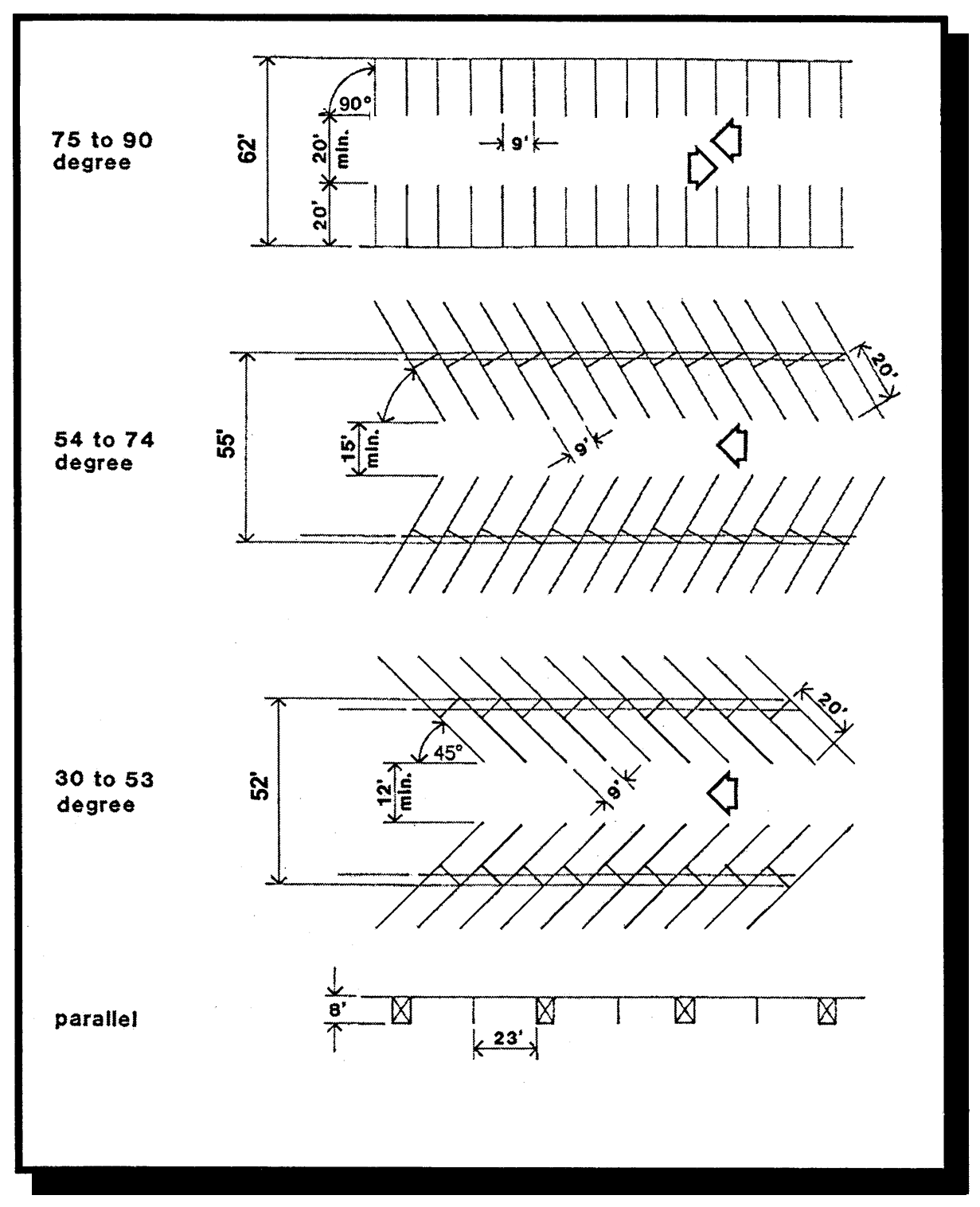
Parking Layouts
B.
Drive Lanes. All spaces shall be provided adequate access by means of maneuvering lanes according to the terms of this section. Backing directly onto a street, backing into an access drive, or requiring the use of the street for maneuvering between parking rows shall be prohibited.
C.
Ingress and Egress. Adequate ingress and egress to the parking lot by means of clearly limited and defined drives shall be provided for all vehicles. Entrance to such areas shall be only from a public street, an adjoining principal use, or an adjoining alley. Ingress and egress to a parking lot lying in an area zoned for other than single-family residential use shall not be across land zoned for single-family residential use.
D.
Traffic Movement. It is recommended, that where other than ninety (90) degree parking stalls are used, all maneuvering lane widths only permit one-way traffic movement.
E.
Distance From Residential Districts. Each entrance and exit to and from any off-street parking lot located in an area zoned for other than single-family residential use shall be at least twenty-five (25) feet distant from the adjacent property located in any single-family residential district.
F.
Surface and Curbing. The entire parking area, including parking spaces and maneuvering lanes, required under this Ordinance shall be provided with a dust free surfacing of concrete and/or plant mixed bituminous material according to the requirements of this Ordinance and the city's Code of Ordinances. Necessary curbs or other protection for the public and for the protection of adjoining properties, streets, and sidewalks shall be provided and maintained. Where deemed necessary, the planning commission may require that parking areas be curbed with concrete curbs and gutters. The parking are shall be surfaced within six (6) months of the date of occupancy.
In all cases where such parking areas abut public sidewalks, a decorative wall, a curb, or bollards shall be placed thereon so that a motor vehicle cannot be driven or parked with any part thereof extending onto the public sidewalk.
G.
Drainage. Off-street parking areas shall be drained so as to dispose of all water accumulated in the parking area in such a way as to preclude drainage of water onto adjacent property or toward buildings and shall be in accordance with any standards and requirements stated by the county drain commission.
H.
Lighting. All lighting used to illuminate off-street parking areas shall be so designed, located, installed, and shielded as to be confined within and directed onto the parking area only, and to prevent glare onto adjacent properties, and shall be arranged to prevent adverse affects on motorist visibility on adjacent rights-of-way.
The source of illumination shall not be more than fifteen (15) feet above the parking surface in any Central Business District (CBD), Local Business District (LBD), or Mixed Use District (MXD), and twenty-five (25) feet above the parking surface in any General Business District (GBD), Limited Industrial District (LID), and General Industrial District (GID).
All illumination shall be in compliance with the performance standards established in Article XVIII of this Ordinance.
Sec. 21.35. - Loading Space Requirements.
A.
Minimum Number of Spaces Required. For every building, or addition to an existing building, hereafter erected to be occupied by a use allowed in any business or industrial zoning district or other similar use requiring the receipt or distribution of materials or merchandise, there shall be provided and maintained on the same premises with such building additional off-street loading spaces in relation to the floor area in accordance with the following:
B.
Dimensions of required spaces. Each such loading space shall be sufficient in size and shape to accommodate the delivery of goods without encroaching upon any public street or right-of-way. No such space shall be located closer than fifty (50) feet to any lot in any residential zoning district, unless wholly within a completely enclosed building or enclosed on all sides by a wall, or a greenbelt, berm, or buffer strip.
C.
Lighting. Lights used to illuminate loading areas shall be arranged so as to reflect away from adjacent areas and shall be otherwise in conformance with the provisions of this Ordinance.
D.
Location. Loading spaces shall not be provided in the front yard, the front side of any building, or on any building side facing and directly visible to a public street, unless the planning commission determines such a location is necessary due to the building's location or placement, the existing street patterns, or other factors.
E.
Surface and Drainage. Loading spaces shall be surfaced with concrete or a plant-mixed bituminous material and shall be graded and drained so as to properly dispose of surface water.
F.
Exceptions. The planning commission may waive the requirement for off-street loading spaces for existing buildings within the Central Business District (CBD), Local Business District (LBD), and the Mixed Use District (MXD) under the following circumstances:
1.
The rear of the building is built to the rear lot line and directly abuts a public alley.
2.
The layout and size of the existing building and parking area preclude the placement of a designated loading space within the site.
Sec. 21.40. - Parking Lots in Residential Districts.
Off-street parking lots for permitted principal uses in residential districts shall conform to the following:
A.
Surface and drainage. Where providing required off-street parking for more than one (1) building or structure, the parking surface and access driveways shall be surfaced in concrete or a plant-mixed bituminous material of the street upon which the driveway has access, has curbs and gutters. Driveways shall be graded toward the center of the parking surface or driveway, and drained to a storm sewer so as to dispose of surface water in an appropriate manner and in accordance with any applicable standards established by the county drain commission.
B.
Lighting. When lighting for such facilities is used, the light shall be kept away from adjoining residential uses, and the source of illumination shall not be more than fifteen (15) feet above the parking surface.
C.
Screening. All parking areas in a Multiple-Family Residential District (MFRD) shall be screened from adjacent properties other than another multiple-family residential use, by means of a wall, greenbelt, berm, or buffer strip, installed and maintained in accordance with this Ordinance.
Sec. 21.45. - Access Management Requirements.
A.
Purpose. The purpose of this section is to provide access standards which will facilitate through traffic operations, ensure public safety along roadways, and protect the public investment in the street system, while providing property owners with reasonable access. The standards are specifically designed for streets whose primary function is access to adjacent properties.
B.
Application of Standards.
1.
The standards of this section shall be applied to the following streets:
Main Street (M-50/M-99)
Dexter (M-50)
Canal; Michigan (M-99)
Water Street (M-188)
Spicerville Highway
Kinneville Road
Five Point Highway; Brook Street
2.
The access standards contained herein shall be required in addition to, and where permissible shall supersede, the requirements of the Michigan Department of Transportation, or the county.
3.
The standards contained in this section shall apply to all uses, except permitted single-family and two-family dwelling units.
4.
For expansion and/or redevelopment of existing sites requiring the submittal of a development plan, where the planning commission determines that compliance with all standards of this section is unreasonable, the standards shall be applied to the maximum extent possible. In such instances, suitable alternatives which substantially achieve the purpose of this section may be accepted by the planning commission, provided that the applicant demonstrates all of the following apply:
a.
The size of the parcel is insufficient to meet the dimensional standards.
b.
The spacing of existing, adjacent driveways or environmental constraints prohibit adherence to the access standards at a reasonable cost.
c.
The use will generate less than five hundred (500) total vehicle trips per day or less than seventy-five (75) total vehicle trips in the peak hour of travel on the adjacent street. All projections of trips shall be based on rates developed by the Institute of Transportation Engineers (ITE).
d.
There is no other reasonable means of access.
C.
Number of Driveways.
1.
Access to a parcel shall consist of either a single two-way driveway or a pair of one-way driveways, wherein one (1) driveway is designed and appropriately signed to accommodate ingress movements and the other egress movements, unless specified otherwise in this Ordinance.
2.
Where parcel frontage is insufficient to provide a driveway meeting the minimum driveway width and radii, a shared driveway or other means of access may be required.
3.
Where the parcel is situated on a corner lot, one (1) access point on each street frontage may be permitted, provided there is a minimum of one hundred (100) feet of frontage per side. No more than one (1) access point shall be permitted per side for parcels located on corner lots unless otherwise provided for within this Ordinance.
4.
Where the property has continuous frontage of over three hundred (300) feet and the applicant can demonstrate, using the Institute of Transportation Engineer's Trip Generation Manual or another accepted reference, that a second access is warranted, the planning commission may allow an additional access point. Where possible, this access should be spaced accordingly to the standards contained herein, located on a side street, shared with an adjacent property, and/or be designed to restrict one (1) or both left turn movements.
5.
Where the property has continuous frontage of over six hundred (600) feet, a maximum of three (3) driveways may be allowed, with at least one (1) such driveway being designed, constructed, and signed for right-turns in and right-turns out only.
D.
Shared Access, Joint Driveways, Parking Lot Connections, and Rear Service Drives.
1.
Shared use of access between two (2) or more property owners should be encouraged through the use of driveways constructed along property lines, connecting parking lots, and rear service drives, particularly for the following:
a.
Sites within one-quarter (¼) mile of major intersections.
b.
Sites having dual frontage.
c.
Sites where frontage dimensions are less than three hundred (300) feet.
d.
Locations with sight distance problems.
e.
Along roadway segments experiencing congestion or accidents.
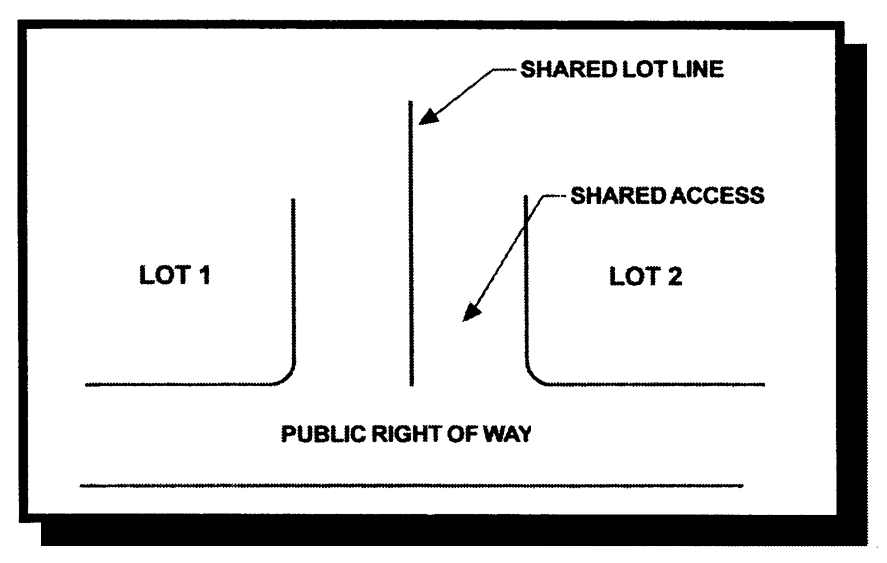
Shared Access
2.
In cases where a site is adjacent to a parking lot of a compatible use, or a rear service drive, a connection to the adjacent facility may be required by the planning commission.
3.
In cases where a site is adjacent to undeveloped property, the site must be designed and constructed to accommodate a future parking lot connection, rear service drive, or other means of shared access as determined by the planning commission.
4.
The applicant shall provide the city with letters of agreement or access easements from all affected property owners.
E.
Adequate Sight Distance.
1.
Requirements for minimum intersection or corner sight distance for driveways shall be in accordance with the American Association of State Highway and Transportation Officials (AASHTO) guidelines defined in the chapter entitled "A Policy on Geometric Design of Highways and Streets" in its latest edition.
2.
The planning commission may adjust driveway location where there is a concern regarding adequate sight distance.
F.
Driveway Spacing From Intersections.
1.
Driveway spacing from intersections shall be measured from the centerline of the driveway to the extended edge of the intersecting street's right-of-way line.
2.
In order to preserve intersection operations and safety, the minimum distance between a driveway and an intersecting street right-of-way, shall be based on the following:
a.
For locations in the vicinity of intersections experiencing congestion (peak hour operations below level of service "C" for one (1) or more movements) and/or a significant number of traffic accidents. The planning commission may require that access be constructed along the property line furthest from the intersection.
b.
For locations within two hundred (200) feet of any signalized or four-way stop intersection, driveways shall be spaced a minimum of one hundred (100) feet from the intersection. Where this spacing cannot be provided, driveways designed for right-turn in/right-turn out only movements may be allowed, with a minimum spacing of fifty (50) feet form the intersecting street right-of-way.
G.
Driveway Spacing From Other Driveways.
1.
Driveway spacing from other driveways shall be measured from the centerline of each driveway at the point where it crosses the street right-of-way line.
2.
Minimum driveway spacing from other driveways along the same side of the street shall be determined based on posted speed limits along the parcel for each particular frontage, as follows:
3.
Driveways shall be directly aligned with those across the street or, where offset, the minimum driveway spacing from driveways across the street shall be one hundred (100) feet excluding when one (1) or both driveways are designed and signed for right-turn in/right-turn out only.
H.
Driveway Design, Channelized Driveways, Deceleration Lanes and Tapers, Bypass Lanes. Driveways shall be designed to the standards of the applicable city, county, or state construction standards.
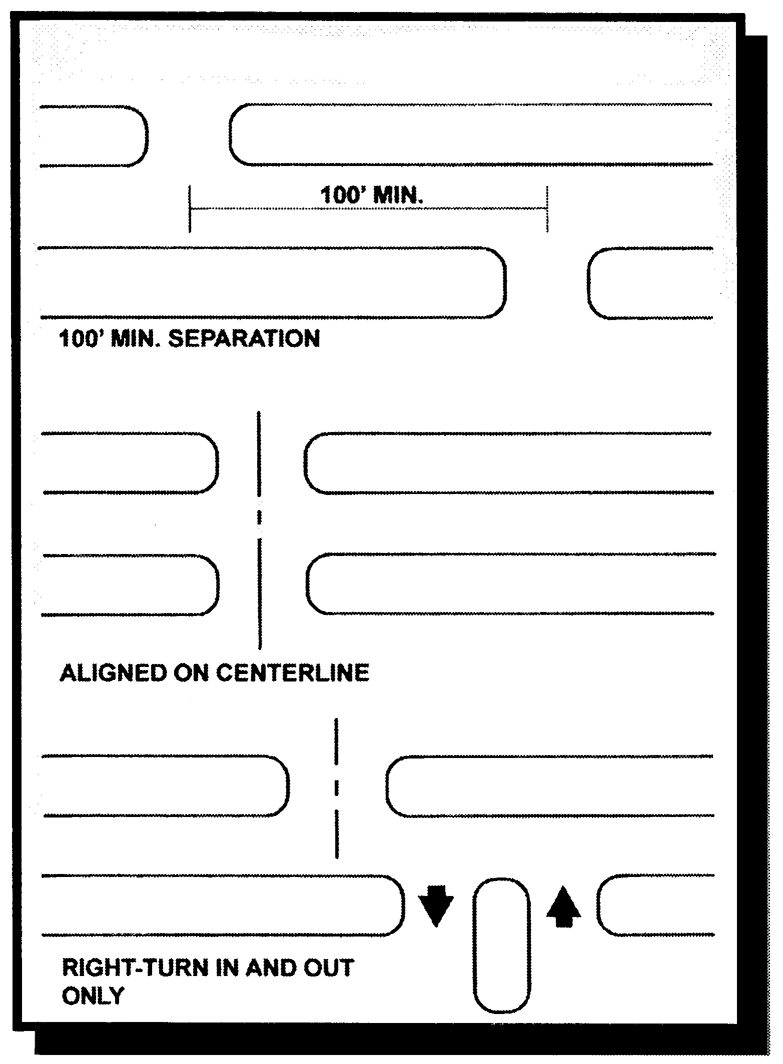
Driveway Offsets
1.
Driveway width and radii.
a.
The typical driveway design shall include one (1) ingress and one (1) egress lane, with a combined minimum throat width of twenty-five (25) feet and a maximum throat width of thirty-five (35) feet, measured from face to face of the curb, unless specified otherwise in this Ordinance.
b.
Wherever the planning commission determines that traffic volumes or conditions may cause significant delays for traffic exiting left, two (2) exit lanes may be required.
c.
In areas with pedestrian traffic, the exit and entrance lanes may be separated by a median with maximum width of ten (10) feet. Concrete sidewalks shall be continued and/or maintained across driveways.
d.
Driveways shall be designed with a minimum twenty-five (25) foot radii, thirty (30) foot radii shall be required where daily truck traffic is expected.
2.
Directional driveways, divided driveways, and deceleration tapers. Directional driveways, divided driveways, and deceleration tapers and/or by-pass lanes may be required by the planning commission where they will reduce congestion and accident potential for vehicles accessing the proposed use or site. Right-turn tapers shall be a minimum of seventy-five (75) feet in length and at least eleven (11) feet wide.
Sec. 21.50. - Private Road Standards.
A.
Appropriateness. The city discourages the use of private roads, but may allow private roads when meeting the standards of this section. The regulations for private roads contained herein shall not apply to approved private roads within platted subdivision regulated by the city's Subdivision Regulations or internal access drives to parking within approved site plans for multiple-family residential developments or manufactured housing parks.
B.
Justification. The use of private roads must be supported by documentation accepted by the planning commission that the property possesses unusual configuration and/or topography which would render construction of street under city standards for grades, radii, width, and/or materials impractical.
C.
Easements. An easement shall be provided of not less than forty-two (42) feet in width for roads and utilities serving four (4) or fewer lots or single-family residential units. A copy of the recorded easement shall be provided to the city clerk.
D.
Frontage. Any lot accessed via a private road shall have frontage on the private road which is at least equal to the minimum lot frontage required herein for the zoning district in which the lot is located. The frontage for the lot shall be measured at the point of the beginning of the lot line designated as the side lot line.
E.
Development Standards. Any lot created on a private road, along with accompanying buildings, shall comply with all site development standards applicable to the zoning district in which it is located.
F.
Maximum Length. The maximum length of any private road cul-de-sac shall not exceed the city standard for public roads. The end of the road shall terminate in some form of a turn-around such as a cul-de-sac or a point of ingress and egress onto a public road.
G.
Surface Material. The surface and base material of any private road shall be approved by the building inspector as being sufficient to accommodate emergency vehicles and shall be a minimum of eighteen (18) feet wide with two-foot shoulders on both sides. The driving surface shall have a minimum of six (6) inches of bank run gravel or sand and six (6) inches of processed gravel over a compacted base. The surface shall be crowned six (6) inches. The road shall be ditched on both sides to prevent the accumulation of water upon the driving surface and shoulders.
H.
Signage A drive name sign of a type approved by the city shall be placed at the intersection of the private drive and the public street providing access to the drive. The bottom of the sign shall be placed a minimum of seven (7) feet above the adjacent street surface. Additionally, a "Private Drive" sign shall face the intersection along the private street, one (1) foot outside the public road right-of-way. The bottom of the sign face shall be placed a minimum of seven (7) feet above the adjacent street surface. The sign face size shall be twelve (12) to eighteen (18) inches in width and eighteen (18) to twenty-four (24) inches in height.
I.
Responsibilities and Maintenance. Issuance of a building permit for the placement of buildings/structures on lots and/or parcels on a private road shall not be considered a guarantee or warranty that adequate access exists to the lot for emergency vehicles. The city assumes no responsibility for the maintenance of or improvements to private roads.
J.
Maintenance Agreements. The applicant shall submit a joint maintenance agreement or master deed in recordable form that runs with the land, binds benefitting parcels, and allows the city to make any repairs or conduct any maintenance it deems necessary, and charge the property owners or homeowners association served by the private road for such service.
K.
Disclosure. The applicant shall provide a recorded statement running with the land informing purchasers that the access road is private.

