
El Dorado County Unincorporated
City Zoning Code
City Zoning Code
ARTICLE 4
- SPECIFIC USE REGULATIONS*
CHAPTER 130.44. - RANCH MARKETING[2]
Editor's note— Ord. No. 5177, § 7, adopted June 20, 2023, repealed § 130.40.260, which formerly pertained to ranch marketing, and enacted Ch. 130.44, §§ 130.44.100—130.44.108 as set out herein.
Sec. 130.40.010 - Content of Chapter.
This Chapter contains regulations applicable to certain specified uses that may be allowed, either by right or by discretionary permit, in a number of different zones. This Chapter provides appropriate standards for the design, location, and operation of the specific uses consistent with the General Plan.
Sec. 130.40.020 - Applicability.
The provisions contained in this Chapter shall apply to all land in the unincorporated part of El Dorado County regardless of zone, unless otherwise specified in this Chapter.
Sec. 130.40.030 - Accessory Structures and Uses.
A.
Accessory Uses and Their Determination. In addition to the principal use or uses expressly established for the zone, as specified in Chapters 130.21 (Agricultural, Rural, and Resources Zones) through 130.25 (Special Purpose Zones) inclusive, in Article 2 (Zones, Allowed Uses, and Zoning Standards) of this Title each use shall include such accessory uses which are customarily associated with the principal use(s). For those uses not specifically identified in the use matrices for the zones, the Director shall determine whether such use is customarily associated with the principal use of the zone.
B.
Exemption. Agricultural buildings, small sheds or other storage structures that do not require a building permit for installation under Title 110 (Buildings and Construction), Section 110.16.060 (International Building Code, Appendix Chapter 1, Section 105.2-Work exempt from permit) pursuant to applicable building code provisions shall be exempt from the provisions of this Title, but shall remain subject to the setback requirements of the zone.
C.
Relationship of Accessory Use or Structure to Primary Use.
1.
Accessory uses and structures shall be consistent with the primary use.
2.
For purposes of this Section, barns, stables, and other structures used to store crops and feed, shelter livestock, or house agriculturally-related machinery shall be allowed as a primary use, subject to the development standards for the zone (See
————
*Editor's note—Ord. No. 5090, adopted Aug. 14, 2018, amended Title 130 in its entirety, with the exception of Article 9, to read as herein set out. Capitalization and expression of numbers in text have
been unchanged from the original ordinance. Obvious misspellings and punctuation errors
have been corrected without notation. Amendments to said ordinance are indicated by
parenthetical history notes following amended provisions. The absence of a history
note indicates that the provision remains unchanged from the original ordinance. For
a detailed analysis and derivation of former Title 130, see the Code Comparative Table.
Chapter 130.21: Agricultural, Rural, and Resources Zones) in Article 2 (Zones, Allowed Uses, and Zoning Standards) of this Title. When allowed in the residential zones, R1, R20K, R1A and R2A said structures shall be accessory to an existing primary residence, except where the existing parcel is larger than ten acres. In R3A and RE zones, said structures shall be allowed as a primary use.
3.
Accessory uses and structures shall be established or constructed at the same time or after the establishment or construction of the primary use or structure on a lot, except where earlier establishment or construction is authorized by Administrative Permit.
4.
Where building permits are issued concurrently for the primary and accessory structures, the permit for the accessory structure may be approved for final occupancy prior to completing the primary structure.
D.
Residential Accessory Structures Uses. In addition to the primary dwelling, the following residential accessory structures and uses that are customarily associated with the primary structure shall be allowed in compliance with specific regulations under this Chapter, development standards of the respective zone, and Article 3 (Site Planning and Project Design Standards) of this Title:
1.
Garages, carports, and storage sheds.
2.
Swimming pools and spas.
3.
Shade structures, arbors, trellises, and gazebos.
4.
Decks and other outdoor residential amenities such as outdoor kitchens and free standing fireplaces with chimneys.
5.
Barns, stables, and other animal shelters, where the keeping of animals is allowed in the zone.
6.
Accessory structures providing habitable space subject to the following:
a.
A structure no greater than 600 square feet that is designated a guest house as defined in Article 8 (Glossary: see "Guest House") of this Title, shall be subject to the requirements of Section 130.40.150 (Guest House) in this Chapter.
b.
A structure that is an accessory dwelling unit as defined in Article 8 (Glossary: see "Accessory Dwelling Unit") of this Title, shall be subject to the requirements of Section 130.40.300 (Accessory Dwelling Units) in this Chapter.
c.
A structure to be used by the property owner as a pool house, workshop, artist studio, as defined in Article 8 (Glossary) of this Title, or other similar use, may contain a full bathroom along with the changing room or work area, but shall not contain kitchen and/or cooking facilities nor be utilized for housing residents or guests.
7.
Alternative energy systems, such as solar or wind energy collection systems, subject to the requirements of Sections 130.40.310 (Solar Collection Systems) and 130.40.390 (Wind Energy Conversion Systems) in this Chapter.
8.
Activities typically associated with residential uses are allowed on all parcels occupied by a residential use. Examples of such residential accessory uses include vehicle parking, gardens, vehicle and boat storage, the keeping of domestic pets (as defined in Title 6 [Animals]) of the County Code of Ordinances, composting of household organic and yard waste, and other similar activities.
(Ord. No. 5152, § 9, 11-16-2021)
Sec. 130.40.040 - Adult Business Establishments.
A.
Content. This Section regulates the time, location, and manner of operating adult (sex oriented) business establishments in compliance with California Government Code Section 65850.4, in order to protect the public health, safety, and welfare. This Section is establishes reasonable and uniform regulations to prevent any deleterious location and concentration of adult business establishments within the County, thereby reducing or eliminating the adverse secondary effects experienced by other cities and counties, such as crime, blight, and downgrading of the surrounding commercial districts and residential neighborhoods. Location of said establishments along U.S. Highway 50 will be regulated in order to preserve the commercial, residential, and scenic character of not only its main transportation corridor, but what is considered to be the "gateway" to the County.
B.
Applicability. The regulations and standards within this Section shall apply to adult business establishments, as defined in Article 8 (Glossary: See "Adult Business Establishment") of this Title, where allowed in the use matrices for the zones, under the following forms:
1.
New Business. The opening or commencement of operation of a business as a new business.
2.
Conversion of an Existing Business. The conversion of an existing business, whether an adult business or not, to an adult business establishment.
3.
Enlargement of Existing Business. The addition of an adult business to an existing adult business if the addition results in enlargement of the place of business. For the purpose of this Subsection (Applicability), enlargement shall mean an increase in the size of the structure within which the business is conducted by either construction or use of an adjacent structure or a portion of a structure, whether located on the same or an adjacent lot.
C.
Prior to Administrative Permit approval, a potential adult business owner shall provide a vicinity map demonstrating that the adult business is not being established or located within 300 feet of U.S. Highway 50 and within 1,000 feet of the following existing uses:
1.
Any zone that allows residential uses by right;
2.
Any house of worship or any noncommercial establishment operated by a bona fide religious organization;
3.
Any public library, public building, or other public facility;
4.
Any public, private, or parochial school, pre-school, child day care center, park, or playground, or any establishment or facility likely to be used by minors; and
5.
Any other adult business.
D.
For the purposes of this Section, distances shall be measured in a straight line, without regard to intervening structures, from the nearest point of the structure in which the adult business will be located to the nearest property line of a use or zone described in Subsection C above.
E.
No adult business establishment shall be open nor shall any activity described in this Section be conducted or carried on in the business premises between the hours of 10:00 p.m. and 10:00 a.m. of any day.
F.
Signs or structures, advertisements, displays, or other promotional material depicting "specified anatomical areas" or "specified sexual activities", as defined under Title 5 (Business Taxes, Licenses and Regulations), Subsection 5.34.020 (Definitions) See: "Adult-related Establishments) of the County Code of Ordinances, or displaying instruments, devices or paraphernalia designed for use in connection with "specific sexual activities", shall not be exhibited or shown in a way that is visible from an exterior area.
G.
Structure openings, entries, and windows shall be located, covered, or screened to prevent viewing the interior from an exterior area.
H.
Loudspeakers or sound equipment audible to persons in a public area shall not be used in connection with an adult business, and the business shall be conducted so that sounds associated with the business are not emitted beyond the exterior walls of the structure in which the use is occurring.
I.
Dumpsters used by an adult business establishment shall be locked when not in use to prevent access thereto by the public.
Sec. 130.40.050 - Agricultural Marketing Disclosures.
A.
For purposes of this Section:
1.
"Agricultural property" means land zoned as Planned Agriculture (PA), Limited Agriculture (LA), Agricultural Grazing (AG), Forest Resource (FR), or Timber Production (TPZ) or land with a commercial winery within the meaning of Section 130.40.400 (Wineries).
2.
"Eligible transaction" means a sale, exchange, installment land sale contract (as defined in Civil Code Section 2985), lease with an option to purchase, any other option to purchase, or ground lease coupled with improvements.
B.
Under the authority of Civil Code Section 1102.6a, before any transfer of agricultural property in an eligible transaction the transferor shall provide the following disclosure: "Agricultural production is the primary use or function, or if this real property is a commercial winery the primary purpose of the winery shall be to process fruit grown on the winery lot or on other local agricultural lands, of the real property subject to this transaction. The real property may be eligible for limited related activities such as bake shops, food stands, dining facilities, marketing events, special events as set out in the Winery Ordinance (El Dorado County Ordinance Code Section 130.40.400) and the Ranch Marketing Ordinance (El Dorado County Ordinance Code Chapter 130.44). If you have questions on what type of activities this property may be eligible for, and what process or permits are required, you are encouraged to contact the County Agricultural Department of the County Department of Planning and Building." This disclosure shall be provided on a form substantially similar to that provided in Civil Code Section 1102.6a. The transferor shall ensure that the transferee signs the disclosure before completing the transfer. This disclosure may be consolidated on one form with any disclosure required by the Right to Farm Ordinance (Section 130.40.290).
(Ord. No. 5218, § 1, 12-10-2024)
Sec. 130.40.060 - Agricultural Preserves and Zones: Contracts, Criteria and Regulations.
A.
Content. This Section implements the provisions of the Land Conservation Act of 1965 (Williamson Act) and the farmland security zone legislation (California Government Code Chapters 51200 et seq. and 51296 to 7, respectively) and provides criteria for zoning and protecting the existing agricultural resources of the County.
B.
Criteria for Establishment of Agricultural Preserves. In order to establish a new Agricultural Preserve, hereinafter referred to as "Preserve", a property owner must enter into a Williamson Act Contract with the County subject to the provisions and criteria set forth in California Government Code Chapter 51200 et seq. and Resolutions adopted by the Board establishing Williamson Act criteria, as amended from time to time, and the following:
1.
Zone Change. The property shall be zoned to Planned Agricultural (PA), Limited Agricultural (LA), or Agricultural Grazing (AG) with the approval and establishment of a Preserve, subject to the specific provisions of Subsection 130.21.010 (Zones Established; Applicability), Subsections C.1 (Planned Agricultural (PA), C.2 (Limited Agricultural (LA) and C.3 (Agricultural Grazing) in Article 2 (Zones, Allowed Uses, and Zoning Standards) of this Title.
2.
Term. The initial term of a contract is ten years, calculated from January 1 of the same year it is approved in. On each anniversary date of a contract, a year shall be automatically added to the initial term unless written Notice of Non-Renewal is given as provided in Subsection D (Non-Renewal of Williamson Act Contracts/Agricultural Preserves) below in this Section. If the property owner or the County serves written Notice of Non-Renewal in any year, the contract shall remain in effect for the balance of the unexpired term.
C.
Preserve Standards.
1.
Minimum Acreage. The minimum acreage of a Preserve shall be:
a.
20 acres for high intensive farming operations or 50 acres for low intensive farming operations, consisting of a single lot or contiguous lots; or
b.
At least ten acres but less than 20 acres upon a positive recommendation from the Ag Commission and approval by the Board if the property meets all land suitability requirements for agricultural potential, and the lot was or contiguous lots were in existence as of March 23, 1993.
2.
Use and Structures. The use of the property shall be limited during the term of the contract to agricultural and compatible uses. Structures may be erected and/or enlarged on the property if they are directly related to and compatible with uses allowed in Table 130.21.020 (Agricultural, Rural Lands and Resource Zone Districts Use Matrix) in Article 2 (Zones, Allowed Uses, and Zoning Standards) of this Title. Non-compatible uses permitted in the Zone District may be permitted by CUP and require a recommendation from the Ag Commission.
3.
Residential Development. In addition to a primary dwelling, one accessory dwelling unit shall be allowed within a Preserve.
a.
It complies with all other zone setbacks and development standards, including agricultural buffer setbacks, if applicable;
b.
It is consistent with the terms of the applicable Agricultural Preserve Contract; and is incidental to the agricultural use of the land;
c.
It is consistent with the principles of compatibility in compliance with California Government Code Section 51238.1(a), as determined by the Ag Commission.
D.
Non-Renewal of Williamson Act Contracts/Agricultural Preserves. In compliance with California Government Code Section 51245, a Notice of Non-Renewal shall be processed according to the following procedures:
1.
A written Notice of Non-Renewal (Notice) shall be submitted by the property owner and a copy provided to the Board at least 90 days prior to the contract renewal date, which would be by October 1 for the upcoming year.
2.
A Notice of Non-Renewal, initiated by the County, shall be submitted to the property owner at least 60 days prior to the annual contract renewal date.
3.
Upon receiving a Notice, the Clerk of the Board shall forward such Notice to the Department, the Assessor, and the Ag Commission for a report.
4.
The Department shall submit a written report to the Ag Commission indicating whether the Notice is for a partition, a roll out, or a partial roll out, and other relative information regarding the agricultural preserve, with a copy to the Board.
5.
When the Notice is for a partition or partial roll out, the remaining parcels under contract will be required to meet the minimum Williamson Act Contract criteria specified by the County. The Ag Commission shall be required to make a recommendation, to the Board, on the viability of the remaining parcels within the Williamson Act Contract (WAC). If the remaining parcels meet the minimum criteria for a WAC, the existing contract shall be amended to reflect the changes to the parcel descriptions or boundary lines.
6.
When the Notice concerns a complete Non-Renewal (total roll out of a contract), the Ag Commission may submit a report to the Board giving an evaluation of the potential impacts resulting from the Notice.
7.
The Board shall receive and file the Notice and direct the County Assessor to begin the roll-out procedure, or when partial roll-out has been requested and it has been determined by the Board that the remaining portion of the agricultural preserve no longer meets the minimum criteria to qualify as an agricultural preserve, direct the Clerk of the Board to file a Notice of Non-Renewal for the entire contract.
E.
Breach of Contract. The County shall file a Notice of Non-Renewal (Notice) when the Board finds that a breach of contract has occurred, when the property no longer meets minimum criteria as a Preserve, or when the remaining property in a partial roll out no longer qualifies as a Preserve under the Williamson Act.
1.
Prior to the Board's decision, the Ag Commission shall hold a hearing to determine if the terms of the contract have been violated. The Ag Commission may provide an opportunity for the operator to bring the agricultural operation into compliance or may recommend to the Board that the Notice be filed.
2.
A hearing to determine compliance with the terms of the contract shall be held by the Board prior to filing the Notice. The property owner shall be provided written notice of all hearings.
3.
Upon the Board's decision not to renew the contract, the County shall serve a written Notice upon the property owner at least 60 days prior to the contract renewal date, which would be by November 1 for the upcoming year.
4.
In the case where certain structure(s) are placed within an agricultural preserve that qualify as a material breach of contract under State law, additional remedies may be applied, including the payment of penalties, in compliance with the requirements under said California Government Code Section 51250, as amended from time to time.
F.
Immediate Cancellation. The property owner may file an application for an immediate cancellation of a Williamson Act Contract, concurrent with a zone change and General Plan amendment, if applicable, at any time during the contract period. As part of the application, the property owner must demonstrate the cancellation is consistent with the purpose of the Williamson Act so that the Board may make the necessary findings in compliance with California Government Code Section 51282, et seq. The application shall be processed as follows:
1.
The Department shall forward a copy of the application to the Ag Commission and Assessor's Office for comments and recommendations.
2.
The Assessor's Office shall determine the cash value of the property as though the land is free from contractual obligations and forward the report to the Department.
3.
The Commission shall hold a public hearing and make a recommendation to the Board.
4.
The Board shall decide at public hearing whether to approve the cancellation, zone change, and General Plan amendment, if applicable, or deny the request.
5.
If approved, the applicant shall pay the amount of cancellation fees, based on the Assessor's report, prior to the effective date of cancellation.
G.
Agricultural Zones not under Williamson Act Contract. Land to be zoned for agricultural or horticultural use that is not encumbered by a Williamson Act or farmland security zone contract must meet one of the following criteria:
1.
Soil Capability. The site is classified as choice soil, as defined in the General Plan, based on the Soil Survey of El Dorado Area, California issued April 1974 by the U.S.D.A. Soil Conservation Service, or other comparable local, state or federal criteria, as further described below:
a.
Choice agricultural land, up to 30 percent slope, includes some lands in classes II, III, IV, VI, and VII, which are suitable for orchard, vineyard, and woodland; or
b.
Choice rangeland includes some lands in classes IV, VI, and VII, with range site indices of 1, 2, and 3, suitable for range use.
2.
Present Use. Lands that are not included in one of the above soil groupings but are being actively used agriculturally may be considered for agricultural zoning when the land in question meets the three criteria of acreage, gross income, and capital outlay for establishment of an agricultural preserve, as set forth by resolution of the Board, as may be amended from time to time.
3.
Ag Commission Recommendation. When lands do not qualify as agricultural zones under Subsections G.1.a, G.1.b, or G.2 above in this Section, they may still be zoned PA, LA or AG, based on the recommendation of the Ag Commission to the Board that there are unique circumstances applying to the land and that an agricultural zone would further the intent of the General Plan for protecting and enhancing the agricultural industry in the County.
(Ord. No. 5152, § 10, 11-16-2021)
Sec. 130.40.070 - Agricultural Support Services.
A.
Applicability. The standards set forth in this Section shall apply to agricultural support services, as defined in Article 8 (Glossary: See "Agricultural Support Services") of this Title, where allowed in the use matrices for the zones.
B.
Special Findings Required. In order to approve a Conditional Use Permit for agricultural support services, the review authority must make the following findings in addition to the findings required under Section 130.52.021 (Conditional Use Permits) in Article 5 (Planning Permit Processing) of this Title:
1.
The establishment of the proposed support service will support the agricultural industry in the surrounding area based on the type of agricultural enterprises that exist in the area.
2.
The proposed support service will have no significant adverse effect on commercial agriculture production in the area.
C.
Uses Allowed By Right. Uses are allowed in the zone as reflected in the matrix in Table 130.21.020 (Agricultural, Rural Lands and Resource Zone Districts Use Matrix) in Article 2 (Zones, Allowed Uses, and Zoning Standards) of this Title.
D.
Uses Requiring an Administrative Permit. Uses allowed by Administrative Permit in compliance with Section 130.52.010 (Administrative Permit, Relief, or Waiver) in Article 5 (Planning Permit Processing) of this Title:
1.
Shall have direct access to a County-maintained roadway or State Highway.
2.
Shall have no impact to traffic, noise or neighboring parcels.
E.
Uses Requiring a Minor Use Permit. Uses allowed by a Minor Use Permit in compliance with Section 130.52.020 (Minor Use Permits) in Article 5 (Planning Permit Processing) of this Title:
1.
Shall have no direct access to a County-maintained roadway or State Highway.
2.
Shall have a less than significant impact to traffic, noise and neighboring parcels.
3.
Review by the Agricultural Commissioner. Where an application for a Minor Use Permit is required to construct or operate a commercial operation on agricultural or resource zoned land as an agricultural support service, the use shall be considered by the Agricultural Commissioner prior to a hearing before the review authority.
F.
Uses Requiring a Conditional Use Permit. Uses allowed with a Conditional Use Permit in compliance with Section 130.52.021 (Conditional Use Permits) in Article 5 (Planning Permit Processing) of this Title:
1.
May have significant impacts to traffic, noise, neighboring parcels and may result in a loss of productive agricultural land.
2.
Review by Ag Commission Required. Where an application for a Conditional Use Permit is required to construct or operate a commercial operation on agricultural or resource zoned land as an agricultural support service, the use shall be considered by the Ag Commission prior to a hearing before the review authority.
Sec. 130.40.080 - Animal Raising and Keeping.
A.
Applicability. The standards set forth in this Section shall apply to the raising and keeping of Domestic Farm Animals for personal use, hobby purposes, educational projects, or commercial use (where allowed) on residentially zoned lands, where the use matrices for the zones allow the raising and keeping of animals.
1.
The standards in this Section apply to Residential Zones that allow for animal raising and keeping, including the Single-Unit Residential (R1/R20K), One-, Two-, and Three-Acre Residential (R1A, R2A, and R3A), and Residential Estate (RE) zones.
2.
The raising and keeping of domestic fowl and domestic farm animals is not allowed in the Multi-unit Residential (RM) or residential uses in Commercial zones.
3.
The standards in this Section do not apply to the keeping of household pets which are addressed in Title 6 (Animals) of the County Code of Ordinances.
4.
Exceptions:
a.
Agricultural, Rural Lands and Resource Zones. These standards do not apply to the raising and keeping of animals in: (1) Agricultural zones: Limited Agricultural (A), Planned Agricultural (PA), and Agricultural Grazing (AG); and, (2) Rural Lands zones (RL); and (3) Resource zones: Forest Resources (FR), and Timber Production (TPZ).
b.
Educational Projects. Animal Husbandry Projects shall be exempt from the requirements of Subsection C (Animal Keeping in Residential Zones), below in this Section, provided the applicable animal husbandry project protocols are followed, and the animals shall be maintained in a healthy and sanitary manner that does not violate any section of the State of California Penal Code or Title 6 (Animals) of the County Code of Ordinances.
c.
Working Animals. Livestock guardian or herding dogs shall be exempt from the commercial kennel requirements and managed in accordance with Title 6 (Animals) of County Code of Ordinances.
d.
Legal Nonconforming Animal Keeping. Where an existing use involves the keeping of animals, then the number of animals, types of animals, minimum lot area for animals, or other standards for the keeping of animals not in conformance with the zone in which they are located, may be continued until the owner or occupant removes them.
B.
Definitions Applicable to 130.40.080 (Animal Raising and Keeping).
1.
Animal Raising and Keeping. The keeping, feeding or raising of animals as a commercial agricultural venture, avocation, hobby or school project, including the processing of products or byproducts. This use is allowed either as a primary use or as subordinate and accessory to a compatible residential use.
2.
Animal Husbandry Project. The raising of farm or game animals such as cattle, horses, goats, sheep, hogs, chickens, rabbits, birds, as a school, 4-H, Grange, or FFA project conducted by students through the twelfth grade and under the direct supervision of a qualified, responsible adult advisor or instructor.
3.
Animals, Large. Large animals include, but are not limited to, cattle, horses, mules, ostrich, swine, llamas, and/or similar livestock.
4.
Animals, Medium. Medium animals include, but are not limited to, sheep, goats, emu, alpaca, turkeys, and donkeys.
5.
Animals, Small. Small animals include, but are not limited to, rabbits, ducks, chickens, fowl, bees, and worms.
6.
Apiaries, Commercial. Any place where 50 or more colonies or hives of bees are kept. (See Title 6 [Animals], Chapter 6.44 [Apiaries and Beekeeping]) of the County Code of Ordinances.
C.
Animal Keeping in Residential Zones.
1.
Apiaries, Commercial. Apiaries are allowed on the following Residential Zones: R2A, R3A, RE-5 and RE-10. Requirements for bee raising and keeping shall meet industry standards as approved by the Agricultural Commissioner and Title 6 (Animals), Chapter 6.44 (Apiaries and Beekeeping) of the County Code of Ordinances. No apiary shall be located within 100 feet of any other property boundary without the written consent of the adjacent resident.
2.
Small animal keeping is allowed on lots within these Residential Zones: R1, R20K, R1A, R2A, R3A, RE-5 and RE-10 provided that owners adhere to all Operation and Maintenance standards in Subsection E (Operation and Maintenance Standards) and subject to Subsection G (Administrative) below in this Section and the following:
a.
Poultry, fowl, and rabbits must be contained within the boundary of the residential lot and provided a suitable enclosure for nesting, feeding, watering, and roosting.
b.
The keeping of roosters, guinea hens, or pea hens (peacock family) is prohibited on any lot less than three acres.
3.
Medium animal keeping is allowed on lots within these Residential Zones: R1A, R2A, R3A, RE-5 and RE-10 provided that owners adhere to all Operation and Maintenance standards. The keeping of no more than four medium animals may be approved by Administrative Permit for lots greater than one half acre, zoned Single-unit Residential (R20K) and all structures or enclosures for use by the animal(s) meet the building setback requirements of the zone.
4.
Large animal keeping is allowed on lots of more than two acre in size within these Residential Zones: R1A, R2A, R3A, RE-5 and RE-10 provided that owners adhere to all Operation and Maintenance standards. Two or more adjacent lots that are less than two acres in size but managed as a single operation and under same ownership may meet the minimum acreage standard. The keeping of no more than two large animals may be approved by Administrative Permit for lots less than two acres when zoned Residential One-acre (R1A) and all structures or enclosures for use by the animal(s) meet the building setback requirements of the zone.
D.
Stables.
1.
Commercial. Standards for Commercial Stables can be found in 130.40.210.C (Outdoor Recreational Facilities - Commercial or Public, Commercial Stables), and are defined in Article 8 (Glossary: See "Stables; Commercial") of this Title. The licensing requirements and standards for commercial Equine Rental Facilities are included in Title 6 (Animals), Chapter 6.24 (Commercial Animal Establishments) of the County Code of Ordinances.
2.
Private. Private stables, including the breeding and raising of horses, are allowed on residential zoned lots as specified in the zone matrices. Facilities are subject to the following standards:
a.
The facility shall not involve more than three patrons visiting the site at any one time and no more than a maximum of fifteen patrons per day, unless authorized by a use permit as provided in Section 130.40.160 (Home Occupations) below in this Chapter.
b.
The Operation and Maintenance Standards in Subsection E (Operation and Maintenance Standards) below in this Section shall be adhered to.
E.
Operation and Maintenance Standards.
1.
Odor and Vector Control. Pastures, agricultural accessory structures and animal enclosures, including but not limited to pens, coops, cages, barns, corrals, paddocks and feed areas, shall be maintained free from excessive litter, garbage, and the accumulation of manure, so as to discourage the proliferation of flies, other disease vectors and offensive odors. Sites shall be maintained in a neat and sanitary manner.
2.
Erosion and Sediment Control. In no case shall any person allow animal keeping to cause soil erosion, or produce sedimentation on any public road, adjacent property, or in any drainage channel. In the event such soil erosion and sedimentation occurs, the keeping of animals outdoors on the site shall be deemed a nuisance and subject to abatement under the County Code of Ordinances.
3.
Noise. No animals will be allowed to create a public nuisance, disturbing the peace by frequent or continuous noise of an irritating or raucous nature. If a nuisance is deemed to have occurred it may be subject to abatement as specified in Title 6 (Animals) of the County Code of Ordinances.
4.
Specified types of animals allowed. More than one type of animal may be kept on a single site as allowed for in the use matrix for the applicable zone.
F.
Setbacks. Animal sheltering structures, including but not limited to coops, stables, and aviaries, shall meet the setbacks established in the applicable zone district in which they occur.
G.
Administrative. On all lots of less than two acres in size, an Administrative Permit shall be required for:
1.
The keeping of large animals allowed pursuant to Subsection C (Animal Keeping in Residential Zones) above in this Section.
2.
The keeping of small animals for the purpose of sale, including their products, so long as the animals are maintained in a healthy and sanitary manner that does not violate any section of the State of California Penal Code or Title 6 (Animals) of the County Code of Ordinances.
H.
Penalties. Violations of this Section may be charged as either an infraction or misdemeanor.
Table 130.40.080.1—Animal Raising & Keeping Matrix
Sec. 130.40.100 - Campgrounds and Recreational Vehicle Parks.
A.
Applicability. The provisions of this Section shall apply to all campgrounds and recreational vehicle parks, as defined in Article 8 (Glossary) of this Title, where the allowed use matrices for the zones allow these uses.
B.
Temporary Camping. It shall be unlawful to place, maintain, use, or occupy any vehicle or temporary structure, such as a tent, lean-to, or other makeshift enclosure for which no building permit has been issued, on any lot of real property for the purpose of camping, dwelling, maintaining, or establishing a temporary or permanent residency for more than 30 days unless such placement, maintenance, use, or occupancy is authorized in compliance with this Section or with Section 130.52.050 (Temporary Mobile Home Permit) in Article 5 (Planning Permit Processing) of this Title.
C.
Compliance with State Law. All campgrounds and recreational vehicle parks shall comply with the minimum standards of the Special Occupancy Parks Act (California Health and Safety Code Section 18860, et seq.) and the applicable regulations adopted by the Department of Housing and Community Development (California Code of Regulations, Title 25: Housing and Community Development Mobile Home Parks and Installations Regulations, Chapter 2) including, but not limited to setback and separation standards, infrastructure requirements, operations, maintenance, and inspections within these facilities.
D.
Development Standards. The following general standards shall apply to new campgrounds and recreational vehicle (RV) parks or proposed revisions to existing facilities, subject to a Conditional Use Permit in compliance with Section 130.52.021 (Conditional Use Permits) in Article 5 (Planning Permit Processing) of this Title:
1.
Minimum Area and Density. The minimum area of a campground or RV park shall be three acres. At least 50 percent of the total site shall be left in its natural state or be landscaped. The remaining 50 percent of land is eligible for development. The maximum number of campsites, RV spaces, dormitory rooms, park model units or cabins shall not exceed nine sites per developable acre and each individual campsite or RV space shall be no less than 1,000 square feet. The average overnight population per campsite, RV space, or cabin shall not exceed four persons.
2.
Fencing. A fence, wall, landscaping screen, earth mound or other screening approved by the Director, or otherwise required by this Title, shall be required as needed for public safety.
3.
Access. Campground and recreational vehicle park access roads shall have clear and unobstructed access to a public roadway. There shall be no direct access from an individual campsite, RV space, dormitory room or cabin to a public roadway.
4.
Trash Collection Areas. Trash collection areas shall be adequately distributed and enclosed by a six foot high landscape screen, solid wall or fence, which is accessible on one side. Bear resistant garbage can containers are required in accordance with Subsection 130.30.030.C.3.g (Bear Resistant Garbage Can Containers) in Article 3 (Site Planning and Project Design Standards) of this Title.
5.
Parking. The campground and recreational vehicle park shall provide off street parking spaces for each campsite and guest parking in accordance with Chapter 130.35 (Parking and Loading) in Article 3 (Site Planning and Project Design Standards) of this Title.
6.
Signs. Campground and recreational vehicle park entrance signs shall comply with the provisions under Chapter 130.36 (Signs) in Article 3 (Site Planning and Project Design Standards) of this Title.
7.
Water Supply and Sewage Disposal. The County Environmental Health Division shall determine that adequate water supply and/or septic capability is available to serve the project.
8.
Commercial Use. The construction of a structure within the campground or recreational vehicle park that is under the ownership or control of the park and can provide commercial use to the public shall be reviewed by the County for potential impacts on local services under the Conditional Use Permit in compliance with Section 130.52.021 (Conditional Use Permits) in Article 5 (Planning Permit Processing) of this Title.
9.
Length of Stay. The maximum length of stay in any campground or recreational vehicle park shall not exceed 30 days.
10.
Structures and Recreational Facilities. The following standards apply to structures on the site, apart from the personal residence of the property owner or caretaker:
a.
Structures are limited to restrooms/showers and one clubhouse which may contain one commercial kitchen facility.
b.
The total area of the structures or portions of structures intended for sleeping that may include restrooms/showers shall be limited to an average of 300 square feet per structure. Structures intended for sleeping may not include any kitchen facilities.
c.
Campgrounds may include minor accessory recreational uses or structures such as swimming pools and tennis courts.
Sec. 130.40.110 - Child Day Care Facilities.
A.
Child Day Care Homes. Child day care homes, as defined in Article 8 (Glossary: See "Child Day Care Home") of this Title, may be provided in any zone that allows detached, single-unit residential dwellings, including rental units, in compliance with California Health and Safety Code Section 1596.70. As such, the following permit requirements shall apply:
1.
Small Family Day Care Homes. Allowed by right.
2.
Large Family Day Care Homes. Allowed by right.
B.
Child Day Care Centers. Child day care centers, as defined in Article 8 (Glossary: See "Child Day Care Center") of this Title, shall be allowed where allowed in the use matrices for the zones.
C.
Employer-sponsored Child Day Care Centers. Employer-sponsored child day care centers, as defined in Article 8 (Glossary: See "Employer-sponsored Child Day Care") of this Title, shall be allowed as part of a commercial or industrial building or complex where allowed in the use matrices for the zones.
D.
Permit Process. When an Administrative Permit is required by this Section it shall be processed as follows:
1.
The Director shall, within 45 days of the filing of a complete permit application, approve a child day care facility if the approval standards in Subsection E (Approval Standards) below in this Section, have been met; otherwise, the permit shall be denied.
2.
Not less than ten days prior to the date on which the decision will be made on the application, written notice shall be given to all residentially zoned property owners within a 100-foot radius from the property lines of a proposed large family day care home, child day care center, or employee-sponsored child day care center. The notice shall declare that the application will be acted on without a public hearing if no request for a hearing is made, in compliance with Subsection E.3 (Approval Standards) below in this Section.
3.
A hearing will only be held if one is requested in writing by the applicant or other affected person prior to the Director's decision (California Health and Safety Code Section 1597.46.a.3). Hearings will be held before the Zoning Administrator.
4.
Decisions that are rendered by the Director may be appealed by the applicant or other affected person. All decisions of the Director are appealable to the Commission and then to the Board, in compliance with Section 130.52.090 (Appeals) in Article 5, (Planning Permit Processing) of this Title.
E.
Approval Standards. No application for an Administrative Permit shall be approved unless it complies with the development standards of the zone, as specified in Article 3 (Site Planning and Project Design Standards) of this Title, and the following standards:
1.
The loading and unloading of vehicle occupants shall only be allowed on the driveway of a residential dwelling, an approved parking area, or along the frontage of the site and shall not restrict traffic flow. Facilities located on those roads delineated in Figure TC-1 of the General Plan or roads designed for speeds of 35 mile per hour or greater shall provide a drop-off and pickup area designed to prevent vehicles from backing into the roadway.
2.
The applicant shall comply with all fire and building codes applicable to child day care facilities.
3.
The applicant shall obtain a valid state license to operate a child day care facility on the site within 180 days of the date of issuance of an Administrative Permit. Within 14 calendar days after issuance of the state license, the applicant shall provide a copy of the license to the Director. The applicant's failure to obtain a state license or to provide a copy of the license to the Director may result in revocation of the Administrative Permit in accordance with the provisions of Chapter 130.67 (Code Enforcement) in Article 6 (Zoning Ordinance Administration).
4.
In addition to the standards in Subsections E.1 and E.2 (Approval Standards) above in this Section, a large family day care home shall be subject to the following:
a.
The site shall provide at least two off-street parking spaces, none of which may be provided in a garage or carport. Parking spaces may include those provided to meet residential parking requirements.
b.
The site shall not be located within 500 feet of any other large family day care home, as measured between the nearest property lines from one another.
c.
If the site has a swimming pool or spa, the pool or spa shall meet all current code regulations for fencing, gate latches, and alarms.
d.
No more than one family day care home shall be located on any single lot.
e.
A permit for a large family day care home is non-transferable.
(Ord. No. 5241, § 8, 8-19-2025)
Sec. 130.40.120 - Commercial Caretaker, Agricultural Employee, and Seasonal Worker Housing.
A.
Applicability. The provisions of this Section shall apply to all housing for commercial caretakers, agricultural employees, and seasonal workers, as defined in Article 8 (Glossary: See "Employee Housing") of this Title, where allowed in the use matrices for the zones.
B.
Commercial Caretaker Housing.
1.
Commercial caretaker housing may be allowed as an accessory use where the primary commercial, industrial, recreational, or civic use involves operations, equipment, or resources that require 24-hour security, and where there is a demonstrated need for such security, including but not limited to the following:
a.
Value and portability of goods and/or equipment stored on the property;
b.
Precautionary measures taken by the applicant to prevent loss or vandalism;
c.
Data from law enforcement agencies demonstrating significant exposure to vandalism or the loss of goods and/or equipment; and
d.
Practicality of permanent facilities.
2.
Permanent housing for commercial caretakers may be established where accessory to an existing, allowed commercial, industrial, recreational, or civic use subject to the standards and permit requirements under Subsection E (General Standards) below in this Section.
3.
Temporary housing for commercial caretakers shall be subject to a Temporary Mobile Home Permit in compliance with Section 130.52.050 (Temporary Mobile Home Permit) in Article 5 (Planning Permit Processing) of this Title.
4.
The Director, in approving a permit for commercial caretaker housing must find that there is a need for such housing based on the information provided under Subsection B.1 (Commercial Caretaker Housing) above in this Section, and that appropriate additional security measures have been installed, such as security lighting and fencing, to minimize potential vandalism or theft.
C.
Agricultural Employee Housing.
1.
A residential structure providing accommodation for six or fewer agricultural employees shall be considered a single-unit residential use and shall be allowed by right in any zone that permits single-unit residential uses. (California Health and Safety Code Section 17021.5).
2.
Agricultural employee housing consisting of no more than 36 beds in group quarters, or 12 units or spaces designated for use by individual households, shall be allowed as specified in Table 130.21.020 (Agricultural, Rural Lands and Resource Zone Districts Use Matrix) in Article 2 (Zones, Allowed Uses, and Zoning Standards) of this Title, subject to the standards in Subsection E (General Standards) below in this Section. The allowed occupancy in said housing shall allow agricultural employees who do not work on the property where the agricultural employee housing is located (California Health and Safety Code Section 17021.6). Permit approval for agricultural employee housing shall be subject to the following:
a.
The Ag Commission determines the need for such housing exists; and
b.
Agricultural employee housing shall be related to agricultural production, including livestock operations, and may serve agricultural employees who work off-site in serially seasonal, agriculturally-related employment.
D.
Seasonal Worker Housing. Housing for seasonal workers in the rafting industry, at ski resorts, or for similar recreational uses may be allowed subject to the standards in Subsection E (General Standards) below in this Section. Rental and occupancy of the seasonal worker housing shall only occur during the season in which the workers are needed and shall not be occupied on a full-year basis.
E.
General Standards. In addition to the specific provisions under Subsections B and D (Commercial Caretaker Housing, and Seasonal Worker Housing, respectively) above in this Section, all commercial caretaker, and seasonal worker housing shall be subject to the following standards under an Administrative Permit in compliance with Section 130.52.010 (Administrative Permit, Relief, or Waiver) in Article 5 (Planning Permit Processing) of this Title. Agricultural employee housing referenced in Subsection C.2 (Agricultural Employee Housing) above in this Section, shall be subject to the following standards under a Minor Use Permit in compliance with Section 130.52.020 (Minor Use Permits) in Article 5 (Planning Permit Processing) of this Title. Housing inconsistent with the standards under this Subsection (General Standards) shall be subject to a Conditional Use Permit in compliance with Section 130.52.021 (Conditional Use Permits) in Article 5 (Planning Permit Processing) of this Title.
1.
Occupancy. At least one of the occupants of each housing unit shall be a full-time or seasonal employee of the business, operation, or institution that qualifies for such housing in compliance with this Section.
2.
Location of Housing Unit.
a.
Commercial caretaker housing shall be located on the same lot, or a contiguous lot under common ownership, as the primary use that provides the qualification for such housing, in compliance with the development standards for the zone.
b.
Seasonal worker housing may be located on-site, or off-site if adjacent to the primary use.
c.
Agricultural employee housing may be located on-site or off-site in compliance with Subsection C.2 (Agricultural Employee Housing) above in this Section.
3.
Housing Maintenance.
a.
All housing, whether permanent or temporary, shall meet the development standards for the zone and be subject to all applicable building, fire, and health codes.
b.
Permanent housing shall be constructed and maintained to conform to State Department of Housing and Community Development regulations for employee housing.
c.
Mobile homes and recreational vehicles used specifically for such housing shall be maintained in compliance with the applicable requirements of the Manufactured Housing Act (California Health and Safety Code Section 18000, et seq.).
d.
Recreational vehicles and temporary structures may be utilized for seasonal worker housing, including agricultural worker housing for six or fewer employees.
F.
Removal of Housing Unit. A commercial caretaker, agricultural employee, or seasonal worker housing unit shall remain in use concurrent with the existence of the use that justifies the housing unit. Upon termination of the allowed use, the housing unit shall be removed if a temporary structure, or converted to another allowed use if a permanent structure.
Sec. 130.40.130 - Telecommunication Facilities.
A.
Applicability. This section applies to all wireless telecommunication facilities, except as expressly stated otherwise. These regulations are specifically not intended to, and shall not be interpreted to apply to:
1.
Prohibit or effectively prohibit the provision of personal wireless services;
2.
Unreasonably discriminate among functionally equivalent service providers; or
3.
Regulate wireless telecommunication facilities and wireless transmission equipment on the basis of the environmental effects of radio frequency emissions to the extent that such emissions comply with the standards established by the Federal Communications Commissions (FCC).
B.
Purpose. The purpose and intent of this Section is to provide a reasonable, uniform, and comprehensive set of procedures, standards, and guidelines for the deployment, construction, co-location, modification, operation, and removal of commercial and private wireless telecommunication facilities within the unincorporated areas of El Dorado County, consistent with and to the extent permitted under Federal and California State law. The Board finds these regulations are intended to protect and promote the public health, safety, and welfare of the residents of the unincorporated areas of El Dorado County. The regulations in this County are specifically not intended to regulate wireless telecommunications facilities and wireless transmission equipment on the basis of the environmental effects of radio frequency emissions to the extent that such emissions comply with the standards established by the FCC.
1.
Generally, the County will seek to minimize the visual impacts of wireless telecommunication facilities by limiting the number of facilities. However, the County may require construction of a number of smaller facilities instead of a single monopole or tower if it finds that multiple smaller facilities are less visually obtrusive or otherwise in the public interest.
C.
Exempt Facilities. The following telecommunication facilities are exempt from the requirements of this Section:
1.
Government-owned telecommunication facilities used primarily to protect public health, welfare, and safety.
2.
Facilities operated by providers of emergency medical services, including hospitals, ambulance, and medical air transportation services, for use in the provision of those services.
3.
Satellite dish, radio, and television antennas for residential and commercial use, solely for the use of the occupants of the site, as defined in County Code Section 130.20.040 (Exemptions from Planning Permit Requirements).
4.
Any facility specifically exempted under Federal or State law.
5.
Facilities located on tribal trust lands.
D.
Permit Requirements. Telecommunication facilities, as defined in Article 8 (Glossary: See "Telecommunication Facilities") of this Title, shall be allowed subject to the following standards and permitting requirements:
1.
Small Cell Wireless Telecommunication Facilities.
a.
Small cell wireless telecommunication facilities that do not exceed five square feet and do not protrude more than 1.5 feet from the mounting surface or extend more than three feet above the roofline may be allowed by right in any zone provided that no additional equipment is required.
b.
Small cell wireless telecommunication facilities may be permitted subject to an Administrative Permit, provided that no additional support equipment is required.
2.
Building Facade Mounted Antennas. In all zones, building facade-mounted antennas may be allowed subject to an Administrative Permit in compliance with Section 130.52.010 (Administrative Permit, Relief, or Waiver) in Article 5 (Planning Permit Processing) of this Title subject to the requirements below in this Section.
a.
No portion of the antenna, support equipment, or cables shall project above the roofline unless consistent with Subsection 3 (Roof Mounted Antennas) below in this Section;
b.
The surface area of all antenna panels shall not exceed ten percent of the surface area of the facade of the building on which it is mounted or 30 square feet, whichever is greater;
c.
No portion of the antenna or equipment shall extend out more than two feet from the facade of the building;
d.
Antennas and equipment shall be constructed and mounted to blend with the predominant architecture and color of the building, or otherwise appear to be part of the building to which it is attached;
e.
The lowest portion of all antennas shall be located a minimum of 15 feet above grade level; and
f.
All equipment shelters, cabinets, or other ancillary structures shall be located within the building being utilized for the telecommunication facility, or on the ground screened from public view. Equipment located on the roof must be screened from public view from adjacent streets and properties by an architecturally compatible parapet wall or other similar device. For facilities located on a historic property or building, please see Section F.5. (Historic Resources).
3.
Roof Mounted Antennas. The construction or placement of telecommunication facilities as roof mounted antennas may be allowed as follows:
a.
In all commercial, industrial and research and development zones [listed under Chapter 130.22 (Commercial Zones) and Chapter 130.23 (Industrial and Research and Development Zones), except where located adjacent to a State highway or designated scenic corridor, roof mounted antennas may be allowed subject to approval of an Administrative Permit when the following requirements are met:
(1)
Facilities located on the roof of the building shall be located towards the center of the roof, if feasible, or screened to minimize visual impact from ground level viewers.
(2)
The height of the facility shall not exceed 15 feet above the roof top or the maximum height for the zone, whichever is less.
b.
In all other zones, or where located adjacent to a State highway or designated scenic corridor, roof mounted antennas shall be subject to Commission approval of a Conditional Use Permit in compliance with Section 130.52.021 (Conditional Use Permits) in Article 5 (Planning Permit Processing) of this Title.
4.
Co-location on Existing Non-building Structures or Public Facilities. In all zones, the co-location of antennas on signs, water tanks, utility poles and towers, light standards, and similar structures may be allowed subject to Zoning Administrator approval of a Minor Use Permit in compliance with Section 130.52.020 (Minor Use Permits) in Article 5 (Planning Permit Processing) of this Title when the following requirements are met:
a.
Antennas shall not exceed the maximum height for the zone or 15 feet above the height of the existing structure, whichever is less;
b.
Antennas and mounting brackets shall be constructed and mounted to blend with the design and color of the existing structure;
c.
All equipment shelters, cabinets, or other ancillary structures shall be located within the structure being utilized for the telecommunication facility, or on the ground screened from public view; and
d.
If proposed to be attached to a structure, utility pole, or tower located within a public utility easement, both the utility and the property owner must authorize submittal of an application for such use.
5.
Co-location on Existing Approved Monopoles or Towers. In all zones, the placement of antennas on an existing approved monopole or tower may be allowed by right as an eligible facilities request per 47 U.S.C. § 1445(a), 47 C.F.R. § 1.6100 or Section 6409(a) of the Middle Class Tax Relief and Job Creation Act of 2012. This placement may be allowed under an Administrative Permit when the all of the following requirements are met:
a.
New antennas shall be located at or below the topmost existing antenna array, either on the same pole, or at the same height on a replacement pole within the approved lease area;
b.
New antennas shall not extend out horizontally from the pole more than the existing widest projection. Use of designs similar to the existing antenna array is required;
c.
All equipment shelters, cabinets, or other ancillary structures shall be located within the building being utilized for the telecommunication facility, or on the ground screened from public view;
d.
The antennas and pole or tower shall be designed to match the existing facility, or to blend with the natural features or vegetation of the site; and
e.
Additional antenna arrays added above the existing approved antenna array or that requires the tower height to be increased beyond the parameters set forth in Section D.9 (Modifications to Telecommunication Facilities), shall be considered a new tower and shall be subject to the provisions of Subsection D.7 (New Towers or Monopoles) below in this Section.
6.
By Right Process for Co-location Facilities. Co-location facilities may be subject to by right processing, when consistent with California Government Code [Section] 65850.6, as amended and superseded.
7.
New Towers or Monopoles. The construction or placement of telecommunication facilities on new towers or monopoles, or an increase in height of existing towers or monopoles may be allowed as set forth below:
a.
In all commercial, industrial, and research and development zones (listed under Chapter 130.22 (Commercial Zones) and Chapter 130.23 (Industrial and Research and Development Zones), except where located adjacent to a state highway or designated scenic corridor or within 500 feet of any residential zone, a new tower or monopole may be allowed subject to Zoning Administrator approval of a Minor Use Permit in compliance with Section 130.52.020 (Minor Use Permits) in Article 5 (Planning Permit Processing) of this Title.
b.
In all other zones, or where located adjacent to a State highway or designated scenic corridor or within 500 feet of any residential zone (listed under Chapter 130.24 (Residential Zones)), new towers or monopoles shall be subject to Commission approval of a Conditional Use Permit in compliance with Section 130.52.021 (Conditional Use Permits) in Article 5 (Planning Permit Processing) of this Title.
8.
Emergency Standby Generators. An emergency standby generator, as defined by California Government Code [Section] 65850.75, as amended and superseded, may be subject to by right processing (e.g. building or grading permits) when proposed to serve an existing macro cell tower site.
9.
Modifications to Telecommunication Facilities. Modifications to an existing wireless tower or base station that do not substantially change the physical dimensions of the tower or base station shall be permitted by right if in accordance with 47 Code of Federal Regulations Section 1.6100(b)(7) or any successor statute thereto. Table 1 outlines relevant facility types and applicable State and Federal regulations.
10.
Temporary Facilities. A carrier may approach the County for a temporary site permit under the following circumstances:
a.
Natural Disaster Emergency Coverage. The carrier may temporarily add a facility to urgently provide sufficient coverage during a State, Federal or local-declared natural disaster or emergency (flood, fire, etc.). Often, these facilities are constructed on jurisdictionally owned parcels. These facilities may be permitted by the authorized emergency operations or incident response command, as applicable. Use of these facilities shall terminate, and the site be restored to its previous condition, within 30 days of official cessation of the declared disaster/emergency.
b.
Special Events. Certain widely attended special events (concerts, fairs, parades, etc.) may necessitate the construction of temporary telecommunications facilities to provide sufficient coverage. These facilities cannot be installed more than four weeks in advance of the event and must be removed a maximum of one week after the event, subject to approval of an Administrative Permit in compliance with Section 130.52.010.
c.
Substitute Facilities to Maintain Service Area Coverage. A temporary facility may be necessary to avoid severe impacts due to an outage and/or facility failure in an existing service area. This temporary site prevents the loss of existing service while the new/updated site is permitted through the appropriate entitlement process. These facilities are subject to approval of an Administrative Permit in compliance with Section 130.52.010. Such approval may not exceed 180 days. An extension for an additional 180 days may be granted.
11.
Other Types of Facilities Not Listed Above. Unless otherwise described within this Section, telecommunication facilities are subject to the permit type within the specified zone as described in Chapter 130.20 of Article 2 (Development and Use Approval Requirements) in Article 2 (Zones, Allowed Uses, and Zoning Standards) of this Title. Application proposals that do not conform to the above requirements of Subsections D.1 through D.10 above in this Section will be subject to Commission approval of a Conditional Use Permit in compliance with Section 130.52.021 (Conditional Use Permits) in Article 5 (Planning Permit Processing) of this Title. Uses described within this Section are summarized in Table 1. Telecommunication Facility Types.
12.
Speculative Towers. Towers for which no licensed communication carriers have committed to utilize shall be prohibited.
Table 1. Telecommunication Facility Types
E.
Visual. Visual simulations of the wireless telecommunications facility, including all support facilities, shall be submitted as part of the application. A visual simulation consists of a photo simulation showing the existing and post-project condition. Simulations that include future landscaping, including trees, shall typically show ten-year growth. The applicant shall also submit a map showing the location of the project site and the visual vantage points. Vantage points shall emphasize public views of the project sites.
F.
Development Standards and Design Guidelines. All facilities shall be conditioned, where applicable, to meet the below criteria. Projects may be subject to additional standards deemed appropriate through discretionary permit processing to address site-specific conditions.
1.
Screening. All facilities shall be screened with vegetation or landscaping. Where screening with vegetation is not feasible, the facilities shall be disguised to blend with the surrounding area, or stealth design. The facility shall be painted or constructed with stealth technology to blend with the prevalent architecture, natural features, existing trees (both type and size), or vegetation of the site. Vegetative screening, if used, shall be subject to the provisions described in Subsection 8.09.070(E)(5) of the El Dorado County Ordinance Code (Hazardous Vegetation and Defensible Space - Critical Infrastructure Sites).
2.
Setbacks. Compliance with the applicable zone setbacks is required. Setbacks shall be measured from the part of the facility closest to the applicable lot line or structure. For towers (including monopoles), when the proposed facility is on a site that is adjacent to a site with an existing residential use or a site that is zoned for residential uses, a minimum setback shall be equal to 1.5 times the overall height of the telecommunications tower. Setback waivers may be considered by the discretionary permit authority, as needed, to allow flexibility in landscaping and siting the facility in a location that best reduces the visual impact on the surrounding area and roads.
3.
Maintenance. All improvements associated with the telecommunication facility, such as equipment shelters, towers, antennas, fencing, and landscaping shall be maintained in good condition at all times, free from trash, debris, graffiti, and any form of vandalism. Design, color, and textural requirements under the approved conditions shall be maintained to ensure a consistent appearance over time.
4.
Location Preferences. Wireless telecommunication facilities are encouraged to co-locate on existing buildings and structures to the extent feasible based coverage requirements. Additionally, to minimize the aesthetic and visual impacts, all new wireless telecommunication facilities shall take into consideration the aesthetic impact of the proposed telecommunication facility as seen from roadways and other public properties should any adverse affects be noted. The following preferences should be considered in locating new facilities.
a.
Industrial and research and development, including corporation yards and mineral resource uses.
b.
Commercial.
c.
Agricultural, rural, and open space.
d.
Residential.
5.
Historic Resources. No facilities shall be allowed on any building or structure, or in any district, that is listed on any Federal, State or local historic register unless it is determined that the facility will have no adverse effect on the building's visual integrity, structure or eligibility for historic designation. Facilities located on any historic building or structure, or within any historic district must comply with the Historical Resource Regulations, the U.S. Secretary of Interior Standards and Guidelines, and local historic guidelines.
6.
Accessibility. Wireless telecommunication facilities shall not be constructed to create a barrier under federal and state Americans with Disabilities Act (ADA).
7.
Written Approval of Owner. A wireless telecommunication facility shall not encroach onto any private or other property outside the public right-of-way unless the owner has provided written consent.
8.
Underground Equipment. Underground equipment shall be located entirely underground and flush with existing sidewalk or ground surface.
9.
Site Security Measures. Wireless telecommunication facilities may incorporate reasonable and appropriate site security measures, such as locks and anti-climbing devices, to prevent unauthorized access, theft, or vandalism.
10.
Signage. All wireless telecommunication facilities must include signage that accurately identifies the facility owner/operator, the owner/operator's site name or identification number, and a toll-free number to the owner/operator's network operations center. No other signage or advertisements may appear on a wireless telecommunication facility unless approved by the Director, required by law or recommended under FCC, Occupational Safety and Health Administration, or other United States governmental agencies for compliance with Radio Frequency (RF) emissions regulations.
11.
Compliance with Health and Safety Regulations. All wireless telecommunication facilities shall be designed, constructed, operated, and maintained in compliance with all generally applicable health and safety regulations, which includes, without limitation, all applicable regulations for human exposure to RF emissions, ADA, California Building Standards Code, and County Code.
12.
Lighting. All wireless telecommunication facilities shall not include any lights that would be visible from publicly accessible areas, except as otherwise required in compliance with the Federal Aviation Administration or the Airport Land Use Commission area standards, and except when authorized personnel are present at night, and for exempt facilities listed in Subsection B (Exempt Facilities).
13.
Aesthetics. All review shall consider aesthetic impacts, including the location, height, and design of the proposed wireless telecommunication facility and an evaluation of the character of the area.
G.
RF Requirements. The application for a discretionary permit shall contain a report or summary of the estimates of the non-ionizing radiation generated by the facility. The report shall include estimates of the maximum electric and magnetic field strengths in all directions from the facility to the property lines of the facility site. Facilities must not be placed or operated in a manner that violates FCC's standards for human exposure to RF emissions.
H.
Availability. All existing telecommunication facilities shall be available to other carriers as long as structural or technological obstacles do not exist.
I.
Unused Facilities. The facility owner shall notify the Department no less than 60 days prior to the final day of use of any telecommunication facilities. All obsolete or unused telecommunication facilities shall be physically removed by the facility owner within 180 days after the use of that facility has ceased or the facility has been abandoned. All site disturbance related to the facility shall be restored to its pre-project condition.
J.
Permit Application Requirements. In order to protect the visual character of established neighborhoods and to protect school children from safety hazards that may result from a potentially attractive nuisance, in addition to the noticing requirements of Section 130.51.050 (Public Notice Requirements and Procedures), the following notification shall occur for discretionary permit applications:
1.
New facilities less than 100 feet in height: 1,500 feet from the proposed facility.
2.
New facilities 100 feet or greater in height: 2,000 feet from the proposed facility.
3.
School District Notification. If the proposed wireless facility is located within either 1,500 feet or 2,000 feet from a school based on the height of the proposed facility under Subsections J.1 or J.2 above, the appropriate school district shall be notified during the initial consultation.
4.
Homeowners Association Notification. For facilities proposed to be located on residentially-zoned land, the applicant shall identify any homeowners association which might govern the property and homeowners associations that are within either 1,500 feet or 2,000 feet from the property based on the height of the proposed facility under Subsections J.1 or J.2 above. Any homeowners associations that are identified shall be notified during the initial consultation.
K.
Additional Sites and Needs Analysis. The application for a discretionary permit shall contain a site justification letter that includes an alternative sites analysis, a discussion of alternative sites that would accomplish the project goals, an evaluation of the feasibility of using multiple small sites to meet coverage needs rather than a single large site, and a description of the need for the proposed facility based on the adequacy of existing coverage. The letter shall detail meaningful outreach to owners of alternative sites. The analysis shall provide specific comparative analysis of how different sites would impact aesthetic and environmental values, as applicable.
L.
Fees. For each initial application, or for the renewal of an application, the applicant shall pay an initial deposit and any associated recurring fees, including maintenance and right-of-way permit fees, consistent with the County's current Community Development Agency Consolidated Fee Schedule.
M.
Airport Operations. Wireless telecommunication facilities shall not be sited in locations where they will interfere with airport operations. The siting of wireless towers and related facilities within the airport influence area of any public airport shall be referred to the El Dorado County Airport Land Use Commission for a determination of consistency with Airport Land Use Compatibility Plan.
N.
Five-Year Review. Every five years following approval of a Conditional Use Permit for a wireless telecommunications facility, the County shall review the facility for compliance with the approved conditions of approval. Review of wireless telecommunications facility Conditional Use Permits shall be staff level. This section shall take precedent over existing conditions of approval.
1.
Notification. All five-year reviews shall be noticed to nearby property owners in accordance with Table 130.51.050.2.
2.
If complaints or concerns are received from a noticed party, the review shall be set with the Planning Commission.
O.
Revocation. Failure to comply with any condition of approval or standard in this ordinance shall constitute grounds for possible revocation of use pursuant to County Code Section 130.53.090 (Revocation or County Mandated Modification of a Permit).
P.
Severability. If any sections, subsections, sentence, clause, or phrase of this chapter is for any reason held to be invalid or unconstitutional by the decision or legislation of any court of competent jurisdiction, or by reason of preemptive legislation, such decision or legislation shall not affect the validity of the remaining portions of the policy. The Board declares that it would have approved this chapter, and each section, subsection, sentence, clause and phrase thereof, irrespective of the fact that one or more of the sections, subsections, sentences, clauses, or phrases thereof is declared invalid or unconstitutional.
Q.
Glossary.
Adjacent. Adjoining the proposed location, or separated only by a street, highway, public easement, or waterway.
Base Station. A structure or equipment at a fixed location that enables Federal Communications Commission-licensed or -authorized wireless communications between user equipment and a communications network. (See also Section 130.40.130: Telecommunication Facilities, in Article 4: Specific Use Regulations, of this Title.)
Co-location. The placement of an antennae on an existing single structure, pole, or tower for the purpose of transmitting and/or receiving radio frequency signals for communications purposes, whether or not there is an existing antenna on the structure. (See also Section 130.40.130: Telecommunication Facilities, in Article 4: Specific Use Regulations, of this Title.)
Facade. Also referred to as a "building facade," means all walls, or portions thereof, of a building's exterior which is exposed to public view, excepting alleys.
Macro Cell Tower Site. The place where wireless telecommunications equipment and network components, including towers, transmitters, base stations, and emergency powers necessary for providing wide area outdoor service, are located. A macro cell tower does not include rooftop, small cell, or outdoor and indoor distributed antenna system sites. (See also Section 130.40.130: Telecommunication Facilities, in Article 4: Specific Use Regulations, of this Title.)
Modifications to Wireless Telecommunication Facilities. Modifications to an existing wireless tower or base station that do not substantially change the physical dimensions of the tower or base as defined in Section 6409(a) of the Middle Class Tax Relief and Job Creation Act of 2012, as amended and superseded. Includes, but is not limited to, antenna modifications, fiber optic line additions, generator additions, collocations on an existing wireless facility, and the placement of the first wireless facility on an existing building or structure. (See also Section 130.40.130: Telecommunication Facilities, in Article 4: Specific Use Regulations, of this Title.)
Small Cell Wireless Telecommunication Facility. A Small Cell Wireless Telecommunication Facility is defined in 47 Code of Federal Regulations and as amended and superseded.
Standby Generator. A stationary generator used for the generation of electricity that meets the criteria set forth in Paragraph (29) of Subdivision (a) of Section 93115.4 of Title 17 of the California Code of Regulations. (See also Section 130.40.130: Telecommunication Facilities, in Article 4: Specific Use Regulations, of this Title.)
Stealth Design. A design or treatment that minimizes adverse aesthetic and visual impacts. Stealth design facilities visually and operationally blend into the surrounding area in a manner consistent with existing development and the natural environment by means of camouflaging, disguising, and/or screening. (See also Section 130.40.130: Telecommunication Facilities, in Article 4: Specific Use Regulations, of this Title.)
Telecommunications Facilities (Use Type). See wireless telecommunication facilities. (See also Section 130.40.130: Telecommunications Facilities.)
Telecommunications Tower. Any mast, pole, monopole, guyed tower, lattice tower, free standing tower or other structure designed and primarily used to support antennas. Also known as towers. (See also Section 130.40.130: Telecommunication Facilities, in Article 4: Specific Use Regulations, of this Title.)
Wireless Telecommunication Facilities. Equipment and network components such as towers, utility poles, transmitters, base stations, and emergency power systems that are integral to providing wireless telecommunications services. This definition does not apply to Amateur Radio Stations as defined by the Federal Communications Commission, in 47 C.F.R., Part 97 of the Commission's Rules nor to TV and radio transmission facilities, nor to Public Safety Communications Facilities. (See also Section 130.40.130: Telecommunication Facilities, in Article 4: Specific Use Regulations, of this Title.)
Wireless Telecommunications Co-location Facility. A wireless telecommunications facility that includes co-location facilities. (See also Section 130.40.130: Telecommunication Facilities, in Article 4: Specific Use Regulations, of this Title.)
(Ord. No. 5217, § 1, 12-3-2024; Ord. No. 5241, § 16, 8-19-2025)
Editor's note— Ord. No. 5217, § 1, adopted Dec. 3, 2024, amended the title of § 130.40.130 to read as herein set out. The former § 130.40.130 title pertained to communication facilities.
Sec. 130.40.140 - Drive-Through Facilities.
A.
Applicability. This Section is intended to regulate drive-through facilities with development standards regarding their design and operation. This Section does not apply to drive-in movie theaters, carwash facilities, or motor vehicle service stations.
B.
Allowed Use. Drive-through facilities are allowed if in compliance with the development standards set forth in this Section in designated zones on Table 130.22.020 (Allowed Uses and Permit Requirements for the Commercial Zones) and Table 130.23.020 (Industrial/R&D Zones Use Matrix) in Article 2 (Zones, Allowed Uses, and Zoning Standards) of this Title.
C.
Permit Requirements. Drive-through facilities require a Conditional Use Permit (CUP) if adjacent to any residential zoned lot or residential use, otherwise permitted by right in designated zones on Table 130.22.020 (Allowed Uses and Permit Requirements for the Commercial Zones) and Table 130.23.020 (Industrial/R&D Zones Use Matrix) in Article 2 (Zones, Allowed Uses, and Zoning Standards) of this Title. Drive-through facilities that are not in compliance with the development standards set forth in this Section require a CUP.
D.
Development Standards. The development standards in this Section are intended to supplement the standards in the underlying zone for drive-through facilities. In the event of conflict between these standards and the underlying zone standards, the provisions of this Section shall apply. A typical example (not site specific) is shown in Figure 130.40.140.A entitled "Drive-Through Facility (Typical Example)" below in this Section.
1.
Drive-Through Lanes.
a.
Drive through lanes shall be a minimum 12 feet in width.
b.
A vehicle turning analysis shall be required, demonstrating that an American Association of State Highway Transportation Officials (AASHTO) Passenger (P) Vehicle can negotiate any curves or turns in the drive-through lane. A minimum 15-foot inside radius is required. Alternative design widths and radii may be approved by the County Engineer or Building Official, utilizing the DL-23 vehicle, as specified by the National Association of City Transportation Officials.
c.
A drive-through lane shall be a minimum of 50 feet from the nearest property line of any residentially zoned lot or residential use. See Figure 130.40.140.A (Example: Drive-Through Facility) below in this Section.
d.
Each drive-through entrance and exit shall be at least 50 feet from the nearest property line of a residential land use.
e.
Each entrance to a lane and the direction of traffic flow shall be clearly designated by signs and pavement markings.
f.
Each drive-through lane or group of multiple lanes shall be physically separated from the circulation routes or parking spaces by means of curbs, rain gardens, or landscaping.
g.
Drive-through entrances and exits shall be designed such that the headlights of vehicles at the point of entrance and exit of the drive-through facility shall not directly face a residential zone or residential use, unless screened by a building, fence, wall, grade, or landscaping.
2.
Stacking Area.
a.
Stacking area within the drive-through lane or lanes shall be provided to accommodate the estimated queued vehicles utilizing the drive-through facility. A queuing analysis performed by a traffic engineer is required for all drive-through facilities, to determine stacking length needed in the drive-through lane. The queuing analysis shall consider queuing in advance of the ordering point, and in advance of the pick-up/service window.
b.
For single drive-through lanes, a minimum stacking distance of 100 feet is required for all food and/or beverage drive-through facilities, measured from the entrance of the drive-through lane to the ordering point.
c.
A minimum stacking distance of 80 feet per lane is required for all nonfood and/or nonbeverage drive-through facilities, measured from the entrance of a drive-through lane to the service window.
d.
Where multiple drive-through lanes are proposed, a lesser minimum distance may be approved by the County Engineer.
e.
Stacking of queued vehicles for drive-through facilities may not stack into parking lot drive aisles, public right-of-way, or a public roadway.
3.
Landscaping and Screening of the Drive-Through Lane. Landscaping shall be provided as described below:
a.
If the drive-through lane is adjacent to a parking area, a five-foot wide planter shall be provided between the drive-through lane and the parking area that includes shade trees consistent with those used in the parking area;
b.
A minimum four-foot high wall or planter/landscaping that screens the drive-through lanes is required so that vehicle headlights in the drive-through lanes are not visible from adjacent street rights-of-way or adjacent residential uses. See Figure 130.40.140.A—Drive-Through Facility (Typical Example) below in this Section.
4.
Pedestrian Access and Crossings. Pedestrian access shall be provided from each abutting street to the primary entrance with a continuous on-site four-foot wide sidewalk or delineated walkway. Pedestrian walkways preferably should not intersect the drive-through lanes, but where they do, the walkways shall have clear visibility and shall be delineated by textured and colored paving.
5.
Signs. Signage shall be in compliance with Chapter 130.36 (Signs) in this Title. Also refer to subsection 130.36.070.K.4 (Menu/Order Board Signs for Drive-In and Drive-Through Uses) in Article 3 (Site Planning and Project Design Standards) of this Title.
6.
Hours of Operation. When the drive-through facility is located within 100 feet of any existing residential zone or existing residential use (measured from the nearest residential property line to any part of the drive-through facility including parking lot, drive-through lane, or structure), hours of operation for the drive-through facility shall be limited to 7:00 a.m.—10:00 p.m. daily. If the use is located greater than 100 feet from a residential zone or existing residential use, there shall be no restrictions on the hours of operation.
7.
Parking. The required number of off-street vehicle parking spaces for drive-through facilities shall be based upon the primary use of the facility (e.g., bank, restaurant, retail, etc.). Refer to Section 130.35.030 (Off-street Parking and Loading Requirements) in Article 3 (Site Planning and Project Design Standards) of this Title. Spaces designated for mobile order pick-up, and waiting area parking shall count toward the minimum overall parking requirements.
8.
Noise. Any drive-through speaker system shall not exceed thresholds set forth in Table 130.37.060.1 (Noise Level Performance Standards for Noise Sensitive Land Uses Affected by Non-Transportation Sources) in Article 3 (Site Planning and Project Design Standards) of this Title. The system shall be designed to compensate for ambient noise levels in the immediate area. At no time shall any speaker system be audible above daytime ambient noise levels beyond the property lines of the site.
9.
Maintenance. The drive-through facility shall be properly maintained in accordance with conditions of approval. If subject to a Conditional Use Permit, see Table 130.22.020—Allowed Uses and Permit Requirements and Table 130.23.020—Industrial/R&D Zones Use Matrix in Article 2 (Zoning Ordinance Zones, Allowed Uses, and Zoning Standards) of this Title.
Figure 130.40.140.A Drive-Through Facility (Typical Example)
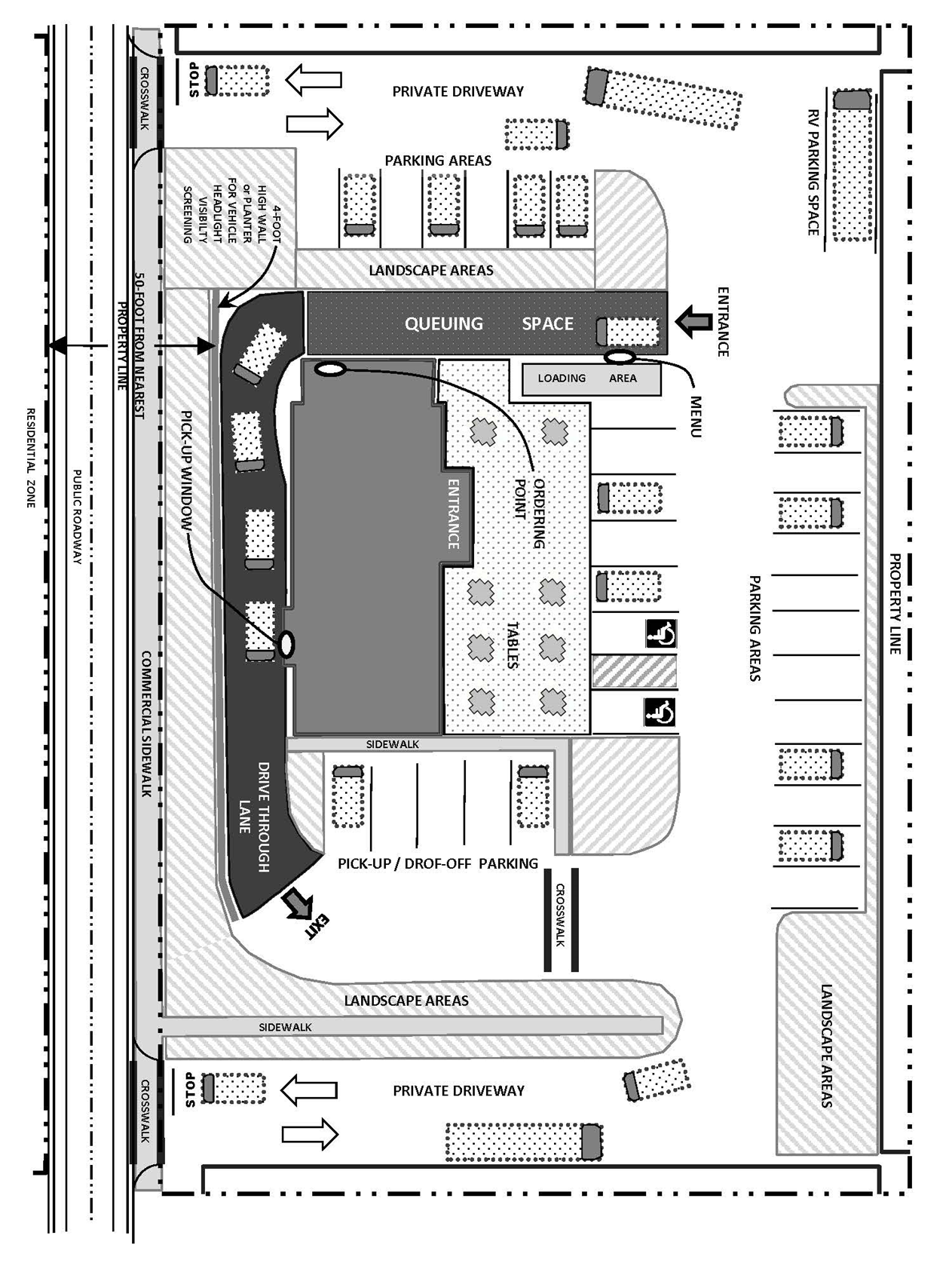
(Ord. No. 5127, §§ 6, 7, 9-1-2020)
Sec. 130.40.150 - Guest House.
A.
Applicability. A guest house attached to or detached from the primary dwelling may be established as an accessory use in any zone allowing single-unit residential development, subject to the general development requirements in Subsection B (General Development Requirements) below in this Section.
B.
General Development Requirements. A guest house shall conform to the setbacks, height limits, lot coverage, and other requirements of the zone in which it is located, as well as the following:
1.
Floor Area Limitation. The maximum floor area allowed for a guest house is 600 square feet. Floor area shall be measured from the outside of the exterior guest house walls including all enclosed habitable or potentially habitable space.
2.
Limitation on Use. As defined under Article 8 (Glossary: See "Guest House") of this Title, a guest house:
a.
May contain a living area, a maximum of two bedrooms, and one bathroom. The living area may include a wet bar, as defined in Article 8 (Glossary) of this Title. A laundry facility and kitchen or cooking facility, or room for installation of a stove, full size refrigerator, or sink other than the bathroom and wet bar sinks, shall be prohibited;
b.
Shall be used for temporary, non-commercial sleeping quarters by visitors of the property owner/lessor; and
c.
Shall not be provided an electric meter separate from the primary dwelling.
Sec. 130.40.160 - Home Occupations.
A.
Contents. This Section provides opportunities for home-based businesses compatible with surrounding residential and agricultural uses in order to encourage home workplace alternatives, promote economic self-sufficiency of county residents, reduce commuting on U.S. Highway 50, while minimizing conflicts with adjacent property owners, maintaining the residential character of neighborhoods, and protecting the public health, safety, and welfare.
B.
Applicability. A home occupation, as defined in Article 8 (Glossary: see "Home Occupation") of this Title, shall be allowed in any zone that allows single- or multi-unit residential use in compliance with the standards and permitting requirements of this Section as shown in Table 130.40.160.1 (Home Occupation Use Matrix) below in this Section.
Table 130.40.160.1—Home Occupation Use Matrix
C.
Standards. A home occupation shall be allowed in compliance with the following standards and Title 5 (Business Taxes, Licenses and Regulations) in the County Code of Ordinances:
1.
All business is conducted within permitted structures on the lot or outdoors provided the business is screened from a right-of-way or road easement. The appearance of the structure shall not be altered nor shall the occupation be conducted in a manner that would cause the structure to differ from its residential character either by the use of colors, materials, construction, lighting, or signs, except where required under Subsection C.5 below in this Section.
2.
For home occupations conducted in any part of a garage or a detached building, the activity shall not be visible from a right-of-way or road easement, nor shall it require vehicles of the property owner to be routinely parked on the street.
3.
The business shall be owned and operated by a person or persons residing on the premises. The business owner may have on-site meetings with other business personnel who provide support service to the home occupation, such as accountants and transcribers. Full or part-time employees under the direct payroll and supervision of the business owner, or an independent contractor shall be allowed to work at the site of the home occupation subject to Subsection C.5 below in this Section, and as shown in Table 130.40.160.2 (Home Occupation Employee Limits) below:
Table 130.40.160.2—Home Occupation Employee Limits
4.
Retail sales may occur on the premises by appointment, only, or when conducted by telephone, mail, or internet, with delivery occurring off-site.
5.
A change of use for that portion of a structure utilized as an office, workroom, sales area, or restroom facilities for employees or commercial customers may require a building permit.
6.
As part of the home occupation, no equipment or process shall be used that creates noise, vibration, dust, glare, fumes, odors, or electrical interference detectable to the normal senses off-site. In the case of electrical interference, no equipment or process shall be used that creates visual or audible interference in any radio or television receivers, or that causes fluctuations in line voltage off-site. Businesses that do not meet these standards may be subject to a Conditional Use Permit in compliance with Section 130.52.021 (Conditional Use Permits) in Article 5 (Planning Permit Processing) of this Title.
7.
Commercial delivery vehicles that are normally associated with residential uses may be utilized for the pick up or delivery of materials related to the home occupation.
8.
Heavy Commercial Vehicles, as defined in Article 8 (Glossary: See "Vehicle, Heavy Commercial") of this Title are allowed as follows:
a.
Agricultural, Rural Lands (RL), and Resource zones (See Chapter 130.21: Agricultural, Rural, and Resources Zones) in Article 2 (Zones, Allowed Uses, and Zoning Standards), may be stored on-site.
b.
On lots five acres or larger and in Residential Estate (RE) may be stored on-site providing they are not visible from a right-of-way or road easement, except when in use.
c.
On lots larger than or equal to one acre but less than five acres and are zoned R2A or R3A, commercial vehicles are allowed provided that the vehicle is stored or parked on-site within an enclosed structure or screened from public view when not in use.
d.
On lots less than one acre or lots zoned RM, R1, R20K and R1A, no heavy commercial vehicles used as part of the home occupation shall be stored or parked on-site or on the road frontage.
9.
Goods or materials used or manufactured as part of the home occupation shall not be visible from a right of way or road easement.
10.
Any materials used or manufactured as part of the home occupation may be subject to the review and approval of Environmental Management and the applicable fire department prior to business license sign off by the Department.
11.
The total acreage of contiguous lots under same ownership shall be used to determine the number of employees, customers and clients allowed for a home occupation.
12.
Student instruction shall be provided by appointment only, subject to the following standards:
a.
Group lessons shall be limited to a maximum of six students per group lesson at any one time, once per day, on parcels less than one acre, or twice per day on parcels one acre or greater, provided adequate parking is available. Parking space that meets on-site residential requirements, as well as available parking space along the road frontage may be used.
b.
No concerts, recitals, performance events, or showings shall be held on the site unless in compliance with Subsection D (Student Instruction—Administrative Permit Required) below in this Section.
c.
Student instruction shall be allowed between the hours of 7:00 a.m. and 9:00 p.m.
13.
The following home occupations shall be allowed by right in Agricultural, Rural Lands and Resource zones, and Residential Estate (RE) zones (See Chapters 130.21: Agricultural, Rural, and Resources Zones, and 130.24: Residential Zones) in Article 2 (Zones, Allowed Uses, and Zoning Standards) of this Title, on lots with a minimum size of ten acres, in compliance with the standards under Subsection C.12 (Standards) above in this Section:
a.
Horseback riding lessons or similar instruction involving animal husbandry.
b.
Horse boarding providing the use or training of the horse(s) is limited to their owners or lessees.
D.
Student Instruction—Administrative Permit Required. An Administrative Permit shall be required when a home occupation exceeds the standards under Subsections C.12 or C.13 (Standards) above in this Section. An Administrative Permit for a home occupation under this Subsection shall only be approved when the Director finds that the standards being exceeded will not change the residential character of the neighborhood based on the attendance numbers, frequency or duration of the event, and nature of the use. If applicable, the location of an accessory structure relative to adjacent residential uses shall be considered, as well. In addition to all other standards under Subsection C (Standards) above in this Section, permit approval shall be subject to compliance with the following standards:
1.
The site of the home occupation either has direct access to a public or private road that conforms to Standard Plan 101C, or the property owner participates in a road maintenance association.
2.
The total number of vehicle round trips to the site generated by students receiving group lessons shall not exceed 12 per day.
3.
There shall be adequate parking on the site to accommodate recitals or concerts, in addition to the required residential parking spaces. Added parking areas shall be located outside of any setback areas for the zone, in compliance with Chapter 130.35 (Parking and Loading) in Article 3 (Site Planning and Project Design Standards) of this Title. Available parking along the road frontage may also be used.
4.
A proposed accessory structure for the purpose of conducting recitals or concerts shall be allowed as follows:
a.
For lots less than one acre, one structure of 600 square feet, maximum.
b.
For lots one acre or larger, one structure of 1,600 square feet, maximum.
E.
Signs. Signs identifying authorized home business activities on the site shall be subject to the standards in Table 130.36.070.3 (Sign Standards for Home Occupation Signs) in Chapter 130.36 (Signs) in Article 3 (Site Planning and Project Design Standards) of this Title. All signs shall be compatible in design with the residential structures on-site and shall not be illuminated.
F.
Limitations on Home Occupations. The following uses occurring on the site are not compatible with residential activities on parcels less than one acre, and shall not be allowed as home occupations. For parcels one acre or greater, the following uses occurring on the site as indicated below are subject to a Use Permit as specified in Table 130.40.160.1 (Home Occupation Use Matrix) above in this Section:
1.
Motor vehicle and other vehicle repair or maintenance (body or mechanical) including, but not limited to the repair of engine, muffler, or drive train components of the vehicle; and upholstering, painting, or detailing work, except as provided in Section 130.40.380 (Vehicle Maintenance, Repair, and Storage Accessory to a Residential Use) below in this Chapter.
2.
Storage of motor vehicles, including but not limited to automobiles, motorcycles, heavy commercial vehicles, recreational vehicles, trailers, and boats(motorized or not), except as provided in Section 130.40.380 (Vehicle Maintenance, Repair, and Storage Accessory to a Residential Use) below in this Chapter.
3.
Carpentry and cabinet making, with the exception of woodworking that results in the creation of small wood products or single orders of furniture where delivery occurs off-site or on-site by appointment only.
4.
Food preparation and food sales, except as part of a catering business where prepared food will be delivered off-site, subject to Environmental Health permit requirements.
5.
Commercial kennels or catteries.
6.
Medical and dental offices, clinics, and medical laboratories.
7.
Veterinary services, with the exception of those considered an 'agricultural support service', as defined in Article 8 (Glossary) of this Title and subject to the standards in Section 130.40.070 (Agricultural Support Services) above in this Chapter.
8.
Repair shops or service establishments, with the exception of repairing small electrical appliances, cameras, or other similar items where pick-up and delivery occurs off-site or on-site by appointment only.
9.
Commercial stables, as defined in Article 8 (Glossary: See "Stables: Commercial") of this Title, which shall be subject to Subsection 130.40.210.C (Outdoor Recreation Facilities) below in this Chapter.
10.
Large-scale upholstering service, with the exception of upholstering single orders of furniture or other objects where pick-up and delivery occurs off-site.
11.
Welding and machining, except when incidental to small scale production or parts assembly; or work or craft that is the activity of creative artists.
G.
Conditional Use Permit. Where a proposed home occupation exceeds the standards under Subsections C.1 through C.11 (Standards), or Subsection D (Student Instruction—Administrative Permit Required) above in this Section, a Conditional Use Permit shall be required in compliance with Section 130.52.021 (Conditional Use Permits) in Article 5 (Planning Permit Processing) of this Title.
(Ord. No. 5127, § 8, 9-1-2020)
Sec. 130.40.170 - Lodging Facilities.
A.
Applicability. This Section applies to lodging facilities, as defined in Article 8 (Glossary), that are located outside of commercial zones where allowed under the use matrices for the zones. This Section does not apply to Vacation Home Rentals (see Section Chapter 5.56: Vacation Home Rentals in Title 5—Business Taxes, Licenses and Regulations).
B.
General Standards. Lodging facilities shall be subject to the general standards below in this Section. In addition, the specific use standards under Subsections C-E (Agricultural Lodging, Bed and Breakfast Inns, Health Resort and Retreat Center, respectively) below in this Section shall apply.
1.
Lodging facilities proposed within Agricultural Districts, as identified on the General Plan land use maps, on or adjacent to land zoned Planned Agriculture (PA), Limited Agriculture (LA), Agricultural Grazing (AG), Forest Resource (FR), or Timber Production (TPZ) must be reviewed by the Ag Commission for compatibility with surrounding agricultural land uses or on agriculturally zoned lands prior to action by the review authority.
2.
The applicant must demonstrate to the satisfaction of the Environmental Management Department that the facilities meet all applicable health standards including, but not limited to, kitchen facility, water, and sewage disposal permit requirements.
3.
Unless superseded by the regulations under this Section, guest accommodations shall be allowed in compliance with the development standards of the respective zone and Article 3 (Site Planning and Project Design Standards) in this Title.
4.
Signs: See Chapter 130.36 (Signs) in Article 3 (Site Planning and Project Design Standards) in this Title.
5.
Lodging facilities shall have direct access to a maintained road in conformance with Department of Transportation standards. The entrance, parking area, and walkways shall be kept free of obstructions or hazards of any type. With the exception of Agricultural Homestays, Guest Ranches, and Agricultural and Timber Resource Lodging, the entrance, parking and walkways shall be illuminated in compliance with Chapter 130.34 (Outdoor Lighting) in Article 3 (Site Planning and Project Design Standards) in this Title.
6.
Lodging facilities shall provide off street parking at a ratio of one space per each guest room, plus two spaces required for the primary dwelling. Guest parking shall be subject to the following:
a.
No guest parking shall be allowed within the required front or side yard setback.
b.
Tandem parking, meaning two cars parked one behind the other, may be allowed. Denser parking lot configurations may be allowed if valet parking is provided.
c.
Guest parking shall be designed to prohibit the backing of vehicles directly into any public right of way in order to exit any parking space.
d.
The parking area provided for a lodging facility may have a gravel surface.
7.
A lodging facility consisting of five or fewer guestrooms shall be considered a single-unit residential dwelling or lodging house for the purpose of building codes, unless additional standards are required by said codes, as amended from time to time and adopted by the County. Six or more guestrooms within one structure shall be subject to further requirements under the building codes.
8.
The operation of a lodging facility shall be subject to Title 3 (Revenue and Finance), Chapter 3.28 (Transient Occupancy Tax) and Title 5 (Business Taxes, Licenses and Regulations), Chapter 5.08 (License Requirements and Procedure) of the County Code of Ordinances. The business license shall be posted in a conspicuous place on the premises prior to operation of the business.
9.
Ancillary activities such as weddings, receptions, fund raisers, or similar events attended by non-guests may be allowed as part of a Conditional Use Permit (Section 130.52.021: Conditional Use Permits) or subject to a Temporary Use Permit (Section 130.52.060: Temporary Use Permit) in Article 5 (Planning Permit Processing) of this Title, if applicable.
10.
If not already required under the allowed use matrix, a Conditional Use Permit shall be required, in compliance with Section 130.52.021 (Conditional Use Permits) in Article 5 (Planning Permit Processing) of this Title, when a proposed use exceeds the general standards in this Subsection.
C.
Agricultural Lodging Table 130.40.170.1 (Agricultural Lodging) below identifies the allowed agricultural lodging facilities subject to the provision below.
Table 130.40.170.1: Agricultural Lodging
1.
Agricultural Homestays.
a.
The applicant shall demonstrate to the satisfaction of the Agricultural Department that the site meets the minimum qualifications for agricultural or grazing use as set forth under the minimum criteria for a Williamson Act Contract, whether the property is under Contract or not. The adopted Williamson Act criteria for lots between ten and 20 acres shall also apply on similarly sized lots, whether they are under Contract or not.
b.
The use is limited to a maximum of three guest rooms for up to six guests at any one time.
c.
The property owner shall reside on-site.
d.
Meals may be served to overnight guests, only. There are no limitations on the number of meals or the times at which they are served. The price of food shall be included in the price of the overnight accommodations in compliance with the California Retail Food Codes enforced by the County (California Health and Safety Code Section 113893).
e.
Uses which do not meet the above criteria may be considered as a Bed and Breakfast Inns under Subsection D (Bed and Breakfast Inns), below in this Section.
2.
Agricultural and Timber Resource Lodging.
a.
Minimum lot size—Ten acres.
b.
The applicant shall demonstrate to the satisfaction of the Agricultural Department that the site meets the minimum qualifications for agricultural or grazing use as set forth under the minimum criteria for a Williamson Act Contract, whether the property is under contract or not.
c.
Lodging in TPZ shall be subject to Subsection 130.40.350.G (Required Findings to Support Residential, Recreational and Other Non-Timber Uses) below in this Chapter.
3.
Guest Ranch.
a.
The applicant shall demonstrate to the satisfaction of the Agricultural Department that the site meets the minimum qualifications for agricultural/grazing use as set forth under the minimum criteria for a Williamson Act Contract, whether the property is under contract or not.
b.
Meals may be served to registered day use or overnight guests, only. There are no limitations on the number of meals or the times at which they are served.
D.
Bed and Breakfast Inns.
1.
Bed and breakfast inns shall be considered an expanded home occupation in residential and agricultural zones and a compatible use in commercial zones.
2.
The bed and breakfast inn may provide up to a maximum of 20 guestrooms, which shall be contained within the primary and accessory dwelling units and guest house only, in compliance with the development standards of the applicable residential or agricultural zones.
3.
The property owner shall reside on-site.
4.
Meal service shall be limited to registered guests and shall consist of breakfast and light snacks as a portion of the overall room rate in compliance with the California Retail Food Codes enforced by the County (California Health and Safety Code Section 113893).
5.
The Conditional Use Permit may authorize limited ancillary activities such as weddings, receptions, fund raisers, or similar events attended by non-guests, subject to conditions of approval that include, but are not limited to, restrictions upon the frequency and time of holding events, duration thereof, and the maximum number of persons attending. Food preparation, except for the aforementioned breakfast and light snacks, shall not be allowed within the bed and breakfast inn. Unless expressly authorized in the Conditional Use Permit, such ancillary activities are prohibited.
A Temporary Use Permit for an ancillary activity may be processed in situations where special events are not authorized under the Conditional Use Permit for the bed and breakfast inn, in compliance with Section 130.52.060 (Temporary Use Permit) in Article 5 (Planning Permit Processing) of this Title. Applicable conditions shall be imposed, as determined necessary by the review authority, which restrict the number of people attending and offset other related impacts, in order to maintain the residential character of the surrounding neighborhood.
6.
New construction proposed on a bed and breakfast inn site, including buildings not necessarily proposed for bed and breakfast inn use, or exterior remodeling of the building(s) to be used for guest accommodations, is subject to architectural review by the review authority as part of the Conditional Use Permit process, in compliance with Section 130.52.021 (Conditional Use Permits) in Article 5 (Planning Permit Processing) of this Title. This determination will be based on building materials, compatibility with neighborhood building style, and any historic style indigenous to the area.
E.
Health Resort and Retreat Center.
1.
Health resorts and retreat centers shall be considered an expanded home occupation in residential zones and may be a compatible use in Agricultural, Rural Lands and Resource Zones, Commercial and Special Purpose zones.
2.
Prior to action by the review authority, lots adjacent to or within Agricultural zoning must be reviewed by the Ag Commission for compatibility with surrounding agricultural uses prior to action by the review authority.
3.
Meals may be served to registered day use or overnight guests, only. There are no limitations on the number of meals or the times at which they are served.
4.
The Health Resort and Retreat Center may provide up to a maximum 20 guestrooms within one or more structures, in compliance with the development standards of the applicable residential or agricultural zones.
(Ord. No. 5097, § 2, 1-8-2019; Ord. No. 5152, §§ 11, 12, 11-16-2021)
Sec. 130.40.180 - Mixed Use Development.
A.
Applicability. Residential development may occur with the commercial development allowed in Chapter 130.22 (Commercial Zones) in Article 2 (Zones, Allowed Uses, and Zoning Standards) of this Title under the use matrices for the zones. Commercial development may occur with residential development allowed in Chapter 130.24 (Residential Zones) in Article 2 (Zones, Allowed Uses, and Zoning Standards) of this Title.
B.
General Requirements. The following requirements shall apply to all mixed use development projects:
1.
Commercial and residential uses shall be complementary and mutually supportive of each other and shall be integrated into the community or neighborhood where the development is located.
2.
The residential component shall be allowed on separate lots within the development.
3.
The residential component may include a full range of single-unit and/or multi-unit residential design concepts.
4.
Mixed use development projects may be phased.
5.
Mixed use development may include live/work units. A live/work unit is defined as a single unit consisting of both a commercial/office and a residence that is occupied by the same resident. The live/work unit shall be the primary dwelling of the occupant.
6.
Mixed use development projects in Community Regions shall be designed consistent with the Mixed Use Design Manual, adopted by the Board on December 15, 2015 and reformatted on April 24, 2018 (Resolution 197-2015) and the adopted community design standards and guidelines for each Community Region. Until such time as permanent design standards and guidelines are adopted for a particular Community Region, mixed use development projects shall be consistent with either the Interim Objective Design Standards for Streamlined Ministerial Projects or the Interim Design Standards and Guidelines for Multifamily, Mixed-Use or Commercial Projects, whichever is applicable, as adopted by the Board on December 3, 2024 (Resolutions No. 214-2024 and 215-2024, respectively). Mixed use projects that deviate from the standards of the Mixed Use Design Manual or applicable community design standards shall require a Design Review Permit.
7.
Mixed use development projects in Rural Centers or the Rural Region shall be encouraged to comply with the standards and guidelines found in the adopted Mixed Use Design Manual.
C.
Development Standards.
1.
At least 30 percent of the gross floor area of the mixed use development project shall be devoted to commercial uses. "Gross floor area" as used within this Section does not include inner courtyards and exterior stairwells or balconies.
2.
The maximum density for the residential use component shall be 20 dwelling units per acre in Community Regions and ten dwelling units per acre in Rural Centers or developments without a public sewer connection.
3.
Minimum residential dwelling unit area shall comply with the building code.
4.
The gross floor area of commercial use in a mixed use development on RM zoned land shall not exceed 15 percent of the gross floor area of the project.
5.
Setbacks: Notwithstanding Sections 130.22.030 (Commercial Zone Development Standards) and 130.24.030 (Residential Zone Development Standards) in Article 2 (Zones, Allowed Uses, and Zoning Standards) of this Title, front setbacks for mixed use development projects shall be as follows:
Table 130.40.180.1—Front Setbacks for Mixed Use Development
Mixed use buildings shall have no minimum side and rear setbacks if the building has a fireproof wall with no openings that meets all building and fire code requirements. Otherwise, side and rear setbacks shall be a minimum of five feet.
6.
Parking shall be subject to the requirements in Chapter 130.35 (Parking and Loading) and Chapter 130.33 (Landscaping Standards) in Article 3 (Site Planning and Project Design Standards) of this Title. Notwithstanding the requirements of Chapter 130.35 (Parking and Loading), parking shall be required as follows:
Table 130.40.180.2—Parking Requirements
a.
On-street parking spaces located within 400 feet of the project may be credited to meet up to 50 percent of the minimum required off-street parking spaces. On-street parking allowed by this provision shall not be counted toward the maximum amount of parking allowed.
b.
The Director may reduce the minimum off street parking requirements by up to 100 percent for mixed-use projects meeting at least one of the following requirements:
(1)
The project is sited within one-quarter mile of a public or private parking lot that can accommodate the off-street requirements.
(2)
The project developer or owner contributes into a "public parking lot development fund" based upon the number of required off-street parking spaces.
7.
On-site pedestrian walkways or sidewalks connecting the residential and commercial components, as well as connecting to adjacent commercial, residential, and civic uses, shall be provided for pedestrian safety.
D.
Findings. To assure the proposed development meets the intent of this Section for mixed use development the following findings shall be made prior to approving a mixed use project:
1.
The development contains complementary and connected uses that are mutually supportive of each use, provides a significant functional interrelationship, and are integrated into the community or neighborhood it is located.
2.
The development creates an appropriate internal and external human scale, and provides for pedestrian comfort and amenities.
3.
The development is an integrated project as to land use, building design, and site layout, with a coherent physical design.
(Ord. No. 5219, § 2, 12-3-2024; Ord. No. 5241, § 9, 8-19-2025; Ord. No. 5256, § 3, 3-3-2026)
Sec. 130.40.190 - Mobile/Manufactured Homes.
A.
Applicability. A mobile or manufactured home (hereinafter referred to as "mobile home") or a recreational vehicle (RV) may be allowed for temporary or permanent use in compliance with the provisions of Chapter 110.64 (Mobile Home Regulations) of Title 110 (Buildings and Construction) of the County Code of Ordinances, the development standards of the zone, and the provisions of this Section.
B.
Permit Requirements.
1.
Residential Dwellings. In all zones that permit detached, single-unit residential or multi-family dwellings by right, the permanent placement of a mobile/manufactured home as primary and/or accessory dwelling unit shall be allowed.
2.
Temporary While Constructing. One mobile home or recreational vehicle may be placed on a lot for the purpose of habitation during the construction of a permitted primary dwelling or during major repair of a damaged dwelling that is uninhabitable. A temporary occupancy permit shall be obtained from Building Services for the mobile home or recreational vehicle, and an active building permit must remain in effect for the primary dwelling.
3.
Hardship Purposes. One temporary mobile home may be allowed on a lot measuring one acre or larger, in compliance with permit requirements under Section 130.52.050 (Temporary Mobile Home Permit) in Article 5 (Planning Permit Processing) of this Title only when there is an existing primary dwelling and the temporary mobile home is for the following uses:
a.
To provide temporary housing or shelter for the owner or members of the household and/or to allow for in-home care of household members who reside on the lot.
b.
To provide caretaker assistance to the elderly or disabled homeowner(s) in their personal care and/or protection of their property. The elderly or disabled homeowner(s) must reside on site. Under this Section, "elderly" shall mean a person 62 years of age or older.
4.
Contractor's Office. One or more mobile home(s) may be used exclusively as a temporary office for contractors engaged in construction projects during the course of construction of the project where an active building, grading, or other permit remains in effect, subject to the following provisions:
a.
A temporary contractor's office may be located on the same property as the construction project subject to approval of an Administrative Permit in compliance with Section 130.52.010 (Administrative Permit, Relief, or Waiver) in Article 5 (Planning Permit Processing) of this Title.
b.
A temporary contractor's office may be located off-site subject to approval of a Temporary Use Permit in compliance with Section 130.52.060 (Temporary Use Permit) in Article 5 (Planning Permit Processing) of this Title.
c.
A temporary contractor's office located on or adjacent to agricultural or resource zoned land shall be subject to review by the Agricultural Commissioner.
5.
Construction Employee Housing. The temporary placement of one or more mobile homes or recreational vehicles to provide construction-related employee housing may be allowed subject to the use matrices for the zones. Such temporary housing shall be limited to projects in remote areas where permanent housing is infeasible and where a mobile home park, recreational vehicle park, or campground space are unavailable. A temporary occupancy permit shall be obtained from Building Services for the mobile home(s) or recreational vehicle(s), and an active building permit must remain in effect for the construction project.
6.
Agricultural Employee Housing. One or more mobile homes may be used for housing agricultural employees and their immediate families in compliance with the requirements under Section 130.40.120 (Commercial Caretaker, Agricultural Employee, and Seasonal Worker Housing) above in this Chapter.
7.
Caretaker Housing. On lots that contain commercial, industrial, recreational, or civic uses including public and private schools and churches, one mobile home may be placed on the lot or contiguous lots under common ownership for the purpose of providing housing for a caretaker in compliance with the requirements of Section 130.40.120 (Commercial Caretaker, Agricultural Employee, and Seasonal Worker Housing) above in this Chapter.
8.
Temporary Housing Option Recreational Vehicle. One "temporary recreational vehicle" (TRV) may be allowed on a lot measuring one acre or larger, in compliance with permit requirements under Section 130.52.050 (Temporary Mobile Home Permit) in Article 5 (Planning Permit Processing) of this Title.
a.
A "temporary recreational vehicle" (TRV) is defined in this Section as meaning a motor home or travel trailer with or without motive power, originally designed for human habitation that is: Designed for recreational or emergency occupancy; contains less than 320 square feet of internal living room area, excluding built-in equipment, including, but not limited to, wardrobe, closets, cabinets, kitchen units or fixtures, and bath or toilet rooms; contains 400 square feet or less of gross area measured at maximum horizontal projections; is built on a single chassis; is self-propelled or permanently towable on California roadways bearing the State or Federal insignia of approval for recreational vehicles and maintains current registration with the Department of Motor Vehicles (DMV).
b.
A TRV is for the following uses: To provide temporary housing for a property owner or family member and/or to allow for in-home care of family members who reside on the lot; or by a caretaker where the purpose of the caretaker is to assist elderly or disabled homeowner(s) with their personal care and/or the care and protection of their property. The elderly or disabled owner(s) must reside in the primary dwelling or accessory dwelling unit. Under this Section, "elderly" shall mean a person 62 years of age or older.
c.
Exceptions: A TRV may be allowed on a lot of less than one acre in the event of fire, flood, or other disaster, which has destroyed or damaged a dwelling to the point where it is no longer habitable and the property owner needs a temporary mobile home or TRV in which to reside.
d.
The urgency ordinance for temporary housing options from which this Subsection is derived is set to sunset from this Title three years from the date of adoption (December 2, 2020), upon which date no new TRV permits may be issued or renewed.
C.
Temporary Mobile Home Removal. Where the permit has expired in compliance with Subsection 130.52.050.E (Permit Expiration) in Article 5 (Planning Permit Processing) of this Title, the mobile home or recreational vehicle shall be removed from the property within 30 days following the date of expiration. The applicant shall be required to obtain a demolition permit in order that the County can verify that water, sewer or septic systems, and other utilities are disconnected and the unit is removed from the site.
(Ord. No. 5136, § 2, 12-2-2020; Ord. No. 5152, §§ 13, 14, 11-16-2021)
Sec. 130.40.210 - Outdoor Recreational Facilities—Commercial or Public.
A.
Applicability. Commercial or public outdoor recreational facilities are subject to the provisions of this Section where allowed under the use matrices for the zones. The standards under this Section do not apply to private recreational facilities such as swimming pools or tennis courts, that are accessory to an individual residence, a planned community or a multi-unit residential complex and not open to the public, or that are accessory to a school.
B.
Permit Requirements. Where allowed under the use matrices for the zones, those commercial or public outdoor recreational facilities allowed by right shall be subject to the building permit process, while those subject to Administrative or Conditional Use Permit approval shall be reviewed for impacts to the surrounding area. In addition, the specific use standards under Subsections D-G (Hunting/Fishing Club, or Farm; Off -highway or Off-road Vehicle area; Parks, Day Use; Swimming Pools and Tennis Courts, respectively) below in this Section shall apply.
C.
Commercial Stables. Stables that provide horses for hire at an hourly, daily or weekly rate, commercial boarding and training of horses, or riding lessons that exceed the standards of a home occupation shall be subject to the following minimum standards:
1.
Minimum Lot Size—Ten acres.
2.
Setbacks. Under this Subsection, commercial stables, barns, and other structures used for or intended to be used for the sheltering of horses and/or other animals shall comply with the setback requirements of the zone in which they are located, except that the minimum setback from any residentially-zoned property shall be 100 feet.
3.
Parking and Loading. Horse trailer parking spaces required under Chapter 130.35 (Parking and Loading) in Article 3 (Site Planning and Project Design Standards) of this Title shall be located a minimum of 50 feet from any public road or right-of-way.
4.
Arenas. Training arenas shall have a minimum setback of 100 feet from any residentially-zoned property. Arenas used for shows or events where more than 10 people could congregate at any one time shall be subject to a Conditional Use Permit in compliance with Section 130.52.021 (Conditional Use Permits) in Article 5 (Planning Permit Processing) of this Title.
5.
Equestrian Trails. Prior to Department approval of a permit for a commercial stable where the public may be riding off of the premises, the applicant shall demonstrate access to a trail easement for equestrian purposes. Proposed commercial stables adjacent to trail easements may be required to dedicate land for trail access points, as determined by the Director.
a.
If horses will be traveling on a roadway, written approval shall be submitted from the following:
(1)
Private road: Any road maintenance association or other entity created for road maintenance. The operator of the stable shall provide sufficient written documentation to provide proof of the right to use the private road for the proposed use.
(2)
County road: Department of Transportation.
(3)
State highway: Caltrans and the California Highway Patrol.
D.
Hunting/Fishing Club, or Farm.
1.
Minimum Lot Size—20 acres.
2.
Lodging Facilities Accessory. Where applicable, lodging facilities accessory to this use shall be consistent with the standards under Subsection 130.40.170.B (Lodging Facilities: General Standards) above in this Chapter.
E.
Off-highway or Off-road Vehicle area. Uses within this Subsection shall include but not be limited to go-cart, motocross, all-terrain vehicle, snowmobile, and miniature auto tracks for recreational purposes. The following standards shall apply:
1.
Residential Zones. Where allowed in the use matrices for the zones, the noncommercial on-site use of recreational off-road vehicles shall be subject to the following provisions:
a.
Minimum Lot Size—five acres;
b.
Compliance with all applicable development standards under this Title to include, but not be limited to:
(1)
Noise and outdoor lighting standards;
(2)
Issuance of grading and encroachment permits where applicable;
(3)
County erosion, dust control, and air quality standards; and
(4)
Equipment requirements under Subsection E.2 (Non-residential Zones) below in this Section.
2.
Non-residential Zones. Where allowed in the use matrices for the zones, any commercial or public off-road vehicle (OHV) recreation area shall require all vehicles using the site to be equipped, at a minimum, with the following:
a.
Spark arrestors of a type approved by the U.S. Forest Service;
b.
Noise suppression devices, such as mufflers or silencers, which limit exhaust noise emissions in compliance with threshold levels under Chapter 130.37 (Noise Standards) in Article 3 (Site Planning and Project Design Standards) of this Title. No exhaust system or noise suppression device shall be equipped with a cutout, bypass, or similar device, nor shall it be modified in such a manner to amplify or increase the noise emitted by the subject vehicle; and
c.
Licensing to the extent required by law.
F.
Parks, Day Use. Uses within this Subsection include neighborhood, community, and regional parks and picnic areas. The following standards shall apply:
1.
Use and operation of park facilities shall be limited to daylight hours.
2.
Playground equipment shall be centrally located on the park site, or situated in a way that minimizes noise impacts on adjacent residential property owners.
3.
Landscaping and parking shall comply with the standards set forth in Chapters 130.33 (Landscaping Standards) and 130.35 (Parking and Loading) in Article 3 (Site Planning and Project Design Standards) of this Title.
4.
Signs shall be in compliance with Chapter 130.36 (Signs) in Article 3 (Site Planning and Project Design Standards) of this Title.
5.
Lighting shall be limited to security lighting only. Temporary lighting to extend daytime use of the park facilities shall be prohibited.
G.
Swimming Pools and Tennis Courts.
1.
The facilities under this Subsection shall be subject to the standards under Subsection F (Parks, Day Use) above in this Section except as follows:
a.
A noise analysis will be required for a swimming pool facility within 500 feet of a residential zone, prior to permit approval. If the noise analysis shows that the noise levels will exceed the daytime standards of Chapter 130.37 (Noise Standards) in Article 3 (Site Planning and Project Design Standards) of this Title, a Conditional Use Permit shall be required in compliance with Section 130.52.021 (Conditional Use Permits) in Article 5 (Planning Permit Processing) of this Title.
b.
When open for nighttime use, a Conditional Use Permit shall be required, subject to Section 130.52.021 (Conditional Use Permits) in Article 5 (Planning Permit Processing) of this Title.
Sec. 130.40.220 - Outdoor Retail Sales.
A.
Content. This Section is regulates the operation of permanent and temporary outdoor retail.
B.
Permanent Outdoor Retail Sales. Areas of commercial development intended to be used for outdoor retail sales on a permanent or ongoing basis shall be allowed where shown in the use matrices for the zone. Outdoor retail sales areas may be conducted as a primary use, such as a vehicle sales lot or plant nursery, or as an accessory use, such as a sales yard, nursery area, or vending machine in conjunction with a building materials or other retail store. Outdoor seating at a restaurant, whether conducted as a primary or accessory use, shall also be subject to the standards of this Subsection. The following standards shall apply:
1.
A permanent outdoor retail sales area shall be distinct and separate from parking and loading areas, walkways, and landscaping areas.
2.
Sales areas shall be included in square footage calculations when determining parking requirements under Section 130.35.030 (Parking and Loading) in Article 3 (Site Planning and Project Design Standards) of this Title.
3.
All development standards under the specific zone shall apply, as well as those general standards applicable to the site plan, such as landscaping, lighting, signs, and noise (See Chapters 130.33 (Landscaping Standards), 130.34 (Outdoor Lighting), 130.36 (Signs), and 130.37 (Noise Standards)) in Article 3 (Site Planning and Project Design Standards) of this Title.
4.
A permanent outdoor retail sales area shall be screened from the side and rear property lines adjacent to residentially zoned property.
5.
Surfacing requirements of the outdoor sales area shall consist of concrete or asphalt pavement, chip seal, gravel, or other material that can be maintained in a dust-free condition. Vehicle access and parking areas shall be surfaced in compliance with County design standards.
C.
Temporary Outdoor Retail Sales. Temporary outdoor retail sales such as farmers' markets, arts and craft fairs, seasonal sales, swap meets/flea markets, sidewalk sales, and mobile food vendors are allowed subject to the issuance of an Administrative Permit (See Section 130.52.010: Administrative Permit, Relief, or Waiver) in Article 5 (Planning Permit Processing) of this Title, unless otherwise specified below and under Subsections D through H (Certified Farmers' Markets; Garage Sales; Seasonal Sales; Swap Meets/Flea Markets; Itinerant Sales, respectively) below in this Section. The following standards shall apply:
1.
Location. The temporary sales area shall not block any emergency access route or otherwise disrupt general vehicular or pedestrian circulation of the shopping center or public street on which the retail business is located.
2.
Hours of Operation. The temporary sales area shall be conducted during daylight hours only, with all sales facilities, signs, and any related vehicles removed from the site at the close of daily business. Except where otherwise prohibited by this Section, night operations are allowed only when specifically authorized through Temporary Use Permit approval (See Section 130.52.060: Temporary Use Permit) in Article 5 (Planning Permit Processing) of this Title.
3.
Parking Requirements. Parking requirements shall be in conformance with Table 130.35.030.1 (Schedule of Off-Street Vehicle Parking Requirements) in Chapter 130.35 (Parking and Loading) in Article 3 (Site Planning and Project Design Standards) of this Title for each specific use. Parking shall be available to accommodate employee and customer parking needs either on-site or on adjacent to property, provided a shared parking agreement between the applicant and the adjacent property owner has been notarized and submitted with the application. Parking along the road frontage(s) may be allowed subject to the review and approval of the Department of Transportation. If the temporary sales area is located within an existing parking lot, adequate alternative parking must be available.
4.
Surfacing. Surfacing materials shall comply with Subsection B.5 (Permanent Outdoor Retail Sales) above in this Section.
5.
Signs. Signs allowed in conjunction with temporary outdoor retail sales are subject to provisions of Chapter 130.36 (Signs) in Article 3 (Site Planning and Project Design Standards) of this Title for size and placement standards. Sign placement shall be limited to one day prior to the first day of the sales event and removal shall be required at the close of business on the last day of the event.
6.
Duration. Unless otherwise stated in Subsections D through H (Certified Farmers' Markets; Garage Sales; Seasonal Sales; Swap Meets/Flea Markets; Itinerant Sales, respectively) below in this Section, a sales event shall run no more than three consecutive days in the same location, with no more than three such sales events occurring during a calendar year beginning January 1. This standard may be modified through Temporary Use Permit approval where it is found that the proposed site will be provided with adequate parking and restroom facilities and that the surrounding area can sustain traffic volumes generated by the sales event without adverse effects in the area.
D.
Certified Farmers' Markets. In addition to the standards under Subsection C (Temporary Outdoor Retail Sales) above in this Section, Certified Farmers' Markets are subject to all applicable provisions of Sections 47002 et seq. of the California Food and Agriculture Code and shall register with the Department of Agriculture, Weights and Measures. Certified Farmer's Markets are exempt from Subsection C.6 (Duration) above in this Section.
E.
Garage Sales. Garage sales or similar uses may be allowed by right by the residents of the property only, subject to the following standards:
1.
Garage sale activity shall not be conducted in the public right-of-way, including streets, sidewalks, parkways, or alleys.
2.
Items sold at garage sales shall be used goods, wares, or merchandise of a household nature, and shall not have been acquired elsewhere for resale.
3.
Single-unit residential dwellings shall be allowed a maximum of four garage sales per calendar year at the same address. Each garage sale may be allowed for up to 3 days and shall not exceed a total of 12 days per calendar year at the same address.
4.
Multi-unit residential dwellings shall be allowed a maximum of two garage sales per calendar year per legal dwelling unit.
5.
Garage sale advertising signs shall comply with the standards under Subsection 130.40.210.C.5 (Temporary Outdoor Retail Sales, Signs) above in this Chapter as to duration and with Chapter 130.16 (Signs) in Article 3 (Site Planning and Project Design Standards) of this Title, and further shall not be posted on telephone poles, streetlights, traffic signs, or any other structure or location within the public right-of-way.
6.
Garage sales that exceed the standards provided in this Subsection shall be considered a temporary use requiring issuance of a Temporary Use Permit in compliance with Section 130.52.060 (Temporary Use Permit) in Article 5 (Planning Permit Processing) of this Title.
F.
Seasonal Sales. Seasonal sales, as defined in Article 8 (Glossary: see "Seasonal Sales) of this Title, shall be subject to the following:
1.
Time Limit. Seasonal sales products grown in a location separate from where they are sold shall be limited to a period of 45 consecutive days.
2.
Merchandise. The area dedicated to seasonal sales shall not contain the sale of any merchandise not directly associated with the season identified by the applicant as the basis for the seasonal sales activity.
3.
Location. Seasonal sales shall be conducted outside of any public right-of-way or road easement unless an encroachment permit is approved by the Department of Transportation. Off-site sales may utilize a shopping center parking lot subject to a maximum reduction of 20 percent of the total amount of available parking.
4.
Hours of Operation. Seasonal sales shall be conducted between the hours of 8:00 a.m. and 10:00 p.m. unless otherwise restricted.
5.
Lighting. Lighting shall be subject to the requirements in Chapter 130.34 (Outdoor Lighting) in Article 3 (Site Planning and Project Design Standards) of this Title.
G.
Swap Meets/Flea Markets. These temporary events may be conducted on the site of another use established in compliance with this Title in a commercial or industrial zone, provided that such site is not adjacent to a residential zone.
1.
Limitation on Use. The sale of vehicles is not allowed.
2.
Site Surfacing. Portions of a swap meet site used for sales activities or pedestrian circulation shall be surfaced in compliance with Subsection B.5 (Permanent Outdoor Retail Sales) above in this Section or with planted and maintained lawn.
H.
Itinerant Sales. Transient produce, food, flower, or merchandise stands that are not part of a temporary use or event authorized in compliance with this Section, are not authorized by another permit or license, or that are not operated as a produce stand in compliance with Section 130.40.240 (Produce Sales) below in this Chapter are prohibited.
Sec. 130.40.230 - Private Schools in Light Manufacturing Facilities.
A.
Applicability. Private schools and their accessory uses allowed under the use matrices for zones allowing light manufacturing uses, as defined in Article 8 (Glossary: see "Light Manufacturing") of this Title, are subject to the standards and permitting requirements of this Section.
B.
Exemptions. Trade schools that provide training in skills that would be compatible with the uses in zones allowing light manufacturing shall be exempt from this Section.
C.
Permit Requirements. The use of light manufacturing facilities for private schools shall be subject to discretionary review. As part of discretionary approval, the review authority shall determine:
1.
There is sufficient land or structures available in the adjacent area or business park in which the school is located to accommodate the expected demand for light industrial uses.
2.
Sufficient outdoor play area is provided to accommodate the number of children anticipated or approved by the discretionary permit, with age-appropriate play facilities on the site of the school.
3.
The location of the school will not detract from or compromise current or future light industrial uses in the vicinity.
4.
The private school conforms to all other requirements of this Title, including, but not limited to parking and signs (Chapters 130.35 (Parking and Loading) and 130.36 (Signs), respectively) in Article 3 (Site Planning and Project Design Standards) of this Title.
D.
General Standards.
1.
Where it can be demonstrated that shared parking can accommodate the anticipated parking demand based on alternating use schedules, a school shall not be required to provide additional parking with the exception of meeting ADA requirements for access to the school building.
2.
An adjacent site may be utilized for parking with submittal of a written, binding agreement with the adjacent land owner allowing use of their site for this purpose.
3.
Utilization of parking and/or loading areas for outdoor play shall be prohibited.
4.
A drop-off and pick-up area shall be provided that does not conflict with traffic flow or impact parking areas.
Sec. 130.40.240 - Produce Sales.
A.
Applicability. The standards set forth in this Section shall apply to produce sales, as defined in Article 8 (Glossary: see "Produce Sales") of this Title, where allowed in the use matrices for the zones.
B.
General Standards. Sale of produce grown on-site shall be subject to the following:
1.
Sales may occur on-site subject to adequate off-road and/or road frontage parking.
2.
One produce stand, as defined in Article 8 (Glossary: see "Produce Stand") of this Title, may be used subject to the following requirements:
a.
The stand shall measure 200 square feet or less in size and be situated a minimum of 50 feet from the nearest side or rear property line.
b.
An encroachment permit shall be secured from the Department of Transportation if the produce stand is accessed from a County road.
c.
Parking requirements shall be in compliance with Table 130.35.030.1 (Schedule of Off-Street Vehicle Parking Requirements) in Chapter 130.35 (Parking and Loading) in Article 3 (Site Planning and Project Design Standards) of this Title. The parking area shall meet minimum setback standards for the zone and shall be designed to prevent vehicles from backing into the roadway. Said parking area may be of gravel or dirt surface, but dust control measures shall be implemented as needed to comply with Air Pollution Control District standards.
C.
Value-added Agricultural Products. Value-added agricultural products, as defined in Article 8 (Glossary: see "Agriculture, Value-added Product") of this Title, created from products grown on-site, may be sold concurrently with agricultural products on-site. Products shall comply with all local, and state and federal laws and regulations.
D.
Off-site Sales. No direct sales of produce grown off-site or of any other merchandise, including wholesale or retail nursery products, shall be allowed by right. Off-site produce sales, when in conjunction with a shared multi-farm produce stand, may be allowed subject to approval of a Minor Use Permit (See Section 130.52.020: Minor Use Permits) in Articles (Planning Permit Processing) of this Title.
E.
Ranch Marketing. Produce sales in excess of the requirements of this Section, shall be subject to Chapter 130.44 (Ranch Marketing) below in this Article.
(Ord. No. 5177, § 4, 6-20-2023)
Sec. 130.40.250 - Public Utility Infrastructure.
A.
Applicability. Public utility infrastructure, as defined in Article 8 (Glossary: see "Public Utility Infrastructure") of this Title, may be established as an allowed use in any zone, subject to Subsections B through D (Allowed by Right; Administrative Permit Required; Conditional Use Permit Required, respectively) below in this Section, provided that the routes and site locations of the proposed lines or facilities be submitted to the Department for a finding of consistency with the General Plan during the preliminary planning stages, prior to the adoption of the routes and site locations(s) and/or acquisition of right-of-way.
B.
Allowed by Right. Public utility infrastructure is allowed by right when said facilities do not exceed the height limit of the zone by more than 15 feet and do not create potential safety and health hazards to adjacent property owners, present or future.
C.
Administrative Permit Required. Notwithstanding Subsection B (Allowed by Right) above in this Section, an Administrative Permit in compliance with Section 130.52.010 (Administrative Permit, Relief, or Waiver) in Article 5 (Planning Permit Processing) of this Title shall be required for the following:
1.
Overhead public utility infrastructure proposed to be constructed in the Airport Transportation Corridor (TCA) zone or Airport Safety (-AA) Combining Zone (See Section 130.27.100: Airport Noise and Safety Contour (-ANS) in Article 2 (Zones, Allowed Uses, and Zoning Standards) of this Title). Said permit shall be subject to the review and approval of the Airport Land Use Commission.
2.
Public utility infrastructure that exceeds the height limitations of the zone, as set forth in Subsection B (Allowed by Right) above in this Section, but is less than 150 feet in height or does not comply with setback standards.
D.
Conditional Use Permit Required. A Conditional Use Permit in compliance with Section 130.52.021 (Conditional Use Permits) in Article 5 (Planning Permit Processing) of this Title shall be required for the following:
1.
Where the construction of the public utility infrastructure creates a potential safety or health hazard to adjacent property owners, present or future, as determined by the Director.
2.
Where the construction of the public utility infrastructure exceeds 150 feet in height.
Sec. 130.40.260 - Reserved.
Editor's note— Ord. No. 5177, § 5, adopted June 20, 2023, repealed § 130.40.260, which pertained to ranch marketing, and derived from Ord. No. 5127, §§ 9, 10, adopted Sept. 1, 2020. See Chapter 130.44 for current provisions.
Sec. 130.40.280 - Recycling Facilities.
A.
This Section is to facilitate the placement of recycling facilities to enhance waste stream reduction, while providing standards to ensure appropriate location, noise attenuation, and hazardous material handling to protect the public health, safety, and welfare.
B.
Recycled Oil Collection Facilities. Used oil may be collected for recycling, subject to the following standards:
1.
In all zones where automotive and equipment service, gasoline sales, small engine repair, and aircraft service and repair use types are allowed, the collection of used oil may be allowed by right, provided the use conforms to all applicable state laws and County requirements.
2.
Recycled oil collection facilities located as a part of any use other than those listed in B.1 above in this Section shall be subject to an Administrative Permit based on the findings under Subsection C.2 (Recycling Collection Facilities) below in this Section, as well as all applicable state and County requirements.
C.
Recycling Collection Facilities. Recycling collection facilities as defined in Subsection C.1 below in this Section, shall be allowed as a secondary use in General Commercial (CG), Community Commercial (CC), and Industrial Low (IL) zones by Administrative Permit, and allowed in the Commercial Rural (CRU) zone by CUP. Approval from the Director shall be granted if the proposed use and site plan are in compliance with the findings required in Subsection C.2 below in this Section.
1.
"Recycling collection facilities" shall be defined for the purposes of this Section as:
a.
Reverse vending machines, which are mechanical devices that accept one or more types of empty beverage containers and issue a cash refund or redeemable coupon. Some machines will also dispense coupons and promotional materials. The machines identify containers by reading the bar code, scanning the shape, or by other methods.
b.
Mobile recycling units, which are properly licensed automobiles, trucks, trailers, or vans used for the collection of recyclable material such as aluminum, glass, plastic, and paper.
c.
Small collection facilities no larger than 500 square feet, which are intended for collection only. They have room for limited day to day storage of material, and do not include power driven processing equipment except as part of reverse vending machines. Small collection facilities are usually located outdoors.
2.
The following findings shall be made by the Director prior to Administrative Permit approval:
a.
The facility is established in conjunction with an existing commercial or industrial use, or community service facility, and is in compliance with all applicable County Codes;
b.
The facility itself is clearly marked to identify the name and telephone number of the facility operator and hours of operation, and displays a notice stating that no material shall be left outside the recycling enclosure or containers;
c.
The facility's schedule will accommodate daily collection needs and storage capacity on the site;
d.
The facility is set back a minimum of ten feet from any road easement, is screened from view from said easement, and does not obstruct pedestrian or vehicular circulation;
e.
The facility is no larger than 500 square feet and occupies no more than five parking spaces, not including space that will be periodically needed for removal of materials or exchange of containers;
f.
The facility's occupation of existing parking space by its customers and attendant does not reduce available parking space below the minimum number required for the primary use of the site, unless all of the following conditions exist:
(1)
The facility is located in a convenience zone, as defined in Article 8 (Glossary) of this Title, or a potential convenience zone, as designated by the California Department of Conservation;
(2)
A parking analysis demonstrates that existing parking capacity is not already fully utilized by the primary use during the time the recycling facility will be on the site. A reduction of 20 percent of available parking in an established parking facility may then be allowed up to a maximum of 15 spaces. When the primary use is a community facility, a maximum reduction of five spaces will be allowed.
g.
No additional parking space for a small collection facility will be required in an established parking facility. One space may be dedicated for the attendant, if excess parking is available;
h.
Attended facilities located within 100 feet of a property zoned or occupied for residential use will limit their hours of operation between 9 a.m. to 7 p.m. and be fully screened from view from said residential property;
i.
Containers for the 24 hour donation of materials are located at least 30 feet from any property zoned or occupied for residential use, unless there is a recognized service corridor and acoustic shielding between the containers and the residential use that will reduce noise impacts consistent with Chapter 130.37 (Noise Standards) in Article 3 (Site Planning and Project Design Standards), and the containers are fully screened from view from said residential properties;
j.
The collection containers are insulated so that noise generated by associated activities shall not exceed thresholds for non-transportation noise sources under Chapter 130.37 (Noise Standards) in Article 3 (Site Planning and Project Design Standards);
k.
The facility will not use power driven processing equipment, except for reverse vending machines;
l.
The facility shall store all recyclable material in containers or in the mobile unit vehicle, and shall not leave materials outside of containers when the attendant is not present;
m.
The facility will use containers that will be of a sufficient capacity to accommodate the daily collection of materials. The containers will be constructed and maintained with durable waterproof and rust resistant material that will remain covered when the site is unattended, and secured from unauthorized entry and removal of material;
n.
The facility will accept only glass, metals, plastic containers, and paper material. Containers are to be clearly marked to identify the type of material which may be deposited in each;
o.
No advertisement, posters, or flyers will be attached temporarily or otherwise to the containers; and
p.
The facility will be maintained free of litter and will be swept at the end of each collection day. All other undesirable materials are to be removed at the end of each collection day.
Sec. 130.40.290 - Right to Farm.
A.
It is the policy of the County to conserve and protect agricultural land and to encourage agricultural operations within the County. Where nonagricultural land uses, including but not limited to residential development, extend into or are adjacent to areas of agricultural land, agricultural operations have become the subject of nuisance complaints. As a result, agricultural operations are sometimes forced to curtail or cease operations, and operators are discouraged from making investments in farm improvements to the detriment of the economic viability of the County's agricultural industry as a whole. It is the purpose and intent of this Section to reduce the loss to the County of its agricultural resources by limiting circumstances under which agricultural operations may be considered a nuisance. This Section is not to be construed in any way as modifying or abridging state law relative to nuisances, but is to be utilized in the interpretation and enforcement of the provisions of this Code and other applicable County regulations.
B.
Definitions. As used in this Section, the following terms shall have the meanings set forth below:
"Agricultural Land" is lands which are zoned PA (Planned Agricultural), LA (Limited Agriculture), AG (Agricultural Grazing), FR (Forest Resource), and TPZ (Timberland Production Zone) or lands within a General Plan designated Agricultural District or lots with a General Plan land use designation of Agricultural Land (AL).
"Agricultural Operations" are activities relating to agricultural use including, but not limited to, the cultivation and tillage of the soil; the burning of agricultural waste products or other agricultural burning; the protection of crops and livestock from insects, pests, diseases, birds, predators, or other pests that damage or could potentially damage crops; the proper and lawful use of agricultural chemicals, including but not limited to the application of pesticides and fertilizers; or the raising, production, irrigation, pruning, harvesting, or processing of an agricultural commodity, including any type of crop or livestock, and any forestry improvements and timber harvesting and processing.
C.
Nuisance. No present or future agricultural operation or any of its appurtenances conducted or maintained for commercial purposes and in a manner consistent with proper and accepted customs and standards of the agricultural industry on agricultural land shall become or be a nuisance, private or public, due to any changed condition of the use of adjacent land in or about the locality thereof. However, the provisions of this Subsection shall not apply whenever a nuisance results from the negligent or improper operation of any such agricultural operation and its appurtenances or if the agricultural activity or appurtenances obstruct the free passage or use in the customary manner of any navigable lake, stream, river, canal, or basin, or any public park, square, street or highway.
D.
Role of Ag Commission. An interested party may submit a written request to the Ag Commission for an opinion as to whether a particular agricultural operation constitutes a nuisance. In the event a dispute arises between an owner of an agricultural operation and a resident (or residents) in or about the locality thereof as to whether a particular agricultural operation constitutes a nuisance, an interested party may submit a written request to issue an advisory opinion or mediate a dispute. The Agricultural Commissioner may promulgate such regulations as are necessary for the implementation of this Section. The County Farm Advisor from the University of California Cooperative Extension Service may serve as technical advisor to the Ag Commission.
E.
Disclosure Notice. Every seller of any real property in the unincorporated areas of the County, either directly or through his/her authorized agent, shall provide to any prospective buyer a written disclosure statement advising the buyer of the existence of a Right to Farm Ordinance enacted by the County. Such disclosure statement shall contain or be accompanied by a copy of the Right to Farm Ordinance, Section 130.40.290 (Right to Farm) or successor, and the brochure provided by the County entitled "Agricultural Land Use in El Dorado County". The disclosure statement shall be substantially in the form promulgated by the Agricultural Commissioner, or his/her designee. The written disclosure statement shall include any agricultural setback requirements applicable to the property. The written disclosure statement also shall include a statement that intensive agricultural activities may be conducted on agricultural land within the County. The buyer shall sign a copy of the written disclosure statement acknowledging receipt of the disclosure and accompanying documents and deliver the signed copy to the seller or his/her authorized agent. The seller or his/her authorized agent shall retain the copy of the disclosure statement executed by the buyer in the escrow process.
130.40.300 - Accessory Dwelling Units.
A.
This Section implements California Government Code Section 65852.2 et seq. regarding accessory dwelling units (ADUs) and California Government Code Section 65852.22 et seq regarding junior accessory dwelling units, to provide affordable housing alternatives, and to protect the public health, safety, and welfare of residents of El Dorado County. To the extent that the County has adopted less restrictive requirements for ADUs than the requirements set forth in state law for the development of ADUs, the less restrictive requirements shall apply.
B.
Applicability. In all zones that permit single-family or multi-family residential development, the expansion of the primary dwelling or the construction of a new structure for the purpose of creating an accessory dwelling unit or a junior accessory dwelling unit is allowed by right, subject to the provisions of this Section. The accessory dwelling unit may be rented separate from the primary residence for a term of not less than 30 consecutive calendar days, but may not be sold or otherwise conveyed separate from the primary residence except as provided for in Government Code Section 65852.26.
C.
Development Standards. The following development standards shall apply to all accessory dwelling units:
1.
Maximum Floor Area. The floor area of an accessory dwelling unit shall be measured from the outside of the exterior walls including all enclosed habitable or potentially habitable space, such as living areas, hallways, stairwells, attics, basements, storage areas, and equipment rooms, but excluding the measurements of an attached garage. The maximum floor area allowed for detached accessory dwellings shall be subject to Table 130.40.300.1 (Maximum Floor Area for Detached Accessory Dwelling Units) below in this Section. An attached accessory dwelling unit shall not exceed 50 percent of the square footage of the primary dwelling. For purposes of this Section, an accessory dwelling unit fully enclosed within a primary dwelling shall be considered as an attached unit. Conversion of accessory structures are not subject to the floor area maximums listed in Table 130.40.300.1.
Table 130.40.300.1—Maximum Floor Area for Detached
Accessory Dwelling Units
2.
General Development Requirements.
a.
An accessory dwelling unit shall conform to the parking, height, setback, landscape, architectural review, maximum size of a unit as described in this Title, and standards that prevent adverse impacts on any real property listed in the California Register of Historic Resources. Accessory dwelling units may be attached to, or located within, the living area of the proposed or existing primary dwelling or existing multi-family dwelling, attached to or located within, an attached garage, or conversion of storage area, or an accessory structure, as defined, or detached from the proposed or existing primary dwelling or existing multi-family dwelling and located on the same lot as the proposed or existing primary dwelling or existing multi-family dwelling. A setback more than four feet from the side and rear lot lines shall not be required for an accessory dwelling unit, unless otherwise required for fire and safety, public utility or drainage easements, or other recorded easements. The County may not require, as a condition for ministerial approval of a permit application for the creation of an accessory dwelling unit or a junior accessory dwelling unit, the correction of nonconforming zoning conditions.
No setback shall be required for an existing living area or legally permitted accessory structure or a structure constructed in the same location and to the same dimensions as an existing structure that is converted to an accessory dwelling unit or to a portion of an accessory dwelling unit.
b.
No passageway shall be required in conjunction with the construction of an accessory dwelling unit.
c.
A maximum of one attached or detached accessory dwelling unit and one junior accessory dwelling unit per lot with a proposed or existing single-family dwelling if the following apply:
(1)
The accessory dwelling unit is within the proposed space of a single-family dwelling or existing space of a single-family dwelling or accessory structure and may include an expansion of not more than 150 square feet beyond the same physical dimensions as the existing structure (See Subsection 140.30.400, 3.a). An expansion beyond the physical dimensions of the existing structure shall be limited to accommodating ingress and egress.
(2)
The space has exterior access from the proposed or existing single-family dwelling.
(3)
The accessory dwelling unit meets the criteria specific to zones that permit multi-family residential use.
(4)
The side and rear setbacks are sufficient for fire and safety, public utility or drainage easements, or other recorded easements.
d.
A junior accessory dwelling (JADU) unit shall be created entirely within the single-family dwelling footprint and comply with the requirements subject to the provisions of this Section and Government Code Section 65852.22. The expansion of up to 150 square feet beyond the same physical dimensions as the existing structure to accommodating ingress and egress does not pertain to JADUs.
3.
Specific Development Requirements. A residential unit for one or more persons, either attached or detached, that provides complete and permanent independent provisions for living, sleeping, eating, cooking and sanitation facilities on the same parcel as the proposed or existing primary residence and is situated in all zones that permit single-family or multi-family dwelling residential uses. An accessory dwelling unit also includes an efficiency unit as defined in California Government Code Section 17958.1 of the Health and Safety Code or a manufactured home, as defined in Section 18007 of the Health and Safety Code. (See also Section 130.40.300: Accessory Dwelling Units, in Article 4: Specific Use Regulations, of this Title).
Accessory dwelling units also include the following categories, more fully described in the following subsection:
1.
Attached: The unit is attached to the primary structure.
2.
Detached: The unit is separated from the primary structure.
3.
Converted Existing Space: Space (e.g., master bedroom, attached garage, storage area, or similar use, or an accessory structure) on the lot of the primary dwelling or multi-family dwelling that is converted into an independent living unit.
4.
Junior Accessory Dwelling Unit (JADU): A specific type of conversion of existing space that is contained entirely within an existing or proposed single-family dwelling.
5.
Accessory dwelling units in Multi-family or Mixed-Use Zones.
a.
Attached Dwellings.
(1)
An attached accessory dwelling unit shall share a common wall with the primary dwelling or attached garage. The common wall or portion thereof shall measure a minimum of 10 linear feet on the horizontal plane of the shared surface, to be considered an attached dwelling.
(2)
An enclosed accessory dwelling unit resulting from conversion of a portion of a primary dwelling shall be fully contained within an existing or proposed primary dwelling and may include an expansion of not more than 150 square feet beyond the same physical dimensions as the existing structure limited to accommodating ingress and egress.
(3)
In order for the primary dwelling to maintain its single-unit residential character, the entrance to an attached accessory dwelling unit shall not be located on the same building face as the entrance to the primary dwelling unless separate entrances to both the primary and accessory dwelling unit are off of a shared entrance, provided that this requirement does not prevent creation of the ADU.
b.
Detached Dwellings. A detached accessory dwelling unit shall be located on the same lot as the proposed or existing primary dwelling unit or multi-dwelling structure. The maximum floor area allowed for new construction detached accessory dwelling units shall be subject to Table 130.40.300.1 (Maximum Floor Area for Detached Accessory Dwelling Units) above. The conversion of an existing detached accessory structure is not subject to the Floor Area Table provisions. A setback of no more than four feet from the side and rear lot lines shall be required for a detached accessory dwelling unit, unless otherwise required for fire and safety, public utility or drainage easements, or other recorded easements.
c.
Converted Existing Space.
(1)
Any legally permitted residential accessory structure (e.g. garage, pool house, cabana, artist studio, barn, workshop etc.) may be converted to an accessory dwelling unit, subject to local building code and zoning provisions of this Title. No setback shall be required for conversion of an existing living area or legally permitted accessory structure or a structure constructed in the same location and to the same dimensions as an existing legally permitted structure.
(2)
The conversion of an existing accessory structure or a portion of the existing primary dwelling to an accessory dwelling unit is not subject to floor area provisions in Table 130.40.300.1 of this Section. For example, an existing 3,000 square foot barn converted to an accessory dwelling unit would not be subject to the floor area limitations, height, setback, architectural review, landscape, or other development standards other than compliance with building standards for permanent dwellings. These types of conversions to accessory dwelling units are also eligible for a 150 square foot expansion limited to accommodating ingress and egress. However, expansion of an accessory structure to create an ADU beyond 150 square feet would be subject to the floor area maximums outlined in Table 130.40.300.1 of this Section.
(3)
Accessory dwelling units created under this subsection shall not be required to provide replacement parking. Moreover, these units shall not be required to correct any existing or created nonconformity as a condition for ministerial approval.
d.
Junior Accessory Dwelling Unit. Junior accessory dwelling unit (JADU) means a unit that is no more than 500 square feet in size and contained entirely within an existing or proposed single-family dwelling including attached garages, as attached garages are considered within the walls of the existing single-family dwelling. A JADU may include separate a separate bathroom, or may share a bathroom with the existing or proposed single-family dwelling. JADUs are not allowed in accessory structures. The JADU shall comply with the following standards:
(1)
Owner occupancy is required in the single-family dwelling in which the JADU is located, either in the remaining portion of the primary dwelling or the newly created JADU. Owner occupancy is not required for nonprofit housing organizations, or beneficiaries of special needs trust owning the property or licensed Community Care Facilities, as defined in Article 8 (Glossary) of this Title;
(2)
Only one JADU may to be constructed within the walls of the proposed or existing single-family dwelling;
(3)
No additional parking is required for a JADU;
(4)
Deed Restriction: A deed restriction shall be filed with the Planning and Building Department prior to obtaining a building permit for a JADU stating that:
a)
The junior accessory dwelling unit shall not be sold separately from the primary dwelling unit;
b)
A separate exterior entry from the main entrance to the proposed or existing single-family dwelling shall be provided to serve a junior accessory dwelling unit;
c)
The junior accessory dwelling unit shall include an efficiency kitchen, which shall include all of the following:
(1)
A cooking facility with appliances; and
(2)
A food preparation counter and storage cabinets that are of reasonable size in relation to the size of the junior accessory dwelling unit; and,
d)
Owner occupancy is required in the single-family dwelling in which the JADU is located. Owner occupancy is not required for nonprofit housing organizations, or beneficiaries of special needs trust owning the property or licensed Community Care Facilities, as defined in Article 8 (Glossary) of this Title.
(5)
The restrictions shall be binding upon any successor in ownership of the property and lack of compliance with this provision may result in legal action against the property owner, including revocation of any right to maintain a junior accessory dwelling unit on the property.
e.
Multi-family or Mixed-Use Residential Use.
(1)
For the purposes of state accessory dwelling unit (ADU) law, a structure with two or more attached dwellings on a single lot is considered a multi-family dwelling structure. Multiple detached single-unit dwellings on the same lot are not considered multi-family dwellings for the purposes of state ADU law.
(2)
Accessory dwelling units are only allowed within the portions of existing multi-family dwelling structures that are not used as livable space, including, but not limited to, storage rooms, boiler rooms, passageways, attics, basements, or garages, if each unit complies with state and local building standards for permanent dwellings.
(3)
Multi-family structures may add at least one accessory dwelling unit within the non-livable space of an existing multi-family structure or up to 25% of the existing units (example: an eight-unit multi-family dwelling structure would be allowed two accessory dwelling units).
(4)
In zones that permit multi-family residential use with existing multi-family dwelling structures, not more than two detached accessory dwelling units may be located on the same lot and are subject to a height limit of 16 feet and four-foot rear yard and side setbacks.
4.
Parking. Parking requirements for accessory dwelling units shall not exceed one parking space per unit. Parking shall comply with the requirements under Table 130.35.030.1 (Schedule of Off-Street Vehicle Parking Requirements) in Chapter 130.35 (Parking and Loading) in Article 3 (Site Planning and Project Design Standards) of this Title with certain exceptions listed below. Off-street parking space(s) may be permitted in setback areas or in tandem with the parking spaces required for the primary dwelling unless specific findings are made that parking in setback areas or tandem parking is not feasible based upon specific site, fire, or safety restrictions.
a.
Conversion of Existing Parking Structure. Replacement parking may be located in any configuration on the same parcel as the accessory dwelling unit, but is not required when a legally permitted garage, carport or covered parking structure is demolished in conjunction with the construction of an accessory dwelling unit or converted to an accessory dwelling unit.
b.
Exceptions. Off-street parking spaces shall not be required in any of the following circumstances:
(1)
The accessory dwelling unit is located within one-half mile walking distance of public transit. "Public transit" means a location, including, but not limited to, a bus stop or train station, where the public may access buses, trains, subways, and other forms of transportation that charge set fares, run on fixed routes, and are available to the public.
(2)
The accessory dwelling unit is located within a Design Review-Historic (-DH) Combining Zone as described in Section 130.27.060 (Design Review-Historic [-DH] Combining Zone) in Article 2 (Zones, Allowed Uses and Zoning Standards) of this Title.
(3)
The accessory dwelling unit is part of a conversion of a legally permitted residential accessory structure (e.g. garage, carport, covered parking structure, pool house, studio, etc.) or conversion of a portion of the primary dwelling.
(4)
When on-street parking permits are required but not offered to the occupant of the accessory dwelling unit.
(5)
When there is a car share vehicle located within one block of the accessory dwelling unit.
D.
Owner Occupancy. State law suspends the County's requirement for owner occupancy of one of the residential units on the property for accessory dwelling units permitted between January 1, 2020 and January 1, 2025, except in the case of junior accessory dwelling units.
Permits issued after January 1, 2025, the property owner shall occupy one of the residential dwelling units. This subsection is explicitly intended to prohibit two rental units on lots zoned for one single-unit residential dwelling. A notice of restriction on the subject property that is signed and notarized by the property owner declaring this limitation shall be filed with the Department prior to issuance of the certificate of occupancy for the accessory dwelling unit.
1.
Exceptions.
a.
Owner occupancy for one of the residential dwelling units on a lot shall not be required for nonprofit housing organizations, or beneficiaries of a special needs trust owning the property, or licensed Community Care Facilities, as defined in Article 8 (Glossary) of this Title.
(Ord. No. 5152, § 15, 11-16-2021)
Editor's note— Ord. No. 5152, § 15, adopted Nov. 16, 2021, amended the title of § 130.40.300 to read as herein set out. The former § 130.40.300 title pertained to secondary dwellings.
Sec. 130.40.310 - Solar Collection Systems.
A.
Applicability. As defined in Article 8 (Glossary: see "Solar Collection Systems") of this Title and used in this Section, active solar collection systems may be allowed in any zone in compliance with the general standards in Subsection B (General Standards), below in this Section.
B.
General Standards.
1.
Solar panels located on the roof of an existing structure shall be subject to the height requirements for the zone.
2.
Solar panels located on the ground shall be classified as accessory structures, and shall be subject to front yard setback requirements for the zone. Exceptions to side and rear setback requirements shall be subject to Subsection 130.30.050.C.3.f (Projections into Required Setbacks: Solar Collectors) in Article 3 (Site Planning and Project Design Standards) of this Title.
3.
Solar paneled structures placed in parking lots, whether public or private, may be counted as part of the shade requirements in compliance with adopted design standards.
4.
Solar collection systems constructed for the primary purpose of generating power for sale to a public utility, even if also generating power for use on-site, shall be subject to a Conditional Use Permit in compliance with Section 130.52.021 (Conditional Use Permits) in Article 5 (Planning Permit Processing) of this Title.
(Ord. No. 5241, § 10, 8-19-2025)
Sec. 130.40.320 - Storage Facilities.
A.
Applicability. Storage facilities and outdoor areas including, but not limited to, self storage, vehicle storage, and commercial and industrial equipment and material storage yards are subject to the provisions of this Section where allowed under the use matrices for the zones.
B.
Self Storage Facilities. The following provisions shall apply to self storage facilities, as defined in Article 8 (Glossary: see "Storage, Self") of this Title):
1.
Self storage facilities shall be limited to the storage of personal effects of individuals or equipment and materials by businesses inside of a building or buildings. Use of storage facilities for manufacturing, retail, wholesale, or service uses other than storage shall be prohibited. Human occupancy of individual storage units shall be limited to that required for transporting, arranging, and maintaining stored materials.
2.
Vehicle storage areas may be allowed as an accessory use of a self storage site provided such use is allowed in the zone in which the self storage facility is located. Such storage area shall be fenced, screened, and landscaped in compliance with Subsections C.1 and C.2 (Equipment and Material Storage Yards) below in this Section.
3.
Caretaker housing may be provided in compliance with the provisions of Section 130.40.120 (Commercial Caretaker and Agricultural Employee, and Seasonal Worker Housing) above in this Chapter.
C.
Equipment and Material Storage Yards. In commercial, industrial, and transportation corridor zones, storage yards under this Subsection, as defined in Article 8 (Glossary: see "Storage Yards: Equipment and Material") of this Title, may be allowed as a primary use or as an accessory use to an otherwise allowed use. In the Agricultural, Rural Lands and Timber Production (TPZ) zones, storage yards are limited to storage that is accessory to an allowed use, such as storage of material and/or equipment associated with a resource extraction industry. Storage yards shall be fully screened from view from public areas such as roads, parking lots, pedestrian walkways, open space, and adjacent residential development, as follows:
1.
Screening shall be by building design and placement, solid fence material, landscaped berms, or a combination thereof.
2.
Landscaping requirements under Chapter 130.33 (Landscaping Standards) in Article 3 (Site Planning and Project Design Standards) of this Title shall be in addition to the screening requirements.
3.
Screening and landscaping requirements can be waived by the Director where the storage yard is located on an Agricultural, Rural Lands, or Resource Zones or on an interior lot within an industrial zone or park and not visible from outside the zone or park.
D.
Residential Storage Areas. The storage of personal equipment and materials on a residentially-zoned lot shall be allowed as an accessory use to a dwelling subject to the requirements of Section 8.42.700 (Littering, accumulation of litter, and illegal dumping prohibited) of Title 8 (Public Health and Safety) of the County Code of Ordinances and the following provisions:
1.
There shall be no limit to the amount of materials or equipment stored when all materials and equipment are stored inside an enclosed structure, in compliance with development standards of the zone and Section 130.40.030 (Accessory Structures and Uses) above in this Chapter.
2.
Unenclosed, outside storage area(s) shall be fully screened from view by the public. Storage material shall be placed no higher than the screening material, including existing fencing that complies with Section 130.30.070 (Fences, Walls, and Retaining Walls) in Article 3 (Site Planning and Project Design Standards) of this Title.
3.
Vehicle storage shall be subject to the standards in Section 130.40.380 (Vehicle Maintenance, Repair, and Storage, Accessory to a Residential Use) below in this Chapter.
4.
The use of semi-trailers, shipping containers such as sea-land containers, railroad cars, and similar storage units shall be allowed on all single family residential parcels greater than one acre, subject to the screening requirements in C.1 and C.2 (Equipment and Material Storage Yards) above in this Section.
Sec. 130.40.330 - Temporary Real Estate Sales Offices.
A.
Applicability. A temporary real estate sales office for the exclusive sale of property within an approved subdivision may be allowed before completion of the subdivision improvements, where allowed in the use matrices for the zones subject to the standards in Subsection B (General Standards) below in this Section.
B.
General Standards.
1.
Where a temporary sales office is a separate structure and not located within a model home, as defined in Article 8 (Glossary) of this Title, a site plan shall be submitted demonstrating compliance with all applicable development standards under the zone, such as setbacks and building height, as well as building and fire codes, and grading and encroachment ordinances.
2.
Any off-site parking areas shall be in compliance with Chapter 130.35 (Parking and Loading) in Article 3 (Site Planning and Project Design Standards) of this Title, except that the surface may be gravel instead of pavement.
3.
Exterior lighting shall be in compliance with 130.34 (Outdoor Lighting) in Article 3 (Site Planning and Project Design Standards) of this Title. Floodlights are prohibited.
4.
On-site signage and landscaping shall be in compliance with Chapter 130.36 (Signs) and Chapter 130.33 (Landscaping Standards) in Article 3 (Site Planning and Project Design Standards).
5.
Temporary sales office shall be allowed until the sale of the final lot in the subdivision.
6.
Site restoration shall be required within 60 days of the time limits specified under B.5 above in this Section, as follows:
a.
The real estate sales office shall be removed from the site if it is in a trailer or mobile home. If it is in the garage of a model home, the office shall be converted back to a garage and any off street parking area shall be converted back to residential use.
b.
All temporary structures and related improvements shall be completely removed from the subject site.
7.
The review authority may require other conditions of approval deemed necessary to protect the public health, safety, and welfare of persons residing or working in the neighborhood.
Sec. 130.40.340 - Tobacco retailers.
A.
Purpose. In enacting this chapter, it is the intent of the Board of Supervisors to protect the health and welfare of the citizens of El Dorado County, especially youth, from the impacts of tobacco use. The findings containing the well documented negative health impacts of tobacco use supporting this section are detailed in Resolution Number 177-2024, adopted by the Board of Supervisors on October 22, 2024. This section protects the public health and welfare by regulating setbacks of tobacco retailers from sensitives uses, especially those used by the County's youth, and limiting oversaturation of retailers in response to the recent expansion of tobacco retailers in the County. This section shall apply to all unincorporated areas of the County, notwithstanding any adopted specific or local area plan.
B.
Definitions. For purposes of this chapter:
Person means any natural person, partnership, cooperative association, corporation, personal representative, receiver, trustee, assignee, or any other legal entity.
Sale or sell means any transfer, exchange, barter, gift, offer for sale, or distribution for a commercial purpose, in any manner or by any means whatsoever.
Sensitive use means any of the following:
1.
Child day care facility licensed or authorized under the California Child Day Care Facilities Act (Health and Safety Code § 1569.70 et seq.).
2.
Licensed childcare home.
3.
School as defined in Section 130.41.100.
4.
Youth-oriented facilities as defined in Section 130.41.100.
5.
Churches and community assembly uses as defined in Section 130.80.020.
6.
Parks as defined in Section 130.80.020.
7.
Public libraries.
Tobacco product means:
1.
Any product containing, made of, or derived from tobacco or nicotine that is intended for human consumption or is likely to be consumed, whether inhaled, absorbed, or ingested by any other means, including, but not limited to, a cigarette, a cigar, pipe tobacco, chewing tobacco, snuff, or snus;
2.
Any electronic device that delivers nicotine or tobacco, whether natural or synthetic, to the person inhaling from the device, including, but not limited to, an electronic cigarette, electronic cigar, electronic pipe, or electronic hookah; or
3.
Any component, part, or accessory of [Subparagraphs] 1. or 2. whether or not any of these contains tobacco or nicotine, including, but not limited to, filters, rolling papers, blunt or hemp wraps, hookahs, mouthpieces, and pipes.
"Tobacco product" does not include drugs, devices, or combination products authorized for sale by the United States Food and Drug Administration, as those terms are defined in the Federal Food, Drug and Cosmetic Act.
Tobacco retailer means any person who sells, offers for sale, or does or offers to exchange for any form of consideration tobacco products. This definition is without regard to the quantity of tobacco products sold, offered for sale, exchanged, or offered for exchange.
C.
Setbacks. No tobacco retailer shall be established within 1,500 feet from a:
1.
Sensitive use.
2.
Another tobacco retailer.
Measurement shall be by a straight line from the nearest point of the property line of the parcel on which the sensitive use or tobacco retailer is located to the nearest point of the property line of the parcel on which the tobacco retailer is proposed to be located. A new adjacent use does not affect the continuation of an existing use that was permitted and legally established under the standards of this section.
D.
Nonconforming uses. Notwithstanding Section 130.61.050, a Conditional Use Permit shall only be required for changes or expansion of a nonconforming tobacco retailer use and not for changes or expansion of uses unrelated to tobacco products unless otherwise required.
E.
Enforcement.
1.
Any violation of this section is subject to enforcement under Chapter 9.02, except that, notwithstanding Section 9.02.210, a violation of this section is a misdemeanor and the fine assesses for each notice and order issued for the same violation shall be as follows:
a.
First violation: $250.00.
b.
Second violation: $500.00.
c.
Third or subsequent violation: $1,000.00.
2.
The County may recover the costs of abatement incurred in its code enforcement efforts, including administrative fines or fees, under Section 9.02.090.
3.
All fines or costs collected under this section shall be deposited into the General Fund and used for costs related to enforcement and administration of this section.
4.
This section in no way limits the ability of the County to pursue any enforcement mechanism authorized in this Code or any other civil remedy, including enforcement under Chapter 8.68.
(Ord. No. 5210, § 1, 10-22-2024)
Sec. 130.40.350 - Timber Production Zone: Criteria, Regulations, and Zone Change Requirements.
A.
Content. This Section implements the provisions and intent of the Forest Taxation Reform Act of 1976 as amended.
B.
Applicability. Lands subject to the following criteria and regulations are or shall be zoned Timber Production Zone (TPZ).
C.
General Standards. In addition to the following regulations, lands within the TPZ shall be subject to the allowed uses and development standards under Chapter 130.21 (Agricultural, Rural Lands, and Resources Zones) in Article 2 (Zones, Allowed Uses, and Zoning Standards) of this Title.
D.
TPZ Rezone Application Requirements. In addition to the requirements set forth in Chapter 130.63 (Amendments and Zone Changes) in Article 6 (Zoning Ordinance Administration) of this Title, the following is required as part of any zone change to TPZ:
1.
Timber Production Assessment. Based on General Plan Policy 8.3.1.3, the Ag Commission shall assess property to determine its suitability for timber production. Their decision as to suitability shall be based, in part, on the following findings:
a.
Property is identified as meeting Timber Site Classifications I, II, or III, as defined in the California Forest Handbook and the Soil Survey of El Dorado Area issued April 1974 by the USDA Soil Conservation Service and the U.S. Forest Service;
b.
Property is being used for commercial forestry/timber production;
c.
Property possesses topographical and other features that makes it suitable for timber production; and
d.
No conflict exists with adjacent high density development.
2.
Forest Management Plan. A forest management plan for the property shall be submitted that has been prepared or approved by a Registered Professional Forester, as defined in Article 8 (Glossary: see "Qualified Professional: Registered Professional Forester") of this Title. Prior to approval of the zone change application, the forest management plan shall be reviewed and approved by the Ag Commission. The forest management plan shall include, at a minimum, a discussion and recommendation on each of the following:
a.
Commercial harvesting, a history of past operations, and recommendations for the future;
b.
Provisions for legal and physical access to the property so commercial operations can be carried out;
c.
A reasonable attempt to locate the boundaries of the property and attempts to protect the property against trespass;
d.
Disease or insect control work;
e.
Thinning slash disposal, pruning, and other appropriate silvicultural work;
f.
A fire protection plan including a fuels management program;
g.
Erosion control on existing roads and skid trails along with maintenance of existing roads; and
h.
Planting of a significant portion of the understocked areas of the land.
3.
The property shall currently meet the timber stocking standards as set forth in the California Public Resources Code Section 4561 and the forest practice rules adopted by the State Board of Forestry for the district in which the property is located. As an alternative, the owner shall sign an agreement with the Board to meet the timber stocking standards and forest practice rules by the fifth anniversary of the signing of said agreement. After the zone change to TPZ is approved, failure to meet the state's timber stocking standards and forest practice rules within the five year time period will provide the Board grounds for rescinding the zone change of the property.
E.
Continued Eligibility. The property owner shall continuously comply with at least six of the criteria in the forest management plan required under Subsection D.2 (Forest Management Plan) above in this Section, in order to continue to be eligible for the TPZ classification.
F.
Disclosure Notice of Rezone. Within 10 days of final action of a zone change application that either includes or deletes property from a TPZ, the Clerk of the Board shall cause to be recorded an instrument which will serve as constructive notice of the zone change action to prospective buyers of the subject property.
G.
Required Findings to Support Residential, Recreational and Other Non-Timber Uses. Certain uses within the TPZ may be compatible with growing and harvesting timber in certain circumstances, and may be allowed by Conditional Use Permit. When approving a Conditional Use Permit, as allowed in Table 130.21.020 (Agriculture, Rural Lands and Resource Zone Districts Use Matrix) in Article 2 (Zones, Allowed Uses, and Zoning Standards) of this Title, for compatible, non-timber related uses, the review authority shall consider the recommendations of the Ag Commission and shall make the following findings:
1.
The proposed use is compatible with and will not detract from the land's ability to produce timber;
2.
Fire protection and public safety concerns have been adequately met, including the ability to provide adequate public access, emergency ingress and egress, and sufficient water supply and sewage disposal facilities;
3.
The proposed use will not adversely impact the area's watershed, wildlife, and other natural resources.
Sec. 130.40.360 - Transitional Housing.
A.
Applicability. Where allowed under the use matrices for the zones, transitional housing providing for six persons or less (small) shall be allowed by right, while transitional housing providing for more than six persons (large) shall be allowed subject to discretionary permit.
B.
General Standards. All transitional housing shall conform to the development standards for its zone and under this Title. For those facilities housing seven persons or more the following additional standards shall apply:
1.
A facility shall be located a minimum of 1,000 feet from another transitional housing facility, as measured in a straight line without regard to intervening structures, between the nearest point of each property line.
2.
A six-foot high solid fence shall be provided along all property lines, in compliance with Section 130.30.070 (Fences, Walls, and Retaining Walls) in Article 3 (Site Planning and Project Design Standards) of this Title.
3.
Landscaping shall be regularly maintained and irrigated.
4.
No identification signs shall be allowed within any zone allowing single-unit residential use. Signs for transitional housing within nonresidential zones shall comply with Chapter 130.36 (Signs) in Article 3 (Site Planning and Project Design Standards) of this Title.
5.
Outdoor activities shall not be conducted between the hours of 10 p.m. and 8 a.m.
6.
A valid business license is required prior to operation and shall be maintained as long as the use is in operation.
Sec. 130.40.380 - Vehicle Maintenance, Repair, and Storage Accessory to a Residential Use.
A.
General Standards. The maintenance, repair, and storage of motor vehicles on lots allowing residential uses by right shall be prohibited unless:
1.
All vehicles being stored or repaired are registered to an occupant of the lot; or
2.
Vehicle maintenance, repair, retail sale or storage of vehicle parts are in compliance with Section 130.40.160 (Home Occupations) above in this Chapter; and
3.
Vehicle storage shall not be allowed in any setback area other than the front setback on an access driveway.
Sec. 130.40.390 - Wind Energy Conversion Systems.
A.
Applicability. This Section complies with California Government Code Section 65893, applicable to wind energy conversion system (WECS), used for electrical energy generation based on the State Energy Commission's Wind Resource Potential Maps. Microturbines and Small WECS shall be regulated as accessory structures in all zones while large and utility-scale systems shall be regulated as a primary use in non-residential zones, subject to permitting requirements under Subsection E (Development Standards) below in this Section.
B.
Definitions. The following definitions shall apply to this Section:
"WECS", or "system", means a machine which can convert the kinetic energy in wind into a usable form of electrical or mechanical energy, such as a wind turbine or windmill. As used within this Section, a WECS includes all parts of the turbine and the tower upon which it is installed, but does not include power transmission equipment. Turbines are classified as being either on a horizontal or a vertical axis configuration, as shown below:
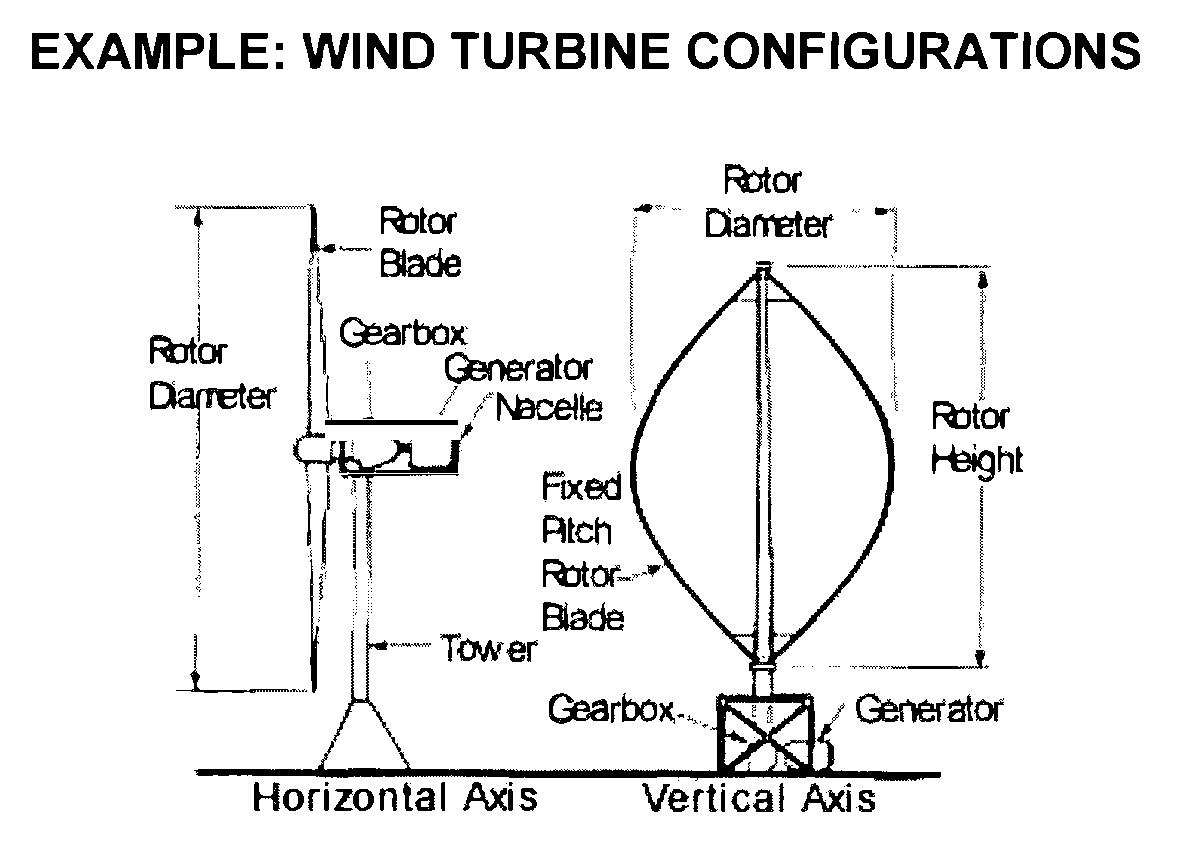
"Height of tower" means the height from base grade to the top of the system, including the uppermost extension of any horizontal axis blades.
"Rated Capacity" means the electrical generation capacity of one WECS unit. Classifications for rated capacity are microturbine, small WECS, large WECS, and utility-scale WECS, as defined below:
"Microturbine" means a WECS that generates one kilowatt (kw) or less.
"Small WECS" means one system with a rated capacity of greater than one to less than 50 kw, to be used to provide electrical energy on-site. Excess electricity can be sold back to the utility supplier through net metering, net billing, or similar programs.
"Large WECS" means one system with a rated capacity of 50 kw to less than 100 kw.
"Utility Scale WECS" means one system with a rated capacity of more than 100 kw.
"Wind Farm" means two or more utility-scale WECS on the same lot or group of adjacent lots under common ownership. A wind farm may cover an extended area, but the land between the systems may be used for agriculture or other purposes.
C.
Permit Requirements. WECS are allowed under Table 130.40.390.1 (WECS Use Matrix), below in this Section, in the following zones subject to the rated capacity thresholds designated below:
Table 130.40.390.1—WECS Use Matrix
D.
Number of WECS Units.
1.
Microturbines. The maximum number of microturbines that may be installed on a lot is as follows:
a.
Residential lots less than five acres in size may install a maximum of five microturbines.
b.
Residential and agricultural lots five acres or greater in size may install a maximum of ten microturbines.
c.
All Agricultural and Resource, Commercial, Industrial, and R&D zoned lots may install up to 25 microturbines.
2.
Small WECS. The maximum number of small WECS units that may be installed on one lot shall be based on the following acreage requirements:
a.
For lots one acre to less than ten acres, one WECS shall be allowed.
b.
For lots ten acres to less than 20 acres, two WECS shall be allowed.
c.
For lots 20 acres or greater, a maximum of three WECS shall be allowed.
d.
If small WECS generate less than five kilowatts each and are limited to 50 feet in height, a maximum of two such WECS may be installed per five acres. Additionally, the separation between them may be reduced to twice the height of the tallest tower or manufacturer's specification, whichever is greater.
3.
Large WECS in Agricultural and Resource Zones.
a.
For lots ten acres to less than 20 acres, one WECS shall be allowed.
b.
For lots 20 acres or greater, a maximum of two WECS shall be allowed.
c.
Where individual systems exceed 50 kilowatts of rated capacity or where total unit numbers exceed standards under 3.a and 3.b above in this Section, a Conditional Use Permit shall be required, in compliance with Section 130.52.021 (Conditional Use Permits) in Article 5 (Planning Permit Processing) of this Title.
E.
Development Standards. The following development standards shall apply to all WECS, except that microturbines shall comply with all standards but Subsections E.3, E.4, E.9, and E.12 below in this Section:
1.
General Development Standards. General development standards shall be applied as set forth in Table 130.40.390.2 (Development Standards) below in this Section;
Table 130.40.390.2—Development Standards
2.
Safety. All WECS shall be completely enclosed by a locked, protective fence at least six feet high unless located upon a roof or other location with limited access.
3.
Guy Wires. Anchor points of any guy wires for a system tower shall be located within the property that the system is located on. Guy wires shall not cross any above-ground electric transmission or distribution lines. The points of attachment for the guy wires shall be either enclosed by a fence six feet high or sheathed in bright orange or yellow coverings from three to eight feet above the ground.
4.
Tower Access. Towers must either:
a.
Have tower-climbing apparatus located no closer than 12 feet from the ground;
b.
Have a locked anti-climb device installed on the tower;
c.
Have a tower-access limitation program approved by the review authority.
5.
Rotor Safety. Each WECS must be equipped with both manual and automatic controls to limit the rotational speed of the blade within the design limits of the rotor.
6.
Electromagnetic Interference. The WECS shall be designed, installed and operated so that no disrupting electromagnetic interference is caused. Disruptive interference from the facility shall be promptly rectified to include the discontinued operation of one or more WECS.
7.
Utility Notification and Undergrounding. For inter-connected systems, no wind turbine shall be installed until evidence has been given that the electric utility service provider has been notified and has indicated that the proposed interconnection is acceptable. On-site electrical wires associated with the system shall be installed underground, except for "tie-ins" to the electric utility service provider and its transmission poles, towers, and lines. This standard may be modified by variance if the project terrain is found to be unsuitable due to the need for excessive grading, biological impacts, or similar factors.
8.
Noise. All WECS shall be subject to the noise standards under Chapter 130.37 (Noise Standards) in Article 3 (Site Planning and Project Design Standards) of this Title or all applicable state laws governing sound pressure levels of WECS, whichever is strictest. Measurement of sound levels shall not be adjusted for, or averaged with, non-operating periods.
9.
Wind Farm Site Access. Construction of on-site roadways shall be minimized. Temporary access roads utilized for initial installation shall be regraded and revegetated to its natural condition after completion of installation.
10.
Site Aesthetics. WECS shall be designed and located in the following manner to minimize adverse visual impacts from public viewing areas and private property:
a.
Structural components including, but not limited to, towers, blades, and fencing shall be of a nonreflective, unobtrusive color.
b.
To the greatest extent feasible, the WECS shall not project above the top of ridgelines.
c.
When adjacent to a designated scenic corridor, WECS shall not cause a significantly adverse visual impact either from the corridor, or on a designated scenic viewshed, subject to the requirement under Subsection F.3 (Application Submittal Requirements) below in this Section.
11.
Exterior Lighting. Exterior lighting on any structure associated with the WECS shall be prohibited, with the exception of that specifically required by the Federal Aviation Administration.
12.
Signs. Signage shall be considered as part of a Conditional Use Permit, and shall be limited to the following:
a.
Signs warning of high voltage electricity shall be posted at a height of five feet above the ground on stationary portions of the WECS or its tower, and at gated entry points to the project site.
b.
No advertising sign or logo shall be placed or painted on any WECS or tower;
c.
For wind farms, no more than two identification signs relating to the development shall be located on the project site.
d.
Signs shall not exceed 16 square feet in surface area or eight feet in height.
13.
Compliance with Federal Aviation Administration (FAA) Regulations. Small wind energy systems must comply with applicable FAA regulations, including any necessary approvals for installations close to airports.
F.
Application Submittal Requirements. All applications for Administrative or Conditional Use Permit for a WECS shall include the following:
1.
Delineation of the direction of the prevailing winds across the project site.
2.
Distance to residentially zoned lots, public and private airports and airstrips, public and private schools within one-quarter mile of the proposed project as measured from its nearest property line.
3.
Photo simulations of the proposed WECS as seen from residentially zoned lots and public viewsheds within one mile of the project site.
4.
Maximum generating capacity of the WECS unit(s) proposed to be installed.
5.
Manufacturer's specifications documenting maximum noise levels generated by the WECS on the surrounding area.
6.
A statement by the manufacturer certifying that the rotor and overspeed controls have been designed and fabricated for the proposed use in accordance with good engineering practice, and have been approved by the California Energy Commission or certified by a national program, such as National Electrical Code (NEC), American National Standards Institute (ANSI), or Underwriters Laboratories (UL).
7.
Certification by a state licensed structural, mechanical or civil engineer that the tower structures are designed and constructed in compliance with the pertinent provisions of the Building Code and California Electric Code.
8.
Written evidence that the electric utility service provider for the proposed site has been informed of the applicant's intent to install an interconnected customer-owned electricity generator. If the applicant does not plan to connect the system to the electricity grid, the applicant shall include a statement to that effect.
9.
A description of the proposed measures to minimize adverse noise, transmission interference, visual, and safety impacts to adjacent properties, and methods to prevent public access to the structure.
Sec. 130.40.400 - Wineries.
A.
Content. The winery ordinance:
1.
Provides for the orderly development of wineries and accessory uses within specified agricultural zones and specified residential zones to ensure compatibility with adjacent land uses (General Plan Policy 2.2.5.21).
2.
Encourages the economic development of the local agricultural industry by allowing for the direct sales and marketing of value-added products (General Plan Policy 10.1.5.4).
3.
Implements General Plan policies that encourage development of agriculturally-related uses while protecting the agricultural character and long-term productivity of agricultural lands. (General Plan Policies: 8.2.2.1, 8.2.4.2., 8.2.4.3, 8.2.4.4, and 8.2.4.5.)
B.
Applicability. Except as provided in Subsection H (Micro-Wineries and Small Vineyards) below in this Section, the regulations and standards of this Section shall apply to wineries, as defined in Article 8 (Glossary: see "Wineries") of this Title, where allowed in the use matrices for the zones, on lots that are a minimum or ten acres or more in size with a commercial vineyard.
C.
Definitions. As used in this Section, the terms below will mean the following:
Agricultural Commissioner means the County Agricultural Commissioner.
Commercial Vineyard means a minimum of five acres of wine grapes are planted and are capable of producing a commercial crop. Five acres shall mean a planting of wine grapes spanning an area of at least 217,800 square feet and consisting of a minimum of 2,200 grape vines that are properly maintained to produce a commercial crop. The Agricultural Commissioner may, when calculating acreage under this paragraph, include wine grapes planted on contiguous property under common ownership. The operator of the commercial vineyard area may demonstrate the vineyard area is under common ownership by providing proof that the operator is the record title holder of the land or by providing a notarized lease agreement with the record title holder of the land. This paragraph does not modify the minimum lot size requirement in Subsection B (Applicability), above.
The Agricultural Commissioner may determine and verify whether the vineyard is in compliance with this paragraph consistent with Subsection G.1. (Commercial Vineyard) below.
Concerts or Other Outdoor Amplified Music or Voice means any musical outdoor performance, including the playing of recorded music, in which sound amplification devices are used by one or more performers, including, but not limited to, concerts, music festivals, performance by a disc jockey, or any other musical performance.
County-Maintained Road means a road that is listed on the current County Maintained Mileage List by the Department of Transportation. This list does not typically include County Service Area (CSA) or Zones of Benefit (ZOB) roads.
Indoors means any fully enclosed area covered with a roof.
Properly Maintained means that the planted grapes are tended in a manner consistent with proper and accepted customs and standards of the agricultural industry including, but not limited to, the provision of irrigation, the control of pests and diseases, and the protection against deer depredation.
Room Rental Event means an event that involves the winery owner renting or donating a portion of the winery for hire that is held indoors.
Winery means an agricultural processing facility that produces wine from fruit or fruit juices through fermentation or the refermenting of still wine into sparkling wine, that is bonded through the Alcohol, Tobacco Tax and Trade Bureau, and that has a current California Alcohol Beverage Control (ABC) Type 2 Winegrower's License.
D.
Table of Allowed Uses. Uses allowed under Table 130.40.400.1 (Wineries Allowed Uses Matrix), below in this Section, are subject to compliance with all applicable provisions of this Title and the County Code of Ordinances. Allowed uses may require a discretionary permit in compliance with Subsections F.1 and G.5 (Use Compatibility Limitations, and Access Standards, respectively) below in this Section. The following winery and accessory uses are further defined in Subsection E (Winery Uses) below in this Section:
Table 130.40.400.1—Wineries Allowed Uses Matrix
E.
Winery Uses. The following provisions shall apply to all wineries, accessory structures, and accessory uses:
1.
General Winery Provisions.
a.
The primary purpose of the winery shall be to process fruit grown on the winery lot or on other local agricultural lands. No more than 50 percent of the fruit processed shall be imported from outside El Dorado County.
b.
Wineries include those areas of a winery where grapes are crushed, fermented, or pressed; where bulk wine is stored in tanks or barrels; where winery operations such as racking, filtering, blending, or bottling of wines are carried out; and where on-site case goods are stored.
c.
Multiple lots under the same ownership are not considered to be a single lot for purposes of this Section, except for the purposes of calculating the qualifying acreage of a commercial vineyard under Subsection C (Definitions - Commercial Vineyard) above.
2.
Tasting Facilities.
a.
Subordinate to Winery. Tasting facilities shall be clearly related and subordinate to the primary operation of the bonded winery as a production facility. The primary focus of the tasting facilities shall be the marketing and sale of the wine and grape or fruit products produced, vinted, cellared, or bottled at the winery. Snack foods that are consumed during wine tasting are allowed.
b.
Wine Sales. Retail sales of wine fruit products shall be limited to those produced, vinted, cellared, or bottled by the winery operator or grown on the winery lot, or custom crushed at another facility for the winery operator, subject to the provisions of an ABC Type 2 Winegrower's license. (The ABC Type 2 Winegrower's license requires that at least 50 percent of the wine sold be produced by the winery.)
c.
Marketing. Tasting facilities include any marketing activities sponsored by a winery facility intended for the promotion and sale of the facility's products. Activities of a marketing event may include, but are not limited to, live music, catered food, food prepared on the premises, winemaker dinners, releases, library wines, discounted sales, "bottle-your-own," and similar activities. Live music is subject to Subsection G.8 (Outdoor Amplified Music) below in this Section. Concerts or other outdoor amplified music or voice or events sponsored by or for the benefit of an organization other than the winery shall not be allowed as marketing events, but may be allowed as special events subject to Subsection E.3 (Special Events) below in this Section.
3.
Special Events. Special events, as defined in Article 8 (Glossary) of this Title, are any events such as charitable events, promotional events, and facility rental events that are not the tasting and marketing activities described in Subsection E.2.c (Tasting Facilities: Marketing) above in this Section.
a.
Number Allowed. Except as provided in Subsection i. (Charitable Events) and Subsection b.2 (Administrative Permit Process) below, special events are limited to a total of 12 events per calendar year for any Commercial Vineyard.
b.
Administrative Permit Process. Special events are allowed with the issuance of an Administrative Permit in compliance with Section 130.52.010 (Administrative Permit, Relief, or Waiver) in Article 5 (Planning Permit Processing) of this Title, and subject to the following requirements:
(1)
The winery owner shall apply to the Agricultural Commissioner on a form prescribed by the County that meets all County requirements, including payment of any applicable fees. On that application, the winery owner must attach proof that the Agricultural Commissioner has verified that the winery meets the minimum five acres of grapes planted and capable of producing a commercial crop that is required to be a Commercial Winery within 30 days of the date of the application, or the winery owner will provide consent for the Agricultural Commissioner to perform that verification.
(2)
The winery owner may, in that application, request to hold an additional two special events per calendar year, up to a maximum of 24 special events per calendar year, for every additional five acres of grapes over the minimum required to meet the definition of a Commercial Vineyard that the Agricultural Commissioner verifies are planted and capable of producing a commercial crop. Five acres shall mean a planting of wine grapes spanning an area of at least 217,800 square feet and consisting of a minimum of 2,200 grape vines that are properly maintained to produce a commercial crop. The Agricultural Commissioner shall verify the total acres of grapes the winery owner has planted that is capable of producing a commercial crop and report the final number of eligible special events on the approved administrative permit. A winery owner that qualifies in Subsection E.3.b.3, below, may request to hold additional special events in compliance with this paragraph.
(3)
Notwithstanding the maximum special events described in E.3.a (Number Allowed) above, the winery owner may, in its application, state that it submitted to the Agricultural Commissioner Advance Notice of at least one special event between January 2024 and October 2024 in compliance with Subsection E.3.h (Advance Notice), below. The Agricultural Commissioner shall verify whether County records confirm that the owner provided advance notice as required by this paragraph and report the final number of eligible special events on the approved administrative permit. If the winery owner qualifies under this paragraph, then the owner is limited to the following number of special events per calendar year:
a.
For the 2025 Calendar Year: 18 special events.
b.
For the 2026 Calendar Year, and every year thereafter: 12 events.
(4)
The Agricultural Commissioner shall review any application for an Administrative Permit to hold special events as they are received. The application shall be approved if it meets all applicable requirements of this Title, and shall be denied if the Agricultural Commissioner finds that any of the following has occurred:
a.
The application is based on inaccurate or incomplete information.
b.
The applicant has failed to pay any required application fees in full.
c.
The applicant is ineligible under Subsection J.4 (Suspension for Repeat Violations), below.
(5)
Any approved administrative permit is valid for one calendar year. An administrative permit issued under this Section does not grant any entitlement or interest in real property, does not create any interest of value, and it does not run with the land.
c.
Special events that have, or are planned to have, up to 250 persons in attendance shall count against the total number of events allowed. A winery owner may only hold one special event per calendar day. If a special event is intended to last more than one calendar day, the winery owner shall submit separate notices for each day pursuant to Subsection h (Advance Notice) below, and each event will be included in the maximum number of special events event limit calculated under Subsection 3.b, above.
d.
Capacity Limitation. All special events are limited to 250 persons at one time. The winery owner shall ensure that the special event does not exceed the maximum capacity of 250 persons at one time.
e.
Ranch Marketing. This Section, rather than Chapter 130.44 (Ranch Marketing), shall govern a winery owner holding a special event. The number of special events shall not be added to or combined with those allowed under Chapter 130.44 (Ranch Marketing).
f.
Temporary Use Permit. The winery owner may apply for a Temporary Use Permit in compliance with Section 130.52.060 (Temporary Use Permit) in Article 5 (Planning Permit Processing) of this Title for a special event that meets all the following requirements:
(1)
The number of attendees will exceed 250 persons at any given time.
(2)
The winery owner has been issued no more than three Temporary Use Permits for that property per calendar year, including the special event that the Temporary Use Permit would apply to.
(3)
The winery owner shall not hold more than one special event under this Subsection per calendar month.
g.
Concerts or Other Amplified Outdoor Music or Voice. Concerts or other outdoor amplified music or voice in which the music is the primary attraction may be allowed if the winery owner obtains a Conditional Use Permit in compliance with Section 130.52.021 (Conditional Use Permits) in Article 5 (Planning Permit Processing) of this Title, or a Temporary Use Permit in compliance with Section 130.52.060 (Temporary Use Permit) in Article 5 (Planning Permit Processing) of this Title. If it is reasonably anticipated that more than 150 persons will be present at the event, the winery owner shall also obtain a permit under Chapter 12.39 or a permit for an outdoor music festival under Chapter 5.32, as applicable.
h.
Advance Notice.
(1)
The winery owner shall notify the Agricultural Commissioner, on a form prescribed by the Agricultural Commissioner, no later 14 days in advance of each special event held under this Section. Notwithstanding the 14-day period in the previous sentence, the winery owner may, no later than seven days before the special event, submit a request to the Agricultural Commissioner for an exception to submit the advance notice no later than 48 hours before the event, and shall include in that request the reasons why special circumstances exist to grant this exception. The Agricultural Commissioner may grant that request if the Agricultural Commissioner finds, in his or her sole discretion, that special circumstances exist that justify the lesser period of advance notice.
(2)
The winery owner shall list all the following in the notice required by this Subsection:
(a)
The name and contact information for a Designated Local Contact for the event and the date.
(b)
The approximate duration for when the event will commence and end.
(c)
The address of the event.
(3)
The Agricultural Commissioner shall make the information submitted by this Subsection f available on the County's website, including the name and contact information of the Designated Local Contact.
(4)
The Designated Local Contact must be available via telephone during the duration of the event, as stated in the notice sent to the Agricultural Commissioner, and two hours before and one hour after the event.
(5)
The Designated Local Contact shall respond to the County within 30 minutes and complete any corrective action that is requested by the County in a timely manner. The Designated Local Contact shall respond to any complaints from any member of the public within 30 minutes and take corrective action to resolve any reasonable complaint. The Designated Local Contact shall prioritize complaints related to noise, lighting, trash, or parking.
(6)
A failure to comply with this Subsection h (Advance Notice) constitutes a violation subject to enforcement under Subsection J (Enforcement) below.
i.
Charitable Events. The winery owner may hold a maximum of three special events per calendar year under this paragraph that are charitable or fundraising events held for the benefit of a nonprofit organization that that qualifies for exempt status under Section 501(c)(3) or 501(c)(6) of the Internal Revenue Code. A special event held under this paragraph must comply with all requirements of this Section applicable to special events, including Subsection E.3.h (Advance Notice), except that the three special events authorized under this paragraph are not counted for purposes of determining the maximum number of special events allowed under Subsection E.3 (Special Events) above in this Section. The winery owner must also provide to the Agricultural Commissioner documentation acceptable to the Agricultural Commissioner demonstrating that the organization qualifies for exempt status, and that any proceeds of the event, excluding the costs of the winery owner, will be used solely by that organization. Any charitable or fundraising events held in excess of the three authorized by this paragraph are counted for purposes of determining the maximum number of special events allowed under Subsection E.3 (Special Events) above in this Section.
4.
Room Rental Event. Room rental events are allowed, and are not counted for purposes of determining the maximum number of special events allowed under Subsection E.3 (Special Events) above in this Section, if the winery owner complies with all the following requirements:
a.
The event is held indoors and involves the rental of a portion of the winery.
b.
There will be no more than 40 persons in attendance.
c.
No amplified music or amplified speech is allowed.
d.
Only one room rental event may be held each calendar day.
e.
The event is limited in duration to eight hours and must be held during the normal business hours of the winery.
5.
Dining Facility. The dining facility, as defined in Article 8 (Glossary: see "Ranch Marketing, Dining Facility") of this Title, shall be subordinate to the sale of wine. Areas of a winery that are temporarily set up for winemaker dinners are not considered to be part of the dining facility.
6.
Distilleries. A distillery, as defined in Article 8 (Glossary: See "Distillery") of this Title, shall be bonded through the Alcohol and Tobacco Tax and Trade Bureau and have a current California ABC License. Distilleries are allowed in Industrial Low (IL) and with a Conditional Use Permit in Industrial High (IH), Research and Development (R&D) and in Agricultural Zones (see Table 130.40.400.1—Wineries Allowed Uses Matrix), in compliance with Section 130.52.021 (Conditional Use Permits) in Article 5 (Planning Permit Processing) of this Title. Allowed activities include, but are not limited to, blending, aging, storing, bottling, and warehousing operations; tasting facilities; wholesale and retail sales; and administrative functions.
7.
Commercial Kitchen. A commercial kitchen, as defined in Article 8 (Glossary: see "Commercial Kitchen") of this Title, shall be accessory to the winery, tasting room, and any other authorized accessory use.
8.
Museum. Agriculture-related museums shall be accessory to a winery and tasting room and shall primarily display items from California's agricultural history.
9.
Picnic Areas. Picnic areas shall be subordinate to the winery and tasting room.
10.
Retail Sales. Retail sales of merchandise, art, and prepackaged food items shall only be allowed within the tasting facilities and shall not be located in a separate structure. The sale of prepackaged food items shall comply with the California Health and Safety Code and be permitted by Environmental Management. Sale of non-wine merchandise shall be subordinate to the wine sales.
11.
Catering. As defined in Article 8 (Glossary: see "Catering") of this Title, use of an onsite commercial kitchen for catering off-site events may be allowed by Conditional Use Permit, in compliance with Section 130.52.021 (Conditional Use Permits) in Article 5 (Planning Permit Processing) of this Title, and only when the catering use is found to be subordinate to the winery's wine sales.
F.
Special Provisions.
1.
Use Compatibility Limitations. Proposed winery facilities that are not located within an Agricultural District and that have property lines adjacent to a lot with a noncompatible zone designation shall require a Conditional Use Permit in compliance with Section 130.52.021 (Conditional Use Permits) in Article 5 (Planning Permit Processing) of this Title. For purposes of this Subsection, noncompatible shall be RM, RI, R20K, R1A, R2A and R3A. The use compatibility determination will be made prior to issuance of a building permit for a winery building. Subsequent expansion of the facility's structures or uses will require additional use compatibility determinations.
G.
Development Standards. These standards are the minimum required for all wineries, accessory uses, and structures listed in Subsection E (Winery Uses) above in this Section. Additional requirements may be added through the discretionary permitting process, if applicable.
1.
Commercial Vineyard. The Agricultural Commissioner may, with advance notice of at least 24 hours, inspect a winery to determine whether the minimum acreage of wine grapes cease to exist or be properly maintained. The Agricultural Commissioner may issue an order, in writing, if the Agricultural Commissioner determines that the winery does not meet the standard in the previous sentence and shall explain in that order the deficiencies and any steps to cure that deficiency. The winery owner has 30 days to address the deficiencies in that order to the satisfaction of the Agricultural Commissioner. If the winery owner has not addressed the deficiencies within that time period and has not appealed the order, then the right to operate the winery and all accessory uses shall immediately cease until such time as the required five acres of wine grapes are re-established to the satisfaction of the Agricultural Commissioner. If the winery owner appeals the order consistent with the following paragraph, then the winery owner may continue to operate during the pendency of that appeal with the Ag Commission. If the Ag Commission affirms the order in its decision, then the right to operate the winery and all accessory uses shall immediately cease until such time as the required five acres of wine grapes are re-established to the satisfaction of the Agricultural Commissioner.
The winery owner who was issued the order may appeal the Agricultural Commissioner's determination to the Ag Commission within 30 calendar days of the order being issued. The Ag Commission shall review the determination for consistency with this Section and issue a decision. The winery owner has 20 calendar days to file a timely appeal of that decision to the superior court. If any party fails to file a timely appeal to the Ag Commission or the superior court shall be deemed to have waived any and all objections to the Agricultural Commissioner or the Ag Commission's determination.
2.
Setbacks. The following minimum setbacks apply to all wineries, tasting facilities, and outdoor use areas, excluding parking lots and picnic areas:
a.
Adjacent to nonresidential zones: 50 feet from all property lines.
b.
Adjacent to residential zones: 200 feet from all property lines.
c.
The 200-foot setback in [Subsection] 2.b above in this Section may be reduced to no less than 50 feet by a grant of administrative relief in compliance with Section 130.52.010 (Administrative Permit, Relief, or Waiver) in Article 5 (Planning Permit Processing) of this Title.
3.
Signs. See Chapter 130.36 (Signs) in Article 3 (Site Planning and Project Design Standards) of this Title.
4.
Parking. The following parking standards shall apply to wineries, tasting rooms, and accessory uses:
a.
Permanent parking spaces shall be provided for wineries, tasting rooms, and retail sales areas in compliance with Chapter 130.35 (Parking and Loading) in Article 3 (Site Planning and Project Design Standards) of this Title.
b.
Parking surfaces shall be surfaced with a Class 2 aggregate base or equivalent, with appropriate hard-surfacing for designated ADA compliant parking stalls.
c.
Temporary parking for marketing activities and special events may utilize overflow parking areas that are not surfaced. Limitations on the number of guests may be based on availability of off street parking in compliance with Chapter 130.35 (Parking and Loading) in Article 3 (Site Planning and Project Design Standards) of this Title. All temporary parking shall be accommodated onsite and shall meet any fire district requirements.
5.
Access Standards. Access standards shall be as follows:
a.
Direct access from a non-County-maintained road, regardless of whether the road is located on or off-site, shall require the following:
(1)
In an Agricultural District. An Administrative Permit in compliance with Section 130.52.010 (Administrative Permit, Relief, or Waiver) in Article 5 (Planning Permit Processing) of this Title, following a recommendation by the Ag Commission.
(2)
Not in an Agricultural District. A Conditional Use Permit in compliance with Section 130.52.021 (Conditional Use Permits) in Article 5 (Planning Permit Processing) of this Title.
b.
Road Maintenance. The winery owner will be required to participate in a private road maintenance entity, annex into a road zone of benefit (ZOB), or otherwise pay a fair share for road maintenance as determined by the review authority.
c.
Fire Safe/Code Standards. Access to a winery open to the public shall meet the minimum access requirements of the applicable fire district, including both on-site and off-site access roads. Exceptions to these standards may be allowed by the fire district, subject to the appeal processes identified in the SRA Fire Safe Regulations.
d.
Facilities Not Open to the Public. A winery that is not open to the public and does not provide on-site sales may be accessed by a non-County-maintained road.
6.
Size Limitation.
a.
The winery, accessory buildings, and accessory uses shall not occupy more than five acres or 50 percent of the gross lot area, whichever is less.
b.
All new wineries and expansions of existing wineries that exceed 10,000 square feet of floor area and are visible from a County-maintained road shall require a Design Review Permit in compliance with Section 130.52.030 (Design Review Permit) in Article 5 (Planning Permit Processing) of this Title.
c.
Tent structures that exceed 1,200 square feet of floor area and are visible from a County-maintained road shall be limited to a 30-day period, three times per calendar year, unless additional time frames are approved by a Temporary or Conditional Use Permit, in compliance with Section 130.52.060 (Temporary Use Permit) or Section 130.52.021 (Conditional Use Permits) in Article 5 (Planning Permit Processing) of this Title.
d.
The total enclosed square footage of all floors of a winery building shall not exceed the square footage shown in the Table 130.40.400.2 (Allowed Square Footage for Winery Buildings) below in this Section. Any winery building or group of winery buildings and accessory buildings exceeding the square footage in Table 130.40.400.2 (Allowed Square Footage for Winery Building) below in this Section shall require a Conditional Use Permit in compliance with Section 130.52.021 (Conditional Use Permits) in Article 5 (Planning Permit Processing) of this Title. Winery buildings do not include residential buildings, garages, outbuildings, and structures not associated with the winery, such as agricultural buildings.
Table 130.40.400.2—Allowed Square Footage for Winery Buildings
7.
Cultural Resource Protection.
a.
Winery development on a lot identified by the County as being listed on the National Register of Historic Places (NRHP) and California Register of Historic Places (CRHR) shall be required to preserve the structure(s). Modifications or demolition of the structures shall only be approved based on recommendations from a cultural resource report that meets County guidelines.
b.
Winery development within 100 feet of perennial or intermittent streams shall submit a cultural resource study prior to approval of grading or building permits. Cultural sites identified in the study and recommended for avoidance and protection shall be protected as recommended in the cultural resource study.
8.
Outdoor Amplified Music. All events, including special events, featuring outdoor amplified music or amplified speech shall comply with Chapter 130.37 (Noise Standards) in Article 3 (Site Planning and Project Design Standards) of this Title. For any events occurring between 7:00 p.m. and 10:00 p.m., a noise analysis shall be submitted to the Department demonstrating that the noise standards will not be exceeded. No outdoor music will be allowed after 10:00 p.m.
9.
Wine Caves. The use of subterranean space for winery facilities in natural or manmade caves shall be in compliance with all applicable building and fire codes, and permit requirements.
H.
Micro-Wineries and Small Vineyards. Wineries that do not meet the minimum acreage requirement for a commercial vineyard, as defined under Subsection C (Definitions) above in this Section, or the minimum lot size under Table 130.40.400.1 (Wineries Allowed Uses Matrix) above in this Section, shall be allowed in compliance with Table 130.40.400.3 (Micro-Winery and Small Vineyards Use Matrix) below in this Section, subject to the following requirements in this Subsection:
Table 130.40.400.3—Micro-Winery and Small Vineyards Use Matrix
1.
Small Vineyard Winery Standards. Wineries with a minimum of one to less than five acres of a planted wine-making crop (wine grapes or other fruit) shall be allowed in compliance with the following provisions and Subsection H.3 (General Standards) below in this Section:
a.
The only accessory use allowed shall be a distillery; and
b.
At least 75 percent of the fruit used by the facility shall be grown within El Dorado County.
2.
Micro-Winery Standards. Micro-wineries shall be allowed in compliance with the following provisions and Subsection H.3 (General Standards) below in this Section:
a.
All micro-wineries shall have a minimum of one acre of planted wine grapes on the same lot;
b.
The capacity of the micro-winery shall not exceed 250 cases (595 gallons) for each acre of wine grapes grown on the lot, with a total capacity not to exceed 1,250 cases (2,972 gallons). Lots zoned PA may exceed these amounts in compliance with the Conditional Use Permit if:
(1)
The lot is within an Agricultural District; and
(2)
The Ag Commission finds that the land is not capable of supporting five acres of vineyard and potential on-site agricultural land is not being precluded from future agricultural production;
c.
No other accessory uses described in this Section are allowed on the site;
d.
On-site signs are limited to one, single-faced, non-illuminated sign advertising the name of the winery and owner, and stating "Not Open to the Public." The sign face shall measure a maximum of six square feet in area and shall stand no higher than six feet from natural grade, as measured directly below the sign; and
e.
The total enclosed floor area(s) of the micro-winery shall measure no greater than 2,000 square feet.
3.
General Standards. The following standards shall apply to both small vineyard wineries and micro-wineries:
a.
One acre shall mean a planting of wine grapes spanning an area of at least 43,560 square feet and consisting of a minimum of 440 grape vines;
b.
The wine grapes or fruit crop shall be properly maintained and cared for to produce a commercial crop. Should the proper maintenance and care of the required minimum acreage cease, as determined by the Agricultural Commissioner, the right to operate the winery becomes void, consistent with Subsection G.1 (Commercial Vineyard) above;
c.
Wine sales shall be conducted off-site or by internet, mail order, telephone, facsimile, or similar means, only. No on-site sales, tasting, or public access shall be allowed either directly or by appointment;
d.
Compliance with all applicable local, State, and Federal laws shall be verified prior to operation. At a minimum, the following shall be required:
(1)
Fire district review of the facility for consistency with the fire code;
(2)
Waste Discharge Permit or Waiver of Discharge Permit from Regional Water Quality Control Board;
(3)
Winegrower license from the ABC;
(4)
Bonding through the Alcohol and Tobacco Tax and Trade Bureau; and
(5)
Building permit, subject to review and approval of the Planning and Building and Environmental Management Departments.
I.
Uses Requiring an Administrative Permit or a Minor Use Permit. Uses allowed by Administrative Permit or Minor Use permit as shown in Table 130.40.400.1 (Wineries Allowed Uses Matrix) shall comply with Section 130.52 (Permit Requirements, Procedures, Decisions, and Appeals) in Article 5 (Planning Permit Processing) of this Title and the following:
1.
The use is incidental and accessory to the winery;
2.
A commercial kitchen established for a winery may be used for preparation of food served on-site or off-site or may be leased as a catering facility under an administrative permit. The administrative permit shall verify that all approvals from applicable agencies including, but not limited to, El Dorado County Environmental Management Department, California Department of Public Health, and California Department of Food and Agriculture have been obtained.
J.
Enforcement.
1.
Any violation of Subsection E.3 (Special Events) is subject to enforcement under Chapter 9.02, except that, notwithstanding Section 9.02.210, a violation of Subsection E.3 (Special Events) may be a misdemeanor and the fine assessed for each notice and order issued for the same violation shall be as follows:
a.
First violation: $250.00.
b.
Second violation: $500.00.
c.
Third or subsequent violation: $1,000.00.
2.
The County may recover the costs of abatement incurred by the County in its code enforcement efforts, including administrative fines or fees, under Section 9.02.090.
3.
All fines or costs collected under this Section shall be deposited into the General Fund and used for costs related to enforcement and administration of this Section.
4.
Suspension for Repeat Violations. If a winery owner has received three substantiated violations or more occurring on separate dates related to a violation of Subsection E.3 (Special Events) within any 18-month period, then the County shall revoke any associated administrative permit that authorized the winery owner to hold special events, and that person will be ineligible to submit an application for an administrative permit to hold special events for six months after the date of the last violation. For purposes of determining whether a substantiated violation occurred within the 18-month period, that period is calculated from the date of violation and not the date that the notice and order is substantiated and includes any violation that occurred on a date after the effective date of Ordinance No. 5177 and before the effective date of the ordinance amending this Subsection. Any subsequent substantiated violation of this paragraph will extend that six-month period for an additional six months. The County may enforce any violation of this paragraph as a public nuisance and may take all reasonable actions consistent with law to abate that public nuisance, including injunctive relief. For purposes of this paragraph, substantiated violation means the winery owner received a notice and order under Chapter 9.02 and either did not contest such violation or filed a timely appeal and the violation in the notice and order was upheld by the administrative hearing officer. A substantiated violation does not include a complaint that did not result in a substantiated violation, nor does it include a violation that led to a notice and order that was withdrawn by both parties due to compliance.
(Ord. No. 5127, §§ 10, 11, 9-1-2020; Ord. No. 5177, § 6, 6-20-2023; Ord. No. 5218, § 2, 12-10-2024)
Sec. 130.41.100 - Commercial Cannabis Activities Permitting and Enforcement.
1.
Applicability.
A.
The purpose of this Section is to provide for the permitting and enforcement procedures to regulate commercial cannabis activities that are independently authorized in a separate chapter. Nothing in this Section is intended to authorize any commercial cannabis activity.
B.
While the ordinance from which this Section is derived was originally enacted by voters, the Board of Supervisors retains discretion to amend the ordinance in any way, including, but not limited to, all procedures provided herein, permit requirements, and penalties, without further voter approval.
2.
Definitions. The terms and phrases in this Section, any County Code authorizing a commercial cannabis activity, and Chapter 3.22 (Taxation of Commercial Cannabis Activities) shall have the meaning ascribed below, unless the context in which they are used clearly suggests otherwise. For any term not defined, the definition shall be that given by the State in the most current cannabis statutes or regulations.
Cannabis means all parts of the plant Cannabis sativa Linnaeus, Cannabis indica, or Cannabis ruderalis, whether growing or not; the seeds thereof; the resin, whether crude or purified, extracted from any part of the plant; and every compound, manufacture, salt, derivative, mixture, or preparation of the plant, its seeds, or resin. "Cannabis" also means the separated resin, whether crude or purified, obtained from cannabis. "Cannabis" does not include the mature stalks of the plant, fiber produced from the stalks, oil or cake made from the seeds of the plant, any other compound, manufacture, salt, derivative, mixture, or preparation of the mature stalks (except the resin extracted therefrom), fiber, oil, or cake, the sterilized seed of the plant which is incapable of germination, or "industrial hemp" as defined by Section 11018.5 of the Health and Safety Code. (Business and Professions Code Section 26001.)
Cannabis business means any person engaged in any commercial cannabis activity.
Cannabis products means cannabis that has undergone a process whereby the plant material has been transformed into a concentrate, including, but not limited to, concentrated cannabis or an edible or topical product containing cannabis or concentrated cannabis and other ingredients. (Health and Safety Code Section 11018.1; Revenue and Taxation Code Section 34010.)
Canopy means the designated area(s) at a licensed premises, calculated in square feet, that will contain mature plants at any point in time, as follows:
(1)
For indoor and mixed-light cultivation and nurseries, canopy shall be calculated in square feet and measured using the room boundaries, walls, or ceiling-to-floor partitions of each enclosed area that will contain mature plants at any point in time, including all of the space(s) within the boundaries. If mature plants are being cultivated using a shelving system, the surface area of each level shall be included in the total canopy calculation.
(2)
For outdoor cultivation and nurseries, canopy shall be calculated in square feet and measured using physical boundaries of all area(s) that will contain mature plants at any point in time, including the space within the boundaries. Canopy may be noncontiguous, but each unique area included in the total canopy calculation shall be separated by a physical boundary, such as a fence, hedgerow, garden plot, or other stable, semipermanent structure that clearly demarcates the canopy edge.
Child care center means any licensed child care center, daycare center, childcare home, or preschool.
Commercial Cannabis Activities Tax means the tax due under this article for engaging in the commercial cannabis activities in the unincorporated area of the County.
Commercial cannabis activity includes any activity involving the propagating, cultivating, harvesting, processing, drying, curing, storing, trimming, manufacturing, packaging, labeling, transporting, delivering, possessing, distributing, or laboratory testing of cannabis or cannabis products for the sale, distribution, gifting, or donating to any other person regardless of whether the activity involves medicinal or adult recreational cannabis or cannabis products, is operated for profit, or is in compliance with State laws and regulations. "Commercial cannabis activity" does not include any activity expressly allowed under Business and Professions Code Section 26033, Health and Safety Code Section 11362.1. and County Code Title 130, Article 9, Section 130.14.260 (Outdoor Medical Cannabis Cultivation for Personal Use) or the transportation of cannabis or cannabis products through the County without delivery within the County on public roads by a transporter licensed under State law.
Commercial cannabis operation includes all of the commercial cannabis activities performed at a premises by one person as a single operation regardless of the number of individual permits or State licenses required and regardless of whether the activity involves medicinal or adult recreational cannabis or cannabis products.
Cultivation or cultivating means the propagation, planting, growing, harvesting, drying, curing, grading, or trimming of one or more cannabis plants or any part thereof.
Delivery means the commercial transfer of cannabis or cannabis products to a customer and includes the use by a retailer of any technology platform. (California Business and Professions Code Section 26001.)
Distribution means the procurement, sale, and transport of cannabis and cannabis products between licensed cannabis businesses, but not the direct sale or transport to the general public.
Distributor means a person engaged in the distribution of cannabis and/or cannabis products between cannabis businesses.
Dried flower means all dead cannabis that has been harvested, dried, cured, or otherwise processed, excluding leaves and stems.
Flowering means that a cannabis plant has formed a mass of pistils measuring greater than one-half inch wide at its widest point.
Gross receipts shall have the same meaning as set forth in California Revenue and Taxation Code Section 6012.
Immature plant or immature means a cannabis plant that has a first true leaf measuring greater than one-half inch long from base to tip (if started from seed) or a mass of roots measuring greater than one-half inch wide at its widest point (if vegetatively propagated), but which is not flowering.
Indoor cultivation means the cultivation of cannabis within a permanent structure using exclusively artificial light or within any type of structure using artificial light at a rate above 25 watts per square foot.
Infusion means a process by which cannabis, cannabinoids, or cannabis concentrations are directly incorporated into a product formulation to produce a cannabis product.
Legal parcel means any parcel of real property that may be separately sold in compliance with the Subdivision Map Act (Division 2 (commencing with Government Code Section 66410) of Title 7 of the Government Code).
Manufacture means all aspects of the extraction and/or infusion processes, including processing, preparing, holding, storing, packaging, or labeling of cannabis, cannabis products, or other components and ingredients that is performed pursuant to a license issued by the California Department of Public Health's Manufactured Cannabis Safety Branch.
Mature plant means a cannabis plant that is flowering.
Medical or medicinal cannabis means cannabis grown for personal medicinal use by a qualified patient as defined in Health and Safety Code Section 11362.7 or a person with a valid cannabis identification card issued under Health and Safety Code Section 11362.71.
Mixed-light cultivation means the cultivation of mature cannabis in a greenhouse, hoophouse, glass house, conservatory, hothouse, or other similar structure using a combination of natural light and artificial lighting at a rate of six watts per square foot or less.
Nursery means all activities associated with producing clones, immature plants, seeds, and other agricultural products used specifically for the propagation and cultivation of cannabis.
Organic certification standards means the organic certification adopted by the California Department of Food and Agriculture for cannabis pursuant to Business and Professions Code Section 26062.
Outdoor cultivation means cultivation activities that are not conducted within a fully enclosed, permitted building, constructed of solid materials, accessible only through one or more locking doors.
Owner shall have the same meaning as defined in California Business and Professions Code Section 26001(ap) or any successor provision thereto.
Person means any individual, firm, partnership, joint venture, association, corporation, limited liability company, cooperative, collective, organization, entity, estate, trust, business trust, receiver, syndicate, or any other group or combination acting as a unit, whether as principal, agent, employee, or otherwise, and the plural as well as the singular.
Place of worship means a structure or leased portion of a structure that is used primarily for religious worship and related religious activities.
Premises means a single, legal parcel of property. Where contiguous legal parcels are under common ownership or control, such contiguous legal parcels may be counted as a single "premises."
Process or processing means all cannabis business activities associated with drying, curing, grading, trimming, storing, packaging, and labeling of raw cannabis, or any part thereof, for transport.
Processor means a cultivation site that conducts only trimming, drying, curing, grading, packaging, or labeling of cannabis and nonmanufactured cannabis products.
Propagate or propagation means to cultivate immature plants from cannabis plant cuttings or seeds.
Retail sale, sell, and to sell means any transaction whereby, for any consideration, title to cannabis or cannabis products is transferred from one person to another, and includes the delivery of cannabis or cannabis products pursuant to an order placed for the purchase of the same and soliciting or receiving an order for the same, but does not include the return of cannabis or cannabis products by a cannabis permittee to the cannabis permittee from whom the cannabis or cannabis product was purchased.
School means an institution of learning for minors, whether public or private, offering a regular course of instruction required by the California Education Code. This definition includes a nursery school, kindergarten, elementary school, middle or junior high school, senior high school, or any special institution of education, but does not include a home school or vocational or professional institution of higher education, including a community or junior college, college, or university.
School bus stop means any location designated in accordance with California Code of Regulations, Title 13, Section 1238, to receive school buses, as defined in Vehicle Code Section 233, or school pupil activity buses, as defined in Vehicle Code Section 546.
Testing laboratory or laboratory means a laboratory, facility, or entity in California that offers or performs tests of cannabis or cannabis products and that is accredited by an accrediting body that is independent from all other persons involved in commercial cannabis activity in the state.
Transport or transportation means the transfer of cannabis from the licensed cannabis business site of one State commercial cannabis licensee to the State licensed cannabis business site of another State commercial cannabis licensee for the purposes of conducting cannabis business activities as authorized pursuant to California Business and Professions Code Section 26000 et seq.
Treasurer-Tax Collector means the Treasurer-Tax Collector of the County of El Dorado, his or her deputies, unless another County officer or employee is assigned by resolution of the Board of Supervisors, to perform all or a portion of the duties as listed herein, in which case, the Treasurer-Tax Collector shall interpreted as the person defined in the resolution.
Watts per square foot means the sum of the maximum wattage of all lights identified in the designated canopy area(s) in the cultivation plan divided by the square feet of designated canopy area(s) identified in the cultivation plan.
Youth-oriented facility means any facility that caters to or provides services primarily intended for minors.
3.
Permits Required. No person shall engage in any commercial cannabis activity in the unincorporated areas of the County without a valid Commercial Cannabis Use Permit and Commercial Cannabis Operating Permit.
4.
Commercial Cannabis Use Permit.
A.
A Commercial Cannabis Use Permit shall be subject to Article 5 of Title 130 of the County Code (Application Forms, Submittal Process, and Fees), unless provided otherwise herein. It shall be treated as a Conditional Use Permit under Section 130.52.021 (Conditional Use Permits), subject to the public hearing procedures and recommendation from the Planning and Building Director and decision by the Planning Commission.
B.
Notice to Interested Parties, Cities, and Counties. Prior to the hearing before the Planning Commission, notice of the application shall be provided pursuant to Section 130.04.015. If a commercial cannabis activity is proposed within a one-half mile radius of an incorporated city or county, notice of and an opportunity to comment on the application for the Commercial Cannabis Use Permit shall be provided to the applicable city or county before the permit is considered by the Planning Commission.
C.
No Commercial Cannabis Use Permit may be granted unless the applicant demonstrates compliance with all standards in the County Code and State law and regulations for the particular commercial cannabis activity. Any setback for a commercial cannabis activity may be reduced in a Commercial Cannabis Use Permit so long as the applicant demonstrates that the actual setback will substantially achieve the purpose of the required setback and that the parcel was owned or leased by the applicant before voter approval of the ordinance from which this Section is derived on November 6, 2018.
D.
Issuance of a Commercial Cannabis Use Permit under this Chapter is a discretionary act requiring compliance with the California Environmental Quality Act ("CEQA") and the applicant shall comply with Article 5, Section 130.51.030 (Environmental Review). The applicant shall be responsible for all costs associated with CEQA compliance, including, but not limited to, environmental analysis and studies, preparation of the appropriate CEQA document, and all County staff time, including attorney time, spent reviewing and pursuing final adoption of the appropriate environmental document.
E.
Pursuant to Article 5, Section 130.51.020 (Application Forms, Submittal Process, and Fees), application fees adopted by resolution of the Board of Supervisors shall be paid upon application submittal. Additional fees may be required subject to the provisions of the adopted fee schedule, such as for "time and material" fee categories.
F.
An application for a Commercial Cannabis Use Permit shall be submitted in accordance with Article 5, Section 130.51.020 (Application Forms, Submittal Process, and Fees) and, in addition to any information requested by the Planning and Building Department, shall include:
1.
The name, contact address, and phone number of the applicant and all owners, as defined above, and spouses or registered domestic partners of owners, all documents providing for the establishing and ownership and control of the applicant, including, but not limited to, operational agreements, bylaws, stock agreements, and any other documents demonstrating the ownership interest of each owner and any other funding sources for the applicant.
2.
Consent to a background check of all owners, spouses of owners, and the Designated Local Contact, including providing the information necessary for performing the background check and fingerprinting. The Sheriff's Office has the discretion to waive a fingerprinting if the individual owns five percent or less of the business.
3.
If the applicant is not the record title owner of the parcel, written consent of the owner of the parcel with original signature and notary acknowledgement. The written consent must be notarized within 30 days of the date that the application is submitted with the County.
4.
Name and contact information for the Designated Local Contact.
5.
Site plan showing the entire parcel, including any easements, streams, springs, ponds, and other surface water features and the location and area for cultivation on the parcel with dimensions of the area for cultivation and setbacks from property lines, if applicable. The site plan shall also include all areas of ground disturbance or surface water disturbance associated with cultivation activities, if applicable, and identify any areas where cannabis will be stored, handled, or displayed.
6.
Detailed explanation of how the applicant will prevent theft and access to cannabis and cannabis products by individuals under the age of 21 unless the individual has a valid medical cannabis card and is lawfully purchasing medicinal cannabis from a licensed retailer.
7.
Proof that the operations will comply with all of the County regulations and standards in the County Code for the particular commercial cannabis activity and any other applicable County regulations and standards, including, but not limited to, Title 130, Chapter 130.36 (Signs).
8.
Proof that the operations will comply with all State standards and regulations by all State agencies with jurisdiction over the particular commercial cannabis activity, including submission of a copy of all documents and exhibits that are required for a State license.
9.
An operating plan demonstrating proper protocols and procedures that address enforcement priorities for cannabis activities, including ensuring that cannabis and cannabis products are obtained from and supplied only to other permitted licensed sources within the State and not distributed out of State.
10.
If applicable, description of how the applicant will meet and maintain organic certification standards or the substantial equivalent or, if pesticides and fertilizers are used, a list of all pesticides and fertilizers that may be used.
11.
If applicable, written acknowledgement that the County reserves the right to reduce the size of the area allowed for cultivation under any permit issued in the event that environmental conditions, such as a sustained drought or non-compliant odor, merit a reduction in the cultivation size.
12.
Complete copy of the State license application, including all exhibits, diagrams, and attachments, along with a certification under penalty of perjury that the copy provided is accurate and that the County will be notified in writing immediately if any information provided to the State differs from what was provided to the County.
13.
The security plan for the operation that includes adequate lighting, security video cameras with a minimum camera resolution of 1,080 pixels and 360-degree coverage, alarm systems, and secure area for cannabis storage. The security plan shall include a requirement that there be at least 90 calendar days of surveillance video (that captures both inside and outside images) stored on an ongoing basis and made available to the County upon request. The County may require real-time access of the surveillance video for the Sheriff's Office. The video system for the security cameras must be located in a locked, tamper-proof compartment. The security plan shall remain confidential.
14.
Detailed diagrams of the premises, including any buildings, structures, fences, gates, parking, lighting, and signage.
15.
Certification of the accuracy of the information submitted and agreement to comply with all conditions of the permit.
G.
No Commercial Cannabis Use Permit may be issued until a background check of all owners and the Designated Local Contact is completed with review and recommendation by the Sheriff's Office, including, but not limited to, criminal history, fingerprinting, and any pending charges. The applicant shall be responsible for the cost of the background check. The County may deny an application based on the results of a background check if the County determines that information in the background check makes it more likely than not that any amount of funding for the operation will be or was derived from illegal activity or because the criminal history or other information discovered in the background check of an owner or spouse of an owner weighs against the owner's trustworthiness or ability to run a legal business in compliance with all regulations, including, but not limited to, the risk of involvement or influence by organized crime, prior convictions involving controlled substances or violent crimes, the likelihood that sales and income will not be truthfully reported, or the risk that cannabis will be illegally provided or sold to individuals under the age of 21.
H.
Concentration of commercial cannabis activities and proximity to an existing or proposed commercial cannabis activity shall be considered in determining whether to grant a Commercial Cannabis Use Permit.
I.
At a minimum, a Commercial Cannabis Use Permit shall include:
1.
The name of all owners.
2.
The single commercial cannabis activity authorized in the permit, including any site specific restrictions or conditions of approval under Section 130.51.060 (Conditions of Approval).
3.
If applicable, statement that the County reserves the right to reduce the size of the area allowed for cultivation under any permit issued in the event that environmental conditions, such as a sustained drought or non-compliant odor, merit a reduction in the cultivation size.
4.
Condition of approval that the permittee and all owners shall defend, indemnify, and hold harmless the County of El Dorado and its agents, officers, elected officials, and employees for any claims, damages, or injuries brought by affected property owners or other third parties due to the issuance of a permit or the commercial cannabis activities and for any claims brought by any person for problems, injuries, damages, or liabilities of any kind that may arise out of the issuance of a permit or the commercial cannabis activities.
5.
Consent for onsite inspection by County officials during the permittee's regular business hours and outside of the permittee's regular business hours if the County has reason to believe that violations are occurring outside of regular business hours.
6.
Indication of whether the Commercial Cannabis Use Permit is for approval of a commercial activity involving cannabis for medicinal, adult-use recreational, or both. A single Commercial Cannabis Use Permit may allow for a commercial activity involving both medicinal and adult-use recreational cannabis provided that the operation is consistent with State law and regulations.
7.
Name and contact information for the Designated Local Contact.
8.
Condition of approval requiring timely payment of the Commercial Cannabis Activities Tax and all other applicable County taxes and assessments, including providing information related to such taxes and assessments to the County Treasurer-Tax Collector and Assessor upon request.
J.
Authorization may not be provided to the appropriate State licensing agency for a State license unless the County has issued a Commercial Cannabis Use Permit and Commercial Cannabis Operating Permit.
5.
Commercial Cannabis Operating Permit.
A.
In addition to a discretionary Commercial Cannabis Use Permit, a person may only conduct a commercial cannabis activity if the person obtains a Commercial Cannabis Operating Permit. Once a Commercial Cannabis Use Permit's conditions of approval are met, the Building and Planning Department shall issue a Commercial Cannabis Operating Permit, subject to renewals. A Commercial Cannabis Operating Permit is valid for two years from the date of initial issuance and may be renewed after staff-level review with public notice as provided for in Chapter 130.50 (Application Filing and Processing) of this Title for subsequent three-year terms.
B.
In addition to any other information or documentation requested by the County Planning and Building Department, an application for renewal of a Commercial Cannabis Operating Permit shall include complete documentation of any changes from the information submitted with the original application, and the complaint report required under Section 9(B) (Designated Local Contact) below in this Section. The applicant must demonstrate continued compliance with all County and State regulations and site specific conditions in the Commercial Cannabis Use Permit or Commercial Cannabis Operating Permit. If the applicant is not the record title owner of the parcel, an updated written consent of the owner of the parcel with original signature and notary acknowledgement must be provided and be notarized within 30 days of the date that the renewal application is submitted with the County.
C.
A Commercial Cannabis Operating Permit shall not be issued if the applicant owes any delinquent Commercial Cannabis Activities Tax or any other fines, violations, assessments, fees, costs, or amounts related to the commercial cannabis activity. Prior to issuance, [the] Building and Planning Department shall notify the Sheriff's Office and Code Enforcement of the application and request information on any resolved or pending complaints or violations.
D.
If taxes under Chapter 3.22 (Taxation of Commercial Cannabis Activities) for cultivation of cannabis are assessed based on square footage, taxes shall be calculated based on the maximum square footage stated in the Commercial Cannabis Operating Permit. If a permittee does not intend to cultivate the entire square footage permitted in a Commercial Cannabis Use Permit in any given year, the permittee must submit a written request for a reduction in square footage prior to the first of the year. Failure to request a reduction in the application will result in taxes being assessed on the square footage stated in the Commercial Cannabis Use Permit.
E.
A Commercial Cannabis Operating Permit is not transferrable and automatically expires upon any change of ownership to the applicant that results in a new owner on owners or new funding source. Before or upon the transfer of the business or addition of a new owner, an application for a new Commercial Cannabis Operating Permit must be submitted. While the Commercial Cannabis Use Permit may be transferred, upon issuance of the new Commercial Cannabis Operating Permit, conditions to the Commercial Cannabis Use Permit and Commercial Cannabis Operating Permit may be added or removed. The Director of Planning and Building may require a decision by the Planning Commission to impose any new conditions or remove any existing conditions of a Commercial Cannabis Use Permit or Commercial Cannabis Operating Permit under this subsection consistent with Article 5, Section 130.54.070 (Revisions to an Approved Permit or Authorization).
6.
Out-of-County Delivery and Distribution of Commercial Cannabis.
A.
This Section applies to any person located outside of the unincorporated areas of the County who delivers or distributes commercial cannabis to a physical location in an unincorporated area of the County as part of a legal commercial cannabis activity. No person operating a commercial cannabis retail or distribution facility located outside of the unincorporated area of the County may deliver or distribute commercial cannabis within the unincorporated area of the County without a valid business license under Chapter 5.08 (License Requirements and Procedure).
B.
Cannabis delivery hours in the County are limited to commencing at 8:00 a.m. and ending at 8:00 p.m. Any delivery must be initiated by a customer by 7:00 p.m. These restricted hours apply regardless of whether the sale originates within or outside of the County.
C.
The Commercial Cannabis Activities Tax shall be paid for the sale of all commercial cannabis delivered or distributed within El Dorado County regardless of where the retail or distribution facility is located.
7.
Revocation After Three Violations. In addition to revocation of a Commercial Cannabis Use Permit or Commercial Cannabis Operating Permit under Article 5, Section 130.54.090 (Revocation or County Mandated Modification of a Permit), upon receipt of any combination of three administrative citations, verified violations, or hearing officer determinations of violation of any of the permit requirements or standards issued to one or more of the owners or operators at any property or combination of properties of one or more of the same owners or operators within a two-year period, the Commercial Cannabis Operating Permit shall be nullified, voided, or revoked, subject to prior notice and appeal under Section 130.54.090 (Revocation or County Mandated Modification of a Permit) and the Commercial Cannabis Use Permit may be revoked, subject to prior notice and appeal under Section 130.54.090. Upon revocation, an application for a Commercial Cannabis Operating Permit to reestablish a cannabis operation by one or more of the same owners or operators or at the subject property shall not be accepted for a minimum period of two years. If only the Commercial Cannabis Operating Permit is revoked under this Section, reissuance shall be subject to the procedures to issue a Commercial Cannabis Use Permit, including hearing before and decision of the Planning Commission and any new or amended conditions may be added to the Commercial Cannabis Use Permit.
8.
Monitoring Program. All Commercial Cannabis Operating Permits shall require the applicant's participation in a County-run monitoring program. The monitoring program shall be funded by applicants and will be used to conduct site visits and inspections of all commercial cannabis activities and verify compliance, including, but not limited to, all requirements of County Code and any site specific permit conditions and State regulations, including the State track-and-trace requirements. The Board of Supervisors shall by resolution or ordinance adopt such fees necessary to implement this monitoring program. The monitoring program fees shall be collected yearly at the time of renewal of the Commercial Cannabis Operating Permit.
9.
Designated Local Contact.
A.
No Commercial Cannabis Use Permit or Commercial Cannabis Operating Permit may be issued unless a current name and contact information for a Designated Local Contact is included. The Designated Local Contact must be available by telephone on a 24-hour basis, seven days per week and be able to respond to the County within two hours and corrective action, if required, must be completed within the time requested by the County.
B.
No less than one week before commercial cannabis operations commence, the permittee must notify the property owners and residents of property located within 1,000 feet of the perimeter of the parcel(s) upon which the commercial cannabis operations will occur and provide the name and contact information for the Designated Local Contact. Complaints made to the Designated Local Contact by any member of the public must be responded to within 24 hours of the initial complaint and corrective action, if required under any State or local law or regulation, must commence within a reasonable time based on the nature of the corrective action required. Complaints by any member of the public shall be logged in writing and the complaint log, including any corrective action taken, shall be provided to the Building and Planning Department with the application to renew the Commercial Cannabis Operating Permit.
C.
The permittee must immediately notify the County and owners and residents covered property owners and residents of property located within 1,000 feet of the perimeter of the parcel(s) upon which the commercial cannabis operations occur of any change to the Designated Local Contact or change to the telephone number for the Designated Local Contact.
D.
The failure to comply with any requirement of this Section constitutes a violation subject to enforcement under this Chapter.
10.
Criminal Enforcement.
A.
Any person who engages or attempts to engage in any commercial cannabis activity without the required County permits, owns the property upon which a commercial cannabis activity is conducted without the required County permits, or otherwise violates or attempts to violate any of the provisions of the County's commercial cannabis activities ordinances can be charged with a misdemeanor or infraction at the discretion of the District Attorney.
B.
If charged as a misdemeanor, the violation shall be punishable by a fine not to exceed $1,000.00 or by imprisonment in the County jail for a term not exceeding six months or by both such fine and imprisonment. If charged as an infraction, the violation shall be punishable by a fine not exceeding $100.00 for the first violation, $250.00 for the second violation within one year, and $500.00 for each additional violation within one year. Each and every day, or portion of a day, that a violation exists may be charged as a separate offense.
11.
Administrative Enforcement and Abatement.
A.
In addition to criminal enforcement and potential revocation of a Commercial Cannabis Use Permit or Commercial Cannabis Operating Permit, a violation of this Section, violation of any County or State rule, regulation, or law governing the particular commercial cannabis activity, or violation of a condition in a Commercial Cannabis Use Permit or Commercial Cannabis Operating Permit shall be deemed a public nuisance and shall be subject to enforcement as provided herein and the provisions of Chapter 9.02 (Code Enforcement). Pursuant to Subsection 9.02.020(B), the higher fines of this Section shall control in any administrative enforcement action.
B.
A notice to correct or notice to abate issued under Chapter 9.02 shall provide 72 hours for the responsible person to correct or abate the violation and shall identify the administrative fines of this Section if the violation is not corrected or abated within 72 hours.
C.
Fines for Persons Operating with a Commercial Cannabis Use Permit and Commercial Cannabis Operating Permit:
1.
For any violation by a person who has been issued a Commercial Cannabis Use Permit and Commercial Cannabis Operating Permit and who does not correct the violation within the 72-hour notice to correct, an administrative fine of $1,000.00 per day, per violation will accrue for each and every day, or portion of a day, that a violation exists.
2.
Once a notice to abate is issued and the time to abate provided in the notice has expired or a decision of a Hearing Officer requires abatement and the time to abate provided in the decision has expired, the fine shall increase to $2,500.00 per day, per violation for each and every day, or portion of a day, that a violation exists.
3.
For a second violation within the 12-month period commencing from the date of a prior administrative citation by the same person or on the same premises if the property owner remains the same, the administrative fine shall be $5,000.00 per day, per violation for each and every day, or portion of a day, that a violation exists.
4.
For a third violation within the 12-month period commencing from the date of the first administrative citation by the same person or on the same premises if the property owner remains the same, the administrative fine shall be $10,000.00 per day, per violation for each and every day, or portion of a day, that a violation exists.
D.
Fines for Persons Operating a Commercial Cannabis Activity Without a Commercial Cannabis Use Permit and Commercial Cannabis Operating Permit:
1.
For any violation by a person who has not been issued a Commercial Cannabis Use Permit and Commercial Cannabis Operating Permit and who does not correct the violation within the 72-hour notice to correct, an administrative fine of $5,000.00 per day, per violation will accrue for each and every day, or portion of a day, that a violation exists.
2.
Once a notice to abate is issued and the time to abate provided in the notice has expired or a decision of a Hearing Officer requires abatement and the time to abate provided in the decision has expired, the fine shall increase to $10,000.00 per day, per violation for each and every day, or portion of a day, that a violation exists.
3.
For a second violation within the 12-month period commencing from the date of a prior administrative citation by the same person or on the same premises if the property owner remains the same, the administrative fine shall be $25,000.00 per day, per violation for each and every day, or portion of a day, that a violation exists.
4.
For a third violation within the 12-month period commencing from the date of the first administrative citation by the same person or on the same premises if the property owner remains the same, the administrative fine shall be $50,000.00 per day, per violation for each and every day, or portion of a day, that a violation exists.
5.
If the violation is for operating without a Commercial Cannabis Use Permit and Commercial Cannabis Operating Permit, the fine shall be tolled from the date the application is submitted until the permit is granted or denied by the County provided that all fines accrued prior to the date the permit is submitted are paid with the permit. If the violation is for failure to comply with the regulations of the County Code for the particular commercial cannabis activity, the fines shall not be tolled during the period that an application for a commercial cannabis activity permit is under review.
E.
Each plant cultivated outside of the square footage provided for in the Commercial Cannabis Operating Permit shall be deemed a separate violation. The determination of the plants outside of the permitted square footage shall be made with reference to the cultivation site plan submitted with an application. Each retail sale or attempted retail sale of cannabis shall be deemed a separate violation.
F.
Notwithstanding Section 9.02.390, a request for an administrative hearing under Chapter 9.02 must be made within three days of service of the notice to correct, administrative citation, or notice to abate and the hearing shall be held within five days of the request for a hearing.
G.
The decision of the Hearing Officer under Section 9.02.440 shall be issued within five days of completion of the hearing.
H.
A notice to abate or decision of a Hearing Officer requiring abatement shall provide that, if any plants cultivated under this Section are removed as part of the abatement action because they are in excess of the allowable square footage, the responsible person may decide which plants will remain so long as the remaining plants are in compliance with the Commercial Cannabis Operating Permit. The notice to abate shall require the responsible person to identify the plants to remain within the 72-hours provided in the notice to abate or the time provided for in the decision by the Hearing Officer. If the responsible person does not identify the plants to remain in writing within the time provided, the enforcement official shall determine, in his or her sole discretion, which plants will remain.
I.
Unless a notice is personally served, any notice provided under this Section shall be mailed under Section 9.02.120 and posted conspicuously on or in front of the business or cultivation site, or other place reasonably anticipated to provide notice to the responsible person.
J.
The remedies provided herein are cumulative to all other administrative, civil, and criminal remedies now or hereafter available to abate or otherwise regulate or prevent public nuisances or criminal activity.
K.
All County officers with authority to enforce this Code shall also have the authority to enforce this Section.
12.
No Authorization, Defense, or Immunity. The issuance of a permit under this Chapter shall not confer on any person the right to maintain a public or private nuisance or to authorize or facilitate any violation of State or Federal law. Except for enforcement actions arising out of this Chapter. No provision of this Chapter shall be deemed a defense or immunity to any action brought against any person by the District Attorney, the State of California, the United States, or any other person. Nothing in this Section shall be construed to authorize or facilitate a commercial cannabis activity that is otherwise illegal under State or Federal law.
13.
No Duty to Enforce. Nothing in this Section shall be construed as imposing on the Sheriff, the District Attorney, or the County any duty to abate any unlawful commercial cannabis activity, to prosecute a violation of County Code, or to take any other action with regard to any unlawful commercial cannabis activity. Furthermore, the Sheriff, District Attorney, County, and any of their officers or employees shall not be held liable for failure to abate any unlawful commercial cannabis activity, to prosecute a violation of this Section, or to take any other action with regard to any unlawful commercial cannabis activity.
14.
Ordinance Declarative of Existing Law. Article 2, Chapter 130.20 of the El Dorado County Zoning Ordinance provides that only uses specifically enumerated are permitted and, unless an exemption applies, any unenumerated use is not allowed within the County. Nothing in this Chapter shall be construed to legalize any existing commercial cannabis activity currently operating in the County, whether it is operating with or without a business license.
15.
Severability. If any section, subsection, subdivision, paragraph, sentence, clause, or phrase of this Chapter or any part thereof is for any reason held to be unconstitutional, invalid, or ineffective by any court of competent jurisdiction, such decision shall not affect the validity or effectiveness of the remaining portions of this Chapter or any part thereof. The Board of Supervisors hereby declares that it would have passed each section, subsection, subdivision, paragraph, sentence, clause, or phrase of this Chapter irrespective of whether one or more sections, subsections, subdivisions, paragraphs, sentences, clauses, or phrases is held invalid or ineffective.
16.
Implementation. The Planning and Building Department shall have applications available to the public no later than September 30, 2019. The Board of Supervisors may grant an extension of the time to have permits available or any other aspect of implementation based on a finding of unforeseen circumstances, changes in State or Federal law, lack of sufficient funding, or other reason necessitating an extension. Pursuant to California Government Code Section 25125, the amendments to the ordinance from which this Section is derived shall become effective 30 days from the date of final passage.
(Ord. No. 5109, § 1, 9-10-2019; Ord. No. 5123, § 1, 6-9-2020; Ord. No. 5193, § 1, 2-27-2024)
Sec. 130.41.200 - Outdoor and Mixed-Light Cultivation of Commercial Cannabis.
1.
Applicability.
A.
The purpose of this Section is to permit certain specified commercial cannabis activities and uses in the unincorporated areas of the County, subject to the regulation and control of the Board of Supervisors. While the ordinance from which this Section was derived was originally enacted by voters, the Board of Supervisors retains discretion to regulate such uses, including without limitation the density, intensity, number, proximity, location, and environmental standards of such uses without further voter approval.
B.
Cannabis is not an agricultural crop or product with respect to the "right to farm" ordinance in Article 4, Section 130.40.290 (Right to Farm), the establishments of Agricultural Preserves under Section 130.40.290, or any other provision in this Code that defines or allows cultivation of crops or agricultural products and nothing in Chapter 130.41 shall be construed to the contrary.
C.
This Section applies regardless of whether commercial cannabis is cultivated for medicinal or recreational adult use.
2.
Definitions. The terms and phrases in this Section shall have the meaning ascribed to them in Section 130.41.100(2), unless the context in which they are used clearly suggests otherwise.
3.
Limit on the Number of Commercial Cannabis Operations. The maximum number of commercial cannabis cultivation operations in the unincorporated portions of the County shall be limited to 150. A minimum of 75 of the total 150 cannabis cultivation operations are reserved for outdoor or mixed-light cultivation operations that are less than 10,000 square feet in total canopy area, with 40 of the 75 reserved for operations limited to cultivation canopy of 3,000 square feet or less and cannabis that is grown exclusively with natural light and meets organic certification standards or the substantial equivalent. This Section sets the maximum possible permits only and nothing in this Section shall be construed to require the County to issue a minimum or the maximum number of permits.
4.
Outdoor and Mixed-Light Commercial Cannabis Cultivation.
A.
Permitted Zones. Outdoor or mixed-light commercial cannabis cultivation may only be permitted in the Rural Lands (RL), Planned Agricultural (PA), Limited Agricultural (LA), and Agricultural Grazing (AG) zoned districts subject to a Commercial Cannabis Use Permit and Commercial Cannabis Operating Permit under Section 130.41.100. This Section allows outdoor or mixed-light commercial cannabis cultivation as a new use authorized by this Section only.
B.
Minimum Site Area. Outdoor or mixed-light cultivation of commercial cannabis is limited to sites that meet the minimum premises area of ten acres. The County may require a premises greater than ten acres to maintain consistency with other laws, surrounding residential uses, and neighborhood compatibility.
C.
Canopy Coverage. Outdoor or mixed-light commercial cannabis cultivation is subject to the following limits on maximum canopy based on zone district. The County may place additional and further restrictions on canopy size to maintain consistency with other laws, agricultural uses, and neighborhood compatibility. A cannabis cultivation operation shall not exceed the canopy size threshold established by State law.
1.
Lots zoned RL with a minimum premises of ten acres: Up to 1.5 percent of the size of the premises with a maximum of one outdoor or mixed-light cultivation operation per premises, but not to exceed 10,000 square feet of total canopy coverage for that premises, including any designated nursery area with mature plants and excluding any designated nursery area with only immature plants.
2.
Lots zoned AG, LA, and PA with a premises between ten and 14.9 acres in area: Up to 1.5 percent of the size of the premises per outdoor or mixed-light cultivation operation with a maximum of two outdoor or mixed-light cultivation operations, but not to exceed 0.45 acres of total canopy coverage for that premises, excluding any nursery area.
3.
Lots zoned AG, LA, and PA with a premises between 15 and 25 acres in area: Up to two percent of the size of the premises per outdoor or mixed-light cultivation operation with a maximum of four outdoor or mixed-light cultivation operations, but not to exceed 1.5 acres of total canopy coverage for that premises, excluding any nursery area.
4.
Lots zoned AG, LA, and PA with a premises greater than 25 acres: Up to five percent of the size of the premises per outdoor or mixed-light cultivation operation with a maximum of six outdoor or mixed-light cultivation operations, but not to exceed two acres of total canopy coverage for that premises, excluding any nursery area.
D.
Retail sale. Retail sale of cannabis shall not occur on any premises where cultivation occurs.
5.
Cultivation Standards.
A.
In addition to any State requirements by any governing State agency and any site specific requirements in a permit, outdoor or mixed-light cultivation of commercial cannabis shall comply with the following requirements. Any violation of State regulations, site specific requirements in a Commercial Cannabis Use Permit or Commercial Cannabis Operating Permit, or these requirements is subject to enforcement, abatement, and revocation of a County permit under Section 130.41.100 (Commercial Cannabis Activities Permitting and Enforcement) and Section 130.54.090 (Revocation or County Mandated Modification of a Permit).
B.
Location. Outdoor or mixed-light commercial cannabis cultivation shall not be located within 1,500 feet from any school, school bus stop, place of worship, park, playground, child care center, youth-oriented facility, pre-school, public library, licensed drug or alcohol recovery facility, or licensed sober living facility. Distance shall be measured from the nearest point of the premises that contains the commercial cultivation to the nearest point of the property line of the enumerated use using a direct straight-line measurement. A new adjacent use does not affect the continuation of an existing use that was permitted and legally established under the standards of this Chapter.
C.
Setbacks. Outdoor or mixed-light cultivation of commercial cannabis shall be setback a minimum of 800 feet from the property line of the site or public right-of-way and shall be located at least 300 feet from the upland extent of the riparian vegetation of any watercourse.
D.
Odor. The cultivating, drying, curing, processing, and storing of cannabis shall not adversely affect the health, safety, or enjoyment of property of persons residing near the property on which cannabis is cultivated or processed due to odor that is disturbing to people of normal sensitivity. Any cannabis odor shall not be equal or greater than a seven dilution threshold ("DT") when measured by the County with a field olfactometer at the property line on which the cannabis is cultivated or processed for a minimum of two olfactometer observations not less than 15 minutes apart within a one-hour period ("seven DT one hour"). If the odor from cannabis cultivating, drying, curing, processing, or storing violates this Subsection, the permittee must reduce the odor below the seven DT one hour at property line threshold within the time required by the County. Notwithstanding the prior issuance of a permit, the County may require installation of one or more odor control options, which may include, but are not limited to, the use of a greenhouse or hoop house that includes activated carbon filtration or equivalent odor abatement control equipment on the air exhaust, a vapor-phase odor control system, increasing the required setback, growing fewer plants, or growing only low odor cannabis strains. Installation of certain odor control options may require a permit. Any such notice requiring the use of one or more odor control options will provide a deadline for completion and the dilution threshold will be retested upon expiration of that deadline. The continued odor in excess of seven DT one hour upon retesting will constitute a violation of this Section subject to enforcement, abatement, and revocation of a Commercial Cannabis Use Permit and Commercial Cannabis Operating Permit under Section 130.41.100 and Article 5, Section 130.54.090 (Revocation or County Mandated Modification of a Permit).
E.
Water Source. Commercial cannabis cultivation may only be permitted if sufficient evidence submitted to the County demonstrates: (1) there is adequate water supply in the watershed and water rights to serve the cultivation site; and (2) all required State permits from the State Water Resources Control Board and any other State agency with jurisdiction. Cultivation of cannabis shall not utilize water that has been or is illegally diverted from any spring, wetland, stream, creek, river, lake, unpermitted well, or body of water. The premises where the cultivation of cannabis takes place shall either be connected to a public water supply or have a County inspected and approved private water source. The activities associated with the cultivation of cannabis shall not create erosion or result in contaminated runoff into any spring, wetland, stream, creek, river, lake, or body of water.
F.
Water Conservation Measures. Cannabis cultivation operations shall include adequate measures that minimize the use of water for cultivation at the site. Water conservation measures, including, but not limited to, underground drip irrigation, soil moisture monitoring, water capture systems, grey water systems, or other equally effective water conservation measures, shall be incorporated into the cultivation operations in order to minimize the use of water where feasible.
G.
Screening. Cannabis shall be screened from public view so that no part of a plant can be seen from an adjacent street or adjacent parcel. Screening shall be accomplished by enclosure within a greenhouse or hoop house or by use of fencing or vegetation. All greenhouses, hoop houses, and fences shall comply with all building and zoning codes and any other applicable law or regulation. Greenhouses and hoop houses are the preferred means of screening.
H.
Security and Wildlife Exclusionary Fencing. Areas where cannabis is cultivated, the premises on which cannabis is cultivated, or a portion thereof that includes the cultivation area shall be secured by a minimum six-foot high solid wood or chain link wildlife exclusionary fence, such as cyclone or field game fencing, with locked gates built in compliance with building and zoning codes. All gates shall be lockable and remain locked at all times except to provide immediate entry and exit. A chain link fence is not sufficient for screening. Fencing may not be covered with plastic or cloth except that neutral-colored shade cloth may be used on the inside of the fence.
I.
Renewable Energy. Electrical power for outdoor or mixed-light cultivation operations, including, but not limited to, illumination, heating, cooling, water supply, and ventilation, shall be provided by on-grid power with a 100 percent renewable source, on-site zero net energy renewable source, or with the purchase of carbon offsets of any portion of power not from renewable sources. Generators may be used as a secondary back-up power source pursuant to a valid permit from the El Dorado County Air Quality Management District. Impacts from generator use will also be considered in the environmental analysis and site specific restrictions and conditions may be imposed to mitigate those impacts, including conditions to minimize noise.
J.
Lighting. All lights used for mixed-light cultivation shall be fully contained within structures or otherwise shielded to fully contain any light or glare involved in the cultivation process. Artificial lighting for mixed-light cultivation is limited to a rate of six watts per square foot or less. For outdoor and mixed-light commercial cannabis cultivation, security lighting shall be motion activated and all outdoor lighting shall comply with Article 3, Chapter 130.34 (Outdoor Lighting).
K.
Pesticide Usage. Preference shall be given to applicants that maintain organic certification standards or the substantial equivalent, provided that maintaining organic certification standards or the substantial equivalent is a condition of the Commercial Cannabis Use Permit and Commercial Cannabis Operating Permit. Until the California Department of Food and Agriculture adopts organic certification standards, the County Agricultural Commissioner shall determine whether a particular operation satisfies substantially equivalent organic criteria. Documentation of all pesticides used shall be presented each year as part of the Commercial Cannabis Operating Permit. All pesticides and fertilizers shall be properly labeled and stored and disposed of to avoid contamination through erosion, leakage, or inadvertent damages from rodents, pests, and wildlife and to prevent harm to persons, the environment, and wildlife.
L.
Disposal of Waste Material. Cannabis waste material shall be disposed of in accordance with existing State and local laws and regulations at the time of disposal. Burning of cannabis waste material is prohibited.
M.
Public Sewer or Sewage Disposal System. The premises where the cultivation of cannabis takes place shall either be connected to a public sewer system, have a County inspected and approved sewage disposal system, or have restroom facilities deemed appropriate by the Director of the Environmental Management Department, or his or her authorized designee(s).
N.
Recommendation of the Agricultural Commission. The Agricultural Commission shall review an application for a Commercial Cannabis Use Permit for outdoor or mixed-light cultivation that involves land zoned for or designated Agricultural or lands adjacent to land zoned for or designated Agricultural, consistent with General Plan Policy 8.1.4.1. The Agricultural Commission shall forward the recommendation, including any suggested conditions or restrictions, to the Planning Commission for its consideration.
6.
Commercial Cannabis Nurseries.
A.
A Commercial Cannabis Use Permit and Commercial Cannabis Operating Permit for a commercial cannabis nursery shall be subject to all of the restrictions and requirements in this Section 130.41.200 for any activities of the nursery that will be conducted outdoors or in mixed-light and all of the restrictions and requirements in Section 130.41.300(4) and (5) for all activities of the nursery that will be conducted indoors.
B.
A Commercial Cannabis Use Permit and Commercial Cannabis Operating Permit for a commercial cannabis nursery shall state the maximum square footage allowed for designated nursery areas with only immature plants, designated nursery areas for seed propagation that may contain mature plants, and designated research and development areas that may contain mature plants if the permittee will be conducting research and development activities that require a plant to flower. The County may place restrictions on such square footage to maintain consistency with other laws, surrounding commercial uses, and neighborhood compatibility.
C.
Nursery activities may not be permitted in a residential dwelling or accessory structure connected to a residential dwelling.
7.
Commercial Cannabis Processors.
A.
A Commercial Cannabis Use Permit and Commercial Cannabis Operating Permit for a commercial cannabis processor shall be subject to all of the restrictions and requirements in this Section 130.41.200 for any activities of the processor that will be conducted outdoors or in mixed-light and all of the restrictions and requirements in Subsections 130.41.300(4) and (5)(A) for all activities of the processor that will be conducted indoors.
B.
The County may place restrictions on square footage for commercial cannabis processing activities to maintain consistency with other laws, surrounding commercial uses, and neighborhood compatibility. Commercial cannabis processing activities may not be permitted in a residential dwelling or accessory structure connected to a residential dwelling.
8.
Ordinance Declarative of Existing Law. Article 2, Chapter 130.20 of the El Dorado County Zoning Ordinance provides that only uses specifically enumerated are permitted and, unless an exemption applies, any unenumerated use is not allowed within the County. Nothing in this Chapter shall be construed to legalize any existing commercial cannabis activity currently operating in the County, whether it is operating with or without a business license.
9.
Severability. If any section, subsection, subdivision, paragraph, sentence, clause, or phrase of this Chapter or any part thereof is for any reason held to be unconstitutional, invalid, or ineffective by any court of competent jurisdiction, such decision shall not affect the validity or effectiveness of the remaining portions of this Chapter or any part thereof. The Board of Supervisors hereby declares that it would have passed each section, subsection, subdivision, paragraph, sentence, clause, or phrase of this Chapter irrespective of whether one or more sections, subsections, subdivisions, paragraphs, sentences, clauses, or phrases is held invalid or ineffective.
10.
Effective Date. Pursuant to California Government Code Section 25123, the amendments to the ordinance from which this Section is derived shall become effective 30 days from the date of final passage. If the general tax passed by the voters of El Dorado County in the November 2018 election, now codified at Chapter 3.22, is challenged or invalidated for any reason, no new Commercial Cannabis Use Permits or Commercial Cannabis Operating Permits may be issued for commercial cannabis activities authorized under this Section unless and until the challenge concludes and the tax is upheld as valid or a new tax of greater or equal amount is enacted. If any general tax for commercial cannabis activities is repealed or invalidated for any reason, this Section shall automatically expire and be repealed unless and until a new tax of greater or equal amount is enacted.
(Ord. No. 5110, § 2, 9-10-2019; Ord. No. 5193, § 1, 2-27-2024)
Sec. 130.41.300 - Retail Sale, Distribution, Indoor Cultivation, Laboratory Testing, and Manufacturing of Commercial Cannabis.
1.
Applicability.
A.
The purpose of this Section is to permit certain specified commercial cannabis activities and uses in the unincorporated areas of the County, subject to the regulation and control of the Board of Supervisors. While the ordinance from which this Section is derived was originally enacted by voters, the Board of Supervisors retains discretion to regulate such uses, including without limitation the density, intensity, number, proximity, location, and environmental standards of such uses without further voter approval.
B.
Cannabis is not an agricultural crop or product with respect to the "right to farm" ordinance in Article 4, Section 130.40.290 (Right to Farm), the establishments of agricultural preserves under Section 130.40.290, or any other provision in this Code that defines or allows cultivation of crops or agricultural products and nothing in this Chapter shall be construed to the contrary.
C.
This Section applies regardless of whether commercial cannabis is cultivated for medicinal or recreational adult use.
2.
Definitions. The terms and phrases in this Section shall have the meaning ascribed to them in Subsection 130.41.100(2), unless the context in which they are used clearly suggests otherwise.
3.
Limit on the Number of Commercial Cannabis Cultivation Operations. The maximum number of commercial cannabis cultivation operations in the unincorporated portions of the County shall be limited to 150. This Section sets the maximum possible permits only and nothing in this Section shall be construed to require the County to issue a minimum or the maximum number of permits.
4.
General Requirements.
A.
In addition to any State requirements, the requirements in this Section are applicable to all commercial cannabis activities authorized under this Section 130.41.300. Any violation of State regulations, site specific requirements in a Commercial Cannabis Use Permit or Commercial Cannabis Operating Permit, or the requirements in this Section 130.41.300 is subject to enforcement, abatement, and revocation of a County permit under Section 130.41.100 and Article 5, Section 130.54.090 (Revocation or County Mandated Modification of a Permit).
B.
Odor. Commercial cannabis activities, including, but not limited to, cultivating, drying, curing, processing, manufacturing, testing, and storing of cannabis, shall not adversely affect the health, safety, or enjoyment of property of persons residing near the property on which the commercial cannabis activity occurs due to odor that is disturbing to people of normal sensitivity. Any cannabis odor shall not be equal or greater than a seven dilution threshold ("DT") when measured by the County with a field olfactometer at the property line on which the commercial cannabis activity occurs for a minimum of two olfactometer observations not less than 15 minutes apart within a one-hour period ("seven DT one hour"). If the odor from a commercial cannabis activity violates this Subsection, the permittee must reduce the odor below the seven DT one hour at property line threshold within the time required by the County. Notwithstanding the prior issuance of a permit, the County may require installation of one or more odor control options, which may include, but are not limited to, the use of activated carbon filtration or equivalent odor abatement control equipment on air exhaust, a vapor-phase odor control system, increasing the required setback, growing fewer plants, or growing only low odor cannabis strains. installation of certain odor control options may require a permit. Any such notice requiring the use of one or more odor control options will provide a deadline for completion and the dilution threshold will be retested upon expiration of that deadline. The continued odor in excess of seven DT one hour upon retesting will constitute a violation of this Section subject to enforcement, abatement, and revocation of the Commercial Cannabis Use Permit and Commercial Cannabis Operating Permit under Section 130.41.100 and Article 5, Section 130.54.090 (Revocation or County Mandated Modification of a Permit).
C.
Location. A commercial cannabis activity authorized under this Section shall not be located within 1,500 feet from any school, school bus stop, place of worship, park, playground, child care center, youth-oriented facility, pre-school, public library, licensed drug or alcohol recovery facility, or licensed sober living facility. With the exception of the Meyers Community Center (MAP-1) zoning district, a commercial cannabis activity authorized under this Section shall not be established on any parcel containing a dwelling unit used as a residence or within 500 feet of a residential zoning district. Distance shall be measured from the nearest point of the property line of the premises that contains the commercial cannabis activity to the nearest point of the property line of the enumerated use using a direct straight-line measurement. For the Meyers Community Center (MAP-1) zoning district, proximity to a residence shall be evaluated to determine compatibility of the proposed use. A new adjacent use does not affect the continuation of an existing use that was permitted and legally established under the standards of this Chapter.
D.
Screening. Commercial cannabis activities authorized under this Section shall be screened from public view so that no part of a plant can be seen from an adjacent street or adjacent parcel. Coverings on any windows may not be made of tarps, canvas, tinfoil, or other fabrics affixed directly to the wall or window.
E.
Lighting. Security lighting for any building utilized for commercial cannabis activities authorized under this Section shall be motion activated and all outdoor lighting shall comply with Article 3, Chapter 130.34 (Outdoor Lighting).
F.
Disposal of Waste Material. Cannabis waste material shall be disposed of in accordance with existing State and local laws and regulations at the time of disposal. Burning of cannabis waste material is prohibited.
G.
Public Sewer or Sewage Disposal System. The premises where commercial cannabis activities authorized under this Section take place shall either be connected to a public sewer system or have a County inspected and approved sewage disposal system.
H.
Transportation Vehicles. Cannabis may only be transported within the unincorporated areas of the County inside a commercial vehicle or trailer with sufficient security features and GPS tracking. Cannabis or cannabis signage or symbols may not be visible or identifiable from outside of the commercial vehicle or trailer. Transportation by means of aircraft, watercraft, drones, rail, human powered vehicles, and unmanned vehicles is prohibited.
I.
Notification to Sheriff's Office. As a condition of any Commercial Cannabis Use Permit for an activity authorized under this Section, the County may require the permittee to notify the Sheriff's Office before transporting cannabis within the unincorporated areas of the County.
J.
Review by Fire Code Official. Prior to approval of any Commercial Cannabis Use Permit for any commercial cannabis activity authorized in this Section, the application must be reviewed by the local fire code official and any recommendations of the local fire code official shall be incorporated as a condition of the Commercial Cannabis Use Permit or a written response to the local fire code official shall explain why a recommendation is not being incorporated.
K.
Retail Sale. Retail sale of cannabis shall not occur on any premises permitted under this Section except for Subsection 7(A).
5.
Indoor Cultivation of Commercial Cannabis.
A.
Limitation on Use. Indoor cultivation of commercial cannabis may be permitted in the General Commercial (GC), Industrial High (IH), Industrial Low (IL), Research and Development (R&D), and Meyers Industrial (MAP-2) zone districts subject to a Commercial Cannabis Use Permit and Commercial Cannabis Operating Permit under Section 130.41.100.
B.
The County may place restrictions on canopy size to maintain consistency with other laws, surrounding commercial uses, and neighborhood compatibility.
C.
Renewable Energy Source. Electrical power for indoor commercial cultivation operations, including, but not limited to, illumination, heating, cooling, and ventilation, shall be provided by on-grid power with 100 percent renewable source, on-site zero net energy renewable source, or with the purchase of carbon offsets of any portion of power not from renewable sources. The use of generators for indoor cultivation is prohibited, except for temporary use in emergencies only.
D.
All lights used for indoor commercial cannabis cultivation shall be fully contained within structures or otherwise shielded to fully contain any light or glare involved in the cultivation process.
E.
Water Source. Indoor cultivation of commercial cannabis may only be permitted if sufficient evidence submitted to the County demonstrates: (1) there is adequate water supply in the watershed and water rights to serve the cultivation site; and (2) all required state permits from the State Water Resources Control Board and any other State agency with jurisdiction. The premises where the cultivation of cannabis takes place shall either be connected to a public water supply or have a County inspected and approved private water source. Cultivation of cannabis shall not utilize water that has been or is illegally diverted from any spring, wetland, stream, creek, river, lake, underground well, or body of water.
F.
Water Conservation Measures. Cannabis cultivation operations shall include adequate measures that minimize the use of water for cultivation at the site. Water conservation measures, water capture systems, grey water systems, or other equally effective water conservation measures shall be incorporated into the cultivation operations in order to minimize the use of water where feasible.
6.
Commercial Cannabis Distribution Facilities.
A.
Limitation on Use. Distribution facilities for commercial cannabis may only be permitted in the General Commercial (CG), Industrial High (IH), Industrial Low (IL), Research and Development (R&D), Meyers Community Center (MAP-1), and Meyers Industrial (MAP-2) zone districts subject to a Commercial Cannabis Use Permit and Commercial Cannabis Operating Permit under Section 130.41.100.
B.
A County permit for distribution may be limited to transportation only so long as the Bureau of Cannabis Control allows for a Distributor-Transport only license or the substantial equivalent. If a Commercial Cannabis Use Permit is sought for transportation only to transport cannabis, cannabis seeds or plants, or other cannabis products grown or manufactured by the same applicant, then the transport only use is not subject to the zone restrictions in Subsection 6(A) provided that the applicant is only transporting cannabis, cannabis seeds or plants, or other cannabis products grown or manufactured on the parcel for which the other commercial cannabis activity is authorized.
C.
If a distributor is located outside of the unincorporated areas of the County, the distributor must comply with Subsection 130.41.100(6).
7.
Commercial Cannabis Retail Sale and Delivery Facilities.
A.
Limitation on Use for Storefront Retail. Retail sale storefront facilities open to the public for the sale of commercial cannabis may only be permitted in the Community Commercial (CC), Regional Commercial (CR), General Commercial (CG), Industrial Low (IL), and Meyers Community Center (MAP-1), zone districts subject to a Commercial Cannabis Use Permit and Commercial Cannabis Operating Permit under Section 130.41.100.
B.
Limitation on Use for Non-storefront Retail (Delivery Only). Retail non-storefront delivery facilities of commercial cannabis may only be permitted in the General Commercial (CG), Industrial High (IH), Industrial Low (IL), Research and Development (R&D), and Meyers Industrial (MAP-2) zone districts subject to a Commercial Cannabis Use Permit and Commercial Cannabis Operating Permit under Section 130.41.100.
C.
If a retail delivery service is located outside of the unincorporated areas of the County, the retailer must comply with Subsection 130.41.100(6).
D.
With the exception of a non-storefront retail facility providing only delivery service, no more than seven cannabis retail storefront facilities that are open to the public shall be permitted at any one time. One additional cannabis retail storefront facility may be permitted in the Meyers Community Center (MAP-1) zoning district for a total of eight potential cannabis retail storefront facilities in the County. Concentration of commercial cannabis facilities and proximity to an existing or proposed cannabis retail facility shall be considered in determining whether to grant a permit. Provided that the application for a Commercial Cannabis Use Permit is received within 45 days of the availability of applications for retail sale, the County shall first review and take action on the application of any retail facility that was issued a valid temporary license from the Bureau of Cannabis Control by July 17, 2018 and continuation within a zone inconsistent with those authorized under this Section may be permitted for those retail facilities as part of the Commercial Cannabis Use Permit as a legal non-conforming use under Article 6, Chapter 130.61 (Nonconforming Uses, Structures, and Lots).
E.
Hours of operation for retail sale and delivery are limited to commencing at 8:00 a.m. and ending at 8:00 p.m. Any delivery must be initiated by a customer by 7:00 p.m. These restricted hours apply regardless of whether the sale originates within or outside of the County.
F.
A retail facility shall provide adequate security on the premises, including lighting and alarms, to insure the safety of persons and to protect the premises from theft. Security lighting shall be motion activated and all outdoor lighting shall comply with Chapter 130.34.
8.
Commercial Cannabis Testing Laboratories.
A.
Limitation on Use. Commercial cannabis testing laboratories may only be permitted in the General Commercial (CG), Industrial High (IH), Industrial Low (IL), Research and Development (R&D), and Meyers Industrial (MAP-2) zone districts subject to a Commercial Cannabis Use Permit and Commercial Cannabis Operating Permit under Section 130.41.100.
B.
The Director of the Environmental Management Department, or his or her authorized designee(s), may impose any additional restrictions or requirements for the laboratory testing of commercial cannabis to protect public health and safety and may inspect any portion of the commercial cannabis testing laboratory facility at any time during normal business hours to ensure compliance.
9.
Commercial Cannabis Manufacturing Facilities.
A.
Limitation on Use. The following manufacturing license types, as defined in the most recent regulations promulgated by the California Department of Public Health's Manufactured Cannabis Safety Branch, may only be permitted in the following zone districts:
1.
Type 7 license may be permitted in the Industrial High (IH), Industrial Low (IL), and Meyers Industrial (MAP-2) zone districts subject to a Commercial Cannabis Use Permit and Commercial Cannabis Operating Permit under Section 130.41.100.
2.
Type 6 license may be permitted in the General Commercial (CG), Industrial High (IH), Industrial Low (IL), Research and Development (R&D), and Meyers Industrial (MAP-2) zone districts subject to a Commercial Cannabis Use Permit and Commercial Cannabis Operating Permit under Section 130.41.100.
3.
Type N and Type P licenses may be permitted in the Community Commercial (CC), Regional Commercial (CR), General Commercial (CG), Industrial High (IH), Industrial Low (IL), Research and Development (R&D), Planned Agricultural (PA), Limited Agricultural (LA), Agricultural Grazing (AG), Meyers Community Center (MAP-1), and Meyers Industrial (MAP-2) zone districts subject to a Commercial Cannabis Use Permit and Commercial Cannabis Operating Permit under Section 130.41.100. Permits in Planned Agricultural (PA), Limited Agricultural (LA), and Agricultural Grazing (AG) zone districts shall be limited to sites that meet the minimum premises area of ten acres, and the County may require a premises greater than ten acres to maintain consistency with other laws, surrounding residential uses, and neighborhood compatibility.
4.
A registered shared-use facility (Type S license) may be issued in a particular zone district only if the manufacturing activity or activities to be performed in the shared-use facility (Type 7, Type 6, Type N, or Type P license) is or are authorized in that particular zone district.
5.
The Commercial Cannabis Use Permit and Commercial Cannabis Operating Permit must specify the manufacturing activities authorized and those activities must be consistent with the specific license types issued by the California Department of Public Health's Manufactured Cannabis Safety Branch at the time of issuance of the Commercial Cannabis Use Permit or Commercial Cannabis Operating Permit.
6.
No manufacturing of commercial cannabis may be permitted in a residential dwelling or accessory structure connected to a residential dwelling.
B.
Shared-Use Facility (Type S License). A single person shall be identified as the primary permittee for a shared-use facility. For any violation at a shared-use facility, the primary permittee and the permittee authorized to use the shared-use facility during the time of the violation may be held jointly and severally liable for the violation regardless of any agreement between the permittees. The occupancy schedule and designated area for a Type S license shall be included in the application for the Commercial Cannabis Use Permit and Commercial Cannabis Operating Permit and may not be changed without prior written notification and prior written approval from the Building and Planning Department and any such change shall be memorialized in the Commercial Cannabis Operating Permit.
C.
The Director of the Environmental Management Department, or his or her authorized designee(s), may impose any additional restrictions or requirements for the manufacturing of commercial cannabis to protect public health and safety and may inspect any portion of the commercial cannabis manufacturing facility at any time during normal business hours to ensure compliance.
(Ord. No. 5111, § 2, 9-10-2019; Ord. No. 5124, § 2, 5-12-2020; Ord. No. 5193, § 1, 2-27-2024)
Sec. 130.42.100 - Cultivation of Cannabis for Personal Use.
1.
Findings and Declaration of Facts.
A.
In 1970, Congress enacted the Controlled Substances Act ("CSA") which, among other things, makes it illegal to import, manufacture, distribute, possess, or use marijuana in the United States.
B.
In 1996, the voters of the State of California approved Proposition 215, which was codified as Health and Safety Code Section 11362.5 et seq., and entitled "The Compassionate Use Act of 1996" ("CUA").
C.
The intent of the CUA was to enable seriously ill persons who need medical cannabis for specified medical purposes to obtain and use cannabis under limited, specified circumstances. The CUA provided a limited exception from criminal prosecution under State law for the cultivation, possession, and use of cannabis for specified medical purposes. The CUA did not address land use, zoning, or building code impacts or issues that arise from cannabis cultivation within local jurisdictions.
D.
On January 1, 2004, SB 420, the Medical Marijuana Program Act ("MMPA"), went into effect. The MMPA was enacted by the California Legislature to clarify the scope of the CUA. The MMPA allows cities, counties, and other governing bodies to adopt and enforce rules and regulations consistent with the MMPA.
E.
In 2015, the State implemented the Medical Cannabis Regulation and Safety Act ("MCRSA"), which implemented AB 243, AB 266, and SB 643 and was subsequently modified in 2016 by budget trailer legislation (SB 837).
F.
On June 27, 2017, as part of budget trailer legislation (SB 94), the State enacted the Medicinal and Adult-Use Cannabis Regulation and Safety Act ("MAUCRSA"), which generally synthesized the regulation and licensing of cannabis. Prior to SB 94, regulation was under MCRSA for medicinal cannabis and Proposition 64, which enacted the Control, Regulate and Tax Adult Use of Marijuana Act ("AUMA"), for nonmedicinal cannabis.
G.
Health and Safety Code Section 11362.83 and Business and Professions Code Section 26200 preserve the authority of local governments to enact local ordinances regulating cannabis.
H.
The cultivation of cannabis has caused an increase in violent crime, intimidation, and threats in El Dorado County. As cannabis plants mature, certain varieties can develop a strong odor that creates an attractive nuisance by alerting people to the location of valuable cannabis plants and large amounts of cash often associated with the sale of cannabis, which creates an increased risk of crimes, including murder, burglary, trespassing, robbery, and armed robbery. Law enforcement officers have also reported an increase in calls from reported respiratory problems and allergic reactions to cannabis plants. The odor associated with cannabis plants increases as the plants reach maturity and enforcement before plants reach maturity will protect the public health.
I.
Unlimited areas for cannabis cultivation exceed the amounts reasonably grown to serve as cannabis for personal use of residents of the land where the cultivation occurs, or patients under the care of the grower, and would likely be criminal operations and an unlicensed commercial cannabis activity. These criminal operations pose an immediate threat to the public peace, health, and safety and enactment of clear standards and immediate enforcement is necessary to protect the public peace, health, and safety.
J.
The unregulated use of pesticides, fungicides, and fertilizers has the potential to contaminate or otherwise damage adjacent property and waterways. Unauthorized use of public and private water supplies and a lack of adequate sanitation facilities further adversely impacts adjacent property and bodies of water. The use of pesticides in the cultivation of cannabis also poses a threat not only to the users of the cannabis, but to consumers of agricultural crops grown in proximity to the cannabis. Under Business and Professions Code Section 26060, the Department of Pesticide Regulation is required to develop guidelines for the use and application of pesticides in the cultivation of cannabis and residue in harvested cannabis.
K.
Standards are necessary to deter increased criminal activity resulting from the visibility of cannabis plants and to protect adjacent property owners and residents who find the odor of mature cannabis plants offensive; the standards will limit incompatible uses on smaller lots and protect the public safety and welfare.
L.
Given the increasing viability of growing cannabis to maturity in moveable containers or harvesting plants during the enforcement process, expedient enforcement of violations under this Section is necessary to achieve compliance while ensuring a fair and adequate process.
M.
Since enactment, criminal enforcement of illegal cannabis cultivation has not proved successful and an effective civil code enforcement system that accounts for the unique circumstances and cash value of cannabis cultivation is necessary. The existing ordinance has not provided sufficiently clear limitations for the public and criminal operations continue to claim that they are operating legally under the existing ordinance. Absent a medical cannabis registration program, the County lacks an efficient and accurate means to confirm whether a cultivation site is a legal medical cannabis grow under the existing County ordinance.
N.
Health and Safety Code Section 11362.2 provides, "Not more than six living plants may be planted, cultivated, harvested, dried, or processed within a single private residence, or upon the grounds of that private residence, at one time." That Section further provides that, while a County "may enact and enforce reasonable regulations to regulate" the cultivation of six plants for personal use, the County shall not completely prohibit persons from cultivating six plants for personal use "inside a private residence, or inside an accessory structure to a private residence located upon the grounds of a private residence that is fully enclosed and secure."
O.
Because state law allows for six plants per residence regardless of whether the cannabis is used for medicinal or adult recreational use, consistent standards for cannabis grown for personal use would provide clarity and allow for more efficient and effective enforcement while preserving access to medicinal cannabis for qualified patients.
P.
Risks to the safety of enforcement officials and the public from delayed enforcement of illegal outdoor cannabis cultivation increases as the plants mature and enforcement officials have observed an increase in criminal activity in attempt to protect plants as they reach maturity because of the value of the product on the black market once a plant has matured. Delaying enforcement until the end of the grow season also allows plants to become large enough for individuals to hide amongst the plants and ambush enforcement officials and the public in attempt to protect the illegal plants. An immediate effective date of the ordinance from which this Section is derived will preserve public peace, health, and safety by allowing for enforcement to begin before plants have reached maturity and pose an increased risk to enforcement officials and the public.
2.
Cultivation.
A.
Purpose. The purpose of this Section is to regulate with zoning standards the cultivation of cannabis for personal, non-commercial use by authorized individuals under existing State law while protecting the health, safety, and welfare of adjacent property owners, minimizing enforcement effort, limiting availability of and exposure to cannabis by the youth of El Dorado County, and protecting the environment and public resources. This Section applies to the cultivation of cannabis for personal use regardless of whether the cannabis is used for medicinal use or recreational use by adults over the age of 21. This Section does not apply to any commercial cannabis activity regulated and permitted under Section 130.41.100.
B.
Definitions. As used in this Section, the following terms and phrases shall have the meaning ascribed to them as follows, unless the context in which they are used clearly suggests otherwise:
Cannabis means all parts of the plant Cannabis sativa Linnaeus, Cannabis indica, or Cannabis ruderalis, whether growing or not; the seeds thereof; the resin, whether crude or purified, extracted from any part of the plant; and every compound, manufacture, salt, derivative, mixture, or preparation of the plant, its seeds, or resin.
"Cannabis" also means the separated resin, whether crude or purified, obtained from cannabis. "Cannabis" does not include the mature stalks of the plant, fiber produced from the stalks, oil or cake made from the seeds of the plant, any other compound, manufacture, salt, derivative, mixture, or preparation of the mature stalks (except the resin extracted therefrom), fiber, oil, or cake, the sterilized seed of the plant which is incapable of germination, or "industrial hemp" as defined by Health and Safety Code Section 11018.5.
Child care center means any licensed child care center, daycare center, childcare home, or preschool.
Cultivation or cultivating means the propagation, planting, growing, harvesting, drying, curing, grading, or trimming of one or more cannabis plants or any part thereof.
Legal parcel means any parcel of real property that may be separately sold in compliance with the Subdivision Map Act (Division 2 (commencing with Government Code Section 66410) of Title 7 of the Government Code).
Outdoor cultivation means cultivation activities that are not conducted within a fully enclosed, permitted structure, constructed of solid materials, accessible only through one or more locking doors. For purposes of this Section, cultivation within a greenhouse, hoop-house, glass house, conservatory, hothouse, or other similar structure shall be considered outdoor cultivation.
Personal use means the planting, cultivating, harvesting, processing, possession, storage, and use of cannabis for the exclusive use of the person or person(s) residing in the private residence and does not include providing, donating, gifting, selling, or distributing cannabis to any other person, except as otherwise allowed by State law.
Place of worship means a structure or leased portion of a structure that is used primarily for religious worship and related religious activities.
Premises means a single, legal parcel of property.
Private residence means a permitted house, apartment unit, mobile home, or other similar dwelling unit.
School means an institution of learning for minors, whether public or private, offering a regular course of instruction required by the California Education Code. This definition includes a nursery school, kindergarten, elementary school, middle or junior high school, senior high school, or any special institution of education, but does not include a home school or vocational or professional institution of higher education, including a community or junior college, college, or university.
School bus stop means any location designated in accordance with California Code of Regulations, Title 13, Section 1238, to receive school buses, as defined in Vehicle Code Section 233, or school pupil activity buses, as defined in Vehicle Code Section 546.
Youth-oriented facility means any facility that caters to or provides services primarily intended for minors.
C.
Nuisance Declared.
1.
Any violation of this Section is hereby declared to be a public nuisance. The cultivation of cannabis plants is also declared to be a public nuisance and is prohibited in all zone districts, except as provided in Subsections 130.42.100(2)(D) and (2)(E).
D.
Cannabis Plant Limit. No more than six living cannabis plants may be planted, cultivated, harvested, dried, or processed within a single private residence, or upon the grounds of that residence, at one time. Even if a legal parcel has more than one private residence, no more than six living plants may be planted, cultivated, harvested, dried, or processed outdoors on a single legal parcel under any circumstances. The limitation of six living cannabis plants includes mature (flowering) plants and immature plants.
E.
Regulations for Cultivation of Cannabis for Personal Use.
1.
Location of Cultivation. Cultivation of cannabis for personal use is prohibited in all zones unless, consistent with the six plant limits in Subsection 130.42.100(2)(D), it occurs within:
a.
Indoors within a private residence, or inside an accessory structure to a private residence located upon the grounds of a private residence that is fully enclosed and secure, for the following zones: Multi-unit Residential (RM), Single-unit Residential (R1, R20,000), One-acre Residential (R1A), Two-acre Residential (R2A), Three-acre Residential (R3A), and Residential Estate (RE), Rural Lands (RL), Agricultural Grazing (AG), Forest Resource (FR), Limited Agriculture (LA), Planned Agriculture (PA), Meyers Community Center District (MAP-1), and Upper Truckee Residential/Tourist District (MAP-3).
b.
Outdoors, including the use of a greenhouse, hoop-house, glass house, conservatory, hothouse, or other similar structure provided that the structure complies with all building and zoning codes, for the following zones: Single-unit Residential (R1, R20,000), One-acre Residential (R1A), Two-acre Residential (R2A), Three-acre Residential (R3A), and Residential Estate (RE), Rural Lands (RL), Agricultural Grazing (AG), Forest Resource (FR), Limited Agriculture (LA), Planned Agriculture (PA), Meyers Community Center District (MAP-1) only if the lot has a Single Family Dwelling, and Upper Truckee Residential/Tourist District (MAP-3) only if the lot has a Single Family Dwelling.
2.
Registration. The County may implement a registration program for any person cultivating cannabis for personal use outdoors under Subsection 130.42.100(2)(E)(b). The registration program may require up to annual registration with the County that includes the name and contact information of each person owning, leasing, occupying, or having control or possession of the premises and responsibility for the cannabis cultivated thereon and, if the person cultivating is not the owner, a copy of the written authorization under Subsection 130.42.100(2)(E)(8) and any such other information and documentation as the County determines necessary to ensure compliance with State law and this Section. Any registration program shall not require an individual to disclose whether cannabis grown under this Section is for medicinal use.
3.
Screening. Cannabis shall be screened from public view so that no part of a plant can be seen from an adjacent street or adjacent parcel. Any greenhouse, hoop-house, glass house, conservatory, hothouse, structure, fence, or material used for screening shall comply with all building and zoning codes and any other applicable law or regulation.
4.
Security. Areas where cannabis is cultivated under Subsection 130.42.100(2)(E)(1)(b), the premises on which cannabis is cultivated under that Subsection, or a portion thereof that includes the cultivation area shall utilize legal security measures, including but not limited to a minimum six-foot high solid wood or chain link fence with locked gates built in compliance with building and zoning codes. A chain link fence is not sufficient for screening. Areas where cannabis is cultivated under Subsection 130.42.100(2)(E)(1)(a) shall be secured with locks and other legal security measures to reduce theft or access to cannabis by individuals under the age of 21.
5.
Distance from Youth-Oriented Facilities. The cultivation of cannabis under Subsection 130.42.100(2)(E)(1)(b) shall be located a minimum of 1,000 feet from any school, school bus stop, place of worship, park, child care center, or youth-oriented facility. The distance shall be measured in a straight line from the closest boundary of the premises on which the cannabis is cultivated to the closest boundary of the premises on which the school, school bus stop, church, park, or youth oriented facility is located.
6.
Setbacks. The cultivation set forth in Subsection 130.42.100(2)(E)(1)(b) shall be set back from all property lines no less than the following:
a.
Lots zoned R1, R20,000, R1A, R2A, and R3A: 50 feet;
b.
Lots zoned RE, RL, AG, FR, LA, and PA: 100 feet.
7.
Residency. The primary place of residence for persons engaging in the cultivation of cannabis for personal use under this Section, including a primary caregiver as defined under Health and Safety Code Section 11362.7(d), shall be the premises on which the cannabis is cultivated. Only those premises with a permitted dwelling unit shall be used for the cultivation of cannabis for personal use under this Section.
8.
Property Owner Authorization. If a person cultivating cannabis for personal use on any legal parcel is not the legal owner of the parcel, such person shall obtain the written permission (including notarized signatures) of the legal owner consenting to the cultivation of cannabis for personal use on the parcel. Cultivation by a non-owner in the absence of notarized written permission constitutes a violation of this Section.
9.
Environmental Requirements.
a.
All persons engaging in the cultivation of cannabis for personal use shall:
1.
Have a legal water source on the premises;
2.
Not engage in unlawful or unpermitted surface drawing of water for such cultivation;
3.
Not allow illicit discharges of irrigation or stormwater from the premises;
4.
Not allow the off-site drift or discharge of chemicals;
5.
Not use any pesticide, fungicide, or fertilizer that has been banned for use in the County or state or that violates the pesticide laws and regulations as enforced by the Department of Pesticide Regulation and the County agricultural commissioner under the authority of the California Food and Agriculture Code Section 11501.5; and
6.
Not allow the discharge of sediment from the site or the degradation of water quality of any water body.
b.
The premises where the cultivation of cannabis for personal use takes place shall either be connected to a public sewer system or have a County inspected and approved sewage disposal system.
c.
Persons engaging in the cultivation of cannabis for personal use shall use, dispose, and store chemicals used in such cultivation pursuant to applicable laws and labeling requirements. All pesticides and fertilizers shall be properly labeled and stored and disposed of to avoid contamination through erosion, leakage, or inadvertent damages from rodents, pests, and wildlife and to prevent harm to persons, the environment, domestic animals, and wildlife.
d.
Power utilized for the cultivation of cannabis for personal use under this Section shall be provided with a legal power source that complies with all applicable laws and regulations and does not pose a risk to health and safety, including the risk of fire.
10.
Disposal of Waste Material. Cannabis waste material shall be disposed of in accordance with existing State and local laws and regulations at the time of disposal. Burning of cannabis waste material is prohibited.
11.
Contact Information. The names and contact information of all individuals residing at the parcel who are responsible for the cannabis grown for personal use shall be posted at the site of cultivation and made available to enforcement personnel at the time of any inspection.
12.
Odor. The cultivating, drying, curing, processing, and storing of cannabis for personal use shall not adversely affect the health, safety, or enjoyment of property of persons residing near the property on which cannabis is cultivated or processed due to dust, noise, smoke, or odors that are disturbing to people of normal sensitivity. Any cannabis odor shall not be equal or greater than a seven dilution threshold ("DT") when measured by the County with a field olfactometer at the property line on which the cannabis is cultivated or processed for a minimum of two olfactometer observations not less than 15 minutes apart within a one hour period ("seven DT one hour"). If the odor from cannabis cultivating, drying, curing, processing, or storing violates this Subsection, the County will notify the responsible person and that person must reduce the odor below the seven DT one hour at property line threshold within the time required by the County. The County may require or suggest the installation of one or more odor control options, which may include but are not limited to the use of a greenhouse or hoop house that includes activated carbon filtration or equivalent odor abatement control equipment on the air exhaust, increasing the required setback, growing fewer plants, or growing only low odor cannabis strains. Installation of certain odor control options may require a permit. Any such notice requiring the use of one or more odor control options will provide a deadline for completion and the dilution threshold will be retested upon expiration of that deadline. The continued odor in excess of seven DT one hour upon retesting will constitute a violation of this Chapter subject to enforcement and abatement.
13.
Once harvested, cannabis shall only be dried, cured, processed, or stored in a shed, garage, residence, or other fully enclosed structure. Equipment used for drying, curing, or processing cannabis may require a permit.
F.
"Right to Farm" Not Applicable. This prohibition on the cultivation of cannabis for personal use shall supersede the provisions of the right to farm ordinance in Section 130.40.290 and any other provision in this Code that defines, addresses, or allows cultivation of crops, agricultural products, or cultivated agricultural lands, and nothing in this Chapter 130.42 shall be construed to the contrary.
G.
Violations Incident to Cultivation. A violation of any other County Code or state regulation or law committed to facilitate the cultivation of cannabis, such as but not limited to grading violations and building code violations, shall constitute a violation of this Section and enforcement may be pursued under this Section or independently.
H.
Criminal Enforcement.
1.
To the extent allowed under State law, any person, firm, partnership, association, corporation, or other entity, whether as principal agent, employee, or otherwise, who owns or is a tenant upon the property upon which cannabis is cultivated, except as provided in Subsection 130.42.100(2)(E) or pursuant to a valid Commercial Cannabis Use Permit and Commercial Cannabis Annual Operating Permit under Section 130.41.100, or owns the cannabis that is cultivated or otherwise violates any of the provisions of this Section can be charged with a misdemeanor.
2.
If charged as a misdemeanor, the violation shall be punishable by a fine not to exceed $1,000.00 or by imprisonment in the County jail for a term not exceeding six months or by both such fine and imprisonment. Such person, firm, partnership, association, corporation or other entity may be charged with a separate offense for each and every day, or portion of a day, that a violation exists.
I.
Administrative Enforcement and Abatement.
1.
In addition to criminal enforcement, a violation of this Section shall be deemed a public nuisance and shall be subject to enforcement as provided herein and the provisions of Chapters 130.12 and 9.02. Pursuant to Subsection 9.02.020(B), the higher fines of this Section shall control in any administrative enforcement action.
2.
A notice to correct or notice to abate issued under Chapter 9.02 shall provide no less than 96 hours for the responsible person to correct or abate the violation and shall identify the administrative fines of this Section if the violation is not corrected or abated within the time stated on the notice. Notwithstanding Chapter 9.02, if the cultivation of cannabis in violation of this Section is confirmed through visual inspection or satellite imagery, a notice to correct and notice to abate may be simultaneously issued on a single form entitled "Notice to Correct and Abate," which would provide for abatement after expiration of no less than 96 hours from the date and time stated on the notice.
3.
For any violation not corrected within the date and time stated on the notice to correct or notice to correct and abate, an administrative fine of up to $1,000.00 per day, per violation will accrue for each and every day, or portion of a day, that a violation exists. Each plant cultivated in violation of this Section shall be deemed a separate violation. For a second violation within the 12-month period commencing from the date of a prior administrative citation by the same person or on the same premises if the property owner remains the same, the administrative fine shall be up to $2,500.00 per day, per violation for each and every day, or portion of a day, that a violation exists. For a third violation within the 12-month period commencing from the date of the first administrative citation by the same person or on the same premises if the property owner remains the same, the administrative fine shall be up to $5,000.00 per day, per violation for each and every day, or portion of a day, that a violation exists.
4.
Notwithstanding Section 9.02.390, a request for an administrative hearing under Chapter 9.02 must be made within three calendar days of service of the notice to correct, administrative citation, or notice to abate and the hearing shall be held within five business days of the request for a hearing. Consistent with Section 9.02.400(A), satellite images of cannabis cultivation shall be admissible in an administrative hearing under this Section provided that there is evidence establishing the date and time the image was captured and the parcel for which the image was taken.
5.
The decision of the Hearing Officer under Section 9.02.440 shall be issued within five calendar days of completion of the hearing.
6.
A notice to abate or decision of a Hearing Officer requiring abatement shall provide that, if any plants cultivated under this Section are removed as part of the abatement action because they are in excess of the allowable number of plants, the responsible person may decide which plants will remain so long as the remaining plants are in compliance with this Section. The notice to abate shall require the responsible person to identify the plants to remain within the time provided in the notice to abate or the time provided for in the decision by the Hearing Officer. If the responsible person does not identify the plants to remain in writing within the time provided, the enforcement official shall determine, in his or her sole discretion, which plants, if any, will remain.
7.
Unless a notice is personally served, any notice provided under this Section shall be:
a.
Mailed under Section 9.02.120 to the property address;
b.
Mailed under Section 9.02.120 to the property owner on record with the County Assessor's Office if the most current address on file with the Assessor's Office is different than the subject property; and
c.
Posted conspicuously on or in front of the residence, cultivation site, or other place reasonably anticipated to provide notice to the responsible person.
8.
Imposition of administrative fines may be delayed and a property owner may be permitted no less than 15 days to correct any violations other than removal of cannabis plants if all of the following conditions are met:
a.
The property where the cultivation is occurring is being rented or leased and a tenant is in possession;
b.
The property owner or agent provides written evidence that the rental or lease agreement prohibits the cultivation of cannabis;
c.
The property owner or agent did not know the tenant was illegally cultivating cannabis and no complaint, property inspection, or other information provided the property owner or agent with actual notice of the illegal cannabis cultivation; and
d.
The property owner demonstrates good faith efforts to remove the illegal cannabis plants within the time required in the notice to correct or notice to abate.
9.
Remediation Plan. Before a civil code enforcement case is closed, the County shall approve a remediation plan that provides for remediation activities that will restore the site to predevelopment (pre-cultivation) conditions to the maximum extent feasible. The County may require a mitigation and monitoring plan subject to review and approval of a Hearing Officer or the Planning and Building Department. The plan shall address prevention of damage to soil, plant and animal life, and surface and subsurface water supplies, and shall include standards for documentation, reporting, and adaptive management. Failure to comply with a mitigation and monitoring plan shall constitute a subsequent violation of this Section.
10.
For purposes of this Section, if the last day for the performance of any act that is required by these rules to be performed within a specific period of time falls on a Saturday, Sunday, or other legal holiday, the period is extended to and includes the next day that is not a holiday.
11.
The remedies provided herein are cumulative to all other administrative, civil, and criminal remedies now or hereafter available to abate or otherwise regulate or prevent public nuisances or criminal activity.
J.
Administrative Relief. Any person who cannot comply with the provisions of this Section due to undue hardship and unique circumstances applying to the property on which cannabis is cultivated or is proposed to be cultivated for personal use, may apply for administrative relief. The relief process shall be as follows:
1.
A written request for a finding of undue hardship shall be submitted to the Chief Administrative Officer or his or her designee. The request shall include the reasons that the standards provided herein cannot be met and how that creates a hardship.
2.
The Chief Administrative Officer or designee shall approve or disapprove the request for administrative relief and provide notice of the action to the property owners immediately adjacent to the subject property, Code Enforcement, and the County Sheriff, together with notice that the action may be appealed. The Chief Administrative Officer may expand the notice at his or her discretion based on the type of relief requested and the potential effects on nearby property.
3.
An appeal of the Chief Administrative Officer's action may be filed as provided in Section 130.52.090 except that any appeal shall be heard by the Board of Supervisors and may be filed within 30 days of the Chief Administrative Officer's action.
4.
The Chief Administrative Officer may refer the matter to the Board of Supervisors at his or her discretion.
5.
The Chief Administrative Officer or designee shall provide notice of the final decision on a request for administrative relief to Code Enforcement and the Sheriff. Additionally, should a request for administrative relief be granted, the applicant shall post documentation of such relief at the site of the cultivation and make such documentation available to enforcement personnel at the time of inspection.
K.
No Authorization, Defense, or Immunity. Nothing herein shall confer on any person the right to maintain a public or private nuisance or to authorize or facilitate any violation of State or Federal law. Except for enforcement actions arising out of this Section, no provision of this Section shall be deemed a defense or immunity to any action brought against any person by the District Attorney, the State of California, the United States, or any other person. Nothing in this Section shall be construed to authorize or facilitate the cultivation or use of cannabis for commercial purposes or to allow any activity relating to the cultivation, distribution, or consumption of cannabis that is otherwise illegal under State or Federal law.
L.
No Duty to Enforce. Nothing in this Section shall be construed as imposing on the Sheriff, the District Attorney, or the County any duty to abate any unlawful cannabis cultivation, to prosecute a violation of this Section, or to take any other action with regard to any unlawful cannabis cultivation. Furthermore, the Sheriff, District Attorney, County, and any of their officers or employees shall not be held liable for failure to abate any unlawful cannabis cultivation, to prosecute a violation of this Section, or to take any other action with regard to any unlawful cannabis cultivation.
(Ord. No. 5067, § 2, 11-7-2017; Ord. No. 5122, § 1, 5-5-2020)
Sec. 130.43.100 - Definitions.
For purposes of this Chapter:
Any purpose includes cultivation for commercial purposes, cultivation for purposes of a hemp breeder, and cultivation by an Established Agricultural Research Institution.
Applicant means a person who submits an application.
Cannabis has the same meaning as defined in Subsection 130.41.100.2 (Definitions).
CCR means the California Code of Regulations.
Cultivation has the same meaning as defined in 3 CCR 4890(a)(6), as that section now reads or may thereafter be amended.
Cultivation site has the same meaning as defined in 3 CCR 4890(a)(6), as that section now reads or may thereafter be amended.
Disqualifying conviction has the same meaning as defined in 3 CCR 4890(a)(10), as that section now reads or may thereafter be amended.
Established agricultural research institution has the same meaning as defined in Food and Agricultural Code Section 81000 as it now reads or may thereafter be amended.
Female industrial hemp plant means an industrial hemp plant that possesses only female pistillate flowers and is capable of bearing seed and is not a male industrial hemp plant.
Female propagative plant material means propagative plant material that is bred, grown, or otherwise developed to become a female industrial hemp plant.
Hemp breeder has the same meaning as defined in Food and Agricultural Code Section 81000 as it now reads or may thereafter be amended.
Industrial hemp has the same meaning as defined in Food and Agricultural Code Section 81000 and Health and Safety Code Section 11018.5, and the same meaning as "hemp" as defined in 7 Code of Federal Regulations Section 990.1, as those sections now read or may thereafter be amended.
Key participant has the same meaning as defined in 3 CCR 4890(a)(17), as it now reads or may thereafter be amended.
Licensee means a person who has been issued an industrial hemp license and registration pursuant to this Chapter.
Male industrial hemp plant means an industrial hemp plant that has male staminate flowers or is otherwise capable of producing pollen.
Pollen means the fine powdery substance discharged from a male plant containing male gametes that is capable of causing a female plant, or female part of a plant, to produce seeds.
Premises has the same meaning as defined in Business and Professions Code Section 26001(ap).
Processing means all activities associated with drying, curing, grading, trimming, storing, packaging, and labeling of raw industrial hemp, or any part thereof, for transport.
Propagative plant material includes live plants, seeds, seedlings, clones, cuttings, transplants, or other propagules used to establish plants for planting.
Sensitive use means the following:
1.
A child day care facility licensed under the California Child Day Care Facilities Act (Health and Safety Code Section 1569.70 et seq.).
2.
A licensed child care home.
3.
An employer-sponsored child care center, as defined in Health and Safety Code Section 1596.771.
4.
A school, as defined in Section 130.41.100.
5.
A youth center, defined to mean any public or private facility that is used to host recreational or social activities for minors while minors are present.
6.
A youth-oriented facility, as defined in Section 130.41.100.
7.
Public parks, defined to mean areas dedicated and used for active recreation operated by a public agency and open to the public.
THC means delta-9 tetrahydrocannabinol.
(Ord. No. 5168, § 4, 11-1-2022)
Sec. 130.43.101 - License Requirements.
A.
License Required. A person shall not cultivate industrial hemp for any purpose in the unincorporated area of the County unless that person first obtains a license issued by the Agricultural Commissioner and satisfies all requirements of this Chapter.
1.
A license issued under this Chapter does not grant any entitlement or interest in real property, does not create any interest of value, and it does not run with the land.
2.
A licensee shall not transfer ownership or control of the license to another person as the license is non-transferabie and automatically terminates upon transfer of ownership. Any attempt to transfer ownership shall cause the license to be automatically revoked.
3.
No license will be issued to carry out the activities of a hemp breeder or an established agricultural research institution.
B.
Application Requirements. In order to obtain a license to cultivate industrial hemp for commercial purpose, the applicant shall meet all of the following requirements:
1.
The person submits an application for a license to cultivate industrial hemp to the Agricultural Commissioner on a form provided by the Agricultural Commissioner. An applicant may submit a single application for multiple parcels if the parcels are contiguous and either owned by the applicant or the applicant provides proof of consent from the record title holder of the land consistent with Subsection B.3, below. The application form shall include a statement that the applicant consents to inspections consistent with Section 130.43.106 (Inspections) and to abatement consistent with abatement and destruction consistent with Section 130.43.107 (Enforcement) and Section 130.43.108 (Destruction).
2.
The applicant submits, along with the application, a completed Industrial Hemp Registration Application for Growers on the form developed by the California Department of Food and Agriculture to the Agricultural Commissioner and satisfies all relevant state and federal requirements to obtain a registration to cultivate industrial hemp, including completion of a criminal history report.
3.
The applicant is the record title holder of the land upon which hemp is to be cultivated. If the applicant is not the record title owner of the parcel, the applicant must provide proof of written consent of the owner of the parcel with original signature and notary acknowledgement. The written consent must be notarized within 30 calendar days of the date that the application is submitted to the Agricultural Commissioner. The written consent shall also include consent to inspections consistent with Section 130.43.106 (Inspections) and to abatement consistent with abatement and destruction consistent with Section 130.43.107 (Enforcement) and Section 130.43.[108] (Destruction).
4.
Each parcel for which a license application is submitted must be located in one of the following: Planned Agricultural (PA), Limited Agricultural (LA), Agricultural Grazing (AG), Residential Estate (RE), and Rural Lands (RL). If the parcel is located on Residential Estate (RE) or Rural Lands (RL), then the parcel must a minimum of 20 acres in size.
5.
The applicant shall provide proof adequate to the Agricultural Commissioner that the cultivation of the industrial hemp will comply with the setback requirements in Subsection 130.43.[105.H] (Setbacks).
6.
The applicant shall confirm that the proposed cultivation of industrial hemp will not occur on a premise that is being used for the commercial cultivation or processing of cannabis, consistent with Food and Agricultural Code Section 81006(c), as that section now reads or may thereafter be amended, and that the proposed cultivation of industrial hemp will not occur on a parcel or parcels that are being used for commercial cannabis activity pursuant to Chapter 130.41 (Commercial Cannabis).
7.
The applicant shall include a site plan that shows the entire parcel or parcels used for cultivation and the location and area for cultivation and set backs, as applicable. The site plan shall include the following:
a.
A legal description, Global Positioning System coordinates, size, and map of the cultivation site, consistent with 3 CCR 4901(a)(2)(D), as that now reads or may thereafter be amended.
b.
Any easements on the property, streams, ponds, or other surface water features.
c.
All areas of ground disturbances or surface water disturbance associated with cultivation activities, if any.
d.
Identify any areas where hemp will be stored, handled, or displayed.
e.
A detailed diagram of the parcel or parcels used for cultivation, including any buildings, structures, fences, gates, parking, lighting, and signage.
8.
If pesticides are to be used, the applicant must obtain an Operator Identification Number or Restricted Materials Permit from the Agricultural Commissioner.
9.
The applicant shall identify all legal water sources used for cultivation activities.
10.
Each license shall expire one year from the date of its issuance.
C.
Review of Application. The Agricultural Commissioner shall review any application submitted and shall approve the license if the applicant meets all of the requirements of this Chapter. The Agricultural Commissioner shall deny a license if the Agricultural Commissioner concludes that:
1.
The application is based on inaccurate or incomplete information.
2.
The application has failed to pay any required application fees in full, including any past due fees or penalties imposed on the applicant that are related to the cultivation of hemp or the cultivation of commercial cannabis.
3.
The Agricultural Commissioner denied the applicant a registration to cultivate industrial hemp because that applicant does not meet applicable state requirements. This includes if the applicant, registrant, or key participant is found to have a disqualifying conviction.
4.
The applicant, or a key participant of the application, is ineligible under Subsection 130.43.107.E (Suspension for Repeat Violations).
5.
There are currently five active licenses issued to cultivate industrial hemp and the application is not for a renewal of an existing license.
D.
Denial of Application. If the Agricultural Commissioner denies the application, the Agricultural Commissioner shall provide the applicant a written statement indicating the reason for the denial. The Agricultural Commissioner's decision on denial is final and unappealable administratively. The applicant may submit a revised application that addresses the deficiencies identified by the Agricultural Commissioner.
E.
Issuance of License. The Agricultural Commissioner shall issue a license concurrent with issuance of a registration whenever possible so that the terms may run concurrent with each. The Agricultural Commissioner shall have the review authority of original jurisdiction for licenses issued under this Chapter, and the procedure shall be staff-level without public notice.
F.
Renewal of License. A licensee shall submit an application for renewal of their license no later than 60 days before the license expires and shall include in that application all information required by Subsection B (Application Requirements) above. The Agricultural Commissioner shall review that application consistent with Subsection C (Review of Application) above. If the licensee fails to request a renewal within the 60-day period described by this Subsection, then the Agricultural Commissioner shall treat that application as a new license that is subject to the cap and waiting lists imposed by Section 130.43.102 (Cap on Licenses Issued).
G.
Application Fees. Each applicant for an initial application, or for the renewal of an application, shall pay an initial deposit in the amount of $1,500.00 for the actual cost of the Agricultural Commissioner for processing of the application, inspections, abatement, and related costs to administer this Chapter. That deposit will be kept in a County account and is available to the Agricultural Commissioner to recover the actual costs to administer this Chapter, as described in the previous sentence. The Agricultural Commissioner shall provide the applicant or licensee, as applicable, with a billing statement identifying the remaining deposit account or the amount due if deposited funds are exhausted. If deposited funds are exhausted, the billing statement shall require the applicant or licensee the amount owed and that amount shall be paid within 30 days as specified in Board of Supervisors Policy B-4. If, at the end of the licensure period, there are amounts remaining in the account, the remaining balance shall be returned to the applicant or licensee.
(Ord. No. 5168, § 4, 11-1-2022)
Sec. 130.43.102 - Cap on Licenses Issued.
A.
Cap. The Agricultural Commissioner shall not issue more than five licenses to cultivate industrial hemp at any given time. The Agricultural Commissioner shall review applications on a first-come, first-serve basis, except that the Agricultural Commissioner shall review an application for a renewal that was submitted within the time period required by Subsection 130.43.101.E (Renewal of License) as it is submitted.
B.
Waiting List. The Agricultural Commissioner shall maintain a waiting list if the Commissioner receives an application after the cap in Subsection [A] above is met. The Agricultural Commissioner shall notify a prospective applicant on the waiting list if the number of active licenses have declined below. The prospective applicant shall have no more than 45 days to complete an application, after which the position on the waiting list shall no longer be held and the Agricultural Commissioner will notify the next prospective applicant on the waiting list. A person shall not appear on the waiting list if they are ineligible under Subsection 130.43.107.E (Suspension for Repeat Violations).
(Ord. No. 5168, § 4, 11-1-2022)
Sec. 130.43.103 - Right to Farm.
The cultivation of industrial hemp consistent with this Chapter cultivated on agricultural land is an agricultural operation within the meaning of Section 130.40.290 (Right to Farm), and as such any nuisance claim based on the cultivation of industrial hemp consistent with this Chapter on agricultural land will be subject to the protections and procedures set out in Section 130.40.290 (Right to Farm), including a claim related to alleged odors.
(Ord. No. 5168, § 4, 11-1-2022)
Sec. 130.43.104 - Best Management Practices.
The Agricultural Commissioner shall, no later than 30 days of the effective date of the ordinance from which this chapter is derived, and at any other time the Agricultural Commissioner determines, develop best management practices regarding the cultivation of industrial hemp consistent to implement or make specific the standards in this Chapter, including practices to reduce odor and pollen spread. The Agricultural Commissioner shall propose these best management practices to the Board of Supervisors by resolution. The Board of Supervisors may adopt the resolution.
(Ord. No. 5168, § 4, 11-1-2022)
Sec. 130.43.105 - Cultivation Requirements.
A licensee shall, at all times, comply with all of the following requirements relating to the cultivation of industrial hemp:
A.
The licensee shall ensure that they are, at all times, operating in a manner compliant with all applicable Federal, State, and local laws. This includes the Agriculture Improvement Act of 2018 (132 Stat. 4490; PL 115-334), including its implementing regulations, and Division 24 (commencing with Section 81000) of the Food and Agricultural Code, including its implementing regulations.
B.
Odors. The licensee shall locate the cultivation area on their parcel or parcels used for cultivation in a manner that minimizes odors to surrounding areas. The Agricultural Commissioner shall include in the best management practices adopted under Section 130.43.104 (Best Management Practices) recommendations to reduce odor spread to surrounding parcels. Any odor associated with cultivation or processing activities shall not be equal to or greater than a seven-dilution threshold ("DT") when measured by the County with a field olfactometer at the property line on which the hemp is cultivated or processed for a minimum of two olfactometer observations not less than 15 minutes apart within a one-hour period ("seven DT one hour"). If the Agricultural Commissioner receives a complaint related to odor, and that complaint is verified based on the seven DT one-hour threshold described in the previous sentence, the Agricultural Commissioner shall provide the licensee with a written warning and suggestions to reduce odor. If, upon retesting, the odor has not been reduced to below the seven DT one-hour threshold, then the Agricultural Commissioner shall refer the licensee to Code Enforcement. Any violation of this Subsection is subject to enforcement, abatement, and revocation of a license under Section 103.43.[107] (Enforcement). Abatement may include, but is not limited to, increasing the required setback, growing fewer plants, or growing only low odor industrial hemp strains. Installation of certain odor control options may require a permit. Any such notice requiring the use of one or more odor control options will provide a deadline for completion and the dilution threshold will be retested upon expiration of that deadline.
C.
The licensee engaging in the outdoor cultivation of industrial hemp may only plant female propagative plant material. A licensee shall promptly destroy any male propagative plant material that the licensee discovers.
D.
Structures. Any structure(s) containing facilities used for the processing of industrial hemp must have all permits required under State law, Building Codes, and the El Dorado County Code.
E.
BMP Resolution. A licensee shall comply with the most recently adopted resolution governing best management practices adopted by the Board of Supervisors consistent with Section 130.43.[104] (Best Management Practices).
F.
Permitted Uses. Cultivation of industrial hemp is permitted only in Planned Agricultural (PA), Limited Agricultural (LA), Agricultural Grazing (AG), Residential Estate (RE), and Rural Lands (RL).
G.
Signage. All parcels used for the cultivation of industrial hemp shall display County approved signage indicating that hemp is being cultivated on site. It is the responsibility of the licensee to pay for the costs of printing and posting all signage. All signage shall utilize a County approved template. The signs shall comply with all the following:
1.
Be of a size so that the wording on the sign is clearly visible and readable to a person with normal vision from a distance of 25 feet.
2.
Clearly identify that the crop is industrial hemp and not cannabis.
3.
That entering upon that land without consent of the owner or legal occupant is prohibited, consistent with Penal Code Section 602(h).
4.
Use letters and symbols that are of a color that sharply contrasts with their immediate background.
5.
Based at the corners of each parcel used for the cultivation of industrial hemp and at all usual entry points to the parcel, including each road, footpath, walkway, or aisle that enters the cultivation area. When a parcel is adjacent to a public right-of-way, such a road, trail, or path, signs shall be posted at intervals not exceeding 200 feet along the parcel's border with the right-of-way.
H.
Setbacks. A licensee engaging in the outdoor cultivation of industrial hemp shall comply with the following setback requirements:
1.
Boundary Line Setback. If the parcel is located on Planned Agricultural (PA), Limited Agricultural (LA), and Agricultural Grazing (AG), there shall be no setback imposed by this Subsection. If the parcel is located on Residential Estate (RE) or Rural Lands (RL), the setback requirement is no less than 200 feet from the boundary line of the parcel. This setback shall be measured in a straight line from the nearest point of the outdoor industrial hemp cultivation to the boundary line of the parcel. This setback will not apply if the property line is adjacent to the property line of a parcel that is either owned, managed, or otherwise under the control of the licensee.
2.
Residential Use Setback. No less than 200 feet from any parcel zoned as Multi-unit Residential (RM), Single-unit Residential (R), One-acre Residential (RIA), Two-acre Residential (R2A), Three-acre Residential (R3A), or Residential Estate (RE) at the time the licensee obtains their license. This setback shall be measured from the nearest point of the outdoor industrial hemp cultivation to the boundary line of the parcel.
3.
Residential Structure Setback. If the parcel is located on Planned Agricultural (PA), Limited Agricultural (LA), and Agricultural Grazing (AG), there shall be no setback imposed by this Subsection. If the parcel is located on Residential Estate (RE) or Rural Lands (RL), the setback requirement is no less than 600 feet from a permitted residential structure that is located on a parcel zoned as Multi-unit Residential (RM), Single-unit Residential (R), One-acre Residential (RIA), Two-acre Residential (R2A), Three-acre Residential (R3A), or Residential Estate (RE) at the time the licensee applies for their license or renewal of a license. This setback shall be measured from the nearest point of the outdoor industrial hemp cultivation to the nearest outer wall of the structure.
4.
Sensitive Use Setback. No less than 200 feet from a parcel containing a sensitive use that was in existence at the time the licensee obtains their license. This setback shall be measured in a straight line from the nearest point of the outdoor industrial hemp cultivation to the boundary line of the parcel containing the use. A new adjacent use does not affect the continuation of an existing use that was permitted and legally established under the standards of this Chapter.
5.
Agricultural Crop Setback. No less than 200 feet from a commercial agricultural crop located on parcel not owned by the licensee that was in existence at the time the licensee obtains their license. This setback shall be measured in a straight line from the nearest point of the outdoor industrial hemp cultivation to the boundary line of the parcel containing the use.
6.
Setback Waiver. The setbacks imposed by this Subsection 130.43.105.H will not apply with respect to a particular parcel if the licensee obtains written consent from all owners of record of any adjacent parcels that are impacted by the setback to waive the setback requirement. The Agricultural Commissioner shall prescribe the form to be used for this written agreement, and any written agreement must be approved by the Agricultural Commissioner. A written agreement will expire at the same date that the licensee's license expires, and if the licensee renews their license the licensee must obtain a new written agreement. The written agreement is only binding on those parties involved and does not bind any subsequent owner of the parcel.
(Ord. No. 5168, § 4, 11-1-2022)
Sec. 130.43.106 - Inspections.
A.
The Agricultural Commissioner shall conduct regular inspections of each licensee to ensure that that the licensee is in compliance with all the requirements of this Chapter and all State and Federal law, including 3 CCR 4930. The Agricultural Commissioner shall conduct inspections at random intervals and shall ensure that each licensee is inspected at least once annually. The Agricultural Commissioner shall provide reasonable advance notice of the inspection, and that notice shall be no later than same day notice.
B.
The licensee shall provide County staff with complete and unrestricted access during business hours, consistent with 3 CCR 4930.
C.
If the Agricultural Commissioner during that inspection discovers or reasonably suspects that a violation of this Chapter or any other provision of County Code has occurred during that inspection, that violation may be referred to Code Enforcement. If the Agricultural Commissioner discovers or reasonably suspects that there is any criminal violation of any provision of this Code or State or Federal law, such as that a crop was tested as having a total THC concentration of more than one percent on a dry weight basis, the Agricultural Commissioner shall promptly notify the Sheriff's Office.
(Ord. No. 5168, § 4, 11-1-2022)
Sec. 130.43.107 - Enforcement.
A.
Enforcement of State Law. The Commissioner may enforce negligent violations Division 24 (commencing with Section 81000) of the Food and Agricultural Code, including its implementing regulations, consistent with 3 CCR 4951 and 4952.
B.
Code Enforcement. In addition to criminal enforcement and potential revocation of a license issued under this Chapter, a violation of any provision of this Chapter shall be deemed a public nuisance and subject to enforcement as provided in this Section and the provisions of Chapter 9.02 (Code Enforcement), except for the following changes:
1.
A notice to correct or notice to abate issued under Chapter 9.02 shall provide 72 hours for the responsible person to correct or abate the violation and shall identify the administrative fines of this Section if the violation is not corrected or abated within 72 hours.
2.
Notwithstanding Section 9.02.370, a request for an administrative hearing under Chapter 9.02 must be made within three days of service of the notice to correct, administrative citation, or notice to abate.
3.
Notwithstanding Section 9.02.390, the hearing shall be held within five days of the request for a hearing.
4.
The decision of the Hearing Officer under Section 9.02.440 shall be issued within five days of completion of the hearing.
5.
If an abatement order requires the destruction of any crops, those crops shall be destroyed consistent with Subsection 130.43.108.B (Destruction Under this Chapter).
6.
Unless a notice is personally served, any notice provided under this Section shall be mailed under Section 9.02.120 and posted conspicuously on or in front of the business or cultivation site, or other place reasonably anticipated to provide notice to the responsible person.
C.
Cannabis Enforcement. A licensee who is found to have engaged in commercial cannabis activities in violation of Chapter 130.41 (Commercial Cannabis) is subject to enforcement under Subsection 130.41.100.10 (Criminal Enforcement) or Subsection 130.41.100.11 (Administrative Enforcement and Abatement).
D.
Hemp Cultivated Outside of Site Plan. Each industrial hemp plant cultivated outside of the square footage provided in the approved site plan shall be deemed a separate violation. The determination of the plants outside of the permitted square footage shall be made with reference to the site plan submitted with an application.
E.
Suspension for Repeat Violations. If a person has received three or more sustained violations of this Chapter within a 12-month period, that person shall be ineligible to submit an application or to be a key participant in any application under Subsection 130.43.101.B (Application Requirements) or to appear on a waiting list under Subsection 130.43.102.B (Waiting List) for a 12-month period after the date of the last violation. If a licensee has received two or more sustained violations of this Chapter during the term of their license, their license shall be revoked. Any subsequent sustained violation of this Subsection will extend that 12-month period for an additional six months. The County may enforce any violation of this paragraph as a public nuisance and may take all reasonable actions consistent with law to abate that public nuisance, including injunctive relief.
F.
The remedies provided herein are cumulative to all other administrative, civil, and criminal remedies now or hereafter available to abate or otherwise regulate or prevent public nuisances or criminal activity.
G.
All County officers with authority to enforce this Code shall also have the authority to enforce this Section.
(Ord. No. 5168, § 4, 11-1-2022)
Sec. 130.43.108 - Destruction.
A.
Destruction Under State Law. Any industrial hemp crop that does not meet the requirements of Division 24 of the Food and Agricultural Code shall be destroyed consistent with 3 CCR 4950 et seq., including the submittal of a destruction plan and destruction report to the Commissioner. If the Commissioner, after review, determines that the industrial hemp plants were not destroyed, the Commissioner shall cause the crops to be destroyed consistent with State law and charge the licensee the full costs of the abatement.
B.
Destruction Under this Chapter. Any industrial hemp crop that does not meet the requirements of this Chapter shall, after an abatement order is issued, be destroyed consistent with the procedures set out in 3 CCR 4950 et seq., including the submittal of a destruction plan and destruction report to the Commissioner. If the Commissioner, after review, determines that the industrial hemp plants were not destroyed, the Commissioner shall cause the crops to be destroyed consistent with State law and charge the licensee the full costs of the abatement.
(Ord. No. 5168, § 4, 11-1-2022)
Sec. 130.43.109 - No Duty to Enforce.
Nothing in this Chapter shall be construed as imposing on the Agricultural Commissioner, the Sheriff, the District Attorney, or any officer or employee of the County to enforce any provision of this Chapter or to take any action regarding alleged violations of this Chapter. Furthermore, the Agricultural Commissioner, Sheriff, District Attorney, County, and any of their officers or employees shall not be held liable for failure to abate any violation of this Chapter, to prosecute a violation of this Chapter, or to take any other action regarding any violation of this Chapter.
(Ord. No. 5168, § 4, 11-1-2022)
Sec. 130.43.110 - No Licenses Issued on or After January 1, 2025.
A.
Notwithstanding any other provision of this Chapter, the Agricultural Commissioner shall not issue any license for the cultivation of industrial hemp on or after January 1, 2025, unless that date is extended by the Board of Supervisors.
B.
Effective January 1, 2025, a person or entity shall not cultivate, process, or manufacture, industrial hemp for any purpose within the unincorporated areas of the County of El Dorado, except that a licensee who was issued a license and registration before January 1, 2025, may finish cultivation activities consistent with the terms of that license and registration. Effective January 1, 2025, the Agricultural Commissioner, and any other County official or employee, shall not issue any County permit, registration, or approval of any type to authorize the cultivation or processing of industrial hemp for any purpose within the unincorporated areas of the County. The prohibition shall supersede the provisions of the Section 130.30.290 (Right to Farm) and another provision of the County Code to the contrary. A violation of this Subsection is a misdemeanor and is subject to enforcement under Section 130.43.107 (Enforcement).
(Ord. No. 5168, § 4, 11-1-2022)
Sec. 130.44.100 - Definitions.
As used in this Chapter:
Accessory use means a use that is customarily associated with the primary agricultural use of the land, consistent with as defined in Article 8 (Glossary) of this Title. This includes, but is not limited to, picnic areas, public tours, hay mazes, pony rides, tractor rides, and fishing ponds.
Agricultural Commissioner means the County Agricultural Commissioner.
Bake Shop means a facility for the preparation and consumption of food items in which agriculture products grown on-site are used as a main ingredient for at least one of the baked goods (i.e. pies, turnovers, and other pastries). Baked goods made from other ingredients may be offered for sale concurrently with goods made from produce grown on-site.
Choose and Cut Tree Sales means a commercial operation that the public is allowed on a site where evergreen trees are grown to personally select a specimen, cut it, and transport it off-site for their use as a Christmas tree.
Christmas Tree Season is the time period beginning November 1 and ending on Christmas Day.
Concerts or Other Outdoor Amplified Music or Voice means any musical outdoor performance, including the playing of recorded music, in which sound amplification devices are used by one or more performers, including, but not limited to, concerts, music festivals, performance by a disc jockey, or any other musical performance.
County-Maintained Road means a road that is listed on the current County Maintained Mileage List by the Department of Transportation. This list does not typically include County Service Area (CSA) or Zones of Benefit (ZOB) roads.
Director means the Director of the Planning and Building Department as described in Section 130.10.030.
Environmental Management means the El Dorado County Environmental Management Department.
Food Stand means a food-serving facility used in conjunction with a ranch marketing operation serving prepared food from products grown on-site or off-site and for which indoor seating is not provided.
Harvest Season means the time period in which the primary crop(s) is harvested on-site and in which certain ranch marketing activities associated with that crop may occur by right consistent with Subsection 130.44.104.B (Ranch Marketing Uses) below, otherwise an administrative permit is required for these activities consistent with Subsection 130.44.104.C (Ranch Marketing Uses for Crop Production: Uses Requiring an Administrative Permit) or Subsection 130.44.106.C (Ranch Marketing Provisions for Agricultural Grazing Lands: Uses Requiring an Administrative Permit), below. The season shall begin with the first day of the month in which the crop is harvested and conclude with the last sale of the primary crop(s) harvested that season.
Indoors means any fully enclosed area covered with a roof.
Marketing Activities means activities sponsored by the operator of the ranch marketing area that are intended for the promotion and sale of the operator's products. These activities include live music, catered food, food prepared on the premises, releases, discounted sales, or other similar activities.
Minimum Cropland Area means the minimum required area planted and maintained in crop production, as defined in Article 8 (Glossary) of this Title, for the production of a commercial crop using standard horticultural practices with regard to irrigation, plant spacing, pruning, and pest and predator control.
Operator of the Ranch Marketing Area means the person who is listed as owner of the parcel used for ranch marketing activities on the last equalized assessment roll. If the operator of the ranch marketing area is not the person listed as the owner of the parcel, then that person must provide to the Agricultural Commissioner written consent from the owner of the parcel that the parcel may be used for ranch marketing activities.
Properly Maintained means that the planted crops are tended in a manner consistent with proper and accepted customs and standards of the Agricultural industry, including, but not limited to, the provision of irrigation, the control of pests and diseases, and the protection against deer depredation.
Ranch Marketing Activities has the same meaning as "Ranch Marketing (Use Type)" as defined in Section 130.80.010.
Ranch Marketing Area means an area used for ranch marketing activities, not including land planted in cropland, and packing and storage facilities, unless those areas are also used for accessory ranch marketing activities as set forth in Section 130.44.102 (General Standards) and Section 130.44.103 (Development Standards) below in this Chapter.
Room Rental Event means an event that involves the operator of the ranch marketing area renting or donating a portion of the ranch marketing area or related facilities for hire that is held indoors.
Special Events has the same meaning as defined in Article 8 (Glossary) of this Title, and includes charitable events, promotional events, and facility rental events. Special events shall comply with the limitations set forth in Subsection 130.44.102.C (Special Events Generally) and Subsection 130.44.104.B.5 (Ranch Marketing Uses for Crop Production: Special Events). Facility rental events involve the ranch marketing area, or portions thereof, being rented or donated for weddings, parties, company picnics, and similar social gatherings.
(Ord. No. 5177, § 7, 6-20-2023)
Sec. 130.44.101 - Applicability and Exceptions.
A.
Applicability. Except as provided in Subsection B (Exceptions) below in this Section, the regulations and standards of this Chapter shall apply to ranch marketing uses if allowed in the use matrices for the zones on lots that meet the following minimum criteria:
1.
Minimum Lot Size. Ten gross acres.
2.
Minimum Cropland Area:
a.
Except as provided in Subsection 2.d below, the acreage shall comply with either of the following:
(1)
Five acres of permanent agricultural cropland.
(2)
Ten acres of annual agricultural cropland in production.
b.
The minimum cropland area shall be properly maintained and cared for to produce a commercial crop. The Agricultural Commissioner may determine whether the cropland area is in compliance with this paragraph. Failure to maintain cropland will void the ranch marketing uses of this Chapter.
c.
The Agricultural Commissioner may, when calculating acreage under Subsection 2.a above, count as one ranch marketing area contiguous property under common ownership. The operator of the ranch marketing area may demonstrate the ranch marketing area is under common ownership by providing proof that the operator is the record title holder of the land or by providing a notarized lease agreement with the record title holder of the land.
d.
Notwithstanding Subsection 2.a above, a smaller acreage amount may qualify for Ranch Marketing if minimum production standards are met. The Agricultural Commissioner and the Director may determine whether to allow a smaller acreage amount consistent with this paragraph.
3.
Agricultural production is the primary use or function of the property. Primary use or function means that the property is used for agricultural production and the sale of the agricultural commodity that is produced on the property. The Agricultural Commissioner may review the proposed Ranch Marketing area to ensure that the site conforms to the standards in Subsection 130.44.102.B (General Standards: Maximum Ranch Marketing Area).
4.
An operator of a ranch marketing area that is proposed on, or adjacent to, land zoned Planned Agriculture (PA), Limited Agriculture (LA), Agricultural Grazing (AG), Forest Resource (FR), or Timber Production (TPZ) must, before engaging in any ranch marketing activities on said parcels, submit that proposal to the Director for consistency with General Plan Policy 2.2.5.2 and for new or existing uses to the Agricultural Commissioner and Ag Commission for compatibility with surrounding agricultural land uses or on agriculturally zoned lands. This paragraph will apply to all operators of ranch marketing areas, including those that were in existence before the effective date of this ordinance amending this Paragraph. The Director or the Agricultural Commissioner and Ag Commission, as applicable, may issue a written decision either approving or denying the proposal for consistency with General Plan Policy 2.2.5.2 or with compatibility with surrounding agricultural land uses or agriculturally zoned lands, as applicable. The operator of the ranch marketing area may appeal any decision issued under this paragraph to a hearing officer within 30 calendar days of the order being issued. The hearing officer shall review any decision issued under this paragraph and issue a decision. The operator of the ranch marketing area has 20 calendar days to file a timely appeal of that decision to the superior court. If any party fails to file a timely appeal to the Ag Commission or the superior court shall be deemed to have waived all objections to the Director or the Agricultural Commissioner and Ag Commission's decision.
B.
Exceptions. This Chapter does not apply to the following uses:
1.
Produce sales, as defined in Article 8 (Glossary: see "Produce Sales") of this Title, for the direct sale of products grown on-site.
2.
Indirect sales by mail, telephone, or internet if delivery of the goods occurs off-site.
3.
Direct sale of value-added agricultural products created from products grown on-site.
(Ord. No. 5177, § 7, 6-20-2023; Ord. No. 5218, § 3, 12-10-2024)
Sec. 130.44.102 - General Standards.
A.
Concurrency. The uses identified in Sections 130.44.104 (Ranch Marketing Uses for Crop Production), 130.44.105 (Ranch Marketing Provisions for Christmas Tree Sales), 130.44.106 (Ranch Marketing Provisions for Agricultural Grazing Lands (Large Animal) below in this Chapter, shall be conducted concurrently with the on-site sale of agricultural products grown on-site or value-added, except as provided below:
1.
Marketing activities, as provided in Subsection 130.44.104.B.3 (Ranch Marketing Uses: Marketing Activities and Accessory Uses) below in this Chapter, may be allowed concurrently with the sale of off-site produce or value-added if both of the following are met:
a.
The off-site produce or value-added are, or are made from, the same type of produce grown on-site.
b.
All other requirements of this Chapter are met.
2.
Special events, subject to all other provisions of this Chapter, including Subsection 130.44.102.C (Special Events Generally).
B.
Maximum Ranch Marketing Area. The total ranch marketing area cannot occupy more than five acres or 50 percent of the lot, whichever is less. The total enclosed square footage of all ranch marketing buildings shall not exceed the square footage shown in Table 130.44.102.1 (Ranch Marketing Use Matrix) below in this Section. Any ranch marketing building, or group of ranch marketing and accessory buildings, that exceeds the square footage in the following table shall require a Conditional Use Permit, in compliance with Section 130.52.021 (Conditional Use Permits) in Article 5 (Planning Permit Processing) of this Title. As used in this Subsection, "ranch marketing buildings" or "ranch marketing building" do not include residential buildings, garages, outbuildings, and structures not associated with the ranch marketing operation, and any residential buildings, garages, outbuildings, or structures not associated with the ranch marketing operation that is proposed to be located on the parcel shall require a Conditional Use Permit, in compliance with Section 130.52.021 (Conditional Use Permits) in Article 5 (Planning Permit Processing) of this Title.
Table 130.44.102.1—Ranch Marketing Use Matrix
C.
Special Events Generally. All special events held under this Chapter shall comply with the following requirements:
1.
Special events may be held throughout the year and are not limited to the harvest season.
2.
Number Allowed. Except as provided in Subsection 2.a (Administrative Permit Process) above or Subsection f (Charitable Events) below an operator of a ranch marketing area may hold a total of 12 special events in a calendar year, subject to the following requirements:
a.
Administrative Permit Process. Special events are allowed with the issuance of an Administrative Permit in compliance with Section 130.52.010 (Administrative Permit, Relief, or Waiver) in Article 5 (Planning Permit Processing) of this Title, and subject to the following requirements:
1.
The operator of the ranch marketing area shall apply to the Agricultural Commissioner on a form prescribed by the County that meets all County requirements, including payment of any applicable fees. On that application, the operator of the ranch marketing area must attach proof that the Agricultural Commissioner has verified that the ranch marketing area meets the Minimum Cropland Area requirements of Section 130.44.101.A.2 within 30 days of the date of the application, or that the operator provides consent for the Agricultural Commissioner to perform that verification.
2.
The operator of the ranch marketing area may, in that application, request to hold an additional two special events per calendar year, up to a maximum of 24 special events per calendar year, for every additional five acres of crops over the minimum required by 130.44.101.A.2 (Minimum Cropland Area) that the Agricultural Commissioner verifies are properly maintained and cared for to produce a commercial crop. The Agricultural Commissioner shall verify the total crops are properly maintained and cared for to produce a commercial crop and report the final number of eligible special events on the approved administrative permit. An operator of a ranch marketing area that qualifies in Subsection C.2.a.3, below, may request to hold additional special events in compliance with this Paragraph.
3.
Notwithstanding the maximum special events described in [Subsection] C.2. (Number Allowed) above, the operator of the ranch marketing area may, in its application, state that it submitted to the Agricultural Commissioner Advance Notice of at least one special event between January 2024 and October 2024 in compliance with Subsection C.6 (Advance Notice). The Agricultural Commissioner shall verify whether County records confirm that the operator provided advance notice consistent with this Paragraph and report the final number of eligible special events on the approved administrative permit. If the operator of the ranch marketing area qualifies under this Paragraph, then the operator is limited to the following number of special events per calendar year:
a.
For the 2025 calendar year: 18 special events.
b.
For the 2026 calendar year, and every year thereafter: 12 events.
4.
The Agricultural Commissioner shall review any application for an Administrative Permit to hold special events as they are received. The application shall be approved if it meets all applicable requirements of this Chapter, and shall be denied if the Agricultural Commissioner finds that any of the following has occurred:
a.
The application is based on inaccurate or incomplete information.
b.
The applicant has failed to pay any required application fees in full.
c.
The applicant is ineligible under Subsection 130.44.108.D (Suspension for Repeat Violations), below.
5.
Any approved administrative permit is valid for one calendar year. An administrative permit issued under this Chapter does not grant any entitlement or interest in real property, does not create any interest of value, and it does not run with the land.
b.
Except as provided in Subsection C.2. (Number Allowed) above or Subsection f (Charitable Events) below, the total number of special events shall be limited to the number provided in this Section and shall not be cumulative if a lot also qualifies for events under Section 130.40.400 (Wineries) in Chapter 130.40.
c.
Special events that have, or are planned to have, up to 250 persons in attendance shall count against the total number of events allowed.
d.
An operator of a ranch marketing area may only hold one special event per calendar day. If a special event is intended to last more than one calendar day, the operator of the ranch marketing area shall submit separate requests for each day pursuant to Subsection C.6 (Advance Notice) below, and each day will be included in the maximum events allowed under this Section.
e.
If the ranch marketing area exceeds this number in a calendar year, a use permit is required under Subsections 130.44.104.D (Ranch Marketing Uses for Crop Production, Uses Requiring a Use Permit) or Subsection 130.44.106.C (Ranch Marketing Provisions for Agricultural Grazing Lands, Uses Requiring a Use Permit), below.
f.
Charitable Events. The operator of the ranch marketing area may hold a maximum of three special events per calendar year under this Paragraph that are charitable or fundraising events held for the benefit of a nonprofit organization that that qualifies for exempt status under Section 501(c)(3) or 501(c)(6) of the Internal Revenue Code. A special event held under this Paragraph must comply with all requirements of this Chapter applicable to special events, including Subsection C.6 (Advance Notice) of this Section, except that the three special events authorized under this Paragraph are not counted for purposes of determining the maximum number of special events allowed under Subsection C.2 in this Section. The operator of the ranch marketing area must also provide to the Agricultural Commissioner documentation acceptable to the Agricultural Commissioner demonstrating that the organization that qualifies for exempt status, and that any proceeds of the event, excluding the costs of the operator of the ranch marketing area, will be used solely by that organization. Any charitable or fundraising events held in excess of the three authorized by this Paragraph are counted for purposes of determining the maximum number of special events allowed under Subsection C.2 in this Section.
3.
The operator of the ranch marketing area shall ensure that the special event does not exceed the maximum capacity of 250 persons at one time. Special events in which the number of attendees exceeds, or is planned to exceed, 250 persons at any given time, require a use permit consistent with Subsection 130.44.104.D (Ranch Marketing Uses for Crop Production, Uses Requiring a Use Permit) or Subsection 130.44.106.D (Ranch Marketing Provisions for Agricultural Grazing Lands, Uses Requiring a Use Permit), below.
4.
Special events shall be limited in time duration to 24 hours, and the event site shall be returned to its pre-event condition after each use.
5.
Noise Standards. Outdoor music shall meet County noise standards. Amplified music or amplified speech shall comply with Chapter 130.37 (Noise Standards) in Article 3 (Site Planning and Project Design Standards) of this Title, except that a discretionary permit is not required under Section 130.37.070.B. For any events with amplified sound, occurring between 7:00 p.m. and 10:00 p.m., a noise analysis shall be submitted to the Department demonstrating that the noise standards will not be exceeded. No outdoor music will be allowed after 10:00 p.m.
6.
Advance Notice.
a.
The operator of the ranch marketing area shall notify the Agricultural Commissioner, on a form prescribed by the Agricultural Commissioner, no later than 14 calendar days in advance of each special event held under this Chapter. Notwithstanding the 14-day period in the previous sentence, the operator of the ranch marketing area may, no later than seven days before the special event, submit a request to the Agricultural Commissioner for an exception to submit the advance notice no later than 48 hours of the event, and shall include in that request the reasons why special circumstances exist to grant this exception. The Agricultural Commissioner may grant that request if the Agricultural Commissioner finds, in his or her sole discretion, that special circumstances exist that justify the lesser period of advance notice.
b.
The operator shall list all the following in the notice required by this Subsection:
1.
The name and contact information for a Designated Local Contact for the event and the date.
2.
The approximate duration for when the event will commence and end.
3.
The address of the event.
c.
The Agricultural Commissioner shall make the information submitted by this Paragraph available on the County's website, including the name and contact information of the Designated Local Contact.
d.
The Designated Local Contact must be available via telephone during the duration of the event, as stated in the notice sent to the Agricultural Commissioner, and two hours before and one hour after the event. The Designated Local Contact shall respond to the County within 30 minutes and complete any corrective action that is requested by the County in a timely manner. The Designated Local Contact shall respond to any complaints from any member of the public within 30 minutes and take corrective action to resolve any reasonable complaint. The Designated Local Contact shall prioritize complaints related to noise, lighting, trash, or parking.
e.
A failure to comply with this Subsection 6 constitutes a violation subject to enforcement under this Chapter.
(Ord. No. 5177, § 7, 6-20-2023; Ord. No. 5218, § 4, 12-10-2024)
Sec. 130.44.103 - Development Standards.
Ranch marketing uses shall not be allowed unless they comply with the development standards of the zone and Article 3 (Site Planning and Project Design Standards) of this Title, except as provided below:
A.
Parking.
1.
Parking spaces shall be provided on-site for all Ranch Marketing uses, in compliance with Chapter 130.35 (Parking and Loading) in Article 3 (Site Planning and Project Design Standards) of this Title. No on-street parking is allowed on County-maintained roads.
2.
Special events may utilize temporary overflow parking areas that are mowed of dried vegetation to a maximum height of two inches.
3.
Areas for bus stop and drop off areas shall be provided for any site that has a minimum of 20 parking spaces. Bus stops and drop off areas may be waived if the parking lot is designed to provide a loop or circular path of travel so that the bus can use the parking drive aisle as a temporary bus stop.
B.
Access.
1.
A ranch marketing area shall be connected directly to a County-maintained road or state highway, except as provided in Subsections 130.44.104.C (Ranch Marketing Uses for Crop Production; Uses Requiring an Administrative Permit), 130.44.104.D (Ranch Marketing Uses for Crop Production, Uses Requiring a Use Permit), 130.44.106.C (Ranch Marketing Provisions for Agricultural Grazing Lands; Uses Requiring an Administrative Permit), or 130.44.106.C (Ranch Marketing Provisions for Agricultural Grazing Lands, Uses Requiring a Use Permit) below in this Chapter.
2.
Fire Safe/Code Standards. The operator of the ranch marketing area that includes a facility shall ensure that access to the facility meets the minimum fire safe standards or same practical effect, as determined by the applicable fire district, including both on-site and off-site access roads. Exceptions to these standards may be allowed by the fire district, subject to the appeal processes identified in the SRA Fire Safe Regulations.
C.
Signs. See Chapter 130.36 (Signs) in Article 3 (Site Planning and Project Design Standards) of this Title.
D.
Setbacks. The following minimum setbacks apply to all ranch marketing facilities and outdoor use areas, excluding parking lots and picnic areas:
1.
Adjacent to non-residential zones: 50 feet from all property lines.
2.
Adjacent to residential zones: 200 feet from all property lines.
3.
The 200-foot setback in [Subsection] 4.b above may be reduced to no less than 50 feet by a grant of administrative relief in compliance with Section 130.52.010 (Administrative Permit, Relief, or Waiver) in Article 5 (Planning Permit Process) of this Title.
(Ord. No. 5177, § 7, 6-20-2023)
Sec. 130.44.104 - Ranch Marketing Uses for Crop Production.
A.
Table 130.44.104.1 (Ranch Marketing Uses for Crop Production) below in this Section identifies the allowed Ranch Marketing uses for crop production, subject to the provision below.
Table 130.44.104.1—Ranch Marketing Uses for Crop Production
B.
Ranch Marketing Uses. The following uses shall be allowed by right during the harvest season:
1.
Bake Shops, and Food Stands, and Dining Facilities. Bake shops and food stands, subject to the following standards:
a.
Bake shops, food stands, dining facilities and any other sale of food products shall comply with the California Health and Safety Code, subject to approval from all applicable agencies including, but not limited to, Environmental Management, California Department of Public Health, and California Department of Food and Agriculture.
b.
A commercial kitchen established for a bake shop, food stand or dining facility can be used outside of harvest season to make value-added products from cold storage produce. The on- or off-site sale of said value-added products is not limited to its applicable harvest season.
2.
Handicraft Sales. Handicraft sales subject to all of the following standards:
a.
Handicrafts shall be products that are made domestically by hand, normally sold by the person who made them, and do not include items that are mass produced by others.
b.
Vendors shall have a current County business license.
c.
Vendors may use the site for overnight recreational vehicle camping during the time the vendor occupies the site, subject to any applicable State and County health and safety regulations.
3.
Marketing Activities and Accessory Uses. Marketing activities and accessory uses are limited to daylight hours. Outdoor music shall meet County noise standards. Amplified music or amplified speech shall comply with Chapter 130.37 (Noise Standards) in Article 3 (Site Planning and Project Design Standards) of this Title. For any events with amplified sound, occurring between 7:00 p.m. and 10:00 p.m., a noise analysis shall be submitted to the Department demonstrating that the noise standards will not be exceeded. No outdoor music will be allowed after 10:00 p.m. Concerts or other outdoor amplified music or voice sponsored by or for the benefit of an organization other than the operator of the ranch marketing area shall not be allowed as marketing activities but may be allowed with a use permit subject to Subsection D.6 (Uses Requiring a Use Permit), below.
4.
Retail Sales. Retail sales of merchandise, art, and prepackaged food items shall be allowed within the ranch marketing area. The sale of prepackaged food items shall comply with the California Health and Safety Code and be permitted by Environmental Management. The sale of non-agricultural merchandise shall be subordinate to the sale of produce and value-added products. Retail sale of on-site produce kept in cold storage is not limited to its harvest season.
5.
Agricultural Museum. Agriculturally related museums that primarily display items from California's agricultural history.
6.
Room Rental Event. Room rental events are allowed, and are not counted for purposes of determining the maximum number of special events allowed under Subsection 130.44.102.C (Special Events Generally), if the operator of the ranch marketing area complies with all the following requirements:
a.
The event is held indoors and involves the rental of a portion of the ranch marketing area or related facilities.
b.
There will be no more than 40 persons in attendance.
c.
No amplified music or amplified speech is allowed.
d.
Only one room rental event may be held each calendar day.
e.
The event is limited in duration to eight hours and must be held during the normal business hours of the operator of the ranch marketing area.
C.
Uses Requiring an Administrative Permit. The following uses are allowed by Administrative Permit in compliance with Section 130.52.010 (Administrative Permit, Relief, or Waiver) in Article 5 (Planning Permit Processing) of this Title:
1.
Non-ranch marketing use of an existing commercial kitchen established for a bake shop or food stand as an owner-operated or leased catering facility, subject to approval from all applicable agencies including, but not limited to, Environmental Management, California Department of Public Health, and California Department of Food and Agriculture.
2.
Ranch marketing activities that do not have direct access to a County-maintained road or State highway, provided that the operator of the ranch marketing area has entered into an agreement to participate in any road maintenance entity (homeowner's agreement, Zone of Benefit, Community Services District, or County Service Area) on roads that serve the site. If the operator of the ranch marketing area has not entered into such an agreement, then a use permit is required under Subsection D.7 (Uses Requiring a Use Permit), below.
3.
Special events, subject to compliance with Subsection 130.44.102.C (Special Events Generally) above.
D.
Uses Requiring a Use Permit. The following uses are allowed by use permit in compliance with Chapter 130.52 (Permit Requirements, Procedures, Decisions, and Appeals) in Article 5 (Planning Permit Processing) of this Title, as follows:
1.
Special events in which the number of attendees exceeds, or is planned to exceed, 250 persons at any given time, and special events that exceed the provisions of this Chapter that are on-going or reoccurring. One-time special events may be authorized by Temporary Use Permit in compliance with Section 130.52.060 (Temporary Use Permit) in Article 5 (Planning Permit Processing) of this Title. The operator of the ranch marketing area that holds a special event using a Temporary Use Permit or a Use Permit shall comply with Subsection 130.44.102.C (Special Events Generally) above.
2.
Any special event that is held on a ranch marketing area that has exceeded the maximum events allowed via an Administrative Permit in a calendar year, consistent with Subsection 130.44.102.C (Special Events Generally) above.
3.
Campgrounds, Temporary Campgrounds, and commercial stables.
4.
Dining facility to the following standards:
a.
Dining facilities and any other sale of food products shall comply with the California Health and Safety Code, subject to approval from all applicable agencies including, but not limited to, Environmental Management, California Department of Public Health, and California Department of Food and Agriculture.
b.
A commercial kitchen established for a bake shop, food stand, or dining facility can be used off-season to make value-added products from cold storage produce. The on- or off-site sale of said value added products is not limited to its harvest season.
5.
Mechanical amusement rides, helicopter rides, and similar non-agricultural activities.
6.
Concerts or other outdoor amplified music or voice in which the music is the primary attraction. The event may also be allowed with a Temporary Use Permit if the operator of the ranch marketing area complies with Section 130.52.060 (Temporary Use Permit) in Article 5 (Planning Permit Processing) of this Title. If it is reasonably anticipated that more than 150 persons will be present at the event, the operator of the ranch marketing area shall also obtain a permit under Chapter 12.39 or a conditional use permit for an outdoor music festival under Chapter 5.32, as applicable.
7.
Ranch marketing activities that do not have direct access onto a County-maintained road or State highway and the operator of the ranch marketing area has not entered into an agreement to participate in any road maintenance entity (homeowner's agreement, Zone of Benefit, Community Services District, or County Service Area).
8.
In addition to the findings required under Subsection 130.52.021.C (Specific Findings for Conditional Use Permits) in Article 5 (Planning Permit Processing) of this Title, the following findings shall be made by the review authority before approving a Conditional Use Permit under this Section:
a.
The site meets the minimum acreage and planting standards.
b.
The use is secondary and subordinate to the agricultural use.
c.
The use does not detract from or diminish the on-site agricultural uses.
d.
There is no adverse effect on agricultural production on surrounding properties.
e.
For lands under Williamson Act contract, the use is compatible with the provisions of California Government Code Section 51200 et seq.
(Ord. No. 5177, § 7, 6-20-2023; Ord. No. 5218, § 5, 12-10-2024)
Sec. 130.44.105 - Ranch Marketing Provisions for Christmas Tree Sales.
The provisions of this Section apply only to operations whose primary product are Christmas trees and are not in addition to other uses allowed by this Chapter. The following ranch marketing provisions shall be allowed if Christmas trees are grown on sites that meet the minimum acreage and planting standards of Subsection 130.44.101.A (Applicability) above in this Chapter:
A.
Choose and cut tree sales.
B.
Retail sales in compliance with Subsection 130.44.104.B.4 (Ranch Marketing Uses: Retail Sales) above in this Chapter.
C.
The sale of pre-cut Christmas trees grown off-site provided they are sold concurrently with Christmas trees grown on-site and the primary crop (greater than 51 percent) is grown on-site.
D.
Room Rental Event. Room rental events are allowed, and are not counted for purposes of determining the maximum number of special events allowed under Subsection 130.44.102.C (Special Events Generally), if the operator of the ranch marketing area complies with all the following requirements:
1.
The event is held indoors and involves the rental of a portion of the ranch marketing area or related facilities.
2.
There will be no more than 40 persons in attendance.
3.
No amplified music or amplified speech is allowed.
4.
Only one room rental event may be held each calendar day.
5.
The event is limited in duration to eight hours and must be held during the normal business hours of the operator of the ranch marketing area.
E.
Special events on lots of ten acres or more, subject to compliance with Subsection 130.44.102.C (Special Events Generally) above.
(Ord. No. 5177, § 7, 6-20-2023; Ord. No. 5218, § 6, 12-10-2024)
Sec. 130.44.106 - Ranch Marketing Provisions for Agricultural Grazing Lands (Large Animal).
A.
The provisions of this Section apply only to cattle grazing operations and are not in addition to other uses allowed by this Chapter. The following ranch marketing provisions shall provide a ranch atmosphere and natural environment for guest ranches, as allowed for in [Section] 130.40.170 (Lodging Facilities) above in Chapter 130.40 and as defined in Article 8 (Glossary) of this Title, and other events and activities defined in this Section and shall be allowed on land zoned Agricultural Grazing (AG), Planned Agricultural (PA), and Limited Agricultural (LA) when in compliance with all applicable provisions and development standards of this Chapter. Table 130.44.106.1 (Ranch Marketing Uses for Agricultural Grazing Lands) below in this Section identifies the allowed ranch marketing uses for agricultural grazing lands with large animal operations, subject to the provision below.
Table 130.44.106.1—Ranch Marketing Uses for Agricultural Grazing Lands
B.
Ranch Marketing Uses on Grazing Lands are the following:
1.
Round-ups, rodeos, or other similar activities.
2.
Camping, fishing, hunting, horseback riding.
3.
Marketing Activities and Accessory Uses in compliance with Subsection 130.44.104.B.3 (Ranch Marketing Uses; Marketing Activities and Accessory Uses) above in this Chapter.
4.
Food Stands or Chuck Wagons in compliance with Subsection 130.44.104.B.1 (Ranch Marketing Uses: Bake Shops, and Food Stands, and Dining Facilities) above in this Chapter.
5.
Retail sales in compliance with Subsection 130.44.104.B.4 (Ranch Marketing Uses: Retail Sales) above in this Chapter.
6.
Museum as defined in Subsection 130.44.104.B.6 (Ranch Marketing Uses: Agricultural Museum) above in this Chapter.
7.
Room Rental Events. Room rental events are allowed, and are not counted for purposes of determining the maximum number of special events allowed under Subsection 130.44.102.C (Special Events Generally), if the operator of the ranch marketing area complies with all the following requirements:
a.
The event is held indoors and involves the rental of a portion of the ranch marketing area or related facilities.
b.
There will be no more than 40 persons in attendance.
c.
No amplified music or amplified speech is allowed.
d.
Only one room rental event may be held each calendar day.
e.
The event is limited in duration to eight hours and must be held during the normal business hours of the operator of the ranch marketing area.
C.
Uses Requiring an Administrative Permit. The following uses are allowed by Administrative Permit in compliance with Section 130.52.010 (Administrative Permit, Relief, or Waiver) in Article 5 (Planning Permit Processing) of this Title:
1.
Ranch marketing activities that do not have direct access to a County-maintained road or State highway, provided that the operator of the ranch marketing area has entered into an agreement to participate in any road maintenance entity (homeowner's agreement, Zone of Benefit, Community Services District, or County Service Area) on roads that serve the site. If the operator of the ranch marketing area has not entered into such an agreement, then a use permit is required under Subsection.D.5 (Uses Requiring a Use Permit), below.
2.
Use of existing permanent structures or temporary structures.
3.
Other uses found compatible with grazing operations.
4.
Special Events in compliance with Subsection 130.44.102.C (Special Events Generally) above in this Chapter.
D.
Uses Requiring a Use Permit. The following uses are allowed by use permit in compliance with Chapter 130.52 (Permit Requirements, Procedures, Decisions, and Appeals) in Article 5 (Planning Permit Processing) of this Title, as follows:
1.
Concerts or other outdoor amplified music where the music is the primary attraction. The event may also be allowed with a Temporary Use Permit if the operator of the ranch marketing area complies with Section 130.52.060 (Temporary Use Permit) in Article 5 (Planning Permit Processing) of this Title. If it is reasonably anticipated that more than 150 persons will be present at the event, the operator of the ranch marketing area shall also obtain a permit under Chapter 12.39 or a conditional use permit for an outdoor music festival under Chapter 5.32, as applicable.
2.
Special events in which the number of attendees exceeds, or is planned to exceed, 250 persons at any given time, and special events that exceed the provisions of this Chapter that are on-going or reoccurring. One-time special events may be authorized by Temporary Use Permit in compliance with Section 130.52.060 (Temporary Use Permit) in Article 5 (Planning Permit Processing) of this Title. The operator of the ranch marketing area shall comply with Subsection 130.44.102.C.3 (Special Events Generally) above.
3.
Any special event that is held on a ranch marketing area that has exceeded the maximum events allowed via an Administrative Permit in a calendar year, consistent with Subsection 130.44.102.C (Special Events Generally) above.
4.
Dining facility.
5.
Ranch marketing activities that do not have direct access onto a County-maintained road or State highway and the operator of the ranch marketing area has not entered into entered into an agreement to participate in any road maintenance entity (homeowner's agreement, Zone of Benefit, Community Services District, or County Service Area) on roads that serve the site.
6.
In addition to the findings required under Subsection 130.52.021.C (Special Findings for Conditional Use Permits) in Article 5 (Planning Permit Processing) of this Title, the following findings shall be made by the review authority before approving a Conditional Use Permit under this Section:
a.
The use is secondary and subordinate to the agricultural use.
b.
The use does not detract from or diminish the on-site agricultural uses.
c.
There is no adverse effect on agricultural operations on surrounding properties.
d.
For lands under Williamson Act contract, the use is compatible with the provisions of California Government Code Section 51200 et seq.
E.
Parcels that do not meet the above acreage criteria but have over 40 acres of grazing land and have agricultural zoning, may qualify for Ranch Marketing activities with an Administrative Permit. For those parcels under 40 acres with agricultural zoning, a Minor or Conditional Use Permit shall be required. (See Table 130.44.106.1: Ranch Marketing Uses for Agricultural Grazing Lands, above in this Section).
(Ord. No. 5177, § 7, 6-20-2023; Ord. No. 5218, § 7, 12-10-2024)
Sec. 130.44.107 - Ranch Marketing Provisions for Small Livestock Operations.
Reserved.
(Ord. No. 5177, § 7, 6-20-2023)
Sec. 130.44.108 - Enforcement.
A.
Any violation of this Chapter is subject to enforcement under Chapter 9.02, except that, notwithstanding Section 9.02.210, a violation of this Chapter may be a misdemeanor and the fine assesses for each notice and order issued for the same violation shall be as follows:
1.
First violation: $250.00.
2.
Second violation: $500.00.
3.
Third or subsequent violation: $1,000.00.
B.
The County may recover the costs of abatement incurred by the County in its code enforcement efforts, including administrative fines or fees, under Section 9.02.090.
C.
All fines or costs collected under this Chapter shall be deposited into the General Fund and used for costs related to enforcement and administration of this Chapter.
D.
Suspension for Repeat Violations. If an operator of a ranch marketing area has received three substantiated violations or more occurring on separate dates related to a violation of Subsection 130.44.102.C ("Special Events Generally") within any 18-month period, then the County shall revoke any associated administrative permit that authorized the operator to hold special events, and that person will be ineligible to submit an application for an administrative permit to hold special events for six months after the date of the last violation. For purposes of determining whether a substantiated violation occurred within an 18-month period, that period is calculated from the date of violation and not the date that the notice and order is substantiated and includes any violation that occurred on a date after the effective date of Ordinance No. 5177 and before the effective date of the ordinance amending this Subsection. Any subsequent substantiated violation of this Paragraph will extend that six-month period for an additional six months. The County may enforce any violation of this Paragraph as a public nuisance and may take all reasonable actions consistent with law to abate that public nuisance, including injunctive relief. For purposes of this Paragraph, substantiated violation means the operator of the ranch marketing area received a notice and order under Chapter 9.02 and either did not contest such violation or filed a timely appeal and the violation in the notice and order was upheld by the administrative hearing officer. A substantiated violation does not include a complaint that did not result in a substantiated violation, nor does it include a violation that led to a notice and order that was withdrawn by both parties due to compliance.
(Ord. No. 5177, § 7, 6-20-2023; Ord. No. 5218, § 8, 12-10-2024)

