
Elk River City Zoning Code
DIVISION 5
SUPPLEMENTAL REGULATIONS
Subdivision II. - Signs[22]
Cross reference— Streets, sidewalks and other public places, ch. 66.
Subdivision III. - Parking, Loading and Vehicular and Pedestrian Circulation[23]
Cross reference— Stopping, standing and parking, § 74-91 et seq.
Sec. 30-791. - Scope of zoning regulations.
(a)
Except as may be otherwise provided in division 3 of this article, all buildings erected, all uses of land or buildings established, all structural alterations or relocations of existing buildings, and all enlargements or additions to existing uses occurring hereafter shall be subject to all regulations of this article which are applicable to the zoning districts in which such buildings, uses or land shall be located.
(b)
No application for a building permit or other permit or license, or for a certificate of zoning compliance, shall be approved by the building official, and no permit or license shall be issued by any other city officer or department, which would authorize the use or change in use of any land or building contrary to the provisions of this Code, or the erection, moving, alteration, enlargement, or occupancy of any building designed or intended to be used for a purpose or in a manner contrary to the provisions of this Code.
(c)
Except as authorized pursuant to section 30-1564 and subdivision II of division 2 of this article, no lot area shall be so reduced or diminished that the yards or other open spaces shall be smaller than prescribed by this article, nor shall the density or population be increased in any manner except in conformity with the area regulations as provided in this article, nor shall the area of any lot be reduced below the minimum requirements established in this article.
(Code 1982, § 900.20(1))
Sec. 30-792. - Number of principal structures per lot.
Except in single-family (R-1) and duplex (R-2a and R-2b) districts and/or a plot in a mobile home park, multiple principal structures per lot may be allowed if the lot is located in a planned development and allowed in accordance with section 30-1564 or the lot and structures therein comply with performance standards of this article applicable to a particular zoning district and after public hearings by the city council and receipt of a recommendation by the planning commission are determined by the city council to meet the standards and comply with the conditions set forth in subdivision III of division 2 of this article. The allowance of multiple principal structures on a residential lot is considered to be equivalent to a subdivision and subject to the requirements of section 30-327. Other than as stated in this section, more than one principal structure per lot shall not be permitted.
(Code 1982, § 900.20(2))
Sec. 30-793. - Accessory buildings.
(a)
Time of construction. No accessory building or structure shall be constructed on any residential lot prior to the time of construction of the principal building to which it is accessory.
(b)
All accessory structures greater than 200 square feet shall require a building permit and comply with all applicable building codes. In any zoning district, all metal finishes or coverings shall be factory prefinished.
(c)
R-1a district. Restrictions on the number of agricultural accessory structures shall not apply to parcels that are 40 acres or larger. The total area of attached garages and number of detached accessory buildings shall not exceed the following:
(d)
Other R-1 districts. In the R-1b, R-1c, and R-1d zones, two detached accessory buildings are allowed per single-family parcel. The total area of attached garages and accessory buildings shall not exceed the following scale:
(e)
Attached accessory buildings; separation between accessory building and main building. In case an accessory building is attached to the main building, it shall be made structurally a part of the main building and shall comply in all respects with the requirements of this article applicable to the main buildings. An accessory building, unless attached to and made a part of the main building, shall not be closer than five feet to the main building.
(f)
All accessory structures, whether a building permit is required or not, shall comply with the required minimum setbacks and shall be anchored to the ground in compliance with all applicable building codes. Accessory structures are permitted in any zone and may be finished with metal panels, wood, vinyl lap siding, metal siding, and/or masonry. Canvas, fabric or plastic covered structures and prefabricated molded plastic storage containers less than 120 square feet in floor area are permitted as an accessory structure in any residential zoning district.
(g)
On lots less than two and one-half acres in the R-1b, R-1c, R-1d, R-1e and residential PUD districts, detached accessory structures greater than 200 square feet may be finished with wood, vinyl lap siding, metal siding, and/or masonry. In the A-1 and R-1a districts, and on lots greater than two and one-half acres in the R-1b, R-1c, R-1d, R1e and residential PUD districts, accessory structures may be finished with metal panels, wood, vinyl lap siding, metal siding, and/or masonry.
(h)
Accessory structures exceeding 120 square feet in floor area, in any zoning district, may not be finished with canvas, fabric and/or plastic membranes with the following exception:
In the R1a and A1 districts, engineered fabric accessory structures shall be allowed provided the following conditions are met:
(1)
The parcel is ten acres or greater.
(2)
The applicant shall obtain a building permit and the structure shall meet the wind and snow load requirements of the building code.
(3)
The structure will be considered permanent and shall be included in the maximum number of detached structures and total square footage of accessory structure calculation.
(4)
The structure shall meet the required accessory structure setbacks for the zoning district and shall be no closer than 250 feet from a residential structure on any adjacent lot.
(5)
The structure shall be removed if the parcel is subdivided into lots smaller than five acres in area.
With the exception of the A-1 district, galvanized corrugated panels shall not be allowed. Metal panels shall be allowed as a roofing material on any accessory structure.
(i)
Temporary tent structures of any size will be allowed for, but not limited to, family gatherings, weddings and special occasions or events. Temporary accessory structures shall not be erected for more than four consecutive days and shall not be erected again for a period of three days thereafter. Temporary tent structures shall comply with the required minimum setbacks and shall be anchored to the ground in compliance with all applicable building codes. For events requiring more than four days, a general planning permit shall be required.
(j)
In all single-family residential zoning districts, a minimum 20-foot × 22-foot single garage shall be constructed with a minimum of 440 square feet in area.
(Code 1982, § 900.20(3); Ord. No. 02-18, § 2, 12-16-2002; Ord. No. 04-21, § 1, 12-20-2004; Ord. No. 05-16, § 1, 7-18-2005; Ord. No. 15-14, § 1, 5-18-2015; Ord. No. 15-19, § 1, 7-20-2015; Ord. No. 22-17, § 1, 7-18-2022)
Sec. 30-794. - Height regulations.
(a)
Where the average slope of a lot is greater than a one-foot rise or fall in seven feet of horizontal distance from the established street elevation at the property line, one story in addition to the number permitted in the district in which the lot is situated shall be permitted on the downhill of any building.
(b)
Height limitations set forth elsewhere in this article may be increased by 100 percent when applied to the following: chimneys, cooling towers, elevator bulkheads, fire towers, monuments, penthouses, water towers, stacks, stage towers or scenery lofts, tanks, ornamental towers and spires, radio towers, TV antennas, or necessary mechanical appurtenances usually required to be placed above the roof level and not intended for human occupancy.
(Code 1982, § 900.20(4))
Sec. 30-795. - Yard regulations.
The following requirements qualify or supplement, as the case may be, the district regulations for each zoning district. Yard measurements shall be taken from the nearest point of the wall of a building to the lot line in question, subject to the following qualifications:
(1)
Every part of a required yard or court shall be open from its lowest point to the sky, unobstructed except for the ordinary projection of window wells above the bottom of such yard or court and except for the projection of sills, belt courses, cornices and ornamental features not to exceed 18 inches.
(2)
Open or lattice-enclosed fire escapes, fireproof outside stairways, and balconies opening upon fire towers projecting into a yard not more than four feet six inches or into a court not more than 3½ feet shall be permitted, where such structures are to be so placed as not to obstruct light and ventilation.
(3)
A yard, court, or other open space provided about any building for the purpose of complying with the provisions of this article shall not again be used as a yard, court, or other open space for another building.
(4)
Side yard requirements specified for a zoning district may be reduced to 20 percent of the lot width, ten percent to be located on each side of a structure, in situations where the lot size is less than the minimum lot size specified in this article.
(5)
In situations where an existing accessory structure is located closer to the street right-of-way than prescribed for a zoning district, the front yard setback may be varied so that it will be one-half the distance between the existing setback and the setback established in this article. If there are structures adjacent to both sides of the lot, the setback may be altered to permit a structure to be located on a line drawn between the furthermost or closest corners of the existing structures to the street right-of-way.
(6)
The front yard setback requirements shall be observed on each street side of a corner lot; provided, however, that the buildable width of a lot shall not be reduced to less than 30 feet.
(7)
Retaining walls, structures or portion of structures (including cantilevers) shall not be located within any easement. With the exception of zero lot line structures, no structure or portion of a structure shall be closer than three feet to any property line. The following items may project into the required front, side, and rear yard setbacks as specified:
a.
Front yard.
1.
Cantilevered bay windows (including eave overhang), balconies, eave overhangs and cantilevered chimney chases (without foundations) may project two feet or less into the required setback.
2.
Egress window wells (including the structure of the well) may project four feet or less into the required setback.
3.
An uncovered landing, stair, ramp or stoop may extend into the required setback a maximum distance of six feet, if the landing, stair, ramp or stoop has a floor no higher than the entrance floor of the building.
4.
Air conditioning units, excluding window units, shall not be located in required front yards.
b.
Side/garage side yard.
1.
Eave overhangs may project two feet or less into the required setback.
2.
Egress window wells (including the structure of the well) may project four feet or less into the required setback.
c.
Rear yard.
1.
Cantilevered bay windows (including eave overhang), balconies, eave overhangs and cantilevered chimney chases (without foundations) may project two feet or less into the required setback.
2.
Egress window wells (including the structure of the well) may project four feet or less into the required setback.
(Code 1982, § 900.20(5); Ord. No. 05-15, § 2, 6-20-2005)
Sec. 30-796. - Fences; visibility at intersections and driveways.
(a)
Fence restrictions. In any zone, on any lot, no landscaping taller than 24 inches or any fencing shall be allowed in a vision clearance triangle.
(b)
Height of fences in residentially zoned districts. No fence on a lot in a residential zone, other than retaining walls, shall be higher than six feet in height unless the adjoining lot is a non-residential zone, in which case, the fence shall not exceed eight feet.
(c)
Height of fences in non-residentially zoned districts. No fence on a lot in a non-resident zone, other than retaining walls, shall be higher than eight feet in height.
(d)
[Height requiring building permit.] In any zoning district, construction of a fence exceeding seven feet in height requires a building permit.
(e)
General requirements for fences.
(1)
Location. Any fence shall be located entirely upon the private property of the person constructing or causing the construction of such fence unless the owner of the adjoining property agrees, in writing, that such fence may be erected on the division line of the respective properties. The director of planning or their designee may require the owner of the property upon which a fence exists to establish the boundary lines of the property by a survey thereof.
(2)
Construction and maintenance.
a.
Every fence shall be constructed in a complete and substantial manner and of materials reasonably suited for the purpose for which the fence is proposed to be used.
b.
Every fence shall be maintained in a condition of reasonable repair. No fence shall be constructed or continue which is dangerous to the public safety, health, or welfare as determined by the director of planning or their designee.
c.
Electric fences, barbed wire fences and barbless wire fences shall be permitted only in the A-1 and R-1a zoning districts when related to farming.
(3)
Finished side of fence to face adjoining property. If the material used in the fence construction is not finished on both sides, the finished side of the material shall be on the outside, facing the abutting or adjoining properties, and all posts or structures supporting the fence shall be on the inside of the fence.
(4)
Pools.
a.
All below ground swimming pools require a building permit and shall be enclosed with a fence or covered with an automatic pool cover when not supervised.
b.
The fencing or automatic pool cover must be installed prior to filling the pool.
c.
Fencing shall be chain link, vertical pickets or solid. Spaces between the bottom of the fence and the ground or between the pickets shall not exceed four inches.
d.
Fencing shall be a minimum of four feet in height and all gates shall be equipped with self-closing and self-latching devices placed at the top of the gate or otherwise inaccessible to small children and provided with hardware for permanent locking devices.
e.
Automatic pool covers shall meet the standards of F1346-91 (reapproved 1996) of American Society of Testing and Materials (ASTM), as such standards may be modified, superseded or replaced by ASTM.
f.
All above ground pools that require a building permit shall have access controlled with a means to prevent access into the above ground pool when unoccupied. Failure to prevent access into an above ground pool when unoccupied is a misdemeanor.
g.
All pool related chemicals shall be stored inside the home or an accessory structure.
(Code 1982, § 900.20(6); Ord. No. 03-10, § 1, 6-16-2003; Ord. No. 04-15, § 1, 10-18-2004; Ord. No. 06-09, § 1, 7-17-2006; Ord. No. 13-18, 11-18-2013; Ord. No. 14-08, 7-21-2014; Ord. No. 14-11, § 1, 10-20-2014; Ord. No. 15-31, § 1, 9-21-2015; Ord. No. 17-16, § 1, 9-18-2017)
Sec. 30-797. - Essential services.
Essential services may be located in any district subject to compliance with all applicable laws, regulations and ordinances. Prior to the commencement of construction, installation or condemnation, plans for the proposed essential service activity shall be submitted to and reviewed by the council. The council may require that the location and construction of such services be made compatible with the existing and planned development, including, without limitation, roads, parks, schools and buildings.
(Code 1982, § 900.20(9))
Sec. 30-798. - Structures to have access.
(a)
Every building hereafter erected or placed shall be on a lot abutting and having access to a street.
(b)
All structures shall be so located on lots as to provide safety and convenient access for servicing, fire protection, and required off-street parking.
(c)
All lots shall have a driveway with a slope of no greater than ten percent.
(d)
All lots shall have their required setback line except as authorized pursuant to article V of this chapter.
(Code 1982, § 900.20(10))
Sec. 30-799. - Dwelling regulations.
Buildings designed or used exclusively as dwellings are subject to the following regulations:
(1)
Foundation. All dwellings, other than mobile homes in approved mobile home parks, shall be permanently affixed to foundations which comply with the Uniform Building Code as adopted in the state and which are solid for the complete circumference of the building.
(2)
Minimum width. All dwellings, other than mobile homes in approved mobile home parks, shall have a minimum width of 22 feet over at least 50 percent of the entire length of the dwelling, which measurement shall not take into account overhangs or other projections beyond the principal walls.
(Code 1982, § 900.20(11))
Sec. 30-800. - Model homes.
Model homes are limited to marketing homes in the subdivision in which they are situated or the concept represented by those models. Model homes may not be used for marketing formerly occupied homes or lots in other subdivisions. The inside and outside appearance must remain as a home. No sales staff shall be permanently officed out of a model home. However, sales staff may hold meetings in a model home and the model may be staffed full-time. Model homes may have a maximum of 32 square feet of signage that represents the structure as a model home, not a real estate office, the lighting of which must be directed away from neighboring residences and rights-of-way. The hours that a model home may be opened to the public are from 9:00 a.m. to 9:00 p.m. Model homes must have a hard-surfaced parking area capable of handling four cars, which can include driveways and garage stalls. Model homes will be allowed to be used as models for a maximum of three years from the date of final plat approval for the plat in which they lie unless an extension is granted by the city council.
(Code 1982, § 900.20(12))
Sec. 30-801. - Residential occupations.
(a)
Purpose. The purpose of this section is to provide a means, through the establishment of specific standards and procedures, by which residential occupations can be conducted in residential neighborhoods, without jeopardizing the residential character or health, safety, and general welfare of the surrounding neighborhood as well as the users of the property. In addition, this section is intended to provide a mechanism enabling a distinction between permitted residential occupations and interim residential occupations, so that permitted residential occupations may be allowed through an administrative process rather than a quasi-judicial hearing process.
(b)
Prohibited activities. No residential occupation (permitted or interim) shall:
(1)
Be conducted by an individual who does not reside on the property and uses the residence as a primary address for legal purposes.
(2)
Operate between the hours of 7:00 p.m. and 7:00 a.m. Monday through Saturday and all day on Sunday.
a.
Exception. Permitted residential occupations as outlined in section 30-801(c).
(3)
Reduce the dimensions of accessory structure space, used for garage purposes, to less than 440 square feet where dimensions of 20' × 22' must be maintained.
(4)
Constitute a fire hazard to neighboring residences, adversely affect neighboring property values, or constitute a nuisance or otherwise be detrimental to the neighbors because of excessive traffic, noise, glare, odor, electrical interference, vibration, dust and other nuisance or safety hazards.
(5)
Involve any of the following:
a.
Ammunition manufacturing.
b.
Body shops.
c.
Escort businesses.
d.
Flea markets.
e.
Gun repair and/or sales.
f.
Hazardous materials or activities, as defined by the Minnesota State Building Code.
g.
Machine shops.
h.
Motor vehicle repairs, with the exception of parcels in the R1-A district on lots ten-acres or larger.
i.
Motor vehicle sales.
j.
Repair of internal combustion engines.
k.
Sexually oriented land uses.
l.
Wholesale or retail business, unless conducted entirely by courier, mail, or email.
m.
Welding.
(6)
Have signage greater than four square feet.
(7)
Adversely affect governmental facilities and services, including roads, sanitary sewers, water, storm drainage, garbage service, police and fire service, sensitive environmental features, including lakes, surface water and underground water supply and quality, wetlands, slopes, floodplains, and soils, or other.
(c)
Permitted residential occupations. Permitted residential occupations (occupation) shall be allowed subject to the conditions of this section, other applicable city ordinances, and state laws and statutes. Permitted residential occupations must satisfy the following criteria:
(1)
The occupation shall be carried out entirely within the dwelling unit.
(2)
No noise, lights, odors, dust, gas, heat, vibration, glare, or other physical manifestations resulting from the occupation shall be evident beyond the boundaries of the property on which the occupation is being conducted.
(3)
Use equipment which is not normally found in a home (such as, but not limited to, stationary power tools and salon seats), except that equipment which is typically in an office may be used.
(4)
The occupation shall not require internal or external construction features not customarily found in single-family residential dwellings.
(5)
A maximum of one full-time employee, or equivalent, other than those persons who customarily reside on the premises shall be employed.
(6)
Occupations involving teaching shall not exceed two pupils at a time.
(7)
Occupations shall not be serviced by delivery vehicles larger than 26,000 pounds gross vehicle weight.
(8)
Occupations shall not create a parking demand more than that which can be accommodated in an existing driveway or approved surface area, where no vehicle is parked closer than 15 feet to the curb line or edge of the paved surface nor is parked within any right-of-way.
(9)
On-site sales shall be limited to those clearly incidental to the services provided.
(10)
There shall be no exterior evidence of the occupation such as displays or exterior storage of business equipment, materials, merchandise, inventory, and/or heavy equipment.
(d)
Interim residential occupations. Residential occupations that do not involve prohibited activities but do not satisfy the permitted residential occupation criteria may be allowed with approval of an interim use permit by the city council pursuant to the provisions of subdivision III of division 2 of this article.
(1)
The council may impose such specific conditions with regard to the proposed use as it considers necessary to promote compatibility with and minimize any potentially adverse effects upon adjacent properties, the neighborhood, or the city.
(2)
Outdoor storage must satisfy the following criteria:
a.
Shall be in the R1-A district on lots five acres or larger.
b.
Shall follow section 30-807.
c.
Shall be setback 50-feet or more from all existing residential structures on adjacent parcels.
(e)
Inspections. The city may at any reasonable time inspect the residential occupation to determine if the applicant is strictly adhering to the criteria for a permitted residential occupation or the conditions placed on an interim residential occupation.
(f)
Revocation or expiration of an interim use permit for residential occupations.
(1)
An approved interim use permit shall terminate when the property is sold or when a lease has expired.
(2)
Expirations of interim residential occupations shall be as set forth in section 30-656.
(3)
Revocation of interim use permits for residential occupations shall be as set forth in section 30-659.
(g)
Professional design services. The applicant shall engage the services of a person licensed pursuant to Minn. Stats., Ch. 326 to verify existing/new structures meet current commercial building codes based on the use. The exceptions set forth in Minn. Stats., § 326.03, subd. 2, and Minnesota Rules, part 1800.5900 shall apply to this section.
(h)
The property owner is responsible for the operations of the residential occupation and any liability related thereto.
(Ord. No. 23-24, § 3, 11-20-2023)
Editor's note— Ord. No. 23-24, § 3, adopted November 20, 2023, repealed the former § 30-801, and enacted a new § 30-801 as set out herein. The former § 30-801 pertained to home occupations and derived from the Code of 1982, § 900.25; Ord. No. 05-09, § 2, adopted April 4, 2005; Ord. No. 14-16, § 1, adopted November 17, 2014; Ord. No. 19-11, § 1, May 20, 2019.
Cross reference— Licenses and business regulations, ch. 38.
Sec. 30-802. - Excavation, grading and filling.
(a)
Definitions. The definitions in section 30-1 are applicable in this section.
(b)
Permit required; exceptions. An excavation, grading and filling permit shall be required for all excavation, grading, and filling activities located on a site. An excavation, grading and filling permit shall not be required for any of the following:
(1)
Excavation, grading and filling necessary for approved development plans and the construction of structures, sewage treatment systems, and driveways under validly issued permits for these facilities do not require the issuance of a separate excavation, grading, and filling permit. However, the excavation, grading and filling standards in this section shall be incorporated into the issuance of permits for development plans and for construction of structures, sewage treatment systems, and driveways.
(2)
A permit is not required for incidental excavation, grading or filling for landscaping projects, including but not limited to spreading black dirt three inches to four inches in depth for seeding and sodding purposes and decorative rock gardens.
(c)
Standards. The following standards shall apply to all excavation, grading and filling operations within the provisions of this section:
(1)
Noise. Maximum noise level at the excavation, grading, or filling site shall comply with the limits or standards established by the state pollution control agency and the United States Environmental Protection Agency.
(2)
Hours of operation. All excavation, grading and filling operations shall be conducted between 7:00 a.m. and 7:00 p.m., Monday through Saturday only. The council may restrict excavation processing or related operations on legal holidays if such activities cause noise or other disturbances to adjacent property owners.
(3)
Duration of project. If the work described in any excavation, grading and filling permit is not substantially completed within 180 days following the date of issuance thereof, the permit shall expire and become void. Written notice thereof shall be transmitted by the building and zoning administrator to the permit holder, stating that the activity authorized by the expired permit shall cease unless and until a new excavation, grading, and filling permit has been obtained.
(4)
Slopes. Slopes during and after excavation, grading and filling shall conform with the following: During the entire period of the project, all excavation, grading, or filling shall be sloped on all sides to a maximum ratio of four feet horizontal to one foot vertical unless a steeper slope is approved by the city.
(5)
Erosion control. Sloped areas shall be surfaced with at least three inches of topsoil and planted with ground cover sufficient to contain the soil. Such ground cover shall be tended as necessary until it is self-sustaining. Methods to trap sediments before they reach any surface water feature shall also be used.
(6)
Drainage. All excavation, grading, and filling activities shall not disrupt the overall drainage patterns for the parcel on which the activity takes place and surrounding parcels.
(7)
State requirements for work in wetlands. Any excavation, grading and filling in a wetland must meet the requirements of Minn. Stats. §§ 103F.612—103F.616.
(d)
Conditional use permit required for certain projects. Any wetland excavation, grading, or filling project where the wetland encompasses more than one parcel shall require a conditional use permit pursuant to subdivision III of division 2 of this article before any excavating, grading or filling activity can take place.
(Code 1982, § 900.31)
Sec. 30-803. - Animals.
(a)
Definitions. The definitions in section 30-1 are applicable in this section.
(b)
Purpose. It is the intent of this section to establish regulations which will allow the keeping of animals within the city in a safe, clean, and healthy manner. The city recognizes that certain types of animals require regulations and standards to ensure that the health, safety, and welfare of the public is protected and to promote the compatibility of land uses as it relates to the keeping of animals.
(c)
Applicability of other regulations. The provisions of this section relate to the regulation of animals in the context of land use compatibility. These standards and provisions are not exclusive of other regulations set forth in this Code. The provisions of any other ordinance, statute or rule which impose other or greater restrictions shall also apply.
(d)
Keeping of chickens.
(1)
Number and type of chickens.
a.
A maximum of 12 chickens (hens) are allowed on parcels two and one-half to five acres on all residentially zoned properties.
b.
For all residentially zoned properties, larger than five acres, the number of chickens shall be as outlined in section 30-803 (e)(2).
c.
For parcels within the R-1a zoning district, the number of chickens can be increased with a conditional use permit, as described in this section.
d.
Chickens are not permitted on parcels below two and one-half acres in size in the R1-b, R1-c, and R1-d zoning district.
e.
Roosters are not permitted on parcels two and one-half acres to five acres in size, unless a conditional use permit is granted on parcels within the R-1a zoning district only.
(2)
Chicken coop and run.
a.
Every person who owns, controls, keeps, maintains, or harbors chickens must keep them confined at all times in a chicken coop or chicken run.
b.
Chickens are not allowed in principal or accessory structures.
c.
Chicken coops may not be constructed on any parcel of land before construction of the principal structure.
d.
A chicken coop will be considered an accessory structure and will count towards total lot coverage.
e.
Chicken coops and runs must comply with all applicable building and zoning codes and regulations.
f.
Setbacks.
i.
Chicken coops and runs must be setback at least 25 feet from any residential structure and at least ten feet from the property line.
ii.
Chicken coops and runs must be located in the rear yard. Corner lots must maintain front yard setbacks from all property lines adjacent to rights-of-way.
iii.
A chicken coop and run may not be located within 45 feet of a wetland or stormwater pond.
g.
Design standards.
i.
Chicken coops may be no larger than ten square feet per chicken and must be elevated between 12 and 24 inches to ensure air circulation beneath the coop. A chicken coop must have rodent resistant flooring.
ii.
Chicken runs may not exceed 20 square feet per chicken and must have a protective overhead netting to keep chickens separated from other animals.
iii.
Chicken coops and runs must be completely enclosed. A chicken coop and run must be enclosed with weather resistant wood or woven wire materials. Additionally, hardware cloth or similar material must extend one foot beyond the base of the coop and run area to protect from predators.
(3)
Additional requirements.
a.
Chicken feed must be stored in rodent-proof containers.
b.
Chicken may not be kept or raised in a manner as to cause injury or annoyance to persons on other property in the vicinity by reason of noise, odor, or filth.
c.
The slaughtering of chickens is prohibited.
(e)
Agricultural animals.
(1)
The keeping of agricultural animals in the A1 and R-1a zoning district is a permitted use on parcels which are five acres or larger and a conditional use on parcels which are smaller than five acres. In the R-1b, R-1c, and R-1d districts, the keeping of agricultural animals is a conditional use and shall be limited to parcels which are five acres or larger.
(2)
The number of animals permitted shall be limited to one animal unit per acre of fenced pasture land as outlined in the following table:
Note: For animals not listed in this table, the number of animal units shall be defined as the average weight of the animal divided by 1,000 pounds.
The total number of allowed animal units per acre may be increased, provided there is an approved manure management plan following the Minnesota Pollution Control Agency Technical Guidelines for Manure Management and Applications. Such approval may be obtained through the conditional use permit process as noted in sections 30-651 through 30-657. In no event, however, shall the increased amount exceed twice the allowed animals as indicated in subsection (d)(2).
(3)
Stables and barns. All agricultural animals shall be provided a shelter under roof appropriately sized to accommodate the specific animal in a humane manner. For setback requirements see section 30-1007.
(4)
Fences. Agricultural animals shall be enclosed in a pen or corral. Fences for pens, corrals, pasture or similar enclosures must be of sufficient height and strength to retain such animals. For setback requirements see section 30-1007.
(5)
Sanitation and health standards. Any stable or barn in which animals are kept or maintained shall be kept clean so as to prevent the transmittal of disease to other animals or persons. Manure shall be removed from confined areas with sufficient frequency and disposed of properly to avoid nuisances from odors or breeding of flies. If manure is used as fertilizer, it shall be turned under immediately if possible, or as soon as the frost leaves the ground. Application of manure should be conducted in such a manner so as not to permit runoff toward surface waters. If the city finds that the manure and other waste materials create a nuisance by attracting flies, other insects, or rodents, or by creating offensive odors, the city may order that the manure and other waste materials be removed within four days of notice to the owner of the land.
(f)
Keeping of honeybees. Honeybees are an asset to the community and important in the pollination of plants and in the production of honey and other products.
(1)
Purpose.
a.
The purpose of this ordinance is to establish certain requirements for beekeeping within the city, to avoid issues which might otherwise be associated with beekeeping in populated areas.
b.
Compliance with this ordinance shall not be a defense to a proceeding alleging that a given colony constitutes a nuisance, but such compliance may be offered as evidence of the beekeeper's efforts to abate any proven nuisance.
c.
Compliance with this ordinance shall not be a defense to a proceeding alleging that a given colony violates applicable ordinances regarding public health, but such compliance may be offered as evidence of the beekeeper's compliance with acceptable standards of practice among hobby beekeepers in the State of Minnesota.
(2)
Colony density.
a.
Every residentially zoned lot or parcel of land of at least one acre, but below five acres shall be permitted six colonies.
b.
There is no limit to the number of colonies for residentially zoned parcels five acres and above.
c.
If any beekeeper serves the community by removing a swarm or swarms of honeybees from locations where they are not desired, that person shall not be considered in violation of the colony density restrictions in this section if the following conditions are met:
1.
The person temporarily houses the honeybees at an apiary site of a beekeeper registered with the city,
2.
The bees are not kept for more than 30 days, and
3.
The site remains in compliance with the other provisions of this section.
(3)
Colony location.
a.
Hives cannot be located in the front or side yards. Corner lots shall be considered to have two front yards. All hives must adhere to the below setbacks:
b.
Hives cannot be located in any drainage and utility easements; floodway or regulated floodplain as defined in division 11 of the city code; or the first 25 feet of the wetland buffer as defined in section 30-1852 of the City Code.
c.
Except as otherwise provided in this section, in each instance where any part of a hive is kept within 25 feet of a lot line of the apiary site, a flyway barrier of at least six feet in height must be constructed.
1.
The flyway barrier must consist of a wall, fence, or dense vegetation that requires honeybees to fly over, rather than through, the barrier.
2.
If a dense vegetation flyway barrier is used, the initial planting may be a minimum of four feet in height, but the vegetation must reach a height of at least six feet within two years after installation.
3.
If a wall or fence flyway barrier is used, the materials must be decay resistant, maintained in good condition, and constructed in accordance with sections 30-796 of this code.
4.
The flyway barrier must continue parallel to the lot line of the apiary site for at least ten feet in both directions from the hive or must contain the hive or hives in an enclosure at least six feet in height.
5.
A flyway barrier is not required if the hive is located on a rooftop.
(4)
Additional requirements.
a.
Honeybee colonies shall be kept in hives with removable frames, which shall be kept in sound and useable condition.
b.
Each colony on the apiary site shall be provided with a convenient and adequate source of water which must be located within ten feet of each active colony on the applicant's property.
c.
Materials from a hive such as wax combs or other materials that might encourage robbing by other bees shall be promptly disposed of in a sealed container or placed within a building or other bee and vermin proof enclosure.
d.
For each colony permitted to be maintained, there may also be maintained upon the same apiary lot, one nucleus colony in a hive structure not to exceed one standard 9 ⅝-inch depth box, ten frame hive body with no supers.
e.
Each beekeeper shall maintain his beekeeping equipment in good condition, including keeping the hives painted if they have been painted but are peeling or flaking, and securing unused equipment from weather, potential theft or vandalism and occupancy by swarms. It shall not be a defense to this ordinance that a beekeeper's unused equipment attracted a swarm and that the beekeeper is not intentionally keeping bees.
f.
Hives shall be continuously managed to provide adequate living space for their resident honeybees in order to prevent swarming.
g.
Honey may not be sold from any residential property unless a home occupation permit has been obtained and required conditions met in accordance with section 30-801 of this Code.
(5)
Permit.
a.
Each apiary site must apply for registration and receive approval prior to bringing any honeybees into the city.
b.
The application for a beekeeping permit must be upon a form provided by the city. All required information must be complete.
c.
Beekeeping training and education is required for the beekeeper prior to the issuance of the initial beekeeping permit by the city. At the time of application for registration, the beekeeper must submit a certificate of completion of a honeybee keeping course from an accredited institution.
d.
If the beekeeper relocates a hive or colony to a new apiary site, the beekeeper shall apply for an updated beekeeping permit, prior to the relocation, on the form provided by the city.
e.
The beekeeping permit shall be valid until March 31 of each calendar year following initial issuance and must be renewed by the registrant prior to expiration each year by submitting a renewal form on a form provided by the city.
f.
Upon receipt of a beekeeping permit for initial review, the city will send written notice to all owners of properties located within 350 feet of the property the apiary site(s) are identified on. Any objections to the registration must be made in writing and received within 14 days of mailing the notice. If any written objection is received, the beekeeping permit must be referred to the city administrator or designee.
1.
The beekeeping permit must be denied if the city receives a written objection from a resident living within the designated notification area that includes medical documentation by a licensed physician of an allergy to honeybee venom.
g.
The fees for the registration will be determined by the city council in the city's fee schedule.
h.
The property must be in compliance with all other applicable city regulations in order to receive approval and renewal.
i.
If the standards of practice are not maintained subsequent to issuance of a beekeeping permit, the permit may be revoked by the city administrator or designee.
j.
Beekeepers operating in the city prior to the effective date of the section will have until July 1, 2019 to apply for registration.
(6)
Inspection.
a.
Upon initial registration, renewal every two years or any updated registration, each beekeeper must allow for an inspection of the site.
b.
A designated city official shall have the right to inspect any apiary for the purpose of ensuring compliance with this ordinance between 8:00 a.m. and 5:00 p.m. once annually upon 30 days notice to the owner of the apiary property.
c.
In the case of a complaint regarding the apiary, the apiary site may be inspected without prior notice.
(g)
Dangerous animals. No person shall keep or be allowed to keep in the city any animal which is dangerous by nature as defined in section 30-1.
(h)
Nontraditional or exotic animals.
(1)
A person may keep a nontraditional or exotic animal only upon issuance of a conditional use permit in accordance with subdivision III of division 2 of this article. In determining whether an animal is considered nontraditional or exotic, it shall be the responsibility of the applicant to supply the city with the necessary data and information to reasonably prove that the animal is not dangerous in captivity. This information shall he part of the public record and shall be discussed as part of the conditional use permit review.
(2)
If a conditional use permit is approved which allows the keeping of a nontraditional or exotic animal, this use shall be at a minimum subject to the agricultural standards as set forth in subsection (d) of this section. In reviewing a request to keep nontraditional or exotic animals, the city may impose conditions and restrictions as it finds necessary, including, but not limited to, the following:
a.
Restrictions on the number and type of animals.
b.
Setbacks greater than those required in subsections (d)(3) and (4) of this section.
c.
Restrictions on the size, height and type of enclosures.
d.
Screening or landscaping of the proposed use.
(3)
The applicant must also submit a copy of all permits required from the state department of natural resources, United States Department of Agriculture, United States Fish and Wildlife Service, and any other governmental agency if applicable.
(i)
Inspections. The city may at any time inspect the lot and structures where animals are kept to ensure compliance with the conditions and restrictions of this article and strict compliance with the terms and conditions of a conditional use permit.
(Code 1982, § 908; Ord. No. 04-21, § 2, 12-20-2004; Ord. No. 17-09, § 1, 5-15-2017; Ord. No. 18-08, § 2, 5-21-2018; Ord. No. 22-11, § 1, 5-16-2022)
Cross reference— Animals, ch. 10.
Sec. 30-804. - Wind turbines.
(a)
Locations. Wind turbines may be permitted where identified as a conditional or accessory use herein.
(b)
Required approvals; exemptions. Required. No wind turbine or support structure of any kind shall be erected anywhere within the city without first making application for and obtaining from the city approvals required by the Code. Wind turbines less than 22 feet in height or attached to and no more than ten feet above an existing structure shall be exempt from the provisions of this section.
(c)
Manufacturer's documentation and engineer's certification. Prior to the issuance of a building permit, the applicant shall provide to the city documentation or other evidence from the dealer or manufacturer that the wind turbine has been successfully operated in atmospheric conditions and is warranted against any systems failures under reasonably expected severe weather operating conditions as established by the department of building safety. The applicant shall also provide to the city documentation that the tower structure for the system has received a professional engineer's certification.
(d)
Design.
(1)
Noise. All wind turbines shall comply with the state pollution control agency's noise pollution control section (NPC 1 and NPC 2), as amended.
(2)
FCC regulations. All wind turbines shall comply with all applicable Federal Communications Commission regulations, as amended.
(3)
FAA regulations. All wind turbines shall comply with all applicable Federal Aviation Administration regulations, as amended.
(4)
Safety. Shall be equipped with over speed or similar controls designed to prevent disintegration of the rotor in high winds.
(5)
Color. The wind turbine and support structure shall be a neutral color such as white or light gray. Other colors may be allowed at the discretion of the city council. The surface shall be nonreflective.
(6)
Lighting. No lights shall be installed on the tower, unless required to meet FAA regulations.
(e)
Setback. In industrial zones towers shall be set back 30 feet from the front property line, 25 feet from the side property line, and 20 feet from the rear property line. In all other zones and from any property line abutting a residential use, towers and accessory structures shall meet setback requirements equal to the height of the tower from all property lines.
(f)
Height. Height shall be measured from grade to the highest point of the blade, at full extension.
(g)
Number. No more than one wind turbine may be placed on any lot.
(h)
General requirements.
(1)
Signage. Signage or advertising for the owner/operator may be placed on the nacelle.
(2)
Climbing apparatus. All climbing apparatus shall be located at least 12 feet above the ground, and the tower must be designed to prevent climbing within the first 12 feet.
(3)
Wind access easements. The enactment of this section does not constitute the granting of an easement by the city. The owner/operator shall be responsible for acquiring any covenants, easements, or similar documentation to assure sufficient wind to operate the wind turbine.
(4)
Abandoned towers. If the wind turbine has not operated for a period of six successive months, or fails to meet the conditions of this section, the city council may order it dismantled and the site restored to its original condition.
(i)
Utility connection.
(1)
Utility notification. No wind turbine shall be installed until evidence has been given that the utility company has been informed.
(2)
Interconnection. The wind turbine, if interconnected to a utility system, shall meet the requirements for interconnection and operation as set forth by the utility.
(Ord. No. 09-09, § 2, 10-19-2009; Ord. No. 20-15, § 1, 10-19-2020)
Sec. 30-805. - Solar energy systems.
(a)
Definitions. The definitions in section 30-1 are applicable in this section.
(b)
Standards.
(1)
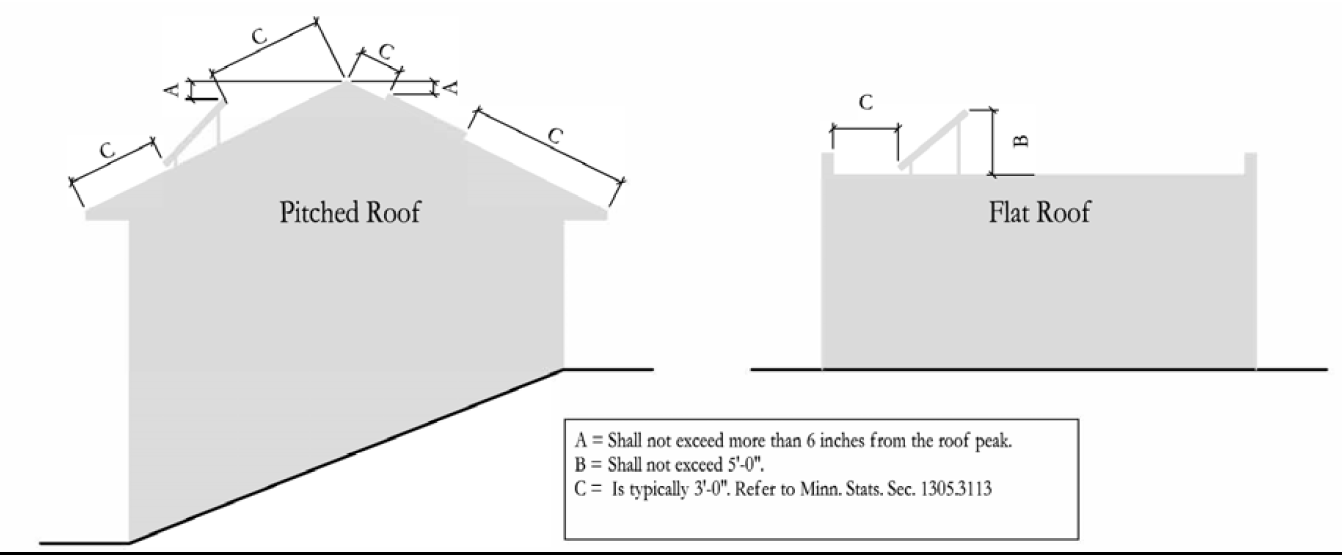
Height.
a.
On pitched roofs, no portion of a flush-mounted or bracket-mounted panel in any position shall extend beyond six inches above the roof peak of the roof plane they are attached to nor exceed the maximum height requirements in that applicable zoning district.
b.
On flat roofs, no portion of a flush mounted or bracket mounted panel in any position, shall exceed a height of five feet above the flat roof they are attached to nor exceed the maximum height requirements in that applicable zoning district.
c.
Ground-mounted solar energy systems shall not exceed the maximum accessory structure height in any zoning district when oriented at maximum tilt.
(2)
Setbacks.
a.
Roof-mounted solar energy systems.
1.
Shall comply with all building setbacks in the applicable zoning districts.
2.
Shall not extend beyond the exterior perimeter of the roof on which the system is mounted.
3.
Unless required by the fire department, there are no setbacks requirements from the exterior perimeters and/or peaks of a roofs.
4.
Exterior piping for solar hot water systems shall be allowed to extend beyond the perimeter of the building, no more than two feet, in side and rear yards only.
b.
Ground-mounted solar energy systems.
1.
Shall be treated as an accessory structure and shall comply with all accessory structure setbacks in the applicable zoning district.
2.
Shall not extend into the side-yard or rear setback when oriented in any position.
3.
For residential systems located within the urban service district, systems shall be located in the rear and side yards only.
(3)
Coverage.
a.
All solar energy systems shall comply with Minn. Stats. § 1305.3113.
b.
For all applications, fire department review is required.
(4)
Glare. Solar systems shall be designed and located in order to prevent reflective glare toward any inhabited buildings on adjacent properties, as well as adjacent street rights-of-way and parks to the fullest possible extent. When necessary, screening may be required to prevent glare.
a.
Concentrated solar systems shall conduct a glare study to identify the impacts of the system on occupied buildings and rights-of-way and parks within a half-mile of the project boundary. The glare study shall also address aviation impacts.
(5)
Exemption. Building integrated solar energy systems are exempt from the requirements of this section and shall be regulated by the building code.
(c)
Permits and notifications.
(1)
Permits. The erection, alteration, improvement, reconstruction, and relocation of a solar energy system requires a building permit from the city.
a.
Applications. An applicant for a solar system permit shall make application to the building department. The application shall accurately state:
1.
The name and contact information of the applicant;
2.
The name and contact information of the installer;
3.
The address of the project being applied for;
4.
To-scale horizontal and vertical elevation drawings showing:
(i)
Location of the system on the building or on the property, including property lines.
(ii)
Any exterior devices (such as, but not limited to, inverters, electrical boxes, batteries, etc)
(iii)
For roof-top solar:
A.
All systems shall show the distance to the roof edges, parapets, ridges, roof penetrations, or changes in roof plane.
B.
Pitched roof-mounted systems shall show the highest finished slope of the solar collector and the slope of the finished roof surface on which it is mounted.
b.
Approval. Applications that meet the design requirements of this ordinance, and do not require a variance, shall be granted administrative approval by the building official. Plan approval does not indicate compliance with building, electric, or plumbing code.
(2)
Utility notification. The owner of a solar energy system that will physically connect to a house or other building's electrical system and/or the electric utility grid must apply for an interconnection agreement with the municipal utility prior to the issuance of a building permit.
(d)
Compliance.
(1)
Compliance with building codes. All solar energy systems shall comply with the Minnesota Building Code and any local building code requirements.
a.
Solar hot water systems shall comply with HVAC-related requirements of the energy code.
(2)
Compliance with electric code. All solar energy systems shall comply with the National Electrical Code.
a.
Electric solar energy system components must have a UL listing.
b.
Solar hot water systems must have an SRCC rating.
(3)
Compliance with plumbing code. All solar thermal systems shall comply with the Minnesota State Plumbing Code.
(e)
Abandonment.
(1)
If the solar energy system remains nonfunctional or inoperative for more than 12 consecutive months, the system shall constitute a public nuisance. The property owner shall obtain a demolition permit and remove the abandoned system at their expense. Removal includes the entire structure, including collector, mount, and transmission equipment.
(f)
Conditional uses.
(1)
Any community solar or solar farm project shall require a conditional use permit.
(2)
Any solar project exceeding 40 kW shall require a conditional use permit.
(3)
Any solar project developed over public or semi-public existing infrastructure (i.e. trail, parking lot, sidewalk, pavilion, etc.) shall require a conditional use permit.
(Ord. No. 16-08, § 2, 4-18-2016)
Sec. 30-806. - Temporary health care dwellings.
Pursuant to authority granted by Minn. Stats. § 462.3593, subdivision 9, the City of Elk River opts-out of the requirements of Minn. Stats. § 462.3593, which defines and regulates temporary health care dwellings.
(Ord. No. 16-18, § 1, 8-15-2016)
Sec. 30-807. - Outdoor storage.
(a)
Definitions. The definitions in section 30-1 are applicable in this section.
(b)
Purpose. It is the intent of this section to establish regulations which allow the outdoor storage materials within the city in a clean and safe manner. Outdoor storage areas must be approved by the city in accordance with the standards outlined in this chapter.
(c)
Standards.
(1)
Outdoor storage shall not exceed 50 percent of the parcel area.
(2)
Approved outdoor storage areas must be paved with an approved surface in accordance with section 30-900(a).
(3)
Outdoor storage areas shall maintain the front yard setback established for the district where the use is located. The side and rear yard setback shall be ten feet.
(4)
Outdoor storage areas shall not be located in designated parking areas or areas striped for parking.
(5)
Outdoor storage areas shall be completely screened from view within all public rights-of-way and commercial or residentially zoned parcels. This requirement shall include gates constructed of the same screening material that can be closed when not in use.
a.
Screening must provide a visual barrier. Any such barrier shall reduce visibility in a manner that restricts vision of the object being screened, but is not required to totally block the vision of any such object.
b.
Screening shall consist of one of the two following methods.
1.
A screening fence of at least six feet and constructed of one or more of the following materials:
(i)
Wood;
(ii)
Factory finished metal or vinyl panels;
(iii)
Chain link with vinyl slats. The slats must be maintained at all times and must be replaced within 30 days at the request of the city.
2.
An earthen berm of at least three feet in height with a mixed hedge of evergreen and deciduous plant materials.
(i)
Plant materials must include a variety of shrubs, ornamental trees, and overstory/evergreen trees. Shrubs must be at least three feet tall at the time of installation and the plan must be approved by city staff.
(ii)
Earthen berms shall not have a slope of more than three feet horizontal to one foot vertical or be located within any street right-of-way unless otherwise approved by the city engineer.
(6)
Outdoor storage areas abutting an adjacent industrial zoned parcel are not required to be screened.
a.
Where screening is not required, barrier style curb B612 shall be installed to define the limits of the approved outdoor storage area.
(Ord. No. 16-26, § 2, 11-21-2016)
Sec. 30-808. - Structures in a right-of-way.
(a)
Definitions. The definitions in section 30-1 are applicable in this section.
(b)
Structures which do not meet or exceed the following standards shall not be permitted within a dedicated right-of-way or roadway easement:
(1)
Co-location. Non-public or private equipment may co-locate on existing public infrastructure (e.g., utility poles, street light, etc.) with approval from the owner of the existing structure.
(2)
Mechanical equipment. All mechanical equipment shall be installed underground, with the exception of mechanical equipment cabinets (structures) in accordance with the following:
a.
Not greater than 30 inches in height or nine square feet in area;
b.
Setback ten feet from the back of curb or edge of travel lane, whichever is greater;
c.
A commercial building permit must be obtained from the building official; and
d.
Mechanical equipment must be in compliance with all laws, ordinances, rules and regulations of the city, including specifically, but not limited to, the city and state building and electrical codes, where appropriate.
(3)
Environmental. Structures shall comply with all environmental setback and applicable regulations as outlined in section 30-1852.
(4)
Stormwater. Structures shall maintain all pre-existing drainage patterns and shall not interfere with existing stormwater infrastructure.
(c)
Exemption. Any public facilities owned and operated by the city, county, state, or federal government shall be exempt from the requirements of this section.
(Ord. No. 17-01, § 1, 1-17-2017)
Editor's note— Ord. No. 17-01, § 1, adopted Jan. 17, 2017, enacted new provisions designated as § 30-807. Inasmuch as the section so numbered already exists, said provisions have been redesignated as § 30-808 at the discretion of the editor.
Sec. 30-851. - Definitions.
The definitions in section 30-1 are applicable in this subdivision.
(Code 1982, § 900.22(2))
Cross reference— Definitions generally, § 1-2.
Sec. 30-852. - Purpose, scope, and findings of subdivision.
(a)
Purpose. The purpose of this subdivision shall be to coordinate the type, placement, and physical dimensions of signs within the different zoning districts, to recognize the commercial communication requirements of all sectors of the business community, to encourage the innovative use of design, to promote both renovation and proper maintenance, to allow for special circumstances, and to guarantee equal treatment under the law through accurate recordkeeping and consistent enforcement. These shall be accompanied by regulation of the display, erection, use, and maintenance of signs.
(b)
Scope. It is not the purpose or intent of this subdivision II to regulate the message displayed on any sign; nor is it the purpose or intent of this subdivision to regulate any building design, or any display not defined as a sign, or any sign which cannot be viewed from outside of a building.
(c)
Findings.
The city finds:
(1)
Exterior signs have a substantial impact on the character and quality of the environment.
(2)
Signs provide an important medium that may convey a variety of messages.
(3)
Signs can create traffic hazards and aesthetic concerns, thereby threatening the public health, safety and welfare.
(4)
The city's zoning regulations include the regulation of signs in an effort to provide adequate means of expression and to promote the economic viability of the business community, while protecting the city and its citizens from a proliferation of signs of a type, size, location, number and character that would adversely impact upon the aesthetics of the community and threaten the health, safety and welfare of the community. The regulation of the physical characteristics of signs within the city has a positive impact on traffic safety and the appearance of the community.
(Code 1982, § 900.22(1); Ord. No. 13-19, § 2, 12-16-2013; Ord. No. 17-04, § 1, 2-21-2017)
Editor's note— Section 2 of Ord. No. 13-19, adopted Dec. 16, 2013, changed the title of § 30-852 from "Purpose and scope of subdivision" to "Purpose, scope, and findings of subdivision."
Sec. 30-853. - Compliance with applicable regulations.
All signs hereafter erected or maintained shall conform with the provisions of this subdivision and other ordinances and regulations of the city.
(Code 1982, § 900.22(3))
Sec. 30-854. - Nonconforming signs.
(a)
Eligibility for legal nonconforming status. Existing signs which do not conform to the current provisions of this subdivision shall be "legal nonconforming" signs, provided that the sign was authorized by a valid permit, variance, or complied with all then applicable laws at the time the sign was installed.
(b)
Loss of legal nonconforming status. A legal nonconforming sign will lose this designation if the sign is removed, abandoned, or its use discontinues for a period of 12 months or more.
(c)
Maintenance and repair. A legal nonconforming sign is subject to all requirements of this subdivision regarding safety, maintenance, and repair.
(d)
Relocation or alteration. The city council may, upon application of a property owner, permit the alteration or relocation of a legal nonconforming sign if, after a public hearing by the planning commission and city council, the council determines that total compliance with the current sign regulations is not reasonable but the alteration or relocation of the nonconforming signs is in greater conformity with the existing sign regulations and is in the best interest of the community.
(e)
No expansion. No legal nonconforming sign shall be expanded or enlarged in any respect.
(Code 1982, § 900.22(5); Ord. No. 09-06, § 1, 7-20-2009; Ord. No. 13-19, § 2, 12-16-2013)
Sec. 30-855. - Appeals.
Appeals from any decision rendered under this subdivision may be made as provided in subdivision II of division 2 of this article.
(Code 1982, § 900.22(7)(I); Ord. No. 09-06, § 1, 7-20-2009; Ord. No. 13-19, § 2, 12-16-2013)
Sec. 30-856. - Notice of violation; order to repair or remove sign.
In addition to the remedies authorized in section 30-576, the city may cause the following actions to be taken for violations of this subdivision:
(a)
If a violation of this subdivision is identified by city administrator, or designee, a written order to either the owner of the sign or the owner of the property on which the sign is placed shall be issued. This order shall specify those sections of this subdivision violated, shall describe the violation, and shall require that the violation be corrected in accordance with the timeframe described below:
(1)
For a first violation, the responsible party shall correct the violation within 30 days from date of the order.
(2)
For repeat violations within a calendar year, the responsible party shall correct the violation within five business days from date of the order.
(3)
For abandoned, structurally or electrically defective signs, the responsible party shall correct the violation within 30 days from date of the order.
(4)
For signs located in the right-of-way, or in any way endangering the public, the responsible party shall correct the violation within five business days from date of the order.
(Code 1982, § 900.22(7)(G); Ord. No. 09-06, § 1, 7-20-2009; Ord. No. 13-19, § 2, 12-16-2013; Ord. No. 17-04, § 2, 2-21-2017)
Sec. 30-857. - Authority of city administrator, or designee.
(a)
Administrative procedures. The city administrator, or designee, shall process applications for permits and variances, schedule public hearings as required, and enforce and carry out all provisions of this subdivision. The city administrator, or designee, is authorized to promulgate procedures consistent with this function.
(b)
Inspections. The building official, city administrator, or designee, is empowered, upon presentation of proper credentials, to enter or inspect any building, structure, or premises in the city for the purpose of inspection of a sign and its structural and electrical connections to ensure compli-ance with all applicable codes and ordinances. Such inspections shall be carried out during business hours unless an emergency exists.
(Code 1982, § 900.22(7)(A); Ord. No. 09-06, § 1, 7-20-2009)
Sec. 30-858. - Removal of signs by city.
(a)
The city administrator, or designee, may cause the removal of a sign after failure to timely comply with written orders for removal or repair as provided in section 38-856. After removal or demolition of the sign, a notice shall be mailed to the sign owner and owner of the property where the sign was located stating the nature of the work and the date on which it was performed and demanding payment of the costs as certified by the city administrator, or designee, including costs for inspection and incidental costs. If the amount specified in the notice is not paid within 30 days after mailing of the notice, it shall become a lien against the property where the Sign was located and shall be certified as an assessment against the property together with ten percent interest for collection in the same manner as the real estate taxes.
(b)
The owner of the property upon which the sign is located shall be presumed to be the owner of all signs thereon unless facts to the contrary are brought to the attention of the city administrator, or designee, as in the case of a leased sign.
(c)
For purposes of removal, a sign shall be deemed to include all sign embellishments and structures designed specifically to support the sign.
(d)
In case of emergency, the city administrator, or designee, may cause the immediate removal of a dangerous or defective sign without notice. Signs removed in this manner must present a hazard to the public safety as defined in section 1300.0180 of the state building code.
(Code 1982, § 900.22(7)(H); Ord. No. 09-06, § 1, 7-20-2009; Ord. No. 13-19, § 2, 12-16-2013)
Sec. 30-859. - Prohibited signs.
The following types of signs are prohibited in all districts:
(a)
Abandoned signs which no longer identify or advertise a bona fide business, service, product, or activity or for which no legal owner can be found.
(b)
Inflatable balloons/displays, and searchlights; except as a permitted temporary sign under subsection 30-867(h).
(c)
Off-premises signs, except for advertising signs (billboards) specifically allowed by this chapter.
(d)
Signs imitating or resembling official government signs or signals.
(e)
Signs attached to trees, utility poles, public benches, streetlights, or placed on any public property or public right-of-way, except signs as permitted in subsection 30-873(b)(4).
(f)
Signs placed on trailers which are parked or placed for the primary purpose of displaying the sign, except for lettering on buses, taxis, or vehicles operating during the normal course of business.
(g)
Signs suspended beneath a canopy, overhang, roof, or marquee without a minimum clearance from grade of eight feet in either a vehicular or pedestrian way.
(h)
Any roof sign or sign erected above the roofline of a building.
(i)
Any sign placed within the vision clearance triangle that may obstruct motorist or pedestrian visibility.
(j)
Rotating or moving signs.
(k)
Unsafe or dangerous signs as determined by the city administrator, or designee.
(l)
Painted wall signs.
(m)
Signs utilizing flashing and/or revolving beacon lights.
(n)
Banner signs, except as a permitted temporary signs under subsection 30-867(h) or permitted real estate signs under subsection 30-860(b)(5).
(Code 1982, § 900.22(3)(B); Ord. No. 09-06, § 1, 7-20-2009; Ord. No. 13-19, § 2, 12-16-2013; Ord. No. 17-04, § 3, 2-21-2017)
State Law reference— Signs resembling traffic control devices prohibited, Minn. Stats. § 169.07.
Sec. 30-860. - Permit.
(a)
Required. Unless otherwise provided by this subdivision, the erection, structural alteration, or relocation of:
(1)
Wall signs shall require a single sign/building permit.
(2)
Individual freestanding/monument signs shall require a single sign/building permit.
(b)
Exemptions. The following types of signs are exempt from permit requirements but must otherwise be in conformance with all requirements of this subdivision:
(1)
The maintenance of a sign or changing the copy without an increase in area.
(2)
On-premises construction signs that comply with subsection 30-867(b).
(3)
On-premises signs, including but not limited to directional signs, informational signs, private sale signs and nameplates, having a sign area of four square feet or less.
(4)
Portable signs in the downtown district.
(5)
Political signs.
(6)
On-premises residential or commercial real estate signs that comply with subsection 30-867(c).
(c)
Application. Application for a permit for the erection, structural alteration, or relocation of signs shall be made to the city administrator, or designee, upon a form provided by the city and shall include the following information:
(1)
The name and address of the owner of the sign.
(2)
The street address or location of the property on which the sign is to be located, along with the name and address of the property owner.
(3)
The type of sign or sign structure as defined in this chapter.
(4)
A site plan showing the proposed location of the sign along with the locations and square footage areas of all existing signs on the same premises.
(5)
Structural details as required.
(6)
The building official, at their discretion, may require plans prepared by a structural engineer to verify structural and wind load requirements.
(d)
Fee. All applications for permits filed with the city administrator, or designee, shall be accompanied by a payment of the initial permit fee for each sign in such amount as determined by city ordinance.
(e)
Issuance or denial. The city administrator, or designee, shall issue a permit for the erection, alteration, change of copy or relocation of signs within 30 days of receipt of the completed application and applicable fees, provided that the sign complies with all applicable laws and regulations of the city. In all applications, where a matter of interpretation arises, the more specific definition or higher standard shall prevail. When a permit is denied by the city administrator, or designee, written notice shall be provided to the applicant along with a brief statement of the reasons for denial. The city administrator, or designee, may suspend or revoke an issued permit for any false statement or misrepresentation of fact in the application.
(f)
Failure to obtain permit. If any sign is installed or placed on any property prior to receipt of a permit, the specified permit fee shall be doubled. However, payment of the doubled fee shall not relieve any person of any other requirement or penalties prescribed in this ordinance.
(Code 1982, § 900.22(3)(A), (3)(C), (7)(B)—(7)(E); Ord. No. 09-06, § 1, 7-20-2009; Ord. No. 13-19, § 2, 12-16-2013; Ord. No. 24-03, § 1, 1-16-2024)
Sec. 30-861. - Inspections.
(a)
Any person performing the erection, alteration, or relocating a sign for which a permit has been issued shall notify the building official upon completion of the work. The building official may require a final inspection, including an electrical inspection and inspection of footings on freestanding signs.
(b)
The building official may require in writing upon issuance of a permit that he be notified for inspection prior to the installation of certain signs.
(Code 1982, § 900.22(7)(F); Ord. No. 09-06, § 1, 7-20-2009)
Sec. 30-862. - Maintenance.
All signs shall be properly maintained, including the ground around the sign. Defective parts shall be replaced on signs. The building official shall have the right under sections 30-856 and 30-858 to order the repair or removal of any sign which is defective, damaged, or substantially deteriorated.
(Code 1982, § 900.22(3)(D); Ord. No. 09-06, § 1, 7-20-2009; Ord. No. 13-19, § 2, 12-16-2013)
Sec. 30-863. - Illumination.
Unless otherwise specified by this subdivision, all signs may be illuminated.
(Code 1982, § 900.22(3)(E))
Sec. 30-864. - Changeable copy signs.
(a)
Unless otherwise specified by this subdivision, any changeable copy sign larger than 30 square feet will require a conditional use permit.
(b)
Changeable copy signs may only display advertising information for on-site businesses, public service announcements, or non-commercial copy.
(c)
Motor vehicle service stations. Signs for motor vehicle service stations shall be regulated by the provisions for the zoning district in which the facility is located, except that within a freestanding sign, an area not to exceed 16 square feet shall be allowed for continuous display (no flashing, scrolling or other animation) of digital or non-digital changeable copy identifying current fuel prices, in accordance with Minn. Stats. § 239.751.
(d)
Time and temperature signs. Within all commercial and industrial zoning districts, an area not to exceed 16 square feet within a freestanding or wall sign shall be allowed for display of an electronic time and temperature sign subject to the sign provisions for the zoning district in which the sign is located.
(e)
Digital changeable copy signs.
(1)
In addition to subsections (a) and (b), the display must be static, and the transition from one static display to another must be no more than two seconds. The images and messages displayed must be complete in themselves and without continuation in content to the next image, message, or any other sign.
(2)
May not change more often than once every eight seconds.
(3)
Digital displays must be equipped with automatic dimming technology or other mechanisms that automatically adjust the signs illumination level based on ambient light conditions.
(4)
No sign may be of such intensity or brilliance as to impair the vision of a motor vehicle driver with average eyesight or to otherwise interfere with the driver's operation of a motor vehicle.
(5)
The display must be designed and equipped to freeze the device in one position if a malfunction occurs. The display must also be equipped with a means to immediately discontinue the display if it malfunctions, and the sign owner must immediately stop a digital display when notified by the city that it is not complying with the standards of this ordinance.
(Code 1982, § 900.22(3)(F); Ord. No. 07-10, § 1, 7-16-2007; Ord. No. 13-19, § 2, 12-16-2013)
Editor's note— Section 2 of Ord. No. 13-19, adopted Dec. 16, 2013, changed the title of § 30-864 from "Changeable copy" to "Changeable copy signs."
Sec. 30-865. - Area identification signs.
Area identification signs are intended to provide additional navigation and identification opportunities for residential, commercial, and industrial developments meeting the following criteria:
(a)
Area identification signs shall be monument signs in design, and are permitted as follows:
(1)
Residential subdivisions of at least 20 acres.
a.
Shall not exceed 16 square feet in area and eight feet in height.
b.
One sign permitted at each entrance from an arterial or collector roadway.
(2)
Condominium or apartment complex of at least 12 units.
a.
Shall not exceed 16 square feet in area and eight feet in height.
b.
One sign permitted at each entrance from an arterial or collector roadway.
(3)
Commercial or industrial complex.
a.
Must consist of three or more platted lots, and as a planned unit development.
b.
One sign not to exceed 80 square feet in area.
c.
Maximum height as follows:
(b)
Shall identify an area or complex, not individual businesses.
(c)
Area identification signs must be located on the same premises as the development which it identifies, as required by the development agreement, or as part of a CUP.
(Ord. No. 13-19, § 2, 12-16-2013)
Sec. 30-866. - Indemnification of city.
All persons involved in the erection, alteration, change of copy or relocation of signs near or upon any public right-of-way or public property which requires the use of public property shall, as a condition of the use of such public property for sign work, agree to hold harmless and indemnify the city and its officers, agents, and employees against any and all claims of negligence resulting from such work insofar as this subdivision has not specifically directed the placement of a sign.
(Code 1982, § 900.22(3)(G); Ord. No. 09-06, § 1, 7-20-2009; Ord. No. 13-19, § 2, 12-16-2013)
Editor's note— Section 2 of Ord. No. 13-19, adopted Dec. 16, 2013, renumbered and amended former § 30-865 as § 30-866.
Sec. 30-867. - District regulations.
The following signs are allowed in all districts:
(a)
All signs not requiring permits as set forth in subsection 30-860(b).
(b)
Construction signs. One on-premises, non-illuminated construction sign not to exceed 64 square feet in sign area and 15 feet in height. Signs may be erected 30 days prior to the beginning of construction, and must be removed ten days following issuance of a certificate of occupancy.
(c)
Real estate sign. One on-premises, non-illuminated real estate sign per lot or premises not to exceed six square feet in sign area and six feet in height for residential lots, and one on-premises non-illuminated real estate sign per lot or premises not to exceed 64 square feet in sign area and 15 feet in height for commercial lots. Such a sign must be removed ten days following closing, rental, or lease.
(d)
Nameplate. One on-premises attached nameplate per occupancy, not to exceed four square feet in sign area.
(e)
Political signs. As permitted by Minn. Stats. § 211B.045, political signs are permitted in all zones. Political signs may be placed only on private property and only with the permission of the property owner. Such signs shall not be illuminated.
(f)
Directional signs. On-premises directional signs shall not exceed four square feet in sign area. Logos and advertisements are not permitted on directional signs.
(g)
Window signs. Provided they do not cover more than 50 percent of an individual window area.
(1)
Vacant commercial spaces may cover 100 percent of a window, provided no advertising message is displayed.
(h)
Government operated off-premises advertising signs. Government facilities that do not abut a public street are permitted one off-premises sign.
(1)
The government operated sign does not count as signage otherwise permitted on the subject property.
(2)
Sign size is limited to ten feet tall and 100 square feet.
(i)
Temporary signs. One on-premises temporary sign per property may be installed, as allowed by the city administrator or their designee. Temporary signs are also subject to the following:
(1)
Signs may not be displayed for more than a total of 90 days per calendar year, per property. A single permit shall not exceed 30 consecutive days.
(2)
Signs may not be displayed without a permit. Each permit must indicate the number of days and the dates the sign is to be displayed. A fee at a level established by ordinance adopted by the city council is required. Unless exempt as indicated in subsection (5), a citation will be issued to the property owner if the sign is placed on an unapproved surface and/or was erected past the date removed, as indicated on the permit.
(3)
Maximum sign area shall be limited to 56 square feet and signs shall not exceed nine feet in height. Lettering shall not extend beyond the edges of the sign.
(4)
Signs must be located on the property of the business and the advertising message must only relate to business conducted on that premises, except that nonprofit or charitable organizations as defined by Internal Revenue Code section 501(C)(3) may have off-premises signs for their fundraising activities, provided they obtain written permission from the property owner. Nonprofit organizations shall be limited to three signs per event and the signs shall not exceed the number of days allowed in subsection (h)(1) of this section. If an event is advertised for more than 30 days, it shall count toward that property's 90-day limit for temporary signage.
(5)
Temporary signs may not be placed in any right-of-way, and must be located on an approved surface; not including sidewalks, fire lanes, and/or circulation drive lanes. Approved surfaces include: asphalt, concrete, and class 5 or crushed concrete compacted to a dust free surface. If an approved surface is not located in a front yard or is more than ten feet from the front property line, the sign may be located in a landscaped area and shall be setback ten feet from property lines. The landscaped area around the temporary sign must continue to be maintained while the sign is in place.
(6)
Only signs for the community events listed in subsection 38-383(6) may be placed on city property.
(7)
For purposes of this section, City of Elk River property leased to other entities shall not be considered city property.
(8)
Signs must not be unsafe or dangerous and must be securely anchored.
(Code 1982, § 900.22(4)(A), (4)(B); Ord. No. 00-06, § 1, 3-20-2000; Ord. No. 04-13, § 1, 8-27-2004; Ord. No. 06-12, § 2, 10-16-2006; Ord. No. 07-20, § 1, 12-17-2007; Ord. No. 08-14, § 2, 10-20-2008; Ord. No. 09-06, § 1, 7-20-2009; Ord. No. 13-19, § 2, 12-16-2013; Ord. No. 19-06, § 1, 3-18-2019; Ord. No. 25-06, § 1, 5-5-2025)
Editor's note— Section 2 of Ord. No. 13-19, adopted Dec. 16, 2013, renumbered and amended former § 30-866 as § 30-867.
Sec. 30-868. - Construction and location standards.
(a)
Compliance with building code. All signs shall be constructed in accordance with the requirements of the state building code.
(b)
Setback. Except as otherwise provided, freestanding signs shall have a setback of ten feet from any property line to any portion of the sign. When a property line is located within the street, the setback shall be 25 feet from the edge of the road.
(c)
Anchoring.
(1)
No sign shall be suspended so that the sign will swing in the wind.
(2)
All temporary and portable signs on display shall be braced or secured to prevent motion.
(d)
Wind resistance. All signs shall comply with the wind load requirements of the state building code.
(e)
Obstruction of exits. No sign shall be erected, constructed or maintained so as to obstruct any fire escape, required exit, window or door opening used as a means of egress.
(f)
Interference with ventilation. No sign shall be attached in any form, shape, or manner which will interfere with any opening required for ventilation, except that signs may be erected in front of and may cover transom windows when not in violation of the provisions of the current building or fire code.
(g)
Substitution. The owner of any sign which is otherwise allowed by this ordinance may substitute non-commercial copy in lieu of any other commercial or non-commercial copy. This substitution of copy may be made without any additional approval or permitting. The purpose of this provision is to prevent any inadvertent favoring of commercial speech over non-commercial speech, or favoring of any particular non-commercial message over any other non-commercial message. This provision prevails over any more specific provision to the contrary.
(Code 1982, § 900.22(6); Ord. No. 09-06, § 1, 7-20-2009; Ord. No. 13-19, § 2, 12-16-2013)
Editor's note— Section 2 of Ord. No. 13-19, adopted Dec. 16, 2013, renumbered and amended former § 30-867 as § 30-868.
Sec. 30-869. - C-1 central business district.
(a)
Temporary signs as permitted in section 30-851 et seq.
(b)
Permanent signs.
(1)
Wall signs. Total wall sign area not to exceed 15 percent of façade area. Wall signs are permitted on any façade that is not directly adjacent to a residential zone. Businesses in multi-tenant facilities shall be allowed their proportionate share of permitted wall sign area. For the purposes of this section a road shall constitute a separation of zones.
(2)
One freestanding sign, not to exceed 64 square feet in sign area with a maximum height of 20 feet.
(3)
Area identification signs as permitted in section 30-865.
(4)
The sign area of freestanding signs may be increased by 25 percent if the sign is constructed as a monument sign.
(5)
One on-premises menu board per drive-up or walk-up lane of a drive-in restaurant or carwash up to a maximum of 32 square feet each. Menu boards are allowed to have a message on one side only and may not contain an advertising message.
(6)
One on-premises pre-order board per drive thru lane up to a maximum of 20 square feet. Pre-order boards are allowed to have a message on one side only and may not contain advertising. Pre-order boards shall not have a speaker or communication system installed.
(7)
Canopy signs on motor vehicle service stations.
a.
In addition to wall signs, motor vehicle service stations shall be allowed two canopy signs.
b.
The total area of each canopy sign shall not exceed 32 square feet.
(c)
Changeable copy signs as permitted in section 30-864.
(Ord. No. 09-06, § 2, 7-20-2009; Ord. No. 13-19, § 2, 12-16-2013; Ord. No. 16-07, § 1, 4-18-2016)
Editor's note— Section 2 of Ord. No. 13-19, adopted Dec. 16, 2013, renumbered and amended former § 30-868 as § 30-869.
Editor's note— Ord. No. 16-07, § 1, adopted April 18, 2016, renumbered § 30-869(b)(6) as (b)(7).
Sec. 30-870. - C-2 office district.
(a)
Temporary signs as permitted in section 30-851 et seq.
(b)
Permanent signs.
(1)
Wall signs. Total wall sign area not to exceed 15 percent of Façade area. Wall signs are permitted on any façade that is not directly adjacent to a residential zone. Businesses in multi-tenant facilities shall be allowed their proportionate share of permitted wall sign area. For the purposes of this section a road shall constitute a separation of zones.
(2)
One monument sign, not to exceed 40 square feet with a maximum height of seven feet.
(3)
Area identification signs as permitted in section 30-865.
(c)
Changeable copy signs as permitted in section 30-864.
(Ord. No. 09-06, § 2, 7-20-2009; Ord. No. 13-19, § 2, 12-16-2013)
Editor's note— Section 2 of Ord. No. 13-19, adopted Dec. 16, 2013, renumbered and amended former § 30-869 as § 30-870.
Sec. 30-871. - C-3 highway commercial district.
(a)
Temporary signs as permitted in section 30-851 et seq.
(b)
Permanent signs.
(1)
Wall signs. Total wall sign area not to exceed 15 percent of façade area. Wall signs are permitted on any façade that is not directly adjacent to a residential zone. Businesses in multi-tenant facilities shall be allowed their proportionate share of permitted wall sign area. For the purposes of this section a road shall constitute a separation of zones.
(2)
One freestanding sign, not to exceed 150 square feet with a maximum height of 30 feet. One freestanding sign may be permitted for every 300 feet of street frontage measured along a single street. The frontage shall only include the property in which the principal use is located on, which the sign is advertising. The additional sign(s) shall be subject to the size and height limitations of the first allowed freestanding or monument sign and may be placed no closer than 150 feet to any other freestanding or monument sign.
a.
Freestanding signs located on parcels that abut Highway 169 may be constructed to a maximum height of 40 feet as measured from the nearest point grade of the main line of Highway 169, provided the sign meets all other criteria of this section. A parcel which, but for the location of an intervening frontage road between said parcel and the freeway, shall be deemed to abut the highway. For all such parcels, the sign may only be located in the yard which directly abuts the highway or frontage road as applicable.
1.
In locations where the grade at the base of the sign is lower than the elevation of the adjacent Highway 169, the sign height shall not exceed 50-feet in total height or higher than 40-feet above Highway 169.
2.
In locations where the grade at the base of the sign is higher than ten-feet above the elevation of the adjacent Highway 169, the sign height shall be limited to 30-feet.
3.
In locations where the grade at the base of the sign is lower than ten-feet above the elevation of the adjacent Highway 169, the sign height shall not exceed 40-feet above Highway 169.
(3)
The sign area of freestanding signs may be increased 25 percent if the sign is constructed as a monument sign.
(4)
Area identification signs as permitted in section 30-865.
(5)
One on-premises menu board per drive-up or walk-up lane of a drive-in restaurant or carwash up to a maximum of 32 square feet each. Menu boards are allowed to have a message on one side only and may not contain an advertising message.
(6)
One on-premises per-order board per drive thru lane up to a maximum of 20 square feet. Er-order boards are allowed to have a message on one side only and may not contain advertising. Per-order boards shall not have speaker or communication system installed.
(7)
Canopy signs on motor vehicle service stations.
a.
In addition to wall signs, motor vehicle service stations shall be allowed two canopy signs.
b.
The total area of each canopy sign shall not exceed 32 square feet.
(8)
Advertising signs (billboards), subject to the following:
a.
Prohibited within 100 feet of the intersection of the highway right-of-way and any other right-of-way or driveway.
b.
Prohibited within 1,200 feet of another advertising sign on the same side of the right-of-way.
c.
Shall be erected with a single pole or mono-pole structural standard and shall have underground wiring.
d.
The base of any advertising sign must be landscaped to prevent erosion and noxious weeds and must be properly maintained.
e.
Shall not exceed 400 square feet in area and 35 feet in height, as measured perpendicularly from the highest point of the sign structure to the nearest road grade.
f.
Shall be considered a principal use of the property. Existing advertising signs must be removed when the parcel upon which they are situated is devoted to another principal use.
g.
Shall only be allowed in C-3 zoned property adjacent to rights-of-way for State Highways 10 and 169.
(c)
Changeable copy signs as permitted in section 30-864.
(Ord. No. 09-06, § 2, 7-20-2009; Ord. No. 13-19, § 2, 12-16-2013; Ord. No. 16-07, § 2, 4-18-2016; Ord. No. 24-09, § 1, 4-15-2024)
Editor's note— Section 2 of Ord. No. 13-19, adopted Dec. 16, 2013, renumbered and amended former § 30-870 as § 30-871.
Editor's note— Ord. No. 16-07, § 1, adopted April 18, 2016, renumbered § 30-871(b)(6), (b)(7) as (b)(7), (b)(8).
Sec. 30-872. - C-4 community commercial district.
(a)
Temporary signs as permitted in section 30-851 et seq.
(b)
Permanent signs.
(1)
Wall signs. Total wall sign area not to exceed 15 percent of façade area. Wall signs are permitted on any façade that is not directly adjacent to a residential zone. Businesses in multi-tenant facilities shall be allowed their proportionate share of permitted wall sign area. For the purposes of this section a road shall constitute a separation of zones.
(2)
One monument sign, not to exceed 125 square feet. The maximum height shall be ten feet along collector streets, and the maximum height shall be 20 feet along arterial streets.
(3)
Area identification signs as permitted in section 30-865.
(c)
Changeable copy signs as permitted in section 30-864.
(Ord. No. 09-06, § 2, 7-20-2009; Ord. No. 13-19, § 2, 12-16-2013)
Editor's note— Section 2 of Ord. No. 13-19, adopted Dec. 16, 2013, renumbered and amended former § 30-871 as § 30-872.
Sec. 30-873. - DD downtown district.
(a)
Temporary signs as permitted in section 30-851 et seq.
(b)
Permanent signs. Signs should be designed to fit with the character, proportions and scale of the individual building and should complement, rather than compete with, the character of downtown.
(1)
One wall sign shall be allowed on each primary façade and on one secondary façade. One square foot of wall sign per one linear foot of unit width shall be allowed, and shall not project out more than eight inches.
a.
Wall signs shall not extend above the roofline of an adjoining building.
(2)
One monument sign is permitted for each multi-tenant facility.
a.
Sign height shall be limited to one-half the average height of the primary structure, not to exceed 20 feet.
b.
Sign area, as measured in square feet, shall be limited to one-third of primary structure width, measured at the widest point parallel to the building address street, and shall not exceed 80 square feet.
(3)
One projecting sign shall be allowed on each primary façade, provided that:
a.
The sign does not exceed six square feet in area, shall not project perpendicularly more than four feet from façade and shall not be thicker than six inches.
b.
The projecting sign projects out perpendicular from façade.
c.
Projecting sign and structural elements are not lower than eight feet from the sidewalk, nor higher than the bottom of the sill of the second floor windows.
d.
The brackets and structure for projecting signs shall be ornamentally designed.
(4)
One portable sign is permitted per public entrance, and only one Sign may be displayed per façade.
a.
Two-sided portable signs (sandwich boards) may not exceed five feet in height, and six square feet in area. Such signs are only permitted during business hours, must be located in front of the business it identifies, and shall not obstruct pedestrian traffic nor impede vehicular traffic.
b.
Portable signs (sandwich boards) shall be set back a minimum of two feet from the back of curb of parking areas, public streets, or private drive aisles.
(5)
With the exception of individual letters and digital changeable copy signs, only externally illuminated signs are allowed.
(6)
Aside from a date and name stone not exceeding three square feet, no signage shall be placed within the parapet panel area.
(c)
Changeable copy signs as permitted in section 30-864.
(d)
Prohibited signs: Back-lit signs (excluding individual letters), molded plastic cabinet signs, smooth/flat plastic signs and signs with strobe lights, flashing elements or distracting actions.
(Ord. No. 09-06, § 2, 7-20-2009; Ord. No. 13-19, § 2, 12-16-2013; Ord. No. 17-14, § 1, 7-3-2017)
Editor's note— Section 2 of Ord. No. 13-19, adopted Dec. 16, 2013, renumbered and amended former § 30-872 as § 30-873.
Sec. 30-874. - I-1 light industrial district.
(a)
Temporary signs as permitted in section 30-851 et seq.
(b)
Permanent signs.
(1)
Wall signs. Total wall sign area not to exceed 15 percent of façade area. Wall signs are permitted on any façade that is not directly adjacent to a residential zone. Businesses in multi-tenant facilities shall be allowed their proportionate share of permitted wall sign area. For the purposes of this section a road shall constitute a separation of zones.
(2)
One freestanding sign, not to exceed 150 square feet with a maximum height of 30 feet. Where a lot has in excess of 300 feet of street frontage, one additional freestanding or monument sign will be allowed. This sign shall be subject to the size and height limitations of the first allowed freestanding or monument sign and may be placed no closer than 150 feet to any other freestanding or monument sign on the same premises.
(3)
The sign area of freestanding signs may be increased 25 percent if the sign is constructed as a monument sign.
(4)
Area identification signs as permitted in section 30-865.
(5)
Advertising signs (billboards), subject to the following:
a.
Prohibited within 100 feet of the intersection of the highway right-of-way and any other right-of-way or driveway.
b.
Prohibited within 1,200 feet of another advertising sign on the same side of the right-of-way.
c.
Shall be erected with a single pole or monopole structural standard and shall have underground wiring.
d.
The base of any advertising sign must be landscaped to prevent erosion and noxious weeds and must be properly maintained.
e.
Shall not exceed 400 square feet in area and 35 feet in height, as measured perpendicularly from the highest point of the sign structure to the nearest road grade.
f.
Shall be considered a principal use of the property. Existing advertising signs must be removed when the parcel upon which they are situated is devoted to another principal use.
g.
Shall only be allowed in I-1 zoned property adjacent to right-of-way for State Highways 10 and 169.
(c)
Changeable copy signs as permitted in section 30-864.
(Ord. No. 09-06, § 2, 7-20-2009; Ord. No. 13-19, § 2, 12-16-2013)
Editor's note— Section 2 of Ord. No. 13-19, adopted Dec. 16, 2013, renumbered and amended former § 30-873 as § 30-874.
Sec. 30-875. - I-2 medium industrial district.
(a)
Temporary signs as permitted in section 30-851 et seq.
(b)
Permanent signs.
(1)
Wall signs. Total wall sign area not to exceed 15 percent of façade area. Wall signs are permitted on any façade that is not directly adjacent to a residential zone. Businesses in multi-tenant facilities shall be allowed their proportionate share of permitted wall sign area. For the purposes of this section a road shall constitute a separation of zones.
(2)
One freestanding sign, not to exceed 150 square feet with a maximum height of 30 feet. Where a lot has in excess of 300 feet of street frontage, one additional freestanding or monument sign will be allowed. This sign shall be subject to the size and height limitations of the first allowed freestanding or monument sign and may be placed no closer than 150 feet to any other freestanding or monument sign on the same premises.
(3)
The sign area of freestanding signs may be increased 25 percent if the sign is constructed as a monument sign.
(4)
Area identification signs as permitted in section 30-865.
(5)
Advertising signs (billboards), subject to the following:
a.
Prohibited within 100 feet of the intersection of the highway right-of-way and any other right-of-way or driveway.
b.
Prohibited within 1,200 feet of another advertising sign on the same side of the right-of-way.
c.
Shall be erected with a single pole or monopole structural standard and shall have underground wiring.
d.
The base of any advertising sign must be landscaped to prevent erosion and noxious weeds and must be properly maintained.
e.
Shall not exceed 400 square feet in area and 35 feet in height, as measured perpendicularly from the highest point of the sign structure to the nearest road grade.
f.
Shall only be allowed in I-2 zoned property adjacent to right-of-way for State Highways 10 and 169.
(c)
Changeable copy signs as permitted in section 30-864.
(Ord. No. 09-06, § 2, 7-20-2009; Ord. No. 13-19, § 2, 12-16-2013; Ord. No. 14-04, § 1, 3-17-2014)
Editor's note— Section 2 of Ord. No. 13-19, adopted Dec. 16, 2013, renumbered and amended former § 30-874 as § 30-875.
Sec. 30-876. - I-3 general industrial district.
(a)
Temporary signs as permitted in section 30-851 et seq.
(b)
Permanent signs.
(1)
Wall signs. Total wall sign area not to exceed 15 percent of façade area. Wall signs are permitted on any façade that is not directly adjacent to a residential zone. Businesses in multi-tenant facilities shall be allowed their proportionate share of permitted wall sign area. For the purposes of this section a road shall constitute a separation of zones.
(2)
One freestanding sign not to exceed 150 square feet with a maximum height of 30 feet. Where a lot has in excess of 300 feet of street frontage, one additional freestanding or monument sign will be allowed. This sign shall be subject to the size and height limitations of the first allowed freestanding or monument sign and shall be no closer than 150 feet to any other freestanding or monument sign on the same premises.
(3)
The sign area of a freestanding sign may be increased 25 percent if the sign is constructed as a monument sign.
(4)
Area identification signs as permitted in section 30-865.
(c)
Changeable copy signs as permitted in section 30-864.
(Ord. No. 09-06, § 2, 7-20-2009; Ord. No. 13-19, § 2, 12-16-2013)
Editor's note— Section 2 of Ord. No. 13-19, adopted Dec. 16, 2013, renumbered and amended former § 30-877 as § 30-876.
Sec. 30-877. - BP business park district.
(a)
Temporary signs as permitted in section 30-851 et seq.
(b)
Permanent signs.
(1)
Wall Signs. Total wall sign area not to exceed 15 percent of façade area. Wall signs are permitted on any façade that is not directly adjacent to a residential use or zone. Businesses in multi-tenant facilities shall be allowed their proportionate share of permitted wall sign area.
(2)
One monument sign, not to exceed 64 square feet with a maximum height of eight feet.
(3)
Area identification signs as permitted in section 30-865.
(c)
Changeable copy signs as permitted in section 30-864.
(Ord. No. 09-06, § 2, 7-20-2009; Ord. No. 10-10, § 1, 7-19-2010; Ord. No. 13-19, § 2, 12-16-2013)
Editor's note— Section 2 of Ord. No. 13-19, adopted Dec. 16, 2013, renumbered and amended former § 30-875 as § 30-877.
Sec. 30-878. - CRT commercial reserve transitional district.
(a)
Temporary signs as permitted in section 30-851 et seq.
(b)
Permanent signs.
(1)
Three wall signs, not to exceed 300 square feet per occupancy.
(2)
One freestanding sign, not to exceed 150 square feet with a maximum height of 30 feet.
(c)
Changeable copy signs as permitted in section 30-864.
(d)
Event sponsor signs, a sign subordinate to a principal use intended for the display of information for onsite patrons, shall be allowed provided the following criteria are met:
(1)
An approved interim use permit has been obtained for the property;
(2)
A sign plan shall be approved by city staff;
(3)
Property shall be larger than 20 acres;
(4)
Each sign shall not to exceed 32 square feet;
(5)
Must be one-sided only;
(6)
Shall be setback ten feet from property line, or 25 feet from rights-of-way, whichever is further;
(7)
Shall face away from rights-of-way, or be setback at least 500 feet from the right-of-way;
(8)
Shall not exceed six feet in height;
(9)
Shall not be illuminated.
(Ord. No. 13-02, § 1, 3-18-2013; Ord. No. 13-19, § 2, 12-16-2013)
Editor's note— Section 2 of Ord. No. 13-19, adopted Dec. 16, 2013, renumbered and amended former § 30-876 as § 30-878.
Sec. 30-879. - Residential districts.
(a)
Temporary signs as permitted in section 30-851 et seq.
(b)
Permanent signs.
(1)
One wall sign, not to exceed four square feet in area.
(2)
One freestanding sign not to exceed four square feet in area.
(3)
Area identification signs as permitted in section 30-865.
(c)
Changeable copy signs as permitted in section 30-864.
(d)
For permitted nonresidential uses, such as churches, synagogues, and schools, in residentially zoned areas, one on-premises freestanding sign and one wall sign, not to exceed 96 square feet in total sign area. Where a zoning lot has in excess of 1,000 linear feet of combined street frontage, the total sign area shall not exceed 192 square feet with no more than 96 square feet per sign. Freestanding signage shall not exceed 20 feet in height.
(1)
For the purpose of this section, zoning lots shall include vacant commonly held parcels across city streets.
(2)
Signs authorized under this section must be removed upon sale of the parcel or when the zoning lot is dedicated to another use.
(e)
Any combination of on-premises freestanding and wall-mounted real estate signs for model homes having a combined total sign area not to exceed 32 square feet. Freestanding signs for model homes shall have a maximum height of five feet.
(f)
Rural-based businesses shall be allowed up to four off-premises directional signs subject to the following restrictions:
(1)
Individual directional signs shall not exceed six square feet.
(2)
Such signs shall be located on private property adjacent to an arterial road, provided that the property owner's permission is obtained in writing.
(3)
Such signs shall only contain the name of the rural-based business, and the direction and distance to the facility.
(4)
Except as otherwise provided, all freestanding signs in residential zones shall have a maximum height of eight feet.
(5)
Signing for straight-ahead movements shall not be allowed.
(g)
Apartments shall be allowed one on-premises freestanding sign not to exceed 64 square feet nor 20 feet in height, and one wall sign per elevation, not to exceed 32 square feet.
(Ord. No. 13-19, § 2, 12-16-2013; Ord. No. 19-16, § 1, 8-19-2019; Ord. No. 24-04, § 1, 1-16-2024)
Sec. 30-880. - XCR extreme commercial recreation district.
(a)
Temporary signs as permitted in section 30-851 et seq.
(b)
Permanent signs.
(1)
Wall signs. Total wall sign area not to exceed 15 percent of façade area. Wall signs are permitted on any façade that is not directly adjacent to a residential zone. Businesses in multi-tenant facilities shall be allowed their proportionate share of permitted wall sign area. For the purposes of this section a road shall constitute a separation of zones.
(2)
One freestanding sign, not to exceed 150 square feet with a maximum height of 30 feet. One freestanding sign may be permitted for every 1,000 feet of street frontage measured along a single street. The frontage shall only include the property in which the principal use is located on, which the sign is advertising. The additional sign(s) shall be subject to the size and height limitations of the first allowed freestanding or monument sign and may be placed no closer than 500 feet to any other freestanding or monument sign.
(3)
The sign area of freestanding signs may be increased 25 percent if the sign is constructed as a monument sign.
(4)
Area identification signs as permitted in section 30-865.
(5)
One on-premises menu board per drive-up or walk-up lane of a drive-in restaurant or carwash up to a maximum of 32 square feet each. Menu boards are allowed to have a message on one side only and may not contain an advertising message.
(6)
One on-premises pre-order board per drive thru lane up to a maximum of 20 square feet. Pre-order boards are allowed to have a message on one side only and may not contain advertising. Pre-order boards shall not have a speaker or communication system installed.
(c)
Changeable copy signs as permitted in section 30-864.
(d)
Event sponsor signs, a sign subordinate to a principal use intended for the display of information for onsite patrons, shall be allowed provided the following criteria are met:
(1)
An approved conditional use permit has been obtained for the property;
(2)
A sign plan shall be approved by city staff;
(3)
Property shall be larger than 20 acres;
(4)
Each sign shall not exceed 32 square feet;
(5)
Must be one-sided only;
(6)
Shall be setback ten feet from property line, or 25 feet from rights-of-way, whichever is further;
(7)
Shall face away from rights-of-way, or be setback at least 500 feet from the right-of-way;
(8)
Shall not exceed six feet in height;
(9)
Shall not be illuminated.
(Ord. No. 15-23, § 2, 7-20-2015; Ord. No. 16-07, § 4, 4-18-2016)
Sec. 30-881. - MU-ERP mixed use Elk River Plaza district.
(a)
Signage.
(1)
Temporary signs as permitted in section 30-851 et seq.
(2)
Permanent signs.
a.
Wall signs. Total wall sign area not to exceed 15 percent of facade area. Wall signs are permitted on any facade that is not directly adjacent to a residential zone. Businesses in multi-tenant facilities shall be allowed their proportionate share of permitted wall sign area. For the purposes of this section a road shall constitute a separation of zones.
b.
One freestanding sign, not to exceed 100 square feet along a collector street or 150 feet along an arterial street. Max height of ten feet along a collector street or 30 feet along an arterial street.
1.
Freestanding signs located on parcels that abut Highway 169 may be constructed to a maximum height of 40 feet as measured from the nearest point grade of the main line of Highway 169, provided the sign meets all other criteria of this section. A parcel which, but for the location of an intervening frontage road between said parcel and the freeway, shall be deemed to abut the highway. For all such parcels, the sign may only be located in the yard which directly abuts the highway or frontage road as applicable.
i.
In locations where the grade at the base of the sign is lower than the elevation of the adjacent Highway 169, the sign height shall not exceed 50-feet in total height or higher than 40-feet above Highway 169.
ii.
In locations where the grade at the base of the sign is higher than ten-feet above the elevation of the adjacent Highway 169, the sign height shall be limited to 30-feet.
iii.
In locations where the grade at the base of the sign is lower than ten-feet above the elevation of the adjacent Highway 169, the sign height shall not exceed 40-feet above Highway 169.
c.
Two permanent area identification signs per neighborhood, subdivision, or development, one not to exceed 64 square feet with a maximum height of 20 feet, the second not to exceed 50 square feet with a maximum height of 12 feet. The area identification signs shall be located on the same premises as the development they identify.
d.
One on-premises menu board per drive-up or walk-up lane of a drive-in restaurant or carwash up to a maximum of 32 square feet each. Menu boards are allowed to have a message on one side only and may not contain an advertising message.
e.
One on-premises pre-order board per drive thru lane up to a maximum of 20 square feet. Pre-order boards are allowed to have a message on one side only and may not contain advertising. Pre-order boards shall not have a speaker or communication system installed.
(Ord. No. 16-10, § 2, 5-16-2016; Ord. No. 24-09, § 2, 4-15-2024)
Sec. 30-891. - Generally.
All parking hereafter constructed or maintained shall conform with the provisions of this subdivision and any other ordinances or regulations of the city.
(Code 1982, § 900.24)
Sec. 30-892. - Size of parking spaces and aisles.
Each parking space and drive aisle shall comply with city standards as set forth in the following table. All loading spaces shall be sufficient to meet the requirements of each use and shall provide adequate space for storage and maneuvering of the vehicles they are designed to serve.
_____
STANDARD VEHICLE
VEHICLES FOR HANDICAPPED
The stall length can be reduced by the amount of the curb overhang up to a maximum of two feet.
(Code 1982, § 900.24(1))
_____
Sec. 30-893. - Reduction or alteration of existing facilities; prohibited uses on required space.
(a)
On-site parking facilities existing on the effective date of the ordinance from which this subdivision is derived shall not be reduced in size to an amount less than that authorized under this subdivision for a similar new building or use except following express authorization of the council pursuant to the provisions for obtaining a conditional use permit or variance. Required parking /or loading space shall not be used for storage of goods or for storage of vehicles that are inoperable or for sale or rent.
(b)
Any off-street parking space in connection with existing buildings or structures on the effective date of the ordinance from which this subdivision is derived shall not be removed, enlarged or altered, except in conformance with the requirements of this subdivision.
(Code 1982, § 900.24(2))
Sec. 30-894. - Rules for computing required number of parking spaces; authority to reduce required number of spaces.
(a)
In computing the number of parking spaces required, the following rules shall govern:
(1)
Floor space shall mean the gross floor area of the specific use.
(2)
Where fractional spaces result, the parking spaces required shall be construed to be the next largest whole number.
(3)
The parking space requirement for a use not specifically mentioned in this subdivision shall be the same as required for a use of a similar nature.
(b)
Pursuant to the provisions for obtaining a conditional use permit or variance, the council may reduce the number of off-street parking spaces required by this subdivision following the establishment of a public off-street parking area which serves the applicable use.
(Code 1982, § 900.24(3))
Sec. 30-895. - Setbacks.
On-site parking and loading facilities shall not be subject to the front yard, side yard, and rear yard regulations for the district in which parking is located, except that:
(1)
In multifamily, commercial, business park or industrial districts, no parking area, drive aisle or loading space shall be located within ten feet of any property lines, except that zero lot line developments may have parking that abuts the zero lot line property boundaries, and in the business park district, where the front yard abuts an arterial or collector street, the parking setback shall be increased to 25 feet. Further, nonsingle-family residential uses located in single-family residential districts shall also be subject to these requirements.
(2)
In single-family residential zoning districts no driveway or parking area shall be located within five feet of a side or rear property line.
(Code 1982, §§ 900.12(16), 900.24(4); Ord. No. 05-19, § 1, 8-15-2005)
Sec. 30-896. - Buffer fence or screen for parking areas.
On-site parking areas near or abutting residential districts shall be screened by a buffer fence of adequate design or a planting buffer screen. Plans of such screen or fence shall be submitted for approval as a part of the required site plan, and such fence or landscaping shall be installed as a part of the initial construction.
(Code 1982, § 900.24(5))
Sec. 30-897. - Access to parking areas.
(a)
Parking spaces shall have proper access from a public right-of-way.
(b)
The number, width and location of access drives shall be so as to minimize traffic congestion and abnormal traffic hazards.
(c)
Vehicular access to business or industrial uses across property in any residential district shall be prohibited.
(d)
The number and type of access drives onto arterial or collector streets may be controlled and limited in the interest of public safety and efficient traffic flow.
(e)
Access drives to principal structures which traverse wooded, steep or open fields shall be constructed and maintained to a width and base material sufficient to support access by emergency vehicles.
(Code 1982, § 900.24(6))
Sec. 30-898. - Location of parking areas.
Required on-site parking space shall be provided on the same lot as the principal building or use.
(Code 1982, § 900.24(7))
Sec. 30-899. - Exception for premises having demonstrated parking area.
Uses of property which do not require the total number of parking stalls as set forth in this subdivision may reduce the number of parking stalls initially constructed. However, it must be demonstrated on the approved site plan that the required number of stalls can be constructed on-site to meet the requirements set forth in this subdivision. This demonstrated parking area shall be installed upon request by the city.
(Code 1982, § 900.24(8))
Sec. 30-900. - Paving, drainage and maintenance of parking areas.
(a)
Paving and drainage required. All off-street parking areas and access drives shall be paved with one of the following:
(1)
Asphalt;
(2)
Concrete;
(3)
Concrete or similar pavers; or
(4)
Class V compacted to maintain a dustfree surface.
(b)
Maintenance. The operator of the principal building or use shall maintain parking and loading areas, access drives and yard areas in a neat and serviceable condition.
(c)
Exemptions from paving requirement. The city may exempt the following from the requirement for a paved off-street parking area:
(1)
Agricultural uses.
(2)
Where installing a paved off-street parking area presents a hardship due to the uniqueness of the business or other conditions.
(Code 1982, § 900.24(9))
Sec. 30-901. - Curbing.
(a)
All driving areas and parking areas shall be bounded by B612 concrete curb and gutter.
(b)
The city may grant an exemption from the curbing requirement:
(1)
Where the parking lot directly abuts a sidewalk which is sufficiently higher than the grade of the parking lot to substitute for the curbing requirements;
(2)
Where the city has approved future expansion of the parking lot; or
(3)
Where installing concrete curb and gutter presents a hardship due to the uniqueness of the business or other conditions.
(c)
Curbing shall be required around islands in pavement.
(d)
Curb cuts and ramps for the handicapped shall be installed as required by the Minnesota State Building Code.
(Code 1982, § 900.24(10))
Sec. 30-902. - Reserved.
Editor's note— Section 1 of Ord. No. 11-01, adopted March 21, 2011, repealed § 30-902 which pertained to lighting and derived from Code 1982, § 900.24(11).
Sec. 30-903. - Minimum number of parking spaces.
On-site parking areas of sufficient size to provide parking for patrons, customers, suppliers, visitors and employees shall be provided on the premises of each use. The minimum number of required on-site parking spaces for the following uses shall be as follows:
(1)
Assembly/churches.
a.
Assembly or exhibition hall, auditorium, theater or sports arena: one parking space for each three seats, based upon design capacity.
b.
Church or funeral parlor: one parking space for each three seats, based on the design capacity of the main seating area.
(2)
Dwellings.
a.
Multiple-family dwelling, including attached townhouses over two units and townhomes: 2½ parking spaces per dwelling unit, one space of which must be completely enclosed.
b.
Nursing home: one space for every four patients or residents, based on the maximum capacity of the building, plus one space per employee on the major shift, plus one space per vehicle owned by the building management.
c.
Senior citizen housing: one parking space per unit, plus one space for each employee who is not a resident of the building.
d.
Single-family dwelling: one enclosed parking space plus two off-street spaces. No garage shall be converted into living space unless other acceptable on-site parking space is provided.
e.
Two-family dwelling: two spaces per dwelling unit.
(3)
Hospitals. one parking space for each two hospital beds, plus one space for each employee on the major shift.
(4)
Offices.
a.
Bank: one space per 200 square feet of floor area, plus room to stack two vehicles per drive-through lane.
b.
Office building: one parking space for each 300 square feet of floor area.
c.
Medical or dental clinic: one parking space for each 200 square feet of floor area.
(5)
Public buildings.
a.
Municipal or county administration building: one parking space for each 300 square feet of floor area.
b.
Community center: adequate parking shall be provided based on the uses contained within the community center and as required in this subdivision.
c.
Public library, museum, art gallery, post office or other public service building: one parking space for every 300 square feet of floor area.
(6)
Recreation.
a.
General standards: one parking space per four expected patrons at capacity.
b.
Archery or golf driving range: one parking space per tee or target, plus one parking space per employee on the largest work shift.
c.
Athletic club or fitness center: one parking space for each 200 square feet of floor area.
d.
Bowling alley: five parking spaces for each bowling lane.
e.
Golf course, golf clubhouse or country club: 30 spaces per each nine holes plus one parking space for each 500 square feet of floor area in the principal structure.
f.
Miniature golf: 1½ parking spaces per hole, plus one space per employee on the largest work shift.
g.
Private swimming facility: one parking space per 75 square feet of gross water area, plus one parking space per employee on the largest shift.
h.
Public swimming pool: 20 parking spaces, plus one space for each 500 square feet of floor area in the principal structure.
i.
Skating rink, ice or roller: one parking space per 300 square feet of gross floor area, plus one parking space per employee on the largest work shift.
j.
Tennis, racquetball, or handball court: four parking spaces per court, plus one parking space per employee on the largest work shift.
(7)
Research. Research, experimental or testing station: one parking space for each employee on the major shift or one parking space for each 500 square feet of floor area within the building, whichever is greater.
(8)
Restaurants/bars.
a.
Class II restaurant: one parking space for each 40 square feet of indoor or outdoor customer area, but not less than six spaces, plus room to stack a minimum of five vehicles per drive-through lane.
b.
Class I restaurant: one parking space for each 100 square feet of indoor or outdoor customer area, or one parking space for each four seats plus five additional spaces, whichever is greater.
c.
Nightclub, tavern or bar: one parking space for every 50 square feet of floor area.
(9)
Sales/service.
a.
Automobile repair service station: one parking space for each 300 square feet of floor area.
b.
Auto sales, trailer sales, marine and boat sales, implement sales, garden supply store, or building materials sales: one parking space for each 500 square feet of floor area. Open sales or rental lots shall also provide one parking space for each 5,000 square feet of land which is to be used for sales and display area.
c.
Convenience store: at least one parking space per 200 square feet of floor area, but not less than six spaces.
d.
Furniture store, appliance store, wholesale, and furniture and appliance repairs: one parking space for each 500 square feet of floor area up to 6,000 square feet, and then one space for each additional 800 square feet of floor area, but not less than six spaces.
e.
Retail store: one parking space for each 200 square feet of floor area.
f.
Supermarket or discount house: at least one parking space for each 200 square feet of floor area.
g.
Veterinarian clinic: one parking space for every 250 square feet of floor area.
(10)
Schools.
a.
Day care, nursery or preschool: one parking space per teacher or employee, plus one space per 12 individuals receiving care.
b.
Public elementary school or junior high school or similar private school: two parking spaces for each classroom.
c.
Senior high school: one parking space for each classroom plus one parking space for each three students, based upon design capacity.
(11)
Warehouse/manufacturing.
a.
Storage or warehouse establishments: one parking space for each two employees on the major shift or one parking space for each 2,000 square feet of floor area, whichever is greater, plus one space for each company motor vehicle when customarily kept on the premises. These requirements shall not apply to ministorage buildings.
b.
Manufacturing, fabricating, general industrial: six stalls plus one off-street parking space for each 500 square feet of floor area.
c.
Ministorage or self-storage facilities: one parking stall for each 400 square feet of office space or four stalls, whichever is greater.
(Code 1982, § 900.24(12); Ord. No. 14-15, § 1, 11-17-2014)
Sec. 30-904. - Handicapped accessible parking.
Handicapped accessible stall requirements are determined as provided by state law or rule.
(Code 1982, § 900.24(13))
Sec. 30-905. - Location, design and construction of loading facilities and overhead doors.
(a)
Loading facilities required; location. All required loading or unloading into or out of railroad cars or trucks in excess of three-fourths ton capacity shall be conducted at facilities specifically designed or designated for that purpose. These facilities shall be located upon the lot of the principal use for which they are required.
(b)
Access to spaces. Each required off-street loading berth and overhead doors shall be so designed as to avoid interference with other vehicular, pedestrian or rail access or use of public streets, alleys, or other public transport systems. These areas should include maneuvering area that does not interfere with parking stalls and designated drive aisles.
(c)
Surfacing, drainage and landscaping; maintenance. All off-street loading facilities, including loading berths and maneuvering areas, shall be surfaced with one of the following:
(1)
Asphalt;
(2)
Concrete;
(3)
Concrete or other pavers; or
(4)
Class V compacted to maintain a dustfree surface;
and shall be well drained and landscaped and shall be maintained in good condition.
(d)
Screening. All loading berths and overhead doors shall be screened from view from the public right-of-way, public facility or residential district or use. The screening shall be accomplished by a solid wall not less than six feet in height and shall be so designed as to be architecturally harmonious with the principal structure. Screen plantings and earth berming may be substituted for the prescribed wall; however, such plantings must be of such type as to provide maximum screening during all months of the year.
(e)
Design. Loading areas and overhead doors should be designed to reflect harmonious compatibility with the principal structure. Architectural techniques are encouraged to reduce the visual impacts there may be on adjacent properties or roadways.
(Code 1982, § 900.24(14))
Sec. 30-906. - Vehicular and pedestrian circulation.
(a)
Generally. All commercial buildings or structures and their accessory uses shall be accessible to and from nearby public streets and sidewalks by driveways and walkways properly drained and paved with:
(1)
Asphalt;
(2)
Concrete;
(3)
Concrete or similar pavers; or
(4)
Class V (or equivalent) compacted to maintain a dustfree surface.
Vehicular traffic generated by commercial uses shall be channeled and controlled in a manner that will avoid congestion on the public streets, traffic hazards, and excessive traffic through residential areas, particularly truck traffic. The adequacy of any proposed traffic circulation system to accomplish these objectives shall be determined by the city engineer, who may require such additional measures for traffic control as he may deem necessary, including but not limited to the following: directional signalization, channelization, standby turn lanes, illumination, and storage area and distribution facilities within the commercial site to prevent backup of vehicles on public streets.
(b)
Use of right-of-way. No area used by motor vehicles other than driveways serving as ingress and egress to a commercial site shall be located within the public street right-of-way.
(c)
Driveway width.
(1)
Commercial driveways. The following shall be applicable to commercial driveways (measured between roadway edges);
(2)
Single-family residential driveways. Single-family residential driveways shall not exceed 30 feet in width measured at the property line. Each single-family lot shall be limited to one driveway except:
a.
Lots that are one acre or larger in the A-1 and R1a zoning districts shall be allowed two driveways onto a city street, not exceeding 40 feet in total combined width. Driveways shall be separated by a minimum of 25 feet.
b.
In all single-family districts, if the area inside a looped driveway is 25 feet or less wide, the two legs of the loop, not to exceed 30 feet in combined width, shall be considered one driveway.
c.
In all single-family districts, corner lots shall be allowed to have one driveway on each street, not to exceed 40 feet in total combined width.
(3)
Permit required. All driveways accessing a county road will require a county access permit.
(d)
Minimum driveway angle to street. The minimum driveway angle to the street shall be 30 degrees when the street is one-way or divided, or 60 degrees otherwise.
(e)
Minimum distance of driveways from street intersections. The minimum distance of a driveway from street intersections shall be as follows (measured along the street curbline between the nearest driveway edge and the intersecting street curbline):
_____
*Note: Minimum distance to be the same as that specified for approaching lane if left turns are permitted into or out of driveway.
(Code 1982, § 900.32; Ord. No. 03-14, § 1, 8-18-2003)
Cross reference— Streets, sidewalks and other public places, ch. 66.
_____
Sec. 30-931. - Definitions.
The definitions in section 30-1 are applicable in this subdivision.
(Code 1982, § 900.30(2))
Cross reference— Definitions generally, § 1-2.
Sec. 30-932. - Intent and purpose of subdivision.
(a)
The purpose of this subdivision is to clearly express the city's intent for all properties to be landscaped and maintained with great care. Properties shall be landscaped to express sensitivity to environmental conditions as well as aesthetic needs of the general public.
(b)
All landscaping must be designed to add visual beauty to the property. The quantity and quality of the design should be compatible with each zoning district and the intended use of the property. Individual review of the landscape design will require consistency with areas which have established unique concepts, design patterns, and a high level of aesthetic value.
(c)
The preservation of desirable vegetation is a goal which should be addressed prior to new construction or expansion of an existing use.
(Code 1982, § 900.30(1))
Sec. 30-933. - Screening.
(a)
All nonresidential principal and accessory uses, including off-street parking, except business signs, which are situated within 50 feet of a residential district shall be screened from such district by a wall, fence and/or landscaping of not less than 80 percent opacity.
(b)
Walls, fences or planting screens may be permitted if the nature or extent of the use being screened is such that a lesser degree of screening will adequately promote and protect the use and enjoyment of the properties in the adjacent residential district, or that screening of the type required by this subdivision would interfere with the provision of adequate amounts of light and air to such properties.
(c)
Double fronted residential buildings and lots along collector or arterial streets shall be screened with a 15-foot easement area for landscaping. Screening shall be accomplished by a combination of earth berming and planting.
(d)
In all districts, mechanical equipment and other similar features shall be screened from adjacent properties and public streets with the application of landscaping designed to be compatible with the architectural treatment of the principal structure or, if this cannot be accomplished, painting of equipment to match the building.
(e)
All external loading and service areas accessory to buildings shall be screened from the ground level view when facing a residential district or public streets, except at access points, with architectural enhancements, walls and/or landscaping.
(Code 1982, § 900.30(3))
Sec. 30-934. - Landscaping.
(a)
General requirements. The following general requirements are applicable to all districts:
(1)
All exposed ground areas surrounding or within a principal or accessory use, including street boulevards, which are not devoted to drives, sidewalks, patios, or other such uses shall be landscaped with grass, shrubs, trees, other living ornamental landscape materials, mulch, or rock.
(2)
All landscaped areas shall be kept neat, clean and uncluttered.
(3)
No landscaped area shall be used for the parking of motor vehicles, trailers, boats, and RVs or the storage or display of materials, supplies or merchandise.
a.
Exception: In all residential zoning districts the parking of a combination of no more than two motor vehicles, trailers, boats and RVs shall be allowed on landscaped areas behind the rear of the home provided they are setback not less than ten feet from all side and rear property lines and are fully operable and licensed as required by the state. Additionally, the area beneath and around the parked motor vehicle, trailer, boat or RV must be maintained in accordance with all city codes, kept in a neat and orderly appearance, and comply with all other city codes with respect to such items.
(4)
Undisturbed areas of existing natural vegetation maintained free of noxious weeds need not be altered.
(5)
A reasonable attempt shall be made to preserve as many existing trees as is practical and to incorporate them into the proposed development plan.
(6)
Slopes greater than three feet horizontal to one foot vertical (3:1) will not be permitted without approval by the city. Only under special conditions or unique circumstances will steeper slopes be permitted. Slopes adjacent to pedestrian systems, inslopes of roadways, ponding, sedimentation areas, and other water or wetland features may not have a slope greater than 4:1.
(7)
In all multifamily, commercial and industrial zoning districts, the maintained/manicured landscaped areas shall have inground/underground irrigation systems. Native grasses and plant areas need not be irrigated.
(b)
All zoning districts except permitted single-family uses in all districts. Landscaping requirements for all zoning districts except permitted single-family uses in all districts are as follows:
(1)
Applicability of requirements. All properties shall comply with the requirements of this subdivision when new development or expansions are to occur on these properties, except for single-family dwelling units.
(2)
Landscape plan. Landscape plans shall be prepared by a landscape architect or other qualified individual acceptable to the city. Landscape plans shall be drawn to a scale of not less than one inch equals 50 feet and shall include the following information:
a.
The name and address of the property owner and/or developer.
b.
The name of the project.
c.
The name of the preparer of the plan.
d.
The date of plan preparation.
e.
Boundary lines of the property with accurate dimensions, and note with scale and north arrow.
f.
The locations of existing and proposed buildings, parking lots, public roads, easements and other improvements.
g.
The location, approximate size and common name of existing trees.
h.
A planting schedule containing:
1.
Symbols.
2.
Quantities.
3.
Common names and botanical names.
4.
Size of plant materials.
5.
Root condition specifications.
6.
Special planting instructions.
i.
Planting details illustrating proposed locations of all new plant material, including proposed walls, fences, planters, landscaped islands, and other landscaping-related improvements.
j.
Details of restoration of disturbed areas, including areas to be sodded and seeded.
k.
Location of existing wetlands.
(3)
Minimum requirements. All open areas of a lot which are not used and improved for required parking areas, drives or storage shall be landscaped with a combination of overstory trees, ornamental trees, coniferous trees, shrubs, flowers, and turf or ground cover materials. The number of trees on the lot, tract, or parcel shall not be less than three plus the perimeter of the described area as measured in feet divided by 40.
a.
Overstory trees. Fifty percent of the required trees shall be overstory trees.
b.
Ornamental trees. Twenty-five percent of the required trees shall be ornamental trees.
c.
Coniferous trees. Twenty-five percent of the required trees shall be coniferous trees.
d.
Additional landscaping. In order to accomplish an adequate buffer or screening, additional landscaping over and above the required amount may be required by the city.
e.
Credits.
1.
For oversizing trees. The total number of required overstory trees may be reduced by one tree for each new deciduous tree measuring four and one-half inches or more in diameter, or each new coniferous tree measuring ten feet or more in height, which is planted on the lot or tract.
2.
For existing trees. The total number of required new trees may be offset by the retention of existing trees on the lot provided that such trees satisfy the requirements of this section as to size and species. The existing tree credit chart shall be used to determine the amount of credit for existing trees. Existing trees closer than 15 feet together shall be considered one tree and the largest diameter tree will be utilized to calculate the tree credit. The diameter of and distance between trees shall be measured six inches above the ground.
Subsection 30-934(d)(3) pertaining to approved tree species shall apply to the types of trees given credit.
3.
For native grasses and plant communities. The total number of required trees may be offset by the provision of native grasses and wildflowers. Planting or preservation of native planting communities will receive credit for one tree per 500 square feet of native grass area. Credits may not exceed 50 percent of the total requirements. A native grass and plant community maintenance plan shall be submitted to the city every year by March 1.
f.
Reserved.
g.
Maintenance. The property owner of the lot upon which required landscaping or screening is located shall maintain all materials in a sightly and healthy growing condition. Plant material removed due to damage, disease, or death shall be replaced.
(c)
Permitted single-family uses in all districts. Landscaping requirements for permitted single-family uses in all districts are as follows:
(1)
Applicability of requirements. All permitted single-family properties shall comply with the requirements of this subdivision when new development or expansions are to occur on these properties.
(2)
Minimum requirements. All open areas of a lot which are not used and improved shall be landscaped with a combination of overstory trees, ornamental trees, coniferous trees, shrubs, flowers, and turf or permitted ground cover materials. The minimum number of trees in the front yard is two.
a.
Location of required front yard trees.
1.
One tree must be located in the boulevard area and shall be an overstory type tree.
2.
A second tree shall be located in the front yard area. Overstory, evergreen, and ornamental tree species are permitted.
(d)
Species.
(1)
All required trees shall be of species which are classified as overstory, ornamental, and coniferous trees by the American Nurseryman's Association.
(2)
Not more than 50 percent of the required number of overstory or ornamental trees shall be composed of one species.
(3)
All required trees shall be selected from the University of Minnesota Extension Service's list of recommended trees for Southeast Minnesota, or as approved by the city's planning department.
(e)
Minimum size and root condition of trees. Minimum size and root condition of required trees shall be as follows:
(1)
Overstory trees shall be two inches in diameter as measured six inches above the ground, and trees must be balled and burlapped.
(2)
Ornamental trees shall be one and one-half inches in diameter as measured six inches above the ground, and trees must be balled and burlapped.
(3)
Coniferous trees shall be six feet in height, and trees must be balled and burlapped.
(f)
Placement of plant materials.
(1)
All required landscaping shall be located on the lot occupied by the use, building, facility, or structures. No landscaping shall be located within any public right-of-way unless approved by the city.
(2)
Plant materials shall be located to provide reasonable access to all utilities.
(3)
At all intersections, sight visibility triangles shall be kept clear of landscape materials that would obstruct the sight lines of motorists at intersecting streets.
(g)
Installation. All landscape improvements required by this subsection shall be installed by the owner no later than one year after the issuance of a building permit for the subject property. Replacement of any dead trees, shrubs, ground covers and sodding shall be responsibility of the property owner.
(h)
Inspection. Twelve months after the date of issuance of a building permit, the city may conduct a field inspection of the subject site to assure compliance with the requirements of this subdivision and implementation of the approved landscape plan.
(i)
Exceptions and adjustments. Where a strict application of this subsection is not possible due to unique topographic landform, irregular lot shape or historic features worthy of preservation, the applicant may present an alternative landscape and screening plan to the city for alternate approval.
(j)
Performance guarantee. If required landscape improvements have not been completed at the time a certificate is requested for occupancy of a property, a financial guarantee to ensure completion of the improvements shall be supplied prior to issuance of the certificate of occupancy. The financial guarantee shall be in an amount equal to approximately 100 percent of the value of the uncompleted landscape improvements, and shall be released one year after completion of the required landscape improvements following written request from the property owner. Developers who have posted a previous financial guarantee in connection with the installation of public improvements shall not be required to post a separate guarantee, but the financial guarantee shall remain in place in an amount equal to approximately 100 percent of the value of uncompleted landscape improvements until all required landscape improvements are completed.
(Code 1982, § 900.30(4), (5); Ord. No. 02-09, § 1, 6-17-2002; Ord. No. 02-11, § 1, 6-10-2002; Ord. No. 12-03, §§ 1—3, 2-21-2012; Ord. No. 14-12, §§ 1, 2, 10-20-2014; Ord. No. 16-22, § 1, 9-19-2016; Ord. No. 20-07, § 3, 7-20-2020)
Sec. 30-935. - Landscaped islands in off-street parking areas.
(a)
All off-street parking areas shall include unpaved, landscaped islands that are reasonably distributed throughout the parking area. These islands should be located to break up expanses of paved areas and facilitate traffic control. Islands shall be provided in a ratio of at least one island per 15 parking spaces.
(b)
Landscaped islands shall be equal to the size of a parking stall, at minimum. The provision of fewer, but larger parking lot islands is encouraged.
(Code 1982, § 900.30(6); Ord. No. 12-03, § 4, 2-21-2012)
Sec. 30-936. - Tree preservation plan.
In order to retain, as far as practicable, substantial tree stands as part of urban development, a tree preservation plan should be submitted to the city prior to removing trees or commencing construction.
(Code 1982, § 900.30(7))
Sec. 30-937. - Lighting.
Artificial lighting shall be planned, designed, constructed and maintained consistent with the following standards:
(1)
Lighting shall be directed away from the public right-of-way and nearby or adjacent residential or agricultural conservation districts.
(2)
Commercial parking lots shall be lighted to a minimum level of three footcandles. Other parking lots shall be lighted to a minimum level of 1½ footcandles.
(3)
All sources of artificial lights shall be so fixed, directed, designed or sized that the minimum subtotal of their illumination will not increase the level of illumination on any nearby residential property by more than 0.1 footcandle in or within 25 feet of a dwelling or by more than 0.5 footcandle on any part of the property.
(4)
Glare, whether direct or reflected, as different from general illumination, shall not be visible from beyond the limits of the immediate site from which it originates.
(Code 1982, § 900.30(8))
Sec. 30-938. - Architectural standards.
Except as otherwise provided, all multifamily, commercial and industrial construction shall be developed in accordance with the following design standards:
(1)
Architectural plans. Construction plans shall be prepared and submitted to include:
a.
Elevations of all sides of the building.
b.
Type and color of exterior building materials.
c.
A typical floor plan and dimensions of all structures.
d.
Location of trash containers and heating, air conditioning and ventilation systems.
e.
Proposed screening of trash containers and heating, air conditioning and ventilation systems.
(2)
Exterior building finish.
a.
In the C-1, C-2 and C-3 districts, the exterior building finish shall consist of at least two of the exterior building finishes, at least two shall be used per wall:
1.
Face brick.
2.
Natural stone.
3.
Architectural glass. (i.e. curtain wall)
4.
Wood.
5.
Stucco.
6.
Siding. (metal, fiber-cement or vinyl)
7.
Integrally colored split face (rock face), burnished or glazed concrete masonry units (excluding smooth/plain or painted).
8.
Other city approved architectural materials.
b.
In the I-1 and I-2 districts, the exterior building finish shall consist of the following exterior building finishes:
1.
Face brick.
2.
Natural stone.
3.
Architectural glass. (i.e. curtain wall)
4.
Wood.
5.
Stucco.
6.
Integrally colored split face (rock face), burnished or glazed concrete masonry units (excluding smooth/plain or painted).
7.
Integrally colored and/or exposed aggregate precast concrete panels.
8.
Poured-in-place concrete walls.
9.
Prefinished metal panels.
10.
Other city approved architectural metal.
(3)
Roofing standards. Roofing shall consist of a shingled, prefinished metal panel and/or membrane roof.
(4)
Alterations and additions. All subsequent additions and exterior alterations constructed after the erection of an original building (when the original building was constructed in conformance with this section) shall be constructed of materials comparable to those used in the original construction and shall be designed in a manner conforming to the original architectural design and general appearance.
(5)
Accessory structures. Architectural standards as outlined in this section shall also apply to accessory buildings, except that in the I1 and I2 districts where the accessory structure is not less than 250 feet from an existing residence, engineered fabric structures may be used as an acceptable material.
(6)
Buildings abutting residential, religious, educational uses, or place of assembly. All portions or sides of buildings which abut a public street, a residential zone, religious or educational uses, or place of assembly, such as a public park or recreational facility, shall be constructed of materials on the list of exterior building finishes in subsection (2)a. of this section.
(Code 1982, § 900.30(9); Ord. No. 05-11, § 1, 5-16-2005; Ord. No. 05-22, § 1, 9-19-2005; Ord. No. 12-04, § 1, 2-21-2012; Ord. No. 19-15, § 3, 8-19-2019)
Sec. 30-939. - Storage and display.
Storage and display on properties shall be planned, designed, constructed and maintained consistent with the following, at the city's discretion:
(1)
All materials, supplies, merchandise or other similar matter not on display for direct sale, rental, or lease shall be stored within a completely enclosed building.
(2)
Merchandise may be displayed beyond the confines of a building. The area occupied by such outdoor display shall not constitute a greater number of square feet than ten percent of the ground floor area of the building housing the principal use. Garden chemicals, such as herbicides, pesticides and fertilizers, shall be stored in such a way as to prevent their discharge into the stormwater management system.
(3)
No storage of any type shall be permitted within one-half of the required front or side street setback nearest the street.
(Code 1982, § 900.30(10))
Sec. 30-961. - Generally; investigations and tests.
Every use of land shall be established and maintained in compliance with the provisions of this subdivision. The council may require the owner or operator of any permitted use to have made such investigations or tests by an independent testing organization satisfactory to the city as may be required to show compliance with the performance standards. The cost of such investigations or tests shall be shared equally by the owner or operator and the city, unless the investigation or tests disclose noncompliance with the performance standards, in which situation the entire cost shall be paid by the owner or operator.
(Code 1982, § 900.28)
Sec. 30-962. - Noise.
At any property line, the sound pressure level of noise radiated from an industrial operation shall not exceed the values given in table 1 in this section. The sound pressure level shall be measured with a sound level meter and an associated octave bank analyzer, both of which are manufactured to specifications published as the American Standard Specifications for an Octave Band Filter Set for the Analysis of Noise and Other Sounds, Z24.10-1953, American Standards Association, Inc., New York, New York. Measurements shall be made using the flat network of the sound level meter.
TABLE 1
(Code 1982, § 900.28(1))
Sec. 30-963. - Odors.
No harmful odors shall be detectable beyond the limits of the site on which a use is located. Detailed plans for the prevention of odorous emissions may be required before the issuance of a building permit.
(Code 1982, § 900.28(2))
Sec. 30-964. - Exterior lighting; glare.
Any lights used for exterior illumination shall direct light away from adjoining property and public roads. Glare, whether direct or reflected, such as from floodlights, spotlights, or high temperature processing, and as differentiated from general illumination, shall not be visible beyond the limits of the property.
(Code 1982, § 900.28(3))
Sec. 30-965. - Vibration.
No vibration shall be discernible at any property line to the human sense of feeling for an accumulated total of three or more minutes during any hour.
(Code 1982, § 900.28(4))
Sec. 30-966. - Smoke.
The Ringelmann smoke chart, published by the United States Bureau of Mines, shall be used for measuring smoke at the point of emission. Smoke not darker or more opaque than no. 4 on the chart may be emitted, except that smoke darker or more opaque than no. 2 on the chart may not be emitted for periods longer than four minutes in any 30 minutes. These provisions, applicable to visible gray smoke, shall also apply to visible smoke of a different color but an equivalent apparent opacity.
(Code 1982, § 900.28(5))
Sec. 30-967. - Dust.
Solid or liquid particles shall not be emitted at any point in concentrations exceeding 0.3 grain per cubic foot of the conveying gas or air. For measuring the amount of particles in gases resulting from combustion, standard corrections shall be applied to a stack temperature of 500 degrees Fahrenheit and 50 percent excess air.
(Code 1982, § 900.28(6))
Sec. 30-968. - Fumes or gases.
Fumes or gases shall not be emitted at any point in concentrations or amounts that are noxious, toxic, or corrosive. The values given in table 1 (Industrial Hygiene Standards—Maximum Allowable Concentration for Eight-Hour Day, Five Days per Week), table III (Odor Thresholds), and table IV (Exposure to Substances Causing Injury to Vegetation) in the latest revision of chapter 5 (Physiological Effects) that contains such tables, in the Air Pollution Abatement Manual, by the Manufacturing Chemists' Association, Inc., Washington, D.C., are hereby established as guides for the elimination of fumes or gases which may be required before the issuance of a building permit.
(Code 1982, § 900.28(7))
Sec. 30-969. - Fire hazards.
Any activity involving the use or storage of flammable or explosive materials shall be protected by adequate firefighting and fire prevention equipment and by such safety devices as are normally used in the handling of such materials. Such hazards shall be kept removed from adjacent activities to a distance which is compatible with the potential danger involved.
(Code 1982, § 900.28(8))
Cross reference— Fire prevention and protection, ch. 22.
Sec. 30-970. - Waste treatment and disposal.
All solid waste material, debris or refuse shall be kept within a completely enclosed building or properly contained in a closed container designed for such purposes. All liquid wastes containing any organic or toxic matter shall be isolated, treated, and disposed of in a manner permitted by applicable law and regulation. The health officer shall assist in determining the proper method of waste treatment and disposal.
(Code 1982, § 900.28(9))
Sec. 30-971. - Air pollution.
Every activity shall conform to state regulations relating to air quality standards and air pollution control.
(Code 1982, § 900.28(10))
Sec. 30-972. - Erosion.
No activity shall be carried on in such a way that water, soil or any objectionable substance is carried onto any adjacent property.
(Code 1982, § 900.28(11))
Sec. 30-973. - Radioactivity or electrical disturbance.
No activity shall emit dangerous radioactivity or any electrical disturbance adversely affecting the operation of any equipment or human habitation at any point other than at the origin of such disturbance.
(Code 1982, § 900.28(12))

