
Escambia County Unincorporated
City Zoning Code
City Zoning Code
DESIGN STANDARDS
MANUAL
Article 1. - Environmental
All environmental design standards will be based on the best available science.
Article 3. - Docks, Piers, and Marinas
[LDC Chapter 4]
Appendix A - Design Standards Manual Professional Advisory Committee
Duties:
The seven members of the professional advisory committee shall review proposed changes to the technical and environmental design standards herein. The proposed changes may be submitted by the county engineer or the environmental director or the public. Proposed changes shall include supporting evidential documentation including, but not limited to, calculations, details, specifications, drawings, peer reviewed best available science, etc.
Meetings:
The professional advisory committee shall meet according to Florida Sunshine law, on a bi-annual basis beginning approximately six months following the adoption by the Escambia County Board of County Commissioners. The meetings will be will be coordinated by either the county engineer, community and environment director or his/her designee, depending on the discipline of issues to be addressed.
Members:
One member shall be from private practice and shall be appointed by the local branch of the Florida Engineering Society.
One member shall be from private practice and shall be appointed by the local branch of the American Society of Civil Engineers.
Two members shall be from private practice and shall be appointed by the Florida Association of Environmental Professionals or other professional scientific association as deemed acceptable to the community and environment director.
One staff member from engineering/public works, community and environment, and development services departments shall be appointed by the respective department director.
Terms of office:
Terms for those members who are not Staff of Escambia County shall serve for a minimum two years and may remain on the committee if re-selected by their appointing body.
Revisions:
Professional Advisory Committee's (PAC) revisions to this manual will be presented to the planning board for their review and recommendation to the BOCC and will be effective at the time of the BOCC decision.
(Ord. No. 2015-12, § 1(Exh. A), 4-16-2015)
1-1 - Stormwater management systems.
All projects requiring a stormwater management system (SMS) shall be designed to meet the following:
1-1.1
Stormwater quality (treatment).
Projects that require a stormwater management system (SMS) shall at a minimum be designed to provide for the treatment of the first one-half inch of runoff which shall be recovered in 72 hours. The method of treatment shall comply with the design methods referenced in the latest edition of the Environmental Resources Permit Applicants Handbook, Volume II. The entire capacity of a dry pond shall be fully recovered within the following days between rain events:
a.
Seven days for a pond with positive drainage outfall.
b.
Ten days for a pond with no positive drainage outfall.
1-1.2
Stormwater quantity (attenuation).
Projects that require a stormwater management system (SMS) shall at a minimum be designed to provide for the following for the total contributing runoff area:
Provide attenuation of the runoff from a 100-year critical duration event, up to and including 24-hour duration, so that the post-development runoff rate does not exceed the pre-development runoff rate, when a positive discharge route is present.
or
Drainage systems in areas with no positive drainage outfall shall be designed to more stringent criteria to include retention up to and including 24-hour, 100-year frequency storm with no offsite discharge. These systems shall remain private and will not be accepted by the county for ownership and maintenance.
or
For projects that abut the Gulf of America, Escambia Bay, Pensacola Bay, Perdido Bay or their connected, tidally influenced bodies of water (i.e., Tarkiln Bayou, Chico Bayou, Bayou Texar, etc.) the county engineer may reduce or waive the SMS from stormwater quantity requirements.
1-1.3
Stormwater ponds and impoundments.
All stormwater ponds or impoundments shall comply with the design standards provided in the Environmental Resource Permitting Applicants Handbook, Volume II, Florida Department of Environmental Protection and Northwest Florida Water Management District.
1-1.4
Pond slopes, fencing, and maintenance access.
All ponds - Retention and detention sides shall slope at a gentle grade into the water as a safeguard against accidents, to encourage the growth of vegetation, allow for proper maintenance, and to allow alternate flooding and exposure of areas along the shore as water levels change.
(a)
Residential subdivisions (private and public).
(1)
Side slopes.
a.
Wet ponds - When unfenced, side slopes shall not be steeper than 4:1 (horizontal to vertical) out to a depth of two feet below the control elevation. When fenced, side slopes shall not be steeper than 3:1 out to a depth of two feet below the control elevation.
b.
Dry ponds - Side slopes may not be steeper than 3:1, and must be fenced when steeper than 4:1 (horizontal to vertical).
(2)
Fencing. The required fence shall be six feet high chain link meeting county technical specifications [1] and be installed along the perimeter of the pond parcel. Privacy fencing, or other fencing, may be used to supplement screening to the chain link fence provided it is located within a private fence easement and offset by a minimum of five feet from the chain link fence for maintenance.
(3)
Stabilization.
a.
Wet ponds - Wet ponds shall be stabilized in solid sod above the permanent pool elevation, unless stabilization is obtained through incorporation of littoral plantings.
b.
Dry ponds - Side slopes shall be solid sod from the bottom to three feet beyond the top of bank.
(4)
Maintenance access shall meet the following criteria:
a.
Unobstructed access with a minimum width of 15 feet to the wet/dry pond area constructed of graded aggregate a minimum 12 feet wide, no steeper than 6:1 (horizontal to vertical) at least five inches thick, and underlain with pervious geotextile fabric.
b.
A concrete driveway from the roadway meeting county standards.
c.
Minimum 14 feet wide, six feet tall double access gate at the pond parcel boundary line.
d.
Dry ponds shall include a minimum 12 feet wide access road into the bottom of the retention/detention basin no steeper than 6:1. The access shall be unobstructed and constructed of graded aggregate a minimum of five inches thick, and underlain with pervious geotextile fabric.
e.
Access width around the dry pond perimeter shall be a minimum of five feet wide with a cross slope no steeper than 6:1.
f.
Wet ponds shall have a minimum 15-foot wide access route around the top bank perimeter of the retention area with a cross slope no steeper than 6:1. Access onto the perimeter route shall have a slope no steeper than 6:1.
(b)
Commercial and industrial sites and subdivisions.
(1)
Private developments.
a.
Side slopes - Wet or dry ponds. Stormwater basins designed to collect more than two feet of water must contain side slopes that are not steeper than 4:1 (horizontal to vertical) out to a depth of two feet below the control elevation unless fenced to restrict public access.
b.
Fencing - Per engineer of record.
c.
Stabilization - Per engineer of record.
d.
Maintenance access - Per engineer of record.
(2)
Public developments.
a.
Side slopes.
1.
Wet ponds - When unfenced, side slopes shall not be steeper than 4:1 (horizontal to vertical) out to a depth of two feet below the control elevation. When fenced, side slopes shall not be steeper than 3:1 out to a depth of two feet below the control elevation.
2.
Dry ponds - Side slopes may not be steeper than 3:1, and must be fenced when steeper than 4:1 (horizontal to vertical).
b.
Fencing - The required fence shall be six-feet high chain link meeting county technical specifications 1 and be installed along the perimeter of the pond parcel. Privacy fencing, or other fencing, may be used to supplement screening to the chain link fence provided it is located within a private fence easement and offset by a minimum of five feet from the chain link fence for maintenance.
c.
Stabilization.
1.
Wet ponds - Wet ponds shall be stabilized in solid sod above the permanent pool elevation, unless stabilization is obtained through incorporation of littoral plantings.
2.
Dry ponds - Side slopes shall be solid sod from the bottom to three feet beyond the top of bank.
a.
Maintenance access - Required (see requirements for maintenance access, this section).
1-1.5
Conveyance systems. All conveyance systems shall be designed to convey the runoff from a 25-year critical duration event.
(a)
Curb and gutter systems. These systems shall be designed to convey runoff without exceeding the following:
1.
For local residential roads, the maximum allowable spread shall not overtop the top of curb and the flow spread should not exceed to the crown of the roadway.
2.
For two lane collector roads, the maximum allowable spread shall not overtop the top of curb and the flow spread must leave one lane free of water in one direction.
3.
For arterial roads, the maximum allowable spread shall not overtop the top of curb and the flow spread must leave at least one lane free of water in both directions.
(b)
Roadside swales and ditches.
1.
Shall be designed so that flow shall not extend over the property line, right-of-way line, or drainage/utility easement line.
2.
All proposed swales and open ditches shall be designed to have a minimal longitudinal slope of 0.30 percent.
3.
Shall not have a depth of greater than three feet.
4.
Shall be designed to have a minimum distance of six feet from the edge of the travel lane.
5.
Shall not have a design velocity of greater than three feet per second unless the swale is lined and shall not have a design velocity of greater than six feet per second.
6.
Maximum side slope shall be no steeper than 3:1.
(c)
Open channels in drainage rights-of-way or easements.
1.
All ditches or swales shall be stabilized.
2.
Bank slopes shall be 6:1 or flatter, unless permanent stabilization is provided.
3.
Velocity of water shall not exceed three feet per second in grassed ditches or six feet per second in lined ditches.
4.
Maximum allowable design depth of water in ditches shall be three feet during a 25-year storm.
5.
Bottom of ditch or swale is two inches or more above the water table.
6.
Any ditches with grades of five percent or greater shall be lined or otherwise improved so as to eliminate erosion and sedimentation buildup in the lower elevations of the ditch, as approved by the county engineer.
7.
Adequate access for maintenance equipment (15 feet wide minimum) must be provided as needed for maintenance equipment access.
8.
Channels and culverts under all proposed roads, excluding conveyance systems diverting runoff to the ponds, shall be designed to convey the runoff from a 100-year critical duration event without overtopping the road.
9.
All proposed conveyance swales and open conveyance ditches shall:
a.
Be designed to have a minimum longitudinal slope of 0.30 percent.
b.
Be installed with either concrete or other permanent stabilization (i.e., sod, etc.) depending on velocity (see DSM 1-1.5(b)5).
10.
For drainage easements or drainage right-of-way, see DSM 2-1.1.
(d)
Underground conveyance systems.
1.
Inlet/junction box spacing shall not exceed 400 linear feet.
2.
Pipe diameters shall be equal to or larger than the adjoining upstream pipe diameter.
3.
The minimum pipe size shall be 18 inches in diameter or its equivalent arch or elliptical pipe.
4.
Only reinforced concrete pipe (RCP) shall be constructed under all proposed or existing paved roadways.
5.
Proposed drainage easements for underground conveyance systems shall have a minimum width of 15 feet for when the proposed depth is equal to or less than five feet from pipe invert to proposed finished grade. Conveyance systems greater than five feet in depth from pipe invert to proposed finished grade shall be located in a drainage easement. Drainage easements shall have a 20-foot minimum width.
6.
County standard inlet capacities. Under normal flood conditions county standard inlets are designed to accept the following flowrates:
Type "A" Inlet: 7—10 cfs
Type "A-1" Inlet: 7—10 cfs
Type Modified "A" Inlet: 14—20 cfs
Double "A" Inlet: 14—20 cfs
FDOT inlets may be used as a substitute for county standard inlets provided the inlet capacity is accommodated by the specified inlet type.
7.
For drainage easements or drainage rights-of-way, see DSM 2-1.1.
1-1.6
Exemptions. Projects that include the addition of 1,000 square feet or less of impervious surface which are not part of a large development plan shall be exempt from this chapter.
(a)
Residential property improvements. Improvements such as driveways, buildings, pools, etc. and/or accessory structures that do not exceed 1,500 square feet shall be exempt from this chapter.
(b)
Minor subdivisions. Proposed subdivision of land into no more than five single-family lots, each fronting on and existing paved public or private streets, and complying with all of the following:
1.
No adverse impacts. Impervious cover on the lots will not adversely impact wetlands or create adverse off-site impacts.
2.
Impervious cover limits shall not exceed:
a.
3,000 square feet on lots less than ¼ acre in size; or
b.
3,500 square feet of lot area on ¼ acre up to one acre in size; or
c.
Eight percent of lot area greater than one acre in size.
3.
Documented limits. Lot impervious cover limitations are permanently documented in the public records of the county, including the subdivision plat and any covenants and restrictions.
4.
Positive outfall. Each lot has a positive drainage outfall.
1-1.7
Other agency approvals. It is the responsibility of the applicant and the engineer of record to apply for and obtain all appropriate permits. Projects that are to be dedicated to the county for ownership and maintenance shall be required to provide all applicable permits prior to dedication.
(Ord. No. 2015-12, § 1(Exh. A), 4-16-2015; Ord. No. 2016-30, § 3(Exh. B), 8-4-2016; Ord. No. 2018-5, § 3, 2-1-2018; Ord. No. 2018-35, § 1, 11-1-2018)
http://www.myescambia.com/sites/myescambia.com/files/Escambia%20County%20Technical%20Specifications_02-01-15.pdf
1-2 - Stormwater management plans.
All projects requiring a stormwater management system (SMS) shall be required to submit a stormwater management plan (SMP) which shall be prepared by, signed and sealed by a professional engineer actively registered to practice in the State of Florida. The PE shall certify that the SMS has been designed to meet the SMS requirements. The SMP shall include those items needed (i.e. maps, graphs, tables, calculations, photographs, narratives, explanations, etc.) which clearly demonstrate the intent of the land development code and this design standards section have been met.
1-2.1
Methods. Innovative approaches to stormwater management are encouraged; however the SMP shall document compliance with the standards of this chapter and shall demonstrate control of erosion, sediment transport, stormwater quality, and stormwater quantity (flooding). Methods used for other than listed below shall require approval by the county engineer:
Urban Hydrology for Small Watersheds, Technical Release 55, US Department of Agriculture, Soil Conservation Service.
Environmental Resource Permit Applicants Handbook, Volumes I and II, Florida Department of Environmental Protection and Northwest Florida Water Management District.
Drainage Handbook: Drainage Connection Permits, Florida Department of Transportation.
Drainage Manual, Florida Department of Transportation.
1-2.2
Content. At a minimum, the SMP shall provide the following information:
(a)
Existing conditions. All existing conditions of the project site shall be detailed and include the following:
1.
Stormwater flow: The direction, flow rate, and volume of runoff pre-development.
2.
Offsite contributing area: The area, direction, flow rate, and volume of runoff impacting the project site pre-development.
3.
Receiving area: Define or describe the area runoff flows offsite pre-development. Define the positive discharge route if one exists.
4.
Environmentally sensitive lands: Indicate the location, area and description of all jurisdictional wetlands and endangered species habitat.
5.
Indicate and define special flood zone areas on the site in accordance with the FEMA flood insurance rate maps should they exist on the project site.
6.
Vegetation: Define the type and extent of existing vegetation on the project site pre-development.
7.
Topography: Provide a topographic map of the site pre-development. The topographic survey shall be prepared by a professional surveyor actively registered in the State of Florida. The topographic survey shall include contours which extend outside the project site property lines when the line adjoins a right-of-way, jurisdictional wetlands or easements. The requirements of this section may be reduced or waived by the county engineer.
8.
Geotechnical report: For projects proposing less than 9,000 square feet of impervious area, the engineer of record (EOR) may use data obtained from the NRCS Soil Survey Map. For projects proposing 9,000 square feet or more of impervious area, the geotechnical report shall meet the requirements of the Environmental Resource Permitting Applicants Handbook, Volume II.
9.
Name, location and right-of-way width of all existing streets noting roadway surface (paved, clay, shell, etc.), rights-of-way and platted streets within 500 feet of the proposed entrance(s) of the proposed subdivision.
(b)
Proposed improvements. All proposed alterations to the project site shall be detailed and include the following:
1.
Topography: All proposed grades and contours.
2.
Impervious cover: The total areas and descriptions of proposed impervious surfaces, semi-impervious surfaces, and pervious surfaces.
3.
Structures: The size, location, and description of all buildings or structures.
4.
Vegetation: The amount of vegetative area to be cleared.
5.
Stormwater management: All components of the proposed SMS to provide for stormwater treatment and attenuation including the following:
A.
Plans and specifications.
B.
Calculations showing all components of all proposed conveyance, attenuation, and treatment systems meet the intent of the land development code and design standards.
C.
Erosion control plan. The control of erosion and sediment transport shall be implemented based on the best management practices (BMPs) designated in the Environmental Resource Permitting Applicants Handbook, Volume II, Florida Department of Environmental Protection and Northwest Florida Water Management District.
[D.]
[Reserved.]
E.
Maintenance plan.
F.
Overall lot grading plan for all proposed subdivisions in accordance with the Florida Building Code.
(Ord. No. 2015-12, § 1(Exh. A), 4-16-2015; Ord. No. 2025-29, § 22, 7-10-2025)
2-1 - Roadway design.
All roads and bridges constructed within Escambia County, public or private, shall be constructed to meet the design and materials standards identified within the DSM and Escambia County Technical Specifications.
2-1.1
Minimum right-of-way widths of streets, alleys and easements for utilities.
Beltways: Beltways as designated by the county shall not be less than 300 feet wide.
Arterials: State highways and county arterials as defined in the LDC shall not be less than 100 feet wide.
Collectors: Collector streets, as defined in the LDC shall not be less than 80 feet wide.
Local streets: Local streets including temporary cul-de-sacs, for curb and gutter sections, shall be 50 feet with an additional five-foot public utility easement along each side of right-of-way or 66 feet if roadside swales are utilized.
Turning circles: Turning circles (permanent) at the end of cul-de-sacs or dead-end street shall have a right-of-way of 100 feet in diameter with a ten-foot utility easement.
Utility easements: Widths shall be according to utility provider's easement requirements.
Alleys: Alleys normally shall not be platted within subdivisions. However, where they are acceptable to the overall development of a subdivision by the county engineer, they shall be platted to a width of not less than 20 feet or more than 30 feet.
Drainage easement: Drainage easements for conveyance systems must contain underground piping or swale in accordance with DSM 1-1.5(c)9 and shall be platted to a width sufficient to accommodate the projected pipe sizes, and shown on the recorded plat but in no case shall such easement be less than 15 feet in width unless an exception is approved by the county engineer or designee.
Drainage rights-of-way: Open ditches and drainage swales for conveyance systems must be constructed within public dedicated or deeded right-of-way with a minimum width of 15 feet and shown on the recorded plat unless an exception is approved by the county engineer or designee.
2-1.2
Minimum pavement widths. The portion of pavement required to be installed at the developer's expense is set forth below. As a condition of approval of new subdivisions on roadways which do not conform to county standards, the developer may be required to improve the portion of said road which adjoins, provides access to or is within the proposed subdivision. Improvements may include installation of turning lanes, increased pavement widths, installation of drainage facilities, paving or dirt roads, etc.
(a)
Streets.
1.
All proposed collector roads shall be 24 feet wide as measured from edge of pavement to edge of pavement.
2.
All proposed residential roads will be 24 feet in clearance:
a.
With curb and gutter - as measured from gutterline.
b.
With ribbon curb - as measured from back edge of ribbon curb.
c.
Or as measured from edge of asphalt to edge of asphalt.
3.
If soil and topographic conditions and impervious areas indicate that no drainage problems will be created or aggravated, the curb and gutter requirements may be waived, and substituted with ribbon curb (or improved shoulders, four feet wide, or other stabilization methods may be used) and swales as approved by the county engineer. The determination of whether drainage problems shall be created or aggravated will be made by the developer's registered professional engineer, subject to approval of the county engineer.
(b)
Turning circles. The pavement of a turning circle at the end of a cul-de-sac or dead-end street shall have a minimum inside curb face diameter of 90 feet.
(c)
Temporary turning circle. The pavement of a temporary turning circle at the end of a cul-de-sac or dead-end street shall be tangent to the boundary of the adjacent property and shall have an outside diameter of 80 feet. The county engineer may recommend that requirements for curb and gutter around the outside of the temporary turning circle be waived.
(d)
Alleys. Alleys, if approved by the county engineer shall be paved to a width of 18 feet.
(e)
Boulevards.
1.
Proposed boulevards shall have a minimum lane width clearance of 16 feet.
a.
With curb and gutter - as measured from gutterline.
b.
With ribbon curb - as measured from back edge of ribbon curb.
c.
Or as measured from edge of asphalt to edge of asphalt.
2.
The proposed island or traffic separator shall have a minimum width of four feet.
2-1.3
Intersections.
(a)
Angle. Proposed streets shall intersect one another within ten degrees of right angles as topography and other limiting factors of good design permit.
(b)
Radii. The minimum radius of proposed access roads to the new development shall be 25 feet if raised curb is used along the entire length of the curve, and the minimum of 35 feet radius shall be used if ribbon curb, or no curb is used in the county right-of-way. Transition from the raised curb to the ribbon curb shall be constructed in accordance with the county's approved detail.
(c)
Sight distance at intersections. Intersections should be designed to provide site distance considerations in accordance with FDOT standards.
(d)
Sight triangle requirements. At a minimum, a sight triangle shall be provided 35 feet from edge of pavement to 35 feet [from] edge of proposed road or driveway.
2-1.4
Slopes. All proposed roadways shall be designed to have a minimal longitudal slope of 0.30 percent.
2-1.5
Roadway elevations. The crown of all proposed roadways must be at minimum of four feet above mean sea level (NGVD) unless approved by the county engineer. All proposed roads shall be designed to have a minimum of two feet of separation between the seasonal high water table and the bottom of the base course.
Development of subdivisions in areas with seasonal high water tables (two feet or less) shall include location of standard roadway geotechnical borings throughout the subdivision on the lot grading plan as well as the associated boring log information.
2-1.6
Street layout. Where appropriate to the design, proposed streets shall be continuous and in alignment with existing, planned or platted streets with which they are to connect. Future commercial and residential subdivisions along major roads, thoroughfares and arterial streets shall provide access routes for all uses within the subdivision.
(a)
Connectivity. Proposed streets shall extend to the boundary lines of the tract to be subdivided. If a subdivision or an undeveloped parcel of substantial size (as determined by the county engineer or its designee) is adjacent to the proposed subdivision, said proposed streets shall connect with streets in the existing, platted, or planned subdivision or parcel. However, nothing herein shall grant to any person or entity other than Escambia County any right of access or right to require the granting of access. However, if the county engineer and the applicant agree that the proposed subdivision should not connect with an adjacent subdivision, said connection will not be required.
(b)
Large development ingress/egress. The following conditions apply to proposed subdivisions that are 100 lots or more, that are part of a master plan of 100 lots or more, or where extension of proposed streets to the boundaries would dead end with no feasible street connections to adjacent developable properties (see 2-1.6(a) connectivity):
1.
There shall be at least two proposed entrance streets connecting a proposed loop street through the subdivision to an existing paved county road(s).
2.
A single ingress/egress proposed entrance street may be utilized if such street provides for separation of traffic entering and exiting the subdivision by means of a boulevard running the entire length of the proposed entrance street between the existing, connecting county road and the proposed loop street. In addition, designated left and right turn lanes must be provided on the existing, connecting county road to the proposed entrance street.
3.
For the purposes of this provision, a loop street means the primary local road designed to move traffic through the subdivision.
(c)
Dead end streets. Cul-de-sac or local dead-end street shall not exceed 1,200 feet in length, exclusive of the permanent turning circle at the end of that street; however, the county engineer may recommend approval of a cul-de-sac over 1,200 feet in length to serve odd-shaped parcels of land which cannot be developed in any other reasonable manner or to serve property that would otherwise be denied reasonable access caused by manmade or natural obstacles adjacent to such property. Cul-de-sacs shall be required on dead end streets according to the Florida Fire Prevention Code Chapter 18, Section 18, Dead Ends - current edition.
(d)
Utilities in road rights-of-way. No streets or roads under the two-year warranty will be allowed to be open cut, or bored. To accomplish this requirement, common trenching is required whenever possible.
The engineer of record shall provide proof of request for all utility layouts (to include but not be limited to power, communications, gas, etc.) prior to construction plan approval. Conduit locations for utility roadway crossings shall be included in construction plans. If locations are not provided by the utility, the engineer of record shall provide conduit locations for utility road crossings. Conduit shall be installed with tracer wire and/or other locating methods. The following note shall be included on the plans: Contractors shall communicate with utility provider(s) a minimum of two weeks prior to curb installation or roadway base installation. Contractors shall ensure integrity of conduit throughout roadway installation.
2-1.7
Traffic control devices. The developer shall install traffic control devices as specified by the county engineer. Such devices shall conform to provisions in the Manual on Uniform Traffic Control Devices and FDOT standards.
(Ord. No. 2015-12, § 1(Exh. A), 4-16-2015; Ord. No. 2016-30, § 2(Exh. B), 8-4-2016; Ord. No. 2018-5, § 3, 2-1-2018)
2-2 - Access management.
Vehicular access to public roadways shall be accomplished by means of an improved access facility (i.e., driveway, private road, etc.). Unimproved and/or unrestricted access will not be permitted. All driveways and streets shall be designed and constructed pursuant to the design standards in the most recent edition of the "A Policy on Geometric Design of Highways and Streets" by the American Association of State Highway Transportation Officials" and/or "The Manual of Uniform Minimum Standards for Design, Construction and Maintenance for Streets and Highways," and FDOT.
2-2.1
Access location. Unless otherwise approved by the county engineer, in order to reduce turning movements on roadways, new access points to development sites or projects should be as follows:
For parcels which front two or more roadways, access shall be permitted onto the higher class roadway if the driveway location can meet the driveway separation standard shown above.
2-2.2
Pedestrian access.
(a)
Commercial development. For commercial sites with buildings individually or cumulatively 50,000 GSF or greater, pathways through parking lots and across driveways between buildings and out parcels shall be provided for pedestrians. Such pathways shall be separated from vehicle driveways and shall be clearly identified by curbs, pavement markings, planting areas, fences or similar features designed to promote pedestrian safety.
(b)
Sidewalks. Sidewalks are to be constructed along the frontage of a development if any of the following conditions apply:
1.
An existing sidewalk abuts the development, or is on one or both sides of an intervening/intersecting street.
2.
The need for site specific improvements are identified within an approved Florida/Alabama TPO Bike/Pedestrian Master Plan.
3.
When 50 percent or more of any developable portion of the property is within two miles of public school property as measured radially from the school's main front office entrance.
Frontage shall be described as the property line that is located closest to the shortest walkable route to the school and possesses at least one main subdivision entrance.
(c)
Bikeways. Class I (separated from the roadway) or II (striped) bikeways shall be constructed along the frontage of a development if any of the following conditions apply:
1.
An existing bikeway abuts the development; or
2.
The need for a bikeway is identified by TPO bike and pedestrian plan.
(d)
Repair. Existing sidewalks and bikeways damaged during the development of a property shall be repaired or replaced by the owner of such property as directed by the division manager, development services.
(e)
Connectivity. A separate access connection that routes pedestrians from the sidewalk to the building shall be provided for developments which are expected to attract pedestrian traffic.
2-2.3
Traffic control.
(a)
Traffic control devices. The county engineer shall require the reasonable placement of traffic control signs, pavement markings, and traffic signals at any roadway or driveway, or within any development, if it is necessary, to provide for the safe and efficient movement of traffic at or prior to the preliminary plat, construction plans or site plan approval, if such device is justified. All traffic control devices shall be designed and installed in accordance with the Manual On Uniform Traffic Control Devices (USDOT, most recent edition) and the Roadway and Traffic Design Standards (FDOT, most recent edition).
(b)
Traffic signals. If a traffic signal proposed by a developer serves a public/public intersection the installation will be conducted by the owner, the maintenance will be paid for and handled by the county, and the county shall be the responsible party of such signal. If it serves a private/public intersection and has the opportunity for additional users, the signal installation will be conducted by the developer/owner, the maintenance of such signal will be handled by the county; however, the developer/owner will pay for the maintenance through the enactment of a development agreement until additional users construct access, and signal will be the responsibility of the county.
If a traffic signal is proposed by a developer or property owner on a private/private intersection, it is a private signal. The signal installation will be conducted by the owner, the maintenance will be paid for and handled by the owner, and the signal will be the responsibility of the owner. The signal shall be justified by a traffic study which demonstrates the warrants, design, and operation of the proposed signal. Such studies shall be provided by the developer for approval by the county engineer or their designee. All construction costs for the installation of a traffic signal, including associated roadway modifications, necessitated by and proposed by a developer or property owner shall be borne by same.
(c)
Turn restrictions. The county engineer shall restrict turning movements into and out of any roadway or driveway where it is deemed necessary for the safe and efficient movement of traffic, and the decision is based on sound professional engineering practices. Roadway or driveway connections with restricted turn movements shall be geometrically designed so as to provide access only for the movements permitted.
(d)
Median openings. The location of additional and relocated median openings shall comply with the standards of FDOT in F.A.C. ch. 14.97, as amended.
(e)
Turn lanes. Warrants for turn lanes into un-signalized driveways or streets were developed to provide for proper access management and safety. A turn lane analysis shall be performed on a county roadway serving a development that generates 50 vehicle trips or greater during any peak hour. Turn lane design shall be supported by documentation of the estimated volume of traffic using the lane, resulting queue length, and design speed of the roadway.
The applicant must develop a trip distribution report in accordance with industry standard guidelines using traffic count data provided by either FDOT, Escambia County, or the applicant that is no more than three years old.
Turn lane warrant criteria are as follows:
1.
Using the data obtained from the trip generation/distribution report, the following shall apply:
a.
Right turn lanes. The developer shall construct a right-turn lane(s) on a county roadway to serve right-turning movements entering a development when the estimated volume of such movement is 30 vehicles or greater during any peak hour.
b.
Left turn lanes. The developer shall construct a left-turn lane(s) on a county roadway to serve left-turning movements entering a development when the estimated volume of such movement is 30 vehicles or greater during any peak hour.
c.
If a right or a left turn lane(s) is not required under section 1, proceed to section 2.
2.
If the number of turning movements, as determined by the trip distribution report, is 25.5 to 30 vehicles during any peak hour, a certified un-signalized turn lane analysis shall be performed by a licensed Florida Professional Engineer using approved methodologies such as those in NCHRP Report 457, 659 or 193, and the Highway Capacity Manual software.
2-2.4
Modification of existing access.
(a)
Abandoned access. When an existing driveway or other type of access is abandoned, or not used to serve a redeveloped site, the developer or property owner shall remove all pavement or gravel and restore the road rights-of-way. Restoration shall include but not be limited to, grading, culvert removal and replacement of curbing, sidewalk and stabilization.
(b)
Additions. Unless the project is de minimis, reconstruction and/or removal of existing access connections to current standards is required when a site is redeveloped or expanded and the number of average daily vehicle trip ends attracted/generated by the new use is increased by 50 percent or more of the previous use.
(c)
Change of use. Alteration of existing access connections by the property owner shall be required by the county engineer whenever the nature of business conducted at a location changes so as to cause a change in the traffic pattern on a roadway which is reasonably expected to cause undue disruption to traffic or present a safety hazard.
2.2-5
Internal site access design.
(a)
Parking area setbacks. Parking shall be set back from the property line at driveways so as to not interfere with safe ingress/egress of traffic. The setback distance should be determined according to the estimated speed and volume of traffic entering a driveway and shall meet all the visual clearance requirements.
(b)
Drive-through stacking. Drive-in and drive-through developments shall provide adequate queue storage capacity based on the peak hour storage requirements of the project which is subject to the review and approval by the county engineer.
2.2-6
Commercial traffic in residential areas. No permit, development order, or other approval shall be issued for any proposed commercial use which requests primary, secondary, or limited access onto a local street if that local street is fronted by more than 50 percent residential zoning in the following districts: LDR, LDR-PK, MDR, MDR-PK, measured in linear feet along the center line of the local street impacted by the proposed development. This provision will not apply when its strict application would deny all access to a parcel that is zoned for any commercial use.
(Ord. No. 2015-12, § 1(Exh. A), 4-16-2015; Ord. No. 2016-30, § 2(Exh. B), 8-4-2016; Ord. No. 2024-16, § 2, 4-4-2024)
3-1 - Parking and loading.
3-1.1
Stall and aisle design.
(a)
Stall dimensions. Standard parking stalls shall be nine feet wide by 18 feet long for all but parallel parking. Parallel stalls shall be nine feet wide by 23 feet long.
(b)
Stall angles. The angles of non-parallel parking stalls in relation to the alignment of the accessing drive aisle are restricted to 90, 60 or 45 degrees.
(c)
Stall accessibility. Each parking stall shall be accessible from an aisle or driveway and designed so that vehicles can enter and exit the stall without backing into the travel way of any street.
(d)
Aisles dimensions.
1.
Standard one-way drive aisles shall be 24 feet if accessing 90 degree parking stalls, 16 feet wide if accessing 60 degree stalls, and 12 feet wide if accessing 45 degree or parallel stalls, or if accessing no stalls.
2.
Standard two-way drive aisles shall be 24 feet wide if accessing 90 degree parking stalls, and 20 feet wide if accessing 60 degree, 45 degree or parallel stalls, or if accessing no stalls.
(e)
Turnarounds. All parking areas containing three or more parking spaces shall include a turnaround that is designed and located so that vehicles can enter and exit the parking area without backing into a public right-of-way.
(f)
Encroachment. Landscape areas and pedestrian pathways shall be protected from vehicle encroachment using wheel stops, raised curbing, bollards or similar fixed barriers such that pathways remain completely functional and vehicles overhang no more than two feet into landscape areas.
(g)
Delineation and traffic control. All paved parking spaces shall be striped in white and all driving aisles clearly delineated. Spaces for motorcycles, bicycles and handicap parking shall be clearly marked. Parking lot traffic control signage and marking shall conform to the latest editions of the Manual on Uniform Traffic Control Devices, U.S. Department of Transportation, and the Florida Accessibility Code for Building Construction.
(h)
Pedestrian entrances. No door or other pedestrian entrance shall open directly upon any driveway or access aisle unless the entrance is at least three feet from the driveway or access aisle.
(i)
Surface materials.
1.
Except as allowed for excess parking or limited uses, the stalls, drive aisles and accesses of all parking required by this article shall be finished with an all-weather surface capable of withstanding ordinary use under normal weather conditions without substantial deterioration. For these purposes, all-weather surfaces are limited to concrete and asphalt pavement, recycled asphalt, gravel, crushed stone or shell, and paving stones. Areas of higher intensity use, such as site accesses or heavy truck routes, may be limited by the county to paved surfaces.
2.
All non-handicap required parking for places of worship, parks and campgrounds, or parking in excess of the quantities required by this article, may be finished in stable grass, provided tree protection is established for any preserved trees within the parking area and the spaces are delineated in a manner acceptable to the county.
(j)
Drive-through stacking. Any development with drive-through facilities shall provide adequate vehicle queuing capacity based on the peak hour requirements of the development. Where inadequate queuing capacity causes a recurring traffic hazard or nuisance off-site, the owner will be responsible for increasing the queuing capacity or decreasing the need for queuing.
3-1.2
Parking demand.
(a)
County engineer. Requests for addition or reduction to the parking requirements will be reviewed and approved by the county engineer. The county engineer has the authority to grant an administrative variance of up to five feet for the rear setback.
(b)
Quantity. The number of off-street parking spaces required for development shall be determined by land use according to the parking demand ratios listed below.
(c)
Computation. In computing the number of required parking spaces, any interpretations made regarding the independent variables should be in favor of the most reasonable assumptions regarding their associated parking demand and according to the following conditions:
1.
Square footage. The independent variable of square footage is gross floor area, unless otherwise noted.
2.
Mixed uses. In the case of mixed or multiple uses, the parking shall be equal to the sum of the several uses computed separately, unless otherwise noted.
(d)
Other quantities. The required number of parking spaces may be increased more than ten percent without the granting of a variance only if additional landscape within the parking lot is provided as prescribed in article 7.
(e)
Parking requirements. Parking size measures (9x18) feet, standard parking size, and does not encroach on a sidewalk. For purposes of this ordinance, a one-car garage counts as one (1) parking space and a two-car garage counts as two (2) parking spaces.
(f)
Uses not listed. Where land uses do not correspond to any categories listed in this article the planning official shall alternatively confirm the sufficiency of parking facilities proposed. For any such use the applicant shall estimate the number of parking spaces required to satisfy the projected demand and provide adequate information from which the demand was estimated, including the following as applicable:
1.
Type of use(s).
2.
Estimated total number of vehicle trips generated during peak conditions and parking duration per trip (turnover rate).
3.
Number of employees.
4.
Building design capacity.
5.
Square feet of use areas.
6.
Hours of operation.
1.
Maneuvering. Vehicles intended to use the areas can maneuver safely and conveniently to and from a public right-of-way and access them without backing into or from a street right-of-way with a posted speed limit of 35 miles per hour or greater.
2.
Obstructing. Loading and unloading operations can be completed without obstructing or interfering with any public right-of-way.
(e)
Number of spaces. The following table indicates the minimum number of loading/unloading spaces required to accommodate delivery and shipment, not including the collection of solid waste:
(f)
Space dimensions. The minimum dimensions of an individual loading/unloading space shall be 12 feet by 55 feet with an overhead clearance of 14 feet above grade.
(g)
Reasonable extent. Whenever there is a lot with one or more structures on it constructed before the effective date of the LDC and there is a change in use proposed that does not involve any enlargement of a structure on the lot, if the loading area requirements of this section cannot be satisfied for the new use because there is insufficient area available on the lot that can practicably be used for loading and unloading, then the use need only comply with this section to the extent reasonably possible as determined by the county engineer.
(h)
Solid waste. Refuse and waste removal areas shall be buffered and/or screened from adjacent properties and public ways by appropriate fences, wall or hedges.
3-1.3
Off-site and joint use parking.
(a)
Off-site parking. If the off-street parking required by the LDC for a specific use cannot be fully accommodated on the site of the use, the remaining required parking may be provided off-site in compliance with the following conditions:
(1)
Pedestrian paths. Where the off-site parking relies on a pedestrian pathway to access the site of the use, the parking shall be within 300 feet of the use as measured along a pedestrian pathway that complies with all of the following:
a.
Accessibility. For any part of the pathway within a street right-of-way, accessibility shall be as prescribed by the latest edition of the Public Rights-of-Way Accessibility Guidelines, United States Access Board. All other parts of the pathway shall be as prescribed by the Florida Accessibility Code for Building Construction.
b.
Sidewalks. For any part of the pathway within a street right-of-way, the pathway shall be a concrete sidewalk along the shoulder of the roadway, five feet wide if curb and gutter is present or six feet wide if there is no curb and gutter, and otherwise complying with county construction standards.
c.
Street crossings. Any pathway that crosses a street shall do so at a marked pedestrian crossing, and where the posted speed limit of the street is greater than 35 miles per hour the marked crossing shall be at a signalized intersection.
d.
Easements. If any part of the intended pedestrian route is through one or more private parcels, the developer shall secure an easement allowing pedestrians to legally traverse the route.
e.
Improvements. If the required pathway is not present or is in substandard condition, including applicable street crossing features, the developer shall be responsible for its construction or augmentation. Additional requirements for improvements may be imposed on the developer at the discretion of the county engineer based on the existing condition of the street or shoulder to be traversed. Required improvements may include striping, signage, lighting, grading, etc.
(2)
Mid-block crossings. In general, the county does not support mid-block crossings on streets with average daily trips greater than 600 or with speed limits greater than 35 miles per hour. However, marked mid-block crossings may be constructed by a developer if supported by sound engineering practices and approved by the county engineer.
(3)
Continuing obligation. The conditions required by this section for off-site parking shall remain in effect for the duration of the need of such parking to comply with LDC requirements for off-street parking.
(b)
Joint use parking. The planning official may authorize a reduction in the total number of required parking spaces for two or more uses jointly providing off-street parking when their respective parking needs do not normally overlap, but such a reduction shall comply with the following conditions:
(1)
The developer submits sufficient data to demonstrate that the demand for parking at the respective uses does not normally overlap.
(2)
The off-street parking to be shared complies with all other applicable provisions of the LDC.
(3)
The developer submits a legal agreement, approved by the county attorney and signed by all property owners involved, guaranteeing the joint use of the parking spaces for as long as the uses requiring parking are in existence, or until the required parking is provided elsewhere in compliance with the provisions of the LDC. The agreement shall include provisions for the maintenance of the parking facility and covenants running with the lands of both the dominant and subordinate parcels or uses.
3-1.4
Loading and unloading.
Development shall provide and maintain sufficient off-street loading and unloading areas as prescribed in this section whenever normal operations requires that goods, merchandise, or equipment be routinely delivered to or shipped from the development. No area allocated to loading and unloading areas may be used to satisfy the area requirements for off-street parking, nor shall any portion of any off-street parking are be used to satisfy the area requirements for loading and unloading facilities.
(a)
Location and design. Loading and unloading areas shall be located and designed to meet the following standards:
(1)
Maneuvering. Vehicles intended to use the areas can maneuver safely and conveniently to and from a public right-of-way and access them without backing into or from a street right-of-way with a posted speed limit of 35 miles per hour or greater.
(2)
Obstructing. Loading and unloading operations can be completed without obstructing or interfering with any public right-of-way.
(Ord. No. 2015-12, § 1(Exh. A), 4-16-2015; Ord. No. 2016-30, § 2(Exh. B), 8-4-2016; Ord. No. 2024-16, § 1, 4-4-2024)
1-1 - Wetlands.
Wetlands [(defined in subsection 373.019(25), F.S.)] shall be protected from acts that will reduce or otherwise adversely impact their primary ecological functions and public benefits consistent with Section 62-330 Florida Administrative Code.
1-1.1
Protectionary measures. Avoidance and minimization.
See LDC Chapter 4. An Environmental Resource Permit issued pursuant to Part IV of Chapter 373, F.S., and 62-346, F.A.C. shall demonstrate compliance with this requirement.
The county will not require design modifications when, based on a site specific analysis and professional environmental assessment, either of the following is determined:
1.
The ecological value of the functions provided by the affected resource area is low and the proposed mitigation will provide greater long-term ecological value than the resource area to be adversely affected.
2.
The Uniform Mitigation Assessment Method (UMAM) shall be used to determine the ecological value of wetlands (62-345, F.A.C.).
3.
The proposed mitigation implements all or part of a plan that provides regional ecological value and provides greater long term ecological value than the resource area to be adversely affected.
1-1.2
Mitigation. A land use or development activity shall not cause a net adverse impact on wetland functions that is not offset by mitigation. Mitigation for adverse impacts to wetlands shall be based on the Uniform Mitigation Assessment Method (UMAM) prescribed by Florida Administrative Code (Ch. 62-345).
A mitigation plan submitted to the county shall provide details of the applicant's proposed creation, restoration, enhancement and/or preservation of protected resources, any purchase of mitigation credits through mitigation banking, and/or any in-lieu payments to compensate for unavoidable impacts to those resources. The mitigation plan shall include provisions for the replacement of the predominant functional values of the lost resources, specify the criteria by which success will be measured, and specify any necessary maintenance entity and its responsibilities. Additionally, the plan shall include provisions for five-year monitoring, or provide adequate assurances such as bonding, to assess and document these success criteria.
Mitigation may include:
1.
Replacement. When wetlands are purchased, created, enhanced and/or restored to compensate for the unavoidable loss of such lands, they shall be of the same type, or shall cause a net improvement in the same functions and values, as that destroyed or degraded.
2.
In-lieu payment option. Where there is no practical opportunity for on-site mitigation, or when the use of in-lieu fee mitigation is environmentally preferable to on-site mitigation, the county will consider a cash in-lieu fee payment to the Escambia County Environmental Lands Trust Fund (ECELTF) to satisfy county mitigation requirements for environmentally sensitive lands, if the applicant requests this option. The cash in-lieu fee payment amount shall be based on an assessment of the area(s) to be impacted and all funds needed to compensate for the impacts to wetlands including land acquisition and initial physical and biological improvements. Funds collected should ensure the replacement of functions and values of impacted areas consistent with applicable regulations and permit conditions.
3.
Preservation. Lands identified by the applicant for preservation shall have appropriate deed restrictions and/or conservation easements placed on them and shall be recorded in the public records of Escambia County. Proof of the recorded restrictions and/or easements shall be provided to the county before approval of, or as a condition of, any development approval. For conditional approvals, the deed restrictions and/or conservation easements shall be recorded within ten days of the conditional approval, and prior to any land disturbing activities.
All mitigation activities shall be completed, or adequate assurances such as bonding provided, before issuance of any development approval allowing the impacts for which the mitigation is proposed.
1-2 - Clustering density—Wetlands, endangered species habitat, and rural districts.
(a)
Maximum density. The development does not exceed the maximum gross density for the applicable zoning of the parcel.
(b)
Minimum preservation. At least 90 percent of the wetlands and/or endangered species habitat remain undisturbed and preserved under a conservation easement, deed restrictions, covenants, or other method approved by the county and recorded in the public records of Escambia County. The easement may be executed in favor of Escambia County, the State of Florida, a federal agency, or other entity approved by the BCC. No area of a developable lot may be applied to the minimum 90 percent conservation area.
(c)
Conservation easement. For a subdivision plat, the remainder of the property on which the development is not clustered is shown on the plat as a permanent open space tract reserved exclusively for conservation use by conservation easement(s) granted to the county. For phased and mixed use projects, the conservation easement(s) shall be shown on the master plan and must be recorded prior to approval of the final plat of each phase. Proposed changes to the conservation easement(s) are considered a substantial change to the master plan and require submission of a new master plan for review and approval.
(d)
Contiguous and unified. All land to be included in the cluster development is contiguous and under unified control of one individual, partnership, corporation, or a grouping thereof at the time of development review.
1-3 - Beach and dune preservation and enhancement.
1-3.1
Dune walkovers. Vegetated areas shall have a minimum of three feet of clearance between the lowest horizontal member and existing elevation.
1-3.2
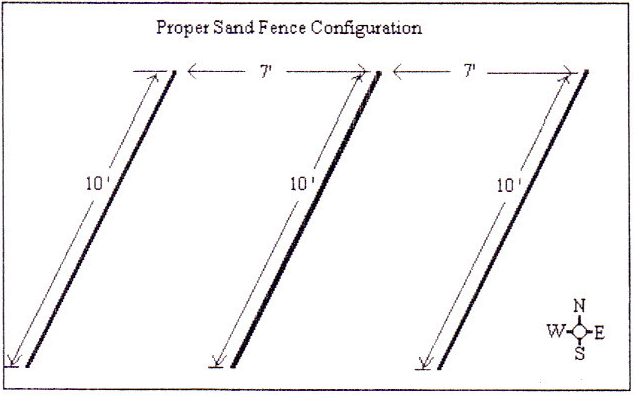
Sand fencing. Sand fencing shall be configured in a manner to limit potential impacts to listed species (see graphic).
1-3.3
Dune restoration plan. The following shall be a part of any proposed dune restoration plan:
(a)
Grading plan.
(b)
Planting plan that outlines plant species, plant density, fertilization, irrigation, and maintenance. (Insert NRCS reference - Native Plants for Coastal Dune Restoration; What, When, and How for Florida).
1-4 - Coastal high hazard areas.
All development that proposes 50 or more dwelling and/or lodging units (on a one-time or cumulative basis) within the CHHA shall be evaluated for impacts to roadway evacuation times to shelter. The county shall not approve a use or activity if it would cause the adopted roadway evacuation time for hurricane evacuation to shelter to be exceeded. Hurricane evacuation times shall be evaluated based on all existing and vested development in the county, including individual building permits for buildings that are not part of a larger development plan approval
(a)
Public facility criteria. No new public facilities shall be placed within the CHHA unless all of the following criteria are met:
(1)
Purpose. The facility is necessary to protect human lives or preserve important natural resources.
(2)
Alternatives. The service provided by the facility cannot be provided at another location outside the CHHA.
(3)
Capacity. The facility is designed to provide the minimum capacity necessary to meet level of service (LOS) standards and best available science for its service area and its sizing is consistent with the densities and intensities reflected on the future land use map
(Ord. No. 2015-12, § 1(Exh. A), 4-16-2015)
1-5 - Barrier island sand.
(a)
Approved material. Approved materials are those constructions and landscaping materials whose mineralogical composition is white fine to medium grained quartz sand. However, oyster shell, limestone or white dolomite may be used for road bed or foundation construction if reasonably the same color as approved sand after exposure to the sun and not containing clay or other discoloring, staining or darkening material. For the purposes of this section, white fine to medium grained quartz sand shall have the following characteristics:
(1)
Color. A Munsell Color Chart value of 9.25 or whiter and a chroma of 0.5 or less on the 2.5, 5, 7.5 or 10YR scale when checked in an air dry condition.
(2)
Grain size. A grain size of 75 percent of the sample by weight between 0.43 millimeters (mm) and 0.08 mm, with the remaining 25 percent being coarser than 0.43 mm but not larger than 1.0 mm as described under the Unified Soil Classification System. This corresponds to the number 40-200 sieve sizes for gradation curve analysis.
(b)
Prohibited material. Prohibited materials are any darkening, discoloring or staining materials having the ability to permanently (greater than six months) change the color or darken the natural white sands of Santa Rosa Island or Perdido Key, or any approved materials, whenever coming into contact with them. Prohibited materials include any with the following characteristics:
(1)
Color. A color darker than the color required for approved materials.
(2)
Grain size. A grain size with over ten percent by weight of the sample outside the range required for approved materials.
(3)
Composition or character. Any material which, in whole or in part, is composed of or contains clay or any other substance that would darken, stain or discolor the natural barrier island sands or approved material.
(Ord. No. 2015-12, § 1(Exh. A), 4-16-2015)
1-6 - Barrier Island lighting.
(a)
Pensacola Beach.
(1)
Wildlife lighting. The following standards for artificial light sources are intended to help minimize harmful effects of light pollution in sea turtle nesting areas. The use of certified wildlife lighting will provide the highest level of protection for nesting sea turtles and their hatchlings. Certified wildlife lighting refers to lighting fixtures and bulbs reviewed and approved through the Florida Fish and Wildlife Conservation Commission's Wildlife Lighting Certification Process. Certified Wildlife Lighting and lights that meet FWC's Wildlife Lighting Guidelines must be installed and maintained according to the approved conditions of use to achieve the light pollution reduction objectives of this section.
a.
The light source shall be mounted as low to the ground or floor as practicable through the use of fixtures such as low-mounted wall fixtures, low bollards, and ground-level fixtures.
b.
The lumens emitted by the light source shall be the minimum required for the intended application.
c.
The light source shall be contained within a full cut-off or fully shielded fixture such that no light is broadcast above a horizontal plane, and the point source of light and any reflective surfaces of the fixture are not directly visible from the marine beach.
d.
The lamps shall emit predominately long-wavelength light (>580 nm). These long-wavelength light sources include amber and red LEDs, true red neon lamps, and other lamps certified by the Florida Fish and Wildlife Conservation Commission as "wildlife lighting."
e.
Tinted glass. Exterior windows, doors, and other building surfaces utilizing glass and other transparent or semi-transparent surface shall be treated to achieve an industry-approved, inside-to-outside light transmittance value of 45 percent or less. Such transmittance is limited to the visible spectrum (400 to 700 nm wavelength) and is measured as the percentage of light that is transmitted through the glass.
f.
Interior lights. Locations including, but not limited to, stairwells, elevators, parking garages, or courtyards shall not produce light that is directly, indirectly, or cumulatively visible from any portion of the beach. Light screens, shades, or curtains shall be used to block visibility of interior lights from the beach. Light screens shall be used on open or enclosed staircases on the seaward or shore-perpendicular side of a building, or for parking garages, to limit light visibility from the nesting beach.
(2)
Specific lighting requirements for exterior and interior lighting affixed to new structures, new construction, and improvements to existing structures.
a.
All lighting affixed to the exterior of new permanent structures, construction, or additions shall be long wavelength, downward directed, full cutoff, fully shielded, and mounted as close to the ground or finished floor surface as possible to achieve the required foot-candles.
b.
Non-egress lighting may be affixed to the landward exterior of permanent structures provided that the fixtures are fitted with a long wavelength source and are not directly, indirectly, or cumulatively visible from any portion of the beach.
c.
Lighting at egress points shall be limited to the minimum number of fixtures and foot-candles necessary to meet federal, state, and local safety requirements.
d.
Locations including, but not limited to, stairwells, elevators, parking garages, or courtyards shall not produce light that is directly, indirectly, or cumulatively visible from any portion of the beach. Light screens, shades, or curtains shall be used to block visibility of interior lights from the beach. Light screens shall be used on open or enclosed staircases on the seaward or shore-perpendicular side of a building or for parking garages to limit visibility of lights from the beach.
e.
All glass windows, walls, railings, and doors on the seaward and shore-perpendicular sides of any new construction shall use tinted glass with an inside to outside light transmittance value of 45 percent or less.
(3)
Specific lighting requirements for Pensacola Beach outdoor areas and recreational amenities.
a.
All lighting of outdoor areas shall be long wavelength, downward directed, full cutoff, fully shielded, and mounted as close to the ground or finished floor surface as possible to achieve the required foot-candles.
b.
Lighting of paths, walks, and routes of building access shall use low-level fixtures such as step, paver, path, recessed wall, or bollard lights. Bollard lights shall not exceed 42 inches in height, and other low-level fixtures shall meet the height requirements of FWC's Wildlife Lighting Guidelines. Fixtures shall be downward directed and utilize long wavelength lamps and beachside shields.
c.
Non-egress outdoor lighting may be installed landward of buildings or other opaque structures if they are fitted with long wavelength light sources and are not directly, indirectly, or cumulatively visible from any portion of the beach.
d.
Internally or externally lighted signs shall not be located on the seaward and shore-perpendicular sides of any structures, and shall not produce light that is directly, indirectly, or cumulatively visible from any portion of the beach.
e.
Ponds and fountains on the seaward and shore-perpendicular sides of any structures shall not produce light that is directly, indirectly, or cumulatively visible from any portion of the beach.
f.
Fire pits located on the seaward and shore-perpendicular sides of any structure shall be shielded with an opaque structure or partition and positioned such that the flame is not directly, indirectly, or cumulatively visible from any portion of the beach. Bonfires, bonfire pits, and other open flames are prohibited on the public beach.
g.
Televisions or other illuminated screens shall be located landward of the dunes and shall be shielded or positioned such that they are not directly, indirectly, or cumulatively visible from the beach.
h.
Recreational amenities, including but not limited to tennis, basketball, pickleball, racquetball courts or similar use areas are exempt from long wavelength requirements if all other wildlife friendly criteria and the following conditions are met:
i.
All lighting must be turned off before 12:00 a.m. and switches, timers or motion sensors are installed to ensure lights remain off unless required.
ii.
Pole-mounted lights may be used to light playing areas but must be mounted at the minimum height required to meet the minimum light level requirement, must be directed downward onto non-reflective surfaces and shall not produce light that is directly, indirectly, or cumulatively visible from any portion of the beach.
iii.
Screens, shields, vegetation or other barriers are used to block light from being directly, indirectly, or cumulatively visible from any portion of the beach.
(4)
Specific lighting requirements for parking areas and roadways.
a.
All lighting of parking areas and roadways visible from the beach shall be long wavelength, downward directed, full cutoff, fully shielded, and mounted to the minimum level required to maintain compliance with federal, state, and local law.
b.
Parking area and roadway lighting shall be shielded from the beach via vegetation, natural features, or artificial structures rising from the ground. This shielding shall prevent artificial light sources, including but not limited to vehicular headlights, from producing light that is directly, indirectly, or cumulatively visible from any portion of the beach.
c.
Lighting of roadways and parking areas shall produce no more lighting than the minimum requirement as outlined by federal, state, and local law.
d.
Lighting of parking areas and roadways shall consist of either:
i.
Ground-level downward-directed fixtures, equipped with interior dark-colored, non-reflective baffles or louvers, mounted either with a wall mount, on walls or piles, facing away from the beach; or
ii.
Bollard-type fixtures, which do not extend more than 42 inches above the adjacent floor or deck, measured from the bottom of fixture, equipped with downward-directed louvers that completely hide the light source and externally shielded on the side facing the beach.
e.
Pole-mounted lights may only be used in parking areas and roadways if mounting the lights at lower elevations cannot practicably comply with minimum light levels set forth in applicable federal and state laws designed to protect public safety. If required, pole-mounted lights shall be:
i.
Located on the landward sides of buildings and shall not produce light that is directly, indirectly, or cumulatively visible from any portion of the beach;
ii.
Mounted at the minimum height required to meet the minimum light level requirement; and
iii.
Downward directed onto non-reflective surfaces.
f.
Equipment yards, storage yards, and temporary security lights shall also adhere to the lighting restrictions contained in this section.
(5)
Specific lighting requirements for pool areas.
a.
Lighting of pool decks, pool facilities, swimming pools, and spas shall be long wavelength and fully shielded.
b.
Lighting of pool water surfaces and pool wet deck surfaces shall comply with the minimum light levels set forth in applicable federal and state laws designed to protect public safety.
c.
Above-water lighting of pool decks, pool facilities, swimming pools, and spas shall otherwise adhere to the applicable requirements for acceptable light fixtures contained in subsections (5)a. and (5)b. above.
d.
Underwater lighting of pools or spa light shall:
i.
Be mounted horizontally in the wall;
ii.
Not produce light that is directly, indirectly, or cumulatively visible from any portion of the beach; and
iii.
Comply with minimum light levels set forth in applicable federal and state laws designed to protect public safety.
(6)
Specific lighting requirements for beach access points and dune walkovers.
a.
Lighting of beach access points shall be located and configured to only illuminate areas landward of the beach and frontal dune. All lighting of beach access points shall be long wavelength, downward directed, full cutoff, and fully shielded, and shall not be directly, indirectly, or cumulatively visible from the beach.
b.
Lights are permissible on dune walkovers or elevated boardwalks only as required for building code purposes and may only be installed landward of the frontal dune. Walkover lighting shall not be directly, indirectly, or cumulatively visible from the beach.
(7)
Specific lighting requirements for pier structures.
a.
Lighting of pier structures projecting over the beach or over water shall be long wavelength, downward-directed, and fully shielded.
b.
Lighting of pier structures projecting over the beach, or over water, shall be mounted no higher than 42 inches above the deck surface. These shall be directed onto the deck surface only, preventing light pollution or light spillage beyond the walking surface.
c.
Lighting of pier structures projecting over the beach or over water shall comply with minimum light levels set forth in applicable federal and state laws designed to protect public safety.
(8)
Specific lighting requirements for special events, motor vehicles, and temporary lighting.
a.
Lighting associated with a special event that may directly, indirectly, or cumulatively be visible from any portion of the beach shall not be authorized at nighttime during sea turtle nesting season, unless authorized through a special event permit or other authorization by Santa Rosa Island Authority with consultation by Escambia County.
b.
The operation of all motorized vehicles, except emergency, law enforcement, county-owned, or vehicles permitted on the beach by the county, shall be prohibited on the beach at nighttime during sea turtle nesting season.
c.
Within sea turtle nesting season, temporary work zone lighting for roadway construction and during declared emergencies shall be directed away from the beach to avoid illumination of or direct visibility from the beach. Work zone luminaires shall be shielded to avoid lighting areas outside of the immediate construction area.
d.
All other temporary construction lighting shall be:
i.
Inclusive of all the standards of this section, including using fixtures that are long wavelength, downward directed, full cutoff, and fully shielded so light is not directly or indirectly visible from the beach;
ii.
Turned off during nighttime in sea turtle nesting season, or if authorized by the county during sea turtle nesting season, shall only be allowed from 6:00 a.m. to 9:00 p.m., must be restricted to the minimal amount necessary, and shall incorporate all the standards of this section;
iii.
Mounted less than eight feet above the adjacent floor or deck, measured from the bottom of fixture; and
iv.
Restricted to the minimal number of foot-candles necessary to conform to the applicable construction safety regulations.
e.
Handheld and other portable temporary lighting shall not be directed toward or used in a manner that disturbs sea turtles or other coastal wildlife.
(b)
Perdido Key.
(1)
Wildlife lighting. All new coastal construction on Perdido Key Property, as defined in LDC section 4-5.8, including redevelopment and substantial improvements, shall utilize certified wildlife lighting and lights that comply with FWC's Wildlife Lighting Guidelines and must be installed and maintained according to the approved conditions of use to achieve the light pollution reduction objectives of this section.
a.
The light source shall be mounted as low to the ground or floor as practicable through the use of fixtures such as low-mounted wall fixtures, low bollards, and ground-level fixtures.
b.
The lumens emitted by the light source shall be the minimum required for the intended application.
c.
The light source shall be contained within a full cut-off or fully shielded fixture such that no light is broadcast above a horizontal plane, and the point source of light and any reflective surfaces of the fixture are not directly visible from any point outside the development footprint.
d.
The lamps shall emit predominately long-wavelength light (>580 nm). These long-wavelength light sources include amber and red LEDs, true red neon lamps, and other lamps certified by the Florida Fish and Wildlife Conservation Commission as "wildlife lighting."
e.
Tinted glass. Exterior windows, doors and other building surfaces utilizing glass and other transparent or semi-transparent surface shall be treated to achieve an industry-approved, inside-to-outside light transmittance value of 45 percent or less. Such transmittance is limited to the visible spectrum (400 to 700 nm wavelength) and is measured as the percentage of light that is transmitted through the glass.
f.
Interior lights. Locations including but not limited to stairwells, elevators, parking garages, or courtyards shall not produce light that is directly, indirectly, or cumulatively visible from any point outside the development footprint. Light screens, shades or curtains shall be used to block visibility of interior lights from the beach. Light screens shall be used on open or enclosed staircases on the seaward or shore-perpendicular side of a building or for parking garages to limit visibility of lights from outside the development footprint.
(2)
Specific lighting requirements for exterior and interior lighting affixed to new structures, new construction, and improvements to existing structures.
a.
All lighting affixed to the exterior of new permanent structures, construction or additions shall be long wavelength, downward directed, full cutoff, fully shielded and mounted as close to the ground or finished floor surface as possible to achieve the required foot-candles.
b.
Lighting at egress points shall be limited to the minimum number of fixtures and foot-candles necessary to meet federal, state, and local safety requirements.
c.
Locations including, but not limited to, stairwells, elevators, parking garages, or courtyards shall not produce light that is directly, indirectly, or cumulatively visible from any portion outside the development footprint. Light screens, shades or curtains shall be used to block visibility of interior lights from any point outside the development footprint. Light screens shall be used on open or enclosed staircases of a building or for parking garages to limit visibility of lights from outside the development footprint.
d.
All glass windows, walls, railings, and doors of any new construction shall use tinted glass with an inside to outside light transmittance value of 45 percent or less.
(3)
Specific lighting requirements for outdoor areas.
a.
All lighting of outdoor areas shall be long wavelength, downward directed, full cutoff, fully shielded and mounted as close to the ground or finished floor surface as possible to achieve the required foot-candles.
b.
Lighting of paths, walks, and routes of building access shall use low-level fixtures such as step, paver, path, recessed wall, or bollard lights. Bollard lights shall not exceed 42 inches in height, and other low-level fixtures are to meet the height requirements of FWC's Wildlife Lighting Guidelines. Fixtures shall be downward directed and utilize long wavelength lamps and shields.
c.
Internally or externally lighted signs shall not produce light that is directly, indirectly, or cumulatively visible from any point outside the development footprint.
d.
Ponds and fountains shall not produce light that is from any point outside the development footprint.
e.
Fire pits shall be shielded with an opaque structure or partition, and positioned such that the flame is not directly, indirectly, or cumulatively visible from any point outside the development footprint. Bonfires, bonfire pits, and other forms of open flame are prohibited within sea turtle nesting habitat.
f.
Televisions or other illuminated screens shall be located landward of the dunes and shall be shielded or positioned such that they are not directly, indirectly, or cumulatively visible from any point outside the development footprint.
h.
Recreational amenities, including but not limited to tennis, basketball, pickleball, racquetball courts or similar use areas are exempt from long wavelength requirements if all other wildlife friendly criteria and the following conditions are met:
i.
All lighting must be turned off before 12:00 a.m. and switches, timers or motion sensors are installed to ensure lights remain off unless required.
ii.
Pole-mounted lights may be used to light playing areas but must be mounted at the minimum height required to meet the minimum light level requirement, must be directed downward onto non-reflective surfaces and shall not produce light that is directly, indirectly, or cumulatively visible from outside the development footprint.
iii.
Screens, shields, vegetation or other barriers are used to block light from being directly, indirectly, or cumulatively visible from outside the development footprint.
(4)
Specific lighting requirements for parking areas and roadways.
a.
All lighting of parking areas and roadways shall be long wavelength, downward directed, full cutoff, fully shielded, and mounted to the minimum level required to maintain compliance with federal, state, and local law.
b.
Parking area and roadway lighting shall be shielded via vegetation, natural features, or artificial structures rising from the ground. These shall prevent artificial light sources, including but not limited to vehicular headlights, from producing light that is directly, indirectly, or cumulatively visible from any point outside the development footprint.
c.
Lighting of roadways and parking areas shall produce no more lighting than the minimum requirement as outlined by federal, state, and local law.
d.
Lighting of parking areas and roadways shall consist of either:
i.
Ground-level downward-directed fixtures, equipped with interior dark-colored, non-reflective baffles or louvers, mounted either with a wall mount, on walls or piles, facing away from the beach; or
ii.
Bollard-type fixtures, which do not extend more than 42 inches above the adjacent floor or deck, measured from the bottom of fixture, equipped with downward-directed louvers that completely hide the light source and externally shielded.
e.
Pole-mounted lights shall only be used in parking areas and roadways when mounting the lights at lower elevations cannot practicably comply with minimum light levels set forth in applicable federal and state laws designed to protect public safety. If required, pole-mounted lights shall be:
i.
Located on the landward sides of buildings and shall not produce light that is directly, indirectly, or cumulatively visible from any point outside the development footprint;
ii.
Mounted at the minimum height required to meet the minimum light level requirement; and
iii.
Downward directed onto non-reflective surfaces.
f.
Equipment yards, storage yards, and temporary security lights shall also adhere to the lighting restrictions contained in this section.
(5)
Specific lighting requirements for pool areas.
a.
Lighting of pool decks, pool facilities, swimming pools, and spas shall be long wavelength and fully shielded.
b.
Lighting of the pool water surfaces and the pool wet deck surfaces shall comply with the minimum light levels set forth in applicable federal and state laws designed to protect public safety.
c.
Above-water lighting of pool decks, pool facilities, swimming pools, and spas shall otherwise adhere to the applicable requirements for acceptable light fixtures contained in subsections (5)a. and (5)b. above.
d.
Underwater lighting of pools or spa light shall:
i.
Be mounted horizontally in the wall;
ii.
Not produce light that is directly, indirectly, or cumulatively visible from any point outside the development footprint; and
iii.
Comply with minimum light levels set forth in applicable federal and state laws designed to protect public safety.
(6)
Specific lighting requirements for beach access points and dune walkovers.
a.
Lighting of beach access points shall be located and configured to only illuminate areas required for human health and safety or as required by Florida Building Code. All lighting of beach access points shall be long wavelength, downward directed, full cutoff and fully shielded and shall not be directly, indirectly, or cumulatively visible from any point outside the development footprint.
b.
Lights are allowable on dune walkovers or elevated boardwalks only as required for building code purposes and may only be installed landward of the frontal dune. Walkover lighting shall not be directly, indirectly, or cumulatively visible from any point outside the development footprint.
(7)
Specific lighting requirements for pier structures.
a.
Lighting of pier structures projecting over the beach or over water shall be long wavelength, downward-directed, and fully shielded.
b.
Lighting of pier structures projecting over the beach, or over water, shall be mounted no higher than 42 inches above the deck surface. These shall be directed onto the deck surface only, preventing light pollution or light spillage beyond the walking surface.
c.
Lighting of pier structures projecting over the beach or over water shall comply with minimum light levels set forth in applicable federal and state laws designed to protect public safety.
(8)
Specific light requirements for special events, motor vehicles, and temporary lighting.
a.
Lighting associated with a special event that may directly, indirectly, or cumulatively be visible from any portion of the beach shall not be authorized at nighttime during sea turtle nesting season, unless authorized by Escambia County.
b.
The operation of all motorized vehicles, except emergency, law enforcement, county-owned, or other county-authorized vehicles, shall be prohibited on the beach.
c.
Within sea turtle nesting season, temporary work zone lighting for roadway construction and during declared emergencies shall be directed away from the beach to avoid illumination of or direct visibility from the beach. Work zone luminaires shall be shielded to avoid lighting areas outside of the immediate construction area.
d.
All other temporary construction lighting shall be:
i.
Inclusive of all the standards of this section, including using fixtures that are long wavelength, downward directed, full cutoff, and fully shielded so light is not directly or indirectly visible from any point outside the intended work area;
ii.
Turned off during nighttime in sea turtle nesting season, or if authorized during sea turtle nesting season, shall only be allowed from 6:00 a.m. to 9:00 p.m., must be restricted to the minimal amount necessary, and shall incorporate all the standards of this section;
iii.
Mounted less than eight feet above the adjacent floor or deck, measured from the bottom of fixture; and
iv.
Restricted to the minimal number of foot-candles necessary to conform to the applicable construction safety regulations.
e.
Handheld and other portable temporary lighting shall not be directed toward or used in a manner that disturbs sea turtles or other coastal wildlife.
(Ord. No. 2015-12, § 1(Exh. A), 4-16-2015; Ord. No. 2025-11, § 3, 3-6-2025)
1-7 - Specifications of groundwater/wellhead impact report.
Applicants proposing development within a wellhead protection area (WHPA) as defined in LDC chapter 4 shall provide a report prepared by an engineer or geologist duly licensed in the state. Based on analysis and comment by the water provider and/or the county, the applicant may be required to expand their report by:
(1)
Completion of a phase I and/or phase II evaluation of the project site; and/or
(2)
Conduct groundwater modeling to assess potential impacts to the groundwater resource within the WHPA.
The report shall contain the following minimum information:
(a)
Accurate description of all current/proposed onsite activities;
(b)
List of hazardous waste stored onsite with quantities and method of disposal;
(c)
Location of any existing or proposed underground and above ground storage tanks;
(d)
Location of any existing or proposed outside storage areas with description of materials;
(e)
Location and status of any existing or proposed monitoring wells;
(f)
Current/proposed best management practices;
(g)
Current/proposed spill response plan;
(h)
Description of current/proposed stormwater treatment;
(i)
Description of current/proposed wastewater treatment;
(j)
List of state or federal permits facility operates under;
(k)
Evidence of the probable impact of the proposed development on the ground water supply and recharge potential of the area and existing wellhead, etc. (i.e., calculation of extent pervious surface);
(l)
Be subjected to periodic inspections for compliance with the above.
(Ord. No. 2018-5, § 3, 2-1-2018)
2-1 - Exemptions.
2-1.1
Tree protection and preservation. The following specific trees and activities are exempt from the tree protection and preservation provisions of this article:
(a)
Invasive trees. Any tree species on the most recent Florida Exotic Pest Plant Council list of invasive species.
(b)
Selected trees. Any species of pine (Pinus sp.), cherry laurel (Prunus laurocerasus and P. caroliniana), or turkey oak (Quercus laevis) tree. This exemption does not apply to trees planted or preserved to meet requirements of the LDC.
(c)
Hazard trees. Any tree determined by a qualified county official to be an immediate hazard or in a dangerous condition so as to constitute an imminent threat to public safety or health.
(d)
Emergencies. Damaged or destroyed trees requiring expedited removal in the interest of public safety, health or welfare during or following periods of emergency as the BCC may declare by resolution for such disasters as hurricanes, tornados, floods, and fires.
(e)
Residential lots. Any non-heritage tree, as defined by this article, on the lot of a single-family or two-family dwelling. However, tree removal prior to construction of the dwelling shall only be allowed after county issuance of a building permit for the dwelling or a separate tree removal permit. This exemption does not apply on the lot of a discontinued residential use. Such discontinuation may be evidenced by removal of the dwelling or its conversion to a nonresidential use, or a different land use classification by the Escambia County Property Appraiser for ad valorem tax purposes. Regardless of this residential lot exemption, the loss of trees resulting from development of such home sites shall be mitigated by a tree restoration fee collected at the time of issuance of any building permit for the construction or replacement of a single-family or two-family dwelling, including a manufactured (mobile) home. The fee shall be an amount established by the BCC and deposited in the county tree restoration fund in the same manner and for the same purposes prescribed in this article for unplanted mitigation.
(f)
Subdivisions. Any non-heritage tree removed within proposed rights-of-way, easements, or parcels dedicated for utility, drainage, or access according to county approved subdivision infrastructure construction plans.
(g)
Agriculture and silviculture. Tree removal according to best management practices for bona fide agricultural or silvicultural operations on land classified by the Escambia County Property Appraiser as "agricultural" for ad valorem tax purposes.
(h)
Habitat management. Tree removal necessary for native habitat management and environmental restoration activities conducted by, or at the direction of, a governmental agency.
(i)
Utility work. Work performed by utilities regulated by the Florida Public Service Commission and necessary in the maintenance and construction of utility lines. Such utilities shall nevertheless provide the county with the advance notice required by Florida Statutes prior to conducting scheduled routine vegetation maintenance and tree pruning or trimming activities within an established right-of-way.
(Ord. No. 2015-12, § 1(Exh. A), 4-16-2015)
2-2 - Landscape areas and quantities.
2-2.1
Parcel total. No parcel shall provide less than 15 percent landscape area, regardless of the minimum pervious lot coverage required by the applicable zoning district. On-site permeable retention/detention ponds and permeable swales qualify as landscape area if their maximum depths are no more than three feet and their side slopes are no steeper than 2:1 (horizontal to vertical}.
2-2.2
Vehicular use areas. No area of vehicular use may be considered landscape area, but parking lots, travel lanes, access ways, loading/unloading areas and other vehicular use areas outside of rights-of-way shall include landscape area according to the following standards:
(a)
General design. Interior portions of vehicular use areas not specifically designed for vehicle parking or maneuvering shall not be paved, but maintained as landscape area.
(b)
Boundary separation. Vehicular use areas shall be separated from the parcel boundary by a landscape strips no less than five feet wide. Driveways or sidewalks may cross such strips to provide approved site access
(c)
Parking row terminations. Except as allowed for large-scale parking, rows of parking stalls shall be terminated at each end with a landscape area having the full length of the adjoining parking stall and containing at least one planted or preserved canopy tree. The remaining dimensions of the landscape area shall be sized to provide no less than the minimum canopy tree planting area for a new tree or minimum root zone for a preserved tree required by this article, whichever is applicable. Where a double row of interior parking stalls ends, the terminating landscape areas shall be combined as one continuous area to maximize rooting space except when a dividing pedestrian and/or handicap accessibility route may be appropriate and approved by the county.
(d)
Continuous parking stalls. Each row of parking shall contain no more than 15 continuous stalls without interruption by a landscape area, and each landscape area shall have the same minimum dimensions and plantings prescribed above for parking row termination landscape areas. However, if any of the following conditions exist, no more than 12 continuous stalls may be provided:
1.
The total number of on-site parking spaces exceeds 50.
2.
The total number of on-site parking spaces exceeds the number required by the applicable parking ratios established in DSM chapter 1 by more than ten percent.
3.
The dimensions of drive aisles and/or parking stalls exceed the standards established in DSM chapter 2.
(e)
Large-scale parking. If the total number of on-site parking spaces is 600 or more, a continuous landscape strip no less than 12 feet wide shall be provided along the center of alternate interior double rows of parking stalls. All interior rows of parking may have unlimited continuous spaces and be terminated with a landscape area having the full length of the adjoining parking stall and a minimum width of four feet. Each strip shall be planted with a quantity of canopy trees no less than one tree per 30 feet of strip length, excluding any minimum root zones of preserved trees within the strip. Trees shall be planted within the strip such that no tree is more than ten feet from either end of the strip, no more 60 feet from another tree, and consistent with the standards of this article for minimum spacing, tree planting area and tree preservation. Sidewalks complying with these standards may be placed within landscape strips to provide on-site pedestrian circulation.
(f)
Seasonal peak demands. Seasonal peak parking demands (e.g., holiday retail sales) are encouraged to be accommodated within areas of stable grass as overflow from paved parking to reduce the year-round impact of the short-term parking need, especially for portions of large scale parking. If such parking is provided its access and arrangement shall be consistent with the standard dimensions and geometry of paved parking.
(g)
Tree exceptions. The following vehicle parking uses need not provide trees, but the exceptions do not apply to areas for customer and employee parking and are not exceptions to the preservation of existing trees.
1.
Automobile sales. Vehicular use areas designed for the display of new or used automobiles for sale or rent. Such areas need only provide landscape areas sufficient to terminate parking rows, having the full length of adjoining parking stalls and a minimum width of four feet.
2.
Fleet parking. Parking areas for fleet delivery or service trucks and other non-passenger vehicles.
3.
Loading. Truck wells, loading docks, and other areas designated exclusively for the loading and unloading of vehicles.
(h)
Encroachments and overhang. Vehicular use areas shall provide raised curbs, wheelstops, bollards or other effective means to permanently protect landscape areas and irrigation systems from damage by vehicle encroachment. Vehicles may not overhang into landscape areas beyond the designed boundaries of vehicular use areas.
2-2.3
Buffers. Based on broad land use categories, where a proposed new use or expanding existing use is likely to adversely impact an adjoining use, a landscape buffer is required to minimize or eliminate those impacts. The buffer shall protect the lower intensity use from the higher intensity use and provide an aesthetically attractive barrier between the uses. It shall function to reduce or eliminate incompatibility between uses such that the long-term continuation of either use is not threatened by impacts from the other. Buffers shall be provided according to the following standards:
(a)
Required by use. The character of adjoining land uses primarily determines the type of buffering required.
1.
Residential and nonresidential. All residential uses shall be buffered from all nonresidential uses, other than passive recreation, conservation, or agricultural uses, according to the buffer types established in this section and following nonresidential categories:
a.
Heavy commercial and industrial. Heavy commercial and industrial uses consistent with the heavy commercial and light industrial (HC/LI) and industrial (Ind) zoning districts shall provide a Type-C buffer supplemented with an opaque fence or wall.
b.
General commercial. General commercial uses consistent with the commercial (Com) zoning district shall provide a Type-B buffer supplemented with an opaque fence or wall.
c.
Other nonresidential. Neighborhood commercial uses consistent with the mixed use zoning districts (RMU, LDMU, HDMU), and other non-residential uses not otherwise required to provide more substantial buffering, shall provide a Type-A buffer supplemented with an opaque fence or wall.
2.
Residential. All multifamily uses exceeding ten dwelling units per acre (MDR district maximum density) shall provide a Type-A buffer supplemented with an opaque fence or wall for all adjoining single-family and two-family residential uses.
3.
Nonresidential. Heavy commercial and industrial uses shall provide a Type-B buffer for all adjoining general commercial, neighborhood commercial and other nonresidential uses less intensive than heavy commercial or industrial.
4.
Condition of approval. All uses whose conditions of approval include buffering shall provide the buffering according to those conditions.
5.
No existing use. For the purposes of buffering, where no use exists on adjoining land and none is proposed by a valid development application to the county, the use of the adjoining land will be assumed to be the most intensive use allowed by the existing zoning.
(b)
Location. Where a use is required to provide buffering for adjoining uses, the buffering shall be along all side and rear lot lines where the use abuts the other uses. No buffers are required along front property lines unless buffering is included in screening requirements for outdoor storage and other conditions as prescribed in chapter 4.
(c)
Composition.
1.
Types. Where buffering is required, the following buffer types define the minimum width and plants required per 100 linear feet of buffer:
2.
Plants. The prescribed buffer plants may be existing natural vegetation, existing vegetation supplemented with additional plantings, or entirely new plantings. The suitability of existing vegetation to provide adequate buffering will be evaluated based on the minimum plants required. For effective buffering year-round, at least 50 percent of buffer trees shall be evergreen species. The selection and installation of buffer plants, and buffer maintenance, shall be according to the provisions of this article.
3.
Supplemental structures.
a.
If an opaque fence or wall is required to supplement the plants within a buffer, it shall have a minimum six-foot height and meet the requirements of chapter 5, fences. Where an existing fence or wall on abutting property meets these requirements, no additional structure is required within the buffer. The existing fence or wall must be in good condition and landscaping consistent with the schedule above.
b.
If a supplemental fence or wall will be constructed, any support posts shall be on the side of the developing property so that the more finished appearance faces the abutting property.
c.
If it can be demonstrated to the planning official that existing natural vegetation, or existing vegetation supplemented with additional plantings, will accomplish the screening function of the prescribed buffer, the supplemental fence/wall may be eliminated.
(d)
Responsibility. Where buffering is required between uses by this section, the landowner proposing the more intensive use shall be responsible for providing and maintaining the buffer. The proposal of a less intensive use does not require the installation of a buffer by either use.
(e)
Exceptions. In addition to the relief provided by the variance process prescribed in LDC chapter 2, full or partial exceptions to the buffering prescribed in this article are allowed according to the following conditions:
Same owner. Buffering need not be provided between uses within the same parcel, or uses on adjoining parcels having the same ownership.
(f)
Uses within. Buffer yards may be included within required building setbacks, but no active recreation, storage of materials or equipment, parking, or structures, except necessary utility enclosures, shall be located within minimum buffer yards.
(Ord. No. 2015-12, § 1(Exh. A), 4-16-2015)
2-3 - Tree protection and preservation.
2-3.1
Approval required. Unless exempt from protection as provided in this article, no person shall remove or otherwise willfully cause harm to any of the following trees on either public or private property, including rights-of-way, without first obtaining appropriate authorization from the county:
(a)
12-inch diameter. Any tree 12 inches or greater in diameter at breast height (DBH).
(b)
Sand live oaks. Any sand live oak (Quercus geminata) tree having five or more total stems (trunks), or having any three or more stems each three inches or greater in diameter (DBH); and located on Pensacola Beach or Perdido Key, or within any shoreline protection zone.
(c)
Required trees. Any tree planted or preserved to meet tree replacement or landscape requirements of the LDC, or other specific conditions of county approval.
(d)
Heritage trees. A protected tree 60 inches or greater in diameter (DBH). Such large mature trees providing proportionately more of the benefits associated with trees, and often defining the local landscape, shall have a greater protected status as prescribed in this article.
2-3.2
Protection areas. The following areas associated with protected trees are afforded additional protection:
(a)
Critical root zone. The critical root zone (CRZ) is represented by a circle, centered on the tree trunk and having a radius of one foot for each one inch of trunk diameter (DBH).
(b)
Structural root plate. The structural root plate is represented by a circle, centered on the tree trunk and having a radius of one-half foot for each inch of trunk diameter (DBH), but no less than six feet and no more than ten feet.
2-3.3
Preservation. For the purposes of this section, a tree is not considered preserved if the root zone and canopy impact limits are exceeded. Removal of such impacted trees is not required. Tree preservation shall comply with the following impact limits:
(a)
Root zone. The critical root zone is, and will remain, substantially undisturbed. Although an undisturbed circular area centered on the tree generally assures less critical root loss, modifications to CRZ perimeters resulting in non-concentric, irregular, and/or smaller areas are acceptable for tree preservation if either of the following conditions are met:
1.
Maximum disturbance. The modified root zone includes at least 50 percent of the concentric CRZ, contains no less total contiguous area than the concentric CRZ, and includes no disturbance or encroachments by improvements within the structural root plate area.
2.
Existing conditions. The tree has demonstrated long-term viability within the same sub-standard root zone and that area will not be further reduced or adversely impacted. In some cases a certified arborist may be required to delineate the functioning root zone and confirm avoidance of further impacts.
(b)
Canopy. No more than 25 percent of the canopy has been or will be removed and the pruning is done according to ANSI standards (A300).
2-3.4
Protective barriers. Trees (and other vegetation) designated for preservation according to an approved site development plan shall be protected from all potentially harmful activity during development by the temporary installation of protective barriers.
(a)
Construction. Barriers shall be constructed of chain link fence, orange laminated plastic fencing, or wood posts and rails, consistent with professional arboricultural practices, and shall be installed along the perimeter of all required preserve areas prior to any land clearing, demolition, grading, or construction.
(b)
Activity within. No potentially harmful activity shall take place within the protective barrier. Harmful activities include but not limited to grade change, trenching, compaction, grubbing or root raking. Activities within barriers or changes in barrier location shall be specifically approved by the county.
(Ord. No. 2015-12, § 1(Exh. A), 4-16-2015)
2-4 - Tree inventory and assessment.
The provisions of this section shall apply to any land use or development activity application required to inventory on-site protected trees. If no protected trees exist on site, that condition shall be identified in the application documents.
2-4.1
Inventory area. Any protected tree with part of its structural root plate area within a development parcel shall be inventoried for the proposed development. Where a significant contiguous area of the parcel will not be subject to any development impacts, including vehicular use and material stockpiles, the developer may propose exclusion of that area from inventory. However, the removal criteria of this article will consider the entire parcel for any proposed protected tree removal. Additionally, any area not inventoried shall be clearly identified on plan drawings and include protective barriers to prevent impacts. Upon verification during county review, the reduced inventory area within the parcel will become the limit for any replacement trees for the proposed development.
2-4.2
Inventory drawing. A scaled drawing shall inventory all existing protected trees and their locations relative to the development parcel boundary, and to existing and proposed improvements. At a minimum, the inventory drawing shall identify by center point, unique number or letter, and circular critical root zone (CRZ) boundary the location, diameter at breast height (DBH), and CRZ of each tree. Estimates may be made for inaccessible trees, but they must be noted as such.
(Ord. No. 2015-12, § 1(Exh. A), 4-16-2015)
2-5 - Tree removal and replacement.
2-5.1
Removal criteria. No authorization to remove a protected tree shall be granted where there has been a failure to take reasonable measures to design and locate proposed improvements so that protected tree removal is minimized. Additionally, each proposed removal of a protected tree must be shown necessary by one or more of the following conditions:
(a)
Reasonable use. A permissible use of the site cannot reasonably be undertaken unless the tree is removed.
(b)
Access. The tree completely prevents access to a lot.
(c)
Proximity to structures. The tree is located in such proximity to an existing or proposed structure that the safety, utility or structural integrity of the structure is materially impaired to the extent that avoidance cannot be accommodated.
(d)
Proximity to roads and utilities. The tree materially interferes with the installation, maintenance, or functioning of roads or utilities to the extent that a curvilinear road or utility run cannot reasonably accommodate the tree.
(e)
Proximity to traffic. The tree creates a substantial hazard to motor vehicle, bicycle, or pedestrian traffic by reason of proximity to a travel way and/or impairment of vision. Curbing, roadway speed limits and avoidance shall be utilized to minimize proximity hazards prior to consideration of removal.
(f)
Poor condition. The tree is confirmed by a certified arborist or county staff to be diseased or substantially weakened by age, abuse, storm damage, or fire; or is otherwise determined to have major defects in structural or functional health beyond reasonable recovery or repair.
2-5.2
Replacements for removal. Where removal of protected trees is authorized by the county, replacement trees to mitigate lost benefits of the trees removed shall be provided according to the following provisions in addition to the trees prescribed for general landscaping:
(a)
Replacement ratio. Within the applicable replacement limits of this section, no less than 50 percent of the total protected tree trunk diameter (DBH) inches removed shall be replaced in total caliper inches of new canopy trees planted. For example, if the diameters (DBH) of all protected trees removed totaled 39 inches, the minimum required replacement would be 39 x 0.50 = 19.5 caliper inches. Three replacement possibilities for the example given are: Eight two and one-half-inch trees providing 20 caliper inches, three two and one-half-inch [trees] and four three-inch trees providing 19.5 caliper inches, or seven three-inch trees providing 21 caliper inches.
(b)
Replacement reduction. If a standard arboricultural assessment of a tree documents damage, decay, poor structure or other substandard conditions, county officials may proportionally reduce the replacement required by its removal.
(c)
Replacement limit. Total tree replacement for non-heritage trees need not exceed 25 caliper inches per development site acre, regardless of the total protected tree trunk diameter (DBH) inches permitted for removal. The development site area for which a mitigation limit is calculated shall be the same as the tree inventory area within the development parcel. Additionally, the 25 caliper-inch replacement limit does not exempt any protected tree removal from compliance with the removal criteria.
(d)
Replacement trees. All trees planted as replacements for removed protected trees shall meet the requirements for tree selection prescribed in this article. Any of the tree species identified as pre-approved replacements may be planted. Other native trees with confirmed moderate to high drought tolerance and wind resistance may be proposed for county review and acceptance. Palms cannot be substituted for mitigation trees, even in greater quantities.
(e)
Replacement fee. If any required replacement trees cannot be accommodated on the site of the removed trees in conformance with the minimum spacing, root area, and other applicable provisions of this article, the unplanted mitigation shall be fulfilled by a contribution to the county tree restoration fund. The fee shall be collected at the time of issuance of any permit authorizing the tree removal.
1.
Unit cost basis. The restoration fund contribution for unplanted mitigation is based on the unit cost of a standard replacement tree. That cost shall be the sum of the typical purchase, planting, and establishment (e.g., initial watering) costs of a two and one-half-inch caliper, Florida Grade No. 1, Live oak (Quercus virginiana) tree as estimated by the county and adopted within the fee schedule of the BCC. The county shall periodically reevaluate the unit cost to assure that the amount accurately represents the complete costs of a replacement tree.
2.
Calculation. The restoration fund contribution is determined by dividing the caliper inches of unplanted mitigation by 2.5 to determine the required number of standard replacement trees. The calculated number of trees is then multiplied by the unit cost of a standard replacement tree. For example, 11 caliper inches of mitigation not provided on site, divided by two and one-half inches per tree, equals 4.4 trees. An amount equal to 4.4 times the fee schedule cost of a replacement tree is the required tree restoration fund contribution.
3.
Use of fees. All tree replacement fees collected by the county will be deposited to the tree restoration fund and credited to the primary watershed in which the permit address is located - either Pensacola Bay or Perdido Bay. The tree restoration fund will be used by the county within the respective watersheds for costs associated with tree replacement and restoration of functional benefits provided by the urban forest.
(Ord. No. 2015-12, § 1(Exh. A), 4-16-2015)
2-6 - Plant selection, installation and irrigation.
2-6.1
Selection. The plant selection standards of this section are not eligible for variances, but any proposed plantings that are in addition to those required by the county are exempt from the minimum size requirements.
(a)
Quality. All plants required by this section shall conform to the standards for Florida Grade No. 1, or better, as provided in the latest edition of Grades and Standards for Nursery Plants, Division of Plant Industry, Florida Department of Agriculture and Consumer Services.
(b)
Species. All landscaping shall utilize native plant species or those species listed in the Florida-Friendly Landscaping™ Guide to Plant Selection and Landscape Design.
(c)
Trees. Trees planted to fulfill the minimum landscape requirements of this article shall normally attain a mature height of at least 20 feet and have a minimum caliper of two and one-half inches or greater measured at four inches above root ball at planting. The following additional criteria apply:
1.
Non-native species. Non-native species are limited to 25 percent or less of the total required trees planted.
2.
Diversity. The diversity of any trees required to be planted on a site shall comply with the following limits to avoid uniform site tree decline from pests or disease:
Use of palms. Palms do not comply with definition of tree for the purposes of these landscaping provisions. However, wind-resistant species may be substituted at the ratio of two palms for one required tree for up to 50 percent of trees required for development on Santa Rosa Island or Perdido Key, excluding any trees required specifically for buffering or replacements for protected tree removal. Such palms include: Date Palm (Phoenix spp. except P reclinata) and cabbage or sabal, (Sabal palmetto).
(d)
Other landscape vegetation.
1.
Shrubs. All shrubs shall be a minimum of 12 inches in height at planting.
2.
Turf grass. Consistent with Florida-friendly practices, development should consolidate and limit the use of most turf grasses to essential areas. When used, grass shall be species normally grown as permanent lawns in Escambia County. All sod shall be clean and reasonably free of weeds, noxious pests, and diseases. When grass areas are to be seeded, sprigged, or plugged, specifications must be submitted. Substantial coverage must be achieved within 180 days and nurse grass shall be sown for immediate effects and protection until coverage is otherwise achieved.
2-6.2
Installation. Whenever landscaping is required or any condition of county approval it shall be installed in a sound manner according to established professional standards, and in compliance with this manual.
(a)
Plant placement. The installation of plants in appropriate locations is essential to their long-term survival. Locations should match mature plant size to available soil volume and other conditions for growth. Appropriate separation from pavement and structures, including streets, driveways, curbs, sidewalks, signs, lights and utilities must be provided.
1.
Sight distances. Landscaping within the sight distance areas prescribed in article 5 for streets and site access shall be designed, installed and maintained to allow visibility between three feet and nine feet above grade. The trunks of mature trees trimmed of foliage to nine feet, and newly planted trees with immature crown development allowing visibility are generally acceptable within such areas.
2.
Minimum tree area. Each new tree shall be planted at the center of a minimum permanent pervious rooting area clear of all obstructions to allow growth to maturity. The minimum radius of the rooting area shall be four feet for an understory tree and six feet for a canopy tree. This minimum circular area shall contain no sidewalks, curbs or pavement and no structures, including light or utility poles, signs, manholes, stormwater inlets, vaults, transformers, fire hydrants or backflow preventers.
3.
Minimum tree spacing. Each new canopy and understory tree shall be planted at least 12 feet from any other tree. Additionally, any trees to be planted within the critical root zones of preserved canopy trees are limited to understory trees.
4.
Overhead utilities. Where overhead utilities exist, only plants that will not create persistent utility maintenance or interference problems may be installed. To prevent trees from becoming energized or disrupting electrical service, tree planting directly below power lines shall be avoided and only understory trees planted near power lines. Within an established electric utility right-of-way no vegetation shall be planted that will achieve a height greater than 14 feet or intrude from the side closer than ten feet to power lines, or exceed clearances otherwise required by applicable ANSI standards. Any canopy trees planted shall be at least 25 feet from power lines, and large maturing species should be planted at least 50 feet away.
(b)
Accommodating tree roots. In addition to the minimum areas required by this article for planted and preserved trees, curb, sidewalks, and other concrete around trees should be minimized and more flexible materials utilized to accommodate tree roots, including crushed stone, brick-in-sand, and porous pavers.
(Ord. No. 2015-12, § 1(Exh. A), 4-16-2015)
3-1 - Design standards.
(a)
For any dock, boathouse structure, pier, or any part of extensions thereof, the minimum setback line from the side property lines and riparian lines shall be ten percent of the width of the lot where the side property lines intersect the mean high water line (MHWL) (see exception in (f), below). However, the minimum setback shall not be less than five feet and a maximum of 25 feet on each side. This setback requirement is not intended to define an upland property owner's riparian and/or littoral rights.
(b)
No pier, dock, marina or walkway shall terminate over submerged land that is vegetated with sea grasses except when a distance of one and one-half foot between the lowest point of the boat, including the motor, expected to use the facility and top of the submersed vegetation can be achieved.
(c)
The dock, pier, marina or walkway shall be aligned to minimize the size of the footprint over seagrasses.
(d)
Grated decking material or wooden planking with at least a one-half-inch space between boards, is required in all areas traversing seagrasses or any other submerged aquatic vegetation.
(e)
The decked surface of any dock, pier, marina, or walkway shall be elevated a minimum of five feet above the mean high water line in all areas traversing seagrass or any other submerged aquatic vegetation.
(f)
Owners of contiguous residential lots of parcels, each of which meet the minimum lot size requirements for construction of single-family residential structures, may construct one common pier (dock) with boathouse structure within the setback requirement of subsection (d), above, upon the following conditions:
1.
The structure would be for the joint use of the contiguous property owners.
2.
The owners of the contiguous parcels, as well as their heirs, successors, assigns, representatives and agents, including those who acquire fractional interests in either or both contiguous parcels, would not be allowed to construct an additional pier (dock) or boathouse structure which may serve or appertain to either or both contiguous parcels unless and until the common pier is removed and all persons having ownership interests in the contiguous parcels rescind and vacate, in writing (which shall be recorded in the public records of Escambia County, Florida), their rights to the said common pier.
3.
The owners of the contiguous parcels shall execute an agreement in a form provided by the county, which expressly stipulates to the terms of this subsection (e) and the owners shall record the said agreement in the public records of Escambia County, Florida.
(g)
Permits for construction of docks and piers on right-of-way that has been dedicated to the public but not yet opened, maintained, or otherwise accepted by the county, shall be issued only upon authorization by the board of county commissioners. The board may authorize issuance of such permits after considering all relevant factors, including, but not limited to, the following:
1.
Whether the applicant has adequately demonstrated that they hold all necessary interest in the dedicated area where the dock or pier will be constructed.
2.
Whether construction of the dock or pier would have an adverse impact on adjacent properties.
3.
Whether the dedicated area is or will be needed for development of a public right-of-way or other infrastructure in the foreseeable future.
4.
Whether the geography and configuration of the property is suited for construction of a dock or pier.
5.
Whether construction of a dock or pier would have an adverse environmental impact on the shoreline or adjacent water body.
6.
However, neither authorization nor denial of a permit for construction of a dock or pier by the board shall be construed as a vacation of acceptance of the dedication. This provision may be applied retroactively to allow permitting of existing docks or piers that were never properly permitted.
(Ord. No. 2015-12, § 1(Exh. A), 4-16-2015)
3-2 - SRIA design standards.
Persons contemplating construction of a dock, pier or any other structure or activity which is to be located on a tidal area (seaward or channelward of mean high water line) should contact the local office of the Florida State Department of Environmental Protection for information on procedures to follow in order to obtain the necessary permit(s) from the appropriate agency or agencies. Acquisition of state and/or federal permit for a project as described above does not obviate the need to obtain development approval from the Santa Rosa Island Authority, but rather is a necessary prerequisite which must be accomplished before a development approval is issued by the Santa Rosa Island Authority.
3-2.1
Location of commercial piers. The location of all docks, piers, boat basins, marinas or other structures must be authorized by the SRIA board. The SRIA board will appraise each facility separately based upon its merits and the affected adjacent land or water.
3-2.2
Marinas, docks, piers, boat basin(s), building(s), ramp(s), and/or other structures constructed adjacent to a commercial area which the lessee intends to operate as a principal business to provide complete facilities for boats must provide the following:
(a)
Fuel (gasoline, diesel, oil).
(b)
Fresh water on docks, ice.
(c)
Modern clean restrooms.
(d)
Electrical outlets on docks.
(e)
Garbage receptacles on docks.
(f)
Telephone outlets.
(g)
Ship's store.
(h)
Facilities for at least minor boat repairs and accessories.
(i)
Auto parking lot.
(j)
Sanitary facilities for boats at dockside.
The above are considered minimum requirements. Other features such as lounges, restaurants, motels, tide gauges, major repair facilities, late weather reports, quarters for ship's crew, swimming pools, etc., are highly desirable and should be considered in the overall ultimate development of a marina. Design of boat storage facilities should receive special attention to insure an attractive appearance that lends itself to the architectural style of adjacent buildings and proposed adjacent buildings.
3-2.3
Plans and construction requirements.
(a)
Drawings and specifications for materials and structural integrity signed and sealed by applicant's engineer or architect must be submitted to and approved by SRIA.
(b)
Current survey of property must be provided, showing property lines and location of mean high water line.
(c)
Width shall be a minimum of three feet and a maximum of eight feet.
(d)
Height to be a minimum of three feet and a maximum of five feet above mean high water line.
(e)
Maximum length of 300 feet and no more than 1,500 square feet.
(f)
Decking shall be spaced not less than one-half-inch spacing.
(g)
Construction shall involve as few pilings as possible.
(h)
Dolphins or mooring piles will be considered on individual basis.
(i)
A means of crossing over, under, or around the pier in a reasonably safe manner must be provided for persons walking the beaches. This may include steps with handrails.
(j)
For commercial piers, each pier must have signs posted in bold print prohibiting the dumping of garbage and the pumping of bilges.
(k)
Piers setback lines shall be ten percent of waterfront at MHWL, but no less than five feet from littoral lines.
(l)
No "T"'s, as such, are allowed, but piers may be widened at the outer end on one or both sides. Maximum size of terminal platforms is 160 square feet for piers not exceeding four feet in width. Maximum width of platform is 12 feet. Piers exceeding four feet in width are restricted to 96 square feet for terminal platforms.
(m)
Structures above the decks of piers are not allowed; however, boat lifts may be approved adjacent to piers if the supporting piles for the boat lift do not extend more than 12 feet above mean high water. Plans and applications must be accompanied by letters from the adjoining lessees stating that they have reviewed the plans and either do or do not object to the proposed construction. Existing structures that were previously approved by the SRIA may remain as long as they are properly maintained. If these structures are destroyed, they may not be rebuilt.
3-2.4
Administrative requirements.
(a)
No fueling facilities are allowed on residential docks or piers.
(b)
Piers may not be constructed on shared property lines.
(c)
SRIA staff shall perform an on-site inspection of area prior to approval.
(d)
Owners must agree to maintain piers and docks in a manner to inhibit deterioration. If it becomes necessary after calling the deteriorated condition of the pier or dock to the attention of the owner, SRIA staff may contract for proper repairs and back charge the owner. Lease(s) shall be amended to accomplish this requirement regarding maintenance and lessee's responsibility for same and approval shall not be granted until executed lease amendment is received by SRIA.
(e)
Liability insurance, naming the SRIA as a certificate holder shall be provided on a yearly basis beginning the date permit is issued in an amount, (a) not less than $250,000.00 liability insurance for single-family lots; (b) additional amounts, as approved by SRIA for multifamily parcels; dependent upon amount of risk involved. Lease shall be amended to accomplish this requirement regarding insurance and lessee's responsibility for same and approval shall not be granted until executed lease amendment is received by the SRIA. Copies of the department of environmental protection (DEP) application and approval letters from DEP and the corps of engineers must be provided to the SRIA prior to development approval.
3-2.5
In Villa Sabine Bay Waters:
(a)
Residential and commercial docks and piers should not be constructed beyond the edge of the channel, and no portion of the structure or mooring pile shall be constructed beyond the toe of the slope of the existing channel, nor shall the pier extend laterally so as to adversely affect the adjacent property or property rights.
(b)
Marinas may be constructed in authorized areas and in accordance with plans approved by the SRIA board, but a minimum 100-foot clear passageway shall be provided beyond any structure.
(c)
Townhouse developments in existence prior to October 19, 1983, are limited only to one dock per four townhouses units, with docks to be made available for use by all tenants in the development.
(d)
Effective on October 19, 1983, only one pier will be allowed for each townhouse/condominium development. Such pier to be constructed as part of the project by the developer, at his cost.
3-2.6
In Gulf of America and Santa Rosa Island Sound Waters:
(a)
No private piers shall be allowed in the waters of the Gulf of America.
(b)
Piers which meet current SRIA requirements, and which must be approved by the architectural environmental committee on an individual basis, may be allowed in the waters of Santa Rosa Sound.
(c)
Basins and marinas shall be constructed in compliance with the current state and federal regulations.
(d)
Miscellaneous.
3-2.7
Sanitary facilities. It is imperative that the waters adjacent to Santa Rosa Island be kept clean and unpolluted, therefore, no dumping of refuse of any kind, including toilet wastes from boats will be allowed in these waters, in accordance with controlling laws.
3-2.8
Signs. Lessee shall display signs of such size and type as the SRIA board may specify in prominent location about the dock or marina area.
3-2.9
Insurance. Owners or lessees of docks, piers, marinas, and related structures will be required to maintain, at their own expense, adequate public liability insurance designed to absolve and indemnify themselves and the Santa Rosa Island Authority from all claims for injuries or damages suffered by any person on or about such structures.
(Ord. No. 2015-12, § 1(Exh. A), 4-16-2015; Ord. No. 2017-64, § 1, 11-30-2017; Ord. No. 2025-29, § 23, 7-10-2025)

