
Eustis City Zoning Code
CHAPTER 110
DEVELOPMENT STANDARDS1
Editor's note— Ord. No. 16-31, § 1.e.(Exh. A), adopted Dec. 15, 2016, repealed the former subpt. B, land development regulations, ch. 110, and enacted a new chapter as set out herein. The provisions of former ch. 110 pertained to design district standards and derived primarily from Ord. No. 15-13, § 1(Exh. F), adopted Oct. 1, 2015. See the Code Comparative Table for additional historical derivations.
Cross reference— Concurrency, ch. 106; land use and design districts, ch. 109; general building and site standards, ch. 115; construction standards, ch. 118; resource protection, ch. 121.
Sec. 110-1.- Development regulations.
Editor's note— Provisions pertaining to development regulations are set forth in the subsequent section, § 110-1.1, below.
Sec. 110-1.1. - Application of district regulations.
The regulations within each district shall be minimum or maximum limitations, as the case may be, and shall apply consistently and uniformly to each class or kind of structure based upon the compatibility requirements provided herein, to each use, and to all land or water other than those properties with a conservation land use designation. The following general regulations shall apply, except where expressly modified elsewhere in these regulations.
(a)
Land use district affects use or occupancy. No building, structure, land, or water shall hereafter be used or occupied, and no building, structure, or part thereof shall hereafter be erected, constructed, reconstructed, located, moved, or structurally altered except in conformity with the regulations herein specified for the district in which it is located.
(b)
Land use district affects height, population density, coverage, and open spaces. No building or structure shall hereafter be erected or altered in any manner contrary to the provisions of these regulations, including, but not limited to:
(1)
Exceeding height, bulk, or floor area;
(2)
Providing a greater number of dwelling units; or
(3)
Occupying a greater percentage of lot area.
(c)
The design districts function to establish a consistent method for regulating the form of a variety of uses and building types through specific performance standards that are provided in chapter 110 and are regulated through three distinct development patterns and four design districts as identified in figure 1.0 in section 109-5.
(d)
Design district affects building frontage, yards, and lot size. No building or structure shall hereafter be erected or altered in any manner contrary to the provisions of these regulations, including, but not limited to:
(1)
Providing less building frontage,
(2)
Providing narrower or smaller yards (or in some cases larger yards), courts, or other buffers; or
(3)
Providing less separation between buildings or structures or portions of buildings or structures.
(Ord. No. 16-31, § 1.e.(Exh. A), 12-15-2016)
Sec. 110-2. - Measurement of standards.
(a)
Density.
(1)
The number of residential dwelling units permitted per net buildable acre of land.
(2)
In the determination of the number of residential dwelling units to be permitted on a specific parcel of land, a fractional unit shall not entitle the applicant to an additional unit.
(b)
Height.
(1)
Height of building is the vertical distance above finished grade to the highest point of a flat roof, to the deck line of a mansard roof, or to the average height of a roof having a pitch.
(2)
The height of a stepped or terraced building is the maximum height of any segment of the building.
(3)
In floodprone areas where minimum floor elevations have been established by law, which exceed the minimum point of measurement established by this section, the building height shall be measured from such required minimum floor elevations.
(4)
Height limitations do not apply to the following: appurtenances/structures, and other similar structures as determined by the development services director:
a.
Flagpoles; antennas and transmission towers in conformance with these regulations; water tanks or fire towers; heating, ventilation or air conditioning equipment, elevator shafts, chimneys and unenclosed roof-top stairways/ladders (when and specifically as required by the building code) on buildings with four or more stories; or
b.
Feed storage structures.
c.
Roof ornaments including spires, belfries, steeples, minarets, clock towers, or cupolas, or any other ornaments or appurtenances that are placed at or rising above the roof level may be made a part of residential or nonresidential structures.
1.
In all residential districts, roof ornaments may be affixed to residential structures, and rooftops may be used for accessory uses such as swimming pools, spas, cooking facilities, playing courts, wet bars, railings, tables, chairs, umbrellas, tents and similar uses, provided no portion of any roof ornament or accessory use exceeds the maximum height limit for the applicable land use district.
2.
Roof ornaments associated with nonresidential structures in all land use districts shall be subject to the following:
i.
No horizontal plane of the roof ornament shall exceed five percent of the total floor area of the building to which it is attached, nor shall the horizontal planes of all roof ornaments associated with the building exceed five percent of the total floor area of the building.
ii.
The height of a roof ornament may extend beyond the maximum height allowed in the district, but the amount of such extension shall not exceed 20 percent of the maximum height for the land use district in which the property is located. A cupola or other ornament may be placed atop a roof ornament, but in such case the roof ornament shall be considered a single ornament for purposes of this section.
(c)
Lot area. Minimum lot areas shall be exclusive of public rights-of-way or private streets and all lands seaward of the mean high water line.
(d)
Lot width. Width of a lot shall be considered to be the average distance between straight lines connecting front and rear lot lines at each side of the lot, measured as straight lines between the foremost points of the side lot lines in front (where they intersect with the street line) and the rear-most points of the side lot lines in the rear. The width between the side lot lines at their foremost points in the front shall not be less than 80 percent of the required lot width except in the case of lots on the turning circle of a cul-de-sac, where the width shall not be less than 60 percent of the required lot width or 60 feet, whichever is smaller.
(e)
Site area. The minimum area required for a particular type of development. The site may then be divided into smaller lots.
(f)
Yards.
(1)
In general. Every part of every required yard shall be open and unobstructed from 30 inches above the general ground level of the graded lot upward to the sky except as hereinafter provided or as otherwise permitted in these land use regulations.
(2)
Types of yards and areas.
a.
There are four types of yards: street, common lot, rear/alley, and lakefront. The building type standards regulate the street, common lot, and rear/alley yard areas as a part of the building envelope. Lakefront setbacks are included in section 121-9.
b.
Corner lots and through lots shall be considered to have two street yards and two common lot yards. However, where a deed restriction is recorded prohibiting vehicular access along the entire frontage of one of the two street frontages for a through lot, that street frontage shall not be considered a street yard.
(g)
Measurement of yards.
(1)
Depth of a required street yard shall be measured at right angles to a straight line joining the foremost points of the side lot lines. The foremost point of the side lot lines, in the case of rounded property corners at street intersections and cul-de-sac lots, shall be assumed to be the point at which the side and front lot lines would have met without such rounding. However, for cul-de-sac lots in residential districts, no required street yard shall be less than ten feet in depth.
(2)
Width of a required street yard shall be measured in such a manner that the yard established is a strip of the minimum width required by district regulations with its inner edge parallel with the side lot line.
(3)
Depth of a required rear or alley yard shall be measured in such a manner that the yard established is a strip of the minimum width required by district regulations with its inner edge parallel with the rear lot line.
(h)
Exemptions.
(1)
In all districts, roof overhangs and chimneys may project into a required yard not more than three feet where the required yard is eight feet or more in width. Roof overhangs may project into a required yard not more than two feet where the required yard is less than eight feet in width. In those districts where side yards are permitted to be less than five feet, roof overhang projections are prohibited.
(2)
Fire escapes, stairways and balconies, whether unroofed, open and unenclosed, or enclosed, shall not intrude into required yards.
(3)
Except as provided for below, fences, drives, privacy walls, parking lots and vegetation are permitted in required yards, provided such structures or vegetation do not block visibility at intersections or at vehicular access points to roadways.
(4)
Air-conditioning, mechanical, electrical and plumbing equipment located at above ground level or elevated due to FEMA elevation requirements is exempt from common lot and rear/alley yard setback requirements. In no case shall such equipment be located closer than three feet from the property line or in any easement.
(5)
Satellite dishes, in excess of one meter in diameter shall not be located on any residential building type lot between the main residential structure and street frontages.
(6)
The building lot typologies specify the setbacks permitted within each building lot type and provide a minimum and maximum range. Approved lot splits prior to July 3, 2008, that have a reduced lot size, or depth shall be permitted to utilize the building lot types permitted within the perspective design district. Infill development shall rely on the established street yard setback for the street the building shall be constructed on. If the building setbacks vary, setback averaging shall occur. Calculation of the setback will be the measurement of existing setbacks per building on the block in which the new building shall be located. The setback may vary no more than 5' on any side, front or rear.
(Ord. No. 16-31, § 1.e.(Exh. A), 12-15-2016; Ord. No. 21-09, § 1, 6-17-2021)
Sec. 110-3. - Development pattern and design districts.
The development patterns are classified as urban, suburban or rural. Within each development pattern there are four design districts. They are categorized as 1) Neighborhood (NHB), 2) District (DST), 3) Center (CTR) and 4) Corridor (COR). These development patterns and district combinations are defined and described with graphic illustrations in chapter 109. The design development standards for each pattern and district are provided herein.
(a)
Building lot types. There are eighteen building lot types and three complex lot types.
(1)
HOMESTEAD: a building lot located and designed to accommodate a detached building with large common lot yards, rear yards and street yards for a rural area.
(2)
ESTATE: a building lot located and designed to accommodate a detached building with large common lot yards, rear yards and street yards.
(3)
HOUSE: A building lot located and designed to accommodate a detached building with small common lot yards and a large street yard.
(4)
COTTAGE: A building lot located and designed to accommodate a small detached building with small common lot and street yards.
(5)
DUPLEX: A building lot located and designed to accommodate a building with small common lot yards and a large street yard and containing two attached dwellings.
(6)
TOWNHOUSE: A building lot located and designed to accommodate a building with common walls on both side building lot lines and a private garden to the rear.
(7)
APARTMENT HOUSE: A building lot located and designed to accommodate a detached building which resembles a large house but which contains multiple dwellings above and beside each other.
(8)
COURTYARD APARTMENT: A building lot located and designed to accommodate multiple dwellings arranged around and fronting on a central garden or courtyard that may be partially or wholly open to the street.
(9)
APARTMENT BUILDING: A building lot located and designed to accommodate multiple dwellings above or beside each other in a building that occupies most of its building lot width and is placed close to the sidewalk.
(10)
LIVE-WORK BUILDING: A building lot located and designed to accommodate an attached or detached building with residential uses, commercial uses, or a combination of the two within individually occupied live-work units, all of which may occupy any story of the building.
(11)
MIXED-USE BUILDING LOT: A building lot located and designed to accommodate a multi-story building with multiple dwellings in upper stories and various commercial uses in any stories.
(12)
MULTI-STORY COMMERCIAL BUILDING: A building lot located and designed to accommodate a multi-story building with commercial and office uses in any story.
(13)
LARGE-FORMAT RETAIL BUILDING: A building lot located and designed to accommodate a large footprint building with one or more uses.
(14)
COMMERCIAL BUILDING: A building lot located and designed to accommodate single use office and retail that are predominately located on corridors as part of a retail complex.
(15)
PEDESTAL BUILDING: A building lot located and designed to accommodate the tallest permissible building whose primary facade must be stepped back to reduce its apparent bulk when viewed from the sidewalk.
(16)
LINER BUILDING: A building lot located and designed to accommodate a large footprint building such as a parking garage, cinema, supermarket, etc., which is surrounded by a liner building which conceals large expanses of blank walls and faces the street with ample windows and doors opening onto the sidewalk.
(17)
INDUSTRIAL BUILDING: A building lot located and designed to accommodate industrial uses.
(18)
CIVIC: A building lot located and designed to accommodate a building containing public or civic uses such as community services, day care, education, government, places of worship, or social services.
(19)
APARTMENT COMPLEX: A complex is located and designed for development over five acres in size and accommodates one or more multifamily building lot types.
(20)
RETAIL COMPLEX: A complex is located and designed for development over five acres in size and accommodates commercial buildings, large format retail building lot type, mixed use building lot types, and multi-story commercial building lot types. A block structure will be required for this type of development and is outlined in section 115-7.1(a).
(21)
INDUSTRIAL COMPLEX: A complex is located and designed for development over five acres in size and accommodates multiple industrial building types in one complex.
(Ord. No. 16-31, § 1.e.(Exh. A), 12-15-2016)
Sec. 110-4. - Building lot types.
The following pages illustrate the permitted building lot types within the city. The use of lot types does not require the parcel to be a platted lot. Each building lot type has an illustrative example of the building type and a table that reflects minimum and maximum ranges permitted by building lot type. Each area type, rural, suburban and urban customizes the permitted ranges and shall be referenced in the relevant sections. Refer to sections 110-3.1, 3.2 and 3.3 for the permitted building lot types by area type.
There are several categories of regulation in the table which are described as follows.
(a)
Lot requirements. Provisions for minimum and maximums of lot depth, width, and lot size.
(b)
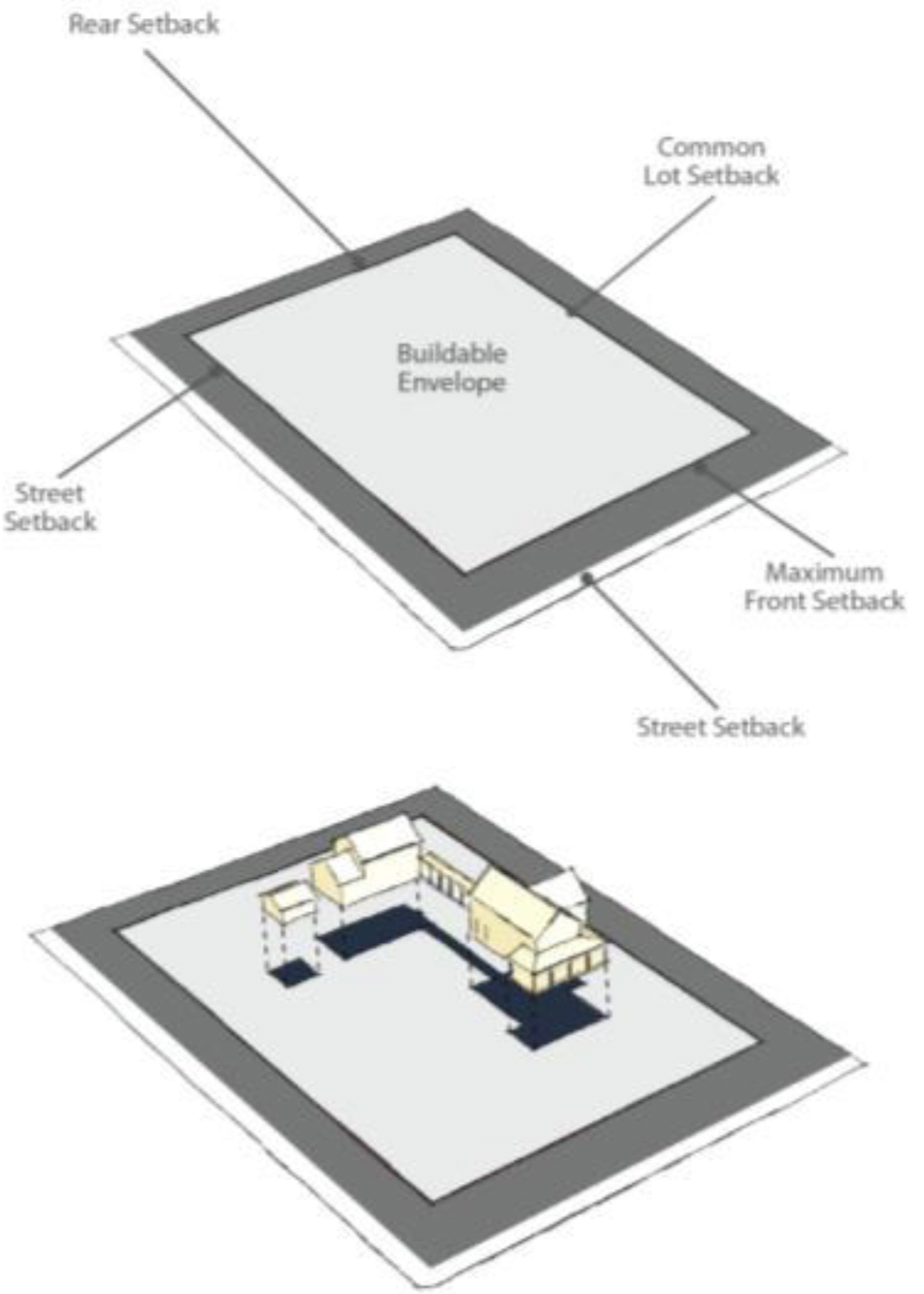
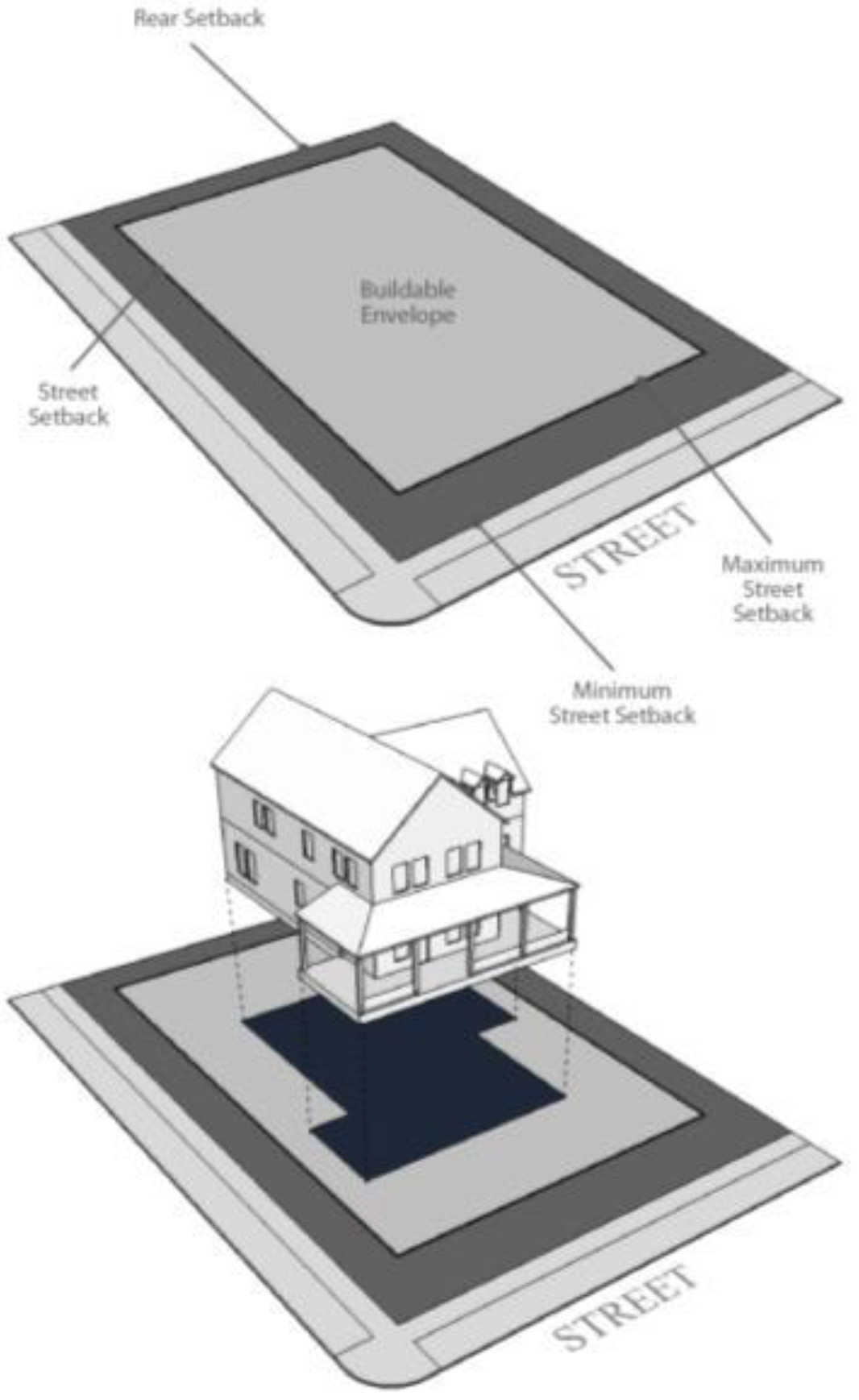
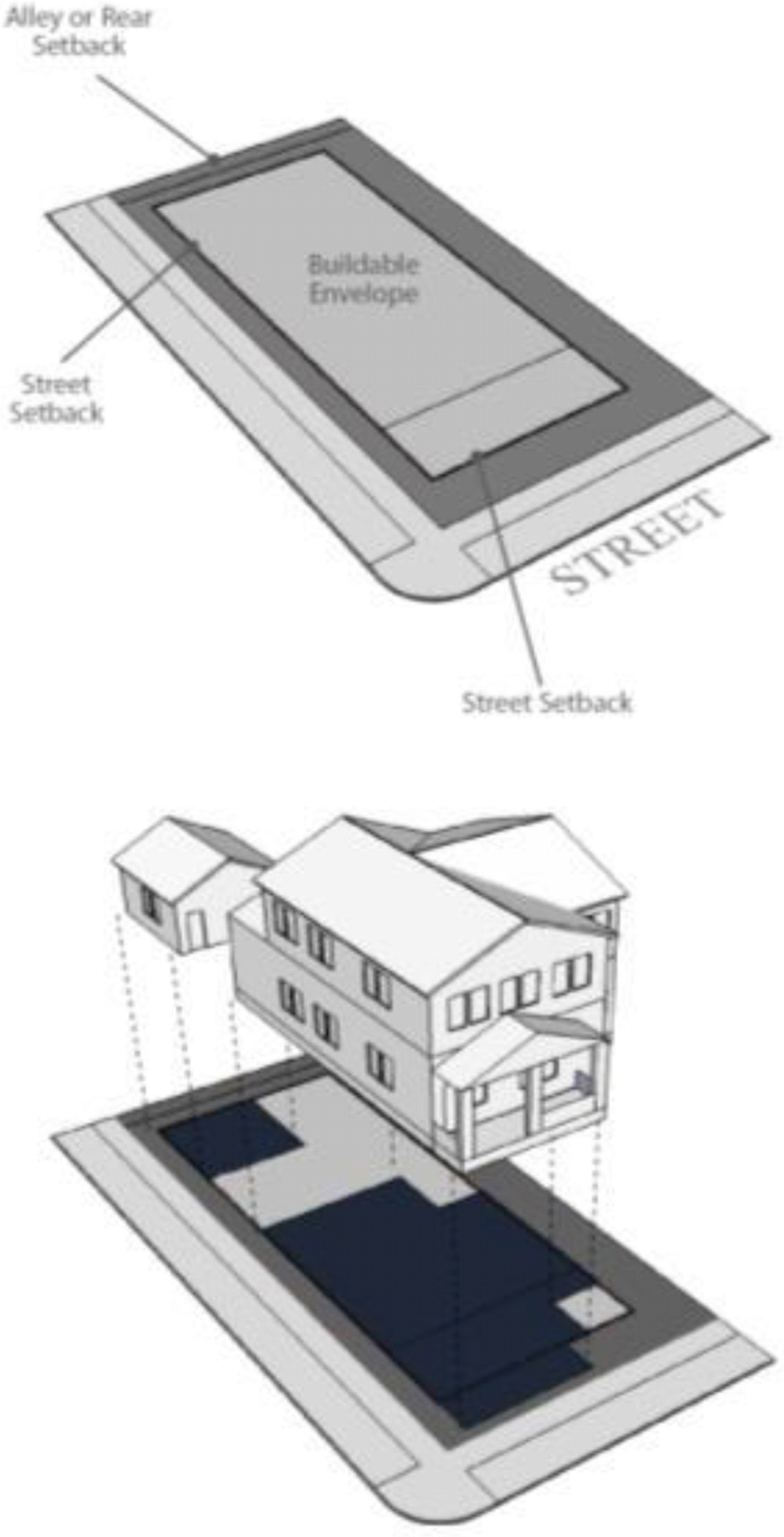
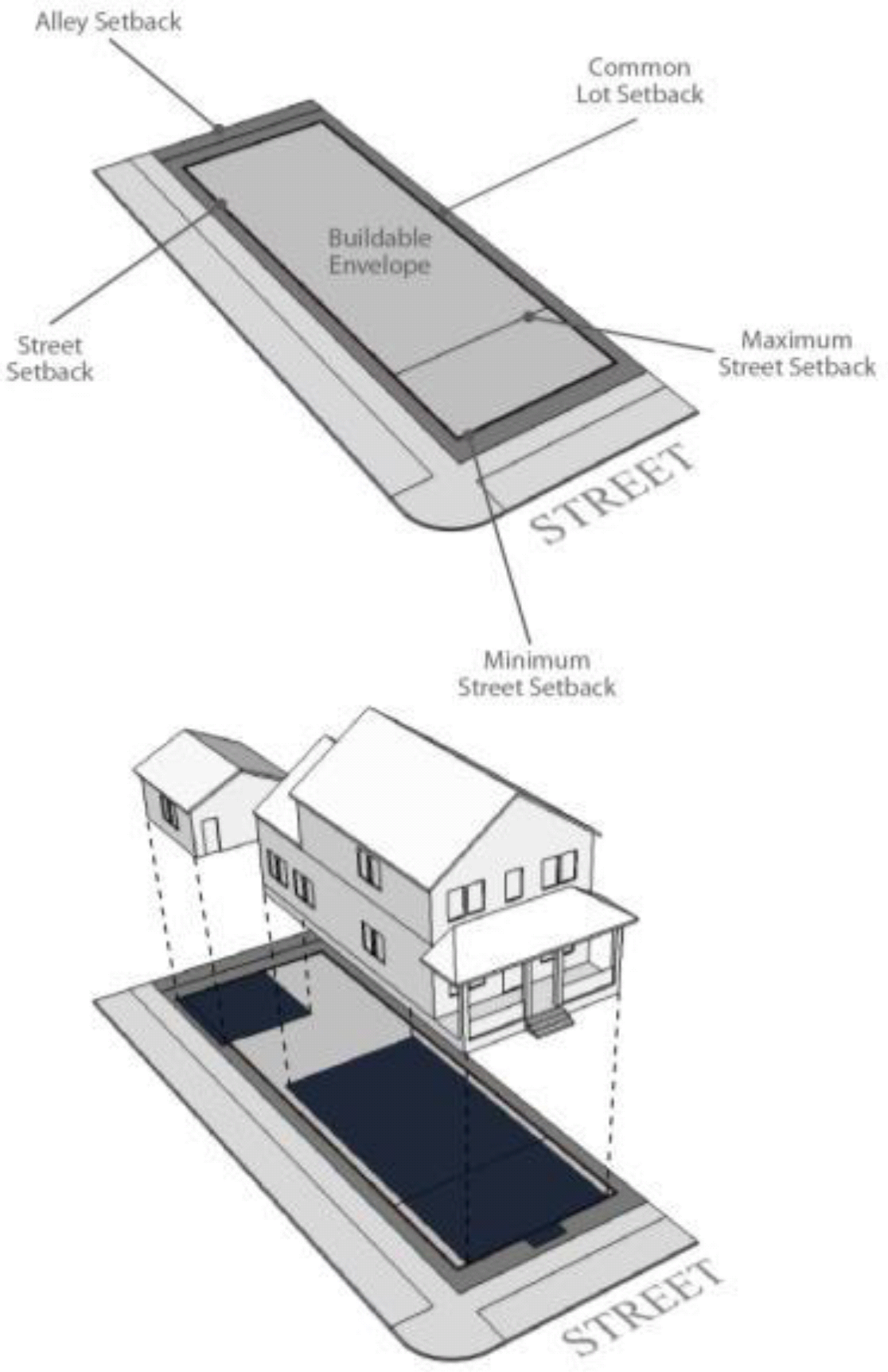
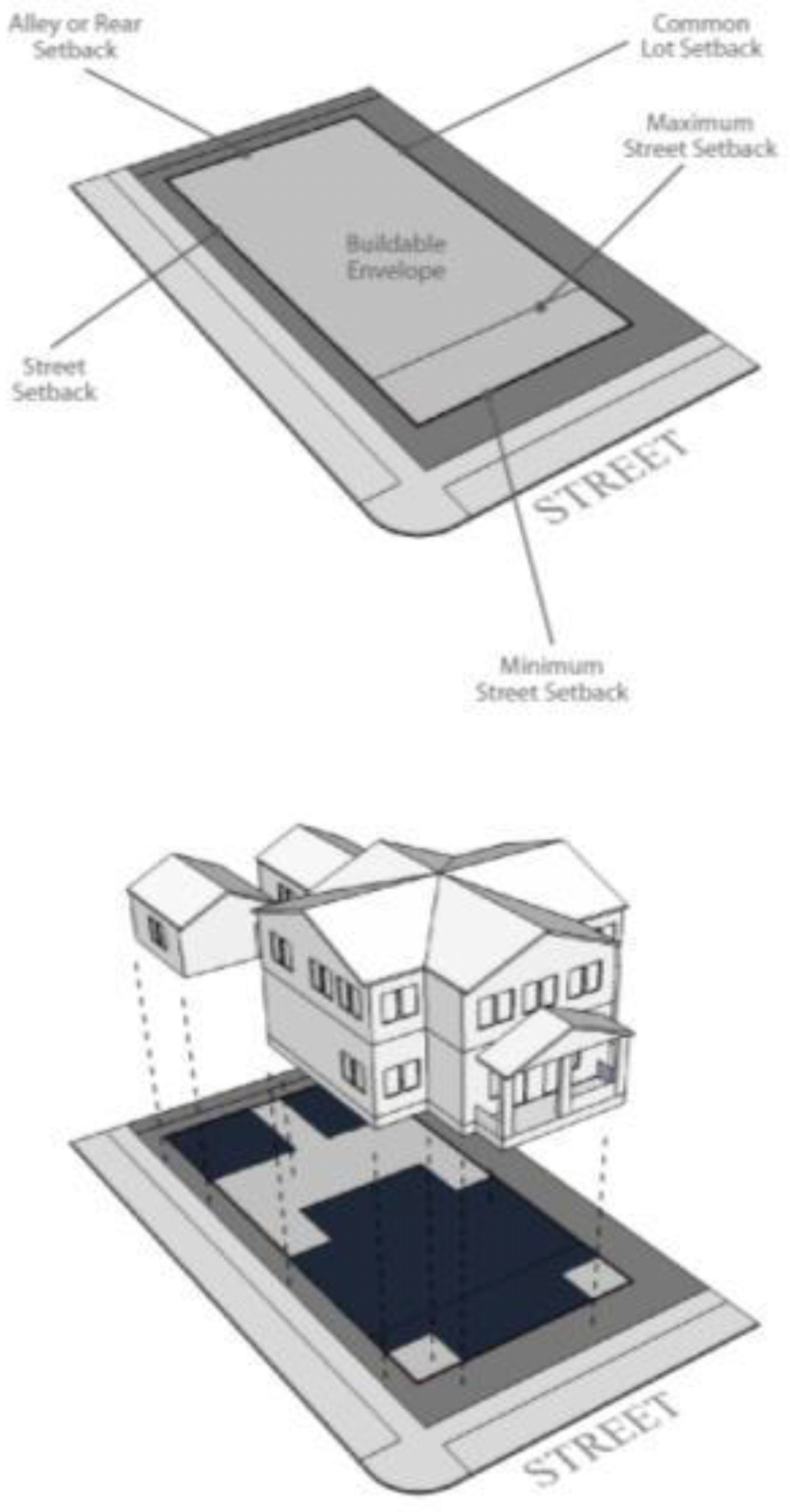
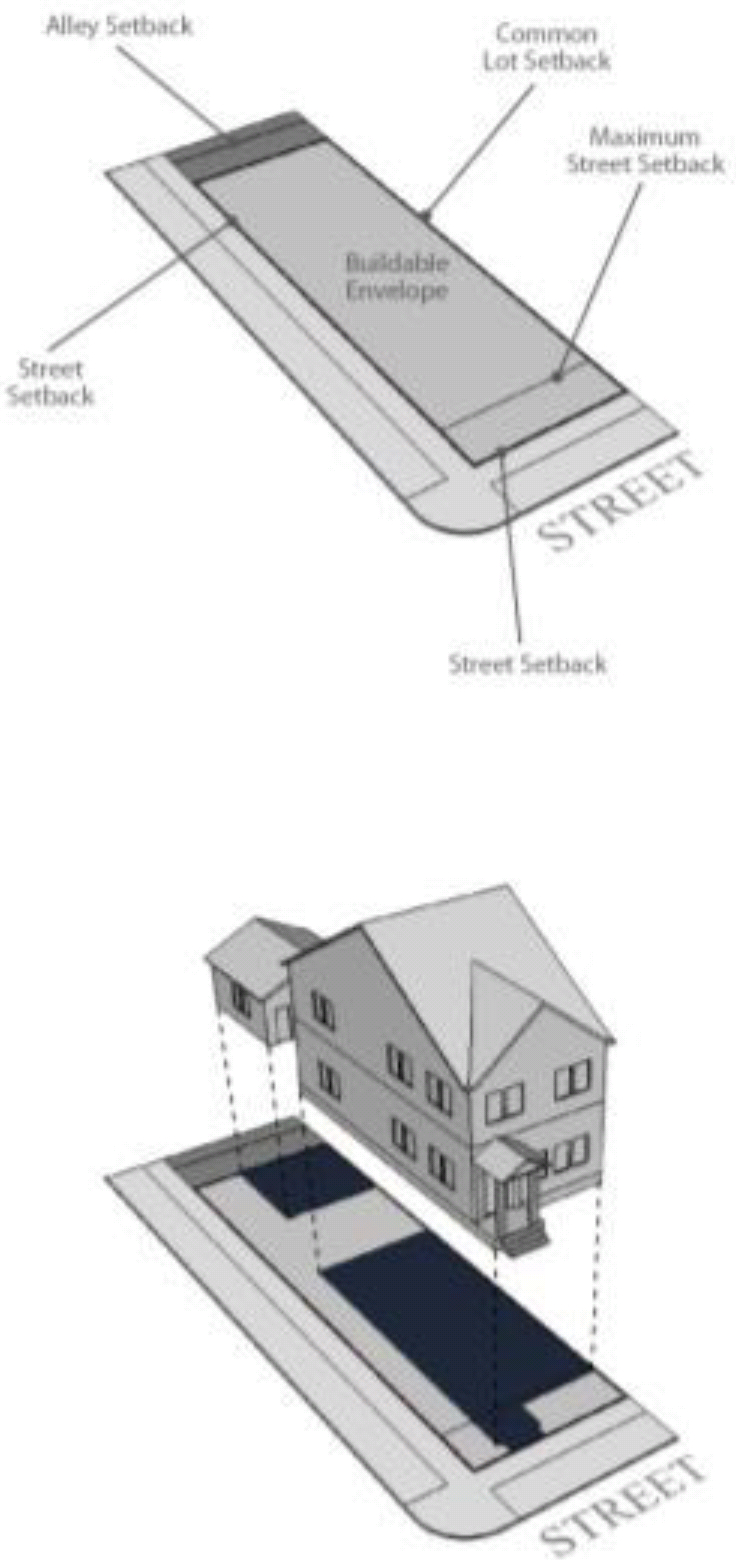
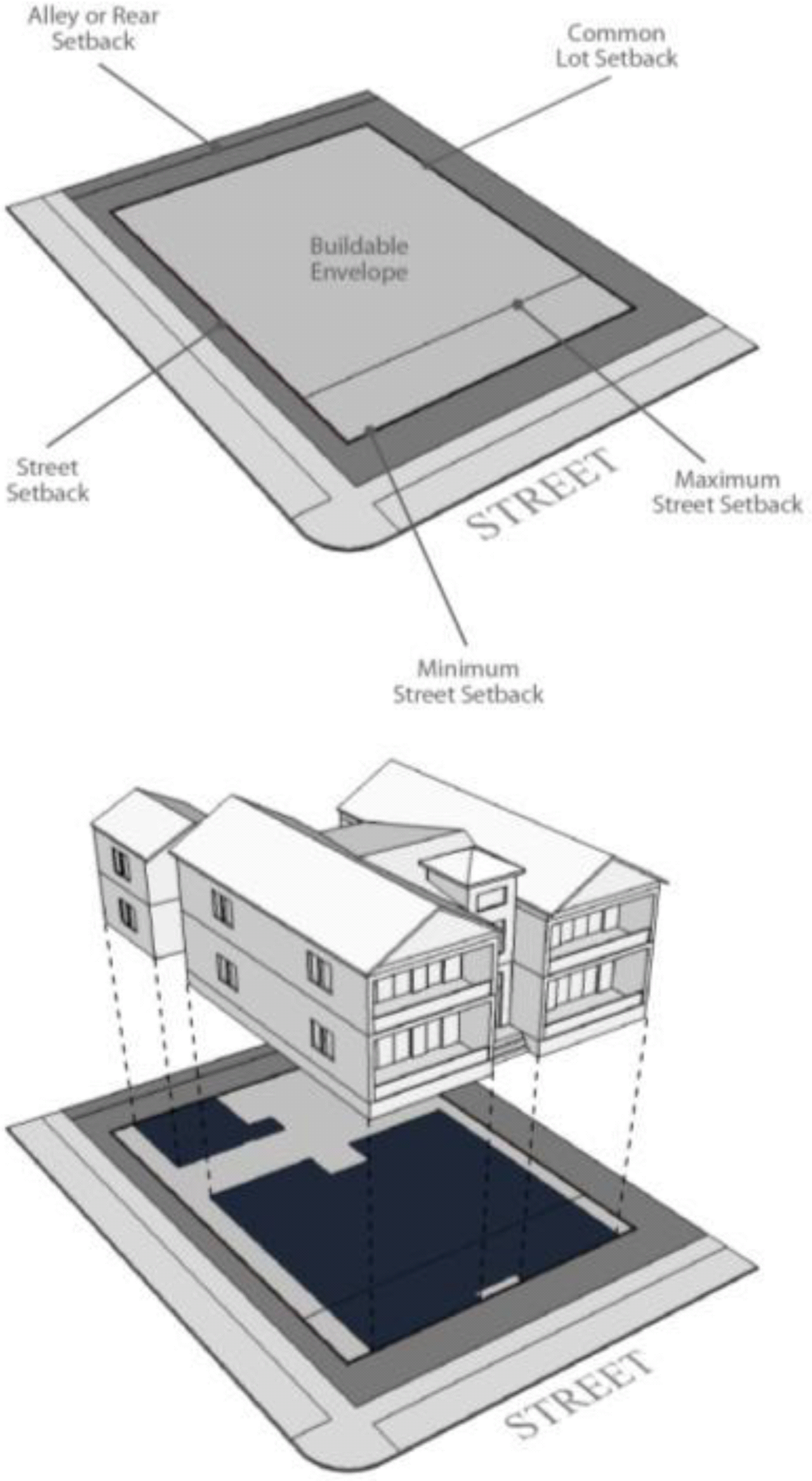
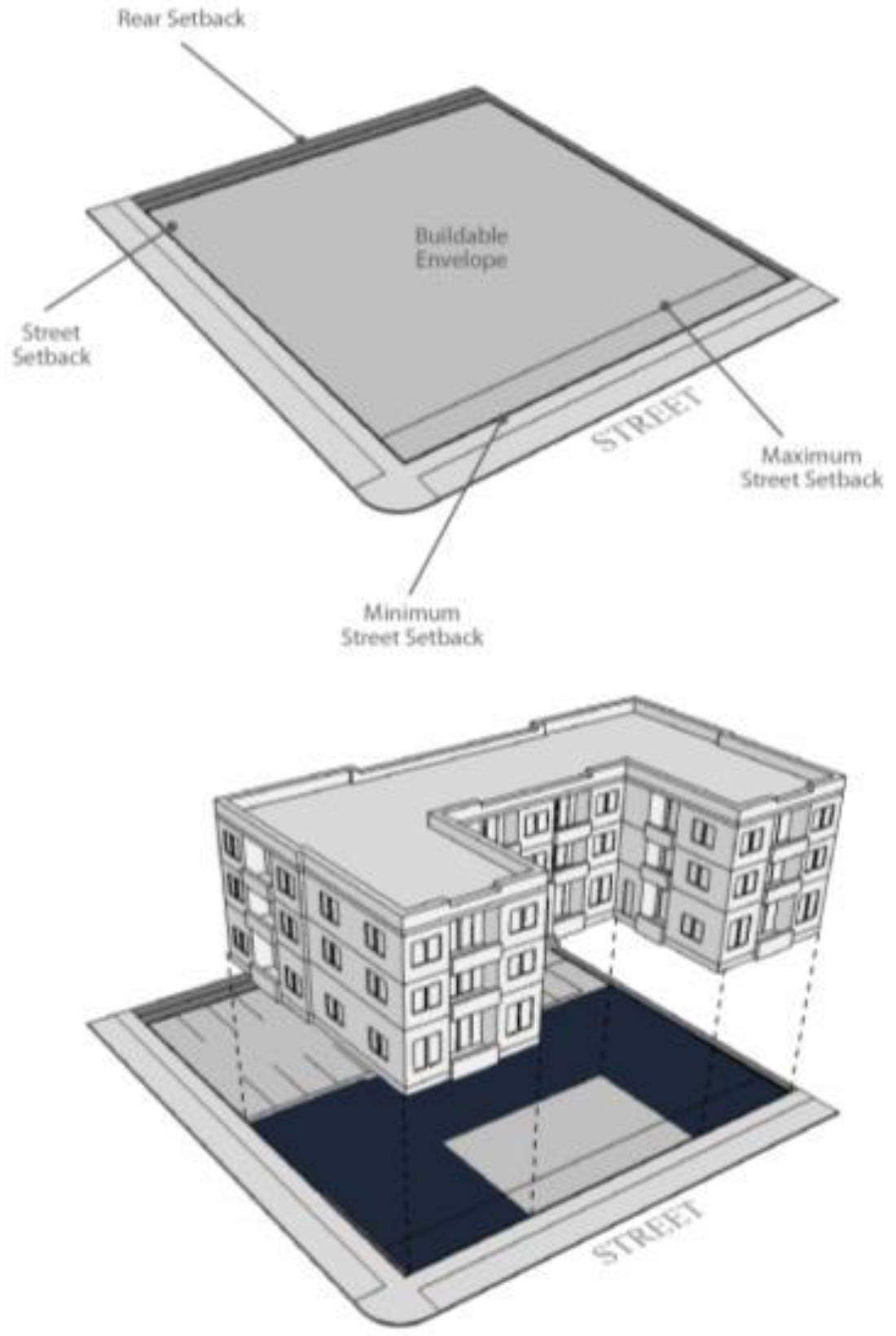
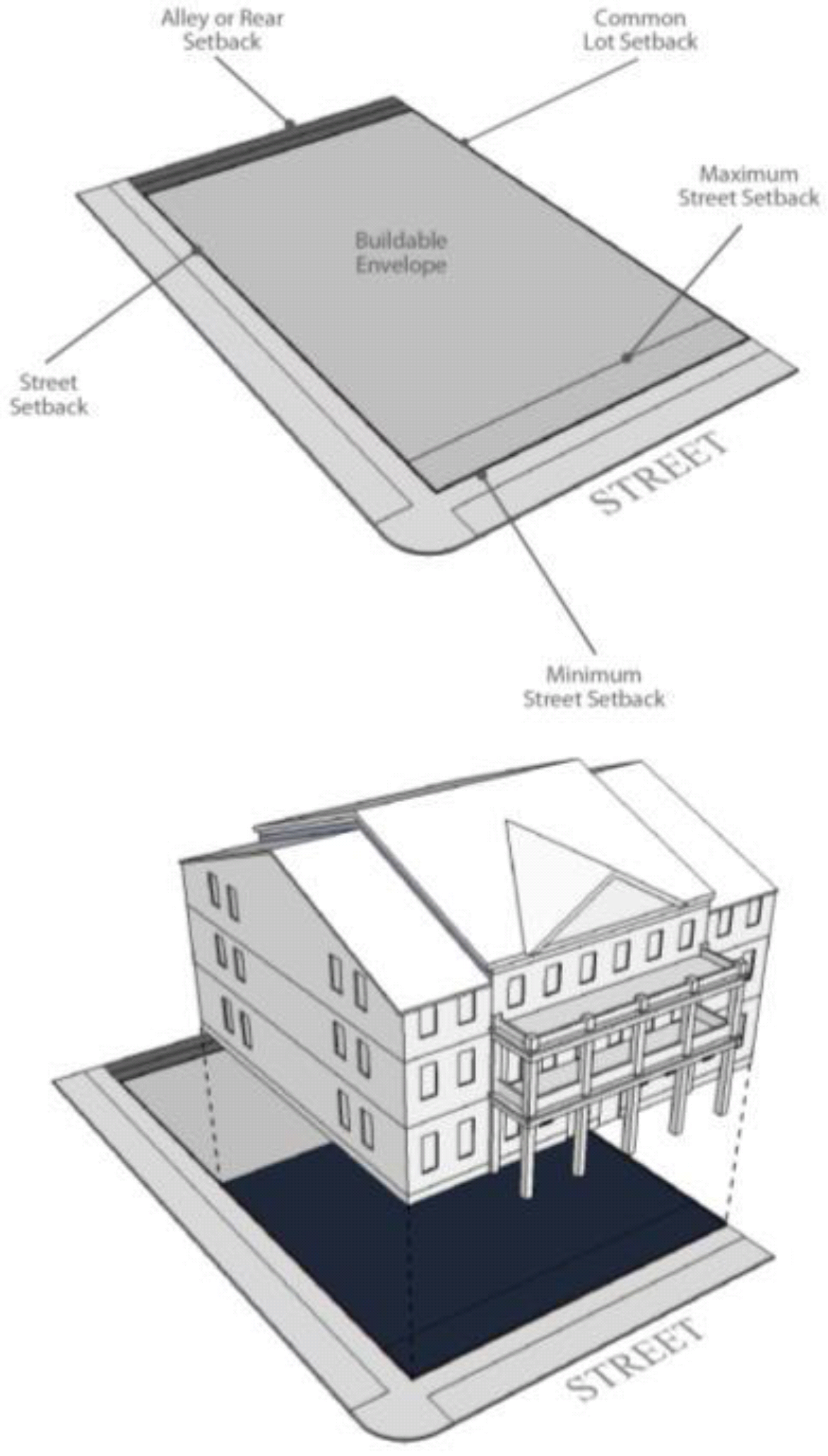
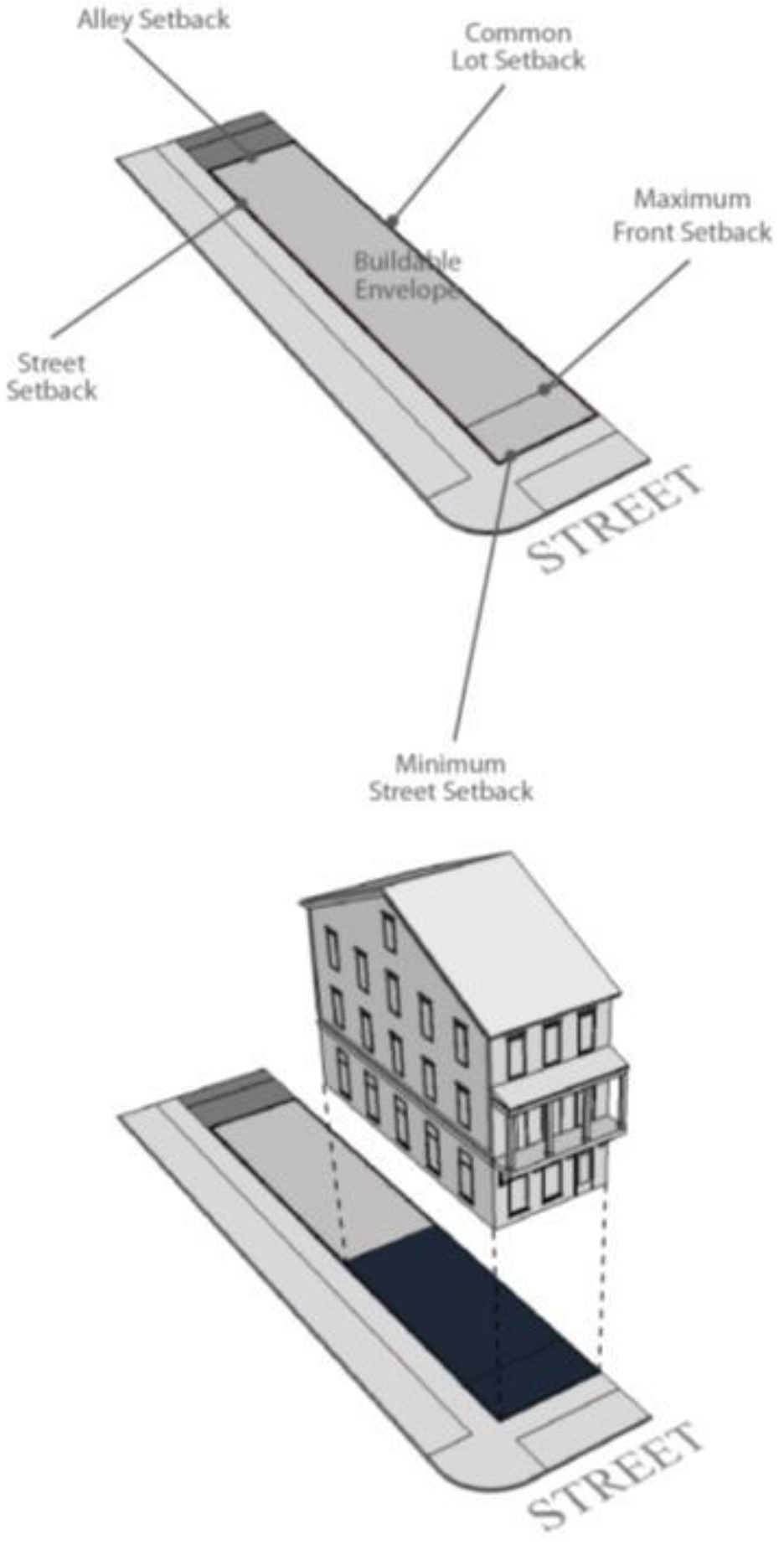
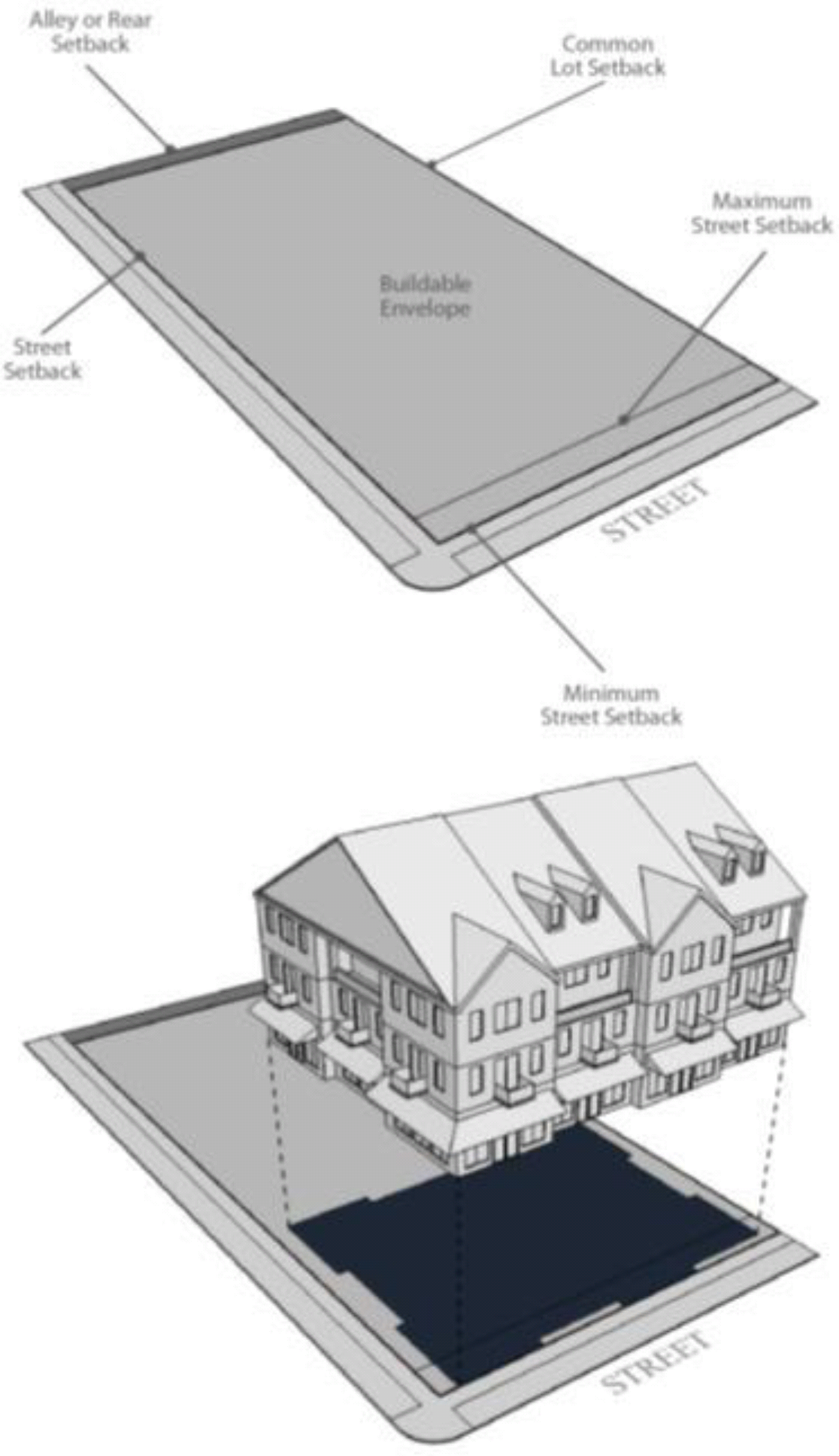
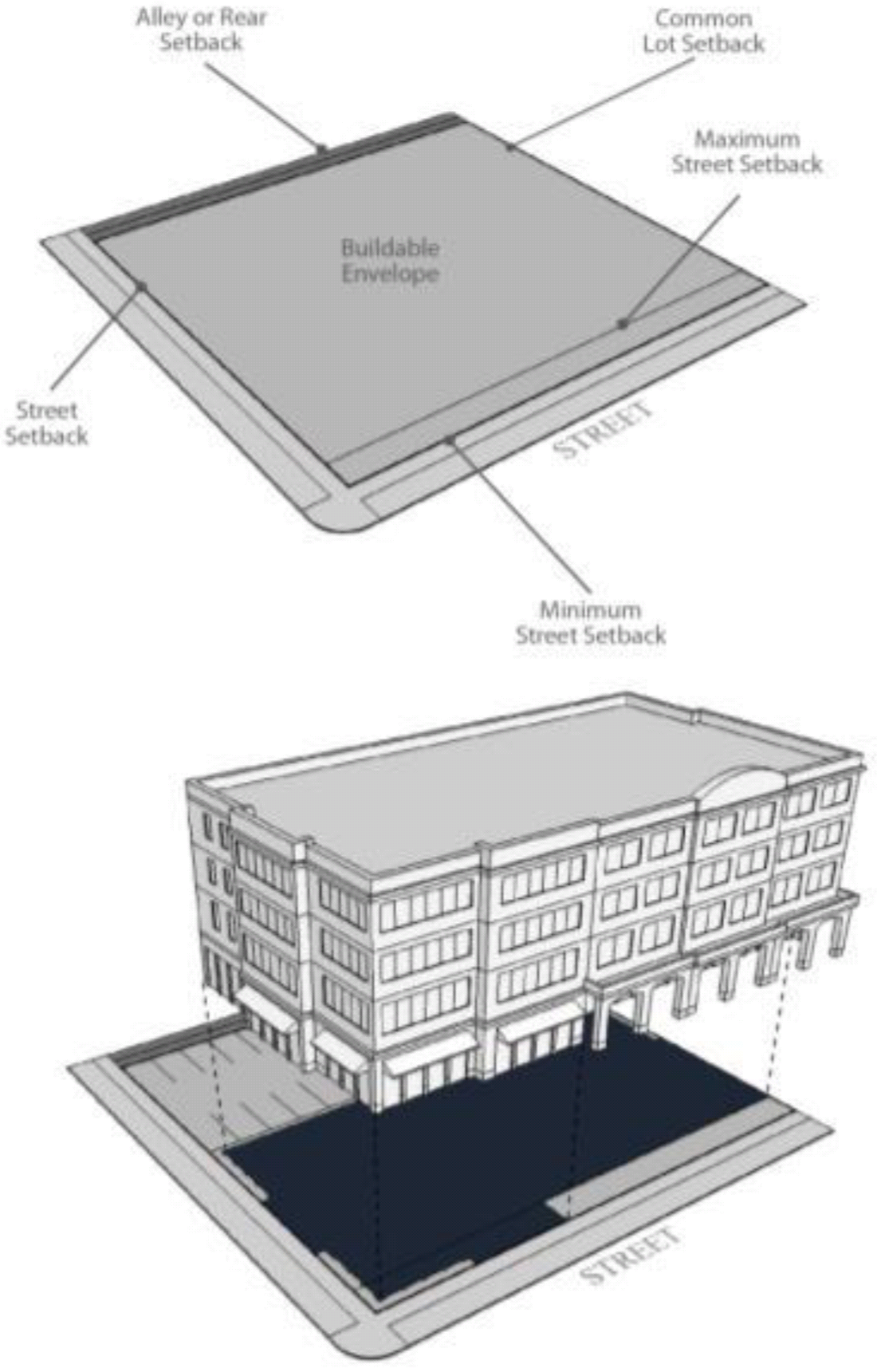
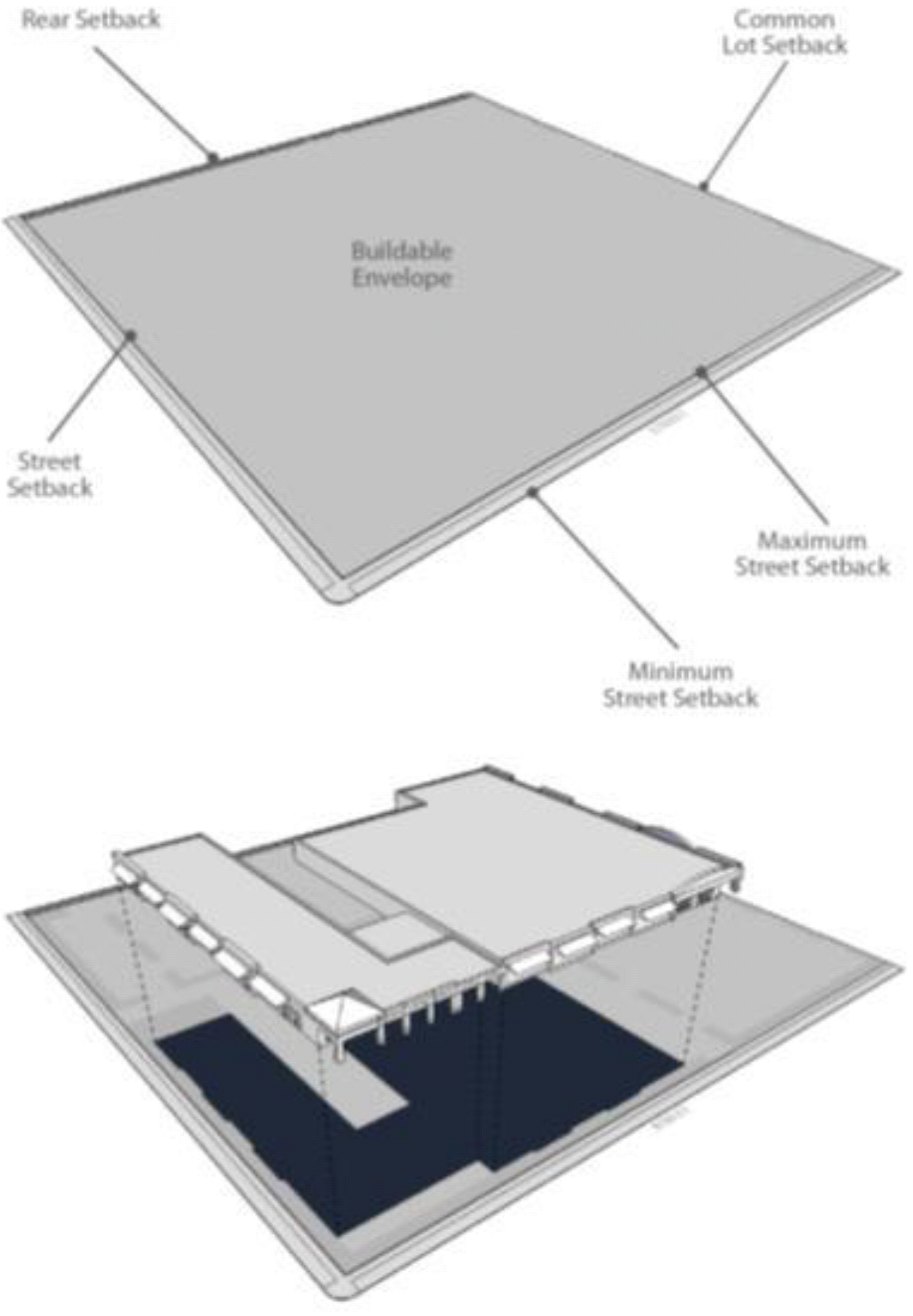
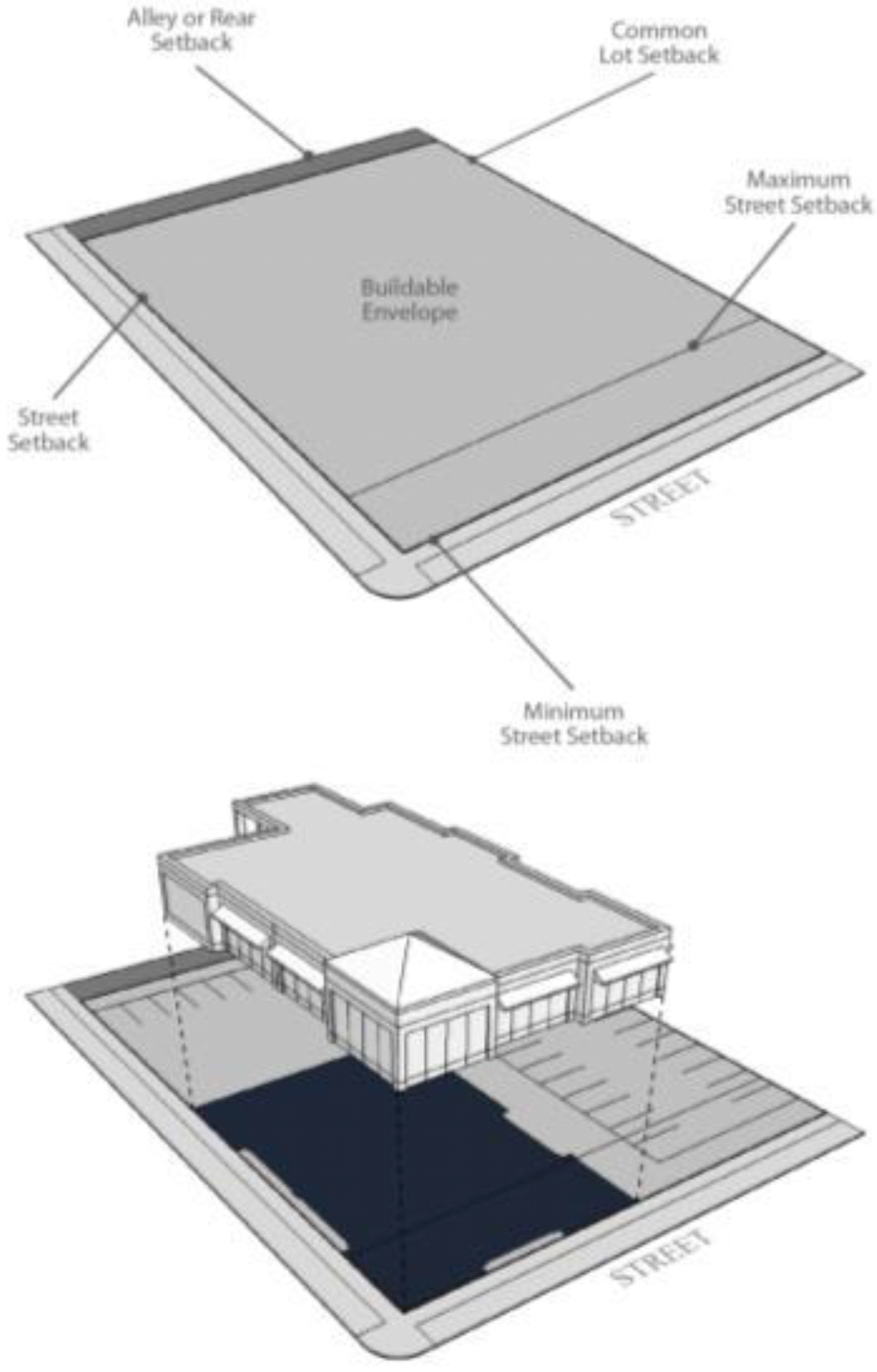
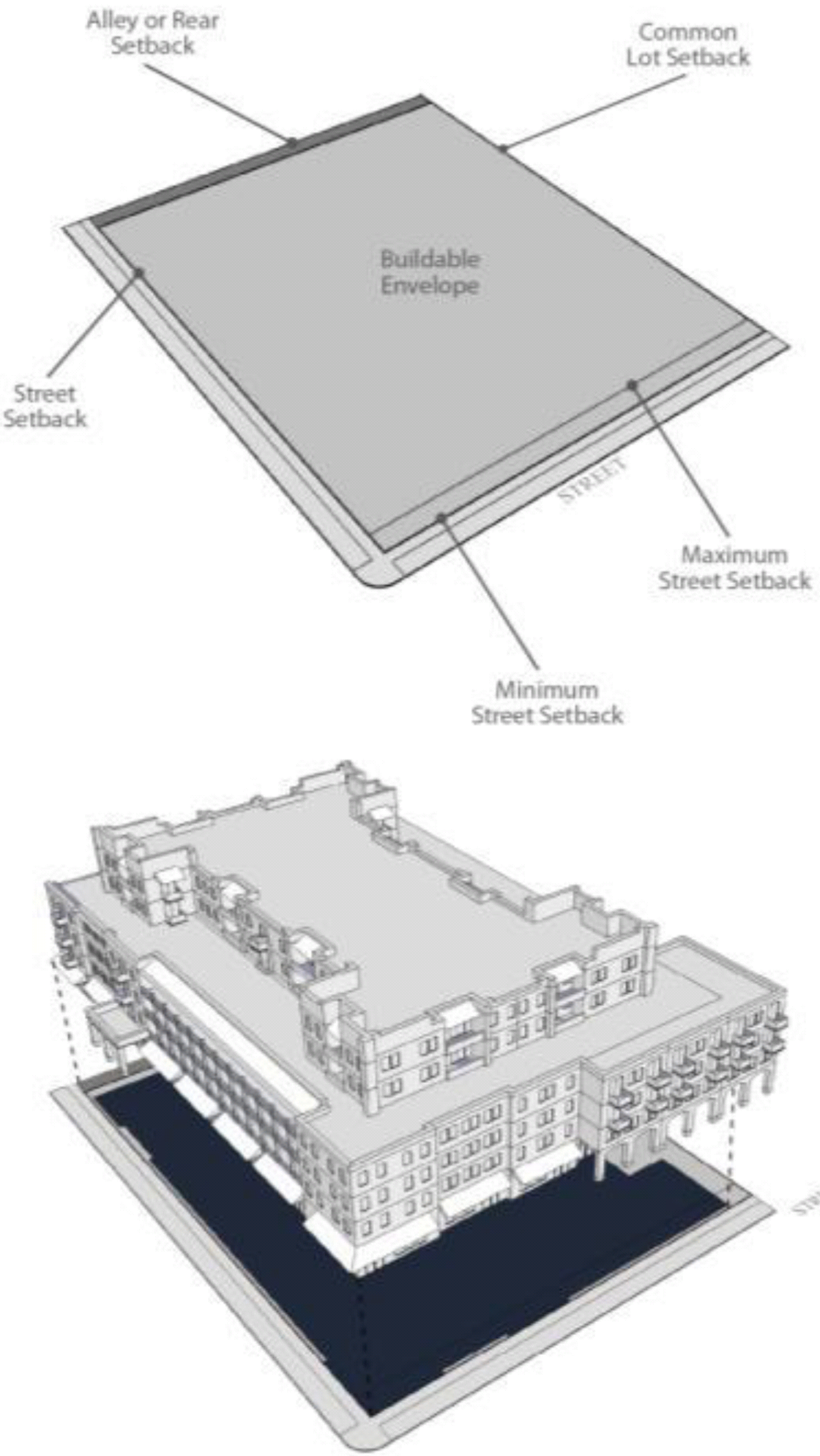
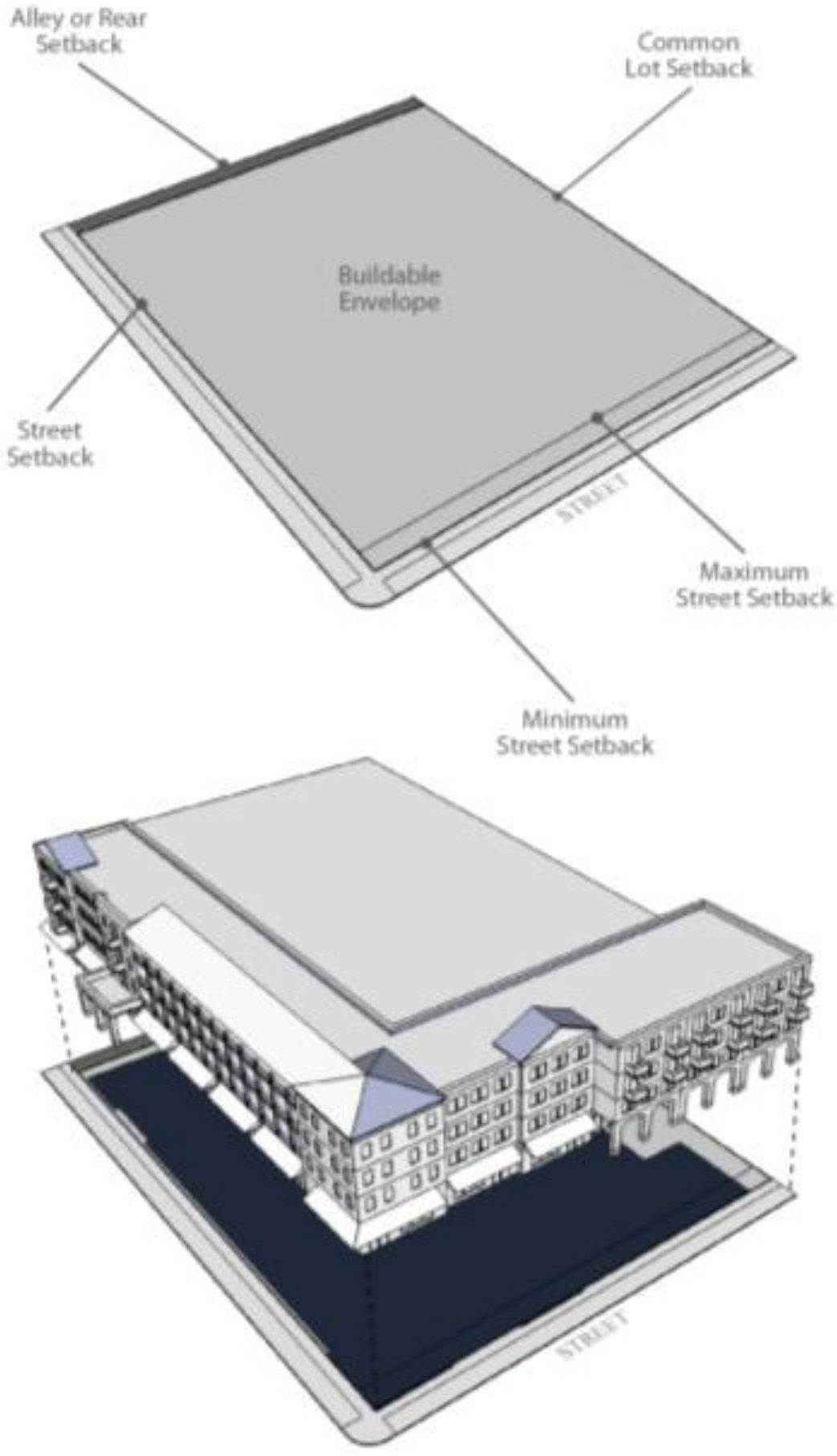
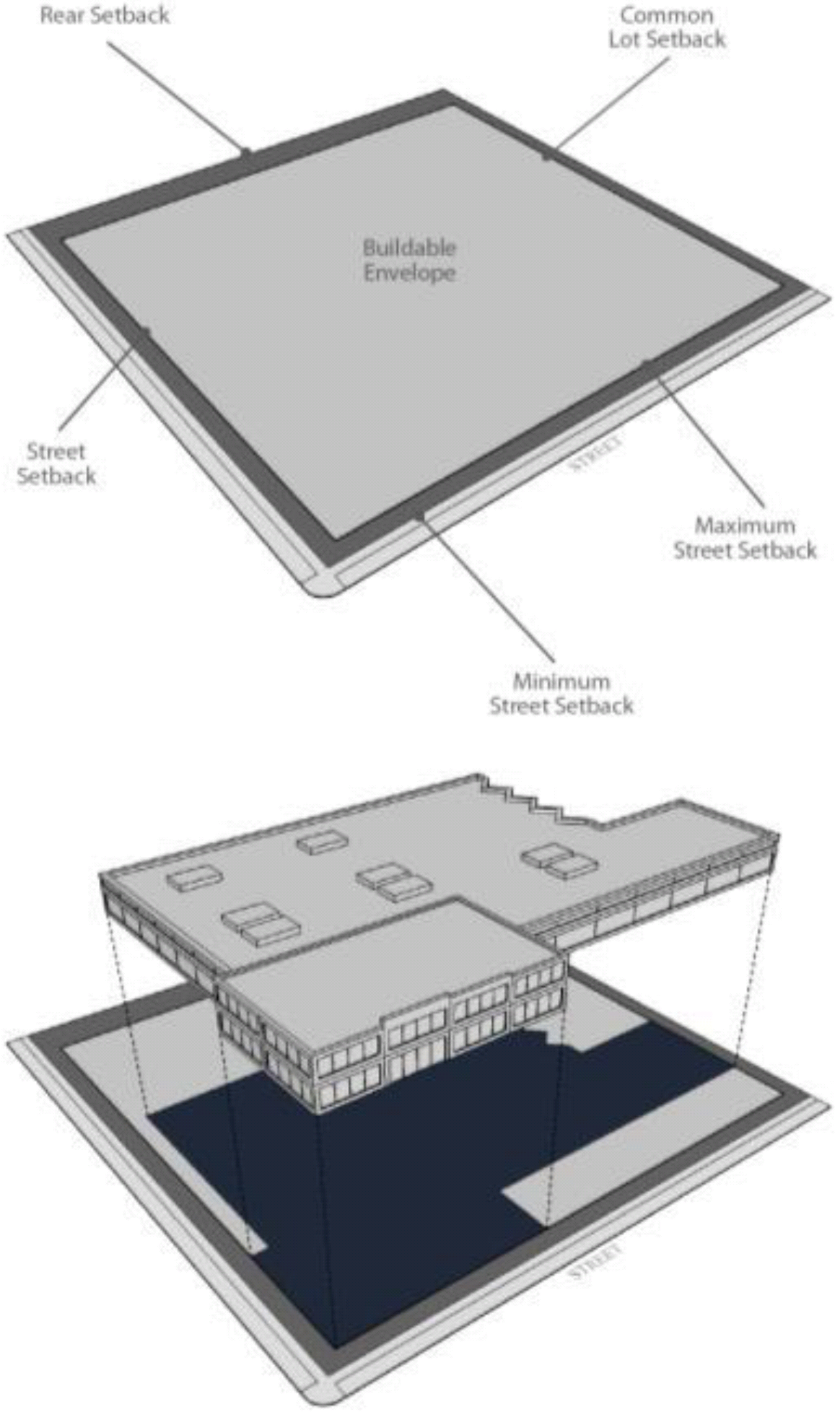
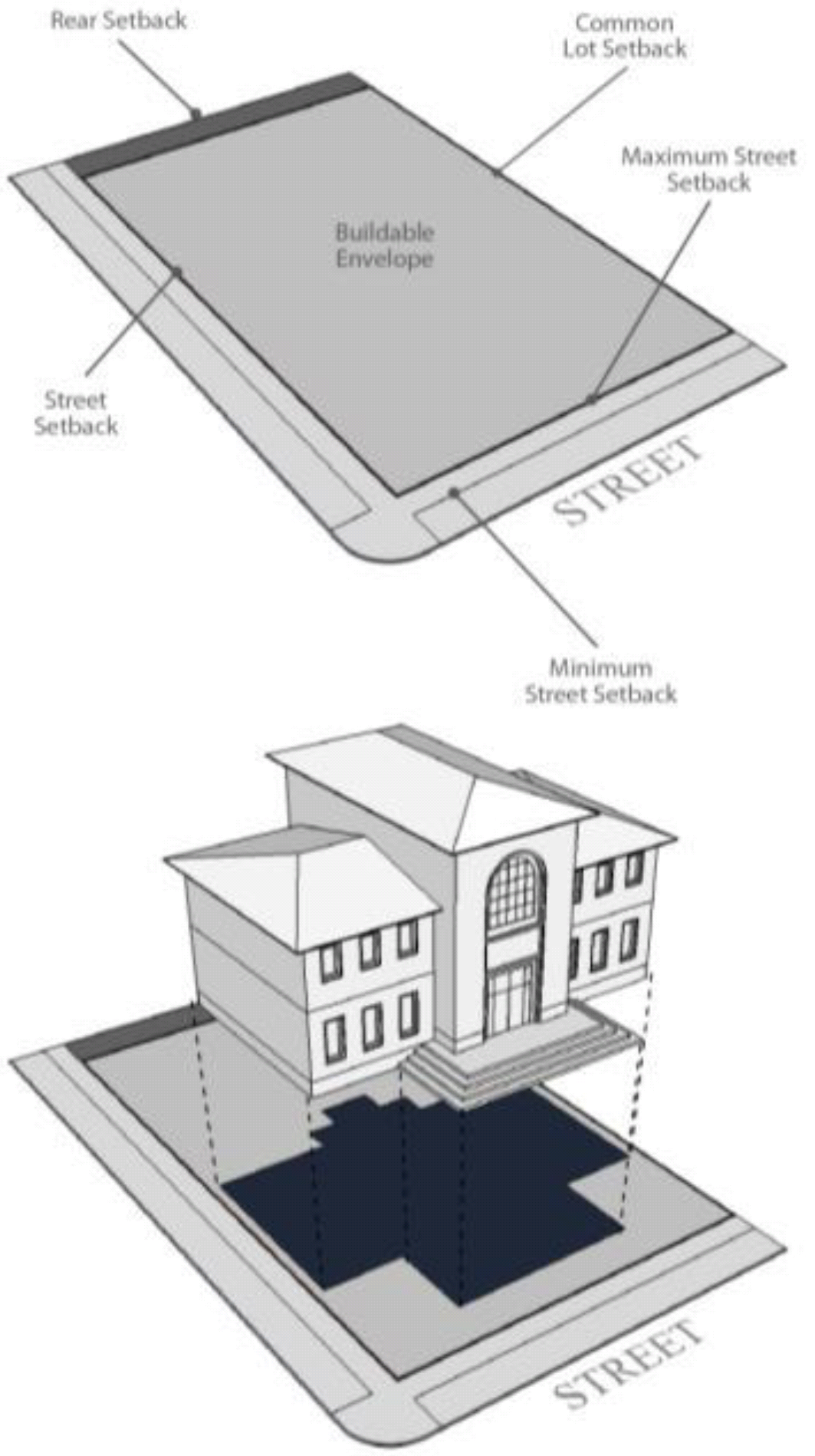
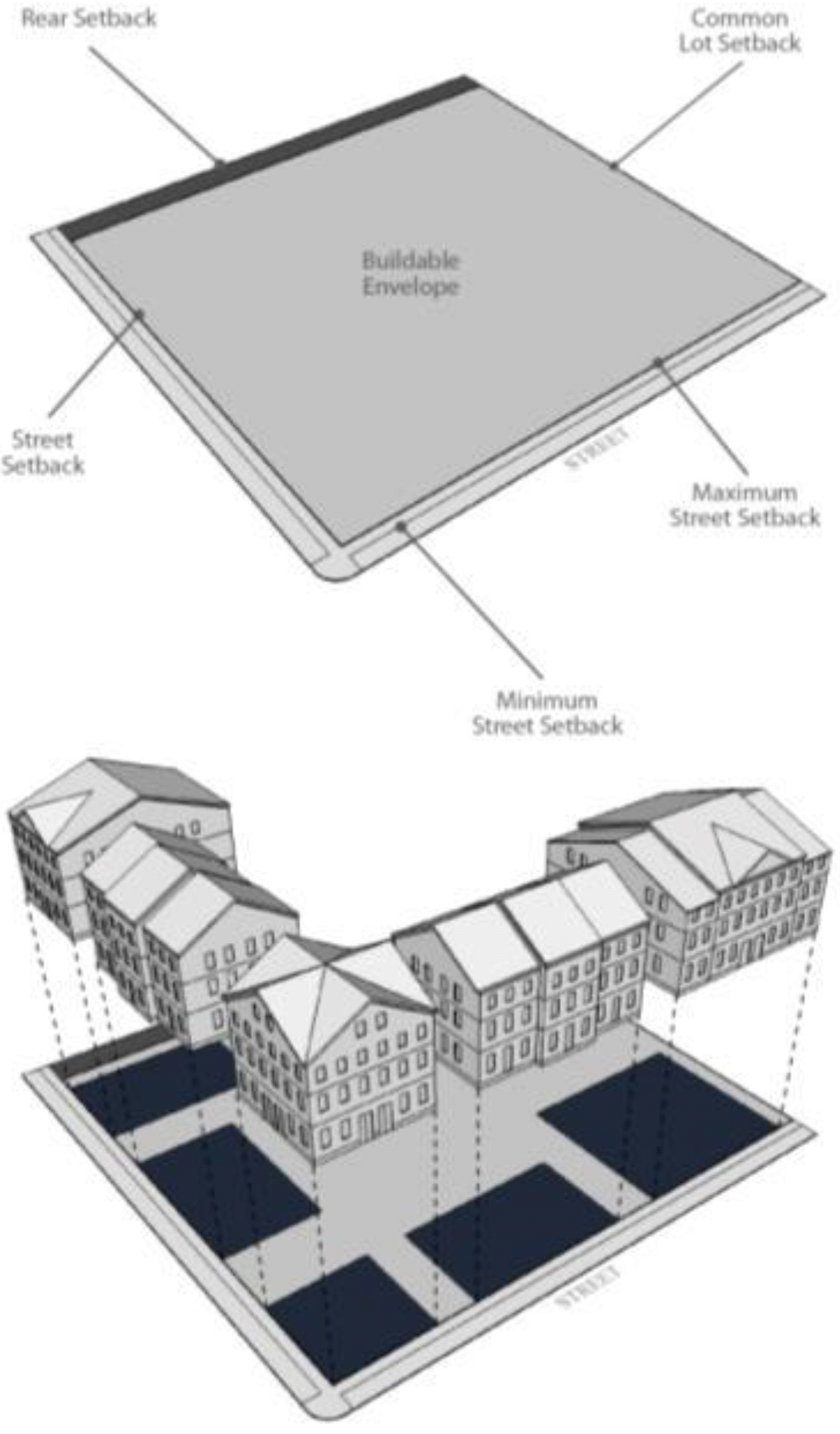
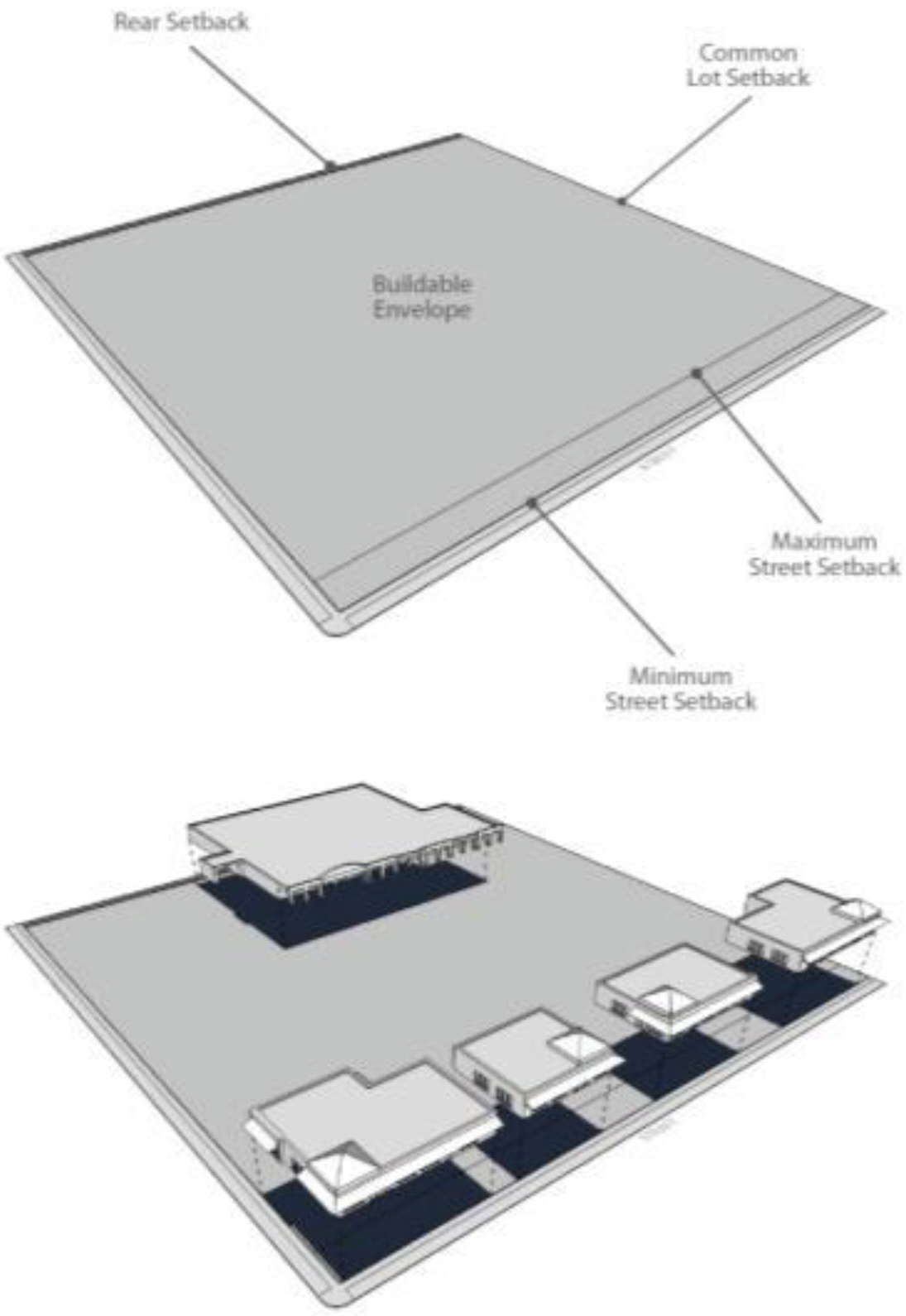
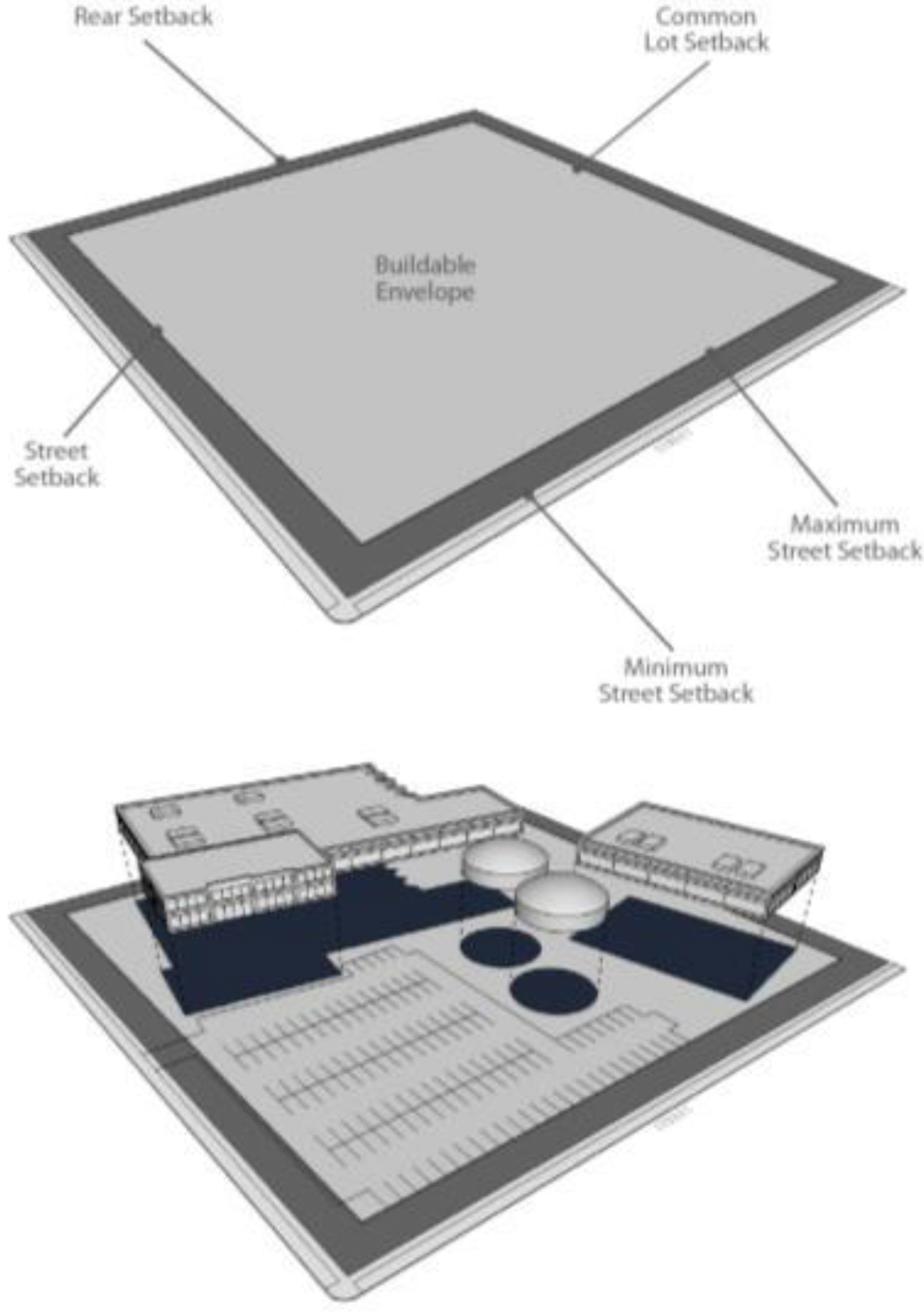
Building envelope standards. Provide setback requirements for: street, common lot and rear or alley setbacks. The following illustration identifies the types of setbacks included in the building lot types
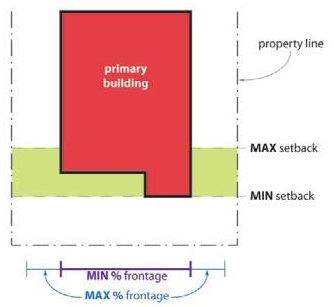
The following illustrations show examples of how the frontage building requirements may apply.
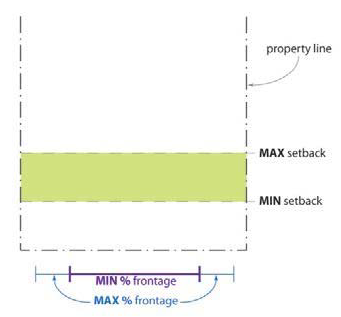
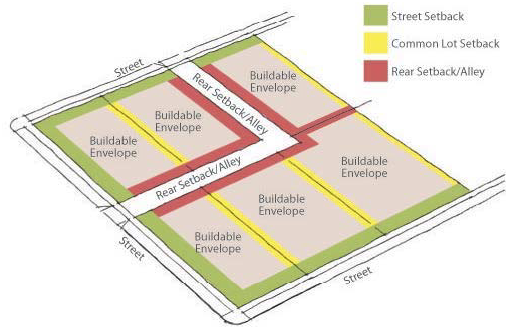
Illustration provides the foundation for how the frontage building is applied. There is a minimum and maximum setback as determined by the lot type. The maximum and minimum frontage is shown adjacent to the property line.
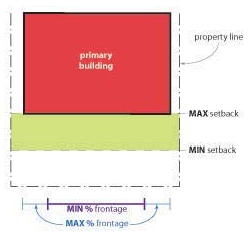 | The primary building in this illustration is placed on the maximum setback and meets the maximum frontage requirements. |
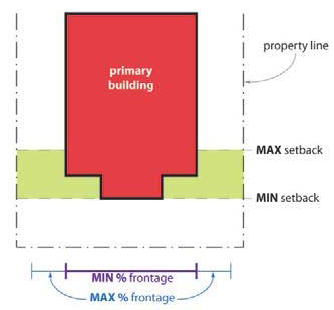 | The primary building is within the min/max setbacks, and is meeting the minimum setback. This provides flexibility to the design of the building. |
 | The primary building is within the min/max setbacks, and is meeting the minimum setback. This provides flexibility to the design of the building. |
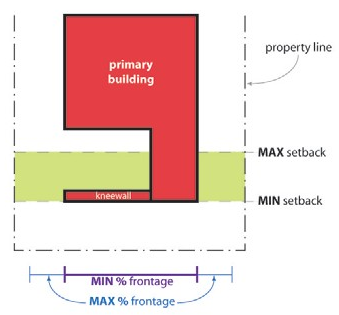 | A knee wall may be utilized to meet the frontage requirements as detailed in chapter 115. |
(c)
Accessory building envelope. (ACC BLDG), provisions for accessory building structures only, additional accessory uses are outlined in chapter 110.
(d)
Building height. Provisions for permitted heights in stories (st). Each building lot typology provides the range of height appropriate for the building type. The underlying land use determines the height that is permitted and shall be the determining factor in establishing the maximum height as outlined in chapter 110.
(e)
Private frontages. Provisions for a variety of different street/public frontage types that are permitted by building lot type. The private frontage is the area between a building façade and the lot line. Frontage types may be counted as part of the building frontage requirements.
| Common lawn: A landscaped front yard that is unfenced and visually continuous with adjacent front yards, supporting a common landscape. The deep setback provides a buffer from the higher speed thoroughfares. | 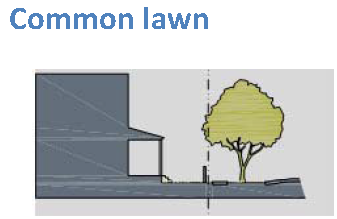 |
| Porch and fence. A landscaped front yard in which the façade includes an attached front porch. A fence at the street right-of-way line maintains the spatial definition of the street. Porches shall be no less than eight feet deep. | 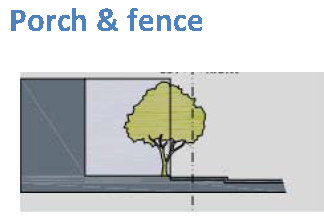 |
| Forecourt. A frontage in which a portion of the façade is close to the street right-of-way line and the remainder is set back. The resulting forecourt is suitable for vehicular drop-offs. This type should be allocated in conjunction with other types of front yards. Large trees within the forecourts may overhang the sidewalks. | 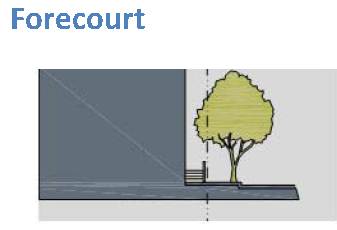 |
| Stoop. A frontage in which the façade is placed close to the street right-of-way line. The first story is elevated above the sidewalk to secure privacy for the windows. The entrance is accessed by an exterior stair and landing. This type is recommended for ground-floor residential uses. | 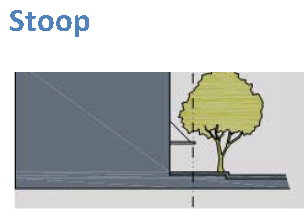 |
| Shopfront and awning. A frontage in which the façade is aligned close to the street right-of-way line with the building entrance as the sidewalk. This type is typical for retail use. It has a substantial amount of glazing on the sidewalk level and an awning that should overhang the sidewalk by at least five feet. | 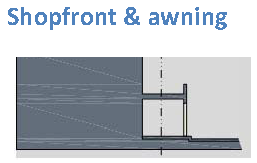 |
| Gallery. A frontage wherein the façade extends beyond the property line with an attached cantilevered shed or a lightweight colonnade overlapping the sidewalk. This type is conventional for retail use. The gallery shall be no less than ten feet wide and should overlap the sidewalk to within two feet of the curb. | 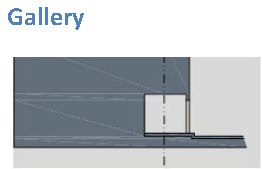 |
| Arcade. A colonnade supporting habitable space that overlaps the sidewalk, while the façade at sidewalk level remains at or behind the front setback line. This type is conventional for retail use. The arcade shall be no less than 12 feet wide and should overlap the sidewalk to within two feet of the curb. | 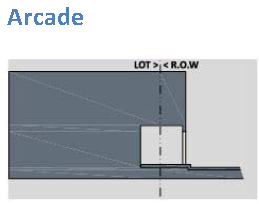 |
(Ord. No. 16-31, § 1.e.(Exh. A), 12-15-2016)
Sec. 110-4.0. - Homestead lot.
A building lot located and designed to accommodate a detached building with large common lot yards, rear yards and street yards for a rural area.
X - Permitted
Blank cell - prohibited
(Ord. No. 16-31, § 1.e.(Exh. A), 12-15-2016)
Sec. 110-4.1. - Estate lot.
A building lot located and designed to accommodate a detached building with large common lot yards, rear yards and street yards. Existing estate sized lots in urban design districts shall follow urban houselot standards.
X - Permitted,
Blank cell - prohibited
(Ord. No. 16-31, § 1.e.(Exh. A), 12-15-2016)
Sec. 110-4.2. - House lot.
A building lot located and designed to accommodate a detached building with small common lot yards and a large street yard.
* Garages in urban districts shall maintain an 18-foot street setback.
X - Permitted
Blank cell - prohibited
(Ord. No. 16-31, § 1.e.(Exh. A), 12-15-2016)
Sec. 110-4.3. - Cottage lot.
A building lot located and designed to accommodate a small detached building with small common lot and street yards.
* Garages in urban districts shall maintain an 18-foot street setback.
X - Permitted
Blank cell - prohibited
(Ord. No. 16-31, § 1.e.(Exh. A), 12-15-2016)
Sec. 110-4.4. - Duplex lot.
A building lot located and designed to accommodate a building with small common lots and containing two dwellings.
* Garages in urban districts shall maintain an 18-foot street setback.
X - Permitted
Blank cell - prohibited
(Ord. No. 16-31, § 1.e.(Exh. A), 12-15-2016; Ord. No. 21-09, § 1, 6-17-2021)
Sec. 110-4.5. - Townhouse lot.
A building lot located and designed to accommodate a building with common walls on both side building lot lines and a private garden to the rear.
* Garages in all districts shall maintain a minimum 18-foot street setback.
X - Permitted
Blank cell - prohibited
(Ord. No. 16-31, § 1.e.(Exh. A), 12-15-2016; Ord. No. 21-09, § 1, 6-17-2021)
Sec. 110-4.6. - Apartment house lot.
A building lot located and designed to accommodate a detached building which resembles a large house but which contains multiple dwellings above and beside each other.
X - Permitted
Blank cell - prohibited
(Ord. No. 16-31, § 1.e.(Exh. A), 12-15-2016)
Sec. 110-4.7. - Courtyard apartment lot.
A building lot located and designed to accommodate multiple dwellings arranged around and fronting on a central garden or courtyard that may be partially or wholly open to the street.
X - Permitted
Blank cell - prohibited
(Ord. No. 16-31, § 1.e.(Exh. A), 12-15-2016)
Sec. 110-4.8. - Apartment building lot.
A building lot located and designed to accommodate multiple dwellings above or beside each other in a building that occupies most of its building lot width and is placed close to the sidewalk.
X - Permitted
Blank cell - prohibited
(Ord. No. 16-31, § 1.e.(Exh. A), 12-15-2016)
Sec. 110-4.9. - Live/work building lot.
A building lot located and designed to accommodate an attached or detached building with residential uses, commercial uses, or a combination of the two within individually occupied live-work units, all of which may occupy any story of the building.
X - Permitted
Blank cell - prohibited
(Ord. No. 16-31, § 1.e.(Exh. A), 12-15-2016)
Sec. 110-4.10. - Mixed-use building lot.
A building lot located and designed to accommodate a multi-story building with multiple dwellings in upper stories and various commercial uses in any stories.
X - Permitted
Blank cell - prohibited
(Ord. No. 16-31, § 1.e.(Exh. A), 12-15-2016)
Sec. 110-4.11. - Multi-story commercial building lot.
A building lot located and designed to accommodate a multi-story building with commercial and office uses in any story.
X - Permitted
Blank cell - prohibited
(Ord. No. 16-31, § 1.e.(Exh. A), 12-15-2016)
Sec. 110-4.12. - Large format retail building lot.
A building lot located and designed to accommodate a large footprint building with one or more uses.
X - Permitted
Blank cell - prohibited
(Ord. No. 16-31, § 1.e.(Exh. A), 12-15-2016)
Sec. 110-4.13. - Commercial building lot.
A building lot located and designed to accommodate single use office and retail that are predominately located on corridors as part of a retail complex.
X - Permitted
Blank cell - prohibited
(Ord. No. 16-31, § 1.e.(Exh. A), 12-15-2016)
Sec. 110-4.14. - Pedestal building lot.
A building lot located and designed to accommodate the tallest permissible building whose primary façade must be stepped back to reduce its apparent bulk when viewed from the sidewalk.
X - Permitted
Blank cell - prohibited
(Ord. No. 16-31, § 1.e.(Exh. A), 12-15-2016)
Sec. 110-4.15. - Liner building lot.
A building lot located and designed to accommodate a large footprint building such as a parking garage, cinema, supermarket, etc., which is surrounded by a liner building which conceals large expanses of blank walls and faces the street with ample windows and doors opening onto the sidewalk.
X - Permitted
Blank cell - prohibited
(Ord. No. 16-31, § 1.e.(Exh. A), 12-15-2016)
Sec. 110-4.16. - Industrial building lot.
A building lot located and designed to accommodate industrial uses.
X - Permitted
Blank cell - prohibited
(Ord. No. 16-31, § 1.e.(Exh. A), 12-15-2016)
Sec. 110-4.17. - Civic building lot.
A building lot located and designed to accommodate a building containing public or civic uses such as community services, day care, education, government, places of worship, or social services.
X - Permitted
Blank cell - prohibited
(Ord. No. 16-31, § 1.e.(Exh. A), 12-15-2016)
Sec. 110-4.18. - Apartment complex.
A complex is located and designed for development over five acres in size and accommodates one or more multifamily building lot type.
X - Permitted
Blank cell - prohibited
(Ord. No. 16-31, § 1.e.(Exh. A), 12-15-2016)
Sec. 110-4.19. - Retail complex.
A complex is located and designed for development over five acres in size and accommodates commercial buildings, large format retail building lot type, mixed use building lot types, and multi-story commercial building lot types. A block structure will be required for this type of development.
X - Permitted
Blank cell - prohibited
(Ord. No. 16-31, § 1.e.(Exh. A), 12-15-2016)
Sec. 110-4.20. - Industrial complex.
A complex is located and designed for development over five acres in size and accommodates multiple industrial building types in one complex.
X - Permitted
Blank cell - prohibited
(Ord. No. 16-31, § 1.e.(Exh. A), 12-15-2016)
Sec. 110-5. - Accessory use regulations and standards.
Editor's note— Provisions pertaining to accessory use regulations and standards are set forth in the subsequent sections, sections 110-5.1—110-5.16, below.
Sec. 110-5.1. - Purpose and general standards.
(a)
Purpose. It is the purpose of this section to regulate the installation, configuration, and use of accessory structures and the conduct of accessory uses in order to ensure that any adverse impacts created are minimal both aesthetically and physically to residents and surrounding properties.
(b)
General standards and requirements. Any number of different accessory structures may be located on a parcel, provided that the following requirements and restrictions are adhered to:
(1)
An accessory structure or use shall be considered incidental to the principal dwellings and must be in full compliance with all standards and requirements of this land development regulation and all other regulations of the city.
(2)
All accessory structures shall comply with standards pertaining to the principal structure and/or development unless exempted or superseded elsewhere in this land development regulation.
(3)
Accessory structures other than fences shall not be located in a required setback, buffer or landscape area, except that accessory structures 30 inches or less than above the general ground level (i.e. decks) shall not be required to meet setbacks.
(4)
Accessory structures shall be included in all calculations of impervious surface and stormwater runoff.
(5)
Accessory structures shall be shown on all development plans with full supporting documentation as required in chapter 102 of this land development regulation.
(6)
All accessory uses and structures shall obtain a building permit or other permit or license.
(7)
Agricultural accessory use/structure. Customary accessory uses/structures may include, but are not limited to the following: swimming pools, spas/hot tubs, tennis courts, fences, utility/storage buildings, greenhouses, gardens, garages, satellite dishes/antennas, boathouses, docks, catwalks and elevated walkways.
(8)
Residential district accessory use/structure (Single-family). Customary accessory uses/structures may include, but are not limited to the following: swimming pools, spas/hot tubs, decks, tennis courts, fences, utility/storage buildings, greenhouses, gardens, garages, satellite dishes/antennas, boathouses, docks, catwalks or elevated walkways.
(9)
Residential district accessory use/structure (multi-family). Customary accessory uses/structures may include, but are not limited to the following: swimming pools, spas/hot tubs, decks, tennis courts, fences, clubhouses, recreational and laundry rooms, sales/rental offices, utility/storage buildings, greenhouses, gardens, garages, satellite dishes/antennas, boathouses, docks, catwalks, or elevated walkways.
(10)
Commercial district accessory use/structure. Customary accessory uses/structures may include, but are not limited to the following: fences, utility/storage buildings, garages, canopies, gas pumps, satellite dishes/antennas.
(11)
Industrial district accessory use/structure. Customary accessory uses/structures may include, but are not limited to the following: fences, utility/storage buildings, garages, canopies, gas pumps, satellite dishes/antennas.
(12)
Mixed use district accessory use/structure. Customary accessory uses/structures may include, but are not limited to the following: swimming pools, spas/hot tubs, tennis courts, fences, utility/storage buildings, greenhouses, gardens, garages, satellite dishes/antennas, boathouses, docks, catwalks, and elevated walkways.
(Ord. No. 16-31, § 1.e.(Exh. A), 12-15-2016; Ord. No. 21-09, § 1, 6-17-2021)
Sec. 110-5.2. - Accessory apartment/dwelling unit.
(a)
Accessory apartments. Accessory apartments may be allowed in conjunction with single-family homes provided that all of the following standards are met:
(1)
No more than one accessory apartment shall be permitted per residential lot.
(2)
The accessory apartment shall be designed, constructed, and located so as not to interfere with the appearance of the principal structure.
(Ord. No. 16-31, § 1.e.(Exh. A), 12-15-2016; Ord. No. 21-09, § 1, 6-17-2021)
Sec. 110-5.3. - Alcoholic beverage sales.
(a)
State liquor law adopted. The provisions of F.S. chapters 561, 562, 567, 568 and 569 respectively, as amended, are hereby enacted and adopted as the law of the city insofar as the same may pertain to cities and towns within the State of Florida and shall be held to be the law and ordinances of the city regulating alcoholic beverages.
(b)
State beverage license required. Any person desiring to engage in the business of manufacturing, selling, ordering, exchanging, dealing in or delivering liquors, wines, beers, or other beverages containing more than one percent of alcohol by weight, within the corporate limits of the city, shall, before engaging in business, apply for and secure a license from the State of Florida.
(c)
Hours of sale and operation.
(1)
Sale of alcoholic beverages at establishments selling alcohol for off-site consumption may be made only between the hours of 7:00 a.m. and 12:00 midnight.
(2)
Beverage licensees, or employees or agents of such licensees may sell, offer for sale, serve, or permit to be sold or served, any alcoholic beverage in a place operating under the beverage license for consumption on-site only during the hours of 7:00 a.m. to 2:00 a.m.
(3)
No establishment which deals in alcoholic beverages for on-site consumption in the city shall remain open for business or admit the public, permit the public to remain within, or permit any individual to possess or consume alcoholic beverages in or upon such premises after 2:00 a.m.; provided, however, restaurants, hotels and motels may be kept open for business beyond such hours, but shall otherwise be subject to those time restrictions applicable to the sale, service, consumption, and possession of alcoholic beverages as set forth in this Land Development Code.
(4)
Sales may be allowed from midnight to 3:00 a.m. on January 1 of any year.
(d)
Distances from schools. No establishment holding any type of beverage license issued by the beverage department of the state authorizing and permitting the establishment to sell alcoholic beverages may be located within 528 feet (one-tenth of one mile) of any public school serving kindergarten through twelfth grades.
(e)
Distances from churches and other establishments.
(1)
Any establishment which sells alcoholic beverages for "on premises consumption" shall be located not less than 528 feet (one-tenth of one mile) from any church or school, except this provision shall not apply to churches operating in strip commercial centers. This distance requirement shall not apply to establishments that are required to maintain a minimum of 50 percent of its gross revenues to be from food sales. Other exceptions to this requirement are businesses located in planned developments (PDs) within which the intended land uses are pre-planned in a coordinated and integrated fashion and set out in the authorizing land use agreement, ordinance or resolution.
(2)
The distance requirements as provided for above shall be measured by public route from the front door of the establishment to the front door of the school or church.
(3)
The distance requirements above may be waived by the city commission in the granting of a commercial land use designation.
(f)
Variances. The city commission may waive the hours of sale as set out in herein for a special event. A special event must be designated by the city commission and may not exceed a three-day period. The city commission must designate the area to which the waiver shall apply and set such other rules and regulations as it deems appropriate to grant the "special event variance".
(g)
Enforcement. Notwithstanding any other law enforcement procedures, any provision of chapter 109 may be enforced under the authority of the code enforcement board in accordance with the Code of Ordinances of the city.
(Ord. No. 16-31, § 1.e.(Exh. A), 12-15-2016)
Sec. 110-5.4. - Amenities.
Residential, mixed-use, and nonresidential development projects may provide amenities for the exclusive use of the employees and/or residents of the project, unless otherwise authorized within a planned development overlay.
(a)
Dining rooms/cafeterias/snack shops, etc. A development may provide a central dining facility to serve the employees and/or residents of the project subject to the following restrictions:
(1)
The facility shall not be open to the general public.
(2)
There shall be no off-site signs advertising the presence of the facility.
(b)
Community centers/recreation centers. A development a may provide a central facility to provide a meeting place and indoor recreation opportunities for residents or employees subject to the following restrictions:
(1)
Such facilities shall not include health clubs, gyms, and the like, offering services to the general public.
(2)
Parking to serve the building shall be provided as required in chapter 115 of this land development regulation.
(3)
There shall be no identification signs, other than directional signs.
(c)
Fitness centers. A development may provide a fitness or exercise center for the use of employees or residents subject to the following restrictions:
(1)
Such facilities shall not be open to the general public.
(2)
There shall be no signs, other than directional or occupant signs, identifying the facility.
(Ord. No. 16-31, § 1.e.(Exh. A), 12-15-2016)
Sec. 110-5.5. - Bed and breakfast.
(a)
Eligibility criteria: All residential structures requesting a bed and breakfast conditional use permit, shall meet one of the following criteria:
(1)
A structure listed on the National Register of Historic Places.
(2)
A structure listed on the city's Historic Survey as National Register eligible.
(3)
A structure located in a National Register Historic District and identified as a contributing structure.
(4)
A structure located in a National Register Eligible Historic District and identified as a contributing structure.
(5)
A structure that was constructed over 50 years ago and restored to original condition as specified in the U.S. Department of the Interior's "Standards for Rehabilitation and Guidelines for Rehabilitating Historic Buildings" (as revised and amended).
(6)
A structure designated by the city as a local landmark or located in a local historic district and identified as a contributing structure in the city. In the event a property has not been designated, the conditional use permit shall be granted contingent upon the property receiving local landmark status prior to the property being occupied as a bed and breakfast.
(7)
A structure determined by the city to be of appropriate size and design to accommodate a "bed and breakfast" function.
(b)
All applications for a bed and breakfast conditional use permit involving historic districts or structures shall be submitted to the city historic preservation board for review and recommendation to the city commission prior to granting the conditional use permit. After review by the historic preservation board, it shall be the duty of the city commission to establish conditions to be imposed on the applicant if a conditional use permit is granted.
(c)
All residential structures requesting a bed and breakfast conditional use permit, must be occupied by an owner or full-time resident manager residing either within the principal structure or an adjacent structure on the same lot.
(d)
Development standards.
(1)
The residential character, integrity, and appearance of the property and the structure contained thereon shall not be altered by the operation of the proposed bed and breakfast inn. However, certain improvements may be required to accommodate the additional demands of a bed and breakfast inn. All improvements shall be designed and constructed to minimize adverse effects to adjacent properties, e.g., glare, noise, fumes, odors, stormwater runoff, etc. and be consistent with the U.S. Department of the Interior's "Standards for Rehabilitation and Guidelines for Rehabilitating Historic Buildings" (as revised and amended) if applicable.
(2)
Adequate ingress and egress shall be provided to the property and structures thereon, with particular references to vehicular and pedestrian safety and convenience, traffic flow and control, and emergency access in case of fire, medical, or other unforeseen circumstances.
(3)
Adequate off-street parking for owners, employees, and guests shall be provided as follows:
a.
Three spaces for owner, manager, and employee parking.
b.
One space per guest room for guest parking.
(4)
Adequate utilities (water, wastewater, electricity, refuse storage/collection, etc.) shall be provided to meet the minimum requirements of the city's health and sanitation ordinances. Residential structures shall meet the minimum requirements of the city's building, safety, and fire prevention codes. The applicant shall submit documentation showing the city building and fire prevention officials have conducted an inspection and the facility meets all minimum city requirements.
(5)
The property owner shall obtain all required licenses (specifically including city and state requirements). Prior to the issuance of a certificate of occupancy or a city business tax receipt, the applicant shall submit documentation showing that the division of hotels and restaurants has conducted an inspection and the facility meets the requirements of state law.
(6)
Bed and breakfast inns shall be limited to one sign, with a maximum size of four square feet. Illumination of the sign will only be artificial lighting located external to the sign face (i.e., indirect lighting) as set forth under the conditional use permit.
(7)
Adequate screening and buffering may be required to minimize any adverse effects to adjacent properties. Buffering shall be accomplished by installing fences, berms, landscaping or a combination of these for the purpose of separating adjacent residential properties from the proposed bed and breakfast inn. All exterior lighting shall be designed and installed to be unobtrusive to adjacent properties.
(8)
All rooms designated for guest occupancy shall provide a minimum inside measurement of 80 square feet of usable floor space. Guest rooms with more than one bed shall provide a minimum inside measurement of 60 square feet of usable floor space per bed.
(9)
Bed and breakfast inns shall have one central kitchen, where all meals are regularly prepared and served in a communal or family style (no service or ordering of individual portions from a menu). Guest rooms shall not be equipped with any cooking or cold food storage facilities.
(10)
All residential property and the structures contained therein requesting a bed and breakfast conditional use permit must comply with all city regulations and ordinances, specifically the city's comprehensive plan and land development regulations.
(11)
Approval of a conditional use permit for a bed and breakfast inn shall authorize only the specific uses described within the permit. Any other use shall be considered a violation of the Conditional use permit, which is subject to revocation.
(12)
Any improvement, alteration, or rehabilitation of historic structures shall be consistent with the U.S. Department of the Interior's "Standards for Rehabilitation and Guidelines for Rehabilitating Historic Buildings" (as revised and amended).
(Ord. No. 16-31, § 1.e.(Exh. A), 12-15-2016)
Sec. 110-5.6. - Boat houses, docks and piers.
Boat houses, docks and piers. Boat houses, docks, and piers shall be considered incidental uses to the primary structure. Boat houses or covered boat docks, subject to approval of other interested governmental authorities, will be permitted on any lake within the city; provided that construction on Lake Eustis requires approval from the St. Johns River Water Management District/Department of Environmental Protection. In residential areas on connected waters (canals, streams or other inlets or basins that have water access to a lake), the maximum height of a boat house or similar structure, above the high-water level established by the St. Johns River Water Management District shall be 12 feet. Boat houses, slips, piers, or similar structures built on streams or canals shall be built entirely within the riparian lines; accessory structure setback requirements herein do not apply riparian lines.
(Ord. No. 16-31, § 1.e.(Exh. A), 12-15-2016; Ord. No. 21-09, § 1, 6-17-2021)
Sec. 110-5.7. - Fences.
(a)
The posts or any portion of each fence which contacts the ground shall be of a material or chemical treatment that is ground contact resistant to decay, corrosion, and termite infestation. The posts, if wooden, must also be pressure treated for strength and endurance.
(b)
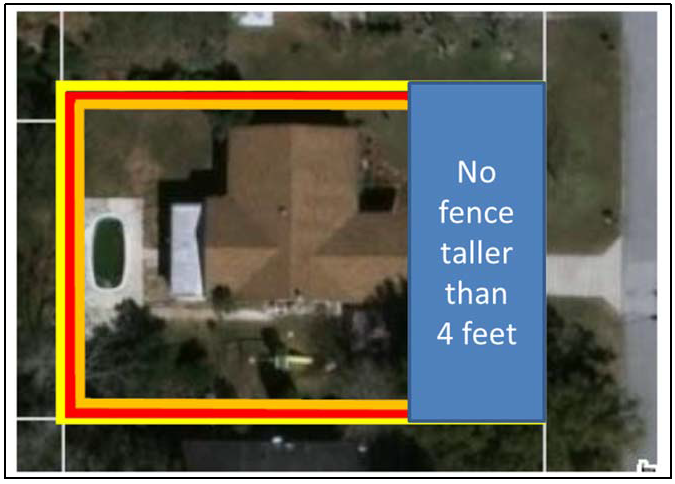
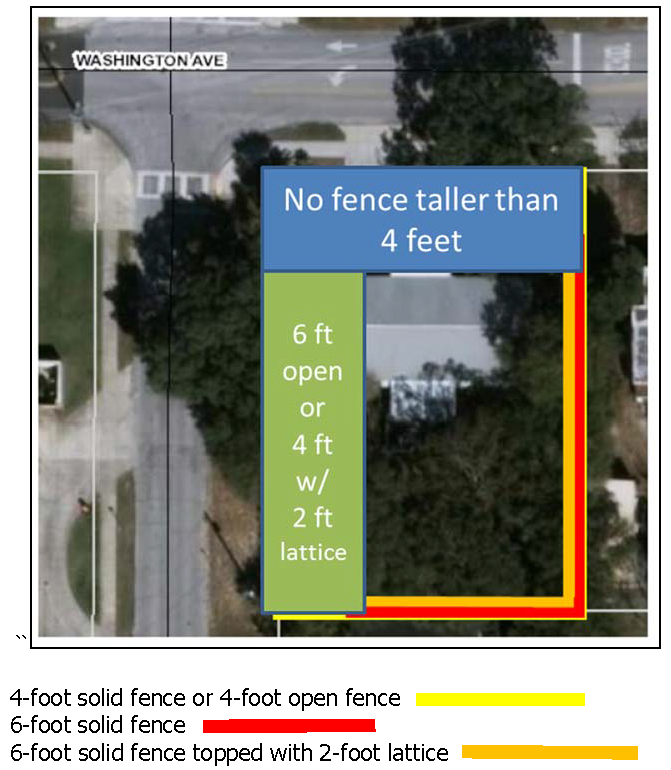
Fences shall be permitted as follows/as depicted on the graphic:
• In a primary street setback, at a maximum height of 4-feet.
• In a secondary street setback, open fencing may be 6-feet high, but opaque fencing shall be limited to a height of 4-feet; 4-foot opaque fences in secondary street setbacks may be topped with additional 2-feet of open or lattice type fencing.
• In a rear or common yard setback, open fences may be 8-feet tall; 6-foot opaque fences may be topped with additional 2-feet of open or lattice type fencing.
• Fences located in landscape buffers along public streets associated with nonresidential or complex building types in suburban design districts are subject to limitations in chapter 115.
• Fences installed for the sole purpose of screening of trash can storage areas, mechanical equipment, or utilities shall be exempt from permitting, provided such fence is clearly not within a required setback and does not exceed maximum height. If necessary to screen existing utilities, the development services director may approve fencing exceeding maximum height in setbacks.
(c)
In areas where the property faces two roadways, or is located in any other area construed to be a corner lot, no fence exceeding four feet high shall be located in the vision triangle, specified in chapter 115, and identified as clear sight zone.
(d)
The smooth side of fence shall face a right-of-way or private road, except split rail.
(e)
A fence constructed for protection and safety from hazard by another public agency may not be subject to the aforementioned height limitations. Approval to exceed the minimum height standards may be given by the director of development services upon receipt of satisfactory evidence of the need to exceed height standards.
(f)
No fence or hedge shall be constructed or installed in such a manner as to interfere with drainage on the site.
(g)
Should the fence encroach on any public easement, the owner shall assume all expense of any necessary removal (either temporary or permanent) or relocation.
(h)
Barbed wire shall be permitted in association with fences as follows:
(1)
In association with bona-fide agricultural uses;
(2)
In conservation (CON) land use districts;
(3)
In general industrial (GI) land use districts atop fences 6 feet or taller;
(4)
On properties where an industrial building lot or industrial complex lot typology has been approved via development plan, site plan, or preliminary subdivision plat atop fences 6 feet or taller;
(5)
On properties containing water/wastewater treatment plants or electric substations atop fences 6 feet or taller;
(6)
On properties with barbed wire fencing installed prior to December 15, 2016, which, upon administrative verification by development services, shall be deemed legally non-conforming and shall be permitted to be repaired or replaced as needed.
(Ord. No. 16-31, § 1.e.(Exh. A), 12-15-2016; Ord. No. 21-09, § 1, 6-17-2021)
Sec. 110-5.8. - Garages
(a)
Garages. All single family dwellings, including mobile homes, duplexes, triplexes, row houses and the like, constructed after the effective date of this section, shall possess a garage as follows:
(1)
Minimum size 300 square feet (12 feet × 18 feet for automobile parking and 12 feet × 7 feet for storage).
(2)
Equipped with an operational overhead door with minimum dimensions of 9 feet × 7 feet, which door, when closed, conceals the interior of the garage.
(b)
Should any property owner enclose or reduce the size of any existing garage or carport below the square footage requirements of this section, then the owner shall mitigate the loss of the garage by providing for on-site parking and outside storage as follows:
(1)
Construct a new garage on the property sufficient to meet the square footage requirements of this section; or
(2)
If in a designated historic district, in an urban design district, or on a legal lot of record that is below the minimum suburban standard, or if enclosing a carport, then the owner may take the following actions in lieu of replacing the garage:
a.
Designate two on-site parking spaces at least 9 feet × 18 feet each in the driveway area or on the residential lot behind the building frontage; and
b.
Provide outside storage by either constructing a storage shed with minimum dimensions of 10 feet × 10 feet in accordance with the Land Development Regulations for accessory structures or by providing outside access to a designated, separated storage area within the enclosed garage or carport (minimum dimensions 12 feet × 7 feet).
(Ord. No. 16-31, § 1.e.(Exh. A), 12-15-2016)
Sec. 110-5.9. - Home occupations.
(a)
The use of a residence for a home occupation shall be clearly incidental and subordinate to its use as a residential structure by the occupants and shall under no circumstances change the residential character of the structure.
(b)
There shall be no change in the outside appearance of the building or premises, or other visible evidence of the conduct of such home occupation, other than a sign as provided for in section 115-11.3.
(c)
No home occupation shall occupy more than 35 percent of the total floor area of the dwelling unit.
(d)
No traffic shall be generated by such home occupation in greater volumes than would normally be expected in a residential neighborhood.
(e)
No equipment, tools, or process shall be used in such a home occupation that creates interference with neighboring properties due to noise, vibration, glare, fumes, odors, or electrical interference.
(f)
Fabrication of articles commonly classified under the terms arts and handicrafts shall be deemed a home occupation provided no retail sales (other than mail-order/internet sales) are made at the home.
(g)
Outdoor storage of equipment or materials shall be permitted if enclosed by an opaque wall, fence, or landscaping of sufficient maturity, density and height to screen such areas from view of the public right-of-way and adjacent properties.
(h)
The following shall not be considered home occupations: Beauty shops, barber shops, studio for group instruction, public dining facility or tea room, photographic studio, fortune telling or similar activity which would rely on impulse buying, outdoor repair, food processing, retail sales (other than mail-order or internet sales), nursery school, or kindergarten.
(i)
The giving of individual instruction to one person at a time, such as an art or music teacher, shall be deemed a home occupation; individual instruction as a home occupation for those activities listed in paragraph (h) above shall be prohibited.
(j)
A home occupation shall be subject to all applicable city/county licensing requirements, fees, and other business taxes.
(Ord. No. 16-31, § 1.e.(Exh. A), 12-15-2016)
Sec. 110-5.10. - Outdoor display.
Outdoor display of the following products may be approved by the development services director or designee when requested by a business owner, via submittal of a site plan indicating the location and dimensions of such display (with a BTR application for new businesses, or at any time for existing businesses), provided that the location of such displays meet the minimum setback requirements on the property subject to the request, and do not interfere with vehicular or pedestrian traffic or required parking. Merchandise associated with an approved special event permit for a seasonal sale or other event shall not be subject to this section.
(a)
Products customarily used outdoors such as pools, spas, lawn furniture, concrete fixtures, landscape or garden supplies and equipment, lumber products, fencing, sheds, and recreational equipment/vehicles.
(b)
New and used motor vehicles, boats, recreational vehicles, mobile homes, and other such vehicles.
(c)
Other retail merchandise subject to the following restrictions:
(1)
Maximum area: The area devoted to outdoor display of merchandise shall not exceed a foot print of 32 square feet per business.
(2)
Maximum height: the maximum height for any portion of an outdoor merchandise display is six feet.
(3)
Dimensions: Outdoor merchandise display areas shall not extend more than five feet from the adjacent store front.
(4)
Display: Merchandise shall be displayed on shelves or tables and/or arranged neatly.
(Ord. No. 16-31, § 1.e.(Exh. A), 12-15-2016)
Sec. 110-5.11. - Outdoor storage.
Outside storage of equipment or materials (not to include display merchandise) shall be permitted, when in compliance with the following requirements:
(a)
An opaque wall shall enclose all storage areas, opaque fence, or landscaping of sufficient maturity, density and height to screen such areas from any public right-of-way or adjoining property, unless other applicable sections of these regulations require stricter screening requirements for specific uses or accessory uses.
(b)
All equipment or materials shall be secured, if necessary, to withstand winds.
(c)
Screening shall not be required around storage areas for operable motor vehicles (i.e. fleet vehicles used in association with a business).
(d)
Storage of licensed and inoperable motor vehicles waiting repair within screened areas on the site of motor vehicle repair facilities and motor vehicle service centers, provided that no such vehicle shall be stored for more than 28 consecutive days. Motor vehicles shall be not be stored for a period exceeding 28 consecutive days unless they are screened from view of the public right-of-way and adjacent properties. If screened by fencing or walls, landscape buffer requirements of the applicable design district shall be required between the property line and fence or wall.
(Ord. No. 16-31, § 1.e.(Exh. A), 12-15-2016)
Sec. 110-5.12. - Pergolas.
A pergola is an architectural element used to define outdoor space, consisting of four columns or posts, topped with beams and open rafters, over which vines or other plants are trained. All pergolas shall comply with street setback requirements as determined by design district/lot type; compliance with the common lot and rear lot setbacks is required for pergolas larger than 100 square feet and taller than 8 feet.
(Ord. No. 16-31, § 1.e.(Exh. A), 12-15-2016)
Sec. 110-5.13. - Short-term, mid-term, and long-term storage containers.
It is the purpose of this section to regulate the placement of storage containers on properties to ensure that any adverse impacts created are minimal both aesthetically and physically to residents and surrounding properties.
(1)
Only authorized short-term, mid-term and long-term storage containers permitted. No person shall place or maintain a storage container except in conformity with this section. Existing non-conforming long-term storage containers shall be removed or brought into compliance with this section no later than June 16, 2022.
(2)
The owner and operator of any site on which a storage container is placed shall be responsible to ensure that the container is in good condition, free from evidence of deterioration, weathering, discoloration, rust, ripping, tearing or other holes or breaks.
(3)
When not in use, containers shall be kept locked.
(4)
Containers shall not be vertically stacked.
(5)
The owner and operator of any site on which container is placed shall also be responsible that no hazardous substances are stored or kept within the container.
(6)
Short-term storage containers (portable storage units or PODs) shall be permitted as follows:
a.
In all districts.
b.
Duration: Once per year for a duration of no more than 30 days.
c.
Maximum size: 8 feet wide, 16 feet long, 8 feet high.
d.
All short-term storage containers (portable storage units) shall be removed immediately upon the issuance of a hurricane warning by a recognized government agency.
(7)
Mid-term storage containers on active construction sites shall be permitted as follows:
a.
In all districts.
b.
Duration: As needed with active permit and active, ongoing construction.
c.
Number: One per homesite or small commercial project; maximum of three subdivision projects.
d.
Maximum size: 10 feet wide, 25 feet long, 8.5 feet high, or 40 feet long if a combination office/storage container is utilized.
(8)
Long-term storage containers with required screening shall be permitted as follows:
a.
In general industrial (GI), mixed commercial/industrial (MCI) and agricultural (AG).
b.
Site plan review required.
c.
Containers shall be fully screened from the view of the public right-of-way and adjacent properties by a masonry or brick enclosure of sufficient height and opacity. The development review committee may, via the administrative site plan or development plan approval process, administratively waive screening requirements when supported by site conditions (containers cannot be seen from public right-of-way or adjacent property). If the site conditions change and the containers are visible from the public right-of-way or adjacent property, such administrative waiver shall be revoked.
d.
Number of containers shall be limited to the extent that maximum impervious surface area of the parcel is not exceeded.
e.
Maximum size: 10 feet wide, 40 feet long, 8.5 feet high.
(9)
Long-term storage containers without required screening shall be permitted as follows:
a.
In general industrial (GI) and mixed commercial/industrial (MCI) with conditional use permit approval by city commission.
b.
Site plan review required.
c.
Number of containers shall be limited to the extent that maximum impervious surface area of the parcel is not exceeded.
d.
Maximum size: Per conditional use permit conditions.
(Ord. No. 16-31, § 1.e.(Exh. A), 12-15-2016; Ord. No. 21-09, § 1, 6-17-2021; Ord. No. 21-40, § 1, 12-16-2021)
Sec. 110-5.14. - Residential vehicle storage/parking.
(a)
Vehicle storage/parking in residential areas (including mixed-use land use districts developed for residential uses) shall be permitted as follows; provided such vehicles comply with section 34-3 of the Code of Ordinances:
(1)
Passenger vehicles and light duty work vehicles, having only two axles and no tandem axles, such as those depicted below with no setback required.
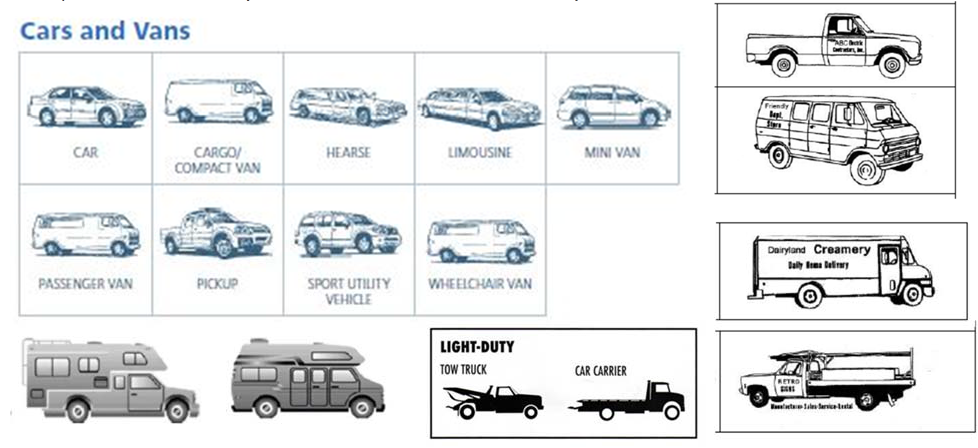
(2)
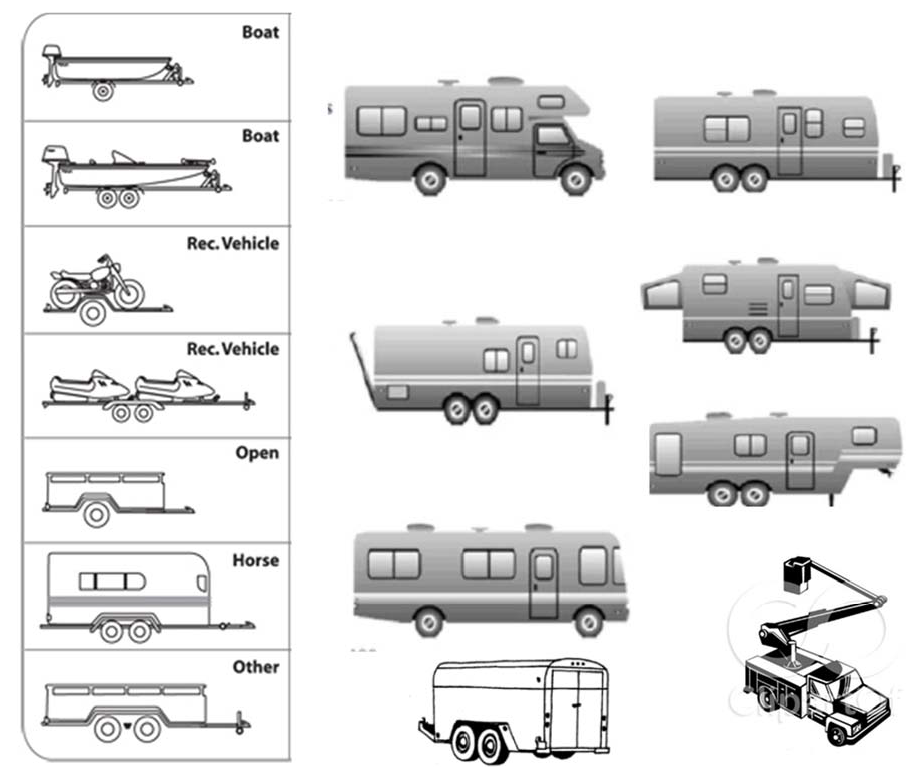
Recreational vehicles and utility trailers such as those depicted below, behind the building frontage on all lots except homestead lots, which must maintain a 25-foot street yard setback (on through lots and corner lots, behind the building frontage on the primary street with a 25-foot secondary street yard setback), provided that any open trailer loaded with debris, equipment or other materials must be screened from view of the right-of-way and neighboring properties.
a.
At no time shall such vehicles be occupied or used for living, sleeping or housekeeping purposes. The use of a trailer or mobile home as a dwelling or living unit on any lot other than a licensed and approved mobile home park, mobile home subdivision, or recreational vehicle park, within the MH/RV mobile home/recreational vehicle land use district shall not be permitted.
b.
At no time shall such vehicles be connected to any water, sewer or gas utility services unless they are within a MH/RV mobile home/recreational vehicle land use district.
c.
The city commission may authorize motor homes, trailers, or other conveyances during city-authorized or other special events at specific sites for a specified time period.
d.
All recreational vehicles described herein, which are parked on residential property shall be licensed in accordance with all laws of the State of Florida.
(3)
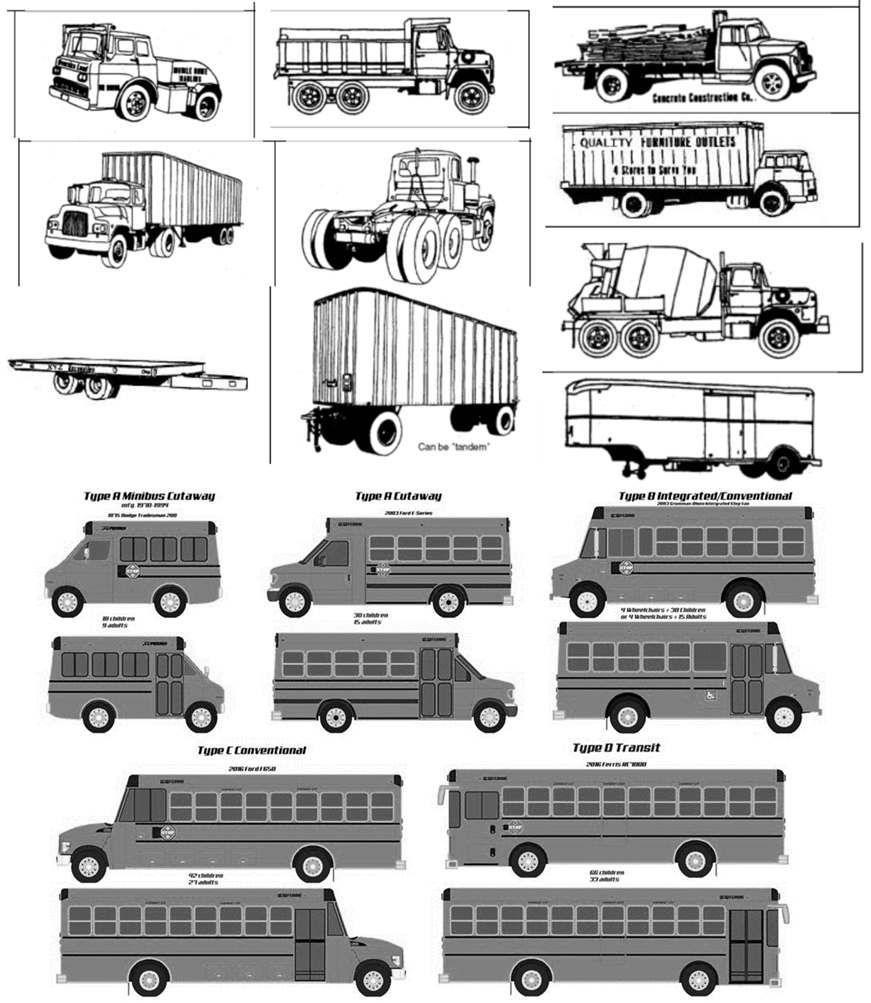
Heavy duty vehicles, as determined by the development services director, busses, and trailers such as those depicted below are not permitted. Semi-trucks and trailers shall not be parked/stored in any residential area or mixed-use land use district developed as residential. No semi-trucks, trailers or other motor vehicle designed primarily for drawing other trailers or vehicles shall be parked or stopped in the in residential areas unless such semi-truck or trailer is actively in the process of loading or unloading and then such vehicle may only be stopped or parked for such period of time as is necessary to complete the process of loading or unloading the vehicle. Under no circumstances may a semi-truck or trailer remain parked or stopped in any residential land use district or mixed-use land use district developed as residential overnight.
(4)
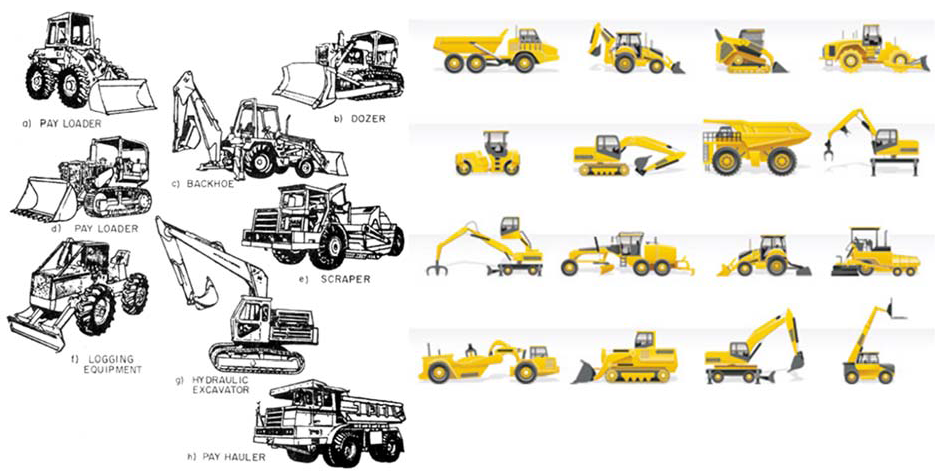
Heavy equipment such as that depicted below shall only be permitted on properties with an active building permit.
(Ord. No. 16-31, § 1.e.(Exh. A), 12-15-2016)
Sec. 110-5.15. - Sheds storage buildings, utility buildings, greenhouses and other accessory structures (permanent or temporary).
(a)
No accessory building used for industrial storage of hazardous, incendiary, noxious, or pernicious materials shall be located within 100 feet of any property line.
(b)
Storage buildings, greenhouses, and similar structures shall be permitted only if in compliance with standards for distance between buildings, and setbacks, if any, from property lines.
(c)
All accessory structures regulated by this chapter shall be permitted only in side and rear yards, unless there are extenuating circumstances that would justify placement in the street yard with no adverse effects on surrounding properties.
(d)
All accessory structures regulated by this chapter, except temporary ones as determined by the director, shall be included in all calculations for impervious surfaces, floor area ratios, or other site design requirements applying to the principal use of the lot.
(e)
Vehicles, including new and existing tractor-trailers, truck beds, manufactured housing, and mobile homes shall not be used as storage buildings, utility buildings, or other such uses.
(Ord. No. 16-31, § 1.e.(Exh. A), 12-15-2016; Ord. No. 21-09, § 1, 6-17-2021)
Sec. 110-5.16. - Swimming pools, hot tubs, spas and similar structures.
(a)
Swimming pools, hot tubs, spas, and similar structures shall be permitted only in side and rear yards but not upon any utility easement.
(b)
Enclosures for pools, hot tubs, spas, and similar structures shall not be considered a part of the principal structure and shall comply with accessory use standards for minimum distance between buildings, yard requirements, and other building location requirements of this land development regulation.
(Ord. No. 16-31, § 1.e.(Exh. A), 12-15-2016)

