
Evanston City Zoning Code
CHAPTER 16
OFF-STREET PARKING AND LOADING
6-16-1-1. - SCOPE OF REGULATIONS.
The off-street parking and loading provisions of this Ordinance shall apply to all buildings and structures erected and all uses of land established after the effective date of this Ordinance:
However, where a building permit has been issued prior to the effective date of this Ordinance and provided that construction is begun within six (6) months of such effective date and diligently pursued to completion (completion to be accomplished within eighteen (18) months of the effective date of this Ordinance), parking and loading facilities in the amounts required for the issuance of said building permit may be provided in lieu of any different amounts required by this Ordinance. If such building permit pertains to a stage of development only, any subsequent stage for which a building permit is required shall comply with the parking and loading requirements set forth in this Chapter.
6-16-1-2. - EXEMPTION FROM OFF-STREET PARKING AND LOADING REQUIREMENTS FOR EXISTING BUILDINGS AND USES.
Changes in the use or intensity of use of a building and/or land area, which do not include construction of a new building, or building addition (i.e., increase in gross floor area), shall be exempt from the parking and loading requirements of this Chapter, except in the following cases:
(A)
Changes in use to religious institution in the business, commercial, or downtown districts.
(B)
Increases in density of a residential use outside of the downtown or research park districts.
(Ord. No. 77-O-10, § 6, 12-13-10; Ord. No. 154-O-14, § 2, 1-12-2015; Ord. No. 17-O-22, § 1, 3-28-2022)
6-16-1-3. - EXISTING PARKING AND LOADING FACILITIES.
Accessory off-street parking and loading facilities in existence on the effective date hereof shall not hereafter be reduced below the parking and loading requirements of this Ordinance.
(Ord. No. 43-O-93)
6-16-1-4. - EXEMPTION OF REQUIRED PARKING SPACES.
Except as limited in Section 6-16-1-3 of this Chapter, the first two thousand (2,000) square feet for any building on a nonresidential lot in the business B1, B1a, B2, B3, C1, C1a, C2, O1, MU, MUE and MXE districts, and the first three thousand (3,000) square feet for any building on a nonresidential lot in the D1, D2, D3, and D4 districts shall be exempt from the calculation for required parking spaces. The exemption shall be applied to the least generating use on the lot. Only one (1) exemption shall be allowed per zoning lot.
(Ord. 88-O-09)
6-16-1-5. - VOLUNTARY PROVISION OF ADDITIONAL PARKING AND LOADING FACILITIES.
Nothing in this Ordinance shall be deemed to prevent the voluntary establishment of off-street parking or loading facilities to serve any existing use of land or buildings, provided that all regulations of this Ordinance governing the location, design, and operation of such facilities are adhered to.
(Ord. No. 43-O-93)
6-16-1-6. - DAMAGE OR DESTRUCTION.
For any conforming or legally nonconforming building or use that is in existence on the effective date hereof, that thereafter is damaged or destroyed by fire, collapse, explosion or other cause, and that is reconstructed, reestablished, or repaired, off-street parking or loading facilities in compliance with the requirements of this Chapter need not be provided, except that parking or loading facilities equivalent to any maintained at the time of such damage or destruction shall be restored or continued in operation. However, in no case, shall it be necessary to restore or maintain parking or loading facilities in excess of those required by this Ordinance for equivalent new uses or construction.
(Ord. No. 43-O-93)
6-16-1-7. - SUBMISSION OF A SITE PLAN.
Any application for a building permit affected by this Chapter shall include a site plan, drawn to scale and fully dimensioned, showing any off-street parking or loading facilities to be provided in compliance with this Ordinance.
(Ord. No. 43-O-93)
6-16-2. - GENERAL OFF STREET PARKING REQUIREMENTS.
Each principal building or use shall provide the minimum number of off-street parking spaces as identified in Table 16-B of this Chapter and the minimum off street loading facilities identified in Table 16-E of this Chapter.
(Ord. 45-O-09)
6-16-2-1. - LOCATION OF PARKING SPACES.
(A)
Parking spaces required for single-family dwellings and two-family dwellings shall be located on the same lot as the dwelling served or on an abutting lot.
(B)
Parking spaces required for all nonsingle-family/two-family dwellings and/or buildings shall be located on the same lot; provided, however, that when ten (10) or more parking spaces are required:
1.
Said parking spaces may be provided on a lot located not more than one thousand (1,000) feet from the lot requiring said parking, provided the lot is within the same zoning district or a less restrictive zoning district and further provided, the lot shall be held under the same ownership or leasehold interest as the zoning lot occupied by the building or use to which the parking facilities are accessory. Said lot shall be owned by the owner of the building requiring the parking, except where otherwise provided in this Ordinance.
Private possession of off-street parking facilities may be either by deed or by such long-term lease as is approved by the Zoning Administrator. The deed or lease shall require such owner or his or her heirs or assigns to maintain the required number of parking facilities for the duration of the use served or the deed or lease, whichever ends first.
2.
In all but R1 through R4 residential districts, part or all of the required parking spaces, regardless of the number required, may, at the City's discretion, be leased from the City to serve the subject property, so long as they are located not more than one thousand (1,000) feet from the lot requiring said parking, and are not located in a more restrictive zoning district than the building and uses they are to serve.
(C)
In addition to the requirements for location of parking set forth in each zoning district, the following requirements shall apply:
1.
The location of required parking spaces shall be no closer than the established building plan for the front and side yard abutting a street when a building is established with a greater setback than required by the district, and parking is prohibited in front and side yards abutting a street; and
2.
The prohibition against parking in any yards shall not be interpreted to prohibit the use of surfaced driveways for the temporary parking of automobiles.
(Ord. No. 43-O-93)
6-16-2-2. - ACCESS.
All off street parking facilities shall be designed with appropriate means of vehicular access to a street or alley in a manner that will least interfere with street traffic movement. All vehicular access/driveways must be hard-surfaced pursuant to Subsection 6-16-2-8(E) of this Chapter. In addition, all vehicular access driveways shall be designed and constructed in accordance with Section 7-3-8 of this Code.
(Ord. No. 43-O-93)
6-16-2-3. - UTILIZATION OF REQUIRED PARKING SPACES.
Except as otherwise provided in this Section 6-16-2, required accessory off-street parking facilities provided for uses listed in Section 6-16-3 of this Chapter shall be solely for the parking of passenger automobiles of owners, guests, patrons, occupants, or employees of such uses.
(Ord. No. 43-O-93)
6-16-2-4. - SIZE OF PARKING STALLS.
Except for parallel parking spaces, each required off-street parking space shall be at least eight and one-half (8½) feet in width and at least eighteen (18) feet in length, exclusive of access drives or aisles, ramps, columns, or office work areas. For parallel parking, the width of the parking space shall be decreased to eight (8) feet and the length of the parking space shall be increased to twenty-one (21) feet. All other requirements as to size shall be as hereinafter set forth in the schedule of off-street parking requirements set forth in Table 16-B, Section 6-16-3-5 of this Chapter.
(Ord. No. 43-O-93)
6-16-2-5. - VERTICAL CLEARANCE.
Such space shall have a vertical clearance of at least seven (7) feet, and shall be measured at right angles to the axis of the vehicle.
(Ord. No. 43-O-93)
6-16-2-6. - ACCESSIBLE PARKING.
Accessible parking, including the size, location, and number of spaces, shall be provided as required by the Americans with Disabilities Act (ADA) Standards for Accessible Design, as amended from time to time.
(Ord. No. 63-O-22, § 1, 8-8-2022)
Editor's note— Ord. No. 63-O-22, § 1, adopted August 8, 2022, amended Section 6-16-2-6 in its entirety to read as herein set out. Formerly, Section 6-16-2-6 pertained to handicapped parking, and derived from Ord. No. 43-O-93.
6-16-2-7. - OFF STREET PARKING DIMENSIONS.
(A)
The dimensions for parking stalls and associated aisles are set forth in Table 16-A of this Section.
(B)
The following exceptions to the dimensions set forth in Table 16-A of this Section shall apply:
1.
Nonparallel parking stalls (those with a parking stall angle that exceeds 0 degrees) for which an abutting alley serves as a portion of an aisle need only be located with a minimum aisle (which may be partially comprised of driveways or public alleys) of thirteen (13) feet; provided that the application of said thirteen-foot minimum aisle width shall not result in a minimum parking stall setback from the alley lot line across which access to the stall is obtained, of less than two (2) feet, nor more than five (5) feet; and
2.
Parallel parking stalls (those with a 0 degree parking stall angle) for which an abutting alley serves as a portion of an aisle need only be located a minimum of two (2) feet from the alley lot line across which access to the stall is obtained.
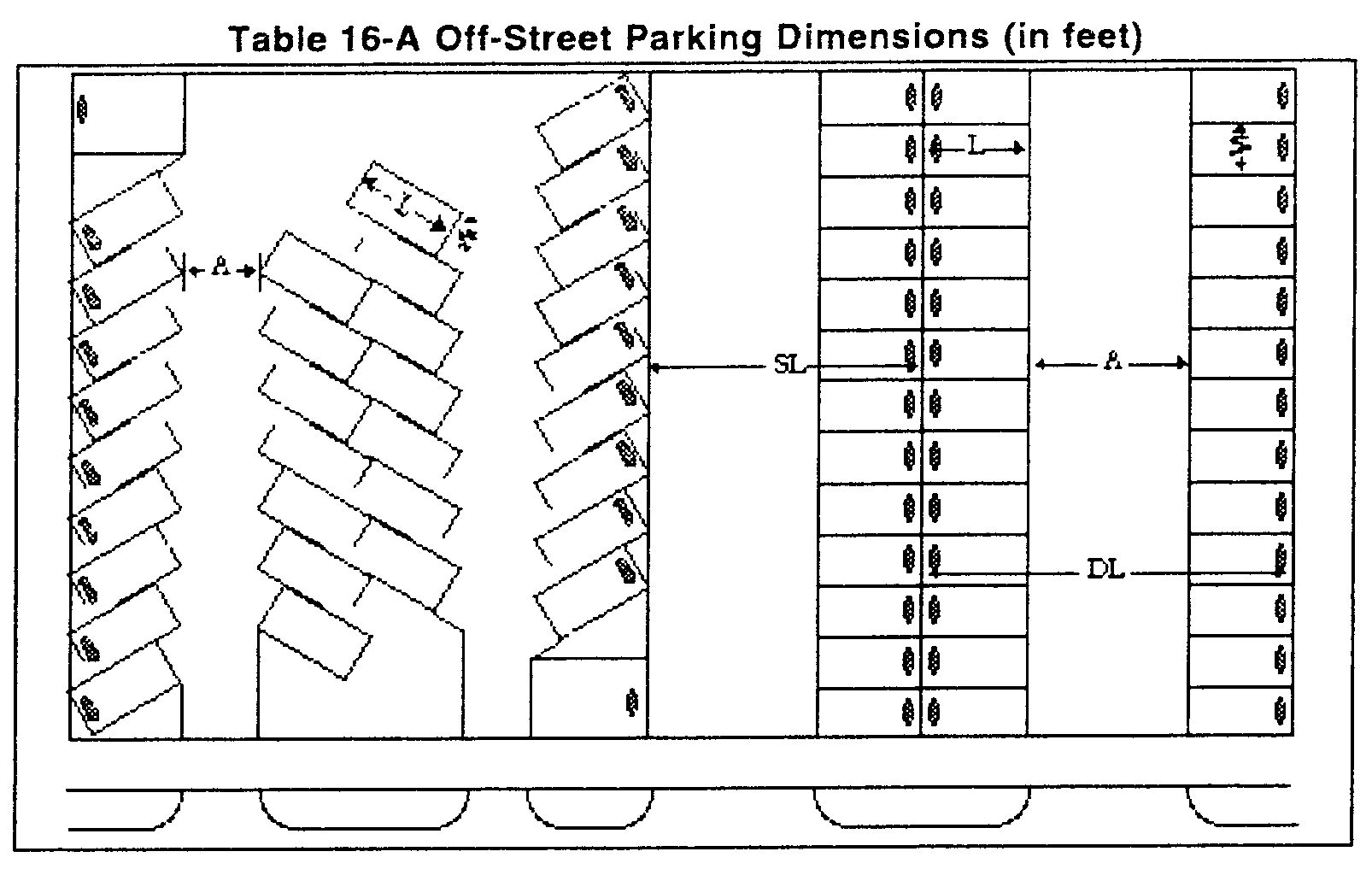
KEY:
O - Parking angle
l - Parking space length
SL - Single loaded module width
W - Parking space width
A - Aisle width
DL - Double loaded module width
* Two-way traffic authorized
___________
Note: Required parking for stall angles other than those contained in the above Table
may be interpolated from said Table.
6-16-2-8. - DESIGN AND MAINTENANCE.
Parking lots and areas shall be designed to ensure safe and easy ingress, egress, and movement through the interior of the lot. The number of curb cuts onto major roads should be minimized. Parking lot islands should be provided on the interior of the parking lot to help direct traffic flow and to provide landscaped areas within such lots.
Parking lots shall be designed in accordance with the guidelines contained in the Manual of Design Guidelines to be prepared by the Land Use Commission and adopted by the City Council. Such guidelines shall address:
•
Minimum distances between curb cuts;
•
Proximity of curb cuts to intersections;
•
Provisions for shared driveways;
•
Location, quantity and design of landscaped islands; and
•
Design of parking lot interior circulation system.
(A)
Plan: The design of parking lots or areas shall be subject to the approval of the Design and Project Review Committee, in accordance with standards set forth in the Manual of Design Guidelines and any additional standards established by the Zoning Administrator.
(B)
Landscaping and Screening: Landscaping and screening shall be provided in accordance with the requirements of Chapter 17, "Landscaping and Screening," and the landscape standards for parking lots set forth in the Manual of Design Guidelines.
(C)
Lighting: Where a parking area or parking lot is illuminated fixed lighting shall be arranged to prevent direct glare beams onto any public property, including streets and any adjoining private property.
(D)
Signs: Accessory signs shall be permitted on parking areas in accordance with the provisions specified in the Sign Ordinance [22] of the City.
(E)
Parking Lot Surface: All open parking areas or lots shall be improved in accordance with regulations applicable to driveway pavement thickness contained in Subsection 7-3-8(C) of the Evanston City Code.
(Ord. No. 66-O-15, § 31, 6-22-2015; Ord. No. 52-O-22, § 74, 6-27-2022)
See Title 4, Chapter 12 of this Code.
6-16-2-9. - PROVISION FOR COLLECTIVE PARKING.
(A)
Off-street parking facilities for separate uses may be provided collectively if the total number of spaces so provided is not less than the sum of the separate requirements of each such use and all regulations governing location of accessory parking spaces in relation to the use served are adhered to. No parking space or portion thereof shall serve as a required space for more than one (1) use unless otherwise authorized by the Zoning Administrator.
(B)
The Zoning Administrator may authorize a reduction in the total number of required parking spaces for two (2) or more nonresidential uses jointly providing off-street parking when their respective hours of operation do not overlap. (See the Schedule for Minimum Off-Street Parking Requirements in Table 16-B of this Chapter.) Reduction of joint use parking shall be subject to the following conditions:
1.
No more than fifty percent (50%) of the parking spaces required for a building or use may be supplied by parking facilities required for any other building or use.
2.
The number of shared spaces for two (2) or more distinguishable land uses shall be determined by the following procedure:
(a)
Multiply the minimum parking required for each individual use, as set forth in Table 16-B Schedule of Minimum Off-Street Parking Requirements, Section 6-16-3 of this Chapter, by the appropriate percentage indicated in Table 16-D, Schedule of Shared Parking Calculations, Section 6-16-3 of this Chapter, for each of the six (6) designated time periods; then
(b)
Add the resulting sums for each of the six (6) columns; then
(c)
The minimum parking requirement shall be the highest sum among the six (6) columns resulting from the above calculations.
3.
If one (1) or all of the land uses proposing to make use of joint parking facilities do not conform to one (1) of the general land use classifications in the Schedule of Shared Parking Calculations as determined by the Zoning Administrator, then the petitioner shall submit sufficient data to indicate that there is not substantial conflict in the principal operating hours of the uses.
4.
The property owners involved in the joint use of off-street parking facilities shall submit a legal agreement approved by the City Attorney guaranteeing that the parking spaces shall be maintained so long as the use requiring parking is in existence or unless the required parking is provided elsewhere in accordance with the provisions of this Chapter. Such instrument shall be recorded by the property owner with the County Recorder of Deeds, and a copy filed with the Zoning Administrator.
(C)
Within the RP research park district a land user may request and the Zoning Administrator may authorize a reduction in the total number of required parking spaces for two (2) or more nonresidential uses jointly utilizing off-street parking when their respective hours of operation do not overlap based upon an estimation of parking demand as computed from the following tables of the Urban Land Use Institute:
1.
The table of default values as a percentage of peak month demands for various land uses and times, which also may be known as Table 16-F, Monthly Variation In Peak Parking Demand Ratios-Default Values (Percent Of Peak Month); and
2.
The table of default values as a percentage of peak hour demands for various land uses and times, which also may be known as Table 16-G, Representative Hourly Accumulation By Percentage Of Peak Hour.
Any reduction in the total number of required parking spaces authorized by this Subsection is subject to the provisions of Subsections (A) and (B)4 of this Section.
Nothing herein shall prohibit a land user within the RP research park district from requesting and the Zoning Administrator from authorizing a reduction in the total number of required parking spaces for two (2) or more nonresidential uses jointly utilizing off-street parking when their respective hours of operation do not overlap based on Table 16-D of this Zoning Ordinance as provided for in Subsection (B) of this Zoning Ordinance.
TABLE 16-F
MONTHLY VARIATION IN PEAK PARKING DEMAND RATIOS-
DEFAULT VALUES (PERCENT OF PEAK MONTH)
TABLE 16-G
REPRESENTATIVE HOURLY ACCUMULATION BY
PERCENTAGE OF PEAK HOUR
6-16-2-10. - RETAIL/SERVICE USES REQUIRED ON GROUND FLOOR OF PARKING STRUCTURES IN B, C AND D DISTRICTS.
Parking structures located in the B1, B1a, B2, B3, C1, C1a, C2, D1, D2, D3 and D4 districts shall include retail or service uses at the ground level of any portion of the structure fronting a dedicated public street.
(Ord. 136-O-05)
6-16-2-11. - BICYCLE PARKING FACILITIES.
New public, hospital, university or college buildings, and shopping centers shall provide bicycle parking facilities if required by the Design and Project Review Committee.
(Ord. No. 43-O-93; Ord. No. 66-O-15, § 32, 6-22-2015)
6-16-2-12. - INTERPRETING CALCULATION OF FRACTIONAL PARKING SPACES.
(A)
When determination of the number of off street parking spaces required by this Ordinance results in a requirement of a fractional space, any fraction of less than one-half (1/2) may be disregarded, while a fraction of one-half (1/2) or more, shall be counted as one parking space.
(B)
Parking spaces required on an employee basis shall be based on the maximum number of employees on duty or residing on the premises, or both, at any one time.
(Ord. No. 43-O-93)
6-16-3-1. - PARKING SPACE DESIGN AND PROVISION.
All off street parking spaces hereinafter required by this Chapter, except those required for single- and two-family dwellings, shall be designed and provided in accordance with the requirements of this Section 6-16-3. Off street parking spaces for new developments shall be provided at the rate specified for a particular use in Table 16-B, Section 6-16-3-5 of this Chapter.
(Ord. No. 43-O-93)
6-16-3-2. - PARKING SPACES FOR ACCESSORY USES.
Parking spaces for accessory uses not specifically enumerated within a parking class shall be assumed to be included in the principal (permitted or special) use requirement.
(Ord. No. 43-O-93)
6-16-3-3. - CALCULATION OF PARKING SPACE REQUIREMENTS FOR MIXED USE DEVELOPMENTS.
In computing required parking spaces, the total number of required spaces shall be based upon the parking requirements for the principal use of the zoning lot except that where residential uses are proposed as part of a mixed use development, the number of parking spaces for residential units shall be calculated separately from and in addition to the parking requirements for the nonresidential uses proposed as part of the mixed use development.
(Ord. No. 43-O-93)
6-16-3-4. - DETERMINATION OF REQUIRED NUMBER OF PARKING SPACES FOR USES NOT SPECIFIED HEREIN.
In the event this Chapter does not specify the number of parking spaces for a specific use, the Zoning Administrator shall determine the number of spaces required. In making this determination, the Zoning Administrator shall consider the following criteria:
(A)
The number of parking spaces required for a use listed in Table 16-B, Section 6-16-3-5 of this Chapter that is the most similar to the proposed use in terms of the parked vehicles that are anticipated to be generated;
(B)
The square footage to be occupied by the proposed use; and
(C)
The number of employees and patrons that are anticipated for the proposed use.
(Ord. No. 43-O-93)
6-16-3-5. - PARKING REDUCTION ALLOWANCE FOR THE D1, D2, D3, AND D4 DISTRICTS.
For all new buildings located in the D1, D2, D3, and D4 districts, there shall be available a parking reduction allowance of twenty percent (20%). The reduction allowance shall be used to reduce the portion of a building's nonresidential parking requirement so that buildings in the D1, D2, D3, and D4 districts shall be required to provide only eighty percent (80%) of the nonresidential required parking spaces for a given use. Parking spaces provided to satisfy a building's residential parking requirement in the D1, D2, D3, and D4 districts shall be provided in full.
(Ord. No. 43-O-93)
TABLE 16-B — SCHEDULE OF MINIMUM
OFF STREET PARKING REQUIREMENTS
Each principal building or use shall have the following minimum number of parking spaces:
(Ord. No. 43-O-93; Ord. No. 45-O-09; Ord. No. 154-O-14, § 3, 1-12-2015; Ord. No. 117-O-16, § 9, 12-12-2016; Ord. No. 92-O-17, § 1, 9-25-2017; Ord. No. 41-O-18, §§ 1, 2, 10-3-2018; Ord. No. 171-O-19, § 5, 1-13-2020; Ord. No. 86-O-20, § 3, 9-29-2020; Ord. No. 13-O-21, § 17, 3-22-2021)
TABLE 16-C - RESERVED
Editor's note— Ord. No. 63-O-22, § 2, adopted August 8, 2022, repealed the former Table 16-C in its entirety, which pertained to handicapped parking stall requirements, and derived from Ord. No. 43-O-93.
TABLE 16-D - SCHEDULE OF SHARED PARKING CALCULATIONS
How to use the schedule of shared parking:
For each applicable general land use category, calculate the number of spaces required for a use if it were freestanding (refer to the schedule of minimum off street parking requirements). Use those figures for each land use to calculate the number of spaces required for each time period for each use (six (6) time periods per use). For each time period, add the number of spaces required for all applicable land uses to obtain a grand total for each of the six (6) time periods. Select the time period with the highest total parking requirement and use that total as the shared parking requirement.
(Ord. No. 43-O-93)
6-16-4-1. - LOCATION.
(A)
All required loading berths shall be located on the same zoning lot as the use served. All motor vehicle loading berths that abut a residential district or an intervening alley, separating a residential district from a business, commercial or industrial district shall be completely screened therefrom according to the standards contained in the "Manual Of Design Guidelines."
(B)
No permitted or required loading berth shall be located within thirty (30) feet of the nearest point of intersection of any two (2) streets. No loading berth shall be located in a required front yard. Any loading berth located in a required rear yard may be open to the sky.
(C)
Loading berths that are open to the sky shall be subject to the open parking setbacks required in the underlying zoning district.
(Ord. No. 43-O-93; Ord. No. 69-O-23, § 3, 7-24-2023)
6-16-4-2. - ACCESS.
Each required off street loading berth shall be designed with appropriate means of vehicular access to a street or alley in a manner that will least interfere with traffic movement, and shall be subject to approval by the Design and Project Review Committee.
(Ord. No. 43-O-93; Ord. No. 66-O-15, § 33, 6-22-2015)
6-16-4-3. - UTILIZATION OF OFF-STREET LOADING AREAS.
Space allocated to any off-street loading use shall not, while so allocated, be used to satisfy the space requirements for any off-street parking facilities or portions thereof.
6-16-4-4. - SIZE.
Unless otherwise specified, a required off-street loading berth shall be at least ten (10) feet in width by at least thirty-five (35) feet in length for short berths, and twelve (12) feet in width by at least fifty (50) feet in length for long berths exclusive of aisle and maneuvering space. Maneuvering aprons of appropriate width and orientation shall be provided and will be subject to approval by the Design and Project Review Committee.
(Ord. No. 66-O-15, § 34, 6-22-2015)
6-16-4-5. - VERTICAL CLEARANCE.
All loading areas shall have a vertical clearance of at least fourteen (14) feet.
6-16-4-6. - MINIMUM FACILITIES.
Uses for which off-street loading facilities are required herein, but that are located in buildings of less floor area than the minimum prescribed for such required facilities, shall be provided with adequate receiving facilities, accessible by motor vehicle off any adjacent alley, service drive, or open space on the same zoning lot.
6-16-4-7. - CENTRAL LOADING.
Central loading facilities may be substituted for loading berths on the individual zoning lots, provided the following conditions are fulfilled:
(A)
Each zoning lot served shall have direct access to the central loading area without crossing streets or alleys at-grade.
(B)
Total off-street loading berths provided shall meet the minimum requirements herein specified, based on the use of the several types of uses served. (Area of types of uses may be totaled before computing number of loading berths.)
(C)
No zoning lot served shall be more than five hundred (500) feet away from the central loading area.
(D)
The tunnel or ramp connecting the central loading area with the zoning lot served shall be not less than seven (7) feet in width and have a clearance of not less than seven (7) feet.
6-16-4-8. - DESIGN AND MAINTENANCE.
(A)
Design of Loading Areas: All loading areas shall be oriented away from adjacent residential or other incompatible uses. Loading areas should be designed in conformance with the standards contained in the Manual of Design Guidelines.
(B)
Plan: The design of loading areas shall be subject to the approval of the Design and Project Review Committee in accordance with any additional standards established by the Zoning Administrator.
(C)
Landscaping and Screening: Landscaping and screening shall be provided in accordance with the requirements of Chapter 17, "Landscaping and Screening," and the landscape standards set forth in the Manual of Design Guidelines.
(D)
Lighting: Any lighting used to illuminate loading areas shall be so arranged as to prevent direct glare of beams onto any public property including streets and any adjoining private property, and residential properties in such a way as not to create a nuisance.
(E)
Cleaning and Maintenance: Except in the industrial districts, no cleaning or maintenance of loading areas utilizing motorized equipment may be performed between 9:00 p.m. and 7:00 a.m. each day, except for snow removal.
(F)
Signs: Accessory signs shall be permitted on loading areas in accordance with the provisions specified in the Sign Ordinance [23] of the City.
(G)
Loading Area Surface: Loading area surfaces shall be graded and drained to dispose of all surface water and to provide effective drainage without allowing the water to cross the sidewalk or driveway.
(Ord. No. 66-O-15, § 35, 6-22-2015)
See Title 4, Chapter 12 of this Code.
6-16-5. - SPECIFIC OFF-STREET LOADING REQUIREMENTS.
Off-street loading facilities for new developments shall be provided at the rate specified for a particular use in the following Schedule of Off-Street Loading Requirements.
TABLE 16-E - SCHEDULE OF OFF-STREET LOADING REQUIREMENTS

