
Evanston City Zoning Code
CHAPTER 4
GENERAL PROVISIONS
6-4-1-1. - ALLOWABLE USES OF LAND AND BUILDINGS.
The following types of uses of land and buildings, and no others, are allowed in the zoning districts established by this Ordinance:
(A)
Permitted uses specifically listed in the various districts or specifically permitted in all districts.
(B)
Special uses specifically listed in the various districts or specifically provided for in all districts, but only in accordance with the standards and procedures for special uses set forth in Section 6-3-5, "Special Uses," of this Title.
(C)
Unique uses as authorized pursuant to the standards and procedures for unique uses set forth in Section 6-3-7, "Unique Uses," of this Title.
(D)
Uses lawfully existing on the effective date hereof, subject to all the provisions of Chapter 6, "Nonconforming Uses And Noncomplying Structures," of this Title.
(Ord. No. 43-O-93)
6-4-1-2. - TRANSITION RULES.
Where an application for a building permit for a building, structure or planned development, accompanied by working drawings, has been submitted prior to the effective date hereof, and a building permit issued with in six (6) months of the date of the submittal of such building, structure or planned development, the proposed project may be completed in accordance with the approved plans provided construction is commenced within one hundred eighty (180) days of the issuance of the building permit. In addition, any project which has secured preliminary Design and Project Review Committee approval, and any project requiring a variation or approval as a special use, including a planned development, and that receives such approval prior to the effective date hereof, may proceed under the zoning regulations, including applicable time limitations, in effect as of the date of such approval.
(Ord. No. 43-O-93; Ord. No. 66-O-15, § 10, 6-22-2015)
6-4-1-3. - EXISTING PERMITTED AND SPECIAL USES.
Any use classified by this Ordinance as a permitted use or a special use, that was legally established as such a use on or before the effective date hereof shall be deemed to be a legal permitted use or a legal special use under the provisions of this Ordinance.
(Ord. No. 43-O-93)
6-4-1-4. - INTERPRETATION OF USE TABLE.
The Zoning Administrator may, pursuant to Section 6-3-9, "Administrative Interpretations," of this Title, authorize a land use in certain instances when, though not contained by name in the use table of a zoning district, it is determined to be similar in nature, impact and character to those uses listed for the particular zoning district in which the use is proposed.
(Ord. No. 43-O-93)
6-4-1-5. - DIVISION OF ZONING LOTS.
(A)
The subdivision of a zoning lot shall be required prior to issuance of a building occupancy permit.
(B)
No improved zoning lot shall be divided hereafter into two (2) or more zoning lots, and no portion of any improved zoning lot shall be conveyed, unless all zoning lots resulting from each such division or sale shall conform with all applicable lot size, bulk, parking and other applicable zoning district regulations of the zoning district in which the property is located.
(Ord. No. 43-O-93)
6-4-1-6. - NUMBER OF BUILDINGS OR USES ON A ZONING LOT.
(A)
Except when authorized as part of a planned development, approved pursuant to Section 6-3-6, "Planned Developments," of this Title, not more than one principal building shall be located on a zoning lot within the R-1, R-2, R-3, and R-4 single-family zoning districts. For all other districts more than one principal building may be located on a zoning lot provided development of the buildings shall adhere to the requirements of the specific district and this zoning ordinance.
(B)
Except when authorized as part of a planned development, approved pursuant to Section 6-3-6, "Planned Developments," of this Title, and involving an Evanston designated landmark structure, not more than one (1) principal use shall be established on a zoning lot within the R-1, R-2, R-3 and R-4 single-family zoning districts. For all other districts, except where approved as a mixed use development, not more than one (1) principal use shall be established on a zoning lot.
(C)
Except when authorized as a special use, approved pursuant to Section 6-3-5 "Special Use" of this Title, not more than one (1) efficiency home shall be located on a zoning lot, regardless of lot size, width, or shape, in all residential zoning districts.
(Ord. No. 43-O-93; Ord. 39-O-08; Ord. No. 19-O-24, § 2, 3-11-2024)
6-4-1-7. - MINIMUM LOT SIZE.
(A)
Every residential building hereafter erected on a lot or parcel of land created subsequent to the effective date hereof shall be erected on a lot or parcel of land that is in accordance with the lot size requirement of the district within which it is located.
(B)
In any residential district, on a lot of record, on the effective date hereof, a single-family dwelling may be erected regardless of the size of the lot, provided all other requirements of this Code are in compliance. Where two (2) or more contiguous, substandard, recorded, and undeveloped lots are in common ownership, such lots shall be so joined, developed, and used for the purpose of forming a conforming or more nearly conforming zoning lot.
(C)
Such contiguous substandard lots in common ownership shall be considered as being maintained in common ownership after the effective date hereof for zoning purposes. In no case shall a lot created illegally be considered a lot of record.
(Ord. 70-O-07; Ord. No. 72-O-12, § 8, 10-22-2012)
6-4-1-8. - GENERAL LOT AND BULK CONTROLS.
(A)
Control Over Lots: Except as hereinafter provided, no lot, building, structure or premises shall hereafter be used or occupied; no building, structure or premises or part thereof shall be erected, razed, moved, reconstructed, extended, or enlarged except in conformity with the regulations and requirements herein specified for the district in which it is located.
1.
In the R1 through R6 districts, a lot shown on a plat properly recorded in the office of the Cook County recorder or registrar of Torrens titles prior to December 2, 1960, which does not meet the requirements of this Title as to width or area but has a minimum lot width of thirty-five (35) feet, may be used for the following dwelling purposes, if it substantially conforms to other requirements of this Title: a) R1 and R2: single-family dwelling (subject to the limitations/requirements found in Table 4-B of Section 6-4-1-7 of this Chapter); b) R3 through R6 districts: two-family dwelling unit building/duplex.
However, a recorded nonconforming lot may not be used if it was held in common ownership with one (1) or more adjoining lots at any time subsequent to December 2, 1960. Such lots may be used if such lots so held in common ownership together, when used as a single parcel, meet or more nearly meet the requirements of this Title.
(Ord. 70-O-07)
2.
Where two (2) or more adjoining lots shown on a plat properly recorded with the office of the Cook County recorder or registrar of Torrens titles have been held in common ownership at any time subsequent to December 2, 1960, and the use of such adjoining lots as a single parcel would meet or more nearly meet the requirements of this Ordinance, such lots shall not be used in any way to conflict with the regulations of this Ordinance nor shall the ownership of said lots be separated unless such separated lots shall each satisfy a minimum lot width of thirty-five (35) feet except as provided for in Section 6-4-1-7 of this Chapter. Provided that any lot platted prior to the effective date of December 2, 1960, shall be exempt from the minimum lot width requirements of this Ordinance so that previously platted lots may be developed.
3.
No building permits shall be issued for the use of any lot or portion of lots sold, transferred, or conveyed in violation of the provisions of this Section.
4.
Notwithstanding the other provisions of this Section, so long as the lot or lots and the structure or structures thereon, when viewed or treated as a whole, conform with or would not further conflict with the requirements of this Ordinance, then the ownership of individual attached single-family dwelling units (group, row or town houses), garages and appurtenant land (which need not be contiguous), may be conveyed pursuant to any of the three (3) following alternatives:
(a)
As a condominium, a cooperative, or by means of any other arrangement by which the land would remain under single ownership.
(b)
For those townhouse units that share no common elements such as plumbing and heating, parking or access, the individual units may be conveyed, provided mutual covenants are recorded prohibiting any expansion of or additions to the building of which the units are a part, and that in the event of demolition, destruction or condemnation of one (1) or more, but less than all the units, any units constructed may only replace the unit or units that were demolished, destroyed or condemned.
(c)
For all other townhouse buildings, separation of ownership and conveyance of individual units may occur if mutual easements and covenants that recite all the restrictions contained herein and that run with the land and govern at least maintenance and repair of the property and the individual dwelling units thereon are duly recorded against the property as a whole. No townhouse building for which the ownership of individual units is separated under this Section may be expanded or enlarged.
In the event of demolition, destruction or condemnation of one (1) or more, but less than all, of the units, any units constructed may only replace the unit or units that were demolished, destroyed, or condemned. In the event of demolition, destruction, or condemnation of all of the units on the property, new construction must conform to the then existing zoning ordinance.
(d)
Said covenant(s), referred to in (A)4(b) and (c) above, shall be recorded in the office of the Cook County Recorder and a copy of which shall be filed with the Zoning Administrator. Said filings shall not be deemed to constitute approval of the City of such covenant.
(B)
Control Over Bulk:
1.
All new buildings and structures shall conform to the bulk regulations established herein for the district in which each building or structure is located. No existing building or structure shall be enlarged, reconstructed, structurally altered, converted, or relocated in such a manner as to create a conflict or to further conflict with the bulk regulations of this Ordinance for the district in which such building or structure is located. Any enlargement, reconstruction, alteration or relocation shall not be permitted for buildings occupied in whole or in part by a nonconforming use, nor for the purposes of adding a dwelling unit or to increase the density of a residential use unless the building is brought into conformity with all applicable requirements of this Ordinance.
2.
Nothing contained in this Section 6-4-1-8, the district regulations, or Chapter 6, "Nonconforming Uses and Noncomplying Structures," shall be construed to prevent any existing building or structure that is noncomplying only with respect to required yards, from being enlarged, reconstructed, structurally altered, or relocated in a manner that will not further conflict with the provisions of this Ordinance or increase the nonconforming aspects of said building or structure.
3.
In case any of the provisions of this Section 6-4-1-8 are more restrictive than the provisions of Chapter 6, "Nonconforming Uses and Noncomplying Structures," Chapter 6 shall control.
6-4-1-9. - YARDS.
(A)
General Yard Requirements: The following provisions set forth the requirements for required yards and for determining or interpreting unusual yard situations:
1.
Calculation of Minimum Required Yard Space: The minimum yard space required for one (1) building shall not be considered as yard space for another adjoining building.
2.
Maintenance of Minimum Yard Requirements: No lot shall be reduced in area so that the required yards or other open spaces become less than required by this Ordinance.
3.
Setbacks in Residential, Transitional Campus, and University Districts: In residential, transitional campus and university districts, on streets where a setback greater than twenty-seven (27) feet has been maintained for existing buildings on lots having a combined frontage of fifty percent (50%) or more of the total frontage on one side of that portion of the street lying between two (2) intersecting streets, there shall be maintained a front yard setback based on the average setback of those buildings, provided that this regulation shall not be interpreted to require a front yard setback of more than fifty (50) feet nor to permit a setback of less than twenty-seven (27) feet.
4.
Determining of Front Lot Line for Vacant Through Lots, or Corner Lots: On a vacant through lot, or corner lot, any street lot line may be established as its front lot line; except that where two (2) or more through lots are contiguous, and a front lot lien has been duly established on at least one (1) such lot, the same street lot line shall thereafter be deemed to be the front lot line of all such contiguous lots. On a through lot, a front yard shall be provided along both street lot lines. The Zoning Administrator has the authority to determine the front lot line for a corner lot giving consideration including, but not limited to, the following:
a)
If a building exists on the lot, previous determination of the front yard, conformance to existing required setbacks, existing principal building orientation, and location of building entrances;
b)
Proportions of the lot line dimensions, with preference for the front lot line being the shorter lot line abutting a street;
c)
Pattern of existing development within the neighborhood, specifically of adjacent lots; and
d)
The property owner's expressed desire.
5.
Front Yard Setback Exceptions:
(a)
Where a lot is located between two (2) improved lots, one (1) of which has less than the required front yard setback of the zoning district, the front yard required for the lot shall be determined by averaging the front yard setbacks of the two (2) abutting lots.
(b)
Where a lot is located between an improved lot and a vacant lot or a lot improved or vacant, and a street, the front yard required for the lot shall be determined by averaging the front yard setbacks of every lot within two hundred (200) feet on the same side of the street in the same block.
6.
Flag Lots: Flag lot applications shall require site plan review and a major variation approval for a new plat. The required yards shall be designated as part of the platting process.
(B)
Permitted Obstructions in Required Yards:
1.
General Provisions: Yard obstructions attached to the principal or an accessory structure on a site shall include but are not limited to: permanently roofed terraces or porches, chimneys, bay windows, window-mounted air conditioning units, awnings, canopies, arbors, trellises, balconies, overhanging eaves, unenclosed staircases four (4) feet or more above grade, and enclosed staircases.
A yard obstruction is any of these items extending outside of the allowable building envelope and into a required yard. A yard obstruction may extend into no more than ten percent (10%) of the depth of a required yard, except in cases of overhanging roof eaves and gutters for new additions to existing structures, and open front porches. In such cases eaves and gutters may be constructed so to match or more closely match the existing roof eave and gutter, provided that such projection does not encroach upon an adjacent lot line. Open front porches may extend into no more than twenty-five percent (25%) of the required front yard setback, shall not exceed seven (7) feet in depth, and must maintain a minimum ten (10) foot front yard setback.
These yard obstructions may be located in the yards indicated in Table 4-A, Section 6-4-6.
Building envelopes are established by front, side and rear yard requirements contained in each zoning district.
2.
Obstruction of Sight Lines at Intersection: In no event shall a yard obstruction taller than thirty (30) inches be located within twenty (20) feet of the corner curb line of an intersection.
3.
Modified Yard Obstruction Requirements for the Disabled: The limitations on yard obstructions for stairs in Subsection (B)1 above may, upon application, be modified or waived in their application to the property of a disabled individual by the Zoning Administrator pursuant to the procedures for minor variations set forth in Section 6-3-8-6, "Procedure for Minor Variations and Fence Variations," in order to provide accessible ramp or lift at the entrance(s) to the disabled individual's residence. Waiver of the provisions of Subsection (B)1 above shall require the written consent of the property owner or owners adjacent to the yard affected. Such a ramp or lift may be provided only while a disabled individual resides in the residence.
(Ord. No. 45-O-17, § 1, 9-11-2017; Ord. No. 40-O-18, § 1, 8-13-2018)
6-4-1-10. - OUTDOOR STORAGE.
Outdoor storage will be prohibited on lots within all zoning districts, unless otherwise specified in this Ordinance.
6-4-1-11. - SIGNS.
Signs shall be allowed in each zoning district only in accordance with the regulations established in the Sign Ordinance [2] of the City.
See Title 4, Chapter 12 of this Code.
6-4-1-12. - OFF-STREET PARKING AND LOADING.
Off-street parking and loading facilities, accessory to uses allowed in applicable zoning districts, shall be provided in accordance with the regulations established in Chapter 16, "Off-Street Parking and Loading," of this Ordinance.
6-4-1-13. - LANDSCAPING AND SCREENING.
Landscaping and screening shall be provided in accordance with the regulations established in Chapter 17, "Landscaping and Screening," of this Ordinance.
6-4-1-14. - OCCUPANCY OF DWELLING UNITS.
No dwelling unit shall be occupied by more than one (1) type (A), type (B), or type (C) family, as defined in Chapter 18, "Definitions," of this Ordinance except as hereinafter provided:
(A)
Upon written application to the Zoning Administrator, certification of approval shall be issued or occupancy for a dwelling unit by a type (D) family in all districts where dwelling units are allowed, except the R1 and R2 districts, provided that the application establishes that the occupancy conforms with the definition of a type (D) family. The members of a type (D) family household shall not keep or store more than one (1) motor vehicle for each such dwelling unit or for each off-street parking space lawfully existing in connection with such dwelling unit, whichever is greater. Certification would be revoked at any time the occupancy or off-street parking no longer conforms to the definition of a type (D) family, or if a request for current records is not answered so as to establish that the type of ownership complies with the definition of a type (D) family.
(B)
No dwelling unit which contains less than one thousand (1,000) square feet of floor area shall be used to provide living quarters for roomers, servants or permanent guests. Where the floor area of a dwelling unit exceeds one thousand (1,000) square feet and the family occupying the dwelling unit is a type (A) or type (B) family then the dwelling unit may also be used for living quarters for not more than two (2) servants, roomers, or permanent guests, provided that the living quarters are located within the dwelling unit as a physically integral part.
(Ord. No. 43-O-93)
6-4-2-1. - DISTRICTS AUTHORIZED.
A child daycare home shall be a permitted use in all residential districts.
(Ord. No. 43-O-93)
6-4-2-2. - ACCESSORY USE STATUS.
Such child daycare homes shall be accessory uses to dwelling structures, churches, and schools.
(Ord. No. 43-O-93)
6-4-2-3. - LICENSE APPLICATION.
Applications for a license to operate a child daycare home shall be made to, and permits issued by, the City department of health and human services.
(Ord. No. 43-O-93)
6-4-2-4. - APPEALS.
Appeals from a decision made by the department of health and human services to suspend, revoke, or refuse to issue a permit for a child daycare home shall be made to the City Manager or his designee. The decision of the City Manager shall be final.
(Ord. No. 43-O-93)
6-4-3-1. - DISTRICTS AUTHORIZED.
An adult daycare home shall be a permitted use in all residential districts.
(Ord. No. 43-O-93)
6-4-3-2. - ACCESSORY USE STATUS.
Such adult daycare homes shall be accessory uses to dwelling structures and churches.
(Ord. No. 43-O-93)
6-4-3-3. - LICENSE APPLICATION.
Applications for a license to operate an adult daycare home shall be made to, and permits issued by, the City department of health and human services.
(Ord. No. 43-O-93)
6-4-3-4. - APPEALS.
Appeals from a decision made by the department of health and human services to suspend, revoke, or refuse to issue a permit for an adult daycare home shall be made to the City Manager or his designee. The decision of the City Manager shall be final.
(Ord. No. 43-O-93)
6-4-4-1. - PURPOSE.
The purpose of this Section 6-4-4 is to permit the establishment of residential care homes for the "disabled" and "child residential care homes," as defined in Chapter 18, "Definitions," of this Title subject to licensing procedures, and where appropriate, special use standards.
(Ord. 40-O-95)
6-4-4-2. - LICENSE REQUIRED.
No residential care home or child residential care home shall be established, operated or maintained within the City without a valid license issued by the City department of health and human services pursuant to the requirements of Title 8, Chapter 19 of this Code.
(Ord. 40-O-95)
6-4-4-3. - CHILD RESIDENTIAL CARE HOMES AUTHORIZED AS SPECIAL USES IN RESIDENTIAL DISTRICTS.
Child residential care homes may be permitted, as a special use, upon the issuance of a license pursuant to Section 6-4-4-2 of this Chapter, in the R1, R2, R3, R4, R4a, R5 and R6 districts; provided, however, that child residential care homes are not located within nine hundred (900) feet of another child residential care home, residential care home, transitional treatment facility, or an existing childcare institution.
(Ord. 40-O-95; Ord. No. 59-O-20, § 1, 6-22-2020)
6-4-4-4. - RESIDENTIAL CARE HOMES (CATEGORY I - FOUR TO EIGHT RESIDENTS) AUTHORIZED AS PERMITTED USES IN CERTAIN RESIDENTIAL AND NONRESIDENTIAL DISTRICTS.
Residential care homes (category I) shall be permitted, as of right, upon the issuance of a license pursuant to Section 6-4-4-2 of this Chapter, in the R1, R2, R3, R4, R4a, R5, R6, B1, B2, B3, C1a, D1, D2, D3, D4, MU, MXE, T1 and T2 districts; provided, however, that residential care homes (category I) established in the B1, B2, B3, C1a, D2, D3, and D4 districts, shall be located above the ground floor and further provided that no residential care homes (category I) shall be permitted within nine hundred (900) feet of another residential care home or transitional treatment facility.
(Ord. 88-O-09; Ord. No. 59-O-20, § 2, 6-22-2020)
6-4-4-5. - RESIDENTIAL CARE HOMES (CATEGORY I - FOUR TO EIGHT RESIDENTS) AUTHORIZED AS SPECIAL USES IN CERTAIN RESIDENTIAL AND NONRESIDENTIAL DISTRICTS.
Residential care homes (category I) may be permitted as special uses, pursuant to the provisions set forth in Section 6-3-5, "Special Uses," of this Title and upon the issuance of a license pursuant to Section 6-4-4-2 of this Chapter, in the MUE district; provided, however, that no residential care home (category I) shall be permitted within nine hundred (900) feet of another residential care home or transitional treatment facility.
(Ord. No. 43-O-93)
6-4-4-6. - RESIDENTIAL CARE HOMES (CATEGORY II - NINE TO FIFTEEN RESIDENTS) AUTHORIZED AS PERMITTED USES IN CERTAIN RESIDENTIAL AND NONRESIDENTIAL DISTRICTS.
Residential care homes (category II) shall be permitted, as of right, upon the issuance of a license pursuant to Section 6-4-4-2 of this Chapter, in the R4, R4a, R5, R6, D1, MU, and MXE districts; provided, however, that no residential care homes (category II) shall be permitted within nine hundred (900) feet of another residential care home or transitional treatment facility.
(Ord. 88-O-09; Ord. No. 59-O-20, § 3, 6-22-2020)
6-4-4-7. - RESIDENTIAL CARE HOMES (CATEGORY II - NINE TO FIFTEEN RESIDENTS) AUTHORIZED AS SPECIAL USES IN CERTAIN RESIDENTIAL AND NONRESIDENTIAL DISTRICTS.
Residential care homes (category II) may be permitted, as a special use, upon the issuance of a license pursuant to Section 6-4-4-2 of this Chapter, in the R1, R2, R3, B1, B2, B3, C1a, D2, D3, D4, MUE, T1 and T2 districts; provided, however, that residential care homes (category II) established in the D2, D3, and D4 districts, shall be located above the ground floor and further provided that no residential care homes (category II) shall be permitted within nine hundred (900) feet of another residential care home or transitional treatment facility.
(Ord. No. 43-O-93)
6-4-5-1. - PURPOSE.
The purpose of this Section 6-4-5 is to permit the establishment of "transitional treatment facilities," as defined in Chapter 18, "Definitions," of this Title for individuals recovering from addiction to alcohol or narcotic drugs in order to facilitate their transition to independent living.
(Ord. No. 43-O-93)
6-4-5-2. - LICENSE REQUIRED.
No transitional treatment facility shall be established, operated, or maintained within the City without a valid license issued by the City department of health and human services.
(Ord. No. 43-O-93)
6-4-5-3. - TRANSITIONAL TREATMENT FACILITIES (CATEGORY I - FOUR TO EIGHT RESIDENTS) AUTHORIZED AS SPECIAL USES IN CERTAIN RESIDENTIAL DISTRICTS.
A transitional treatment facility (category I) may be permitted as a special use pursuant to the provisions set forth in Section 6-3-5, "Special Uses," of this Title and upon issuance of a license pursuant to Section 6-4-5-2 of this Chapter, in the R1, R2, R3, R4, R4a, R5, R6, MU, MUE, MXE, T1, and T2 districts; provided, however, that no transitional treatment facility (category I) shall be permitted within nine hundred (900) feet of another transitional treatment facility or a residential care home.
(Ord. 88-O-09; Ord. No. 59-O-20, § 4, 6-22-2020)
6-4-5-4. - TRANSITIONAL TREATMENT FACILITIES (CATEGORY II - NINE TO FIFTEEN RESIDENTS) AUTHORIZED AS SPECIAL USES IN CERTAIN RESIDENTIAL DISTRICTS.
A transitional treatment facility (category II) may be permitted as a special use pursuant to the provisions set forth in Section 6-3-5, "Special Uses," of this Title and upon issuance of a license pursuant to Section 6-4-5-2 of this Chapter, in the R4, R4a, R5, R6, MU, MUE, MXE, T1, and T2 districts; provided, however, that no transitional treatment facility (category II) shall be permitted within nine hundred (900) feet of another transitional treatment facility or a residential care home.
(Ord. 88-O-09; Ord. No. 59-O-20, § 5, 6-22-2020)
6-4-5-5. - TRANSITIONAL TREATMENT FACILITIES (CATEGORY III - SIXTEEN OR MORE RESIDENTS) AUTHORIZED AS SPECIAL USES IN CERTAIN RESIDENTIAL DISTRICTS.
A transitional treatment facility (category III) may be permitted as a special use pursuant to the provisions set forth in Section 6-3-5, "Special Uses," of this Title and upon issuance of a license pursuant to Section 6-4-5-2 of this Chapter, in the B2 and B3 districts; provided, however, that no transitional treatment facility (category III) shall be permitted within nine hundred (900) feet of another transitional treatment facility or a residential care home.
(Ord. No. 43-O-93)
6-4-6. - ACCESSORY USES AND STRUCTURES.
This Section 6-4-6 establishes regulations governing the type, size, character and location of accessory uses and structures.
(Ord. No. 43-O-93)
6-4-6-1. - AUTHORIZATION.
Subject to the limitations of this Section 6-4-6, accessory uses and structures are permitted in any zoning district in connection with any principal use lawfully existing within such district.
(Ord. No. 43-O-93)
6-4-6-2. - GENERAL PROVISIONS FOR ACCESSORY USES AND STRUCTURES.
Accessory uses and structures shall be approved in accordance with the following regulations:
(A)
No accessory use or structure shall be approved, established or constructed before the principal use is approved.
(B)
Accessory uses shall be compatible with the principal use. Accessory uses shall not include a kennel or an accessory building for the keeping or the propagation of livestock. (However, dog runs and hen coops shall be permitted as accessory uses.)
(C)
No accessory building shall be located within ten (10) feet of the nearest wall of the principal building.
(D)
No accessory building shall be located within the required front or side yard abutting a street, nor between the front of the principal building and the front lot line.
(E)
In residential districts, an accessory building located in a rear yard or interior side yard shall be at least three (3) feet from any property line. In any district other than a residential district, accessory buildings used for required off-street parking purposes shall be located at least five (5) feet from the rear lot line abutting an alley.
(F)
In non-residential districts, accessory uses and structures shall be subject to the yard requirements listed in Table 4-A—Permitted accessory buildings, structures and uses, and unless otherwise specified, shall be subject to the following setback requirements:
(G)
No accessory building located in the rear yard of a corner lot shall be nearer to a street lot line than the minimum width required for a side yard abutting a street in the district where the lot is located.
(H)
No accessory building shall exceed fourteen and one-half (14 1/2) feet in height for a flat roof or mansard roof, or twenty (20) feet measured from grade to the highest point of said structure for all other roofs, except as otherwise provided for garages and coach houses in Section 6-4-6-4 of this Chapter and as otherwise provided for ADUs in Section 6-4-6-10 of this Chapter.
(I)
Child daycare centers shall be considered accessory uses in churches whether or not they are operated by the church in which they are located.
(J)
Bed and breakfast shall be considered accessory uses in residential dwellings subject to the provisions of Section 6-4-7 of this Chapter.
(K)
Signs shall be considered accessory uses subject to the regulations of Section 6-19 of this Title.
(Ord. No. 43-O-93; Ord. No. 23-O-10, § 3, 9-27-10; Ord. No. 72-O-12, § 9, 10-22-2012; Ord. No. 171-O-19, § 2, 1-13-2020; Ord. No. 86-O-20, § 2, 9-29-2020; Ord. No. 68-O-23, § 23, 7-14-2023)
6-4-6-3. - ALLOWABLE ACCESSORY USES AND STRUCTURES.
(A)
Detached accessory buildings, structures and uses: Accessory buildings, structures or uses shall be permitted as provided in Table 4-A of this Section and detached accessory buildings, structures, or uses in a residential district shall:
1.
Cover no more than forty (40) percent of a rear yard when located in a rear yard. However, in no case shall the maximum lot coverage requirement for the zoning district be exceeded.
2.
Not be located in a side yard abutting a street or interior side yard between the principal structure and the side lot line.
3.
Not be located between the building line and the principal structure (except as permitted in front yards).
(B)
Table 4-A — Permitted accessory buildings, structures and uses:
Table 4-A includes yard obstructions (see Subsection 6-4-1-9(B) of this Chapter) attached to the principal or a secondary structure as well as freestanding accessory buildings, structures, and uses.
(Ord. 35-O-08)
KEY:
(Ord. 35-O-08; amd. Ord. 66-O-09; Ord. No. 23-O-10, § 4, 9-27-10; Ord. No. 171-O-19, § 3, 1-13-2020; Ord. No. 86-O-20, § 2, 9-29-2020; Ord. No. 69-O-23, § 2, 7-24-2023)
Editor's note— Ord. No. 69-O-23, § 2, adopted July 24, 2023, changed the title of Section 6-4-6-3 from "Allowable accessory uses and structures (detached from principal structure)" to "Allowable accessory uses and structures." The historical notation has been preserved for reference purposes.
6-4-6-4. - SPECIAL REGULATIONS APPLICABLE TO GARAGES AND COACH HOUSES.
Garages and coach houses shall be subject to the following requirements:
1.
Height:
a.
For garages and coach houses with flat and mansard roofs, the height shall not exceed twenty (20) feet, measured from grade to the highest point of said structure, or two (2) stories, whichever is less.
b.
All garages and coach houses without flat or mansard roofs shall be no taller than twenty-eight (28) feet, measured from grade to the highest point of said structure, or two (2) stories, whichever is less.
2.
Yards: All garages and coach houses shall meet the setback requirements for accessory structures, as set forth in Section 6-4-6-2 of this Chapter.
(Ord. No. 171-O-19, § 4, 1-13-2020; Ord. No. 86-O-20, § 2, 9-29-2020)
Editor's note— Ord. No. 171-O-19, § 4, adopted January 13, 2020, changed the title of Section 6-4-6-4 from "Special regulations applicable to garages" to "Special regulations applicable to garages and coach houses." The historical notation has been preserved for reference purposes.
6-4-6-5. - SPECIAL REGULATIONS APPLICABLE TO RESIDENTIAL RECREATION FACILITIES.
The use of residential recreational facilities such as tennis courts and swimming pools shall be limited to the occupants of the residence and their guests.
6-4-6-6. - SPECIAL REGULATIONS APPLICABLE TO SATELLITE DISH ANTENNAS.
(A)
Purpose And Applicability: The purpose of this Section is to ensure that satellite dish antennas, whether accessory to principal uses, or as principal uses, are compatible in character and appearance with the surrounding neighborhood or area of the zoning districts in which they are located. The provisions of this Section apply to every satellite dish antenna greater than one (1) meter (3 feet 3 1/4 inches) in diameter, or such other dimensions as may be established by 47 CFR 1.4000, installed or modified after the effective date hereof.
(B)
Satellite Dish Antennas Authorized: Satellite dish antennas, accessory to permitted uses, are permitted in the residential and nonresidential districts. Any satellite dish antenna, however, that is proposed to be installed or modified as an accessory use to an existing or proposed special use, or which as proposed does not comply with the requirements of this Section, shall require special use approval pursuant to the provisions of Section 6-3-5 of this Title, "Special Uses."
(C)
Residential Districts: In all residential districts one (1) ground mounted satellite dish antenna accessory to a permitted use and having a diameter not greater than ten (10) feet shall be permitted per lot, in the rear yard only, up to a maximum height of twelve (12) feet above the adjacent ground level and no closer than ten (10) feet from any lot line shall be permitted. The antenna shall be neutral in color and, to the extent possible, compatible in character and appearance with the surrounding neighborhood.
(D)
All Nonresidential Districts; Roof Mounted Antennas: In all nonresidential districts, roof mounted satellite dish antennas accessory to permitted uses, each having a diameter not greater than ten (10) feet, may be erected on the roof of the principal building or, in the university districts only, on a building containing at least fifty thousand (50,000) gross square feet of area, up to a maximum height of thirty-five (35) feet above the maximum height of the building on which it is located, provided:
1.
In all nonresidential districts except the university districts such antennas shall not be located between a building and a front lot line;
2.
In the university districts only, such antennas shall be located a minimum of two hundred fifty (250) feet from the lot line or in such location that they are not visible from the street; and
3.
Such antennas and their support structures shall be neutral in color and, to the extent possible, compatible with the appearance and character of the neighborhood in which they are located.
(E)
Industrial Districts; Ground Mounted Satellite Dish Antennas: Ground mounted satellite dish antennas, each having a diameter not greater than ten (10) feet, may be erected in the I1 industrial/office district and the I2 general industrial districts up to the maximum building height allowed in each district, provided:
1.
Such antennas shall not be located between a building and a front lot line.
2.
The visual impact of such antennas shall be reduced by screening approved by the Zoning Administrator.
3.
Such antennas shall be neutral in color and, to the extent possible, compatible in appearance and character with the surrounding neighborhood.
(F)
Nonresidential Ground Mounted Satellite Dish Antennas On Lot Abutting Residential District: Any ground mounted satellite dish antennas in a nonresidential district located on a lot or parcel that abuts a residential district shall be placed a minimum of ten (10) feet from any lot line and effectively screened by a solid fence, wall, or dense screening hedge to a minimum height of six (6) feet. Such fence, wall, or hedge shall be located on or near the lot line abutting the residential district and shall otherwise comply with the applicable zoning requirements of this Section governing its location.
(G)
All Zoning Districts Except D1, D2, D3, And D4 Downtown Districts: In any zoning district, except D1, D2, D3, and D4 downtown districts, one (1) permanent extendible, retractable, or telescoping ground mounted tower, mast or support, with an accompanying antenna that is accessory to a permitted or special use may be erected to a maximum height of seventy (70) feet above established grade; provided such antennas shall only be located in a side or rear yard a minimum of ten (10) feet from any lot line. Such antenna shall be kept in a lowered position when not in use.
(Ord. 100-O-01)
6-4-6-7. - SPECIAL REGULATIONS APPLICABLE TO FENCES.
The following regulations shall apply to all fences erected, constructed, installed, or replaced after April 1, 1999. The standards regulating the permitted materials, locations, and heights of fences are summarized in Appendix G to this Ordinance, "Summary of Fence Standards as Contained in Section 6-4-6-7 of the City of Evanston Zoning Ordinance."
(A)
Certificate of Zoning Compliance Required: No person shall erect, construct, install, or replace a fence without first receiving a certificate of zoning compliance.
(B)
Fence Maintenance: All fences shall be maintained in good, structurally sound condition.
(C)
Fence Orientation: All fences shall have their finished face directed toward residential property or streets, where a residential property is adjacent to the subject property. However, the unfinished face may be oriented toward an alley.
(D)
Nonconforming Fences: Any fence legally existing on April 1, 1999, which does not conform to the regulations of this Section may remain as a permitted legal nonconforming use pursuant to the provisions of Chapter 6 of this Title. All legal nonconforming fences may be repaired or replaced, provided:
1.
Any repair to or replacement of a legal nonconforming fence shall neither increase the degree of nonconformity nor create any new noncompliance that did not exist prior to April 1, 1999, or prior to the effective date of any amendatory ordinance which caused a previously legal existing fence to not conform with the regulations of this Section;
2.
Any replacement of a legal nonconforming fence shall neither increase the fence height beyond the maximum permitted fence height nor increase the fence opacity by more than thirty percent (30%);
3.
Any replacement of a legal nonconforming fence shall ensure that adequate sight distance at a street or alley intersection is provided in accordance with Subsection (E) of this Section; and
4.
Any repair to or replacement of a legal nonconforming fence shall be complete within one (1) year of the start of such action. If the repair or replacement is not completed, the fence shall lose its legal nonconforming status, and all characteristics of the fence must conform to this Code. The Zoning Administrator may grant one (1) one-year extension upon a written request by the property owner and finding that extenuating circumstances, such as, but not limited to, unfavorable weather for construction and acts of God, warrant the extension.
(E)
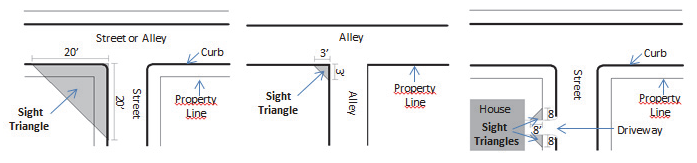
Sight Distance Required: Any person erecting, constructing, installing, or replacing a fence shall ensure that adequate sight distance is provided at the intersection of two (2) streets, two (2) alleys, or a street and an alley, or a property line and a driveway that leads to a street. Sight distance is required as stated in Table (E)-1:
Table (E)-1
Figure 6-4-6-7-(E)
Measuring Sight Distance Requirements
for Fences at Intersections & Driveways
(F)
Special Regulations for Fences Accessory to All Uses Within the Residential, Business, Commercial, Transitional Campus, University, Downtown, and MU Transitional Manufacturing Districts and Residential and Mixed Uses Within the MUE Transitional Manufacturing and MXE Mixed Use Employment Districts: The following standards shall regulate the erection, construction, replacement, or installation of a fence accessory to all uses within the R1, R2, R3, R4, R5, R6, B1, B1a, B2, B3, C1, C1a, C2, T1, T2, U1, U2, U3, RP, O1, OS, D1, D2, D3, D4, and MU districts and residential and mixed uses within the MUE and MXE districts:
1.
Permitted Fence Materials: The permitted materials for fences accessory to the uses listed in this Subsection (F) are:
(a)
Wood;
(b)
Wood polymer lumber, provided said material consists of at least fifty percent (50%) postconsumer and/or postindustrial wood fiber;
(c)
Wrought iron;
(d)
Masonry or stucco wall;
(e)
Chainlink, provided said material shall only be permitted within the area between a street lot line and three (3) feet behind any street-facing facade of the principal building where the required front and/or street side yard abuts a type 1 street, and the City Council has specifically listed chainlink as a permitted fence material along the said type 1 street; and
(f)
PVC, provided:
(1)
Any post or horizontal component does not have a circular cross section;
(2)
Any post or horizontal component has a wall thickness of at least 0.120 inch;
(3)
All fence material is solid wall extruded, ensuring any coloring is consistent throughout the fence material;
(4)
All fence material is recyclable at the conclusion of its useful life; and
(5)
Said fence material meets the material properties and physical properties standards as established in standard specification F964-94 of the 1996 annual book of ASTM standards ("American Society For Testing And Materials").
2.
Permitted Fence Location: The permitted locations for fences accessory to the uses listed in this Subsection (F) are:
(a)
Required front yard, provided:
(1)
The required front yard is adjacent to a type 1 street; and
(2)
Wood, wood polymer lumber, wrought iron, or PVC fences shall have a maximum fence opacity of seventy percent (70%);
(b)
Required street side yard, provided:
(1)
A two-foot setback from the property line is maintained;
(2)
The required setback is landscaped with foundation plantings; and
(3)
Any fence located in the required street side yard shall be set back from any front-facing façade of the principal building by three (3) feet, unless said fence is connected to a portion of fence permissibly located within the required front yard.
(c)
Required interior side yard, provided any fence located within a required interior side yard shall be set back from any front-facing facade of the principal building by three (3) feet unless said fence is connected to a portion of fence permissibly located within the required front yard or required street side yard;
(d)
Required rear yard; and
(e)
Building envelope, provided any fence located within the building envelope shall be set back from any front-facing facade of the principal building by three (3) feet, unless said fence is connected to a portion of fence permissibly located within the required front yard or required street side yard.
3.
Permitted Fence Height: Fences accessory to the uses listed in this Subsection (F) shall not exceed six (6) feet in height, except:
(a)
Fences shall not exceed four (4) feet in height when located within the area between a front lot line and three (3) feet behind any front-facing facade of the principal building;
(b)
Fences shall not exceed eight (8) feet in height when located within a required interior side yard or required rear yard and when the lot line associated with said required yard or an abutting alley is a boundary between a residential use and a nonresidential use;
(c)
Temporary construction fences shall not exceed eight (8) feet in height, provided the applicant conforms with Section 6-4-8-4 of this Chapter; and
(d)
Open mesh type fences accessory to parks, recreational areas, and school sites shall have no height restrictions.
(G)
Special Regulations for Fences Accessory to Nonresidential Uses Within the MUE Transitional Manufacturing and MXE Mixed Use Employment Districts and All Uses Within the Industrial Districts: The following standards shall regulate the erection, construction, replacement, or installation of a fence accessory to a nonresidential use in the MUE or MXE district and any use within the I1, I2, and I3 districts;
1.
Permitted Fence Material: The permitted materials for fences accessory to the uses listed in this Subsection (G) are:
(a)
Wood;
(b)
Wood polymer lumber, provided said material consists of at least fifty percent (50%) postconsumer and/or postindustrial wood fiber;
(c)
Wrought iron;
(d)
Masonry or stucco wall;
(e)
Chainlink, provided said material is located within the required interior side yard or required rear yard;
(f)
PVC, provided:
(1)
Any post or horizontal component does not have a circular cross section;
(2)
Any post or horizontal component has a wall thickness of at least 0.120 inch;
(3)
All fence material is solid wall extruded, ensuring any coloring is consistent throughout the fence material;
(4)
All fence material is recyclable at the conclusion of its useful life; and
(5)
Said fence material meets the material properties and physical properties standards as established in standard specification F964-94 of the 1996 annual book of ASTM standards ("American Society For Testing And Materials");
(g)
Barbed wire, provided:
(1)
Said fence material is located within the required interior side yard or required rear yard;
(2)
Said fence material is located above the height of six (6) feet; and
(3)
Said fence material conforms with Section 7-5-2 of this code; and
(h)
Unfinished concrete or cinder block walls.
2.
Permitted Fence Locations: The permitted locations for fences accessory to the uses listed in this Subsection (G) are:
(a)
Required front yard;
(b)
Required street side yard;
(c)
Required interior side yard;
(d)
Required rear yard; and
(e)
Building envelope.
3.
Permitted Fence Height: Fences accessory to the uses listed in this Subsection (G) shall not exceed eight (8) feet in height, except open mesh type fences accessory to parks, recreational areas, and school sites shall have no height restrictions.
(H)
Permitting Fences Within Required Front Yards: The City Council may designate residentially zoned properties along certain streets or portions thereof as appropriate locations for fences within the required front yards. These certain streets or portions thereof are designated "type 1 streets." Title 4, Chapter 19 of this code (designating type 1 streets) sets forth the process for designating a street or portion thereof as a type 1 street and contains a list of type 1 designated streets.
(I)
Historic Fences: No person shall erect, construct, install, or replace a fence accessory to an Evanston landmark or a use located within a designated historic district without first receiving a certificate of appropriateness.
(J)
Invisible Pet Fences: An invisible pet fence shall be permitted provided the following:
1.
All invisible pet fences shall be set back a minimum of six feet from any property line abutting any public right-of-way or street line.
2.
Any invisible pet fence may be located on or adjacent to any rear lot line not abutting a public alleyway, or any side lot line not abutting a street line, without any required setback.
(Ord. No. 15-O-99; Ord. No. 88-O-99; Ord. No. 22-O-15, §§ 2—6, 4-13-2015; Ord. No. 79-O-18, § 1, 7-23-2018)
6-4-6-8. - SPECIAL REGULATIONS APPLICABLE TO SOLAR COLLECTORS.
(A)
Purpose and Applicability: The purpose of this Section is to ensure that solar collectors, whether accessory to principal uses, or integrated with principal uses, are compatible in character and appearance with the principal structure and surrounding neighborhood or area of the zoning districts in which they are located.
The provisions of this Section apply to solar collectors installed or modified after the effective date hereof. Solar collectors are permitted as an accessory use to any principal permitted or special use subject to the following development standards.
(B)
Appearance and Materials: Solar collectors should be neutral in color and generally matching the roof color of the principal structure. All such devices shall have the following characteristics:
1.
Not be plastic or other non-UV stable material;
2.
Include frames, where applicable, of anodized aluminum or painted steel; and
3.
Where devices are encased with glass, the glass shall be nonreflective tempered glass.
(C)
Yards: Solar collectors shall be subject to the following yard requirements:
1.
Solar collectors are an allowed encroachment in front, side, and rear yards so long as they do not project more than five (5) feet from an exterior wall.
2.
Solar collectors may be located flush with the exterior wall of the principal and street facing facades.
3.
In side wall installations, solar collectors must be set back a minimum of three (3) feet from the property line.
4.
In rear wall installations, solar collectors must be set back a minimum of three (3) feet from the rear property line.
(D)
Height: Solar collectors shall be subject to the following height requirements:
1.
Solar collectors may not exceed the maximum building height requirements for the district in which they are located;
2.
Solar collectors located on sloped roof buildings may extend up to five (5) feet above the roof ridge; and
3.
Solar collectors located on flat roofed buildings may extend up to ten (10) feet above the roof height.
(E)
Bulk Requirements: Solar collectors integrated into the structure or building cladding shall be subject to the bulk requirements of the zoning district in which they are located.
(F)
Ground Mounted Separate or Adjacent to the Principal Structure: Solar collectors mounted on the ground shall not:
1.
Be more than ten (10) feet high;
2.
Have a footprint (as determined by a horizontal plane at the ground generated by extending all parts of the structure vertically down) greater than twenty five percent (25%) of the principal building footprint; or
3.
Be located in front- or street-facing yards.
(G)
Accessory Structures: Solar collectors mounted to accessory structures:
1.
Shall comply with all yard requirements for accessory structures; and
2.
May extend up to four (4) feet above the roof ridge for sloped roof structures and up to five (5) feet above the roof height for flat roofed structures.
(H)
Lot Coverage or Impervious Surface Area: Solar collectors which meet the minimum standards and maximum size limits as determined by this Section shall not be counted in lot coverage or impervious surface area.
(Ord. 35-O-08)
6-4-6-9. - SPECIAL REGULATIONS APPLICABLE TO AIR CONDITIONING EQUIPMENT.
Air conditioning equipment requirements are as follows:
Required Yard
Front yard: Prohibited.
Interior side yard: Eight-foot setback required; or six-foot setback required when located within two (2) feet of the principal structure and obscured from view by screening methods such as landscaping.
Interior side yard abutting an alley of at least eight (8) feet in width: Eight-foot setback required; or four-foot setback required when located within two (2) feet of the principal structure and obscured from view by screening methods such as landscaping.
Street side yard: Four-foot setback required when located within two (2) feet of the principal structure and obscured from view by screening methods such as landscaping.
Rear yard (rearmost thirty (30) feet of yard): Three-foot setback from all property lines (the same as other accessory structures in the required rear yard).
(Ord. 66-O-09; Ord. No. 15-O-14, § 2, 2-10-2014)
6-4-6-10. - SPECIAL REGULATIONS APPLICABLE TO ACCESSORY DWELLING UNITS (ADUs).
(A)
Construction: An ADU may be created through new construction, alteration of an existing structure, addition to an existing structure, or conversion of an existing structure to an ADU while simultaneously constructing a new residential building on the site.
(B)
Number of Units: One (1) ADU is permitted per zoning lot.
(C)
Minimum Lot Size: None.
(D)
Maximum ADU Size: All ADUs shall be smaller than the floor area of the largest primary dwelling unit.
Any detached ADU, internal or attached ADU created through new construction, internal or attached ADU created through an addition to an existing structure, or detached ADU created through the conversion of an existing structure to an ADU while simultaneously constructing a new residential building on the site shall not exceed one thousand (1,000) square feet of floor area.
An internal or attached ADU created through the altering of an existing structure may exceed one thousand (1,000) square feet of floor area but the floor area shall be limited to not more than one level of the existing structure (i.e. a basement, story, or half story).
(E)
Maximum F.A.R. or Building Lot Coverage: For an attached or internal ADU, the maximum F.A.R. or lot coverage of all structures on the zoning lot shall be that of the underlying zoning district.
For a detached ADU, Section 6-4-6-3 shall also apply.
(F)
Yard Requirements: For an attached or internal ADU, the yard requirements shall be those required for a principal structure in the underlying zoning district.
For a detached ADU, the regulations in Sections 6-4-6-2 and 6-4-6-3 shall apply.
(G)
Maximum Height: For an attached or internal ADU, the maximum height shall be that of the underlying zoning district.
For a detached ADU the height shall be subject to the following limitations:
1.
For a detached ADU with a flat or mansard roof the height shall not exceed twenty (20) feet, measured from grade to the highest point of said structure, or two (2) stories, whichever is less.
2.
For a detached ADU without a flat or mansard roof the height shall not exceed twenty-eight (28) feet, measured from grade to the highest point of said structure, or two (2) stories, whichever is less.
(H)
Off-Street Parking: No parking is required per Chapter 16 (Off-street Parking and Loading), Table 16-B, however, existing required parking for the primary residential structure shall be maintained or replaced.
(I)
Design Standards:
1.
Entrances: Only one (1) pedestrian entrance to the structure may be located on the front facing facade of the principal building.
2.
Exterior Stairs: Any exterior stairs to serve as the primary entrance to an attached or internal ADU within the principal building shall be located on the interior side or rear of the principal building.
(J)
Alterations of Existing Structures: If a detached ADU is created from an existing detached accessory structure that does not meet one or more of the standards within Section 6-4-6, the structure is exempt from the standard(s) it does not meet. However, any alterations that would result in the structure becoming less conforming with those standards it does not meet are not allowed.
(K)
Ownership and Occupancy: There is no requirement that the property owner reside on the property, however, an ADU shall remain under common ownership with the residential building. Occupancy of the ADU shall be limited to no more than one (1) family.
(Ord. No. 86-O-20, § 3, 9-29-2020)
6-4-6-11. - SPECIAL REGULATIONS APPLICABLE TO WIRELESS FACILITIES.
(A)
Permitted Locations: Wireless facilities not on public right-of-way shall be classified as permitted uses in all zoning districts and subject to administrative review, except as provided in Section 6-4-6-11(F) regarding exceptions or variances from standards. Wireless facilities proposed within the public right-of-way shall follow the regulations as stated with Title 7, Chapter 16 of this Code.
(B)
Permit Required: An applicant shall obtain one or more permits from the City to collocate a wireless facility or construct a new wireless facility. An application shall be received and processed, and permits issued shall be subject to the following conditions and requirements:
1.
Application Requirements: A wireless provider shall provide the following information to the City, together with the City's small cell facilities permit application, as a condition of any permit application to collocate small wireless facilities on a utility pole or wireless support structure:
a.
Site specific structural integrity and, for a municipal utility pole, make-ready analysis prepared by a structural engineer;
b.
The location where each proposed small wireless facility or structure would be installed and photographs of the location and its immediate surroundings depicting the structures on which each proposed small wireless facility would be mounted or location where structures would be installed. This should include a depiction of the completed facility;
c.
Specifications and drawings prepared by a structural engineer for each proposed small wireless facility covered by the application as it is proposed to be installed;
d.
The equipment type and model numbers for the antennas and all other wireless equipment associated with the small wireless facility;
e.
A proposed schedule for the installation and completion of each small wireless facility covered by the application, if approved; and
f.
Certification that the collocation complies with the collocation requirements and conditions contained within the City Code, to the best of the applicant's knowledge.
g.
In the event that the proposed small wireless facility is to be attached to an existing pole owned by an entity other than the City, the wireless provider shall provide legally competent evidence of the consent of the owner of such pole to the proposed collocation.
h.
In the event that a new wireless support structure is proposed, justification for why co-location is not feasible on existing support structures shall be supplied in order to demonstrate the need for a new structure.
2.
Review Process: The City shall process completed applications as follows:
a.
Completeness of Application: Within thirty (30) days after receiving an application, the City shall determine whether the application is complete and notify the applicant. If an application is incomplete, the City must specifically identify the missing information. An application shall be deemed complete if the City fails to provide notification to the applicant within thirty (30) days after all documents, information and fees specifically enumerated in the City's permit application form are submitted by the applicant to the City. Processing deadlines are tolled from the time the City sends the notice of incompleteness to the time the applicant provides the missing information.
b.
Timeframe for Review: Upon determination of a complete application, an application to collocate a wireless facility on an existing utility pole or wireless support structure, or replacement of an existing utility pole or wireless support structure shall be processed on a nondiscriminatory basis and shall be deemed approved if the City fails to approve or deny the application within sixty (60) days after the submission of a completed application unless time is tolled as described in Subsection c. below.
An application to collocate a wireless facility that includes the installation of a new utility pole shall be processed on a nondiscriminatory basis and deemed approved if the City fails to approve or deny the application within one hundred twenty (120) days after the submission of a completed application unless time is tolled as described in Subsection c. below.
c.
Tolling: The time period for applications may be further tolled by either an expressed written agreement by both the applicant and the City or local, State or Federal disaster declaration or similar emergency that causes the delay.
d.
Review Standards: complete applications will be reviewed subject to the regulations as listed below in Subsections (C) through (E) as well as regulations enumerated the Public Works Agency (Title 7) and Building Code Standards (Title 4).
e.
The City shall deny an application which does not meet the requirements of this Chapter. The City shall document the basis for a denial, including the specific code provisions or application conditions on which the denial is based, and send the documentation to the applicant on or before the day the City denies an application. The applicant may cure the deficiencies identified by the City and resubmit the revised application once within thirty (30) days after notice of denial is sent to the applicant without paying an additional application fee. The City shall approve or deny the revised application within thirty (30) days after the applicant resubmits the application or it is deemed approved.
(C)
Setbacks: New wireless support structures in non-residential districts must be set back from all property lines in accordance with the minimum setback requirements in the zoning district. New support structure in residential districts must be all wireless support structures must be setback a minimum of one-half (½) of the height of the support structure and all facilities must be set back from all lot lines in accordance with the minimum setback requirements in the district.
(D)
Height:
1.
The maximum height permitted for a new wireless telecommunications support structure is the maximum building height of the underlying zoning district. If the proposed height exceeds the district maximum, the special use application for approval of a wireless telecommunications support structure must demonstrate that the height needed for the tower is the minimum needed to function satisfactorily. Wireless support antennas may be attached to an existing building or structure.
2.
Wireless support antennas may be collocated on an existing support structure at a height not to exceed the height of said structure, subject to the application and review procedures listed above.
(E)
Appearance: Wireless facilities and support structure appearance shall be reviewed by the Design and Project Review (DAPR) Committee. Wireless facilities must incorporate the following to the extent possible:
1.
Additional Standards for Wireless Antennas.
a.
Wireless telecommunications antennas must be enclosed, camouflaged, screened, obscured, or otherwise not readily apparent to a casual observer. This does not apply to antennas that co-locate on existing wireless support structures.
b.
Antennas may be located on or in structures already allowed within zoning districts, such as water towers, clock towers, light poles, penthouses, parapet walls and steeples, and must blend into the structure.
2.
Additional Standards for Wireless Support Structures.
a.
The ability for other telecommunications providers to co-locate on a wireless support structure is required. Wireless support structures must be designed to accommodate other telecommunications providers. The area surrounding a support structure must be of a sufficient size to accommodate accompanying wireless telecommunications facilities for other telecommunications providers.
b.
Unless otherwise required by the FCC, the FAA, or the City, wireless support structures must have a galvanized silver or gray finish and may not be lighted.
c.
Any buildings, cabinets, or shelters may house only equipment and supplies for operation of the wireless support structure. Any equipment not used in direct support of such operation is prohibited. The facility must be un-staffed.
d.
Signs for the wireless telecommunications facility are limited to ownership and contact information, FCC antenna registration number (if required), and any other information required by government regulation. Commercial advertising is strictly prohibited.
e.
A facility must be completely enclosed by a solid fence or wall a minimum of six (6) feet and a maximum of eight (8) feet in height.
(F)
Exceptions and Variances from Standards: If an applicant proposes a height for a new or replacement wireless support structure in excess of the above height limitations on which the small wireless facility is proposed for collocation, the applicant shall submit a special use application in conformance with procedures, terms and conditions set forth in Title 6, Chapter 3, Section 5, "Special Uses," of the Evanston City Code
(G)
Non-conformities:
1.
Ordinary maintenance, including replacement/upgrading, of antenna equipment may be performed on nonconforming antennas or wireless support structure. However, if the proposed alteration intensifies a nonconforming characteristic of the antenna or wireless support structure, a special use is required.
2.
Co-location of an antenna on an existing nonconforming wireless support structure is permitted, provided that the addition of the antenna and any additional wireless facilities do not intensify the nonconformity.
(H)
Abandonment: Any wireless antenna, support structure, or facility that is not operated for a continuous period of twelve (12) months shall be considered abandoned. The owner of the antenna, support structure, or facility shall remove the antenna, structure, facility within ninety (90) days after receipt of written notice from the City notifying the wireless provider of the abandonment.
(Ord. No. 44-O-21, § 3, 5-10-2021)
6-4-7. - BED AND BREAKFAST ESTABLISHMENTS.
A bed and breakfast establishment is an owner occupied single-family or two-family dwelling where short term lodging and morning meals are provided for compensation. The following general requirements shall apply to bed and breakfast establishments:
(A)
Location: The bed and breakfast establishments shall be located within and accessory to an owner occupied single-family or two-family residential structure.
(B)
Maximum Bedrooms Allowed: Subject to the special use provisions in each zoning district, up to a maximum of five (5) bedrooms may be provided for registered guests. No additional bedrooms as living quarters for roomers, permanent guests, or other boarders shall be permitted in conjunction with the operation of a bed and breakfast establishment.
(C)
Maximum Stay: The maximum stay by any one (1) guest shall be four (4) consecutive weeks.
(D)
Cooking Limitations: Morning meals shall be the only meals provided for registered guests only. No cooking facilities shall be permitted in guestrooms.
(E)
Room Locations: Rooms used for guests shall be part of the primary residential structure and shall not have been specifically constructed for rental purposes.
(F)
Guest Parking: Guest parking may be provided either on site, in the rear off a public alley or along the curb abutting the lot but at no time shall guest parking be permitted in any front or side yard.
(G)
Licensing: The resident owner shall obtain a license for the operation of a bed and breakfast from the City of Evanston department of health and human services. The license shall be granted for a period of one (1) year commencing on the date of issuance. Thereafter, the license may be renewed for a one (1) year period subject to a review by the City Council, through its health and human services committee.
(H)
Revenue Collection: The resident owner shall comply with all the revenue collection ordinances of the City.
(I)
Signage And Lighting: All signage and special lighting shall comply with the sign ordinance of the City.
(Ord. No. 43-O-93)
6-4-8-1. - AUTHORIZATION.
Subject to the limitations of this Section 6-4-8, temporary uses shall be permitted in the zoning districts as hereinafter specified. No temporary use, however, shall be established unless a certificate of zoning compliance has been issued.
(Ord. No. 43-O-93)
6-4-8-2. - CERTIFICATE OF ZONING COMPLIANCE.
An application for a certificate of zoning compliance shall be made to the Zoning Administrator in conjunction with any application for approval of a temporary use. A decision by the Zoning Administrator not to issue a certificate of zoning compliance may be appealed to the planning and development committee of the City Council.
(A)
Certificate Of Denial: In the event that an application for certificate of zoning compliance is denied, the Zoning Administrator shall state the specific reasons therefor and shall cite the specific provisions of this Ordinance upon which such denial is based.
(B)
Conditions On Certificate: The certificate may be conditioned upon such special requirements as the Zoning Administrator may determine are necessary to achieve the purposes of this Ordinance and to protect the public health, safety, and welfare.
(C)
Revocation Of Certificate: The certificate may be revoked by the Zoning Administrator pursuant to Section 6-3-10-6, "Revocation Of Certificate Of Zoning Compliance," of this Title if any of the standards and conditions imposed by this Section 6-4-8 are violated.
(Ord. No. 43-O-93)
6-4-8-3. - PERMITTED TEMPORARY USE REGULATIONS.
Subject to the specific regulations and time limits indicated for each temporary use, and to the other applicable regulations of the zoning district in which the use is permitted, the following temporary uses, and no others, are permitted in the following zoning districts:
(A)
Residential Districts:
1.
House, Apartment, Garage And Yard Sales: House, apartment, garage and yard sales shall be limited to no more than three (3) sales within any twelve (12) month period.
2.
In-Home Seminars Or Parties: In-home seminars or parties held for the sale of goods or services shall be allowed provided no more than three (3) such events shall be held within any twelve (12) month period.
3.
Tents: Tents shall be allowed for a three (3) day period.
4.
Contractor's Offices/Trailers And Equipment Sheds: Contractor's offices/trailers and equipment sheds shall be limited to the duration of construction.
5.
Real Estate Offices/Trailers: Real estate offices/trailers shall be limited to the period of active selling or leasing of units. No sleeping or cooking accommodations shall be allowed in such facilities except in a model dwelling unit used for marketing purposes.
6.
Portable Outdoor Moving Containers: Portable outdoor moving containers shall be allowed for no more than twenty-one (21) days.
(B)
Nonresidential Districts:
1.
Indoor And Outdoor Festivals, Sidewalk Sales, Art, Craft And Plant Shows, Exhibits And Sales: Indoor and outdoor festivals, sidewalk sales, art, craft and plant shows, exhibits and sales shall be limited to three (3) consecutive days in length, and limited to six (6) special sales per year. Displays shall not encroach into required parking or yards.
2.
Christmas Tree, Pumpkin And Garden Material Sales: Christmas tree, pumpkin and garden material sales shall be limited to nonresidential districts and shall be limited to a duration of forty-five (45) days.
3.
Contractor's Offices/Trailers And Equipment Sheds: Contractor's offices/trailers and equipment sheds shall be limited to the duration of construction.
4.
Real Estate Offices/Trailers: Real estate offices/trailers shall be limited to the period of active selling or leasing of units. No sleeping or cooking accommodations are allowed.
5.
Carnivals And Circuses: These activities shall be open to the general public. Such activities are not to exceed a ten (10) consecutive day period. The applicant must submit a site layout showing adequate provisions for emergency vehicles, fire extinguishers, refuse containers, parking, and general access.
6.
Tents: Tents shall be allowed for no more than ten (10) consecutive days and must comply with the bulk and yard standards of this Ordinance.
(Ord. No. 43-O-93; Ord. No. 68-O-09)
6-4-8-4. - TEMPORARY EXCEPTIONS TO ZONING ORDINANCE REQUIREMENTS.
During construction, temporary exceptions to the zoning regulations for parking, fences, yards, and other items may be permitted during construction subject to the following conditions:
(A)
Upon written application stating the nature of the prospective noncompliance and its expected duration, the City Manager or his designee may grant to the owner of a property within the City a temporary exemption from selected provisions of this Ordinance.
(B)
Exemptions shall be subject to such conditions as may be determined to be reasonable, when such exemption, based upon facts submitted by the applicant, is necessary to permit the construction, alteration, or demolition of improvements upon the property. Each temporary exemption so granted shall be in writing and a copy thereof, together with the application and supporting documentation, if any, shall be transmitted to the Zoning Administrator to be maintained among his/her records.
(Ord. No. 43-O-93)
6-4-9. - NEIGHBORHOOD GARDENS.
A neighborhood garden is a principal use that provides space for people to grow plants for non-commercial purposes, such as beautification, education, recreation, or harvest, that is managed by a specific person or group responsible for maintenance and operations. The following general requirements shall apply to neighborhood gardens:
(A)
The person or group responsible for managing the garden shall be identified on each required annual application/registration form.
(B)
On-site processing and/or storage of plants or plant products are prohibited.
(C)
Outdoor storage of any kind is prohibited.
(D)
A fence and one (1) accessory structure for the storage of gardening tools and supplies, no larger than one hundred twenty (120) square feet in area, shall be allowed on-site, provided the owner or operator first obtains a certificate of zoning compliance or building permit for it/them.
(E)
Composting of plant material that is grown on site shall be permitted, except in the required front yard. All other composting is prohibited.
(F)
No incidental sales of plants or produce shall take place on site.
(G)
Neighborhood gardens shall be maintained so as not to encourage the harboring of vermin. Accumulations of weeds and/or rubbish is prohibited.
(Ord. No. 81-O-14, § 3, 8-11-2014)
6-4-10. - SPECIAL REGULATIONS PERTAINING TO FIREARM RANGES.
(A)
Purpose and Applicability: The purpose of this Section 6-4-10 is to ensure new firearm ranges are integrated with surrounding uses and are compatible in character with surrounding neighborhood or area of the zoning district in which they are located.
(B)
Special Use: The approval for a firearm range shall only be allowed as a special use in I1, I2, and I3 Zoning Districts. Any such Firearm Range shall not be located within three hundred fifty (350) feet of any R1, R2, R3 district, or within three hundred fifty (350) feet of any school, child daycare facility, or public park, as measured from lot line to lot line.
(C)
Distance Requirement: The distance requirement shall be measured from the nearest property lines of each property the firearm range is located on.
(D)
Certificate of Zoning Compliance: A certificate of zoning compliance is required prior to any firearm range use being established.
(Ord. No. 51-O-15, § 5, 6-22-2015)
6-4-11-1. - PURPOSE AND APPLICABILITY.
The purpose of this Section 6-4-11 is to ensure new cannabis related uses are integrated with surrounding uses and are compatible in character with the surrounding neighborhood or area of the zoning district in which they are located.
(Ord. No. 126-O-19, § 2, 10-28-2019; Ord. No. 23-O-20, § 1, 2-24-2020)
6-4-11-2. - CERTIFICATE OF ZONING COMPLIANCE.
6-4-11-3. - CANNABIS DISPENSARIES.
(A)
Special Uses: The approval for cannabis dispensary businesses shall only be allowed as a Special Use in RP, D1, D2, D3, D4, C1a, C1, C2, B1a, B2, B3, and O1 Zoning Districts as well as the oDM, oCSC and oH Zoning Overlay Districts. Cannabis dispensaries shall be prohibited in all R, B1, M, T, U, I, WE1 and OS zoning districts as well as within any dwelling unit or rooming unit.
(B)
Distance Requirement: Any cannabis dispensary shall not be located within one thousand five hundred (1,500) feet of another cannabis dispensary or five hundred (500) feet of a pre-existing public or private educational institution that is an elementary, middle, or high school, as measured from lot line to lot line.
(C)
Distance Requirement Measurement: The distance requirement shall be measured from the nearest property lines of each property the cannabis dispensary is located on.
(D)
Hours of Operation: Cannabis Dispensaries shall only be permitted to operate between the hours of 9:00 a.m. and 9:00 p.m., unless further regulated as a condition of special use approval, seven (7) days out of the week.
(Ord. No. 126-O-19, § 2, 10-28-2019; Ord. No. 23-O-20, § 1, 2-24-2020; Ord. No. 25-O-24, § 2, 2-26-2024)
6-4-11-4. - CANNABIS CULTIVATION CENTERS.
(A)
Special Uses: The approval for cannabis cultivation centers shall only be allowed as a special use in I1, I2 and I3 Zoning Districts. Cannabis cultivation centers shall be prohibited in all R, D, B, C, M, T, U, WE1, RP, OS and O1 Zoning Districts, the oDM, oCSC and oH Zoning Overlay Districts, as well as within any dwelling unit or rooming unit.
(B)
Distance Requirement: Any cannabis cultivation center shall not be located within one thousand five hundred (1,500) feet of a cultivation center or other cannabis related business within two thousand five hundred (2,500) feet of a pre-existing public or private educational institution that is an elementary, middle, or high school, day care center, day care home, group day care home, part day child care facility, or an area zoned exclusively for residential use as measured from lot line to lot line.
(C)
Distance Requirement Measurement: The distance requirement shall be measured from the nearest property lines of each property the cannabis cultivation center is located on.
(D)
Hours of Operation: Cannabis cultivation centers shall only be permitted to operate between the hours of 8:00 a.m. and 8:00 p.m. seven (7) days out of the week.
(Ord. No. 31-O-20, § 2, 2-24-2020)
6-4-11-5. - CANNABIS INFUSER.
(A)
Permitted Uses: Cannabis infusing businesses shall only be allowed as a permitted use in the I1, I2, and I3 Zoning Districts.
(B)
Special Uses: The approval for cannabis infusing businesses shall only be allowed as a special use in all D, C, M, B1a, B2, B3, RP, WE1, and O1 Zoning Districts as well as the oDM and oCSC Zoning Overlay Districts. Cannabis infusers shall be prohibited in all R, T, U, B1, and OS Zoning Districts, oH Zoning Overlay District, as well as within any dwelling unit or rooming unit.
(C)
Distance Requirement: Any cannabis infuser shall not be located within one thousand five hundred (1,500) feet of another cannabis infuser or other cannabis related business or within five hundred (500) feet of a pre-existing public or private educational institution that is an elementary, middle, or high school, as measured from lot line to lot line.
(D)
Distance Requirement Measurement: The distance requirement shall be measured from the nearest property lines of each property the cannabis infuser is located on.
(E)
Hours of Operation: Cannabis infusers shall only be permitted to operate between the hours of 8:00 a.m. and 8:00 p.m. seven (7) days out of the week.
(Ord. No. 31-O-20, § 2, 2-24-2020)
6-4-11-6. - CANNABIS PROCESSOR.
(A)
Permitted Uses: Cannabis processing businesses shall only be allowed as a permitted use in the I1, I2, and I3 Zoning Districts.
(B)
Special Uses: The approval for cannabis processing businesses shall only be allowed as a special use in all M and WE1 Zoning Districts. Cannabis processors shall be prohibited in all R, D, B, C, T, U, RP, OS and O1 Zoning Districts, the oDM, oCSC and oH Zoning Overlay Districts, as well as within any dwelling unit or rooming unit.
(C)
Distance Requirement: Any cannabis processor shall not be located within one thousand five hundred (1,500) feet of another cannabis processor or other cannabis related business or within five hundred (500) feet of a pre-existing public or private educational institution that is an elementary, middle, or high school, as measured from lot line to lot line.
(D)
Distance Requirement Measurement: The distance requirement shall be measured from the nearest property lines of each property the cannabis processor is located on.
(E)
Hours of Operation: Cannabis processor shall only be permitted to operate between the hours of 8:00 a.m. and 8:00 p.m. seven (7) days out of the week.
(Ord. No. 31-O-20, § 2, 2-24-2020)
6-4-11-7. - CANNABIS CRAFT GROWER.
(A)
Permitted Uses: Cannabis craft growing businesses shall only be allowed as a permitted use in the I1, I2, and I3 Zoning Districts.
(B)
Special Uses: The approval for cannabis craft growing businesses shall only be allowed as a special use in all D, C, M, B1a, B2, B3, RP, WE1, and O1 Zoning Districts as well as the oDM and oCSC Zoning Overlay Districts. Cannabis infusers shall be prohibited in all R, T, U, B1, and OS Zoning Districts, oH Zoning Overlay District, as well as within any dwelling unit or rooming unit.
(C)
Distance Requirement: Any cannabis craft grower shall not be located within one thousand five hundred (1,500) feet of another cannabis craft grower or cannabis related business or within five hundred (500) feet of a pre-existing public or private educational institution that is an elementary, middle, or high school, as measured from lot line to lot line.
(D)
Distance Requirement Measurement: The distance requirement shall be measured from the nearest property lines of each property the cannabis craft grower is located on.
(E)
Hours of Operation: Cannabis craft growers shall only be permitted to operate between the hours of 8:00 a.m. and 8:00 p.m. seven (7) days out of the week.
(Ord. No. 31-O-20, § 2, 2-24-2020)
6-4-11-8. - CANNABIS TRANSPORTER.
(A)
Permitted Uses: Cannabis transporting businesses shall only be allowed as a permitted use in the I1, I2, and I3 Zoning Districts.
(B)
Special Uses: The approval for cannabis transporting businesses shall only be allowed as a special use in all D, C, M, B1, B2, B3, RP, WE1, and O1 Zoning Districts as well as the oDM and oCSC Zoning Overlay Districts. Cannabis infusers shall be prohibited in all R, T, U, B1, and OS Zoning Districts, oH Zoning Overlay District, as well as within any dwelling unit or rooming unit.
(C)
Distance Requirement: Any cannabis transporter shall not be located within one thousand five hundred (1,500) feet of another cannabis transporter or cannabis related business or within five hundred (500) feet of a pre-existing public or private educational institution that is an elementary, middle, or high school, as measured from lot line to lot line.
(D)
Distance Requirement Measurement: The distance requirement shall be measured from the nearest property lines of each property the cannabis transporter is located on.
(E)
Hours of Operation: Cannabis transporters shall only be permitted to operate between the hours of 8:00 a.m. and 8:00 p.m. seven (7) days out of the week.
(Ord. No. 31-O-20, § 2, 2-24-2020)
6-4-11-9. - CO-LOCATION OF CANNABIS USES.
6-4-11-10. - ON-SITE CONSUMPTION OF CANNABIS.
On-site consumption of cannabis shall be prohibited at any business establishment within the City, including at any cannabis related business.
(Ord. No. 31-O-20, § 2, 2-24-2020)
6-4-12. - SPECIAL REGULATIONS PERTAINING TO TATTOO AND BODY ART ESTABLISHMENTS.
(A)
The purpose of this Section 6-4-12 is to ensure new tattoo and body art establishments and accessory permanent cosmetics are compatible in character with the surrounding neighborhood or area of the zoning district in which they are located, and to ensure the general health and safety of the community.
(B)
All facilities, whether tattoo and body art establishments or accessory permanent cosmetics (i.e., microblading) shall operate in accordance with the Tattoo and Body Piercing Establishment Registration Act (410 ILCS 54) and The Illinois Department of Public Health's Body Art Code (77 III. Adm. Code 797).
(C)
All facilities, whether tattoo and body art establishments or accessory permanent cosmetics (i.e., microblading) shall be inspected by the Health & Human Services Department or other regulating body as required to meet State regulations and ensure health and safety of employees and customers.
(D)
For purposes of Title 6, Zoning Ordinance, accessory permanent cosmetics (i.e., microblading) shall only be a permitted accessory use when less than twenty percent (20%) of the customer floor space of the establishment is devoted to said use and when less than twenty percent (20%) of business operations are devoted to said use.
(E)
All facilities shall obtain business registration prior to operation.
(F)
Tattoo and body art establishments shall not operate outside the hours of 10:00 a.m.—8:00 p.m. on any given day.
(G)
Tattoo and body art establishments as well as accessory permanent cosmetics are not eligible home occupations and shall not occur within any dwelling unit or rooming unit.
(H)
Piercing of the non-cartilage portion of the earlobe by using a piercing gun with a single-use ear piercing system is exempt and is not considered tattoo and body art for the purposes of this Section.
(Ord. No. 3-O-21, § 2, 1-25-2021)
6-4-13. - SPECIAL REGULATIONS PERTAINING TO LIVE-WORK UNITS.
(A)
Purpose and Intent. The purpose of this Section is to permit the establishment of live-work units that are compatible with the nonresidential and non-university districts in which they are located and to ensure that live-work units are safe and habitable for occupants.
(B)
Construction. A live-work unit may be created through new construction, addition to an existing principal structure, or conversion of an existing principal structure to a live-work unit.
(C)
Number of Units. One (1) live-work unit is permitted per principal nonresidential activity with a valid business registration granted in accordance with Title 3 (Business Regulations) of the City Code occurring within a structure or tenant space.
(D)
Minimum Lot Size. None.
(E)
Dwelling Unit Size within a Live-Work Unit.
1.
Maximum. No more than forty-nine (49) percent of the floor area of each live-work unit, excluding bathrooms, may be used or arranged for designated residential purposes.
2.
Minimum. All live-work units shall be of a suitable area that may sufficiently accommodate one (1) dwelling unit, as defined by Section 6-18-3 of this Title, and shall be compliant with all applicable requirements stated in Title 4 (Building Code) of the City Code.
(F)
Ownership and Occupancy.
1.
Permitted Residents. At least one (1) of the occupants shall be either the property owner conducting the nonresidential activity within the live-work unit or the business owner responsible for the nonresidential activity presently leasing the live-work unit from the property owner.
Should the permitted resident be presently leasing the live-work unit from the property owner, the dwelling unit within the live-work unit shall be subject to Chapters 5-3 (Landlord and Tenant Regulations) and 5-8 (Registration of Rental Residential Buildings).
2.
No Vacation Rentals. Live-work units shall not be rented or leased as Vacation Rentals, as defined by Section 5-9-2 of the Housing Regulations.
(G)
Off-Street Parking. Parking is required for the nonresidential activity being conducted within the live-work unit per Chapter 16 (Off-street Parking and Loading), Table 16-B. Additional parking shall not be required for the dwelling unit component of the live-work unit.
(H)
Design Standards.
1.
Location. The residential activity of the structure or tenant space occurring within the live-work unit shall not be visible from the public right-of-way. In structures greater than one (1) story in height, the nonresidential activity shall occur on the ground floor of the structure.
2.
Entrances. Only one (1) entrance to the dwelling-unit component of the live-work unit may be located on the front-facing facade of the principal building, provided one (1) dedicated customer entrance is already provided and the residential activity is not visible from the public right-of-way.
If the dwelling unit component of the live-work unit is one thousand (1,000) square feet or larger, excluding the bathroom or bathrooms, it shall have at least two (2) dedicated entrances.
(I)
Alterations or Additions to Existing Structures. If an existing nonresidential principal structure that does not meet one or more of the standards within the underlying zoning district is converted into a live-work unit, the structure is exempt from the standard(s) it does not meet. However, any alterations or additions that would result in the structure becoming less conforming with those standards it does not meet are not allowed.
(Ord. No. 82-O-21, § 19, 9-13-2021)

