
Evanston City Zoning Code
CHAPTER 18
DEFINITIONS
6-18-1.- DEFINITIONS GENERALLY.
For the purposes of this Ordinance, certain terms and words are defined in this Chapter, and are used in this Ordinance in that defined context. Any words not defined in this Chapter, shall be construed as defined in normal dictionary usage.
6-18-2-1. - PURPOSE OF GENERIC DEFINITIONS.
Certain terms in this Chapter are defined to be inclusive of many uses in order to eliminate overlay detailed listings of uses in the zoning districts established by this Ordinance. These terms shall be referred to in this Ordinance as "generic" definitions. Examples of generic definitions used in this Ordinance are "retail goods establishment," "commercial indoor recreation" and "light manufacturing."
6-18-2-2. - COMPONENTS OF GENERIC DEFINITIONS.
A generic definition has three (3) components: a) a brief listing of examples of uses intended to be included within the scope of the definition; b) an identification (where appropriate) of certain uses that are not meant to be included by the term; and c) a statement that for the purposes of each zoning district, any other uses specifically listed within the particular zoning district shall not be construed as falling within the generic definition.
6-18-2-3. - USES NOT LISTED OR NOT WITHIN SCOPE OF GENERIC DEFINITIONS.
A use that is not specifically listed in a zoning district or does not fall within a generic definition as defined in this Chapter, or as interpreted by the Zoning Administrator pursuant to Section 6-3-10 of this Ordinance, "Enforcement," is prohibited.
6-18-3. - DEFINITIONS.
For the purposes of this Ordinance, the following terms shall have the following meanings:
(Ord. 13-O-98)
| ABUTTING: | Having a common property line or district line. |
|
ACCESSORY USE
OR STRUCTURE [25]: | A structure or use that: a) is subordinate to and serves a principal building or a principal use, except for a drive-in facility; b) is subordinate in area, extent, and purpose to the principal structure or principal use served; c) contributes to the comfort, convenience, or necessity of the occupants, business, or industry of the principal structure or principal use served; and d) is located on the same lot as the principal structure or principal use served, except as otherwise expressly authorized by the provisions of this Ordinance. Accessory parking facilities may be authorized to be located elsewhere. An accessory structure attached to a principal building in a substantial manner by a wall or roof shall be considered part of the principal building. |
| ADJACENT: | Nearby, or next to, but not necessarily touching or abutting. (e.g., across from a street or alley). |
| ADJOINING: | Touching or joining at any one (1) point, line, or boundary. |
| ADULT DAYCARE: | A community-based, structured comprehensive program of a variety of health, social, and related support services in a protective setting for persons who for reasons of physical or mental impairment are in need of such services during any part of a day not exceeding twelve (12) hours in a twenty-four-hour period. |
| ALLEY: | A public or private right of way that affords a service access to abutting property. |
| ANIMAL HOSPITAL: | A use or structure intended or used primarily for the testing and treatment of the disorders of animals, including the indoor boarding of animals for such purpose, but not the training or grooming of animals, or outdoor cages, pens, or runs for the animals. |
| ANTENNA: | Communications equipment that transmits or receives electromagnetic radio frequency signals used in the provision of wireless services. (Ord. No. 44-O-21, § 1, 5-10-2021) |
| APARTMENT: | See definition of Dwelling, Multiple-Family. |
| AQUAPONICS: | The symbiotic propagation of plants and fish in an indoor or outdoor re-circulating environment that results in the harvest of said plants or fish. (Ord. No. 56-O-14, § 2, 5-27-2014) |
|
ASSISTED LIVING
FACILITY: | A facility for adults in need of some protective oversight or assistance due to functional limitations that provides a living arrangement integrating shelter, food and other supportive services to maintain a resident's functional status. Those facilities that include personal care such as assistance with activities of daily living shall be licensed as sheltered care facilities pursuant to provision of the Evanston City Code. |
| ATTIC: | The top story of a building under a sloping roof with no finished floor and/or finished ceiling; rather, the area is defined by the top of the ceiling beams of the story immediately below the top story and the roof rafters. An attic may be further defined as a half-story, provided the sum of all areas of the top story where the vertical clearance is seven and one-half (7½) feet or more does not exceed sixty percent (60%) of the story immediately below the top story (as measured within the outer face of all exterior walls). (Ord. 13-O-98) |
|
AUTOMOBILE
BODY REPAIR ESTABLISHMENT: | A building, property, or activity the principal use of which is automobile body repair or auto detailing other than those types of repairs permitted at automobile service stations (gas stations) and automobile repair service establishments. |
|
AUTOMOBILE REPAIR
SERVICE ESTABLISHMENT: | A building, property, or activity the principal use of which is the repair or replacement of parts, oils, coolants, lubricants, tires, and other similar services. "Automobile repair establishment" shall include, but is not limited to, muffler shops, oil change shops, car care centers, tire centers and other uses similar in nature and impact. "Automobile repair establishment" shall not include an automobile body repair establishment or a car wash or other use that is otherwise in a zoning district as a permitted or special use. |
|
AUTOMOBILE
SERVICE STATION (GAS STATION): | A building, property, or structure the principal use of which dispenses or offers for retail sale of automotive fuels or oils and incidental convenience goods; having pumps and storage tanks thereon, and where battery, tire and other similar services, are rendered, but only if rendered wholly within lot lines. "Automobile service stations" shall not include an automobile body repair establishment or a car wash. |
| BANQUET HALL: | A principal use consisting of a large room or hall that is available for rent for use for specific banquets, exhibitions, and/or meetings that may include the provision of food, drink, and/or entertainment. (Ord. No. 129-O-12, § 2, 1-14-2013) |
| BASEMENT: | A portion of a building located partly underground but having less than one-half (½) its clear floor-to-joist height below the average grade of the adjoining ground. (See also definition of Cellar.) |
|
BED AND
BREAKFAST ESTABLISHMENT [26]: | An owner-occupied single-family or two-family dwelling where short-term lodging and morning meals are provided for compensation. |
| BERM: | A hill or contour of land that acts as a visual barrier between a lot and adjacent properties, alleys, or streets. |
| BLOCK: | A tract of land bounded by streets or by a combination of one (1) or more streets and public parks, cemeteries, railroad rights of way, bulkhead lines or shorelines of waterways, or corporate boundary lines. |
| BOARDING HOUSE: | A building or portion thereof where lodging and meals are provided to five (5) or more persons who are not members of the operator's family, and by prearrangement for definite periods of time and for compensation, whether direct or indirect. |
| BREW PUB: | An establishment in which the principal use is a Type 1 Restaurant that also brews or produces wine, beer, or any other alcoholic liquor as an accessory use on-site, either for on-site consumption or off-site consumption in containers that are sealed on-premise and compliant with all applicable local, State, and Federal regulations. (Ord. No. 105-O-18, § 1, 10-8-2018) |
| BUILDING: | Anything constructed for the shelter or enclosure of persons, animals, or movable property of any kind and that includes a roof and is permanently affixed to the land. |
|
BUILDING,
COMPLETELY ENCLOSED: | A building separated on all sides from the adjacent open space, or from other buildings or other structures, by a permanent roof and by exterior walls having only windows and normal entrance or exit doors, or by party walls. |
| BUILDING ENVELOPE: | The three-dimensional space within which a structure is permitted to be built on a zoning lot and that is defined with respect to such bulk regulations as height, yards, building coverage, and floor area ratio. |
| BUILDING ENVELOPE (For Review of Fences Only): | That area of a zoning lot within which a structure may be built and consisting of that area not within the required front yard, required street side yard, required side yard(s), and required rear yard (see Figure 6-18-3, "Zoning Lot Components," of this Section). |
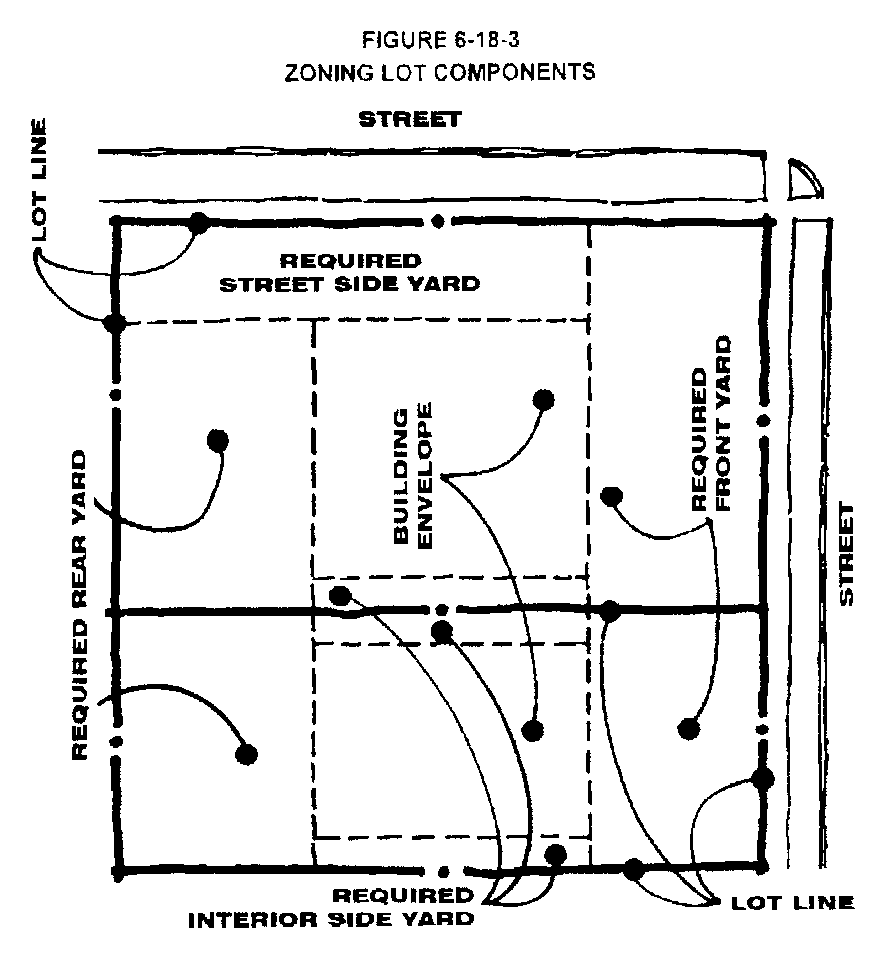
(Ord. 15-O-99)
|
BUILDING HEIGHT,
ABSOLUTE: | The perpendicular distance above the established grade to the highest point of the building, including parapet walls, but excluding chimneys, spires, and mechanical penthouses, provided the penthouses cannot be seen from the street. The highest point of turrets, towers, belfries, cupolas, lanterns, window's walks, and similar structures or features are used as the highest point of the structure when said structure or structure feature is: a) the highest point of the structure, and b) has an outer perimeter enclosing an area of sixteen (16) square feet or more regardless of the presence of floors. Said structure or feature is a spire when it has an outer perimeter enclosing an area of less than sixteen (16) square feet. Said structures or structure features include: turrets, towers, belfries, cupolas, lanterns, widow's walks or similar structures. (Ord. 112-O-03) |
| BUILDING HEIGHT, MEAN: | (A) The perpendicular distance measured from the established grade to the high point of the roof for a flat roof, the deck line of a mansard roof, and to the mean height level for gable, hip or gambrel roofs. Mean height level is computed as the average of the height of the high point of the roof and the highest level where the plane of the main roof, excluding dormers, intersects the plane of an outside wall below the main roof. Chimneys and spires shall not be included in calculating the height nor shall mechanical penthouses or solar collectors, provided the penthouses and collectors cannot be seen from the street. The highest point of the following structures or structure features is used as the high point of the roof in computing mean height level when said structure or feature is: 1) the highest point of the structure and 2) has an outer perimeter enclosing an area of sixteen (16) square feet or more regardless of the presence of floor. Said structure or feature is treated as a spire when having an outer perimeter enclosing an area of less than sixteen (16) square feet. Said structures or features include: turrets, towers, belfries, cupolas, lanterns, window's walks or similar structures. |
| (B) The height of any story of a structure shall be excluded from the calculation of its height when seventy-five percent (75%) or more of the gross floor area of such story consists of parking required for the structure (excluding mechanical penthouse or solar collector). This exclusion of required parking from the calculation of building height shall be applicable to all permitted and special uses in the B3, D2, D3, and D4 zoning districts including planned developments. Where the required parking exclusion is applicable, it shall in no case be greater than four (4) stories or forty (40) feet, whichever is less. | |
| (C) Anywhere in this zoning ordinance where the words building height are indicated without designation of mean building height or absolute building height the reference is to mean building height. (Ord. 35-O-08; Ord. No. 121-O-15, § 3, 10-26-2015) | |
|
BUILDING
MATERIALS ESTABLISHMENT: | A building, property or activity, the principal use of which is the selling of lumber or other associated building material and supplies in bulk to contractors and the general public. "Building materials establishment" shall not include a retail goods establishment or a wholesale goods establishment. |
|
BUILDING,
NONCOMPLYING [27]: | A lawfully established building that by virtue of the adoption hereof does not comply with all the applicable requirements of this Title governing height, bulk and location on a lot. |
|
BUILDING,
PRINCIPAL: | A building in which the business of the principal use of the lot on which the building is located is conducted. |
|
BUILDING,
RESIDENTIAL: | A principal building arranged, designed, used or intended to be used for residential occupancy by one (1) or more families. "Residential building" shall include, but is not limited to, the following types: a) single-family dwelling, b) two-family dwelling, c) multiple-family dwelling, and d) a row of single-family attached dwellings developed initially under single ownership or control. |
|
BUILDING,
TEMPORARY: | A building not designed or intended to be permanently placed or affixed on the lot upon which it is located. |
| BULK: | A composite characteristic of a given building or structure as located upon a given lot, not definable as a single quantity but involving all of these characteristics: 1) size and height of building or structure, 2) location of exterior walls at all levels in relation to lot lines, streets or to other buildings or structures, 3) floor area ratio, 4) all open spaces allocated to the building or structure, and 5) amount of lot area provided per dwelling unit, and 6) lot coverage. |
| BUSINESS: | An occupation, employment, or enterprise that occupies time, attention, labor, and materials, or wherein merchandise is exhibited, bought or sold, and/or where services are offered for compensation. |
|
BUSINESS OR
VOCATIONAL SCHOOL: | A privately-owned or publicly-owned post-secondary school, other than a community college or four-year "college/university institution," providing occupational or job skills in a variety of technical subjects and trades for specific occupations. (Ord. No. 3-O-14, § 2, 2-10-2014) |
| CANDLEPOWER: | The total luminous intensity of a light source expressed in footcandles. Maximum (peak) candlepower is the largest amount of footcandles emitted by any lamp, light source, or luminaire. |
| CANNABIS CRAFT GROWER: | A facility operated by an organization or business that is licensed by the Illinois Department of Agriculture to cultivate, dry, cure and package cannabis and perform other necessary activities to make cannabis available for sale at a dispensing organization or use at a processing organization, per the Cannabis Regulation and Tax Act, (P.A. 101-0027), as it may be amended from time-to-time, and regulations promulgated thereunder. (Ord. No. 31-O-20, § 1, 2-24-2020) |
|
CANNABIS
DISPENSARY: | A facility operated by an organization or business that is registered by the Illinois Department of Financial and Professional Regulation to acquire cannabis from a registered cultivation center for the purpose of dispensing cannabis, cannabis infused products, paraphernalia, or related supplies and educational materials to purchasers or registered qualifying patients as defined in the Compassionate Use of Medical Cannabis Program and the Cannabis Regulation and Tax Act as it may be amended from time-to-time, and regulations promulgated thereunder. (Ord. No. 126-O-19, § 1, 10-28-2019) |
|
CANNABIS
CULTIVATION CENTER: | A facility operated by an organization or business that is registered by the Illinois Department of Financial and Professional Regulation to cultivate, process, transport and perform necessary activities to provide cannabis and cannabis-infused products to licensed cannabis business establishments, per the Cannabis Regulation and Tax Act, (P.A. 101-0027), as it may be amended from time-to-time, and regulations promulgated thereunder. (Ord. No. 31-O-20, § 1, 2-24-2020) |
|
CANNABIS
INFUSER: | A facility operated by an organization or business that is licensed by the Illinois Department of Agriculture to directly incorporate cannabis or cannabis concentrate into a product formulation to produce a cannabis-infused product, per the Cannabis Regulation and Tax Act, (P.A. 101-0027), as it may be amended from time-to-time, and regulations promulgated thereunder. (Ord. No. 31-O-20, § 1, 2-24-2020) |
|
CANNABIS
PROCESSOR: | A facility operated by an organization or business that is licensed by the Illinois Department of Agriculture to either extract constituent chemicals or compounds to produce cannabis concentrate or incorporate cannabis or cannabis concentrate into a product formulation to produce a cannabis product, per the Cannabis Regulation and Tax Act, (P.A. 101-0027), as it may be amended from time-to-time, and regulations promulgated thereunder. (Ord. No. 31-O-20, § 1, 2-24-2020) |
|
CANNABIS
TRANSPORTER: | An organization or business that is licensed by the Illinois Department of Agriculture to transport cannabis on behalf of a cannabis business establishment or a community college licensed under the Community College Cannabis Vocational Training Pilot Program, per the Cannabis Regulation and Tax Act, (P.A. 101-0027), as it may be amended from time-to-time, and regulations promulgated thereunder. (Ord. No. 31-O-20, § 1, 2-24-2020) |
| CAR WASH: | A building or portion thereof where facilities for washing, cleaning and detailing automobiles are provided, that involve machine or hand-operated mechanical devices or equipment. |
| CATERER: | A building, property, or activity, the principal use or purpose of which is the preparing and serving and delivering of meals or food items only for consumption off the premises at public or private functions such as: weddings, receptions, dinners or banquets. Over-the-counter sales of prepared food items shall be prohibited in conjunction with this use. (Ord. 39-O-95) |
| CELLAR: | The portion of a building located partly or wholly underground and having one-half (1/2) or more than one-half (1/2) of its clear floor-to-joist height below the average grade of the adjoining ground. |
|
CERTIFICATE OF
OCCUPANCY: | The official certification that a premises conforms to the provisions of the Zoning Regulations and Building Code and may be used or occupied. A certificate of occupancy must be issued before a structure may be occupied. |
|
CERTIFICATE OF
ZONING COMPLIANCE: | A written certification that a structure, use, or parcel of land is, or will be in compliance with the requirements of this Ordinance. (See Section 6-3-2.) |
|
CHILD
RESIDENTIAL CARE HOME: | A dwelling unit shared by four (4) to eight (8) unrelated persons, under the age of twenty-one (21) years, exclusive of staff, who require assistance and/or supervision while pursuing a primary or secondary education curriculum, and who reside together in a family-type environment as a single housekeeping unit. "Child residential care home" shall not include a home for persons who are currently addicted to alcohol or narcotic drugs or who are criminal or juvenile offenders serving on work release, probationary or court-ordered supervisory programs for offenders; nor a dormitory, fraternity/sorority dwelling, boarding house, rooming house or nursing home. (Ord. 40-O-95) |
| COACH HOUSE: | A type of detached Accessory Dwelling Unit which includes a garage. (Ord. No. 47-O-18, § 1, 5-14-2018; Ord. No. 171-O-19, § 1, 1-13-2020; Ord. No. 86-O-20, § 1, 9-29-2020) |
|
COLLEGE/
UNIVERSITY INSTITUTION: | A privately-owned or publicly-owned institution providing full-time or part-time education, other than "business or vocational school," beyond the high school level, including any lodging rooms or housing for students or faculty. (Ord. No. 3-O-14, § 2, 2-10-2014) |
| COLLOCATE or COLLOCATION: | To install, mount, maintain, modify, operate, or replace wireless facilities on or adjacent to a wireless support structure or utility pole. (Ord. No. 44-O-21, § 2, 5-10-2021) |
|
COMMERCIAL
INDOOR RECREATION: | Public or private recreation facilities, tennis ball, racquet or other courts, swimming pools, bowling alleys, skating rinks, or similar uses that are enclosed in buildings and primarily for the use of persons who do not reside on the same lot as that on which the recreational use is located. "Commercial indoor recreation" shall include, but not be limited to, health and fitness establishments or any accessory use, such as snack bars that sell prepackaged food items, pro shops, and locker rooms that are designed and intended primarily for the use of patrons of the principal recreational use. "Commercial indoor recreation" shall not include cultural facilities, community centers and recreation centers, or any use that is otherwise listed specifically in a zoning district as a permitted or a special use. For purposes of this definition, the term "commercial purpose," as defined in this Section, shall not apply. (Ord. No. 47-O-13, § 2, 6-10-2013) |
|
COMMERCIAL
OUTDOOR RECREATION: | Public or private swimming pools, tennis courts, ball fields, ball courts, and fishing piers that are not enclosed in buildings and are operated on a commercial or membership basis primarily for the use of persons who do not reside on the same lot as that on which the recreational use is located. "Commercial outdoor recreation" shall include any accessory uses, such as snack bars, pro shops, and clubhouses that are designed and intended primarily for the use of patrons of the principal recreational use. "Commercial outdoor recreation" shall not include skateboarding courses, water slides, mechanical rides, go-cart or motorcycle courses, raceways, drag strips, stadiums, marinas, overnight camping, or gun firing ranges, or any use that is otherwise listed specifically in a zoning district as a permitted or special use. |
|
COMMERCIAL
PARKING GARAGE: | A privately or publicly owned and used structure used for parking or storage of automobiles, generally available to the public, and involving payment of a charge for such parking or storage. |
|
COMMERCIAL
PARKING LOT: | An area reserved or used for parking or storage of automobiles, which is either privately or publicly owned generally available to the public, and involving payment of a charge for such parking or storage. |
|
COMMERCIAL
PURPOSE: | An occupation, employment or enterprise that is carried on for profit by the owner, lessee or licensee, except for activities carried on by a not for profit organization that utilizes the proceeds of such activities solely for the purposes for which it is organized. |
|
COMMERCIAL
SHOPPING CENTER: | A concentration of related commercial establishments with one (1) or more major anchor tenants, shared parking, and unified architectural and site design. A shopping center normally has single or coordinated ownership/operations/management control and may include out parcels as well as architecturally connected units. |
|
COMMERCIAL
STORAGE FACILITY: | A commercial land use consisting of the rental of fully enclosed interior building space for the storage of personal property (miniwarehouse). An industrial warehouse is not considered commercial storage facility. (Ord. No. 43-O-93) |
|
COMMUNITY
CENTER: | A place, structure, area or other facility that is open to the public, under the jurisdiction of a public or nonprofit agency, and is used for community recreation, education and/or service activities. A community center may include, but is not limited to, the following uses: auditorium, multipurpose room, gymnasium, meeting space, open space, playground, playing courts, playing field, and swimming pool. Community center does not include retail services, membership organizations, commercial indoor recreation, commercial outdoor recreation, transitional shelter, transitional treatment facility, short or long term care facility. (Ord. 67-0-09) |
|
CONFERENCE
FACILITY (COLLEGE/ UNIVERSITY): | A building or portion thereof operated by a college/university institution used for holding assemblies, conferences, conventions, public meetings, seminars, workshops, or other similar activities. Such a facility may include executive level training programs and executive level educational seminars but may not include classrooms or other facilities used for regular college or university degree program classes. A conference facility may include dining facilities for the use of participants, as well as other compatible accessory uses but may not include sleeping or dwelling quarters or lodging as an accessory use to the conference facility. |
|
CONFERENCE
FACILITY (NONCOLLEGE/ UNIVERSITY): | A building or portion thereof used for holding assemblies, conferences, conventions, public meetings, seminars, trade shows, workshops, or other similar activities that is not a conference facility (college/university). A conference facility may include dining facilities for the use of participants, as well as other compatible accessory uses but may not include sleeping or dwelling quarters or lodging as an accessory use to the conference facility. (Ord. 82-0-98) |
|
CONGREGATE
HOUSING: | Rental housing which provides a living arrangement of self-contained units that integrates shelter, food service and other services for independent adults who do not require twenty-four (24) hour oversight. Services may include meals, laundry, transportation, housekeeping and organized activities which create opportunities for socialization. |
|
CONVENIENCE
STORE: | Any food store establishment having a building size or occupying a sales floor space under three thousand two hundred (3,200) square feet. (Ord. 114-O-02) |
|
CRAFT ALCOHOL
PRODUCTION FACILITY: | A commercial facility that: (1) produces beer, wine, or other alcoholic liquor in quantities complaint with all applicable local, state, and federal regulations; and (2) includes an accessory tasting room in zoning districts where the facility is a Special Use. A tasting room is only permitted to serve alcohol as permitted by Title 3, Chapter 4 of the Evanston City Code of 2012, as amended (Liquor Control Regulations). A Craft Alcohol Production Facility may have a Type 1 Restaurant as an accessory use. (Ord. No. 105-O-18, § 1, 10-8-2018; Ord. No. 63-O-19, § 1, 8-5-2019) |
|
CULTURAL
FACILITY: | An indoor theater, auditorium, or other building or structure designed, intended, or used primarily for musical, dance, dramatic, or other performances, or a library, museum or gallery operated primarily for the display, rather than the sale, of works of art. A "cultural facility" does not include a performance entertainment venue. (Ord. 2-O-00) |
| DAYCARE CENTER — ADULT: | Any place other than a family home in which persons receive adult daycare services during any part of a day not exceeding twelve (12) hours in a twenty-four (24) hour period licensed pursuant to this Code. |
| DAYCARE CENTER — CHILD: | Any place other than a family home in which children nine (9) years of age and under receive child daycare services during any part of a day not exceeding twelve (12) hours in a twenty-four (24) hour period licensed pursuant to this Code. |
| DAYCARE HOME — ADULT [28]: | A family home in which not less than four (4) and not more than eight (8) persons receive adult daycare services during any part of a day not exceeding twelve (12) hours in a twenty-four (24) hour period. |
|
DAYCARE HOME —
CHILD [29]: | A family home that receives not less than four (4) and not more than eight (8) children, nine (9) years of age and under, for care during any part of the day not exceeding twelve (12) hours in a twenty-four (24) hour period. The maximum of eight (8) children includes the family's natural or adopted children under age eighteen (18) and those children who are in the home under full time care. |
|
DAYCARE
CENTER— DOMESTIC ANIMAL: | Any establishment for which the principal use or purpose is the housing of domestic animals for periods of time that shall neither exceed fourteen (14) hours in any twenty-four (24) hour period, nor include overnight stays. Multiple animals shall be permitted outside on the premises when accompanied by staff and only between the hours of 8:30 a.m. and 4:30 p.m. on any day. Individual animals shall be permitted outside on the premises to relieve themselves at any time during the Center's hours of operation when accompanied by staff. Prior to beginning operation of any such Center, the operator shall submit to the Zoning Administrator a contingency plan for those times when an owner fails to claim his/her animal(s) before the Center closes for the day, and, thereafter, comply with said plan. The operator of any such Center shall comply with the applicable regulations of Title 8, Chapter 4, and Title 9, Chapter 4 of the City Code, as amended. (Ord. No. 67-O-11, § 2, 9-12-2011; Ord. No. 95-O-20, § 1, 10-26-2020) |
| DECK: | A structure which is either freestanding or attached to a principal or accessory building, located in the rear yard or side yard and constructed above grade and unenclosed by solid or nonsolid walls or a roof. If located in the side yard, an attached deck must meet principal building setbacks. (Ord. No. 165-O-15, § 10, 5-23-2016) |
|
DESIGN AND PROJECT
REVIEW COMMITTEE (DAPR): | The committee addressed by Ordinance 50-O-14, as amended, whose major purpose is to review development plans pursuant to the provisions of this Title. (Ord. No. 50-O-14, § 21, 10-27-2014) |
| DISABLED: | As defined pursuant to Title VIII of the Civil Rights Act of 1968, as amended by the Fair Housing Amendment Act of 1988, a person having: a) a physical or mental impairment that substantially limits such person's ability to live independently; b) a record of having such an impairment; or c) being regarded as having such an impairment. "Disabled" shall not include current illegal use of or addiction to a controlled substance, nor shall it include any person whose residency in the home would constitute a direct threat to the health and safety of the other individuals. |
|
DISTRICT
OVERLAY: | An overlay district is a second set of regulations applied to any part or all of a zoning district or any number of districts. The overlay district regulations may relax or further restrict the number or types of uses allowed as well as the way permitted activities operate within the overlay district boundaries. Such districts are mapped on the City of Evanston zoning map. |
| DORMER: | A structure projecting from a slanting roof to accommodate a window. |
| DORMITORY: | A building or portion thereof that contains living quarters for students, staff, or members of an accredited college, university, boarding school, theological school, hospital, religious order, or comparable organization; provided that said building is owned or managed by said organization and contains not more than one (1) cooking and eating area; and further provided that said building complies with the rooming house ordinance of the City. |
|
DRIVE-THROUGH
FACILITY: | A facility, establishment or portion thereof that is designed, intended or used for transacting business with customers located in motor vehicles. "Drive-through facility" shall only be permitted in connection with a listed permitted or special use. (Ord. 39-O-95) |
| DRIVEWAY: | A private access way that provides direct access from a street to a parking space. |
| DRIVEWAY, SHARED: | Private way for vehicular use by two (2) or more owners. |
| DWELLING: | A residential building or portion thereof. "Dwelling" shall not include a hotel, motel, boarding house, rooming house, dormitory, nursing home, mobile home, or institution. |
|
DWELLING,
FRATERNITY/ SORORITY: | A building that is occupied only by a group of university or college students who are associated together in a fraternity/sorority that is chartered by a national or international fraternity/sorority or is officially recognized by the university or college and who receive from the fraternity/sorority lodging and/or meals on the premises for compensation. |
|
DWELLING,
MULTIPLE-FAMILY: | A detached residential building containing three (3) or more dwelling units, including what is commonly known as an apartment building, but not including group, row, or town houses. |
|
DWELLING,
SINGLE-FAMILY ATTACHED (GROUP, ROW, OR TOWN HOUSES): | Three (3) or more dwelling units joined side by side. |
|
DWELLING,
SINGLE-FAMILY DETACHED: | A residential building containing not more than one (1) dwelling unit entirely surrounded by open space on the same lot. |
|
DWELLING,
TWO-FAMILY: | A residential building containing not more than two (2) dwelling units entirely surrounded by open space on the same lot. |
| DWELLING UNIT: | A room or group of contiguous rooms that include facilities used or intended to be used for living, sleeping, cooking and eating, and that are arranged, designed or intended for use exclusively as living quarters. |
| DWELLING UNIT, ACCESSORY (ADU): | A smaller, secondary independent housekeeping establishment located on the same zoning lot as a residential building. ADUs are independently habitable and provide the basic requirements of shelter, heating, cooking, and sanitation, and may be internal, attached or detached. (Ord. No. 86-O-20, § 1, 9-29-2020) |
|
EDUCATIONAL
INSTITUTION - PRIVATE: | A privately owned preschool, elementary school, middle school, or high school. |
|
EDUCATIONAL
INSTITUTION - PUBLIC: | A publicly owned preschool, elementary school, middle school, or high school, or a facility owned by a public school district containing classrooms, and libraries, offices or similar support facilities for one (1) or more of the following district purposes: educational services and related programs for faculty and staff and for students, preschool age children and their families; district administrative staff offices. A zoning lot developed as an educational institution must be principally used for classrooms for preschool, elementary school, middle school, or high school students. (Ord. 24-0-01) |
| EFFICIENCY HOME: | A small residential building, with a ground floor area of six hundred (600) square feet or less, containing not more than one (1) dwelling unit entirely surrounded by open space on the same lot and permanently affixed to a foundation. A mobile home or recreational vehicle shall not be considered an efficiency home. (Ord. No. 13-O-21, § 1, 3-22-2021; Ord. No. 19-O-24, § 4, 3-11-2024) |
| EFFICIENCY UNIT: | A dwelling unit consisting of one (1) principal room together with bathroom, kitchen, hallway, closets and/or dining room alcove directly off the principal room, provided such dining alcove does not exceed one hundred twenty-five (125) square feet in area. An efficiency unit created after December 2, 1960, shall contain at least three hundred (300) square feet of floor area. (Ord. No. 13-O-21, § 1, 3-22-2021) |
|
EMERGENCY
PHONE STRUCTURE: | A structure with a phone specifically provided for making calls to emergency services for security and safety precaution in public areas. Emergency phone structures are typically highly visible due to high intensity lighting. Examples include, but are not limited to: emergency phones, phone stanch ions, call stations, and call boxes. (Ord. No. 66-O-15, § 36, 6-22-2015) |
|
EVANSTON
LANDMARK: | A landmark of historic importance as defined in Title 2, Chapter 8, "Historic Preservation," as amended. (Ord. No. 79-O-18, § 5, 7-23-2018) |
|
FACADE OF THE
PRINCIPAL BUILDING, FRONT-FACING: | Any facade of the principal building which approximately parallels the front lot line, exceeds ten (10) feet in length, and is located within fifteen (15) feet of that portion of, or is, the facade of the principal building closest to the front lot line (see Figure 6-18-3, front-facing facade of the principal building). |
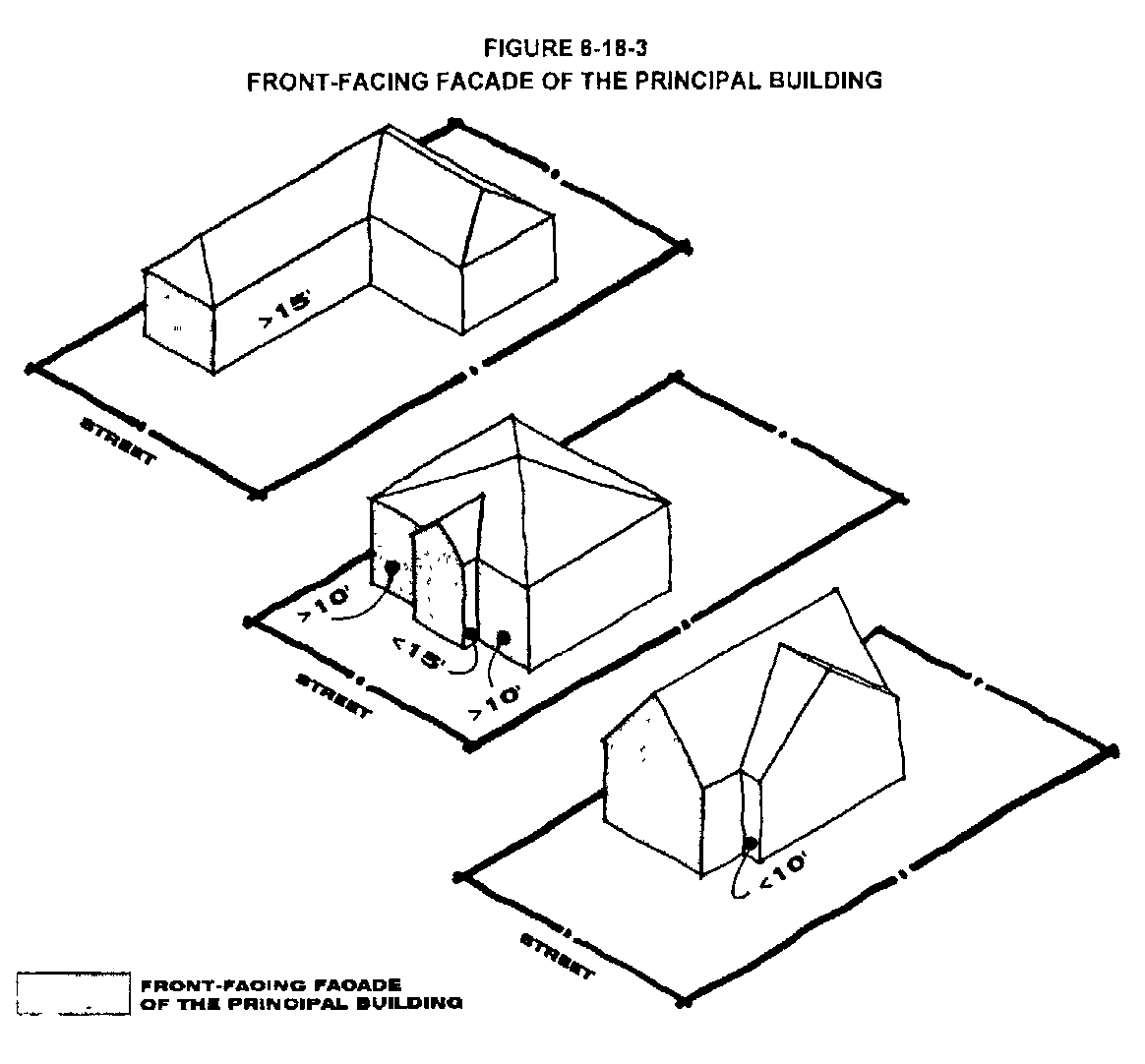
| FACADE OF THE PRINCIPAL BUILDING, STREET FACING: | Any facade of the principal building which approximately parallels a street lot line(s), exceeds ten (10) feet in length, and is located within fifteen (15) feet of that portion of, or is, the facade of the principal building closest to the corresponding street lot line (see Figure 6-18-3, "Street-Facing Facade of the Principal Building," of this Section). |
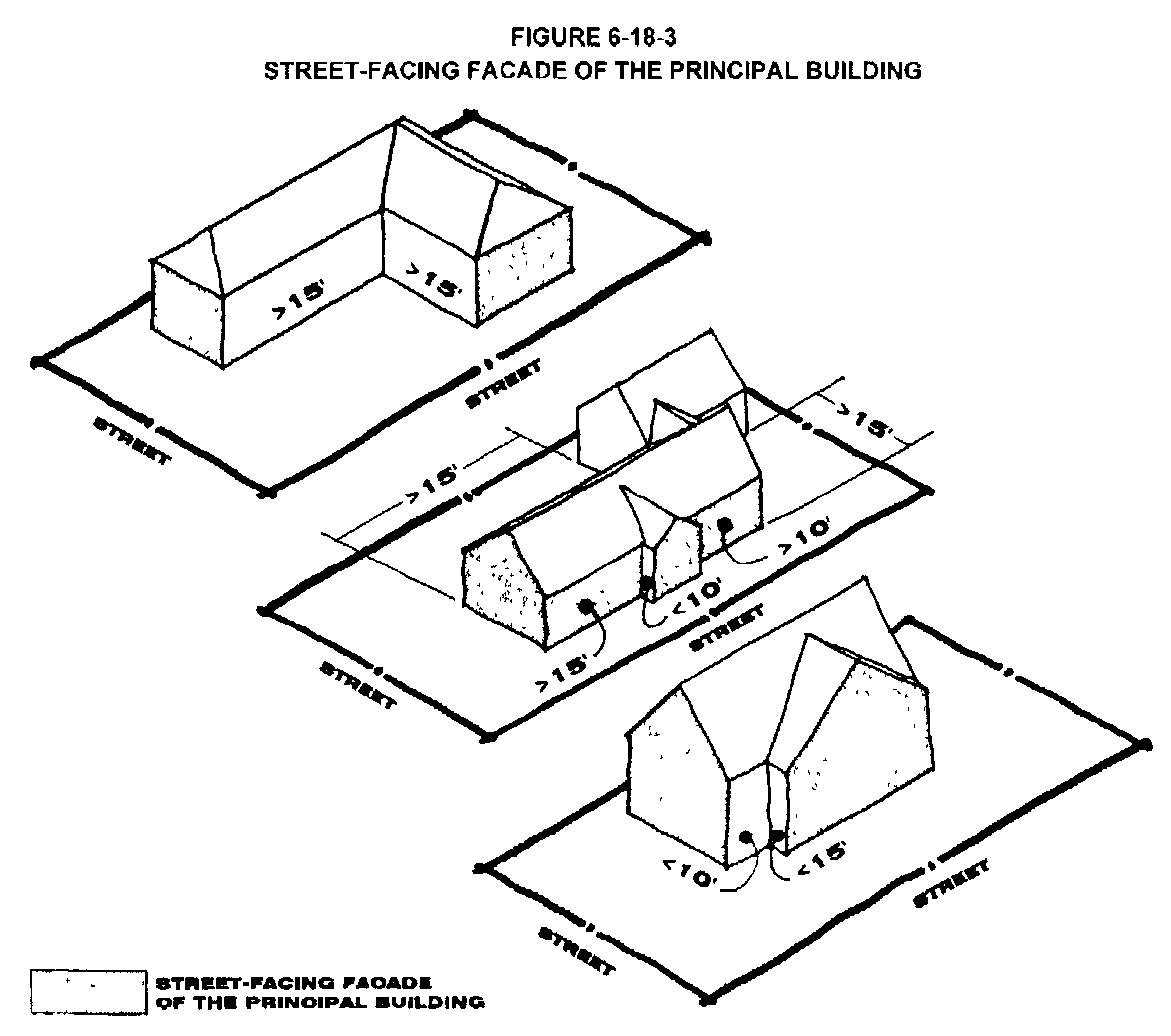
(Ord. 15-O-99)
| FAMILY: | (A) Type (A) Family: One (1) or more persons related by blood, marriage, or adoption living together as a single housekeeping unit in a dwelling unit. |
| (B) Type (B) Family: Two (2) unrelated persons and their children living together as a single housekeeping unit in a dwelling unit. | |
| (C) Type (C) Family: A group of not more than three (3) unrelated persons living together as a single housekeeping unit in a dwelling unit. | |
| (D) Type (D) Family: A group of two (2) or more persons containing within it one (1) or more families, as defined in Subsections (A) and (B) of this definition, including a husband and wife married to one another and their children, as well as adults, living together in a dwelling unit as a single housekeeping unit and management, in premises in which the adult occupants are affiliated with a bona fide not for profit corporation organized for religious purposes chartered by the state of Illinois, that owns or rents the property and has been in existence for at least five (5) years prior to seeking certification by the director of planning and zoning as provided herein; provided, that in no case shall the total occupancy of the dwelling unit exceed two (2) persons per bedroom, nor shall the premises be utilized for religious public assembly. This type (D) family may occupy a dwelling unit only in accordance with the procedures in Section 6-4-1-14 of this Title. | |
| "Family" shall not be construed to mean a club, a lodge or a fraternity/sorority house. | |
| FENCE [30]: | A structure, other than a building, that is a barrier and used as a boundary or means of protection or confinement. (Ord. No. 43-O-93) |
| FENESTRATION: | The design and placement of windows in a building. (Ord. 5-9-08) |
| FIELD HOUSE: | A place, structure, or other facility used for and providing athletic and recreational programs for a college/university institution. "Field house (college/university)" shall include any accessory uses, such as, but not limited, to locker rooms, snack bars, administrative offices and classrooms which are designed and intended primarily for the use of college/university related persons and patrons of the principal recreational use. |
|
FINANCIAL
INSTITUTION: | A building, property or activity, the principal use or purpose of which is the provision of financial services, including but not limited to banks, facilities for automated teller machines ("ATMs"), credit unions, savings and loan institutions, and mortgage companies. "Financial institution" shall not include any use or other type of institution that is otherwise listed specifically in a zoning district as a permitted or special use. |
| FIREARM RANGE: | Any indoor establishment where the discharging of a firearm, as defined in Section 9-8-1, is allowed for a sporting event or for practice, instruction, testing, or training in the use of a firearm. A firearm range may also include rental of a firearm for allowable uses within the establishment and a firearm dealer as defined and regulated by Title 9, Chapter 8 — Weapon of the City Code. (Ord. No. 51-O-15, § 4, 6-22-2015) |
|
FLOOR AREA
(GROSS FLOOR AREA): | The sum of the gross horizontal areas of the several floors of a building, except a cellar floor, measured from the exterior faces of the exterior walls or from the center line of walls separating two (2) buildings. The "floor area" of a building shall also include, but not be limited to, basements, all attic space, finished or unfinished, having five (5) feet or more space from floor to rafters, interior balconies and mezzanines; and enclosed porches or porches covered by a roof suitable for covering a habitable room. Any space devoted to required off-street parking or loading for the building shall not be included in "floor area." The following areas shall be excluded from calculations for "floor area": elevator shafts, stairwells, space used solely for heating, cooling, mechanical, electrical and mechanical penthouses, refuse rooms and uses accessory to the building. |
|
FLOOR AREA OF A
DWELLING UNIT OR A LODGING ROOM: | The sum of the gross horizontal areas of the rooms constituting the dwelling unit or lodging room, including closets, baths, utility rooms, enclosed porches and hallways when accessible only to the occupants of said dwelling unit or lodging room and not accessible to other occupants of the building or to the general public, and only when such rooms, halls or other areas are an integral part of said dwelling unit or lodging room. Floor area shall be measured from the interior faces of the outermost walls defining the dwelling unit or lodging room but shall not include any unfinished space or finished space having a head room of less than five (5) feet. |
|
FLOOR AREA,
GROUND: | The sum of the gross horizontal area of the ground floor of a building, measured from the exterior faces of the exterior walls or from the center line of walls separating two (2) buildings. The ground floor area of a building also shall include recessed, unenclosed, or partially enclosed areas under a floor above exterior stairways, porches, and similar areas but excluding open terraces. |
| FLOOR AREA RATIO: | The numerical value obtained by dividing the gross floor area of a building or buildings by the lot area on which such building or buildings are located. |
|
FOOD STORE
ESTABLISHMENT: | A building or portion thereof where the direct retail sale of food items such as meats, cereals, grains, produce, baked goods, dairy products, canned and frozen prepared food products, beverages, cleaning supplies, pet food and supplies, pharmaceuticals, over-the-counter medicines, personal products, household goods, books and magazines, plants, and other sundry and similar items are available to be purchased by the consumer. "Food store establishments" shall include, but not be limited to, a candy or confectionery store, grocery store, a food and drug supermarket, meat or fish market, fruit and vegetable market, retail bakery, and other uses similar in nature and impact. "Food store establishment" shall not include any use or other type of establishment that is otherwise listed specifically in a zoning district as a permitted or special use. Seating for the consumption of food and/or beverages by customers is prohibited. (Ord. 39-O-95) |
| FOOT-CANDLE: | A unit of illumination produced on a surface, all points of which are one (1) foot from a uniform point source of one (1) standard candle. |
| FOSTER CHILD: | A child giving, receiving, and sharing affection and care in a family other than his or her biological family, as if related by blood or as if legally adopted. |
| GARAGE, PRIVATE: | An accessory building or an accessory portion of the principal building, including a carport, that is intended for and used for storing the privately owned motor vehicles, boats, and trailers of the family or families resident upon the premises, and in which no business, service, or industry connected directly or indirectly with motor vehicles, boats, and trailers is carried on. |
| GARAGE, STORAGE: | A building or premises used for the housing only of motor vehicles, boats, and trailers and where no equipment or parts are sold and vehicles are not rebuilt, serviced, repaired, hired or sold. |
| GOVERNMENT INSTITUTION: | A building or structure owned and operated by a municipal, state, federal, or other taxing body institution in which governmental services are provided or conducted. |
|
GRADE,
ESTABLISHED: | The elevation established for regulating the height of buildings. Established grade shall be the mean level of the public sidewalk, where present, or if no sidewalk, the mean finished surface of the ground off the subject property immediately adjacent to the front lot line. (Ord. 112-O-03) |
| GUEST, PERMANENT: | A person who occupies or has the right to occupy a residential accommodation for a period of thirty (30) days or more. |
| GUEST, TRANSIENT: | A guest who does not have a lease and occupies an apartment, lodging room, or other living quarters on a daily or weekly basis. |
| HEALTH HAZARD: | A classification of a chemical for which there is statistically significant evidence based on at least one (1) study conducted in accordance with established scientific principles that acute or chronic health effects may occur in exposed persons. The term "health hazard" includes chemicals that are carcinogens, toxic or highly toxic agents, reproductive toxins, irritants, corrosives, sensitizers, hepatotoxins, nephrotoxins, agents which act on the hematopoietic system, and agents which damage the lungs, skin, eyes, or mucous membranes. |
| HISTORIC LANDMARK: | See definition of Evanston Landmark. |
| HOME OCCUPATION: | An accessory use of a dwelling unit that is used for a gainful activity involving the provision, assembly, processing or sale of goods and/or services that is incidental and secondary to the use of a dwelling unit, but excluding the provision of shelter or lodging. (See Chapter 5 of this Title.) |
| HOSPITAL: | An institution licensed by state law providing health services and medical or surgical care to patients and injured persons. (See Section 6-15-10 of this Title.) |
|
HOSPITAL BASED
SPECIALIST: | A medical practitioner licensed by the state of Illinois to practice medicine who restricts his/her practice to one (1) of the following seven (7) medical specialties: a) emergency medicine; b) radiology; c) nuclear medicine; d) pathology; e) anesthesiology; f) neonatology; and g) perinatology. These physicians see essentially all of their patients in the hospital facilities. |
| HOTEL: | A building in which lodging is offered with or without meals principally to transient guests and that provides a common entrance, lobby, halls and stairways. |
| HOTEL, APARTMENT: | A hotel with dwelling units in which all accommodations are provided in dwelling units and in which at least twenty-five percent (25%) of the guestrooms are for occupancy by transient guests. An apartment hotel may have a dining room open to the public that is accessible only from an inner lobby or corridor. |
|
IMPERVIOUS
SURFACE: | Any hard surfaced, manmade area that does not readily absorb or retain water, including but not limited to any paved, asphalt or concrete areas, parking and graveled driveway areas and sidewalks. (Ord. No. 165-O-15, § 9, 5-23-2016) |
|
INDEPENDENT
LIVING FACILITY: | A living arrangement of dwelling units or rooming units for older adults who do not require any oversight or assistance with personal or medical care needs. Facility may provide general services such as meals, transportation, housekeeping, and opportunities for socialization. (See definitions of Retirement Hotel and Congregate Housing.) |
|
INDOOR RECREATION
FACILITY (COLLEGE/ UNIVERSITY): | A place, structure, or other facility used for and providing indoor recreation facilities, tennis, ball, racquet or other courts, swimming pools, bowling alleys, or similar uses that are enclosed in buildings and are operated primarily for the use of college/university related persons. "Indoor recreation facilities (college/university)" shall include any accessory uses, such as, but not limited to, cafeterias, administrative offices, classrooms and locker rooms, which are designed and intended primarily for the use of college/university related persons and patrons of the principal recreational use. "Indoor recreation facilities (college/university)" shall not include theaters, cultural facilities, commercial recreation centers, community centers and recreation centers, or any use which is otherwise listed specifically in the zoning districts as a permitted or special use. |
|
INDUSTRIAL
SERVICE ESTABLISHMENT: | A building, property, or activity of which the principal use or purpose is the provision of industrial oriented services directly to the industrial use establishments. This term shall include, but will not be limited to, tool shops, machine repair and service shops, blade sharpening shops and similar establishments. "Industrial services establishments" shall not include any use or other type of establishment that is otherwise listed specifically in a zoning district as a permitted or special use. |
| INSTITUTION: | An organization or establishment providing religious, educational, charitable, medical, cultural, or governmental services. |
| INVISIBLE PET FENCE: | An electronic system designed to keep a pet or other domestic animal within a set of predefined boundaries without the use of a visible barrier. (Ord. No. 22-O-15, § 7, 4-13-2015) |
|
JOINT PARKING
FACILITY: | A parking facility used for joint parking by two (2) or more businesses or other establishments. |
| JUNKYARD: | An open area where discarded, used, or secondhand materials are bought, sold, exchanged, stored, baled, packed, disassembled, or handled including, but not limited to, scrap iron and other metals, paper, rags, rubber tires and bottles. Junkyard includes wrecking yards, but does not include landfills, waste transfer stations or uses carried on entirely within enclosed buildings. (Ord. No. 43-O-93) |
| KENNEL: | Any establishment for which the principal use or purpose is the housing of domestic animals, including overnight stays. Multiple animals shall be permitted outside on the premises when accompanied by staff and only between the hours of 8:30 a.m. and 4:30 p.m. on any day. Individual animals shall be permitted outside on the premises to relieve themselves at any time during the Center's hours of operation when accompanied by staff. Prior to beginning operation of any such Kennel, the operator shall submit to the Zoning Administrator a contingency plan for those times when an owner fails to claim his/her animal(s), and, thereafter, comply with said plan. The operator of any such Kennel shall comply with the applicable regulations of Title 8, Chapter 4, and Title 9, Chapter 4 of the City Code, as amended. (Ord. No. 67-O-11, § 2, 9-12-2011) |
|
KNEE-WALL,
EXTERIOR: | That portion of a building, with vertical walls, located between the top full story and a half story. Exterior knee-walls shall not exceed three (3) feet in height. In order to allow for additional height while minimizing bulk, exterior knee-walls above the second story are not allowed except on buildings with gable or hip roofs. (Ord. No. 72-O-12, § 11, 10-22-2012) |
| LIVE-WORK UNIT: | A structure or a tenant space where allowed nonresidential activity occurs as the principal use of the structure or tenant space and a living quarters accessory to the allowed nonresidential activity serves as a dwelling unit on the premises. A live-work unit shall not consist of solely the allowed nonresidential activity and a sleeping unit without a kitchen for use exclusively by the occupant. (Ord. 67-0-09; Ord. No. 82-O-21, § 1, 9-13-2021) |
| LODGING: | A place of business including the following uses: hotels, motels, inns, and other uses similar in nature and impact. |
|
LODGING ROOM
(ROOMING UNIT): | A room or group of rooms forming a single habitable unit that is not physically a part of a dwelling unit or, though physically a part of a dwelling unit, is used or intended for use by a person or persons other than members of the family occupying said dwelling unit, and that is used or intended to be used as sleeping and living quarters, but without facilities for cooking, eating, food storage or food preparation. |
|
LONG TERM CARE
FACILITY: | A facility that provides personal, sheltered, intermediate or skilled care for persons in need of such care, regardless of age. (Ord. No. 43-O-93) |
| LOT: | A parcel of land located within a single block which shall be either a "lot of record" or a "zoning lot" and shall have frontage upon a "street." (Ord. 10-0-95) |
| LOT AREA: | The area of horizontal plane bounded by the vertical planes through front, side, and rear lot lines. |
| LOT, CORNER: | A lot situated at the junction of and abutting on two (2) or more intersecting streets; or a lot at the point of deflection in alignment of a single street, the interior angle of which does not exceed one hundred thirty-five degrees (135°). |
|
LOT COVERAGE,
BUILDING: | The ratio between the ground floor areas of all buildings or structures, including covered decks attached to the principal building or free-standing, on a lot and the total area of the lot. (Ord. No. 165-O-15, § 9, 5-23-2016) |
| LOT DEPTH: | The mean horizontal distance between the front lot line and the rear lot line of a lot, measured within the lot boundaries. |
| LOT, FLAG: | A lot with access provided to the bulk of the lot by means of a narrow corridor. |
| LOT LINE: | A line dividing one (1) lot from another lot or from a street or alley. |
| LOT LINE, FRONT: | A lot line that is a street lot line. Any street lot line of a corner lot may be established by the Zoning Administrator as the front lot line. (Ord. No. 45-O-17, § 2, 9-11-2017) |
| LOT LINE, REAR: | That boundary of a lot that is most distant from and is, or is approximately, parallel to the front lot line. If the rear lot line is less than ten (10) feet in length, or if the lot forms a point at the rear, the rear lot line shall be deemed to be a line ten (10) feet in length within the lot, parallel to and at the maximum distance from the front lot line. |
| LOT LINE, SIDE: | Any boundary of a lot that is not a front or rear lot line. On a corner lot, a side lot line may be a street lot line. |
|
LOT,
NONCONFORMING: | A use or activity that lawfully existed prior to the adoption, revision, or amendment of this Ordinance, but that fails by reason of such adoption, revision, or amendment to conform to the requirements of the zoning district in which it is located. (See Chapter 6 of this Title.) |
| LOT OF RECORD: | Is a lot that is part of a subdivision, the plat of which has been recorded in the office of the recorder of deeds of Cook County, or a parcel of land, the deed to which was recorded in the office of said recorder of deeds prior to the adoption of this Ordinance. |
| LOT, OPEN SALES: | Any zoning lot or portion of a zoning lot used for retail sales in which said sales or the inspection of merchandise by prospective purchasers predominantly occurs outside of an area enclosed by walls. Open sales lot does not include the following uses: uses allowed and/or regulated in Section 6-4-8-3, "Permitted Temporary Use Regulations," of this Title; automobile and recreational vehicle sales and/or rental; truck sales and/or rental; sales of plants for landscaping or gardening; the "farmers' market" as defined and regulated by Title 3, "Business Regulations," Chapter 25, "Farmers' Market" of this Code. (Ord. 114-O-02; Ord. No. 154-O-15, § 4, 2-8-2015) |
|
LOT, REVERSED
CORNER: | A corner lot where the street side lot line is substantially a continuation of the front lot line of the first lot to its rear. |
| LOT, THROUGH: | A lot with lot lines on two (2) streets, that is not a corner lot. All street lot lines shall be deemed front lot lines. (Ord. 18-0-94) |
| LOT WIDTH: | (A) The distance between the side lot lines measured across the rear of the required front yard; or |
| (B) One hundred twenty-five percent (125%) of the distance between the side lot lines at the point where said side lot lines intersect the street, whichever is shorter. | |
| LOT, ZONING: | A single tract of land located within a single block that, at the time of filing for a building permit, is designated by its owner or developer as a tract to be used, developed, or built upon as a unit, under single ownership or control. Therefore, a "zoning lot or lots" may or may not coincide with a lot of record. |
|
MANUFACTURING,
HEAVY: | The assembly, fabrication, or processing of goods and materials using processes that ordinarily have greater than minimal impacts on the environment, or that ordinarily have significant impacts on the use and enjoyment of adjacent property in terms of noise, smoke, fumes, visual impact, odors, glare, or health and safety hazards, or that otherwise do not constitute "light manufacturing," or any use where the area occupied by outdoor storage of goods and materials used in the assembly, fabrication, or processing exceeds twenty-five percent (25%) of the floor area of all buildings on the property. Heavy manufacturing generally includes processing and fabrication of large or bulky products made from extracted or raw materials or products involving flammable or explosive materials and processes that require extensive floor areas or land areas for the fabrication and/or incidental storage of the products. "Heavy manufacturing" shall not include any use that is otherwise listed specifically in a zoning district as a permitted or special use. |
|
MANUFACTURING,
LIGHT: | The assembly, fabrication, or processing of goods and materials using processes that ordinarily do not create noise, smoke, fumes, odors, glare, or health or safety hazards outside of the building or lot where such assembly, fabrication, or processing takes place, where such processes are housed entirely within a building, or where the area occupied by outdoor storage of goods and materials used in such processes does not exceed twenty-five (25) percent of the floor area of all buildings on the property. Light manufacturing generally includes processing and fabrication of finished products predominantly from previously prepared materials and includes processes that do not require extensive floor areas or land areas. "Light manufacturing" shall not include any use that is otherwise listed specifically in a zoning district as a permitted or special use. |
|
MEDIA
BROADCAST STATIONS: | A building or portion thereof used for the production and broadcast of media related programming. This term shall include, but will not be limited to, radio and television broadcasting stations and other uses similar in nature and impact. |
|
MEMBERSHIP
ORGANIZATION: | Lands, buildings or portions thereof, or premises owned or operated by an organization of a professional, business, trade, civic, social, fraternal, political, or religious nature operating on a membership basis and engaged in promoting the interest of their members. (Ord. No. 43-O-93) |
| MICRO WIRELESS FACILITY: | A small wireless facility that is not larger in dimension than twenty-four (24) inches in length, fifteen (15) inches in width, and twelve (12) inches in height and that has an exterior antenna, if any, no longer than eleven (11) inches. (Ord. No. 44-O-21, § 2, 5-10-2021) |
|
MINIMUM LINEAR
FENESTRATION: | A minimum total horizontal distance along a facade containing fenestration that meets the specified criteria, usually in terms of height and placement of windows and doors. (Ord. No. 5-O-08) |
| MIXED-USE MARKET: | One (1) facility that features a variety of sub-uses, often start-ups and unique or innovative local businesses, that encourage cross-patronage in one (1) experience. Some sub-uses may not be listed or eligible uses within the zoning district the facility is located, but may be allowed when the majority of the sub-uses are retail, restaurant, and/or service oriented in nature. (Ord. No. 69-O-23, § 4, 7-24-2023) |
|
MODULE WIDTH,
DOUBLE LOADED (OF PARKING SPACES): | The distance between parking spaces (stalls) on both (2) sides of any access aisle as measured perpendicular to said aisle and from the farthest point of spaces (stalls) on one (1) side of said aisle to the farthest point of spaces (stalls) on the other side of said aisle. |
|
MODULE WIDTH,
SINGLE LOADED (OF PARKING SPACES): | The distance between parking spaces (stalls) on one (1) side of an access aisle as measured perpendicular to said aisle from the farthest point of said spaces (stalls) and including the width of said aisle (at its minimum dimension). |
| MOTOR VEHICLE: | A self-propelled wheeled vehicle designed primarily for transportation of persons or goods along public streets. |
|
NEIGHBORHOOD
GARDEN: | A principal use that provides space for people to grow plants for non-commercial purposes, such as beautification, education, recreation, or harvest, and is managed by a specific person or group responsible for maintenance and operations. (Ord. No. 81-O-14, § 2, 8-11-2014) |
| NURSERY SCHOOL: | See definition of Daycare Center—Child. |
| OFFICE: | A use or structure where business or professional activities are conducted and/or business or professional services are made available to the public, including, but not limited to, tax preparation, accounting, architecture, legal services, medical clinics and laboratories, dental laboratories, psychological counseling, real estate and securities brokering, and professional consulting services, but not including drive-through service windows, the cutting or styling of hair, or recreational facilities or amusements. "Office" shall not include any use that is otherwise listed specifically in a zoning district as a permitted or special use. |
| OPACITY, FENCE: | A measurement of the amount of vision blocked by the various components of a fence, expressed as a percent. Fence opacity shall be measured across a typical section of fence, from the vertical centerline of one (1) fence post to the vertical centerline of a second fence post (see Figure 6-18-3, "Fence Opacity," of this Section). |
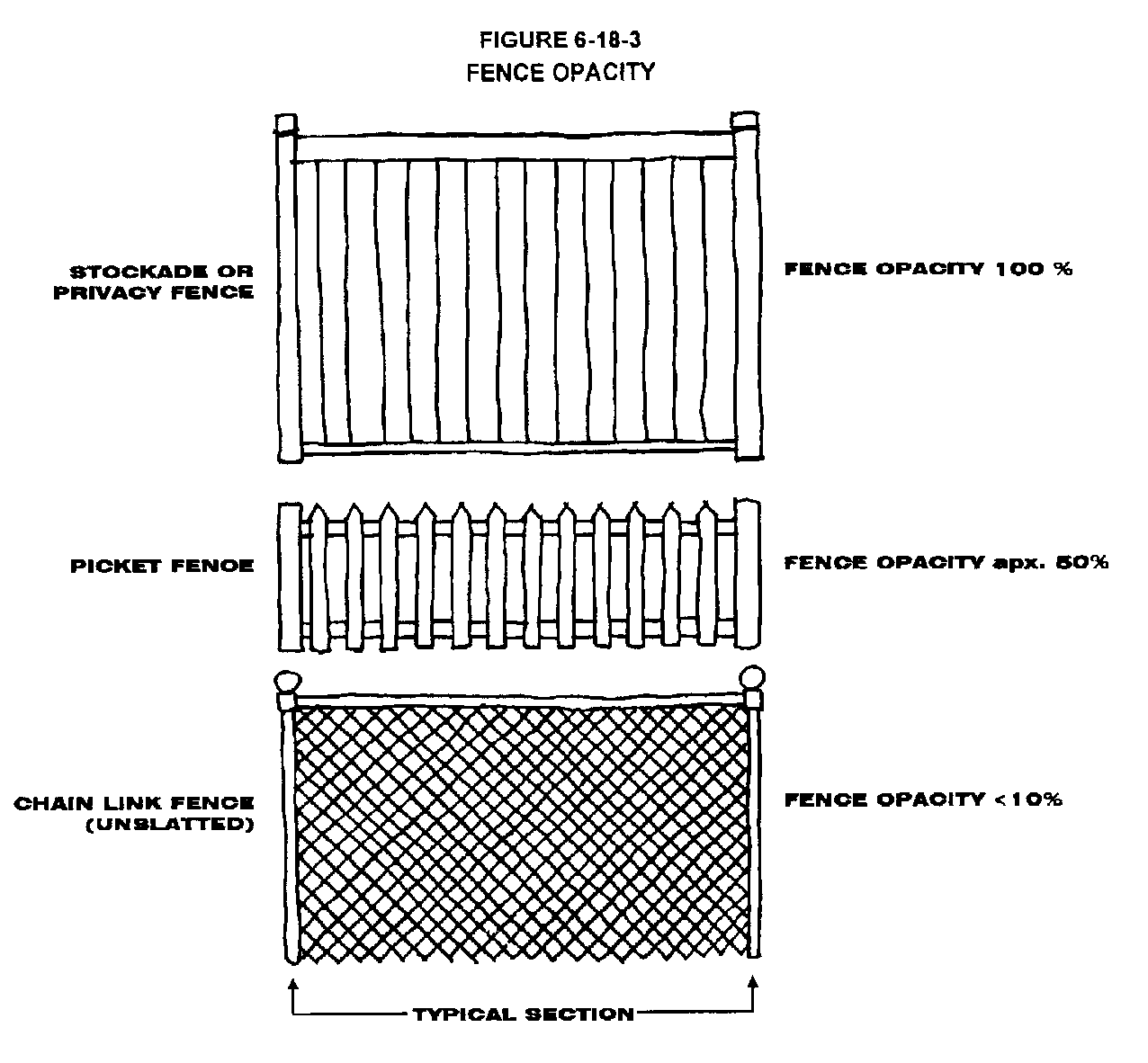
(Ord. 15-O-99)
| OPEN SPACE: | An area of naturally existing or planted vegetation adjacent or surrounding a land use, unoccupied in its entirety by any enclosed structure, or portion of such land use, used as a buffer for the purposes of screening and softening the effects of the use, building or structure, no part of which buffer is used for parking or outdoor storage. |
|
OUTDOOR
RECREATION FACILITY (COLLEGE/ UNIVERSITY): | A place or other facility used for and providing outdoor recreation facilities, tennis, ball, racquet or other courts, swimming pools, golf courses and fishing piers which are not enclosed in buildings and are operated primarily for the use of college/university related persons. "Outdoor recreation facilities (college/university)" shall include any accessory uses, such as, but not limited to, clubhouses, locker rooms, or bleachers which are designed and intended primarily for the use of college/university related persons and patrons of the principal recreational use. "Outdoor recreation facilities (college/university)" shall not include skateboarding courses, go-cart or motorcycle courses, stadiums, field houses, marinas, overnight camping, or gun firing ranges, or any use which is otherwise listed specifically in the zoning districts as a permitted or special use. |
| OUTDOOR STORAGE: | The keeping or storage of any goods, material, equipment, part or merchandise in an enclosed, but open to the sky, area, for more than a twenty-four (24) hour period. "Open storage" shall not include junkyard or salvage yard establishments or landfills. |
| OWNER: | Any full or part owner, joint owner, tenant in common, tenant in partnership, joint tenant or tenant by the entirety with legal or beneficial Title to the whole or to part of a structure or land. |
| PARKING AREA: | One (1) or more parking spaces including access drives, aisles, ramps and maneuvering area, serving a principal building located on the same lot. |
| PARKING LOT: | An area reserved or used for parking or storage of motor vehicles, hauling trailers or boats on premises on which there is no principal building. |
| PARKING SPACE: | An accessible area used or intended for use for temporary storage of one (1) motor vehicle, hauling trailer or trailer mounted boat; said parking space may be located in a private or storage garage, a private or public parking lot, a parking garage, a carport or in the open. Temporary storage is further limited to include only the storage of vehicles that are fully capable of legal operation on the public streets. Any other storage of vehicles shall be considered as the storage of goods and shall be prohibited except where specifically permitted by this Ordinance. |
|
PARKING STRUCTURE,
DECK, OR GARAGE: | A structure used for the parking or storage of motor vehicles. |
| PATIO: | An unroofed area improved with a hardscape material that is not a walkway or open parking space and is intended for recreational use. (Ord. No. 165-O-15, § 10, 5-23-2016; Ord. No. 69-O-23, § 4, 7-24-2023) |
| PAWNBROKER: | A building or use, the principal purpose of which is the lending of money on deposit or pledge of personal property, or dealing in the purchase of personal property on condition of selling the same back at a stipulated price and that is licensed pursuant to Title 3, Chapter 12 of this Code. (Ord. No. 43-O-93) |
|
PAYDAY LOAN OR
CONSUMER LOAN ESTABLISHMENT: | Any business that makes or offers a loan transaction where a cash advance, post-dated check, or other financial instrument, which the parties agree will be held for a period of time before presentment for payment or deposit, is accepted as collateral for the loan, or by which a loan transaction is made or offered in lieu of a title to personal or real property, in an amount not exceeding twenty-five thousand dollars ($25,000.00), that is not expressly done through a bank, savings and loan association, or credit union. No payday loan or consumer loan establishment shall be permitted within one thousand (1,000) feet, measured property line to property line, of another such establishment. (Ord. No. 35-O-12, § 2, 3-26-2012) |
| PEDESTRIAN AREA: | The area between the front facade of a building and the curb. The pedestrian area consists of a sidewalk clear zone closest to the building, and a parallel parkway/street furniture zone that is between the sidewalk and the curb. (Ord. 5-O-08) |
|
PERFORMANCE
ENTERTAINMENT VENUE: | A commercial land use in which the principal activity is the provision of performance entertainment in a nontheatrical setting without a theatrical stage other than a raised platform or without fixed seating. A performance entertainment venue may or may not, subject to all applicable legislation, include the service of alcoholic liquor, and may or may not allow dancing. A performance entertainment venue is not an establishment in which the principal use is the service of prepared food and beverages and in which the land user provides entertainment as an accessory or incidental to the service of prepared food and beverages, nor is a performance entertainment venue a cultural facility in which performance entertainment is provided in a theatrical setting or with fixed seating. |
| A performance entertainment venue includes, without limitation: | |
| (A) Live music venues; | |
| (B) Venues for the provision of musical entertainment which is not live for compensation; | |
| (C) Dance or "DJ" (disc jockey) halls or clubs in which for compensation live or recorded musical entertainment is provided with or without a dance floor; | |
| (D) Comedy clubs; and | |
| (E) Rap clubs. | |
| A performance entertainment venue does not include poetry clubs or the use of the property of nonprofit institutions for theatrical or musical performances accessory to the nonprofit institution or by another nonprofit organization. (Ord. 2-O-00) | |
| PERSON: | An individual, corporation, governmental agency, business trust, estate, trust, partnership, association, two (2) or more persons having a joint or common interest, or any other legal entity. |
|
PLANNED
DEVELOPMENT [31]: | A tract of land that is developed as a unit under single ownership or control. One (1) or more principal buildings may be located on a single lot. |
|
POND,
DETENTION: | An area containing a temporary pool of water and with the capacity to detain storm water for long periods of time. |
|
POND,
RETENTION: | An area containing a permanent pool of water as well as capacity to detain additional storm water for long periods of time. |
| PORCH: | An open or enclosed area attached to the building and located between the exterior wall of a building and the right-of-way. A porch may be covered by a roof which may be attached to a side wall or common with the main roof of the building. (Ord. No. 165-O-15, § 10, 5-23-2016) |
|
PORCH,
ENCLOSED: | A roofed area that features walls and/or windows that exceed fifty percent (50%) opacity but is not heated or cooled, attached to the building and located between the exterior wall of a building and the right-of-way. (Ord. No. 40-O-18, § 2, 8-13-2018) |
| PORCH, OPEN: | An open, unroofed or roofed area that features openings with a maximum opacity of fifty percent (50%), attached to the building and located between the exterior wall of a building and the right-of-way. (Ord. No. 40-O-18, § 2, 8-13-2018) |
| PREMISES: | A distinct portion of real estate, land or lands with or without buildings or structures. It may or may not have the same meaning as "lot," "building" or "structure." |
|
PRESERVATION
ORDINANCE: | Ordinance 14-0-83, as amended, of the City of Evanston. |
|
PUBLIC
TRANSPORTATION CENTER: | A building or portion thereof used as a terminus for rail or bus passenger service. This term shall include, but not be limited to, train and bus stations and other uses similar in nature and impact. |
| PUBLIC UTILITIES: | A building or portion thereof used for providing, monitoring, and housing utilities for public consumption or use. This term shall include, but will not be limited to, operations providing water, sewer, gas, public works facilities, and other uses similar in nature and impact. |
|
READY MIX/
CONCRETE: | A place, structure, or activity primarily engaged in the manufacturing and sale of Portland cement concrete. "Ready mix/concrete" shall include, but not be limited to, establishments engaged in the production and sale of central mixed concrete, shrink mixed concrete, and truck mixed concrete. |
|
RECREATION
CENTER: | A place, structure, area or other facility used for and providing recreation programs and facilities generally open to the public and designed to accommodate and serve significant segments of the community. |
|
RECYCLING DROP
OFF STATION: | An accessory use, structure, or set of outdoor containers designed or intended for the depositing or collection of clean, source separated, and recyclable papers, glass, metals, or plastics, but having no mechanical facilities for the processing of such materials. |
|
RELIGIOUS
INSTITUTION: | A church, synagogue, temple, meetinghouse, mosque, or other place of religious worship, including any accessory use or structure, such as a school, daycare center, or dwelling. |
|
REPAIR (For Review
Of Fences Only): | Any action in which a person fixes, mends, restores, or removes that portion of a fence which provides its opacity (e.g., vertical boards, slats, pickets, chainlink) and/or associated horizontal supports. Repair shall include any action to an existing fence not specifically included within the definition of "replace." (Ord. No. 43-O-93) |
|
REPLACE (For Review
Of Fences Only): | Any action in which a person removes more than twenty-five percent (25%) of the number of posts within a fence, except any action in which a person removes three (3) or fewer posts. (Ord. 15-O-99) |
|
RESALE
ESTABLISHMENT: | A building, property, or activity, the principal use or purpose of which is the resale of used clothing, furniture, and/or other goods, products or merchandise directly to the consumer. "Resale establishment" shall not include businesses that sell primarily cars, antiques, books, recorded music, and/or artwork. (Ord. 122-O-09) |
|
RESEARCH AND
DEVELOPMENT INDUSTRIES: | A building, property, or structure in which are located facilities for scientific research, investigation, testing, or experimentation, but not facilities for the manufacture or sale of products, except as incidental to the main purpose of the building, property, or structure. |
|
RESIDENTIAL
CARE HOME - CATEGORY I [32]: | A dwelling unit shared by four (4) to eight (8) unrelated persons, exclusive of staff, who require assistance and/or supervision and who reside together in a family type environment as a single housekeeping unit. "Residential care home - category I" shall not include a home for persons who are currently addicted to alcohol or narcotic drugs or are criminal offenders serving on work release or probationary programs. |
|
RESIDENTIAL
CARE HOME — CATEGORY II [33]: | A dwelling unit shared by nine (9) to fifteen (15) unrelated persons, exclusive of staff, who require assistance and/or supervision and who reside together in a family type environment as a single housekeeping unit. "Residential care home — category II" shall not include a home for persons who are currently addicted to alcohol or narcotic drugs or are criminal offenders serving on work release or probationary programs. (Ord. No. 43-O-93) |
|
RESTAURANT,
TYPE 1: | An establishment in which the principal use is the service of prepared food and beverages for consumption on the premises. All service of prepared food and beverages for consumption on the premises shall require customers to order at a table, booth, or dining counter with service by a waiter or waitress at said table, booth, or dining counter and shall also require the use of reusable (nondisposable) flatware and dishware. Drive-through facilities are prohibited. |
|
RESTAURANT,
TYPE 2: | An establishment in which the principal use is the service of prepared food and/or beverages for consumption on and/or off the premises and that is not a "restaurant, type 1" as defined herein. This definition shall not include establishments where incidental prepared food and beverage service is accessory to a bakery, food establishment, convenience store, food store establishment, meat market, or similar principal use nor shall it include cafeterias that are accessory to hospitals, colleges, universities, schools or other similar principal uses. (Ord. 9-0-10) |
|
RETAIL GOODS
ESTABLISHMENT: | A building, property, or activity, the principal use or purpose of which is the sale of goods, products, or merchandise directly to the consumer. "Retail goods establishment" shall include, but not be limited to, department stores, hardware stores, apparel stores, art galleries, and other uses similar in nature and impact. "Retail goods establishment" shall not include dealers in firearms, handguns, or ammunition, or any use or other type of establishment that is otherwise listed specifically in a zoning district as a permitted or a special use. |
|
RETAIL SERVICES
ESTABLISHMENT: | A building, property, or activity, the principal use or purpose of which is the provision of personal services directly to the consumer. The term "retail services establishment" shall include, but shall not be limited to, barbershops, beauty facilities, laundry and dry cleaning establishments (plant off premises), tailoring shops, shoe repair shops and the like. "Retail services establishment" shall not include: businesses that exchange, loan, rent, manufacture, service, alter, repair, or otherwise transfer for consideration, firearms, handguns, or ammunition; tattoo facilities; or any use that is otherwise listed specifically in a zoning district as a permitted or a special use. (Ord. 126-0-08) |
|
RETIREMENT
COMMUNITY: | Housing developed, planned, designed, and operated to provide a full range of accommodations and services for older adults including independent living, assisted living, sheltered care, and nursing home care. Residents may move from one (1) level to another as needs change. This term shall include, but will not be limited to, continuing care communities and life care retirement communities. |
|
RETIREMENT
HOME (HOME FOR THE AGED): | A facility for older adults that provides services and rooming units, dwelling units of any type, sheltered care, or intermediate or skilled nursing care services. |
|
RETIREMENT
HOTEL: | An establishment where meals are provided as part of the price of the accommodations, that caters primarily to nontransient guests and either holds itself out to the public as a retirement facility, selectively caters to or solicits the elderly, or has admission standards based on age. A retirement hotel may not offer any type of long term care, including nursing or sheltered care services. |
| RIGHT-OF-WAY: | A strip of land dedicated to or owned by the public for use as a roadway, walk or other way. (Ord. No. 43-O-93) |
| ROOMING HOUSE: | A building or portion thereof containing lodging rooms that accommodate more than three (3) persons who are not members of the keeper's family, and where lodging, excluding food service, is provided for compensation, whether direct or indirect. (Ord. 49-0-09) |
|
SATELLITE DISH
ANTENNA [34]: | A device incorporating a reflective surface that is solid, open mesh, or bar configured and is in the shape of a flat plate, shallow dish, cone, horn or cornucopia. Such device shall be used to transmit and/or receive radio or electromagnetic waves between terrestrially and/or orbitally based equipment. This term shall include, but will not be limited to, what are commonly referred to as satellite earth stations, television receive only antennas (TVROs) and satellite microwave antennas or towers. |
| SCOREBOARD: | A display device, appurtenant to an athletic facility, that enables spectators and/or participants in an athletic contest to be informed of the progress of such contest. |
| SCREENING: | A structure erected, and earth mound constructed, vegetation planted or some combination of these devices used for concealing the area behind it from view. |
|
SHELTER FOR
ABUSED PERSONS: | A building, or portion thereof, in which residential accommodations are provided on an emergency basis for persons who are victims of abusive treatment. |
|
SHELTERED CARE
HOME: | An establishment that provides shelter, food, assistance with meals, assistance with activities of daily living, and twenty-four (24) hour supervision and monitoring of the mental and health status of residents who are incapable of maintaining a private independent residence or incapable of managing themselves. |
|
SHORT TERM CARE
FACILITY: | An establishment that provides personal care, sheltered care, and intermediate or skilled care for persons in need of such care, regardless of age. |
|
SITE PLAN AND
APPEARANCE REVIEW COMMITTEE (SPARC): | The committee established by ordinance 31-0-93 [35], as amended, whose major purpose is to review submitted site plans pursuant to the provisions of this Title. (Ord. No. 43-O-93) |
| SLOPE RATIO: | The ratio of the vertical rise of a sloped surface to its horizontal run (e.g., a surface that rises two (2) inches within a run of twelve (12) inches has a slope ratio of 2:12). (Ord. No. 72-O-12, § 11, 10-22-2012) |
|
SOLAR
COLLECTOR: | A silent device, structure, or part of a device or structure, which is used primarily to transform solar energy into thermal, chemical, or electrical energy. The solar collector shall be used as part of a system which makes use of such energy for the purposes of water heating, space heating or cooling, or power generation. (Ord. 35-O-08) |
|
SMALL WIRELESS
FACILITY: | A wireless facility that meets both of the following qualifications: (i) each antenna is located inside an enclosure of no more than six (6) cubic feet in volume or, in the case of an antenna that has exposed elements, the antenna and all of its exposed elements could fit within an imaginary enclosure of no more than six (6) cubic feet; and (ii) all other wireless equipment attached directly to a utility pole associated with the facility is cumulatively no more than twenty-five (25) cubic feet in volume. The following types of associated ancillary equipment are not included in the calculation of equipment volume: electric meter, concealment elements, telecommunications demarcation box, ground-based enclosures, grounding equipment, power transfer switch, cut-off switch, and vertical cable runs for the connection of power and other services. (Ord. No. 44-O-21, § 2, 5-10-2021) |
|
SPECIAL
EDUCATIONAL INSTITUTION— PUBLIC: | A publicly owned special education secondary school, or a facility owned or leased by a public school district (provided the owned or leased property remains subject to real estate taxes) providing occupational or job skills in a variety of technical subjects and trades for specific occupations, as well as classrooms and educational services and related programs for faculty and staff and for secondary school students who are eligible to receive special education services. (Ord. No. 148-O-17, § 1, 12-11-2017) |
| STADIUM: | An enclosed athletic or sports ground with tiers of seats for spectators. (Ord. No. 43-O-93) |
| STEPBACK: | An additional setback that applies to upper stories of a building. Stepbacks can be effective in reducing the perception of building mass at ground level, reducing potential "wind tunnel" effects, increasing the amount of sunlight at ground level, providing increased articulation of the street wall, and avoiding a "canyon effect" for corridors. (Ord. 5-O-08) |
| STORY: | That portion of a building included between the surface of any floor and the surface of the floor above; or if there is no floor above, the attic, or space between the floor and the ceiling above. A basement shall be counted as a story, except in residential districts. A cellar shall not be counted as a story. |
| STORY, HALF: | That portion of a building between a sloped roof and the building's top story or exterior knee-wall, if applicable. The minimum slope ratio of any roof above a half story shall be 2:12. (Ord. 13-O-98; Ord. No. 72-O-12, § 10, 10-22-2012) |
|
STREET (AVENUE,
COURT, PLACE, ROAD, TERRACE OR PARKWAY): | A publicly dedicated right of way not less than thirty-three (33) feet in width or a permanently reserved easement of access approved by the City Council, that affords a primary means of access to abutting property. |
| STREET, TYPE 1: | A street or portion thereof upon which the City Council has found by ordinance that fences are permitted in the required front or required street side yards of properties adjacent to said street or portion thereof. (Ord. 15-O-99) |
|
STRUCTURAL
ALTERATIONS: | Any change, other than incidental repairs, in the supporting members of a building or structure such as bearing walls or partitions, columns, beams or girders, or any substantial change in the roof or exterior walls. |
| STRUCTURE: | Anything erected, the use of which requires more or less permanent location on the ground or attachment to something having a permanent location on the ground. |
|
STUDENT
RELIGIOUS ORGANIZATION MEETINGHOUSE: | A building or premises owned or operated by a religious organization primarily engaged in providing religious, educational and other services, meals and socialization to a limited segment of the university and student population. There shall be no overnight sleeping accommodations permitted in a student religious organization meetinghouse. "Student religious organization meetinghouse" shall not include a student union, recreational facility or any other facility that is designed and intended to serve the university or college population as a whole or which otherwise is specifically listed as a permitted or special use in the university housing, university athletic facilities, university lakefront campus or transitional campus districts. (Ord. 20-0-97) |
|
SUBSTANTIAL
REHABILITATION AND SUBSTANTIAL ADDITIONS: | Construction or proposed construction that increases the floor area of the principal structure by thirty-five percent (35%) or more including as added floor area any newly constructed areas at or above the first floor with an interior vertical clearance of seven (7) feet or more. (Ord. 112-O-03) |
| TATTOO AND BODY ART ESTABLISHMENT: | Any place, where the act of puncturing the skin to insert jewelry, ink, or other foreign items through, into, or under the skin are performed, in accordance with The Tattoo and Body Piercing Establishment Registration Act (410 ILCS 54) and The Illinois Department of Public Health's Body Art Code (77 III. Adm. Code 797). A salon or other similar facility that engages in minor cosmetic procedures such as microblading as an accessory use shall not be considered a tattoo and body art establishment for purposes of this Section. (Ord. 100-O-97; Ord. No. 3-O-21, § 1, 1-15-2021) |
| TOWNHOUSE: | See definition of Dwelling, Single-Family Attached (Group, Row Or Town Houses). |
|
TRADE
CONTRACTOR: | A building or portion thereof used for the housing of where building and construction trade services are provided to the public. "Trade contractor" shall include, but will not be limited to, contractor offices, including landscaper's showrooms, construction supplies and storage including plumbing, heating, air conditioning, and building equipment, materials, sales, and other uses similar in nature and impact. |
|
TRANSIT
ORIENTED DEVELOPMENT OR TOD: | A development pattern created around a transit station that is characterized by higher density, mixed uses, pedestrian environment, reduced parking, and a direct and convenient access to the transit station. (Ord. No. 117-O-16, § 10, 12-12-2016) |
| TOD AREA: | The area that has the designation for an identified transit station and the area around it. The area provides for development that is compatible with and supportive of public transit and a pedestrian-oriented environment. (Ord. No. 117-O-16, § 10, 12-12-2016) |
| TRANSIT STATION: | The area including the platform which supports transit usage and that is owned and/or operated by the transit agency. (Ord. No. 117-O-16, § 10, 12-12-2016) |
|
TRANSITION
LANDSCAPE STRIP: | A designated area, located primarily along lot lines, consisting of vegetative screening, earth berms or mounds, fencing or decorative walls that creates a transition between districts or incompatible uses. (All transition landscape strips shall be designed and built in accordance with the City's "Manual Of Design Guidelines.") |
|
TRANSITIONAL
HEIGHT PLANE: | A two-dimensional, geometric plane that defines the upper boundary (i.e., maximum permitted height) of the buildable area of a higher intensity district that is adjacent to a lower intensity residential district. The effect of a transitional height plane (plane) is to progressively lower the allowable building height of a higher intensity district as one approaches that district's boundary and the adjacent lower intensity residential district. The plane does not supersede other building height restrictions; it is an additional height restriction that must be considered in conjunction with any other height restrictions imposed. |
| A transitional height plane extends over the higher intensity district, upward and away from all adjacent lower intensity residential districts, as follows: | |
| (A) The origin of the plane is a horizontal line in space in the higher intensity district at the location of the defined setback closest to the adjacent lower intensity residential district, and having a height the same as the defined maximum building height of the adjacent lower intensity residential district. | |
| (B) The plane extends orthogonally from this line of origin away from the lower intensity residential district and upward over the higher intensity district at an elevation of forty-five degrees (45°) from horizontal, as measured from the grade directly below the line of origin. | |
| (C) If the higher intensity district is adjacent to a lower intensity residential district(s) on more than one (1) side, transitional height planes must be calculated for each such adjacent side. (Ord. 5-O-08) | |
|
TRANSITIONAL
SHELTER [36]: | A building, or portion thereof, in which sleeping accommodations are provided on an emergency basis for the temporarily homeless. |
|
TRANSITIONAL
TREATMENT FACILITY [37]: | A facility licensed by the state of Illinois that provides supervision, counseling and therapy through a temporary living arrangement for individuals recovering from addiction to alcohol or narcotic drugs in order to facilitate their transition to independent living. Residents of this facility have been previously screened in another treatment setting and are determined to be sober/drug free but require twenty-four (24) hour staff supervision and a peer support structure in order to strengthen their recovery/sobriety. Transitional treatment facility shall not include any facility for persons awaiting adjudication by any court of competent jurisdiction or any facility for persons on parole from correctional institutions. |
| URBAN FARM: | Indoor or outdoor principal use that includes growing plant products for wholesale or retail sales and may include one (1) or more of the following: washing; packaging; storage. Typical urban farms may include growing beds, greenhouses, and orchards. (Ord. No. 81-O-14, § 2, 8-11-2014) |
| URBAN FARM, ROOFTOP: | A rooftop operation that includes growing plant products for wholesale or retail sales and may include one (1) or more of the following: washing; packaging; storage. Typical urban rooftop farms may include growing beds, greenhouses, and orchards. (Ord. No. 81-O-14, § 2, 8-11-2014) |
| USE: | The purpose or activity for which the land, building or structure thereon is designed, arranged or intended, or for which it is occupied or maintained. |
| USE, ALLOWED: | Listed use either permitted or special, principal or accessory. |
| USE, INSTITUTIONAL: | A use of land employed by public or quasi-public organizations providing services to the public that individuals cannot readily provide for themselves. Institutional uses include, but are not limited to, churches, cemeteries, hospitals, nursing homes, libraries, museums, government buildings, facilities of fraternal orders, school, community centers, schools or homes for the disabled, religious retreats, monasteries, convents, and group homes. |
| USE, NONCONFORMING [38]: | A use of land, buildings, structures, or premises that was lawfully established as of the date of the adoption of this Ordinance and is not listed as a permitted use, special use or a unique use, under the provisions of this Ordinance. |
| USE, PERMITTED: | Any use of land, buildings, structures or premises that is a listed permitted use in the zoning district in which such use is located. |
| USE, PRINCIPAL: | The main use of land, building, or structure as distinguished from a subordinate or accessory use. |
| USE, SPECIAL [39]: | Any building, structure or use that, on the effective date hereof, complies with the applicable regulations governing special uses in the zoning districts in which such building, structure, or use is located. |
| USE, TEMPORARY: | A land use of a duration less than ninety (90) days or as listed, allowed and regulated in Section 6-4-8-3 of this Title. (Ord. 114-O-02) |
| USE, UNIQUE [40]: | A use determined by the City Council, to be an unusual one of a kind use that is not listed as an authorized use, but that will be of substantial land use or economic benefit to the City and whose authorization would not be appropriate through a zoning amendment. (Ord. 49-O-04) |
| USE, UNIQUE ADAPTIVE: | A conversion to a use not listed as an authorized special or permitted use in the zoning district to be developed predominantly within an existing structure or structures which have identified adaptive use as the principal means to preserve and assure the continued existence of said structure(s). (Ord. No. 49-O-04; Ord. No. 68-O-23, § 12, 7-14-2023) |
|
VEHICLE
SALVAGE: | A place, structure, or activity, the principal use of which is the salvaging of motorized vehicles, including buses. "Vehicle salvage" shall not include automobile and recreation vehicle sales, automobile repair service, automobile service station establishments and vehicle storage establishments. |
|
VEHICLE
STORAGE ESTABLISHMENT: | A building, property, or activity, the principal use of which is the storage of nondisabled motorized vehicles, including buses. "Vehicle storage establishment" shall not include automobile and recreational vehicle sales, automobile repair service, automobile service station establishments, and vehicle salvage establishments. |
|
VEHICLE TOWING
ESTABLISHMENTS: | A building, property, or activity, the principal use of which is the retrieving or securing of distressed, disabled, abandoned, or illegally parked motorized vehicles. |
| WAREHOUSE: | A building or portion thereof used for the storage of goods and/or materials. This term shall include, but not be limited to, commercial storage facilities, miniwarehouses, and other uses similar in nature and impact. |
|
WHOLESALE GOODS
ESTABLISHMENT: | A building, property, or activity, the use or purpose of which is the sale of goods, products, or merchandise, in bulk quantities to retailers or persons who will in turn sell the goods, products, or merchandise directly to the consumer. "Wholesale goods establishment" shall not include any use or other type of establishment that is otherwise listed specifically in a zoning district as a permitted or a special use. |
|
WIRELESS
FACILITY: | Equipment at a fixed location that enables wireless communications between user equipment and a communications network, including: (i) equipment associated with wireless communications; and (ii) radio transceivers, antennas, coaxial or fiber-optic cable, regular and backup power supplies, and comparable equipment, regardless of technological configuration. Wireless facility includes small wireless facilities. Wireless facility does not include: (i) the structure or improvements on, under, or within which the equipment is collocated; or (ii) wireline backhaul facilities, coaxial or fiber optic cable that is between wireless support structures or utility poles or coaxial, or fiber optic cable that is otherwise not immediately adjacent to or directly associated with an antenna. (Ord. No. 44-O-21, § 2, 5-10-2021) |
|
WIRELESS
SUPPORT STRUCTURE: | A freestanding structure, such as a monopole; tower, either guyed or self-supporting; billboard; or other existing or proposed structure designed to support or capable of supporting wireless facilities. Wireless support structure does not include a utility pole. (Ord. No. 44-O-21, § 2, 5-10-2021) |
| YARD: | An open space on a lot that is unoccupied and unobstructed from its lowest level to the sky, except as otherwise permitted in this Ordinance. A required yard extends along a lot line and at right angles to such line to a minimum depth or width specified in the yard regulations for the district in which such lot is located. |
| YARD, FRONT: | A yard extending along the full width of a front lot line between side lot lines and from the front lot line to the front building line in depth. |
|
YARD, FRONT
REQUIRED (For Review Of Fences Only): | That area on a zoning lot between the front lot line, two (2) side lot lines (interior or street), and the line established by the front yard requirement of each zoning district of Subsection 6-4-1-9(A)3 or (A)5 of this Title (see Figure 6-18-3, "Zoning Lot Components," of this Section). |
|
YARD, INTERIOR
SIDE REQUIRED (For Review Of Fences Only): | That area on a zoning lot between the interior side lot line, the line established by the front yard requirement of each zoning district or Subsection 6-4-1-9(A)3 or (A)5 of this Title, the line established by the rear yard requirement of each zoning district, and the line established by the side yard requirement of each zoning district (see Figure 6-18-3, "Zoning Lot Components," of this Section). (Ord. 15-O-99) |
| YARD, REAR: | The portion of the yard on the same lot with the principal building located between the building and the rear lot line extending for the full width of the lot. |
|
YARD, REAR
REQUIRED (For Review Of Fences Only): | For zoning lots that are not also corner lots, that are on a zoning lot between the rear lot line, two (2) side lot lines, and the line established by the rear yard requirement of each zoning district. For zoning lots that are also corner lots, that area on a zoning lot between the rear lot line, the interior side lot line, the line established by the side yard abutting a street requirement of each zoning district, and the line established by the rear yard requirement of each zoning district (see Figure 6-18-3, "Zoning Lot Components," of this Section). (Ord. 9-0-01). |
| YARD, SIDE: | A yard extending along a side lot line between the front and rear yards, except that a side yard abutting a street shall be defined as the yard extending along a side lot line between the front yard and the rear lot lines. |
|
YARD, STREET SIDE
REQUIRED (For Review Of Fences Only): | That area on a zoning lot between the street side lot line, the line established by the front yard requirement of each zoning district or Subsection 6-4-1-9(A)3 or (A)5 of this Title, the rear lot line, and the line established by the side yard abutting a street requirement of each zoning district (see Figure 6-18-3, "Zoning Lot Components," of this Section). (Ord. 9-0-01) |
|
YARD WASTE
TRANSFER FACILITY: | A nongovernmental facility that accepts yard waste, as defined in City Code Section 8-4-1, as amended, and/or landscape waste, as defined in 415 ILCS 5/3.270, as amended, for sorting and/or consolidation prior to transfer to an off-site recycling and/or composting facility. Yard/landscape waste shall remain onsite before such transfer for no longer than twenty-four (24) hours or other time period designated in 415 ILCS 5/39.2(o), as amended. Composting onsite is prohibited. Any mechanical facilities used for the processing of such yard/landscape waste must be incidental in nature. (Ord. No. 46-O-13, § 2, 5-28-2013) |
|
ZIGGURAT
SETBACK: | A design characteristic in three-dimension (3-D) that forms one (1) or more setbacks to a vertical plain. |
|
ZONING
ADMINISTRATOR: | The staff person or persons to whom the administrative responsibilities under this Ordinance are assigned by the director of planning and zoning. |
| ZONING MAP: | The official map delineating the boundaries of the zoning districts established in Section 6-7-2 of this Title. |

