
Farmers Branch City Zoning Code
ARTICLE 4
- SITE DEVELOPMENT STANDARDS
4.1 - LANDSCAPING
A.
Applicability
This Section 4.1 shall apply to all districts except R-districts.
B.
Objectives
The objective of this section is to improve the surrounding neighborhoods and promote the general welfare by providing for the installation and maintenance of landscaping for screening and other public benefits.
C.
Planned Development Districts
This section shall be a minimum standard and shall apply to all zoning districts, except residential and multiple family districts, unless landscape standards have been established by separate ordinance.
D.
Landscape Plans
1.
Plan
a.
Prior to the issuance of any Building Permit in any zoning district other than R-1 through D-2, a landscape plan shall be submitted to the Community Services Department for approval.
b.
The landscape plan shall be drawn to a scale large enough to adequately show the details of the plan.
c.
The drawings will consist of plans and elevation views plus detailed plans of special structural elements such as walls, fountains, raised planters, and berms.
2.
Specifications
Accompanying the plan will be a set of specifications which must include the following:
a.
Common and scientific names of all plant material.
b.
Size and quantity of plant materials.
c.
Bed preparation procedure and required materials.
d.
Specifications for developing all supporting structural elements.
E.
Minimum Landscape Requirements
1.
Prescribed Area
a.
A minimum of five percent of the entire lot area not covered by buildings and not a part of any right-of-way shall be landscaped in accordance with this section.
b.
Each modular area of land 50 feet by 50 feet not covered by buildings shall contain 150 square feet or more of landscaped area in accordance with this section. These modules shall collectively comprise the five percent total landscaped area in paragraph a, above. Rear areas not open to view may be approved for exclusion from the landscaping requirements.
c.
Parking areas visible from the street shall be broken up with vertical landscaping and shown on the landscaping plan. A minimum of five percent of the total property area shall be landscaped between the building and all street right-of-way lines.
d.
When a driveway intersects a public right-of-way or when the property abuts the intersection of two or more rights-of-way, all landscaping within sight triangular areas shall provide unobstructed cross-visibility. Except for required grass or ground cover, landscaping shall not be located closer than three feet from the edge of any driveway pavement.
e.
The area between the property line and the street curb shall be included on the landscape plan, and shall be maintained by the abutting property owner.
f.
All landscaping shall be maintained in a living growing condition. Any landscaping that is removed must be replaced with the same or comparable species and caliper plant, as when it was originally installed.
2.
Plant Requirements
a.
Trees
i.
At the time of planting, trees required as part of the landscaping plan shall be not less than three inch diameter measured at a height of five feet above the ground. One tree for each 25 feet of street frontage, or one tree per each 50 by 50 foot module, whichever is greater, shall be planted within the areas from the front of the building to the front property line. The trees may be planted within the street right-of-way when approved by the Director. An exception may be granted where larger turf areas exist and grouping of trees is desirable.
ii.
Plants not considered trees but grown to tree form (example: Crape Myrtle, Ligustrum, etc.) and which can be substituted for trees shall be a minimum of six feet in height at time of planting.
b.
Screen Plantings
Plantings that are to serve as a living screen shall be not less than four feet high with a minimum spacing of five feet apart at time of planting.
c.
Shrubs
Shrubs planted as part of the approved landscape plan shall be no smaller than three gallon containers and, where used for continuous hedge effect, shall be spaced so that the shrubs grow to fill in all gaps with two- years after planting.
d.
Ground Cover Plants
No minimum size is required; provided, however, planting shall be sufficiently dense to develop full coverage of the area to be covered as shown on the landscape within 18 months after planting.
3.
Structural Requirements
All structural elements in the landscape plan are to support the living landscape development and not replace it. Each element will be judged on its individual merits. Structural elements will be defined as walks, walls, fountains and will also include artificial plants, gravel and various surface treatments.
F.
Establishment
All landscape materials shown on the landscape plan shall be developed within 18 months after planting. The owner or his agent in control of the property shall maintain the landscape in a healthy, living condition and free of all plants not included in the plan. All landscaped areas shall be provided with a readily available water supply with at least one outlet located within 100 feet of all plant materials to be maintained.
G.
Changes or Redevelopment
When the landscaped areas of a property subject to previously approved landscape plans requires change or redevelopment, approval of the Community Services Department will be required.
H.
Special Conditions
No Building Permit shall be issued in any zoning district other than R-1 through D-2 prior to the approval of the landscape plan by the Director, which landscape plan shall be in substantial compliance with the minimum landscape requirements set forth in this Chapter and any adopted planned development regulations and detailed site plan applicable to the property. Prior to the issuance of any certificate of occupancy, all approved screening and landscaping must be in place, or if seasonal considerations prohibit the completion of the landscape, a Certificate of Occupancy subject to the written authorization of the City Manager that sets forth the date by which the installation of all required landscaping must be completed. Failure to complete the installation of required landscaping by the date required by the City Manager shall be a violation of this zoning ordinance.
I.
Buffer
Any lot or tract zoned for any purpose other than one-family or two-family residences and lying immediately adjacent to a tract or lot zoned for one-family or two-family residences shall have a solid structural masonry wall not less than six feet in height designed by a Texas Registered Professional Engineer separating the two different uses.
J.
Recommended Plant Materials
The following list of recommended plant materials is intended to assist in the selection of plant materials but is not an inclusive list. These plants have been identified as well suited for the soils found in the city.
(Ord. No. 3415, § 1(Exh. A), 1-20-2017)
4.2 - REFUSE CONTAINERS.
Garbage, trash or refuse containers located on property used for any purpose other than single family residential use shall not be located in front of the main building and must be screened from view of the public. The container screening enclosure shall consist of a minimum six foot high masonry screening wall designed by a Texas registered professional engineer in which the exterior of the wall shall be architecturally consistent with the primary building and solid opaque metal gates shall be provided, primed and painted to match the masonry screening walls. In addition to the screening walls, shrubs, trees or other landscaping shall be required as approved by the Director or as required by any applicable planned development regulations or approved detailed site plan.
(Ord. No. 3415, § 1(Exh. A), 1-20-2017)
4.3 - PARKING AND LOADING
A.
Applicability
1.
The regulations in this section apply to all zoning districts including Planned Development (PD) Districts (except to the extent modified by the regulations applicable to a Planned Development (PD) District) and for every use, when a building or structure is erected, enlarged or increased in capacity, or at any time a different use is established.
2.
Additional parking spaces shall be constructed when the square footage of an existing building is increased to comply with the number of parking spaces for the property required by this section even if no change in use occurs.
3.
If the occupancy of a building is changed to another use, no certificate of occupancy shall be granted for the new use until parking spaces have been constructed on the property on which the building is located in the minimum numbers required by this section for the new use.
B.
Parking Space
1.
For purposes of this article, "parking space" means an enclosed or unenclosed all-weather surfaced area (including permeable pavement surfaces as outlined in Section 4.3.J.2), measuring minimum nine (9) feet by 18 feet (except as provided for in Section 4.3.D.), not located on a public street or alley, together with an all-weather surfaced driveway (including permeable pavement surfaces as outlined in Section 4.3.J.2), connecting the area with a street or alley permitting free ingress and egress without encroachment on the street or alley. Unless authorized by another section of this Code or another ordinance, a parking space adjacent to a public street for which access and entry requires maneuvering on the public street shall not be classified as an "parking space" for purposes of this section and shall not be included when computing the minimum number of parking spaces required for a use.
2.
Driveways on private property within single family residential zoning districts R-1 to R-6, shall be all-weather surfaced area constructed with concrete, crushed granite, or permeable pavement surfaces (as outlined in Section 4.3.J.2) or any combination of these materials, subject to approval by the Director of Community Services and/or the Director of Planning. Alternate paving materials consisting of crushed granite or permeable pavement surfaces, must be installed with masonry curbs, or reinforced concrete footing to retain the materials in place. Alternate edging method may be approved by the Director of Community Services and/or the Director of Planning.
C.
Parking Ratios
1.
The number of parking spaces required for one or more uses shall be located on the lot or tract occupied by the main use(s) for which the parking spaces are required except as provided in accordance with Section 4.3.E.
2.
Calculation of Parking
a.
In computing the number of parking spaces required for any building or development, the total number of parking spaces required shall be the sum of the parking spaces required for each use located in the building or development.
b.
The floor area of a parking structure shall be excluded from the total building gross floor area when computing the number of parking spaces required for any use.
c.
In computing the number of parking spaces required for each use, "floor area" shall mean the gross floor area ("GFA") of the specific use.
d.
In computing the number of required parking spaces and/or loading spaces, fractional spaces shall be rounded up to the nearest whole space.
3.
Residential Uses
a.
The number of parking spaces required for residential uses is as follows:
4.
Non-Residential Uses
a.
The number of parking spaces required for non-residential uses is as follows:
b.
The Director of Planning is authorized, but not obligated, to approve a reduction of the number of required parking spaces by an amount not to exceed 5% without requiring a parking study. The Director of Planning is authorized, but not obligated, to approve a reduction of the number of required parking spaces by more than 5% reduction in the number of required parking spaces if such reduction is supported by the findings of a parking study and alternate parking plan obtained by the owner or developer of the property that is prepared by a licensed transportation engineer. The study and alternate parking plan should establish that the reduction in total required parking shall not negatively affect optimum traffic flow and business operations of the property(s) in question.
c.
Except for parking spaces located in a parking structure, the maximum number of parking spaces located on a property shall not exceed 125% of the minimum number of parking spaces required for the uses listed in the table provided for in Section 4.3.C.4.a.
5.
Parking Space Requirements for New and Unlisted Uses
a.
The Director of Planning shall determine the minimum number of parking spaces required for any use not specifically listed in Section 4.3.C.a.
b.
If the minimum parking requirements cannot be readily determined by the Director of Planning for a new or unlisted use, or an owner disagrees with the determination of the Director of Planning, the minimum off-street parking requirement shall be established in accordance with the process for classifying new and unlisted uses as provided for in Section 2.4A.
D.
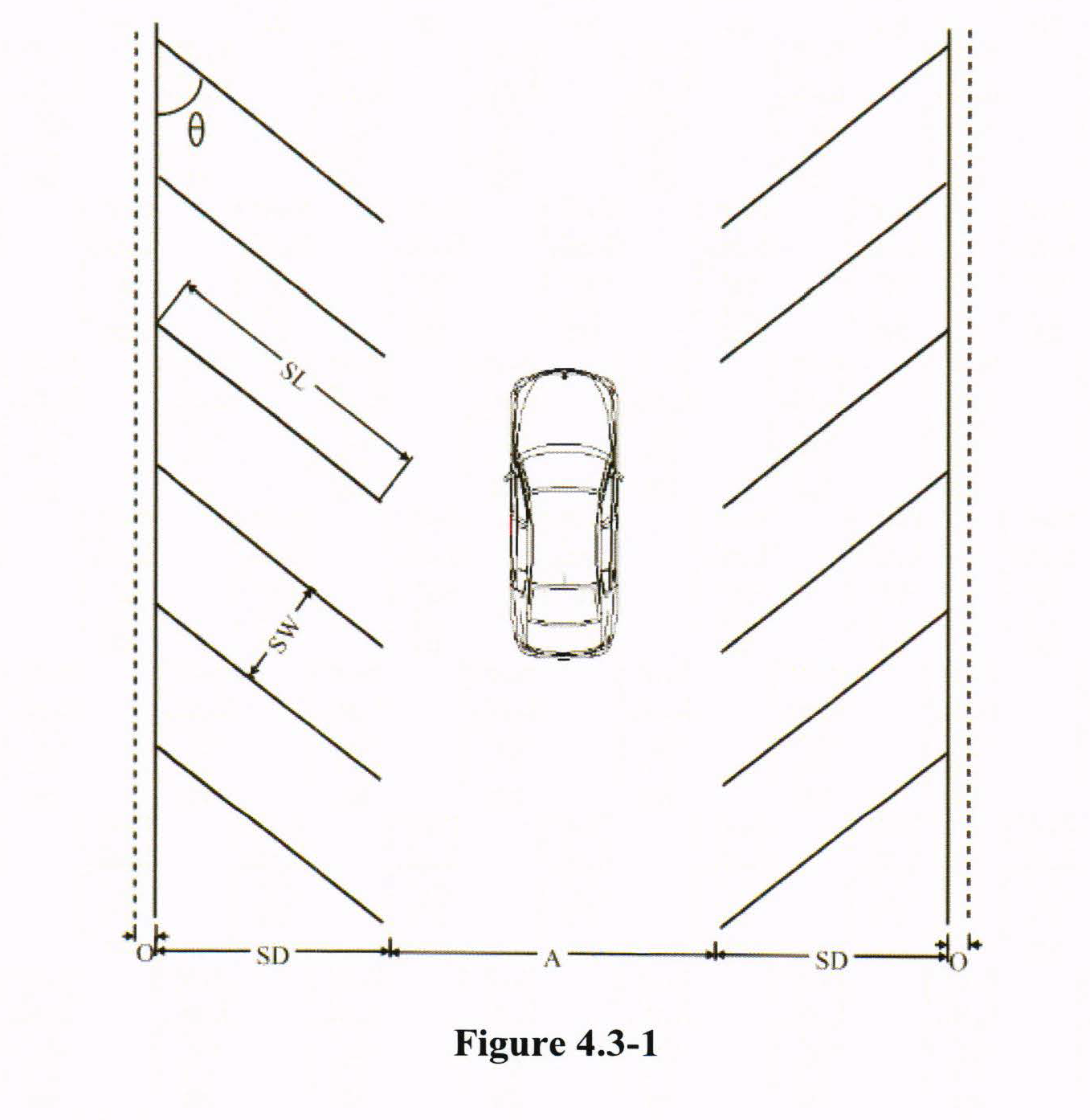
Parking Space and Parking Lot Layout Design
Parking spaces required by this section shall be in accordance with the minimum standards set forth in Figure 4.3-1 and Table 4.3-1.
E.
Off-Site Parking
Required parking spaces may be located off-site subject to approval of the Director of Planning and the following criteria:
1.
The off-site parking spaces must be located on a lot or tract within five hundred feet (500') of the boundary of the property on which the parking spaces are required to be located measured in a straight line;
2.
The property on which the off-site parking spaces are located must have parking spaces in excess of the minimum number of parking spaces required for the uses located on the property; and
3.
A parking easement or other agreement or instrument in a form approved by the Director of Planning that grants to the owner of the use that needs the off-site parking spaces an irrevocable right to use the off-site parking spaces in numbers sufficient to comply with this section when combined with the user's required on-site parking spaces for at least as long as the use requiring the off-site parking spaces continues to operate, which easement, agreement, or other instrument must be signed by both parties and recorded in the Official Public Records of Dallas County.
F.
Shared Parking
Parking may be shared between two or more uses where peak parking demand occurs at different times for the uses during the day, allowing a reduction in the total required number of parking spaces for the uses. For purposes of this section "shared parking" means the use of the same parking spaces to satisfy the number of required parking spaces for two or more uses. The right to use shared parking in order to comply with this section is subject to the Director of Planning's approval and the following criteria:
1.
The property owner(s) shall submit a parking study and alternate parking plan prepared by a licensed transportation engineer to establish that the peak hours of parking demand from all uses sharing parking do not coincide. The study needs to show that the shared parking and resulting reduction in total required parking shall not negatively affect optimum traffic flow and business operations of the property(s) in question.
2.
The Director of Planning may place limitations or other requirements deemed necessary on the parking arrangement if required.
3.
The shared parking study and alternate parking plan shall be re-visited if any of the existing uses change to a more intensive use requiring additional off-site parking or to any use with similar peak parking demand like the existing uses.
4.
Shared parking shall be permitted by agreement only. The agreement shall:
a.
Be in writing and executed by all owners of the properties affected;
b.
Specify the parking being shared and the hours of operation of the uses involved; and
c.
Be approved by the Director of Planning and approved as to form by the City Attorney.
5.
A shared parking agreement may be amended or terminated only by an instrument approved by the Director of Planning and the City Attorney.
6.
All shared parking spaces must be unrestricted and accessible at all times to all parties to the shared parking agreement and their respective employees, invitees, customers, and guests; provided, however, the shared parking spaces may by agreement be closed and inaccessible to all parties to the shared parking agreement during times of day when all uses are closed for business.
G.
Accessible Spaces
1.
Handicap accessible parking spaces shall be provided in all parking lots and parking structures in accordance with applicable state and federal laws and regulations, including, but not limited, to Chapter 469 of the Texas Government Code, as amended (the Texas Elimination of Architectural Barriers Act), Title 42, Chapter 126 of the United States Code, as amended (the Americans Disability Act of 1990), and accessibility guidelines of the Uniform Federal Accessibility Standards as may be amended, and in accordance with the following, whichever is more restrictive:
2.
Accessible spaces provided in accordance with this section shall count towards the required minimum off-street parking for the site.
H.
Stacking Requirement
1.
Stacking spaces that allow vehicles to queue on-site prior to receiving a service shall be provided for uses that include, but are not limited to, drive-through restaurants, drive-in or drive-through banks, and similar uses that allow a person to receive services and/or conduct activities on the property without leaving the person's vehicle.
2.
Stacking spaces shall be provided in compliance with the following:
a.
A stacking space shall be not less than nine (9) feet wide and 20 feet long and shall not encroach or be located within a public street or any other circulation drive aisle, driveway, parking space, fire lane or maneuvering area.
b.
Banks or financial institutions with drive-through facilities shall have one (1) space for each drive-up service window or station plus two (2) additional stacking spaces for each service lane.
c.
Each automated drive-up teller machine (ATM) shall have one (1) stacking space plus one (1) additional stacking space for each station.
d.
Restaurants with a drive-up window shall have one (1) space for each drive-up window plus five (5) additional stacking spaces as measured from the first order board.
I.
Off-Street Loading Requirement
1.
All retail, commercial, service, and industrial uses shall provide and maintain off-street facilities for receiving, loading and unloading of merchandise, supplies and materials within the building or on the lot or tract subject to the provisions of this Section 4.3.I.
2.
No off-street loading area or space shall be located within a designated fire lane or otherwise encroach upon or occupy a fire lane, maneuvering aisle, or parking space.
3.
Off-street loading spaces or truck berths shall be not less than ten feet (10.0') wide and not less than forty-five feet (45.0') long.
4.
Loading areas or overhead rolling doors shall not be visible from public street or constructed facing a public street, unless such loading area or overhead rolling doors are screened in accordance with one or combination of any of the following (driveways are exempt from these screening requirements):
a.
A masonry screening wall not less than six feet (6.0') in height with same or similar appearance as the exterior building facade and designed by a licensed Professional Engineer (P.E) shall be constructed; or
b.
A living vegetative screen planted on top an earthen berm not less than three feet (3') in height with a slope not exceeding 3:1 and subject to the following:
i.
The berm shall vary in height to avoid a visual appearance of a straight-line levee;
ii.
Shrubs planted on top of the berm shall not be less than three feet (3') in height at the time of planting and shall be spaced so that the shrubs grow to fill in all gaps within two-years after planting;
iii.
The berm shall be sodded with turf grasses; and
iv.
Both the berm and the shrubs shall be irrigated with an automatic irrigation system; or
c.
A living vegetative screen with plant material that provide appearance of solid screening not less than six feet (6') in height at the time of planting that grows to fill in all gaps within two-years after planting.
d.
Required screening shall be provided for a linear distance equal to the length of the loading area or overhead rolling doors.
e.
The screening wall may be located within the required front setback area, provided that a minimum ten-feet (10') wide landscape edge is located on the outside (street side) of the screening wall, and includes shade trees of a variety as set forth in Section 4.2.K "Recommended Plant Materials" are planted not greater than 25 feet apart on center for the entire length of the distance adjacent to the screening wall.
5.
Properties with existing buildings constructed prior to October 13, 2020, with loading areas or overhead rolling doors that are currently not screened from public street view in accordance with this Section 4.3.1.4, shall be required to install screening for their entire loading areas or overhead rolling doors visible from public street view with the method described in Section 4.3.I.4, upon the occurrence of one or more of the following:
a.
The building is damaged by fire or other cause where the cost to repair and restore the building to the condition prior to the damage plus upgrades and changes required to bring the building into compliance with the City's current construction codes exceeds 50% of the assessed fair market value of the improvement prior the date the damage occurred as determined by the most current certified tax rolls of the Dallas Central Appraisal District;
b.
Expansion of the square footage of the building by five percent (5%) or more than the square footage of the building as it existed on October 13, 2020; or
c.
Addition of 2 or more overhead rolling doors.
6.
Loading spaces shall be provided in accordance with the following schedule:
7.
The Director of Planning shall determine the minimum off-street loading requirements for any circumstances not otherwise specified in this Section 4.3.I.
J.
Sustainable Parking Lot Design
1.
For purposes of this Section 4.3.J, "sustainable parking lot design" means a parking lot with parking spaces and drives that use innovative stormwater management practices, vegetation, and permeable paving materials to mitigate adverse environmental impacts of large expanses of paving and designed to reduce storm water run-off, manage water as a resource by promoting infiltration, protect local water quality through effective filtration and minimizes the heat island effect through effective landscaping.
2.
The maximum number of parking spaces allowed for a particular nonresidential use as set forth in Section 4.3.C.4.c may be increased, or the required minimum number of parking spaces for a particular nonresidential use as set forth in Section 4.3.C.4.a may be decreased up to 15% of the number of required parking spaces, by applying two or more of the following sustainable design principals:
a.
Bioswale or raingardens. As part of the overall storm water management plan for a property, bioswale or rain gardens constructed and used to reduce storm water run-off and treat storm water through filtration subject to the following:
i.
Drainage area map and calculations shall incorporate bioswale or rain gardens proposed within the parking lot and establish positive reduction in storm water drainage and sheet flow subject to review and approval by the Public Works Director;
ii.
Plant materials installed within the depression or swale area of a rain garden shall be of native variety and shall tolerate wet roots for the amount of time the rainwater takes to drain; and
iii.
Soil preparation, irrigation and fertilizer for the rain garden during installation shall be required.
b.
Permeable Pavement. Not less than 30% of the parking lot surface constructed with a porous or permeable pavement to allow transmission of water to aggregate base and subsoils. Runoff shall be temporarily stored in the base for infiltration into the subsoils and/or slow released to storm drain system. The three permeable pavement systems authorized by this paragraph b. are porous asphalt and concrete, permeable interlocking concrete pavers, and reinforced grass/gravel pavement systems. Additional types of permeable pavement may be considered subject to approval by the Director of Sustainability and Public Health and/or Public Works Director.
c.
Additional Landscaping. Installation of enhanced landscaping. For the purpose of this section "enhanced landscaping" means landscaping exceeding the landscape area and number of shade trees required by Article 4.2 "Landscaping" of this chapter, subject to the following:
i.
Parking lot interior landscape islands shall be not less than 300 square feet in size;
ii.
Each landscape island shall contain no fewer than one (1) shade tree;
iii.
A landscape planting area not less than ten (10) feet wide shall be installed between two parking rows for the length of the parking rows with one (1) shade tree planted not greater than 25 feet apart for the length of the landscape planting area; and
iv.
Trees and plant materials shall comply with Section 4.2.K "Recommended Plant Materials."
K.
Additional Parking Requirements
1.
Parking Location
a.
Required parking spaces shall be located in a manner that allows a person to maneuver a motor vehicle from each space to the nearest adjacent public street or alley without encroachment on other parking spaces.
b.
Required parking spaces for new residences in the R-1 through D-2 zoning districts shall be:
i.
located behind the front building line;
ii.
enclosed in a garage structure suitable for vehicle storage; and
iii.
prohibited in the required side yard.
c.
All one-family and two-family residences with required parking spaces located in the front yard existing as of August 24, 1970, may retain and maintain the required parking in the required front yard provided the existing garage or carport is not converted into space other than vehicle storage space.
2.
Commercial Vehicle Parking
a.
On properties developed with residential uses, no off-street parking space, garage, carport or other automobile storage space or structure shall be used for the parking or storage of any commercial motor vehicle that exceeds a 10,000 Gross Vehicle Weight Rating (GVWR), except for one pickup truck or van not exceeding 14,000 GVWR, with commercial signage, operated by the owner of tenant of the property on which such truck or van is parked. A vehicle is deemed to have been "stored" if parked continuously for 48 hours or longer on the same property.
b.
In the O, LR-1 and LR-2 districts, no parking space or other automobile storage space which is visible from the street shall be used for the parking or storage of any commercial type vehicle that exceeds 16,000 GVWR, except for pick-up trucks and passenger vans.
3.
Carports and Garages
a.
Properties developed with one-family detached dwelling units on which garages or carports have been enclosed or otherwise converted into space for use other than vehicle storage, including, but not limited to, provision of additional living area in a dwelling:
(1)
The required number of parking spaces shall be provided behind the front building line in an enclosed garage structure suitable for vehicle storage constructed to store the same number of vehicles as the garage or carport that has been enclosed;
(2)
Driveways located in the front yard after closing in or converting the garage or carport shall be removed or reconfigured to provide access to the required parking garage or structure behind the front building line; and
(3)
Head-in or dead-end parking spaces in the required front yard are prohibited.
b.
It shall be a defense to a violation of Section 4.3.K.3.a that:
(1)
The garage was converted prior to July 16, 2024, pursuant to a building permit issued by the City and such conversion was inspected and approved in accordance with the City's building codes and other applicable ordinances in effect at the time of issuance of such building permits; or
(2)
The garage was converted prior to July 16, 2024, and the owner of the property on which the dwelling unit is located has obtained an Amnesty Program Permit in accordance with Section 4.3.K.5.
c.
On properties developed with one-family attached, two-family, or multiple family dwelling units, garages, carports, or other similar structures originally intended and constructed for the parking of motor vehicles, boats, trailers or other similar items may not be converted, temporarily or permanently, to use for human habitation, storage, or any other use or purpose other than originally intended.
4.
Screening
When parking spaces for any use other than one-family or two-family dwellings is constructed adjacent to property that is developed with, or zoned to allow the adjacent property to be developed for, one-family or two-family dwellings, a structural masonry wall not less than six (6) feet in height shall be erected by the owner of the parking spaces prior to issuance of a certificate of occupancy for the use.
5.
Amnesty Program Permit
a.
Applicability. This Section 4.3.K.5 shall apply only to an owner of property:
(1)
on which a garage was converted:
(i)
before July 16, 2024, for which no building permit was issued by the City and/or a final inspection or approval was not obtained from the City in accordance with building codes in effect at the time of the conversion; or
(ii)
in violation of Section 4.3.K.3.a on or after September 27, 1997, but before July 16, 2024, for which the defense provided in Section 4.3.K.3.b.(1) does not apply; and
(2)
makes an application for a permit pursuant to this Section 4.3.K.5 on or before July 31, 2026, which permit is herein called an "Amnesty Program Permit."
b.
Application. An application for an Amnesty Program Permit shall be submitted to the Community Services Department on or before July 31, 2026, on a form provided by the City and accompanied by the application fee set forth in Appendix A of this Code. Such application shall contain at least the following information:
(1)
The name, address, phone number, and email address of the owner property;
(2)
The name, address, phone number, and email address of the primary contact person for the owner of the property, if the owner is not the primary contact person;
(3)
A diagram of the property and comprehensive floor plan detailing the layout of the dwelling unit, including, but not limited to, the converted garage.
c.
Consent to Inspection. An application for an Amnesty Program Permit shall constitute consent by the owner of the property authorizing the City to enter the property described in the application for purposes of conducting the inspection required by Section 4.3.K.5.d.
d.
Inspection Required; Scope. No Amnesty Program Permit shall be issued prior to the City's inspection of the garage conversion work pursuant to this Section 4.3.K.5.d and completion and inspection of any modifications and/or repairs required by Section 4.3.K.5.e. Such inspection shall be limited to the converted area of the dwelling unit and such other portions of the dwelling unit to which such work is connected, including, but not limited to, building systems that support or serve the converted garage area of the dwelling. Inspections performed by the City pursuant to this Section 4.3.K.5.d shall not require the removal in whole or in part of any walls, floors, or ceilings to uncover plumbing, heating, air conditioning, or electrical systems unless there is reason to believe that a condition exists within a wall, floor, or ceiling that could pose a fire, water damage, or other life and safety concern and there is no other reasonable means to access the area of concern.
e.
Required Modifications or Repairs. If upon inspection, the City official inspecting a property pursuant to Section 4.3.K.5.d determines one or more conditions exist that are (i) not in compliance with applicable building codes and (ii) constitute a condition which, if not modified or repaired, may reasonably result in injury to a person and/or damage to property (i.e., a life and safety concern), such inspector shall provide a written report detailing the nature of the condition constituting life and safety concern that needs to be resolved through a modification or repair to the property. The owner of the property shall cause such life and safety concern to be resolved not later than thirty (30) days following receipt of such inspection report. An initial reinspection of the property by the City shall be conducted on or after the deadline for completion of the required modifications or repairs or on such earlier date upon receipt of a request for reinspection by the owner of the property.
f.
Extensions of Time. If the life and safety concern identified in the initial inspection report has not been resolved at the time of the initial reinspection, the owner of the property may request an extension to complete the work to resolve such life and safety concern. Such request must be submitted in writing no later than ten (10) days after the initial reinspection is conducted and must demonstrate justifiable cause for the need for such extension. The building official may grant in writing one or more extensions for the time to complete the work to resolve the identified life and safety concern(s) provided the total period of all extensions shall not exceed 180 days from the original application date. Upon request of the owner and payment of the reinspection fee set forth in Appendix A of this Code, the City's inspector shall conduct an additional reinspection.
g.
Issuance or Denial of Permit. The City shall issue an Amnesty Program Permit to an owner who has made an application for such permit if:
(1)
Following initial inspection of the property as required by Section 4.3.K.5.d, no life and safety concerns are determined by the inspector to exist with respect to the garage conversion area; or
(2)
If one or more life and safety concerns are identified during the initial inspection of the garage conversion area, and modifications and/or repairs to the property are determined by the City's inspector following the initial inspection or, if applicable, additional reinspection, to have been completed so that all life and safety concerns have been resolved.
An application for an Amnesty Program Permit shall be denied if all life and safety concerns identified during the initial inspection remain unresolved on the date of the last reinspection of the subject property conducted by the City inspector pursuant to Section 4.3.K.5.e. and, if applicable, Section 4.3.K.5.f.
h.
Building Permits Required. An application for an Amnesty Program Permit does not constitute an application for, nor a waiver of any requirement to obtain, a permit that is required under Chapter 22 of this Code to be issued prior to performing any work necessary to complete any modifications or repairs required pursuant to Section 4.3.K.5.e.
i.
Tolling of Enforcement. Enforcement of violations of Section 4.3.K.3.a. to which the defenses described in Sections 4.3.K.3.b(l) and (2) are not available shall be tolled for the period beginning July 16, 2024, and ending July 31, 2026; provided, however, the tolling of such enforcement shall be extended with respect to any property for which the City has received an Amnesty Program Permit and ending on the date such permit is granted or the application is denied.
(Ord. No. 3415, § 1(Exh. A), 1-20-2017; Ord. No. 3661, § 1, 10-13-2020; Ord. No. 3695, § 1I, 8-3-2021; Ord. No. 3873, §§ 1A., B., 7-16-2024; Ord. No. 3992, § 1, 3-17-2026)
4.4 - SIGNS
Signs shall be permitted for specified uses in appropriate zoning districts as indicated by Chapter 62 "Signs, Advertising and Merchandise Display" of the Code of Ordinances and as permitted in the respective Planned Development Districts.
(Ord. No. 3415, § 1(Exh. A), 1-20-2017)
4.5 - PERFORMANCE STANDARDS
A.
Applicability
1.
All uses in all zoning districts shall conform in operation, location, and construction to the performance standards specified for noise, odorous matter, toxic and noxious matter and glare set forth in this Section 4.5.
2.
All uses in the C, LI, HI, or PD zoning districts shall conform in operation, location and construction to the performance standards specified for noise, odorous matter, toxic and noxious matter, glare, smoke, particulate matter and other air contaminants, fire and explosive or hazardous matter, vibration, open storage, planting, waste materials, and sanitation set forth in this Section 4.5.
B.
C, LI and PD Districts
1.
Applicability
The provisions of this Section 4.5.C. shall apply only within the C, LI, and PD zoning districts.
2.
Noise
At no point at the bounding property line of any use shall the sound pressure level of any operation or plant exceed the decibel limits specified in the Octave Bands groups designated in the following table:
a.
The maximum permissible daytime octave band-decibel limits at the bounding property line shall be as follows:
Note: Scale levels are provided for monitoring purposes only and are not applicable to detailed sound analysis.
b.
The following corrections shall be made to the table of octave band-decibel limits in determining compliance with the noise level standards:
i.
When noise is present at nighttime: subtract -7 dB.
ii.
When noise contains strong pure-tone components or is impulsive, that is, when meter changes at 10 decibels or more per second: subtract -7 dB.
iii.
When noise is present for not more than ½ minute in any ½-hour period, 1 minute in any 1-hour period, 10 minutes in any 2-hour period, or 20 minutes in any 4-hour period: add 10 dB.
c.
Measurement of noise shall be made with a sound level meter or Octave band analyzer meeting the standards prescribed by the American Standards Association.
3.
Smoke and Particulate Matter
No operation or use shall cause, create or allow the emission for more than three minutes in any one hour of air contaminants which at the emission point or within the property are:
a.
As dark or darker in shade as that designated as No. 2 on the Ringleman Chart as published by the United States Bureau of Mines Information Circular 7118;
b.
Of such opacity as to obscure an observers view to a degree equal to or greater than does smoke or contaminants in the standard prescribed in Section 4.5B.3.a above except that; when the presence of uncombined water is the only reason for failure to comply or when such contaminants are emitted inside a building which prevents their escape into the outside atmosphere, the standards in Sections 4.5B.3.a and 4.5B.3.b shall not apply;
c.
The emission of particulate matter from all sources shall not exceed 0.5 pounds per acre of property within the 0.5 pounds per acre of property within the plan site per any one-hour; or
d.
The open storage and open processing operations, including on-site transportation movements which are the source of wind or airborne dust or other particulate matter, or which involves dust or other particulate air contaminant generating equipment such as used in paint spraying, grain handling, sand or gravel processing or storage, or sand blasting, shall be so conducted that dust and other particulate matter so generated are not transported across the boundary line of the tract on which the use is located in concentrations exceeding 4 grains per 1,000 cubic feet of air.
4.
Odorous Matter
a.
No use shall be permitted which involves the emission of odorous matter from a source of operation where the odorous matter exceeds the odor threshold at the bounding property line or any point beyond the tract on which such use or operation is located.
b.
The odor threshold shall be determined by observation by on[e] or more people. In any case, where uncertainty may arise, the operator or owner of an odor emitting use may disagree with the enforcing officer, or specific measurement of odor concentration is required, the method and procedures as specified by American Society for Testing Materials A.S.T.M.D. 1391-57 titled "Standard Method for Measurement of Odor in Atmospheres" shall be used as the standard for determining the odor threshold, which standards are incorporated herein by reference.
5.
Fire and Explosive Materials
No use involving the manufacture or storage of compounds or products which decompose by detonation shall be permitted except that chlorates, nitrates, perchlorates, phosphorous and similar substances and compounds in small quantities for use by industry, school laboratories, druggists or wholesalers may be permitted when approved by the City's Fire Department.
6.
Toxic and Noxious Matter
No operation or use shall emit across the bounding property line of the tract on which such operation or use is located a concentration of toxic or noxious matter which will exceed ten percent of the concentration (exposure) considered as the threshold limit for an industrial worker as set forth by the Texas State Department of Health in Threshold Limit Values Occupational Health Regulation No. 3, a copy of which is incorporated herein by reference and is on file in the office of the Director.
7.
Vibration
No operation or use shall at any time create earth-borne vibrations which, when measured at the bounding property line of the source of operation, exceed the limits of displacement set forth in the following table in the frequency ranges specified.
8.
Open Storage
a.
Open storage shall be permitted as an accessory use to a main use which is located in a building in a C, LI or PD district allowing uses and standards in accordance with the LI zoning district.
b.
The area designated as open storage shall not exceed 15% of the total gross square foot of the building located on the same lot as the open storage prior to approval of a specific use permit in accordance with Section 6.5.
c.
Open storage shall be located on the rear one-half of the lot.
d.
No open storage shall be located in front of the main building.
e.
No open storage may be used for a wrecking, junk or salvage yard prior to approval of a specific use permit Section 6.5 authorizing such use.
f.
All open storage areas shall be screened from view of the public by a masonry wall not less than six feet nor greater than eight feet in height, and shrubs, trees or other landscaping as approved by the Director.
g.
Items stored in an authorized open storage area shall not extend above the required screening fence or wall.
9.
Glare
No use or operation shall be located or conducted so as to produce intense glare or direct illumination across the bounding property line from a visible source of illumination nor shall any such light be of such intensity as to create a nuisance or detract from the use and enjoyment of adjacent property.
C.
HI District
1.
Applicability
The provisions of this Section 4.5.C shall apply only to property located within the HI zoning districts.
2.
Noise
a.
At no point at the bounding property line of any use shall the sound pressure level of any operation or plant exceed the decibel limits specified in the Octave Band groups designated in the following table. Maximum permissible daytime octave band-decibel limits at the bounding property line shall be as follows:
Note: Scale levels are provided for monitoring purposes only and are not applicable to detailed sound analysis.
b.
The following corrections shall be made to the table of octave band-decibel limits in determining compliance with the noise level standards:
i.
When Noise is present at nighttime: subtract -7 dB.
ii.
When Noise contains strong pure-tone components or is impulsive, that is, when meter changes at 10 decibels or more per second: subtract -7 dB.
iii.
When Noise is present for not more than ½ minute in any ½-hour period, 1 minute in any 1-hour period, 10 minutes in any 2-hour period, or 20 minutes in any 4-hour period: add 10 dB.
c.
Measurement of noise shall be made with an Octave band analyzer meeting the standards prescribed by the American Standards Association.
3.
Smoke and Particulate Matter
No operation or use shall cause, create, or allow the emission for more than 3 minutes in any 1 hour of air contaminants which at the emission point or within the bounds of the property are:
a.
As dark or darker in shade as that designated as No. 2 on the Ringleman Chart as published by the United States Bureau of Mines Information Bulletin 7118.
b.
Of such opacity as to obscure an observer's view to a degree equal to or greater than does smoke or contaminants in the standard prescribed in Section 4.5C.3.a above except that; when the presence of uncombined water is the only reason for failure to comply or when such contaminants are emitted inside a building which prevents their escape into the atmosphere, the standards specified in Sections 4.5C.3.a and 4.5C.3.b shall not apply.
c.
The emission of particulate matter from all sources shall not exceed 1.0 pounds per acre of property within the plant site per any one hour.
d.
The open storage and open processing operations including on site transportation movements which are the source of wind or airborne dust or other particulate air contaminants generating equipment such as used in paint spraying, grain handling, sand or gravel processing or storage, or sand blasting shall be so conducted that dust and other particulate matter so generated are not transported across the boundary line of the tract on which the use is located in concentrations exceeding 4 grains per 1,000 cubic feet of air.
4.
Odorous Matter
a.
No use shall be located or operated which involves the emission of odorous matter from a source operation where the odorous matter exceeds a concentration at the bounding property line or any point beyond which, when diluted with an equal volume of odor free air, exceeds the odor threshold (two odor units).
b.
The odor threshold and odor unit shall be determined by observation by one or more people. In any case where uncertainty may arise, the operator or owner of an odor emitting use may disagree with the enforcing officer, or specific measurement of odor concentration is required, the method and procedures specified by the American Society for Testing Materials, A.S.T.M.D. 1391-57 titled Standard Method for Measurement of Odor in Atmosphere shall be used as the standard for determining the odor threshold, which standards are incorporated herein by reference.
5.
Fire or Explosive Hazard Material
a.
No use involving the manufacture or storage of compounds or products which decompose by detonation shall be permitted except when such use is in conformance with all other City ordinances and has been approved by the City's Fire Department.
b.
The storage and use of all flammable liquids and materials such as pyroxylin plastics, nitrocellulose film, solvents and petroleum products shall be permitted only when such storage or use conforms to the standards and regulations of City's Fire Department.
6.
Toxic and Noxious Matter
No operation or use shall emit across the bounding property line of the tract on which such use or operation is located a concentration of toxic or noxious matter which will exceed ten percent of the concentration (exposure) considered as the threshold limit for an industrial worker as such standards are set forth by the Texas State Department of Health in Threshold Limit Values Occupational Health Regulation No. 3, a copy of which is incorporated herein by reference and on file in the office of the Director.
7.
Vibrations
No operation or use shall at any time create earthborne vibrations which, when measured at the bounding property line of the source operation, exceeds the limit of displacement set forth in the following table in the frequency ranges specified:
8.
Open Storage
a.
Open storage shall be permitted as an accessory use to a main use which is located in a building in an HI district or a PD district allowing uses and standards in accordance with the HI zoning district.
b.
The area designated as open storage shall not exceed the total gross square foot of the building located on the same lot as the open storage area without the prior approval of a specific use permit in accordance with Section 6.5.
c.
Open storage shall be located on the rear one-half of the lot.
d.
No open storage shall be located in front of the main building.
e.
No open storage area shall be used as a wrecking, junk or salvage yard prior to approval of as a specific use permit in accordance with Section 6.5 authorizing such use.
f.
All open storage areas shall be screened from view of the public by a masonry wall not less than six feet nor greater than eight feet in height, and shrubs, trees or other landscaping as approved by the Director.
g.
Items stored in an authorized open storage area shall not extend above the required screening wall or fence.
9.
Waste Materials
No use or operation shall discharge onto the ground or into any driveway, open pit, pond or into any street or street right-of-way, any waste materials, liquids, residue or by products for storage, decomposition, disposal or fill, unless approved by the Director.
D.
"Daytime" and "Bounding Property Line"
1.
"Daytime" As used in Sections 4.5.B. and C., "daytime" means the hours between sunrise and sunset on any given day.
2.
"Bounding Property Line"
As used in Sections 4.5.B. and C., "bounding property line" means (i) the far side of any street, alley, stream or other permanently dedicated open space from the noise source when such open space exists between the property line of the noise source and adjacent property, and (ii) when no such open space exists, the common line between two parcels of property.
(Ord. No. 3415, § 1(Exh. A), 1-20-2017)

