
Flat Rock City Zoning Code
ARTICLE 2
00.- GENERAL PROVISIONS
Sec. 2.01 - Administrative regulations.
A.
Scope of regulations. No structure or tract of land shall hereafter be used or occupied, and no structure, or part thereof, shall be erected, altered, or moved, except in conformity with the regulations specified herein for the zoning district in which the structure or land is located.
However, where a building permit for a building or structure has been issued in accordance with law prior to the effective date of this ordinance and provided construction is begun within six months of the effective date, said building or structure may be completed in accordance with the approved plans. Furthermore, upon completion of construction said building may be occupied under a certificate of occupancy for the use for which the building was originally designated, subject thereafter to the provisions of article 3.00 concerning nonconformities. Any subsequent text or map amendments shall not affect previously issued valid permits.
B.
Minimum requirements. The provisions of this ordinance shall be held to be the minimum requirements for the promotion of public health, safety, convenience, comfort, morals, prosperity, and general welfare.
C.
Relationship to other ordinances or agreements. This ordinance is not intended to abrogate or annul any ordinance, rule, regulation, permit, easement, covenant, or other private agreement previously adopted, issued, or entered into and not in conflict with the provisions of this ordinance. However, where the regulations of this ordinance are more restrictive or impose higher standards or requirements than other such ordinances, rules, regulations, permits, easements, covenants, or other private agreements, the requirements of this ordinance shall govern.
D.
Vested right. Nothing in this ordinance should be interpreted or construed to give rise to any permanent vested rights in the continuation of any particular use, district, zoning classification, or permissible activities therein. Furthermore, such rights as may exist through enforcement of this ordinance are hereby declared to be subject to subsequent amendment, change or modification as may be necessary for the preservation or protection of public health, safety, and welfare.
E.
Continued conformity with yard and bulk regulations. The maintenance of yards and other open space and minimum lot area legally required for a building shall be a continuing obligation of the owner of such building or of the property on which it is located, for as long as the building is in existence. No portion of a lot used in complying with the provisions of this ordinance for yards, courts, lot area, lot coverage, in connection with an existing or planned building or structure, shall again be used to qualify or justify any other building or structure existing or intended to exist at the same time.
F.
Division and consolidation of land. The division and consolidation of land shall be in accordance with the subdivision control ordinance of the City of Flat Rock (chapter 52). Any zoning lot shall hereafter be divided into two or more zoning lots and no portion of any zoning lot shall be sold, unless all zoning lots resulting from each such division or sale conform with all applicable regulations of the zoning district in which the property is located, and provided further than no lot shall be divided so that the depth is greater than four times the front width.
G.
Unlawful buildings, structures, site designs, and uses. A building, structure, or use which was not lawfully existing at the time of adoption of this ordinance shall not become or be made lawful solely by reason of the adoption of this ordinance. In case any building, or part thereof, is used, erected, occupied or altered contrary to law or the provisions of this ordinance, such building shall be deemed an unlawful structure and a nuisance and may be required to be vacated, torn down or abated by any legal means, and shall not be used or occupied until it has been made to conform to the provisions of this ordinance. Public expenditures toward abating any such nuisance shall become a lien upon the land.
H.
Voting place. The provisions of this ordinance shall not be so construed as to interfere with the temporary use of any property as a voting place in connection with a public election.
(Ord. No. 128-B, § I, 9-20-10)
Sec. 2.02 - Permitted uses.
Permitted uses are recognized as uses of land and buildings in certain districts which are harmonious with other such uses which may lawfully exist with the same district. A permitted use is subject to the schedule of regulations, permit, and site plan requirements found elsewhere in this ordinance, but otherwise is considered to be a lawful use not requiring special or extraordinary controls and conditions. Uses for enterprises or purposes that are contrary to federal, state or local laws or ordinances are prohibited.
(Ord. No. 128-B, § I, 9-20-10; Ord. No. 410, § I, 12-6-10)
Sec. 2.03 - Accessory structures and uses.
Accessory structures and uses shall comply with the following regulations:
A.
General requirements.
1.
Timing of construction. No accessory structure or use shall be constructed or established on a parcel unless there is a principal building, structure, or use being constructed or already established on the same parcel of land.
2.
Site plan approval. If submission of a site plan for review and approval is required, then said plans shall indicate the location of proposed accessory structures and uses.
3.
Nuisances. Accessory uses such as household animal enclosures, dog runs, central air conditioning units, heat pumps, and other mechanical equipment that could produce noise, odors, or other nuisances shall not be located adjacent to an adjoining property owner's living or sleeping area where windows and/or doors would be exposed to the nuisance.
4.
Conformance with lot coverage standards. Accessory buildings and structures shall be included in computations to determine compliance with maximum lot coverage standards, where required.
5.
Location in proximity to easements or rights-of-way. Accessory buildings and structures shall not be located within a dedicated easement or right-of-way and further, shall be located at least one foot away from the easement or right-of-way.
B.
General requirements for detached accessory structures and uses.
1.
Location. Detached accessory buildings and structures shall not be located in a front yard or required side yard, except on a lot that abuts a lake or stream. One accessory building or structure may be permitted in the front (i.e., on the side facing the road) of a lot abutting a lake or stream provided further that any such accessory building or structure shall comply with the minimum setback requirements for the district in which it is located.
2.
Setbacks. Accessory structures or uses (including garages) which are not structurally attached as defined above, shall meet the same setback and coverage requirements as set forth for the principal structure, except as otherwise specified for accessory structures in residential districts. Accessory structures or uses on double frontage lots shall be restricted to the central one-third of such lots.
3.
Height. Detached accessory buildings and structures shall conform to the height requirement for the principal structure in the district in which it is located, except as may otherwise be specified for accessory buildings and structures in residential districts.
4.
Necessity of Rat Wall. All accessory structures or uses (including garages) shall be built on a concrete slab not less than four inches thick with a concrete rat wall, four inches wide and 24 inches in depth. Concrete foundation requires a building permit from the Building Department.
C.
Attached accessory structures or uses. Unless otherwise specified in this section, accessory structures or uses (including garages and breeze ways) which are attached to the principal building or structure shall be considered a part of the principal building for the purposes of determining conformance with area, setback and bulk requirements. For the purposes of this section buildings or structures that are within ten feet of the principal building or structure shall be considered "attached."
D.
Specific requirements for accessory structures and uses in residential districts.
1.
Size and number. The maximum floor area for the total of all accessory structures on a lot in a residential district shall be equal to 35 percent of the floor area of the house, plus three percent of the total lot area, except for R-1C districts. In R-1C districts, the total maximum floor area of all accessory structures on a lot shall be equal to 35 percent of the floor area of the house, plus five percent of the total lot area. In no case shall the floor area of the accessory structure exceed the area of the principal residential structure in any single-family residential district. No more than two accessory structures shall be permitted on each lot in any platted subdivisions. The area of an attached garage which is designed as an integral part of the house (rather than as add on) shall not be included in the computations to determine conformance with maximum floor area standards of accessory structures.
2.
Height. Accessory structures in residential districts shall not exceed 12 feet in height.
3.
Lot coverage. Accessory structures and uses in residential districts shall not occupy more than 25 percent of the required rear yard and no more than 40 percent of the total rear yard.
4.
Setbacks. Accessory structures and uses in residential districts shall conform to the setback requirements for the district in which they are located, except as follows:
a.
Detached accessory structures and uses located on the rear one-quarter of the lot shall be permitted no closer than three feet to any side or rear property line.
b.
Accessory structures located on a corner lot shall not extend nearer to the side street lot line than the main portion of the principal building.
5.
Uses of accessory structures. Attached and detached accessory structures in residential and agricultural districts shall not be used as a dwelling unit or for any business, profession, trade, or occupation.
6.
Garages. One private garage or carport (as defined in article 1.00) shall be permitted per residential lot. Any such garage or carport shall be used for the storage of only vehicles owned and used by occupants of the residence to which it is accessory, subject to the requirements in section 4.01B.3.
7.
Wood piles. Storage of up to two full cords of wood shall be permitted per residential lot provided that the wood is stored at least one foot off of the ground and provided further that stacked wood does not block any doors, windows, or other openings.
E.
Specific requirements for accessory structures and uses in commercial and industrial districts. Accessory structures in commercial and industrial districts shall meet the same setback and coverage requirements as set forth for the principal structure, except that in the M-2 district the following accessory uses may be permitted in the front or side yard subject to the approval of the planning commission: Buildings for parking attendants, guard shelters, gate houses, and transformer buildings.
(Ord. No. 128-B, § I, 9-20-10; Ord. No. 449, 7-20-20)
Sec. 2.04 - Lawful use of structure as a dwelling unit.
Any incompletely constructed structure which does not meet the requirements of the building code or this ordinance shall not be issued a certificate of occupancy and shall not be used as a dwelling. For the purposes of this section, a basement which does not have a residential structure constructed above it shall be considered an incompletely constructed structure.
No dwelling shall be erected in a commercial or industrial district, except for the living quarters of a watchman or caretaker. Any such living quarters shall be consisted of a structure which is permanently affixed to the ground, constructed in accordance with the adopted building code, and provided with plumbing, heating, bathroom, and kitchen facilities. In no case shall such living quarters be used as a permanent single-family residence by anyone other than a watchman or caretaker.
(Ord. No. 128-B, § I, 9-20-10)
Sec. 2.05 - Residential design standards.
Any residential structure, including manufactured dwellings and mobile homes not located in mobile home parks, shall be erected or constructed only if in compliance with the following residential design standards.
A.
General requirements.
1.
Area and bulk regulations. Any residential structure, including any mobile home dwelling unit, shall comply with the minimum floor area requirements specified for the zoning district where such structure is located furthermore, mobile homes shall comply with all other regulations normally required for site built housing in the zoning district in which it is located, unless specifically indicated otherwise herein.
2.
Foundation. Any residential structure, including a mobile home, shall be placed on a permanent foundation to form a complete enclosure under the exterior walls. The foundation shall be constructed in accordance with the adopted building code of the city. A mobile home shall be securely anchored to its foundation in order to prevent displacement during windstorms. The wheels, tongue and hitch assembly, and other towing apparatuses shall be removed before attaching a mobile home to its permanent foundation. If a crawl space is provided instead of a basement, the crawl space shall have a minimum clear distance of 24 inches below the bottom of the floor joists 12 inches of which may be below the finished exterior grade. The crawl space shall not be used for storage purposes.
3.
Other regulations. Residential structures shall be constructed in compliance with applicable state, federal, or local laws or ordinances. Mobile homes shall comply with the most recent regulations specified by the United States Department of Housing and Urban Development, Mobile Home Construction and Safety Standards (24 CFR 3280).
4.
Floodplain. No dwelling unit, including mobile homes, shall be located within a 100-year floodplain without first obtaining necessary permits from the Michigan Department of Natural Resources. No dwelling unit shall be located in a floodway.
5.
Use. Mobile manufactured homes and other structures shall be used only for the purposes permitted in the zoning district in which they are located.
6.
Attachments. Any exterior attachments or extensions onto a dwelling unit, such as entry steps and storage buildings, shall comply with the adopted building code of the city.
7.
Garages. A one- or two-car garage shall be constructed in conjunction with the construction of any new single-family residence if a majority of other houses within 300 feet of the proposed residence have garages.
8.
Mechanical equipment. All mechanical equipment, except for room air conditioners and roof mounted television antennas (including satellite dish antennas), shall be concealed from view from public rights-of-way.
9.
Utilities. Utility and service lines shall be designed for permanent attachment to the home in accordance with applicable city codes and ordinances. Above ground heating fuel tanks shall be screened from view from public rights-of-way by the residence itself or by enclosure in a storage shed or ornamental screening.
B.
Requirements applicable to class a mobile homes. Mobile homes erected outside of mobile home parks after the effective date of this ordinance shall comply with the general requirements set forth previously in section 2.05A., and with the following regulations for Class A mobile homes. Any mobile home which does not comply with the following regulations shall be designated a Class B mobile home.
1.
Design features. The fenestration and other features of Class A mobile homes, including exterior wall colors and color combinations, shall be similar to site-built homes within 500 feet of the mobile home property boundaries. Such features shall include building height and number of stories. For example, if homes within 500 feet are predominately one and one-half- and two-story structures, then the proposed mobile home must have one and one-half or two stories. Predominance shall be determined to exist if more than 50 percent of homes within 500 feet have the same or similar characteristic(s).
In no more than one site-built dwelling is presently located within 500 feet of the proposed location, then the mobile home shall be compared to all site-built homes within the city. Such distance shall be measured from the property line of the proposed mobile home site to the property line of surrounding properties.
2.
Roof pitch. The pitches of the main roof shall have a minimum vertical rise of one foot for each four feet of horizontal run, and the minimum distance from the eaves to the ridge shall be ten feet, except where the specific housing design dictates otherwise (ie. French provincial, Italianate, etc.). The roof shall be finished with a type of shingle or other material that is commonly used in standards on-site residential construction.
3.
Exterior materials. The exterior siding of a Class A mobile home shall consist of materials that are not grossly dissimilar to the type of materials used in single-family homes in the surrounding area provided that the reflection from such exterior surface shall be no greater than from which semi-gloss exterior enamel, and provided further that any such exterior is comparable in composition, appearance, and durability to the exterior siding commonly used in standard residential construction.
4.
Dimensions. The dimensions and proportions of Class A mobile homes shall be comparable to typical dimensions and placement of site-built housing in the vicinity. Therefore, a Class A mobile home shall be so located on the lot so that the minimum width of the front elevation shall be no less than 34 feet and the minimum dimension along any side elevation shall be no less than 20 feet. Such dimensions shall be measured from outer extremities and shall include additions to the main body of the mobile home, such as living or recreation rooms, garages, carports, utility rooms, and the like, the front portions of which are within ten feet of the front of the main body of the mobile home. Further, the floor area of the proposed dwelling shall be at least 75 percent of the average square footage of site-constructed single-family dwellings in the surrounding area.
5.
Ceiling height. Class A mobile homes shall have a minimum ceiling height of seven feet six inches in all rooms.
6.
Roof overhand. Class A mobile homes shall be designed with either a roof overhand of not less than six inches on all sides or with window sills and roof drainage systems to concentrate roof drainage at collection points along the sides of the dwelling. Eaves troughs shall be provided where appropriate for roof drainage.
7.
Exterior doors. Class A mobile homes shall have not less than two exterior doors which shall not be located on the same side of the building.
8.
Windows. The design and position of windows shall not be grossly dissimilar in relation to other single-family homes in the surrounding area.
(Ord. No. 128-B, § I, 9-20-10)
Sec. 2.07 - Temporary structures.
A.
General requirements. Temporary buildings and structures shall comply with the following requirements:
1.
Temporary structures used for residential purposes. A building or structure may be approved for temporary residential use only under the following circumstances:
a.
During actual construction of the permanent residence on the site.
b.
While damage to the principal dwelling due to fire, flood, ice, wind, or other natural disaster is being repaired.
A building or structure may be used for temporary residential use for a period not to exceed 90 days. Any such structure, including a house trailer, basement, garage, barn, or other outbuilding, shall not be used as a temporary residence on any parcel without prior review by the fire department and review and approval of the building official.
2.
Temporary structures used for nonresidential purposes. Temporary buildings for nonresidential use, including semi-trucks/trailers and concrete batch plants, shall be permitted only when the intended use is by a contractor or builder in conjunction with a construction project, and only after review by the building official. Such temporary structures shall be removed immediately upon completion of the construction project and prior to a request for a certificate of occupancy for the project.
3.
Permits. Permits for the utilization of temporary structures (including tents) shall be issued by the building official. The permit shall specify a date for the removal of the temporary structure, and the building official may require posting of a bond to insure removal. A certificate of occupancy shall be required for such structures.
4.
Use as an accessory structure. A temporary building or structure shall not be used as an accessory building or structure, except as permitted in section 2.07A.1., above.
5.
Special events. The city council, in accord with policy guidelines it establishes, may grant temporary use of land and structures for special events, as defined in article 1.00 of this ordinance.
6.
Christmas tree sales. Christmas trees may be sold for profit on lots located in the C-1, C-2, C3, M-1, and M-2 districts, provided a permit is first obtained from the building official. In addition, churches, schools, and other nonprofit organizations in any district may use their own grounds for the sale of Christmas trees, subject also to issuance of a permit by the building official. All trees, parts of trees, signs, stakes, and other equipment or debris associated with the Christmas tree sales operation shall be removed from the site not later than the 28th day of December of the year in which the sales takes place.
7.
Circuses, fairs, carnivals, and similar uses. Circuses, fairs, carnivals, and similar uses may be permitted for a temporary period of time under the following circumstances:
a.
Such uses may be permitted only when engaged in by schools, churches, fraternal societies, and similar nonprofit organizations as an accessory use for the sole purpose of raising money for the financial support of such institutions in pursuit of their natural functions.
b.
Such uses shall be confined to the land and buildings normally used and occupied by such nonprofit institutions, unless the use of other lands is approved by the city council.
c.
Such uses shall not disturb general public peace and tranquility, or shall such uses be detrimental to adjacent surrounding property.
d.
Permit for such uses may be granted for a period of eight consecutive days; however, a permit may be renewed for not more than eight days.
8.
Sidewalk sales. Sidewalk sales or sales of the similar nature shall be permitted by any legally established retail business, subject to the following;
a.
The sidewalk sale shall be conducted in conjunction with a permanent retail business located in a building on the parcel.
b.
A permit shall be obtained from the building department prior to conducting a sidewalk sale.
c.
Permits for sidewalk sales shall be granted for a period not to exceed five days. Up to three permits (non-consecutive) may be issued per year for any business, parcel, or lot.
d.
The sidewalk sale shall not adversely affect adjacent or nearby properties, nor shall it disturb public peace and tranquility.
e.
Sidewalk sales shall not block the use of any public sidewalk or road, nor shall it block emergency access routes.
9.
Performance guarantee. To insure compliance with the regulations in this section, and to insure the removal of a temporary use or structure in accordance with the conditions of the permit, the building official may require that a performance guarantee be deposited with the city in accordance with section 2.17.
10.
Mobile Food Vendors (also known as food trucks).
a.
Applicability. The provisions of this article apply to mobile food businesses engaged in the business of cooking, preparing and distributing food or beverages with or without charge on public or private property. This article does not apply to vehicles which dispense food by moving from place to place and are stationary for no more than 15 minutes at a time, such as ice cream trucks or food vending pushcarts.
b.
Permit and Authorization Required. Annual operating permits are required for all mobile food vendors who are proposing to conduct business in the City of Flat Rock. Each planned instance of operation shall be submitted to the City for review prior to commencing sales unless the vendor is operating in an approved food vendor park. No operator of a mobile food vendor shall park, stand or move a vehicle or trailer and conduct business within areas of the City where the vendor has not been authorized to operate. An exemption to the requirement for permit may be considered by the City if the vendor is taking part in a City-operated event and contracted by the City.
c.
Definitions.
1)
Food Vendor Park. A physical site, such as a parking lot or park, that is designed and approved by the City for the operation of mobile food vendors. Amenities such as parking, benches, trash cans, utility connections, and lighting are characteristic of such parks.
2)
Mobile Food Vendor. A kitchen within a licensed and operable motor vehicle or trailer whose method of operation is temporary and may be transient or in a static location and involves the preparation and sale of food and/or beverages in a ready-to-consume state for consumption either on or off the premises, but not within the motor vehicle and/or trailer.
3)
Brick-and-mortar. Brick-and-mortar refers to a physical presence of an organization or business in a building or other structure.
d.
Regulations.
1)
Permitted areas of operation. Mobile food vendors are permitted in all districts subject to a permit. Permits for mobile food vendors in residential districts shall only be valid for up to 24 hours.
2)
Business Hours, restrictions. No vendor shall conduct business before the hour of 8:00 a.m. or after the hour of 10:00 p.m. or as otherwise restricted on a by-location basis by resolution of the City Council.
3)
Private Property. Mobile food vendors conducting business on private property must provide to the city a lease or the written expressed consent from the property owner to use the property on which they propose to operate.
4)
Public Property. Mobile food vendors conducting business on public property must obtain written permission from the City of Flat Rock or other government entity responsible for said property.
5)
Traffic. Food truck vendors:
a.
Shall not obstruct the use of any street intersection or pedestrian crosswalk.
b.
Shall not impede the ingress or egress of any driveway.
c.
Shall not obstruct pedestrian space.
d.
Shall not impede or obstruct the ingress or egress of any building.
e.
Shall not impede or obstruct any fire lane.
6)
Signage. Mobile food vendors may have one portable sign that is 6 square feet, with no dimension greater than 3 feet and no height (with legs) greater than 4 feet, located within 5 feet of the unit. Any and all signage must be contained to the property on which the vender is operating. At no time shall any signage be placed within the public right-of-way.
7)
Waste. Mobile food vendors must provide appropriate waste receptacles at the site of the unit and remove all litter, debris and other waste attributable to the vendor on a daily basis. Such receptacle shall be located no more than 10 feet from the mobile food vendor. No liquid waste or grease shall be disposed of or released into any sanitary sewer or storm drains, sidewalks, streets or other public places, or municipal waste receptacles located within any public sidewalk or right-of-way. Failure to maintain a site free of waste may be grounds for revocation of current vendor permits or withholding the issuance of new permits.
8)
Lights. No flashing or blinking lights or strobe lights; all exterior lights over 60 watts shall contain opaque, hood shields to direct the illumination downward.
9)
Noise. No loud music, amplification devices or "crying out" or any other audible methods to gain attention which causes a disruption or safety hazard are permitted. The decibel levels for any generator(s) used shall not exceed 80 dBA.
10)
Parking. The issuance of a mobile food business license does not grant or entitle the vendor to the exclusive use of any service route or parking space to the license holder. When parked on public streets, a mobile food business shall be parked in conformance with all applicable parking restrictions and shall not hinder the lawful parking or operation of other vehicles. Mobile food vendor vehicles shall not be left unattended while on a public street, highway or public parking space. Any mobile vending unit shall be removed from the public street, highway or public parking space during the hours of non-operation.
11)
Setbacks. Parking of a mobile food truck must maintain a minimum distance of 100-feet from any brick-and-mortar building. A 15-foot setback must be maintained from all fire hydrants.
12)
Merchandise Sales. Retail sale of merchandise related to the food truck may be permitted as an accessory to the primary sales of food.
13)
Alcohol Sales. Sale of alcoholic beverages shall only be permitted when licensed in accordance with City and State regulations.
14)
Fire/police. Mobile food vendor uses shall be subject to the review and approval of City public safety officials.
e.
Enforcement.
1)
Violation; fines. Any license holder operating a mobile food business in violation of any provision of this article or any rules and regulations promulgated by the City is responsible for a municipal civil infraction and is subject to a civil fine of $250 per day. Each day of violation shall constitute a separate and distinct offense.
2)
License is revocable. Once a license has been issued, it may be revoked, suspended or not renewed by the City Clerk for failure to comply with the provisions of this article and any rules or regulations promulgated by the City.
(Ord. No. 128-B, § I, 9-20-10; Ord. No. 458, § I, 6-6-22)
Sec. 2.08 - Uses not otherwise included in a district.
A.
General requirements. A land use which is not cited by name as a permitted use in a zoning district may be permitted upon determination by the planning commission that such use is clearly similar in nature and compatible with the listed or existing uses in that district. In making such a determination, the planning commission shall consider the following:
1.
Determination of compatibility. In making the determination of compatibility, the planning commission shall consider specific characteristics of the use in question and compare such characteristics with those of the uses which are expressly permitted in the district. Such characteristics shall include, but are not limited to, traffic generation, types of service offered, types of goods produced, methods of operation, and building characteristics.
2.
Conditions by which use may be permitted. If the planning commission determines that the proposed use is compatible with permitted and existing uses in the district, the planning commission shall decide whether the proposed use shall be permitted by right, as a special land use, or as a permitted accessory use. The proposed use shall be subject to the review and approval requirements for the district in which it is located. The planning commission shall have the authority to establish additional standards and conditions under which a use may be permitted in a district.
No use shall be permitted in a district under the terms of this section if said use is specifically listed as a use permitted by right or as a special land use in any other district.
(Ord. No. 128-B, § I, 9-20-10)
Sec. 2.09 - Yard and bulk regulations.
A.
General regulations. All lots, buildings, and structures shall comply with the following general yard and bulk regulations unless specifically stated otherwise in this ordinance:
1.
Minimum lot size. Every building hereafter erected on a lot or parcel of land created subsequent to the effective date of this ordinance shall comply with the lot size, lot coverage, and setback requirements for the district in which it is located. No yards in existence on the effective date of this ordinance, shall subsequently be reduced below, or further reduced if already less than, the minimum yard requirements of this ordinance.
2.
Lots adjoining alleys. Where the rear of a residential lot abuts a public alley, the depth of the rear yard as required by this ordinance shall be measured to the center of the alley. In calculating the area of such a lot, for the purposes of determining compliance with the requirements of this ordinance, one-half of the width of the abutting alley shall be considered a part of the lot.
3.
Lots fronting on more than one street. On double frontage lots there shall be maintained a front yard setback along each street frontage. Unless otherwise specified, on corner lots there shall be maintained a front yard setback along each street frontage.
4.
Number of principal uses per lot. Only one principal building shall be placed on a lot of record in single-family residential districts.
5.
Projections into required yards. Outside stairways, fire escapes, fire towers, chimneys, platforms, balconies, boiler flues, and other projections shall be considered part of the building, subject to the setback requirements for the district in which the building is located. The following projections shall be permitted when located in the required yards as specified:
a.
Awnings.
b.
Approved freestanding signs, upon issuance of a permit.
c.
Approved landscaping.
d.
Arbors and trellises.
e.
Barrier free ramps, provided that any such ramp shall be no closer than 15 feet to the front lot line.
f.
Flagpoles, subject to the following requirements:
Maximum height: As specified in the schedule of regulations.
Minimum setback from right-of-way: Ten feet.
Minimum setback from property line: Ten feet.
g.
Window air conditioning units.
h.
Fences and walls, subject to applicable restrictions set forth herein.
i.
Bay windows, window sills, belt courses, cornices, eaves, overhanging eaves, and other architectural features may project into the required side yard not more than two inches for each one foot of width of such side yards, and may extend into any front or rear yard not more than 24 inches.
j.
Open paved terraces, open or screened porches, and steps below first floor level may project into required yards provided that such structural features do not project more than 12 feet into a front or rear yard and not more than eight feet into a side yard, and provided further that such structural features shall not be closer than 20 feet to a front or rear lot line or closer than six feet to a side lot line.
6.
Permitted driveways and sidewalks in required yards. Access driveways may be placed in required front or side yards so as to provide access to the rear yard or to accessory or attached structures. Any walk, terrace, or other pavement used for pedestrian or vehicular access shall be permitted in any required yard, provided such pavement does not exceed nine inches above the grade on which it is placed.
7.
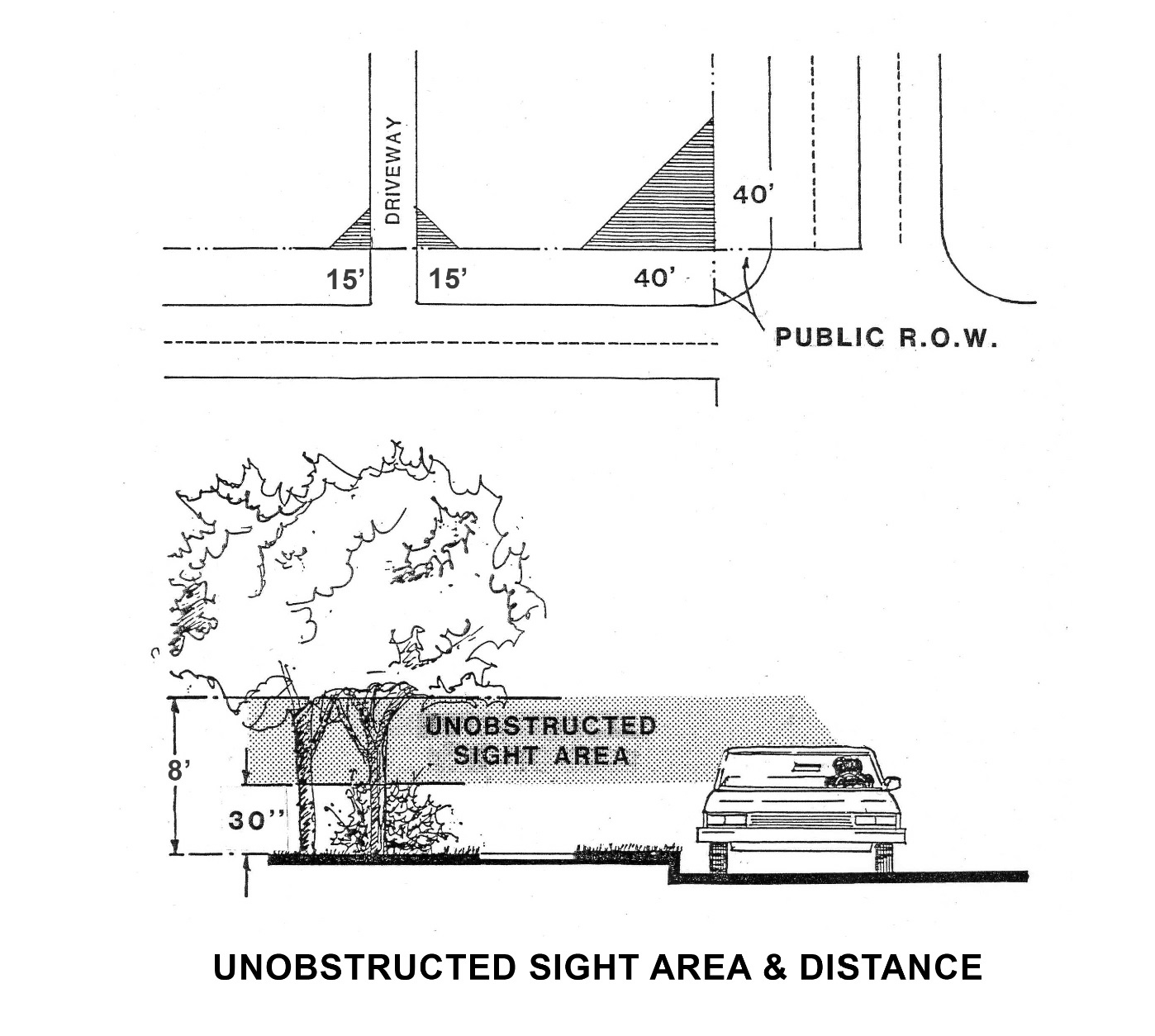
Unobstructed sight area. No fence, wall, structure, or planting shall be erected, established, or maintained on any lot which will obstruct the view of drivers in vehicles approaching an intersection of two roads or the intersection of a road and a driveway. Fences, walls, structures, or plantings located in the triangular area described below shall not be permitted to obstruct cross visibility between a height of 30 inches and eight feet above the lowest point of the intersecting road(s).
Trees shall be permitted in the triangular area provided that limbs and foliage are trimmed so that they do not extend into the cross visibility area or otherwise create a traffic hazard. Landscaping, except required grass or ground cover, shall not be located closer than three feet from the edge of any driveway or road pavement within the triangular area.
8.
Unobstructed sight distance. The unobstructed triangular distance (see illustration) is described as follows:
a.
The area formed at the corner intersection of two public right-of-way lines, the two sides of the triangular area being 40 feet in length measured along abutting public rights-of-way lines, and third side being a line connecting these two sides, or
b.
The area formed at the corner intersection of a public right-of-way and a driveway, the two sides of the triangular area being 15 feet in length measured along the right-of-way line and edge of the driveway, and the third side being a line connecting these two sides.
9.
Buildings to be moved. Any building or structure which has been wholly or partially constructed on any premises, either inside or outside the city, shall not be moved to and placed on any premises in the city unless required building and occupancy permits have first been obtained from the building official. Any such building or structure shall conform fully to the requirements of the zoning ordinance and other applicable regulations, in the same manner as a conventional new building or structure.
A permit to allow a building or structure into the city shall be issued only if the building official determines, after inspecting the building or structure in its original location, that:
It is in safe condition to be moved,
It can be reconditioned to comply with the building code and other applicable codes and ordinances, and
It will be similar in character to the buildings in the area in which it is to move.
(Ord. No. 128-B, § I, 9-20-10)
Sec. 2.10 - Streets, roads, and other means of access.
A.
Intent. Unimpeded, safe access to parcels of land throughout the city is necessary to provide adequate police and fire protection, ambulance services, and other public services, and to otherwise promote and protect the health, safety, and welfare of the public. Accordingly, minimum standards and specifications are required for private roads to assure safe and quick access to private property, and to permit the eventual upgrading and dedication of such access rights-of-way to the city, the Wayne County Board of Commissioners, or another appropriate municipal corporation if public dedication is deemed necessary or desirable. The standards and specifications set forth herein are determined to be the minimum standards and specifications necessary to meet the above-stated intentions.
B.
Public access required. The front lot line of all lots shall abut onto a publicly dedicated road right-of-way or onto an approved private road or drive which complies with the requirements set forth herein. The stub end of any street right-of-way shall not be considered as adequate frontage. No person shall construct, alter, or extend a private road unless in compliance with the requirements of this section. A building permit shall not be issued for any building or structure that would be located where it would circumvent the extension of an existing street or the construction of a new street that is shown on the city's master thoroughfare plan, or that would prevent the widening of any street right-of-way to its ultimate required width.
C.
Access across residential district land. No land which is located in a residential district shall be used for a driveway, walkway, or access purposes to any land which is located in a nonresidential district, unless such access is by way of a public road.
D.
Private roads or streets. The following standards shall be complied with whenever a private internal or on site road or street is proposed:
1.
Applicability. Lots or building sites may be created with a frontage on private roads or streets provided that such lots or building sites conform to all requirements of the district in which the land is located, and provided further, that the lots or building sites shall not be created until an easement agreement for the private road or street has been executed and recorded in accordance with the standards set forth herein. No construction shall be permitted on lots or building sites which have frontage only onto undeveloped private road easements. Construction may be permitted on such lots or building sites subsequent to development of the private road in full compliance with the regulations set forth herein.
2.
Site plan requirements. Submission of a site plan for review and approval shall be required, in accordance with the provisions set forth in section 24.02, prior to issuance of any permits to construct a private road. The site plan shall also include information specified in section 5.442 of the subdivision control ordinance, chapter 52.
3.
Minimum easement requirements. A 60-foot wide easement for ingress, egress, and parking shall be established contiguous to all lots to be serviced by a private road, unless a narrower easement is deemed adequate by the city engineer to meet minimum engineering and access requirements for the site. Such easement shall be established for the joint nonexclusive use of all owners of property abutting the easement. The private road shall be established within the easement and shall provide access to all abutting property. Public utilities and drainage ditches shall also be permitted to occupy the easement.
4.
Design requirements. Private roads shall comply with the design requirements set forth in the construction standards and specifications for private roads established and updated periodically by the city engineer and kept on file in the department of building and safety.
5.
Modification of requirements. The planning commission may waive or modify the private road requirements for private roads serving single-family development, upon recommendation of the planning official and city engineer, if it is determined that the average daily traffic using the private road will be less than 100 trips per day.
E.
Secondary access drive. If the planning commission determines that proposed or anticipated development will result in an excessive number of entrance or exit drives onto a public road, thereby creating potentially hazardous traffic conditions and diminishing the carrying capacity of the road, the commission may permit or require construction of secondary access drives across abutting parcels and generally parallel to the arterial street to allow traffic to circulate from one parcel to another without reentering the public road. The front edge of any such secondary access drive shall be located no closer to the road than the future right-of-way line. Such secondary access drive shall conform to the minimum specifications for private roads as set forth previously.
F.
Performance guarantee. To assure completion of a private road or service drive in conformance with the requirements set forth herein, the building official or city engineer may require the applicant or owner to provide a performance guarantee, in accordance with section 2.17, herein.
G.
Maintenance. Continued maintenance of private roads and service drives shall be the responsibility of the property owner(s) served by the road or drive. Prior to issuance of construction permits, said property owner(s) shall prepare a legally binding easement maintenance agreement, to be entered into with the city following satisfactory review of the agreement by the planning commission, city council, and city attorney. Upon execution, the easement maintenance agreement shall be recorded. Under the terms of the easement maintenance agreement, the property owner(s) shall agree with the city concerning the following provisions and responsibilities:
1.
Maintenance costs. The easement maintenance agreement shall acknowledge that the road or service drive surface and easement area are privately owned, and therefore all construction and improvements within the easement will be contracted and paid for by the signatories to the easement maintenance agreement.
2.
Maintenance needs. Such maintenance shall include, but not necessarily be limited to: surface grading and resurfacing at regular intervals; snow and ice removal from the roadway surface; repair of potholes and ruts; maintenance of roadside drainage ditches to assure the free flow of runoff water to prevent flooding and prevent collection of stagnant pools of water; and, regular cutting of weeds and grass within the easement no less than three times each year in order to assure good visibility for traffic and to impede the growth of plants commonly causing allergic reactions in human beings.
3.
Required signage. The easement maintenance agreement shall acknowledge the responsibility of the signatories to the agreement for installation and maintenance of appropriate traffic safety and road identification signage.
4.
Emergency access. The easement maintenance agreement shall acknowledge the responsibility of the signatories to the agreement for maintenance in order that police, fire, and other public safety vehicles may safely travel on the road or service drive for emergency purposes. The city may request that the easement maintenance agreement signatories repair the road or service drive surface or perform other maintenance of the easement if it is determined that such repair or maintenance is necessary to provide for the public health, safety, or welfare. If such necessary repair or maintenance is not accomplished in a timely manner, the city may make arrangements for the work to be performed and charge the easement maintenance agreement signatories for the actual cost plus all other administrative, contractual, and legal fees incurred in the performance of such work. Such charges shall be a lien upon the land served and owned by the easement maintenance agreement signatories, in proportion to the frontage of each property along the private road or service drive.
5.
City not responsible. The provisions set forth herein or in the easement maintenance agreement shall in no way be construed to obligate the city to perform regular inspections of the easement area or to provide necessary repairs or maintenance. The city shall intercede only if a potential health or safety hazard is brought to the attention of city officials.
6.
Continuing obligation. The easement maintenance agreement shall specify that the obligation to maintain the easement shall be an obligation running with the land to be served by the road or service drive, and shall be binding upon the owner(s) of such land and their heirs, successors, and assigns.
7.
Recording of agreement. The easement maintenance agreement shall be recorded prior to the platting of any lots or the sale or conveyance of any of the property to be charged with the maintenance of the easement area.
(Ord. No. 128-B, § I, 9-20-10)
Sec. 2.11 - Building grades.
A.
General requirements. The following regulations shall apply with respect to building grades:
1.
Minimum sloping grade. The finished grade shall drop a minimum of six inches over a distance of ten feet from the walls on each side of a structure. Beyond ten feet a minimum sloping grade of not less than one percent shall be retained to cause surface water to flow away from the walls of any building.
2.
Natural drainage patterns. On lots that are one-half acre or more in area, buildings shall be located so as not to interfere with the natural drainage pattern, unless it can be demonstrated that the regrading of the land will adequately redirect the flow of surface water.
3.
Measurement of sloping grade. On lots that less than one-half acre in size, the minimum sloping grade of not less than one percent shall be maintained from the finished grade at the front of the building to the sidewalk level (or, if there is not a sidewalk, to the proposed grade at the sidewalk location) and from the finished grade at the rear of the building to the rear lot line.
4.
Exceptions. The provisions in this section shall not prevent the grading of a site to provide a sunken or terraced area, provided proper measures are taken to prevent the runoff of surface water onto adjoining properties or into the proposed building.
5.
Grade of a new building. When a new building is constructed between existing buildings or adjacent to an existing building, the finished grade of the adjacent existing buildings shall be considered in determining the appropriate finished grade of the new building. The grading of the site around the new buildings shall not result in additional runoff of surface water onto adjacent properties. Furthermore, the finished grade shall be one foot above the grade of the adjacent road, unless otherwise specified by the department of building and safety.
6.
Approval of proposed grades. Proposed grades shall be approved by the department of building and safety prior to excavation.
(Ord. No. 128-B, § I, 9-20-10)
Sec. 2.12 - Dumping, filling and excavation.
The dumping of waste or other materials, grading, excavating, filling, and similar "earth changes" shall be subject to the provisions of the city's soil removal and landfills ordinance, chapter 54, as well as all other applicable laws and ordinances. In addition, the following regulations shall apply to dumping and excavation in the City of Flat Rock:
A.
Dumping of waste, junk, or similar materials. The use of land for the storage, collection or accumulation of used construction materials, or for the dumping or disposal of refuse, ash, garbage, rubbish, waste material or industrial by products shall not be permitted in any district, except in conformity with the city's soil removal and landfills ordinance, chapter 54, and subject to approval by the zoning board of appeals.
B.
Excavation. The excavation or continued existence of unprotected holes, pits, or wells which constitute or are reasonably likely to constitute a danger or menace to the public health, safety, and welfare is prohibited; provided, however, that this restriction shall not apply to excavations for which a permit has been acquired, provided such excavations are properly protected with fencing, guard rails, and warning signs. Excavations which may be permitted if proper permits are acquired include: excavation related to construction of a driveway, walk, a permitted wall, or building or part thereof, or movement of soil within the boundaries of a parcel for the purposes of preparing a site for building construction or another permitted use.
C.
Dumping of soil, sand, clay, gravel or similar material. The dumping or filling with soil, sand, clay, gravel or similar earthen material (excluding waste, junk, or contaminated material) on any lot or parcel of land shall not occur unless the plans for such dumping or filling have first been reviewed and appropriate permits issued by the building official. Land within a drainage easement shall not be filled unless approved by the city engineer.
D.
Removal of soil, sand or similar materials. Approval of the zoning board of appeals shall be required prior to any of the following activities, except for excavation for construction of buildings for which a building permit has been issued:
The removal of top soil, sand, gravel, or similar earthen material from any site in the city, or
The mining of gravel.
(Ord. No. 128-B, § I, 9-20-10)
Sec. 2.13 - Trash removal and collection.
A.
Standards for siting and screening of trash dumpsters commercial trash bins. Dumpsters commercial trash bins (commonly referred to as dumpsters) may be permitted or required as accessory to any use, other than single-family residential uses, subject to the following conditions:
1.
Location. Dumpsters trash bins shall be located on a concrete pad in a rear or side yard, provided any such dumpster trash bin shall not encroach on required parking area, is clearly accessible to servicing vehicles, and is located at least ten feet from any building.
Dumpsters/trash bins shall be located as far as practicable from any adjoining residential district or use but shall in no instance be located within ten feet of any residential property line or district.
2.
Screening. Dumpsters/trash bins shall be screened from view from adjoining property and public streets and thoroughfares. Dumpsters/trash bins shall be screened on three sides with a permanent building, wall, obscuring fences made of a pressure-treated wood, or earth mound, not less than six feet in height or at least one foot above the height of the enclosed dumpster, whichever is taller. The fourth side of the dumpster/trash bin screening shall be equipped with an opaque locale gate that is the same height as the enclosure around the other three sides.
3.
Site plan requirements. The location and method of screening of dumpsters/trash bins shall be shown on all site plans and shall be subject to approval. Building materials and colors shall be compatible with the main building.
(Ord. No. 128-B, § I, 9-20-10)
Sec. 2.14 - Lighting.
Subject to the provisions set forth herein, all parking areas, walkways, driveways, building entryways, off street parking and loading areas, and building complexes with common areas shall be sufficiently illuminated to ensure the security of property and the safety of persons using such public or common areas.
A.
Time period. Required lighting shall be turned on daily from one-half hour after sunset to one-half hour before sunrise.
B.
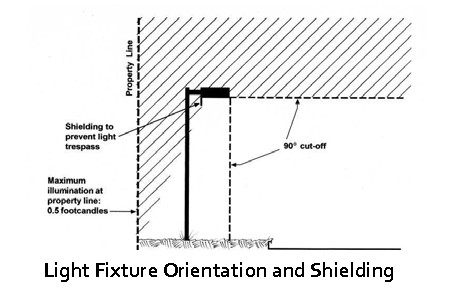
Permitted lighting. Only non-glare, color-corrected lighting shall be permitted. Lighting shall be placed and shielded so as to direct the light onto the site and away from adjoining properties. The lighting source shall not be directly visible from adjoining properties. Lighting shall be shielded so that it does not cause glare for motorists or adjacent residential uses.
C.
Intensity. The light intensity provided at ground level shall be a minimum of 0.3 foot candle anywhere in the area to be illuminated. Light intensity shall average a minimum of 0.5 foot candle over the entire area, measured five feet above the surface. The illumination produced varies depending on the type of lighting source (incandescent, fluorescent, mercury vapor, low or high pressure sodium). For example, an average illumination of 0.6 to 0.8 foot candles can be produced with 4.00 watt clear mercury lamps at a height of 30 feet, or with 1,000 watt high pressure sodium lamps at a height of 50 feet.
D.
Height. Except as noted below, lighting fixtures shall not exceed a height of 25 feet or the height of the building, whichever is less, measured from the ground level to the centerline of the light source fixtures should provide an overlapping pattern of light at a height of approximately seven feet above ground level. The planning commission may modify these height standards in the commercial and industrial districts, based on consideration of the following: The position and height of buildings, other structures, and trees on the site; the potential off-site impact of the lighting; the character of the proposed use; and, the character of surrounding land use. In no case shall the lighting exceed the maximum building height in the district in which it is located. More specifically, in industrial districts the height of lighting fixtures may be equal to the height of the principal building on the site on which the lighting is located, provided that such lighting does not exceed 40 feet and is located at least 500 feet from any residential district.
E.
Sign lighting. Signs shall be illuminated in accordance with the regulations set forth in article 27.00, sign ordinance.
F.
Site plan requirements. All lighting, including ornamental lighting, shall be shown on site plans in sufficient detail to allow determination of the effects of such lighting upon adjacent properties, traffic safety, and overhead sky glow. The objective of these specifications is to minimize the undesirable off-site effects.
(Ord. No. 128-B, § I, 9-20-10)
Sec. 2.15 - Safety provisions.
A.
Public service access. All structures shall be provided with adequate access for fire, police, sanitation, and public works vehicles.
B.
Fire protection. All structures shall be provided with adequate fire protection including adequate water supply for firefighting purposes, adequate internal fire suppression system, use of fire walls and fireproof materials, and other fire protection measures deemed necessary by the department of building and safety.
1.
Fire protection systems. The department of building and safety shall have the authority to require fire protection systems, including a rapid entry key control system, installed in any zoning district.
2.
Site development standards. To facilitate fire protection during site preparation and construction of buildings, consideration shall be given to the following:
a.
Water mains and fire hydrants shall be installed prior to construction above the foundation. Hydrants shall be within 400 feet of all parts of a building, as measured along a line of unobstructed travel access capable of supporting fire apparatus.
b.
Prior to construction of buildings and other large structures, a hard and sufficient roadbed shall be provided to accommodate access of heavy firefighting equipment to the immediate job site at the start of construction. The roadbed shall be maintained until all construction is completed or until another means of access is constructed.
c.
Free access from the street to fire hydrants and to outside connections for standpipes, sprinklers, or other fire extinguishing equipment, whether permanent or temporary, shall be provided and maintained at all times.
d.
The building permit holder shall provide scheduled daily cleanups of scrap lumber, paper products, corrugated cardboard and other debris. Construction debris shall be disposed of in accordance with methods approved by the building official.
C.
Excavations and holes. Excavations and holes created in conjunction with a construction project shall be adequately barricaded and illuminated if not filled in at the end of the working day. Where such excavations or holes are located in a public right-of-way, it shall be the responsibility of the contractor to notify the police chief of their existence. (See also section 2.12.)
D.
Building demolition. Before a building or structure is demolished the owner, wrecking company, or person who requests the demolition permit shall notify all utilities providing service to the building. A demolition permit shall not be issued until all utilities have provided notification that service has been properly terminated.
(Ord. No. 128-B, § I, 9-20-10)
Sec. 2.16 - Exceptions.
A.
Essential services. Essential services shall be permitted as authorized and regulated by state, federal, and local ordinances and laws, it being the intention hereof to exempt such essential services from those regulations governing area, height, placement, and use of land in the city which would not be practical or feasible to comply with. Essential services, as defined in section 1.03, shall include:
The erection, construction, alteration or maintenance by public or quasi public utilities or municipal departments or city certified cable television companies of underground, surface or overhead gas, steam, electrical, fuel or water systems for the purposes of transmission, distribution, collection, communication, supply, or disposal; including towers, poles, wires, mains, drains, sewers, pipes, conduits, cables, fire alarm and police call boxes, traffic signals, hydrants and similar equipment, which are necessary for the furnishing of adequate service by such utilities or municipal departments for the general health, safety, and welfare of the public. Essential services shall not include storage yards, sales or business offices, or commercial buildings or activities.
Although exempt from certain regulations, proposals for construction of essential services shall still be subject to site plan review, it being the intention of the city to achieve efficient use of the land and alleviate adverse impact on nearby uses or lands. Essential services shall comply with all applicable regulations that do not affect the basic design or nature of operation of said services.
B.
Exceptions to height standards.
1.
Exceptions. The height limitation of this ordinance shall not apply to chimneys, cooling towers, elevators, bulkheads, fire towers, grain elevators, silos, penthouses, stacks, stage towers, scenery lofts, sugar refineries, tanks, water towers, pumping towers, radio towers, television antennae, monuments, steeples, cupolas, and mechanical appurtenance accessory to and necessary for the permitted use in the district in which they are located.
2.
Height of public and semi-public buildings. The height of public and semi-public buildings, such as churches, cathedrals, temples, hospitals, sanitariums, or schools shall not exceed 55 feet, provided that if any such building exceeds the height limitation for the district in which it is located, then, in addition to the required setback, the building shall be set back an additional one foot for each foot by which the building exceeds the height standard.
3.
Height of parapet walls. Parapet walls may extend up to five feet above the permitted height in the district in which the building is located.
C.
Municipal facilities. Municipal facilities, including municipal offices, buildings, and uses (not requiring outside storage of materials and vehicles); libraries; museums and locally designated historic buildings; publicly owned and operated park and recreation buildings, facilities, and structures shall be permitted as authorized and regulated by federal, state and local ordinances and laws, it being the intention hereof to exempt such municipal facilities from those regulations governing area, height, placement, and use of land in the city which would not be practical or feasible to comply with.
Although exempt from certain regulations, proposals for construction of municipal facilities shall still be subject to site plan review, it being the intention of the city to achieve efficient use of the land and alleviate adverse impact on adjacent and nearby uses and lands. Municipal facilities shall comply with all applicable regulations that do not affect the basic design or nature of operation of said facilities and shall comply with the following specific requirements:
1.
Lot size. The minimum lot size shall comply with the minimum lot size required in the zoning district that the municipal facility shall be located.
2.
Height of municipal facilities. The planning commission may permit the height of municipal buildings and accessory structures to exceed the maximum height of the district where the municipal facilities will be located subject to the following design considerations:
a.
Municipal buildings shall be preeminently located in/around a community park facility or within a main street commercial area and shall be prominent in a distinct fashion using massing, additional height, contrasting materials, and civic architectural embellishments to obtain this effect.
b.
Focal points, or points of visual termination, shall generally be occupied by more prominent, monumental buildings and structures that employ enhanced height, massing, distinctive architectural treatments, or other distinguishing civic features.
c.
Buildings and accessory structures shall be considered in terms of their relationship to the height and massing of adjacent buildings, other buildings located on the site, and in relation to the human scale.
d.
Municipal buildings shall be a minimum of two stories high.
3.
Spatial relationships. More than one principal building and accessory structures may be permitted on the same lot subject to the following design considerations:
a.
Spatial relationships between buildings and other structures shall be geometrically logical and architecturally formal. On a lot with multiple buildings, those located on the interior of the site shall front towards and relate to one another, both functionally and visually. A lot with multiple buildings may be organized around features such as courtyards, greens, park facilities and uses, or quadrangles which encourage pedestrian activity and incidental social interaction among users. Smaller, individualized groupings of (historic) buildings are encouraged.
b.
Buildings shall be located no closer to each other than state and local building and fire codes allow. Buildings shall be located to allow for adequate fire and emergency access.
c.
Wherever feasible, buildings shall be located to front towards and relate to public streets, both functionally and visually, to the greatest extent possible. Buildings shall not be oriented to front toward a parking lot.
4.
Architectural design. Buildings shall generally relate in scale and design features to the surrounding buildings, showing respect for the local context. As a general rule, buildings shall reflect a continuity of treatment obtained by maintaining the building scale or by subtly graduating changes; by maintaining base courses and cornice lines in buildings of the same height; by extending horizontal lines of fenestration; and by echoing architectural styles and details, design themes, building materials, and colors used in surrounding buildings. Buildings on corner lots shall be considered significant structures, since they have at least two front facades visibly exposed to the street. Buildings shall avoid long, monotonous, uninterrupted walls or roof planes. Blank, windowless walls are discouraged. Building wall offsets, including projections, recesses, and changes in floor level shall be used in order to add architectural interest and variety, and to relieve the visual effect of a simple, long wall. Similarly, roof-line offsets shall be provided in order to provide architectural interest and variety to the massing of a building and to relieve the effect of a single, long roof.
Buildings facing a public street or internal open space, shall be architecturally emphasized through fenestration, entrance treatment, and details. Buildings with more than one facade facing a public street or internal open space shall be required to provide several front facade treatments. The architectural treatment of the front facade shall be continued, in its major features, around all visibly exposed sides of a building. All sides of a building shall be architecturally designed to be consistent with regard to style, materials, colors, and details.
All entrances to a building shall be defined and articulated by architectural elements such as lintels, pediments, pilasters, columns, porticoes, porches, overhangs, railings, balustrades, and other architectural features, where appropriate.
5.
Exterior spaces. Exterior public spaces, such as courtyards or plazas, shall be designed to function, enhance surrounding buildings, and to provide amenities for users, in the form of textured paving, landscaping, lighting, street trees, benches, trash receptacles, public art, and other items of street/park furniture, as appropriate. Courtyards shall have recognizable edges defined on at least three sides by buildings, walls, elements of landscaping, and elements of site furniture, in order to create a strong sense of enclosure.
Modular masonry materials, such as brick, slate, and concrete pavers, or gridded cast-in-place materials, such as exposed aggregate concrete slabs shall be used, whenever possible, on sidewalks, pedestrian walkways and pathways, and public or semi-public plazas, courtyards, or open spaces. Asphalt, and non-aggregate exposed concrete slabs should be avoided.
6.
Maximum building coverage: Seventy percent.
7.
Minimum non-impervious area: Twenty percent.
8.
Minimum space between buildings: Fifteen feet.
9.
Off-street parking. Off-street parking spaces should be located in the rear yard or interior of the lot, wherever feasible. The number of parking spaces provided should be sufficient to provide parking for employees of all facilities as well as visitor parking. Common, share parking facilities are encouraged where feasible.
10.
Linkages. A sidewalk/pathway network shall be provided throughout the development that interconnects all municipal buildings and functional areas and common areas. Sidewalks/pathways shall promote pedestrian activity within each municipal area and throughout the municipal complex. Pathways shall be a minimum of five feet wide and expanding to eight feet wide along major pedestrian routes.
All sidewalks and other pedestrian pathways shall have appropriate lighting, using poles and fixtures consistent with the overall design theme for the development.
Bikeways shall be provided, where possible, to link internal open space areas with peripheral open space areas and continuing on routes through peripheral open space areas. Bike racks shall be provided in internal open space areas and recreation areas in the peripheral of the municipal open space.
(Ord. No. 128-B, § I, 9-20-10)
Sec. 2.17 - Performance guarantee.
A.
Intent. To insure compliance with the provisions of this ordinance and any conditions imposed thereunder, the planning commission, city council, or building official may require that a performance guarantee be deposited with the city to insure faithful completion of improvements, in accordance with Section 505 of the Michigan Zoning Enabling Act, Public Act 110 of 2006, as amended.
B.
General requirements. The performance guarantee shall meet the following requirements:
1.
The performance guarantee shall be in the form of a cash bond irrevocable letter of credit, certified check, or similar instrument acceptable to the city treasurer. Which names the property owner as the obligor and the city as the obligee.
2.
The performance guarantee shall be submitted at the time of issuance of the permit authorizing the activity or project. If appropriate based on the type of performance guarantee submitted, the city shall deposit the funds in an interest bearing account in a financial institution with which the city regularly conducts business.
3.
The amount of the performance guarantee shall be sufficient to cover the estimated cost of the improvements or portion thereof associated with a project for which site plan approval is being sought or has been obtained. In accordance with these guidelines, the exact amount of the performance guarantee shall be determined by the building official.
4.
The entire performance guarantee, including interest accrued, shall be returned to the applicant upon satisfactory completion of the required improvements.
5.
An amount not less than ten percent of the total performance guarantee may be retained for a period of at least one year after installation of landscape materials to insure proper maintenance and replacement, if necessary. This amount shall be released to the applicant upon certification by the building official that all landscape materials are being maintained in good condition.
C.
Unsatisfactory completion of improvements. Whenever required improvements are not installed or maintained within the time stipulated or in accordance with the standards set forth in this ordinance, the city may complete the necessary improvements itself or by contract to an independent developer, and assess all costs of completing said improvements against the performance bond or other surety, including any interest accrued on said bond or surety prior to completing said improvements, the city shall notify the owner, site plan review applicant, or other firm or individual responsible for completion of the required improvements.
(Ord. No. 128-B, § I, 9-20-10)
Sec. 2.18 - Signs.
All signs shall comply with the regulations set forth in the article 27.00, sign ordinance as amended, and other applicable laws and ordinances.
(Ord. No. 128-B, § I, 9-20-10)
Sec. 2.19 - Sidewalks and pathways.
Sidewalks shall comply with the regulations set forth in the adopted sidewalk ordinance, chapter 4.2, as amended, and other applicable laws and ordinances.
A minimum ten-foot wide paved pathway shall be constructed, in lieu of sidewalks, in all areas in the city designated on the adopted non-motorized pathway master plan, as amended. Non-motorized pathways shall be constructed to city engineering standards.
(Ord. No. 128-B, § I, 9-20-10)
Sec. 2.20 - Fences.
Fences shall be permitted subject to the following requirements:
1.
Requirements for freestanding fences. Freestanding fences (i.e., those that are not adjacent to another fence of structure) shall comply with the following regulations:
FOOTNOTES:
(a)
Alternative #1: Fence is located to the rear of the principal structure.
(b)
Alternative #2: Fence is located no closer to the front of the lot than any portion of the principal building.
(c)
Alternative #3: Fence is located in the front yard. Fences are permitted in the front yard in single family residential districts only, subject to zoning board of appeals approval, and provided that: (1) the parcel has a minimum size of one acre, and (2) the principal dwelling is set back at least 50 feet from the front property line. Fences may also be permitted in the front yard of industrial districts or to enclose public utility facilities subject to zoning board of appeals approval.
2.
Requirement for fences located adjacent to other fences. Any fence that is proposed to be placed adjacent or attached to another fence or structure shall comply with the following regulations:
FOOTNOTES:
(a)
Alternative #1: Fence is located to the rear of the principal structure.
(b)
Alternative #2: Fence is located no closer to the front of the lot than any portion of the principal building.
(c)
Alternative #3: Fence is located in the front yard. Fences are permitted in the front yard in single family residential districts only, subject to zoning board of appeals approval, and provided that: (1) the parcel has a minimum size of one acre, and (2) the principal dwelling is set back at least 50 feet from the front property line. Fences may also be permitted in the front yard of industrial districts or to enclose public utility facilities subject to zoning board of appeals approval.
3.
Fence placement. Fences shall be placed inside and adjacent to the property line, except in the following instances:
(a)
Where underground utilities interfere with placement of the fence on the property line, the fence may be placed on the utility easement line located nearest the property line.
(b)
Where an existing fence that is not intended to be removed is located on the property line, the proposed fence shall either be placed adjacent to or at least six feet away from the existing fence.
(c)
Fences or privacy screens may be placed elsewhere on the interior of the lot in the rear yard provided a minimum clearance of six feet is provided between the proposed fence and any other fence, structure, or property line.
4.
Clearance at bottom. Clearance at the bottom of the fence shall be required as indicated in items 1 and 2, above, to prevent rotting and permit weed removal.
5.
Existing fences. No more than two fences shall be placed adjacent to each other. In order to implement this regulation, the construction of a new fence adjacent or attached to an existing fence shall not be permitted, unless the existing fence is owned in full or in part by an adjoining property owner. If the existing fence is owned in full by the applicant, it shall be removed prior to construction of the new fence. If the existing fence is owned jointly with an adjoining property owner, construction of a new fence adjacent to the existing fence may be permitted only if the applicant submits a notarized letter agreeing to share in the proportionate cost of continuing maintenance and/or eventual removal of the existing fence. It shall be the applicant's responsibility to submit adequate proof of ownership of existing fences.
6.
Fence materials. Fences shall consist of materials commonly used in conventional fence construction, such as wood or metal. Chain link fences in nonresidential areas shall be black vinyl coated or other approved colors by the planning commission.
7.
Finished appearance. If, because of the design or construction, one side of the fence has a more finished appearance than the other, the side of the fence with the more finished appearance shall face the exterior of the lot.
8.
Obstruction of use of adjoining property. No fence shall be erected where it would prevent or unreasonably obstruct the use of adjacent property, nor shall a fence be erected where it would obstruct or prevent the continued safe use of an existing driveway or other means of access to adjacent property. In enforcing this provision, the building official may require a fence to be set back a minimum distance from a driveway or property line.
9.
Fence maintenance. Fences shall be maintained in good condition. Rotten or broken components shall be replaced, repaired, or removed. As required, surfaces shall be painted, stained or similarly treated.
10.
Barbed wire. Fences shall not contain barbed wire, razor wire, electric current or charge of electricity, provided, however, that fences in nonresidential districts which enclose storage areas may have barbed wire provided that the barbed wire is at least six feet above grade.
11.
Review and approval. It shall be the building official's responsibility to review and act on all fence proposals, unless the fence is proposed as part of a site plan which is subject to the normal site plan review procedures in section 24.02. The erection, construction, or alteration of any fence shall be done in accordance with all municipal codes and shall require appropriate permits.
12.
Obscuring walls and fences. Obscuring walls and fences shall be subject to the requirements in section 5.08.
(Ord. No. 128-B, § I, 9-20-10)
Sec. 2.21 - Floodplains.
Development within the floodplain shall comply with the regulations set forth in the adopted floodplain control ordinance, chapter 103, as amended, and other applicable laws and ordinances.
(Ord. No. 128-B, § I, 9-20-10)
Sec. 2.22 - Utilities.
Utility service lines, including electric, telephone and cable television lines, shall be placed underground. Also, electric lines to freestanding signs and light poles shall be placed underground.
(Ord. No. 128-B, § I, 9-20-10)
Sec. 2.23 - Satellite dish antenna.
Satellite dish antennae may be permitted as an accessory structure in any zoning district, subject to the following conditions:
A.
Roof-mounted antennae. Roof-mounted dish antennae up to a maximum of ten feet in diameter shall be permitted in commercial and industrial districts only, provided that the antennae comply with the height standards for the district in which they are located and subject to the following conditions:
1.
The satellite dish structure shall be securely mounted and anchored to a pole and secured in accordance with the requirements of the manufacturer and the building code.
2.
Any person who proposes to construct a satellite dish antenna having a dish diameter larger than three feet on any lot or parcel of land must first obtain a permit from the building and safety department. The person seeking the permit, if not the owner of the lot or parcel of land, must provide evidence to the building and safety department that the owner of the lot or parcel of land has no objection to its construction and assumes all liability for its construction, operation and use.
3.
The building and safety department shall issue a permit provided the applicant complies with all the provisions of this ordinance and submits a written application upon forms provided by the building and safety department, along with a site plan showing the exact location and dimensions of the proposed satellite dish on the building.
4.
The applicant shall present any license or permit required by any federal, state or local agency pertaining to the ownership, construction or operation of a satellite dish antenna.
5.
A permit fee shall be paid to the city and the permit fee shall cover the costs of reviewing the construction plans and specifications, inspecting the final construction and processing the application.
6.
All electrical and antenna wiring shall be placed underground.
7.
The surface of the dish shall be painted or treated as not to reflect glare from sunlight, and shall not be used as any sign or message board. All installations shall employ (to the extent possible) materials and colors that blend the building and its surroundings.
8.
Any roof-mounted antenna shall be so located and designed to withstand a wind force of 100 miles per hour.
B.
Ground-mounted antennae. Ground mounted antennae up to eight feet in diameter shall be permitted in all districts subject to the following conditions:
1.
Maximum height permitted shall be 12 feet.
2.
The satellite dish structure shall be securely mounted and anchored to a pole and secured in accordance with the requirements of the manufacturer and the building code.
3.
Any person who proposes to construct a satellite dish antenna having a dish diameter larger than three feet on any lot or parcel of land must first obtain a permit from the building and safety department. The person seeking the permit, if not the owner of the lot or parcel of land, must provide evidence to the building and safety department that the owner of the lot or parcel of land has no objection to its construction and assumes all liability for its construction, operation and use.
4.
The building and safety department shall issue a permit provided the applicant complies with all the provisions of this ordinance and submits a written application upon forms provided by the building and safety department, along with a site plan showing the exact location and dimensions of the proposed satellite dish and the proposed landscaping.
5.
The applicant shall present any license or permit required by any federal, state or local agency pertaining to the ownership, construction or operation of a satellite dish antenna.
6.
A permit fee shall be paid to the city and the permit fee shall cover the costs of reviewing the construction plans and specifications, inspecting the final construction and processing the application.
7.
Satellite dish antennae shall comply with setback requirements for the district in which they are located, and shall not be permitted in front or side yards.
8.
All electrical and antenna wiring shall be placed underground.
9.
The surface of the dish shall be painted or treated as not to reflect glare from sunlight, and shall not be used as any sign or message board. All installations shall employ (to the extent possible) materials and colors that blend the surroundings.
10.
The site of the antenna shall be screened from view through the planting of evergreens of sufficient concentration to reasonably conceal the antenna. Alternative screening is acceptable if approved by the director of the building and safety department
11.
Any ground-mounted antenna shall be so located and designed to withstand a wind force of 100 miles per hour.
(c)
Appeal to zoning board of appeals. If a true hardship or practical difficulty exists on a particular lot or parcel of land such that compliance with the provisions of this ordinance is impossible because satellite sight lines are blocked, then a variance may be granted by the zoning board of appeals to the extent necessary to permit reasonable reception, after consideration of the following factors and standards:
1.
A showing of good and sufficient cause and exceptional hardship;
2.
The safety of the property owner and the surrounding property owners;
3.
The variance shall be the minimum necessary to afford relief to the applicant;
4.
"Reasonable reception", as used in this section, does not mean perfect reception from each satellite of the many satellites in space;
5.
Conditions may be attached to the granting of the variance which are in the best interest of the health, safety ad welfare of the community.
(Ord. No. 128-B, § I, 9-20-10)
Sec. 2.24 - Wireless communication facilities and services.
A.
Permitted as principal uses. In the following circumstances, a new wireless communication facility shall be a principal permitted use, or a permitted accessory use, subject to site plan approval as provided in article 24.00, general procedures and related standards, section 24.02, site plan review, and also subject to the conditions set forth in subparagraph (D) below:
1.
Attached wireless communication facilities within all districts where the existing structure is not, in the discretion of the planning commission, proposed to be either materially altered or materially changed;
2.
Collocation of an attached wireless communication facility which has been previously approved for collocation by the planning commission; or
3.
Wireless communication facilities attached to a utility pole located within a right-of-way, where the existing pole is not modified to materially alter the structure and/or result in an impairment of sight lines or other safety interests.
4.
M-2 district.
B.
Permitted as special land uses in the HR, RE and M-1 districts. Wireless communication facilities with monopole support structures shall be permitted as special land uses or special accessory uses only, subject to the standards of section 24.03, special land use review procedures and standards, and also subject to the conditions hereinafter imposed in the RE and M-1 districts, except that they shall not be located within 200 feet of any district zoned for single-family residential purposes or within a distance equal to the height of the support structure from the right-of-way line of Interstates I-75, other major roads and railroads. If located on the same parcel with another permitted use, such facilities and any other structures connected therewith shall not be located in a front yard.
Collocation of attached wireless communication facilities on existing structures shall be permitted as a special land use or special accessory use only in the HR district, subject to the standards of section 24.03, special land use review procedures and standards, and also subject to the conditions hereinafter imposed in the HR district, and the following conditions:
1.
The collocation of attached wireless communication facilities and support structures shall be permitted on buildings nine stories or higher in the HR district provided that the antennas and support structure do not exceed the height of the high rise.
2.
Collocation of attached wireless communication facilities shall not, to the determination of the planning commission materially alter or materially change the appearance of the existing structure.
C.
Required standards for wireless communication facilities in all districts.
1.
Required information.
2.
Compatibility of support structures. Wireless communication support structures shall not be injurious to the neighborhood or detrimental to the public safety and welfare. Support structures shall be harmonious with the surrounding areas, and aesthetically and architecturally compatible with the natural environment.
a.
Site plan. A site plan prepared in accordance with section 24.02, site plan review, also showing as-built drawings for all proposed attached wireless communication facilities and/or wireless communication support structures.
b.
Demonstration of need. Demonstration of the need for the proposed wireless communication support structure due to a minimum of one of the following:
•
Proximity to an interstate highway or major thoroughfare.
•
Proximity to areas of population concentration.
•
Proximity to commercial or industrial business centers.
•
Avoidance of signal interference due to buildings, woodlands, topography, or other obstructions.
•
Other specific reasons.
c.
Service area and power. As applicable, a description of the planned, proposed, or existing service area of the facility, and wireless communication support structure height and type, and signal power expressed in effective radiated power (ERP) upon which the service area has been planned.
d.
Map of other facilities nearby. A map showing existing or proposed wireless communication facilities within the city, and further showing existing and known proposed wireless communication facilities within areas surrounding the borders of the city, which are relevant in terms of potential collocation or in demonstrating the need for the proposed facility. If the information is on file with the city, the applicant shall update as needed. This ordinance shall serve as the promise to maintain confidentiality as permitted by law. A request for confidentiality must be prominently stated.
e.
Data on other facilities nearby. For each location identified by the applicant/provider, the application shall include the following data, if known, with the applicant/provider expected to exercise reasonable diligence to obtain information:
•
The structural capacity and whether it can accommodate the applicant's facility, as proposed or modified.
•
Evidence of property owner approvals.
•
Whether the location could be used by the applicant/provider for placement of its attached wireless communication facility; if the location cannot be used, a disclosure of the technological considerations involved, with specific reference to how use of the location would prohibit the applicant/provider from providing services.
f.
Fall zone certification. To determine setbacks, a certification by a Michigan licensed, registered engineer regarding the manner in which the proposed structure will fall.
g.
Description of security for removal. A description of the security for the wireless communication support structure to ensure removal and maintenance. The security shall be in the form of cash, surety bond, letter of credit, or an agreement in a form approved by the city attorney and recordable at the Wayne County Register of Deeds, a promise of the applicant and owner of the property to timely remove the facility as required, with the provision that the applicant and owner shall pay costs and attorney's fees incurred by the city in securing removal.
h.
Data on FCC and FAA approval. A copy of the application submitted to the Federal Communications Commission and Federal Aviation Administration detailing technical parameters authorization for the facility.
3.
Maximum height. The maximum height of wireless communication support structures shall be: a) 120 feet; or b) the minimum height demonstrated to be necessary by the applicant; or c) such lower heights as approved by the Federal Aviation Administration. The applicant shall demonstrate a justification for the height and provide an evaluation of alternative designs which might result in lower heights. Accessory buildings shall be limited to the maximum height for accessory structures within respective districts.
4.
Setbacks from nonresidential districts. Wireless communication support structures abutting any lot zoned for other than residential purposes shall have a minimum setback in accordance with the required setbacks for the principal buildings for the zoning district in which the support structure is located.
5.
Variances. The zoning board of appeals may grant variances for the setback of a wireless communication support structure, to reduce its visual impact, or to meet the required standards of (D)(10), "collocation". The zoning board of appeal may also grant variances for the height of a support structure of up to 20 feet only in cases where a variance would permit additional collocations.
6.
Compatibility of accessory structures. Wireless communication facilities proposed on the roof of a building with an equipment enclosure shall be architecturally compatible with the principal building upon which it is located. The equipment enclosure may be located within the principal building or may be an accessory building, provided the accessory building conforms with all district requirements for accessory buildings and is constructed of the same or compatible building material as the principal building.
7.
Appearance of support structures. The color of wireless communication support structures and all accessory buildings shall minimize distraction, reduce visibility, maximize aesthetics, and ensure compatibility with surroundings. The applicant shall be responsible for the maintenance of the wireless communication facility in a neat and orderly condition.
8.
Federal and state requirements. The requirements of the Federal Aviation Administration, Federal Communication Commission, and Michigan Aeronautics Commission shall be noted on the site plan.
9.
Lighting. Lighting on a wireless communication facility shall be prohibited. If the Federal Aviation Administration requires lighting, the applicant shall propose a height reduction to eliminate the need for lighting, or shall submit detailed technical data demonstrating the need for the requested height including an analysis demonstrating that other sites are unavailable or inadequate for their purposes.
10.
Collocation. All wireless communication support structures shall accommodate no more than three attached wireless communication facilities. Support structures shall allow for future rearrangement of attached wireless communication facilities to accept other attached facilities mounted at varying heights.
a.
When collocation is not "feasible". Wireless communication support structures shall not be approved unless the applicant documents that its attached wireless communication facilities cannot be feasibly collocated or accommodated on an existing support structure or other existing structure due to one or more of the following reasons:
•
The planned equipment would exceed the structural capacity of the existing support structure or other structure, as documented by licensed engineer, and the existing support structure or other structure cannot be reinforced, modified, or replaced to accommodate planned or equivalent equipment at a reasonable cost.
•
The planned equipment would cause interference affecting the function of other equipment on the existing support structure or other structure as documented by a licensed engineer, and the interference cannot be prevented at a reasonable cost.
•
Support structures and other structures within the search radius cannot accommodate the planned equipment at a height necessary for the coverage area and capacity needs to reasonably function as documented by a qualified and licensed professional engineer.
•
Other unforeseen reasons that make it infeasible to locate the planned communications equipment upon an existing support structure or other structure.
b.
Determining feasibility of collocation. Collocation shall be deemed to be "feasible" when all of the following are met:
•
The applicant/provider will pay market rent or other market compensation for collocation.
•
The site is able to provide structural support, considering reasonable modification or replacement of a facility.
•
The collocation being considered is technically reasonable and will not result in unreasonable interference, given appropriate physical adjustments.
•
The height of the structure necessary for collocation will not be increased beyond maximum height limits.
c.
Refusal to permit collocation. If a party who owns or otherwise controls a wireless communication support structure shall fail or refuse to alter a structure to accommodate a feasible collocation, such facility shall thereafter be a nonconforming structure and use, and shall not be altered, expanded or extended in any respect.
d.
Refusal to collocation constitutes violation. If a party who owns or otherwise controls a facility shall fail or refuse to permit a feasible collocation, and this requires the construction and/or use of a new wireless communication support structure, the party failing or refusing to permit a feasible collocation shall be deemed to be in direct violation and contradiction of the policy, intent and purpose of this section of the zoning ordinance.
e.
New structures prohibited. Consequently such party shall take responsibility for the violation, and shall be prohibited from receiving approval for a new support structure within the city for a period of five years from the date of the failure or refusal to permit the collocation.
f.
Variance from collocation. Such a party may seek and obtain a variance from the zoning board of appeals if and to the limited extent the applicant demonstrates entitlement to variance relief which, in this context, shall mean a demonstration that enforcement of the five-year prohibition would unreasonably discriminate among providers of functionally equivalent wireless communication services, or that such enforcement would have the effect of prohibiting the provision of personal wireless communication service.
g.
Offer of collocation required. An application for a new wireless communication support structure shall include a letter from the applicant to all potential users offering an opportunity for collocation. The list of potential users shall be provided by the city based on those entities who have requested approval of a wireless communication facility, current FCC license holders, and other entities requesting to be on the list. If, during a period of 30 days after the notice letters are sent to potential users, a user requests, in writing, to collocate on the new support structure, the applicant shall accommodate the request(s), unless collocation is not feasible based on the criteria of this section.
11.
Removal. When a wireless communications facility has not been used for 90 days, or 90 days after new technology is available which permits the operation of a facility without the requirement of a wireless communication support structure, all or parts of the wireless communications facility shall be removed by the users and owners of the facility and owners of the property.
The removal of antennae or other equipment from the facility, or the cessation of operations (transmission and/or reception of radio signals) shall be considered as the beginning of a period of non-use. The situation(s) in which removal of a wireless communications facility is required may be applied and limited to a portion of the facility.
a.
Upon the occurrence of one or more of the events requiring removal, the property owner or persons who had used the wireless communications facility shall immediately apply for and secure the application for any required demolition or removal permits, and immediately proceed with and complete the demolition/removal, restoring the condition which existed prior to the construction of the facility.
b.
If the required removal of the wireless communications facility or a portion thereof has not been lawfully completed within 60 days of the applicable deadline, and after at least 30 days' written notice, the city may remove or secure the removal of the facility or required portions thereof, with its actual costs and reasonable administrative charges to be drawn or collected from the security posted at the time application was made for establishing the facility.
12.
Radio frequency emission standards. Wireless communication facilities shall comply with applicable federal and state standards relative to electromagnetic fields and the environmental effects of radio frequency emissions.
13.
Effect of approval.
a.
Subject to subparagraph (b) below, final approval under for a wireless communication support structure shall be effective for a period of six months.
b.
If construction of a wireless communication support structure is commenced within two miles of the land upon which a facility has been approved, but upon which construction has not been commenced during the six-month period of effectiveness, the approval for the support structure that has not been commenced shall be void 30 days following written notice from the city of the commencement of the other support structure. Such voiding shall apply when the applicant granted approval of the support structure which has not been commenced demonstrates that it would not be feasible to collocate on the support structure that has been newly commenced.
(Ord. No. 128-B, § I, 9-20-10)
Sec. 2.25 - Donation bins.
Donation bins shall be allowed in all zoning districts with the exception of zoning districts R-1A through R-1C, R-2, R-3, HR, 0-1, RE, and PUD districts having an underlying residential use. Notwithstanding the foregoing, donation bins may be placed on properties occupied by religious institutions. The placement of donation bins is subject to the following regulations:
A.
Definitions.
1.
Donation bin shall mean an unattended, closed receptacle or container made of metal, wood, or plastic or a combination thereof and designed and intended for the collection from the public of donations of used clothing, shoes, textiles, household items, books, magazines, other salvageable personal property, or wastepaper, for the purpose of reuse or recycling. Donation bin does not include a receptacle or container used to collect recyclable metal, plastic, or glass or a household curb side recycling container or other container used to receive recyclables from a specific person or persons.
2.
Charitable organization means an organization that is exempt from taxation pursuant to Section 501(c)(3) of the Internal Revenue Code, 26 USC 501(c)(3).
B.
It shall be unlawful to place or operate a donation bin outdoors unless a permit is first obtained from the building department, upon payment of a fee as determined by resolution of the city council. A separate permit shall be required for each donation bin, however, a single application may seek permits for up to three donation bins. To obtain a permit the applicant shall be a charitable organization, and shall make application to include the following:
1.
The applicant's name, address, telephone number, electronic mail address, website address, if any, and fax number, if any. The information provided under this subsection shall be for the applicant's registered office under Section 241 of the Nonprofit Corporation Act, 1982 Public Act 162, MCL 450.2241, if the applicant is incorporated under that Act.
2.
The name and contact information of the applicant's resident agent under Section 241 of the Nonprofit Corporation Act, 1982 Public Act 162, MCL 450.2241, if the applicant is incorporated under that Act.
3.
A certificate of good standing with the State of Michigan under Section 922 of the Nonprofit Corporation Act, 1982 Public Act 162, MCL 450.2922, issued within the past 90 days, if the applicant is incorporated under that Act.
4.
The manner in which any clothing or other donations collected are expected to be used, sold, or distributed.
5.
The name and telephone number of any entity that will receive some or all of the donations collected in the donation bin or the proceeds thereof.
6.
The address and, as precisely as possible, location where each bin will be placed, and the name of any business at the location.
7.
Written consent from the property owner, property owner's agent, or person in lawful possession of the property to place the donation bin on the property.
8.
Proof that the applicant is a charitable organization as defined in this section.
C.
Permits under this section shall be valid for a period of one year.
D.
The donation bin must have clearly identified on its face the entity or organization maintaining the donation bin, together with a phone number, address, and website, if any, for such entity clearly appearing on the donation bin, together with a statement describing the charitable cause that will benefit from the donation.
E.
The donation bin shall be appropriately located so as to not interfere with sight triangles, on-site circulation, required setbacks, landscaping, parking, and any other requirements that may have been imposed as part of the site plan approval for the premises, and shall be placed on a concrete surface.
(Ord. No. 429, § I, 5-5-14)
Sec. 2.26 - Outdoor vending machines.
Outdoor vending machines shall be allowed in all zoning districts with the exception of zoning districts R-1A through R-1C, R-2, R-3, HR, 0-1, RE, and PUD districts having an underlying residential use, subject to the following regulations:
A.
It shall be unlawful to place or operate an outdoor vending machine unless a permit is first obtained from the building department, upon payment of a fee as determined by resolution of the city council. A separate permit shall be required for each outdoor vending machine and the application for a permit shall include the following:
1.
The applicant's name, address, telephone number, electronic mail address, website address, if any, and fax number, if any.
2.
The address, and as precisely as possible, location where each outdoor vending machine will be placed, and the name of any business at the location.
3.
Written consent from the property owner, property owner's agent, or person in lawful possession of the property to place the outdoor vending machine on the property.
B.
Permits under this section shall be valid for a period of one year.
C.
The vending machine shall be appropriately located so as to not interfere with sight triangles, on-site circulation, required setbacks, landscaping, parking, and any other requirements that may have been imposed as part of the site plan approval for the premises, and shall be placed on a concrete surface.
D.
No more than three vending machines will be located outdoors on any single business property.
E.
Vending machines shall be located in such a way as to maintain a minimum of five feet clear area on any sidewalk.
F.
Vending machines must be located a minimum of ten feet from any building entrance.
G.
Vending machines may not be located in areas designated for parking or landscaping.
H.
The owner, lessee, or other person or legal entity in control or in lawful possession of the property where the outdoor vending machine is located, and the entity which owns, maintains, or operates the outdoor vending machine in violation of this ordinance shall be jointly and severally responsible for a municipal civil infraction and may be ordered to pay a civil fine of not more than $500.00 per outdoor vending machine in violation of this ordinance.
(Ord. No. 428, § I, 5-5-14)

