
Flat Rock City Zoning Code
ARTICLE 5
00.- LANDSCAPING, SCREENING AND WALLS
Sec. 5.01 - Intent and scope of requirements.
A.
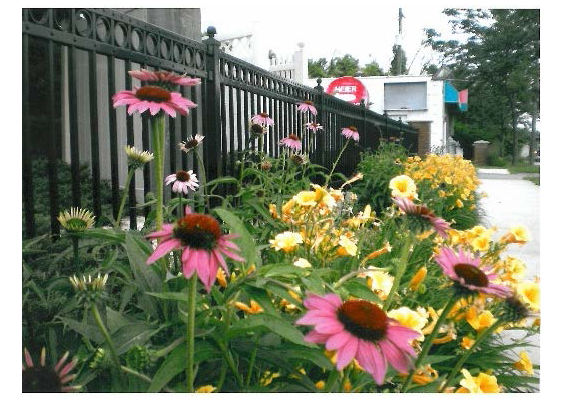
Intent. Landscaping, greenbelts, and screening are necessary for the continued protection and enhancement of all land uses. Landscaping and greenbelts are capable of enhancing the visual image of the city, preserving natural features, improving property values, and alleviating the impact of noise, traffic, and visual distraction associated with certain uses. Screening is important to protect less-intensive uses from the noise, light, traffic, litter and other impacts of more intensive, nonresidential uses. Accordingly, these provisions are intended to set minimum standards for the design and use of landscaping, greenbelts, and screening, and for the protection and enhancement of the city's environment. More specifically, the intent of these provisions is to:
1.
Improve the appearance of off-street parking areas, vehicular use areas, and property abutting public rights-of-way,
2.
Protect and preserve the appearance, character, and value of the neighborhoods that abut nonresidential areas, parking areas, and other intensive use areas, thereby protecting the public health, safety and welfare,
3.
Reduce soil erosion and depletion,
4.
Increase soil water retention, thereby helping to prevent flooding,
5.
Reduce stormwater pollution, temperature, and rate of volume of flow, and
6.
Encourage the use of native plantings.
B.
Scope of application. These requirements shall apply to all uses which are developed, expanded, or changed and to all lots, sites, and parcels which are developed or expanded upon following the effective date of this ordinance. No site plan shall be approved unless it shows landscaping consistent with the requirements of this section.
Where landscaping is required, a building permit shall not be issued until the required landscape plan is submitted and approved, and a certificate of occupancy shall not be issued unless provisions set forth in this section have been met or a performance guarantee has been posted in accordance with the provisions set forth in section 2.17.
C.
Minimum requirements. The requirements in this article are minimum requirements, and under no circumstances shall they preclude the developer, property owner and the city from agreeing to more extensive landscaping.
D.
Design creativity. Creativity in landscape design is encouraged. Accordingly, required trees and shrubs may be planted at uniform intervals, at random, or in groupings, depending on the designer's desired visual effect and, equally important, the intent of the city planning commission to coordinate landscaping on adjoining properties.
(Ord. No. 128-B, § I, 9-20-10)
Sec. 5.02 - General landscaping requirements.
A.
General site requirements. All developed portions of the site shall conform to the following general landscaping standards, except where specific landscape elements, such as a greenbelt, streetscape elements, berms, or screening are required:
1.
All unpaved portions of the site shall be planted with grass, ground cover, shrubbery, or other suitable live plant material, which shall extend to any abutting street pavement edge. Grass areas in the front yard of all nonresidential uses shall be planted with sod.
2.
A mixture of evergreen and deciduous trees shall be planted on nonresidential parcels at the rate of one tree per 3,000 square feet or portion thereof of any unpaved open area for which specific landscaping requirements do not appear later in this article. Required trees may be planted at uniform intervals, at random, or in groupings.
B.
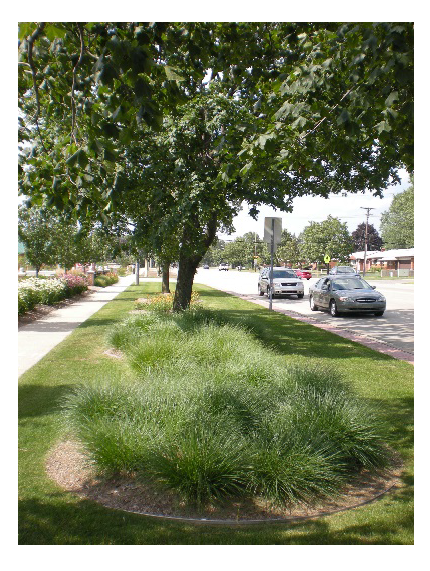
Tree lawn. One street tree (minimum two and one-half-inch caliper) shall be required for every 40 linear feet of tree lawn. The tree lawn (public rights-of-way) shall be defined as the area located between the sidewalk or non-motorized pathway and the street curb line. Additional landscape materials may be required in specially designated areas.
1.
Street trees:
a.
Variety: The species of street tree and exact locations shall be as specified on the future DDA Streetscape Plan. In areas outside of the DDA district, then planting of the salt-resistant, deciduous street trees shall be encouraged within the road rights-of-way at 40-foot intervals. Some of the acceptable tree types include Red Maple, Norway Maple.
b.
Cleveland Pear, Aristocrat Pear, Little Leaf Linden, Zelkova, Honeylocust and Oak.
c.
Street tree plan: A street tree plan shall be submitted for review and approval for any modifications that do not fit into the DDA's Streetscape Plan.
2.
Landscape plan: On every site involving new development or total redevelopment, a landscape plan shall be submitted for review and approval.
3.
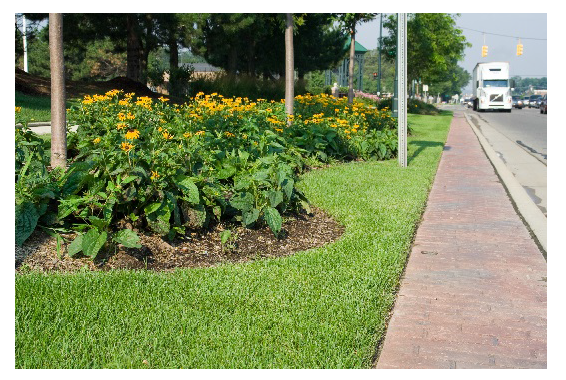
Landscape lighting: Up lighting of landscaping and trees is encouraged. Public rights-of-way located adjacent to required landscaped areas and greenbelts shall be planted with grass or other suitable live ground cover unless located in designated pedestrian areas. The area shall be maintained by the owner or occupant of the adjacent property as if the rights-of-way were part of the required landscaped areas or greenbelts. No plant materials, except for grass or ground cover shall be permitted closer than three feet from the edge of the road pavement or two feet from pedestrian pathways.
Planting areas shall be separated from lawn areas through the installation of professional landscape edging or similar method to minimize overgrowth of the turf.
C.
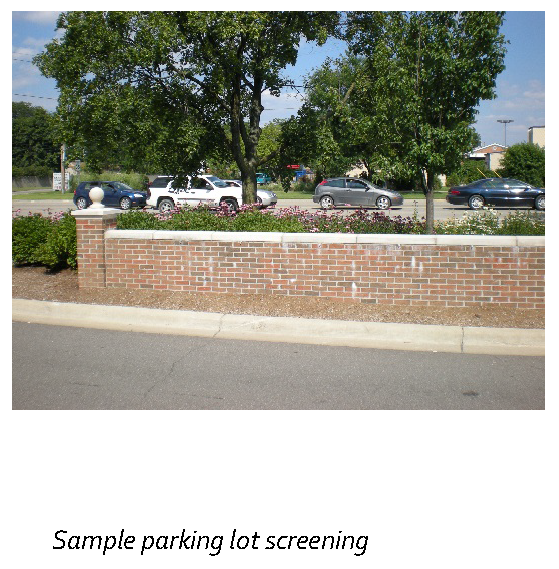
Parking lot screening. Screening adjacent to rights-of-way: All off-street parking areas located adjacent to rights-of-way shall be screened from view by one of the following:
1.
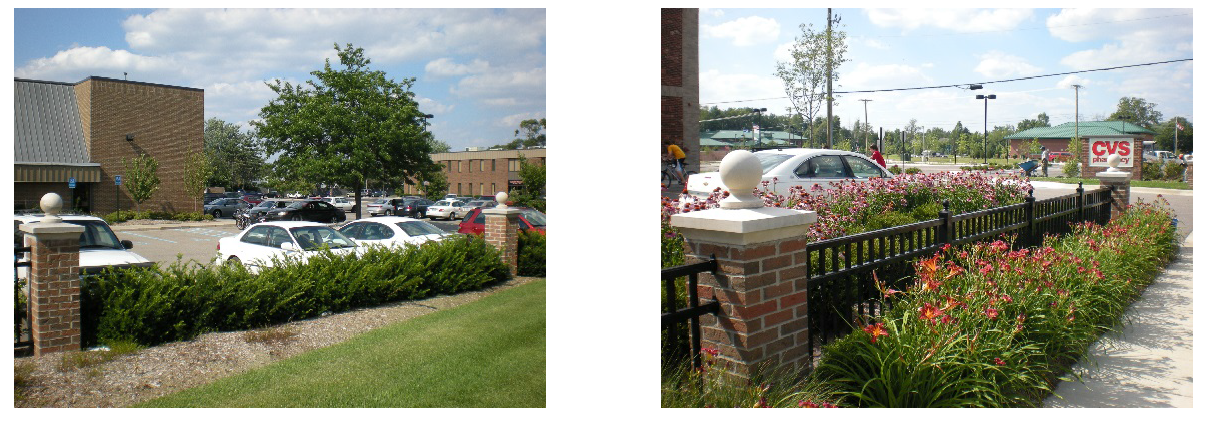
Ornamental fence or decorative masonry knee wall (maximum 30 inches high); or
2.
Evergreen hedge (maximum 30 inches high) and perennials; or
3.
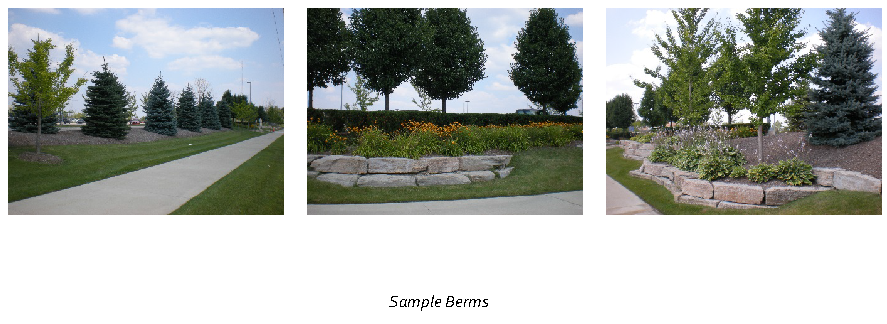
Landscape berm; or
4.
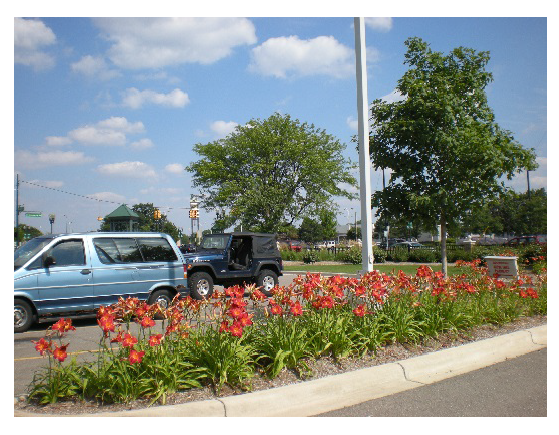
Combination of items 1.—3. above (see illustrations below).
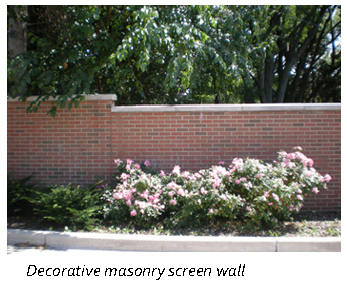
Screening adjacent to residential uses: Privacy walls shall be required whenever a nonresidential use in a commercial, office, or industrial district abuts directly upon land zoned or used for residential purposes. Privacy walls shall be six feet in height unless otherwise permitted. Required privacy walls shall be decorative and constructed of masonry material (e.g. face brick, decorative block, or poured concrete with simulated brick or stone patterns) that is architecturally compatible with the materials of the adjacent principal structure on site. Long wall faces shall be broken up with columns or pilasters to create a shadow line. Privacy walls shall be topped off with a wall cap.
Privacy walls shall be continuous along residential district boundaries unless a pedestrian opening (typically 36 inches wide) is required to connect to designated pedestrian pathways.
Location: Privacy walls shall be located on the lot line except where underground utilities interfere and except in instances where the zoning ordinance requires otherwise. Required walls may, upon approval of the board of zoning appeals, be located on the opposite side of an alley right-of-way from a nonresidential zone that abuts a residential zone when mutually agreeable to affected property owners.
Berms: Where required, berms shall conform to the following standards:
1.
Dimensions. Required berms shall be at least three feet above grade elevation, and shall be constructed with slopes no steeper than one foot vertical for each three feet horizontal (33 percent slope), with at least a two-foot flat area on top. The planning commission may modify the height requirements in cases where sufficient room does not exist to construct a three-foot high berm.
2.
Protection from erosion. Any required berm shall be planted with sod, ground cover, or other suitable live plant material to protect it from erosion so that it retains its height and shape. The use of railroad ties, cement blocks, and other types of construction materials to retain the shape and height of a berm shall be prohibited unless specifically reviewed and approved by the planning commission.
3.
Required plantings. Unless otherwise specified (such as for the purposes of screening), a minimum of one deciduous or evergreen tree shall be planted for each thirty lineal feet or portion thereof of required berm, or alternatively, eight shrubs may be substituted for each required tree. Trees and shrubs may be planted at uniform intervals, at random, or in groupings.
4.
Measurement of berm length. For the purpose of calculating required plant material, berm length shall be measured along the exterior edge of the berm.
Ornamental fencing: In lieu of a berm, parking lots may be screened with DDA approved ornamental fencing, brick piers, evergreen hedge or combination of above (see illustrations below).
General screening requirements: Unless otherwise specified, wherever an evergreen or landscaped screen is required, evergreen screening shall consist of closely spaced plantings which can be reasonably expected to form a complete visual barrier that is at least six feet above ground level within one year of planting. Wherever screening is required adjacent to residentially zoned or used property, the screening must be installed prior to the beginning of site grading and general construction, except where such activity would result in damage to the screening.
Screening of equipment. Mechanical equipment, such as air compressors, pool pumps, transformers, sprinkler pumps, satellite dish antennae, and similar equipment shall be screened on at least three sides. Insofar as practical, said screening shall exceed the vertical height of the equipment being screened by at least six inches within one years of planting.
D.
Interior parking lot landscaping. Any off-street parking lot, excluding loading, unloading and storage area in nonresidential districts containing more than 15 off-street parking spaces or 4,500 square feet of area, shall provide interior parking lot landscaping in addition to required perimeter landscaping and screening. Wherever possible, parking lot landscaping shall be designed to improve safety of pedestrian and vehicular traffic, guide traffic movement, and improve the appearance of the parking area. Interior parking lot landscaping may be peninsular or island types.
1.
Landscape area. For each 100 square feet, or fraction thereof, of vehicular use area, a minimum total of five square feet of landscape area shall be provided.
a.
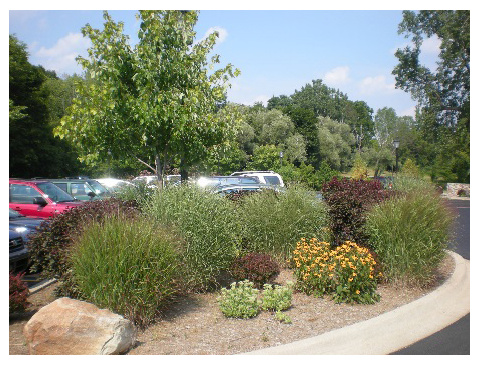
Minimum area. The minimum landscape island permitted shall be no less than eight feet in any single dimension and no less than 128 square feet in total area. (Note: A minimum four-foot dimension to all trees from edge of pavement where vehicles overhang is required.) Landscape areas in or adjacent to parking lots shall be protected with curbing or other means to prevent encroachment of vehicles.
b.
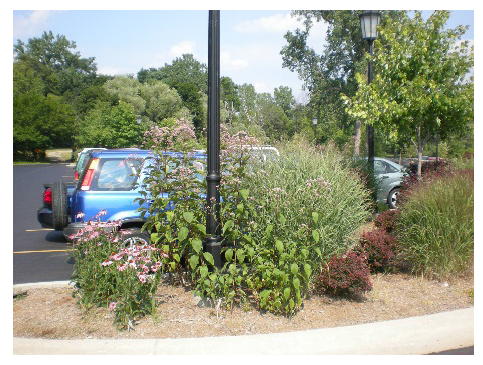
Maximum contiguous area. In order to encourage the required landscape areas to be properly dispersed, no individual landscape area shall be larger than 256 square feet in size. The least dimension of any required area shall be four feet minimum dimension to all trees from edge of pavement where vehicles overhang. Individual landscape areas larger than above are permitted as long as the additional area is in excess of the required minimum total.
2.
Minimum trees. Requirements for plant materials shall be based on the location, size, and shape of the parking lot landscaped areas. Required landscaping elsewhere on the parcel shall not be counted in meeting the parking lot landscaping requirements. The following minimum is required, based upon total required parking lot landscaping:
a.
One deciduous tree and two shrubs (or four perennials) per 128 square feet of landscaped island area or part thereof. At least 50 percent of each interior landscaped area shall be covered with living plant materials: perennials, shrubs, living ground cover or sod not to exceed 30 inches in height.
b.
Trees shall have a clear trunk of at least five feet above the ground. Plantings within parking lots shall comply with the requirements for unobstructed site distance set forth in section 5.02G, herein.
3.
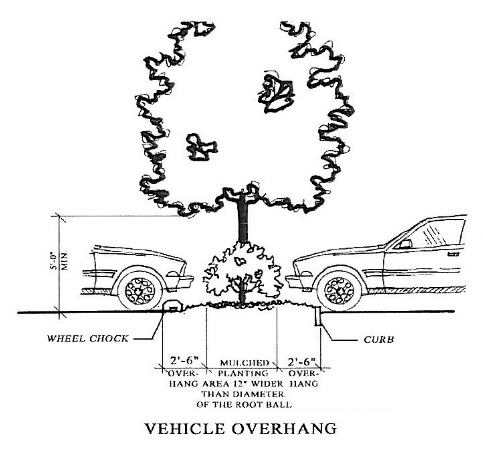
Vehicle overhang. Parked vehicles may hang over the interior landscaped area no more than two and one-half feet, as long as concrete or other wheel stops are provided to insure no greater overhang or penetration of the landscaped area (see figure "vehicle overhang").
E.
Greenbelts and landscape buffer zones. Where required, greenbelts and landscape buffer zones shall conform to the following standards:
1.
Dimensions. Unless otherwise indicated or appropriate, required greenbelts shall be at least eight feet in width. A required greenbelt may be interrupted only to provide for pedestrian or vehicular access.
2.
Required plantings.
a.
Grass or ground cover requirements. Grass, ground cover, or other suitable live plant materials shall be planted over the entire greenbelt area, except where paved walkways are used.
b.
Tree and shrub requirements. Unless otherwise specified (such as for the purposes of screening), a minimum of one deciduous (minimum two and one-half-inch caliper) or evergreen tree (minimum six-foot high) and eight shrubs (or 16 perennials) shall be planted for each 30 lineal feet or portion thereof of required buffer zone. Eight shrubs may be substituted for each required tree per the discretion of the city planner/landscape architect. Trees and shrubs may be planted at uniform intervals, at random, or in groupings.
c.
Distance from sidewalks. Plant material shall not be placed closer than four feet from the right-of-way line where the greenbelt abuts a public sidewalk.
3.
Measurement of greenbelt length. For the purposes of calculating required plant material, greenbelt length shall be measured along the exterior edge of the greenbelt.
F.
Open area landscaping. All unpaved portions of the site shall be planted with grass, ground cover, perennials, shrubs, or other suitable live plant materials, which shall extend to any abutting street pavement edge. A mixture of evergreen and deciduous trees shall be planted on nonresidential parcels at the rate of one tree per 3,000 square feet or portion thereof of any unpaved open area for which specific landscaping requirements do not apply. Required plantings may be planted at uniform intervals, at random, or in groupings.
G.
Maintenance of unobstructed visibility for drivers. No landscaping shall be erected, established, or maintained on any parcel or in any parking lot which will obstruct the view of drivers. Accordingly, all landscaping shall comply with the provisions concerning unobstructed sight distance set forth in section 2.09, subsection A.7., herein. Furthermore, interior landscaping in parking lots shall not be permitted to obstruct cross-visibility between a height of 30 inches and six feet above the grade level of the parking lot.
H.
Potential damage to utilities. In no case shall landscaping material be planted in a way which will interfere with or cause damage to underground utility lines, public roads, or other public facilities. Species of trees whose roots are known to cause damage to public roadways, sewers, or other utilities shall not be planted closer than 15 feet from any such roadways, sewers, or utilities.
I.
Landscaping of divider medians. Where traffic on driveways, maneuvering lanes, private roads, or similar vehicle accessways is separated by a divider median, the median shall be curbed and have a minimum width of ten feet. A minimum of one deciduous or evergreen tree shall be planted for each 30 lineal feet or portion thereof of median. Trees may be planted at uniform intervals, at random, or in groupings, but in no instance shall the center-to-center distance between trees exceed 60 feet.
J.
Irrigation. The proposed method of irrigating landscape areas shall be indicated on the site plan. Landscape and turf areas shall be irrigated to maintain plant materials in good and healthy condition. Hose bibs (water outlets) shall be provided within 100 feet of all plant material unless a sub-grade irrigation system is installed. Any irrigation or watering system shall be continuously maintained and kept in good working order.
K.
Street trees in single-family districts. A minimum of one deciduous tree shall be planted on each single family parcel on which a new dwelling unit is proposed to be constructed.
L.
Bioretention (rain gardens). Wherever feasible, bioretention areas (or rain gardens) are encouraged. Bioretention areas are shallow surface depressions planted with specially selected native vegetation to capture and treat stormwater runoff from rooftops, streets, and parking lots.
Key design features:
•
Flexible in size and infiltration
•
Ponding depths 6—18 inches for drawdown within 48 hours
•
Native plants
•
Amend soil as needed
•
Provide positive overflow for extreme storm events
•
Bioretention can accomplish the following:
•
Reduce runoff volume
•
Filter pollutants through both soil particles (which trap pollutants) and plant material (which take up pollutants)
•
Provide habitat
•
Recharge groundwater (if no underdrain is placed underneath)
•
Reduce stormwater temperature impacts
•
Enhance site aesthetics
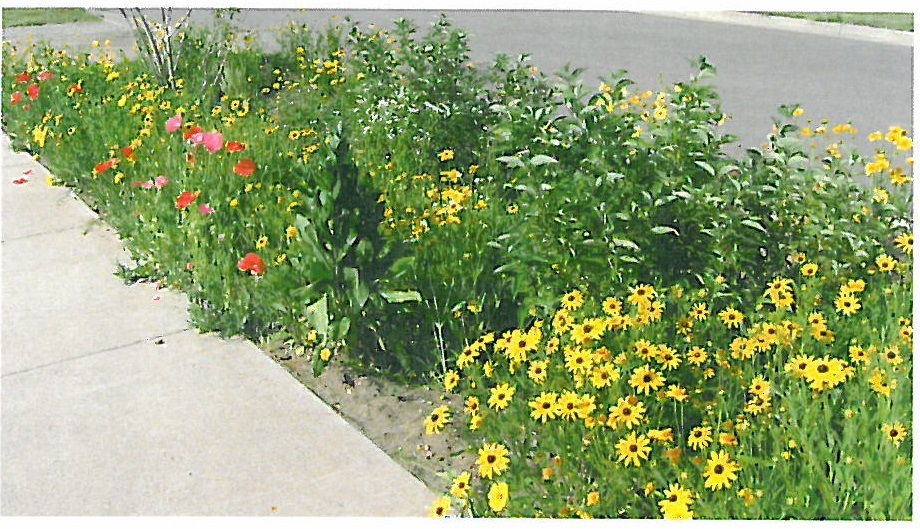
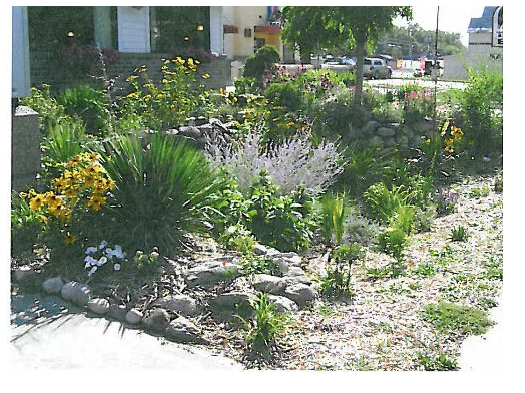
Sample Rain Gardens
M.
Stormwater management pond landscaping. Where any pond, retention basin, detention basin, or other constructed stormwater management facility is required, it shall comply with the following requirements:
1.
Basin configurations shall be incorporated into the natural topography to the greatest extent possible. Where this is not practical, the basin shall be shaped to emulate a naturally formed or free form depression. The basin edge shall consist of sculptured landforms to filter and soften views of the basin.
2.
Basins shall be designed to avoid the need for perimeter fencing. Where such fencing is necessary, the location and design shall be subject to planning commission approval.
3.
Basins shall be planted with a mixture of groundcover and wetland-based plantings native to Michigan, such as native grasses or wildflowers.
4.
A perimeter greenbelt shall be provided in accordance with the following:
a.
Plantings shall be clustered around the basin to achieve a variety of plant materials and to replicate a natural environment. Deciduous shade trees shall be clustered around the south and west sides of the basin to provide shade and minimize solar heating of the water.
b.
Trees shall be planted above the average water level of the basin. Any plantings proposed below the average water level shall be tolerant of wet or moist soil conditions. The location of plant materials shall take into consideration the need to provide access for routine basin maintenance.
(Ord. No. 128-B, § I, 9-20-10)
Sec. 5.03 - Specific landscaping requirements for zoning districts.
A.
Requirements for commercial, office and industrial districts. In addition to the general landscaping requirements set forth in section 5.02, all lots or parcels of land developed upon in the commercials, office, or industrial zoning districts shall comply with the following landscaping requirements:
1.
Front yard berm requirements. Wherever front, side, or rear yards adjacent to public rights-of-way are used for parking, a berm shall be required to screen the parking from view of the road. The berm shall be a minimum of three feet in height, and shall be planted in accordance with section 5.02, subsection B. The berm shall be located totally on private property, adjacent to the road right-of-way line.
2.
Protective screening requirements. Protective screening in the form of a berm or an obscuring wall shall be required wherever a nonresidential use in a commercial, office, or industrial district abuts directly upon land zoned for residential purposes. Berms used for screening shall be a minimum of four feet in height, and shall be planted in accordance with section 5.02B, above. If a wall is used instead of a berm, the requirements of section 5.08 shall be complied with.
3.
Landscaping adjacent to roads. All front, side, or rear yards adjacent to roads, including berm areas, shall be landscaped in accordance with the following standards (see illustration):
A minimum of one deciduous or evergreen tree shall be planted for each 40 lineal feet or portion thereof of road frontage, plus a minimum of one ornamental tree shall be planted for each 100 lineal feet or portion thereof of road frontage, plus a minimum of eight shrubs shall be planted for each 40 lineal feet or portion thereof of road frontage. For the purposes of computing length of road frontage, openings for driveways and sidewalks shall not be counted. Trees and shrubs may be planted at uniform intervals, at random, or in groupings.
B.
Requirements for manufactured home park districts. All lots or parcels of land located in a district zoned for manufactured home park uses shall comply with the following landscaping requirements:
1.
General site landscaping. A minimum of one deciduous or evergreen tree shall be planted for each manufactured home lot. Deciduous trees may be planted between the curb and sidewalk, or in any other unpaved open area. Unless otherwise specified, required landscaping elsewhere in the manufactured home park shall not be counted in meeting these requirements for trees.
2.
Landscaping adjacent to roads. All front, side, or rear yards, adjacent to roads, including berm areas, shall be landscaped in accordance with the following standards:
A minimum of one deciduous or evergreen tree shall be planted for each 40 lineal feet or portion thereof of road frontage, plus a minimum of one ornamental tree shall be planted for each 100 lineal feet or portion thereof of road frontage, plus a minimum of eight shrubs shall be planted for each 40 lineal feet or portion thereof of road frontage. For the purposes of computing length of road frontage, openings for driveways and sidewalks shall not be counted. Trees and shrubs may be planted at uniform intervals, at random, or in groupings.
3.
Landscaping around manufactured homes. Areas between or surrounding manufactured homes, as well as other open areas, shall be covered with grass and landscaped with trees and shrubs. Any landscaping material used to satisfy the requirements of this sub-section may also be counted toward meeting the requirements for general site landscaping specified above.
4.
Protective screening requirements. Protective screening in the form of a berm or an obscuring wall shall be required wherever development in a manufactured home park district abuts directly upon land zoned for residential purposes. Berms shall be a minimum of four feet in height, and shall be planted in accordance with section 5.02, subsection B. If a wall is used instead of a berm, the requirements of section 5.08 shall be complied with.
C.
Requirements for multiple-family districts. In addition to the general landscaping requirements set forth in section 5.02, above, all lots or parcels of land located in multiple-family zoning districts shall comply with the following landscaping requirements:
1.
General site landscaping. A minimum of two deciduous or evergreen trees, plus four shrubs shall be planted per dwelling unit. Unless otherwise specified, required landscaping elsewhere in the multiple-family development shall not be counted in meeting these requirements for trees.
2.
Landscaping variety. In order to encourage creativity in landscaping and to minimize tree loss caused by species-specific disease, a variety of tree species shall be required, as specified in the following schedule:
3.
Protective screening requirements. Protective screening in the form of a berm or an obscuring wall shall be required wherever development in a multiple-family district abuts directly upon land zoned for single-family residential purposes. Berms shall be a minimum of four feet in height, and shall be planted in accordance with section 5.02, subsection B. If a wall is used instead of a berm, the requirements of section 5.08 shall be complied with.
4.
Privacy screen. Where multiple family dwellings are designed so that rear open areas or patio areas front onto a public street, a landscaped privacy screen shall be provided (see illustration). Such screen may consist of a combination of trees, shrubs, and berming, subject to review by the planning commission.
5.
Landscaping adjacent to a highway. Where multiple-family dwellings abut a highway or freeway, a landscaped buffer shall be provided to screen noise and views. The buffer shall consist of a combination of closely-spaced evergreens and earth mounding, providing a total minimum design height of 11 feet. The size and placement of plantings should provide for a complete visual barrier at the desired height within five years of planting. The planning commission may modify these requirements where noise mitigation measures, such as walls, have been constructed in the freeway right-of-way.
D.
Requirements for nonresidential uses in residential districts. In addition to the general landscaping requirements set forth in section 5.02, above, all nonresidential uses developed in residential districts shall comply with the following landscaping requirements:
1.
Protective screening requirements. Protective screening in the form of a berm or an obscuring wall shall be required wherever a nonresidential use in a residential district abuts directly upon land zoned for residential purposes. Berms shall be a minimum of four feet in height, and shall be planted in accordance with section 5.02, subsection B. If a wall is used instead of a berm, the requirements of section 5.08 shall be complied with.
2.
Screening of off-street parking. A four-foot high obscuring wall shall be required along all sides of any off-street parking or vehicle use area constructed to serve a nonresidential use in a residential district, where said off-street parking or vehicle use area is located within 25 feet of any land zoned for residential use.
3.
Landscaping adjacent to roads. The front, side, or rear yards adjacent to roads shall be landscaped in accordance with the following standards:
A minimum of one deciduous or evergreen tree shall be planted for each 40 lineal feet or portion thereof of road frontage, plus a minimum of one ornamental tree shall be planted for each 100 lineal feet or portion thereof of road frontage, plus a minimum of eight shrubs shall be planted for each 40 lineal feet or portion thereof of road frontage. For the purposes of computing length of road frontage, openings for driveways and sidewalks shall not be counted. Trees and shrubs may be planted at uniform intervals, at random, or in groupings.
(Ord. No. 128-B, § I, 9-20-10)
Sec. 5.04 - Standards for landscape materials.
Unless otherwise specified, all landscape materials shall comply with the following standards:
A.
Plant quality. Plant materials used in compliance with the provisions of this ordinance shall be nursery grown, free of pest and diseases, hardy in southern Wayne County, shall have passed inspections required under state regulations, and shall be in accordance with the minimum recommended standards set forth in the latest edition of horticultural standards of the American Associations of Nurserymen, Inc. Furthermore, plant material shall conform to the standards of the Wayne County Cooperation Extension Service. Native plantings are encouraged.
B.
Prohibited plant material. The use of non-native, invasive species of plants are prohibited. Plastic and other non-living plant materials shall not be considered acceptable to meet the landscaping requirements of this ordinance.
C.
Plant material specifications. The following specifications shall apply to all plant material proposed in accordance with the landscaping requirements of this ordinance:
1.
Deciduous shade trees. Deciduous shade trees shall be a minimum of two and one-half inches in caliper measured 12 inches above grade with the first branch a minimum of four feet above grade when planted.
2.
Deciduous ornamental trees. Deciduous ornamental trees shall be a minimum of one and one-half inches in caliper measured six inches above grade with a minimum height of four feet above grade when planted.
3.
Evergreen trees. Evergreen trees shall be a minimum of six feet in height when planted. Furthermore, evergreen trees shall have a minimum spread of three feet, and the size of the burlapped root ball shall be at least ten times the caliper measured six inches above grade.
4.
Shrubs. Shrubs shall be a minimum of two feet in height when planted, except that columnar evergreen shrubs, such as juniper, yew and arborvitae species, shall be a minimum of three feet in height when planted. Low growing shrubs shall have a minimum spread of 18 inches when planted.
5.
Hedges. Hedges shall be planted and maintained so as to form a continuous, unbroken, visual screen within two years after planting, barring unusual growing conditions, such as drought or disease. Hedges shall be a minimum of two feet in height when planted.
6.
Vines. Vines shall be a minimum of 30 inches in length after one growing season.
7.
Ground cover. Ground cover use in lieu of turf grasses in whole or in part shall be planted in such a manner as to present a finished appearance and reasonably complete coverage after one complete growing season.
8.
Grass. Grass area shall be planted using species normally grown as permanent lawns in southern Wayne County. Grass, sod, and seed shall be clean and free of weeds, pests, and diseases. Grass may be sodded, plugged sprigged or seeded, except that sod shall be installed in swales or other areas that are subject to erosion, and in the front yard areas of all nonresidential uses. When grass is to be established by a method other than complete sodding or seeding, nurse grass seed shall be sown for immediate effect and protection until complete coverage is otherwise achieved. Straw or other mulch shall be used to protect newly seeded areas.
9.
Mulch. Mulch use around trees, shrubs, and vines shall be a minimum of three inches deep, and installed in a manner as to present a finished appearance.
10.
Undesirable plant material. Use of the following plant materials (or their clones or cultivars) is not encouraged because of susceptibility to storm damage, disease, and other undesirable characteristics;
Box Elder
American Elm
Tree of Heaven
European Barberry
Northern Catalpa
Poplar
Willow
Horse Chestnut
Silver Maple
Trees with extensive root systems that may infiltrate the sewer system shall be prohibited in the right-of-way.
(Ord. No. 128-B, § I, 9-20-10)
Sec. 5.05 - Installation and maintenance.
The following standards shall be observed where installation and maintenance of landscape materials are required:
A.
Installation. Landscaping shall be installed in a sound, workmanlike manner to ensure the continued growth of healthy plant material. Trees, shrubs, hedges, and vines shall be generously mulched at the time of planting.
B.
Protection from vehicles. Landscaping shall be protected from vehicle through use of curbs. Landscape areas shall be elevated above the pavement to a height adequate to protect the plants for snow removal, salt, and other hazards.
C.
Off-season planting requirements. If development is completed during the off-season when plants cannot be installed, the owner shall provide a performance guarantee to ensure installation of required landscaping in the next planting season, in accordance with section 2.17.
D.
Maintenance. Landscaping required by this ordinance shall be maintained in a healthy, neat, and orderly appearance, free from refuse and debris. All unhealthy and dead plant material shall be replaced immediately upon notice from the building official, unless the season is not appropriate for planting, in which case such plant material shall be replaced at the beginning of the next planting season.
All landscaped areas shall be provided with a readily available and acceptable supply of water, with at least one spigot located within 300 feet of all plant material to be established and maintained. Trees, shrubs, and other plantings and lawn areas shall be watered regularly throughout the growing season.
All constructed or manufactured landscape elements, such as but not limited to benches, retaining walls, edging, and so forth, shall be maintained in good condition and neat appearance. Rotted, deteriorated, or damaged landscape elements shall be repaired, replaced, or removed.
E.
Performance guarantee.
1.
Performance bond.
a.
Whenever a site plan requires any type of landscaping, the applicant may be required to post a performance bond prior to the issuance of a temporary or final certificate of occupancy to ensure the completion of landscaping (including irrigation) if the landscaping is not 100 percent complete when any certificate of occupancy is requested. The city will inspect the landscaping and determine the percentage of completion and a performance bond must be submitted to the city by the developer in the sum equal to the unfinished portion of the landscape work. If the landscaping is 100 percent compete and approved no performance bond will be required.
b.
If a performance bond is required it must be a cash bond or a corporate surety bond or irrevocable bank letter of credit in the full amount of the sum due as determined by the city.
2.
Maintenance bond. A maintenance bond in the sum of 25 percent of estimated cost of landscaping (including irrigation) must be posted prior to the issuance of any certificate of occupancy (including temporary). The maintenance bond is held for a period of two years, at the end of which time the city shall inspect the landscaping. Once any issues identified during the inspection are addressed the unused balance of the maintenance bond will be released.
(Ord. No. 128-B, § I, 9-20-10)
Sec. 5.06 - Treatment of existing plant material.
The following regulations shall apply to existing plant material:
A.
Consideration of existing elements in the landscape design. In instances where healthy plant material exists on a site prior to its development, the planning commission may permit substitution of such plant material in place of the requirements set forth previously in this section, provided such substitution is in keeping with the spirit and intent of this section and the ordinance in general.
Existing hedges, berms, walls, or other landscape elements may be used to satisfy the requirements set forth previously, provided that such existing elements are in conformance with the requirements of this section.
B.
Preservation of existing plant material. The purpose and intent of this section is to protect and maintain trees and woodlands within the city for the following reasons:
•
Trees are proven producers of oxygen, a necessary element for the survival of mankind;
•
Trees play an important role in the hydrologic cycle, transpiring considerable amounts of water each day, thereby precipitating dust and other particulate airborne pollutants from the air;
•
Trees play an important role in neutralizing wastewater, which passes through the ground from the surface to groundwater tables and lower aquifers;
•
Trees, through their root systems, stabilize the soil and play an important and effective part in soil conservation, erosion control and flood control;
•
Trees are an invaluable physical and psychological addition to the city, making life more comfortable by providing shade, by cooling both air and land, by reducing noise levels and glare, and by breaking the visual monotony of development on the land;
•
Trees provide wildlife habitat and play other important ecological roles;
•
The protection of trees within the city is not only desirable, but essential to the present and future health, safety, and welfare of all the citizens of the city; and
•
Trees are matters of paramount public concern as provided by Article IV, Section 52 of the Constitution of the State of Michigan, as well as the Natural Resources and Environmental Protection Act of 1994 (PA 451 of 1994, as amended).
Site plans shall show all existing trees which are located in the portions of the site that will be built upon or otherwise altered, and are five inches or greater in caliper, measured 12 inches above grade.
Removing, damaging, or destroying trees. It shall be a violation of this chapter for any person to remove, damage or destroy a tree; or cause a tree to be removed, damaged or destroyed unless such removal, damage or destruction is in compliance with the requirements of this chapter or is authorized by site plan approval.
Definitions.
Critical root zone or dripline means the area where a tree's roots are located. The critical root zone is described by a circle around the tree with one foot of radius for each one inch D.B.H. of the tree.
Diameter at breast height or D.B.H. means a tree's diameter in inches measured 54 inches above grade level.
Tree or protected tree or regulated tree means a living, woody, self-supporting plant with a diameter of five inches or greater D.B.H.
Tree removal plan means a one inch (or more) equals 200 feet scale aerial or drawing to scale, plotted by accurate techniques, that provides the location of all trees protected under the provisions of this chapter and the common name of all such trees together with their D.B.H.; tree protection measures; and a tree replacement plan. The tree removal plan shall be prepared by and signed and sealed by a registered landscape architect, registered forester, or certified arborist.
C.
Tree removal. Before any protected tree is removed or relocated on land requiring site plan approval, the owner of the land involved shall make application to the city for a tree removal permit. The application shall include a tree location survey including a tree removal and replacement plan.
The reviewing authority shall not approve the removal of any tree unless it determines that one or more of the following conditions exist:
•
The tree poses a safety hazard to pedestrian or vehicular traffic or unmanageably threatens to cause disruption to public utility services.
•
The tree poses a safety hazard to buildings or structures.
•
The tree completely prevents access to a lot or parcel, without any reasonable alternative means of access.
•
The tree unreasonably prevents development of a lot or parcel, or the physical use thereof.
•
The tree is diseased or has been weakened by age, storm, fire or other injury that was not inflicted or caused by or on behalf of the landowner and that the resulting condition of the tree poses a real danger to persons or property.
•
All reasonable alternatives to removal of the tree must first have been considered and rejected as impractical or unfeasible.
Trees shall be labeled "To Be Removed" or "To Be Saved" on the site plan. If existing plant material is labeled "To Be Saved" on the site plan, protective measures should be implemented, such as the placement of fencing or stakes at the dripline around each tree. No vehicle or other construction equipment shall be parked or stored within the dripline of any tree or other plant material intended to be saved.
In the event that healthy plan materials which are intended to meet the requirements of the ordinance are cut down, damaged or destroyed during construction, said plant material shall be replaced with the same species as the damaged or removed tree, in accordance with the following schedule, unless otherwise approved by the building official based on consideration of the site and building configuration, available planting space, and similar considerations:
In lieu of actual tree replacement on site, the planning commission may allow an escrow payment to the city's tree replacement fund if circumstances warrant. The amount of the payment to be determined by the city engineer or planner.
D.
Tree protection.
1.
Identifying trees to be removed. All trees that have been approved for removal shall be identified on site by fluorescent orange spray paint or by red flagging tape prior to development. Trees selected for transplanting shall be flagged with a separate distinguishing color. All tree flag colors to be used in the field shall be noted on the tree removal plan.
2.
Critical root zone/dripline. No person shall conduct activity within the critical root zone/dripline of any tree designated for preservation, including, but not limited to, the storage or placing of solvents, building materials, construction equipment or soil deposits, or the parking of any vehicles.
3.
Tree protection fence. Prior to any development, land clearing, grading, or other site work commencing on the site, the developer or builder shall provide and maintain tree protection fences around the critical root zone of all trees to be preserved.
a.
Construction. Tree protection fencing shall be constructed of one-inch by one-inch boards, or similar sturdy stock, to shield protected trees. Snow fencing or other similar temporary fencing using vinyl or plastic as the primary fence material are not suitable. Details of the tree protection fences must be included on the tree removal plan.
b.
Exceptions. Street rights-of-way, utility easements, and large areas separate from construction or land clearing activities where no equipment or materials will be stored may be cordoned by placing stakes a minimum of 50 feet apart and tying ribbon, plastic tape, or other brightly visible materials at least 30 inches above the ground along the outside perimeter of areas to be cleared.
4.
Tree protection fence inspection. The location and construction of tree protection fences on the site must be inspected and approved by the city before any construction activity, tree removal, or land balancing activity commences. Protective fences shall remain in place until the city authorizes their removal or issues a final certificate of occupancy, whichever occurs first.
5.
Attachments prohibited. No damaging attachment, wires (other than supportive wires for a tree), signs or permits may be fastened to any tree protected by this section.
E.
Emergency tree removal. When in the interest of public safety, health and general welfare, it becomes necessary to remove trees damaged or destroyed by high winds, storms, tornados, floods, freezes, snows, fires, or manmade and natural disasters not inflicted or condoned by the landowner or his or her agent, the building official may excuse noncompliance with this section, provided that the landowner so notifies the planning commission of such removal and the reason therefore within ten days of the disaster.
(Ord. No. 128-B, § I, 9-20-10)
Sec. 5.07 - Modifications to landscape.
In consideration of the overall design and impact of a specific landscape plan, and in consideration of the amount of existing plant material to be retained on the site, the planning commission may modify the specific requirements outlined herein, provided that any such adjustment is in keeping with the intent of this section and the ordinance in general. In determining whether a modification is appropriate, the planning commission shall consider whether the following conditions exist:
Topographic features or other unique features of the site create conditions such that strict application of the landscape regulations would result in a less effective screen than an alternative landscape design.
Parking, vehicular circulation, or land use are such that required landscaping would not enhance the site or result in the desired screening effect.
The public benefit intended by the landscape regulations could be better-achieved with a plan that varies from the strict requirements of the ordinance.
(Ord. No. 128-B, § I, 9-20-10)
Sec. 5.08 - Obscuring walls and fences.
A.
Obscuring wall and fence standards. Where permitted or required by this ordinance, obscuring walls shall be subject to the following regulations:
1.
Location. Required obscuring walls and fences shall be placed inside and adjacent to the lot line except in the following instances:
•
Where underground utilities interfere with placement of the wall or fence on the property line, the wall shall be placed on the utility easement line located nearest the property line.
•
In residential districts, no fence shall be constructed closer to the road than the front building line, except that fences may be constructed in the front yard in the R-1-E district if the lot is one acre or more in size.
2.
Time of construction. Wherever construction of an obscuring wall or fence is required adjacent to residentially zoned or used property, the wall or fence shall be installed prior to the beginning of site grading and general construction, except where such activity would result in damage to the wall or fence.
3.
Corner clearance. Obscuring walls and fences shall comply with the specification for maintenance of unobstructed sight distance for drivers as set forth in section 2.09.
4.
Substitution. As a substitute for a required obscuring wall or fence, the planning commission may, in its review of the site plan, approve the use of other existing and/or proposed natural or manmade landscape features (such as closely spaced evergreens) that would produce substantially the same results in terms of screening, durability, and permanence. The character of adjoining uses and the preference of adjoining residents or businesses shall be taken into consideration in determining whether any such substitution is appropriate.
5.
Wall specifications. Required obscuring walls shall comply with the following height requirements, unless otherwise specified in this ordinance:
6.
Fence specifications. Fences erected for screening purposes shall be six feet in height unless otherwise specified in this ordinance, and shall be constructed of redwood, cedar, or No. 1 pressure-treated wood. Chain link fences shall not be permitted for screening purposes.
7.
Compliance with fence ordinance. All fences and walls shall be constructed in compliance with the applicable provisions as noted section 2.20 herein.
(Ord. No. 128-B, § I, 9-20-10)
Sec. 5.09 - Residential fences and walls.
Fences or walls in residential districts, whether for the purposes of screening or decorative landscaping, shall be subject to the regulations set forth in section 2.20 herein.
(Ord. No. 128-B, § I, 9-20-10)
Sec. 5.10 - Entranceway structures.
Entranceway structures shall be permitted in any required yard area for the purpose of identifying the entrance to a subdivision, multiple-family development, manufactured home park, office park, or other planned development containing several buildings that are related in purpose and use. All such entranceway structures shall be subject to the following regulations:
1.
Dimensions and setbacks. Entranceway structures shall not exceed 24 square feet in area and eight feet in height. All such structures shall be located on private property, no closer than five feet to the closest property line. Entranceway structures shall comply with the specification for maintenance of unobstructed sight distance for drivers as set forth in section 2.09.
2.
Signage. Signage on entranceway structures shall comply with the requirements in the city's sign ordinance, chapter 101.
3.
Construction and design. Entranceway structures shall be constructed or permanent, durable materials and shall be designed to be architecturally compatible with the surrounding development.
4.
Site plan. Prior to issuance of a building permit for an entranceway structure, a site plan shall be submitted for review and approval by the planning commission. The site plan shall include an elevation drawing and a cross-section of the proposed structure. The site plan shall also show the relationship of the entranceway to adjacent road rights-of-way.
(Ord. No. 128-B, § I, 9-20-10)

